LIS and Data Engagement Graham Lally Oxford Consultants for  Social Inclusion [email_address] http://www.ocsi.co.uk/
Coming up Data Engagement What is it? How can it be done?
What are we talking about? Go beyond just providing data - helping people to get the most use out of it too. "A commitment to open data involves making information and data resources accessible to all without discrimination;  and actively engaging to ensure that information and data can be used in a wide range of ways ." " [We need a way to] ...  get  beyond simply publishing datasets , and get to  supporting people to use data  to create  social, economic and administrative change. " - UK GovCamp 2012 (See  http://j.mp/data_stars  )
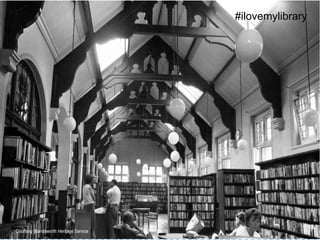
#ilovemylibrary
Libraries Libraries Have: A lot of different content A lot of different users So they need to find ways to make  finding ,  suggesting ,  using  information and  supporting  users as easy as possible Same challenge for LIS
But... New users and audiences have different backgrounds, skills, language, needs and questions Can get confusing quickly How can LIS approach it in a  clear, structured way ? What role(s) can/should LIS play?
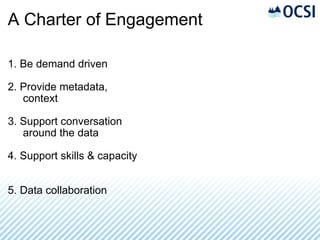
A Charter of Engagement 1. Be demand driven 2. Provide metadata,       context 3. Support conversation       around the data 4. Support skills & capacity 5. Data collaboration
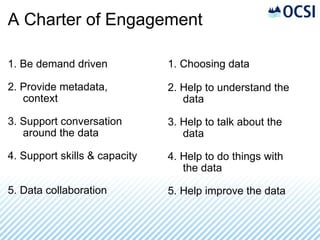
A Charter of Engagement 1. Be demand driven 2. Provide metadata,       context 3. Support conversation       around the data 4. Support skills & capacity 5. Data collaboration 1. Choosing data 2. Help to understand the       data 3. Help to talk about the        data 4. Help to do things with        the data 5. Help improve the data
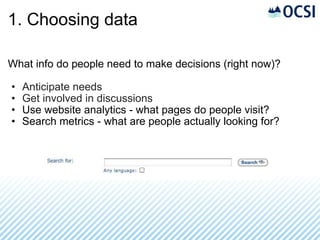
1. Choosing data What info do people need to make decisions (right now)? Anticipate needs Get involved in discussions Use website analytics - what pages do people visit? Search metrics - what are people actually looking for?
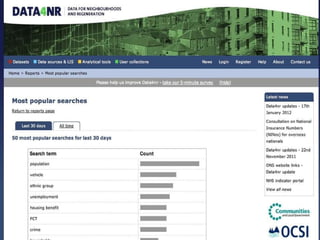
Search Metrics
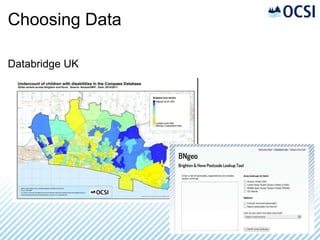
Choosing Data Databridge UK 
1. Choosing data Resources & Signposting  - where else could people look? Can people ask you  where something is? Simple, separate form for people to ask where they can find data?
2. Help to Understand the data Understand users - get on the road! Personas & User Acceptance Testing Is metadata easily accessible and clear? Is there information available on frequency of data updates, formats, reliability concerns, etc? Glossary or guide to the data Any other examples of data being used?
3. Help to Talk about the data Go to the conversation - what existing user groups are there? Be sharable Hyperlinks 'Share this' buttons for social media E-mail alerts News items/blog posts Be open Can users comment at your site? Can users reply to each other?
4. Help to Use the data Lead by example
 
4. Help to Use the data Lead by example Show examples of where data is being used Reports News articles Apps? Provide links to useful resources and support Local National General (e.g. http://www.improving-visualisation.org/case-studies)
5. Help to Improve the data What is missing? Why is it missing? How could it be added? What do people still need for  "social, economic and administrative change"?
What to do first? Remember, just a guide / some ideas But breaks complex area down into easy-to-digest chunks Can focus on what's most useful or appropriate for you
Thanks [email_address] http://www.ocsi.co.uk/

Data engagement and Local Information Systems

  • 1.
    LIS and DataEngagement Graham Lally Oxford Consultants for  Social Inclusion [email_address] http://www.ocsi.co.uk/
  • 2.
    Coming up DataEngagement What is it? How can it be done?
  • 3.
    What are wetalking about? Go beyond just providing data - helping people to get the most use out of it too. "A commitment to open data involves making information and data resources accessible to all without discrimination; and actively engaging to ensure that information and data can be used in a wide range of ways ." " [We need a way to] ... get beyond simply publishing datasets , and get to  supporting people to use data  to create social, economic and administrative change. " - UK GovCamp 2012 (See http://j.mp/data_stars )
  • 4.
  • 5.
    Libraries Libraries Have:A lot of different content A lot of different users So they need to find ways to make finding , suggesting ,  using  information and supporting  users as easy as possible Same challenge for LIS
  • 6.
    But... New usersand audiences have different backgrounds, skills, language, needs and questions Can get confusing quickly How can LIS approach it in a clear, structured way ? What role(s) can/should LIS play?
  • 7.
    A Charter ofEngagement 1. Be demand driven 2. Provide metadata,       context 3. Support conversation       around the data 4. Support skills & capacity 5. Data collaboration
  • 8.
    A Charter ofEngagement 1. Be demand driven 2. Provide metadata,       context 3. Support conversation       around the data 4. Support skills & capacity 5. Data collaboration 1. Choosing data 2. Help to understand the       data 3. Help to talk about the        data 4. Help to do things with        the data 5. Help improve the data
  • 9.
    1. Choosing dataWhat info do people need to make decisions (right now)? Anticipate needs Get involved in discussions Use website analytics - what pages do people visit? Search metrics - what are people actually looking for?
  • 10.
  • 11.
  • 12.
    1. Choosing dataResources & Signposting - where else could people look? Can people ask you where something is? Simple, separate form for people to ask where they can find data?
  • 13.
    2. Help toUnderstand the data Understand users - get on the road! Personas & User Acceptance Testing Is metadata easily accessible and clear? Is there information available on frequency of data updates, formats, reliability concerns, etc? Glossary or guide to the data Any other examples of data being used?
  • 14.
    3. Help toTalk about the data Go to the conversation - what existing user groups are there? Be sharable Hyperlinks 'Share this' buttons for social media E-mail alerts News items/blog posts Be open Can users comment at your site? Can users reply to each other?
  • 15.
    4. Help toUse the data Lead by example
  • 16.
  • 17.
    4. Help toUse the data Lead by example Show examples of where data is being used Reports News articles Apps? Provide links to useful resources and support Local National General (e.g. http://www.improving-visualisation.org/case-studies)
  • 18.
    5. Help toImprove the data What is missing? Why is it missing? How could it be added? What do people still need for  "social, economic and administrative change"?
  • 19.
    What to dofirst? Remember, just a guide / some ideas But breaks complex area down into easy-to-digest chunks Can focus on what's most useful or appropriate for you
  • 20.

Editor's Notes

  • #5 Putney Library in the 1960s. Libraries are places where books (and magazines, newspapers, audio, video, etc) are stored, but are much more than simply a content-store. Everyone loves libraries.
  • #8 Presenting the draft 5-star structure to Data Engagement that emerged from work by Tim Davies, Liz Stevenson, Anthony Zacharzewski, Jon Foster and Jag Goraya at UK GovCamp 2012. See http://bit.ly/data_stars for more information.
  • #9 Here we map this to more of a 5-part “data lifecycle” than a 5-star structure. It’s possible to do some stages without others.
  • #11 An example of showing search stats from behind the scenes at http://www.data4nr.net/
  • #12 Databridge was a project which OCSI worked on with Jo Ivens, helping a charity called Amaze (http://www.amazebrighton.org.uk/) to aggregate, correlate and display data. See http://databridgeuk.wordpress.com/ for more information on Databridge.
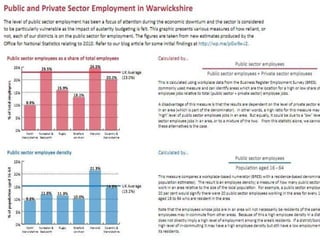
  • #17 An example of a small report published by Warwickshire Observatory (http://www.warwickshireobservatory.org/) – see http://wp.me/pGw9x-J2 for the original report. Of interest here is the very immediate inclusion of how the figures were calculated, and the associated explanatory notes.