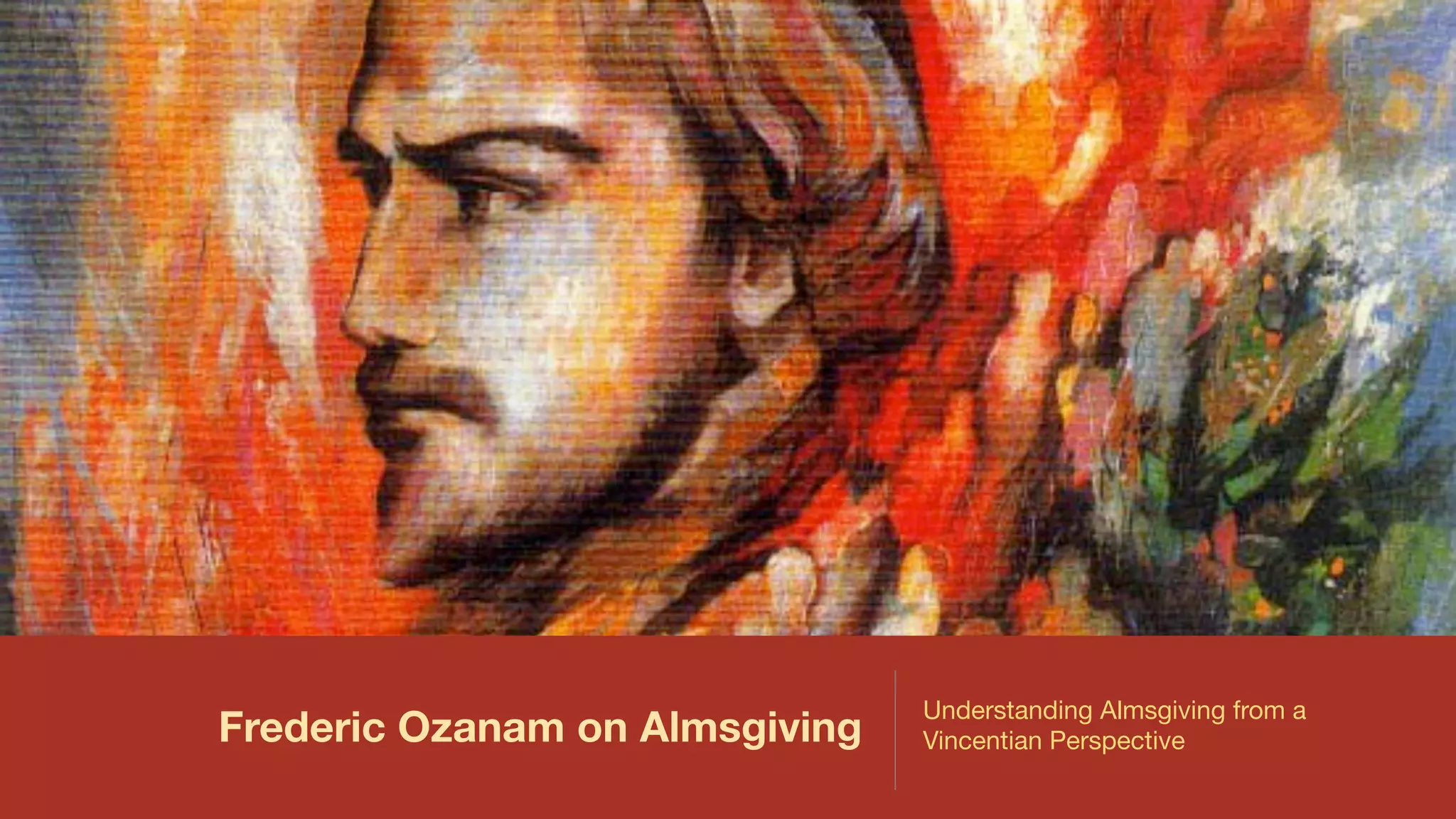
Frederic Ozanam on Almsgiving
Understanding Almsgiving from a
Vincentian Perspective
Almsgiving: For or Against?
• The Christian tradition of almsgiving is a
practice that is found in Scripture and
preached in the tradition of the Church.
• Socialists in 19th century France viewed
alms as an abuse of Christian society.
According to them, alms insulted the poor,
humiliating those who received these
offerings and doing nothing to lift them out
of their situation of poverty.
• Frederic Ozanam refuted these arguments
against almsgiving. On December 24th, his
article on this subject, De L’Aumone,
appeared in the newspaper L’Ere Nouvelle.
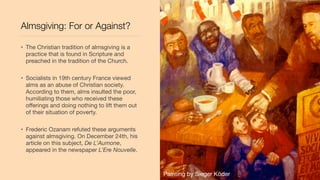
Painting by Sieger Köder
Ozanam’s Eloquent Defense
of the Practice of Almsgiving
• Do not believe those who speak of alms as
a deplorable abuse, as a means of
maintaining a patriarchal system that gives
and a class of slaves who receive. It is true
that alms impose a debt of gratitude on the
poor. But it is also true that there are
people who uphold the idea of a society in
which no one feels obligated, in which
everyone can feel cut off from everyone
else. [...] as if the whole economy of Divine
Providence did not consist of a reciprocity
of gratitude that can never be satisfied; as
if children were not eternally indebted to
their parents, and parents indebted to their
children, and citizens to their country; as if
there were someone here on earth so
isolated that this individual could say:
“Today I do not feel obligated to anyone!”
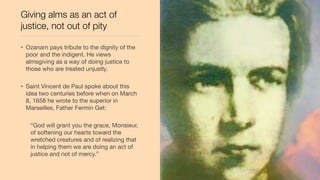
Early photograph of Ozanam
Alms as compensation for
free services
• Ozanam said: The indigent persons whom
we assist [are not] useless because
people who suffer serve God and
consequently, also serve society… they
pray and they fulfill a ministry of expiation,
a sacrifice whose merits revert to us.
• Therefore, just as a soldier receives
compensation for serving his country, and
a priest receives compensation for
offering the Eucharist. the poor also have
no wages attached to them and yet they
demand a certain reciprocity of benefits.
Therefore we cannot say that the poor
person is humiliated when treated like the
priest or the soldier.
Giving alms as an act of
justice, not out of pity
• Ozanam pays tribute to the dignity of the
poor and the indigent. He views
almsgiving as a way of doing justice to
those who are treated unjustly.
• Saint Vincent de Paul spoke about this
idea two centuries before when on March
8, 1658 he wrote to the superior in
Marseilles, Father Fermin Get:
“God will grant you the grace, Monsieur,
of softening our hearts toward the
wretched creatures and of realizing that
in helping them we are doing an act of
justice and not of mercy.”
Alms Should Be United With
the Lips and the Heart
• Another idea that Ozanam highlighted in
his article was the fact that the one who
gives and the one who receives are
equally obligated.
• The one who gives should never call at
the door of a poor family in a disrespectful
manner.
• Alms should not be given indifferently.
Ozanam expressed this idea in another
article that was published in L’Ere
Nouvelle on October 21, 1848: “The rich
person who gives his gold does so coldly
if he does not unite his lips and his heart
with his alms.”
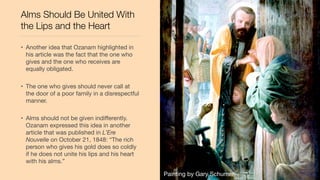
Painting by Gary Schumer
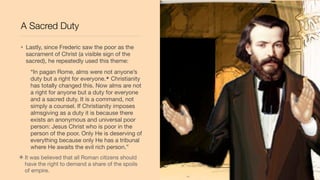
A Sacred Duty
• Lastly, since Frederic saw the poor as the
sacrament of Christ (a visible sign of the
sacred), he repeatedly used this theme:
“In pagan Rome, alms were not anyone’s
duty but a right for everyone.* Christianity
has totally changed this. Now alms are not
a right for anyone but a duty for everyone
and a sacred duty. It is a command, not
simply a counsel. If Christianity imposes
almsgiving as a duty it is because there
exists an anonymous and universal poor
person: Jesus Christ who is poor in the
person of the poor. Only He is deserving of
everything because only He has a tribunal
where He awaits the evil rich person.”
✴It was believed that all Roman citizens should
have the right to demand a share of the spoils
of empire.
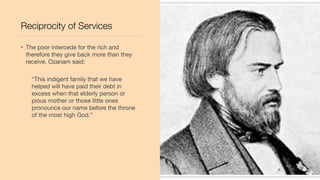
Reciprocity of Services
• The poor intercede for the rich and
therefore they give back more than they
receive. Ozanam said:
“This indigent family that we have
helped will have paid their debt in
excess when that elderly person or
pious mother or those little ones
pronounce our name before the throne
of the most high God.”
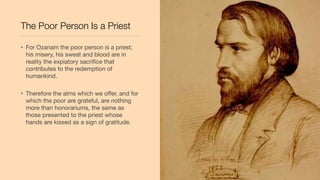
The Poor Person Is a Priest
• For Ozanam the poor person is a priest;
his misery, his sweat and blood are in
reality the expiatory sacrifice that
contributes to the redemption of
humankind.
• Therefore the alms which we offer, and for
which the poor are grateful, are nothing
more than honorariums, the same as
those presented to the priest whose
hands are kissed as a sign of gratitude.
Source:
Biography of Frederic Ozanam,
Sister M. Teresa Candelas, D.C.
http://famvin.org/wiki/
Biography_of_Frederic_Ozanam

Ozanam on Almsgiving

  • 1.
    Frederic Ozanam onAlmsgiving Understanding Almsgiving from a Vincentian Perspective
  • 2.
    Almsgiving: For orAgainst? • The Christian tradition of almsgiving is a practice that is found in Scripture and preached in the tradition of the Church. • Socialists in 19th century France viewed alms as an abuse of Christian society. According to them, alms insulted the poor, humiliating those who received these offerings and doing nothing to lift them out of their situation of poverty. • Frederic Ozanam refuted these arguments against almsgiving. On December 24th, his article on this subject, De L’Aumone, appeared in the newspaper L’Ere Nouvelle. Painting by Sieger Köder
  • 3.
    Ozanam’s Eloquent Defense ofthe Practice of Almsgiving • Do not believe those who speak of alms as a deplorable abuse, as a means of maintaining a patriarchal system that gives and a class of slaves who receive. It is true that alms impose a debt of gratitude on the poor. But it is also true that there are people who uphold the idea of a society in which no one feels obligated, in which everyone can feel cut off from everyone else. [...] as if the whole economy of Divine Providence did not consist of a reciprocity of gratitude that can never be satisfied; as if children were not eternally indebted to their parents, and parents indebted to their children, and citizens to their country; as if there were someone here on earth so isolated that this individual could say: “Today I do not feel obligated to anyone!” Early photograph of Ozanam
  • 4.
    Alms as compensationfor free services • Ozanam said: The indigent persons whom we assist [are not] useless because people who suffer serve God and consequently, also serve society… they pray and they fulfill a ministry of expiation, a sacrifice whose merits revert to us. • Therefore, just as a soldier receives compensation for serving his country, and a priest receives compensation for offering the Eucharist. the poor also have no wages attached to them and yet they demand a certain reciprocity of benefits. Therefore we cannot say that the poor person is humiliated when treated like the priest or the soldier.
  • 5.
    Giving alms asan act of justice, not out of pity • Ozanam pays tribute to the dignity of the poor and the indigent. He views almsgiving as a way of doing justice to those who are treated unjustly. • Saint Vincent de Paul spoke about this idea two centuries before when on March 8, 1658 he wrote to the superior in Marseilles, Father Fermin Get: “God will grant you the grace, Monsieur, of softening our hearts toward the wretched creatures and of realizing that in helping them we are doing an act of justice and not of mercy.”
  • 6.
    Alms Should BeUnited With the Lips and the Heart • Another idea that Ozanam highlighted in his article was the fact that the one who gives and the one who receives are equally obligated. • The one who gives should never call at the door of a poor family in a disrespectful manner. • Alms should not be given indifferently. Ozanam expressed this idea in another article that was published in L’Ere Nouvelle on October 21, 1848: “The rich person who gives his gold does so coldly if he does not unite his lips and his heart with his alms.” Painting by Gary Schumer
  • 7.
    A Sacred Duty •Lastly, since Frederic saw the poor as the sacrament of Christ (a visible sign of the sacred), he repeatedly used this theme: “In pagan Rome, alms were not anyone’s duty but a right for everyone.* Christianity has totally changed this. Now alms are not a right for anyone but a duty for everyone and a sacred duty. It is a command, not simply a counsel. If Christianity imposes almsgiving as a duty it is because there exists an anonymous and universal poor person: Jesus Christ who is poor in the person of the poor. Only He is deserving of everything because only He has a tribunal where He awaits the evil rich person.” ✴It was believed that all Roman citizens should have the right to demand a share of the spoils of empire.
  • 8.
    Reciprocity of Services •The poor intercede for the rich and therefore they give back more than they receive. Ozanam said: “This indigent family that we have helped will have paid their debt in excess when that elderly person or pious mother or those little ones pronounce our name before the throne of the most high God.”
  • 9.
    The Poor PersonIs a Priest • For Ozanam the poor person is a priest; his misery, his sweat and blood are in reality the expiatory sacrifice that contributes to the redemption of humankind. • Therefore the alms which we offer, and for which the poor are grateful, are nothing more than honorariums, the same as those presented to the priest whose hands are kissed as a sign of gratitude.
  • 10.
    Source: Biography of FredericOzanam, Sister M. Teresa Candelas, D.C. http://famvin.org/wiki/ Biography_of_Frederic_Ozanam