Media Policy Instruments to support
local journalism in the USA
NYPA’s spring convention, April 2022
Damian Radcliffe
@damianradcliffe
Plan for today
Session structure and goals
1. Why does this matter?
2. Why now?
3. 10 Ideas on the table
4. What this means for you
5. Q&A
I know it’s Saturday morning
(But hopefully that sounds good)
Virtual Introductions
About Me
 British – in USA since 2015
 Married (Habiba)
 3 x Children (Nyla, Yara and Rafi)
 1 cat (Oreo)
 Love(d) to travel (55 countries)
 BA and MA Oxford University
Many hats
Carolyn S. Chambers Professor in Journalism
University of Oregon
Fellow, Tow Center for Digital Journalism
Columbia University, Graduate School of Journalism
Honorary Research Fellow
Cardiff University, School of Journalism, Media and Culture Studies
Life Fellow
Royal Society for the encouragement of Arts, Manufactures and Commerce
(RSA)
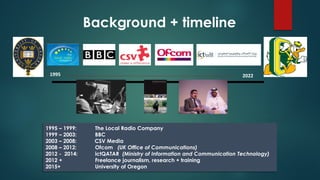
1995 – 1999: The Local Radio Company
1999 – 2003: BBC
2003 – 2008: CSV Media
2008 – 2012: Ofcom (UK Office of Communications)
2012 - 2014: ictQATAR (Ministry of Information and Communication Technology)
2012 + Freelance journalism, research + training
2015+ University of Oregon
Background + timeline

1995 2022
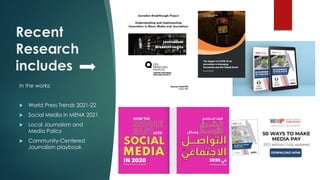
Recent
Research
includes
In the works:
 World Press Trends 2021-22
 Social Media in MENA 2021
 Local Journalism and
Media Policy
 Community-Centered
Journalism playbook
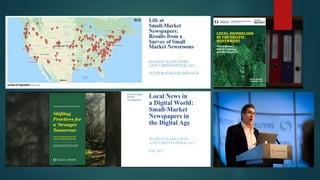
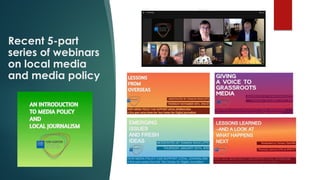
Recent 5-part
series of webinars
on local media
and media policy
Those hats…
 Journalist
 Researcher
 15 years in local journalism
Lens for this session…
1. Why does this matter?
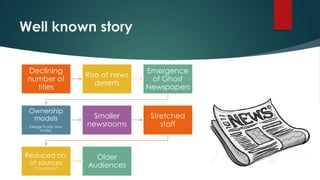
Well known story
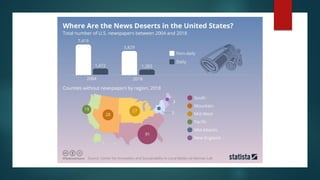
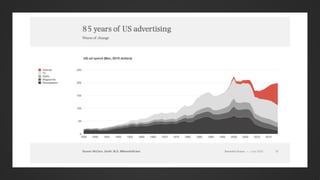
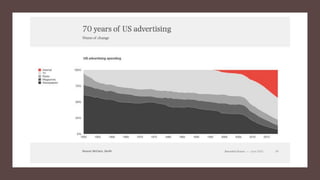
Declining
number of
titles
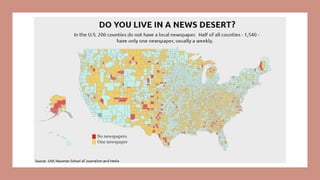
Rise of news
deserts
Emergence
of Ghost
Newspapers
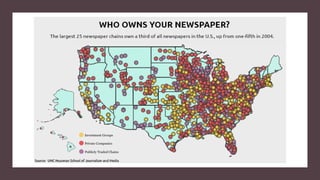
Ownership
models
(Hedge Funds, Non-
Profits)
Smaller
newsrooms
Stretched
staff
Reduced no.
of sources
(“churnalism”)
Older
Audiences
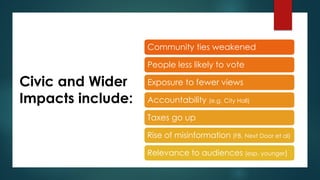
Civic and Wider
Impacts include:
Community ties weakened
People less likely to vote
Exposure to fewer views
Accountability (e.g. City Hall)
Taxes go up
Rise of misinformation (FB, Next Door et al)
Relevance to audiences (esp. younger)
Titles
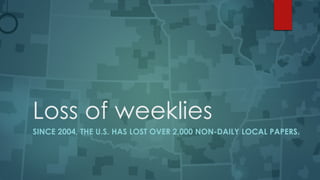
Loss of weeklies
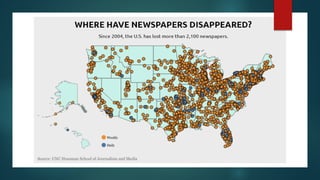
SINCE 2004, THE U.S. HAS LOST OVER 2,000 NON-DAILY LOCAL PAPERS.
Business Model
 Ownership
 Location of staff
 Revenue sources
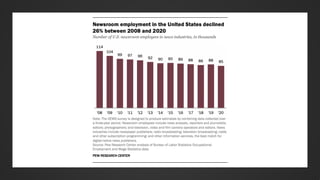
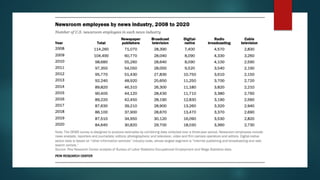
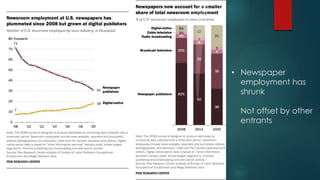
Employment
• Newspaper
employment has
shrunk
Not offset by other
entrants
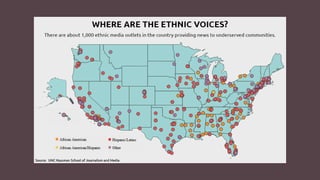
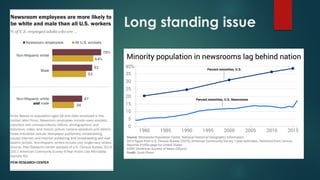
Diversity,
Equity
and
Inclusion
Long standing issue
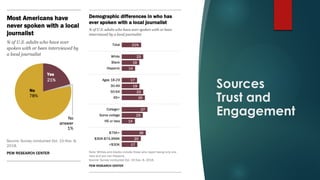
Sources
Trust and
Engagement
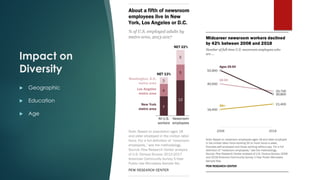
Impact on
Diversity
 Geographic
 Education
 Age
2. What’s changed?
Accelerated by COVID
Short Term
Impacts
 Furloughs
 Lay Offs
 Closed Offices
 “Infodemic”
Longer Term
 More than 100 local
newsrooms closed during the
coronavirus pandemic
(Poynter)
 Jobs lost unlikely to come
back
 Structural changes (e.g. closure
of downtown newsrooms)
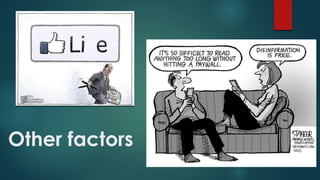
Other factors
Willingness to engage
Historic
reticence
 Market is all
 First Amendment
 Fear of Interference
 Loss of Independence
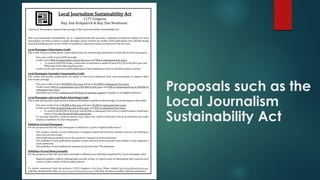
Proposals such as the
Local Journalism
Sustainability Act
State-level
moves
 In August 2201, Illinois Gov. J.B.
Pritzker signed into law Senate
Bill 134, which created the
Local Journalism Task Force.
 The Task Force will conduct a
comprehensive study of the
status of journalism and make
recommendations for
improvement to the Governor
and General Assembly.
Strategic Considerations
1. Who is a journalist?
2. Who should get money? (e.g. public companies)
3. Shore-up existing structure vs. Promote new
4. Platform agnostic vs. Platform specific
5. How support freelancers?
6. Short term “stimulus” or long-term support
7. How do you measure impact/ROI?
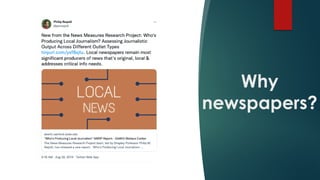
Why
newspapers?
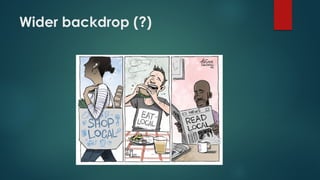
Wider backdrop (?)
3. 10 ideas
on the table
1. Philanthropy
Orgs
 New Media Funders (Pivot)
 Local Community Funds
 Report for America
Individual
 News Match
 Other forms (e.g. donations, legacies etc.)
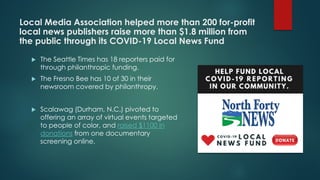
Local Media Association helped more than 200 for-profit
local news publishers raise more than $1.8 million from
the public through its COVID-19 Local News Fund
 The Seattle Times has 18 reporters paid for
through philanthropic funding.
 The Fresno Bee has 10 of 30 in their
newsroom covered by philanthropy.
 Scalawag (Durham, N.C.) pivoted to
offering an array of virtual events targeted
to people of color, and raised $1100 in
donations from one documentary
screening online.
2. Non-profits
 Many local journalists say the future is non-profit.
 More than 360 independent news orgs now part of
Institute for Nonprofit News’ network.
 In 2019, The Salt Lake Tribune got IRS approval to
become a non-profit.
 Published a playbook in December 2020 that captured
the learnings from this transition.
 Moved to 2 x weekly, from daily, but sustainable +
growing it’s newsroom (up 23% at end of 21 y-o-y.)
3. New entrants
 More than 70 local newsrooms
launched in the United States in 2020
and 2021.
 More than 50 local newsletters
started publishing in that time.
4. Public
Notices
 Campaigning to
keep in print
 Refresh and
reinvigorate
(Column start-up)
5. Government comms budgets
Health Crime Consultations
Other examples, ideas and suggestions?
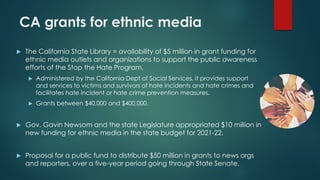
CA grants for ethnic media
 The California State Library = availability of $5 million in grant funding for
ethnic media outlets and organizations to support the public awareness
efforts of the Stop the Hate Program.
 Administered by the California Dept of Social Services, it provides support
and services to victims and survivors of hate incidents and hate crimes and
facilitates hate incident or hate crime prevention measures.
 Grants between $40,000 and $400,000.
 Gov. Gavin Newsom and the state Legislature appropriated $10 million in
new funding for ethnic media in the state budget for 2021-22.
 Proposal for a public fund to distribute $50 million in grants to news orgs
and reporters, over a five-year period going through State Senate.
6.
Tax Breaks
• Build Back Better proposed a tax
credit of $25,000 the first year and
$15,000 the next four years for
newspapers, digital news outlets,
and radio and television stations.
• Cost = $1.67 billion over the next
five years.
• Journalists live withing 50 miles +
work 30 hours a week or more.
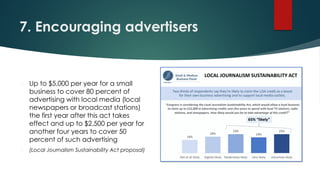
7. Encouraging advertisers
 Up to $5,000 per year for a small
business to cover 80 percent of
advertising with local media (local
newspapers or broadcast stations)
the first year after this act takes
effect and up to $2,500 per year for
another four years to cover 50
percent of such advertising
 (Local Journalism Sustainability Act proposal)
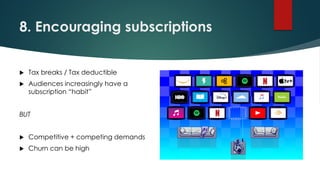
8. Encouraging subscriptions
 Tax breaks / Tax deductible
 Audiences increasingly have a
subscription “habit”
BUT
 Competitive + competing demands
 Churn can be high
9. Partnerships
BBC Local News Partnerships
 News Hub to give external media orgs access to BBC video material for use online.
 A Shared Data Unit - staffed by the BBC alongside reporters on secondment from local
news providers - to share data journalism across the media industry.
 The employment of up to 165 Local Democracy Reporters – on 3 year contracts paid by
the BBC - covering councils and public services for the BBC and local news orgs.
IMPACT
 Published over 200k stories.
 New Zealand and Canada launched their own version of the scheme.
 More than 150 media orgs - representing over 1,000 print, online or broadcast outlets – involved.

10. Taxing
Big Tech
All eyes on Australia
 News Media Bargaining Code, has enabled Australian news
organizations to extract more than $200 million (c. $150 million US).
 Google agreed to pay Nine Entertainment Co., which owns a major

television channel, multiple radio stations, the Sydney Morning

Herald, and The Age in Melbourne, a reported $30 million AUD
(about $22 million USD) or more annually for five years.
 Country Press Australia, a trade group that represents about 160
regional newspapers, got permission from the government to
bargain collectively with both platforms.
 Local newspapers roughly $31,000 to $62,000 AUD ($22,000 to
$44,000 USD) per year, depending on their size and how many
stories they generate.
 Uneven distribution. Not a transparent process.
4. What does this mean for you?
Making the
case to your
audience
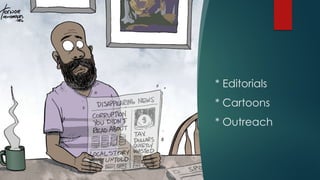
* Editorials
* Cartoons
* Outreach
“Disappearing
headlines”
 Awareness campaign led by Torstar
and News Media Canada in 2021
aimed at raising awareness of the
existential crisis facing publishers: they
produce the news content, while
Google and Facebook get most of
the advertising money.
 The front page cover wraps feature
only the newspaper nameplate
above a blank page, while a
message below the fold reads
“Imagine if the news wasn’t there.”
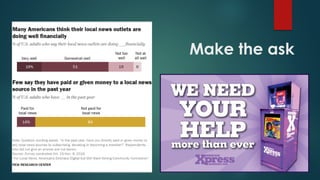
Make the ask
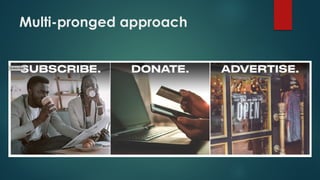
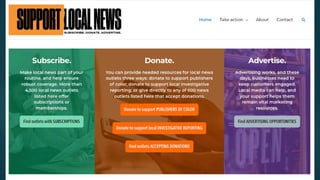
Multi-pronged approach
Power of partnerships
and collaboration
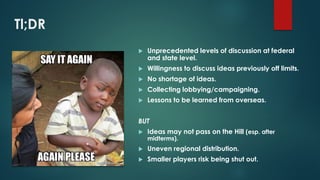
Tl;DR
 Unprecedented levels of discussion at federal
and state level.
 Willingness to discuss ideas previously off limits.
 No shortage of ideas.
 Collecting lobbying/campaigning.
 Lessons to be learned from overseas.
BUT
 Ideas may not pass on the Hill (esp. after
midterms).
 Uneven regional distribution.
 Smaller players risk being shut out.
5. Questions?
Email: damianr@uoregon.edu
Twitter: @damianradcliffe
Web: www.damianradcliffe.com
Thanks for listening!

Media Policy Instruments to support local journalism

  • 1.
    Media Policy Instrumentsto support local journalism in the USA NYPA’s spring convention, April 2022 Damian Radcliffe @damianradcliffe
  • 2.
    Plan for today Sessionstructure and goals 1. Why does this matter? 2. Why now? 3. 10 Ideas on the table 4. What this means for you 5. Q&A
  • 3.
    I know it’sSaturday morning (But hopefully that sounds good)
  • 4.
  • 5.
    About Me  British– in USA since 2015  Married (Habiba)  3 x Children (Nyla, Yara and Rafi)  1 cat (Oreo)  Love(d) to travel (55 countries)  BA and MA Oxford University
  • 7.
    Many hats Carolyn S.Chambers Professor in Journalism University of Oregon Fellow, Tow Center for Digital Journalism Columbia University, Graduate School of Journalism Honorary Research Fellow Cardiff University, School of Journalism, Media and Culture Studies Life Fellow Royal Society for the encouragement of Arts, Manufactures and Commerce (RSA)
  • 8.
    1995 – 1999:The Local Radio Company 1999 – 2003: BBC 2003 – 2008: CSV Media 2008 – 2012: Ofcom (UK Office of Communications) 2012 - 2014: ictQATAR (Ministry of Information and Communication Technology) 2012 + Freelance journalism, research + training 2015+ University of Oregon Background + timeline 1995 2022
  • 10.
    Recent Research includes In the works: World Press Trends 2021-22  Social Media in MENA 2021  Local Journalism and Media Policy  Community-Centered Journalism playbook
  • 11.
    Recent 5-part series ofwebinars on local media and media policy
  • 12.
    Those hats…  Journalist Researcher  15 years in local journalism Lens for this session…
  • 13.
    1. Why doesthis matter?
  • 14.
    Well known story Declining numberof titles Rise of news deserts Emergence of Ghost Newspapers Ownership models (Hedge Funds, Non- Profits) Smaller newsrooms Stretched staff Reduced no. of sources (“churnalism”) Older Audiences
  • 15.
    Civic and Wider Impactsinclude: Community ties weakened People less likely to vote Exposure to fewer views Accountability (e.g. City Hall) Taxes go up Rise of misinformation (FB, Next Door et al) Relevance to audiences (esp. younger)
  • 17.
  • 21.
    Loss of weeklies SINCE2004, THE U.S. HAS LOST OVER 2,000 NON-DAILY LOCAL PAPERS.
  • 22.
    Business Model  Ownership Location of staff  Revenue sources
  • 26.
  • 29.
  • 30.
  • 32.
  • 33.
  • 34.
  • 35.
  • 36.
  • 37.
    Short Term Impacts  Furloughs Lay Offs  Closed Offices  “Infodemic”
  • 38.
    Longer Term  Morethan 100 local newsrooms closed during the coronavirus pandemic (Poynter)  Jobs lost unlikely to come back  Structural changes (e.g. closure of downtown newsrooms)
  • 39.
  • 40.
  • 41.
    Historic reticence  Market isall  First Amendment  Fear of Interference  Loss of Independence
  • 42.
    Proposals such asthe Local Journalism Sustainability Act
  • 43.
    State-level moves  In August2201, Illinois Gov. J.B. Pritzker signed into law Senate Bill 134, which created the Local Journalism Task Force.  The Task Force will conduct a comprehensive study of the status of journalism and make recommendations for improvement to the Governor and General Assembly.
  • 45.
    Strategic Considerations 1. Whois a journalist? 2. Who should get money? (e.g. public companies) 3. Shore-up existing structure vs. Promote new 4. Platform agnostic vs. Platform specific 5. How support freelancers? 6. Short term “stimulus” or long-term support 7. How do you measure impact/ROI?
  • 46.
  • 48.
  • 49.
    3. 10 ideas onthe table
  • 50.
    1. Philanthropy Orgs  NewMedia Funders (Pivot)  Local Community Funds  Report for America Individual  News Match  Other forms (e.g. donations, legacies etc.)
  • 51.
    Local Media Associationhelped more than 200 for-profit local news publishers raise more than $1.8 million from the public through its COVID-19 Local News Fund  The Seattle Times has 18 reporters paid for through philanthropic funding.  The Fresno Bee has 10 of 30 in their newsroom covered by philanthropy.  Scalawag (Durham, N.C.) pivoted to offering an array of virtual events targeted to people of color, and raised $1100 in donations from one documentary screening online.
  • 52.
    2. Non-profits  Manylocal journalists say the future is non-profit.  More than 360 independent news orgs now part of Institute for Nonprofit News’ network.  In 2019, The Salt Lake Tribune got IRS approval to become a non-profit.  Published a playbook in December 2020 that captured the learnings from this transition.  Moved to 2 x weekly, from daily, but sustainable + growing it’s newsroom (up 23% at end of 21 y-o-y.)
  • 54.
    3. New entrants More than 70 local newsrooms launched in the United States in 2020 and 2021.  More than 50 local newsletters started publishing in that time.
  • 55.
    4. Public Notices  Campaigningto keep in print  Refresh and reinvigorate (Column start-up)
  • 57.
    5. Government commsbudgets Health Crime Consultations Other examples, ideas and suggestions?
  • 58.
    CA grants forethnic media  The California State Library = availability of $5 million in grant funding for ethnic media outlets and organizations to support the public awareness efforts of the Stop the Hate Program.  Administered by the California Dept of Social Services, it provides support and services to victims and survivors of hate incidents and hate crimes and facilitates hate incident or hate crime prevention measures.  Grants between $40,000 and $400,000.  Gov. Gavin Newsom and the state Legislature appropriated $10 million in new funding for ethnic media in the state budget for 2021-22.  Proposal for a public fund to distribute $50 million in grants to news orgs and reporters, over a five-year period going through State Senate.
  • 59.
    6. Tax Breaks • BuildBack Better proposed a tax credit of $25,000 the first year and $15,000 the next four years for newspapers, digital news outlets, and radio and television stations. • Cost = $1.67 billion over the next five years. • Journalists live withing 50 miles + work 30 hours a week or more.
  • 60.
    7. Encouraging advertisers Up to $5,000 per year for a small business to cover 80 percent of advertising with local media (local newspapers or broadcast stations) the first year after this act takes effect and up to $2,500 per year for another four years to cover 50 percent of such advertising  (Local Journalism Sustainability Act proposal)
  • 61.
    8. Encouraging subscriptions Tax breaks / Tax deductible  Audiences increasingly have a subscription “habit” BUT  Competitive + competing demands  Churn can be high
  • 62.
  • 63.
    BBC Local NewsPartnerships  News Hub to give external media orgs access to BBC video material for use online.  A Shared Data Unit - staffed by the BBC alongside reporters on secondment from local news providers - to share data journalism across the media industry.  The employment of up to 165 Local Democracy Reporters – on 3 year contracts paid by the BBC - covering councils and public services for the BBC and local news orgs. IMPACT  Published over 200k stories.  New Zealand and Canada launched their own version of the scheme.  More than 150 media orgs - representing over 1,000 print, online or broadcast outlets – involved.
  • 64.
  • 65.
    All eyes onAustralia  News Media Bargaining Code, has enabled Australian news organizations to extract more than $200 million (c. $150 million US).  Google agreed to pay Nine Entertainment Co., which owns a major television channel, multiple radio stations, the Sydney Morning Herald, and The Age in Melbourne, a reported $30 million AUD (about $22 million USD) or more annually for five years.  Country Press Australia, a trade group that represents about 160 regional newspapers, got permission from the government to bargain collectively with both platforms.  Local newspapers roughly $31,000 to $62,000 AUD ($22,000 to $44,000 USD) per year, depending on their size and how many stories they generate.  Uneven distribution. Not a transparent process.
  • 66.
    4. What doesthis mean for you?
  • 67.
    Making the case toyour audience
  • 68.
  • 69.
    “Disappearing headlines”  Awareness campaignled by Torstar and News Media Canada in 2021 aimed at raising awareness of the existential crisis facing publishers: they produce the news content, while Google and Facebook get most of the advertising money.  The front page cover wraps feature only the newspaper nameplate above a blank page, while a message below the fold reads “Imagine if the news wasn’t there.”
  • 70.
  • 71.
  • 73.
  • 74.
    Tl;DR  Unprecedented levelsof discussion at federal and state level.  Willingness to discuss ideas previously off limits.  No shortage of ideas.  Collecting lobbying/campaigning.  Lessons to be learned from overseas. BUT  Ideas may not pass on the Hill (esp. after midterms).  Uneven regional distribution.  Smaller players risk being shut out.
  • 75.
    5. Questions? Email: damianr@uoregon.edu Twitter:@damianradcliffe Web: www.damianradcliffe.com Thanks for listening!