Michael Cairns
Managing Partner
Information Media Partners
New Technology in Publishing
Chinese publishing industry senior management
seminar 2008
2
Introduction
Michael Cairns is a publishing and media executive with over 25 years experience in
business strategy, operations and technology implementation. As a business
executive, Mr. Cairns has successfully managed several troubled and under-
performing businesses, creating new business opportunities, developing new funding
sources and enhancing shareholder value for investors. His years spent as an
operating executive have largely been with brand-name publishing companies such
as Macmillan, Inc., Berlitz International, Wolters Kluwer Health, Reed Elsevier and
R.R. Bowker. As a consultant, Mr. Cairns has worked with clients as diverse as
AARP, Hewlett Packard, InterPublic Companies and Reed Elsevier with an emphasis
on business strategy, market development and corporate development.
His skills and experience include:
 Business and corporate strategy development and implementation
 Operations management and business transformation
 Traditional and digital publishing and operations
 Print-to-digital transformation and adoption of new business models
 Software development and software services
Mr. Cairns holds an MBA (Finance) from Georgetown University and a BA from
Boston University. He has served on several boards and advisory groups including
the Association of American Publishers, Book Industry Study Group and the
International ISBN organization. Additionally, he has public and private company
board experience.
2
Michael Cairns
Information Media Partners
Strategy Consulting
New York, London, Melbourne
Tel: 908 938 4889
Michael.cairns@infomediapartners.com
Find me:
LinkedIn Twitter Blog Flickr InstaGram
3
Information Media Partners
Michael Cairns established Information Media Partners in 2006 as a boutique strategy
consulting firm focused on the information and education publishing segment. The work
conducted by the firm includes product development, corporate development, sales
management and corporate reorganizations. We work with established businesses, private
equity owners and potential acquirers.
Examples of our work include:
 Reorganized and re-focused a $25 million software publishing company by aligning
business operations with client priorities; implementing internal collaboration tools and
project management standards; re-building executive team to focus on effective and
efficient management
 Defined a new business strategy for a large non-profit association and advocacy group,
expanding their business model into global markets to exploit their core knowledge and
expertise across a broader market
 Led an information technology capabilities review at a large international advertising
holding company. Completed over 200 interviews in 15 international offices and multiple
group focus sessions to define the operational ‘gaps’ between existing agency capabilities
and those necessary and important for client delivery by region
 Completed a sales management effectiveness review for a global software company and
defined six key project initiatives to improve sales effectiveness, market development and
account management
We approach our client engagements in a standardized, logical manner which creates the best
environment to identify key business drivers, administrative and logistical road blocks and/or
product or market definition issues. Our investigative approach leads to better insights into
your businesses and supports the development of workable solutions and recommendations
for success.
Visit the Information Media Partners website for more information.
Sample Client List
4
Technology in publishing, how it is implemented
and how it is used is increasingly the
differentiator - not the content! - between the
publishers that will succeed and those that will
fail.
5
Introduction and agenda
 Introduction & background
 Historical perspective
 Technology in the back office
 Supporting the product development value chain
 Customer-centric technology
 Democratization of the publishing process
 Forecasting the future of publishing technology
6
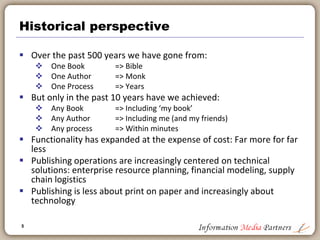
Historical perspective
 Over the past 500 years we have gone from:
 One Book => Bible
 One Author => Monk
 One Process => Years
 But only in the past 10 years have we achieved:
 Any Book => Including ‘my book’
 Any Author => Including me (and my friends)
 Any process => Within minutes
 Functionality has expanded at the expense of cost: Far more for far
less
 Publishing operations are increasingly centered on technical
solutions: enterprise resource planning, financial modeling, supply
chain logistics
 Publishing is less about print on paper and increasingly about
technology
7
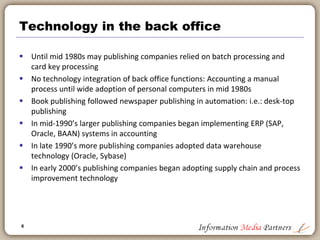
Technology in the back office
 Until mid 1980s may publishing companies relied on batch processing and
card key processing
 No technology integration of back office functions: Accounting a manual
process until wide adoption of personal computers in mid 1980s
 Book publishing followed newspaper publishing in automation: i.e.: desk-top
publishing
 In mid-1990’s larger publishing companies began implementing ERP (SAP,
Oracle, BAAN) systems in accounting
 In late 1990’s more publishing companies adopted data warehouse
technology (Oracle, Sybase)
 In early 2000’s publishing companies began adopting supply chain and process
improvement technology
8
8
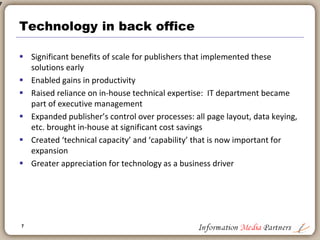
Technology in back office
 Significant benefits of scale for publishers that implemented these
solutions early
 Enabled gains in productivity
 Raised reliance on in-house technical expertise: IT department became
part of executive management
 Expanded publisher’s control over processes: all page layout, data keying,
etc. brought in-house at significant cost savings
 Created ‘technical capacity’ and ‘capability’ that is now important for
expansion
 Greater appreciation for technology as a business driver
9
9
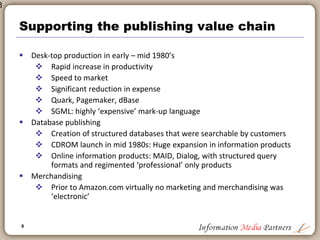
Supporting the publishing value chain
 Desk-top production in early – mid 1980’s
 Rapid increase in productivity
 Speed to market
 Significant reduction in expense
 Quark, Pagemaker, dBase
 SGML: highly ‘expensive’ mark-up language
 Database publishing
 Creation of structured databases that were searchable by customers
 CDROM launch in mid 1980s: Huge expansion in information products
 Online information products: MAID, Dialog, with structured query
formats and regimented ‘professional’ only products
 Merchandising
 Prior to Amazon.com virtually no marketing and merchandising was
‘electronic’
10
10
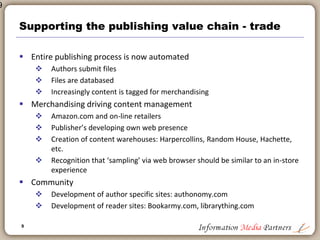
Supporting the publishing value chain - trade
 Entire publishing process is now automated
 Authors submit files
 Files are databased
 Increasingly content is tagged for merchandising
 Merchandising driving content management
 Amazon.com and on-line retailers
 Publisher’s developing own web presence
 Creation of content warehouses: Harpercollins, Random House, Hachette,
etc.
 Recognition that ‘sampling’ via web browser should be similar to an in-store
experience
 Community
 Development of author specific sites: authonomy.com
 Development of reader sites: Bookarmy.com, librarything.com
11
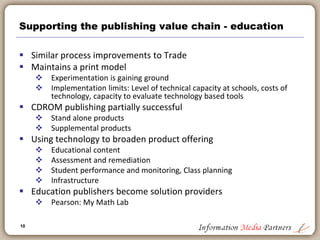
Supporting the publishing value chain - education
 Similar process improvements to Trade
 Maintains a print model
 Experimentation is gaining ground
 Implementation limits: Level of technical capacity at schools, costs of
technology, capacity to evaluate technology based tools
 CDROM publishing partially successful
 Stand alone products
 Supplemental products
 Using technology to broaden product offering
 Educational content
 Assessment and remediation
 Student performance and monitoring, Class planning
 Infrastructure
 Education publishers become solution providers
 Pearson: My Math Lab
12
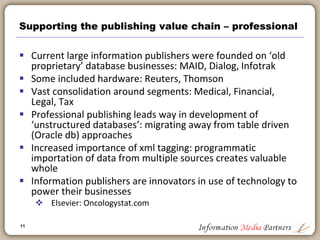
Supporting the publishing value chain – professional
 Current large information publishers were founded on ‘old
proprietary’ database businesses: MAID, Dialog, Infotrak
 Some included hardware: Reuters, Thomson
 Vast consolidation around segments: Medical, Financial,
Legal, Tax
 Professional publishing leads way in development of
‘unstructured databases’: migrating away from table driven
(Oracle db) approaches
 Increased importance of xml tagging: programmatic
importation of data from multiple sources creates valuable
whole
 Information publishers are innovators in use of technology to
power their businesses
 Elsevier: Oncologystat.com
13
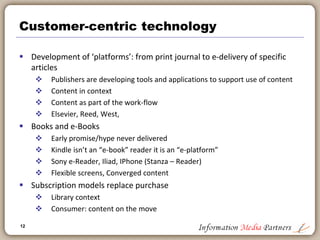
Customer-centric technology
 Development of ‘platforms’: from print journal to e-delivery of specific
articles
 Publishers are developing tools and applications to support use of content
 Content in context
 Content as part of the work-flow
 Elsevier, Reed, West,
 Books and e-Books
 Early promise/hype never delivered
 Kindle isn’t an “e-book” reader it is an “e-platform”
 Sony e-Reader, Iliad, IPhone (Stanza – Reader)
 Flexible screens, Converged content
 Subscription models replace purchase
 Library context
 Consumer: content on the move
14
14
Democratization of publishing process
 Incredible explosion of content
 Anyone is a publisher
 Any type of content
 Driven by access to professional tools
 From InDesign to Dreamweaver to Blogger: Barriers are eliminated
 Computing power cheap
 Network effects significant
 Self-publishing process
 660,000 titles with Lulu.com: $99/per title for a printed book
 On-demand publishing programs: no title out of print
 Photobooks
 Blurb.com, Photobucket, etc.
 Increasingly ‘mystique’ of publishing is eliminated: Consumers will source their
own content, produce it and consume it without (direct) involvement of
traditional publisher
 What happens in nations where traditional publishing is less entrenched – India,
China, Africa?
15
New entrants and wild cards
 Google and the Google Book Program
 Significant potential
 Closed system
 Digitization generally
 To what end?
 How much is too much?
 Who is in charge and are we making mistakes we will regret later?
 The Network Effect
 Potential vast productivity and effectiveness gain from network
computing
 Collaboration and Crowdsourcing
 Shared applications and application development
 Maintaining the value of content vs ‘good enough’
 Significant challenge for all publishers: commoditization
15
16
16
Forecasting the future of technology in publishing
 Publishing and technology will become synonymous (if it hasn’t already)
 Many losers who are slow to migrate to web delivery, xml based and
‘open’ social network orientation
 Expansion of solutions based publishing: content is secondary to the
provision of a work-flow solution, an integrated application and/or an
open ‘widget’ application enabling further leverage
 Amazon web services
 Education publishers will follow information publishers in rapid adoption
of solutions based applications
 All publishers will be slow to adopt open social networks and new
entrants will take market share
 Google isn’t finished
17
Please review my blog post associated
with this presentation:
http://personanondata.blogspot.com/2007
/12/technology-in-publishing-
overview.html
Michael Cairns
Managing Partner
Michael.Cairns@InfoMediaPartners.com
908 938 4889
LinkedIn Twitter Blog Flickr InstaGram

Overview of Technology in Publishing: NYU Publishing Program Seminar for Chinese Publishers

  • 1.
    Michael Cairns Managing Partner InformationMedia Partners New Technology in Publishing Chinese publishing industry senior management seminar 2008
  • 2.
    2 Introduction Michael Cairns isa publishing and media executive with over 25 years experience in business strategy, operations and technology implementation. As a business executive, Mr. Cairns has successfully managed several troubled and under- performing businesses, creating new business opportunities, developing new funding sources and enhancing shareholder value for investors. His years spent as an operating executive have largely been with brand-name publishing companies such as Macmillan, Inc., Berlitz International, Wolters Kluwer Health, Reed Elsevier and R.R. Bowker. As a consultant, Mr. Cairns has worked with clients as diverse as AARP, Hewlett Packard, InterPublic Companies and Reed Elsevier with an emphasis on business strategy, market development and corporate development. His skills and experience include:  Business and corporate strategy development and implementation  Operations management and business transformation  Traditional and digital publishing and operations  Print-to-digital transformation and adoption of new business models  Software development and software services Mr. Cairns holds an MBA (Finance) from Georgetown University and a BA from Boston University. He has served on several boards and advisory groups including the Association of American Publishers, Book Industry Study Group and the International ISBN organization. Additionally, he has public and private company board experience. 2 Michael Cairns Information Media Partners Strategy Consulting New York, London, Melbourne Tel: 908 938 4889 Michael.cairns@infomediapartners.com Find me: LinkedIn Twitter Blog Flickr InstaGram
  • 3.
    3 Information Media Partners MichaelCairns established Information Media Partners in 2006 as a boutique strategy consulting firm focused on the information and education publishing segment. The work conducted by the firm includes product development, corporate development, sales management and corporate reorganizations. We work with established businesses, private equity owners and potential acquirers. Examples of our work include:  Reorganized and re-focused a $25 million software publishing company by aligning business operations with client priorities; implementing internal collaboration tools and project management standards; re-building executive team to focus on effective and efficient management  Defined a new business strategy for a large non-profit association and advocacy group, expanding their business model into global markets to exploit their core knowledge and expertise across a broader market  Led an information technology capabilities review at a large international advertising holding company. Completed over 200 interviews in 15 international offices and multiple group focus sessions to define the operational ‘gaps’ between existing agency capabilities and those necessary and important for client delivery by region  Completed a sales management effectiveness review for a global software company and defined six key project initiatives to improve sales effectiveness, market development and account management We approach our client engagements in a standardized, logical manner which creates the best environment to identify key business drivers, administrative and logistical road blocks and/or product or market definition issues. Our investigative approach leads to better insights into your businesses and supports the development of workable solutions and recommendations for success. Visit the Information Media Partners website for more information. Sample Client List
  • 4.
    4 Technology in publishing,how it is implemented and how it is used is increasingly the differentiator - not the content! - between the publishers that will succeed and those that will fail.
  • 5.
    5 Introduction and agenda Introduction & background  Historical perspective  Technology in the back office  Supporting the product development value chain  Customer-centric technology  Democratization of the publishing process  Forecasting the future of publishing technology
  • 6.
    6 Historical perspective  Overthe past 500 years we have gone from:  One Book => Bible  One Author => Monk  One Process => Years  But only in the past 10 years have we achieved:  Any Book => Including ‘my book’  Any Author => Including me (and my friends)  Any process => Within minutes  Functionality has expanded at the expense of cost: Far more for far less  Publishing operations are increasingly centered on technical solutions: enterprise resource planning, financial modeling, supply chain logistics  Publishing is less about print on paper and increasingly about technology
  • 7.
    7 Technology in theback office  Until mid 1980s may publishing companies relied on batch processing and card key processing  No technology integration of back office functions: Accounting a manual process until wide adoption of personal computers in mid 1980s  Book publishing followed newspaper publishing in automation: i.e.: desk-top publishing  In mid-1990’s larger publishing companies began implementing ERP (SAP, Oracle, BAAN) systems in accounting  In late 1990’s more publishing companies adopted data warehouse technology (Oracle, Sybase)  In early 2000’s publishing companies began adopting supply chain and process improvement technology
  • 8.
    8 8 Technology in backoffice  Significant benefits of scale for publishers that implemented these solutions early  Enabled gains in productivity  Raised reliance on in-house technical expertise: IT department became part of executive management  Expanded publisher’s control over processes: all page layout, data keying, etc. brought in-house at significant cost savings  Created ‘technical capacity’ and ‘capability’ that is now important for expansion  Greater appreciation for technology as a business driver
  • 9.
    9 9 Supporting the publishingvalue chain  Desk-top production in early – mid 1980’s  Rapid increase in productivity  Speed to market  Significant reduction in expense  Quark, Pagemaker, dBase  SGML: highly ‘expensive’ mark-up language  Database publishing  Creation of structured databases that were searchable by customers  CDROM launch in mid 1980s: Huge expansion in information products  Online information products: MAID, Dialog, with structured query formats and regimented ‘professional’ only products  Merchandising  Prior to Amazon.com virtually no marketing and merchandising was ‘electronic’
  • 10.
    10 10 Supporting the publishingvalue chain - trade  Entire publishing process is now automated  Authors submit files  Files are databased  Increasingly content is tagged for merchandising  Merchandising driving content management  Amazon.com and on-line retailers  Publisher’s developing own web presence  Creation of content warehouses: Harpercollins, Random House, Hachette, etc.  Recognition that ‘sampling’ via web browser should be similar to an in-store experience  Community  Development of author specific sites: authonomy.com  Development of reader sites: Bookarmy.com, librarything.com
  • 11.
    11 Supporting the publishingvalue chain - education  Similar process improvements to Trade  Maintains a print model  Experimentation is gaining ground  Implementation limits: Level of technical capacity at schools, costs of technology, capacity to evaluate technology based tools  CDROM publishing partially successful  Stand alone products  Supplemental products  Using technology to broaden product offering  Educational content  Assessment and remediation  Student performance and monitoring, Class planning  Infrastructure  Education publishers become solution providers  Pearson: My Math Lab
  • 12.
    12 Supporting the publishingvalue chain – professional  Current large information publishers were founded on ‘old proprietary’ database businesses: MAID, Dialog, Infotrak  Some included hardware: Reuters, Thomson  Vast consolidation around segments: Medical, Financial, Legal, Tax  Professional publishing leads way in development of ‘unstructured databases’: migrating away from table driven (Oracle db) approaches  Increased importance of xml tagging: programmatic importation of data from multiple sources creates valuable whole  Information publishers are innovators in use of technology to power their businesses  Elsevier: Oncologystat.com
  • 13.
    13 Customer-centric technology  Developmentof ‘platforms’: from print journal to e-delivery of specific articles  Publishers are developing tools and applications to support use of content  Content in context  Content as part of the work-flow  Elsevier, Reed, West,  Books and e-Books  Early promise/hype never delivered  Kindle isn’t an “e-book” reader it is an “e-platform”  Sony e-Reader, Iliad, IPhone (Stanza – Reader)  Flexible screens, Converged content  Subscription models replace purchase  Library context  Consumer: content on the move
  • 14.
    14 14 Democratization of publishingprocess  Incredible explosion of content  Anyone is a publisher  Any type of content  Driven by access to professional tools  From InDesign to Dreamweaver to Blogger: Barriers are eliminated  Computing power cheap  Network effects significant  Self-publishing process  660,000 titles with Lulu.com: $99/per title for a printed book  On-demand publishing programs: no title out of print  Photobooks  Blurb.com, Photobucket, etc.  Increasingly ‘mystique’ of publishing is eliminated: Consumers will source their own content, produce it and consume it without (direct) involvement of traditional publisher  What happens in nations where traditional publishing is less entrenched – India, China, Africa?
  • 15.
    15 New entrants andwild cards  Google and the Google Book Program  Significant potential  Closed system  Digitization generally  To what end?  How much is too much?  Who is in charge and are we making mistakes we will regret later?  The Network Effect  Potential vast productivity and effectiveness gain from network computing  Collaboration and Crowdsourcing  Shared applications and application development  Maintaining the value of content vs ‘good enough’  Significant challenge for all publishers: commoditization 15
  • 16.
    16 16 Forecasting the futureof technology in publishing  Publishing and technology will become synonymous (if it hasn’t already)  Many losers who are slow to migrate to web delivery, xml based and ‘open’ social network orientation  Expansion of solutions based publishing: content is secondary to the provision of a work-flow solution, an integrated application and/or an open ‘widget’ application enabling further leverage  Amazon web services  Education publishers will follow information publishers in rapid adoption of solutions based applications  All publishers will be slow to adopt open social networks and new entrants will take market share  Google isn’t finished
  • 17.
    17 Please review myblog post associated with this presentation: http://personanondata.blogspot.com/2007 /12/technology-in-publishing- overview.html Michael Cairns Managing Partner Michael.Cairns@InfoMediaPartners.com 908 938 4889 LinkedIn Twitter Blog Flickr InstaGram