Best Practices ForBusiness
Analyst
Modern practices in 2017
R e q u i r e m e n t s , R o l e s , S t r a t e g y, T i p s
Presented by: Moutasm Tamimi
Software Engineering
2
2.
Outline
1. Definitions
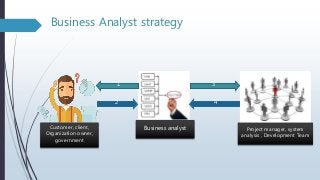
2. Businessanalyst strategy
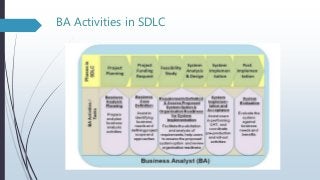
3. BA Activities in SDLC
4. Business analysis planning
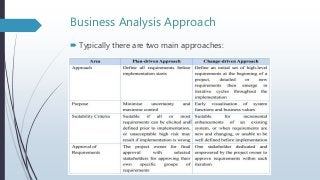
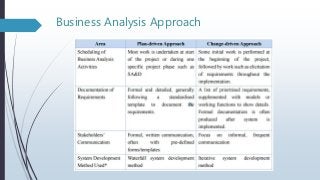
5. Business analysis approach
6. Factors to determine the BA approach
7. Identify stakeholders
8. Plan business analysis activities
9. Tips for BA work plan
10.Requirements definition
11.Tips for requirements definition
12. Requirement classifications
3.
Requirement Definition
Inproduct development and process
optimization, a requirement is a singular
documented physical and functional need
that a particular design, product or process
must be able to perform.
It is most commonly used in a formal sense
in systems engineering, software
engineering, or enterprise engineering.
It is a statement that identifies a necessary
attribute, capability, characteristic, or quality
of a system for it to have value and utility to
a customer, organization, internal user, or
other stakeholder.
5.
Definitions
Business analysis:the identification and analysis of business
problems, needs and opportunities through participation in
the SDLC to help achieve the organisation’s strategic vision
and business goals.
Business analyst: BA refers to any person who is responsible
for performing the business analysis functions for IT system
development projects.
6.
Definitions
A systemsanalyst is an information technology (IT)
professional who specializes in analysing, designing and
implementing information systems.
A systems analyst is typically confined to an assigned or
given system and will often work in conjunction with
a business analyst.
7.
Business Analyst Works
Facilitating the elicitation of user requirements.
Documenting and prioritising the business requirements.
Verifying the major project deliverables.
Business reengineering opportunities and workflow from
business Perspective.
Facilitating effective communication between business and IT
sides.
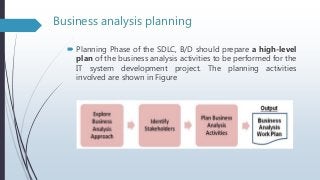
Business analysis planning
Planning Phase of the SDLC, B/D should prepare a high-level
plan of the business analysis activities to be performed for the
IT system development project. The planning activities
involved are shown in Figure
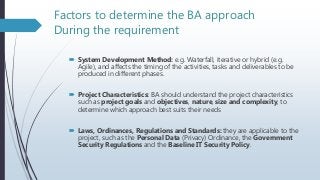
Factors to determinethe BA approach
During the requirement
System Development Method: e.g. Waterfall, iterative or hybrid (e.g.
Agile), and affects the timing of the activities, tasks and deliverables to be
produced in different phases.
Project Characteristics: BA should understand the project characteristics
such as project goals and objectives, nature, size and complexity, to
determine which approach best suits their needs
Laws, Ordinances, Regulations and Standards: they are applicable to the
project, such as the Personal Data (Privacy) Ordinance, the Government
Security Regulations and the Baseline IT Security Policy.
14.
Identify Stakeholders
Thisactivity is to identify stakeholders who may influence or be
affected by the business needs, requirements or outcomes of the
IT system development project.
The internal Project manager PM and the BA would identify both
internal and external stakeholders for the whole project and
conduct preliminary stakeholder analysis.
BA may leverage techniques from Practice Guide to Project
Management1 (PGPM).
15.
Plan Business AnalysisActivities
Plan the business analysis deliverables
Determine the business activities to be performed.
Identify communication vehicle and frequencies with
stakeholders
Estimate the resources required.
16.
Tips for BAWork Plan
1. First, determine the business analysis approach (plan-driven or
change-driven) to be adopted and identify all the deliverables
(including work products) that will be produced.
2. Second, think of the tasks needed to produce each work
product/deliverable and break the tasks into smaller manageable
sub-tasks. Managerial tasks such as planning, control, review and
monitor should also be included.
3. Third, estimate how many man hours each task and sub-task will
take.
17.
Requirements definition
Therequirements serve as the foundation to the business needs
and the design of the proposed system. The role of BA during the
Feasibility Study(FS) and SA&D phases is to facilitate the IT project
team to elicit and analyse requirements.
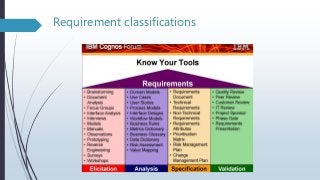
In general, requirements can be classified into two broad categories:
functional requirements: what the system should do to provide business
value when satisfied.
non-functional requirements: how the system should work.
BA should also provide business input to the IT project team for
assessing the proposed system option to ensure that they are able to
meet the business needs and requirements
18.
Tips for RequirementsDefinition
1. BA should work closely with IT project team in particular the
SA to work out what are relevant to the project that must be
highlighted and discussed at interviews and workshops.
2. Prior to approaching stakeholders, BA could come up with
some directions (e.g. start processes from user touch points)
19.
Tips for RequirementsDefinition
3. It should be noted that requirements are often unclear and
not comprehensive at the beginning.
BA is to help dig out the details of the requirements and uncover
hidden requirements through progressive deliberations and
elaborations. Additional requirements will be derived as more
information is collected about the business
4. If a large amount of information is required to be
quickly collected from a large number of
stakeholders, survey is an efficient tool to use.
Speaker Information
Moutasmtamimi
Independent Consultant , IT Researcher ,
CEO at ITG7
Instructor of: Project Management.
DBMS Specialist.
.NET Applications.
Digital Marketing.
– Email: tamimi@itg7.com
Click Here
Click HereITG7
Click Here
24.
Concepts Of businessanalyst
Practices
Modern practices in 2017
B e s t P r a c t i c e s
Presented by: Moutasm Tamimi
Software Engineering
1
https://www.slideshare.net/moutasmtamimi/concepts-of-business-analyst-
practices-part-1
25.
Best Practices ForBusiness
Analyst
Modern practices in 2017
Benefits, Roles, Consistent Requirements, tips
Presented by: Moutasm Tamimi
Software Engineering
3