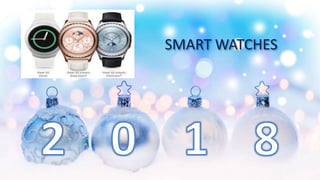
SMART WATCHES
PRESENTED BY
• Mishal Saba
• Arooba Tiwana
• Noman Akram
• Waleed Khalid
• Usama Ahmad
• Yawar Ahmad
Contents
• Smart watch
• History
• Working
• Technologies used
• Features
• Applications
• Advantages/Disadvantages
• Future
Smart watch
• The smart watch is a wearable gadget which
keeps our hands free and yet allows us to
use our Smart phones which might be at
home, which we are away.
History
• The idea of a smart watch has been taken from
the 1940’s comic strip, Dick Iracy, who was a
detective.
• The Smart watch was first introduced to in 1982.
The first smart watch was the Pulsar NL CO1. It was
released in 1982.
History
• The first Smart watch only stored 24 digits on
information. This ranged anywhere from
$2,500,00 to $3,000,00.
• 2013,“ The year of Smart watch”, Apple,
Blackberry, Google, LG, Samsung, Sony,
Microsoft, all actively involved in development
of smart watch.
Working
• As a rule of thumb, smart watches need to be connected to a
smartphone for their full potential. If you do not, you may
only tell you. This is done via Bluetooth pairing, and some
devices allow quick and easy setup using NFC chips.
• Once you connect your smart watch to your smartphone, you
can select notifications on your watch, such as text messages,
emails, phones, and social networks. Smart watches can do
more than just talk to your cell phone. Smart watches have
different functions for smart watches, so check them before
you buy them.
Technologies used
• S- Smart
• P- personal
• O- Object
• T- Technology
Introduced by Microsoft
Features
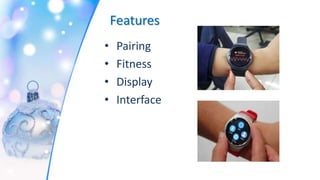
• Pairing
• Fitness
• Display
• Interface
Features
Pairing
• Many watches can be
paired to smart phones
to take calls, send texts.
• Watches often rely on
smartphones for full
functionality.
Fitness
• The boundaries between
smart watches and
fitness trackers are
getting blurred as heart
rate monitors, GPS and
sports wristbands are
becoming more
commonplace.
Features
Display
• Either E-ink or Colour:
• E-ink saves battery with
5 days of battery life.
• Colour only lasts 1-2
days.
Interface
• Touch interface
dominant, easier to
navigate.
• Many use a
combination of touch
and buttons.
Applications
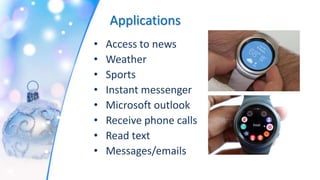
• Access to news
• Weather
• Sports
• Instant messenger
• Microsoft outlook
• Receive phone calls
• Read text
• Messages/emails
Advantages/Disadvantages
Advantages
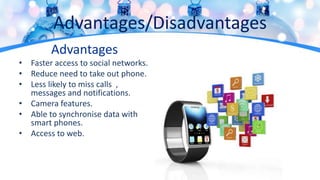
• Faster access to social networks.
• Reduce need to take out phone.
• Less likely to miss calls ,
messages and notifications.
• Camera features.
• Able to synchronise data with
smart phones.
• Access to web.
Advantages/Disadvantages
Disadvantages
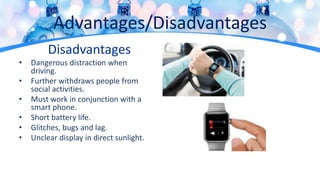
• Dangerous distraction when
driving.
• Further withdraws people from
social activities.
• Must work in conjunction with a
smart phone.
• Short battery life.
• Glitches, bugs and lag.
• Unclear display in direct sunlight.
Future
• Manufacturers are beginning to build smart
watches for both business and general use.
• In the future, I believe we will see the cross
Watching communications via mobile communications is
like we saw dial-up networks moving to Wi-Fi and more
• The future of smart watches should be smart
watch bands.
THANK YOU

Presentation smart watch

  • 1.
  • 2.
    PRESENTED BY • MishalSaba • Arooba Tiwana • Noman Akram • Waleed Khalid • Usama Ahmad • Yawar Ahmad
  • 3.
    Contents • Smart watch •History • Working • Technologies used • Features • Applications • Advantages/Disadvantages • Future
  • 4.
    Smart watch • Thesmart watch is a wearable gadget which keeps our hands free and yet allows us to use our Smart phones which might be at home, which we are away.
  • 5.
    History • The ideaof a smart watch has been taken from the 1940’s comic strip, Dick Iracy, who was a detective. • The Smart watch was first introduced to in 1982. The first smart watch was the Pulsar NL CO1. It was released in 1982.
  • 6.
    History • The firstSmart watch only stored 24 digits on information. This ranged anywhere from $2,500,00 to $3,000,00. • 2013,“ The year of Smart watch”, Apple, Blackberry, Google, LG, Samsung, Sony, Microsoft, all actively involved in development of smart watch.
  • 7.
    Working • As arule of thumb, smart watches need to be connected to a smartphone for their full potential. If you do not, you may only tell you. This is done via Bluetooth pairing, and some devices allow quick and easy setup using NFC chips. • Once you connect your smart watch to your smartphone, you can select notifications on your watch, such as text messages, emails, phones, and social networks. Smart watches can do more than just talk to your cell phone. Smart watches have different functions for smart watches, so check them before you buy them.
  • 8.
    Technologies used • S-Smart • P- personal • O- Object • T- Technology Introduced by Microsoft
  • 9.
  • 10.
    Features Pairing • Many watchescan be paired to smart phones to take calls, send texts. • Watches often rely on smartphones for full functionality. Fitness • The boundaries between smart watches and fitness trackers are getting blurred as heart rate monitors, GPS and sports wristbands are becoming more commonplace.
  • 11.
    Features Display • Either E-inkor Colour: • E-ink saves battery with 5 days of battery life. • Colour only lasts 1-2 days. Interface • Touch interface dominant, easier to navigate. • Many use a combination of touch and buttons.
  • 12.
    Applications • Access tonews • Weather • Sports • Instant messenger • Microsoft outlook • Receive phone calls • Read text • Messages/emails
  • 13.
    Advantages/Disadvantages Advantages • Faster accessto social networks. • Reduce need to take out phone. • Less likely to miss calls , messages and notifications. • Camera features. • Able to synchronise data with smart phones. • Access to web.
  • 14.
    Advantages/Disadvantages Disadvantages • Dangerous distractionwhen driving. • Further withdraws people from social activities. • Must work in conjunction with a smart phone. • Short battery life. • Glitches, bugs and lag. • Unclear display in direct sunlight.
  • 15.
    Future • Manufacturers arebeginning to build smart watches for both business and general use. • In the future, I believe we will see the cross Watching communications via mobile communications is like we saw dial-up networks moving to Wi-Fi and more • The future of smart watches should be smart watch bands.
  • 16.

Editor's Notes

  • #9 Spot is a discontinued initiative by Microsoft to create intelligent and personal home electronics appliances ,was first announced by Bill Gates in 2002 in a COMDEX computer exposition event. But additional detail was given in 2003. was commercially failed due to subsription based business model.
  • #15 glitches:fault of equipement Lags:slow speed