Quantifying red maple seed
production and viability in
nutrient manipulated stands
Donna Riner 2018
Mentors: Adam Wild, Alex Young, Alex Rice, Ruth Yanai
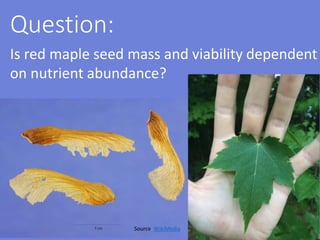
Question:
Is red maple seed mass and viability dependent
on nutrient abundance?
Source: WikiMedia
Significance
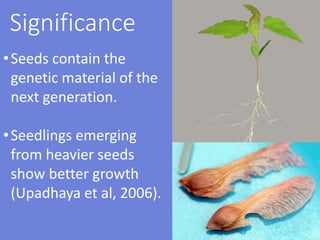
•Seeds contain the
genetic material of the
next generation.
•Seedlings emerging
from heavier seeds
show better growth
(Upadhaya et al, 2006).
Methods
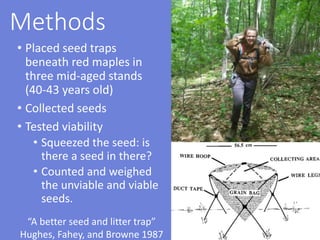
• Placed seed traps
beneath red maples in
three mid-aged stands
(40-43 years old)
• Collected seeds
• Tested viability
• Squeezed the seed: is
there a seed in there?
• Counted and weighed
the unviable and viable
seeds.
ā€œA better seed and litter trapā€
Hughes, Fahey, and Browne 1987
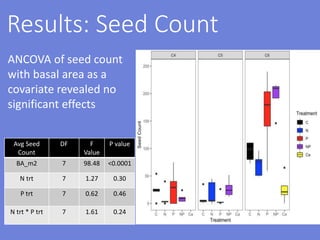
Results: Seed Count
Avg Seed
Count
DF F
Value
P value
BA_m2 7 98.48 <0.0001
N trt 7 1.27 0.30
P trt 7 0.62 0.46
N trt * P trt 7 1.61 0.24
ANCOVA of seed count
with basal area as a
covariate revealed no
significant effects
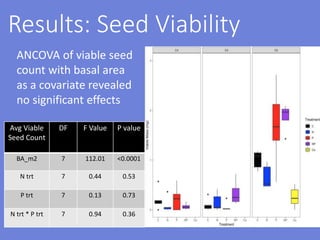
Results: Seed Viability
Avg Viable
Seed Count
DF F Value P value
BA_m2 7 112.01 <0.0001
N trt 7 0.44 0.53
P trt 7 0.13 0.73
N trt * P trt 7 0.94 0.36
ANCOVA of viable seed
count with basal area
as a covariate revealed
no significant effects
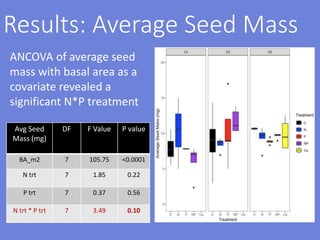
Results: Average Seed Mass
ANCOVA of average seed
mass with basal area as a
covariate revealed a
significant N*P treatment
Avg Seed
Mass (mg)
DF F Value P value
BA_m2 7 105.75 <0.0001
N trt 7 1.85 0.22
P trt 7 0.37 0.56
N trt * P trt 7 3.49 0.10
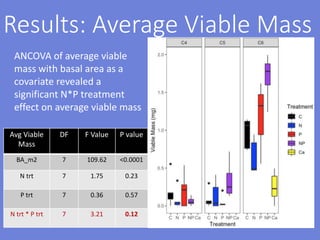
Avg Viable
Mass
DF F Value P value
BA_m2 7 109.62 <0.0001
N trt 7 1.75 0.23
P trt 7 0.36 0.57
N trt * P trt 7 3.21 0.12
Results: Average Viable Mass
ANCOVA of average viable
mass with basal area as a
covariate revealed a
significant N*P treatment
effect on average viable mass
Discussion
• Significant N*P treatment effect on average
seed mass and average seed viability
• When using basal area of red maples in each stand
as a covariate (thank you MELNHE tree inventory!)
Questions?

HB 2018 - Quantifying red maple seed production

  • 1.
    Quantifying red mapleseed production and viability in nutrient manipulated stands Donna Riner 2018 Mentors: Adam Wild, Alex Young, Alex Rice, Ruth Yanai
  • 2.
    Question: Is red mapleseed mass and viability dependent on nutrient abundance? Source: WikiMedia
  • 3.
    Significance •Seeds contain the geneticmaterial of the next generation. •Seedlings emerging from heavier seeds show better growth (Upadhaya et al, 2006).
  • 4.
    Methods • Placed seedtraps beneath red maples in three mid-aged stands (40-43 years old) • Collected seeds • Tested viability • Squeezed the seed: is there a seed in there? • Counted and weighed the unviable and viable seeds. ā€œA better seed and litter trapā€ Hughes, Fahey, and Browne 1987
  • 5.
    Results: Seed Count AvgSeed Count DF F Value P value BA_m2 7 98.48 <0.0001 N trt 7 1.27 0.30 P trt 7 0.62 0.46 N trt * P trt 7 1.61 0.24 ANCOVA of seed count with basal area as a covariate revealed no significant effects
  • 6.
    Results: Seed Viability AvgViable Seed Count DF F Value P value BA_m2 7 112.01 <0.0001 N trt 7 0.44 0.53 P trt 7 0.13 0.73 N trt * P trt 7 0.94 0.36 ANCOVA of viable seed count with basal area as a covariate revealed no significant effects
  • 7.
    Results: Average SeedMass ANCOVA of average seed mass with basal area as a covariate revealed a significant N*P treatment Avg Seed Mass (mg) DF F Value P value BA_m2 7 105.75 <0.0001 N trt 7 1.85 0.22 P trt 7 0.37 0.56 N trt * P trt 7 3.49 0.10
  • 8.
    Avg Viable Mass DF FValue P value BA_m2 7 109.62 <0.0001 N trt 7 1.75 0.23 P trt 7 0.36 0.57 N trt * P trt 7 3.21 0.12 Results: Average Viable Mass ANCOVA of average viable mass with basal area as a covariate revealed a significant N*P treatment effect on average viable mass
  • 9.
    Discussion • Significant N*Ptreatment effect on average seed mass and average seed viability • When using basal area of red maples in each stand as a covariate (thank you MELNHE tree inventory!) Questions?

Editor's Notes

  • #4Ā Trees allocate nutrients and energy to produce seeds but the impact of nutrient availability on seed mass and viability is not well understood (Pearse et al 2016). Studies demonstrate that seedling vigor is significantly affected by seed mass, and that seedlings emerging from heavier seeds show better growth when compared to lighter seeds (Upadhaya et al, 2006).