The After Mast:
effects of nutrients on
sugar maple and beech
seed production
Adam Wild
Committee Members:
Ruth Yanai
Nat Cleavitt
Tim Fahey
Matt Vadeboncoeur
Why study seeds?
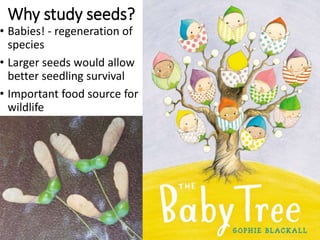
• Babies! - regeneration of
species
• Larger seeds would allow
better seedling survival
• Important food source for
wildlife
Why Collect Seeds in 2017?
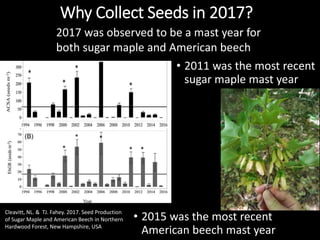
• 2011 was the most recent
sugar maple mast year
Cleavitt, NL. & TJ. Fahey. 2017. Seed Production
of Sugar Maple and American Beech in Northern
Hardwood Forest, New Hampshire, USA
2017 was observed to be a mast year for
both sugar maple and American beech
• 2015 was the most recent
American beech mast year
Methods
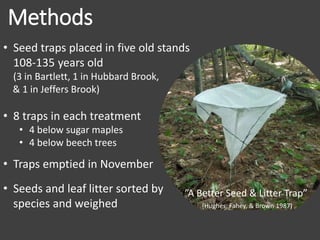
”A Better Seed & Litter Trap”
(Hughes, Fahey, & Brown 1987)
• Seed traps placed in five old stands
108-135 years old
(3 in Bartlett, 1 in Hubbard Brook,
& 1 in Jeffers Brook)
• 8 traps in each treatment
• 4 below sugar maples
• 4 below beech trees
• Traps emptied in November
• Seeds and leaf litter sorted by
species and weighed
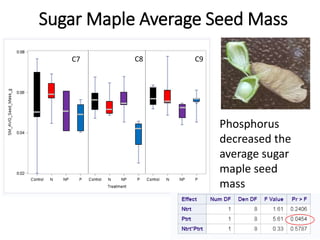
Sugar Maple Average Seed Mass
Phosphorus
decreased the
average sugar
maple seed
mass
C7 C8 C9
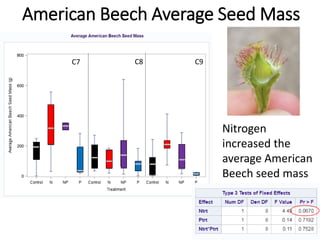
American Beech Average Seed Mass
Nitrogen
increased the
average American
Beech seed mass
C7 C8 C9
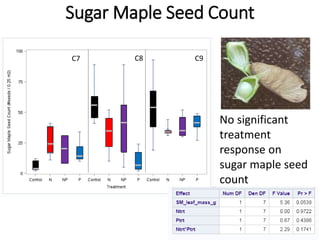
Sugar Maple Seed Count
No significant
treatment
response on
sugar maple seed
count
C7 C8 C9
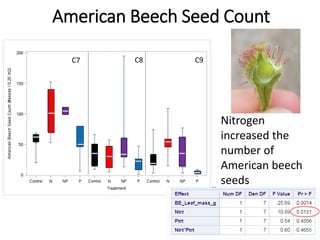
American Beech Seed Count
C7 C8 C9
Nitrogen
increased the
number of
American beech
seeds
Future Work
• Still sorting data from
Jeffers Brook and
Hubbard Brook
• Seed viability testing
• Germination testing
• Chemistry analysis
• Carbohydrate analysis
Acknowledgement
• Nat Cleavitt
• Ruth Yanai
• Tim Fahey
• Matt Vadeboncoeur
• Maddy Morley
• Claudia Victoroff
• MELNHE Crew
Students at SUNY Cobleskill
• Max Hill
• Naomi Shibuya
• Nancy Hendricks
• Mary Morawski
• Collin Clark
• John Parker
• Jimmy Kloos
• Julian Canavan
• Briana Vasquez

HB 2018- The after mast

  • 1.
    The After Mast: effectsof nutrients on sugar maple and beech seed production Adam Wild Committee Members: Ruth Yanai Nat Cleavitt Tim Fahey Matt Vadeboncoeur
  • 2.
    Why study seeds? •Babies! - regeneration of species • Larger seeds would allow better seedling survival • Important food source for wildlife
  • 3.
    Why Collect Seedsin 2017? • 2011 was the most recent sugar maple mast year Cleavitt, NL. & TJ. Fahey. 2017. Seed Production of Sugar Maple and American Beech in Northern Hardwood Forest, New Hampshire, USA 2017 was observed to be a mast year for both sugar maple and American beech • 2015 was the most recent American beech mast year
  • 4.
    Methods ”A Better Seed& Litter Trap” (Hughes, Fahey, & Brown 1987) • Seed traps placed in five old stands 108-135 years old (3 in Bartlett, 1 in Hubbard Brook, & 1 in Jeffers Brook) • 8 traps in each treatment • 4 below sugar maples • 4 below beech trees • Traps emptied in November • Seeds and leaf litter sorted by species and weighed
  • 5.
    Sugar Maple AverageSeed Mass Phosphorus decreased the average sugar maple seed mass C7 C8 C9
  • 6.
    American Beech AverageSeed Mass Nitrogen increased the average American Beech seed mass C7 C8 C9
  • 7.
    Sugar Maple SeedCount No significant treatment response on sugar maple seed count C7 C8 C9
  • 8.
    American Beech SeedCount C7 C8 C9 Nitrogen increased the number of American beech seeds
  • 9.
    Future Work • Stillsorting data from Jeffers Brook and Hubbard Brook • Seed viability testing • Germination testing • Chemistry analysis • Carbohydrate analysis
  • 10.
    Acknowledgement • Nat Cleavitt •Ruth Yanai • Tim Fahey • Matt Vadeboncoeur • Maddy Morley • Claudia Victoroff • MELNHE Crew Students at SUNY Cobleskill • Max Hill • Naomi Shibuya • Nancy Hendricks • Mary Morawski • Collin Clark • John Parker • Jimmy Kloos • Julian Canavan • Briana Vasquez

Editor's Notes

  • #5 Paper said it would take 4.5-6.5 minutes to make but it actually took 10-15 minutes to make.
  • #8 NP maybe increased count