Using uncertainty analysis to provide
sampling guidance in monitoring fish and
loons for mercury pollution
Yang Yang1*, Ruth Yanai1, Charley Driscoll2,
Geoffrey Miller2, Nina Schoch3, David Evers4
State University of New York-ESF1, Syracuse University2
Adirondack Center for Loon Conservation3,
Biodiversity Research Institute4
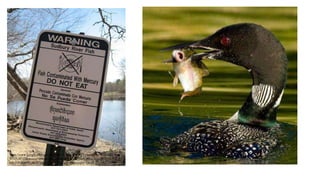
https://www.google.com/search?q=no+fishing+mercury+sign&rlz=1C1CHZL_enU
S732US732&source=lnms&tbm=isch&sa=X&ved=0ahUKEwiEsaDBxqjaAhUCsl
MKHflQDtQQ_AUICygC&biw=1366&bih=662#imgrc=DF16_FEyaNFOQM:
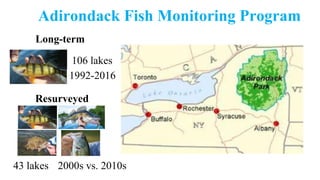
Adirondack Fish Monitoring Program
1992-2016
106 lakes
Long-term
Resurveyed
43 lakes 2000s vs. 2010s
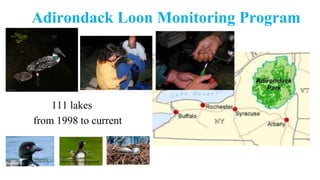
Adirondack Loon Monitoring Program
111 lakes
from 1998 to current
https://www.google.com/search?rlz
&q=loon&oq=loon&gs_l=
https://www.google.com/search
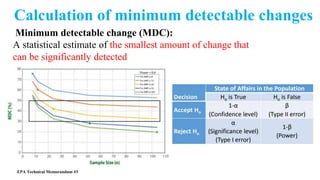
Calculation of minimum detectable changes
Minimum detectable change (MDC):
A statistical estimate of the smallest amount of change that
can be significantly detected
EPA Technical Memorandum #3
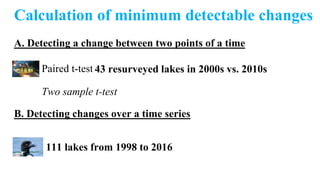
Calculation of minimum detectable changes
A. Detecting a change between two points of a time
Two sample t-test
Paired t-test
B. Detecting changes over a time series
43 resurveyed lakes in 2000s vs. 2010s
111 lakes from 1998 to 2016
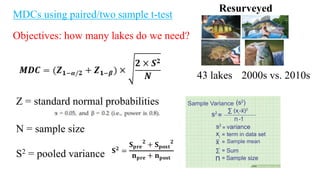
MDCs using paired/two sample t-test
N = sample size
S2 = pooled variance
Z = standard normal probabilities
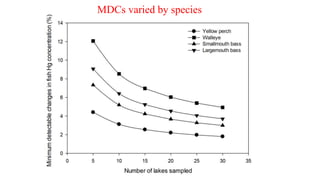
Objectives: how many lakes do we need?
Resurveyed
43 lakes 2000s vs. 2010s
MDCs varied by species
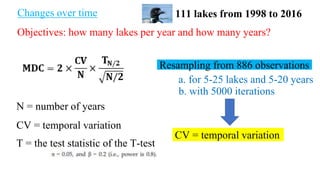
Changes over time
N = number of years
CV = temporal variation
T = the test statistic of the T-test
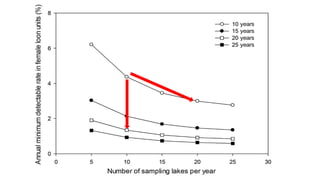
Objectives: how many lakes per year and how many years?
111 lakes from 1998 to 2016
a. for 5-25 lakes and 5-20 years
Resampling from 886 observations
CV = temporal variation
b. with 5000 iterations
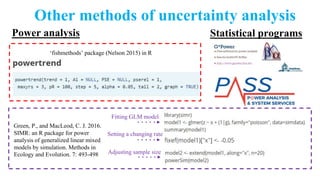
Other methods of uncertainty analysis
Statistical programsPower analysis
‘fishmethods’ package (Nelson 2015) in R
Green, P., and MacLeod, C. J. 2016.
SIMR: an R package for power
analysis of generalized linear mixed
models by simulation. Methods in
Ecology and Evolution. 7: 493-498
Fitting GLM model
Setting a changing rate
Adjusting sample size
Acknowledgement
Field and laboratory work
Financial support
The Wild Center
The Raquette River Advisory Council
And more and more…

Asm2018 4 y.yang

  • 1.
    Using uncertainty analysisto provide sampling guidance in monitoring fish and loons for mercury pollution Yang Yang1*, Ruth Yanai1, Charley Driscoll2, Geoffrey Miller2, Nina Schoch3, David Evers4 State University of New York-ESF1, Syracuse University2 Adirondack Center for Loon Conservation3, Biodiversity Research Institute4
  • 2.
  • 3.
    Adirondack Fish MonitoringProgram 1992-2016 106 lakes Long-term Resurveyed 43 lakes 2000s vs. 2010s
  • 4.
    Adirondack Loon MonitoringProgram 111 lakes from 1998 to current https://www.google.com/search?rlz &q=loon&oq=loon&gs_l= https://www.google.com/search
  • 5.
    Calculation of minimumdetectable changes Minimum detectable change (MDC): A statistical estimate of the smallest amount of change that can be significantly detected EPA Technical Memorandum #3
  • 6.
    Calculation of minimumdetectable changes A. Detecting a change between two points of a time Two sample t-test Paired t-test B. Detecting changes over a time series 43 resurveyed lakes in 2000s vs. 2010s 111 lakes from 1998 to 2016
  • 7.
    MDCs using paired/twosample t-test N = sample size S2 = pooled variance Z = standard normal probabilities Objectives: how many lakes do we need? Resurveyed 43 lakes 2000s vs. 2010s
  • 8.
  • 9.
    Changes over time N= number of years CV = temporal variation T = the test statistic of the T-test Objectives: how many lakes per year and how many years? 111 lakes from 1998 to 2016 a. for 5-25 lakes and 5-20 years Resampling from 886 observations CV = temporal variation b. with 5000 iterations
  • 11.
    Other methods ofuncertainty analysis Statistical programsPower analysis ‘fishmethods’ package (Nelson 2015) in R Green, P., and MacLeod, C. J. 2016. SIMR: an R package for power analysis of generalized linear mixed models by simulation. Methods in Ecology and Evolution. 7: 493-498 Fitting GLM model Setting a changing rate Adjusting sample size
  • 12.
    Acknowledgement Field and laboratorywork Financial support The Wild Center The Raquette River Advisory Council And more and more…