


@martin_loetzsch
Dr. Martin Loetzsch
Data Natives 2017
Reducing pain in data engineering
2
Data Engineering
@martin_loetzsch
3
@martin_loetzsch
4
Which technology?
@martin_loetzsch
Avoid click-tools
hard to debug
hard to change
hard to scale with team size/ data complexity / data volume 

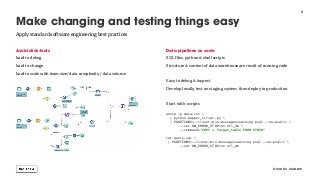
Data pipelines as code
SQL files, python & shell scripts
Structure & content of data warehouse are result of running code 

Easy to debug & inspect
Develop locally, test on staging system, then deploy to production
Start with scripts


unzip -p data.csv 

| python mapper_script.py 

| PGOPTIONS=--client-min-messages=warning psql --no-psqlrc 

--set ON_ERROR_STOP=on etl_db 
--command="COPY s.target_table FROM STDIN”
cat query.sql 

| PGOPTIONS=--client-min-messages=warning psql --no-psqlrc 

--set ON_ERROR_STOP=on etl_db

5
Make changing and testing things easy
@martin_loetzsch
Apply standard software engineering best practices
Target of computation


CREATE TABLE m_dim_next.region (

region_id SMALLINT PRIMARY KEY,

region_name TEXT NOT NULL UNIQUE,

country_id SMALLINT NOT NULL,

country_name TEXT NOT NULL,

_region_name TEXT NOT NULL

);


Do computation and store result in table


WITH raw_region
AS (SELECT DISTINCT
country,

region

FROM m_data.ga_session

ORDER BY country, region)


INSERT INTO m_dim_next.region
SELECT
row_number()
OVER (ORDER BY country, region ) AS region_id,

CASE WHEN (SELECT count(DISTINCT country)
FROM raw_region r2
WHERE r2.region = r1.region) > 1
THEN region || ' / ' || country
ELSE region END AS region_name,
dense_rank() OVER (ORDER BY country) AS country_id,
country AS country_name,
region AS _region_name
FROM raw_region r1;

INSERT INTO m_dim_next.region
VALUES (-1, 'Unknown', -1, 'Unknown', 'Unknown');

Speedup subsequent transformations


SELECT util.add_index(
'm_dim_next', 'region',
column_names := ARRAY ['_region_name', ‘country_name',
'region_id']);


SELECT util.add_index(
'm_dim_next', 'region',
column_names := ARRAY ['country_id', 'region_id']);


ANALYZE m_dim_next.region;
6
SQL as data processing language
@martin_loetzsch
Tables as (intermediate) results of processing steps
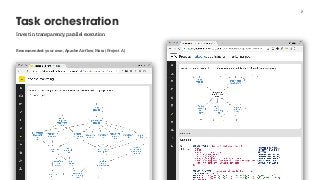
Recommended: your own, Apache Airflow, Mara (Project A)
Transformations are transparent to stakeholders
7
Task orchestration
@martin_loetzsch
Invest in transparency, parallel execution
8
Consistency & correctness
@martin_loetzsch
It’s easy to make mistakes during ETL


DROP SCHEMA IF EXISTS s CASCADE; CREATE SCHEMA s;


CREATE TABLE s.city (
city_id SMALLINT,
city_name TEXT,
country_name TEXT
);

INSERT INTO s.city VALUES
(1, 'Berlin', 'Germany'),
(2, 'Budapest', 'Hungary');


CREATE TABLE s.customer (
customer_id BIGINT,
city_fk SMALLINT
);

INSERT INTO s.customer VALUES
(1, 1),
(1, 2),
(2, 3);

Customers per country?


SELECT
country_name,
count(*) AS number_of_customers
FROM s.customer JOIN s.city 

ON customer.city_fk = s.city.city_id
GROUP BY country_name;


Back up all assumptions about data by constraints


ALTER TABLE s.city ADD PRIMARY KEY (city_id);
ALTER TABLE s.city ADD UNIQUE (city_name);
ALTER TABLE s.city ADD UNIQUE (city_name, country_name);


ALTER TABLE s.customer ADD PRIMARY KEY (customer_id);
[23505] ERROR: could not create unique index "customer_pkey"
Detail: Key (customer_id)=(1) is duplicated.

ALTER TABLE s.customer ADD FOREIGN KEY (city_fk)
REFERENCES s.city (city_id);
[23503] ERROR: insert or update on table "customer" violates
foreign key constraint "customer_city_fk_fkey"
Detail: Key (city_fk)=(3) is not present in table "city"
9
Referential consistency
@martin_loetzsch
Only very little overhead, will save your ass
10/18/2017 2017-10-18-dwh-schema-pav.svg
customer
customer_id
first_order_fk
favourite_product_fk
lifetime_revenue
product
product_id
revenue_last_6_months
order
order_id
processed_order_id
customer_fk
product_fk
revenue
Never repeat “business logic”


SELECT sum(total_price) AS revenue
FROM os_data.order
WHERE status IN ('pending', 'accepted', 'completed',

'proposal_for_change');


SELECT CASE WHEN (status <> 'started'
AND payment_status = 'authorised'
AND order_type <> 'backend')
THEN o.order_id END AS processed_order_fk
FROM os_data.order;


SELECT (last_status = 'pending') :: INTEGER AS is_unprocessed
FROM os_data.order;


Refactor pipeline
Create separate task that computes everything we know about an order
Usually difficult in real life


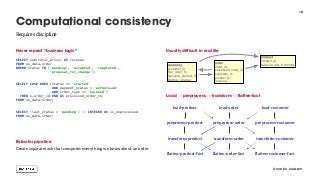
Load → preprocess → transform → flatten-fact
10
Computational consistency
@martin_loetzsch
Requires discipline
load-product load-order load-customer
preprocess-product preprocess-order preprocess-customer
transform-product transform-order transform-customer
flatten-product-fact flatten-order-fact flatten-customer-fact
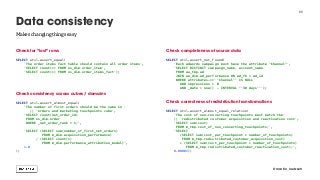
Check for “lost” rows


SELECT util.assert_equal(
'The order items fact table should contain all order items',
'SELECT count(*) FROM os_dim.order_item',
'SELECT count(*) FROM os_dim.order_items_fact');


Check consistency across cubes / domains


SELECT util.assert_almost_equal(
'The number of first orders should be the same in '

|| 'orders and marketing touchpoints cube',
'SELECT count(net_order_id)
FROM os_dim.order
WHERE _net_order_rank = 1;',

'SELECT (SELECT sum(number_of_first_net_orders)
FROM m_dim.acquisition_performance)
/ (SELECT count(*)
FROM m_dim.performance_attribution_model)',
1.0
);

Check completeness of source data


SELECT util.assert_not_found(
'Each adwords campaign must have the attribute "Channel"',
'SELECT DISTINCT campaign_name, account_name
FROM aw_tmp.ad
JOIN aw_dim.ad_performance ON ad_fk = ad_id
WHERE attributes->>''Channel'' IS NULL
AND impressions > 0
AND _date > now() - INTERVAL ''30 days''');


Check correctness of redistribution transformations


SELECT util.assert_almost_equal_relative(
'The cost of non-converting touchpoints must match the'
|| 'redistributed customer acquisition and reactivation cost',
'SELECT sum(cost)
FROM m_tmp.cost_of_non_converting_touchpoints;',
'SELECT
(SELECT sum(cost_per_touchpoint * number_of_touchpoints)
FROM m_tmp.redistributed_customer_acquisition_cost)
+ (SELECT sum(cost_per_touchpoint * number_of_touchpoints)
FROM m_tmp.redistributed_customer_reactivation_cost);',
0.00001);
11
Data consistency
@martin_loetzsch
Makes changing things easy
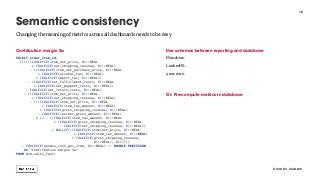
Contribution margin 3a
SELECT order_item_id,
((((((COALESCE(item_net_price, 0)::REAL
+ COALESCE(net_shipping_revenue, 0)::REAL)
- ((COALESCE(item_net_purchase_price, 0)::REAL
+ COALESCE(alcohol_tax, 0)::REAL)
+ COALESCE(import_tax, 0)::REAL))
- (COALESCE(net_fulfillment_costs, 0)::REAL
+ COALESCE(net_payment_costs, 0)::REAL))
- COALESCE(net_return_costs, 0)::REAL)
- ((COALESCE(item_net_price, 0)::REAL
+ COALESCE(net_shipping_revenue, 0)::REAL)
- ((((COALESCE(item_net_price, 0)::REAL
+ COALESCE(item_tax_amount, 0)::REAL)
+ COALESCE(gross_shipping_revenue, 0)::REAL)
- COALESCE(voucher_gross_amount, 0)::REAL)
* (1 - ((COALESCE(item_tax_amount, 0)::REAL
+ (COALESCE(gross_shipping_revenue, 0)::REAL
- COALESCE(net_shipping_revenue, 0)::REAL))
/ NULLIF(((COALESCE(item_net_price, 0)::REAL
+ COALESCE(item_tax_amount, 0)::REAL)
+ COALESCE(gross_shipping_revenue,
0)::REAL), 0))))))
- COALESCE(goodie_cost_per_item, 0)::REAL) :: DOUBLE PRECISION
AS "Contribution margin 3a"
FROM dim.sales_fact;
Use schemas between reporting and database
Mondrian
LookerML
your own
Or: Pre-compute metrics in database
12
Semantic consistency
@martin_loetzsch
Changing the meaning of metrics across all dashboards needs to be easy
Focus on the complexity of data
rather than the complexity of technology
@martin_loetzsch
13
14
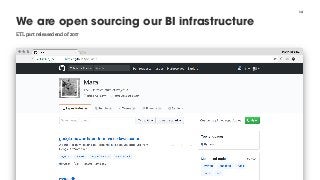
We are open sourcing our BI infrastructure
@martin_loetzsch
ETL part released end of 2017
@martin_loetzsch
15
Meet us here at DN
16
Refer us a data person, earn 200€
@martin_loetzsch
Also analysts, BI managers
Thank you
@martin_loetzsch
17

Reducing Pain in Data Engineering - Data Natives 2017

  • 1.
    @martin_loetzsch Dr. Martin Loetzsch DataNatives 2017 Reducing pain in data engineering
  • 2.
  • 3.
  • 4.
  • 5.
    Avoid click-tools hard todebug hard to change hard to scale with team size/ data complexity / data volume 
 Data pipelines as code SQL files, python & shell scripts Structure & content of data warehouse are result of running code 
 Easy to debug & inspect Develop locally, test on staging system, then deploy to production Start with scripts 
 unzip -p data.csv 
 | python mapper_script.py 
 | PGOPTIONS=--client-min-messages=warning psql --no-psqlrc 
 --set ON_ERROR_STOP=on etl_db --command="COPY s.target_table FROM STDIN” cat query.sql 
 | PGOPTIONS=--client-min-messages=warning psql --no-psqlrc 
 --set ON_ERROR_STOP=on etl_db
 5 Make changing and testing things easy @martin_loetzsch Apply standard software engineering best practices
  • 6.
    Target of computation 
 CREATETABLE m_dim_next.region (
 region_id SMALLINT PRIMARY KEY,
 region_name TEXT NOT NULL UNIQUE,
 country_id SMALLINT NOT NULL,
 country_name TEXT NOT NULL,
 _region_name TEXT NOT NULL
 );
 
 Do computation and store result in table 
 WITH raw_region AS (SELECT DISTINCT country,
 region
 FROM m_data.ga_session
 ORDER BY country, region)
 
 INSERT INTO m_dim_next.region SELECT row_number() OVER (ORDER BY country, region ) AS region_id,
 CASE WHEN (SELECT count(DISTINCT country) FROM raw_region r2 WHERE r2.region = r1.region) > 1 THEN region || ' / ' || country ELSE region END AS region_name, dense_rank() OVER (ORDER BY country) AS country_id, country AS country_name, region AS _region_name FROM raw_region r1;
 INSERT INTO m_dim_next.region VALUES (-1, 'Unknown', -1, 'Unknown', 'Unknown');
 Speedup subsequent transformations 
 SELECT util.add_index( 'm_dim_next', 'region', column_names := ARRAY ['_region_name', ‘country_name', 'region_id']);
 
 SELECT util.add_index( 'm_dim_next', 'region', column_names := ARRAY ['country_id', 'region_id']);
 
 ANALYZE m_dim_next.region; 6 SQL as data processing language @martin_loetzsch Tables as (intermediate) results of processing steps
  • 7.
    Recommended: your own,Apache Airflow, Mara (Project A) Transformations are transparent to stakeholders 7 Task orchestration @martin_loetzsch Invest in transparency, parallel execution
  • 8.
  • 9.
    It’s easy tomake mistakes during ETL 
 DROP SCHEMA IF EXISTS s CASCADE; CREATE SCHEMA s;
 
 CREATE TABLE s.city ( city_id SMALLINT, city_name TEXT, country_name TEXT );
 INSERT INTO s.city VALUES (1, 'Berlin', 'Germany'), (2, 'Budapest', 'Hungary');
 
 CREATE TABLE s.customer ( customer_id BIGINT, city_fk SMALLINT );
 INSERT INTO s.customer VALUES (1, 1), (1, 2), (2, 3);
 Customers per country? 
 SELECT country_name, count(*) AS number_of_customers FROM s.customer JOIN s.city 
 ON customer.city_fk = s.city.city_id GROUP BY country_name;
 
 Back up all assumptions about data by constraints 
 ALTER TABLE s.city ADD PRIMARY KEY (city_id); ALTER TABLE s.city ADD UNIQUE (city_name); ALTER TABLE s.city ADD UNIQUE (city_name, country_name); 
 ALTER TABLE s.customer ADD PRIMARY KEY (customer_id); [23505] ERROR: could not create unique index "customer_pkey" Detail: Key (customer_id)=(1) is duplicated.
 ALTER TABLE s.customer ADD FOREIGN KEY (city_fk) REFERENCES s.city (city_id); [23503] ERROR: insert or update on table "customer" violates foreign key constraint "customer_city_fk_fkey" Detail: Key (city_fk)=(3) is not present in table "city" 9 Referential consistency @martin_loetzsch Only very little overhead, will save your ass
  • 10.
    10/18/2017 2017-10-18-dwh-schema-pav.svg customer customer_id first_order_fk favourite_product_fk lifetime_revenue product product_id revenue_last_6_months order order_id processed_order_id customer_fk product_fk revenue Never repeat“business logic” 
 SELECT sum(total_price) AS revenue FROM os_data.order WHERE status IN ('pending', 'accepted', 'completed',
 'proposal_for_change'); 
 
 SELECT CASE WHEN (status <> 'started' AND payment_status = 'authorised' AND order_type <> 'backend') THEN o.order_id END AS processed_order_fk FROM os_data.order;
 
 SELECT (last_status = 'pending') :: INTEGER AS is_unprocessed FROM os_data.order;


 Refactor pipeline Create separate task that computes everything we know about an order Usually difficult in real life


 Load → preprocess → transform → flatten-fact 10 Computational consistency @martin_loetzsch Requires discipline load-product load-order load-customer preprocess-product preprocess-order preprocess-customer transform-product transform-order transform-customer flatten-product-fact flatten-order-fact flatten-customer-fact
  • 11.
    Check for “lost”rows 
 SELECT util.assert_equal( 'The order items fact table should contain all order items', 'SELECT count(*) FROM os_dim.order_item', 'SELECT count(*) FROM os_dim.order_items_fact');


 Check consistency across cubes / domains 
 SELECT util.assert_almost_equal( 'The number of first orders should be the same in '
 || 'orders and marketing touchpoints cube', 'SELECT count(net_order_id) FROM os_dim.order WHERE _net_order_rank = 1;',
 'SELECT (SELECT sum(number_of_first_net_orders) FROM m_dim.acquisition_performance) / (SELECT count(*) FROM m_dim.performance_attribution_model)', 1.0 );
 Check completeness of source data 
 SELECT util.assert_not_found( 'Each adwords campaign must have the attribute "Channel"', 'SELECT DISTINCT campaign_name, account_name FROM aw_tmp.ad JOIN aw_dim.ad_performance ON ad_fk = ad_id WHERE attributes->>''Channel'' IS NULL AND impressions > 0 AND _date > now() - INTERVAL ''30 days''');
 
 Check correctness of redistribution transformations 
 SELECT util.assert_almost_equal_relative( 'The cost of non-converting touchpoints must match the' || 'redistributed customer acquisition and reactivation cost', 'SELECT sum(cost) FROM m_tmp.cost_of_non_converting_touchpoints;', 'SELECT (SELECT sum(cost_per_touchpoint * number_of_touchpoints) FROM m_tmp.redistributed_customer_acquisition_cost) + (SELECT sum(cost_per_touchpoint * number_of_touchpoints) FROM m_tmp.redistributed_customer_reactivation_cost);', 0.00001); 11 Data consistency @martin_loetzsch Makes changing things easy
  • 12.
    Contribution margin 3a SELECTorder_item_id, ((((((COALESCE(item_net_price, 0)::REAL + COALESCE(net_shipping_revenue, 0)::REAL) - ((COALESCE(item_net_purchase_price, 0)::REAL + COALESCE(alcohol_tax, 0)::REAL) + COALESCE(import_tax, 0)::REAL)) - (COALESCE(net_fulfillment_costs, 0)::REAL + COALESCE(net_payment_costs, 0)::REAL)) - COALESCE(net_return_costs, 0)::REAL) - ((COALESCE(item_net_price, 0)::REAL + COALESCE(net_shipping_revenue, 0)::REAL) - ((((COALESCE(item_net_price, 0)::REAL + COALESCE(item_tax_amount, 0)::REAL) + COALESCE(gross_shipping_revenue, 0)::REAL) - COALESCE(voucher_gross_amount, 0)::REAL) * (1 - ((COALESCE(item_tax_amount, 0)::REAL + (COALESCE(gross_shipping_revenue, 0)::REAL - COALESCE(net_shipping_revenue, 0)::REAL)) / NULLIF(((COALESCE(item_net_price, 0)::REAL + COALESCE(item_tax_amount, 0)::REAL) + COALESCE(gross_shipping_revenue, 0)::REAL), 0)))))) - COALESCE(goodie_cost_per_item, 0)::REAL) :: DOUBLE PRECISION AS "Contribution margin 3a" FROM dim.sales_fact; Use schemas between reporting and database Mondrian LookerML your own Or: Pre-compute metrics in database 12 Semantic consistency @martin_loetzsch Changing the meaning of metrics across all dashboards needs to be easy
  • 13.
    Focus on thecomplexity of data rather than the complexity of technology @martin_loetzsch 13
  • 14.
    14 We are opensourcing our BI infrastructure @martin_loetzsch ETL part released end of 2017
  • 15.
  • 16.
    16 Refer us adata person, earn 200€ @martin_loetzsch Also analysts, BI managers
  • 17.