How and why I turned my old
Java projects into a first-class
serverless component
by Mario Fusco
Red Hat – Principal Software Engineer
@mariofusco
c
Agenda
➢
Declarative vs. Imperative programming
➢
What is a rule engine and how it works
➢
A simple example
➢
From drl to Java: the executable model
Agenda
➢
Declarative vs. Imperative programming
➢
What is a rule engine and how it works
➢
A simple example
➢
From drl to Java: the executable model
➢
What is GraalVM
➢
AoT compilation
➢
Limitations
➢
Refactoring Drools to (natively) compile on GraalVM
Agenda
c
➢
Declarative vs. Imperative programming
➢
What is a rule engine and how it works
➢
A simple example
➢
From drl to Java: the executable model
➢
What is GraalVM
➢
AoT compilation
➢
Limitations
➢
Refactoring Drools to (natively) compile on GraalVM
➢
What is Quarkus
➢
Quarkus features
➢
Integrating Drools with Quarkus
➢
Writing a Quarkus extension for Drools
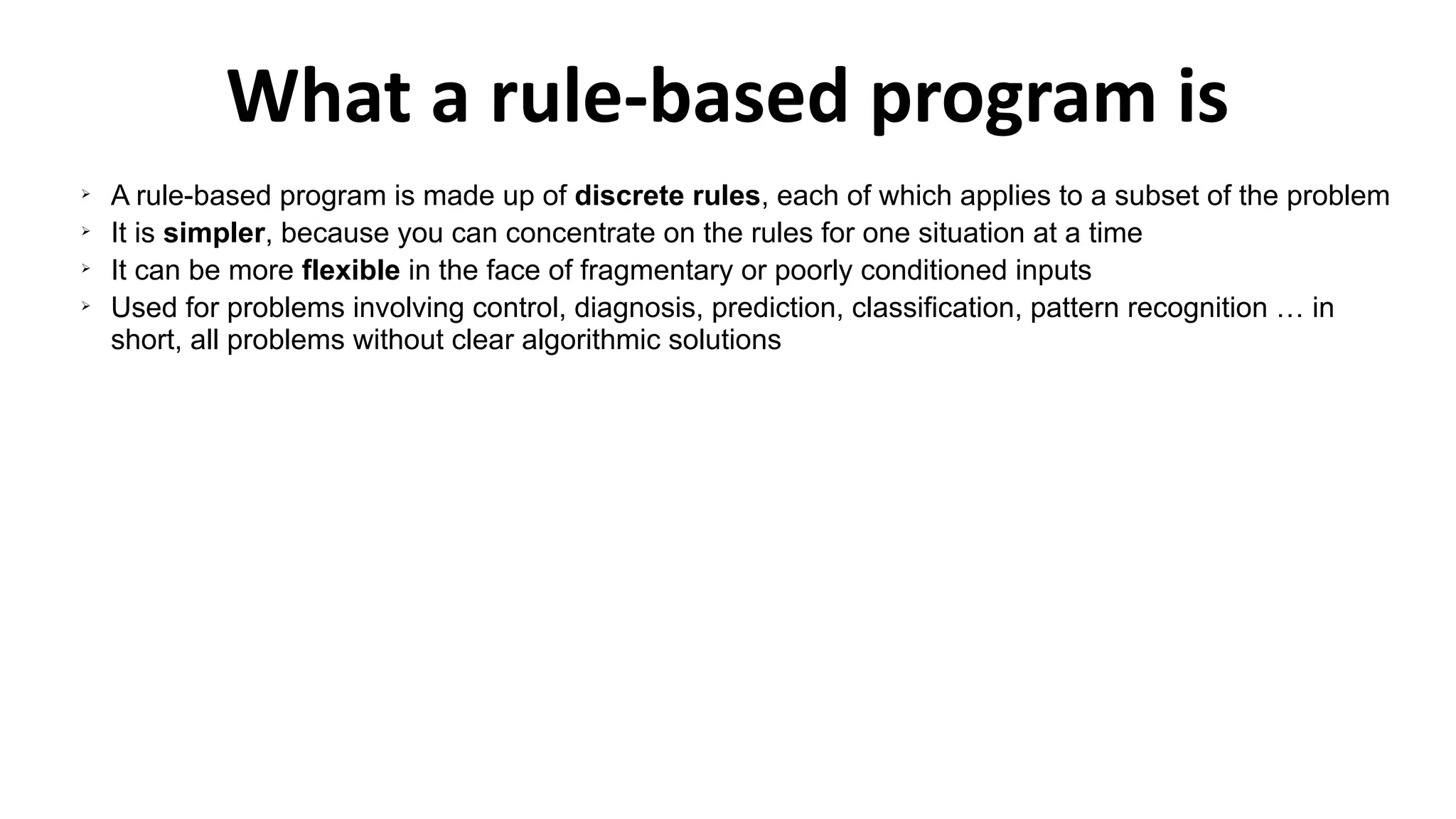
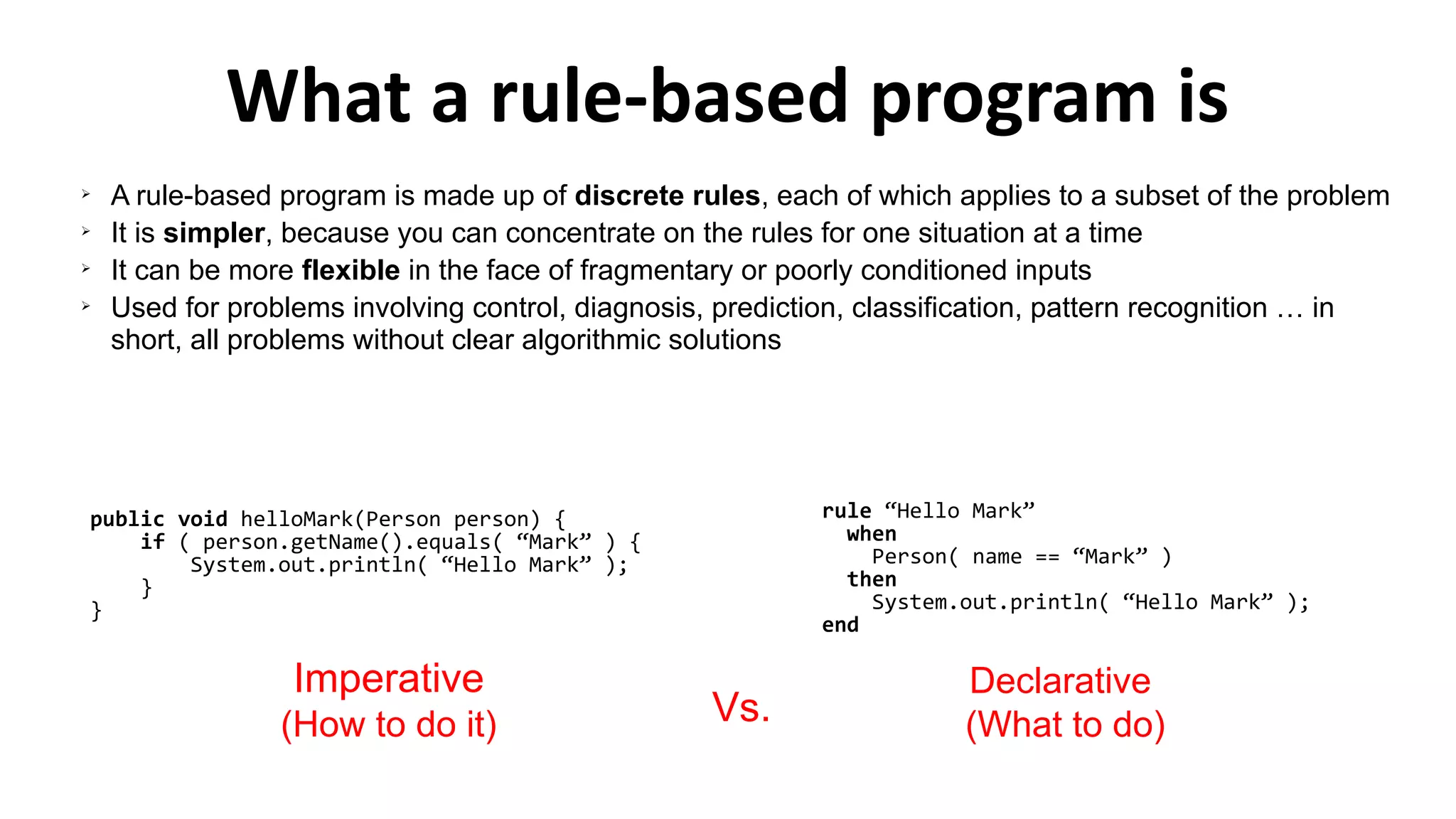
What a rule-based program is
➢
A rule-based program is made up of discrete rules, each of which applies to a subset of the problem
➢
It is simpler, because you can concentrate on the rules for one situation at a time
➢
It can be more flexible in the face of fragmentary or poorly conditioned inputs
➢
Used for problems involving control, diagnosis, prediction, classification, pattern recognition … in
short, all problems without clear algorithmic solutions
What a rule-based program is
➢
A rule-based program is made up of discrete rules, each of which applies to a subset of the problem
➢
It is simpler, because you can concentrate on the rules for one situation at a time
➢
It can be more flexible in the face of fragmentary or poorly conditioned inputs
➢
Used for problems involving control, diagnosis, prediction, classification, pattern recognition … in
short, all problems without clear algorithmic solutions
Declarative
(What to do)
Imperative
(How to do it) Vs.
public void helloMark(Person person) {
if ( person.getName().equals( “Mark” ) {
System.out.println( “Hello Mark” );
}
}
rule “Hello Mark”
when
Person( name == “Mark” )
then
System.out.println( “Hello Mark” );
end
What a rule-based program is
➢
A rule-based program is made up of discrete rules, each of which applies to a subset of the problem
➢
It is simpler, because you can concentrate on the rules for one situation at a time
➢
It can be more flexible in the face of fragmentary or poorly conditioned inputs
➢
Used for problems involving control, diagnosis, prediction, classification, pattern recognition … in
short, all problems without clear algorithmic solutions
Declarative
(What to do)
Imperative
(How to do it) Vs.
public void helloMark(Person person) {
if ( person.getName().equals( “Mark” ) {
System.out.println( “Hello Mark” );
}
}
rule “Hello Mark”
when
Person( name == “Mark” )
then
System.out.println( “Hello Mark” );
end
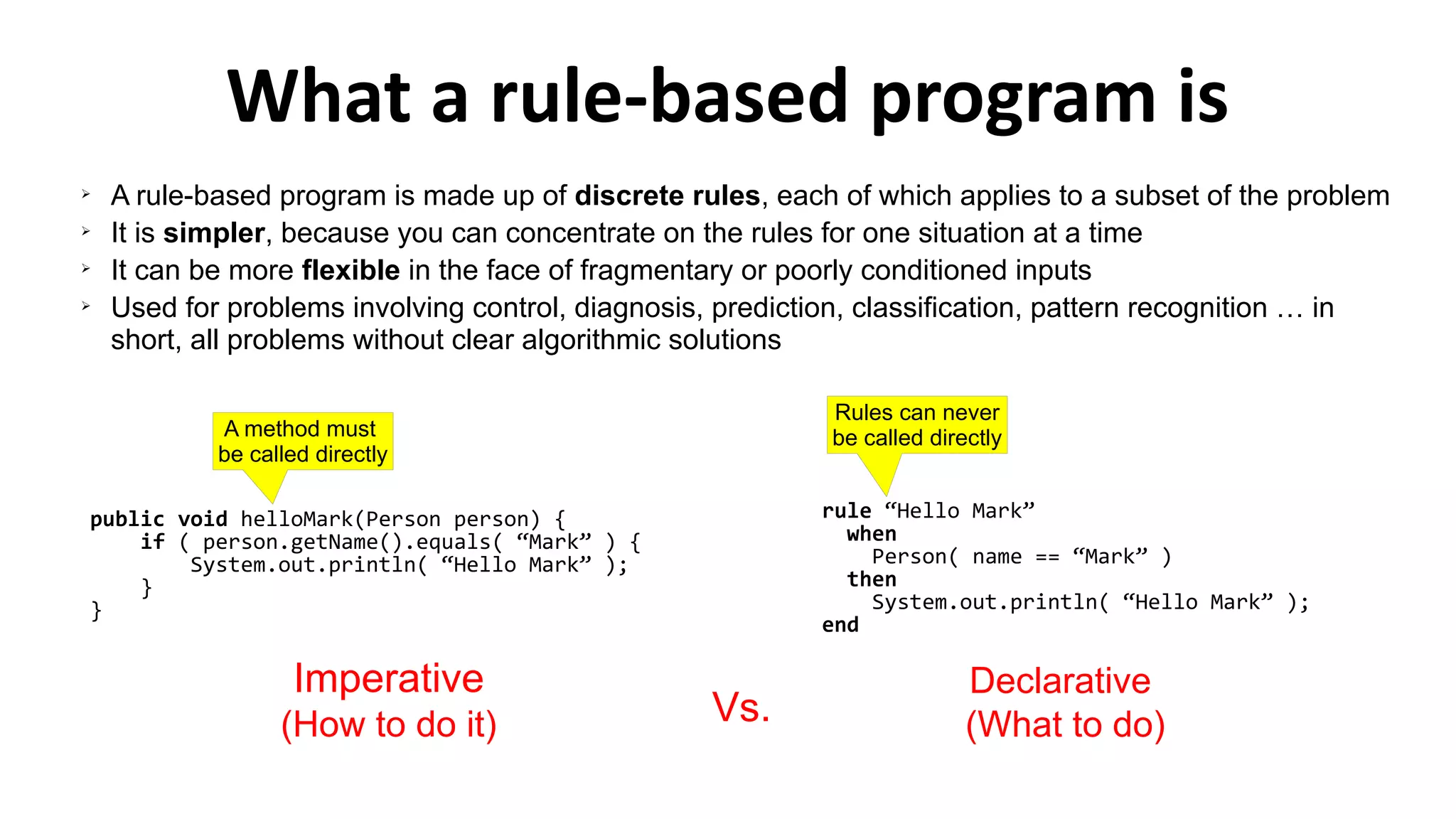
A method must
be called directly
Rules can never
be called directly
What a rule-based program is
➢
A rule-based program is made up of discrete rules, each of which applies to a subset of the problem
➢
It is simpler, because you can concentrate on the rules for one situation at a time
➢
It can be more flexible in the face of fragmentary or poorly conditioned inputs
➢
Used for problems involving control, diagnosis, prediction, classification, pattern recognition … in
short, all problems without clear algorithmic solutions
Declarative
(What to do)
Imperative
(How to do it) Vs.
public void helloMark(Person person) {
if ( person.getName().equals( “Mark” ) {
System.out.println( “Hello Mark” );
}
}
rule “Hello Mark”
when
Person( name == “Mark” )
then
System.out.println( “Hello Mark” );
end
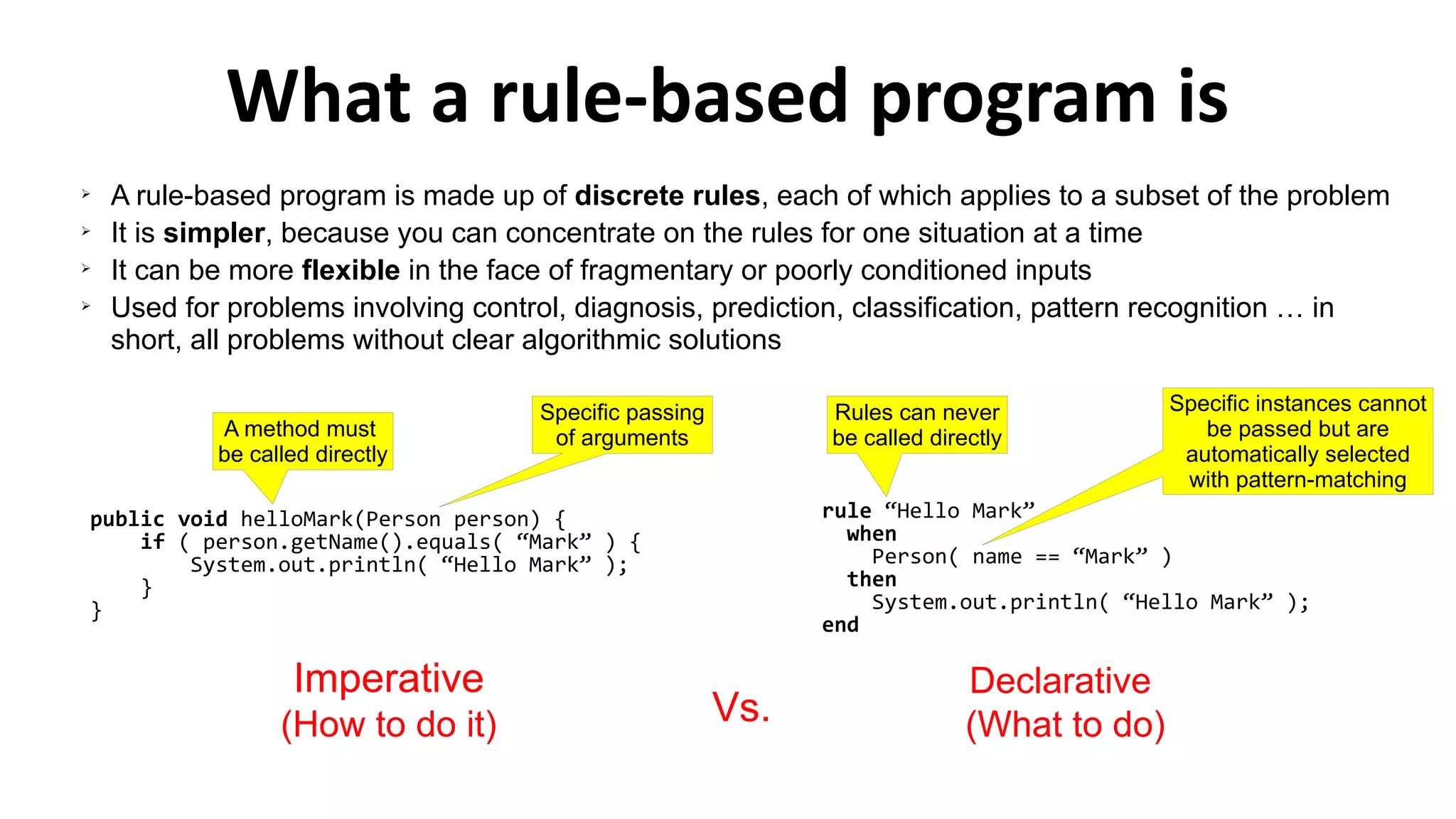
A method must
be called directly
Specific passing
of arguments
Rules can never
be called directly
Specific instances cannot
be passed but are
automatically selected
with pattern-matching
Introducing
➢
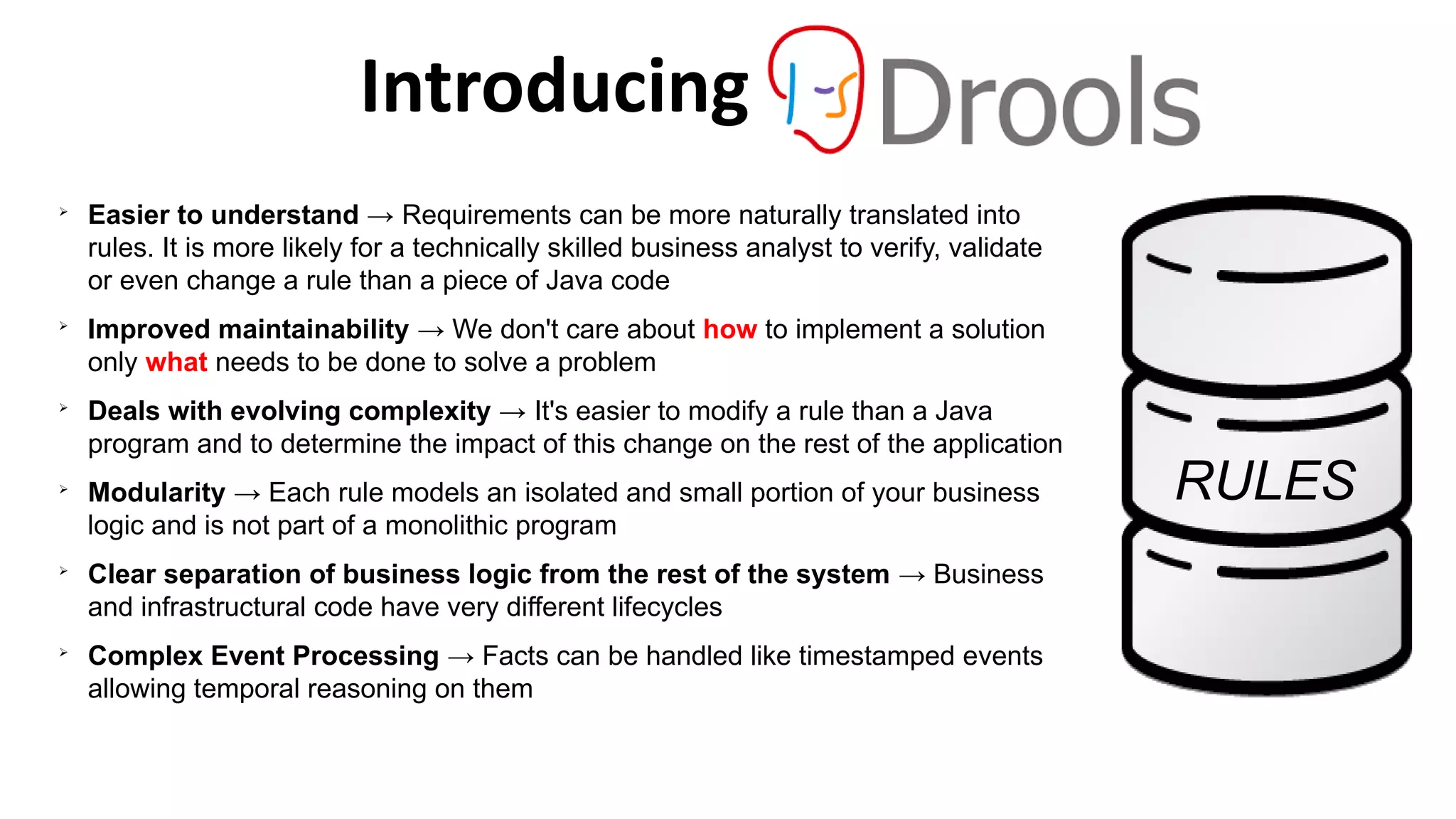
Easier to understand → Requirements can be more naturally translated into
rules. It is more likely for a technically skilled business analyst to verify, validate
or even change a rule than a piece of Java code
➢
Improved maintainability → We don't care about how to implement a solution
only what needs to be done to solve a problem
➢
Deals with evolving complexity → It's easier to modify a rule than a Java
program and to determine the impact of this change on the rest of the application
➢
Modularity → Each rule models an isolated and small portion of your business
logic and is not part of a monolithic program
➢
Clear separation of business logic from the rest of the system → Business
and infrastructural code have very different lifecycles
➢
Complex Event Processing → Facts can be handled like timestamped events
allowing temporal reasoning on them
RULES
How a rule-based system works
➢
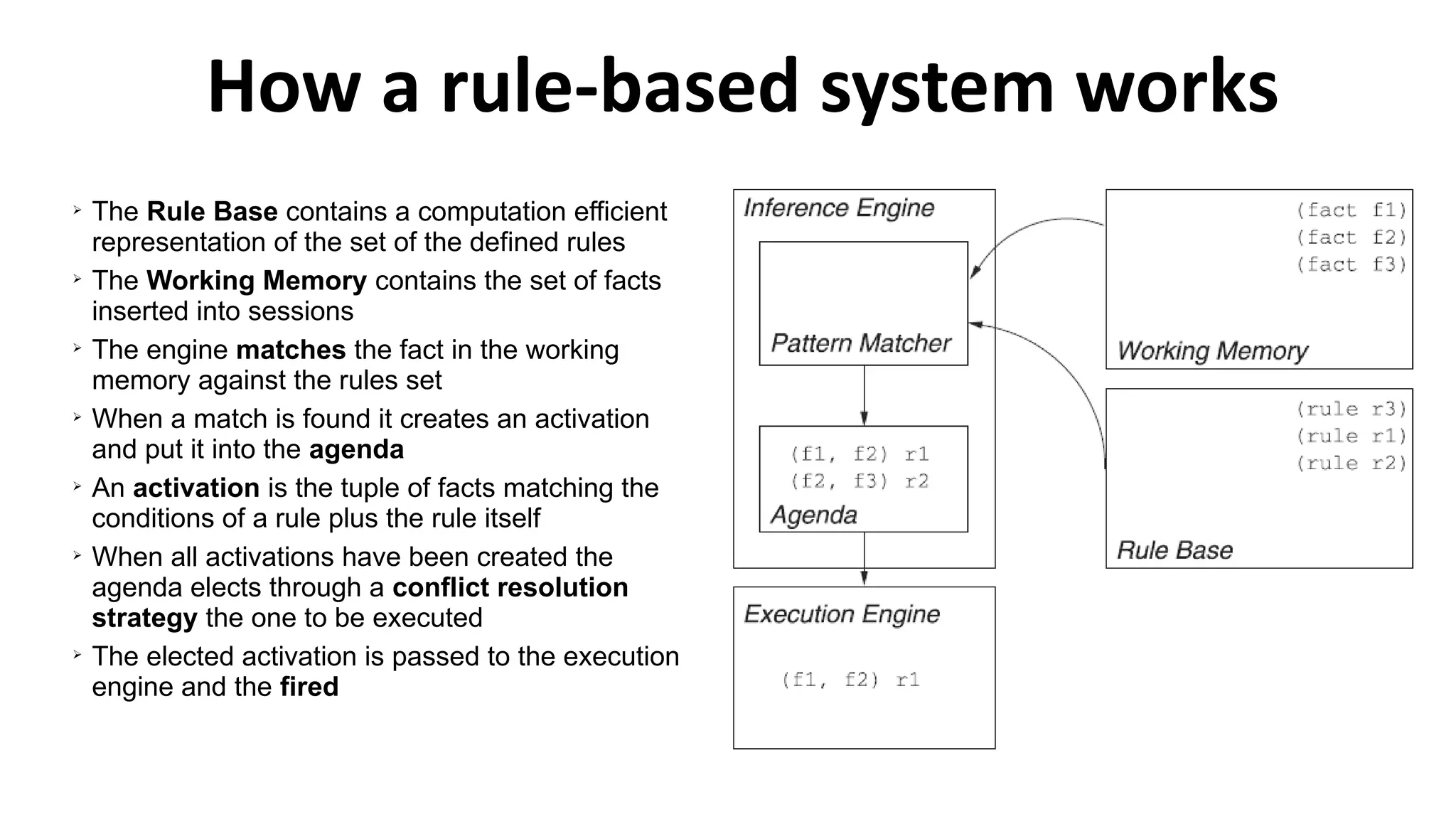
The Rule Base contains a computation efficient
representation of the set of the defined rules
➢
The Working Memory contains the set of facts
inserted into sessions
➢
The engine matches the fact in the working
memory against the rules set
➢
When a match is found it creates an activation
and put it into the agenda
➢
An activation is the tuple of facts matching the
conditions of a rule plus the rule itself
➢
When all activations have been created the
agenda elects through a conflict resolution
strategy the one to be executed
➢
The elected activation is passed to the execution
engine and the fired
A simple rule set
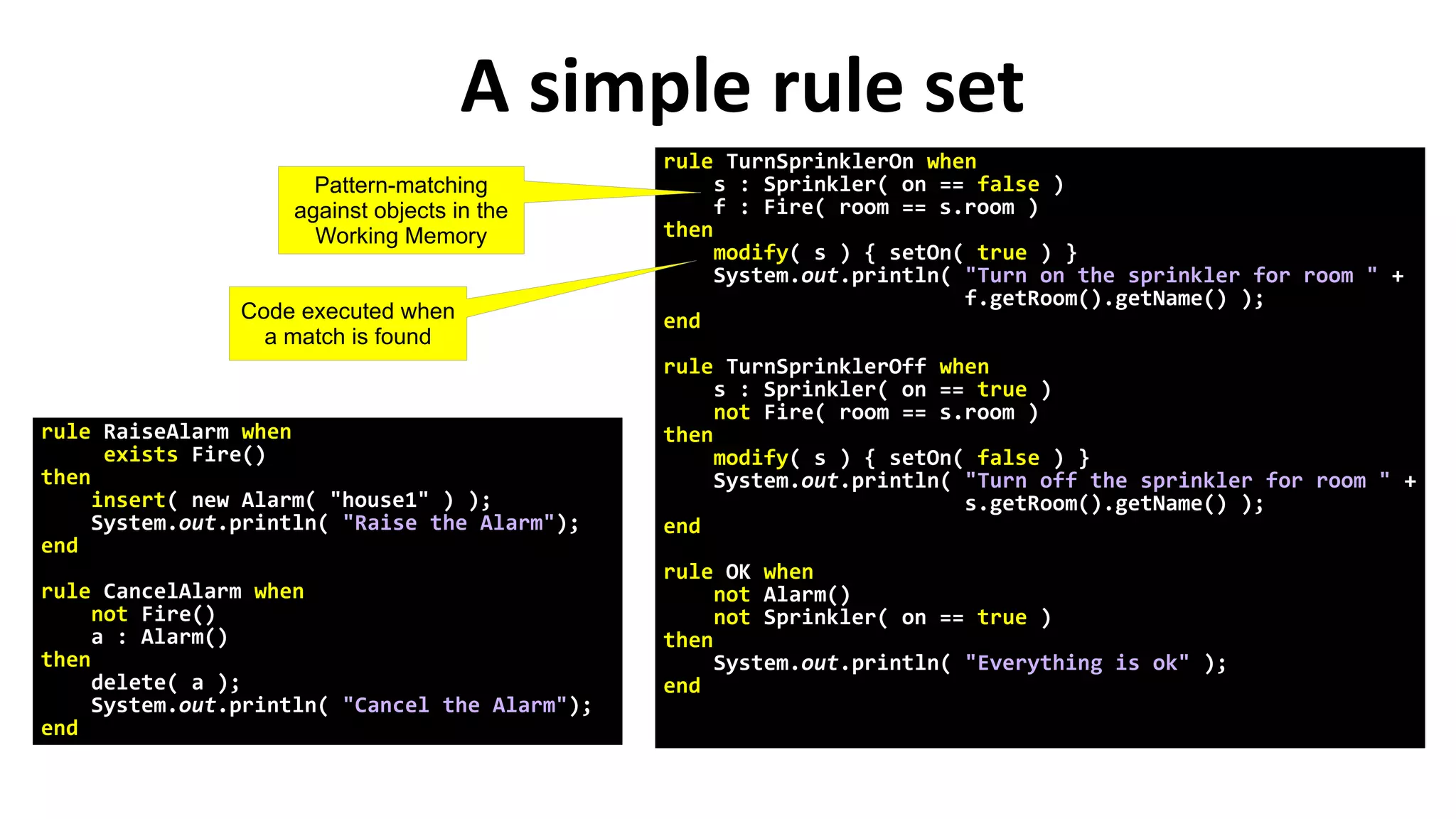
rule RaiseAlarm when
exists Fire()
then
insert( new Alarm( "house1" ) );
System.out.println( "Raise the Alarm");
end
rule CancelAlarm when
not Fire()
a : Alarm()
then
delete( a );
System.out.println( "Cancel the Alarm");
end
rule TurnSprinklerOn when
s : Sprinkler( on == false )
f : Fire( room == s.room )
then
modify( s ) { setOn( true ) }
System.out.println( "Turn on the sprinkler for room " +
f.getRoom().getName() );
end
rule TurnSprinklerOff when
s : Sprinkler( on == true )
not Fire( room == s.room )
then
modify( s ) { setOn( false ) }
System.out.println( "Turn off the sprinkler for room " +
s.getRoom().getName() );
end
rule OK when
not Alarm()
not Sprinkler( on == true )
then
System.out.println( "Everything is ok" );
end
Pattern-matching
against objects in the
Working Memory
Code executed when
a match is found
What is
used by Quarkus
➢
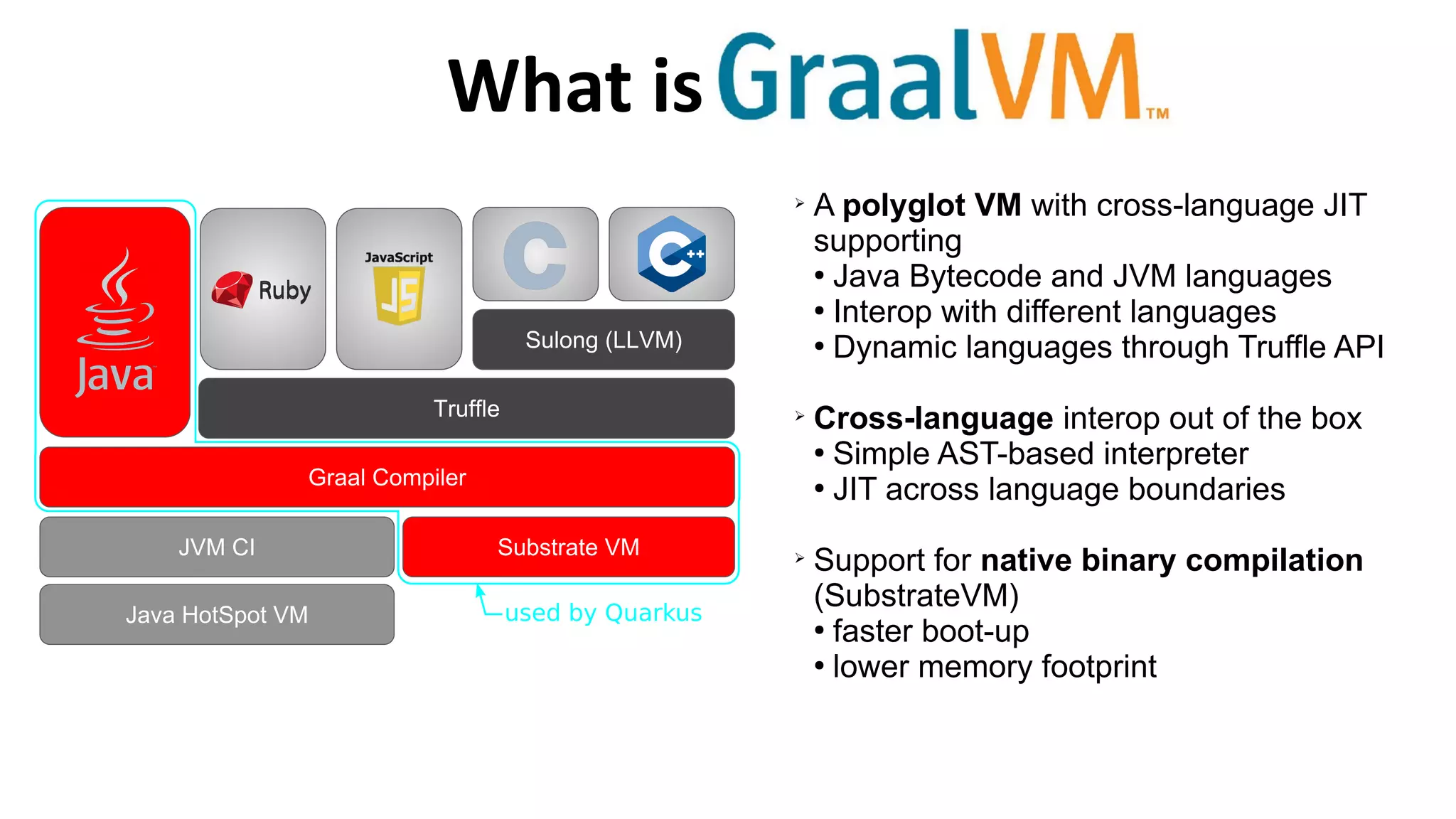
A polyglot VM with cross-language JIT
supporting
●
Java Bytecode and JVM languages
●
Interop with different languages
●
Dynamic languages through Truffle API
➢
Cross-language interop out of the box
●
Simple AST-based interpreter
●
JIT across language boundaries
➢
Support for native binary compilation
(SubstrateVM)
●
faster boot-up
●
lower memory footprint
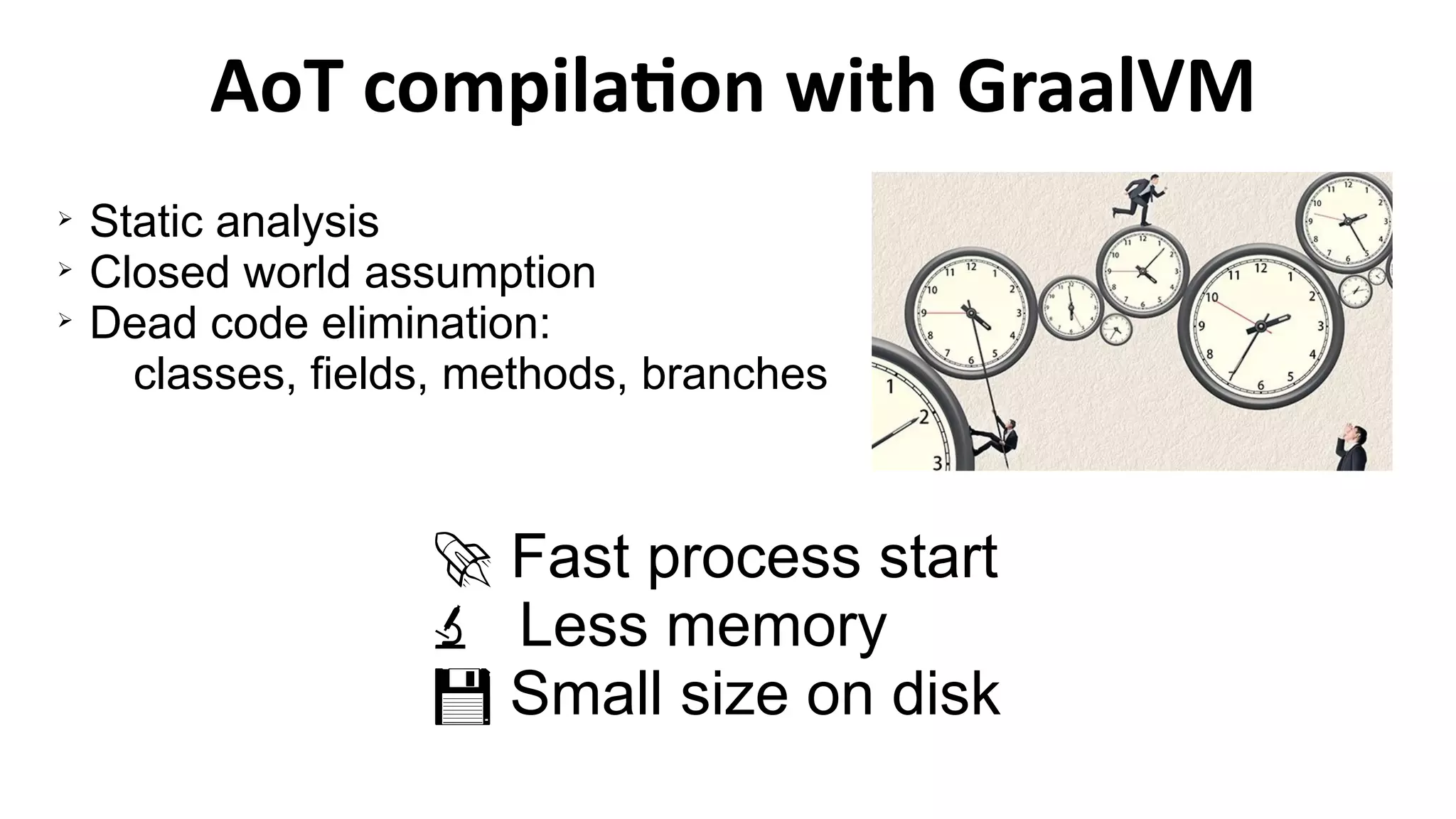
AoT compilation with GraalVM
➢
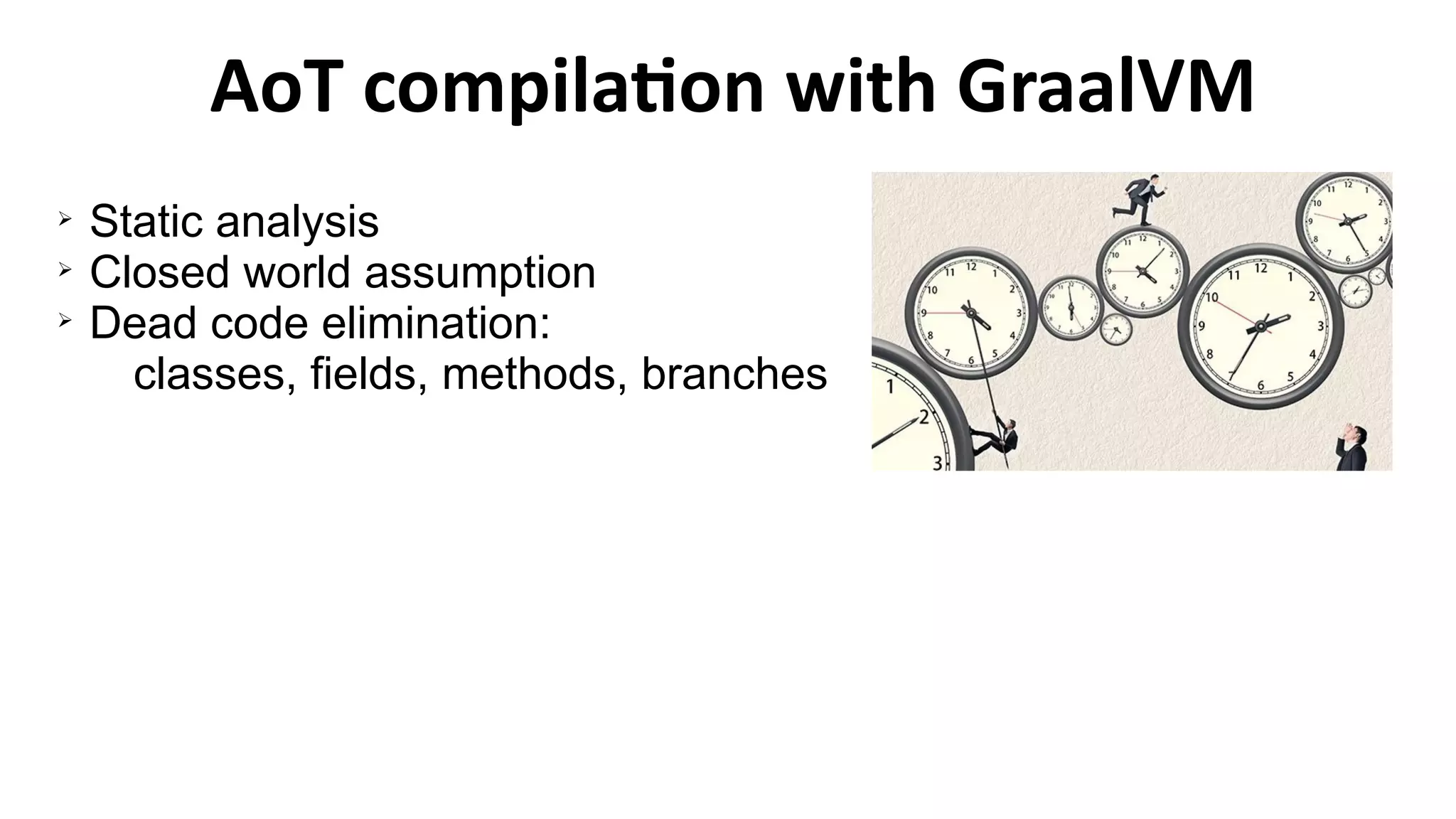
Static analysis
➢
Closed world assumption
➢
Dead code elimination:
     classes, fields, methods, branches
AoT compilation with GraalVM
➢
Static analysis
➢
Closed world assumption
➢
Dead code elimination:
     classes, fields, methods, branches
🚀 Fast process start
🔬 Less memory
💾 Small size on disk
GraalVM Limitations
Dynaminc Classloading
Deloying jars, wars, etc. at runtime impossible
public class InternalClassLoader extends ClassLoader {
public Class<?> defineClass( String name, byte[] bytecode ) {
return defineClass( name, bytecode, 0, bytecode.length );
}
}
GraalVM Limitations
Dynaminc Classloading
Deloying jars, wars, etc. at runtime impossible
public class InternalClassLoader extends ClassLoader {
public Class<?> defineClass( String name, byte[] bytecode ) {
return defineClass( name, bytecode, 0, bytecode.length );
}
}
GraalVM Limitations
Dynaminc Classloading
Deloying jars, wars, etc. at runtime impossible
public class InternalClassLoader extends ClassLoader {
public Class<?> defineClass( String name, byte[] bytecode ) {
return defineClass( name, bytecode, 0, bytecode.length );
}
}
JVMTI, JMX + other
native VM interfaces
No agents → No JRebel, Byteman, profilers, tracers
Miscellaneous
➢
Security Manager
➢ finalize() (depreceated anyway)
➢ InvokeDynamic and MethodHandle
GraalVM Limitations
Dynaminc Classloading
Deloying jars, wars, etc. at runtime impossible
public class InternalClassLoader extends ClassLoader {
public Class<?> defineClass( String name, byte[] bytecode ) {
return defineClass( name, bytecode, 0, bytecode.length );
}
}
JVMTI, JMX + other
native VM interfaces
No agents → No JRebel, Byteman, profilers, tracers
Miscellaneous
➢
Security Manager
➢ finalize() (depreceated anyway)
➢ InvokeDynamic and MethodHandle
GraalVM Limitations
Dynaminc Classloading
Deloying jars, wars, etc. at runtime impossible
public class InternalClassLoader extends ClassLoader {
public Class<?> defineClass( String name, byte[] bytecode ) {
return defineClass( name, bytecode, 0, bytecode.length );
}
}
JVMTI, JMX + other
native VM interfaces
No agents → No JRebel, Byteman, profilers, tracers
Miscellaneous
➢
Security Manager
➢ finalize() (depreceated anyway)
➢ InvokeDynamic and MethodHandle
Reflection
Requires registration (closed world assumption)
GraalVM Limitations
Dynaminc Classloading
Deloying jars, wars, etc. at runtime impossible
public class InternalClassLoader extends ClassLoader {
public Class<?> defineClass( String name, byte[] bytecode ) {
return defineClass( name, bytecode, 0, bytecode.length );
}
}
JVMTI, JMX + other
native VM interfaces
No agents → No JRebel, Byteman, profilers, tracers
Miscellaneous
➢
Security Manager
➢ finalize() (depreceated anyway)
➢ InvokeDynamic and MethodHandle
[
{
"name" : "org.domain.model.Person",
"allPublicConstructors" : true,
"allPublicMethods" : true
}
]
Reflection
Requires registration (closed world assumption)
-H:ReflectionConfigurationFiles=src/main/resources/reflection.json
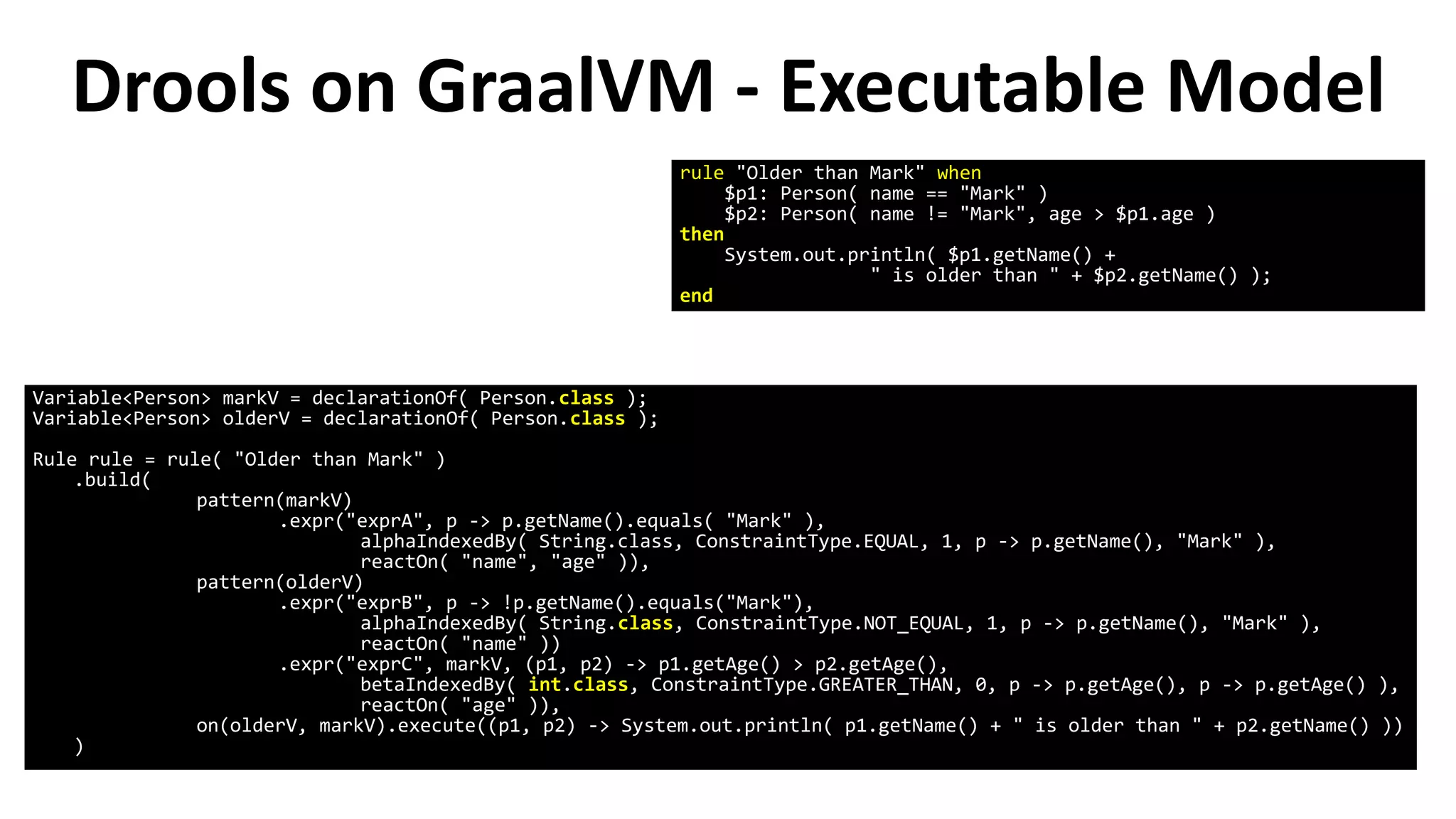
Drools on GraalVM - Executable Model
rule "Older than Mark" when
$p1: Person( name == "Mark" )
$p2: Person( name != "Mark", age > $p1.age )
then
System.out.println( $p1.getName() +
" is older than " + $p2.getName() );
end
Variable<Person> markV = declarationOf( Person.class );
Variable<Person> olderV = declarationOf( Person.class );
Rule rule = rule( "Older than Mark" )
.build(
pattern(markV)
.expr("exprA", p -> p.getName().equals( "Mark" ),
alphaIndexedBy( String.class, ConstraintType.EQUAL, 1, p -> p.getName(), "Mark" ),
reactOn( "name", "age" )),
pattern(olderV)
.expr("exprB", p -> !p.getName().equals("Mark"),
alphaIndexedBy( String.class, ConstraintType.NOT_EQUAL, 1, p -> p.getName(), "Mark" ),
reactOn( "name" ))
.expr("exprC", markV, (p1, p2) -> p1.getAge() > p2.getAge(),
betaIndexedBy( int.class, ConstraintType.GREATER_THAN, 0, p -> p.getAge(), p -> p.getAge() ),
reactOn( "age" )),
on(olderV, markV).execute((p1, p2) -> System.out.println( p1.getName() + " is older than " + p2.getName() ))
)
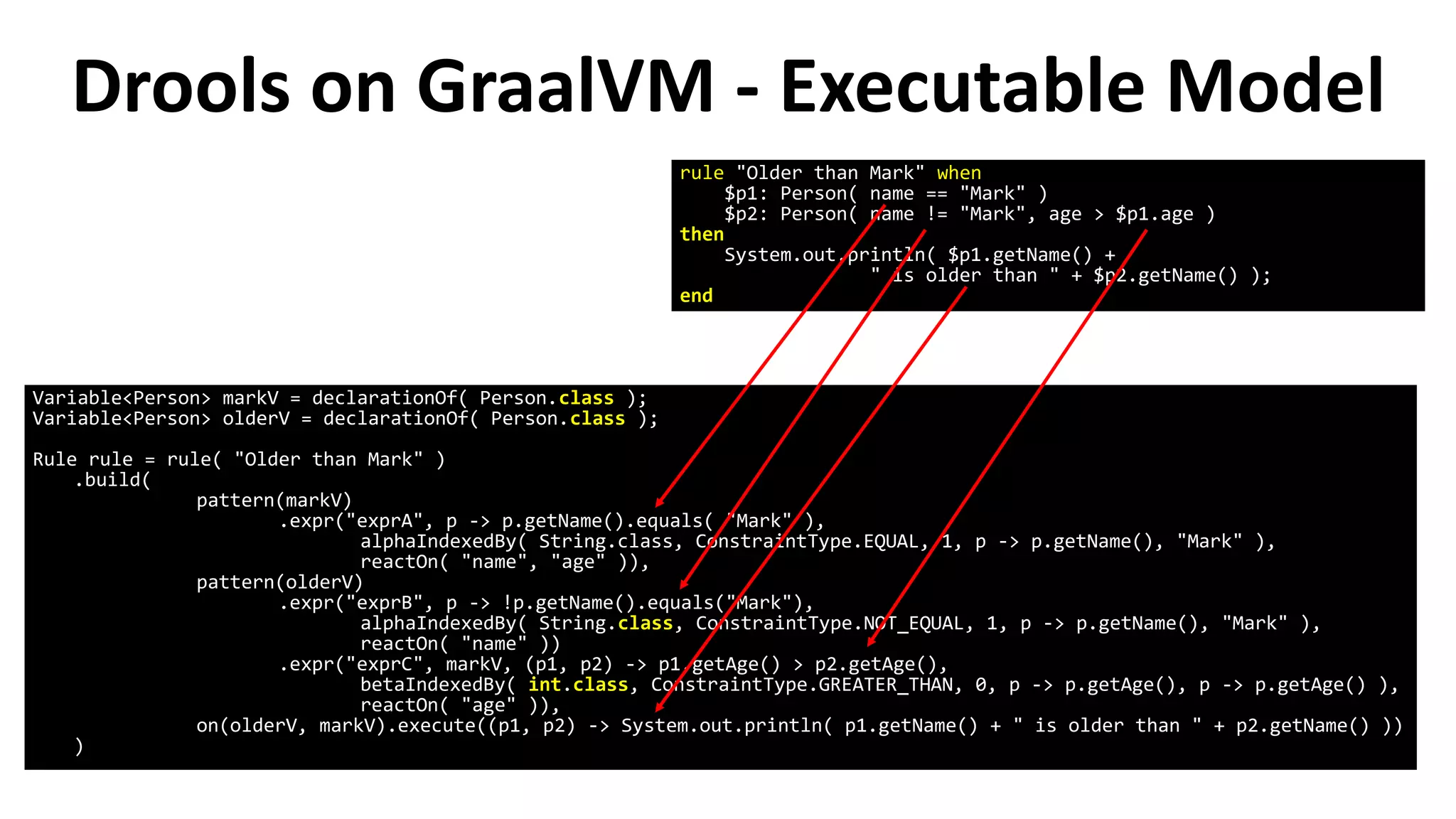
Drools on GraalVM - Executable Model
rule "Older than Mark" when
$p1: Person( name == "Mark" )
$p2: Person( name != "Mark", age > $p1.age )
then
System.out.println( $p1.getName() +
" is older than " + $p2.getName() );
end
Variable<Person> markV = declarationOf( Person.class );
Variable<Person> olderV = declarationOf( Person.class );
Rule rule = rule( "Older than Mark" )
.build(
pattern(markV)
.expr("exprA", p -> p.getName().equals( "Mark" ),
alphaIndexedBy( String.class, ConstraintType.EQUAL, 1, p -> p.getName(), "Mark" ),
reactOn( "name", "age" )),
pattern(olderV)
.expr("exprB", p -> !p.getName().equals("Mark"),
alphaIndexedBy( String.class, ConstraintType.NOT_EQUAL, 1, p -> p.getName(), "Mark" ),
reactOn( "name" ))
.expr("exprC", markV, (p1, p2) -> p1.getAge() > p2.getAge(),
betaIndexedBy( int.class, ConstraintType.GREATER_THAN, 0, p -> p.getAge(), p -> p.getAge() ),
reactOn( "age" )),
on(olderV, markV).execute((p1, p2) -> System.out.println( p1.getName() + " is older than " + p2.getName() ))
)
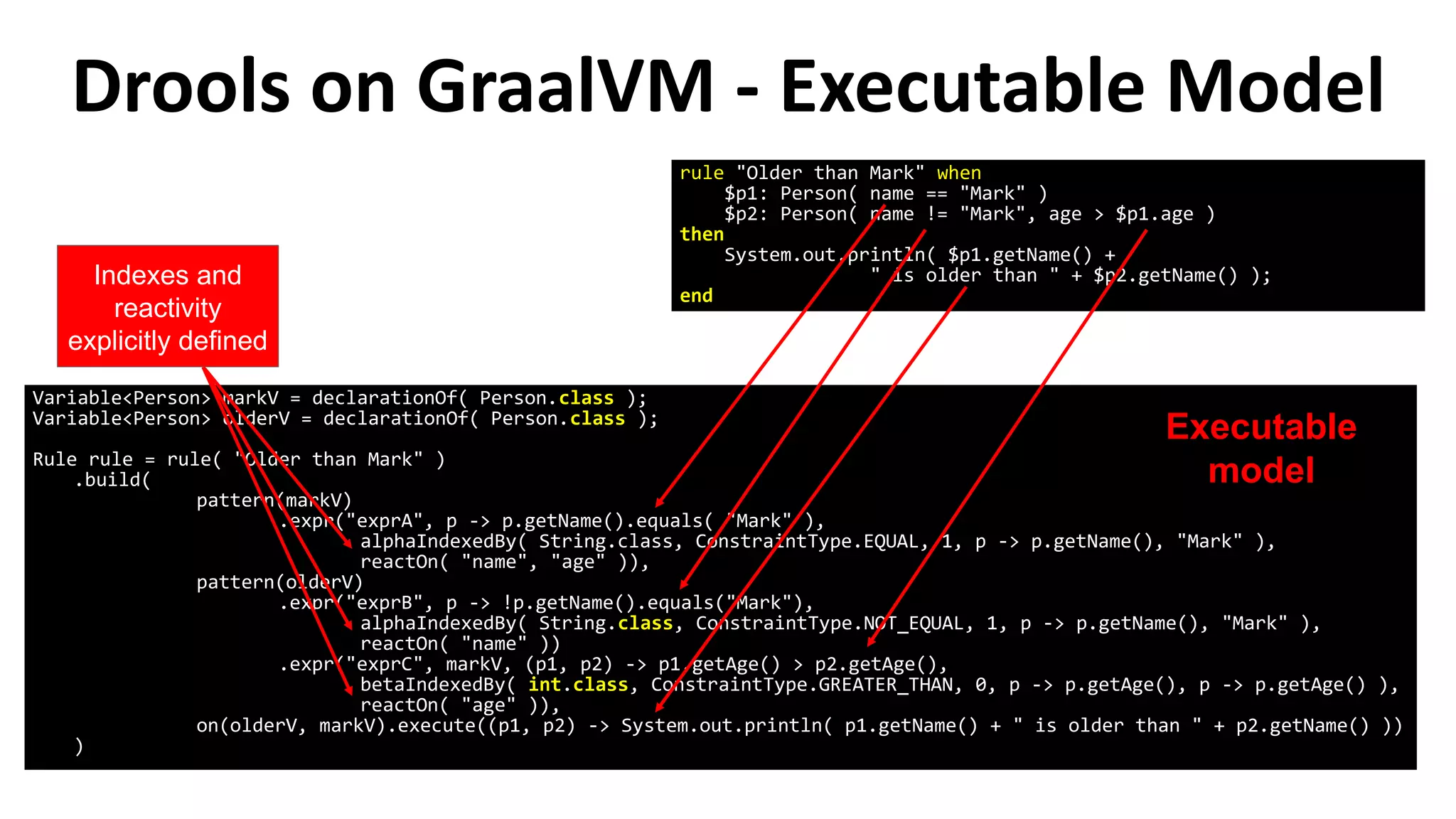
Drools on GraalVM - Executable Model
rule "Older than Mark" when
$p1: Person( name == "Mark" )
$p2: Person( name != "Mark", age > $p1.age )
then
System.out.println( $p1.getName() +
" is older than " + $p2.getName() );
end
Variable<Person> markV = declarationOf( Person.class );
Variable<Person> olderV = declarationOf( Person.class );
Rule rule = rule( "Older than Mark" )
.build(
pattern(markV)
.expr("exprA", p -> p.getName().equals( "Mark" ),
alphaIndexedBy( String.class, ConstraintType.EQUAL, 1, p -> p.getName(), "Mark" ),
reactOn( "name", "age" )),
pattern(olderV)
.expr("exprB", p -> !p.getName().equals("Mark"),
alphaIndexedBy( String.class, ConstraintType.NOT_EQUAL, 1, p -> p.getName(), "Mark" ),
reactOn( "name" ))
.expr("exprC", markV, (p1, p2) -> p1.getAge() > p2.getAge(),
betaIndexedBy( int.class, ConstraintType.GREATER_THAN, 0, p -> p.getAge(), p -> p.getAge() ),
reactOn( "age" )),
on(olderV, markV).execute((p1, p2) -> System.out.println( p1.getName() + " is older than " + p2.getName() ))
)
Executable
model
Indexes and
reactivity
explicitly defined
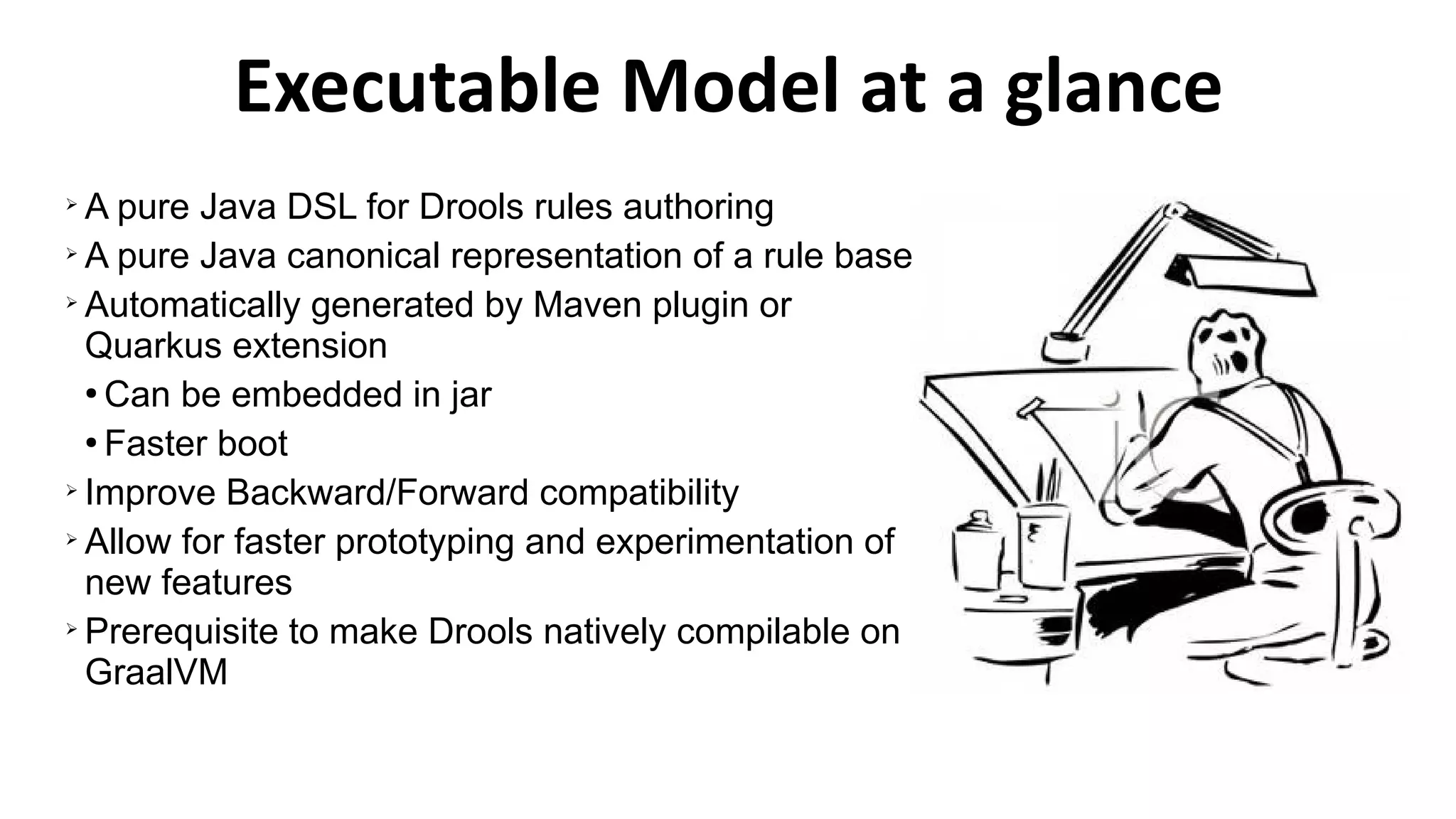
Executable Model at a glance
➢
A pure Java DSL for Drools rules authoring
➢
A pure Java canonical representation of a rule base
➢
Automatically generated by Maven plugin or
Quarkus extension
●
Can be embedded in jar
●
Faster boot
➢
Improve Backward/Forward compatibility
➢
Allow for faster prototyping and experimentation of
new features
➢
Prerequisite to make Drools natively compilable on
GraalVM
public class InternalClassLoader extends ClassLoader {
public Class<?> defineClass( String name, byte[] bytecode ) {
throw new UnsupportedOperationException();
}
}
Drools on GraalVM – other refactors
Dynamic class definition
is no longer necessary
public class InternalClassLoader extends ClassLoader {
public Class<?> defineClass( String name, byte[] bytecode ) {
throw new UnsupportedOperationException();
}
}
Drools on GraalVM – other refactors
Dynamic class definition
is no longer necessary
<?xml version="1.0" encoding="UTF-8"?>
<kmodule xmlns="http://jboss.org/kie/6.0.0/kmodule">
<kbase name="simpleKB"
packages="org.drools.simple.project">
<ksession name="simpleKS" default="true"/>
</kbase>
</kmodule>
var m = KieServices.get().newKieModuleModel();
var kb = m.newKieBaseModel("simpleKB");
kb.setEventProcessingMode(CLOUD);
kb.addPackage("org.drools.simple.project");
var ks = kb.newKieSessionModel("simpleKS");
ks.setDefault(true);
ks.setType(STATEFUL);
ks.setClockType(ClockTypeOption.get("realtime"));
public class InternalClassLoader extends ClassLoader {
public Class<?> defineClass( String name, byte[] bytecode ) {
throw new UnsupportedOperationException();
}
}
Drools on GraalVM – other refactors
Dynamic class definition
is no longer necessary
<?xml version="1.0" encoding="UTF-8"?>
<kmodule xmlns="http://jboss.org/kie/6.0.0/kmodule">
<kbase name="simpleKB"
packages="org.drools.simple.project">
<ksession name="simpleKS" default="true"/>
</kbase>
</kmodule>
var m = KieServices.get().newKieModuleModel();
var kb = m.newKieBaseModel("simpleKB");
kb.setEventProcessingMode(CLOUD);
kb.addPackage("org.drools.simple.project");
var ks = kb.newKieSessionModel("simpleKS");
ks.setDefault(true);
ks.setType(STATEFUL);
ks.setClockType(ClockTypeOption.get("realtime"));
org.kie.api.io.KieResources =
org.drools.core.io.impl.ResourceFactoryServiceImpl
org.kie.api.marshalling.KieMarshallers =
org.drools.core.marshalling.MarshallerProviderImpl
org.kie.api.concurrent.KieExecutors =
org.drools.core.concurrent.ExecutorProviderImpl
Map<Class<?>, Object> serviceMap = new HashMap<>();
void wireServices() {
serviceMap.put( ServiceInterface.class,
Class.forName("org.drools.ServiceImpl")
.newInstance());
// … more services here
}
Demo 1
Drools on GraalVM
Introducing
➢
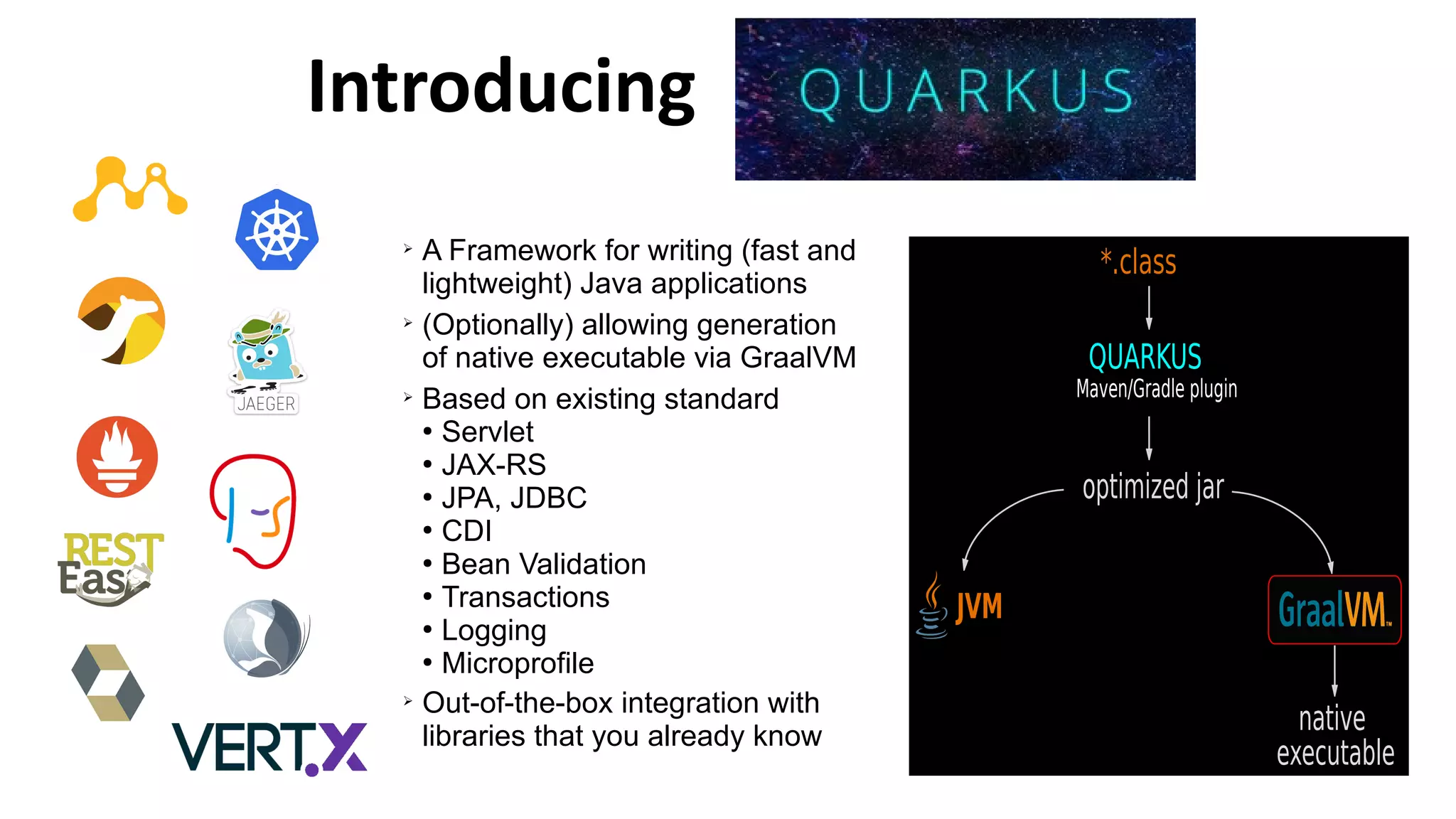
A Framework for writing (fast and
lightweight) Java applications
Introducing
➢
A Framework for writing (fast and
lightweight) Java applications
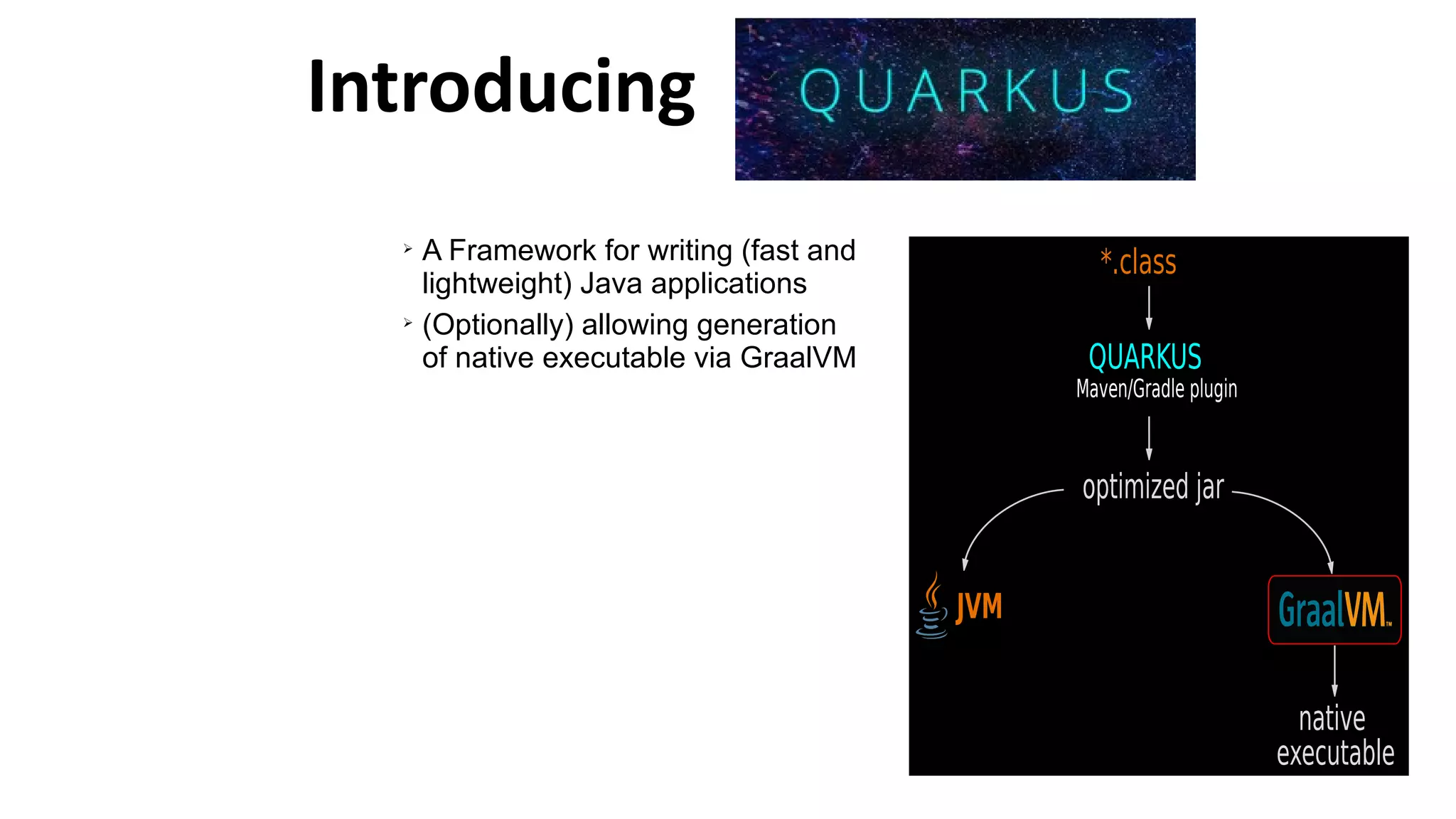
➢
(Optionally) allowing generation
of native executable via GraalVM
*.class
QUARKUS
optimized jar
native
executable
JVM
Maven/Gradle plugin
Introducing
➢
A Framework for writing (fast and
lightweight) Java applications
➢
(Optionally) allowing generation
of native executable via GraalVM
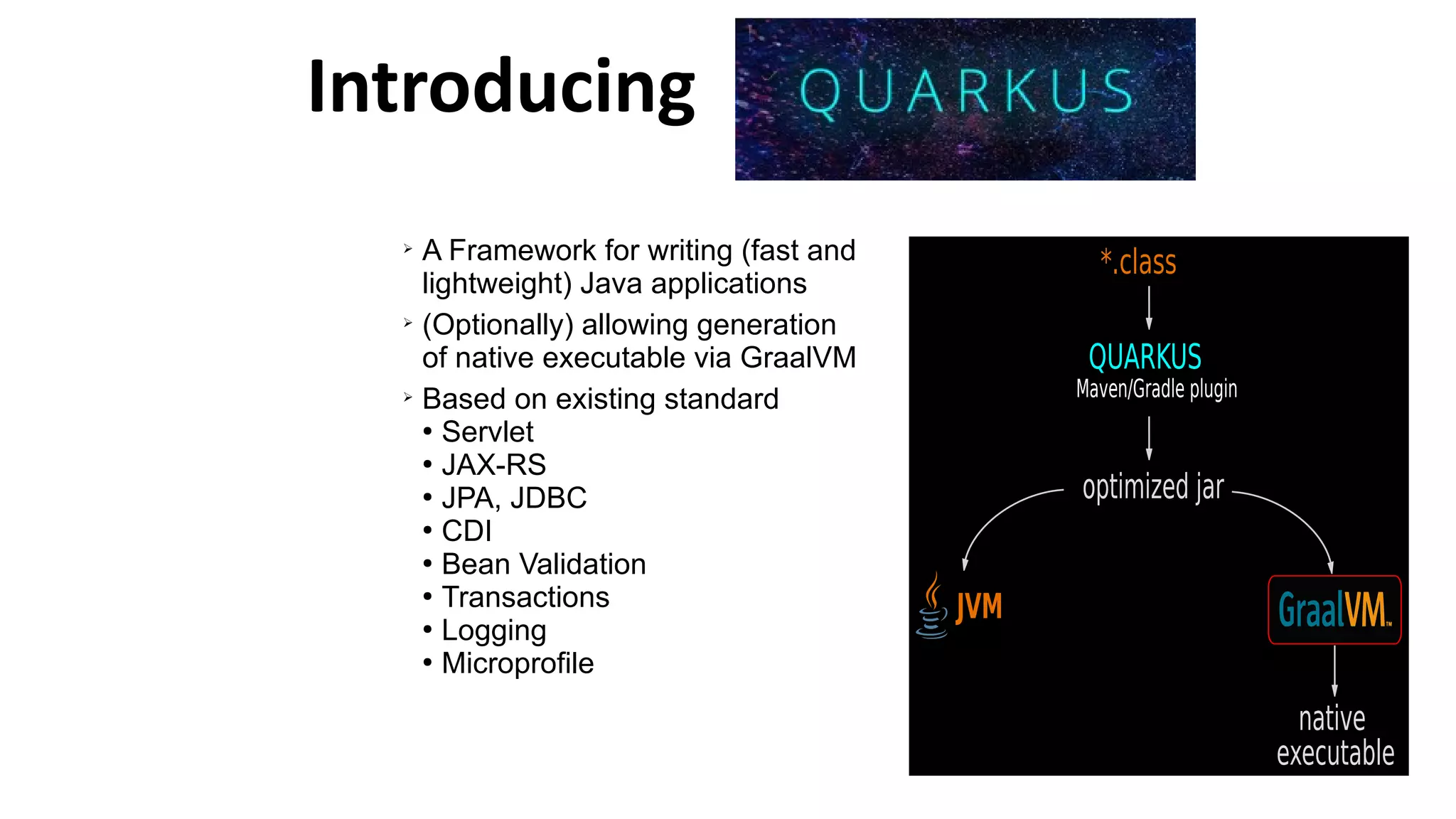
➢
Based on existing standard
●
Servlet
●
JAX-RS
●
JPA, JDBC
●
CDI
●
Bean Validation
●
Transactions
●
Logging
●
Microprofile
*.class
QUARKUS
optimized jar
native
executable
JVM
Maven/Gradle plugin
Introducing
➢
A Framework for writing (fast and
lightweight) Java applications
➢
(Optionally) allowing generation
of native executable via GraalVM
➢
Based on existing standard
●
Servlet
●
JAX-RS
●
JPA, JDBC
●
CDI
●
Bean Validation
●
Transactions
●
Logging
●
Microprofile
➢
Out-of-the-box integration with
libraries that you already know
*.class
QUARKUS
optimized jar
native
executable
JVM
Maven/Gradle plugin
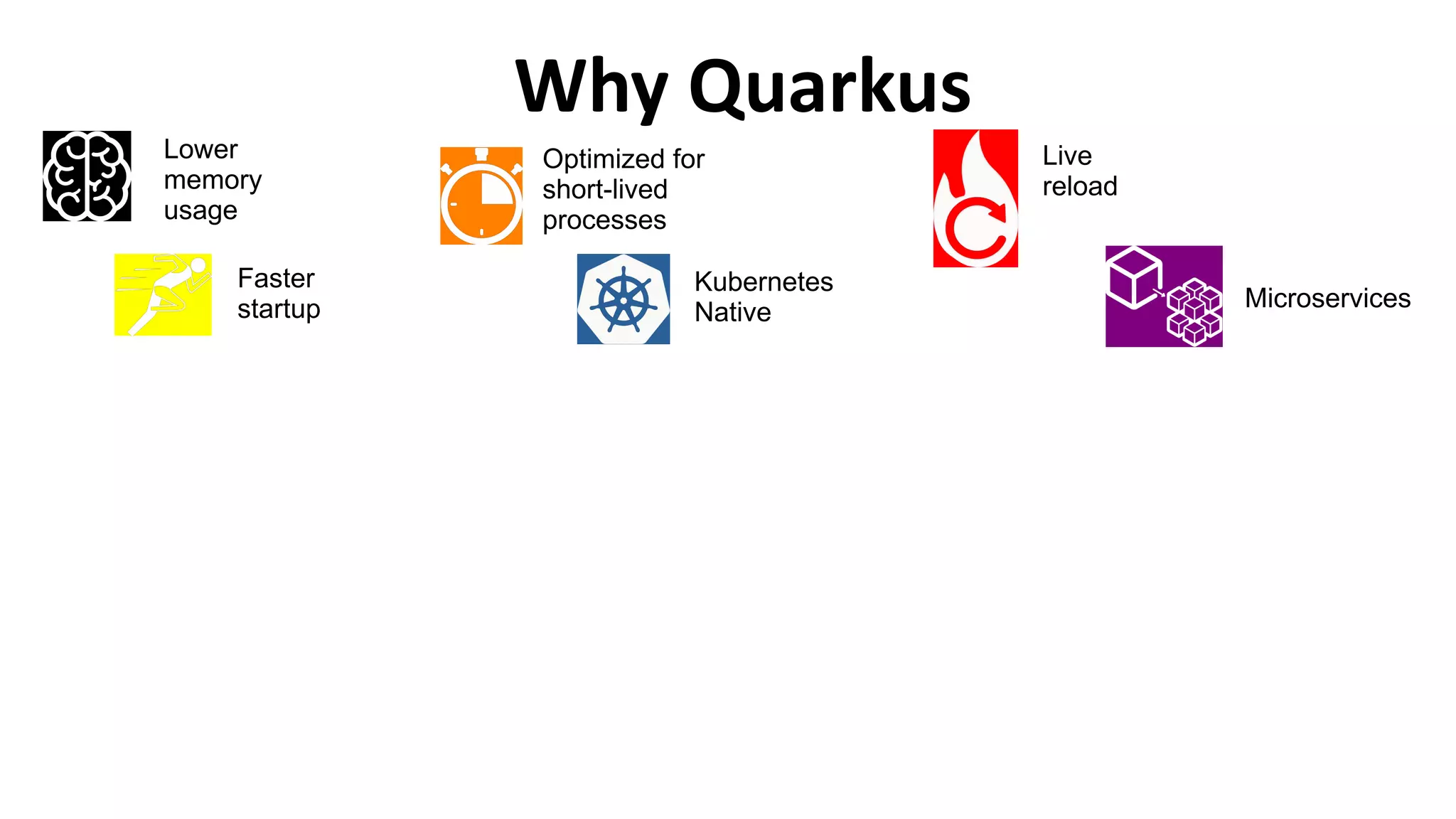
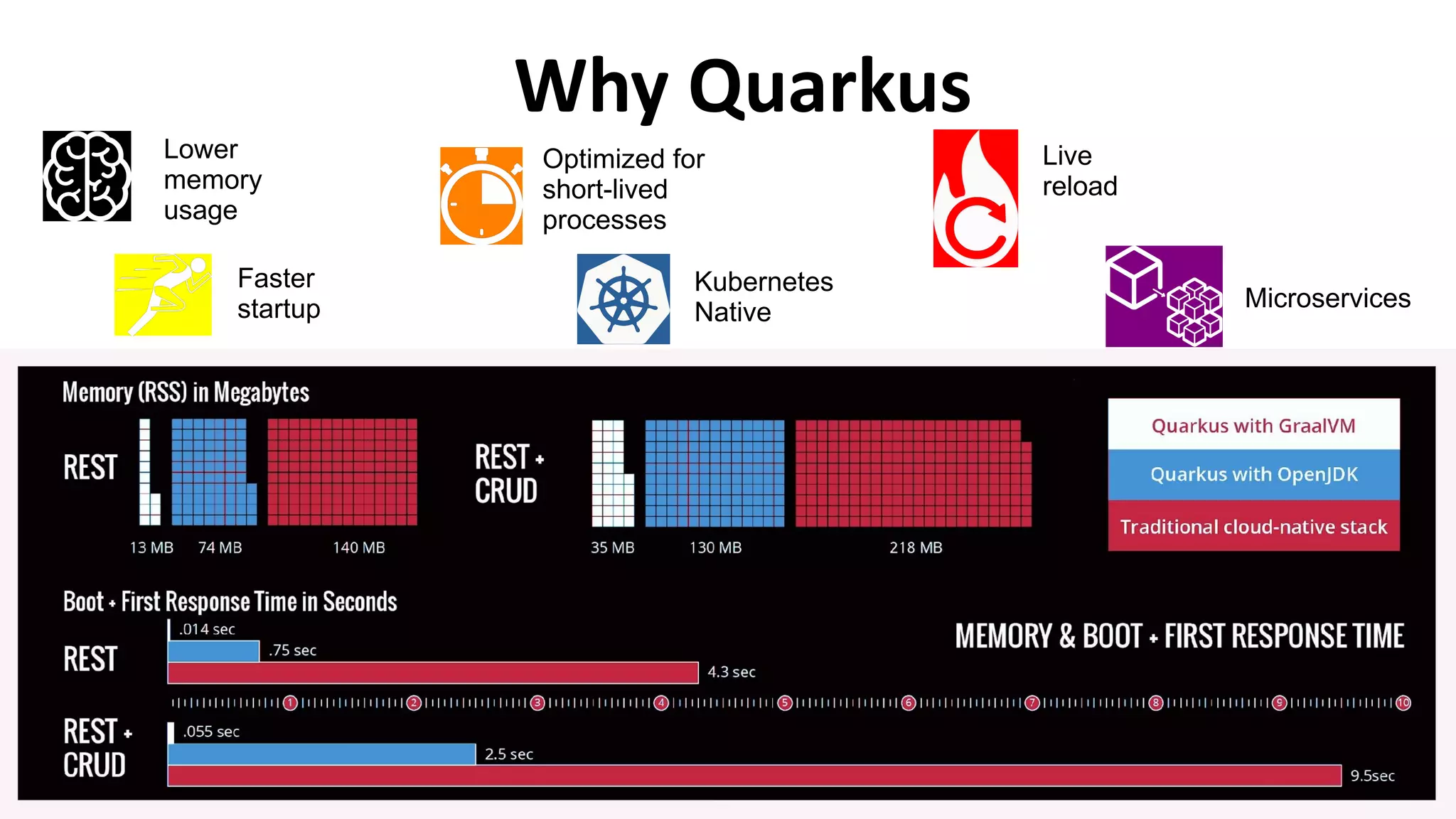
Why Quarkus
Lower
memory
usage
Faster
startup
Optimized for
short-lived
processes
Kubernetes
Native
Live
reload
Microservices
Why Quarkus
Lower
memory
usage
Faster
startup
Optimized for
short-lived
processes
Kubernetes
Native
Live
reload
Microservices
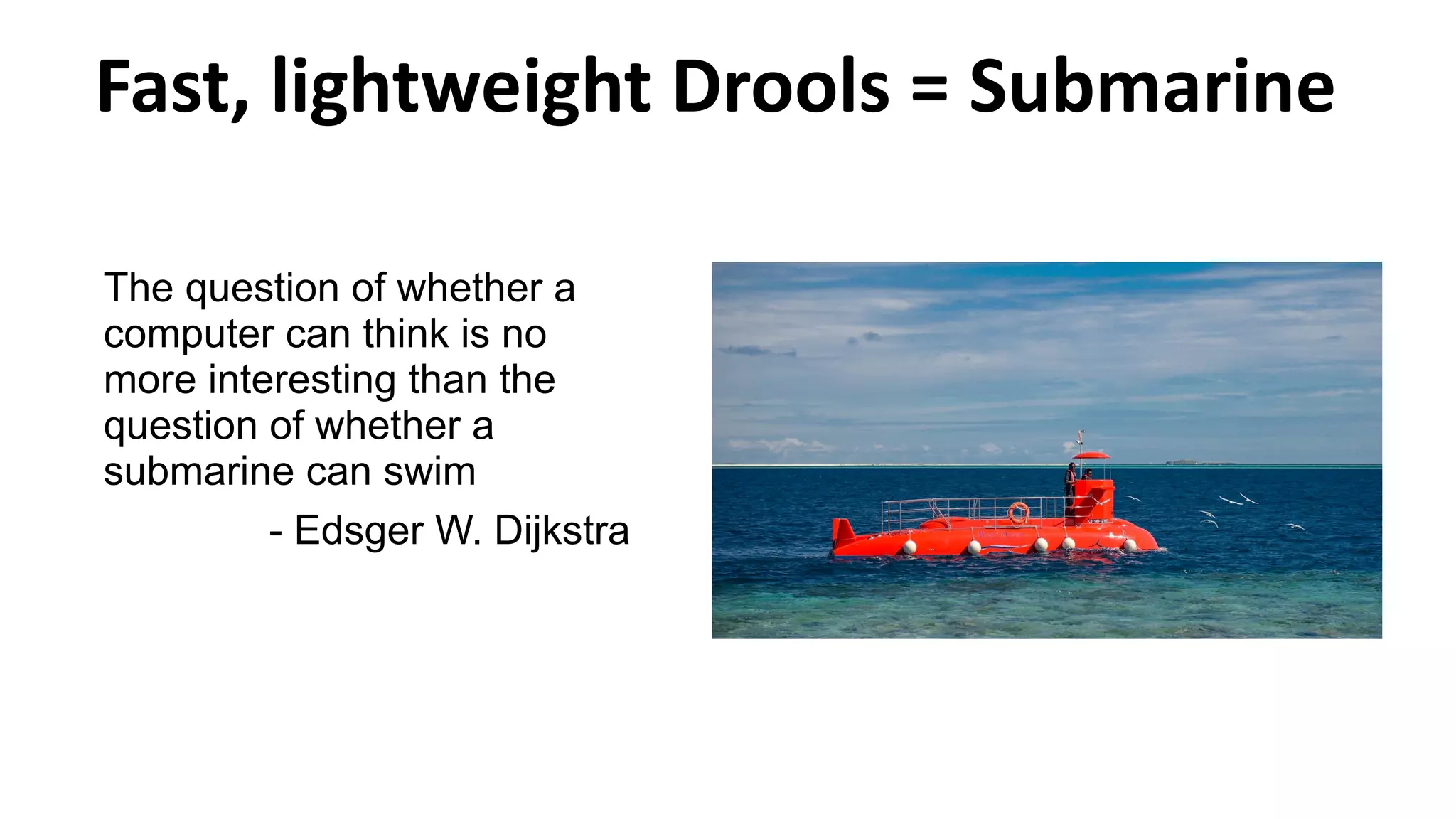
Fast, lightweight Drools = Submarine
The question of whether a
computer can think is no
more interesting than the
question of whether a
submarine can swim
- Edsger W. Dijkstra
Integrating Quarkus and Drools
Writing a Quarkus extension
public class ExecutableModelGenerator {
private static final String PRODUCER_SOURCE = "package io.quarkus.drools.runtime;n" +
"import org.drools.modelcompiler.KieRuntimeBuilder;n" +
"n" +
"@javax.inject.Singletonn" +
"public class RuntimeProducer {n" +
" public static final KieRuntimeBuilder INSTANCE = new org.drools.project.model.ProjectRuntime();n" +
"n" +
" @javax.enterprise.inject.Producesn" +
" public KieRuntimeBuilder produce() { return INSTANCE; }n" +
"}";
@BuildStep(providesCapabilities = "io.quarkus.drools") @Record(STATIC_INIT)
public void generateModel( ArchiveRootBuildItem root,
BuildProducer<GeneratedBeanBuildItem> generatedBeans, BuildProducer<GeneratedClassBuildItem> generatedClasses) {
MemoryFileSystem srcMfs = new MemoryFileSystem();
String[] sources = generateSources(root, srcMfs);
srcMfs.write(toRuntimeSource(PRODUCER_CLASSNAME), PRODUCER_SOURCE.getBytes());
sources[sources.length - 1] = toRuntimeSource(PRODUCER_CLASSNAME);
registerGeneratedClasses(generatedBeans, generatedClasses, compileSources(srcMfs, sources));
}
private void registerGeneratedClasses( BuildProducer<GeneratedBeanBuildItem> generatedBeans,
BuildProducer<GeneratedClassBuildItem> generatedClasses, MemoryFileSystem trgMfs) {
for (String fileName : trgMfs.getFileNames()) {
String className = toClassName(fileName);
if (className.equals(PRODUCER_CLASSNAME)) {
generatedBeans.produce(new GeneratedBeanBuildItem(className, trgMfs.getBytes(fileName)));
} else {
generatedClasses.produce(new GeneratedClassBuildItem(true, className, trgMfs.getBytes(fileName)));
}
}
}
}
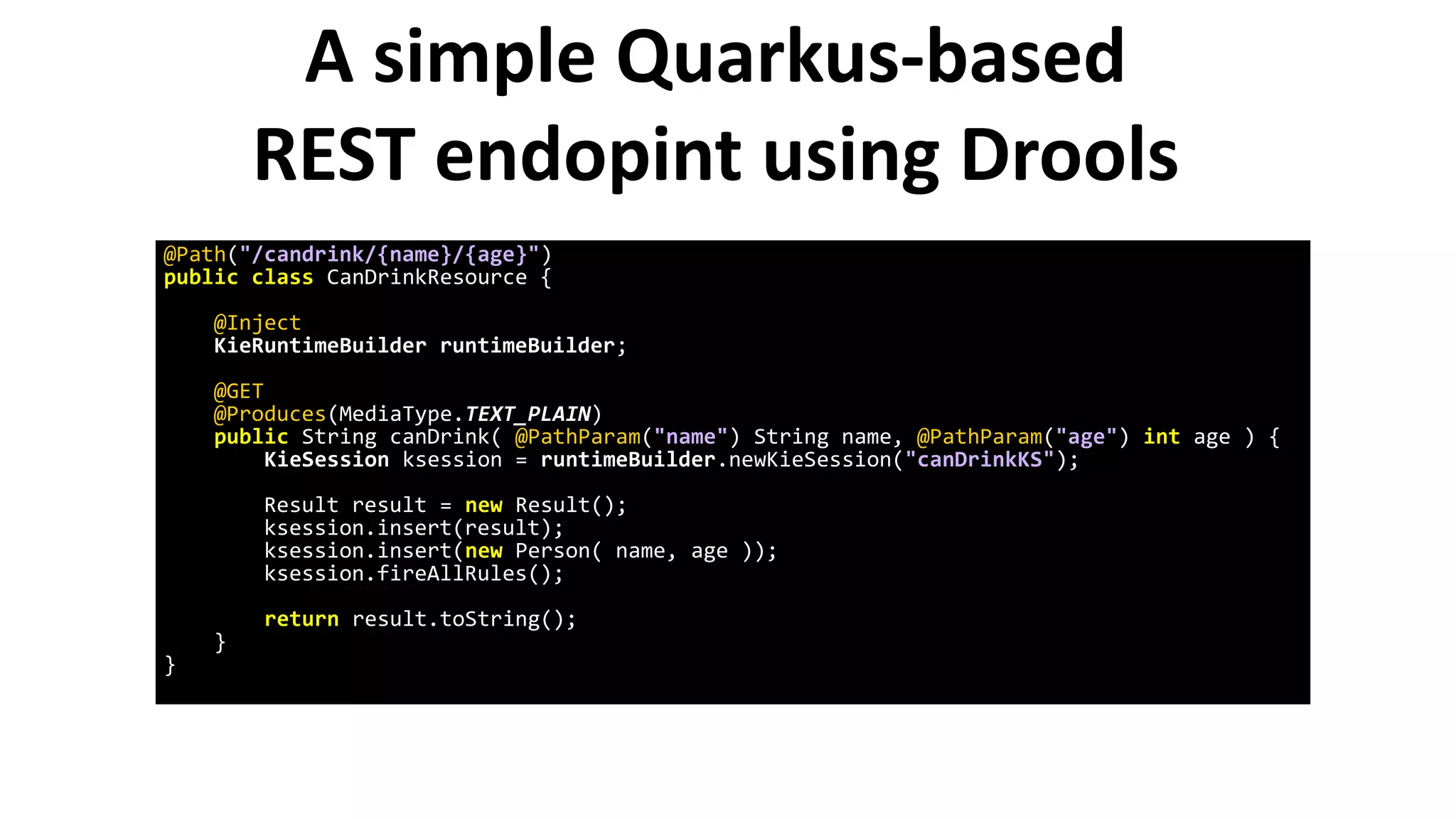
A simple Quarkus-based
REST endopint using Drools
@Path("/candrink/{name}/{age}")
public class CanDrinkResource {
@Inject
KieRuntimeBuilder runtimeBuilder;
@GET
@Produces(MediaType.TEXT_PLAIN)
public String canDrink( @PathParam("name") String name, @PathParam("age") int age ) {
KieSession ksession = runtimeBuilder.newKieSession("canDrinkKS");
Result result = new Result();
ksession.insert(result);
ksession.insert(new Person( name, age ));
ksession.fireAllRules();
return result.toString();
}
}
Demo 2
Drools on Quarkus
Mario Fusco
Red Hat – Principal Software Engineer
mario.fusco@gmail.com
twitter: @mariofusco
Q A
Thanks ... Questions?

How and why I turned my old Java projects into a first-class serverless component

  • 1.
    How and whyI turned my old Java projects into a first-class serverless component by Mario Fusco Red Hat – Principal Software Engineer @mariofusco c
  • 2.
    Agenda ➢ Declarative vs. Imperativeprogramming ➢ What is a rule engine and how it works ➢ A simple example ➢ From drl to Java: the executable model
  • 3.
    Agenda ➢ Declarative vs. Imperativeprogramming ➢ What is a rule engine and how it works ➢ A simple example ➢ From drl to Java: the executable model ➢ What is GraalVM ➢ AoT compilation ➢ Limitations ➢ Refactoring Drools to (natively) compile on GraalVM
  • 4.
    Agenda c ➢ Declarative vs. Imperativeprogramming ➢ What is a rule engine and how it works ➢ A simple example ➢ From drl to Java: the executable model ➢ What is GraalVM ➢ AoT compilation ➢ Limitations ➢ Refactoring Drools to (natively) compile on GraalVM ➢ What is Quarkus ➢ Quarkus features ➢ Integrating Drools with Quarkus ➢ Writing a Quarkus extension for Drools
  • 5.
    What a rule-basedprogram is ➢ A rule-based program is made up of discrete rules, each of which applies to a subset of the problem ➢ It is simpler, because you can concentrate on the rules for one situation at a time ➢ It can be more flexible in the face of fragmentary or poorly conditioned inputs ➢ Used for problems involving control, diagnosis, prediction, classification, pattern recognition … in short, all problems without clear algorithmic solutions
  • 6.
    What a rule-basedprogram is ➢ A rule-based program is made up of discrete rules, each of which applies to a subset of the problem ➢ It is simpler, because you can concentrate on the rules for one situation at a time ➢ It can be more flexible in the face of fragmentary or poorly conditioned inputs ➢ Used for problems involving control, diagnosis, prediction, classification, pattern recognition … in short, all problems without clear algorithmic solutions Declarative (What to do) Imperative (How to do it) Vs. public void helloMark(Person person) { if ( person.getName().equals( “Mark” ) { System.out.println( “Hello Mark” ); } } rule “Hello Mark” when Person( name == “Mark” ) then System.out.println( “Hello Mark” ); end
  • 7.
    What a rule-basedprogram is ➢ A rule-based program is made up of discrete rules, each of which applies to a subset of the problem ➢ It is simpler, because you can concentrate on the rules for one situation at a time ➢ It can be more flexible in the face of fragmentary or poorly conditioned inputs ➢ Used for problems involving control, diagnosis, prediction, classification, pattern recognition … in short, all problems without clear algorithmic solutions Declarative (What to do) Imperative (How to do it) Vs. public void helloMark(Person person) { if ( person.getName().equals( “Mark” ) { System.out.println( “Hello Mark” ); } } rule “Hello Mark” when Person( name == “Mark” ) then System.out.println( “Hello Mark” ); end A method must be called directly Rules can never be called directly
  • 8.
    What a rule-basedprogram is ➢ A rule-based program is made up of discrete rules, each of which applies to a subset of the problem ➢ It is simpler, because you can concentrate on the rules for one situation at a time ➢ It can be more flexible in the face of fragmentary or poorly conditioned inputs ➢ Used for problems involving control, diagnosis, prediction, classification, pattern recognition … in short, all problems without clear algorithmic solutions Declarative (What to do) Imperative (How to do it) Vs. public void helloMark(Person person) { if ( person.getName().equals( “Mark” ) { System.out.println( “Hello Mark” ); } } rule “Hello Mark” when Person( name == “Mark” ) then System.out.println( “Hello Mark” ); end A method must be called directly Specific passing of arguments Rules can never be called directly Specific instances cannot be passed but are automatically selected with pattern-matching
  • 9.
    Introducing ➢ Easier to understand→ Requirements can be more naturally translated into rules. It is more likely for a technically skilled business analyst to verify, validate or even change a rule than a piece of Java code ➢ Improved maintainability → We don't care about how to implement a solution only what needs to be done to solve a problem ➢ Deals with evolving complexity → It's easier to modify a rule than a Java program and to determine the impact of this change on the rest of the application ➢ Modularity → Each rule models an isolated and small portion of your business logic and is not part of a monolithic program ➢ Clear separation of business logic from the rest of the system → Business and infrastructural code have very different lifecycles ➢ Complex Event Processing → Facts can be handled like timestamped events allowing temporal reasoning on them RULES
  • 10.
    How a rule-basedsystem works ➢ The Rule Base contains a computation efficient representation of the set of the defined rules ➢ The Working Memory contains the set of facts inserted into sessions ➢ The engine matches the fact in the working memory against the rules set ➢ When a match is found it creates an activation and put it into the agenda ➢ An activation is the tuple of facts matching the conditions of a rule plus the rule itself ➢ When all activations have been created the agenda elects through a conflict resolution strategy the one to be executed ➢ The elected activation is passed to the execution engine and the fired
  • 11.
    A simple ruleset rule RaiseAlarm when exists Fire() then insert( new Alarm( "house1" ) ); System.out.println( "Raise the Alarm"); end rule CancelAlarm when not Fire() a : Alarm() then delete( a ); System.out.println( "Cancel the Alarm"); end rule TurnSprinklerOn when s : Sprinkler( on == false ) f : Fire( room == s.room ) then modify( s ) { setOn( true ) } System.out.println( "Turn on the sprinkler for room " + f.getRoom().getName() ); end rule TurnSprinklerOff when s : Sprinkler( on == true ) not Fire( room == s.room ) then modify( s ) { setOn( false ) } System.out.println( "Turn off the sprinkler for room " + s.getRoom().getName() ); end rule OK when not Alarm() not Sprinkler( on == true ) then System.out.println( "Everything is ok" ); end Pattern-matching against objects in the Working Memory Code executed when a match is found
  • 12.
    What is used byQuarkus ➢ A polyglot VM with cross-language JIT supporting ● Java Bytecode and JVM languages ● Interop with different languages ● Dynamic languages through Truffle API ➢ Cross-language interop out of the box ● Simple AST-based interpreter ● JIT across language boundaries ➢ Support for native binary compilation (SubstrateVM) ● faster boot-up ● lower memory footprint
  • 13.
    AoT compilation withGraalVM ➢ Static analysis ➢ Closed world assumption ➢ Dead code elimination:      classes, fields, methods, branches
  • 14.
    AoT compilation withGraalVM ➢ Static analysis ➢ Closed world assumption ➢ Dead code elimination:      classes, fields, methods, branches 🚀 Fast process start 🔬 Less memory 💾 Small size on disk
  • 15.
    GraalVM Limitations Dynaminc Classloading Deloyingjars, wars, etc. at runtime impossible public class InternalClassLoader extends ClassLoader { public Class<?> defineClass( String name, byte[] bytecode ) { return defineClass( name, bytecode, 0, bytecode.length ); } }
  • 16.
    GraalVM Limitations Dynaminc Classloading Deloyingjars, wars, etc. at runtime impossible public class InternalClassLoader extends ClassLoader { public Class<?> defineClass( String name, byte[] bytecode ) { return defineClass( name, bytecode, 0, bytecode.length ); } }
  • 17.
    GraalVM Limitations Dynaminc Classloading Deloyingjars, wars, etc. at runtime impossible public class InternalClassLoader extends ClassLoader { public Class<?> defineClass( String name, byte[] bytecode ) { return defineClass( name, bytecode, 0, bytecode.length ); } } JVMTI, JMX + other native VM interfaces No agents → No JRebel, Byteman, profilers, tracers Miscellaneous ➢ Security Manager ➢ finalize() (depreceated anyway) ➢ InvokeDynamic and MethodHandle
  • 18.
    GraalVM Limitations Dynaminc Classloading Deloyingjars, wars, etc. at runtime impossible public class InternalClassLoader extends ClassLoader { public Class<?> defineClass( String name, byte[] bytecode ) { return defineClass( name, bytecode, 0, bytecode.length ); } } JVMTI, JMX + other native VM interfaces No agents → No JRebel, Byteman, profilers, tracers Miscellaneous ➢ Security Manager ➢ finalize() (depreceated anyway) ➢ InvokeDynamic and MethodHandle
  • 19.
    GraalVM Limitations Dynaminc Classloading Deloyingjars, wars, etc. at runtime impossible public class InternalClassLoader extends ClassLoader { public Class<?> defineClass( String name, byte[] bytecode ) { return defineClass( name, bytecode, 0, bytecode.length ); } } JVMTI, JMX + other native VM interfaces No agents → No JRebel, Byteman, profilers, tracers Miscellaneous ➢ Security Manager ➢ finalize() (depreceated anyway) ➢ InvokeDynamic and MethodHandle Reflection Requires registration (closed world assumption)
  • 20.
    GraalVM Limitations Dynaminc Classloading Deloyingjars, wars, etc. at runtime impossible public class InternalClassLoader extends ClassLoader { public Class<?> defineClass( String name, byte[] bytecode ) { return defineClass( name, bytecode, 0, bytecode.length ); } } JVMTI, JMX + other native VM interfaces No agents → No JRebel, Byteman, profilers, tracers Miscellaneous ➢ Security Manager ➢ finalize() (depreceated anyway) ➢ InvokeDynamic and MethodHandle [ { "name" : "org.domain.model.Person", "allPublicConstructors" : true, "allPublicMethods" : true } ] Reflection Requires registration (closed world assumption) -H:ReflectionConfigurationFiles=src/main/resources/reflection.json
  • 21.
    Drools on GraalVM- Executable Model rule "Older than Mark" when $p1: Person( name == "Mark" ) $p2: Person( name != "Mark", age > $p1.age ) then System.out.println( $p1.getName() + " is older than " + $p2.getName() ); end Variable<Person> markV = declarationOf( Person.class ); Variable<Person> olderV = declarationOf( Person.class ); Rule rule = rule( "Older than Mark" ) .build( pattern(markV) .expr("exprA", p -> p.getName().equals( "Mark" ), alphaIndexedBy( String.class, ConstraintType.EQUAL, 1, p -> p.getName(), "Mark" ), reactOn( "name", "age" )), pattern(olderV) .expr("exprB", p -> !p.getName().equals("Mark"), alphaIndexedBy( String.class, ConstraintType.NOT_EQUAL, 1, p -> p.getName(), "Mark" ), reactOn( "name" )) .expr("exprC", markV, (p1, p2) -> p1.getAge() > p2.getAge(), betaIndexedBy( int.class, ConstraintType.GREATER_THAN, 0, p -> p.getAge(), p -> p.getAge() ), reactOn( "age" )), on(olderV, markV).execute((p1, p2) -> System.out.println( p1.getName() + " is older than " + p2.getName() )) )
  • 22.
    Drools on GraalVM- Executable Model rule "Older than Mark" when $p1: Person( name == "Mark" ) $p2: Person( name != "Mark", age > $p1.age ) then System.out.println( $p1.getName() + " is older than " + $p2.getName() ); end Variable<Person> markV = declarationOf( Person.class ); Variable<Person> olderV = declarationOf( Person.class ); Rule rule = rule( "Older than Mark" ) .build( pattern(markV) .expr("exprA", p -> p.getName().equals( "Mark" ), alphaIndexedBy( String.class, ConstraintType.EQUAL, 1, p -> p.getName(), "Mark" ), reactOn( "name", "age" )), pattern(olderV) .expr("exprB", p -> !p.getName().equals("Mark"), alphaIndexedBy( String.class, ConstraintType.NOT_EQUAL, 1, p -> p.getName(), "Mark" ), reactOn( "name" )) .expr("exprC", markV, (p1, p2) -> p1.getAge() > p2.getAge(), betaIndexedBy( int.class, ConstraintType.GREATER_THAN, 0, p -> p.getAge(), p -> p.getAge() ), reactOn( "age" )), on(olderV, markV).execute((p1, p2) -> System.out.println( p1.getName() + " is older than " + p2.getName() )) )
  • 23.
    Drools on GraalVM- Executable Model rule "Older than Mark" when $p1: Person( name == "Mark" ) $p2: Person( name != "Mark", age > $p1.age ) then System.out.println( $p1.getName() + " is older than " + $p2.getName() ); end Variable<Person> markV = declarationOf( Person.class ); Variable<Person> olderV = declarationOf( Person.class ); Rule rule = rule( "Older than Mark" ) .build( pattern(markV) .expr("exprA", p -> p.getName().equals( "Mark" ), alphaIndexedBy( String.class, ConstraintType.EQUAL, 1, p -> p.getName(), "Mark" ), reactOn( "name", "age" )), pattern(olderV) .expr("exprB", p -> !p.getName().equals("Mark"), alphaIndexedBy( String.class, ConstraintType.NOT_EQUAL, 1, p -> p.getName(), "Mark" ), reactOn( "name" )) .expr("exprC", markV, (p1, p2) -> p1.getAge() > p2.getAge(), betaIndexedBy( int.class, ConstraintType.GREATER_THAN, 0, p -> p.getAge(), p -> p.getAge() ), reactOn( "age" )), on(olderV, markV).execute((p1, p2) -> System.out.println( p1.getName() + " is older than " + p2.getName() )) ) Executable model Indexes and reactivity explicitly defined
  • 24.
    Executable Model ata glance ➢ A pure Java DSL for Drools rules authoring ➢ A pure Java canonical representation of a rule base ➢ Automatically generated by Maven plugin or Quarkus extension ● Can be embedded in jar ● Faster boot ➢ Improve Backward/Forward compatibility ➢ Allow for faster prototyping and experimentation of new features ➢ Prerequisite to make Drools natively compilable on GraalVM
  • 25.
    public class InternalClassLoaderextends ClassLoader { public Class<?> defineClass( String name, byte[] bytecode ) { throw new UnsupportedOperationException(); } } Drools on GraalVM – other refactors Dynamic class definition is no longer necessary
  • 26.
    public class InternalClassLoaderextends ClassLoader { public Class<?> defineClass( String name, byte[] bytecode ) { throw new UnsupportedOperationException(); } } Drools on GraalVM – other refactors Dynamic class definition is no longer necessary <?xml version="1.0" encoding="UTF-8"?> <kmodule xmlns="http://jboss.org/kie/6.0.0/kmodule"> <kbase name="simpleKB" packages="org.drools.simple.project"> <ksession name="simpleKS" default="true"/> </kbase> </kmodule> var m = KieServices.get().newKieModuleModel(); var kb = m.newKieBaseModel("simpleKB"); kb.setEventProcessingMode(CLOUD); kb.addPackage("org.drools.simple.project"); var ks = kb.newKieSessionModel("simpleKS"); ks.setDefault(true); ks.setType(STATEFUL); ks.setClockType(ClockTypeOption.get("realtime"));
  • 27.
    public class InternalClassLoaderextends ClassLoader { public Class<?> defineClass( String name, byte[] bytecode ) { throw new UnsupportedOperationException(); } } Drools on GraalVM – other refactors Dynamic class definition is no longer necessary <?xml version="1.0" encoding="UTF-8"?> <kmodule xmlns="http://jboss.org/kie/6.0.0/kmodule"> <kbase name="simpleKB" packages="org.drools.simple.project"> <ksession name="simpleKS" default="true"/> </kbase> </kmodule> var m = KieServices.get().newKieModuleModel(); var kb = m.newKieBaseModel("simpleKB"); kb.setEventProcessingMode(CLOUD); kb.addPackage("org.drools.simple.project"); var ks = kb.newKieSessionModel("simpleKS"); ks.setDefault(true); ks.setType(STATEFUL); ks.setClockType(ClockTypeOption.get("realtime")); org.kie.api.io.KieResources = org.drools.core.io.impl.ResourceFactoryServiceImpl org.kie.api.marshalling.KieMarshallers = org.drools.core.marshalling.MarshallerProviderImpl org.kie.api.concurrent.KieExecutors = org.drools.core.concurrent.ExecutorProviderImpl Map<Class<?>, Object> serviceMap = new HashMap<>(); void wireServices() { serviceMap.put( ServiceInterface.class, Class.forName("org.drools.ServiceImpl") .newInstance()); // … more services here }
  • 28.
  • 29.
    Introducing ➢ A Framework forwriting (fast and lightweight) Java applications
  • 30.
    Introducing ➢ A Framework forwriting (fast and lightweight) Java applications ➢ (Optionally) allowing generation of native executable via GraalVM *.class QUARKUS optimized jar native executable JVM Maven/Gradle plugin
  • 31.
    Introducing ➢ A Framework forwriting (fast and lightweight) Java applications ➢ (Optionally) allowing generation of native executable via GraalVM ➢ Based on existing standard ● Servlet ● JAX-RS ● JPA, JDBC ● CDI ● Bean Validation ● Transactions ● Logging ● Microprofile *.class QUARKUS optimized jar native executable JVM Maven/Gradle plugin
  • 32.
    Introducing ➢ A Framework forwriting (fast and lightweight) Java applications ➢ (Optionally) allowing generation of native executable via GraalVM ➢ Based on existing standard ● Servlet ● JAX-RS ● JPA, JDBC ● CDI ● Bean Validation ● Transactions ● Logging ● Microprofile ➢ Out-of-the-box integration with libraries that you already know *.class QUARKUS optimized jar native executable JVM Maven/Gradle plugin
  • 33.
  • 34.
  • 35.
    Fast, lightweight Drools= Submarine The question of whether a computer can think is no more interesting than the question of whether a submarine can swim - Edsger W. Dijkstra
  • 36.
    Integrating Quarkus andDrools Writing a Quarkus extension public class ExecutableModelGenerator { private static final String PRODUCER_SOURCE = "package io.quarkus.drools.runtime;n" + "import org.drools.modelcompiler.KieRuntimeBuilder;n" + "n" + "@javax.inject.Singletonn" + "public class RuntimeProducer {n" + " public static final KieRuntimeBuilder INSTANCE = new org.drools.project.model.ProjectRuntime();n" + "n" + " @javax.enterprise.inject.Producesn" + " public KieRuntimeBuilder produce() { return INSTANCE; }n" + "}"; @BuildStep(providesCapabilities = "io.quarkus.drools") @Record(STATIC_INIT) public void generateModel( ArchiveRootBuildItem root, BuildProducer<GeneratedBeanBuildItem> generatedBeans, BuildProducer<GeneratedClassBuildItem> generatedClasses) { MemoryFileSystem srcMfs = new MemoryFileSystem(); String[] sources = generateSources(root, srcMfs); srcMfs.write(toRuntimeSource(PRODUCER_CLASSNAME), PRODUCER_SOURCE.getBytes()); sources[sources.length - 1] = toRuntimeSource(PRODUCER_CLASSNAME); registerGeneratedClasses(generatedBeans, generatedClasses, compileSources(srcMfs, sources)); } private void registerGeneratedClasses( BuildProducer<GeneratedBeanBuildItem> generatedBeans, BuildProducer<GeneratedClassBuildItem> generatedClasses, MemoryFileSystem trgMfs) { for (String fileName : trgMfs.getFileNames()) { String className = toClassName(fileName); if (className.equals(PRODUCER_CLASSNAME)) { generatedBeans.produce(new GeneratedBeanBuildItem(className, trgMfs.getBytes(fileName))); } else { generatedClasses.produce(new GeneratedClassBuildItem(true, className, trgMfs.getBytes(fileName))); } } } }
  • 37.
    A simple Quarkus-based RESTendopint using Drools @Path("/candrink/{name}/{age}") public class CanDrinkResource { @Inject KieRuntimeBuilder runtimeBuilder; @GET @Produces(MediaType.TEXT_PLAIN) public String canDrink( @PathParam("name") String name, @PathParam("age") int age ) { KieSession ksession = runtimeBuilder.newKieSession("canDrinkKS"); Result result = new Result(); ksession.insert(result); ksession.insert(new Person( name, age )); ksession.fireAllRules(); return result.toString(); } }
  • 38.
  • 39.
    Mario Fusco Red Hat– Principal Software Engineer mario.fusco@gmail.com twitter: @mariofusco Q A Thanks ... Questions?