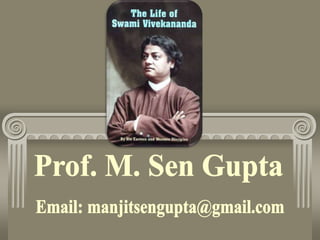
Swami Vivekanand
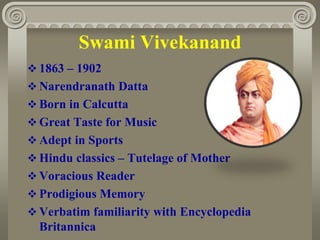
 1863 – 1902
 Narendranath Datta
 Born in Calcutta
 Great Taste for Music
 Adept in Sports
 Hindu classics – Tutelage of Mother
 Voracious Reader
 Prodigious Memory
 Verbatim familiarity with Encyclopedia
Britannica
Childhood
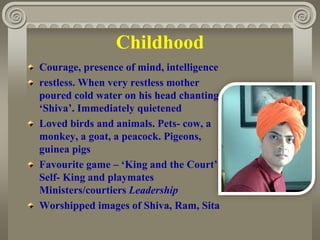
Courage, presence of mind, intelligence
restless. When very restless mother
poured cold water on his head chanting
‘Shiva’. Immediately quietened
Loved birds and animals. Pets- cow, a
monkey, a goat, a peacock. Pigeons,
guinea pigs
Favourite game – ‘King and the Court’
Self- King and playmates
Ministers/courtiers Leadership
Worshipped images of Shiva, Ram, Sita
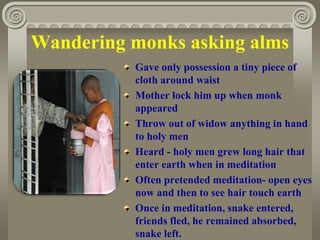
Wandering monks asking alms
Gave only possession a tiny piece of
cloth around waist
Mother lock him up when monk
appeared
Throw out of widow anything in hand
to holy men
Heard - holy men grew long hair that
enter earth when in meditation
Often pretended meditation- open eyes
now and then to see hair touch earth
Once in meditation, snake entered,
friends fled, he remained absorbed,
snake left.
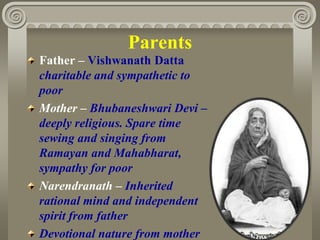
Parents
Father – Vishwanath Datta
charitable and sympathetic to
poor
Mother – Bhubaneshwari Devi –
deeply religious. Spare time
sewing and singing from
Ramayan and Mahabharat,
sympathy for poor
Narendranath – Inherited
rational mind and independent
spirit from father
Devotional nature from mother
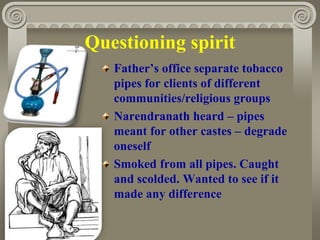
Questioning spirit
Father’s office separate tobacco
pipes for clients of different
communities/religious groups
Narendranath heard – pipes
meant for other castes – degrade
oneself
Smoked from all pipes. Caught
and scolded. Wanted to see if it
made any difference
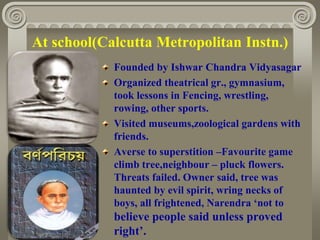
At school(Calcutta Metropolitan Instn.)
Founded by Ishwar Chandra Vidyasagar
Organized theatrical gr., gymnasium,
took lessons in Fencing, wrestling,
rowing, other sports.
Visited museums,zoological gardens with
friends.
Averse to superstition –Favourite game
climb tree,neighbour – pluck flowers.
Threats failed. Owner said, tree was
haunted by evil spirit, wring necks of
boys, all frightened, Narendra ‘not to
believe people said unless proved
right’.
That is realization
Do not believe in a thing because
U have read it in a book.
Do not --another man has said it is
true.
Find out the truth for yourself.
Set up a heavy trapeze in
gymnasium, An English sailor
helped, trapeze hit the sailor, fell
unconscious, crowd thinking dead
ran away. N tore a piece of cloth
from dhoti, dressed, washed face,
nursed, purse of donation
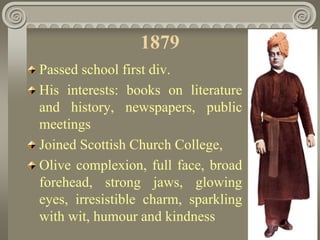
1879
Passed school first div.
His interests: books on literature
and history, newspapers, public
meetings
Joined Scottish Church College,
Olive complexion, full face, broad
forehead, strong jaws, glowing
eyes, irresistible charm, sparkling
with wit, humour and kindness
Romain Rolland writes
Nobody would come near him
without paying homage to his
majesty.
In college, specialized in western
philosophy, ancient and modern
history
Developed critical inquiry
Doubts stormed his mind
Grew older became sceptical
about very existence of God
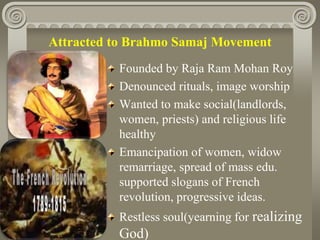
Attracted to Brahmo Samaj Movement
Founded by Raja Ram Mohan Roy
Denounced rituals, image worship
Wanted to make social(landlords,
women, priests) and religious life
healthy
Emancipation of women, widow
remarriage, spread of mass edu.
supported slogans of French
revolution, progressive ideas.
Restless soul(yearning for realizing
God)
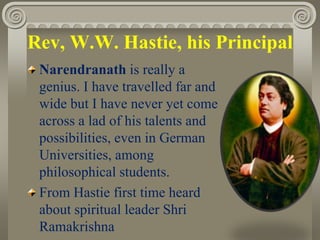
Rev, W.W. Hastie, his Principal
Narendranath is really a
genius. I have travelled far and
wide but I have never yet come
across a lad of his talents and
possibilities, even in German
Universities, among
philosophical students.
From Hastie first time heard
about spiritual leader Shri
Ramakrishna
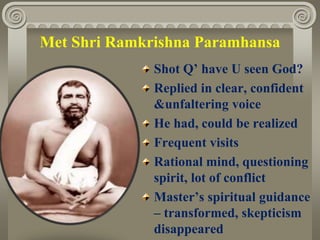
Met Shri Ramkrishna Paramhansa
Shot Q’ have U seen God?
Replied in clear, confident
&unfaltering voice
He had, could be realized
Frequent visits
Rational mind, questioning
spirit, lot of conflict
Master’s spiritual guidance
– transformed, skepticism
disappeared
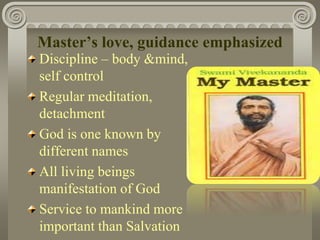
Master’s love, guidance emphasized
Discipline – body &mind,
self control
Regular meditation,
detachment
God is one known by
different names
All living beings
manifestation of God
Service to mankind more
important than Salvation
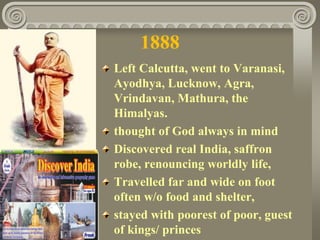
1888
Left Calcutta, went to Varanasi,
Ayodhya, Lucknow, Agra,
Vrindavan, Mathura, the
Himalyas.
thought of God always in mind
Discovered real India, saffron
robe, renouncing worldly life,
Travelled far and wide on foot
often w/o food and shelter,
stayed with poorest of poor, guest
of kings/ princes
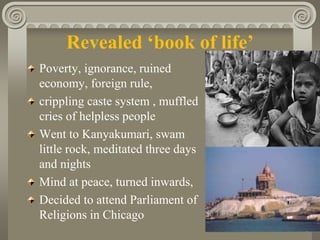
Revealed ‘book of life’
Poverty, ignorance, ruined
economy, foreign rule,
crippling caste system , muffled
cries of helpless people
Went to Kanyakumari, swam
little rock, meditated three days
and nights
Mind at peace, turned inwards,
Decided to attend Parliament of
Religions in Chicago
Firm conviction
It is futile to teach
religion w/o first
trying to remove
poverty and suffering
Journey to Parliament of Religions
Not know exact date of opening
Little money, no credentials
Maharaja of Khetri, a devotee, ticket
for sea voyage
Left Bombay, visited Ceylon,
Penang, Singapore, Canton,
Nagasaki, the by land to Yokohama,
Vancouver - Chicago (July)
America
Overwhelmed by power, riches, inventive
genius
Dismayed, open first week if Sept., too late
for registration, no w/o official reference
Decided to visit Boston, fellow traveler rich
Massachusettes lady – invited to house
Introduced to Prof. J. H. Wright
Write wrote to President of the committee
Offered rail ticket to Chicago
Chicago
Lost address of the committee
Coloured man – Shunned
No lodging, slept in big empty box at
station
Tried way to venue, knocked doors
Sat down exhausted. a Lady gave food,
rest, took to Parliament, accepted. Mrs
hale remained faithful, devoted
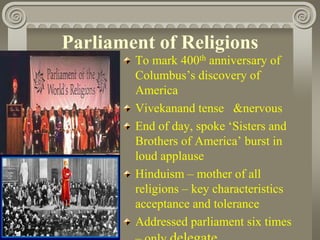
Parliament of Religions
To mark 400th anniversary of
Columbus’s discovery of
America
Vivekanand tense &nervous
End of day, spoke ‘Sisters and
Brothers of America’ burst in
loud applause
Hinduism – mother of all
religions – key characteristics
acceptance and tolerance
Addressed parliament six times
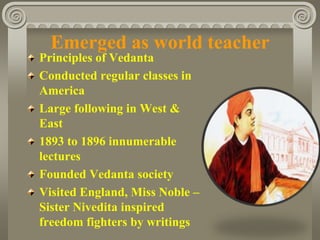
Emerged as world teacher
Principles of Vedanta
Conducted regular classes in
America
Large following in West &
East
1893 to 1896 innumerable
lectures
Founded Vedanta society
Visited England, Miss Noble –
Sister Nivedita inspired
freedom fighters by writings
Back to India
People stormed, flowers, inscence,
offerings
Planned mission of social service
Worship God embodied in men
Founded Ramkrishna Mission
Messages of Shri Ramkrishna, Vedanta
Social service, poor, orphanage, famine,
Plague, relief work, education
Second journey – London, San Francisco,
Oakland, Alameda, France, Hungary,
Serbia, Romania, Bulgaria, Athens, back
in Belur
Teachings
Believe first in yourself, then in God
Bravery is the highest virtue
Dare to speak the whole truth always
God in every being
Knowledge is to find unity in
diversity
Education is that by which character
is formed, strength of mind is
increased, intellect is expanded and
by which one can stand on one’s feet.
Man making Education
Christopher Isherwood
He stood impartially between East
and West, prizing the virtues and
condemning the defects of both
cultures. Synthesis between young
India and ancient India. Champion
against poverty and oppression.
Praised American idealism. British
singleness of purpose. Such
Greatness
Swami Vivekananda

Swami Vivekananda

  • 2.
    Swami Vivekanand  1863– 1902  Narendranath Datta  Born in Calcutta  Great Taste for Music  Adept in Sports  Hindu classics – Tutelage of Mother  Voracious Reader  Prodigious Memory  Verbatim familiarity with Encyclopedia Britannica
  • 3.
    Childhood Courage, presence ofmind, intelligence restless. When very restless mother poured cold water on his head chanting ‘Shiva’. Immediately quietened Loved birds and animals. Pets- cow, a monkey, a goat, a peacock. Pigeons, guinea pigs Favourite game – ‘King and the Court’ Self- King and playmates Ministers/courtiers Leadership Worshipped images of Shiva, Ram, Sita
  • 4.
    Wandering monks askingalms Gave only possession a tiny piece of cloth around waist Mother lock him up when monk appeared Throw out of widow anything in hand to holy men Heard - holy men grew long hair that enter earth when in meditation Often pretended meditation- open eyes now and then to see hair touch earth Once in meditation, snake entered, friends fled, he remained absorbed, snake left.
  • 5.
    Parents Father – VishwanathDatta charitable and sympathetic to poor Mother – Bhubaneshwari Devi – deeply religious. Spare time sewing and singing from Ramayan and Mahabharat, sympathy for poor Narendranath – Inherited rational mind and independent spirit from father Devotional nature from mother
  • 6.
    Questioning spirit Father’s officeseparate tobacco pipes for clients of different communities/religious groups Narendranath heard – pipes meant for other castes – degrade oneself Smoked from all pipes. Caught and scolded. Wanted to see if it made any difference
  • 7.
    At school(Calcutta MetropolitanInstn.) Founded by Ishwar Chandra Vidyasagar Organized theatrical gr., gymnasium, took lessons in Fencing, wrestling, rowing, other sports. Visited museums,zoological gardens with friends. Averse to superstition –Favourite game climb tree,neighbour – pluck flowers. Threats failed. Owner said, tree was haunted by evil spirit, wring necks of boys, all frightened, Narendra ‘not to believe people said unless proved right’.
  • 8.
    That is realization Donot believe in a thing because U have read it in a book. Do not --another man has said it is true. Find out the truth for yourself. Set up a heavy trapeze in gymnasium, An English sailor helped, trapeze hit the sailor, fell unconscious, crowd thinking dead ran away. N tore a piece of cloth from dhoti, dressed, washed face, nursed, purse of donation
  • 9.
    1879 Passed school firstdiv. His interests: books on literature and history, newspapers, public meetings Joined Scottish Church College, Olive complexion, full face, broad forehead, strong jaws, glowing eyes, irresistible charm, sparkling with wit, humour and kindness
  • 10.
    Romain Rolland writes Nobodywould come near him without paying homage to his majesty. In college, specialized in western philosophy, ancient and modern history Developed critical inquiry Doubts stormed his mind Grew older became sceptical about very existence of God
  • 11.
    Attracted to BrahmoSamaj Movement Founded by Raja Ram Mohan Roy Denounced rituals, image worship Wanted to make social(landlords, women, priests) and religious life healthy Emancipation of women, widow remarriage, spread of mass edu. supported slogans of French revolution, progressive ideas. Restless soul(yearning for realizing God)
  • 12.
    Rev, W.W. Hastie,his Principal Narendranath is really a genius. I have travelled far and wide but I have never yet come across a lad of his talents and possibilities, even in German Universities, among philosophical students. From Hastie first time heard about spiritual leader Shri Ramakrishna
  • 13.
    Met Shri RamkrishnaParamhansa Shot Q’ have U seen God? Replied in clear, confident &unfaltering voice He had, could be realized Frequent visits Rational mind, questioning spirit, lot of conflict Master’s spiritual guidance – transformed, skepticism disappeared
  • 14.
    Master’s love, guidanceemphasized Discipline – body &mind, self control Regular meditation, detachment God is one known by different names All living beings manifestation of God Service to mankind more important than Salvation
  • 15.
    1888 Left Calcutta, wentto Varanasi, Ayodhya, Lucknow, Agra, Vrindavan, Mathura, the Himalyas. thought of God always in mind Discovered real India, saffron robe, renouncing worldly life, Travelled far and wide on foot often w/o food and shelter, stayed with poorest of poor, guest of kings/ princes
  • 16.
    Revealed ‘book oflife’ Poverty, ignorance, ruined economy, foreign rule, crippling caste system , muffled cries of helpless people Went to Kanyakumari, swam little rock, meditated three days and nights Mind at peace, turned inwards, Decided to attend Parliament of Religions in Chicago
  • 17.
    Firm conviction It isfutile to teach religion w/o first trying to remove poverty and suffering
  • 18.
    Journey to Parliamentof Religions Not know exact date of opening Little money, no credentials Maharaja of Khetri, a devotee, ticket for sea voyage Left Bombay, visited Ceylon, Penang, Singapore, Canton, Nagasaki, the by land to Yokohama, Vancouver - Chicago (July)
  • 19.
    America Overwhelmed by power,riches, inventive genius Dismayed, open first week if Sept., too late for registration, no w/o official reference Decided to visit Boston, fellow traveler rich Massachusettes lady – invited to house Introduced to Prof. J. H. Wright Write wrote to President of the committee Offered rail ticket to Chicago
  • 20.
    Chicago Lost address ofthe committee Coloured man – Shunned No lodging, slept in big empty box at station Tried way to venue, knocked doors Sat down exhausted. a Lady gave food, rest, took to Parliament, accepted. Mrs hale remained faithful, devoted
  • 21.
    Parliament of Religions Tomark 400th anniversary of Columbus’s discovery of America Vivekanand tense &nervous End of day, spoke ‘Sisters and Brothers of America’ burst in loud applause Hinduism – mother of all religions – key characteristics acceptance and tolerance Addressed parliament six times
  • 22.
    Emerged as worldteacher Principles of Vedanta Conducted regular classes in America Large following in West & East 1893 to 1896 innumerable lectures Founded Vedanta society Visited England, Miss Noble – Sister Nivedita inspired freedom fighters by writings
  • 23.
    Back to India Peoplestormed, flowers, inscence, offerings Planned mission of social service Worship God embodied in men Founded Ramkrishna Mission Messages of Shri Ramkrishna, Vedanta Social service, poor, orphanage, famine, Plague, relief work, education Second journey – London, San Francisco, Oakland, Alameda, France, Hungary, Serbia, Romania, Bulgaria, Athens, back in Belur
  • 24.
    Teachings Believe first inyourself, then in God Bravery is the highest virtue Dare to speak the whole truth always God in every being Knowledge is to find unity in diversity Education is that by which character is formed, strength of mind is increased, intellect is expanded and by which one can stand on one’s feet. Man making Education
  • 25.
    Christopher Isherwood He stoodimpartially between East and West, prizing the virtues and condemning the defects of both cultures. Synthesis between young India and ancient India. Champion against poverty and oppression. Praised American idealism. British singleness of purpose. Such Greatness