











High Schoolers’
Guide To The Future
&Written by
Questions or feedback? Comment here.
Table of Contents 1
Introduction
About Magoosh 3
About CollegeXpress 5
What is this eBook? 7
Freshman Year
Find the right extracurriculars 8
The Importance of Extracurricular Activities in the Admission Process 9
Develop Key Life Skills 11
Organization (The Step by Step Guide) 11
Six Surprising Myths About Succeeding in School 15
Make the most of your summers 18
High Schooler’s Guide to Spending Your Summer Wisely 18
Sophomore Year
Optimize Your Study Habits 23
Interesting = Studying 24
How to Study Online Without Getting Distracted 26
Creating a Productive Group Study Session 29
Learn How to Manage Stress 33
Twenty Ways to Destroy Stress for the Stress-Destroyed 33
Take AP Classes 38
Should I take AP courses? 38
AP Test Insider Tips	  40
Take Standardized Tests, part 1 41
PSAT vs. SAT 41
SAT Subject Tests – Sophomore Year! 44
Questions or feedback? Comment here.
Table of Contents 2
Junior Year
Ease into College Admissions 46
Making That College List 47
Top 10 Campus Visit Tips 50
Take Standardized Tests, Part 2 53
ACT vs SAT 53
How to Study for Both the SAT (and ACT!) and Your AP Tests 56
Educate your parents 59
What should I do if my parents and I disagree about my college choices? 59
SAT Information for Parents 61
Senior Year
Apply to College 64
°° Top 10 Admission Mistakes 64
°° Common Mistakes that Will Kill Your College Essay 69
°° Checklists and Soul Searches: Finding the Right School for You 73
Get Money for College  79
°° The Ultimate Financial Aid Handbook 79
Appendix
	 International Students 85
°° Preparing for the SAT as a Non-Native English Speaker 85
°° Educational Opportunities in the United States 88
°° International Students’ Application Process 94
Transitioning to College 98
°° 10 Tips on How to Survive (and Thrive) Your First Year of College 98
°° Tackling the Transition 100
°° 5 Things I Should’ve Done Differently in College 105
Free Resources 108
Questions or feedback? Comment here.
Introduction 3
Introduction
About Magoosh:
Magoosh is an online SAT prep course that offers:
•	 Material created by expert tutors who have in-depth knowledge of the SAT
•	 140+ unique lessons on all SAT subjects
•	 700+ Math  Verbal practice questions with video explanations after each question
•	 Free vocabulary flashcards online and through our Android and iPhone mobile apps
•	 Access anytime, anywhere from an internet-connected device
•	 150-point score improvement guarantee
•	 Email support from experienced SAT tutors
•	 Customizable practice sessions and quizzes
•	 Personalized statistics based on performance
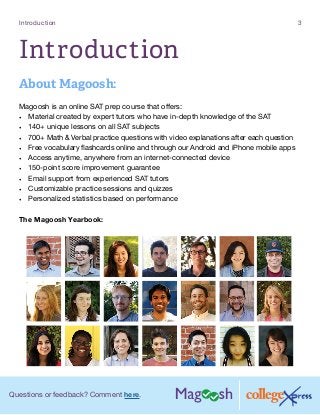
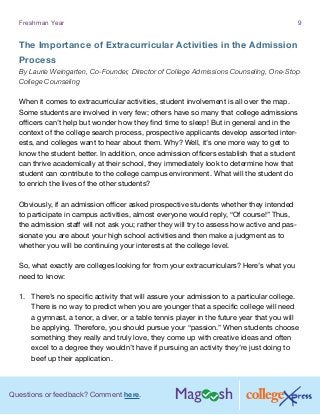
The Magoosh Yearbook:
Questions or feedback? Comment here.
Introduction 4
What students say about Magoosh
“It has given me great preparation for hard questions on the SAT. It’s an amazing way
to practice hard questions that you rarely find, and the answer explanations are amazing.”
“Unlike others out there, Magoosh has all the helpful, easy-to-comprehend video les-
sons. It helps a lot just by watching them.”
“I used the product to prepare me for taking the SAT and even though I had taken it
before, I was still very much informed on many things I did not know about the test.”
Featured in:
Questions or feedback? Comment here.
Introduction 5
About CollegeXpress:
CollegeXpress is a comprehensive college and scholarship search site—a one-stop-
shop for all things college admission. We know what college is all about—academics,
personal growth, professional opportunities, and fun—because we’ve been there.
When we built CollegeXpress, we kept all of that in mind, creating the kind of site we
wish we had when we were looking for schools. And best of all, it’s free to use!
CollegeXpress was created by the team at Carnegie Communications, an educational
publisher. Every year, thousands of students across the United States and around the
world discover their colleges using our magazines and websites. Nothing makes us
happier than when that happens.
We’ve been in the education business for many years, and CollegeXpress was first
launched in 1995. Yet, even though we’ve been around a long time, many of the brains
behind CollegeXpress are recent grads. So you get the experience of an established
company with the perspective of people just like you. We also incorporate as much
user feedback as possible, so the site has all the information you need.
Our college and scholarship data comes from Wintergreen Orchard House (a subdi-
vision of Carnegie Communications), a major database compiler of college, graduate,
and scholarship data.
College experts, like deans of admission or financial aid, or college counselors, write
many of our articles and blog posts. And our own experienced editorial team contrib-
utes to the site as well:
Questions or feedback? Comment here.
Introduction 6
We’re constantly working to make CollegeXpress the best college resource out there,
and if you have any feedback or questions, we’d love to hear from you via e-mail
Facebook, or Twitter!
Jessica Tomer
Editor-in-Chief, Carnegie Communications
Stephanie Farah
Writer and Senior Editor at Wintergreen Orchard House, Col-
legeXpress Blogger
Megan Gibbs
Senior Editor and Marketing Manager at Wintergreen Orchard
House, CollegeXpress Blogger
Claire Carter
Editorial Assistant, Carnegie Communications
Questions or feedback? Comment here.
Introduction 7
What is this eBook?
Applying to college is no easy feat these days. It’s overwhelming to know where to
start or how to find the resources you’ll need to succeed. So CollegeXpress and Ma-
goosh teamed up to provide you with an ultimate guide to applying for college. It’s
structured as a timeline, guiding you through what you should be thinking about each
year that you’re in high school. It’s packed with information (and it’s pretty too!) so that
you’ll have a handy-dandy resource to turn to whenever you feel stuck or have ques-
tions throughout the process. So without further ado, CollegeXpress and Magoosh
present you: The Ultimate Guide to Applying for College! We hope you enjoy it.
Questions or feedback? Comment here.
Freshman Year 8
Freshman Year
Find the right extracurriculars
How do you decide which extracurriculars to pursue? Why does this matter to college
admissions officers? And why should you start during your freshman year? If you’re
wondering any of these questions, read on for answers!
Questions or feedback? Comment here.
Freshman Year 9
The Importance of Extracurricular Activities in the Admission
Process
By Laurie Weingarten, Co-Founder, Director of College Admissions Counseling, One-Stop
College Counseling
When it comes to extracurricular activities, student involvement is all over the map.
Some students are involved in very few; others have so many that college admissions
officers can’t help but wonder how they find time to sleep! But in general and in the
context of the college search process, prospective applicants develop assorted inter-
ests, and colleges want to hear about them. Why? Well, it’s one more way to get to
know the student better. In addition, once admission officers establish that a student
can thrive academically at their school, they immediately look to determine how that
student can contribute to the college campus environment. What will the student do
to enrich the lives of the other students?
Obviously, if an admission officer asked prospective students whether they intended
to participate in campus activities, almost everyone would reply, “Of course!” Thus,
the admission staff will not ask you; rather they will try to assess how active and pas-
sionate you are about your high school activities and then make a judgment as to
whether you will be continuing your interests at the college level.
So, what exactly are colleges looking for from your extracurriculars? Here’s what you
need to know:
1.	 There’s no specific activity that will assure your admission to a particular college.
There is no way to predict when you are younger that a specific college will need
a gymnast, a tenor, a diver, or a table tennis player in the future year that you will
be applying. Therefore, you should pursue your “passion.” When students choose
something they really and truly love, they come up with creative ideas and often
excel to a degree they wouldn’t have if pursuing an activity they’re just doing to
beef up their application.
Questions or feedback? Comment here.
Freshman Year 10
2.	 Colleges today aren’t necessarily looking for a well-rounded student; they want a
well-rounded class. So you can be a specialist, an “accomplished expert,” without
feeling that you also need to join nine clubs, volunteer 35 hours a week, and work
part-time at the local Starbucks.
3.	 Speaking of clubs, no applicants are fooling admission counselors with that “join
six clubs junior year” strategy in order to fill up the common app activity section—
counselors know what’s up! That’s why you need to start this early on in your
freshman year. If you participate in a club, become a leader who actually does
something. If you’re the club President, be prepared to speak/write about things
that you changed and accomplished that have never been done before. If you
don’t hold an official leadership position, then organize an event, raise money for a
charity. Make a difference!
4.	 Depth over breadth! Colleges will look for how you progressed in the activity, and
they will evaluate your level of passion and commitment. If you play tennis for your
high school team, do you also take lessons out-of-season, teach skills to younger
children and referee tennis tournaments? If you are conducting cancer research,
have you shown a progression in your work over the years?
5.	 Hobbies count! Whether you’ve visited every baseball stadium in America or rode
every roller coaster on the East Coast or sampled every cupcake bakery in the
Midwest or attended auto shows throughout the county or performed magic at
children’s birthday parties, let admission officers know! These are interesting and
important details about what makes you tick, and such atypical extracurricular
activities will showcase a unique aspect of your personality.
6.	 Some students use the summer to more thoroughly pursue their interests. Take
some time to relax in the summer, but make sure that you spend part of your va-
cation being productive. Do something that really interests you—as long as it’s not
watching hours of television!
Questions or feedback? Comment here.
Freshman Year 11
Develop Key Life Skills
In this chapter, we’re talking about the necessary skills that will lead to your thriving
in high school and success in the college admissions process. So don’t neglect this
step! Start working on these skills now.
Organization (The Step by Step Guide)
By Cassidy Mayeda, Magoosh Blogger
So…organization. Repeated more often by teachers, mentors, and parents as the
key to the universe, and the great mystery (or dreaded arch nemesis) of many a high
school student. But what is organization? At least in my personal AP Student-ese
dictionary, organization is the effort to put your thoughts and physical homework and
classwork into a comprehensible order. Be it a triple-layered color-coded sticky note
system, or a simple iPhone app; organization is whatever keeps your stuff in an under-
standable format that’s easy to access, and easy to understand.
Whether you’re fluent in the magical arts of organization and are just looking for some
extra tips, or you’re a student who is only reading this because your mom emailed it
to you in a last-ditch effort to get you to finally--FINALLY--organize the mess of loose
papers in your backpack, this post hopefully has some useful tips and explanations
that will help you keep everything straight.
Organizing Classwork  Homework
The easiest (and most fundamental) place to start organizing is with the physical pa-
pers you deal with on a day-to-day basis. From the assignment papers you get in
class to the math homework you always manage to lose the moment you put it in your
backpack, there are common steps you can take to keep these papers in order:
•	 Binders  Notebooks: A classic! You can use a binder with a divider for every
class, or even a separate binder for every class. You can also use a spiral bound
Questions or feedback? Comment here.
Freshman Year 12
notebook for note-heavy classes (math and language classes, for starters), and
that’ll keep your notes chronological and avoid the binder problem of losing a loose
sheet of paper.
•	 Folders: Maybe you have an addiction to kawaii Japanese school supplies, and
individual folders are more your style. Great! Use those tools to keep your papers
organized. But, I would not suggest this for someone who particularly struggles
with organization because folders require that you only keep the bare minimum
with you, since you don’t want to be spending excessive amounts of time search-
ing through loose sheets of paper.
•	 Computer folders: It might sound simple, but this is actually a fairly complicated
task. If you take notes on your computer, it can be difficult to keep track of word
docs, emailed drafts, Google drive, and whatever is on that flash drive you’ve kept
in your backpack for years but never use. The best advice I can give to keep your
cyberspace in order is to keep detailed folders (i.e. a “Class Notes” folder within
your “AP Biology” folder) and to always put draft numbers in file titles. Also remem-
ber that Google Drive has folder options, and it can be wonderful to keep important
documents backed up there in case of a crash.
Organizing Assignments
The next important step in learning the dark arts of organization is keeping care-
ful track of assignments or things you need to do. Many only do this for homework
(which is a wonderful place to start), but if you find yourself struggling to remember
everything outside of school you need to do, it’s a good idea to start writing that stuff
down too. Tasks for extracurriculars, chores, college applications, and/or a part time
job are numerous and confusing if you try to remember them all at once.
As with schoolwork, you have several common options for how to organize your
school and general to-do lists:
•	 Paper agenda: The best thing about an agenda is that you get to physically write
down and check off tasks. If you’re a kinesthetic learner, this might be a good op-
tion for you because it will be easier for you to remember when you’ve done some-
thing (because you went through the motion of crossing it out).
Questions or feedback? Comment here.
Freshman Year 13
•	 Smartphone apps: What I love about smartphone app organization is that you
always have them around, and won’t forget your lists places. If you have a habit of
losing things, this would be a great option for you because most to-do apps also
connect to a website that you can access from any computer (in the awful situation
that you lose your phone). Additionally, they are great for setting timed reminders
that will beep at you when it’s time to do something. The only drawback is that at
times when you’re entering your homework into your phone, teachers will assume
that you’re texting. But don’t worry; just assure them know you’re actually being a
good student and doing the right thing, and problem solved! My favorite apps are:
•	Reminders for the iPhone (check out this link on how to best use it)
•	myHomework (keeps track of class times for you)
•	Wunderlist (great for sharing to-do lists and deadlines on group projects)
•	Cozi (for family tasks)
Organizing Thoughts
The final step in the full sweep of get-your-life-together organization is note taking.
Because chances are, if your homework is disorganized, so are your notes. But you’re
in luck! Just like the rest of these tips, organized note taking is something everyone
can be good at with effort and practice.
Here are the most common note-taking styles with comments on each:
•	 Cornell Notes: I would say this is the most common and the most versatile way of
taking notes. If you’ve never encountered it before, it’s essentially a giant T on your
page where the smaller left side is reserved for key terms and concepts, and the
right side is the bulk of your notes. I find this style works well for term-heavy topics
like biology, history, or even certain sections of English classes like rhetorical de-
vices, but is poor for classes like math and chemistry where notes are dominated
by long problems. It also includes a summary at the end of a topic to remind you of
the most important parts.
•	 Outline/bullet points. This style is the most hierarchic, and makes it clear when
one concept is part of another, or builds upon one another. It’s good for subjects
Questions or feedback? Comment here.
Freshman Year 14
with clear classifications and sub-topics (like psychology or biology) but poor for
topics with many key terms, or with many sample problems. This is also the easiest
format to type notes in.
•	 Concept maps/drawings. I find that beyond necessary diagrams of physical pro-
cess (like the parts of a cell in bio), drawings are usually a study tool more than
a note-taking style. It’s difficult to keep up in lecture when you’re busy drawing a
complex diagram. But as with anything, if it works for you, then keep doing it, as
long as it doesn’t hold you back from absorbing more information.
Takeaway
Organization is a process of trial and error in efforts to find what works for you. There
are a lot of tips here, but ultimately you need to find your system and stick to it. If
you’re at a total loss, just pick one strategy from each of the categories and try to train
yourself to constantly keep at it. Maybe you won’t be a perfectly organized person
every moment of every day, but at least once a week you should sit down, go through
everything, and make sure you have what you need for the coming week. This weekly
process can be a real stress reliever (psychologically proven), and help you be positive
about the work to come (not psychologically proven, but my personal philosophy!)
Questions or feedback? Comment here.
Freshman Year 15
Six Surprising Myths About Succeeding in School
By Stefanie Weisman, Author
By the time you reach high school, chances are you’ve got some pretty entrenched
study habits. Maybe they’re things your parents or teachers told you, maybe you
picked them up from other students, maybe you just grew into them. But have you
ever wondered if there was a better way? Many commonly held beliefs about learn-
ing and success have been dispelled by recent research, but much of it has failed to
make a dent in students’ everyday lives. Here are six surprising myths that may forev-
er change the way you study.
Myth #1: You should have a designated area for studying.
Reality: A change of scenery stimulates the mind.
When you have a test to study for, do you lock yourself in your room for hours? Spend
so much time in the library that they start charging you rent? While you may think that
staying in a single location helps you focus, you’re actually better off switching up
where you study. In an experiment led by cognitive psychologist Robert Bjork, college
students who reviewed vocabulary in two different rooms recalled 20% more words
than a group studying the same list in a single location. “What we think is happening
here,” says Dr. Bjork, “is that, when the outside context is varied, the information is
enriched, and this slows down forgetting.” So instead of staking out one study spot,
opt for the life of a wandering scholar. Alternate between your room, the library, an
empty classroom, a park, and so on—as long as it’s a place without too many distrac-
tions!
Myth #2: Surfing the Web for cute kitties is bad for your grades.
Reality: Cuteness can help you concentrate (up to a point).
You may think you’re just wasting time when you watch a video of a panda cub sneez-
ing, otters holding hands, or cats having a conversation. But according to a 2012
Japanese study, looking at cute things—in particular, baby animals—actually improves
fine motor skills and “perceptual carefulness.” Researchers think that exposure to im-
Questions or feedback? Comment here.
Freshman Year 16
ages of adorable, helpless little creatures naturally makes people more attentive and
focused, which is a good thing when you’re sitting down to study. So go ahead and
visit your squeal-inducing website of choice before cracking open your textbook. Just
beware of getting sucked into the black hole of online cuteness; a few heart-melting
images are all you need.
Myth #3: Studying should be done in silence.
Reality: Reading out loud can jumpstart your memory.
In a 2010 study by the University of Waterloo in Ontario, researchers found that when
it comes to studying, silence isn’t golden. According to the experiment, people who
read half a list of words silently and said the other half out loud recalled the spoken
words 12%–20% better than those read silently. However, subjects who vocalized the
entire list remembered them no better than a group who reviewed the words without a
peep. It seems that reading out loud gives your brain a boost only when it’s a distinc-
tive event, not when you do it all the time. So save your breath for the stuff you really
want to stick in your brain, things like important formulas, key terms, main ideas, and
so on. And if you’re studying in public and don’t want to alarm the people around you,
mouthing the words to yourself will work just as well.
Myth #4: The more you multitask, the better you get at it.
Reality: People who are chronic media multitaskers actually have lower levels of
concentration than those who aren’t.
You see them in schools around the country: students checking e-mail and Face-
book on their laptops and sending texts on their iPhones, all while ostensibly paying
attention in class. Perhaps these students, having been raised in a world of portable
electronic devices and endless streams of data, are multitasking wunderkinds. Not
so, according to a 2009 Stanford University study. As the experiments show, subjects
who were heavy media multitaskers were worse at filtering out distractions, organiz-
ing and storing information, and switching from one task to another than those who
were not. “They’re suckers for irrelevancy,” says Professor Clifford Nass. “Everything
distracts them.” So whether you’re in class or studying, limit the temptations of tech-
nology by closing distracting websites, turning off your phone, disabling your Wi-Fi, or
Questions or feedback? Comment here.
Freshman Year 17
even installing apps that will block your access to the Web.
Myth #5: For best results when studying, read the material over and over again
until you know it cold.
Reality: Testing yourself is more effective than reading and re-reading.
A lot of students think the best way to study is to read their textbook and notes as
many times as possible before the exam. But the truth is, you’ll learn the material
much faster—and retain it longer—if you engage in a little QA. In a 2006 study by
Washington University in St. Louis, students who were tested on a reading passage
remembered over 60% of it one week later, while those who read it several times with-
out being tested recalled only 40%. Similarly, researchers Mary Pyc and Katherine
Rawson showed that students who actively recalled the meaning of foreign vocabu-
lary words retained them better than those who merely studied them repeatedly. To
get the most out of your study time, think of questions to ask yourself during your first
read-through, and write down the answers when you’re done. Have a friend quiz you
on the material, and make use of the problem sets at the end of chapters.
Myth #6: You have to be a perfectionist to be a top student.
Reality: Perfectionism can hold you back from academic success.
You may think top students are relentless perfectionists who would never accept any-
thing less than an A, but in reality, accepting failure is an important part of the learning
process. In a 1998 study, researchers Claudia Mueller and Carol Dweck showed how
fifth-graders learned more and did better on tests when they felt it was okay to make
mistakes. Similarly, in a 2012 French experiment, students who were told that expe-
riencing difficulty is a normal part of learning demonstrated higher working memory
capacity than those who didn’t receive this pep talk. According to one of the research-
ers, Frederique Autin, “By being obsessed with success, students are afraid to fail,
so they are reluctant to take difficult steps to master new material. Acknowledging
that difficulty is a crucial part of learning could stop a vicious circle in which difficulty
creates feelings of incompetence that in turn disrupts learning.” To embrace your full
academic potential, don’t be afraid of failure. Instead, view your mistakes as a learning
opportunity, take classes outside of your comfort zone, and remember that learning is
Questions or feedback? Comment here.
Freshman Year 18
hard—but totally worth it.
Make the most of your summers
School’s out!
In middle school, those words probably meant getting to watch all the T.V. and play all
the video games you were forced to resist during the school year. But in high school,
that needs to change. If you’re going to make it to college you will need to invest ev-
ery moment, including your summers, into building your college app resume. Here’s
how to make the most of those summer months!
High Schooler’s Guide to Spending Your Summer Wisely
By Maddi Lee, Magoosh Blogger
“Oh, lord,” you groan. “Now, this blogger’s gonna tell me to be—shudder—productive
this summer.”
I wish I could tell you that you’re wrong…
...But I can’t. Summer is an awesome time to have fun, but it’s also a vital period
for tons of programs and activities and volunteer gigs that your mind will positively
explode. It’s an essential time for any high schooler to do things that are (collective
groan) productive.
Still, though the word “productive” has connotations all on its own, spending your
summer wisely can only help you in the end...and it can actually be pretty fun. Instead
of vegetating for the next three months, try a few items on this list! This applies to in-
coming sophomores, juniors and seniors.
1.	 Find an internship
Questions or feedback? Comment here.
Freshman Year 19
Now, many internships only accept applications months in advance, but there
are still others who accept new interns on a rolling basis. If you have a good idea
of your college major and future occupation, find a relevant internship and work
hard at it. Internship opportunities can be found through already established con-
nections (familial or otherwise) or even by a quick internet search on websites like
InternMatch or Internships. They’re literally only a click away.
2.	 READ!
You’ve been told this since you encountered Hooked on Phonics in Kindergarten,
but really...reading is so, so vital to success—not just in school, but in life. Man,
that sounded cheesy.
Reading will help keep your mind in tip-top shape, while also providing you with
valuable information and resources for the next school year (and many more
school years to come). Think of all the times you’ll need to cite reading material—
on the SAT, on AP exams, on in-class essays...Don’t just stick to required reading.
If you look at the books on this awesome reading list, for example, you’ll find tons
of invigorating, stimulating material, which will not only keep you entertained, but
also provide some worthwhile academic benefits.
3.	 Orientations and college visits
Visit those colleges that you’re looking to apply to—especially if you’ve just com-
pleted junior year. Lots of juniors do this during winter and spring break, but sum-
mer break offers even more time and even more opportunities to visit campuses
near and far. This is a great way to really get a feel for the atmosphere of a college
campus and its students.
4.	 Find a job
It really isn’t as scary as it sounds! Finding a job is an excellent way to prepare for
your future. Not only will it help you gain valuable life experience, but who doesn’t
like some moola? Not to mention, it’s a great addition to your college app—a great
way to show that you are committed, responsible, and not just relying on your
Questions or feedback? Comment here.
Freshman Year 20
parents to keep your wallet filled. It’s even better if you can find a job doing some-
thing you enjoy or something relevant to your future career!
Jobs can range from small jobs at your local shopping mall or larger jobs for com-
panies in a field you’re interested in ...or maybe even an online job. Check out job
listings on these websites, for example—or ask around locally.
5.	 Volunteer!
Volunteering is a great way to spend your summer—especially if you find a job you
really love. This ties into #6, but try to find a volunteer opportunity that you really
enjoy—maybe even something that involves your passions and interests.
VolunteerMatch is an excellent resource for finding local and virtual jobs according
to your interests.
6.	 Work on a big project or something that’s meaningful to you
Stay busy! You don’t necessarily have to go to some fancy camp to make your
summer impressive. Set big goals for yourself, and reach for them. Climb a moun-
tain. Organize a charity event. The point is to make use of your time—because
soon you won’t have much of it.
Particularly for those who have a huge passion or hobby, do what you like doing—
and do it a lot. If you’re an artist, paint like it’s no one’s business. Maybe even sell
some of your work! Aim to be featured in a local art fair.
If you’re a programming enthusiast, code like there’s no tomorrow. Maybe you can
start a business or look for companies which need your talent.
In short, know your passion and exploit it. Become very good at it. Colleges enjoy
seeing extracurricular focus in applicants.
7.	 Take classes
Questions or feedback? Comment here.
Freshman Year 21
Take classes at a local college or university! This is a great opportunity to gain some
experience to gain credits and learning experience in a real college environment.
You can also take online classes—a lot of which are completely free. Again, this
ties into #6. If you enjoy architecture, for example, there are plenty of free courses
online on sites like edX. The same applies to countless other fields.
Check out these other MOOC’s (Massive Open Online Courses). There are hun-
dreds of free online courses—some of which are associated with elite universities.
You can also watch countless lectures from top universities on YouTube like Stan-
ford or Yale.
8.	 Study!
I know, I know. Not the funnest way to spend your summer. But this is a great
opportunity to study for the SAT or ACT if you haven’t already. It’s also a great
time to study for any SAT subject tests that you’re planning on taking later on in
high school. Find a great online program or prep school, find a tutor, or buy a prep
book and study on your own!
9.	 Start your college apps
Ah, college apps! This has been mentioned in previous posts, but summer is the
prime time to begin those wonderful little bundles of...terror. A great place to start
is the Common App supplement essays. Start outlining ideas and writing your
first drafts. Maybe even send some drafts over to family members for feedback.
Check out the supplement essays for the colleges you’re thinking of applying to-it
is NEVER too early to start!
The more you do now, the less you’ll have to worry about in the chaotic maelstrom
that is first semester senior year. (And you thought second semester junior year
was hard!)
10.	Stay physically active
Don’t just work out your brain! Staying physically active has been scientifically
Questions or feedback? Comment here.
Freshman Year 22
proven to promote healthy brain activity and—get this—happiness. Start healthy
habits: go for a daily jog, have a nightly workout routine, take up a yoga class! “I’m
not athletic” isn’t an excuse.
Lastly, here are some things to be wary of, when it comes to summer plans:
1.	 “Prestigious” summer programs
Lots of students and parents become convinced that attending “prestigious” sum-
mer programs at prestigious universities will secure them a spot in admissions.
Although these programs will certainly provide an excellent experience, attending
one just to add it to your college application is not a great idea. Many of them are
expensive, but not necessarily selective. It’ll prove to college admissions officers
that your parents are wealthy enough to afford such programs, but it certainly
won’t guarantee you a spot. Enroll if you want a great experience and want to
learn a lot...but don’t do it just for the app!
2.	 Short service trips
The same thing applies to service trips. A lot of people are convinced that going
to Africa and building some houses for a few days will look great on their college
app. They go on expensive service trips just to write about it in their essay.
Don’t do this! This will not help your college app. There are tons of students who
do this, and admissions officers will not be impressed—especially if you volun-
teered your time, not out of your own passion, but for the sake of a checkbox on
your college app. Especially if you stay for a few days and leave.
If you’re passionate about helping people, go ahead. Do something worthwhile with it.
Just don’t think a short summer service trip will secure your chances.
Takeaway
And that’s it! Spend your summer wisely. Don’t get sucked into doing things just to
add to your college app...and remember to have fun! It’s summer!
Questions or feedback? Comment here.
Sophomore Year 23
Sophomore Year
Optimize Your Study Habits
	
When you become a sophomore in high school, things get a little more real. Habits
you ignored or thought you could push through now start to show their full effects in
your schoolwork, extracurriculars, and maybe even your personal life. So instead of
leaving those to fester and explode into full blown problems, tackle them as they ar-
rive with these tips below.
Questions or feedback? Comment here.
Sophomore Year 24
Interesting = Studying
By Cassidy Mayeda, Magoosh Blogger
Okay, you’re going to study for a pop quiz, final exam, or any-test-ever-because-your-
life-is-studying. Obviously the first thing you do is all of your other homework. Then
you walk the dog, maybe get some food—basically anything except actually sitting
down and studying.
What can you do to combat this gut-wrenching resistance to studying? You make it
interesting.
This may sound overly optimistic, like Princess Unikitty saying nothing can ever be
unhappy, but the best thing you can do to motivate yourself to study is to find what
makes the subject interesting.
This sounds confusing but let’s go through an example. Say, you’re in math class.
You’re studying sine graphs, and you’re bored out of your mind because you’d much
rather be out skateboarding, or listening to music, or going to the fair with your
friends. So here’s the cool part, sine graphs are actually involved in all of those ac-
tivities. When you skate in a circular pool, you’re skating in a sine pattern. The radio
waves transmitting your favorite 9.33 tunes are sine waves that can be graphed. The
Ferris wheel at the fair travels in a circular pattern, and the cars individual heights can
be calculated over time with a sine graph. Suddenly, what you’ve been learning in
school is all around you in real life. It’s important to know, because it helps you un-
derstand the physical world outside your textbooks. And when it’s important to know,
you’re more likely to put in more work to actually learn the subject (aka studying).
Good teachers often know this simple little secret, and take time to make the informa-
tion applicable to students’ lives. I once had an AP U.S. History teacher that made it a
literal requirement on a project to “be interesting”. But even if you don’t have a teacher
like that, you can play a game with yourself to figure out what makes a certain subject
interesting. Does Big Brother from 1984 remind you of your parents taking your phone
Questions or feedback? Comment here.
Sophomore Year 25
away? Does Howard Gardener’s Theory of Multiple Intelligences help you understand
how to study? There is something interesting about every subject in school, otherwise
they wouldn’t teach it. So forget about the idea that school isn’t cool, it is. It helps us
understand the world around us.
That isn’t to say that you will find something interesting in every single school assign-
ment. Believe me, the 50th algebra problem will bore anybody, and it’s hard to get
past the 345th page of Fydor Dostoevsky’s Crime  Punishment, but finding interest-
ing concepts will help you find your passion. Which is not only helpful when writing
college essays (they pretty much all ask about your passions) but in life when you’re
trying to figure out what to do with it.
Takeaway
Finding interesting applications of what you’re studying in class helps motivate you to
want to learn it, thus interesting=studying. Accept when you can’t make a topic inter-
esting, but have conversations with other people when you can. It will make it easier
to start studying, and (if you’re an interpersonal learner) help you better understand
the content. Besides, when you find things interesting, it makes you a more interesting
person.
Questions or feedback? Comment here.
Sophomore Year 26
How to Study Online Without Getting Distracted
By Rita Kreig, Magoosh
When you want to study for the SAT online, the internet becomes your best friend and
your worst enemy. Yes, you have access to wonderful resources all in one place, from
the comfort of your own home. But, oh the temptation to procrastinate!!
You know what I’m talking about. You go online to check Facebook for 2 minutes, and
30 minutes later you’ve delved deep into a friend of a friend’s pics from 3 years ago.
A 20-minute break to watch a quick episode of something becomes a full-on Netflix
binge. Don’t even get me started on the black hole that is YouTube. Or Pinterest.Or
Instagram.
Realistically, this can happen whether you’re studying for the ultimate end of year
exam at school or your 5 point pop quiz. This procrastination is only half fun and it’s
killing your study momentum. Stop this madness!! I’ll help.
SAT Studying Life Hacks
Let’s start with apps. I figure, if technology is the problem it might as well be the solu-
tion too.
•	 SelfControl
Price: Free
Here’s the deal: This app works for Mac, and allows you to block certain sites
on your computer for a set period of time. For example, imagine that I commit to
studying for the SAT online with Magoosh for 2 hours. I can set SelfControl to block
Facebook, YouTube, Tumblr, Pinterest, Instagram, email, etc. for two hours. After I
click “Start”, I can’t access those sites no matter what.
A word of warning: This app is harsh. Once you’ve activated it for a certain period
of time, you can’t deactivate it even by restarting your computer or deleting the ap-
plication. (Harsh, but brilliant.) For a less-severe alternative, try Concentrate ($29). It
has similar options, but you can unblock sites by restarting your computer.
Questions or feedback? Comment here.
Sophomore Year 27
•	 StayFocusd
Price: Free
Here’s the deal: Like SelfControl, StayFocusd allows you to block distracting and
addictive sites. The cool thing about it is that it’s a free chrome extension, and
therefore can be used by both Mac and PC users. Just download Google Chrome!
This extension allows you to pick how much time you’re willing to spend on dis-
tracting sites each day. You pick which sites are distracting you (it lets you get
really specific), and once you’ve used up all your procrastination time, those sites
become blocked for the rest of the day.
•	 I-Am-Studying Blocker
Price: Free
Here’s the deal: This Chrome extension is not nearly as strict as the two apps
mentioned before. Yes, you can block distracting sites, but I-Am-Studying allows
you to “snooze” your study time and browse your blocked sites for 10 minutes
every hour. The app collects data on your browsing habits and lets you know which
sites you waste the most time on (*cough* … Reddit … *cough*). If you’re not
strong-willed, this is probably not the solution for you.
Time-Management Strategies
Let’s step away from apps for a minute and talk about a solution that actually im-
proves your study and time-management skills.
•	 The Pomodoro Technique
Tools needed: One ordinary kitchen timer, a pen, paper.
Here’s the deal: This technique is all about time-management. The idea is to
thoughtfully choose a task that you need to complete and then to break the time
it takes you to complete this task into 25-minute intervals, called “pomodori” (the
plural of “pomodoro” which means tomato in Italian). You set your kitchen timer for
25 minutes, and when the time is up, you take a short (3-5 minute) break. Keep a
piece of paper handy and write an “X” every time you complete a pomodoro. Then,
Questions or feedback? Comment here.
Sophomore Year 28
after four pomodori, take a longer break (15-30 minutes).
The cool thing about this method is that you can keep yourself organized by plan-
ning your study sessions, tracking and recording your progress, and prioritizing
tasks using an estimation of how much effort (how many pomodori) they will take to
complete. Also, you get to take breaks which allow your brain to process and retain
information! Win-win.
Takeaway
Life is distracting. One second you’re studying your heart out and the next you’re
sidetracked by the music you’re listening to, TV, social media, a shiny object… And
these distractions are ruining your SAT practice.
Be strong! Find a system that works for you. Maybe you combine the Pomodoro Tech-
nique with an anti-distraction app, or maybe you just use your awesome willpower to
stay away from addictive sites on the internet. Either way, commit to your technique
and you’ll start to see your focus improve.
(For more unexpected study techniques, check out our SAT Lifehacks Infographic!)
Questions or feedback? Comment here.
Sophomore Year 29
Creating a Productive Group Study Session
By Maddie Lee, Magoosh Blogger
We’ve all been there. You plan a group study session with your friends, and three
hours later...you have done nothing. Well, except for exchanging some good gossip
and googling pictures of cats, maybe.
Group study sessions can be awesome study tools, but they can easily become just
another hang-out with your friends. And though hanging out with friends is always a
fun way to spend time, it’s not always ideal the day before a big test!
Surprisingly, having a fun (yet productive) group study session is possible. Try follow-
ing some of these tips the next time you study in a group. It might save you some
stress.
1.	 Limit the size
Although it might be tempting to invite all your friends to a study session, these
are usually more effective when you limit the size. Huge study groups will move a
lot slower and be a lot less effective. For a maximally effective session, try capping
your group at five or six people.
2.	 Prepare!
It’s a lot harder to be productive when you have no plans as to where your study
session is going. Before you start, establish what you want to cover and approxi-
mately how long you want the session to take. If you set a time limit, it’ll force you
to stay on track and not get distracted! Having a rough agenda is also useful.
You should also make sure to meet at a good location—one without too many
distractions! Some people work better in quiet locations, while others prefer some
background noise. Decide amongst your group where to study! Cafés, class-
rooms, and libraries are all great choices.
Questions or feedback? Comment here.
Sophomore Year 30
3.	 Establish rules
This may sound a bit unappealing, but it can really make your group session a lot
more productive. You can forbid all phones during the session, for example. Or
you can ban Internet for a couple hours. It may seem a little overbearing, but if
everyone is willing to do it, it’ll make the session a lot more serious and a lot more
productive. It’s a lot harder to ask a friend a question if he or she is playing 2048!
4.	 Invite people wisely	
Though it’s always fun to study with close friends, keep in mind that you don’t
have to limit your session to just your friend group. Best friends don’t always make
the best study buddies. Perhaps consider inviting people who know the material
well—even if they aren’t close friends! You’ll not only learn a lot more, but you can
form some strong friendships! After all, there’s nothing more unifying than the uni-
versal terror of desperate high school students.
5.	 Create a routine
If you find that study sessions are really effective for you and your friends, try es-
tablishing a routine. If your study sessions are scheduled periodically—and aren’t
just random events—they’ll be a lot more serious and productive. Not to mention,
they’ll improve over time as everyone becomes more used to each other and more
familiar with what study tactics are most useful for the group.
6.	 Group activities
There are lots of cool study strategies that you can only practice with other peo-
ple. Study sessions are the perfect time to try these out! A few examples of activi-
ties you can try include…
•	 Quizzes! Test each other on your knowledge! You can hold verbal trivia, or you
can make fake mini-tests for one another. Have each member of your study
group write down a question on a piece of paper and pass each paper around
until everyone has answered each one. When you’re done, compare your an-
Questions or feedback? Comment here.
Sophomore Year 31
swers!
•	 Teach each other: Communicating information orally is amazing for information
retention. Teaching other people how to do a problem is mutually beneficial:
the person being taught learns something new, and the teacher is forced to ex-
plain and understand the material he or she is teaching. Each member of your
study group can be in charge of teaching a certain topic that they understand
well, for example. It’s surprisingly fun and very effective.
•	 Rotate notes: Everyone takes notes differently, and many times, someone else
will catch something in the teacher’s lecture that you didn’t! A great way to
review the material while possibly learning something new is to exchange notes
with other members of your group. Review them together, and look for material
that you haven’t recorded in your own.
•	 Fill in the blanks: This is probably the most obvious thing to do in a study
group: answer each other’s questions! Everyone should make a list of topics
that they don’t understand, so that together you can discuss and explain all the
ideas that need explaining. Write down all your questions, and make sure you
pass them by your study buddies!
•	 Brainstorm study strategies!: Four or five heads are most certainly better than
one! Try brainstorming mnemonics or songs or other tricks to help you remem-
ber key topics. It’ll be a lot easier making memory tricks when you have several
other people brainstorming along with you! You can create different types of
tricks depending on the kinds of learners that compose your group. If you have
a lot of kinesthetic learners, for example, you might consider making a song or
dance that’ll help them on test day!
Extra tips
•	 Don’t make your study session too long! After 4 hours, your brain will start to
scream for mercy. If you really have so much to study, break your session into multi-
Questions or feedback? Comment here.
Sophomore Year 32
ple smaller chunks—one per day after school, for example.
•	 Communicate! Studying with other people can become frustrating, but if you com-
municate clearly, things will be a lot smoother. Talk with your peers, ask questions,
and discuss! That’s what study sessions are all about.
•	 Food. Have some water and some snacks out, but try not to overindulge. Oth-
erwise, your study session will turn into an impromptu banquet! It’s best not to
eat your meals in the middle of your study group, as they will easily shatter your
group’s focus.
•	 Stay focused. As mentioned before, setting rules and time limits are great for
keeping the group focused. Making timetables and establishing priority topics are
also ideal for keeping everyone on track. If people begin to veer off track, gently
steer them back in the right direction!
•	 Stay positive! Stressing out for a big test can become even more stressful in a
group if not handled correctly. Try to keep a positive environment in your group
and avoid conflicts and arguments. The last thing you need before test day is a
sore throat and a broken friendship.
Best of luck hosting your study sessions. These can be so much fun and so very pro-
ductive. Don’t miss out!
Questions or feedback? Comment here.
Sophomore Year 33
Learn How to Manage Stress
Everybody feels it, it’s an unavoidable part of life, and yet majority of people are still so
bad at managing it properly. As school picks up in this second year, use the following
tips to prepare ample tools in your arsenal so you’re ready to battle the anxiety and
fears that accompany everybody’s favorite companion: stress.
Twenty Ways to Destroy Stress for the Stress-Destroyed
By Maddi Lee, Magoosh Blogger
You’re at your desk. It’s 2 AM. You have an English essay to write, three articles to
read and annotate, and a Calculus exam tomorrow, and you just want to scream
AND—
Don’t pass out, darling! It’s alright! Forget what other people say—school is downright
stressful. You’ve got tons of homework, demanding AP classes, friend drama, SAT’s,
AP’s, and whatever other evil acronyms College Board makes up to torture our minds.
But you can deal with it! Stress is normal, but it can be seriously detrimental to your
health, leading to depression, headaches, heart problems, and even diabetes. If you
learn how to deal with it, you’ll ultimately feel a lot calmer, a lot happier, and a lot
healthier.
Check out these effective ways to destroy your stress like the evil creature it is!
1.	 Stay organized
It’s so much easier to become frustrated when you’re disorganized. Try to keep a
routine and keep your workplace clean and organized. If you have a routine, you’ll
be less likely to procrastinate and leave off all your work until the last minute. In
other words, if you have a routine, you’ll be a lot less stressed out!
Questions or feedback? Comment here.
Sophomore Year 34
2.	 SLEEP
I know it’s tempting to stay up all night and watch Netflix…
...but sleep smart! Sleep is integral for healthy brain function. Although it’s very
difficult to maintain eight full hours of sleep during the school year, it’s important to
try to get as much sleep as is possible. Spend less time vegetating on social me-
dia and more time catching those z’s!
3.	 Stay active
This has been mentioned in previous blog posts, but seriously: physical exercise
is essential for a healthy lifestyle. It’s also a great way to de-stress. Try doing some
jumping jacks in between study sessions—or going for a brisk walk. Yoga and Pi-
lates are also great ways to relieve tension! Sign up for a local class or buy a yoga
mat and learn online! Also, for some exercises that are easy to do at home, check
out this awesome list.
4.	 Keep things in perspective
It sounds too easy, but it’s true. Keeping things in perspective is the key solution
to dissolving stress. When you’re shoulder-deep in AP preparation, it might seem
like the stress will utterly destroy you, but really...it’s just a standardized test. It
won’t make or break your life. Make sure to take a step back, open up a window,
and breathe. Meditation and self-hypnosis are both great ways to deal with this.
5.	 Get a stress toy
For real, though! Having a physical outlet for your stress in the form of a squeaky
toy is no small matter. It’s actually fairly effective. And they come in all sorts of
shapes and sizes.
6.	 Study in a group
Oftentimes, studying with friends or people you are comfortable with is optimal for
relieving stress. You can know you’re not suffering alone, and you can try try all
Questions or feedback? Comment here.
Sophomore Year 35
sorts of group study methods. Try quizzing each other, discussing key topics, and
asking them your questions—if you conduct the study session right, it can be very
fun and very productive.
7.	 Laugh!
Laughing really is the best medicine. Or, at least, it’s excellent at de-stressing! Sci-
entific studies have proven that laughing eases stress and lowers blood pressure.
So, even if you’re really not in the mood for it, laugh! Watch some funny videos on
YouTube or remember a funny memory, and you’ll be guaranteed to feel a lot less
stressed.
8.	 Write it out in a journal
Writing out your thoughts is a great way to organize your emotions and really
get to the bottom of what’s bothering you. Try keeping a journal to write in when
you’re stressed—or just get out a sheet of paper! As long as you have an outlet for
your stress, you’ll feel a lot better.
9.	 Think positively
Sounds cliché, but it couldn’t be more true. Positive thinking is key to staying
calm. It’s hard not to constantly imagine worst-case scenarios (...or maybe that’s
just...me…), but if you replace them with positive mantras, things will be much
more enjoyable.
10.	Eat healthy
Eating definitely helps in stressful situations...but eating healthier is even better.
Certain foods like mussels and Greek yogurt are scientifically proven to contain
happiness-boosting nutrients and ingredients. So, the next time you’re feeling
down try chomping down on some of these!
11.	Do relaxing things (massage, tea-drinking, bubble bath)
This is a no-brainer. Sometimes all it takes to de-stress is to treat yourself to
something nice. Drink some tea. Have a bubble bath. Get a nice massage. Or try
Questions or feedback? Comment here.
Sophomore Year 36
something on this list of 100 ways to relax!
12.	Change up your environment
Sometimes, your cluttered desk does nothing to help your stress. Try switching
it up and change your environment. Study outside, in your kitchen, by a balcony!
The options are endless. Escaping familiar surroundings might help you focus
more on the task at hand.
13.	Show your affection!
Well, ok. This is going to sound really weird and possibly a little creepy, but it’s
scientifically proven, so whatever.
Hug or kiss someone. No, I’m not joking. Hugging reduces blood pressure and
stress levels, and kissing fights stress-related hormones. Just don’t kiss or hug
someone who doesn’t want to be kissed or hugged.
14.	Listen to music
Jam to some tunes! Music definitely has a strong psychological impact on its lis-
teners, and the right type of music can help you focus more, uplift your spirits, and
even relieve your stress. Take a look at these great stress-relieving playlists the
next time you feel like tearing your hair out.
15.	Stop wasting time.
This ties into a few previously mentioned topics, but it’s so important that we
might as well mention it again. If you study earlier and not later and start becoming
more productive, you’ll actually spend a lot less time getting your work done and
more time to relax. Rather than half-heartedly studying while watching TV, get away
from your distractions and just get your work over with. You’ll spend a lot less time
stressing over looming deadlines and a lot more time relaxing. Try downloading
tools which track your internet usage, so you can see which websites you spend the
most time on. Or try pitching into this list of time management strategies.
Questions or feedback? Comment here.
Sophomore Year 37
16.	Don’t take on more than you can handle
Learn to keep your priorities straight and don’t overburden yourself with commit-
ments. Don’t try to cram a whole bunch of activities in your schedule if you can’t
handle it, and don’t always feel obligated to dedicated all your time to other peo-
ple. You are important, too—learn to say “no” if you know you already have too
much on your plate!
17.	Volunteer!
According to research, volunteering and giving back actually increases happiness.
Mother Teresa would approve. So, go sign up for some nice volunteer gigs! Not
only will you be doing something good for your community, but you’ll also be a lot
less stressed out.
18.	Get a pet
In one study involving 217 community members, people with pets were proven
to be happier and less preoccupied. And, get this: petting aforementioned pets
is also said to be a major stress-reliever. It releases oxytocin, which helps lower
blood pressure and fight cortisol, which is associated with stress and anxiety. So,
go get a pet...and pet it!
19.	Chew gum
Chewing gum alleviates negativity and reduces cortisol when under stress, ac-
cording to one study. So grab your nearest pack of gum and chew that thing like
it’s nobody’s business.Oh, and what’s that about chewing gum having a negative
connotation? I didn’t think so.
20.	Speak out loud
Talk about your stress with someone. Really, it helps. Find an understanding friend
or family member to talk about your problems with (preferably someone who won’t
make you more stressed!). If you feel like there’s no one who understands, there
are tons of counseling hotlines like this one which will help you for free.
Questions or feedback? Comment here.
Sophomore Year 38
Take AP Classes
It’s time to challenge yourself academically! Start small with 1 AP class first, and then
build up to 3, 4 or even 5 at a time. You’ll show the college admissions committees
that you’re not afraid of a rigorous schedule and that you have the grit needed to suc-
ceed in academia. Read on for how to make the most of these advanced placement
classes!
Should I take AP courses?
By Multiple Authors
Here’s what the college admissions experts have to say in response to this question:
Douglas Christiansen
Vice Provost for Enrollment, Dean of Admissions
Vanderbilt University
A student should take the most rigorous course load available in which he or she will
be successful. A question that is often asked is, “What if I get a B in an AP course
when I could have gotten an A in an honors course?” For highly selective universi-
ties, it is critical that the most difficult courses be taken, and that the student be very
successful in those courses. If a student is, for example, in all AP classes senior year
and makes a B in one of the courses, the level of academic work is considered when
evaluating that B. We understand that not all students can take AP courses success-
fully while in high school. What all colleges want to see is that the student challenged
his/herself to a higher level of rigor. This shows incentive, work ethic, and dedication
to one’s education. Being realistic about one’s abilities is also critical; not everyone
excels at the same level, and there is a university or college for every student in this
country who wants a higher education. If one invests one’s self at the highest level,
that effort shines through in any application.
Questions or feedback? Comment here.
Sophomore Year 39
Rodney Morrison
Associate Chancellor for Enrollment Management
Rutgers, The State University of New Jersey, Camden
Generally speaking, yes. Colleges like to see students stretch themselves academical-
ly. The more selective of a college, the more academic rigor is a factor.
Will Zuberbuhler
Director of Business Development
Triumph College Admissions
So, you’re thinking of starting college while still in high school? Well, that’s sort of
what you’re doing when you enroll in AP (Advanced Placement) courses. You’ll find
the courses are much more difficult than any you’ve taken so far. This is because they
are very similar to college-level courses. What you’ll notice different is how the cours-
es are taught. You won’t be simply given a lot of information that you are then required
to know for a test. Rather, you’ll enter into discussions with your classmates and the
instructor as you work towards a better understanding of the subject matter.
Why are AP courses beneficial? They help you hone skills you’ll use in college like
critical thinking, writing, and time management. You can receive college credits or
advanced placement (depends on the college or university and requires passing the
exam for the course). They can help you to decide on a college major. If you’re think-
ing of taking AP courses, but just aren’t sure, it may be a good idea to try just one to
see how you like it.
Questions or feedback? Comment here.
Sophomore Year 40
AP Test Insider Tips
By Jessica Tomer, Editor-in-Chief, Carnegie Communications
Thinking about taking AP courses—and the requisite exams? They are challenging but
rightfully so, because doing well on the test can help you get a serious leg up in your
college studies, both academically and financially! Here are a few test-taking tips right
from the source.
You know those big, scary AP tests? They’re not too scary after all! “If students have
been going to class, keeping up with their coursework and studying along the way,
much of the work for the exam is already done,” says Trevor Packer, Senior Vice Pres-
ident of the Advanced Placement Program and College Readiness at the College
Board. “Students can also familiarize themselves with exam formats, sample multiple
choice and free-response questions in each of AP’s 34 subjects.” To access these
tools, go to the College Board’s AP website.
Packer recommends making educated guesses on multiple-choice questions. “If
students do not feel confident about an essay question, they should write what they
know, and earn points that could make a difference to their final score,” he says.
“When students take an AP course, they learn to think critically, construct solid argu-
ments and see many sides of an issue—skills that prepare them for success in college
and today’s highly competitive global marketplace,” Packer says. “Taking AP courses
demonstrates to college admission officers that students have sought the most rigor-
ous curriculum available to them.” Students who then go on to take the AP tests can
receive college credit and/or advanced placement if they score a 3 or better; score
requirements and credits vary, so be sure to check with your potential colleges and
universities to see how AP tests might affect your future course load. One of the big-
gest advantages of going the AP route is skipping otherwise required courses, which
might enable to you save tuition dollars if you graduate early or need to take additional
classes for whatever reason.
Questions or feedback? Comment here.
Sophomore Year 41
Take Standardized Tests, Part 1
It begins in your sophomore year—you get a first taste of these hour-long tests that
predict your fate in the world of college admissions. Gear up to start putting what
you’ve learned so far to the test, and get these tests out of the way sooner, so you
can focus on the ones that come up later.
PSAT vs SAT
By Lucas Fink, Magoosh
The PSAT is basically an SAT with smaller teeth and less purpose (it gets you schol-
arships, rather than acceptance into college). All of the same basic math topics show
up, minus a bit of the higher-level stuff.
It’s made up of the same types of questions, the instructions are all the same, and
even the timing on each section is very similar. There are a few important differences
in length and content between them, though. Take a look at the chart below to get an
idea.
The Timing of the PSAT vs the SAT
Questions or feedback? Comment here.
Sophomore Year 42
PSAT Content
The skills that the SAT tests are almost exactly the same that you’ll need to dominate
the PSAT and come away with a chance at some scholarships. Even the types of
questions are the same. In both tests, you’ll see these:
Math:
•	 Multiple choice
•	 Grid-in (Write your own answer)
Critical Reading:
•	 Reading comprehension
•	 Long texts
•	 Short texts
•	 Paired texts on one topic
•	 Sentence completions
•	 One blank
•	 Two blanks
Writing Multiple Choice
•	 Identifying sentence errors
•	 Improving sentences
•	 Improving paragraphs
That means that studying for the PSAT is a good way to get ready for the SAT ear-
ly, and conversely, using SAT study material is a perfectly good way to study for the
PSAT. In other words, if you become very comfortable with either test, you’ll get better
at taking the other as well.
Difficulty
The PSAT is a tad easier than its big brother, but the difference is pretty minimal. You’ll
see the same general vocabulary (surprisingly), the same kinds of tricky math ques-
Questions or feedback? Comment here.
Sophomore Year 43
tions, and the same common grammar issues.
It’s all toned down slightly, though. Questions that would be on the easy end of SAT
math show up more frequently on the PSAT. You might get 5 questions in a PSAT
math section that are as easy as the first 2 questions of an SAT math section, say.
And, meanwhile, the most difficult PSAT questions don’t quite reach the difficulty of
the hardest SAT math questions.
And a couple of math topics aren’t quite as common in PSAT math: quadratics are
less important, notably. The higher end of SAT math topics like that might still show
up on the PSAT—they’re skills that sophomores often have some background in, any-
way—but they’ll be more straightforward. You might get a graph of a parabola that
simply asks for an intercept, say, and requires no algebra.
So don’t freak out if you’re going to take the PSAT and are just taking Geometry 1: the
test mostly asks for basic number skills, algebra, and basic geometry, nothing more.
Taking lengthy practice SATs, like the PSAT, is an incredibly valuable way to prepare
for the real SAT and earn yourself a leg-up on test day. Combine that with the oppor-
tunity to earn a scholarship from your high PSAT score, and you have every reason to
spend a couple hours on the PSAT.
Questions or feedback? Comment here.
Sophomore Year 44
SAT Subject Tests – Sophomore Year!
By Cassidy Mayeda, Magoosh Blogger
There are no SAT tests Sophomore year right? Sophomore year is golden time before
the madness of junior year, surely. Right? No really, right?
Unfortunately, not right. SAT subject tests are the little known college application re-
quirement you should take as early as sophomore year.
What are SAT Subject Tests?
SAT Subject tests are additional tests run by the College Board that assess your abili-
ties in courses other than what is offered on the SAT itself. They’re essentially like eas-
ier AP tests in specific subjects, and are scored on an 800-point scale. You can take
them during the October, November, December, January, May and June SAT testing
dates (but check the College Board website as dates vary). You can take up to three in
one sitting, but you cannot take a subject test and the SAT on the same day. Here is a
complete list of the tests you can take:
•	 Literature
•	 Biology (ecological or molecular)
•	 Chemistry
•	 Physics
•	 U.S. History
•	 World History
•	 Mathematics (1 and 2)
•	 French
•	 German
•	 Spanish
•	 Modern Hebrew
•	 Italian
•	 Latin
•	 Chinese
•	 Japanese
Questions or feedback? Comment here.
Sophomore Year 45
•	 Korean
Also note that many of the language tests have the option to have listening portions,
but you need to register specifically for those tests. Many listening tests are only avail-
able during the November SAT.
Why do I need to take SAT Subject Tests?
Essentially, because many colleges require 2 to 3 subject tests when you apply. The
University of California app allows you to input several, and up to three language
tests. The Common App allows up to 10. These subject tests can be a great booster
for your application, but keep in mind that they will not earn you college credit like AP
tests. Don’t stress out about taking too many, because you still have to pay the fees
for each test, but you should take the tests you think you’ll score the highest in. Addi-
tionally, if you want to apply to engineering colleges, or science majors in general you
should research what SAT Subject tests your college requires. Often, one of the math-
ematics, or Biology, is needed to apply.
Why do I need to take them sophomore year?
Like with any test, you remember the most right after you’ve completed the course
(or near the end of the course). Which is what makes the June SAT the prime time for
subject tests. It also means that if you take AP classes your sophomore year, then
you’ll want to take those subject tests right away. You don’t want realize you need to
take the Chemistry SAT Subject test December of your senior year, when it’s been a
year since. That would be depressing. But hey, there is always Ryan Gosling.
Takeaway
Don’t worry if you haven’t taken any SAT Subject tests yet, you can still study and
get good scores. Make sure you research what tests you need to apply to different
schools in different majors. Try to take the tests directly after you finish the course, in
the subjects you’re strongest in.
 
Questions or feedback? Comment here.
Junior Year 46
Junior Year
Ease into College Admissions
Welcome to junior year! This is when all that talk about going to college one day starts
to get real. It’s overwhelming to know where to start, so this year is the time to ease
into things and do some prep work. Many have made the mistake of ignoring these
preliminary steps, and they lived to regret it! Don’t make the same mistake; start pre-
paring for college app season early.
Questions or feedback? Comment here.
Junior Year 47
Making That College List
By Maddi Lee, Magoosh Blogger
I want a shirt that says “Junior Year.” I then want to burn that shirt.
As hectic as junior year is, though, the paranoia has a purpose. College application
season is really just a few months away.
Junior year is an integral time to start narrowing down your college choices. You’ve
probably heard this same thing from a dozen people, but it’s true! Make that college
list.
There are literally thousands of colleges in the U.S, and thousands more across the
globe. From all of these choices, how can you possibly narrow your choices down to
just a handful? Here are a few different factors to look into when looking for potential
colleges.
1.	 Greek Life
Ah, the Greek Life. Some people really couldn’t care for it, but to others it’s an
essential part of the college experience. If you’re set on joining a school with a
vibrant sorority/fraternity culture, check out schools with high percentages of their
student body involved with Greek Life. The Huffington Post has a nice compilation
of colleges with the most Greek Life.
2.	 Setting
Are you adamant about staying close to home? Or are you dying to get out of your
state? When you’re looking for colleges, don’t just look at their state or general
region-- you might also want to look at the city they are situated in. Some college
towns are notorious for being pricey, socially dead, or even dangerous.
3.	 Demographics
I know a lot of people who refuse to go to certain schools for their population’s
Questions or feedback? Comment here.
Junior Year 48
general political stance or ethnic demographic. If you’re a die-hard conservative
Republican, for example, you might feel a bit uncomfortable at UC Berkeley. If
you’re looking for a school with lots of religious diversity, you might not want to
apply to Brigham Young University. This nice list of colleges from the U.S. News
details colleges with high rates of ethnic diversity. Check it out if that’s something
you’re looking for!
4.	 Academics
What? You have to learn in college, too?! Factors like class size and quality pro-
fessors often make the difference between mediocre and top-notch academics.
If this is important to you, check out the student-to-teacher ratio of the schools
you’re applying to. If you know what you’re majoring in, check out the top schools
in that area of expertise. Oftentimes, top-notch schools will not necessarily offer
the best programs for your specific career path.
5.	 Retention rate
Retention rate is basically the amount of enrolled students who actually gradu-
ate without dropping out or switching out. Generally, a school’s retention rate is
a great marker of student satisfaction. If you’re looking into a school with a 99%
retention rate, chances are the student population is a happy one.
6.	 Name brand
Here come the big boys. If raising eyebrows at dinner parties and on your resume
is essential for you, you probably want to look into Ivy League schools (or al-
most-Ivies). If you decide to apply to these top schools, however, it’s important to
remember that they are almost always “reach” schools. This means that almost no
one is a guaranteed shoo-in.
Hopefully, these will help narrow down your college choices! College visits, virtual
campus tours, college reviews, and Youtube videos made by current students can all
help, too. When you finally do make your college list, make sure to include a mix of
Questions or feedback? Comment here.
Junior Year 49
safety schools (schools which are pretty much guaranteed shoo-in’s), match schools
(schools where you have a decent chance of getting in), and reach schools (schools
which are longshots).
Don’t apply only to Ivies-- and don’t cheat yourself out of applying to a good school
because you don’t think you’re good enough!
Looking for colleges doesn’t have to be a total chore. It’s one of the most important
steps of the college application process, but it’s also one of the most rewarding.
Questions or feedback? Comment here.
Junior Year 50
Top 10 Campus Visit Tips
By Jessica King
Choosing a college is a huge investment—for your future and your bank account. It’s
important that you take the right steps to ensure that the college you decide on is the
right fit. A great tool of evaluation is the campus visit.
You might wonder: with all the benefits that a technologically savvy society has to
offer, is a campus visit really necessary? Definitely. A campus visit allows you to gain
a feel for the atmosphere of your perspective college and will help you in your deci-
sion-making process. Here are a few tips to help you prepare for your visit:
Plan ahead
Call the admission office to find out when tours and information sessions are offered.
Do a little research about the school so you can prove you are well prepared and
knowledgeable. Ask if you can speak with a current student, professor in your intend-
ed field of study, a coach, an admission officer, or a financial aid officer (they can an-
swer the difficult questions about paying for your education). Most campuses require
reservations, so plan accordingly!
Take your time
Allow at least half a day for each campus visit. This gives you enough time to inter-
view, tour, and explore all you need. Any less, and you won’t gain a full understanding
of what the college has to offer. Map out routes and schedules ahead of time to make
sure you are making the most of your visit.
Dress appropriately
The first impression is important. You may meet an admission counselor or go for an
interview, so it is important to dress professionally. Also, you may want to wear com-
fortable shoes because you’ll be walking a lot. Finally, plan for the weather.
Try it out
Questions or feedback? Comment here.
Junior Year 51
Eat lunch in the dining hall. Sit in on a class. Catch a football or soccer game. The
best way to answer your questions about a college is to go find out for yourself. Why
ask a tour guide if the food is any good when you can grab a snack from the dining
hall and taste it for yourself? Firsthand experience is a great way to discover if you like
the atmosphere of a college, and a major benefit of a campus visit, so take advantage
of it!
Visit while school’s in
Summer may be the most convenient time to visit a campus, but it’s not the best.
Often campuses are deserted because most students are home for summer break.
The same is true for winter and spring breaks. Also, avoid exam time. The atmosphere
provided by stressed-out students hunkered down in the library is not typical of the
rest of the year. And finally, major campus events such as commencement, home-
coming, or opening weekend of the fall semester may prove to be too busy to get the
attention that you deserve. To get the most out of your campus visit, try to visit during
the middle of the fall or spring semester, while campuses are humming with activity
and you can get the full campus effect.
Stay overnight
It’s the best way to imagine you are a student. By spending a night in the dorms, you
can gain a viewpoint on what life would really be like if you attended that college.
Some colleges allow prospective students to spend a night with a current student in
a dorm. If this is impossible due to limited space or unavailability, then talk to your
guidance counselor. Graduates from your high school may be glad to host a student
for a night. Even if you can’t arrange an overnight stay, you still want to check out the
dorms. After all, you’ll spend most of your time in your room, so you want to make
sure you are comfortable there.
Visit the city
When you visit a campus, you want to make sure you check out its surroundings.
Make sure that if you need something, the city or town the campus is in can provide it.
Check out the local restaurants, parks, and museums. Will you need a car, or is there
Questions or feedback? Comment here.
Junior Year 52
easy and available public transportation? During all the excitement of a campus visit,
don’t forget you are going to be living there for the next few years. Make sure every-
thing you need is at hand.
Pick up a newspaper
Student newspapers are one of the best sources for finding out what campus life is
like. Look up what activities are happening or what the articles focus on. Newspapers
can really show what’s important to the student body. Bulletin boards can give you the
same type of information as well, so keep your eyes open during your tour of the cam-
pus!
Get involved
Talk to the experts—the students! They can provide great inside information that you
may not find on a website or in a brochure. Ask them what they love about the school
and what they are not so fond of. Prepare important questions ahead of time and find
someone who can answer them for you. Another great way to gain information from a
campus visit is through a group information session. Others may have questions that
didn’t occur to you. In general, students have a lot of information to give. All you need
to do is ask, so don’t be shy.
Reflect
Take notes. You are going to be visiting a lot of campuses (hopefully), and you are
going to need those notes to remember and make comparisons. If it’s possible, take
pictures of points of interest to remind you what the campus was like. When you get
home, send thank you notes or e-mails to interviewers and admission officials who
helped you along the way. Then begin to compare the schools. Figure out what you
liked about them and what you hated. Picture yourself as a student at each campus
and try to discover which seems the best fit. With a bit of luck and some preparation,
your campus visits will help you choose the right school for you.
Questions or feedback? Comment here.
Junior Year 53
Take your Standardized Tests, Part 2
We told you sophomore year was only the beginning! Now you have a whole cohort
of standardized tests to study for! Coming up is an overview of the tests you might
need to take as well as some tips for successfully navigating through all of them at the
same time! Good luck.
ACT vs SAT
By Lucas Fink, Magoosh
Traditionally, the SAT and ACT were differentiated mostly by geography. While the
coasts leaned toward the SAT, the ACT was more popular in the middle of the country.
And that’s still largely true, as the map shows.
Questions or feedback? Comment here.
Junior Year 54
The choice between the tests might be as simple as finding out which is going to be
administered at a convenient date and place for you. But it’s not necessarily going to
stay that way. The ACT has been growing steadily since its roots in the ‘50s and ‘60s,
and there are plenty of students on the coasts taking it. And it’s been about six years
since the ACT became accepted at the last four-year U.S. college. (The SAT had been
universally accepted pretty much all along.)
Every year, more and more students are faced with the choice: SAT, ACT, or both?
And what’s the difference?
Difference in content
The SAT and ACT differ in a couple of pretty important ways as far as content. First,
the ACT includes both science and trigonometry, which the SAT doesn’t. That’s defi-
nitely worth taking into account when you make your decision. If science really isn’t
your thing, then the SAT has the upper hand.
Meanwhile, the SAT tests vocabulary directly—and a whole lot of it—including some
pretty uncommon words, while the ACT only asks a small number of vocab questions
about more common words.
But what’s more important in the long run is the general feeling of the tests. The SAT
doesn’t match up quite as closely with school studies; it’s not quite as curriculum
based as the ACT. And that’s why the science and trig issue pops up. The ACT is
more like a school test, while the SAT is a little bit more logic-leaning.
Of course, CollegeBoard insists that’s not true, and that their test is based on what
you’re studying in school, but most SAT teachers will agree that they’re being a little
dishonest, there. It’s a bit more puzzle-like than they let on.
So what does that mean? If you earn your math grades through rote memorization of
the formulas, diligent studying, and doing all the homework, then the ACT might be
Questions or feedback? Comment here.
Junior Year 55
better. If, on the other hand, your strength lies more in your innate problem-solving
ability, then lean toward the SAT.
To tell the truth, though, you’re going to need both formulas and logic for either test—
it’s not a one-or-the-other situation.
Difference in format
Both tests are long, but the SAT is longer. Even if you take the optional, 30-minute
ACT essay, the test runs at about three hours thirty minutes, whereas the SAT takes
up a full four hours.
The SAT is more divided, though, so you get more opportunity to switch between
math and verbal sections. The ACT is made up of five sections (including the essay),
while the SAT is comprised of ten. If you like more frequent subject change, the SAT
has that. If you just need a shorter test, then it’s the ACT.
The college’s prestige
Students who are looking at more competitive schools tend to take the SAT. That
inclination doesn’t necessarily mean that higher-end schools prefer the SAT, though…
in fact, very few schools will say that they prefer one or the other. But it’s worth noting,
anyway.
Making the choice
All-in-all, the test you choose won’t make monumental differences to your college
prospects. For the most part, ACT and SAT scores correlate pretty closely. If you
score in the top 40% on the SAT, your ACT would probably be pretty similar, and vice
versa. Taking both definitely doesn’t hurt you, either, so consider doing that if you can
afford to.
Questions or feedback? Comment here.
Junior Year 56
How to Study for Both the SAT (and ACT!) and Your AP Tests
By Lucas Fink, Magoosh
Everybody knows it, and everybody says it: junior year can be hellish. Clearly, the
pressure’s on. If you’re taking on a rigorous course load, then you may be in a pretty
tight spot right now, studying for both the SAT and your AP tests.
And even if you’re not in any AP classes, this post might still apply to you; after all,
how close together are your finals and the June SAT? Whether it’s AP tests or other
exams, having the biggest test of the year in a class be so close to the SAT is brutal.
Studying for both—and yes, you’ve got to study for the SAT—is a balancing act, one
you do for weeks (or even months). Keeping from toppling over takes skill.
Know your goal
The biggest problem, obviously, is time. How much of your life are you going to de-
vote to these tests? Once you’re done with class, you still probably have a team, a
club, a part-time job, or some other extra-curricular that’s going to eat up time. Maybe
you have two or three. And you have to sleep, of course. What about seeing friends,
reading a book, doing what you enjoy? Ideally, you’d have time for that too, but I’ll be
honest; for a few weeks, you might not. Most people find that it boils down to three
options—grades, sleep, or fun—and you can only pick two.
That’s a bit depressing, but don’t give up on it here. There’s a light at the end of the
tunnel. The time leading up to these tests will go by a lot faster than you think. Spend-
ing a few weeks with complete focus on academic goals (and being well-rested
enough to remember what you study) isn’t going to kill you, and the reward is huge.
These test scores affect your next few years, and the results can be pretty awesome.
Take, for example, a friend of mine: let’s call her Meghan. Meghan did really well on all
of her AP tests, and when she started college, she was given course credits for those
tests. So in her junior year of college, she took a semester off—she had enough credit
Questions or feedback? Comment here.
Junior Year 57
that she didn’t need to take any classes for a whole semester, and she was still able
to graduate on time. In that semester and the summer leading up to it, she moved to
Prague for 9 months, got a job teaching English, and basically lived it up Euro-style.
Then, when it was time to come back, she moved back home and started up classes
again. Without the AP credits, none of that would’ve been possible.
Did I mention that high SAT scores and a solid GPA helped to lock down scholarship
money and get her into her first choice school? There’s that, too.
If you’ve heard this before, it’s for good reason: it’s worth repeating. Keep your eye on
the prize. Put your social life, your leisure time, aside for now. You’ll have a chance to
come back to it later.
Organize your time
Devotion only gets you so far. What about the practical advice? The most import-
ant thing you can do, the one indispensable piece of the puzzle, is creating a study
schedule for yourself. It’s much, much easier to just do what’s next on the list than it
is to sit down and decide where to start, especially when you’ve got so much on your
plate.
Give yourself something to do every day, however small it may be. Know how much
time you want to spend on each subject. Include breaks in the schedule, too, so you
know exactly when you can step back from your book or computer.
And, of course, each day in your schedule should have a couple of themes, focal
points. Don’t expect to study for 5 different tests every day. But that’s not the real
danger. The common mistake is exactly the opposite...
Mix your studies
Organizing doesn’t mean spending 3 hours studying only chemistry on Tuesday then
4 hours doing SAT math on Wednesday. Break up your time like that and you’re basi-
cally throwing some of your energy out of the window. If you want to really retain what
Questions or feedback? Comment here.
Junior Year 58
you learn, you need to vary the topics a bit. Spend 30-45 minutes on one subject,
then move on to another for an hour, and a third for an hour after that. Two or three
subjects every day is a solid goal.
Repeat the material
Similar to breaking the material up and studying different subjects, repeating the same
material across several days makes it much more memorable. If you really want to
learn, for example, how to write a good SAT essay, one of the best ways is to read
example essays a few times, write more than one yourself, and come back to edit
each one you’ve written a couple of times over. Each session you spend preparing for
the essay might be only 30 minutes long, but in sum, they’ll add up to a much greater
impact than you’d get by just hammering away on practice essays for hours on end
on one miserable day.
Quiz yourself often
Repeating material isn’t just limited to the time you spend in your bedroom, kitchen,
school library, tree house, or wherever it is you study. Spending just a minute or two
mentally quizzing yourself, and repeating information you’ve studied, really cements it.
When you’re brushing your teeth, review the measurements of special triangles. While
you’re in the shower, come up with as many SAT words that start with “C” as you can
(cathartic, catatonic, candor, cede, creedence,...).
Every minute you spend helps; it doesn’t have to be time that you scheduled for
studying, specifically. Keep your mind in the right place, and you’ll make massive
progress.
And again, remember that it’s not forever! The tests will pass, and life will go on. Just
not quite yet.
Questions or feedback? Comment here.
Junior Year 59
Educate your parents
Admit it: your parents are a major part of the college application process, and you
cannot get through this without them. It’s a hard truth to grasp sometimes ,as you
might not feel like you’re always on the same page as your parents. But being patient
enough to guide them through the process and communicate effectively will do won-
ders both for your relationship and for your college applications. Read on to learn how
you can involve your parents in this major life decision.
What should I do if my parents and I disagree about my col-
lege choices?
By Multiple Authors
Mitchell Lipton
Dean of Admissions and Records and Registrar
The Cooper Union for the Advancement of Science and Art
It is quite common for students and their parents to disagree about the appropriate
college choice. Think carefully what is most important to you as you start your college
search. Have an honest discussion with your family regarding college costs, location,
size, programs of study, etc. Parents want to see that their children are making an ed-
ucated, rational decision. If funding is limiting your options, check with every college
you are interested in to explore financial aid. Sometimes parents are initially shocked
by the sticker price of a college and may be more open to discussing your college
plans after being educated themselves about the complex world of financial aid.
In the end it really should be your choice, as it’s you that will be going to college—sor-
ry parents! Again, if you get the difficult questions out in the open before you begin
your college search, in the end your choices of where to accept should hopefully be
aligned with your parents’ needs.
Questions or feedback? Comment here.
Junior Year 60
Rodney Morrison
Associate Chancellor for Enrollment Management
Rutgers, The State University of New Jersey, Camden
As a parent, it’s my job to challenge my kids on their choices, especially when they
don’t appear to know what they are talking about or I am not familiar with the topic.
For many students, this is one of—if not the biggest decision—they and their fami-
ly will make. It can be a very stressful time. Lay some ground rules and parameters
down with your parents before deciding on a school. Discuss things like college size,
major, distance from home, activities, and how much you can afford to pay.
Cyndy McDonald
Founder
Higher Educational Consultants Association (HECA)
Going to college is a family affair. Even though you are the one going to college; your
parents are sending you. There are a lot of factors that go into choosing what your
path for college will be. Having an open and frank discussion with your parents will
help. Are your parents worried about how to pay for college? About you being too far
away? Or about the people you might be going to school with? Discuss these topics
openly and often with your parents to let them know you are listening to them, and
they should be more open to listening to you as well. In the end, there is not just one
perfect school for you; any number of schools will work for you. Sit down as a family
and make a priority list of what is important in college choices to you. Then use those
priorities to create your college list. Don’t wait until just before May 1 of your senior
year to have this discussion.
Questions or feedback? Comment here.
Junior Year 61
SAT Information for Parents
By Chris Lele, Magoosh
For well over a year, we’ve been writing posts aimed at students (“How to Get a High
SAT Score”, “How to Spot a Dangling Modifier”, etc.). Not that there haven’t been use-
ful tips for parents; there just hasn’t been anything directly targeted towards parents.
Until now.
But if you are the parent of a high schooler, you probably have plenty of questions
regarding the SAT. Below are some of the most common ones.
Why is the SAT such a big deal?
The logic goes that we can’t rely on GPA alone. A student with a 4.0 from Phillips
Exeter is probably different academically from one who gets a 4.0 at a small country
school. That is not to say the Phillips Exeter student is brighter; indeed, maybe the
one from the small country school is just as bright, if not brighter. So we need a test,
and that test is the SAT.
Of course the SAT is not a perfect test for “brightness”, but it’s the main one we’ve
got, and the one that colleges consider a decent gauge of bookish brainpower. In
other words, it’s one of the best ways for a student to make him or herself stand out
intellectually.
Which materials to use?
One of the most daunting parts of SAT prep is navigating through all of the material
out there. There’s McGraw Hill, Princeton Review, Kaplan, Barron’s, Sparknotes…and
those are just the big names. The list goes on for awhile, encompassing everything
from online test prep (like Magoosh) to some SAT tutor in Delaware with a heavy blog
presence.
A great way to avoid getting buried under this mountain of information is to check out
our book reviews. We’ve reviewed the big players in the market, as well as some of
Questions or feedback? Comment here.
Junior Year 62
the smaller ones, making sure that you are left with the best material. And remember,
we’re not biased (or least doing our best not to be). Our aim is not to brazenly tout our
own material. Rather, we want to make sure that we give a fair assessment of what is
out there, whether a student ends up using Magoosh or not.
How long should students study for the test?
As parents, you are probably wondering how hard to push your kid(s) on the SAT.
While there is no easy answer, doing well on the SAT isn’t a matter of forgoing two
straight summers for grueling SAT boot camps. Nor is it a good idea to assume that,
with one week of study, a student can make significant improvement on the test.
There are two things you need to figure out: your child’s baseline score and what col-
lege/program he or she wants to attend. If your child wants to go to a decent private
school in the area and major in, say, economics, then he or she probably doesn’t have
to work too hard at the SAT with a baseline score of 1800 (assuming that GPA and
essays are relatively strong). If that score is 1500, then getting to 1800 would be the
goal. With a serious summer of prep, those 300 points should be in reach.
Again, the lower the GPA, the higher the SAT score should be. The higher-ranked
the school, the higher the SAT score needs to be. At the same time, a 3.3 student
shouldn’t put their life on hold until they can raise their score 800 points. That’s simply
not feasible, nor wise.
Class vs Tutor vs Self-study
The short answer is it depends on the student. The long answer is as follows: fig-
ure out the type of environment in which your student thrives. If he/she is typically a
straight-A student, my hunch is that he/she will be fine with a classroom format. On
the other hand, students who tend to have trouble focusing in classroom settings may
benefit greatly from a tutor.
Finally, there is the self-study option, which is not for everybody. Those who require
lots of discipline and a constant system of reward or recognition can easily get lost
Questions or feedback? Comment here.
Junior Year 63
with an online program.
Often the best answer to this question is all of them. Combining the three will lead to
the highest score increases. Yet tutors and classes can be expensive, especially the
latter, so self-study is by far the best way to go economically.
But I shouldn’t make the self-studying process sound as bleak as all that.A great way
to become part of the SAT self-studying process is to talk to your child a lot as he or
she studies. Keep in tune with their progress or lack of progress. Help them brain-
storm ways to improve, and, in general, be their cheerleader, since SAT-prep takes
a lot of positive reinforcement. One great way to get directly involved is to quiz your
child on SAT vocabulary, and, if you are up to it, throw some SAT vocab into your daily
conversations.
Why not just take the ACT?
With more and more schools accepting the ACT—and indeed weighing it the same
as the SAT—most students are asking themselves the natural question: Why should I
take the SAT?
The quick answer may surprise them: You may actually do better on the SAT than
the ACT. This may sound counterintuitive since the SAT is regarded (rightly so) as the
more difficult test. However, one’s score depends on how well you do versus oth-
er students. Some students will excel on the SAT, a test which rewards a mixture of
strategic and big-picture thinking, vocabulary and . The ACT, on the other hand, tests
knowledge directly accrued in school; while few, if any, students learnt the meaning of
“effrontery”, most will be pretty comfortable with almost any word that will show up on
the ACT.
So a straight-A student who remembers most material learned over the past few years
should likely fare better on the ACT. By contrast, a student who was more prone to
finding shortcuts, reading outside of class, or effortlessly crunching numbers, may do
better—versus their peers—on the SAT.
Questions or feedback? Comment here.
Senior Year 64
Senior Year
Apply to College
Ah, you made it to the last year of high school! There’s just one more step left in the
journey and it’s the biggest one yet—it’s time to actually apply and get in to some
colleges. This process can be just as tricky as the ones that came before it, so what
follows is more guidance for navigating this process.
Questions or feedback? Comment here.
Senior Year 65
Top 10 Admission Mistakes
By Michael K. McKeon, Dean of Admissions, Saint Mary’s College of California
Admission representatives have seen it all, from inspiring personal essays to applica-
tion-bruising errors. They tend to remember these mistakes, and they certainly know
how students can prevent them. Avoiding these 10 potential mistakes will definitely
help you in the admissions process, not to mention save you from dealing with the
repercussions, when you would rather be picking out posters for your freshman dorm
than scrambling to figure out a plan B . . .
1. Not providing your social security number on your application
If you fail to provide your social security number, colleges will not be able to download
your FAFSA (Free Application for Federal Student Aid) and will not be able to provide
you with a need-based aid package, including any government grants or loans.
2. Not answering optional application questions
Optional questions are opportunities for bolstering your application, and failing to
answer them deprives the college of information that could be used to your advan-
tage. For example, it could result in admissions officers advising you about special
scholarship opportunities or special services that you might be specifically qualified to
receive.
3. Electing to use “score choice” when taking the ACT or SAT
On the day when you take your standardized tests, you have the option of listing a
limited number of colleges to which you can have your test scores sent for free. How-
ever, if you choose to wait until after you review your test scores, you will need to pay
and request to have those scores sent separately to colleges and universities. More
importantly, though, most colleges consider those who have chosen to have their
scores sent to them directly among their “hottest” prospects, particularly those who
send scores when taking the tests in the spring of their junior year.
Those students are then informed of spring, summer, and fall campus programs for
Questions or feedback? Comment here.
Senior Year 66
prospective students; when their representatives will visit the student’s high school;
and about regional receptions or off-campus interview opportunities. Students who
send test score results are also more likely to be invited for other specific opportu-
nities, such as science, math, or performing arts program scholarship competitions.
Using score choice usually leads to walking away from opportunities.
4. Failing to demonstrate interest
Colleges increasingly take into consideration whether students have directly demon-
strated interest in learning more about them. Your demonstrated level of interest can
determine whether you get specific brochures, whether students or faculty call you, or
whether you are invited to participate in special opportunities. Also, and very impor-
tantly, many colleges check your established interest and interactions with the school
when making admission and scholarship decisions.
If two applicants have very similar achievements but only one has previously shown
an interest in the school, that student is usually the one selected. Luckily, you can
easily demonstrate interest: use the response methods in this magazine (or at www.
privatecolleges.com) to ask for more information about that college, visit the college’s
website and fill out an online inquiry form, meet with a school representative at a col-
lege fair or high school visit, or call to request information. The best way to demon-
strate interest is by visiting campus or scheduling an off-campus interview; just make
sure to indicate any campus personnel with whom you have met.
5. Inappropriate e-mail account names
Your college application is a time to be serious, not cute. And colleges will not take
you seriously if you have an e-mail address like heartbreaker375@domain.com. If nec-
essary, open a new e-mail account with a more formal address, like your name or a
variation of it. Maturity is something that colleges expect in the students they admit.
6. Not checking the e-mail address you listed when you inquired or applied
Nowadays, colleges send e-mail messages to students instead of regular mail. These
e-mail messages could begin by notifying you of campus visits or scholarship oppor-
Questions or feedback? Comment here.
Senior Year 67
tunities, but after you’ve applied, e-mail becomes even more important. You could
receive messages updating you on the process of your application or if items are
needed to make admission and financial aid decisions. Failing to check your e-mail
on a regular basis can result in missed deadlines, so if you have more than one e-mail
address, be sure to check the one you provided on your application.
7. Not providing your cell phone number on your application
Most students have cell phones, and most colleges will try to reach you on your cell
phone if they want to speak with you. Usually you end up playing phone tag when
they try to reach you on your home phone, or your little brother might forget to give
you the message when a college calls. Again, as with e-mail, make sure that you have
a cleaned-up cell phone greeting if providing your number; a college representative
isn’t going to understand or appreciate a “cute” voicemail greeting.
8. Failing to take the supplemental application seriously
When colleges have supplemental applications (e.g., to the Common Application),
they have a serious purpose in asking certain questions. If asked how you became in-
terested in the college, take the time to provide a thoughtful answer. Know something
about the college and its mission when responding. One-sentence answers generally
don’t make good impressions. Colleges request supplemental application essays or
personal statements for good reasons. If they inform you that you neglected to include
one with your application, it isn’t a good idea to respond that you already wrote an
essay that you included with the Common Application. Even if they admit you, that
supplemental answer could have put you in the running for special programs or even
scholarships.
9. Goofing off during senior year
Colleges are very interested in your senior year schedule when you apply. Competitive
colleges want to know you are taking the most demanding courses available to you, and
they factor in your senior year schedule when deciding whether to award scholarships—
they don’t just use a GPA and test score formula. While your first six semesters of high
school might be the minimum to get you admitted, you could damper your educational
Questions or feedback? Comment here.
Senior Year 68
prospects due to “senioritis.” Colleges want to see you taking English, mathematics,
lab science, social studies, and a foreign language in the senior year, not jewelry making
and Fun with Fossils, and they expect you to continue earning high marks. Remember,
most college acceptances are provisional, and the admission staff is going to re-review
your application in the summer after you graduate when they receive your final tran-
script; poor performance can result in their withdrawing acceptance.
10. Waiting until the last minute
This is never a good idea; procrastinating with your college applications just increas-
es the likelihood of error or missing a deadline. The college application process is a
time-compressed period with lots of deadlines. Waiting until the last minute could
mean your application is incomplete after the deadline or you miss the scholarship
deadline. Waiting until the last minute to submit your FAFSA could mean there is no
time for an appeal for additional financial aid due to new family circumstances before
the deposit deadline. The best advice throughout this process is to plan ahead.
Questions or feedback? Comment here.
Senior Year 69
Common Mistakes that Will Kill Your College Essay
By Maddi Lee, Magoosh Blogger
It’s summer! You’re off to the beach to go and sunbathe and worry about nothing for
three mon—
HA. Oh, wait. You’re technically a senior now, which means that, for the next six
months, you’re saddled to that lovely bundle of joy known as...college apps! I’m sure
you’re positively enthused.
Summer is the prime time to start out on your essays, especially since you won’t have
much time during the first semester of your senior year. Every year, thousands of inno-
cent college essays die due to common mistakes that could have easily been cured.
Don’t kill your chances at that dream school by falling into one of these writing traps!
1.	 Bad grammar
Ah, grammar. It sounds like a petty reason to dump your essay, but bad punc-
tuation and incorrect spelling are one of the easiest ways to lose the interest of
readers. It tells your audience that you either didn’t care enough to proofread your
writing or lack the basic writing skills essential to a successful college career. In
one MIT Admissions blog post, for example, the Associate Director of Admissions
claims that, “When there get to be a lot of errors, we start to question how much
time and effort the student has put into the application.”
Make spell-check your slave.
2.	 Lying
It’s tempting to concoct a dramatic story about your heart wrenching childhood
or your three-month trek to salvation in the deserts of Nigeria or that time you got
kidnapped at the North Korean border...But please. Don’t.
Questions or feedback? Comment here.
Senior Year 70
Lying—even to a small degree—will bite you back, more often than not. It only
affords more chances for contradiction and major errors later in your application.
Also, as cheesy as it sounds, sincerity does matter. If you’re telling the truth and
really communicating thoughts and emotions that you believe in, it will come
across as a lot more powerful than a false story. It’s difficult to describe an experi-
ence in a real, sincere, and moving manner if it never happened in the first place.
3.	 Using the wrong college name
Nothing says “I re-used this essay” more clearly than using the wrong college
name in your college app! If you’re going to use the same essay to apply to mul-
tiple colleges, make sure to double-check and write the correct college name in
each essay. Berkeley won’t want to know that you’ve always longed to be a bull-
dog!
4.	 Not answering the question
It’s awesome if you have lots of ideas and lots to say, but make sure to actually
answer the question on the way!
Colleges pick the essay topics that they do for a reason. If you miss the entire
point of the question, it certainly won’t help them, nor will it say great things about
your ability to follow basic instruction.
5.	 Using cliché’s
Sticking dramatic, inspirational quotes at the beginning of your essays sounded
great in middle school, but for college essays...not so much. Neither do cliché
phrases like “There’s no ‘I’ in team!” or “Everything happens for a reason!”
These platitudes look fine as desktop wallpapers, but in college essays (or any
essay, for that matter), they come off as trite and uninspired.
6.	 Don’t scare off admissions officers
Questions or feedback? Comment here.
Senior Year 71
There’s a fine line between creativity and...weirdness. And creepiness. Colleges
receive some pretty strange essays from people who’ve pushed the envelope a
little too far. Take one Yale applicant, for example, who wrote about how she uri-
nated on herself rather than remove herself from an intellectual conversation...thus
demonstrating how she prioritized mental over physical needs.
You know you’ve crossed the line when Lady Gaga doesn’t approve. Go ahead
and be unique, but don’t cross into absurdity.
7.	 Restate your resume
“What matters to me? Being the student council president, varsity basketball cap-
tain, and senior newspaper editor, I have a lot on my plate to handle. That didn’t
stop me from flying to Uganda to build an orphanage last summer, however—a
trip inspired by my gig as a White House intern and, consequently, the many long,
meaningful conversations I had with Barack Obama. On an unrelated note, I have
a 4.8 GPA.”
Oh, my. Do not reiterate all of your extracurriculars into your essays because that
completely defeats the purpose of the essay. Not to mention, you’ll come across
as a kiss-up who’s trying too hard.
You already listed your extracurriculars in a different section. The essay section is
for admissions officers to know your character more—to really know who you are
and what you stand for. Rather than spewing out all your extracurriculars, why not
focus on one? Or something that the admissions officer isn’t already familiar with?
8.	 Sounding like an entitled brat
Despite the evil, terrifying image of admissions officers that many of us have con-
jured up in our heads...
…they’re actually real human beings! It’s difficult to swallow, I know. When you’re
writing your essays, then, it’s a good idea to sound like, you know, a reasonably
Questions or feedback? Comment here.
Senior Year 72
decent person. (Even though you’re secretly evil, of course.)
So, don’t talk endlessly about your countless lavish vacations to foreign countries
or talk about how “I want to go to Stanford because I am a triple Stanford legacy,
and my family is a huge donor.”
Hard-earned accomplishments speak louder than privileged opportunities...Show
them what you’ve done on your own—not the favorable circumstances you’ve
been born into.
Takeaway
And that’s it! These mistakes are harder to avoid when you’re pressed for time, so try
to get a head start and write a couple now. Have fun writing those essays!
Questions or feedback? Comment here.
Senior Year 73
Checklists and Soul Searches: Finding the Right School for
You
By Douglas L. Christiansen, Vice Provost for Enrollment and Dean of Admissions, Vander-
bilt University
As a student in high school, you likely spend a lot of time wondering about the four
years that come after it. But before you start thinking about the right college or univer-
sity, be aware that there are many at which you could be both happy and successful.
Get out of the mindset that you are searching for the “one right college” and instead
realize that you are building a list of colleges that make sense, given your own particu-
lar background and dreams for the future. Your goal is to select a college or university
that is a great match for you, versus trying to determine the single “perfect” college
to attend. Embarking on a well-planned and organized search will help you stay fo-
cused during the application process and will help you confidently transition from high
school to college.
Finding the right college or university requires a combination of research, soul-search-
ing, reality checking, and expert confirmation. Students can engage in the college
search for any number of weeks, months, or even years. There’s no “right time” to be-
gin thinking about college, but there is one foundational element to a healthy search:
an open mind. For students who think they’ve found the perfect college as early
as ninth grade, we advise a good dose of re-thinking throughout high school. High
school can be a time of tremendous change for students—physiologically, mentally,
and academically—and heading off to a college you’ve been set on attending since
ninth grade may not make much sense by the time graduation rolls around. Instead,
it’s important to reconsider your options, especially as you approach application sea-
son in fall of senior year, and then again as you make the choice of where to attend.
And while we’re setting the ground rules, let’s recognize that families involved in the
college search often bring more anxiety to the process than may be warranted simply
because there’s a cloud of finality looming overhead—in the media, by your class-
mates, and in the gossip mills that typically surround this process. The college de-
Questions or feedback? Comment here.
Senior Year 74
cision is sometimes referred to as the biggest or most independent decision many
18-year-olds will make in their lifetime thus far. While factually that may be true, be
wary of putting quite that much weight into your thinking. By understanding that you
will thrive at a number of colleges or universities, you can take some of the pressure
off of your search. Just like your academic goals may change from fall of junior year
to fall of senior year, your life goals will evolve continuously—your college choice is
just one manifestation of those goals during your senior year. But, once you land on
your chosen college campus, you will continue to re-prioritize your personal goals,
academic and otherwise. Knowing that the result of your college search process rep-
resents one step in a continuum of your academic career might help you enjoy the
process a bit more and take some of the angst out of the search.
Understanding the process requires an open mind, and this big decision is simply one
step in your educational journey, so where might you begin? The good news is that
the information available to you about colleges and universities in the United States
(and there are approximately 4,000 accredited institutions) is virtually limitless. With all
the websites, university Facebook pages, Internet searches, virtual tours, glossy print
brochures, and campus visits, finding out answers should be simple, right? Maybe.
The bad news is that because the information available is virtually limitless, informa-
tion overload is perhaps one of the biggest hazards in the college search process.
However, with a little organization, you can use all of that information to your advan-
tage.
Goals and considerations
There’s a two-step goal to this process. Step one: build an appropriate list of colleges
to apply to. Step two: find the right college to attend.
Start a journal or list of general requirements you think exist for your college experi-
ence. Here are some things to consider:
Location. Are you set on attending college as close to home as possible? Has your
family set geographic limits? Perhaps you are anxious to see a new part of the country
Questions or feedback? Comment here.
Senior Year 75
and want to attend college in a faraway destination? Let yourself dream here, partic-
ularly in the initial stages of your search. As you approach college application season,
just remember, attending college far away may mean fewer visits home; is that ok with
you and your family?
Academic programs. Would you like to engage in a liberal arts program in which you
are exposed to a number of core academic areas with the intent of becoming a crit-
ical thinker, able to interpret many different perspectives about a range of subjects?
In these programs, you’ll eventually select a major and become a specialist in some
academic area, but you’ll graduate from college having engaged in a broad academic
framework. In the alternative, you may be searching for highly specialized academic
training. Perhaps you would like to pursue electrical engineering, and your goal is to
engage in engineering classes and related hands-on work nearly 100% of the time.
Knowing whether you are searching for a liberal arts experience, versus a more tai-
lored academic experience, is important as you search for the right college.
As you consider the best academic environment for you, also think about how stu-
dents typically engage with each other and with faculty. In other words, will you have
easy access to your professors? Will most or many of your classes be small and sem-
inar-style, or will you be mostly in larger lecture hall classes? Are you hoping to remain
mostly anonymous to your professors or do you want to interact with them easily?
Likewise, what do you hear from other students at each college regarding academ-
ic life? Do students talk about working together on projects or do you sense a more
competitive environment? What are you used to and what do you want in college?
Setting. Would you prefer to be in an urban, suburban, or rural setting? Major cosmo-
politan city or small college town? Do you want to walk, bike, or take a bus to class-
es? Will you be most fulfilled on a campus filled with open green space or in an envi-
ronment filled with city action? Think about your academic life and in what setting you
are most likely to succeed, and consider your social preferences—what’s most likely
to help you thrive?
Questions or feedback? Comment here.
Senior Year 76
Student body. Regardless of where you attend college, you are likely to meet stu-
dents from many different backgrounds, from cultural to socioeconomic; however,
some colleges and universities are more likely than others to build a diverse communi-
ty of students. Is that important to you?
Cost. While you should be sure you understand what possibilities exist regarding
your college career, you should also take plenty of time to research the need- and
merit-based funding options available. Some colleges promise to meet 100% of your
demonstrated financial need without loans; others will meet your need by awarding
you loans that you must pay back after graduation. Other colleges do not promise to
meet your need, meaning you will cover any costs your family cannot afford, wheth-
er through outside scholarships, part-time work, student loans, or a combination of
these things. Some schools offer a significant number of merit scholarships, some-
times based solely on test scores and GPAs, while others reserve a small handful of
merit awards for the most academically competitive applicants. Knowing your family’s
financial situation, paired with a healthy dose of research regarding available funding
options, is important as you build an appropriate list of colleges.
Size. Do you attend a small school with plenty of individual attention? If so, how will
you feel suddenly being one of thousands of first-year students, having to register
for classes via a computer system or being put in a random housing lottery? Are you
prepared for that kind of change? Or perhaps you attend a large high school and you
would like more individual attention? Colleges range in size from very small (under
1,000 students) to very large (60,000 students or more!), and it’s up to you to figure
out what size might make you feel most secure.
Student life. Are you interested in a place where nearly every student is involved in
activities outside the classroom? Is college spirit important to you? Do you want to
join a community that goes en masse every weekend to the home game? Or are you
more interested in other types of activities? Would you prefer to join a community in
which late-night, deep discussions are the norm? What about Greek life? Intramural or
club sports? Political debates or performing arts? This is an area where soul-searching
Questions or feedback? Comment here.
Senior Year 77
comes into play. As you think about how you’ve spent your high school days, imagine
what you want college to feel like regarding your out-of-classroom experiences.
Organizing your search
•	 Begin by using guidebooks and websites to create a list of anywhere from five to
20 colleges that are of interest. You’re looking for broad outlines with this step—
colleges that fit your ideal in terms of size, location, academic program, setting,
and student life.
•	 Work with your family and guidance counselors to understand how your list fits
with their suggestions and with your financial considerations.
•	 Spend time connecting with the colleges on your list: subscribe to blogs, read
school Facebook pages and post if you are so inclined, follow school Twitter ac-
counts, and connect with students at the school via e-mail if that is easily avail-
able. Sign up for e-mail and mailing lists to be sure you receive information about
the schools. As you do this, remember that all of these communication avenues
tell you more about the school. Do you find the information coming from the
school interesting? Does it make you want to learn more? Or does it make you
want to run the other way? Remember to update your list as you learn more about
your potential schools.
•	 During junior year, visit schools if you can. There is no better way to grasp the cul-
ture of a college or university than by visiting. And if you can visit during the aca-
demic year, even better. Talk to students at every possible turn—your tour guide,
students walking to class, students in the dining hall. Sit in on a class or two if
possible. Take note of how students and professors are engaged in the classroom.
After the class, ask a student about anything that concerned or interested you.
Can you see yourself in this environment?
•	 If visiting is difficult or impossible, try out school virtual tours. While not every
school offers a virtual tour, many do, and these tours will give you a nice feel for
the school.
•	 If you know what academic areas you are interested in, and if you have particular
questions about academic programs, contact appropriate faculty members via
e-mail.
•	 Aim for narrowing your list to five to 10 schools by spring of junior year.
Questions or feedback? Comment here.
Senior Year 78
•	 As you begin the application process senior year, continue to gather information
and interact with the schools to which you are applying. You’ll use all of this infor-
mation as you make a final decision about which school to attend.
Once you’ve applied to and been admitted to a set of schools, re-engage in your re-
search. At this juncture, you should know a lot about the schools on your final list.
If you haven’t been able to visit, make every effort to do so before committing to a
school. As you make the final visit(s), speak with the experts—current students and
professors—and ask the nitty-gritty detail questions about everyday life at the school.
Do the answers resonate with your vision of college life? Let your gut be your guide;
you are older and wiser now, and your perspective is new. Use that to your advantage
as you make the decision of where to attend. Remember, if you select a school that
makes you happy, you are more likely to have an easier transition from high school to
college and be more successful at that school.
Finding a great college or university match can be a complex process. But with orga-
nization and research and some soul-searching along the way, you can work with your
high school counselor, check in with the experts on campus, and land with confidence
at a college or university that is right for you.
Questions or feedback? Comment here.
Senior Year 79
Get Money for College
If you thought getting into college would be the end of it, think again! Paying for col-
lege is another major hurdle in this process, and it can make or break college admis-
sions for a lot of students. So here are some guides for how to organize and pull to-
gether the funds and resources you’ll need to pay for college.
The Ultimate Financial Aid Handbook
By Jasmine K. Evans
College: you’re ready to make it happen. You’re working hard to keep your GPA up.
You know what your application essay is going to be about. Maybe you even picked
out posters for your dorm. Then, it hits you . . . there’s the not-so-slight issue of figur-
ing out how you’re going to pay for it all.
Financial aid can be very complicated and overwhelming for students and their fami-
lies, but with a little help, you will be well on your way to finding the money you need
to pay for school. Where should you start? Right here.
The FAFSA demystified
The money you get through financial aid typically falls into one of two categories:
loans, which are monies you have to pay back, or “gift aid,” which you don’t have to
pay back. But in order to be considered for that precious gift aid—to be considered
for most aid, really—you need to complete the FAFSA. The FAFSA, or Free Application
for Federal Student Aid, is the form used by the federal government and most col-
leges to determine your aid eligibility.
Filling out the FAFSA should be your #1 financial aid priority. Even if you and your fam-
ily don’t think you’ll qualify for aid, you have nothing to lose by trying. You never know
what you might be eligible for: federal grants or loans, state aid, or college-specific
Questions or feedback? Comment here.
Senior Year 80
grants or scholarships.
As for what to expect when you and your family fill it out, the FAFSA will ask you
questions about your income, your parents’ income and assets, and your family’s de-
mographics. (Historically, the FAFSA has been a very long, tedious form, but, luckily, in
recent years, it has been simplified.)
Make sure your taxes, as well as your parents’ taxes, are filed as soon as possible
after January 1 of the year in which you plan to enroll. But don’t be afraid to submit
the FAFSA as soon as possible with tax estimates; you can update the definite num-
bers later. In many cases, funds are allocated on a first come, first serve basis, and
the financial aid pot can run out, so you want to be at the front of the line! Also, many
schools have internal deadlines closer to the beginning of the year for submitting the
FAFSA in order to qualify for aid.
It’s generally better to complete the FAFSA online too: www.fafsa.ed.gov—accept no
imitations! Even though the paper application is available, applying online is advanta-
geous because the program will automatically remove questions that don’t apply to
you. For example, if you indicate that you don’t have any assets, you will not see any
questions about assets. This intelligent skip logic helps cut down on the amount of
confusion families may face.
Also helpful is the IRS retrieval tool. Once your taxes are filed, you can use this rel-
atively new service to transfer your income information directly from your tax return.
This will prevent you from entering numbers incorrectly or misreading the instructions.
If you have questions along the way that a simple Google search won’t answer, you
have options. You can call 800-4FED-AID to ask specific questions, or you can call the
schools to which you’re applying. According to Alyssa McCloud, the Vice President
of Enrollment Management at Seton Hall University, financial aid officers are always
willing to answer questions from prospective students—just keep in mind that, for all
their knowledge, they don’t know everything. “One thing that’s important for families
to understand,” says McCloud, “is that often they want a financial aid office to provide
answers to questions that they can’t answer.” Questions like, How much money will I
Questions or feedback? Comment here.
Senior Year 81
get? What will my loan package look like? “They may be able to tell you about merit
aid, but [with] need-based aid and federal aid they really can’t tell you much about it
until the FAFSA is processed.”
Finally, be forewarned that you’ll need to complete the FAFSA every year. Even if you
didn’t receive aid in the previous year, apply again! Your eligibility can change from
year to year.
Smart scholarship searches
The FAFSA will determine which loans and grants you can receive from the federal
government and colleges, but scholarships are a great way to get additional funds.
Mark Kantrowitz has made a career out of giving advice to college applicants on Fast-
web.com and FinAid.org, and offers some of his top tips for making the most out of
your scholarship search:
•	 First and foremost: apply to every scholarship for which you are eligible. The worst
mistake you can make in this process is not doing so, Kantrowitz says. And it’s not
as time consuming as you might think. After the first six applications or so, you
can start reusing essays and you’ll most likely find a rhythm, making each applica-
tion less time consuming.
•	 Answer all the questions. This applies to scholarship applications and scholarship
search engines. Whether you’re completing scholarship applications online or on
paper, always double check to make sure you’ve answered every question.
•	 Keep track of deadlines. Use a calendar app on your phone or write them on a
calendar you can post on your bedroom wall. You don’t want to miss opportunities
for funding by simply missing a deadline.
•	 Be yourself and tell the truth. “Anything you say in your essay can be fair game,”
Kantrowitz says. He strongly cautions applicants to not exaggerate their skills or
interests. For example, if you say you are a singer but the only time you sing is in
your shower, scholarship committees may not look favorably on that kind of exag-
geration.
•	 Write about things that interest you. Just as with application essays, be yourself in
your scholarship applications and write about something that excites or interests
Questions or feedback? Comment here.
Senior Year 82
you instead of telling the committee what you think they want to hear.
•	 Record your first draft of your essay. Essay competitions may seem like too much
work, but Kantrowitz offers a way to make essay writing easier. “Instead of writ-
ing it or typing the essay, answer the question out loud while recording your re-
sponse,” he advises. “Then, transcribe your response afterwards.” This technique
can be faster and will allow you to get all your thoughts out. After you transcribe
your words, make sure you go back and add some structure or fill in any gaps to
make sure it’s well written.
•	 Proofread. Don’t rely on spellcheck to catch all your mistakes. Double-check ev-
erything before you submit your application.
•	 Create a résumé. Or at the very least, make a list of everything you did in high
school, including community service, part-time jobs, honors and awards, extra-
curricular activities, and leadership positions. Keeping a list like this close by while
you fill out applications will ensure you don’t forget anything.
A word of caution as you scour the Internet looking for scholarship opportunities: you
should never have to pay to get information about a scholarship. If a company or or-
ganization is requiring you to pay money for an application or information, it’s probably
a scam.
Saving for college before senior year
“Your greatest asset is time,” says Kantrowitz. The earlier you start saving for college,
the less you’ll have to borrow in loans. You also don’t have to wait until senior year to
start applying for scholarships. Several scholarships are available for students under
the age of 13, and you can find scholarships at any point between 9th and 12th grade.
“The sooner you start searching, the more chances you will have to win a scholarship.
It’s not just a matter of skill; it’s a matter of luck,” Kantrowitz advises. The scholarship
game is all about volume. If you submit dozens of applications over a few years, you
will have a much better chance of getting money than if you wait until senior year and
only submit a few applications.
Seton Hall’s McCloud encourages young students to focus on achieving academically
Questions or feedback? Comment here.
Senior Year 83
throughout those years as well. If you have a high GPA, you may be eligible for more
merit-based aid from colleges. Remember, colleges are typically making decisions
about scholarships based on your grades from 9th through 11th grade—that’s when
it’s really time to shine academically.
Deciphering your award letter
You got into college! After you and your family cheer and do a happy dance, you may
notice an award letter in your big packet of papers. “One of the most confusing as-
pects of the financial aid process can be reading and differentiating award letters,”
says Kristina Tirloni, a spokesperson for the Texas Guaranteed Student Loan Corp.
Your best sources of information are the financial aid officers at specific schools. But
what should you ask them?
There may be a lot of terminology you don’t understand. In that case, talk to a finan-
cial aid officer, your high school college counselor, or an organization like the Texas
Financial Aid Information Center to have them walk you through your award letter and
help everything make more sense.
Kantrowitz says every student should ask schools about front loading. Front loading
is when a school will provide more grant money freshman year than in other years.
This could mean the cost of college will go up after your freshman year. Ask how your
financial aid package might change over the next four years.
Furthermore, different colleges have different ways of dealing with scholarship money.
At some schools, the scholarship money you win will go to decrease the grant that the
school gives you. This kind of set up doesn’t help you much. But at other schools, the
scholarship money will decrease the amount of money they offer you in loans. This is
the best option and could potentially save you a significant amount of money, espe-
cially if you are diligent about applying to scholarships. Double-check each school’s
website or call and ask how they handle scholarship money.
Of course, life can be unpredictable, and if something happens between the time you
Questions or feedback? Comment here.
Senior Year 84
complete the FAFSA, like a parent loses a job, and the time you get your award letter,
let colleges know. In some cases, they will be able to adjust your award.
The student loan situation
Your financial aid package will likely include some loans, and you may see words like
“subsidized” and “unsubsidized” surrounding them. Subsidized loans don’t accrue
interest while you are in school while unsubsidized loans do. In the long run, you will
most likely end up paying less with subsidized loans.
In many cases, families will borrow more money than they actually need. The amount
you see on your award letter is typically the maximum amount of subsidized loans you
can get, but that doesn’t mean you have to take all of it.
McCloud suggests that you and your parents sit down and figure out what you can
contribute to tuition, living expenses, books, and supplies. If you can use a part-time
job to pay for books and supplies, that’s less money you have to borrow.
Remember, taking out loans is a big decision; you’ll have the responsibility of paying
back the money with interest. McCloud advises families to consider other options
before borrowing money for school, particularly if you are considering private loans,
which should be viewed as a last resort. Try to get scholarships and work with the col-
lege of your choice to figure out a payment plan.
If you have questions about loans, feel free to call the financial aid offices at the
schools from which you received award letters. McCloud also suggests that you ask
multiple schools the same questions. “It will help you get a better picture,” she says.
One financial aid officer may give you information that another officer doesn’t.
True, the whole financial aid process can be overwhelming and stressful. And though
McCloud doesn’t downplay the stress, she also advises that you cope by asking for
help and starting the process as early as possible. The more you know about the fi-
nancial aid process and money management, the easier all of it will be.
Questions or feedback? Comment here.
Appendix 85
Appendix
International Students
We didn’t forget about you, international students! In addition to everything we’ve talk-
ed about above, there are some obstacles that are unique to students with your back-
ground, so we will address a few of those in the Appendix. Read on for tips specific to
you!
Preparing for the SAT as a Non-Native English Speaker
By Lucas Fink, Magoosh
If English isn’t your first language, then you have an extra challenge when taking the
SAT. The test is hard enough for native speakers. Coming from a different language, it
might seem impossible.
Applying to U.S. colleges and aiming to study in America is ambitious in the first
place, so if you’re reading this at all, I applaud you. You need serious commitment to
do this, and that’s fantastic. So here’s the good news: your SAT score is manageable.
This will not be as difficult as it might seem.
Many schools will consider TOEFL scores
If you have a lot of difficulty with the SAT reading and writing sections, then check if
your goal schools want TOEFL scores. If they consider TOEFL scores, then they gen-
erally care less about your SAT reading and writing scores.
The TOEFL is a test of English for non-native speakers so schools can judge your abil-
ity to communicate. The vocabulary is easier than SAT vocabulary, the reading ques-
tions aren’t so tricky, and the writing passage is easier to get high scores on. There
are other sections, though, including the listening and speaking sections, so it’s a
Questions or feedback? Comment here.
Appendix 86
very different test than the SAT, but the two in combination can make your application
stronger than an application with only SAT scores (with low reading and writing).
But if you do have competitive reading and writing scores (500+), then you probably
don’t need the TOEFL. In that case, you should think more about how you can raise
your SAT score.
Vocabulary
The SAT is very direct when it comes to testing you on rare and difficult vocabulary
words. Sentence completions are often only possible to answer if you know the defi-
nitions of words. But that’s a good thing: you can learn vocabulary simply by study-
ing flashcards. Reading comprehension, by comparison, is much harder to improve.
Vocabulary is mostly about memorization. If you learn all those words, you’ll increase
your score. Simple.
Grammar rules
If you learn the rules that many SAT writing questions test—such as subject-verb
agreement and parallelism—then the writing multiple choice questions will be almost
as easy for you as they are for a native speaker.
Most of these rules are not very complicated. Again, this is just about memorizing, like
vocabulary is. If you study the rules and do practice questions, you’ll be just fine.
The essay
If you study the essay format and practice writing in a specific structure, you can earn
points on the SAT even with vocabulary or grammar mistakes. Giving a well struc-
tured, clear opinion with understandable reasons is half of the task. Yes, vocabulary
and grammar can help you a lot, but that’s not everything. Focus on the structure.
Reading comprehension
This is really the biggest challenge for non-native speakers. There’s no easy way to
improve this quickly, so it should be the least important part to worry about from the
Questions or feedback? Comment here.
Appendix 87
topics in this Appendix. But if you have a lot of experience reading English, it will be-
come easier. Read as much as possible for as long as possible. Try to go through a
few different news articles every week. Read a novel in English. Follow blogs in En-
glish (like the Magoosh or CollegeXpress blogs!). The more reading you do, the better.
Of course, learning question strategies and practicing note taking definitely help, too!
But this is nothing special for non-natives: everybody benefits from practicing SAT
strategies.
There’s much, much more involved in your application than just your SAT score, so
don’t focus on this alone! Your grades in school, your activities outside of school, rec-
ommendations from teachers, and your application essay are all pieces of the bigger
picture. Even if you have trouble on the reading and writing sections of the SAT, you
still have chances to get into good American colleges! Be sure to focus on those other
parts of your application, too.
Questions or feedback? Comment here.
Appendix 88
Educational Opportunities in the United States
By Catherine Capolupo, Director of Undergraduate Admission, Simmons College
Often touted as the “land of opportunity,” the United States offers an abundance of
possibilities not only for individual advancement, but also for obtaining an education
that fits a student’s needs and can be tailored to his or her ambitions.
Spanning over 3,000 miles of mountains, valleys, deserts, canyons, and rivers, the
United States is as geographically varied as its citizens are diverse. More than 200
million residents compose an assortment of cultures, ethnicities, religions, political
views, and lifestyle choices. Such a variation means that there is also a wide array of
educational opportunities to fit the needs of this diverse population.
The college experience in the United States extends well beyond the classroom into
extracurricular activities and campus life. Students search for a place where they will
not only thrive academically, but where they may also have the chance to perform in a
play, participate on the club rugby team, join a political group, or just relax with friends
in casual settings, such as nearby restaurants and clubs. For Americans, college is
about the exploration of oneself and the world around them, and that means embrac-
ing many different types of experiences.
Almost all students in the United States have the chance to attend college, and unlike
many other countries, higher education is not nationally governed, but is standardized
by accrediting agencies. Each school sets its own guidelines and has its own appli-
cation procedures. Such easy access to education has allowed for the existence of a
large and varying number of higher learning institutions. At the moment, there are over
4,000 colleges and universities within the United States! Starting to sound a little over-
whelming, huh?
Deciding where to attend university in the United States requires asking a few
questions of yourself. Do you want to study in a bustling city or a rural oasis? A
highly ranked institution or one that offers a more individualized education? A re-
Questions or feedback? Comment here.
Appendix 89
search-based university or a small liberal arts college? What’s the difference between
a university and a college anyway? And what does “liberal arts” mean? Below you
will find a broad outline of the different types of institutions in the United States and
the opportunities that they present, as well as some helpful advice about choosing a
school and major.
Universities and colleges
The words “university” and “college” are often interchangeable within the U.S. educa-
tion system; however, there are differences. Many people say “college” when referring
to any institution of high education, or to higher education in a general sense. In gen-
eral, colleges are smaller and only offer undergraduate programs, while universities
are larger and also contain graduate schools.
While the difference between the two is fairly straightforward, the choice between
which one to attend may not be. Often, colleges provide a more individualized ap-
proach to learning that requires classroom participation, one-on-one advising, and
a working relationship with one’s professors. Universities, on the other hand, have
larger classes, which are frequently held in lecture halls where there is less interac-
tion between the students and the professor. However, these larger classes are often
followed by seminars, or tutorials, where a teaching assistant leads discussion within
a smaller group. In addition, universities may offer a wider selection of courses and
access to more resources, such as libraries, research facilities, and academic tutoring.
So which one is better? It’s a simple question with a complex answer. Americans do
not tend to think of one type of institution as “better” or more prestigious. Each insti-
tution is different than the next, and the honest answer is that you must take a good
look at yourself to know which type of school is right for you. Are you an independent
learner who enjoys large lecture-style classes? Or do you prefer to learn through in-
teraction and discussion? Would you thrive socially in a large student population? Or
are you better in an intimate environment, where most students know each other’s
names?
Questions or feedback? Comment here.
Appendix 90
Liberal arts schools
You may be wondering if students only study painting and drawing at liberal arts
schools. Or if they are all associated with a liberal political party or are liberal-thinking
students. Translated directly, the phrase “liberal arts” can be misleading. In reality, a
liberal arts education is based on the philosophy that students who have a broad base
of knowledge will be better prepared for the work force because they can bring a vari-
ety of skills and understanding into any profession, and are highly adaptable.
Instead of focusing on a narrow and specific path of study, liberal arts students spend
about half of their time in classes pertaining to their major, and the other half in what
are commonly called “core” courses. These core courses focus on giving students a
wide breadth of knowledge across disciplines—from history to art, language to math,
science, and more. Students pursuing a liberal arts education are expected to be very
interactive within the classroom—engaging in conversation, debate, and analysis.
Graduates with a liberal arts education are generally thought to be strong writers and
verbal communicators.
This educational philosophy is unique to the United States, Western Europe, and
Canada, and the majority of American students who choose to study at liberal arts
schools do so because it allows them to explore a variety of disciplines and possible
majors. Students may choose their major prior to college, or during their freshman or
sophomore year, based on which courses have appealed to them so far. Employers
within the United States are accustomed to hiring students with a liberal arts educa-
tion, and it is a viable choice of study for many students.
Yet, attending a liberal arts school is not ideal for everyone. You must ask yourself if
you are willing to engage in classroom discussions and study a variety of topics even
if they do not directly pertain to your major. For some students, this is the perfect path
to discovering their interests and areas in which they excel. Others may already have
a very specific course laid out for their educational and career path, and will therefore
want to attend a more specialized institution.
Questions or feedback? Comment here.
Appendix 91
A word of advice to those of you who may be frightened by the thought of classroom
interaction and think you’re too shy to succeed in this type of institution: college is a
time for growth, both intellectually and personally. Professors understand that many
students may be intimidated by speaking in class and will often work with you to im-
prove your comfort level when interacting. Many students who start out sitting quietly
in the back of the class end up in the front row participating in lively debates by the
end of the semester.
Specialized institutions
Already know exactly what you’d like to study and do for a living? Or perhaps you
like the idea of a liberal arts institution but want one that has a religious affiliation, is a
single-sex institution, or offers special programs? Remember the number of universi-
ties in the States—4,000? There are a lot of schools out there, each one catering to a
different type of student, meaning there is sure to be one for you!
Music and art schools
These institutions are devoted solely to the arts—dance, theater, music, and the
fine arts. Music and/or art schools do offer academic courses in subjects like math
and writing, although often in a manner that supports their majors. In addition, many
schools have agreements with other academic or arts institutions where students can
cross-register. The application process is a bit different as well. Students must have
a background in the arts and will be required to audition or send a portfolio of their
work.
Institutes of technology
Are you a budding chemist? Wondering if your love of video games could lead to a
career in computer programming? An institute of technology could be just the place
for you. The main focus at technical schools is science, and at most schools you will
study with professors devoted to research, technology, and discovery. Institutes of
technology often have state-of-the-art equipment, which students can access and
use, and generally mirror the products used in the postgrad work place.
Questions or feedback? Comment here.
Appendix 92
Religious institutions
In general, there are two types of religious institutions: one that provides a liberal arts
education and is affiliated with a religion, and one that trains students to become
religious leaders or scholars. Schools with a religious affiliation can provide a variety
of resources for spiritual learning and growth for students—from places of worship, to
the observance of religious holidays, to specialized food. In addition, the curriculum
will often incorporate the particular beliefs of the religion, and more religious course
offerings are available.
It is important to note that many secular schools also offer resources for spiritual life
to its student body for a variety of religions. There are schools that are affiliated with a
religion, but welcome students from all faiths and do not incorporate religion into the
classroom.
Single-gender schools
There are many highly ranked and prestigious women’s colleges in the United States,
and while there are fewer all-male colleges, they do exist. Both can offer a strong
sense of community, the opportunity for powerful mentorships, and the ability to be
yourself within the classroom and campus setting without worrying about the oppo-
site sex! But don’t worry—you won’t be sheltered from members of the opposite sex.
Most single-gender schools have vibrant activity boards and events throughout the
year that involve surrounding co-ed colleges, to ensure a balanced social life.
Special programs within colleges and universities
So maybe you’ve decided on the type of school you’d like to attend, but what else
can they offer you? Perhaps you’d like to be part of an honors program, in which you
take advanced courses and work closely with other high-achieving students on re-
search and writing projects. Or maybe you have a set career goal in mind, but liberal
arts still appeal to you. Don’t worry! Many liberal arts schools offer pre-professional
programs, such as law, finance, medicine, etc. This allows you to specialize in one
area while also gaining that broad base of knowledge. If you know you’ll need to go
Questions or feedback? Comment here.
Appendix 93
to graduate school, look for institutions that have accelerated bachelor’s-to-master’s
programs, which can cut down on the time and cost of getting an advanced degree.
Many other special and unique educational opportunities exist and vary from school to
school; take the time to research these programs when choosing a university.
A little advice
So now that you have a general understanding of the opportunities available to you
when studying in the United States, you may be left wondering what exactly to study.
Many Americans enter college with more than one major in mind—or perhaps not
knowing at all what they’d like to study. These students are often referred to as “unde-
cided” or “undeclared.” They come to school to explore their interests, and in Ameri-
can culture that is perfectly acceptable.
When entering university undecided, feel free to explore your options—just be sure to
take care of required courses, and strive to take classes that may fulfill multiple ma-
jors. For example, a history class can be applied to a major in history, political sci-
ence, and anthropology.
During freshman year, many colleges and universities will assign students an aca-
demic advisor to help them register for classes and choose a major. But there are a
variety of ways to choose a major. One way is simple—ask yourself what interests you
and what you are good at. You may already know this, or you may need some time to
decide. Here’s an advantage of the American system: you’re not locked into a major
before your senior year, though you may need to apply to a new program or school
within the institution if you change your major.
Another way to decide on a major may be to take a career assessment test, which
suggests certain careers and fields of study based on your interests. Most schools in
the United States offer access to these tests, or you can find them online. Whatever
you decide, your main focus should be on studying a subject that inspires you, and
will get you where you’d like to be in life. Remember, there is a school in the United
States that fits your needs; it just takes thinking about what you want and need in an
Questions or feedback? Comment here.
Appendix 94
education and doing the research to find the right school for you.
International Students’ Application Process
By Richard R. Eber, Vice President of Enrollment Management, Cottey College
Time changes things—including the university admission process. From how students
access their university applications to the standardized tests that schools require, it
can be hard to follow all the details that change from year to year. But applying to U.S.
universities and colleges is doable, especially with this general overview to help keep
you on track!
Before the application
The U.S. university application process starts long before you actually fill out any
forms. You should start thinking about university when you begin secondary school,
then start focusing on the logistics of applying during your second-to-last year.
Begin by taking the most challenging classes you can. Your transcripts are very im-
portant in the application review because universities want to see if you are prepared
for the academic rigors of their classrooms. Consider taking IB or AP courses, if they
are available during your final secondary school year. You cannot expect to take basic
courses and get into a top U.S. university. Admission officers like to see students who
challenge themselves—inside and outside the classroom.
You may have a talent for sports, theater, or art. You may have volunteered at home-
less shelters or hospitals. Whatever your extracurricular passion, make sure it is doc-
umented and added to your transcript and/or application. It is important to show what
makes you different from other applicants with the same academic background. Col-
leges like to see what new students have to offer to make the campus a better experi-
ence for everyone.
Use today’s resources
Questions or feedback? Comment here.
Appendix 95
There are so many tools at your disposal, not the least of which is the Internet, and
most are free. For example, practically every university in the United States uses
Facebook, Twitter, and YouTube to communicate campus news. Then there’s Educa-
tionUSA, a free academic advising service with offices around the globe (learn more
on page 28). Or you can use Skype (www.skype.com) to make free international calls
to admission offices, as well as current students and alumni, of the U.S. colleges and
universities you’re considering. Finally, you might be able to meet with alumni who live
near you; just contact the universities’ admission or alumni relations offices to coordi-
nate the meeting.
Contact admission offices early in the process and speak to university representatives
to help you step-by-step as you navigate the application process. Don’t assume all
universities want the same information. Admission representatives often travel over-
seas to recruit students. Contact the admission office to find out if a representative
will be visiting near you. Arm yourself with questions for these meetings and whenever
you are around university representatives. For example, college fairs are a great way
to meet many university officers at once and have your questions answered face-to-
face. When you attend, try to speak with as many universities as possible—not just
the largest and most well known. You may be surprised by what some of the smaller
colleges have to offer in academics and scholarships.
Plan for your future
Research many universities that offer the area(s) of study you’re interested in. Once
you match your academic needs, you can pursue other preferences such as location,
food, and social life. These more personal choices are very important. If you prefer
to live and study in the mountains, beach, or the Great Plains to live and study, don’t
push those feelings aside. On campus, consider your preferences regarding “fast
food” (street food), gourmet fare, or standard cafeteria food. What about outside of
class—are there museums, parks/nature reserves, or shopping near by? Are there
fraternities and sororities, or clubs and organizations on campus that interest you?
Where do you want to live? In a dormitory, suite, or off-campus apartment? You will
probably spend at least four years at the university you choose, so you should like
Questions or feedback? Comment here.
Appendix 96
where you are, what you eat, how you socialize, and other area amenities.
You can prepare for standardized tests like the SAT, ACT, IELTS, or TOEFL by taking
practice tests. Make sure you know the school codes for the universities you wish to
receive your scores. In addition to test scores and transcripts, most schools require an
essay or writing sample. Here are some helpful hints: tell stories using brief anecdotes;
use vivid language; be specific; avoid clichés, empty words, or stereotypes; keep your
focus narrow and personal; be dynamic; get feedback and revise; be yourself; and
most importantly check for spelling or grammatical errors!
Every campus is different
You should also double-check items that require other people’s participation, such as
your recommendation letter(s). Be sure to follow up with any teacher, coach, clerical
person, etc. you asked to write and send recommendation letters. You may want to
send or call the letter writers to remind them of coming deadlines. (And don’t forget to
thank them for their time once your applications are completed!)
It’s also a good idea to confirm with your secondary school that your final transcripts
were sent. You should make sure your universities received your application fees as
well, particularly if they were not sent at the same time as your applications. Many
application decisions are stalled due to missing fees. You can usually pay online with
a credit card, money order, or wired bank account. Be sure to send your fee in U.S.
dollars as well.
And though this may seem obvious, make sure you completed your applications fully.
Many applying students feel it doesn’t matter if they leave a question blank or unan-
swered. The truth is that every question on the application is important! If the college
or university did not consider it relevant, then they would have left it off the applica-
tion.
Finally, every university and college has its own application deadlines, but they tend
to fall around the same time. Early applicants (Early Action, Early Decision, or Single
Questions or feedback? Comment here.
Appendix 97
Choice Early Action) generally need to get their applications in by either November 1
or November 15.
Some universities also have a second deadline for early applicants, usually January
1. Granted, that’s not very early, but Early Decision applications are binding, meaning
you’re committed to attending your Early Decision school if you’re accepted. Because
colleges like accepting students they feel confident will attend, an extended Early
Decision process works for both the school and the applicants. Schools without a set
deadline have a rolling admission policy, where applications are considered as they
are received and students admitted until the school reaches capacity. Applicants usu-
ally receive a response to their completed application in six weeks or less. These dif-
fering dates make it very important that you confirm the deadlines for every university
you’re applying to.
Hopefully, following these simple guidelines will bring you that much closer to enjoying
your study abroad experience in the United States!
Questions or feedback? Comment here.
Appendix 98
Transitioning to College
It’s not over once you’ve completed the steps outlined in this eBook! There are still
obstacles and processes to navigate once you’ve arrived on your college campus. So
this part of the Appendix is here to give you added guidance, post-application pro-
cess! Enjoy.
10 Tips on How to Survive (and Thrive) Your First Year of Col-
lege
By Leslie Krafft, Associate Director, Residence Life and Housing, University of Redlands
What does it take to make the most of freshman year? In addition to a willingness to
try new things, introduce yourself to new people, and develop a new appreciation for
ramen noodles, a university insider suggests you try these 10 things.
1.	 Go to every event during orientation. You only get to do this once, and you nev-
er know where you will meet your best friends or get the information that gives you
an edge.
2.	 Take the time to explore campus. Perhaps by asking a returning student to give
you a personal campus tour. You’ll get a chance to find your class locations before
the first day of school so you will feel more prepared and confident.
3.	 Go to class early on your first day in case you get lost. Set alarms in your
phone to alert you 15 minutes before each class so that you are always on time.
4.	 Take care of your body and your mind will follow. If you worked out daily in
high school, don’t stop. Get enough rest. Make time for what is really important.
5.	 Get up in time for breakfast every day. There is nothing worse than running
straight from bed to class. Take the time to fuel up and wake up.
6.	 Don’t be afraid to try new things. But, always remember to be safe and smart
about your decisions. Think about the person you want to be and make sure your
choices reflect that value system.
7.	 Introduce yourself to everyone around you. Everyone is eager to make friends
Questions or feedback? Comment here.
Appendix 99
during the first few months of school, so it is not weird to walk up to strangers and
say hello.
8.	 Hang out with people who make you happy and help you succeed. Don’t hold
back on being yourself. You will find friends who appreciate you for who you truly
are.
9.	 Get involved in at least one extracurricular right away. You may want to take it
slow and settle in, but joining just one group can give you a sense of family here,
help you manage your time (and fill it). This is where you will find the people who
share your interests.
10.	Talk to your roommate openly and early about issues. Roommate issues al-
most always start with some little thing that doesn’t really matter. When you let it
fester and build, it is much harder to fix it and move on.
Questions or feedback? Comment here.
Appendix 100
Tackling the Transition
By Kay Higgins, Ph.D., Associate Dean of Student Development, Texas Christian Universi-
ty
You are approaching an important milestone as you near graduation. You’re embark-
ing on the winding road that leads from high school to college, and you’re bound to
feel a strange mix of excitement, nerves, anticipation, and joy.
Countless questions will race through your head: Will I like the campus? Meet many
new people? Fit in? Enjoy classes? Will they be too difficult or too easy? What about
finding a major? Am I prepared for the demands of college life?
The transition from high school to college elicits a spectrum of emotions—one minute
you are excited; the next, afraid. The shift from life at home to life at school can some-
times be tough to handle, but with the right attitude and determination, the next four
years will be some of the best in your life!
Below are 10 tips that will help you ease into the transition from high school to col-
lege, as well as some life lessons that will support your efforts toward a successful
college experience.
1.	 Anticipate/Be prepared.
Whether you’re facing a challenge big or small, it’s important to face the obstacles
coming your way in advance and with enthusiasm. If you’re preparing for orienta-
tion, that may mean just packing all the items on the “what to bring to orientation”
list. When prepping for your first big college exam, it may entail reading assign-
ments ahead of time, rewriting notes, and clarifying points of confusion in your
understanding of the material. Know what to expect by doing some research and
asking questions. By preparing well in advance, you will be ready to handle any
surprise that may pop up along the way.
2.	 De-stress!
Questions or feedback? Comment here.
Appendix 101
There is nothing productive about stress. It causes health problems, sleepless
nights, and anxiety. Some people say they are energized by stress, but your life
cannot be one perpetual “crunch time.” Instead, stay positive to keep yourself mo-
tivated and energized. Approach every task with a confident attitude. Meditate, go
to the gym, find a quiet place, or go for a hike or a walk—whatever you have to do
to get stress out of your life, do it! Your daily life will be happier and more produc-
tive.
3.	 Make safe choices.
Life away from your parents means there is often no one watching out for your
well-being besides yourself. Campuses are relatively protected spaces, but it is still
important to play it safe. Until you familiarize yourself with your new surroundings,
don’t go jogging alone at midnight with head-phones blaring. (In fact, you should
probably avoid doing that any time.) If you are meeting new friends, opt for a pub-
lic place. Make sure you know a person well before you spend time together alone.
Use the buddy system and let people know where you’ll be at all times. It’s import-
ant to remember to stay vigilant about your security as you transition to college.
4.	 Manage your time and your money.
At college, you won’t have a strict schedule like in high school. There will be a lot
of free time on your hands before, after, and in between classes—but that doesn’t
mean you can afford to slack off. College is structured so students have more time
to study the material they’ve learned in class, and you’ll need it! Look at 8:00 a.m.
to 5:00 p.m., Monday through Friday, as your primary workweek. The more produc-
tive you are with those 45 hours, the more options you will have in the evenings and
on weekends. If you study Thursday at noon, then you don’t have to do it Saturday
afternoon instead of going to the park with your friends.
Like managing your time, you’ll also need to learn how to monitor your finances.
Money can be tight in college. Even with a part-time job, a lot of unexpected ex-
penses can pop up, so be mindful of how you’re spending your cash. You do not
want to graduate from college with an educational loan to repay and $15,000 in
Questions or feedback? Comment here.
Appendix 102
credit card debt, charging you 30% interest annually. Your bright future will turn
bleak.
5.	 Get involved on campus.
College campuses boast a unique sense of enthusiasm for community, leader-
ship, and diversity. The opportunities stemming from these qualities could create
a remarkable college experience. Getting involved on campus not only fosters a
sense of pride in your school, but it will help you meet new people. If you’re not
sure how to start, try attending a student activity fair or research different clubs on
your school’s website and explore the ones that seem interesting. You can start
your participation with a quick e-mail to an advisor or club member, a visit to the
club’s office, or just show up at the first meeting. Bulletin boards around campus
are sure to be covered with flyers advertising groups, meetings, and events, so be
on the lookout. No matter how you go about it, getting involved on campus will
help you make friends and feel like you’re connected to your school.
6.	 Meet your professor.
If professors didn’t enjoy teaching students, they would have chosen another
career. If you don’t feel comfortable asking for an appointment, visit during office
hours (designated times during the week professors will be in their office, ready for
“walk-in” meetings with students). You may end up having the privilege of being
mentored by one of your professors. Think of what you might miss if you don’t go
to the office for that first visit.
At large institutions, some of your instructors might be graduate or teaching as-
sistants (GAs or TAs). Make the effort to introduce yourself! Meeting your TAs can
certainly come in handy when you need clarification of a concept before a test or
to go over an exam that didn’t go as well as you had expected.
They are also great resources if you have general questions about life on campus
and the intangibles that only students would know. If you are in a smaller institu-
tion where professors will be teaching your classes, pay them a visit! Don’t be shy.
Questions or feedback? Comment here.
Appendix 103
7.	 Seek a balanced lifestyle.
You may know the expression, “All work and no play makes Jack a dull boy.” Per-
haps more appropriate in this context: “All play and no work sends Jack home
from college to better define his priorities.” Both ways of life demonstrate excess.
You need to remember to study, eat healthy, exercise, visit with friends, and go
places. Some weeks will not be balanced, no matter how hard you try. Midterms
and finals weeks are notorious for making students go crazy studying. However,
if you can counteract these stressful periods with weeks of relaxation, then you’ll
have a better chance of making it through. Your goal is an overall balanced life-
style, even if every week isn’t perfect.
8.	 Learn how to learn and find your passion!
You cannot discover all that you need to know for the rest of your life in four years.
But if you learn how to learn while you are in college, you will always be able to
obtain the knowledge you need. For example, you may leave your college philoso-
phy class with no better understanding of Nietzscheism than the day you started;
however, you should walk out the door knowing how to read for both content and
analysis, and that’s a skill that will serve you well for the rest of your life. College is
also an ideal time (maybe even the best time) to discover your life’s passions. Life
is too short to spend all your waking hours working at a lucrative job that you hate.
Find your passion and live it! If you love what you are doing or studying, the transi-
tion from high school to college will be that much easier.
9.	 Live consciously.
While you may live in a neighborhood or socialize with friends who all attended
or graduated from college, this does not reflect the norm for the world. When you
graduate from college, you will represent only 1% of the world’s population. Sacri-
fices have been made along the years that have brought you to this place. Be sure
to continue to make the road easier for those following your footsteps so they can
make an easier transition to the college world.
College provides fantastic opportunities to do great things, and you are just be-
Questions or feedback? Comment here.
Appendix 104
ginning to make a difference in the world. Keep in mind that all your efforts do
not have to come in the first month of school. Be patient and allow yourself to get
used to your new surroundings. Start slowly. Speak to people you meet on cam-
pus. You don’t have to know them.
10.	Embrace life and enjoy the ride!
This is a new beginning. You can start with a clean slate. Go into the collegiate
experience with your eyes wide open. There may be days that you feel less confi-
dent than others. There will be times you don’t know what you want. Give yourself
a break and try to relax as you begin your journey. There will never be another time
like this. Be determined to give it your all and the returns will be plentiful!
Questions or feedback? Comment here.
Appendix 105
5 Things I Should’ve Done Differently in College
By Stephanie Farah, Writer and Senior Editor, Wintergreen Orchard House
There are lots of things that you should take away with you when you graduate from
college: friends, fond memories, professional connections, solid career goals, a bor-
derline unhealthy affinity for ramen—not to mention an education and a degree. But
the one thing that you shouldn’t leave with is regret. While I loved my time in college,
there are definitely some things I should’ve done differently. Hindsight is 20/20 but
foresight is priceless, as the saying goes, so in hopes that you might learn from my
experiences (or lack thereof, as you’ll see), here’s a look at a few of the things I wish
I’d done while I had the chance.
1.	 I didn’t study abroad
The thing I most regret about my time in college is that I didn’t study abroad.
Studying abroad can be expensive, but it’s an invaluable, incredible, once-in-a-
lifetime experience. And as someone who’s been out of school for a full decade
now (yikes!), I can tell you that life isn’t going to hand you many—if any—other op-
portunities to live on the other side of the planet for months at a time. Just imagine
studying French in the morning and then having a picnic on the Champs de Mars,
or studying Scandinavian literature one day and sailing down Hardangerfjord the
next. The possibilities are endless—and I kick myself for missing out on them.
If cost is a concern, talk with your school’s financial aid office to see what types of
scholarships, grants, and loans are available for study abroad. You can even find
study abroad scholarships right here at CollegeXpress. In short, if you’ve got your
heart set on studying abroad, find a way to make it happen!
2.	 I didn’t live on campus
I started college at a university that was driving distance from my parents’ house,
so in an effort to save on my cost of living, I decided to live at home for my first
several semesters.
Questions or feedback? Comment here.
Appendix 106
While I’m glad I saved the money, I wish I’d at least lived on campus during my
freshman year. I missed out on so many opportunities to meet new people and try
new things. I probably would’ve done better in my classes if I’d lived walking dis-
tance from the library.
Some schools require students to live on campus for a specified amount of time,
but even if your school doesn’t have this requirement, I strongly encourage you to
live on campus anyway, at least for your first year or two. You’ll get so much more
out of your college experience.
3.	 I didn’t join any clubs
I’m painfully shy, and going to a large state school made me feel especially in-
visible. I was so shy that I was afraid to join any clubs, when in fact that’s exactly
what I should’ve done in order to make new friends and break out of my shell.
Even if you’re an extrovert, joining a club will help you meet like-minded people,
and if you take on a leadership position, it could even help you boost your résumé.
I wasn’t interested in joining a sorority, but if you’re so inclined, Greek life can also
be a great way to make lifelong friends, gain new experiences, and contribute to
the campus and the surrounding community through volunteer work. Finding ways
to get involved in campus life outside the classroom can help you get out of your
comfort zone and open you up to new adventures.
4.	 I didn’t do an internship
Unfortunately, a college degree alone isn’t always enough to “wow” potential em-
ployers. The job market is competitive, and internships are a great way to give
you a leg up. I didn’t do any internships, and when it came time to go on job inter-
views, that hole in my résumé was generally met with a chilly, dismissive glare. It’s
one thing to get an education, but it’s another thing entirely to demonstrate that
you can put that education into practice. If you have the time and can afford to
work for free (though it’s worth noting that some such positions are paid), I strong-
ly encourage you to do at least one internship before you graduate.
Questions or feedback? Comment here.
Appendix 107
5.	 I didn’t talk to a career advisor early on
I waited until a few weeks before graduation to speak with a career advisor.
If I could go back in time, knowing what I know now, I can honestly say that I
wouldn’t pick a different major (mine was English). But I do wish I’d given more
consideration to my professional goals earlier on in college. There I was, less
than a month away from entering the “real world,” and I hadn’t the foggiest no-
tion of what I wanted to do with my life. Well, not a practical notion. “New York
Times bestselling author” isn’t exactly a position you’ll find in the classifieds. I was
about to start grad school, but even that was something of a game-day decision. I
should’ve started thinking—really thinking—about what sort of career I could pic-
ture myself in well before graduation.
Of course, it all worked out in the end, and here I am passing along my pearls of wis-
dom to you! But you’ll save yourself a lot of nail-biting anxiety if you start thinking
about your job prospects and speaking with your career advisor as soon as possible.
Regardless of what you decide to do (or not do) in college, the experience is going to
be uniquely yours. Be sure to make the most of it!
 
Questions or feedback? Comment here.
Appendix 108
Free Resources
CollegeXpress:
•	 Scholarship search
•	 Summer program search
•	 CollegeXpress Magazine: A Guide to Careers and Colleges
•	 College search
•	 SAT Word Game
Magoosh
•	 3 Day SAT Study Schedule
•	 1 Week SAT Study Schedule
•	 1 Month SAT Study Schedule
•	 3 Month SAT Study Schedule
•	 6 Month SAT Study Schedule
•	 SAT General eBook
•	 SAT Math Formula eBook
•	 Best Books of 2014
•	 Vocabulary Flashcards (Web)
•	 SAT Vocab Android App
•	 SAT Vocab iOS App

High Schoolers' Guide to the Future

  • 1.
    High Schoolers’ Guide ToThe Future &Written by
  • 2.
    Questions or feedback?Comment here. Table of Contents 1 Introduction About Magoosh 3 About CollegeXpress 5 What is this eBook? 7 Freshman Year Find the right extracurriculars 8 The Importance of Extracurricular Activities in the Admission Process 9 Develop Key Life Skills 11 Organization (The Step by Step Guide) 11 Six Surprising Myths About Succeeding in School 15 Make the most of your summers 18 High Schooler’s Guide to Spending Your Summer Wisely 18 Sophomore Year Optimize Your Study Habits 23 Interesting = Studying 24 How to Study Online Without Getting Distracted 26 Creating a Productive Group Study Session 29 Learn How to Manage Stress 33 Twenty Ways to Destroy Stress for the Stress-Destroyed 33 Take AP Classes 38 Should I take AP courses? 38 AP Test Insider Tips 40 Take Standardized Tests, part 1 41 PSAT vs. SAT 41 SAT Subject Tests – Sophomore Year! 44
  • 3.
    Questions or feedback?Comment here. Table of Contents 2 Junior Year Ease into College Admissions 46 Making That College List 47 Top 10 Campus Visit Tips 50 Take Standardized Tests, Part 2 53 ACT vs SAT 53 How to Study for Both the SAT (and ACT!) and Your AP Tests 56 Educate your parents 59 What should I do if my parents and I disagree about my college choices? 59 SAT Information for Parents 61 Senior Year Apply to College 64 °° Top 10 Admission Mistakes 64 °° Common Mistakes that Will Kill Your College Essay 69 °° Checklists and Soul Searches: Finding the Right School for You 73 Get Money for College 79 °° The Ultimate Financial Aid Handbook 79 Appendix International Students 85 °° Preparing for the SAT as a Non-Native English Speaker 85 °° Educational Opportunities in the United States 88 °° International Students’ Application Process 94 Transitioning to College 98 °° 10 Tips on How to Survive (and Thrive) Your First Year of College 98 °° Tackling the Transition 100 °° 5 Things I Should’ve Done Differently in College 105 Free Resources 108
  • 4.
    Questions or feedback?Comment here. Introduction 3 Introduction About Magoosh: Magoosh is an online SAT prep course that offers: • Material created by expert tutors who have in-depth knowledge of the SAT • 140+ unique lessons on all SAT subjects • 700+ Math Verbal practice questions with video explanations after each question • Free vocabulary flashcards online and through our Android and iPhone mobile apps • Access anytime, anywhere from an internet-connected device • 150-point score improvement guarantee • Email support from experienced SAT tutors • Customizable practice sessions and quizzes • Personalized statistics based on performance The Magoosh Yearbook:
  • 5.
    Questions or feedback?Comment here. Introduction 4 What students say about Magoosh “It has given me great preparation for hard questions on the SAT. It’s an amazing way to practice hard questions that you rarely find, and the answer explanations are amazing.” “Unlike others out there, Magoosh has all the helpful, easy-to-comprehend video les- sons. It helps a lot just by watching them.” “I used the product to prepare me for taking the SAT and even though I had taken it before, I was still very much informed on many things I did not know about the test.” Featured in:
  • 6.
    Questions or feedback?Comment here. Introduction 5 About CollegeXpress: CollegeXpress is a comprehensive college and scholarship search site—a one-stop- shop for all things college admission. We know what college is all about—academics, personal growth, professional opportunities, and fun—because we’ve been there. When we built CollegeXpress, we kept all of that in mind, creating the kind of site we wish we had when we were looking for schools. And best of all, it’s free to use! CollegeXpress was created by the team at Carnegie Communications, an educational publisher. Every year, thousands of students across the United States and around the world discover their colleges using our magazines and websites. Nothing makes us happier than when that happens. We’ve been in the education business for many years, and CollegeXpress was first launched in 1995. Yet, even though we’ve been around a long time, many of the brains behind CollegeXpress are recent grads. So you get the experience of an established company with the perspective of people just like you. We also incorporate as much user feedback as possible, so the site has all the information you need. Our college and scholarship data comes from Wintergreen Orchard House (a subdi- vision of Carnegie Communications), a major database compiler of college, graduate, and scholarship data. College experts, like deans of admission or financial aid, or college counselors, write many of our articles and blog posts. And our own experienced editorial team contrib- utes to the site as well:
  • 7.
    Questions or feedback?Comment here. Introduction 6 We’re constantly working to make CollegeXpress the best college resource out there, and if you have any feedback or questions, we’d love to hear from you via e-mail Facebook, or Twitter! Jessica Tomer Editor-in-Chief, Carnegie Communications Stephanie Farah Writer and Senior Editor at Wintergreen Orchard House, Col- legeXpress Blogger Megan Gibbs Senior Editor and Marketing Manager at Wintergreen Orchard House, CollegeXpress Blogger Claire Carter Editorial Assistant, Carnegie Communications
  • 8.
    Questions or feedback?Comment here. Introduction 7 What is this eBook? Applying to college is no easy feat these days. It’s overwhelming to know where to start or how to find the resources you’ll need to succeed. So CollegeXpress and Ma- goosh teamed up to provide you with an ultimate guide to applying for college. It’s structured as a timeline, guiding you through what you should be thinking about each year that you’re in high school. It’s packed with information (and it’s pretty too!) so that you’ll have a handy-dandy resource to turn to whenever you feel stuck or have ques- tions throughout the process. So without further ado, CollegeXpress and Magoosh present you: The Ultimate Guide to Applying for College! We hope you enjoy it.
  • 9.
    Questions or feedback?Comment here. Freshman Year 8 Freshman Year Find the right extracurriculars How do you decide which extracurriculars to pursue? Why does this matter to college admissions officers? And why should you start during your freshman year? If you’re wondering any of these questions, read on for answers!
  • 10.
    Questions or feedback?Comment here. Freshman Year 9 The Importance of Extracurricular Activities in the Admission Process By Laurie Weingarten, Co-Founder, Director of College Admissions Counseling, One-Stop College Counseling When it comes to extracurricular activities, student involvement is all over the map. Some students are involved in very few; others have so many that college admissions officers can’t help but wonder how they find time to sleep! But in general and in the context of the college search process, prospective applicants develop assorted inter- ests, and colleges want to hear about them. Why? Well, it’s one more way to get to know the student better. In addition, once admission officers establish that a student can thrive academically at their school, they immediately look to determine how that student can contribute to the college campus environment. What will the student do to enrich the lives of the other students? Obviously, if an admission officer asked prospective students whether they intended to participate in campus activities, almost everyone would reply, “Of course!” Thus, the admission staff will not ask you; rather they will try to assess how active and pas- sionate you are about your high school activities and then make a judgment as to whether you will be continuing your interests at the college level. So, what exactly are colleges looking for from your extracurriculars? Here’s what you need to know: 1. There’s no specific activity that will assure your admission to a particular college. There is no way to predict when you are younger that a specific college will need a gymnast, a tenor, a diver, or a table tennis player in the future year that you will be applying. Therefore, you should pursue your “passion.” When students choose something they really and truly love, they come up with creative ideas and often excel to a degree they wouldn’t have if pursuing an activity they’re just doing to beef up their application.
  • 11.
    Questions or feedback?Comment here. Freshman Year 10 2. Colleges today aren’t necessarily looking for a well-rounded student; they want a well-rounded class. So you can be a specialist, an “accomplished expert,” without feeling that you also need to join nine clubs, volunteer 35 hours a week, and work part-time at the local Starbucks. 3. Speaking of clubs, no applicants are fooling admission counselors with that “join six clubs junior year” strategy in order to fill up the common app activity section— counselors know what’s up! That’s why you need to start this early on in your freshman year. If you participate in a club, become a leader who actually does something. If you’re the club President, be prepared to speak/write about things that you changed and accomplished that have never been done before. If you don’t hold an official leadership position, then organize an event, raise money for a charity. Make a difference! 4. Depth over breadth! Colleges will look for how you progressed in the activity, and they will evaluate your level of passion and commitment. If you play tennis for your high school team, do you also take lessons out-of-season, teach skills to younger children and referee tennis tournaments? If you are conducting cancer research, have you shown a progression in your work over the years? 5. Hobbies count! Whether you’ve visited every baseball stadium in America or rode every roller coaster on the East Coast or sampled every cupcake bakery in the Midwest or attended auto shows throughout the county or performed magic at children’s birthday parties, let admission officers know! These are interesting and important details about what makes you tick, and such atypical extracurricular activities will showcase a unique aspect of your personality. 6. Some students use the summer to more thoroughly pursue their interests. Take some time to relax in the summer, but make sure that you spend part of your va- cation being productive. Do something that really interests you—as long as it’s not watching hours of television!
  • 12.
    Questions or feedback?Comment here. Freshman Year 11 Develop Key Life Skills In this chapter, we’re talking about the necessary skills that will lead to your thriving in high school and success in the college admissions process. So don’t neglect this step! Start working on these skills now. Organization (The Step by Step Guide) By Cassidy Mayeda, Magoosh Blogger So…organization. Repeated more often by teachers, mentors, and parents as the key to the universe, and the great mystery (or dreaded arch nemesis) of many a high school student. But what is organization? At least in my personal AP Student-ese dictionary, organization is the effort to put your thoughts and physical homework and classwork into a comprehensible order. Be it a triple-layered color-coded sticky note system, or a simple iPhone app; organization is whatever keeps your stuff in an under- standable format that’s easy to access, and easy to understand. Whether you’re fluent in the magical arts of organization and are just looking for some extra tips, or you’re a student who is only reading this because your mom emailed it to you in a last-ditch effort to get you to finally--FINALLY--organize the mess of loose papers in your backpack, this post hopefully has some useful tips and explanations that will help you keep everything straight. Organizing Classwork Homework The easiest (and most fundamental) place to start organizing is with the physical pa- pers you deal with on a day-to-day basis. From the assignment papers you get in class to the math homework you always manage to lose the moment you put it in your backpack, there are common steps you can take to keep these papers in order: • Binders Notebooks: A classic! You can use a binder with a divider for every class, or even a separate binder for every class. You can also use a spiral bound
  • 13.
    Questions or feedback?Comment here. Freshman Year 12 notebook for note-heavy classes (math and language classes, for starters), and that’ll keep your notes chronological and avoid the binder problem of losing a loose sheet of paper. • Folders: Maybe you have an addiction to kawaii Japanese school supplies, and individual folders are more your style. Great! Use those tools to keep your papers organized. But, I would not suggest this for someone who particularly struggles with organization because folders require that you only keep the bare minimum with you, since you don’t want to be spending excessive amounts of time search- ing through loose sheets of paper. • Computer folders: It might sound simple, but this is actually a fairly complicated task. If you take notes on your computer, it can be difficult to keep track of word docs, emailed drafts, Google drive, and whatever is on that flash drive you’ve kept in your backpack for years but never use. The best advice I can give to keep your cyberspace in order is to keep detailed folders (i.e. a “Class Notes” folder within your “AP Biology” folder) and to always put draft numbers in file titles. Also remem- ber that Google Drive has folder options, and it can be wonderful to keep important documents backed up there in case of a crash. Organizing Assignments The next important step in learning the dark arts of organization is keeping care- ful track of assignments or things you need to do. Many only do this for homework (which is a wonderful place to start), but if you find yourself struggling to remember everything outside of school you need to do, it’s a good idea to start writing that stuff down too. Tasks for extracurriculars, chores, college applications, and/or a part time job are numerous and confusing if you try to remember them all at once. As with schoolwork, you have several common options for how to organize your school and general to-do lists: • Paper agenda: The best thing about an agenda is that you get to physically write down and check off tasks. If you’re a kinesthetic learner, this might be a good op- tion for you because it will be easier for you to remember when you’ve done some- thing (because you went through the motion of crossing it out).
  • 14.
    Questions or feedback?Comment here. Freshman Year 13 • Smartphone apps: What I love about smartphone app organization is that you always have them around, and won’t forget your lists places. If you have a habit of losing things, this would be a great option for you because most to-do apps also connect to a website that you can access from any computer (in the awful situation that you lose your phone). Additionally, they are great for setting timed reminders that will beep at you when it’s time to do something. The only drawback is that at times when you’re entering your homework into your phone, teachers will assume that you’re texting. But don’t worry; just assure them know you’re actually being a good student and doing the right thing, and problem solved! My favorite apps are: • Reminders for the iPhone (check out this link on how to best use it) • myHomework (keeps track of class times for you) • Wunderlist (great for sharing to-do lists and deadlines on group projects) • Cozi (for family tasks) Organizing Thoughts The final step in the full sweep of get-your-life-together organization is note taking. Because chances are, if your homework is disorganized, so are your notes. But you’re in luck! Just like the rest of these tips, organized note taking is something everyone can be good at with effort and practice. Here are the most common note-taking styles with comments on each: • Cornell Notes: I would say this is the most common and the most versatile way of taking notes. If you’ve never encountered it before, it’s essentially a giant T on your page where the smaller left side is reserved for key terms and concepts, and the right side is the bulk of your notes. I find this style works well for term-heavy topics like biology, history, or even certain sections of English classes like rhetorical de- vices, but is poor for classes like math and chemistry where notes are dominated by long problems. It also includes a summary at the end of a topic to remind you of the most important parts. • Outline/bullet points. This style is the most hierarchic, and makes it clear when one concept is part of another, or builds upon one another. It’s good for subjects
  • 15.
    Questions or feedback?Comment here. Freshman Year 14 with clear classifications and sub-topics (like psychology or biology) but poor for topics with many key terms, or with many sample problems. This is also the easiest format to type notes in. • Concept maps/drawings. I find that beyond necessary diagrams of physical pro- cess (like the parts of a cell in bio), drawings are usually a study tool more than a note-taking style. It’s difficult to keep up in lecture when you’re busy drawing a complex diagram. But as with anything, if it works for you, then keep doing it, as long as it doesn’t hold you back from absorbing more information. Takeaway Organization is a process of trial and error in efforts to find what works for you. There are a lot of tips here, but ultimately you need to find your system and stick to it. If you’re at a total loss, just pick one strategy from each of the categories and try to train yourself to constantly keep at it. Maybe you won’t be a perfectly organized person every moment of every day, but at least once a week you should sit down, go through everything, and make sure you have what you need for the coming week. This weekly process can be a real stress reliever (psychologically proven), and help you be positive about the work to come (not psychologically proven, but my personal philosophy!)
  • 16.
    Questions or feedback?Comment here. Freshman Year 15 Six Surprising Myths About Succeeding in School By Stefanie Weisman, Author By the time you reach high school, chances are you’ve got some pretty entrenched study habits. Maybe they’re things your parents or teachers told you, maybe you picked them up from other students, maybe you just grew into them. But have you ever wondered if there was a better way? Many commonly held beliefs about learn- ing and success have been dispelled by recent research, but much of it has failed to make a dent in students’ everyday lives. Here are six surprising myths that may forev- er change the way you study. Myth #1: You should have a designated area for studying. Reality: A change of scenery stimulates the mind. When you have a test to study for, do you lock yourself in your room for hours? Spend so much time in the library that they start charging you rent? While you may think that staying in a single location helps you focus, you’re actually better off switching up where you study. In an experiment led by cognitive psychologist Robert Bjork, college students who reviewed vocabulary in two different rooms recalled 20% more words than a group studying the same list in a single location. “What we think is happening here,” says Dr. Bjork, “is that, when the outside context is varied, the information is enriched, and this slows down forgetting.” So instead of staking out one study spot, opt for the life of a wandering scholar. Alternate between your room, the library, an empty classroom, a park, and so on—as long as it’s a place without too many distrac- tions! Myth #2: Surfing the Web for cute kitties is bad for your grades. Reality: Cuteness can help you concentrate (up to a point). You may think you’re just wasting time when you watch a video of a panda cub sneez- ing, otters holding hands, or cats having a conversation. But according to a 2012 Japanese study, looking at cute things—in particular, baby animals—actually improves fine motor skills and “perceptual carefulness.” Researchers think that exposure to im-
  • 17.
    Questions or feedback?Comment here. Freshman Year 16 ages of adorable, helpless little creatures naturally makes people more attentive and focused, which is a good thing when you’re sitting down to study. So go ahead and visit your squeal-inducing website of choice before cracking open your textbook. Just beware of getting sucked into the black hole of online cuteness; a few heart-melting images are all you need. Myth #3: Studying should be done in silence. Reality: Reading out loud can jumpstart your memory. In a 2010 study by the University of Waterloo in Ontario, researchers found that when it comes to studying, silence isn’t golden. According to the experiment, people who read half a list of words silently and said the other half out loud recalled the spoken words 12%–20% better than those read silently. However, subjects who vocalized the entire list remembered them no better than a group who reviewed the words without a peep. It seems that reading out loud gives your brain a boost only when it’s a distinc- tive event, not when you do it all the time. So save your breath for the stuff you really want to stick in your brain, things like important formulas, key terms, main ideas, and so on. And if you’re studying in public and don’t want to alarm the people around you, mouthing the words to yourself will work just as well. Myth #4: The more you multitask, the better you get at it. Reality: People who are chronic media multitaskers actually have lower levels of concentration than those who aren’t. You see them in schools around the country: students checking e-mail and Face- book on their laptops and sending texts on their iPhones, all while ostensibly paying attention in class. Perhaps these students, having been raised in a world of portable electronic devices and endless streams of data, are multitasking wunderkinds. Not so, according to a 2009 Stanford University study. As the experiments show, subjects who were heavy media multitaskers were worse at filtering out distractions, organiz- ing and storing information, and switching from one task to another than those who were not. “They’re suckers for irrelevancy,” says Professor Clifford Nass. “Everything distracts them.” So whether you’re in class or studying, limit the temptations of tech- nology by closing distracting websites, turning off your phone, disabling your Wi-Fi, or
  • 18.
    Questions or feedback?Comment here. Freshman Year 17 even installing apps that will block your access to the Web. Myth #5: For best results when studying, read the material over and over again until you know it cold. Reality: Testing yourself is more effective than reading and re-reading. A lot of students think the best way to study is to read their textbook and notes as many times as possible before the exam. But the truth is, you’ll learn the material much faster—and retain it longer—if you engage in a little QA. In a 2006 study by Washington University in St. Louis, students who were tested on a reading passage remembered over 60% of it one week later, while those who read it several times with- out being tested recalled only 40%. Similarly, researchers Mary Pyc and Katherine Rawson showed that students who actively recalled the meaning of foreign vocabu- lary words retained them better than those who merely studied them repeatedly. To get the most out of your study time, think of questions to ask yourself during your first read-through, and write down the answers when you’re done. Have a friend quiz you on the material, and make use of the problem sets at the end of chapters. Myth #6: You have to be a perfectionist to be a top student. Reality: Perfectionism can hold you back from academic success. You may think top students are relentless perfectionists who would never accept any- thing less than an A, but in reality, accepting failure is an important part of the learning process. In a 1998 study, researchers Claudia Mueller and Carol Dweck showed how fifth-graders learned more and did better on tests when they felt it was okay to make mistakes. Similarly, in a 2012 French experiment, students who were told that expe- riencing difficulty is a normal part of learning demonstrated higher working memory capacity than those who didn’t receive this pep talk. According to one of the research- ers, Frederique Autin, “By being obsessed with success, students are afraid to fail, so they are reluctant to take difficult steps to master new material. Acknowledging that difficulty is a crucial part of learning could stop a vicious circle in which difficulty creates feelings of incompetence that in turn disrupts learning.” To embrace your full academic potential, don’t be afraid of failure. Instead, view your mistakes as a learning opportunity, take classes outside of your comfort zone, and remember that learning is
  • 19.
    Questions or feedback?Comment here. Freshman Year 18 hard—but totally worth it. Make the most of your summers School’s out! In middle school, those words probably meant getting to watch all the T.V. and play all the video games you were forced to resist during the school year. But in high school, that needs to change. If you’re going to make it to college you will need to invest ev- ery moment, including your summers, into building your college app resume. Here’s how to make the most of those summer months! High Schooler’s Guide to Spending Your Summer Wisely By Maddi Lee, Magoosh Blogger “Oh, lord,” you groan. “Now, this blogger’s gonna tell me to be—shudder—productive this summer.” I wish I could tell you that you’re wrong… ...But I can’t. Summer is an awesome time to have fun, but it’s also a vital period for tons of programs and activities and volunteer gigs that your mind will positively explode. It’s an essential time for any high schooler to do things that are (collective groan) productive. Still, though the word “productive” has connotations all on its own, spending your summer wisely can only help you in the end...and it can actually be pretty fun. Instead of vegetating for the next three months, try a few items on this list! This applies to in- coming sophomores, juniors and seniors. 1. Find an internship
  • 20.
    Questions or feedback?Comment here. Freshman Year 19 Now, many internships only accept applications months in advance, but there are still others who accept new interns on a rolling basis. If you have a good idea of your college major and future occupation, find a relevant internship and work hard at it. Internship opportunities can be found through already established con- nections (familial or otherwise) or even by a quick internet search on websites like InternMatch or Internships. They’re literally only a click away. 2. READ! You’ve been told this since you encountered Hooked on Phonics in Kindergarten, but really...reading is so, so vital to success—not just in school, but in life. Man, that sounded cheesy. Reading will help keep your mind in tip-top shape, while also providing you with valuable information and resources for the next school year (and many more school years to come). Think of all the times you’ll need to cite reading material— on the SAT, on AP exams, on in-class essays...Don’t just stick to required reading. If you look at the books on this awesome reading list, for example, you’ll find tons of invigorating, stimulating material, which will not only keep you entertained, but also provide some worthwhile academic benefits. 3. Orientations and college visits Visit those colleges that you’re looking to apply to—especially if you’ve just com- pleted junior year. Lots of juniors do this during winter and spring break, but sum- mer break offers even more time and even more opportunities to visit campuses near and far. This is a great way to really get a feel for the atmosphere of a college campus and its students. 4. Find a job It really isn’t as scary as it sounds! Finding a job is an excellent way to prepare for your future. Not only will it help you gain valuable life experience, but who doesn’t like some moola? Not to mention, it’s a great addition to your college app—a great way to show that you are committed, responsible, and not just relying on your
  • 21.
    Questions or feedback?Comment here. Freshman Year 20 parents to keep your wallet filled. It’s even better if you can find a job doing some- thing you enjoy or something relevant to your future career! Jobs can range from small jobs at your local shopping mall or larger jobs for com- panies in a field you’re interested in ...or maybe even an online job. Check out job listings on these websites, for example—or ask around locally. 5. Volunteer! Volunteering is a great way to spend your summer—especially if you find a job you really love. This ties into #6, but try to find a volunteer opportunity that you really enjoy—maybe even something that involves your passions and interests. VolunteerMatch is an excellent resource for finding local and virtual jobs according to your interests. 6. Work on a big project or something that’s meaningful to you Stay busy! You don’t necessarily have to go to some fancy camp to make your summer impressive. Set big goals for yourself, and reach for them. Climb a moun- tain. Organize a charity event. The point is to make use of your time—because soon you won’t have much of it. Particularly for those who have a huge passion or hobby, do what you like doing— and do it a lot. If you’re an artist, paint like it’s no one’s business. Maybe even sell some of your work! Aim to be featured in a local art fair. If you’re a programming enthusiast, code like there’s no tomorrow. Maybe you can start a business or look for companies which need your talent. In short, know your passion and exploit it. Become very good at it. Colleges enjoy seeing extracurricular focus in applicants. 7. Take classes
  • 22.
    Questions or feedback?Comment here. Freshman Year 21 Take classes at a local college or university! This is a great opportunity to gain some experience to gain credits and learning experience in a real college environment. You can also take online classes—a lot of which are completely free. Again, this ties into #6. If you enjoy architecture, for example, there are plenty of free courses online on sites like edX. The same applies to countless other fields. Check out these other MOOC’s (Massive Open Online Courses). There are hun- dreds of free online courses—some of which are associated with elite universities. You can also watch countless lectures from top universities on YouTube like Stan- ford or Yale. 8. Study! I know, I know. Not the funnest way to spend your summer. But this is a great opportunity to study for the SAT or ACT if you haven’t already. It’s also a great time to study for any SAT subject tests that you’re planning on taking later on in high school. Find a great online program or prep school, find a tutor, or buy a prep book and study on your own! 9. Start your college apps Ah, college apps! This has been mentioned in previous posts, but summer is the prime time to begin those wonderful little bundles of...terror. A great place to start is the Common App supplement essays. Start outlining ideas and writing your first drafts. Maybe even send some drafts over to family members for feedback. Check out the supplement essays for the colleges you’re thinking of applying to-it is NEVER too early to start! The more you do now, the less you’ll have to worry about in the chaotic maelstrom that is first semester senior year. (And you thought second semester junior year was hard!) 10. Stay physically active Don’t just work out your brain! Staying physically active has been scientifically
  • 23.
    Questions or feedback?Comment here. Freshman Year 22 proven to promote healthy brain activity and—get this—happiness. Start healthy habits: go for a daily jog, have a nightly workout routine, take up a yoga class! “I’m not athletic” isn’t an excuse. Lastly, here are some things to be wary of, when it comes to summer plans: 1. “Prestigious” summer programs Lots of students and parents become convinced that attending “prestigious” sum- mer programs at prestigious universities will secure them a spot in admissions. Although these programs will certainly provide an excellent experience, attending one just to add it to your college application is not a great idea. Many of them are expensive, but not necessarily selective. It’ll prove to college admissions officers that your parents are wealthy enough to afford such programs, but it certainly won’t guarantee you a spot. Enroll if you want a great experience and want to learn a lot...but don’t do it just for the app! 2. Short service trips The same thing applies to service trips. A lot of people are convinced that going to Africa and building some houses for a few days will look great on their college app. They go on expensive service trips just to write about it in their essay. Don’t do this! This will not help your college app. There are tons of students who do this, and admissions officers will not be impressed—especially if you volun- teered your time, not out of your own passion, but for the sake of a checkbox on your college app. Especially if you stay for a few days and leave. If you’re passionate about helping people, go ahead. Do something worthwhile with it. Just don’t think a short summer service trip will secure your chances. Takeaway And that’s it! Spend your summer wisely. Don’t get sucked into doing things just to add to your college app...and remember to have fun! It’s summer!
  • 24.
    Questions or feedback?Comment here. Sophomore Year 23 Sophomore Year Optimize Your Study Habits When you become a sophomore in high school, things get a little more real. Habits you ignored or thought you could push through now start to show their full effects in your schoolwork, extracurriculars, and maybe even your personal life. So instead of leaving those to fester and explode into full blown problems, tackle them as they ar- rive with these tips below.
  • 25.
    Questions or feedback?Comment here. Sophomore Year 24 Interesting = Studying By Cassidy Mayeda, Magoosh Blogger Okay, you’re going to study for a pop quiz, final exam, or any-test-ever-because-your- life-is-studying. Obviously the first thing you do is all of your other homework. Then you walk the dog, maybe get some food—basically anything except actually sitting down and studying. What can you do to combat this gut-wrenching resistance to studying? You make it interesting. This may sound overly optimistic, like Princess Unikitty saying nothing can ever be unhappy, but the best thing you can do to motivate yourself to study is to find what makes the subject interesting. This sounds confusing but let’s go through an example. Say, you’re in math class. You’re studying sine graphs, and you’re bored out of your mind because you’d much rather be out skateboarding, or listening to music, or going to the fair with your friends. So here’s the cool part, sine graphs are actually involved in all of those ac- tivities. When you skate in a circular pool, you’re skating in a sine pattern. The radio waves transmitting your favorite 9.33 tunes are sine waves that can be graphed. The Ferris wheel at the fair travels in a circular pattern, and the cars individual heights can be calculated over time with a sine graph. Suddenly, what you’ve been learning in school is all around you in real life. It’s important to know, because it helps you un- derstand the physical world outside your textbooks. And when it’s important to know, you’re more likely to put in more work to actually learn the subject (aka studying). Good teachers often know this simple little secret, and take time to make the informa- tion applicable to students’ lives. I once had an AP U.S. History teacher that made it a literal requirement on a project to “be interesting”. But even if you don’t have a teacher like that, you can play a game with yourself to figure out what makes a certain subject interesting. Does Big Brother from 1984 remind you of your parents taking your phone
  • 26.
    Questions or feedback?Comment here. Sophomore Year 25 away? Does Howard Gardener’s Theory of Multiple Intelligences help you understand how to study? There is something interesting about every subject in school, otherwise they wouldn’t teach it. So forget about the idea that school isn’t cool, it is. It helps us understand the world around us. That isn’t to say that you will find something interesting in every single school assign- ment. Believe me, the 50th algebra problem will bore anybody, and it’s hard to get past the 345th page of Fydor Dostoevsky’s Crime Punishment, but finding interest- ing concepts will help you find your passion. Which is not only helpful when writing college essays (they pretty much all ask about your passions) but in life when you’re trying to figure out what to do with it. Takeaway Finding interesting applications of what you’re studying in class helps motivate you to want to learn it, thus interesting=studying. Accept when you can’t make a topic inter- esting, but have conversations with other people when you can. It will make it easier to start studying, and (if you’re an interpersonal learner) help you better understand the content. Besides, when you find things interesting, it makes you a more interesting person.
  • 27.
    Questions or feedback?Comment here. Sophomore Year 26 How to Study Online Without Getting Distracted By Rita Kreig, Magoosh When you want to study for the SAT online, the internet becomes your best friend and your worst enemy. Yes, you have access to wonderful resources all in one place, from the comfort of your own home. But, oh the temptation to procrastinate!! You know what I’m talking about. You go online to check Facebook for 2 minutes, and 30 minutes later you’ve delved deep into a friend of a friend’s pics from 3 years ago. A 20-minute break to watch a quick episode of something becomes a full-on Netflix binge. Don’t even get me started on the black hole that is YouTube. Or Pinterest.Or Instagram. Realistically, this can happen whether you’re studying for the ultimate end of year exam at school or your 5 point pop quiz. This procrastination is only half fun and it’s killing your study momentum. Stop this madness!! I’ll help. SAT Studying Life Hacks Let’s start with apps. I figure, if technology is the problem it might as well be the solu- tion too. • SelfControl Price: Free Here’s the deal: This app works for Mac, and allows you to block certain sites on your computer for a set period of time. For example, imagine that I commit to studying for the SAT online with Magoosh for 2 hours. I can set SelfControl to block Facebook, YouTube, Tumblr, Pinterest, Instagram, email, etc. for two hours. After I click “Start”, I can’t access those sites no matter what. A word of warning: This app is harsh. Once you’ve activated it for a certain period of time, you can’t deactivate it even by restarting your computer or deleting the ap- plication. (Harsh, but brilliant.) For a less-severe alternative, try Concentrate ($29). It has similar options, but you can unblock sites by restarting your computer.
  • 28.
    Questions or feedback?Comment here. Sophomore Year 27 • StayFocusd Price: Free Here’s the deal: Like SelfControl, StayFocusd allows you to block distracting and addictive sites. The cool thing about it is that it’s a free chrome extension, and therefore can be used by both Mac and PC users. Just download Google Chrome! This extension allows you to pick how much time you’re willing to spend on dis- tracting sites each day. You pick which sites are distracting you (it lets you get really specific), and once you’ve used up all your procrastination time, those sites become blocked for the rest of the day. • I-Am-Studying Blocker Price: Free Here’s the deal: This Chrome extension is not nearly as strict as the two apps mentioned before. Yes, you can block distracting sites, but I-Am-Studying allows you to “snooze” your study time and browse your blocked sites for 10 minutes every hour. The app collects data on your browsing habits and lets you know which sites you waste the most time on (*cough* … Reddit … *cough*). If you’re not strong-willed, this is probably not the solution for you. Time-Management Strategies Let’s step away from apps for a minute and talk about a solution that actually im- proves your study and time-management skills. • The Pomodoro Technique Tools needed: One ordinary kitchen timer, a pen, paper. Here’s the deal: This technique is all about time-management. The idea is to thoughtfully choose a task that you need to complete and then to break the time it takes you to complete this task into 25-minute intervals, called “pomodori” (the plural of “pomodoro” which means tomato in Italian). You set your kitchen timer for 25 minutes, and when the time is up, you take a short (3-5 minute) break. Keep a piece of paper handy and write an “X” every time you complete a pomodoro. Then,
  • 29.
    Questions or feedback?Comment here. Sophomore Year 28 after four pomodori, take a longer break (15-30 minutes). The cool thing about this method is that you can keep yourself organized by plan- ning your study sessions, tracking and recording your progress, and prioritizing tasks using an estimation of how much effort (how many pomodori) they will take to complete. Also, you get to take breaks which allow your brain to process and retain information! Win-win. Takeaway Life is distracting. One second you’re studying your heart out and the next you’re sidetracked by the music you’re listening to, TV, social media, a shiny object… And these distractions are ruining your SAT practice. Be strong! Find a system that works for you. Maybe you combine the Pomodoro Tech- nique with an anti-distraction app, or maybe you just use your awesome willpower to stay away from addictive sites on the internet. Either way, commit to your technique and you’ll start to see your focus improve. (For more unexpected study techniques, check out our SAT Lifehacks Infographic!)
  • 30.
    Questions or feedback?Comment here. Sophomore Year 29 Creating a Productive Group Study Session By Maddie Lee, Magoosh Blogger We’ve all been there. You plan a group study session with your friends, and three hours later...you have done nothing. Well, except for exchanging some good gossip and googling pictures of cats, maybe. Group study sessions can be awesome study tools, but they can easily become just another hang-out with your friends. And though hanging out with friends is always a fun way to spend time, it’s not always ideal the day before a big test! Surprisingly, having a fun (yet productive) group study session is possible. Try follow- ing some of these tips the next time you study in a group. It might save you some stress. 1. Limit the size Although it might be tempting to invite all your friends to a study session, these are usually more effective when you limit the size. Huge study groups will move a lot slower and be a lot less effective. For a maximally effective session, try capping your group at five or six people. 2. Prepare! It’s a lot harder to be productive when you have no plans as to where your study session is going. Before you start, establish what you want to cover and approxi- mately how long you want the session to take. If you set a time limit, it’ll force you to stay on track and not get distracted! Having a rough agenda is also useful. You should also make sure to meet at a good location—one without too many distractions! Some people work better in quiet locations, while others prefer some background noise. Decide amongst your group where to study! Cafés, class- rooms, and libraries are all great choices.
  • 31.
    Questions or feedback?Comment here. Sophomore Year 30 3. Establish rules This may sound a bit unappealing, but it can really make your group session a lot more productive. You can forbid all phones during the session, for example. Or you can ban Internet for a couple hours. It may seem a little overbearing, but if everyone is willing to do it, it’ll make the session a lot more serious and a lot more productive. It’s a lot harder to ask a friend a question if he or she is playing 2048! 4. Invite people wisely Though it’s always fun to study with close friends, keep in mind that you don’t have to limit your session to just your friend group. Best friends don’t always make the best study buddies. Perhaps consider inviting people who know the material well—even if they aren’t close friends! You’ll not only learn a lot more, but you can form some strong friendships! After all, there’s nothing more unifying than the uni- versal terror of desperate high school students. 5. Create a routine If you find that study sessions are really effective for you and your friends, try es- tablishing a routine. If your study sessions are scheduled periodically—and aren’t just random events—they’ll be a lot more serious and productive. Not to mention, they’ll improve over time as everyone becomes more used to each other and more familiar with what study tactics are most useful for the group. 6. Group activities There are lots of cool study strategies that you can only practice with other peo- ple. Study sessions are the perfect time to try these out! A few examples of activi- ties you can try include… • Quizzes! Test each other on your knowledge! You can hold verbal trivia, or you can make fake mini-tests for one another. Have each member of your study group write down a question on a piece of paper and pass each paper around until everyone has answered each one. When you’re done, compare your an-
  • 32.
    Questions or feedback?Comment here. Sophomore Year 31 swers! • Teach each other: Communicating information orally is amazing for information retention. Teaching other people how to do a problem is mutually beneficial: the person being taught learns something new, and the teacher is forced to ex- plain and understand the material he or she is teaching. Each member of your study group can be in charge of teaching a certain topic that they understand well, for example. It’s surprisingly fun and very effective. • Rotate notes: Everyone takes notes differently, and many times, someone else will catch something in the teacher’s lecture that you didn’t! A great way to review the material while possibly learning something new is to exchange notes with other members of your group. Review them together, and look for material that you haven’t recorded in your own. • Fill in the blanks: This is probably the most obvious thing to do in a study group: answer each other’s questions! Everyone should make a list of topics that they don’t understand, so that together you can discuss and explain all the ideas that need explaining. Write down all your questions, and make sure you pass them by your study buddies! • Brainstorm study strategies!: Four or five heads are most certainly better than one! Try brainstorming mnemonics or songs or other tricks to help you remem- ber key topics. It’ll be a lot easier making memory tricks when you have several other people brainstorming along with you! You can create different types of tricks depending on the kinds of learners that compose your group. If you have a lot of kinesthetic learners, for example, you might consider making a song or dance that’ll help them on test day! Extra tips • Don’t make your study session too long! After 4 hours, your brain will start to scream for mercy. If you really have so much to study, break your session into multi-
  • 33.
    Questions or feedback?Comment here. Sophomore Year 32 ple smaller chunks—one per day after school, for example. • Communicate! Studying with other people can become frustrating, but if you com- municate clearly, things will be a lot smoother. Talk with your peers, ask questions, and discuss! That’s what study sessions are all about. • Food. Have some water and some snacks out, but try not to overindulge. Oth- erwise, your study session will turn into an impromptu banquet! It’s best not to eat your meals in the middle of your study group, as they will easily shatter your group’s focus. • Stay focused. As mentioned before, setting rules and time limits are great for keeping the group focused. Making timetables and establishing priority topics are also ideal for keeping everyone on track. If people begin to veer off track, gently steer them back in the right direction! • Stay positive! Stressing out for a big test can become even more stressful in a group if not handled correctly. Try to keep a positive environment in your group and avoid conflicts and arguments. The last thing you need before test day is a sore throat and a broken friendship. Best of luck hosting your study sessions. These can be so much fun and so very pro- ductive. Don’t miss out!
  • 34.
    Questions or feedback?Comment here. Sophomore Year 33 Learn How to Manage Stress Everybody feels it, it’s an unavoidable part of life, and yet majority of people are still so bad at managing it properly. As school picks up in this second year, use the following tips to prepare ample tools in your arsenal so you’re ready to battle the anxiety and fears that accompany everybody’s favorite companion: stress. Twenty Ways to Destroy Stress for the Stress-Destroyed By Maddi Lee, Magoosh Blogger You’re at your desk. It’s 2 AM. You have an English essay to write, three articles to read and annotate, and a Calculus exam tomorrow, and you just want to scream AND— Don’t pass out, darling! It’s alright! Forget what other people say—school is downright stressful. You’ve got tons of homework, demanding AP classes, friend drama, SAT’s, AP’s, and whatever other evil acronyms College Board makes up to torture our minds. But you can deal with it! Stress is normal, but it can be seriously detrimental to your health, leading to depression, headaches, heart problems, and even diabetes. If you learn how to deal with it, you’ll ultimately feel a lot calmer, a lot happier, and a lot healthier. Check out these effective ways to destroy your stress like the evil creature it is! 1. Stay organized It’s so much easier to become frustrated when you’re disorganized. Try to keep a routine and keep your workplace clean and organized. If you have a routine, you’ll be less likely to procrastinate and leave off all your work until the last minute. In other words, if you have a routine, you’ll be a lot less stressed out!
  • 35.
    Questions or feedback?Comment here. Sophomore Year 34 2. SLEEP I know it’s tempting to stay up all night and watch Netflix… ...but sleep smart! Sleep is integral for healthy brain function. Although it’s very difficult to maintain eight full hours of sleep during the school year, it’s important to try to get as much sleep as is possible. Spend less time vegetating on social me- dia and more time catching those z’s! 3. Stay active This has been mentioned in previous blog posts, but seriously: physical exercise is essential for a healthy lifestyle. It’s also a great way to de-stress. Try doing some jumping jacks in between study sessions—or going for a brisk walk. Yoga and Pi- lates are also great ways to relieve tension! Sign up for a local class or buy a yoga mat and learn online! Also, for some exercises that are easy to do at home, check out this awesome list. 4. Keep things in perspective It sounds too easy, but it’s true. Keeping things in perspective is the key solution to dissolving stress. When you’re shoulder-deep in AP preparation, it might seem like the stress will utterly destroy you, but really...it’s just a standardized test. It won’t make or break your life. Make sure to take a step back, open up a window, and breathe. Meditation and self-hypnosis are both great ways to deal with this. 5. Get a stress toy For real, though! Having a physical outlet for your stress in the form of a squeaky toy is no small matter. It’s actually fairly effective. And they come in all sorts of shapes and sizes. 6. Study in a group Oftentimes, studying with friends or people you are comfortable with is optimal for relieving stress. You can know you’re not suffering alone, and you can try try all
  • 36.
    Questions or feedback?Comment here. Sophomore Year 35 sorts of group study methods. Try quizzing each other, discussing key topics, and asking them your questions—if you conduct the study session right, it can be very fun and very productive. 7. Laugh! Laughing really is the best medicine. Or, at least, it’s excellent at de-stressing! Sci- entific studies have proven that laughing eases stress and lowers blood pressure. So, even if you’re really not in the mood for it, laugh! Watch some funny videos on YouTube or remember a funny memory, and you’ll be guaranteed to feel a lot less stressed. 8. Write it out in a journal Writing out your thoughts is a great way to organize your emotions and really get to the bottom of what’s bothering you. Try keeping a journal to write in when you’re stressed—or just get out a sheet of paper! As long as you have an outlet for your stress, you’ll feel a lot better. 9. Think positively Sounds cliché, but it couldn’t be more true. Positive thinking is key to staying calm. It’s hard not to constantly imagine worst-case scenarios (...or maybe that’s just...me…), but if you replace them with positive mantras, things will be much more enjoyable. 10. Eat healthy Eating definitely helps in stressful situations...but eating healthier is even better. Certain foods like mussels and Greek yogurt are scientifically proven to contain happiness-boosting nutrients and ingredients. So, the next time you’re feeling down try chomping down on some of these! 11. Do relaxing things (massage, tea-drinking, bubble bath) This is a no-brainer. Sometimes all it takes to de-stress is to treat yourself to something nice. Drink some tea. Have a bubble bath. Get a nice massage. Or try
  • 37.
    Questions or feedback?Comment here. Sophomore Year 36 something on this list of 100 ways to relax! 12. Change up your environment Sometimes, your cluttered desk does nothing to help your stress. Try switching it up and change your environment. Study outside, in your kitchen, by a balcony! The options are endless. Escaping familiar surroundings might help you focus more on the task at hand. 13. Show your affection! Well, ok. This is going to sound really weird and possibly a little creepy, but it’s scientifically proven, so whatever. Hug or kiss someone. No, I’m not joking. Hugging reduces blood pressure and stress levels, and kissing fights stress-related hormones. Just don’t kiss or hug someone who doesn’t want to be kissed or hugged. 14. Listen to music Jam to some tunes! Music definitely has a strong psychological impact on its lis- teners, and the right type of music can help you focus more, uplift your spirits, and even relieve your stress. Take a look at these great stress-relieving playlists the next time you feel like tearing your hair out. 15. Stop wasting time. This ties into a few previously mentioned topics, but it’s so important that we might as well mention it again. If you study earlier and not later and start becoming more productive, you’ll actually spend a lot less time getting your work done and more time to relax. Rather than half-heartedly studying while watching TV, get away from your distractions and just get your work over with. You’ll spend a lot less time stressing over looming deadlines and a lot more time relaxing. Try downloading tools which track your internet usage, so you can see which websites you spend the most time on. Or try pitching into this list of time management strategies.
  • 38.
    Questions or feedback?Comment here. Sophomore Year 37 16. Don’t take on more than you can handle Learn to keep your priorities straight and don’t overburden yourself with commit- ments. Don’t try to cram a whole bunch of activities in your schedule if you can’t handle it, and don’t always feel obligated to dedicated all your time to other peo- ple. You are important, too—learn to say “no” if you know you already have too much on your plate! 17. Volunteer! According to research, volunteering and giving back actually increases happiness. Mother Teresa would approve. So, go sign up for some nice volunteer gigs! Not only will you be doing something good for your community, but you’ll also be a lot less stressed out. 18. Get a pet In one study involving 217 community members, people with pets were proven to be happier and less preoccupied. And, get this: petting aforementioned pets is also said to be a major stress-reliever. It releases oxytocin, which helps lower blood pressure and fight cortisol, which is associated with stress and anxiety. So, go get a pet...and pet it! 19. Chew gum Chewing gum alleviates negativity and reduces cortisol when under stress, ac- cording to one study. So grab your nearest pack of gum and chew that thing like it’s nobody’s business.Oh, and what’s that about chewing gum having a negative connotation? I didn’t think so. 20. Speak out loud Talk about your stress with someone. Really, it helps. Find an understanding friend or family member to talk about your problems with (preferably someone who won’t make you more stressed!). If you feel like there’s no one who understands, there are tons of counseling hotlines like this one which will help you for free.
  • 39.
    Questions or feedback?Comment here. Sophomore Year 38 Take AP Classes It’s time to challenge yourself academically! Start small with 1 AP class first, and then build up to 3, 4 or even 5 at a time. You’ll show the college admissions committees that you’re not afraid of a rigorous schedule and that you have the grit needed to suc- ceed in academia. Read on for how to make the most of these advanced placement classes! Should I take AP courses? By Multiple Authors Here’s what the college admissions experts have to say in response to this question: Douglas Christiansen Vice Provost for Enrollment, Dean of Admissions Vanderbilt University A student should take the most rigorous course load available in which he or she will be successful. A question that is often asked is, “What if I get a B in an AP course when I could have gotten an A in an honors course?” For highly selective universi- ties, it is critical that the most difficult courses be taken, and that the student be very successful in those courses. If a student is, for example, in all AP classes senior year and makes a B in one of the courses, the level of academic work is considered when evaluating that B. We understand that not all students can take AP courses success- fully while in high school. What all colleges want to see is that the student challenged his/herself to a higher level of rigor. This shows incentive, work ethic, and dedication to one’s education. Being realistic about one’s abilities is also critical; not everyone excels at the same level, and there is a university or college for every student in this country who wants a higher education. If one invests one’s self at the highest level, that effort shines through in any application.
  • 40.
    Questions or feedback?Comment here. Sophomore Year 39 Rodney Morrison Associate Chancellor for Enrollment Management Rutgers, The State University of New Jersey, Camden Generally speaking, yes. Colleges like to see students stretch themselves academical- ly. The more selective of a college, the more academic rigor is a factor. Will Zuberbuhler Director of Business Development Triumph College Admissions So, you’re thinking of starting college while still in high school? Well, that’s sort of what you’re doing when you enroll in AP (Advanced Placement) courses. You’ll find the courses are much more difficult than any you’ve taken so far. This is because they are very similar to college-level courses. What you’ll notice different is how the cours- es are taught. You won’t be simply given a lot of information that you are then required to know for a test. Rather, you’ll enter into discussions with your classmates and the instructor as you work towards a better understanding of the subject matter. Why are AP courses beneficial? They help you hone skills you’ll use in college like critical thinking, writing, and time management. You can receive college credits or advanced placement (depends on the college or university and requires passing the exam for the course). They can help you to decide on a college major. If you’re think- ing of taking AP courses, but just aren’t sure, it may be a good idea to try just one to see how you like it.
  • 41.
    Questions or feedback?Comment here. Sophomore Year 40 AP Test Insider Tips By Jessica Tomer, Editor-in-Chief, Carnegie Communications Thinking about taking AP courses—and the requisite exams? They are challenging but rightfully so, because doing well on the test can help you get a serious leg up in your college studies, both academically and financially! Here are a few test-taking tips right from the source. You know those big, scary AP tests? They’re not too scary after all! “If students have been going to class, keeping up with their coursework and studying along the way, much of the work for the exam is already done,” says Trevor Packer, Senior Vice Pres- ident of the Advanced Placement Program and College Readiness at the College Board. “Students can also familiarize themselves with exam formats, sample multiple choice and free-response questions in each of AP’s 34 subjects.” To access these tools, go to the College Board’s AP website. Packer recommends making educated guesses on multiple-choice questions. “If students do not feel confident about an essay question, they should write what they know, and earn points that could make a difference to their final score,” he says. “When students take an AP course, they learn to think critically, construct solid argu- ments and see many sides of an issue—skills that prepare them for success in college and today’s highly competitive global marketplace,” Packer says. “Taking AP courses demonstrates to college admission officers that students have sought the most rigor- ous curriculum available to them.” Students who then go on to take the AP tests can receive college credit and/or advanced placement if they score a 3 or better; score requirements and credits vary, so be sure to check with your potential colleges and universities to see how AP tests might affect your future course load. One of the big- gest advantages of going the AP route is skipping otherwise required courses, which might enable to you save tuition dollars if you graduate early or need to take additional classes for whatever reason.
  • 42.
    Questions or feedback?Comment here. Sophomore Year 41 Take Standardized Tests, Part 1 It begins in your sophomore year—you get a first taste of these hour-long tests that predict your fate in the world of college admissions. Gear up to start putting what you’ve learned so far to the test, and get these tests out of the way sooner, so you can focus on the ones that come up later. PSAT vs SAT By Lucas Fink, Magoosh The PSAT is basically an SAT with smaller teeth and less purpose (it gets you schol- arships, rather than acceptance into college). All of the same basic math topics show up, minus a bit of the higher-level stuff. It’s made up of the same types of questions, the instructions are all the same, and even the timing on each section is very similar. There are a few important differences in length and content between them, though. Take a look at the chart below to get an idea. The Timing of the PSAT vs the SAT
  • 43.
    Questions or feedback?Comment here. Sophomore Year 42 PSAT Content The skills that the SAT tests are almost exactly the same that you’ll need to dominate the PSAT and come away with a chance at some scholarships. Even the types of questions are the same. In both tests, you’ll see these: Math: • Multiple choice • Grid-in (Write your own answer) Critical Reading: • Reading comprehension • Long texts • Short texts • Paired texts on one topic • Sentence completions • One blank • Two blanks Writing Multiple Choice • Identifying sentence errors • Improving sentences • Improving paragraphs That means that studying for the PSAT is a good way to get ready for the SAT ear- ly, and conversely, using SAT study material is a perfectly good way to study for the PSAT. In other words, if you become very comfortable with either test, you’ll get better at taking the other as well. Difficulty The PSAT is a tad easier than its big brother, but the difference is pretty minimal. You’ll see the same general vocabulary (surprisingly), the same kinds of tricky math ques-
  • 44.
    Questions or feedback?Comment here. Sophomore Year 43 tions, and the same common grammar issues. It’s all toned down slightly, though. Questions that would be on the easy end of SAT math show up more frequently on the PSAT. You might get 5 questions in a PSAT math section that are as easy as the first 2 questions of an SAT math section, say. And, meanwhile, the most difficult PSAT questions don’t quite reach the difficulty of the hardest SAT math questions. And a couple of math topics aren’t quite as common in PSAT math: quadratics are less important, notably. The higher end of SAT math topics like that might still show up on the PSAT—they’re skills that sophomores often have some background in, any- way—but they’ll be more straightforward. You might get a graph of a parabola that simply asks for an intercept, say, and requires no algebra. So don’t freak out if you’re going to take the PSAT and are just taking Geometry 1: the test mostly asks for basic number skills, algebra, and basic geometry, nothing more. Taking lengthy practice SATs, like the PSAT, is an incredibly valuable way to prepare for the real SAT and earn yourself a leg-up on test day. Combine that with the oppor- tunity to earn a scholarship from your high PSAT score, and you have every reason to spend a couple hours on the PSAT.
  • 45.
    Questions or feedback?Comment here. Sophomore Year 44 SAT Subject Tests – Sophomore Year! By Cassidy Mayeda, Magoosh Blogger There are no SAT tests Sophomore year right? Sophomore year is golden time before the madness of junior year, surely. Right? No really, right? Unfortunately, not right. SAT subject tests are the little known college application re- quirement you should take as early as sophomore year. What are SAT Subject Tests? SAT Subject tests are additional tests run by the College Board that assess your abili- ties in courses other than what is offered on the SAT itself. They’re essentially like eas- ier AP tests in specific subjects, and are scored on an 800-point scale. You can take them during the October, November, December, January, May and June SAT testing dates (but check the College Board website as dates vary). You can take up to three in one sitting, but you cannot take a subject test and the SAT on the same day. Here is a complete list of the tests you can take: • Literature • Biology (ecological or molecular) • Chemistry • Physics • U.S. History • World History • Mathematics (1 and 2) • French • German • Spanish • Modern Hebrew • Italian • Latin • Chinese • Japanese
  • 46.
    Questions or feedback?Comment here. Sophomore Year 45 • Korean Also note that many of the language tests have the option to have listening portions, but you need to register specifically for those tests. Many listening tests are only avail- able during the November SAT. Why do I need to take SAT Subject Tests? Essentially, because many colleges require 2 to 3 subject tests when you apply. The University of California app allows you to input several, and up to three language tests. The Common App allows up to 10. These subject tests can be a great booster for your application, but keep in mind that they will not earn you college credit like AP tests. Don’t stress out about taking too many, because you still have to pay the fees for each test, but you should take the tests you think you’ll score the highest in. Addi- tionally, if you want to apply to engineering colleges, or science majors in general you should research what SAT Subject tests your college requires. Often, one of the math- ematics, or Biology, is needed to apply. Why do I need to take them sophomore year? Like with any test, you remember the most right after you’ve completed the course (or near the end of the course). Which is what makes the June SAT the prime time for subject tests. It also means that if you take AP classes your sophomore year, then you’ll want to take those subject tests right away. You don’t want realize you need to take the Chemistry SAT Subject test December of your senior year, when it’s been a year since. That would be depressing. But hey, there is always Ryan Gosling. Takeaway Don’t worry if you haven’t taken any SAT Subject tests yet, you can still study and get good scores. Make sure you research what tests you need to apply to different schools in different majors. Try to take the tests directly after you finish the course, in the subjects you’re strongest in.  
  • 47.
    Questions or feedback?Comment here. Junior Year 46 Junior Year Ease into College Admissions Welcome to junior year! This is when all that talk about going to college one day starts to get real. It’s overwhelming to know where to start, so this year is the time to ease into things and do some prep work. Many have made the mistake of ignoring these preliminary steps, and they lived to regret it! Don’t make the same mistake; start pre- paring for college app season early.
  • 48.
    Questions or feedback?Comment here. Junior Year 47 Making That College List By Maddi Lee, Magoosh Blogger I want a shirt that says “Junior Year.” I then want to burn that shirt. As hectic as junior year is, though, the paranoia has a purpose. College application season is really just a few months away. Junior year is an integral time to start narrowing down your college choices. You’ve probably heard this same thing from a dozen people, but it’s true! Make that college list. There are literally thousands of colleges in the U.S, and thousands more across the globe. From all of these choices, how can you possibly narrow your choices down to just a handful? Here are a few different factors to look into when looking for potential colleges. 1. Greek Life Ah, the Greek Life. Some people really couldn’t care for it, but to others it’s an essential part of the college experience. If you’re set on joining a school with a vibrant sorority/fraternity culture, check out schools with high percentages of their student body involved with Greek Life. The Huffington Post has a nice compilation of colleges with the most Greek Life. 2. Setting Are you adamant about staying close to home? Or are you dying to get out of your state? When you’re looking for colleges, don’t just look at their state or general region-- you might also want to look at the city they are situated in. Some college towns are notorious for being pricey, socially dead, or even dangerous. 3. Demographics I know a lot of people who refuse to go to certain schools for their population’s
  • 49.
    Questions or feedback?Comment here. Junior Year 48 general political stance or ethnic demographic. If you’re a die-hard conservative Republican, for example, you might feel a bit uncomfortable at UC Berkeley. If you’re looking for a school with lots of religious diversity, you might not want to apply to Brigham Young University. This nice list of colleges from the U.S. News details colleges with high rates of ethnic diversity. Check it out if that’s something you’re looking for! 4. Academics What? You have to learn in college, too?! Factors like class size and quality pro- fessors often make the difference between mediocre and top-notch academics. If this is important to you, check out the student-to-teacher ratio of the schools you’re applying to. If you know what you’re majoring in, check out the top schools in that area of expertise. Oftentimes, top-notch schools will not necessarily offer the best programs for your specific career path. 5. Retention rate Retention rate is basically the amount of enrolled students who actually gradu- ate without dropping out or switching out. Generally, a school’s retention rate is a great marker of student satisfaction. If you’re looking into a school with a 99% retention rate, chances are the student population is a happy one. 6. Name brand Here come the big boys. If raising eyebrows at dinner parties and on your resume is essential for you, you probably want to look into Ivy League schools (or al- most-Ivies). If you decide to apply to these top schools, however, it’s important to remember that they are almost always “reach” schools. This means that almost no one is a guaranteed shoo-in. Hopefully, these will help narrow down your college choices! College visits, virtual campus tours, college reviews, and Youtube videos made by current students can all help, too. When you finally do make your college list, make sure to include a mix of
  • 50.
    Questions or feedback?Comment here. Junior Year 49 safety schools (schools which are pretty much guaranteed shoo-in’s), match schools (schools where you have a decent chance of getting in), and reach schools (schools which are longshots). Don’t apply only to Ivies-- and don’t cheat yourself out of applying to a good school because you don’t think you’re good enough! Looking for colleges doesn’t have to be a total chore. It’s one of the most important steps of the college application process, but it’s also one of the most rewarding.
  • 51.
    Questions or feedback?Comment here. Junior Year 50 Top 10 Campus Visit Tips By Jessica King Choosing a college is a huge investment—for your future and your bank account. It’s important that you take the right steps to ensure that the college you decide on is the right fit. A great tool of evaluation is the campus visit. You might wonder: with all the benefits that a technologically savvy society has to offer, is a campus visit really necessary? Definitely. A campus visit allows you to gain a feel for the atmosphere of your perspective college and will help you in your deci- sion-making process. Here are a few tips to help you prepare for your visit: Plan ahead Call the admission office to find out when tours and information sessions are offered. Do a little research about the school so you can prove you are well prepared and knowledgeable. Ask if you can speak with a current student, professor in your intend- ed field of study, a coach, an admission officer, or a financial aid officer (they can an- swer the difficult questions about paying for your education). Most campuses require reservations, so plan accordingly! Take your time Allow at least half a day for each campus visit. This gives you enough time to inter- view, tour, and explore all you need. Any less, and you won’t gain a full understanding of what the college has to offer. Map out routes and schedules ahead of time to make sure you are making the most of your visit. Dress appropriately The first impression is important. You may meet an admission counselor or go for an interview, so it is important to dress professionally. Also, you may want to wear com- fortable shoes because you’ll be walking a lot. Finally, plan for the weather. Try it out
  • 52.
    Questions or feedback?Comment here. Junior Year 51 Eat lunch in the dining hall. Sit in on a class. Catch a football or soccer game. The best way to answer your questions about a college is to go find out for yourself. Why ask a tour guide if the food is any good when you can grab a snack from the dining hall and taste it for yourself? Firsthand experience is a great way to discover if you like the atmosphere of a college, and a major benefit of a campus visit, so take advantage of it! Visit while school’s in Summer may be the most convenient time to visit a campus, but it’s not the best. Often campuses are deserted because most students are home for summer break. The same is true for winter and spring breaks. Also, avoid exam time. The atmosphere provided by stressed-out students hunkered down in the library is not typical of the rest of the year. And finally, major campus events such as commencement, home- coming, or opening weekend of the fall semester may prove to be too busy to get the attention that you deserve. To get the most out of your campus visit, try to visit during the middle of the fall or spring semester, while campuses are humming with activity and you can get the full campus effect. Stay overnight It’s the best way to imagine you are a student. By spending a night in the dorms, you can gain a viewpoint on what life would really be like if you attended that college. Some colleges allow prospective students to spend a night with a current student in a dorm. If this is impossible due to limited space or unavailability, then talk to your guidance counselor. Graduates from your high school may be glad to host a student for a night. Even if you can’t arrange an overnight stay, you still want to check out the dorms. After all, you’ll spend most of your time in your room, so you want to make sure you are comfortable there. Visit the city When you visit a campus, you want to make sure you check out its surroundings. Make sure that if you need something, the city or town the campus is in can provide it. Check out the local restaurants, parks, and museums. Will you need a car, or is there
  • 53.
    Questions or feedback?Comment here. Junior Year 52 easy and available public transportation? During all the excitement of a campus visit, don’t forget you are going to be living there for the next few years. Make sure every- thing you need is at hand. Pick up a newspaper Student newspapers are one of the best sources for finding out what campus life is like. Look up what activities are happening or what the articles focus on. Newspapers can really show what’s important to the student body. Bulletin boards can give you the same type of information as well, so keep your eyes open during your tour of the cam- pus! Get involved Talk to the experts—the students! They can provide great inside information that you may not find on a website or in a brochure. Ask them what they love about the school and what they are not so fond of. Prepare important questions ahead of time and find someone who can answer them for you. Another great way to gain information from a campus visit is through a group information session. Others may have questions that didn’t occur to you. In general, students have a lot of information to give. All you need to do is ask, so don’t be shy. Reflect Take notes. You are going to be visiting a lot of campuses (hopefully), and you are going to need those notes to remember and make comparisons. If it’s possible, take pictures of points of interest to remind you what the campus was like. When you get home, send thank you notes or e-mails to interviewers and admission officials who helped you along the way. Then begin to compare the schools. Figure out what you liked about them and what you hated. Picture yourself as a student at each campus and try to discover which seems the best fit. With a bit of luck and some preparation, your campus visits will help you choose the right school for you.
  • 54.
    Questions or feedback?Comment here. Junior Year 53 Take your Standardized Tests, Part 2 We told you sophomore year was only the beginning! Now you have a whole cohort of standardized tests to study for! Coming up is an overview of the tests you might need to take as well as some tips for successfully navigating through all of them at the same time! Good luck. ACT vs SAT By Lucas Fink, Magoosh Traditionally, the SAT and ACT were differentiated mostly by geography. While the coasts leaned toward the SAT, the ACT was more popular in the middle of the country. And that’s still largely true, as the map shows.
  • 55.
    Questions or feedback?Comment here. Junior Year 54 The choice between the tests might be as simple as finding out which is going to be administered at a convenient date and place for you. But it’s not necessarily going to stay that way. The ACT has been growing steadily since its roots in the ‘50s and ‘60s, and there are plenty of students on the coasts taking it. And it’s been about six years since the ACT became accepted at the last four-year U.S. college. (The SAT had been universally accepted pretty much all along.) Every year, more and more students are faced with the choice: SAT, ACT, or both? And what’s the difference? Difference in content The SAT and ACT differ in a couple of pretty important ways as far as content. First, the ACT includes both science and trigonometry, which the SAT doesn’t. That’s defi- nitely worth taking into account when you make your decision. If science really isn’t your thing, then the SAT has the upper hand. Meanwhile, the SAT tests vocabulary directly—and a whole lot of it—including some pretty uncommon words, while the ACT only asks a small number of vocab questions about more common words. But what’s more important in the long run is the general feeling of the tests. The SAT doesn’t match up quite as closely with school studies; it’s not quite as curriculum based as the ACT. And that’s why the science and trig issue pops up. The ACT is more like a school test, while the SAT is a little bit more logic-leaning. Of course, CollegeBoard insists that’s not true, and that their test is based on what you’re studying in school, but most SAT teachers will agree that they’re being a little dishonest, there. It’s a bit more puzzle-like than they let on. So what does that mean? If you earn your math grades through rote memorization of the formulas, diligent studying, and doing all the homework, then the ACT might be
  • 56.
    Questions or feedback?Comment here. Junior Year 55 better. If, on the other hand, your strength lies more in your innate problem-solving ability, then lean toward the SAT. To tell the truth, though, you’re going to need both formulas and logic for either test— it’s not a one-or-the-other situation. Difference in format Both tests are long, but the SAT is longer. Even if you take the optional, 30-minute ACT essay, the test runs at about three hours thirty minutes, whereas the SAT takes up a full four hours. The SAT is more divided, though, so you get more opportunity to switch between math and verbal sections. The ACT is made up of five sections (including the essay), while the SAT is comprised of ten. If you like more frequent subject change, the SAT has that. If you just need a shorter test, then it’s the ACT. The college’s prestige Students who are looking at more competitive schools tend to take the SAT. That inclination doesn’t necessarily mean that higher-end schools prefer the SAT, though… in fact, very few schools will say that they prefer one or the other. But it’s worth noting, anyway. Making the choice All-in-all, the test you choose won’t make monumental differences to your college prospects. For the most part, ACT and SAT scores correlate pretty closely. If you score in the top 40% on the SAT, your ACT would probably be pretty similar, and vice versa. Taking both definitely doesn’t hurt you, either, so consider doing that if you can afford to.
  • 57.
    Questions or feedback?Comment here. Junior Year 56 How to Study for Both the SAT (and ACT!) and Your AP Tests By Lucas Fink, Magoosh Everybody knows it, and everybody says it: junior year can be hellish. Clearly, the pressure’s on. If you’re taking on a rigorous course load, then you may be in a pretty tight spot right now, studying for both the SAT and your AP tests. And even if you’re not in any AP classes, this post might still apply to you; after all, how close together are your finals and the June SAT? Whether it’s AP tests or other exams, having the biggest test of the year in a class be so close to the SAT is brutal. Studying for both—and yes, you’ve got to study for the SAT—is a balancing act, one you do for weeks (or even months). Keeping from toppling over takes skill. Know your goal The biggest problem, obviously, is time. How much of your life are you going to de- vote to these tests? Once you’re done with class, you still probably have a team, a club, a part-time job, or some other extra-curricular that’s going to eat up time. Maybe you have two or three. And you have to sleep, of course. What about seeing friends, reading a book, doing what you enjoy? Ideally, you’d have time for that too, but I’ll be honest; for a few weeks, you might not. Most people find that it boils down to three options—grades, sleep, or fun—and you can only pick two. That’s a bit depressing, but don’t give up on it here. There’s a light at the end of the tunnel. The time leading up to these tests will go by a lot faster than you think. Spend- ing a few weeks with complete focus on academic goals (and being well-rested enough to remember what you study) isn’t going to kill you, and the reward is huge. These test scores affect your next few years, and the results can be pretty awesome. Take, for example, a friend of mine: let’s call her Meghan. Meghan did really well on all of her AP tests, and when she started college, she was given course credits for those tests. So in her junior year of college, she took a semester off—she had enough credit
  • 58.
    Questions or feedback?Comment here. Junior Year 57 that she didn’t need to take any classes for a whole semester, and she was still able to graduate on time. In that semester and the summer leading up to it, she moved to Prague for 9 months, got a job teaching English, and basically lived it up Euro-style. Then, when it was time to come back, she moved back home and started up classes again. Without the AP credits, none of that would’ve been possible. Did I mention that high SAT scores and a solid GPA helped to lock down scholarship money and get her into her first choice school? There’s that, too. If you’ve heard this before, it’s for good reason: it’s worth repeating. Keep your eye on the prize. Put your social life, your leisure time, aside for now. You’ll have a chance to come back to it later. Organize your time Devotion only gets you so far. What about the practical advice? The most import- ant thing you can do, the one indispensable piece of the puzzle, is creating a study schedule for yourself. It’s much, much easier to just do what’s next on the list than it is to sit down and decide where to start, especially when you’ve got so much on your plate. Give yourself something to do every day, however small it may be. Know how much time you want to spend on each subject. Include breaks in the schedule, too, so you know exactly when you can step back from your book or computer. And, of course, each day in your schedule should have a couple of themes, focal points. Don’t expect to study for 5 different tests every day. But that’s not the real danger. The common mistake is exactly the opposite... Mix your studies Organizing doesn’t mean spending 3 hours studying only chemistry on Tuesday then 4 hours doing SAT math on Wednesday. Break up your time like that and you’re basi- cally throwing some of your energy out of the window. If you want to really retain what
  • 59.
    Questions or feedback?Comment here. Junior Year 58 you learn, you need to vary the topics a bit. Spend 30-45 minutes on one subject, then move on to another for an hour, and a third for an hour after that. Two or three subjects every day is a solid goal. Repeat the material Similar to breaking the material up and studying different subjects, repeating the same material across several days makes it much more memorable. If you really want to learn, for example, how to write a good SAT essay, one of the best ways is to read example essays a few times, write more than one yourself, and come back to edit each one you’ve written a couple of times over. Each session you spend preparing for the essay might be only 30 minutes long, but in sum, they’ll add up to a much greater impact than you’d get by just hammering away on practice essays for hours on end on one miserable day. Quiz yourself often Repeating material isn’t just limited to the time you spend in your bedroom, kitchen, school library, tree house, or wherever it is you study. Spending just a minute or two mentally quizzing yourself, and repeating information you’ve studied, really cements it. When you’re brushing your teeth, review the measurements of special triangles. While you’re in the shower, come up with as many SAT words that start with “C” as you can (cathartic, catatonic, candor, cede, creedence,...). Every minute you spend helps; it doesn’t have to be time that you scheduled for studying, specifically. Keep your mind in the right place, and you’ll make massive progress. And again, remember that it’s not forever! The tests will pass, and life will go on. Just not quite yet.
  • 60.
    Questions or feedback?Comment here. Junior Year 59 Educate your parents Admit it: your parents are a major part of the college application process, and you cannot get through this without them. It’s a hard truth to grasp sometimes ,as you might not feel like you’re always on the same page as your parents. But being patient enough to guide them through the process and communicate effectively will do won- ders both for your relationship and for your college applications. Read on to learn how you can involve your parents in this major life decision. What should I do if my parents and I disagree about my col- lege choices? By Multiple Authors Mitchell Lipton Dean of Admissions and Records and Registrar The Cooper Union for the Advancement of Science and Art It is quite common for students and their parents to disagree about the appropriate college choice. Think carefully what is most important to you as you start your college search. Have an honest discussion with your family regarding college costs, location, size, programs of study, etc. Parents want to see that their children are making an ed- ucated, rational decision. If funding is limiting your options, check with every college you are interested in to explore financial aid. Sometimes parents are initially shocked by the sticker price of a college and may be more open to discussing your college plans after being educated themselves about the complex world of financial aid. In the end it really should be your choice, as it’s you that will be going to college—sor- ry parents! Again, if you get the difficult questions out in the open before you begin your college search, in the end your choices of where to accept should hopefully be aligned with your parents’ needs.
  • 61.
    Questions or feedback?Comment here. Junior Year 60 Rodney Morrison Associate Chancellor for Enrollment Management Rutgers, The State University of New Jersey, Camden As a parent, it’s my job to challenge my kids on their choices, especially when they don’t appear to know what they are talking about or I am not familiar with the topic. For many students, this is one of—if not the biggest decision—they and their fami- ly will make. It can be a very stressful time. Lay some ground rules and parameters down with your parents before deciding on a school. Discuss things like college size, major, distance from home, activities, and how much you can afford to pay. Cyndy McDonald Founder Higher Educational Consultants Association (HECA) Going to college is a family affair. Even though you are the one going to college; your parents are sending you. There are a lot of factors that go into choosing what your path for college will be. Having an open and frank discussion with your parents will help. Are your parents worried about how to pay for college? About you being too far away? Or about the people you might be going to school with? Discuss these topics openly and often with your parents to let them know you are listening to them, and they should be more open to listening to you as well. In the end, there is not just one perfect school for you; any number of schools will work for you. Sit down as a family and make a priority list of what is important in college choices to you. Then use those priorities to create your college list. Don’t wait until just before May 1 of your senior year to have this discussion.
  • 62.
    Questions or feedback?Comment here. Junior Year 61 SAT Information for Parents By Chris Lele, Magoosh For well over a year, we’ve been writing posts aimed at students (“How to Get a High SAT Score”, “How to Spot a Dangling Modifier”, etc.). Not that there haven’t been use- ful tips for parents; there just hasn’t been anything directly targeted towards parents. Until now. But if you are the parent of a high schooler, you probably have plenty of questions regarding the SAT. Below are some of the most common ones. Why is the SAT such a big deal? The logic goes that we can’t rely on GPA alone. A student with a 4.0 from Phillips Exeter is probably different academically from one who gets a 4.0 at a small country school. That is not to say the Phillips Exeter student is brighter; indeed, maybe the one from the small country school is just as bright, if not brighter. So we need a test, and that test is the SAT. Of course the SAT is not a perfect test for “brightness”, but it’s the main one we’ve got, and the one that colleges consider a decent gauge of bookish brainpower. In other words, it’s one of the best ways for a student to make him or herself stand out intellectually. Which materials to use? One of the most daunting parts of SAT prep is navigating through all of the material out there. There’s McGraw Hill, Princeton Review, Kaplan, Barron’s, Sparknotes…and those are just the big names. The list goes on for awhile, encompassing everything from online test prep (like Magoosh) to some SAT tutor in Delaware with a heavy blog presence. A great way to avoid getting buried under this mountain of information is to check out our book reviews. We’ve reviewed the big players in the market, as well as some of
  • 63.
    Questions or feedback?Comment here. Junior Year 62 the smaller ones, making sure that you are left with the best material. And remember, we’re not biased (or least doing our best not to be). Our aim is not to brazenly tout our own material. Rather, we want to make sure that we give a fair assessment of what is out there, whether a student ends up using Magoosh or not. How long should students study for the test? As parents, you are probably wondering how hard to push your kid(s) on the SAT. While there is no easy answer, doing well on the SAT isn’t a matter of forgoing two straight summers for grueling SAT boot camps. Nor is it a good idea to assume that, with one week of study, a student can make significant improvement on the test. There are two things you need to figure out: your child’s baseline score and what col- lege/program he or she wants to attend. If your child wants to go to a decent private school in the area and major in, say, economics, then he or she probably doesn’t have to work too hard at the SAT with a baseline score of 1800 (assuming that GPA and essays are relatively strong). If that score is 1500, then getting to 1800 would be the goal. With a serious summer of prep, those 300 points should be in reach. Again, the lower the GPA, the higher the SAT score should be. The higher-ranked the school, the higher the SAT score needs to be. At the same time, a 3.3 student shouldn’t put their life on hold until they can raise their score 800 points. That’s simply not feasible, nor wise. Class vs Tutor vs Self-study The short answer is it depends on the student. The long answer is as follows: fig- ure out the type of environment in which your student thrives. If he/she is typically a straight-A student, my hunch is that he/she will be fine with a classroom format. On the other hand, students who tend to have trouble focusing in classroom settings may benefit greatly from a tutor. Finally, there is the self-study option, which is not for everybody. Those who require lots of discipline and a constant system of reward or recognition can easily get lost
  • 64.
    Questions or feedback?Comment here. Junior Year 63 with an online program. Often the best answer to this question is all of them. Combining the three will lead to the highest score increases. Yet tutors and classes can be expensive, especially the latter, so self-study is by far the best way to go economically. But I shouldn’t make the self-studying process sound as bleak as all that.A great way to become part of the SAT self-studying process is to talk to your child a lot as he or she studies. Keep in tune with their progress or lack of progress. Help them brain- storm ways to improve, and, in general, be their cheerleader, since SAT-prep takes a lot of positive reinforcement. One great way to get directly involved is to quiz your child on SAT vocabulary, and, if you are up to it, throw some SAT vocab into your daily conversations. Why not just take the ACT? With more and more schools accepting the ACT—and indeed weighing it the same as the SAT—most students are asking themselves the natural question: Why should I take the SAT? The quick answer may surprise them: You may actually do better on the SAT than the ACT. This may sound counterintuitive since the SAT is regarded (rightly so) as the more difficult test. However, one’s score depends on how well you do versus oth- er students. Some students will excel on the SAT, a test which rewards a mixture of strategic and big-picture thinking, vocabulary and . The ACT, on the other hand, tests knowledge directly accrued in school; while few, if any, students learnt the meaning of “effrontery”, most will be pretty comfortable with almost any word that will show up on the ACT. So a straight-A student who remembers most material learned over the past few years should likely fare better on the ACT. By contrast, a student who was more prone to finding shortcuts, reading outside of class, or effortlessly crunching numbers, may do better—versus their peers—on the SAT.
  • 65.
    Questions or feedback?Comment here. Senior Year 64 Senior Year Apply to College Ah, you made it to the last year of high school! There’s just one more step left in the journey and it’s the biggest one yet—it’s time to actually apply and get in to some colleges. This process can be just as tricky as the ones that came before it, so what follows is more guidance for navigating this process.
  • 66.
    Questions or feedback?Comment here. Senior Year 65 Top 10 Admission Mistakes By Michael K. McKeon, Dean of Admissions, Saint Mary’s College of California Admission representatives have seen it all, from inspiring personal essays to applica- tion-bruising errors. They tend to remember these mistakes, and they certainly know how students can prevent them. Avoiding these 10 potential mistakes will definitely help you in the admissions process, not to mention save you from dealing with the repercussions, when you would rather be picking out posters for your freshman dorm than scrambling to figure out a plan B . . . 1. Not providing your social security number on your application If you fail to provide your social security number, colleges will not be able to download your FAFSA (Free Application for Federal Student Aid) and will not be able to provide you with a need-based aid package, including any government grants or loans. 2. Not answering optional application questions Optional questions are opportunities for bolstering your application, and failing to answer them deprives the college of information that could be used to your advan- tage. For example, it could result in admissions officers advising you about special scholarship opportunities or special services that you might be specifically qualified to receive. 3. Electing to use “score choice” when taking the ACT or SAT On the day when you take your standardized tests, you have the option of listing a limited number of colleges to which you can have your test scores sent for free. How- ever, if you choose to wait until after you review your test scores, you will need to pay and request to have those scores sent separately to colleges and universities. More importantly, though, most colleges consider those who have chosen to have their scores sent to them directly among their “hottest” prospects, particularly those who send scores when taking the tests in the spring of their junior year. Those students are then informed of spring, summer, and fall campus programs for
  • 67.
    Questions or feedback?Comment here. Senior Year 66 prospective students; when their representatives will visit the student’s high school; and about regional receptions or off-campus interview opportunities. Students who send test score results are also more likely to be invited for other specific opportu- nities, such as science, math, or performing arts program scholarship competitions. Using score choice usually leads to walking away from opportunities. 4. Failing to demonstrate interest Colleges increasingly take into consideration whether students have directly demon- strated interest in learning more about them. Your demonstrated level of interest can determine whether you get specific brochures, whether students or faculty call you, or whether you are invited to participate in special opportunities. Also, and very impor- tantly, many colleges check your established interest and interactions with the school when making admission and scholarship decisions. If two applicants have very similar achievements but only one has previously shown an interest in the school, that student is usually the one selected. Luckily, you can easily demonstrate interest: use the response methods in this magazine (or at www. privatecolleges.com) to ask for more information about that college, visit the college’s website and fill out an online inquiry form, meet with a school representative at a col- lege fair or high school visit, or call to request information. The best way to demon- strate interest is by visiting campus or scheduling an off-campus interview; just make sure to indicate any campus personnel with whom you have met. 5. Inappropriate e-mail account names Your college application is a time to be serious, not cute. And colleges will not take you seriously if you have an e-mail address like heartbreaker375@domain.com. If nec- essary, open a new e-mail account with a more formal address, like your name or a variation of it. Maturity is something that colleges expect in the students they admit. 6. Not checking the e-mail address you listed when you inquired or applied Nowadays, colleges send e-mail messages to students instead of regular mail. These e-mail messages could begin by notifying you of campus visits or scholarship oppor-
  • 68.
    Questions or feedback?Comment here. Senior Year 67 tunities, but after you’ve applied, e-mail becomes even more important. You could receive messages updating you on the process of your application or if items are needed to make admission and financial aid decisions. Failing to check your e-mail on a regular basis can result in missed deadlines, so if you have more than one e-mail address, be sure to check the one you provided on your application. 7. Not providing your cell phone number on your application Most students have cell phones, and most colleges will try to reach you on your cell phone if they want to speak with you. Usually you end up playing phone tag when they try to reach you on your home phone, or your little brother might forget to give you the message when a college calls. Again, as with e-mail, make sure that you have a cleaned-up cell phone greeting if providing your number; a college representative isn’t going to understand or appreciate a “cute” voicemail greeting. 8. Failing to take the supplemental application seriously When colleges have supplemental applications (e.g., to the Common Application), they have a serious purpose in asking certain questions. If asked how you became in- terested in the college, take the time to provide a thoughtful answer. Know something about the college and its mission when responding. One-sentence answers generally don’t make good impressions. Colleges request supplemental application essays or personal statements for good reasons. If they inform you that you neglected to include one with your application, it isn’t a good idea to respond that you already wrote an essay that you included with the Common Application. Even if they admit you, that supplemental answer could have put you in the running for special programs or even scholarships. 9. Goofing off during senior year Colleges are very interested in your senior year schedule when you apply. Competitive colleges want to know you are taking the most demanding courses available to you, and they factor in your senior year schedule when deciding whether to award scholarships— they don’t just use a GPA and test score formula. While your first six semesters of high school might be the minimum to get you admitted, you could damper your educational
  • 69.
    Questions or feedback?Comment here. Senior Year 68 prospects due to “senioritis.” Colleges want to see you taking English, mathematics, lab science, social studies, and a foreign language in the senior year, not jewelry making and Fun with Fossils, and they expect you to continue earning high marks. Remember, most college acceptances are provisional, and the admission staff is going to re-review your application in the summer after you graduate when they receive your final tran- script; poor performance can result in their withdrawing acceptance. 10. Waiting until the last minute This is never a good idea; procrastinating with your college applications just increas- es the likelihood of error or missing a deadline. The college application process is a time-compressed period with lots of deadlines. Waiting until the last minute could mean your application is incomplete after the deadline or you miss the scholarship deadline. Waiting until the last minute to submit your FAFSA could mean there is no time for an appeal for additional financial aid due to new family circumstances before the deposit deadline. The best advice throughout this process is to plan ahead.
  • 70.
    Questions or feedback?Comment here. Senior Year 69 Common Mistakes that Will Kill Your College Essay By Maddi Lee, Magoosh Blogger It’s summer! You’re off to the beach to go and sunbathe and worry about nothing for three mon— HA. Oh, wait. You’re technically a senior now, which means that, for the next six months, you’re saddled to that lovely bundle of joy known as...college apps! I’m sure you’re positively enthused. Summer is the prime time to start out on your essays, especially since you won’t have much time during the first semester of your senior year. Every year, thousands of inno- cent college essays die due to common mistakes that could have easily been cured. Don’t kill your chances at that dream school by falling into one of these writing traps! 1. Bad grammar Ah, grammar. It sounds like a petty reason to dump your essay, but bad punc- tuation and incorrect spelling are one of the easiest ways to lose the interest of readers. It tells your audience that you either didn’t care enough to proofread your writing or lack the basic writing skills essential to a successful college career. In one MIT Admissions blog post, for example, the Associate Director of Admissions claims that, “When there get to be a lot of errors, we start to question how much time and effort the student has put into the application.” Make spell-check your slave. 2. Lying It’s tempting to concoct a dramatic story about your heart wrenching childhood or your three-month trek to salvation in the deserts of Nigeria or that time you got kidnapped at the North Korean border...But please. Don’t.
  • 71.
    Questions or feedback?Comment here. Senior Year 70 Lying—even to a small degree—will bite you back, more often than not. It only affords more chances for contradiction and major errors later in your application. Also, as cheesy as it sounds, sincerity does matter. If you’re telling the truth and really communicating thoughts and emotions that you believe in, it will come across as a lot more powerful than a false story. It’s difficult to describe an experi- ence in a real, sincere, and moving manner if it never happened in the first place. 3. Using the wrong college name Nothing says “I re-used this essay” more clearly than using the wrong college name in your college app! If you’re going to use the same essay to apply to mul- tiple colleges, make sure to double-check and write the correct college name in each essay. Berkeley won’t want to know that you’ve always longed to be a bull- dog! 4. Not answering the question It’s awesome if you have lots of ideas and lots to say, but make sure to actually answer the question on the way! Colleges pick the essay topics that they do for a reason. If you miss the entire point of the question, it certainly won’t help them, nor will it say great things about your ability to follow basic instruction. 5. Using cliché’s Sticking dramatic, inspirational quotes at the beginning of your essays sounded great in middle school, but for college essays...not so much. Neither do cliché phrases like “There’s no ‘I’ in team!” or “Everything happens for a reason!” These platitudes look fine as desktop wallpapers, but in college essays (or any essay, for that matter), they come off as trite and uninspired. 6. Don’t scare off admissions officers
  • 72.
    Questions or feedback?Comment here. Senior Year 71 There’s a fine line between creativity and...weirdness. And creepiness. Colleges receive some pretty strange essays from people who’ve pushed the envelope a little too far. Take one Yale applicant, for example, who wrote about how she uri- nated on herself rather than remove herself from an intellectual conversation...thus demonstrating how she prioritized mental over physical needs. You know you’ve crossed the line when Lady Gaga doesn’t approve. Go ahead and be unique, but don’t cross into absurdity. 7. Restate your resume “What matters to me? Being the student council president, varsity basketball cap- tain, and senior newspaper editor, I have a lot on my plate to handle. That didn’t stop me from flying to Uganda to build an orphanage last summer, however—a trip inspired by my gig as a White House intern and, consequently, the many long, meaningful conversations I had with Barack Obama. On an unrelated note, I have a 4.8 GPA.” Oh, my. Do not reiterate all of your extracurriculars into your essays because that completely defeats the purpose of the essay. Not to mention, you’ll come across as a kiss-up who’s trying too hard. You already listed your extracurriculars in a different section. The essay section is for admissions officers to know your character more—to really know who you are and what you stand for. Rather than spewing out all your extracurriculars, why not focus on one? Or something that the admissions officer isn’t already familiar with? 8. Sounding like an entitled brat Despite the evil, terrifying image of admissions officers that many of us have con- jured up in our heads... …they’re actually real human beings! It’s difficult to swallow, I know. When you’re writing your essays, then, it’s a good idea to sound like, you know, a reasonably
  • 73.
    Questions or feedback?Comment here. Senior Year 72 decent person. (Even though you’re secretly evil, of course.) So, don’t talk endlessly about your countless lavish vacations to foreign countries or talk about how “I want to go to Stanford because I am a triple Stanford legacy, and my family is a huge donor.” Hard-earned accomplishments speak louder than privileged opportunities...Show them what you’ve done on your own—not the favorable circumstances you’ve been born into. Takeaway And that’s it! These mistakes are harder to avoid when you’re pressed for time, so try to get a head start and write a couple now. Have fun writing those essays!
  • 74.
    Questions or feedback?Comment here. Senior Year 73 Checklists and Soul Searches: Finding the Right School for You By Douglas L. Christiansen, Vice Provost for Enrollment and Dean of Admissions, Vander- bilt University As a student in high school, you likely spend a lot of time wondering about the four years that come after it. But before you start thinking about the right college or univer- sity, be aware that there are many at which you could be both happy and successful. Get out of the mindset that you are searching for the “one right college” and instead realize that you are building a list of colleges that make sense, given your own particu- lar background and dreams for the future. Your goal is to select a college or university that is a great match for you, versus trying to determine the single “perfect” college to attend. Embarking on a well-planned and organized search will help you stay fo- cused during the application process and will help you confidently transition from high school to college. Finding the right college or university requires a combination of research, soul-search- ing, reality checking, and expert confirmation. Students can engage in the college search for any number of weeks, months, or even years. There’s no “right time” to be- gin thinking about college, but there is one foundational element to a healthy search: an open mind. For students who think they’ve found the perfect college as early as ninth grade, we advise a good dose of re-thinking throughout high school. High school can be a time of tremendous change for students—physiologically, mentally, and academically—and heading off to a college you’ve been set on attending since ninth grade may not make much sense by the time graduation rolls around. Instead, it’s important to reconsider your options, especially as you approach application sea- son in fall of senior year, and then again as you make the choice of where to attend. And while we’re setting the ground rules, let’s recognize that families involved in the college search often bring more anxiety to the process than may be warranted simply because there’s a cloud of finality looming overhead—in the media, by your class- mates, and in the gossip mills that typically surround this process. The college de-
  • 75.
    Questions or feedback?Comment here. Senior Year 74 cision is sometimes referred to as the biggest or most independent decision many 18-year-olds will make in their lifetime thus far. While factually that may be true, be wary of putting quite that much weight into your thinking. By understanding that you will thrive at a number of colleges or universities, you can take some of the pressure off of your search. Just like your academic goals may change from fall of junior year to fall of senior year, your life goals will evolve continuously—your college choice is just one manifestation of those goals during your senior year. But, once you land on your chosen college campus, you will continue to re-prioritize your personal goals, academic and otherwise. Knowing that the result of your college search process rep- resents one step in a continuum of your academic career might help you enjoy the process a bit more and take some of the angst out of the search. Understanding the process requires an open mind, and this big decision is simply one step in your educational journey, so where might you begin? The good news is that the information available to you about colleges and universities in the United States (and there are approximately 4,000 accredited institutions) is virtually limitless. With all the websites, university Facebook pages, Internet searches, virtual tours, glossy print brochures, and campus visits, finding out answers should be simple, right? Maybe. The bad news is that because the information available is virtually limitless, informa- tion overload is perhaps one of the biggest hazards in the college search process. However, with a little organization, you can use all of that information to your advan- tage. Goals and considerations There’s a two-step goal to this process. Step one: build an appropriate list of colleges to apply to. Step two: find the right college to attend. Start a journal or list of general requirements you think exist for your college experi- ence. Here are some things to consider: Location. Are you set on attending college as close to home as possible? Has your family set geographic limits? Perhaps you are anxious to see a new part of the country
  • 76.
    Questions or feedback?Comment here. Senior Year 75 and want to attend college in a faraway destination? Let yourself dream here, partic- ularly in the initial stages of your search. As you approach college application season, just remember, attending college far away may mean fewer visits home; is that ok with you and your family? Academic programs. Would you like to engage in a liberal arts program in which you are exposed to a number of core academic areas with the intent of becoming a crit- ical thinker, able to interpret many different perspectives about a range of subjects? In these programs, you’ll eventually select a major and become a specialist in some academic area, but you’ll graduate from college having engaged in a broad academic framework. In the alternative, you may be searching for highly specialized academic training. Perhaps you would like to pursue electrical engineering, and your goal is to engage in engineering classes and related hands-on work nearly 100% of the time. Knowing whether you are searching for a liberal arts experience, versus a more tai- lored academic experience, is important as you search for the right college. As you consider the best academic environment for you, also think about how stu- dents typically engage with each other and with faculty. In other words, will you have easy access to your professors? Will most or many of your classes be small and sem- inar-style, or will you be mostly in larger lecture hall classes? Are you hoping to remain mostly anonymous to your professors or do you want to interact with them easily? Likewise, what do you hear from other students at each college regarding academ- ic life? Do students talk about working together on projects or do you sense a more competitive environment? What are you used to and what do you want in college? Setting. Would you prefer to be in an urban, suburban, or rural setting? Major cosmo- politan city or small college town? Do you want to walk, bike, or take a bus to class- es? Will you be most fulfilled on a campus filled with open green space or in an envi- ronment filled with city action? Think about your academic life and in what setting you are most likely to succeed, and consider your social preferences—what’s most likely to help you thrive?
  • 77.
    Questions or feedback?Comment here. Senior Year 76 Student body. Regardless of where you attend college, you are likely to meet stu- dents from many different backgrounds, from cultural to socioeconomic; however, some colleges and universities are more likely than others to build a diverse communi- ty of students. Is that important to you? Cost. While you should be sure you understand what possibilities exist regarding your college career, you should also take plenty of time to research the need- and merit-based funding options available. Some colleges promise to meet 100% of your demonstrated financial need without loans; others will meet your need by awarding you loans that you must pay back after graduation. Other colleges do not promise to meet your need, meaning you will cover any costs your family cannot afford, wheth- er through outside scholarships, part-time work, student loans, or a combination of these things. Some schools offer a significant number of merit scholarships, some- times based solely on test scores and GPAs, while others reserve a small handful of merit awards for the most academically competitive applicants. Knowing your family’s financial situation, paired with a healthy dose of research regarding available funding options, is important as you build an appropriate list of colleges. Size. Do you attend a small school with plenty of individual attention? If so, how will you feel suddenly being one of thousands of first-year students, having to register for classes via a computer system or being put in a random housing lottery? Are you prepared for that kind of change? Or perhaps you attend a large high school and you would like more individual attention? Colleges range in size from very small (under 1,000 students) to very large (60,000 students or more!), and it’s up to you to figure out what size might make you feel most secure. Student life. Are you interested in a place where nearly every student is involved in activities outside the classroom? Is college spirit important to you? Do you want to join a community that goes en masse every weekend to the home game? Or are you more interested in other types of activities? Would you prefer to join a community in which late-night, deep discussions are the norm? What about Greek life? Intramural or club sports? Political debates or performing arts? This is an area where soul-searching
  • 78.
    Questions or feedback?Comment here. Senior Year 77 comes into play. As you think about how you’ve spent your high school days, imagine what you want college to feel like regarding your out-of-classroom experiences. Organizing your search • Begin by using guidebooks and websites to create a list of anywhere from five to 20 colleges that are of interest. You’re looking for broad outlines with this step— colleges that fit your ideal in terms of size, location, academic program, setting, and student life. • Work with your family and guidance counselors to understand how your list fits with their suggestions and with your financial considerations. • Spend time connecting with the colleges on your list: subscribe to blogs, read school Facebook pages and post if you are so inclined, follow school Twitter ac- counts, and connect with students at the school via e-mail if that is easily avail- able. Sign up for e-mail and mailing lists to be sure you receive information about the schools. As you do this, remember that all of these communication avenues tell you more about the school. Do you find the information coming from the school interesting? Does it make you want to learn more? Or does it make you want to run the other way? Remember to update your list as you learn more about your potential schools. • During junior year, visit schools if you can. There is no better way to grasp the cul- ture of a college or university than by visiting. And if you can visit during the aca- demic year, even better. Talk to students at every possible turn—your tour guide, students walking to class, students in the dining hall. Sit in on a class or two if possible. Take note of how students and professors are engaged in the classroom. After the class, ask a student about anything that concerned or interested you. Can you see yourself in this environment? • If visiting is difficult or impossible, try out school virtual tours. While not every school offers a virtual tour, many do, and these tours will give you a nice feel for the school. • If you know what academic areas you are interested in, and if you have particular questions about academic programs, contact appropriate faculty members via e-mail. • Aim for narrowing your list to five to 10 schools by spring of junior year.
  • 79.
    Questions or feedback?Comment here. Senior Year 78 • As you begin the application process senior year, continue to gather information and interact with the schools to which you are applying. You’ll use all of this infor- mation as you make a final decision about which school to attend. Once you’ve applied to and been admitted to a set of schools, re-engage in your re- search. At this juncture, you should know a lot about the schools on your final list. If you haven’t been able to visit, make every effort to do so before committing to a school. As you make the final visit(s), speak with the experts—current students and professors—and ask the nitty-gritty detail questions about everyday life at the school. Do the answers resonate with your vision of college life? Let your gut be your guide; you are older and wiser now, and your perspective is new. Use that to your advantage as you make the decision of where to attend. Remember, if you select a school that makes you happy, you are more likely to have an easier transition from high school to college and be more successful at that school. Finding a great college or university match can be a complex process. But with orga- nization and research and some soul-searching along the way, you can work with your high school counselor, check in with the experts on campus, and land with confidence at a college or university that is right for you.
  • 80.
    Questions or feedback?Comment here. Senior Year 79 Get Money for College If you thought getting into college would be the end of it, think again! Paying for col- lege is another major hurdle in this process, and it can make or break college admis- sions for a lot of students. So here are some guides for how to organize and pull to- gether the funds and resources you’ll need to pay for college. The Ultimate Financial Aid Handbook By Jasmine K. Evans College: you’re ready to make it happen. You’re working hard to keep your GPA up. You know what your application essay is going to be about. Maybe you even picked out posters for your dorm. Then, it hits you . . . there’s the not-so-slight issue of figur- ing out how you’re going to pay for it all. Financial aid can be very complicated and overwhelming for students and their fami- lies, but with a little help, you will be well on your way to finding the money you need to pay for school. Where should you start? Right here. The FAFSA demystified The money you get through financial aid typically falls into one of two categories: loans, which are monies you have to pay back, or “gift aid,” which you don’t have to pay back. But in order to be considered for that precious gift aid—to be considered for most aid, really—you need to complete the FAFSA. The FAFSA, or Free Application for Federal Student Aid, is the form used by the federal government and most col- leges to determine your aid eligibility. Filling out the FAFSA should be your #1 financial aid priority. Even if you and your fam- ily don’t think you’ll qualify for aid, you have nothing to lose by trying. You never know what you might be eligible for: federal grants or loans, state aid, or college-specific
  • 81.
    Questions or feedback?Comment here. Senior Year 80 grants or scholarships. As for what to expect when you and your family fill it out, the FAFSA will ask you questions about your income, your parents’ income and assets, and your family’s de- mographics. (Historically, the FAFSA has been a very long, tedious form, but, luckily, in recent years, it has been simplified.) Make sure your taxes, as well as your parents’ taxes, are filed as soon as possible after January 1 of the year in which you plan to enroll. But don’t be afraid to submit the FAFSA as soon as possible with tax estimates; you can update the definite num- bers later. In many cases, funds are allocated on a first come, first serve basis, and the financial aid pot can run out, so you want to be at the front of the line! Also, many schools have internal deadlines closer to the beginning of the year for submitting the FAFSA in order to qualify for aid. It’s generally better to complete the FAFSA online too: www.fafsa.ed.gov—accept no imitations! Even though the paper application is available, applying online is advanta- geous because the program will automatically remove questions that don’t apply to you. For example, if you indicate that you don’t have any assets, you will not see any questions about assets. This intelligent skip logic helps cut down on the amount of confusion families may face. Also helpful is the IRS retrieval tool. Once your taxes are filed, you can use this rel- atively new service to transfer your income information directly from your tax return. This will prevent you from entering numbers incorrectly or misreading the instructions. If you have questions along the way that a simple Google search won’t answer, you have options. You can call 800-4FED-AID to ask specific questions, or you can call the schools to which you’re applying. According to Alyssa McCloud, the Vice President of Enrollment Management at Seton Hall University, financial aid officers are always willing to answer questions from prospective students—just keep in mind that, for all their knowledge, they don’t know everything. “One thing that’s important for families to understand,” says McCloud, “is that often they want a financial aid office to provide answers to questions that they can’t answer.” Questions like, How much money will I
  • 82.
    Questions or feedback?Comment here. Senior Year 81 get? What will my loan package look like? “They may be able to tell you about merit aid, but [with] need-based aid and federal aid they really can’t tell you much about it until the FAFSA is processed.” Finally, be forewarned that you’ll need to complete the FAFSA every year. Even if you didn’t receive aid in the previous year, apply again! Your eligibility can change from year to year. Smart scholarship searches The FAFSA will determine which loans and grants you can receive from the federal government and colleges, but scholarships are a great way to get additional funds. Mark Kantrowitz has made a career out of giving advice to college applicants on Fast- web.com and FinAid.org, and offers some of his top tips for making the most out of your scholarship search: • First and foremost: apply to every scholarship for which you are eligible. The worst mistake you can make in this process is not doing so, Kantrowitz says. And it’s not as time consuming as you might think. After the first six applications or so, you can start reusing essays and you’ll most likely find a rhythm, making each applica- tion less time consuming. • Answer all the questions. This applies to scholarship applications and scholarship search engines. Whether you’re completing scholarship applications online or on paper, always double check to make sure you’ve answered every question. • Keep track of deadlines. Use a calendar app on your phone or write them on a calendar you can post on your bedroom wall. You don’t want to miss opportunities for funding by simply missing a deadline. • Be yourself and tell the truth. “Anything you say in your essay can be fair game,” Kantrowitz says. He strongly cautions applicants to not exaggerate their skills or interests. For example, if you say you are a singer but the only time you sing is in your shower, scholarship committees may not look favorably on that kind of exag- geration. • Write about things that interest you. Just as with application essays, be yourself in your scholarship applications and write about something that excites or interests
  • 83.
    Questions or feedback?Comment here. Senior Year 82 you instead of telling the committee what you think they want to hear. • Record your first draft of your essay. Essay competitions may seem like too much work, but Kantrowitz offers a way to make essay writing easier. “Instead of writ- ing it or typing the essay, answer the question out loud while recording your re- sponse,” he advises. “Then, transcribe your response afterwards.” This technique can be faster and will allow you to get all your thoughts out. After you transcribe your words, make sure you go back and add some structure or fill in any gaps to make sure it’s well written. • Proofread. Don’t rely on spellcheck to catch all your mistakes. Double-check ev- erything before you submit your application. • Create a résumé. Or at the very least, make a list of everything you did in high school, including community service, part-time jobs, honors and awards, extra- curricular activities, and leadership positions. Keeping a list like this close by while you fill out applications will ensure you don’t forget anything. A word of caution as you scour the Internet looking for scholarship opportunities: you should never have to pay to get information about a scholarship. If a company or or- ganization is requiring you to pay money for an application or information, it’s probably a scam. Saving for college before senior year “Your greatest asset is time,” says Kantrowitz. The earlier you start saving for college, the less you’ll have to borrow in loans. You also don’t have to wait until senior year to start applying for scholarships. Several scholarships are available for students under the age of 13, and you can find scholarships at any point between 9th and 12th grade. “The sooner you start searching, the more chances you will have to win a scholarship. It’s not just a matter of skill; it’s a matter of luck,” Kantrowitz advises. The scholarship game is all about volume. If you submit dozens of applications over a few years, you will have a much better chance of getting money than if you wait until senior year and only submit a few applications. Seton Hall’s McCloud encourages young students to focus on achieving academically
  • 84.
    Questions or feedback?Comment here. Senior Year 83 throughout those years as well. If you have a high GPA, you may be eligible for more merit-based aid from colleges. Remember, colleges are typically making decisions about scholarships based on your grades from 9th through 11th grade—that’s when it’s really time to shine academically. Deciphering your award letter You got into college! After you and your family cheer and do a happy dance, you may notice an award letter in your big packet of papers. “One of the most confusing as- pects of the financial aid process can be reading and differentiating award letters,” says Kristina Tirloni, a spokesperson for the Texas Guaranteed Student Loan Corp. Your best sources of information are the financial aid officers at specific schools. But what should you ask them? There may be a lot of terminology you don’t understand. In that case, talk to a finan- cial aid officer, your high school college counselor, or an organization like the Texas Financial Aid Information Center to have them walk you through your award letter and help everything make more sense. Kantrowitz says every student should ask schools about front loading. Front loading is when a school will provide more grant money freshman year than in other years. This could mean the cost of college will go up after your freshman year. Ask how your financial aid package might change over the next four years. Furthermore, different colleges have different ways of dealing with scholarship money. At some schools, the scholarship money you win will go to decrease the grant that the school gives you. This kind of set up doesn’t help you much. But at other schools, the scholarship money will decrease the amount of money they offer you in loans. This is the best option and could potentially save you a significant amount of money, espe- cially if you are diligent about applying to scholarships. Double-check each school’s website or call and ask how they handle scholarship money. Of course, life can be unpredictable, and if something happens between the time you
  • 85.
    Questions or feedback?Comment here. Senior Year 84 complete the FAFSA, like a parent loses a job, and the time you get your award letter, let colleges know. In some cases, they will be able to adjust your award. The student loan situation Your financial aid package will likely include some loans, and you may see words like “subsidized” and “unsubsidized” surrounding them. Subsidized loans don’t accrue interest while you are in school while unsubsidized loans do. In the long run, you will most likely end up paying less with subsidized loans. In many cases, families will borrow more money than they actually need. The amount you see on your award letter is typically the maximum amount of subsidized loans you can get, but that doesn’t mean you have to take all of it. McCloud suggests that you and your parents sit down and figure out what you can contribute to tuition, living expenses, books, and supplies. If you can use a part-time job to pay for books and supplies, that’s less money you have to borrow. Remember, taking out loans is a big decision; you’ll have the responsibility of paying back the money with interest. McCloud advises families to consider other options before borrowing money for school, particularly if you are considering private loans, which should be viewed as a last resort. Try to get scholarships and work with the col- lege of your choice to figure out a payment plan. If you have questions about loans, feel free to call the financial aid offices at the schools from which you received award letters. McCloud also suggests that you ask multiple schools the same questions. “It will help you get a better picture,” she says. One financial aid officer may give you information that another officer doesn’t. True, the whole financial aid process can be overwhelming and stressful. And though McCloud doesn’t downplay the stress, she also advises that you cope by asking for help and starting the process as early as possible. The more you know about the fi- nancial aid process and money management, the easier all of it will be.
  • 86.
    Questions or feedback?Comment here. Appendix 85 Appendix International Students We didn’t forget about you, international students! In addition to everything we’ve talk- ed about above, there are some obstacles that are unique to students with your back- ground, so we will address a few of those in the Appendix. Read on for tips specific to you! Preparing for the SAT as a Non-Native English Speaker By Lucas Fink, Magoosh If English isn’t your first language, then you have an extra challenge when taking the SAT. The test is hard enough for native speakers. Coming from a different language, it might seem impossible. Applying to U.S. colleges and aiming to study in America is ambitious in the first place, so if you’re reading this at all, I applaud you. You need serious commitment to do this, and that’s fantastic. So here’s the good news: your SAT score is manageable. This will not be as difficult as it might seem. Many schools will consider TOEFL scores If you have a lot of difficulty with the SAT reading and writing sections, then check if your goal schools want TOEFL scores. If they consider TOEFL scores, then they gen- erally care less about your SAT reading and writing scores. The TOEFL is a test of English for non-native speakers so schools can judge your abil- ity to communicate. The vocabulary is easier than SAT vocabulary, the reading ques- tions aren’t so tricky, and the writing passage is easier to get high scores on. There are other sections, though, including the listening and speaking sections, so it’s a
  • 87.
    Questions or feedback?Comment here. Appendix 86 very different test than the SAT, but the two in combination can make your application stronger than an application with only SAT scores (with low reading and writing). But if you do have competitive reading and writing scores (500+), then you probably don’t need the TOEFL. In that case, you should think more about how you can raise your SAT score. Vocabulary The SAT is very direct when it comes to testing you on rare and difficult vocabulary words. Sentence completions are often only possible to answer if you know the defi- nitions of words. But that’s a good thing: you can learn vocabulary simply by study- ing flashcards. Reading comprehension, by comparison, is much harder to improve. Vocabulary is mostly about memorization. If you learn all those words, you’ll increase your score. Simple. Grammar rules If you learn the rules that many SAT writing questions test—such as subject-verb agreement and parallelism—then the writing multiple choice questions will be almost as easy for you as they are for a native speaker. Most of these rules are not very complicated. Again, this is just about memorizing, like vocabulary is. If you study the rules and do practice questions, you’ll be just fine. The essay If you study the essay format and practice writing in a specific structure, you can earn points on the SAT even with vocabulary or grammar mistakes. Giving a well struc- tured, clear opinion with understandable reasons is half of the task. Yes, vocabulary and grammar can help you a lot, but that’s not everything. Focus on the structure. Reading comprehension This is really the biggest challenge for non-native speakers. There’s no easy way to improve this quickly, so it should be the least important part to worry about from the
  • 88.
    Questions or feedback?Comment here. Appendix 87 topics in this Appendix. But if you have a lot of experience reading English, it will be- come easier. Read as much as possible for as long as possible. Try to go through a few different news articles every week. Read a novel in English. Follow blogs in En- glish (like the Magoosh or CollegeXpress blogs!). The more reading you do, the better. Of course, learning question strategies and practicing note taking definitely help, too! But this is nothing special for non-natives: everybody benefits from practicing SAT strategies. There’s much, much more involved in your application than just your SAT score, so don’t focus on this alone! Your grades in school, your activities outside of school, rec- ommendations from teachers, and your application essay are all pieces of the bigger picture. Even if you have trouble on the reading and writing sections of the SAT, you still have chances to get into good American colleges! Be sure to focus on those other parts of your application, too.
  • 89.
    Questions or feedback?Comment here. Appendix 88 Educational Opportunities in the United States By Catherine Capolupo, Director of Undergraduate Admission, Simmons College Often touted as the “land of opportunity,” the United States offers an abundance of possibilities not only for individual advancement, but also for obtaining an education that fits a student’s needs and can be tailored to his or her ambitions. Spanning over 3,000 miles of mountains, valleys, deserts, canyons, and rivers, the United States is as geographically varied as its citizens are diverse. More than 200 million residents compose an assortment of cultures, ethnicities, religions, political views, and lifestyle choices. Such a variation means that there is also a wide array of educational opportunities to fit the needs of this diverse population. The college experience in the United States extends well beyond the classroom into extracurricular activities and campus life. Students search for a place where they will not only thrive academically, but where they may also have the chance to perform in a play, participate on the club rugby team, join a political group, or just relax with friends in casual settings, such as nearby restaurants and clubs. For Americans, college is about the exploration of oneself and the world around them, and that means embrac- ing many different types of experiences. Almost all students in the United States have the chance to attend college, and unlike many other countries, higher education is not nationally governed, but is standardized by accrediting agencies. Each school sets its own guidelines and has its own appli- cation procedures. Such easy access to education has allowed for the existence of a large and varying number of higher learning institutions. At the moment, there are over 4,000 colleges and universities within the United States! Starting to sound a little over- whelming, huh? Deciding where to attend university in the United States requires asking a few questions of yourself. Do you want to study in a bustling city or a rural oasis? A highly ranked institution or one that offers a more individualized education? A re-
  • 90.
    Questions or feedback?Comment here. Appendix 89 search-based university or a small liberal arts college? What’s the difference between a university and a college anyway? And what does “liberal arts” mean? Below you will find a broad outline of the different types of institutions in the United States and the opportunities that they present, as well as some helpful advice about choosing a school and major. Universities and colleges The words “university” and “college” are often interchangeable within the U.S. educa- tion system; however, there are differences. Many people say “college” when referring to any institution of high education, or to higher education in a general sense. In gen- eral, colleges are smaller and only offer undergraduate programs, while universities are larger and also contain graduate schools. While the difference between the two is fairly straightforward, the choice between which one to attend may not be. Often, colleges provide a more individualized ap- proach to learning that requires classroom participation, one-on-one advising, and a working relationship with one’s professors. Universities, on the other hand, have larger classes, which are frequently held in lecture halls where there is less interac- tion between the students and the professor. However, these larger classes are often followed by seminars, or tutorials, where a teaching assistant leads discussion within a smaller group. In addition, universities may offer a wider selection of courses and access to more resources, such as libraries, research facilities, and academic tutoring. So which one is better? It’s a simple question with a complex answer. Americans do not tend to think of one type of institution as “better” or more prestigious. Each insti- tution is different than the next, and the honest answer is that you must take a good look at yourself to know which type of school is right for you. Are you an independent learner who enjoys large lecture-style classes? Or do you prefer to learn through in- teraction and discussion? Would you thrive socially in a large student population? Or are you better in an intimate environment, where most students know each other’s names?
  • 91.
    Questions or feedback?Comment here. Appendix 90 Liberal arts schools You may be wondering if students only study painting and drawing at liberal arts schools. Or if they are all associated with a liberal political party or are liberal-thinking students. Translated directly, the phrase “liberal arts” can be misleading. In reality, a liberal arts education is based on the philosophy that students who have a broad base of knowledge will be better prepared for the work force because they can bring a vari- ety of skills and understanding into any profession, and are highly adaptable. Instead of focusing on a narrow and specific path of study, liberal arts students spend about half of their time in classes pertaining to their major, and the other half in what are commonly called “core” courses. These core courses focus on giving students a wide breadth of knowledge across disciplines—from history to art, language to math, science, and more. Students pursuing a liberal arts education are expected to be very interactive within the classroom—engaging in conversation, debate, and analysis. Graduates with a liberal arts education are generally thought to be strong writers and verbal communicators. This educational philosophy is unique to the United States, Western Europe, and Canada, and the majority of American students who choose to study at liberal arts schools do so because it allows them to explore a variety of disciplines and possible majors. Students may choose their major prior to college, or during their freshman or sophomore year, based on which courses have appealed to them so far. Employers within the United States are accustomed to hiring students with a liberal arts educa- tion, and it is a viable choice of study for many students. Yet, attending a liberal arts school is not ideal for everyone. You must ask yourself if you are willing to engage in classroom discussions and study a variety of topics even if they do not directly pertain to your major. For some students, this is the perfect path to discovering their interests and areas in which they excel. Others may already have a very specific course laid out for their educational and career path, and will therefore want to attend a more specialized institution.
  • 92.
    Questions or feedback?Comment here. Appendix 91 A word of advice to those of you who may be frightened by the thought of classroom interaction and think you’re too shy to succeed in this type of institution: college is a time for growth, both intellectually and personally. Professors understand that many students may be intimidated by speaking in class and will often work with you to im- prove your comfort level when interacting. Many students who start out sitting quietly in the back of the class end up in the front row participating in lively debates by the end of the semester. Specialized institutions Already know exactly what you’d like to study and do for a living? Or perhaps you like the idea of a liberal arts institution but want one that has a religious affiliation, is a single-sex institution, or offers special programs? Remember the number of universi- ties in the States—4,000? There are a lot of schools out there, each one catering to a different type of student, meaning there is sure to be one for you! Music and art schools These institutions are devoted solely to the arts—dance, theater, music, and the fine arts. Music and/or art schools do offer academic courses in subjects like math and writing, although often in a manner that supports their majors. In addition, many schools have agreements with other academic or arts institutions where students can cross-register. The application process is a bit different as well. Students must have a background in the arts and will be required to audition or send a portfolio of their work. Institutes of technology Are you a budding chemist? Wondering if your love of video games could lead to a career in computer programming? An institute of technology could be just the place for you. The main focus at technical schools is science, and at most schools you will study with professors devoted to research, technology, and discovery. Institutes of technology often have state-of-the-art equipment, which students can access and use, and generally mirror the products used in the postgrad work place.
  • 93.
    Questions or feedback?Comment here. Appendix 92 Religious institutions In general, there are two types of religious institutions: one that provides a liberal arts education and is affiliated with a religion, and one that trains students to become religious leaders or scholars. Schools with a religious affiliation can provide a variety of resources for spiritual learning and growth for students—from places of worship, to the observance of religious holidays, to specialized food. In addition, the curriculum will often incorporate the particular beliefs of the religion, and more religious course offerings are available. It is important to note that many secular schools also offer resources for spiritual life to its student body for a variety of religions. There are schools that are affiliated with a religion, but welcome students from all faiths and do not incorporate religion into the classroom. Single-gender schools There are many highly ranked and prestigious women’s colleges in the United States, and while there are fewer all-male colleges, they do exist. Both can offer a strong sense of community, the opportunity for powerful mentorships, and the ability to be yourself within the classroom and campus setting without worrying about the oppo- site sex! But don’t worry—you won’t be sheltered from members of the opposite sex. Most single-gender schools have vibrant activity boards and events throughout the year that involve surrounding co-ed colleges, to ensure a balanced social life. Special programs within colleges and universities So maybe you’ve decided on the type of school you’d like to attend, but what else can they offer you? Perhaps you’d like to be part of an honors program, in which you take advanced courses and work closely with other high-achieving students on re- search and writing projects. Or maybe you have a set career goal in mind, but liberal arts still appeal to you. Don’t worry! Many liberal arts schools offer pre-professional programs, such as law, finance, medicine, etc. This allows you to specialize in one area while also gaining that broad base of knowledge. If you know you’ll need to go
  • 94.
    Questions or feedback?Comment here. Appendix 93 to graduate school, look for institutions that have accelerated bachelor’s-to-master’s programs, which can cut down on the time and cost of getting an advanced degree. Many other special and unique educational opportunities exist and vary from school to school; take the time to research these programs when choosing a university. A little advice So now that you have a general understanding of the opportunities available to you when studying in the United States, you may be left wondering what exactly to study. Many Americans enter college with more than one major in mind—or perhaps not knowing at all what they’d like to study. These students are often referred to as “unde- cided” or “undeclared.” They come to school to explore their interests, and in Ameri- can culture that is perfectly acceptable. When entering university undecided, feel free to explore your options—just be sure to take care of required courses, and strive to take classes that may fulfill multiple ma- jors. For example, a history class can be applied to a major in history, political sci- ence, and anthropology. During freshman year, many colleges and universities will assign students an aca- demic advisor to help them register for classes and choose a major. But there are a variety of ways to choose a major. One way is simple—ask yourself what interests you and what you are good at. You may already know this, or you may need some time to decide. Here’s an advantage of the American system: you’re not locked into a major before your senior year, though you may need to apply to a new program or school within the institution if you change your major. Another way to decide on a major may be to take a career assessment test, which suggests certain careers and fields of study based on your interests. Most schools in the United States offer access to these tests, or you can find them online. Whatever you decide, your main focus should be on studying a subject that inspires you, and will get you where you’d like to be in life. Remember, there is a school in the United States that fits your needs; it just takes thinking about what you want and need in an
  • 95.
    Questions or feedback?Comment here. Appendix 94 education and doing the research to find the right school for you. International Students’ Application Process By Richard R. Eber, Vice President of Enrollment Management, Cottey College Time changes things—including the university admission process. From how students access their university applications to the standardized tests that schools require, it can be hard to follow all the details that change from year to year. But applying to U.S. universities and colleges is doable, especially with this general overview to help keep you on track! Before the application The U.S. university application process starts long before you actually fill out any forms. You should start thinking about university when you begin secondary school, then start focusing on the logistics of applying during your second-to-last year. Begin by taking the most challenging classes you can. Your transcripts are very im- portant in the application review because universities want to see if you are prepared for the academic rigors of their classrooms. Consider taking IB or AP courses, if they are available during your final secondary school year. You cannot expect to take basic courses and get into a top U.S. university. Admission officers like to see students who challenge themselves—inside and outside the classroom. You may have a talent for sports, theater, or art. You may have volunteered at home- less shelters or hospitals. Whatever your extracurricular passion, make sure it is doc- umented and added to your transcript and/or application. It is important to show what makes you different from other applicants with the same academic background. Col- leges like to see what new students have to offer to make the campus a better experi- ence for everyone. Use today’s resources
  • 96.
    Questions or feedback?Comment here. Appendix 95 There are so many tools at your disposal, not the least of which is the Internet, and most are free. For example, practically every university in the United States uses Facebook, Twitter, and YouTube to communicate campus news. Then there’s Educa- tionUSA, a free academic advising service with offices around the globe (learn more on page 28). Or you can use Skype (www.skype.com) to make free international calls to admission offices, as well as current students and alumni, of the U.S. colleges and universities you’re considering. Finally, you might be able to meet with alumni who live near you; just contact the universities’ admission or alumni relations offices to coordi- nate the meeting. Contact admission offices early in the process and speak to university representatives to help you step-by-step as you navigate the application process. Don’t assume all universities want the same information. Admission representatives often travel over- seas to recruit students. Contact the admission office to find out if a representative will be visiting near you. Arm yourself with questions for these meetings and whenever you are around university representatives. For example, college fairs are a great way to meet many university officers at once and have your questions answered face-to- face. When you attend, try to speak with as many universities as possible—not just the largest and most well known. You may be surprised by what some of the smaller colleges have to offer in academics and scholarships. Plan for your future Research many universities that offer the area(s) of study you’re interested in. Once you match your academic needs, you can pursue other preferences such as location, food, and social life. These more personal choices are very important. If you prefer to live and study in the mountains, beach, or the Great Plains to live and study, don’t push those feelings aside. On campus, consider your preferences regarding “fast food” (street food), gourmet fare, or standard cafeteria food. What about outside of class—are there museums, parks/nature reserves, or shopping near by? Are there fraternities and sororities, or clubs and organizations on campus that interest you? Where do you want to live? In a dormitory, suite, or off-campus apartment? You will probably spend at least four years at the university you choose, so you should like
  • 97.
    Questions or feedback?Comment here. Appendix 96 where you are, what you eat, how you socialize, and other area amenities. You can prepare for standardized tests like the SAT, ACT, IELTS, or TOEFL by taking practice tests. Make sure you know the school codes for the universities you wish to receive your scores. In addition to test scores and transcripts, most schools require an essay or writing sample. Here are some helpful hints: tell stories using brief anecdotes; use vivid language; be specific; avoid clichés, empty words, or stereotypes; keep your focus narrow and personal; be dynamic; get feedback and revise; be yourself; and most importantly check for spelling or grammatical errors! Every campus is different You should also double-check items that require other people’s participation, such as your recommendation letter(s). Be sure to follow up with any teacher, coach, clerical person, etc. you asked to write and send recommendation letters. You may want to send or call the letter writers to remind them of coming deadlines. (And don’t forget to thank them for their time once your applications are completed!) It’s also a good idea to confirm with your secondary school that your final transcripts were sent. You should make sure your universities received your application fees as well, particularly if they were not sent at the same time as your applications. Many application decisions are stalled due to missing fees. You can usually pay online with a credit card, money order, or wired bank account. Be sure to send your fee in U.S. dollars as well. And though this may seem obvious, make sure you completed your applications fully. Many applying students feel it doesn’t matter if they leave a question blank or unan- swered. The truth is that every question on the application is important! If the college or university did not consider it relevant, then they would have left it off the applica- tion. Finally, every university and college has its own application deadlines, but they tend to fall around the same time. Early applicants (Early Action, Early Decision, or Single
  • 98.
    Questions or feedback?Comment here. Appendix 97 Choice Early Action) generally need to get their applications in by either November 1 or November 15. Some universities also have a second deadline for early applicants, usually January 1. Granted, that’s not very early, but Early Decision applications are binding, meaning you’re committed to attending your Early Decision school if you’re accepted. Because colleges like accepting students they feel confident will attend, an extended Early Decision process works for both the school and the applicants. Schools without a set deadline have a rolling admission policy, where applications are considered as they are received and students admitted until the school reaches capacity. Applicants usu- ally receive a response to their completed application in six weeks or less. These dif- fering dates make it very important that you confirm the deadlines for every university you’re applying to. Hopefully, following these simple guidelines will bring you that much closer to enjoying your study abroad experience in the United States!
  • 99.
    Questions or feedback?Comment here. Appendix 98 Transitioning to College It’s not over once you’ve completed the steps outlined in this eBook! There are still obstacles and processes to navigate once you’ve arrived on your college campus. So this part of the Appendix is here to give you added guidance, post-application pro- cess! Enjoy. 10 Tips on How to Survive (and Thrive) Your First Year of Col- lege By Leslie Krafft, Associate Director, Residence Life and Housing, University of Redlands What does it take to make the most of freshman year? In addition to a willingness to try new things, introduce yourself to new people, and develop a new appreciation for ramen noodles, a university insider suggests you try these 10 things. 1. Go to every event during orientation. You only get to do this once, and you nev- er know where you will meet your best friends or get the information that gives you an edge. 2. Take the time to explore campus. Perhaps by asking a returning student to give you a personal campus tour. You’ll get a chance to find your class locations before the first day of school so you will feel more prepared and confident. 3. Go to class early on your first day in case you get lost. Set alarms in your phone to alert you 15 minutes before each class so that you are always on time. 4. Take care of your body and your mind will follow. If you worked out daily in high school, don’t stop. Get enough rest. Make time for what is really important. 5. Get up in time for breakfast every day. There is nothing worse than running straight from bed to class. Take the time to fuel up and wake up. 6. Don’t be afraid to try new things. But, always remember to be safe and smart about your decisions. Think about the person you want to be and make sure your choices reflect that value system. 7. Introduce yourself to everyone around you. Everyone is eager to make friends
  • 100.
    Questions or feedback?Comment here. Appendix 99 during the first few months of school, so it is not weird to walk up to strangers and say hello. 8. Hang out with people who make you happy and help you succeed. Don’t hold back on being yourself. You will find friends who appreciate you for who you truly are. 9. Get involved in at least one extracurricular right away. You may want to take it slow and settle in, but joining just one group can give you a sense of family here, help you manage your time (and fill it). This is where you will find the people who share your interests. 10. Talk to your roommate openly and early about issues. Roommate issues al- most always start with some little thing that doesn’t really matter. When you let it fester and build, it is much harder to fix it and move on.
  • 101.
    Questions or feedback?Comment here. Appendix 100 Tackling the Transition By Kay Higgins, Ph.D., Associate Dean of Student Development, Texas Christian Universi- ty You are approaching an important milestone as you near graduation. You’re embark- ing on the winding road that leads from high school to college, and you’re bound to feel a strange mix of excitement, nerves, anticipation, and joy. Countless questions will race through your head: Will I like the campus? Meet many new people? Fit in? Enjoy classes? Will they be too difficult or too easy? What about finding a major? Am I prepared for the demands of college life? The transition from high school to college elicits a spectrum of emotions—one minute you are excited; the next, afraid. The shift from life at home to life at school can some- times be tough to handle, but with the right attitude and determination, the next four years will be some of the best in your life! Below are 10 tips that will help you ease into the transition from high school to col- lege, as well as some life lessons that will support your efforts toward a successful college experience. 1. Anticipate/Be prepared. Whether you’re facing a challenge big or small, it’s important to face the obstacles coming your way in advance and with enthusiasm. If you’re preparing for orienta- tion, that may mean just packing all the items on the “what to bring to orientation” list. When prepping for your first big college exam, it may entail reading assign- ments ahead of time, rewriting notes, and clarifying points of confusion in your understanding of the material. Know what to expect by doing some research and asking questions. By preparing well in advance, you will be ready to handle any surprise that may pop up along the way. 2. De-stress!
  • 102.
    Questions or feedback?Comment here. Appendix 101 There is nothing productive about stress. It causes health problems, sleepless nights, and anxiety. Some people say they are energized by stress, but your life cannot be one perpetual “crunch time.” Instead, stay positive to keep yourself mo- tivated and energized. Approach every task with a confident attitude. Meditate, go to the gym, find a quiet place, or go for a hike or a walk—whatever you have to do to get stress out of your life, do it! Your daily life will be happier and more produc- tive. 3. Make safe choices. Life away from your parents means there is often no one watching out for your well-being besides yourself. Campuses are relatively protected spaces, but it is still important to play it safe. Until you familiarize yourself with your new surroundings, don’t go jogging alone at midnight with head-phones blaring. (In fact, you should probably avoid doing that any time.) If you are meeting new friends, opt for a pub- lic place. Make sure you know a person well before you spend time together alone. Use the buddy system and let people know where you’ll be at all times. It’s import- ant to remember to stay vigilant about your security as you transition to college. 4. Manage your time and your money. At college, you won’t have a strict schedule like in high school. There will be a lot of free time on your hands before, after, and in between classes—but that doesn’t mean you can afford to slack off. College is structured so students have more time to study the material they’ve learned in class, and you’ll need it! Look at 8:00 a.m. to 5:00 p.m., Monday through Friday, as your primary workweek. The more produc- tive you are with those 45 hours, the more options you will have in the evenings and on weekends. If you study Thursday at noon, then you don’t have to do it Saturday afternoon instead of going to the park with your friends. Like managing your time, you’ll also need to learn how to monitor your finances. Money can be tight in college. Even with a part-time job, a lot of unexpected ex- penses can pop up, so be mindful of how you’re spending your cash. You do not want to graduate from college with an educational loan to repay and $15,000 in
  • 103.
    Questions or feedback?Comment here. Appendix 102 credit card debt, charging you 30% interest annually. Your bright future will turn bleak. 5. Get involved on campus. College campuses boast a unique sense of enthusiasm for community, leader- ship, and diversity. The opportunities stemming from these qualities could create a remarkable college experience. Getting involved on campus not only fosters a sense of pride in your school, but it will help you meet new people. If you’re not sure how to start, try attending a student activity fair or research different clubs on your school’s website and explore the ones that seem interesting. You can start your participation with a quick e-mail to an advisor or club member, a visit to the club’s office, or just show up at the first meeting. Bulletin boards around campus are sure to be covered with flyers advertising groups, meetings, and events, so be on the lookout. No matter how you go about it, getting involved on campus will help you make friends and feel like you’re connected to your school. 6. Meet your professor. If professors didn’t enjoy teaching students, they would have chosen another career. If you don’t feel comfortable asking for an appointment, visit during office hours (designated times during the week professors will be in their office, ready for “walk-in” meetings with students). You may end up having the privilege of being mentored by one of your professors. Think of what you might miss if you don’t go to the office for that first visit. At large institutions, some of your instructors might be graduate or teaching as- sistants (GAs or TAs). Make the effort to introduce yourself! Meeting your TAs can certainly come in handy when you need clarification of a concept before a test or to go over an exam that didn’t go as well as you had expected. They are also great resources if you have general questions about life on campus and the intangibles that only students would know. If you are in a smaller institu- tion where professors will be teaching your classes, pay them a visit! Don’t be shy.
  • 104.
    Questions or feedback?Comment here. Appendix 103 7. Seek a balanced lifestyle. You may know the expression, “All work and no play makes Jack a dull boy.” Per- haps more appropriate in this context: “All play and no work sends Jack home from college to better define his priorities.” Both ways of life demonstrate excess. You need to remember to study, eat healthy, exercise, visit with friends, and go places. Some weeks will not be balanced, no matter how hard you try. Midterms and finals weeks are notorious for making students go crazy studying. However, if you can counteract these stressful periods with weeks of relaxation, then you’ll have a better chance of making it through. Your goal is an overall balanced life- style, even if every week isn’t perfect. 8. Learn how to learn and find your passion! You cannot discover all that you need to know for the rest of your life in four years. But if you learn how to learn while you are in college, you will always be able to obtain the knowledge you need. For example, you may leave your college philoso- phy class with no better understanding of Nietzscheism than the day you started; however, you should walk out the door knowing how to read for both content and analysis, and that’s a skill that will serve you well for the rest of your life. College is also an ideal time (maybe even the best time) to discover your life’s passions. Life is too short to spend all your waking hours working at a lucrative job that you hate. Find your passion and live it! If you love what you are doing or studying, the transi- tion from high school to college will be that much easier. 9. Live consciously. While you may live in a neighborhood or socialize with friends who all attended or graduated from college, this does not reflect the norm for the world. When you graduate from college, you will represent only 1% of the world’s population. Sacri- fices have been made along the years that have brought you to this place. Be sure to continue to make the road easier for those following your footsteps so they can make an easier transition to the college world. College provides fantastic opportunities to do great things, and you are just be-
  • 105.
    Questions or feedback?Comment here. Appendix 104 ginning to make a difference in the world. Keep in mind that all your efforts do not have to come in the first month of school. Be patient and allow yourself to get used to your new surroundings. Start slowly. Speak to people you meet on cam- pus. You don’t have to know them. 10. Embrace life and enjoy the ride! This is a new beginning. You can start with a clean slate. Go into the collegiate experience with your eyes wide open. There may be days that you feel less confi- dent than others. There will be times you don’t know what you want. Give yourself a break and try to relax as you begin your journey. There will never be another time like this. Be determined to give it your all and the returns will be plentiful!
  • 106.
    Questions or feedback?Comment here. Appendix 105 5 Things I Should’ve Done Differently in College By Stephanie Farah, Writer and Senior Editor, Wintergreen Orchard House There are lots of things that you should take away with you when you graduate from college: friends, fond memories, professional connections, solid career goals, a bor- derline unhealthy affinity for ramen—not to mention an education and a degree. But the one thing that you shouldn’t leave with is regret. While I loved my time in college, there are definitely some things I should’ve done differently. Hindsight is 20/20 but foresight is priceless, as the saying goes, so in hopes that you might learn from my experiences (or lack thereof, as you’ll see), here’s a look at a few of the things I wish I’d done while I had the chance. 1. I didn’t study abroad The thing I most regret about my time in college is that I didn’t study abroad. Studying abroad can be expensive, but it’s an invaluable, incredible, once-in-a- lifetime experience. And as someone who’s been out of school for a full decade now (yikes!), I can tell you that life isn’t going to hand you many—if any—other op- portunities to live on the other side of the planet for months at a time. Just imagine studying French in the morning and then having a picnic on the Champs de Mars, or studying Scandinavian literature one day and sailing down Hardangerfjord the next. The possibilities are endless—and I kick myself for missing out on them. If cost is a concern, talk with your school’s financial aid office to see what types of scholarships, grants, and loans are available for study abroad. You can even find study abroad scholarships right here at CollegeXpress. In short, if you’ve got your heart set on studying abroad, find a way to make it happen! 2. I didn’t live on campus I started college at a university that was driving distance from my parents’ house, so in an effort to save on my cost of living, I decided to live at home for my first several semesters.
  • 107.
    Questions or feedback?Comment here. Appendix 106 While I’m glad I saved the money, I wish I’d at least lived on campus during my freshman year. I missed out on so many opportunities to meet new people and try new things. I probably would’ve done better in my classes if I’d lived walking dis- tance from the library. Some schools require students to live on campus for a specified amount of time, but even if your school doesn’t have this requirement, I strongly encourage you to live on campus anyway, at least for your first year or two. You’ll get so much more out of your college experience. 3. I didn’t join any clubs I’m painfully shy, and going to a large state school made me feel especially in- visible. I was so shy that I was afraid to join any clubs, when in fact that’s exactly what I should’ve done in order to make new friends and break out of my shell. Even if you’re an extrovert, joining a club will help you meet like-minded people, and if you take on a leadership position, it could even help you boost your résumé. I wasn’t interested in joining a sorority, but if you’re so inclined, Greek life can also be a great way to make lifelong friends, gain new experiences, and contribute to the campus and the surrounding community through volunteer work. Finding ways to get involved in campus life outside the classroom can help you get out of your comfort zone and open you up to new adventures. 4. I didn’t do an internship Unfortunately, a college degree alone isn’t always enough to “wow” potential em- ployers. The job market is competitive, and internships are a great way to give you a leg up. I didn’t do any internships, and when it came time to go on job inter- views, that hole in my résumé was generally met with a chilly, dismissive glare. It’s one thing to get an education, but it’s another thing entirely to demonstrate that you can put that education into practice. If you have the time and can afford to work for free (though it’s worth noting that some such positions are paid), I strong- ly encourage you to do at least one internship before you graduate.
  • 108.
    Questions or feedback?Comment here. Appendix 107 5. I didn’t talk to a career advisor early on I waited until a few weeks before graduation to speak with a career advisor. If I could go back in time, knowing what I know now, I can honestly say that I wouldn’t pick a different major (mine was English). But I do wish I’d given more consideration to my professional goals earlier on in college. There I was, less than a month away from entering the “real world,” and I hadn’t the foggiest no- tion of what I wanted to do with my life. Well, not a practical notion. “New York Times bestselling author” isn’t exactly a position you’ll find in the classifieds. I was about to start grad school, but even that was something of a game-day decision. I should’ve started thinking—really thinking—about what sort of career I could pic- ture myself in well before graduation. Of course, it all worked out in the end, and here I am passing along my pearls of wis- dom to you! But you’ll save yourself a lot of nail-biting anxiety if you start thinking about your job prospects and speaking with your career advisor as soon as possible. Regardless of what you decide to do (or not do) in college, the experience is going to be uniquely yours. Be sure to make the most of it!  
  • 109.
    Questions or feedback?Comment here. Appendix 108 Free Resources CollegeXpress: • Scholarship search • Summer program search • CollegeXpress Magazine: A Guide to Careers and Colleges • College search • SAT Word Game Magoosh • 3 Day SAT Study Schedule • 1 Week SAT Study Schedule • 1 Month SAT Study Schedule • 3 Month SAT Study Schedule • 6 Month SAT Study Schedule • SAT General eBook • SAT Math Formula eBook • Best Books of 2014 • Vocabulary Flashcards (Web) • SAT Vocab Android App • SAT Vocab iOS App