Downloaded 13 times

![Dataset
“Was A.L.Ex trained on movie lines?”
• OpenSubtitles
http://www.opensubtitles.org
http://opus.lingfil.uu.se/OpenSubtitles.php
• 100k movies (1902-2016)
• 880M word tokens
• Dataset used to train dialogue systems
[Vinyals & Le (2015) “A Neural Conversational Model”, ICML Deep Learning Workshop]
• Improv actors work from a huge selection of scripts
[Martin, Harrison & Riedl (2016) “Improvisational Computational Storytelling in Open Worlds”, ICIDS]](https://image.slidesharecdn.com/humanmachinecreativeai18january2017-170120160058/85/Improvised-Theatre-with-Artificial-Intelligence-4-320.jpg)
![Statistical Language Models
• Claude Shannon’s N-grams: P(wn | wn-1, wn-2, …, w1)
• Example of n-gram generation from an improv textbook
[Keith Johnstone (1979) “Impro: Improvisation and the theatre”, Faber and Faber]
dismissed as “not the sort of thing spewed out by the unconscious”
“The head and frontal attack on an English writer
that the character of this point is therefore
another method for the letters that the time of
whoever told the problem for an unexpected […]”](https://image.slidesharecdn.com/humanmachinecreativeai18january2017-170120160058/85/Improvised-Theatre-with-Artificial-Intelligence-5-320.jpg)
![[Jeffrey L Elman (1991) “Distributed representations, simple recurrent networks and grammatical structure”, Machine Learning;
Tomas Mikolov et al. (2010) “Recurrent neural network based language model”, INTERSPEECH]
Recurrent Neural Networks
“How long is A.L.Ex’s memory?”
“persistent memory”:
state variable
for arbitrarily
long contexts](https://image.slidesharecdn.com/humanmachinecreativeai18january2017-170120160058/85/Improvised-Theatre-with-Artificial-Intelligence-6-320.jpg)
![Long Short-Term Memory (LSTM)
+⨉
+
forget gate
⨉
input
gate
⨉
output gate
state
ht-1
state
ht
output yt
input xt
cell
ct-1
cell
ct
[Sepp Hochreiter and Jürgen Schmidhuber (1997) “Long Short-Term Memory”, Neural Computation;
Alex Graves (2013) “Generating sequences with recurrent neural networks”, arXiv 1308.0850]
4 LSTMs
stacked
on top of
each other
(hierarchical
representation
of text)](https://image.slidesharecdn.com/humanmachinecreativeai18january2017-170120160058/85/Improvised-Theatre-with-Artificial-Intelligence-7-320.jpg)
![Topic models
“Can A.L.Ex stay on topic?”
• Latent Dirichlet Allocation
(LDA)
with 64 topics
• Computed per movie
at training time
• Computed in real-time
during improv
• Extra input
to “stay on topic”
[Mirowski et al. (2010) “Feature-Rich Continuous Language Models for Speech Recognition”, SLT]
Topic 62:
vaccine
tox
hodgins
e.r.
rayna
bp
ct
serum
mri
cdc
biopsy
karev
surgeries
abdominal
scalpel
Topic 46:
solar
galaxy
nasa
s.h.i.e.l.d.
orbit
nadia
galaxies
sonic
reactor
asteroid
kraang
activate
satellites
tardis
spaceship
Topic 21:
samurai
sensei
yakuza
naruto
angelina
yoko
honda
shinichi
yamato
kato
kimura
kyoto
yamamoto
shogun
jutsu
Topic 6:
homicide
defendant
prosecutor
nypd
forensics
unsure
callen
weeks
dci
ween
css
chi
annalise
priors
provenza](https://image.slidesharecdn.com/humanmachinecreativeai18january2017-170120160058/85/Improvised-Theatre-with-Artificial-Intelligence-8-320.jpg)
![“Could A.L.Ex be rewarded
for funny or successful scenes ?”
• Currently word by word text generation, supervised training
• Still thinking about proper way for reinforcement learning…
• Reward structure: amount of laughs?
• Improv and theatre in open-world setting are more than a game
• Reward dialogue system if it stays on track of an emotional trajectory?
[Hernandez, Bulitko et al (2015) “Keeping the Player on an Emotional Trajectory in Interactive Storytelling”, AAAI]
• Reward dialogue system for informative and coherent dialogue, train on self-play?
[Li et al (2016) “Deep Reinforcement Learning for Dialogue Generation”, arXiv]](https://image.slidesharecdn.com/humanmachinecreativeai18january2017-170120160058/85/Improvised-Theatre-with-Artificial-Intelligence-9-320.jpg)
![ELIZA [Joseph Weizenbaum (1966)]](https://image.slidesharecdn.com/humanmachinecreativeai18january2017-170120160058/85/Improvised-Theatre-with-Artificial-Intelligence-10-320.jpg)
![Physical avatar
“Could you have a robot on stage?”
• Educational robot [www.ez-robot.com]
with C# Software Development Kit
• 16 servos, control angles
• Two 3x3 LED grids, control colour
• Camera: add face tracking (OpenCV)
[Image credit: www.ez-robot.com]](https://image.slidesharecdn.com/humanmachinecreativeai18january2017-170120160058/85/Improvised-Theatre-with-Artificial-Intelligence-11-320.jpg)
![RNNs in theatre and cinema
“Sunspring” (2016)
Ross Goodwin (rossgoodwin.com), Oscar Sharp
[http://arstechnica.com/the-multiverse/2016/06/an-ai-wrote-this-movie-and-its-strangely-moving/]
“Beyond the Fence” (2016)
Benjamin Till, Nathan Taylor
Photograph: Tristram Kenton for the Guardian](https://image.slidesharecdn.com/humanmachinecreativeai18january2017-170120160058/85/Improvised-Theatre-with-Artificial-Intelligence-14-320.jpg)
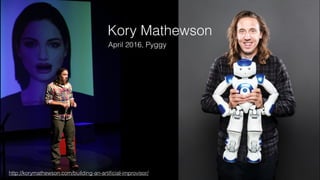
![A computer stage partner
[Image credits: Kory Mathewson,
http://korymathewson.com/building-an-artificial-improvisor/]
• Improv lessons from
playing with an AI
• Humility lesson
from improv and theatre](https://image.slidesharecdn.com/humanmachinecreativeai18january2017-170120160058/85/Improvised-Theatre-with-Artificial-Intelligence-15-320.jpg)
![Improv is about doing the obvious thing
• Surprisingly hard…
• Trying to be “funny” or “interesting” makes improv boring.
• Need to overcome social fears.
• “I began to think of children not as immature adults,
but of adults as atrophied children.”
[Keith Johnstone (1979) “Impro: Improvisation and the theatre”, Faber and Faber]
• “Know that you knew how to do this when you were six years old,
other stuff just got in the way.”
[Jill Bernard (2002) “Small Cute Book of Improv”, YESand.com]](https://image.slidesharecdn.com/humanmachinecreativeai18january2017-170120160058/85/Improvised-Theatre-with-Artificial-Intelligence-16-320.jpg)
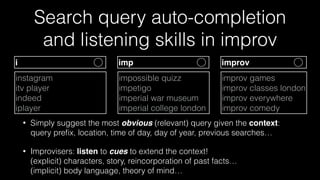
![A.L.Ex: an exercise in justification
• When the machine gives difficult suggestions…
• Justification game: “real-time dynamic problem solving”.
Improvisers need to (observe, repair, accept) divergences.
[Magerko et al (2009) “An Empirical Study of Cognition and Theatrical Improvisation”, C&C]
• Being able to improvise with anybody:
e.g., Kory would improvise with a non-improviser audience member.
• Make the stage partner look good!](https://image.slidesharecdn.com/humanmachinecreativeai18january2017-170120160058/85/Improvised-Theatre-with-Artificial-Intelligence-18-320.jpg)
![Konstantin
Stanislavski
(1863-1938)
and the actor’s System
Stanislavski (far left) in The Lower Depths
at The Moscow Art Theatre,1902
[Credit: Stanislavski Centre/ArenaPal, BBC]
Diagram of Stanislavski's 'system', based on his "Plan of Experiencing" (1935)
[Credit: Wikimedia Commons]](https://image.slidesharecdn.com/humanmachinecreativeai18january2017-170120160058/85/Improvised-Theatre-with-Artificial-Intelligence-20-320.jpg)
![[Credit: Jean Benedetti (2008) “Stanislavski:
An Introduction”, Bloomsbury]
Determine Given Circumstances:
Where, when, who, what, why,
obstacle, how (to overcome obstacle)
Research the context of the play
and of its characters: original text,
facts, social conventions…
Rely on intellect
to understand the character
Practice physical characterisations
of the character to acquire reflexes
(e.g., animal work)
Each line of the script is actioned,
actor “does” something to others
(how to get what one wants)
Draw on memory and experience
to give emotional depth to play
Determine the units of the script
with their own objectives
(what the character wants)
Aim towards
super-objective
of the character and of the play
Create a “third being”
character creation
as self-transformation](https://image.slidesharecdn.com/humanmachinecreativeai18january2017-170120160058/85/Improvised-Theatre-with-Artificial-Intelligence-21-320.jpg)
![A lesson in humility from theatre
• Creating an AS (Artificial
Stanislavski) actor is AI-hard…
• … and somewhat pointless:
• Audience can suspend disbelief
and anthropomorphise robots.
• What is interesting in theatre or
improv is how the human actor
overcomes adversity.
[Image credit: www.pixar.com]](https://image.slidesharecdn.com/humanmachinecreativeai18january2017-170120160058/85/Improvised-Theatre-with-Artificial-Intelligence-22-320.jpg)


The document discusses the integration of artificial intelligence in improvised theatre, focusing on a project called a.l.ex that utilizes recurrent neural networks for dialogue generation and interaction with human actors. It explores various technical aspects such as language models, memory, topic tracking, and real-time dialogue systems, as well as the challenges and potential benefits of using AI in performance settings. Additionally, it emphasizes the importance of embracing failure and improvisation in the creative process.


![Deep learning for fun and profit [pyconde 2018]](https://cdn.slidesharecdn.com/ss_thumbnails/deeplearningforfunandprofitpyconde2018-181029150851-thumbnail.jpg?width=640&height=640&fit=bounds)
![Deep Learning for Fun and Profit [PyConDE 2018]](https://cdn.slidesharecdn.com/ss_thumbnails/deeplearningforfunandprofitpyconde2018-181105221856-thumbnail.jpg?width=640&height=640&fit=bounds)


