Lect. 1 Schrodinger equation in time dependent form
The time dependent form of Schrodinger has been derived by using the freely moving particle and not be. interacted. the expression is derived in simple form and easy for understanding for B. Sc. TY students of SRTM university Nanded India.
Lect. 1 Schrodinger equation in time dependent form
1.
Schrodinger Equation Intime dependent Form
Dr. L. S. Ravangave
Associate Professor and Head
Department of Physics
Shri Sant Gadge Maharaj Mahavidyalaya
Loha. District Nanded Maharashtra.
2.
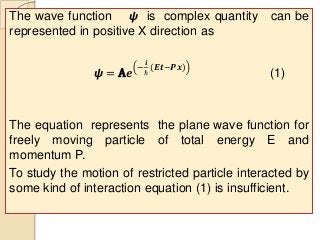
The wave function𝟁 is complex quantity can be
represented in positive X direction as
𝟁 = A𝒆
−
𝒊
ℏ
(𝑬𝒕−𝑷𝒙)
(1)
The equation represents the plane wave function for
freely moving particle of total energy E and
momentum P.
To study the motion of restricted particle interacted by
some kind of interaction equation (1) is insufficient.
3.
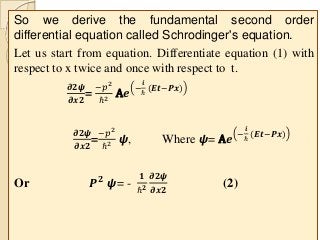
So we derivethe fundamental second order
differential equation called Schrodinger's equation.
Let us start from equation. Differentiate equation (1) with
respect to x twice and once with respect to t.
𝝏𝟐𝟁
𝝏𝒙𝟐
=
−𝑝2
ℏ2 A𝒆
−
𝒊
ℏ
(𝑬𝒕−𝑷𝒙)
𝝏𝟐𝟁
𝝏𝒙𝟐
=
−𝑝2
ℏ2 𝟁, Where 𝟁= A𝒆
−
𝒊
ℏ
(𝑬𝒕−𝑷𝒙)
Or 𝑷 𝟐
𝟁= -
𝟏
ℏ 𝟐
𝝏𝟐𝟁
𝝏𝒙𝟐
(2)
4.
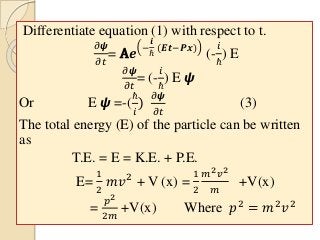
Differentiate equation (1)with respect to t.
𝜕𝟁
𝜕𝑡
= A𝒆
−
𝒊
ℏ
(𝑬𝒕−𝑷𝒙)
(-
𝑖
ℏ
) E
𝜕𝟁
𝜕𝑡
= (-
𝑖
ℏ
) E 𝟁
Or E 𝟁 =-(
ℏ
𝑖
)
𝜕𝟁
𝜕𝑡
(3)
The total energy (E) of the particle can be written
as
T.E. = E = K.E. + P.E.
E=
1
2
𝑚𝑣2
+ V (x) =
1
2
𝑚2 𝑣2
𝑚
+V(x)
=
𝑝2
2𝑚
+V(x) Where 𝑝2
= 𝑚2
𝑣2
5.
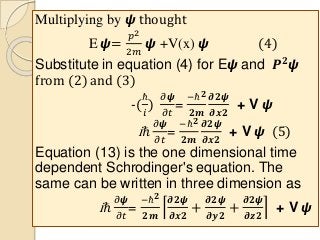
Multiplying by 𝟁thought
E 𝟁=
𝑝2
2𝑚
𝟁 +V(x) 𝟁 (4)
Substitute in equation (4) for E𝟁 and 𝑷 𝟐
𝟁
from (2) and (3)
-(
ℏ
𝑖
)
𝜕𝟁
𝜕𝑡
=
−ℏ 𝟐
𝟐𝒎
𝝏𝟐𝟁
𝝏𝒙𝟐
+ V 𝟁
iℏ
𝜕𝟁
𝜕𝑡
=
−ℏ 𝟐
𝟐𝒎
𝝏𝟐𝟁
𝝏𝒙𝟐
+ V 𝟁 (5)
Equation (13) is the one dimensional time
dependent Schrodinger's equation. The
same can be written in three dimension as
iℏ
𝜕𝟁
𝜕𝑡
=
−ℏ 𝟐
𝟐𝒎
𝝏𝟐𝟁
𝝏𝒙𝟐
+
𝝏𝟐𝟁
𝝏𝒚𝟐
+
𝝏𝟐𝟁
𝝏𝒛𝟐
+ V 𝟁
6.
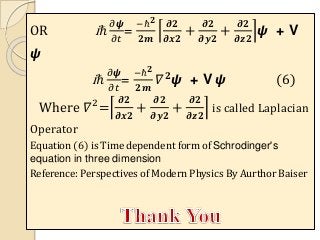
OR iℏ
𝜕𝟁
𝜕𝑡
=
−ℏ 𝟐
𝟐𝒎
𝝏𝟐
𝝏𝒙𝟐
+
𝝏𝟐
𝝏𝒚𝟐
+
𝝏𝟐
𝝏𝒛𝟐
𝟁+ V
𝟁
iℏ
𝜕𝟁
𝜕𝑡
=
−ℏ 𝟐
𝟐𝒎
𝛻 𝟐
𝟁 + V 𝟁 (6)
Where 𝛻2
=
𝝏𝟐
𝝏𝒙𝟐
+
𝝏𝟐
𝝏𝒚𝟐
+
𝝏𝟐
𝝏𝒛𝟐
is called Laplacian
Operator
Equation (6) is Time dependent form of Schrodinger's
equation in three dimension
Reference: Perspectives of Modern Physics By Aurthor Baiser