Effectiveness in
Sales Incentive
Programs

Executive Summary
of Global Trends
June 2012
Challenges                Solution               Testimonials   Conclusions


           Most typical challenges
           about sales incentive programs
1. Related to the current economic situation:

   • Strong effort to have a full control of the budget

   • Focus on maximize the customer relationship due his ability to change supplier

2. Related to the sales people/channels:

   • Doesn’t fit in all people needs

   • Unachievable goals or just a few people can achieve goals

3. Related to the programs:

   •   Even still expensive, sales incentive programs are strategic

   •   Cash or non-cash rewards?
                              * Source: Incentive Marketing Association


                                               2
Challenges          Solution             Testimonials           Conclusions


              Flexibility on reward choices

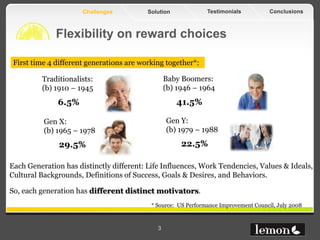
 First time 4 different generations are working together*:

         Traditionalists:                        Baby Boomers:
         (b) 1910 – 1945                         (b) 1946 – 1964
              6.5%                                   41.5%

          Gen X:                                 Gen Y:
          (b) 1965 – 1978                        (b) 1979 – 1988

               29.5%                                  22.5%

Each Generation has distinctly different: Life Influences, Work Tendencies, Values & Ideals,
Cultural Backgrounds, Definitions of Success, Goals & Desires, and Behaviors.

So, each generation has different distinct motivators.
                                           * Source: US Performance Improvement Council, July 2008


                                             3
Challenges    Solution           Testimonials       Conclusions


          Why to incentivize Gen Y people

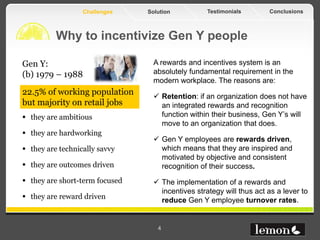
Gen Y:                            A rewards and incentives system is an
(b) 1979 – 1988                   absolutely fundamental requirement in the
                                  modern workplace. The reasons are:
22.5% of working population        Retention: if an organization does not have
but majority on retail jobs         an integrated rewards and recognition
 they are ambitious                function within their business, Gen Y’s will
                                    move to an organization that does.
 they are hardworking
                                   Gen Y employees are rewards driven,
 they are technically savvy        which means that they are inspired and
                                    motivated by objective and consistent
 they are outcomes driven          recognition of their success.
 they are short-term focused      The implementation of a rewards and
                                    incentives strategy will thus act as a lever to
 they are reward driven            reduce Gen Y employee turnover rates.


                                   4
Challenges        Solution      Testimonials      Conclusions


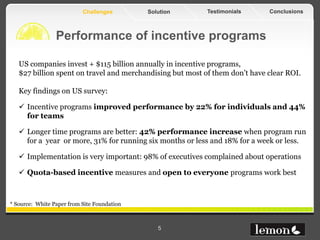
                 Performance of incentive programs

   US companies invest + $115 billion annually in incentive programs,
   $27 billion spent on travel and merchandising but most of them don’t have clear ROI.

   Key findings on US survey:

    Incentive programs improved performance by 22% for individuals and 44%
     for teams

    Longer time programs are better: 42% performance increase when program run
     for a year or more, 31% for running six months or less and 18% for a week or less.

    Implementation is very important: 98% of executives complained about operations

    Quota-based incentive measures and open to everyone programs work best


* Source: White Paper from Site Foundation


                                                5
Solution            Testimonials      Conclusions


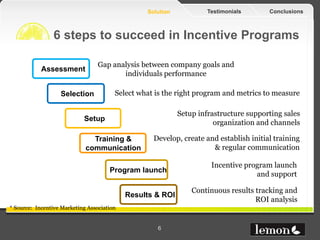
                6 steps to succeed in Incentive Programs

                                  Gap analysis between company goals and
            Assessment
                                         individuals performance

                   Selection            Select what is the right program and metrics to measure

                                                            Setup infrastructure supporting sales
                            Setup
                                                                       organization and channels

                               Training &          Develop, create and establish initial training
                             communication                           & regular communication

                                                                      Incentive program launch
                                      Program launch
                                                                                   and support

                                                                Continuous results tracking and
                                            Results & ROI
                                                                                   ROI analysis
* Source: Incentive Marketing Association


                                                    6
Solution          Testimonials       Conclusions


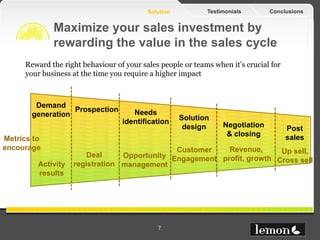
             Maximize your sales investment by
             rewarding the value in the sales cycle
     Reward the right behaviour of your sales people or teams when it’s crucial for
     your business at the time you require a higher impact


        Demand
                  Prospection        Needs
       generation                                    Solution
                                  identification                 Negotiation
                                                      design                          Post
                                                                  & closing           sales
Metrics to
encourage                                     Customer    Revenue,      Up sell,
                        Deal     Opportunity Engagement profit, growth
                                                                       Cross sell
         Activity   registration management
         results


                                             7
Solution                Testimonials            Conclusions


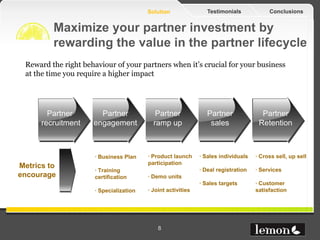
         Maximize your partner investment by
         rewarding the value in the partner lifecycle
 Reward the right behaviour of your partners when it’s crucial for your business
 at the time you require a higher impact


        Partner        Partner              Partner              Partner              Partner
      recruitment    engagement            ramp up                sales              Retention


                      · Business Plan    · Product launch     · Sales individuals   · Cross sell, up sell
                                         participation
Metrics to                                                    · Deal registration   · Services
                      · Training
encourage             certification      · Demo units
                                                              · Sales targets       · Customer
                      · Specialization   · Joint activities                         satisfaction


                                             8
Solution            Testimonials   Conclusions


                4 Psychology effects on non-cash rewards

   1. Higher value perception: Non-cash awards have positive attributes associated
      with the award and it is ascribed a higher value.

   2. Rewards on performance: Non-cash incentives tend to be kept separate from
      compensation, thus standing out as rewards for performance

   3. Power to motivate: When a non-cash award is something that a participant would
      not purchase with cash on his or her own, the participant can justify the award.
      Being able to justify the award means it has greater power to be motivational.

   4. Social reinforcement: Non-cash incentives have
      trophy value and are more likely to be acknowledged
      than would be the case if the award were in cash.


* Source: Site Foundation


                                           9
Solution      Testimonials       Conclusions


                 5 conditions for sales incentive programs

    Five conditions when sales incentive programs work best:

    1. Current performance is inadequate

    2. The cause of the inadequate performance is related to deficiencies in motivation.

    3. The desired performance type and level can be quantified.

    4. The goal is challenging but achievable.

    5. The focus on promoting a particular behavior
       does not conflict with or override everyday organizational goals.


* Source: US Performance Improvement Council


                                                  10
Testimonials   Conclusions


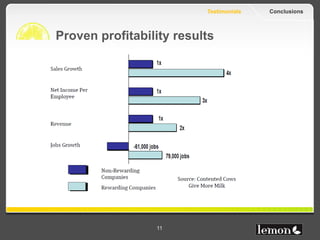
Proven profitability results


                 11
Conclusions

      key findings for the effectiveness
      of your sales incentive program

 Incentivizes individuals considering all ages and diversities
 Long run programs, easy to launch, open to everyone
 Assessment and measurable metrics to track ROI
 Training and regular communication of the program
 Reward the value in the sales cycle / partner lifecycle
 Reward on your behavior interest
 Non-cash rewards considered as trophies


                              12
www.lemon-sales.com
Amsterdam – Barcelona – Bristol – Brussels – Madrid – Milano – München – Paris

Effectiveness in sales incentive programs

  • 1.
    Effectiveness in Sales Incentive Programs ExecutiveSummary of Global Trends June 2012
  • 2.
    Challenges Solution Testimonials Conclusions Most typical challenges about sales incentive programs 1. Related to the current economic situation: • Strong effort to have a full control of the budget • Focus on maximize the customer relationship due his ability to change supplier 2. Related to the sales people/channels: • Doesn’t fit in all people needs • Unachievable goals or just a few people can achieve goals 3. Related to the programs: • Even still expensive, sales incentive programs are strategic • Cash or non-cash rewards? * Source: Incentive Marketing Association 2
  • 3.
    Challenges Solution Testimonials Conclusions Flexibility on reward choices First time 4 different generations are working together*: Traditionalists: Baby Boomers: (b) 1910 – 1945 (b) 1946 – 1964 6.5% 41.5% Gen X: Gen Y: (b) 1965 – 1978 (b) 1979 – 1988 29.5% 22.5% Each Generation has distinctly different: Life Influences, Work Tendencies, Values & Ideals, Cultural Backgrounds, Definitions of Success, Goals & Desires, and Behaviors. So, each generation has different distinct motivators. * Source: US Performance Improvement Council, July 2008 3
  • 4.
    Challenges Solution Testimonials Conclusions Why to incentivize Gen Y people Gen Y: A rewards and incentives system is an (b) 1979 – 1988 absolutely fundamental requirement in the modern workplace. The reasons are: 22.5% of working population  Retention: if an organization does not have but majority on retail jobs an integrated rewards and recognition  they are ambitious function within their business, Gen Y’s will move to an organization that does.  they are hardworking  Gen Y employees are rewards driven,  they are technically savvy which means that they are inspired and motivated by objective and consistent  they are outcomes driven recognition of their success.  they are short-term focused  The implementation of a rewards and incentives strategy will thus act as a lever to  they are reward driven reduce Gen Y employee turnover rates. 4
  • 5.
    Challenges Solution Testimonials Conclusions Performance of incentive programs US companies invest + $115 billion annually in incentive programs, $27 billion spent on travel and merchandising but most of them don’t have clear ROI. Key findings on US survey:  Incentive programs improved performance by 22% for individuals and 44% for teams  Longer time programs are better: 42% performance increase when program run for a year or more, 31% for running six months or less and 18% for a week or less.  Implementation is very important: 98% of executives complained about operations  Quota-based incentive measures and open to everyone programs work best * Source: White Paper from Site Foundation 5
  • 6.
    Solution Testimonials Conclusions 6 steps to succeed in Incentive Programs Gap analysis between company goals and Assessment individuals performance Selection Select what is the right program and metrics to measure Setup infrastructure supporting sales Setup organization and channels Training & Develop, create and establish initial training communication & regular communication Incentive program launch Program launch and support Continuous results tracking and Results & ROI ROI analysis * Source: Incentive Marketing Association 6
  • 7.
    Solution Testimonials Conclusions Maximize your sales investment by rewarding the value in the sales cycle Reward the right behaviour of your sales people or teams when it’s crucial for your business at the time you require a higher impact Demand Prospection Needs generation Solution identification Negotiation design Post & closing sales Metrics to encourage Customer Revenue, Up sell, Deal Opportunity Engagement profit, growth Cross sell Activity registration management results 7
  • 8.
    Solution Testimonials Conclusions Maximize your partner investment by rewarding the value in the partner lifecycle Reward the right behaviour of your partners when it’s crucial for your business at the time you require a higher impact Partner Partner Partner Partner Partner recruitment engagement ramp up sales Retention · Business Plan · Product launch · Sales individuals · Cross sell, up sell participation Metrics to · Deal registration · Services · Training encourage certification · Demo units · Sales targets · Customer · Specialization · Joint activities satisfaction 8
  • 9.
    Solution Testimonials Conclusions 4 Psychology effects on non-cash rewards 1. Higher value perception: Non-cash awards have positive attributes associated with the award and it is ascribed a higher value. 2. Rewards on performance: Non-cash incentives tend to be kept separate from compensation, thus standing out as rewards for performance 3. Power to motivate: When a non-cash award is something that a participant would not purchase with cash on his or her own, the participant can justify the award. Being able to justify the award means it has greater power to be motivational. 4. Social reinforcement: Non-cash incentives have trophy value and are more likely to be acknowledged than would be the case if the award were in cash. * Source: Site Foundation 9
  • 10.
    Solution Testimonials Conclusions 5 conditions for sales incentive programs Five conditions when sales incentive programs work best: 1. Current performance is inadequate 2. The cause of the inadequate performance is related to deficiencies in motivation. 3. The desired performance type and level can be quantified. 4. The goal is challenging but achievable. 5. The focus on promoting a particular behavior does not conflict with or override everyday organizational goals. * Source: US Performance Improvement Council 10
  • 11.
    Testimonials Conclusions Proven profitability results 11
  • 12.
    Conclusions key findings for the effectiveness of your sales incentive program  Incentivizes individuals considering all ages and diversities  Long run programs, easy to launch, open to everyone  Assessment and measurable metrics to track ROI  Training and regular communication of the program  Reward the value in the sales cycle / partner lifecycle  Reward on your behavior interest  Non-cash rewards considered as trophies 12
  • 13.
    www.lemon-sales.com Amsterdam – Barcelona– Bristol – Brussels – Madrid – Milano – München – Paris