ONLINE Community strategy frameworkEnsuring an engaged online community
COMMUNITY STRATEGY FRAMEWORK
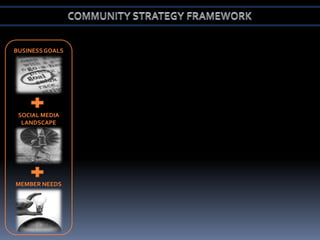
COMMUNITY STRATEGY FRAMEWORKBUSINESS GOALSSOCIAL MEDIA LANDSCAPEMEMBER NEEDS
COMMUNITY STRATEGY FRAMEWORKBUSINESS GOALSLAUNCH PLANContent PlanEvent PlanPromotion/Outreach PlanMember-to-Member InteractionSOCIAL MEDIA LANDSCAPEMEMBER NEEDS
COMMUNITY STRATEGY FRAMEWORKBUSINESS GOALSLAUNCH PLANContent PlanEvent PlanPromotion/Outreach PlanMember-to-Member InteractionMETRICS/ROISOCIAL MEDIA LANDSCAPEMEMBER NEEDS
1) Business Goal What is your business objective? Boil it down to one sentence that gets to the core of your objective.Increase SalesIncrease Brand AwarenessDecrease Cost of Customer ServiceCo-creation of New ProductsEstablish Yourself as a Thought LeaderBetter Search ResultsProvide Additional InformationEducate CustomersEnable Customers to Collaborate and Share Knowledge
1- Business Goal (communities need a reason)King Research, June 2007
1) Business GoalThe business goal of PD 360 was to raise student achievement . They accomplished a lift of 11.3% improvement in student achievement through an online learning community for teachers with on demand professional development .
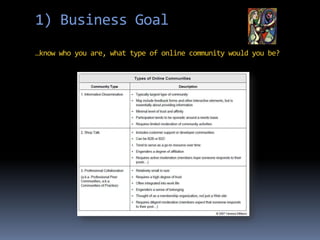
1) Business Goal …know who you are, what type of online community would you be?
2) Social Media LandscapeWhat is Social Media Anyway?From Wikipedia, the free encyclopediaAt its most basic sense, social media is a shift in how people discover, read and share news, information and content. It's a fusion of sociology and technology, transforming monologues (one to many) into dialogues (many to many) and is the democratization of information, transforming people from content readers into publishers. Businesses also refer to social media as user-generated content (UGC) or consumer-generated media (CGM).
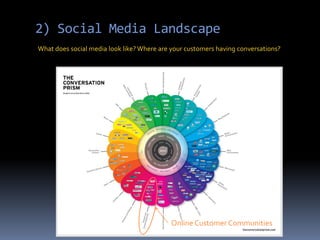
2) Social Media LandscapeWhat does social media look like? Where are your customers having conversations?Online Customer Communities
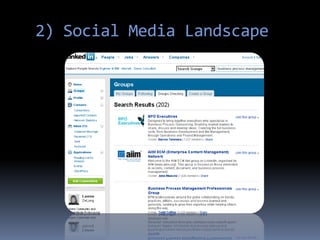
2) Social Media LandscapeHow is your brand or the competition’s brand represented in the social ecosystem, where are there gaps, and what is your plan to position your brand accordingly?Search for Brand MentionBlog PulseTechnoratiDeliciousGoogle Blog SearchMonitor Activity LevelsFacebookMySpaceYouTubeNingFlickrLinkedIn Competitive Analysis and Tracking
2) Social Media Landscape
LEARN
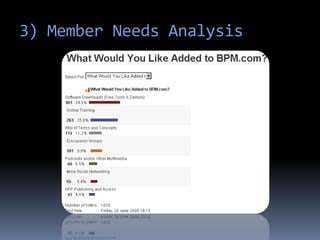
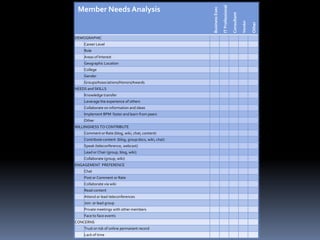
3) Member Needs AnalysisShare Knowledge: Explore ideas and participate in one-on-one private discussions or public group threads. Access actionable experienced-based solutions from like mindsConnect With Peers: Network with one another to find exactly the individual you need who shares your passion. Combat isolation, share emotions and experience a sense of camaraderie.Access Tools:find resources that allow you to do your job better, shorten decision times, decrease risk
3) Member Needs Analysis (profile your audience)INTERVIEW OR SURVEY MEMBERS    Gain insight on their specific needs.
  What member types or personas exist?
  Predict their needs.
  Do their needs vary?
  What are they looking for?
  How do they like to interact?
  How willing are they to share openly?
  Do they want exposure?
  Do they want to influence others?
  Do they want to shape the industry?
  Are they time crunched?Prepared by www.InnerCircleCommunities.com
3) Member Needs Analysis
3) Member Needs AnalysisCUSTOMIZE YOUR ENGAGEMENT MODELAnnounce new members in a group
Invite members in a group to read            relevant articles and comment
Invite members to participate in relevant webcasts or teleconferencesPrepared by www.InnerCircleCommunities.com
LAUNCH
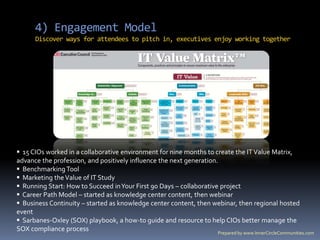
4) Engagement ModelWhat will you publish?Where will you publish?How often will you publish?Balance (content, events, 1:1, outreach)Integrate with traditional channels
4) Engagement Model…strive to balance the elements
4) Engagement Model…plan for active readers or ‘lurkers’Make it easier to contribute.Netflix lets users rate movies by clicking a star ratingMake participation a side effect.For example, Amazon's "people who bought this book, bought these other books”Edit, don't create.Let users build their contributions by modifying existing templates rather than creating newReward — but don't over-reward — participants.Don't give too much to the most active participants, or you'll simply encourage them to dominate the system even more. Promote quality contributors.Give extra prominence to good contributionsJakob Nielsen’s Alertbox, October 9, 2006
4) Engagement Model …promote quality contributors and create ways to spotlight good contributionsPrepared by www.InnerCircleCommunities.com
4) Engagement Model…active and relevant moderation engages members
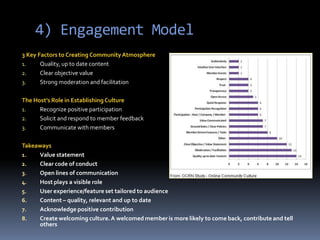
4) Engagement Model 3 Key Factors to Creating Community AtmosphereQuality, up to date contentClear objective valueStrong moderation and facilitationThe Host’s Role in Establishing CultureRecognize positive participationSolicit and respond to member feedbackCommunicate with membersTakeawaysValue statementClear code of conductOpen lines of communicationHost plays a visible roleUser experience/feature set tailored to audienceContent – quality, relevant and up to dateAcknowledge positive contributionCreate welcoming culture. A welcomed member is more likely to come back, contribute and tell others
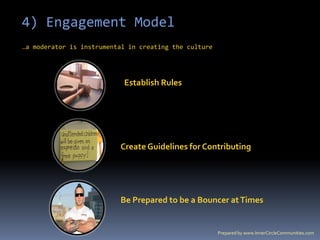
4) Engagement Model…a moderator is instrumental in creating the culture  Establish Rules Create Guidelines for ContributingBe Prepared to be a Bouncer at TimesPrepared by www.InnerCircleCommunities.com
Recruit a Variety of Hosts  Editorial Board
  Frequent Contributors
  Former Speakers
  Affinity Group Chairs4) Engagement Model…build your bench of hosts or “creators”Prepared by www.InnerCircleCommunities.com
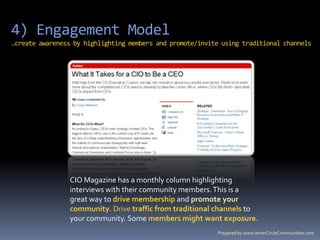
4) Engagement Model…create awareness by highlighting members and promote/invite using traditional channelsCIO Magazine has a monthly column highlighting interviews with their community members. This is a great way to drive membership and promote your community. Drive traffic from traditional channels to your community. Some members might want exposure.Prepared by www.InnerCircleCommunities.com
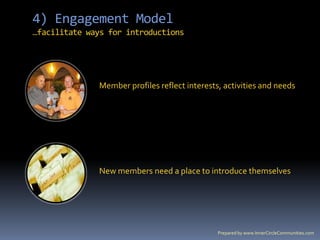
4) Engagement Model…facilitate ways for introductionsMember profiles reflect interests, activities and needsNew members need a place to introduce themselvesPrepared by www.InnerCircleCommunities.com

Online Community Strategy Framework

  • 1.
    ONLINE Community strategyframeworkEnsuring an engaged online community
  • 2.
  • 3.
    COMMUNITY STRATEGY FRAMEWORKBUSINESSGOALSSOCIAL MEDIA LANDSCAPEMEMBER NEEDS
  • 4.
    COMMUNITY STRATEGY FRAMEWORKBUSINESSGOALSLAUNCH PLANContent PlanEvent PlanPromotion/Outreach PlanMember-to-Member InteractionSOCIAL MEDIA LANDSCAPEMEMBER NEEDS
  • 5.
    COMMUNITY STRATEGY FRAMEWORKBUSINESSGOALSLAUNCH PLANContent PlanEvent PlanPromotion/Outreach PlanMember-to-Member InteractionMETRICS/ROISOCIAL MEDIA LANDSCAPEMEMBER NEEDS
  • 6.
    1) Business GoalWhat is your business objective? Boil it down to one sentence that gets to the core of your objective.Increase SalesIncrease Brand AwarenessDecrease Cost of Customer ServiceCo-creation of New ProductsEstablish Yourself as a Thought LeaderBetter Search ResultsProvide Additional InformationEducate CustomersEnable Customers to Collaborate and Share Knowledge
  • 7.
    1- Business Goal(communities need a reason)King Research, June 2007
  • 8.
    1) Business GoalThebusiness goal of PD 360 was to raise student achievement . They accomplished a lift of 11.3% improvement in student achievement through an online learning community for teachers with on demand professional development .
  • 9.
    1) Business Goal…know who you are, what type of online community would you be?
  • 10.
    2) Social MediaLandscapeWhat is Social Media Anyway?From Wikipedia, the free encyclopediaAt its most basic sense, social media is a shift in how people discover, read and share news, information and content. It's a fusion of sociology and technology, transforming monologues (one to many) into dialogues (many to many) and is the democratization of information, transforming people from content readers into publishers. Businesses also refer to social media as user-generated content (UGC) or consumer-generated media (CGM).
  • 11.
    2) Social MediaLandscapeWhat does social media look like? Where are your customers having conversations?Online Customer Communities
  • 12.
    2) Social MediaLandscapeHow is your brand or the competition’s brand represented in the social ecosystem, where are there gaps, and what is your plan to position your brand accordingly?Search for Brand MentionBlog PulseTechnoratiDeliciousGoogle Blog SearchMonitor Activity LevelsFacebookMySpaceYouTubeNingFlickrLinkedIn Competitive Analysis and Tracking
  • 13.
  • 14.
  • 15.
  • 16.
  • 17.
  • 18.
  • 19.
    3) Member NeedsAnalysisShare Knowledge: Explore ideas and participate in one-on-one private discussions or public group threads. Access actionable experienced-based solutions from like mindsConnect With Peers: Network with one another to find exactly the individual you need who shares your passion. Combat isolation, share emotions and experience a sense of camaraderie.Access Tools:find resources that allow you to do your job better, shorten decision times, decrease risk
  • 20.
    3) Member NeedsAnalysis (profile your audience)INTERVIEW OR SURVEY MEMBERS Gain insight on their specific needs.
  • 21.
    Whatmember types or personas exist?
  • 22.
    Predicttheir needs.
  • 23.
    Dotheir needs vary?
  • 24.
    Whatare they looking for?
  • 25.
    Howdo they like to interact?
  • 26.
    Howwilling are they to share openly?
  • 27.
    Dothey want exposure?
  • 28.
    Dothey want to influence others?
  • 29.
    Dothey want to shape the industry?
  • 30.
    Arethey time crunched?Prepared by www.InnerCircleCommunities.com
  • 31.
  • 32.
    3) Member NeedsAnalysisCUSTOMIZE YOUR ENGAGEMENT MODELAnnounce new members in a group
  • 33.
    Invite members ina group to read relevant articles and comment
  • 34.
    Invite members toparticipate in relevant webcasts or teleconferencesPrepared by www.InnerCircleCommunities.com
  • 36.
  • 37.
    4) Engagement ModelWhatwill you publish?Where will you publish?How often will you publish?Balance (content, events, 1:1, outreach)Integrate with traditional channels
  • 38.
    4) Engagement Model…striveto balance the elements
  • 40.
    4) Engagement Model…planfor active readers or ‘lurkers’Make it easier to contribute.Netflix lets users rate movies by clicking a star ratingMake participation a side effect.For example, Amazon's "people who bought this book, bought these other books”Edit, don't create.Let users build their contributions by modifying existing templates rather than creating newReward — but don't over-reward — participants.Don't give too much to the most active participants, or you'll simply encourage them to dominate the system even more. Promote quality contributors.Give extra prominence to good contributionsJakob Nielsen’s Alertbox, October 9, 2006
  • 41.
    4) Engagement Model…promote quality contributors and create ways to spotlight good contributionsPrepared by www.InnerCircleCommunities.com
  • 42.
    4) Engagement Model…activeand relevant moderation engages members
  • 43.
    4) Engagement Model3 Key Factors to Creating Community AtmosphereQuality, up to date contentClear objective valueStrong moderation and facilitationThe Host’s Role in Establishing CultureRecognize positive participationSolicit and respond to member feedbackCommunicate with membersTakeawaysValue statementClear code of conductOpen lines of communicationHost plays a visible roleUser experience/feature set tailored to audienceContent – quality, relevant and up to dateAcknowledge positive contributionCreate welcoming culture. A welcomed member is more likely to come back, contribute and tell others
  • 44.
    4) Engagement Model…amoderator is instrumental in creating the culture Establish Rules Create Guidelines for ContributingBe Prepared to be a Bouncer at TimesPrepared by www.InnerCircleCommunities.com
  • 45.
    Recruit a Varietyof Hosts Editorial Board
  • 46.
    FrequentContributors
  • 47.
    FormerSpeakers
  • 48.
    AffinityGroup Chairs4) Engagement Model…build your bench of hosts or “creators”Prepared by www.InnerCircleCommunities.com
  • 49.
    4) Engagement Model…createawareness by highlighting members and promote/invite using traditional channelsCIO Magazine has a monthly column highlighting interviews with their community members. This is a great way to drive membership and promote your community. Drive traffic from traditional channels to your community. Some members might want exposure.Prepared by www.InnerCircleCommunities.com
  • 50.
    4) Engagement Model…facilitateways for introductionsMember profiles reflect interests, activities and needsNew members need a place to introduce themselvesPrepared by www.InnerCircleCommunities.com