Land Law Webinar
Jamie Quirke BBL LLM
Jamie.Quirke.2011@nuim.ie
Succession Law
• Wills and Intestacy are covered by the Succession
Act 1965.
• This Act is based on the principle that a testator
owes a duty to leave part of his estate to his
widow (the legal share) and to make proper
provision for his children in accordance with his
means.
• It is not based on a duty to provide maintenance
for his widow nor is it limited in its application to
children who were dependant on him.
Validity of a Will
• There are very strict guidelines as to what makes a will valid.
These are:
 The testator (person who makes the will) must be over 18
years of age (or be married);
 He/she must act of his/her own free will;
 He/she must be of sound mind and memory and understand
that he/she is making a will;
 The testator must know the nature and extent of his/her
property and be capable of recalling all of the people who may
expect to benefit from his/her estate;
 The will must be in writing;
 The will must be signed at the end by the testator;
Validity of a Will
 The testator’s signature must be made in the presence of TWO
witnesses who are both present at the same time.
 The witnesses must sign their signature in the presence of the
testator, but not necessarily in each other’s presence.
 A witness or his/her spouse cannot benefit under the will.
 Where these formalities are not respected, the will may fail
and, if so, the law in relation to intestacy will then determine
how such property is distributed.
Intestacy
• When a person has not made a will or the will
they have made is found to be invalid, that
person is said to have died intestate.
• Where a person dies intestate, their property is
distributed according to the law of intestacy
laid down in the Succession Act 1965.
Intestacy
• Distribution of Estate on Intestacy
• Spouse and Children:
– Spouse take two thirds and children take the
remainder
• Spouse and no Children:
– Spouse takes whole estate
• Children and no Spouse:
– Children take whole estate
Intestacy
• Parents and Siblings:
– Each parent takes one half
• Siblings:
– Estate is divided equally among the siblings
• Nieces and Nephews:
– Estate is divided equally
Intestacy
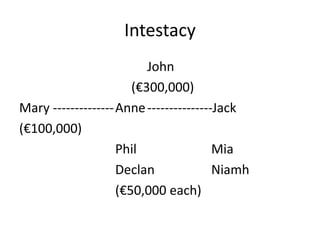
• Question:
John dies intestate, leaving no spouse or
children. He leaves an estate of €300,000. He
has 3 siblings, Mary, Anne and Jack.
Mary and Anne are both deceased but have two
children each; Phil, Declan, Mia and Niamh.
Based on the laws of intestacy, how will the
estate of John be divided.
Intestacy
John
(€300,000)
Mary --------------Anne---------------Jack
(€100,000)
Phil Mia
Declan Niamh
(€50,000 each)
Intestacy
• Per stirpes : If a lineal descendent of an
intestate deceased has died before them,
leaving children, then those children take the
share their parent would have taken if alive
divided equally between them.
Restrictions on Freedom of Testation
• Spouse or Civil Partner – Legal Right Share (S
111)
• Provision for children (s 117)
• Divorce, Dissolution, Cohabitation
• Unworthiness to succeed
• Disinheritance – or avoidance of provisions of
succession act.
Spouse/Civil Partner Legal Right share
• Part IX Succession Act 1965 – Applies to Testate
succession (wholly or partly) s 109(1)
• Section 111: Testator leaving spouse (or civil partner)
and no children – spouse or civil partner takes half;
Testator leaving spouse (or civil partner) and children
– spouse or civil partner takes one third
• Can be renounced – prenup, separation agreement.
• Uruquhart [1974]- right to choose.
• Vests on death where no provision made for spouse
O Dwyer v Keegan [1997] 2 IR 585.
• S56 – Right to appropriate dwelling house in
satisfaction of gift in will or legal right share
Provision for Children
• Section 117(1) – allows court on application to
make provision for the child of a testator.
• Applies only to Testate succession – on
intestacy child much accept statutory
provision.
• ‘failed in his moral duty to make proper
provision for the child in accordance with his
means’ s 117(1)’
‘moral duty to make proper provision’
• ‘proper provision’ – applies to facts at date of
death MPD v MD [1981] ILRM 179.
• FM v TAM (1972) 106 ILTR 82 – on the existence
of a moral duty. In this case no provision meant
failure of duty BUT
• Re IAC [1989] ILRM 815 – high onus of proof on
child – less than others not indicative of failure –
proper provision made by testator during her
lifetime discharges duty, but not in this case.
Section 117
• Re ABC deceased [2003] 2 IR 250- s117 directed
to children of an age and situation in life where
they might reasonably expect support from their
parents. Relationship of parent and child does not
automatically create obligation. Position of child
not to be taken in isolation.
• CC v WC [1990] 2 IR 143 SC Finlay CJ ‘ A
positive failure of moral duty must be established’
Divorce and Dissolution
• S 18 Family Law (Divorce) Act 1996 – court can,
on application of ex spouse of deceased, make
provision for the applicant out of the estate of
the deceased if satisfied ‘proper provision’ not
made during lifetime of deceased.
• S 25 Family Law Act 1995, similar provision where
divorce obtained in another jurisdiction.
• S 127 Civil Partnership and Certain Rights of
Cohabitants act - similar provisions following
death of ex-civil partner
Qualified Cohabitants
• Section 194 2010 Act a ‘qualified cohabitant’
can apply for provision from the estate of a
deceased cohabitant
• Relationship status at death can affect
distribution of estate, both on testacy and on
intestacy.
Unworthiness to Succeed
• S 120 Succession Act as amended
• Person guilty of murder, attempted murder or
manslaughter unless Will made after offence,
also cannot make s 117 application
• Person guilty of offence against deceased or
spouse, civil partner or child of deceased
punishable by imprisonment of at least 2 years.
Disinheritance
• S121 Succession Act – Court can void a
disposition which was made for the purpose of
defeating or substantially diminishing the
share of the disponers spouse (civil partner) or
intestate share of children
• Applies to non-testamentary, voluntary
disposition made within 3 years of death.
Recommended Reading
Cases:
• Ross v. Caunters [1980] Ch. 297
• Wall v. Hegarty [1980] ILRM 124
• Fitzgerald v. Ryan [1899] 2 IR 637
• Lassence v. Tierney (1849) 1 Mac & G 551
• O’Dwyer v. Keegan [1997] 2 IR 585
• Bank of Ireland v. Gaffin [1971] IR 213.
• In b. GM (1972) 106 ILTR 82
• MPD v. MD [1981] ILRM 179
• Re Urquhart [1974] IR 197
Recommended Reading
Articles:
• ‘Witnessing Wills and Losing Legacies’ (1984)
100 LQR 53
• ‘Aspects of our Present Law Relating to
Illegitimate Children’ (1978) 72 Gaz ILSI 95
• ‘Succession 117: Out of Step With the Times’
(2001) 6(4) CPLJ 84

Land Law Webinar

  • 1.
    Land Law Webinar JamieQuirke BBL LLM Jamie.Quirke.2011@nuim.ie
  • 2.
    Succession Law • Willsand Intestacy are covered by the Succession Act 1965. • This Act is based on the principle that a testator owes a duty to leave part of his estate to his widow (the legal share) and to make proper provision for his children in accordance with his means. • It is not based on a duty to provide maintenance for his widow nor is it limited in its application to children who were dependant on him.
  • 3.
    Validity of aWill • There are very strict guidelines as to what makes a will valid. These are:  The testator (person who makes the will) must be over 18 years of age (or be married);  He/she must act of his/her own free will;  He/she must be of sound mind and memory and understand that he/she is making a will;  The testator must know the nature and extent of his/her property and be capable of recalling all of the people who may expect to benefit from his/her estate;  The will must be in writing;  The will must be signed at the end by the testator;
  • 4.
    Validity of aWill  The testator’s signature must be made in the presence of TWO witnesses who are both present at the same time.  The witnesses must sign their signature in the presence of the testator, but not necessarily in each other’s presence.  A witness or his/her spouse cannot benefit under the will.  Where these formalities are not respected, the will may fail and, if so, the law in relation to intestacy will then determine how such property is distributed.
  • 5.
    Intestacy • When aperson has not made a will or the will they have made is found to be invalid, that person is said to have died intestate. • Where a person dies intestate, their property is distributed according to the law of intestacy laid down in the Succession Act 1965.
  • 6.
    Intestacy • Distribution ofEstate on Intestacy • Spouse and Children: – Spouse take two thirds and children take the remainder • Spouse and no Children: – Spouse takes whole estate • Children and no Spouse: – Children take whole estate
  • 7.
    Intestacy • Parents andSiblings: – Each parent takes one half • Siblings: – Estate is divided equally among the siblings • Nieces and Nephews: – Estate is divided equally
  • 8.
    Intestacy • Question: John diesintestate, leaving no spouse or children. He leaves an estate of €300,000. He has 3 siblings, Mary, Anne and Jack. Mary and Anne are both deceased but have two children each; Phil, Declan, Mia and Niamh. Based on the laws of intestacy, how will the estate of John be divided.
  • 9.
  • 10.
    Intestacy • Per stirpes: If a lineal descendent of an intestate deceased has died before them, leaving children, then those children take the share their parent would have taken if alive divided equally between them.
  • 11.
    Restrictions on Freedomof Testation • Spouse or Civil Partner – Legal Right Share (S 111) • Provision for children (s 117) • Divorce, Dissolution, Cohabitation • Unworthiness to succeed • Disinheritance – or avoidance of provisions of succession act.
  • 12.
    Spouse/Civil Partner LegalRight share • Part IX Succession Act 1965 – Applies to Testate succession (wholly or partly) s 109(1) • Section 111: Testator leaving spouse (or civil partner) and no children – spouse or civil partner takes half; Testator leaving spouse (or civil partner) and children – spouse or civil partner takes one third • Can be renounced – prenup, separation agreement. • Uruquhart [1974]- right to choose. • Vests on death where no provision made for spouse O Dwyer v Keegan [1997] 2 IR 585. • S56 – Right to appropriate dwelling house in satisfaction of gift in will or legal right share
  • 13.
    Provision for Children •Section 117(1) – allows court on application to make provision for the child of a testator. • Applies only to Testate succession – on intestacy child much accept statutory provision. • ‘failed in his moral duty to make proper provision for the child in accordance with his means’ s 117(1)’
  • 14.
    ‘moral duty tomake proper provision’ • ‘proper provision’ – applies to facts at date of death MPD v MD [1981] ILRM 179. • FM v TAM (1972) 106 ILTR 82 – on the existence of a moral duty. In this case no provision meant failure of duty BUT • Re IAC [1989] ILRM 815 – high onus of proof on child – less than others not indicative of failure – proper provision made by testator during her lifetime discharges duty, but not in this case.
  • 15.
    Section 117 • ReABC deceased [2003] 2 IR 250- s117 directed to children of an age and situation in life where they might reasonably expect support from their parents. Relationship of parent and child does not automatically create obligation. Position of child not to be taken in isolation. • CC v WC [1990] 2 IR 143 SC Finlay CJ ‘ A positive failure of moral duty must be established’
  • 16.
    Divorce and Dissolution •S 18 Family Law (Divorce) Act 1996 – court can, on application of ex spouse of deceased, make provision for the applicant out of the estate of the deceased if satisfied ‘proper provision’ not made during lifetime of deceased. • S 25 Family Law Act 1995, similar provision where divorce obtained in another jurisdiction. • S 127 Civil Partnership and Certain Rights of Cohabitants act - similar provisions following death of ex-civil partner
  • 17.
    Qualified Cohabitants • Section194 2010 Act a ‘qualified cohabitant’ can apply for provision from the estate of a deceased cohabitant • Relationship status at death can affect distribution of estate, both on testacy and on intestacy.
  • 18.
    Unworthiness to Succeed •S 120 Succession Act as amended • Person guilty of murder, attempted murder or manslaughter unless Will made after offence, also cannot make s 117 application • Person guilty of offence against deceased or spouse, civil partner or child of deceased punishable by imprisonment of at least 2 years.
  • 19.
    Disinheritance • S121 SuccessionAct – Court can void a disposition which was made for the purpose of defeating or substantially diminishing the share of the disponers spouse (civil partner) or intestate share of children • Applies to non-testamentary, voluntary disposition made within 3 years of death.
  • 20.
    Recommended Reading Cases: • Rossv. Caunters [1980] Ch. 297 • Wall v. Hegarty [1980] ILRM 124 • Fitzgerald v. Ryan [1899] 2 IR 637 • Lassence v. Tierney (1849) 1 Mac & G 551 • O’Dwyer v. Keegan [1997] 2 IR 585 • Bank of Ireland v. Gaffin [1971] IR 213. • In b. GM (1972) 106 ILTR 82 • MPD v. MD [1981] ILRM 179 • Re Urquhart [1974] IR 197
  • 21.
    Recommended Reading Articles: • ‘WitnessingWills and Losing Legacies’ (1984) 100 LQR 53 • ‘Aspects of our Present Law Relating to Illegitimate Children’ (1978) 72 Gaz ILSI 95 • ‘Succession 117: Out of Step With the Times’ (2001) 6(4) CPLJ 84