The Oppositional Gaze

Bell Hooks, Professor of English, City College, New
Introduction
 Foucault:
 The power relationship.
 „Power as domination, it

reproduces itself in
different locations and
employing similar
apparatuses, strategies
and mechanisms of
control.
 In all relations of power

„there is necessarily the
The Oppositional Gaze
 The power of looking as







contrast to gaze in general.
The gaze has always been
political in my life.
As confrontational and as a
gesture of resistance
The gaze can be dangerous
and be understood by
repeated punishments.
„Look at me when I talk to
you‟
„There is power in looking‟.
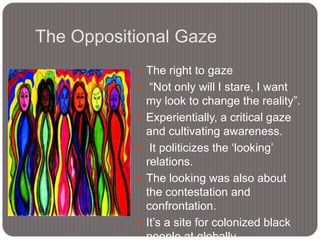
The Oppositional Gaze
 The right to gaze

 “Not only will I stare, I want






my look to change the reality”.
Experientially, a critical gaze
and cultivating awareness.
It politicizes the „looking‟
relations.
The looking was also about
the contestation and
confrontation.
It‟s a site for colonized black
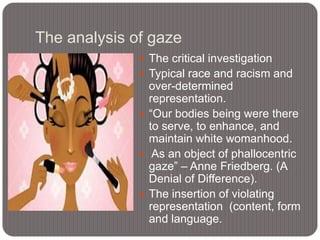
The analysis of gaze
 The critical investigation
 Typical race and racism and

over-determined
representation.
 “Our bodies being were there
to serve, to enhance, and
maintain white womanhood.
 As an object of phallocentric
gaze” – Anne Friedberg. (A
Denial of Difference).
 The insertion of violating
representation (content, form
and language.
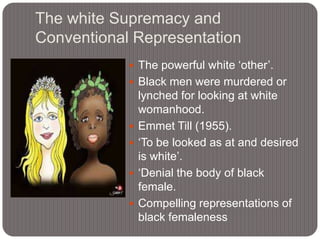
The white Supremacy and
Conventional Representation
 The powerful white „other‟.
 Black men were murdered or







lynched for looking at white
womanhood.
Emmet Till (1955).
„To be looked as at and desired
is white‟.
„Denial the body of black
female.
Compelling representations of
black femaleness
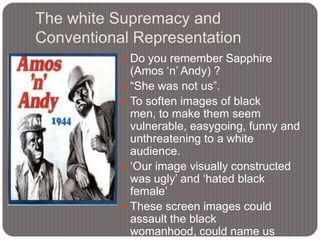
The white Supremacy and
Conventional Representation
 Do you remember Sapphire








(Amos „n‟ Andy) ?
“She was not us”.
To soften images of black
men, to make them seem
vulnerable, easygoing, funny and
unthreatening to a white
audience.
„Our image visually constructed
was ugly‟ and „hated black
female‟
These screen images could
assault the black
womanhood, could name us
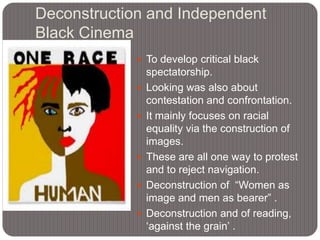
Deconstruction and Independent
Black Cinema
 To develop critical black








spectatorship.
Looking was also about
contestation and confrontation.
It mainly focuses on racial
equality via the construction of
images.
These are all one way to protest
and to reject navigation.
Deconstruction of “Women as
image and men as bearer” .
Deconstruction and of reading,
„against the grain‟ .
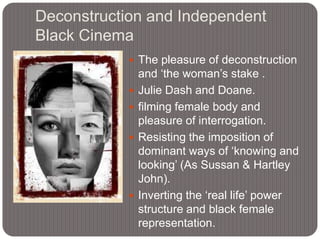
Deconstruction and Independent
Black Cinema
 The pleasure of deconstruction






and „the woman‟s stake .
Julie Dash and Doane.
filming female body and
pleasure of interrogation.
Resisting the imposition of
dominant ways of „knowing and
looking‟ (As Sussan & Hartley
John).
Inverting the „real life‟ power
structure and black female
representation.
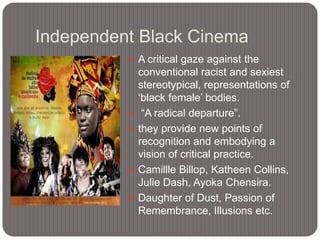
Independent Black Cinema
 A critical gaze against the








conventional racist and sexiest
stereotypical, representations of
„black female‟ bodies.
“A radical departure”.
they provide new points of
recognition and embodying a
vision of critical practice.
Camillle Billop, Katheen Collins,
Julie Dash, Ayoka Chensira.
Daughter of Dust, Passion of
Remembrance, Illusions etc.
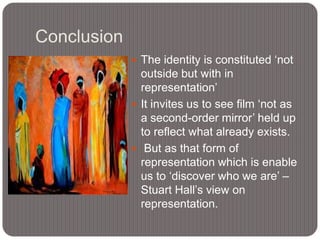
Conclusion
 The identity is constituted „not

outside but with in
representation‟
 It invites us to see film „not as
a second-order mirror‟ held up
to reflect what already exists.
 But as that form of
representation which is enable
us to „discover who we are‟ –
Stuart Hall‟s view on
representation.
Conclusion
 The oppositional gaze is a

new framework which offers a
critical investigation to rethink
a body of feminist film theory
and denial of the reality (the
objectivity of reality and
content forms).
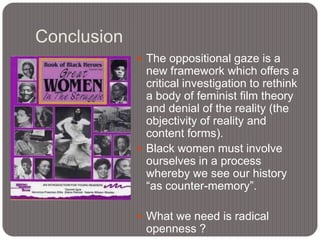
 Black women must involve
ourselves in a process
whereby we see our history
“as counter-memory”.
 What we need is radical

openness ?
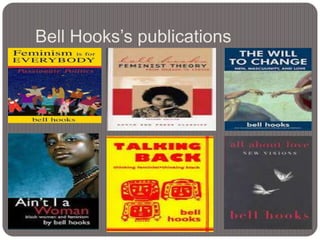
Bell Hooks‟s publications
Thank You

By
Nagarjuna K
12 SCMC 07

Bell Hooks - The oppositional gaze by Nagarjuna.K. University of hyderabad, India

  • 1.
    The Oppositional Gaze BellHooks, Professor of English, City College, New
  • 2.
    Introduction  Foucault:  Thepower relationship.  „Power as domination, it reproduces itself in different locations and employing similar apparatuses, strategies and mechanisms of control.  In all relations of power „there is necessarily the
  • 3.
    The Oppositional Gaze The power of looking as      contrast to gaze in general. The gaze has always been political in my life. As confrontational and as a gesture of resistance The gaze can be dangerous and be understood by repeated punishments. „Look at me when I talk to you‟ „There is power in looking‟.
  • 4.
    The Oppositional Gaze The right to gaze  “Not only will I stare, I want     my look to change the reality”. Experientially, a critical gaze and cultivating awareness. It politicizes the „looking‟ relations. The looking was also about the contestation and confrontation. It‟s a site for colonized black
  • 5.
    The analysis ofgaze  The critical investigation  Typical race and racism and over-determined representation.  “Our bodies being were there to serve, to enhance, and maintain white womanhood.  As an object of phallocentric gaze” – Anne Friedberg. (A Denial of Difference).  The insertion of violating representation (content, form and language.
  • 6.
    The white Supremacyand Conventional Representation  The powerful white „other‟.  Black men were murdered or     lynched for looking at white womanhood. Emmet Till (1955). „To be looked as at and desired is white‟. „Denial the body of black female. Compelling representations of black femaleness
  • 7.
    The white Supremacyand Conventional Representation  Do you remember Sapphire     (Amos „n‟ Andy) ? “She was not us”. To soften images of black men, to make them seem vulnerable, easygoing, funny and unthreatening to a white audience. „Our image visually constructed was ugly‟ and „hated black female‟ These screen images could assault the black womanhood, could name us
  • 8.
    Deconstruction and Independent BlackCinema  To develop critical black      spectatorship. Looking was also about contestation and confrontation. It mainly focuses on racial equality via the construction of images. These are all one way to protest and to reject navigation. Deconstruction of “Women as image and men as bearer” . Deconstruction and of reading, „against the grain‟ .
  • 9.
    Deconstruction and Independent BlackCinema  The pleasure of deconstruction     and „the woman‟s stake . Julie Dash and Doane. filming female body and pleasure of interrogation. Resisting the imposition of dominant ways of „knowing and looking‟ (As Sussan & Hartley John). Inverting the „real life‟ power structure and black female representation.
  • 10.
    Independent Black Cinema A critical gaze against the     conventional racist and sexiest stereotypical, representations of „black female‟ bodies. “A radical departure”. they provide new points of recognition and embodying a vision of critical practice. Camillle Billop, Katheen Collins, Julie Dash, Ayoka Chensira. Daughter of Dust, Passion of Remembrance, Illusions etc.
  • 11.
    Conclusion  The identityis constituted „not outside but with in representation‟  It invites us to see film „not as a second-order mirror‟ held up to reflect what already exists.  But as that form of representation which is enable us to „discover who we are‟ – Stuart Hall‟s view on representation.
  • 12.
    Conclusion  The oppositionalgaze is a new framework which offers a critical investigation to rethink a body of feminist film theory and denial of the reality (the objectivity of reality and content forms).  Black women must involve ourselves in a process whereby we see our history “as counter-memory”.  What we need is radical openness ?
  • 13.
  • 14.