Word Problems inAlgebraWord problems allow us to apply algebra to real life situations. Many students find them difficult, but if approached in a logical manner, they can be easily solved.
2.
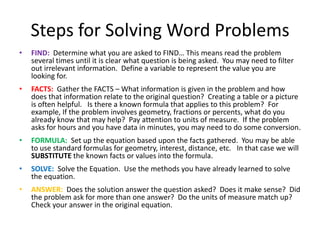
Steps for SolvingWord ProblemsFIND: Determine what you are asked to FIND… This means read the problem several times until it is clear what question is being asked. You may need to filter out irrelevant information. Define a variable to represent the value you are looking for.FACTS: Gather the FACTS – What information is given in the problem and how does that information relate to the original question? Creating a table or a picture is often helpful. Is there a known formula that applies to this problem? For example, If the problem involves geometry, fractions or percents, what do you already know that may help? Pay attention to units of measure. If the problem asks for hours and you have data in minutes, you may need to do some conversion.FORMULA: Set up the equation based upon the facts gathered. You may be able to use standard formulas for geometry, interest, distance, etc. In that case we will SUBSTITUTE the known facts or values into the formula.SOLVE: Solve the Equation. Use the methods you have already learned to solve the equation.ANSWER: Does the solution answer the question asked? Does it make sense? Did the problem ask for more than one answer? Do the units of measure match up? Check your answer in the original equation.
3.
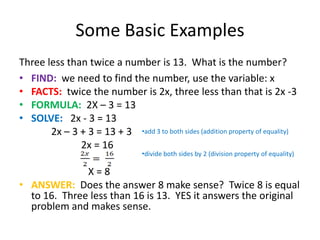
Some Basic ExamplesThreeless than twice a number is 13. What is the number?FIND:we need to find the number, use the variable: xFACTS: twice the number is 2x, three less than that is 2x -3FORMULA: 2X – 3 = 13SOLVE: 2x - 3 = 13 2x – 3 + 3 = 13 + 3 2x = 16 X = 8ANSWER: Does the answer 8 make sense? Twice 8 is equal to 16. Three less than 16 is 13. YES it answers the original problem and makes sense.add 3 to both sides (addition property of equality)
4.
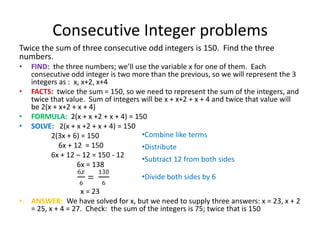
divide both sidesby 2 (division property of equality)Consecutive Integer problemsTwice the sum of three consecutive odd integers is 150. Find the three numbers.FIND: the three numbers; we’ll use the variable x for one of them. Each consecutive odd integer is two more than the previous, so we will represent the 3 integers as : x, x+2, x+4 FACTS: twice the sum = 150, so we need to represent the sum of the integers, and twice that value. Sum of integers will be x + x+2 + x + 4 and twice that value will be 2(x + x+2 + x + 4)FORMULA: 2(x + x +2 + x + 4) = 150SOLVE: 2(x + x +2 + x + 4) = 150 2(3x + 6) = 150 6x + 12 = 150 6x + 12 – 12 = 150 - 12 6x = 138 x = 23 ANSWER: We have solved for x, but we need to supply three answers: x = 23, x + 2 = 25, x + 4 = 27. Check: the sum of the integers is 75; twice that is 150Combine like terms