Enforcing Behavioral Constraints in
               Evolving
       Aspect-Oriented Programs
Raffi Khatchadourian1*, Johan Dovland2, and Neelam Soundarajan1

                1The  Ohio State University, USA
                   2University of Oslo, Norway
 *Partially administered during visit to Lancaster University, UK
Introduction
Introduction


• AOP enables modular implementation of cross-
 cutting concerns.
Introduction


• AOP enables modular implementation of cross-
 cutting concerns.
• Both formal and informal reasoning about AOP
 presents unique challenges especially in respect to
 evolution.
Introduction


• AOP enables modular implementation of cross-
 cutting concerns.
• Both formal and informal reasoning about AOP
 presents unique challenges especially in respect to
 evolution.
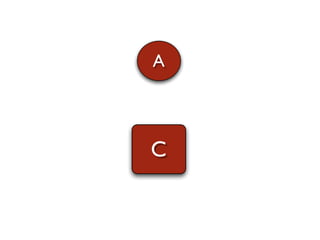
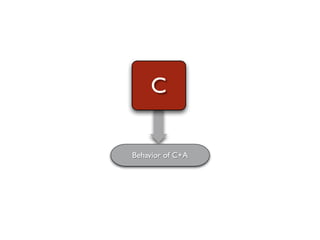
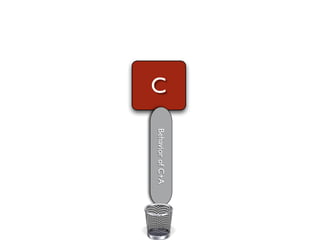
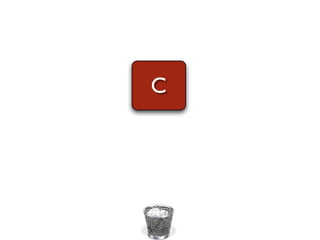
• As components enter, exit, and re-enter software,
 conclusions about behavior of components may be
 invalidated.
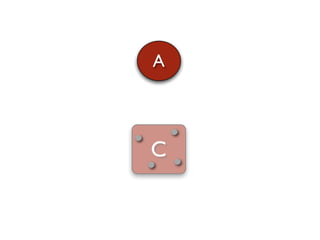
C
A


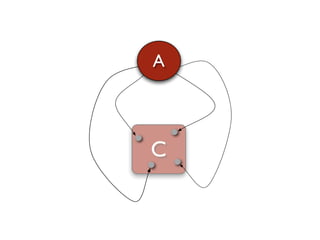
C
A


C
A


C
A


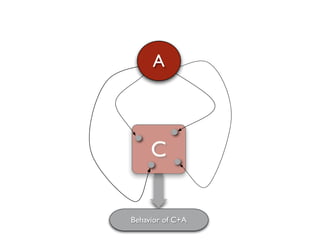
     C

Behavior of C+A
C

Behavior of C+A
C

Behavior of C+A
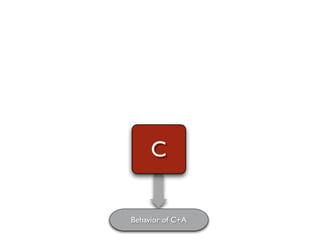
C

    Behavior of C+A
C
What We Want
What We Want


• Desire a compositional reasoning approach, however
 the invasive nature of AOP makes this difficult.
What We Want


• Desire a compositional reasoning approach, however
 the invasive nature of AOP makes this difficult.
• In the worst case, changes made to a single
 component require reexamining the entire program.
Questions
Questions


• Can we draw meaningful conclusions about
 component code without considering the actual
 advice code?
Questions


• Can we draw meaningful conclusions about
 component code without considering the actual
 advice code?
• Can we specify the behavior of components without
 any particular advice in mind?
Questions


• Can we draw meaningful conclusions about
 component code without considering the actual
 advice code?
• Can we specify the behavior of components without
 any particular advice in mind?
• Can we parameterize specifications over all possibly
 applicable aspects?
Questions


• Can we draw meaningful conclusions about
 component code without considering the actual
 advice code?
• Can we specify the behavior of components without
 any particular advice in mind?
• Can we parameterize specifications over all possibly
 applicable aspects?
• Can we suitably constrain the behavior of aspects as
 the software evolves?
Hiding Behind Interfaces


• Using interface is
 one answer (e.g.,
 XPIs, Open
 Modules)
Hiding Behind Interfaces


• Using interface is
 one answer (e.g.,
 XPIs, Open
 Modules)

• But it would be
 nice to have a way
 to derive the
 enriched behavior
 of the base plus the
 aspects at compile
 time.
Insight
Insight


• AO programs inherently enjoy plug-n-play
 capabilities [Laddad03]
Insight


• AO programs inherently enjoy plug-n-play
 capabilities [Laddad03]
• Crosscutting features can be plugged-in to enrich the
 behavior of advised components.
Insight


• AO programs inherently enjoy plug-n-play
 capabilities [Laddad03]
• Crosscutting features can be plugged-in to enrich the
 behavior of advised components.
• Likewise, can we specify components so that we can
 derive their behaviors in a similar fashion?
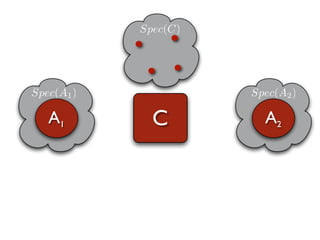
C
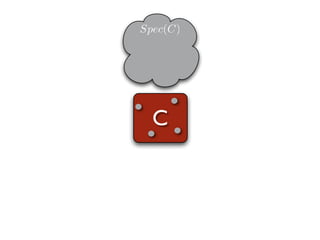
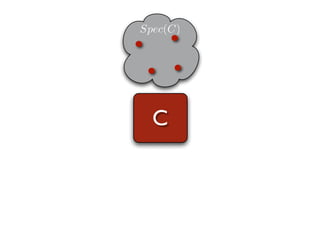
Spec(C)

  C
Spec(C)


  C
Spec(C)


  C
Spec(C)


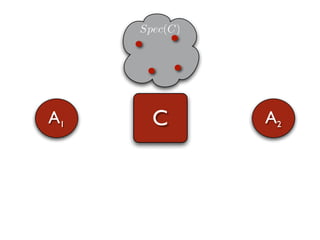
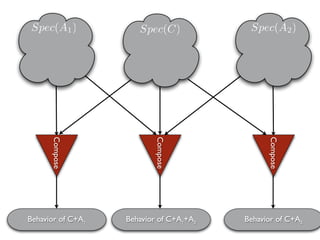
A1     C       A2
Spec(C)


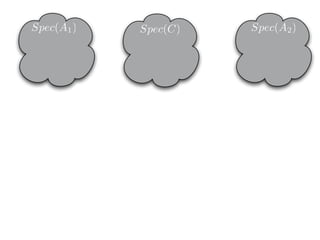
Spec(A1 )             Spec(A2 )

   A1         C         A2
Spec(A1 )   Spec(C)   Spec(A2 )
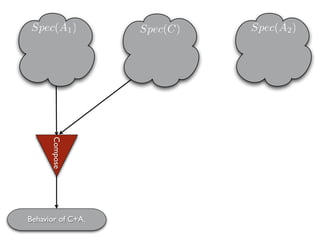
Spec(A1 )          Spec(C)   Spec(A2 )

      Compose


Behavior of C+A1
Spec(A1 )          Spec(C)    Spec(A2 )

      Compose


                                   Compose
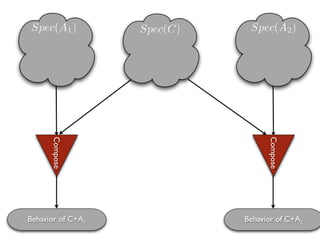
Behavior of C+A1             Behavior of C+A2
Spec(A1 )             Spec(C)             Spec(A2 )

      Compose


                           Compose


                                               Compose
Behavior of C+A1   Behavior of C+A1+A2   Behavior of C+A2
Obstacles
Obstacles


• Usefulness
Obstacles


• Usefulness
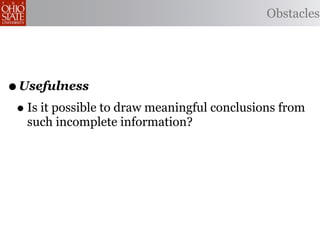
 • Is it possible to draw meaningful conclusions from
   such incomplete information?
Obstacles


• Usefulness
 • Is it possible to draw meaningful conclusions from
   such incomplete information?
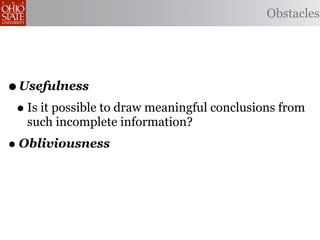
• Obliviousness
Obstacles


• Usefulness
 • Is it possible to draw meaningful conclusions from
   such incomplete information?
• Obliviousness
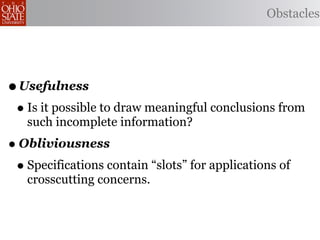
 • Specifications contain “slots” for applications of
   crosscutting concerns.
Obstacles
Obstacles


• Abstraction
Obstacles


• Abstraction
 • Competing forces:
Obstacles


• Abstraction
 • Competing forces:
   • Specs abstract internal details components,
     aspects directly manipulate them.
Obstacles


• Abstraction
 • Competing forces:
   • Specs abstract internal details components,
     aspects directly manipulate them.
• Composition
Obstacles


• Abstraction
 • Competing forces:
   • Specs abstract internal details components,
     aspects directly manipulate them.
• Composition
 • Which pegs go into which holes?
Obstacles


• Abstraction
 • Competing forces:
   • Specs abstract internal details components,
     aspects directly manipulate them.
• Composition
 • Which pegs go into which holes?
 • How to deal with dynamic and lexical pointcuts?
Obstacles


• Abstraction
 • Competing forces:
   • Specs abstract internal details components,
     aspects directly manipulate them.
• Composition
 • Which pegs go into which holes?
 • How to deal with dynamic and lexical pointcuts?
• Complexity
Obstacles


• Abstraction
 • Competing forces:
   • Specs abstract internal details components,
     aspects directly manipulate them.
• Composition
 • Which pegs go into which holes?
 • How to deal with dynamic and lexical pointcuts?
• Complexity
 • What if no advice is applicable?
Tackling Specification Complexity

• May need to make assumptions about the behavior of
 evolving components.
Tackling Specification Complexity

• May need to make assumptions about the behavior of
 evolving components.
• Specification pointcuts
Tackling Specification Complexity

• May need to make assumptions about the behavior of
 evolving components.
• Specification pointcuts
 • Pointcut interfaces [Gudmundson01] annotated
   with behavioral specifications.
Tackling Specification Complexity

• May need to make assumptions about the behavior of
 evolving components.
• Specification pointcuts
 • Pointcut interfaces [Gudmundson01] annotated
   with behavioral specifications.
 • “Exported” internal semantic events within the
   component.
Tackling Specification Complexity

• May need to make assumptions about the behavior of
 evolving components.
• Specification pointcuts
 • Pointcut interfaces [Gudmundson01] annotated
   with behavioral specifications.
 • “Exported” internal semantic events within the
   component.
 • Adopt a rely-guarantee approach [Xu97] from
   concurrent programming to constrain the behavior
   of all possibly applicable advice using a rely clause.
Tackling Specification Complexity

• May need to make assumptions about the behavior of
 evolving components.
• Specification pointcuts
 • Pointcut interfaces [Gudmundson01] annotated
   with behavioral specifications.
 • “Exported” internal semantic events within the
   component.
 • Adopt a rely-guarantee approach [Xu97] from
   concurrent programming to constrain the behavior
   of all possibly applicable advice using a rely clause.
 • A guar clause may be used to constrain components.
Review of R/G for AOP [Khatchadourian07,
                                Soundarajan07]


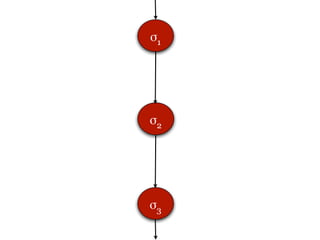
                the set of all variables of
     σ          the program

                states in which each
σi , σj , ...   variable has a particular
                value
!1


!2


!3
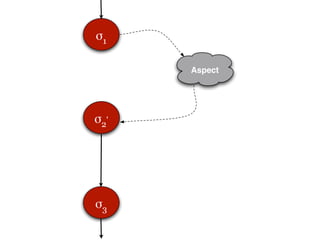
!1

      Aspect


!2'


!3
!a

     Aspect


!b
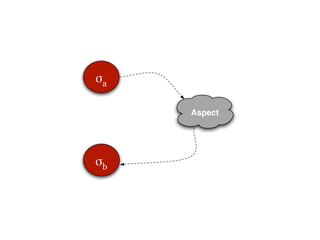
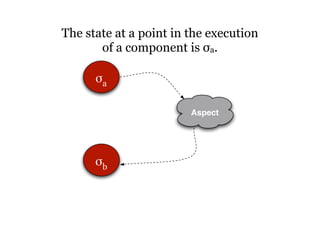
The state at a point in the execution
       of a component is σa.

      !a

                        Aspect


      !b
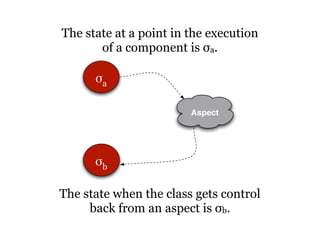
The state at a point in the execution
       of a component is σa.

      !a

                        Aspect


      !b

The state when the class gets control
     back from an aspect is σb.
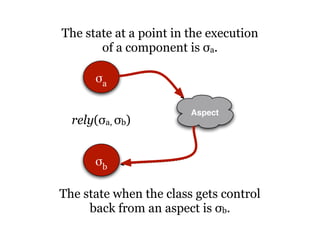
The state at a point in the execution
       of a component is σa.

      !a

                        Aspect
  rely(σa, σb)


      !b

The state when the class gets control
     back from an aspect is σb.
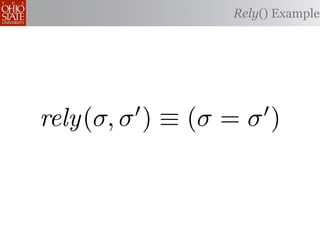
Rely() Example


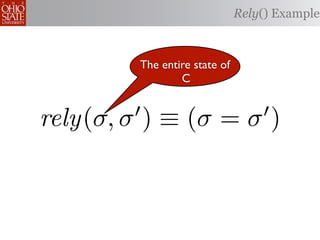
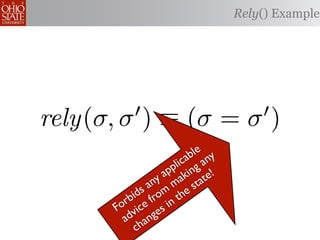
rely(σ, σ ) ≡ (σ = σ )
Rely() Example


         The entire state of
                 C


rely(σ, σ ) ≡ (σ = σ )
Rely() Example


rely(σ, σ ) ≡ (σ = σ )
                            le y
                          ab an
                       lic g
                    pp kin e!
                y a ma tat
              an
             s om he s
           id fr       t
        rb e
       o ic         in
      F v        es
        a d ang
           ch
Rely() Example

      This is
 “Harmless”[D&W
     POPL’06]


rely(σ, σ ) ≡ (σ = σ )
Deriving Effective Behavior


• Constraining parameterized behavior reduces
 complexity, but ...
Deriving Effective Behavior


• Constraining parameterized behavior reduces
 complexity, but ...
 • How are formal parameters expressed?
Deriving Effective Behavior


• Constraining parameterized behavior reduces
 complexity, but ...
 • How are formal parameters expressed?
 • How are actual parameters deduced?
Deriving Effective Behavior


• Constraining parameterized behavior reduces
 complexity, but ...
 • How are formal parameters expressed?
 • How are actual parameters deduced?
 • How are the specifications composed?
Deriving Effective Behavior


• Constraining parameterized behavior reduces
  complexity, but ...
 • How are formal parameters expressed?
 • How are actual parameters deduced?
 • How are the specifications composed?
• Aspects are typically used to enrich the behavior of
  the an underlying component.
Deriving Effective Behavior


• Constraining parameterized behavior reduces
  complexity, but ...
 • How are formal parameters expressed?
 • How are actual parameters deduced?
 • How are the specifications composed?
• Aspects are typically used to enrich the behavior of
  the an underlying component.
• Thus, we want to deriving the actual behavior of
  components with the aspects.
Join Point Traces
Join Point Traces


• A Join Point Trace (JPT) variable is introduced to
 track the flow-of-control through various join points
 within a component.
Join Point Traces


• A Join Point Trace (JPT) variable is introduced to
  track the flow-of-control through various join points
  within a component.
• A JPT is used as a parameter over the actions of all
  possibly applicable aspects.
Join Point Traces


• A Join Point Trace (JPT) variable is introduced to
  track the flow-of-control through various join points
  within a component.
• A JPT is used as a parameter over the actions of all
  possibly applicable aspects.
• Method post-conditions will references to the JPT.
Join Point Traces


• A Join Point Trace (JPT) variable is introduced to
  track the flow-of-control through various join points
  within a component.
• A JPT is used as a parameter over the actions of all
  possibly applicable aspects.
• Method post-conditions will references to the JPT.
• Informally, a JPT is used to refer to the actions and
  resulting values taken by advice at certain join point.
Elements of the JPT
Elements of the JPT


• The JPT is composed of several components that are
 associated with each join point.
Elements of the JPT


• The JPT is composed of several components that are
  associated with each join point.
• Just as there are different kinds of join points (e.g.,
  call, execution), there different kinds of JPT
  entries.
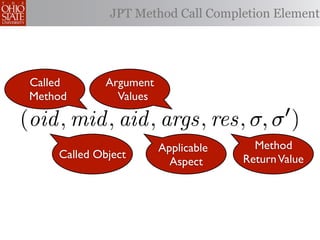
JPT Method Call Completion Element


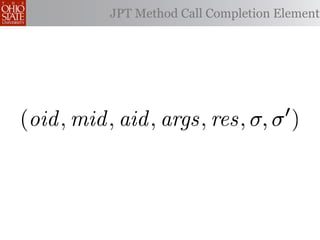
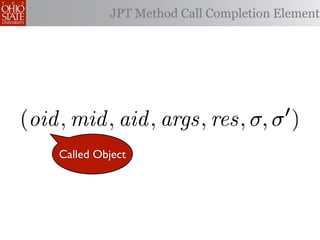
(oid , mid , aid , args, res, σ, σ )
JPT Method Call Completion Element


(oid , mid , aid , args, res, σ, σ )
     Called Object
JPT Method Call Completion Element


 Called
 Method

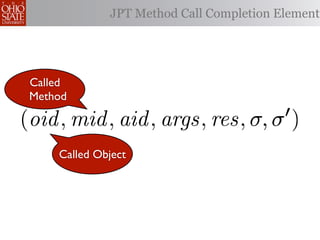
(oid , mid , aid , args, res, σ, σ )
     Called Object
JPT Method Call Completion Element


 Called
 Method

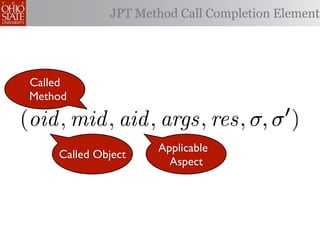
(oid , mid , aid , args, res, σ, σ )
                     Applicable
     Called Object
                       Aspect
JPT Method Call Completion Element


 Called       Argument
 Method         Values

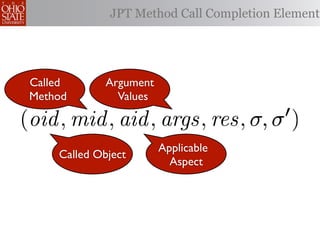
(oid , mid , aid , args, res, σ, σ )
                         Applicable
     Called Object
                           Aspect
JPT Method Call Completion Element


 Called       Argument
 Method         Values

(oid , mid , aid , args, res, σ, σ )
                         Applicable     Method
     Called Object                    Return Value
                           Aspect
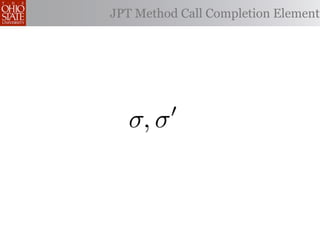
JPT Method Call Completion Element


   σ, σ
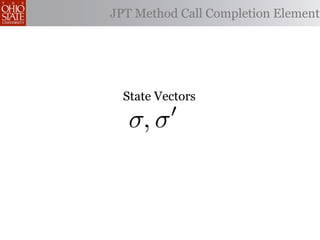
JPT Method Call Completion Element


  State Vectors

   σ, σ
JPT Method Call Completion Element


           State Vectors

            σ, σ
σ[oid]    State of object oid after
         completion of method mid
JPT Method Call Completion Element


            State Vectors

             σ, σ
σ[oid]     State of object oid after
          completion of method mid
σ [oid]     State of object oid after
           completion of aspect aid
JPT Method Call Completion Element


            State Vectors

             σ, σ
σ[oid]     State of object oid after
          completion of method mid
σ [oid]     State of object oid after
           completion of aspect aid
No applicable advice   =⇒ σ = σ
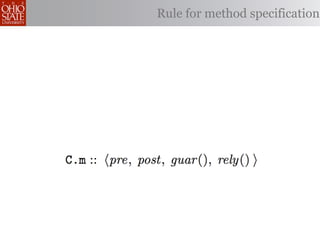
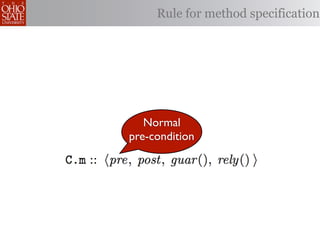
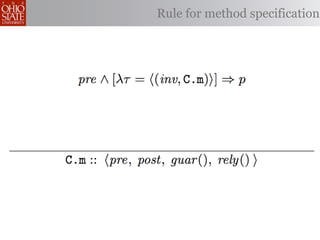
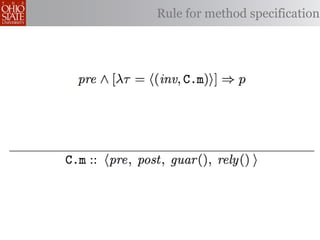
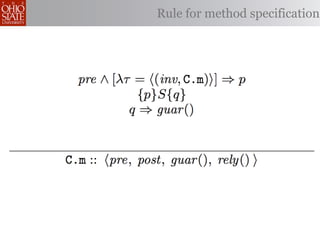
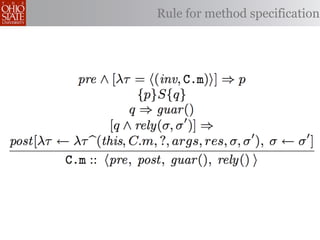
Rule for method specification


   Normal
pre-condition
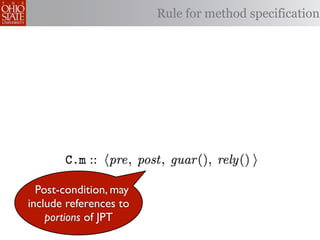
Rule for method specification


  Post-condition, may
include references to
    portions of JPT
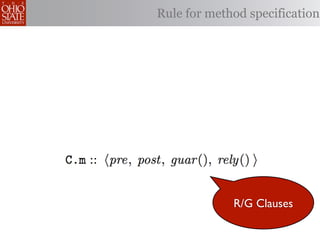
Rule for method specification


             R/G Clauses
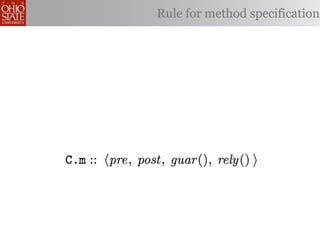
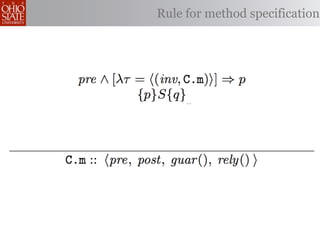
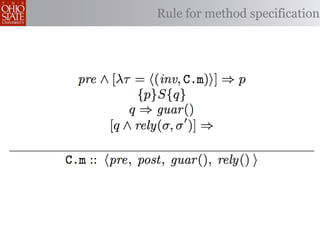
Rule for method specification


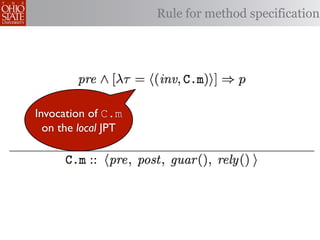
Invocation of C.m
  on the local JPT
Rule for method specification


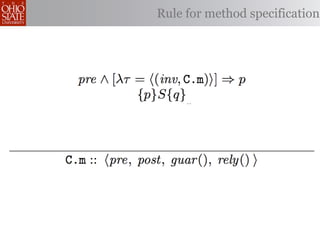
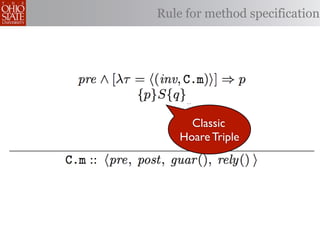
      Classic
    Hoare Triple
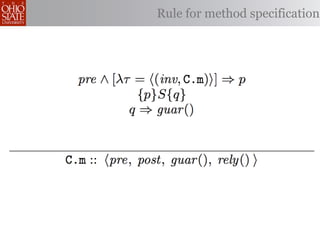
Rule for method specification


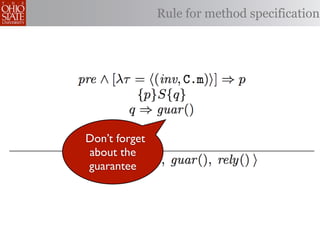
Don’t forget
about the
guarantee
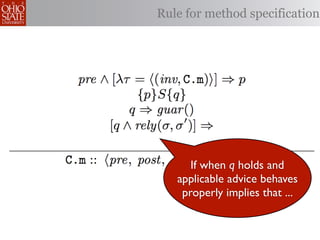
Rule for method specification


      If when q holds and
   applicable advice behaves
    properly implies that ...
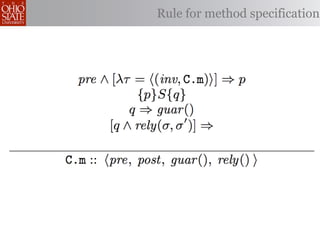
Rule for method specification


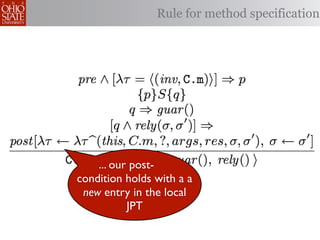
    ... our post-
condition holds with a a
 new entry in the local
           JPT
Rule for method specification


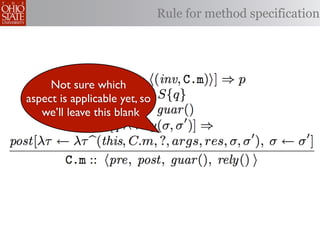
     Not sure which
aspect is applicable yet, so
   we’ll leave this blank
Rule for method specification


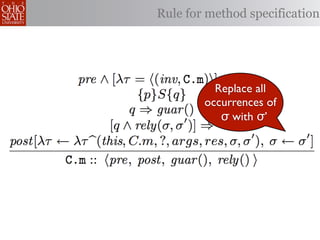
          Replace all
        occurrences of
           σ with σ’
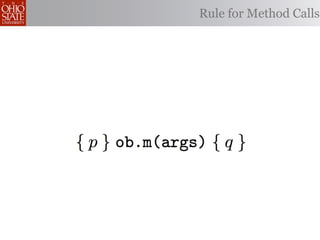
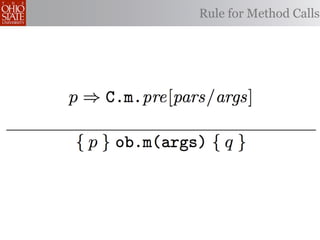
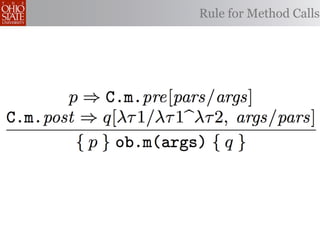
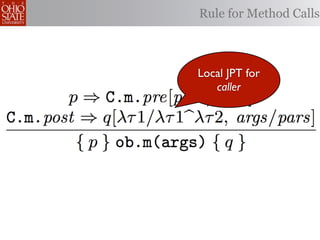
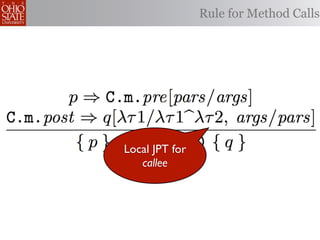
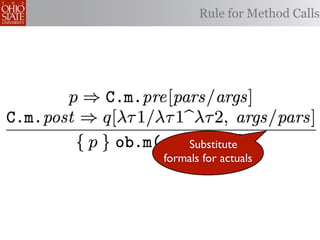
Rule for Method Calls


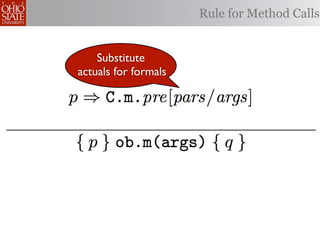
    Substitute
actuals for formals
Rule for Method Calls


Local JPT for
   caller
Rule for Method Calls


Local JPT for
   callee
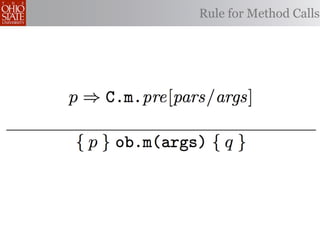
Rule for Method Calls


    Substitute
formals for actuals
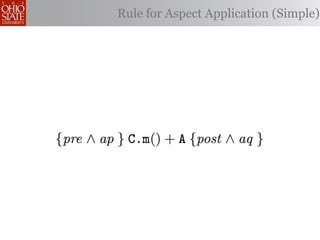
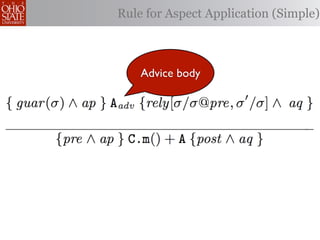
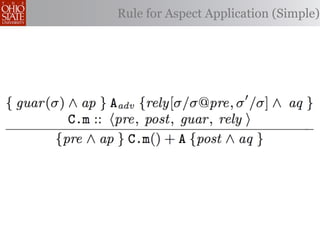
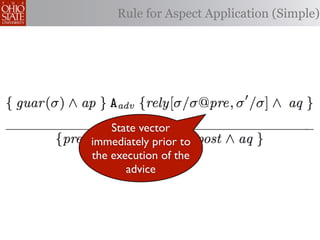
Rule for Aspect Application (Simple)


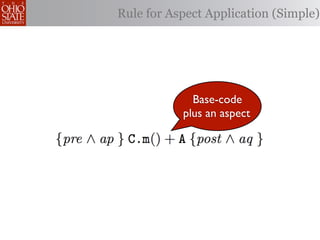
             Base-code
           plus an aspect
Rule for Aspect Application (Simple)


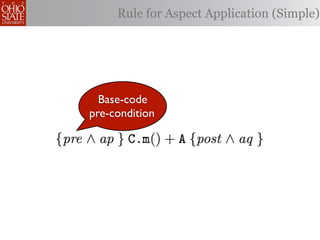
  Base-code
pre-condition
Rule for Aspect Application (Simple)


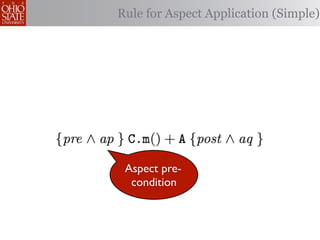
 Aspect pre-
  condition
Rule for Aspect Application (Simple)


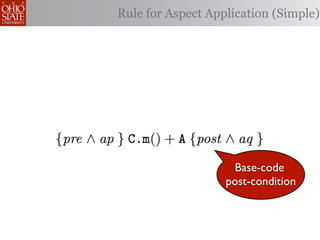
                    Base-code
                   post-condition
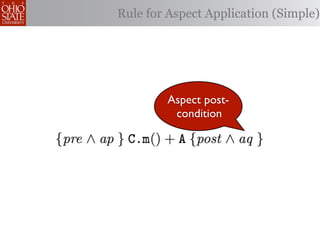
Rule for Aspect Application (Simple)


        Aspect post-
         condition
Rule for Aspect Application (Simple)


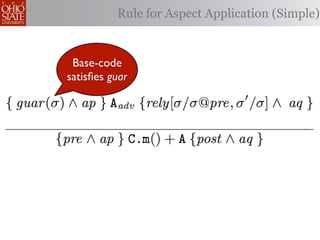
 Base-code
satisfies guar
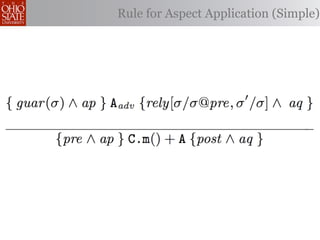
Rule for Aspect Application (Simple)


    Advice body
Rule for Aspect Application (Simple)


    State vector
immediately prior to
the execution of the
       advice
Rule for Aspect Application (Simple)
Conclusion
Conclusion


• On-going work (hopefully thesis worthy! ;) )
Conclusion


• On-going work (hopefully thesis worthy! ;) )
• Complete formal model (suggestions here?)
Conclusion


• On-going work (hopefully thesis worthy! ;) )
• Complete formal model (suggestions here?)
• Sound axiomatic proof system
Conclusion


• On-going work (hopefully thesis worthy! ;) )
• Complete formal model (suggestions here?)
• Sound axiomatic proof system
• Curbing notational complexity via predicates.
Conclusion


• On-going work (hopefully thesis worthy! ;) )
• Complete formal model (suggestions here?)
• Sound axiomatic proof system
• Curbing notational complexity via predicates.
• Integration with IDE/theorem provers.
Conclusion


• On-going work (hopefully thesis worthy! ;) )
• Complete formal model (suggestions here?)
• Sound axiomatic proof system
• Curbing notational complexity via predicates.
• Integration with IDE/theorem provers.
 • Complement the Eclipse AJDT with a behavioral
   cross reference view?
Conclusion


• On-going work (hopefully thesis worthy! ;) )
• Complete formal model (suggestions here?)
• Sound axiomatic proof system
• Curbing notational complexity via predicates.
• Integration with IDE/theorem provers.
 • Complement the Eclipse AJDT with a behavioral
   cross reference view?
• Integration with languages (e.g., via annotated
  pointcuts, JML)

Enforcing Behavioral Constraints in Evolving Aspect-Oriented Programs

  • 1.
    Enforcing Behavioral Constraintsin Evolving Aspect-Oriented Programs Raffi Khatchadourian1*, Johan Dovland2, and Neelam Soundarajan1 1The Ohio State University, USA 2University of Oslo, Norway *Partially administered during visit to Lancaster University, UK
  • 2.
  • 3.
    Introduction • AOP enablesmodular implementation of cross- cutting concerns.
  • 4.
    Introduction • AOP enablesmodular implementation of cross- cutting concerns. • Both formal and informal reasoning about AOP presents unique challenges especially in respect to evolution.
  • 5.
    Introduction • AOP enablesmodular implementation of cross- cutting concerns. • Both formal and informal reasoning about AOP presents unique challenges especially in respect to evolution. • As components enter, exit, and re-enter software, conclusions about behavior of components may be invalidated.
  • 6.
  • 7.
  • 8.
  • 9.
  • 10.
    A C Behavior of C+A
  • 11.
  • 12.
  • 13.
    C Behavior of C+A
  • 14.
  • 15.
  • 16.
    What We Want •Desire a compositional reasoning approach, however the invasive nature of AOP makes this difficult.
  • 17.
    What We Want •Desire a compositional reasoning approach, however the invasive nature of AOP makes this difficult. • In the worst case, changes made to a single component require reexamining the entire program.
  • 18.
  • 19.
    Questions • Can wedraw meaningful conclusions about component code without considering the actual advice code?
  • 20.
    Questions • Can wedraw meaningful conclusions about component code without considering the actual advice code? • Can we specify the behavior of components without any particular advice in mind?
  • 21.
    Questions • Can wedraw meaningful conclusions about component code without considering the actual advice code? • Can we specify the behavior of components without any particular advice in mind? • Can we parameterize specifications over all possibly applicable aspects?
  • 22.
    Questions • Can wedraw meaningful conclusions about component code without considering the actual advice code? • Can we specify the behavior of components without any particular advice in mind? • Can we parameterize specifications over all possibly applicable aspects? • Can we suitably constrain the behavior of aspects as the software evolves?
  • 23.
  • 24.
    Hiding Behind Interfaces •Using interface is one answer (e.g., XPIs, Open Modules)
  • 25.
    Hiding Behind Interfaces •Using interface is one answer (e.g., XPIs, Open Modules) • But it would be nice to have a way to derive the enriched behavior of the base plus the aspects at compile time.
  • 26.
  • 27.
    Insight • AO programsinherently enjoy plug-n-play capabilities [Laddad03]
  • 28.
    Insight • AO programsinherently enjoy plug-n-play capabilities [Laddad03] • Crosscutting features can be plugged-in to enrich the behavior of advised components.
  • 29.
    Insight • AO programsinherently enjoy plug-n-play capabilities [Laddad03] • Crosscutting features can be plugged-in to enrich the behavior of advised components. • Likewise, can we specify components so that we can derive their behaviors in a similar fashion?
  • 30.
  • 31.
  • 32.
  • 33.
  • 34.
  • 35.
    Spec(C) Spec(A1 ) Spec(A2 ) A1 C A2
  • 36.
    Spec(A1 ) Spec(C) Spec(A2 )
  • 37.
    Spec(A1 ) Spec(C) Spec(A2 ) Compose Behavior of C+A1
  • 38.
    Spec(A1 ) Spec(C) Spec(A2 ) Compose Compose Behavior of C+A1 Behavior of C+A2
  • 39.
    Spec(A1 ) Spec(C) Spec(A2 ) Compose Compose Compose Behavior of C+A1 Behavior of C+A1+A2 Behavior of C+A2
  • 40.
  • 41.
  • 42.
    Obstacles • Usefulness •Is it possible to draw meaningful conclusions from such incomplete information?
  • 43.
    Obstacles • Usefulness •Is it possible to draw meaningful conclusions from such incomplete information? • Obliviousness
  • 44.
    Obstacles • Usefulness •Is it possible to draw meaningful conclusions from such incomplete information? • Obliviousness • Specifications contain “slots” for applications of crosscutting concerns.
  • 45.
  • 46.
  • 47.
  • 48.
    Obstacles • Abstraction •Competing forces: • Specs abstract internal details components, aspects directly manipulate them.
  • 49.
    Obstacles • Abstraction •Competing forces: • Specs abstract internal details components, aspects directly manipulate them. • Composition
  • 50.
    Obstacles • Abstraction •Competing forces: • Specs abstract internal details components, aspects directly manipulate them. • Composition • Which pegs go into which holes?
  • 51.
    Obstacles • Abstraction •Competing forces: • Specs abstract internal details components, aspects directly manipulate them. • Composition • Which pegs go into which holes? • How to deal with dynamic and lexical pointcuts?
  • 52.
    Obstacles • Abstraction •Competing forces: • Specs abstract internal details components, aspects directly manipulate them. • Composition • Which pegs go into which holes? • How to deal with dynamic and lexical pointcuts? • Complexity
  • 53.
    Obstacles • Abstraction •Competing forces: • Specs abstract internal details components, aspects directly manipulate them. • Composition • Which pegs go into which holes? • How to deal with dynamic and lexical pointcuts? • Complexity • What if no advice is applicable?
  • 54.
  • 55.
    Tackling Specification Complexity •May need to make assumptions about the behavior of evolving components.
  • 56.
    Tackling Specification Complexity •May need to make assumptions about the behavior of evolving components. • Specification pointcuts
  • 57.
    Tackling Specification Complexity •May need to make assumptions about the behavior of evolving components. • Specification pointcuts • Pointcut interfaces [Gudmundson01] annotated with behavioral specifications.
  • 58.
    Tackling Specification Complexity •May need to make assumptions about the behavior of evolving components. • Specification pointcuts • Pointcut interfaces [Gudmundson01] annotated with behavioral specifications. • “Exported” internal semantic events within the component.
  • 59.
    Tackling Specification Complexity •May need to make assumptions about the behavior of evolving components. • Specification pointcuts • Pointcut interfaces [Gudmundson01] annotated with behavioral specifications. • “Exported” internal semantic events within the component. • Adopt a rely-guarantee approach [Xu97] from concurrent programming to constrain the behavior of all possibly applicable advice using a rely clause.
  • 60.
    Tackling Specification Complexity •May need to make assumptions about the behavior of evolving components. • Specification pointcuts • Pointcut interfaces [Gudmundson01] annotated with behavioral specifications. • “Exported” internal semantic events within the component. • Adopt a rely-guarantee approach [Xu97] from concurrent programming to constrain the behavior of all possibly applicable advice using a rely clause. • A guar clause may be used to constrain components.
  • 61.
    Review of R/Gfor AOP [Khatchadourian07, Soundarajan07] the set of all variables of σ the program states in which each σi , σj , ... variable has a particular value
  • 63.
  • 66.
    !1 Aspect !2' !3
  • 68.
    !a Aspect !b
  • 69.
    The state ata point in the execution of a component is σa. !a Aspect !b
  • 70.
    The state ata point in the execution of a component is σa. !a Aspect !b The state when the class gets control back from an aspect is σb.
  • 71.
    The state ata point in the execution of a component is σa. !a Aspect rely(σa, σb) !b The state when the class gets control back from an aspect is σb.
  • 72.
  • 73.
    Rely() Example The entire state of C rely(σ, σ ) ≡ (σ = σ )
  • 74.
    Rely() Example rely(σ, σ) ≡ (σ = σ ) le y ab an lic g pp kin e! y a ma tat an s om he s id fr t rb e o ic in F v es a d ang ch
  • 75.
    Rely() Example This is “Harmless”[D&W POPL’06] rely(σ, σ ) ≡ (σ = σ )
  • 76.
  • 77.
    Deriving Effective Behavior •Constraining parameterized behavior reduces complexity, but ...
  • 78.
    Deriving Effective Behavior •Constraining parameterized behavior reduces complexity, but ... • How are formal parameters expressed?
  • 79.
    Deriving Effective Behavior •Constraining parameterized behavior reduces complexity, but ... • How are formal parameters expressed? • How are actual parameters deduced?
  • 80.
    Deriving Effective Behavior •Constraining parameterized behavior reduces complexity, but ... • How are formal parameters expressed? • How are actual parameters deduced? • How are the specifications composed?
  • 81.
    Deriving Effective Behavior •Constraining parameterized behavior reduces complexity, but ... • How are formal parameters expressed? • How are actual parameters deduced? • How are the specifications composed? • Aspects are typically used to enrich the behavior of the an underlying component.
  • 82.
    Deriving Effective Behavior •Constraining parameterized behavior reduces complexity, but ... • How are formal parameters expressed? • How are actual parameters deduced? • How are the specifications composed? • Aspects are typically used to enrich the behavior of the an underlying component. • Thus, we want to deriving the actual behavior of components with the aspects.
  • 83.
  • 84.
    Join Point Traces •A Join Point Trace (JPT) variable is introduced to track the flow-of-control through various join points within a component.
  • 85.
    Join Point Traces •A Join Point Trace (JPT) variable is introduced to track the flow-of-control through various join points within a component. • A JPT is used as a parameter over the actions of all possibly applicable aspects.
  • 86.
    Join Point Traces •A Join Point Trace (JPT) variable is introduced to track the flow-of-control through various join points within a component. • A JPT is used as a parameter over the actions of all possibly applicable aspects. • Method post-conditions will references to the JPT.
  • 87.
    Join Point Traces •A Join Point Trace (JPT) variable is introduced to track the flow-of-control through various join points within a component. • A JPT is used as a parameter over the actions of all possibly applicable aspects. • Method post-conditions will references to the JPT. • Informally, a JPT is used to refer to the actions and resulting values taken by advice at certain join point.
  • 88.
  • 89.
    Elements of theJPT • The JPT is composed of several components that are associated with each join point.
  • 90.
    Elements of theJPT • The JPT is composed of several components that are associated with each join point. • Just as there are different kinds of join points (e.g., call, execution), there different kinds of JPT entries.
  • 91.
    JPT Method CallCompletion Element (oid , mid , aid , args, res, σ, σ )
  • 92.
    JPT Method CallCompletion Element (oid , mid , aid , args, res, σ, σ ) Called Object
  • 93.
    JPT Method CallCompletion Element Called Method (oid , mid , aid , args, res, σ, σ ) Called Object
  • 94.
    JPT Method CallCompletion Element Called Method (oid , mid , aid , args, res, σ, σ ) Applicable Called Object Aspect
  • 95.
    JPT Method CallCompletion Element Called Argument Method Values (oid , mid , aid , args, res, σ, σ ) Applicable Called Object Aspect
  • 96.
    JPT Method CallCompletion Element Called Argument Method Values (oid , mid , aid , args, res, σ, σ ) Applicable Method Called Object Return Value Aspect
  • 97.
    JPT Method CallCompletion Element σ, σ
  • 98.
    JPT Method CallCompletion Element State Vectors σ, σ
  • 99.
    JPT Method CallCompletion Element State Vectors σ, σ σ[oid] State of object oid after completion of method mid
  • 100.
    JPT Method CallCompletion Element State Vectors σ, σ σ[oid] State of object oid after completion of method mid σ [oid] State of object oid after completion of aspect aid
  • 101.
    JPT Method CallCompletion Element State Vectors σ, σ σ[oid] State of object oid after completion of method mid σ [oid] State of object oid after completion of aspect aid No applicable advice =⇒ σ = σ
  • 102.
    Rule for methodspecification
  • 103.
    Rule for methodspecification Normal pre-condition
  • 104.
    Rule for methodspecification Post-condition, may include references to portions of JPT
  • 105.
    Rule for methodspecification R/G Clauses
  • 106.
    Rule for methodspecification
  • 107.
    Rule for methodspecification
  • 108.
    Rule for methodspecification Invocation of C.m on the local JPT
  • 109.
    Rule for methodspecification
  • 110.
    Rule for methodspecification
  • 111.
    Rule for methodspecification Classic Hoare Triple
  • 112.
    Rule for methodspecification
  • 113.
    Rule for methodspecification
  • 114.
    Rule for methodspecification Don’t forget about the guarantee
  • 115.
    Rule for methodspecification
  • 116.
    Rule for methodspecification
  • 117.
    Rule for methodspecification If when q holds and applicable advice behaves properly implies that ...
  • 118.
    Rule for methodspecification
  • 119.
    Rule for methodspecification
  • 120.
    Rule for methodspecification ... our post- condition holds with a a new entry in the local JPT
  • 121.
    Rule for methodspecification Not sure which aspect is applicable yet, so we’ll leave this blank
  • 122.
    Rule for methodspecification Replace all occurrences of σ with σ’
  • 123.
  • 124.
  • 125.
    Rule for MethodCalls Substitute actuals for formals
  • 126.
  • 127.
  • 128.
    Rule for MethodCalls Local JPT for caller
  • 129.
    Rule for MethodCalls Local JPT for callee
  • 130.
    Rule for MethodCalls Substitute formals for actuals
  • 131.
    Rule for AspectApplication (Simple)
  • 132.
    Rule for AspectApplication (Simple) Base-code plus an aspect
  • 133.
    Rule for AspectApplication (Simple) Base-code pre-condition
  • 134.
    Rule for AspectApplication (Simple) Aspect pre- condition
  • 135.
    Rule for AspectApplication (Simple) Base-code post-condition
  • 136.
    Rule for AspectApplication (Simple) Aspect post- condition
  • 137.
    Rule for AspectApplication (Simple)
  • 138.
    Rule for AspectApplication (Simple) Base-code satisfies guar
  • 139.
    Rule for AspectApplication (Simple) Advice body
  • 140.
    Rule for AspectApplication (Simple) State vector immediately prior to the execution of the advice
  • 141.
    Rule for AspectApplication (Simple)
  • 142.
  • 143.
    Conclusion • On-going work(hopefully thesis worthy! ;) )
  • 144.
    Conclusion • On-going work(hopefully thesis worthy! ;) ) • Complete formal model (suggestions here?)
  • 145.
    Conclusion • On-going work(hopefully thesis worthy! ;) ) • Complete formal model (suggestions here?) • Sound axiomatic proof system
  • 146.
    Conclusion • On-going work(hopefully thesis worthy! ;) ) • Complete formal model (suggestions here?) • Sound axiomatic proof system • Curbing notational complexity via predicates.
  • 147.
    Conclusion • On-going work(hopefully thesis worthy! ;) ) • Complete formal model (suggestions here?) • Sound axiomatic proof system • Curbing notational complexity via predicates. • Integration with IDE/theorem provers.
  • 148.
    Conclusion • On-going work(hopefully thesis worthy! ;) ) • Complete formal model (suggestions here?) • Sound axiomatic proof system • Curbing notational complexity via predicates. • Integration with IDE/theorem provers. • Complement the Eclipse AJDT with a behavioral cross reference view?
  • 149.
    Conclusion • On-going work(hopefully thesis worthy! ;) ) • Complete formal model (suggestions here?) • Sound axiomatic proof system • Curbing notational complexity via predicates. • Integration with IDE/theorem provers. • Complement the Eclipse AJDT with a behavioral cross reference view? • Integration with languages (e.g., via annotated pointcuts, JML)