http://reflective-online-teaching.blogspot.com/
Blog entries writtenby Prof. Jonathan Acuña
Online Engagement: Rubrics
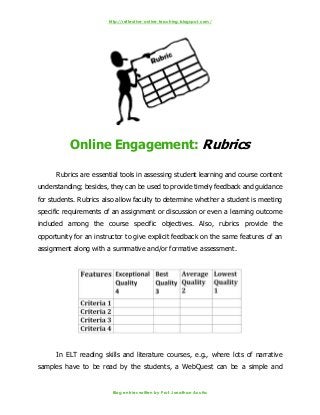
Rubrics are essential tools in assessing student learning and course content
understanding; besides, they can be used to provide timely feedback and guidance
for students. Rubrics also allow faculty to determine whether a student is meeting
specific requirements of an assignment or discussion or even a learning outcome
included among the course specific objectives. Also, rubrics provide the
opportunity for an instructor to give explicit feedback on the same features of an
assignment along with a summative and/or formative assessment.
In ELT reading skills and literature courses, e.g., where lots of narrative
samples have to be read by the students, a WebQuest can be a simple and
2.
http://reflective-online-teaching.blogspot.com/
Blog entries writtenby Prof. Jonathan Acuña
accurate way of testing student understanding. In Reading Skills II, a course that
in the English Language Teaching major students must take, it is common at
Universidad Latina to use the PBL [Project-Based Learning] philosophy geared at
having students use WebQuesting as part of their autonomous learning and
reading skills training. Students are provided with a series of short stories that they
have to read and analyze along the quarter, and a sample reading series of
activities learners must carry out can be accessed at http://bin-
08.blogspot.com/2012/05/webquest-quiz-1-version-b.html, which is a sci-fi story
written by Elizabeth van Steenwyk entitled Something Funny.
Elizabeth van Steenwyk
For any kind of Internet-Based Learning [IBL] task a rubric has to be
designed. The idea behind having a rubric for a WebQuest is not just to guide the
student but to have them become aware of the aspects s/he will be graded on.
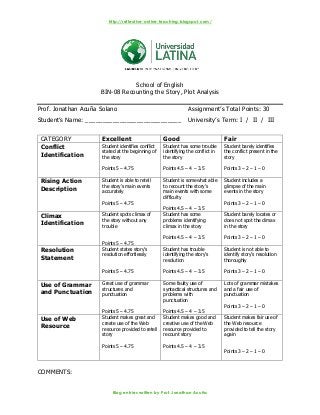
For the Reading Skills II students, this is what they were confronted with:
3.
http://reflective-online-teaching.blogspot.com/
Blog entries writtenby Prof. Jonathan Acuña
School of English
BIN-08 Recounting the Story, Plot Analysis
Prof. Jonathan Acuña Solano Assignment’s Total Points: 30
Student’s Name: ____________________________ University’s Term: I / II / III
CATEGORY Excellent Good Fair
Conflict
Identification
Student identifies conflict
stated at the beginning of
the story
Points 5 – 4.75
Student has some trouble
identifying the conflict in
the story
Points 4.5 – 4 – 3.5
Student barely identifies
the conflict present in the
story
Points 3 – 2 – 1 – 0
Rising Action
Description
Student is able to retell
the story’s main events
accurately
Points 5 – 4.75
Student is somewhat able
to recount the story’s
main events with some
difficulty
Points 4.5 – 4 – 3.5
Student includes a
glimpse of the main
events in the story
Points 3 – 2 – 1 – 0
Climax
Identification
Student spots climax of
the story without any
trouble
Points 5 – 4.75
Student has some
problems identifying
climax in the story
Points 4.5 – 4 – 3.5
Student barely locates or
does not spot the climax
in the story
Points 3 – 2 – 1 – 0
Resolution
Statement
Student states story’s
resolution effortlessly
Points 5 – 4.75
Student has trouble
identifying the story’s
resolution
Points 4.5 – 4 – 3.5
Student is not able to
identify story’s resolution
thoroughly
Points 3 – 2 – 1 – 0
Use of Grammar
and Punctuation
Great use of grammar
structures and
punctuation
Points 5 – 4.75
Some faulty use of
syntactical structures and
problems with
punctuation
Points 4.5 – 4 – 3.5
Lots of grammar mistakes
and a fair use of
punctuation
Points 3 – 2 – 1 – 0
Use of Web
Resource
Student makes great and
create use of the Web
resource provided to retell
story
Points 5 – 4.75
Student makes good and
creative use of the Web
resource provided to
recount story
Points 4.5 – 4 – 3.5
Student makes fair use of
the Web resource
provided to tell the story
again
Points 3 – 2 – 1 – 0
COMMENTS:
4.
http://reflective-online-teaching.blogspot.com/
Blog entries writtenby Prof. Jonathan Acuña
If the rubric above gets to be compared with the WebQuest learners are
provided at the class blog [http://bin-08.blogspot.com/2012/05/webquest-quiz-1-
version-b.html], they both go hand in hand with everything students are asked to
do for their literary analysis; there are no tricks or hidden steps the “average”
student will have to follow to achieve the learning goal of the task. Not only are
students’ works published by them on their personal reading blogs online, but they
are also provided with the summative and formative feedback needed to shape
their newly acquired understanding of the Formalistic Approach for literary
understanding.
To fully comprehend the scope of this teaching reflections, it is highly advisable that
the following topics must be expanded further:
Summative Assessment
Formative Assessment
WebQuesting
Internet-Based Learning
Professor Jonathan Acuña-Solano
ELT Trainer, Instructor & Curriculum Developer based in Costa Rica
Active NCTE – Costa Rica Member
Resource Teacher & Curricular Developer at CCCN
Senior ELT Instructor at Universidad Latina, Costa Rica, since 1998
Contact Information:
Twitter @jonacuso
Email: jonacuso@gmail.com
5.
http://reflective-online-teaching.blogspot.com/
Blog entries writtenby Prof. Jonathan Acuña
Pronunciation
Development
BIN-02 Pronunciation 1
BIN-06 Pronunciation 2
BIN-04 Reading Skills 1 Reading Skills
DevelopmentBIN-08 Reading Skills 2
Curated Topics
Online
TEFL Daily
ELT Daily
English Language Teaching Journal
Phonemics Daily
The Linguists: Linguistics News
Jonathan’s Learning Attic
Article published on Sunday, May 4, 2014
How to quote this blog entry:
Acuña, J. (2014, May 4). Online Engagement: Rubrics. Retrieved from Reflective Online
Teaching Website: http://reflective-online-teaching.blogspot.com/2014/05/how-
important-is-environment-in.html

![http://reflective-online-teaching.blogspot.com/
Blog entries written by Prof. Jonathan Acuña
accurate way of testing student understanding. In Reading Skills II, a course that
in the English Language Teaching major students must take, it is common at
Universidad Latina to use the PBL [Project-Based Learning] philosophy geared at
having students use WebQuesting as part of their autonomous learning and
reading skills training. Students are provided with a series of short stories that they
have to read and analyze along the quarter, and a sample reading series of
activities learners must carry out can be accessed at http://bin-
08.blogspot.com/2012/05/webquest-quiz-1-version-b.html, which is a sci-fi story
written by Elizabeth van Steenwyk entitled Something Funny.
Elizabeth van Steenwyk
For any kind of Internet-Based Learning [IBL] task a rubric has to be
designed. The idea behind having a rubric for a WebQuest is not just to guide the
student but to have them become aware of the aspects s/he will be graded on.
For the Reading Skills II students, this is what they were confronted with:](https://image.slidesharecdn.com/online-20engagement-20rubrics-140505163055-phpapp01/85/Online-engagement-rubrics-2-320.jpg?cb=1399307483)
![http://reflective-online-teaching.blogspot.com/
Blog entries written by Prof. Jonathan Acuña
If the rubric above gets to be compared with the WebQuest learners are
provided at the class blog [http://bin-08.blogspot.com/2012/05/webquest-quiz-1-
version-b.html], they both go hand in hand with everything students are asked to
do for their literary analysis; there are no tricks or hidden steps the “average”
student will have to follow to achieve the learning goal of the task. Not only are
students’ works published by them on their personal reading blogs online, but they
are also provided with the summative and formative feedback needed to shape
their newly acquired understanding of the Formalistic Approach for literary
understanding.
To fully comprehend the scope of this teaching reflections, it is highly advisable that
the following topics must be expanded further:
Summative Assessment
Formative Assessment
WebQuesting
Internet-Based Learning
Professor Jonathan Acuña-Solano
ELT Trainer, Instructor & Curriculum Developer based in Costa Rica
Active NCTE – Costa Rica Member
Resource Teacher & Curricular Developer at CCCN
Senior ELT Instructor at Universidad Latina, Costa Rica, since 1998
Contact Information:
Twitter @jonacuso
Email: jonacuso@gmail.com](https://image.slidesharecdn.com/online-20engagement-20rubrics-140505163055-phpapp01/85/Online-engagement-rubrics-4-320.jpg?cb=1399307483)