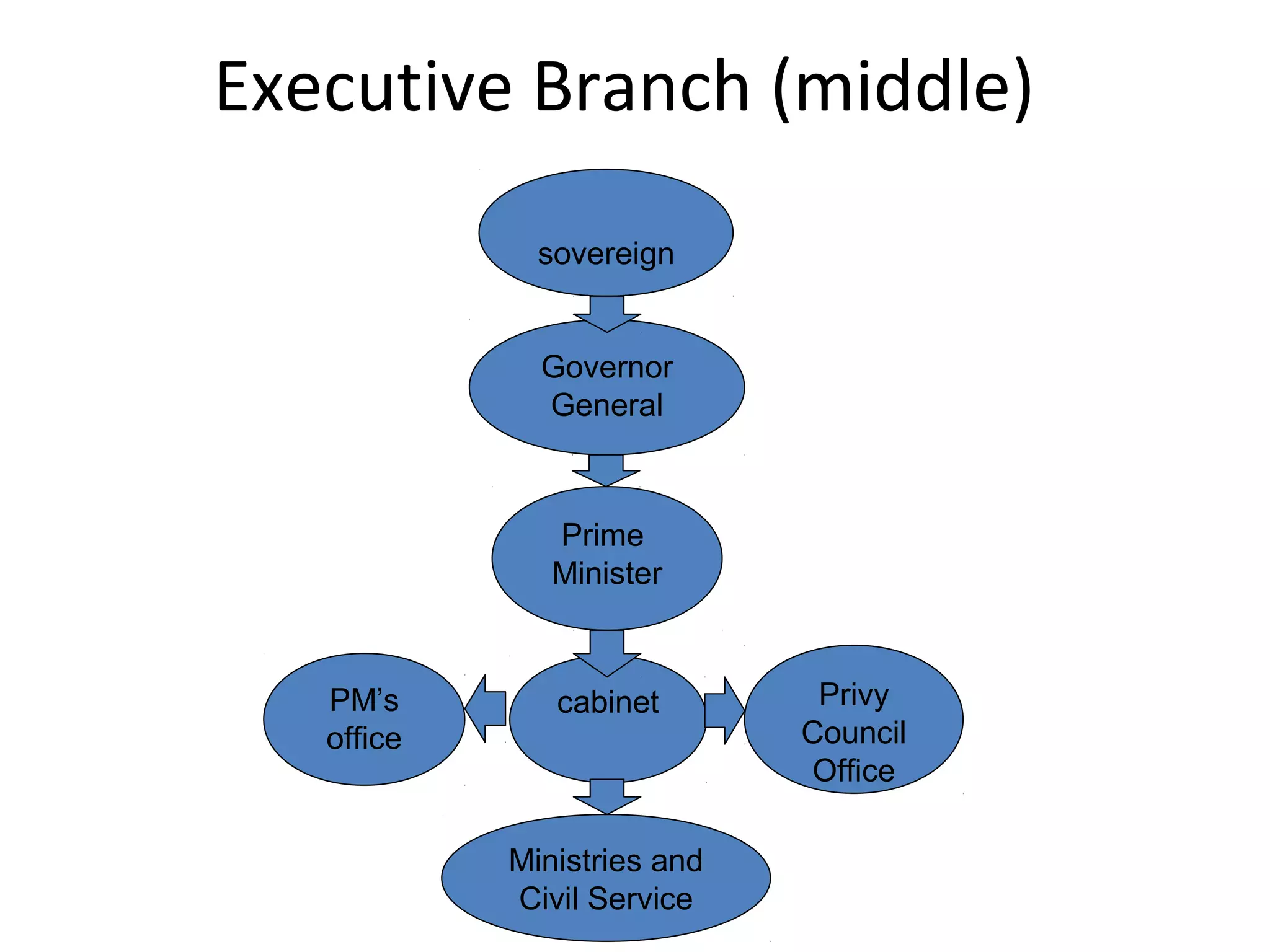
Executive Branch (middle)
sovereign
Governor
General

Prime
Minister

PM’s
office

cabinet

Ministries and
Civil Service

Privy
Council
Office
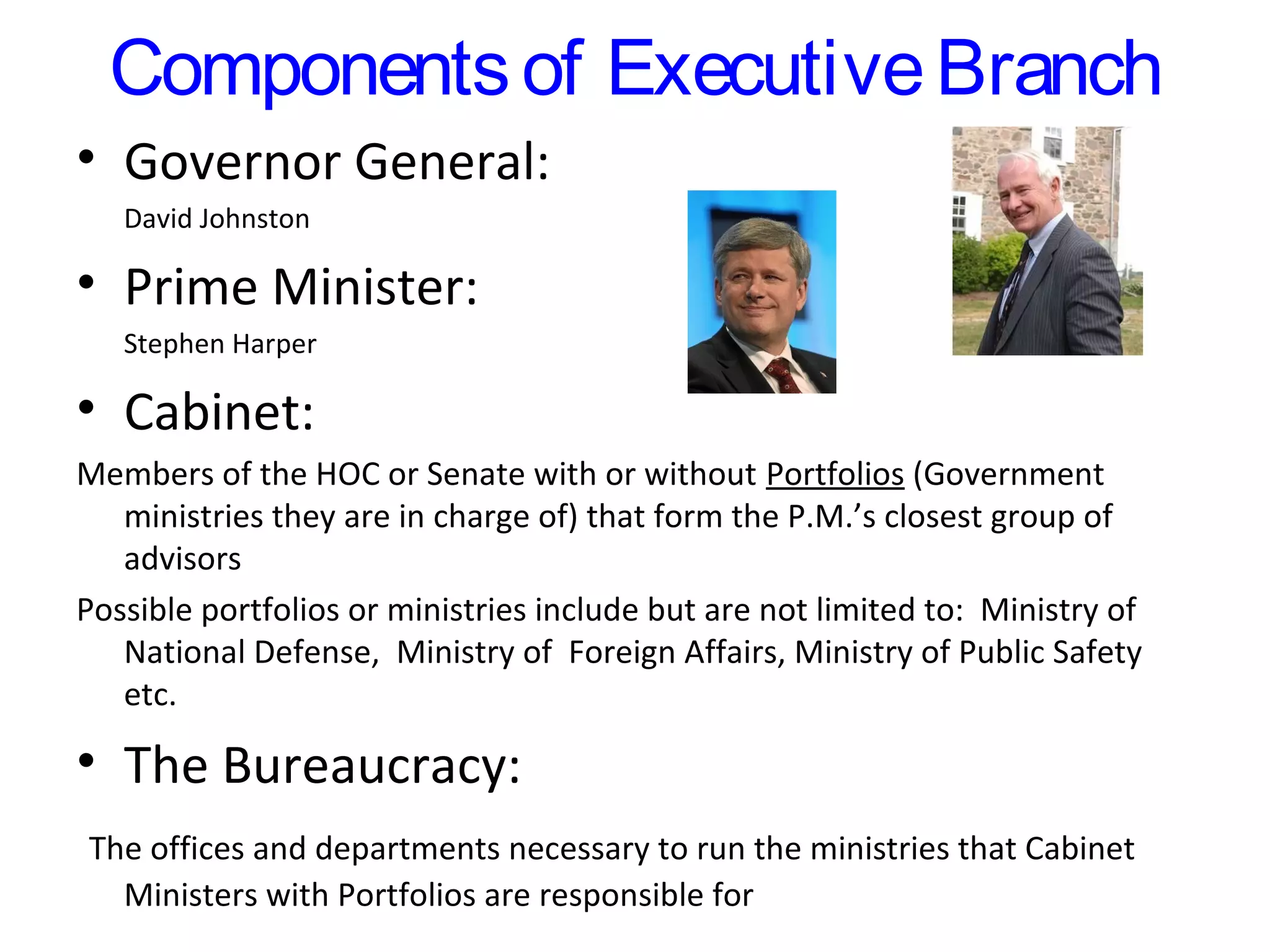
Components of Executive Branch
• Governor General:
David Johnston

• Prime Minister:
Stephen Harper

• Cabinet:
Members of the HOC or Senate with or without Portfolios (Government
ministries they are in charge of) that form the P.M.’s closest group of
advisors
Possible portfolios or ministries include but are not limited to: Ministry of
National Defense, Ministry of Foreign Affairs, Ministry of Public Safety
etc.

• The Bureaucracy:
The offices and departments necessary to run the ministries that Cabinet
Ministers with Portfolios are responsible for
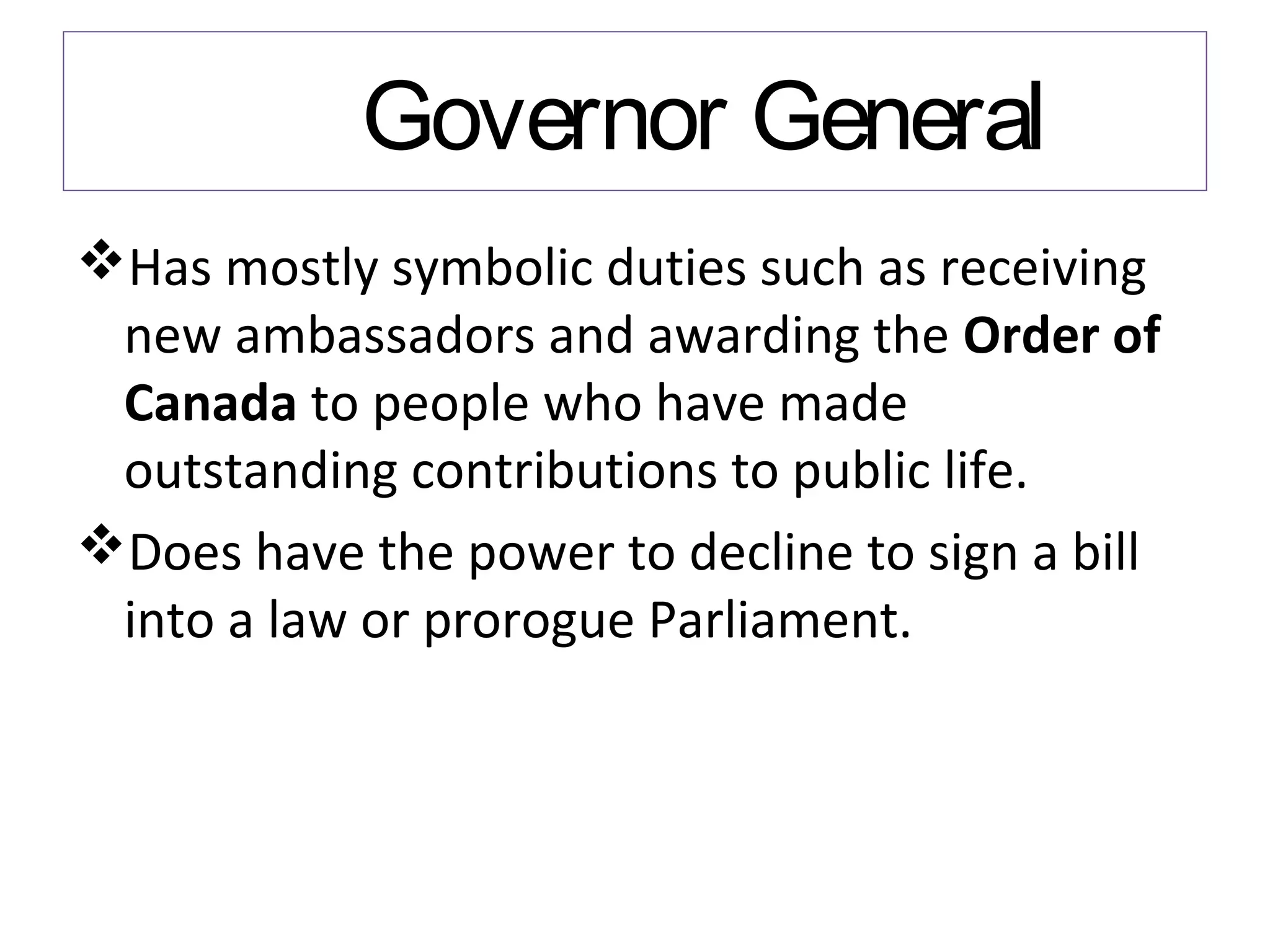
Governor General
Has mostly symbolic duties such as receiving
new ambassadors and awarding the Order of
Canada to people who have made
outstanding contributions to public life.
Does have the power to decline to sign a bill
into a law or prorogue Parliament.
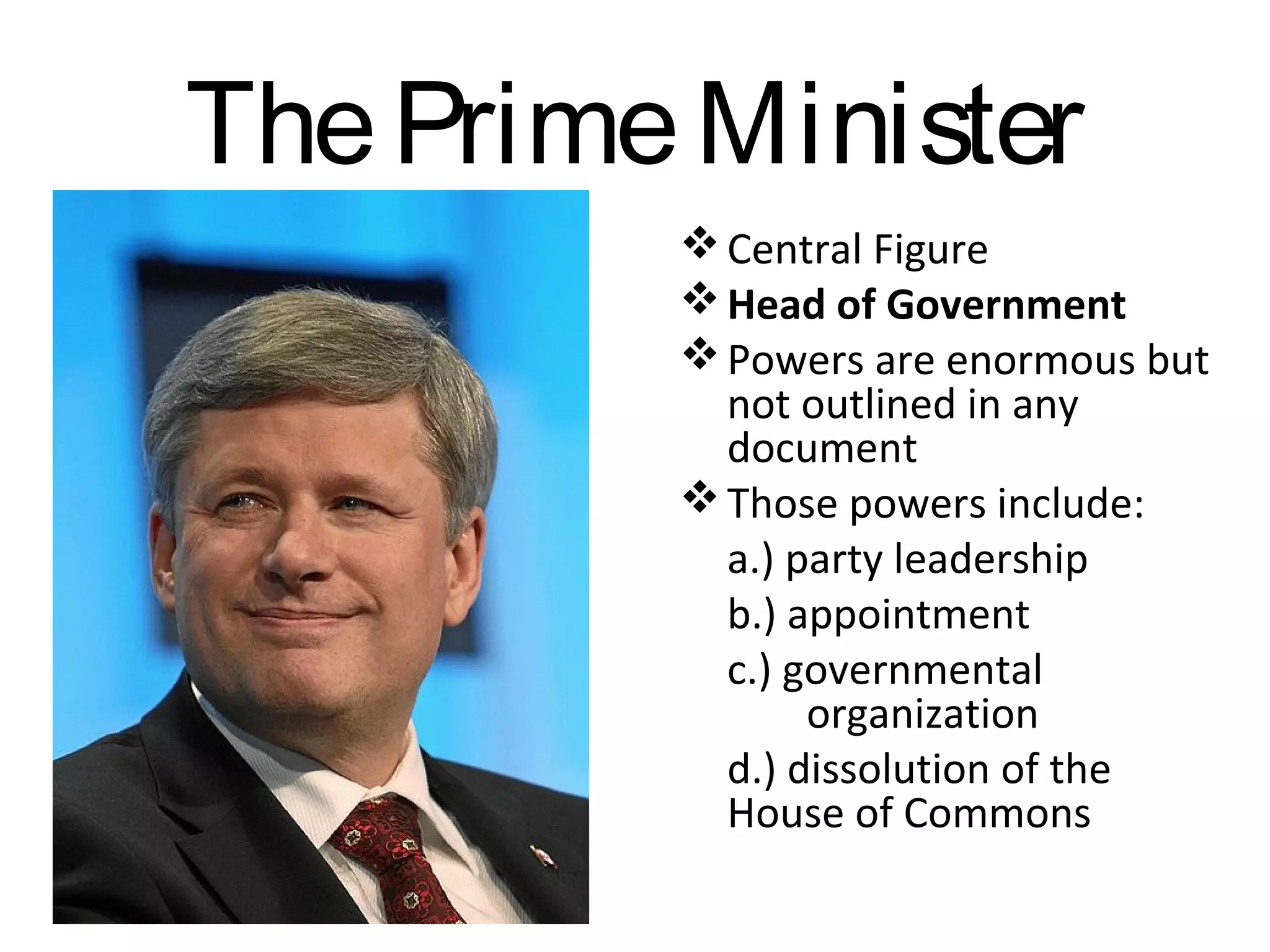
The Prime Minister
 Central Figure
 Head of Government
 Powers are enormous but
not outlined in any
document
 Those powers include:
a.) party leadership
b.) appointment
c.) governmental
organization
d.) dissolution of the
House of Commons
a.) Party Leadership

 The P.M has the power to approve which person from
his own party will run in an election to become an MP in
each riding (constituency, electoral district)
 When a party wins an election, it can be said that the
voters have given that party a mandate to rule the
country
 PM can therefore count on support of his MP’s. This
means that they will all vote the way the leader of the
party votes. This is called Party Solidarity
 The P.M. utilizes caucus meetings (a meeting of
supporters or members of a specific political party or
movement) to iron out issues or disagreements within
the party.
b.) Power of appointment
The P.M. appoints the Governor General
Appoints cabinet members through Governor
General
The P.M. decides the size of the cabinet
Each province is supposed to be represented
in cabinet
All races, genders, minority groups etc. are
meant to be represented, obviously that
poses some challenges.
c.) Government organization
The PM appoints cabinet ministers and has
the power to create or abolish portfolio’s
(ministries)
The P.M. will often pick his most trusted
cabinet members to form an inner cabinet for
every day decision making
Cabinets can be shuffled by the PM to freshen
things up
d.) Power of Dissolution
The PM is able to set the time of election
to their liking, within their five year term
 Government can be dissolved before they
set an election date if they are a minority
government and they are defeated in a
vote of non-confidence
 The government serves a maximum five
year term, before calling an election
Prime Ministers Office
Carry out everyday functions of government
(answer phones, mail, schedules etc.)
Top people in office play important role
Head of PMO known as Principal Secretary =
Good friend to PM
Advise PM on how policies will affect party
popularity
Privy Council Office
Eyes and ears of cabinet
Top figure = Clerk of Privy Council
Very influential
Coordinating meetings and relaying decisions
Provide impartial research and info
The Cabinet
Members of cabinet called ministers are
responsible for portfolio’s
These portfolios are comprised of what we call
ministries (like the Ministry of Transportation)
Cabinets form committees to discuss planning
and priorities
Cabinet members show solidarity to their party
Ministers agree to secrecy regarding meetings
Cabinet Continued…
A key agency linked with the Cabinet is the
Treasury Board (cabinet committee)
Purpose is to monitor budgets of the
government
Another group associated with the Cabinet is
the “Shadow Cabinet.” The Official Opposition
appoints one of their MP’s to “shadow” each of
the Cabinet Ministers responsible for a portfolio
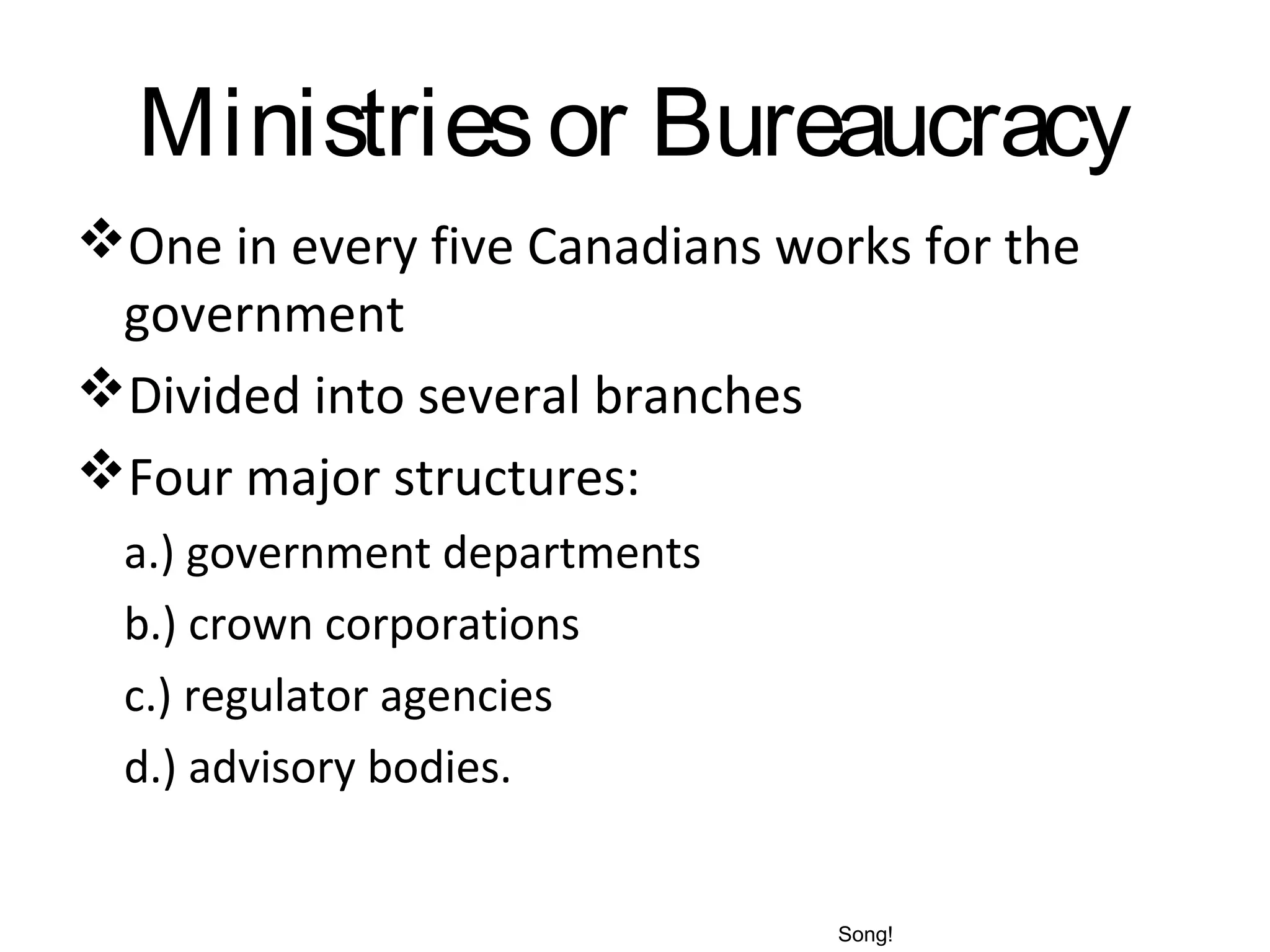
Ministries or Bureaucracy
One in every five Canadians works for the
government
Divided into several branches
Four major structures:
a.) government departments
b.) crown corporations
c.) regulator agencies
d.) advisory bodies.

Song!
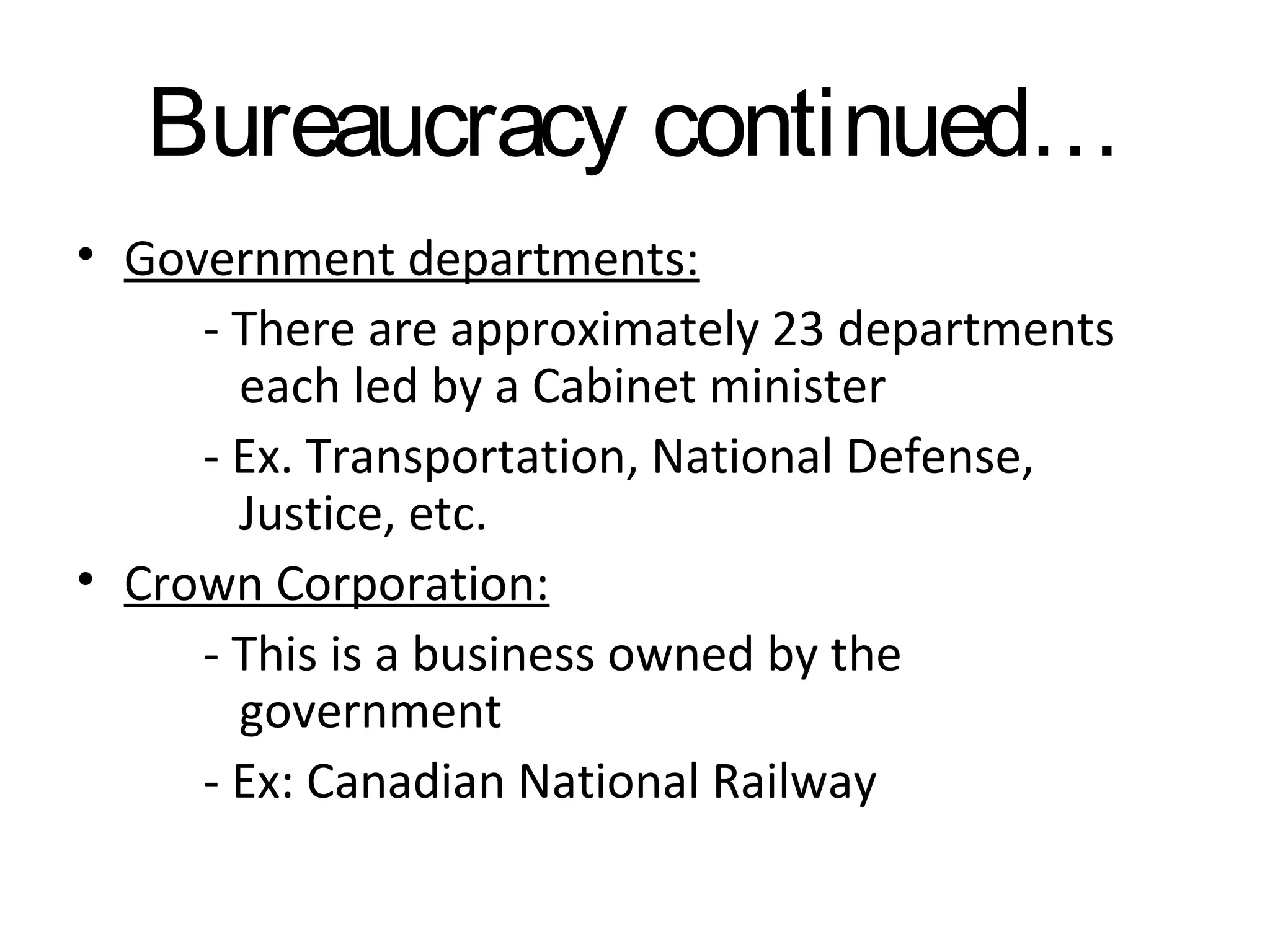
Bureaucracy continued…
• Government departments:
- There are approximately 23 departments
each led by a Cabinet minister
- Ex. Transportation, National Defense,
Justice, etc.
• Crown Corporation:
- This is a business owned by the
government
- Ex: Canadian National Railway
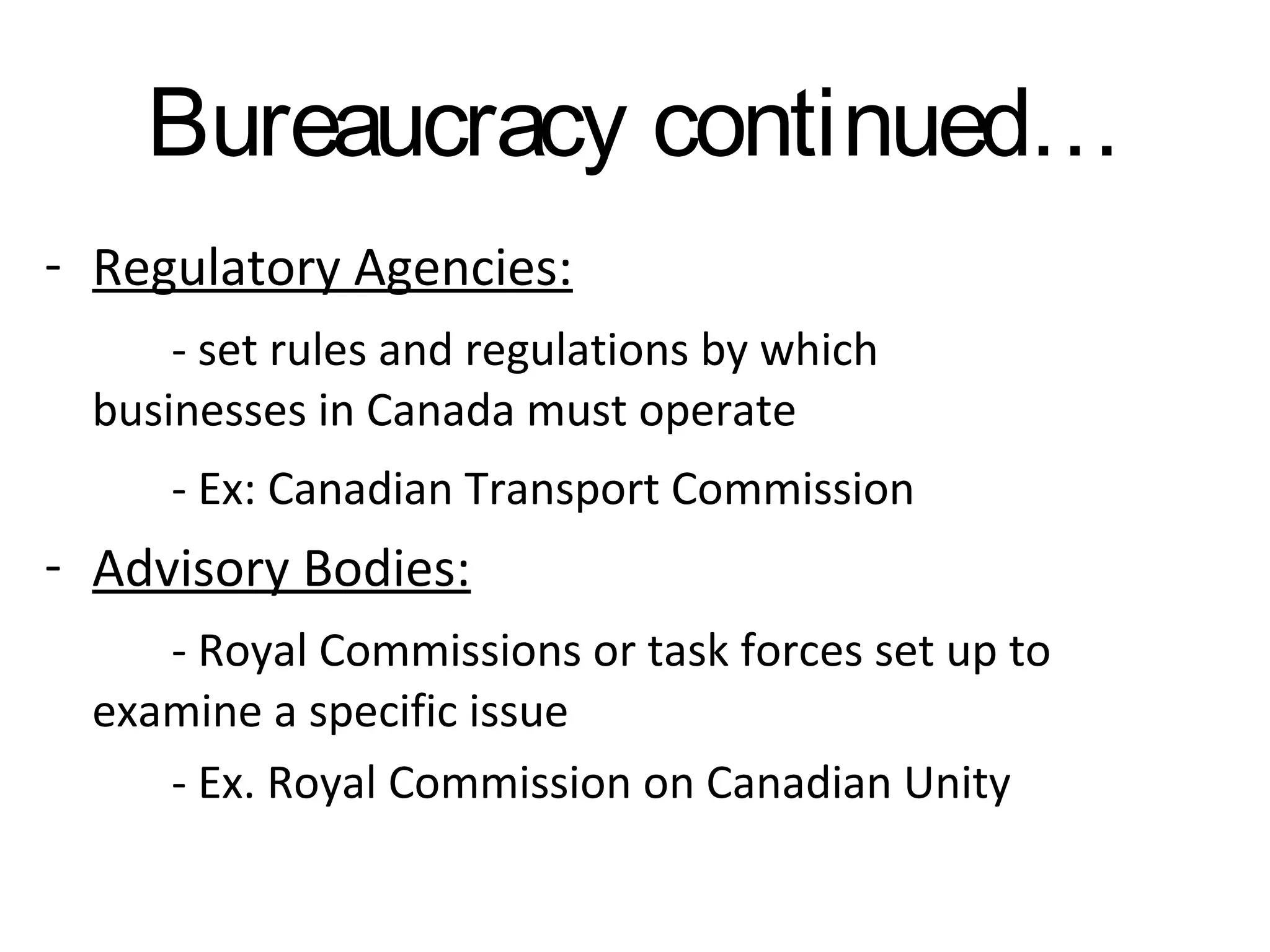
Bureaucracy continued…
- Regulatory Agencies:
- set rules and regulations by which
businesses in Canada must operate
- Ex: Canadian Transport Commission

- Advisory Bodies:
- Royal Commissions or task forces set up to
examine a specific issue
- Ex. Royal Commission on Canadian Unity

1.4 executive branch website

  • 1.
  • 2.
    Components of ExecutiveBranch • Governor General: David Johnston • Prime Minister: Stephen Harper • Cabinet: Members of the HOC or Senate with or without Portfolios (Government ministries they are in charge of) that form the P.M.’s closest group of advisors Possible portfolios or ministries include but are not limited to: Ministry of National Defense, Ministry of Foreign Affairs, Ministry of Public Safety etc. • The Bureaucracy: The offices and departments necessary to run the ministries that Cabinet Ministers with Portfolios are responsible for
  • 3.
    Governor General Has mostlysymbolic duties such as receiving new ambassadors and awarding the Order of Canada to people who have made outstanding contributions to public life. Does have the power to decline to sign a bill into a law or prorogue Parliament.
  • 4.
    The Prime Minister Central Figure  Head of Government  Powers are enormous but not outlined in any document  Those powers include: a.) party leadership b.) appointment c.) governmental organization d.) dissolution of the House of Commons
  • 5.
    a.) Party Leadership The P.M has the power to approve which person from his own party will run in an election to become an MP in each riding (constituency, electoral district)  When a party wins an election, it can be said that the voters have given that party a mandate to rule the country  PM can therefore count on support of his MP’s. This means that they will all vote the way the leader of the party votes. This is called Party Solidarity  The P.M. utilizes caucus meetings (a meeting of supporters or members of a specific political party or movement) to iron out issues or disagreements within the party.
  • 6.
    b.) Power ofappointment The P.M. appoints the Governor General Appoints cabinet members through Governor General The P.M. decides the size of the cabinet Each province is supposed to be represented in cabinet All races, genders, minority groups etc. are meant to be represented, obviously that poses some challenges.
  • 7.
    c.) Government organization ThePM appoints cabinet ministers and has the power to create or abolish portfolio’s (ministries) The P.M. will often pick his most trusted cabinet members to form an inner cabinet for every day decision making Cabinets can be shuffled by the PM to freshen things up
  • 8.
    d.) Power ofDissolution The PM is able to set the time of election to their liking, within their five year term  Government can be dissolved before they set an election date if they are a minority government and they are defeated in a vote of non-confidence  The government serves a maximum five year term, before calling an election
  • 9.
    Prime Ministers Office Carryout everyday functions of government (answer phones, mail, schedules etc.) Top people in office play important role Head of PMO known as Principal Secretary = Good friend to PM Advise PM on how policies will affect party popularity
  • 10.
    Privy Council Office Eyesand ears of cabinet Top figure = Clerk of Privy Council Very influential Coordinating meetings and relaying decisions Provide impartial research and info
  • 11.
    The Cabinet Members ofcabinet called ministers are responsible for portfolio’s These portfolios are comprised of what we call ministries (like the Ministry of Transportation) Cabinets form committees to discuss planning and priorities Cabinet members show solidarity to their party Ministers agree to secrecy regarding meetings
  • 12.
    Cabinet Continued… A keyagency linked with the Cabinet is the Treasury Board (cabinet committee) Purpose is to monitor budgets of the government Another group associated with the Cabinet is the “Shadow Cabinet.” The Official Opposition appoints one of their MP’s to “shadow” each of the Cabinet Ministers responsible for a portfolio
  • 13.
    Ministries or Bureaucracy Onein every five Canadians works for the government Divided into several branches Four major structures: a.) government departments b.) crown corporations c.) regulator agencies d.) advisory bodies. Song!
  • 14.
    Bureaucracy continued… • Governmentdepartments: - There are approximately 23 departments each led by a Cabinet minister - Ex. Transportation, National Defense, Justice, etc. • Crown Corporation: - This is a business owned by the government - Ex: Canadian National Railway
  • 15.
    Bureaucracy continued… - RegulatoryAgencies: - set rules and regulations by which businesses in Canada must operate - Ex: Canadian Transport Commission - Advisory Bodies: - Royal Commissions or task forces set up to examine a specific issue - Ex. Royal Commission on Canadian Unity