Search Here..
Soumik Kar
Interview
How To Spot A
100-Bagger
Raamdeo Agrawal of Motilal
Oswal Financial Services, on what
it takes to identify a stock that will
go up multi-fold
Jitendra Kumar Gupta
"In a given timeframe, 100X investment opportunities are much more widely available than 100X stock ideas" —
Raamdeo Agrawal, co-founder and joint managing director, Motilal Oswal Financial Services 
Home  /  Markets  /  Interview  / How to spot a 100-bagger | FEB 06 , 2015
How did you zero in on the concept of a 100-bagger? Why did you choose to make it the subject
of your wealth creation study?
This report would most likely have been titled ‘demystifying growth’. But then we came across the book
100 to 1 in the Stock Market by Thomas W Phelps, who is described as a private investor, columnist,
analyst, author and financial advisor. Written in 1972, the book makes a strong case for investors to
“buy right and hold on”. It offers examples of how over 365 stocks in the US appreciated 100 times or
more over the 40-year period ending 1971. 
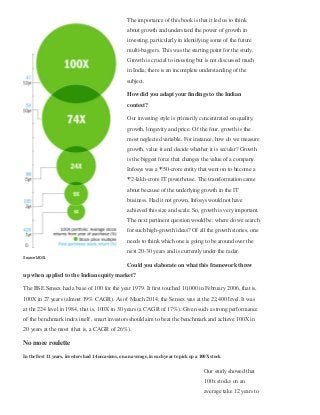
12 years a slave
In India, the average 100X period is 12 years, stocks delivered handsome interim-period returns as well
    SIGN IN | SUBSCRIBE
The importance of this book is that it led us to think
about growth and understand the power of growth in
investing, particularly in identifying some of the future
multi-baggers. This was the starting point for the study.
Growth is crucial to investing but is not discussed much
in India; there is an incomplete understanding of the
subject.
How did you adapt your findings to the Indian
context? 
Our investing style is primarily concentrated on quality,
growth, longevity and price. Of the four, growth is the
most neglected variable. For instance, how do we measure
growth, value it and decide whether it is secular? Growth
is the biggest force that changes the value of a company.
Infosys was a ₹50-crore entity that went on to become a
₹2-lakh-crore IT powerhouse. The transformation came
about because of the underlying growth in the IT
business. Had it not grown, Infosys would not have
achieved this size and scale. So, growth is very important.
The next pertinent question would be: where do we search
for such high-growth ideas? Of all the growth stories, one
needs to think which one is going to be around over the
next 20-30 years and is currently under the radar.
Could you elaborate on what this framework threw
up when applied to the Indian equity market?
The BSE Sensex had a base of 100 for the year 1979. It first touched 10,000 in February 2006, that is,
100X in 27 years (almost 19% CAGR). As of March 2014, the Sensex was at the 22,400 level. It was
at the 224 level in 1984, that is, 100X in 30 years (a CAGR of 17%). Given such a strong performance
of the benchmark index itself, smart investors should aim to beat the benchmark and achieve 100X in
20 years at the most (that is, a CAGR of 26%). 
No more roulette
In the first 11 years, investors had 14 occasions, on an average, in each year to pick up a 100X stock
Our study showed that
100x stocks on an
average take 12 years to
Source: MOSL
rise hundredfold, that
is, a 47% return CAGR,
and in a given
timeframe, 100X
investment
opportunities are much
more widely available
than 100X investment
ideas. If 100X takes 50
years, the effective annual return is only 10%; if it takes 40 years, the figure would be 12%. In the
Indian context, the long-period return of the benchmark indices is around 17%.
Thus, if a stock takes more than 30 years to rise hundredfold, it would most likely end up
underperforming the market. Given this, even investors with long-term outlook should reject such slow-
growth 100X ideas. Hence, we believe that the single-most important determinant of stock market
return is growth in all its dimensions — sales, margin and valuation.
What makes a 100-bagger?
Mathematically, sales volume growth multiplied by sales price growth multiplied by margin, and
valuations expansion is the possible source of a 100-bagger. Simply put, growth in share price will be
directly influenced by growth in sales volumes and sales price, along with expansion in margins and
valuations. If all these things happen simultaneously, it could be a huge game-changer. It is possible for
a smaller company to grow its sales by 20-25% annually. However, sales turnover cannot be seen in
isolation. If a stock is trading at 30X and margins are going to double, for me it is a 15 PE stock. 
Gimme five
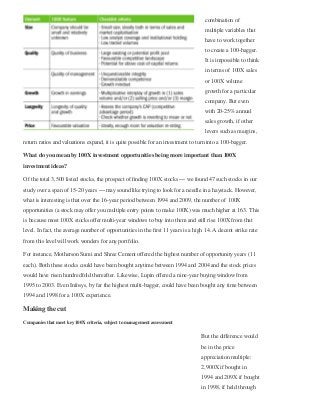
The essence of 100X stocks lies in the alchemy of the following five elements
We now know what
margins can do to
valuations. Similarly, if
a stock is currently
trading at 10X and
after a few years starts
to trade at 30X, one
can imagine what
impact valuations could
have on a higher
earnings base. It is a
Source: MOSL
combination of
multiple variables that
have to work together
to create a 100-bagger.
It is impossible to think
in terms of 100X sales
or 100X volume
growth for a particular
company. But even
with 20-25% annual
sales growth, if other
levers such as margins,
return ratios and valuations expand, it is quite possible for an investment to turn into a 100-bagger.
What do you mean by 100X investment opportunities being more important than 100X
investment ideas?
Of the total 3,500 listed stocks, the prospect of finding 100X stocks — we found 47 such stocks in our
study over a span of 15-20 years — may sound like trying to look for a needle in a haystack. However,
what is interesting is that over the 16-year period between 1994 and 2009, the number of 100X
opportunities (a stock may offer you multiple entry points to make 100X) was much higher at 163. This
is because most 100X stocks offer multi-year windows to buy into them and still rise 100X from that
level. In fact, the average number of opportunities in the first 11 years is a high 14. A decent strike rate
from this level will work wonders for any portfolio.
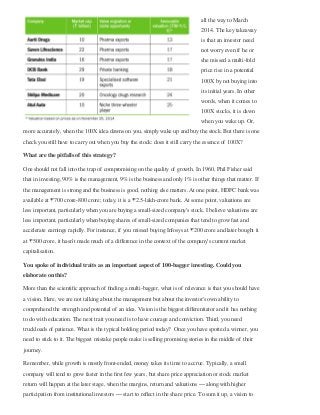
For instance, Motherson Sumi and Shree Cement offered the highest number of opportunity years (11
each). Both these stocks could have been bought anytime between 1994 and 2004 and the stock prices
would have risen hundredfold thereafter. Likewise, Lupin offered a nine-year buying window from
1995 to 2003. Even Infosys, by far the highest multi-bagger, could have been bought any time between
1994 and 1998 for a 100X experience. 
Making the cut
Companies that meet key 100X criteria, subject to management assessment
But the difference would
be in the price
appreciation multiple:
2,900X if bought in
1994 and 209X if bought
in 1998, if held through
all the way to March
2014. The key takeaway
is that an investor need
not worry even if he or
she missed a multi-fold
price rise in a potential
100X by not buying into
its initial years. In other
words, when it comes to
100X stocks, it is dawn
when you wake up. Or,
more accurately, when the 100X idea dawns on you, simply wake up and buy the stock. But there is one
check you still have to carry out when you buy the stock: does it still carry the essence of 100X?
What are the pitfalls of this strategy?
One should not fall into the trap of compromising on the quality of growth. In 1960, Phil Fisher said
that in investing, 90% is the management, 9% is the business and only 1% is other things that matter. If
the management is strong and the business is good, nothing else matters. At one point, HDFC bank was
available at ₹700 crore-800 crore; today, it is a ₹2.5-lakh-crore bank. At some point, valuations are
less important, particularly when you are buying a small-sized company’s stock. I believe valuations are
less important, particularly when buying shares of small-sized companies that tend to grow fast and
accelerate earnings rapidly. For instance, if you missed buying Infosys at ₹200 crore and later bought it
at ₹500 crore, it hasn’t made much of a difference in the context of the company’s current market
capitalisation. 
You spoke of individual traits as an important aspect of 100-bagger investing. Could you
elaborate on this? 
More than the scientific approach of finding a multi-bagger, what is of relevance is that you should have
a vision. Here, we are not talking about the management but about the investor’s own ability to
comprehend the strength and potential of an idea. Vision is the biggest differentiator and it has nothing
to do with education. The next trait you need is to have courage and conviction. Third, you need
truckloads of patience. What is the typical holding period today?  Once you have spotted a winner, you
need to stick to it. The biggest mistake people make is selling promising stories in the middle of their
journey.
Remember, while growth is mostly front-ended, money takes its time to accrue. Typically, a small
company will tend to grow faster in the first few years, but share price appreciation or stock market
return will happen at the later stage, when the margins, return and valuations — along with higher
participation from institutional investors — start to reflect in the share price. To sum it up, a vision to
comprehend, courage to buy and the patience to hold are the key individual traits that investors need to
have to reap the 100X opportunity. 
Here's your chance to read the latest issue of Outlook Business for free! Download the
Outlook Magazines app now. Available on Play Store and App Store
RAAMDEO AGRAWAL MOTILAL OSWAL FINANCIAL SERVICES 100 TO 1 IN THE STOCK MARKET
THOMAS W PHELPS INFOSYS MOTHERSON SUMI SHREE CEMENT HDFC BANK
More From Interview
‘Elections are won with local
leaders, PM is often a
surprise’
“Look out for companies
aspiring to dominate niche
businesses”
"Real estate is the most
effective way to capture the
growth of the middle class"
0 Comments Outlook Business Login

1
t Tweet f Share Sort by Best
LOG IN WITH
OR SIGN UP WITH DISQUS
Name
Start the discussion…
?
Be the first to comment.
Subscribe
✉ Add Disqus to your site
d Disqus' Privacy Policy
🔒
Recommend
 2
"Indian yields unattractive in
the short term"
India yet to reform under
Modi, China a better
investment bet
"Watching news channels
hourly will not yield
anything"
More From Interview
1
‘Elections are won with local leaders, PM
is often a surprise’
2
“Look out for companies aspiring to
dominate niche businesses”
3
"Real estate is the most effective way to
capture the growth of the middle class"
4
"Indian yields unattractive in the short
term"
5
India yet to reform under Modi, China a
better investment bet
6
"Watching news channels hourly will not
yield anything"
On Stands Now
Scorecard Points table Schedule
June 28, 2019
203/10(49.3)
Sri Lanka
78/1(14.5)
South Africa
BATTING South Africa
Hashim Amla 41 (41)
Faf du Plessis 18 (32)
BOWLING Sri Lanka
Suranga Lakmal 3.5-0-20-0
Jeevan Mendis 1.0-0-3-0
Match 35, at Chester-le-Street
Editor's Pick
1
"To make this market exuberant enough for a bust will take considerably higher prices"
2
"Companies that maximise per share value, even if they don't grow will be great bets"
Most Popular
Twitter
3
"Once we get over all this macho 'I can do everything on my own' nonsense, Life is much better"
4
"Engines of 'influence' work exactly the way power flows when you flip a switch"
5
"You want to see a business model that makes sense now; it is hard to change later on"
1
“Every crisis is also an opportunity”
2
The Globetrotters
3
"No matter how sincere your efforts though, the competition will never let go of things easily"
4
Fashionably Forward
5
“If you are dispassionate, you'll win — that's my greatest lesson from Bhagwad Gita”
Embed View on Twitter
Tweets by @OutlookBusiness
Jun 27, 2019
.@India_Yamaha plans to bulk up its India revenue by going beyond #150cc.
To find out about the new #Yamaha models coming your way, click here: bit.ly/YamahaIndia
#motorcycles
Outlook Business
@OutlookBusiness
Print Edition
May 10, 2019
Table of contents
Apr 26, 2019
Table of contents
Apr 12, 2019
Table of contents
Mar 29, 2019
Table of contents

THE BIG STORY SPECIALS PERSPECTIVE PIXTORY ENTERPRISE STRATEGY MARKETS C'EST LA VIE
SUBSCRIBE
Copyright © 2019 Outlook Business!. All pages of the Website are subject to our terms and conditions and privacy policy. You must not
reproduce, duplicate, copy, sell, resell or exploit any material on the Website for any commercial purposes.

Art and Science of spotting a 100-bagger

  • 1.
    Search Here.. Soumik Kar Interview HowTo Spot A 100-Bagger Raamdeo Agrawal of Motilal Oswal Financial Services, on what it takes to identify a stock that will go up multi-fold Jitendra Kumar Gupta "In a given timeframe, 100X investment opportunities are much more widely available than 100X stock ideas" — Raamdeo Agrawal, co-founder and joint managing director, Motilal Oswal Financial Services  Home  /  Markets  /  Interview  / How to spot a 100-bagger | FEB 06 , 2015 How did you zero in on the concept of a 100-bagger? Why did you choose to make it the subject of your wealth creation study? This report would most likely have been titled ‘demystifying growth’. But then we came across the book 100 to 1 in the Stock Market by Thomas W Phelps, who is described as a private investor, columnist, analyst, author and financial advisor. Written in 1972, the book makes a strong case for investors to “buy right and hold on”. It offers examples of how over 365 stocks in the US appreciated 100 times or more over the 40-year period ending 1971.  12 years a slave In India, the average 100X period is 12 years, stocks delivered handsome interim-period returns as well     SIGN IN | SUBSCRIBE
  • 2.
    The importance ofthis book is that it led us to think about growth and understand the power of growth in investing, particularly in identifying some of the future multi-baggers. This was the starting point for the study. Growth is crucial to investing but is not discussed much in India; there is an incomplete understanding of the subject. How did you adapt your findings to the Indian context?  Our investing style is primarily concentrated on quality, growth, longevity and price. Of the four, growth is the most neglected variable. For instance, how do we measure growth, value it and decide whether it is secular? Growth is the biggest force that changes the value of a company. Infosys was a ₹50-crore entity that went on to become a ₹2-lakh-crore IT powerhouse. The transformation came about because of the underlying growth in the IT business. Had it not grown, Infosys would not have achieved this size and scale. So, growth is very important. The next pertinent question would be: where do we search for such high-growth ideas? Of all the growth stories, one needs to think which one is going to be around over the next 20-30 years and is currently under the radar. Could you elaborate on what this framework threw up when applied to the Indian equity market? The BSE Sensex had a base of 100 for the year 1979. It first touched 10,000 in February 2006, that is, 100X in 27 years (almost 19% CAGR). As of March 2014, the Sensex was at the 22,400 level. It was at the 224 level in 1984, that is, 100X in 30 years (a CAGR of 17%). Given such a strong performance of the benchmark index itself, smart investors should aim to beat the benchmark and achieve 100X in 20 years at the most (that is, a CAGR of 26%).  No more roulette In the first 11 years, investors had 14 occasions, on an average, in each year to pick up a 100X stock Our study showed that 100x stocks on an average take 12 years to Source: MOSL
  • 3.
    rise hundredfold, that is,a 47% return CAGR, and in a given timeframe, 100X investment opportunities are much more widely available than 100X investment ideas. If 100X takes 50 years, the effective annual return is only 10%; if it takes 40 years, the figure would be 12%. In the Indian context, the long-period return of the benchmark indices is around 17%. Thus, if a stock takes more than 30 years to rise hundredfold, it would most likely end up underperforming the market. Given this, even investors with long-term outlook should reject such slow- growth 100X ideas. Hence, we believe that the single-most important determinant of stock market return is growth in all its dimensions — sales, margin and valuation. What makes a 100-bagger? Mathematically, sales volume growth multiplied by sales price growth multiplied by margin, and valuations expansion is the possible source of a 100-bagger. Simply put, growth in share price will be directly influenced by growth in sales volumes and sales price, along with expansion in margins and valuations. If all these things happen simultaneously, it could be a huge game-changer. It is possible for a smaller company to grow its sales by 20-25% annually. However, sales turnover cannot be seen in isolation. If a stock is trading at 30X and margins are going to double, for me it is a 15 PE stock.  Gimme five The essence of 100X stocks lies in the alchemy of the following five elements We now know what margins can do to valuations. Similarly, if a stock is currently trading at 10X and after a few years starts to trade at 30X, one can imagine what impact valuations could have on a higher earnings base. It is a Source: MOSL
  • 4.
    combination of multiple variablesthat have to work together to create a 100-bagger. It is impossible to think in terms of 100X sales or 100X volume growth for a particular company. But even with 20-25% annual sales growth, if other levers such as margins, return ratios and valuations expand, it is quite possible for an investment to turn into a 100-bagger. What do you mean by 100X investment opportunities being more important than 100X investment ideas? Of the total 3,500 listed stocks, the prospect of finding 100X stocks — we found 47 such stocks in our study over a span of 15-20 years — may sound like trying to look for a needle in a haystack. However, what is interesting is that over the 16-year period between 1994 and 2009, the number of 100X opportunities (a stock may offer you multiple entry points to make 100X) was much higher at 163. This is because most 100X stocks offer multi-year windows to buy into them and still rise 100X from that level. In fact, the average number of opportunities in the first 11 years is a high 14. A decent strike rate from this level will work wonders for any portfolio. For instance, Motherson Sumi and Shree Cement offered the highest number of opportunity years (11 each). Both these stocks could have been bought anytime between 1994 and 2004 and the stock prices would have risen hundredfold thereafter. Likewise, Lupin offered a nine-year buying window from 1995 to 2003. Even Infosys, by far the highest multi-bagger, could have been bought any time between 1994 and 1998 for a 100X experience.  Making the cut Companies that meet key 100X criteria, subject to management assessment But the difference would be in the price appreciation multiple: 2,900X if bought in 1994 and 209X if bought in 1998, if held through
  • 5.
    all the wayto March 2014. The key takeaway is that an investor need not worry even if he or she missed a multi-fold price rise in a potential 100X by not buying into its initial years. In other words, when it comes to 100X stocks, it is dawn when you wake up. Or, more accurately, when the 100X idea dawns on you, simply wake up and buy the stock. But there is one check you still have to carry out when you buy the stock: does it still carry the essence of 100X? What are the pitfalls of this strategy? One should not fall into the trap of compromising on the quality of growth. In 1960, Phil Fisher said that in investing, 90% is the management, 9% is the business and only 1% is other things that matter. If the management is strong and the business is good, nothing else matters. At one point, HDFC bank was available at ₹700 crore-800 crore; today, it is a ₹2.5-lakh-crore bank. At some point, valuations are less important, particularly when you are buying a small-sized company’s stock. I believe valuations are less important, particularly when buying shares of small-sized companies that tend to grow fast and accelerate earnings rapidly. For instance, if you missed buying Infosys at ₹200 crore and later bought it at ₹500 crore, it hasn’t made much of a difference in the context of the company’s current market capitalisation.  You spoke of individual traits as an important aspect of 100-bagger investing. Could you elaborate on this?  More than the scientific approach of finding a multi-bagger, what is of relevance is that you should have a vision. Here, we are not talking about the management but about the investor’s own ability to comprehend the strength and potential of an idea. Vision is the biggest differentiator and it has nothing to do with education. The next trait you need is to have courage and conviction. Third, you need truckloads of patience. What is the typical holding period today?  Once you have spotted a winner, you need to stick to it. The biggest mistake people make is selling promising stories in the middle of their journey. Remember, while growth is mostly front-ended, money takes its time to accrue. Typically, a small company will tend to grow faster in the first few years, but share price appreciation or stock market return will happen at the later stage, when the margins, return and valuations — along with higher participation from institutional investors — start to reflect in the share price. To sum it up, a vision to
  • 6.
    comprehend, courage tobuy and the patience to hold are the key individual traits that investors need to have to reap the 100X opportunity.  Here's your chance to read the latest issue of Outlook Business for free! Download the Outlook Magazines app now. Available on Play Store and App Store RAAMDEO AGRAWAL MOTILAL OSWAL FINANCIAL SERVICES 100 TO 1 IN THE STOCK MARKET THOMAS W PHELPS INFOSYS MOTHERSON SUMI SHREE CEMENT HDFC BANK More From Interview ‘Elections are won with local leaders, PM is often a surprise’ “Look out for companies aspiring to dominate niche businesses” "Real estate is the most effective way to capture the growth of the middle class" 0 Comments Outlook Business Login  1 t Tweet f Share Sort by Best LOG IN WITH OR SIGN UP WITH DISQUS Name Start the discussion… ? Be the first to comment. Subscribe ✉ Add Disqus to your site d Disqus' Privacy Policy 🔒 Recommend  2
  • 7.
    "Indian yields unattractivein the short term" India yet to reform under Modi, China a better investment bet "Watching news channels hourly will not yield anything" More From Interview 1 ‘Elections are won with local leaders, PM is often a surprise’ 2 “Look out for companies aspiring to dominate niche businesses” 3 "Real estate is the most effective way to capture the growth of the middle class" 4 "Indian yields unattractive in the short term" 5 India yet to reform under Modi, China a better investment bet 6 "Watching news channels hourly will not yield anything"
  • 8.
    On Stands Now ScorecardPoints table Schedule June 28, 2019 203/10(49.3) Sri Lanka 78/1(14.5) South Africa BATTING South Africa Hashim Amla 41 (41) Faf du Plessis 18 (32) BOWLING Sri Lanka Suranga Lakmal 3.5-0-20-0 Jeevan Mendis 1.0-0-3-0 Match 35, at Chester-le-Street Editor's Pick 1 "To make this market exuberant enough for a bust will take considerably higher prices" 2 "Companies that maximise per share value, even if they don't grow will be great bets"
  • 9.
    Most Popular Twitter 3 "Once weget over all this macho 'I can do everything on my own' nonsense, Life is much better" 4 "Engines of 'influence' work exactly the way power flows when you flip a switch" 5 "You want to see a business model that makes sense now; it is hard to change later on" 1 “Every crisis is also an opportunity” 2 The Globetrotters 3 "No matter how sincere your efforts though, the competition will never let go of things easily" 4 Fashionably Forward 5 “If you are dispassionate, you'll win — that's my greatest lesson from Bhagwad Gita”
  • 10.
    Embed View onTwitter Tweets by @OutlookBusiness Jun 27, 2019 .@India_Yamaha plans to bulk up its India revenue by going beyond #150cc. To find out about the new #Yamaha models coming your way, click here: bit.ly/YamahaIndia #motorcycles Outlook Business @OutlookBusiness Print Edition May 10, 2019 Table of contents Apr 26, 2019 Table of contents Apr 12, 2019 Table of contents Mar 29, 2019 Table of contents
  • 11.
    THE BIG STORYSPECIALS PERSPECTIVE PIXTORY ENTERPRISE STRATEGY MARKETS C'EST LA VIE SUBSCRIBE Copyright © 2019 Outlook Business!. All pages of the Website are subject to our terms and conditions and privacy policy. You must not reproduce, duplicate, copy, sell, resell or exploit any material on the Website for any commercial purposes.