Top 10 game dev legal
mistakes (in 20 minutes)
Jas Purewal
Rezzed, 12 March 2015
What we’ll discuss
2
1. The top 10 game dev legal mistakes
2. Why you shouldn’t do them
3. How not to do them
4. Seriously, don’t
5. Bye!
About me
3
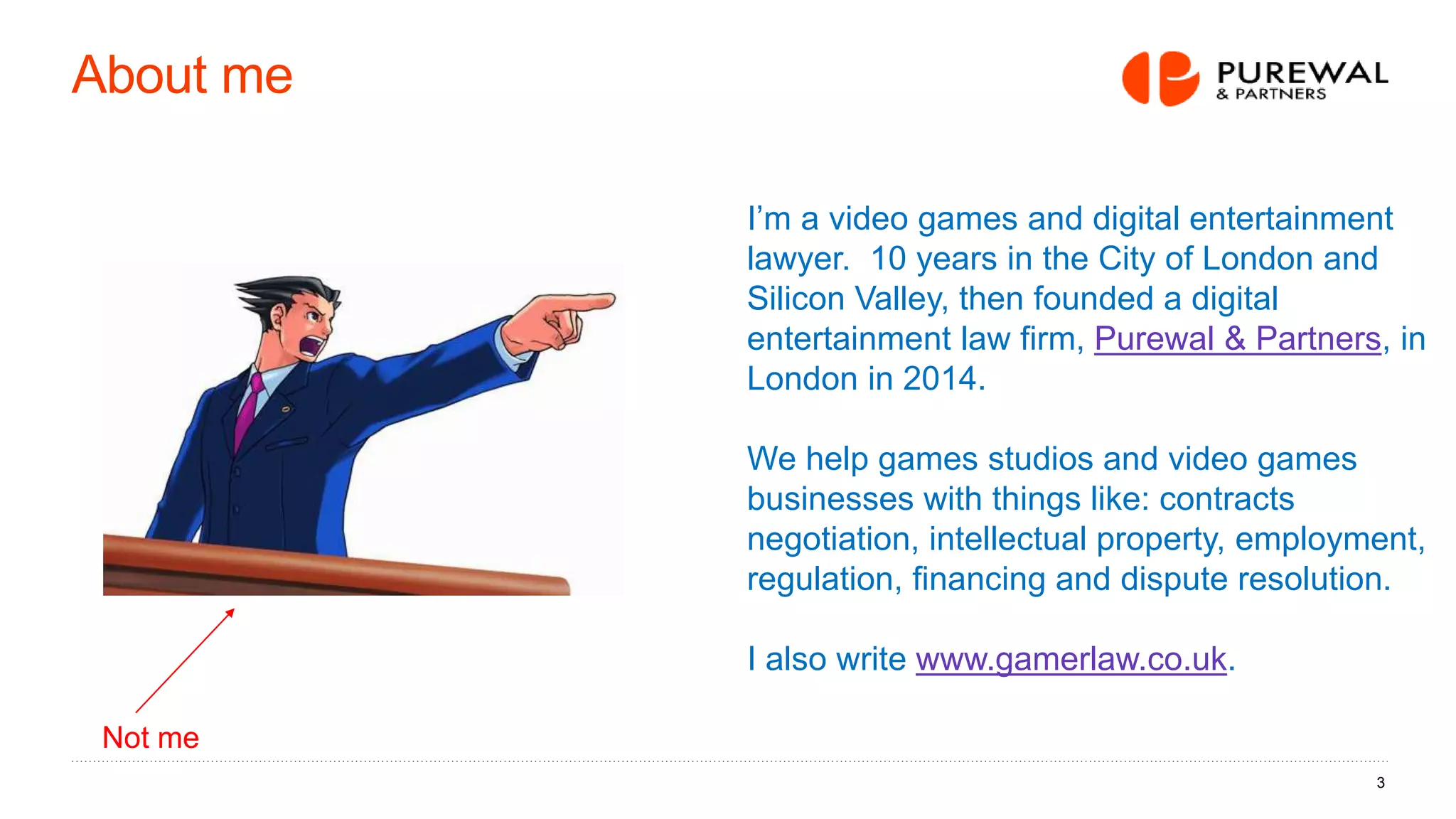
I’m a video games and digital entertainment
lawyer. 10 years in the City of London and
Silicon Valley, then founded a digital
entertainment law firm, Purewal & Partners, in
London in 2014.
We help games studios and video games
businesses with things like: contracts
negotiation, intellectual property, employment,
regulation, financing and dispute resolution.
I also write www.gamerlaw.co.uk.
Not me
Clients
4
1: Contracts are a waste of time
Why devs might think so:
Contracts are complicated and are full of
things only lawyers might understand.
Why that’s a mistake:
• A contract is just a document explaining
what both sides get.
• It’s your best chance to make sure you
get what your studio needs but doesn’t
give too much away.
Tip: use contracts whenever possible. Get a
working understanding of them. Ask other
devs and lawyers about them.
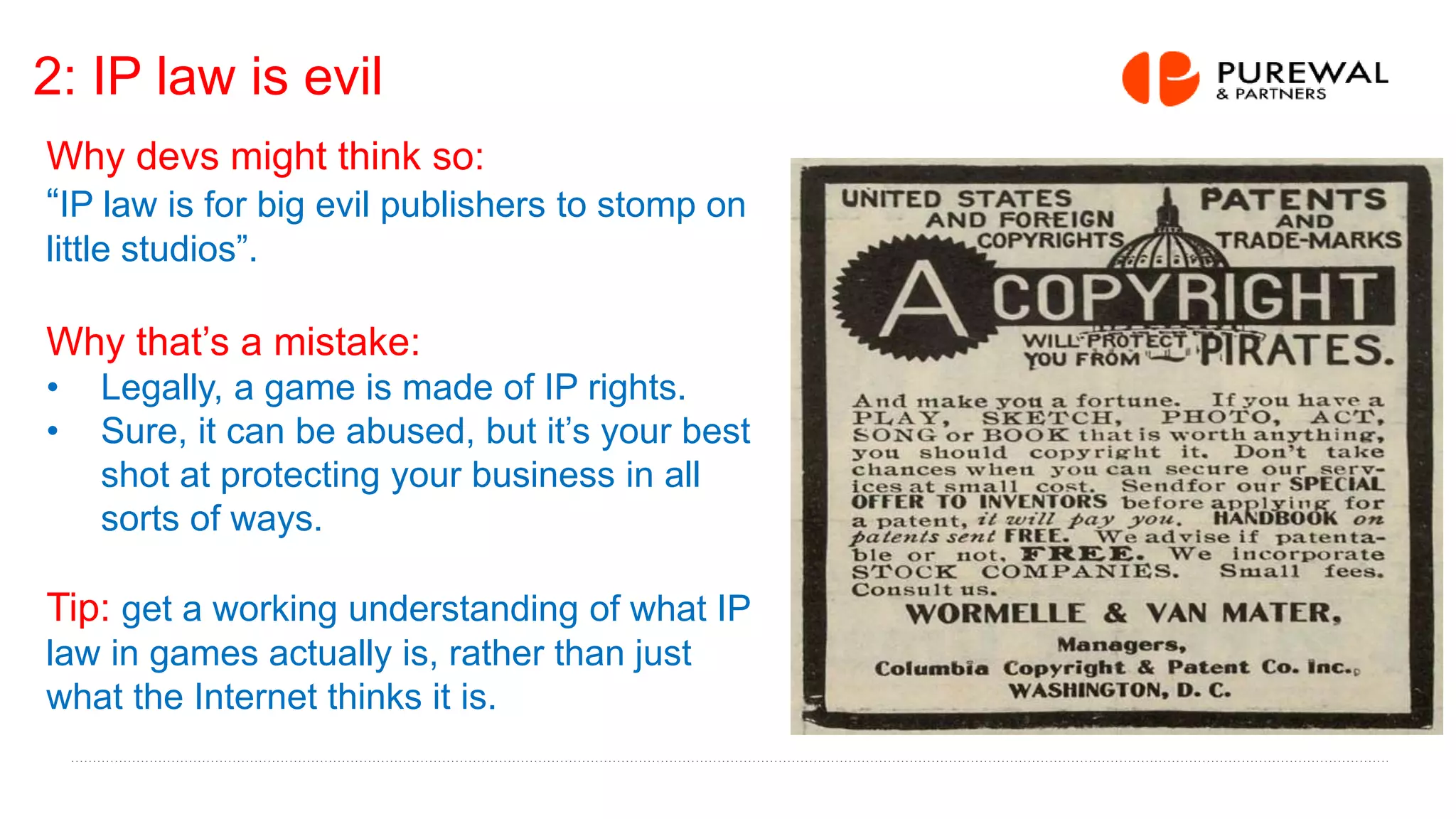
2: IP law is evil
Why devs might think so:
“IP law is for big evil publishers to stomp on
little studios”.
Why that’s a mistake:
• Legally, a game is made of IP rights.
• Sure, it can be abused, but it’s your best
shot at protecting your business in all
sorts of ways.
Tip: get a working understanding of what IP
law in games actually is, rather than just
what the Internet thinks it is.
3: T&Cs are pointless
Why devs might think so:
“Everyone just ticks the box and ignores it.”
Why that’s a mistake:
• T&Cs are your way to tell your users
what’s OK and what’s not.
• It helps protect your business and
communicate with your users.
• Still legally effective if not fully read!
Tip: there is no earthly reason not to have
T&Cs. They don’t have to be stuffed full of
legalese, but they should exist.
4: Data privacy: not a dev problem
Why devs might think so:
“Our games don’t collect on any data!”
Why that’s a mistake:
• All studios do.
• Regulators in UK/US/EU are actively
looking at games studios’ use of data.
Tip: get a privacy policy and cookie policy.
Register with local data privacy regulator (if
applicable). “Privacy by design”.
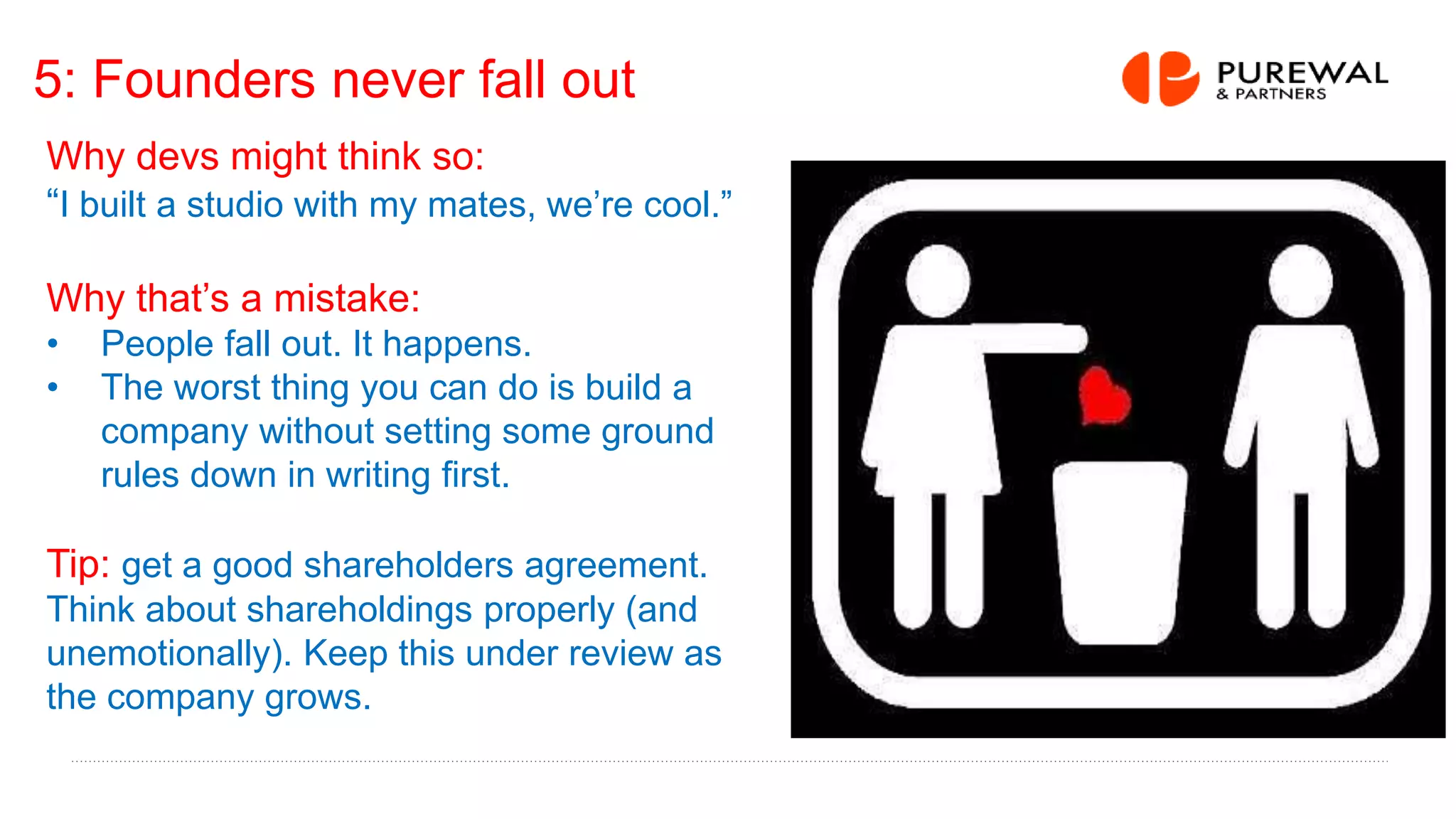
5: Founders never fall out
Why devs might think so:
“I built a studio with my mates, we’re cool.”
Why that’s a mistake:
• People fall out. It happens.
• The worst thing you can do is build a
company without setting some ground
rules down in writing first.
Tip: get a good shareholders agreement.
Think about shareholdings properly (and
unemotionally). Keep this under review as
the company grows.
6: Employees, contractors,
so what?
Why devs might think so:
“Employment law is for big studios.”
Why that’s a mistake:
• Contractors own IP in their work.
Contractors could be employees in fact.
• Employment law raises serious tax and
admin issues – not to be ignored.
Tip: get good template employment and
contractor agreements. Employment law
applies to even the smallest of indies.
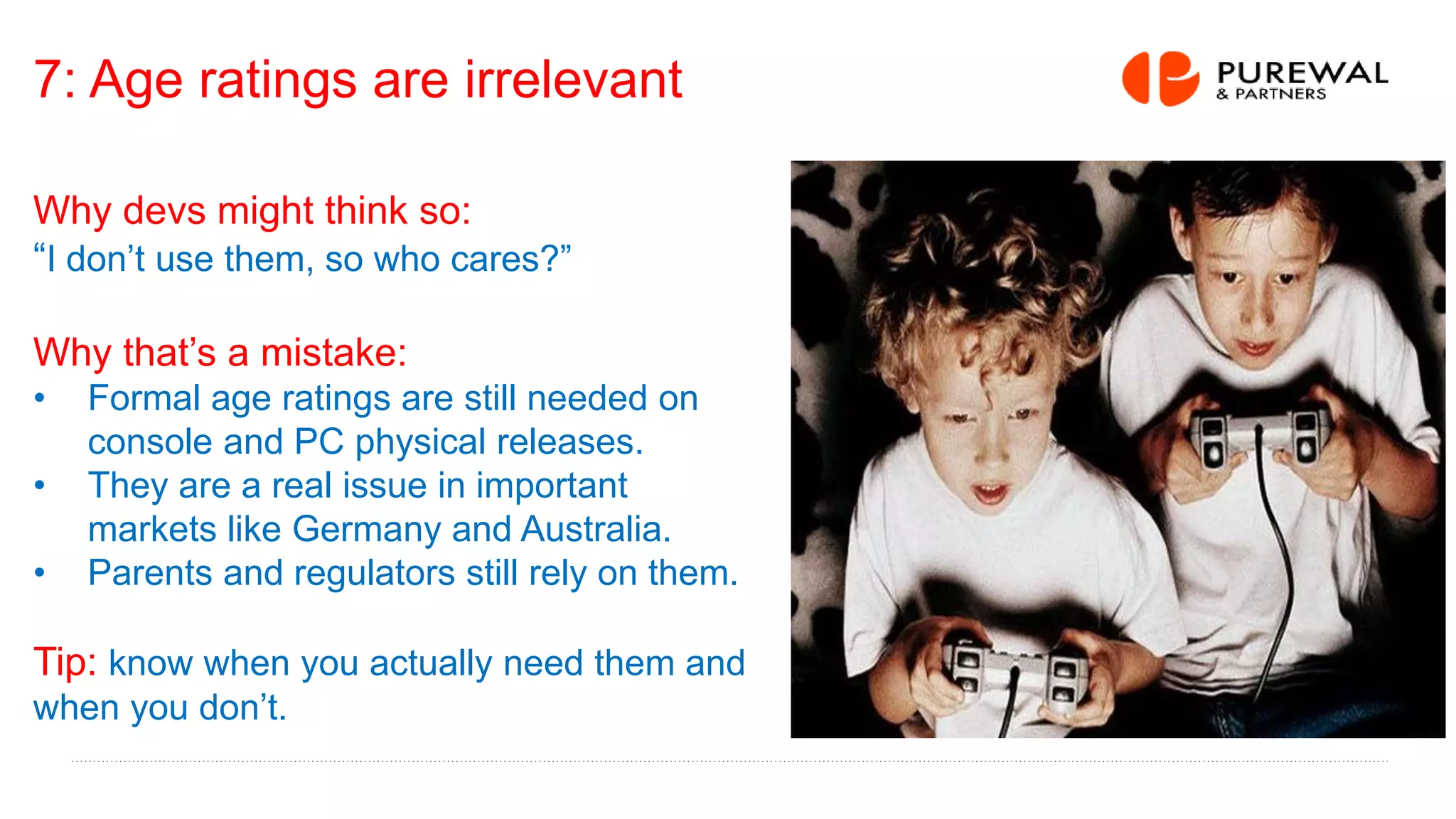
7: Age ratings are irrelevant
Why devs might think so:
“I don’t use them, so who cares?”
Why that’s a mistake:
• Formal age ratings are still needed on
console and PC physical releases.
• They are a real issue in important
markets like Germany and Australia.
• Parents and regulators still rely on them.
Tip: know when you actually need them and
when you don’t.
8: Tax breaks aren’t worth it
Why devs might think so:
“It’s just loads of paperwork for nothing”.
Why that’s a mistake:
• Tax breaks themselves effectively
subsidise development (e.g. UK GTR:
>20% of qualifying dev costs).
• They could be used to unlock wider
equity/project funding.
Tip: have a chat with your accountant and
lawyer – is there free money on the table?
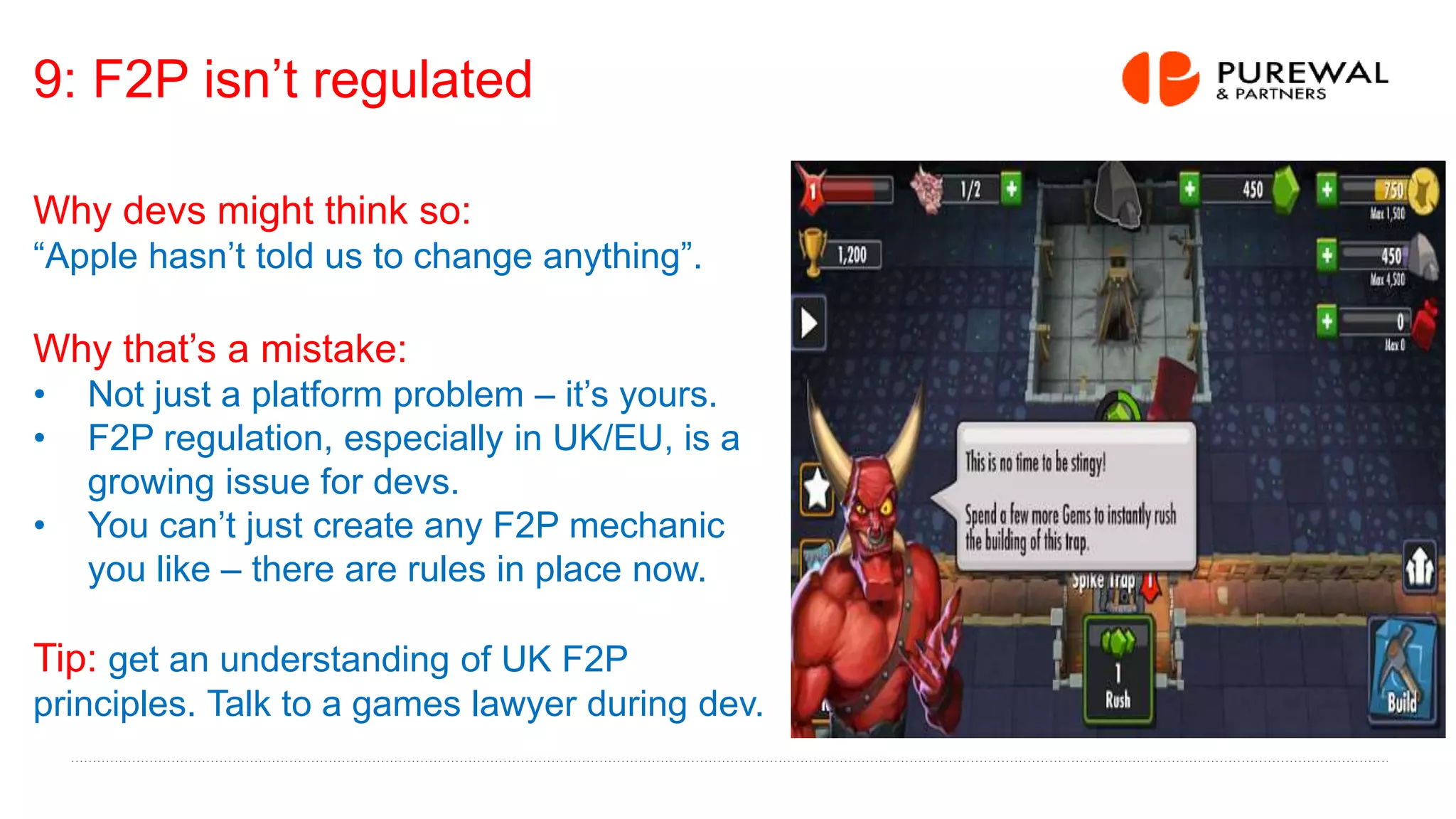
9: F2P isn’t regulated
Why devs might think so:
“Apple hasn’t told us to change anything”.
Why that’s a mistake:
• Not just a platform problem – it’s yours.
• F2P regulation, especially in UK/EU, is a
growing issue for devs.
• You can’t just create any F2P mechanic
you like – there are rules in place now.
Tip: get an understanding of UK F2P
principles. Talk to a games lawyer during dev.
10: Lawyers can’t help game devs
Why devs might think so:
“Expensive and they don’t get games.”
Why that’s a mistake:
• Find the right lawyer. Purewal & Partners,
Osborne Clarke, Sheridans, Harbottles –
all good UK/EU law firms.
• A good lawyer is also a business advisor
and a walking contact list.
Tip: find a games lawyer and build a long-
term relationship with him/her.
Thanks! AMA?
15
........................................................
E: jas@purewalandpartners.com
W: www.purewalandpartners.com
T: @gamerlaw
........................................................

Top 10 game developer legal mistakes

  • 1.
    Top 10 gamedev legal mistakes (in 20 minutes) Jas Purewal Rezzed, 12 March 2015
  • 2.
    What we’ll discuss 2 1.The top 10 game dev legal mistakes 2. Why you shouldn’t do them 3. How not to do them 4. Seriously, don’t 5. Bye!
  • 3.
    About me 3 I’m avideo games and digital entertainment lawyer. 10 years in the City of London and Silicon Valley, then founded a digital entertainment law firm, Purewal & Partners, in London in 2014. We help games studios and video games businesses with things like: contracts negotiation, intellectual property, employment, regulation, financing and dispute resolution. I also write www.gamerlaw.co.uk. Not me
  • 4.
  • 5.
    1: Contracts area waste of time Why devs might think so: Contracts are complicated and are full of things only lawyers might understand. Why that’s a mistake: • A contract is just a document explaining what both sides get. • It’s your best chance to make sure you get what your studio needs but doesn’t give too much away. Tip: use contracts whenever possible. Get a working understanding of them. Ask other devs and lawyers about them.
  • 6.
    2: IP lawis evil Why devs might think so: “IP law is for big evil publishers to stomp on little studios”. Why that’s a mistake: • Legally, a game is made of IP rights. • Sure, it can be abused, but it’s your best shot at protecting your business in all sorts of ways. Tip: get a working understanding of what IP law in games actually is, rather than just what the Internet thinks it is.
  • 7.
    3: T&Cs arepointless Why devs might think so: “Everyone just ticks the box and ignores it.” Why that’s a mistake: • T&Cs are your way to tell your users what’s OK and what’s not. • It helps protect your business and communicate with your users. • Still legally effective if not fully read! Tip: there is no earthly reason not to have T&Cs. They don’t have to be stuffed full of legalese, but they should exist.
  • 8.
    4: Data privacy:not a dev problem Why devs might think so: “Our games don’t collect on any data!” Why that’s a mistake: • All studios do. • Regulators in UK/US/EU are actively looking at games studios’ use of data. Tip: get a privacy policy and cookie policy. Register with local data privacy regulator (if applicable). “Privacy by design”.
  • 9.
    5: Founders neverfall out Why devs might think so: “I built a studio with my mates, we’re cool.” Why that’s a mistake: • People fall out. It happens. • The worst thing you can do is build a company without setting some ground rules down in writing first. Tip: get a good shareholders agreement. Think about shareholdings properly (and unemotionally). Keep this under review as the company grows.
  • 10.
    6: Employees, contractors, sowhat? Why devs might think so: “Employment law is for big studios.” Why that’s a mistake: • Contractors own IP in their work. Contractors could be employees in fact. • Employment law raises serious tax and admin issues – not to be ignored. Tip: get good template employment and contractor agreements. Employment law applies to even the smallest of indies.
  • 11.
    7: Age ratingsare irrelevant Why devs might think so: “I don’t use them, so who cares?” Why that’s a mistake: • Formal age ratings are still needed on console and PC physical releases. • They are a real issue in important markets like Germany and Australia. • Parents and regulators still rely on them. Tip: know when you actually need them and when you don’t.
  • 12.
    8: Tax breaksaren’t worth it Why devs might think so: “It’s just loads of paperwork for nothing”. Why that’s a mistake: • Tax breaks themselves effectively subsidise development (e.g. UK GTR: >20% of qualifying dev costs). • They could be used to unlock wider equity/project funding. Tip: have a chat with your accountant and lawyer – is there free money on the table?
  • 13.
    9: F2P isn’tregulated Why devs might think so: “Apple hasn’t told us to change anything”. Why that’s a mistake: • Not just a platform problem – it’s yours. • F2P regulation, especially in UK/EU, is a growing issue for devs. • You can’t just create any F2P mechanic you like – there are rules in place now. Tip: get an understanding of UK F2P principles. Talk to a games lawyer during dev.
  • 14.
    10: Lawyers can’thelp game devs Why devs might think so: “Expensive and they don’t get games.” Why that’s a mistake: • Find the right lawyer. Purewal & Partners, Osborne Clarke, Sheridans, Harbottles – all good UK/EU law firms. • A good lawyer is also a business advisor and a walking contact list. Tip: find a games lawyer and build a long- term relationship with him/her.
  • 15.
    Thanks! AMA? 15 ........................................................ E: jas@purewalandpartners.com W:www.purewalandpartners.com T: @gamerlaw ........................................................