SOCIAL MEDIA
& ETHICS
Iris Thiele Isip Tan MD, MSc, FPCP, FPSEDM
Professor 3, UP College of Medicine
Chief, UP Medical Informatics Unit
Director, UP Manila Interactive Learning Center
@endocrine_witch
Nothing to disclose
I give consent for the
audience to tweet this
talk and give me
feedback
(@endocrine_witch).
Feel free take pictures of
my slides (though it will be on
www.slideshare.net/isiptan).
Double-effect reasoning
OUTLINE
Maintaining
professionalism
Protecting the physician-
patient relationship
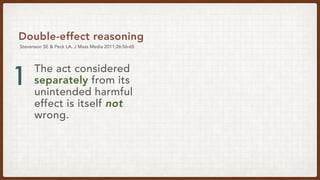
The act considered
separately from its
unintended harmful
effect is itself not
wrong.
Double-effect reasoning
1
Stevenson SE & Peck LA. J Mass Media 2011;26:56-65
The agent intends
only the good and
does not intend
harm as an end or
as a mean.
Double-effect reasoning
2
The agent reflects upon
his/her relevant duties,
considering accepted
norms and takes due
care to eliminate or
alleviate any foreseen
harm through his/her act.
Double-effect reasoning
3
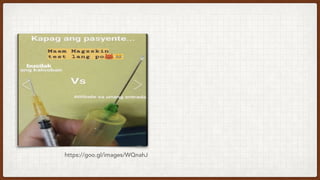
https://goo.gl/images/WQnahJ
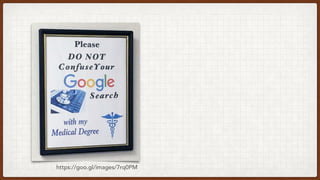
https://goo.gl/images/7rq0PM
Double-effect reasoning
OUTLINE
Maintaining
professionalism
Protecting the physician-
patient relationship
Circulation 2013;127:1413-1421
AMA principles of medical
ethics as framework
Code of Ethics of the
Philippine Medical Association
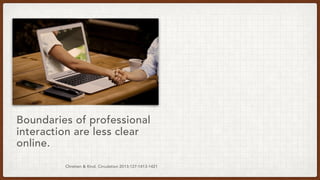
Chretien & Kind. Circulation 2013;127:1413-1421
Boundaries of professional
interaction are less clear
online.
Committee Opinion No. 622: Professional Use of Digital and
Social Media. Obstetrics & Gynecology 2015;125(2):516-20.
A professional social media
profile is low risk if under
close surveillance. .
Committee Opinion No. 622: Professional Use of Digital and
Social Media. Obstetrics & Gynecology 2015;125(2):516-20.
A personal social media
profile is moderate risk if
informal acquaintances can
view personal information.
Chretien & Kind. Circulation 2013;127:1413-1421
Anonymity can breed
disinhibition.
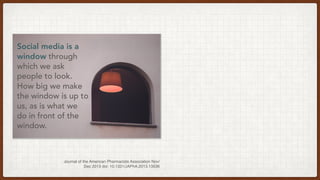
Social media is a
window through
which we ask
people to look.
How big we make
the window is up to
us, as is what we
do in front of the
window.
Journal of the American Pharmacists Association Nov/
Dec 2013 doi: 10.1331/JAPhA.2013.13536
PMA Code of Ethics
For the promotion of
medical practice, a physician
may use … internet.
Friend of Mankind
PMA Code of Ethics
Chretien & Kind. Circulation 2013;127:1413-1421
Establish norms for
interaction.
Chretien & Kind. Circulation 2013;127:1413-1421
Be honest in all
professional interactions.
Chretien & Kind. Circulation 2013;127:1413-1421
Disclose conflict of
interest.
PMA Code of Ethics
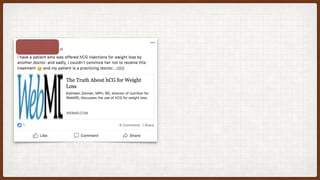
Expose and report
charlatans and quacks.
Chretien & Kind. Circulation 2013;127:1413-1421
Bring to attention of
individual directly or report
to authorities.
http://cnnphilippines.com/news/2016/05/07/map-
where-presidential-VP-candidates-vote.html
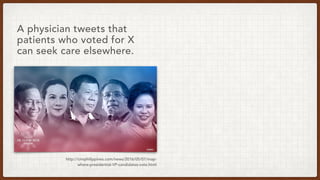
A physician tweets that
patients who voted for X
can seek care elsewhere.
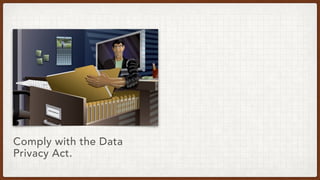
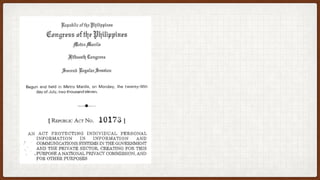
Comply with the Data
Privacy Act.
PRIVACY
About people
Right to be left alone
Limit access to public
CONFIDENTIALITY
About identifiable data
Extension of privacy
Prevent unauthorized access
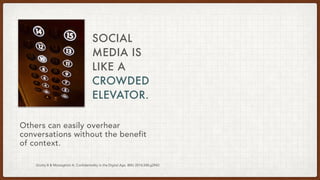
Others can easily overhear
conversations without the benefit
of context.
Grotty B & Mostaghimi A. Confidentiality in the Digital Age. BMJ 2014;348:g2943
SOCIAL
MEDIA IS
LIKE A
CROWDED
ELEVATOR.
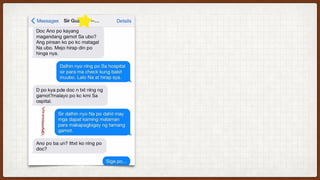
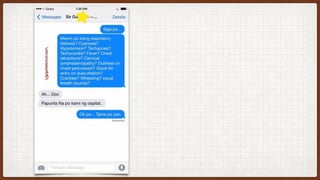
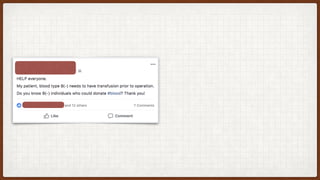
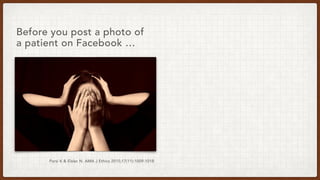
Before you post a photo of
a patient on Facebook …
Parsi K & Elsler N. AMA J Ethics 2015;17(11):1009-1018
Double-effect reasoning
OUTLINE
Maintaining
professionalism
Protecting the physician-
patient relationship
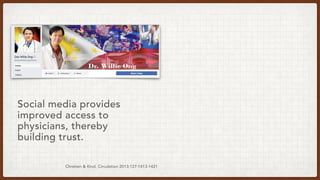
Social media provides
improved access to
physicians, thereby
building trust.
Chretien & Kind. Circulation 2013;127:1413-1421
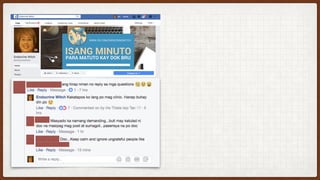
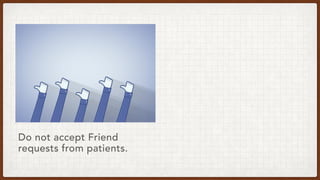
Do not accept Friend
requests from patients.
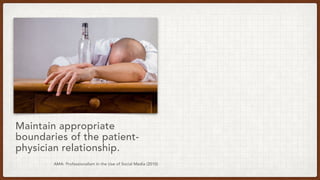
Maintain appropriate
boundaries of the patient-
physician relationship.
AMA: Professionalism in the Use of Social Media (2010)
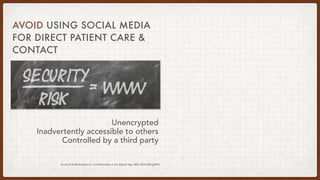
AVOID USING SOCIAL MEDIA
FOR DIRECT PATIENT CARE &
CONTACT
Unencrypted
Inadvertently accessible to others
Controlled by a third party
Grotty B & Mostaghimi A. Confidentiality in the Digital Age. BMJ 2014;348:g2943
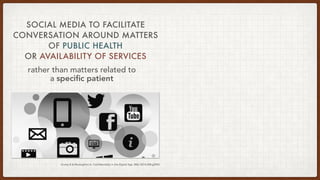
SOCIAL MEDIA TO FACILITATE
CONVERSATION AROUND MATTERS
OF PUBLIC HEALTH
OR AVAILABILITY OF SERVICES
rather than matters related to
a specific patient
Grotty B & Mostaghimi A. Confidentiality in the Digital Age. BMJ 2014;348:g2943
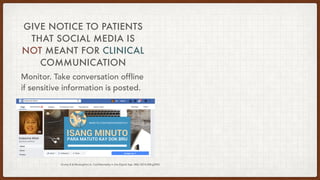
GIVE NOTICE TO PATIENTS
THAT SOCIAL MEDIA IS
NOT MEANT FOR CLINICAL
COMMUNICATION
Monitor. Take conversation offline
if sensitive information is posted.
Double-effect reasoning
SUMMARY
Maintaining
professionalism
Protecting the physician-
patient relationship
We don’t have a choice on
whether we DO social media.
The question is how
well we DO it.
- Eric Qualman

Social Media & Ethics