The SPF Clean Air:
Programme Emerging New
Tools
Presentation for the Routes To Clean Air Conference 2023
Noel Nelson
Met Office
What’s In the Talk?
Briefly introduce the Strategic Priority Fund Clean
Air Programme
Overview of the main rationale and aims
Introduce some of the new tools emerging from
the Programme.
Acknowledgements
 Met Office – Paul Agnew, Eleanor Smith, Lucy Neal, Thomas
Wilson
 CEH - Michael Holloway
 CERC – David Caruthers, Amy Stidworth, Jenny Stocker
 Royal Holloway College – Gavin Shaddick
 Joint Centre for Environmental Intelligence – Matthew Thomas
SPF Clean Air – Background
 Atmospheric pollution in the UK is responsible for approximately 40,000 early deaths and has a cost
of around £20 billion to health services and business, per year.
 The UK is entering a transformative period in air quality, as transport, heating, energy, solvent use
and agricultural emissions change. Most of the 'easy wins' to reduce particulate matter, volatile
organic compounds, ammonia and nitrogen oxides have already been implemented in the UK.
 Future improvements will require innovative solutions underpinned by new research to protect the
health of society, whilst pursuing clean growth and increasing national productivity.
To bring together the UK’s world
class air quality research base and
support high quality multi- and
inter-disciplinary research and
innovation to develop practical
solutions to today’s air quality
issues and equip the UK to
proactively tackle future air
quality issues, in order to protect
health and support clean growth.
SPF Clean Air – Aims
Strategic Priorities Fund
The Strategic Priorities Fund (SPF) is being led by UKRI to:
 drive an increase in high quality multi- and interdisciplinary
research and innovation
 ensure that UKRI’s investment links up effectively with
government research priorities and opportunities
 and ensure the system responds to strategic priorities and
opportunities
SPF builds on Paul Nurse’s vision of a ‘common fund’, to support
high quality multidisciplinary and interdisciplinary research
programmes, which could have otherwise been missed through
traditional funding channels
SPF Clean Air - Delivery
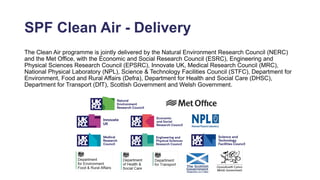
The Clean Air programme is jointly delivered by the Natural Environment Research Council (NERC)
and the Met Office, with the Economic and Social Research Council (ESRC), Engineering and
Physical Sciences Research Council (EPSRC), Innovate UK, Medical Research Council (MRC),
National Physical Laboratory (NPL), Science & Technology Facilities Council (STFC), Department for
Environment, Food and Rural Affairs (Defra), Department for Health and Social Care (DHSC),
Department for Transport (DfT), Scottish Government and Welsh Government.
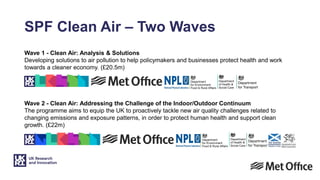
Wave 1 - Clean Air: Analysis & Solutions
Developing solutions to air pollution to help policymakers and businesses protect health and work
towards a cleaner economy. (£20.5m)
Wave 2 - Clean Air: Addressing the Challenge of the Indoor/Outdoor Continuum
The programme aims to equip the UK to proactively tackle new air quality challenges related to
changing emissions and exposure patterns, in order to protect human health and support clean
growth. (£22m)
SPF Clean Air – Two Waves
Wave 1 - Clean Air:
Analysis & Solutions
AIMS
 Developing solutions to air pollution to help policymakers and businesses protect health and work
towards a cleaner economy
 Drive forward new multidisciplinary research and innovation
 Leverage existing UK investments and enable a challenge-focussed multidisciplinary community
to work together for the first time
 Inform implementation of the Clean Air Strategy and related strategies
 Develop new solutions to reduce emissions and protect public health, whilst avoiding perverse
consequences
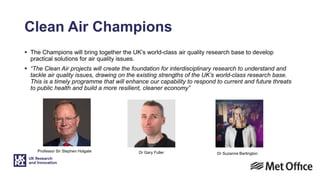
Professor Sir Stephen Holgate Dr Gary Fuller
Clean Air Champions
 The Champions will bring together the UK’s world-class air quality research base to develop
practical solutions for air quality issues.
 “The Clean Air projects will create the foundation for interdisciplinary research to understand and
tackle air quality issues, drawing on the existing strengths of the UK’s world-class research base.
This is a timely programme that will enhance our capability to respond to current and future threats
to public health and build a more resilient, cleaner economy”
Dr Suzanne Bartington
Wave 1 - Clean Air:
Analysis & Solutions
OUTPUTS
 Clean Air Champions to maximise links across the programme, knowledge exchange, business
convening, and links into international efforts, and start to refine the priorities for future investment
 Innovation funding competition for UK businesses with solutions to work on product and service
development, and first deployments of technologies to tackle non-exhaust and non-road-vehicle air
pollution
 Activities to network and leverage existing UKRI major, long-term strategic investments in order to
support multidisciplinary policy-relevant research to underpin sustainable solutions for air quality
 Activities to develop a systems framework for clean air analysis
Wave 2 - Clean Air:
Addressing the Challenge of the Indoor/Outdoor Continuum
BACKGROUND
 The scientific, technical, behavioural and policy approaches used to assess and manage exposure
to air pollution need radical change to reflect the indoor/outdoor continuum of exposure.
 Human exposure to air pollution occurs in the home, at school and in workplaces, whilst travelling,
and during leisure activities.
 Managing human exposure to the very smallest airborne particulate matter (PM1 and ultra-fine PM)
and the complex cocktail of volatile organic compounds (VOCs) is likely to grow in health
significance as concentrations of larger primary particles (e.g. PM10 and nitrates from tailpipe Nox)
decline.
 Indoor air quality is dynamic: the introduction of new emissions in the indoor environment together
with the trend towards more energy efficient buildings (impacting insulation/ventilation) will increase
indoor air exposures.
 It will no longer be effective to attempt to manage public health impacts solely through controlling
outdoor sources.
Wave 2 - Clean Air:
Addressing the Challenge of the Indoor/Outdoor Continuum
THE SECOND WAVE OF THE CLEAN AIR PROGRAMME IS EXPECTED TO:
 Build a new UK interdisciplinary community to address research challenges across the interface of
indoor/outdoor air quality through collaboration between wider disciplines and stakeholders
including: environmental, social and medical sciences, engineering, economics, and health.
 Deliver new knowledge that:
 provides critical foresight on emerging air pollution challenges and associated health risks and impacts;
and
 enable an increased understanding and quantification of human behavioural change and practices in order
to develop and assess interventions, that limit harmful exposure to mitigate the negative health impacts of
individuals most at risk.
 Provide consistent, evidence-based advice for stakeholders through open data and tools in order to
stimulate policy and regulatory innovation.
 Stimulate business-led innovation for sustainable products and services to protect health across the
indoor/outdoor air quality interface and grow UK businesses.
OUTPUTS
 Networks to build the interdisciplinary community
 Interdisciplinary research and innovation consortia to generate new knowledge and tools to
influence policy and regulation
 Business-led innovation projects to develop a new clean air products and services for indoor
environment
 Continued coordination, integration and impact activities (including Clean Air Champions)
Wave 2 - Clean Air:
Addressing the Challenge of the Indoor/Outdoor Continuum
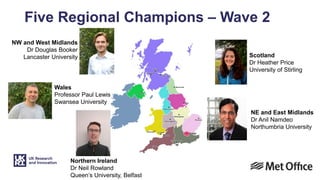
Five Regional Champions – Wave 2
Scotland
Dr Heather Price
University of Stirling
Northern Ireland
Dr Neil Rowland
Queen’s University, Belfast
NE and East Midlands
Dr Anil Namdeo
Northumbria University
Wales
Professor Paul Lewis
Swansea University
NW and West Midlands
Dr Douglas Booker
Lancaster University
Clean Air Networks
 Indoor/outdoor Bioaerosols Interface and Relationships Network – BioAirNet: Frederic Coulon
- Cranfield University
 Air Pollution Solutions for Vulnerable Groups (CleanAir4V): Christian Pfrang - University of
Birmingham
 Breathing City: Future Urban Ventilation Network: Catherine Noakes - University of Leeds
 Tackling Air Pollution at School: Paul Linden - University of Cambridge
 The health and equity impacts of climate change mitigation measures on indoor and outdoor
air pollution exposure (HEICCAM): Ruth Doherty - University of Edinburgh
 Optimising air quality and health benefits associated with a low-emission transport and
mobility revolution in the UK: Suzanne Bartington - University of Birmingham
 Metrology Network: National Physical Laboratory
Multidisciplinary policy-relevant research
 APEx: An Air Pollution Exposure model to integrate protection of vulnerable groups into the UK
Clean Air Programme. (Ben Barratt, MRC CEH)
 ANTICIPATE: Actively anticipating the unintended consequences on air quality of future public
policies (Nigel Gilbert, CECAN)
 DREaM: Component-Specific Air pollutant Drivers of Disease Risk in Early to Midlife: a pathway
approach (Ian Mudway, MRC CEH)
 OSCA: Integrated Research Observation System for Clean Air (Hugh Coe, NERC Air pollution
supersites)
 QUANT: Quantification of Utility of Atmospheric Network Technologies. (Pete Edwards, NCAS)
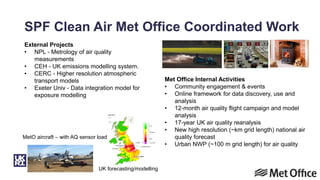
SPF Clean Air Met Office Coordinated Work
External Projects
• NPL - Metrology of air quality
measurements
• CEH - UK emissions modelling system.
• CERC - Higher resolution atmospheric
transport models
• Exeter Univ - Data integration model for
exposure modelling
Met Office Internal Activities
• Community engagement & events
• Online framework for data discovery, use and
analysis
• 12-month air quality flight campaign and model
analysis
• 17-year UK air quality reanalysis
• New high resolution (~km grid length) national air
quality forecast
• Urban NWP (~100 m grid length) for air quality
UK forecasting/modelling
MetO aircraft – with AQ sensor load
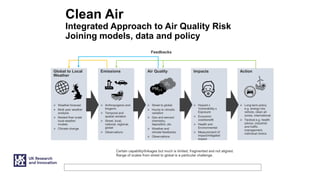
Clean Air
Integrated Approach to Air Quality Risk
Joining models, data and policy
Global to Local
Weather
Emissions
 Weather forecast
 Multi year weather
analysis
 Nested finer scale
local weather
models
 Climate change
 Anthropogenic and
biogenic
 Temporal and
spatial variation
 Street, local,
national, regional,
global
 Observations
Air Quality
 Street to global
 Hourly to climatic
variation
 Gas and aerosol
chemistry,
deposition, etc
 Weather and
climate feedbacks
 Observations
Impacts
 Hazard x
Vulnerability x
Exposure
 Economic
cost/benefit
 Health and
Environmental
 Measurement of
impact/mitigated
impact
Action
 Long term policy
e.g. energy mix,
vehicle, clean air
zones, international
 Tactical e.g. health
advice, industrial
and traffic
management,
individual choice
PM2.5
O3
Certain capability/linkages but much is limited, fragmented and not aligned.
Range of scales from street to global is a particular challenge.
Feedbacks
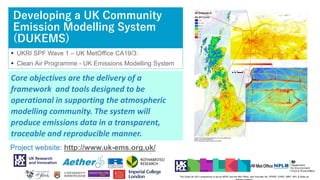
Developing a UK Community
Emission Modelling System
(DUKEMS)
 UKRI SPF Wave 1 – UK MetOffice CA19/3:
 Clean Air Programme - UK Emissions Modelling System
20
The Clean Air (W1) programme is led by NERC and the Met Office, with Innovate UK, EPSRC, ESRC, MRC, NPL & Defra as
Core objectives are the delivery of a
framework and tools designed to be
operational in supporting the atmospheric
modelling community. The system will
produce emissions data in a transparent,
traceable and reproducible manner.
Project website: http://www.uk-ems.org.uk/
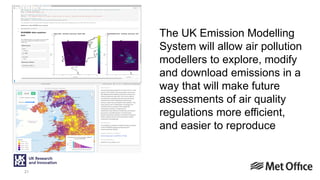
21
The UK Emission Modelling
System will allow air pollution
modellers to explore, modify
and download emissions in a
way that will make future
assessments of air quality
regulations more efficient,
and easier to reproduce
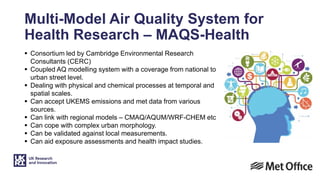
Multi-Model Air Quality System for
Health Research – MAQS-Health
 Consortium led by Cambridge Environmental Research
Consultants (CERC)
 Coupled AQ modelling system with a coverage from national to
urban street level.
 Dealing with physical and chemical processes at temporal and
spatial scales.
 Can accept UKEMS emissions and met data from various
sources.
 Can link with regional models – CMAQ/AQUM/WRF-CHEM etc
 Can cope with complex urban morphology.
 Can be validated against local measurements.
 Can aid exposure assessments and health impact studies.
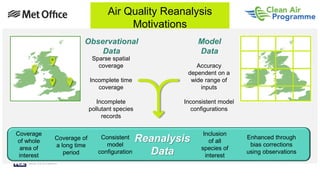
Air Quality Reanalysis
Motivations
Observational
Data
Model
Data
Sparse spatial
coverage
Incomplete time
coverage
Incomplete
pollutant species
records
Accuracy
dependent on a
wide range of
inputs
Inconsistent model
configurations
Reanalysis
Data
Coverage
of whole
area of
interest
Coverage of
a long time
period
Consistent
model
configuration
Inclusion
of all
species of
interest
Enhanced through
bias corrections
using observations
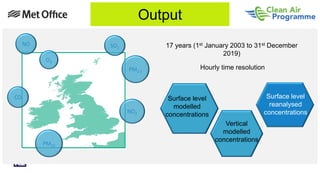
Output
NO
NO2
SO2
O3
PM2.5
PM10
CO
17 years (1st January 2003 to 31st December
2019)
Hourly time resolution
Surface level
modelled
concentrations
Vertical
modelled
concentrations
Surface level
reanalysed
concentrations
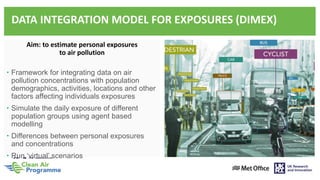
Aim: to estimate personal exposures
to air pollution
‘ Framework for integrating data on air
pollution concentrations with population
demographics, activities, locations and other
factors affecting individuals exposures
‘ Simulate the daily exposure of different
population groups using agent based
modelling
‘ Differences between personal exposures
and concentrations
‘ Run ‘virtual’ scenarios
DATA INTEGRATION MODEL FOR EXPOSURES (DIMEX)
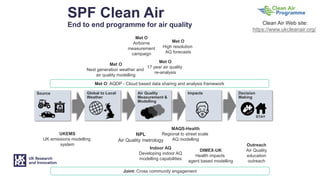
SPF Clean Air
End to end programme for air quality
Global to Local
Weather
Source Air Quality
Measurement &
Modelling
Impacts Decision
Making
STAY
UKEMS
UK emissions modelling
system
MAQS-Health
Regional to street scale
AQ modelling
DIMEX-UK
Health impacts
agent based modelling
Met O
High resolution
AQ forecasts
Met O
17 year air quality
re-analysis
Met O
Next generation weather and
air quality modelling
Met O: AQDP - Cloud based data sharing and analysis framework
Met O
Airborne
measurement
campaign
Outreach
Air Quality
education
outreach
NPL
Air Quality metrology
Indoor AQ
Developing indoor AQ
modelling capabilities
Clean Air Web site:
https://www.ukcleanair.org/
Joint: Cross community engagement
Contact details
UKEMS – Michael Holloway – mholloway@ceh.ac.uk
MAQS-Health – Amy Stidworthy – amy.Stidworthy@cerc.co.uk
DIMEX – Gavin Shaddick – Gavin.Shaddick@rhul.ac.uk
AQ Reanalysis – Paul Agnew – paul.agnew@metoffice.gov.uk
This project is funded as part of the Clean Air SPF programme which is led by the Natural Environment Research Council (NERC )and the Met Office, with the
Engineering & Physical Sciences Research Council (EPSRC), the Economic & Social Research Council (ESRC), Innovate UK, the Medical Research Council
(MRC), the Science and Technology Facilities Council (STFC), the National Physical Laboratory (NPL) and Defra.
Contact details
Website: www.ukcleanair.org
Twitter: @UK_CleanAir
This project is funded as part of the Clean Air SPF programme which is led by the Natural Environment Research Council (NERC )and the Met Office, with the
Engineering & Physical Sciences Research Council (EPSRC), the Economic & Social Research Council (ESRC), Innovate UK, the Medical Research Council
(MRC), the Science and Technology Facilities Council (STFC), the National Physical Laboratory (NPL) and Defra.

10.15 New Tools from the SPF Clean Air Programme.pdf

  • 1.
    The SPF CleanAir: Programme Emerging New Tools Presentation for the Routes To Clean Air Conference 2023 Noel Nelson Met Office
  • 2.
    What’s In theTalk? Briefly introduce the Strategic Priority Fund Clean Air Programme Overview of the main rationale and aims Introduce some of the new tools emerging from the Programme.
  • 3.
    Acknowledgements  Met Office– Paul Agnew, Eleanor Smith, Lucy Neal, Thomas Wilson  CEH - Michael Holloway  CERC – David Caruthers, Amy Stidworth, Jenny Stocker  Royal Holloway College – Gavin Shaddick  Joint Centre for Environmental Intelligence – Matthew Thomas
  • 4.
    SPF Clean Air– Background  Atmospheric pollution in the UK is responsible for approximately 40,000 early deaths and has a cost of around £20 billion to health services and business, per year.  The UK is entering a transformative period in air quality, as transport, heating, energy, solvent use and agricultural emissions change. Most of the 'easy wins' to reduce particulate matter, volatile organic compounds, ammonia and nitrogen oxides have already been implemented in the UK.  Future improvements will require innovative solutions underpinned by new research to protect the health of society, whilst pursuing clean growth and increasing national productivity.
  • 5.
    To bring togetherthe UK’s world class air quality research base and support high quality multi- and inter-disciplinary research and innovation to develop practical solutions to today’s air quality issues and equip the UK to proactively tackle future air quality issues, in order to protect health and support clean growth. SPF Clean Air – Aims
  • 6.
    Strategic Priorities Fund TheStrategic Priorities Fund (SPF) is being led by UKRI to:  drive an increase in high quality multi- and interdisciplinary research and innovation  ensure that UKRI’s investment links up effectively with government research priorities and opportunities  and ensure the system responds to strategic priorities and opportunities SPF builds on Paul Nurse’s vision of a ‘common fund’, to support high quality multidisciplinary and interdisciplinary research programmes, which could have otherwise been missed through traditional funding channels
  • 7.
    SPF Clean Air- Delivery The Clean Air programme is jointly delivered by the Natural Environment Research Council (NERC) and the Met Office, with the Economic and Social Research Council (ESRC), Engineering and Physical Sciences Research Council (EPSRC), Innovate UK, Medical Research Council (MRC), National Physical Laboratory (NPL), Science & Technology Facilities Council (STFC), Department for Environment, Food and Rural Affairs (Defra), Department for Health and Social Care (DHSC), Department for Transport (DfT), Scottish Government and Welsh Government.
  • 8.
    Wave 1 -Clean Air: Analysis & Solutions Developing solutions to air pollution to help policymakers and businesses protect health and work towards a cleaner economy. (£20.5m) Wave 2 - Clean Air: Addressing the Challenge of the Indoor/Outdoor Continuum The programme aims to equip the UK to proactively tackle new air quality challenges related to changing emissions and exposure patterns, in order to protect human health and support clean growth. (£22m) SPF Clean Air – Two Waves
  • 9.
    Wave 1 -Clean Air: Analysis & Solutions AIMS  Developing solutions to air pollution to help policymakers and businesses protect health and work towards a cleaner economy  Drive forward new multidisciplinary research and innovation  Leverage existing UK investments and enable a challenge-focussed multidisciplinary community to work together for the first time  Inform implementation of the Clean Air Strategy and related strategies  Develop new solutions to reduce emissions and protect public health, whilst avoiding perverse consequences
  • 10.
    Professor Sir StephenHolgate Dr Gary Fuller Clean Air Champions  The Champions will bring together the UK’s world-class air quality research base to develop practical solutions for air quality issues.  “The Clean Air projects will create the foundation for interdisciplinary research to understand and tackle air quality issues, drawing on the existing strengths of the UK’s world-class research base. This is a timely programme that will enhance our capability to respond to current and future threats to public health and build a more resilient, cleaner economy” Dr Suzanne Bartington
  • 11.
    Wave 1 -Clean Air: Analysis & Solutions OUTPUTS  Clean Air Champions to maximise links across the programme, knowledge exchange, business convening, and links into international efforts, and start to refine the priorities for future investment  Innovation funding competition for UK businesses with solutions to work on product and service development, and first deployments of technologies to tackle non-exhaust and non-road-vehicle air pollution  Activities to network and leverage existing UKRI major, long-term strategic investments in order to support multidisciplinary policy-relevant research to underpin sustainable solutions for air quality  Activities to develop a systems framework for clean air analysis
  • 12.
    Wave 2 -Clean Air: Addressing the Challenge of the Indoor/Outdoor Continuum BACKGROUND  The scientific, technical, behavioural and policy approaches used to assess and manage exposure to air pollution need radical change to reflect the indoor/outdoor continuum of exposure.  Human exposure to air pollution occurs in the home, at school and in workplaces, whilst travelling, and during leisure activities.  Managing human exposure to the very smallest airborne particulate matter (PM1 and ultra-fine PM) and the complex cocktail of volatile organic compounds (VOCs) is likely to grow in health significance as concentrations of larger primary particles (e.g. PM10 and nitrates from tailpipe Nox) decline.  Indoor air quality is dynamic: the introduction of new emissions in the indoor environment together with the trend towards more energy efficient buildings (impacting insulation/ventilation) will increase indoor air exposures.  It will no longer be effective to attempt to manage public health impacts solely through controlling outdoor sources.
  • 13.
    Wave 2 -Clean Air: Addressing the Challenge of the Indoor/Outdoor Continuum THE SECOND WAVE OF THE CLEAN AIR PROGRAMME IS EXPECTED TO:  Build a new UK interdisciplinary community to address research challenges across the interface of indoor/outdoor air quality through collaboration between wider disciplines and stakeholders including: environmental, social and medical sciences, engineering, economics, and health.  Deliver new knowledge that:  provides critical foresight on emerging air pollution challenges and associated health risks and impacts; and  enable an increased understanding and quantification of human behavioural change and practices in order to develop and assess interventions, that limit harmful exposure to mitigate the negative health impacts of individuals most at risk.  Provide consistent, evidence-based advice for stakeholders through open data and tools in order to stimulate policy and regulatory innovation.  Stimulate business-led innovation for sustainable products and services to protect health across the indoor/outdoor air quality interface and grow UK businesses.
  • 14.
    OUTPUTS  Networks tobuild the interdisciplinary community  Interdisciplinary research and innovation consortia to generate new knowledge and tools to influence policy and regulation  Business-led innovation projects to develop a new clean air products and services for indoor environment  Continued coordination, integration and impact activities (including Clean Air Champions) Wave 2 - Clean Air: Addressing the Challenge of the Indoor/Outdoor Continuum
  • 15.
    Five Regional Champions– Wave 2 Scotland Dr Heather Price University of Stirling Northern Ireland Dr Neil Rowland Queen’s University, Belfast NE and East Midlands Dr Anil Namdeo Northumbria University Wales Professor Paul Lewis Swansea University NW and West Midlands Dr Douglas Booker Lancaster University
  • 16.
    Clean Air Networks Indoor/outdoor Bioaerosols Interface and Relationships Network – BioAirNet: Frederic Coulon - Cranfield University  Air Pollution Solutions for Vulnerable Groups (CleanAir4V): Christian Pfrang - University of Birmingham  Breathing City: Future Urban Ventilation Network: Catherine Noakes - University of Leeds  Tackling Air Pollution at School: Paul Linden - University of Cambridge  The health and equity impacts of climate change mitigation measures on indoor and outdoor air pollution exposure (HEICCAM): Ruth Doherty - University of Edinburgh  Optimising air quality and health benefits associated with a low-emission transport and mobility revolution in the UK: Suzanne Bartington - University of Birmingham  Metrology Network: National Physical Laboratory
  • 17.
    Multidisciplinary policy-relevant research APEx: An Air Pollution Exposure model to integrate protection of vulnerable groups into the UK Clean Air Programme. (Ben Barratt, MRC CEH)  ANTICIPATE: Actively anticipating the unintended consequences on air quality of future public policies (Nigel Gilbert, CECAN)  DREaM: Component-Specific Air pollutant Drivers of Disease Risk in Early to Midlife: a pathway approach (Ian Mudway, MRC CEH)  OSCA: Integrated Research Observation System for Clean Air (Hugh Coe, NERC Air pollution supersites)  QUANT: Quantification of Utility of Atmospheric Network Technologies. (Pete Edwards, NCAS)
  • 18.
    SPF Clean AirMet Office Coordinated Work External Projects • NPL - Metrology of air quality measurements • CEH - UK emissions modelling system. • CERC - Higher resolution atmospheric transport models • Exeter Univ - Data integration model for exposure modelling Met Office Internal Activities • Community engagement & events • Online framework for data discovery, use and analysis • 12-month air quality flight campaign and model analysis • 17-year UK air quality reanalysis • New high resolution (~km grid length) national air quality forecast • Urban NWP (~100 m grid length) for air quality UK forecasting/modelling MetO aircraft – with AQ sensor load
  • 19.
    Clean Air Integrated Approachto Air Quality Risk Joining models, data and policy Global to Local Weather Emissions  Weather forecast  Multi year weather analysis  Nested finer scale local weather models  Climate change  Anthropogenic and biogenic  Temporal and spatial variation  Street, local, national, regional, global  Observations Air Quality  Street to global  Hourly to climatic variation  Gas and aerosol chemistry, deposition, etc  Weather and climate feedbacks  Observations Impacts  Hazard x Vulnerability x Exposure  Economic cost/benefit  Health and Environmental  Measurement of impact/mitigated impact Action  Long term policy e.g. energy mix, vehicle, clean air zones, international  Tactical e.g. health advice, industrial and traffic management, individual choice PM2.5 O3 Certain capability/linkages but much is limited, fragmented and not aligned. Range of scales from street to global is a particular challenge. Feedbacks
  • 20.
    Developing a UKCommunity Emission Modelling System (DUKEMS)  UKRI SPF Wave 1 – UK MetOffice CA19/3:  Clean Air Programme - UK Emissions Modelling System 20 The Clean Air (W1) programme is led by NERC and the Met Office, with Innovate UK, EPSRC, ESRC, MRC, NPL & Defra as Core objectives are the delivery of a framework and tools designed to be operational in supporting the atmospheric modelling community. The system will produce emissions data in a transparent, traceable and reproducible manner. Project website: http://www.uk-ems.org.uk/
  • 21.
    21 The UK EmissionModelling System will allow air pollution modellers to explore, modify and download emissions in a way that will make future assessments of air quality regulations more efficient, and easier to reproduce
  • 22.
    Multi-Model Air QualitySystem for Health Research – MAQS-Health  Consortium led by Cambridge Environmental Research Consultants (CERC)  Coupled AQ modelling system with a coverage from national to urban street level.  Dealing with physical and chemical processes at temporal and spatial scales.  Can accept UKEMS emissions and met data from various sources.  Can link with regional models – CMAQ/AQUM/WRF-CHEM etc  Can cope with complex urban morphology.  Can be validated against local measurements.  Can aid exposure assessments and health impact studies.
  • 23.
    Air Quality Reanalysis Motivations Observational Data Model Data Sparsespatial coverage Incomplete time coverage Incomplete pollutant species records Accuracy dependent on a wide range of inputs Inconsistent model configurations Reanalysis Data Coverage of whole area of interest Coverage of a long time period Consistent model configuration Inclusion of all species of interest Enhanced through bias corrections using observations
  • 24.
    Output NO NO2 SO2 O3 PM2.5 PM10 CO 17 years (1stJanuary 2003 to 31st December 2019) Hourly time resolution Surface level modelled concentrations Vertical modelled concentrations Surface level reanalysed concentrations
  • 25.
    Aim: to estimatepersonal exposures to air pollution ‘ Framework for integrating data on air pollution concentrations with population demographics, activities, locations and other factors affecting individuals exposures ‘ Simulate the daily exposure of different population groups using agent based modelling ‘ Differences between personal exposures and concentrations ‘ Run ‘virtual’ scenarios DATA INTEGRATION MODEL FOR EXPOSURES (DIMEX)
  • 26.
    SPF Clean Air Endto end programme for air quality Global to Local Weather Source Air Quality Measurement & Modelling Impacts Decision Making STAY UKEMS UK emissions modelling system MAQS-Health Regional to street scale AQ modelling DIMEX-UK Health impacts agent based modelling Met O High resolution AQ forecasts Met O 17 year air quality re-analysis Met O Next generation weather and air quality modelling Met O: AQDP - Cloud based data sharing and analysis framework Met O Airborne measurement campaign Outreach Air Quality education outreach NPL Air Quality metrology Indoor AQ Developing indoor AQ modelling capabilities Clean Air Web site: https://www.ukcleanair.org/ Joint: Cross community engagement
  • 27.
    Contact details UKEMS –Michael Holloway – mholloway@ceh.ac.uk MAQS-Health – Amy Stidworthy – amy.Stidworthy@cerc.co.uk DIMEX – Gavin Shaddick – Gavin.Shaddick@rhul.ac.uk AQ Reanalysis – Paul Agnew – paul.agnew@metoffice.gov.uk This project is funded as part of the Clean Air SPF programme which is led by the Natural Environment Research Council (NERC )and the Met Office, with the Engineering & Physical Sciences Research Council (EPSRC), the Economic & Social Research Council (ESRC), Innovate UK, the Medical Research Council (MRC), the Science and Technology Facilities Council (STFC), the National Physical Laboratory (NPL) and Defra.
  • 28.
    Contact details Website: www.ukcleanair.org Twitter:@UK_CleanAir This project is funded as part of the Clean Air SPF programme which is led by the Natural Environment Research Council (NERC )and the Met Office, with the Engineering & Physical Sciences Research Council (EPSRC), the Economic & Social Research Council (ESRC), Innovate UK, the Medical Research Council (MRC), the Science and Technology Facilities Council (STFC), the National Physical Laboratory (NPL) and Defra.