100 Unicorns: India’s changing
corporate landscape
India Market Strategy
Asia Pacific/India, Equity Research, 10 March 2021
Research Analysts
Neelkanth Mishra, Abhay Khaitan, Varun Ahuja, Krati Sanklecha, Anubhav Aggarwal, Lokesh Garg , Ashish Gupta, Arnab Mitra,
Prateek Singh, Satyam Thakur, Rikin Shah, Kush Shah, Garima Bharti, Gaurav Birmiwal, Jayant Kharote, Sayantan Maji, Pratik
Rangnekar, Viral Shah
DISCLOSURE APPENDIX AT THE BACK OF THIS REPORT CONTAINS IMPORTANT DISCLOSURES, ANALYST
CERTIFICATIONS, LEGAL ENTITY DISCLOSURE AND THE STATUS OF NON-US ANALYSTS. U.S. Disclosure: Credit Suisse
does and seeks to do business with companies covered in its research reports. As a result, investors should be aware that the Firm
may have a conflict of interest that could affect the objectivity of this report. Investors should consider this report as only a single
factor in making their investment decision.
A
r
t
i
c
l
e
i
n
t
e
n
d
e
d
f
o
r
:
a
s
h
a
.
g
o
p
a
l
a
k
r
i
s
h
n
a
n
#
u
n
i
l
e
v
e
r
.
c
o
m
A
r
t
i
c
l
e
i
n
t
e
n
d
e
d
f
o
r
:
a
s
h
a
.
g
o
p
a
l
a
k
r
i
s
h
n
a
n
#
u
n
i
l
e
v
e
r
.
c
o
m
India Market Strategy 3
Contents
Focus charts.................................................................................4
100 Unicorns ................................................................................5
List of Unicorns ............................................................................7
Transformation in the corporate landscape ................................9
The Enablers: Funding, infrastructure, regulation.....................15
The beginning, not the end of unicorn seeding.........................21
FinTech ....................................................................................21
EdTech.....................................................................................24
Indian SaaS...............................................................................27
E-commerce .............................................................................31
Discretionary .............................................................................33
Pharmaceuticals/Bio-Tech.........................................................36
A virtuous cycle?........................................................................39
List of firms.................................................................................43
Allied Blenders & Distillers (ABD) ............................. 43 Innovaccer..............................................................93
Anthem Biosciences................................................ 44 Intas Pharmaceuticals..............................................94
Aptus Finance......................................................... 45 Joyalukkas .............................................................95
Atria Convergence Technologies............................... 46 Kurl-on...................................................................96
Bharat Biotech........................................................ 47 Lenskart.................................................................97
BharatPe................................................................ 48 Macleods Pharmaceuticals.......................................98
Bhilosa Industries Pvt Ltd ........................................ 49 Manipal Hospitals....................................................99
Bigtree Entertainment (BookMyShow) ...................... 50 Medha Servo Drives ..............................................100
Bill Desk ................................................................ 51 Meesho................................................................101
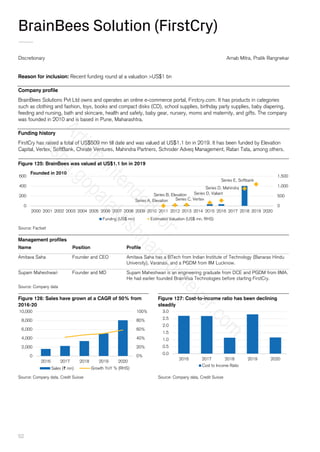
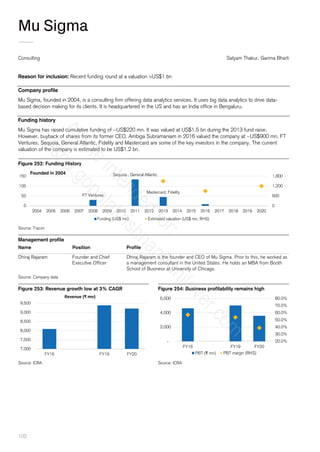
BrainBees Solution (FirstCry) ................................... 52 Mu Sigma.............................................................102
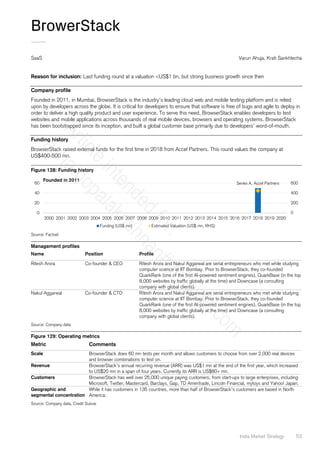
BrowerStack........................................................... 53 MX Player ............................................................103
Bundl Technologies (Swiggy) ................................... 54 Mytrah Energy ......................................................104
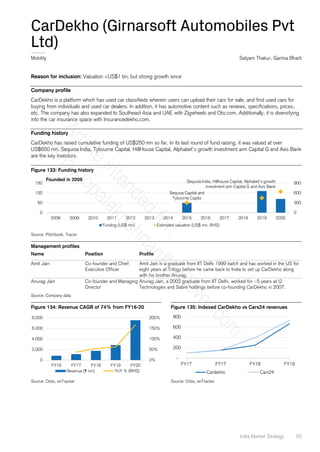
CarDekho (Girnarsoft Automobiles Pvt Ltd) ............... 55 National Stock Exchange.......................................105
Cars24................................................................... 56 Nykaa E-Retail......................................................106
Chargebee ............................................................. 57 Ola Cabs (ANI Technologies Pvt Ltd)......................107
CitiusTech.............................................................. 58 Ola Electric Mobility...............................................108
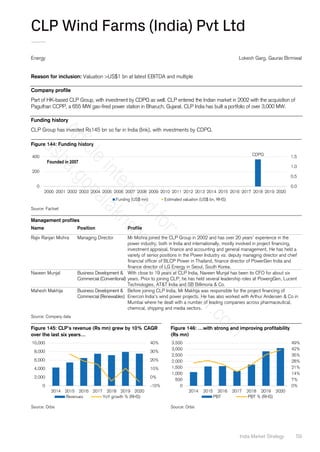
CLP Wind Farms (India) Pvt Ltd............................... 59 Oravel Stays (Oyo Rooms) .....................................109
CureFit................................................................... 60 Parle Products......................................................110
Dailyhunt VerSe...................................................... 61 Paytm ..................................................................111
D’decor.................................................................. 62 PharmEasy...........................................................112
Deccan Fine Chemicals ........................................... 63 PhonePe..............................................................113
Delhivery Pvt Ltd..................................................... 64 Pine Labs.............................................................114
Digit....................................................................... 65 Piramal Glass........................................................115
Druva Data Solutions............................................... 66 PlayGames24x7 (RummyCircle) .............................116
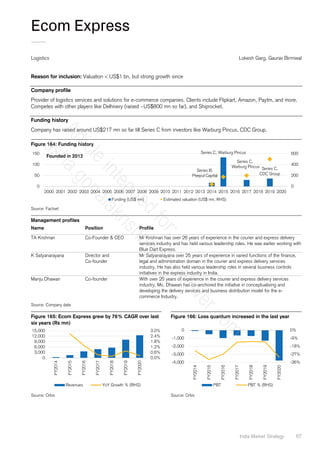
Ecom Express......................................................... 67 Policybazaar..........................................................117
Eightfold................................................................. 68 Postman...............................................................118
Emcure Pharmaceuticals ......................................... 69 Rategain...............................................................119
Enzen Global Solutions Pvt Ltd................................. 70 Razorpay ..............................................................120
Eruditus Education .................................................. 71 ReNew Power Ventures.........................................121
Essar Ports............................................................. 72 RSPL Limited .......................................................122
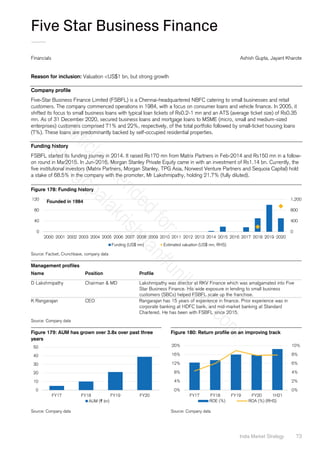
Five Star Business Finance...................................... 73 Serum Institute of India..........................................123
Flipkart................................................................... 74 Sharechat.............................................................124
Freshworks............................................................. 75 Sorting Hat Technologies (Unacademy).....................125
Galactus Funware Technology (MPL)........................ 76 Sporta Technologies (Dream11).............................126
Gharda Chemicals................................................... 77 Sri Chaitanya ........................................................127
Glance ................................................................... 78 Star Health...........................................................128
GlobalLogic ............................................................ 79 Supermart Grocery Supplies (BigBasket).................129
Greenko Group....................................................... 80 Synechron............................................................130
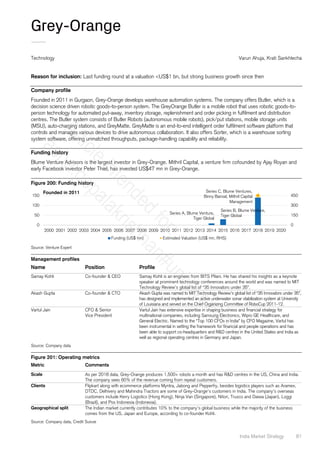
Grey-Orange .......................................................... 81 Think and Learn (Byju’s)........................................131
Groww ................................................................... 82 Udaan..................................................................132
GRT Jewellers Limited............................................. 83 UrbanClap Technologies (Urban Company)..............133
Haldiram’s.............................................................. 84 UST.....................................................................134
Headspin................................................................ 85 Vini Cosmetics......................................................135
Hero Fincorp Ltd..................................................... 86 Vishal Mega Mart ..................................................136
Hetero Labs ........................................................... 87 Wonder Cement....................................................137
HighRadius............................................................. 88 Zenoti ..................................................................138
IBS Software.......................................................... 89 Zerodha ...............................................................139
Icertis..................................................................... 90 Zoho....................................................................140
Infra.Market............................................................ 91 Zomato ................................................................141
InMobi.................................................................... 92 Zoomcar...............................................................142
9
15
21
39
43
A
r
t
i
c
l
e
i
n
t
e
n
d
e
d
f
o
r
:
a
s
h
a
.
g
o
p
a
l
a
k
r
i
s
h
n
a
n
#
u
n
i
l
e
v
e
r
.
c
o
m
4
Focus charts
Figure 1: Indian equity fundraising—private tops public Figure 2: Sectoral split by number—highly diverse
Source: VCCedge, Credit Suisse Source: Credit Suisse
Figure 3: Two-thirds of unicorns started after 2005 Figure 4: 87% of the BSE-500 started before 2000
Source: Credit Suisse Source: CMIE, Credit Suisse
Figure 5: More than 6k startups were funded in 2019 Figure 6: Number of millionaires in India rising sharply
Source: VCCedge, Credit Suisse Source: CS Global Wealth Report, Credit Suisse
0
5
10
15
20
25
30
35
40
45
2008
2009
2010
2011
2012
2013
2014
2015
2016
2017
2018
2019
2020
Private Equity Deals Public Offerings
US$ bn
9%
13%
7%
4%
3%
10%
4%
2%
12%
10%
2%
4%
3%
3%
2%
12%
Healthcare
Financials
Others
Energy
Staples
Discretionary
Logistics
Industrials
IT/Tech
E-commerce
Foodtech
Education
Mobility
Gaming
Insurance
SaaS Split of 100 unicorns by sector
1% 9%
9%
15%
35%
31%
Before 1950
1950-1975
1975-1990
1990-2000
2000-2010
2010-2020
Split of unicorns by year of incorporation
16%
20%
26%
25%
9%
4%
Before 1950
1950-1975
1975-1990
1990-2000
2000-2010
2010-2020
Split of BSE500 firms by year of incorporation
0
1
2
3
4
5
6
7
2012 2013 2014 2015 2016 2017 2018 2019
Funded Startups (k)
0
100
200
300
400
500
600
700
800
900
1000
2010 2011 2012 2013 2014 2015 2016 2017 2018 2019 2020
Number of millionaires in India (k)
Increase of 569k in last 2 years
A
r
t
i
c
l
e
i
n
t
e
n
d
e
d
f
o
r
:
a
s
h
a
.
g
o
p
a
l
a
k
r
i
s
h
n
a
n
#
u
n
i
l
e
v
e
r
.
c
o
m
India Market Strategy 5
100 Unicorns
India’s corporate landscape is undergoing a radical change due to a remarkable confluence of changes in
the funding, regulatory and business environment in the country over the past two decades. An
unprecedented pace of new-company formation and innovation in a variety of sectors has meant a surge
in the number of highly-valued, as-yet unlisted companies. While conventional Unicorn lists show 30-35
names for India, our exploration reveals a 100 of them!
Transformation in the corporate landscape
Against 336 listed companies with billion dollar-plus market
capitalisation, there are now 100 unicorns in India with a
combined market capitalisation of US$240 bn. Two-thirds of
these firms started after 2005, whereas only 46 of the listed
firms were founded this century, and as many as 112
started before 1975. The sectoral split is highly diversified:
in addition to the largely expected e-commerce, FinTech,
education technology, food delivery and mobility companies,
there is a rapidly growing number of such firms in Software-
as-a-Service (SaaS), gaming, new-age distribution and
logistics, modern trade, bio-tech, pharmaceuticals, and even
fast-growing consumer brands benefitting from accelerating
penetration and formalisation. These are only at the top of a
fast-growing pyramid of 80,000 start-ups in India, which are
incrementally now nearly 10% of new companies formed
every year; the number of firms is up 70% in 8 years. There
is some geographical diversity in the cities where these firms
started, though there is some concentration in Bengaluru,
Mumbai and the National Capital Region (NCR), Delhi.
The Enablers: Funding, infrastructure, regulation
The growth in highly valued companies has been enabled by
a range of factors: (1) the natural shortage of risk capital in
an economy with low per capita wealth has been addressed
by a surge in (mostly foreign) private equity: these flows
have exceeded public market transactions in each year of
the last decade; (2) increase in teledensity and smartphone
and internet penetration. Till 2005 less than 15% of Indians
had a phone, versus 85% now; 700 mn-plus people have
internet access now due to cheap data and falling
smartphone prices (40% penetration now); (3) deep-rooted
physical infrastructure changes: nearly all habitations are
now connected by all-weather roads compared to only half
in 2000, and all households are electrified now vs. just 54%
in 2001; (4) financial innovation is accelerating, courtesy the
world-leading “India stack”, which has innovative applications
like UPI built on a base of universal bank account access,
mobiles, and the biometric-ID (Aadhaar), helped by greater
data availability; and (5) development of ecosystems in
several sectors that now provides a competitive advantage
versus global peers; for example in technology (4.5 mn IT
professionals) and pharma/biotech (several Indian firms can
now afford US$200-300 mn of annual R&D).
The beginning, not the end of unicorn seeding
We dig into segments that have a concentration of unicorns:
FinTech, e-commerce, SaaS, EduTech, pharma/ biotech and
consumer discretionary. In addition to the common drivers, each
of these also has several idiosyncratic catalysts, like the
astonishing surge in the number of SaaS unicorns being driven
by the changing nature of software and software development,
and enabled by a very large available pool of trained software
engineers, many of whom accidentally discovered their work had
business value. Similarly, e-commerce, modern-trade and
regulatory tightening by the government are driving formalisation
of erstwhile mature but extremely fragmented businesses like
that of jewellery, as well as creation of new consumer brands in
novel and fast-growing categories supported by new advertising
channels and the rise of professional distributors. Elsewhere,
while technology was anyway considered critical to solve India’s
troubling education problem, the pandemic last year catalysed a
level of penetration that may have taken several years otherwise.
In pharma/biotech, India’s switch to process patents in the
1970s and the US’ 1984 Hatch-Waxman Act supported the
development of a large and complex ecosystem, which has now
scaled up. Each of these segments can continue to throw up
innovative and high-value companies, in our view.
A virtuous cycle?
In a country notorious for stifling entrepreneurship, new company
formation was quite strong even in the 1980s, though lack of
access to capital was a challenge. This changed as economic
reforms freed up capital access, but sizeable investments were
still limited to a handful of family-owned dynastic businesses. The
surge in unicorns creates numerous large pools of risk capital:
even at 15-20% residual ownership on average of these
businesses, US$35-50 bn of wealth has likely been created.
This has contributed to the growth in the number of millionaires in
India (as also Ultra High Net Worth Individuals), which had
stagnated for several years, but has started to rise rapidly of late.
Unlike for family-owned, generations-old businesses this capital
once monetised is likely to be deployed in new ventures. Exits for
private equity investors should also trigger more interest in Indian
businesses. These businesses are also likely to impact the
broader economy: combined revenues were Rs2.4 tn in FY20
(1.2% of GDP), but growing rapidly. If growth rates sustain,
incremental revenues could be 5.3% of incremental GDP in 5
years. The second-order effects: indirect employment,
improvement in economy-wide productivity, are harder to
quantify, but are also likely to be meaningful, in our view.
A
r
t
i
c
l
e
i
n
t
e
n
d
e
d
f
o
r
:
a
s
h
a
.
g
o
p
a
l
a
k
r
i
s
h
n
a
n
#
u
n
i
l
e
v
e
r
.
c
o
m
6
We found 100 unicorns in India in a
diverse set of industries: not just the
usual technology or tech-enabled
sectors, but also in pharma/biotech and
consumer goods, benefiting from
formalisation and accelerating adoption.
“
A
r
t
i
c
l
e
i
n
t
e
n
d
e
d
f
o
r
:
a
s
h
a
.
g
o
p
a
l
a
k
r
i
s
h
n
a
n
#
u
n
i
l
e
v
e
r
.
c
o
m
India Market Strategy 7
List of Unicorns
Company Sector Company Sector
Wonder Cement Cement Sporta Technologies (Dream11) Gaming
Deccan Fine Chemicals Chemicals Anthem Biosciences Healthcare
Gharda Chemicals Chemicals Bharat Biotech Healthcare
Enzen Global Solutions Pvt Ltd Consulting Emcure Pharmaceuticals Healthcare
Mu Sigma Consulting Hetero Labs Healthcare
Allied Blenders & Distillers (ABD) Discretionary Intas Pharmaceuticals Healthcare
D'Decor Discretionary Macleods Pharmaceuticals Healthcare
GRT Jewellers Limited Discretionary Manipal Hospitals Healthcare
Joyalukkas Discretionary Pharmeasy Healthcare
Kurl-On Discretionary Serum Institute of India Healthcare
Oravel Stays (Oyo Rooms) Discretionary Infra.Market Industrials
Piramal Glass Discretionary Medha Servo Drives Industrials
Rategain Discretionary Digit Insurance
Vini Cosmetics Discretionary Policybazaar Insurance
Vishal Mega Mart Discretionary CitiusTech IT/Tech
Bigtree Entertainment (BookMyShow) E-commerce Dailyhunt Verse IT/Tech
BrainBees Solution (FirstCry) E-commerce Glance IT/Tech
CarDekho (Girnarsoft Automobiles Pvt Ltd)E-commerce GlobalLogic IT/Tech
Cars24 E-commerce Grey-Orange IT/Tech
CureFit E-commerce Headspin IT/Tech
Flipkart E-commerce InMobi IT/Tech
Lenskart E-commerce Meesho IT/Tech
Nykaa E-Retail E-commerce MX Player IT/Tech
Supermart Grocery Supplies (BigBasket) E-commerce Sharechat IT/Tech
UrbanClap Technologies (Urban Company)E-commerce Synechron IT/Tech
Eruditus Education Education UST IT/Tech
Sorting Hat Technologies (Unacademy) Education Delhivery Pvt Ltd Logistics
Sri Chaitanya Education Ecom Express Logistics
Think and Learn (Byju's) Education Essar Ports Logistics
CLP Wind Farms (India) Pvt Ltd Energy Udaan Logistics
Greenko Group Energy Ola Cabs (ANI Technologies Pvt Ltd) Mobility
Mytrah Energy Energy Ola Electric Mobility Mobility
ReNew Power Ventures Energy Zoomcar Mobility
Aptus Finance Financials BrowerStack SaaS
BharatPe Financials Chargebee SaaS
Bill Desk Financials Druva Data Solutions SaaS
Five Star Business Finance Financials Eightfold SaaS
Groww Financials Freshworks SaaS
Hero Fincorp Ltd Financials HighRadius SaaS
National Stock Exchange Financials IBS Software SaaS
Paytm Financials Icertis SaaS
PhonePe Financials Innovaccer SaaS
Pine Labs Financials Postman SaaS
Razorpay Financials Zenoti SaaS
Star Health Financials Zoho SaaS
Zerodha Financials Haldiram's Staples
Bundl Technologies (Swiggy) Foodtech Parle Products Staples
Zomato Foodtech RSPL Limited Staples
Galactus Funware Technology (MPL) Gaming Atria Convergence Technologies Telecom
PlayGames24x7 (RummyCircle) Gaming Bhilosa Industries Pvt Ltd Textiles
A
r
t
i
c
l
e
i
n
t
e
n
d
e
d
f
o
r
:
a
s
h
a
.
g
o
p
a
l
a
k
r
i
s
h
n
a
n
#
u
n
i
l
e
v
e
r
.
c
o
m
8
The corporate landscape in India is
rapidly transforming: 66 firms in our list
did not exist till 2005, whereas 180 of
the BSE500 started before 1975.
“
A
r
t
i
c
l
e
i
n
t
e
n
d
e
d
f
o
r
:
a
s
h
a
.
g
o
p
a
l
a
k
r
i
s
h
n
a
n
#
u
n
i
l
e
v
e
r
.
c
o
m
India Market Strategy 9
Transformation in the corporate
landscape
Fast growing and innovative (unlisted) firms are sprouting up in new sectors and locations across India;
many have rapidly gained scale
A fast-growing but less familiar part of the economy
With a rapidly growing economy, the market capitalisation of
listed equities in India has risen too (Figure 7), making India
the 8th
largest market globally, and only 7% away from
being the 6th
largest, after the US, China, HK, Japan and
the UK. The number of listed companies with market
capitalisation above US$1 bn has risen to 336 from 178 in
2010 and just 72 in 2005 (Figure 8). Remarkably, while
some standard unicorn lists, which count unlisted firms
valued above US$1 bn mention 30-35 companies, a more
rigorous investigation reveals as many as 100 unicorns in
India, with a combined valuation of US$240 bn.
We spread our net wider, looking beyond the ‘normal’
technology or technology-enabled sectors, which are
expected to have unicorns, but also in conventional sectors
like non-banking finance, bio-tech and pharmaceuticals,
modern trade, consumer goods as well as infrastructure (e.g.
new ports or renewable energy generation). We screened for
unlisted firms with large profit pools and strong growth,
tabulating the list of investments by major private equity
investors, digging into deals news flow, and then meeting
several PE firms to make sure the list was comprehensive.
Focussing only on deals is a natural limitation: firms that
generate sufficient cash for reinvestment get excluded.
Conversely, a better assessment of the value of loss-making
firms may come from funds who invest in them.
Inclusion: We include firms that meet one of the three
criteria below:
 have seen a funding round at a valuation exceeding
US$1 bn;
 reported an EBITDA in FY20 that, at the average
valuation multiples of listed peers, would give them a
valuation in excess of US$1 bn; or
 where the last funding round was at less than US$1 bn
some time back, but the business momentum has been
strong since then, implying higher current valuations.
Exclusion: We have excluded several firms that had
received funding at unicorn valuations, but have since then
slipped in their business, and have either already had a
“down round”, or are likely to have one. We also exclude
firms that are subsidiaries of listed companies. We have also
excluded Indian subsidiaries of global firms, some of which
have become sizeable. Some firms which often appear in
new reports as unicorns, either as exploring mergers with
SPACs, or having raised capital but do not have an
understandable business model are also excluded.
Figure 7: Market capitalisation of listed equities has risen Figure 8: No. of listed $bn+ firms have risen steadily
Source: The BLOOMBERG PROFESSIONALTM
service, Credit Suisse Source: The BLOOMBERG PROFESSIONALTM
service, Credit Suisse
0%
20%
40%
60%
80%
100%
120%
0
500
1,000
1,500
2,000
2,500
3,000
1994
1996
1998
2000
2002
2004
2006
2008
2010
2012
2014
2016
2018
2020
Market cap (US$ bn) Mcap to GDP (%, RHS)
0
50
100
150
200
250
300
350
400
2005
2006
2007
2008
2009
2010
2011
2012
2013
2014
2015
2016
2017
2018
2019
2020
2021
Number of US$1 bn+ listed companies
A
r
t
i
c
l
e
i
n
t
e
n
d
e
d
f
o
r
:
a
s
h
a
.
g
o
p
a
l
a
k
r
i
s
h
n
a
n
#
u
n
i
l
e
v
e
r
.
c
o
m
10
A highly diverse sectoral mix
The sectoral-split of firms in the list show a high level of
diversification (Figure 9 shows the split by number and
Figure 10 by value). The largely expected e-commerce,
education technology (EduTech), food-tech and mobility
companies account for less than a fourth of the total.
The largest number of firms are in finance (all non-banks),
which includes a few conventional NBFCs (non-banking
finance companies) in addition to the highly disruptive
financial technology (FinTech) companies: given the unique
position India is in (low financialisation and at the same time
world-leading financial infrastructure: discussed in detail in
the third section of this report), this is not surprising.
Software as a Service (SaaS), niche IT Service providers,
gaming companies, insurance technology, and even new-
age distribution and logistics firms enabled by technology
have also achieved sufficient scale to be included in this list.
In addition, there are purely conventional companies that
are growing rapidly as they drive, and at the same time
benefit from, formalisation of their industries, e.g.
jewellers, upcoming retail chains, providers of fabric and
mattresses, or even in packaged food.
In the process of discovering these companies we came
across several more in each of these categories that are
innovative, fast growing and led by strong promoters, but
are not large enough yet to be included in this list.
Corporate rejuvenation? Most firms started post-2005
While there are a few firms of old vintage, particularly firms
in conventional businesses like the National Stock
Exchange, Transunion CIBIL (consumer credit data provider)
or Parle Biscuits, most of these firms have been formed
after 2005 (Figure 11). This is noteworthy, as just 13% of
the BSE500 firms have started after 2000 (Figure 12), and
36% had started before 1975 (the year in which the oldest
of this report’s authors was born).
As we are only considering companies with valuation in the
neighbourhood or in excess of US$1 bn, and only 336 of
BSE500 firms cross that threshold, this is an extraordinary
episode of new-company formation in what has traditionally
been a slow process.
Figure 9: Sectoral split by number: highly diverse Figure 10: Sectoral split of unicorns by value
Source: Credit Suisse Source: Credit Suisse
Figure 11: Two-thirds of unicorns started after 2005 Figure 12: 87% of the BSE500 started before 2000
Source: Credit Suisse Source: CMIE, Credit Suisse
9%
13%
7%
4%
3%
10%
4%
2%
12%
10%
2%
4%
3%
3%
2%
12%
Healthcare
Financials
Others
Energy
Staples
Discretionary
Logistics
Industrials
IT/Tech
E-commerce
Foodtech
Education
Mobility
Gaming
Insurance
SaaS
Split of 100 unicorns by sector
7%
15%
17%
4%
14%
8%
7%
5%
5%
3%
1%
2% 3%
1%
3% 3%
Discretionary
Healthcare
Financials
Others
E-commerce
SaaS
Education
Energy
IT/Tech
Logistics
Insurance
Gaming
Staples
Industrials
Mobility
Foodtech
Split of 100 unicorns by valuation
1% 9%
9%
15%
35%
31%
Before 1950
1950-1975
1975-1990
1990-2000
2000-2010
2010-2020
Split of unicorns by year of incorporation
16%
20%
26%
25%
9%
4%
Before 1950
1950-1975
1975-1990
1990-2000
2000-2010
2010-2020
Split of BSE500 firms by year of incorporation
A
r
t
i
c
l
e
i
n
t
e
n
d
e
d
f
o
r
:
a
s
h
a
.
g
o
p
a
l
a
k
r
i
s
h
n
a
n
#
u
n
i
l
e
v
e
r
.
c
o
m
India Market Strategy 11
As we discuss in detail in the next section, several enabling
conditions improved to boost the number of start-ups: an
estimated 80,000 by 2019 (Figure 13). These include
(1) availability of risk capital, which improved meaningfully
after 2005, (2) a fertile ecosystem in several of the sub-
segments: e.g. a massive number of software engineers
facilitated the creation of Software-as-a-Service, or SaaS
start-ups, a critical transition from services to products at the
cutting edge of developer needs; the near universal reach of
bank accounts and creation of the “India Stack” enabled
financial innovation; better road networks and media access
provided an opportunity to formalise and consolidate
erstwhile undeveloped markets in consumer goods; (3)
examples of wealth creation by first-generation
entrepreneurs inspired new ones to start businesses, or
experienced professionals to join hands with private-equity
investors in return for stock; and (4) a general pick-up in
new company formation in India (Figure 16), with the active
companies growing to 1.3 mn vs just 700k in 2012.
Start-ups account for a reasonably high 6-7% of these
firms, and the ratio has risen over the past decade, with new
start-ups incrementally 10% of the new firms created
(Figure 15). Not every new company is classified a “start-
up” as several are created as subsidiaries of existing large
firms. Several headline-grabbing funding transactions in the
2013-15 period led to a surge in the number of start-ups in
2015, as well as funding deals.
The dip in average deal sizes to US$7-10 mn showed these
firms were still in early stages of development. Since then, as the
euphoria has subsided, the number of transactions has come
down, but, reflecting late-stage transactions, the average deal
size has picked up, taking total funding to US$40 bn in CY2019.
A third of the US$45 bn of funds raised in CY2020 are for
the telecom/internet subsidiaries of Reliance Industries.
However, the year saw 1,338 transactions despite the
pandemic-induced uncertainty slowing deal-making in the
first nine months of the calendar year (Figure 16).
Information technology, discretionary and healthcare
continued to be the dominant sectors in 2020. The decline
in volumes from peak in percentage terms has been the
worst for industrials: from 113 in 2008 to just 56 in CY20.
Staples saw a record high 106 deals in 2019, but the value
per deal was just US$6 mn. Financials and materials have
fewer deals but the average deal size is larger.
Figure 13: No. of start-ups has surged in recent years Figure 14: As has new-company registrations
Source: VCCedge, Credit Suisse Source: MCA, Credit Suisse
Figure 15: “Start-ups” account for 7-10% of new firms Figure 16: Sectoral split of deals in CY2020
Source: VCCedge, MCA, Credit Suisse Source: VCCedge, Credit Suisse
6.4%
6.6%
6.8%
7.0%
7.2%
7.4%
7.6%
7.8%
8.0%
8.2%
0
10
20
30
40
50
60
70
80
90
2012 2013 2014 2015 2016 2017 2018 2019
Total (k) Funded as % of Total (RHS)
Number of start-ups
0
500
1,000
1,500
2,000
2,500
1991 1994 1997 2000 2003 2006 2009 2012 2015 2018 2021
Total companies in MCA database (k) Active
0%
5%
10%
15%
20%
25%
2013 2014 2015 2016 2017 2018 2019 2020
Startups as % of total new companies
57%
17%
8%
6%
6%
4% 1%
1%
0%
0%
IT
Discretionary
Healthcare
Staples
Financials
Industrials
Materials
Utilities
Telecom
Energy Sectoral split of deals in CY2020
A
r
t
i
c
l
e
i
n
t
e
n
d
e
d
f
o
r
:
a
s
h
a
.
g
o
p
a
l
a
k
r
i
s
h
n
a
n
#
u
n
i
l
e
v
e
r
.
c
o
m
12
Transaction values in IT, discretionary and financials
continued to be strong in 2020 (Figure 17). Overall
transaction values were still higher, as the average deal size
climbed (Figure 18). Business momentum for most of the
technology and tech-enabled firms though remained robust,
and in fact picked up meaningfully in several sectors. For the
non-technology sectors, investors likely held back, but as
the economy continues to recover, and medium-term growth
expectations start to see upgrades, deals may restart.
Geographical spread is wide as well
In the past firms have chosen to shift their corporate offices
to one of the metros as they gained scale. This is primarily
to tap into a bigger talent pool of senior management, as
well as easy global connectivity. However, most tend to
retain their registered offices; assuming that these reflect
the city of origin, we find that about half of BSE500 firms
started in Mumbai, Delhi and Bengaluru (Figure 19), and
about 20% started outside the top 10 cities.
The spread of unicorns is different, with Bengaluru the
dominant centre (Figure 20), followed closely by Delhi NCR
and Mumbai. FinTech firms are concentrated in Mumbai and
Bengaluru: the first due to the preponderance of financial
services firms and personnel, and the latter due to the
technology talent and a vibrant VC ecosystem. Segments
that focus on export markets, like SaaS and
pharmaceuticals/BioTech have mostly emerged in hubs that
have both human resource and funding ecosystems in place,
as well as global connectivity. Interestingly, some SaaS firms
have also emerged from smaller towns. Some of the
consumer discretionary names have emerged in smaller
towns, and then grown their business nationally. Others like
the formal jewellery retailers have grown on the back of
strong local markets in Tamil Nadu and Kerala.
Figure 17: IT, Discretionary & financials led by deal value Figure 18: Quantum of funding up due to deal sizes
Source: VCCedge, Credit Suisse Source: VCCedge, Credit Suisse
Figure 19: Geographical split of the BSE500 Figure 20: Geographical split of Unicorns is wide too
Source: CMIE, Credit Suisse Source: Credit Suisse
0
5
10
15
20
25
30
35
40
45
2006
2007
2008
2009
2010
2011
2012
2013
2014
2015
2016
2017
2018
2019
2020
IT Disc. Health Fin. Materials Util. Industr. Oth
US$ bn
0
7
14
21
28
35
0
500
1000
1500
2000
2500
2005 2007 2009 2011 2013 2015 2017 2019
Number of Deals Avg deal size ($ Mn) (RHS)
32%
13%
6%
6%
5%
5%
4%
4%
2%
1%
1%
1%
1%
1%
1%
18%
Mumbai
Delhi
Bengaluru
Kolkata
Chennai
Pune
Ahmedabad
Hyderabad
Vadodara
Thane
Kochi
Noida
Aurangabad
Gandhinagar
Gurgaon
Others Geographical split of BSE500 firms
6%
28%
8%
20%
8%
5%
5%
7%
13%
Delhi
Bengaluru
Hyderabad
Mumbai
Gurgaon
Pune
Noida
Chennai
Others Split of unicorns by founding location
A
r
t
i
c
l
e
i
n
t
e
n
d
e
d
f
o
r
:
a
s
h
a
.
g
o
p
a
l
a
k
r
i
s
h
n
a
n
#
u
n
i
l
e
v
e
r
.
c
o
m
India Market Strategy 13
Figure 21: Geographical spread
Source: Credit Suisse
Hyderabad
Bharat Biotech
Deccan Fine
Chemicals
Greenko
Hetero Labs
HighRadius
Medha Servo
Drives
Mytrah Energy
Zenoti
Nimbahera
Wonder Cement
Jaipur
CarDekho
Macleods Pharma
Delhi
BharatPe
Ecom Express
Grey-Orange
Hero FinCorp
Lenskart
RateGain
Gurgaon
Cars24
Delhivery
Oyo Rooms
Policy Bazaar
Renew Power
Urban Company
Vishal Megamarts
Zomato
Noida
EightFold
Global Logic
Innovaccer
PayTM
Pine Labs
Kanpur
RSPL
Nagpur
Haldiram
Vijaywada
Sri Chaitanya
Chennai
Aptus Finance
Chargebee
Freshworks
Fivestar Finance
GRT Jewellers
StarHealth
Zoho
Kochi
UST Global
Trivandrum
IBS Software
Ahmedabad
Vini Cosmetics
Intas Pharma
Hazira
Essar Port
Thrissur
Joyalukkas
Bengaluru
ACT
Anthem
Biosciences
BigBasket
Byju’s
CureFit
DailyHunt
Digit
Enzen
Flipkart
Glance
Groww
Headspin
Icertis
Kurl-On
Manipal
Hospitals
Meesho
MPL
MuSigma
Ola
Ola Electric
PhonePe
Postman
Razorpay
Sharechat
Swiggy
Udaan
Unacademy
Zerodha
Zoomcar
Pune
Firstcry
Druva Data
EmCure
Serum Inst
Synechron
Mumbai
Allied Blenders
Bhilosa
BillDesk
BookMyShow
Browser Stack
CLP Wind
Farms
Citius
D’ Decor
Dream11
Eruditus
Games 24x7
Gharda
Chemicals
InMobi
Infra Market
Parle Biscuits
MX Player
NSE
Nykaa
Pharmeasy
Piramal Glass
A
r
t
i
c
l
e
i
n
t
e
n
d
e
d
f
o
r
:
a
s
h
a
.
g
o
p
a
l
a
k
r
i
s
h
n
a
n
#
u
n
i
l
e
v
e
r
.
c
o
m
14
The surge in private equity funding
has helped address the shortage of risk
capital; ground-up infrastructure
improvements (roads, electricity, data,
computing) have widened market access.
“
A
r
t
i
c
l
e
i
n
t
e
n
d
e
d
f
o
r
:
a
s
h
a
.
g
o
p
a
l
a
k
r
i
s
h
n
a
n
#
u
n
i
l
e
v
e
r
.
c
o
m
India Market Strategy 15
The Enablers: Funding, infrastructure,
regulation
Not just rapid economic growth, but a range of enabling trends have helped the
growth of Unicorns: surge in private funding, grassroots physical and virtual
connectivity, and set-up of digital infrastructure.
The growth in highly valued companies has been enabled by
a range of factors that we explore in this section: (1) the
growth in private equity helping address the shortage of risk
capital; (2) increase in teledensity, data usage and
smartphone penetration; (3) development of the “India
stack”; (4) improvement in ground-level infrastructure like
rural roads and electrification; (5) development of
ecosystems in technology and pharma/biotech.
Scarcity of risk capital solved: private now > public
The surge in private equity flows for Indian firms has been
such that private market fund-raising has exceeded public
market transactions in each year of the last decade (Figure
22). This may not be a permanent phenomenon, given the
generally much larger liquidity and size of public markets, but
this is definitely not a fluke either.
While private equity firms tapping into domestic pools of
capital are emerging too (more on this in the fourth section
of this report), much of the current inflow is foreign. The rise
of private equity has been a global trend over the past
decade (Figure 23), and as pension and insurance fund
managers switch to alternate assets in their allocations in
response to record low interest rates, is likely to persist.
This inflow has helped address a significant shortage of risk
capital in India. Low per-capita-GDP economies like India
are generally short of equity capital. Not only do they have
low wealth per capita (Figure 24), most household wealth is
in hard assets like the land they own, the house they live in,
the shop they own, the vehicle they use, or gold. The share
of their wealth in financial assets is low (Figure 25). Further,
even for financial wealth the first investment preference for
households tends to be capital-assured asset classes like
bank deposits. It is only beyond a certain quantum of weatlh,
and usually after the purchase of a house that households
begin to invest in equity of firms they do not run themselves.
How did this happen in other economies when they were at
the per capita income and wealth of India? First, the
transition of currently developed markets out of their
emerging market status occurred over a much longer period,
with growth averaging 2-3% a year over a century or more.
Wealth thus accumulated over a period of time, and was
able to provide the risk capital necessary to finance this level
of growth. To grow at 6-8% annually for a few decades
though one needs significantly large amounts of risk capital.
Some emerging markets (including the US in the early 19th
century) also used debt as risk capital, and had several
boom-bust cycles in debt. The Chinese model of growth has
also relied on debt-funded growth, with state ownership
reducing the risk of systemic instability when loans go bad.
Figure 22: Indian equity fundraising: private tops public Figure 23: Private equity deals have risen globally too
Source: VCCedge, Credit Suisse Source: VCCedge, Credit Suisse
0
5
10
15
20
25
30
35
40
45
2008
2009
2010
2011
2012
2013
2014
2015
2016
2017
2018
2019
2020
Private Equity Deals Public Offerings
US$ bn
0
100
200
300
400
500
600
700
800
900
1000
2005 2007 2009 2011 2013 2015 2017 2019
Global private capital raised ($Bn)
A
r
t
i
c
l
e
i
n
t
e
n
d
e
d
f
o
r
:
a
s
h
a
.
g
o
p
a
l
a
k
r
i
s
h
n
a
n
#
u
n
i
l
e
v
e
r
.
c
o
m
16
Given an aversion to boom-bust cycles of debt, and low
availability of locally available risk capital, India has been
short of risk capital. If a business needed Rs1 bn of equity
capital, only a handful of business families could afford that.
As these unicorns (started by mostly first-generation wealth
creators) start deploying their capital, this problem would be
less acute in a few years’ time.
Rise in telecom, data and smartphone penetration
Till 2005, less than one in six Indians had a phone, and
while rural teledensity today is just 60%, it was less than
10% as recently as 2008 (Figure 26). The recent apparent
decline, particularly in urban areas is due to the drop in dual-
sim usage. Without a phone, economic scale is hard to
achieve, with costlier economic linkages as well as elevated
friction in the job market making large parts of the economy
inaccessible for various products and services.
Even today products that cost more than Rs200-300/month
per capita struggle to reach penetration exceeding 70%.
Innovative pre-paid subscription models that provided
connections at ARPU as low as Rs30-40 makes the
individuals more productive.
Similarly, a sharp drop in data prices has led to a dramatic
jump in data usage (Figure 27). Total data usage per capita
in India remains low, given the very weak fixed-line
broadband penetration, but India leads in mobile data usage.
This was enabled by a precipitous drop in data costs in
2016-17, and appears to be stabilising now. Even as fixed-
line broadband data penetration rises steadily (ADC, one of
the unicorns, operates in this space) from its low base, the
rapid rise in smartphone ownership (Figure 28) has brought
cheap computing and through that, usable internet
connectivity to the masses.
Reach is thus no longer a bottleneck—not just for Business-
to-Consumer business models in goods (e.g., groceries,
medicines) and services (e.g., education, health), but also
Business-to-Business expansion, for instance, for logistics
companeis like Udaan connecting with millions of retailers
efficiently, or share-cab operators tracking their fleets.
Figure 24: India has low wealth per capita Figure 25: Financial share of wealth low for poor nations
Source: CS Global Wealth Report, Credit Suisse Source: CS Global Wealth Report, Credit Suisse
Figure 26: Tele-density has improved in last 20 years Figure 27: Data usage rose sharply after 2016
Source: TRAI, Credit Suisse Source: TRAI, Credit Suisse
0
50,000
100,000
150,000
200,000
250,000
300,000
350,000
400,000
450,000
500,000
BD KE ID VN IN ZA TH CH JP UK US
Wealth per adult (US$), 2019
0%
10%
20%
30%
40%
50%
60%
70%
80%
90%
BD KE ID VN IN ZA TH CH JP UK US
Financial wealth as % of Gross Wealth, 2019
0
20
40
60
80
100
120
140
160
180
200
Dec-03
Sep-04
Jun-05
Mar-06
Dec-06
Sep-07
Jun-08
Mar-09
Dec-09
Sep-10
Jun-11
Mar-12
Dec-12
Sep-13
Jun-14
Mar-15
Dec-15
Sep-16
Jun-17
Mar-18
Dec-18
Sep-19
Jun-20
Teledensity (per 100 people) Urban Rural
0
50
100
150
200
250
0
2,000
4,000
6,000
8,000
10,000
12,000
14,000
Jun-16
Sep-16
Dec-16
Mar-17
Jun-17
Sep-17
Dec-17
Mar-18
Jun-18
Sep-18
Dec-18
Mar-19
Jun-19
Sep-19
Dec-19
Mar-20
Jun-20
Sep-20
Data Usage (MB/month) Outgo per GB (Rs)
A
r
t
i
c
l
e
i
n
t
e
n
d
e
d
f
o
r
:
a
s
h
a
.
g
o
p
a
l
a
k
r
i
s
h
n
a
n
#
u
n
i
l
e
v
e
r
.
c
o
m
India Market Strategy 17
Better physical reach, household productivity
The past 20 years have also seen an inflection in rural all-
weather road connectivity, courtesy the Pradhan Mantri
Gram Sadak Yojana (PMGSY) and several similar state-level
schemes (Figure 30). Not only has this enabled labour
mobility, but also expansion of fulfilment networks for larger
firms, as well as efficient extraction of production from the
villages, not only of dairy, poultry and meat, but also
handicraft and products.
This access to roads also improved the ability to provide
electricity connections, pushing India’s household
electrification to nearly 100% from less than 60% in 2001
(Figure 31). While rural electrification has been a
government priority since the 1970s, achieving the objective
first needed a rural road network to be built.
Most than just stringing a wire to every house, the availability
of power has improved as well, from being avaialble for 5-6
hours a day to 20-23 hours a day in most areas, and 24
hours a day in some states.
Not only does electricity help extend the working day (light
from other sources is expensive), it also allows productivity-
enhancing appliances like fans, refrigerators, induction
cooktops and mixer-grinders to be used in more households.
Phone usage as well as the maintenance of phone networks
has also improved due to these changes.
Phones, roads and electricity have driven the Silent
Transformation of India that we first wrote about in 2013.
A leapfrog in financial penetration: the India Stack
India’s bio-metric ID system, Aadhaar, now has 1.29 bn
registrations. Not only has it significantly expanded state
capacity, but it has dramatically reduced the cost of setting
up and conducting financial operations, starting with KYC.
Without Aadhaar and mobile phones, the nearly universal
availability of bank accounts would not have been possible
(Figure 32). This has allowed the government to clean-up
fiscal transfers to the poor, but also allowed for a new open-
architecture for India’s financial system: the India Stack.
Figure 28: Smartphone ownership has risen sharply Figure 29: Also boosting internet penetration
Source: TRAI, Credit Suisse Source: TRAI, Credit Suisse
Figure 30: Road connectivity has surged esp. in rural Figure 31: Household Electrification has reached 100%
Source: CMIE, Credit Suisse Source: CMIE, Credit Suisse
5%
11%
18%
24%
29%
33%
36%
38%
0%
5%
10%
15%
20%
25%
30%
35%
40%
45%
2013 2014 2015 2016 2017 2018 2019 2020
Smartphone penetration In India
0
20
40
60
80
100
120
Dec-14
Jun-15
Dec-15
Jun-16
Dec-16
Jun-17
Dec-17
Jun-18
Dec-18
Jun-19
Dec-19
Jun-20
Internet Subscribers (Per 100) Urban Rural
0.0
0.5
1.0
1.5
2.0
2.5
3.0
3.5
1971
1974
1977
1980
1983
1986
1989
1992
1995
1998
2001
2004
2007
2010
2013
2016
Rural Urban
Length of roads (Mn Km)
56
67
88
100
0
20
40
60
80
100
120
2001 2011 2016 2019
% of Households having electriicy
A
r
t
i
c
l
e
i
n
t
e
n
d
e
d
f
o
r
:
a
s
h
a
.
g
o
p
a
l
a
k
r
i
s
h
n
a
n
#
u
n
i
l
e
v
e
r
.
c
o
m
18
The India Stack, unlike the closed and/or silo-ed systems
seen in the developed world and China, works with
interoperability across multiple systems. Forming the base of
the stack are the JAM trinity: Jan Dhan (Banking for All),
Aadhaar (unique biometric ID) and Mobile connectivity,
which enable financial firms to uniquely identify individuals
with their bank accounts with a two-layer verification using
one-time passwords (OTP) sent on mobile phones. Consent
and privacy are also integrated into this stack by design.
Above this are the application layers that allow paperless Know-
Your-Client (KYC) checks, provide digital storage for IDs (e.g.
once verified on a Central KYC registry say for a mutual fund
folio, the person can use the same verification across all MF
providers), as well as a pathbreaking application layer for
cashless transactions: the Unified Payments Interface (UPI).
UPI allows peer-to-peer or even merchant payments with
the convenience of sending a message. UPI transactions
have been growing at a rapid pace, and have already
crossed Rs1 tn daily (Figure 34).
In this process, as India leapfrogs over a cards-based
payment system, straight to the more efficient digital
system, the share of digital transactions has increased to
30% in FY2021 from just 5% in FY2016 (Figure 35). This
has been led by the sustained 100%-plus growth in UPI
transactions, and continued growth in IMPS (Immediate
Payment Service), which was the precursor to UPI.
While the cards ecosystem is still growing rapidly from a low
base, the rapid spread of smartphones has enabled FinTech
firms to enrol a large number of merchants for UPI-based
payments. Wallet operators like Paytm, WhatsApp Business,
PhonePe and Khatabook each already have more
merchants signed up than the POS machines set up by all
banks cumulatively in the last two decades (Figure 36).
Not surprisingly, therefore, while most UPI payments are
Person-to-Person (P2P), the Person-to-Merchant (P2M)
transactions have already become comparable to the POS
transactions (Figure 37).
Figure 32: Nearly every household has a bank account Figure 33: India Stack builds on Aadhaar, Jan Dhan
Source: Saubhagya, Credit Suisse Source: Credit Suisse
Figure 34: UPI transactions (daily average) rising sharply Figure 35: Digital payments gaining share from cash
Source: RBI, Credit Suisse Source: RBI, Credit Suisse
35.0%
53.0%
80.0%
99.6%
0%
20%
40%
60%
80%
100%
120%
2011 2014 2017 2020
Percentage of Indians (15+) with bank accounts
350 mn bank accounts
opened so far
Average balance > Rs 2,700
~1.2bn Aadhaar cards issued
(> 90% of the population)
~850nm mobile phone users
Smartphone penetration at
~50% and rising
~700mn smartphones by
2020E
0%
20%
40%
60%
80%
100%
120%
140%
160%
180%
200%
0
20
40
60
80
100
120
140
160
Apr-16
Aug-16
Dec-16
Apr-17
Aug-17
Dec-17
Apr-18
Aug-18
Dec-18
Apr-19
Aug-19
Dec-19
Apr-20
Aug-20
Dec-20
UPI Transactions
Volume (mn) Value (₹ bn) Growth YoY (RHS)
0%
10%
20%
30%
40%
-
500
1,000
1,500
2,000
FY12
FY13
FY14
FY15
FY16
FY17
FY18
FY19
FY20
FY21E
Digital Cards Cash Share of digital (%) (RHS)
US$ bn
A
r
t
i
c
l
e
i
n
t
e
n
d
e
d
f
o
r
:
a
s
h
a
.
g
o
p
a
l
a
k
r
i
s
h
n
a
n
#
u
n
i
l
e
v
e
r
.
c
o
m
India Market Strategy 19
Rapid growth in IT-trained manpower
The growth in India’s IT services industry triggered a
significant increase in the number of engineering colleges
and gradates: so much so that there was an overshoot in
the number of graduates, forcing closure of many such
colleges that could not compete in placing their graduates
(Figure 38). This ended up being a market-based
mechanism for weeding out poor quality capacity.
Many, if not most, of this cohort of engineers still needed
retraining by IT services firms. Despite a slowdown in growth
in headcount of the sector, there are now 4.5 mn individuals
that know programming and have a functional knowledge of
developing or maintaining software.
This has helped create the manpower for companies driving
technology-led innovation, not just in old-economy firms or
consultancies, but also new-age firms in e-commerce,
financial technology, education technology as well as
software product companies in the Software-as-a-Service
(SaaS) space.
Ease-of-doing-business and formalisation
Government efforts to widen the tax base and simplify the
start and end of companies has helped faster-than-market
growth in segments that had significant fragmentation and
informality. Some of the changes triggered by the
simplification of India’s labour code and the Ease-of-Doing-
Business are of recent vintage, and are likely to encourage
several more entrepreneurs to embark on their own
ventures.
In the next section we will explore the sector-specific
changes in some sectors that have a meaningful and rapidly
growing number of unicorns.
Figure 36: Payment/wallet firms onboarding merchants Figure 37: UPI P2M now comparable to POS spends
Source: NPCI, Credit Suisse Source: RBI, Credit Suisse
Figure 38: India adding 3.5 mn engineering graduates
p.a.
Figure 39: India employs 4.5mn IT engineers
Source: CMIE, Credit Suisse Source: Nasscom, Credit Suisse
17
15
13
8
5 5
3 3
1.4
0.2
0
2
4
6
8
10
12
14
16
18
PayTM
Whatsapp
Bussiness
PhonePe
Khatabook
System
POS
Razorpay
Google
Pay
Mobikwik
Mwipe
Pine
Labs
Merchants (mn)
208
322
428
456
503
511
647
624
230
376
473
498
543
548
686
674
231
287
338
394
419
466
554
610
0
100
200
300
400
500
600
700
800
Apr-20 May-20 Jun-20 Jul-20 Aug-20 Sep-20 Oct-20 Nov-20
Rs bn
Credit Card usage at POS Debit Card usage at POS UPI P2M
2.4
2.9
3.0
3.3
3.5 3.5 3.4
0.0
0.5
1.0
1.5
2.0
2.5
3.0
3.5
4.0
2013 2014 2015 2016 2017 2018 2019
Annual engineering graduates (mn)
0%
7%
14%
21%
28%
35%
0.0
1.0
2.0
3.0
4.0
5.0
2002
2003
2004
2005
2006
2007
2008
2009
2010
2011
2012
2013
2014
2015
2016
2017
2018
2019
2020
IT Employees (mn) IT Employees growth (RHS)
A
r
t
i
c
l
e
i
n
t
e
n
d
e
d
f
o
r
:
a
s
h
a
.
g
o
p
a
l
a
k
r
i
s
h
n
a
n
#
u
n
i
l
e
v
e
r
.
c
o
m
20
Several sector-specific changes like
ecosystem maturation in IT (for SaaS
and e-commerce), firms reaching scale
in pharma/biotech, and the India Stack
for FinTech are likely to accelerate
innovation.
“
A
r
t
i
c
l
e
i
n
t
e
n
d
e
d
f
o
r
:
a
s
h
a
.
g
o
p
a
l
a
k
r
i
s
h
n
a
n
#
u
n
i
l
e
v
e
r
.
c
o
m
India Market Strategy 21
The beginning, not the end of unicorn
seeding
We explore in detail the sectors that have a clutch of unicorns: FinTech, education,
SaaS, e-commerce, discretionary, and pharmaceuticals/biotech
FinTech
Financial services have low penetration in India. Over the past decade, capability has been improving step-by-
step. Starting with universal banking access, spread of computing/internet and Aadhaar helped the
development of the India Stack. The growth in digital payments and data generation has now set the stage for
innovative and scalable solutions across lending, insurance, investing and wealth management.
~30% of retail spends now through digital means
Riding on a public payments infrastructure, digital
payments have leapfrogged in India, growing ~10.5x over
the past five years to an annual payment run-rate of
US$450 bn and now constituting ~30% of retail
transactions. We note that UPI is the major driver of this
accelerated payment digitisation as it opened up an
interoperable payment network to large tech companies.
Within 4-5 years of their launches, Google Pay and
PhonePe have built 75-100 mn users each, transacting
through their UPI-based payments app: together they
account for ~83% of total UPI volumes. To address
concerns on concentration and monopoly risks though,
recently UPI’s self-regulatory body, National Payment
Corporation of India (NPCI), has proposed a 30% market
share cap per firm.
Figure 40: Large user base for wallets/payment cos. Figure 41: UPI has led surge in digital transactions
Source: RBI, NPCI, Credit Suisse Source: RBI, NPCI, Credit Suisse
Figure 42: ~75-100 mn users for Google Pay/PhonePe Figure 43: These two are 80%+ of UPI transactions
Source: Company data, NPCI Source: NPCI
603
459
150
120
100
75
0
100
200
300
400
500
600
700
Smartphone
users
Whatsapp PayTM Mobikwik PhonePe Google
Pay
Users (mn)
0%
5%
10%
15%
20%
25%
30%
35%
40%
0
10
20
30
40
50
60
70
FY16 FY17 FY18 FY19 FY20
POS IMPS Prepaid UPI Share of UPI (RHS)
22
67
75
0
20
40
60
80
100
120
0
200
400
600
800
1000
1200
1400
1600
1800
Dec-18
Aug-19
Apr-20
May-20
Jun-20
Jul-20
Aug-20
Sep-20
Oct-20
Nov-20
Google Pay
Monthly UPI trnx (Rs bn)
Monthly active users (mn; RHS)
50
60
100
0
20
40
60
80
100
120
0
200
400
600
800
1000
1200
1400
1600
1800
Dec-18
Aug-19
Apr-20
May-20
Jun-20
Jul-20
Aug-20
Sep-20
Oct-20
Nov-20
PhonePe
0%
20%
40%
60%
80%
100%
Dec-18 Aug-19 Apr-20 May-20 Jun-20 Jul-20 Aug-20 Sep-20 Oct-20 Nov-20
UPI market share
PhonePe Google Pe PayTM Others
A
r
t
i
c
l
e
i
n
t
e
n
d
e
d
f
o
r
:
a
s
h
a
.
g
o
p
a
l
a
k
r
i
s
h
n
a
n
#
u
n
i
l
e
v
e
r
.
c
o
m
22
Specialised POS terminal/payment gateways for P2M
PI payments, while growing fast, are still predominantly used
for P2P (Peer-to-Peer or Person-to-Person) payments
(85% share). There are, however, specialised POS terminal
and payment gateways which process an annualised
US$140 bn of card and UPI P2M (Person-to-Merchant)
payment transactions. On the off-line side, players such as
Pine Labs, MSwipe and Paytm, comprise ~10-15% of total
P2M payments and together account for ~25% of total
POS terminals installed in the country, whereas Bill Desk is
the market leader in the online payment gateway,
processing US$80 bn of bill payments annually.
FinTech unlocking consumer credit for >150 mn users
Having acquired a substantial user base, FinTechs and e-
commerce players have started offering small-ticket
personal loans or short-term credit to monetise their user
base—mostly in partnership with banks/NBFCs. At the
same time, many specialised digital consumer financiers
have emerged, providing EMI or Buy-Now, Pay Later
(BNPL) credit either at POS terminals (for offline payments)
or as a payment mode on checkout pages (for online) for
more than 150 mn users. Paytm, Flipkart and Amazon
provide short-term credit (15-30 days) of Rs5-60k for online
spends, helping increase financing options especially when
credit card penetration in India remains low at ~4%. On the
other hand, specialised players such as KrazyBee, LazyPay,
Zest Money, Simpl, provide transactional credit with an
intent to provide longer tenure, higher ticket personal loans
to existing customers having good repayment behaviour.
Retail digital lending: US$110 bn by 2019 itself
Retail digital lending has delivered ~43% CAGR over the past
seven years, reaching US$110 bn in size by 2019. This has
been led by the emergence and growth of many specialised
digital lenders like pay day, SME, unsecured retail and BNPL
(Book Now, Pay Later) lenders who differentiate mainly
through faster disbursements (often within minutes for small
ticket consumer/personal loans), using alternative data
sources for underwriting and reach to customers who were
hitherto outside formal credit due to lack of bureau records.
They have gained more than a 40% market share in new
personal loans and 20%+ in unsecured retail loans.
Figure 44: Retail digital lending—43% CAGR in 7 years Figure 45: Share of FinTech rising across segments
Source: Experian Source: Experian
Figure 46: FinTech loan ticket-size is smaller… Figure 47: …but growing, as underwriting matures
Source: Experian Source: Experian
9
14
23
33
46
58
75
110
0
20
40
60
80
100
120
2012 2013 2014 2015 2016 2017 2018 2019
Digital lending in India (US$ bn)
1%
23%
41% 44%
8%
23%
40%
0%
10%
20%
30%
40%
50%
60%
4Q17 4Q18 4Q19 Jan & Feb
20
4Q18 4Q19 4Q19
Share in personal loans sourced (nos) Share in retail
unsecured loans
(nos)
Share in
consumer
durable
loans (%
YoY)
FinTech lenders
394
76
8
30 18 24
0
50
100
150
200
250
300
350
400
450
Banks NBFCs FinTechs Banks NBFCs FinTechs
Personal loans Consumer durable loans
Avg ticket size (Rs '000; 4Q19)
61%
48%
42%
33%
40%
45%
3%
9% 9%
0%
10%
20%
30%
40%
50%
60%
70%
4Q18
4Q19
Jan&Feb'20
4Q18
4Q19
Jan&Feb'20
4Q18
4Q19
Jan&Feb'20
< Rs5K Rs5K-10K Rs10K-20K
Share of FinTech personal loans - according
to Avg ticket size
A
r
t
i
c
l
e
i
n
t
e
n
d
e
d
f
o
r
:
a
s
h
a
.
g
o
p
a
l
a
k
r
i
s
h
n
a
n
#
u
n
i
l
e
v
e
r
.
c
o
m
India Market Strategy 23
Providing small ticket, contextual unsecured credit has been
the primary target segment for a large section of digital
lenders, as they lend to customers having no/limited credit
record. According to data from Experian, the average ticket
size for personal loans by FinTechs is 0.02x of the average
ticket size for banks and is 0.8x in case of consumer durable
loans. That said, the average ticket size for digital lenders is
increasing, as they add new loan products with higher ticket
size and tenure based on confidence in their underwriting
models, and where lending to existing non-delinquent
customers helps improve profitability, given better asset
quality and otherwise high customer acquisition cost.
Digital lenders worst impacted by COVID-19
Pre-pandemic, digital lenders were growing at 70-330% YoY
across personal, consumer and retail business loans riding atop
the India stack and alternative underwriting models. They were
impacted the most by lockdowns with consequent moratoriums
over collections and containing delinquency losses becoming
the main focus. Growth took a back seat. Disbursement
volumes are now gradually recovering, and though still below
pre-pandemic levels, given the short-cycle nature of these
loans, are likely to resume rapid growth once lenders see the
economy is back on the growth path.
Figure 48: FinTechs expanding into newer segments to increase engagement, the addressable market and drive
monetisation
Source: Company data, Credit Suisse
PhonePe Payments E-commerce Investing (MF/Gold) Insurance
Off-line merchant
tieups
Online merchant
tieup – presence
within app
PayTM
Payments &
wallet
E-commerce
Investing
(MF/Gold/FDs)
Equity broking &
Insurance
Off-line merchant
tieups & VAS
Consumer internet
(gaming, travel,
entertain)
Consumer lending
(BNPL, PL)
Offline merchant
lending
Mobikwik
Payments &
wallet
Consumer
lending (PL, CL)
Investing (MF/Gold) Insurance Payment gateway
Google Pay Payments
Consumer
lending (PL)
Investing (MF/Gold) Merchant lending
Pine Labs
POS player
(larger ent)
VAS for
merchants
GC, loyalty and
rewards mgmt
Consumer financing
at POS
(BNPL, EMI)
Digital platform for
business bank
(Neo bk)
Merchant lending
Mswipe
POS player
(SMEs)
VAS for
merchants
Pay-by-link and
micro websites
Consumer financing
at POS (EMI)
Merchant lending
Razorpay
Payments
gateway
VAS for online
merchants
Pay-by-link and
ePOS
Digital platform for
business bank
(Neo bk)
Merchant lending
Yono
Mobile / internet
bnkg
New customer
acq
Pre-approved PL Insurance E-commerce
Khatabook
LendingKart
Digital MSME
loans
Co-lending
platform
Digital ledger
(kirana & small
merchants
Payments Merchant lending
KrazyBee Digital PL
BNPL/
consumer loans
Co-lending
platform
Capital Float
Digital MSME
loans
BNPL/
consumer loans
Zest Money
BNPL for e-
commerce trnx
BNPL for off-line
trnx
Simpl
BNPL for e-
commerce trnx
Merchant loyalty
prgm
PolicyBazaar
Insurance
aggregator
Lending
(retail, business)
Investing
(MF, FDs)
Zerodha Broking MF investing
Loan against
shares / MF
Smallcase Basket investing
Advisory platform
for RAs
Trading gateway
natively
InsurTech
WealthTech
Open banking / Digital lending
Merchant payments / POS / payment gateway
Payments / wallets
Core offering Expansion into new segments
A
r
t
i
c
l
e
i
n
t
e
n
d
e
d
f
o
r
:
a
s
h
a
.
g
o
p
a
l
a
k
r
i
s
h
n
a
n
#
u
n
i
l
e
v
e
r
.
c
o
m
24
EdTech
While India solved the enrolment problem last decade, education outcomes continue to be a challenge.
The advent of cheap computing, internet access, global innovations in pedagogy and the accelerated
adoption driven by the pandemic have boosted the business opportunity.
Total learners base in India is c.360 mn
Education in India is one of the big sectors with a total
learners’ base of c.360 mn and total education spending of
US$110 bn in FY20. However, the sector has been plagued
by legacy issues—quality of teachers, archaic teaching
methodology and poor infrastructure. Hence, online education
(EdTech) is seen as a solution for some of these problems.
But, the penetration of online education (as % of total
education spending) has remained low (less than 1%) despite
the emergence of many start-ups over the last 5-10 years.
COVID-19 has accelerated the adoption of online learning
That said, COVID-19 is seen as the inflection point in the
sector with online learning seeing accelerated adoption with
c.320 mn students impacted by the lock down and several
social distancing measures taken by government/authorities
to contain the pandemic. These restrictions forced the
students and parents to evaluate the online mode of learning
thus significantly lowered the psychological barriers. Byju’s,
one of the leading EdTech companies in India, added 20 mn
users in the first four months after the lock down compared
to the 40 mn user base the company added in the first 4.5
years before the pandemic. Unacademy, the second most
valuable EdTech in India, registered an 82% rise in revenue
for Apr-2020, which was 10x higher compared to the same
period last year. The strong growth in the sector can also be
gauged by the increased investments from PE/VC in 2020.
As per PGA Labs, total EdTech funding in India increased
by 4x to US$2.2 bn in 2020 compared to 2019.
Figure 49: Education in India is one of the big sectors with a total learners’ base of c.360 mn
Source: DICE, AISHE, AICTE, Mettl report, PGA Labs
Figure 50: Total EdTech funding in India increased by 4x in 2020
Source: PGA Labs deal database
K-G5, 49%
G6-8, 26%
G9-10, 15%
G11-12, 10%
Grade-wise
Rural,
70%
Urban,
30%
Location
Govt,
56%
Priavte,
44%
Management type
English,
24%
Others,
76%
Medium of
instruction
<INR 12K,
87%
INR 12-18K,
7%
INR 18-30K,
3%
>INR 30K,
3%
School fee
261mn
Pre-K, 9%
K-12, 73%
College, 9%
Corporate, 9%
Total learner's
universe
360mm
258 211
805
553
2,215
0
500
1,000
1,500
2,000
2,500
2016 2017 2018 2019 2020
Total funding in Edtech sector (US$ mn)
A
r
t
i
c
l
e
i
n
t
e
n
d
e
d
f
o
r
:
a
s
h
a
.
g
o
p
a
l
a
k
r
i
s
h
n
a
n
#
u
n
i
l
e
v
e
r
.
c
o
m
India Market Strategy 25
K12 and test preparation is the largest sub-segment
The EdTech sector in India can be sub-segmented in to:
 Pre-school (0-5 years): includes play schools, day care
etc.
 K–12 and test competition (6-17 years):
supplemental school education and competitive exam
preparation (engineering, medical college entrance
exams, etc.)
 Higher education (18–23 years): products and
services focussed on college students to improve their
employability, job test preparation, personality
development, etc.
 Continued learning (24+ years): product and services
focussed on skill enhancements, certifications, language
courses, etc.
 B2B: products and services sold to schools, colleges,
companies etc. that enable them to offer online
learnings, enhance their services, improve employee
productivity etc.
K12 and test preparation is the largest sub-segment in the
EdTech space in India and has attracted the most
investments so far. However, continued learnings and higher
education have also witnessed increased investments over
the last 12 months.
While currently most of the EdTech content is standardised
and on-demand basis, there is an increasing trend towards
personalised learning with more engagement through
gamification/entertainment and immersive learnings (AI/VI).
The other key trend emerging in the sector is consolidation.
Byju’s, inundated with the recent funding, acquired WhiteHat
Jr and Aakash Institute in 2020 to expand its product
offerings. There are media reports that Byju is looking to
competing K-12 and test competition platform, Toppr, for
US$150 mn in order to strengthen in its market positioning.
Unacademy, the other leading EdTech platform in India, has
also been very active in M&A over the last 12-18 months. The
company has made seven acquisitions since 2020 with the
latest being that of Tap Chief in Feb-2021.
Figure 51: K12 and test preparation is the largest sub-segment in the EdTech space in India
Source: PGA Labs
Figure 52: K-12 and test preparation accounted for 70-90% of funding over the last four years
Source: PGA Labs
 Play schools
 Day care
 Educational
games
 Supplemental
school
education
 Competitive
exam prep i.e.
Civil services,
CAT, etc.
 For college
students: Skills
assessment, job
search, test
prep and
personality
development
 For corporate
training and
development
 Vocational
training
 B2B sales to
schools,
colleges,
companies etc.
 Online learning
modules,
training courses,
Edtech SaaS,
etc.
Pre-school
(0 – 5 yrs)
K-12 and test
preparation
(6 – 17 yrs)
Higher
education
(8 – 23 yrs)
Continued
learning
(24+ yrs)
B2B
200
700
500
1980
21
30
58
142
40
98
48
84
10
6
11
12
9
13
2
7
0
500
1,000
1,500
2,000
2,500
2017 2018 2019 2020
K-12 & test prep Continued learning Higher Education Pre-K B2B
Total funding in Edtech sector (US$ mn)
A
r
t
i
c
l
e
i
n
t
e
n
d
e
d
f
o
r
:
a
s
h
a
.
g
o
p
a
l
a
k
r
i
s
h
n
a
n
#
u
n
i
l
e
v
e
r
.
c
o
m
26
EdTech market is expected to reach US$4 bn by 2025
Given the high under-penetration of online education and
inherent legacy issues in the current education system,
EdTech in India is well poised for strong growth over the
medium to long term. Further, COVID-19 has facilitated the
adoption of online learning. According to Blumes Venture,
one of the leading VC funds in the EdTech space in India,
the size of the EdTech market was US$750 mn in 2020
which is expected to reach US$4 bn by 2025.
That said, we believe price points of current offerings will
need to come down for mass scale adoption. For example,
the cost of a class 10 math and science product is
c.US$350 which is higher than average annual school fees
of 94% of the K-12 students. Further, EdTech platforms will
need to develop credible measuring mechanisms to show
the effectiveness of their online education.
Figure 53: EdTech market in India is expected to grow by 5x by 2025
Source: Blume Ventures
Current Education market:
US$135bn
K-12:
US$1.5bn
Continued learning:
US$964mn
Higher education:
US$884mn
Pre-school:
US$180mn
B2B:
US$341mn
Others:
US$95mn
Current
Edtech
market:
US$750mn
Estd size of
EdTech market
by 2025
US$4bn
A
r
t
i
c
l
e
i
n
t
e
n
d
e
d
f
o
r
:
a
s
h
a
.
g
o
p
a
l
a
k
r
i
s
h
n
a
n
#
u
n
i
l
e
v
e
r
.
c
o
m
India Market Strategy 27
Indian SaaS
Even as “software takes over the world”, the nature of software is changing as is the process of software
development sales. Indian businesses, once relegated to services, are now making rapid strides in
product development.
27% of technology unicorns are SaaS
Compared to the consumer internet sector, Indian SaaS
industry has largely remained under the radar for most part of
the last decade until recently when the current pandemic
(COVID-19) accelerated the adoption of digital technology
and provided an impetus to the Indian SaaS sector. There are
currently 12 Indian SaaS unicorns out of total 44 technology
unicorns, highlighting the importance of the sector.
Indian SaaS companies have doubled over the last
five years
The genesis of the new age India SaaS companies dates back
to 2005 with the incorporation of Zoho followed by emergence
of other start-ups such as Freshworks (earlier known as
Freshdesk), Unmetrics, Chargebee, Qubole, etc. However,
India’s SaaS ecosystem has flourished over the last five years
with the number of SaaS companies doubling during the
period. According to the recent Bain report, there are 7-8k
Indian SaaS companies currently vs. 4-5k five years ago.
The strong surge in Indian SaaS companies can be
attributed to
 Vast availability of IT trained professionals. The success
of the Indian IT services sector is instrumental in enabling a
strong IT-trained work force in India. Besides many global
tech and non-tech companies have opened their IT back
offices or R&D centres in India which has also added to the
growth of IT workforce. As per Nasscom, there are currently
4.45 mn professional working in the IT services sector out of
which 25% are trained in new digital technologies. Also,
there are over 3 mn software professional in India and 100k+
SaaS professionals (as of 2019).
 Relatively economical cost of business set up.
Compared to other internet businesses, the initial cost of
setting up a SaaS business is not high as the
requirement of workforce is low. A SaaS business can
be founded and tested for business case with the
number of employees being in single digit or low double
digit. We note that Postman had 250 employees when it
received series C funding of US$150 mn, valuing the
company at US$2.0 bn valuation.
Further, the salary levels in India are lower than that in other
developed countries such as the US, UK, etc. Additionally,
even in India SaaS companies are being incorporated in
non-traditional places such as Chennai. Chennai has
emerged as the centre of SaaS innovation in India. There
are 15k+ software professionals in Chennai.
 Increased adoption of digital technologies. The
emergence and adoption of new technologies such as
cloud, mobile, RPA, AI, and the like over the last 5-10
years has not only facilitated increased penetration of the
SaaS business model but also brought about new
verticals/areas where SaaS can be deployed. For
example cyber security, API, analytics, have become
emerging areas of focus for SaaS companies.
 Increased availability of funding. VC and PE funding
has also increased over the last five years with some of
the early Indian SaaS companies establishing their
business models, thus providing support to the Indian
SaaS ecosystem.
The valuation of some of the SaaS companies has seen
considerable growth during the current pandemic.
Figure 54: There are 7k-8k Indian SaaS start-ups currently (vs. 4k-5k in Dec-2015)
Source: Tracxn, Bain India SaaS report 2020
4K - 5K
7K - 8K
5 yrs ago Now
SaaS companies founded
~10
40+
5 yrs ago Now
SaaS companies raising late stage funds
~500
~1200
5 yrs ago Now
SaaS companies raising funds
A
r
t
i
c
l
e
i
n
t
e
n
d
e
d
f
o
r
:
a
s
h
a
.
g
o
p
a
l
a
k
r
i
s
h
n
a
n
#
u
n
i
l
e
v
e
r
.
c
o
m
28
 A more developed ecosystem. Over the last decade, the
Indian SaaS ecosystem has gained strength with the
participation from many VCs/PE (global and domestic),
emergence of active angel investor community, government
support, SaaS community development (SaaSBoomi,
Nasscom and the like). We also highlight that the success
of first generation entrepreneurs has aided in the creation of
the SaaS ecosystem in India. According to Nasscom, at
least 22 start-ups have been formed by the alumnus of
Zoho (founded by Sridhar Vembu).
Figure 55: Funding for Indian SaaS companies has improved considerably over the last two years…
Note: 2020 data as of June 2020. Source: Pitchbook; https://www.svb.com/blogs/priya-rajan/the-indian-saas-landscape
Figure 56: …and, also the valuations of Indian SaaS companies have surged
Source: Nasscom; Credit Suisse
0.1
0.1 0.1
0.1
0.2
0.3
0.4 0.4 0.4 0.4
1.0
0.7
24
28
37
76 82
121
176
222
174 174 169
57
0
50
100
150
200
250
0.0
0.2
0.4
0.6
0.8
1.0
1.2
2009 2010 2011 2012 2013 2014 2015 2016 2017 2018 2019 2020
Capital invested (US$ bn) Deal count
0.0
0.5
1.0
1.5
2.0
2.5
3.0
3.5
4.0
-
0.5
1.0
1.5
2.0
2.5
3.0
3.5
4.0
4.5
5.0
5.5
6.0
6.5
7.0
7.5
8.0
8.5
9.0
9.5
10.0
10.5
11.0
11.5
12.0
12.5
13.0
13.5
14.0
Freshworks (Yr 0: 2011) Postman (Yr 0: 2014) iCertis (Yr 0: 2009) CitiusTech (Yr 0: 2005)
Browserstack (Yr 0: 2011) Zenoti (Yr 0: 2010) Innovaccer (Yr 0: 2014)
Time (yrs)
Valuation
($
bn)
A
r
t
i
c
l
e
i
n
t
e
n
d
e
d
f
o
r
:
a
s
h
a
.
g
o
p
a
l
a
k
r
i
s
h
n
a
n
#
u
n
i
l
e
v
e
r
.
c
o
m
India Market Strategy 29
Product offerings of Indian SaaS companies have
evolved over the last five years
Further, Indian SaaS companies have evolved in their
product offerings as well from a decade ago. While the initial
Indian SaaS companies were largely focussed on horizontal
product offerings such as ERP or CRM solutions, over the
last five years Indian SaaS enterprises have expanded in to
vertical SaaS solutions (targeting specific industry verticals
such as retail, logistics, healthcare, travel, etc) and also in to
emerging technologies such as API, AI/ML, security etc.
COVID-19 has also accelerated demand for SaaS services
for work for home, business continuity, e-commerce
enablement tools and other related services even within the
domestic market. Indian SaaS companies are now focussing
on both enterprises and SMBs covering global as well as
domestic markets.
Figure 57: Indian SaaS companies have broadened their product offering to vertical SaaS and emerging technologies
Source: Bain India SaaS report 2020
Figure 58: Indian SaaS companies are now focussing on both enterprises and SMBs across geographies
Source: Bain India SaaS report 2020
Horizontal business products targeting
SMBs globally (2011 – present)
Description
• Rise if horizontal solutions, primarily ERP or
CRM related
• Targeting global SMBs using cost arbitrage
and benefiting from strong customer service
talent
Enablers
Examples
• Indian IT giants (TCS, Infosys) developing
customer service & engineering talent en-
masse
• Setup of Indian operations by big tech
companies (Google, Microsoft), gradual return
of trained product managers
• Zoho, Kissflowm, Freshworksm, Chargebee,
Agile, CRM
Vertical SaaS businesses disrupting
underserved markets (2015 – present)
• Companies disrupting underserved markets
and verticals by replacing legacy processes
• Rise of public cloud with entry and growth of
Amazon Web Services, Google Cloud
Platform and Azure
• Zenoti, Innovapptive, Innovaccer, CareStack,
DataWeave, Tookitaki
Broad-based horizontal and vertical
solutions serving enterprises & SMBs
(2018 – present)
• SaaS companies witnessing bottom-up
adoption within enterprises and catering to
different verticals
• Building category leadership in emerging tech
(e.g., APIs, GraphQL, cybersecurity)
• Rise of trained SaaS talent from Wave 1 and
Wave 2 SaaS companies
• Development of ecosystem and better access
to capital
• Postman, Hasura, BrowserStack, Yellow
Messenger, Acceldata
Replacing legacy processes with SaaS solutions
driven by shift of workloads to cloud
Examples: Freight Tiger, Darwinbox
Rising software adoption by value-seeking SMBs in
the increasingly digitized domestic market
Examples: OkCredit, Kahatabook, Instamojo, Teachmint,
LoveLocal
Globally competitive product-led companies
differentiated on tech; strong network effects
driving bottom-up adoption
Examples: Postman, BrowserStack, Hasura, DataWeave
Underpenetrated, fast-growing global SaaS SMB
market; cost arbitrage vs global peers through
inside sales focus
Examples: Freshworks, Zoho, Chargebee, Hubilo
Enterprises
SMB
India for India India for the world
Customer geography
Customer
scale
A
r
t
i
c
l
e
i
n
t
e
n
d
e
d
f
o
r
:
a
s
h
a
.
g
o
p
a
l
a
k
r
i
s
h
n
a
n
#
u
n
i
l
e
v
e
r
.
c
o
m
30
Indian SaaS market share likely to increase to 5% by
FY25
According to Nasscom, the size of the Indian SaaS market
was US$3.5 bn in FY20 growing at a two-year CAGR of
c.30% from US$2.1 bn in FY18. Also, the components of
domestic revenue increased from 21% in FY18 to 25% in
FY20. Further, pure play Indian SaaS companies
contributed 70-72% of SaaS revenues in FY20 while the
contribution from global SaaS companies was 16-18% and
that of Indian IT service providers was 10-12%.
According to IDC, the size of the SaaS market (Applications
and system infrastructure software) was US$148.5 bn in
2019 and is expected to grow at a five year CAGR (2019-
24) of 13.2% to reach US$276.6 bn by 2024. Also, the
penetration of SaaS—% of total software (cloud and
traditional)—is expected to increase to c.51% by 2024 from
c.34% in 2019. Nasscom estimates the revenue for pure
play Indian SaaS companies can increase by 6x to US$13-
US$15 bn by FY25 from US$2.5 bn in FY20, suggesting
the market share of pure play Indian SaaS companies could
increase to c.5% by FY25 from c.2% in FY20.
We believe Indian SaaS companies are well placed to
capture the strong growth potential in the SaaS market
globally driven by the key competitive advantages the Indian
IT sector enjoys. With the high valuation multiples that SaaS
companies enjoy compared to IT services or other
technology sectors, due to highly scalable and recurring
business models with high margin, we see more Indian
SaaS unicorns emerging over the next 3-5 years.
Figure 59: India SaaS revenue increased at a two-year
CAGR of 30% to US$3.5 bn by FY2020
Figure 60: Figure 12: Pureplay Indian SaaS companies
accounted for 70-72% of India’s SaaS revenue
Source: Nasscom Source: Nasscom
Figure 61: Global SaaS market expected to grow at a
five-year CAGR of c.14% by 2024
Figure 62: Indian SaaS revenue to grow by 6x to US$13-
15 bn by FY25, suggesting market share rise of ~3%
Source: IDC Source: Nasscom
2.1
3.5
0
1
2
3
4
FY18 FY20
Indian SaaS revenues (US$ bn)
79%
21%
FY18
75%
25%
Exports
Domestic
FY20
70%
20%
10%
Pureplay
Global SaaS
ISP
122.5 135.2 151.2 171.6
196.8
224.8
26.0
29.3
33.2
38.4
44.9
51.8
148.5
164.5
184.4
210.0
241.7
276.6
0
50
100
150
200
250
300
2019 2020 2021 2022 2023 2024
Applications System Infra software
SaaS market (US$ bn)
2.5
13 - 15
0
2
4
6
8
10
12
14
16
FY20 FY25
Indian SaaS revenues (US$ bn)
A
r
t
i
c
l
e
i
n
t
e
n
d
e
d
f
o
r
:
a
s
h
a
.
g
o
p
a
l
a
k
r
i
s
h
n
a
n
#
u
n
i
l
e
v
e
r
.
c
o
m
India Market Strategy 31
E-commerce
India lagged the world in e-commerce adoption, challenged by weak internet access, outdated payment
systems and a shallow market. This is changing rapidly, as e-commerce itself adapts to India.
E-commerce penetration in India is 6.5%, offering
significant growth potential
E-commerce is one of the oldest internet economy sectors
in India. And the sector has been through various phases of
competition and consolidation over the last ten years.
Currently, the market is largely dominated by Amazon and
Flipkart with more than 70% market share. However, we
note that more competition is on the horizon with Reliance
Industries looking to aggressively expand its e-commerce
business in the coming months.
From a long-term growth perspective, the sector continues
to offer strong prospects with e-commerce penetration at
6.5% as of 2020 vs c.30% for China.
COVID-19 accelerated e-commerce adoption
Further, COVID-19 provided a boost to e-commerce
penetration in 2020 (it increased by 1.5%) as e-commerce
sales increased by 28% YoY while offline retail sales
declined by c.4% YoY as various lock down measures
increased sales activities on the online platforms. As a
result, total retail sales declined by 2.6% YoY in 2020.
The trend can also be seen from the value contribution of e-
commerce to FMCG sales which increased from 2.6% in 1Q
2020 to 3.1% in 3Q 2020 on an all India basis. In metros, it
increased from 6.4% to 8.6% in 3Q 2020. The YoY growth
of FMCG e-commerce sales is also rising steadily. Card
transaction data from SBI cards also shows increased
spending on the online platforms in 2020. The share of online
retail spend increased to 55% during April-Sep 2020.
Figure 63: E-commerce penetration in India was 6.5% in
2020
Figure 64: Offering strong growth prospects when
compared to China/US
Source: Euromonitor, Credit Suisse Source: e-marketer, Euromonitor, Credit Suisse
Figure 65: Offline retail sales declined in 2020 while e-
commerce witnessed strong growth…
Figure 66: …leading to the total retail sales declining by
c.3% in 2020
Source: Euromonitor, Credit Suisse Source: Euromonitor, Credit Suisse
9
13
20
26
33
42
0%
1%
2%
3%
4%
5%
6%
7%
0
10
20
30
40
50
60
70
2015 2016 2017 2018 2019 2020
e-commerce (US$ bn, LHS) % of retail sales (%, RHS)
31% 31%
15%
9%
7% 7% 6% 6%
0%
5%
10%
15%
20%
25%
30%
35%
CH UK US ID MX IN VN BR
-20.0%
0.0%
20.0%
40.0%
60.0%
-5.0%
0.0%
5.0%
10.0%
15.0%
2015 2016 2017 2018 2019 2020
Offline (% YoY; LHS) Online (% YoY; RHS)
436
487
542
599
657 640
-5%
0%
5%
10%
15%
20%
25%
30%
0
100
200
300
400
500
600
700
2015 2016 2017 2018 2019 2020
Total retail sales (US$ bn, LHS) % change YoY (%, RHS)
A
r
t
i
c
l
e
i
n
t
e
n
d
e
d
f
o
r
:
a
s
h
a
.
g
o
p
a
l
a
k
r
i
s
h
n
a
n
#
u
n
i
l
e
v
e
r
.
c
o
m
32
High unorganised contribution presents strong growth
prospects for online platforms
One of the key unique aspects of the India retail market is the
higher contribution from the unorganised sector especially in
the grocery space. The unorganised segment is more than
80% of the total Indian retail market while the same for
grocery is c.96%. Also, the online contribution in grocery is in
low single digit while in non-grocery the online contribution is
in the teens. We note that grocery’s share of the total retail
market was c.65% in 2020 increasing from c.60% in 2019.
With total retail market growth due to go back to 9-10% by
2021, we believe the e-commerce market size in India can be
c.US$100 bn by 2025, representing c.10% total retail sales.
Given massive growth opportunities in the grocery vertical, the
sector has seen the emergence of many vertical players—Big
Basket, Grofers, Nykaa, etc. Even established horizontal
companies, such as Flipkart and Amazon, are making increasing
investment in to the segment. The other key theme is hyperlocal
or modernisation of mom-and-pop stores so as to provide
inventory fulfilment and enabling them to do last mile delivery.
Reliance Industries is looking to play a big role in the segment.
We expect e-commerce to remain one of the largest sub-
segments of India’s internet sector due to the strong growth
prospects in organised Indian retail and, thus, support
emergence of more unicorns in the sector.
Figure 67: E-commerce’s contribution to FMCG sales has
inched up in 2020
Figure 68: And also has the share of online retail spend
for SBI cards
Source: Nielsen, Credit Suisse Source: SBI Cards, Credit Suisse
Figure 69: Unorganised segment is more than 80% of
the total Indian retail market…
Figure 70: …while the same for grocery is c.96%.
Source: Euromonitor, IBEF, Credit Suisse Source: Euromonitor, Credit Suisse
Figure 71: Online contribution in grocery is the lowest Figure 72: E-commerce market size in India can
potentially be c.US$100 bn by 2025
Source: Euromonitor, Credit Suisse Source: Euromonitor, BCG, Credit Suisse]
0
2
4
6
8
10
1QCY20 3QCY20
All India Metros
Vaue contribution of E-commerce to FMCG Sales
0%
10%
20%
30%
40%
50%
60%
FY17 FY18 FY19 FY20 1H21
Share of online retail spends
84%
9%
7%
Unorganised
Organised
e-commerce
Non-Grocery
34%
Traditional
96%
Modern
3%
Online
1%
Grocery
66%
17%
1%
7%
% online,
Grocery
% online,
Non-Grocery
% online,
Total retail
sales
42
101
0
200
400
600
800
1,000
1,200
2020 2025E
Offline Online
640
1,007
5-year
CAGR of
9.5%
Penetration
6.5%
Penetration
10.0%
US$ bn
A
r
t
i
c
l
e
i
n
t
e
n
d
e
d
f
o
r
:
a
s
h
a
.
g
o
p
a
l
a
k
r
i
s
h
n
a
n
#
u
n
i
l
e
v
e
r
.
c
o
m
India Market Strategy 33
Discretionary
That rapid economic growth boosts discretionary demand is well understood. In India this has been
accompanied by governemnt support for formalisation, development of efficient advertising channels and
professional distributors. Brand owners are developing in several categories.
Strong demand growth in discretionary goods
India’s GDP growth has been remarkably consistent over
various time periods since 1991: over 30, 20, 10 as well as
5 years real growth has averaged 6.5-7.0%. Nominal growth
slowed in the last decade due to slowing inflation, but real
growth held up (Figure 73). Weakness in FY20 (pre-
pandemic) was in our view due to economy-wide destocking
triggered by stress in the financial system; the inevitable
restocking now under way should bring medium-term growth
back to the “normal” range. Outperformance over global
growth in all these periods has been a steady 5-7%.
Steady “excess” growth over a sustained period starts to add
absolute GDP in increasingly large numbers: despite the
outperformance in percentage terms being steady, India’s
incremental share of global GDP has been steadily climbing,
and after the blip of FY20 and FY21, is likely to rise again
(Figure 74).
Affordability of several discretionary goods has increased
meaningfully, even if rising income inequality has dampened
that trend a bit. At India’s current level of per capita GDP
and sustained growth, consumption of several discretionary
items like in personal care (Figure 75) can be substantial. A
similar trend is visible in other segments like spirits (Figure
77) and packaged foods (Figure 76). Consumption of
processed food in the top 10% of the population is 3x that
in the middle-rung, and only 3% of India’s food is
processed.
Rapid growth in these segments has provided an opportunity
for Indian brands to establish themselves: in our list of
unicorns there are names like Vini Cosmetics, Haldiram’s,
Parle Biscuits, and Allied Blenders that have built strong
businesses over many years. At the same time, there are
dozens of new emerging names in food processing and
nutrition in particular, catering to growing health awareness,
affordability and the shift from loose grains/spices/tea to
packaged and branded goods.
Broad-based and easier brand-building/distribution
Even as recently as a decade back, the market for branded
goods was largely urban: this was partly due to challenges in
brand-building (TV penetration as well as newspaper
readership were mostly urban), affordability (low rural per
capita GDP meant low penetration of most categories), and
distribution costs (lack of roads meant low retail penetration
in villages and infrequent replenishment which raised supply-
chain costs, as inventory-holding is the most important cost
element for distributors and retailers). In several categories
like perishables that need a cold-chain, or consumer
appliances that need electrified households, large parts of
the Indian market were inaccessible.
Further, advertising platforms were mostly national: national
newspapers and broadcast TV, which restricted brand reach to
those firms that could amortise those costs over a national
distribution setup. This itself acted as a barrier to entry. So was
distribution: the retail channel was highly fragmented, as were
the intervening layers of wholesalers and distributors. Most
large companies therefore owned their distribution channels.
Figure 73: Steady GDP growth and outperformance Figure 74: India’s share of incremental global GDP rising
Source: World Economic Outlook, Credit Suisse Source: World Economic Outlook, Credit Suisse
0%
2%
4%
6%
8%
10%
12%
14%
30Y 25Y 20Y 15Y 10Y 5Y
World GDP India GDP
Growth CAGR (Nominal)
0%
1%
2%
3%
4%
5%
6%
7%
8%
2000
2002
2004
2006
2008
2010
2012
2014
2016
2018
2020
2022
Incremental share of India's GDP in
world GDP growth (Trailing 10 years) Projection
A
r
t
i
c
l
e
i
n
t
e
n
d
e
d
f
o
r
:
a
s
h
a
.
g
o
p
a
l
a
k
r
i
s
h
n
a
n
#
u
n
i
l
e
v
e
r
.
c
o
m
34
Figure 75: The S-curve for personal care
Source: World Economic Outlook, Euromonitor, Credit Suisse
Figure 76: The S-curve for packaged foods
Source: World Economic Outlook, Euromonitor, Credit Suisse
Figure 77: The S-curve for spirits
Source: World Economic Outlook, Euromonitor, Credit Suisse
China
India
Indonesia
Japan
Malaysia
Thailand
Australia
Russia
Brazil
South Africa
Canada
USA
France
Germany
UK
0
50
100
150
200
250
300
- 10,000 20,000 30,000 40,000 50,000 60,000
Consumption
per
capita
(US$)
GDP per capita (US$)
Personal care
China
India Indonesia
Japan
Malaysia
Thailand
Australia
Russia
Brazil
South
Africa
Canada USA
France
Germany
UK
-200
0
200
400
600
800
1000
1200
1400
1600
- 10,000 20,000 30,000 40,000 50,000 60,000
Consumption
per
capita
(US$)
GDP per capita (US$)
Packaged foods
China
India
Indonesia
Japan
Malaysia
Thailand
Australia
Russia
Brazil
South
Africa
Canada USA
France
Germany
UK
0
50
100
150
200
250
300
350
- 10,000 20,000 30,000 40,000 50,000 60,000
Consumption
per
capita
(US$)
GDP per capita (US$)
Spirits
A
r
t
i
c
l
e
i
n
t
e
n
d
e
d
f
o
r
:
a
s
h
a
.
g
o
p
a
l
a
k
r
i
s
h
n
a
n
#
u
n
i
l
e
v
e
r
.
c
o
m
India Market Strategy 35
All these challenges are now less severe. Specialised
distribution firms have come up (like Delhivery and Udaan
in our list), and modern trade is gaining share steadily
along with e-commerce, providing distribution for new
innovative products and brands to get set up without the
need for scale. New firms need only focus on production
and branding, and the distribution, from small-volume/
numerous-SKUs (Stock-Keeping Units) like nail-polishes
to large-volume/few-SKUs like processed food.
The ability to reach a wider audience through a more
selective advertising channel has also improved, as
smartphone penetration in many areas exceeds TV
penetration (still low: Figure 79). Cheap data has driven
up mobile video viewing, and provided firms the ability to
build brands deep into the income pyramid both in rural
(Figure 80) and urban areas (Figure 81).
Figure 78: Modern-trade/e-commerce gaining share Figure 79: TV penetration is low in India
Source: World Economic Outlook, Credit Suisse Source: World Economic Outlook, Credit Suisse
Figure 80: Expanding advertising reach with data (rural) Figure 81: Expanding advertising reach (urban)
Source: NSSO, Credit Suisse Source: NSSO, Credit Suisse
0%
10%
20%
30%
40%
50%
60%
70%
80%
90%
100%
2008
2009
2010
2011
2012
2013
2014
2015
2016
2017
2018
2019
2020
2021
2022
2023
Traditional Grocery Specialist stores
Modern Grocery E-commerce
0% 20% 40% 60% 80% 100%
India Rural
India
China
India Urban
Germany
UK
Japan
France
USA
Spain
Russia
TV Penetration in Households
0%
5%
10%
15%
20%
25%
1 2 3 4 5 6 7 8 9 10 11 12
In Advt Reach in 2012 Incremental by 2020 Out of Advt Reach
Branded Rural Consumption by
Fractiles (% of Total Rural branded)
4%
76%
20%
0%
5%
10%
15%
20%
25%
1 2 3 4 5 6 7 8 9 10 11 12
In Advt Reach in 2012 Incremental by 2020 Out of Advt Reach
Branded Urban Consumption by
Fractiles (% of Total Urban branded)
67%
32%
1%
A
r
t
i
c
l
e
i
n
t
e
n
d
e
d
f
o
r
:
a
s
h
a
.
g
o
p
a
l
a
k
r
i
s
h
n
a
n
#
u
n
i
l
e
v
e
r
.
c
o
m
36
Pharmaceuticals/Bio-Tech
India’s switch to process patents between 1971 and 2005, and then the growth in the US generics
industry have helped create a large and vibrant ecosystem of companies and people. With expanding R&D
budget pools, Indian industry is also now starting to move beyond generics.
Domestic pharma market supported cash flows
The Indian domestic pharma market has grown by 15% CAGR
over the last 20 years (Figure 82). India is mostly a branded
generics market with high operating profit margins. In such
markets, brands, while hard to build, once established can drive
sales for multiple decades sometimes, similar to consumer
products, and unlike the 10-12 years of patent protection that
innovator drugs effectively get. These firms therefore tend to
generate significant amounts of cash over time.
Growth in the domestic market has been supported by a
steady increase in the number of doctors (Figure 85):
earlier, a shortage of doctors writing prescriptions was and
remains a challenge. As medical college capacity is still
increasing, the number of doctors is likely to rise further,
particularly after recent reforms in medical education.
Similarly, the physical infrastructure has improved
meaningfully as well, with the private sector starting to
invest, and several new chains coming up (Figure 84).
Similar improvements are visible in diagnostic chains as well.
Given low healthcare spending in healthcare and ~80% of
that being out-of-pocket, the government has been boosting
public expenditure on healthcare. The Ayushman Bharat
insurance scheme launched a few years back focusses on
tertiary care, and built on earlier schemes that were much
smaller in size. The government’s priority now is on
improving primary care infrastructure: a focus over the next
five years.
Figure 82: Domestic Indian market grew 15% CAGR 2000-
20
Figure 83: Number of doctors in India has been rising
Source: CMIE, Credit Suisse Source: World Bank, Credit Suisse
Figure 84: Private sector hospital bed capacity expanding Figure 85: Pharmaceutical industry employment
Source: World Bank, Credit Suisse Source: CMIE, Credit Suisse
0%
5%
10%
15%
20%
25%
0
300
600
900
1,200
1,500
1999
2000
2001
2002
2003
2004
2005
2006
2007
2008
2009
2010
2011
2012
2013
2014
2015
2016
2017
2018
2019
2020
India Market (₹ bn) YoY % (RHS)
0.40
0.50
0.60
0.70
0.80
0.90
1.00
2005
2006
2007
2008
2009
2010
2011
2012
2013
2014
2015
2016
2017
2018
2019
Physicians (per 1000 people)
0.0
0.2
0.4
0.6
0.8
1.0
1.2
1.4
1.6
1.8
2.0
2010 2020
Government Private
Hospital beds per 1000 people
0%
12%
24%
36%
48%
60%
0
100,000
200,000
300,000
400,000
500,000
2010
2011
2012
2013
2014
2015
2016
2017
2018
2019
2020
Employment (k) YoY growth % (RHS)
Pharma employment of listed corporates
A
r
t
i
c
l
e
i
n
t
e
n
d
e
d
f
o
r
:
a
s
h
a
.
g
o
p
a
l
a
k
r
i
s
h
n
a
n
#
u
n
i
l
e
v
e
r
.
c
o
m
India Market Strategy 37
A large and vibrant ecosystem is now in place
After the introduction of process patents in 1971, tens of
thousands of firms were set up: from companies processing
intermediates, producing bulk drugs and packaging material
to formulations firms building brands and selling to doctors.
Just the listed firms now employ more than 400k workers
on their rolls, having grown 4x over the past decade (Figure
85). The number of unlisted firms is many times the number
of listed ones and so would be their employment.
This ecosystem takes advantage of skills available in other
firms, and many a times one firm meeting with success in a
market (e.g. Cipla, Dr Reddy’s and Ranbaxy in the 1990s in
the US, or Torrent in Brazil) drives a string of others, often
with the same team.
Strong growth in exports has helped with scale
This ecosystem set-up provides competitive strength in
export markets. While growth over the past five years has
been slightly lower in the domestic market, it has been
compensated by faster growth in export markets (Figure
86): exports are now 72% of revenues for the Indian
pharmaceutical industry (Figure 87). Generics exports
require some upfront investments in filings and regulator-
approved manufacturing plants.
Most if not all of these sales are in generics, primarily
unbranded generics. However, despite the 98-99% price
declines for manufacturers after a molecule goes off-patent,
in a stable market 40% gross margins are possible, and
given a largely institutional sales force, the flow-through to
operating and net profits is meaningful.
Return ratios in pharma have seen a few cycles over the past two
decades: there is a period of high returns, which then attracts
new (primarily Indian) competitors, pushing down returns over the
next several years. Over a cycle, though, the returns are strong
and have provided funding support to the industry.
Innovations in sales and marketing
While the domestic pharmaceutical industry has seen some
consolidation over the past decade, with the share of top 10
firms rising from 68% in FY11 to 74% now (Figure 88),
several domestic-only pharmaceutical firms have used
innovative sales and marketing techniques to sharply expand
the market, and have in the process risen up the ranks:
several (Intas, Macleods, Bharat Biotech) appear in our list.
Industry has gained scale: can invest in R&D now
As a result of growth, the R&D budgets of the industry have
risen from Rs20 bn to Rs130 bn now (Figure 89), with
several of the larger firms now having annual R&D budgets
exceeding US$200-250 mn/year. While this is not enough
to develop new molecules, several are now investing in
specialty pharma pipelines.
Indian firms are also investing in upcoming opportunities like
biosimilars early enough to participate in the high-margin phases.
The development and availability of skills in biotech are also now
showing up in the growth of firms like Anthem Biosciences.
Figure 86: Pharma/biotech exports continues to grow Figure 87: Exports are now 72% of industry revenues
Source: CMIE, Credit Suisse Source: CMIE, Credit Suisse
Figure 88: The industry has consolidated a bit 2010-20 Figure 89: R&D budgets of Indian pharma firms rising
Source: CMIE, Credit Suisse Source: CMIE, Credit Suisse
-8%
0%
8%
16%
24%
32%
0
5
10
15
20
25
1994
1995
1996
1997
1998
1999
2000
2001
2002
2003
2004
2005
2006
2007
2008
2009
2010
2011
2012
2013
2014
2015
2016
2017
2018
2019
2020
Pharma exports (US$ bn) YoY growth % (RHS)
64%
66%
68%
70%
72%
74%
76%
FY10 FY11 FY12 FY13 FY14 FY15 FY16 FY17 FY18 FY19 FY20
Export share of revenues
62%
64%
66%
68%
70%
72%
74%
76%
2010 2011 2012 2013 2014 2015 2016 2017 2018 2019 2020
Share of top 10 pharma as % of total listed
0%
1%
2%
3%
4%
5%
6%
7%
8%
0
20,000
40,000
60,000
80,000
100,000
120,000
140,000
160,000
2010
2011
2012
2013
2014
2015
2016
2017
2018
2019
2020
R&D Expense (₹ bn) As % of sales (RHS)
A
r
t
i
c
l
e
i
n
t
e
n
d
e
d
f
o
r
:
a
s
h
a
.
g
o
p
a
l
a
k
r
i
s
h
n
a
n
#
u
n
i
l
e
v
e
r
.
c
o
m
38
Wealth created by the unicorns for
mostly first-generation entrepreneurs
more likely to be invested again in new
start-ups, and also attract new
entrepreneurs as well as private equity
investors.
“
A
r
t
i
c
l
e
i
n
t
e
n
d
e
d
f
o
r
:
a
s
h
a
.
g
o
p
a
l
a
k
r
i
s
h
n
a
n
#
u
n
i
l
e
v
e
r
.
c
o
m
India Market Strategy 39
A virtuous cycle?
In a country notorious for stifling entrepreneurship, new company formation had
been strong even pre-1991. The change came from availability of capital; wealth
from these unicorns can further speed up the process.
Not entrepreneurship, but capital was a problem
Tomes have been written on the difficulty of starting,
running and closing a business in India. Despite that, even in
the 1980s, the pace of new company formation was quite
strong, with double-digit growth in numbers every year
(Figure 90). The number of non-government companies
grew from 56k in 1980 to 223k by 1991, even before the
big reforms were announced. This may have been because
some regulatory easing had started in the 1980s itself.
There are limitations in using new company registration data
to measure new business formation: existing firms set up
subsidiaries sometimes for regulatory reasons (e.g. recently
GST may have necessitated state-wise subsidiaries in some
businesses). Tax evaders can also use shell companies to
launder money or create fictitious costs: e.g. Government
crackdown on shell companies in recent years to reduce tax
evasion has led to the closure of several thousand firms.
With digitisation the abilities of investigative agencies have
improved, and such vigilance is possibly a reason that
growth in formation of new companies has slowed a bit.
Nevertheless, it would be myopic to think that all new
company registrations were for spurious reasons and new
businesses did not get formed. The challenge though was in
getting access to risk capital, as discussed in the second
section of this report. From 1980-1992, average paid-up
capital for non-government firms was unchanged despite
double-digit inflation (Figure 91). As with the number of
companies registered, there are challenges in using paid-up
capital as a measure of risk capital availability, but this may
be the best proxy we have. Controls on capital issuance (A
Controller of Capital Issues was established in 1947 itself)
and the need for multiple approvals may have kept this
number low, as also the preference for complex holding
structures in Indian business groups. However, the sharp
growth in paid-up capital per company in the decades that
followed, and the continuing acceleration in this number
suggests that the availability of risk-capital may have been a
bigger constraint, and it is starting to get addressed now.
Notwithstanding the limitations of using paid-up capital as a proxy
for risk capital, steady mid-teens annual growth, driven largely by
non-government organisations is an encouraging trend (Figure
92). Mostly because of the government relinquishing its
monopoly on capital intensive sectors like steel, power and
telecom, but also because of investment opportunities and
improvements in risk capital availability, the share of government
in paid-up capital has fallen sharply since the 1980s (Figure 93).
We note, however, that since 2005, capital injection into
government firms had been faster than in private companies.
At least in the last five years, this may have been skewed by
large re-capitalisation of PSU banks. Similarly, slowing
growth in the private sector may be a reflection of
bankruptcies as well as a cyclical downturn in private capex.
Figure 90: Growth in no. of firms strong since 1980s Figure 91: The challenge was in availability of capital
Source: MCA, Credit Suisse Source: MCA, Credit Suisse
-4%
0%
4%
8%
12%
16%
1980-
85
1985-
90
1990-
95
1995-
00
2000-
05
2005-
10
2010-
15
2015-
19
Government Private Total
CAGR of number of companies
0
5
10
15
20
25
1980 1984 1988 1992 1996 2000 2004 2008 2012 2016
Paid-up capital/company for Private companies
A
r
t
i
c
l
e
i
n
t
e
n
d
e
d
f
o
r
:
a
s
h
a
.
g
o
p
a
l
a
k
r
i
s
h
n
a
n
#
u
n
i
l
e
v
e
r
.
c
o
m
40
Entrepreneurship by example
Capital formation was earlier the forte of dynastic business
conglomerates, but the quantum of wealth created by the
current crop of unicorns would trigger not only new
entrepreneuers but also attract new pools of capital.
As discussed briefly in the second section, India’s low per-
capita wealth (Figure 94) has been a constraint in the past.
Further, even this wealth was largely in non-financial assets
(Figure 95): the ownership of the house and land that
passed through generations remained a substantial part of
the physical assets for households, as also gold and
jewellery. Net financial assets for most households on
average are too low to seed sizeable new businesses.
The creation of 100 unicorns in a short space of time means
that large pools of capital are reaching a few hands. Unlike
the problems created by the growth of billionaires in the
developed world, this level of wealth creation can in fact be
a positive for the economy.
Two-thirds of firms in our list started before 2010, even if
the growth acceleration may have occurred in the last few
years. While some firms in our list were formed as recently
as 2018 and 2019, and the time taken to become a unicorn
has been shrinking globally, it would take at least 7-10 years
for most firms to hit unicorn status.
The new-business-formation triggered by the success of the
much feted unicorns would only show up in such lists a few
years from now. The ecosystem effects discussed in the
previous section should keep the size of the pie attractive.
The number of millionaires in India had stagnated for several
years, but has started to rise rapidly in the last two years
(Figure 96) a trend that we believe can persist for several
years going forward. The number of Ultra High Net Worth
individuals (assets exceeding US$50 mn) has been rising
too, and is being boosted meaningfully by the surge in new
businesses started by first-generation entrepreneurs. Even
at 15-20% residual ownership on average of these
businesses, at a total market cap of US$240 bn for these
hundred firms, US$35-50 bn of new wealth has been
created. Not only is this likely to inspire new businesses, but
a meaningful part of this wealth is also likley to end up in
new investments targeting bolder problems.
Figure 92: Growth in paid-up capital led by Private firms Figure 93: Non-government share has continued to rise
Source: MCA, Credit Suisse Source: MCA, Credit Suisse
Figure 94: India’s total wealth has surged in last 10 years Figure 95: Share of non-financial assets still high
Source: CS Global Wealth Report, Credit Suisse Source: CS Global Wealth Report, Credit Suisse
0%
5%
10%
15%
20%
25%
30%
35%
1980-
85
1985-
90
1990-
95
1995-
00
2000-
05
2005-
10
2010-
15
2015-
19
Government Private Total
CAGR of paid-up capital of companies
73% 74%
65%
43%
30% 26% 25% 30%
27% 26%
35%
57%
70% 74% 75% 70%
0%
20%
40%
60%
80%
100%
1980-
85
1985-
90
1990-
95
1995-
00
2000-
05
2005-
10
2010-
15
2015-
19
Government Private
Share of paid-up capital
0
2
4
6
8
10
12
14
16
18
2000
2001
2002
2003
2004
2005
2006
2007
2008
2009
2010
2011
2012
2013
2014
2015
2016
2017
2018
2019
2020
India's total wealth (US$ tn)
-20%
0%
20%
40%
60%
80%
100%
120%
2000
2001
2002
2003
2004
2005
2006
2007
2008
2009
2010
2011
2012
2013
2014
2015
2016
2017
2018
2019
Financial Non-Financial Debt
A
r
t
i
c
l
e
i
n
t
e
n
d
e
d
f
o
r
:
a
s
h
a
.
g
o
p
a
l
a
k
r
i
s
h
n
a
n
#
u
n
i
l
e
v
e
r
.
c
o
m
India Market Strategy 41
Major liquidity events in these businesses are listings, though
some private funding rounds also tend to have a meaningful
secondary component. The number of US$1 bn-plus IPOs
slowed in 2019-20 due to the economic slowdown and
thereafter the COVID-19 pandemic. However, several firms in
our list are likely to tap the public markets going forward.
Meaningful contribution to economic growth
Aggregating for all the unicorns in our list, the total annual
revenues come to Rs2.4 tn in FY20: 1.2% of India’s GDP
that year. E-commerce, healthcare and discretionary
contribute ~50% to all revenues, despite being only 28% of
total companies. This is due to the presence of companies
with high-ticket items (jewellers), big unlisted pharma
companies (Intas, Macleods, Hetero) and Flipkart. On the
other side, tech companies (including SaaS) add only 8% of
the revenues, despite being a quarter of total companies,
likely because two-thirds of these firms started after 2010
and are at early stages of revenue creation. Given the
annuity revenues of these businesses, they tend to get
valued on high multiples of revenues.
For companies where the data for the last two years is
available, aggregate revenue grew by 28% in FY20. If this
continues for the next five years, as appears to be the
expectation behind lofty valuations, and supported by their track
record, incremental revenues in FY25 can be 5.3% of
incremental GDP.
Figure 96: Rising no. of millionaires -> more risk capital Figure 97: No. of US$ bn+ IPOs slowed in 2019-20
Source: CS Global Wealth Report, Credit Suisse Source: VCCedge, Credit Suisse
Figure 98: Revenues from the 100 companies Figure 99: Incremental sales as % of incremental GDP
Source: Credit Suisse Source: Credit Suisse
0
100
200
300
400
500
600
700
800
900
1000
2010 2011 2012 2013 2014 2015 2016 2017 2018 2019 2020
Number of millionaires in India (k)
Increase of 569k in last 2 years
0
2
4
6
8
10
12
14
0
5
10
15
20
25
30
35
40
2012 2013 2014 2015 2016 2017 2018 2019 2020 2021
Number of IPOs in India $Bn IPOs
17%
9%
9%
6%
8%
14%
2%
1%
4%
18%
2%
1%
1%
2% 1%4%
Healthcare
Financials
Others
Energy
Staples
Discretionary
Logistics
Industrials
IT/Tech
E-commerce
Foodtech
Education
Mobility
Gaming
Insurance
SaaS
Annual Revenue contribution of ₹2.4 tn
by sector
3.0%
3.4%
4.0%
4.7%
5.5%
0%
1%
2%
3%
4%
5%
6%
2021 2022 2023 2024 2025
Incremental Revenues as % of Incremental GDP
A
r
t
i
c
l
e
i
n
t
e
n
d
e
d
f
o
r
:
a
s
h
a
.
g
o
p
a
l
a
k
r
i
s
h
n
a
n
#
u
n
i
l
e
v
e
r
.
c
o
m
42
The combined market capitalisation
of the 100 unicorns in our list is
US$240 bn; their annual revenues were
US$34 bn in FY20, ~1.2% of GDP.
“
A
r
t
i
c
l
e
i
n
t
e
n
d
e
d
f
o
r
:
a
s
h
a
.
g
o
p
a
l
a
k
r
i
s
h
n
a
n
#
u
n
i
l
e
v
e
r
.
c
o
m
India Market Strategy 43
List of firms
Allied Blenders & Distillers (ABD)
Discretionary Arnab Mitra, Pratik Rangnekar
Reason for inclusion: Valuation <US$1 bn, but strong growth since
Company profile
The company produces and supplies alcoholic beverages with branded presence in whisky, brandy, rum and vodka. Its key
brand is the Officer’s Choice whisky which sells c.35 mn cases annually and was introduced in 1988. Kishore Chabbria the
founder of ABD was the managing director of Shaw Wallace with his brother Manu Chhabria. Post a fallout, Mr Kishore
Chhabria took the Officer’s Choice brand with him and joined Vijay Mallya in a company called Herbertsons. Later, Mr
Kishore Chhabria split from the Mallya Group and founded ABD in 2008 with the sole brand as Officer’s Choice.
Funding history
The company has not raised funding so valuation history is unavailable. Valuing at a discount to listed peerset we estimate
the company to be worth c.US$750 mn.
Management profile
Name Position Profile
Mr Kishore Chhabria Founder Chairman Has 30 years of experience in the Alcobev industry. From 1987 Mr Chhabria
started working at Shaw & Wallace where he introduced several new offerings to
the portfolio. Later he was also the executive vice chairman till 2005 at
Herbertsons which was later merged with United Spirits.
Source: Company data
Figure 100: Steady revenue growth with margin
improvement
Figure 101: PAT CAGR from FY17-19 has been 32%
Source: Company data, Euromonitor, Credit Suisse Source: Company data, Credit Suisse
3.2%
3.3%
3.4%
3.5%
3.6%
1,000
1,100
1,200
1,300
1,400
2018 2019
Revenues (US$ mn) EBITDA (% of gross sales) (RHS)
0.0%
0.1%
0.2%
0.3%
0.4%
0.5%
0
1
2
3
4
5
2018 2019
PAT (US$ mn) PAT % (RHS)
A
r
t
i
c
l
e
i
n
t
e
n
d
e
d
f
o
r
:
a
s
h
a
.
g
o
p
a
l
a
k
r
i
s
h
n
a
n
#
u
n
i
l
e
v
e
r
.
c
o
m
44
Anthem Biosciences
Healthcare Anubhav Aggarwal, Sayantan Maji
Reason for inclusion: Valuation >US$1 bn at latest EBITDA and multiple
Company profile
Anthem Biosciences, which commenced its operations in 2007 as an Export Oriented Unit, is a Contract Research and
Innovation Service Provider (CRISP). It has a built-in capacity to house 1k+ researchers and manufacture novel commercial
drug actives from its two sites in Bengaluru. It offers early-stage drug discovery services with services encompassing
medicinal chemistry, process chemistry, custom synthesis, discovery research and analytical research and development. Over
the years, the company has forward-integrated into contract manufacturing. It has leveraged its core competency in organic
synthesis to develop nutritional and wellness products. Anthem has a high product concentration, with more than half of
FY19 revenues accruing from its top five customers and the US market.
Funding history
True North has reportedly acquired an 8% stake in Anthem for US$85 mn in Mar-2021, valuing the company at US$1 bn+.
Figure 102: Funding history
Source: Credit Suisse
Management profiles
Name Position Profile
Ajay Bharadwaj Chief Executive Officer Prior to founding Anthem, Ajay Bharadwaj was one of the earliest employees in Biocon,
and served in the firm for 21 years. He was president of marketing and technical
services at Biocon, and has also worked in Ranbaxy. He is an alumnus of Indian
Institute of Technology, Delhi, and was based out of the US till 1985.
Ganesh Sambasivam Chief Scientific Officer Ganesh Sambasivam, one of the co-founders of Anthem, was serving as chief scientific officer
in Syngene (Biocon’s subsidiary) before founding Anthem. He was associated with Syngene for
12 years. He completed his PhD. in organic chemistry and MSc in Chemistry from Savitribai
Phule Pune University. He holds Bachelor of Science in chemistry from Madras University.
Ravindra KC Chief Operating Officer Ravindra KC, one of the co-founders of Anthem, was head of manufacturing at Biocon and
helped the company set up 11 manufacturing plants between 1999 and 2006.
Source: Company data
Figure 103: Anthem revenue grew at 32%+ CAGR in
FY16-FY20
Figure 104: Anthem’s EBITDA margin was >30% in FY19
and FY20
Source: Prowess Source: Prowess
True North
0
350
700
1,050
1,400
0
30
60
90
120
2000 2001 2002 2003 2004 2005 2006 2007 2008 2009 2010 2011 2012 2013 2014 2015 2016 2017 2018 2019 2020
Funding (US$ mn) Estimated valuation (US$ mn, RHS)
Founded in 2007
0%
20%
40%
60%
80%
0
2,000
4,000
6,000
8,000
FY16 FY17 FY18 FY19 FY20
Revenue (₹ mn) YoY growth (RHS)
0%
10%
20%
30%
40%
50%
0
500
1,000
1,500
2,000
2,500
FY16 FY17 FY18 FY19 FY20
EBITDA (₹ mn) EBITDA margin (RHS)
A
r
t
i
c
l
e
i
n
t
e
n
d
e
d
f
o
r
:
a
s
h
a
.
g
o
p
a
l
a
k
r
i
s
h
n
a
n
#
u
n
i
l
e
v
e
r
.
c
o
m
India Market Strategy 45
Aptus Finance
Financials Ashish Gupta, Jayant Kharote
Reason for inclusion: Valuation <US$1 bn, but strong growth since
Company profile
Aptus is a Chennai based housing finance company (HFC), promoted by Mr M Anandan and incorporated in December
2009. The company’s target borrowers are from the low to middle-income segments, with an average ticket size of about
Rs0.8-0.9 mn. Its target geographies are the southern states of Tamil Nadu, Puducherry (~54% of book), Karnataka,
Andhra Pradesh and Telangana, with a focus on rural and semi-urban areas. It is largely focussed on self-employed
customers with limited or no documentary evidence of their income, and with limited access to funding from banks and larger
HFCs. Its consolidated AUM as on 1H21 was Rs35.3 bn with a net worth of Rs18.3 bn. Home loans account for 52% of
book while 15% is towards house construction, renovation or purchase and the rest is towards LAP/SME.
Funding history
Aptus had raised Rs0.3 bn from Impact investor Caspian's India Financial Inclusion Fund in 2012. Two years later, the
homegrown private equity firm WestBridge put in around Rs1 bn. More recently, it has raised US$122 mn in an equity
funding round led by existing investor WestBridge Capital where new names like Steadview and Sequoia participated. PE
firms now hold >55% stake in the company which is looking to tap public markets in FY22.
Figure 105: Funding history
Source: Factset, Crunchbase, Company data
Management profiles
Name Position Profile
A Anandan Chairman & MD A Anandan is a former Murugappa group executive with three decades of
experience. He was executive director (1997-2000) and managing director (2000-
06) of Cholamandalam Investments and Finance.
Balaji P ED & CFO Mr Balaji has 20+ years of experience and was previously associated with SKS
Microfinance, Cholamandalam MS General Insurance, Hutchison Max Telecom
Limited and The Bombay Dyeing and Manufacturing Company.
Source: Company data
Figure 106: AUM compounded at ~52% CAGR over
FY16-1H21
Figure 107: Return profile of the company has been
improving
Source: Company data Source: Company data
​
0
350
700
1,050
0
50
100
150
2000 2001 2002 2003 2004 2005 2006 2007 2008 2009 2010 2011 2012 2013 2014 2015 2016 2017 2018 2019 2020
Funding (US$ mn) Estimated valuation (US$ mn, RHS)
Founded in 2009
0.0
10.0
20.0
30.0
40.0
FY16
FY17
FY18
FY19
FY20
1H21
Loan assets (₹ bn)
0%
2%
4%
6%
8%
10%
0%
4%
8%
12%
16%
20%
FY16 FY17 FY18 FY19 FY20
ROE % ROA % (RHS)
A
r
t
i
c
l
e
i
n
t
e
n
d
e
d
f
o
r
:
a
s
h
a
.
g
o
p
a
l
a
k
r
i
s
h
n
a
n
#
u
n
i
l
e
v
e
r
.
c
o
m
46
Atria Convergence Technologies
Others Varun Ahuja, Viral Shah
Reason for inclusion: Valuation >US$1 bn at last reported EBITDA and industry average EV/EBITDA multiple
Company profile
Atria Convergence Technologies (ACT) is a home broadband operator operating in 19 cities and has a customer base of
1.8 mn. It is amongst the largest non-telco backed fixed broadband operators in India having ~8% market share. Its home
broadband subscriber base has grown at 14% CAGR over the last five years. Additionally, the company also provides digital
cable TV to its subscribers. Its revenues, EBITDA and profits have grown at 10.5%, 11% and 12% CAGR over two years
(up to FY19).
Funding history
Atria Convergence Technologies has raised US$500 mn in 2015 and is majorly owned (~90%) by True North and TA Associates.
Figure 108: Funding history
Source: Factset
Management profiles
Name Position Profile
Sunder Raju Founder and Director He has over 17 years of experience in the broadband internet sector and holds a
bachelor’s degree in engineering from Bangalore University.
Bala Malladi CEO Prior to ACT, Mr Malladi worked for over 17 years at Unilever and HUL across
India and Europe in finance, strategy, supply chain and new businesses. He has
been with ACT for 12 years.
Saurabh Mukherjee COO Mr Mukherjee is a member of the founding team at ACT. Prior to ACT, he has
worked with P&G and Tata Steel in addition to a teaching stint at MIT. He is an
IIT Kharagpur and IIM Calcutta alumni and also holds a fellow MBA degree from
MIT Sloan School.
Source: Company data
Figure 109: ACT’s home broadband subscribers have
grown at ~14% CAGR over last five years and had ~8%
market share
Figure 110: ACT reported ~Rs6 bn EBITDA in FY19
(₹ bn)
Source: TRAI Source: TRAI
0.0
0.5
1.0
1.5
0
200
400
600
2000 2001 2002 2003 2004 2005 2006 2007 2008 2009 2010 2011 2012 2013 2014 2015 2016 2017 2018 2019 2020
Funding (US$ mn) Estimated Valuation (US$ bn, RHS)
Founded in 2018
0.0
0.5
1.0
1.5
2.0
Mar-16 Mar-17 Mar-18 Mar-19 Mar-20 Dec-20
Broadband subs (mn)
20%
30%
40%
50%
-
5.0
10.0
15.0
FY17 FY18 FY19
Revenues EBITDA PAT EBITDA margin (%)
A
r
t
i
c
l
e
i
n
t
e
n
d
e
d
f
o
r
:
a
s
h
a
.
g
o
p
a
l
a
k
r
i
s
h
n
a
n
#
u
n
i
l
e
v
e
r
.
c
o
m
India Market Strategy 47
Bharat Biotech
Healthcare Anubhav Aggarwal, Sayantan Maji
Reason for inclusion: Valuation <US$1 bn but strong growth since COVID-19
Company profile
Founded in 1996 by Krishna Ella, Bharat Biotech Ltd. is an Indian biotechnology company engaged in drug discovery, drug
development, vaccine manufacturing, bio-therapeutics, pharmaceuticals and healthcare products. It derives 90% of its revenues
from the vaccine sub-segment, and has a high product concentration, with ~85% of its revenues accruing from rotavirus,
typhoid conjugate and oral polio vaccines. It was one of the first companies to develop vaccines for Chikungunya and Zika
viruses. It also developed India’s first indigenous COVID-19 vaccine, which was granted emergency use authorisation by Drugs
Controller General of India, Central Drugs Standard Control Organisation (Government of India) in Jan-2021.
Funding history
The firm has raised funding worth ~US$14 mn so far in the form of grants and investment by private equity investors—ICICI
Venture, Subhkam Ventures and International Finance Corporation.
Figure 111: Funding history
Source: The Economic Times
Management profiles
Name Position Profile
Krishna Ella Chairman and Managing
Director
Dr Krishna Ella is a research scientist in molecular biology. He completed his graduation
in agricultural sciences from University of Agricultural Sciences, Bengaluru, and then
moved to the US for his MS from the University of Hawaii and PhD, from the University
of Wisconsin-Madison. He also worked as a research faculty at the Medical University
of South Carolina, Charleston.
Suchitra Ella Joint Managing Director Suchitra Ella co-founded Bharat Biotech. She has experience in customer operations,
finance, marketing and business development. She holds a BA in economics and social
sciences from the University of Madras and followed it up with a diploma in business
development from UWCU—Madison, diploma in real estate management from University
of South Carolina and post-graduate diploma in patent law from NALSAR, Hyderabad.
Source: Company data
Figure 112: Stable revenue growth profile of Bharat
Biotech…
Figure 113: …with steady improvement in margin profile
Source: Orbis Source: Orbis
Valuation sought during
stake sale discussions
0
350
700
1,050
0
1
1
2
2000 2001 2002 2003 2004 2005 2006 2007 2008 2009 2010 2011 2012 2013 2014 2015 2016 2017 2018 2019 2020
Funding (US$ mn) Estimated valuation (US$ mn, RHS)
Founded in 1996
0%
8%
16%
24%
32%
40%
0
2,000
4,000
6,000
8,000
10,000
FY14 FY15 FY16 FY17 FY18 FY19
Revenue (₹ mn) YoY growth % (RHS)
0%
3%
6%
9%
12%
15%
18%
0
200
400
600
800
1,000
1,200
FY14 FY15 FY16 FY17 FY18 FY19
PAT (₹ mn) PAT margin % (RHS)
A
r
t
i
c
l
e
i
n
t
e
n
d
e
d
f
o
r
:
a
s
h
a
.
g
o
p
a
l
a
k
r
i
s
h
n
a
n
#
u
n
i
l
e
v
e
r
.
c
o
m
48
BharatPe
Financials Ashish Gupta, Viral Shah
Reason for inclusion: Valuation <US$1 bn, but strong growth since
Company profile
Founded in 2018, BharatPe enables UPI-based payment acceptance for merchants through an inter-operable QR code
which is UPI payment app agnostic. Within three years, it has on-boarded ~6 mn merchants and processes US$1.4 bn of
payments annually. While it has acquired SME merchants by being a low cost payments service provider, its monetisation
rests on advancing credit to merchants on the back of transaction data in partnership with banks and NBFCs. It advances
short duration unsecured working capital and business loans for up to Rs0.7 mn. It has expanded to structure loyalty cards
for merchants to increase customer stickiness and has also launched POS terminals for card acceptance.
Funding history
BharatPe has raised a total ~US$250 mn till date and is valued at US$900 mn. Ribbit Capital, Steadview Capital, Insight
Partners, Coatue Management and Amplo are the key investors in BharatPe.
Figure 114: Funding history
Source: Company data, Factset, Crunchbase
Management profiles
Name Position Profile
Ashneer Grover CEO & Co-founder Prior to BharatPe he was head of new business at PC Jewellers and was also
CFO at Grofers, a grocery e-commerce company. He also has over seven years
of deal-making experience at Kotak investment banking. He holds a PGDM from
IIM Ahmedabad and BTech from IIT Delhi.
Shashvat Nakrani Co-founder & CTO He is an IIT Delhi alumni.
Source: Company data
Figure 115: BharatPe has acquired ~6 mn merchants Figure 116: BharatPe financials
Source: Company data Source: Company data
0
400
800
1,200
0
50
100
150
2000 2001 2002 2003 2004 2005 2006 2007 2008 2009 2010 2011 2012 2013 2014 2015 2016 2017 2018 2019 2020 2021
Funding (US$ mn) Estimated Valuation (US$ mn, RHS)
Founded in 2018
0
2
4
6
8
May-19 Dec-19 Jul-20 Feb-21
BharatPe merchants (mn)
0.04
(230.0)
(250)
(200)
(150)
(100)
(50)
0
50
Revenues PAT
Financials ₹ mn- FY19
A
r
t
i
c
l
e
i
n
t
e
n
d
e
d
f
o
r
:
a
s
h
a
.
g
o
p
a
l
a
k
r
i
s
h
n
a
n
#
u
n
i
l
e
v
e
r
.
c
o
m
India Market Strategy 49
Bhilosa Industries Pvt Ltd
Textiles Varun Ahuja, Krati Sankhlecha
Reason for inclusion: Valuation >US$1 bn at last reported EBITDA and industry average EV/EBITDA multiple
Company profile
Bhilosa Industries Private Limited (BIPL) is promoted by Mr Rameshchandra T Jain (CMD) in 1988 and it started operations
in 1990 in the name of Bhilosa Tex-N-Twist Pvt Ltd Subsequently, the name of the company was changed to Bhilosa
Industries Private Limited on 2 February 2007. Over the years, through continuous backward and forward capacity
expansion, BIPL has emerged as one of the leading integrated players in the polyester filament yarn (PFY) industry in India.
It offers a range of products such as polyester texturised yarn (PTY), partially oriented yarn (POY), fully drawn yarn (FDY),
knitted fabrics (KF), etc. The company has manufacturing facilities located in Silvassa in the Union Territory (UT) of Dadra
and Nagar Haveli.
Management profiles
Name Position Profile
Ramesh Jain Chairman & MD Ramesh Jain belongs to a family of textile entrepreneurs and has over four
decades of experience in the polyester filament yarn (PFY) industry.
Sandeep Jain CEO Sandeep is the son of Ramesh Jain and has an important role to play in the
administration and business operations with a streamlining efficiency and strong
desire to continue to achieve faster growth. Bhilosa under his efficient leadership
plans to expand and double the current production capacity.
Kumarpal Jain Director Kumarpal is the son of Ramesh Jain and has significant experience in the PFY
industry.
Source: Company data, CARE Ratings
Figure 117: Bhilosa’s revenue grew at 49% in FY19 due
to capacity expansion
Figure 118: Bhilosa has been earning EBITDA margin of
12-13% over FY17-19 period
Source: MCA Source: MCA
-40%
0%
40%
80%
120%
160%
0
20
40
60
80
100
FY14 FY15 FY16 FY17 FY18 FY19
Revenue (₹ bn) Revenue growth (RHS)
8%
9%
10%
11%
12%
13%
14%
0
2
4
6
8
10
12
FY14 FY15 FY16 FY17 FY18 FY19
EBITDA (₹ bn) EBITDA margin %
A
r
t
i
c
l
e
i
n
t
e
n
d
e
d
f
o
r
:
a
s
h
a
.
g
o
p
a
l
a
k
r
i
s
h
n
a
n
#
u
n
i
l
e
v
e
r
.
c
o
m
50
Bigtree Entertainment (BookMyShow)
E-commerce Varun Ahuja, Krati Sankhlecha
Reason for inclusion: Valuation <US$1 bn, but strong growth since
Company profile
Big Tree Entertainment Pvt Ltd is an online movie and entertainment ticketing company. It is engaged in providing
comprehensive ticketing, information, and analysis solutions. It also provides cinemas and event organisers, as well as
consumers, a complete range of solutions through call centres, internet ticketing, kiosk and a mobile ticketing platform. It
operates under the brand names Rentrak, White Label, Call Centre and Vista. The firm owns and operates an online ticket
booking platform, Bookmyshow.com. The company was founded in 1999 in Mumbai.
Funding history
Bigtree has raised a total of US$224 mn till date and was valued at US$850 mn in its last round of funding in 2019. It has
been funded by Network18 Media Investments, Accel India, Web18 Holdings, Elevation Capital India, Stripes Group and
TPG Growth.
Figure 119: In the Series-D funding in 2018, Bigtree was valued at US$800 mn
Source: Factset
Management profiles
Name Position Profile
Ashish Hemrajani Founder & CEO Ashish Hemrajani started his professional journey after completing his MBA
specialising in marketing at Sydenham University in 1997.
Rajesh Balpande Founder Rajesh Balpande is an MBA in finance from Sydenham Institute of Management,
Mumbai University. He started his career in 1997 as an investment banker at
Chatterjee Soros Group. Post this stint, he helped set up Bigtree Entertainment
in 1999.
Source: Company data
Figure 120: Sales have grown by 45% CAGR from
2015-19
Figure 121: Movie ticket sales expected to bounce back
Source: VCCedge, Credit Suisse Source: Statista, Credit Suisse
Series A, Accel
Series B, Elevation Capital
Series C, Stripes Group
Series D, TPG Growth
0
350
700
1,050
0
50
100
150
2000 2001 2002 2003 2004 2005 2006 2007 2008 2009 2010 2011 2012 2013 2014 2015 2016 2017 2018 2019 2020
Funding (US$ mn) Valuation (US$ mn, RHS)
Founded in 1999
0%
40%
80%
120%
160%
0
2,000
4,000
6,000
2015 2016 2017 2018 2019
Sales (₹ mn) Growth YoY % (RHS)
0%
10%
20%
30%
40%
0
200
400
600
800
2017 2018 2019 2020 2021 2022 2023 2024
Industry sales (US$ mn) Growth YoY % (RHS)
Forecast
2020 and 2021 growth
normalised by taking 2Y
CAGR
A
r
t
i
c
l
e
i
n
t
e
n
d
e
d
f
o
r
:
a
s
h
a
.
g
o
p
a
l
a
k
r
i
s
h
n
a
n
#
u
n
i
l
e
v
e
r
.
c
o
m
India Market Strategy 51
Bill Desk
Financials Ashish Gupta, Viral Shah
Reason for inclusion: Recent funding round at a valuation >US$1 bn
Company profile
Founded in 2000, Bill Desk is the leading payment gateway in India, processing US$80 bn of payments annually. Over the
past two decades, it has built tie-ups with 100+ high volume billers like discoms, local government bodies, telcos, insurance
companies, and MFs. In 2016, Bill Desk acquired Loylty Rewardz, a loyalty rewards management solution provider to
enterprises. Through it, Bill Desk has built ~50% market share in debit card reward point management in India.
Funding history
Bill Desk has raised a total of US$285 mn till date and is valued at US$1.9 bn. General Atlantic, TA Associates, Temasek,
Visa are the key investors in Bill Desk.
Figure 122: Funding history
Source: Company data
Management profiles
Name Position Profile
Srinivasu MN Co-founder & CEO Srinivasu holds a PGDM from IIM Ahmedabad. Prior to founding Bill Desk, Vasu
worked with ITC Limited and Arthur Andersen.
Ajay Kaushal Co-founder & director He graduated in electrical engineering from IIT Madras and completed his PGDM
from IIM Lucknow. Prior to setting up Bill Desk, he worked with SBI Capital
Markets and Arthur Andersen.
Source: Company data
Figure 123: Payment gateway constitutes two-thirds of
its revenues
Figure 124: Bill Desk financials
Source: Company data Source: Entrackr
0
1,000
2,000
3,000
0
100
200
300
2000 2001 2002 2003 2004 2005 2006 2007 2008 2009 2010 2011 2012 2013 2014 2015 2016 2017 2018 2019 2020
Funding (US$ mn) Estimated Valuation (US$ mn, RHS)
Founded in 2000
66%
23%
9%
3%
Payment services
Loyalty point management
Sale of products
Others
14,050
1,380
-177
18,047
2,112
267
-5000
0
5000
10000
15000
20000
Revenues Profits Net cash flow from
operations
Bill Desk financials (₹ mn)
FY19 FY20
A
r
t
i
c
l
e
i
n
t
e
n
d
e
d
f
o
r
:
a
s
h
a
.
g
o
p
a
l
a
k
r
i
s
h
n
a
n
#
u
n
i
l
e
v
e
r
.
c
o
m
52
BrainBees Solution (FirstCry)
Discretionary Arnab Mitra, Pratik Rangnekar
Reason for inclusion: Recent funding round at a valuation >US$1 bn
Company profile
BrainBees Solutions Pvt Ltd owns and operates an online e-commerce portal, Firstcry.com. It has products in categories
such as clothing and fashion, toys, books and compact disks (CD), school supplies, birthday party supplies, baby diapering,
feeding and nursing, bath and skincare, health and safety, baby gear, nursery, moms and maternity, and gifts. The company
was founded in 2010 and is based in Pune, Maharashtra.
Funding history
FirstCry has raised a total of US$509 mn till date and was valued at US$1.1 bn in 2019. It has been funded by Elevation
Capital, Vertex, SoftBank, Chirate Ventures, Mahindra Partners, Schroder Adveq Management, Ratan Tata, among others.
Figure 125: BrainBees was valued at US$1.1 bn in 2019
Source: Factset
Management profiles
Name Position Profile
Amitava Saha Founder and CEO Amitava Saha has a BTech from Indian Institute of Technology (Banaras Hindu
University), Varanasi, and a PGDM from IIM Lucknow.
Supam Maheshwari Founder and MD Supam Maheshwari is an engineering graduate from DCE and PGDM from IIMA.
He had earlier founded BrainVisa Technologies before starting FirstCry.
Source: Company data
Figure 126: Sales have grown at a CAGR of 50% from
2016-20
Figure 127: Cost-to-income ratio has been declining
steadily
Source: Company data, Credit Suisse Source: Company data, Credit Suisse
Series A, Elevation
Series B, Elevation
Series C, Vertex
Series D, Valiant
Series D, Mahindra
Series E, Softbank
​
0
500
1,000
1,500
0
200
400
600
2000 2001 2002 2003 2004 2005 2006 2007 2008 2009 2010 2011 2012 2013 2014 2015 2016 2017 2018 2019 2020
Funding (US$ mn) Estimated Valuation (US$ mn, RHS)
Founded in 2010
0%
20%
40%
60%
80%
100%
0
2,000
4,000
6,000
8,000
10,000
2016 2017 2018 2019 2020
Sales (₹ mn) Growth YoY % (RHS)
0.0
0.5
1.0
1.5
2.0
2.5
3.0
2016 2017 2018 2019 2020
Cost to Income Ratio
A
r
t
i
c
l
e
i
n
t
e
n
d
e
d
f
o
r
:
a
s
h
a
.
g
o
p
a
l
a
k
r
i
s
h
n
a
n
#
u
n
i
l
e
v
e
r
.
c
o
m
India Market Strategy 53
BrowerStack
SaaS Varun Ahuja, Krati Sankhlecha
Reason for inclusion: Last funding round at a valuation <US$1 bn, but strong business growth since then
Company profile
Founded in 2011, in Mumbai, BrowserStack is the industry’s leading cloud web and mobile testing platform and is relied
upon by developers across the globe. It is critical for developers to ensure that software is free of bugs and agile to deploy in
order to deliver a high quality product and user experience. To serve this need, BrowserStack enables developers to test
websites and mobile applications across thousands of real mobile devices, browsers and operating systems. BrowserStack
has been bootstrapped since its inception, and built a global customer base primarily due to developers’ word-of-mouth.
Funding history
BrowserStack raised external funds for the first time in 2018 from Accel Partners. This round values the company at
US$400-500 mn.
Figure 128: Funding history
Source: Factset
Management profiles
Name Position Profile
Ritesh Arora Co-founder & CEO Ritesh Arora and Nakul Aggarwal are serial entrepreneurs who met while studying
computer science at IIT Bombay. Prior to BrowserStack, they co-founded
QuarkRank (one of the first AI-powered sentiment engines), QuarkBase (in the top
8,000 websites by traffic globally at the time) and Downcase (a consulting
company with global clients).
Nakul Aggarwal Co-founder & CTO Ritesh Arora and Nakul Aggarwal are serial entrepreneurs who met while studying
computer science at IIT Bombay. Prior to BrowserStack, they co-founded
QuarkRank (one of the first AI-powered sentiment engines), QuarkBase (in the top
8,000 websites by traffic globally at the time) and Downcase (a consulting
company with global clients).
Source: Company data
Figure 129: Operating metrics
Metric Comments
Scale BrowserStack does 60 mn tests per month and allows customers to choose from over 2,000 real devices
and browser combinations to test on.
Revenue BrowserStack’s annual recurring revenue (ARR) was US$1 mn at the end of the first year, which increased
to US$20 mn in a span of four years. Currently its ARR is US$80+ mn.
Customers BrowserStack has well over 25,000 unique paying customers, from start-ups to large enterprises, including
Microsoft, Twitter, Mastercard, Barclays, Gap, TD Ameritrade, Lincoln Financial, mytoys and Yahoo! Japan.
Geographic and
segmental concentration
While it has customers in 135 countries, more than half of BrowserStack’s customers are based in North
America.
Source: Company data, Credit Suisse
Series A, Accel Partners
0
200
400
600
0
20
40
60
2000 2001 2002 2003 2004 2005 2006 2007 2008 2009 2010 2011 2012 2013 2014 2015 2016 2017 2018 2019 2020
Funding (US$ mn) Estimated Valuation (US$ mn, RHS)
Founded in 2011
A
r
t
i
c
l
e
i
n
t
e
n
d
e
d
f
o
r
:
a
s
h
a
.
g
o
p
a
l
a
k
r
i
s
h
n
a
n
#
u
n
i
l
e
v
e
r
.
c
o
m
54
Bundl Technologies (Swiggy)
Food-Tech Varun Ahuja, Krati Sankhlecha
Reason for inclusion: Recent funding round at a valuation >US$1 bn
Company profile
Bundl Technologies Private Limited, doing business as Swiggy, is an India-based provider of online food ordering and
delivery solutions from restaurants near-by. Swiggy’s customers' orders are placed through its website and mobile
application. It has a fleet of delivery personnel to pick up orders from restaurants and deliver them to customers. The
company was founded in 2014 and is based in Bengaluru, Karnataka.
Funding history
Swiggy has raised a total of US$1.6 bn till date and was valued at US$3.65 bn in its last round of funding in May 2020. It
has been funded by Prosus, DST Global, Elevation Capital, Tencent, Naspers, HillHouse Capital, Norwest and Accel India,
among others.
Figure 130: In the latest round, Swiggy has raised US$158 mn at a valuation of US$3.65 bn
Source: Factset
Management profiles
Name Position Profile
Sriharsha Majey Founder & CEO Sriharsha Majey completed his BTech from BITS Pilani, followed by an MBA
from IIM C, and after a stint with investment banking in London, he founded
Swiggy.
Rahul Jaimini Founder & Director After graduating from IIT Kharagpur, Rahul Jaimini worked for Netmap for two
years, and then joined Myntra as senior software engineer, before founding
Swiggy.
Source: Company data
Figure 131: Sales have grown exponentially Figure 132: Cost-to-income ratio has been declining
steadily
Source: Company data, Credit Suisse Source: Company data, Credit Suisse
Series A,B, Elevation Capital
Series C,D, Bessemmer
Series E, Prosus
Series F,G,H, Prosus
Series I, Naspers
0
1,500
3,000
4,500
0
500
1,000
1,500
2000 2001 2002 2003 2004 2005 2006 2007 2008 2009 2010 2011 2012 2013 2014 2015 2016 2017 2018 2019 2020
Funding (US$ mn) Estimated Valuation (US$ mn, RHS)
Founded in 2014
0%
200%
400%
600%
0
10,000
20,000
30,000
2016 2017 2018 2019 2020
Sales (₹ mn) Growth YoY % (RHS)
0.0
2.0
4.0
6.0
8.0
2016 2017 2018 2019 2020
Cost to Income Ratio
A
r
t
i
c
l
e
i
n
t
e
n
d
e
d
f
o
r
:
a
s
h
a
.
g
o
p
a
l
a
k
r
i
s
h
n
a
n
#
u
n
i
l
e
v
e
r
.
c
o
m
India Market Strategy 55
CarDekho (Girnarsoft Automobiles Pvt
Ltd)
Mobility Satyam Thakur, Garima Bharti
Reason for inclusion: Valuation <US$1 bn, but strong growth since
Company profile
CarDekho is a platform which has used car classifieds wherein users can upload their cars for sale, and find used cars for
buying from individuals and used car dealers. In addition, it has automotive content such as reviews, specifications, prices,
etc. The company has also expanded to Southeast Asia and UAE with Zigwheels and Oto.com. Additionally, it is diversifying
into the car insurance space with Insurancedekho.com.
Funding history
CarDekho has raised cumulative funding of US$250 mn so far. In its last round of fund raising, it was valued at over
US$650 mn. Sequoia India, Tybourne Capital, HillHouse Capital, Alphabet’s growth investment arm Capital G and Axis Bank
are the key investors.
Figure 133: Funding history
Source: Pitchbook, Tracxn
Management profiles
Name Position Profile
Amit Jain Co-founder and Chief
Executive Officer
Amit Jain is a graduate from IIT Delhi 1999 batch and has worked in the US for
eight years at Trilogy before he came back to India to set up CarDekho along
with his brother Anurag.
Anurag Jain Co-founder and Managing
Director
Anurag Jain, a 2002 graduate from IIT Delhi, worked for ~5 years at i2
Technologies and Sabre holdings before co-founding CarDekho in 2007.
Source: Company data
Figure 134: Revenue CAGR of 74% from FY16-20 Figure 135: Indexed CarDekho vs Cars24 revenues
Source: Orbis, enTracker Source: Orbis, enTracker
Sequoia Capital and
Tybourne Capita
Sequoia India, Hillhouse Capital, Alphabet’s growth
investment arm Capital G and Axis Bank
​
0
300
600
900
0
50
100
150
2008 2009 2010 2011 2012 2013 2014 2015 2016 2017 2018 2019 2020
Funding (US$ mn) Estimated valuation (US$ mn, RHS)
Founded in 2008
0%
50%
100%
150%
200%
0
2,000
4,000
6,000
8,000
FY16 FY17 FY18 FY19 FY20
Revenue (₹ mn) YoY % (RHS)
-
200
400
600
800
FY17 FY17 FY18 FY19
Cardekho Cars24
A
r
t
i
c
l
e
i
n
t
e
n
d
e
d
f
o
r
:
a
s
h
a
.
g
o
p
a
l
a
k
r
i
s
h
n
a
n
#
u
n
i
l
e
v
e
r
.
c
o
m
56
Cars24
E-commerce Satyam Thakur, Garima Bharti
Reason for inclusion: Recent funding round at a valuation >US$1 bn
Company profile
Cars24 is India’s largest platform for buying and selling of used cars. Founded in 2015, it now has a presence across 156
cities in India. Unlike a marketplace model, it follows a customer to business model where it buys used cars from individuals
or dealers and sells them to other individuals or dealers. While this increases inventory load for the company, it provides its
customers timely and efficient buying and selling services.
Funding history
Cars24 has raised a cumulative total of ~US$394 mn so far. It raised US$200 mn at a valuation of US$1 bn in its last round
of funding held in Nov-2020.
Figure 136: Funding history
Source: Factset, Tracxn
Management profiles
Name Position Profile
Vikram Chopra Founder & Chief Executive
Officer
Vikram Chopra, a 2006 batch graduate from IIT Bombay, is a former co-founder
of Fab Furnish. Prior to his entrepreneurial stints, he has worked as an
investment analyst at Sequoia and business analyst at McKinsey and Co.
Mehul Agrawal Founder & Chief Operating
Officer
Mehul Agrawal, a 2009 graduate from IIM Calcutta, is a former founder of Fab
Furnish. Prior to this, he worked as a consultant with Boston Consulting Group.
Source: Company data
Figure 137: Revenue CAGR of 153% over FY16-20 Figure 138: Losses as % of sales down to 9% in FY20
Source: Tracxn Source: Tracxn
Series C, Exor
Series D, Sequoia, Unbound
Series E, Unbound, Moore,
Digital Sky, Exor
0
500
1,000
1,500
0
100
200
300
2015 2016 2017 2018 2019 2020
Funding (US$ mn) Estimated Valuation (US$ mn, RHS)
Founded in 2015
0%
120%
240%
360%
480%
0
10,000
20,000
30,000
40,000
FY16 FY17 FY18 FY19 FY20
Revenue (₹ mn) YoY % (RHS)
-40%
-30%
-20%
-10%
0%
-4,000
-3,000
-2,000
-1,000
0
FY16 FY17 FY18 FY19 FY20
PBT (₹ mn) PBT margin % (RHS)
A
r
t
i
c
l
e
i
n
t
e
n
d
e
d
f
o
r
:
a
s
h
a
.
g
o
p
a
l
a
k
r
i
s
h
n
a
n
#
u
n
i
l
e
v
e
r
.
c
o
m
India Market Strategy 57
Chargebee
SaaS Varun Ahuja, Krati Sankhlecha
Reason for inclusion: Recent funding round at a valuation >US$1 bn
Company profile
Founded in 2010 in Chennai, Chargebee helps businesses—mainly in the US and Europe—manage subscriptions, including
billing, invoicing, taxes and payment methods. It provides analytics as well. While managing subscriptions sounds pretty
straightforward, Chargebee claims its solutions are sector specific, company specific and beyond just billing, can plug
revenue leakage, increase customer loyalty, expand into new categories with the backend ready, and experiment with pricing
plans—introducing and removing them quickly.
Funding history
As per media reports (Moneycontrol), Chargebee will raise ~US$150 mn at a valuation of US$1.4 bn. The round will likely
be led by a fresh US-based investor, with existing backers Tiger Global Management, Steadview Capital and Insight Partners
doubling down on their bets.
Figure 139: Funding history
Source: Crunchbase
Management profiles
Name Position Profile
Krish Subramanian Co-founder & CEO Krish Subramanian is an engineer from IIT Chennai. Prior to co-founding
Chargebee, Krish worked with TCS for six years and Cognizant for about two
years.
KP Saravanan Co-founder & CTO Prior to co-founding Chargebee, KP Saravanan was working as a technical
architect at Chargebee’s competitor, Zoho, for 12+ years.
Rajaraman S Co-founder Prior to co-founding Chargebee, Rajaraman S was working as a technical staff
member at Chargebee’s competitor, Zoho, for ten years.
Thiyagarajan T Co-founder Prior to co-founding Chargebee, Thiyagarajan T was working as a technical staff
member at Chargebee’s competitor, Zoho, for seven years.
Source: Company data, Credit Suisse
Figure 140: Operating metrics
Metric Comments
Revenue Chargbee currently has annualised recurring revenue (ARR) of about US$50 mn.
Clients Its customers include Freshworks, Calendly and Fujitsu.
Geographical split Chargebee is serving 15,000+ customers in 50+ countries. About 60% of Chargebee’s revenue comes from
the US, 35% from Europe and the rest from Asia-Pacific.
Competitors Chargebee’s major competitors include Zoho, Zuora, Chargify and Aria Systems.
Source: Company data, Credit Suisse
Angel round
Series A, Accel Partners
Series B, Tiger Global
Series C, Insight Partners
Series D, Steadview Capital
Series F, Insight Partners
Series G, Tiger Global Management,
Steadview Capital, Insight Partners
0
750
1,500
0
100
200
2010 2011 2012 2013 2014 2015 2016 2017 2018 2019 2020 2021
Funding (US$ mn) Estimated valuation (US$ mn, RHS)
Founded in 2010
A
r
t
i
c
l
e
i
n
t
e
n
d
e
d
f
o
r
:
a
s
h
a
.
g
o
p
a
l
a
k
r
i
s
h
n
a
n
#
u
n
i
l
e
v
e
r
.
c
o
m
58
CitiusTech
SaaS Varun Ahuja, Krati Sankhlecha
Reason for inclusion: Recent funding round at a valuation >US$1 bn
Company profile
Founded in 2005 in Mumbai, CitiusTech offers analytical solutions and technology services for healthcare providers. The
company offers capabilities for shared risk management, population health management, and care coordination and provides
predictive analytics tools such as re-admission management, claim analytics, bundled payments, population viewer and value-
based purchasing; and offers clinical, financial, operational and regulatory reporting.
Funding history
General Atlantic acquired a 30% stake in CitiusTech for US$111 mn in 2014. General Atlantic sold its stake in 2019 when
Baring acquired 80% of Citius Tech at a US$1 bn valuation.
Figure 141: Funding history
Source: Tracxn, Credit Suisse
Management profiles
Name Position Profile
Rizwan Koita Co-Founder
& CEO
Rizwan Koita drives CitiusTech’s worldwide business strategy. Before CitiusTech, Mr Koita
was the CEO and founder of TransWorks (now Aditya Birla Minacs). Earlier, he was a senior
consultant with McKinsey & Co., where he consulted transnational clients on exploiting
remote service opportunities.
Jagdish Moorjani Co-Founder
& COO
Mr Moorjani is responsible for project quality and delivery for all CitiusTech clients worldwide.
Before CitiusTech, he co-founded TransWorks, where he was responsible for global
operations, finance, infrastructure, commercial and legal.
Dr William Winkenwerder
Jr
MD & Chairman Dr William Winkenwerder Jr is the Chairman and CEO of Winkenwerder Strategies, a
healthcare advisory and investment firm. He is an influential and very well recognised leader
in American healthcare.
Source: Company data
Figure 142: CitiusTech’s revenue grew by 38% CAGR
over 2011-17
Figure 143: CitiusTech has consistently been making
~40% PBT margin
Source: Orbis Source: Orbis
General Atlantic
Baring PE
0
750
1,500
0
500
1,000
2000 2001 2002 2003 2004 2005 2006 2007 2008 2009 2010 2011 2012 2013 2014 2015 2016 2017 2018 2019 2020
Funding (US$ mn) Estimated valuation (US$ mn, RHS)
Founded in 2005
0%
20%
40%
60%
80%
100%
0
20
40
60
80
100
2011 2012 2013 2014 2015 2016 2017
Revenue YoY growth % (RHS)
10%
20%
30%
40%
50%
0
10
20
30
40
2011 2012 2013 2014 2015 2016 2017
PBT PBT margin % (RHS)
A
r
t
i
c
l
e
i
n
t
e
n
d
e
d
f
o
r
:
a
s
h
a
.
g
o
p
a
l
a
k
r
i
s
h
n
a
n
#
u
n
i
l
e
v
e
r
.
c
o
m
India Market Strategy 59
CLP Wind Farms (India) Pvt Ltd
Energy Lokesh Garg, Gaurav Birmiwal
Reason for inclusion: Valuation >US$1 bn at latest EBITDA and multiple
Company profile
Part of HK-based CLP Group, with investment by CDPQ as well. CLP entered the Indian market in 2002 with the acquisition of
Paguthan CCPP, a 655 MW gas-fired power station in Bharuch, Gujarat. CLP India has built a portfolio of over 3,000 MW.
Funding history
CLP Group has invested Rs145 bn so far in India (link), with investments by CDPQ.
Figure 144: Funding history
Source: Factset
Management profiles
Name Position Profile
Rajiv Ranjan Mishra Managing Director Mr Mishra joined the CLP Group in 2002 and has over 20 years’ experience in the
power industry, both in India and internationally, mostly involved in project financing,
investment appraisal, finance and accounting and general management. He has held a
variety of senior positions in the Power Industry viz. deputy managing director and chief
financial officer of BLCP Power in Thailand, finance director of PowerGen India and
finance director of LG Energy in Seoul, South Korea.
Naveen Munjal Business Development &
Commercial (Conventional)
With close to 19 years at CLP India, Naveen Munjal has been its CFO for about six
years. Prior to joining CLP, he has held several leadership roles at PowergGen, Lucent
Technologies, AT&T India and SB Billimoria & Co.
Mahesh Makhija Business Development &
Commercial (Renewables)
Before joining CLP India, Mr Makhija was responsible for the project financing of
Enercon India's wind power projects. He has also worked with Arthur Andersen & Co in
Mumbai where he dealt with a number of leading companies across pharmaceutical,
chemical, shipping and media sectors.
Source: Company data
Figure 145: CLP’s revenue (Rs mn) grew by 10% CAGR
over the last six years…
Figure 146: …with strong and improving profitability
(Rs mn)
Source: Orbis Source: Orbis
CDPQ
0.0
0.5
1.0
1.5
0
200
400
2000 2001 2002 2003 2004 2005 2006 2007 2008 2009 2010 2011 2012 2013 2014 2015 2016 2017 2018 2019 2020
Funding (US$ mn) Estimated valuation (US$ bn, RHS)
Founded in 2007
-10%
0%
10%
20%
30%
40%
0
2,000
4,000
6,000
8,000
10,000
2014 2015 2016 2017 2018 2019 2020
Revenues YoY growth % (RHS)
0%
7%
14%
21%
28%
35%
42%
49%
0
500
1,000
1,500
2,000
2,500
3,000
3,500
2014 2015 2016 2017 2018 2019 2020
PBT PBT % (RHS)
A
r
t
i
c
l
e
i
n
t
e
n
d
e
d
f
o
r
:
a
s
h
a
.
g
o
p
a
l
a
k
r
i
s
h
n
a
n
#
u
n
i
l
e
v
e
r
.
c
o
m
60
CureFit
E-commerce Arnab Mitra, Pratik Rangnekar
Reason for inclusion: Valuation <US$1 bn but strong growth since inception
Company profile
Founded by Myntra co-founder, Mukesh Bansal, and former Flipkart chief business officer Ankit Nagori in 2016, CureFit
started out with gyms across India under the brand name CultFit. It later expanded to provide healthy food options under the
brand name EatFit, and mental fitness under MindFit. At end of FY20, CureFit operated 180 fitness centres under CultFit,
35 centres under MindFit and claimed to deliver more than 35,000 orders daily under EatFit pre-COVID-19. CureFit is
aiming to broaden its scope of business further, to include groceries under its WholeFit brand and add dental and skincare
services to its healthcare brand, CareFit.
Funding history
The firm has raised funding worth ~US$405 mn across nine funding rounds. It signed Hrithik Roshan, an Indian actor, as its
brand ambassador for five years starting Aug-2017 in a deal worth Rs1 bn. Its key investors are Accel Partners, Temasek,
Kalaari Capital and Chiratae Ventures.
Figure 147: Funding history
Source: Credit Suisse
Management profiles
Name Position Profile
Mukesh Bansal Co-Founder, CEO and
W.I.P. (Work-in-Progress)
Mukesh Bansal had co-founded Myntra and served as its CEO. After Flipkart's
acquisition of Myntra, he joined Flipkart as head of commerce & advertising business.
He holds a BTech. degree in computer science engineering from Indian Institute of
Technology, Kanpur. He is also on the board of Olympics Gold Quest, a non-profit
foundation that promotes sports and games.
Ankit Nagori Co-Founder Ankit Nagori previously served as the chief business officer and senior vice
president at Flipkart. He holds a Bachelor of Design degree from Indian Institute of
Technology, Guwahati.
Source: Company data
Figure 148: Monthly active user base remains steady Figure 149: Spike in app downloads in Apr-2020 due to
lockdown
Note: Data for Android users only. Source: SimilarWeb Note: Data for Android users only. Source: SimilarWeb
Series A, Accel
Series B, Accel
Series C, Accel
Series D, Accel
Series D, Temasek
0
300
600
900
0
50
100
150
2000 2001 2002 2003 2004 2005 2006 2007 2008 2009 2010 2011 2012 2013 2014 2015 2016 2017 2018 2019 2020
Funding (US$ mn) Estimated valuation (US$ mn, RHS)
Founded in 2016
0
200
400
600
800
Apr-
2020
May-
2020
Jun-
2020
Jul-
2020
Aug-
2020
Sep-
2020
Oct-
2020
Nov-
2020
Dec-
2020
Monthly Active Users ('000)
0
200
400
600
800
1,000
Apr-
2020
May-
2020
Jun-
2020
Jul-
2020
Aug-
2020
Sep-
2020
Oct-
2020
Nov-
2020
Dec-
2020
App Downloads ('000)
A
r
t
i
c
l
e
i
n
t
e
n
d
e
d
f
o
r
:
a
s
h
a
.
g
o
p
a
l
a
k
r
i
s
h
n
a
n
#
u
n
i
l
e
v
e
r
.
c
o
m
India Market Strategy 61
Dailyhunt VerSe
IT/Technology Varun Ahuja, Krati Sankhlecha
Reason for inclusion: Recent funding round at a valuation >US$1 bn
Company profile
Founded in 2007, in Bengaluru, as Newshunt by ex-Nokia employees, VerSe Innovation Pvt Ltd is home to multiple
businesses. The parent company of the news aggregation platform Dailyhunt offers mobile applications like NewsHunt
(regional language news and e-books) and iPayy (carrier-based billing platform). It has recently launched a short-video
platform called Josh. Then, there is Greynium Technologies, which runs around ten content platforms such as Oneindia,
Gizbot, Boldsky.com and CareerIndia. It also provides telco grade solutions in over 20 markets, including India, Africa and
Bangladesh, for delivery of information over unstructured supplementary service data, short messaging service, voice and
wireless application protocol. It also offers on-deck solutions for operators, which include job listings and career guidance,
real estate and property listings, educational listings and mobile-based testing, matrimonial and matchmaking services, deals
and discounts, location-based services, news and local information, and market place.
Funding history
Dailyhunt VerSe became a unicorn in Dec-2020 with valuation of US$1 bn+ after raising money in May-2020 at a valuation
US$650 mn. The company is backed by Google, Microsoft and Falcon Edge’s Alpha Wave Incubation.
Figure 150: Funding history
Source: Factset
Management profiles
Name Position Profile
Umang Bedi Co-founder &
President
Umang Bedi served as the managing director (India & South Asia), Facebook and
managing director (South Asia), Adobe, MD (India & Emerging markets), Intuit Inc
before joining Dailyhunt VerSe. He is a management graduate from Harvard
Business School.
Virendra Gupta Co-founder & CEO Virendra Gupta is an IIT Bombay graduate and worked with Bharti Cellular as
general manager and telecom director at Trilogy before buying Newshunt from its
original founders and renaming it Dailyhunt VerSe.
Umesh Kulkarni Co-founder & Group CTO Before InMobi, Mr Kulkarni managed technology operations at Virgin Mobile,
designing and deploying its post-paid billing system and pre-paid revenue
recognition system. He earlier worked at AT&T and has contributed to many
patents filed in the telecommunications area.
Source: Company data
VC, Matrix India
VC, Matrix India, Omidyar Network,
Sequoia
Series C, Matrix India, Omidyar
Network, Sequoia
Series D, Matrix India,
Omidyar Network,
Sequoia
Series E, Sofina SA,
Omidyar Network,
Sequoia
Series G&H, Goldman Sachs,
Advent Management, Alpha Wave,
Lupa Systems, Sofina SA
0
400
800
1,200
1,600
0
50
100
150
200
2000 2001 2002 2003 2004 2005 2006 2007 2008 2009 2010 2011 2012 2013 2014 2015 2016 2017 2018 2019 2020
Funding (US$ mn) Estimated valuation (US$ mn, RHS)
Founded in 2007
A
r
t
i
c
l
e
i
n
t
e
n
d
e
d
f
o
r
:
a
s
h
a
.
g
o
p
a
l
a
k
r
i
s
h
n
a
n
#
u
n
i
l
e
v
e
r
.
c
o
m
62
D’decor
Discretionary Arnab Mitra, Pratik Rangnekar
Reason for inclusion: Valuation <US$1 bn, but strong growth
Company profile
D'decor Home Fabrics Pvt Ltd is engaged in designing and manufacturing curtains and upholstery fabrics. Its product range
includes curtains and upholstery, bedding, rugs, towel, blinds and wallpapers. The company also provides water-repellent
fabric, flame-retardant fabrics and also has a robotic warehouse in India. The firm operates both retail stores and online
stores to sell its products. The company was founded in 1999 and is based in Mumbai, Maharashtra with additional offices at
Ahmedabad, Chennai and New Delhi.
Management profiles
Name Position Profile
Sanjay Arora Founder and MD Sanjay is an executive MBA from London School of Business. He has also
completed his technical training in the Japanese textile industry.
Source: Company data
Figure 151: Sales have grown at a CAGR of 4% from
2015-19
Figure 152: EBITDA growth has been volatile
Source: Company data, Credit Suisse Source: Company data, Credit Suisse
-6%
-3%
0%
3%
6%
9%
12%
5,000
5,300
5,600
5,900
6,200
6,500
6,800
2015 2016 2017 2018 2019
Sales (₹ mn) Growth YoY % (RHS)
-20%
-14%
-8%
-2%
4%
10%
0
300
600
900
1,200
1,500
2015 2016 2017 2018 2019
EBITDA (₹ mn) Growth YoY % (RHS)
A
r
t
i
c
l
e
i
n
t
e
n
d
e
d
f
o
r
:
a
s
h
a
.
g
o
p
a
l
a
k
r
i
s
h
n
a
n
#
u
n
i
l
e
v
e
r
.
c
o
m
India Market Strategy 63
Deccan Fine Chemicals
Chemicals Pratik Rangnekar
Reason for inclusion: Valuation >US$1 bn at latest EBITDA and multiple
Company profile
Deccan Fine Chemicals was established in 2006 and provides contract manufacturing and CSM services to global
agrochemical players. Mitsubishi Corporation and Belchim Management of Belgium purchased a 39% stake in the company
in 2009. In addition to organic expansion, Deccan has also grown through outright purchase of plants in India that were
owned by Bayer CropSciences and Syngenta. The company has manufacturing sites in three states all three of whom are
classified as Export Oriented Units and has become a key player in the Indian agrochem CSM space with strong
relationships with global and Japanese innovators. The company’s business model is directly comparable to that of PI
Industries.
Funding history
The company has not raised funding in recent years. The last time was in 2009 when Mitsubishi picked up a stake at a very
early stage. At FY20 revenue and using a slight EV/EBITDA discount to listed comparable, we estimate the valuation would
be ~US$2.3 bn.
Management profiles
Name Position
Mr Vamsi Raju Founder and Director Mr Vamsi Raju is a graduate from Stephen M Ross School of Business
(University of Michigan). He is the founder and Managing Director of
Deccan Fine Chemicals
Source: Company data
Figure 153: Sales have grown by 30% CAGR from
2015-20
Figure 154: PAT growth has been strong too
Source: Company data, Credit Suisse Source: Company data, Credit Suisse
0%
10%
20%
30%
40%
0
100
200
300
400
500
2015 2016 2017 2018 2019
Revenues (US$ mn) EBITDA % (RHS)
0%
6%
12%
18%
0
20
40
60
2015 2016 2017 2018 2019
PAT (US$ mn) PAT % (RHS)
A
r
t
i
c
l
e
i
n
t
e
n
d
e
d
f
o
r
:
a
s
h
a
.
g
o
p
a
l
a
k
r
i
s
h
n
a
n
#
u
n
i
l
e
v
e
r
.
c
o
m
64
Delhivery Pvt Ltd
Logistics Satyam Thakur, Garima Bharti
Reason for inclusion: Recent funding round at a valuation >US$1 bn
Company profile
Delhivery, founded in 2011, is one of the leading India supply chain services company with presence across 2,300 cities in
the country. It offers a full range of services such as last-mile delivery, third-party and transit warehousing, reverse logistics,
payment collection, vendor-to-warehouse and vendor-to-customer shipping.
Funding history
Delhivery has raised a cumulative amount of US$953 mn so far and was valued at ~US$1.5 bn in its last fund raise in 2019.
Steadview, SoftBank, Nexus Venture Partners, Carlyle, Times Internet and Tiger Global are some of its key investors.
Figure 155: Funding History
Source: Pitchbook, Tracxn
Management profiles
Name Position Profile
Sahil Barua Co-founder and Chief
Executive Officer
Sahil Barua is the co-founder and Chief Executive Officer of Delhivery. Prior to
this, he worked as a consultant with Bain & Company. He holds a master’s
degree from IIM Bangalore and a bachelor’s from NIT, Karnataka.
Ajith Pai Chief Operating
Officer
Ajith Pai joined Delhivery in 2013 and currently serves as the COO of the
company. Prior to this, he was working with the Lodha group. He holds a
master’s degree from IIM Bangalore and a bachelor’s from NIT, Karnataka.
Kapil Bharati Co-founder and Chief
Technical Officer
Kapil Bharati is the co-founder and CTO of Delhivery. He has a diverse
experience of ~20 years across different organisations and start-ups. He holds a
bachelor’s degree from IIT Delhi.
Source: Company data
Figure 156: Revenue CAGR of 68% between FY15 and
FY20
Figure 157: Operations performance has improved in
FY20
Source: Orbis, Inc. Source: Orbis, Inc.
0
500
1,000
1,500
2,000
0
200
400
600
800
2011 2012 2013 2014 2015 2016 2017 2018 2019 2020
Funding (US$ mn) Estimated valuation (US$ mn, RHS)
Founded in 2011
0%
20%
40%
60%
80%
100%
120%
140%
0
5,000
10,000
15,000
20,000
25,000
30,000
35,000
FY15 FY16 FY17 FY18 FY19 FY20
Revenue (₹ mn) YoY % (RHS)
-120%
-90%
-60%
-30%
0%
-20,000
-15,000
-10,000
-5,000
0
FY15 FY16 FY17 FY18 FY19 FY20
PBT (₹ mn) PBT margin % (RHS)
A
r
t
i
c
l
e
i
n
t
e
n
d
e
d
f
o
r
:
a
s
h
a
.
g
o
p
a
l
a
k
r
i
s
h
n
a
n
#
u
n
i
l
e
v
e
r
.
c
o
m
India Market Strategy 65
Digit
InsurTech Ashish Gupta, Viral Shah
Reason for inclusion: Recent funding round at a valuation >US$1 bn
Company profile
Founded in 2017, Digit is a general insurer with tech-enabled processes across distribution, policy issuance and claims
processing. It has an overall market share of 1.4% with a much higher market share in motor, fire and property, and liability
insurance. Its gross direct premiums have scaled to ~Rs28 bn (FY21 annualised) and has a customer base of 14 mn. Along
with rapid growth, the company has also been able to control costs—bringing down its combined ratio to 117% by FY20
from 205% in FY19. It has also developed digital claims settlement processes like self-inspection/self-survey approach
across products which has helped reduce turn-around time.
Funding history
Digit has raised a total ~US$250 mn till date and is valued at US$1.9 bn. Fairfax, Faering Capital and TVS Capital are the
key investors in Digit.
Figure 158: Funding history
Source: Factset, Crunchbase, Company data
Management profiles
Name Position Profile
Kamesh Goyal Chairman and
Founder
Kamesh Goyal has decades of experience in the insurance industry working at
Bajaj Allianz General Insurance as both the CEO and COO and also at Allianz Asset
Management prior to that. He also worked at New India Assurance Company for
nine years. He graduated from St. Stephen’s College, Delhi, and completed his
MBA from Delhi University.
Vijay Kumar CEO & Principal
Officer
Prior to joining Digit, he worked as president at Bajaj Allianz General Insurance. He
started his career at Maruti and later worked at Hyundai as a deputy general
manager.
Source: Company data
Figure 159: Digit has 3.1% market share in motor &
2.3% in fire
Figure 160: Motor & fire constitute ~90% of GDPI for
Digit
Source: IRDAI Source: IRDAI
0
400
800
1,200
1,600
2,000
0
20
40
60
80
100
2000 2001 2002 2003 2004 2005 2006 2007 2008 2009 2010 2011 2012 2013 2014 2015 2016 2017 2018 2019 2020 2021
Funding (US$ mn) Estimated valuation (US$ mn, RHS)
Founded in 2017
0.0%
0.5%
1.0%
1.5%
2.0%
2.5%
3.0%
3.5%
Motor Fire Liability Total
Digit market share (%)
FY19 FY20 FY21 upto Oct-20
Digit Gros direct prem (FY21 - upto Oct-20)
Motor
Fire
Health
Liability
Personal accident
Others
A
r
t
i
c
l
e
i
n
t
e
n
d
e
d
f
o
r
:
a
s
h
a
.
g
o
p
a
l
a
k
r
i
s
h
n
a
n
#
u
n
i
l
e
v
e
r
.
c
o
m
66
Druva Data Solutions
SaaS Varun Ahuja, Krati Sankhlecha
Reason for inclusion: Recent funding round at a valuation >US$1 bn
Company profile
Founded in 2008, in Pune, Druva Data Solutions delivers data protection and management for the cloud. Druva cloud
platform is built on Amazon Web Services and offered as-a-Service, delivering globally accessible, scalable and completely
autonomous enterprise data resiliency. The company provides solutions such as cloud backup and restore, cloud-native
disaster recovery, ransomware protection, data centre consolidation and compliance monitoring.
Funding history
Druva Data Solutions has raised a total of US$328 mn till date and is valued at US$1+ bn. Viking Global Investors,
Riverwood Capital and Sequoia Capital are the key investors in Druva.
Figure 161: Funding history
Source: Factset, Credit Suisse
Management profiles
Name Position Profile
Jaspreet Singh Founder & CEO Prior to starting Druva, Jaspreet Singh held foundational roles at Veritas and Ensim Corp.
Additionally, he holds multiple patents and has a Bachelor of Science in computer science from
the Indian Institute of Technology, Guwahati.
Milind Borate Founder & Chief
Development
Officer
Milind Borat has >20 years’ experience in enterprise product development and delivery. Prior to
co-founding Druva, he worked at Veritas Software. Milind holds several patents in storage
technology and co-authored the book Undocumented Windows NT.
Mike Gustafson Executive Chairman Mike Gustafson has been Executive Chairman and an Independent Board Director at Druva since
April 2016. He has an experience of 25+ years. Mike was previously CEO and Chairman of
Virident Systems and CEO of BlueArc Corporation
Source: Company data
Figure 162: Druva’s revenue (US$ mn) grew by 21%
CAGR over 2013-18
Figure 163: Druva has been making 10% PBT margin on
an average over the 2016-18 period (US$ mn)
Source: Orbis Source: Orbis
Angel, Indian Angel Network,
Accord International
Series A,
Sequoia Capital,
Indian Angel Network
Series B,
Nexus Venture Partners,
Sequoia Capital
Series C,
Nexus Venture Partners,
Sequoia Capital,
Tenaya Capital
Series D
Series E,
Sequoia Capital,
Blue Cloud Ventures,
Hercules Capital Series F,
Riverwood Capital
Series G,
Viking Global Investors
0
500
1,000
1,500
0
50
100
150
2000 2001 2002 2003 2004 2005 2006 2007 2008 2009 2010 2011 2012 2013 2014 2015 2016 2017 2018 2019 2020
Funding (US$ mn) Estimated valuation (US$ mn, RHS)
Founded in 2008
0%
8%
16%
24%
32%
40%
0.0
5.0
10.0
15.0
20.0
25.0
2013 2014 2015 2016 2017 2018
Revenue YoY growth % (RHS)
-4%
-1%
2%
5%
8%
11%
14%
-0.5
0.0
0.5
1.0
1.5
2.0
2.5
2013 2014 2015 2016 2017 2018
PBT PBT margin % (RHS)
A
r
t
i
c
l
e
i
n
t
e
n
d
e
d
f
o
r
:
a
s
h
a
.
g
o
p
a
l
a
k
r
i
s
h
n
a
n
#
u
n
i
l
e
v
e
r
.
c
o
m
India Market Strategy 67
Ecom Express
Logistics Lokesh Garg, Gaurav Birmiwal
Reason for inclusion: Valuation < US$1 bn, but strong growth since
Company profile
Provider of logistics services and solutions for e-commerce companies. Clients include Flipkart, Amazon, Paytm, and more.
Competes with other players like Delhivery (raised ~US$800 mn so far), and Shiprocket.
Funding history
Company has raised around US$217 mn so far till Series C from investors like Warburg Pincus, CDC Group.
Figure 164: Funding history
Source: Factset
Management profiles
Name Position Profile
TA Krishnan Co-Founder & CEO Mr Krishnan has over 26 years of experience in the courier and express delivery
services industry and has held various leadership roles. He was earlier working with
Blue Dart Express.
K Satyanarayana Director and
Co-founder
Mr Satyanarayana over 25 years of experience in varied functions of the finance,
legal and administration domain in the courier and express delivery services
industry. He has also held various leadership roles in several business controls
initiatives in the express industry in India.
Manju Dhawan Co-founder With over 25 years of experience in the courier and express delivery services
industry, Ms. Dhawan has co-anchored the initiative in conceptualising and
developing the delivery services and business distribution model for the e-
commerce Industry.
Source: Company data
Figure 165: Ecom Express grew by 76% CAGR over last
six years (Rs mn)
Figure 166: Loss quantum increased in the last year
Source: Orbis Source: Orbis
Series B,
Peepul Capital
Series C, Warburg Pincus
Series C,
Warburg Pincus Series C,
CDC Group
0
200
400
600
0
50
100
150
2000 2001 2002 2003 2004 2005 2006 2007 2008 2009 2010 2011 2012 2013 2014 2015 2016 2017 2018 2019 2020
Funding (US$ mn) Estimated valuation (US$ mn, RHS)
Founded in 2012
0.0%
0.6%
1.2%
1.8%
2.4%
3.0%
0
3,000
6,000
9,000
12,000
15,000
FY2014
FY2015
FY2016
FY2017
FY2018
FY2019
FY2020
Revenues YoY Growth % (RHS)
-36%
-27%
-18%
-9%
0%
-4,000
-3,000
-2,000
-1,000
0
FY2014
FY2015
FY2016
FY2017
FY2018
FY2019
FY2020
PBT PBT % (RHS)
A
r
t
i
c
l
e
i
n
t
e
n
d
e
d
f
o
r
:
a
s
h
a
.
g
o
p
a
l
a
k
r
i
s
h
n
a
n
#
u
n
i
l
e
v
e
r
.
c
o
m
68
Eightfold
SaaS Varun Ahuja, Krati Sankhlecha
Reason for inclusion: Recent funding round at a valuation >US$1 bn
Company profile
Founded in 2016 in the US, Eightfold is a provider of talent intelligence platform (TIP), which is built for enterprises to
address talent acquisition and management. Its TIP focusses on three key areas: talent, personalisation, and artificial
intelligence. The company's platform creates a comprehensive talent network for an organization by aggregating all internal
and external data for an enterprise—from applicants to alumni which is siloed across many different solutions. By using
artificial intelligence, its platform continuously learns from all the data, engagement and decisions in the enterprises to predict
future roles, career alternatives and support diversity and inclusion. Eightfold has offices in Noida and Bengaluru in India.
Funding history
The latest funding round in Nov-2020 which valued the company at US$1 bn was led by General Catalyst and also included
investors from previous rounds, including Capital One Ventures, Foundation Capital, Institutional Venture Partners and
Lightspeed Venture Partners. Total funding raised to date by Eightfold AI is more than US$180 mn.
Figure 167: Funding history
Source: Factset, Credit Suisse
Management profiles
Name Position Profile
Ashutosh Garg Co-founder &
CEO
Ashutosh Garg has 6,000+ research citations, 50+ patents, 35+ peer reviewed research
publications to his name and was awarded the PhD thesis award from UIUC for his PhD thesis
in machine learning.
Varun Kacholia Co-founder &
CTO
Prior to founding Eightfold, Varun Kacholia led the news feed team at Facebook and the
YouTube search and recommendations team at Google.
Kamal Ahluwalia President Kamal Ahluwalia brings extensive experience in creating software categories, scaling
businesses and ensuring that customer and partner success drive business success. As chief
revenue officer at Apttus, Kamal led the company to market leadership in multiple product
categories ahead of Salesforce, Oracle, SAP, IBM, and others.
Source: Company data
Figure 168: Operating metrics
Metric Comments
Revenue growth Eightfold has more than quadrupled its sales since the last round of equity funding in April 2019.
Customers Eightfold’s customers include Tata Communications, AirAsia, Bayer, Capital One, BNY Mellon, Dolby,
Booking.com, Bayer and Micron.
Geographic and
segmental concentration
Eightfold works with customers across 110 countries, 17 industries and 13 languages.
Source: Company data, Credit Suisse
Series A
Series B, Foundation Capital,
Lightspeed Venture Partners ​
Series C, Foundation Capital,
Lightspeed, Institutional Ventures
Series D, Capital One, Foundation
Capital, General Catalyst,
Lightspeed, Institutional Ventures
0
500
1,000
1,500
0
50
100
150
2000 2001 2002 2003 2004 2005 2006 2007 2008 2009 2010 2011 2012 2013 2014 2015 2016 2017 2018 2019 2020
Funding (US$ mn) Estimated valuation (US$ mn, RHS)
Founded in 2016
A
r
t
i
c
l
e
i
n
t
e
n
d
e
d
f
o
r
:
a
s
h
a
.
g
o
p
a
l
a
k
r
i
s
h
n
a
n
#
u
n
i
l
e
v
e
r
.
c
o
m
India Market Strategy 69
Emcure Pharmaceuticals
Healthcare Anubhav Aggarwal, Sayantan Maji
Reason for inclusion: Valuation >US$1 bn at latest EBITDA and multiple
Company profile
Incorporated in 1981, Emcure is engaged in developing, manufacturing and marketing a broad range of pharmaceutical
products globally. It has its own sales and marketing infrastructure in the US through its subsidiary, Heritage. It is ranked as
the 13th largest company in the Indian pharmaceutical market, in terms of value share (source: AIOCD AWACS MAT Dec-
2020). The group has nine manufacturing facilities (eight in India and one in the US). It focusses its research on developing
a portfolio of differentiated products across several platforms, including chiral molecules and biosimilars, and novel drug
delivery systems.
Funding history
In 2006, Blackstone invested ~US$50 mn in Emcure for a 13% stake, which was bought out by Bain Capital in Dec-2013
for ~Rs7 bn. Currently, Bain Capital holds a 13% stake in the firm, with the remaining held by Satish Mehta and family.
Figure 169: Funding history
Source: Tracxn, Credit Suisse
Management profiles
Name Position Profile
Satish Ramanlal Mehta Founder and CEO Satish Mehta founded Emcure to serve multinationals as a contract manufacturer
before marketing and distributing its own branded generics. He completed his
Bachelor of Science in science and Master of Science in chemistry from Pune
University, and Post Graduate Diploma in Management from Indian Institute of
Management, Ahmedabad. He is on the Board since 1981.
Samit Satish Mehta President, R&D Samit Mehta is a graduate and a post-graduate in commerce from Pune University
and holds an MBA degree from Wharton School, University of Pennsylvania, US.
He has worked as a management consultant (strategy) at Ernst & Young.
Vikas Thapar President, Corporate
Development & Strategy
Vikas Thapar holds a bachelor’s degree in management science from University of
California, San Diego, US. He later obtained his MBA degree from University of
Southern California, US. He has worked in Agilent Technologies and e-bay.
Sanjay R. Mehta President, Commercial Sanjay Mehta has been associated with Emcure since 1989. He is a graduate in
BCom from Pune University.
Source: Company data
Blackstone
Bain Capital
Valuation sought during
stake sale
0
800
1,600
2,400
0
50
100
150
2000 2001 2002 2003 2004 2005 2006 2007 2008 2009 2010 2011 2012 2013 2014 2015 2016 2017 2018 2019 2020
Funding (US$ mn) Estimated valuation (US$ mn, RHS)
Founded in 1981
A
r
t
i
c
l
e
i
n
t
e
n
d
e
d
f
o
r
:
a
s
h
a
.
g
o
p
a
l
a
k
r
i
s
h
n
a
n
#
u
n
i
l
e
v
e
r
.
c
o
m
70
Enzen Global Solutions Pvt Ltd
Consulting Satyam Thakur, Garima Bharti
Reason for inclusion: Valuation <US$1 bn, but strong growth
Company profile
Enzen Global Solutions Pvt Ltd is a consulting firm founded in 2006 which specialises in the energy and water industries. It
provides end-to-end services of transformation and advisory, digital enterprise, business operations along with specialist
knowledge in energy and water networks.
Funding history
Enzen is a profitable company with PBT margins of ~16% in CY18. Its last fund raise was in Sep-2019 when it raised
US$100 mn from Greater Pacific Capital at a valuation of ~US$675 mn.
Figure 170: Funding History
Source: Factset, Tracxn
Management profiles
Name Position Profile
Satheesh Kumar Chairman Satheesh Kumar is the founder and Managing Director of Enzen. He has more
than 27 years of experience across industries such as utilities, financial services
and telecommunications and has worked in the USA, UK, EMEA and India.
Kutty Prabakaran Chief Executive
Officer
Kutty Prabakaran was a founding member of the team in 2006. He is a certified
engineer and also is an alumnus of Wharton and Stanford Business Schools.
Rahul Choraria Chief Financial
Officer
Rahul Choraria heads Enzon group’s finance team and has more than 14 years
of experience in financial planning, investment advisory, corporate restructuring,
inorganic growth strategies, deal negotiations, structuring and fund-raising.
Source: Company data
Figure 171: Revenue CAGR of 13% over FY13-18 Figure 172: PBT CAGR of 26%; stable double digit PBT
margins
Source: Orbis Source: Orbis
0
250
500
750
0
50
100
150
2006 2007 2008 2009 2010 2011 2012 2013 2014 2015 2016 2017 2018 2019 2020
Funding (US$ mn) Estimated valuation (US$ mn, RHS)
Founded in 2006 Greater Pacific Capital
0%
4%
8%
12%
16%
20%
24%
0
3,000
6,000
9,000
12,000
15,000
18,000
CY13 CY14 CY15 CY16 CY17 CY18
Revenue (₹ mn) YoY % (RHS)
0%
4%
8%
12%
16%
20%
24%
28%
0
500
1,000
1,500
2,000
2,500
3,000
3,500
CY13 CY14 CY15 CY16 CY17 CY18
PBT (₹ mn) PBT margin % (RHS)
A
r
t
i
c
l
e
i
n
t
e
n
d
e
d
f
o
r
:
a
s
h
a
.
g
o
p
a
l
a
k
r
i
s
h
n
a
n
#
u
n
i
l
e
v
e
r
.
c
o
m
India Market Strategy 71
Eruditus Education
Education Varun Ahuja, Krati Sanklecha
Reason for inclusion: Valuation <US$1 bn, but strong growth
Company profile
Eruditus Education Pvt Ltd is engaged in providing executive education programmes to Indian corporate and other
participants. It offers executive education and management training programmes and accelerated development programmes.
The company was incorporated in 2010 and is based in Mumbai, Maharashtra.
Funding history
Eruditus has raised a total of US$161 mn till date and was valued at US$0.8 bn in its last round of fund raising in 2020.
After seven years of incorporation, it received its first funding from Bertelsmann India, followed by Sequoia Capital, and Chan
Zuckerberg, among others.
Figure 173: Eruditus was valued at US$0.8 bn in its last round of funding in 2020
Source: Factset
Management profiles
Name Position Profile
Chaitanya Kalipatnapu Founder and ED An alumni of BITS Pilani, Chaitanya Kalipatnapu did his MBA from INSEAD. He
has over 15 years of experience in executive education.
Ashwin Damera Founder and CEO Ashwin Damera is a CA and MBA from Harvard Business School. He worked for
multiple years in Citigroup before founding Travelguru followed by Eruditus.
Source: Company data
Figure 174: Revenues from online education in India Figure 175: Number of users in online education in India
Source: Company data, Credit Suisse Source: Company data, Credit Suisse
Series B, Berelsmann
Series C, Sequioa
Series D, Chan Zuckerberg
0
350
700
1,050
0
50
100
150
2000 2001 2002 2003 2004 2005 2006 2007 2008 2009 2010 2011 2012 2013 2014 2015 2016 2017 2018 2019 2020
Funding (US$ mn) Estimated valuation (US$ mn, RHS)
Founded in 2010
30%
17%
38%
13%
2%
Revenues from online education in India
Primary
Test
Certificates
Higher Education
Language/Casual
30%
12%
32%
4%
22%
Number of users in online education in India
Primary
Test
Certificates
Higher Education
Language/Casual
A
r
t
i
c
l
e
i
n
t
e
n
d
e
d
f
o
r
:
a
s
h
a
.
g
o
p
a
l
a
k
r
i
s
h
n
a
n
#
u
n
i
l
e
v
e
r
.
c
o
m
72
Essar Ports
Logistics Lokesh Garg, Gaurav Birmiwal
Reason for inclusion: Valuation >US$1 bn at latest EBITDA and multiple
Company profile
Essar Ports is one of India’s largest private sector port and terminal developers and operators. It has invested US$1.45 bn in
developing world-class terminals in three Indian states. Its current operations span four terminals with a combined capacity of 110
MTPA, which is roughly 5% of India’s port capacity. The company is a leader in the non-containerised bulk cargo space. Having
clocked a throughput of 40 MT in FY19, Essar Ports is expecting to handle over 60 MT in the current financial year.
Funding history
Essar Ports was delisted in 2015 from the exchanges and has not raised external capital.
Management profiles
Name Position Profile
PK Srivastava Chairman Mr Srivastava has rich experience of 45 years in various commercial organisations in India and
abroad (mainly Public Sector undertakings in India and Kingdom of Saudi Arabia) with about 15
years as director on the Board and ten years as the chairman and managing director of
Shipping Corporation of India Limited
Rajiv Agarwal Managing
Director &
CEO
Rajiv Agarwal was the chief executive officer of Modi Champion during 1992-94 and joint
managing director of Modi Korea Telecom during 1994-97. He joined the Essar Group in
1997 as chief operating officer in Essar Telecom. Mr Agarwal was the President of IndoRama
Synthetics Limited during 2002-04. He held the position of CEO and director of The Mobile
Store Limited and created a well-recognised and strong Indian telecom brand in just two years.
Source: Company data
Figure 176: Essar Ports’ revenues have fallen (₹ mn)… Figure 177: …with losses in recent years (₹ mn)
Source: Orbis Source: Orbis
-65%
-50%
-35%
-20%
-5%
10%
0
4,000
8,000
12,000
16,000
20,000
FY2015 FY2016 FY2017 FY2018 FY2019 FY2020
Revenues YoY growth % (RHS)
-80%
-60%
-40%
-20%
0%
20%
-1,000
-500
0
500
1,000
1,500
FY2015 FY2016 FY2017 FY2018 FY2019 FY2020
PBT PBT % (RHS)
A
r
t
i
c
l
e
i
n
t
e
n
d
e
d
f
o
r
:
a
s
h
a
.
g
o
p
a
l
a
k
r
i
s
h
n
a
n
#
u
n
i
l
e
v
e
r
.
c
o
m
India Market Strategy 73
Five Star Business Finance
Financials Ashish Gupta, Jayant Kharote
Reason for inclusion: Valuation <US$1 bn, but strong growth
Company profile
Five-Star Business Finance Limited (FSBFL) is a Chennai-headquartered NBFC catering to small businesses and retail
customers. The company commenced operations in 1984, with a focus on consumer loans and vehicle finance. In 2005, it
shifted its focus to small business loans with typical loan tickets of Rs0.2-1 mn and an ATS (average ticket size) of Rs0.35
mn. As of 31 December 2020, secured business loans and mortgage loans to MSME (micro, small and medium-sized
enterprises) customers comprised 71% and 22%, respectively, of the total portfolio followed by small-ticket housing loans
(7%). These loans are predominantly backed by self-occupied residential properties.
Funding history
FSBFL started its funding journey in 2014. It raised Rs170 mn from Matrix Partners in Feb-2014 and Rs150 mn in a follow-
on round in Mar2015. In Jun-2016, Morgan Stanley Private Equity came in with an investment of Rs1.14 bn. Currently, the
five institutional investors (Matrix Partners, Morgan Stanley, TPG Asia, Norwest Venture Partners and Sequoia Capital) hold
a stake of 68.5% in the company with the promoter, Mr Lakshmipathy, holding 21.7% (fully diluted).
Figure 178: Funding history
Source: Factset, Crunchbase, company data
Management profiles
Name Position Profile
D Lakshmipathy Chairman & MD Lakshmipathy was director at RKV Finance which was amalgamated into Five
Star Business Finance. His wide exposure in lending to small business
customers (SBCs) helped FSBFL scale up the franchise.
K Rangarajan CEO Rangarajan has 15 years of experience in finance. Prior experience was in
corporate banking at HDFC bank, and mid-market banking at Standard
Chartered. He has been with FSBFL since 2015.
Source: Company data
Figure 179: AUM has grown over 3.8x over past three
years
Figure 180: Return profile on an improving track
Source: Company data Source: Company data
0
400
800
1,200
0
40
80
120
2000 2001 2002 2003 2004 2005 2006 2007 2008 2009 2010 2011 2012 2013 2014 2015 2016 2017 2018 2019 2020
Funding (US$ mn) Estimated valuation (US$ mn, RHS)
Founded in 1984
0
10
20
30
40
50
FY17 FY18 FY19 FY20
AUM (₹ bn)
0%
2%
4%
6%
8%
10%
0%
4%
8%
12%
16%
20%
FY17 FY18 FY19 FY20 1H21
ROE (%) ROA (%) (RHS)
A
r
t
i
c
l
e
i
n
t
e
n
d
e
d
f
o
r
:
a
s
h
a
.
g
o
p
a
l
a
k
r
i
s
h
n
a
n
#
u
n
i
l
e
v
e
r
.
c
o
m
74
Flipkart
E-commerce Arnab Mitra, Pratik Rangnekar
Reason for inclusion: Recent funding round at a valuation >US$1 bn
Company profile
Flipkart Pvt Ltd (formerly known as Flipkart Ltd.) owns and operates an e-commerce portal Flipkart.com. Its products include
electronics, household items, large and small appliances, apparel and accessories for men, women and babies, books, baby
and kids products, furniture, mobile phones, accessories, perfumes, headphones, home decor products, among others.
Flipkart was founded in 2007 and is based in Singapore. Flipkart Pvt Ltd operates as a subsidiary of Walmart Inc.
Funding history
Flipkart was acquired by Walmart in 2018 at a valuation of US$16 bn. S then it has raised a further US$1.2 bn at a
valuation of US$24 bn. It has been funded by Tiger Global, Qatar Investment, Tencent, SoftBank, Macquarie, among others.
Figure 181: Funding history
Source: Factset
Management profile
Name Position Profile
Kalyan Krishnamurthy CEO Prior to joining Flipkart, Kalyan was director of finance at Tiger Global. He also
worked in ebay and P&G before that. He also holds an MBA degree from Asian
Institute of Management, Philippiines, and another MBA in Finance from UIUC
College of Business, Illinois (US).
Source: Company data
Figure 182: Sales have grown at a CAGR of 36% from
2015-19
Figure 183: Cost-to-income ratio not declining
Source: Company data, Credit Suisse Source: Company data, Credit Suisse
Series D, Tiger
Series E+, Tiger
Series E+, Steadview
Acquired by Walmart
Walmart
0
6,000
12,000
18,000
24,000
30,000
0
500
1,000
1,500
2,000
2,500
2000 2001 2002 2003 2004 2005 2006 2007 2008 2009 2010 2011 2012 2013 2014 2015 2016 2017 2018 2019 2020
Funding (US$ mn) Estimated valuation (US$ mn, RHS)
Founded in 2007
0%
7%
14%
21%
28%
35%
42%
49%
0
50,000
100,000
150,000
200,000
250,000
300,000
350,000
2015 2016 2017 2018 2019
Sales (₹ mn) Growth YoY % (RHS)
0.94
0.99
1.04
1.09
1.14
2015 2016 2017 2018 2019
Cost to income ratio
A
r
t
i
c
l
e
i
n
t
e
n
d
e
d
f
o
r
:
a
s
h
a
.
g
o
p
a
l
a
k
r
i
s
h
n
a
n
#
u
n
i
l
e
v
e
r
.
c
o
m
India Market Strategy 75
Freshworks
SaaS Varun Ahuja, Krati Sankhlecha
Reason for inclusion: Recent funding round at a valuation >US$1 bn
Company profile
Founded in 2010 in Chennai, Freshworks is a software development company that offers customer relationship management
software. The company enables the streamlining of information technology services and manages internal requests. It offers
project management software for development teams that enables planning, tracking, testing and shipping. Its platform
enables organisations to support teams to work together and resolve customer issues. Freshworks’ competitor, Zoho (ex-
employer of the founders), has filed a lawsuit in the US against Freshworks in March 2020 for trade theft.
Funding history
Freshworks has been valued at US$3.5 bn at its recent funding round in 2019, where it raised US$150 mn from Accel,
CapitalG Management and Sequoia.
Figure 184: Funding history
Source: Factset, Credit Suisse
Management profiles
Name Position Profile
Girish Mathrubootham Co-Founder & CEO Girish Mathrubootham is an MBA from University of Madras. Prior to founding
Freshworks, Girish was the VP of product management at ManageEngine, a
division of Zoho Corp, where he was responsible for setting worldwide product
strategy and overseeing product marketing, product management, and customer
support.
Shah Krishnasamy Co-Founder & CTO Shan Krishnasamy is an engineer from TPGIT, Vellore. Prior to founding
Freshworks, he was a technical architect at Zoho.
Sidharth Malik Chairman Sidharth has served in senior positions at a number of tech companies including
Zacco India, Akamai Technologies, salesforce, and Microsoft
Source: Company data
Figure 185: Operating metrics
Metric Comments
Revenue
Freshworks’ surpassed US$300 mn in annual recurring revenue in 2020 as its revenue grew by 40% last year when
the pandemic forced companies to adopt digital transformation and strengthen their remote operations through
enterprise tech tools.
Customers 150k customers, 60% revenue from Small and Medium Businesses (SMBs).
Competitors Among Indian SaaS start-ups, Zoho is the closest competitor of Freshworks.
Source: Nasscom, Credit Suisse
Series A, Accel Partners
Series B, Accel, Tiger Global
Series C, Accel, Tiger Global
Series D, Accel, Tiger Global,
CapitalG
Series E, Google Capital,
Tiger Global, Accel
Series F, Accel, Sequoia
Series G, Accel Capital,
CapitalG, Sequoia
Series H1, Accel Capital, CapitalG,
Sequoia
Series H2,
Steadview Capital
0
1,000
2,000
3,000
4,000
0
50
100
150
200
2000 2001 2002 2003 2004 2005 2006 2007 2008 2009 2010 2011 2012 2013 2014 2015 2016 2017 2018 2019 2020
Funding (US$ mn) Estimated valuation (US$ mn, RHS)
Founded in 2010
A
r
t
i
c
l
e
i
n
t
e
n
d
e
d
f
o
r
:
a
s
h
a
.
g
o
p
a
l
a
k
r
i
s
h
n
a
n
#
u
n
i
l
e
v
e
r
.
c
o
m
76
Galactus Funware Technology (MPL)
Education Arnab Mitra, Pratik Rangnekar
Reason for inclusion: Recent funding round at a valuation >US$1 bn
Company profile
Galactus Funware Technology Pvt Ltd owns and operates a digital gaming platform, Mobile Premier League. It offers an e-
sports platform consisting of games such as bubble shooter, fantasy cricket, fantasy football, rummy, ludo, fruit slice, fruit
chop, runner no. 1, pool, carrom, etc. The company was founded in 2018 and is based in Bengaluru, Karnataka. Galactus
Funware Technology operates as a subsidiary of M-League Pte. Ltd.
Funding history
Galactus Funware has raised a total of US$185 mn till date and was valued at US$945 mn in its last round of fund raising in
2021. It has been funded by Cornerstone, Pegasus, Sequoia Capital, Composite Capital, Moore Capital, Base Partners, and
SIG Global Fund, among others.
Figure 186: MPL was valued at US$945 bn in its last round of funding in 2021
Source: Factset
Management profiles
Name Position Profile
Shubh Malhotra Founder and Director An alumni of BITS Pilani, Shubh Malhotra worked in software engineering and
product management roles before founding Teewe and CREO followed by MPL.
Sai Garimella Founder and CEO Sai Garimella holds a bachelors' degree in aeronautical engineering from IIT
Kanpur and previously did stints with Zynga and Bharti SoftBank.
Source: Company data
Figure 187: Sales have grown at a CAGR of 50% from
2016-20
Figure 188: Cost-to-income ratio has been declining
steadily
Source: Company data, Credit Suisse Source: Company data, Credit Suisse
Series A, Cornerstone
Series B,C, Sequioa
Series D, Composite
0
200
400
600
800
1,000
0
20
40
60
80
100
2000 2001 2002 2003 2004 2005 2006 2007 2008 2009 2010 2011 2012 2013 2014 2015 2016 2017 2018 2019 2020 2021
Funding (US$ mn) Estimated valuation (US$ mn, RHS)
Founded in 2018
0%
90%
180%
270%
360%
0
50
100
150
200
2019 2020
Sales (₹ mn) Growth YoY % (RHS)
44%
33%
11%
12%
Operating Expense
Advertising
Employee
Miscellaneous
A
r
t
i
c
l
e
i
n
t
e
n
d
e
d
f
o
r
:
a
s
h
a
.
g
o
p
a
l
a
k
r
i
s
h
n
a
n
#
u
n
i
l
e
v
e
r
.
c
o
m
India Market Strategy 77
Gharda Chemicals
Chemicals Pratik Rangnekar
Reason for inclusion: Valuation >US$1 bn at latest EBITDA and multiple
Company profile
Gharda Chemicals, established in 1967, was set up as a manufacturer of dyes and dye intermediates but has over the years
diversified into generic agrochemicals, veterinary drugs dyestuff and also manufactures intermediates. It is one of the key
exporters of agrochemicals out of India with ~60% of its revenues coming from exports. With its focus on research and
building process developmental skills, and reverse engineering, Gharda has developed low cost alternatives of several
blockbuster off-patent products.
Funding history
Gharda Chemicals has never raised PE funding and hence does not have a valuation history. Nevertheless, based on listed
industry comparables, and considering that Gharda has very little debt, we estimate the valuation would be c. US$2.5 bn on
trailing FY19 financials.
Figure 189: Funding history
Source: Tracxn, Credit Suisse
Management profile
Name Position Profile
Dr Keki Gharda Founder & CEO Dr Keki Gharda has a Bachelor of Science from Institute of Chemical Technology
Mumbai University and then obtained a master’s degree and PhD in chemical
engineering from the University of Michigan, Ann Arbor. After returning to India he
worked as a faculty at UDCT before starting Gharda Chemicals in 1970.
Source: Company data
Figure 190: Sales have grown at 11% CAGR from 2015-
19
Figure 191: Net income margins have increased further
Source: Company data, Credit Suisse Source: Company data, Credit Suisse
0.0
0.4
0.8
1.2
1.6
2.0
0
100
200
300
400
2000 2001 2002 2003 2004 2005 2006 2007 2008 2009 2010 2011 2012 2013 2014 2015 2016 2017 2018 2019 2020
Funding (US$ mn) Estimated Valuation (US$ bn, RHS)
CDPQ
Founded in 2007
-15%
0%
15%
30%
45%
60%
0
100
200
300
400
500
2015 2016 2017 2018 2019
Revenues (US$ mn) YoY growth % (RHS)
0%
5%
10%
15%
20%
25%
0
20
40
60
80
100
2015 2016 2017 2018 2019
PAT (US$ mn) PAT % (RHS)
A
r
t
i
c
l
e
i
n
t
e
n
d
e
d
f
o
r
:
a
s
h
a
.
g
o
p
a
l
a
k
r
i
s
h
n
a
n
#
u
n
i
l
e
v
e
r
.
c
o
m
78
Glance
Technology Varun Ahuja, Krati Sankhlecha
Reason for inclusion: Recent funding round at a valuation >US$1 bn
Company profile
Founded in 2017 in Bengaluru, InMobi’s mobile-first content platform, Glance, helps users enjoy personalised content in
their favourite language on their lock screen. Glance is available in multiple languages like English, Hindi, Tamil, and Telugu
and also in the Indonesian language, Bahasa. This gives the start-up access to a wider captive audience. It aims to
democratise content and commerce on the internet.
Funding history
Glance became a unicorn in 2020 and has raised US$190 bn in funding till date.
Figure 192: Funding history
Source: Factset, Crunchbase
Management profiles
Name Position Profile
Naveen Tiwari Co-founder & CEO Naveen Tiwari has a bachelor’s degree from Indian Institute of Technology, Kanpur
(IIT) and a Master’s in Business Administration from Harvard Business School. He
is involved in the fuelling of around 30 start-ups in India and has personally
invested and supported several start-ups like NestAway, SlideRule, Mettl,
Moneysights, Bombay Canteen, Zimmber, Razorpay, among others.
Rohan Choudhary Vice President, Product &
Founding Team
Rohan Choudhary is an MBA from IIM Ahmedabad and BTech & MTech from IIT
Delhi. Prior to Glance, he worked with InMobi for six years and Monitor Deloitte for
about a year.
Bikash Chowdhury Vice President of
Marketing
Bikash Chowdhury holds a Master’s in Business Administration from IIM
Bangalore.
Source: Company data, Credit Suisse
Figure 193: Operating metrics
Metric Comments
Glance customers Glance has 115 mn daily active users, largely in India, who spend an average of 25 minutes on the platform daily.
The platform has to date, partnered with about 1,000 media, agencies and smartphone makers such as Samsung,
Mi, Xiaomi, and Gionee to pre-install Glance in their popular model.
Geographical presence Apart from India, it has a presence in Indonesia, Malaysia, Philippines, and Thailand as well and its total
monthly active users in India plus the aforementioned markets stand at around 130 mn.
Source: Company data, Credit Suisse
VC Round, Mithril Capital
VC Round, Mithril Capital, Google
0
300
600
900
1,200
0
50
100
150
200
2000 2001 2002 2003 2004 2005 2006 2007 2008 2009 2010 2011 2012 2013 2014 2015 2016 2017 2018 2019 2020
Funding (US$ mn) Estimated Valuation (US$ mn, RHS)
Founded in 2017
A
r
t
i
c
l
e
i
n
t
e
n
d
e
d
f
o
r
:
a
s
h
a
.
g
o
p
a
l
a
k
r
i
s
h
n
a
n
#
u
n
i
l
e
v
e
r
.
c
o
m
India Market Strategy 79
GlobalLogic
IT/Technology Varun Ahuja, Krati Sanklecha
Reason for inclusion: Recent funding round at a valuation >US$1 bn
Company profile
GlobalLogic India Ltd. is an information technology solution provider. It offers content engineering services, product
engineering services, including system architecture design, software development, QA and testing, language localization and
project management, product experience services, big data and analytics, cloud, embedded, mobile and security
technologies. It serves automotive, business technology, communications, media, retail and e-commerce, finance, medical
technology and infotainment industries. The company was founded in 2000 and is based in Noida, Uttar Pradesh.
GlobalLogic India Pvt Ltd operates as a subsidiary of GlobalLogic Inc.
Funding history
GlobalLogic is backed by Apax Partners, Goldman Sachs, Sequoia Capital among others and was valued at US$2 bn in
2018.
Figure 194: GlobalLogic was valued at US$2 bn in 2018
Source: Factset
Management profiles
Name Position Profile
Sumit Sood APAC Head An alumni of XLRI, Sumit Sood has spent over 19 years in the IT services industry
including a 14-year stint at Virtusa prior to joining GlobalLogic.
Nitesh Banga CEO A chemical engineer from IIT, Nitesh Banga has spent over 20 years at Infosys at
different capacities before joining GlobalLogic.
Source: Company data
Figure 195: Sales have grown at a CAGR of 24% from
2015-19
Figure 196: EBITDA growth has been strong too
Source: Company data, Credit Suisse Source: Company data, Credit Suisse
Apax Partners
Apax Partners
0
800
1,600
2,400
0
500
1,000
1,500
2000 2001 2002 2003 2004 2005 2006 2007 2008 2009 2010 2011 2012 2013 2014 2015 2016 2017 2018 2019 2020
Funding (US$ mn) Estimated Valuation (US$ mn, RHS)
Founded in 2000
0%
10%
20%
30%
40%
0
2,000
4,000
6,000
8,000
2015 2016 2017 2018 2019
Sales (₹ mn) Growth YoY (RHS)
0%
10%
20%
30%
0
500
1,000
1,500
2015 2016 2017 2018 2019
EBITDA (₹ mn) Growth YoY (RHS)
A
r
t
i
c
l
e
i
n
t
e
n
d
e
d
f
o
r
:
a
s
h
a
.
g
o
p
a
l
a
k
r
i
s
h
n
a
n
#
u
n
i
l
e
v
e
r
.
c
o
m
80
Greenko Group
Utilities Lokesh Garg, Gaurav Birmiwal
Reason for inclusion: Valuation >US$1 bn at latest EBITDA and multiple
Company profile
Greenko is one of India’s leading renewable energy companies, with a net installed capacity of 6.2 GW (DC) across 15
states in India. It has integrated renewable energy storage projects in the states of Andhra Pradesh, Madhya Pradesh and
Karnataka.
Funding history
Greenko has raised US$2.9 bn from multiple investors like Global Environment Fund, TPG, Mirabaud, Arden Partners,
Standard Chartered, GE, GIC, ADIA and Orix.
Figure 197: Chart title
Source: Factset
Management profiles
Name Position Profile
Om Prakash Bhatt Chairman Mr Bhatt is the former chairman of State Bank of India. He holds a graduate
degree in physics and a post graduate degree in English literature. He currently
serves as an independent director on the Boards of Hindustan Unilever, Tata
Consultancy Services, Tata Steel and Standard Chartered PLC.
Anil Kumar
Chalamalasetty
CEO, MD Mr Chalamalasetty had an extended entrepreneurial career in IT, infra and
environmental sectors in the United Kingdom and India. He co-founded and
developed Greenko with Mahesh Kolli in 2004 and incorporated it in early-2006
to raise funds for financing early operations. Mr Chalamalasetty is a graduate in
computer science and holds a master’s from North West University.
Mahesh Kolli Joint Managing Director Mr Kolli started his career in the energy sector and went on to build his
entrepreneurial interests in the information technology and environmental space. His
entrepreneur journey started with an environmental solutions company focussed on
technology transfer from developed markets to India.
Source: Company data
Figure 198: Revenues have ramped up with asset base
(US$ mn)…
Figure 199: …with profitability improving
Source: Orbis Source: Orbis
Global Environment Fund
TPG, Mirabaud, Arden Partners
Standard Chartered, GE
GIC, Arden Partners
EIG GIC, ADIA
GIC, ADIA
GIC, ADIA
Orix
0
3,000
6,000
9,000
0
400
800
1,200
2000 2001 2002 2003 2004 2005 2006 2007 2008 2009 2010 2011 2012 2013 2014 2015 2016 2017 2018 2019 2020
Funding (US$ mn) Estimated Valuation (US$ mn, RHS)
Founded in 2004
0%
200%
400%
600%
800%
0
200
400
600
800
2017 2018 2019 2020
Revenue YoY growth % (RHS)
-80%
-40%
0%
40%
-50
0
50
100
2017 2018 2019 2020
PBT PBT % (RHS)
A
r
t
i
c
l
e
i
n
t
e
n
d
e
d
f
o
r
:
a
s
h
a
.
g
o
p
a
l
a
k
r
i
s
h
n
a
n
#
u
n
i
l
e
v
e
r
.
c
o
m
India Market Strategy 81
Grey-Orange
Technology Varun Ahuja, Krati Sankhlecha
Reason for inclusion: Last funding round at a valuation <US$1 bn, but strong business growth since then
Company profile
Founded in 2011 in Gurgaon, Grey-Orange develops warehouse automation systems. The company offers Butler, which is a
decision science driven robotic goods-to-person system. The GreyOrange Butler is a mobile robot that uses robotic goods-to-
person technology for automated put-away, inventory storage, replenishment and order picking in fulfilment and distribution
centres. The Butler system consists of Butler Robots (autonomous mobile robots), pick/put stations, mobile storage units
(MSU), auto-charging stations, and GreyMatte. GreyMatte is an end-to-end intelligent order fulfilment software platform that
controls and manages various devices to drive autonomous collaboration. It also offers Sorter, which is a warehouse sorting
system software, offering unmatched throughputs, package-handling capability and reliability.
Funding history
Blume Venture Advisors is the largest investor in Grey-Orange. Mithril Capital, a venture firm cofounded by Ajay Royan and
early Facebook investor Peter Thiel, has invested US$47 mn in Grey-Orange.
Figure 200: Funding history
Source: Venture Expert
Management profiles
Name Position Profile
Samay Kohli Co-founder & CEO Samay Kohli is an engineer from BITS Pilani. He has shared his insights as a keynote
speaker at prominent technology conferences around the world and was named to MIT
Technology Review’s global list of “35 Innovators under 35”.
Akash Gupta Co-founder & CTO Akash Gupta was named to MIT Technology Review’s global list of “35 Innovators under 35”,
has designed and implemented an active underwater sonar stabilization system at University
of Louisiana and served on the Chief Organizing Committee of RoboCup 2011-12.
Vartul Jain CFO & Senior
Vice President
Vartul Jain has extensive expertise in shaping business and financial strategy for
multinational companies, including Samsung Electronics, Wipro GE Healthcare, and
General Electric. Named to the “Top 100 CFOs in India” by CFO Magazine, Vartul has
been instrumental in setting the framework for financial and people operations and has
been able to support co-headquarters and R&D centres in the United States and India as
well as regional operating centres in Germany and Japan.
Source: Company data
Figure 201: Operating metrics
Metric Comments
Scale As per 2018 data, Grey-Orange produces 1,500+ robots a month and has R&D centres in the US, China and India.
The company sees 60% of the revenue coming from repeat customers.
Clients Flipkart along with ecommerce platforms Myntra, Jabong and Pepperfry, besides logistics players such as Aramex,
DTDC, Delhivery and Mahindra Tractors are some of Grey-Orange’s customers in India. The company’s overseas
customers include Kerry Logistics (Hong Kong), Ninja Van (Singapore), Nitori, Trusco and Daiwa (Japan), Loggi
(Brazil), and Pos Indonesia (Indonesia).
Geographical split The Indian market currently contributes 10% to the company’s global business while the majority of the business
comes from the US, Japan and Europe, according to co-founder Kohli.
Source: Company data, Credit Suisse
Series A, Blume Venture,
Tiger Global
Series B, Blume Venture,
Tiger Global
Series C, Blume Ventures,
Binny Bansal, Mithril Capital
Management
0
150
300
450
0
50
100
150
2000 2001 2002 2003 2004 2005 2006 2007 2008 2009 2010 2011 2012 2013 2014 2015 2016 2017 2018 2019 2020
Funding (US$ mn) Estimated Valuation (US$ mn, RHS)
Founded in 2011
A
r
t
i
c
l
e
i
n
t
e
n
d
e
d
f
o
r
:
a
s
h
a
.
g
o
p
a
l
a
k
r
i
s
h
n
a
n
#
u
n
i
l
e
v
e
r
.
c
o
m
82
Groww
FinTech Ashish Gupta, Viral Shah
Reason for inclusion: Valuation <US$1 bn, but strong growth since
Company profile
Founded in 2018, Groww is an investment platform enabling direct MF investments (including SIPs), digital gold, fixed deposits
with banks and direct equity investing. It has grown to a registered user base of 10 mn users of which 0.4 mn are direct equity
users. It offers a low cost discount broking platform and has also enabled US investing on its platform. According to the
company, more than 60% of its users come from smaller cities and towns with three-fifths being new investors.
Funding history
Groww has raised a total of ~US$60 mn till date and is valued at US$275 mn. Ribbit Capital, Sequoia Capital and Propel
Venture Partners are the key investors in Groww.
In recent months, the start-up has expanded its offerings to allow users to buy stocks of Indian firms and digital gold, said
Lalit Keshre, co-founder and chief executive of Groww, in an interview with TechCrunch. Keshre and the other three co-
founders of Groww worked at Flipkart before launching their own start-up.
Figure 202: Funding history
Source: Company data, Factset, Crunchbase
Management profiles
Name Position Profile
Lalit Keshre CEO & Co-founder Prior to starting Groww, Lalit Keshre successfully founded and led Flipkart Quick—a
logistics platform incubated within Flipkart and also founded an online learning company
Eduflix. He is an engineer in microelectronics from IIT Bombay.
Harsh Jain COO & Co-founder At Groww, Harsh Jain heads customer acquisition, retention and business
development. Prior to Groww, he was product manager at Flipkart. He holds a
BTech and masters from IIT Delhi and an MBA in product management and
marketing from UCLA.
Source: Company data
Figure 203: Groww has ~10 mn registered users of
which ~0.4 mn are active direct equity investors
Source: Company data, NSE
0
100
200
300
400
0
10
20
30
40
2000 2001 2002 2003 2004 2005 2006 2007 2008 2009 2010 2011 2012 2013 2014 2015 2016 2017 2018 2019 2020
Funding (US$ mn) Estimated Valuation (US$ mn, RHS)
Founded in 2018
8.0
10.0
0.4
-
4.0
8.0
12.0
Sep-20 Feb-21
Total registered users (mn) Stock market users (active; mn)
Users (mn)
A
r
t
i
c
l
e
i
n
t
e
n
d
e
d
f
o
r
:
a
s
h
a
.
g
o
p
a
l
a
k
r
i
s
h
n
a
n
#
u
n
i
l
e
v
e
r
.
c
o
m
India Market Strategy 83
GRT Jewellers Limited
Consumer discretionary Arnab Mitra, Pratik Rangnekar
Reason for inclusion: Valuation >US$1 bn at latest EBITDA and multiple
Company profile
GRT Jewellers was in founded in 1964 by G Rajendran in Chennai and is now run by his two sons GR Anantha
Padmanabhan and GR Radhakrishnan. It has now become a large jeweller in the south of India with 55 stores and 1 store in
Singapore engaged in gold, diamond, platinum and silver jewellery with showrooms in 11 other southern cities. The group
has expanded beyond jewellery to hospitality, agri, education and renewable power.
Funding history
GRT Jewellers has not raised funding so valuation history is unavailable but valuing its as per its listed peerset we estimate
the company to be worth c.US$1.8 bn
Management profiles
Name Position Profile
G Rajendan Founder Though he comes from a family of jewelers, G Rajendan started his career as a
gold appraiser at the Chennai Central Cooperative Bank. In 1964 he started a
small gold retail store named GRT as a small 500 sq ft showroom in Chennai.
GR Anantha Padmanabhan
and GR Radhakrishnan
Managing Directors Both sons of the founder are Managing Directors at GRT.
Source: Company data
Figure 204: Revenues have grown at 16% CAGR over
FY15-19
Figure 205: PAT margin has expanded sharply as well
Source: Company data, Euromonitor Credit Suisse Source: Company data, Credit Suisse
0%
10%
20%
30%
40%
0
500
1,000
1,500
2,000
2015 2016 2017 2018 2019
Revenues (US$ mn) % YoY (RHS)
0.0%
0.8%
1.6%
2.4%
3.2%
4.0%
0
10
20
30
40
50
2015 2016 2017 2018 2019
PAT PAT % (RHS)
A
r
t
i
c
l
e
i
n
t
e
n
d
e
d
f
o
r
:
a
s
h
a
.
g
o
p
a
l
a
k
r
i
s
h
n
a
n
#
u
n
i
l
e
v
e
r
.
c
o
m
84
Haldiram’s
Consumer staples Arnab Mitra, Pratik Rangnekar
Reason for inclusion: Valuation> US$1 bn at latest EBITDA & multiple
Company profile
Haldiram’s is a popular brand of Indian sweet, savoury and salted snacks. The franchise as such has been in existence since
1937 when it was founded in Rajasthan. Over the years the franchise has split into three branches with Haldiram Snacks
focussed on the north India market which is the biggest of the three. The Nagpur based Haldiram Foods focusses on the
west and south of India with the third branch operating out of Kolkata looking at the east. Haldiram Snacks is present in 50
countries other than India and has also done a few acquisitions in the snacks and savoury segment.
Funding history
Haldiram’s has not raised funding so valuation history is unavailable but has been the subject of several discussions for
private equity stakes and outright sale as well. Reports in the Economic Times suggest Kelloggs was looking to buy a
majority stake in the company at a valuation of ~Rs3 bn in 2019. Valuing at a premium to the listed peerset we estimate the
company to be worth c.US$2.5 bn.
Figure 206: We estimate Haldiram’s valuation to be close to $2.5bn
Source: Credit Suisse
Management profile
Name Position Profile
Dr AK Tyagi Executive Director Has be at this position for seven years and joined Haldiram Snacks seven years
prior to that. He holds an MBA from IMT Ghaziabad.
Source: Company data
Figure 207: Steady revenue growth with margin
improvement
Figure 208: PAT CAGR from FY17-19 has been 32%
(US$ mn)
Source: Company data, Euromonitor Credit Suisse Source: Company data, Credit Suisse
CDPQ
0
750
1,500
2,250
3,000
0
100
200
300
400
2000 2001 2002 2003 2004 2005 2006 2007 2008 2009 2010 2011 2012 2013 2014 2015 2016 2017 2018 2019 2020
Funding (US$ mn) Estimated valuation (US$ mn, RHS)
Founded in 2007
0%
5%
10%
15%
20%
25%
0
100
200
300
400
500
2017 2018 2019
Revenues (US$ mn) EBITDA % (RHS)
0%
5%
10%
15%
0
20
40
60
2017 2018 2019
PAT PAT % (RHS)
A
r
t
i
c
l
e
i
n
t
e
n
d
e
d
f
o
r
:
a
s
h
a
.
g
o
p
a
l
a
k
r
i
s
h
n
a
n
#
u
n
i
l
e
v
e
r
.
c
o
m
India Market Strategy 85
Headspin
Education Arnab Mitra, Pratik Rangnekar
Reason for inclusion: Recent funding round at a valuation >US$1 bn
Company profile
Headspin Inc. is engaged in providing mobile application testing and development services. It offers a connected intelligence
platform built for web, mobile, internet of things and 5G services. It offers solutions for mobile testing, mobile performance
monitoring, and mobile analytics, digital test automation, and benchmark reports. It caters to sectors like telecom, media and
entertainment, retail, banking, hi-tech and gaming sectors. The company was founded in 2015 and is based in Palo Alto,
United States of America.
Funding history
Headspin has raised a total of US$80 mn till date and was valued at US$1.16 bn in its last round of fund raising in 2020, It
has been funded by Tiger Global, Alpha Square, EQT Ventures and Iconiq Capital, among others.
Figure 209: Headspin was valued at US$1.16 bn in its last round of funding in 2020
Source: Factset
Management profiles
Name Position Profile
Manish Lachwani Founder and CEO Manish Lachwani started Headspin after working at Youtube, Google Chrome and
Zynga in different capacities, and had founded another start-up, Appurify
Brien Colwell Founder and CTO An alumni of UC Berkeley and New York University, Brien Colwell worked with
multiple firms as a software engineer before co-founding Headspin.
Source: Company data
Figure 210: Sales have grown at a CAGR of 50% from
2016-20
Figure 211: Cost-to-income ratio has been declining
steadily
Source: Company data, Credit Suisse Source: Company data, Credit Suisse
Series B, EQT
Series C, Iconiq
0
400
800
1,200
1,600
0
20
40
60
80
2000 2001 2002 2003 2004 2005 2006 2007 2008 2009 2010 2011 2012 2013 2014 2015 2016 2017 2018 2019 2020
Funding (US$ mn) Estimated Valuation (US$ mn, RHS)
Founded in 2015
0%
15%
30%
45%
60%
75%
0
2,000
4,000
6,000
8,000
10,000
2016 2017 2018 2019 2020
Sales (₹ mn) Growth YoY % (RHS)
0
1
2
3
2016 2017 2018 2019 2020
Cost to Income Ratio
A
r
t
i
c
l
e
i
n
t
e
n
d
e
d
f
o
r
:
a
s
h
a
.
g
o
p
a
l
a
k
r
i
s
h
n
a
n
#
u
n
i
l
e
v
e
r
.
c
o
m
86
Hero Fincorp Ltd
Financials Ashish Gupta, Jayant Kharote
Reason for inclusion: Valuation <US$1 bn, but strong growth
Company profile
Hero FinCorp Limited (HFCL) was incorporated in December 1991 as Hero Honda FinLease Limited. HFCL is engaged in
extending retail finance for the two-wheeler sales of HMCL, bill discounting for HMCL's suppliers, loans to small and medium
enterprises, loan against property (LAP), and used car financing. It also gives personal loans to its 2W customers with a good
track record. It has over 2.5 mn active customers and extends credit to underbanked communities, particularly those in rural
areas, with c.70% of retail loan customers being new to credit. As on 30 September 2020, the company’s consolidated loan
portfolio stood at Rs243.4 bn comprising of two-wheeler finance with a portfolio share of 34%, dealer inventory funding (2%),
pre-owned car finance (7%), personal loans (9%), home loans (6%), retail SME loans (22%), and corporate loans (20%).
Funding history
Hero Moto Corp (HMCL) and its promoter group (members of the Munjal family and their investment companies) together
hold a 79.5% ownership stake in HFCL. External investors such as Credit Suisse (Singapore) and Otter Ltd (Chrys Capital)
entered in a fundraise in FY17 which valued the company at Rs52 bn and now hold a 14% stake with the balance 6.4%
held by HMCL's dealers, employees, etc.
Figure 212: Funding history
Source: Factset, Crunchbase, Company data
Management profiles
Name Position Profile
Abhimanyu Munjal Joint MD & CEO Abhimanyu Munjal has over 15 years of experience in strategic leadership and
people management and has successfully spearheaded international joint
ventures, M&As & complex transformations.
Ajay Sahasrabuddhe COO, Retail Finance With two decades of experience in finance in India, Mr Sahasrabuddhe heads
retail franchise since its inception in 2013. His earlier experience was in retail
lending with Tata Capital, HDFC BANK and Fullerton India.
Source: Company data
Figure 213: AUM has compounded at ~50% CAGR over
FY15-20
Figure 214: Increasing retailisation in loan book mix
Source: Company data Source: Company data
0
250
500
750
1,000
0
40
80
120
160
2000 2001 2002 2003 2004 2005 2006 2007 2008 2009 2010 2011 2012 2013 2014 2015 2016 2017 2018 2019 2020
Funding (US$ mn) Estimated Valuation (US$ mn, RHS)
Founded in 1991
0%
2%
4%
6%
8%
10%
0
50
100
150
200
250
FY15 FY16 FY17 FY18 FY19 FY20
Loans (₹ bn) GNPA
27% 26% 31% 32% 39% 49%
29% 32%
36% 36% 30%
23%
43% 39% 32% 31% 31% 28%
2% 2% 1% 1% 0% 0%
0%
20%
40%
60%
80%
100%
FY15 FY16 FY17 FY18 FY19 FY20
Retail SME Corporate and Institutional Others
A
r
t
i
c
l
e
i
n
t
e
n
d
e
d
f
o
r
:
a
s
h
a
.
g
o
p
a
l
a
k
r
i
s
h
n
a
n
#
u
n
i
l
e
v
e
r
.
c
o
m
India Market Strategy 87
Hetero Labs
Healthcare Anubhav Aggarwal, Sayantan Maji
Reason for inclusion: Valuation >US$1 bn at latest EBITDA and multiple
Company profile
Hetero is one of India’s leading generic pharmaceutical companies and the world’s largest producer of anti-retroviral drugs
for the treatment of HIV/AIDS. It has a presence in 126 countries and has 36 manufacturing facilities. Its businesses are
spread across APIs, Generics, Biosimilars, Custom Pharmaceutical Services and Branded Generics. Its portfolio includes
300+ products encompassing HIV/AIDS, oncology, cardiovascular, neurology, hepatitis, nephrology, urology, diabetes,
ophthalmology, hematology and immunology, among others. It also has vaccine manufacturing capability and could begin
production of COVID-19 vaccines in the near term.
Funding history
NA
Management profiles
Name Position Profile
Bandi Parthasarathy
Reddy
Chairman Before founding Hetero, Bandi Parthasarathy Reddy worked at Dr Reddy’s for 13
years and held the position of chief technologist. He is a scientist and has
experience across research and development, manufacturing and marketing with
leading pharmaceutical companies.
Vamsi Krishna Bandi Managing Director Vamsi Krishna Bandi is the son of Chairman and currently serves as Managing
Director in the company. He holds a bachelor’s in chemical engineering from
University of Mumbai and an MS in chemical engineering and biosciences from
Stanford University, US. He briefly served as Executive in Invagen
Pharmaceuticals, Inc. in 2007.
Source: Company data
Figure 215: Hetero’s revenues grew at a 3% CAGR in
FY14-FY18
Figure 216: Hetero’s PBT margin fell to 5% in FY18
(FY15: 25%)
Source: Orbis Source: Orbis
-50%
-25%
0%
25%
50%
0
350
700
1,050
1,400
FY14 FY15 FY16 FY17 FY18
Revenue (US$ mn) YoY growth % (RHS)
0%
6%
12%
18%
24%
30%
0
100
200
300
400
500
FY14 FY15 FY16 FY17 FY18
PBT (US$ mn) PBT margin % (RHS)
A
r
t
i
c
l
e
i
n
t
e
n
d
e
d
f
o
r
:
a
s
h
a
.
g
o
p
a
l
a
k
r
i
s
h
n
a
n
#
u
n
i
l
e
v
e
r
.
c
o
m
88
HighRadius
SaaS Varun Ahuja, Krati Sankhlecha
Reason for inclusion: Recent funding round at a valuation >US$1 bn
Company profile
Founded in 2006 in Hyderabad, HighRadius leverages artificial intelligence (AI)-based autonomous systems to assist
companies to automate accounts receivable and treasury processes. The company's HighRadius integrated receivables
platform automates receivables and payments processes across credit, electronic billing and payment processing, cash
application, deductions, and collections. Its products also include HighRadius Rivana, RadiusOne, and Freeda.
Funding history
Susquehanna Growth Equity is the largest investor in HighRadius. The company achieved unicorn status in 2020.
Figure 217: Funding history
Source: Venture Expert
Management profiles
Name Position Profile
Sashi Narahari Co-founder & CEO Sashi Narahari holds a master’s in mechanical engineering from University of
Maryland, College Park and a bachelor’s in mechanical engineering from Indian
Institute of Technology (IIT) Madras. He has worked with many Fortune 1000
companies in implementing credit management, collections management, dispute
management, and invoicing and payments solutions.
Sayid Shabeer Chief Product Officer Sayid Shabeer has an MBA from Yale University, a Master of Science degree from
the University of Maryland College Park, and a Bachelor of Technology degree
from the Indian Institute of Technology, Madras. Prior to joining HighRadius, he
was head of product for the merchant business unit at Vantiv. Before Vantiv, Sayid
held a leadership role in M&A Investment Banking at Bank of America Merrill
Lynch.
Scott Buxton CFO Prior to joining HighRadius, Scott Buxton served as the VP of finance at Datadog
Inc., a monitoring platform for cloud applications. He led the company to an IPO at
a US$9 bn valuation and a current market capitalisation of over US$25 bn.
Source: Company data
Figure 218: Operating metrics
Metric Comments
Revenue growth Latest revenue growth was high at 70-75% with annual average revenue of more than US$50 mn
Clients HighRadius has 400 clients including over 200 of the Forbes Global 2000. Some of its clients are General
Electric, Hindustan Unilever, L’Oréal, P&G, Sony and Reebok, among others.
Source: Nasscom, Credit Suisse
VC Round, Susquehanna
Growth Equity
Series B, Citi Ventures,
Iconiq Capital, Susquehanna
Growth Equity
0
400
800
1,200
1,600
0
20
40
60
80
2000 2001 2002 2003 2004 2005 2006 2007 2008 2009 2010 2011 2012 2013 2014 2015 2016 2017 2018 2019 2020
Funding (US$ mn) Estimated Valuation (US$ mn, RHS)
Founded in 2006
A
r
t
i
c
l
e
i
n
t
e
n
d
e
d
f
o
r
:
a
s
h
a
.
g
o
p
a
l
a
k
r
i
s
h
n
a
n
#
u
n
i
l
e
v
e
r
.
c
o
m
India Market Strategy 89
IBS Software
IT/Technology Varun Ahuja, Krati Sankhlecha
Reason for inclusion: Recent funding round at a valuation >US$1 bn
Company profile
Founded in 1997 in Thiruvananthapuram, IBS Software is a leading global provider of new generation IT solutions to the
global travel, transportation and logistics industry. IBS Software provides comprehensive, end-to-end new-generation IT
systems to the global aviation industry across all process areas—airline passenger services, cargo operations, flight and crew
operations, airport operations and aircraft maintenance engineering. In the non-aviation sector, IBS Software's solutions are
used to manage certain mission-critical operations of major oil and gas companies, cruise lines, hotels and tour operators.
Funding history
As per some media reports in 2019, IBS Software was planning to go public in FY21 and market valuation was expected in
the range of US$1.5-2.0 bn.
Figure 219: Funding history
Source: Crunchbase
Management profiles
Name Position Profile
VK Mathews Founder & Executive
Chairman
VK Mathews founded IBS in 1997 with a vision to redefine the way the global
travel, transportation and logistics industries managed their businesses. With over
17 years of in-depth understanding of the aviation industry, having served Emirates
for over a decade, Mathews set out to fulfil his vision for the industry with just 55
employees joining him in his entrepreneurial venture.
Anand Krishnan CEO Anand Krishna comes with a 20-year track record of building high-growth software
businesses. Most recently, he served as executive vice-president at Canonical
Software where he led the commercialisation and growth of the Ubuntu business.
Vikas Surekha CFO Vikash Surekha has over 19 years of experience, mostly in senior executive roles
managing businesses globally, with proven proficiency in investor relations and
various financial areas including P&L management, financial planning, accounting,
corporate audit, risk assessment, structuring deals and negotiating large
outsourcing contracts.
Source: Company data
Figure 220: Operating metrics
Metric Comments
Revenue IBS Software earned revenue of US$143 mn in 2018.
Scale IBS today is a multinational corporation, serving over 200 clients worldwide, employing over 3,000
professionals from 30 different nationalities.
Source: Tracxn, Credit Suisse
0
500
1,000
1,500
2,000
0
50
100
150
200
2000 2001 2002 2003 2004 2005 2006 2007 2008 2009 2010 2011 2012 2013 2014 2015 2016 2017 2018 2019 2020
Funding (US$ mn) Estimated Valuation (US$ mn, RHS)
Founded in 1997
A
r
t
i
c
l
e
i
n
t
e
n
d
e
d
f
o
r
:
a
s
h
a
.
g
o
p
a
l
a
k
r
i
s
h
n
a
n
#
u
n
i
l
e
v
e
r
.
c
o
m
90
Icertis
SaaS Varun Ahuja, Krati Sankhlecha
Reason for inclusion: Recent funding round at a valuation >US$1 bn
Company profile
Founded in 2009 in Bengaluru, Icertis provides an enterprise contract management platform in the cloud. The features of its
platform include smart contract initiation, intelligent contract authoring, negotiations and collaboration, contract approval and
execution, contract visibility and search, usability and productivity, risk management and compliance, contract analytics and
proposal management. Major customer wins around the world include Airbus, BASF, Bertelsmann, Blue Cross Blue Shield,
Cognizant, Daimler, Microsoft, Norfolk Southern, Sanofi and Treasury Wines. As per Nov-2019 data, Icertis is used to
manage 6.5 mn contracts in 40+ languages across 90+ countries.
Funding history
Icertis reached unicorn status in 2019 when it was valued at US$1 bn after series e fundings. It has been funded by Cross
Creek, Eight Roads and Ignition Partners, among others.
Figure 221: Funding history
Source: Factset
Management profiles
Name Position Profile
Samir Bodas Co-founder
& CEO
Samir Bodas has a 20-year track record of leading fast-growing, category-defining companies. Prior to
co-founding Icertis, Samir held multiple leadership roles at Microsoft and served as CEO for two IT
services firms, Disha Technology and Aztecsoft, overseeing rapid growth followed by successful exits.
Monish Darda Co-founder
& CTO
Monish Darda is a cloud-technology pioneer and serial entrepreneur with a 30-year track record in the
enterprise software space. With deep experience in distributed systems and cloud apps, he is the co-
inventor of two patents in cloud resource management and provisioning. Monish has a BE in
mechanical engineering and a master’s degree from Florida Atlantic University.
Anand Veerkar Chief
Revenue
Officer
Anand Veerkar brings with him over 25 years of global sales experience. He spent his early
professional career at Tata Unisys and then with Digital Equipment India. His last role before joining
Icertis was vice president of sales for Europe and APAC for KPIT Cummins.
Source: Company data
Figure 222: Operating metrics
Metric Comments
Revenue Icertis has an annual recurring revenue of ~US$100 mn.
Customers Customers include big names like Airbus, Daimler, Microsoft and Apple. The company has seen 400% increase in new
customers in mid-sized firms (US$100+ mn top line), which now contributes a third of its customer base.
Technology
partners
Adobe, Box, Salesforce, SAP, Workday, Whatfix, DocuSign.
Source: Nasscom, Credit Suisse
Series A, Fidelity,
Greycroft Partners
Series B, Ignition Partners,
Fidelity, Greycroft Partners
Series C, Ignition Partners,
B Capital, Eight Roads and
2 others
Series D, Cross Creek,
Ignition Partners, B
Capital and 4 others
Series E, Cross Creek,
Eight Roads, Premji
Invest and 5 others
0
500
1,000
1,500
2,000
0
50
100
150
200
2000 2001 2002 2003 2004 2005 2006 2007 2008 2009 2010 2011 2012 2013 2014 2015 2016 2017 2018 2019 2020
Funding (US$ mn) Estimated Valuation (US$ mn, RHS)
Founded in 2009
A
r
t
i
c
l
e
i
n
t
e
n
d
e
d
f
o
r
:
a
s
h
a
.
g
o
p
a
l
a
k
r
i
s
h
n
a
n
#
u
n
i
l
e
v
e
r
.
c
o
m
India Market Strategy 91
Infra.Market
Industrials Lokesh Garg, Gaurav Birmiwal
Reason for inclusion: Valuation <US$1 bn, but strong growth since
Company profile
Infra.Market is an online marketplace for construction materials procurement. It has its headquarters in Mumbai, with regional
offices in Noida, Gurugram, Delhi, Kochi, Bengaluru, Hyderabad, Pune, and Nashik.
Funding history
The company has raised US$149 mn from multiple investors like Tiger Global Management, Accel, Nexus Venture Partners,
Foundamental, Evolvence, Sistema Asia Capital, and Trifecta Capital.
Figure 223: Funding History
Source: Factset
Management profiles
Name Position Profile
Souvik Sengupta Co-founder Souvik Sengupta is a Chartered Accountant with over seven years of experience
in P&L ownership and management. An alumni of IIM Bangalore, Souvik did his
graduation from Sydenham College in Mumbai.
Aaditya Sharda Co-founder Aaditya Sharda heads operations at Infra.Market and brings to the table almost
ten years of entrepreneurial experience in the field of infrastructure and
construction. He is an alumni of IIM Ahmedabad.
Source: Company data
Figure 224: Revenues have ramped up recently (Rs mn) Figure 225: Consistently profitable (PBT = ₹ mn)
Source: Orbis Source: Orbis
Series A - Tiger Global Management,
Accel, Nexus Venture Partners
Series B, C - Tiger Global
Management, Accel, Foundamental,
Nexus Venture Partners, Evolvence,
Sistema Asia Capital, Nexus…
0
500
1,000
1,500
0
50
100
150
2000 2001 2002 2003 2004 2005 2006 2007 2008 2009 2010 2011 2012 2013 2014 2015 2016 2017 2018 2019 2020 2021
Funding (US$ mn) Estimated valuation (US$ mn, RHS)
Founded in 2016
117%
120%
123%
126%
129%
0
200
400
600
800
2017 2018 2019
Revenue YoY growth (RHS)
0%
2%
4%
6%
0
10
20
30
2017 2018 2019
PBT PBT %
A
r
t
i
c
l
e
i
n
t
e
n
d
e
d
f
o
r
:
a
s
h
a
.
g
o
p
a
l
a
k
r
i
s
h
n
a
n
#
u
n
i
l
e
v
e
r
.
c
o
m
92
InMobi
IT/Technology Varun Ahuja, Krati Sankhlecha
Reason for inclusion: Recent funding round at a valuation >US$1 bn
Company profile
Founded in 2007 as MKhoj in Mumbai, InMobi is a global mobile ad network offering mobile web advertising solutions to its
partners. InMobi (and every other ad network) essentially matches publishers (who have users using their mobile assets and
want to monetise them) and advertisers (who are willing to spend money to reach these users). InMobi has built a strong
network in Asia, the Middle East and Africa and has grown into the leader as the largest ad network in Asia.
Funding history
InMobi became a unicorn in 2011.
Figure 226: Funding history
Source: Factset
Management profiles
Name Position Profile
Naveen Tiwari Co-founder &
CEO
Naveen Tiwari has a bachelor’s degree from Indian Institute of Technology, Kanpur
(IIT) and a Master in Business Administration from Harvard Business School. Naveen is
involved in the fuelling of around 30 start-ups so far in India and has personally
invested and supported several start-ups like NestAway, SlideRule, Mettl, Moneysights,
Bombay Canteen, Zimmber, Razorpay, etc.
Abhay Singhal Co-founder & CEO
of InMobi Marketing
Cloud
Prior to his current role, Abhay Singhal held several different executive positions within
InMobi including chief revenue officer and head of human resources. He was
recognised as one of India's most influential and impactful young business leaders by
the Economic Times’ 40-Under-Forty in 2018.
Mohit Saxena Co-founder &
Group CTO
Before InMobi, Mohit Saxena managed technology operations at Virgin Mobile,
designing and deploying its post-paid billing system and pre-paid revenue recognition
system. He earlier worked at AT&T and has contributed to many patents filed in the
telecommunications area.
Source: Company data
Figure 227: Operating metrics
Metric Comments
Revenue and
profitability
InMobi Technology Services Private Limited, reported its revenues for financial year 2019-20 as Rs 432 crore,
a 12 per cent jump since the last financial year. The company further reported a net loss of Rs 77 crore during
the same fiscal. This is 41% increase from the last financial year
Competitors InMobi, which competes with Google and Facebook in the digital ads space
Source: YourStory, Credit Suisse
Seed, Mumbai Angels
Series A,
Sherpalo Ventures,
Kleiner Perkins
Series B, Kleiner
Perkins, Sherpalo
Ventures
Series C, Softbank
Series C, Softbank
0
300
600
900
1,200
1,500
0
50
100
150
200
250
2000 2001 2002 2003 2004 2005 2006 2007 2008 2009 2010 2011 2012 2013 2014 2015 2016 2017 2018 2019 2020
Funding (US$ mn) Estimated Valuation (US$ mn, RHS)
Founded in 2007
A
r
t
i
c
l
e
i
n
t
e
n
d
e
d
f
o
r
:
a
s
h
a
.
g
o
p
a
l
a
k
r
i
s
h
n
a
n
#
u
n
i
l
e
v
e
r
.
c
o
m
India Market Strategy 93
Innovaccer
SaaS Varun Ahuja, Krati Sankhlecha
Reason for inclusion: Recent funding round at a valuation >US$1 bn
Company profile
Founded in 2014 in Noida, Innovaccer is a leading healthcare data activation platform company focussed on delivering more
efficient and effective healthcare through the use of pioneering analytics and transparent, clean, and accurate data.
Innovaccer’s aim is to simplify complex data from all points of care, streamline the information, and help organisations make
powerful decisions and realise strategic goals based on key insights and predictions from their data.
Funding history
Innovaccer has raised US$229 mn till date and was valued at US$1.3 bn in its latest round of funding in 2021. It has been
funded by Tiger Global, Steadview Capital, Westbridge Capital and, Sequoia among others.
Figure 228: Funding history
Source: Crunchbase
Management profiles
Name Position Profile
Abhinav Shashank Co-founder & CEO Abhinav Shashank is an engineer from IIT Kharagpur.
Kanav Hasija Co-founder & CTO Kanav Hasija is an engineer from IIT Kharagpur.
Sandeep Gupta Co-founder & COO Sandeep Gupta is an engineer and an MBA from IIM Ahmedabad. Prior to co-
founding Innovaccer, he worked with TCS, Microsoft and Ingersoll Rand,
Source: Company data
Figure 229: Operating metrics
Metric Comments
Scale Innovaccer’s products have been deployed across more than 500 locations with over 10,000 providers
leveraging it at institutions, governmental organisations, and several corporate enterprises such as Mercy ACO,
StratiFi Health, Catalyst Health Network, Osler Health Network, and PHIX HIE. Innovaccer is based in San
Francisco with offices around the United States and Asia.
COVID In 2020, which was considered as the testing year for the healthcare sector, Innovaccer rose to the opportunity
and assisted the sector through their various COVID-19 tools—telehealth products, command centre for
healthcare executives, and a COVID-19 management system. Though Innovaccer is yet to attain break-even,
its road to profitability looks promising in the face of its over 500% YoY revenue growth within five years of its
inception.
Source: Company data, Credit Suisse
Seed round
Series A, Sequoia Capital
Series B, WestBridge Capital
Series B, M12
Series C, Steadview Capital,
Mubadala, Westbridge
Series D, Tiger Global, Dragoneer, M12, OMERS,
Steadview Capital, Mubadala, B Capital
0
500
1,000
1,500
0
50
100
150
2000 2001 2002 2003 2004 2005 2006 2007 2008 2009 2010 2011 2012 2013 2014 2015 2016 2017 2018 2019 2020 2021
Funding ($ Mn) Estimated Valuation ($Mn, RHS)
Founded in 2014
A
r
t
i
c
l
e
i
n
t
e
n
d
e
d
f
o
r
:
a
s
h
a
.
g
o
p
a
l
a
k
r
i
s
h
n
a
n
#
u
n
i
l
e
v
e
r
.
c
o
m
94
Intas Pharmaceuticals
Healthcare Anubhav Aggarwal, Sayantan Maji
Reason for inclusion: Valuation >US$1 bn at latest EBITDA and multiple
Company profile
Intas, founded in 1977 as Intas Laboratories Private Ltd, is a vertically-integrated global pharmaceutical formulation
development, manufacturing and marketing company, based in India. Intas is present in 85+ countries worldwide, and
operates 13 formulation manufacturing facilities, of which ten are located in India, and the rest are in the UK and Mexico. It
primarily derives its revenues from EU (42%), India (31%) and US (18%), with total revenues exceeding US$2 bn in FY20
(note: figures in brackets denote revenue salience in FY19). Intas is ranked as the ninth largest company in the Indian
pharmaceutical market, in terms of value share (source: AIOCD AWACS MAT Dec-2020).
Funding history
Intas currently has two major PE investors: Temasek (10% stake) and Chrys Capital (6% stake). The promoters, the
Chudgar family, own the remaining 84% stake. As of Jun-2020, the firm was valued at US$4.25 bn.
Figure 230: Funding history
Source: Tracxn, Credit Suisse
Management profiles
Name Position Profile
Hasmukh Chudgar Chairman Hasmukh Chudgar founded Intas and has over 66 years of experience in the
pharmaceuticals industry. He holds a graduate degree in pharmacy (BPharm) from
Gujarat University.
Binish Hasmukh
Chudgar
Vice Chairman,
Managing Director
Binish Chudgar has 35 years of experience in the pharmaceuticals industry. He
holds a graduate degree in commerce from Gujarat University and is a Master of
Business Administration from SP Jain Management School, Mumbai.
Nimish Hasmukhbhai
Chudgar
Managing Director
& CEO
Nimish Chudgar has 38 years of experience in the pharmaceuticals industry. He
holds a Bachelor of Science in chemistry from Gujarat University.
Urmish Hasmukh
Chudgar
Managing Director Urmish Chudgar has 39 years of experience in the pharmaceuticals industry. He
holds an MBBS degree from NHL Municipal Medical College, and a master’s in
pediatric hematology and oncology from the American Board of Pediatrics.
Source: Company data
Figure 231: Intas’ revenues grew at 25%+ CAGR (FY15-19) Figure 232: Intas has healthy EBITDA margin of 18-22%
Source: Company data Source: Company data
Chrys Capital
Chrys Capital
Temasek
Capital International
Chrys Capital
-500
1,500
3,500
5,500
0
50
100
150
2000 2001 2002 2003 2004 2005 2006 2007 2008 2009 2010 2011 2012 2013 2014 2015 2016 2017 2018 2019 2020
Funding (US $mn) Estimated valuation (US$ mn, RHS)
Founded in 1977
0%
10%
20%
30%
40%
0
500
1,000
1,500
2,000
FY15 FY16 FY17 FY18 FY19
Revenue (US$ mn) YoY Growth, RHS
16%
18%
20%
22%
24%
0
100
200
300
400
FY15 FY16 FY17 FY18 FY19
EBITDA (US$ mn) EBITDA Margin, RHS
A
r
t
i
c
l
e
i
n
t
e
n
d
e
d
f
o
r
:
a
s
h
a
.
g
o
p
a
l
a
k
r
i
s
h
n
a
n
#
u
n
i
l
e
v
e
r
.
c
o
m
India Market Strategy 95
Joyalukkas
Consumer discretionary Pratik Rangnekar
Reason for inclusion: Valuation >US$1 bn at latest EBITDA and multiple
Company profile
Joyalukkas was established in 1988 after it commenced jewellery operations in the UAE though the Alukkas family has been
in the jewellery business since 1956 with its first showroom in Kerala. It is one of the leading south India-based jewellery
companies with focus on large format stores. The jewellery business consists of the sale of jewellery made of gold, diamond,
platinum and silver. It also sells textiles, apparel and accessories through its wedding centres in Kerala. The company has
160 stores with nearly half of these present outside India in the UK, US, Singapore and across the GCC.
Funding history
The company has not raised funding so valuation history is unavailable but valuing as per the listed peerset we estimate the
company to be worth c.US$1.4 bn.
Management profiles
Name Position Profile
Joy Alukkas Founder MD Joy Alukkas is the founder of the company and has ~32 years of experience in the
jewellery industry.
John Paul Joy Alukkas Managing Director John Alukkas joined the group as a trainee post his graduation in business
administration from the Manipal university. He focusses on marketing and brand
related initiatives
Source: Company data
Figure 233: Revenue growth has slowed in line with the
industry
Figure 234: However control on costs has helped
support margin
Source: Company data, Euromonitor Credit Suisse Source: Company data, Credit Suisse
-5%
0%
5%
10%
15%
20%
0
500
1,000
1,500
2,000
2015 2016 2017 2018 2019 2020
Revenues (US$ mn) YoY % (RHS)
0%
5%
10%
15%
0
50
100
150
2015 2016 2017 2018 2019 2020
EBITDA EBITDA % (RHS)
A
r
t
i
c
l
e
i
n
t
e
n
d
e
d
f
o
r
:
a
s
h
a
.
g
o
p
a
l
a
k
r
i
s
h
n
a
n
#
u
n
i
l
e
v
e
r
.
c
o
m
96
Kurl-on
Consumer durables Arnab Mitra, Pratik Rangnekar
Reason for inclusion: Valuation >US$1 bn at latest EBITDA and multiple
Company profile
The company was founded in 1962 as a part of the Manipal group and innovated the concept of the coir mattress in India.
Kurl-on is a prominent player in India’s c.US$2 bn mattress market, only a third of which is organised. Apart from retail sales
Kurl-on also sells to institutional clients like hospitals, hotels and hostels and has now started supplying to IKEA as well.
Besides mattresses, Kurl-on also manufacturers home comfort solutions and a wide range of pillows, cushions and bed
linen. Kurl-on has built a network of ~10k dealers and ~1,300 franchisees and is primarily strong in the south and east of
the country.
Funding history
Raised funding from Motilal Oswal PE in 2015 at a valuation of US$135 mn and was reportedly looking to raise money in
2017 from a clutch of PE players at a valuation of US$1.6 bn. Using current listed peer multiples, the company would be
valued c. US$900 mn.
Figure 235: Raised funding from Motilal Oswal PE in 2015 at a valuation of US$135 mn
Source: Factset
Management profiles
Name Position Profile
T Sudhakar Pai CMD A third generation member of the founding Pai family and has been working with
Kurl-on since 1982 and joined the board in 1990. He is an electronics engineer
and has studied management from IIM Bangalore.
Ms. Jyothi Pradhan CEO Took over the CEO role at Kurl-on from Oct-2020. She has 15 years of experience
across industries such as manufacturing, medical transcription and consumer products
and holds an MBA from University of California, Irvine.
Source: Company data
Figure 236: Revenue has grown at 8% CAGR from
FY16-19
Figure 237: Margins have inched up and are now at par
vs peers
Source: Company data, Euromonitor Credit Suisse Source: Company data, Credit Suisse
Motilal Oswal PE
0
350
700
1,050
1,400
0
10
20
30
40
50
2000 2001 2002 2003 2004 2005 2006 2007 2008 2009 2010 2011 2012 2013 2014 2015 2016 2017 2018 2019 2020
Funding (US$ mn) Valuation (US$ mn, RHS)
Founded in 1962
0%
4%
8%
12%
16%
0
50
100
150
200
2016 2018 2019
Revenues (US$ mn) EBITDA % (RHS)
0%
3%
6%
9%
0
5
10
15
2016 2018 2019
PAT (US$ mn) PAT % (RHS)
A
r
t
i
c
l
e
i
n
t
e
n
d
e
d
f
o
r
:
a
s
h
a
.
g
o
p
a
l
a
k
r
i
s
h
n
a
n
#
u
n
i
l
e
v
e
r
.
c
o
m
India Market Strategy 97
Lenskart
E-commerce Varun Ahuja, Krati Sankhlecha
Reason for inclusion: Recent funding round at a valuation >US$1 bn
Company profile
Founded in 2010 in Delhi NCR, Lenskart is an India-based online shopping portal for eyewear. The company offers various
collections of eyeglasses, sunglasses, power glasses and contact lenses for men and women. It provides a range of
sunglasses for kids and teenagers in different shapes. For kids, it also offers accessories, including eyewear stand, eyewear
cases, contact lens cases and lens cleaner spray solution. Lenskart offers various brands eyewear, including John Jacobs,
Vincent Chase, Ray-Ban, Oakley, Carrera, Nike, Tommy Hilfiger, Vogue, TAG Heuer, Fastrack, Mask, IDEE, Bausch and
Lomb, Aqualens, Johnson & Johnson, Alcom, Acme and Silklens. It also provides various accessories for eyewear including
eyewear stands, cases, cleaning wipes, screw drivers, contact lens cases and lens cleaner sprays.
Funding history
Lenskart has raised a total of US$467 mn till date and is valued at US$1.5 bn. SoftBank Vision Fund is the largest investor
and has invested US$275 mn out of the total US$467 mn.
Figure 238: Funding history
Source: Factset
Management profiles
Name Position Profile
Amit Chaudhary Founder Amit Chaudhary is an engineering graduate from Birla Institute of Technology,
Mesra. Amit manages all technology operations at the company.
Peyush Bansal Founder & CEO Peyush Bansal has a BTech from McGill University, Canada and is an IIMC
graduate. He has worked as program manager at Microsoft, Redmond for a year.
Source: Company data
Figure 239: Lenskart India’s operational revenues grew
at 75% CAGR over last two years
Figure 240: Lenskart turned profitable in FY20
Source: Inc24 Source: Inc24
Series A, Chiratae Ventures Series B, Unilazer Ventures
Series C, TPG Capital, TR Capital
Series D & E, Premji Invest, Steadview
Capital, Epiq Capital Advisors,
Schroder Adveq
Series F, Kedaara
​
Late VC & Series G, Softbank,
Kedaara Capital
0
500
1,000
1,500
2,000
0
100
200
300
400
2000 2001 2002 2003 2004 2005 2006 2007 2008 2009 2010 2011 2012 2013 2014 2015 2016 2017 2018 2019 2020
Funding (US$ mn) Estimated valuation (US$ mn, RHS)
Founded in 2008
2,923
4,742
8,937
-
2,000
4,000
6,000
8,000
10,000
FY18 FY19 FY20
Operational revenue (₹ mn)
-12%
-6%
0%
6%
12%
-400
-200
0
200
400
FY18 FY19 FY20
PAT (₹ mn) PAT margin %
A
r
t
i
c
l
e
i
n
t
e
n
d
e
d
f
o
r
:
a
s
h
a
.
g
o
p
a
l
a
k
r
i
s
h
n
a
n
#
u
n
i
l
e
v
e
r
.
c
o
m
98
Macleods Pharmaceuticals
Healthcare Anubhav Aggarwal, Sayantan Maji
Reason for inclusion: Valuation >US$1 bn at latest EBITDA and multiple
Company profile
Established in 1986, Macleods specialises in the development and manufacturing of APIs and finished dosage
pharmaceutical formulations. It manufactures close to 25 bn units of finished dosages per year encompassing tablets,
capsules, liquid orals, powders for oral suspension, pressurised metered dose inhalers, single dose dry powder inhalers, dry
powders for injections (antiseptic fill) and a variety of topicals like lotions, creams, ointments and gels. It is ranked as the
10th largest company in the Indian pharmaceutical market, in terms of value (source: AIOCD AWACS MAT Dec-2020).
Funding history
Macleods had raised Rs794 mn in Feb-2008 from International Finance Corporation at an undisclosed valuation.
Figure 241: Funding history
Source: Tracxn, Credit Suisse
Management profiles
Name Position Profile
Girdhari Lal Bawri Chairman Part of the family which owned a pharmacy in Jaipur, Girdhari Lal Bawri set up
Macleods Pharmaceuticals to manufacture anti-TB medicines. He is the eldest of
the three brothers.
Rajendra Agrawal Managing Director Rajendra Agrawal is the youngest of the three brothers who founded Macleods
Pharmaceuticals in 1986.
Banwarilal Bawri Joint Managing
Director
Banwarilal Bawri is the second eldest of the three brothers who founded Macleods
Pharmaceuticals in 1986.
Source: Company data
Figure 242: Macleods revenues grew at 12% CAGR in
FY14-18
Figure 243: Macleods’ PBT margin >20% since FY14
Source: Orbis Source: Orbis
IFC
0
100
200
300
0
10
20
30
2000 2001 2002 2003 2004 2005 2006 2007 2008 2009 2010 2011 2012 2013 2014 2015 2016 2017 2018 2019 2020
Funding (US$ mn) Estimated valuation (US$ mn, RHS)
Founded in 1986
0%
8%
16%
24%
32%
40%
0
200
400
600
800
1,000
FY11 FY12 FY13 FY14 FY15 FY16 FY17 FY18
Revenue (US$ mn) YoY growth (RHS)
0%
5%
10%
15%
20%
25%
0
50
100
150
200
250
FY11 FY12 FY13 FY14 FY15 FY16 FY17 FY18
PBT (US$ mn) PBT margin, RHS
A
r
t
i
c
l
e
i
n
t
e
n
d
e
d
f
o
r
:
a
s
h
a
.
g
o
p
a
l
a
k
r
i
s
h
n
a
n
#
u
n
i
l
e
v
e
r
.
c
o
m
India Market Strategy 99
Manipal Hospitals
Healthcare Anubhav Aggarwal, Sayantan Maji
Reason for inclusion: Valuation >US$1 bn at latest EBITDA and multiple
Company profile
Manipal Hospitals is a chain of multi-specialty hospitals in India and, post the Columbia Asia acquisition in Nov-2020, it is
now India’s second-largest healthcare chain, behind Apollo Hospitals. The combined entity has a network of 27 hospitals
across 15 cities, with 7.2k+ beds, 4k+ doctors, and 10k+ employees. It was founded by Dr Tonse Madhav Ananth Pai in
1953 and is part of the Manipal Education and Medical Group.
Funding history
The firm raised Rs9 bn from TPG in Feb-2015 and Rs14 bn from Temasek in Mar-2017. TPG and Temasek currently hold
21.48% and 18.11% stake in the hospital chain, respectively. The balance ~60% stake is with the promoters. Temasek
bought out 18% stake of True North in Mar-2017.
Figure 244: Funding history
Source: Tracxn, Credit Suisse
Management profiles
Name Position Profile
Dr Ranjan Pai Chairman, Manipal Education
and Medical Group
Dr Ranjan Pai is Chairman of Manipal Education and Medical Group, which has interests across
education, healthcare and research. He is a medical graduate from Kasturba Medical College,
Manipal and later completed his fellowship in Hospital Administration in the United States. He
began his career as the Managing Director of the Melaka Manipal Medical College in Malaysia.
Dr H Sudarshan Ballal Chairman, Manipal Health
Enterprises
Dr Ballal is Director of Manipal Institute of Nephrology and Urology. He did his MBBS degree from
Kasturba Medical College, Manipal in 1977 and obtained his MD degree from the US. He did his
Residency at Deaconess Hospital, St. Louis, Missouri, USA and then pursued his Fellowship in
Nephrology at St Louis University Medical Centre, Missouri, US.
Mr Dilip Jose Managing Director & CEO Mr Dilip Jose has over 30 years of experience in various sectors and has spent his last 18
years in healthcare. He has earlier served as senior adviser, healthcare in TPG Capital, CEO
of CARE Hospitals and regional director in Fortis Healthcare.
Source: Company data
Figure 245: Manipal generated 20%+ EBITDA margin in
FY20
Figure 246: RoCE of Manipal was >10% in FY20
* Kovai Medical Center & Hospital Ltd; ** Krishna Institute of Medical
Sciences; ^ Healthcare Global Enterprises Ltd. Source: CRISIL
* Kovai Medical Center & Hospital Ltd; ** Krishna Institute of Medical
Sciences; ^ Healthcare Global Enterprises Ltd. Source: CRISIL
TPG
Temasek
0
500
1,000
1,500
0
100
200
300
2000 2001 2002 2003 2004 2005 2006 2007 2008 2009 2010 2011 2012 2013 2014 2015 2016 2017 2018 2019 2020
Funding (US$ mn) Estimated valuation (US$ mn, RHS)
Founded in 1953
0.0%
5.0%
10.0%
15.0%
20.0%
25.0%
30.0%
KMCHL*
KIMS**
Manipal
Shalby
Apollo
HCG^
Max
Narayana
Fortis
EBITDA margin (FY20)
0.0%
5.0%
10.0%
15.0%
20.0%
25.0%
KIMS**
Narayana
KMCHL*
Apollo
Manipal
Fortis
Shalby
HCG^
RoCE (FY20)
A
r
t
i
c
l
e
i
n
t
e
n
d
e
d
f
o
r
:
a
s
h
a
.
g
o
p
a
l
a
k
r
i
s
h
n
a
n
#
u
n
i
l
e
v
e
r
.
c
o
m
100
Medha Servo Drives
Industrials Lokesh Garg, Gaurav Birmiwal
Reason for inclusion: Valuation <US$1 bn, but strong growth since
Company profile
Medha Servo Drives Pvt Ltd, founded in 1984, is focussed on rail transportation. Medha’s vision is to become a world leader
in railway products and to achieve this it specialises in three areas: control electronics, power electronics and safety critical
signalling. In addition to the railway domain, Medha has now diversified its product portfolio to include solar inverters and
electric vehicle propulsion systems.
Funding history
There has been no PE funding.
Management profiles
Name Position Profile
Yugandhar Reddy Promoter and
Chairman
Mr Reddy has 30 years of experience in the railway industry. He has worked with
VV Rama Rao & Co., Yamuna Digital Electronics Pvt Ltd and Electronics
Corporation of India Limited, where he worked as technical officer for six years.
PS Babu Promoter and
Director
Mr Babu has more than 40 years of experience in product design, development
and engineering. He began his career with Electronics Corporation of India Limited,
where he worked for 16 years in mechanical design and product engineering of
servo components, servo systems, control instrumentation, and signalling for
defence, nuclear reactors and railways.
Y Kasyap Reddy Managing Director Mr Reddy began his career with Analog Devices Inc., USA, where he worked as an
applications engineer for three years prior to joining Medha.
Source: Company data
Figure 247: Medha grew at a 25% CAGR over the last
five years
Figure 248: Strong profitability trends
Source: Orbis Source: Orbis
0%
10%
20%
30%
40%
50%
0
5,000
10,000
15,000
20,000
25,000
FY2014 FY2015 FY2016 FY2017 FY2018 FY2019
Revenues (₹ mn) YoY growth % (RHS)
0%
10%
20%
30%
40%
50%
0
1,000
2,000
3,000
4,000
5,000
FY2014 FY2015 FY2016 FY2017 FY2018 FY2019
PBT (₹ mn) PBT (%)
A
r
t
i
c
l
e
i
n
t
e
n
d
e
d
f
o
r
:
a
s
h
a
.
g
o
p
a
l
a
k
r
i
s
h
n
a
n
#
u
n
i
l
e
v
e
r
.
c
o
m
India Market Strategy 101
Meesho
IT/Technology Varun Ahuja, Krati Sanklecha
Reason for inclusion: Recent funding round at a valuation >US$1 bn
Company profile
FashNear Technologies Pvt Ltd owns and operates a social platform under the brand name of Meesho. It allows sellers to
set up an online shop through its platform and also facilitates sharing on other social media platforms such as WhatsApp,
Facebook, Pinterest, amongst others. Its features include order management, meesho bubble, online payments, real-time
shop updates, subscribe to new products in Facebook messenger, and beautiful online shop. The company was founded in
2015 and is based in Bengaluru, Karnataka.
Funding history
Meesho has raised a total of US$190 mn till date and was valued at US$700 mn when acquired by Facebook. It is expected
to be valued at US$1.2 bn in 2021. It has been funded by Sequoia, SAIF Partners and Prosus Ventures, among others.
Figure 249: Meesho is expected to raise US$250 mn from SoftBank at a valuation of US$1.2-1.3 bn in 2021
Source: Factset
Management profiles
Name Position Profile
Vidit Aatrey Founder and CEO Vidit Aatrey is a BTech degree holder from IIT Delhi. Prior to Meesho, he has
worked for ITC in supply chain management and InMobi in strategy and sales
teams.
Sanjeev Barnwal Founder and CTO Sanjeev Barnwal completed his BTech in computer science from IIT Delhi. He
worked with Sony in Tokyo for five years before founding Meesho
Source: Company data
Figure 250: Sales have grown exponentially Figure 251: Cost-to-income ratio has been declining
steadily
Source: Company data, Credit Suisse Source: Company data, Credit Suisse
Series A, SAIF
Series B, Sequioa
Series C,D, Prosus
​
0
500
1,000
1,500
0
50
100
150
2000 2001 2002 2003 2004 2005 2006 2007 2008 2009 2010 2011 2012 2013 2014 2015 2016 2017 2018 2019 2020
Funding (US$ mn) Estimated valuation (US$ mn, RHS)
Founded in 2012
0%
400%
800%
1200%
1600%
0
1,000
2,000
3,000
4,000
2018 2019 2020
Sales (₹ mn) Growth YoY (RHS)
1.6
1.8
2.0
2.2
2.4
2018 2019 2020
Cost to Income Ratio
A
r
t
i
c
l
e
i
n
t
e
n
d
e
d
f
o
r
:
a
s
h
a
.
g
o
p
a
l
a
k
r
i
s
h
n
a
n
#
u
n
i
l
e
v
e
r
.
c
o
m
102
Mu Sigma
Consulting Satyam Thakur, Garima Bharti
Reason for inclusion: Recent funding round at a valuation >US$1 bn
Company profile
Mu Sigma, founded in 2004, is a consulting firm offering data analytics services. It uses big data analytics to drive data-
based decision making for its clients. It is headquartered in the US and has an India office in Bengaluru.
Funding history
Mu Sigma has raised cumulative funding of ~US$220 mn. It was valued at US$1.5 bn during the 2013 fund raise.
However, buyback of shares from its former CEO, Ambiga Subramaniam in 2016 valued the company at ~US$900 mn. FT
Ventures, Sequoia, General Atlantic, Fidelity and Mastercard are some of the key investors in the company. The current
valuation of the company is estimated to be US$1.2 bn.
Figure 252: Funding History
Source: Tracxn
Management profile
Name Position Profile
Dhiraj Rajaram Founder and Chief
Executive Officer
Dhiraj Rajaram is the founder and CEO of Mu Sigma. Prior to this, he worked as
a management consultant in the United States. He holds an MBA from Booth
School of Business at University of Chicago.
Source: Company data
Figure 253: Revenue growth low at 3% CAGR Figure 254: Business profitability remains high
Source: ICRA Source: ICRA
FT Ventures
Sequoia , General Atlantic
Mastercard, Fidelity
​
0
600
1,200
1,800
0
50
100
150
2004 2005 2006 2007 2008 2009 2010 2011 2012 2013 2014 2015 2016 2017 2018 2019 2020
Funding (US$ mn) Estimated valuation (US$ mn, RHS)
Founded in 2004
7,000
7,500
8,000
8,500
9,000
9,500
FY16 FY19 FY20
Revenue (₹ mn)
20.0%
30.0%
40.0%
50.0%
60.0%
70.0%
80.0%
-
2,000
4,000
6,000
FY16 FY19 FY20
PBT (₹ mn) PBT margin (RHS)
A
r
t
i
c
l
e
i
n
t
e
n
d
e
d
f
o
r
:
a
s
h
a
.
g
o
p
a
l
a
k
r
i
s
h
n
a
n
#
u
n
i
l
e
v
e
r
.
c
o
m
India Market Strategy 103
MX Player
IT/Tech Varun Ahuja, Krati Sanklecha
Reason for inclusion: Valuation <US$1 bn, but strong growth since
Company profile
MX Media and Entertainment Pte. Ltd. (formerly J2 Interactive Co. Ltd) is engaged in providing video streaming services
under the name MX Player. It offers movies, television shows, web series, music videos, and short videos. The platform
focusses on original content with emphasis on Hindi and regional languages. The language range includes everything from
Malayalam, Tamil, Bengali, Punjabi, Bhojpuri, and Kannada. The company is based in Singapore with an additional country
office in Maharashtra. MX Media and Entertainment Pte. Ltd operates as a subsidiary of Times Internet Ltd.
Funding history
MX Player was acquired by Times Internet from J2 Interactive Media in 2018 at a valuation of US$200 mn in 2018. Since
then, it has raised funds from Tencent Holdings at a valuation of US$500 mn.
Figure 255: Funding history
Source: Factset
Management profile
Name Position Profile
Satyan Gajwani Founder and COO Satyan Gajwani is the Vice Chairman of Times Internet. He also serves on the
board of Bennett Coleman, the parent company of the Times Group.
Source: Company data
Figure 256: Digital Ad revenues in India are going up Figure 257: EBITDA growth has been strong as well
Source: Company data, Credit Suisse Source: Company data, Credit Suisse
Times Internet Acquired
Series A, Tencent
0
500
1,000
0
50
100
150
2000 2001 2002 2003 2004 2005 2006 2007 2008 2009 2010 2011 2012 2013 2014 2015 2016 2017 2018 2019 2020
Funding (US$ mn) Estimated valuation (US$ mn, RHS)
Acquired in 2018
0
100
200
300
400
2014 2015 2016 2017 2018 2019 2020
Digital Ad Revenues in India (₹ bn)
0
10
20
30
40
Jan-20 Feb-20 Mar-20 Apr-20 May-20 Jun-20 Jul-20
No. of OTT subscribers (mn)
A
r
t
i
c
l
e
i
n
t
e
n
d
e
d
f
o
r
:
a
s
h
a
.
g
o
p
a
l
a
k
r
i
s
h
n
a
n
#
u
n
i
l
e
v
e
r
.
c
o
m
104
Mytrah Energy
Energy Lokesh Garg, Gaurav Birmiwal
Reason for inclusion: Valuation >US$1 bn at latest EBITDA and multiple
Company profile
Mytrah Energy (India) Pvt Ltd has the largest wind data bank in India, being the only Independent Power Producer having a
pan-India presence of over 240 wind masts. Mytrah has an operational portfolio of 2.3 gigawatts (GW)—including 1,700MW
of wind and around 535MW of solar—apart from 700MW of projects under development.
Funding history
In 2010, Mytrah listed on Alternative Investment Market (AIM) of the London Stock Exchange after raising US$80 mn from
institutional investors. It delisted in May 2018. The company has mostly raised money as debt.
Management profiles
Name Position Profile
Ravi Kailas Chairman Ravi Kailas is the founder and Chairman of the London-based Mytrah Group, whose
mission is to deliver sustainable and unsubsidised renewable energy worldwide. An
entrepreneur with 25 years of experience, he has built successful companies across
diverse sectors including telecom, software, franchising, digital advertising, financial
options and infrastructure.
Vikram Kailas Vice Chairman, MD Vikram Kailas has worked in the energy & utilities investment banking group at
Credit Suisse in New York, where he was involved in a number of renewable
energy transactions, including a US$6 bn exit financing for Calpine and a US$300
mn loan for First Energy. Mr Kailas has also worked for Deloitte Consulting in India.
He has a bachelor in engineering degree from Indian Institute of Technology,
Chennai and Master of Business Administration from Yale School of Management
Source: Company data
Figure 258: Mytrah has ~Rs30 bn revenues (₹ mn) Figure 259: Profitability under pressure (₹ mn)
Source: Orbis Source: Orbis
-100%
0%
100%
200%
300%
400%
-10,000
0
10,000
20,000
30,000
40,000
2015 2016 2017 2018 2019
Revenue YoY growth (RHS)
-30%
-20%
-10%
0%
10%
-1,500
-1,000
-500
0
500
2015 2016 2017 2018 2019
PBT PBT (%)
A
r
t
i
c
l
e
i
n
t
e
n
d
e
d
f
o
r
:
a
s
h
a
.
g
o
p
a
l
a
k
r
i
s
h
n
a
n
#
u
n
i
l
e
v
e
r
.
c
o
m
India Market Strategy 105
National Stock Exchange
Financials Ashish Gupta, Jayant Kharote
Reason for inclusion: Recent funding round at a valuation >US$1 bn
Company profile
The National Stock Exchange of India Ltd (NSE) was incorporated in 1992 and is now the leading stock exchange in India
by market share. NSE has a fully-integrated business model comprising exchange listings, trading services, clearing and
settlement services, indices, market data feeds, technology solutions and financial education offerings.
Funding history
NSE was set up by a group of leading Indian financial institutions at the behest of the Government of India to bring
transparency to the Indian capital market. The key domestic investors include Life Insurance Corporation, State Bank of
India, IFCI Limited, IDFC Limited and Stock Holding Corporation of India Limited. Key global investors include Norwest
Venture, GS Strategic Investments Limited, SAIF Investments, Aranda Investments and PI Opportunities. Recently, an
American PE fund, TA Associates, invested US$150 mn in the exchange at a valuation of US$7 bn.
Figure 260: Funding history
Source: VCC
Management profile
Name Position Profile
Vikram Limaye MD & CEO Prior to joining NSE, Mr Limaye was the managing director & CEO of IDFC, a
diversified financial services conglomerate. After completing his MBA in
Wharton, USA, he worked on Wall Street for eight years before returning to
Mumbai in 2004.
Source: Company data
Figure 261: Consolidated gross and net margins have
been improving
Figure 262: Market share has increased across CM and
derivatives
Source: Company data Source: Company data
0
3,000
6,000
9,000
0
1
2
3
2000 2001 2002 2003 2004 2005 2006 2007 2008 2009 2010 2011 2012 2013 2014 2015 2016 2017 2018 2019 2020 2021
Funding (US$ mn) Estimated valuation (US$ mn, RHS)
Acquired in 1993
0%
20%
40%
60%
80%
FY16 FY17 FY18 FY19 FY20 9M21
Operating margin (%) PAT (%)
0
20
40
60
80
100
FY18 FY19 FY20 9M21
Cash Market Currency Futures Currency Option
A
r
t
i
c
l
e
i
n
t
e
n
d
e
d
f
o
r
:
a
s
h
a
.
g
o
p
a
l
a
k
r
i
s
h
n
a
n
#
u
n
i
l
e
v
e
r
.
c
o
m
106
Nykaa E-Retail
E-commerce Varun Ahuja, Krati Sankhlecha
Reason for inclusion: Recent funding round at a valuation >US$1 bn
Company profile
Nykaa E-Retail Pvt Ltd owns and operates an e-commerce platform nykaa.com for providing personal care products. Its
products include make-up kits, skincare, hair products, appliances, personal care, natural, mom and baby, wellness, men's
products and fragrances. The company was founded in 2012 and is based in Mumbai, Maharashtra.
Funding history
Nykaa has raised total US$103 mn till date and was valued at US$1.2 bn in its last round of funding in 2020. It has been
funded by TVS Capital, Sunil Munjal, Lighthouse Funds, TPG Growth and Steadview Capital.
Figure 263: Nykaa was valued at US$1.2 bn in 2020
Source: Factset
Management profiles
Name Position Profile
Falguni Nayar Founder & CEO After graduating from IIM A, Falguni Nayan started her career in consulting with
AF Ferguson, followed by a 17-year stint with Kotak Bank before founding
Nykaa.
Adwaita Nayar CEO, Fashion Adwaita Nayan finished her graduation from Yale University, and started her
career with Bain. She completed an MBA from Harvard before taking on her role
as CEO of Fashion in Nykaa.
Source: Company data
Figure 264: Sales have grown by 73% CAGR from 2018-
20
Figure 265: Nykaa has reported positive EBITDA since
FY19
Source: Company data, Credit Suisse Source: Company data, Credit Suisse
Series A, Private
Series B, TVS Shriram
Series C, Sunil Munjal
Series D, Lighthouse funds
Series E, TPG Growth
Series F, Steadview
0
500
1,000
1,500
0
20
40
60
2000 2001 2002 2003 2004 2005 2006 2007 2008 2009 2010 2011 2012 2013 2014 2015 2016 2017 2018 2019 2020
Funding (US$ mn) Estimated valuation (US$ mn, RHS)
Founded in 2012
0%
50%
100%
150%
0
10,000
20,000
30,000
2018 2019 2020 2021E
Sales (₹ mn) YoY growth % (RHS)
-500
0
500
1,000
2018 2019 2020
EBITDA (₹ mn)
A
r
t
i
c
l
e
i
n
t
e
n
d
e
d
f
o
r
:
a
s
h
a
.
g
o
p
a
l
a
k
r
i
s
h
n
a
n
#
u
n
i
l
e
v
e
r
.
c
o
m
India Market Strategy 107
Ola Cabs (ANI Technologies Pvt Ltd)
Mobility Satyam Thakur, Garima Bharti
Reason for inclusion: Recent funding round at a valuation >US$1 bn
Company profile
Ola Cabs was founded in 2010 and is now India’s largest mobility platform. The ride hailing company has presence in 250+
cities across India, Australia, New Zealand and the UK.
Funding history
Ola was valued at US$5.7 bn in the last fund raise round held in April 2019 where it raised ~US$450 mn. The company has
raised a cumulative funding of ~US$3 bn till date. Steadview, Tiger Global, SoftBank and Temasek are some of the key
investors in the company.
Figure 266: Funding History
Source: Factset, Tracxn
Management profiles
Name Position Profile
Bhavish Aggarwal Co-Founder and
CEO
Bhavish Aggarwal is the founder of Ola. He is a 2008 batch graduate from IIT
Bombay and prior to his entrepreneurial stint, worked in Microsoft Research.
Ankit Bhati Co-Founder and
CTO
Ankit Bhati is a 2010 batch graduate from IIT Bombay and has been associated
with Ola since its inception.
Source: Company data
Figure 267: Revenue CAGR of 73% over FY15-18 Figure 268: High cash burn business with loss at ~99%
of sales
Source: Orbis Source: Orbis
0
2,000
4,000
6,000
0
500
1,000
1,500
2010 2011 2012 2013 2014 2015 2016 2017 2018 2019 2020
Funding (US$ mn) Estimated valuation (US$ mn, RHS)
Founded in 2010
0%
300%
600%
900%
0
10,000
20,000
30,000
CY15 CY16 CY17 CY18
Revenue (₹ mn) YoY % (RHS)
-500%
-400%
-300%
-200%
-100%
0%
-50,000
-40,000
-30,000
-20,000
-10,000
0
CY15 CY16 CY17 CY18
PBT (₹ mn) PBT margin % (RHS)
A
r
t
i
c
l
e
i
n
t
e
n
d
e
d
f
o
r
:
a
s
h
a
.
g
o
p
a
l
a
k
r
i
s
h
n
a
n
#
u
n
i
l
e
v
e
r
.
c
o
m
108
Ola Electric Mobility
Mobility Satyam Thakur, Garima Bharti
Reason for inclusion: Recent funding round at a valuation >US$1 bn
Company profile
Ola Electric Mobility Pvt Ltd was set up in 2017 by Ola, the ride hailing service provider. It aims to build electric vehicles
across segments while developing battery as a service application for shared mobility. The company is currently led by
Bhavish Aggarwal, the founder of Ola. Ola Electric Mobility has been piloting many projects around charging solutions,
battery swap options and electric vehicle technology. It is currently in the process of setting up its 2W manufacturing unit and
will be launching its e2W offering soon.
Funding history
Ola Electric has raised a total funding of ~US$339 mn, the bulk of which was raised in 2019 at a valuation of US$1.05 bn.
Hyundai, Kia, SoftBank, Tiger Global and Matrix Partners are some of the key investors in the company.
Management profiles
Name Position Profile
Bhavish Aggarwal Chairman and Group CEO Bhavish Aggarwal is the founder of Ola. He acts as the Chairman for Ola
Electric. He is a 2008 batch graduate from IIT Bombay and prior to his
entrepreneurial stint, worked in Microsoft Research.
Jose Pinheiro Head of Global
Manufacturing &
Operations
Jose Pinheiro has been appointed as the head of global manufacturing and
operations at Ola Electric since Nov-2020. He is a veteran from General Motors
where he spent close to ~45 years and held diverse portfolios across the
company including body shop process engineering, manufacturing engineering,
plant operations, director of manufacturing.
Source: Company data
Acquisition
Ola Electric acquired Amsterdam-based innovative electric scooter manufacturer Etergo BV in May 2020. Etergo has
developed an all-electric state-of-the-art AppScooter, which has won multiple awards across the world for its innovative
design and engineering. Etergo’s app scooter has a range of 240 km, can accelerate from 0 to 45 km/h in 3.9s and has
50L seat storage.
Manufacturing set-up
Ola Electric is building its 2W electric vehicle manufacturing facility in Tamil Nadu. The facility, the largest such unit in the
world, will have an initial capacity of 2 mn units per year. The land acquisition was completed in Jan-2021 and the company
will invest in Rs24 bn in setting up the unit. The plant will employ ~5,000 robots and is likely to be the most automated plant
in India.
A
r
t
i
c
l
e
i
n
t
e
n
d
e
d
f
o
r
:
a
s
h
a
.
g
o
p
a
l
a
k
r
i
s
h
n
a
n
#
u
n
i
l
e
v
e
r
.
c
o
m
India Market Strategy 109
Oravel Stays (Oyo Rooms)
Discretionary Arnab Mitra, Pratik Rangnekar
Reason for inclusion: Recent funding round at a valuation >US$1 bn
Company profile
Oravel Stays Pvt Ltd owns and operates an online hotel booking platform Oyorooms.com. It offers its services under the
brand name Oyo Rooms with facilities such as air-conditioned rooms, spotless linen, breakfast, WiFi, washroom, and cable
television. It allows users to book a room at an affordable price through its mobile application. The company was founded in
2013 and is based in Gurgaon, Haryana with a registered office in Ahmedabad.
Funding history
Oyo Rooms has raised a total of US$2.3 bn till date and was valued at US$10 bn in its last round of funding in 2019, which
has since dropped to US$8 bn. It has been funded by SoftBank, Lightspeed, Grab VC, Greenoaks Capital, and Sequoia
Capital, among others.
Figure 269: Oyo Rooms’ valuation has dropped to US$8 bn in 2020 from US$10 bn in 2019
Source: Factset
Management profiles
Name Position Profile
Ritesh Agarwal Founder and CEO Ritesh Agarwal is an alumni of Indian school of Business and Finance in Delhi.
He dropped out of college and founded Oyo Rooms in 2013.
Mandar Vaidya CEO, Southeast Asia and
Middle East
Mandar Vaidya joined Oyo Rooms in 2019 after working with McKinsey and Co.
for 17 years.
Source: Company data
Figure 270: Sales have grown exponentially since FY18 Figure 271: Cost-to-income ratio has been declining
steadily
Source: Company data, Credit Suisse Source: Company data, Credit Suisse
Series A, Sequioa
Series B, Lightspeed
Series C, D, Softbank
Series E, Softbank
Series F, Softbank
​
0
5,000
10,000
15,000
0
500
1,000
1,500
2000 2001 2002 2003 2004 2005 2006 2007 2008 2009 2010 2011 2012 2013 2014 2015 2016 2017 2018 2019 2020
Funding (US$ mn) Estimated valuation (US$ mn, RHS)
Founded in 2013
0%
400%
800%
1200%
1600%
0
10,000
20,000
30,000
40,000
2015 2016 2017 2018 2019
Sales (₹ mn) YoY growth % (RHS)
0
10
20
30
2015 2016 2017 2018 2019
Cost to Income Ratio
A
r
t
i
c
l
e
i
n
t
e
n
d
e
d
f
o
r
:
a
s
h
a
.
g
o
p
a
l
a
k
r
i
s
h
n
a
n
#
u
n
i
l
e
v
e
r
.
c
o
m
110
Parle Products
Consumer staples Arnab Mitra
Reason for inclusion: Valuation >US$1 bn at latest EBITDA and multiple
Company profile
Parle Products started in 1929 as a manufacturer of confectionery and a decade later ventured into its current core area of
biscuits with the launch of the Parle Gluco brand of biscuits. The brand, now known as Parle-G, is the largest biscuit brand
in India. The company has several other brands in biscuits such as Monaco, Marie and the more recent Milano and Hide &
Seek cookies. While over the years it has lost its leadership position in overall biscuits to close competitor Britannia, it
remains a strong number 2 player with nearly 28% market share. Parle has now diversified to salted snacks, cake and rusk
as well.
Funding history
The company has not raised funding so valuation history is unavailable. However valuing using a discounted multiple to listed
peers and accounting for the lower share of premium biscuits, we estimate a valuation of ~US$3.6 bn.
Management profile
Name Position Profile
Chauhan family Founder Directors Parle remains a family-run enterprise to this day and most of the key management
personnel are members of the Chauhan family. The grandsons of the founder, Mr
Mohanlal, are the current MDs and their sons are also part of the board and involved
in the day-to-day operations of the business. Mr Vijay Chauhan, one of the current
MDs is ~80 years old and joined the business when he was 23 and is an engineering
graduate from MIT. His brothers Sharad and Raj Chauhan are also MDs.
Source: Company data
Figure 272: Revenue has grown at par with industry and
margins have kept steady
Figure 273: Net profit margin is relatively lower than
peers (PAT = US$ mn)
Source: Company data, Credit Suisse Source: Company data, Credit Suisse
0%
3%
6%
9%
12%
0
500
1,000
1,500
2,000
2015 2016 2017 2018 2019
Revenues (US$ mn) EBITDA % (RHS)
0%
2%
4%
6%
8%
0
20
40
60
80
2015 2016 2017 2018 2019
PAT PAT % (RHS)
A
r
t
i
c
l
e
i
n
t
e
n
d
e
d
f
o
r
:
a
s
h
a
.
g
o
p
a
l
a
k
r
i
s
h
n
a
n
#
u
n
i
l
e
v
e
r
.
c
o
m
India Market Strategy 111
Paytm
FinTech Ashish Gupta, Viral Shah
Reason for inclusion: Recent funding round at a valuation >US$1 bn
Company profile
Founded in 2010, Paytm was among the first wallet companies and has grown to have a user base of ~450 mn. It has also
adopted UPI payments with its proliferation having ~7.5% market share in it and has also on-boarded ~17 mn merchants,
most of which are QR code-based small merchants. It is evolving into a diversified FinTech platform, offering investment
(MF, FD, stock broking), protection (insurance), and lending (BNPL, personal loans), with an aim to drive monetisation
through cross-selling. It also has a payment banks and has raised Rs10 bn of deposits from ~60 mn accounts. Whereas, its
consumer internet offerings (travel, entertainment and shopping) help it to attract new customers and increase engagement
on the platform. Paytm has plans of being not just an originator but also to lend on its balance sheet and plans to convert its
payments bank into a small finance bank which would enable it to lend on its balance sheet as well as build a liability
franchise (the current payment bank licence restricts deposits to Rs0.1 mn per customer).
Funding history
Paytm has raised total US$4.4 bn till date and is valued at US$16 bn. SoftBank, Ant Financial, T. Rowe, and Hana
Investment are the key investors in Paytm.
Figure 274: Funding history
Source: Factset, Crunchbase, company data
Management profiles
Name Position Profile
Vijay Shekhar Sharma Founder &
CEO
Vijay Sharma was listed as one of Time Magazine’s most influential people and India’s
youngest billionaire by Forbes in 2017. He also invests in early-stage internet start-ups from
his Paytm’s One97 Mobility Fund. He has a bachelor's degree in electronics and
communication engineering from the Delhi College of Engineering.
Madhur Deora President &
CFO
Prior to Paytm, Madhur Deora worked in New York, London and Mumbai and served as
managing director in Citigroup’s investment banking business prior to joining Paytm in
October 2016.
Source: Company data
Figure 275: Starting off with payments, Paytm has expanded to lending, broking, investing (MF + FD) & insurance
Source: Company data, NSE, NPCI, Credit Suisse
0
10,000
20,000
0
1,000
2,000
2000 2001 2002 2003 2004 2005 2006 2007 2008 2009 2010 2011 2012 2013 2014 2015 2016 2017 2018 2019 2020
Funding (US$ mn) Estimated Valuation (US$ mn, RHS)
Founded in 2010
60
mn
Rs15 bn Rs10 bn
Accounts Linked
FDs
Deposits
Paytments bank
6.6 mn
26 K
Rs 60 bn
Users Broking
users
MF AUM
PayTM Money
150 mn
7.4%
Wallet
users
UPI
market
share
PayTM Payments
7.0
mn
0.1
mn
Rs
5.5
bn
PayTM
postpaid
users
Merchant
borrowers
Merchant
loan disb.
PayTM Lending
28 nos
4.5
mn
Partners Daily
logins
Insurance
broking
Consumer
internet
A
r
t
i
c
l
e
i
n
t
e
n
d
e
d
f
o
r
:
a
s
h
a
.
g
o
p
a
l
a
k
r
i
s
h
n
a
n
#
u
n
i
l
e
v
e
r
.
c
o
m
112
PharmEasy
Healthcare Anubhav Aggarwal, Sayantan Maji
Reason for inclusion: Valuation >US$1 bn at latest EBITDA and multiple
Company profile
Launched in 2015, PharmEasy is an India-based health technology company and operates on a full stack model whereby it
claims to procure medicines directly from the manufacturers before delivering it to the customers. It offers a range of
products under various categories, which includes prescription and OTC drugs, personal care, wellness products and medical
equipment. It provides tele-consultation services with doctors to issue online prescriptions. It also enables booking of
diagnostic tests through the mode of home sample collection.
Funding history
PharmEasy has raised a total of US$328 mn till date across seven funding rounds and was last valued at US$700 mn (Nov-
2019). Key investors include Temasek, Bessemer Venture Partners, and Eight Roads Ventures. Post that, PharmEasy and
MedLife proposed a merger wherein the combined entity was valued at US$1.2 bn.
Figure 276: Funding history
Source: FactSet, Crunchbase
Management profiles
Name Position Profile
Siddharth Shah Co-Founder & CEO Siddharth Shah heads Ascent Health and Wellness Solutions Pvt Ltd, which is a
pharmaceutical distribution platform and acts as a B2B distribution entity for
PharmEasy. He holds a BTech degree in computer science engineering from
Dwarkadas Jivanlal Sanghvi College of Engineering and an MBA from Indian
Institute of Management, Ahmedabad.
Dharmil Sheth Co-Founder In addition to PharmEasy, Dharmil Sheth founded Ekagrata, which supports quality
education especially among the under-privileged, and 91streets, which is a
marketing platform for retailers. He holds a BE degree in electronics engineering
from KJ Somaiya College of Engineering and an MBA from Institute of
Management Technology, Ghaziabad.
Dhaval Shah Co-Founder Prior to launching PharmEasy, Dhaval Shah worked with McKinsey & Company for
two years as a consultant. He holds an MBBS from Rajiv Gandhi Government
Medical College, and an MBA from XLRI Jamshedpur.
Source: Company data
Series A, Bessemer
Series B, Bessemer
Series C1+C2,
Bessemer/Eight Roads
Series D, Temasek
MedLife
merger
0
500
1,000
1,500
0
100
200
300
2000 2001 2002 2003 2004 2005 2006 2007 2008 2009 2010 2011 2012 2013 2014 2015 2016 2017 2018 2019 2020
Funding (US$ mn) Estimated Valuation (US$ mn, RHS)
Founded in 2015
A
r
t
i
c
l
e
i
n
t
e
n
d
e
d
f
o
r
:
a
s
h
a
.
g
o
p
a
l
a
k
r
i
s
h
n
a
n
#
u
n
i
l
e
v
e
r
.
c
o
m
India Market Strategy 113
PhonePe
Financials Ashish Gupta, Viral Shah
Reason for inclusion: Recent funding round at a valuation >US$1 bn
Company profile
Founded in 2015, PhonePe is a market leader in UPI payments, with 45% market share and a user base of ~250 mn
registered and ~100 mn monthly active users. It also cross-sells financial products like MF investments, digital gold and
insurance products. It is also on-boarding online and offline merchants—the former within the PhonePe app in a mini-app
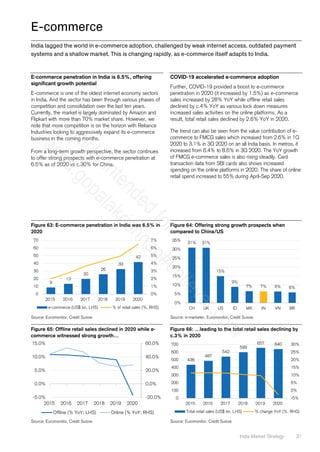
form and 13 mn+ offline merchants through inter-operable QR codes. Its app also enables flight or movie bookings,
shopping, in partnership with existing players like Goibibo, BookMyShow, etc.
Funding history
PhonePe is almost wholly owned by Flipkart and its parent Walmart and has raised total funding of US$1.3 bn till date and is
valued at US$5.5 bn. While it was earlier an exclusive subsidiary of Flipkart, with its latest US$700 mn round, Walmart has
initiated steps to spin off PhonePe and onboard external investors with direct reporting to Walmart.
Figure 277: Funding history
Source: Factset, Crunchbase, company data
Management profiles
Name Position Profile
Sameer Nigam Co-founder & CEO Prior to founding PhonePe, Mr Nigam worked as senior vice president,
engineering, at Flipkart. He is an MBA from the Wharton School.
Rahul Chari Co-founder & CTO Previously, Mr Chari built the software stack for eKart logistics at Flipkart. Prior to
that he had 10+ years of experience in storage visualisation, content management,
and supply chain technology. He has a degree in computer science from IIT
Bombay.
Source: Company data
Figure 278: PhonePe has 100 mn active users; 45% UPI
market share
Figure 279: PhonePe financials
Source: Company data, NPCI Source: Entrackr
0
3,000
6,000
0
500
1,000
2000 2001 2002 2003 2004 2005 2006 2007 2008 2009 2010 2011 2012 2013 2014 2015 2016 2017 2018 2019 2020
Funding (US$ mn) Estimated Valuation (US$ mn, RHS)
Founded in 2015
170 175
250
50 55
100
70
277
3 8 13
41%
45%
35%
40%
45%
50%
0
200
400
Apr-19 Dec-19 Nov-20
PhonePe
Reg. users (mn) Mnthly active users (mn)
Ann. TPV (US$ bn) Merchants (mn)
428 2,450 4,270
8,400
21,588 22,020
(7,910)
(19,047) (17,710)
(30,000)
(20,000)
(10,000)
-
10,000
20,000
30,000
FY18 FY19 FY20
PhonePe financials (Rs mn)
Revenues Expenses PAT
A
r
t
i
c
l
e
i
n
t
e
n
d
e
d
f
o
r
:
a
s
h
a
.
g
o
p
a
l
a
k
r
i
s
h
n
a
n
#
u
n
i
l
e
v
e
r
.
c
o
m
114
Pine Labs
Financials Ashish Gupta, Viral Shah
Reason for inclusion: Valuation <US$1 bn, but strong growth since
Company profile
Founded in 1998, Pine Labs is the largest POS player, processing US$30 bn of payments annually, representing 14% of
card spends through a network of ~600k POS machines. Its business model consists of fixed rental for POS machines and
bundling value-added services (analytics, billing and reconciliation, EMI financing, loyalty programmes, etc.). It has also
become a dominant player in offline POS consumer durable financing wherein it offers EMIs in a tie-up with 120+ brands,
35+ lenders, and 150k merchants for fees. It disbursed US$2 bn of consumer loans (no-interest EMIs) in FY20 with an
average transaction size of ~Rs25k in India and plans to expand the offering to five Southeast Asian markets in 2021.
Funding history
Pine Labs has raised a total of ~US$400 mn till date and is valued at US$2 bn. Sequoia, Temasek, Mastercard, Paypal,
Lone Pine and Actis are the key investors in Pine Labs.
Figure 280: Funding history
Source: Factset, Crunchbase, company data
Management profiles
Name Position Profile
Lokvir Kapoor Co-founder &
Chairman
Before Pine Labs, Lokvir Kapoor worked with Schlumberger in financial management and
business development in India and overseas. He has a Bachelor of Engineering from Indian
Institute of Technology (IIT), Kanpur and an MBA from IIM, Bangalore.
Amrish Rau CEO Previously, Amrish Rau was the founder and CEO of Citrus Pay, a consumer payments
company, which was later acquired by PayU. Prior to that, he worked in NCR Corporation and
was also the CEO of First Data Corporation, an electronic payment services company. He was
also founder and MD of ICICI Merchant Services (a JV of FDC and ICICI Bank).
Source: Company data
Figure 281: Pine Labs has 600k POS terminals; 150k
merchants
Figure 282: Pine Labs financials
Source: Company data, Credit Suisse Source: Entrackr
0
800
1,600
2,400
0
100
200
300
2000 2001 2002 2003 2004 2005 2006 2007 2008 2009 2010 2011 2012 2013 2014 2015 2016 2017 2018 2019 2020
Funding (US$ mn) Estimated Valuation (US mn, RHS)
Founded in 1998
600K
150K
120+
85mn
US$30bn
US$2bn US$1.5bn
POS MerchantsBrands tie
ups
Pre-
approved
EMI
customers
Payments
TPV
EMI /
BNPL
ann.
disbursals
Gift card
TPV
Pine Labs
1,910
3,323
4,916
(40) (25) (137)
-1,000
1,000
3,000
5,000
FY17 FY18 FY19
Pine Labs financials (₹ mn)
Total revenues PAT
A
r
t
i
c
l
e
i
n
t
e
n
d
e
d
f
o
r
:
a
s
h
a
.
g
o
p
a
l
a
k
r
i
s
h
n
a
n
#
u
n
i
l
e
v
e
r
.
c
o
m
India Market Strategy 115
Piramal Glass
Consumer Discretionary Arnab Mitra, Pratik Rangnekar
Reason for inclusion: Recent funding round at a valuation > US$1 bn
Company profile
Piramal Glass is a leading provider of glass packaging solutions in to segments such as pharmaceutical, cosmetics &
perfumery, and specialty food & beverage. In pharma, Piramal provides glass bottles for syrups and vials for infusions and
injectables. Comestics include bottles for creams and nail polish which beverages include bottles for beer and alcohol. It has
a manufacturing footprint in the USA, India, and Sri Lanka with an overall capacity of 1,475 tpd, with 12 furnaces and 65
production lines. Piramal Glass started in 1984 when the Piramal group acquired Gujarat Glass in Kosamba. Over the years
it has grown through both organic capacity expansion as well as acquisitions that have added segments and markets. Firms
such as L'Oréal, Diageo, Pernod Ricard, and Sanofi are customers.
Funding history
Piramal Glass has not raised private equity funding. However, the company, which was once listed on the exchanges, was
delisted by the group in 2014. The last traded market cap was c.160 mn. In Nov-2020, Piramal Group announced the sale
of this business to Blackstone at a US$1 bn valuation.
Figure 283: Blackstone acquired the company from the Piramal Group at a valuation of US$1 bn
Source: Factset
Management profiles
Name Position Profile
Ajay Piramal Founder chairman Chairman of the company and the chairman of the Piramal Group, a conglomerate
with interests in pharmaceutical, financial services, real estate, healthcare analytics
and glass packaging.
Vijay Shah Vice Chairman An old hand at the Piramal group, Mr Shah is a CA rank holder and has also done
the Management Education Programme from IIM, Ahmedabad and Advanced
Management Program from Harvard Business School.
Source: Company data
Figure 284: Piramal Glass’s revenue CAGR over the
years has been muted
Figure 285: Margins have recovered after an interim dip
Source: Company data, Euromonitor Credit Suisse Source: Company data, Credit Suisse
Management delisted
Piramal Glass
Acquired from Piramal by
Blackstone
0
750
1,500
0.0
0.5
1.0
2000 2001 2002 2003 2004 2005 2006 2007 2008 2009 2010 2011 2012 2013 2014 2015 2016 2017 2018 2019 2020
Funding (US$ mn) Estimated Valuation (US$ mn, RHS)
Founded in 1984
-2%
0%
2%
4%
6%
300
310
320
330
340
350
2016 2017 2018 2019 2020
Revenues (US$ mn) YoY % (RHS)
0%
3%
6%
9%
12%
15%
0
10
20
30
40
50
2016 2017 2018 2019 2020
PAT PAT %
A
r
t
i
c
l
e
i
n
t
e
n
d
e
d
f
o
r
:
a
s
h
a
.
g
o
p
a
l
a
k
r
i
s
h
n
a
n
#
u
n
i
l
e
v
e
r
.
c
o
m
116
PlayGames24x7 (RummyCircle)
Gaming Varun Ahuja, Krati Sanklecha
Reason for inclusion: Recent funding round at a valuation >US$1 bn
Company profile
Play Games24x7 Pvt Ltd owns and operates an online game platform. It offers rummy circle, Call it Right, Ultimate Rummy,
Ultimate Poker and Ultimate Teenpatti games. It also owns and operates platform RummyCircle.com. The portal brings
games of skill with cash prizes. It focusses on the online rummy game, multiplayer tournament platform, points rummy, and
knock-out tournaments. The company was founded in 2006 and is based in Mumbai, Maharashtra.
Funding history
PlayGames reported close to US$200 mn in sales in FY20. Estimating the price-to-sales multiple as 7.5 (Dream 11), we
get a valuation of US$1.5 bn for PlayGames24x7.
Management profiles
Name Position Profile
Bhavin Pandya Founder and COO Bhavin Pandya completed his PhD in economics from New York University. Prior
to that, he had studied electrical engineering at Purdue University.
Trivikraman Thampy Founder and CEO Trivikraman Thampy is an IIT Bombay graduate with a PhD in economics from New
York University
Source: Company data
Figure 286: Sales have grown at a CAGR of 66% from
2016-20
Figure 287: EBITDA growth has been strong as well
Source: Company data, Credit Suisse Source: Company data, Credit Suisse
0%
50%
100%
150%
0
5,000
10,000
15,000
2016 2017 2018 2019 2020
Sales (₹ mn) YoY growth % (RHS)
0%
30%
60%
90%
120%
150%
0
1,000
2,000
3,000
4,000
5,000
2016 2017 2018 2019 2020
EBITDA (₹ mn) YoY growth % (RHS)
A
r
t
i
c
l
e
i
n
t
e
n
d
e
d
f
o
r
:
a
s
h
a
.
g
o
p
a
l
a
k
r
i
s
h
n
a
n
#
u
n
i
l
e
v
e
r
.
c
o
m
India Market Strategy 117
Policybazaar
InsurTech Ashish Gupta, Viral Shah
Reason for inclusion: Recent funding round at a valuation >US$1 bn
Company profile
Founded in 2008, Policybazaar has >90% market share in online insurance aggregation and 50% market share in total
digital insurance sales in India, with a monthly run-rate of 1 mn policies. It originated Rs40 bn worth of premium in FY20,
growing at ~50% CAGR over the last two years. The platform has ~150 mn unique visitors annually with >90% from direct
channels. It has 8-10% market share in health insurance and 20-25% in term life insurance policies in India. PB Fintech,
also houses other verticals: Paisabazaar, an aggregator platform for various lending and investment products and a similar
insurance platform in the Middle East.
Funding history
Policybazaar’s parent, PB Fintech, has raised a total of ~US$550 mn till date and is valued at US$1.5 bn. Info Edge,
SoftBank, Intel, Inventus Capital, Tiger Global, Tencent are the key investors in PB Fintech (Policybazaar’s parent).
Figure 288: Funding history
Source: Company data, Factset, Crunchbase
Management profiles
Name Position Profile
Yashish Dahiya Co-founder & group CEO Yashish Dahiya holds a bachelor’s degree in engineering from IIT Delhi, a PGDM
from IIM Ahmedabad and an MBA from INSEAD. Previously, he worked at Bain
and then was CEO of a global online insurance broker. He also led an online
travel aggregator as its MD.
Sarbvir Singh CEO for Policybazaar Sarbvir Singh is an IIT Delhi and IIM Ahmedabad alumnus and has over 20 years
of global experience in venture capital, senior corporate leadership and public
markets investing. Prior to Policybazaar, he was a managing partner at
WaterBridge Ventures.
Source: Company data
Figure 289: Policybazaar is dominant in online insurance
aggregation
Figure 290: PB Fintech group financials
Source: Company data, Ken, Entrackr Source: Company data, Fintrackr, Ken
0
400
800
1,200
1,600
0
100
200
300
400
2000 2001 2002 2003 2004 2005 2006 2007 2008 2009 2010 2011 2012 2013 2014 2015 2016 2017 2018 2019 2020
Funding (US$ mn) Estimated Valuation (US$ mn, RHS)
Founded in 2008
>90%
50-60%
7-10%
20-25%
1
0%
25%
50%
75%
100%
125%
Online
insurance
aggregator
Online
insurance
policies
Health
insurance
Term life
insurance
Monthly
policies
Market share (%) Volume mn
Policy Bazaar 3,103
1,560
4
(2,131)
(970)
(127)
(4,000)
(2,000)
0
2,000
4,000
Policy Bazaar Paisa Bazaar Doc Prime
FY19 (₹ mn)
Revenues PAT
A
r
t
i
c
l
e
i
n
t
e
n
d
e
d
f
o
r
:
a
s
h
a
.
g
o
p
a
l
a
k
r
i
s
h
n
a
n
#
u
n
i
l
e
v
e
r
.
c
o
m
118
Postman
SaaS Varun Ahuja, Krati Sankhlecha
Reason for inclusion: Recent funding round at a valuation >US$1 bn
Company profile
Founded in 2014 in Bengaluru, Postman is a collaborative testing and development suite. Postman is targeted at coders,
who create, test, and modify application programme interface (APIs). It has an understandable and intuitive user interface
and helps test APIs without creating code for testing, which was the norm earlier. Today, payments, communication and
collaborations are all API-centric. For example, when you check the weather on your phone, via a search engine or a
weather app, APIs bring that information to you. Google or the app does not own the weather data, so they use APIs to
source it.
Funding history
Postman has been the fastest SaaS start-up to enter the Unicorn club in 2020 with Nexus Venture Partners being the
largest investor driving ~40% of the total funding raised.
Figure 291: Funding history
Source: Factset
Management profiles
Name Position Profile
Abhinav Asthana Co-Founder & CEO Abhinav Asthana who was the CTO of photo app TeliportMe, started the project
during his spare time and later quit his job in order to pursue development of
Postman full time. He is an engineer from BITS Pilani.
Ankit Sobti Co-Founder & CTO Ankit Sobti is an engineer and holds an MBA from ISB. Prior to joining Abhinav to
co-found Postman, Ankit worked as a product manager at Media.net.
Abhijit Kane Co-Founder Prior to joining Abhinav to co-found Postman, Abhijit Kane worked as a software
engineer at Walmart.
Source: Company data
Figure 292: Operating metrics
Metric Comments
Revenue Postman clocked revenues of US$40 mn in 2019, according to an ET report while The Ken pegged its annual
recurring revenue from product subscriptions at US$30-40 mn. A look at the financials of Postman’s Indian
entity on Tofler reveals operating revenues of Rs154.4 mn in FY19 and Rs88.6 mn in FY18 which means the
lion’s share of the company’s revenue base is accounted for by its US entity.
Category wise
competitors
API Development: Swagger, Apiary, Gelato, MuleSoft, Smartbear
API Testing: Smartbear, Katalon, RapidAPI, JMeter, Karate
API Monitoring: Loggly, AlertSite, sematext, Appdynamics, dotcom-monitor
Source: Company data
Series A, Nexus Venture Partners
Series B, Charles River Ventures,
Nexus Venture
Series C, Charles River Ventures,
Nexus Venture, Insight Venture
0
1,500
3,000
0
100
200
2000 2001 2002 2003 2004 2005 2006 2007 2008 2009 2010 2011 2012 2013 2014 2015 2016 2017 2018 2019 2020
Funding (US$ mn) Estimated Valuation (US$ mn, RHS)
Founded in 2014
A
r
t
i
c
l
e
i
n
t
e
n
d
e
d
f
o
r
:
a
s
h
a
.
g
o
p
a
l
a
k
r
i
s
h
n
a
n
#
u
n
i
l
e
v
e
r
.
c
o
m
India Market Strategy 119
Rategain
Discretionary Lokesh Garg, Gaurav Birmiwal
Reason for inclusion: Valuation <US$1 bn, but strong growth since
Company profile
Provider of cloud-based management solutions for the hospitality & travel industry. The company competes with players like
Sabre, Duetto, Travelport, and IDeaS.
Funding history
Rategain has raised around US$55 mn so far in Series A from investors like TA Associates.
Figure 293: Funding history
Source: Factset
Management profiles
Name Position Profile
Bhanu Chopra Founder and
Chairman
Bhanu Chopra founded the company in 2004 and has been with the company over
the last 17 years. He has completed his BS in finance and computer science from
Indiana University Bloomington
Harmeet Singh CEO Harmeet Singh has been with the company since 2019. He was earlier associated
with Madison Dearborn Partners, j2 Global. He has a BS in finance and accounting
from California State University
Aqeel Ahmed COO Aqeel Ahmed has been with the company almost since inception from 2005. He
has a BTech in mechanical engineering from College of Tech, Pantnagar.
Source: Company data
Figure 294: Rategain grew by 20% CAGR over the last
four years (£ mn)
Figure 295: Consistently profitable (£ mn)
Source: Orbis Source: Orbis
Avataar Ventures
TA Associates Management
0.0
0.5
1.0
1.5
0
20
40
60
2000 2001 2002 2003 2004 2005 2006 2007 2008 2009 2010 2011 2012 2013 2014 2015 2016 2017 2018 2019 2020
Funding (US$ mn) Estimated Valuation (US$ bn, RHS)
Founded in 2004
-100%
0%
100%
200%
0
10
20
30
FY2015 FY2016 FY2017 FY2018 FY2019
Revenues YoY growth % (RHS)
0%
6%
12%
18%
0
1
2
3
FY2015 FY2016 FY2017 FY2018 FY2019
PBT PBT % (RHS)
A
r
t
i
c
l
e
i
n
t
e
n
d
e
d
f
o
r
:
a
s
h
a
.
g
o
p
a
l
a
k
r
i
s
h
n
a
n
#
u
n
i
l
e
v
e
r
.
c
o
m
120
Razorpay
Financials Ashish Gupta, Viral Shah
Reason for inclusion: Recent funding round at a valuation >US$1 bn
Company profile
Founded in 2014, Razorpay operates a payment gateway with 5 mn online merchants, processing annual payments of
US$25 bn. Its target segment includes MSMEs seeking to build online presence and start-ups with its developer friendly and
easy to integrate single script APIs. It also offers value-added services like automating vendor payments, real time
reconciliation and analytics, GST invoicing, and the like. It is also building a neo-banking platform that offers business
banking and funding to merchants in partnership with banks.
Funding history
Razorpay has raised a total of US$204 mn till date and is valued at US$1 bn. Matrix, Tiger Global, Sequoia, DST, and GIC
are the key investors in Razorpay.
Figure 296: Funding history
Source: Factset
Management profiles
Name Position Profile
Harshil Mathur Co-founder & CEO Harshil Mathur previously worked at Schlumberger as a field engineer. He is an
engineering graduate from IIT Roorkee.
Shashank Kumar Co-founder Shashank Kumar has a graduate degree in computer science from IIT Roorkee.
Source: Company data
Figure 297: Razorpay has 5 mn+ merchants processing
US$25 bn of payments annually
Figure 298: Razorpay financials
Source: Company data Source: Entrackr
-300
300
900
1,500
0
50
100
150
2000 2001 2002 2003 2004 2005 2006 2007 2008 2009 2010 2011 2012 2013 2014 2015 2016 2017 2018 2019 2020
Funding (US$ mn) Estimated Valuation (US$ mn, RHS)
Founded in 2014
US$25 bn
5 mn
10 k+ 8 k+
0
10
20
30
Annual trnx
processed
Merchants RazorpayX
enabled
merchants
Razorpay Capital
enabled
merchants
-2000
0
2000
4000
6000
Revenues Total expenses PAT Net cash flow
from operations
(₹ mn)
FY19 FY20
A
r
t
i
c
l
e
i
n
t
e
n
d
e
d
f
o
r
:
a
s
h
a
.
g
o
p
a
l
a
k
r
i
s
h
n
a
n
#
u
n
i
l
e
v
e
r
.
c
o
m
India Market Strategy 121
ReNew Power Ventures
Energy Lokesh Garg, Gaurav Birmiwal
Reason for inclusion: Recent funding round at a valuation >US$1 bn
Company profile
ReNew Power has a total asset base of 10.14 GW of which 5.73 GW is already commissioned. ReNew Power develops, builds,
owns and operates utility scale wind and solar energy projects as well as distributed solar energy projects that generate energy for
commercial and industrial customers. It today operates more than 110 utility scale projects spread across eight states in India.
Funding history
ReNew Power has been funded by Goldman Sachs, Global Environment Fund, Asian Development Bank and Abu Dhabi
Investment Authority, CPPIB and JERA.
Figure 299: Funding history
Source: Factset
Management profiles
Name Position Profile
Sumant Sinha Chairman and
MD
After starting his career in the Tata Administrative Service, Sumant Sinha worked as an investment
banker with Citicorp and ING Barings in the US and UK, before heading finance at Aditya Birla Group.
He was also COO of Suzlon. He has a master’s degree in international affairs from Columbia
University, business management from IIM Calcutta and a BTech from IIT Delhi.
Michael Specht
Bruun
Goldman Sachs
Nominee
Director
Michael Bruun holds a bachelor’s in economics from University of Copenhagen and master’s in
economics from University of Copenhagen and Cornell University. He joined Goldman Sachs in 2004
and is currently working as a partner in the merchant banking division of Goldman Sachs in London.
Satoshi Yajima JERA Power
Nominee
Director
Satoshi Yajima works for JERA since 2016 and is responsible for business development of global
renewable project and thermal IPP power projects as senior operating officer at the business
development department at HQ in Tokyo. He has over 30 years of experience in development and
management of international and domestic power projects and during his career has served at
Marubeni, Enron and TEPCO (Tokyo Electric Power Company) before his association with JERA.
Source: Company data
Figure 300: ReNew grew at 67% CAGR over last four
years (Rs mn)
Figure 301: Strong growth in asset base impacts
profitability due to fixed costs flowing through (Rs mn)
Source: Orbis Source: Orbis
Goldman Sachs (GS)
GS, Global Env.
Fund (GEF), ADB
ADIA, GEF, GS
JERA
CPPIB
CPPIB, GS, ADIA
0
1,000
2,000
3,000
0
200
400
600
2000 2001 2002 2003 2004 2005 2006 2007 2008 2009 2010 2011 2012 2013 2014 2015 2016 2017 2018 2019 2020
Funding (US$ mn) Estimated Valuation (US$ mn, RHS)
Founded in 2011
0%
50%
100%
150%
0
20,000
40,000
60,000
2016 2017 2018 2019 2020
Revenues YoY growth % (RHS)
-12%
-6%
0%
6%
12%
18%
-6,000
-4,000
-2,000
0
2,000
4,000
2016 2017 2018 2019 2020
PBT PBT % (RHS)
A
r
t
i
c
l
e
i
n
t
e
n
d
e
d
f
o
r
:
a
s
h
a
.
g
o
p
a
l
a
k
r
i
s
h
n
a
n
#
u
n
i
l
e
v
e
r
.
c
o
m
122
RSPL Limited
Consumer staples Arnab Mitra, Pratik Rangnekar
Reason for inclusion: Valuation >US$1 bn at latest EBITDA and multiple
Company profile
Mr Murlidhar and Bimal Gyanchandani founded this Kanpur-based consumer goods firm in 1987. The key segment of RSPL
is economy detergents with ‘Ghadi’ being its main brand. RSPL is a key competitor to Nirma and HUL’s lower end brands
and has a 10% share in the detergents market and is primarily strong in the northern states of Uttar Pradesh, Bihar, Madhya
Pradesh and also Western India. The company has expanded beyond fabric wash and detergents to dishwasher bars, body
soap and sanitary pads as well.
Funding history
The company has not raised funding so valuation history is unavailable but valuing as per the listed peerset in the tier 2 space
given its exposure to a single product and that too at the lower end, we estimate the company to be worth c.US$1.3 bn.
Management profiles
Name Position Profile
Murlidhar and Bimal
Gyanchandani
Founder MD RSPL is a largely family run business with the two founders continuing to be on the
board. They are responsible for group strategy including the key marketing
function. Growth planning as well as any foray into newer segments is also a part
of their scope. Murlidhar Gyanchandani is the executive chairman while Bimal
Gyanchandani is the MD.
Manoj, Rahul and Rohit
Gyanchandani
Director While Manoj Gyanchandani is involved in RSPL, he is more focussed on the other
business interests of the group such as leather and footwear. Rahul Gyanchandani
is a joint MD, joined the business 2004 and was key to diversifying into body soaps
and other home care segments. Rohit Gyanchandani joined the business in 2005
and is a graduate from SP Jain Institute of Management and looks after the
hygiene care part of the business.
Source: Company data
Figure 302: RSPL’s market share has increased 3 pp to
25%
Figure 303: Margins have reduced from the peak of FY16
Source: Company data, Euromonitor Credit Suisse Source: Company data, Credit Suisse
18%
20%
22%
24%
26%
550
600
650
700
750
2015 2016 2017 2018 2019
Revenues (US$ mn) Market share in detergents (RHS)
0%
5%
10%
15%
0
20
40
60
80
100
2015 2016 2017 2018 2019
PBT (US$ mn) PBT % (RHS)
A
r
t
i
c
l
e
i
n
t
e
n
d
e
d
f
o
r
:
a
s
h
a
.
g
o
p
a
l
a
k
r
i
s
h
n
a
n
#
u
n
i
l
e
v
e
r
.
c
o
m
India Market Strategy 123
Serum Institute of India
Healthcare Anubhav Aggarwal, Sayantan Maji
Reason for inclusion: Valuation >US$1 bn at latest EBITDA and multiple
Company profile
Serum Institute of India Pvt Ltd is the world's largest vaccine manufacturer by number of doses produced and sold globally
(more than 1.5 bn doses) which includes polio vaccine as well as diphtheria, tetanus, pertussis, Hib, BCG, r-Hepatitis B,
measles, mumps and rubella, and COVID-19 vaccines. Vaccines manufactured by Serum Institute are accredited by World
Health Organisation, Geneva and are being used in around 170 countries. The company was founded in 1966 by Dr Cyrus
Poonawalla with the aim of manufacturing life-saving immuno-biologicals, which were in shortage in the country and
imported at high prices.
Funding history
NA
Figure 304: Funding history
Source: Mint
Management profiles
Name Position Profile
Cyrus Poonawalla Founder Dr Cyrus Poonawalla is Chairman of Poonawalla Group, which includes Serum
Institute of India. He was awarded the Padma Shri by the Government of India in
2005 for his contribution to the field of medicine.
Adar Poonawalla CEO Adar Poonawalla joined Serum Institute of India in 2001 and became CEO in
2011. He was educated at The Bishop's School (Pune), St Edmund's School
Canterbury, followed by the University of Westminster.
Source: Company data
Figure 305: Steady revenue growth profile of Serum
Institute of India…
Figure 306: …at high margins, as profitability is high in
the vaccine manufacturing industry
Source: Orbis Source: Orbis
Valuation sought during
stake sale discussions
0
5,000
10,000
15,000
0
1
1
2
2000 2001 2002 2003 2004 2005 2006 2007 2008 2009 2010 2011 2012 2013 2014 2015 2016 2017 2018 2019 2020
Funding (US$ mn) Estimated Valuation (US$ mn, RHS)
Founded in 1996
-15%
0%
15%
30%
45%
0
200
400
600
800
FY11 FY12 FY13 FY14 FY15 FY16 FY17 FY18
Revenue (US$ mn) YoY growth % (RHS)
48%
51%
54%
57%
60%
63%
0
100
200
300
400
500
FY11 FY12 FY13 FY14 FY15 FY16 FY17 FY18
PBT (US$ mn) PBT margin % (RHS)
A
r
t
i
c
l
e
i
n
t
e
n
d
e
d
f
o
r
:
a
s
h
a
.
g
o
p
a
l
a
k
r
i
s
h
n
a
n
#
u
n
i
l
e
v
e
r
.
c
o
m
124
Sharechat
IT/Technology Varun Ahuja, Krati Sanklecha
Reason for inclusion: Valuation <US$1 bn, but strong growth since
Company profile
Mohalla Tech Pvt Ltd owns and operates an online social networking platform, Sharechat.com. It offers services such as
providing funny videos, songs, movies, advertisements, daily horoscopes, quotes, etc. It helps to create and share content in
the user’s own language. It is available in six languages namely Hindi, Marathi, Malayalam, Punjabi, Gujarati and Telugu. The
company was founded in 2015 and is based in Bengaluru, Karnataka.
Funding history
Sharechat has raised a total of US$273 mn till date and is expected to be valued at US$1 bn in its latest round of fund
raising in 2021. It has been funded by Elevation Capital, Lightspeed, Twitter, Xiaomi and 5Y Capital, among others.
Figure 307: Sharechat is looking to raise US$300 mn in series E funding at a valuation of US$1 bn
Source: Factset
Management profiles
Name Position Profile
Farid Ahsan Founder and CEO Farid Ahsan has a BTech degree in material science and engineering from IIT
Kanpur.
Ankush Sachdeval Founder and CEO Ankush Sachdeval has a BTech degree in computer science and engineering
from IIT Kanpur.
Source: Company data
Figure 308: Sales have grown exponentially Figure 309: Cost-to-income ratio has been declining
steadily
Source: Company data, Credit Suisse Source: Company data, Credit Suisse
Angel, Elevation
Series A, Lightspeed
Series B, Xiaomi
Series C, 5Y Capital
Series D, Twitter
Series E
0
400
800
1,200
0
50
100
150
2000 2001 2002 2003 2004 2005 2006 2007 2008 2009 2010 2011 2012 2013 2014 2015 2016 2017 2018 2019 2020
Funding (US$ mn) Estimated valuation (US$ mn, RHS)
Founded in 2015
0%
300%
600%
900%
1200%
1500%
0
100
200
300
400
500
2016 2017 2018 2019 2020
Sales (₹ mn) YoY growth % (RHS)
0.0
10.0
20.0
30.0
40.0
50.0
2016 2017 2018 2019 2020
Cost to Income Ratio
A
r
t
i
c
l
e
i
n
t
e
n
d
e
d
f
o
r
:
a
s
h
a
.
g
o
p
a
l
a
k
r
i
s
h
n
a
n
#
u
n
i
l
e
v
e
r
.
c
o
m
India Market Strategy 125
Sorting Hat Technologies (Unacademy)
Education Varun Ahuja, Krati Sankhlecha
Reason for inclusion: Recent funding round at a valuation >US$1 bn
Company profile
Sorting Hat Technologies Pvt Ltd owns and operates online education web portal Unacademy.in. It offers courses under
seven heads like test preparation, language, programming, job preparation, central board of secondary education,
engineering curriculum, lifelong learning. It also helps educators create these courses, which are then available on the
platform for free. It was founded in 2015 and is based in Bengaluru, Karnataka.
Funding history
Unacademy has raised a total of US$400 mn till date and was valued at US$2 bn in its last round of funding in Nov-2020. it
has been funded by Tiger Global, Sequoia, General Atlantic, Nexus India, Facebook, Blume Ventures and Elevation Capital,
among others.
Figure 310: In the latest round, Unacademy has raised US$250 mn at a valuation of US$2 bn
Source: Factset
Management profiles
Name Position Profile
Gaurav Munjal Founder & CEO After completing his BTech in computer science from Motilal Nehru Institute of
Technology, Gaurav Munjal founded Flatchat before starting Unacademy.
Hemesh Singh Founder & CTO Hemesh Singh has completed engineering from Motilal Nehru Institute of
Technology and was the CTO of Flatchat before founding Unacademy.
Source: Company data
Figure 311: Sales have grown exponentially Figure 312: Cost-to-income ratio has been declining
steadily
Source: Company data, Credit Suisse Source: Company data, Credit Suisse
Series A1, Blume Ventures
Series A2 Nexus Ventures
Series B, Nexus Ventures
Series C, Sequoia
Series D, Steadview
Series E, General Atlantic
0
800
1,600
2,400
0
100
200
300
2000 2001 2002 2003 2004 2005 2006 2007 2008 2009 2010 2011 2012 2013 2014 2015 2016 2017 2018 2019 2020
Funding (US$ mn) Estimated Valuation (US$ mn, RHS)
Founded in 2015
0%
250%
500%
750%
1000%
0
200
400
600
800
2016 2017 2018 2019 2020
Sales (₹ mn) YoY growth % (RHS)
0
4
8
12
16
20
2016 2017 2018 2019 2020
Cost to Income ratio
A
r
t
i
c
l
e
i
n
t
e
n
d
e
d
f
o
r
:
a
s
h
a
.
g
o
p
a
l
a
k
r
i
s
h
n
a
n
#
u
n
i
l
e
v
e
r
.
c
o
m
126
Sporta Technologies (Dream11)
Gaming Varun Ahuja, Krati Sanklecha
Reason for inclusion: Recent funding round at a valuation >US$1 bn
Company profile
Sporta Technologies Pvt Ltd (formerly known as Dream11 Fantasy Pvt Ltd) owns and operates an online gaming portal
Dream11. It offers fantasy sports, fantasy football, fantasy cricket, fantasy kabaddi, fantasy sports platform, cricket, games
of skill, among others. It also operates a multi-sport aggregator platform, Fancode, which focusses on long-tail sports
content and contextual commerce. The company was founded in 2012 and is based in Mumbai, Maharashtra.
Funding history
Dream11 has raised a total of US$385 mn till date and was valued at US$2.5 bn in its last round of funding in Oct-2020. It
has been funded by Chrys Capital, TPG Capital, Kalaari, Tiger Global, Tencent, Multiples and Steadview Capital, among
others.
Figure 313: In the latest round, Dream11 raised US$225 mn at a valuation of US$2.5 bn
Source: Factset
Management profiles
Name Position Profile
Harsh Jain Founder and CEO Harsh Jain graduated as an engineer from the University of Pennsylvania in
Philadelphia and MBA from Columbia Business School in New York.
Bhavit Sheth Founder and COO Bhavit Sheth is an engineer with an MBA from Bentley University (Boston) and
has a Diploma in e-commerce strategies from Harvard.
Source: Company data
Figure 314: Sales have shown a spike in 2020 Figure 315: Share of online retail spends has risen sharply
Source: Company data, Credit Suisse Source: Company data, Credit Suisse
Series C, Multiples
Series D, Tencent
Series E, Steadview
Series F, Tiger
0
1,000
2,000
3,000
0
100
200
300
2000 2001 2002 2003 2004 2005 2006 2007 2008 2009 2010 2011 2012 2013 2014 2015 2016 2017 2018 2019 2020
Funding (US$ mn) Estimated Valuation (US$ mn, RHS)
Founded in 2012
0%
150%
300%
450%
0
10,000
20,000
30,000
2015 2016 2017 2018 2019 2020
Sales (₹ mn) YoY growth % (RHS)
12.1
1.4 1.2
3.6
1.8
0
3
6
9
12
15
2016 2017 2018 2019 2020
Cost to Income Ratio
A
r
t
i
c
l
e
i
n
t
e
n
d
e
d
f
o
r
:
a
s
h
a
.
g
o
p
a
l
a
k
r
i
s
h
n
a
n
#
u
n
i
l
e
v
e
r
.
c
o
m
India Market Strategy 127
Sri Chaitanya
Education Varun Ahuja, Krati Sanklecha
Reason for inclusion: Valuation >US$1 bn at latest EBITDA and multiple
Company profile
Sri Chaitanya Group is engaged in providing educational services. It operates under the name Sri Chaitanya Educational
Institutions. It provides coaching for entrance exams like Indian Institute of Technology joint entrance exam (IIT-JEE), pre-
medical test (PMT), chartered accountancy, Indian administrative service (IAS) exams, and the like. The group also operates
private schools, junior colleges, a] chartered accountancy academy and an Indian administrative service academy. The
company was founded in 1986 and is based in Hyderabad, Telangana.
Funding history
NA
Management profiles
Name Position Profile
Dr BS Rao Founder and Chairman A practicing doctor, Dr BS Rao opened the first school in 1986 with just one
branch of 56 students.
Sushma Bopanna Academic Director Mrs Sushma Bopanna completed her BTech from BITS Pilani and her master’s in
IT from US University.
Source: Company data
Figure 316: Number of universities growing at a CAGR of
8%
Figure 317: Education industry grew by 10% in India
Source: Company data, Credit Suisse Source: Company data, Credit Suisse
0
200
400
600
800
1,000
1,200
FY16 FY17 FY18 FY19
Number of Universities in India
0
20
40
60
80
100
FY18 FY19
Number of Universities in India
A
r
t
i
c
l
e
i
n
t
e
n
d
e
d
f
o
r
:
a
s
h
a
.
g
o
p
a
l
a
k
r
i
s
h
n
a
n
#
u
n
i
l
e
v
e
r
.
c
o
m
128
Star Health
Financials Ashish Gupta, Jayant Kharote
Reason for inclusion: Emerging rural focus NBFC with US$3.5 bn AUM
Company profile
Provider of health insurance services founded in 2006 and based in Chennai, Tamil Nadu. Star Health specialises in health
insurance services and provides a wide range of medi-claim products, overseas medical coverage and personal accident
coverage for senior citizens and families. Star is the largest private health insurance provider in India, with a market share of
47.4% in the standalone health insurance segment, 22.2% in the private health insurance space, and 12.1% in the overall
health insurance segment in FY20.
Funding history
In August 2018, Safecrop Holdings Pvt Ltd, a consortium of investors including WestBridge AIF, Rakesh Jhunjhunwala and
Madison Capital, signed definitive agreements with the shareholders of Star Health & Allied Insurance Company Ltd to pick
up 90% in the firm. Back then, the existing shareholders of Star Health included Star Health Investments Pvt Ltd and funds
managed/or advised by ICICI Venture, Tata Capital and Apis Partners.
Figure 318: Funding history
Source: Factset, Crunchbase, company data
Management profiles
Name Position Profile
V Jagannathan Chairman & CEO Founder of Star Health who was earlier heading United India Insurance and has
over 50 years’ experience in the industry.
Dr S Prakash MD A medical doctor who is the first of its kind to have two decades of clinical
experience from India and overseas and having more than a decade of
experience in health insurance.
Source: Company data
Figure 319: Gross premium growth remains strong Figure 320: Combined ratio has come off and is stable
Source: Company data Source: Company data
ICICI Venture Seqioua
Tata capital
Apis Rakesh
0
500
1,000
1,500
0
20
40
60
2000 2001 2002 2003 2004 2005 2006 2007 2008 2009 2010 2011 2012 2013 2014 2015 2016 2017 2018 2019 2020
Funding (US$ mn) Estimated Valuation (US$ mn, RHS)
Founded in 2006
18.5
24.8
35.6
47.8
61.3
0%
20%
40%
60%
0
20
40
60
80
FY16 FY17 FY18 FY19 FY20
GWP (₹ bn) Growth (%)
113%
101%
93% 93% 93% 93%
0%
25%
50%
75%
100%
125%
FY15 FY16 FY17 FY18 FY19 FY20
Combined ratio (%)
A
r
t
i
c
l
e
i
n
t
e
n
d
e
d
f
o
r
:
a
s
h
a
.
g
o
p
a
l
a
k
r
i
s
h
n
a
n
#
u
n
i
l
e
v
e
r
.
c
o
m
India Market Strategy 129
Supermart Grocery Supplies
(BigBasket)
E-commerce Arnab Mitra, Pratik Rangnekar
Reason for inclusion: Recent funding round at a valuation >US$1 bn
Company profile
Supermarket Grocery Supplies Pvt Ltd owns and operates an online food and grocery portal, Bigbasket.com. The firm offers
grocery items in categories such as fruits and vegetables, basmati rice, green tea, cheese, dry fruits, chocolates and sweets,
soft drinks, wheat atta, frozen food and chicken, diapers and wipes; sanitary pads, mosquito repellent, energy drinks, bread
dairy and eggs; olive oils, grocery and staples, sunflower oils, liquid soaps and bars, and meats. The company was founded
in 2011 and is based in Bengaluru, Karnataka.
Funding history
BigBasket has raised a total of US$750 mn till date and was valued at US$1.2 bn in its last round of funding in Apr-2020. It
has been funded by Abraaj, Helion, Alibaba, Mirae, Ascent, Sands Capital, Trifecta and CDC Group, among others.
Figure 321: In the latest round, BigBasket has raised US$50 mn at a valuation of US$1.2 bn
Source: Factset
Management profiles
Name Position Profile
Hari Menon CEO An alumni of BITS Pilani, Hari Menon has held top positions with IT majors like
Wipro, country head of Planetasia and CEO of Indiaskills.
Vipul Parekh Founder, Head of
Marketing & Finance
An alumni of IIM B, Vipul Parekh has worked as investment director for Peepul
Capital and business development head for Wipro, before founding BigBasket.
Source: Company data
Figure 322: Sales have grown at a CAGR of 61% from
2015-20
Figure 323: Cost-to-income ratio still high
Source: Company data, Credit Suisse Source: Company data, Credit Suisse
Series A, Ascent
Series B, Helion
Series C, Zodius
Series D, Sands Capital
Series E, Alibaba
Series F, Mirae
Series G, CDC
0
1000
2000
0
200
400
2000 2001 2002 2003 2004 2005 2006 2007 2008 2009 2010 2011 2012 2013 2014 2015 2016 2017 2018 2019 2020
Funding (US$ mn) Estimated Valuation (US$ mn, RHS)
Founded in 2011
0%
40%
80%
120%
160%
0
10,000
20,000
30,000
40,000
2016 2017 2018 2019 2020
Sales (₹ mn) YoY growth % (RHS)
0.0
0.5
1.0
1.5
2.0
2016 2017 2018 2019 2020
Cost to Income Ratio
A
r
t
i
c
l
e
i
n
t
e
n
d
e
d
f
o
r
:
a
s
h
a
.
g
o
p
a
l
a
k
r
i
s
h
n
a
n
#
u
n
i
l
e
v
e
r
.
c
o
m
130
Synechron
IT Services Varun Ahuja, Krati Sankhlecha
Reason for inclusion: Valuation >US$1 bn at latest EBITDA and multiple
Company profile
Founded in 2001 in Pune, engaged in the provision of hardware consultancy, computer programming, data processing, and
other computer related services. Synechron is involved in writing, modifying, testing, and supporting software to meet the
needs of a particular customer; planning and designing computer systems that integrate computer hardware, software, and
communication technologies; on-site management and operation of clients' computer systems and/or data processing
facilities; and other professional and technical computer-related advice and services.
Funding history
In 2019, there was media speculation (Economic Times) that Synechron is being seen as a potential acquisition target for
global IT services companies like Cognizant and NTT. At that time, the company was being valued at US$1.2-1.3 bn.
Synechron has not raised any PE/VC funding.
Management profiles
Name Position Profile
Faisal Husain Co-founder & CEO Prior to founding Synechron, Faisal Husain was responsible for developing
enterprise-level applications for Merrill Lynch and Dun & Bradstreet. He holds a
bachelor's in aeronautical engineering and a master's in computer science.
Tanveer Saulat Co-founder & CPO Tanveer Saulat has 20 years of experience. He started his career in HR at Deepak
Nitrate Limited. He graduated as Master of Personnel Management from the
University of Pune. As the CPO of Synechron, Tanveer has built and shaped the
growth of the company in becoming a leading digital, business consulting &
technology services company over the last 18 years.
Zia Bhutta Co-founder & COO Zia Bhutta manages global operations, sales force, and finance and client
relationships at Synechron. He is an engineer from Rutgers, The State University
of New Jersey-New Brunswick
Source: Company data, Credit Suisse
Figure 324: Operating metrics
Metric Comments
Revenue Synechron earns more than US$500 mn in revenues annually.
Profitability Synechron’s EBITDA stood at US$60-70, suggesting an EBITDA margin of 12-14%.
Organic/inorganic
growth
The company has steadily grown organically as well as inorganically. It has acquired a series of smaller IT firms
in the US and Europe. The recent acquisition of Attra (company focussed on banking solutions) is expected to
add US$100 mn to Synechron’s revenues.
Geographies Synechron has presence in the US, Canada, Europe and Middle East with US being the dominant market.
Source: Company data, Credit Suisse
A
r
t
i
c
l
e
i
n
t
e
n
d
e
d
f
o
r
:
a
s
h
a
.
g
o
p
a
l
a
k
r
i
s
h
n
a
n
#
u
n
i
l
e
v
e
r
.
c
o
m
India Market Strategy 131
Think and Learn (Byju’s)
Ed-Tech Varun Ahuja, Krati Sankhlecha
Reason for inclusion: Recent funding round at a valuation >US$1 bn
Company profile
Think and Learn Pvt Ltd owns and operates an online learning application Byju's. It is engaged in providing online
educational services. It offers test preparation courses like a common admission test, union public service commission,
graduate management admission test, graduate record examination, and Indian administrative service. It also offers
supplemental school curriculum classes for class 4-12. The company was founded in 2011 and is based in Bengaluru,
Karnataka.
Funding history
Byju’s has raised a total of US$1.8 bn till date and was valued at US$12 bn in its last round of funding in Nov-2020. It has
been funded by Tiger Global, Sequoia, QIA, Blackrock, Silver lake, Sofina, Aarin Capital and Lightspeed India, among
others.
Figure 325: In the latest round, Byju’s raised US$200 mn (valuation of US$12 bn) led by BlackRock and T Rowe Price
Source: Factset
Management profiles
Name Position Profile
Raveendran Byju Founder & CEO After completing his BTech in mechanical engineering from Government
Engineering college in Kannur, Kerala, Raveendran started Byju in 2011.
Ranjit Radhakrishnan CPO After graduating from IIMK in 2008, Ranjit Radhakrishnan worked in multiple
start-ups like Zynga, Hike, before joining Byju’s in 2015.
Source: Company data
Figure 326: Sales have grown by 129% CAGR from
2015-20
Figure 327: Byju’s has reported positive EBITDA since
FY18
Source: Company data, Credit Suisse Source: Company data, Credit Suisse
Series A, Aarin Capital
Series B,C, Sequioa
Series D, Verlinvest
Series E, Naspers
Series F, QIA
Series G, Silverlake
0
3,000
6,000
9,000
12,000
0
300
600
900
1,200
2000 2001 2002 2003 2004 2005 2006 2007 2008 2009 2010 2011 2012 2013 2014 2015 2016 2017 2018 2019 2020
Funding (US$ mn) Estimated Valuation (US$ mn, RHS)
Founded in 2011
0%
60%
120%
180%
0
10,000
20,000
30,000
2015 2016 2017 2018 2019 2020
Sales (₹ mn) YoY growth % (RHS)
-600
-400
-200
0
200
400
600
800
1,000
2015 2016 2017 2018 2019
EBITDA (₹ mn)
A
r
t
i
c
l
e
i
n
t
e
n
d
e
d
f
o
r
:
a
s
h
a
.
g
o
p
a
l
a
k
r
i
s
h
n
a
n
#
u
n
i
l
e
v
e
r
.
c
o
m
132
Udaan
Logistics Satyam Thakur, Garima Bharti
Reason for inclusion: Recent funding round at a valuation = US$3 bn
Company profile
Udaan is a B2B logistics operator founded in 2016. It is a business marketplace where manufacturers and wholesalers can
sell their products to retailers via an online app on their mobile. The company facilitates buying and selling with secure
payments and smooth logistics.
Funding history
Udaan has cumulatively raised US$1.15 bn so far and was valued at US$3 bn during its last fund raise of US$280 mn in
Dec-2020. Some of its key investors are Lightspeed Venture Partners, DST Global, Tencent and Moonstone Capital.
Figure 328: Funding history
Source: Pitchbook, Tracxn
Management profiles
Name Position Profile
Sujeet Kumar Founder Sujeet Kumar co-founded Udaan in 2016. He is a 2003 batch graduate from IIT
Delhi and worked in Flipkart prior to founding Udaan.
Amod Malviya Co-Founder Amod Malviya also worked at Flipkart prior to co-founding Udaan. He is a 2002
batch graduate from IIT Kharagpur.
Vaibhav Gupta Co-Founder Vaibhav Gupta, a graduate from IIT Delhi and MBA from University of Virginia,
co-founded the company in 2016. Prior to this, he worked with Flipkart and
McKinsey.
Source: Company data
Figure 329: Revenue grew 19x between FY19 and FY20 Figure 330: While absolute losses almost doubled, loss
as % of sales came down to ~41% in FY20
Source: TechCircle Source: TechCircle
​
​ ​
0
2,000
4,000
0
500
1,000
2016 2017 2018 2019 2020
Funding (US$ mn) Estimated Valuation (US$ mn, RHS)
Founded in 2016
118
2,256
0
500
1,000
1,500
2,000
2,500
FY19 FY20
Revenue (₹ mn) Linear (Revenue (₹ mn))
(444)
(923) -400.0%
-300.0%
-200.0%
-100.0%
0.0%
-1,000
-800
-600
-400
-200
0
FY19 FY20
PBT (₹ mn) PBT Margin (RHS)
A
r
t
i
c
l
e
i
n
t
e
n
d
e
d
f
o
r
:
a
s
h
a
.
g
o
p
a
l
a
k
r
i
s
h
n
a
n
#
u
n
i
l
e
v
e
r
.
c
o
m
India Market Strategy 133
UrbanClap Technologies (Urban
Company)
Discretionary Arnab Mitra, Pratik Rangnekar
Reason for inclusion: Recent funding round at a valuation >US$1 bn
Company profile
UrbanClap Technologies India Pvt Ltd owns and operates an online marketplace for urban lifestyle services known as Urban
Company. It offers mobile application and website for finding and hiring services such as home service and repair, beauty
and wellness services, lessons and hobbies, event and wedding services, business services, personal services. The company
was founded 2014 and is based in Gurgaon, Haryana.
Funding history
Urbanclap has raised a total of US$188 mn till date and was valued at US$0.9 bn in its last round of funding in 2019. It has
have been funded by Bessemer, Vy Capital, Steadview Capital, Tiger Global, Accel India and Elevation Capital, among
others.
Figure 331: Urban Company was valued at US$933 mn in its last round of funding in 2019
Source: Factset
Management profiles
Name Position Profile
Varun Khaitan Founder and CEO An Alumni of IIT Kanpur, Varun Khaitan has worked with Qualcomm and BCG in
the US before returning to India to find UrbanClap in 2015.
Raghav Chandra Founder and CTO Raghav is an alumni of University of California, Berkeley and has worked at
Infosys, Roamware and Yelp as a software engineer prior to founding UrbanClap.
Source: Company data
Figure 332: Sales have grown exponentially since FY18 Figure 333: Cost-to-income ratio has been declining
steadily
Source: Company data, Credit Suisse Source: Company data, Credit Suisse
Series A, B, Bessemer Series C,
Vy Capital
Series D, Steadview
Series E, Tiger
0
500
1,000
0
50
100
2000 2001 2002 2003 2004 2005 2006 2007 2008 2009 2010 2011 2012 2013 2014 2015 2016 2017 2018 2019 2020
Funding (US$ mn) Estimated Valuation (US$ mn, RHS)
Founded in 2015
0%
300%
600%
900%
1200%
1500%
0
500
1,000
1,500
2,000
2,500
2016 2017 2018 2019 2020
Sales (₹ mn) YoY growth % (RHS)
0
20
40
60
80
2016 2017 2018 2019 2020
Cost to Income Ratio
A
r
t
i
c
l
e
i
n
t
e
n
d
e
d
f
o
r
:
a
s
h
a
.
g
o
p
a
l
a
k
r
i
s
h
n
a
n
#
u
n
i
l
e
v
e
r
.
c
o
m
134
UST
IT Services Varun Ahuja, Krati Sankhlecha
Reason for inclusion: Recent funding round at a valuation >US$1 bn
Company profile
UST is a provider of custom computer programming services. The company offers content management, cloud services,
continuous improvements, enterprise content management, information management, IT services, Six Sigmas, objectives, IT
solutions, mobiles. The company was founded in 1999 in Kochi.
Funding history
UST raised funding only once in 2018 from Temasek.
Figure 334: Funding history
Source: Crunchbase
Management profiles
Name Position Profile
Paras Chandaria Executive Chairman A leader with over 25 years of international business experience, Paras Chandaria
works alongside the leadership team to define and articulate UST’s long-term
strategy. Education: BA, London School of Economics and Political Science (LSE),
graduate of executive programs at INSEAD, Oxford University, and Singularity
University.
Krishna Sudheendra CEO With more than 25+ years leading high-growth organisations, Krishna Sudheendra
is responsible for growing the business at scale and creating shareholder value.
Before joining UST in 2004, he was corporate controller for First Apex, and held
FP&A leadership positions at General Electric. He began his career as a consultant
with SB Billimoria, a Deloitte partner company.
Arun Narayanan President Since 2000, Arun Narayanan served in several executive positions at UST and was
previously the chief operating officer (COO) of the company. Prior to UST he was
with HCL and IMR Global in delivery leadership roles.
Source: Company data
Figure 335: Operating metrics
Metric Comments
Revenue UST’s annual revenue is more than US$500 mn.
Source: Company data, Credit Suisse
PE Round, Temasek
0
500
1,000
1,500
0
100
200
300
2000 2001 2002 2003 2004 2005 2006 2007 2008 2009 2010 2011 2012 2013 2014 2015 2016 2017 2018 2019 2020
Funding (US$ mn) Estimated Valuation (US$ mn, RHS)
Founded in 1999
A
r
t
i
c
l
e
i
n
t
e
n
d
e
d
f
o
r
:
a
s
h
a
.
g
o
p
a
l
a
k
r
i
s
h
n
a
n
#
u
n
i
l
e
v
e
r
.
c
o
m
India Market Strategy 135
Vini Cosmetics
Discretionary Arnab Mitra, Pratik Rangnekar
Reason for inclusion: Recent funding round at a valuation >US$1 bn
Company profile
Vini Cosmetics Pvt Ltd is engaged in manufacturing personal care products. Its provides beauty and personal care products
like ladies and gents deodorants, talc powder, perfume, and face powder under the brands Fogg, 18+ Deodorants, Glam Up
and White Tone Talc. The company was incorporated in 2009 and is based in Ahmedabad, Gujarat.
Funding history
Vini Cosmetics has raised a total of US$194 mn till date and was valued at US$1.1 bn in 2020. It has been funded by
Sequoia Capital, Bay Capital, Westbridge and Sixth Sense Ventures.
Figure 336: Vini Cosmetics was valued at US$1.1 bn in 2020
Source: Factset
Management profiles
Name Position Profile
Darshan Patel Founder and MD Darshan Patel was born in Ahmedabad, but brought up in Sambalpur, Orissa. He
co-founded Paras Group (Livon), but moved out of it in 2010 to found ini
Cosmetics. Paras group was subsequently sold to Reckitt Benckiser.
Source: Company data
Figure 337: Sales have grown at a CAGR of 13% from
2016-20
Figure 338: Steady earnings growth at 28% CAGR in the
last five years
Source: Company data, Credit Suisse Source: Company data, Credit Suisse
Series A, Bay Capital
Series B, Sequioa
Series C, Westbridge
0
500
1,000
1,500
0
100
200
2000 2001 2002 2003 2004 2005 2006 2007 2008 2009 2010 2011 2012 2013 2014 2015 2016 2017 2018 2019 2020
Funding (US$ mn) Estimated Valuation (US$ mn, RHS)
Founded in 2009
-8%
0%
8%
16%
24%
32%
0
2,000
4,000
6,000
8,000
10,000
2016 2017 2018 2019 2020
Sales (₹ mn) YoY growth % (RHS)
0%
10%
20%
30%
40%
0
1,000
2,000
3,000
2016 2017 2018 2019 2020
EBITDA (₹ mn) YoY growth % (RHS)
A
r
t
i
c
l
e
i
n
t
e
n
d
e
d
f
o
r
:
a
s
h
a
.
g
o
p
a
l
a
k
r
i
s
h
n
a
n
#
u
n
i
l
e
v
e
r
.
c
o
m
136
Vishal Mega Mart
Consumer Discretionary Arnab Mitra, Pratik Rangnekar
Reason for inclusion: Valuation <US$1 bn, but strong growth
Company profile
Founded by Mr Ram Chandra Agarwal in 1994, Vishal Mega Mart started off as a value retailer franchising out ~170 stores
across India mainly outside the metros. However, saddled with debt, the company was sold to TPG Private Equity and
Shriram Group for Rs700 mn in a fire sale. In 2018, the company changed hands again with Kedaara Capital and Global
investment firm Partners Group acquiring it. The network has grown to 375 franchised stores across 241 cities mainly in
north, south and east of India with an area of 6.4 mn sq ft. Its presence in under-penetrated markets and a value positioning
have driven a 35% CAGR over the last three years with a wide offering of private label fast fashion and other general
merchandise and grocery.
Funding history
Vishal Mega Mart was sold to TPG Private Equity and Shriram Group for Rs700 mn in a fire sale. In 2018, the company
changed hands again with Kedaara Capital and global investment firm, Partners Group, acquiring it for a deal reported in
media at ~US$700 mn (source: Mint).
Figure 339: Kedaara Capital and Partners Group acquired Vishal from TPG capital in 2018
Source: Factset
Management profile
Name Position Profile
Gunendar Kapoor CEO Has been the CEO since TPG took over and has overseen a turnaround in the
company. Prior to this he has been a veteran in Unilever/HUL for 12 years and
thereafter was the CEO at Reliance Retail for c.4 years.
Source: Company data
Figure 340: Revenues have grown at a 16% CAGR over
FY15-19
Figure 341: PAT margin has expanded sharply as well
(EBITDA = US$ mn]
Source: Company data, Euromonitor Credit Suisse Source: Company data, Credit Suisse
TPG Capital purchased in
slump sale
Kedaara Capital and
Partners Group
0
400
800
1,200
0
1
1
2
2000 2001 2002 2003 2004 2005 2006 2007 2008 2009 2010 2011 2012 2013 2014 2015 2016 2017 2018 2019 2020
Funding (US$ mn) Estimated Valuation (US$ mn, RHS)
Founded in 1994
30%
32%
34%
36%
38%
0
100
200
300
400
500
600
2017 2018 2019
Revenues (US$ m) % YoY (RHS)
9%
10%
10%
11%
0
20
40
60
2019 2020
EBITDA EBITDA % (RHS)
A
r
t
i
c
l
e
i
n
t
e
n
d
e
d
f
o
r
:
a
s
h
a
.
g
o
p
a
l
a
k
r
i
s
h
n
a
n
#
u
n
i
l
e
v
e
r
.
c
o
m
India Market Strategy 137
Wonder Cement
Cement Lokesh Garg, Gaurav Birmiwal
Reason for inclusion: Valuation >US$1 bn at latest EBITDA and multiple
Company profile
Wonder Cement is a major cement producer, with current capacity of 11 mn tpa. Upcoming expansions will take the capacity
up to 13 mn tpa in 2021. Its major plant in Nimbahera, district Chittorgarh in Rajasthan has three lines with 8 mn tpa
capacity. It has commissioned grinding units in Dhule (Maharashtra), and Bhadnawar (Madhya Pradesh), with a capacity of 2
mn tpa each. Current expansion of the third grinding unit in Jhajjar, Haryana is under way.
Funding history
The company has not been PE funded.
Management profiles
Name Position Profile
Ashok Patni Chairman Ashok Patni is chairman emeritus of RK Group. From his native place in Kishangarh, with the
legacy of a family-run wholesale business in grains, Mr Patni set up Wonder Cement in May
1989 with a clear vision and objective to establish the nascent company as a major player in the
national and international market.
Vimal Patni Vice Chairman Vimal Patni was instrumental in setting up the factory right from the time of winning the
limestone mine at Nimbahera and is now involved in day-to-day operations.
Vikas Patni Joint Managing
Director
After completing graduation in economics & management from Cardiff University, UK, Vikas
Patni joined the accounting firm, PricewaterhouseCooper, After joining the business, he brought
about a directional change by shifting Wonder Cement’s policy of only processing marble from its
own mines to importing of marble, thus becoming one of the largest suppliers of imported marble
in India. He was instrumental in creating a footprint for the company in Turkey by acquiring mines
and establishing Wonder Cement on a firm footing in international markets.
Source: Company data
Figure 342: Wonder grew by 21% last year (Rs mn)… Figure 343: …with profitability improving (Rs mn)
Source: Orbis Source: Orbis
0%
10%
20%
30%
40%
0
10,000
20,000
30,000
40,000
FY2014
FY2015
FY2016
FY2017
FY2018
FY2019
FY2020
Revenues YoY growth % (RHS)
-8%
0%
8%
16%
24%
32%
-2,000
0
2,000
4,000
6,000
8,000
FY2014
FY2015
FY2016
FY2017
FY2018
FY2019
FY2020
PBT PBT % (RHS)
A
r
t
i
c
l
e
i
n
t
e
n
d
e
d
f
o
r
:
a
s
h
a
.
g
o
p
a
l
a
k
r
i
s
h
n
a
n
#
u
n
i
l
e
v
e
r
.
c
o
m
138
Zenoti
SaaS Varun Ahuja, Krati Sankhlecha
Reason for inclusion: Last funding round at a valuation <US$1 bn, but strong business growth since then
Company profile
Founded in 2010 in Hyderabad, Zenoti offers cloud-based software solutions for the beauty and wellness industry. The
company's touchless and mobile solutions serve all aspects of consumer engagement, allowing for appointment scheduling,
self-check-ins and automatic payments. Zenoti’s products include appointments, billing and payments, reporting and
analytics, marketing, employees and inventory. The company's software solutions include salon, spa, medi-spa and fitness.
Funding history
Tiger Global is the largest investor for Zenoti. Zenoti became a unicorn in 2020.
Management profiles
Name Position Profile
Sudheer Koneru Co-founder & CEO Sudheer Koneru did his engineering in computer science from Indian Institute of
Technology, Madras. Later, he went on to pursue post-graduation in computer
science from The University of Texas at Austin. He started his career with
Microsoft and spent about eight years with the company.
Srinivasan
Chandrasekar
COO Srinivasan Chandrasekar is a veteran SaaS executive with previous experience at
Aztecsoft and SumTotal. Chandrasekar joins Zenoti after a successful 17-year
career at Microsoft, where he was responsible for leading global services on Azure
in the company's India Development Centre in Hyderabad.
Source: Company data
Figure 344: Operating metrics
Metric Comments
Customers Zenoti has about 12,000 business customers across 50 countries with the US being its largest market,
contributing around 60% of its topline.
Ex-US markets Around 20% of Zenoti’s sales comes from the UK and the rest from Australia, New Zealand, Middle East,
India and Southeast Asia.
Scale Zenoti is said to be managing around 50 mn bookings. It has a total of 550 employees across the globe with
around 400 in India, where it is looking to add another 300.
Source: Company data, Credit Suisse
A
r
t
i
c
l
e
i
n
t
e
n
d
e
d
f
o
r
:
a
s
h
a
.
g
o
p
a
l
a
k
r
i
s
h
n
a
n
#
u
n
i
l
e
v
e
r
.
c
o
m
India Market Strategy 139
Zerodha
Financials Ashish Gupta, Viral Shah
Reason for inclusion: Based on self-assessed valuation >US$1 bn
Company profile
Founded in 2010, Zerodha has grown to become the largest retail broker in India with an active customer base of 2.9 mn
(18.3% market share) and handles 5-7 mn trades from 1 mn+ users on a daily basis. It disrupted the broking industry with a
discount broking model. According to the company, ~35% customers account for ~85% of its revenues. Recently, it has
also partnered with IDFC Bank to offer a 3-in-1 account (demat, savings and trading) making its offering comparable to
bank-led brokers. It also intends to enable direct US markets investing from its platform and has also launched loan against
shares/MF units through its NBFC to monetise its customers beyond broking.
Funding history
Zerodha is a bootstrapped venture with the company not raising any external funding. However, the founders recently bought
back employee ESOPs at a valuation of US$1 bn. It is almost entire owned by its founders, Nithin and Nikhil Kamath.
Management profiles
Name Position Profile
Nithin Kamath Co-founder & CEO Nithin Kamath was a trader for a decade before he bootstrapped and founded
Zerodha in 2010. He has won numerous awards for pioneering and scaling
discount broking in India.
Nikhil Kamath Co-founder & CIO Nikhil Kamath has a decade of experience in investment management. He heads
investments and risk management at Zerodha.
Source: Company data
Figure 345: Retail broking growth accelerated post
COVID-19…
Figure 346: …led by Zerodha and Upstox
Source: Company data, Ken, Entrackr Source: NSE
Figure 347: Discount brokers have been gaining market
share
Figure 348: Zerodha financials
Source: Company data, Credit Suisse Source: Company data, Ken
4.3 5.1 5.2 6.0
8.3 8.8
10.8
14.8
16.0
0.0
5.0
10.0
15.0
20.0
Mar-14
Mar-15
Mar-16
Mar-17
Mar-18
Mar-19
Mar-20
Oct-20
Dec-20
Broking accounts (unique) - in mn
+48%
0.0
1.0
2.0
3.0
4.0
Zerodha Upstox
Broking accounts (active) - mn
0.5%
0.7%
1.4%
3.1%
7.5%
12.7%
22.9%
33.8%
36.0%
99.5%
99.3%
98.6%
96.9%
92.5%
87.3%
77.1%
66.2%
64.0%
0%
50%
100%
Mar-14 Mar-16 Mar-18 Mar-20 Dec-20
Broking accounts (active) market share (%)
Discount / FinTech brokers Traditional brokers
4,500
9,000
11,000
2,500
3,500
4,300
0
400
800
1,200
1,600
0
3,000
6,000
9,000
12,000
FY18 FY19 FY20
Zerodha
Revenues PAT Nos of active customers ('000; RHS)
A
r
t
i
c
l
e
i
n
t
e
n
d
e
d
f
o
r
:
a
s
h
a
.
g
o
p
a
l
a
k
r
i
s
h
n
a
n
#
u
n
i
l
e
v
e
r
.
c
o
m
140
Zoho
SaaS Varun Ahuja, Krati Sankhlecha
Reason for inclusion: Valuation >US$1 bn at last reported EBITDA and industry average EV/EBITDA multiple
Company profile
Founded in 1999, in Chennai, Zoho offers customer relationship management software (CRM). Zoho’s CRM can be easily
customised to meet the specific needs of any business type and size. Start-ups, large enterprises, and verticals like real-
estate, healthcare, insurance, legal, media, restaurants, travel, banking, tax, freelancers, and non-profits all use a customer
relationship management software for increasing their sales, marketing, and customer support efforts.
Funding history
Zoho reported revenue of US$470 mn for FY19 and SaaS companies command median valuation multiple of 10+ annual
average revenue. Hence, Zoho should have a valuation upwards of US$4 bn.
Figure 349: Funding history
Source: Factset
Management profiles
Name Position Profile
Sridhar Vembu Co-founder &
CEO
Sridhar Vembu was awarded the Padma Shri, on the occasion of India's 72nd Republic Day
(2021). He completed his bachelor’s from IIT Madras and did his PhD in electrical engineering
from Princeton University. He started his career in Qualcomm in 1994 and privately held Zoho
two years later.
Raju Vegesna Chief
Evangelist
Raju Vegesna is an evangelist for Zoho and is one of the foremost thought leaders in the
Office 2.0 revolution. Raju is one of the key people responsible for developing the strategic
direction of the Zoho Suite. Prior to joining AdventNet, Raju co-founded an internet services
company serving the educational market. He holds a bachelor’s degree in computer science.
Ian Wenig VP, Business
Development
Ian Wenig has more than 20 years’ experience creating partnerships and driving revenue
growth in the software industry. Ian is President of Channel-Dev Consulting, a full service
consultancy specialising in channel and partner development.
Source: Company data
Figure 350: Operating metrics
Metric Comments
Revenue Zoho recorded a 37.1% growth in operating revenue to Rs33 bn in FY19 from Rs24 bn in FY18. For the very first
time, Zoho has made a revenue of Rs1.21 bn from India while export of services stood at Rs32 bn during FY19.
Profitability The company’s profit surged by 26.3% to Rs5 bn in FY19 from Rs4 bn in FY18. Zoho made a profit margin
of 15% in FY19.
Major expense head Advertising expenses stood out as the single biggest cost element for the company, growing by almost 68%
to reach Rs11 bn in FY19 from Rs7 bn in FY18.
Competitors Among Indian SaaS players, Freshworks is the closest competitor of Zoho.
Customers Zoho has 50+ mn users in more than 180 countries.
Geographic concentration 50%+ sales for Zoho come from US small and medium businesses.
Source: Company data, Credit Suisse
Seed round, Zetron Labs
Series C, Zenedge
0.0
0.5
1.0
0
5
10
2000 2001 2002 2003 2004 2005 2006 2007 2008 2009 2010 2011 2012 2013 2014 2015 2016 2017 2018 2019 2020
Funding (US$ mn) Estimated valuation (US$ bn, RHS)
Founded in 1999
A
r
t
i
c
l
e
i
n
t
e
n
d
e
d
f
o
r
:
a
s
h
a
.
g
o
p
a
l
a
k
r
i
s
h
n
a
n
#
u
n
i
l
e
v
e
r
.
c
o
m
India Market Strategy 141
Zomato
Food-Tech Varun Ahuja, Krati Sankhlecha
Reason for inclusion: Recent funding round at a valuation >US$1 bn
Company profile
Zomato Pvt Ltd (formerly known as Zomato Media Pvt Ltd) owns and operates the online platform, zomato.com. It provides
an online food guide and restaurant directory. The firm offers lists of menus, prices, reviews, ratings and contact details of
restaurants. It also provides online food delivery services. The company was founded in 2008 and is based in Gurgaon,
Haryana with a registered office in New Delhi.
Funding history
Zomato has raised a total of US$1.5 bn till date and was valued at US$4 bn in its last round of funding in Nov-2020. It has
been funded by Sequoia, Temasek, Alibaba, Tiger Global, Mirae, Kora Investments, Ant Group and Nexus, among others.
Figure 351: In the latest round, Zomato has raised US$158 mn at a valuation of US$3.65 bn
Source: Factset
Management profiles
Name Position Profile
Mohit Gupta Founder & CEO After graduating from IIM C, Mohit Gupta has worked in marketing in Makemytrip
and Pepsi foods before founding Zomato in 2008.
Deepinder Goyali Founder & CEO After graduating from IIT Delhi, Deepinder Goyali started his career as a
consultant in Bain & Co, before founding Zomato in 2008.
Source: Company data
Figure 352: Sales have grown exponentially Figure 353: Cost-to-income ratio has been declining
steadily
Source: Company data, Credit Suisse Source: Company data, Credit Suisse
Series A,Sequioa
Series B, Info Edge
Series C,D, Temasek Later stage, Alibaba
Later stage, Temasek
Later stage, Tiger Global
0
2,000
4,000
0
500
1,000
2000 2001 2002 2003 2004 2005 2006 2007 2008 2009 2010 2011 2012 2013 2014 2015 2016 2017 2018 2019 2020
Funding (US$ mn) Estimated Valuation (US$ mn, RHS)
Founded in 2008
0%
50%
100%
150%
200%
250%
0
5,000
10,000
15,000
20,000
25,000
2016 2017 2018 2019 2020
Sales (₹ mn) YoY growth % (RHS)
0.0
0.5
1.0
1.5
2.0
2.5
3.0
2016 2017 2018 2019 2020
Cost to Income Ratio
A
r
t
i
c
l
e
i
n
t
e
n
d
e
d
f
o
r
:
a
s
h
a
.
g
o
p
a
l
a
k
r
i
s
h
n
a
n
#
u
n
i
l
e
v
e
r
.
c
o
m
142
Zoomcar
Mobility Satyam Thakur, Garima Bharti
Reason for inclusion: Ongoing round of funding could put the company’s valuation at US$1 bn
Company profile
Zoomcar, founded in 2013, is a self-drive rental company where consumers can rent a car for short durations. It operates a
fleet of ~6500 vehicles and is present in ~28 Indian cities.
Funding history
Zoomcar has received a cumulative funding of US$152 mn. It was valued at US$170 mn in the 2018 funding round led by
Mahindra & Mahindra and is estimated to be valued at US$1 bn in the current ongoing funding round. Sequoia, Sony
Innovation and Empire Angles are some of the other key investors in the company.
Figure 354: Funding history
Source: Pitchbook, Tracxn
Management profiles
Name Position Profile
Greg Moran Co-Founder and Chief
Executive Officer
Greg Morgan co-founded Zoomcar along with David Back in 2013. Prior to co-
founding Zoomcar, Greg studied at USC's Marshall School of Business. Greg is
also a graduate of the University of Pennsylvania, where he holds a degree in
international relations.
Sudhindra Reddy Chief Operating
Officer
Sudhindra Reddy is the COO of the company and prior to joining Zoomcar, he
spent ~8 years with P&G. He is an alumnus of School of Management, IIT
Bombay, and also holds a civil engineering degree from NIT Bhopal.
Source: Company data
Figure 355: Revenue CAGR of 34% from FY17-20 Figure 356: Operations performance has worsened
Source: TechCircle Source: TechCircle
0
500
1,000
1,500
0
20
40
60
2013 2014 2015 2016 2017 2018 2019 2020
Funding (US$ mn) Estimated Valuation (US$ mn, RHS)
Mahindra & Mahindra Sony Innovation
Founded in 2013
0%
20%
40%
60%
80%
0
1,000
2,000
3,000
4,000
FY17 FY18 FY19 FY20
Revenue (₹ mn) YoY % (RHS)
-200%
-150%
-100%
-50%
0%
-5,000
-4,000
-3,000
-2,000
-1,000
0
FY17 FY18 FY19 FY20
PBT (₹ mn) PBT margin % (RHS)
A
r
t
i
c
l
e
i
n
t
e
n
d
e
d
f
o
r
:
a
s
h
a
.
g
o
p
a
l
a
k
r
i
s
h
n
a
n
#
u
n
i
l
e
v
e
r
.
c
o
m
India Market Strategy 143
A
r
t
i
c
l
e
i
n
t
e
n
d
e
d
f
o
r
:
a
s
h
a
.
g
o
p
a
l
a
k
r
i
s
h
n
a
n
#
u
n
i
l
e
v
e
r
.
c
o
m
144
A
r
t
i
c
l
e
i
n
t
e
n
d
e
d
f
o
r
:
a
s
h
a
.
g
o
p
a
l
a
k
r
i
s
h
n
a
n
#
u
n
i
l
e
v
e
r
.
c
o
m
India Market Strategy 145
Companies Mentioned (Price as of 08-Mar-2021)
Alphabet (GOOGL.OQ, $2007.5)
Disclosure Appendix
Analyst Certification
Neelkanth Mishra and Abhay Khaitan each certify, with respect to the companies or securities that the individual analyzes, that (1) the views
expressed in this report accurately reflect his or her personal views about all of the subject companies and securities and (2) no part of his or her
compensation was, is or will be directly or indirectly related to the specific recommendations or views expressed in this report.
3-Year Price and Rating History for Alphabet (GOOGL.OQ)
GOOGL.OQ Closing Price Target Price
Date (US$) (US$) Rating
20-Apr-18 1077.32 1350.00 O
16-Jul-18 1196.51 1330.00
24-Jul-18 1258.15 1375.00
19-Oct-18 1105.18 1500.00
26-Oct-18 1083.75 1450.00
05-Feb-19 1151.87 1400.00
26-Jul-19 1245.22 1500.00
23-Oct-19 1257.63 1700.00
20-Apr-20 1261.15 1500.00
29-Apr-20 1342.18 1600.00
20-Jul-20 1563.84 1850.00
30-Oct-20 1616.11 1950.00
22-Jan-21 1892.56 2000.00
03-Feb-21 2058.88 2360.00
* Asterisk signifies initiation or assumption of coverage.
As of December 10, 2012 Analysts’ stock rating are defined as follows:
Outperform (O) : The stock’s total return is expected to outperform the relevant benchmark* over the next 12 months.
Neutral (N) : The stock’s total return is expected to be in line with the relevant benchmark* over the next 12 months.
Underperform (U) : The stock’s total return is expected to underperform the relevant benchmark* over the next 12 months.
*Relevant benchmark by region: As of 10th December 2012, Japanese ratings are based on a stock’s total return relative to the analyst's coverage universe which
consists of all companies covered by the analyst within the relevant sector, with Outperforms representing the most attractive, Neutrals the less attractive, and
Underperforms the least attractive investment opportunities. As of 2nd October 2012, U.S. and Canadian as well as European (excluding Turkey) ratings are
based on a stock’s total return relative to the analyst's coverage universe which consists of all companies covered by the analyst within the relevant sector, with
Outperforms representing the most attractive, Neutrals the less attractive, and Underperforms the least attractive investment opportunities. For Latin America,
Turkey and Asia (excluding Japan and Australia), stock ratings are based on a stock’s total return relative to the average total return of the relevant country or
regional benchmark (India - S&P BSE Sensex Index); prior to 2nd October 2012 U.S. and Canadian ratings were based on (1) a stock’s absolute total return
potential to its current share price and (2) the relative attractiveness of a stock’s total return potential within an analyst’s coverage universe. For Australian and
New Zealand stocks, the expected total return (ETR) calculation includes 12-month rolling dividend yield. An Outperform rating is assigned where an ETR is
greater than or equal to 7.5%; Underperform where an ETR less than or equal to 5%. A Neutral may be assigned where the ETR is between -5% and 15%. The
overlapping rating range allows analysts to assign a rating that puts ETR in the context of associated risks. Prior to 18 May 2015, ETR ranges for Outperform and
Underperform ratings did not overlap with Neutral thresholds between 15% and 7.5%, which was in operation from 7 July 2011.
Restricted (R) : In certain circumstances, Credit Suisse policy and/or applicable law and regulations preclude certain types of communications,
including an investment recommendation, during the course of Credit Suisse's engagement in an investment banking transaction and in certain
other circumstances.
Not Rated (NR) : Credit Suisse Equity Research does not have an investment rating or view on the stock or any other securities related to the
company at this time.
Not Covered (NC) : Credit Suisse Equity Research does not provide ongoing coverage of the company or offer an investment rating or
investment view on the equity security of the company or related products.
Volatility Indicator [V] : A stock is defined as volatile if the stock price has moved up or down by 20% or more in a month in at least 8 of the past
24 months or the analyst expects significant volatility going forward.
Analysts’ sector weightings are distinct from analysts’ stock ratings and are based on the analyst’s expectations for the fundamentals and/or
valuation of the sector* relative to the group’s historic fundamentals and/or valuation:
Overweight : The analyst’s expectation for the sector’s fundamentals and/or valuation is favorable over the next 12 months.
Market Weight : The analyst’s expectation for the sector’s fundamentals and/or valuation is neutral over the next 12 months.
Underweight : The analyst’s expectation for the sector’s fundamentals and/or valuation is cautious over the next 12 months.
*An analyst’s coverage sector consists of all companies covered by the analyst within the relevant sector. An analyst may cover multiple sectors.
Target Price Closing Price GOOGL.OQ
01- Jan- 2019 01- Jan- 2020 01- Jan- 2021
500
1,000
1,500
2,000
2,500
O U T PERFO RM
A
r
t
i
c
l
e
i
n
t
e
n
d
e
d
f
o
r
:
a
s
h
a
.
g
o
p
a
l
a
k
r
i
s
h
n
a
n
#
u
n
i
l
e
v
e
r
.
c
o
m
146
Credit Suisse's distribution of stock ratings (and banking clients) is:
Global Ratings Distribution
Rating Versus universe (%) Of which banking clients (%)
Outperform/Buy* 52% (32% banking clients)
Neutral/Hold* 35% (27% banking clients)
Underperform/Sell* 11% (22% banking clients)
Restricted 2%
Please click here to view the MAR quarterly recommendations and investment services report for fundamental research recommendations.
*For purposes of the NYSE and FINRA ratings distribution disclosure requirements, our stock ratings of Outperform, Neutral, and Underperform most closely
correspond to Buy, Hold, and Sell, respectively; however, the meanings are not the same, as our stock ratings are determined on a relative basis. (Please refer to
definitions above.) An investor's decision to buy or sell a security should be based on investment objectives, current holdings, and other individual factors.
Important Global Disclosures
Credit Suisse’s research reports are made available to clients through our proprietary research portal on CS PLUS. Credit Suisse research
products may also be made available through third-party vendors or alternate electronic means as a convenience. Certain research products are
only made available through CS PLUS. The services provided by Credit Suisse’s analysts to clients may depend on a specific client’s preferences
regarding the frequency and manner of receiving communications, the client’s risk profile and investment, the size and scope of the overall client
relationship with the Firm, as well as legal and regulatory constraints. To access all of Credit Suisse’s research that you are entitled to receive in
the most timely manner, please contact your sales representative or go to https://plus.credit-suisse.com .
Credit Suisse’s policy is to update research reports as it deems appropriate, based on developments with the subject company, the sector or the
market that may have a material impact on the research views or opinions stated herein.
Credit Suisse's policy is only to publish investment research that is impartial, independent, clear, fair and not misleading. For more detail please
refer to Credit Suisse's Policies for Managing Conflicts of Interest in connection with Investment Research: https://www.credit-
suisse.com/sites/disclaimers-ib/en/managing-conflicts.html .
Any information relating to the tax status of financial instruments discussed herein is not intended to provide tax advice or to be used by anyone to
provide tax advice. Investors are urged to seek tax advice based on their particular circumstances from an independent tax professional.
Credit Suisse has decided not to enter into business relationships with companies that Credit Suisse has determined to be involved in the
development, manufacture, or acquisition of anti-personnel mines and cluster munitions. For Credit Suisse's position on the issue, please see
https://www.credit-suisse.com/media/assets/corporate/docs/about-us/responsibility/banking/policy-summaries-en.pdf .
The analyst(s) responsible for preparing this research report received compensation that is based upon various factors including Credit Suisse's
total revenues, a portion of which are generated by Credit Suisse's investment banking activities
See the Companies Mentioned section for full company names
Credit Suisse currently has, or had within the past 12 months, the following as investment banking client(s): GOOGL.OQ
Credit Suisse provided investment banking services to the subject company (GOOGL.OQ) within the past 12 months.
Within the last 12 months, Credit Suisse has received compensation for non-investment banking services or products from the following issuer(s):
GOOGL.OQ
Credit Suisse has managed or co-managed a public offering of securities for the subject company (GOOGL.OQ) within the past 12 months.
Within the past 12 months, Credit Suisse has received compensation for investment banking services from the following issuer(s): GOOGL.OQ
Credit Suisse expects to receive or intends to seek investment banking related compensation from the subject company (GOOGL.OQ) within the
next 3 months.
Credit Suisse currently has, or had within the past 12 months, the following issuer(s) as client(s), and the services provided were non-investment-
banking, securities-related: GOOGL.OQ
Credit Suisse currently has, or had within the past 12 months, the following issuer(s) as client(s), and the services provided were non-investment-
banking, non securities-related: GOOGL.OQ
Credit Suisse or a member of the Credit Suisse Group is a market maker or liquidity provider in the securities of the following subject issuer(s):
GOOGL.OQ
A member of the Credit Suisse Group is party to an agreement with, or may have provided services set out in sections A and B of Annex I of
Directive 2014/65/EU of the European Parliament and Council ("MiFID Services") to, the subject issuer (GOOGL.OQ) within the past 12 months.
Credit Suisse beneficially holds >0.5% long position of the total issued share capital of the subject company (GOOGL.OQ).
For date and time of production, dissemination and history of recommendation for the subject company(ies) featured in this report, disseminated
within the past 12 months, please refer to the link: https://rave.credit-suisse.com/disclosures/view/report?i=597341&v=-
1yidn0323835aj7ulb80eq666 .
Important Regional Disclosures
Singapore recipients should contact Credit Suisse AG, Singapore Branch for any matters arising from, or in connection with, this research report.
The analyst(s) involved in the preparation of this report may participate in events hosted by the subject company, including site visits. Credit
Suisse does not accept or permit analysts to accept payment or reimbursement for travel expenses associated with these events.
For Credit Suisse Securities (Canada), Inc.'s policies and procedures regarding the dissemination of equity research, please visit
https://www.credit-suisse.com/sites/disclaimers-ib/en/canada-research-policy.html.
A
r
t
i
c
l
e
i
n
t
e
n
d
e
d
f
o
r
:
a
s
h
a
.
g
o
p
a
l
a
k
r
i
s
h
n
a
n
#
u
n
i
l
e
v
e
r
.
c
o
m
India Market Strategy 147
Investors should note that income from such securities and other financial instruments, if any, may fluctuate and that price or value of such
securities and instruments may rise or fall and, in some cases, investors may lose their entire principal investment.
To the extent any Credit Suisse equity research analyst employed by Credit Suisse International (a "UK Analyst") has interactions with a Spanish
domiciled client of Credit Suisse AG or its affiliates, such UK Analyst will be acting for and on behalf of CSSSV, with respect only to the provision
of equity research services to Spanish domiciled clients of Credit Suisse AG or its affiliates.
Pursuant to CVM Instruction No. 598/2018, of May 3, 2018, the author(s) of the report hereby certify(ies) that the views expressed in this report
solely and exclusively reflect the personal opinions of the author(s) and have been prepared independently, including with respect to Credit
Suisse. Part of the author(s)´s compensation is based on various factors, including the total revenues of Credit Suisse, but no part of the
compensation has been, is, or will be related to the specific recommendations or views expressed in this report. In addition, Credit Suisse
declares that: Credit Suisse has provided, and/or may in the future provide investment banking, brokerage, asset management, commercial
banking and other financial services to the subject company/companies or its affiliates, for which they have received or may receive customary
fees and commissions, and which constituted or may constitute relevant financial or commercial interests in relation to the subject
company/companies or the subject securities.
Please visit https://www.credit-suisse.com/in/en/legal/research-disclosure.html for additional disclosures required under the Securities And
Exchange Board of India (Research Analysts) Regulations, 2014
Neelkanth Mishra is a part-time member of the Economic Advisory Council to the Prime Minister of India.
This research report is authored by:
Credit Suisse AG, Singapore Branch ...........................................................................................................................................Varun Ahuja, CFA
Credit Suisse Securities (India) Private Limited.......Neelkanth Mishra ; Abhay Khaitan ; Krati Sankhlecha ; Anubhav Aggarwal ; Lokesh Garg ;
Arnab Mitra ; Prateek Singh ; Satyam Thakur ; Rikin Shah ; Kush Shah ; Garima Bharti ; Gaurav Birmiwal ; Jayant Kharote ; Sayantan Maji ; Pratik
Rangnekar ; Viral Shah ; Ashish Gupta
To the extent this is a report authored in whole or in part by a non-U.S. analyst and is made available in the U.S., the following are important
disclosures regarding any non-U.S. analyst contributors: The non-U.S. research analysts listed below (if any) are not registered/qualified as
research analysts with FINRA. The non-U.S. research analysts listed below may not be associated persons of CSSU and therefore may not be
subject to the FINRA 2241 restrictions on communications with a subject company, public appearances and trading securities held by a research
analyst account.
Credit Suisse AG, Singapore Branch ...........................................................................................................................................Varun Ahuja, CFA
Credit Suisse Securities (India) Private Limited.......Neelkanth Mishra ; Abhay Khaitan ; Krati Sankhlecha ; Anubhav Aggarwal ; Lokesh Garg ;
Arnab Mitra ; Prateek Singh ; Satyam Thakur ; Rikin Shah ; Kush Shah ; Garima Bharti ; Gaurav Birmiwal ; Jayant Kharote ; Sayantan Maji ; Pratik
Rangnekar ; Viral Shah ; Ashish Gupta
Important disclosures regarding companies that are the subject of this report are available by calling +1 (877) 291-2683. The same important
disclosures, with the exception of valuation methodology and risk discussions, are also available on Credit Suisse’s disclosure website at
https://rave.credit-suisse.com/disclosures . For valuation methodology and risks associated with any recommendation, price target, or rating
referenced in this report, please refer to the disclosures section of the most recent report regarding the subject company.
A
r
t
i
c
l
e
i
n
t
e
n
d
e
d
f
o
r
:
a
s
h
a
.
g
o
p
a
l
a
k
r
i
s
h
n
a
n
#
u
n
i
l
e
v
e
r
.
c
o
m
148
This report is produced by subsidiaries and affiliates of Credit Suisse operating under its Global Markets Division. For more information on our structure, please use the following link: https://www.credit-suisse.com/who-we-are This report may
contain material that is not directed to, or intended for distribution to or use by, any person or entity who is a citizen or resident of or located in any locality, state, country or other jurisdiction where such distribution, publication, availability or use
would be contrary to law or regulation or which would subject Credit Suisse or its affiliates ("CS") to any registration or licensing requirement within such jurisdiction. All material presented in this report, unless specifically indicated otherwise, is
under copyright to CS. None of the material, nor its content, nor any copy of it, may be altered in any way, transmitted to, copied or distributed to any other party, without the prior express written permission of CS. All trademarks, service marks
and logos used in this report are trademarks or service marks or registered trademarks or service marks of CS or its affiliates.The information, tools and material presented in this report are provided to you for information purposes only and are
not to be used or considered as an offer or the solicitation of an offer to sell or to buy or subscribe for securities or other financial instruments. CS may not have taken any steps to ensure that the securities referred to in this report are suitable for
anyparticularinvestor. CSwill not treat recipientsof thisreport asitscustomersbyvirtueof theirreceivingthisreport. Theinvestmentsand servicescontained orreferredtointhisreport maynot besuitable foryouandit isrecommendedthat you
consult an independent investment advisor if you are in doubt about such investments or investment services. Nothing in this report constitutes investment, legal, accounting or tax advice, or a representation that any investment or strategy is
suitable or appropriate to your individual circumstances, or otherwise constitutes a personal recommendation to you. Please note in particular that the bases and levels of taxation may change. Information and opinions presented in this report
have been obtained or derived from sources believed by CS to be reliable, but CS makes no representation as to their accuracy or completeness. CS accepts no liability for loss arising from the use of the material presented in this report, except
that this exclusion of liability does not apply to the extent that such liability arises under specific statutes or regulations applicable to CS. This report is not to be relied upon in substitution for the exercise of independent judgment. CS may have
issued, and may in the future issue, other communications that are inconsistent with, and reach different conclusions from, the information presented in this report. Those communications reflect the different assumptions, views and analytical
methodsof the analystswho preparedthemandCSisunder noobligationto ensurethat suchother communicationsarebrought tothe attention of any recipient of this report. Someinvestments referredtointhisreport will beoffered solelybya
singleentityandinthecaseof someinvestmentssolelybyCS, oranassociateof CSorCSmaybetheonlymarket makerinsuchinvestments. Past performanceshouldnot betakenasanindicationor guaranteeof futureperformance, andno
representationorwarranty, expressorimplied, ismaderegardingfutureperformance. Information, opinionsandestimatescontainedinthisreport reflect ajudgment at itsoriginal dateof publicationbyCSandaresubject tochangewithout notice.
The price, value of and income from any of the securities or financial instruments mentioned in this report can fall as well as rise. The value of securities and financial instruments is subject to exchange rate fluctuation that may have a positive or
adverse effect on the price or income of such securities or financial instruments. Investors in securities such as ADR's, the values of which are influenced by currency volatility, effectively assume this risk. Structured securities are complex
instruments, typically involve a high degree of risk and are intended for sale only to sophisticated investors who are capable of understanding and assuming the risks involved. The market value of any structured security may be affected by
changes in economic, financial and political factors (including, but not limited to, spot and forward interest and exchange rates), time to maturity, market conditions and volatility, and the credit quality of any issuer or reference issuer. Any investor
interestedinpurchasinga structuredproduct shouldconduct theirowninvestigationandanalysisof theproduct and consult with theirown professional advisersastotherisksinvolvedinmakingsuchapurchase. Someinvestmentsdiscussedin
thisreportmayhaveahighlevelofvolatility.Highvolatilityinvestmentsmayexperiencesuddenandlargefallsintheirvaluecausinglosseswhenthatinvestmentisrealised.Thoselossesmayequalyouroriginalinvestment.Indeed,inthecaseof
some investments the potential losses may exceed the amount of initial investment and, in such circumstances, you may be required to pay more money to support those losses. Income yields from investments may fluctuate and, in
consequence, initial capital paid to make the investment may be used as part of that income yield. Some investments may not be readily realisable and it may be difficult to sell or realise those investments, similarly it may prove difficult for you to
obtain reliable information about the value, or risks, to which such an investment is exposed. This report may provide the addresses of, or contain hyperlinks to, websites. Except to the extent to which the report refers to website material of CS,
CShasnot reviewedany suchsiteandtakesno responsibilityforthecontent containedtherein. Such address or hyperlink (includingaddressesor hyperlinkstoCS's ownwebsitematerial) isprovidedsolely foryourconvenienceandinformation
andthecontentofanysuchwebsitedoesnotinanywayformpartofthisdocument.AccessingsuchwebsiteorfollowingsuchlinkthroughthisreportorCS'swebsiteshallbeatyourownrisk.
This report is issued and distributed in European Union (except Germany and Spain): by Credit Suisse Securities (Europe) Limited, One Cabot Square, London E14 4QJ, England, which is authorised by the Prudential Regulation Authority
and regulated by the Financial Conduct Authority and the Prudential Regulation Authority; Spain: Credit Suisse Securities, Sociedad de Valores, S.A. (“CSSSV”) regulated by the Comision Nacional del Mercado de Valores; Germany: Credit
Suisse (Deutschland) Aktiengesellschaft regulated by the Bundesanstalt fuer Finanzdienstleistungsaufsicht ("BaFin"). United States: Credit Suisse Securities (USA) LLC; Canada: Credit Suisse Securities (Canada), Inc.; Switzerland: Credit
Suisse AG; Brazil: Banco de Investimentos Credit Suisse (Brasil) S.A or its affiliates; Mexico: Banco Credit Suisse (México), S.A., Institución de Banca Múltiple, Grupo Financiero Credit Suisse (México) and Casa de Bolsa Credit Suisse
(México), S.A. de C.V., Grupo Financiero Credit Suisse (México) ("Credit Suisse Mexico"). This document has been prepared for information purposes only and is exclusively distributed in Mexico to Institutional Investors. Credit Suisse Mexico is
not responsibleforanyonwarddistributionof thisreport tonon-institutional investors by anythirdparty. The authors of thisreport havenot received payment orcompensationfromanyentityorcompanyotherthanfromtherelevant Credit Suisse
Group company employing them; Japan: by Credit Suisse Securities (Japan) Limited, Financial Instruments Firm, Director-General of Kanto Local Finance Bureau ( Kinsho) No. 66, a member of Japan Securities Dealers Association, The
Financial Futures Association of Japan, Japan Investment Advisers Association, Type II Financial Instruments Firms Association; Hong Kong: Credit Suisse (Hong Kong) Limited; Australia: Credit Suisse Equities (Australia) Limited; Thailand:
Credit Suisse Securities (Thailand) Limited, regulated by the Office of the Securities and Exchange Commission, Thailand, having registered address at 990 Abdulrahim Place, 27th Floor, Unit 2701, Rama IV Road, Silom, Bangrak,
Bangkok10500, Thailand, Tel. +66 2614 6000; Malaysia: Credit Suisse Securities (Malaysia) Sdn Bhd; Singapore: Credit Suisse AG, Singapore Branch; India: Credit Suisse Securities (India) Private Limited (CIN
no.U67120MH1996PTC104392) regulated by the Securities and Exchange Board of India as Research Analyst (registration no. INH 000001030) and as Stock Broker (registration no. INZ000248233), having registered address at 9th Floor,
Ceejay House, Dr.A.B. Road, Worli, Mumbai - 18, India, T- +91-22 6777 3777; South Korea: Credit Suisse Securities (Europe) Limited, Seoul Branch; Taiwan: Credit Suisse AG Taipei Securities Branch; Indonesia: PT Credit Suisse
SekuritasIndonesia;Philippines:CreditSuisseSecurities(Philippines)Inc.,andelsewhereintheworldbytherelevantauthorisedaffiliateoftheabove.
AdditionalRegionalDisclaimers
Australia:CreditSuisseSecurities(Europe)Limited("CSSEL")andCreditSuisseInternational ("CSI") areauthorisedbythePrudentialRegulationAuthorityandregulatedbytheFinancialConductAuthority("FCA")andthePrudential Regulation
Authority under UK laws, which differ from Australian Laws. CSSEL and CSI do not hold an Australian Financial Services Licence ("AFSL") and are exempt from the requirement to hold an AFSL under the Corporations Act (Cth) 2001
("CorporationsAct")inrespectofthefinancialservicesprovidedtoAustralianwholesaleclients(withinthemeaningofsection761GoftheCorporationsAct)(hereinafterreferredtoas“FinancialServices”).Thismaterialisnotfordistributiontoretail
clients and is directed exclusively at Credit Suisse's professional clients and eligible counterparties as defined by the FCA, and wholesale clients as defined under section 761G of the Corporations Act. Credit Suisse (Hong Kong) Limited
("CSHK")islicensed andregulated bytheSecuritiesand FuturesCommission of HongKong under thelawsof HongKong, which differfromAustralianlaws. CSHKLdoes not holdanAFSLandisexempt fromtherequirement to hold anAFSL
under the Corporations Act in respect of providing Financial Services. Investment banking services in the United States are provided by Credit Suisse Securities (USA) LLC, an affiliate of Credit Suisse Group. CSSU is regulated by the United
States Securities and Exchange Commission under United States laws, which differ from Australian laws. CSSU does not hold an AFSL and is exempt from the requirement to hold an AFSL under the Corporations Act in respect of providing
Financial Services. Credit SuisseAsset Management LLC(CSAM)isauthorisedbytheSecuritiesandExchangeCommissionunderUSlaws, whichdifferfromAustralianlaws. CSAMdoesnot holdanAFSLandisexempt fromtherequirement
to hold an AFSL under the Corporations Act in respect of providing Financial Services. This material is provided solely to Institutional Accounts (as defined in the FINRA rules) who are Eligible Contract Participants (as defined in the US
CommodityExchangeAct).CreditSuisseEquities(Australia)Limited(ABN35068232708)("CSEAL")isanAFSLholderinAustralia(AFSL 237237).
Malaysia:ResearchprovidedtoresidentsofMalaysiaisauthorisedbytheHeadofResearchforCreditSuisseSecurities(Malaysia)SdnBhd,towhomtheyshoulddirectanyquerieson+60327232020.
Singapore: This report has been prepared and issued for distribution in Singapore to institutional investors, accredited investors and expert investors (each as defined under the Financial Advisers Regulations) only, and is also distributed by
Credit Suisse AG, Singapore Branch to overseas investors (as defined under the Financial Advisers Regulations). Credit Suisse AG, Singapore Branch may distribute reports produced by its foreign entities or affiliates pursuant to an
arrangement under Regulation 32C of the Financial Advisers Regulations. Singapore recipients should contact Credit Suisse AG, Singapore Branch at +65-6212-2000 for matters arising from, or in connection with, this report. By virtue of your
statusasaninstitutional investor, accreditedinvestor, expert investororoverseasinvestor, Credit SuisseAG, SingaporeBranchisexemptedfrom complyingwithcertaincompliance requirementsunderthe Financial AdvisersAct, Chapter110of
Singapore(the“FAA”),theFinancialAdvisersRegulationsandtherelevantNoticesandGuidelinesissuedthereunder,inrespectofanyfinancialadvisoryservicewhichCreditSuisseAG,SingaporeBranchmayprovidetoyou.
EU:ThisreporthasbeenproducedbysubsidiariesandaffiliatesofCreditSuisseoperatingunderitsGlobalMarketsDivision
In jurisdictions where CS is not already registered or licensed to trade in securities, transactions will only be effected in accordance with applicable securities legislation, which will vary from jurisdiction to jurisdiction and may require that the trade
bemadeinaccordancewithapplicableexemptionsfrom registrationorlicensingrequirements.
This material is issued and distributed in the U.S. by CSSU, a member of NYSE, FINRA, SIPC and the NFA, and CSSU accepts responsibility for its contents. Clients should contact analysts and execute transactions through a Credit Suisse
subsidiaryoraffiliateintheirhomejurisdictionunlessgoverninglawpermitsotherwise.
CSmayprovidevariousservicestoUSmunicipal entitiesorobligatedpersons("municipalities"), includingsuggesting individual transactionsortradesandenteringintosuchtransactions. AnyservicesCSprovidestomunicipalitiesarenot viewed
as "advice" within the meaning of Section 975 of the Dodd-Frank Wall Street Reform and Consumer Protection Act. CS is providing any such services and related information solely on an arm's length basis and not as an advisor or fiduciary to
the municipality. In connection with the provision of the any such services, there is no agreement, direct or indirect, between any municipality (including the officials,management, employees or agents thereof) and CS for CS to provide advice to
the municipality. Municipalities should consult with their financial, accounting and legal advisors regarding any such services provided by CS. In addition, CS is not acting for direct or indirect compensation to solicit the municipality on behalf of an
unaffiliated broker, dealer, municipal securities dealer, municipal advisor, or investment adviser for the purpose of obtaining or retaining an engagement by the municipality for or in connection with Municipal Financial Products, the issuance of
municipal securities, orof aninvestment advisertoprovideinvestment advisoryservicestooronbehalf of themunicipality. Ifthisreport isbeingdistributedbyafinancial institutionotherthanCredit SuisseAG, oritsaffiliates,that financial institution
is solely responsible for distribution. Clients of that institution should contact that institution to effect a transaction in the securities mentioned in this report or require further information. This report does not constitute investment advice by Credit
Suissetotheclientsof the distributingfinancial institution, andneitherCredit SuisseAG, itsaffiliates, andtheirrespectiveofficers, directorsandemployeesaccept anyliabilitywhatsoeverforanydirect orconsequential lossarisingfromtheiruseof
this report or its content. No information or communication provided herein or otherwise is intended to be, or should be construed as, a recommendation within the meaning of the US Department of Labor’s final regulation defining "investment
advice" for purposes of the Employee Retirement Income Security Act of 1974, as amended and Section 4975 of the Internal Revenue Code of 1986, as amended, and the information provided herein is intended to be general information, and
shouldnotbeconstruedas,providinginvestmentadvice(impartialorotherwise).
Copyright©2021CREDITSUISSEAGand/oritsaffiliates.Allrightsreserved.
When you purchase non-listed Japanese fixed income securities (Japanese government bonds, Japanese municipal bonds, Japanese government guaranteed bonds, Japanese corporate bonds) from CS as a seller, you will be requested to
paythepurchasepriceonly.
A
r
t
i
c
l
e
i
n
t
e
n
d
e
d
f
o
r
:
a
s
h
a
.
g
o
p
a
l
a
k
r
i
s
h
n
a
n
#
u
n
i
l
e
v
e
r
.
c
o
m

India's 100 unicorns

  • 1.
    100 Unicorns: India’schanging corporate landscape India Market Strategy Asia Pacific/India, Equity Research, 10 March 2021 Research Analysts Neelkanth Mishra, Abhay Khaitan, Varun Ahuja, Krati Sanklecha, Anubhav Aggarwal, Lokesh Garg , Ashish Gupta, Arnab Mitra, Prateek Singh, Satyam Thakur, Rikin Shah, Kush Shah, Garima Bharti, Gaurav Birmiwal, Jayant Kharote, Sayantan Maji, Pratik Rangnekar, Viral Shah DISCLOSURE APPENDIX AT THE BACK OF THIS REPORT CONTAINS IMPORTANT DISCLOSURES, ANALYST CERTIFICATIONS, LEGAL ENTITY DISCLOSURE AND THE STATUS OF NON-US ANALYSTS. U.S. Disclosure: Credit Suisse does and seeks to do business with companies covered in its research reports. As a result, investors should be aware that the Firm may have a conflict of interest that could affect the objectivity of this report. Investors should consider this report as only a single factor in making their investment decision. A r t i c l e i n t e n d e d f o r : a s h a . g o p a l a k r i s h n a n # u n i l e v e r . c o m
  • 2.
  • 3.
    India Market Strategy3 Contents Focus charts.................................................................................4 100 Unicorns ................................................................................5 List of Unicorns ............................................................................7 Transformation in the corporate landscape ................................9 The Enablers: Funding, infrastructure, regulation.....................15 The beginning, not the end of unicorn seeding.........................21 FinTech ....................................................................................21 EdTech.....................................................................................24 Indian SaaS...............................................................................27 E-commerce .............................................................................31 Discretionary .............................................................................33 Pharmaceuticals/Bio-Tech.........................................................36 A virtuous cycle?........................................................................39 List of firms.................................................................................43 Allied Blenders & Distillers (ABD) ............................. 43 Innovaccer..............................................................93 Anthem Biosciences................................................ 44 Intas Pharmaceuticals..............................................94 Aptus Finance......................................................... 45 Joyalukkas .............................................................95 Atria Convergence Technologies............................... 46 Kurl-on...................................................................96 Bharat Biotech........................................................ 47 Lenskart.................................................................97 BharatPe................................................................ 48 Macleods Pharmaceuticals.......................................98 Bhilosa Industries Pvt Ltd ........................................ 49 Manipal Hospitals....................................................99 Bigtree Entertainment (BookMyShow) ...................... 50 Medha Servo Drives ..............................................100 Bill Desk ................................................................ 51 Meesho................................................................101 BrainBees Solution (FirstCry) ................................... 52 Mu Sigma.............................................................102 BrowerStack........................................................... 53 MX Player ............................................................103 Bundl Technologies (Swiggy) ................................... 54 Mytrah Energy ......................................................104 CarDekho (Girnarsoft Automobiles Pvt Ltd) ............... 55 National Stock Exchange.......................................105 Cars24................................................................... 56 Nykaa E-Retail......................................................106 Chargebee ............................................................. 57 Ola Cabs (ANI Technologies Pvt Ltd)......................107 CitiusTech.............................................................. 58 Ola Electric Mobility...............................................108 CLP Wind Farms (India) Pvt Ltd............................... 59 Oravel Stays (Oyo Rooms) .....................................109 CureFit................................................................... 60 Parle Products......................................................110 Dailyhunt VerSe...................................................... 61 Paytm ..................................................................111 D’decor.................................................................. 62 PharmEasy...........................................................112 Deccan Fine Chemicals ........................................... 63 PhonePe..............................................................113 Delhivery Pvt Ltd..................................................... 64 Pine Labs.............................................................114 Digit....................................................................... 65 Piramal Glass........................................................115 Druva Data Solutions............................................... 66 PlayGames24x7 (RummyCircle) .............................116 Ecom Express......................................................... 67 Policybazaar..........................................................117 Eightfold................................................................. 68 Postman...............................................................118 Emcure Pharmaceuticals ......................................... 69 Rategain...............................................................119 Enzen Global Solutions Pvt Ltd................................. 70 Razorpay ..............................................................120 Eruditus Education .................................................. 71 ReNew Power Ventures.........................................121 Essar Ports............................................................. 72 RSPL Limited .......................................................122 Five Star Business Finance...................................... 73 Serum Institute of India..........................................123 Flipkart................................................................... 74 Sharechat.............................................................124 Freshworks............................................................. 75 Sorting Hat Technologies (Unacademy).....................125 Galactus Funware Technology (MPL)........................ 76 Sporta Technologies (Dream11).............................126 Gharda Chemicals................................................... 77 Sri Chaitanya ........................................................127 Glance ................................................................... 78 Star Health...........................................................128 GlobalLogic ............................................................ 79 Supermart Grocery Supplies (BigBasket).................129 Greenko Group....................................................... 80 Synechron............................................................130 Grey-Orange .......................................................... 81 Think and Learn (Byju’s)........................................131 Groww ................................................................... 82 Udaan..................................................................132 GRT Jewellers Limited............................................. 83 UrbanClap Technologies (Urban Company)..............133 Haldiram’s.............................................................. 84 UST.....................................................................134 Headspin................................................................ 85 Vini Cosmetics......................................................135 Hero Fincorp Ltd..................................................... 86 Vishal Mega Mart ..................................................136 Hetero Labs ........................................................... 87 Wonder Cement....................................................137 HighRadius............................................................. 88 Zenoti ..................................................................138 IBS Software.......................................................... 89 Zerodha ...............................................................139 Icertis..................................................................... 90 Zoho....................................................................140 Infra.Market............................................................ 91 Zomato ................................................................141 InMobi.................................................................... 92 Zoomcar...............................................................142 9 15 21 39 43 A r t i c l e i n t e n d e d f o r : a s h a . g o p a l a k r i s h n a n # u n i l e v e r . c o m
  • 4.
    4 Focus charts Figure 1:Indian equity fundraising—private tops public Figure 2: Sectoral split by number—highly diverse Source: VCCedge, Credit Suisse Source: Credit Suisse Figure 3: Two-thirds of unicorns started after 2005 Figure 4: 87% of the BSE-500 started before 2000 Source: Credit Suisse Source: CMIE, Credit Suisse Figure 5: More than 6k startups were funded in 2019 Figure 6: Number of millionaires in India rising sharply Source: VCCedge, Credit Suisse Source: CS Global Wealth Report, Credit Suisse 0 5 10 15 20 25 30 35 40 45 2008 2009 2010 2011 2012 2013 2014 2015 2016 2017 2018 2019 2020 Private Equity Deals Public Offerings US$ bn 9% 13% 7% 4% 3% 10% 4% 2% 12% 10% 2% 4% 3% 3% 2% 12% Healthcare Financials Others Energy Staples Discretionary Logistics Industrials IT/Tech E-commerce Foodtech Education Mobility Gaming Insurance SaaS Split of 100 unicorns by sector 1% 9% 9% 15% 35% 31% Before 1950 1950-1975 1975-1990 1990-2000 2000-2010 2010-2020 Split of unicorns by year of incorporation 16% 20% 26% 25% 9% 4% Before 1950 1950-1975 1975-1990 1990-2000 2000-2010 2010-2020 Split of BSE500 firms by year of incorporation 0 1 2 3 4 5 6 7 2012 2013 2014 2015 2016 2017 2018 2019 Funded Startups (k) 0 100 200 300 400 500 600 700 800 900 1000 2010 2011 2012 2013 2014 2015 2016 2017 2018 2019 2020 Number of millionaires in India (k) Increase of 569k in last 2 years A r t i c l e i n t e n d e d f o r : a s h a . g o p a l a k r i s h n a n # u n i l e v e r . c o m
  • 5.
    India Market Strategy5 100 Unicorns India’s corporate landscape is undergoing a radical change due to a remarkable confluence of changes in the funding, regulatory and business environment in the country over the past two decades. An unprecedented pace of new-company formation and innovation in a variety of sectors has meant a surge in the number of highly-valued, as-yet unlisted companies. While conventional Unicorn lists show 30-35 names for India, our exploration reveals a 100 of them! Transformation in the corporate landscape Against 336 listed companies with billion dollar-plus market capitalisation, there are now 100 unicorns in India with a combined market capitalisation of US$240 bn. Two-thirds of these firms started after 2005, whereas only 46 of the listed firms were founded this century, and as many as 112 started before 1975. The sectoral split is highly diversified: in addition to the largely expected e-commerce, FinTech, education technology, food delivery and mobility companies, there is a rapidly growing number of such firms in Software- as-a-Service (SaaS), gaming, new-age distribution and logistics, modern trade, bio-tech, pharmaceuticals, and even fast-growing consumer brands benefitting from accelerating penetration and formalisation. These are only at the top of a fast-growing pyramid of 80,000 start-ups in India, which are incrementally now nearly 10% of new companies formed every year; the number of firms is up 70% in 8 years. There is some geographical diversity in the cities where these firms started, though there is some concentration in Bengaluru, Mumbai and the National Capital Region (NCR), Delhi. The Enablers: Funding, infrastructure, regulation The growth in highly valued companies has been enabled by a range of factors: (1) the natural shortage of risk capital in an economy with low per capita wealth has been addressed by a surge in (mostly foreign) private equity: these flows have exceeded public market transactions in each year of the last decade; (2) increase in teledensity and smartphone and internet penetration. Till 2005 less than 15% of Indians had a phone, versus 85% now; 700 mn-plus people have internet access now due to cheap data and falling smartphone prices (40% penetration now); (3) deep-rooted physical infrastructure changes: nearly all habitations are now connected by all-weather roads compared to only half in 2000, and all households are electrified now vs. just 54% in 2001; (4) financial innovation is accelerating, courtesy the world-leading “India stack”, which has innovative applications like UPI built on a base of universal bank account access, mobiles, and the biometric-ID (Aadhaar), helped by greater data availability; and (5) development of ecosystems in several sectors that now provides a competitive advantage versus global peers; for example in technology (4.5 mn IT professionals) and pharma/biotech (several Indian firms can now afford US$200-300 mn of annual R&D). The beginning, not the end of unicorn seeding We dig into segments that have a concentration of unicorns: FinTech, e-commerce, SaaS, EduTech, pharma/ biotech and consumer discretionary. In addition to the common drivers, each of these also has several idiosyncratic catalysts, like the astonishing surge in the number of SaaS unicorns being driven by the changing nature of software and software development, and enabled by a very large available pool of trained software engineers, many of whom accidentally discovered their work had business value. Similarly, e-commerce, modern-trade and regulatory tightening by the government are driving formalisation of erstwhile mature but extremely fragmented businesses like that of jewellery, as well as creation of new consumer brands in novel and fast-growing categories supported by new advertising channels and the rise of professional distributors. Elsewhere, while technology was anyway considered critical to solve India’s troubling education problem, the pandemic last year catalysed a level of penetration that may have taken several years otherwise. In pharma/biotech, India’s switch to process patents in the 1970s and the US’ 1984 Hatch-Waxman Act supported the development of a large and complex ecosystem, which has now scaled up. Each of these segments can continue to throw up innovative and high-value companies, in our view. A virtuous cycle? In a country notorious for stifling entrepreneurship, new company formation was quite strong even in the 1980s, though lack of access to capital was a challenge. This changed as economic reforms freed up capital access, but sizeable investments were still limited to a handful of family-owned dynastic businesses. The surge in unicorns creates numerous large pools of risk capital: even at 15-20% residual ownership on average of these businesses, US$35-50 bn of wealth has likely been created. This has contributed to the growth in the number of millionaires in India (as also Ultra High Net Worth Individuals), which had stagnated for several years, but has started to rise rapidly of late. Unlike for family-owned, generations-old businesses this capital once monetised is likely to be deployed in new ventures. Exits for private equity investors should also trigger more interest in Indian businesses. These businesses are also likely to impact the broader economy: combined revenues were Rs2.4 tn in FY20 (1.2% of GDP), but growing rapidly. If growth rates sustain, incremental revenues could be 5.3% of incremental GDP in 5 years. The second-order effects: indirect employment, improvement in economy-wide productivity, are harder to quantify, but are also likely to be meaningful, in our view. A r t i c l e i n t e n d e d f o r : a s h a . g o p a l a k r i s h n a n # u n i l e v e r . c o m
  • 6.
    6 We found 100unicorns in India in a diverse set of industries: not just the usual technology or tech-enabled sectors, but also in pharma/biotech and consumer goods, benefiting from formalisation and accelerating adoption. “ A r t i c l e i n t e n d e d f o r : a s h a . g o p a l a k r i s h n a n # u n i l e v e r . c o m
  • 7.
    India Market Strategy7 List of Unicorns Company Sector Company Sector Wonder Cement Cement Sporta Technologies (Dream11) Gaming Deccan Fine Chemicals Chemicals Anthem Biosciences Healthcare Gharda Chemicals Chemicals Bharat Biotech Healthcare Enzen Global Solutions Pvt Ltd Consulting Emcure Pharmaceuticals Healthcare Mu Sigma Consulting Hetero Labs Healthcare Allied Blenders & Distillers (ABD) Discretionary Intas Pharmaceuticals Healthcare D'Decor Discretionary Macleods Pharmaceuticals Healthcare GRT Jewellers Limited Discretionary Manipal Hospitals Healthcare Joyalukkas Discretionary Pharmeasy Healthcare Kurl-On Discretionary Serum Institute of India Healthcare Oravel Stays (Oyo Rooms) Discretionary Infra.Market Industrials Piramal Glass Discretionary Medha Servo Drives Industrials Rategain Discretionary Digit Insurance Vini Cosmetics Discretionary Policybazaar Insurance Vishal Mega Mart Discretionary CitiusTech IT/Tech Bigtree Entertainment (BookMyShow) E-commerce Dailyhunt Verse IT/Tech BrainBees Solution (FirstCry) E-commerce Glance IT/Tech CarDekho (Girnarsoft Automobiles Pvt Ltd)E-commerce GlobalLogic IT/Tech Cars24 E-commerce Grey-Orange IT/Tech CureFit E-commerce Headspin IT/Tech Flipkart E-commerce InMobi IT/Tech Lenskart E-commerce Meesho IT/Tech Nykaa E-Retail E-commerce MX Player IT/Tech Supermart Grocery Supplies (BigBasket) E-commerce Sharechat IT/Tech UrbanClap Technologies (Urban Company)E-commerce Synechron IT/Tech Eruditus Education Education UST IT/Tech Sorting Hat Technologies (Unacademy) Education Delhivery Pvt Ltd Logistics Sri Chaitanya Education Ecom Express Logistics Think and Learn (Byju's) Education Essar Ports Logistics CLP Wind Farms (India) Pvt Ltd Energy Udaan Logistics Greenko Group Energy Ola Cabs (ANI Technologies Pvt Ltd) Mobility Mytrah Energy Energy Ola Electric Mobility Mobility ReNew Power Ventures Energy Zoomcar Mobility Aptus Finance Financials BrowerStack SaaS BharatPe Financials Chargebee SaaS Bill Desk Financials Druva Data Solutions SaaS Five Star Business Finance Financials Eightfold SaaS Groww Financials Freshworks SaaS Hero Fincorp Ltd Financials HighRadius SaaS National Stock Exchange Financials IBS Software SaaS Paytm Financials Icertis SaaS PhonePe Financials Innovaccer SaaS Pine Labs Financials Postman SaaS Razorpay Financials Zenoti SaaS Star Health Financials Zoho SaaS Zerodha Financials Haldiram's Staples Bundl Technologies (Swiggy) Foodtech Parle Products Staples Zomato Foodtech RSPL Limited Staples Galactus Funware Technology (MPL) Gaming Atria Convergence Technologies Telecom PlayGames24x7 (RummyCircle) Gaming Bhilosa Industries Pvt Ltd Textiles A r t i c l e i n t e n d e d f o r : a s h a . g o p a l a k r i s h n a n # u n i l e v e r . c o m
  • 8.
    8 The corporate landscapein India is rapidly transforming: 66 firms in our list did not exist till 2005, whereas 180 of the BSE500 started before 1975. “ A r t i c l e i n t e n d e d f o r : a s h a . g o p a l a k r i s h n a n # u n i l e v e r . c o m
  • 9.
    India Market Strategy9 Transformation in the corporate landscape Fast growing and innovative (unlisted) firms are sprouting up in new sectors and locations across India; many have rapidly gained scale A fast-growing but less familiar part of the economy With a rapidly growing economy, the market capitalisation of listed equities in India has risen too (Figure 7), making India the 8th largest market globally, and only 7% away from being the 6th largest, after the US, China, HK, Japan and the UK. The number of listed companies with market capitalisation above US$1 bn has risen to 336 from 178 in 2010 and just 72 in 2005 (Figure 8). Remarkably, while some standard unicorn lists, which count unlisted firms valued above US$1 bn mention 30-35 companies, a more rigorous investigation reveals as many as 100 unicorns in India, with a combined valuation of US$240 bn. We spread our net wider, looking beyond the ‘normal’ technology or technology-enabled sectors, which are expected to have unicorns, but also in conventional sectors like non-banking finance, bio-tech and pharmaceuticals, modern trade, consumer goods as well as infrastructure (e.g. new ports or renewable energy generation). We screened for unlisted firms with large profit pools and strong growth, tabulating the list of investments by major private equity investors, digging into deals news flow, and then meeting several PE firms to make sure the list was comprehensive. Focussing only on deals is a natural limitation: firms that generate sufficient cash for reinvestment get excluded. Conversely, a better assessment of the value of loss-making firms may come from funds who invest in them. Inclusion: We include firms that meet one of the three criteria below:  have seen a funding round at a valuation exceeding US$1 bn;  reported an EBITDA in FY20 that, at the average valuation multiples of listed peers, would give them a valuation in excess of US$1 bn; or  where the last funding round was at less than US$1 bn some time back, but the business momentum has been strong since then, implying higher current valuations. Exclusion: We have excluded several firms that had received funding at unicorn valuations, but have since then slipped in their business, and have either already had a “down round”, or are likely to have one. We also exclude firms that are subsidiaries of listed companies. We have also excluded Indian subsidiaries of global firms, some of which have become sizeable. Some firms which often appear in new reports as unicorns, either as exploring mergers with SPACs, or having raised capital but do not have an understandable business model are also excluded. Figure 7: Market capitalisation of listed equities has risen Figure 8: No. of listed $bn+ firms have risen steadily Source: The BLOOMBERG PROFESSIONALTM service, Credit Suisse Source: The BLOOMBERG PROFESSIONALTM service, Credit Suisse 0% 20% 40% 60% 80% 100% 120% 0 500 1,000 1,500 2,000 2,500 3,000 1994 1996 1998 2000 2002 2004 2006 2008 2010 2012 2014 2016 2018 2020 Market cap (US$ bn) Mcap to GDP (%, RHS) 0 50 100 150 200 250 300 350 400 2005 2006 2007 2008 2009 2010 2011 2012 2013 2014 2015 2016 2017 2018 2019 2020 2021 Number of US$1 bn+ listed companies A r t i c l e i n t e n d e d f o r : a s h a . g o p a l a k r i s h n a n # u n i l e v e r . c o m
  • 10.
    10 A highly diversesectoral mix The sectoral-split of firms in the list show a high level of diversification (Figure 9 shows the split by number and Figure 10 by value). The largely expected e-commerce, education technology (EduTech), food-tech and mobility companies account for less than a fourth of the total. The largest number of firms are in finance (all non-banks), which includes a few conventional NBFCs (non-banking finance companies) in addition to the highly disruptive financial technology (FinTech) companies: given the unique position India is in (low financialisation and at the same time world-leading financial infrastructure: discussed in detail in the third section of this report), this is not surprising. Software as a Service (SaaS), niche IT Service providers, gaming companies, insurance technology, and even new- age distribution and logistics firms enabled by technology have also achieved sufficient scale to be included in this list. In addition, there are purely conventional companies that are growing rapidly as they drive, and at the same time benefit from, formalisation of their industries, e.g. jewellers, upcoming retail chains, providers of fabric and mattresses, or even in packaged food. In the process of discovering these companies we came across several more in each of these categories that are innovative, fast growing and led by strong promoters, but are not large enough yet to be included in this list. Corporate rejuvenation? Most firms started post-2005 While there are a few firms of old vintage, particularly firms in conventional businesses like the National Stock Exchange, Transunion CIBIL (consumer credit data provider) or Parle Biscuits, most of these firms have been formed after 2005 (Figure 11). This is noteworthy, as just 13% of the BSE500 firms have started after 2000 (Figure 12), and 36% had started before 1975 (the year in which the oldest of this report’s authors was born). As we are only considering companies with valuation in the neighbourhood or in excess of US$1 bn, and only 336 of BSE500 firms cross that threshold, this is an extraordinary episode of new-company formation in what has traditionally been a slow process. Figure 9: Sectoral split by number: highly diverse Figure 10: Sectoral split of unicorns by value Source: Credit Suisse Source: Credit Suisse Figure 11: Two-thirds of unicorns started after 2005 Figure 12: 87% of the BSE500 started before 2000 Source: Credit Suisse Source: CMIE, Credit Suisse 9% 13% 7% 4% 3% 10% 4% 2% 12% 10% 2% 4% 3% 3% 2% 12% Healthcare Financials Others Energy Staples Discretionary Logistics Industrials IT/Tech E-commerce Foodtech Education Mobility Gaming Insurance SaaS Split of 100 unicorns by sector 7% 15% 17% 4% 14% 8% 7% 5% 5% 3% 1% 2% 3% 1% 3% 3% Discretionary Healthcare Financials Others E-commerce SaaS Education Energy IT/Tech Logistics Insurance Gaming Staples Industrials Mobility Foodtech Split of 100 unicorns by valuation 1% 9% 9% 15% 35% 31% Before 1950 1950-1975 1975-1990 1990-2000 2000-2010 2010-2020 Split of unicorns by year of incorporation 16% 20% 26% 25% 9% 4% Before 1950 1950-1975 1975-1990 1990-2000 2000-2010 2010-2020 Split of BSE500 firms by year of incorporation A r t i c l e i n t e n d e d f o r : a s h a . g o p a l a k r i s h n a n # u n i l e v e r . c o m
  • 11.
    India Market Strategy11 As we discuss in detail in the next section, several enabling conditions improved to boost the number of start-ups: an estimated 80,000 by 2019 (Figure 13). These include (1) availability of risk capital, which improved meaningfully after 2005, (2) a fertile ecosystem in several of the sub- segments: e.g. a massive number of software engineers facilitated the creation of Software-as-a-Service, or SaaS start-ups, a critical transition from services to products at the cutting edge of developer needs; the near universal reach of bank accounts and creation of the “India Stack” enabled financial innovation; better road networks and media access provided an opportunity to formalise and consolidate erstwhile undeveloped markets in consumer goods; (3) examples of wealth creation by first-generation entrepreneurs inspired new ones to start businesses, or experienced professionals to join hands with private-equity investors in return for stock; and (4) a general pick-up in new company formation in India (Figure 16), with the active companies growing to 1.3 mn vs just 700k in 2012. Start-ups account for a reasonably high 6-7% of these firms, and the ratio has risen over the past decade, with new start-ups incrementally 10% of the new firms created (Figure 15). Not every new company is classified a “start- up” as several are created as subsidiaries of existing large firms. Several headline-grabbing funding transactions in the 2013-15 period led to a surge in the number of start-ups in 2015, as well as funding deals. The dip in average deal sizes to US$7-10 mn showed these firms were still in early stages of development. Since then, as the euphoria has subsided, the number of transactions has come down, but, reflecting late-stage transactions, the average deal size has picked up, taking total funding to US$40 bn in CY2019. A third of the US$45 bn of funds raised in CY2020 are for the telecom/internet subsidiaries of Reliance Industries. However, the year saw 1,338 transactions despite the pandemic-induced uncertainty slowing deal-making in the first nine months of the calendar year (Figure 16). Information technology, discretionary and healthcare continued to be the dominant sectors in 2020. The decline in volumes from peak in percentage terms has been the worst for industrials: from 113 in 2008 to just 56 in CY20. Staples saw a record high 106 deals in 2019, but the value per deal was just US$6 mn. Financials and materials have fewer deals but the average deal size is larger. Figure 13: No. of start-ups has surged in recent years Figure 14: As has new-company registrations Source: VCCedge, Credit Suisse Source: MCA, Credit Suisse Figure 15: “Start-ups” account for 7-10% of new firms Figure 16: Sectoral split of deals in CY2020 Source: VCCedge, MCA, Credit Suisse Source: VCCedge, Credit Suisse 6.4% 6.6% 6.8% 7.0% 7.2% 7.4% 7.6% 7.8% 8.0% 8.2% 0 10 20 30 40 50 60 70 80 90 2012 2013 2014 2015 2016 2017 2018 2019 Total (k) Funded as % of Total (RHS) Number of start-ups 0 500 1,000 1,500 2,000 2,500 1991 1994 1997 2000 2003 2006 2009 2012 2015 2018 2021 Total companies in MCA database (k) Active 0% 5% 10% 15% 20% 25% 2013 2014 2015 2016 2017 2018 2019 2020 Startups as % of total new companies 57% 17% 8% 6% 6% 4% 1% 1% 0% 0% IT Discretionary Healthcare Staples Financials Industrials Materials Utilities Telecom Energy Sectoral split of deals in CY2020 A r t i c l e i n t e n d e d f o r : a s h a . g o p a l a k r i s h n a n # u n i l e v e r . c o m
  • 12.
    12 Transaction values inIT, discretionary and financials continued to be strong in 2020 (Figure 17). Overall transaction values were still higher, as the average deal size climbed (Figure 18). Business momentum for most of the technology and tech-enabled firms though remained robust, and in fact picked up meaningfully in several sectors. For the non-technology sectors, investors likely held back, but as the economy continues to recover, and medium-term growth expectations start to see upgrades, deals may restart. Geographical spread is wide as well In the past firms have chosen to shift their corporate offices to one of the metros as they gained scale. This is primarily to tap into a bigger talent pool of senior management, as well as easy global connectivity. However, most tend to retain their registered offices; assuming that these reflect the city of origin, we find that about half of BSE500 firms started in Mumbai, Delhi and Bengaluru (Figure 19), and about 20% started outside the top 10 cities. The spread of unicorns is different, with Bengaluru the dominant centre (Figure 20), followed closely by Delhi NCR and Mumbai. FinTech firms are concentrated in Mumbai and Bengaluru: the first due to the preponderance of financial services firms and personnel, and the latter due to the technology talent and a vibrant VC ecosystem. Segments that focus on export markets, like SaaS and pharmaceuticals/BioTech have mostly emerged in hubs that have both human resource and funding ecosystems in place, as well as global connectivity. Interestingly, some SaaS firms have also emerged from smaller towns. Some of the consumer discretionary names have emerged in smaller towns, and then grown their business nationally. Others like the formal jewellery retailers have grown on the back of strong local markets in Tamil Nadu and Kerala. Figure 17: IT, Discretionary & financials led by deal value Figure 18: Quantum of funding up due to deal sizes Source: VCCedge, Credit Suisse Source: VCCedge, Credit Suisse Figure 19: Geographical split of the BSE500 Figure 20: Geographical split of Unicorns is wide too Source: CMIE, Credit Suisse Source: Credit Suisse 0 5 10 15 20 25 30 35 40 45 2006 2007 2008 2009 2010 2011 2012 2013 2014 2015 2016 2017 2018 2019 2020 IT Disc. Health Fin. Materials Util. Industr. Oth US$ bn 0 7 14 21 28 35 0 500 1000 1500 2000 2500 2005 2007 2009 2011 2013 2015 2017 2019 Number of Deals Avg deal size ($ Mn) (RHS) 32% 13% 6% 6% 5% 5% 4% 4% 2% 1% 1% 1% 1% 1% 1% 18% Mumbai Delhi Bengaluru Kolkata Chennai Pune Ahmedabad Hyderabad Vadodara Thane Kochi Noida Aurangabad Gandhinagar Gurgaon Others Geographical split of BSE500 firms 6% 28% 8% 20% 8% 5% 5% 7% 13% Delhi Bengaluru Hyderabad Mumbai Gurgaon Pune Noida Chennai Others Split of unicorns by founding location A r t i c l e i n t e n d e d f o r : a s h a . g o p a l a k r i s h n a n # u n i l e v e r . c o m
  • 13.
    India Market Strategy13 Figure 21: Geographical spread Source: Credit Suisse Hyderabad Bharat Biotech Deccan Fine Chemicals Greenko Hetero Labs HighRadius Medha Servo Drives Mytrah Energy Zenoti Nimbahera Wonder Cement Jaipur CarDekho Macleods Pharma Delhi BharatPe Ecom Express Grey-Orange Hero FinCorp Lenskart RateGain Gurgaon Cars24 Delhivery Oyo Rooms Policy Bazaar Renew Power Urban Company Vishal Megamarts Zomato Noida EightFold Global Logic Innovaccer PayTM Pine Labs Kanpur RSPL Nagpur Haldiram Vijaywada Sri Chaitanya Chennai Aptus Finance Chargebee Freshworks Fivestar Finance GRT Jewellers StarHealth Zoho Kochi UST Global Trivandrum IBS Software Ahmedabad Vini Cosmetics Intas Pharma Hazira Essar Port Thrissur Joyalukkas Bengaluru ACT Anthem Biosciences BigBasket Byju’s CureFit DailyHunt Digit Enzen Flipkart Glance Groww Headspin Icertis Kurl-On Manipal Hospitals Meesho MPL MuSigma Ola Ola Electric PhonePe Postman Razorpay Sharechat Swiggy Udaan Unacademy Zerodha Zoomcar Pune Firstcry Druva Data EmCure Serum Inst Synechron Mumbai Allied Blenders Bhilosa BillDesk BookMyShow Browser Stack CLP Wind Farms Citius D’ Decor Dream11 Eruditus Games 24x7 Gharda Chemicals InMobi Infra Market Parle Biscuits MX Player NSE Nykaa Pharmeasy Piramal Glass A r t i c l e i n t e n d e d f o r : a s h a . g o p a l a k r i s h n a n # u n i l e v e r . c o m
  • 14.
    14 The surge inprivate equity funding has helped address the shortage of risk capital; ground-up infrastructure improvements (roads, electricity, data, computing) have widened market access. “ A r t i c l e i n t e n d e d f o r : a s h a . g o p a l a k r i s h n a n # u n i l e v e r . c o m
  • 15.
    India Market Strategy15 The Enablers: Funding, infrastructure, regulation Not just rapid economic growth, but a range of enabling trends have helped the growth of Unicorns: surge in private funding, grassroots physical and virtual connectivity, and set-up of digital infrastructure. The growth in highly valued companies has been enabled by a range of factors that we explore in this section: (1) the growth in private equity helping address the shortage of risk capital; (2) increase in teledensity, data usage and smartphone penetration; (3) development of the “India stack”; (4) improvement in ground-level infrastructure like rural roads and electrification; (5) development of ecosystems in technology and pharma/biotech. Scarcity of risk capital solved: private now > public The surge in private equity flows for Indian firms has been such that private market fund-raising has exceeded public market transactions in each year of the last decade (Figure 22). This may not be a permanent phenomenon, given the generally much larger liquidity and size of public markets, but this is definitely not a fluke either. While private equity firms tapping into domestic pools of capital are emerging too (more on this in the fourth section of this report), much of the current inflow is foreign. The rise of private equity has been a global trend over the past decade (Figure 23), and as pension and insurance fund managers switch to alternate assets in their allocations in response to record low interest rates, is likely to persist. This inflow has helped address a significant shortage of risk capital in India. Low per-capita-GDP economies like India are generally short of equity capital. Not only do they have low wealth per capita (Figure 24), most household wealth is in hard assets like the land they own, the house they live in, the shop they own, the vehicle they use, or gold. The share of their wealth in financial assets is low (Figure 25). Further, even for financial wealth the first investment preference for households tends to be capital-assured asset classes like bank deposits. It is only beyond a certain quantum of weatlh, and usually after the purchase of a house that households begin to invest in equity of firms they do not run themselves. How did this happen in other economies when they were at the per capita income and wealth of India? First, the transition of currently developed markets out of their emerging market status occurred over a much longer period, with growth averaging 2-3% a year over a century or more. Wealth thus accumulated over a period of time, and was able to provide the risk capital necessary to finance this level of growth. To grow at 6-8% annually for a few decades though one needs significantly large amounts of risk capital. Some emerging markets (including the US in the early 19th century) also used debt as risk capital, and had several boom-bust cycles in debt. The Chinese model of growth has also relied on debt-funded growth, with state ownership reducing the risk of systemic instability when loans go bad. Figure 22: Indian equity fundraising: private tops public Figure 23: Private equity deals have risen globally too Source: VCCedge, Credit Suisse Source: VCCedge, Credit Suisse 0 5 10 15 20 25 30 35 40 45 2008 2009 2010 2011 2012 2013 2014 2015 2016 2017 2018 2019 2020 Private Equity Deals Public Offerings US$ bn 0 100 200 300 400 500 600 700 800 900 1000 2005 2007 2009 2011 2013 2015 2017 2019 Global private capital raised ($Bn) A r t i c l e i n t e n d e d f o r : a s h a . g o p a l a k r i s h n a n # u n i l e v e r . c o m
  • 16.
    16 Given an aversionto boom-bust cycles of debt, and low availability of locally available risk capital, India has been short of risk capital. If a business needed Rs1 bn of equity capital, only a handful of business families could afford that. As these unicorns (started by mostly first-generation wealth creators) start deploying their capital, this problem would be less acute in a few years’ time. Rise in telecom, data and smartphone penetration Till 2005, less than one in six Indians had a phone, and while rural teledensity today is just 60%, it was less than 10% as recently as 2008 (Figure 26). The recent apparent decline, particularly in urban areas is due to the drop in dual- sim usage. Without a phone, economic scale is hard to achieve, with costlier economic linkages as well as elevated friction in the job market making large parts of the economy inaccessible for various products and services. Even today products that cost more than Rs200-300/month per capita struggle to reach penetration exceeding 70%. Innovative pre-paid subscription models that provided connections at ARPU as low as Rs30-40 makes the individuals more productive. Similarly, a sharp drop in data prices has led to a dramatic jump in data usage (Figure 27). Total data usage per capita in India remains low, given the very weak fixed-line broadband penetration, but India leads in mobile data usage. This was enabled by a precipitous drop in data costs in 2016-17, and appears to be stabilising now. Even as fixed- line broadband data penetration rises steadily (ADC, one of the unicorns, operates in this space) from its low base, the rapid rise in smartphone ownership (Figure 28) has brought cheap computing and through that, usable internet connectivity to the masses. Reach is thus no longer a bottleneck—not just for Business- to-Consumer business models in goods (e.g., groceries, medicines) and services (e.g., education, health), but also Business-to-Business expansion, for instance, for logistics companeis like Udaan connecting with millions of retailers efficiently, or share-cab operators tracking their fleets. Figure 24: India has low wealth per capita Figure 25: Financial share of wealth low for poor nations Source: CS Global Wealth Report, Credit Suisse Source: CS Global Wealth Report, Credit Suisse Figure 26: Tele-density has improved in last 20 years Figure 27: Data usage rose sharply after 2016 Source: TRAI, Credit Suisse Source: TRAI, Credit Suisse 0 50,000 100,000 150,000 200,000 250,000 300,000 350,000 400,000 450,000 500,000 BD KE ID VN IN ZA TH CH JP UK US Wealth per adult (US$), 2019 0% 10% 20% 30% 40% 50% 60% 70% 80% 90% BD KE ID VN IN ZA TH CH JP UK US Financial wealth as % of Gross Wealth, 2019 0 20 40 60 80 100 120 140 160 180 200 Dec-03 Sep-04 Jun-05 Mar-06 Dec-06 Sep-07 Jun-08 Mar-09 Dec-09 Sep-10 Jun-11 Mar-12 Dec-12 Sep-13 Jun-14 Mar-15 Dec-15 Sep-16 Jun-17 Mar-18 Dec-18 Sep-19 Jun-20 Teledensity (per 100 people) Urban Rural 0 50 100 150 200 250 0 2,000 4,000 6,000 8,000 10,000 12,000 14,000 Jun-16 Sep-16 Dec-16 Mar-17 Jun-17 Sep-17 Dec-17 Mar-18 Jun-18 Sep-18 Dec-18 Mar-19 Jun-19 Sep-19 Dec-19 Mar-20 Jun-20 Sep-20 Data Usage (MB/month) Outgo per GB (Rs) A r t i c l e i n t e n d e d f o r : a s h a . g o p a l a k r i s h n a n # u n i l e v e r . c o m
  • 17.
    India Market Strategy17 Better physical reach, household productivity The past 20 years have also seen an inflection in rural all- weather road connectivity, courtesy the Pradhan Mantri Gram Sadak Yojana (PMGSY) and several similar state-level schemes (Figure 30). Not only has this enabled labour mobility, but also expansion of fulfilment networks for larger firms, as well as efficient extraction of production from the villages, not only of dairy, poultry and meat, but also handicraft and products. This access to roads also improved the ability to provide electricity connections, pushing India’s household electrification to nearly 100% from less than 60% in 2001 (Figure 31). While rural electrification has been a government priority since the 1970s, achieving the objective first needed a rural road network to be built. Most than just stringing a wire to every house, the availability of power has improved as well, from being avaialble for 5-6 hours a day to 20-23 hours a day in most areas, and 24 hours a day in some states. Not only does electricity help extend the working day (light from other sources is expensive), it also allows productivity- enhancing appliances like fans, refrigerators, induction cooktops and mixer-grinders to be used in more households. Phone usage as well as the maintenance of phone networks has also improved due to these changes. Phones, roads and electricity have driven the Silent Transformation of India that we first wrote about in 2013. A leapfrog in financial penetration: the India Stack India’s bio-metric ID system, Aadhaar, now has 1.29 bn registrations. Not only has it significantly expanded state capacity, but it has dramatically reduced the cost of setting up and conducting financial operations, starting with KYC. Without Aadhaar and mobile phones, the nearly universal availability of bank accounts would not have been possible (Figure 32). This has allowed the government to clean-up fiscal transfers to the poor, but also allowed for a new open- architecture for India’s financial system: the India Stack. Figure 28: Smartphone ownership has risen sharply Figure 29: Also boosting internet penetration Source: TRAI, Credit Suisse Source: TRAI, Credit Suisse Figure 30: Road connectivity has surged esp. in rural Figure 31: Household Electrification has reached 100% Source: CMIE, Credit Suisse Source: CMIE, Credit Suisse 5% 11% 18% 24% 29% 33% 36% 38% 0% 5% 10% 15% 20% 25% 30% 35% 40% 45% 2013 2014 2015 2016 2017 2018 2019 2020 Smartphone penetration In India 0 20 40 60 80 100 120 Dec-14 Jun-15 Dec-15 Jun-16 Dec-16 Jun-17 Dec-17 Jun-18 Dec-18 Jun-19 Dec-19 Jun-20 Internet Subscribers (Per 100) Urban Rural 0.0 0.5 1.0 1.5 2.0 2.5 3.0 3.5 1971 1974 1977 1980 1983 1986 1989 1992 1995 1998 2001 2004 2007 2010 2013 2016 Rural Urban Length of roads (Mn Km) 56 67 88 100 0 20 40 60 80 100 120 2001 2011 2016 2019 % of Households having electriicy A r t i c l e i n t e n d e d f o r : a s h a . g o p a l a k r i s h n a n # u n i l e v e r . c o m
  • 18.
    18 The India Stack,unlike the closed and/or silo-ed systems seen in the developed world and China, works with interoperability across multiple systems. Forming the base of the stack are the JAM trinity: Jan Dhan (Banking for All), Aadhaar (unique biometric ID) and Mobile connectivity, which enable financial firms to uniquely identify individuals with their bank accounts with a two-layer verification using one-time passwords (OTP) sent on mobile phones. Consent and privacy are also integrated into this stack by design. Above this are the application layers that allow paperless Know- Your-Client (KYC) checks, provide digital storage for IDs (e.g. once verified on a Central KYC registry say for a mutual fund folio, the person can use the same verification across all MF providers), as well as a pathbreaking application layer for cashless transactions: the Unified Payments Interface (UPI). UPI allows peer-to-peer or even merchant payments with the convenience of sending a message. UPI transactions have been growing at a rapid pace, and have already crossed Rs1 tn daily (Figure 34). In this process, as India leapfrogs over a cards-based payment system, straight to the more efficient digital system, the share of digital transactions has increased to 30% in FY2021 from just 5% in FY2016 (Figure 35). This has been led by the sustained 100%-plus growth in UPI transactions, and continued growth in IMPS (Immediate Payment Service), which was the precursor to UPI. While the cards ecosystem is still growing rapidly from a low base, the rapid spread of smartphones has enabled FinTech firms to enrol a large number of merchants for UPI-based payments. Wallet operators like Paytm, WhatsApp Business, PhonePe and Khatabook each already have more merchants signed up than the POS machines set up by all banks cumulatively in the last two decades (Figure 36). Not surprisingly, therefore, while most UPI payments are Person-to-Person (P2P), the Person-to-Merchant (P2M) transactions have already become comparable to the POS transactions (Figure 37). Figure 32: Nearly every household has a bank account Figure 33: India Stack builds on Aadhaar, Jan Dhan Source: Saubhagya, Credit Suisse Source: Credit Suisse Figure 34: UPI transactions (daily average) rising sharply Figure 35: Digital payments gaining share from cash Source: RBI, Credit Suisse Source: RBI, Credit Suisse 35.0% 53.0% 80.0% 99.6% 0% 20% 40% 60% 80% 100% 120% 2011 2014 2017 2020 Percentage of Indians (15+) with bank accounts 350 mn bank accounts opened so far Average balance > Rs 2,700 ~1.2bn Aadhaar cards issued (> 90% of the population) ~850nm mobile phone users Smartphone penetration at ~50% and rising ~700mn smartphones by 2020E 0% 20% 40% 60% 80% 100% 120% 140% 160% 180% 200% 0 20 40 60 80 100 120 140 160 Apr-16 Aug-16 Dec-16 Apr-17 Aug-17 Dec-17 Apr-18 Aug-18 Dec-18 Apr-19 Aug-19 Dec-19 Apr-20 Aug-20 Dec-20 UPI Transactions Volume (mn) Value (₹ bn) Growth YoY (RHS) 0% 10% 20% 30% 40% - 500 1,000 1,500 2,000 FY12 FY13 FY14 FY15 FY16 FY17 FY18 FY19 FY20 FY21E Digital Cards Cash Share of digital (%) (RHS) US$ bn A r t i c l e i n t e n d e d f o r : a s h a . g o p a l a k r i s h n a n # u n i l e v e r . c o m
  • 19.
    India Market Strategy19 Rapid growth in IT-trained manpower The growth in India’s IT services industry triggered a significant increase in the number of engineering colleges and gradates: so much so that there was an overshoot in the number of graduates, forcing closure of many such colleges that could not compete in placing their graduates (Figure 38). This ended up being a market-based mechanism for weeding out poor quality capacity. Many, if not most, of this cohort of engineers still needed retraining by IT services firms. Despite a slowdown in growth in headcount of the sector, there are now 4.5 mn individuals that know programming and have a functional knowledge of developing or maintaining software. This has helped create the manpower for companies driving technology-led innovation, not just in old-economy firms or consultancies, but also new-age firms in e-commerce, financial technology, education technology as well as software product companies in the Software-as-a-Service (SaaS) space. Ease-of-doing-business and formalisation Government efforts to widen the tax base and simplify the start and end of companies has helped faster-than-market growth in segments that had significant fragmentation and informality. Some of the changes triggered by the simplification of India’s labour code and the Ease-of-Doing- Business are of recent vintage, and are likely to encourage several more entrepreneurs to embark on their own ventures. In the next section we will explore the sector-specific changes in some sectors that have a meaningful and rapidly growing number of unicorns. Figure 36: Payment/wallet firms onboarding merchants Figure 37: UPI P2M now comparable to POS spends Source: NPCI, Credit Suisse Source: RBI, Credit Suisse Figure 38: India adding 3.5 mn engineering graduates p.a. Figure 39: India employs 4.5mn IT engineers Source: CMIE, Credit Suisse Source: Nasscom, Credit Suisse 17 15 13 8 5 5 3 3 1.4 0.2 0 2 4 6 8 10 12 14 16 18 PayTM Whatsapp Bussiness PhonePe Khatabook System POS Razorpay Google Pay Mobikwik Mwipe Pine Labs Merchants (mn) 208 322 428 456 503 511 647 624 230 376 473 498 543 548 686 674 231 287 338 394 419 466 554 610 0 100 200 300 400 500 600 700 800 Apr-20 May-20 Jun-20 Jul-20 Aug-20 Sep-20 Oct-20 Nov-20 Rs bn Credit Card usage at POS Debit Card usage at POS UPI P2M 2.4 2.9 3.0 3.3 3.5 3.5 3.4 0.0 0.5 1.0 1.5 2.0 2.5 3.0 3.5 4.0 2013 2014 2015 2016 2017 2018 2019 Annual engineering graduates (mn) 0% 7% 14% 21% 28% 35% 0.0 1.0 2.0 3.0 4.0 5.0 2002 2003 2004 2005 2006 2007 2008 2009 2010 2011 2012 2013 2014 2015 2016 2017 2018 2019 2020 IT Employees (mn) IT Employees growth (RHS) A r t i c l e i n t e n d e d f o r : a s h a . g o p a l a k r i s h n a n # u n i l e v e r . c o m
  • 20.
    20 Several sector-specific changeslike ecosystem maturation in IT (for SaaS and e-commerce), firms reaching scale in pharma/biotech, and the India Stack for FinTech are likely to accelerate innovation. “ A r t i c l e i n t e n d e d f o r : a s h a . g o p a l a k r i s h n a n # u n i l e v e r . c o m
  • 21.
    India Market Strategy21 The beginning, not the end of unicorn seeding We explore in detail the sectors that have a clutch of unicorns: FinTech, education, SaaS, e-commerce, discretionary, and pharmaceuticals/biotech FinTech Financial services have low penetration in India. Over the past decade, capability has been improving step-by- step. Starting with universal banking access, spread of computing/internet and Aadhaar helped the development of the India Stack. The growth in digital payments and data generation has now set the stage for innovative and scalable solutions across lending, insurance, investing and wealth management. ~30% of retail spends now through digital means Riding on a public payments infrastructure, digital payments have leapfrogged in India, growing ~10.5x over the past five years to an annual payment run-rate of US$450 bn and now constituting ~30% of retail transactions. We note that UPI is the major driver of this accelerated payment digitisation as it opened up an interoperable payment network to large tech companies. Within 4-5 years of their launches, Google Pay and PhonePe have built 75-100 mn users each, transacting through their UPI-based payments app: together they account for ~83% of total UPI volumes. To address concerns on concentration and monopoly risks though, recently UPI’s self-regulatory body, National Payment Corporation of India (NPCI), has proposed a 30% market share cap per firm. Figure 40: Large user base for wallets/payment cos. Figure 41: UPI has led surge in digital transactions Source: RBI, NPCI, Credit Suisse Source: RBI, NPCI, Credit Suisse Figure 42: ~75-100 mn users for Google Pay/PhonePe Figure 43: These two are 80%+ of UPI transactions Source: Company data, NPCI Source: NPCI 603 459 150 120 100 75 0 100 200 300 400 500 600 700 Smartphone users Whatsapp PayTM Mobikwik PhonePe Google Pay Users (mn) 0% 5% 10% 15% 20% 25% 30% 35% 40% 0 10 20 30 40 50 60 70 FY16 FY17 FY18 FY19 FY20 POS IMPS Prepaid UPI Share of UPI (RHS) 22 67 75 0 20 40 60 80 100 120 0 200 400 600 800 1000 1200 1400 1600 1800 Dec-18 Aug-19 Apr-20 May-20 Jun-20 Jul-20 Aug-20 Sep-20 Oct-20 Nov-20 Google Pay Monthly UPI trnx (Rs bn) Monthly active users (mn; RHS) 50 60 100 0 20 40 60 80 100 120 0 200 400 600 800 1000 1200 1400 1600 1800 Dec-18 Aug-19 Apr-20 May-20 Jun-20 Jul-20 Aug-20 Sep-20 Oct-20 Nov-20 PhonePe 0% 20% 40% 60% 80% 100% Dec-18 Aug-19 Apr-20 May-20 Jun-20 Jul-20 Aug-20 Sep-20 Oct-20 Nov-20 UPI market share PhonePe Google Pe PayTM Others A r t i c l e i n t e n d e d f o r : a s h a . g o p a l a k r i s h n a n # u n i l e v e r . c o m
  • 22.
    22 Specialised POS terminal/paymentgateways for P2M PI payments, while growing fast, are still predominantly used for P2P (Peer-to-Peer or Person-to-Person) payments (85% share). There are, however, specialised POS terminal and payment gateways which process an annualised US$140 bn of card and UPI P2M (Person-to-Merchant) payment transactions. On the off-line side, players such as Pine Labs, MSwipe and Paytm, comprise ~10-15% of total P2M payments and together account for ~25% of total POS terminals installed in the country, whereas Bill Desk is the market leader in the online payment gateway, processing US$80 bn of bill payments annually. FinTech unlocking consumer credit for >150 mn users Having acquired a substantial user base, FinTechs and e- commerce players have started offering small-ticket personal loans or short-term credit to monetise their user base—mostly in partnership with banks/NBFCs. At the same time, many specialised digital consumer financiers have emerged, providing EMI or Buy-Now, Pay Later (BNPL) credit either at POS terminals (for offline payments) or as a payment mode on checkout pages (for online) for more than 150 mn users. Paytm, Flipkart and Amazon provide short-term credit (15-30 days) of Rs5-60k for online spends, helping increase financing options especially when credit card penetration in India remains low at ~4%. On the other hand, specialised players such as KrazyBee, LazyPay, Zest Money, Simpl, provide transactional credit with an intent to provide longer tenure, higher ticket personal loans to existing customers having good repayment behaviour. Retail digital lending: US$110 bn by 2019 itself Retail digital lending has delivered ~43% CAGR over the past seven years, reaching US$110 bn in size by 2019. This has been led by the emergence and growth of many specialised digital lenders like pay day, SME, unsecured retail and BNPL (Book Now, Pay Later) lenders who differentiate mainly through faster disbursements (often within minutes for small ticket consumer/personal loans), using alternative data sources for underwriting and reach to customers who were hitherto outside formal credit due to lack of bureau records. They have gained more than a 40% market share in new personal loans and 20%+ in unsecured retail loans. Figure 44: Retail digital lending—43% CAGR in 7 years Figure 45: Share of FinTech rising across segments Source: Experian Source: Experian Figure 46: FinTech loan ticket-size is smaller… Figure 47: …but growing, as underwriting matures Source: Experian Source: Experian 9 14 23 33 46 58 75 110 0 20 40 60 80 100 120 2012 2013 2014 2015 2016 2017 2018 2019 Digital lending in India (US$ bn) 1% 23% 41% 44% 8% 23% 40% 0% 10% 20% 30% 40% 50% 60% 4Q17 4Q18 4Q19 Jan & Feb 20 4Q18 4Q19 4Q19 Share in personal loans sourced (nos) Share in retail unsecured loans (nos) Share in consumer durable loans (% YoY) FinTech lenders 394 76 8 30 18 24 0 50 100 150 200 250 300 350 400 450 Banks NBFCs FinTechs Banks NBFCs FinTechs Personal loans Consumer durable loans Avg ticket size (Rs '000; 4Q19) 61% 48% 42% 33% 40% 45% 3% 9% 9% 0% 10% 20% 30% 40% 50% 60% 70% 4Q18 4Q19 Jan&Feb'20 4Q18 4Q19 Jan&Feb'20 4Q18 4Q19 Jan&Feb'20 < Rs5K Rs5K-10K Rs10K-20K Share of FinTech personal loans - according to Avg ticket size A r t i c l e i n t e n d e d f o r : a s h a . g o p a l a k r i s h n a n # u n i l e v e r . c o m
  • 23.
    India Market Strategy23 Providing small ticket, contextual unsecured credit has been the primary target segment for a large section of digital lenders, as they lend to customers having no/limited credit record. According to data from Experian, the average ticket size for personal loans by FinTechs is 0.02x of the average ticket size for banks and is 0.8x in case of consumer durable loans. That said, the average ticket size for digital lenders is increasing, as they add new loan products with higher ticket size and tenure based on confidence in their underwriting models, and where lending to existing non-delinquent customers helps improve profitability, given better asset quality and otherwise high customer acquisition cost. Digital lenders worst impacted by COVID-19 Pre-pandemic, digital lenders were growing at 70-330% YoY across personal, consumer and retail business loans riding atop the India stack and alternative underwriting models. They were impacted the most by lockdowns with consequent moratoriums over collections and containing delinquency losses becoming the main focus. Growth took a back seat. Disbursement volumes are now gradually recovering, and though still below pre-pandemic levels, given the short-cycle nature of these loans, are likely to resume rapid growth once lenders see the economy is back on the growth path. Figure 48: FinTechs expanding into newer segments to increase engagement, the addressable market and drive monetisation Source: Company data, Credit Suisse PhonePe Payments E-commerce Investing (MF/Gold) Insurance Off-line merchant tieups Online merchant tieup – presence within app PayTM Payments & wallet E-commerce Investing (MF/Gold/FDs) Equity broking & Insurance Off-line merchant tieups & VAS Consumer internet (gaming, travel, entertain) Consumer lending (BNPL, PL) Offline merchant lending Mobikwik Payments & wallet Consumer lending (PL, CL) Investing (MF/Gold) Insurance Payment gateway Google Pay Payments Consumer lending (PL) Investing (MF/Gold) Merchant lending Pine Labs POS player (larger ent) VAS for merchants GC, loyalty and rewards mgmt Consumer financing at POS (BNPL, EMI) Digital platform for business bank (Neo bk) Merchant lending Mswipe POS player (SMEs) VAS for merchants Pay-by-link and micro websites Consumer financing at POS (EMI) Merchant lending Razorpay Payments gateway VAS for online merchants Pay-by-link and ePOS Digital platform for business bank (Neo bk) Merchant lending Yono Mobile / internet bnkg New customer acq Pre-approved PL Insurance E-commerce Khatabook LendingKart Digital MSME loans Co-lending platform Digital ledger (kirana & small merchants Payments Merchant lending KrazyBee Digital PL BNPL/ consumer loans Co-lending platform Capital Float Digital MSME loans BNPL/ consumer loans Zest Money BNPL for e- commerce trnx BNPL for off-line trnx Simpl BNPL for e- commerce trnx Merchant loyalty prgm PolicyBazaar Insurance aggregator Lending (retail, business) Investing (MF, FDs) Zerodha Broking MF investing Loan against shares / MF Smallcase Basket investing Advisory platform for RAs Trading gateway natively InsurTech WealthTech Open banking / Digital lending Merchant payments / POS / payment gateway Payments / wallets Core offering Expansion into new segments A r t i c l e i n t e n d e d f o r : a s h a . g o p a l a k r i s h n a n # u n i l e v e r . c o m
  • 24.
    24 EdTech While India solvedthe enrolment problem last decade, education outcomes continue to be a challenge. The advent of cheap computing, internet access, global innovations in pedagogy and the accelerated adoption driven by the pandemic have boosted the business opportunity. Total learners base in India is c.360 mn Education in India is one of the big sectors with a total learners’ base of c.360 mn and total education spending of US$110 bn in FY20. However, the sector has been plagued by legacy issues—quality of teachers, archaic teaching methodology and poor infrastructure. Hence, online education (EdTech) is seen as a solution for some of these problems. But, the penetration of online education (as % of total education spending) has remained low (less than 1%) despite the emergence of many start-ups over the last 5-10 years. COVID-19 has accelerated the adoption of online learning That said, COVID-19 is seen as the inflection point in the sector with online learning seeing accelerated adoption with c.320 mn students impacted by the lock down and several social distancing measures taken by government/authorities to contain the pandemic. These restrictions forced the students and parents to evaluate the online mode of learning thus significantly lowered the psychological barriers. Byju’s, one of the leading EdTech companies in India, added 20 mn users in the first four months after the lock down compared to the 40 mn user base the company added in the first 4.5 years before the pandemic. Unacademy, the second most valuable EdTech in India, registered an 82% rise in revenue for Apr-2020, which was 10x higher compared to the same period last year. The strong growth in the sector can also be gauged by the increased investments from PE/VC in 2020. As per PGA Labs, total EdTech funding in India increased by 4x to US$2.2 bn in 2020 compared to 2019. Figure 49: Education in India is one of the big sectors with a total learners’ base of c.360 mn Source: DICE, AISHE, AICTE, Mettl report, PGA Labs Figure 50: Total EdTech funding in India increased by 4x in 2020 Source: PGA Labs deal database K-G5, 49% G6-8, 26% G9-10, 15% G11-12, 10% Grade-wise Rural, 70% Urban, 30% Location Govt, 56% Priavte, 44% Management type English, 24% Others, 76% Medium of instruction <INR 12K, 87% INR 12-18K, 7% INR 18-30K, 3% >INR 30K, 3% School fee 261mn Pre-K, 9% K-12, 73% College, 9% Corporate, 9% Total learner's universe 360mm 258 211 805 553 2,215 0 500 1,000 1,500 2,000 2,500 2016 2017 2018 2019 2020 Total funding in Edtech sector (US$ mn) A r t i c l e i n t e n d e d f o r : a s h a . g o p a l a k r i s h n a n # u n i l e v e r . c o m
  • 25.
    India Market Strategy25 K12 and test preparation is the largest sub-segment The EdTech sector in India can be sub-segmented in to:  Pre-school (0-5 years): includes play schools, day care etc.  K–12 and test competition (6-17 years): supplemental school education and competitive exam preparation (engineering, medical college entrance exams, etc.)  Higher education (18–23 years): products and services focussed on college students to improve their employability, job test preparation, personality development, etc.  Continued learning (24+ years): product and services focussed on skill enhancements, certifications, language courses, etc.  B2B: products and services sold to schools, colleges, companies etc. that enable them to offer online learnings, enhance their services, improve employee productivity etc. K12 and test preparation is the largest sub-segment in the EdTech space in India and has attracted the most investments so far. However, continued learnings and higher education have also witnessed increased investments over the last 12 months. While currently most of the EdTech content is standardised and on-demand basis, there is an increasing trend towards personalised learning with more engagement through gamification/entertainment and immersive learnings (AI/VI). The other key trend emerging in the sector is consolidation. Byju’s, inundated with the recent funding, acquired WhiteHat Jr and Aakash Institute in 2020 to expand its product offerings. There are media reports that Byju is looking to competing K-12 and test competition platform, Toppr, for US$150 mn in order to strengthen in its market positioning. Unacademy, the other leading EdTech platform in India, has also been very active in M&A over the last 12-18 months. The company has made seven acquisitions since 2020 with the latest being that of Tap Chief in Feb-2021. Figure 51: K12 and test preparation is the largest sub-segment in the EdTech space in India Source: PGA Labs Figure 52: K-12 and test preparation accounted for 70-90% of funding over the last four years Source: PGA Labs  Play schools  Day care  Educational games  Supplemental school education  Competitive exam prep i.e. Civil services, CAT, etc.  For college students: Skills assessment, job search, test prep and personality development  For corporate training and development  Vocational training  B2B sales to schools, colleges, companies etc.  Online learning modules, training courses, Edtech SaaS, etc. Pre-school (0 – 5 yrs) K-12 and test preparation (6 – 17 yrs) Higher education (8 – 23 yrs) Continued learning (24+ yrs) B2B 200 700 500 1980 21 30 58 142 40 98 48 84 10 6 11 12 9 13 2 7 0 500 1,000 1,500 2,000 2,500 2017 2018 2019 2020 K-12 & test prep Continued learning Higher Education Pre-K B2B Total funding in Edtech sector (US$ mn) A r t i c l e i n t e n d e d f o r : a s h a . g o p a l a k r i s h n a n # u n i l e v e r . c o m
  • 26.
    26 EdTech market isexpected to reach US$4 bn by 2025 Given the high under-penetration of online education and inherent legacy issues in the current education system, EdTech in India is well poised for strong growth over the medium to long term. Further, COVID-19 has facilitated the adoption of online learning. According to Blumes Venture, one of the leading VC funds in the EdTech space in India, the size of the EdTech market was US$750 mn in 2020 which is expected to reach US$4 bn by 2025. That said, we believe price points of current offerings will need to come down for mass scale adoption. For example, the cost of a class 10 math and science product is c.US$350 which is higher than average annual school fees of 94% of the K-12 students. Further, EdTech platforms will need to develop credible measuring mechanisms to show the effectiveness of their online education. Figure 53: EdTech market in India is expected to grow by 5x by 2025 Source: Blume Ventures Current Education market: US$135bn K-12: US$1.5bn Continued learning: US$964mn Higher education: US$884mn Pre-school: US$180mn B2B: US$341mn Others: US$95mn Current Edtech market: US$750mn Estd size of EdTech market by 2025 US$4bn A r t i c l e i n t e n d e d f o r : a s h a . g o p a l a k r i s h n a n # u n i l e v e r . c o m
  • 27.
    India Market Strategy27 Indian SaaS Even as “software takes over the world”, the nature of software is changing as is the process of software development sales. Indian businesses, once relegated to services, are now making rapid strides in product development. 27% of technology unicorns are SaaS Compared to the consumer internet sector, Indian SaaS industry has largely remained under the radar for most part of the last decade until recently when the current pandemic (COVID-19) accelerated the adoption of digital technology and provided an impetus to the Indian SaaS sector. There are currently 12 Indian SaaS unicorns out of total 44 technology unicorns, highlighting the importance of the sector. Indian SaaS companies have doubled over the last five years The genesis of the new age India SaaS companies dates back to 2005 with the incorporation of Zoho followed by emergence of other start-ups such as Freshworks (earlier known as Freshdesk), Unmetrics, Chargebee, Qubole, etc. However, India’s SaaS ecosystem has flourished over the last five years with the number of SaaS companies doubling during the period. According to the recent Bain report, there are 7-8k Indian SaaS companies currently vs. 4-5k five years ago. The strong surge in Indian SaaS companies can be attributed to  Vast availability of IT trained professionals. The success of the Indian IT services sector is instrumental in enabling a strong IT-trained work force in India. Besides many global tech and non-tech companies have opened their IT back offices or R&D centres in India which has also added to the growth of IT workforce. As per Nasscom, there are currently 4.45 mn professional working in the IT services sector out of which 25% are trained in new digital technologies. Also, there are over 3 mn software professional in India and 100k+ SaaS professionals (as of 2019).  Relatively economical cost of business set up. Compared to other internet businesses, the initial cost of setting up a SaaS business is not high as the requirement of workforce is low. A SaaS business can be founded and tested for business case with the number of employees being in single digit or low double digit. We note that Postman had 250 employees when it received series C funding of US$150 mn, valuing the company at US$2.0 bn valuation. Further, the salary levels in India are lower than that in other developed countries such as the US, UK, etc. Additionally, even in India SaaS companies are being incorporated in non-traditional places such as Chennai. Chennai has emerged as the centre of SaaS innovation in India. There are 15k+ software professionals in Chennai.  Increased adoption of digital technologies. The emergence and adoption of new technologies such as cloud, mobile, RPA, AI, and the like over the last 5-10 years has not only facilitated increased penetration of the SaaS business model but also brought about new verticals/areas where SaaS can be deployed. For example cyber security, API, analytics, have become emerging areas of focus for SaaS companies.  Increased availability of funding. VC and PE funding has also increased over the last five years with some of the early Indian SaaS companies establishing their business models, thus providing support to the Indian SaaS ecosystem. The valuation of some of the SaaS companies has seen considerable growth during the current pandemic. Figure 54: There are 7k-8k Indian SaaS start-ups currently (vs. 4k-5k in Dec-2015) Source: Tracxn, Bain India SaaS report 2020 4K - 5K 7K - 8K 5 yrs ago Now SaaS companies founded ~10 40+ 5 yrs ago Now SaaS companies raising late stage funds ~500 ~1200 5 yrs ago Now SaaS companies raising funds A r t i c l e i n t e n d e d f o r : a s h a . g o p a l a k r i s h n a n # u n i l e v e r . c o m
  • 28.
    28  A moredeveloped ecosystem. Over the last decade, the Indian SaaS ecosystem has gained strength with the participation from many VCs/PE (global and domestic), emergence of active angel investor community, government support, SaaS community development (SaaSBoomi, Nasscom and the like). We also highlight that the success of first generation entrepreneurs has aided in the creation of the SaaS ecosystem in India. According to Nasscom, at least 22 start-ups have been formed by the alumnus of Zoho (founded by Sridhar Vembu). Figure 55: Funding for Indian SaaS companies has improved considerably over the last two years… Note: 2020 data as of June 2020. Source: Pitchbook; https://www.svb.com/blogs/priya-rajan/the-indian-saas-landscape Figure 56: …and, also the valuations of Indian SaaS companies have surged Source: Nasscom; Credit Suisse 0.1 0.1 0.1 0.1 0.2 0.3 0.4 0.4 0.4 0.4 1.0 0.7 24 28 37 76 82 121 176 222 174 174 169 57 0 50 100 150 200 250 0.0 0.2 0.4 0.6 0.8 1.0 1.2 2009 2010 2011 2012 2013 2014 2015 2016 2017 2018 2019 2020 Capital invested (US$ bn) Deal count 0.0 0.5 1.0 1.5 2.0 2.5 3.0 3.5 4.0 - 0.5 1.0 1.5 2.0 2.5 3.0 3.5 4.0 4.5 5.0 5.5 6.0 6.5 7.0 7.5 8.0 8.5 9.0 9.5 10.0 10.5 11.0 11.5 12.0 12.5 13.0 13.5 14.0 Freshworks (Yr 0: 2011) Postman (Yr 0: 2014) iCertis (Yr 0: 2009) CitiusTech (Yr 0: 2005) Browserstack (Yr 0: 2011) Zenoti (Yr 0: 2010) Innovaccer (Yr 0: 2014) Time (yrs) Valuation ($ bn) A r t i c l e i n t e n d e d f o r : a s h a . g o p a l a k r i s h n a n # u n i l e v e r . c o m
  • 29.
    India Market Strategy29 Product offerings of Indian SaaS companies have evolved over the last five years Further, Indian SaaS companies have evolved in their product offerings as well from a decade ago. While the initial Indian SaaS companies were largely focussed on horizontal product offerings such as ERP or CRM solutions, over the last five years Indian SaaS enterprises have expanded in to vertical SaaS solutions (targeting specific industry verticals such as retail, logistics, healthcare, travel, etc) and also in to emerging technologies such as API, AI/ML, security etc. COVID-19 has also accelerated demand for SaaS services for work for home, business continuity, e-commerce enablement tools and other related services even within the domestic market. Indian SaaS companies are now focussing on both enterprises and SMBs covering global as well as domestic markets. Figure 57: Indian SaaS companies have broadened their product offering to vertical SaaS and emerging technologies Source: Bain India SaaS report 2020 Figure 58: Indian SaaS companies are now focussing on both enterprises and SMBs across geographies Source: Bain India SaaS report 2020 Horizontal business products targeting SMBs globally (2011 – present) Description • Rise if horizontal solutions, primarily ERP or CRM related • Targeting global SMBs using cost arbitrage and benefiting from strong customer service talent Enablers Examples • Indian IT giants (TCS, Infosys) developing customer service & engineering talent en- masse • Setup of Indian operations by big tech companies (Google, Microsoft), gradual return of trained product managers • Zoho, Kissflowm, Freshworksm, Chargebee, Agile, CRM Vertical SaaS businesses disrupting underserved markets (2015 – present) • Companies disrupting underserved markets and verticals by replacing legacy processes • Rise of public cloud with entry and growth of Amazon Web Services, Google Cloud Platform and Azure • Zenoti, Innovapptive, Innovaccer, CareStack, DataWeave, Tookitaki Broad-based horizontal and vertical solutions serving enterprises & SMBs (2018 – present) • SaaS companies witnessing bottom-up adoption within enterprises and catering to different verticals • Building category leadership in emerging tech (e.g., APIs, GraphQL, cybersecurity) • Rise of trained SaaS talent from Wave 1 and Wave 2 SaaS companies • Development of ecosystem and better access to capital • Postman, Hasura, BrowserStack, Yellow Messenger, Acceldata Replacing legacy processes with SaaS solutions driven by shift of workloads to cloud Examples: Freight Tiger, Darwinbox Rising software adoption by value-seeking SMBs in the increasingly digitized domestic market Examples: OkCredit, Kahatabook, Instamojo, Teachmint, LoveLocal Globally competitive product-led companies differentiated on tech; strong network effects driving bottom-up adoption Examples: Postman, BrowserStack, Hasura, DataWeave Underpenetrated, fast-growing global SaaS SMB market; cost arbitrage vs global peers through inside sales focus Examples: Freshworks, Zoho, Chargebee, Hubilo Enterprises SMB India for India India for the world Customer geography Customer scale A r t i c l e i n t e n d e d f o r : a s h a . g o p a l a k r i s h n a n # u n i l e v e r . c o m
  • 30.
    30 Indian SaaS marketshare likely to increase to 5% by FY25 According to Nasscom, the size of the Indian SaaS market was US$3.5 bn in FY20 growing at a two-year CAGR of c.30% from US$2.1 bn in FY18. Also, the components of domestic revenue increased from 21% in FY18 to 25% in FY20. Further, pure play Indian SaaS companies contributed 70-72% of SaaS revenues in FY20 while the contribution from global SaaS companies was 16-18% and that of Indian IT service providers was 10-12%. According to IDC, the size of the SaaS market (Applications and system infrastructure software) was US$148.5 bn in 2019 and is expected to grow at a five year CAGR (2019- 24) of 13.2% to reach US$276.6 bn by 2024. Also, the penetration of SaaS—% of total software (cloud and traditional)—is expected to increase to c.51% by 2024 from c.34% in 2019. Nasscom estimates the revenue for pure play Indian SaaS companies can increase by 6x to US$13- US$15 bn by FY25 from US$2.5 bn in FY20, suggesting the market share of pure play Indian SaaS companies could increase to c.5% by FY25 from c.2% in FY20. We believe Indian SaaS companies are well placed to capture the strong growth potential in the SaaS market globally driven by the key competitive advantages the Indian IT sector enjoys. With the high valuation multiples that SaaS companies enjoy compared to IT services or other technology sectors, due to highly scalable and recurring business models with high margin, we see more Indian SaaS unicorns emerging over the next 3-5 years. Figure 59: India SaaS revenue increased at a two-year CAGR of 30% to US$3.5 bn by FY2020 Figure 60: Figure 12: Pureplay Indian SaaS companies accounted for 70-72% of India’s SaaS revenue Source: Nasscom Source: Nasscom Figure 61: Global SaaS market expected to grow at a five-year CAGR of c.14% by 2024 Figure 62: Indian SaaS revenue to grow by 6x to US$13- 15 bn by FY25, suggesting market share rise of ~3% Source: IDC Source: Nasscom 2.1 3.5 0 1 2 3 4 FY18 FY20 Indian SaaS revenues (US$ bn) 79% 21% FY18 75% 25% Exports Domestic FY20 70% 20% 10% Pureplay Global SaaS ISP 122.5 135.2 151.2 171.6 196.8 224.8 26.0 29.3 33.2 38.4 44.9 51.8 148.5 164.5 184.4 210.0 241.7 276.6 0 50 100 150 200 250 300 2019 2020 2021 2022 2023 2024 Applications System Infra software SaaS market (US$ bn) 2.5 13 - 15 0 2 4 6 8 10 12 14 16 FY20 FY25 Indian SaaS revenues (US$ bn) A r t i c l e i n t e n d e d f o r : a s h a . g o p a l a k r i s h n a n # u n i l e v e r . c o m
  • 31.
    India Market Strategy31 E-commerce India lagged the world in e-commerce adoption, challenged by weak internet access, outdated payment systems and a shallow market. This is changing rapidly, as e-commerce itself adapts to India. E-commerce penetration in India is 6.5%, offering significant growth potential E-commerce is one of the oldest internet economy sectors in India. And the sector has been through various phases of competition and consolidation over the last ten years. Currently, the market is largely dominated by Amazon and Flipkart with more than 70% market share. However, we note that more competition is on the horizon with Reliance Industries looking to aggressively expand its e-commerce business in the coming months. From a long-term growth perspective, the sector continues to offer strong prospects with e-commerce penetration at 6.5% as of 2020 vs c.30% for China. COVID-19 accelerated e-commerce adoption Further, COVID-19 provided a boost to e-commerce penetration in 2020 (it increased by 1.5%) as e-commerce sales increased by 28% YoY while offline retail sales declined by c.4% YoY as various lock down measures increased sales activities on the online platforms. As a result, total retail sales declined by 2.6% YoY in 2020. The trend can also be seen from the value contribution of e- commerce to FMCG sales which increased from 2.6% in 1Q 2020 to 3.1% in 3Q 2020 on an all India basis. In metros, it increased from 6.4% to 8.6% in 3Q 2020. The YoY growth of FMCG e-commerce sales is also rising steadily. Card transaction data from SBI cards also shows increased spending on the online platforms in 2020. The share of online retail spend increased to 55% during April-Sep 2020. Figure 63: E-commerce penetration in India was 6.5% in 2020 Figure 64: Offering strong growth prospects when compared to China/US Source: Euromonitor, Credit Suisse Source: e-marketer, Euromonitor, Credit Suisse Figure 65: Offline retail sales declined in 2020 while e- commerce witnessed strong growth… Figure 66: …leading to the total retail sales declining by c.3% in 2020 Source: Euromonitor, Credit Suisse Source: Euromonitor, Credit Suisse 9 13 20 26 33 42 0% 1% 2% 3% 4% 5% 6% 7% 0 10 20 30 40 50 60 70 2015 2016 2017 2018 2019 2020 e-commerce (US$ bn, LHS) % of retail sales (%, RHS) 31% 31% 15% 9% 7% 7% 6% 6% 0% 5% 10% 15% 20% 25% 30% 35% CH UK US ID MX IN VN BR -20.0% 0.0% 20.0% 40.0% 60.0% -5.0% 0.0% 5.0% 10.0% 15.0% 2015 2016 2017 2018 2019 2020 Offline (% YoY; LHS) Online (% YoY; RHS) 436 487 542 599 657 640 -5% 0% 5% 10% 15% 20% 25% 30% 0 100 200 300 400 500 600 700 2015 2016 2017 2018 2019 2020 Total retail sales (US$ bn, LHS) % change YoY (%, RHS) A r t i c l e i n t e n d e d f o r : a s h a . g o p a l a k r i s h n a n # u n i l e v e r . c o m
  • 32.
    32 High unorganised contributionpresents strong growth prospects for online platforms One of the key unique aspects of the India retail market is the higher contribution from the unorganised sector especially in the grocery space. The unorganised segment is more than 80% of the total Indian retail market while the same for grocery is c.96%. Also, the online contribution in grocery is in low single digit while in non-grocery the online contribution is in the teens. We note that grocery’s share of the total retail market was c.65% in 2020 increasing from c.60% in 2019. With total retail market growth due to go back to 9-10% by 2021, we believe the e-commerce market size in India can be c.US$100 bn by 2025, representing c.10% total retail sales. Given massive growth opportunities in the grocery vertical, the sector has seen the emergence of many vertical players—Big Basket, Grofers, Nykaa, etc. Even established horizontal companies, such as Flipkart and Amazon, are making increasing investment in to the segment. The other key theme is hyperlocal or modernisation of mom-and-pop stores so as to provide inventory fulfilment and enabling them to do last mile delivery. Reliance Industries is looking to play a big role in the segment. We expect e-commerce to remain one of the largest sub- segments of India’s internet sector due to the strong growth prospects in organised Indian retail and, thus, support emergence of more unicorns in the sector. Figure 67: E-commerce’s contribution to FMCG sales has inched up in 2020 Figure 68: And also has the share of online retail spend for SBI cards Source: Nielsen, Credit Suisse Source: SBI Cards, Credit Suisse Figure 69: Unorganised segment is more than 80% of the total Indian retail market… Figure 70: …while the same for grocery is c.96%. Source: Euromonitor, IBEF, Credit Suisse Source: Euromonitor, Credit Suisse Figure 71: Online contribution in grocery is the lowest Figure 72: E-commerce market size in India can potentially be c.US$100 bn by 2025 Source: Euromonitor, Credit Suisse Source: Euromonitor, BCG, Credit Suisse] 0 2 4 6 8 10 1QCY20 3QCY20 All India Metros Vaue contribution of E-commerce to FMCG Sales 0% 10% 20% 30% 40% 50% 60% FY17 FY18 FY19 FY20 1H21 Share of online retail spends 84% 9% 7% Unorganised Organised e-commerce Non-Grocery 34% Traditional 96% Modern 3% Online 1% Grocery 66% 17% 1% 7% % online, Grocery % online, Non-Grocery % online, Total retail sales 42 101 0 200 400 600 800 1,000 1,200 2020 2025E Offline Online 640 1,007 5-year CAGR of 9.5% Penetration 6.5% Penetration 10.0% US$ bn A r t i c l e i n t e n d e d f o r : a s h a . g o p a l a k r i s h n a n # u n i l e v e r . c o m
  • 33.
    India Market Strategy33 Discretionary That rapid economic growth boosts discretionary demand is well understood. In India this has been accompanied by governemnt support for formalisation, development of efficient advertising channels and professional distributors. Brand owners are developing in several categories. Strong demand growth in discretionary goods India’s GDP growth has been remarkably consistent over various time periods since 1991: over 30, 20, 10 as well as 5 years real growth has averaged 6.5-7.0%. Nominal growth slowed in the last decade due to slowing inflation, but real growth held up (Figure 73). Weakness in FY20 (pre- pandemic) was in our view due to economy-wide destocking triggered by stress in the financial system; the inevitable restocking now under way should bring medium-term growth back to the “normal” range. Outperformance over global growth in all these periods has been a steady 5-7%. Steady “excess” growth over a sustained period starts to add absolute GDP in increasingly large numbers: despite the outperformance in percentage terms being steady, India’s incremental share of global GDP has been steadily climbing, and after the blip of FY20 and FY21, is likely to rise again (Figure 74). Affordability of several discretionary goods has increased meaningfully, even if rising income inequality has dampened that trend a bit. At India’s current level of per capita GDP and sustained growth, consumption of several discretionary items like in personal care (Figure 75) can be substantial. A similar trend is visible in other segments like spirits (Figure 77) and packaged foods (Figure 76). Consumption of processed food in the top 10% of the population is 3x that in the middle-rung, and only 3% of India’s food is processed. Rapid growth in these segments has provided an opportunity for Indian brands to establish themselves: in our list of unicorns there are names like Vini Cosmetics, Haldiram’s, Parle Biscuits, and Allied Blenders that have built strong businesses over many years. At the same time, there are dozens of new emerging names in food processing and nutrition in particular, catering to growing health awareness, affordability and the shift from loose grains/spices/tea to packaged and branded goods. Broad-based and easier brand-building/distribution Even as recently as a decade back, the market for branded goods was largely urban: this was partly due to challenges in brand-building (TV penetration as well as newspaper readership were mostly urban), affordability (low rural per capita GDP meant low penetration of most categories), and distribution costs (lack of roads meant low retail penetration in villages and infrequent replenishment which raised supply- chain costs, as inventory-holding is the most important cost element for distributors and retailers). In several categories like perishables that need a cold-chain, or consumer appliances that need electrified households, large parts of the Indian market were inaccessible. Further, advertising platforms were mostly national: national newspapers and broadcast TV, which restricted brand reach to those firms that could amortise those costs over a national distribution setup. This itself acted as a barrier to entry. So was distribution: the retail channel was highly fragmented, as were the intervening layers of wholesalers and distributors. Most large companies therefore owned their distribution channels. Figure 73: Steady GDP growth and outperformance Figure 74: India’s share of incremental global GDP rising Source: World Economic Outlook, Credit Suisse Source: World Economic Outlook, Credit Suisse 0% 2% 4% 6% 8% 10% 12% 14% 30Y 25Y 20Y 15Y 10Y 5Y World GDP India GDP Growth CAGR (Nominal) 0% 1% 2% 3% 4% 5% 6% 7% 8% 2000 2002 2004 2006 2008 2010 2012 2014 2016 2018 2020 2022 Incremental share of India's GDP in world GDP growth (Trailing 10 years) Projection A r t i c l e i n t e n d e d f o r : a s h a . g o p a l a k r i s h n a n # u n i l e v e r . c o m
  • 34.
    34 Figure 75: TheS-curve for personal care Source: World Economic Outlook, Euromonitor, Credit Suisse Figure 76: The S-curve for packaged foods Source: World Economic Outlook, Euromonitor, Credit Suisse Figure 77: The S-curve for spirits Source: World Economic Outlook, Euromonitor, Credit Suisse China India Indonesia Japan Malaysia Thailand Australia Russia Brazil South Africa Canada USA France Germany UK 0 50 100 150 200 250 300 - 10,000 20,000 30,000 40,000 50,000 60,000 Consumption per capita (US$) GDP per capita (US$) Personal care China India Indonesia Japan Malaysia Thailand Australia Russia Brazil South Africa Canada USA France Germany UK -200 0 200 400 600 800 1000 1200 1400 1600 - 10,000 20,000 30,000 40,000 50,000 60,000 Consumption per capita (US$) GDP per capita (US$) Packaged foods China India Indonesia Japan Malaysia Thailand Australia Russia Brazil South Africa Canada USA France Germany UK 0 50 100 150 200 250 300 350 - 10,000 20,000 30,000 40,000 50,000 60,000 Consumption per capita (US$) GDP per capita (US$) Spirits A r t i c l e i n t e n d e d f o r : a s h a . g o p a l a k r i s h n a n # u n i l e v e r . c o m
  • 35.
    India Market Strategy35 All these challenges are now less severe. Specialised distribution firms have come up (like Delhivery and Udaan in our list), and modern trade is gaining share steadily along with e-commerce, providing distribution for new innovative products and brands to get set up without the need for scale. New firms need only focus on production and branding, and the distribution, from small-volume/ numerous-SKUs (Stock-Keeping Units) like nail-polishes to large-volume/few-SKUs like processed food. The ability to reach a wider audience through a more selective advertising channel has also improved, as smartphone penetration in many areas exceeds TV penetration (still low: Figure 79). Cheap data has driven up mobile video viewing, and provided firms the ability to build brands deep into the income pyramid both in rural (Figure 80) and urban areas (Figure 81). Figure 78: Modern-trade/e-commerce gaining share Figure 79: TV penetration is low in India Source: World Economic Outlook, Credit Suisse Source: World Economic Outlook, Credit Suisse Figure 80: Expanding advertising reach with data (rural) Figure 81: Expanding advertising reach (urban) Source: NSSO, Credit Suisse Source: NSSO, Credit Suisse 0% 10% 20% 30% 40% 50% 60% 70% 80% 90% 100% 2008 2009 2010 2011 2012 2013 2014 2015 2016 2017 2018 2019 2020 2021 2022 2023 Traditional Grocery Specialist stores Modern Grocery E-commerce 0% 20% 40% 60% 80% 100% India Rural India China India Urban Germany UK Japan France USA Spain Russia TV Penetration in Households 0% 5% 10% 15% 20% 25% 1 2 3 4 5 6 7 8 9 10 11 12 In Advt Reach in 2012 Incremental by 2020 Out of Advt Reach Branded Rural Consumption by Fractiles (% of Total Rural branded) 4% 76% 20% 0% 5% 10% 15% 20% 25% 1 2 3 4 5 6 7 8 9 10 11 12 In Advt Reach in 2012 Incremental by 2020 Out of Advt Reach Branded Urban Consumption by Fractiles (% of Total Urban branded) 67% 32% 1% A r t i c l e i n t e n d e d f o r : a s h a . g o p a l a k r i s h n a n # u n i l e v e r . c o m
  • 36.
    36 Pharmaceuticals/Bio-Tech India’s switch toprocess patents between 1971 and 2005, and then the growth in the US generics industry have helped create a large and vibrant ecosystem of companies and people. With expanding R&D budget pools, Indian industry is also now starting to move beyond generics. Domestic pharma market supported cash flows The Indian domestic pharma market has grown by 15% CAGR over the last 20 years (Figure 82). India is mostly a branded generics market with high operating profit margins. In such markets, brands, while hard to build, once established can drive sales for multiple decades sometimes, similar to consumer products, and unlike the 10-12 years of patent protection that innovator drugs effectively get. These firms therefore tend to generate significant amounts of cash over time. Growth in the domestic market has been supported by a steady increase in the number of doctors (Figure 85): earlier, a shortage of doctors writing prescriptions was and remains a challenge. As medical college capacity is still increasing, the number of doctors is likely to rise further, particularly after recent reforms in medical education. Similarly, the physical infrastructure has improved meaningfully as well, with the private sector starting to invest, and several new chains coming up (Figure 84). Similar improvements are visible in diagnostic chains as well. Given low healthcare spending in healthcare and ~80% of that being out-of-pocket, the government has been boosting public expenditure on healthcare. The Ayushman Bharat insurance scheme launched a few years back focusses on tertiary care, and built on earlier schemes that were much smaller in size. The government’s priority now is on improving primary care infrastructure: a focus over the next five years. Figure 82: Domestic Indian market grew 15% CAGR 2000- 20 Figure 83: Number of doctors in India has been rising Source: CMIE, Credit Suisse Source: World Bank, Credit Suisse Figure 84: Private sector hospital bed capacity expanding Figure 85: Pharmaceutical industry employment Source: World Bank, Credit Suisse Source: CMIE, Credit Suisse 0% 5% 10% 15% 20% 25% 0 300 600 900 1,200 1,500 1999 2000 2001 2002 2003 2004 2005 2006 2007 2008 2009 2010 2011 2012 2013 2014 2015 2016 2017 2018 2019 2020 India Market (₹ bn) YoY % (RHS) 0.40 0.50 0.60 0.70 0.80 0.90 1.00 2005 2006 2007 2008 2009 2010 2011 2012 2013 2014 2015 2016 2017 2018 2019 Physicians (per 1000 people) 0.0 0.2 0.4 0.6 0.8 1.0 1.2 1.4 1.6 1.8 2.0 2010 2020 Government Private Hospital beds per 1000 people 0% 12% 24% 36% 48% 60% 0 100,000 200,000 300,000 400,000 500,000 2010 2011 2012 2013 2014 2015 2016 2017 2018 2019 2020 Employment (k) YoY growth % (RHS) Pharma employment of listed corporates A r t i c l e i n t e n d e d f o r : a s h a . g o p a l a k r i s h n a n # u n i l e v e r . c o m
  • 37.
    India Market Strategy37 A large and vibrant ecosystem is now in place After the introduction of process patents in 1971, tens of thousands of firms were set up: from companies processing intermediates, producing bulk drugs and packaging material to formulations firms building brands and selling to doctors. Just the listed firms now employ more than 400k workers on their rolls, having grown 4x over the past decade (Figure 85). The number of unlisted firms is many times the number of listed ones and so would be their employment. This ecosystem takes advantage of skills available in other firms, and many a times one firm meeting with success in a market (e.g. Cipla, Dr Reddy’s and Ranbaxy in the 1990s in the US, or Torrent in Brazil) drives a string of others, often with the same team. Strong growth in exports has helped with scale This ecosystem set-up provides competitive strength in export markets. While growth over the past five years has been slightly lower in the domestic market, it has been compensated by faster growth in export markets (Figure 86): exports are now 72% of revenues for the Indian pharmaceutical industry (Figure 87). Generics exports require some upfront investments in filings and regulator- approved manufacturing plants. Most if not all of these sales are in generics, primarily unbranded generics. However, despite the 98-99% price declines for manufacturers after a molecule goes off-patent, in a stable market 40% gross margins are possible, and given a largely institutional sales force, the flow-through to operating and net profits is meaningful. Return ratios in pharma have seen a few cycles over the past two decades: there is a period of high returns, which then attracts new (primarily Indian) competitors, pushing down returns over the next several years. Over a cycle, though, the returns are strong and have provided funding support to the industry. Innovations in sales and marketing While the domestic pharmaceutical industry has seen some consolidation over the past decade, with the share of top 10 firms rising from 68% in FY11 to 74% now (Figure 88), several domestic-only pharmaceutical firms have used innovative sales and marketing techniques to sharply expand the market, and have in the process risen up the ranks: several (Intas, Macleods, Bharat Biotech) appear in our list. Industry has gained scale: can invest in R&D now As a result of growth, the R&D budgets of the industry have risen from Rs20 bn to Rs130 bn now (Figure 89), with several of the larger firms now having annual R&D budgets exceeding US$200-250 mn/year. While this is not enough to develop new molecules, several are now investing in specialty pharma pipelines. Indian firms are also investing in upcoming opportunities like biosimilars early enough to participate in the high-margin phases. The development and availability of skills in biotech are also now showing up in the growth of firms like Anthem Biosciences. Figure 86: Pharma/biotech exports continues to grow Figure 87: Exports are now 72% of industry revenues Source: CMIE, Credit Suisse Source: CMIE, Credit Suisse Figure 88: The industry has consolidated a bit 2010-20 Figure 89: R&D budgets of Indian pharma firms rising Source: CMIE, Credit Suisse Source: CMIE, Credit Suisse -8% 0% 8% 16% 24% 32% 0 5 10 15 20 25 1994 1995 1996 1997 1998 1999 2000 2001 2002 2003 2004 2005 2006 2007 2008 2009 2010 2011 2012 2013 2014 2015 2016 2017 2018 2019 2020 Pharma exports (US$ bn) YoY growth % (RHS) 64% 66% 68% 70% 72% 74% 76% FY10 FY11 FY12 FY13 FY14 FY15 FY16 FY17 FY18 FY19 FY20 Export share of revenues 62% 64% 66% 68% 70% 72% 74% 76% 2010 2011 2012 2013 2014 2015 2016 2017 2018 2019 2020 Share of top 10 pharma as % of total listed 0% 1% 2% 3% 4% 5% 6% 7% 8% 0 20,000 40,000 60,000 80,000 100,000 120,000 140,000 160,000 2010 2011 2012 2013 2014 2015 2016 2017 2018 2019 2020 R&D Expense (₹ bn) As % of sales (RHS) A r t i c l e i n t e n d e d f o r : a s h a . g o p a l a k r i s h n a n # u n i l e v e r . c o m
  • 38.
    38 Wealth created bythe unicorns for mostly first-generation entrepreneurs more likely to be invested again in new start-ups, and also attract new entrepreneurs as well as private equity investors. “ A r t i c l e i n t e n d e d f o r : a s h a . g o p a l a k r i s h n a n # u n i l e v e r . c o m
  • 39.
    India Market Strategy39 A virtuous cycle? In a country notorious for stifling entrepreneurship, new company formation had been strong even pre-1991. The change came from availability of capital; wealth from these unicorns can further speed up the process. Not entrepreneurship, but capital was a problem Tomes have been written on the difficulty of starting, running and closing a business in India. Despite that, even in the 1980s, the pace of new company formation was quite strong, with double-digit growth in numbers every year (Figure 90). The number of non-government companies grew from 56k in 1980 to 223k by 1991, even before the big reforms were announced. This may have been because some regulatory easing had started in the 1980s itself. There are limitations in using new company registration data to measure new business formation: existing firms set up subsidiaries sometimes for regulatory reasons (e.g. recently GST may have necessitated state-wise subsidiaries in some businesses). Tax evaders can also use shell companies to launder money or create fictitious costs: e.g. Government crackdown on shell companies in recent years to reduce tax evasion has led to the closure of several thousand firms. With digitisation the abilities of investigative agencies have improved, and such vigilance is possibly a reason that growth in formation of new companies has slowed a bit. Nevertheless, it would be myopic to think that all new company registrations were for spurious reasons and new businesses did not get formed. The challenge though was in getting access to risk capital, as discussed in the second section of this report. From 1980-1992, average paid-up capital for non-government firms was unchanged despite double-digit inflation (Figure 91). As with the number of companies registered, there are challenges in using paid-up capital as a measure of risk capital availability, but this may be the best proxy we have. Controls on capital issuance (A Controller of Capital Issues was established in 1947 itself) and the need for multiple approvals may have kept this number low, as also the preference for complex holding structures in Indian business groups. However, the sharp growth in paid-up capital per company in the decades that followed, and the continuing acceleration in this number suggests that the availability of risk-capital may have been a bigger constraint, and it is starting to get addressed now. Notwithstanding the limitations of using paid-up capital as a proxy for risk capital, steady mid-teens annual growth, driven largely by non-government organisations is an encouraging trend (Figure 92). Mostly because of the government relinquishing its monopoly on capital intensive sectors like steel, power and telecom, but also because of investment opportunities and improvements in risk capital availability, the share of government in paid-up capital has fallen sharply since the 1980s (Figure 93). We note, however, that since 2005, capital injection into government firms had been faster than in private companies. At least in the last five years, this may have been skewed by large re-capitalisation of PSU banks. Similarly, slowing growth in the private sector may be a reflection of bankruptcies as well as a cyclical downturn in private capex. Figure 90: Growth in no. of firms strong since 1980s Figure 91: The challenge was in availability of capital Source: MCA, Credit Suisse Source: MCA, Credit Suisse -4% 0% 4% 8% 12% 16% 1980- 85 1985- 90 1990- 95 1995- 00 2000- 05 2005- 10 2010- 15 2015- 19 Government Private Total CAGR of number of companies 0 5 10 15 20 25 1980 1984 1988 1992 1996 2000 2004 2008 2012 2016 Paid-up capital/company for Private companies A r t i c l e i n t e n d e d f o r : a s h a . g o p a l a k r i s h n a n # u n i l e v e r . c o m
  • 40.
    40 Entrepreneurship by example Capitalformation was earlier the forte of dynastic business conglomerates, but the quantum of wealth created by the current crop of unicorns would trigger not only new entrepreneuers but also attract new pools of capital. As discussed briefly in the second section, India’s low per- capita wealth (Figure 94) has been a constraint in the past. Further, even this wealth was largely in non-financial assets (Figure 95): the ownership of the house and land that passed through generations remained a substantial part of the physical assets for households, as also gold and jewellery. Net financial assets for most households on average are too low to seed sizeable new businesses. The creation of 100 unicorns in a short space of time means that large pools of capital are reaching a few hands. Unlike the problems created by the growth of billionaires in the developed world, this level of wealth creation can in fact be a positive for the economy. Two-thirds of firms in our list started before 2010, even if the growth acceleration may have occurred in the last few years. While some firms in our list were formed as recently as 2018 and 2019, and the time taken to become a unicorn has been shrinking globally, it would take at least 7-10 years for most firms to hit unicorn status. The new-business-formation triggered by the success of the much feted unicorns would only show up in such lists a few years from now. The ecosystem effects discussed in the previous section should keep the size of the pie attractive. The number of millionaires in India had stagnated for several years, but has started to rise rapidly in the last two years (Figure 96) a trend that we believe can persist for several years going forward. The number of Ultra High Net Worth individuals (assets exceeding US$50 mn) has been rising too, and is being boosted meaningfully by the surge in new businesses started by first-generation entrepreneurs. Even at 15-20% residual ownership on average of these businesses, at a total market cap of US$240 bn for these hundred firms, US$35-50 bn of new wealth has been created. Not only is this likely to inspire new businesses, but a meaningful part of this wealth is also likley to end up in new investments targeting bolder problems. Figure 92: Growth in paid-up capital led by Private firms Figure 93: Non-government share has continued to rise Source: MCA, Credit Suisse Source: MCA, Credit Suisse Figure 94: India’s total wealth has surged in last 10 years Figure 95: Share of non-financial assets still high Source: CS Global Wealth Report, Credit Suisse Source: CS Global Wealth Report, Credit Suisse 0% 5% 10% 15% 20% 25% 30% 35% 1980- 85 1985- 90 1990- 95 1995- 00 2000- 05 2005- 10 2010- 15 2015- 19 Government Private Total CAGR of paid-up capital of companies 73% 74% 65% 43% 30% 26% 25% 30% 27% 26% 35% 57% 70% 74% 75% 70% 0% 20% 40% 60% 80% 100% 1980- 85 1985- 90 1990- 95 1995- 00 2000- 05 2005- 10 2010- 15 2015- 19 Government Private Share of paid-up capital 0 2 4 6 8 10 12 14 16 18 2000 2001 2002 2003 2004 2005 2006 2007 2008 2009 2010 2011 2012 2013 2014 2015 2016 2017 2018 2019 2020 India's total wealth (US$ tn) -20% 0% 20% 40% 60% 80% 100% 120% 2000 2001 2002 2003 2004 2005 2006 2007 2008 2009 2010 2011 2012 2013 2014 2015 2016 2017 2018 2019 Financial Non-Financial Debt A r t i c l e i n t e n d e d f o r : a s h a . g o p a l a k r i s h n a n # u n i l e v e r . c o m
  • 41.
    India Market Strategy41 Major liquidity events in these businesses are listings, though some private funding rounds also tend to have a meaningful secondary component. The number of US$1 bn-plus IPOs slowed in 2019-20 due to the economic slowdown and thereafter the COVID-19 pandemic. However, several firms in our list are likely to tap the public markets going forward. Meaningful contribution to economic growth Aggregating for all the unicorns in our list, the total annual revenues come to Rs2.4 tn in FY20: 1.2% of India’s GDP that year. E-commerce, healthcare and discretionary contribute ~50% to all revenues, despite being only 28% of total companies. This is due to the presence of companies with high-ticket items (jewellers), big unlisted pharma companies (Intas, Macleods, Hetero) and Flipkart. On the other side, tech companies (including SaaS) add only 8% of the revenues, despite being a quarter of total companies, likely because two-thirds of these firms started after 2010 and are at early stages of revenue creation. Given the annuity revenues of these businesses, they tend to get valued on high multiples of revenues. For companies where the data for the last two years is available, aggregate revenue grew by 28% in FY20. If this continues for the next five years, as appears to be the expectation behind lofty valuations, and supported by their track record, incremental revenues in FY25 can be 5.3% of incremental GDP. Figure 96: Rising no. of millionaires -> more risk capital Figure 97: No. of US$ bn+ IPOs slowed in 2019-20 Source: CS Global Wealth Report, Credit Suisse Source: VCCedge, Credit Suisse Figure 98: Revenues from the 100 companies Figure 99: Incremental sales as % of incremental GDP Source: Credit Suisse Source: Credit Suisse 0 100 200 300 400 500 600 700 800 900 1000 2010 2011 2012 2013 2014 2015 2016 2017 2018 2019 2020 Number of millionaires in India (k) Increase of 569k in last 2 years 0 2 4 6 8 10 12 14 0 5 10 15 20 25 30 35 40 2012 2013 2014 2015 2016 2017 2018 2019 2020 2021 Number of IPOs in India $Bn IPOs 17% 9% 9% 6% 8% 14% 2% 1% 4% 18% 2% 1% 1% 2% 1%4% Healthcare Financials Others Energy Staples Discretionary Logistics Industrials IT/Tech E-commerce Foodtech Education Mobility Gaming Insurance SaaS Annual Revenue contribution of ₹2.4 tn by sector 3.0% 3.4% 4.0% 4.7% 5.5% 0% 1% 2% 3% 4% 5% 6% 2021 2022 2023 2024 2025 Incremental Revenues as % of Incremental GDP A r t i c l e i n t e n d e d f o r : a s h a . g o p a l a k r i s h n a n # u n i l e v e r . c o m
  • 42.
    42 The combined marketcapitalisation of the 100 unicorns in our list is US$240 bn; their annual revenues were US$34 bn in FY20, ~1.2% of GDP. “ A r t i c l e i n t e n d e d f o r : a s h a . g o p a l a k r i s h n a n # u n i l e v e r . c o m
  • 43.
    India Market Strategy43 List of firms Allied Blenders & Distillers (ABD) Discretionary Arnab Mitra, Pratik Rangnekar Reason for inclusion: Valuation <US$1 bn, but strong growth since Company profile The company produces and supplies alcoholic beverages with branded presence in whisky, brandy, rum and vodka. Its key brand is the Officer’s Choice whisky which sells c.35 mn cases annually and was introduced in 1988. Kishore Chabbria the founder of ABD was the managing director of Shaw Wallace with his brother Manu Chhabria. Post a fallout, Mr Kishore Chhabria took the Officer’s Choice brand with him and joined Vijay Mallya in a company called Herbertsons. Later, Mr Kishore Chhabria split from the Mallya Group and founded ABD in 2008 with the sole brand as Officer’s Choice. Funding history The company has not raised funding so valuation history is unavailable. Valuing at a discount to listed peerset we estimate the company to be worth c.US$750 mn. Management profile Name Position Profile Mr Kishore Chhabria Founder Chairman Has 30 years of experience in the Alcobev industry. From 1987 Mr Chhabria started working at Shaw & Wallace where he introduced several new offerings to the portfolio. Later he was also the executive vice chairman till 2005 at Herbertsons which was later merged with United Spirits. Source: Company data Figure 100: Steady revenue growth with margin improvement Figure 101: PAT CAGR from FY17-19 has been 32% Source: Company data, Euromonitor, Credit Suisse Source: Company data, Credit Suisse 3.2% 3.3% 3.4% 3.5% 3.6% 1,000 1,100 1,200 1,300 1,400 2018 2019 Revenues (US$ mn) EBITDA (% of gross sales) (RHS) 0.0% 0.1% 0.2% 0.3% 0.4% 0.5% 0 1 2 3 4 5 2018 2019 PAT (US$ mn) PAT % (RHS) A r t i c l e i n t e n d e d f o r : a s h a . g o p a l a k r i s h n a n # u n i l e v e r . c o m
  • 44.
    44 Anthem Biosciences Healthcare AnubhavAggarwal, Sayantan Maji Reason for inclusion: Valuation >US$1 bn at latest EBITDA and multiple Company profile Anthem Biosciences, which commenced its operations in 2007 as an Export Oriented Unit, is a Contract Research and Innovation Service Provider (CRISP). It has a built-in capacity to house 1k+ researchers and manufacture novel commercial drug actives from its two sites in Bengaluru. It offers early-stage drug discovery services with services encompassing medicinal chemistry, process chemistry, custom synthesis, discovery research and analytical research and development. Over the years, the company has forward-integrated into contract manufacturing. It has leveraged its core competency in organic synthesis to develop nutritional and wellness products. Anthem has a high product concentration, with more than half of FY19 revenues accruing from its top five customers and the US market. Funding history True North has reportedly acquired an 8% stake in Anthem for US$85 mn in Mar-2021, valuing the company at US$1 bn+. Figure 102: Funding history Source: Credit Suisse Management profiles Name Position Profile Ajay Bharadwaj Chief Executive Officer Prior to founding Anthem, Ajay Bharadwaj was one of the earliest employees in Biocon, and served in the firm for 21 years. He was president of marketing and technical services at Biocon, and has also worked in Ranbaxy. He is an alumnus of Indian Institute of Technology, Delhi, and was based out of the US till 1985. Ganesh Sambasivam Chief Scientific Officer Ganesh Sambasivam, one of the co-founders of Anthem, was serving as chief scientific officer in Syngene (Biocon’s subsidiary) before founding Anthem. He was associated with Syngene for 12 years. He completed his PhD. in organic chemistry and MSc in Chemistry from Savitribai Phule Pune University. He holds Bachelor of Science in chemistry from Madras University. Ravindra KC Chief Operating Officer Ravindra KC, one of the co-founders of Anthem, was head of manufacturing at Biocon and helped the company set up 11 manufacturing plants between 1999 and 2006. Source: Company data Figure 103: Anthem revenue grew at 32%+ CAGR in FY16-FY20 Figure 104: Anthem’s EBITDA margin was >30% in FY19 and FY20 Source: Prowess Source: Prowess True North 0 350 700 1,050 1,400 0 30 60 90 120 2000 2001 2002 2003 2004 2005 2006 2007 2008 2009 2010 2011 2012 2013 2014 2015 2016 2017 2018 2019 2020 Funding (US$ mn) Estimated valuation (US$ mn, RHS) Founded in 2007 0% 20% 40% 60% 80% 0 2,000 4,000 6,000 8,000 FY16 FY17 FY18 FY19 FY20 Revenue (₹ mn) YoY growth (RHS) 0% 10% 20% 30% 40% 50% 0 500 1,000 1,500 2,000 2,500 FY16 FY17 FY18 FY19 FY20 EBITDA (₹ mn) EBITDA margin (RHS) A r t i c l e i n t e n d e d f o r : a s h a . g o p a l a k r i s h n a n # u n i l e v e r . c o m
  • 45.
    India Market Strategy45 Aptus Finance Financials Ashish Gupta, Jayant Kharote Reason for inclusion: Valuation <US$1 bn, but strong growth since Company profile Aptus is a Chennai based housing finance company (HFC), promoted by Mr M Anandan and incorporated in December 2009. The company’s target borrowers are from the low to middle-income segments, with an average ticket size of about Rs0.8-0.9 mn. Its target geographies are the southern states of Tamil Nadu, Puducherry (~54% of book), Karnataka, Andhra Pradesh and Telangana, with a focus on rural and semi-urban areas. It is largely focussed on self-employed customers with limited or no documentary evidence of their income, and with limited access to funding from banks and larger HFCs. Its consolidated AUM as on 1H21 was Rs35.3 bn with a net worth of Rs18.3 bn. Home loans account for 52% of book while 15% is towards house construction, renovation or purchase and the rest is towards LAP/SME. Funding history Aptus had raised Rs0.3 bn from Impact investor Caspian's India Financial Inclusion Fund in 2012. Two years later, the homegrown private equity firm WestBridge put in around Rs1 bn. More recently, it has raised US$122 mn in an equity funding round led by existing investor WestBridge Capital where new names like Steadview and Sequoia participated. PE firms now hold >55% stake in the company which is looking to tap public markets in FY22. Figure 105: Funding history Source: Factset, Crunchbase, Company data Management profiles Name Position Profile A Anandan Chairman & MD A Anandan is a former Murugappa group executive with three decades of experience. He was executive director (1997-2000) and managing director (2000- 06) of Cholamandalam Investments and Finance. Balaji P ED & CFO Mr Balaji has 20+ years of experience and was previously associated with SKS Microfinance, Cholamandalam MS General Insurance, Hutchison Max Telecom Limited and The Bombay Dyeing and Manufacturing Company. Source: Company data Figure 106: AUM compounded at ~52% CAGR over FY16-1H21 Figure 107: Return profile of the company has been improving Source: Company data Source: Company data ​ 0 350 700 1,050 0 50 100 150 2000 2001 2002 2003 2004 2005 2006 2007 2008 2009 2010 2011 2012 2013 2014 2015 2016 2017 2018 2019 2020 Funding (US$ mn) Estimated valuation (US$ mn, RHS) Founded in 2009 0.0 10.0 20.0 30.0 40.0 FY16 FY17 FY18 FY19 FY20 1H21 Loan assets (₹ bn) 0% 2% 4% 6% 8% 10% 0% 4% 8% 12% 16% 20% FY16 FY17 FY18 FY19 FY20 ROE % ROA % (RHS) A r t i c l e i n t e n d e d f o r : a s h a . g o p a l a k r i s h n a n # u n i l e v e r . c o m
  • 46.
    46 Atria Convergence Technologies OthersVarun Ahuja, Viral Shah Reason for inclusion: Valuation >US$1 bn at last reported EBITDA and industry average EV/EBITDA multiple Company profile Atria Convergence Technologies (ACT) is a home broadband operator operating in 19 cities and has a customer base of 1.8 mn. It is amongst the largest non-telco backed fixed broadband operators in India having ~8% market share. Its home broadband subscriber base has grown at 14% CAGR over the last five years. Additionally, the company also provides digital cable TV to its subscribers. Its revenues, EBITDA and profits have grown at 10.5%, 11% and 12% CAGR over two years (up to FY19). Funding history Atria Convergence Technologies has raised US$500 mn in 2015 and is majorly owned (~90%) by True North and TA Associates. Figure 108: Funding history Source: Factset Management profiles Name Position Profile Sunder Raju Founder and Director He has over 17 years of experience in the broadband internet sector and holds a bachelor’s degree in engineering from Bangalore University. Bala Malladi CEO Prior to ACT, Mr Malladi worked for over 17 years at Unilever and HUL across India and Europe in finance, strategy, supply chain and new businesses. He has been with ACT for 12 years. Saurabh Mukherjee COO Mr Mukherjee is a member of the founding team at ACT. Prior to ACT, he has worked with P&G and Tata Steel in addition to a teaching stint at MIT. He is an IIT Kharagpur and IIM Calcutta alumni and also holds a fellow MBA degree from MIT Sloan School. Source: Company data Figure 109: ACT’s home broadband subscribers have grown at ~14% CAGR over last five years and had ~8% market share Figure 110: ACT reported ~Rs6 bn EBITDA in FY19 (₹ bn) Source: TRAI Source: TRAI 0.0 0.5 1.0 1.5 0 200 400 600 2000 2001 2002 2003 2004 2005 2006 2007 2008 2009 2010 2011 2012 2013 2014 2015 2016 2017 2018 2019 2020 Funding (US$ mn) Estimated Valuation (US$ bn, RHS) Founded in 2018 0.0 0.5 1.0 1.5 2.0 Mar-16 Mar-17 Mar-18 Mar-19 Mar-20 Dec-20 Broadband subs (mn) 20% 30% 40% 50% - 5.0 10.0 15.0 FY17 FY18 FY19 Revenues EBITDA PAT EBITDA margin (%) A r t i c l e i n t e n d e d f o r : a s h a . g o p a l a k r i s h n a n # u n i l e v e r . c o m
  • 47.
    India Market Strategy47 Bharat Biotech Healthcare Anubhav Aggarwal, Sayantan Maji Reason for inclusion: Valuation <US$1 bn but strong growth since COVID-19 Company profile Founded in 1996 by Krishna Ella, Bharat Biotech Ltd. is an Indian biotechnology company engaged in drug discovery, drug development, vaccine manufacturing, bio-therapeutics, pharmaceuticals and healthcare products. It derives 90% of its revenues from the vaccine sub-segment, and has a high product concentration, with ~85% of its revenues accruing from rotavirus, typhoid conjugate and oral polio vaccines. It was one of the first companies to develop vaccines for Chikungunya and Zika viruses. It also developed India’s first indigenous COVID-19 vaccine, which was granted emergency use authorisation by Drugs Controller General of India, Central Drugs Standard Control Organisation (Government of India) in Jan-2021. Funding history The firm has raised funding worth ~US$14 mn so far in the form of grants and investment by private equity investors—ICICI Venture, Subhkam Ventures and International Finance Corporation. Figure 111: Funding history Source: The Economic Times Management profiles Name Position Profile Krishna Ella Chairman and Managing Director Dr Krishna Ella is a research scientist in molecular biology. He completed his graduation in agricultural sciences from University of Agricultural Sciences, Bengaluru, and then moved to the US for his MS from the University of Hawaii and PhD, from the University of Wisconsin-Madison. He also worked as a research faculty at the Medical University of South Carolina, Charleston. Suchitra Ella Joint Managing Director Suchitra Ella co-founded Bharat Biotech. She has experience in customer operations, finance, marketing and business development. She holds a BA in economics and social sciences from the University of Madras and followed it up with a diploma in business development from UWCU—Madison, diploma in real estate management from University of South Carolina and post-graduate diploma in patent law from NALSAR, Hyderabad. Source: Company data Figure 112: Stable revenue growth profile of Bharat Biotech… Figure 113: …with steady improvement in margin profile Source: Orbis Source: Orbis Valuation sought during stake sale discussions 0 350 700 1,050 0 1 1 2 2000 2001 2002 2003 2004 2005 2006 2007 2008 2009 2010 2011 2012 2013 2014 2015 2016 2017 2018 2019 2020 Funding (US$ mn) Estimated valuation (US$ mn, RHS) Founded in 1996 0% 8% 16% 24% 32% 40% 0 2,000 4,000 6,000 8,000 10,000 FY14 FY15 FY16 FY17 FY18 FY19 Revenue (₹ mn) YoY growth % (RHS) 0% 3% 6% 9% 12% 15% 18% 0 200 400 600 800 1,000 1,200 FY14 FY15 FY16 FY17 FY18 FY19 PAT (₹ mn) PAT margin % (RHS) A r t i c l e i n t e n d e d f o r : a s h a . g o p a l a k r i s h n a n # u n i l e v e r . c o m
  • 48.
    48 BharatPe Financials Ashish Gupta,Viral Shah Reason for inclusion: Valuation <US$1 bn, but strong growth since Company profile Founded in 2018, BharatPe enables UPI-based payment acceptance for merchants through an inter-operable QR code which is UPI payment app agnostic. Within three years, it has on-boarded ~6 mn merchants and processes US$1.4 bn of payments annually. While it has acquired SME merchants by being a low cost payments service provider, its monetisation rests on advancing credit to merchants on the back of transaction data in partnership with banks and NBFCs. It advances short duration unsecured working capital and business loans for up to Rs0.7 mn. It has expanded to structure loyalty cards for merchants to increase customer stickiness and has also launched POS terminals for card acceptance. Funding history BharatPe has raised a total ~US$250 mn till date and is valued at US$900 mn. Ribbit Capital, Steadview Capital, Insight Partners, Coatue Management and Amplo are the key investors in BharatPe. Figure 114: Funding history Source: Company data, Factset, Crunchbase Management profiles Name Position Profile Ashneer Grover CEO & Co-founder Prior to BharatPe he was head of new business at PC Jewellers and was also CFO at Grofers, a grocery e-commerce company. He also has over seven years of deal-making experience at Kotak investment banking. He holds a PGDM from IIM Ahmedabad and BTech from IIT Delhi. Shashvat Nakrani Co-founder & CTO He is an IIT Delhi alumni. Source: Company data Figure 115: BharatPe has acquired ~6 mn merchants Figure 116: BharatPe financials Source: Company data Source: Company data 0 400 800 1,200 0 50 100 150 2000 2001 2002 2003 2004 2005 2006 2007 2008 2009 2010 2011 2012 2013 2014 2015 2016 2017 2018 2019 2020 2021 Funding (US$ mn) Estimated Valuation (US$ mn, RHS) Founded in 2018 0 2 4 6 8 May-19 Dec-19 Jul-20 Feb-21 BharatPe merchants (mn) 0.04 (230.0) (250) (200) (150) (100) (50) 0 50 Revenues PAT Financials ₹ mn- FY19 A r t i c l e i n t e n d e d f o r : a s h a . g o p a l a k r i s h n a n # u n i l e v e r . c o m
  • 49.
    India Market Strategy49 Bhilosa Industries Pvt Ltd Textiles Varun Ahuja, Krati Sankhlecha Reason for inclusion: Valuation >US$1 bn at last reported EBITDA and industry average EV/EBITDA multiple Company profile Bhilosa Industries Private Limited (BIPL) is promoted by Mr Rameshchandra T Jain (CMD) in 1988 and it started operations in 1990 in the name of Bhilosa Tex-N-Twist Pvt Ltd Subsequently, the name of the company was changed to Bhilosa Industries Private Limited on 2 February 2007. Over the years, through continuous backward and forward capacity expansion, BIPL has emerged as one of the leading integrated players in the polyester filament yarn (PFY) industry in India. It offers a range of products such as polyester texturised yarn (PTY), partially oriented yarn (POY), fully drawn yarn (FDY), knitted fabrics (KF), etc. The company has manufacturing facilities located in Silvassa in the Union Territory (UT) of Dadra and Nagar Haveli. Management profiles Name Position Profile Ramesh Jain Chairman & MD Ramesh Jain belongs to a family of textile entrepreneurs and has over four decades of experience in the polyester filament yarn (PFY) industry. Sandeep Jain CEO Sandeep is the son of Ramesh Jain and has an important role to play in the administration and business operations with a streamlining efficiency and strong desire to continue to achieve faster growth. Bhilosa under his efficient leadership plans to expand and double the current production capacity. Kumarpal Jain Director Kumarpal is the son of Ramesh Jain and has significant experience in the PFY industry. Source: Company data, CARE Ratings Figure 117: Bhilosa’s revenue grew at 49% in FY19 due to capacity expansion Figure 118: Bhilosa has been earning EBITDA margin of 12-13% over FY17-19 period Source: MCA Source: MCA -40% 0% 40% 80% 120% 160% 0 20 40 60 80 100 FY14 FY15 FY16 FY17 FY18 FY19 Revenue (₹ bn) Revenue growth (RHS) 8% 9% 10% 11% 12% 13% 14% 0 2 4 6 8 10 12 FY14 FY15 FY16 FY17 FY18 FY19 EBITDA (₹ bn) EBITDA margin % A r t i c l e i n t e n d e d f o r : a s h a . g o p a l a k r i s h n a n # u n i l e v e r . c o m
  • 50.
    50 Bigtree Entertainment (BookMyShow) E-commerceVarun Ahuja, Krati Sankhlecha Reason for inclusion: Valuation <US$1 bn, but strong growth since Company profile Big Tree Entertainment Pvt Ltd is an online movie and entertainment ticketing company. It is engaged in providing comprehensive ticketing, information, and analysis solutions. It also provides cinemas and event organisers, as well as consumers, a complete range of solutions through call centres, internet ticketing, kiosk and a mobile ticketing platform. It operates under the brand names Rentrak, White Label, Call Centre and Vista. The firm owns and operates an online ticket booking platform, Bookmyshow.com. The company was founded in 1999 in Mumbai. Funding history Bigtree has raised a total of US$224 mn till date and was valued at US$850 mn in its last round of funding in 2019. It has been funded by Network18 Media Investments, Accel India, Web18 Holdings, Elevation Capital India, Stripes Group and TPG Growth. Figure 119: In the Series-D funding in 2018, Bigtree was valued at US$800 mn Source: Factset Management profiles Name Position Profile Ashish Hemrajani Founder & CEO Ashish Hemrajani started his professional journey after completing his MBA specialising in marketing at Sydenham University in 1997. Rajesh Balpande Founder Rajesh Balpande is an MBA in finance from Sydenham Institute of Management, Mumbai University. He started his career in 1997 as an investment banker at Chatterjee Soros Group. Post this stint, he helped set up Bigtree Entertainment in 1999. Source: Company data Figure 120: Sales have grown by 45% CAGR from 2015-19 Figure 121: Movie ticket sales expected to bounce back Source: VCCedge, Credit Suisse Source: Statista, Credit Suisse Series A, Accel Series B, Elevation Capital Series C, Stripes Group Series D, TPG Growth 0 350 700 1,050 0 50 100 150 2000 2001 2002 2003 2004 2005 2006 2007 2008 2009 2010 2011 2012 2013 2014 2015 2016 2017 2018 2019 2020 Funding (US$ mn) Valuation (US$ mn, RHS) Founded in 1999 0% 40% 80% 120% 160% 0 2,000 4,000 6,000 2015 2016 2017 2018 2019 Sales (₹ mn) Growth YoY % (RHS) 0% 10% 20% 30% 40% 0 200 400 600 800 2017 2018 2019 2020 2021 2022 2023 2024 Industry sales (US$ mn) Growth YoY % (RHS) Forecast 2020 and 2021 growth normalised by taking 2Y CAGR A r t i c l e i n t e n d e d f o r : a s h a . g o p a l a k r i s h n a n # u n i l e v e r . c o m
  • 51.
    India Market Strategy51 Bill Desk Financials Ashish Gupta, Viral Shah Reason for inclusion: Recent funding round at a valuation >US$1 bn Company profile Founded in 2000, Bill Desk is the leading payment gateway in India, processing US$80 bn of payments annually. Over the past two decades, it has built tie-ups with 100+ high volume billers like discoms, local government bodies, telcos, insurance companies, and MFs. In 2016, Bill Desk acquired Loylty Rewardz, a loyalty rewards management solution provider to enterprises. Through it, Bill Desk has built ~50% market share in debit card reward point management in India. Funding history Bill Desk has raised a total of US$285 mn till date and is valued at US$1.9 bn. General Atlantic, TA Associates, Temasek, Visa are the key investors in Bill Desk. Figure 122: Funding history Source: Company data Management profiles Name Position Profile Srinivasu MN Co-founder & CEO Srinivasu holds a PGDM from IIM Ahmedabad. Prior to founding Bill Desk, Vasu worked with ITC Limited and Arthur Andersen. Ajay Kaushal Co-founder & director He graduated in electrical engineering from IIT Madras and completed his PGDM from IIM Lucknow. Prior to setting up Bill Desk, he worked with SBI Capital Markets and Arthur Andersen. Source: Company data Figure 123: Payment gateway constitutes two-thirds of its revenues Figure 124: Bill Desk financials Source: Company data Source: Entrackr 0 1,000 2,000 3,000 0 100 200 300 2000 2001 2002 2003 2004 2005 2006 2007 2008 2009 2010 2011 2012 2013 2014 2015 2016 2017 2018 2019 2020 Funding (US$ mn) Estimated Valuation (US$ mn, RHS) Founded in 2000 66% 23% 9% 3% Payment services Loyalty point management Sale of products Others 14,050 1,380 -177 18,047 2,112 267 -5000 0 5000 10000 15000 20000 Revenues Profits Net cash flow from operations Bill Desk financials (₹ mn) FY19 FY20 A r t i c l e i n t e n d e d f o r : a s h a . g o p a l a k r i s h n a n # u n i l e v e r . c o m
  • 52.
    52 BrainBees Solution (FirstCry) DiscretionaryArnab Mitra, Pratik Rangnekar Reason for inclusion: Recent funding round at a valuation >US$1 bn Company profile BrainBees Solutions Pvt Ltd owns and operates an online e-commerce portal, Firstcry.com. It has products in categories such as clothing and fashion, toys, books and compact disks (CD), school supplies, birthday party supplies, baby diapering, feeding and nursing, bath and skincare, health and safety, baby gear, nursery, moms and maternity, and gifts. The company was founded in 2010 and is based in Pune, Maharashtra. Funding history FirstCry has raised a total of US$509 mn till date and was valued at US$1.1 bn in 2019. It has been funded by Elevation Capital, Vertex, SoftBank, Chirate Ventures, Mahindra Partners, Schroder Adveq Management, Ratan Tata, among others. Figure 125: BrainBees was valued at US$1.1 bn in 2019 Source: Factset Management profiles Name Position Profile Amitava Saha Founder and CEO Amitava Saha has a BTech from Indian Institute of Technology (Banaras Hindu University), Varanasi, and a PGDM from IIM Lucknow. Supam Maheshwari Founder and MD Supam Maheshwari is an engineering graduate from DCE and PGDM from IIMA. He had earlier founded BrainVisa Technologies before starting FirstCry. Source: Company data Figure 126: Sales have grown at a CAGR of 50% from 2016-20 Figure 127: Cost-to-income ratio has been declining steadily Source: Company data, Credit Suisse Source: Company data, Credit Suisse Series A, Elevation Series B, Elevation Series C, Vertex Series D, Valiant Series D, Mahindra Series E, Softbank ​ 0 500 1,000 1,500 0 200 400 600 2000 2001 2002 2003 2004 2005 2006 2007 2008 2009 2010 2011 2012 2013 2014 2015 2016 2017 2018 2019 2020 Funding (US$ mn) Estimated Valuation (US$ mn, RHS) Founded in 2010 0% 20% 40% 60% 80% 100% 0 2,000 4,000 6,000 8,000 10,000 2016 2017 2018 2019 2020 Sales (₹ mn) Growth YoY % (RHS) 0.0 0.5 1.0 1.5 2.0 2.5 3.0 2016 2017 2018 2019 2020 Cost to Income Ratio A r t i c l e i n t e n d e d f o r : a s h a . g o p a l a k r i s h n a n # u n i l e v e r . c o m
  • 53.
    India Market Strategy53 BrowerStack SaaS Varun Ahuja, Krati Sankhlecha Reason for inclusion: Last funding round at a valuation <US$1 bn, but strong business growth since then Company profile Founded in 2011, in Mumbai, BrowserStack is the industry’s leading cloud web and mobile testing platform and is relied upon by developers across the globe. It is critical for developers to ensure that software is free of bugs and agile to deploy in order to deliver a high quality product and user experience. To serve this need, BrowserStack enables developers to test websites and mobile applications across thousands of real mobile devices, browsers and operating systems. BrowserStack has been bootstrapped since its inception, and built a global customer base primarily due to developers’ word-of-mouth. Funding history BrowserStack raised external funds for the first time in 2018 from Accel Partners. This round values the company at US$400-500 mn. Figure 128: Funding history Source: Factset Management profiles Name Position Profile Ritesh Arora Co-founder & CEO Ritesh Arora and Nakul Aggarwal are serial entrepreneurs who met while studying computer science at IIT Bombay. Prior to BrowserStack, they co-founded QuarkRank (one of the first AI-powered sentiment engines), QuarkBase (in the top 8,000 websites by traffic globally at the time) and Downcase (a consulting company with global clients). Nakul Aggarwal Co-founder & CTO Ritesh Arora and Nakul Aggarwal are serial entrepreneurs who met while studying computer science at IIT Bombay. Prior to BrowserStack, they co-founded QuarkRank (one of the first AI-powered sentiment engines), QuarkBase (in the top 8,000 websites by traffic globally at the time) and Downcase (a consulting company with global clients). Source: Company data Figure 129: Operating metrics Metric Comments Scale BrowserStack does 60 mn tests per month and allows customers to choose from over 2,000 real devices and browser combinations to test on. Revenue BrowserStack’s annual recurring revenue (ARR) was US$1 mn at the end of the first year, which increased to US$20 mn in a span of four years. Currently its ARR is US$80+ mn. Customers BrowserStack has well over 25,000 unique paying customers, from start-ups to large enterprises, including Microsoft, Twitter, Mastercard, Barclays, Gap, TD Ameritrade, Lincoln Financial, mytoys and Yahoo! Japan. Geographic and segmental concentration While it has customers in 135 countries, more than half of BrowserStack’s customers are based in North America. Source: Company data, Credit Suisse Series A, Accel Partners 0 200 400 600 0 20 40 60 2000 2001 2002 2003 2004 2005 2006 2007 2008 2009 2010 2011 2012 2013 2014 2015 2016 2017 2018 2019 2020 Funding (US$ mn) Estimated Valuation (US$ mn, RHS) Founded in 2011 A r t i c l e i n t e n d e d f o r : a s h a . g o p a l a k r i s h n a n # u n i l e v e r . c o m
  • 54.
    54 Bundl Technologies (Swiggy) Food-TechVarun Ahuja, Krati Sankhlecha Reason for inclusion: Recent funding round at a valuation >US$1 bn Company profile Bundl Technologies Private Limited, doing business as Swiggy, is an India-based provider of online food ordering and delivery solutions from restaurants near-by. Swiggy’s customers' orders are placed through its website and mobile application. It has a fleet of delivery personnel to pick up orders from restaurants and deliver them to customers. The company was founded in 2014 and is based in Bengaluru, Karnataka. Funding history Swiggy has raised a total of US$1.6 bn till date and was valued at US$3.65 bn in its last round of funding in May 2020. It has been funded by Prosus, DST Global, Elevation Capital, Tencent, Naspers, HillHouse Capital, Norwest and Accel India, among others. Figure 130: In the latest round, Swiggy has raised US$158 mn at a valuation of US$3.65 bn Source: Factset Management profiles Name Position Profile Sriharsha Majey Founder & CEO Sriharsha Majey completed his BTech from BITS Pilani, followed by an MBA from IIM C, and after a stint with investment banking in London, he founded Swiggy. Rahul Jaimini Founder & Director After graduating from IIT Kharagpur, Rahul Jaimini worked for Netmap for two years, and then joined Myntra as senior software engineer, before founding Swiggy. Source: Company data Figure 131: Sales have grown exponentially Figure 132: Cost-to-income ratio has been declining steadily Source: Company data, Credit Suisse Source: Company data, Credit Suisse Series A,B, Elevation Capital Series C,D, Bessemmer Series E, Prosus Series F,G,H, Prosus Series I, Naspers 0 1,500 3,000 4,500 0 500 1,000 1,500 2000 2001 2002 2003 2004 2005 2006 2007 2008 2009 2010 2011 2012 2013 2014 2015 2016 2017 2018 2019 2020 Funding (US$ mn) Estimated Valuation (US$ mn, RHS) Founded in 2014 0% 200% 400% 600% 0 10,000 20,000 30,000 2016 2017 2018 2019 2020 Sales (₹ mn) Growth YoY % (RHS) 0.0 2.0 4.0 6.0 8.0 2016 2017 2018 2019 2020 Cost to Income Ratio A r t i c l e i n t e n d e d f o r : a s h a . g o p a l a k r i s h n a n # u n i l e v e r . c o m
  • 55.
    India Market Strategy55 CarDekho (Girnarsoft Automobiles Pvt Ltd) Mobility Satyam Thakur, Garima Bharti Reason for inclusion: Valuation <US$1 bn, but strong growth since Company profile CarDekho is a platform which has used car classifieds wherein users can upload their cars for sale, and find used cars for buying from individuals and used car dealers. In addition, it has automotive content such as reviews, specifications, prices, etc. The company has also expanded to Southeast Asia and UAE with Zigwheels and Oto.com. Additionally, it is diversifying into the car insurance space with Insurancedekho.com. Funding history CarDekho has raised cumulative funding of US$250 mn so far. In its last round of fund raising, it was valued at over US$650 mn. Sequoia India, Tybourne Capital, HillHouse Capital, Alphabet’s growth investment arm Capital G and Axis Bank are the key investors. Figure 133: Funding history Source: Pitchbook, Tracxn Management profiles Name Position Profile Amit Jain Co-founder and Chief Executive Officer Amit Jain is a graduate from IIT Delhi 1999 batch and has worked in the US for eight years at Trilogy before he came back to India to set up CarDekho along with his brother Anurag. Anurag Jain Co-founder and Managing Director Anurag Jain, a 2002 graduate from IIT Delhi, worked for ~5 years at i2 Technologies and Sabre holdings before co-founding CarDekho in 2007. Source: Company data Figure 134: Revenue CAGR of 74% from FY16-20 Figure 135: Indexed CarDekho vs Cars24 revenues Source: Orbis, enTracker Source: Orbis, enTracker Sequoia Capital and Tybourne Capita Sequoia India, Hillhouse Capital, Alphabet’s growth investment arm Capital G and Axis Bank ​ 0 300 600 900 0 50 100 150 2008 2009 2010 2011 2012 2013 2014 2015 2016 2017 2018 2019 2020 Funding (US$ mn) Estimated valuation (US$ mn, RHS) Founded in 2008 0% 50% 100% 150% 200% 0 2,000 4,000 6,000 8,000 FY16 FY17 FY18 FY19 FY20 Revenue (₹ mn) YoY % (RHS) - 200 400 600 800 FY17 FY17 FY18 FY19 Cardekho Cars24 A r t i c l e i n t e n d e d f o r : a s h a . g o p a l a k r i s h n a n # u n i l e v e r . c o m
  • 56.
    56 Cars24 E-commerce Satyam Thakur,Garima Bharti Reason for inclusion: Recent funding round at a valuation >US$1 bn Company profile Cars24 is India’s largest platform for buying and selling of used cars. Founded in 2015, it now has a presence across 156 cities in India. Unlike a marketplace model, it follows a customer to business model where it buys used cars from individuals or dealers and sells them to other individuals or dealers. While this increases inventory load for the company, it provides its customers timely and efficient buying and selling services. Funding history Cars24 has raised a cumulative total of ~US$394 mn so far. It raised US$200 mn at a valuation of US$1 bn in its last round of funding held in Nov-2020. Figure 136: Funding history Source: Factset, Tracxn Management profiles Name Position Profile Vikram Chopra Founder & Chief Executive Officer Vikram Chopra, a 2006 batch graduate from IIT Bombay, is a former co-founder of Fab Furnish. Prior to his entrepreneurial stints, he has worked as an investment analyst at Sequoia and business analyst at McKinsey and Co. Mehul Agrawal Founder & Chief Operating Officer Mehul Agrawal, a 2009 graduate from IIM Calcutta, is a former founder of Fab Furnish. Prior to this, he worked as a consultant with Boston Consulting Group. Source: Company data Figure 137: Revenue CAGR of 153% over FY16-20 Figure 138: Losses as % of sales down to 9% in FY20 Source: Tracxn Source: Tracxn Series C, Exor Series D, Sequoia, Unbound Series E, Unbound, Moore, Digital Sky, Exor 0 500 1,000 1,500 0 100 200 300 2015 2016 2017 2018 2019 2020 Funding (US$ mn) Estimated Valuation (US$ mn, RHS) Founded in 2015 0% 120% 240% 360% 480% 0 10,000 20,000 30,000 40,000 FY16 FY17 FY18 FY19 FY20 Revenue (₹ mn) YoY % (RHS) -40% -30% -20% -10% 0% -4,000 -3,000 -2,000 -1,000 0 FY16 FY17 FY18 FY19 FY20 PBT (₹ mn) PBT margin % (RHS) A r t i c l e i n t e n d e d f o r : a s h a . g o p a l a k r i s h n a n # u n i l e v e r . c o m
  • 57.
    India Market Strategy57 Chargebee SaaS Varun Ahuja, Krati Sankhlecha Reason for inclusion: Recent funding round at a valuation >US$1 bn Company profile Founded in 2010 in Chennai, Chargebee helps businesses—mainly in the US and Europe—manage subscriptions, including billing, invoicing, taxes and payment methods. It provides analytics as well. While managing subscriptions sounds pretty straightforward, Chargebee claims its solutions are sector specific, company specific and beyond just billing, can plug revenue leakage, increase customer loyalty, expand into new categories with the backend ready, and experiment with pricing plans—introducing and removing them quickly. Funding history As per media reports (Moneycontrol), Chargebee will raise ~US$150 mn at a valuation of US$1.4 bn. The round will likely be led by a fresh US-based investor, with existing backers Tiger Global Management, Steadview Capital and Insight Partners doubling down on their bets. Figure 139: Funding history Source: Crunchbase Management profiles Name Position Profile Krish Subramanian Co-founder & CEO Krish Subramanian is an engineer from IIT Chennai. Prior to co-founding Chargebee, Krish worked with TCS for six years and Cognizant for about two years. KP Saravanan Co-founder & CTO Prior to co-founding Chargebee, KP Saravanan was working as a technical architect at Chargebee’s competitor, Zoho, for 12+ years. Rajaraman S Co-founder Prior to co-founding Chargebee, Rajaraman S was working as a technical staff member at Chargebee’s competitor, Zoho, for ten years. Thiyagarajan T Co-founder Prior to co-founding Chargebee, Thiyagarajan T was working as a technical staff member at Chargebee’s competitor, Zoho, for seven years. Source: Company data, Credit Suisse Figure 140: Operating metrics Metric Comments Revenue Chargbee currently has annualised recurring revenue (ARR) of about US$50 mn. Clients Its customers include Freshworks, Calendly and Fujitsu. Geographical split Chargebee is serving 15,000+ customers in 50+ countries. About 60% of Chargebee’s revenue comes from the US, 35% from Europe and the rest from Asia-Pacific. Competitors Chargebee’s major competitors include Zoho, Zuora, Chargify and Aria Systems. Source: Company data, Credit Suisse Angel round Series A, Accel Partners Series B, Tiger Global Series C, Insight Partners Series D, Steadview Capital Series F, Insight Partners Series G, Tiger Global Management, Steadview Capital, Insight Partners 0 750 1,500 0 100 200 2010 2011 2012 2013 2014 2015 2016 2017 2018 2019 2020 2021 Funding (US$ mn) Estimated valuation (US$ mn, RHS) Founded in 2010 A r t i c l e i n t e n d e d f o r : a s h a . g o p a l a k r i s h n a n # u n i l e v e r . c o m
  • 58.
    58 CitiusTech SaaS Varun Ahuja,Krati Sankhlecha Reason for inclusion: Recent funding round at a valuation >US$1 bn Company profile Founded in 2005 in Mumbai, CitiusTech offers analytical solutions and technology services for healthcare providers. The company offers capabilities for shared risk management, population health management, and care coordination and provides predictive analytics tools such as re-admission management, claim analytics, bundled payments, population viewer and value- based purchasing; and offers clinical, financial, operational and regulatory reporting. Funding history General Atlantic acquired a 30% stake in CitiusTech for US$111 mn in 2014. General Atlantic sold its stake in 2019 when Baring acquired 80% of Citius Tech at a US$1 bn valuation. Figure 141: Funding history Source: Tracxn, Credit Suisse Management profiles Name Position Profile Rizwan Koita Co-Founder & CEO Rizwan Koita drives CitiusTech’s worldwide business strategy. Before CitiusTech, Mr Koita was the CEO and founder of TransWorks (now Aditya Birla Minacs). Earlier, he was a senior consultant with McKinsey & Co., where he consulted transnational clients on exploiting remote service opportunities. Jagdish Moorjani Co-Founder & COO Mr Moorjani is responsible for project quality and delivery for all CitiusTech clients worldwide. Before CitiusTech, he co-founded TransWorks, where he was responsible for global operations, finance, infrastructure, commercial and legal. Dr William Winkenwerder Jr MD & Chairman Dr William Winkenwerder Jr is the Chairman and CEO of Winkenwerder Strategies, a healthcare advisory and investment firm. He is an influential and very well recognised leader in American healthcare. Source: Company data Figure 142: CitiusTech’s revenue grew by 38% CAGR over 2011-17 Figure 143: CitiusTech has consistently been making ~40% PBT margin Source: Orbis Source: Orbis General Atlantic Baring PE 0 750 1,500 0 500 1,000 2000 2001 2002 2003 2004 2005 2006 2007 2008 2009 2010 2011 2012 2013 2014 2015 2016 2017 2018 2019 2020 Funding (US$ mn) Estimated valuation (US$ mn, RHS) Founded in 2005 0% 20% 40% 60% 80% 100% 0 20 40 60 80 100 2011 2012 2013 2014 2015 2016 2017 Revenue YoY growth % (RHS) 10% 20% 30% 40% 50% 0 10 20 30 40 2011 2012 2013 2014 2015 2016 2017 PBT PBT margin % (RHS) A r t i c l e i n t e n d e d f o r : a s h a . g o p a l a k r i s h n a n # u n i l e v e r . c o m
  • 59.
    India Market Strategy59 CLP Wind Farms (India) Pvt Ltd Energy Lokesh Garg, Gaurav Birmiwal Reason for inclusion: Valuation >US$1 bn at latest EBITDA and multiple Company profile Part of HK-based CLP Group, with investment by CDPQ as well. CLP entered the Indian market in 2002 with the acquisition of Paguthan CCPP, a 655 MW gas-fired power station in Bharuch, Gujarat. CLP India has built a portfolio of over 3,000 MW. Funding history CLP Group has invested Rs145 bn so far in India (link), with investments by CDPQ. Figure 144: Funding history Source: Factset Management profiles Name Position Profile Rajiv Ranjan Mishra Managing Director Mr Mishra joined the CLP Group in 2002 and has over 20 years’ experience in the power industry, both in India and internationally, mostly involved in project financing, investment appraisal, finance and accounting and general management. He has held a variety of senior positions in the Power Industry viz. deputy managing director and chief financial officer of BLCP Power in Thailand, finance director of PowerGen India and finance director of LG Energy in Seoul, South Korea. Naveen Munjal Business Development & Commercial (Conventional) With close to 19 years at CLP India, Naveen Munjal has been its CFO for about six years. Prior to joining CLP, he has held several leadership roles at PowergGen, Lucent Technologies, AT&T India and SB Billimoria & Co. Mahesh Makhija Business Development & Commercial (Renewables) Before joining CLP India, Mr Makhija was responsible for the project financing of Enercon India's wind power projects. He has also worked with Arthur Andersen & Co in Mumbai where he dealt with a number of leading companies across pharmaceutical, chemical, shipping and media sectors. Source: Company data Figure 145: CLP’s revenue (Rs mn) grew by 10% CAGR over the last six years… Figure 146: …with strong and improving profitability (Rs mn) Source: Orbis Source: Orbis CDPQ 0.0 0.5 1.0 1.5 0 200 400 2000 2001 2002 2003 2004 2005 2006 2007 2008 2009 2010 2011 2012 2013 2014 2015 2016 2017 2018 2019 2020 Funding (US$ mn) Estimated valuation (US$ bn, RHS) Founded in 2007 -10% 0% 10% 20% 30% 40% 0 2,000 4,000 6,000 8,000 10,000 2014 2015 2016 2017 2018 2019 2020 Revenues YoY growth % (RHS) 0% 7% 14% 21% 28% 35% 42% 49% 0 500 1,000 1,500 2,000 2,500 3,000 3,500 2014 2015 2016 2017 2018 2019 2020 PBT PBT % (RHS) A r t i c l e i n t e n d e d f o r : a s h a . g o p a l a k r i s h n a n # u n i l e v e r . c o m
  • 60.
    60 CureFit E-commerce Arnab Mitra,Pratik Rangnekar Reason for inclusion: Valuation <US$1 bn but strong growth since inception Company profile Founded by Myntra co-founder, Mukesh Bansal, and former Flipkart chief business officer Ankit Nagori in 2016, CureFit started out with gyms across India under the brand name CultFit. It later expanded to provide healthy food options under the brand name EatFit, and mental fitness under MindFit. At end of FY20, CureFit operated 180 fitness centres under CultFit, 35 centres under MindFit and claimed to deliver more than 35,000 orders daily under EatFit pre-COVID-19. CureFit is aiming to broaden its scope of business further, to include groceries under its WholeFit brand and add dental and skincare services to its healthcare brand, CareFit. Funding history The firm has raised funding worth ~US$405 mn across nine funding rounds. It signed Hrithik Roshan, an Indian actor, as its brand ambassador for five years starting Aug-2017 in a deal worth Rs1 bn. Its key investors are Accel Partners, Temasek, Kalaari Capital and Chiratae Ventures. Figure 147: Funding history Source: Credit Suisse Management profiles Name Position Profile Mukesh Bansal Co-Founder, CEO and W.I.P. (Work-in-Progress) Mukesh Bansal had co-founded Myntra and served as its CEO. After Flipkart's acquisition of Myntra, he joined Flipkart as head of commerce & advertising business. He holds a BTech. degree in computer science engineering from Indian Institute of Technology, Kanpur. He is also on the board of Olympics Gold Quest, a non-profit foundation that promotes sports and games. Ankit Nagori Co-Founder Ankit Nagori previously served as the chief business officer and senior vice president at Flipkart. He holds a Bachelor of Design degree from Indian Institute of Technology, Guwahati. Source: Company data Figure 148: Monthly active user base remains steady Figure 149: Spike in app downloads in Apr-2020 due to lockdown Note: Data for Android users only. Source: SimilarWeb Note: Data for Android users only. Source: SimilarWeb Series A, Accel Series B, Accel Series C, Accel Series D, Accel Series D, Temasek 0 300 600 900 0 50 100 150 2000 2001 2002 2003 2004 2005 2006 2007 2008 2009 2010 2011 2012 2013 2014 2015 2016 2017 2018 2019 2020 Funding (US$ mn) Estimated valuation (US$ mn, RHS) Founded in 2016 0 200 400 600 800 Apr- 2020 May- 2020 Jun- 2020 Jul- 2020 Aug- 2020 Sep- 2020 Oct- 2020 Nov- 2020 Dec- 2020 Monthly Active Users ('000) 0 200 400 600 800 1,000 Apr- 2020 May- 2020 Jun- 2020 Jul- 2020 Aug- 2020 Sep- 2020 Oct- 2020 Nov- 2020 Dec- 2020 App Downloads ('000) A r t i c l e i n t e n d e d f o r : a s h a . g o p a l a k r i s h n a n # u n i l e v e r . c o m
  • 61.
    India Market Strategy61 Dailyhunt VerSe IT/Technology Varun Ahuja, Krati Sankhlecha Reason for inclusion: Recent funding round at a valuation >US$1 bn Company profile Founded in 2007, in Bengaluru, as Newshunt by ex-Nokia employees, VerSe Innovation Pvt Ltd is home to multiple businesses. The parent company of the news aggregation platform Dailyhunt offers mobile applications like NewsHunt (regional language news and e-books) and iPayy (carrier-based billing platform). It has recently launched a short-video platform called Josh. Then, there is Greynium Technologies, which runs around ten content platforms such as Oneindia, Gizbot, Boldsky.com and CareerIndia. It also provides telco grade solutions in over 20 markets, including India, Africa and Bangladesh, for delivery of information over unstructured supplementary service data, short messaging service, voice and wireless application protocol. It also offers on-deck solutions for operators, which include job listings and career guidance, real estate and property listings, educational listings and mobile-based testing, matrimonial and matchmaking services, deals and discounts, location-based services, news and local information, and market place. Funding history Dailyhunt VerSe became a unicorn in Dec-2020 with valuation of US$1 bn+ after raising money in May-2020 at a valuation US$650 mn. The company is backed by Google, Microsoft and Falcon Edge’s Alpha Wave Incubation. Figure 150: Funding history Source: Factset Management profiles Name Position Profile Umang Bedi Co-founder & President Umang Bedi served as the managing director (India & South Asia), Facebook and managing director (South Asia), Adobe, MD (India & Emerging markets), Intuit Inc before joining Dailyhunt VerSe. He is a management graduate from Harvard Business School. Virendra Gupta Co-founder & CEO Virendra Gupta is an IIT Bombay graduate and worked with Bharti Cellular as general manager and telecom director at Trilogy before buying Newshunt from its original founders and renaming it Dailyhunt VerSe. Umesh Kulkarni Co-founder & Group CTO Before InMobi, Mr Kulkarni managed technology operations at Virgin Mobile, designing and deploying its post-paid billing system and pre-paid revenue recognition system. He earlier worked at AT&T and has contributed to many patents filed in the telecommunications area. Source: Company data VC, Matrix India VC, Matrix India, Omidyar Network, Sequoia Series C, Matrix India, Omidyar Network, Sequoia Series D, Matrix India, Omidyar Network, Sequoia Series E, Sofina SA, Omidyar Network, Sequoia Series G&H, Goldman Sachs, Advent Management, Alpha Wave, Lupa Systems, Sofina SA 0 400 800 1,200 1,600 0 50 100 150 200 2000 2001 2002 2003 2004 2005 2006 2007 2008 2009 2010 2011 2012 2013 2014 2015 2016 2017 2018 2019 2020 Funding (US$ mn) Estimated valuation (US$ mn, RHS) Founded in 2007 A r t i c l e i n t e n d e d f o r : a s h a . g o p a l a k r i s h n a n # u n i l e v e r . c o m
  • 62.
    62 D’decor Discretionary Arnab Mitra,Pratik Rangnekar Reason for inclusion: Valuation <US$1 bn, but strong growth Company profile D'decor Home Fabrics Pvt Ltd is engaged in designing and manufacturing curtains and upholstery fabrics. Its product range includes curtains and upholstery, bedding, rugs, towel, blinds and wallpapers. The company also provides water-repellent fabric, flame-retardant fabrics and also has a robotic warehouse in India. The firm operates both retail stores and online stores to sell its products. The company was founded in 1999 and is based in Mumbai, Maharashtra with additional offices at Ahmedabad, Chennai and New Delhi. Management profiles Name Position Profile Sanjay Arora Founder and MD Sanjay is an executive MBA from London School of Business. He has also completed his technical training in the Japanese textile industry. Source: Company data Figure 151: Sales have grown at a CAGR of 4% from 2015-19 Figure 152: EBITDA growth has been volatile Source: Company data, Credit Suisse Source: Company data, Credit Suisse -6% -3% 0% 3% 6% 9% 12% 5,000 5,300 5,600 5,900 6,200 6,500 6,800 2015 2016 2017 2018 2019 Sales (₹ mn) Growth YoY % (RHS) -20% -14% -8% -2% 4% 10% 0 300 600 900 1,200 1,500 2015 2016 2017 2018 2019 EBITDA (₹ mn) Growth YoY % (RHS) A r t i c l e i n t e n d e d f o r : a s h a . g o p a l a k r i s h n a n # u n i l e v e r . c o m
  • 63.
    India Market Strategy63 Deccan Fine Chemicals Chemicals Pratik Rangnekar Reason for inclusion: Valuation >US$1 bn at latest EBITDA and multiple Company profile Deccan Fine Chemicals was established in 2006 and provides contract manufacturing and CSM services to global agrochemical players. Mitsubishi Corporation and Belchim Management of Belgium purchased a 39% stake in the company in 2009. In addition to organic expansion, Deccan has also grown through outright purchase of plants in India that were owned by Bayer CropSciences and Syngenta. The company has manufacturing sites in three states all three of whom are classified as Export Oriented Units and has become a key player in the Indian agrochem CSM space with strong relationships with global and Japanese innovators. The company’s business model is directly comparable to that of PI Industries. Funding history The company has not raised funding in recent years. The last time was in 2009 when Mitsubishi picked up a stake at a very early stage. At FY20 revenue and using a slight EV/EBITDA discount to listed comparable, we estimate the valuation would be ~US$2.3 bn. Management profiles Name Position Mr Vamsi Raju Founder and Director Mr Vamsi Raju is a graduate from Stephen M Ross School of Business (University of Michigan). He is the founder and Managing Director of Deccan Fine Chemicals Source: Company data Figure 153: Sales have grown by 30% CAGR from 2015-20 Figure 154: PAT growth has been strong too Source: Company data, Credit Suisse Source: Company data, Credit Suisse 0% 10% 20% 30% 40% 0 100 200 300 400 500 2015 2016 2017 2018 2019 Revenues (US$ mn) EBITDA % (RHS) 0% 6% 12% 18% 0 20 40 60 2015 2016 2017 2018 2019 PAT (US$ mn) PAT % (RHS) A r t i c l e i n t e n d e d f o r : a s h a . g o p a l a k r i s h n a n # u n i l e v e r . c o m
  • 64.
    64 Delhivery Pvt Ltd LogisticsSatyam Thakur, Garima Bharti Reason for inclusion: Recent funding round at a valuation >US$1 bn Company profile Delhivery, founded in 2011, is one of the leading India supply chain services company with presence across 2,300 cities in the country. It offers a full range of services such as last-mile delivery, third-party and transit warehousing, reverse logistics, payment collection, vendor-to-warehouse and vendor-to-customer shipping. Funding history Delhivery has raised a cumulative amount of US$953 mn so far and was valued at ~US$1.5 bn in its last fund raise in 2019. Steadview, SoftBank, Nexus Venture Partners, Carlyle, Times Internet and Tiger Global are some of its key investors. Figure 155: Funding History Source: Pitchbook, Tracxn Management profiles Name Position Profile Sahil Barua Co-founder and Chief Executive Officer Sahil Barua is the co-founder and Chief Executive Officer of Delhivery. Prior to this, he worked as a consultant with Bain & Company. He holds a master’s degree from IIM Bangalore and a bachelor’s from NIT, Karnataka. Ajith Pai Chief Operating Officer Ajith Pai joined Delhivery in 2013 and currently serves as the COO of the company. Prior to this, he was working with the Lodha group. He holds a master’s degree from IIM Bangalore and a bachelor’s from NIT, Karnataka. Kapil Bharati Co-founder and Chief Technical Officer Kapil Bharati is the co-founder and CTO of Delhivery. He has a diverse experience of ~20 years across different organisations and start-ups. He holds a bachelor’s degree from IIT Delhi. Source: Company data Figure 156: Revenue CAGR of 68% between FY15 and FY20 Figure 157: Operations performance has improved in FY20 Source: Orbis, Inc. Source: Orbis, Inc. 0 500 1,000 1,500 2,000 0 200 400 600 800 2011 2012 2013 2014 2015 2016 2017 2018 2019 2020 Funding (US$ mn) Estimated valuation (US$ mn, RHS) Founded in 2011 0% 20% 40% 60% 80% 100% 120% 140% 0 5,000 10,000 15,000 20,000 25,000 30,000 35,000 FY15 FY16 FY17 FY18 FY19 FY20 Revenue (₹ mn) YoY % (RHS) -120% -90% -60% -30% 0% -20,000 -15,000 -10,000 -5,000 0 FY15 FY16 FY17 FY18 FY19 FY20 PBT (₹ mn) PBT margin % (RHS) A r t i c l e i n t e n d e d f o r : a s h a . g o p a l a k r i s h n a n # u n i l e v e r . c o m
  • 65.
    India Market Strategy65 Digit InsurTech Ashish Gupta, Viral Shah Reason for inclusion: Recent funding round at a valuation >US$1 bn Company profile Founded in 2017, Digit is a general insurer with tech-enabled processes across distribution, policy issuance and claims processing. It has an overall market share of 1.4% with a much higher market share in motor, fire and property, and liability insurance. Its gross direct premiums have scaled to ~Rs28 bn (FY21 annualised) and has a customer base of 14 mn. Along with rapid growth, the company has also been able to control costs—bringing down its combined ratio to 117% by FY20 from 205% in FY19. It has also developed digital claims settlement processes like self-inspection/self-survey approach across products which has helped reduce turn-around time. Funding history Digit has raised a total ~US$250 mn till date and is valued at US$1.9 bn. Fairfax, Faering Capital and TVS Capital are the key investors in Digit. Figure 158: Funding history Source: Factset, Crunchbase, Company data Management profiles Name Position Profile Kamesh Goyal Chairman and Founder Kamesh Goyal has decades of experience in the insurance industry working at Bajaj Allianz General Insurance as both the CEO and COO and also at Allianz Asset Management prior to that. He also worked at New India Assurance Company for nine years. He graduated from St. Stephen’s College, Delhi, and completed his MBA from Delhi University. Vijay Kumar CEO & Principal Officer Prior to joining Digit, he worked as president at Bajaj Allianz General Insurance. He started his career at Maruti and later worked at Hyundai as a deputy general manager. Source: Company data Figure 159: Digit has 3.1% market share in motor & 2.3% in fire Figure 160: Motor & fire constitute ~90% of GDPI for Digit Source: IRDAI Source: IRDAI 0 400 800 1,200 1,600 2,000 0 20 40 60 80 100 2000 2001 2002 2003 2004 2005 2006 2007 2008 2009 2010 2011 2012 2013 2014 2015 2016 2017 2018 2019 2020 2021 Funding (US$ mn) Estimated valuation (US$ mn, RHS) Founded in 2017 0.0% 0.5% 1.0% 1.5% 2.0% 2.5% 3.0% 3.5% Motor Fire Liability Total Digit market share (%) FY19 FY20 FY21 upto Oct-20 Digit Gros direct prem (FY21 - upto Oct-20) Motor Fire Health Liability Personal accident Others A r t i c l e i n t e n d e d f o r : a s h a . g o p a l a k r i s h n a n # u n i l e v e r . c o m
  • 66.
    66 Druva Data Solutions SaaSVarun Ahuja, Krati Sankhlecha Reason for inclusion: Recent funding round at a valuation >US$1 bn Company profile Founded in 2008, in Pune, Druva Data Solutions delivers data protection and management for the cloud. Druva cloud platform is built on Amazon Web Services and offered as-a-Service, delivering globally accessible, scalable and completely autonomous enterprise data resiliency. The company provides solutions such as cloud backup and restore, cloud-native disaster recovery, ransomware protection, data centre consolidation and compliance monitoring. Funding history Druva Data Solutions has raised a total of US$328 mn till date and is valued at US$1+ bn. Viking Global Investors, Riverwood Capital and Sequoia Capital are the key investors in Druva. Figure 161: Funding history Source: Factset, Credit Suisse Management profiles Name Position Profile Jaspreet Singh Founder & CEO Prior to starting Druva, Jaspreet Singh held foundational roles at Veritas and Ensim Corp. Additionally, he holds multiple patents and has a Bachelor of Science in computer science from the Indian Institute of Technology, Guwahati. Milind Borate Founder & Chief Development Officer Milind Borat has >20 years’ experience in enterprise product development and delivery. Prior to co-founding Druva, he worked at Veritas Software. Milind holds several patents in storage technology and co-authored the book Undocumented Windows NT. Mike Gustafson Executive Chairman Mike Gustafson has been Executive Chairman and an Independent Board Director at Druva since April 2016. He has an experience of 25+ years. Mike was previously CEO and Chairman of Virident Systems and CEO of BlueArc Corporation Source: Company data Figure 162: Druva’s revenue (US$ mn) grew by 21% CAGR over 2013-18 Figure 163: Druva has been making 10% PBT margin on an average over the 2016-18 period (US$ mn) Source: Orbis Source: Orbis Angel, Indian Angel Network, Accord International Series A, Sequoia Capital, Indian Angel Network Series B, Nexus Venture Partners, Sequoia Capital Series C, Nexus Venture Partners, Sequoia Capital, Tenaya Capital Series D Series E, Sequoia Capital, Blue Cloud Ventures, Hercules Capital Series F, Riverwood Capital Series G, Viking Global Investors 0 500 1,000 1,500 0 50 100 150 2000 2001 2002 2003 2004 2005 2006 2007 2008 2009 2010 2011 2012 2013 2014 2015 2016 2017 2018 2019 2020 Funding (US$ mn) Estimated valuation (US$ mn, RHS) Founded in 2008 0% 8% 16% 24% 32% 40% 0.0 5.0 10.0 15.0 20.0 25.0 2013 2014 2015 2016 2017 2018 Revenue YoY growth % (RHS) -4% -1% 2% 5% 8% 11% 14% -0.5 0.0 0.5 1.0 1.5 2.0 2.5 2013 2014 2015 2016 2017 2018 PBT PBT margin % (RHS) A r t i c l e i n t e n d e d f o r : a s h a . g o p a l a k r i s h n a n # u n i l e v e r . c o m
  • 67.
    India Market Strategy67 Ecom Express Logistics Lokesh Garg, Gaurav Birmiwal Reason for inclusion: Valuation < US$1 bn, but strong growth since Company profile Provider of logistics services and solutions for e-commerce companies. Clients include Flipkart, Amazon, Paytm, and more. Competes with other players like Delhivery (raised ~US$800 mn so far), and Shiprocket. Funding history Company has raised around US$217 mn so far till Series C from investors like Warburg Pincus, CDC Group. Figure 164: Funding history Source: Factset Management profiles Name Position Profile TA Krishnan Co-Founder & CEO Mr Krishnan has over 26 years of experience in the courier and express delivery services industry and has held various leadership roles. He was earlier working with Blue Dart Express. K Satyanarayana Director and Co-founder Mr Satyanarayana over 25 years of experience in varied functions of the finance, legal and administration domain in the courier and express delivery services industry. He has also held various leadership roles in several business controls initiatives in the express industry in India. Manju Dhawan Co-founder With over 25 years of experience in the courier and express delivery services industry, Ms. Dhawan has co-anchored the initiative in conceptualising and developing the delivery services and business distribution model for the e- commerce Industry. Source: Company data Figure 165: Ecom Express grew by 76% CAGR over last six years (Rs mn) Figure 166: Loss quantum increased in the last year Source: Orbis Source: Orbis Series B, Peepul Capital Series C, Warburg Pincus Series C, Warburg Pincus Series C, CDC Group 0 200 400 600 0 50 100 150 2000 2001 2002 2003 2004 2005 2006 2007 2008 2009 2010 2011 2012 2013 2014 2015 2016 2017 2018 2019 2020 Funding (US$ mn) Estimated valuation (US$ mn, RHS) Founded in 2012 0.0% 0.6% 1.2% 1.8% 2.4% 3.0% 0 3,000 6,000 9,000 12,000 15,000 FY2014 FY2015 FY2016 FY2017 FY2018 FY2019 FY2020 Revenues YoY Growth % (RHS) -36% -27% -18% -9% 0% -4,000 -3,000 -2,000 -1,000 0 FY2014 FY2015 FY2016 FY2017 FY2018 FY2019 FY2020 PBT PBT % (RHS) A r t i c l e i n t e n d e d f o r : a s h a . g o p a l a k r i s h n a n # u n i l e v e r . c o m
  • 68.
    68 Eightfold SaaS Varun Ahuja,Krati Sankhlecha Reason for inclusion: Recent funding round at a valuation >US$1 bn Company profile Founded in 2016 in the US, Eightfold is a provider of talent intelligence platform (TIP), which is built for enterprises to address talent acquisition and management. Its TIP focusses on three key areas: talent, personalisation, and artificial intelligence. The company's platform creates a comprehensive talent network for an organization by aggregating all internal and external data for an enterprise—from applicants to alumni which is siloed across many different solutions. By using artificial intelligence, its platform continuously learns from all the data, engagement and decisions in the enterprises to predict future roles, career alternatives and support diversity and inclusion. Eightfold has offices in Noida and Bengaluru in India. Funding history The latest funding round in Nov-2020 which valued the company at US$1 bn was led by General Catalyst and also included investors from previous rounds, including Capital One Ventures, Foundation Capital, Institutional Venture Partners and Lightspeed Venture Partners. Total funding raised to date by Eightfold AI is more than US$180 mn. Figure 167: Funding history Source: Factset, Credit Suisse Management profiles Name Position Profile Ashutosh Garg Co-founder & CEO Ashutosh Garg has 6,000+ research citations, 50+ patents, 35+ peer reviewed research publications to his name and was awarded the PhD thesis award from UIUC for his PhD thesis in machine learning. Varun Kacholia Co-founder & CTO Prior to founding Eightfold, Varun Kacholia led the news feed team at Facebook and the YouTube search and recommendations team at Google. Kamal Ahluwalia President Kamal Ahluwalia brings extensive experience in creating software categories, scaling businesses and ensuring that customer and partner success drive business success. As chief revenue officer at Apttus, Kamal led the company to market leadership in multiple product categories ahead of Salesforce, Oracle, SAP, IBM, and others. Source: Company data Figure 168: Operating metrics Metric Comments Revenue growth Eightfold has more than quadrupled its sales since the last round of equity funding in April 2019. Customers Eightfold’s customers include Tata Communications, AirAsia, Bayer, Capital One, BNY Mellon, Dolby, Booking.com, Bayer and Micron. Geographic and segmental concentration Eightfold works with customers across 110 countries, 17 industries and 13 languages. Source: Company data, Credit Suisse Series A Series B, Foundation Capital, Lightspeed Venture Partners ​ Series C, Foundation Capital, Lightspeed, Institutional Ventures Series D, Capital One, Foundation Capital, General Catalyst, Lightspeed, Institutional Ventures 0 500 1,000 1,500 0 50 100 150 2000 2001 2002 2003 2004 2005 2006 2007 2008 2009 2010 2011 2012 2013 2014 2015 2016 2017 2018 2019 2020 Funding (US$ mn) Estimated valuation (US$ mn, RHS) Founded in 2016 A r t i c l e i n t e n d e d f o r : a s h a . g o p a l a k r i s h n a n # u n i l e v e r . c o m
  • 69.
    India Market Strategy69 Emcure Pharmaceuticals Healthcare Anubhav Aggarwal, Sayantan Maji Reason for inclusion: Valuation >US$1 bn at latest EBITDA and multiple Company profile Incorporated in 1981, Emcure is engaged in developing, manufacturing and marketing a broad range of pharmaceutical products globally. It has its own sales and marketing infrastructure in the US through its subsidiary, Heritage. It is ranked as the 13th largest company in the Indian pharmaceutical market, in terms of value share (source: AIOCD AWACS MAT Dec- 2020). The group has nine manufacturing facilities (eight in India and one in the US). It focusses its research on developing a portfolio of differentiated products across several platforms, including chiral molecules and biosimilars, and novel drug delivery systems. Funding history In 2006, Blackstone invested ~US$50 mn in Emcure for a 13% stake, which was bought out by Bain Capital in Dec-2013 for ~Rs7 bn. Currently, Bain Capital holds a 13% stake in the firm, with the remaining held by Satish Mehta and family. Figure 169: Funding history Source: Tracxn, Credit Suisse Management profiles Name Position Profile Satish Ramanlal Mehta Founder and CEO Satish Mehta founded Emcure to serve multinationals as a contract manufacturer before marketing and distributing its own branded generics. He completed his Bachelor of Science in science and Master of Science in chemistry from Pune University, and Post Graduate Diploma in Management from Indian Institute of Management, Ahmedabad. He is on the Board since 1981. Samit Satish Mehta President, R&D Samit Mehta is a graduate and a post-graduate in commerce from Pune University and holds an MBA degree from Wharton School, University of Pennsylvania, US. He has worked as a management consultant (strategy) at Ernst & Young. Vikas Thapar President, Corporate Development & Strategy Vikas Thapar holds a bachelor’s degree in management science from University of California, San Diego, US. He later obtained his MBA degree from University of Southern California, US. He has worked in Agilent Technologies and e-bay. Sanjay R. Mehta President, Commercial Sanjay Mehta has been associated with Emcure since 1989. He is a graduate in BCom from Pune University. Source: Company data Blackstone Bain Capital Valuation sought during stake sale 0 800 1,600 2,400 0 50 100 150 2000 2001 2002 2003 2004 2005 2006 2007 2008 2009 2010 2011 2012 2013 2014 2015 2016 2017 2018 2019 2020 Funding (US$ mn) Estimated valuation (US$ mn, RHS) Founded in 1981 A r t i c l e i n t e n d e d f o r : a s h a . g o p a l a k r i s h n a n # u n i l e v e r . c o m
  • 70.
    70 Enzen Global SolutionsPvt Ltd Consulting Satyam Thakur, Garima Bharti Reason for inclusion: Valuation <US$1 bn, but strong growth Company profile Enzen Global Solutions Pvt Ltd is a consulting firm founded in 2006 which specialises in the energy and water industries. It provides end-to-end services of transformation and advisory, digital enterprise, business operations along with specialist knowledge in energy and water networks. Funding history Enzen is a profitable company with PBT margins of ~16% in CY18. Its last fund raise was in Sep-2019 when it raised US$100 mn from Greater Pacific Capital at a valuation of ~US$675 mn. Figure 170: Funding History Source: Factset, Tracxn Management profiles Name Position Profile Satheesh Kumar Chairman Satheesh Kumar is the founder and Managing Director of Enzen. He has more than 27 years of experience across industries such as utilities, financial services and telecommunications and has worked in the USA, UK, EMEA and India. Kutty Prabakaran Chief Executive Officer Kutty Prabakaran was a founding member of the team in 2006. He is a certified engineer and also is an alumnus of Wharton and Stanford Business Schools. Rahul Choraria Chief Financial Officer Rahul Choraria heads Enzon group’s finance team and has more than 14 years of experience in financial planning, investment advisory, corporate restructuring, inorganic growth strategies, deal negotiations, structuring and fund-raising. Source: Company data Figure 171: Revenue CAGR of 13% over FY13-18 Figure 172: PBT CAGR of 26%; stable double digit PBT margins Source: Orbis Source: Orbis 0 250 500 750 0 50 100 150 2006 2007 2008 2009 2010 2011 2012 2013 2014 2015 2016 2017 2018 2019 2020 Funding (US$ mn) Estimated valuation (US$ mn, RHS) Founded in 2006 Greater Pacific Capital 0% 4% 8% 12% 16% 20% 24% 0 3,000 6,000 9,000 12,000 15,000 18,000 CY13 CY14 CY15 CY16 CY17 CY18 Revenue (₹ mn) YoY % (RHS) 0% 4% 8% 12% 16% 20% 24% 28% 0 500 1,000 1,500 2,000 2,500 3,000 3,500 CY13 CY14 CY15 CY16 CY17 CY18 PBT (₹ mn) PBT margin % (RHS) A r t i c l e i n t e n d e d f o r : a s h a . g o p a l a k r i s h n a n # u n i l e v e r . c o m
  • 71.
    India Market Strategy71 Eruditus Education Education Varun Ahuja, Krati Sanklecha Reason for inclusion: Valuation <US$1 bn, but strong growth Company profile Eruditus Education Pvt Ltd is engaged in providing executive education programmes to Indian corporate and other participants. It offers executive education and management training programmes and accelerated development programmes. The company was incorporated in 2010 and is based in Mumbai, Maharashtra. Funding history Eruditus has raised a total of US$161 mn till date and was valued at US$0.8 bn in its last round of fund raising in 2020. After seven years of incorporation, it received its first funding from Bertelsmann India, followed by Sequoia Capital, and Chan Zuckerberg, among others. Figure 173: Eruditus was valued at US$0.8 bn in its last round of funding in 2020 Source: Factset Management profiles Name Position Profile Chaitanya Kalipatnapu Founder and ED An alumni of BITS Pilani, Chaitanya Kalipatnapu did his MBA from INSEAD. He has over 15 years of experience in executive education. Ashwin Damera Founder and CEO Ashwin Damera is a CA and MBA from Harvard Business School. He worked for multiple years in Citigroup before founding Travelguru followed by Eruditus. Source: Company data Figure 174: Revenues from online education in India Figure 175: Number of users in online education in India Source: Company data, Credit Suisse Source: Company data, Credit Suisse Series B, Berelsmann Series C, Sequioa Series D, Chan Zuckerberg 0 350 700 1,050 0 50 100 150 2000 2001 2002 2003 2004 2005 2006 2007 2008 2009 2010 2011 2012 2013 2014 2015 2016 2017 2018 2019 2020 Funding (US$ mn) Estimated valuation (US$ mn, RHS) Founded in 2010 30% 17% 38% 13% 2% Revenues from online education in India Primary Test Certificates Higher Education Language/Casual 30% 12% 32% 4% 22% Number of users in online education in India Primary Test Certificates Higher Education Language/Casual A r t i c l e i n t e n d e d f o r : a s h a . g o p a l a k r i s h n a n # u n i l e v e r . c o m
  • 72.
    72 Essar Ports Logistics LokeshGarg, Gaurav Birmiwal Reason for inclusion: Valuation >US$1 bn at latest EBITDA and multiple Company profile Essar Ports is one of India’s largest private sector port and terminal developers and operators. It has invested US$1.45 bn in developing world-class terminals in three Indian states. Its current operations span four terminals with a combined capacity of 110 MTPA, which is roughly 5% of India’s port capacity. The company is a leader in the non-containerised bulk cargo space. Having clocked a throughput of 40 MT in FY19, Essar Ports is expecting to handle over 60 MT in the current financial year. Funding history Essar Ports was delisted in 2015 from the exchanges and has not raised external capital. Management profiles Name Position Profile PK Srivastava Chairman Mr Srivastava has rich experience of 45 years in various commercial organisations in India and abroad (mainly Public Sector undertakings in India and Kingdom of Saudi Arabia) with about 15 years as director on the Board and ten years as the chairman and managing director of Shipping Corporation of India Limited Rajiv Agarwal Managing Director & CEO Rajiv Agarwal was the chief executive officer of Modi Champion during 1992-94 and joint managing director of Modi Korea Telecom during 1994-97. He joined the Essar Group in 1997 as chief operating officer in Essar Telecom. Mr Agarwal was the President of IndoRama Synthetics Limited during 2002-04. He held the position of CEO and director of The Mobile Store Limited and created a well-recognised and strong Indian telecom brand in just two years. Source: Company data Figure 176: Essar Ports’ revenues have fallen (₹ mn)… Figure 177: …with losses in recent years (₹ mn) Source: Orbis Source: Orbis -65% -50% -35% -20% -5% 10% 0 4,000 8,000 12,000 16,000 20,000 FY2015 FY2016 FY2017 FY2018 FY2019 FY2020 Revenues YoY growth % (RHS) -80% -60% -40% -20% 0% 20% -1,000 -500 0 500 1,000 1,500 FY2015 FY2016 FY2017 FY2018 FY2019 FY2020 PBT PBT % (RHS) A r t i c l e i n t e n d e d f o r : a s h a . g o p a l a k r i s h n a n # u n i l e v e r . c o m
  • 73.
    India Market Strategy73 Five Star Business Finance Financials Ashish Gupta, Jayant Kharote Reason for inclusion: Valuation <US$1 bn, but strong growth Company profile Five-Star Business Finance Limited (FSBFL) is a Chennai-headquartered NBFC catering to small businesses and retail customers. The company commenced operations in 1984, with a focus on consumer loans and vehicle finance. In 2005, it shifted its focus to small business loans with typical loan tickets of Rs0.2-1 mn and an ATS (average ticket size) of Rs0.35 mn. As of 31 December 2020, secured business loans and mortgage loans to MSME (micro, small and medium-sized enterprises) customers comprised 71% and 22%, respectively, of the total portfolio followed by small-ticket housing loans (7%). These loans are predominantly backed by self-occupied residential properties. Funding history FSBFL started its funding journey in 2014. It raised Rs170 mn from Matrix Partners in Feb-2014 and Rs150 mn in a follow- on round in Mar2015. In Jun-2016, Morgan Stanley Private Equity came in with an investment of Rs1.14 bn. Currently, the five institutional investors (Matrix Partners, Morgan Stanley, TPG Asia, Norwest Venture Partners and Sequoia Capital) hold a stake of 68.5% in the company with the promoter, Mr Lakshmipathy, holding 21.7% (fully diluted). Figure 178: Funding history Source: Factset, Crunchbase, company data Management profiles Name Position Profile D Lakshmipathy Chairman & MD Lakshmipathy was director at RKV Finance which was amalgamated into Five Star Business Finance. His wide exposure in lending to small business customers (SBCs) helped FSBFL scale up the franchise. K Rangarajan CEO Rangarajan has 15 years of experience in finance. Prior experience was in corporate banking at HDFC bank, and mid-market banking at Standard Chartered. He has been with FSBFL since 2015. Source: Company data Figure 179: AUM has grown over 3.8x over past three years Figure 180: Return profile on an improving track Source: Company data Source: Company data 0 400 800 1,200 0 40 80 120 2000 2001 2002 2003 2004 2005 2006 2007 2008 2009 2010 2011 2012 2013 2014 2015 2016 2017 2018 2019 2020 Funding (US$ mn) Estimated valuation (US$ mn, RHS) Founded in 1984 0 10 20 30 40 50 FY17 FY18 FY19 FY20 AUM (₹ bn) 0% 2% 4% 6% 8% 10% 0% 4% 8% 12% 16% 20% FY17 FY18 FY19 FY20 1H21 ROE (%) ROA (%) (RHS) A r t i c l e i n t e n d e d f o r : a s h a . g o p a l a k r i s h n a n # u n i l e v e r . c o m
  • 74.
    74 Flipkart E-commerce Arnab Mitra,Pratik Rangnekar Reason for inclusion: Recent funding round at a valuation >US$1 bn Company profile Flipkart Pvt Ltd (formerly known as Flipkart Ltd.) owns and operates an e-commerce portal Flipkart.com. Its products include electronics, household items, large and small appliances, apparel and accessories for men, women and babies, books, baby and kids products, furniture, mobile phones, accessories, perfumes, headphones, home decor products, among others. Flipkart was founded in 2007 and is based in Singapore. Flipkart Pvt Ltd operates as a subsidiary of Walmart Inc. Funding history Flipkart was acquired by Walmart in 2018 at a valuation of US$16 bn. S then it has raised a further US$1.2 bn at a valuation of US$24 bn. It has been funded by Tiger Global, Qatar Investment, Tencent, SoftBank, Macquarie, among others. Figure 181: Funding history Source: Factset Management profile Name Position Profile Kalyan Krishnamurthy CEO Prior to joining Flipkart, Kalyan was director of finance at Tiger Global. He also worked in ebay and P&G before that. He also holds an MBA degree from Asian Institute of Management, Philippiines, and another MBA in Finance from UIUC College of Business, Illinois (US). Source: Company data Figure 182: Sales have grown at a CAGR of 36% from 2015-19 Figure 183: Cost-to-income ratio not declining Source: Company data, Credit Suisse Source: Company data, Credit Suisse Series D, Tiger Series E+, Tiger Series E+, Steadview Acquired by Walmart Walmart 0 6,000 12,000 18,000 24,000 30,000 0 500 1,000 1,500 2,000 2,500 2000 2001 2002 2003 2004 2005 2006 2007 2008 2009 2010 2011 2012 2013 2014 2015 2016 2017 2018 2019 2020 Funding (US$ mn) Estimated valuation (US$ mn, RHS) Founded in 2007 0% 7% 14% 21% 28% 35% 42% 49% 0 50,000 100,000 150,000 200,000 250,000 300,000 350,000 2015 2016 2017 2018 2019 Sales (₹ mn) Growth YoY % (RHS) 0.94 0.99 1.04 1.09 1.14 2015 2016 2017 2018 2019 Cost to income ratio A r t i c l e i n t e n d e d f o r : a s h a . g o p a l a k r i s h n a n # u n i l e v e r . c o m
  • 75.
    India Market Strategy75 Freshworks SaaS Varun Ahuja, Krati Sankhlecha Reason for inclusion: Recent funding round at a valuation >US$1 bn Company profile Founded in 2010 in Chennai, Freshworks is a software development company that offers customer relationship management software. The company enables the streamlining of information technology services and manages internal requests. It offers project management software for development teams that enables planning, tracking, testing and shipping. Its platform enables organisations to support teams to work together and resolve customer issues. Freshworks’ competitor, Zoho (ex- employer of the founders), has filed a lawsuit in the US against Freshworks in March 2020 for trade theft. Funding history Freshworks has been valued at US$3.5 bn at its recent funding round in 2019, where it raised US$150 mn from Accel, CapitalG Management and Sequoia. Figure 184: Funding history Source: Factset, Credit Suisse Management profiles Name Position Profile Girish Mathrubootham Co-Founder & CEO Girish Mathrubootham is an MBA from University of Madras. Prior to founding Freshworks, Girish was the VP of product management at ManageEngine, a division of Zoho Corp, where he was responsible for setting worldwide product strategy and overseeing product marketing, product management, and customer support. Shah Krishnasamy Co-Founder & CTO Shan Krishnasamy is an engineer from TPGIT, Vellore. Prior to founding Freshworks, he was a technical architect at Zoho. Sidharth Malik Chairman Sidharth has served in senior positions at a number of tech companies including Zacco India, Akamai Technologies, salesforce, and Microsoft Source: Company data Figure 185: Operating metrics Metric Comments Revenue Freshworks’ surpassed US$300 mn in annual recurring revenue in 2020 as its revenue grew by 40% last year when the pandemic forced companies to adopt digital transformation and strengthen their remote operations through enterprise tech tools. Customers 150k customers, 60% revenue from Small and Medium Businesses (SMBs). Competitors Among Indian SaaS start-ups, Zoho is the closest competitor of Freshworks. Source: Nasscom, Credit Suisse Series A, Accel Partners Series B, Accel, Tiger Global Series C, Accel, Tiger Global Series D, Accel, Tiger Global, CapitalG Series E, Google Capital, Tiger Global, Accel Series F, Accel, Sequoia Series G, Accel Capital, CapitalG, Sequoia Series H1, Accel Capital, CapitalG, Sequoia Series H2, Steadview Capital 0 1,000 2,000 3,000 4,000 0 50 100 150 200 2000 2001 2002 2003 2004 2005 2006 2007 2008 2009 2010 2011 2012 2013 2014 2015 2016 2017 2018 2019 2020 Funding (US$ mn) Estimated valuation (US$ mn, RHS) Founded in 2010 A r t i c l e i n t e n d e d f o r : a s h a . g o p a l a k r i s h n a n # u n i l e v e r . c o m
  • 76.
    76 Galactus Funware Technology(MPL) Education Arnab Mitra, Pratik Rangnekar Reason for inclusion: Recent funding round at a valuation >US$1 bn Company profile Galactus Funware Technology Pvt Ltd owns and operates a digital gaming platform, Mobile Premier League. It offers an e- sports platform consisting of games such as bubble shooter, fantasy cricket, fantasy football, rummy, ludo, fruit slice, fruit chop, runner no. 1, pool, carrom, etc. The company was founded in 2018 and is based in Bengaluru, Karnataka. Galactus Funware Technology operates as a subsidiary of M-League Pte. Ltd. Funding history Galactus Funware has raised a total of US$185 mn till date and was valued at US$945 mn in its last round of fund raising in 2021. It has been funded by Cornerstone, Pegasus, Sequoia Capital, Composite Capital, Moore Capital, Base Partners, and SIG Global Fund, among others. Figure 186: MPL was valued at US$945 bn in its last round of funding in 2021 Source: Factset Management profiles Name Position Profile Shubh Malhotra Founder and Director An alumni of BITS Pilani, Shubh Malhotra worked in software engineering and product management roles before founding Teewe and CREO followed by MPL. Sai Garimella Founder and CEO Sai Garimella holds a bachelors' degree in aeronautical engineering from IIT Kanpur and previously did stints with Zynga and Bharti SoftBank. Source: Company data Figure 187: Sales have grown at a CAGR of 50% from 2016-20 Figure 188: Cost-to-income ratio has been declining steadily Source: Company data, Credit Suisse Source: Company data, Credit Suisse Series A, Cornerstone Series B,C, Sequioa Series D, Composite 0 200 400 600 800 1,000 0 20 40 60 80 100 2000 2001 2002 2003 2004 2005 2006 2007 2008 2009 2010 2011 2012 2013 2014 2015 2016 2017 2018 2019 2020 2021 Funding (US$ mn) Estimated valuation (US$ mn, RHS) Founded in 2018 0% 90% 180% 270% 360% 0 50 100 150 200 2019 2020 Sales (₹ mn) Growth YoY % (RHS) 44% 33% 11% 12% Operating Expense Advertising Employee Miscellaneous A r t i c l e i n t e n d e d f o r : a s h a . g o p a l a k r i s h n a n # u n i l e v e r . c o m
  • 77.
    India Market Strategy77 Gharda Chemicals Chemicals Pratik Rangnekar Reason for inclusion: Valuation >US$1 bn at latest EBITDA and multiple Company profile Gharda Chemicals, established in 1967, was set up as a manufacturer of dyes and dye intermediates but has over the years diversified into generic agrochemicals, veterinary drugs dyestuff and also manufactures intermediates. It is one of the key exporters of agrochemicals out of India with ~60% of its revenues coming from exports. With its focus on research and building process developmental skills, and reverse engineering, Gharda has developed low cost alternatives of several blockbuster off-patent products. Funding history Gharda Chemicals has never raised PE funding and hence does not have a valuation history. Nevertheless, based on listed industry comparables, and considering that Gharda has very little debt, we estimate the valuation would be c. US$2.5 bn on trailing FY19 financials. Figure 189: Funding history Source: Tracxn, Credit Suisse Management profile Name Position Profile Dr Keki Gharda Founder & CEO Dr Keki Gharda has a Bachelor of Science from Institute of Chemical Technology Mumbai University and then obtained a master’s degree and PhD in chemical engineering from the University of Michigan, Ann Arbor. After returning to India he worked as a faculty at UDCT before starting Gharda Chemicals in 1970. Source: Company data Figure 190: Sales have grown at 11% CAGR from 2015- 19 Figure 191: Net income margins have increased further Source: Company data, Credit Suisse Source: Company data, Credit Suisse 0.0 0.4 0.8 1.2 1.6 2.0 0 100 200 300 400 2000 2001 2002 2003 2004 2005 2006 2007 2008 2009 2010 2011 2012 2013 2014 2015 2016 2017 2018 2019 2020 Funding (US$ mn) Estimated Valuation (US$ bn, RHS) CDPQ Founded in 2007 -15% 0% 15% 30% 45% 60% 0 100 200 300 400 500 2015 2016 2017 2018 2019 Revenues (US$ mn) YoY growth % (RHS) 0% 5% 10% 15% 20% 25% 0 20 40 60 80 100 2015 2016 2017 2018 2019 PAT (US$ mn) PAT % (RHS) A r t i c l e i n t e n d e d f o r : a s h a . g o p a l a k r i s h n a n # u n i l e v e r . c o m
  • 78.
    78 Glance Technology Varun Ahuja,Krati Sankhlecha Reason for inclusion: Recent funding round at a valuation >US$1 bn Company profile Founded in 2017 in Bengaluru, InMobi’s mobile-first content platform, Glance, helps users enjoy personalised content in their favourite language on their lock screen. Glance is available in multiple languages like English, Hindi, Tamil, and Telugu and also in the Indonesian language, Bahasa. This gives the start-up access to a wider captive audience. It aims to democratise content and commerce on the internet. Funding history Glance became a unicorn in 2020 and has raised US$190 bn in funding till date. Figure 192: Funding history Source: Factset, Crunchbase Management profiles Name Position Profile Naveen Tiwari Co-founder & CEO Naveen Tiwari has a bachelor’s degree from Indian Institute of Technology, Kanpur (IIT) and a Master’s in Business Administration from Harvard Business School. He is involved in the fuelling of around 30 start-ups in India and has personally invested and supported several start-ups like NestAway, SlideRule, Mettl, Moneysights, Bombay Canteen, Zimmber, Razorpay, among others. Rohan Choudhary Vice President, Product & Founding Team Rohan Choudhary is an MBA from IIM Ahmedabad and BTech & MTech from IIT Delhi. Prior to Glance, he worked with InMobi for six years and Monitor Deloitte for about a year. Bikash Chowdhury Vice President of Marketing Bikash Chowdhury holds a Master’s in Business Administration from IIM Bangalore. Source: Company data, Credit Suisse Figure 193: Operating metrics Metric Comments Glance customers Glance has 115 mn daily active users, largely in India, who spend an average of 25 minutes on the platform daily. The platform has to date, partnered with about 1,000 media, agencies and smartphone makers such as Samsung, Mi, Xiaomi, and Gionee to pre-install Glance in their popular model. Geographical presence Apart from India, it has a presence in Indonesia, Malaysia, Philippines, and Thailand as well and its total monthly active users in India plus the aforementioned markets stand at around 130 mn. Source: Company data, Credit Suisse VC Round, Mithril Capital VC Round, Mithril Capital, Google 0 300 600 900 1,200 0 50 100 150 200 2000 2001 2002 2003 2004 2005 2006 2007 2008 2009 2010 2011 2012 2013 2014 2015 2016 2017 2018 2019 2020 Funding (US$ mn) Estimated Valuation (US$ mn, RHS) Founded in 2017 A r t i c l e i n t e n d e d f o r : a s h a . g o p a l a k r i s h n a n # u n i l e v e r . c o m
  • 79.
    India Market Strategy79 GlobalLogic IT/Technology Varun Ahuja, Krati Sanklecha Reason for inclusion: Recent funding round at a valuation >US$1 bn Company profile GlobalLogic India Ltd. is an information technology solution provider. It offers content engineering services, product engineering services, including system architecture design, software development, QA and testing, language localization and project management, product experience services, big data and analytics, cloud, embedded, mobile and security technologies. It serves automotive, business technology, communications, media, retail and e-commerce, finance, medical technology and infotainment industries. The company was founded in 2000 and is based in Noida, Uttar Pradesh. GlobalLogic India Pvt Ltd operates as a subsidiary of GlobalLogic Inc. Funding history GlobalLogic is backed by Apax Partners, Goldman Sachs, Sequoia Capital among others and was valued at US$2 bn in 2018. Figure 194: GlobalLogic was valued at US$2 bn in 2018 Source: Factset Management profiles Name Position Profile Sumit Sood APAC Head An alumni of XLRI, Sumit Sood has spent over 19 years in the IT services industry including a 14-year stint at Virtusa prior to joining GlobalLogic. Nitesh Banga CEO A chemical engineer from IIT, Nitesh Banga has spent over 20 years at Infosys at different capacities before joining GlobalLogic. Source: Company data Figure 195: Sales have grown at a CAGR of 24% from 2015-19 Figure 196: EBITDA growth has been strong too Source: Company data, Credit Suisse Source: Company data, Credit Suisse Apax Partners Apax Partners 0 800 1,600 2,400 0 500 1,000 1,500 2000 2001 2002 2003 2004 2005 2006 2007 2008 2009 2010 2011 2012 2013 2014 2015 2016 2017 2018 2019 2020 Funding (US$ mn) Estimated Valuation (US$ mn, RHS) Founded in 2000 0% 10% 20% 30% 40% 0 2,000 4,000 6,000 8,000 2015 2016 2017 2018 2019 Sales (₹ mn) Growth YoY (RHS) 0% 10% 20% 30% 0 500 1,000 1,500 2015 2016 2017 2018 2019 EBITDA (₹ mn) Growth YoY (RHS) A r t i c l e i n t e n d e d f o r : a s h a . g o p a l a k r i s h n a n # u n i l e v e r . c o m
  • 80.
    80 Greenko Group Utilities LokeshGarg, Gaurav Birmiwal Reason for inclusion: Valuation >US$1 bn at latest EBITDA and multiple Company profile Greenko is one of India’s leading renewable energy companies, with a net installed capacity of 6.2 GW (DC) across 15 states in India. It has integrated renewable energy storage projects in the states of Andhra Pradesh, Madhya Pradesh and Karnataka. Funding history Greenko has raised US$2.9 bn from multiple investors like Global Environment Fund, TPG, Mirabaud, Arden Partners, Standard Chartered, GE, GIC, ADIA and Orix. Figure 197: Chart title Source: Factset Management profiles Name Position Profile Om Prakash Bhatt Chairman Mr Bhatt is the former chairman of State Bank of India. He holds a graduate degree in physics and a post graduate degree in English literature. He currently serves as an independent director on the Boards of Hindustan Unilever, Tata Consultancy Services, Tata Steel and Standard Chartered PLC. Anil Kumar Chalamalasetty CEO, MD Mr Chalamalasetty had an extended entrepreneurial career in IT, infra and environmental sectors in the United Kingdom and India. He co-founded and developed Greenko with Mahesh Kolli in 2004 and incorporated it in early-2006 to raise funds for financing early operations. Mr Chalamalasetty is a graduate in computer science and holds a master’s from North West University. Mahesh Kolli Joint Managing Director Mr Kolli started his career in the energy sector and went on to build his entrepreneurial interests in the information technology and environmental space. His entrepreneur journey started with an environmental solutions company focussed on technology transfer from developed markets to India. Source: Company data Figure 198: Revenues have ramped up with asset base (US$ mn)… Figure 199: …with profitability improving Source: Orbis Source: Orbis Global Environment Fund TPG, Mirabaud, Arden Partners Standard Chartered, GE GIC, Arden Partners EIG GIC, ADIA GIC, ADIA GIC, ADIA Orix 0 3,000 6,000 9,000 0 400 800 1,200 2000 2001 2002 2003 2004 2005 2006 2007 2008 2009 2010 2011 2012 2013 2014 2015 2016 2017 2018 2019 2020 Funding (US$ mn) Estimated Valuation (US$ mn, RHS) Founded in 2004 0% 200% 400% 600% 800% 0 200 400 600 800 2017 2018 2019 2020 Revenue YoY growth % (RHS) -80% -40% 0% 40% -50 0 50 100 2017 2018 2019 2020 PBT PBT % (RHS) A r t i c l e i n t e n d e d f o r : a s h a . g o p a l a k r i s h n a n # u n i l e v e r . c o m
  • 81.
    India Market Strategy81 Grey-Orange Technology Varun Ahuja, Krati Sankhlecha Reason for inclusion: Last funding round at a valuation <US$1 bn, but strong business growth since then Company profile Founded in 2011 in Gurgaon, Grey-Orange develops warehouse automation systems. The company offers Butler, which is a decision science driven robotic goods-to-person system. The GreyOrange Butler is a mobile robot that uses robotic goods-to- person technology for automated put-away, inventory storage, replenishment and order picking in fulfilment and distribution centres. The Butler system consists of Butler Robots (autonomous mobile robots), pick/put stations, mobile storage units (MSU), auto-charging stations, and GreyMatte. GreyMatte is an end-to-end intelligent order fulfilment software platform that controls and manages various devices to drive autonomous collaboration. It also offers Sorter, which is a warehouse sorting system software, offering unmatched throughputs, package-handling capability and reliability. Funding history Blume Venture Advisors is the largest investor in Grey-Orange. Mithril Capital, a venture firm cofounded by Ajay Royan and early Facebook investor Peter Thiel, has invested US$47 mn in Grey-Orange. Figure 200: Funding history Source: Venture Expert Management profiles Name Position Profile Samay Kohli Co-founder & CEO Samay Kohli is an engineer from BITS Pilani. He has shared his insights as a keynote speaker at prominent technology conferences around the world and was named to MIT Technology Review’s global list of “35 Innovators under 35”. Akash Gupta Co-founder & CTO Akash Gupta was named to MIT Technology Review’s global list of “35 Innovators under 35”, has designed and implemented an active underwater sonar stabilization system at University of Louisiana and served on the Chief Organizing Committee of RoboCup 2011-12. Vartul Jain CFO & Senior Vice President Vartul Jain has extensive expertise in shaping business and financial strategy for multinational companies, including Samsung Electronics, Wipro GE Healthcare, and General Electric. Named to the “Top 100 CFOs in India” by CFO Magazine, Vartul has been instrumental in setting the framework for financial and people operations and has been able to support co-headquarters and R&D centres in the United States and India as well as regional operating centres in Germany and Japan. Source: Company data Figure 201: Operating metrics Metric Comments Scale As per 2018 data, Grey-Orange produces 1,500+ robots a month and has R&D centres in the US, China and India. The company sees 60% of the revenue coming from repeat customers. Clients Flipkart along with ecommerce platforms Myntra, Jabong and Pepperfry, besides logistics players such as Aramex, DTDC, Delhivery and Mahindra Tractors are some of Grey-Orange’s customers in India. The company’s overseas customers include Kerry Logistics (Hong Kong), Ninja Van (Singapore), Nitori, Trusco and Daiwa (Japan), Loggi (Brazil), and Pos Indonesia (Indonesia). Geographical split The Indian market currently contributes 10% to the company’s global business while the majority of the business comes from the US, Japan and Europe, according to co-founder Kohli. Source: Company data, Credit Suisse Series A, Blume Venture, Tiger Global Series B, Blume Venture, Tiger Global Series C, Blume Ventures, Binny Bansal, Mithril Capital Management 0 150 300 450 0 50 100 150 2000 2001 2002 2003 2004 2005 2006 2007 2008 2009 2010 2011 2012 2013 2014 2015 2016 2017 2018 2019 2020 Funding (US$ mn) Estimated Valuation (US$ mn, RHS) Founded in 2011 A r t i c l e i n t e n d e d f o r : a s h a . g o p a l a k r i s h n a n # u n i l e v e r . c o m
  • 82.
    82 Groww FinTech Ashish Gupta,Viral Shah Reason for inclusion: Valuation <US$1 bn, but strong growth since Company profile Founded in 2018, Groww is an investment platform enabling direct MF investments (including SIPs), digital gold, fixed deposits with banks and direct equity investing. It has grown to a registered user base of 10 mn users of which 0.4 mn are direct equity users. It offers a low cost discount broking platform and has also enabled US investing on its platform. According to the company, more than 60% of its users come from smaller cities and towns with three-fifths being new investors. Funding history Groww has raised a total of ~US$60 mn till date and is valued at US$275 mn. Ribbit Capital, Sequoia Capital and Propel Venture Partners are the key investors in Groww. In recent months, the start-up has expanded its offerings to allow users to buy stocks of Indian firms and digital gold, said Lalit Keshre, co-founder and chief executive of Groww, in an interview with TechCrunch. Keshre and the other three co- founders of Groww worked at Flipkart before launching their own start-up. Figure 202: Funding history Source: Company data, Factset, Crunchbase Management profiles Name Position Profile Lalit Keshre CEO & Co-founder Prior to starting Groww, Lalit Keshre successfully founded and led Flipkart Quick—a logistics platform incubated within Flipkart and also founded an online learning company Eduflix. He is an engineer in microelectronics from IIT Bombay. Harsh Jain COO & Co-founder At Groww, Harsh Jain heads customer acquisition, retention and business development. Prior to Groww, he was product manager at Flipkart. He holds a BTech and masters from IIT Delhi and an MBA in product management and marketing from UCLA. Source: Company data Figure 203: Groww has ~10 mn registered users of which ~0.4 mn are active direct equity investors Source: Company data, NSE 0 100 200 300 400 0 10 20 30 40 2000 2001 2002 2003 2004 2005 2006 2007 2008 2009 2010 2011 2012 2013 2014 2015 2016 2017 2018 2019 2020 Funding (US$ mn) Estimated Valuation (US$ mn, RHS) Founded in 2018 8.0 10.0 0.4 - 4.0 8.0 12.0 Sep-20 Feb-21 Total registered users (mn) Stock market users (active; mn) Users (mn) A r t i c l e i n t e n d e d f o r : a s h a . g o p a l a k r i s h n a n # u n i l e v e r . c o m
  • 83.
    India Market Strategy83 GRT Jewellers Limited Consumer discretionary Arnab Mitra, Pratik Rangnekar Reason for inclusion: Valuation >US$1 bn at latest EBITDA and multiple Company profile GRT Jewellers was in founded in 1964 by G Rajendran in Chennai and is now run by his two sons GR Anantha Padmanabhan and GR Radhakrishnan. It has now become a large jeweller in the south of India with 55 stores and 1 store in Singapore engaged in gold, diamond, platinum and silver jewellery with showrooms in 11 other southern cities. The group has expanded beyond jewellery to hospitality, agri, education and renewable power. Funding history GRT Jewellers has not raised funding so valuation history is unavailable but valuing its as per its listed peerset we estimate the company to be worth c.US$1.8 bn Management profiles Name Position Profile G Rajendan Founder Though he comes from a family of jewelers, G Rajendan started his career as a gold appraiser at the Chennai Central Cooperative Bank. In 1964 he started a small gold retail store named GRT as a small 500 sq ft showroom in Chennai. GR Anantha Padmanabhan and GR Radhakrishnan Managing Directors Both sons of the founder are Managing Directors at GRT. Source: Company data Figure 204: Revenues have grown at 16% CAGR over FY15-19 Figure 205: PAT margin has expanded sharply as well Source: Company data, Euromonitor Credit Suisse Source: Company data, Credit Suisse 0% 10% 20% 30% 40% 0 500 1,000 1,500 2,000 2015 2016 2017 2018 2019 Revenues (US$ mn) % YoY (RHS) 0.0% 0.8% 1.6% 2.4% 3.2% 4.0% 0 10 20 30 40 50 2015 2016 2017 2018 2019 PAT PAT % (RHS) A r t i c l e i n t e n d e d f o r : a s h a . g o p a l a k r i s h n a n # u n i l e v e r . c o m
  • 84.
    84 Haldiram’s Consumer staples ArnabMitra, Pratik Rangnekar Reason for inclusion: Valuation> US$1 bn at latest EBITDA & multiple Company profile Haldiram’s is a popular brand of Indian sweet, savoury and salted snacks. The franchise as such has been in existence since 1937 when it was founded in Rajasthan. Over the years the franchise has split into three branches with Haldiram Snacks focussed on the north India market which is the biggest of the three. The Nagpur based Haldiram Foods focusses on the west and south of India with the third branch operating out of Kolkata looking at the east. Haldiram Snacks is present in 50 countries other than India and has also done a few acquisitions in the snacks and savoury segment. Funding history Haldiram’s has not raised funding so valuation history is unavailable but has been the subject of several discussions for private equity stakes and outright sale as well. Reports in the Economic Times suggest Kelloggs was looking to buy a majority stake in the company at a valuation of ~Rs3 bn in 2019. Valuing at a premium to the listed peerset we estimate the company to be worth c.US$2.5 bn. Figure 206: We estimate Haldiram’s valuation to be close to $2.5bn Source: Credit Suisse Management profile Name Position Profile Dr AK Tyagi Executive Director Has be at this position for seven years and joined Haldiram Snacks seven years prior to that. He holds an MBA from IMT Ghaziabad. Source: Company data Figure 207: Steady revenue growth with margin improvement Figure 208: PAT CAGR from FY17-19 has been 32% (US$ mn) Source: Company data, Euromonitor Credit Suisse Source: Company data, Credit Suisse CDPQ 0 750 1,500 2,250 3,000 0 100 200 300 400 2000 2001 2002 2003 2004 2005 2006 2007 2008 2009 2010 2011 2012 2013 2014 2015 2016 2017 2018 2019 2020 Funding (US$ mn) Estimated valuation (US$ mn, RHS) Founded in 2007 0% 5% 10% 15% 20% 25% 0 100 200 300 400 500 2017 2018 2019 Revenues (US$ mn) EBITDA % (RHS) 0% 5% 10% 15% 0 20 40 60 2017 2018 2019 PAT PAT % (RHS) A r t i c l e i n t e n d e d f o r : a s h a . g o p a l a k r i s h n a n # u n i l e v e r . c o m
  • 85.
    India Market Strategy85 Headspin Education Arnab Mitra, Pratik Rangnekar Reason for inclusion: Recent funding round at a valuation >US$1 bn Company profile Headspin Inc. is engaged in providing mobile application testing and development services. It offers a connected intelligence platform built for web, mobile, internet of things and 5G services. It offers solutions for mobile testing, mobile performance monitoring, and mobile analytics, digital test automation, and benchmark reports. It caters to sectors like telecom, media and entertainment, retail, banking, hi-tech and gaming sectors. The company was founded in 2015 and is based in Palo Alto, United States of America. Funding history Headspin has raised a total of US$80 mn till date and was valued at US$1.16 bn in its last round of fund raising in 2020, It has been funded by Tiger Global, Alpha Square, EQT Ventures and Iconiq Capital, among others. Figure 209: Headspin was valued at US$1.16 bn in its last round of funding in 2020 Source: Factset Management profiles Name Position Profile Manish Lachwani Founder and CEO Manish Lachwani started Headspin after working at Youtube, Google Chrome and Zynga in different capacities, and had founded another start-up, Appurify Brien Colwell Founder and CTO An alumni of UC Berkeley and New York University, Brien Colwell worked with multiple firms as a software engineer before co-founding Headspin. Source: Company data Figure 210: Sales have grown at a CAGR of 50% from 2016-20 Figure 211: Cost-to-income ratio has been declining steadily Source: Company data, Credit Suisse Source: Company data, Credit Suisse Series B, EQT Series C, Iconiq 0 400 800 1,200 1,600 0 20 40 60 80 2000 2001 2002 2003 2004 2005 2006 2007 2008 2009 2010 2011 2012 2013 2014 2015 2016 2017 2018 2019 2020 Funding (US$ mn) Estimated Valuation (US$ mn, RHS) Founded in 2015 0% 15% 30% 45% 60% 75% 0 2,000 4,000 6,000 8,000 10,000 2016 2017 2018 2019 2020 Sales (₹ mn) Growth YoY % (RHS) 0 1 2 3 2016 2017 2018 2019 2020 Cost to Income Ratio A r t i c l e i n t e n d e d f o r : a s h a . g o p a l a k r i s h n a n # u n i l e v e r . c o m
  • 86.
    86 Hero Fincorp Ltd FinancialsAshish Gupta, Jayant Kharote Reason for inclusion: Valuation <US$1 bn, but strong growth Company profile Hero FinCorp Limited (HFCL) was incorporated in December 1991 as Hero Honda FinLease Limited. HFCL is engaged in extending retail finance for the two-wheeler sales of HMCL, bill discounting for HMCL's suppliers, loans to small and medium enterprises, loan against property (LAP), and used car financing. It also gives personal loans to its 2W customers with a good track record. It has over 2.5 mn active customers and extends credit to underbanked communities, particularly those in rural areas, with c.70% of retail loan customers being new to credit. As on 30 September 2020, the company’s consolidated loan portfolio stood at Rs243.4 bn comprising of two-wheeler finance with a portfolio share of 34%, dealer inventory funding (2%), pre-owned car finance (7%), personal loans (9%), home loans (6%), retail SME loans (22%), and corporate loans (20%). Funding history Hero Moto Corp (HMCL) and its promoter group (members of the Munjal family and their investment companies) together hold a 79.5% ownership stake in HFCL. External investors such as Credit Suisse (Singapore) and Otter Ltd (Chrys Capital) entered in a fundraise in FY17 which valued the company at Rs52 bn and now hold a 14% stake with the balance 6.4% held by HMCL's dealers, employees, etc. Figure 212: Funding history Source: Factset, Crunchbase, Company data Management profiles Name Position Profile Abhimanyu Munjal Joint MD & CEO Abhimanyu Munjal has over 15 years of experience in strategic leadership and people management and has successfully spearheaded international joint ventures, M&As & complex transformations. Ajay Sahasrabuddhe COO, Retail Finance With two decades of experience in finance in India, Mr Sahasrabuddhe heads retail franchise since its inception in 2013. His earlier experience was in retail lending with Tata Capital, HDFC BANK and Fullerton India. Source: Company data Figure 213: AUM has compounded at ~50% CAGR over FY15-20 Figure 214: Increasing retailisation in loan book mix Source: Company data Source: Company data 0 250 500 750 1,000 0 40 80 120 160 2000 2001 2002 2003 2004 2005 2006 2007 2008 2009 2010 2011 2012 2013 2014 2015 2016 2017 2018 2019 2020 Funding (US$ mn) Estimated Valuation (US$ mn, RHS) Founded in 1991 0% 2% 4% 6% 8% 10% 0 50 100 150 200 250 FY15 FY16 FY17 FY18 FY19 FY20 Loans (₹ bn) GNPA 27% 26% 31% 32% 39% 49% 29% 32% 36% 36% 30% 23% 43% 39% 32% 31% 31% 28% 2% 2% 1% 1% 0% 0% 0% 20% 40% 60% 80% 100% FY15 FY16 FY17 FY18 FY19 FY20 Retail SME Corporate and Institutional Others A r t i c l e i n t e n d e d f o r : a s h a . g o p a l a k r i s h n a n # u n i l e v e r . c o m
  • 87.
    India Market Strategy87 Hetero Labs Healthcare Anubhav Aggarwal, Sayantan Maji Reason for inclusion: Valuation >US$1 bn at latest EBITDA and multiple Company profile Hetero is one of India’s leading generic pharmaceutical companies and the world’s largest producer of anti-retroviral drugs for the treatment of HIV/AIDS. It has a presence in 126 countries and has 36 manufacturing facilities. Its businesses are spread across APIs, Generics, Biosimilars, Custom Pharmaceutical Services and Branded Generics. Its portfolio includes 300+ products encompassing HIV/AIDS, oncology, cardiovascular, neurology, hepatitis, nephrology, urology, diabetes, ophthalmology, hematology and immunology, among others. It also has vaccine manufacturing capability and could begin production of COVID-19 vaccines in the near term. Funding history NA Management profiles Name Position Profile Bandi Parthasarathy Reddy Chairman Before founding Hetero, Bandi Parthasarathy Reddy worked at Dr Reddy’s for 13 years and held the position of chief technologist. He is a scientist and has experience across research and development, manufacturing and marketing with leading pharmaceutical companies. Vamsi Krishna Bandi Managing Director Vamsi Krishna Bandi is the son of Chairman and currently serves as Managing Director in the company. He holds a bachelor’s in chemical engineering from University of Mumbai and an MS in chemical engineering and biosciences from Stanford University, US. He briefly served as Executive in Invagen Pharmaceuticals, Inc. in 2007. Source: Company data Figure 215: Hetero’s revenues grew at a 3% CAGR in FY14-FY18 Figure 216: Hetero’s PBT margin fell to 5% in FY18 (FY15: 25%) Source: Orbis Source: Orbis -50% -25% 0% 25% 50% 0 350 700 1,050 1,400 FY14 FY15 FY16 FY17 FY18 Revenue (US$ mn) YoY growth % (RHS) 0% 6% 12% 18% 24% 30% 0 100 200 300 400 500 FY14 FY15 FY16 FY17 FY18 PBT (US$ mn) PBT margin % (RHS) A r t i c l e i n t e n d e d f o r : a s h a . g o p a l a k r i s h n a n # u n i l e v e r . c o m
  • 88.
    88 HighRadius SaaS Varun Ahuja,Krati Sankhlecha Reason for inclusion: Recent funding round at a valuation >US$1 bn Company profile Founded in 2006 in Hyderabad, HighRadius leverages artificial intelligence (AI)-based autonomous systems to assist companies to automate accounts receivable and treasury processes. The company's HighRadius integrated receivables platform automates receivables and payments processes across credit, electronic billing and payment processing, cash application, deductions, and collections. Its products also include HighRadius Rivana, RadiusOne, and Freeda. Funding history Susquehanna Growth Equity is the largest investor in HighRadius. The company achieved unicorn status in 2020. Figure 217: Funding history Source: Venture Expert Management profiles Name Position Profile Sashi Narahari Co-founder & CEO Sashi Narahari holds a master’s in mechanical engineering from University of Maryland, College Park and a bachelor’s in mechanical engineering from Indian Institute of Technology (IIT) Madras. He has worked with many Fortune 1000 companies in implementing credit management, collections management, dispute management, and invoicing and payments solutions. Sayid Shabeer Chief Product Officer Sayid Shabeer has an MBA from Yale University, a Master of Science degree from the University of Maryland College Park, and a Bachelor of Technology degree from the Indian Institute of Technology, Madras. Prior to joining HighRadius, he was head of product for the merchant business unit at Vantiv. Before Vantiv, Sayid held a leadership role in M&A Investment Banking at Bank of America Merrill Lynch. Scott Buxton CFO Prior to joining HighRadius, Scott Buxton served as the VP of finance at Datadog Inc., a monitoring platform for cloud applications. He led the company to an IPO at a US$9 bn valuation and a current market capitalisation of over US$25 bn. Source: Company data Figure 218: Operating metrics Metric Comments Revenue growth Latest revenue growth was high at 70-75% with annual average revenue of more than US$50 mn Clients HighRadius has 400 clients including over 200 of the Forbes Global 2000. Some of its clients are General Electric, Hindustan Unilever, L’Oréal, P&G, Sony and Reebok, among others. Source: Nasscom, Credit Suisse VC Round, Susquehanna Growth Equity Series B, Citi Ventures, Iconiq Capital, Susquehanna Growth Equity 0 400 800 1,200 1,600 0 20 40 60 80 2000 2001 2002 2003 2004 2005 2006 2007 2008 2009 2010 2011 2012 2013 2014 2015 2016 2017 2018 2019 2020 Funding (US$ mn) Estimated Valuation (US$ mn, RHS) Founded in 2006 A r t i c l e i n t e n d e d f o r : a s h a . g o p a l a k r i s h n a n # u n i l e v e r . c o m
  • 89.
    India Market Strategy89 IBS Software IT/Technology Varun Ahuja, Krati Sankhlecha Reason for inclusion: Recent funding round at a valuation >US$1 bn Company profile Founded in 1997 in Thiruvananthapuram, IBS Software is a leading global provider of new generation IT solutions to the global travel, transportation and logistics industry. IBS Software provides comprehensive, end-to-end new-generation IT systems to the global aviation industry across all process areas—airline passenger services, cargo operations, flight and crew operations, airport operations and aircraft maintenance engineering. In the non-aviation sector, IBS Software's solutions are used to manage certain mission-critical operations of major oil and gas companies, cruise lines, hotels and tour operators. Funding history As per some media reports in 2019, IBS Software was planning to go public in FY21 and market valuation was expected in the range of US$1.5-2.0 bn. Figure 219: Funding history Source: Crunchbase Management profiles Name Position Profile VK Mathews Founder & Executive Chairman VK Mathews founded IBS in 1997 with a vision to redefine the way the global travel, transportation and logistics industries managed their businesses. With over 17 years of in-depth understanding of the aviation industry, having served Emirates for over a decade, Mathews set out to fulfil his vision for the industry with just 55 employees joining him in his entrepreneurial venture. Anand Krishnan CEO Anand Krishna comes with a 20-year track record of building high-growth software businesses. Most recently, he served as executive vice-president at Canonical Software where he led the commercialisation and growth of the Ubuntu business. Vikas Surekha CFO Vikash Surekha has over 19 years of experience, mostly in senior executive roles managing businesses globally, with proven proficiency in investor relations and various financial areas including P&L management, financial planning, accounting, corporate audit, risk assessment, structuring deals and negotiating large outsourcing contracts. Source: Company data Figure 220: Operating metrics Metric Comments Revenue IBS Software earned revenue of US$143 mn in 2018. Scale IBS today is a multinational corporation, serving over 200 clients worldwide, employing over 3,000 professionals from 30 different nationalities. Source: Tracxn, Credit Suisse 0 500 1,000 1,500 2,000 0 50 100 150 200 2000 2001 2002 2003 2004 2005 2006 2007 2008 2009 2010 2011 2012 2013 2014 2015 2016 2017 2018 2019 2020 Funding (US$ mn) Estimated Valuation (US$ mn, RHS) Founded in 1997 A r t i c l e i n t e n d e d f o r : a s h a . g o p a l a k r i s h n a n # u n i l e v e r . c o m
  • 90.
    90 Icertis SaaS Varun Ahuja,Krati Sankhlecha Reason for inclusion: Recent funding round at a valuation >US$1 bn Company profile Founded in 2009 in Bengaluru, Icertis provides an enterprise contract management platform in the cloud. The features of its platform include smart contract initiation, intelligent contract authoring, negotiations and collaboration, contract approval and execution, contract visibility and search, usability and productivity, risk management and compliance, contract analytics and proposal management. Major customer wins around the world include Airbus, BASF, Bertelsmann, Blue Cross Blue Shield, Cognizant, Daimler, Microsoft, Norfolk Southern, Sanofi and Treasury Wines. As per Nov-2019 data, Icertis is used to manage 6.5 mn contracts in 40+ languages across 90+ countries. Funding history Icertis reached unicorn status in 2019 when it was valued at US$1 bn after series e fundings. It has been funded by Cross Creek, Eight Roads and Ignition Partners, among others. Figure 221: Funding history Source: Factset Management profiles Name Position Profile Samir Bodas Co-founder & CEO Samir Bodas has a 20-year track record of leading fast-growing, category-defining companies. Prior to co-founding Icertis, Samir held multiple leadership roles at Microsoft and served as CEO for two IT services firms, Disha Technology and Aztecsoft, overseeing rapid growth followed by successful exits. Monish Darda Co-founder & CTO Monish Darda is a cloud-technology pioneer and serial entrepreneur with a 30-year track record in the enterprise software space. With deep experience in distributed systems and cloud apps, he is the co- inventor of two patents in cloud resource management and provisioning. Monish has a BE in mechanical engineering and a master’s degree from Florida Atlantic University. Anand Veerkar Chief Revenue Officer Anand Veerkar brings with him over 25 years of global sales experience. He spent his early professional career at Tata Unisys and then with Digital Equipment India. His last role before joining Icertis was vice president of sales for Europe and APAC for KPIT Cummins. Source: Company data Figure 222: Operating metrics Metric Comments Revenue Icertis has an annual recurring revenue of ~US$100 mn. Customers Customers include big names like Airbus, Daimler, Microsoft and Apple. The company has seen 400% increase in new customers in mid-sized firms (US$100+ mn top line), which now contributes a third of its customer base. Technology partners Adobe, Box, Salesforce, SAP, Workday, Whatfix, DocuSign. Source: Nasscom, Credit Suisse Series A, Fidelity, Greycroft Partners Series B, Ignition Partners, Fidelity, Greycroft Partners Series C, Ignition Partners, B Capital, Eight Roads and 2 others Series D, Cross Creek, Ignition Partners, B Capital and 4 others Series E, Cross Creek, Eight Roads, Premji Invest and 5 others 0 500 1,000 1,500 2,000 0 50 100 150 200 2000 2001 2002 2003 2004 2005 2006 2007 2008 2009 2010 2011 2012 2013 2014 2015 2016 2017 2018 2019 2020 Funding (US$ mn) Estimated Valuation (US$ mn, RHS) Founded in 2009 A r t i c l e i n t e n d e d f o r : a s h a . g o p a l a k r i s h n a n # u n i l e v e r . c o m
  • 91.
    India Market Strategy91 Infra.Market Industrials Lokesh Garg, Gaurav Birmiwal Reason for inclusion: Valuation <US$1 bn, but strong growth since Company profile Infra.Market is an online marketplace for construction materials procurement. It has its headquarters in Mumbai, with regional offices in Noida, Gurugram, Delhi, Kochi, Bengaluru, Hyderabad, Pune, and Nashik. Funding history The company has raised US$149 mn from multiple investors like Tiger Global Management, Accel, Nexus Venture Partners, Foundamental, Evolvence, Sistema Asia Capital, and Trifecta Capital. Figure 223: Funding History Source: Factset Management profiles Name Position Profile Souvik Sengupta Co-founder Souvik Sengupta is a Chartered Accountant with over seven years of experience in P&L ownership and management. An alumni of IIM Bangalore, Souvik did his graduation from Sydenham College in Mumbai. Aaditya Sharda Co-founder Aaditya Sharda heads operations at Infra.Market and brings to the table almost ten years of entrepreneurial experience in the field of infrastructure and construction. He is an alumni of IIM Ahmedabad. Source: Company data Figure 224: Revenues have ramped up recently (Rs mn) Figure 225: Consistently profitable (PBT = ₹ mn) Source: Orbis Source: Orbis Series A - Tiger Global Management, Accel, Nexus Venture Partners Series B, C - Tiger Global Management, Accel, Foundamental, Nexus Venture Partners, Evolvence, Sistema Asia Capital, Nexus… 0 500 1,000 1,500 0 50 100 150 2000 2001 2002 2003 2004 2005 2006 2007 2008 2009 2010 2011 2012 2013 2014 2015 2016 2017 2018 2019 2020 2021 Funding (US$ mn) Estimated valuation (US$ mn, RHS) Founded in 2016 117% 120% 123% 126% 129% 0 200 400 600 800 2017 2018 2019 Revenue YoY growth (RHS) 0% 2% 4% 6% 0 10 20 30 2017 2018 2019 PBT PBT % A r t i c l e i n t e n d e d f o r : a s h a . g o p a l a k r i s h n a n # u n i l e v e r . c o m
  • 92.
    92 InMobi IT/Technology Varun Ahuja,Krati Sankhlecha Reason for inclusion: Recent funding round at a valuation >US$1 bn Company profile Founded in 2007 as MKhoj in Mumbai, InMobi is a global mobile ad network offering mobile web advertising solutions to its partners. InMobi (and every other ad network) essentially matches publishers (who have users using their mobile assets and want to monetise them) and advertisers (who are willing to spend money to reach these users). InMobi has built a strong network in Asia, the Middle East and Africa and has grown into the leader as the largest ad network in Asia. Funding history InMobi became a unicorn in 2011. Figure 226: Funding history Source: Factset Management profiles Name Position Profile Naveen Tiwari Co-founder & CEO Naveen Tiwari has a bachelor’s degree from Indian Institute of Technology, Kanpur (IIT) and a Master in Business Administration from Harvard Business School. Naveen is involved in the fuelling of around 30 start-ups so far in India and has personally invested and supported several start-ups like NestAway, SlideRule, Mettl, Moneysights, Bombay Canteen, Zimmber, Razorpay, etc. Abhay Singhal Co-founder & CEO of InMobi Marketing Cloud Prior to his current role, Abhay Singhal held several different executive positions within InMobi including chief revenue officer and head of human resources. He was recognised as one of India's most influential and impactful young business leaders by the Economic Times’ 40-Under-Forty in 2018. Mohit Saxena Co-founder & Group CTO Before InMobi, Mohit Saxena managed technology operations at Virgin Mobile, designing and deploying its post-paid billing system and pre-paid revenue recognition system. He earlier worked at AT&T and has contributed to many patents filed in the telecommunications area. Source: Company data Figure 227: Operating metrics Metric Comments Revenue and profitability InMobi Technology Services Private Limited, reported its revenues for financial year 2019-20 as Rs 432 crore, a 12 per cent jump since the last financial year. The company further reported a net loss of Rs 77 crore during the same fiscal. This is 41% increase from the last financial year Competitors InMobi, which competes with Google and Facebook in the digital ads space Source: YourStory, Credit Suisse Seed, Mumbai Angels Series A, Sherpalo Ventures, Kleiner Perkins Series B, Kleiner Perkins, Sherpalo Ventures Series C, Softbank Series C, Softbank 0 300 600 900 1,200 1,500 0 50 100 150 200 250 2000 2001 2002 2003 2004 2005 2006 2007 2008 2009 2010 2011 2012 2013 2014 2015 2016 2017 2018 2019 2020 Funding (US$ mn) Estimated Valuation (US$ mn, RHS) Founded in 2007 A r t i c l e i n t e n d e d f o r : a s h a . g o p a l a k r i s h n a n # u n i l e v e r . c o m
  • 93.
    India Market Strategy93 Innovaccer SaaS Varun Ahuja, Krati Sankhlecha Reason for inclusion: Recent funding round at a valuation >US$1 bn Company profile Founded in 2014 in Noida, Innovaccer is a leading healthcare data activation platform company focussed on delivering more efficient and effective healthcare through the use of pioneering analytics and transparent, clean, and accurate data. Innovaccer’s aim is to simplify complex data from all points of care, streamline the information, and help organisations make powerful decisions and realise strategic goals based on key insights and predictions from their data. Funding history Innovaccer has raised US$229 mn till date and was valued at US$1.3 bn in its latest round of funding in 2021. It has been funded by Tiger Global, Steadview Capital, Westbridge Capital and, Sequoia among others. Figure 228: Funding history Source: Crunchbase Management profiles Name Position Profile Abhinav Shashank Co-founder & CEO Abhinav Shashank is an engineer from IIT Kharagpur. Kanav Hasija Co-founder & CTO Kanav Hasija is an engineer from IIT Kharagpur. Sandeep Gupta Co-founder & COO Sandeep Gupta is an engineer and an MBA from IIM Ahmedabad. Prior to co- founding Innovaccer, he worked with TCS, Microsoft and Ingersoll Rand, Source: Company data Figure 229: Operating metrics Metric Comments Scale Innovaccer’s products have been deployed across more than 500 locations with over 10,000 providers leveraging it at institutions, governmental organisations, and several corporate enterprises such as Mercy ACO, StratiFi Health, Catalyst Health Network, Osler Health Network, and PHIX HIE. Innovaccer is based in San Francisco with offices around the United States and Asia. COVID In 2020, which was considered as the testing year for the healthcare sector, Innovaccer rose to the opportunity and assisted the sector through their various COVID-19 tools—telehealth products, command centre for healthcare executives, and a COVID-19 management system. Though Innovaccer is yet to attain break-even, its road to profitability looks promising in the face of its over 500% YoY revenue growth within five years of its inception. Source: Company data, Credit Suisse Seed round Series A, Sequoia Capital Series B, WestBridge Capital Series B, M12 Series C, Steadview Capital, Mubadala, Westbridge Series D, Tiger Global, Dragoneer, M12, OMERS, Steadview Capital, Mubadala, B Capital 0 500 1,000 1,500 0 50 100 150 2000 2001 2002 2003 2004 2005 2006 2007 2008 2009 2010 2011 2012 2013 2014 2015 2016 2017 2018 2019 2020 2021 Funding ($ Mn) Estimated Valuation ($Mn, RHS) Founded in 2014 A r t i c l e i n t e n d e d f o r : a s h a . g o p a l a k r i s h n a n # u n i l e v e r . c o m
  • 94.
    94 Intas Pharmaceuticals Healthcare AnubhavAggarwal, Sayantan Maji Reason for inclusion: Valuation >US$1 bn at latest EBITDA and multiple Company profile Intas, founded in 1977 as Intas Laboratories Private Ltd, is a vertically-integrated global pharmaceutical formulation development, manufacturing and marketing company, based in India. Intas is present in 85+ countries worldwide, and operates 13 formulation manufacturing facilities, of which ten are located in India, and the rest are in the UK and Mexico. It primarily derives its revenues from EU (42%), India (31%) and US (18%), with total revenues exceeding US$2 bn in FY20 (note: figures in brackets denote revenue salience in FY19). Intas is ranked as the ninth largest company in the Indian pharmaceutical market, in terms of value share (source: AIOCD AWACS MAT Dec-2020). Funding history Intas currently has two major PE investors: Temasek (10% stake) and Chrys Capital (6% stake). The promoters, the Chudgar family, own the remaining 84% stake. As of Jun-2020, the firm was valued at US$4.25 bn. Figure 230: Funding history Source: Tracxn, Credit Suisse Management profiles Name Position Profile Hasmukh Chudgar Chairman Hasmukh Chudgar founded Intas and has over 66 years of experience in the pharmaceuticals industry. He holds a graduate degree in pharmacy (BPharm) from Gujarat University. Binish Hasmukh Chudgar Vice Chairman, Managing Director Binish Chudgar has 35 years of experience in the pharmaceuticals industry. He holds a graduate degree in commerce from Gujarat University and is a Master of Business Administration from SP Jain Management School, Mumbai. Nimish Hasmukhbhai Chudgar Managing Director & CEO Nimish Chudgar has 38 years of experience in the pharmaceuticals industry. He holds a Bachelor of Science in chemistry from Gujarat University. Urmish Hasmukh Chudgar Managing Director Urmish Chudgar has 39 years of experience in the pharmaceuticals industry. He holds an MBBS degree from NHL Municipal Medical College, and a master’s in pediatric hematology and oncology from the American Board of Pediatrics. Source: Company data Figure 231: Intas’ revenues grew at 25%+ CAGR (FY15-19) Figure 232: Intas has healthy EBITDA margin of 18-22% Source: Company data Source: Company data Chrys Capital Chrys Capital Temasek Capital International Chrys Capital -500 1,500 3,500 5,500 0 50 100 150 2000 2001 2002 2003 2004 2005 2006 2007 2008 2009 2010 2011 2012 2013 2014 2015 2016 2017 2018 2019 2020 Funding (US $mn) Estimated valuation (US$ mn, RHS) Founded in 1977 0% 10% 20% 30% 40% 0 500 1,000 1,500 2,000 FY15 FY16 FY17 FY18 FY19 Revenue (US$ mn) YoY Growth, RHS 16% 18% 20% 22% 24% 0 100 200 300 400 FY15 FY16 FY17 FY18 FY19 EBITDA (US$ mn) EBITDA Margin, RHS A r t i c l e i n t e n d e d f o r : a s h a . g o p a l a k r i s h n a n # u n i l e v e r . c o m
  • 95.
    India Market Strategy95 Joyalukkas Consumer discretionary Pratik Rangnekar Reason for inclusion: Valuation >US$1 bn at latest EBITDA and multiple Company profile Joyalukkas was established in 1988 after it commenced jewellery operations in the UAE though the Alukkas family has been in the jewellery business since 1956 with its first showroom in Kerala. It is one of the leading south India-based jewellery companies with focus on large format stores. The jewellery business consists of the sale of jewellery made of gold, diamond, platinum and silver. It also sells textiles, apparel and accessories through its wedding centres in Kerala. The company has 160 stores with nearly half of these present outside India in the UK, US, Singapore and across the GCC. Funding history The company has not raised funding so valuation history is unavailable but valuing as per the listed peerset we estimate the company to be worth c.US$1.4 bn. Management profiles Name Position Profile Joy Alukkas Founder MD Joy Alukkas is the founder of the company and has ~32 years of experience in the jewellery industry. John Paul Joy Alukkas Managing Director John Alukkas joined the group as a trainee post his graduation in business administration from the Manipal university. He focusses on marketing and brand related initiatives Source: Company data Figure 233: Revenue growth has slowed in line with the industry Figure 234: However control on costs has helped support margin Source: Company data, Euromonitor Credit Suisse Source: Company data, Credit Suisse -5% 0% 5% 10% 15% 20% 0 500 1,000 1,500 2,000 2015 2016 2017 2018 2019 2020 Revenues (US$ mn) YoY % (RHS) 0% 5% 10% 15% 0 50 100 150 2015 2016 2017 2018 2019 2020 EBITDA EBITDA % (RHS) A r t i c l e i n t e n d e d f o r : a s h a . g o p a l a k r i s h n a n # u n i l e v e r . c o m
  • 96.
    96 Kurl-on Consumer durables ArnabMitra, Pratik Rangnekar Reason for inclusion: Valuation >US$1 bn at latest EBITDA and multiple Company profile The company was founded in 1962 as a part of the Manipal group and innovated the concept of the coir mattress in India. Kurl-on is a prominent player in India’s c.US$2 bn mattress market, only a third of which is organised. Apart from retail sales Kurl-on also sells to institutional clients like hospitals, hotels and hostels and has now started supplying to IKEA as well. Besides mattresses, Kurl-on also manufacturers home comfort solutions and a wide range of pillows, cushions and bed linen. Kurl-on has built a network of ~10k dealers and ~1,300 franchisees and is primarily strong in the south and east of the country. Funding history Raised funding from Motilal Oswal PE in 2015 at a valuation of US$135 mn and was reportedly looking to raise money in 2017 from a clutch of PE players at a valuation of US$1.6 bn. Using current listed peer multiples, the company would be valued c. US$900 mn. Figure 235: Raised funding from Motilal Oswal PE in 2015 at a valuation of US$135 mn Source: Factset Management profiles Name Position Profile T Sudhakar Pai CMD A third generation member of the founding Pai family and has been working with Kurl-on since 1982 and joined the board in 1990. He is an electronics engineer and has studied management from IIM Bangalore. Ms. Jyothi Pradhan CEO Took over the CEO role at Kurl-on from Oct-2020. She has 15 years of experience across industries such as manufacturing, medical transcription and consumer products and holds an MBA from University of California, Irvine. Source: Company data Figure 236: Revenue has grown at 8% CAGR from FY16-19 Figure 237: Margins have inched up and are now at par vs peers Source: Company data, Euromonitor Credit Suisse Source: Company data, Credit Suisse Motilal Oswal PE 0 350 700 1,050 1,400 0 10 20 30 40 50 2000 2001 2002 2003 2004 2005 2006 2007 2008 2009 2010 2011 2012 2013 2014 2015 2016 2017 2018 2019 2020 Funding (US$ mn) Valuation (US$ mn, RHS) Founded in 1962 0% 4% 8% 12% 16% 0 50 100 150 200 2016 2018 2019 Revenues (US$ mn) EBITDA % (RHS) 0% 3% 6% 9% 0 5 10 15 2016 2018 2019 PAT (US$ mn) PAT % (RHS) A r t i c l e i n t e n d e d f o r : a s h a . g o p a l a k r i s h n a n # u n i l e v e r . c o m
  • 97.
    India Market Strategy97 Lenskart E-commerce Varun Ahuja, Krati Sankhlecha Reason for inclusion: Recent funding round at a valuation >US$1 bn Company profile Founded in 2010 in Delhi NCR, Lenskart is an India-based online shopping portal for eyewear. The company offers various collections of eyeglasses, sunglasses, power glasses and contact lenses for men and women. It provides a range of sunglasses for kids and teenagers in different shapes. For kids, it also offers accessories, including eyewear stand, eyewear cases, contact lens cases and lens cleaner spray solution. Lenskart offers various brands eyewear, including John Jacobs, Vincent Chase, Ray-Ban, Oakley, Carrera, Nike, Tommy Hilfiger, Vogue, TAG Heuer, Fastrack, Mask, IDEE, Bausch and Lomb, Aqualens, Johnson & Johnson, Alcom, Acme and Silklens. It also provides various accessories for eyewear including eyewear stands, cases, cleaning wipes, screw drivers, contact lens cases and lens cleaner sprays. Funding history Lenskart has raised a total of US$467 mn till date and is valued at US$1.5 bn. SoftBank Vision Fund is the largest investor and has invested US$275 mn out of the total US$467 mn. Figure 238: Funding history Source: Factset Management profiles Name Position Profile Amit Chaudhary Founder Amit Chaudhary is an engineering graduate from Birla Institute of Technology, Mesra. Amit manages all technology operations at the company. Peyush Bansal Founder & CEO Peyush Bansal has a BTech from McGill University, Canada and is an IIMC graduate. He has worked as program manager at Microsoft, Redmond for a year. Source: Company data Figure 239: Lenskart India’s operational revenues grew at 75% CAGR over last two years Figure 240: Lenskart turned profitable in FY20 Source: Inc24 Source: Inc24 Series A, Chiratae Ventures Series B, Unilazer Ventures Series C, TPG Capital, TR Capital Series D & E, Premji Invest, Steadview Capital, Epiq Capital Advisors, Schroder Adveq Series F, Kedaara ​ Late VC & Series G, Softbank, Kedaara Capital 0 500 1,000 1,500 2,000 0 100 200 300 400 2000 2001 2002 2003 2004 2005 2006 2007 2008 2009 2010 2011 2012 2013 2014 2015 2016 2017 2018 2019 2020 Funding (US$ mn) Estimated valuation (US$ mn, RHS) Founded in 2008 2,923 4,742 8,937 - 2,000 4,000 6,000 8,000 10,000 FY18 FY19 FY20 Operational revenue (₹ mn) -12% -6% 0% 6% 12% -400 -200 0 200 400 FY18 FY19 FY20 PAT (₹ mn) PAT margin % A r t i c l e i n t e n d e d f o r : a s h a . g o p a l a k r i s h n a n # u n i l e v e r . c o m
  • 98.
    98 Macleods Pharmaceuticals Healthcare AnubhavAggarwal, Sayantan Maji Reason for inclusion: Valuation >US$1 bn at latest EBITDA and multiple Company profile Established in 1986, Macleods specialises in the development and manufacturing of APIs and finished dosage pharmaceutical formulations. It manufactures close to 25 bn units of finished dosages per year encompassing tablets, capsules, liquid orals, powders for oral suspension, pressurised metered dose inhalers, single dose dry powder inhalers, dry powders for injections (antiseptic fill) and a variety of topicals like lotions, creams, ointments and gels. It is ranked as the 10th largest company in the Indian pharmaceutical market, in terms of value (source: AIOCD AWACS MAT Dec-2020). Funding history Macleods had raised Rs794 mn in Feb-2008 from International Finance Corporation at an undisclosed valuation. Figure 241: Funding history Source: Tracxn, Credit Suisse Management profiles Name Position Profile Girdhari Lal Bawri Chairman Part of the family which owned a pharmacy in Jaipur, Girdhari Lal Bawri set up Macleods Pharmaceuticals to manufacture anti-TB medicines. He is the eldest of the three brothers. Rajendra Agrawal Managing Director Rajendra Agrawal is the youngest of the three brothers who founded Macleods Pharmaceuticals in 1986. Banwarilal Bawri Joint Managing Director Banwarilal Bawri is the second eldest of the three brothers who founded Macleods Pharmaceuticals in 1986. Source: Company data Figure 242: Macleods revenues grew at 12% CAGR in FY14-18 Figure 243: Macleods’ PBT margin >20% since FY14 Source: Orbis Source: Orbis IFC 0 100 200 300 0 10 20 30 2000 2001 2002 2003 2004 2005 2006 2007 2008 2009 2010 2011 2012 2013 2014 2015 2016 2017 2018 2019 2020 Funding (US$ mn) Estimated valuation (US$ mn, RHS) Founded in 1986 0% 8% 16% 24% 32% 40% 0 200 400 600 800 1,000 FY11 FY12 FY13 FY14 FY15 FY16 FY17 FY18 Revenue (US$ mn) YoY growth (RHS) 0% 5% 10% 15% 20% 25% 0 50 100 150 200 250 FY11 FY12 FY13 FY14 FY15 FY16 FY17 FY18 PBT (US$ mn) PBT margin, RHS A r t i c l e i n t e n d e d f o r : a s h a . g o p a l a k r i s h n a n # u n i l e v e r . c o m
  • 99.
    India Market Strategy99 Manipal Hospitals Healthcare Anubhav Aggarwal, Sayantan Maji Reason for inclusion: Valuation >US$1 bn at latest EBITDA and multiple Company profile Manipal Hospitals is a chain of multi-specialty hospitals in India and, post the Columbia Asia acquisition in Nov-2020, it is now India’s second-largest healthcare chain, behind Apollo Hospitals. The combined entity has a network of 27 hospitals across 15 cities, with 7.2k+ beds, 4k+ doctors, and 10k+ employees. It was founded by Dr Tonse Madhav Ananth Pai in 1953 and is part of the Manipal Education and Medical Group. Funding history The firm raised Rs9 bn from TPG in Feb-2015 and Rs14 bn from Temasek in Mar-2017. TPG and Temasek currently hold 21.48% and 18.11% stake in the hospital chain, respectively. The balance ~60% stake is with the promoters. Temasek bought out 18% stake of True North in Mar-2017. Figure 244: Funding history Source: Tracxn, Credit Suisse Management profiles Name Position Profile Dr Ranjan Pai Chairman, Manipal Education and Medical Group Dr Ranjan Pai is Chairman of Manipal Education and Medical Group, which has interests across education, healthcare and research. He is a medical graduate from Kasturba Medical College, Manipal and later completed his fellowship in Hospital Administration in the United States. He began his career as the Managing Director of the Melaka Manipal Medical College in Malaysia. Dr H Sudarshan Ballal Chairman, Manipal Health Enterprises Dr Ballal is Director of Manipal Institute of Nephrology and Urology. He did his MBBS degree from Kasturba Medical College, Manipal in 1977 and obtained his MD degree from the US. He did his Residency at Deaconess Hospital, St. Louis, Missouri, USA and then pursued his Fellowship in Nephrology at St Louis University Medical Centre, Missouri, US. Mr Dilip Jose Managing Director & CEO Mr Dilip Jose has over 30 years of experience in various sectors and has spent his last 18 years in healthcare. He has earlier served as senior adviser, healthcare in TPG Capital, CEO of CARE Hospitals and regional director in Fortis Healthcare. Source: Company data Figure 245: Manipal generated 20%+ EBITDA margin in FY20 Figure 246: RoCE of Manipal was >10% in FY20 * Kovai Medical Center & Hospital Ltd; ** Krishna Institute of Medical Sciences; ^ Healthcare Global Enterprises Ltd. Source: CRISIL * Kovai Medical Center & Hospital Ltd; ** Krishna Institute of Medical Sciences; ^ Healthcare Global Enterprises Ltd. Source: CRISIL TPG Temasek 0 500 1,000 1,500 0 100 200 300 2000 2001 2002 2003 2004 2005 2006 2007 2008 2009 2010 2011 2012 2013 2014 2015 2016 2017 2018 2019 2020 Funding (US$ mn) Estimated valuation (US$ mn, RHS) Founded in 1953 0.0% 5.0% 10.0% 15.0% 20.0% 25.0% 30.0% KMCHL* KIMS** Manipal Shalby Apollo HCG^ Max Narayana Fortis EBITDA margin (FY20) 0.0% 5.0% 10.0% 15.0% 20.0% 25.0% KIMS** Narayana KMCHL* Apollo Manipal Fortis Shalby HCG^ RoCE (FY20) A r t i c l e i n t e n d e d f o r : a s h a . g o p a l a k r i s h n a n # u n i l e v e r . c o m
  • 100.
    100 Medha Servo Drives IndustrialsLokesh Garg, Gaurav Birmiwal Reason for inclusion: Valuation <US$1 bn, but strong growth since Company profile Medha Servo Drives Pvt Ltd, founded in 1984, is focussed on rail transportation. Medha’s vision is to become a world leader in railway products and to achieve this it specialises in three areas: control electronics, power electronics and safety critical signalling. In addition to the railway domain, Medha has now diversified its product portfolio to include solar inverters and electric vehicle propulsion systems. Funding history There has been no PE funding. Management profiles Name Position Profile Yugandhar Reddy Promoter and Chairman Mr Reddy has 30 years of experience in the railway industry. He has worked with VV Rama Rao & Co., Yamuna Digital Electronics Pvt Ltd and Electronics Corporation of India Limited, where he worked as technical officer for six years. PS Babu Promoter and Director Mr Babu has more than 40 years of experience in product design, development and engineering. He began his career with Electronics Corporation of India Limited, where he worked for 16 years in mechanical design and product engineering of servo components, servo systems, control instrumentation, and signalling for defence, nuclear reactors and railways. Y Kasyap Reddy Managing Director Mr Reddy began his career with Analog Devices Inc., USA, where he worked as an applications engineer for three years prior to joining Medha. Source: Company data Figure 247: Medha grew at a 25% CAGR over the last five years Figure 248: Strong profitability trends Source: Orbis Source: Orbis 0% 10% 20% 30% 40% 50% 0 5,000 10,000 15,000 20,000 25,000 FY2014 FY2015 FY2016 FY2017 FY2018 FY2019 Revenues (₹ mn) YoY growth % (RHS) 0% 10% 20% 30% 40% 50% 0 1,000 2,000 3,000 4,000 5,000 FY2014 FY2015 FY2016 FY2017 FY2018 FY2019 PBT (₹ mn) PBT (%) A r t i c l e i n t e n d e d f o r : a s h a . g o p a l a k r i s h n a n # u n i l e v e r . c o m
  • 101.
    India Market Strategy101 Meesho IT/Technology Varun Ahuja, Krati Sanklecha Reason for inclusion: Recent funding round at a valuation >US$1 bn Company profile FashNear Technologies Pvt Ltd owns and operates a social platform under the brand name of Meesho. It allows sellers to set up an online shop through its platform and also facilitates sharing on other social media platforms such as WhatsApp, Facebook, Pinterest, amongst others. Its features include order management, meesho bubble, online payments, real-time shop updates, subscribe to new products in Facebook messenger, and beautiful online shop. The company was founded in 2015 and is based in Bengaluru, Karnataka. Funding history Meesho has raised a total of US$190 mn till date and was valued at US$700 mn when acquired by Facebook. It is expected to be valued at US$1.2 bn in 2021. It has been funded by Sequoia, SAIF Partners and Prosus Ventures, among others. Figure 249: Meesho is expected to raise US$250 mn from SoftBank at a valuation of US$1.2-1.3 bn in 2021 Source: Factset Management profiles Name Position Profile Vidit Aatrey Founder and CEO Vidit Aatrey is a BTech degree holder from IIT Delhi. Prior to Meesho, he has worked for ITC in supply chain management and InMobi in strategy and sales teams. Sanjeev Barnwal Founder and CTO Sanjeev Barnwal completed his BTech in computer science from IIT Delhi. He worked with Sony in Tokyo for five years before founding Meesho Source: Company data Figure 250: Sales have grown exponentially Figure 251: Cost-to-income ratio has been declining steadily Source: Company data, Credit Suisse Source: Company data, Credit Suisse Series A, SAIF Series B, Sequioa Series C,D, Prosus ​ 0 500 1,000 1,500 0 50 100 150 2000 2001 2002 2003 2004 2005 2006 2007 2008 2009 2010 2011 2012 2013 2014 2015 2016 2017 2018 2019 2020 Funding (US$ mn) Estimated valuation (US$ mn, RHS) Founded in 2012 0% 400% 800% 1200% 1600% 0 1,000 2,000 3,000 4,000 2018 2019 2020 Sales (₹ mn) Growth YoY (RHS) 1.6 1.8 2.0 2.2 2.4 2018 2019 2020 Cost to Income Ratio A r t i c l e i n t e n d e d f o r : a s h a . g o p a l a k r i s h n a n # u n i l e v e r . c o m
  • 102.
    102 Mu Sigma Consulting SatyamThakur, Garima Bharti Reason for inclusion: Recent funding round at a valuation >US$1 bn Company profile Mu Sigma, founded in 2004, is a consulting firm offering data analytics services. It uses big data analytics to drive data- based decision making for its clients. It is headquartered in the US and has an India office in Bengaluru. Funding history Mu Sigma has raised cumulative funding of ~US$220 mn. It was valued at US$1.5 bn during the 2013 fund raise. However, buyback of shares from its former CEO, Ambiga Subramaniam in 2016 valued the company at ~US$900 mn. FT Ventures, Sequoia, General Atlantic, Fidelity and Mastercard are some of the key investors in the company. The current valuation of the company is estimated to be US$1.2 bn. Figure 252: Funding History Source: Tracxn Management profile Name Position Profile Dhiraj Rajaram Founder and Chief Executive Officer Dhiraj Rajaram is the founder and CEO of Mu Sigma. Prior to this, he worked as a management consultant in the United States. He holds an MBA from Booth School of Business at University of Chicago. Source: Company data Figure 253: Revenue growth low at 3% CAGR Figure 254: Business profitability remains high Source: ICRA Source: ICRA FT Ventures Sequoia , General Atlantic Mastercard, Fidelity ​ 0 600 1,200 1,800 0 50 100 150 2004 2005 2006 2007 2008 2009 2010 2011 2012 2013 2014 2015 2016 2017 2018 2019 2020 Funding (US$ mn) Estimated valuation (US$ mn, RHS) Founded in 2004 7,000 7,500 8,000 8,500 9,000 9,500 FY16 FY19 FY20 Revenue (₹ mn) 20.0% 30.0% 40.0% 50.0% 60.0% 70.0% 80.0% - 2,000 4,000 6,000 FY16 FY19 FY20 PBT (₹ mn) PBT margin (RHS) A r t i c l e i n t e n d e d f o r : a s h a . g o p a l a k r i s h n a n # u n i l e v e r . c o m
  • 103.
    India Market Strategy103 MX Player IT/Tech Varun Ahuja, Krati Sanklecha Reason for inclusion: Valuation <US$1 bn, but strong growth since Company profile MX Media and Entertainment Pte. Ltd. (formerly J2 Interactive Co. Ltd) is engaged in providing video streaming services under the name MX Player. It offers movies, television shows, web series, music videos, and short videos. The platform focusses on original content with emphasis on Hindi and regional languages. The language range includes everything from Malayalam, Tamil, Bengali, Punjabi, Bhojpuri, and Kannada. The company is based in Singapore with an additional country office in Maharashtra. MX Media and Entertainment Pte. Ltd operates as a subsidiary of Times Internet Ltd. Funding history MX Player was acquired by Times Internet from J2 Interactive Media in 2018 at a valuation of US$200 mn in 2018. Since then, it has raised funds from Tencent Holdings at a valuation of US$500 mn. Figure 255: Funding history Source: Factset Management profile Name Position Profile Satyan Gajwani Founder and COO Satyan Gajwani is the Vice Chairman of Times Internet. He also serves on the board of Bennett Coleman, the parent company of the Times Group. Source: Company data Figure 256: Digital Ad revenues in India are going up Figure 257: EBITDA growth has been strong as well Source: Company data, Credit Suisse Source: Company data, Credit Suisse Times Internet Acquired Series A, Tencent 0 500 1,000 0 50 100 150 2000 2001 2002 2003 2004 2005 2006 2007 2008 2009 2010 2011 2012 2013 2014 2015 2016 2017 2018 2019 2020 Funding (US$ mn) Estimated valuation (US$ mn, RHS) Acquired in 2018 0 100 200 300 400 2014 2015 2016 2017 2018 2019 2020 Digital Ad Revenues in India (₹ bn) 0 10 20 30 40 Jan-20 Feb-20 Mar-20 Apr-20 May-20 Jun-20 Jul-20 No. of OTT subscribers (mn) A r t i c l e i n t e n d e d f o r : a s h a . g o p a l a k r i s h n a n # u n i l e v e r . c o m
  • 104.
    104 Mytrah Energy Energy LokeshGarg, Gaurav Birmiwal Reason for inclusion: Valuation >US$1 bn at latest EBITDA and multiple Company profile Mytrah Energy (India) Pvt Ltd has the largest wind data bank in India, being the only Independent Power Producer having a pan-India presence of over 240 wind masts. Mytrah has an operational portfolio of 2.3 gigawatts (GW)—including 1,700MW of wind and around 535MW of solar—apart from 700MW of projects under development. Funding history In 2010, Mytrah listed on Alternative Investment Market (AIM) of the London Stock Exchange after raising US$80 mn from institutional investors. It delisted in May 2018. The company has mostly raised money as debt. Management profiles Name Position Profile Ravi Kailas Chairman Ravi Kailas is the founder and Chairman of the London-based Mytrah Group, whose mission is to deliver sustainable and unsubsidised renewable energy worldwide. An entrepreneur with 25 years of experience, he has built successful companies across diverse sectors including telecom, software, franchising, digital advertising, financial options and infrastructure. Vikram Kailas Vice Chairman, MD Vikram Kailas has worked in the energy & utilities investment banking group at Credit Suisse in New York, where he was involved in a number of renewable energy transactions, including a US$6 bn exit financing for Calpine and a US$300 mn loan for First Energy. Mr Kailas has also worked for Deloitte Consulting in India. He has a bachelor in engineering degree from Indian Institute of Technology, Chennai and Master of Business Administration from Yale School of Management Source: Company data Figure 258: Mytrah has ~Rs30 bn revenues (₹ mn) Figure 259: Profitability under pressure (₹ mn) Source: Orbis Source: Orbis -100% 0% 100% 200% 300% 400% -10,000 0 10,000 20,000 30,000 40,000 2015 2016 2017 2018 2019 Revenue YoY growth (RHS) -30% -20% -10% 0% 10% -1,500 -1,000 -500 0 500 2015 2016 2017 2018 2019 PBT PBT (%) A r t i c l e i n t e n d e d f o r : a s h a . g o p a l a k r i s h n a n # u n i l e v e r . c o m
  • 105.
    India Market Strategy105 National Stock Exchange Financials Ashish Gupta, Jayant Kharote Reason for inclusion: Recent funding round at a valuation >US$1 bn Company profile The National Stock Exchange of India Ltd (NSE) was incorporated in 1992 and is now the leading stock exchange in India by market share. NSE has a fully-integrated business model comprising exchange listings, trading services, clearing and settlement services, indices, market data feeds, technology solutions and financial education offerings. Funding history NSE was set up by a group of leading Indian financial institutions at the behest of the Government of India to bring transparency to the Indian capital market. The key domestic investors include Life Insurance Corporation, State Bank of India, IFCI Limited, IDFC Limited and Stock Holding Corporation of India Limited. Key global investors include Norwest Venture, GS Strategic Investments Limited, SAIF Investments, Aranda Investments and PI Opportunities. Recently, an American PE fund, TA Associates, invested US$150 mn in the exchange at a valuation of US$7 bn. Figure 260: Funding history Source: VCC Management profile Name Position Profile Vikram Limaye MD & CEO Prior to joining NSE, Mr Limaye was the managing director & CEO of IDFC, a diversified financial services conglomerate. After completing his MBA in Wharton, USA, he worked on Wall Street for eight years before returning to Mumbai in 2004. Source: Company data Figure 261: Consolidated gross and net margins have been improving Figure 262: Market share has increased across CM and derivatives Source: Company data Source: Company data 0 3,000 6,000 9,000 0 1 2 3 2000 2001 2002 2003 2004 2005 2006 2007 2008 2009 2010 2011 2012 2013 2014 2015 2016 2017 2018 2019 2020 2021 Funding (US$ mn) Estimated valuation (US$ mn, RHS) Acquired in 1993 0% 20% 40% 60% 80% FY16 FY17 FY18 FY19 FY20 9M21 Operating margin (%) PAT (%) 0 20 40 60 80 100 FY18 FY19 FY20 9M21 Cash Market Currency Futures Currency Option A r t i c l e i n t e n d e d f o r : a s h a . g o p a l a k r i s h n a n # u n i l e v e r . c o m
  • 106.
    106 Nykaa E-Retail E-commerce VarunAhuja, Krati Sankhlecha Reason for inclusion: Recent funding round at a valuation >US$1 bn Company profile Nykaa E-Retail Pvt Ltd owns and operates an e-commerce platform nykaa.com for providing personal care products. Its products include make-up kits, skincare, hair products, appliances, personal care, natural, mom and baby, wellness, men's products and fragrances. The company was founded in 2012 and is based in Mumbai, Maharashtra. Funding history Nykaa has raised total US$103 mn till date and was valued at US$1.2 bn in its last round of funding in 2020. It has been funded by TVS Capital, Sunil Munjal, Lighthouse Funds, TPG Growth and Steadview Capital. Figure 263: Nykaa was valued at US$1.2 bn in 2020 Source: Factset Management profiles Name Position Profile Falguni Nayar Founder & CEO After graduating from IIM A, Falguni Nayan started her career in consulting with AF Ferguson, followed by a 17-year stint with Kotak Bank before founding Nykaa. Adwaita Nayar CEO, Fashion Adwaita Nayan finished her graduation from Yale University, and started her career with Bain. She completed an MBA from Harvard before taking on her role as CEO of Fashion in Nykaa. Source: Company data Figure 264: Sales have grown by 73% CAGR from 2018- 20 Figure 265: Nykaa has reported positive EBITDA since FY19 Source: Company data, Credit Suisse Source: Company data, Credit Suisse Series A, Private Series B, TVS Shriram Series C, Sunil Munjal Series D, Lighthouse funds Series E, TPG Growth Series F, Steadview 0 500 1,000 1,500 0 20 40 60 2000 2001 2002 2003 2004 2005 2006 2007 2008 2009 2010 2011 2012 2013 2014 2015 2016 2017 2018 2019 2020 Funding (US$ mn) Estimated valuation (US$ mn, RHS) Founded in 2012 0% 50% 100% 150% 0 10,000 20,000 30,000 2018 2019 2020 2021E Sales (₹ mn) YoY growth % (RHS) -500 0 500 1,000 2018 2019 2020 EBITDA (₹ mn) A r t i c l e i n t e n d e d f o r : a s h a . g o p a l a k r i s h n a n # u n i l e v e r . c o m
  • 107.
    India Market Strategy107 Ola Cabs (ANI Technologies Pvt Ltd) Mobility Satyam Thakur, Garima Bharti Reason for inclusion: Recent funding round at a valuation >US$1 bn Company profile Ola Cabs was founded in 2010 and is now India’s largest mobility platform. The ride hailing company has presence in 250+ cities across India, Australia, New Zealand and the UK. Funding history Ola was valued at US$5.7 bn in the last fund raise round held in April 2019 where it raised ~US$450 mn. The company has raised a cumulative funding of ~US$3 bn till date. Steadview, Tiger Global, SoftBank and Temasek are some of the key investors in the company. Figure 266: Funding History Source: Factset, Tracxn Management profiles Name Position Profile Bhavish Aggarwal Co-Founder and CEO Bhavish Aggarwal is the founder of Ola. He is a 2008 batch graduate from IIT Bombay and prior to his entrepreneurial stint, worked in Microsoft Research. Ankit Bhati Co-Founder and CTO Ankit Bhati is a 2010 batch graduate from IIT Bombay and has been associated with Ola since its inception. Source: Company data Figure 267: Revenue CAGR of 73% over FY15-18 Figure 268: High cash burn business with loss at ~99% of sales Source: Orbis Source: Orbis 0 2,000 4,000 6,000 0 500 1,000 1,500 2010 2011 2012 2013 2014 2015 2016 2017 2018 2019 2020 Funding (US$ mn) Estimated valuation (US$ mn, RHS) Founded in 2010 0% 300% 600% 900% 0 10,000 20,000 30,000 CY15 CY16 CY17 CY18 Revenue (₹ mn) YoY % (RHS) -500% -400% -300% -200% -100% 0% -50,000 -40,000 -30,000 -20,000 -10,000 0 CY15 CY16 CY17 CY18 PBT (₹ mn) PBT margin % (RHS) A r t i c l e i n t e n d e d f o r : a s h a . g o p a l a k r i s h n a n # u n i l e v e r . c o m
  • 108.
    108 Ola Electric Mobility MobilitySatyam Thakur, Garima Bharti Reason for inclusion: Recent funding round at a valuation >US$1 bn Company profile Ola Electric Mobility Pvt Ltd was set up in 2017 by Ola, the ride hailing service provider. It aims to build electric vehicles across segments while developing battery as a service application for shared mobility. The company is currently led by Bhavish Aggarwal, the founder of Ola. Ola Electric Mobility has been piloting many projects around charging solutions, battery swap options and electric vehicle technology. It is currently in the process of setting up its 2W manufacturing unit and will be launching its e2W offering soon. Funding history Ola Electric has raised a total funding of ~US$339 mn, the bulk of which was raised in 2019 at a valuation of US$1.05 bn. Hyundai, Kia, SoftBank, Tiger Global and Matrix Partners are some of the key investors in the company. Management profiles Name Position Profile Bhavish Aggarwal Chairman and Group CEO Bhavish Aggarwal is the founder of Ola. He acts as the Chairman for Ola Electric. He is a 2008 batch graduate from IIT Bombay and prior to his entrepreneurial stint, worked in Microsoft Research. Jose Pinheiro Head of Global Manufacturing & Operations Jose Pinheiro has been appointed as the head of global manufacturing and operations at Ola Electric since Nov-2020. He is a veteran from General Motors where he spent close to ~45 years and held diverse portfolios across the company including body shop process engineering, manufacturing engineering, plant operations, director of manufacturing. Source: Company data Acquisition Ola Electric acquired Amsterdam-based innovative electric scooter manufacturer Etergo BV in May 2020. Etergo has developed an all-electric state-of-the-art AppScooter, which has won multiple awards across the world for its innovative design and engineering. Etergo’s app scooter has a range of 240 km, can accelerate from 0 to 45 km/h in 3.9s and has 50L seat storage. Manufacturing set-up Ola Electric is building its 2W electric vehicle manufacturing facility in Tamil Nadu. The facility, the largest such unit in the world, will have an initial capacity of 2 mn units per year. The land acquisition was completed in Jan-2021 and the company will invest in Rs24 bn in setting up the unit. The plant will employ ~5,000 robots and is likely to be the most automated plant in India. A r t i c l e i n t e n d e d f o r : a s h a . g o p a l a k r i s h n a n # u n i l e v e r . c o m
  • 109.
    India Market Strategy109 Oravel Stays (Oyo Rooms) Discretionary Arnab Mitra, Pratik Rangnekar Reason for inclusion: Recent funding round at a valuation >US$1 bn Company profile Oravel Stays Pvt Ltd owns and operates an online hotel booking platform Oyorooms.com. It offers its services under the brand name Oyo Rooms with facilities such as air-conditioned rooms, spotless linen, breakfast, WiFi, washroom, and cable television. It allows users to book a room at an affordable price through its mobile application. The company was founded in 2013 and is based in Gurgaon, Haryana with a registered office in Ahmedabad. Funding history Oyo Rooms has raised a total of US$2.3 bn till date and was valued at US$10 bn in its last round of funding in 2019, which has since dropped to US$8 bn. It has been funded by SoftBank, Lightspeed, Grab VC, Greenoaks Capital, and Sequoia Capital, among others. Figure 269: Oyo Rooms’ valuation has dropped to US$8 bn in 2020 from US$10 bn in 2019 Source: Factset Management profiles Name Position Profile Ritesh Agarwal Founder and CEO Ritesh Agarwal is an alumni of Indian school of Business and Finance in Delhi. He dropped out of college and founded Oyo Rooms in 2013. Mandar Vaidya CEO, Southeast Asia and Middle East Mandar Vaidya joined Oyo Rooms in 2019 after working with McKinsey and Co. for 17 years. Source: Company data Figure 270: Sales have grown exponentially since FY18 Figure 271: Cost-to-income ratio has been declining steadily Source: Company data, Credit Suisse Source: Company data, Credit Suisse Series A, Sequioa Series B, Lightspeed Series C, D, Softbank Series E, Softbank Series F, Softbank ​ 0 5,000 10,000 15,000 0 500 1,000 1,500 2000 2001 2002 2003 2004 2005 2006 2007 2008 2009 2010 2011 2012 2013 2014 2015 2016 2017 2018 2019 2020 Funding (US$ mn) Estimated valuation (US$ mn, RHS) Founded in 2013 0% 400% 800% 1200% 1600% 0 10,000 20,000 30,000 40,000 2015 2016 2017 2018 2019 Sales (₹ mn) YoY growth % (RHS) 0 10 20 30 2015 2016 2017 2018 2019 Cost to Income Ratio A r t i c l e i n t e n d e d f o r : a s h a . g o p a l a k r i s h n a n # u n i l e v e r . c o m
  • 110.
    110 Parle Products Consumer staplesArnab Mitra Reason for inclusion: Valuation >US$1 bn at latest EBITDA and multiple Company profile Parle Products started in 1929 as a manufacturer of confectionery and a decade later ventured into its current core area of biscuits with the launch of the Parle Gluco brand of biscuits. The brand, now known as Parle-G, is the largest biscuit brand in India. The company has several other brands in biscuits such as Monaco, Marie and the more recent Milano and Hide & Seek cookies. While over the years it has lost its leadership position in overall biscuits to close competitor Britannia, it remains a strong number 2 player with nearly 28% market share. Parle has now diversified to salted snacks, cake and rusk as well. Funding history The company has not raised funding so valuation history is unavailable. However valuing using a discounted multiple to listed peers and accounting for the lower share of premium biscuits, we estimate a valuation of ~US$3.6 bn. Management profile Name Position Profile Chauhan family Founder Directors Parle remains a family-run enterprise to this day and most of the key management personnel are members of the Chauhan family. The grandsons of the founder, Mr Mohanlal, are the current MDs and their sons are also part of the board and involved in the day-to-day operations of the business. Mr Vijay Chauhan, one of the current MDs is ~80 years old and joined the business when he was 23 and is an engineering graduate from MIT. His brothers Sharad and Raj Chauhan are also MDs. Source: Company data Figure 272: Revenue has grown at par with industry and margins have kept steady Figure 273: Net profit margin is relatively lower than peers (PAT = US$ mn) Source: Company data, Credit Suisse Source: Company data, Credit Suisse 0% 3% 6% 9% 12% 0 500 1,000 1,500 2,000 2015 2016 2017 2018 2019 Revenues (US$ mn) EBITDA % (RHS) 0% 2% 4% 6% 8% 0 20 40 60 80 2015 2016 2017 2018 2019 PAT PAT % (RHS) A r t i c l e i n t e n d e d f o r : a s h a . g o p a l a k r i s h n a n # u n i l e v e r . c o m
  • 111.
    India Market Strategy111 Paytm FinTech Ashish Gupta, Viral Shah Reason for inclusion: Recent funding round at a valuation >US$1 bn Company profile Founded in 2010, Paytm was among the first wallet companies and has grown to have a user base of ~450 mn. It has also adopted UPI payments with its proliferation having ~7.5% market share in it and has also on-boarded ~17 mn merchants, most of which are QR code-based small merchants. It is evolving into a diversified FinTech platform, offering investment (MF, FD, stock broking), protection (insurance), and lending (BNPL, personal loans), with an aim to drive monetisation through cross-selling. It also has a payment banks and has raised Rs10 bn of deposits from ~60 mn accounts. Whereas, its consumer internet offerings (travel, entertainment and shopping) help it to attract new customers and increase engagement on the platform. Paytm has plans of being not just an originator but also to lend on its balance sheet and plans to convert its payments bank into a small finance bank which would enable it to lend on its balance sheet as well as build a liability franchise (the current payment bank licence restricts deposits to Rs0.1 mn per customer). Funding history Paytm has raised total US$4.4 bn till date and is valued at US$16 bn. SoftBank, Ant Financial, T. Rowe, and Hana Investment are the key investors in Paytm. Figure 274: Funding history Source: Factset, Crunchbase, company data Management profiles Name Position Profile Vijay Shekhar Sharma Founder & CEO Vijay Sharma was listed as one of Time Magazine’s most influential people and India’s youngest billionaire by Forbes in 2017. He also invests in early-stage internet start-ups from his Paytm’s One97 Mobility Fund. He has a bachelor's degree in electronics and communication engineering from the Delhi College of Engineering. Madhur Deora President & CFO Prior to Paytm, Madhur Deora worked in New York, London and Mumbai and served as managing director in Citigroup’s investment banking business prior to joining Paytm in October 2016. Source: Company data Figure 275: Starting off with payments, Paytm has expanded to lending, broking, investing (MF + FD) & insurance Source: Company data, NSE, NPCI, Credit Suisse 0 10,000 20,000 0 1,000 2,000 2000 2001 2002 2003 2004 2005 2006 2007 2008 2009 2010 2011 2012 2013 2014 2015 2016 2017 2018 2019 2020 Funding (US$ mn) Estimated Valuation (US$ mn, RHS) Founded in 2010 60 mn Rs15 bn Rs10 bn Accounts Linked FDs Deposits Paytments bank 6.6 mn 26 K Rs 60 bn Users Broking users MF AUM PayTM Money 150 mn 7.4% Wallet users UPI market share PayTM Payments 7.0 mn 0.1 mn Rs 5.5 bn PayTM postpaid users Merchant borrowers Merchant loan disb. PayTM Lending 28 nos 4.5 mn Partners Daily logins Insurance broking Consumer internet A r t i c l e i n t e n d e d f o r : a s h a . g o p a l a k r i s h n a n # u n i l e v e r . c o m
  • 112.
    112 PharmEasy Healthcare Anubhav Aggarwal,Sayantan Maji Reason for inclusion: Valuation >US$1 bn at latest EBITDA and multiple Company profile Launched in 2015, PharmEasy is an India-based health technology company and operates on a full stack model whereby it claims to procure medicines directly from the manufacturers before delivering it to the customers. It offers a range of products under various categories, which includes prescription and OTC drugs, personal care, wellness products and medical equipment. It provides tele-consultation services with doctors to issue online prescriptions. It also enables booking of diagnostic tests through the mode of home sample collection. Funding history PharmEasy has raised a total of US$328 mn till date across seven funding rounds and was last valued at US$700 mn (Nov- 2019). Key investors include Temasek, Bessemer Venture Partners, and Eight Roads Ventures. Post that, PharmEasy and MedLife proposed a merger wherein the combined entity was valued at US$1.2 bn. Figure 276: Funding history Source: FactSet, Crunchbase Management profiles Name Position Profile Siddharth Shah Co-Founder & CEO Siddharth Shah heads Ascent Health and Wellness Solutions Pvt Ltd, which is a pharmaceutical distribution platform and acts as a B2B distribution entity for PharmEasy. He holds a BTech degree in computer science engineering from Dwarkadas Jivanlal Sanghvi College of Engineering and an MBA from Indian Institute of Management, Ahmedabad. Dharmil Sheth Co-Founder In addition to PharmEasy, Dharmil Sheth founded Ekagrata, which supports quality education especially among the under-privileged, and 91streets, which is a marketing platform for retailers. He holds a BE degree in electronics engineering from KJ Somaiya College of Engineering and an MBA from Institute of Management Technology, Ghaziabad. Dhaval Shah Co-Founder Prior to launching PharmEasy, Dhaval Shah worked with McKinsey & Company for two years as a consultant. He holds an MBBS from Rajiv Gandhi Government Medical College, and an MBA from XLRI Jamshedpur. Source: Company data Series A, Bessemer Series B, Bessemer Series C1+C2, Bessemer/Eight Roads Series D, Temasek MedLife merger 0 500 1,000 1,500 0 100 200 300 2000 2001 2002 2003 2004 2005 2006 2007 2008 2009 2010 2011 2012 2013 2014 2015 2016 2017 2018 2019 2020 Funding (US$ mn) Estimated Valuation (US$ mn, RHS) Founded in 2015 A r t i c l e i n t e n d e d f o r : a s h a . g o p a l a k r i s h n a n # u n i l e v e r . c o m
  • 113.
    India Market Strategy113 PhonePe Financials Ashish Gupta, Viral Shah Reason for inclusion: Recent funding round at a valuation >US$1 bn Company profile Founded in 2015, PhonePe is a market leader in UPI payments, with 45% market share and a user base of ~250 mn registered and ~100 mn monthly active users. It also cross-sells financial products like MF investments, digital gold and insurance products. It is also on-boarding online and offline merchants—the former within the PhonePe app in a mini-app form and 13 mn+ offline merchants through inter-operable QR codes. Its app also enables flight or movie bookings, shopping, in partnership with existing players like Goibibo, BookMyShow, etc. Funding history PhonePe is almost wholly owned by Flipkart and its parent Walmart and has raised total funding of US$1.3 bn till date and is valued at US$5.5 bn. While it was earlier an exclusive subsidiary of Flipkart, with its latest US$700 mn round, Walmart has initiated steps to spin off PhonePe and onboard external investors with direct reporting to Walmart. Figure 277: Funding history Source: Factset, Crunchbase, company data Management profiles Name Position Profile Sameer Nigam Co-founder & CEO Prior to founding PhonePe, Mr Nigam worked as senior vice president, engineering, at Flipkart. He is an MBA from the Wharton School. Rahul Chari Co-founder & CTO Previously, Mr Chari built the software stack for eKart logistics at Flipkart. Prior to that he had 10+ years of experience in storage visualisation, content management, and supply chain technology. He has a degree in computer science from IIT Bombay. Source: Company data Figure 278: PhonePe has 100 mn active users; 45% UPI market share Figure 279: PhonePe financials Source: Company data, NPCI Source: Entrackr 0 3,000 6,000 0 500 1,000 2000 2001 2002 2003 2004 2005 2006 2007 2008 2009 2010 2011 2012 2013 2014 2015 2016 2017 2018 2019 2020 Funding (US$ mn) Estimated Valuation (US$ mn, RHS) Founded in 2015 170 175 250 50 55 100 70 277 3 8 13 41% 45% 35% 40% 45% 50% 0 200 400 Apr-19 Dec-19 Nov-20 PhonePe Reg. users (mn) Mnthly active users (mn) Ann. TPV (US$ bn) Merchants (mn) 428 2,450 4,270 8,400 21,588 22,020 (7,910) (19,047) (17,710) (30,000) (20,000) (10,000) - 10,000 20,000 30,000 FY18 FY19 FY20 PhonePe financials (Rs mn) Revenues Expenses PAT A r t i c l e i n t e n d e d f o r : a s h a . g o p a l a k r i s h n a n # u n i l e v e r . c o m
  • 114.
    114 Pine Labs Financials AshishGupta, Viral Shah Reason for inclusion: Valuation <US$1 bn, but strong growth since Company profile Founded in 1998, Pine Labs is the largest POS player, processing US$30 bn of payments annually, representing 14% of card spends through a network of ~600k POS machines. Its business model consists of fixed rental for POS machines and bundling value-added services (analytics, billing and reconciliation, EMI financing, loyalty programmes, etc.). It has also become a dominant player in offline POS consumer durable financing wherein it offers EMIs in a tie-up with 120+ brands, 35+ lenders, and 150k merchants for fees. It disbursed US$2 bn of consumer loans (no-interest EMIs) in FY20 with an average transaction size of ~Rs25k in India and plans to expand the offering to five Southeast Asian markets in 2021. Funding history Pine Labs has raised a total of ~US$400 mn till date and is valued at US$2 bn. Sequoia, Temasek, Mastercard, Paypal, Lone Pine and Actis are the key investors in Pine Labs. Figure 280: Funding history Source: Factset, Crunchbase, company data Management profiles Name Position Profile Lokvir Kapoor Co-founder & Chairman Before Pine Labs, Lokvir Kapoor worked with Schlumberger in financial management and business development in India and overseas. He has a Bachelor of Engineering from Indian Institute of Technology (IIT), Kanpur and an MBA from IIM, Bangalore. Amrish Rau CEO Previously, Amrish Rau was the founder and CEO of Citrus Pay, a consumer payments company, which was later acquired by PayU. Prior to that, he worked in NCR Corporation and was also the CEO of First Data Corporation, an electronic payment services company. He was also founder and MD of ICICI Merchant Services (a JV of FDC and ICICI Bank). Source: Company data Figure 281: Pine Labs has 600k POS terminals; 150k merchants Figure 282: Pine Labs financials Source: Company data, Credit Suisse Source: Entrackr 0 800 1,600 2,400 0 100 200 300 2000 2001 2002 2003 2004 2005 2006 2007 2008 2009 2010 2011 2012 2013 2014 2015 2016 2017 2018 2019 2020 Funding (US$ mn) Estimated Valuation (US mn, RHS) Founded in 1998 600K 150K 120+ 85mn US$30bn US$2bn US$1.5bn POS MerchantsBrands tie ups Pre- approved EMI customers Payments TPV EMI / BNPL ann. disbursals Gift card TPV Pine Labs 1,910 3,323 4,916 (40) (25) (137) -1,000 1,000 3,000 5,000 FY17 FY18 FY19 Pine Labs financials (₹ mn) Total revenues PAT A r t i c l e i n t e n d e d f o r : a s h a . g o p a l a k r i s h n a n # u n i l e v e r . c o m
  • 115.
    India Market Strategy115 Piramal Glass Consumer Discretionary Arnab Mitra, Pratik Rangnekar Reason for inclusion: Recent funding round at a valuation > US$1 bn Company profile Piramal Glass is a leading provider of glass packaging solutions in to segments such as pharmaceutical, cosmetics & perfumery, and specialty food & beverage. In pharma, Piramal provides glass bottles for syrups and vials for infusions and injectables. Comestics include bottles for creams and nail polish which beverages include bottles for beer and alcohol. It has a manufacturing footprint in the USA, India, and Sri Lanka with an overall capacity of 1,475 tpd, with 12 furnaces and 65 production lines. Piramal Glass started in 1984 when the Piramal group acquired Gujarat Glass in Kosamba. Over the years it has grown through both organic capacity expansion as well as acquisitions that have added segments and markets. Firms such as L'Oréal, Diageo, Pernod Ricard, and Sanofi are customers. Funding history Piramal Glass has not raised private equity funding. However, the company, which was once listed on the exchanges, was delisted by the group in 2014. The last traded market cap was c.160 mn. In Nov-2020, Piramal Group announced the sale of this business to Blackstone at a US$1 bn valuation. Figure 283: Blackstone acquired the company from the Piramal Group at a valuation of US$1 bn Source: Factset Management profiles Name Position Profile Ajay Piramal Founder chairman Chairman of the company and the chairman of the Piramal Group, a conglomerate with interests in pharmaceutical, financial services, real estate, healthcare analytics and glass packaging. Vijay Shah Vice Chairman An old hand at the Piramal group, Mr Shah is a CA rank holder and has also done the Management Education Programme from IIM, Ahmedabad and Advanced Management Program from Harvard Business School. Source: Company data Figure 284: Piramal Glass’s revenue CAGR over the years has been muted Figure 285: Margins have recovered after an interim dip Source: Company data, Euromonitor Credit Suisse Source: Company data, Credit Suisse Management delisted Piramal Glass Acquired from Piramal by Blackstone 0 750 1,500 0.0 0.5 1.0 2000 2001 2002 2003 2004 2005 2006 2007 2008 2009 2010 2011 2012 2013 2014 2015 2016 2017 2018 2019 2020 Funding (US$ mn) Estimated Valuation (US$ mn, RHS) Founded in 1984 -2% 0% 2% 4% 6% 300 310 320 330 340 350 2016 2017 2018 2019 2020 Revenues (US$ mn) YoY % (RHS) 0% 3% 6% 9% 12% 15% 0 10 20 30 40 50 2016 2017 2018 2019 2020 PAT PAT % A r t i c l e i n t e n d e d f o r : a s h a . g o p a l a k r i s h n a n # u n i l e v e r . c o m
  • 116.
    116 PlayGames24x7 (RummyCircle) Gaming VarunAhuja, Krati Sanklecha Reason for inclusion: Recent funding round at a valuation >US$1 bn Company profile Play Games24x7 Pvt Ltd owns and operates an online game platform. It offers rummy circle, Call it Right, Ultimate Rummy, Ultimate Poker and Ultimate Teenpatti games. It also owns and operates platform RummyCircle.com. The portal brings games of skill with cash prizes. It focusses on the online rummy game, multiplayer tournament platform, points rummy, and knock-out tournaments. The company was founded in 2006 and is based in Mumbai, Maharashtra. Funding history PlayGames reported close to US$200 mn in sales in FY20. Estimating the price-to-sales multiple as 7.5 (Dream 11), we get a valuation of US$1.5 bn for PlayGames24x7. Management profiles Name Position Profile Bhavin Pandya Founder and COO Bhavin Pandya completed his PhD in economics from New York University. Prior to that, he had studied electrical engineering at Purdue University. Trivikraman Thampy Founder and CEO Trivikraman Thampy is an IIT Bombay graduate with a PhD in economics from New York University Source: Company data Figure 286: Sales have grown at a CAGR of 66% from 2016-20 Figure 287: EBITDA growth has been strong as well Source: Company data, Credit Suisse Source: Company data, Credit Suisse 0% 50% 100% 150% 0 5,000 10,000 15,000 2016 2017 2018 2019 2020 Sales (₹ mn) YoY growth % (RHS) 0% 30% 60% 90% 120% 150% 0 1,000 2,000 3,000 4,000 5,000 2016 2017 2018 2019 2020 EBITDA (₹ mn) YoY growth % (RHS) A r t i c l e i n t e n d e d f o r : a s h a . g o p a l a k r i s h n a n # u n i l e v e r . c o m
  • 117.
    India Market Strategy117 Policybazaar InsurTech Ashish Gupta, Viral Shah Reason for inclusion: Recent funding round at a valuation >US$1 bn Company profile Founded in 2008, Policybazaar has >90% market share in online insurance aggregation and 50% market share in total digital insurance sales in India, with a monthly run-rate of 1 mn policies. It originated Rs40 bn worth of premium in FY20, growing at ~50% CAGR over the last two years. The platform has ~150 mn unique visitors annually with >90% from direct channels. It has 8-10% market share in health insurance and 20-25% in term life insurance policies in India. PB Fintech, also houses other verticals: Paisabazaar, an aggregator platform for various lending and investment products and a similar insurance platform in the Middle East. Funding history Policybazaar’s parent, PB Fintech, has raised a total of ~US$550 mn till date and is valued at US$1.5 bn. Info Edge, SoftBank, Intel, Inventus Capital, Tiger Global, Tencent are the key investors in PB Fintech (Policybazaar’s parent). Figure 288: Funding history Source: Company data, Factset, Crunchbase Management profiles Name Position Profile Yashish Dahiya Co-founder & group CEO Yashish Dahiya holds a bachelor’s degree in engineering from IIT Delhi, a PGDM from IIM Ahmedabad and an MBA from INSEAD. Previously, he worked at Bain and then was CEO of a global online insurance broker. He also led an online travel aggregator as its MD. Sarbvir Singh CEO for Policybazaar Sarbvir Singh is an IIT Delhi and IIM Ahmedabad alumnus and has over 20 years of global experience in venture capital, senior corporate leadership and public markets investing. Prior to Policybazaar, he was a managing partner at WaterBridge Ventures. Source: Company data Figure 289: Policybazaar is dominant in online insurance aggregation Figure 290: PB Fintech group financials Source: Company data, Ken, Entrackr Source: Company data, Fintrackr, Ken 0 400 800 1,200 1,600 0 100 200 300 400 2000 2001 2002 2003 2004 2005 2006 2007 2008 2009 2010 2011 2012 2013 2014 2015 2016 2017 2018 2019 2020 Funding (US$ mn) Estimated Valuation (US$ mn, RHS) Founded in 2008 >90% 50-60% 7-10% 20-25% 1 0% 25% 50% 75% 100% 125% Online insurance aggregator Online insurance policies Health insurance Term life insurance Monthly policies Market share (%) Volume mn Policy Bazaar 3,103 1,560 4 (2,131) (970) (127) (4,000) (2,000) 0 2,000 4,000 Policy Bazaar Paisa Bazaar Doc Prime FY19 (₹ mn) Revenues PAT A r t i c l e i n t e n d e d f o r : a s h a . g o p a l a k r i s h n a n # u n i l e v e r . c o m
  • 118.
    118 Postman SaaS Varun Ahuja,Krati Sankhlecha Reason for inclusion: Recent funding round at a valuation >US$1 bn Company profile Founded in 2014 in Bengaluru, Postman is a collaborative testing and development suite. Postman is targeted at coders, who create, test, and modify application programme interface (APIs). It has an understandable and intuitive user interface and helps test APIs without creating code for testing, which was the norm earlier. Today, payments, communication and collaborations are all API-centric. For example, when you check the weather on your phone, via a search engine or a weather app, APIs bring that information to you. Google or the app does not own the weather data, so they use APIs to source it. Funding history Postman has been the fastest SaaS start-up to enter the Unicorn club in 2020 with Nexus Venture Partners being the largest investor driving ~40% of the total funding raised. Figure 291: Funding history Source: Factset Management profiles Name Position Profile Abhinav Asthana Co-Founder & CEO Abhinav Asthana who was the CTO of photo app TeliportMe, started the project during his spare time and later quit his job in order to pursue development of Postman full time. He is an engineer from BITS Pilani. Ankit Sobti Co-Founder & CTO Ankit Sobti is an engineer and holds an MBA from ISB. Prior to joining Abhinav to co-found Postman, Ankit worked as a product manager at Media.net. Abhijit Kane Co-Founder Prior to joining Abhinav to co-found Postman, Abhijit Kane worked as a software engineer at Walmart. Source: Company data Figure 292: Operating metrics Metric Comments Revenue Postman clocked revenues of US$40 mn in 2019, according to an ET report while The Ken pegged its annual recurring revenue from product subscriptions at US$30-40 mn. A look at the financials of Postman’s Indian entity on Tofler reveals operating revenues of Rs154.4 mn in FY19 and Rs88.6 mn in FY18 which means the lion’s share of the company’s revenue base is accounted for by its US entity. Category wise competitors API Development: Swagger, Apiary, Gelato, MuleSoft, Smartbear API Testing: Smartbear, Katalon, RapidAPI, JMeter, Karate API Monitoring: Loggly, AlertSite, sematext, Appdynamics, dotcom-monitor Source: Company data Series A, Nexus Venture Partners Series B, Charles River Ventures, Nexus Venture Series C, Charles River Ventures, Nexus Venture, Insight Venture 0 1,500 3,000 0 100 200 2000 2001 2002 2003 2004 2005 2006 2007 2008 2009 2010 2011 2012 2013 2014 2015 2016 2017 2018 2019 2020 Funding (US$ mn) Estimated Valuation (US$ mn, RHS) Founded in 2014 A r t i c l e i n t e n d e d f o r : a s h a . g o p a l a k r i s h n a n # u n i l e v e r . c o m
  • 119.
    India Market Strategy119 Rategain Discretionary Lokesh Garg, Gaurav Birmiwal Reason for inclusion: Valuation <US$1 bn, but strong growth since Company profile Provider of cloud-based management solutions for the hospitality & travel industry. The company competes with players like Sabre, Duetto, Travelport, and IDeaS. Funding history Rategain has raised around US$55 mn so far in Series A from investors like TA Associates. Figure 293: Funding history Source: Factset Management profiles Name Position Profile Bhanu Chopra Founder and Chairman Bhanu Chopra founded the company in 2004 and has been with the company over the last 17 years. He has completed his BS in finance and computer science from Indiana University Bloomington Harmeet Singh CEO Harmeet Singh has been with the company since 2019. He was earlier associated with Madison Dearborn Partners, j2 Global. He has a BS in finance and accounting from California State University Aqeel Ahmed COO Aqeel Ahmed has been with the company almost since inception from 2005. He has a BTech in mechanical engineering from College of Tech, Pantnagar. Source: Company data Figure 294: Rategain grew by 20% CAGR over the last four years (£ mn) Figure 295: Consistently profitable (£ mn) Source: Orbis Source: Orbis Avataar Ventures TA Associates Management 0.0 0.5 1.0 1.5 0 20 40 60 2000 2001 2002 2003 2004 2005 2006 2007 2008 2009 2010 2011 2012 2013 2014 2015 2016 2017 2018 2019 2020 Funding (US$ mn) Estimated Valuation (US$ bn, RHS) Founded in 2004 -100% 0% 100% 200% 0 10 20 30 FY2015 FY2016 FY2017 FY2018 FY2019 Revenues YoY growth % (RHS) 0% 6% 12% 18% 0 1 2 3 FY2015 FY2016 FY2017 FY2018 FY2019 PBT PBT % (RHS) A r t i c l e i n t e n d e d f o r : a s h a . g o p a l a k r i s h n a n # u n i l e v e r . c o m
  • 120.
    120 Razorpay Financials Ashish Gupta,Viral Shah Reason for inclusion: Recent funding round at a valuation >US$1 bn Company profile Founded in 2014, Razorpay operates a payment gateway with 5 mn online merchants, processing annual payments of US$25 bn. Its target segment includes MSMEs seeking to build online presence and start-ups with its developer friendly and easy to integrate single script APIs. It also offers value-added services like automating vendor payments, real time reconciliation and analytics, GST invoicing, and the like. It is also building a neo-banking platform that offers business banking and funding to merchants in partnership with banks. Funding history Razorpay has raised a total of US$204 mn till date and is valued at US$1 bn. Matrix, Tiger Global, Sequoia, DST, and GIC are the key investors in Razorpay. Figure 296: Funding history Source: Factset Management profiles Name Position Profile Harshil Mathur Co-founder & CEO Harshil Mathur previously worked at Schlumberger as a field engineer. He is an engineering graduate from IIT Roorkee. Shashank Kumar Co-founder Shashank Kumar has a graduate degree in computer science from IIT Roorkee. Source: Company data Figure 297: Razorpay has 5 mn+ merchants processing US$25 bn of payments annually Figure 298: Razorpay financials Source: Company data Source: Entrackr -300 300 900 1,500 0 50 100 150 2000 2001 2002 2003 2004 2005 2006 2007 2008 2009 2010 2011 2012 2013 2014 2015 2016 2017 2018 2019 2020 Funding (US$ mn) Estimated Valuation (US$ mn, RHS) Founded in 2014 US$25 bn 5 mn 10 k+ 8 k+ 0 10 20 30 Annual trnx processed Merchants RazorpayX enabled merchants Razorpay Capital enabled merchants -2000 0 2000 4000 6000 Revenues Total expenses PAT Net cash flow from operations (₹ mn) FY19 FY20 A r t i c l e i n t e n d e d f o r : a s h a . g o p a l a k r i s h n a n # u n i l e v e r . c o m
  • 121.
    India Market Strategy121 ReNew Power Ventures Energy Lokesh Garg, Gaurav Birmiwal Reason for inclusion: Recent funding round at a valuation >US$1 bn Company profile ReNew Power has a total asset base of 10.14 GW of which 5.73 GW is already commissioned. ReNew Power develops, builds, owns and operates utility scale wind and solar energy projects as well as distributed solar energy projects that generate energy for commercial and industrial customers. It today operates more than 110 utility scale projects spread across eight states in India. Funding history ReNew Power has been funded by Goldman Sachs, Global Environment Fund, Asian Development Bank and Abu Dhabi Investment Authority, CPPIB and JERA. Figure 299: Funding history Source: Factset Management profiles Name Position Profile Sumant Sinha Chairman and MD After starting his career in the Tata Administrative Service, Sumant Sinha worked as an investment banker with Citicorp and ING Barings in the US and UK, before heading finance at Aditya Birla Group. He was also COO of Suzlon. He has a master’s degree in international affairs from Columbia University, business management from IIM Calcutta and a BTech from IIT Delhi. Michael Specht Bruun Goldman Sachs Nominee Director Michael Bruun holds a bachelor’s in economics from University of Copenhagen and master’s in economics from University of Copenhagen and Cornell University. He joined Goldman Sachs in 2004 and is currently working as a partner in the merchant banking division of Goldman Sachs in London. Satoshi Yajima JERA Power Nominee Director Satoshi Yajima works for JERA since 2016 and is responsible for business development of global renewable project and thermal IPP power projects as senior operating officer at the business development department at HQ in Tokyo. He has over 30 years of experience in development and management of international and domestic power projects and during his career has served at Marubeni, Enron and TEPCO (Tokyo Electric Power Company) before his association with JERA. Source: Company data Figure 300: ReNew grew at 67% CAGR over last four years (Rs mn) Figure 301: Strong growth in asset base impacts profitability due to fixed costs flowing through (Rs mn) Source: Orbis Source: Orbis Goldman Sachs (GS) GS, Global Env. Fund (GEF), ADB ADIA, GEF, GS JERA CPPIB CPPIB, GS, ADIA 0 1,000 2,000 3,000 0 200 400 600 2000 2001 2002 2003 2004 2005 2006 2007 2008 2009 2010 2011 2012 2013 2014 2015 2016 2017 2018 2019 2020 Funding (US$ mn) Estimated Valuation (US$ mn, RHS) Founded in 2011 0% 50% 100% 150% 0 20,000 40,000 60,000 2016 2017 2018 2019 2020 Revenues YoY growth % (RHS) -12% -6% 0% 6% 12% 18% -6,000 -4,000 -2,000 0 2,000 4,000 2016 2017 2018 2019 2020 PBT PBT % (RHS) A r t i c l e i n t e n d e d f o r : a s h a . g o p a l a k r i s h n a n # u n i l e v e r . c o m
  • 122.
    122 RSPL Limited Consumer staplesArnab Mitra, Pratik Rangnekar Reason for inclusion: Valuation >US$1 bn at latest EBITDA and multiple Company profile Mr Murlidhar and Bimal Gyanchandani founded this Kanpur-based consumer goods firm in 1987. The key segment of RSPL is economy detergents with ‘Ghadi’ being its main brand. RSPL is a key competitor to Nirma and HUL’s lower end brands and has a 10% share in the detergents market and is primarily strong in the northern states of Uttar Pradesh, Bihar, Madhya Pradesh and also Western India. The company has expanded beyond fabric wash and detergents to dishwasher bars, body soap and sanitary pads as well. Funding history The company has not raised funding so valuation history is unavailable but valuing as per the listed peerset in the tier 2 space given its exposure to a single product and that too at the lower end, we estimate the company to be worth c.US$1.3 bn. Management profiles Name Position Profile Murlidhar and Bimal Gyanchandani Founder MD RSPL is a largely family run business with the two founders continuing to be on the board. They are responsible for group strategy including the key marketing function. Growth planning as well as any foray into newer segments is also a part of their scope. Murlidhar Gyanchandani is the executive chairman while Bimal Gyanchandani is the MD. Manoj, Rahul and Rohit Gyanchandani Director While Manoj Gyanchandani is involved in RSPL, he is more focussed on the other business interests of the group such as leather and footwear. Rahul Gyanchandani is a joint MD, joined the business 2004 and was key to diversifying into body soaps and other home care segments. Rohit Gyanchandani joined the business in 2005 and is a graduate from SP Jain Institute of Management and looks after the hygiene care part of the business. Source: Company data Figure 302: RSPL’s market share has increased 3 pp to 25% Figure 303: Margins have reduced from the peak of FY16 Source: Company data, Euromonitor Credit Suisse Source: Company data, Credit Suisse 18% 20% 22% 24% 26% 550 600 650 700 750 2015 2016 2017 2018 2019 Revenues (US$ mn) Market share in detergents (RHS) 0% 5% 10% 15% 0 20 40 60 80 100 2015 2016 2017 2018 2019 PBT (US$ mn) PBT % (RHS) A r t i c l e i n t e n d e d f o r : a s h a . g o p a l a k r i s h n a n # u n i l e v e r . c o m
  • 123.
    India Market Strategy123 Serum Institute of India Healthcare Anubhav Aggarwal, Sayantan Maji Reason for inclusion: Valuation >US$1 bn at latest EBITDA and multiple Company profile Serum Institute of India Pvt Ltd is the world's largest vaccine manufacturer by number of doses produced and sold globally (more than 1.5 bn doses) which includes polio vaccine as well as diphtheria, tetanus, pertussis, Hib, BCG, r-Hepatitis B, measles, mumps and rubella, and COVID-19 vaccines. Vaccines manufactured by Serum Institute are accredited by World Health Organisation, Geneva and are being used in around 170 countries. The company was founded in 1966 by Dr Cyrus Poonawalla with the aim of manufacturing life-saving immuno-biologicals, which were in shortage in the country and imported at high prices. Funding history NA Figure 304: Funding history Source: Mint Management profiles Name Position Profile Cyrus Poonawalla Founder Dr Cyrus Poonawalla is Chairman of Poonawalla Group, which includes Serum Institute of India. He was awarded the Padma Shri by the Government of India in 2005 for his contribution to the field of medicine. Adar Poonawalla CEO Adar Poonawalla joined Serum Institute of India in 2001 and became CEO in 2011. He was educated at The Bishop's School (Pune), St Edmund's School Canterbury, followed by the University of Westminster. Source: Company data Figure 305: Steady revenue growth profile of Serum Institute of India… Figure 306: …at high margins, as profitability is high in the vaccine manufacturing industry Source: Orbis Source: Orbis Valuation sought during stake sale discussions 0 5,000 10,000 15,000 0 1 1 2 2000 2001 2002 2003 2004 2005 2006 2007 2008 2009 2010 2011 2012 2013 2014 2015 2016 2017 2018 2019 2020 Funding (US$ mn) Estimated Valuation (US$ mn, RHS) Founded in 1996 -15% 0% 15% 30% 45% 0 200 400 600 800 FY11 FY12 FY13 FY14 FY15 FY16 FY17 FY18 Revenue (US$ mn) YoY growth % (RHS) 48% 51% 54% 57% 60% 63% 0 100 200 300 400 500 FY11 FY12 FY13 FY14 FY15 FY16 FY17 FY18 PBT (US$ mn) PBT margin % (RHS) A r t i c l e i n t e n d e d f o r : a s h a . g o p a l a k r i s h n a n # u n i l e v e r . c o m
  • 124.
    124 Sharechat IT/Technology Varun Ahuja,Krati Sanklecha Reason for inclusion: Valuation <US$1 bn, but strong growth since Company profile Mohalla Tech Pvt Ltd owns and operates an online social networking platform, Sharechat.com. It offers services such as providing funny videos, songs, movies, advertisements, daily horoscopes, quotes, etc. It helps to create and share content in the user’s own language. It is available in six languages namely Hindi, Marathi, Malayalam, Punjabi, Gujarati and Telugu. The company was founded in 2015 and is based in Bengaluru, Karnataka. Funding history Sharechat has raised a total of US$273 mn till date and is expected to be valued at US$1 bn in its latest round of fund raising in 2021. It has been funded by Elevation Capital, Lightspeed, Twitter, Xiaomi and 5Y Capital, among others. Figure 307: Sharechat is looking to raise US$300 mn in series E funding at a valuation of US$1 bn Source: Factset Management profiles Name Position Profile Farid Ahsan Founder and CEO Farid Ahsan has a BTech degree in material science and engineering from IIT Kanpur. Ankush Sachdeval Founder and CEO Ankush Sachdeval has a BTech degree in computer science and engineering from IIT Kanpur. Source: Company data Figure 308: Sales have grown exponentially Figure 309: Cost-to-income ratio has been declining steadily Source: Company data, Credit Suisse Source: Company data, Credit Suisse Angel, Elevation Series A, Lightspeed Series B, Xiaomi Series C, 5Y Capital Series D, Twitter Series E 0 400 800 1,200 0 50 100 150 2000 2001 2002 2003 2004 2005 2006 2007 2008 2009 2010 2011 2012 2013 2014 2015 2016 2017 2018 2019 2020 Funding (US$ mn) Estimated valuation (US$ mn, RHS) Founded in 2015 0% 300% 600% 900% 1200% 1500% 0 100 200 300 400 500 2016 2017 2018 2019 2020 Sales (₹ mn) YoY growth % (RHS) 0.0 10.0 20.0 30.0 40.0 50.0 2016 2017 2018 2019 2020 Cost to Income Ratio A r t i c l e i n t e n d e d f o r : a s h a . g o p a l a k r i s h n a n # u n i l e v e r . c o m
  • 125.
    India Market Strategy125 Sorting Hat Technologies (Unacademy) Education Varun Ahuja, Krati Sankhlecha Reason for inclusion: Recent funding round at a valuation >US$1 bn Company profile Sorting Hat Technologies Pvt Ltd owns and operates online education web portal Unacademy.in. It offers courses under seven heads like test preparation, language, programming, job preparation, central board of secondary education, engineering curriculum, lifelong learning. It also helps educators create these courses, which are then available on the platform for free. It was founded in 2015 and is based in Bengaluru, Karnataka. Funding history Unacademy has raised a total of US$400 mn till date and was valued at US$2 bn in its last round of funding in Nov-2020. it has been funded by Tiger Global, Sequoia, General Atlantic, Nexus India, Facebook, Blume Ventures and Elevation Capital, among others. Figure 310: In the latest round, Unacademy has raised US$250 mn at a valuation of US$2 bn Source: Factset Management profiles Name Position Profile Gaurav Munjal Founder & CEO After completing his BTech in computer science from Motilal Nehru Institute of Technology, Gaurav Munjal founded Flatchat before starting Unacademy. Hemesh Singh Founder & CTO Hemesh Singh has completed engineering from Motilal Nehru Institute of Technology and was the CTO of Flatchat before founding Unacademy. Source: Company data Figure 311: Sales have grown exponentially Figure 312: Cost-to-income ratio has been declining steadily Source: Company data, Credit Suisse Source: Company data, Credit Suisse Series A1, Blume Ventures Series A2 Nexus Ventures Series B, Nexus Ventures Series C, Sequoia Series D, Steadview Series E, General Atlantic 0 800 1,600 2,400 0 100 200 300 2000 2001 2002 2003 2004 2005 2006 2007 2008 2009 2010 2011 2012 2013 2014 2015 2016 2017 2018 2019 2020 Funding (US$ mn) Estimated Valuation (US$ mn, RHS) Founded in 2015 0% 250% 500% 750% 1000% 0 200 400 600 800 2016 2017 2018 2019 2020 Sales (₹ mn) YoY growth % (RHS) 0 4 8 12 16 20 2016 2017 2018 2019 2020 Cost to Income ratio A r t i c l e i n t e n d e d f o r : a s h a . g o p a l a k r i s h n a n # u n i l e v e r . c o m
  • 126.
    126 Sporta Technologies (Dream11) GamingVarun Ahuja, Krati Sanklecha Reason for inclusion: Recent funding round at a valuation >US$1 bn Company profile Sporta Technologies Pvt Ltd (formerly known as Dream11 Fantasy Pvt Ltd) owns and operates an online gaming portal Dream11. It offers fantasy sports, fantasy football, fantasy cricket, fantasy kabaddi, fantasy sports platform, cricket, games of skill, among others. It also operates a multi-sport aggregator platform, Fancode, which focusses on long-tail sports content and contextual commerce. The company was founded in 2012 and is based in Mumbai, Maharashtra. Funding history Dream11 has raised a total of US$385 mn till date and was valued at US$2.5 bn in its last round of funding in Oct-2020. It has been funded by Chrys Capital, TPG Capital, Kalaari, Tiger Global, Tencent, Multiples and Steadview Capital, among others. Figure 313: In the latest round, Dream11 raised US$225 mn at a valuation of US$2.5 bn Source: Factset Management profiles Name Position Profile Harsh Jain Founder and CEO Harsh Jain graduated as an engineer from the University of Pennsylvania in Philadelphia and MBA from Columbia Business School in New York. Bhavit Sheth Founder and COO Bhavit Sheth is an engineer with an MBA from Bentley University (Boston) and has a Diploma in e-commerce strategies from Harvard. Source: Company data Figure 314: Sales have shown a spike in 2020 Figure 315: Share of online retail spends has risen sharply Source: Company data, Credit Suisse Source: Company data, Credit Suisse Series C, Multiples Series D, Tencent Series E, Steadview Series F, Tiger 0 1,000 2,000 3,000 0 100 200 300 2000 2001 2002 2003 2004 2005 2006 2007 2008 2009 2010 2011 2012 2013 2014 2015 2016 2017 2018 2019 2020 Funding (US$ mn) Estimated Valuation (US$ mn, RHS) Founded in 2012 0% 150% 300% 450% 0 10,000 20,000 30,000 2015 2016 2017 2018 2019 2020 Sales (₹ mn) YoY growth % (RHS) 12.1 1.4 1.2 3.6 1.8 0 3 6 9 12 15 2016 2017 2018 2019 2020 Cost to Income Ratio A r t i c l e i n t e n d e d f o r : a s h a . g o p a l a k r i s h n a n # u n i l e v e r . c o m
  • 127.
    India Market Strategy127 Sri Chaitanya Education Varun Ahuja, Krati Sanklecha Reason for inclusion: Valuation >US$1 bn at latest EBITDA and multiple Company profile Sri Chaitanya Group is engaged in providing educational services. It operates under the name Sri Chaitanya Educational Institutions. It provides coaching for entrance exams like Indian Institute of Technology joint entrance exam (IIT-JEE), pre- medical test (PMT), chartered accountancy, Indian administrative service (IAS) exams, and the like. The group also operates private schools, junior colleges, a] chartered accountancy academy and an Indian administrative service academy. The company was founded in 1986 and is based in Hyderabad, Telangana. Funding history NA Management profiles Name Position Profile Dr BS Rao Founder and Chairman A practicing doctor, Dr BS Rao opened the first school in 1986 with just one branch of 56 students. Sushma Bopanna Academic Director Mrs Sushma Bopanna completed her BTech from BITS Pilani and her master’s in IT from US University. Source: Company data Figure 316: Number of universities growing at a CAGR of 8% Figure 317: Education industry grew by 10% in India Source: Company data, Credit Suisse Source: Company data, Credit Suisse 0 200 400 600 800 1,000 1,200 FY16 FY17 FY18 FY19 Number of Universities in India 0 20 40 60 80 100 FY18 FY19 Number of Universities in India A r t i c l e i n t e n d e d f o r : a s h a . g o p a l a k r i s h n a n # u n i l e v e r . c o m
  • 128.
    128 Star Health Financials AshishGupta, Jayant Kharote Reason for inclusion: Emerging rural focus NBFC with US$3.5 bn AUM Company profile Provider of health insurance services founded in 2006 and based in Chennai, Tamil Nadu. Star Health specialises in health insurance services and provides a wide range of medi-claim products, overseas medical coverage and personal accident coverage for senior citizens and families. Star is the largest private health insurance provider in India, with a market share of 47.4% in the standalone health insurance segment, 22.2% in the private health insurance space, and 12.1% in the overall health insurance segment in FY20. Funding history In August 2018, Safecrop Holdings Pvt Ltd, a consortium of investors including WestBridge AIF, Rakesh Jhunjhunwala and Madison Capital, signed definitive agreements with the shareholders of Star Health & Allied Insurance Company Ltd to pick up 90% in the firm. Back then, the existing shareholders of Star Health included Star Health Investments Pvt Ltd and funds managed/or advised by ICICI Venture, Tata Capital and Apis Partners. Figure 318: Funding history Source: Factset, Crunchbase, company data Management profiles Name Position Profile V Jagannathan Chairman & CEO Founder of Star Health who was earlier heading United India Insurance and has over 50 years’ experience in the industry. Dr S Prakash MD A medical doctor who is the first of its kind to have two decades of clinical experience from India and overseas and having more than a decade of experience in health insurance. Source: Company data Figure 319: Gross premium growth remains strong Figure 320: Combined ratio has come off and is stable Source: Company data Source: Company data ICICI Venture Seqioua Tata capital Apis Rakesh 0 500 1,000 1,500 0 20 40 60 2000 2001 2002 2003 2004 2005 2006 2007 2008 2009 2010 2011 2012 2013 2014 2015 2016 2017 2018 2019 2020 Funding (US$ mn) Estimated Valuation (US$ mn, RHS) Founded in 2006 18.5 24.8 35.6 47.8 61.3 0% 20% 40% 60% 0 20 40 60 80 FY16 FY17 FY18 FY19 FY20 GWP (₹ bn) Growth (%) 113% 101% 93% 93% 93% 93% 0% 25% 50% 75% 100% 125% FY15 FY16 FY17 FY18 FY19 FY20 Combined ratio (%) A r t i c l e i n t e n d e d f o r : a s h a . g o p a l a k r i s h n a n # u n i l e v e r . c o m
  • 129.
    India Market Strategy129 Supermart Grocery Supplies (BigBasket) E-commerce Arnab Mitra, Pratik Rangnekar Reason for inclusion: Recent funding round at a valuation >US$1 bn Company profile Supermarket Grocery Supplies Pvt Ltd owns and operates an online food and grocery portal, Bigbasket.com. The firm offers grocery items in categories such as fruits and vegetables, basmati rice, green tea, cheese, dry fruits, chocolates and sweets, soft drinks, wheat atta, frozen food and chicken, diapers and wipes; sanitary pads, mosquito repellent, energy drinks, bread dairy and eggs; olive oils, grocery and staples, sunflower oils, liquid soaps and bars, and meats. The company was founded in 2011 and is based in Bengaluru, Karnataka. Funding history BigBasket has raised a total of US$750 mn till date and was valued at US$1.2 bn in its last round of funding in Apr-2020. It has been funded by Abraaj, Helion, Alibaba, Mirae, Ascent, Sands Capital, Trifecta and CDC Group, among others. Figure 321: In the latest round, BigBasket has raised US$50 mn at a valuation of US$1.2 bn Source: Factset Management profiles Name Position Profile Hari Menon CEO An alumni of BITS Pilani, Hari Menon has held top positions with IT majors like Wipro, country head of Planetasia and CEO of Indiaskills. Vipul Parekh Founder, Head of Marketing & Finance An alumni of IIM B, Vipul Parekh has worked as investment director for Peepul Capital and business development head for Wipro, before founding BigBasket. Source: Company data Figure 322: Sales have grown at a CAGR of 61% from 2015-20 Figure 323: Cost-to-income ratio still high Source: Company data, Credit Suisse Source: Company data, Credit Suisse Series A, Ascent Series B, Helion Series C, Zodius Series D, Sands Capital Series E, Alibaba Series F, Mirae Series G, CDC 0 1000 2000 0 200 400 2000 2001 2002 2003 2004 2005 2006 2007 2008 2009 2010 2011 2012 2013 2014 2015 2016 2017 2018 2019 2020 Funding (US$ mn) Estimated Valuation (US$ mn, RHS) Founded in 2011 0% 40% 80% 120% 160% 0 10,000 20,000 30,000 40,000 2016 2017 2018 2019 2020 Sales (₹ mn) YoY growth % (RHS) 0.0 0.5 1.0 1.5 2.0 2016 2017 2018 2019 2020 Cost to Income Ratio A r t i c l e i n t e n d e d f o r : a s h a . g o p a l a k r i s h n a n # u n i l e v e r . c o m
  • 130.
    130 Synechron IT Services VarunAhuja, Krati Sankhlecha Reason for inclusion: Valuation >US$1 bn at latest EBITDA and multiple Company profile Founded in 2001 in Pune, engaged in the provision of hardware consultancy, computer programming, data processing, and other computer related services. Synechron is involved in writing, modifying, testing, and supporting software to meet the needs of a particular customer; planning and designing computer systems that integrate computer hardware, software, and communication technologies; on-site management and operation of clients' computer systems and/or data processing facilities; and other professional and technical computer-related advice and services. Funding history In 2019, there was media speculation (Economic Times) that Synechron is being seen as a potential acquisition target for global IT services companies like Cognizant and NTT. At that time, the company was being valued at US$1.2-1.3 bn. Synechron has not raised any PE/VC funding. Management profiles Name Position Profile Faisal Husain Co-founder & CEO Prior to founding Synechron, Faisal Husain was responsible for developing enterprise-level applications for Merrill Lynch and Dun & Bradstreet. He holds a bachelor's in aeronautical engineering and a master's in computer science. Tanveer Saulat Co-founder & CPO Tanveer Saulat has 20 years of experience. He started his career in HR at Deepak Nitrate Limited. He graduated as Master of Personnel Management from the University of Pune. As the CPO of Synechron, Tanveer has built and shaped the growth of the company in becoming a leading digital, business consulting & technology services company over the last 18 years. Zia Bhutta Co-founder & COO Zia Bhutta manages global operations, sales force, and finance and client relationships at Synechron. He is an engineer from Rutgers, The State University of New Jersey-New Brunswick Source: Company data, Credit Suisse Figure 324: Operating metrics Metric Comments Revenue Synechron earns more than US$500 mn in revenues annually. Profitability Synechron’s EBITDA stood at US$60-70, suggesting an EBITDA margin of 12-14%. Organic/inorganic growth The company has steadily grown organically as well as inorganically. It has acquired a series of smaller IT firms in the US and Europe. The recent acquisition of Attra (company focussed on banking solutions) is expected to add US$100 mn to Synechron’s revenues. Geographies Synechron has presence in the US, Canada, Europe and Middle East with US being the dominant market. Source: Company data, Credit Suisse A r t i c l e i n t e n d e d f o r : a s h a . g o p a l a k r i s h n a n # u n i l e v e r . c o m
  • 131.
    India Market Strategy131 Think and Learn (Byju’s) Ed-Tech Varun Ahuja, Krati Sankhlecha Reason for inclusion: Recent funding round at a valuation >US$1 bn Company profile Think and Learn Pvt Ltd owns and operates an online learning application Byju's. It is engaged in providing online educational services. It offers test preparation courses like a common admission test, union public service commission, graduate management admission test, graduate record examination, and Indian administrative service. It also offers supplemental school curriculum classes for class 4-12. The company was founded in 2011 and is based in Bengaluru, Karnataka. Funding history Byju’s has raised a total of US$1.8 bn till date and was valued at US$12 bn in its last round of funding in Nov-2020. It has been funded by Tiger Global, Sequoia, QIA, Blackrock, Silver lake, Sofina, Aarin Capital and Lightspeed India, among others. Figure 325: In the latest round, Byju’s raised US$200 mn (valuation of US$12 bn) led by BlackRock and T Rowe Price Source: Factset Management profiles Name Position Profile Raveendran Byju Founder & CEO After completing his BTech in mechanical engineering from Government Engineering college in Kannur, Kerala, Raveendran started Byju in 2011. Ranjit Radhakrishnan CPO After graduating from IIMK in 2008, Ranjit Radhakrishnan worked in multiple start-ups like Zynga, Hike, before joining Byju’s in 2015. Source: Company data Figure 326: Sales have grown by 129% CAGR from 2015-20 Figure 327: Byju’s has reported positive EBITDA since FY18 Source: Company data, Credit Suisse Source: Company data, Credit Suisse Series A, Aarin Capital Series B,C, Sequioa Series D, Verlinvest Series E, Naspers Series F, QIA Series G, Silverlake 0 3,000 6,000 9,000 12,000 0 300 600 900 1,200 2000 2001 2002 2003 2004 2005 2006 2007 2008 2009 2010 2011 2012 2013 2014 2015 2016 2017 2018 2019 2020 Funding (US$ mn) Estimated Valuation (US$ mn, RHS) Founded in 2011 0% 60% 120% 180% 0 10,000 20,000 30,000 2015 2016 2017 2018 2019 2020 Sales (₹ mn) YoY growth % (RHS) -600 -400 -200 0 200 400 600 800 1,000 2015 2016 2017 2018 2019 EBITDA (₹ mn) A r t i c l e i n t e n d e d f o r : a s h a . g o p a l a k r i s h n a n # u n i l e v e r . c o m
  • 132.
    132 Udaan Logistics Satyam Thakur,Garima Bharti Reason for inclusion: Recent funding round at a valuation = US$3 bn Company profile Udaan is a B2B logistics operator founded in 2016. It is a business marketplace where manufacturers and wholesalers can sell their products to retailers via an online app on their mobile. The company facilitates buying and selling with secure payments and smooth logistics. Funding history Udaan has cumulatively raised US$1.15 bn so far and was valued at US$3 bn during its last fund raise of US$280 mn in Dec-2020. Some of its key investors are Lightspeed Venture Partners, DST Global, Tencent and Moonstone Capital. Figure 328: Funding history Source: Pitchbook, Tracxn Management profiles Name Position Profile Sujeet Kumar Founder Sujeet Kumar co-founded Udaan in 2016. He is a 2003 batch graduate from IIT Delhi and worked in Flipkart prior to founding Udaan. Amod Malviya Co-Founder Amod Malviya also worked at Flipkart prior to co-founding Udaan. He is a 2002 batch graduate from IIT Kharagpur. Vaibhav Gupta Co-Founder Vaibhav Gupta, a graduate from IIT Delhi and MBA from University of Virginia, co-founded the company in 2016. Prior to this, he worked with Flipkart and McKinsey. Source: Company data Figure 329: Revenue grew 19x between FY19 and FY20 Figure 330: While absolute losses almost doubled, loss as % of sales came down to ~41% in FY20 Source: TechCircle Source: TechCircle ​ ​ ​ 0 2,000 4,000 0 500 1,000 2016 2017 2018 2019 2020 Funding (US$ mn) Estimated Valuation (US$ mn, RHS) Founded in 2016 118 2,256 0 500 1,000 1,500 2,000 2,500 FY19 FY20 Revenue (₹ mn) Linear (Revenue (₹ mn)) (444) (923) -400.0% -300.0% -200.0% -100.0% 0.0% -1,000 -800 -600 -400 -200 0 FY19 FY20 PBT (₹ mn) PBT Margin (RHS) A r t i c l e i n t e n d e d f o r : a s h a . g o p a l a k r i s h n a n # u n i l e v e r . c o m
  • 133.
    India Market Strategy133 UrbanClap Technologies (Urban Company) Discretionary Arnab Mitra, Pratik Rangnekar Reason for inclusion: Recent funding round at a valuation >US$1 bn Company profile UrbanClap Technologies India Pvt Ltd owns and operates an online marketplace for urban lifestyle services known as Urban Company. It offers mobile application and website for finding and hiring services such as home service and repair, beauty and wellness services, lessons and hobbies, event and wedding services, business services, personal services. The company was founded 2014 and is based in Gurgaon, Haryana. Funding history Urbanclap has raised a total of US$188 mn till date and was valued at US$0.9 bn in its last round of funding in 2019. It has have been funded by Bessemer, Vy Capital, Steadview Capital, Tiger Global, Accel India and Elevation Capital, among others. Figure 331: Urban Company was valued at US$933 mn in its last round of funding in 2019 Source: Factset Management profiles Name Position Profile Varun Khaitan Founder and CEO An Alumni of IIT Kanpur, Varun Khaitan has worked with Qualcomm and BCG in the US before returning to India to find UrbanClap in 2015. Raghav Chandra Founder and CTO Raghav is an alumni of University of California, Berkeley and has worked at Infosys, Roamware and Yelp as a software engineer prior to founding UrbanClap. Source: Company data Figure 332: Sales have grown exponentially since FY18 Figure 333: Cost-to-income ratio has been declining steadily Source: Company data, Credit Suisse Source: Company data, Credit Suisse Series A, B, Bessemer Series C, Vy Capital Series D, Steadview Series E, Tiger 0 500 1,000 0 50 100 2000 2001 2002 2003 2004 2005 2006 2007 2008 2009 2010 2011 2012 2013 2014 2015 2016 2017 2018 2019 2020 Funding (US$ mn) Estimated Valuation (US$ mn, RHS) Founded in 2015 0% 300% 600% 900% 1200% 1500% 0 500 1,000 1,500 2,000 2,500 2016 2017 2018 2019 2020 Sales (₹ mn) YoY growth % (RHS) 0 20 40 60 80 2016 2017 2018 2019 2020 Cost to Income Ratio A r t i c l e i n t e n d e d f o r : a s h a . g o p a l a k r i s h n a n # u n i l e v e r . c o m
  • 134.
    134 UST IT Services VarunAhuja, Krati Sankhlecha Reason for inclusion: Recent funding round at a valuation >US$1 bn Company profile UST is a provider of custom computer programming services. The company offers content management, cloud services, continuous improvements, enterprise content management, information management, IT services, Six Sigmas, objectives, IT solutions, mobiles. The company was founded in 1999 in Kochi. Funding history UST raised funding only once in 2018 from Temasek. Figure 334: Funding history Source: Crunchbase Management profiles Name Position Profile Paras Chandaria Executive Chairman A leader with over 25 years of international business experience, Paras Chandaria works alongside the leadership team to define and articulate UST’s long-term strategy. Education: BA, London School of Economics and Political Science (LSE), graduate of executive programs at INSEAD, Oxford University, and Singularity University. Krishna Sudheendra CEO With more than 25+ years leading high-growth organisations, Krishna Sudheendra is responsible for growing the business at scale and creating shareholder value. Before joining UST in 2004, he was corporate controller for First Apex, and held FP&A leadership positions at General Electric. He began his career as a consultant with SB Billimoria, a Deloitte partner company. Arun Narayanan President Since 2000, Arun Narayanan served in several executive positions at UST and was previously the chief operating officer (COO) of the company. Prior to UST he was with HCL and IMR Global in delivery leadership roles. Source: Company data Figure 335: Operating metrics Metric Comments Revenue UST’s annual revenue is more than US$500 mn. Source: Company data, Credit Suisse PE Round, Temasek 0 500 1,000 1,500 0 100 200 300 2000 2001 2002 2003 2004 2005 2006 2007 2008 2009 2010 2011 2012 2013 2014 2015 2016 2017 2018 2019 2020 Funding (US$ mn) Estimated Valuation (US$ mn, RHS) Founded in 1999 A r t i c l e i n t e n d e d f o r : a s h a . g o p a l a k r i s h n a n # u n i l e v e r . c o m
  • 135.
    India Market Strategy135 Vini Cosmetics Discretionary Arnab Mitra, Pratik Rangnekar Reason for inclusion: Recent funding round at a valuation >US$1 bn Company profile Vini Cosmetics Pvt Ltd is engaged in manufacturing personal care products. Its provides beauty and personal care products like ladies and gents deodorants, talc powder, perfume, and face powder under the brands Fogg, 18+ Deodorants, Glam Up and White Tone Talc. The company was incorporated in 2009 and is based in Ahmedabad, Gujarat. Funding history Vini Cosmetics has raised a total of US$194 mn till date and was valued at US$1.1 bn in 2020. It has been funded by Sequoia Capital, Bay Capital, Westbridge and Sixth Sense Ventures. Figure 336: Vini Cosmetics was valued at US$1.1 bn in 2020 Source: Factset Management profiles Name Position Profile Darshan Patel Founder and MD Darshan Patel was born in Ahmedabad, but brought up in Sambalpur, Orissa. He co-founded Paras Group (Livon), but moved out of it in 2010 to found ini Cosmetics. Paras group was subsequently sold to Reckitt Benckiser. Source: Company data Figure 337: Sales have grown at a CAGR of 13% from 2016-20 Figure 338: Steady earnings growth at 28% CAGR in the last five years Source: Company data, Credit Suisse Source: Company data, Credit Suisse Series A, Bay Capital Series B, Sequioa Series C, Westbridge 0 500 1,000 1,500 0 100 200 2000 2001 2002 2003 2004 2005 2006 2007 2008 2009 2010 2011 2012 2013 2014 2015 2016 2017 2018 2019 2020 Funding (US$ mn) Estimated Valuation (US$ mn, RHS) Founded in 2009 -8% 0% 8% 16% 24% 32% 0 2,000 4,000 6,000 8,000 10,000 2016 2017 2018 2019 2020 Sales (₹ mn) YoY growth % (RHS) 0% 10% 20% 30% 40% 0 1,000 2,000 3,000 2016 2017 2018 2019 2020 EBITDA (₹ mn) YoY growth % (RHS) A r t i c l e i n t e n d e d f o r : a s h a . g o p a l a k r i s h n a n # u n i l e v e r . c o m
  • 136.
    136 Vishal Mega Mart ConsumerDiscretionary Arnab Mitra, Pratik Rangnekar Reason for inclusion: Valuation <US$1 bn, but strong growth Company profile Founded by Mr Ram Chandra Agarwal in 1994, Vishal Mega Mart started off as a value retailer franchising out ~170 stores across India mainly outside the metros. However, saddled with debt, the company was sold to TPG Private Equity and Shriram Group for Rs700 mn in a fire sale. In 2018, the company changed hands again with Kedaara Capital and Global investment firm Partners Group acquiring it. The network has grown to 375 franchised stores across 241 cities mainly in north, south and east of India with an area of 6.4 mn sq ft. Its presence in under-penetrated markets and a value positioning have driven a 35% CAGR over the last three years with a wide offering of private label fast fashion and other general merchandise and grocery. Funding history Vishal Mega Mart was sold to TPG Private Equity and Shriram Group for Rs700 mn in a fire sale. In 2018, the company changed hands again with Kedaara Capital and global investment firm, Partners Group, acquiring it for a deal reported in media at ~US$700 mn (source: Mint). Figure 339: Kedaara Capital and Partners Group acquired Vishal from TPG capital in 2018 Source: Factset Management profile Name Position Profile Gunendar Kapoor CEO Has been the CEO since TPG took over and has overseen a turnaround in the company. Prior to this he has been a veteran in Unilever/HUL for 12 years and thereafter was the CEO at Reliance Retail for c.4 years. Source: Company data Figure 340: Revenues have grown at a 16% CAGR over FY15-19 Figure 341: PAT margin has expanded sharply as well (EBITDA = US$ mn] Source: Company data, Euromonitor Credit Suisse Source: Company data, Credit Suisse TPG Capital purchased in slump sale Kedaara Capital and Partners Group 0 400 800 1,200 0 1 1 2 2000 2001 2002 2003 2004 2005 2006 2007 2008 2009 2010 2011 2012 2013 2014 2015 2016 2017 2018 2019 2020 Funding (US$ mn) Estimated Valuation (US$ mn, RHS) Founded in 1994 30% 32% 34% 36% 38% 0 100 200 300 400 500 600 2017 2018 2019 Revenues (US$ m) % YoY (RHS) 9% 10% 10% 11% 0 20 40 60 2019 2020 EBITDA EBITDA % (RHS) A r t i c l e i n t e n d e d f o r : a s h a . g o p a l a k r i s h n a n # u n i l e v e r . c o m
  • 137.
    India Market Strategy137 Wonder Cement Cement Lokesh Garg, Gaurav Birmiwal Reason for inclusion: Valuation >US$1 bn at latest EBITDA and multiple Company profile Wonder Cement is a major cement producer, with current capacity of 11 mn tpa. Upcoming expansions will take the capacity up to 13 mn tpa in 2021. Its major plant in Nimbahera, district Chittorgarh in Rajasthan has three lines with 8 mn tpa capacity. It has commissioned grinding units in Dhule (Maharashtra), and Bhadnawar (Madhya Pradesh), with a capacity of 2 mn tpa each. Current expansion of the third grinding unit in Jhajjar, Haryana is under way. Funding history The company has not been PE funded. Management profiles Name Position Profile Ashok Patni Chairman Ashok Patni is chairman emeritus of RK Group. From his native place in Kishangarh, with the legacy of a family-run wholesale business in grains, Mr Patni set up Wonder Cement in May 1989 with a clear vision and objective to establish the nascent company as a major player in the national and international market. Vimal Patni Vice Chairman Vimal Patni was instrumental in setting up the factory right from the time of winning the limestone mine at Nimbahera and is now involved in day-to-day operations. Vikas Patni Joint Managing Director After completing graduation in economics & management from Cardiff University, UK, Vikas Patni joined the accounting firm, PricewaterhouseCooper, After joining the business, he brought about a directional change by shifting Wonder Cement’s policy of only processing marble from its own mines to importing of marble, thus becoming one of the largest suppliers of imported marble in India. He was instrumental in creating a footprint for the company in Turkey by acquiring mines and establishing Wonder Cement on a firm footing in international markets. Source: Company data Figure 342: Wonder grew by 21% last year (Rs mn)… Figure 343: …with profitability improving (Rs mn) Source: Orbis Source: Orbis 0% 10% 20% 30% 40% 0 10,000 20,000 30,000 40,000 FY2014 FY2015 FY2016 FY2017 FY2018 FY2019 FY2020 Revenues YoY growth % (RHS) -8% 0% 8% 16% 24% 32% -2,000 0 2,000 4,000 6,000 8,000 FY2014 FY2015 FY2016 FY2017 FY2018 FY2019 FY2020 PBT PBT % (RHS) A r t i c l e i n t e n d e d f o r : a s h a . g o p a l a k r i s h n a n # u n i l e v e r . c o m
  • 138.
    138 Zenoti SaaS Varun Ahuja,Krati Sankhlecha Reason for inclusion: Last funding round at a valuation <US$1 bn, but strong business growth since then Company profile Founded in 2010 in Hyderabad, Zenoti offers cloud-based software solutions for the beauty and wellness industry. The company's touchless and mobile solutions serve all aspects of consumer engagement, allowing for appointment scheduling, self-check-ins and automatic payments. Zenoti’s products include appointments, billing and payments, reporting and analytics, marketing, employees and inventory. The company's software solutions include salon, spa, medi-spa and fitness. Funding history Tiger Global is the largest investor for Zenoti. Zenoti became a unicorn in 2020. Management profiles Name Position Profile Sudheer Koneru Co-founder & CEO Sudheer Koneru did his engineering in computer science from Indian Institute of Technology, Madras. Later, he went on to pursue post-graduation in computer science from The University of Texas at Austin. He started his career with Microsoft and spent about eight years with the company. Srinivasan Chandrasekar COO Srinivasan Chandrasekar is a veteran SaaS executive with previous experience at Aztecsoft and SumTotal. Chandrasekar joins Zenoti after a successful 17-year career at Microsoft, where he was responsible for leading global services on Azure in the company's India Development Centre in Hyderabad. Source: Company data Figure 344: Operating metrics Metric Comments Customers Zenoti has about 12,000 business customers across 50 countries with the US being its largest market, contributing around 60% of its topline. Ex-US markets Around 20% of Zenoti’s sales comes from the UK and the rest from Australia, New Zealand, Middle East, India and Southeast Asia. Scale Zenoti is said to be managing around 50 mn bookings. It has a total of 550 employees across the globe with around 400 in India, where it is looking to add another 300. Source: Company data, Credit Suisse A r t i c l e i n t e n d e d f o r : a s h a . g o p a l a k r i s h n a n # u n i l e v e r . c o m
  • 139.
    India Market Strategy139 Zerodha Financials Ashish Gupta, Viral Shah Reason for inclusion: Based on self-assessed valuation >US$1 bn Company profile Founded in 2010, Zerodha has grown to become the largest retail broker in India with an active customer base of 2.9 mn (18.3% market share) and handles 5-7 mn trades from 1 mn+ users on a daily basis. It disrupted the broking industry with a discount broking model. According to the company, ~35% customers account for ~85% of its revenues. Recently, it has also partnered with IDFC Bank to offer a 3-in-1 account (demat, savings and trading) making its offering comparable to bank-led brokers. It also intends to enable direct US markets investing from its platform and has also launched loan against shares/MF units through its NBFC to monetise its customers beyond broking. Funding history Zerodha is a bootstrapped venture with the company not raising any external funding. However, the founders recently bought back employee ESOPs at a valuation of US$1 bn. It is almost entire owned by its founders, Nithin and Nikhil Kamath. Management profiles Name Position Profile Nithin Kamath Co-founder & CEO Nithin Kamath was a trader for a decade before he bootstrapped and founded Zerodha in 2010. He has won numerous awards for pioneering and scaling discount broking in India. Nikhil Kamath Co-founder & CIO Nikhil Kamath has a decade of experience in investment management. He heads investments and risk management at Zerodha. Source: Company data Figure 345: Retail broking growth accelerated post COVID-19… Figure 346: …led by Zerodha and Upstox Source: Company data, Ken, Entrackr Source: NSE Figure 347: Discount brokers have been gaining market share Figure 348: Zerodha financials Source: Company data, Credit Suisse Source: Company data, Ken 4.3 5.1 5.2 6.0 8.3 8.8 10.8 14.8 16.0 0.0 5.0 10.0 15.0 20.0 Mar-14 Mar-15 Mar-16 Mar-17 Mar-18 Mar-19 Mar-20 Oct-20 Dec-20 Broking accounts (unique) - in mn +48% 0.0 1.0 2.0 3.0 4.0 Zerodha Upstox Broking accounts (active) - mn 0.5% 0.7% 1.4% 3.1% 7.5% 12.7% 22.9% 33.8% 36.0% 99.5% 99.3% 98.6% 96.9% 92.5% 87.3% 77.1% 66.2% 64.0% 0% 50% 100% Mar-14 Mar-16 Mar-18 Mar-20 Dec-20 Broking accounts (active) market share (%) Discount / FinTech brokers Traditional brokers 4,500 9,000 11,000 2,500 3,500 4,300 0 400 800 1,200 1,600 0 3,000 6,000 9,000 12,000 FY18 FY19 FY20 Zerodha Revenues PAT Nos of active customers ('000; RHS) A r t i c l e i n t e n d e d f o r : a s h a . g o p a l a k r i s h n a n # u n i l e v e r . c o m
  • 140.
    140 Zoho SaaS Varun Ahuja,Krati Sankhlecha Reason for inclusion: Valuation >US$1 bn at last reported EBITDA and industry average EV/EBITDA multiple Company profile Founded in 1999, in Chennai, Zoho offers customer relationship management software (CRM). Zoho’s CRM can be easily customised to meet the specific needs of any business type and size. Start-ups, large enterprises, and verticals like real- estate, healthcare, insurance, legal, media, restaurants, travel, banking, tax, freelancers, and non-profits all use a customer relationship management software for increasing their sales, marketing, and customer support efforts. Funding history Zoho reported revenue of US$470 mn for FY19 and SaaS companies command median valuation multiple of 10+ annual average revenue. Hence, Zoho should have a valuation upwards of US$4 bn. Figure 349: Funding history Source: Factset Management profiles Name Position Profile Sridhar Vembu Co-founder & CEO Sridhar Vembu was awarded the Padma Shri, on the occasion of India's 72nd Republic Day (2021). He completed his bachelor’s from IIT Madras and did his PhD in electrical engineering from Princeton University. He started his career in Qualcomm in 1994 and privately held Zoho two years later. Raju Vegesna Chief Evangelist Raju Vegesna is an evangelist for Zoho and is one of the foremost thought leaders in the Office 2.0 revolution. Raju is one of the key people responsible for developing the strategic direction of the Zoho Suite. Prior to joining AdventNet, Raju co-founded an internet services company serving the educational market. He holds a bachelor’s degree in computer science. Ian Wenig VP, Business Development Ian Wenig has more than 20 years’ experience creating partnerships and driving revenue growth in the software industry. Ian is President of Channel-Dev Consulting, a full service consultancy specialising in channel and partner development. Source: Company data Figure 350: Operating metrics Metric Comments Revenue Zoho recorded a 37.1% growth in operating revenue to Rs33 bn in FY19 from Rs24 bn in FY18. For the very first time, Zoho has made a revenue of Rs1.21 bn from India while export of services stood at Rs32 bn during FY19. Profitability The company’s profit surged by 26.3% to Rs5 bn in FY19 from Rs4 bn in FY18. Zoho made a profit margin of 15% in FY19. Major expense head Advertising expenses stood out as the single biggest cost element for the company, growing by almost 68% to reach Rs11 bn in FY19 from Rs7 bn in FY18. Competitors Among Indian SaaS players, Freshworks is the closest competitor of Zoho. Customers Zoho has 50+ mn users in more than 180 countries. Geographic concentration 50%+ sales for Zoho come from US small and medium businesses. Source: Company data, Credit Suisse Seed round, Zetron Labs Series C, Zenedge 0.0 0.5 1.0 0 5 10 2000 2001 2002 2003 2004 2005 2006 2007 2008 2009 2010 2011 2012 2013 2014 2015 2016 2017 2018 2019 2020 Funding (US$ mn) Estimated valuation (US$ bn, RHS) Founded in 1999 A r t i c l e i n t e n d e d f o r : a s h a . g o p a l a k r i s h n a n # u n i l e v e r . c o m
  • 141.
    India Market Strategy141 Zomato Food-Tech Varun Ahuja, Krati Sankhlecha Reason for inclusion: Recent funding round at a valuation >US$1 bn Company profile Zomato Pvt Ltd (formerly known as Zomato Media Pvt Ltd) owns and operates the online platform, zomato.com. It provides an online food guide and restaurant directory. The firm offers lists of menus, prices, reviews, ratings and contact details of restaurants. It also provides online food delivery services. The company was founded in 2008 and is based in Gurgaon, Haryana with a registered office in New Delhi. Funding history Zomato has raised a total of US$1.5 bn till date and was valued at US$4 bn in its last round of funding in Nov-2020. It has been funded by Sequoia, Temasek, Alibaba, Tiger Global, Mirae, Kora Investments, Ant Group and Nexus, among others. Figure 351: In the latest round, Zomato has raised US$158 mn at a valuation of US$3.65 bn Source: Factset Management profiles Name Position Profile Mohit Gupta Founder & CEO After graduating from IIM C, Mohit Gupta has worked in marketing in Makemytrip and Pepsi foods before founding Zomato in 2008. Deepinder Goyali Founder & CEO After graduating from IIT Delhi, Deepinder Goyali started his career as a consultant in Bain & Co, before founding Zomato in 2008. Source: Company data Figure 352: Sales have grown exponentially Figure 353: Cost-to-income ratio has been declining steadily Source: Company data, Credit Suisse Source: Company data, Credit Suisse Series A,Sequioa Series B, Info Edge Series C,D, Temasek Later stage, Alibaba Later stage, Temasek Later stage, Tiger Global 0 2,000 4,000 0 500 1,000 2000 2001 2002 2003 2004 2005 2006 2007 2008 2009 2010 2011 2012 2013 2014 2015 2016 2017 2018 2019 2020 Funding (US$ mn) Estimated Valuation (US$ mn, RHS) Founded in 2008 0% 50% 100% 150% 200% 250% 0 5,000 10,000 15,000 20,000 25,000 2016 2017 2018 2019 2020 Sales (₹ mn) YoY growth % (RHS) 0.0 0.5 1.0 1.5 2.0 2.5 3.0 2016 2017 2018 2019 2020 Cost to Income Ratio A r t i c l e i n t e n d e d f o r : a s h a . g o p a l a k r i s h n a n # u n i l e v e r . c o m
  • 142.
    142 Zoomcar Mobility Satyam Thakur,Garima Bharti Reason for inclusion: Ongoing round of funding could put the company’s valuation at US$1 bn Company profile Zoomcar, founded in 2013, is a self-drive rental company where consumers can rent a car for short durations. It operates a fleet of ~6500 vehicles and is present in ~28 Indian cities. Funding history Zoomcar has received a cumulative funding of US$152 mn. It was valued at US$170 mn in the 2018 funding round led by Mahindra & Mahindra and is estimated to be valued at US$1 bn in the current ongoing funding round. Sequoia, Sony Innovation and Empire Angles are some of the other key investors in the company. Figure 354: Funding history Source: Pitchbook, Tracxn Management profiles Name Position Profile Greg Moran Co-Founder and Chief Executive Officer Greg Morgan co-founded Zoomcar along with David Back in 2013. Prior to co- founding Zoomcar, Greg studied at USC's Marshall School of Business. Greg is also a graduate of the University of Pennsylvania, where he holds a degree in international relations. Sudhindra Reddy Chief Operating Officer Sudhindra Reddy is the COO of the company and prior to joining Zoomcar, he spent ~8 years with P&G. He is an alumnus of School of Management, IIT Bombay, and also holds a civil engineering degree from NIT Bhopal. Source: Company data Figure 355: Revenue CAGR of 34% from FY17-20 Figure 356: Operations performance has worsened Source: TechCircle Source: TechCircle 0 500 1,000 1,500 0 20 40 60 2013 2014 2015 2016 2017 2018 2019 2020 Funding (US$ mn) Estimated Valuation (US$ mn, RHS) Mahindra & Mahindra Sony Innovation Mahindra & Mahindra Sony Innovation Founded in 2013 0% 20% 40% 60% 80% 0 1,000 2,000 3,000 4,000 FY17 FY18 FY19 FY20 Revenue (₹ mn) YoY % (RHS) -200% -150% -100% -50% 0% -5,000 -4,000 -3,000 -2,000 -1,000 0 FY17 FY18 FY19 FY20 PBT (₹ mn) PBT margin % (RHS) A r t i c l e i n t e n d e d f o r : a s h a . g o p a l a k r i s h n a n # u n i l e v e r . c o m
  • 143.
    India Market Strategy143 A r t i c l e i n t e n d e d f o r : a s h a . g o p a l a k r i s h n a n # u n i l e v e r . c o m
  • 144.
  • 145.
    India Market Strategy145 Companies Mentioned (Price as of 08-Mar-2021) Alphabet (GOOGL.OQ, $2007.5) Disclosure Appendix Analyst Certification Neelkanth Mishra and Abhay Khaitan each certify, with respect to the companies or securities that the individual analyzes, that (1) the views expressed in this report accurately reflect his or her personal views about all of the subject companies and securities and (2) no part of his or her compensation was, is or will be directly or indirectly related to the specific recommendations or views expressed in this report. 3-Year Price and Rating History for Alphabet (GOOGL.OQ) GOOGL.OQ Closing Price Target Price Date (US$) (US$) Rating 20-Apr-18 1077.32 1350.00 O 16-Jul-18 1196.51 1330.00 24-Jul-18 1258.15 1375.00 19-Oct-18 1105.18 1500.00 26-Oct-18 1083.75 1450.00 05-Feb-19 1151.87 1400.00 26-Jul-19 1245.22 1500.00 23-Oct-19 1257.63 1700.00 20-Apr-20 1261.15 1500.00 29-Apr-20 1342.18 1600.00 20-Jul-20 1563.84 1850.00 30-Oct-20 1616.11 1950.00 22-Jan-21 1892.56 2000.00 03-Feb-21 2058.88 2360.00 * Asterisk signifies initiation or assumption of coverage. As of December 10, 2012 Analysts’ stock rating are defined as follows: Outperform (O) : The stock’s total return is expected to outperform the relevant benchmark* over the next 12 months. Neutral (N) : The stock’s total return is expected to be in line with the relevant benchmark* over the next 12 months. Underperform (U) : The stock’s total return is expected to underperform the relevant benchmark* over the next 12 months. *Relevant benchmark by region: As of 10th December 2012, Japanese ratings are based on a stock’s total return relative to the analyst's coverage universe which consists of all companies covered by the analyst within the relevant sector, with Outperforms representing the most attractive, Neutrals the less attractive, and Underperforms the least attractive investment opportunities. As of 2nd October 2012, U.S. and Canadian as well as European (excluding Turkey) ratings are based on a stock’s total return relative to the analyst's coverage universe which consists of all companies covered by the analyst within the relevant sector, with Outperforms representing the most attractive, Neutrals the less attractive, and Underperforms the least attractive investment opportunities. For Latin America, Turkey and Asia (excluding Japan and Australia), stock ratings are based on a stock’s total return relative to the average total return of the relevant country or regional benchmark (India - S&P BSE Sensex Index); prior to 2nd October 2012 U.S. and Canadian ratings were based on (1) a stock’s absolute total return potential to its current share price and (2) the relative attractiveness of a stock’s total return potential within an analyst’s coverage universe. For Australian and New Zealand stocks, the expected total return (ETR) calculation includes 12-month rolling dividend yield. An Outperform rating is assigned where an ETR is greater than or equal to 7.5%; Underperform where an ETR less than or equal to 5%. A Neutral may be assigned where the ETR is between -5% and 15%. The overlapping rating range allows analysts to assign a rating that puts ETR in the context of associated risks. Prior to 18 May 2015, ETR ranges for Outperform and Underperform ratings did not overlap with Neutral thresholds between 15% and 7.5%, which was in operation from 7 July 2011. Restricted (R) : In certain circumstances, Credit Suisse policy and/or applicable law and regulations preclude certain types of communications, including an investment recommendation, during the course of Credit Suisse's engagement in an investment banking transaction and in certain other circumstances. Not Rated (NR) : Credit Suisse Equity Research does not have an investment rating or view on the stock or any other securities related to the company at this time. Not Covered (NC) : Credit Suisse Equity Research does not provide ongoing coverage of the company or offer an investment rating or investment view on the equity security of the company or related products. Volatility Indicator [V] : A stock is defined as volatile if the stock price has moved up or down by 20% or more in a month in at least 8 of the past 24 months or the analyst expects significant volatility going forward. Analysts’ sector weightings are distinct from analysts’ stock ratings and are based on the analyst’s expectations for the fundamentals and/or valuation of the sector* relative to the group’s historic fundamentals and/or valuation: Overweight : The analyst’s expectation for the sector’s fundamentals and/or valuation is favorable over the next 12 months. Market Weight : The analyst’s expectation for the sector’s fundamentals and/or valuation is neutral over the next 12 months. Underweight : The analyst’s expectation for the sector’s fundamentals and/or valuation is cautious over the next 12 months. *An analyst’s coverage sector consists of all companies covered by the analyst within the relevant sector. An analyst may cover multiple sectors. Target Price Closing Price GOOGL.OQ 01- Jan- 2019 01- Jan- 2020 01- Jan- 2021 500 1,000 1,500 2,000 2,500 O U T PERFO RM A r t i c l e i n t e n d e d f o r : a s h a . g o p a l a k r i s h n a n # u n i l e v e r . c o m
  • 146.
    146 Credit Suisse's distributionof stock ratings (and banking clients) is: Global Ratings Distribution Rating Versus universe (%) Of which banking clients (%) Outperform/Buy* 52% (32% banking clients) Neutral/Hold* 35% (27% banking clients) Underperform/Sell* 11% (22% banking clients) Restricted 2% Please click here to view the MAR quarterly recommendations and investment services report for fundamental research recommendations. *For purposes of the NYSE and FINRA ratings distribution disclosure requirements, our stock ratings of Outperform, Neutral, and Underperform most closely correspond to Buy, Hold, and Sell, respectively; however, the meanings are not the same, as our stock ratings are determined on a relative basis. (Please refer to definitions above.) An investor's decision to buy or sell a security should be based on investment objectives, current holdings, and other individual factors. Important Global Disclosures Credit Suisse’s research reports are made available to clients through our proprietary research portal on CS PLUS. Credit Suisse research products may also be made available through third-party vendors or alternate electronic means as a convenience. Certain research products are only made available through CS PLUS. The services provided by Credit Suisse’s analysts to clients may depend on a specific client’s preferences regarding the frequency and manner of receiving communications, the client’s risk profile and investment, the size and scope of the overall client relationship with the Firm, as well as legal and regulatory constraints. To access all of Credit Suisse’s research that you are entitled to receive in the most timely manner, please contact your sales representative or go to https://plus.credit-suisse.com . Credit Suisse’s policy is to update research reports as it deems appropriate, based on developments with the subject company, the sector or the market that may have a material impact on the research views or opinions stated herein. Credit Suisse's policy is only to publish investment research that is impartial, independent, clear, fair and not misleading. For more detail please refer to Credit Suisse's Policies for Managing Conflicts of Interest in connection with Investment Research: https://www.credit- suisse.com/sites/disclaimers-ib/en/managing-conflicts.html . Any information relating to the tax status of financial instruments discussed herein is not intended to provide tax advice or to be used by anyone to provide tax advice. Investors are urged to seek tax advice based on their particular circumstances from an independent tax professional. Credit Suisse has decided not to enter into business relationships with companies that Credit Suisse has determined to be involved in the development, manufacture, or acquisition of anti-personnel mines and cluster munitions. For Credit Suisse's position on the issue, please see https://www.credit-suisse.com/media/assets/corporate/docs/about-us/responsibility/banking/policy-summaries-en.pdf . The analyst(s) responsible for preparing this research report received compensation that is based upon various factors including Credit Suisse's total revenues, a portion of which are generated by Credit Suisse's investment banking activities See the Companies Mentioned section for full company names Credit Suisse currently has, or had within the past 12 months, the following as investment banking client(s): GOOGL.OQ Credit Suisse provided investment banking services to the subject company (GOOGL.OQ) within the past 12 months. Within the last 12 months, Credit Suisse has received compensation for non-investment banking services or products from the following issuer(s): GOOGL.OQ Credit Suisse has managed or co-managed a public offering of securities for the subject company (GOOGL.OQ) within the past 12 months. Within the past 12 months, Credit Suisse has received compensation for investment banking services from the following issuer(s): GOOGL.OQ Credit Suisse expects to receive or intends to seek investment banking related compensation from the subject company (GOOGL.OQ) within the next 3 months. Credit Suisse currently has, or had within the past 12 months, the following issuer(s) as client(s), and the services provided were non-investment- banking, securities-related: GOOGL.OQ Credit Suisse currently has, or had within the past 12 months, the following issuer(s) as client(s), and the services provided were non-investment- banking, non securities-related: GOOGL.OQ Credit Suisse or a member of the Credit Suisse Group is a market maker or liquidity provider in the securities of the following subject issuer(s): GOOGL.OQ A member of the Credit Suisse Group is party to an agreement with, or may have provided services set out in sections A and B of Annex I of Directive 2014/65/EU of the European Parliament and Council ("MiFID Services") to, the subject issuer (GOOGL.OQ) within the past 12 months. Credit Suisse beneficially holds >0.5% long position of the total issued share capital of the subject company (GOOGL.OQ). For date and time of production, dissemination and history of recommendation for the subject company(ies) featured in this report, disseminated within the past 12 months, please refer to the link: https://rave.credit-suisse.com/disclosures/view/report?i=597341&v=- 1yidn0323835aj7ulb80eq666 . Important Regional Disclosures Singapore recipients should contact Credit Suisse AG, Singapore Branch for any matters arising from, or in connection with, this research report. The analyst(s) involved in the preparation of this report may participate in events hosted by the subject company, including site visits. Credit Suisse does not accept or permit analysts to accept payment or reimbursement for travel expenses associated with these events. For Credit Suisse Securities (Canada), Inc.'s policies and procedures regarding the dissemination of equity research, please visit https://www.credit-suisse.com/sites/disclaimers-ib/en/canada-research-policy.html. A r t i c l e i n t e n d e d f o r : a s h a . g o p a l a k r i s h n a n # u n i l e v e r . c o m
  • 147.
    India Market Strategy147 Investors should note that income from such securities and other financial instruments, if any, may fluctuate and that price or value of such securities and instruments may rise or fall and, in some cases, investors may lose their entire principal investment. To the extent any Credit Suisse equity research analyst employed by Credit Suisse International (a "UK Analyst") has interactions with a Spanish domiciled client of Credit Suisse AG or its affiliates, such UK Analyst will be acting for and on behalf of CSSSV, with respect only to the provision of equity research services to Spanish domiciled clients of Credit Suisse AG or its affiliates. Pursuant to CVM Instruction No. 598/2018, of May 3, 2018, the author(s) of the report hereby certify(ies) that the views expressed in this report solely and exclusively reflect the personal opinions of the author(s) and have been prepared independently, including with respect to Credit Suisse. Part of the author(s)´s compensation is based on various factors, including the total revenues of Credit Suisse, but no part of the compensation has been, is, or will be related to the specific recommendations or views expressed in this report. In addition, Credit Suisse declares that: Credit Suisse has provided, and/or may in the future provide investment banking, brokerage, asset management, commercial banking and other financial services to the subject company/companies or its affiliates, for which they have received or may receive customary fees and commissions, and which constituted or may constitute relevant financial or commercial interests in relation to the subject company/companies or the subject securities. Please visit https://www.credit-suisse.com/in/en/legal/research-disclosure.html for additional disclosures required under the Securities And Exchange Board of India (Research Analysts) Regulations, 2014 Neelkanth Mishra is a part-time member of the Economic Advisory Council to the Prime Minister of India. This research report is authored by: Credit Suisse AG, Singapore Branch ...........................................................................................................................................Varun Ahuja, CFA Credit Suisse Securities (India) Private Limited.......Neelkanth Mishra ; Abhay Khaitan ; Krati Sankhlecha ; Anubhav Aggarwal ; Lokesh Garg ; Arnab Mitra ; Prateek Singh ; Satyam Thakur ; Rikin Shah ; Kush Shah ; Garima Bharti ; Gaurav Birmiwal ; Jayant Kharote ; Sayantan Maji ; Pratik Rangnekar ; Viral Shah ; Ashish Gupta To the extent this is a report authored in whole or in part by a non-U.S. analyst and is made available in the U.S., the following are important disclosures regarding any non-U.S. analyst contributors: The non-U.S. research analysts listed below (if any) are not registered/qualified as research analysts with FINRA. The non-U.S. research analysts listed below may not be associated persons of CSSU and therefore may not be subject to the FINRA 2241 restrictions on communications with a subject company, public appearances and trading securities held by a research analyst account. Credit Suisse AG, Singapore Branch ...........................................................................................................................................Varun Ahuja, CFA Credit Suisse Securities (India) Private Limited.......Neelkanth Mishra ; Abhay Khaitan ; Krati Sankhlecha ; Anubhav Aggarwal ; Lokesh Garg ; Arnab Mitra ; Prateek Singh ; Satyam Thakur ; Rikin Shah ; Kush Shah ; Garima Bharti ; Gaurav Birmiwal ; Jayant Kharote ; Sayantan Maji ; Pratik Rangnekar ; Viral Shah ; Ashish Gupta Important disclosures regarding companies that are the subject of this report are available by calling +1 (877) 291-2683. The same important disclosures, with the exception of valuation methodology and risk discussions, are also available on Credit Suisse’s disclosure website at https://rave.credit-suisse.com/disclosures . For valuation methodology and risks associated with any recommendation, price target, or rating referenced in this report, please refer to the disclosures section of the most recent report regarding the subject company. A r t i c l e i n t e n d e d f o r : a s h a . g o p a l a k r i s h n a n # u n i l e v e r . c o m
  • 148.
    148 This report isproduced by subsidiaries and affiliates of Credit Suisse operating under its Global Markets Division. For more information on our structure, please use the following link: https://www.credit-suisse.com/who-we-are This report may contain material that is not directed to, or intended for distribution to or use by, any person or entity who is a citizen or resident of or located in any locality, state, country or other jurisdiction where such distribution, publication, availability or use would be contrary to law or regulation or which would subject Credit Suisse or its affiliates ("CS") to any registration or licensing requirement within such jurisdiction. All material presented in this report, unless specifically indicated otherwise, is under copyright to CS. None of the material, nor its content, nor any copy of it, may be altered in any way, transmitted to, copied or distributed to any other party, without the prior express written permission of CS. All trademarks, service marks and logos used in this report are trademarks or service marks or registered trademarks or service marks of CS or its affiliates.The information, tools and material presented in this report are provided to you for information purposes only and are not to be used or considered as an offer or the solicitation of an offer to sell or to buy or subscribe for securities or other financial instruments. CS may not have taken any steps to ensure that the securities referred to in this report are suitable for anyparticularinvestor. CSwill not treat recipientsof thisreport asitscustomersbyvirtueof theirreceivingthisreport. Theinvestmentsand servicescontained orreferredtointhisreport maynot besuitable foryouandit isrecommendedthat you consult an independent investment advisor if you are in doubt about such investments or investment services. Nothing in this report constitutes investment, legal, accounting or tax advice, or a representation that any investment or strategy is suitable or appropriate to your individual circumstances, or otherwise constitutes a personal recommendation to you. Please note in particular that the bases and levels of taxation may change. Information and opinions presented in this report have been obtained or derived from sources believed by CS to be reliable, but CS makes no representation as to their accuracy or completeness. CS accepts no liability for loss arising from the use of the material presented in this report, except that this exclusion of liability does not apply to the extent that such liability arises under specific statutes or regulations applicable to CS. This report is not to be relied upon in substitution for the exercise of independent judgment. CS may have issued, and may in the future issue, other communications that are inconsistent with, and reach different conclusions from, the information presented in this report. Those communications reflect the different assumptions, views and analytical methodsof the analystswho preparedthemandCSisunder noobligationto ensurethat suchother communicationsarebrought tothe attention of any recipient of this report. Someinvestments referredtointhisreport will beoffered solelybya singleentityandinthecaseof someinvestmentssolelybyCS, oranassociateof CSorCSmaybetheonlymarket makerinsuchinvestments. Past performanceshouldnot betakenasanindicationor guaranteeof futureperformance, andno representationorwarranty, expressorimplied, ismaderegardingfutureperformance. Information, opinionsandestimatescontainedinthisreport reflect ajudgment at itsoriginal dateof publicationbyCSandaresubject tochangewithout notice. The price, value of and income from any of the securities or financial instruments mentioned in this report can fall as well as rise. The value of securities and financial instruments is subject to exchange rate fluctuation that may have a positive or adverse effect on the price or income of such securities or financial instruments. Investors in securities such as ADR's, the values of which are influenced by currency volatility, effectively assume this risk. Structured securities are complex instruments, typically involve a high degree of risk and are intended for sale only to sophisticated investors who are capable of understanding and assuming the risks involved. The market value of any structured security may be affected by changes in economic, financial and political factors (including, but not limited to, spot and forward interest and exchange rates), time to maturity, market conditions and volatility, and the credit quality of any issuer or reference issuer. Any investor interestedinpurchasinga structuredproduct shouldconduct theirowninvestigationandanalysisof theproduct and consult with theirown professional advisersastotherisksinvolvedinmakingsuchapurchase. Someinvestmentsdiscussedin thisreportmayhaveahighlevelofvolatility.Highvolatilityinvestmentsmayexperiencesuddenandlargefallsintheirvaluecausinglosseswhenthatinvestmentisrealised.Thoselossesmayequalyouroriginalinvestment.Indeed,inthecaseof some investments the potential losses may exceed the amount of initial investment and, in such circumstances, you may be required to pay more money to support those losses. Income yields from investments may fluctuate and, in consequence, initial capital paid to make the investment may be used as part of that income yield. Some investments may not be readily realisable and it may be difficult to sell or realise those investments, similarly it may prove difficult for you to obtain reliable information about the value, or risks, to which such an investment is exposed. This report may provide the addresses of, or contain hyperlinks to, websites. Except to the extent to which the report refers to website material of CS, CShasnot reviewedany suchsiteandtakesno responsibilityforthecontent containedtherein. Such address or hyperlink (includingaddressesor hyperlinkstoCS's ownwebsitematerial) isprovidedsolely foryourconvenienceandinformation andthecontentofanysuchwebsitedoesnotinanywayformpartofthisdocument.AccessingsuchwebsiteorfollowingsuchlinkthroughthisreportorCS'swebsiteshallbeatyourownrisk. This report is issued and distributed in European Union (except Germany and Spain): by Credit Suisse Securities (Europe) Limited, One Cabot Square, London E14 4QJ, England, which is authorised by the Prudential Regulation Authority and regulated by the Financial Conduct Authority and the Prudential Regulation Authority; Spain: Credit Suisse Securities, Sociedad de Valores, S.A. (“CSSSV”) regulated by the Comision Nacional del Mercado de Valores; Germany: Credit Suisse (Deutschland) Aktiengesellschaft regulated by the Bundesanstalt fuer Finanzdienstleistungsaufsicht ("BaFin"). United States: Credit Suisse Securities (USA) LLC; Canada: Credit Suisse Securities (Canada), Inc.; Switzerland: Credit Suisse AG; Brazil: Banco de Investimentos Credit Suisse (Brasil) S.A or its affiliates; Mexico: Banco Credit Suisse (México), S.A., Institución de Banca Múltiple, Grupo Financiero Credit Suisse (México) and Casa de Bolsa Credit Suisse (México), S.A. de C.V., Grupo Financiero Credit Suisse (México) ("Credit Suisse Mexico"). This document has been prepared for information purposes only and is exclusively distributed in Mexico to Institutional Investors. Credit Suisse Mexico is not responsibleforanyonwarddistributionof thisreport tonon-institutional investors by anythirdparty. The authors of thisreport havenot received payment orcompensationfromanyentityorcompanyotherthanfromtherelevant Credit Suisse Group company employing them; Japan: by Credit Suisse Securities (Japan) Limited, Financial Instruments Firm, Director-General of Kanto Local Finance Bureau ( Kinsho) No. 66, a member of Japan Securities Dealers Association, The Financial Futures Association of Japan, Japan Investment Advisers Association, Type II Financial Instruments Firms Association; Hong Kong: Credit Suisse (Hong Kong) Limited; Australia: Credit Suisse Equities (Australia) Limited; Thailand: Credit Suisse Securities (Thailand) Limited, regulated by the Office of the Securities and Exchange Commission, Thailand, having registered address at 990 Abdulrahim Place, 27th Floor, Unit 2701, Rama IV Road, Silom, Bangrak, Bangkok10500, Thailand, Tel. +66 2614 6000; Malaysia: Credit Suisse Securities (Malaysia) Sdn Bhd; Singapore: Credit Suisse AG, Singapore Branch; India: Credit Suisse Securities (India) Private Limited (CIN no.U67120MH1996PTC104392) regulated by the Securities and Exchange Board of India as Research Analyst (registration no. INH 000001030) and as Stock Broker (registration no. INZ000248233), having registered address at 9th Floor, Ceejay House, Dr.A.B. Road, Worli, Mumbai - 18, India, T- +91-22 6777 3777; South Korea: Credit Suisse Securities (Europe) Limited, Seoul Branch; Taiwan: Credit Suisse AG Taipei Securities Branch; Indonesia: PT Credit Suisse SekuritasIndonesia;Philippines:CreditSuisseSecurities(Philippines)Inc.,andelsewhereintheworldbytherelevantauthorisedaffiliateoftheabove. AdditionalRegionalDisclaimers Australia:CreditSuisseSecurities(Europe)Limited("CSSEL")andCreditSuisseInternational ("CSI") areauthorisedbythePrudentialRegulationAuthorityandregulatedbytheFinancialConductAuthority("FCA")andthePrudential Regulation Authority under UK laws, which differ from Australian Laws. CSSEL and CSI do not hold an Australian Financial Services Licence ("AFSL") and are exempt from the requirement to hold an AFSL under the Corporations Act (Cth) 2001 ("CorporationsAct")inrespectofthefinancialservicesprovidedtoAustralianwholesaleclients(withinthemeaningofsection761GoftheCorporationsAct)(hereinafterreferredtoas“FinancialServices”).Thismaterialisnotfordistributiontoretail clients and is directed exclusively at Credit Suisse's professional clients and eligible counterparties as defined by the FCA, and wholesale clients as defined under section 761G of the Corporations Act. Credit Suisse (Hong Kong) Limited ("CSHK")islicensed andregulated bytheSecuritiesand FuturesCommission of HongKong under thelawsof HongKong, which differfromAustralianlaws. CSHKLdoes not holdanAFSLandisexempt fromtherequirement to hold anAFSL under the Corporations Act in respect of providing Financial Services. Investment banking services in the United States are provided by Credit Suisse Securities (USA) LLC, an affiliate of Credit Suisse Group. CSSU is regulated by the United States Securities and Exchange Commission under United States laws, which differ from Australian laws. CSSU does not hold an AFSL and is exempt from the requirement to hold an AFSL under the Corporations Act in respect of providing Financial Services. Credit SuisseAsset Management LLC(CSAM)isauthorisedbytheSecuritiesandExchangeCommissionunderUSlaws, whichdifferfromAustralianlaws. CSAMdoesnot holdanAFSLandisexempt fromtherequirement to hold an AFSL under the Corporations Act in respect of providing Financial Services. This material is provided solely to Institutional Accounts (as defined in the FINRA rules) who are Eligible Contract Participants (as defined in the US CommodityExchangeAct).CreditSuisseEquities(Australia)Limited(ABN35068232708)("CSEAL")isanAFSLholderinAustralia(AFSL 237237). Malaysia:ResearchprovidedtoresidentsofMalaysiaisauthorisedbytheHeadofResearchforCreditSuisseSecurities(Malaysia)SdnBhd,towhomtheyshoulddirectanyquerieson+60327232020. Singapore: This report has been prepared and issued for distribution in Singapore to institutional investors, accredited investors and expert investors (each as defined under the Financial Advisers Regulations) only, and is also distributed by Credit Suisse AG, Singapore Branch to overseas investors (as defined under the Financial Advisers Regulations). Credit Suisse AG, Singapore Branch may distribute reports produced by its foreign entities or affiliates pursuant to an arrangement under Regulation 32C of the Financial Advisers Regulations. Singapore recipients should contact Credit Suisse AG, Singapore Branch at +65-6212-2000 for matters arising from, or in connection with, this report. By virtue of your statusasaninstitutional investor, accreditedinvestor, expert investororoverseasinvestor, Credit SuisseAG, SingaporeBranchisexemptedfrom complyingwithcertaincompliance requirementsunderthe Financial AdvisersAct, Chapter110of Singapore(the“FAA”),theFinancialAdvisersRegulationsandtherelevantNoticesandGuidelinesissuedthereunder,inrespectofanyfinancialadvisoryservicewhichCreditSuisseAG,SingaporeBranchmayprovidetoyou. EU:ThisreporthasbeenproducedbysubsidiariesandaffiliatesofCreditSuisseoperatingunderitsGlobalMarketsDivision In jurisdictions where CS is not already registered or licensed to trade in securities, transactions will only be effected in accordance with applicable securities legislation, which will vary from jurisdiction to jurisdiction and may require that the trade bemadeinaccordancewithapplicableexemptionsfrom registrationorlicensingrequirements. This material is issued and distributed in the U.S. by CSSU, a member of NYSE, FINRA, SIPC and the NFA, and CSSU accepts responsibility for its contents. Clients should contact analysts and execute transactions through a Credit Suisse subsidiaryoraffiliateintheirhomejurisdictionunlessgoverninglawpermitsotherwise. CSmayprovidevariousservicestoUSmunicipal entitiesorobligatedpersons("municipalities"), includingsuggesting individual transactionsortradesandenteringintosuchtransactions. AnyservicesCSprovidestomunicipalitiesarenot viewed as "advice" within the meaning of Section 975 of the Dodd-Frank Wall Street Reform and Consumer Protection Act. CS is providing any such services and related information solely on an arm's length basis and not as an advisor or fiduciary to the municipality. In connection with the provision of the any such services, there is no agreement, direct or indirect, between any municipality (including the officials,management, employees or agents thereof) and CS for CS to provide advice to the municipality. Municipalities should consult with their financial, accounting and legal advisors regarding any such services provided by CS. In addition, CS is not acting for direct or indirect compensation to solicit the municipality on behalf of an unaffiliated broker, dealer, municipal securities dealer, municipal advisor, or investment adviser for the purpose of obtaining or retaining an engagement by the municipality for or in connection with Municipal Financial Products, the issuance of municipal securities, orof aninvestment advisertoprovideinvestment advisoryservicestooronbehalf of themunicipality. Ifthisreport isbeingdistributedbyafinancial institutionotherthanCredit SuisseAG, oritsaffiliates,that financial institution is solely responsible for distribution. Clients of that institution should contact that institution to effect a transaction in the securities mentioned in this report or require further information. This report does not constitute investment advice by Credit Suissetotheclientsof the distributingfinancial institution, andneitherCredit SuisseAG, itsaffiliates, andtheirrespectiveofficers, directorsandemployeesaccept anyliabilitywhatsoeverforanydirect orconsequential lossarisingfromtheiruseof this report or its content. No information or communication provided herein or otherwise is intended to be, or should be construed as, a recommendation within the meaning of the US Department of Labor’s final regulation defining "investment advice" for purposes of the Employee Retirement Income Security Act of 1974, as amended and Section 4975 of the Internal Revenue Code of 1986, as amended, and the information provided herein is intended to be general information, and shouldnotbeconstruedas,providinginvestmentadvice(impartialorotherwise). Copyright©2021CREDITSUISSEAGand/oritsaffiliates.Allrightsreserved. When you purchase non-listed Japanese fixed income securities (Japanese government bonds, Japanese municipal bonds, Japanese government guaranteed bonds, Japanese corporate bonds) from CS as a seller, you will be requested to paythepurchasepriceonly. A r t i c l e i n t e n d e d f o r : a s h a . g o p a l a k r i s h n a n # u n i l e v e r . c o m