
Sr. Cloud Solution Architect, Microsoft
himskim
옛날옛적 Microsoft MVP
비인기서적 날림 번역 전문
TubeMyungShinKim
Resources
aka.ms/AFUN60Repo
aka.ms/AFUN60
aka.ms/mymsignitethetour
Resources
aka.ms/AFUN60MSLearnCollection
/Docs alert
aka.ms/azure-containers-afun60
aka.ms/LearningPartner
Microsoft.com/Learn
Microsoft.com/Certifications
Memory, CPU, Storage, Network, Desktop, Machine, App, …
OS Virtualization
Why Container ?
•
•
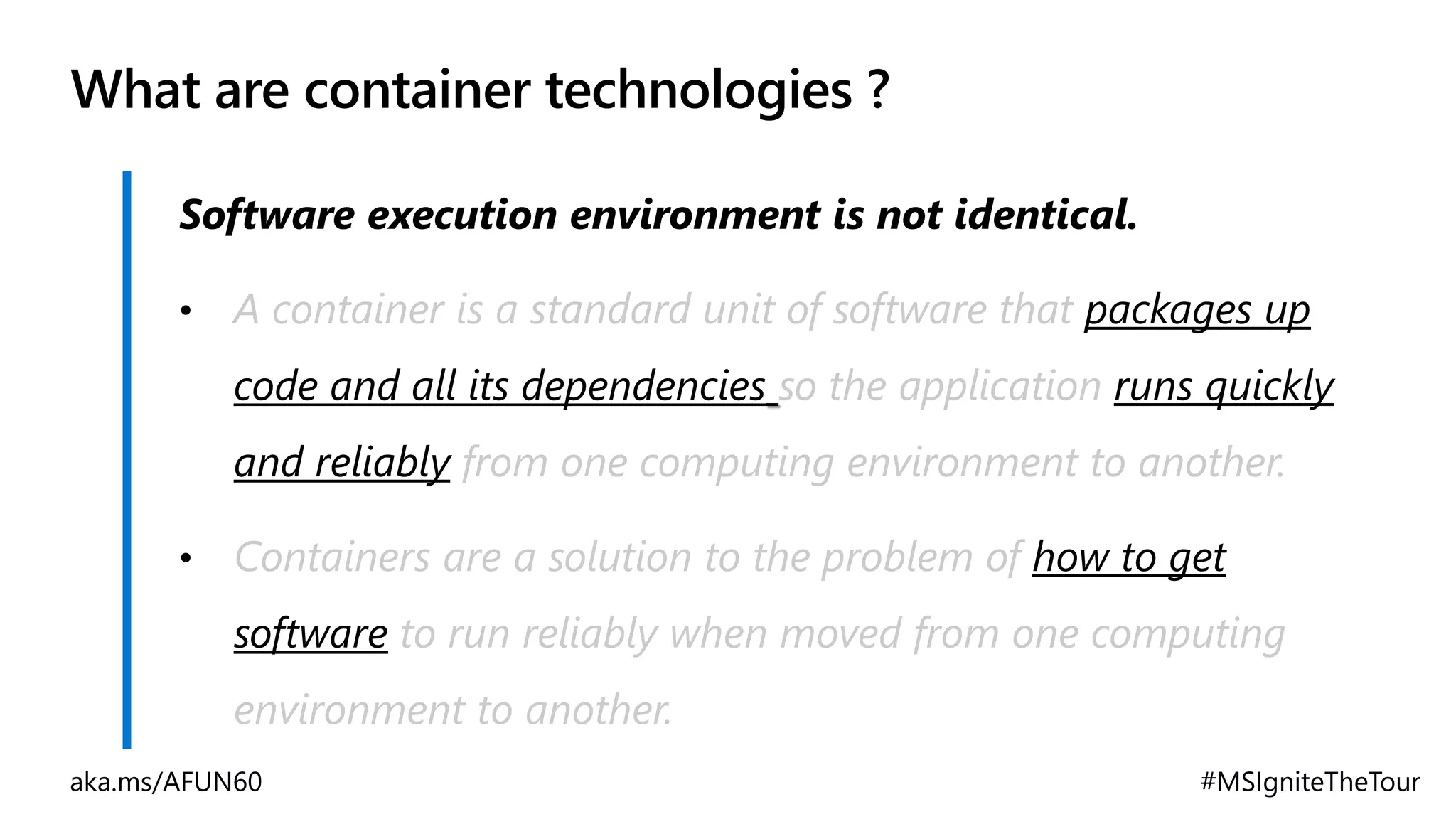
What are container technologies ?
• A container is a standard unit of software that packages up
code and all its dependencies so the application runs quickly
and reliably from one computing environment to another.
• Containers are a solution to the problem of how to get
software to run reliably when moved from one computing
environment to another.
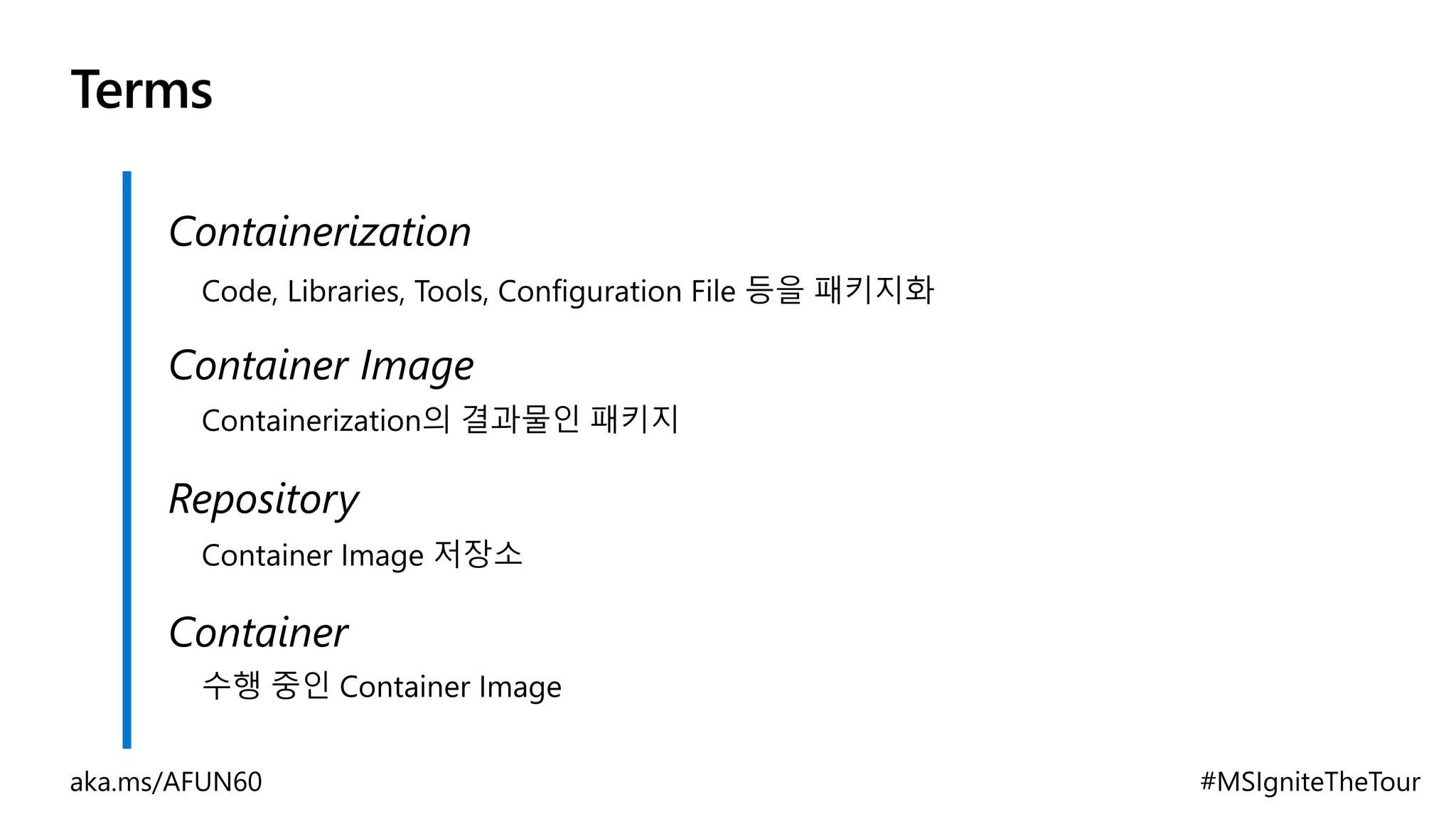
Terms
Container Image
Image1
Image2
…Container Runtime
Image Cache/Image1, Image3
Container(Image1)
Azure Container Registry
(ACR)
What is a container registry?
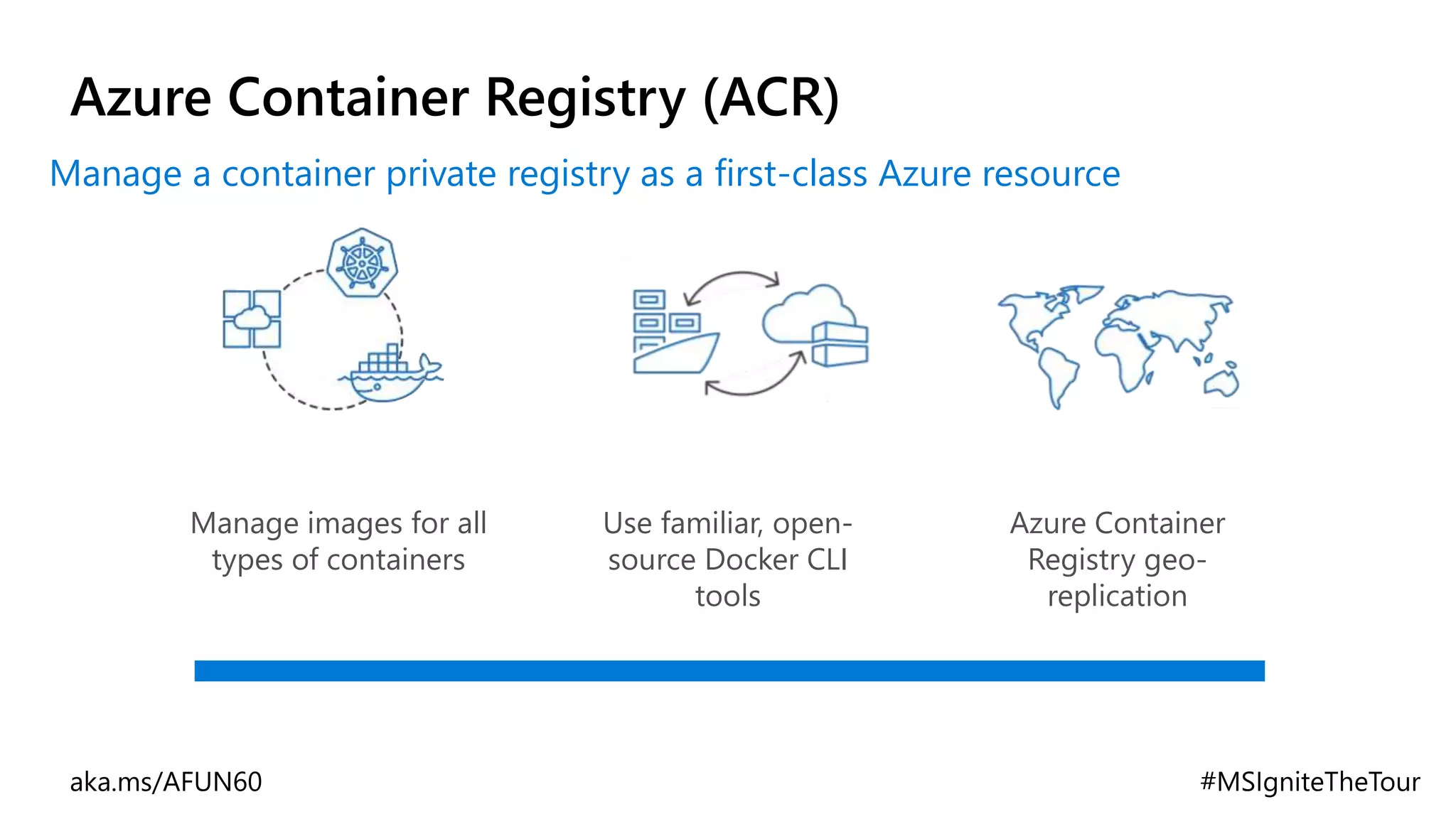
Azure Container Registry (ACR)
Manage a container private registry
as a first-class Azure resource
Azure Container Registry (ACR)
Manage images for all
types of containers
Manage a container private registry as a first-class Azure resource
Azure Container Registry (ACR)
Use familiar, open-
source Docker CLI
tools
Manage images for all
types of containers
Manage a container private registry as a first-class Azure resource
Azure Container Registry (ACR)
Use familiar, open-
source Docker CLI
tools
Azure Container
Registry geo-
replication
Manage images for all
types of containers
Manage a container private registry as a first-class Azure resource
Azure Container Registry
IaaSPaaS
Azure services
SQL Database
Redis Cache
CosmosDB
And more!
Partner services
OpenShift
Pivotal Cloud
Foundry
Docker Enterprise
Edition
Mesosphere
DC/OS
Azure
OSBA
Azure Container
Service (AKS)
ACS
Engine
Batch
Azure Container
Instances (ACI)
Azure Virtual
Machines
Virtual Machine
Scale Sets
(VMSS)
Service Fabric
Virtual Kubelet
App Service Azure
Container
Registry
(ACR)
Azure Container Instances
(ACI)
What is Azure Container Instances (ACI)?
What can you build with Azure Container Instances?
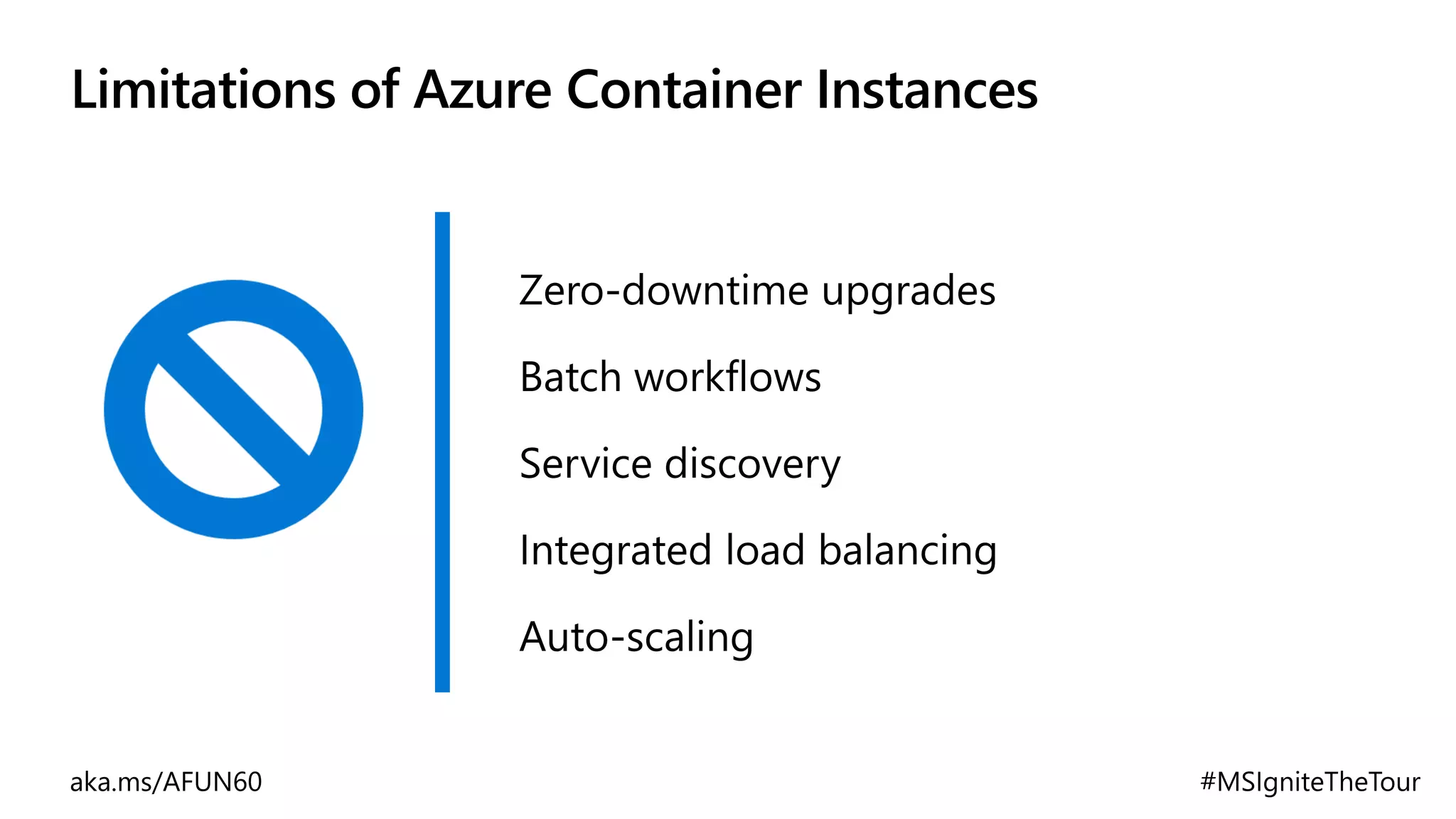
Limitations of Azure Container Instances
Azure App Service
Azure App Service
Web App for Containers
Azure Kubernetes Service
(AKS)
Azure Kubernetes Service (AKS)
Scheduling Affinity/anti-
affinity
Health
monitoring
Failover
Scaling Networking Service
discovery
Coordinated
app upgrades
Azure Kubernetes Service (AKS)
The elements of orchestration
Azure Kubernetes Service (AKS)
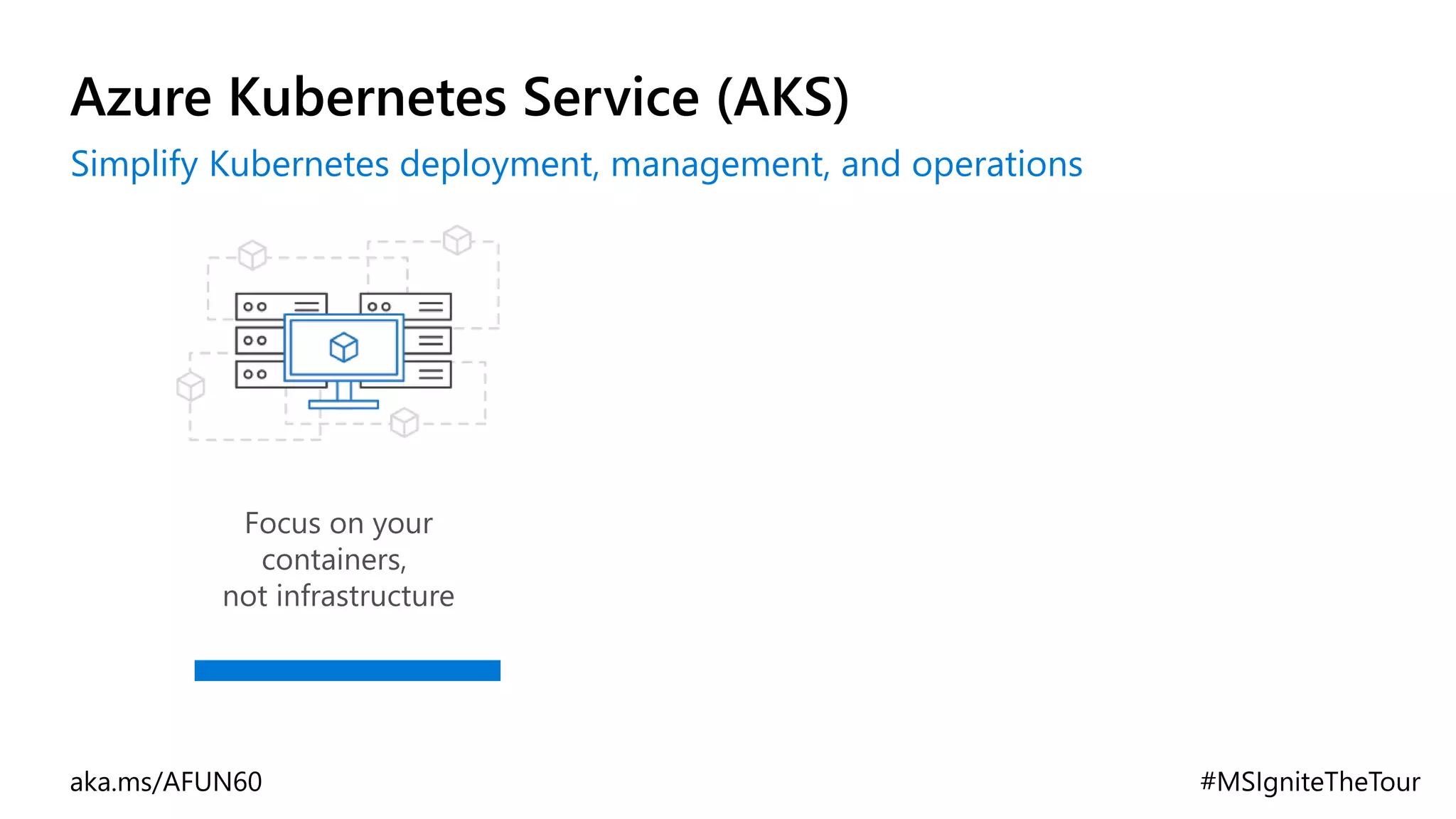
Simplify Kubernetes deployment, management, and operations
Focus on your
containers,
not infrastructure
Azure Kubernetes Service (AKS)
Simplify Kubernetes deployment, management, and operations
Work how you want
with open-source
APIs
Focus on your
containers,
not infrastructure
Azure Kubernetes Service (AKS)
Work how you want
with open-source
APIs
Scale and run
applications with
confidence
Focus on your
containers,
not infrastructure
Simplify Kubernetes deployment, management, and operations
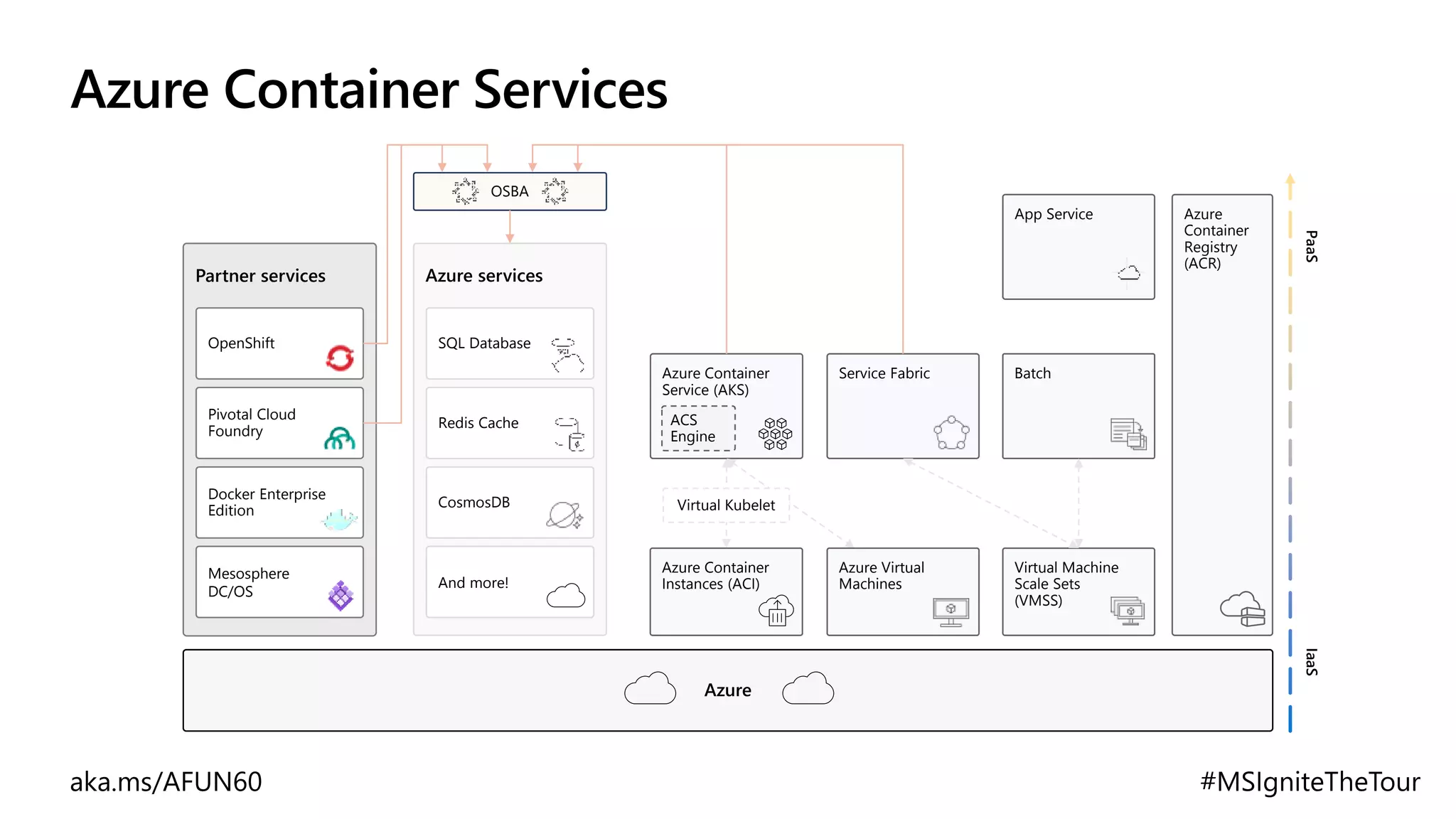
Azure Container Services
IaaSPaaS
Azure services
SQL Database
Redis Cache
CosmosDB
And more!
Partner services
OpenShift
Pivotal Cloud
Foundry
Docker Enterprise
Edition
Mesosphere
DC/OS
Azure
OSBA
Azure Container
Service (AKS)
ACS
Engine
Batch
Azure Container
Instances (ACI)
Azure Virtual
Machines
Virtual Machine
Scale Sets
(VMSS)
Service Fabric
Virtual Kubelet
App Service Azure
Container
Registry
(ACR)
[2020 Ignite Seoul]Azure에서 사용할 수 있는 컨테이너/오케스트레이션 기술 살펴보기

[2020 Ignite Seoul]Azure에서 사용할 수 있는 컨테이너/오케스트레이션 기술 살펴보기

Editor's Notes

  • #5 Before we get started, everything that I talk about today will be available for you to access following the session at these links: First link - session slides, video recording when available, and Tech Community forum to ask questions. Second link - GitHub code for everything you see here, so you can try it yourself. Third link - explore all MS Ignite The Tour learnig paths and sessions (Tech Community)
  • #8 For the first time, Microsoft is offering FREE certification exams to all event attendees. You can take advantage of this for any Fundamentals or Role-based Certifications. The offer is for one free exam and it’s valid for up to 6 months post-event. You can utilize this at our onsite testing in the event expo hall or use signup online today (Gov. Officials are not eligible)
  • #12 Containers offer a logical packaging mechanism in which applications can be abstracted from the environment in which they actually run. This decoupling allows container-based applications to be deployed easily and consistently, regardless of the target environment Containerization provides a clean separation of concerns – isolation. Developers focus on their application logic and dependencies; IT Ops focus on deployment and management.
  • #13 Containers offer a logical packaging mechanism in which applications can be abstracted from the environment in which they actually run. This decoupling allows container-based applications to be deployed easily and consistently, regardless of the target environment Containerization provides a clean separation of concerns – isolation. Developers focus on their application logic and dependencies; IT Ops focus on deployment and management.
  • #15 Containers offer a logical packaging mechanism in which applications can be abstracted from the environment in which they actually run. This decoupling allows container-based applications to be deployed easily and consistently, regardless of the target environment Containerization provides a clean separation of concerns – isolation. Developers focus on their application logic and dependencies; IT Ops focus on deployment and management.
  • #19 How does it help in building, shipping and running an application? Why might an organization need a private registry to securely and efficiently manage their container images? All good questions. A good analogy is GitHub or code repositories. The container is a snapshot of your application and its dependencies. Once the image is created, the registry is a place to hold this application template. A registry is a way to share the application between systems. Docker Hub is a public registry available and easy to use via the internet. However, as with our code, their may be restrictions the prohibit us from storing these images outside of our domain, country, etc. For instance, Intellectual Property (IP) or sensitive data restrictions are most common. A private registry allows for your organization to setup RBAC (Role based Access Control) to the registry based on LDAP or AD already setup within your organization to enforce rules such as push, pull access.
  • #21 ACR allows you to store images for all types of container deployments. Mesosphere, Docker Swarm, Kubernetes, and Azure services. You or your DevOps team can seamlessly integrate the build and deploy process with ACR.
  • #22 Docker’s command line interface works directly with ACR using the login, push, pull commands just as you would with Docker Hub. No new APIs or commands to learn.
  • #23 Efficiently manage a single registry replicated across multiple regions. Geo-replication enables you to manage global deployments as one entity to simplify operations and management. Reduce the network latency and eliminate any ingress/egress charges by keeping your registry in the same data center as your deployments. ACR gives you local, network-close storage of your container images and full control over naming and organization of the images.
  • #25 The Azure Container Registry is positioned close to all of your other Azure objects, VMs, Kubernetes clusters in AKS, AppService, ACI as discussed previously. Therefore when pulling the image for your applications to these resources, the latency is greatly reduced. This is benefit for scaling, CI/CD for builds and deployments and so forth. Using public repositories such as Docker Hub or even GitHub; the ingress/egress costs are incurred leaving Azure plus the network latency going outside of this infrastructure.
  • #26 shell.azure.com
  • #27 You can start a container using a single command. This command can be run on the command line, Azure DevOps, LogicApps; many options. Per second billing, Only be charged for the time the container is running. Just run the container, there is no infrastructure to manage.
  • #29 Have you ever had that server or machine that just existed to run those console apps on the windows scheduler? Every Monday at 10 am it would run myjob.exe – Now put that app in a container, and run it in the cloud and oly be charged when it runs. Data processing apps, Reporting, CI Jobs, are all good options. Using ACI in place of VM reduces footprint as well as costs. ACI also provides fast, isolated compute to handle spikes without managing servers. Through the use of Virtual Kubelet, your AKS cluster is enabled to scale and provision pods in seconds with just enough capacity to handle the load.
  • #30 Azure Container Instances supports the deployment of multiple containers onto a single host using a container group A container group is useful when building an application sidecar for logging, monitoring, or any other configuration where a service needs a second attached process. By default, Azure Container Instances are stateless. If the container crashes or stops, all of its state is lost. To persist state beyond the lifetime of the container, you must mount a volume from an external store.
  • #31 If you need these features, you probably need an orchestrator – see Kubernetes via AKS
  • #33 Azure App Service is an HTTP-based service for hosting web applications, REST APIs, and mobile back ends. You can develop in your favorite language, be it .NET, .NET Core, Java, Ruby, Node.js, PHP, or Python. Applications run and scale with ease on both Windows and Linux-based environments. Deploy Apps from GitHub, Azure DevOps, even DropBox! App Service offers just about every piece you’d need to run a scalable, secure web application. Speak to slot deployments, scalability points, and that is is the basis for serverless apps too.
  • #34 App Service is a fully managed compute platform that is optimized for hosting websites and web applications. Customers can use App Service on Linux to host web apps natively on Linux for supported application stacks.  Node, Java, PHP, Python, .NET Core, Ruby can all be run natively or within containers.
  • #35 Just pull container images from Docker Hub or a private Azure Container Registry, and Web App for Containers will deploy the containerized app with your preferred dependencies to production in seconds.  Simplify your container image deployments through CI/CD) capabilities with Docker Hub, Azure Container Registry, and DevOps. App Service creates an association with the selected repository, so your apps are updated each time your source code changes. Scaling based on load; CPU, RAM etc. Load balancing is handled, Can be overridden manually with CLI or in the portal.
  • #38 The fully managed Azure Kubernetes Service (AKS) makes deploying and managing containerized applications easy. It offers serverless Kubernetes, an integrated continuous integration and continuous delivery (CI/CD) experience, and enterprise-grade security and governance. single platform to rapidly build, deliver, and scale applications with confidence.
  • #40 Easily provision clusters using the CLI or infrastructure-as-code tools such as Terraform. Minimize infrastructure maintenance using automated upgrades, repair, monitoring, and scaling. Elastically provision additional compute capacity in serverless Kubernetes in seconds without worrying about managing the infrastructure.
  • #41 Easily provision clusters using the CLI or infrastructure-as-code tools such as Terraform. Minimize infrastructure maintenance using automated upgrades, repair, monitoring, and scaling. Elastically provision additional compute capacity in serverless Kubernetes in seconds without worrying about managing the infrastructure.
  • #42 Easily provision clusters using the CLI or infrastructure-as-code tools such as Terraform. Minimize infrastructure maintenance using automated upgrades, repair, monitoring, and scaling. Elastically provision additional compute capacity in serverless Kubernetes in seconds without worrying about managing the infrastructure.
  • #44 The Azure Container Registry is positioned close to all of your other Azure objects, VMs, Kubernetes clusters in AKS, AppService, ACI as discussed previously. Therefore when pulling the image for your applications to these resources, the latency is greatly reduced. This is benefit for scaling, CI/CD for builds and deployments and so forth. Using public repositories such as Docker Hub or even GitHub; the ingress/egress costs are incurred leaving Azure plus the network latency going outside of this infrastructure.
  • #45 And that’s a statement around how we feel about Azure. We want to invent with purpose in how we think about it what we deliver to you but also enable you to invent with purpose. And we do that in some key ways. TRANSITION: I talk about these ways as our promises to you on what Azure will always deliver and why we’ll help you.