Live Typing
A Type System for Smalltalk
Hernán A. Wilkinson - @hernanwilkinson
10Pines founder – Professor at UBA
agile software development & services
Hernán Wilkinson
Ø10Pines Founder
ØFAST Founder
(Fundación Argentina de Smalltalk)
ØProfessor at Computer Science
Department at UBA
....
Ømainly, passionate programmer
Type information in
Dynamically Typed Languages has
always been a topic of research due
to many reasons ...
There are mainly two ways to have type
information in dynamically typed languages:
ØType Inference
ØManual Type Annotation
(generally combined with type inference)
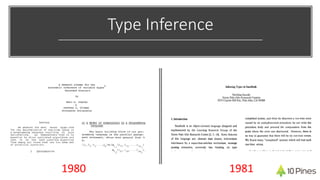
Type Inference
1980 1981
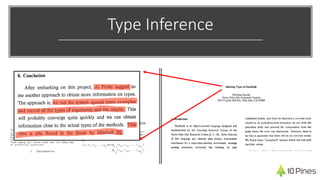
Type Inference
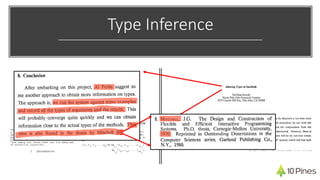
Type Inference
Disadvantages
•Slow
•Incomplete
•Invalid information
•...
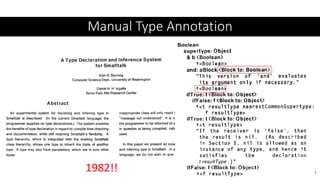
Manual Type Annotation
1982!!
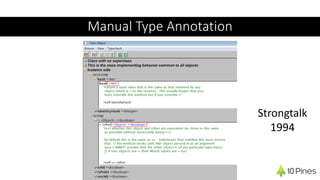
Manual Type Annotation
Strongtalk
1994
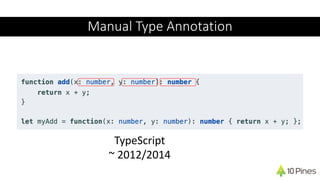
TypeScript
~ 2012/2014
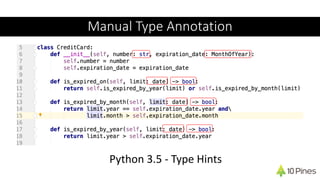
Manual Type Annotation
Python 3.5 - Type Hints
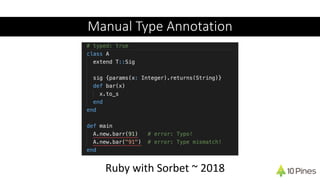
Manual Type Annotation
Ruby with Sorbet ~ 2018
Manual Type Annotation
Let’s see an example with Python 3.9
and PyCharm 2020.3
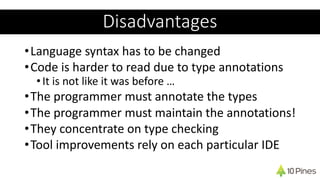
•Language syntax has to be changed
•Code is harder to read due to type annotations
•It is not like it was before …
•The programmer must annotate the types
•The programmer must maintain the annotations!
•They concentrate on type checking
•Tool improvements rely on each particular IDE
Disadvantages
What is Live Typing?
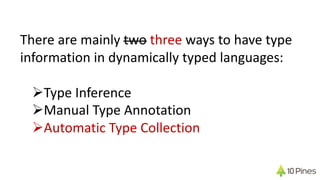
There are mainly two three ways to have type
information in dynamically typed languages:
ØType Inference
ØManual Type Annotation
ØAutomatic Type Collection
Automatic type collection (done by the VM)
+
Tools that improve the development experience
Live Typing
As we saw, it is not a new idea…
but a particular one with a
working implementation
Live Typing’s goal is not
Type Checking
Its goal is to improve the tools to
facilitate the programmer’s tasks
(although it provides a type checking solution)
Implementation
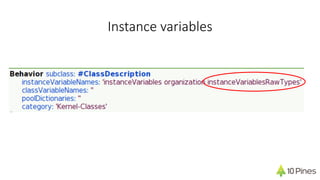
Instance variables
Instance variables – VM Change
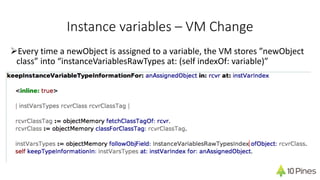
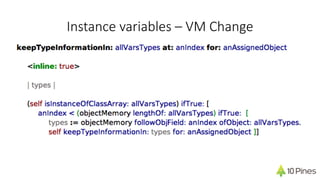
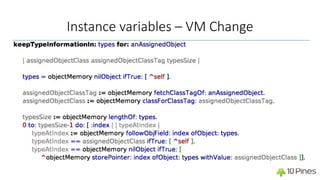
ØEvery time a newObject is assigned to a variable, the VM stores ”newObject
class” into “instanceVariablesRawTypes at: (self indexOf: variable)”
Instance variables – VM Change
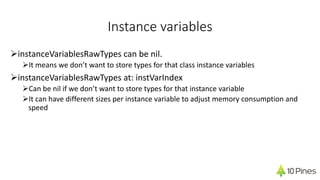
Instance variables
ØinstanceVariablesRawTypes can be nil.
ØIt means we don’t want to store types for that class instance variables
ØinstanceVariablesRawTypes at: instVarIndex
ØCan be nil if we don’t want to store types for that instance variable
ØIt can have different sizes per instance variable to adjust memory consumption and
speed
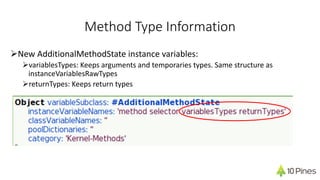
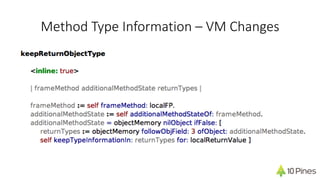
Method Type Information
ØNew AdditionalMethodState instance variables:
ØvariablesTypes: Keeps arguments and temporaries types. Same structure as
instanceVariablesRawTypes
ØreturnTypes: Keeps return types
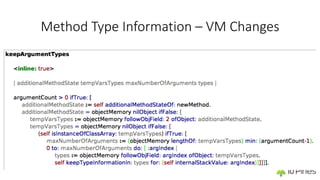
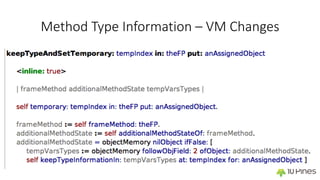
Method Type Information – VM Changes
Tools Examples
TicTacToe
Showing/Managing Types
Autocompletion
DynamicType
(SelfType, ClassType, InstanceType)
Actual Implementors
Actual Senders
Sure and Possible
(Per Message Send analysis)
Refactorings with Actual Scope
Type Checker
(we know for sure when nil is assigned!)
Type Check Morph & Behavior
Some statistics
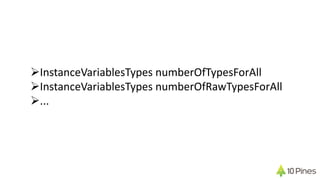
ØInstanceVariablesTypes numberOfTypesForAll
ØInstanceVariablesTypes numberOfRawTypesForAll
Ø...
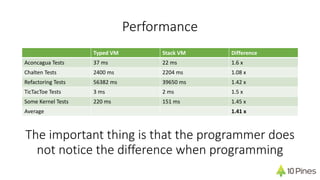
Performance
Typed VM Stack VM Difference
Aconcagua Tests 37 ms 22 ms 1.6 x
Chalten Tests 2400 ms 2204 ms 1.08 x
Refactoring Tests 56382 ms 39650 ms 1.42 x
TicTacToe Tests 3 ms 2 ms 1.5 x
Some Kernel Tests 220 ms 151 ms 1.45 x
Average 1.41 x
The important thing is that the programmer does
not notice the difference when programming
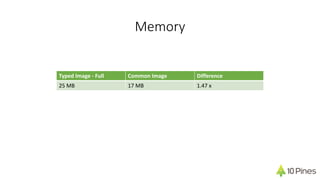
Memory
Typed Image - Full Common Image Difference
25 MB 17 MB 1.47 x
Conclusion
With no extra effort,
we can have type information,
and get rid off most of the
disadvantages of a
dynamically type language
The programmer does not have to
maintain the types.
Types do not interfere when reading
code
Live Typing makes types explicit
You do not have to remember or
infer them anymore
It is a very simple technique that
heavily improves the
programming experience
It does not change the syntax
It does not stop you from compiling
It does not force you to use it
Types are not in the source code
I humbly believe it
respects and honors
the Smalltalk spirit
I hope that, some day, we will stop
saying that Smalltalk is
Dynamically Typed and start saying
it is Lively Typed
Future Work
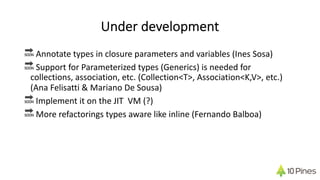
Under development
🔜 Annotate types in closure parameters and variables (Ines Sosa)
🔜 Support for Parameterized types (Generics) is needed for
collections, association, etc. (Collection<T>, Association<K,V>, etc.)
(Ana Felisatti & Mariano De Sousa)
🔜 Implement it on the JIT VM (?)
🔜 More refactorings types aware like inline (Fernando Balboa)
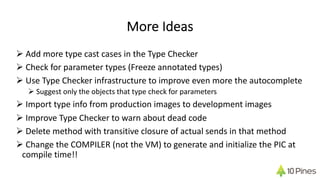
More Ideas
Ø Add more type cast cases in the Type Checker
Ø Check for parameter types (Freeze annotated types)
Ø Use Type Checker infrastructure to improve even more the autocomplete
Ø Suggest only the objects that type check for parameters
Ø Import type info from production images to development images
Ø Improve Type Checker to warn about dead code
Ø Delete method with transitive closure of actual sends in that method
Ø Change the COMPILER (not the VM) to generate and initialize the PIC at
compile time!!
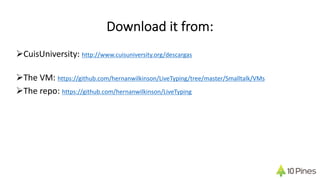
Download it from:
ØCuisUniversity: http://www.cuisuniversity.org/descargas
ØThe VM: https://github.com/hernanwilkinson/LiveTyping/tree/master/Smalltalk/VMs
ØThe repo: https://github.com/hernanwilkinson/LiveTyping
Questions?
Thanks!
@HernanWilkinson – hernan.wilkinson@10pines.com – www.10pines.com

Live Typing - California Smalltalkers