
Welcome to our Bible Study
16th
Sunday in the Ordinary Time B
19 July 2015
In preparation for this Sunday’s liturgy
As aid in focusing our homilies and sharing
Prepared by Fr. Cielo R. Almazan, OFM
1st
Reading: Jeremiah 23:1-6
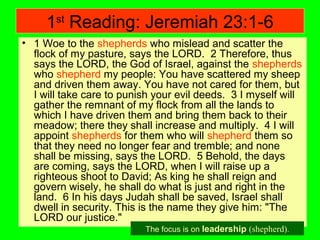
• 1 Woe to the shepherds who mislead and scatter the
flock of my pasture, says the LORD. 2 Therefore, thus
says the LORD, the God of Israel, against the shepherds
who shepherd my people: You have scattered my sheep
and driven them away. You have not cared for them, but
I will take care to punish your evil deeds. 3 I myself will
gather the remnant of my flock from all the lands to
which I have driven them and bring them back to their
meadow; there they shall increase and multiply. 4 I will
appoint shepherds for them who will shepherd them so
that they need no longer fear and tremble; and none
shall be missing, says the LORD. 5 Behold, the days
are coming, says the LORD, when I will raise up a
righteous shoot to David; As king he shall reign and
govern wisely, he shall do what is just and right in the
land. 6 In his days Judah shall be saved, Israel shall
dwell in security. This is the name they give him: "The
LORD our justice."
The focus is on leadership (shepherd).
1st
Reading: Jeremiah 23:1-6
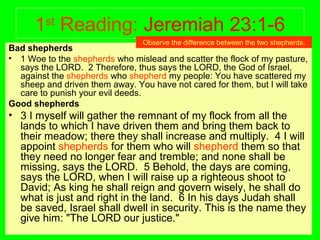
Bad shepherds
• 1 Woe to the shepherds who mislead and scatter the flock of my pasture,
says the LORD. 2 Therefore, thus says the LORD, the God of Israel,
against the shepherds who shepherd my people: You have scattered my
sheep and driven them away. You have not cared for them, but I will take
care to punish your evil deeds.
Good shepherds
• 3 I myself will gather the remnant of my flock from all the
lands to which I have driven them and bring them back to
their meadow; there they shall increase and multiply. 4 I will
appoint shepherds for them who will shepherd them so that
they need no longer fear and tremble; and none shall be
missing, says the LORD. 5 Behold, the days are coming,
says the LORD, when I will raise up a righteous shoot to
David; As king he shall reign and govern wisely, he shall do
what is just and right in the land. 6 In his days Judah shall
be saved, Israel shall dwell in security. This is the name they
give him: "The LORD our justice."
Observe the difference between the two shepherds.
1st
Reading: Jeremiah 23:1-6
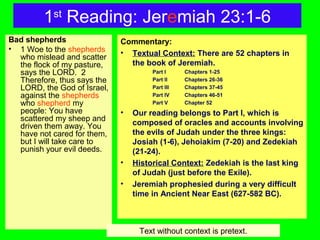
Bad shepherds
• 1 Woe to the shepherds
who mislead and scatter
the flock of my pasture,
says the LORD. 2
Therefore, thus says the
LORD, the God of Israel,
against the shepherds
who shepherd my
people: You have
scattered my sheep and
driven them away. You
have not cared for them,
but I will take care to
punish your evil deeds.
Commentary:
• Textual Context: There are 52 chapters in
the book of Jeremiah.
Part I Chapters 1-25
Part II Chapters 26-36
Part III Chapters 37-45
Part IV Chapters 46-51
Part V Chapter 52
• Our reading belongs to Part I, which is
composed of oracles and accounts involving
the evils of Judah under the three kings:
Josiah (1-6), Jehoiakim (7-20) and Zedekiah
(21-24).
• Historical Context: Zedekiah is the last king
of Judah (just before the Exile).
• Jeremiah prophesied during a very difficult
time in Ancient Near East (627-582 BC).
Text without context is pretext.
1st
Reading: Jeremiah 23:1-6
Bad shepherds
• 1 Woe to the shepherds
who mislead and scatter
the flock of my pasture,
says the LORD. 2
Therefore, thus says the
LORD, the God of Israel,
against the shepherds who
shepherd my people: You
have scattered my sheep
and driven them away.
You have not cared for
them, but I will take care to
punish your evil deeds.
Commentary:
• In v.1, God objects to
leaders, who mislead
and scatter his people.
• In v.2, God announces
the punishment for
their evil deeds (for not
caring for his people).
1st
Reading: Jeremiah 23:1-6
Good shepherds
• 3 I myself will gather the
remnant of my flock
from all the lands to
which I have driven
them and bring them
back to their meadow;
there they shall
increase and multiply.
4 I will appoint
shepherds for them who
will shepherd them so
that they need no
longer fear and tremble;
and none shall be
missing, says the
LORD.
• In v.3, God himself
promises to gather his
people together back
to their meadow, where
they will reproduce.
• In v.4, God promises to
appoint good
shepherds, so that his
people will not live in
fear and no one will be
lost.
1st
Reading: Jeremiah 23:1-6
Righteous shoot of David
• 5 Behold, the days are
coming, says the LORD,
when I will raise up a
righteous shoot to
David; As king he shall
reign and govern wisely,
he shall do what is just
and right in the land. 6
In his days Judah shall
be saved, Israel shall
dwell in security. This is
the name they give him:
"The LORD our justice."
• In v.5, God promises to
raise a righteous leader
(shoot).
• He will govern with
wisdom, justice and
righteousness.
• In v.6, both Judah and
Israel will dwell in
peace and security.
Reflections on the 1st
reading
• In one way or another, we are leaders.
• Leadership is one that unites the community, that makes
them feel secure.
• Leadership is not one that terrorizes and victimizes the
people. It is not tyranny.
• A good sign of leadership is when there is abundance of
food and the people live in peace, harmony and security.
• Today we talk about collective leadership, collegial
leadership or servant-leadership.
• Are you a leader? Can you work with a group? Do you
discern with others?
• How is leadership (in government, private and in the
church) exercised in our present context?
Resp. Ps 23:1-3. 3-4. 5. 6
• R. (1) The Lord is my shepherd; there is nothing I shall want.
• The LORD is my shepherd; I shall not want.
In verdant pastures he gives me repose;
beside restful waters he leads me;
he refreshes my soul.
• He guides me in right paths for his name's sake.
Even though I walk in the dark valley
I fear no evil; for you are at my side
with your rod and your staff
that give me courage.
• You spread the table before me
in the sight of my foes;
you anoint my head with oil;
my cup overflows.
• Only goodness and kindness follow me
all the days of my life;
and I shall dwell in the house of the LORD for years to come.
Resp. Ps 23:1-3. 3-4. 5. 6
• R. (1) The Lord is my shepherd;
there is nothing I shall want.
• 2 The LORD is my shepherd; I shall not
want.
3 In verdant pastures he gives me
repose;
beside restful waters he leads me;
he refreshes my soul.
• 3 He guides me in right paths
for his name's sake.
4 Even though I walk in the dark valley
I fear no evil; for you are at my side
with your rod and your staff
that give me courage.
• 5 You spread the table before me
in the sight of my foes;
you anoint my head with oil;
my cup overflows.
• 6 Only goodness and kindness follow
me
all the days of my life;
and I shall dwell in the house of the
LORD
for years to come.
Commentary
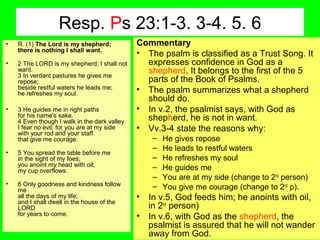
• The psalm is classified as a Trust Song. It
expresses confidence in God as a
shepherd. It belongs to the first of the 5
parts of the Book of Psalms.
• The psalm summarizes what a shepherd
should do.
• In v.2, the psalmist says, with God as
shepherd, he is not in want.
• Vv.3-4 state the reasons why:
– He gives repose
– He leads to restful waters
– He refreshes my soul
– He guides me
– You are at my side (change to 2nd
person)
– You give me courage (change to 2nd
p).
• In v.5, God feeds him; he anoints with oil,
in 2nd
person)
• In v.6, with God as the shepherd, the
psalmist is assured that he will not wander
away from God.
Reflections on the Psalm
• Like the psalmist, we must be able to affirm
God’s leadership.
• We can do it only if we allow ourselves to be led
by him.
• His words give us direction.
• He keeps us away from danger.
• We can imitate God’s leadership.
2nd
Reading: Ephesians 2:13-18
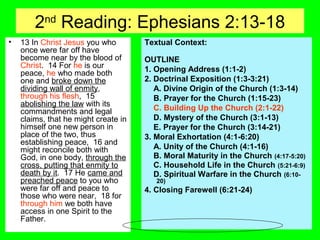
• 13 In Christ Jesus you who once were far off
have become near by the blood of Christ. 14
For he is our peace, he who made both one and
broke down the dividing wall of enmity, through
his flesh, 15 abolishing the law with its
commandments and legal claims, that he might
create in himself one new person in place of the
two, thus establishing peace, 16 and might
reconcile both with God, in one body, through
the cross, putting that enmity to death by it. 17
He came and preached peace to you who were
far off and peace to those who were near, 18 for
through him we both have access in one Spirit to
the Father.
The focus is on Jesus as peacemaker.
Observe the underlined words.
2nd
Reading: Ephesians 2:13-18
• 13 In Christ Jesus you who
once were far off have
become near by the blood of
Christ. 14 For he is our
peace, he who made both
one and broke down the
dividing wall of enmity,
through his flesh, 15
abolishing the law with its
commandments and legal
claims, that he might create in
himself one new person in
place of the two, thus
establishing peace, 16 and
might reconcile both with
God, in one body, through the
cross, putting that enmity to
death by it. 17 He came and
preached peace to you who
were far off and peace to
those who were near, 18 for
through him we both have
access in one Spirit to the
Father.
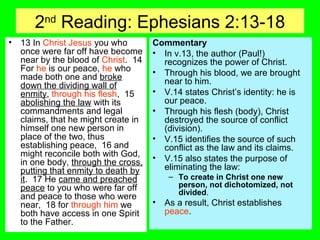
Textual Context:
OUTLINE
1. Opening Address (1:1-2)
2. Doctrinal Exposition (1:3-3:21)
A. Divine Origin of the Church (1:3-14)
B. Prayer for the Church (1:15-23)
C. Building Up the Church (2:1-22)
D. Mystery of the Church (3:1-13)
E. Prayer for the Church (3:14-21)
3. Moral Exhortation (4:1-6:20)
A. Unity of the Church (4:1-16)
B. Moral Maturity in the Church (4:17-5:20)
C. Household Life in the Church (5:21-6:9)
D. Spiritual Warfare in the Church (6:10-
20)
4. Closing Farewell (6:21-24)
2nd
Reading: Ephesians 2:13-18
• 13 In Christ Jesus you who
once were far off have become
near by the blood of Christ. 14
For he is our peace, he who
made both one and broke
down the dividing wall of
enmity, through his flesh, 15
abolishing the law with its
commandments and legal
claims, that he might create in
himself one new person in
place of the two, thus
establishing peace, 16 and
might reconcile both with God,
in one body, through the cross,
putting that enmity to death by
it. 17 He came and preached
peace to you who were far off
and peace to those who were
near, 18 for through him we
both have access in one Spirit
to the Father.
Commentary
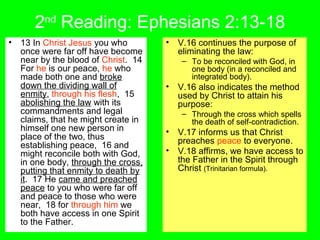
• In v.13, the author (Paul!)
recognizes the power of Christ.
• Through his blood, we are brought
near to him.
• V.14 states Christ’s identity: he is
our peace.
• Through his flesh (body), Christ
destroyed the source of conflict
(division).
• V.15 identifies the source of such
conflict as the law and its claims.
• V.15 also states the purpose of
eliminating the law:
– To create in Christ one new
person, not dichotomized, not
divided.
• As a result, Christ establishes
peace.
2nd
Reading: Ephesians 2:13-18
• 13 In Christ Jesus you who
once were far off have become
near by the blood of Christ. 14
For he is our peace, he who
made both one and broke
down the dividing wall of
enmity, through his flesh, 15
abolishing the law with its
commandments and legal
claims, that he might create in
himself one new person in
place of the two, thus
establishing peace, 16 and
might reconcile both with God,
in one body, through the cross,
putting that enmity to death by
it. 17 He came and preached
peace to you who were far off
and peace to those who were
near, 18 for through him we
both have access in one Spirit
to the Father.
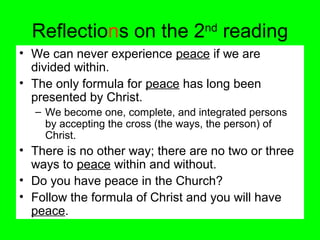
• V.16 continues the purpose of
eliminating the law:
– To be reconciled with God, in
one body (in a reconciled and
integrated body).
• V.16 also indicates the method
used by Christ to attain his
purpose:
– Through the cross which spells
the death of self-contradiction.
• V.17 informs us that Christ
preaches peace to everyone.
• V.18 affirms, we have access to
the Father in the Spirit through
Christ (Trinitarian formula).
Reflections on the 2nd
reading
• We can never experience peace if we are
divided within.
• The only formula for peace has long been
presented by Christ.
– We become one, complete, and integrated persons
by accepting the cross (the ways, the person) of
Christ.
• There is no other way; there are no two or three
ways to peace within and without.
• Do you have peace in the Church?
• Follow the formula of Christ and you will have
peace.
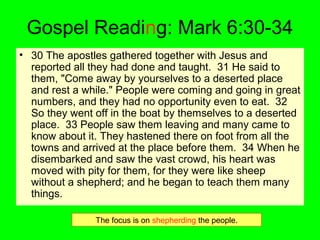
Gospel Reading: Mark 6:30-34
• 30 The apostles gathered together with Jesus and
reported all they had done and taught. 31 He said to
them, "Come away by yourselves to a deserted place
and rest a while." People were coming and going in great
numbers, and they had no opportunity even to eat. 32
So they went off in the boat by themselves to a deserted
place. 33 People saw them leaving and many came to
know about it. They hastened there on foot from all the
towns and arrived at the place before them. 34 When he
disembarked and saw the vast crowd, his heart was
moved with pity for them, for they were like sheep
without a shepherd; and he began to teach them many
things.
The focus is on shepherding the people.
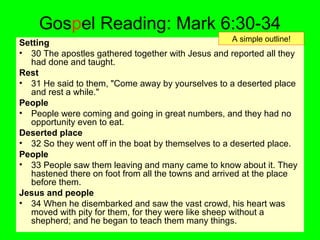
Gospel Reading: Mark 6:30-34
Setting
• 30 The apostles gathered together with Jesus and reported all they
had done and taught.
Rest
• 31 He said to them, "Come away by yourselves to a deserted place
and rest a while."
People
• People were coming and going in great numbers, and they had no
opportunity even to eat.
Deserted place
• 32 So they went off in the boat by themselves to a deserted place.
People
• 33 People saw them leaving and many came to know about it. They
hastened there on foot from all the towns and arrived at the place
before them.
Jesus and people
• 34 When he disembarked and saw the vast crowd, his heart was
moved with pity for them, for they were like sheep without a
shepherd; and he began to teach them many things.
A simple outline!
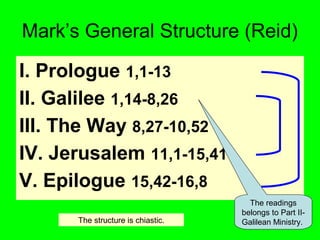
Mark’s General Structure (Reid)
I. Prologue 1,1-13
II. Galilee 1,14-8,26
III. The Way 8,27-10,52
IV. Jerusalem 11,1-15,41
V. Epilogue 15,42-16,8
The structure is chiastic.
The readings
belongs to Part II-
Galilean Ministry.
Gospel Reading: Mark 6:30-34
Setting
• 30 The apostles gathered together with
Jesus and reported all they had done
and taught.
Rest
• 31 He said to them, "Come away by
yourselves to a deserted place and rest
a while."
People
• People were coming and going in great
numbers, and they had no opportunity
even to eat.
Deserted place
• 32 So they went off in the boat by
themselves to a deserted place.
People
• 33 People saw them leaving and many
came to know about it. They hastened
there on foot from all the towns and
arrived at the place before them.
Jesus and people
• 34 When he disembarked and saw the
vast crowd, his heart was moved with
pity for them, for they were like sheep
without a shepherd; and he began to
teach them many things.
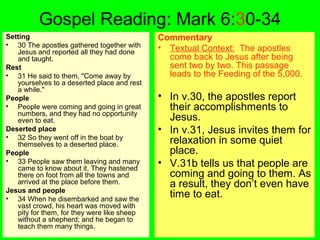
Commentary
• Textual Context: The apostles
come back to Jesus after being
sent two by two. This passage
leads to the Feeding of the 5,000.
• In v.30, the apostles report
their accomplishments to
Jesus.
• In v.31, Jesus invites them for
relaxation in some quiet
place.
• V.31b tells us that people are
coming and going to them. As
a result, they don’t even have
time to eat.
Gospel Reading: Mark 6:30-34
Setting
• 30 The apostles gathered together with
Jesus and reported all they had done
and taught.
Rest
• 31 He said to them, "Come away by
yourselves to a deserted place and rest
a while."
People
• People were coming and going in great
numbers, and they had no opportunity
even to eat.
Deserted place
• 32 So they went off in the boat by
themselves to a deserted place.
People
• 33 People saw them leaving and many
came to know about it. They hastened
there on foot from all the towns and
arrived at the place before them.
Jesus and people
• 34 When he disembarked and saw the
vast crowd, his heart was moved with
pity for them, for they were like sheep
without a shepherd; and he began to
teach them many things.
• In v.32, finally, they embark
to a secluded place.
• In v.33, people get ahead of
them.
• The people really want to
listen to them.
• In v.34, Jesus sees a
captured audience. His heart
sinks.
• They hunger for spiritual
food.
• So Jesus teach them a lot of
things.
Reflections on the gospel reading
• Like the people in the gospel, we must draw
closer to Jesus to listen to him.
• God will speak to us if we constantly seek him.
• We will not go home empty handed, when we
encounter him.
• As we listen to his voice, we will be filled with
wisdom and assurances of God’s love.
• We will be strengthened; we will be transformed.
• Jesus is a leader par excellence.
• How do you evaluate the leadership in your
context (workplace, organization or church)?
Tying the 3 readings and the Psalm
• The first reading warns bad leaders who
victimizes their constituents.
• The psalm affirms God as the good shepherd.
• The second reading affirms Jesus as a good
leader, who makes you integrated and peaceful.
• The gospel reading describes Jesus’ leadership
in terms of non-stop preaching to the people,
who are hungry for his words.
How to develop your homily / sharing
• Begin by talking about crisis of leadership.
• Our leaders make money out of their offices.
• They do not care for the interest of the common
good at all.
• Many of them have no moral authority.
• They are just there because they have been
groomed by their parents to become next in
power.
• They become leaders without moral formation and
conscience.
• They make important decisions in terms of votes,
not in God’s terms.
• This kind of leadership must end.
• In the first reading, Jeremiah warns the leaders,
who are negligent of their duties as shepherds.
• They scatter their flocks. They have no affection
for them. They don’t care.
• God will soon punish them for their evil deeds.
• God will replace them with better ones who can
provide more food on the table.
• In the second reading, Jesus, as a leader, brings
peace and reconciliation through his blood and
crucified flesh.
• He chooses to suffer himself in order to bring
about peace.
• Jesus has no political ambitions.
• He knows his limits.
• In the gospel, Jesus is presented as a good
leader.
• Jesus knows how to take care of his fellow
workers.
• He gives them rest (to recoup their energies).
• Clearly, he is a spiritual leader.
• For this, people flock to him for his words, not for
material food.
• As a leader, Jesus guides them to the right path.
• What happens when we have bad leaders?
• People will be scattered, will go hungry. No one
will live in peace and bad leaders will be
punished.
• Leaders must have high moral and spiritual
values.
• Hence, the need to form them at the tender age.
• You cannot form them anymore when they have
tasted power, money and influence.
• How easy it is to corrupt the youth in the SK!
• Training for good leaders starts at home.
• Leadership can be fostered through leadership
trainings, by listening to the success stories of
the good leaders (of good church leaders, of
successful entrepreneurs).
• In our parish, whom do you consider as a good
leader?
• It is time for the pastor and pastoral team to
examine their own style of leadership (is it
facilitative, formative, pastoral, nurturing, inspiring
or divisive, dictatorial, oppressive, taking advantage
of people?)
• We must recognize that we have to pattern our
leadership to that of Christ.
• Jesus is the perfect model of good leadership.
• The eucharist is a sign of Jesus’ tender
leadership.
• In the eucharist, Jesus as a leader comes to
nurture us.
• In the eucharist, Jesus teaches us that we can
have peace only when we share ourselves with
one another.
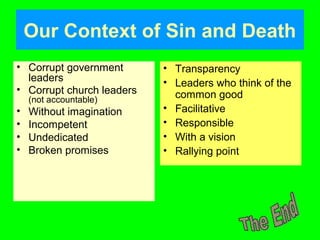
Our Context of Sin and Death
• Corrupt government
leaders
• Corrupt church leaders
(not accountable)
• Without imagination
• Incompetent
• Undedicated
• Broken promises
• Transparency
• Leaders who think of the
common good
• Facilitative
• Responsible
• With a vision
• Rallying point
Suggested Songs
• Paano Namin Masasabi
– http://www.youtube.com/watch?v=9ICZUOf_jNo
• Ang Panginoon ay aking pastol
– http://www.youtube.com/watch?v=tGnh_6Pggf4
– http://www.youtube.com/watch?v=nh4Pclk-OcM
• The Lord is my Shepherd, Hontiveros
• The Lord is my Shepherd, Tibong
http://www.youtube.com/watch?v=9ekQdpjS4VA

16th Sunday B

  • 1.
    Welcome to ourBible Study 16th Sunday in the Ordinary Time B 19 July 2015 In preparation for this Sunday’s liturgy As aid in focusing our homilies and sharing Prepared by Fr. Cielo R. Almazan, OFM
  • 2.
    1st Reading: Jeremiah 23:1-6 •1 Woe to the shepherds who mislead and scatter the flock of my pasture, says the LORD. 2 Therefore, thus says the LORD, the God of Israel, against the shepherds who shepherd my people: You have scattered my sheep and driven them away. You have not cared for them, but I will take care to punish your evil deeds. 3 I myself will gather the remnant of my flock from all the lands to which I have driven them and bring them back to their meadow; there they shall increase and multiply. 4 I will appoint shepherds for them who will shepherd them so that they need no longer fear and tremble; and none shall be missing, says the LORD. 5 Behold, the days are coming, says the LORD, when I will raise up a righteous shoot to David; As king he shall reign and govern wisely, he shall do what is just and right in the land. 6 In his days Judah shall be saved, Israel shall dwell in security. This is the name they give him: "The LORD our justice." The focus is on leadership (shepherd).
  • 3.
    1st Reading: Jeremiah 23:1-6 Badshepherds • 1 Woe to the shepherds who mislead and scatter the flock of my pasture, says the LORD. 2 Therefore, thus says the LORD, the God of Israel, against the shepherds who shepherd my people: You have scattered my sheep and driven them away. You have not cared for them, but I will take care to punish your evil deeds. Good shepherds • 3 I myself will gather the remnant of my flock from all the lands to which I have driven them and bring them back to their meadow; there they shall increase and multiply. 4 I will appoint shepherds for them who will shepherd them so that they need no longer fear and tremble; and none shall be missing, says the LORD. 5 Behold, the days are coming, says the LORD, when I will raise up a righteous shoot to David; As king he shall reign and govern wisely, he shall do what is just and right in the land. 6 In his days Judah shall be saved, Israel shall dwell in security. This is the name they give him: "The LORD our justice." Observe the difference between the two shepherds.
  • 4.
    1st Reading: Jeremiah 23:1-6 Badshepherds • 1 Woe to the shepherds who mislead and scatter the flock of my pasture, says the LORD. 2 Therefore, thus says the LORD, the God of Israel, against the shepherds who shepherd my people: You have scattered my sheep and driven them away. You have not cared for them, but I will take care to punish your evil deeds. Commentary: • Textual Context: There are 52 chapters in the book of Jeremiah. Part I Chapters 1-25 Part II Chapters 26-36 Part III Chapters 37-45 Part IV Chapters 46-51 Part V Chapter 52 • Our reading belongs to Part I, which is composed of oracles and accounts involving the evils of Judah under the three kings: Josiah (1-6), Jehoiakim (7-20) and Zedekiah (21-24). • Historical Context: Zedekiah is the last king of Judah (just before the Exile). • Jeremiah prophesied during a very difficult time in Ancient Near East (627-582 BC). Text without context is pretext.
  • 5.
    1st Reading: Jeremiah 23:1-6 Badshepherds • 1 Woe to the shepherds who mislead and scatter the flock of my pasture, says the LORD. 2 Therefore, thus says the LORD, the God of Israel, against the shepherds who shepherd my people: You have scattered my sheep and driven them away. You have not cared for them, but I will take care to punish your evil deeds. Commentary: • In v.1, God objects to leaders, who mislead and scatter his people. • In v.2, God announces the punishment for their evil deeds (for not caring for his people).
  • 6.
    1st Reading: Jeremiah 23:1-6 Goodshepherds • 3 I myself will gather the remnant of my flock from all the lands to which I have driven them and bring them back to their meadow; there they shall increase and multiply. 4 I will appoint shepherds for them who will shepherd them so that they need no longer fear and tremble; and none shall be missing, says the LORD. • In v.3, God himself promises to gather his people together back to their meadow, where they will reproduce. • In v.4, God promises to appoint good shepherds, so that his people will not live in fear and no one will be lost.
  • 7.
    1st Reading: Jeremiah 23:1-6 Righteousshoot of David • 5 Behold, the days are coming, says the LORD, when I will raise up a righteous shoot to David; As king he shall reign and govern wisely, he shall do what is just and right in the land. 6 In his days Judah shall be saved, Israel shall dwell in security. This is the name they give him: "The LORD our justice." • In v.5, God promises to raise a righteous leader (shoot). • He will govern with wisdom, justice and righteousness. • In v.6, both Judah and Israel will dwell in peace and security.
  • 8.
    Reflections on the1st reading • In one way or another, we are leaders. • Leadership is one that unites the community, that makes them feel secure. • Leadership is not one that terrorizes and victimizes the people. It is not tyranny. • A good sign of leadership is when there is abundance of food and the people live in peace, harmony and security. • Today we talk about collective leadership, collegial leadership or servant-leadership. • Are you a leader? Can you work with a group? Do you discern with others? • How is leadership (in government, private and in the church) exercised in our present context?
  • 9.
    Resp. Ps 23:1-3.3-4. 5. 6 • R. (1) The Lord is my shepherd; there is nothing I shall want. • The LORD is my shepherd; I shall not want. In verdant pastures he gives me repose; beside restful waters he leads me; he refreshes my soul. • He guides me in right paths for his name's sake. Even though I walk in the dark valley I fear no evil; for you are at my side with your rod and your staff that give me courage. • You spread the table before me in the sight of my foes; you anoint my head with oil; my cup overflows. • Only goodness and kindness follow me all the days of my life; and I shall dwell in the house of the LORD for years to come.
  • 10.
    Resp. Ps 23:1-3.3-4. 5. 6 • R. (1) The Lord is my shepherd; there is nothing I shall want. • 2 The LORD is my shepherd; I shall not want. 3 In verdant pastures he gives me repose; beside restful waters he leads me; he refreshes my soul. • 3 He guides me in right paths for his name's sake. 4 Even though I walk in the dark valley I fear no evil; for you are at my side with your rod and your staff that give me courage. • 5 You spread the table before me in the sight of my foes; you anoint my head with oil; my cup overflows. • 6 Only goodness and kindness follow me all the days of my life; and I shall dwell in the house of the LORD for years to come. Commentary • The psalm is classified as a Trust Song. It expresses confidence in God as a shepherd. It belongs to the first of the 5 parts of the Book of Psalms. • The psalm summarizes what a shepherd should do. • In v.2, the psalmist says, with God as shepherd, he is not in want. • Vv.3-4 state the reasons why: – He gives repose – He leads to restful waters – He refreshes my soul – He guides me – You are at my side (change to 2nd person) – You give me courage (change to 2nd p). • In v.5, God feeds him; he anoints with oil, in 2nd person) • In v.6, with God as the shepherd, the psalmist is assured that he will not wander away from God.
  • 11.
    Reflections on thePsalm • Like the psalmist, we must be able to affirm God’s leadership. • We can do it only if we allow ourselves to be led by him. • His words give us direction. • He keeps us away from danger. • We can imitate God’s leadership.
  • 12.
    2nd Reading: Ephesians 2:13-18 •13 In Christ Jesus you who once were far off have become near by the blood of Christ. 14 For he is our peace, he who made both one and broke down the dividing wall of enmity, through his flesh, 15 abolishing the law with its commandments and legal claims, that he might create in himself one new person in place of the two, thus establishing peace, 16 and might reconcile both with God, in one body, through the cross, putting that enmity to death by it. 17 He came and preached peace to you who were far off and peace to those who were near, 18 for through him we both have access in one Spirit to the Father. The focus is on Jesus as peacemaker. Observe the underlined words.
  • 13.
    2nd Reading: Ephesians 2:13-18 •13 In Christ Jesus you who once were far off have become near by the blood of Christ. 14 For he is our peace, he who made both one and broke down the dividing wall of enmity, through his flesh, 15 abolishing the law with its commandments and legal claims, that he might create in himself one new person in place of the two, thus establishing peace, 16 and might reconcile both with God, in one body, through the cross, putting that enmity to death by it. 17 He came and preached peace to you who were far off and peace to those who were near, 18 for through him we both have access in one Spirit to the Father. Textual Context: OUTLINE 1. Opening Address (1:1-2) 2. Doctrinal Exposition (1:3-3:21) A. Divine Origin of the Church (1:3-14) B. Prayer for the Church (1:15-23) C. Building Up the Church (2:1-22) D. Mystery of the Church (3:1-13) E. Prayer for the Church (3:14-21) 3. Moral Exhortation (4:1-6:20) A. Unity of the Church (4:1-16) B. Moral Maturity in the Church (4:17-5:20) C. Household Life in the Church (5:21-6:9) D. Spiritual Warfare in the Church (6:10- 20) 4. Closing Farewell (6:21-24)
  • 14.
    2nd Reading: Ephesians 2:13-18 •13 In Christ Jesus you who once were far off have become near by the blood of Christ. 14 For he is our peace, he who made both one and broke down the dividing wall of enmity, through his flesh, 15 abolishing the law with its commandments and legal claims, that he might create in himself one new person in place of the two, thus establishing peace, 16 and might reconcile both with God, in one body, through the cross, putting that enmity to death by it. 17 He came and preached peace to you who were far off and peace to those who were near, 18 for through him we both have access in one Spirit to the Father. Commentary • In v.13, the author (Paul!) recognizes the power of Christ. • Through his blood, we are brought near to him. • V.14 states Christ’s identity: he is our peace. • Through his flesh (body), Christ destroyed the source of conflict (division). • V.15 identifies the source of such conflict as the law and its claims. • V.15 also states the purpose of eliminating the law: – To create in Christ one new person, not dichotomized, not divided. • As a result, Christ establishes peace.
  • 15.
    2nd Reading: Ephesians 2:13-18 •13 In Christ Jesus you who once were far off have become near by the blood of Christ. 14 For he is our peace, he who made both one and broke down the dividing wall of enmity, through his flesh, 15 abolishing the law with its commandments and legal claims, that he might create in himself one new person in place of the two, thus establishing peace, 16 and might reconcile both with God, in one body, through the cross, putting that enmity to death by it. 17 He came and preached peace to you who were far off and peace to those who were near, 18 for through him we both have access in one Spirit to the Father. • V.16 continues the purpose of eliminating the law: – To be reconciled with God, in one body (in a reconciled and integrated body). • V.16 also indicates the method used by Christ to attain his purpose: – Through the cross which spells the death of self-contradiction. • V.17 informs us that Christ preaches peace to everyone. • V.18 affirms, we have access to the Father in the Spirit through Christ (Trinitarian formula).
  • 16.
    Reflections on the2nd reading • We can never experience peace if we are divided within. • The only formula for peace has long been presented by Christ. – We become one, complete, and integrated persons by accepting the cross (the ways, the person) of Christ. • There is no other way; there are no two or three ways to peace within and without. • Do you have peace in the Church? • Follow the formula of Christ and you will have peace.
  • 17.
    Gospel Reading: Mark6:30-34 • 30 The apostles gathered together with Jesus and reported all they had done and taught. 31 He said to them, "Come away by yourselves to a deserted place and rest a while." People were coming and going in great numbers, and they had no opportunity even to eat. 32 So they went off in the boat by themselves to a deserted place. 33 People saw them leaving and many came to know about it. They hastened there on foot from all the towns and arrived at the place before them. 34 When he disembarked and saw the vast crowd, his heart was moved with pity for them, for they were like sheep without a shepherd; and he began to teach them many things. The focus is on shepherding the people.
  • 18.
    Gospel Reading: Mark6:30-34 Setting • 30 The apostles gathered together with Jesus and reported all they had done and taught. Rest • 31 He said to them, "Come away by yourselves to a deserted place and rest a while." People • People were coming and going in great numbers, and they had no opportunity even to eat. Deserted place • 32 So they went off in the boat by themselves to a deserted place. People • 33 People saw them leaving and many came to know about it. They hastened there on foot from all the towns and arrived at the place before them. Jesus and people • 34 When he disembarked and saw the vast crowd, his heart was moved with pity for them, for they were like sheep without a shepherd; and he began to teach them many things. A simple outline!
  • 19.
    Mark’s General Structure(Reid) I. Prologue 1,1-13 II. Galilee 1,14-8,26 III. The Way 8,27-10,52 IV. Jerusalem 11,1-15,41 V. Epilogue 15,42-16,8 The structure is chiastic. The readings belongs to Part II- Galilean Ministry.
  • 20.
    Gospel Reading: Mark6:30-34 Setting • 30 The apostles gathered together with Jesus and reported all they had done and taught. Rest • 31 He said to them, "Come away by yourselves to a deserted place and rest a while." People • People were coming and going in great numbers, and they had no opportunity even to eat. Deserted place • 32 So they went off in the boat by themselves to a deserted place. People • 33 People saw them leaving and many came to know about it. They hastened there on foot from all the towns and arrived at the place before them. Jesus and people • 34 When he disembarked and saw the vast crowd, his heart was moved with pity for them, for they were like sheep without a shepherd; and he began to teach them many things. Commentary • Textual Context: The apostles come back to Jesus after being sent two by two. This passage leads to the Feeding of the 5,000. • In v.30, the apostles report their accomplishments to Jesus. • In v.31, Jesus invites them for relaxation in some quiet place. • V.31b tells us that people are coming and going to them. As a result, they don’t even have time to eat.
  • 21.
    Gospel Reading: Mark6:30-34 Setting • 30 The apostles gathered together with Jesus and reported all they had done and taught. Rest • 31 He said to them, "Come away by yourselves to a deserted place and rest a while." People • People were coming and going in great numbers, and they had no opportunity even to eat. Deserted place • 32 So they went off in the boat by themselves to a deserted place. People • 33 People saw them leaving and many came to know about it. They hastened there on foot from all the towns and arrived at the place before them. Jesus and people • 34 When he disembarked and saw the vast crowd, his heart was moved with pity for them, for they were like sheep without a shepherd; and he began to teach them many things. • In v.32, finally, they embark to a secluded place. • In v.33, people get ahead of them. • The people really want to listen to them. • In v.34, Jesus sees a captured audience. His heart sinks. • They hunger for spiritual food. • So Jesus teach them a lot of things.
  • 22.
    Reflections on thegospel reading • Like the people in the gospel, we must draw closer to Jesus to listen to him. • God will speak to us if we constantly seek him. • We will not go home empty handed, when we encounter him. • As we listen to his voice, we will be filled with wisdom and assurances of God’s love. • We will be strengthened; we will be transformed. • Jesus is a leader par excellence. • How do you evaluate the leadership in your context (workplace, organization or church)?
  • 23.
    Tying the 3readings and the Psalm • The first reading warns bad leaders who victimizes their constituents. • The psalm affirms God as the good shepherd. • The second reading affirms Jesus as a good leader, who makes you integrated and peaceful. • The gospel reading describes Jesus’ leadership in terms of non-stop preaching to the people, who are hungry for his words.
  • 24.
    How to developyour homily / sharing • Begin by talking about crisis of leadership. • Our leaders make money out of their offices. • They do not care for the interest of the common good at all. • Many of them have no moral authority. • They are just there because they have been groomed by their parents to become next in power. • They become leaders without moral formation and conscience. • They make important decisions in terms of votes, not in God’s terms. • This kind of leadership must end.
  • 25.
    • In thefirst reading, Jeremiah warns the leaders, who are negligent of their duties as shepherds. • They scatter their flocks. They have no affection for them. They don’t care. • God will soon punish them for their evil deeds. • God will replace them with better ones who can provide more food on the table.
  • 26.
    • In thesecond reading, Jesus, as a leader, brings peace and reconciliation through his blood and crucified flesh. • He chooses to suffer himself in order to bring about peace. • Jesus has no political ambitions. • He knows his limits.
  • 27.
    • In thegospel, Jesus is presented as a good leader. • Jesus knows how to take care of his fellow workers. • He gives them rest (to recoup their energies). • Clearly, he is a spiritual leader. • For this, people flock to him for his words, not for material food. • As a leader, Jesus guides them to the right path.
  • 28.
    • What happenswhen we have bad leaders? • People will be scattered, will go hungry. No one will live in peace and bad leaders will be punished. • Leaders must have high moral and spiritual values. • Hence, the need to form them at the tender age. • You cannot form them anymore when they have tasted power, money and influence. • How easy it is to corrupt the youth in the SK!
  • 29.
    • Training forgood leaders starts at home. • Leadership can be fostered through leadership trainings, by listening to the success stories of the good leaders (of good church leaders, of successful entrepreneurs). • In our parish, whom do you consider as a good leader? • It is time for the pastor and pastoral team to examine their own style of leadership (is it facilitative, formative, pastoral, nurturing, inspiring or divisive, dictatorial, oppressive, taking advantage of people?)
  • 30.
    • We mustrecognize that we have to pattern our leadership to that of Christ. • Jesus is the perfect model of good leadership.
  • 31.
    • The eucharistis a sign of Jesus’ tender leadership. • In the eucharist, Jesus as a leader comes to nurture us. • In the eucharist, Jesus teaches us that we can have peace only when we share ourselves with one another.
  • 32.
    Our Context ofSin and Death • Corrupt government leaders • Corrupt church leaders (not accountable) • Without imagination • Incompetent • Undedicated • Broken promises • Transparency • Leaders who think of the common good • Facilitative • Responsible • With a vision • Rallying point
  • 33.
    Suggested Songs • PaanoNamin Masasabi – http://www.youtube.com/watch?v=9ICZUOf_jNo • Ang Panginoon ay aking pastol – http://www.youtube.com/watch?v=tGnh_6Pggf4 – http://www.youtube.com/watch?v=nh4Pclk-OcM • The Lord is my Shepherd, Hontiveros • The Lord is my Shepherd, Tibong http://www.youtube.com/watch?v=9ekQdpjS4VA