The Challenges of Nation Building An Analysis of India’s Housing Sector   By: Tom Eddington, Keya Kunte and Emma Hall
India: Superpower by 2030? Booming economic growth and increasing importance on the world stage put India on the path towards achieving superpower status However, India must overcome numerous obstacles, including a severe  housing shortage .
The Scale of India  Current Population: 1.1 billion (CIA 2006) Projected Population in 2030: 1.38 billion (UN 2005)  Half of total population growth in urban areas Total Housing Need:  111 million units
India’s Economy Tremendous economic growth  Second only to China in annual GDP growth Stable inflation and exchange rates Safe investment environment Housing sector benefits from increased investment However, lack of trunk infrastructure hinders economic growth
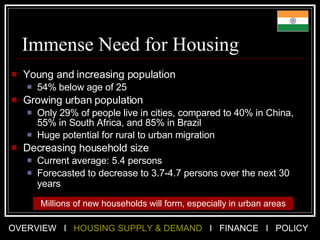
Immense Need for Housing Young and increasing population 54% below age of 25 Growing urban population Only 29% of people live in cities, compared to 40% in China,  55% in South Africa, and 85% in Brazil Huge potential for rural to urban migration Decreasing household size Current average: 5.4 persons  Forecasted to decrease to 3.7-4.7 persons over the next 30 years   Millions of new households will form, especially in urban areas
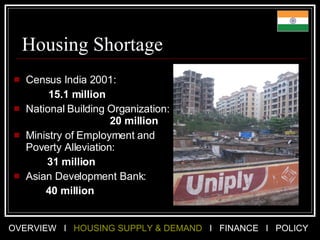
Housing Shortage Census India 2001:  15.1 million National Building Organization:  20 million   Ministry of Employment and Poverty Alleviation:  31 million Asian Development Bank:  40 million
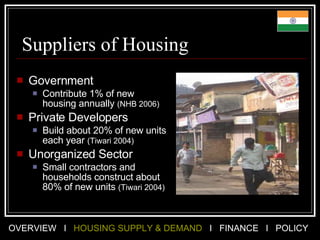
Suppliers of Housing Government Contribute 1% of new housing annually  (NHB 2006) Private Developers Build about 20% of new units each year  (Tiwari 2004) Unorganized Sector Small contractors and households construct about 80% of new units  (Tiwari 2004)
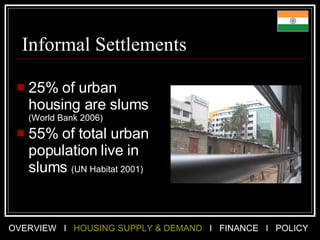
Informal Settlements 25% of urban housing are slums  (World Bank 2006) 55% of total urban population live in slums  (UN Habitat 2001)
Housing Demand: Growing Middle Class   Increasing demand for housing due to rising incomes and a growing middle class Source:  DB Research, 2006 New developments in Mumbai Rising Middle Class 1980 8% 2000 22% 2010 32%
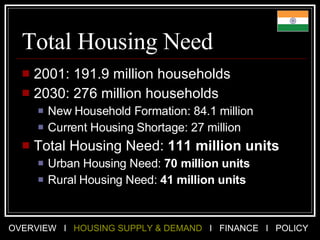
Total Housing Need 2001: 191.9 million households 2030: 276 million households New Household Formation: 84.1 million Current Housing Shortage: 27 million Total Housing Need:  111 million units Urban Housing Need:  70 million units Rural Housing Need:  41 million units
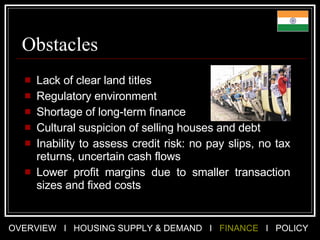
Obstacles Lack of clear land titles  Regulatory environment Shortage of long-term finance Cultural suspicion of selling houses and debt Inability to assess credit risk: no pay slips, no tax returns, uncertain cash flows  Lower profit margins due to smaller transaction sizes and fixed costs
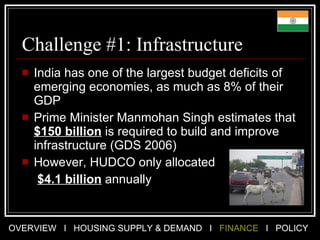
Challenge #1: Infrastructure India has one of the largest budget deficits of emerging economies, as much as 8% of their GDP Prime Minister Manmohan Singh estimates that  $150 billion  is required to build and improve infrastructure (GDS 2006) However, HUDCO only allocated   $4.1 billion  annually
Challenge #2: Regulations Urban Land Ceiling Act  Rent Control Acts Arbitrary Master Plans High cost of land transactions Large land holdings that cannot be sold Low property taxes Minimum plot size Low FAR – 1.6 vs. 5-15 in other Asian cities
Policy Recommendations Repeal Urban Land Ceiling and Rent Control Acts in Maharashtra and West Bengal Base taxes on property value not rents Impose impact fees when redeveloping high density areas that can be used to increase financing for infrastructure Increase FAR revision to allow for denser development Fiscal incentives benefit well-off, instead direct money to improving the institutions that are necessary for an efficient housing market
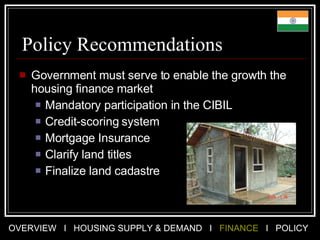
Policy Recommendations Government must serve to enable the growth the housing finance market Mandatory participation in the CIBIL Credit-scoring system Mortgage Insurance  Clarify land titles  Finalize land cadastre
India’s Potential Largest democracy on Earth 2 nd  fastest growing major economy after China Projected to overtake China as most populous nation by 2050 with 1.5 billion people Estimated 111 million new housing units needed by 2030 Government encouraging free market since 1990s Private sector rapidly expanding Challenge lies in the SCALE of India

2628971179771875

  • 1.
    The Challenges ofNation Building An Analysis of India’s Housing Sector By: Tom Eddington, Keya Kunte and Emma Hall
  • 2.
    India: Superpower by2030? Booming economic growth and increasing importance on the world stage put India on the path towards achieving superpower status However, India must overcome numerous obstacles, including a severe housing shortage .
  • 3.
    The Scale ofIndia Current Population: 1.1 billion (CIA 2006) Projected Population in 2030: 1.38 billion (UN 2005) Half of total population growth in urban areas Total Housing Need: 111 million units
  • 4.
    India’s Economy Tremendouseconomic growth Second only to China in annual GDP growth Stable inflation and exchange rates Safe investment environment Housing sector benefits from increased investment However, lack of trunk infrastructure hinders economic growth
  • 5.
    Immense Need forHousing Young and increasing population 54% below age of 25 Growing urban population Only 29% of people live in cities, compared to 40% in China, 55% in South Africa, and 85% in Brazil Huge potential for rural to urban migration Decreasing household size Current average: 5.4 persons Forecasted to decrease to 3.7-4.7 persons over the next 30 years Millions of new households will form, especially in urban areas
  • 6.
    Housing Shortage CensusIndia 2001: 15.1 million National Building Organization: 20 million Ministry of Employment and Poverty Alleviation: 31 million Asian Development Bank: 40 million
  • 7.
    Suppliers of HousingGovernment Contribute 1% of new housing annually (NHB 2006) Private Developers Build about 20% of new units each year (Tiwari 2004) Unorganized Sector Small contractors and households construct about 80% of new units (Tiwari 2004)
  • 8.
    Informal Settlements 25%of urban housing are slums (World Bank 2006) 55% of total urban population live in slums (UN Habitat 2001)
  • 9.
    Housing Demand: GrowingMiddle Class Increasing demand for housing due to rising incomes and a growing middle class Source: DB Research, 2006 New developments in Mumbai Rising Middle Class 1980 8% 2000 22% 2010 32%
  • 10.
    Total Housing Need2001: 191.9 million households 2030: 276 million households New Household Formation: 84.1 million Current Housing Shortage: 27 million Total Housing Need: 111 million units Urban Housing Need: 70 million units Rural Housing Need: 41 million units
  • 11.
    Obstacles Lack ofclear land titles Regulatory environment Shortage of long-term finance Cultural suspicion of selling houses and debt Inability to assess credit risk: no pay slips, no tax returns, uncertain cash flows Lower profit margins due to smaller transaction sizes and fixed costs
  • 12.
    Challenge #1: InfrastructureIndia has one of the largest budget deficits of emerging economies, as much as 8% of their GDP Prime Minister Manmohan Singh estimates that $150 billion is required to build and improve infrastructure (GDS 2006) However, HUDCO only allocated $4.1 billion annually
  • 13.
    Challenge #2: RegulationsUrban Land Ceiling Act Rent Control Acts Arbitrary Master Plans High cost of land transactions Large land holdings that cannot be sold Low property taxes Minimum plot size Low FAR – 1.6 vs. 5-15 in other Asian cities
  • 14.
    Policy Recommendations RepealUrban Land Ceiling and Rent Control Acts in Maharashtra and West Bengal Base taxes on property value not rents Impose impact fees when redeveloping high density areas that can be used to increase financing for infrastructure Increase FAR revision to allow for denser development Fiscal incentives benefit well-off, instead direct money to improving the institutions that are necessary for an efficient housing market
  • 15.
    Policy Recommendations Governmentmust serve to enable the growth the housing finance market Mandatory participation in the CIBIL Credit-scoring system Mortgage Insurance Clarify land titles Finalize land cadastre
  • 16.
    India’s Potential Largestdemocracy on Earth 2 nd fastest growing major economy after China Projected to overtake China as most populous nation by 2050 with 1.5 billion people Estimated 111 million new housing units needed by 2030 Government encouraging free market since 1990s Private sector rapidly expanding Challenge lies in the SCALE of India