Malaya David Wicks and Simon Wilson
A History of 2 Field Troop Royal Australian Engineers 1963–1965
Destination:Destination:
"It is a splendid job most professionally done... "
Brigadier Terrence McMeekin, Commander 28 Commonwealth Brigade
Destinaton:MalayaAHistoryof2FieldTroopRoyalAustralianEngineers1963–1965DavidWicksandSimonWilson
Description of image above to be
inserted in this section, description of
image above to be inserted in this
section
L/Cpl John Barnett and Spr Bill Whitfield and an unlucky Brit Spr Ian Tibbles Sprs Bob Rawson and Tony Farrell
Spr Arthur Sinclair
L/Cpl Tony Farrell
Sprs Dave Wicks, Ray Logan, Harry Atkinson,
Mick Sutton and George Greenslade
Spr Darryl Hess
Spr Ken Jolley
Spr Doug Canning
Spr Dion Hands
Front cover photo top: Loading a Commer tipper with laterite under the chinaman at the
Free Thai airstrip. Cpl John Bending oversees proceedings while Spr Ian Tibbles advis-
es Spr Alan Morris driving the dozer. Operation Crown, March 1964.
Front cover photo bottom: L to R: Sappers Les McNamara, Darryl Hess, Peter Matthews,
Gary Plumb, Trevor Reece and Bob Rawson. Exercise Raven, July 1964, Asahan
Training Area, Malacca State.
Rear cover photo: Spr Darryl Hess leading the bucket brigade of concrete carriers during
the construction of a stairway from Commonwealth House, the home of the
Commander of 28 Commonwealth Brigade, to the beach 1964.
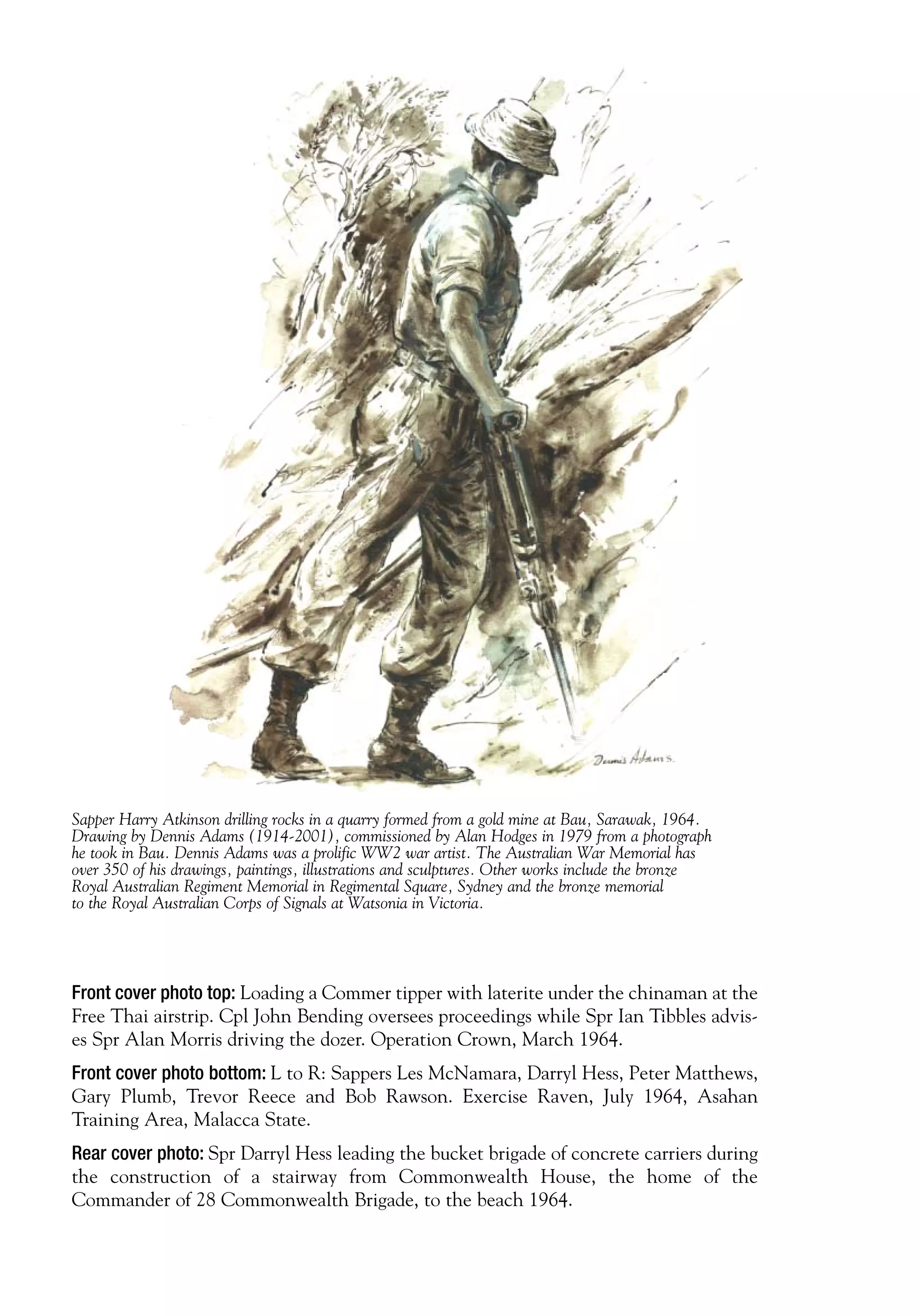
Sapper Harry Atkinson drilling rocks in a quarry formed from a gold mine at Bau, Sarawak, 1964.
Drawing by Dennis Adams (1914-2001), commissioned by Alan Hodges in 1979 from a photograph
he took in Bau. Dennis Adams was a prolific WW2 war artist. The Australian War Memorial has
over 350 of his drawings, paintings, illustrations and sculptures. Other works include the bronze
Royal Australian Regiment Memorial in Regimental Square, Sydney and the bronze memorial
to the Royal Australian Corps of Signals at Watsonia in Victoria.
Malaya
Destination:Destination:
David Wicks and Simon Wilson
A History of 2 Field Troop Royal Australian Engineers 1963–1965
Destination: Malaya
A History of 2 Field Troop Royal Australian Engineers 1963-1965
David Wicks and Simon Wilson
Published by the 2 Field Troop RAE (1963-1965) Association.
October 2003 Revised
First published in Australia – September 2003
Published by the 2 Field Troop RAE (1963-1965) Association. ©This book is copyright. Apart from
any fair dealing for the purpose of private study, research, criticism or review, as permitted under the
Copyright Act, no part may be reproduced by any process without written permission.
Printed in Australia by Trendsetting – Canberra ACT.
Design by Spectrum Graphics – Canberra ACT.
Images used in this book have been provided freely for reproduction by the owners except for:
Certain photos associated with opening of the Bau airstrip where the photographer and the
organisation commissioning the photographs are unknown.
Formal photos taken by Wong Photographer in 11 Indep Field Sqn lines. This firm is believed to
be no longer trading.
National Library of Australia Cataloguing-in-Publication.
Wicks, David, 1939-
Destination : Malaya : a history of 2 Field Troop Royal Australian Engineers 1963-1965.
Bibliography.
ISBN 0 646 42626 5.
1. Australia. Army. Royal Australian Engineers - History.
2. Military engineers - Australia - History. I. Wilson, Simon, 1941-. II. 2 Field Troop RAE (1963-
1965) Association. III. Title.
358.2099
Every valley shall be filled in,
every mountain and hill made low.
The crooked roads shall become straight,
the rough ways smooth.
Luke 3:5
A History of 2 Field Troop RAE 1963 to 1965 PAGE V
CONTENTS
Preface vi
Foreword vii
Acknowledgements ix
Abbreviations and Glossary x
Map of Southeast Asia xii
Chapter 1 The Raising of 2 Field Troop RAE 1
Chapter 2 Malay Peninsula 5
Chapter 3 Thailand and Operation Crown 13
Chapter 4 Terendak Again 31
Chapter 5 Bound for Borneo – Sarawak 47
Chapter 6 Terendak, then Homeward Bound 67
Chapter 7 Views from the Top 73
Chapter 8 Reminiscences 87
Chapter 9 Records of Service Achievement 113
Chapter 10 The Reunions 119
2 Troop Nominal Roll 130
Accompanied Family Details 132
2 Field Troop RAE Roll of Honour 133
In Memoriam 134
Service Medals 135
Bibliography 138
PAGE VI DESTINATION: MALAYA
Preface
This book covers a two-year period in the service of 2 Field
Troop Royal Australian Engineers as a sub-unit of 11 Indep
Field Sqn Royal Engineers. From 1963 to 1965 the Troop
served on the Malay Peninsula, Thailand and Sarawak.
This was an active period of training and operations, which
prepared many of the troop members in a very practical
manner for subsequent service in South Vietnam and other
countries.
Not only are details of the practical aspects of military
engineering described, but there are also descriptions of the
social aspects of living in Southeast Asia and anecdotes of
events that have become akin to folk law. Accompanied
families were an important part of life in Malaya and so there
are stories about their experiences in Malacca.
Although this book is primarily directed towards the former
members of the Troop, the professional and social aspects
narrated provide a unique perspective on the life of a soldier
during a period of Indonesian Confrontation and on the
tensions associated with countering the potential spread of
Communism in Southeast Asia.
Cpl John Bending, Sprs Alan Morris, Bill Jones and Tom Abberfield
A History of 2 Field Troop RAE 1963 to 1965 PAGE VII
This book is going to invoke many happy memories for the Sappers who served in the
Royal Australian Engineers throughout the 1960s and early 1970s – particularly those
who were fortunate enough to join the Australian contingent based at Terendak as part
of the British Far East Land Forces (FARELF).
I can recall a sense of envy when the 2nd Field Troop of 1 Field Squadron was raised to
FARELF establishment to head off on what most of us thought was the only foreseeable
military adventure for young Australian servicemen at that time. Little did most of us
realise that we would also find ourselves on British rations with the meat allowance
before much time had elapsed.
Before 2 Troop’s tour of duty in South East Asia was completed in 1965 the Australian
Army had become engaged in conflicts in both Malaysia and South Vietnam and we
were all confronted with opportunities for adventure. During Confrontation most
Sappers serving at the time were going to have some experience of service in Asia.
2 Troop itself was to be a part of this expanded effort, with operational deployments to
Thailand and Sarawak.
When 2 Troop journeyed back to Australia it returned to a vastly expanded and
changing Army. It would never really be the same again. Members of the Troop were to
serve with many other units in equally exciting places, and to make their professional
contribution to the expanded Army. But what should be of great interest to all students
of the military ethos is the fact that, despite its members having many different and
stimulating experiences, the two years from 1963 to 1965 has bound them together in
a spirit of camaraderie that has endured now for four decades.
A part of the reason for this must be due to the fact that it was an accompanied tour,
ensuring that it was a total family experience as well as a professional military journey.
Being part of a larger allied unit and formation would also have something to do with
the esprit of the time and the strong memories it has left. 2 Troop was always on its
mettle to prove that it was better than the Brits (which it was), making each
achievement a triumph in some way.
Produced by the 2 Field Troop RAE (1963-1965) Association, this book does justice to
that memory. It is also timely in that it captures the precious memories before they grow
dim, or virtual! It is both interesting and stimulating and will, I am sure, be a major
contribution to the many reunions to come. I congratulate the authors for their success
in capturing the spirit of an experience shared by a select group of the RAE family and
a job well done.
Governor
The members of 2 Field Troop RAE (1963-1965) Association
greatly appreciate the financial support for this
publication from the Corps Committee of the
Royal Australian Engineers.
A History of 2 Field Troop RAE 1963 to 1965 PAGE IX
Acknowledgements
When 2 Field Troop RAE deployed to Malaya in 1963 many of the members were
accompanied by their families. An attempt has been made throughout this book to
recognise the contribution made by these ‘associate’ members. For the wives and
children it must have been a difficult and, at times, lonely posting in a foreign country,
far from the support of family and friends, yet they have done their families and the
Troop proud.
Also, throughout the book there is mention made of events unrelated to 2 Troop. These
events have been introduced in an effort to fix the history of the Troop in relation to
the world events of that period. Imperial units of measurement were used in 1963-65
and so they have been retained in the text.
Although the Federated States of Malaysia came into existence shortly before 2 Troop’s
deployment to the region, the posting was generally known as Malaya, rather than
Malaysia, and both the title and text throughout the book reflect this terminology.
This book could not have been written without the help of a great many people. We
express our appreciation to the friendly and helpful staff at the Mitchell Library in
Sydney and the National Library in Canberra, David Sibley, editor of Army The
Soldier’s Newspaper, and all the troop members for their contributions and input. In
addition, special mention needs to be made of a number of people: Barry Lennon, for
his clear and concise advice at the very beginning of the project, and continued
valuable input throughout its development; Dave Wood and Bill Jones for their
countless hours spent in consultation on all topics, and their assistance with endless
research – the book would not have been finished without your selfless contributions;
Alan Hodges, not only for considerable material content, continous support and
encouragement, but also for his editing skills, taking a fairly ordinary document and
turning it into a manuscript fit for publication; proof reader extraordinaire, Beryl
Hodges, thanks Beryl; and Alan’s friend Bill Laing of Spectrum Graphics in Canberra,
who donated his valuable time and considerable expertise, and that of his staff, to
produce the finished product. Just saying thanks hardly seems adequate, Bill – perhaps
we could make you an honorary 2 Troop Sapper.
Finally, every care has been taken to ensure the accuracy of all material contained
within the book and if there are errors or omissions they are entirely the fault of the
authors.
David Wicks and Simon Wilson
August 2003
PAGE X DESTINATION: MALAYA
Abbreviations and Glossary
ADF Australian Defence Force
ANZUK Combined Australian, New Zealand and UK Force
APC Armoured Personnel Carrier
ASCO Australian Services Canteen Organisation
CB Confined to Barracks (a form of punishment)
Const Construction
CRE Commander Royal Engineers
FAMTO First Aid Mechanical Transport Outfit
FARELF Far East Land Forces
FE Field Engineer
GPMG General Purpose Machine Gun
MO Medical Officer
NAAFI Navy Army and Air Force Institution
NATO North Atlantic Treaty Organisation
NCO Non-Commissioned Officer
OC Officer Commanding
OR Other Rank (Sapper etc.)
PT Physical Training
QM Quarter Master
RAE Royal Australian Engineer
RAOC Royal Army Ordnance Corps (British)
RAR Royal Australian Regiment
RASC Royal Army Service Corps (British)
RE Royal Engineer
RSM Regimental Sergeant Major
SEATO Southeast Asian Treaty Organisation
SLR Self-Loading Rifle
SMG Sub-Machine Gun
SQMS Squadron Quarter Master Sergeant
SPR Sapper
SSM Squadron Sergeant Major
Amah Female domestic servant
A History of 2 Field Troop RAE 1963 to 1965 PAGE XI
Dhobi Wallah Laundry boy (or girl)
Dyak Dyak is the name applied to aboriginal inhabitants of the island of
Borneo, particularly to the peoples of the interior of the state of
Sarawak. The Dyak are divided into six groups including Ibans.
Garter Flash Elastic garter used to keep hose tops in position with small attached
flag in Engineer red and blue Corps colours.
Gollock British Army issue machete.
Hose Tops Long sock without a foot. Used in conjunction with puttees and
garter flashes.
Hutchie Lightweight one- or two-man shelter. Sometimes called a ‘Donga’.
Iban The Ibans, also known as Sea Dyaks, are the only Dyak group that
inhabits coastal areas.
Kampong Native village.
Laterite A high-iron clay and gravel deposit suitable for use in road and
airfield construction.
Padang Open space, village common, sports oval.
Panji Stakes set in holes or under water as anti-personnel traps.
Parang Malay machete of variable design and shape.
Puttees A strip of woollen cloth wound around the top of the boot and
ankle for protection and support.
Bau
Malacca
Operation Crown
A History of 2 Field Troop RAE 1963 to 1965 PAGE 1
Chapter One
The Raising of 2 Field Troop RAE
The Beginning
In the early 1950s there was international concern about the possibility of Communism
spreading in Southeast Asia. As a result, Australia, France, Great Britain, New Zealand,
Pakistan, the Philippines, Thailand, and the United States established the Southeast
Asia Treaty Organization (SEATO) alliance in 1954 under the Southeast Asia
Collective Defence Treaty.
The formation of SEATO was followed in 1955 by an agreement between UK, NZ and
Australia to establish a Far East Strategic Reserve in Penang on the west coast of
Malaysia. Its function was to counter Communist aggression in Southeast Asia and also
to operate against the Communist Terrorists in Malaya. Australia provided, in addition
to an engineer troop, an infantry battalion, a battery of artillery, a contingent of signals
and other support elements as part of 28 Commonwealth Brigade. A squadron of Sabre
jet fighters was based at Butterworth, and there were sundry other military personnel in
Singapore.
Troop photo taken on the 11 Indep Field Sqn parade ground shortly before the deployment to Sarawak in
April 1965. (Wong Photographer)
PAGE 2 DESTINATION: MALAYA
The Australian Government had strongly supported the formation of the Federated
States of Malaysia and, with a contribution to the Far East Strategic Reserve, it was also
providing a tangible means of supporting the fledgling state against the open hostility
displayed by Indonesia. It was felt that by guaranteeing Malaysia’s sovereignty, Australia
was also guaranteeing its own strategic interests in the region.
The inaugural Australian engineer contribution to the Far East Strategic Reserve,
4 Troop RAE, was raised at Casula in 1955 and came under command of
11 Independent Field Squadron, RE (11 Indep Field Sqn) in Penang as part of
28 Commonwealth Brigade. The squadron had a proud history of significant military
involvement dating back to the late 18th Century including deployments to the West
Indies, Crimean War, Indian Mutiny, Egypt and Sudan, including the relief of
Mafeking, and the first and second world wars.
The advance party to Malaya of 4 Troop was led by Lieutenant Peter Gration, who
subsequently rose to Chief of the General Staff and then Chief of Defence Force. In
1957, 2 Troop from 7 Indep Field Sqn replaced 4 Troop, and in 1959 it was in turn
replaced by 1 Troop of the squadron. Another 4 Troop was raised, in 1961, by 1 Field Sqn
and, after a brief time at Butterworth and a deployment to Borneo, it moved to new
facilities at Terendak, 12 miles north of Malacca. 1 Field Sqn was also subsequently
Sprs Trevor Reece, Bob McDonald, Cpl Snow Wilson and unknown. Drilling before blasting,
Rylstone area mid-1963.
A History of 2 Field Troop RAE 1963 to 1965 PAGE 3
responsible for raising 2 Troop, the subject of this book. Surprisingly, the replacement
troop in 1965 was also called 2 Troop and subsequent replacements kept that title. With
the withdrawal of British troops from Malaysia in 1970, 11 Indep Field Sqn departed and
left 2 Troop in support of the Australian battalion. In September 2 Troop was disbanded
and some members were absorbed by the recently-created 9 Field Sqn. So ended 15 years
of continuous service by an Australian field engineer troop within 11 Indep Field Sqn,
RE. Subsequently, the British left a battalion group at Terendak and 9 Field Sqn gained
a British field troop under command. The Squadron later became 28 ANZUK Field Sqn
and, later again, 28 Commonwealth Brigade became 28 ANZUK Brigade.
The beginning for 2 Field Troop RAE (1963-1965) occurred in early 1963 when orders
were raised for 1 Field Sqn to form an engineer troop to deploy to Malaya for a two-year
period, replacing 4 Troop, which was nearing the end of its tour of duty. It was to be an
‘accompanied’ posting, married personnel could take their wives and children, so
competition for a position, in what was considered to be a prize posting, was fierce.
The troop was formed under the leadership of Lieutenant Barry Lennon, and marched
into 1 Field Sqn at Casula on the 29 May. 1 Field Sqn provided the administration,
stores, transport, plant and other support that 2 Troop would require until its departure.
At the time the Officer Commanding (OC) 1 Field Sqn was Major D J Binney. He was
replaced by Major I R Way shortly after 2 Troop’s arrival.
The bulk of 2 Troop’s members came from 1 Field Sqn and
from 7 Field Sqn in Enoggera, Queensland, with four
members from 20 Field Park Sqn (Plant) at Casula. It was
Barry Lennon’s job to mould sappers from these various units
into a cohesive troop and, to this end, much time was spent
in the Rylstone-Gospers area of the Blue Mountains carrying
out typical engineer tasks including road and fire trail
construction, improvised bridging, and drilling and blasting.
A week-long exercise in the rugged Kangaroo Valley near
Moss Vale covered some basic weapons training and ambush
drills although, given the wet and near-freezing conditions,
the troop members could have been forgiven for thinking
they were preparing for a posting to anywhere but the
tropics.
In hindsight, it seems that, apart from honing engineering
skills, preparation for deployment into a region like Malaya
was not as thorough as it could have been: there was
insufficient weapons training and no period of training at the Jungle Warfare Centre at
Canungra in Queensland. During this period, Australian troops were generally deployed
with little specialist training for the area in which they were to operate.
In early September, Sapper Sam Scales and another sapper were withdrawn from the
troop and were replaced by Sappers Lindsay ‘Nipper’ Simpson and Dave Wicks from 1
Field Sqn. By late October 1963 2 Troop was fit and rearing to go. Inoculations were
brought up to date and the last of the paperwork completed. The troop members were
given pre-embarkation leave to say farewell to family and friends, then assembled once
more at 1 Field Sqn several days before departure. One of the last tasks before departure
for those who were interested and were over 21 years of age was to cast an absentee vote
in the forthcoming Federal election. On departure, the troop was 46 strong, and was
accompanied by 14 wives and 22 children.
Studebaker 6x6 fitted with
tipping body and canopy. Belonging
to 1 Field Sqn, it was on loan
to 2 Troop.
“There were some early difficulties like learning
to wrap ankle puttees so they would stay on,
and finding out what hose tops and garter
flashes were for...”
A History of 2 Field Troop RAE 1963 to 1965 PAGE 5
Chapter Tw o
Malay Peninsula - The First Weeks
Departure day from Australia for 2 Troop was Sunday 17 November 1963, a date still
well-remembered by Sapper Bob 'Macca' McDonald as it was his mother’s birthday. The
journey began with an early morning bus ride to the international terminal at Mascot
where the troop, including wives and children, boarded a chartered Qantas 707. A
refuelling stop at Darwin allowed all to stretch their legs; then the 707 continued on to
Singapore, landing at Paya Lebar International Airport in the late afternoon. There, a
Fokker Friendship and a DC3 waited to fly the troop on to Malacca: marrieds and their
families on the Friendship, the remainder on the DC3. The troop was welcomed at
Malacca by Captain Malcolm van Gelder, who would be the Troop Commander for the
next 12 months, as he had already served 12 months as commander of the now
homeward-bound 4 Troop. Buses transported the troop members to their respective
destinations: families, with some very tired children, to their married quarters, and
singlies to the barracks of 11 Indep Field Sqn at Terendak, their home for the next two
years. As well as the Australian troop, 11 Sqn had two British field troops, and a park
troop with more construction equipment than a normal field squadron, as the squadron
was designed to operate independently without support from other engineer units. The
squadron included a section-strength team (up to 10 people) who were parachute-
11 Indep Field Sqn lines looking out to the straits of Malacca. 2 Troop barracks in the foreground and
NAAFI on the right. Beyond the tennis courts is the ORs mess.
trained so as to provide sapper assistance in capturing an airfield for insertion of brigade
units. It also maintained a diving team of about the same strength.
The first few days were mostly taken up with kit issue and meeting the eight members
of 4 Troop who had remained in Malaya and still had 12 months of their tour to
complete. Unlike the infantry battalion, 3 Battalion, Royal Australian Regiment (3
RAR), which had arrived as a complete unit and brought a lot of its Australian issue
kit, 2 Troop was to be fully integrated with 11 Sqn, and kitted out with British-issue
field kit and troop stores. There were some early difficulties like learning to wrap ankle
puttees so they would stay on, and finding out what hose tops and garter flashes were
for; but generally the kit was well received with the exception of the footwear and
webbing. The British did have an excellent machete, called a gollock, which was far
superior to the Australian issue. The British Pattern 44 webbing looked like it was a
leftover from WW2 and was uncomfortable, particularly when heavily loaded. The
Australian Army by this time had the lightweight American issue webbing, and there
was little to compare between the two. Footwear issue consisted of plimsolls, a sort of
sandshoe, for PT, leather ammunition boots similar to Australian issue but made from
a much coarser grade leather, and green jungle boots with a black moulded rubber sole,
similar to gym boots but with tall canvas uppers that laced up to the calf.
Weapons were issued – the 7.62 mm FN 30 was almost identical to its Australian
counterpart and the SLR (self-loading rifle) was already familiar to all the sappers.
NCOs, drivers and plant operators were issued with the Sterling 9 mm SMG (sub-
machine-gun), a superior weapon and lighter than the Owen, but this meant some
familiarisation training was required. The section machine-gun was a Bren GPMG,
which had been modified to accept the
NATO 7.62 mm rimless cartridge, and
had also been improved so it did not
require barrel changes after each
200-300 rounds fired. Australia had only
recently phased out the older .303
version of the Bren Gun, so those
selected in the machine-gun teams
quickly became proficient.
The food served in the ORs (Other
Ranks) mess came as a bit of a culture
shock. Not many Australians ate kippers
for breakfast (most could not even stand
the smell), the portions of meat were
microscopic and underground mutton
(rabbit) was frequently on the menu.
Potatoes seemed a staple part of the diet,
with spuds being served in as many as
five or six different guises (or disguises)
at the one meal. To compensate in part,
the Australians were paid a ‘meat
allowance’ of 2 shillings and 6 pence per
day, and this was a cause of some friction
with the Brits. The Australians were
already better paid and the Brits could
Rear Spr Alan Pullen, Spr Michael Holloway; Front Spr
John Tomczak, Spr Gary Plumb in ceremonial uniform
PAGE 6 DESTINATION: MALAYA
not see why the Aussies should be paid extra to eat in their
mess. It was doubtful that the allowance was always spent in
obtaining additional protein however, unless it came out of a
Tiger beer can. The married members were not paid the meat
allowance but received 9 shillings and 2 pence per day as a
general family allowance, plus a domestic servants allowance
that varied with the size of the family.
The troops were confined to barracks for the first week,
marrieds excluded, to allow them to ‘settle down’ to their
new environment. During this time, lectures were given on
health issues in the tropics, including an entertaining lecture
by Dr. Nurse (aptly named) on the dangers of fraternising
with the local ladies. A Paludrine antimalarial tablet was
issued to everyone on a daily basis, usually on morning
parade. There was also some instruction on riot control, Brit
army style. Riots were not uncommon throughout Malaysia
at the time, and if the Police could not contain the unrest,
troops could be called in to assist under provisions of Military
Aid to the Civil Power.
On the first weekend leave most sampled the sights and smells of downtown Malacca
and the many sites of historical interest. The ancient city of Malacca (now known as
Melaka) is on the west coast of the Malay Peninsula about 120 miles northwest of
Singapore. Malacca was founded in the 14th Century by Raja Iskandar Shah when
Singapore was abandoned due to Javanese attacks. In its early days, the town came
under Chinese protection of the Ming Emperor Yung Ho. During the 1400s, the town
was the most important port in Southeast Asia and the State of Malacca was a major
trading power with exports of gold, ivory and spices. In the late 1400s the Portuguese
explorers discovered a sea route from Europe to India, and in 1511 the Portuguese
Alfonse de Albuquerque captured Malacca and established a fort there.
Towards the end of the 1500s, the Dutch and English, who each formed an East India
Company, challenged the Portuguese traders. These companies eventually broke
Portuguese control of trade, but it was the wealthier Dutch
company that dominated the region. The Dutch captured
Malacca in 1641, with the assistance of a Malay force from
Johore, after an eight-month siege. The Dutch remained for
nearly 200 years and added their own style of architecture
that still stands. In 1824, the British East India Company
occupied the area, following a treaty arrangement by which
the Dutch exchanged Malacca for the British settlement of
Bencoolen in Sumatra, and formed the Straits Settlements,
which initially included Singapore, Penang-Wellesley and
Malacca. During the Second World War, the Japanese
occupied these areas. In 1946 the Straits Settlements Colony
was dissolved and in 1957 the British ceded Malacca and
Penang to Malaya. The Federation of Malaysia was
proclaimed in 1963, with the merging of the former Straits
Settlements of Malaya, Singapore and the Borneo territories
of Sarawak and Sabah.
Chief of the General Staff, Australia,
Lt Gen J Wilton, accompanied by
Maj Tony Stacey-Marks inspecting
L/Cpl John Barnett’s gollock. Spr
Murray Aitken in the background.
Downtown Malacca 1963
A History of 2 Field Troop RAE 1963 to 1965 PAGE 7
PAGE 8 DESTINATION: MALAYA
Many historical buildings and ruins from
the various occupations of Malacca can
still be seen. The ancient Catholic
Church of St Paul overlooking Malacca
was the temporary burial place of Saint
Francis Xavier between 22 March and
11 December 1553. One particular
attraction of Malacca was Tai Chong,
a store better know by its English name
of Cold Storage. Here, on hot humid
days, strange-tasting but nevertheless
satisfying milkshakes could be bought in
air-conditioned comfort. The historical
features of the city were probably lost on
the sappers, at least on this first visit.
An article in the Bukit Bulletin (a fortnightly Brigade magazine of Terendak news) by
‘Harry Reyer’ captures the atmosphere of a first venture to Malacca:
My hands were perspiring freely. I knew this was to be a dangerous mission. The
hazards I was to encounter on this journey I knew would be many and varied. But,
if I was to prove myself, this was the ultimate test. I glanced nervously at the man
in whose hands I had placed my future. He showed no concern. His face was
impassive; his sinewy hands gripped the controls of his machine. He looked round
cautiously and then sprang into action – the great adventure was on.
It was worse than I had imagined. The Angel of Death was brooding over my head
as the hazards loomed up. Destruction against one of the many obstacles, or a direct
hit by the missiles that ripped past us seemed inevitable. We moved relentlessly on,
not at a smooth pace but progressing in fits and starts, taking every opportunity that
presented itself, squeezing past the dust-covered monsters only to have them bear
down on us again, blaring their
indignation at being passed. Somehow we
evaded them all.
I glanced up at the man. He still looked
impassive but I noticed he was sweating
now and the veins on his face were
bulging slightly – the trip was obviously
taking its toll. My knuckles gleamed
white as my fingernails dug into my
sweating palms and then we slipped out
of the stream and stopped. In the
comparative quiet I felt weak but
triumphant. At last it was over. With
a shaking hand I passed the coin to
the man and moved to the shade. Yes. I had done it – the length of Newcombe
Road in a trishaw.
While the troops were enjoying this first weekend of freedom, the families still settling
into their new surrounds, and the Jones family making arrangements for Lorraine’s 21st
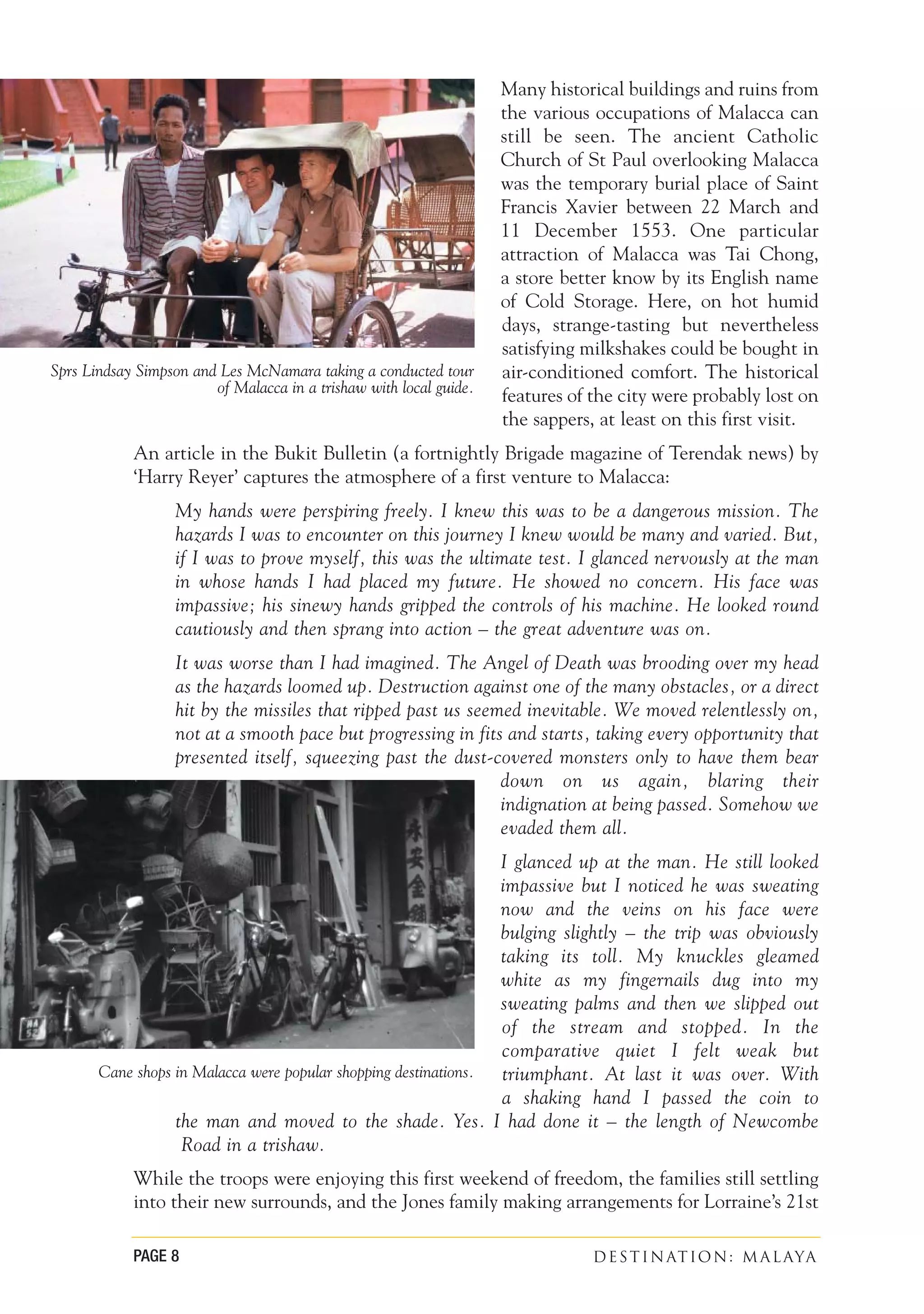
Sprs Lindsay Simpson and Les McNamara taking a conducted tour
of Malacca in a trishaw with local guide.
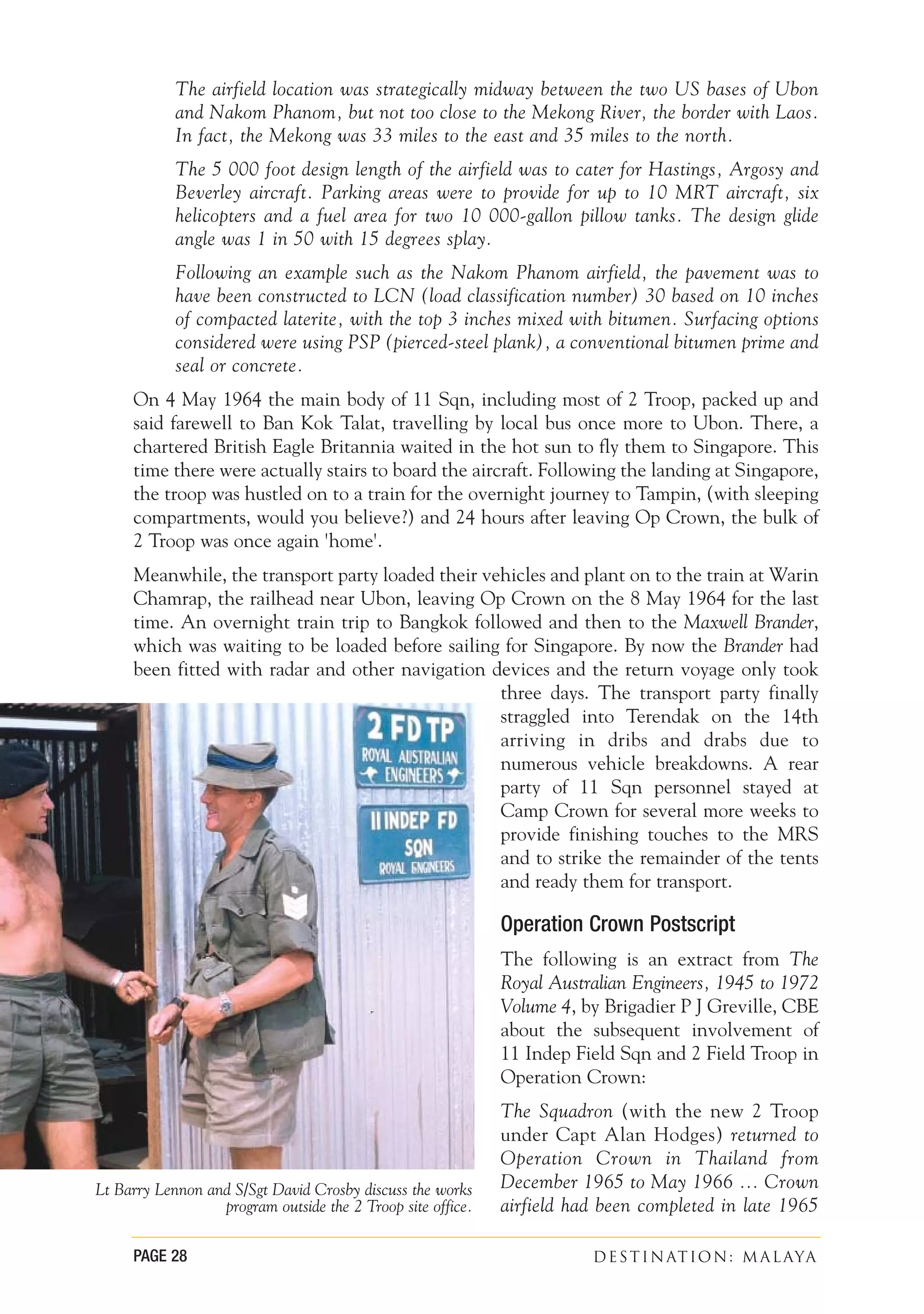
Cane shops in Malacca were popular shopping destinations.
A History of 2 Field Troop RAE 1963 to 1965 PAGE 9
birthday party, the world was stunned by
the assassination of John Fitzgerald
Kennedy, the 36th President of The
United States of America. The
President was struck in the head by
two rounds fired from a sniper's rifle
while travelling in an open car in
Dallas, Texas around 1.30 pm Friday
22 November (4.30 am Saturday eastern
Australian time, 2.30 am Malacca
time).
Terendak Garrison
Terendak was a large modern military
base, complete with all amenities and on a much wider scale than provided in
Australia. The garrison took its name from the highest hill in the area, Bukit Terendak,
which means the hill of the rice planter's hat. The camp area was 1 500 acres with
an associated training area of 3 500 acres. The camp housed probably in excess of
10 000 people, including married members and their families. It was the home of
28 Commonwealth Infantry Brigade, of which the Australian units were a part.
The NAAFI (Navy Army and Air Force Institutes) was centrally located in the
garrison and was somewhat similar to ASCO (Australian Services Canteen
Organisation) in Australia, but with considerably expanded services. It included a
supermarket with its own butchery and bakery, hairdresser, electrical, watch and shoe
repairers, photographic shop, tailor and a florist. The camp had three churches and a
temple, a cinema (the Loewen, showing films twice nightly with additional afternoon
matinees on Wednesday and Saturday), a large four-storey hospital, four swimming
pools and other sporting facilities, and various clubs with bar and restaurant service.
There were also the St. Andrew's
Commonwealth Club (a sort of drop-in
centre where you could have a quiet
cuppa or write a letter home), the Rose
& Crown pub, several beach clubs for
various rank levels, and a sailing club
with a squadron boat.
Although the camp had 900 married
quarters, it was not large enough to
accommodate all the married personnel
and so many lived outside the garrison
boundaries in comfortable bungalows in
purpose-built ‘villages’ (Bukit Bahru,
Tay Boon Seng). The residents usually
referred to these villages by English
names: Somerset Green, Eden Park, Suffolk Gardens. The married quarters were fully
furnished and included linen and crockery. Each item was worth a certain number of
points and a monthly points breakage allowance enabled replacement items to be
issued. Each married family had an amah, (and sometimes two if the family was large)
St John’s C of E church and the Rose and Crown Inn.
Terendak Garrison swimming pool.
to help with the housework and look
after the children. Some amahs cooked
although there might also be a separate
cook.
Neither were the single members left to
fend for themselves. The troop had a
‘boot boy’, Babu, an Indian from
Allahabad. Babu not only polished
everyone’s boots and brass (including
spit polishing the parade boots), but also
made the beds and swept the floor as
well. Laundry and ironing were done by
the ‘dhobi wallah’. Silver, another
gentleman of Indian decent, was the
dhobi contractor (although he
employed local labour to do the work)
and also the Squadron tailor. The cost
to troop members was minimal,
amounting to only a few shillings a week
each. There were no latrine duties, as
the ablution block and barrack
surrounds were kept spotless by the ever-
smiling Malay maintenance man, Baba.
Small wonder Malaya was a popular
posting.
The climate was probably a bit trying at
first due to the high humidity, but in fact
was quite equable. The sun rose and set
at around the same time all year round.
There was lots of torrential rain carried
away by large open monsoon drains,
but there were no distinct wet and
dry seasons. The temperature rarely
exceeded 850
F, dropping to around 700
F
at night. The barracks and married
quarters were open and airy with ceiling
fans and shutters rather than windows,
designed to take advantage of the sea
breezes. Each of the barrack rooms
housed eight people with NCOs in
individual rooms at the end of each
block.
The Troop’s first ‘acclimatisation’ task
was to construct a volleyball court
between the barracks. This was followed
by a ‘gentle’ march in section strength
into Jungle East, a training area adjacent
to the garrison. Phase three of the
Sprs Harry Atkinson, John Tomczak, Lindsay Simpson, Ian
Tibbles and Cpl Simon Wilson lending their support to an
Australian food promotion at the garrison NAAFI supermarket.
Babu, 2 Troop’s ever-smiling boot boy, at work
polishing belt-brass and boots.
Typical married quarters in the purpose-built villages outside
the garrison boundaries.
PAGE 10 DESTINATION: MALAYA
acclimatisation period was to be a
three-day exercise in full kit, including
hard rations, into the jungle proper.
Day 1 passed without incident until,
preparing to ‘hutchie-up’ for the night,
the deficiencies of the Brit issue kit,
particularly the bedding, became even
more apparent. Then, while chopping
down some bamboo for his hutchie,
Sapper Nipper Simpson disturbed a nest
of wasps. Not wishing to seem a selfish
fellow, Nipper ran toward a group of his
fellow sappers, sharing his largesse.
Nipper was always well liked in the
troop, but he would not have won many
votes in a popularity contest that night.
Day 2 also left a bit to be desired. After
the troop had marched well into the
afternoon, it was decided the troop had
become ‘temporarily misplaced’ and
they had to backtrack, arriving at an
isolated police outpost, a remnant from
the days of the Malayan Emergency, just
on dusk. It had been a long, hot, trying
day for little or no gain, but the troops
were too bushed to whinge too much,
rolling their groundsheets out on the
concrete floor and sleeping like the
dead. (In Chapter 7, S/Sgt David
Crosby bravely acknowledges that he
managed to read the map on to the
wrong ridgeline!)
Day 3 saw a return to camp, most of the
way by truck, after a morning road
reconnaissance exercise. Nearly all of the troop returned to camp footsore, and from
then on seldom wore the jungle boots, preferring instead to use the ammo boots with
their Australian issue gaiters.
About this time, several members of the troop were issued with a new Australian design
boot for user trials in the field. It was an all-leather boot with welted rubber soles, and
laced up to the calf. This was the prototype of what was to become known as GPs
(General Purpose), complete with steel innersole for protection against anti-personnel
mines and panji stakes.
Meanwhile the plant operators, Cpl John Bending, L/Cpl Noel Butler and Sappers
Dave Wood and Alan Morris were working with Park Troop constructing a grenade and
rocket range adjacent to the garrison. It was their first experience on a Vickers Vigor
dozer, with its unusual track design (similar to a tank), and the all–hydraulic Aveling
Austin grader. Being experienced plant operators, they did not take long to master the
unfamiliar equipment.
2 Troop members enjoy a friendly game of volleyball on the
newly-completed court.
Pouring concrete for the volleyball court, the Troop’s first task
after arrival. The assault course and 25-yard range are in the
background.
A History of 2 Field Troop RAE 1963 to 1965 PAGE 11
PAGE 12 DESTINATION: MALAYA
2 Troop’s first Christmas in Malaya was a
fairly low-key affair with the single
members, in particular, having thoughts
of home. Christmas dinner (lunch) was
served on Christmas Eve by the officers
and senior NCOs as tradition dictated,
and after a few beers everybody’s spirits
improved.
Peter and Margaret Stokes held an open
house to usher in the New Year. It was
the first time many had seen a bath tub
filled with cans of beer and ice, and it
was just as well most of the troop
attended otherwise Margaret would not
have been able to bathe for several days.
(See Margaret’s perspective in her
reminiscence in Chapter 8.)
An extract from Cpl Simon ‘Snow’
Wilson’s diary dated 1 January 1964
reports:
Saw the New Year in at Peter and
Margaret Stokes’. A terrific party.
Mounted guard at 0900 and was
not feeling very fit. We were
notified that the move to Thailand
had been brought forward, leaving
here for Singapore on 3rd Jan.
Sprs Trevor Reece, Bob Rawson, Cpl Bruce Parsons,
Sprs Les McNamara and Peter Glasson, relaxing after
a one-day acclimatisation exercise in the Jungle East
training area adjacent to the garrison.
Typical Malay kampong (village) similar to many the Troop
encountered on their first acclimatisation march
Lt Barry Lennon doing his once-a-year table service duty,
Christmas lunch in the ORs mess 1963. L/Cpl Brian Cribbs
gracefully accepts a beer.
Chapter Three
Thailand and Operation Crown
The Construction of Leong Nok Tha Airfield
Since the Troop's arrival in Malaya there had been talk that it may be deployed to
Thailand for an airfield construction project. The rest of 11 Sqn was to go, but it was
thought that 2 Troop, due to political considerations, might have to remain at
Terendak. Major H A Stacey-Marks, the OC of 11 Indep Field Sqn, had a high regard
for the Australian sappers and was adamant that 2 Troop should accompany the
squadron. The green light was eventually given and, at fairly short notice, the troop
prepared for departure. Part of the conditions of entry to Thailand was that everyone
had to have a current passport. The staff at the Australian Embassy in Bangkok and the
Australian High Commission in Kuala Lumpur must have worked overtime as the
passports were duly issued, with the appropriate entry visas, in early March. In the
interim period, the Australian Military Forces Identity Card (AAF-A129) proved
adequate. The only person who seemed to have a problem was Cpl Snow Wilson. Snow
was as Australian as anybody; however he had been born at Quetta in India (now part
of Pakistan) where his father was serving with the British-Indian Army at the time. The
family migrated to Australia when he was only seven years old, and it never occurred to
him that he needed to become an Australian citizen. After all, he was in the Australian
Army, wasn’t he? He wrote to his mother requesting she contact the Immigration
Department in Perth to have him registered as an Australian citizen, but was advised
that, as he came from India, he would
have to sit a test to ensure his grasp of
the English language was adequate.
Eventually, the problem was solved by
the High Commissioner in Kuala
Lumpur.
In the late evening of 26 December
1963 the advance party, including nine
members from 2 Troop, left Terendak
with vehicles and plant for Singapore,
where they embarked on the Maxwell
Brander for Bangkok. The Maxwell
Brander was a 4 255-ton (gross) LST
(Landing Ship Tank), which was built
by Smith’s Dock Co. Ltd. at South
The Maxwell Brander ready to leave Singapore Harbour with the 11 Indep
Field Sqn plant and vehicles, New Year’s Eve 1963.
A History of 2 Field Troop RAE 1963 to 1965 PAGE 13
PAGE 14 DESTINATION: MALAYA
Bank-on-Tees, England, and was launched in October 1944 as LST 3024. It is not
known if she took part in the Normandy landings, but she was transferred on charter to
the War Office in 1946 when she was named the Maxwell Brander. By the time 2 Troop
sailed on her, she was managed by the British India Steam Navigation Company and
contracted to the British Army. The troop felt that the LST was well past her use-by
date, having already been to the bottom several times. After many years of sailing
Southeast Asian waters, albeit slowly, she was bought by Panama in 1968 and then sold
for scrap in Hong Kong in 1969.
With no radar onboard the Brander, her Captain navigated by following the coastline
and, with a top speed of six knots, this made for a long and tiresome voyage. If it was a
quiet Christmas and New Year at Terendak, it was positively subdued for the members
of the advance party en route to Thailand, some of whom had left wives and children
to welcome in the New Year in a strange country alone. From Bangkok, the convoy
travelled northeast, spending the first night at the American base at Korat. Next day it
was on to Ubon, approximately 400 miles from Bangkok, where they were to meet up
with the plant and heavy equipment which had been brought up by rail.
Meanwhile, the main body of the squadron travelled to Singapore by rail, entraining at
Tampin station on the morning of 3 January 1964. Several days were spent cooling heels
at Gillman Barracks, the Royal Engineer base in Singapore, as RAF Transport
Command aircraft were being held in Europe for the possible movement of troops to
Cyprus. The break gave the 2 Troop members an opportunity to explore Singapore
(even though Singapore had been declared out of bounds to the squadron). Then, after
a rather hurried departure from Gillman Barracks (only a half hour's notice) and a fast
trip by bus to Changi Air Force Base, the troop boarded an RAF Transport Command
turbo-prop Britannia for the flight direct to Ubon, Thailand. As well as being home to
elements of the Royal Thai Air Force, Ubon became a major operational base for
United States Air Force incursions and strike missions into Southeast Asia. Also at
Ubon was a flight of eight RAAF Sabre jet fighters detached from 79 Squadron at
Butterworth; their primary role was the
defence of the air base and Thailand’s
borders with Laos and Cambodia. In
addition to the 20 or so flight crew from
Butterworth, there were around 100
RAAF logistic and support personnel at
Ubon and these were rotated directly to
Australia after a six-month deployment.
The facilities at the base had been
erected in 1962 by the Ubon
Detachment of RAAF’s 5 ACS (Airfield
Const Sqn).
L/Cpl John Barnett exiting the RAF Transport Command
Britannia via the emergency escape chute at Ubon Airport.
There were no steps available for disembarking in the more
conventional manner.
Welcome to Thailand
When the aircraft arrived in Ubon, it
was discovered there were no steps
available large enough to service the
Britannia, so the troop was required to
exit via the emergency escape chutes. It
was already late in the afternoon by the
time buses were boarded and the troop
was heading north for Ban Kok Talat,
70 miles away over a rough and only
partially-sealed road. The local buses
were a sight to behold with their fierce
dragon emblems and large tail fins, and
they were obviously built for the small
stature of the local population as leg
room was at a premium.
It was very late and very dark by the
time the troop reached the proposed
camp site and untangled themselves
from the buses. It was then a case of
collecting a camp bed from a jumble of
stores, which should have been very simple except that a very zealous sergeant, in
charge of the stores, decided that everyone should queue up and sign for each item.
While he was being quite officious to Captain van Gelder and S/Sgt. David ‘Bing’
Crosby and others, tired Sappers were removing camp beds under cover of darkness and
getting settled for the night. Common sense finally prevailed. Next morning over a
breakfast of hard rations and a brew, the sappers surveyed their surroundings. They had
been dropped in a paddy field from which the season’s rice crop had been harvested and
only the stubble remained. There were
very few trees but there were a couple of
mounds of stores, which had obviously
been just thrown off the trucks
wherever they had pulled up. Upon the
Squadron’s arrival at Ubon, Major
Stacey-Marks briefed everyone and
advised that there would be very little at
the camp site. He certainly got that
right.
The first task was to get mess and latrine
facilities operational and some shelter
erected. The piles of stores contained
tents and marquees, so over the next
couple of weeks the sappers became very
proficient at pitching tents, at one stage
erecting 15 tents and two marquees in a
day. In all, over 200 tents were erected
plus marquees for the mess, stores,
Typically-decorated Thai bus similar to that used by the
squadron to travel from Ubon to the Operation Crown site.
The first morning in the paddy fields of Ban Kok Talat.
A History of 2 Field Troop RAE 1963 to 1965 PAGE 15
canteen, and administration. Not only
did they have to provide their own
shelter, but accommodation also had to
be provided for the influx of engineers
from other units scheduled to arrive in
the near future. S/Sgt Bing Crosby was
largely instrumental in the rapid
construction of an efficient latrine
facility. With a ‘borrowed’ RAF Pengo
(large diameter posthole digger) and
a couple of chippies he soon had a
framework built over several bottomless
pits which served the camp well for the
duration. So started OPERATION
CROWN.
Water was in short supply and bathing was usually done in a dish. Even shower buckets
could not be used due to the acute shortage of water. For the first week the squadron’s
six 100-gallon water trailers were towed into Ubon each day and refilled, the 140 mile
round trip over atrocious roads taking a heavy toll on the squadron vehicles. Each tent
of four people received a daily ration of one jerry can and this had to provide for both
drinking and ablutions. Eventually a mobile bath unit did arrive and set up a communal
shower, something similar to a sheep-spray race: dirty people in one end, clean ones out
the other.
Snow’s diary 15 January:
9 tents and 2 marquees today. Jack Brown had gone off sick with a bad cartilage.
There is a pirate radio station broadcasting to us from across the Mekong in Laos.
We have been listening to 6WF in Perth on shortwave, it's good to hear from home.
We have 3 tents left to put up. There is mail tomorrow, well here’s hoping. We had
our second shower tonight thanks to the RAOC mobile bath unit.
It was the height of the dry season: hot and cloudless. The paddy fields, after countless
years of flood irrigation, were just fine silt, and this quickly transformed into bulldust,
particularly where there was vehicular traffic. This dust got into everything, clothes,
bedding, and especially food, although
in this case it probably improved the
flavour. It also made for difficult working
conditions and was to be a constant
irritant, until the rains finally started
some months later.
Despite the RAOC mobile bath unit,
hygiene was to be a constant problem for
the troops throughout their time in
Thailand. The poor diet, coupled with
limited ablution facilities, ensured
almost everyone suffered from some
form of skin complaint at one time
or another. After the first week or
so, limited supplies of fresh vegetables
A ‘Pengo’ (large-diameter post-hole digger) on loan from the
RAF, drilling holes for the latrines.
Spr Peter Glasson enjoys a bath in a makeshift tub fashioned
from a poncho. Wonder where he got enough water?
PAGE 16 DESTINATION: MALAYA
became available through local purchase, but fresh meat was not seen until the end of
January. The troop cook, Spr Tom Abberfield, did his very best but, with little to work
with, it was difficult to provide a balanced and varied diet.
Bing Crosby recalls:
Several members of 11 Sqn, including 2 Troop, paid a courtesy call on the US
Base, Ubon. They were made very welcome and, as with servicemen everywhere,
the fat (an appropriate term as the reader will see) was chewed over a convivial
glass. When it was explained that the scale of rations at Crown was not good, it
was not being disloyal because the merit of the British individual and section ration
packs was praised by all, especially the inclusion of Cadbury’s chocolate.
The Crown visitors inspected the huge refrigerated stores for meat. It was obvious
that the American ‘cousins’ had sides of beef in abundance. The question of a
trade-off was raised with the currency being beef for Cadburys chocolate.
Back in Crown, the SSM and the SQMS did the sums on available chocolate. The
SSM advanced the view that the CRE would not agree to being helped by the
cousins. This would become a matter of national pride, he suggested. 2 Troop
members didn’t think the venerable SSM was right on this occasion and Capt van
Gelder was asked to inform the CRE of the plan. He was to say that even the
officers would benefit. Astoundingly, the SSM’s view was sustained and national
pride kept the meat rations ridiculously low for the work being done in the field.
There was one plus. The Americans had a weekly milk run from Stateside. After
all, this was an Air Force Base! Cardboard boxes with an insert containing about
20 litres of pasteurized,
homogenized milk were available at
one per week for (of course)
Cadbury’s chocolate.
Those concerned realized that to
prevent animosity between the
officers, senior NCOs and ORs,
the milk should remain with the
senior NCOs – and it did!
The kitchen facilities, like everything
else in the beginning, were basic, just
pressure field stoves and one Wiles
cooker (the small two-wheel version, at
that). A bush oven was constructed of
beer and soft drink cans filled with
damp earth When steam developed, as
the oven heated, the cans exploded,
some landing on the ORs mess tent
roof. The Brit who had constructed the
oven sustained some injuries and the
RSM threatened to charge him.
Sapper Dave Cannon was quite a
talented cartoonist and kept 2 Troop
Spr Tom Abberfield preparing to serve lunch in the
gourmet kitchen, while Spr Bill Jones inspects the Wiles
cooker. The bush oven in the background exploded the
first time it was used.
A History of 2 Field Troop RAE 1963 to 1965 PAGE 17
PAGE 18 DESTINATION: MALAYA
entertained with his satirical comment on life at Op Crown, including the exploding-
oven incident. During a tent inspection, several of his more irreverent cartoons were
confiscated by the inspecting officer who considered them to be ‘anti-establishment’.
Unfortunately, no examples of Dave’s creations appear to have survived to the present.
Snow’s diary 20 January:
Short of water all day again. The meals are shocking,
found two pieces of tin in my dinner.
Because it was too hot to drink tea in the middle of the day, a
cold drink consisting of a lemon- or orange-flavoured powder
dissolved in water was usually served with lunch. This
concoction was mixed in a large metal garbage can and was so
potent it dissolved the galvanized coating from the can.
Hence it was called ‘battery acid’. When mixed in the correct
proportions however, it was actually quite a refreshing drink.
By the end of January 1964 the 'tent city' was completed, and
work commenced at the main construction site a couple of
miles down the road, and adjacent to the village. The village
people were friendly and industrious and soon after the
squadron's arrival they were satisfying the troop’s needs, be it
a cold soft drink or dhobi facilities. The most popular
villagers by far were the watermelon vendors from whom a
cool delicious melon could be bought for just two Baht (10 pence). The SSM, Tom
Thornton, decided to bring the watermelon sellers under ‘military control’. He had
Tables Field Service set up at the entrance to the camp area and priced each watermelon
with a crayon. He became the camp expert judging ripeness and size, but had an
occasional argument with the sellers who thought that their fruit was larger and that his
pricing structure did not reflect that in comparison to others. He would wave his cane,
speak loudly and rapidly and, given his imposing height of 6 foot 4 inches, his will
prevailed. What the locals really thought of these visitors
from Australia and Britain is uncertain, but it cannot be
imagined they were too impressed with losing a large tract of
their traditional rice-growing land for an airfield they didn’t
particularly want or need.
Water, or the lack of it, was still a grave concern. After the
first week all the camp needs were met from the village well,
which had been equipped with a pump by the squadron. It
was however only a limited supply and, in addition to the
camp, it still had to provide for the needs of the village and
their livestock. Before the start of Op Crown, the Thai
Department of Mineral Resources had conducted a
geological survey of the area, and drilling for water was still
going on apace, with absolutely no success. There was no way
the village well would be able to supply the quantities of
water required for the compaction of the roads, helipad and
runway. In desperation, the CRE of Op Crown, Lieutenant
Colonel Harry McIntyre, agreed to let a 2 Troop member,
L/Cpl John Armitage, divine for water, amid much derision
Spr Ian Tibbles and ‘Guts’ a loveable
local villager who became a constant
companion of 2 Troop.
Soft drink entrepreneurs from
the local village under a
rudimentary shelter.
Even more popular with the troops
were the watermelon vendors.
A History of 2 Field Troop RAE 1963 to 1965 PAGE 19
from the geologist and the drilling team. Nevertheless, water
was found on the first try, and this bore, along with another
also divined by John, provided all the water required for the
permanent camp and the airfield construction. John
Armitage’s divining skills were put to further use on his
return to Malaya where he found water on several oil palm
plantations, considerably enhancing troop funds in the
process.
On 11 February the Troop received the sad news, from
station 6WF Perth via Snow’s shortwave radio, that HMAS
Voyager had been sunk in a collision with HMAS Melbourne
while conducting night exercises in the Jervis Bay training
area. A total of 82 crew members lost their lives.
Construction of the Main Camp
2 Troop's first task at the main construction site after the
perimeter fence was the erection of the workshop buildings.
These consisted of eight steel Romney huts. Not only were
these difficult to assemble due to being badly transit-
damaged, but also, with daily temperatures hovering around
the 1040
F mark, the galvanised sheeting and steel frames
became almost too hot to handle. Add to this the glare and
the blowing dust, and the working conditions could best
be described as difficult. In spite of the adverse conditions,
all the buildings were finished by the end of February 1964,
complete with concrete floors. Major Stacey-Marks was
impressed enough to shout the Troop three cartons of
coldies. Also during February, the troop poured the footings
for the Braithwaite tank stand for the camp water supply.
Pouring concrete at Op Crown had it own special set of
problems. Firstly, the aggregate was more a kind of shale than
gravel and very difficult to work with. The parched soil, high
temperatures and low humidity meant the mix set almost as
soon as it was poured and, to add further to the Troop's woes,
it was suspected the cement supplied to them was a quick-setting type usually used for
soil stabilization.
In late February there was a dramatic change in the weather with strong cold winds
blowing from the northwest, reputably from the Gobi desert in China. The temperature
plummeted and with no warm clothing everyone suffered, and the blowing dust was
even worse than usual. Fortunately, the change only lasted for about a week then it was
back to the daily 1000
F plus. The nearly-completed helipad had its first tryout about this
time when a Royal Thai Air Force Westland Wessex landed to evacuate a Brit who had
injured his back. The MO (Medical Officer) deemed he could not be safely transported
to Ubon by ambulance because of the very rough road.
After the initial requirements of setting up the base camp were met, the troop shifted
from a 7-day working week to 5 days. Overnight leave was approved and this was
usually taken in Ubon, although there were excursions to Mukdahan on the Mekong
L/Cpl John Armitage divining for
water. (Army The Soldiers
Newspaper 14 May 1964)
River and other places of interest in
the region. Capt Malcolm van Gelder’s
extensive reconnoitring in the
Laos/Cambodian border region was
popular with the sappers and he could
always be guaranteed to have a full Land
Rover each time he went out. Malcolm
and a party from 4 Troop had been
involved in a combined exercise and
reconnaissance of the general area
during May and June of the previous
year during Exercise Dhana Rajata.
On Sunday 1 March 1964 a team from 2
Troop travelled to Ubon for a friendly
game of Aussie Rules against the RAAF.
It was a bit one-sided, the RAAF
winning 7 goals 11 to the troop’s 1 goal
5. Still, a great time was had by all.
Members of the squadron had also
constructed a wooden volleyball court in
their own time and games were played
regularly, usually 2 Troop against all
comers.
Snow’s diary Sunday 8th March:
What a day; the boys from Ubon
came back a bit under the weather,
and broke…and Mukdahan…that
was a different story. Five of the
boys decided to go to Laos over the
Mekong, stole a boat and sank it,
and all are now in the Mukdahan
gaol.
The Mekong River at Mukdahan was
the border between Thailand and Laos.
On one visit to the town, five 2 Troop
sappers decided they would like to visit
Laos, in spite of the fact it was very
much out of bounds and would have
required a passport and visa anyway.
Changing their Thai currency for
Laotian Kip, they ‘borrowed’ a local boat
to transport them across the river. The
Mekong at that point was about 1 000
yards across and, in spite of it being the
dry season, was still flowing quite
strongly. About halfway across, the
outboard motor stopped, and the
Sgt Jack Brown and Sprs Humphrey Dodd and Darryl Hess
erecting the perimeter fence at the main camp site.
Sprs Harry Atkinson, Dennis Fitzhenry and Darryl Hess
sheeting the first Romney hut with the aid of a ‘mobile
scaffold’ constructed on the tray of a 3 ton Bedford.
Spr Ian Tibbles delivering cladding for a Romney in a Rough
Rider motorised skip, complete with accompanying dust.
PAGE 20 DESTINATION: MALAYA
sappers, all experienced in boat-
handling, moved to the end of the long,
skinny craft to offer advice to the
nominated driver. With all the weight
in the stern, the boat stood on its end
and disappeared below the water. After
being rescued from the river, the group
was thrown into the local lock-up
where they were held until a none-too-
happy Barry Lennon arrived late that
night to bail them out and reimburse
the boat owner for his loss. Several days
later all five faced the table and were
given seven days CB (confined to
barracks with additional duties), no
leave for a month, and deductions from
their pay until full restitution was made
for the lost boat and motor. (A rather
different perspective on this event is
recorded in Chapter 8.)
Since the start of Op Crown the 11 Sqn
plant operators had been busy preparing
the foundations for the construction
site, building access roads, starting
preliminary work on the helipad and
main runway, and clearing overburden
from borrow pits. They had collected
the construction plant from the Warin
Chamrap railhead near Ubon, driving
the graders and other wheeled
equipment the 70 miles to Op Crown.
With the tented accommodation now
ready, troops from 59 Field Sqn RE and
54 Corps Field Park Sqn RE began
arriving direct from Singapore and the
UK. With them came their heavy plant,
Cat D8s, Gainsborough wheeled dozers,
open-bowl scrapers and other specialist
equipment, and now the earthworks
could begin in earnest. The fine soil and
dust were first removed, then laterite
from the borrow pits nearby was laid
and compacted. Because the land was
previously rice paddy and reasonably
flat, large amounts of fill were required
in some areas to ensure adequate
drainage.
Capt Malcolm van Gelder assesses the capacity of a bridge to
support the Land Rovers while on a reconnaissance near
Cambodia.
2 Troop Aussie Rules team preparing to play the RAAF at
Ubon airfield.
Cat D8 and open bowl scraper of 54 Field Park Sqn taking
material from the borrow pit for placement on the construction
site and helipad.
A History of 2 Field Troop RAE 1963 to 1965 PAGE 21
PAGE 22 DESTINATION: MALAYA
With the influx of personnel, the mess
facilities were being strained to the limit
so a staggered shift system was
introduced to ease the problem. Reveille
for the early shift was 0500, the late shift
starting work at the normal time. The
shifts were alternated week about.
The Free Thai Airfield
With the influx of heavy plant and
equipment of 54 and 59 Sqns, a small
contingent of 11 Sqn plant under WO2
Dixon RE was detailed to begin a
secondary airfield project on a site some
15 miles northwest from Ban Kok Talat at Ban Sawat. Known as the Free Thai strip, it
was in fact only a DZ (drop zone) which had been built by Thais opposed to the
Japanese occupation in WW2, so that arms and medical supplies could be parachuted
to the resistance movement. Included in the nine-man contingent were 2 Troop’s Cpl
John Bending, and Sprs Dave Wood and Alan Morris. Their total plant consisted of two
Fowler light dozers, one Aveling Austin grader, a towed multi-wheel roller, a Foden
water tanker, two Commer tippers and a Land Rover. With this limited equipment the
team managed to turn an ox cart track into an 15-mile access road and clear, form and
surface with laterite a 700-yard airstrip in less than three months. At one stage it took
three days just to remove a very large tree from the road alignment with only the light
dozers at their disposal.
Dave Wood recalls:
The road was the width of two dozer blades with about a 20-foot carriageway and
side drains to suit prevailing conditions. We camped on site each night just short of
whatever village we were going through at the time. After reaching the airstrip site
we established a more lasting campsite complete with a sleeping tent and cooking,
shower and latrine facilities. As we were without a front-end loader we constructed
a chinaman, using timber from an old bridge we demolished. The chinaman proved
very effective for loading the tippers but
was not so good when it rained as it could
only be drained by pumping the water
out.
During this time I think most of the crew
developed a taste for the local Thai food
as we were frequent guests to the local's
homes for meals. Some of us were invited
to attend the local schools to talk and
show some pictures of the countries we
lived in. We also carried out some basic
first-aid treatment to the locals along the
way and also during our stay at the Free
Thai strip. Another highlight was the
The nearly-completed camp from on top of the Braithwaite
water tank. Workshops in the foreground, NAAFI in the
distance and ORs mess in between.
RNZAF Bristol Freighter, the first aircraft to land at the
newly-completed Free Thai airfield, welcomed by crowds of
locals who just appeared from the surrounding bush.
A History of 2 Field Troop RAE 1963 to 1965 PAGE 23
water festival which was held about mid-April after the rains had started – not sure
what it was called but do know they throw water on everyone for good luck. We
decided to take part in the festivities so we filled the water truck then used the
pressure pump to spray everybody, including the local Buddhist monks who, I might
say, were not that impressed.
In addition to the road and airstrip the team also constructed a 9-hole golf course
(under instructions from CRE Crown). The first plane to land at the Free Thai Airstrip
was a Kiwi Air Force Bristol Freighter with the New Zealand Prime Minister, Mr Keith
Holyoake, on board. They saw the strip and thought they would ‘just drop in.’ The
‘official opening’ by the British Attaché to Thailand, who arrived in a DeHavilland
Dove, was several days later. The Attaché’s pilot treated the construction crew to a joy
flight and an opportunity to see the fruits of their labour from the air. During late April,
with the main tasks completed and insurgents becoming active in the area, the
contingent returned to the main camp.
Snow’s diary, 10 March:
Hold-ups on road to village by armed locals. If this keeps up someone could get
hurt.
When the Squadron arrived at Ban Kok Talat there were no bars in the village but, with
the influx of thirsty troops, bars sprang up overnight, almost as if by magic. The main
drink served was Singha, a pleasant lager style beer brewed in Bangkok, but a spirit
called ‘Mekong Whisky’ was also popular with some of the patrons. This fiery
concoction, made from grain, juniper berries and various other unknown ingredients
was a real ‘fighting’ drink and also caused temporary blindness if partaken of too
generously. The often inebriated patrons walking back to camp for the 2230 curfew
sometimes found themselves the victim of a hold-up by armed local bandits.
Fortunately, no one was seriously hurt in these encounters and a police crackdown and
some summary Thai justice during late March all but ended these encounters.
During March, 2 Troop started on the MRS (Medical Reception Station) and hospital
building. Timber frames were prefabricated on site, erected, and then clad with
corrugated galvanised iron. This building was fully-lined inside and fitted with ceiling
fans and even boasted an air-conditioner in the treatment room. The troop also poured
the foundations for the power station
and built several prefabricated site sheds
around the construction site.
Around this time, the Op Crown flag
mysteriously disappeared from the
flagpole to be replaced by a ladies bra.
The CRE nearly had apoplexy and, to
add insult to injury, the bra became
stuck at the top of the flagpole and a
crane had to be brought in to remove
the offending undergarment. A little
later on, the RASC flag from
the FAMTO (First Aid Mechanical
Transport Outfit, although usually
known as the Fuel and Motor Transport
Partially-completed MRS and hospital building with the
Braithwaite tank and one of the Romney huts in the
background.
PAGE 24 DESTINATION: MALAYA
Office) store also disappeared, but
unfortunately it was lost to posterity
many years later when the Wicks family
lost their house and all their possessions
in Darwin’s cyclone Tracy.
The monsoon season was approaching
and this would signal the end of major
construction work for several months.
The first downpours started at the end of
March and caused quite a sensation in
the tent city, as not only did the tents
leak, but also the rice paddies filled and
inundated the tents as well. The floors of
the tents had been laid with coir matting
in an attempt to reduce the dust. (The
coir matting had been 'salvaged' from the packaging in which the tents were originally
consigned.) Breeding under the matting were all sorts of nasties including some very
large scorpions. As the tents flooded, the nasties moved to higher 'ground', which
meant climbing up onto the camp beds. This was particularly exciting when the
downpour occurred in the wee dark hours of the night, and it gave added incentive to
make sure the mosquito net was tucked in tightly. Thankfully, by this time, several of
the accommodation blocks at the main camp were nearing completion and some of the
sappers from 54 and 59 Sqns were moving house so the tents could be dismantled,
although 11 Sqn, including 2 Troop, remained under canvas for the duration of the
deployment.
The sod-turning ceremony signalling the ‘official’ start of Op Crown was performed on
3 April 1964 by the Thai Prime Minister, Field Marshal Thanom Kittikachorn, who
named the airfield after the late Prime Minister Sarit Thanarat. There were a 60-strong
Thai Army guard of honour and a brass band, and a combined Australian, New Zealand
and British ceremonial guard also. Security was tight in and around the construction
site with armed Thai Militia everywhere. The Prime Minister arrived by luxury twin
rotor helicopter, landing on the recently-completed helipad. After the traditional
inspection of the guard, the Prime Minister climbed aboard a Cat D8 (after it had been
A Buddhist Monk blesses the Cat D8 before the sod-turning
ceremony marking the official beginning of Operation Crown.
Combined Australian, British and NZ guard of honour for the official start of Operation Crown
await the arrival of the Prime Minister of Thailand.
A History of 2 Field Troop RAE 1963 to 1965 PAGE 25
suitably blessed by a Buddhist Monk) and, with the help of
the Kiwi plant operator, pushed over a tree left standing
especially for the occasion.
A near-tragedy occurred in the early hours of Good Friday
when one of the 2 Troop tents caught fire, probably started
by a cigarette carelessly discarded by a passer-by. The entire
tent was engulfed in seconds, and the four occupants,
Sappers Frank Sexton, Mick 'Moose' Sutton, Arthur
'Geordie' Sinclair and Cpl Stan Limb were lucky to escape
with their lives. Little was saved, the heat being so intense
that even the aluminium trunks melted and the contents
burned. Next morning Moose Sutton displayed his melted
radio complete with his grinning denture inside the fused
components. Bing Crosby recalls that he told Moose to keep
it as a memento/sculpture as it was unique and would
eventually be valuable. Unfortunately Moose did not accept
that advice. Despite the dogged effort of Malcolm van
Gelder to get compensation for loss of personal and civilian
effects, the answer was ‘they were told to insure property
against loss’. On the other hand, the CRE Crown flag
thankfully survived, buried safely in an ammo box deep
under the coir matting. (Several years later this flag was
presented to the Sportsman’s Club at 21 Const Sqn
Puckapunyal by Moose Sutton.) While watching all he
owned go up in flames and wearing only a towel, Geordie
Sinclair was berated by the RSM for being incorrectly
dressed.
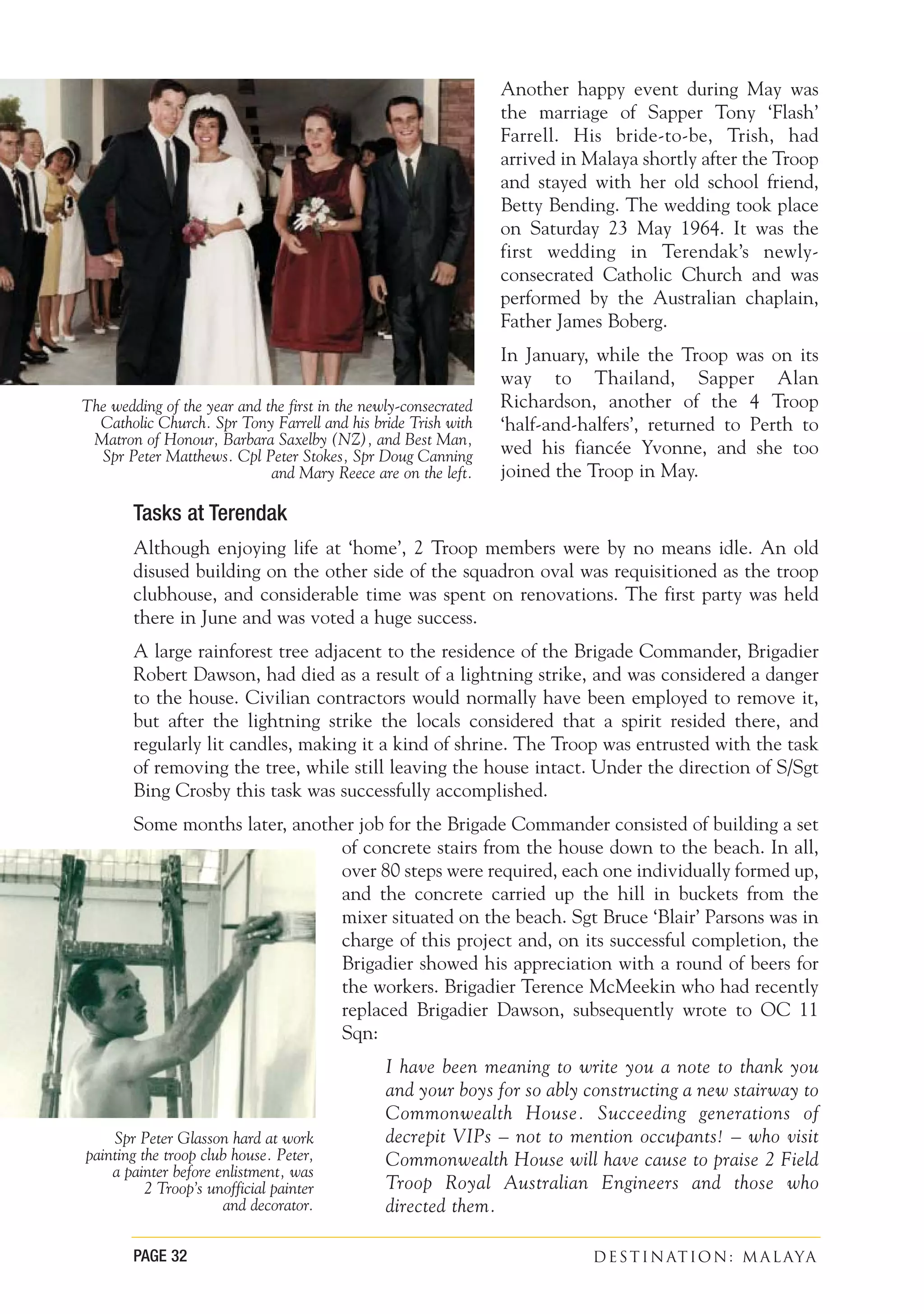
April brought the news that 7 Field Sqn from Enoggera in
Brisbane was to be sent to Sabah the following month. Part
of Australia’s commitment to Malaysia was to provide
military support, but it still wished to avoid direct contact
with Indonesian forces and, no doubt, saw the provision of
an Engineer unit as achieving both objectives.
Also in April, Op Crown had its first two serious accidents,
one fatal. A cook from 59 Sqn RE was badly burned while filling a pressure stove. There
was no helicopter available to evacuate him so a couple of plant operators, including
Noel Butler, worked throughout the night to prepare a section of the main runway to
accept a STOL (short takeoff and landing) type aircraft. The pilot was not too happy
with the surface but he landed and lifted the injured cook out. On 21 April a Brit
electrician, only newly arrived from UK, was electrocuted while working on powerlines
within the construction site. In spite of the best efforts of the MO he could not be
resuscitated.
A visit by the New Zealand Prime Minister, Mr Holyoake, and the Commander in
Chief, Far East Command, went largely unnoticed by the workers at the construction
site, except maybe the Kiwis and those at the MRS and hospital building, which rated
an inspection.
Spr Frank Sexton looking rather
forlorn amid the ruins of his fire-
ravished tent on Good Friday 1964.
Anzac Day 1964
Anzac day was approaching, and in spite of Malcolm van Gelder’s best efforts, the
Australians were not to be granted a full day of rest. However a contingent of Kiwi plant
operators and carpenters had arrived in March as New Zealand’s contribution to Op
Crown, and the Anzac force, along with the recent visit by Mr Holyoake, convinced
the powers that be that the day should
be accorded the respect it deserved.
After a 0400 reveille, a combined Anzac
and British dawn service was held at the
construction site. This was followed by a
gunfire breakfast with some excellent
British Navy rum which had been flown
in from Singapore as the result of
Malcolm's persistence and emphasis on
the ‘tradition’ that the British initially
failed to appreciate. The rum was served
in waxed sputum cups, compliments of
the MRS.
Later, some of the troop repaired to
Ubon to celebrate further, and to play a
game of rugby union against the RAAF. The RAAF won 6 points to 3. Those who
remained at the camp continued on with a gunfire lunch.
The ORs mess was completed at the main camp by another unit and its first use was the
gunfire breakfast after the dawn service. With the weight of the large crowd, the piers
supporting the floor sank into the rain-softened earth. It seems that no sole plates or
concrete pads had been used under the piers. From the 26th all meals were served at the
new mess, the first meal being bully beef. The change of venue and improved kitchen
facilities had obviously not improved the menu or its presentation.
The hospital was completed by 2 Troop by the end of April and the MO brought the
troop a couple of cartons. (Some wag suggested it was only a couple of cans and a carton
of straws.) It must have been very difficult for the MO to have maintained a reasonable
medical service for both the soldiers and
the locals amid the blowing dust, with
just tents and a marquee for an MRS and
hospital, and so he was overjoyed with
his new facilities.
During the previous six weeks, in
addition to the hospital, the troop had
also constructed the power station and
the FAMTO store, using the same
prefabrication techniques. Meanwhile,
the Brits of 11 and 59 Sqns had erected
a Braithwaite tank and stand for the
camp water supply, installed three
diesel-powered generating sets in the
power station and erected the
Erecting the prefabricated wall-section of the FAMTO store
requires a solid team effort.
Barrack hut based on a design by WW2 Australian Army
Engineer in Chief, Major General Sir Clive Steele. It is
doubtful that Sir Clive would have been impressed with the
finished product.
PAGE 26 DESTINATION: MALAYA
distribution lines throughout the camp. They had also constructed a range of other
buildings including the Sgts and ORs messes, accommodation barracks, and the
NAAFI. The accommodation barracks were supposedly based on a 1940 WW2 design
by Major General Sir Clive Steele, an Australian Army Engineer-in-Chief. The
finished product bore little resemblance to Sir Clive Steele’s original design and the
workmanship left much to be desired.
By May all of 11 Sqn's designated tasks were completed. With able assistance from
2 Troop the Squadron had established a tent complex to house three squadrons of
Engineers, nearly 900 men in all, constructed a permanent camp with all facilities,
begun preliminary work on the access roads, helipad and main runway, and completed
the Free Thai airstrip and access road. The completion of the Crown airfield would be
left to 54 and 59 Sqns who would be joined by the Royal Air Force 5001 Const Sqn,
and other support units. After the earthworks were completed the 5 000 feet runway
and dispersal areas were covered with a 6-inch layer of cement-stabilised laterite,
topped with two and a half inches of hot mix asphalt. The completed airfield was
handed over to the Thai Government in June 1965.
Malcolm van Gelder provides an overview of the reasoning behind Operation Crown
and some of the design parameters:
If only in a minor way, Australian sappers were involved in Operation Crown from
late 1962 when Lt Norm Griffith (Troop Officer 4 Field Troop RAE) accompanied
what was believed to be first ground reconnaissance party of the area.
Operation Crown was designed to provide an MRT (medium range transport)
airfield in northeast Thailand as part of the UK’s contribution to the SEATO
program for improving logistical facilities in Thailand. More specifically the
purposes of the airfield were:
• To deliver troops, supplies and equipment for a Brigade Group (initially).
• The deployment of fixed and rotary wing short-range takeoff and landing
aircraft.
• To provide a means of subsequent maintenance of the force.
Boiling the billy during the first weeks at the main camp site Op Crown. Sprs Ian Tibbles and Darryl Hess, Sgt Jack
Brown, Spr John White and L/Cpl John Armitage preparing the alignment for the perimeter fence.
A History of 2 Field Troop RAE 1963 to 1965 PAGE 27
The airfield location was strategically midway between the two US bases of Ubon
and Nakom Phanom, but not too close to the Mekong River, the border with Laos.
In fact, the Mekong was 33 miles to the east and 35 miles to the north.
The 5 000 foot design length of the airfield was to cater for Hastings, Argosy and
Beverley aircraft. Parking areas were to provide for up to 10 MRT aircraft, six
helicopters and a fuel area for two 10 000-gallon pillow tanks. The design glide
angle was 1 in 50 with 15 degrees splay.
Following an example such as the Nakom Phanom airfield, the pavement was to
have been constructed to LCN (load classification number) 30 based on 10 inches
of compacted laterite, with the top 3 inches mixed with bitumen. Surfacing options
considered were using PSP (pierced-steel plank), a conventional bitumen prime and
seal or concrete.
On 4 May 1964 the main body of 11 Sqn, including most of 2 Troop, packed up and
said farewell to Ban Kok Talat, travelling by local bus once more to Ubon. There, a
chartered British Eagle Britannia waited in the hot sun to fly them to Singapore. This
time there were actually stairs to board the aircraft. Following the landing at Singapore,
the troop was hustled on to a train for the overnight journey to Tampin, (with sleeping
compartments, would you believe?) and 24 hours after leaving Op Crown, the bulk of
2 Troop was once again 'home'.
Meanwhile, the transport party loaded their vehicles and plant on to the train at Warin
Chamrap, the railhead near Ubon, leaving Op Crown on the 8 May 1964 for the last
time. An overnight train trip to Bangkok followed and then to the Maxwell Brander,
which was waiting to be loaded before sailing for Singapore. By now the Brander had
been fitted with radar and other navigation devices and the return voyage only took
three days. The transport party finally
straggled into Terendak on the 14th
arriving in dribs and drabs due to
numerous vehicle breakdowns. A rear
party of 11 Sqn personnel stayed at
Camp Crown for several more weeks to
provide finishing touches to the MRS
and to strike the remainder of the tents
and ready them for transport.
Operation Crown Postscript
The following is an extract from The
Royal Australian Engineers, 1945 to 1972
Volume 4, by Brigadier P J Greville, CBE
about the subsequent involvement of
11 Indep Field Sqn and 2 Field Troop in
Operation Crown:
The Squadron (with the new 2 Troop
under Capt Alan Hodges) returned to
Operation Crown in Thailand from
December 1965 to May 1966 … Crown
airfield had been completed in late 1965
Lt Barry Lennon and S/Sgt David Crosby discuss the works
program outside the 2 Troop site office.
PAGE 28 DESTINATION: MALAYA
A History of 2 Field Troop RAE 1963 to 1965 PAGE 29
but water penetration during the wet had led to the failure of the pavement. The
redeployment of 11 Independent Field Squadron was part of a major operation to
correct the problem. It involved stripping two inches of bituminous macadam
surface, repairing the laterite base and laying eight inches of quality concrete on the
5,000-ft runway…The squadron was part of a larger British force of engineers,
plus transport, workshops and stores, totalling 418 men. About 150 Thai nationals
were employed. The squadron was relieved in May by 59 Field Squadron RE and
the task was completed by December.
Twenty years after 11 Sqn’s involvement in Op Crown, John Stevens returned to Loeng
Nok Tha and recorded his visit in The Royal Engineers Journal, Vol 104, No 4. Some of
John’s observations were:
Ubon airport turned out to be a shadow of its former self … One Thai Airways
flight a day and a small RTAF presence is all that is left.
However, Ubon town has grown out of all recognition – wide streets, modern
buildings, a population trebled in size, a new bridge over the meandering Moon
River.
Off on the road to Loeng Nok Tha– a wide straight metalled road, raised above the
surrounding paddy has replaced the laterite ruts, standing water and endless dust of
the dry season. After a coffee stop at Amnat Charoen – remember the 16 foot tall
Buddha image – the local village of Ban Kok Samnam and the entrance to Crown
Airfield was reached in a little over an hour.
The approach track leads to two concrete plinths on which brass plates in English
and Thai commemorate the opening of the airfield. The English version has been
used for target practice and now contains no less that fourteen bullet marks.
The pavement quality concrete of runway, taxiways and apron appears in excellent
condition, though one must remember it has received very little use by aircraft and
a Thai water buffalo is hardly LCN30.
Crown Camp has returned to the bush. The only clearly recognisable features are
the swimming pool … and a concrete slab containing sixteen large holes. – Polaris
silo or perhaps something more mundane?
A stroll down the main camp road and up the nearby village – no beer tins or
Mekong bottles now define the route – revealed a transformation. Ban Kok Samnan
is now a model village – neatly laid out, tidy houses with a metalled road and mains
electricity…
Perhaps not a lot to show for all the Sapper, REME and RCT ‘blood, tears
and sweat’ which went into Operation CROWN but the airfield is there, intact
and with very little work could quickly be made operational once again. With
the emphasis on tourism in Thailand it might even become MUKDAHAN
INTERNATIONAL!!
“...camp security was again upgraded
with the guard being increased to five
NCOs and 18 ORs, all armed and
issued with live ammunition”
A History of 2 Field Troop RAE 1963 to 1965 PAGE 31
Chapter Four
Terendak Again
Everyone was pleased to be ‘home’, especially the married members who had been
separated from their families for over four months. A ‘welcome home’ party was held on
the 16 May 1964 and everyone had an enjoyable time.
Security had been increased around the garrison during the Troop’s absence, due to the
threat posed by Indonesian insurgents. The duty guard now consisted of two NCOs and
12 other ranks, as well as a Duty Officer. Two Sterling SMGs with 40 rounds each were
issued to the duty patrol.
Near the end of May, Sapper Harry Atkinson flew home to Queensland, as his father
was very ill. The good news was that he recovered, and Harry returned to Terendak in
due course.
An Increase in Troop Numbers
During July of 1963, while 2 Troop was still undergoing
pre-deployment training in Australia, in Malaya, Sharon,
the first child of Bill and Lorraine Jones was born. Bill, the
Troop vehicle mechanic, arrived in January 1963 to join
4 Troop and stayed on with 2 Troop. When Sharon was
born, Terendak Hospital was still under construction, so
she was delivered in the MRS, which was really only a
treatment room and outpatient facility. Shortly after
2 Troop’s arrival, Bob and Marilyn Reed welcomed their
first baby, Donna, who was born a couple of weeks before
Christmas. Bob had completed two years with 4 Troop
and remained in Malaya with 2 Troop for Donna’s birth.
He did not accompany the troop to Thailand and
returned to Australia in mid-1964.
When the new 140-bed hospital complex was officially
opened in Terendak shortly after 2 Troop’s arrival, it
boasted a 30-bed wing, exclusively for use by the families
of the servicemen in the garrison, and this included an air-conditioned eight-bed
maternity ward and delivery suite. The first troop family members to trial the new
facilities were Trish Lennon and Val Plumb. Both Jenni-Lee Lennon and Kevin Plumb
were born in March 1964 while the Troop was in Thailand. In May, John and Betty
Bending welcomed baby Michael and, soon after, the Morris family increased with the
arrival of Shane, a brother for Stephen.
The modern hospital complex at Terendak
Garrison which was officially opened
after 2 Troop’s arrival in Malaya.
Another happy event during May was
the marriage of Sapper Tony ‘Flash’
Farrell. His bride-to-be, Trish, had
arrived in Malaya shortly after the Troop
and stayed with her old school friend,
Betty Bending. The wedding took place
on Saturday 23 May 1964. It was the
first wedding in Terendak’s newly-
consecrated Catholic Church and was
performed by the Australian chaplain,
Father James Boberg.
In January, while the Troop was on its
way to Thailand, Sapper Alan
Richardson, another of the 4 Troop
‘half-and-halfers’, returned to Perth to
wed his fiancée Yvonne, and she too
joined the Troop in May.
Tasks at Terendak
Although enjoying life at ‘home’, 2 Troop members were by no means idle. An old
disused building on the other side of the squadron oval was requisitioned as the troop
clubhouse, and considerable time was spent on renovations. The first party was held
there in June and was voted a huge success.
A large rainforest tree adjacent to the residence of the Brigade Commander, Brigadier
Robert Dawson, had died as a result of a lightning strike, and was considered a danger
to the house. Civilian contractors would normally have been employed to remove it,
but after the lightning strike the locals considered that a spirit resided there, and
regularly lit candles, making it a kind of shrine. The Troop was entrusted with the task
of removing the tree, while still leaving the house intact. Under the direction of S/Sgt
Bing Crosby this task was successfully accomplished.
Some months later, another job for the Brigade Commander consisted of building a set
of concrete stairs from the house down to the beach. In all,
over 80 steps were required, each one individually formed up,
and the concrete carried up the hill in buckets from the
mixer situated on the beach. Sgt Bruce ‘Blair’ Parsons was in
charge of this project and, on its successful completion, the
Brigadier showed his appreciation with a round of beers for
the workers. Brigadier Terence McMeekin who had recently
replaced Brigadier Dawson, subsequently wrote to OC 11
Sqn:
I have been meaning to write you a note to thank you
and your boys for so ably constructing a new stairway to
Commonwealth House. Succeeding generations of
decrepit VIPs – not to mention occupants! – who visit
Commonwealth House will have cause to praise 2 Field
Troop Royal Australian Engineers and those who
directed them.
The wedding of the year and the first in the newly-consecrated
Catholic Church. Spr Tony Farrell and his bride Trish with
Matron of Honour, Barbara Saxelby (NZ), and Best Man,
Spr Peter Matthews. Cpl Peter Stokes, Spr Doug Canning
and Mary Reece are on the left.
Spr Peter Glasson hard at work
painting the troop club house. Peter,
a painter before enlistment, was
2 Troop’s unofficial painter
and decorator.
PAGE 32 DESTINATION: MALAYA
It is a splendid job most professionally done and – as far
as I could see – with great good heart. Please thank them
very much for me.
In June the Troop received the news that 7 Field Sqn had
arrived at Jesselton aboard HMAS Sydney, to begin its
deployment in Sabah.
At this time Exercise ‘Wide-step’ was held near the garrison
in the Asahan training area, and consisted of building an
improvised bridge over a 60-foot gap, capable of supporting
a 3-ton vehicle. It turned into a competition between
2 Troop and 1 Troop, one of the Brit troops from 11 Sqn.
The task was completed by 2 Troop late in the afternoon of
the second day, several hours ahead of 1 Troop.
The next exercise was an overnighter in Jungle East. Because
it was adjacent to the garrison no transport was involved, so
the troop marched to the area in full kit and set up a
defensive perimeter for a series of ‘stand-to’ exercises. The
heavens opened and, even without stand-tos, no one had
much sleep. Many of the hutchies flooded, and it was a wet
and weary troop that returned to barracks next day.
The troop travelled to Asahan once again, this time for an
explosives exercise and, after destroying a lot of trees,
returned to base.
An ‘Air Portable’ inspection was held on the 26 June. The
troop still had some serious deficiencies in its kit and
essential stores due to shortages within the squadron.
However, this was not considered a reasonable excuse and all
the section NCOs were given extra duties.
'NEVER ASSUME' as told by S/Sgt Bing Crosby
Background
The air portable inspection on the 26 June 1964 had a
dummy run, a day or two beforehand. Capt van Gelder
asked Cpl Graeme Leach what he used as a container
for centralised cooking or brewing up in his section.
Graeme replied that there wasn't a suitable item in the
Q Store.
Reaction
The Troop Commander was obviously determined that
the troop should present very well. He told Cpl Leach to
find something, such as a pulp-apple tin, from the mess.
AP day
On the morning of the 26th, the inspection wasn't going
too well, when Capt van Gelder asked Cpl Leach where
his newly-acquired container was. The reply: ‘I haven’t
been able to get one.’
Commonwealth House, the
Brigadier’s residence, was threatened
by a large tree.
Sprs John White and Les McNamara
float-finish steps on the stairway
project at the Brigadier’s residence.
Exercise Wide Step in the Asahan
training area. A smoke break as work
on the improvised bridge is progressing
ahead of schedule.
A History of 2 Field Troop RAE 1963 to 1965 PAGE 33
Opposite and equal reaction
Capt van Gelder turned to me and told
me to parade Leach to his office after the
inspection. We both stood to attention as
Cpl Leach was given a ‘right bollocking’,
which I found rather embarrassing
because I thought the ‘crime’ wasn't that
serious. I attempted a defence but I was
cut off and Cpl Leach was dismissed with
several extra duties. Later, there were
some fierce remarks outside the OC's
Hearing as Graeme felt that he had been
the victim of – if not a kangaroo court –
certainly a wallaby one.
Inevitable flow on
After Graeme had left, I was asked why I had not followed up on the direction that
Malcolm had given. ‘I assumed that Cpl. Leach, in his usual efficient way, would
have obtained a suitable container’, I said. To this, Malcolm replied: ‘Never
assume. Just be thankful that you are not being formally disciplined.'
Lifetime lesson
I suppose I was thankful not to be disciplined, but my sense of professional pride
and fairness had been dented. Looking back, it was a worthwhile lesson to carry
through life from that day, but I certainly didn't think so at the time.
Exercise Raven
All this activity was only a lead-up to ‘Raven’, a Brigade-strength exercise also
conducted in the Asahan training area. 2 Troop was to provide engineer support for the
KOYLI Regiment (King’s Own Yorkshire Light Infantry) and after a 0230 start on day
one, the troop was kept on the move for the ensuing seven days. Its tasks included, as
well as the usual war games, a night-bridging exercise. While travelling in convoy on a
straight stretch of jungle track, the troop
was strafed at treetop level by an ‘enemy’
Buccaneer jet fighter which seemed to
appear from nowhere. Fortunately it was
only an exercise, but it still scared the
hell out of everyone. When ‘Raven’ was
finally concluded, the sappers were
treated to their first shower in seven
days, and their old friends from
Thailand, the RAOC mobile bath unit,
provided it.
Exercise Raven was the last major
activity for Malcolm van Gelder as
Troop Commander. His replacement,
Captain Alan Hodges, arrived shortly
before the exercise and deployed with
Sprs Clem Finlay and Tony Farrell join others from 2 Troop
boarding the truck for a 0230 start to Exercise Raven.
Sapper ingenuity. Spr John Tomczak, Cpl Graeme
Leach, Sprs Tony Farrell, Ray Logan, Sgt Jack Brown,
Sprs Harry Atkinson, Dave Wood and Norm Looby
with a ‘borrowed’ ox-art, minus ox, just the thing
for carrying all that kit on Ex Raven.
PAGE 34 DESTINATION: MALAYA
the troop. Malcolm and Helen, with their two boys returned to Australia, enjoying a
relaxing and well-earned holiday. Other new Troop members arriving before the start
of ‘Raven’ were Sapper John Tomczak, replacement for the homeward bound Bob Reed,
and Private Ken Johnson, a cook from the Australian Army Catering Corps. Not long
after this, the Squadron 2IC, Captain Mike Arber, was replaced by Major Gordon
Chave. During July, Bruce Parsons was promoted to Troop Sergeant.
Bereavement
Shortly after the return from Exercise Raven, Dave and Judy Wood lost their two-year
old daughter, Roslyn Heather. She had been in ill health since receiving a BCG
injection before leaving Australia. It was a very sad time for the Woods, made especially
hard by being so far from family support. The funeral service was held in the recently-
consecrated OPD (Other Presbyterian Denominations) Church on 25 July 1964, and
the troop members not on duty attended and offered what little comfort they could.
Roslyn was buried near the hospital in the garrison military cemetery, which is now
beautifully maintained by the Commonwealth War Graves Commission.
Interestingly, the cemetery was used to bury 24 Australians killed in Vietnam, as well
as those from the Borneo conflict because, at that time, it was Australian policy not to
bring bodies back to Australia for burial. A Vietnam VC winner, Major Peter Badcoe,
is buried there, as is Cpl Bob Bowtell from 3 Field Troop RAE, the first engineer to die
in Vietnam.
The Cameron Highlands
The Cameron Highlands are in the central mountainous region of Malaya, and have an
elevation of about 5 000 feet and above. The British had used the area as a hill station
to escape the hot, humid conditions of the lowlands, and many retired expatriates had
made it their home. The British Army maintained a rest camp there, and units were
rotated for several days of R and R, usually once during their deployment. A party from
2 Troop, those not required for duty, joined other 11 Sqn personnel for a brief stay. The
golf course, where Mick Sutton lost countless balls, was very picturesque but quite
difficult, and the troops generally enjoyed the novelty of the nights in front of a roaring
open fire.
The Cameron Highlands is also a major
tea-growing area, and the troop
members enjoyed a tour of one of the
plantations and the processing facilities.
There was also a march through virgin
rainforest, (with very, very steep hills) to
a remote village to see an ancient tribe
of indigenous ‘primitive’ Malays in their
natural habitat, unchanged for hundreds
of years. Just how primitive they were
was evidenced by the fact nearly
everyone carried the latest model
transistor radio. However, it was an
enjoyable four or five-day break from
Terendak, in spite of the long trip to and
fro in the back of a Bedford 3-ton truck.
Well, not so enjoyable for Darryl ‘Fred’
Sprs Arthur Sinclair, Peter Matthews and Bob Rawson take a
breather after walking up very steep hills in a tea plantation in
the Cameron Highlands area of central Malaya.
A History of 2 Field Troop RAE 1963 to 1965 PAGE 35
Hess perhaps. While on guard duty one
night, he was instructed by the Duty
Corporal to take his evening meal break.
When the Duty Sergeant found the
guard room deserted Fred was charged
with leaving his post – the Corporal
denying everything. Fred was returned
to Terendak next day to face the table
where he was relieved of 28 days pay.
If the punishment meted out to the
sappers seemed harsh at times it was
because, as part of a British unit, they
were governed not by Australian
Military Law but by the much
more draconian Queen’s Regulations,
and sentences for even minor
misdemeanours could be quite severe.
While indiscriminate urinating at the
tented campsite at Crown was not
heavily frowned upon, it took a charge of two British sappers by Malcolm van Gelder as
Duty Officer to demonstrate the severity of punishments under these Regulations.
When Malcolm expressed surprise at the punishments given, the sentencing officer
said: ‘Malcolm, if you don’t know the consequences of charging, or object to the severity
of punishment, you should not have charged them.’
Near the end of July the camp security was again upgraded with the guard being
increased to five NCOs and 18 ORs, all armed and issued with live ammunition. This
meant that guard duty was a very frequent event for everyone and, with not enough
NCOs in the Sqn to maintain a reasonable roster, several senior sappers like Bill Jones
and Tony Farrell were seconded to the role of Guard Corporal.
The Park Troop, with attached 2 Troop plant operators, was deployed to the Asahan
training area to construct a heavy-weapons firing range. The project consisted of access
roads, stop butts and abutments, firing
mounds, and bund walls around the
munitions magazines. While it was
essentially a plant operation, some FEs
were required for culvert and headwall
construction, and 2 Troop made its
contribution.
Sport played a major role in the
squadron, helping keep everyone fit, as
well as providing entertainment. Rugby,
basketball, hockey and volleyball were
played regularly, with 2 Troop providing
its share of participants to the squadron
teams. An inter-troop sports day,
consisting of track and field events, was
won by the troop, as was a swimming
carnival held in August, although
2 Troop lost the water polo competition
The nearly-victorious water polo team, standing,
Sprs Trevor Reece, Tony Farrell, Ken Jolley, John Tomczak,
Cpl Graeme Leach and Team Manager‚ Cpl Bruce Parsons.
Seated, Sprs Dave Wood, Peter Matthews, Norm Looby
and Lindsay Simpson.
11 Sqn basketball team with a strong 2 Troop element.
Standing: Spr John Tomczak, S/Sgt David Crosby, Cpl Bruce
Parsons, Cpl Graeme Leach and Spr Dennis Fitzhenry. Front
row 2nd from right, Spr Peter Matthews.
PAGE 36 DESTINATION: MALAYA
A History of 2 Field Troop RAE 1963 to 1965 PAGE 37
by a narrow margin to 3 Troop in the second extension of extra time. The squadron
rugby team defeated 3 RAR in the final of the Brigade competition and seven of the
15 players were from 2 Troop. Malcolm van Gelder’s prowess as a rugby player (1958
Wallaby selection) was not put to the test because of a broken arm at the critical time.
Dennis Fitzhenry and Snow Wilson were part of the squadron hockey team that finished
as runners-up in the 17 Gurkha Division championship of 1964. The ladies of the troop
were also prominent in the squadron teams, particularly in basketball and tennis, and Jan
Leach won the 1964 small-bore championship at the ladies rifle club.
A cholera outbreak in Singapore during August reinforced the need to be always aware
of the danger of drinking untreated water and that even the ice served in drinks outside
the garrison was to be considered suspect.
During 1964 television began broadcasts in Malaya and the troop rented a TV set for the
common room. Most of the programs were of an ethnic
nature, Malay, Chinese or Indian, but the news bulletins were
welcome viewing as were the highlights of the Tokyo
Olympics, where Australia did so well in the swimming with
Dawn Fraser playing a starring role.
Rubber production was important to the economy of
Malaya, with extensive areas under plantation. Many of the
exercises were conducted, at least in part, in ‘the rubber’, so
the troop was familiar with the sight of the tappers at work,
and the pungent smell of sheets of rubber latex hanging out
to dry. An excursion to Dunlop’s Regent Rubber Plantation
for a conducted tour was found to be particularly interesting
by all who went. The tapping of the rubber trees was
demonstrated, and Sapper Ian Tibbles learned a new trade,
earning himself the title of Tapper Tibbles.
In late August, Bill Jones’ father died suddenly while
working in London. As the funeral was held in the UK, it
was not possible for Bill to attend, but his family stayed with
him and Lorraine on their way back to Australia.
A State of Emergency
By September 1964 the Indonesians were becoming increasingly aggressive.
Snow’s diary 2 September (while he was on a Language course at Nee Soon):
30 Indons landed by parachute at Labis in Johore. Second landing, this time by
regular troops. Looks like it might be on shortly.
A party of 30 insurgents was parachuted into the Labis area in Johore, east of Malacca
at 0230 on 2 September, the second landing within as many days. The next day the
Malaysian Government declared a State of Emergency, and security went up another
level. There were now armed guards on all the garrison installations on a 24-hour basis.
Armed guards were also placed on the school buses carrying garrison children.
Snow’s diary 4 September:
Singapore is under curfew. Riots in Geylang Road. All the Kiwis dragged off
courses and sent back to their units to join in the hunt for the Indons in the Labis
area with 1 Battalion Gurkhas. Wonder how long before we go back?
“30 Indons
landed by
parachute at
Labis in Johore.
Second landing,
this time by
regular troops.
Looks like it
might be on
shortly”
In spite of the serious nature of the situation, there were some lighter moments to the
heightened security and the issue of live rounds. A Brit, Sapper Meston, known to all
as ‘Little Mess Tin’, had an AD (accidental discharge) outside the 11 Sqn NAAFI, and
managed to shoot a fellow Brit in the arm as he was reaching for his beer. The wounded
Brit did not see a funny side to it, but he was lucky it was a 9 mm Sterling and not an
FN 30. Sapper Meston’s elder brother, ‘Big Mess Tin’, got browned-off with the noisy
chit-chats (geckos) at the munitions magazine, and let off a burst of 9 mm rounds. The
gecko survived, but the sapper was harshly dealt with. 2 Troop’s Nipper Simpson nearly
started an international incident when he threatened to shoot a Malay mosquito-
control worker, mistaking him for an insurgent and the wand on his knapsack sprayer
for a rifle.
During September, the annual battle efficiency tests were endured and passed by all.
Day one was a two-mile run, in full kit, in 20 minutes. Everyone came in under the
20 minutes mark but they were pretty bushed. Next day was a nine-mile run in full kit
in two hours, with a 100-yard fireman’s carry in the middle, followed immediately by the
wall and water jump, then live firing on the 25-yard range (yes, you were expected to
hit the target).
Lisa, the first child of the Troop OC, Alan Hodges, and his wife Beryl, was born in
September 1964.
Around this time Major Tony Stacey-Marks was farewelled. He had been a popular OC,
not only with the Brits but also with the Australian troops as well, and it was with
sadness they said goodbye to a good friend. Few of the Troop knew of the Squadron
Commander’s interesting background. He was born in Uganda but educated in England.
He joined the Home Guard and undertook a short degree-course at Cambridge in 1942.
As a 19-year-old he was commissioned into the Royal Engineers in 1943 and was
Mentioned in Despatches during service in 79 Assault Sqn following the D-Day
landings. He was wounded in 1945 and evacuated to England. He subsequently served
in engineer units and on the staff in Kenya, UK, the Canal Zone and Cyprus. This was
followed by four years at the Royal Military Academy at Sandhurst before taking
command of 11 Indep Field Sqn.
The incoming Squadron Commander, Major John Stevens, was to prove equally even-
handed in his administration of the composite squadron and quickly earned the respect
and admiration of all its members. Major Gordon Chave had by now settled into his
2 Troop at Engineer Training Centre, Kluang, assembling an LFB (Light Floating Bridge)at the wet-gap training area.
PAGE 38 DESTINATION: MALAYA
position as 2IC and was also well
received by all ranks.
In October the KOYLI battalion
departed Terendak for a new posting
following a farewell Trooping of the
Colour at which they displayed the
‘marching on-the-run’ drill of the Light
Infantry. 2 Troop provided the KOYLIs
with an armed escort to the airport at
Kuala Lumpur. The KOYLIs were
replaced by a battalion of the Scots
Guards with 2 Troop assigned as its
direct support engineers. The battalion
Commanding Officer was Lieutenant
Colonel Sir Gregor McGregor of McGregor. The battalion headquarters operated on an
interesting arrangement of the CO, 2IC, Adjutant and Assistant Adjutant all being in
the same office (open-planning well before its time!) with their desks covered in
McGregor tartan cloths.
Snow’s diary Sunday 4 October:
Dennis Fitzhenry had an accident today, dived into shallow water and damaged his
neck. Supposed to be broken but we will wait and see.
As a result of the accident Dennis spent several weeks with a plaster cast around his
neck but otherwise seemed OK.
Shortly after the battle efficiency tests, Lt Barry Lennon, S/Sgt Bing Crosby, Sgt Blair
Parsons and Sapper Dave Wicks travelled to Singapore to complete a basic parachute
course with the RAF Far East Parachute school at Changi. Earlier in the year, Dave
Wood had completed a 4-week Junior NCO cadre course at Gillman Barracks – the
only Australian and the only sapper on what was an excellent leadership course. Dave
passed with distinction. Snow Wilson attended a Malay language course at the school
of languages at Nee Soon and proved to be a very capable interpreter during the Troop’s
later tour in Sarawak.
Snow’s diary 17 October:
Young Craig Crosby fell down the
stairs and broke and dislocated his
jaw, also broke his arm.
Craig had fallen over the top landing in
the Crosby’s married quarter and landed
on the bottom three steps of the tiled
concrete. He was initially treated at the
Terendak hospital but later was flown
by helicopter to the British Military
Hospital in Singapore for urgent
dental treatment. Bing was already in
Singapore on a parachute course, so
S/Sgt David Crosby, centre, awaiting orders to jump from an RAF Argosy
over Seletar airfield in Singapore.
The whole of Australia stops for the Melbourne Cup. Members
of 2 Troop during bridging training at Kluang join their fellow
Aussies to listen to the race on Snow Wilson’s short-wave radio.
A History of 2 Field Troop RAE 1963 to 1965 PAGE 39
Judy Crosby initially stayed at Terendak
to care for Craig’s twin sister Sue.
The dental surgeon had left Singapore
on holidays the day before, so the
authorities flew a Surgeon Commander
from the fleet in the South China Sea.
He saved all of Craig's teeth and the
Crosbys remain forever in the debt of
those concerned.
In late October, 2 Troop was sent south
to the Engineer Training Centre at
Kluang to spend time at the wet-gap
bridging training area. The camp was
the main centre for Gurkha engineers so
everyone worked to Gurkha hours: start
0700, breakfast 0900, lunch 1330 then
rest for the remainder of the day. Sapper
Phil Macklin had a fall from a gyn on
the first day, breaking one ankle and
badly bruising the other and, as a result,
he spent a considerable time in hospital.
At the end of their four-week parachute
course, Bruce Parsons and Dave Wicks
rejoined the troop at Kluang, just in
time to listen to the Melbourne Cup on
Snow Wilson’s radio. Polo Prince ridden
by R Taylor was first past the post, but
there is no record of who won the sweep.
The Troop left Kluang and returned to
Terendak on 7 November.
Invasion
While the troop was at Kluang, on
October 29, the Indonesians landed
several boat loads of insurgents in the
Merimau swamps near the Muar River,
about 30 miles south of Terendak.
3 RAR, a battalion of Gurkhas and the
Royal New Zealand Infantry Regiment
were sent to seal off the area and deal
with the threat. 102 Field Battery RAA
employed their 105 mm howitzers to
good effect in support of the operation.
This was the same area where the
Australian 19 and 29 Brigades first
engaged the Japanese in mid-January
At the half-way party the Troop vehicle mechanic, Spr Bill
Jones, is presented with a Selangor pewter tankard by Capt
Alan Hodges. Spr William ‘Jock’ Oliver looks on.
Spr Alan Richardson and his wife Yvonne enjoy a quiet chat with
Ray Logan and fiancée, Ahlan, at the Troop half-way party.
Navigating the Heavy Ferry during training at Blakang Mati
Island off Singapore in November 1964.
PAGE 40 DESTINATION: MALAYA
1942 and, in a fierce and bloody battle raging over several
days, halted the Japanese advance on Singapore, albeit
briefly.
This latest incursion of insurgents from the islands off
Sumatra prompted the deployment of platoon-strength
patrols to remote fishing villages along the Malayan west
coast. Drawn from various units, these platoons were
equipped with an assault boat powered by a 40 hp outboard
motor and manned by boat handlers from 11 Sqn. Sappers
from 2 Troop were included in the rotation and usually spent
a week at a time on boat duty, although Fred Hess spent
several months at one of the outposts near Port Dickson. He
had hired a car in Malacca, was involved in an accident, car
was a write-off, no insurance! The Chinese businessman
wanted full restitution or else, so Fred felt safer some distance
from Malacca. He was replaced during February 1965 by
Humphrey ‘Dodo’ Dodd, who spent several weeks as the duty
boat handler before returning to Terendak in readiness for
deployment to Sarawak.
As a result of the escalation of the Indonesian confrontation
and the further commitment of troops to the Vietnam
conflict, the Australian Government announced on
10 November that it was reintroducing National Service.
The call-up would be for a period of two years service with
candidates decided by a ballot based on birth dates.
Also during November, 1 Field Sqn and a portion of 20 Field
Park Sqn replaced 7 Field Sqn in Sabah. Before they
returned to Australia, a few of the 7 Field sappers, including
Phil Jones, ‘Darky’ Fadden and Max Blain, managed a detour
to Malacca to catch up with a few of their old mates in
2 Troop, and were suitably entertained at a party at one of
the ‘Pads’ as the married members were called as they lived
in houses or ‘pads’.
The Half-Way Mark
On Friday, 13 November 1964, 2 Troop had been in Malaya
for a few days short of 12 months. What better reason than
to celebrate the occasion in the newly-renovated club house
with a ‘half-way’ party. It was a resounding success and
everyone had a great time, but there were a few sorry-looking
people around next day. Spr Bill Jones had his photo in
Army Newspaper being presented at the party with a
Selangor pewter tankard to mark his approaching return
home after his two-year tour of duty.
On the Sunday following the half-way celebrations, the
troop travelled to Blakang Mati, ‘The Isle of The Dead’, an
island just off Singapore, for two weeks of rafting training
A History of 2 Field Troop RAE 1963 to 1965
PAGE 41
Sprs Mick Sutton and Tom
Abberfield attempting to supplement
the rations at Blakang Mati.
2 Troop members inspecting the
WW2 fortifications on Blakang
Mati Island.
using the Heavy Ferry and various floating bridges and other
watercraft. Blakang Mati was the site of major fortress gun
emplacements with deep ammunition storage tunnels dating
back to the 1880s when Royal Engineers and local labour
undertook extensive blasting and excavation to build Fort
Silosa to protect Singapore harbour. Further fortifications
were constructed before WW2, but proved ineffective during
the Japanese invasion which came from the Malay Peninsula
rather than from the sea, and so the guns took no part in the
defence of Singapore. 2 Troop lived in old concrete barracks
and had the chance to inspect many of the fortifications
which were being gradually overgrown by dense tropical
growth.
With Tom Abberfield, now a L/Cpl, in charge of the
catering, the troop ate extremely well. Tom’s skills at
bartering army rations for fresh local produce were
exceptional. The Straits Times on 4 December 1964 had a
full-page spread with seven photos of the troop members
undertaking training activities. This coincided with a team
from Channel 9 making a 30-minute documentary to give
National Servicemen some idea of life for soldiers in
Malaysia. Blakang Mati today is a popular tourist park now
known as Sentosa, which means peace and tranquillity in
Malay.
Sappers Simpson and Wicks did not accompany the troop on
this exercise. They were recovering in Terendak hospital as a
result of a motorbike accident where they had been forced off
the road by a bus and a Malay local was killed. Both sappers
required stitches, but neither was seriously hurt, although
they were fortunate that the 11 Sqn guard truck came along
shortly after the accident and rescued them from a very
hostile group of local villagers.
The Motorbike Brigade
From the very first days in Malaya, several of the troop
members purchased motorbikes, usually small 75-100 cc two-
stroke models. These were ideal for travelling about the
garrison, which was spread out over a large area. For travel
outside the garrison most used taxis, which were plentiful
and cheap, but some of the troop graduated to larger and
more powerful bikes. The problem was that the roads, while
bitumen sealed, were narrow and winding, and the local
drivers had scant regard for other road users, especially those
on motorbikes. As a result, most of the bike owners had one
or more accidents, usually minor, but some were more
serious. Nipper Simpson was riding George Greenslade’s
Triumph with Dave Wicks as pillion at the time of their
accident. Harry Atkinson also came to grief when a taxi
L/Cpl Brian Cribbs keeping in
touch during rafting training on
Blakang Mati Island.
Spr Dennis Fitzhenry as ‘Horace
Horsecollar’ after he injured his neck
when diving into shallow water.
PAGE 42 DESTINATION: MALAYA
pushed him off the road and through a barbed-wire fence.
Besides losing a lot of bark (skin), Harry very nearly lost the
sight in one eye. After that episode, a sympathetic mate
christened Harry ‘Wok-eye’, and the name has stuck to the
present day. Ian Tibbles and John Tomczak were returning
from Malacca on their bikes when Tibbs had a buster. John
convinced Ian he needed medical attention but, while giving
him a pillion ride to the hospital, John hit a dog, so they both
ended up in hospital for the night. Shortly after, John sold his
bike and bought an MG sports car. To celebrate the
importance of bikes, the troop conducted a Motorbike
Gymkhana in the area near the 25-yard range. Much fun was
had by riders and spectators alike, but it is doubtful that
anyone above the rank of corporal knew it ever took place.
Christmas with the Pads
In the lead-up to Christmas 1964 there were many activities.
11 Sqn had a Children’s Christmas Party on the Saturday
beforehand, and the married families went out of their way to
ensure the single members were looked after and had an
enjoyable time. Each pad invited several single members to
his home for Christmas dinner and made them feel welcome.
It was a generous gesture, and one the single members
appreciated and remember with gratitude. The many bath
tubs were filled with ice and beer and some of the ladies had
to bathe with their neighbours for several days until all the
beer was consumed. There was the usual traditional
Christmas lunch on Christmas Eve in the ORs mess, with
the officers and senior NCOs providing the table service.
The menu was:
Cream of tomato soup
Roast turkey with sage and onion stuffing
Roast pork with apple sauce
Chipolata sausages (a strange Brit favourite)
Parmentier potatoes, creamed potatoes, crisps
Green peas, glazed carrots and giblet gravy.
Christmas pudding, brandy sauce, fresh fruit, nuts,
cheese and crackers.
A few days later, Clem Finlay celebrated his 21st birthday on
29 December. During this Christmas leave period, several of
the troop members, who were originally from UK, took
advantage of the RAF’s ‘indulgence’ flights to visit the home
country. They included Brian Cribbs, Jack Brown and
William ‘Jock’ Oliver and, while they no doubt enjoyed the
A History of 2 Field Troop RAE 1963 to 1965 PAGE 43
Spr Frank Sexton competing in the
motorbike gymkhana, with some
assistance from Spr Mick Sutton.
Spr Harry Atkinson shortly after a
serious motorbike accident in which he
was forced off the road and through a
barbed-wire fence.
visit, they seemed happy to return to a
warm climate.
It was not a particularly happy new year
for John White. His father died of a
heart attack on the 30 December while
mowing the lawn. John managed to get
a flight back to Brisbane in time for the
funeral and, after several quiet days
spent with his family, returned to
Terendak.
January 1965
The first month of the 1965 new year
saw the return to Australia of Sapper Bill
Jones, wife Lorraine and baby Sharon.
The replacement vehicle mechanic,
Sapper Doug ‘Lefty’ Maddison, took up
residence a couple of weeks later and
settled in quickly with the Troop. It
should be noted here that Bill Jones,
Doug Maddison and Tom Abberfield
were in fact sappers, and like all sappers,
had completed the Field Engineer Grade
3 course, in addition to their relevant
trade training. All three were proud to
be Royal Australian Engineers and
strongly resisted moves by the Army to
transfer them to RAEME and AACC,
but in the end were unsuccessful in this
endeavour.
Frank Sexton and Yvonne Richardson
reached their majority. Bill Whitfield
and wife, Kath, organised the 21st
birthday party for Frank at their place,
inviting the entire troop. It was a great
night for all, especially Frank, who years
later could not even remember where
the party was held. The parachute squad
of Lennon, Crosby, Parsons and Wicks
returned to Singapore for a two-day
continuation course, adding another
couple of jumps to their total.
The first week in February was marked
by Ian Tibbles’ 21st birthday. Dave and
Judy Wood held the party at their house
and most of the troop arrived to help Ian
celebrate his coming of age. Sapper Dion
SSM Tom Thornton manages to keep his thumbs out of
the soup while serving the Christmas lunch in the ORs
mess, Christmas 1964.
Putting the finishing touches to the helicopter landing
platform during the section-strength exercise in the
Asahan training area.
PAGE 44 DESTINATION: MALAYA
Spr Frank Sexton stabs the cake at his 21st birthday
celebrations. Kath and Bill Whitfield held the party at their ‘pad’
and the Troop assembled to wish Frank the best for the future.
A History of 2 Field Troop RAE 1963 to 1965 PAGE 45
Hands, who had arrived earlier as the troop clerk and then returned to Australia to be
married, brought his new wife, Magaret, to Terendak.
Asahan Again
Another exercise was conducted in the Asahan area involving each of 2 Troop’s three
sections being transported to a different site by helicopter. Once there, they were
lowered into the jungle by winch, complete with chainsaws, axes, explosives and
rations for three days. The task was to clear a patch of the jungle with chainsaws and
explosives and then build a platform from the felled timber adequate to land a
helicopter; only then could the men be lifted out. It was a tough assignment especially
felling tropical rainforest trees with extremely large buttress roots, but one in which the
Australians excelled. Sappers like Les McNamara, Harry Atkinson and Ken Jolley were
experts with axe and chainsaw, and they had earned their living working in the big
timber country before enlisting. Their efforts were helped along with some carefully-
positioned plastic explosive.
Snow Wilson, section corporal at one of
the sites, takes up the story:
One morning John Barnett and
George Greenslade found a snake.
We didn’t know what type it was,
but George put it into a sand bag to
keep. George had been bitten on
the hand by something before this
and it was rather swollen. So, on
the radio schedule I discussed what
we should do with him. Medics
were consulted and it was decided
that he would be lifted out. The
chopper came in and George and
his gear were loaded on. He also
took the snake. When he got back
to camp he went to the hospital
complete with snake for a check up. The medic could not identify the snake, but
they treated George and sent him back to the unit. George got cleaned up and
decided to go to town complete with snake.
Meanwhile, back at the hospital the medic found a book that identified the snake
and rang the unit to advise George it was quite poisonous. The duty personnel
couldn’t find him, but someone had seen him getting in a taxi and heading for town,
so the Redcaps were alerted. Anyhow, George wasn’t found and came back to camp
later that night without the snake, which he had apparently given to someone in
Malacca.
The landing pads were completed after three days of hard yakka in hot and trying
conditions, the RAAF from Butterworth arrived on cue, and the men were lifted out to
the trucks for the return to Terendak and a few refreshing and appreciated beers at the
Sydney Bar.
Snake charmers Spr George Greenslade and L/Cpl John
Barnett. George later took the snake with him to Terendak
Hospital where he was treated for a swollen hand.
O2@? ?W2@@@?h@6KO2@ ?@Khf?W2@@6X?W2@@6XeW2@@6X?W&@@@@??@@@@6X?@@@@@5?@@@@@@@ ?@@@@@@h?7@@@@1?7@@@@1?W&@@@@1?7@@fJ@@@@@1?@@@@0Y?3@@@@@5 ?@@@@@@L?gJ@@W@@@?@@@?@@?7@@V'@@?@@@f7@(?'@@?@@f?V+Y@@(Y ?@@e@@1?g7@@(Y@@@@@@@@@?@@@?N@@?@@@@6X?@@H??@@?@@@@@@e?J@@H? ?@@@@@@5?g@@@H?@@@@@@@@@?@@5e@@@@@@@@1?@@e@@@?@@@@@@eW&@5 ?@@@@@@H?g3@@??@@@@@(Y@@?@@He@@@@@V'@@?@@e?@@?f@@?W&@(Y ?@@?@@@hN@@??@@?@@H?@@?@@L?J@@@@@??@@?@@?O&@5?e?J@@?7@@YO2@ ?
@@?3@@L?g?@@??@@?@@e@@?3@)?&@(Y@@W&@5?3@@@@@H?eO&@5?3@@@@@5 ?@@?V4@@?g?3@@@@@?@@@@@@?V4@@@0Y?@@@@0Y?V4@@@@e@@@@(Y?V4@@@0Y ??V4@0Me?I40M?e?I@M @@@0Y? ???@6Xe?O2@@@6Ke@@@6K?eW26KeW2@@6K ?@@@@6X ?O2@6KeW2@6K??@@@?@@@@6X?g@6X??@@1?@@@@@@@@@@?@@@@@6KO&@@@6?&@@@@@@? ?@@@@@1e@@?@@@h@@@@@@@?7@@@@@?@@@?@@@@@1?f?J@@1??@@@?@@@@@@@@@@?@@e@@@@@@@@@@@@@X?@@? ?@@?I4@e@@?@@@h@@(?'@@X@(M?@@?@@@?@@?@@5?f?7@@@??@@@W@@@@@@??@@?@@e@@@@@?e@@@@@)X@@? ?@@g@@@@@@h@@H?V+R@@He@@?3@@?3@?@@H?f?@@@@??@@@@Y@@X@5??@@?@@@@@@?@@?e@@@@@@@@5? ?@@@@@?e@@@@@@h@@f?@@?e@@e@@LN@?@@g?@@@@L?@@?@?@V'@e?@@?@@@@@@?@@?e@@@@@@@@H? ?@@V4@?e@@@@@@h@@eW2@@@Le@@?7@V/?@?@@gJ@@@@1?@@?3@@?N@1?J@@?@@?W@@@@@L?J@@@@@?@@L? ?@@g@@e@@h3@?O&@(Y@)K?@@?@@??J@?@@eO2@?7@V'@@?@@?N@@?J@@W&@5?@@W&@(?'@)?&@?@@@?@@1? ?@@L?f@@e@@hV'@@@(Y?3@@@@5?@@??'@?@@@@@@@?@@?N@@?@@??@@?@@@@@0Y?@@@@0Y?V4@@@@?@@@?@@@? ?@@@?f@@e@@h?V4@0YeV4@@0Y?@@??V'?@@@@@@@?@@e@@ ??
??@@?eW2@@@6?26Xf?@@@@6X?h@@@@6KeO2@6X?@@@??@@? ?W26K ?W26K?h?@@@@@@@@@@6K?he?W2@fW26Xh?@@@@@@@e?@@?e7@@@@@@@@1f?@@@@@)Xh@@@@@@@@@@@@)X@@@L?@@? ?7@@@@@@?W2@@6Xh?7@@@6X?g?@@@@@@@@@@@@@@?hW&@@L??W&@@1h?N@@V4@@e?@@?e@@eI4@@@5f?@@?I'@1h@@e@@@@@@@@@@@@@)X@@? @@f?@ ?@@@@@@@?7@@@@)X?g?@@@@@1?g?@0Y@@@@X@@??@@?h7@@@@??7@@@@he@@g?@@?e@@f?@@Hf?@@??N@@h3@@@@X?@@XI'@@@@@@@@@? ?@@@@@V'X@@e@@1?g?@0MW@@?he@(MB@@@??@@?h@@@@H??@@@@5he@@@@f?@@?e@@@@@??@@?f?@@?e@5hV4@@@)X@@)XN@@@@@@@@@? ?@@@?N@@@e@@@?h?O&@5?h?J@?e@@@@@@5?he@@f?@@Hhe@?I@f?@@?e@@@@@??@@?f?3@?e@Hhf@@@@@@)X@@?@@@@@@? ?3@@??@@@e@@5?g?W2@@(Y?h?7@1e3@@@@0Y?he@@f?@@Lhe@Lg?@@?e@@f?@@?g@?e@?h@6K?@@@@@@@@@@@@?I'@@? ??@@??@@@e@@H?g?7@@0Yhe?@@@eN@@? @@f?@@1he@1gJ@@?e@@?O2@@@@??O2@?7@@@@@?h3@@@@(MI4@T@0Y@@eV4@? ?7@@??3@@e@@h?@@?hf?@@@eJ@@? @@f?@@5he@5g@@@?e@@@@@@@@@@@@@5?@@@0MheV+?40Ye?I'Ue@@ ?@@@??V'@@@@5hJ@@@@@@?h?@@@e@@@? @@f?3@Hhe(Yg?I@?h?I@?4@0Y V4@? ?@@@?eV4@@0Yh@@@@@@@? @@f?V'? ????
@@@@@6X? ??@@?@6X?@@@@@@1? ?
?@H?N@1?@@@@V4@?hf?/K? ??@L?J@@?e@@ ?V4@ ??@1?@@@?e@@ ??@5?N@@?e@@ ?J@eJ@@?e@@L? O)X? ?@@@@@@6?2@??W-Xe@@@??@@@?W2@?W2@@6X?e?7@1?7@5?e@@1? ?W2@6?26?26XfO2@@@@@?g?@@@@6X?@@@@@@1?e@@@??@@@he?3@@@@@@@@@??7@1e@@@??@@@W&@@?7@@@@)Xe?@@@?@0Y?e@@@? ?@@@@@@?h@@@@@@@?W2@@@?g?7@@@@@@@@@1?@@@@@@@@@@?g?@@@@@1?@@@@@@@??J@@@??@@@he?V4@@@@@@@@??@@5e@@@??@@@@Y@@?@@(?'@)e?@6?@K?h?@@??W&?@@@@@6?2@@f?W2@@@@6?2@@@@?@@6X?@@?@@@@@@?h@@@@@@@T&@@@@Lg?3@@@@@@@@@5?@@@@@@@@@@?g?@@??@@?3@@?W@@??7@@@??@@@ @@e?@@??@@He@@@??@@@@?@@?@@H?V@He??@@? ?@@6K??O2@ ?O@K O2@@@@@@@@6Xe@@@@@@h@@@@@6X?@@@@@@h?@@??7@?@@@@@@@@@@f?7@@@@@@@@@@@@W@@@)X@@?@@??W5?h@Y@@V(R@@(Y@@1g?V+Y@@e?@@Y?@@@@@@?@?h?@@??@@??@@@@Ue?@@@@??@@@hf?J@@e?@@@@@@?e@@@??@@@@@@@@@@W2@@Le?O26KeO2@6KO)Xf?@@?eW2@?eW2@@@?f?@@@@@@@@@eO2@@6Xh@@@@@@@@@@@@6X?W2@@@@?@@@?@@@?g?@@@@@@@@@@@@)X?@@@@@@h@@@@@@1?@@V'@@L?g?@@??@@?@@eW(Y@@@f?@@?I'@@@@(?'@@Y@@@@@@?@@W2@H?he@@e?@@H?3@@he@@e?@@@@@@@@@@@@?h?@@@@@5?7@@@@,eJ@@@@L?@@5hf?@@@e?@@@@@@?e@@@??@@@@@@@@@@@@@@1e?W2@6K??@6XgW-X?eW2@@6Xh@@@@@@?'@@@@@@@@@@@@@1fJ@5??O&@@??W&@@@@LfJ@(Y@@@@@@?@@@@@@1h@@@@@@@@@?I'@1?7@@@@@?@@@?@@@?g?@@(?'@@@@X?W@1?@@hf@@e?@@?@@?V'@1?g?@@@@@@?@@W2@H?@@@f?@@??V'Y@@H?N@@?@@@@@@?@@@@@hf@@e?@@??N@@he@@e?@@@@@@@@@@@@?h?@@@@@e3@@V(Ye7@@@@1?@@H @@e?@@??@@Le@@@??@@@?@@@?@@@?@@@e??@@??@@@@@@??@6?&@@@@@?@@)g7@1?e7@@@@1h@@@@@@LV4@@@@@@@@@@V4@e?W&@H?@@@@@??7@(?'@1f7@H?@@f?@@0MW@@h@@f?@@??V@@?@@V'@@@@@@?@@@?g?@@H?V4@@@)?&@5?@@?@@?h@@@@@@5?@@e?@5?g?@@@@@@?@@@@@??@@@f?@@?f@@e?@@?@@@@@@?@@@@@hf@@e?@@?e@@he@@e?@@??@@X?@@?he?@@??@)KV@@??O@?@@@@@@?@@?O2@@h?7@@e?@@??@@1e@@@??@@@?3@@?3@@@@@@e??@@??@@?@@@??@@@@(?'@@?@@Hf?J@@@?e@@XI4@h@@e?@1?e@@V@M??@@Lf?7@@e@@@@@??@@H?N@@e?J@5e@@@@6XfW&@@h@@@@@??@@@@@@@?@5?V'@@?@@@@@@?g?@@?f@@@@@(Y?@@?@@?h@@@@@0Y?@@e7@H?g?@@@@@@?@@V4@??@@@f?@@??@6X@@eJ@@@@W@@@@?@@?hf?J@@e?@@?e@5he@@e?@@??@@1?@@@@@@?g?@@??@@@@@@@@@@?@@e@@@@@@@@@@h?3@5e?@@??@@@e@@@??@@@?V4@?V4@@@@@e??@@??@@?@@@L?@@@@H?V4@?@@?f?7@@@?e3@)Khe@@@@@@5?e@@f?@@@fJ@@5f@@@??@@?e@@eW&@He@@@@@1e?O&@@@h@@@@@??@@@@@X??@H?e@@X@@@@@@?g?@@??W&X@@V'@?e@@hf@@g@@?J@@h?3@@@@5?@@f?@@@?O2@?@@??@@@@@?O&@@@@@<?@@?@@@@@@@h?'@@e?3@@@@(Yhe@@e?3@??3@5?@@@@@@?g?@@??@0?4@@@@@@?@@e@@@@@@@@@@h?V+Yhf@@@?hf?I4@e??@@??3@@@@V)X@@@@?f?@@?f?@@@@LeV4@@@@h@@@@@(Y?e@@f?@@Hf7@(Yf@@@??@@?e@@e7@@?g@@e@@@0M?h@@f?@@??@1??@L??7@V@@e?@@?g?@@?O&@@@@?N@)X?@@eO@h@@L?f@@?7@5h?N@@@@H?@@@@@@@@@@@@@@?@@@@@0?4@@@@0?'@5e@5?@@@@@@@h?V4@e?V4@@0Y?he@@e?V'??V+Y ?
?@@?e@@@@?3@@@@@?eW&?@@?f?@@@@1g@@h@@@@@?f@@f?@@?e?J@@H?f@@@??@@?e@@?J@@5?g@@?J@(M?he@@f?@@??3@L?3)K?@5?@@e?@@?g?3@@@@(Y@@e@@,?3@@@@@h3@,?f@@?@0Yhe@@@@e@@@@@0?4@@@@@@eI40Me?I40M??V+Ye(Y ??@@L?7@?@@?N@@V'@L?W&@?@@?e@K?@@@@@e@6K?@@h@@e@1f@@f?@@?e?7@5g@@@??3@?e@@T&@@H?f?J@5?7@Yhf@@f?@@??V4@?V'@@(Y?@@e?@@?g?V4@@0Y?@@e@0Y?V4@@@@hV+Y? I@M? ?
?@@)X@@?@@e3@?N@)?&@5?@@?e@@@@e@@e3@@@@5h@@e@@f@@f?@@?eJ@@Hg@@@??N@@@@(R@@@5gO&(Y?@@@@@@? V40Y ?@ ??@@@@@@?@@eV'e@@@@0Y?@@@@@@@@@e@@eV4@@0Yh@@ 7@5?g@@@?e@@@0Y?3@(Yf@@@(Y? ?I@M? @0Y? V+Y?f@@0Y ?????@@@6K?O2@@@@@@? ??@@@@@@@@@@@@@@? ??@@??@@@@0Y@@@@? ??@@??@@(M??@@? ??@@@@@@?e?@@? ??@@?I'@1e?@@? ??@@??V@@eJ@@? ?
?@@@@@@5e7@@? ??@@@@@0Ye@@@? ?
??
??
A History of 2 Field Troop RAE 1963 to 1965 PAGE 47
Chapter Five
Bound for Borneo – Sarawak
Indonesian Confrontation
The Indonesian Confrontation had its beginnings in 1961 when the Malayan Prime
Minister, Tunku Abdul Rahman, proposed that Malaya, Singapore and the two British
Territories in Borneo, Sarawak and Sabah, should merge into a new federation called
Malaysia. Indonesian President Sukarno was strongly opposed to the union, particularly
the inclusion of the Borneo Territories, which he saw as a part of Indonesia.
Kalimantan, the largest part of the island of Borneo, was in fact already Indonesian.
The Federation of Malaysia came into being on 16 September 1963, only two months
before 2 Troop's arrival at Terendak. The Australian Government, while welcoming the
Federation as having important regional, strategic and economic advantages, also
wished to retain friendly ties with Indonesia. With the Federation now a reality,
President Sukarno declared a Konfrontasi (Confrontation), without really spelling out
what his intentions were, except to Ganjang Malaysia (Crush Malaysia) ‘before the
cock crowed in 1965’.
At first, Indonesia conducted only brief guerrilla raids into Sabah and Sarawak, but
these escalated as the PKI (Partai Kommunis Indonesia) guerrillas were reinforced by
regular army units, and this in turn required a corresponding build-up of British and
Federation of Malaysia combat units. Until the action at the Muar River in October
1964, Australia had managed to avoid direct contact between its troops and those of
Indonesia. With the confrontation escalating still further, Australia finally committed
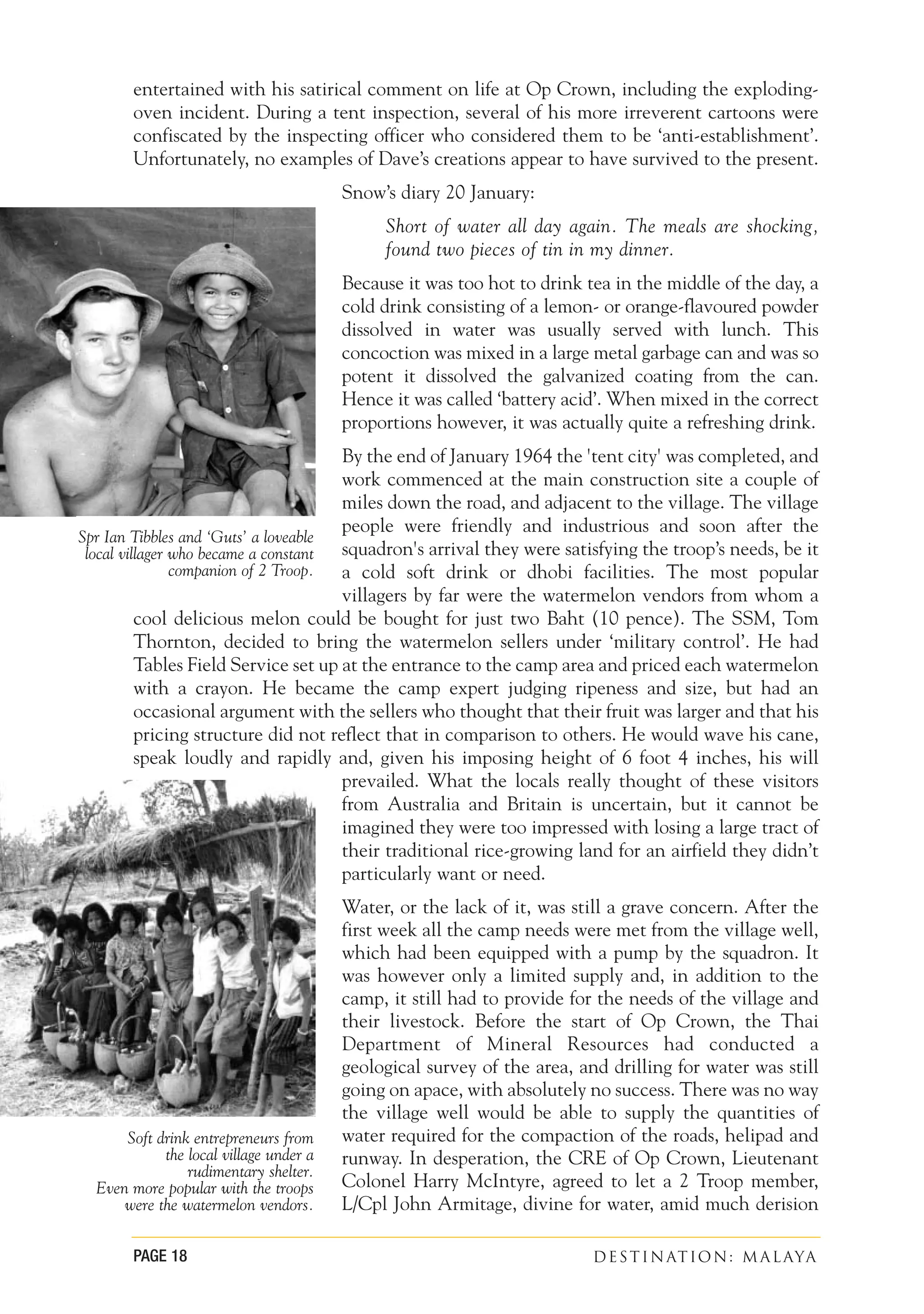
combat units to Sarawak in March–April 1965.
The Communist Party coup and counter-coup that took place in Jakarta in October
1965 was the beginning of the end for Sukarno. After the bloodbath that followed the
coup, where tens of thousands of the PKI and their supporters were massacred, a little-
known military leader, Major General Soeharto, emerged as the dominant force in
Indonesian politics. This had little immediate effect on the military situation in Sabah
and Sarawak, and it was not until 11 August 1966 that a Peace Treaty was signed to end
a three-year war that had never been declared. Throughout the Confrontation, even
during the period of the successful deep penetration secret 'Claret' operations across the
Kalimantan border, conducted by 3 RAR, and the following year by 4 RAR, Australia
maintained full diplomatic relations with Indonesia, considering this the best way to
bring peace and stability to the region. However, it seemed incongruous to some that,
while Australian soldiers were fighting the Indonesians in Borneo, Indonesian Officers
still attended the Australian Staff College at Queenscliff in Victoria.
PAGE 48 DESTINATION: MALAYA
Off to Borneo
Since the beginning of the New Year there were persistent rumours that 2 Troop was to
be sent to Borneo as 3 Troop of 11 Indep Field Sqn was already there and would need
to be replaced in a few months. On 21 January 1965 the Malaysian Government made
a direct request to Australia for combat troops for Borneo and the Australian
Government reluctantly agreed. The first unit to be deployed, 1 SAS Sqn under Major
Alf Garland, arrived in Brunei in early February. During March, 3 RAR began moving
into Sarawak and, also in March, 2 Troop replaced 3 Troop in Sarawak as part of West
Brigade under the command of Brigadier Bill Cheyne, OBE. Babu, an essential member
of the troop, also went to Borneo (although he had not been allowed to accompany the
troop on Op Crown in Thailand).
Farewells and Congratulations
Before departing for Sarawak, the Troop said farewell to Sappers Fred Hess, Jim
Kimberley, Geordie Sinclair and Murray Aitken, who were returning to Australia after
having completed their tour of duty. Phil Macklin also returned home about this time
for medical reasons. Replacements, Sappers Terry Hanrahan, Michael ‘Tassie’ Holloway
and Alan Pullen, arrived in early April
and, as soon as they settled in, joined the
Troop at Bau.
Ken Jolley had his 21st birthday on the
31 March 1965, and although
preparations for deployment were in full
swing, Ken, assisted by several of his
mates, celebrated the occasion at the
Sydney Bar.
On the day of departure for Singapore,
several members of the transport party
were delayed while repairs were carried
out on one of the vehicles. Lefty
Maddison, the recently-arrived vehicle
mechanic, takes up the story:
The Commer Tipper
This poor old wreck was in dire need of a new prop shaft months before the troop
was deployed to Borneo. Having requested new parts through the FAMTO store,
which never seemed to come up with any parts for the Australian Troop, we decided
the old girl would make Singapore and, if treated gently, it still had a few months of
loyal service in the old shaft.
On our day of departure and dressed in our good clobber, we were unexpectedly
approached by the L/Cpl in the FAMTO store who came out with a brand new prop
shaft for our tipper. We were told that the new part must be fitted NOW and the
old part returned to the store. He was promptly told to p--- off and that we would
take the new part and fit it at a later date, then send the old one back.
This idea did not sit well with the L/Cpl who then ordered me to change the shaft
immediately. At this time, Frank Sexton, Moose Sutton, Ian Tibbles and I were
2 Troop about to board the Auby in Singapore for
Kuching on 4 April 1965.
A History of 2 Field Troop RAE 1963 to 1965 PAGE 49
discussing this bloke’s parentage, to which he did not take kindly, so he went and
reported us to the QM. The QM then arranged a very swift visit to his office for
the four offending colonials. The QM pointed out to us the error of our ways saying
that, because we were on active service and we being four against one Pommy
NCO, we could be charged with mutiny, for which the penalty was the firing
squad.
Not being too keen on this idea, a new solution was found: we would apologize to
the L/Cpl, change the part and proceed on our merry way.
After the apology (tongue in cheek) and an hour or so delay, the job was done.
Picking up the old shaft I threw it to the L/Cpl, who was a bit on the skinny side.
The weight of the shaft sat him on his backside and as we drove off, I think he was
discussing our parentage.
Bau and Cambrai Camp
The 2 Troop advance party was flown into Kuching courtesy of RAF Transport
Command in early April 1965 while the main body of the Troop sailed from Singapore
on the Auby on 4 April. The Auby, a cargo/ferry ship, was built in 1954 for the Sarawak
Steamship Company and was chartered
by the Ministry of Transport during the
Indonesian Confrontation. Acting as a
troopship, it ferried some 31 000 troops
during Confrontation including 3 RAR
to Sarawak in late March.
The transport party and Troop vehicles
embarked at Singapore on their old
friend, the Maxwell Brander, also on 4
April, bound for Kuching. Snow Wilson
was in charge of the road convoy and he
takes up the narrative: .
The ship was due to sail at 1800
hrs so we were required to be on
board by 1700 hrs; most of us
made it, although Mick Sutton, Ian
Tibbles and Frank Sexton were a little late. A lot of us had been on board the year
before when we came back from Thailand, and one thing for sure – it was not
designed as a cruise ship, and it had been used in the landings of the Second World
War. We were allocated to mess decks or cabins, which held about 14 bunks. These
were located up forward and each side of the well deck, bow doors and landing
ramp. They were very hot and there was no ventilation worth having, even with the
portholes open. To overcome this, we each carried a mattress up on to the deck,
found the best bit of shade we could and camped in it for most of the trip.
Our meals were served to us out of the galley door into our mess tins. I don’t know
how the cook managed to cook for us all in such a small galley. Babu, our boot boy,
came with us on the ship, which raised some eyebrows from other units when we
arrived at our base in Bau. To relieve boredom on the three-day voyage and to hone
our small arms skills, live firing was conducted over the stern each day
Aboard the heavy landing ship Maxwell Brander bound
for Kuching, Sarawak, L/Cpl John Barnett, Sprs Harry
Atkinson, Gary Plumb and John White enjoy a game of
cards to pass the time, Spr Doug Canning and Cpl
Simon Wilson look on.
PAGE 50 DESTINATION: MALAYA
It was about mid-morning when we saw the city of Kuching and by lunchtime we
tied up and were met by a party from the Troop which had arrived before us. Once
all the vehicles were unloaded we left for the camp at Bau, which was about
30 miles south west of Kuching. The trip was interesting and, about halfway, we
had to cross the Kuching River again, this time by vehicular ferry. This took, about
20 to 25 minutes including the loading
and unloading. The road was bitumen all
the way and we passed through several
kampongs. It was not until later that we
found out that one of the villages was
considered unfriendly, and it was
recommended you should pass through at
a rapid rate and be ready for any
reception committee waiting for you. It
was late afternoon when we reached the
mining township of Bau, which was to be
our base of operations.
A signal from CRE West Brigade, with a
simple but appropriate message, was
received by 2 Troop on its arrival in Bau:
‘Welcome to the real thing.’ Cambrai,
the fortified camp at Bau, also housed 3 RAR Battalion Headquarters, plus one
company as reserve, a troop of armoured vehicles from 4 Royal Tank Regiment and a
section of Malaysian Federation Army Engineer plant operators, which were to work
under the command of 2 Troop. The Malaysian Engineers did not stay in the compound
but lived with the local villagers in Bau. 3 RAR also had a company at each of the
forward defensive positions of Stass, Bukit Knuckle and Serikin along the Kalimantan
boarder. 2 Locating Troop, RA, had a small detachment at Cambrai Camp with a Green
Archer radar to investigate whether the existing ability to identify artillery shells and
mortar rounds when fired during fine
weather would also work during heavy
or monsoonal rain.
The accommodation and facilities at
Bau were surprisingly good. The timber-
framed buildings were roofed with
corrugated galvanised iron and the
wooden floors were raised several feet
above the ground. Walls were mostly
made from atap (woven palm fronds),
some with large push-out shutters,
others with half-walls and a verandah. A
Gurkha battalion had occupied Cambrai
before the arrival of the Australians.
Because of the high water table at the
camp it had not been feasible to dig
standard weapon pits, so they had
constructed ‘sangers’, above-ground defensive positions built from sandbags On the first
evening ‘stand-to’ it was discovered the dirt floor of the sangers had to be lowered by
Ferry crossing on the Kuching River between
Kuching and Bau.
The fortified Cambrai Camp at Bau overshadowed
by the 1200 feet high Bau Peak.
about one foot to accommodate the lanky Australians. The twice-daily clearing patrols
and general base security were handled by the battalion, with everyone else, including
2 Troop members, taking their turn in the weapon pits at night. 2 Troop was to become
the bane of the dawn clearing patrols as the sappers roared out of the compound each
morning before sun-up to begin work.
Sapper John Tomczak, one of the troop
plumbers, spent little time at Cambrai
during the early part of 2 Troop’s
deployment, being detached to 3 RAR
to provide some basic water supply
facilities at Serikin and Bukit Knuckle.
His tasks included providing hot and
cold showers, a rare luxury at forward
bases, and basic maintenance of the
camps’ water supplies. Before his return
to more mundane duties at Cambrai
Camp, John also participated in a
clearing patrol with the infantry.
The Tasks at Bau
2 Troop was tasked with completing an
airstrip close to the Bau township,
which had been started several months earlier by 11 Sqn’s 3 Troop. A second objective
was to push a road through difficult terrain, towards the Kalimantan border, to link up
with the 3 RAR outposts, whose only means of re-supply was by helicopter or air drop.
OC 11 Sqn, Major John Stevens, visited the troop several times and gained a very good
appreciation of the difficulties of construction in the very wet and muddy area. He
stressed the need to complete the airstrip and road with some urgency. The squadron
2IC, Major Gordon Chave, also visited the troop to oversee progress.
The airstrip presented major difficulties
in that it was partially built on a massive
tailings dump from an adjacent open-pit
mine. This had become the scenic Tai
Parit Lake and recreation area that also
provided a plentiful water supply to
both the town and the camp. When
2 Troop arrived, the main airstrip earth
works were already completed, but the
1 200 feet surface of the airstrip was
covered in a thick gluey slurry, and the
sub-base was poorly compacted and
unstable. This situation caused a major
headache for S/Sgt Bing Crosby on just
how to proceed. Since it was not
practical to compact the tailings dump,
it was decided to remove the surface
slush, and then correct the gradients so the strip would become self-draining. After this
was completed, a layer of rock, 10-12 inches thick was spread to form a solid base. The
A History of 2 Field Troop RAE 1963 to 1965 PAGE 51
Progress on the road and airfield may be all-important but the
paperwork still has to be done. Cpl Peter Stokes and Spr Doug
Canning get their heads together.
Local labour hand-laying a rock base on the poorly-compacted
airstrip. The rock had been delivered by Shawny-Poole haulage
trailers.
PAGE 52 DESTINATION: MALAYA
placing of the rock was almost completely done by hand, using labour recruited from
Bau and the surrounding villages, and overseen by Cpl Graeme Leach. Throughout
operations in Sarawak, the policy of employing as much local labour as possible was
encouraged to give some economic benefit to the local communities. A further layer of
crushed metal was spread by grader using the expert skills of L/Cpl Noel Butler, followed
by the final surface of compacted gold tailings.
Initially, the coarse rock was hauled
from a commercial quarry on the
Kuching road, but this proved
unsatisfactory. Material was then drawn
from a quarry operated by the troop,
with the assistance of much local labour.
Sapper Harry Atkinson was placed in
charge, and produced a continuous
supply of good quality material for both
the airstrip and road works. Adjacent to
the quarry, a rock-crushing plant was set
up to provide the crushed metal needed
for the sub-base on the road and airfield
before the final surface of gold tailings
could be laid. Several sappers took the
role of overseer at the crusher at various
times, supervising the local labour employed at the site. A very popular overseer was
Norm Looby who got along extremely well with all the workers.
The locally-purchased explosives used for blasting at the quarry consisted of 2-ounce
sticks of gelignite. Apart from being much smaller than the 8-ounce sticks with which
the Australians were familiar, the gelignite was generally in poor condition and prone
to weeping. Unless extreme care was exercised in using the gelignite, it caused severe
headaches for those who handled it. So it was decided to use a mixture of nitrogen
fertilizer and fuel oil, as this would be a better quarrying
charge anyway. Some prilled fertilizer was purchased in
Kuching and prepared in the appropriate manner but, no
matter how large the primary charge, it could not be induced
to detonate. Most likely the nitrogen level was not high
enough, but whatever the reason it was back to the gelignite,
headaches and all. The local villagers welcomed the gift of
the remaining fertilizer and soon had the greenest gardens in
all of Sarawak.
Harry Atkinson, the youngest member of 2 Troop, turned
21 during April but had little cause to celebrate. He had
contacted a dose of the local strain of measles from the Dyak
workers at the quarry, and spent a week in the hot and
uncomfortable isolation hut adjacent to the 3 RAR
Regimental Aid Post.
Tai Parit lake at Bau. Originally an open-pit gold mine, the
lake was reputed to be 200 feet deep and was a favourite
swimming spot, both for the locals and the troops.
Spr Harry Atkinson, foreman
at the quarry, drilling prior
to blasting. The front
piece sketch was based
on this photo.
A History of 2 Field Troop RAE 1963 to 1965 PAGE 53
Meanwhile, the new road toward the border was progressing under the direction of
Plant Cpl John Bending and his offsiders, Sappers Dave Wood and Alan Morris,
although conditions there were less than ideal as well. An unsurfaced road already
existed for about 8 miles in a south-westerly direction from Bau, but there it ended.
Progress on extension of the road from that point was slow due to marshy conditions
and very heavy rainfall, and it was not until the high country was reached that the road
construction gained momentum.
There was a quarter-mile section of road
that needed several culverts. The first
culvert, a sawn timber-box section,
proved satisfactory, but the material had
to be purchased locally with the
inherent lead-time, transportation and
cost. So, it was decided to use log
culverts from felled timber adjacent to
the road alignment. The logs used were
about 8 inches in diameter and 30 feet
long. To move the timber, the Dyak
labourers would line up on each side of
a log and stand for what seemed to be
ages, looking at one another. There
would be an occasional ‘whoop’. After
some minutes, one man, the ‘chant-master’, would call the tune. As one, they bent and
lifted the heavy log on to their shoulders. Moving the log and positioning it into
position was deliberate and steady. The result: applause, grins and shaking of hands.
Dave Wood’s recalls some aspects of the road construction:
A super highway this was not! But the road to Stass was a planty’s dream, no
design to work to. The only instruction was to get a vehicular track to Stass by
the best possible alignment. Once again the planties (plant operators) under
JB (Cpl John Bending to some, but
to Alan Morris and me, JB
or Bindi Jack) were banished to
the sharp end, along with our
trusty FE, Cpl Snow Wilson).
Snow’s job (and what a great job
he did for an FE!) was to find
a suitable route to Stass. Just a pity
he did not take the time to become
a plant type! Also included in
Snow’s job description was
counting the valuable trees for
which compensation would be
paid if we planties ‘inadvertently’
destroyed them.
A Michigan 75 front-end loader operated at the quarry by a
Malaysian Engineer under the supervision of Spr Ian Tibbles
while Spr Mick Sutton in a Commer tipper waits for a load.
The rock-crushing plant near the quarry provided a
continuous supply of good quality aggregate. Here, it is
manned by sappers from 2 Troop, although local labour
was usually employed.
Some road work had already been
completed by the previous troop, but due
to the wet weather and time constraints
the construction had stopped just short of
a very wet and marshy area.
This area posed some problems at first,
but in time an alternative route was
found around it; then, like all good plant
ops, we headed for the hills. This not
only picked up the pace of construction of
the road but also gave us a lot more dirt
to play with and push around. Design,
what design? It appeared that, if the road
as constructed would take our tippers
and dump trucks, then that would be
good enough for the local traffic as well.
In the end the main carriageway was to
be about 20 feet wide, with shoulders and side drains taking the overall width to
approx 35 feet.
Once the centre line was selected, we set about clearing about 40 feet each side of
it. This was to allow some sun onto the road alignment and to help maintain a
reasonably dry surface on which to build the road. The road progressed at a steady
rate, helped by the fact that the ridge line was not heavily timbered and, once
cleared, allowed for easy drainage. It did mean, however, that to shape the road’s
sub-base and base, and still maintain a reasonable gradient, a lot of cut and fill was
required. It was in this work that two Michigan wheeled-dozers, on loan from the
Malaysian Engineer Sqn, proved their worth.
As the road got nearer the border, JB felt that we did not have enough protection
with personal weapons only and that more substantial protection should be available
for the project. JB decided to go right to the Top Man and this he did, speaking
directly to Brig Bill Cheyne on one of the
West Bde Commander’s visits by
helicopter to the head of the road. It
turned out that the Brigadier’s helicopter
was piloted by an Australian, Lt Bobby
Hill, who had completed a Basic Plant
Course with me in 20 Field Pk Sqn in the
early 60s before taking up flying, so we
had an ‘in’ there for a start. The old
saying goes ‘ask and you shall receive’.
The next day two armoured vehicles
from 4 Royal Tank Regiment, a Ferret
scout car and a Saladin armoured vehicle
were on hand to escort us to the road
head daily, and they remained with us for
the duration of the road task, so we a felt
a little safer after that.
Section of marshy road surfaced with corduroy surfacing.
After the section was adequately drained, a gravel surface
was laid over the corduroy as an expedient method
of progressing the road.
A Cat D4D bogged in the marshy ground encountered early
in the road project. Much time and many resources were spent
recovering this piece of equipment.
PAGE 54 DESTINATION: MALAYA
We had our good and bad days.
One of our not-so-good days was
when moving a 19 Ruston Bucyrus
tracked excavator ‘face shovel’ to a
forward area, we had to ford a little
creek approximately 50 feet wide
and banks at 20 feet in height and
a very fast-flowing stream. This
necessitated cutting ramps down
the banks to allow easy access for
the excavator. Once the ramps
were cut, we then drove the
machine to the water line and
attached a winch rope from the
dozer we had on the far bank to
assist in getting the machine across
the creek. Easy, I hear you say! As
soon as the excavator entered the
water it proceeded to sink into the bottom of the creek, and it being very heavy and
fitted with only flat tracks did not help the situation. Also, it had started to rain very
heavily as it so often does in the tropics, which had the effect of causing the water
level to rise rapidly from about shin level to waist deep in less than 30 minutes. As
the sun had long passed the yardarm we were committed to completing the task, be
it finished by day or by dark. After much consternation and a good amount of
cursing, we got the job done. The crossing had taken about five hours to complete.
We learnt a lot about recovery that day and I had many occasions later in my Army
career to remember the lessons learnt on recovery of construction plant.
The good days were when we had no recovery to carry out and the road progressed
ahead of schedule. Towards the end of our tour, JB managed a short walk in to
Stass to surprise the locals, using the pilot track for the road.
Our task completed, we made ready to return to Terendak.
Noel Butler, our expert grader
operator, did very little work on the
Stass road, as he mostly worked on
the airstrip and on maintaining the
roads used by the haulage vehicles.
We did, however, have some
Federation Engineers with us.
The equipment was maintained by
the plant ops themselves with help
from some locals who greased and
did other relevant tasks as directed.
The equipment used for the road
construction was handed over by
the previous troop along with the
following on loan from the
Malaysian Engineers:
Sprs Alan Morris and Dave Wood driving Michigan 180 and
280 wheeled-dozers operating in tandem on a forward section
of the road from Bau to the forward base at Stass occupied by
A Company 3 RAR.
Local labour hand-placing rock on the formed road surface.
The artillery base of Pejiru can be seen through the smoke at
the bottom of the hill.
A History of 2 Field Troop RAE 1963 to 1965 PAGE 55
Two Michigan wheeled dozers
Models 180 and 280
One D4D tracked dozer
One Avelling Austin grader
One Fowler size-6 tracked
dozer
Two Commer tippers
I believe that the standard of road
achieved during this period was
comparable to other tasks
undertaken in Sarawak at that
time.
In addition to the reconnaissance of the
best route for the road to Stass, Snow
Wilson was in charge of the Dyak
workers clearing the timber from the
road alignment. The construction plant
could certainly have done this job, but it
was important to provide employment
for the locals. Also, there were fruit trees
scattered throughout the bush which
were owned by various families in the
kampongs. Much of their food and trade
goods came from the jungle. If any of
these trees had to be removed, it needed
to be recorded so the owners could be
compensated.
An Indonesian poster offering a reward
for the capture of a particular fair-haired
‘round-eye’ (European), described as a
freelance spy, appeared in several of the
surrounding kampongs and, while it
wasn’t Snow they were after, discretion
dictated that he stay closer to Cambrai
Camp. On one occasion, Snow asked to
be relieved but an outwardly
unsympathetic Troop S/Sgt reminded
him of his extra pay allowance for using
his language training. He was not
impressed with that argument and used
language that his allowance did NOT
cover However, Snow was eventually
replaced in this role by Flash Farrell (by
now a L/Cpl) during the final weeks of
the troop’s tour in Sarawak, as it may
Ferret scout car, protection for the forward road
works, inspected by Sprs Sexton and Tibbles.
(Trying to get a demo drive?)
Ruston Bucyrus 19 RB excavator loading a Muir Hill dump truck
with crushed metal. This was the excavator which became bogged
in the bottom of a stream and was so difficult to extract.
Spr Dave Wicks dropping a load of rock on the road to Stass. Once
the high country was reached the road works progressed rapidly, but
this made it an increasingly long haul from the quarry.
PAGE 56 DESTINATION: MALAYA
have been embarrassing trying to
explain to Mrs Wilson why her son’s
head, complete with blonde locks,
adorned a pole in some Dyak village.
Bing Crosby recalls that ‘Snow Wilson
was outstanding as a forward scout and
liaison officer with the indigenous
people’.
The plant and equipment available to
the troop included a number of Muir-
Hill dump trucks and these, along with
a couple of Commer tippers, were used
almost exclusively for the haulage of all
the materials required for the airstrip
and road construction. These machines
were apparently designed for use in
quarries and areas with paved surfaces,
and were completely unsuitable for the
transport of heavy materials on the
often steep, wet and narrow unmade
roads of Sarawak. The cockpit was open
to the elements, with no crash
protection, the brakes were virtually
non-existent and the steering was heavy
and prone to 'wheel wobble'. However,
since these were the only haulage
vehicles available, it was necessary to
persevere with them. There were
frequent accidents and it was fortunate
no one was seriously injured. Sapper Ian
‘Jock’ Benson hit a local bus head on
and the bus ended up about two feet
shorter. Sappers Simpson and Jolley
both put their dump trucks over steep
embankments, managing to 'bail out'
safely as the vehicles left the road.
Sapper Dave Wicks and an RA Land
Rover met on a narrow bridge, the
Gunner driver wisely opting for the
creek. The vehicle was soon towed back
onto the road with nothing hurt except
the Artillery officer’s pride.
Another type of haulage vehicle in
limited use was the Shawny-Poole, a
Fordson tractor fitted with a two-wheel
articulated trailer. Sapper Doug 'Blue'
Canning was hauling gold tailings when
a narrow section of road subsided, and
Payday for the Dyaks employed on the road gang.
The Muir Hill dump trucks were generally unsuited to the
operating conditions prevailing in Sarawak and this was only
one of several accidents in which they were involved.
Cpl Jack Brown and Spr Jock Benson helping to maintain
plant and equipment not designed for the harsh operating
conditions of Sarawak.
A History of 2 Field Troop RAE 1963 to 1965 PAGE 57
PAGE 58 DESTINATION: MALAYA
the tractor overturned and slid down a steep embankment. Blue was badly shaken but
not seriously hurt, and the equipment was soon recovered. As a result, it was decided to
widen the road at that point and this involved blasting a large outcrop of rock. Harry
Atkinson was borrowed from the quarry for the job, but had to 'cadge' an Infantry driver
and Land Rover to tow the air compressor to the site, due to a shortage of troop
vehicles. Drilling completed and the holes charged, the Infantry driver, with compressor
attached, was given a red flag and
instructed to park down the road and
stop all traffic. The fuse was lit, 'fire on'
given, and everyone retreated to cover,
when around the corner appeared a
Land Rover. Capt Alan Hodges, with his
driver, Sapper Macca McDonald, had
come to check on progress and pulled up
beside the outcrop. Warnings were
shouted, and Macca took one look at the
burning fuse and reversed faster than he
had ever driven forward. After the blast,
a very pale and shaken Alan Hodges
demanded an explanation. Seems the
Infantry driver realised he had to stop
everyone, but did not think it included
officers.
On the road toward Stass, about five miles from Bau was an old wooden truss bridge.
Reputedly built by POWs during the Japanese occupation of Borneo in WW2, it was
quite a unique, well-engineered structure, but the truss design limited the side and
overhead clearance. Unfortunately, during the road construction an armoured scout car
from 4 Royal Tank Regiment damaged a side-bearer strut which caused the collapse of
the bottom chord. The structural integrity of the bridge was compromised which
required that it be closed to vehicle
traffic. The 2 Troop 'chippies'
(carpenters) Cpl Graeme Leach,
L/Cpl Flash Farrell and Sapper Trevor
Reece, with assistance from some FEs,
supported the bridge on a pier
constructed from the very versatile steel
Christchurch Cribs and then fitted a
new main support, returning the bridge
to near new condition. This bridge
spanned the same stream where the
Ruston Bucyrus excavator became
bogged and which was the cause of so
much grief to the planties.
Anzac Day 25 April 1965 was the 50th
anniversary of the landing at Gallipoli.
A dawn service was held at Cambrai Camp with elements of all the Australian units in
the camp represented. After the service, it was a quick breakfast and then off to work as
usual. The previous day had seen the commemoration of the Battle of Kapyong, a big
Truss bridge reputedly built by POWs during WW2. One of
the main supports was damaged by an armoured vehicle and
the bridge was in danger of collapse.
With repairs complete and the bridge returned to near-new
condition, the workers celebrate with a cold drink.
L to R: Sprs Dennis Fitzhenry, Trevor Reece, John White,
Cpl Peter Stokes, Spr Peter Matthews in front.
A History of 2 Field Troop RAE 1963 to 1965 PAGE 59
day on the 3 RAR calendar. Kapyong Day commemorates the successful action during
the Korean War on 23 and 24 April 1951 in which 3 RAR, along with a Canadian
infantry battalion and a company of US tanks, held their defensive positions against an
enormous attack by the Chinese Army.
On 17 May, Sgt Vella and Pte Downes, two members of 1 Platoon, 3 RAR were killed
when they triggered an US-manufactured M2A4 jumping mine while patrolling on
a jungle track near Stass. The CO of 3
RAR, Lieutenant Colonel Bruce
McDonald, MC, sent Alan Hodges with
a section of the battalion's Assault
Pioneers, under the protection of an
Infantry platoon, to check the area for
more mines. The mines were provided
in packages of six. The remaining mines
were discovered using mine detectors
and prodders and were exploded in
place by Alan Hodges. (In 1996 Bruce
McDonald received the award of the
Order of the British Empire for his
service in Bau. He retired from the
Army as a Major General.)
This was the second mine incident
involving 1 Platoon. Earlier, in March, a sergeant and an Iban tracker were killed and
three others wounded in the same area, shortly after they took over duties in the area
from 1/7 Gurkhas.
Near to where 2 Troop began extending the road was the Artillery compound of Pejiru.
It contained two long-range 5.5 inch guns which, as well as protecting the forward
bases, offered support for the covert, deep penetration operations into Indonesian
territory. Even with the heavy tropical atmosphere of Sarawak, these guns could fire
effectively up to about 14 miles. The problem was that they were sited on marshy
ground, and the recoil used to bury the spades in the soft earth. The solution was to
pack behind the spades with gravel. So it was not uncommon for a load of crushed
metal, destined for the road works further on, to be dropped behind the guns. This
always earned the driver a 'goffa' (soft drink) or a cold beer, but it was never done for
such gain. Another piece of equipment at Pejiru was a large searchlight, which, when
the cloud conditions were right, would be used to bounce a beam of high intensity light
into suspected enemy positions and so provide artificial moonlight, thus disrupting
their activities.
Gawai Padi – Festival of the Rice Goddess
The Gawai Padi is a harvest festival celebrated by the Dyak people on the first and
second of June each year. Several of the troop working on the road were invited to
attend the festival in Kampong Serasot and, as it was a Sunday rest day, several of them
went and what a day they had.
From the end of the road it was a five-mile walk to the Kampong, using the Dyak track
which was the shortest way in and, once there, the troop members were met by
members of the Dyak road-clearing team.
Because of the rugged terrain large amounts of fill were
required in places. 2 Troop carpenters and FEs construct a
bridge as dozers complete the embankments.
For the festival, the villagers had
constructed a large bamboo platform (as
they do each festival) in front of one of
the central buildings. This was the
Rumah Gawai, the building where the
villagers hold their traditional rituals. In
the centre was a small shelter with
seating for the dignitaries. The platform
held about 80 people when the
ceremony was in full swing.
The day started with a visit to the house
of one of the road-team members, where
the sappers were introduced to some
typical Dyak hospitality. They were
given a locally-brewed rice wine ‘tuak’
which was the favourite of that house
and, after having stayed a reasonable
time, they were led off to another team
member’s house to sample the favourite
beverage there. This continued until the
main ceremony of the day was to start,
when they were taken back to the
Rumah Gawai.
There was much dancing and singing
which was all in the local dialect and,
although the visitors could not
understand it, they did appreciate the
rhythm of the songs and beat of the
drums and gongs.
Before leaving the Rumah Gawai, they
had servings of roast pork which had
been a wild pig in the jungle the day
before. It was cooked whole over an
open fire and the cut up into cubes with
the skin still attached. The cooking was
not very thorough but, as no one came
down with food poisoning, it must have
been done enough. To go with the pork
was glutinous rice. This was cooked in
lengths of green bamboo about two feet
long and two inches inside diameter.
The dry rice was first wrapped in
bananas leaves and slid into the
bamboo, some water added, and the
bamboo tubes were then stacked on
either side of a fire to cook.
Dr Tan Siew Sin, Malaysian Federal Minister for Finance,
with Capt Alan Hodges, inspecting the guard of honour at the
opening of the Bau airstrip.
The completed Bau airstrip.
The sign unveiled at the official opening of the Bau airstrip.
PAGE 60 DESTINATION: MALAYA
After the feasting was finished it was
back to visiting houses for more Dyak
hospitality, until it was finally time to
bid their friendly hosts farewell and face
the long walk back to the end of the
road.
In early June 1965 the Troop received
the sad news that another Australian
soldier, a member of 1 SAS Sqn, was
killed while on patrol in the Sabah-
Kalimantan border region. A rogue bull
elephant, standing almost 10 feet tall,
attacked an SAS patrol that was trying
to avoid the beast but the patrol
signaller, L/Cpl Paul Denehy, was fatally
gored by the enraged bull. Paul Denehy
was the first Australian SAS soldier to
die on active service.
The Bau airstrip was completed and
officially opened on 15 June 1965 by
Dr Tan Siew Sin, Malaysia's Federal
Minister for Finance, who arrived in an
RAF Twin Pioneer aircraft. A guard of
honour of 2 Troop and attached British
and 3 Sqn Malaysian Engineers was
inspected by Dr Tan before he departed
in the Twin Pioneer, which in the
meantime had been suitably
embellished with the red kangaroo
stencil. The Army Newspaper reported
that Dr Tan spoke with Cpl Noel
Butler, L/Cpl John Armitage and Spr
2 Troop and supporting British and Malaysian Engineers after the official opening of the airstrip.
A History of 2 Field Troop RAE 1963 to 1965 PAGE 61
Members of the construction team with the RAF Twin Pioneer
which flew Dr Tan to Bau for the opening of the airstrip.
Sgt Bruce Parsons, L/Cpl Noel Butler and Spr Bill Whitfield
having a cold drink after the opening ceremony.
Norm Looby. Dr Tan also congratulated all concerned for what he termed ‘a very good
job done in very good time.'
With the completion of the airstrip, all resources were concentrated on extending the
road. A frequent and welcome visitor along the road was Padre Eugene Harley, an
Australian RC chaplain, who took a close interest in construction progress and the
welfare of the troop. When the road reached the village of Serasot, the residents threw
a grand party at St Leo's school with music from Sarawak gongs and drums accompanied
by men walking on stilts. There was much excitement for the villagers as they welcomed
Alan Hodges in the first car to drive into Serasot. To honour the Troop for its work, the
villagers made him an honorary Dyak chief.
Ambush
By late June, with the road to Stass progressing on schedule, some of the plant was to
be moved to a Malaysian Engineer base at Kohom near Balai Ringin, on the Kuching-
Serian road. The first convoy left Bau on the evening of 28 June with Dave Wood
driving the Michigan 280 dozer, Lt Barry Lennon in a Land Rover as convoy
commander, and two three-ton Bedford trucks with a couple of sections of 4 Sqn
Malaysian Engineers and two British
MPs. To minimise disruption to local
traffic on the narrow roads, the convoy
travelled in the curfew hours between
1800 and 0600. The Malaysian
Engineers were not for protection, but
were required to lay large balks of timber
on each of the 29 bridges to be crossed,
raising the road surface so the Michigan
could cross without demolishing the
guardrails with its blade. The timber
served a secondary role of distributing
the weight of the plant more evenly on
bridges not designed for such heavy
equipment.
At about 2200, just past the 17 Mile
Bazaar, the convoy was stopped when an
explosion damaged a bridge in front of them. Barry Lennon immediately put the convoy
into a defensive position and, leaving Dave Wood in charge, took a section of the 4 Sqn
FEs forward to check out the area. The bridge was not extensively damaged so Barry
continued on to the 24 Mile Bazaar where an attempt had been made to blow another
bridge. At the Bazaar, there had also been some selective killing of pro-government
locals so he radioed for an APC-mounted infantry unit to be dispatched from Balai
Ringin to do a sweep of the area. While waiting for support, Barry was engaged in some
immediate clearing at the murder sites and setting up a defensive perimeter, and then
in assessing the capability of the bridge to support the mounted infantry when they
arrived.
Meanwhile, seeing a firefight in progress beyond the 17 Mile Bazaar, Dave Wood and
the MPs conducted a clearing sweep through the village pepper gardens and up to the
18 Mile Police Station. The raiders had departed by the time Dave Wood and his party
PAGE 62 DESTINATION: MALAYA
Padre Eugene Harley. an Australian RC chaplain, enjoys a
joke with troop members at the head of the road.
A History of 2 Field Troop RAE 1963 to 1965 PAGE 63
arrived, but they were kept busy doing what they could to aid the police and
civilian wounded.
It was thought at first that the convoy had been the target and that it was a local CCO
(Communist Clandestine Organization) operation. However, it soon became apparent
that the 18 Mile Police Station was in fact the primary target and the perpetrators were
a party of about 40 Indonesian regulars from across the Kalimantan border, with some
support from local CCO subversives. The attempts at blowing the bridges were
intended to prevent reinforcements from Bali Ringing and Kuching from reaching the
Police Station. Oil poured on the road in conjunction with crude road blocks, made
from large spikes driven through blocks of timber placed at the 10 and 24 mile posts,
did in fact successfully delay an APC and Police Land Rover despatched from Kuching.
At the Police station two policemen were killed and two others severely wounded. The
radio had been destroyed and the armoury looted. At the 17 and 24 Mile Bazaars there
were a total of six civilian deaths including women and children, and a further three
badly injured. All were either shot or hacked to death. One of the dead policemen was
the Officer in Charge of the station, Sgt Simon Peter Ningkan, younger brother of Dato
Stephen Kalong Ningkan, Sarawak’s Chief Minister.
The reinforcements from Balai Ringin arrived around
midnight and some time later the convoy returned to Bau
with the plant undelivered. Next day both Barry Lennon
and Dave Wood were extensively debriefed by 3 RAR
Operations and Intelligence officers.
In the days that followed, 2 Troop members joined
Malaysian Engineers to put fences around five villages in the
area suspected of being CCO strongholds. The fences were
patrolled by Gurkha infantry, both protecting the villagers
and providing a controlled environment to enable the
extent of the CCO support to be assessed
Several days later, another attempt was made to get the plant
to Kohom and this time the convoy included both of the
Michigan dozers plus two Michigan 210 motorised scrapers from Penrissen Garrison at
9 Mile Bazaar. It also included a section from 2 Troop under Jack Brown as an armed
escort. The plant was delivered without incident and, after an overnight stay at the
Malaysian Engineer base, the troop members returned safely to Bau. The two Michigan
210 scrapers are now on permanent display in front of the 3 Sqn Malaysian Engineer
HQ at Penrissen Garrison.
Official Visits
In early July 1965 the Minister for the Army, the Hon A J Forbes, MC visited
28 Brigade at Terendak and also came to Bau where he met a number of the troop. The
Minister’s visit was followed on the 22 July by a group of MHRs from the Australian
Labor Party led by Mr E G Whitlam, Deputy Leader of the Opposition, and including
Mr K Beazley. They were briefed by 3 RAR intelligence officers and inspected progress
on the forward road works. Later, Mr Whitlam shouted the troop a beer in the canteen,
but one of his staff obviously forgot to pay the bill before departing, as the troop
members had to pay for their own beer next day.
At the Bazaar,
there had also
been some
selective killing of
pro-government
locals
PAGE 64 DESTINATION: MALAYA
By mid-July the troop was making preparations for return to Terendak and an advance
party of Gurkhas had arrived to relieve 3 RAR. Despite the reduction in the heavy plant
at their disposal, John Bending and his crew had managed, in the final days, to cut a
pilot dozer trail right up to the forward defensive position of Stass on the Kalimantan
border. In the last week before departure, Sapper Lefty Maddison, the troop vehicle
mechanic, slipped and fell into a weapon pit, breaking several ribs and puncturing a
lung. Shortly before the troop left for Terendak, the Sarawak Chief Minister, Dato
Stephen Kalong Ningkan, presented a handsome Sarawak shield to 2 Troop as a
memento of its service.
On 25 July as the troop was preparing to leave Bau, the
following signal was received from Commander West
Brigade, Brigadier Cheyne:
From Comd to OC 2 Troop RAE. Many thanks for all the
good work done by your troops in W/Bde. Bau-Stass road and
the Bau airstrip will be a permanent reminder of your efforts
here and will be appreciated and valued by both civil and mil
in Sarawak. It has been a great pleasure having you under
command. I hope all ranks have a good well-earned leave.
Good luck.
On the 28th July, in a torrential downpour, 2 Troop was lifted
from Bau by Wessex helicopters directly to the deck of HMS
Albion, ‘The Grey Ghost of the Borneo Coast’, waiting
several miles offshore.
Australian Associated Press reported on the following day under the headline:
Malaysia: 58 Aussies Flown Out. Gurkhas move into Jungle
58 Australian jungle fighters were airlifted from Sarawak yesterday and replaced by
British Gurkha troops.
Waves of helicopters flew the Gurkhas directly from the commando aircraft carrier
Albion to forward positions facing Indonesian Borneo.
The helicopters then took the Australians, ending 4 months of duty along the rugged
Borneo border that separates Indonesia from Malaysia, back to the carrier.
When the Australians – the Second Field Troop of the 11th Independent Squadron
Royal Engineers – were flown out, they left behind at least 3 mementoes. They
were:
A new surface to the Bau airstrip.
An extension to a road leading to one of the forward positions near the
Indonesian border.
Their Squadron flag fluttering high on the 1 200 feet Bau Hill.
A sudden downpour drenched the men as they were being airlifted out. One of the
men said, ‘Wouldn't you know it? 14 days without rain and it has to rain today.’
But the airlift continued.
Lieut Barry Lennon from Morningside, Brisbane, who took the engineers’ flag up
Bau Hill said the men were looking forward to getting out.
“From Comd to
OC 2 Troop RAE.
Many thanks for
all the good work
done by your
troops in W/Bde.”
But both he and Captain Alan Hodges, of Mordialloc, Melbourne, had nothing but
praise for the tiny town of Bau, nestling beside a lake.
The Australian engineers employed local workers and spoke highly of their work
and friendliness.
‘They could spend days just chipping at rocks whereas our men would get fed up
within a few hours’, Captain Hodges said.
Both officers said the local people spoke English, then
added with a grin they had learned some of the local
language also.
‘Just the essential,’ one of them said, ‘like – “Another
brandy ginger” and “Tell my friend to pay”.’
The day-long helicopter operation was the second of its
kind in Malaysian Borneo.
3 RAR was also choppered aboard Albion, a 28 000-ton
Special Commando Carrier, and sister ship to the Australian
Aircraft Carrier, HMAS Melbourne. It was a relaxing and
uneventful voyage to Terendak, except perhaps for Lefty
Maddison, who was in the sickbay and still feeling a bit sorry
for himself. Movies were shown on the hanger deck, and a
two-can per day, per man (perhaps!) beer ration was in
effect, but since it was Pommy beer hardly anyone drew his
HMS Albion and its complement of Westland Wessex helicopters involved in the airlift of 2 Troop
and 3 RAR from Sarawak.
A History of 2nd Field Troop RAE 1963 to 1965 PAGE 65
A handsome plaque from the State of
Sarawak presented to
2 Troop on its departure.
PAGE 66 DESTINATION: MALAYA
entitlement. Daylight on the third day and HMS Albion was standing off the sailing club
at Terendak.
A final word on the Troop's tour in Sarawak appeared in the Terendak Garrison
magazine, the Bukit Bulletin:
Looking back on our tour it is easy to forget the moans of extra duties (discipline
must be maintained). Our clerk Cpl Peter Stokes checked up and found that Spr
Looby had just enough service to work off his extras before return to Australia.
Two major tasks were handed over to us by 3 Troop. The first, a light aircraft strip
that was officially opened in mid-June, and the other was a road towards Stass. In
our last week Cpl John Bending, in charge of plant on the road, managed to make
a surprise visit to Stass along the dozer trail. Our British plant-fitting team under
L/Cpl Geoff Gillespie kept the machines going with Bostic and elbow grease.
Infanteers and Sappers aren't really compatible. 3 RAR loved the rain as their
patrols couldn't be heard, but nothing gladdens the heart of a Sapper more than
good dry dust. Our dump trucks coated Cambrai Camp in dust and the RSM was
not impressed when we quoted figures of maximum economical haulage speeds. This
speed was sometimes exceeded and S/Sgt Bing Crosby and Spr
Jock Benson are available for lectures on ‘Newton’s Second
Law of Motion and Impact Factors during collisions.’
The ‘Hearts and Minds’ campaign is really an excuse for any
job that won't be approved. Our children's playground at the
lake met with the approval of the resting warriors of 3 RAR.
An interesting item was the floating diving tower. Spr Trevor
Reece still insists that the design was based on Archimedes’
Principle. Whoever he is, he wasn't at Bau.
The plant ops built a padang at Kampong Serasot and the
locals had a ‘gawai’ for us in return. The troop commander
was inaugurated as an honorary Dyak chief. The Bau
Secondary School received the assistance of many hands to construct a basketball
court. A carved wooden hornbill was received from the school by Capt Alan Hodges
on behalf of the troop.
After our return with 3 RAR in HMS Albion it was touch and go to get a leave
pass before the Orderly Corporal got your name on the duty roster.
“...nothing
gladdens the heart
of a Sapper more
than good dry
dust...”
Chapter Six
Terendak, then Homeward Bound
The soldiers were delivered ashore in assault landing craft to the Terendak LCT hard
on Saturday 31 July 1965, much to the delight of the assembled wives and children of
both 2 Troop and the Battalion. Lefty Maddison was transferred directly from the ship
to Terendak Hospital. Meanwhile, the troop vehicles made the return voyage on the
LSL (Landing Ship Logistic) Sir Lancelot to Singapore and thence by road to Terendak,
arriving several days after the main body. Sir Lancelot, of 6 390 gross tons, was built in
1964 for the UK Ministry of Transport. In 1970 it was transferred to the Royal Fleet
Auxiliary. Along with five sister ships, Sir Lancelot served in the 1982 Falklands
Conflict. She was damaged by a 1 000-pound enemy bomb which although failing to
explode, resulted in fire damage. The ship continued in service until 1989, when she
was sold and refitted as a floating casino at Capetown, South Africa.
During the deployment in Sarawak there were several more additions to troop numbers.
Bruce and Judy Parsons became proud parents of a son, Jeffrey, born at Terendak
Hospital, while June Hanrahan travelled to Penang and gave birth to daughter Kim,
surrounded by family and friends, but with Terry still in Bau. Anais Marie Richardson
arrived on 3 July to joyous first-time parents, Yvonne and Alan.
The Prime Minister of Singapore, Mr Lee Kwan Yew, announced on 9 August that
Singapore was seceding from the Federation of Malaysia, and would become a separate
republic, with himself as President.
Ray Logan and fiancée, Ahlan, were married at St. John’s OPD Church, Terendak, on
16 August. Harry Atkinson took the role of best man.
On Friday 20 August, 11 Sqn held a dinner dance in the ORs mess to celebrate the
return of 2 Troop from Borneo. The dress was 'Planters with ties for men' (long trousers
and long-sleeved white shirts). The Flamingoes provided dance music including the
waltz, quickstep, foxtrot, Latin American and Gay Gordons. There was also a Twist
competition and novelty dances, including the Limbo.
Meanwhile Park Troop and the 2 Troop planties recently returned from Sarawak, were
hard at work constructing a helipad and helicopter test area just below the 11 Sqn
barracks. While it was largely a plant operation, sappers from the squadron poured the
concrete test bays and tie-down points.
A History of 2 Field Troop RAE 1963 to 1965 PAGE 67
Also during August, Acker Bilk (a
former Royal Engineer) and his band
visited Terendak, and all the lovers of
trad jazz attended the concert and had a
great time. 2 Troop, with the exception
of seven members who were staying
behind to join the incoming group, were
in wind-down mode. The Pads were
busily having their personal belongings
packed for transport to Australia by sea,
and the aluminium trunks (soldier’s box)
of the single members were packed
and addressed to their respective
destinations.
Most of the troop attended the Farewell
Parade for 3 RAR, held on 9 September,
and the Battalion certainly marched out
in style.
Lennon, Crosby, Parsons and Wicks
travelled once more to Singapore to
participate in another parachute
qualifying course. This time they
travelled in a RAF Beverley Transport
to Kuantan on the east coast for
practice jumps in stick formations of
15-20 troops at a time.
Brian Cribbs, a confirmed bachelor,
quaintly asked his Troop Commander
for permission to marry. He amazed
everyone in deciding to get married
given his committed single life and at
such a late stage in the tour of duty in
Malaya. Naturally, the whole troop was
invited to witness the happy occasion
and to enjoy a sumptuous 12-course feast
while wishing Brian and his bride much
happiness.
Farewell to Malaysia
It was now 2 Troop's turn to march out
and they were bade farewell at a
Squadron Parade on 30 September 1965,
with Lieutenant Colonel E Westbrook
RE, the Deputy Commander, 28
Commonwealth Infantry Brigade, taking
Spr Ray Logan and his new bride, Ahlan, with bridesmaid
and best man, Spr Harry Atkinson, outside St. John’s church,
Terendak, shortly after the wedding ceremony.
Spr Dave Wood accompanied by Spr Ian Tibbles on a Fowler
light dozer beginning preliminary work on the helicopter test
area adjacent to the 11 Sqn area.
A landing craft from HMS Albion delivers members of 2
Troop to the landing hard at Terendak where wives and family
are eagerly waiting.
PAGE 68 DESTINATION: MALAYA
the salute. During the farewell parade,
Major Stevens presented Capt Hodges
with a handsome shield with crossed
chromed gollock and Malay parang.
This plaque, along with the one
presented to 2 Troop by the State of
Sarawak, is on display in the Australian
Army Museum of Military Engineering
at the School of Military Engineering.
The troop marched off proudly, showing
it was not only the Regiments that
could put on a display. The 11 Sqn flag
was lowered by L/Cpl Tom Abberfield,
who was given this duty as he was not
greatly adept at parade drill. With the
order to 'March Off', this Tom did –
straight to his barracks instead of the
Orderly Room. Custodian of the Flag
for 28 years, Tom presented it to the
troop at its first reunion in Alice
Springs in 1993. (After Tom’s death his
sister, Barbara Dore, gave the 11 Sqn
flag to Doug Maddison and Bill Jones
for use at future reunions.)
The final party was held in the 2 Troop
clubhouse and all members were
presented with a Selengor pewter
tankard suitably inscribed with their
personal details and history of the
deployment. Barry Lennon presented a
plaque to Maj John Stevens as a
memento of the Troop’s service with
11 Sqn. (The plaque with the map of
Australia was made from timber from
each State by 20 Field Park Sqn in
Sydney, which was commanded by Maj
Warren Lennon, Barry’s brother.)
Everyone was keen to return to
Australia but, while there were
occasional instances of animosity
between the Brit and Australian
sappers, the troop had made many good
friends in the Squadron and it was sad
to bid them farewell. The SSM, WO
Tom Thornton, in particular, was well
liked and respected by everyone. Fred
2 Troop’s farewell parade. Lt Col E Westbrook RE, Deputy
Commander, 28 Commonwealth Brigade, inspects the Troop
with Troop OC Capt Alan Hodges, 30 September 1965.
Presenting Arms to the Inspecting Officer after
the march past.
L/Cpl Brian Cribbs and bride with Cpl Stan Limb and Cpl
Simon Wilson, September 1965.
A History of 2 Field Troop RAE 1963 to 1965 PAGE 69
Gray, the Orderly Room Corporal for
the first 12 months, and plant fitter
L/Cpl Geoff Gillespie would also be
remembered as close friends.
Everyone, apart from the Troop
Commander, and the six others who
were staying on with the replacement
troop, said farewell to Terendak on 5
October 1965, and boarded a Qantas
707 in Singapore for the flight home.
Although Lefty Maddison had only been
in Malaya for under a year, he returned
with the troop on its return to Australia
to attend a medical board as a result of
his injuries in Sarawak.
It was necessary for the plane to fly
around the top end of the island of
Sumatra to avoid Indonesian airspace,
then on to the first touchdown on
Australian soil for two years – a cold,
windy and wet Perth. With the
Sandgropers disembarked, it was on to
Sydney, arriving at some ungodly hour of
the morning. A few hours sleep at the
personnel depot at Watsons Bay (or
motels for the families), then those
travelling interstate caught their various
flights to take some much anticipated
leave.
With the dispersal of the members to
their various new postings, the 2 Troop
of 1963-65 was no longer an entity,
although the name continued with its
successor. Some of the troop went to
existing engineer squadrons, while
others became the nucleus of the
fledgling 18 Field Sqn to be based at
Wacol (later moved to Lavarack
Barracks, Townsville). Many went on to
serve one or more tours in South
Vietnam, while those who were posted
to 21 Const Sqn were in Borneo again
before Christmas, this time in Sabah,
relieving 24 Const Sqn. However, no
matter what the posting, those Sappers
who spent 1963-1965 in Malaya,
The farewell parade over, its time to relax with a few
‘coldies’ at the troop club house. From here it is
‘Destination: Australia’.
2 Troop singlies, together with Babu, enjoy a farewell drink
with the Hodges before the Troop’s return to Australia.
The troops march past in style, with the salute taken by Lt
Col E Westbrook RE.
PAGE 70 DESTINATION: MALAYA
A History of 2 Field Troop RAE 1963 to 1965 PAGE 71
Thailand and Sarawak always thought of themselves, first
and foremost, as 2 Field Troop Royal Australian Engineers.
Those troop members with eligible service were awarded the
British General Service Medal with bars, 'Malay Peninsula'
and 'Borneo'. Subsequently, the Australian Active Service
Medal 1945-1975 was awarded with clasp 'Malaysia' and the
Australian Service Medal 1945-1975 with clasps 'Thailand'
and ‘SE Asia’. The General Service Medal has especially
been worn proudly because of its special significance as a
tangible reminder of our close working relationship with our
British colleagues in 11 Indep Field Sqn RE. (Further details
on medal entitlements are contained in the section on
Service Medals at the end of the book.)
With 11 Sqn at Present Arms, 2 Troop leaves the parade ground for the last time.
Plaque presented to 2 Troop on its
departure by 11 Indep Field Sqn
“Any expectation that I
would have to induct and
train a new bunch of sappers
was dissipated when
I was confronted with a
well-trained troop...”
A History of 2 Field Troop RAE 1963 to 1965 PAGE 73
Chapter Seven
Views from the Top
Malcolm van Gelder – Officer Commanding 2 Field Troop RAE, 1963-64
At the time that I was posted as Troop Commander of 4 Field Troop RAE, 11 Indep
Field Sqn RE in 1963, I was worried that I was fast becoming the longest-serving troop
commander in the RAE. My first troop was the MARSU (Maralinga Range Support
Unit) troop at Maralinga in 1958,
consisting of a mixture of British and
Australian sappers. Five years later I was
to return to contact with British sappers,
but in the more salubrious location of
Malacca, with reasonable access to the
even more salubrious (and very British)
Gillman and Tanglin Barracks in
Singapore.
For the record I had come direct from
my 5 Airfield Const Sqn RAAF (5
ACS) attachment in Darwin at the
beginning of 1963, and departed
Malaysia from command of 2 Troop in
1964 for posting to SME as instructor on
promotion.
When 2 Troop arrived I was well
ensconced in military life in Malaysia
having been ‘blooded’ by the veterans of 4 Troop. Any expectation that I would have
to induct and train a new bunch of sappers was dissipated when I was confronted with
a well-trained troop led by Lt Barry Lennon as Troop Officer, supported by S/Sgt Bing
Crosby. All I had to do was relax and let it happen! Perhaps that might explain why
I later indulged myself in so many ‘getaways’, having great confidence that the troop
would be in good hands and shape in my absence.
I shall summarise some reflections:
• Luxury travel from Australia to Singapore by Italian passenger liner. Our family’s
first and last such journey. With the advent of cheaper and more frequent air
travel, the option of such travel may not have been so readily available to later
arrivals.
Capt Malcolm van Gelder accompanying Lt Gen Wilton,
CGS Australia, on inspection of the Troop, along with Maj
Tony Stacey-Marks.
PAGE 74 DESTINATION: MALAYA
• Our first married quarter in Kampong Bukit Bahru just outside Malacca.
• The assistance of a cook and an amah to make domestic life even in a kampong
and later in married quarters in Terendak Garrison much more pleasant with two
children under three years.
• Our transition from a 1960 Holden, which we had in Darwin, to a sparkling black
Mercedes. The fact that the pride and joy suffered the indignity of being driven
into a monsoon drain did not detract from our later enjoyment of travelling
throughout Malaya in unaccustomed luxury.
• The cool hill stations which were available for families and for troops generally.
• Visits to Singapore for shopping at ‘Tangs’ and indulging in the products of ‘Cold
Storage’.
• Travel to Penang and enjoying the magnificent views from Penang Hill.
• Our quick trip to Japan from whence I returned via HMAS Quiberon as a guest of
the Australian Navy, and Helen flew back to Malacca to rejoin the children after
spending an overnight train trip from Osaka to Tokyo in a sleeping compartment
in which she was the only female.
• My short familiarisation attachment to Vietnam, flying to and from Saigon by Pan
Am first class, the only time in my life that I have flown internationally first class.
Although we have travelled much thereafter, cattle class has remained the travel
mode for the van Gelders.
• My involvement in SEATO Exercise Dhana Rajata in Thailand in 1963 in which,
while managing the erection of camp facilities for SEATO exercise troops,
I encountered some difficulty, even with an interpreter, in explaining to a female
building contractor the intricacies of building an Australian sit-up dunny as
opposed to a ‘squat’.
• Culinary delights not previously experienced in Australia.
• Helen’s experience of six-months separation from me during the deployment of
2 Troop at Crown while looking after two children. The period was marked by the
youngest, Timothy, contracting a serious bout of measles and pneumonia and
being evacuated to a military hospital in Kuala Lumpur at Kinrara.
• The commencement of Indonesian confrontation and rumours of hostile action.
• For me, particularly, the renewed experience of life and service in Thailand on
Operation Crown, punctuated by numerous excursions into the hinterland of
Northeast Thailand. Highlights of the excursions were visits to the Cambodian
border to sight the famous temple of Khao Prau Vivanh, and a flying visit by road
to the Mekong River in Laos at Pakse.
• Being bogged in a Land Rover in the middle of a paddy field. The efforts of a Thai
farmer in constructing a temporary bund and evacuating the water with his feet
were more fruitful than the efforts and equipment of the Australian sappers.
• The poignant picture of a small Thai boy afflicted with elephantitis, as an example
of how primitive village medicine remained in the early 1960s.
• Hair-raising travel between Ubon and Ban Kok Talat where the corrugations were
worthy of an Australian outback road. It is not necessarily true that a visiting
Australian general happened to die of heart attack shortly after his return from
Thailand.
• Running with the typically-British Hashhound Harriers (also called Hash House
Harriers). This was an exercise in paper-chasing through the Thai countryside to
an undisclosed destination where typical refreshments awaited the exhausted
runners.
• The unauthorised, but enterprising, 2 Troop canteen operating out of a site shed
in defiance of the NAAFI Canteen. It produced a good source of Troop funds.
• The enforced absence of contact between members of 2 Troop and the Australian
RAAF contingent at Ubon. There were two memorable visits to Ubon at which
the Troop played Australian Rules and rugby games.
• Exercise Raven and the experience of participating in a brigade-strength exercise
conducted straight out of a military textbook.
• My experience also of the hazard of playing bridge in a British mess and the
subsequent pecuniary loss.
• Recollections of, as examples only of application of skills, particularly the
construction of the hospital facility at Crown, the demonstration of water-
divining skills also at Crown, and the removal of the huge tree leaning
dangerously over the Commander’s residence at Terendak.
• The enduring memory of Australian sappers’ skills displayed in military, trade or
sporting activities and their high level of competence. This was not surprising
given the selection procedures leading to the formation of 2 Troop, and the fact
that 2 Troop was the only engineer unit or sub-unit outside Australia (apart from
PNG) at the time of its deployment.
Barry Lennon – Troop Officer, 2 Field Troop RAE, 1963-65
With the hindsight of forty years, and four distinct and different careers, I look back on
the experience of raising the troop to go to Malaysia and then the time in Malaysia,
Borneo, and Thailand as the most
rewarding of my life. The reward was
not financial but experiential. I was, at
that stage, a mere two and a half years
into my career as a soldier with most of
that time in training at Officer Cadet
School and at the School of Military
Engineering, and only a short time as a
lieutenant responsible for the lives and
aspirations of a troop of soldiers. Like
most ‘two pippers’ at that stage of a
career, I did not know what I did not
know. Learning what I did not know
came later and, for it, I am very much
indebted to the NCOs and men of
2 Field Troop RAE.
Lt Barry Lennon presents Major John Stevens, OC 11 Indep
Field Sqn RE, with a commemorative plaque, a gift from the
Australian Troop.
A History of 2 Field Troop RAE 1963 to 1965 PAGE 75
PAGE 76 DESTINATION: MALAYA
After our arrival in Malaysia, my responsibilities to the troop as troop commander were
at an end. I handed the troop over to Captain Malcolm van Gelder who shared my view,
or perhaps I shared his, that a troop of Australian engineers within the infrastructure
provided by the 11 Indep Field Sqn RE did not require both a troop commander and a
troop officer. I became, at that stage, the squadron liaison officer. For those not too
familiar with it, ‘liaison’ is army-speak for whatever job needs to be done. Fortunately
for me, two of the things that needed to be done were to create a squadron parachute
stick and a squadron shallow-water diving team. Doing this gave me many opportunities
to visit Singapore for initial and ‘continuation’ training and to work with both the
Royal Air Force at Changi and the Royal Navy at HMS Terror at the Straits of Johore.
While there is nothing very rewarding about doing a ship’s bottom search in the murk
of the Straits of Johore, or jumping out of an aircraft at 800 feet, banging down the side
of a C47, before releasing into a strong crosswind and landing in trees, the experience
of living and working in Singapore was instrumental in my being offered, and quickly
accepting, an assignment to Singapore with IBM much later – and spending another 16
years in the Orient.
These, together with assignments as Brigade Plant Movements Officer and Bomb
Disposal Officer in Sarawak, engineer-in-charge of the reconstruction of Leong Nok
Tha MRT (medium range transport) strip about 15 miles north of Crown, and Squadron
Reconnaissance Officer during operations and training on the Malay Peninsular, kept
me more than busy. The occasional trip to visit the RAE squadron building the road at
Keningau in Sabah and to visit the American training teams in South Vietnam also
helped. But the result was that there was not much time to get engaged in much of what
the troop was doing. This troop history therefore, for me, fills in many blanks in that
detail.
My recollections of the troop are very much confined to the troop members with whom
I worked on various squadron operations and projects. A few of the troop were part of
the shallow-water diving team and the parachute stick. Elements of the troop were
assigned to me for limited operations up the Kuching-Balai Ringin Road in Borneo, and
our planties did the bulk of the work at Leong Nok Tha (Crown). It was always a
pleasure to work with your own countrymen.
But by far the most pleasurable associations were back at Terendak at the various
sporting and social events that happened at the squadron. The Australian troop of
11 Squadron fielded seven of the 15 rugby players in the Squadron team which beat the
Australian Infantry Battalion in the rugby final just before we set off to Borneo. Spr
Tibbles and I competed in the British Automobile Association Rally through the tin
mines and rubber plantations of Malaysia. Tibbles’ preoccupation with how high a
1
/4-ton Land Rover could leap over rice paddy bunds, rather than on how exactly to get
through a rubber plantation in roughly the right direction, cost us first, second, and
third place. But fourth, we considered, was ‘credible’.
The more I cast my mind back to these days, the more the memories come flooding
back. Little things – almost losing a Michigan 280 in the river at Bau when trying to
load it on the LST Teddy. The poor fellow we mistakenly captured as a terrorist at 17
Mile Bazaar – who was merely out after curfew trying to get a midwife for his wife who
had gone into labour. The night ‘Little Mess Tin’ accidentally discharged his gun while
on guard duty at Terendak. The atap beetles at Cambrai camp in Bau. The mysterious
A History of 2 Field Troop RAE 1963 to 1965 PAGE 77
sinking fortified fire-posts at Bukit Knuckel. The Iban longhouses with the piles of
skulls in the bush in Sarawak. The police station at Mukdahan. The family of the poor
chap we accidentally killed with our plant convoy from Bangkok to Ban Kok Talat. The
morning the wash basins froze at Crown and several villagers died of pneumonia. The
night a couple of British sappers decided to burn down Ban Kok Talat. And so much
more.
But the memories of the troop’s preparation time prior to leaving Australia are also
strong. This is the time when I knew the troop best. It was also without doubt the
greatest challenge of my army career. To be told that you were to raise a troop and get
it ready for operations in Asia sounded simple. But when it became apparent that
‘raising a troop’ was army-speak for ‘scrounging’, it ceased to be quite so simple. If there
was a medal for scrounging, 2 Troop should have been awarded it. We scrounged for
people, equipment, accommodation, administrative support, weapons, field kit,
transport, the lot. But with everybody pitching in, we managed to get ourselves ready
for Malaysia and also put in some valuable time in the Wollombi area – Glen Davis,
Glen Alice, Gospers Mountain – getting to know each other’s strengths and weaknesses
and getting to work as a team.
I was reminded recently of those days when I heard a news report that someone had
discovered in the Wollombi National Park a significant site of Aboriginal cave
paintings. This is a part of Australia that 2 Troop knew well. It had some of the thickest
scrub within a few hours drive from Sydney that we could find to simulate Malaysia’s
jungles. And we got to know it very well indeed, even to the point of rediscovering a
cairn erected by a group of explorers who had first (they said) found their way up the
Glen Davis escarpment to Mt Uraterer. They had left a message in the cairn in 1937.
We added another.
On one of our expeditions down the Glen Davis-Newnes gorge, however, we also
discovered how quickly a gorge fills with water when a severe storm hits the mountains
above it. It was coming on evening and too late to try to clear the gorge in daylight.
The water was rising as we watched and the walls of the ravine were sheer. With,
potentially, a very dangerous situation, we split the troop to double our chances of
survival. One section, led by Cpl Jack Brown, decided to climb the escarpment, while
I led the rest of the troop downstream in search of some higher ground on which to see
out the night and the rising waters. By morning I thought we had lost Jack and his
section. Bits of gear had been spotted sweeping past in the flood. But there was no sign
of them.
They eventually turned up – minus gear – but none the worse for wear. It was only when
I read the recent report that I came to understand that they probably spent the night
drawing pictures on a cave wall.
Those two and a half years for the members of 2 Troop and its families were a very
special time. Just how strong is evidenced by the remaining bonds of friendship that
bring the troop together every few years to remember past days and past friends. I
commend the team that took the initiative to put this history together. I am not aware
of any other sub-unit that has retained the cohesion and the interest to be able to do
that. Well done!
David Crosby – Troop Staff Sergeant,
2 Field Troop RAE, 1963-65
Graduation from the Army Apprentices
School in 1953 took me to two
units with a definite ‘Dad’s Army’
environment: 17 Const Sqn in Sydney
and 25 Const Sqn in Hobart. A posting
to 7 Field Sqn followed. The unit had
many ex-Malaya sappers and there was
much talk about their exploits. Rumours
flowed daily as to the makeup of the new
troop to go to 11 Sqn with a changeover
thought to be at least 10 months away in
late-1963. Snow Wilson and I had
decided there would need to be a miracle
or two if we were to be considered for
the Corps’ plum posting.
The gods must have been listening
because one night I was the Unit
Picquet Corporal. and the Duty Officer
was the SSM, WO2 Don Stahl, a highly-
efficient and respected no-nonsense
soldier. I was a little in awe of this
immaculately turned-out soldier who
seemed to want to talk. We shared some confidences and I told him that, although I still
needed B1 and B2 for Sergeant, I wanted to take 2 Field Troop to Malaya as the Staff
Sergeant. I confided that, on the promotion scale, with anything less I would be better
off transferring to a construction squadron and ultimately the Works Service stream.
The SSM inspected the squadron parade next morning and paused in front of me
saying, ‘Be at the orderly room at 1200 hours – you are seeing the DCRE Field Force’. I
recall stuttering, ‘But I don’t want to see the DCRE, SSM’. ‘You just be there and tell
him exactly what you told me last night.’ I duly reported and was introduced to the
DCRE by the OC Major Bob Mills who then left for lunch.
Lt Col Ian Gilmore heard my case with a slightly bemused look. I am sure that there
were some chuckles between him and Bob Mills over lunch as they discussed this
ambitious sapper and HIS plans for his role in the Field Force. The DCRE promised to
get back to me in a few days, but there was quite a delay because we were on exercise
again. When the information came through, I was paraded eyeball-to-eyeball with Capt
Brian Florence, the unit 2IC. ‘You must pass a re-examination of all FE subjects. If you
pass, you will then join the FE1 course for Sergeant. If you pass at suitable levels, you
will be posted to Malaya as the Acting Troop S/Sgt.’
While on the course at SME, I had to ‘vet’ those who were posted to the Malayan
Troop. I met Lt B B Lennon who seemed to be quite unimpressed by those senior in rank
to himself. He also seemed to be able to just appear, sign a few papers and everything
would be OK. It took me quite a while to discover that BB had skills which set him apart
S/Sgt David Crosby at ‘Apache’ forward base
helicopter landing pad, Sarawak.
PAGE 78 DESTINATION: MALAYA
A History of 2 Field Troop RAE 1963 to 1965 PAGE 79
from virtually all other junior officers and many senior officers. Examples included his
ability to delegate, and to recognize that there were others within the rank structure –
above and below him – who would ensure that the wheels kept turning. He never
seemed to worry and was, in every respect, capable to the point where I doubt that he
was ever fully tested either mentally or physically while in the Army.
I travelled to Terendak with the advance party. On arrival I met SSM Tom Thornton
who wore a peaked cap in a way which I thought gave him a very narrow view of what
was going on. In fact, he seemed to have a crystal ball. We become close friends and
resolved many problems quite often before those involved knew there was one. The
handover was with S/Sgt Ron Janvrin (Jamtin) and he was very generous with his
knowledge of the ‘Pommy’ system. On waking on that first morning I was handed a cup
of char which was as black as the smiling face behind it, even with the tinned milk. It
was bloody awful.
Quite early in the tour (that word is meant to imply that we really were tourists) the
troop had to do a navigation exercise to a pick-up point. Trucks delivered us, minus our
troop commander, who had ‘done it all before’ and BB who ‘had important matters to
sort out’ and after all ‘that is the sort of thing that troop S/Sgts are meant to do’. I did
what others (apparently) had done before me and managed to read the map on to the
wrong ridgeline – shades of the map reading at 7 Field Sqn. Quite democratically, it was
decided to backtrack and stay the night in an unused police
hut adjacent to a village. We were picked up the next day by
truck after I had phoned for help. Our radios weren’t up to
the terrain and distance.
Malaya was a challenge in every regard. I won the guernsey as the Duty Officer on the
reopening of the ORs Beach Club. It had been closed indefinitely due to a riot that
night. I kept a British cook in the Army, despite his desire to commit hari-kari. Yes, he
drew blood, but when told to ‘get on with it’ he eventually handed over the knife, was
disciplined in Terendak and served on Op Crown.
Operation Crown certainly tested Malcolm van Gelder’s diplomacy with the CRE and
his staff. In turn, there was a flow-on effect where he and I developed a relationship
based on demarcation which allowed him to be fairly free of troop matters.
Borneo was another opportunity to expand in knowledge and experience and I believe
that, under Capt Alan Hodges, the troop performed exceptionally well in that
environment.
S/Sgt David Crosby’s paybook
showing meagre earnings in
Australian pounds and drawings in
Malay dollars.
PAGE 80 DESTINATION: MALAYA
As I look back, there never seemed to be
many average situations. On the plus
side, each individual at one time or
another stepped forwarded and was
counted. Certainly, being the Troop
S/Sgt of 2 Field Troop Malaya was a
major highlight of my military career
and I thank those with whom I served.
Alan Hodges – Officer Commanding
2 Field Troop RAE, 1964-66
I was deep in the bush at Tin Can Bay in
mid-1964 when I received word that I
was to be posted to Malaysia. Nothing
could have been further from my mind
at that time, but I was very excited at the
prospect of this posting. I was soon
brought down to earth with a protracted
battle with the Army Movements
bureaucracy, until they finally gave
approval for Beryl to accompany me. We
left Australia less than two months
before our first child was due.
On arrival in Terendak, I immediately
took part in Exercise Raven. During the
0300 frantic deployment preparation in 11 Squadron lines, I admitted to Major Stacey-
Marks that I really wasn’t sure just what was going on. I quickly received life-changing
advice to the effect that I was never to be in a position to tell him that again. And
I wasn’t – in Malaya or anywhere!
On Exercise Raven I met for the first time the troop members who were to become life-
long friends. At that time we were sizing each other up, but it did not take long for me
to respect the sappers I had the privilege to command. All worked extremely hard, both
on deployments and in barracks, and some still suffer the physical consequences. They
could also play hard with youthful enthusiasm and without caution. This sometimes
resulted in the most outrageous excuses for various military offences, which at this
distance in time seem rather trivial. Moreover, the punishments did not seem to have
any deterrent effect!
This group of soldiers taught me so much about practical sappering. Each was a true
professional. I particularly learned from, and depended on, Barry Lennon, David Crosby
and the troop NCOs. I received frequent and unsolicited advice from all levels of the
troop on how to solve problems. As a result, I never felt that as Troop Commander that
I needed to have all the answers.
Tony Stacey-Marks left shortly after I arrived, and so I came to know John Stevens and
Gordon Chave – a formidable leadership team. John was an excellent commander and
a practical engineer. I recall that he alerted me to the value of fascines (bundles of tree
limbs used to fill holes in road works) in expedient road repair in Borneo. Gordon was
Capt Alan Hodges explaining engineering works to
Dr Tan Siew Sin, Malaysian Minister for Finance,
at opening of Bau airstrip.
A History of 2 Field Troop RAE 1963 to 1965 PAGE 81
a great enthusiast and had the heavy
load of managing the PRI Fund
(equivalent to Australian regimental
funds). As auditor of the fund, I gladly
took Gordon's advice on the intricacies
of double-entry book-keeping and
readily accepted his assurances that
everything would balance – and it did!
After I left Malaysia, I was posted to
the Office of the Engineer in Chief
in Canberra. During that time
I received an inquiry through Army
channels in Malaysia regarding
the ownership of a Bailey Bridge on
the road alongside the lake in Bau.
The British Army wanted to recover
it, but the locals told the officials
that ‘Captain Hodges gave it to us’.
I was certainly not about to undermine
the achievements of the hearts and
minds campaign! I hope that the
bridge is still standing and serving our
friends in Bau.
Twenty-one years after leaving
Terendak, Beryl and I revisited
Terendak. The former 11 Squadron
lines had hardly changed, although
there were more flowerbeds and a large
aviary. It was home to a Malaysian
engineer squadron. The 2 Troop office
was as familiar as yesterday, although it
did seem somewhat smaller than I
remembered. We ended our visit at the
Beach Club and had a very refreshing
‘gunner’ (half ginger ale, half ginger
beer and a dash of bitters) and topped-
off our nostalgic visit with Gula
Malacca (glutinous sago topped with a
very sweet palm-sugar syrup).
The reunions have given me a new
insight into 2 Troop. I am constantly
delighted at the strong bonds that have
grown over the past 40 years. The
efforts of Snow Wilson in initiating the
inaugural reunion in Alice Springs in
1993 and in keeping everyone in touch
by regular newsletters have helped
Labourers gathering timber for making a fascine.
Fascine being laid on the Bau-Stass Road, in conjunction with
a culvert, on particularly boggy ground, following a suggestion
from Major John Stevens.
immensely in fostering the spirit of comradeship and true friendship between us all and
our families. There is now a constant stream of phone calls and emails crossing the
country between so many of the troop.
On 26 April 2002 I received an email from Dave Wicks in which he said in part:
Over a few beers yesterday (Anzac Day), Snow and I decided it was finally time to
put the Troop history into print while we can still remember some of it. The aim is
to have at least the first draft completed for the reunion next year in Canberra, the
Troop’s 40th birthday.
Compiling this history has been a further binding force within the Troop as information
was swapped, checked and corrected. Unfortunately, many of us have gaps in memories
that we thought would never disappear. Nevertheless, the book has been written and
produced in final form in time for our reunion in Canberra. This feat has required great
commitment and persistence by Dave Wicks and Snow Wilson. We are all in their debt
for their sustained effort in recording such a significant time in our lives together.
I served in the Army for 38 years, but was never in a unit that has strengthened and
nurtured its spirit in the way 2 Troop has. I feel extremely privileged to have been
associated with 2 Troop, both with the sappers who served in 1963-65 and with their
successors in the replacement troop which I commanded until the end of 1966. What
was a challenging and exciting posting for me as a junior captain has become a
continuing source of great satisfaction and pride.
The British Perspective
John Stevens – Officer Commanding 11 Indep Field Sqn RE, 1964-66
I was overjoyed to be given command of 11 Indep Field Sqn in October 1964.
A squadron independent of a regimental commander was every major's dream and
providing engineer support to 28 Brigade with its Australian and New Zealand
components in sunny Malaya was a very
exciting prospect. I could hardly ask for
more! However, what about the
Australian Troop - an integral part of the
unit. Now, I did not know many
Australian soldiers apart from a few
officers attending courses in UK – who
were always on their best behaviour.
Rumour had it that drinking Tiger beer
from unbelievably cold tins was a serious
sport! Would I be able to handle 2 Field
Troop RAE? How did they fit into the
Squadron? Would different pay rates and
terms of service be a problem? What
about their military and engineer skills –
how did they compare with the Brits?
How would Norma get on with the
Australian wives?
Maj John Stevens presents Capt Alan Hodges with a shield of
crossed gollock and Malay parang on behalf of 11 Indep Field
Sqn during the farewell parade of 2 Troop.
PAGE 82 DESTINATION: MALAYA
A History of 2 Field Troop RAE 1963 to 1965 PAGE 83
I need not have had so many sleepless nights! I inherited a group of young, fit, highly-
competent Sappers who worked hard and played hard. Under their excellent Troop
Commander they were full of initiative, tackled any task with skill and enthusiasm and
saw it through to a successful conclusion. The wives too played a full part, with shooting
and basketball teams. 2 Troop fitted in well with the rest of the unit and many long-
lasting friendships were made. They were always full of fun and a great asset to the
Squadron and its social and sporting life.
Above all, our most treasured memory of 2 Troop is its comradeship, epitomised for
Norma and me in the Hobart Reunion in 1999. It was wonderful to see so many of our
boisterous, Tiger-drinking tearaways of Terendak now senior and respected citizens still
enjoying their comradeship more than 30 years later. We only wish we could have
joined them in Canberra 2003.
Commanding 11 Indep Field Sqn was the most satisfying and enjoyable assignment of
my military career and it was one in which 2 Field Troop RAE made such a memorable
and important contribution.
Gordon Chave – 2IC, 11 Indep Field Sqn RE 1964-66
It's a privilege and a pleasure to contribute these few words - that sounds trite, but 40
years on from our time in Malaya that is still the opinion of Vicky and me. There is no
doubt that 11 Squadron was the highlight of our years in the army – that is why we have
called our present house ‘Terendak’. 2 Troop contributed much to the quality of life,
both in the way of work and in the social and sporting aspects. It says much for the
morale of the unit that there is still an Association and that reunions are so successful,
and we Brits are proud to be honorary members of this marvellous organisation.
11 Squadron was very ‘family’, and it is obvious that 2 Troop (Retired) is still all about
families. 2 Troop ladies contributed so much to the overall life of the unit. As I write, I
have in front of me a number of photographs. Number one is of the wives shooting
team. One day, as I sat in my office, I heard the fire of Sten guns (that dates it!), and
enquired of Tom Thornton who was
using the range. Reply – the ladies have
got a bit bored with .22, so Sgt Edge is
giving them a go with SMG! This was
DEFINITELY not allowed.
Another nice memory – I am escorting
the Commander of Far East Land
Forces, Lieutenant General Jolly, on a
review of the assembled troops, with Sgt
Brown as right marker. To my surprise,
the general stopped and said, ‘Hello Sgt
Brown’. Apparently they had served
together in the British army. It certainly
relaxed the situation.
2 Troop in the jungle – a radio message
that Spr Clem Finlay has put a machete
into his knee, and was being flown back
to Terendak by helicopter with an
L to R Front row: Bobby Thornton, – , Norma Stevens,
Jan Leach, Jean Slesser
Second row: Vicky Chave, Mary Reece, Margaret Strokes, Judy
Crosby, –
Rear: Sgt Peter Edge
(Jan Leach won the 1994 Ladies Small Bore
escort. John Stevens and I met them, to be told by a furious
pilot that the escort (Spr Greenslade) firmly believed that if
you could catch a snake, you should take it back to show a
doctor – what the rules actually said was that if you were
BITTEN by a snake, you should try to catch it for
identification. Shortly after the helicopter had taken off,
another sapper opened a sand bag and enquired of the pilot
whether he had ever seen one of these – it was a pit viper!
Later in the evening I enquired what had happened to the
snake, and was told that Spr Osman, who lived in Malacca,
had taken it home strapped to the pillion of his motorcycle.
The next morning he brought it back in a jar – pickled.
I have in front of me a copy of the Bukit Bulletin, and also a
copy of the programme of the Grand Fete (held while 2
Troop was in Borneo) that was known to most as the fate
worse than death. It was held up on the playing fields near
the 2 Troop social club. (Incidentally, we have good
memories of the club, and have a Qantas tie pin presented to
all the ladies by 2 Troop, to prove it.)
I am now looking at the photograph of the Alice Springs
Reunion. I see a few changes, but oddly can still recognise a
few faces.
It was great chaps - thanks for the memories.
Tom Thornton – SSM 11 Indep Field Sqn RE 1964-66
In many ways I am sure that I had the best deal when I joined
11 Indep Field Sqn as the SSM. I was posted in on a three-
year tour and this was where my ‘best deal’ commenced – I
caught the back end of the ‘Janvrin first troop 1961-63’ then
the whole of the ‘Crosby troop 1963-65’ and finished off with
the relieving ‘Janvrin second troop 1965-67’.
The most relevant leveller in my time was when the
Australian and New Zealand Governments decided to allow
their resident infantry battalions to serve outside Malaysian
mainland. Prior to this decision, British troops had fulfilled
all the commitments. 2 Field Troop RAE was in support of
the Australian Infantry Battalion when the Brigade or
Battalion Group deployed. Not that the 1963-65 Troop had
a great deal of time to familiarise themselves in their support
duties, because we all marched away to Thailand on the
Squadron’s first ‘works’ task of 1964.
On second sight the timing was perfect: on first sight it did
not make for a happy New Year. But, small things pushed to
one side, the rainy season ended about four hours before our
aircraft touched down at RAAF Ubon. Someone worked
that one out correctly. It ‘almost’ seemed as if the military
Part of the ‘Grand Fete and Military
Display’ on 3 July 1965 at 11 Indep Field
Sqn playing fields held to raise funds for
the Army Benevolent Funds of the three
Commonwealth countries in 28 Brigade.
Maj Gordon Chave crossing a
bamboo bridge near Bau when
visiting 2 Troop.
Squadron SSM, WO2 Tom Thornton.
PAGE 84 DESTINATION: MALAYA
A History of 2 Field Troop RAE 1963 to 1965 PAGE 85
were not involved in our reception, but the civilian
contractor bus drivers had been well briefed. Beside
ourselves, our kit, our rations and other sundry items were all
loaded. We put our faith in the leading driver and took off
on the bumpy, dusty laterite road to ?, at that time we did not
know where. Our eyes and minds were soon to be opened, for
Operation Crown was about to commence and Ban Kok
Talat was about to grow up and blossom out.
The first sight of our new home for the next four months
looked suspiciously like a dried-out paddy field, but our
drivers turned off the main road with all confidence and
there we were: soldiers, kit, rations, sundries and buses.
Minutes later all the buses had gone, as had the daylight, and
we were stranded right there – IN IT. It was a case of INIT,
INIT dark, INIT dusty, INIT hard to find a torch, INIT hard
to find a toilet, etc, etc.
The next morning we set about militarising the paddy fields. This was achieved with an
item of British Army Equipment from another era – the IPEP, Indian Pattern
Equipment Personnel – a six-man tent no less. These were something of a puzzle for the
uninitiated but, having lived for three years in them in Egypt, I was able to offer some
advice and a few hints and we set about constructing our canvas city, which was to
house 730 all ranks with an Officers Mess, Sgts Mess, Dining Room, NAAFI, Field
Kitchen, MI Room, Offices and Stores Compound.
Strange how the deployment worked out. 3 Troop was based at Korat and hosted by a
US Army Base camp. They were responsible for 200 miles of road and bridges north of
Korat carrying the largest and heaviest loads, Scammel prime movers, low loaders and
Size 8 bulldozers, for instance. 1 Troop found their lodgings at RAAF Ubon and looked
after 200 miles south of Ubon and 50 miles to the north. They unloaded all items from
the railhead terminus and moved it north to Ban Kok Talat. 2 Field Troop lived in the
tented camp and made a start on a permanent hutted camp nearby. Their other duties
were to look after Squadron Headquarters and Park Troop.
Every flight into Ubon brought in more and more personnel who set up and manned
HQ CRE Troops and we also had the company of 59 (Antrim) Field Sqn Royal
Engineers and, best of all, the mobile Bath Unit of the Royal Army Ordnance Corps.
There was no natural source of water in Ban Kok Talat or the next village or
surrounding area. 50 miles away was a lake and very quickly a water point was set up
and manned by a small detachment. 400-gallon galvanised tanks were secured on
flatbed Bedfords and they worked hard to keep up our water levels in the canvas city.
Not much could be spared for the showers at the bath unit. The system was simple –
whistle blew, water came on, minimal time to soap up and wash off, whistle blew, water
off. If you were slow, tough luck, you got dry skin, unless you learnt to hurry yourself up.
The short walk back to the tent lines, through the paddy field, did not enhance your
complexion a great deal either.
The soldier’s life took on better shape when the beer bar opened. Some time later when
we were a little more settled in, the beer bar took on a role of more importance and I
took it upon myself to build a boxing ring adjacent to the NAAFI tent where exponents
Tent lines at Op Crown as organised
by SSM Tom Thornton
PAGE 86 DESTINATION: MALAYA
of the fine art were allowed to enter the ring and do their best or their worst, whichever
way you looked at it, without let or hindrance. No fisticuffs were allowed in the NAAFI
tent, much to the relief of the manager.
With all the required stores and equipment on site, 1 and 3 Troops joined us in Tented
City and Operation Crown began to show signs that the main objectives were
progressing. Early shifts and late shifts were introduced to achieve as much as possible
before the wet season was upon us again. It could be said that it was extremely hot, so
that the fellas from Tassie must have suffered a bit. It was much different at night
though as the temperature did drop to a relative cold.
During this period, 2 Field Troop came into its own with its overall high standards of
trade skills and the experience of construction squadron work. By the time we came
back to Terendak there was a blacktop airfield runway and most of the hutted camp
complete.
Not everyone liked Operation Crown – like the Brit wife who hid her husband’s
passport – but, surprisingly, even some of the soldiers were not overly enthusiastic on it
either. I used to think of my three and a half years in the Middle East and count my
blessings. That reminds me of the time I overheard three of my fellas moaning about our
conditions early on after our arrival. One of their comments was ‘I did not join the
Army to live in a b… tent. I got hold of the three of them and made them move out of
that luxurious tent and suffer the discomfort of living in a paddy field. Three days and
nights were enough for them to realise that perhaps there might be some small
advantages in a canvas cover – as I said: ‘Count your blessings’.
Those four months set a pattern for the Squadron that turned out to be competitive,
and the strong rivalry that thrived there did much for the wellbeing and the good
humour of all.
To me there was little or no difference in the troop personnel, except probably the
various accents amongst the Brits. Each Troop would have their joker (verbal), joker
(practical), the mickey-takers (and those who bore the brunt of their cruel humour),
the quiet ones, the talkers, the action men, the moaners, the scruffs, the smart ones and,
of course, the sportsmen. Within all these personalities was the strength of the troop,
woven together to make one material which could be as soft as silk or as hard as
armoured plate, just depending on the daily requirement.
It was a good thing for the squadron to return one year later and to participate in the
completion of the concrete runway and also be part of the Guard of Honour for the
official handover to the Thai Services.
Incidentally, do you remember the Thai Army Band that played at that ceremony? They
got through two choruses of the National Anthem before I realised what they were
playing – not their National Anthem but OURS.
Service with 11 Indep Field Sqn, Royal Engineers was one of the best tours of my 371/2
years service and that can only be attributed to the people I served with. With that
thought in mind, I will take this opportunity to say ‘Thank you one and all’.
A History of 2 Field Troop RAE 1963 to 1965 PAGE 87
Chapter Eight
Reminiscences
Bill Jones
A Vehicle Mechanic’s Story
The life of the troop vehicle mechanic is not the most magical or exciting task within
a field troop. FEs have fun with big bangs, etc while I was left to ponder, with our
drivers, the best way to keep our equipment ship-shape and stay out of trouble. The
troop transport consisted of the following: 5 x Land Rovers 1/4 ton, each with 1/2 ton
trailer – one with winch, and one as FFR (fitted for radio): the boss’s vehicle. Then the
super transport vehicles: 2 x Bedford 3 ton GS trucks, 1 x Commer tipper of dubious
age and ability, and 1 x 100 gallon water trailer. All this to be maintained by a vehicle
mechanic and the unit drivers – a piece of cake, thought he.
For what I think was one of the funniest times in my long
and sometimes inglorious career, the story starts and ends in
Thailand, Ban Kok Talat. What a wonderful place, Bing
Crosby had allowed me to slink away from the vehicles for a
while and work with the troop. We were constructing the
Romney huts down by the strip. It was not much fun, but was
better than lying under a truck, in two feet of bulldust, trying
to keep outdated tippers going.
We had by this time formed a little group, led by the
inimitable Cpl Peter Stokes, called the Animals Club. We
had two aims in life: make things as unpleasant as possible for
the Pommy RSM, and ensure we had sufficient COLD beer
to see us through each night. In order to ensure the beer was
cold we had a plan. Boy, did we have a plan. To the front of
the Sergeants mess was a stockpile of ice, cleverly hidden
under a heap of sawdust. At about lights out, two of us would take our galvanized
dustbin, purloined from the Q store, place a block of ice in the bin and merrily return
to our tent. We would then cover the bin in bagging and leave it for the next day.
Whoever knocked off first was responsible to get the bin to the canteen, buy a carton
of Tiger cans and place them in the bin so that the beer was crispy cold when the rest
of the gang knocked off. Worked like a charm! We would then add to the bin as
required all night.
A smiling Spr Bill Jones on the
Maxwell Brander.
PAGE 88 DESTINATION: MALAYA
Now for the good bit. One particular day I was dragged off the Romneys to fix a tipper
that had thrown a prop shaft. It was a particularly difficult task because the job had to
be done in situ, off the side of the main road. I digress. I finished quite early, about 1500
and decided to get an early start with the beer task. Either Blue Canning, or Jim
Kimberly had obtained a carton of West Aussie beer from the RAAF and half of it was
in the ice bin. I elicited the aid of one of the Pommies from the soils lab – he owed us
– and we positioned the bin with ice and beer in the NAAFI tent. Being a good soldier,
I decided to guard the bin in case someone decided to take advantage of our
forethought. Of course, guarding it also required sampling it. I can still taste it, bloody
terrible! So I only had a few. In due course, the NAAFI opened and I filled our bin with
the much more flavoursome Tiger.
On especially hot nights (weren’t they all) we would build a can pyramid on our FS
table and try to reach the roof of the tent. On an especially hot night, having been
joined by about half the troop, we were going great guns to hit the roof with the cans
when Moose Sutton decided it was time for a Beatles hit on his wind-up record player.
Moose, ever playful, called out ‘Stand fast for the British National Anthem’ and
proceeded to play ‘She Loves Me’. To say ‘the proverbial hit the fan’ would be an
understatement. Beer cans flew at us from everywhere, our
beloved pyramid was knocked down, and a couple of groups
decided fisticuffs was the answer. The Duty Officer arrived
and attempted to quell the uprising, and indeed called out
the guard. I explained that if he didn’t depart I would show
him what he could do with his piddling little SMG. He was
horrified and, in the best traditions of the RE, he placed me
under close arrest and had me escorted to the guardroom –
another tent, no walls, locked up?
The disturbance apparently continued, and some poor
Pommy ended in one of the horrific pits into which we threw
our leftover meal scraps. The Duty Officer then decided that
the matter required his attention again, so he handcuffed me
to a stretcher and left post-haste to quell the ‘colonial melee’ at the NAAFI – his words,
not mine.
Authors’ note: Bill fails to mention that he rejoined the ‘colonials’ in the NAAFI
later that night for a few more Tigers, still under close arrest and still firmly
handcuffed to the stretcher which was now neatly folded under his arm.
Graeme Leach
Bees
A round of golf with your mates. What else could you ask for?
The first hole at Terendak was a short par 3 away from the club house and over the
creek. I have no implanted memories of our start or finish on this hole. However the
2nd hole, a par 4, will remain with me forever.
We had all approached on or near the green and I walked on to remove the flag for our
putting. All hell broke loose. I had not noticed that a swarm of jungle bees had adopted
the flagstick and, once I was near enough, they attacked me all over the face, head,
neck, and other exposed parts.
“It was not much
fun, but was better
than lying under a
truck, in two feet
of bulldust.”
A History of 2 Field Troop RAE 1963 to 1965 PAGE 89
Flapping and flaying at them increased their effort. Over the edge of the green and a
short distance downhill was the small creek that ran through the golf course. That
became my target and I hit it flat out with a belly-flop dive. Still not good enough. The
water was not deep so I had to roll around like a crocodile in a frenzy trying to rid myself
of the bees. The waterhole was like one of those buffalo wallows, but to me it was my
saviour.
I have no recollection of how much time this took to remove the swarm but eventually
it was strongly recommended by my playing mates that I return to the clubhouse and
then make my way to the hospital for some attention.
Of course, this is what I did and, of course, my mates continued to complete their round
of golf. What else would golfers do?!
I somehow found the clubhouse and rode my 50 cc step-through Honda bike, trying to
see through slits that used to be my eyes, and made my way along the bitumen to the
hospital. My next recollection was being dragged out of a shower cubicle where I had
collapsed. The British had a policy of patients being free of buffalo dung prior to
medication. I do remember being told that the sister had taken 158 bee stings just out
of my back and then stopped counting as she pulled them out
of my face and arms.
Naturally, my playing mates visited me in the wonderful
hospital to tell me their scores. To this day when questioned
about being allergic to anything, my stock answer is ‘Bee-
Stings’.
Alan Pullen
Tasmania to Sarawak
‘Bloody Hell! You’ve got it made, young Pullen – Corps
enlisted to Engineers, AND a posting straight to Malaysia!’ –
comment from my Sgt Instructor, Percy Lyall RAE, during
my basic training at Kapooka. From 1 Recruit Training
Battalion to 17 Const Sqn at Randwick in October 1964, then late March 1965 to
Eastern Command Personnel Depot to process for embarkation to Malaysia with the
then Spr Tassie Holloway, who later became the much-admired (and curiously-
watched) bomb disposal ‘expert’ at SME.
Early April, 1965: on board the international civvy Qantas flight to Singapore, by
Malaysian Airlines to Malacca, then to Terendak Garrison. OOPS! ‘2 Field Troop RAE
isn’t here – it’s in Borneo.’ ‘We’ll send you back to Singapore, to Changi, to acclimatise
for two weeks, then you can join the Troop.’ Tassie and I investigated all of the
Singapore tourist attractions, i.e. one pub after the other. Two weeks of ‘re-hydration’ –
it was the least we could do to prepare us to ‘do our duty’ in Borneo.
28 April 1965: We boarded the RAF Hastings aircraft at Changi, then were on the
ground in Kuching. Met by gun-toting ‘Waries’, Peter ‘PJ’ Matthews and partner-in-
crime, ‘Flash’ Farrell, who proceeded to ‘brief’ Tassie and me on the ‘DS’ required –
vehicle ambush drill. Very impressed were we!? We – in our ‘polys’, no weapons, sitting
in the back of a stripped-down Land Rover – scared stiff of what we were headed for.
Flash and Pete continued to ‘brief’ us on the more ‘deadly’ side of this War in Sarawak.
The British had
a policy of
patients being
free of buffalo
dung prior to
medication
PAGE 90 DESTINATION: MALAYA
Arrived at Cambrai Camp Bau. Welcomed by Troop Commander, Capt Alan Hodges,
and Troop S/Sgt Bing Crosby. Allocated our ‘tentage’, accommodation for the next four
months, sharing with Dave Wicks and Nipper Simpson.
‘What’s your ECN?’ ‘Electrical Mechanic, Staff.’ ‘Good, you’ll be driving a dump truck!’
‘But – I haven’t got my military licence.’ ‘That’s OK, most of the other “drivers” haven’t
got theirs either. Just don’t drive them over 30 miles per hour, or the bloody thing will
bounce itself off the roadway!’
‘Welcome to the Troop.’ So began my RAE, and life-shaping, military service.
I had been in the Army less than 12 months. I was in a Theatre of War. I had not been
to SME for FE training, in fact I was never to undertake this supposedly essential course
for all RAE personnel. (Some years later, as a new sergeant. I did manage to be posted
to FE Wing to instruct on two FE Courses.) Further, I had arrived in a Theatre of War
without having gone through the dreaded Jungle Training Centre at Canungra,
Queensland, again considered ‘essential’ training to prepare soldiers for war. The
‘system’ did, however, finally, manage to get me through Canungra before I joined
1 Field Sqn, RAE in South Vietnam in 1968.
The memories of that time that remain etched on my
personality all revolve around the individuals and their
unique characteristics that made the long, hot days just
bearable:
I can never forget Nipper Simpson and his nightly battles
with malaria and how Dave Wicks genuinely cared for
him during these spells. I learnt what ‘mates’ meant.
Tassie Holloway and his ‘dossing’ down in the first bed
he reached as he staggered, (worn out from his daily
ventures!?) into the tent – it was usually mine. How
could you get angry with big, loveable Tassie?
The children who followed the road, always there for a
handout, and with a permanent smile.
The smell of the Gurkhas’ cooking pots and whatever it was inside them.
The rice wine at Serasot. Whew! High octane plus.
Listening to the fight between Cassius Clay and Sonny Liston for the World
Heavyweight Boxing Championship on Radio Australia, in the middle of the
Airstrip at Bau, in May.
Trying to keep that dump truck on the road. And trying to find a comfortable way
to sit on it – it was worse than riding a buckjumper.
How beautiful the country and its people were, if you took the time to appreciate
them.
The flight by Wessex helicopter from Bau out to HMS Albion miles out into the
South China Sea.
The Troop’s ‘beach landing’ at Terendak, just below the Officers Mess, with its
attendant wives as humoured spectators. Whoever thought up this tactical exercise?
“I had been in
the Army less than
12 months. I was
in a Theatre of
War. I had not
been to SME for
FE training...”
A History of 2 Field Troop RAE 1963 to 1965 PAGE 91
The basketball games, played in heat and humidity only a Brit would go out in.
How bloody good we were, considering we were a hodgepodge of just 50 Australian
Sappers.
‘A cuppa char and a NAAFI buun!’
The experience that was the Sydney Bar – complete with the Kiwis who you
regretted ever responding too. Their ‘Eh, you want a drink boy!’ a statement, not
a request – the signal for alcoholic self-destruction.
Thank God for those gigantic storm-water drains alongside the road back to camp that,
once fallen into, guided the most disadvantaged legs back to the main gate of Terendak.
Then, you only had to convince those Scots Guards you were an Australian Sapper and
not a CT, or worse, a Brit.
I remained with the troop until it returned to Australia in October 1965 and, as I had
not yet completed my two-year posting, I stayed in Malaysia with the replacement
troop, until selected for Officer Training at the Officer Cadet School, Portsea,
commencing there early in January 1966.
Mick Sutton
My Uncle and Me
On our deployment to Sarawak the departure of the Maxwell
Brander from Singapore harbour was delayed by the late
return of several sappers. Here are the facts.
Well, where do I start? There were three sappers doing a bit
of a bar crawl and we met a few sailors who were in port. I
asked one if he knew a Chief Petty Officer by the name of
Curly Sutton. He said he did and arranged for me to
telephone the ship and speak to Curly, who is my uncle. I
hadn’t seen him in about five years, him sailing the seven seas and all, so he came in
on the next boat. Ian Tibbles, Frank Sexton and I waited till he got into town, all shook
hands, then headed off to a bar for some light refreshment. Before one could say
‘whoops-a-daisy’, we were late back to the Maxwell Brander and to the loving arms of
our favourite Corporal, Snow Wilson, who later informed me that I would be put on a
charge for holding up the departure of the said ship.
Well I didn’t worry. I had a very good excuse, so up we three musketeers went to face
the table. First was Tibbles and Capt Hodges liked the story; next up went Frank and
again Capt Hodges liked hearing the story a second time – no fine or charges for either
of these two fine young sappers; and then it was ‘March in the guilty party – having
heard the two stories I find you guilty as charged to the tune of three weeks loss of pay.’
It was MY uncle, not Tibbles’ or Sexton’s, and I paid the price.
But it didn’t worry me and, to this day, I can still see my Uncle Jim waving his white
handkerchief while standing on the wharf, as the Maxwell Brander steamed out to sea
with Captain Bligh and his faithful corporal by his side.
“I find you
guilty as charged
to the tune of
three weeks loss
of pay...”
PAGE 92 DESTINATION: MALAYA
John Tomczak
My Tour In North Borneo
During the first part of the tour of duty with 2 Field Troop RAE in Bau I was assigned
to 3 RAR at their forward bases near the Indonesian border.
My role was to provide adequate showering facilities for the personnel based there. The
two forward bases I went to were Serikin and Bukit Knuckle. Serikin was the first and I
was there for approximately three to four weeks. This was by far the better base as it was
on level ground and had a clear field of fire up to approx 200 yards. Some of the
accommodation that we lived in was dug into the ground with some very basic timber
shoring and lined with corrugated iron, which was then covered with filled sandbags.
It didn’t rain very much during my stay, which was a blessing, as the living conditions
were very musty and damp. On the underside of the corrugated iron there was a series
of poncho liners to catch the loose dirt falling upon one’s luxury five-star dwelling. Not
that this did much good for, when the Brit 105 mm artillery started to do its nightly
harassing fire from the base, you had to evacuate the bunker because the cordite fumes
would just flow right in and create difficulty in breathing, plus the vibration would
compound the falling debris.
The task I was sent out to do wasn’t an
overly big job, but getting the supplies
out to me was slow, as they had to be
purchased in Kuching then flown into
my location. One lot of galvanised water
pipe was actually delivered to the end of
the existing road by truck, then carried
in 11 or 12 miles over jungle tracks by
Dyak porters. I used a very basic but
effective layout. I built an additional
water tower for a secondary storage tank,
with provision to store a couple of 44-
gallon drums of diesel fuel on a lower
platform for fuel to heat up the primary
water storage boiler. I then ran additional pipes and taps to link up with the existing
cold-shower plumbing. There were approximately 20 showers connected to the system
and, with an effective heating system, there was more than enough hot water for the
company of 3 RAR and its supporting elements.
I constructed a similar but smaller system at Bukit Knuckle, as this position had a vastly
different layout from that of Serikin. This countryside was very hilly and inhospitable.
The entire base was built into both sides of a razorback ridge; the helipad was located
on top of the ridge, and the accommodation bunkers were dug into both sides
descending down to the general administration and messing area. The bunker
accommodation was less than homely as it was continually damp and smelly, with the
only light entering into the bunker coming from a small window that was used for our
field of fire at ‘stand-to’ and when we did our nightly guard duty. So with those types of
living conditions, people generally spent most of their time in the messing area which
A Belvedere helicopter above a forward base at Bau where Spr
John Tomczak was working.
A History of 2 Field Troop RAE 1963 to 1965 PAGE 93
doubled up as a recreation area. I don’t recall staying at Bukit Knuckle for more than
eight or nine days.
I was a lot more involved in other tasks at Serikin, such as minor base-restoration and
reconstruction. I did one night-clearing patrol, and nightly sentry duty, made up
ashtrays out of 105 shell casings for those who wanted them, and assisted with gathering
up parachute resupply drops that came once or twice a week. (The parachutes made up
into great pyjamas.) I found that the 3 RAR guys were very friendly and easy to get
along with, and there was a good feeling at both forward bases.
Snow Wilson
First Bush Trip
Our shakedown exercise was a bit of a disaster; we headed out of Terendak Camp to one
of the training areas on a map-reading exercise and to get used to operating in the
jungle. Great! We had our Brit 44-pattern webbing, our new, green jungle-boots and
personal weapons with five rounds of ammunition each. The trucks dropped us off, and
we set off in patrol formation into the jungle. We kept moving steadily, deeper, and
about 1600 hours we stopped in our harbour position. Everyone got himself organised
with hutchies and mozzie nets erected, then cooked our
meal, or rather warmed it up. Before final darkness fell we
had an ‘O’ group where we got our instructions for the next
day. Then, as it was not a tactical exercise, we turned in for
the night.
I was camped with Jock Benson and we chatted on like
everyone else until I felt something crawling around on my
lower left leg. I asked Jock to find the torch, as by now I was
holding the culprit through my trousers. Jock asked, ‘What
do you need the torch for?’, so I told him I thought I had a
leech on my leg. Poor Jock went into a flap. He came from
Glasgow and was not used to the things in the bush. Well,
we overcame that problem and settled down again on our inner-sprung dirt. Within half
an hour we heard away in the distance a tiger growling. Poor Jock – that was the end
of his sleeping for the night.
Nee Soon
I went to Nee Soon Barracks in Singapore for a six-week Malay language course and got
‘E’ for effort. On our course we had blokes from a variety of units and amongst them
were some members of the British SAS. Because of the security situation in Singapore,
we were confined to camp for part of our course. One Saturday night we had been in
the NAAFI for a while and were quite cheerful by the time they closed the bar. As we
were leaving, one of the SAS blokes decided he would like to take the picture of the
Queen, which was hanging on the wall. What he thought was a good idea, members of
the Anti-Aircraft Artillery unit took exception to. As I went past him, he handed me
the picture while he sorted out the AA blokes. Not a good idea, as I am rather
recognisable. Also I didn’t know that the Duty Sgt was a Gurkha, and they don’t have
much of a sense humour when on duty. I went to the barracks, gave the bloke his
picture, and then went to bed. Well, it was not long before the Duty Sgt was giving me
what-for about the photo of his beloved Queen. Of course, I forgot where it was and it
“...we heard
away in the
distance a tiger
growling...”
PAGE 94 DESTINATION: MALAYA
was only when I was halfway across the parade ground heading rapidly for the
guardroom that my memory suddenly returned. We went back to the barracks, the
picture was returned, and so did peace.
Our Hoppy RSM
Operation Crown has hundreds of funny stories. One was when I fell foul of Hoppy,
CRE Crown RSM. Like a lot of RSMs he didn’t always see things the same way as a
digger does. The temperature had been hovering around the 100-1090
F and my face and
neck were burnt enough to fry eggs. So, I saw the Boss, Capt VG, and asked if I could
wear my slouch hat. It was no problem as far as the Troop Commander was concerned.
Sunburn in the Army was considered as a self-inflicted wound and you could be charged
for it. Things went well for a few days as Hoppy hadn’t seen me. Well, when he did, he
gave me a bit of advice as only RSMs can, and told me to ‘Get that thing off your head,
and get your bush hat on. NOW!’ Trying to explain was getting me nowhere, so off to
the Boss again, then down to the MO for a chit. The Doctor gave me a chit to allow me
to wear my slouch hat without question. I kept it under the headband of my hat, which
saved so many more embarrassing situations with other
senior members of Operation Crown.
I might add that I didn’t have problems from anyone in
11 Indep Field Sqn.
Fire
At about 0400 hours Dodo Dodd rushed into my tent and
woke me up with, ‘Snow, there is a tent on fire!’ I jumped out
from under my mozzie net, put on my thongs and raced
outside, grabbed the fire bucket in one hand and the stirrup
pump in the other and ran down to where Moose Sutton,
Frank Sexton, Stan Limb and Geordie Sinclair’s tent was on
the ground with just a few smoking remains left. Luckily, no
one was hurt but most of their gear was lost. Well, all that
was above ground was. Over the other side of the tent to me
were Geordie and the RSM, who was fairly giving Geordie a dressing down for not being
properly dressed. I was lucky someone handed me a towel and I quickly went back to
my tent to get dressed.
Canteen Cowboy
Canteen Cowboy is the term we used for the Duty NCO in the NAAFI. I was on duty
one night and it must have been an off-pay week as it was rather quiet. A few of 2 Troop
were there, playing darts and spending their last dollars on the cheap beer. In the Brit
side it was pretty much the same. The NAAFI wasn’t segregated but it had two bars.
The Brits tended to drink in one and, in the other, the larger of the two, the Aussies
drank.
I was watching the dart game when suddenly a shot rang out. I jumped up and raced
through the Brit side to find one of the guards outside, with his Sterling SMG, in quite
a state. I took the weapon from him and he was taken to the guardroom for further
investigation.
“...one of the
Brits had just
been reaching
for his beer on
the bar when
he was shot in
the forearm
A History of 2 Field Troop RAE 1963 to 1965 PAGE 95
It turned out that the guard had forgotten two basic things about the Stirling: the first,
it has a fixed firing pin; and second, if you let the working parts forward with a loaded
magazine, it will take a live round into the chamber and fire that round. And that is
what happened.
In the meantime there was a lot of noise coming from the Brit side of the NAAFI.
When I got back inside I found that one of the Brits had just been reaching for his beer
on the bar when he was shot in the forearm. The bullet had travelled a distance of
about 10 yards, through a timber window frame a couple of inches thick, but hadn’t
gone right through the bloke’s arm. Which was very lucky for our blokes as the
dartboard was in a direct line of the shot. The bloke who was shot was taken up to the
hospital in the car of one of his mates as the duty vehicle was out on another job. The
injured soldier returned to the unit some days later.
My personal weapon was a Stirling, so the next morning I was down at the Q store
straight after parade and changed the 9 mm Stirling for a 7.62 mm FN 30, something
with a bit of hitting power.
Back from Sarawak and on Leave
After our return on the HMS Albion
from Sarawak we cleaned up our
equipment and got any replacements we
needed, then went on leave. Three of us
decided to go up to Penang for a few
days. Dave Wicks and Murray Avery
organised a hire car from some dodgy
bloke who hired them without the
correct paperwork, insurance, etc. I’m
not too sure it even had current
registration.
They got the car and the next morning
we set off on the trip – first stop, the
Sydney Bar for breakfast. When I was
climbing out of the back seat, holding
onto the centre post, Dave slammed his front door. What a good start, four bruised
fingernails and two unsympathetic Sappers laughing their heads off.
After breakfast we headed north to new sights, sounds and smells. We stopped once to
look at a local circus, to find a polar bear in a cage on a trailer with a large block of ice
in with it. We passed the Batu Caves and their interiors set up as temples. We stopped
to take photos of very large tin dredges floating on their own lakes as they ate their way
through the countryside and, at last, came to the beautiful city of Ipoh where we stayed
overnight.
The next day we toured around Ipoh. In the afternoon we went to the races where we
found out that to win you needed to back the horses with the Aussie jockeys on them,
and then you needed to know whose turn it was to win. Well that’s how it seemed to
us.
Then on to Penang Island, where we crossed by one of the large ferries, stayed for a
couple of days, travelling on the Peak Railway and did other touristy things. On the
Spr Murray Avery and Cpl Simon Wilson with a dodgy hire
car outside the Sydney Bar at the Terendak Garrison entrance.
PAGE 96 DESTINATION: MALAYA
morning we were leaving, Murray was driving and as we were going into a car park, a
group of attractive young ladies were crossing the street. Having good eyesight, we were
all (including the driver) admiring the scenery. I was sitting in the backseat. Suddenly
I looked in front and yelled, ‘LOOK OUT!’ Too late – we hit one of the metal lampposts
fair and square in the middle. Luckily, we didn’t cause too much damage to the car, and
none to the lamp-post, but the girls were in hysterics. We managed to straighten out the
front so we could drive without causing any more damage, and we eventually got on our
way.
We got back to Terendak in time for me to mount guard duty. After taking the pee out
of me during the whole trip, the other two had to take the car back. Their reception was
rather cool, but their legs were fast. I think that was the last they heard about the
matter.
Anonymous
Crossing the Mekong
My name is – well, it really is of little concern what my name is at this time, suffice to
say I am writing these few lines to put right a longstanding
misconception of a series of events that happened many years
ago. I was very close to the people involved and to the best
of my knowledge this is the only factual account ever
recorded of the often discussed ‘Crossing of the Mekong’.
As the sun came up on that Sunday morning, it shone down
fiercely upon a group of young Australian Army Engineers as
they left a makeshift Chapel. In the absence of a Padre in the
area, each took his turn on Sunday mornings to present a
short service by reading selected passages from the good
book.
Nothing particularly unusual about this scene, other than
the fact that it was occurring in a rice paddy in a remote part of Northeast Thailand.
The actual date is a bit fuzzy; however, it was in the first quarter of 1964. The lads in
the group of five shall remain nameless; one a lanky Queenslander in the mould of
Chips Rafferty, one a red-headed dynamo from Western Australia, a shy and introverted
lad from New South Wales and two steady types from Tasmania.
Something set this group aside from the other troops that day – they had all volunteered
to work on their day off. They had done this despite the fact that, like all of the sappers
at Operation ‘Crownseal’, they were working six days a week from daylight to dark in
terrible conditions: searing heat during the day, and freezing cold at night. These are the
types of soldiers you will come to respect, as you become more familiar with their
exploits.
A few days before, they had approached their Staff Sergeant (The Crooner) and
outlined a plan to drive north from the camp a hundred kilometres or so and seek out
and record potential sites for quarries, water and level, well-drained light aircraft strips,
etc. It seemed logical to them that their work-free days should be used in a constructive
way, seeking out and placing on record such strategic knowledge to facilitate future
operations should the need for them arise. There was never a thought given to their
“There was never a
thought given to
their own health
and wellbeing...”
A History of 2 Field Troop RAE 1963 to 1965 PAGE 97
own health and wellbeing, nor to the rest they ought to be having on their limited days
away from the workface.
The Crooner, upon hearing their plan, sought approval from the Troop OC, who agreed
to authorise the use of a suitable vehicle and wished the group well in their endeavours.
He, like his Senior NCO, never ceased to be impressed by the work ethic of the
Australian Sapper when the situation warranted it. It may be worth mentioning that
the Captain to this day recalls an inner sinking feeling he experienced as he watched
the vehicle depart the Camp confines.
The group drove north at a steady rate, oblivious to the severe heat and choking dust
along the way, sighting several areas of potential value in relation to road base, water
and other sought-after materials. They had decided to photograph and record these
sights during their return trip.
Tired and dirty from the long road trip, they were pleased to reach a village of
reasonable size that appeared to have one or two rural Thai-style eating-houses: a few
chairs and tables, an owner/cook and one or two staff to service the patrons. The lads
entered the first one they came across and proceeded to order Earl Greys all around,
followed by bowls of red rice and vegies. They were soon settled into their lunch and
enjoying the sweeping vista of the magnificent Mekong River. As you might imagine,
the presence of the Australians caused a little stir among the locals, as the Aussies were
possibly the first they had seen in the flesh. The owner seemed particularly surprised
that the group had chosen to drink tea instead of the cold beer and spirits he had
quickly placed on the counter upon their arrival. This, however, was the nature of this
group: the work must come first and any thought of a cold beer or two would have to
wait until they were safely back at base and, even then, not until the de-briefings were
completed.
So there they were, knocking back the Earl Greys when one of them sighted, through
binoculars, a large foreign flag flying on top of a substantial building on the other side
of the river, directly opposite their position. It was jointly decided that the flag in
question would look good in one of the messes at Casula. That’s all it takes with
Sappers, the decision was unanimous, the flag ‘had to be got’.
By this time, the Earl Grey was starting to kick in and it was agreed that they borrow a
powered longboat, slip across to the other side and bring the flag back. A few problems
existed, of course, not the least of which was the fact that the country across the river
was led by a communist regime, and there was a fair chance that any government
officials present in the building flying the flag would not take kindly to an unsolicited
visit by a group of foreigners. You could add to that the fact that the Mekong around
this area was almost a mile wide. These minor problems aside, the lads were well aware
that each of them was highly skilled in watermanship and, as a group, well-honed in the
finer arts of public relations, in particular those required while serving overseas.
Arriving at the river’s edge, the group had soon arranged for a local to lend the group
his motorised longboat. He was seemingly quite pleased with the idea and even
declined the offer of money to offset the cost of fuel, etc. He became so excited about
the fact that his boat had been selected from many lying around that, as the group
headed offshore, he appeared to be jumping up and down and waving his arms about,
obviously overcome by the situation he found himself in.
PAGE 98 DESTINATION: MALAYA
With the throttle wide open, it didn’t take long to navigate the sandbars and several
other craft on the river, and they soon found themselves backing off a little to approach
the shoreline. It would appear the cups of tea had affected some more than others, and
a couple expressed the need to ease themselves as soon as they were ashore. They had
no sooner commenced this function when a large group of locals arrived on the scene
to observe these strange-looking people from parts unknown and their weird greeting
ritual of standing with their headwear positioned over their crotch.
It was at this time that a number of uniformed men carrying firearms were sighted
leaving the building with the flag flying above and heading at a canter towards the
unscheduled boat arrival. The decision was instantaneous, ‘To hell with the flag; let’s
get out of here’, or words to that effect. With that, the vessel, again complete with its
crew, was pointed back towards friendly shores and the motor given its head. The (until
now) reliable old craft fairly screamed away from the riverbank and the now-present
reception committee but, alas, not for long. In midstream, the motor coughed and
spluttered a few times and then stopped. It was literally dead in the water.
Hours of training on the wet gap went out the window as all aboard decided to assist in
the attempt to restart the failed engine; this had the immediate effect of transferring all
of the onboard weight to the blunt end, already struggling
with the weight of the motor and the operator. The bemused
locals on both sides of the river were, within a few seconds,
witnessing the no-doubt amusing spectacle of the boat going
end-up and, together with its highly-trained crew, disappear
quickly beneath the surface, stern-first! It was, however,
pleasing to note that even in these trying circumstances
some of the crew’s training prevailed and, as the last few feet
of the boat disappeared, the cry was heard, ‘Lay in your oars’,
followed closely by a gurgling sound.
It soon became evident to the now-swimmers that the boat
and motor were not coming back up and another decision
was quickly reached. As JFK and his crew had done, at another time and place, all five
struck out towards the distant riverbank, some 500 yards or so through fast-flowing
muddy waters. Amazing stuff that Earl Grey, even in these circumstances there was
plenty of sparkling conversation until it was noticed that the conversation had become
a four-way one, and not five-way as it should have been. They ducked-dived as one, and
there he was on the murky bottom, our West Australian friend, no doubt checking out
the river gravel as to its suitability for concrete or road-base material. He was dragged
back to the surface by his now out-of-breath mates, only to inform them that he was
sick of swimming and was going back to the bottom.
As you can imagine, there was quite a bit of animated conversation going on about this
time and, after retrieving him again, they managed to convince him that any future he
might have lay on the bank ahead of them. I understand that a mental picture drawn
by one of his mates of the availability of chilled Earl Grey awaiting them ashore carried
the day, and together they pushed on towards the still-distant riverbank. Finally, they
waded ashore in anything but Macarthur fashion, but still managed to carry themselves
with some dignity towards the rousing reception from the gathered villagers.
“It would appear
the cups of tea had
affected some more
than others...”
A History of 2 Field Troop RAE 1963 to 1965 PAGE 99
A couple had dispensed with their footwear in mid-stream, others hadn’t. All were
pretty well spent and looking for a place to sit down, dry off a little, and perchance
partake of a few more exotic teas. Those with footwear led the way, followed by those
without. A couple of attempts were made to purchase thongs from the locals to no avail.
Apparently, the sodden one-baht notes offered by the wretched souls with bare feet
didn’t appeal.
In the village again, they quickly located another teahouse and arranged themselves
around a table. Much relieved, they ordered drinks and began reliving their recent
ordeal, oblivious to the stunned looks on the faces of the attending staff. Soon they
started to dry out a little, and laughter began to fill the small building as the Earl Grey
again warmed their souls.
A few minutes later, all hell broke loose – Hollywood came to the village. A number of
vehicles skidded to a halt in front of the building and a dozen or so Thai police officers
debussed carrying a variety of weapons, some of which were quite nasty-looking
arrangements. They pushed through the locals gathered in the doorway and quickly
surrounded the visitors’ table. They were shouting orders of some kind at the perplexed
Australians who, now refortified in the best Aussie tradition, started returning the
compliments in kind. More Hollywood – through the door
came a thin, pale European male who in an uncalled-for
belligerent manner declared himself to be a Major in the
British Army, and proceeded to demand the names from all
of those seated at the table. Only one name was
forthcoming, that of the ever-present Spr Bridge. The others,
not at all impressed by this sudden show of bravado, invited
the intruder to depart the immediate area and, in so doing,
broke their habit of not swearing in public places.
The Senior Thai officer stepped forward at this stage and,
looking totally under-whelmed by the scene taking place,
barked an order to his officers. His intentions were very clear
and with the clicking of safety catches ringing in their ears
the boys decided as one to go along with whatever the Senior Police Officer had in
mind. On arrival at the Police Station, it would seem the Captain had decided to allow
the still-damp and tired visitors to occupy one of his rooms for a few hours in order that
they may dry out and rest up a little. His men directed the group upstairs to where the
only room of sorts was overflowing with really bad-looking Asian males. This situation
was quickly overcome and an officer opened the door to the room and shouted
something at the bemused occupants who, en masse, stampeded out of the room and
down the stairs in a matter of seconds.
Inside the small room, which was constructed of a series of iron bars spaced about three
inches apart, no doubt to facilitate a good flow of air in the tropical conditions, the new
occupants examined the spartan decor. The only thing present in the room other than
themselves was a very large earthenware jar or urn of sorts, the function of which would
soon become obvious to all present. The worst aspect of the room appeared to be the
fact that it was no more than about five feet two inches from floor to ceiling. It was
impossible for the Australians to stand upright, a serious design fault. In their ensuing
attempts to get comfortable, the West Australian somehow managed to knock over the
“...the cry was
heard, ‘Lay in
your oars’,
followed closely
by a gurgling
sound.”
PAGE 100 DESTINATION: MALAYA
urn in the corner and its use became immediately apparent. The foul-smelling contents
poured forth onto the floor, the stench overpowering.
It was at this moment that old Chips, the Queenslander, decided that the
accommodation provided was not to his liking and, as the door was still ajar at this
stage, he decided to return to the eating-house down the road. He strolled from the
room to the top of the staircase – a bad move in the circumstances. The business-end
of a very long rifle barrel was positioned just below his bottom lip by a policeman who
gave the impression that he wasn’t being paid for his overtime. As he cocked his
weapon, the whole floor resounded with the unmistakable sound of rounds going up the
spout. Watching the lanky Queenslander somehow cover the distance from the top of
the stairwell back to his mates in a single bound (and, in so doing, almost taking out the
urn-bandit who had decided to join him) cheered up his mates no end, so much so, they
burst forth with a rousing rendition of ‘Two Arms’.
Maybe it was the terrible rendition of the soldier’s hymn, or
perhaps the fact that the contents of the urn had seeped
through the floorboards and had dripped all over his desk,
that convinced the Police Captain that it was time to have a
chat with his new tenants. In any case, the group found
themselves standing in front of the Captain’s desk in a matter
of minutes. It was at the very start of this meeting that the
Captain experienced first-hand the compassionate nature of
these rowdy Australians. Disappointed to see the Captain
had a smoking habit, the lad from New South Wales reached
across the desk, picked up the Captain’s cigarettes and
handed one to each member of the group. He then picked up
his Zippo and proceeded to light all of them. He tried to
explain to the somewhat bewildered Captain that, in so
doing, he was cutting down the number of cigarettes
available for consumption, thus cutting down on his (the
Captain’s) smoking habit. Following this little discourse, the
Captain terminated the meeting and had the cigarette-
puffing group shown back to their room. On this occasion,
the door was closed behind them. The boys soon settled into
some more intelligent conversation and, from time to time,
attempted to replace the contents of the urn. They insisted
that the West Australian sit in the opposite corner, and
watched him very closely when his turn came to use it.
Time seemed to fly by in their comfortable surroundings until, before them, the
imposing sight of the tallest NCO in the troop appeared at the top of the steps. His
driver Sapper Black, who as always had a grin from ear to ear, closely followed him. Try
as they may however, the boys could not make out even the slightest smile on the big
feller’s face. Things moved pretty quickly from that point onwards and the group soon
found themselves in the back of a vehicle heading towards their camp at a fair clip. As
they proceeded down the road, the effects of too much Earl Grey still lingered and each
took his turn to enlighten those in the front of the vehicle with the day’s happenings.
Of course, these deliberations were laced with much laughter and ‘You should have
been there!’ remarks. Someone in the rear committed a social indiscretion in a very
“It was at the
very start of this
meeting that
the Captain
experienced
first-hand the
compassionate
nature of these
rowdy Australians”
A History of 2 Field Troop RAE 1963 to 1965 PAGE 101
audible manner followed by the usual comments: ‘A bit more choke and that would
have started’, ‘If that’s not out, I’m not playing’ etc.
It wasn’t long before all of this wore a little thin with the ‘Tall One’ in the front seat.
He turned around with a look that conveyed the tacit message that, at that very
moment in time, they as a group were in more physical danger than they had been at
any stage since leaving on their eventful trip. All five had seen the ‘Windmill’ go off in
the wet canteen the night a not-so-bright Brit had removed the Troop shield from the
wall behind the bar and proceeded to stomp all over it. In the ensuing moments,’ The
Windmill’s flailing arms had, inter alia, cooled the canteen considerably. From that
point on, it was a pleasantly quiet trip, broken only by the odd polite request for a
comfort stop.
On the vehicle’s arrival back at camp, the Sqn OC was understandably anxious to know
how the recce group was bearing up after their experience. He had been briefed of
course by the British Major who had the pleasure of meeting up with the group in the
field and, because of that, had in all probability developed a slanted view of what really
occurred during their absence from the camp. He must have indeed been anxious for a
debriefing, as the SSM himself was in attendance to ‘invite’ the boys into the arranged
meeting as soon as possible. As the team gathered in front of
the polished desk, one of them was heard to express the
opinion that he thought it rather rude that no chairs had
been provided for the weary travellers. It would appear they
would have to stand throughout the proceedings.
In any case, it didn’t take long to sort out the unfortunate
misconceptions that were formed prior to their arrival, and
all present reached a satisfactory conclusion to the matters at
hand. All perhaps with the exception of the ‘British Major’
who departed the area muttering two words over and over.
One of the words was ‘Colonials’, the one that preceded it
was not really nice, so much so, that common decency
dictates that it not be recorded here.
The group readily agreed to pay the boatman for his loss of the boat and motor, still
presumably on the bottom of the Mekong. All agreed that, although it had been a
mechanical fault that had caused the problem in the first instance, no blame could be
laid at their feet and, as the owner had at the time been good enough to lend his boat,
he should not be left out of pocket. They also agreed to an unusual request that they
construct a boxing ring in the vicinity of the wet canteen. They even agreed to perform
this task outside of normal working hours – a nice gesture, given the circumstances. The
group believed then, and still do, that the boxing-ring concept came from the British
SSM, a big man in every sense of the word. He was without doubt the most admired
and respected British soldier the Australians had met to date on their tour of Southeast
Asia.
The boxing edifice was soon completed, and was naturally of a high standard, given
that there were two excellent chippies in the group, not to mention a qualified
‘tinsmith’. The only lingering concern the lads had was that the SSM might have called
upon one of them to join him in the ring for a few rounds in order to test the facility.
Thankfully, their fears in this respect were unfounded.
The group readily
agreed to pay the
boatman for his
loss of the boat
and motor,
PAGE 102 DESTINATION: MALAYA
A few days later, the whole team returned to the village and spoke at length with the
Police Captain in relation to the events of the previous week. No Earl Grey was
consumed prior to or during this trip, with the end result that the meeting was
extremely convivial. The Captain gratefully accepted the payment for the lost boat and
motor and mentioned in passing that he had received information to the effect that the
local had retrieved the complete outfit the next day; however, in the interest of
receiving some form of compensation, he had hidden it well away from the village. He
stated that, although this was dishonest, he was not inclined to pursue the matter,
having regard to all of the circumstances. The lads apologised for the dripping ceiling
episode and for their unauthorised consumption of his tobacco products. He made the
comment in closing that he believed the whole incident had been the result of high
spirits, something that constantly saw him in trouble as a young man. The meeting
finished with everyone on good terms. The likely lads were even tempted to invite the
Captain down to his ‘local’ for a couple of Earl Greys,
however common sense prevailed – well, either that or a
look from across the room.
The whole matter ended there, well almost. It would appear
that these rather unusual events had been whispered about in
the hallways of Canberra, in particular the rumour that
serving Australian soldiers had indeed set foot in a
communist country. The discussions centred on the
diplomatic problems that could ensue from such an
occurrence. It was apparently decided at slightly below
executive level that ‘it did not happen’. Confirmation that
the hallway discussions did in fact take place was
forthcoming after the troop returned to its base in Malaya.
A visiting General while addressing the assembled troop
mentioned in passing that he believed all members of the
‘Mekong Sailing Club’ were present in the ranks. He was
discreet enough not to seek personal introductions.
Well, that’s the way it happened – at last a credible account
of what transpired on that day back in 1964. It’s a pity that
rumours grow in the absence of facts. I know of one in
particular that really hurt those involved. It was the
outrageous suggestion that they had consumed copious
amounts of Mekong whisky prior to and during their unfortunate misadventure on the
mighty Mekong.
Upon reflection, one might say they could be likened to a group of young children in a
Thai Pagoda, innocents surrounded by gilt.
Ben Trovato (nom de plume)
Trish Farrell
Men just don’t listen
Like all of you, we have many fond and humorous memories from Malaya. One we often
relate to our friends is the time Tony arrived home from work a little hot and bothered
as usual from the bus trip from Terendak, and proceeded to the fridge. I told him there
“Upon reflection,
one might say
they could be
likened to
a group of young
children in a
Thai Pagoda,
innocents
surrounded
by gilt”
A History of 2 Field Troop RAE 1963 to 1965 PAGE 103
was a man in the roof. To which he responded ‘Yeah, sure’ and proceeded to sit down
on his favourite chair and empty a can of Tiger in his usual fashion. He was on the
second one when a pair of hairy legs appeared out of the manhole above him. He almost
spilt his beer in adopting an aggressive stance beneath the manhole. He was relieved to
find a friendly British neighbour from across the road who had come to my assistance
when the hot water tank in the roof had somehow overflowed and leaked down the
walls and onto the floor – something Tony had failed to notice before settling into his
arrival home ritual. He wears glasses now.
Swarming
Swarming is not a new idea. It was alive and well in the 60s. Unbeknown to Tony and
me, some considerate person placed a notice on the troop noticeboard to the effect
‘Open house at the Farrells’ on Saturday night. All welcome. BYO’. On the Saturday
morning we returned from a shopping trip in Malacca to find a stack of cartons on the
front porch. Our normally calm, pleasant Ah Moi said in a very quiet yet knowing
voice, ‘Master’s friends come. I go sleep at parents’ house tonight’. (She was a mother
of nine and her husband worked in Singapore).
The ‘guests’ started arriving early for the ‘big party’. As usual,
the towers of empty cans were constructed and
photographed. We were eaten out of house and home by ‘the
singlies’. Soon, the cans collapsed all over the floor, leaving
a considerable mess for all sleepover guests to clean up next
morning.
Before light, a truck screeched to a halt outside the house.
The driver announced, in the usual ‘voice-to-wake-the-
dead’, the untimely news of an air-portability exercise. All
present were bundled into the truck and taken back to
Terendak. Tony was informed that a vehicle would return for
the married men at 0400. Somehow he managed to get
himself up and was making more than the normal noise
associated with getting ready for work, so reluctantly I
decided to investigate before the truck arrived and I could
get some sleep. The scene in the lounge was not to my liking at all. There was Tony
holding a large box of empty beer cans that he had picked up, no doubt in the hope of
leaving home on speaking terms. The truck arrived from the camp to another screech
that probably woke the whole neighbourhood. Another yell and knock at the door.
Then the crash – the bottom of the box, now limp and sodden from the beer from
leaking beer cans, split and the contents spilled out onto his boots, uniform and all over
the lounge. One word was spoken: ‘OUT’. I closed and locked the door and went back
to bed until Ah Moi and I cleaned up the mess made by the party animals. We also
found several cartons of beer, which some guest or tenant had stashed away. As I have
never been a beer drinker and have always been generous in giving it away to friends, I
decided to get rid of the horrible stuff and have a party for the other wives who lived in
the street.
It was wonderful to see the look on the faces of the DPJFs (‘Deep Penetrating Jungle
Fighters’) when they returned, thinking they had been very smart and there would be
a ‘coldie’ at the Farrells’!
“Open house
at the Farrells’
on Saturday night.
All welcome.
BYO”
PAGE 104 DESTINATION: MALAYA
Picnic at Port Dixon.
Shortly after their joint purchase of a motorcar, Peter Matthews and Phil Macklin were
good enough to invite Tony and me along on a picnic. We were happy enough to go,
provided my little dog Mandy could also attend.
Peter reluctantly went along with this and panicked all of the way, in the fear that the
poor little thing might not be car-trained and might wee in the back seat, which we
shared as the invited guests. Almost there, no mishaps as yet; then the dog that came
from a disadvantaged background and had never travelled in a car before was carsick.
She made more noise than Peter ever could. Peter was mortified and did his usual ‘rave’.
Phil was as controlled as ever, while we continued the journey in uncontrolled fits of
laughter. A short, but nonetheless pleasant, picnic (at least Tony and I thought so) was
followed by a whiffy return to Malacca. That was the only ride we had in their new car,
which didn’t last long as a new car anyway after bone-shaking punishment on the
Terendak-Malacca road. Funny about that!
Tony vs. Mandy
Mandy was very much my dog. I didn’t like dogs in the house. However, as we lived
outside of camp, the dog was a companion and very protective of our space. She
tolerated Tony and he returned the favour. We still get a good laugh when we recall the
day Tony arrived home, unexpectedly, after a two-week exercise only to be greeted by a
sharp nip on his behind by my beautiful little dog. Tony responded by throwing a punch,
missing Mandy completely but somehow smashing a very beautiful and expensive radio,
which had been purchased from our Indian Trader. It was going to be a showpiece on
our return to Brisbane. Mandy survived the incident. I think Tony’s pride suffered a
little.
The Cameraman
After a very long day at the Singapore Zoological Gardens, we decided that Tony had
taken enough magnificent snaps (with our borrowed camera) to show our family and
friends back home. Tired and complete with the photographic record of our one and
only visit to this wonderful place, we returned to our room at the 7th Storey Hotel. On
arrival at Malacca early next morning (you guessed it) when he examined the camera
to remove the film for development, he discovered the lens cap in place where it had
been for the duration of his photographic safari. Men!
Beryl Hodges
Our arrangements for the Brisbane birth of our first baby in 1964 were hastily changed
on our surprise posting to Malaysia. After hurried injections, packing and a farewell trip
to our families in Melbourne, we excitedly made our first overseas flight, via the
heavily-guarded Jakarta airport, to Singapore. With an overnight stay at Raffles in
Singapore, we flew then on to Malacca, wide-eyed at all the unfamiliar and fascinating
sights (and smells) of Southeast Asia.
Within a couple of days, Alan had left for Exercise Raven and I was ‘put in’ to the
Westernhay Hotel, a Somerset Maugham-style boarding house on the Malacca Road,
where I mostly spent the time taking afternoon tea with the owner, Mrs Zoe Benn, an
English gentlewoman from Malaya’s colonial past. This set the pattern of our life for the
next two and a half years of our wonderful posting at Terendak – Alan away for long
A History of 2 Field Troop RAE 1963 to 1965 PAGE 105
periods in Borneo and Thailand, as well as all the never-ending jungle exercises, while
I spent a great deal of time at morning and afternoon teas (by no-means an unpleasant
experience) as wives from 2 Troop and other units in the Brigade formed a strong
support network for each other. I have great admiration, developed from that time and
over the many years since, for the competence and independence of Army wives in
dealing alone with family life while their husbands are away.
The times between our separations were happy, enjoyable and great fun. It was easy to
slip into a comfortable lifestyle so different from life in Australia.
Our daughter Lisa was born at the new British Military Hospital in Terendak, run with
an iron rod by the no-nonsense British Army nursing sisters, one of whom sternly
answered Alan’s enquiry about me with: ‘I’ll ask the questions, Captain!’ I was bemused
by the fact that we patients were all required to read the Standing Orders, make our
beds and stand to attention during rounds by the CO (I hope I was right in assuming
that this latter instruction didn’t apply to the Maternity Ward).
We were well looked after by our wonderful amahs, Ah Lan,
who did the laundry and upstairs cleaning, and Mary
followed by Chai, who were cooks and who also cleaned
downstairs. The kebun cared for the garden and cleaned the
monsoon drains along the driveway. These were deep, and
essential for the rainy season, but provided a constant
driving hazard, especially with a curved driveway such as we
had. However, wives lived with the reassuring knowledge
that if you drove your car into a monsoon drain in camp, it
was quite possible that a couple of cheerful Maori MPs would
be passing and would lift it out, by hand! At the same time,
you were careful not to sit behind those big MPs at the
Loewen Cinema, or you wouldn’t be able to see the screen.
Very good pay allowances and lots of free time made
shopping, at the NAAFI, in Malacca and in some of the
smaller nearby towns, a regular pastime. Learning the
intricacies of bargaining has since been useful during
numerous trips to Asia. I also became very adept at playing
Mahjong.
Of course, most of the dramas happened while the husbands were away, such as when I
found a snake crawling around our dining-room floor while our baby girl was sitting
nearby. By the time husbands heard by letter about such events, they were old news.
Telephones were simply not part of our lives. Communication with families at home
was also usually only by letter. However, for quick messages there was an interesting
Australian Army system of sending telegrams economically. Set phrases such as
‘Greetings to the best of fathers’, ‘Good show’ and ‘Many happy returns’ were coded by
number, and so we sent and received cryptic messages on telegrams which had the typed
code, with a handwritten translation added by the receiving post office staff.
Alan, Lisa and I really enjoyed exploring multicultural Malacca, with its history,
buildings and people, and made many trips around Malacca and beyond, south to
Singapore and north to Kuala Lumpur and Penang. We loved watching the seasonal
changes in the padi fields and seeing glimpses of the daily life of the beautiful and
If I had to use
one word to
describe 2 Troop,
‘irrepressible’
would come
to mind.
PAGE 106 DESTINATION: MALAYA
graceful Malays in their kampong houses. Just as fascinating were the Chinese and
Indian temples, festivities and shops.
When I look at photos of 2 Troop, I marvel at how young we all were and what fun it
was. If I had to use one word to describe 2 Troop, ‘irrepressible’ would come to mind.
They were a lively bunch who made life interesting for everyone. Just before 2 Troop
left for Borneo, one of these lively sappers and his friends arrived at our house with his
gramophone and a pile of LP records. He thought that I might be lonely while the Boss
was away and I might enjoy playing his records. I was touched by his thoughtfulness
(and it didn’t occur to me how much safer they would be at our place than left in the
empty 2 Troop lines). I played those records endlessly during the long evenings and
became very fond of them all, even ‘I’m Going Back Again to Yarrawonga’ and ‘The
Pub With No Beer’. So I was very grateful, and sorry to have to give them back on
2 Troop’s return. Shortly after, Alan told me that he had to heavily fine the sapper as a
result of a charge for some incident in Kuching (he didn’t tell me what the incident
was) and that he (the sapper) was going to sell his records to raise some money. Guess
who bought them – and I still love listening to them!
Our 2 Troop posting is a cherished memory. The wonderful life and experiences have
compensated for the separations and loneliness, and perhaps our young age made us
more resilient when coping with the difficulties than we might have been at a later
time.
The soldiers and wives of 2 Troop and 11
Indep Field Sqn, and so many other
Australians in Terendak, became
lifelong friends – our friendships
succinctly summed up by the words: ‘we
were in Malaya together’.
Lorraine Jones
Lorraine’s Malaya Story
The date was the 28 February 1963 and
I was going on this big adventure to
Malaya. I was excited about it and
nervous at the same time – Bill and I had
been married for four months and he had
left in early January. I was expecting our
first child so I couldn’t leave with him
because some of the needles would not
be given before I was three-months
pregnant.
This was the first time I had been away
from home and my family, and they too
had mixed emotions about my leaving.
Anyway, the day arrived that I was flying
out to meet Bill in Singapore and the
whole family came to see me off: my
parents, my brother and all five of myLorraine Jones and daughter Sharon.
A History of 2 Field Troop RAE 1963 to 1965 PAGE 107
aunties. I can remember that there were two soldiers on the same flight, and one of my
dear aunties went to them and asked them to look after me. I was so embarrassed! I was
well looked after on our flight and I eventually arrived in Singapore where I was met
on the tarmac by our movements corporal, Bruce Glossop. Bill had advised him to look
for a pregnant lady – that would be me.
Bill and I were booked into a hotel for the night, but they had put us into a room with
one single bed, and the bathroom consisted of a shower and a hole in the floor for a
toilet. I had a lot to learn about Asia and toilets!
Malacca airport was closed, so the next morning it was on to the train to Tampin – lots
more to learn. On arrival at the railway station, we were met by a driver from 11 Sqn
and driven at breakneck speed to our married quarter at Klebang Bazaar. The troop
wives had been shopping for us and we had food, and a couple of the ladies were there
to meet me. The shock of seeing the married quarter, everything the same colour, all
the furniture the same colour, caused me to collapse in tears. This was to be home for
the next two years, and sometimes Bill even shared it with me (when the troop didn’t
need him).
So the months progressed. We had employed an Amah so
that I didn’t have to wash and iron uniforms – too hot and
too pregnant. And Bill was home sometimes. The other
wives were wonderful. Some had babies born in the tropics
and knew what I was going through. We had to make our
own fun. I couldn’t play basketball, but played a lot of bingo
at the Beach Club and we had dinners at each other’s houses
when the boys were away.
The big day dawns: I get up to make Bill’s breakfast and feel
strange. While busying myself in the kitchen, I casually
remark ‘I think I’m having the baby’. Bill goes into a blind
panic: no suitcase is packed; no arrangements made to get to
camp; the baby is not due for another three weeks. Half-
dressed, Bill darts across the street to where Lucy and Billy Broughton live. Billy is a
S/Sgt clerk of works with the CRE at Terendak but, more importantly, he owns a car.
Billy agrees to drive us to the MRS (there was no hospital in those days) as I throw some
clothes into a suitcase. We arrive at the MRS and a very officious Sister takes over, ‘Go
to your unit young man’, she scolds Bill ‘and do not ring before lunch time’. Unable
even to get a kiss goodbye from Bill, I am whisked away.
Our gorgeous baby girl arrives, Sharon, weighing six pounds. Gone are the days of rest
and trying to find something to do. Bill rings and is allowed to see me. When he arrives
I am taken on a wheelchair to the entrance to the next ward. The sister says, ‘Your bed
is the second on the left. Away you go.’ Now I’ve learnt the British way to have a baby.
There sure is a lot to learn in this country!
“I had a lot to
learn about Asia
and toilets!”
PAGE 108 DESTINATION: MALAYA
Jan Leach
Memories of Terendak
When we were asked if we would like to
contribute an article for this book,
I thought, ‘What did we have to write
about?’, and then the memories came
flooding back:
Walking down the steps of the Boeing
707 at Singapore airport and that
strange, heady ‘Asian smell’ mingled
with the humidity wafting up to greet us;
arriving at Terendak at night; and getting
up the next morning to find our clothes
had been washed, starched and hanging
on the clothes line.
The excitement and expectation turning to horror on my first visit to the markets in
Malacca. ‘What have we done?’ I thought when I saw the meat and those red ducks
hanging from hooks with no refrigeration, and the horrible foul-smelling storm
drains that the locals seemed to use for everything.
Pat Hup, the bus company, and how one never caught ‘the bus’. It was always ‘Pat
Hup.’
Memories of the sentry box having to be moved because evil spirits had invaded it.
Graeme and I both on our Honda 50 cc step-through motor scooters, carrying a set
of golf clubs each.
Later, buying a black Austin A50 with rust holes in the floor and most of the lining
pulled out, driving to Singapore, arriving at the Goodwin Hotel, and the uniformed
doorman parking it amongst all the shining new Mercedes.
And who could forget the Magnolia boy? Malaya’s ice cream man. Even when we
were on a trip to Port Dickson for the day, he seemed to materialize from nowhere
when we arrived, peddling as fast as he could and ringing his bicycle bell.
Apart from platitudes, I have two vivid memories from Terendak. The first memory was
the snobbery among the wives. One’s social standing depended very much on your
husband’s rank. I had been told I could expect this among the British wives but never
in my wildest dreams did I think that this class distinction would exist among
Australian wives. The first time I was put in my place was on the golf course. After our
tee shots my partner asked me, ‘Who are you with?’ ‘I’m with the beginners’, I replied.
The conversation then went something like this: ‘No, what unit are you with?’ ‘I’m not
with any unit, my husband is in 2 Troop, 11 Field Sqn.’ ‘What rank is he?’ ‘A corporal’,
I replied. ‘Oh.’ was the answer and that woman never spoke another word to me for the
rest of the game except when the etiquette of the game forced her to. This came as quite
a shock to a naïve 21-year-old who thought she must have had leprosy. I later learnt that
this woman was an RSM’s wife. On many occasions it was made known to Graeme and
me that we were the ‘lowest-ranked’ couple at the Terendak golf club. Later, and to
Graeme’s disappointment, I resigned from the club.
11 Squadron ladies basketball team. Rear L to R --,
Yvonne Richardson, Judy Crosby, Jan Leach, Bobby Thornton.
Front L to R --, Mary Reece, --, --, Lily Butler
A History of 2 Field Troop RAE 1963 to 1965 PAGE 109
My strongest memory of life in
Terendak is of loneliness and living
apart for months at a time. Like many
other wives I played a lot of sport, did a
lot of shopping and tried to immerse
myself into local life, but this still did
not compensate for, or fill, the lonely
void in one’s life, of living apart. As a
soldier’s wife I expected to spend some
time on my own, but never did
I envisage having to spend so many
months alone. After Thailand, there
were the usual short separations and
then came the tour to Sarawak. Once
again, the loneliness set in. Month after
month of putting on a happy face,
looking forward to going home towards
the end of 1965, where perhaps we could spend more time together.
Little did I know what 1966 would bring – Vietnam.
Trish Lennon
Posted to Malaysia
We all knew about Malaysia – a country in South East Asia, the capital Kuala Lumpur,
and the city of Singapore. Our perception of Malaysia came from books and movies as
few of us had ever travelled outside Australia in the 60s. It was an exotic land of jungles,
rubber plantations and British plantation owners who wore pith helmets, lived in large
bungalows with servants, and who drank gin and tonics at sunset.
On our landing in Singapore, reality hit us – the smell, the heat and the humidity.
Strangely though, the smell somehow faded after a few months. And the heat and
humidity were manageable. We discarded our old, fashionable clothing and adjusted
our daily routines. We exchanged the waisted dresses, the petticoats, and the stockings
for cotton shifts, bare legs, and sandals. Shopping in Malacca was rarely done in the
middle of the day.
When we arrived in Malacca, the reality of servants appeared in the form of Ah Eng, a
black and white amah. Quite frankly, she terrified me. Fortunately, after six weeks we
moved to Klebang Besar, closer to Terendak camp, as the men were off to Thailand.
From then on, the household included Ah Keng the cook amah and Ah Lan the wash
amah. The latter never ceased to amaze. In the most primitive of conditions and in the
heat of the day, she washed and ironed our clothes to perfection. She somehow
managed to starch Barry’s uniform so well it could stand to attention on its own.
I always thought that that was British army regulations – but perhaps not.
The new house at Jalan Tay Boon Seng was one of a number of duplexes where all the
other occupants were young families from 3 RAR – a great support group. The houses
were typically Chinese, built on cement slabs and all gaily painted in blue, green,
yellow, and pink. In the wet season, the water table was level with the floor, so, through
Letter-writers in front of Stadthuys, the oldest Dutch building
in Malacca. It was erected before 1660 and was used as a
government office in 1963. It now houses the Malacca
Museum.
capillary action, the moisture was drawn up through the cement to form interesting
large ‘splodges’ on the walls.
Rather to my regret, I never did take the time and effort to explore the intricacies of the
different cultures that had shaped the town of Malacca. Of course, at a superficial level,
we knew that Malacca had been colonized by the Portuguese, that the Chinese has
arrived as traders, and that the British civil servants had brought large pots of red paint
to cover all of the administrative buildings with bright red exteriors.
The indigenous Malays lived in kampongs, wore sarongs, and were buried under small
headstones facing in the direction of Mecca. The Chinese lived in rather more
centralized areas in their cement houses, visited the exotically-decorated temples, and
were buried on the hillsides in semi-circular graves that
represented the womb. We all vaguely knew the traditions of
the local people – there was the Muslim Ramadan and the
Haj to Mecca, mostly followed by the Malays. The Chinese
celebrated Chinese New Year and other festivals such as the
Night of the Hungry Ghosts. We found out about this when
the large tree at the end of our street had packages of sticky
rice tied to its branches to appease the ghosts. The other
troops in the Malacca-Terendak area were the Gurkhas who
had their own rituals which, every New Year, included the
ceremonial beheading of a bullock for good luck – all very
intriguing.
During our two years in Malacca, the wives tended to live a
somewhat idyllic life. We had more money and more time on
our hands, so we enjoyed our freedom and spent many a
happy hour at the Beach Club. There was also time to
socialize during the day and enjoy visits from the linen man,
the camphor-wood chest man, or the occasional visit from
the travelling gem trader. Buy a Burmese ruby at your own
risk though – it could just as readily be a piece of coloured
glass.
But during these years we were also cocooned from the
reality of what was going on around us. I think this was
because there was little sense of immediacy. There were no
tele/photo journalists in those days, so the impact of a
number of life-threatening incidents occurred in another
dimension. Some of the more serious were: the invasion of the Indonesians south of us
at Muar, the bombing of the theatre in Malacca, the explosion in the electrical pylon
at the end of our street, the killing of young 3 RAR soldiers on the Malaysian-Thai
border, and the assault on the 17 Mile Police station that involved our own 2 Troopers.
These were ongoing throughout the two years and cast a pall over all our lives. The
reality was that our men’s lives were at risk and no amount of wishing otherwise could
alter the fact that there was a very real threat to our loved ones.
But I doubt that any of us would have foregone those two years. I like to think that we
all somehow ‘grew up’ while we were in Malaysia. The long separations from husbands
made us more self-reliant. The differences in the cultures that surrounded us made us
PAGE 110 DESTINATION: MALAYA
“The reality was
that our men’s
lives were at risk
and no amount
of wishing
otherwise could
alter the fact
that there was
a very real
threat to our
loved ones”
A History of 2 Field Troop RAE 1963 to 1965 PAGE 111
more tolerant. We had to get along with others – we lived so closely together and under
the same sort of pressures. We shared so many of the same joys and heartbreaks. We
returned to Australia different people from those who had left just a short two years
before and – I like to think – better people.
Margaret Stokes
Malasia, what do I remember?
The flight to Malaysia for me was horrible: four kids, the eldest five, the youngest
18 months. Peter wasn’t with us as he was in the advance party. He did, however, meet
us at Malacca airport with a minibus.
We played basketball, squash, went swimming and joined the rifle club. Shopping
became a good pastime. The three older children, Peter, Debra and Michael, started
school at the Seaview British Army School while Janelle stayed home with me.
A couple of memories from the kids: the MPs came into the area and shot a mad dog in
front of them. They told the kids to get inside the b… house. They also remember
chasing the fog machine when it came into the area to spray the mosquitoes. It was
probably DDT – we didn’t know then that its use was going to be severely restricted
years later. The other memory that stands out with Peter is that we were going to be
invaded by the Indonesians.
I also remember that one Christmas we had a couple of single chaps come in for the day.
We all went to a Christmas Eve ‘do’ in camp, getting home at 3 am. Pete and his mates
went to bed while l had to finish two bridal dolls and didn’t get to bed until 4.30. The
kids were up at 5! When the fellas got up they could not remember where they were.
Peter had to go in and tell them that they were at our place.
When we came back to Australia, we were put in a private hotel in Kings Cross. Boom
boom da boom boom went on all night. The next morning when we went out the kids
made for a small advertising photo cabinet. Yes, you've guessed it – the ‘Pink Pussy Cat’
was the source of the music. Their comment was rather loud, ‘Look at the rudies, Dad.’
Hope this gives a little insight into this family’s tour of Malaysia.
“All the members of 2 Field Troop Royal
Australian Engineers 1963-1965 served the
Corps with pride and dedication during the
Malaysian deployment...”
A History of 2 Field Troop RAE 1963 to 1965 PAGE 113
Chapter nine
Records of Service Achievement
All the members of 2 Field Troop Royal Australian Engineers 1963-1965 served the
Corps with pride and dedication during the Malaysian deployment and in subsequent
postings. As their period of engagement expired, many returned to civilian life,
becoming valuable members of the community. They took with them the discipline,
ingenuity and pride in achievement of the Sapper, often excelling in their chosen
career, and making important contributions to their workplace and to the broader
community. To record their achievements would be a worthwhile and challenging
project, but one well beyond the scope of this book.
There were, however, those who continued their career in the Army, giving meritorious
service to the Corps, and their record of service is much easier to document. The
following members of 2 Field Troop RAE and key figures from 11 Indep Field Sqn RE
can be justly proud of their achievements:
Murray Aitken. A carpenter and joiner, Murray enlisted in 1962 and after recruit
training and an FE3 course was posted to 1 Field Sqn. In March 1963 he was posted to
4 Troop in Malaya, remaining there with 2 Field Troop until March 1965 when he
returned to Australia shortly before the Sarawak tour. He was not to miss out on Borneo
however, deploying to Sabah with 21 Const Sqn. This was followed in 1970 with a Sgt’s
posting to 198 Works Section in Vietnam as Assistant Supervisor Construction and
Maintenance. Promoted to WO2 in 1975, Murray served as Supervisor Construction
and Maintenance in such diverse postings as ADAG in PNG, 19 CE Works Sydney,
HQ 2nd Military District, Liverpool, and as Garrison Engineer at Kapooka. On retiring
in 1984, Murray had served over 22 years with the Corps.
John Bending. John enlisted in February 1949, completing basic training at Greta,
then, while at SME, spent two months of his early Army life in the Muswellbrook NSW
coal mines during the miners’ strike. After service in 21 and 22 Const Sqns he was
posted to the British Commonwealth Engineer Regiment in Kure, Japan. John then saw
service in Korea at Seoul and Inchon (the sharp end) with 7 Works Section RE. On his
return to Australia, he was posted to 8 Army Engineer Regiment RAE at Broken Hill,
then to PNG with one of the earliest construction squadrons sent to that area of
operations. After returning from the deployment to Malaysia, John filled the role of
plant sergeant in the fledgling 18 Field Sqn, before serving with 1 Field and 17 Const
Sqns in Vietnam. After his discharge in 1971 he joined the Main Roads Department
and was Works Supervisor on the Harvey Range Road project.
PAGE 114 DESTINATION: MALAYA
David ‘Bing’ Crosby. Bing graduated from the Army Apprentices School at Balcombe
in 1953 as a ‘Chippy’. By the time he joined 2 Field Troop in 1963 as Troop S/Sgt Field
Engineer (but with the added benefit of being a qualified Clerk of Works), he had
served with 17 Const Sqn, 25 Const Sqn and 7 Field Sqn. After deployment in Malaya,
Thailand and Sarawak, David successfully completed the 32/66 Officer Qualifying
Course at the Jungle Training Centre at Canungra and subsequently served in Wewak
as Lieutenant, Garrison Engineer, PNG. On promotion to Captain, he was posted Troop
Commander Resources Troop, 23 Const Sqn and later as the Works Officer of that unit.
He was posted to Vietnam as OC 21 Engineer Support Troop. Medevaced home to
Holsworthy, he was posted to Tasmania as the 2IC/Adjutant 12 Field Sqn (CMF) and
later as Garrison Engineer, Headquarters Tasmania Command. David was promoted to
Major and became Chief Engineer Tasmania Command (a position he held for 9 years
and 19 days – an unofficial Army record). His final appointment before retirement in
December 1983 (after over 30 years of service with the Corps) was OC District Support
Unit, Hobart.
Alan Hodges. After graduating from the Royal Military College in 1960, Alan
completed his civil engineering degree at Melbourne University before being posted to
24 Const Sqn. A posting as OC 2 Field Troop followed and he joined the troop half-
way through its tour. He continued on as OC of the replacement troop for a further year,
including a deployment for six months at Op Crown in Thailand. Subsequent
appointments included: OC District Engineers Office in PNG, OC 23 Const Sqn, Staff
College in Quetta, Pakistan, Directing Staff at the Joint Services Staff College,
Commanding Officer/Chief Instructor School of Military Engineering, Commander
5th Military District WA, Chief of Staff Training Command in Sydney and several
senior staff appointments in Army Office and Headquarters Australian Defence Force.
He was awarded the Queen’s Silver Jubilee Medal in 1977 and made a Member of the
Order of Australia (AM) in 1992. He finished his career of 38 years in the Army as
Director General Emergency Management Australia with the rank of Brigadier and
continued in that appointment as a civilian for a further five years. He now conducts
a consultancy business.
Michael ‘Tassie’ Holloway. Tassie Holloway joined 2 Field Troop in Sarawak as a
replacement for the homeward-bound Jim Kimberley, remaining in Malaya until 1967.
Two years in 18 Field Sqn was followed in 1969 by a posting to PNG as RAE Bomb
Disposal Technician He returned to Australia in 1972 to the Jungle Training Centre at
Canungra as an instructor in the Battle Wing. Tassie’s work in PNG as a sergeant earned
him an Order of Australia (AM) in 1975. On promotion to WO2, he moved to SME
FE wing, followed in 1976 by five months in the UK on the inaugural exercise ‘Long-
Look’ where he was attached to 39 Explosive Ordnance Disposal Sqn. His CO was
Gordon Chave, then a Lt Col. Returning to SME, Tassie remained at FE wing until the
offer of an accompanied posting to the UK as a WO instructor. This was followed by
the WO1 position with 5 Engineer Group at Haberfield, then from 1983 to his
retirement in 1985, as RSM of 2/3 Field Engineer Regiment – a total of 27 years with
the Royal Australian Engineers.
Bill Jones. Bill Jones graduated from the Army Apprentices School as a vehicle
mechanic in 1960. After time with 17 Const Sqn and 20 Field Park Sqn he joined 4
Troop in Malaya in January 1963, staying on with 2 Field Troop, and returning to
Australia in January 1965. As a sergeant in 1966, Bill narrowly avoided being Corps-
A History of 2 Field Troop RAE 1963 to 1965 PAGE 115
transferred to RAEME and by 1970 was in Vietnam with
21 Engineer Support Troop. This was followed by two years
instructing at SME, then to PNG as WO2, where one of his
Commanding Officers was Lt Col P M Jeffrey MC, (the
recently-appointed Australian Governor General) On his
return to Australia Bill’s next three years were spent as an
instructor at SME (for a period while Alan Hodges was
CO/CI), and OCS, with a short stint as acting RSM of SME.
Awarded the Queen’s Silver Jubilee Medal in 1977, he was
discharged in 1980 with the rank of WO1 and 22 years
service in the Corps.
Jim Kimberley. Jim enlisted in 1961 and, following
completion of basic training and FE3 course, was posted to 1
Field Sqn. In March 1963, he was posted to 4 Field Troop in
Malaya and remained there with 2 Field Troop until March
1965. On return to Australia, he went to 22 Const Sqn in
WA and was promoted to Cpl and then Sgt while in the
unit. He went with the squadron to Sabah, Borneo in 1966.
A posting to 17 Const Sqn in South Vietnam in 1969 was
followed in 1970 with a transfer to the Australian Army
Training Team Vietnam. On return to Australia, Jim was
posted to SME as a Troop Sgt/Instructor with Corps Training
Wing and in 1971 he returned to 22 Const Sqn as Troop/Training Sgt. In January 1975,
he was promoted to WO2 and posted back to SME as WO Coordination. In 1977, he
was posted as SSM 16 Field Sqn in 3 Field Engineer Regt, Townsville. Promotion to
WO1 occurred in 1978 and an instructional posting as WO Training Wing, Land
Warfare Centre, Canungra. His final posting was, once again, with 22 Const Sqn where
he became SSM in 1980. In 1982, Jim took his discharge and joined the Main Roads
Department of WA where he was employed as an engineering assistant until retirement
in 1998.
Barry Lennon. Barry graduated from the Officer Cadet School, Portsea in 1961 and
after completing the officers’ ‘Long Course’ at SME was posted to 1 Field Sqn as troop
commander before being given responsibility as Troop Officer for raising 2 Field Troop
for service in Malaysia. On return from Malaysia, Barry raised 22 Field Support Troop
and relocated it to Queensland in support of 7 Field Sqn. From there he was appointed
as GSO3 Staff Duties at Army HQ in Canberra, followed by appointment initially as
2IC of 17 Const Sqn in Nui Dat Vietnam and then OC Land Clearing Operations and
OC 17 Const Sqn detachment in Vung Tau. On return from Vietnam, he was
appointed OC 7 Field Sqn in Queensland – his last assignment before being granted
permission to transfer to the ‘inactive list’ in Canberra. While an ‘inactive’ Reservist he
joined IBM World Trade Corporation and spent the bulk of his 30 years with that
company as General Manager of various country operations in Asia – including
Singapore, Malaysia, and Thailand – the countries which he first experienced during
service with 2 Field Troop.
Doug ‘Lefty’ Maddison. Lefty joined the Army Apprentice School at Balcombe as a
vehicle mechanic in 1959. After completion of his trade, he was posted to 17 Const
Sqn, and when the squadron deployed to PNG in 1963 he went with them. On his
Spr Jim Kimberley ready for action
in the jungle.
return to Australia, he was posted to 55 Advanced Engineer
Stores Sqn at Penrith and from there volunteered for a
posting to Malaya, where he replaced Bill Jones, arriving in
2 Troop in February 1965 and deploying with the troop to
Sarawak, but he was injured shortly before the troop’s return
to Terendak. As a result of his injuries, he returned to
Australia with 2 Troop in October 1965 for a medical board,
but instead of returning to Malaya he was posted back to
17 Const Sqn, and in 1966 deployed with them to Vietnam.
Back home to 7 Field Sqn Workshop, he was forced to
transfer corps to RAEME. It was then back to Vietnam for
another tour with 17 Const Sqn Workshop. Various postings
to engineer units followed, then it was back to PNG once
more, this time with PNGDF Engineer Workshop. After
12 months in PNG, he returned to Sydney and was then
posted to several non-engineer units. Lefty left the service in
April 1982, having completed 23 years service, the last four as
a WO2.
Bruce ‘Blair’ Parsons. Blair Parsons joined 2 Field Troop as
a section corporal from 1 Field Sqn. He had enlisted in 1952
in the 7th intake at the Army Apprentice School, graduating
as a Carpenter and Joiner, and had served in PNG before
joining the troop. He was promoted to sergeant during 2 Troop’s deployment in Malaya
and then, after a brief posting in Australia, served in Vietnam during 1966-67 with 17
Const Sqn and 1 Field Sqn. Promotion to WO2 was followed by a variety of postings:
5 Field Sqn, where he was SSM, 11 CE Works and then SME. Blair was the SSM of
1 Field Sqn 1 Field Engineer Regiment when he took his discharge.
Peter Stokes. After his enlistment in 1960 Peter’s first posting on completion of his FE3
course was to 7 Field Sqn in Enoggera. He joined 2 Field Troop in May 1963 as the
Troop Clerk with the rank of corporal. When 2 Troop returned home in 1965, Peter and
his family remained in Malaya and he completed a second deployment to Operation
Crown before being posted to 55 AES at Penrith in 1966. In December 1967 Peter
joined 17 Const Sqn in South Vietnam as the Sgt Clerk. This was followed by a return
to 55 AES and, in 1971, a posting as S/Sgt to PNG where he remained until 1974. On
his return to Australia and promotion to warrant officer, Peter was posted to 1 Field
Engineer Regiment as Chief Clerk where he remained until discharge in 1976. He then
undertook a career in the security industry and later in the justice system.
Malcolm van Gelder. After graduating from the Royal Military College in 1955,
Malcolm completed his engineering degree at the University of Adelaide in 1957. After
a posting as an instructor at the Royal Military College, he was Troop Commander in
the Maralinga Range Support Unit followed by Works Officer at 21 Construction Sqn
at Puckapunyal. In 1961 he was attached to 5 Airfield Construction Sqn RAAF at
Darwin as Works Officer and then, in 1963, posted to Malaya to command 4 Troop and
the replacement 2 Troop. On return to Australia, he served in succession as Major
Instructor SME, OC 23 Construction Sqn at Holsworthy and of 17 Construction Sqn
in Vietnam, and staff appointments as a Maj and Lt Col at Army Headquarters in the
areas of personal services and personnel planning. He subsequently attended Staff
College and the Joint Services Staff College. In 1972 he joined the Australian Public
Sgt Bruce Parsons all ready
to parachute.
PAGE 116 DESTINATION: MALAYA
A History of 2 Field Troop RAE 1963 to 1965 PAGE 117
Service in the Department of Territories as Assistant Secretary Administrative
Planning and Development. On leaving the Public Service in 1988 he became a lawyer
in practices in Sydney and Canberra, and is now a sole practitioner in Canberra. While
in the Army, he completed Masters degrees in Engineering Science and Economics, and
subsequently completed a Bachelor of Laws.
Simon ‘Snow’ Wilson. Snow enlisted in 1958 and after completing the FE3 course at
SME served in 7 Indep Field Sqn (later renamed 7 Field Sqn) and 20 Field Park Sqn.
He joined 2 Field Troop as a section corporal and after service with the troop in Malaya,
Thailand and Sarawak, Snow was posted to the newly formed 18 Field Sqn. In 1967 he
joined 17 Const Sqn in Vietnam and on his promotion to Sgt in May the same year was
posted to 1 Field Sqn at Nui Dat. On his return to Australia he again spent a short time
with 7 Field Sqn before receiving a posting to SME as an instructor in the FE wing,
where he remained until his discharge in late 1970, with the rank of WO2 and 12 years
service with the Corps.
Dave Wood. After completing National Service in 1959 Dave immediately signed on
in the Regular army and subsequently served in a wide variety of Engineer units.
Following the deployment to Malaya with 2 Troop, Dave completed two tours of
Vietnam. In 1978, accompanied by wife Judy, Dave was posted to Fiji as part of a
Defence Corps Project for the Royal Fiji Military Force. His role as Plant Troop
Commander was to establish a plant troop and oversee Australian Military Aid projects
involving plant and equipment. Dave and Judy returned to Australia in 1980 and he
took up a position with 19 CE Works in Sydney, followed by several years as instructor
at PRA (Plant Road and Airfield) wing at SME. After 26 years with the Corps, Dave
was discharged in 1985 as a WO1.
The British Hierarchy
Gordon Chave. After serving with
11 Indep Field Sqn RE, Gordon
returned to UK from Terendak to fill a
staff appointment at the Atomic
Weapons Research Establishment. This
was followed by command of a squadron
in the Arabian Gulf, which among
other things included drilling for water
for the Arab rulers in the days before
oil was discovered. He then attended
Joint Services Staff College. The
Commandant was Maj Gen (later
Lt Gen Sir) Terence McMeekin, and
among the staff were Lt Col John
Stevens and the Australian Lt Col
(Later Gen Sir) Phillip Bennett. In due course he commanded a regiment, a Bomb
Disposal unit. Following another staff tour, he was persuaded to join industry and, after
a short spell with Dunlop Rubber, he became joint managing director of a firm
manufacturing textile products for the army and for export. For five years Gordon was
secretary and Vicky was a caseworker with the Soldiers, Sailors and Air Force
Association, a charity which they used to support in Malaya.
Maj Gordon Chave, Major John Stevens and WO2 Tom
Thornton at 11 Indep Field Sqn.
PAGE 118 DESTINATION: MALAYA
Tony Stacey-Marks. Tony is well-remembered by all in 2 Troop, who proudly served
under his command. He was always very loyal to his Australian Troop and took great
pleasure in having 2 Troop as part of his unit. Immediately after commanding 11 Indep
Field Sqn RE, he had a succession of postings in the UK, followed by attendance at the
NATO Defence College in Rome. He then served in Europe at SHAPE (Supreme
Headquarters Allied Powers Europe) and SACEUR (Supreme Allied Commander
Europe). He returned to his Corps in 1977 as the first Regimental Colonel. After leaving
the Army, Tony became a district councillor for six years and ran residential homes for
the elderly. Sadly, Tony Stacey-Marks died in December 1999 aged 75 years.
John Stevens. John left Terendak in December 1965 and returned to the UK to become
the senior staff officer in the Engineer in Chief’s Operations and Organisation
department in the Ministry of Defence. In mid-1967 he was promoted to command
35 Corps Engineer Regiment in Hamelin, West Germany during the tense Cold War
period of preparing for a possible Soviet invasion. This was followed by two related
appointments: as Instructor at the Joint Services Staff College and then, on promotion
to Colonel, as Senior Instructor at the Staff College, Camberley. His final appointment
was as Deputy Commander 12 Engineer Brigade where he was responsible for
construction projects undertaken by RE units world-wide. As a civilian, John worked for
a consulting engineer firm and supervised the construction of major port developments
in Bahrain and Libya, with four years in each country. He then transferred with the firm
to Bangkok for two years. On return to the UK, he became Director of a housing
association providing rented homes for ex-Service families until he retired in 1992. John
then spent a further five years training young engineers to prepare them for disaster-relief
operations worldwide. He now provides assistance to others as a Welfare Officer for the
Royal British Legion. Norma continues to work for OXFAM and Traidcraft, an
organisation providing aid through trade for developing countries.
Tom Thornton. Following his departure from 11 Indep Field Sqn in 1966, Tom took
accumulated overseas leave before attending a QMSI course at the Royal School of
Military Engineering. He then occupied a QMSI appointment in charge of the Training
Wing at 21 Engineer Regt as part of the British Army of the Rhine. In 1969 he was
promoted WO1 and became the RSM of 4 Divisional Engineer Regt and of 26 Engineer
Regt. In the following year he was awarded the Meritorious Service Medal. Tom was
commissioned as a Captain in 1970 and became OC HQ Sqn, 25 Engineer Regt. In 1972
he returned to UK and served for four years as Assistant Chief Instructor of
No 1 Training Regt at Cove. His final two years in the Army saw him as a Personnel
Selection Officer at the Army Junior Selection Centre at Harrogate. In 1978, he was
discharged after 371
/2 years service and became a Sales and Marketing Manager for
several years, followed by 12 years as the Service Manager at hospitals in Leeds and York.
Chapter Ten
The Reunions
The 2 Troop reunions as we know them today had their beginnings around 1989, when
a small group of ex-members of 2 Troop in Western Australia, along with a couple
visiting from Tasmania, got together for dinner. The idea of a reunion was discussed and
Snow Wilson agreed to coordinate the search for the 62 members who at one time or
another had been part of 2 Field Troop RAE during 1963-65, and gather them together
at a ‘central point’. It was a monumental undertaking, and it is now history that it took
the best part of five years to make contact with the bulk of the members and organise
the inaugural reunion.
The ‘central point’ was Alice Springs, and this ensured everyone had to travel about the
same distance. The first weekend in September ‘seemed like a good time’ and so 30 years
after the Troop deployed to Malaysia they gathered once more, this time to reminisce
and enjoy the company of their fellow sappers and families.
After the runaway success of the Alice Springs reunion, it was agreed by all that it
should happen again and, initially, a five-year cycle was proposed. As no one was getting
any younger, however, it was later decided that reunions should be scheduled more
frequently.
On the eve of the 5th
reunion and the 40th
anniversary of the formation of 2 Field Troop
RAE 1963-65 we look forward to meeting up with our comrades and families once
again, especially those for whom this is their first reunion. May we all live to enjoy many
more such gatherings.
The 2 Troop members at the Alice Springs reunion
A History of 2 Field Troop RAE 1963 to 1965 PAGE 119
ALICE SPRINGS
Northern Territory
3-5 September 1993
The following is an extract from a report written by Bill
Jones shortly after his return home from the reunion, and it
succinctly sums up the events and the camaraderie
experienced by all who attended.
In excess of 30 members accepted the invitation to attend the
reunion. A few had to drop out due to work and family
commitments. With wives and children, we had 74 booked
into the motel and the surrounding area.
On Friday the third we all met at The Outback Motor Lodge
and the scene was one of utter chaos as hands were shaken,
ladies kissed and people stood about in groups reminiscing
about past feats, present employment and how different we all
looked. Cold beers were offered and accepted (the beauty of
an advance party) and after about an hour all were ‘as we
were’ all those years ago. A barbecue was held at the motel
that night and stories were told till the small hours.
On Saturday afternoon a service was held at the Alice Springs
War Memorial and a wreath was laid in honour of our three
comrades no longer with us.
The words of Alan Hodges best describe the moment:
Toward dusk we gathered at the striking War Memorial that dominates the town on
the top of Anzac Hill. The troop members lined up in front of the memorial and Ken
Jolley conducted a short but moving wreath-laying service in memory of Dennis
Fitzhenry, Ian Tibbles and Noel and Lily Butler. Malcolm van Gelder recited the
Ode. As the remaining serving member of 2 Troop, I felt greatly honoured to wear
uniform and lay a sheaf of flowers at the memorial on behalf of us all.
Bill Jones continues:
Saturday night was taken up by a dinner at the Alice Springs RSL Social Club. Bing
Crosby was MC for the night and presentations were made to
Snow Wilson and Ken Jolley for their efforts in putting the
reunion together.
Congratulatory letters were read from Norma and John
Stevens, Vicky and Gordon Chave, Bobby and Tom
Thornton and from Colonel Rod McKinnon, Director of
Engineers-Army.
Sunday morning, very early we headed off as a group for
sightseeing in the Western McDonald ranges. Sunday evening
again saw us at the RSL where the local Vietnam Veterans
Association provided us with a barbecue. It rained, of course,
and the locals were glad that we came to provide the off-
season rain. The President of the RSL welcomed us, as did the
Brig Alan Hodges after laying a
wreath at the Alice Springs War
Memorial September 1993.
Alice Springs War Memorial
PAGE 120 DESTINATION: MALAYA
Mayor. Many thanks to the RSL
for its kindness and participation.
After much talk and friendly
rivalry as to location, it was
decided ‘to do it all again’ at
another ‘central point’ in five
years.
A sum of money was raised to
enable the restoration and addition
to the Australian Troop Photo
Album held and kindly lent to us
by the RAE Museum at SME.
This task will be undertaken as
photos, etc arrive.
Mick Sutton had transferred his home movies of Malaya to video and these were
eagerly watched by all, creating much mirth and many ‘remember whens.’ Mick also
had commemorative caps and stubby coolers printed in Engineer colours. Tony Farrell
arrived with a couple of cartons of Tiger beer (just like old times) but Trish wouldn’t let
him cool them in the bath tub, insisting he use the fridge instead. On the Friday
afternoon several of the group enjoyed the novelty of a camel ride.
The weekend passed all too quickly, and as Monday morning dawned and arrangements
were made to return to their various destinations, there was not one person who
regretted making the effort to gather again with his comrades of 2 Field Troop RAE of
1963-65.
TANUNDA
South Australia
17-19 September 1996
After a very successful reunion in Alice Springs during early September 1993, it was
decided by the group that we should do this again and again. So Snow went back to
Busselton WA, put on his thinking cap and produced a map of Australia and sent a copy
Family members at the Alice Springs reunion
Some of the group that travelled down the Murray on the Murray Princess
A History of 2 Field Troop RAE 1963 to 1965 PAGE 121
to all members of the troop. Each
member was asked to nominate a
town/place for the next reunion. How
very democratic!
The result of the vote was mostly for
South Australia and what a great result
it turned out to be. The decision was
then made for the Troop to meet in
Tanunda in 1996, three years after that
great inaugural reunion at the Alice.
Once again in excess of 30 of us, plus
families, made the journey, this time to
SA in mid-September 1996. Snow had
tried to keep a similar format to that of
the reunion in the Northern Territory as
it had worked so very well.
Unfortunately, the welcome barbecue
was a wash out; however, not to be put
off, the organisers decided to move the
event inside under cover (the dining
room) and what a great ‘barbie’ it turned
out to be, Silver Service and all! Some
people were heard to say this is the only
way to have a barbecue. I think this set
the tone for the rest of the reunion
which was full of adventure. How many
wineries can you see in one day? I think
we managed five on the first day and
then some more over the next few days.
Along with the visits to wineries, we
managed to fit in a few bus rides, touring
the beautiful Barossa countryside (I
wonder if the tour guide ever found that
Mick Sutton and Clem Finlay at the Barossa
Pioneer Memorial
Wreath-laying ceremony at Tanunda
Relaxing at Yaldara Winery
PAGE 122 DESTINATION: MALAYA
house). Who will ever forget those bus
trips and the goings on during them?
I would hate to have been the driver
trying to organise that lot! Just to get to
the bus was a production of mammoth
proportions. I think the culprits will
know who they were, so I won’t
mention names.
We had a very moving memorial service
for our mates and close family members
who had passed away since Malaya. This
service is now a formal part of our
reunions, along with the official dinner
we have toward the end.
At the end of a very good reunion some of the group had decided to party on, while the
rest went back to the daily grind. Those that stayed on proceeded to Mannum for a two-
day trip on the Murray River aboard the Murray Princess (a paddle steamer of some
note). Those two days were just the best,
being able to relax and take in just how
big and beautiful the river really is.
The trip on the Murray for me capped
off a great reunion. (What about
Cynthia and Richard, the local experts,
who showed us some of the great things
that the local indigenous people left for
us to marvel at in a later time.) While
on the river the seeds for the location of
the next reunion were planted and this
turned out to be Tasmania in 1999.
Dave Wood
HOBART
Tasmania
19-26 April 1999
The ‘Tasmanian Connection’ took on the task of getting all of us to Tasmania for Anzac
Day 1999. The reunion at this time of the year meant that we could gather and march
as a Troop for the first time since leaving Malaya in October 1965.
The members and their families met in Hobart Town a couple of days prior to Anzac Day
and this allowed us to catch up on old friends, and see what everybody had been doing
since the last reunion. It also allowed time to do some tourist activities, which included
a bus tour of Hobart by evening and a visit to the old courthouse and jail, where we took
part in a trial which had been listed especially for us. I think it may have brought back
memories for some members of the troop. (I will not go into that at this time.)
On the whole, I think the Tassie reunion was one big history lesson for everyone.
Everywhere you turn there is so much for you to look at and discover about our nation’s
Afternoon tea with the Matthews on the first day of the
Hobart Reunion,
The Troop proudly marching through Hobart on Anzac Day
with the newly-dedicated banner.
A History of 2 Field Troop RAE 1963 to 1965 PAGE 123
past, and what a past it is. Places like Port Arthur and Sarah
Island are among some of the worst examples, but then there
were the wonderful buildings and bridges that were left for us
to admire. I would like to know how many of the engineers
who built these great structures had university degrees! Or
was it just good old sapper know-how?
Enough of the history lessons, let’s get back to the march on
Anzac day. The march was for me the highlight of the
reunion. We had present, our former Commander of
11 Indep Field Sqn RE 1964 -1966, Colonel John Stevens,
both the 2 Troop Commanders, Malcolm van Gelder and
Alan Hodges, and our Troop S/Sgt Bing Crosby plus about
20 members. This was to be one of the bigger groups
marching on the day and our wives and families showed
plenty of enthusiasm as we marched by. The march was
followed by a wreath-laying ceremony at the War Memorial
in Hobart, and then back to a local hotel for lunch and a few
drinks.
Then what about our reunion dinner, when Moose Sutton
turned up with all his Buffalo Lodge medals on and showed
us all up. The look on the faces of people who were not in
the know was priceless. At the dinner we unveiled a new troop banner and had it
blessed by the local padre. This was then carried in the Anzac parade and is now a part
of the troop history.
All in all, a great reunion. Many people took the opportunity to explore the Apple Isle
both before and after the official functions and I don’t
believe anyone would have left Tasmania disappointed.
Dave Wood
BUSSELTON
West Australia
16-20 October 2001
The Busselton reunion was an occasion to explore the
beautiful southwest of Western Australia. The location was
an easy choice as Busselton is home to the Wilsons.
However, this meant that, once again, the heavy
organisational preparation fell to Snow Wilson.
The first night, Tuesday, was held at the Busselton RSL in its
newly-renovated premises. This event was extremely relaxed
and there was much talk and mixing. To our surprise we
found that everyone else in Busselton called Snow by his
name, Simon. Our accommodation was at the very spacious
and well-appointed Esplanade Hotel, which set a very high
standard for selection of future reunion accommodation.
Mick Sutton looking resplendent at
the Hobart Reunion Dinner.
Some of those attending the Hobart
reunion just before the
Anzac Day march.
PAGE 124 DESTINATION: MALAYA
On Wednesday we left by coach to explore the beautiful Cape Naturaliste hinterland
by going to Canal Rocks, Yallingup, Eagle Bay and Dunsborough with lunch at Wises’
Winery. The next day we toured the wonderful Mammoth Cave and stood among the
tall trees in the Borranup forest with lunch at Augusta. A highlight of the day was the
Cape Leeuwin lighthouse which had its foundation stone
laid in 1895. It is still serving mariners as it stands
prominently against the fierce winds on the most
southwestern point of Australia and at the dividing point
between the Southern and Indian Oceans.
After we arrived back at the hotel, we met for an hour or so
with the Governor of Western Australia, His Excellency,
Lieutenant General John Sanderson, AC. The Governor
spoke to everyone at the reunion and renewed many old
sapper acquaintances. After dinner, to the accompaniment
of many comments, both flattering and unflattering, we saw
a selection of slides from 1963-65 that various people had
brought with them. Were we really so young?
Friday saw us split into two groups so that we had half a day
to explore the various attractions of Busselton. The
remainder of the day was occupied by a guided tour by local
expert, Rob Breeden, to the Whicher Ranges to look at
wildflowers. That evening we had our Reunion Dinner at the RSL. As this was the first
reunion that Barry Lennon had been able to attend, he was the main speaker and
reminisced about our time together in Malaya. How wonderful to catch up once again
with Trish and Barry and the other first-timers: Terry Hanrahan, Margaret Stokes and
Noelene and Peter Glasson. Unfortunately, Peter had an emergency medical
evacuation as a result of heart problems and was flown to Hollywood Hospital in Perth
by the Royal Flying Doctor Service. After we arrived home it was a relief to hear that
he was recovering well.
2 Troop join the Governor, Lt Gen John Sanderson, during the Busselton reunion, October 2001
A History of 2 Field Troop RAE 1963 to 1965 PAGE 125
“The Governor
spoke to everyone
at the reunion
and renewed
many old sapper
acquaintances”
The Grace said by Alan Hodges before the dinner was:
Lord
As we gather here this evening we cherish the comradeship forged in Malaya,
Thailand and Borneo nearly 40 years ago.
We value the friendships, which have blossomed to embrace our families.
We remember those who, for various reasons, cannot be with us here in Busselton.
We particularly remember our colleagues who have died, and their families, and
pray that you will hold them in the palm of your hand.
As we share this meal tonight, we thank you for this food and ask for your blessing
on us all.
Amen
Saturday morning saw us all at the Busselton War Memorial set among manicured lawns
on the main street. A simple but moving ceremony was held under Parade Marshall,
Ken Jolley; a sheaf of flowers was laid in memory of our deceased colleagues and families;
and Snow Wilson lowered the flag during the Last Post. During the remainder of the
day we went by coach to visit Mt Augusta and the magnificently-appointed Palandri
winery, and we also wandered around the township of Margaret River and looked at the
local artworks in a number of galleries. The final evening was characterised by people
moving between small groups during informal meals in the bustling Esplanade Hotel.
Simon Wilson lowering the flag at the Busselton reunion.
PAGE 126 DESTINATION: MALAYA
A History of 2 Field Troop RAE 1963 to 1965 PAGE 127
Farewells were held the following
morning while a number continued to
Albany for an overnight visit. During
this visit they saw the One Tree Bridge
made out of a massive Karri tree and
visited the Light Horse Memorial at Mt
Clarence overlooking King Georges
Sound. The next morning before
heading back to Busselton there was a
visit to the whaling station, the Gap
and the Natural Bridge.
Once again, it was a truly memorable
reunion.
Canberra
Australian Capital Territory
30 September-4 October
At the time of writing this book, the Canberra reunion is still to be held. About
70 people are planning on attending. The program will commence with a welcome
buffet at the Belconnen Inn on Tuesday evening during which this book will be
launched by General Peter Gration.
Wednesday will commence with a tour
of the National Capital Exhibition that
tells the story of the history of Canberra
and its design. This is to be followed by
a tour of the highlights of the city and
its vantage points, followed by lunch at
the Southern Cross Yacht Club. After a
boat cruise on Lake Burley Griffin,
there will be a leisurely inspection of
the beautiful flowers at the annual
Floriade exhibition in Commonwealth
Park followed by a visit to the Changi
Chapel at the Royal Military College.
The first activity on Thursday is to be a
tour of the War Memorials on Anzac
Parade followed by a wreath-laying
ceremony at the Tomb of the Unknown
Soldier in the Hall of Remembrance
at the Australian War Memorial.
Monsignor John Hoare, a former Army
chaplain, will be conducting this service. During the ceremony, a plaque to honour all
the members of the 1963-65, 2 Field Troop will be dedicated for subsequent placement
in the Heritage Area of the School of Military Engineering. The War Memorial is
providing a function room for a morning tea after the ceremony. The rest of the day is
available for inspecting the exhibits and records of the Memorial’s collection. In the
2 Troop on parade for the wreath laying ceremony at the
Busselton reunion, October 2001.
Family members at the Busselton reunion who lived in
Malaya. L to R: Kate Wood, Helen van Gelder, Yvonne
Richardson, Lorraine Jones, Judy Wood, Beryl Hodges,
Margaret Stokes.
evening, a casual dinner is planned
at Harcourt Inn with some live
entertainment.
The Parliamentary Triangle is the centre
of interest on Friday commencing with a
tour of Parliament House and then free
time to visit other attractions such as
Old Parliament House, Questacon,
Reconciliation Place, High Court,
National Gallery of Australian and
Australian Archives. Lunch will be held
in the Members’ Dining Room of Old
Parliament House.
Saturday morning will see the group go
to the National Museum with the
afternoon free to wander. The Reunion
Dinner at the Belconnen Inn in the
evening will bring the gathering to a
close, although a number of the group
will go on a post-reunion visit to the
Snowy area on Sunday and Monday.
The reunion has been organised by
Malcolm van Gelder, Frank Sexton and
Alan Hodges and supported by a
generous $1500 grant from the
Government through the Minister for
Veterans Affairs in recognition of the
special occasion of this reunion,
celebrating the 40th anniversary of the
Troop’s arrival in Malaya. A ceremonial
handing-over of the cheque to the
reunion organising committee was made
by Senator Gary Humphries, Senator for
the ACT, on Thursday 14 August at
Parliament House.
A special feature of this reunion will
be the presence of our 11 Indep Field
Sqn British colleagues Tom Thornton
and Fred Gray, who will be accompanied
by his wife Betty. We will also receive
a sketch of a WW1 digger presented
to the Troop by John and Norma
Stevens in recognition of their links
with 2 Troop members. This sketch was
done by the late Charles Payne, a
Warwickshire artist.
Plaque to be dedicated at the Australian War Memorial and
placed at the School of Military Engineering.
Senator Gary Humphries, Senator for the ACT, with Alan
Hodges, Frank Sexton and Malcolm van Gelder, displaying
the plaque during a ceremony to hand over a cheque for
$1500 for support of the reunion.
PAGE 128 DESTINATION: MALAYA
Ceremonial cheque from the Minister of Veterans Affairs
to support the reunion.
Sketch of a WW1 digger to be presented to 2 Troop at the Canberra reunion on behalf of John
and Norma Stevens.
A History of 2 Field Troop RAE 1963 to 1965 PAGE 129
PAGE 130 DESTINATION: MALAYA
2 Troop Nominal Roll
Name Reg No. Rank Posting Arrived Malaya RTA
Abberfield T L 24649 Spr/LCpl Cook 17/11/1963 5/10/1965
Aitken M J 61450 Spr Carpenter Ex 4 Troop 3/1965
Armitage J E 15938 L/Cpl FE 17/11/1963 5/10/1965
Arnold G A 16681 Spr FE 17/11/1963 5/10/1965
Atkinson H W 16312 Spr FE 17/11/1963 5/10/1965
Avery M R 5411164 Spr FE 17/11/1963 5/10/1965
Barnett J W 14411 L/Cpl FE 17/11/1963 5/10/1965
Bending J 51051 Cpl Plant 17/11/1963 5/10/1965
Operator
Benson I 311397 Spr FE 17/11/1963 5/10/1965
Brown J O 311393 Sgt/Cpl FE 17/11/1963 5/10/1965
Butler N M 13706 L/Cpl Plant 17/11/1963 5/10/1965
Operator
Canning D A 53894 Spr Driver 17/11/1963 5/10/1965
Cannon D L 16695 Spr FE 17/11/1963 5/10/1965
Cribbs B W 214375 L/Cpl FE 17/11/1963 5/10/1965
Crosby A D 64267 S/Sgt FE/Clerk 17/11/1963 5/10/1965
of Works
Dodd H G 42921 Spr FE 17/11/1963 5/10/1965
Farrell A J 61433 Spr/LCpl Carpenter 17/11/1963 5/10/1965
Finlay C J 214336 Spr FE 17/11/1963 5/10/1965
Fitzhenry D G 5411092 Spr FE 17/11/1963 5/10/1965
Glasson P D 5411162 Spr FE 17/11/1963 5/10/1965
Greenslade A G 37783 Spr FE 17/11/1963 5/10/1965
Hands D H 48614 Spr Clerk 2/1965 1967
Hanrahan T J 14563 Spr FE/Fitter 5/04/1965 1967
Hess D F 15159 Spr Plumber Ex 4 Troop 3/1965
Hodges A H 335128 Capt Troop OC 30/6/1964 5/12/1966
Holloway M G 61188 Spr FE 5/04/1965 1967
Johnson K Pte Cook 1964 Not known
Jolley K J 16733 Spr FE 17/11/1963 5/10/1965
Jones L W 243081 Spr Vehicle Ex 4 Troop 14/01/1965
Mechanic
Kimberley J F 5410989 Spr Driver Ex 4 Troop 27/03/1965
A History of 2 Field Troop RAE 1963 to 1965 PAGE 131
2 Troop Nominal Roll
Name Reg No. Rank Posting Arrived Malaya RTA
Leach G E 242773 Cpl Carpenter 17/11/1963 5/10/1965
Lennon B B 15871 Lt Troop 17/11/1963 5/10/1965
Officer
Limb S 61357 Cpl Stores 17/11/1963 5/10/1965
Logan H R 16736 Spr FE 17/11/1963 5/10/1965
Looby N 3411116 Spr FE 17/11/1963 5/10/1965
Macklin P J 16692 Spr FE 17/11/1963 7/4/1965
Maddison D R 243145 Spr Vehicle 8/2/1965 5/10/1965
Mechanic
Matthews P J 61432 Spr FE 17/11/1963 5/10/1965
McDonald R M 42742 Spr Driver 17/11/1963 5/10/1965
McNamara L C 15863 Spr FE 17/11/1963 5/10/1965
Morris A 2411338 Spr Plant 17/11/1963 5/10/1965
Operator
Oliver W M 5411225 Spr FE 17/11/1963 5/10/1965
Parsons B W 214121 Cpl/Sgt FE 17/11/1963 5/10/1965
Plumb G C 15712 Spr Driver 17/11/1963 May 1966
Pullen A R 61592 Spr Electrician 5/04/1965 12/1965
Rawson R E 214457 Spr FE 17/11/1963 5/10/1965
Reece T W 16394 Spr Carpenter 17/11/1963 5/10/1965
Reed R W 342790 Spr Carpenter Ex 4 Troop Mid-1964
Richardson A T 48572 Spr Bricklayer Ex 4 Troop 5/10/1965
Sexton F J 37481 Spr Driver 17/11/1963 5/10/1965
Simpson L E 37833 Spr FE 17/11/1963 5/10/1965
Sinclair A 311261 Spr Clerk Ex 4 Troop 3/1965
Stokes P J 36907 Cpl Clerk 17/11/1963 Mid-1966
Sutton W M 37448 Spr FE 17/11/1963 5/10/1965
Tibbles I E 214667 Spr Driver 17/11/1963 5/10/1965
Tomczak J W 58737 Spr Plumber 6/1964 8/1967
van Gelder M M 17021 Capt Troop OC Ex 4 Troop 1/07/1965
White K J 16584 Spr FE 17/11/1963 5/10/1965
Whitfield W A 29959 Spr Plumber 17/11/1963 5/10/1965
Wicks D C 16722 Spr FE 17/11/1963 5/10/1965
Wilson J S 53599 Cpl FE 17/11/1963 5/10/1965
Wood D F 15389 Spr Plant Operator 17/11/1963 5/10/1965
PAGE 132 DESTINATION: MALAYA
Accompanied Family Details
Name Children/Comments
Mercia Armitage Lisa and Jamie
Joan Barnett 2 children
Betty Bending Michael born Malaya May 1964
Lily Butler
– Cribbs Married in Malaya September 1965
Judy Crosby Twins, Craig and Sue
Trish Farrell Married in Malaya 25 May 1964. Christopher born Malaya
18 August 1965
Margaret Hands
June Hanrahan Lee; Kim born Malaya June 1965
Beryl Hodges Lisa born Malaya 10 September 1964
Lorraine Jones Sharon born Malaya 9 July 1963
Jan Leach
Trish Lennon Steele; Jenni-Lee born Malaya 13 March 1964
Ahlan (Ann) Logan Married in Malaya 16 August 1965
Beverley Morris Stephen; Shane born Malaya 1964
Judy Parsons Jeffrey born Malaya 1965
Val Plumb Kevin born Malaya March 1964, Janelle born Malaya
November 1965
Mary Reece David, Michael and Lynette
Marilyn Reed Donna born Malaya 12 December 1963
Yvonne Richardson Anais Marie born Malaya 3 July 1965
Margaret Stokes Peter, Debra, Michael and Janelle
Helen van Gelder James and Timothy
Kath Whitfield 1 girl and 3 boys
Judy Wood David and Kate, Roslyn deceased Malaya 24 July 1964
A History of 2 Field Troop RAE 1963 to 1965 PAGE 133
2 Field Troop RAE
Roll of Honour
With great affection we remember our colleagues who have died since we served together in
2 Field Troop RAE.
24649 Tom L Abberfield
311397 Ian Benson
13706 Noel M Butler
214375 Brian W Cribbs
5411092 Dennis G Fitzhenry
214121 Bruce W Parsons
36907 Peter J Stokes
214667 Ian E Tibbles
Our Comrades at arms
At the going down of the sun, and in the morning
We will remember them
Lest We Forget
In 2002 a limited-edition paving brick was commissioned by the Troop in memory of
those members who had died. It is to be laid on the Heritage Walk adjacent to the
Royal Australian Engineers’ Vietnam Memorial at the School of Military Engineering.
PAGE 134 DESTINATION: MALAYA
2 Field Troop RAE
In Memoriam
With great affection we remember family members
of
2 Field Troop RAE (1963-65) who have died.
Joan Barnett
Lily Butler
Judy Crosby
Val Plumb
Roslyn Wood
May they rest in eternal peace
A History of 2 Field Troop RAE 1963 to 1965 PAGE 135
Service Medals
In 1994 a Committee of Inquiry into Defence and Defence Related Awards, headed by
General Peter Gration AC, OBE Ret’d, was established to examine service from 1945
until 1975 when the present Australian system of honours and awards came into being.
(As mentioned in Chapter 1, General Gration was the troop officer of 4 Troop, the
inaugural Australian troop to join 11 Indep Fd Sqn, RE.)
At the time of the inquiry, Alan Hodges was Director General Service Personnel Policy
in Headquarters Australian Defence Force. In this capacity, he was responsible for
appearing before the Committee to put forward the Defence position on a range of
issues relating to awards. During such an appearance, the matter of an award for RAAF
personnel serving at Ubon was discussed. This led to discussion of 2 Troop’s service on
Operation Crown. General Gration suggested that a submission be prepared on behalf
of 2 Troop for the Committee to consider. This offer was accepted and the case was
supported by reports on Operation Crown by both Malcolm van Gelder and Alan
Hodges (in relation to his service on Operation Crown in 1966 with the replacement
2 Troop).
The reports were referred to the Official History Unit at the Australian War Memorial,
which examined the reports and provided additional advice to the Committee. A letter
from the Official History Unit covering the return of the report to Alan Hodges stated:
It was indeed most fortuitous that both you and Malcolm van Gelder still retained
your reports. I think this must say something about the thoroughness of Australian
engineers.
As a result of the Committee’s findings and recommendations, the Minister for Defence
announced, on 19 April 1994, the introduction of a number of new Defence Related
Awards to recognise service to Australia, including the Australian Service Medal with
bar ‘Thailand’ for service on Operation Crown. This reflected acceptance of the Report
of Committee of Inquiry into Defence and Defence/Related Awards, which stated:
The Committee also received a submission on behalf of 2 Field Troop, Royal
Australian Engineers (RAE), who served at Ban Kok Talat 110 kilometres north
of Ubon for five months in 1964 and six months in 1965-1966. On both occasions
the troop’s employment was associated with construction of an airfield at Leong
Nok Tha (Operation Crown) as part of Australia’s commitment to SEATO.
During both deployments there was a continuing low level of insurgent activity in
the general Operation Crown area, probably comparable to that pertaining
110 kilometres to the south around the Ubon air base. For example, in the period
from January to April 1966, in six separate insurgent incidents in the Crown area,
eighteen Thai dead and five wounded were reported including police and
government officials. There is no suggestion that 2 Field Troop was engaged in any
action and insurgents, but the deployment clearly took place in a situation of low
security. The unit also advises that a few other Australian personnel (signals and
medical) may have been involved with Operation Crown.
Guided by Principles number 1, number 3 and number 8, the Committee
recommends that members of 2 Field Troop RAE and other Australian personnel
who participated in Operation Crown and served at Ban Kok Talat between
PAGE 136 DESTINATION: MALAYA
January 1964 and May 1966 should also be awarded the Australian Service Medal
1945-1975 with clasp Ubon, with the relevant qualifying period of 30 days.
(The clasp eventually issued was ‘Thailand’ rather than ‘Ubon’.)
The Committee developed 10 principles to guide its consideration of the many
submissions placed before it. Those applicable to 2 Troop were:
Principle 1: Recognition of service by medals (other than medals for long service
or special occasions such as coronations) should only occur when that service has
been rendered beyond the normal requirements of peacetime. Normal duties such as
training and garrison duties should not be recognised by the award of a medal, even
though they may be demanding, hazardous and uncomfortable, and may be
undertaken in countries other than Australia. As a general rule, medals should be
reserved for the recognition of service in military campaigns, peacekeeping or other
military activities clearly and markedly more demanding than normal peacetime
service.
Principle 3: To maintain the inherent fairness and integrity of the Australian
system of honours and awards, care must be taken that, in recognising service by
some, the comparable service of others is not overlooked or degraded.
Principle 8: Recognising that its work requires viewing past service through the
eyes of 1994, the Committee believes that appropriate benchmarks in considering
hitherto unrecognised service between 1945 and 1975 are the terms and conditions
currently attached to an award of the Australian Active Service and Australian
Service Medals. Service rendered during this period which generally meets those
terms and conditions should receive retrospective and comparable recognition.
Depending on actual areas and times of service, members of 2 Field Troop (1963-64) are
entitled to the award of the Australian Active Service Medal (AASM), the Australian
Service Medal (ASM) and the British General Service Medal (GSM).
Australian Active Service Medal 1945-1975
Prime Minister John Howard announced the establishment of the
AASM in December 1997 to recognise the service of veterans who
served in the Korean War, the Malayan Emergency, the Indonesian
Confrontation and the Vietnam War. The establishment of this new
medal followed on from the Government’s 1996 election commitment to
the veterans’ community to create a distinctly Australian award to
recognise warlike service between 1945 and 1975.
The AASM with clasp MALAYSIA is awarded to members of the
Australian Defence Force who were allotted and posted for one day’s
service in warlike operations during Indonesian Confrontation in
Sarawak for service between 24 December 1962 and 11 August 1966 and
in the Malay Peninsula between 17 August 1964 and 11 August 1966.
The AASM is also awarded for those who had been awarded the GSM
with clasp BORNEO or clasp MALAY PENINSULA.
Australian Active
Service Medal.
A History of 2 Field Troop RAE 1963 to 1965 PAGE 137
Australian Service Medal 1945-1975
The ASM is awarded to members of the Australian Defence force
serving with the Australian Defence Force for non-warlike service in
certain specified areas overseas. Two clasps apply to the service of 2 Field
Troop during 1963-65.
The conditions for the clasp THAILAND specifically list the service of
2 Field Troop RAE at Ban Kok Talat in Operation Crown between
1 May 1962 and 24 June 1965.
The clasp SE ASIA applies for non-warlike Defence Force activities on
land in Malaysia between 1 August 1960 and 16 August 1964.
Some of the troop, who stayed on with the replacement 2 Troop in 1964
and served in Operation Crown in 1966, are entitled to the AASM with
clasp THAILAND for that service rather than the ASM.
British General Service Medal 1962
The GSM with clasp BORNEO was awarded for 30 days or more service
in Borneo, not necessarily continuous, between 24 December 1962 and
11 August 1966.
The GSM with clasp MALAY PENINSULA was awarded for 30 days or
more service, not necessarily continuous, on land in the Malay
Peninsular and Singapore between 17 August 1964 and 12 June 1965
inclusive while on the posted or attached strength of any unit or
formation serving in these areas
An interesting flow-on of the award for service on Operation Crown
relates to New Zealand Army detachments. A 33-strong New Zealand
Army engineering team was deployed at Operation Crown, and another
group worked on a separate road project in northeast Thailand. In 2002,
Alan Hodges was contacted by a NZ Engineer about the justification he
put forward for the award to Australians for service on Operation Crown.
He provided his report on Operation Crown and this was used to assist
in the justification for a new New Zealand General Service Medal with
clasp ‘Thailand’, which was announced by the NZ Minister for Defence
on 15 January 2003.
Australian Service
Medal.
British General
Service Medal.
PAGE 138 DESTINATION: MALAYA
Bibliography
Army, The Soldier’s newspaper, all issues May 1963 to November 1965.
Australasian Post, What a Divine Digger, July 1964.
Australia Through Time – 126 Years of Australian History, Sydney, 1994.
Bukit Bulletin, Terendak Camp Fortnightly Magazine, various issues 1964-65.
Cochrane, Peter. Australians at War. Accompanying book to the television series
‘Australians at War,’ Sydney, 2001.
Donough, W. ‘Wanton Attack - Heavily Armed Indons Overrun Police Station’, The
Sarawak Tribune, 29 June 1965.
Edwards, Peter. ‘Confrontation – Australia’s Curious War of Diplomacy’, Wartime,
Summer, 1999
Greville, Brigadier P. J. CBE. The Royal Australian Engineers 1945 to 1972 Volume 4.
Loftus, NSW, 2002.
Kho, Paul. ‘Tan Opens Bau Airstrip’, The Sarawak Tribune, 16 June 1965.
Miller, Russell. ‘Sweat and Grit in the Land of Smiles’, Soldier, June 1965.
Navy News, ‘HMAS Voyager Sunk’, 21 February 1964.
Report of the Committee of Inquiry into Defence and Defence Related Awards, Canberra,
1994
Smith, Lieutenant Colonel Neil C, AM. Nothing Short of War – With the Australian
Army in Borneo 1962-66, Melbourne, 1999.
Sun Herald, feature article, ‘President Kennedy’s Assassination’, Sydney, 24 November
1963.
Wilson, J S ‘Snow’. Extracts from his personal diary, 1964.
Sprs Ian Tibbles, Lindsay Simpson and Trevor Reece Cpl Peter Stokes, Sprs Peter Matthews, Jim Kimberley, Bob McDonald and Bill Jones
Spr (Acting 'Capt’!)
Peter Glasson
Spr Dave Cannon
L/Cpl Brian Cribbs
Sprs Clem Finlay and Tom Abberfield
Sprs Ken Jolley and Jock Benson
Spr Murray Aitken
L/Cpl Tony Farrell
L/Cpl Noel Butler
PAGE 140 DESTINATION: MALAYA
Spr Murray Avery and bootboy Spr Humphrey Dodd Spr Bob McDonald
L/Cpl John Barnett
Spr Mick Sutton
Spr George Greenslade
Spr John White
Spr Les McNamara Sprs Les McNamara and Lindsay Simpson
Spr Peter Matthews
Description of image above to be
inserted in this section, description of
image above to be inserted in this
section
L/Cpl John Barnett and Spr Bill Whitfield and an unlucky Brit Spr Ian Tibbles Sprs Bob Rawson and Tony Farrell
Spr Arthur Sinclair
L/Cpl Tony Farrell
Sprs Dave Wicks, Ray Logan, Harry Atkinson,
Mick Sutton and George Greenslade
Spr Darryl Hess
Spr Ken Jolley
Spr Doug Canning
Spr Dion Hands
Front cover photo top: Loading a Commer tipper with laterite under the chinaman at the
Free Thai airstrip. Cpl John Bending oversees proceedings while Spr Ian Tibbles advis-
es Spr Alan Morris driving the dozer. Operation Crown, March 1964.
Front cover photo bottom: L to R: Sappers Les McNamara, Darryl Hess, Peter Matthews,
Gary Plumb, Trevor Reece and Bob Rawson. Exercise Raven, July 1964, Asahan
Training Area, Malacca State.
Rear cover photo: Spr Darryl Hess leading the bucket brigade of concrete carriers during
the construction of a stairway from Commonwealth House, the home of the
Commander of 28 Commonwealth Brigade, to the beach 1964.
Sapper Harry Atkinson drilling rocks in a quarry formed from a gold mine at Bau, Sarawak, 1964.
Drawing by Dennis Adams (1914-2001), commissioned by Alan Hodges in 1979 from a photograph
he took in Bau. Dennis Adams was a prolific WW2 war artist. The Australian War Memorial has
over 350 of his drawings, paintings, illustrations and sculptures. Other works include the bronze
Royal Australian Regiment Memorial in Regimental Square, Sydney and the bronze memorial
to the Royal Australian Corps of Signals at Watsonia in Victoria.
Malaya David Wicks and Simon Wilson
A History of 2 Field Troop Royal Australian Engineers 1963–1965
Destination:Destination:
"It is a splendid job most professionally done... "
Brigadier Terrence McMeekin, Commander 28 Commonwealth Brigade
Destinaton:MalayaAHistoryof2FieldTroopRoyalAustralianEngineers1963–1965DavidWicksandSimonWilson

Destination Malaya 2nd Australian Field Troop

  • 1.
    Malaya David Wicksand Simon Wilson A History of 2 Field Troop Royal Australian Engineers 1963–1965 Destination:Destination: "It is a splendid job most professionally done... " Brigadier Terrence McMeekin, Commander 28 Commonwealth Brigade Destinaton:MalayaAHistoryof2FieldTroopRoyalAustralianEngineers1963–1965DavidWicksandSimonWilson
  • 2.
    Description of imageabove to be inserted in this section, description of image above to be inserted in this section L/Cpl John Barnett and Spr Bill Whitfield and an unlucky Brit Spr Ian Tibbles Sprs Bob Rawson and Tony Farrell Spr Arthur Sinclair L/Cpl Tony Farrell Sprs Dave Wicks, Ray Logan, Harry Atkinson, Mick Sutton and George Greenslade Spr Darryl Hess Spr Ken Jolley Spr Doug Canning Spr Dion Hands Front cover photo top: Loading a Commer tipper with laterite under the chinaman at the Free Thai airstrip. Cpl John Bending oversees proceedings while Spr Ian Tibbles advis- es Spr Alan Morris driving the dozer. Operation Crown, March 1964. Front cover photo bottom: L to R: Sappers Les McNamara, Darryl Hess, Peter Matthews, Gary Plumb, Trevor Reece and Bob Rawson. Exercise Raven, July 1964, Asahan Training Area, Malacca State. Rear cover photo: Spr Darryl Hess leading the bucket brigade of concrete carriers during the construction of a stairway from Commonwealth House, the home of the Commander of 28 Commonwealth Brigade, to the beach 1964. Sapper Harry Atkinson drilling rocks in a quarry formed from a gold mine at Bau, Sarawak, 1964. Drawing by Dennis Adams (1914-2001), commissioned by Alan Hodges in 1979 from a photograph he took in Bau. Dennis Adams was a prolific WW2 war artist. The Australian War Memorial has over 350 of his drawings, paintings, illustrations and sculptures. Other works include the bronze Royal Australian Regiment Memorial in Regimental Square, Sydney and the bronze memorial to the Royal Australian Corps of Signals at Watsonia in Victoria.
  • 3.
    Malaya Destination:Destination: David Wicks andSimon Wilson A History of 2 Field Troop Royal Australian Engineers 1963–1965
  • 4.
    Destination: Malaya A Historyof 2 Field Troop Royal Australian Engineers 1963-1965 David Wicks and Simon Wilson Published by the 2 Field Troop RAE (1963-1965) Association. October 2003 Revised First published in Australia – September 2003 Published by the 2 Field Troop RAE (1963-1965) Association. ©This book is copyright. Apart from any fair dealing for the purpose of private study, research, criticism or review, as permitted under the Copyright Act, no part may be reproduced by any process without written permission. Printed in Australia by Trendsetting – Canberra ACT. Design by Spectrum Graphics – Canberra ACT. Images used in this book have been provided freely for reproduction by the owners except for: Certain photos associated with opening of the Bau airstrip where the photographer and the organisation commissioning the photographs are unknown. Formal photos taken by Wong Photographer in 11 Indep Field Sqn lines. This firm is believed to be no longer trading. National Library of Australia Cataloguing-in-Publication. Wicks, David, 1939- Destination : Malaya : a history of 2 Field Troop Royal Australian Engineers 1963-1965. Bibliography. ISBN 0 646 42626 5. 1. Australia. Army. Royal Australian Engineers - History. 2. Military engineers - Australia - History. I. Wilson, Simon, 1941-. II. 2 Field Troop RAE (1963- 1965) Association. III. Title. 358.2099
  • 6.
    Every valley shallbe filled in, every mountain and hill made low. The crooked roads shall become straight, the rough ways smooth. Luke 3:5
  • 7.
    A History of2 Field Troop RAE 1963 to 1965 PAGE V CONTENTS Preface vi Foreword vii Acknowledgements ix Abbreviations and Glossary x Map of Southeast Asia xii Chapter 1 The Raising of 2 Field Troop RAE 1 Chapter 2 Malay Peninsula 5 Chapter 3 Thailand and Operation Crown 13 Chapter 4 Terendak Again 31 Chapter 5 Bound for Borneo – Sarawak 47 Chapter 6 Terendak, then Homeward Bound 67 Chapter 7 Views from the Top 73 Chapter 8 Reminiscences 87 Chapter 9 Records of Service Achievement 113 Chapter 10 The Reunions 119 2 Troop Nominal Roll 130 Accompanied Family Details 132 2 Field Troop RAE Roll of Honour 133 In Memoriam 134 Service Medals 135 Bibliography 138
  • 8.
    PAGE VI DESTINATION:MALAYA Preface This book covers a two-year period in the service of 2 Field Troop Royal Australian Engineers as a sub-unit of 11 Indep Field Sqn Royal Engineers. From 1963 to 1965 the Troop served on the Malay Peninsula, Thailand and Sarawak. This was an active period of training and operations, which prepared many of the troop members in a very practical manner for subsequent service in South Vietnam and other countries. Not only are details of the practical aspects of military engineering described, but there are also descriptions of the social aspects of living in Southeast Asia and anecdotes of events that have become akin to folk law. Accompanied families were an important part of life in Malaya and so there are stories about their experiences in Malacca. Although this book is primarily directed towards the former members of the Troop, the professional and social aspects narrated provide a unique perspective on the life of a soldier during a period of Indonesian Confrontation and on the tensions associated with countering the potential spread of Communism in Southeast Asia. Cpl John Bending, Sprs Alan Morris, Bill Jones and Tom Abberfield
  • 9.
    A History of2 Field Troop RAE 1963 to 1965 PAGE VII This book is going to invoke many happy memories for the Sappers who served in the Royal Australian Engineers throughout the 1960s and early 1970s – particularly those who were fortunate enough to join the Australian contingent based at Terendak as part of the British Far East Land Forces (FARELF). I can recall a sense of envy when the 2nd Field Troop of 1 Field Squadron was raised to FARELF establishment to head off on what most of us thought was the only foreseeable military adventure for young Australian servicemen at that time. Little did most of us realise that we would also find ourselves on British rations with the meat allowance before much time had elapsed. Before 2 Troop’s tour of duty in South East Asia was completed in 1965 the Australian Army had become engaged in conflicts in both Malaysia and South Vietnam and we were all confronted with opportunities for adventure. During Confrontation most Sappers serving at the time were going to have some experience of service in Asia. 2 Troop itself was to be a part of this expanded effort, with operational deployments to Thailand and Sarawak. When 2 Troop journeyed back to Australia it returned to a vastly expanded and changing Army. It would never really be the same again. Members of the Troop were to serve with many other units in equally exciting places, and to make their professional contribution to the expanded Army. But what should be of great interest to all students of the military ethos is the fact that, despite its members having many different and stimulating experiences, the two years from 1963 to 1965 has bound them together in a spirit of camaraderie that has endured now for four decades. A part of the reason for this must be due to the fact that it was an accompanied tour, ensuring that it was a total family experience as well as a professional military journey. Being part of a larger allied unit and formation would also have something to do with the esprit of the time and the strong memories it has left. 2 Troop was always on its mettle to prove that it was better than the Brits (which it was), making each achievement a triumph in some way. Produced by the 2 Field Troop RAE (1963-1965) Association, this book does justice to that memory. It is also timely in that it captures the precious memories before they grow dim, or virtual! It is both interesting and stimulating and will, I am sure, be a major contribution to the many reunions to come. I congratulate the authors for their success in capturing the spirit of an experience shared by a select group of the RAE family and a job well done. Governor
  • 10.
    The members of2 Field Troop RAE (1963-1965) Association greatly appreciate the financial support for this publication from the Corps Committee of the Royal Australian Engineers.
  • 11.
    A History of2 Field Troop RAE 1963 to 1965 PAGE IX Acknowledgements When 2 Field Troop RAE deployed to Malaya in 1963 many of the members were accompanied by their families. An attempt has been made throughout this book to recognise the contribution made by these ‘associate’ members. For the wives and children it must have been a difficult and, at times, lonely posting in a foreign country, far from the support of family and friends, yet they have done their families and the Troop proud. Also, throughout the book there is mention made of events unrelated to 2 Troop. These events have been introduced in an effort to fix the history of the Troop in relation to the world events of that period. Imperial units of measurement were used in 1963-65 and so they have been retained in the text. Although the Federated States of Malaysia came into existence shortly before 2 Troop’s deployment to the region, the posting was generally known as Malaya, rather than Malaysia, and both the title and text throughout the book reflect this terminology. This book could not have been written without the help of a great many people. We express our appreciation to the friendly and helpful staff at the Mitchell Library in Sydney and the National Library in Canberra, David Sibley, editor of Army The Soldier’s Newspaper, and all the troop members for their contributions and input. In addition, special mention needs to be made of a number of people: Barry Lennon, for his clear and concise advice at the very beginning of the project, and continued valuable input throughout its development; Dave Wood and Bill Jones for their countless hours spent in consultation on all topics, and their assistance with endless research – the book would not have been finished without your selfless contributions; Alan Hodges, not only for considerable material content, continous support and encouragement, but also for his editing skills, taking a fairly ordinary document and turning it into a manuscript fit for publication; proof reader extraordinaire, Beryl Hodges, thanks Beryl; and Alan’s friend Bill Laing of Spectrum Graphics in Canberra, who donated his valuable time and considerable expertise, and that of his staff, to produce the finished product. Just saying thanks hardly seems adequate, Bill – perhaps we could make you an honorary 2 Troop Sapper. Finally, every care has been taken to ensure the accuracy of all material contained within the book and if there are errors or omissions they are entirely the fault of the authors. David Wicks and Simon Wilson August 2003
  • 12.
    PAGE X DESTINATION:MALAYA Abbreviations and Glossary ADF Australian Defence Force ANZUK Combined Australian, New Zealand and UK Force APC Armoured Personnel Carrier ASCO Australian Services Canteen Organisation CB Confined to Barracks (a form of punishment) Const Construction CRE Commander Royal Engineers FAMTO First Aid Mechanical Transport Outfit FARELF Far East Land Forces FE Field Engineer GPMG General Purpose Machine Gun MO Medical Officer NAAFI Navy Army and Air Force Institution NATO North Atlantic Treaty Organisation NCO Non-Commissioned Officer OC Officer Commanding OR Other Rank (Sapper etc.) PT Physical Training QM Quarter Master RAE Royal Australian Engineer RAOC Royal Army Ordnance Corps (British) RAR Royal Australian Regiment RASC Royal Army Service Corps (British) RE Royal Engineer RSM Regimental Sergeant Major SEATO Southeast Asian Treaty Organisation SLR Self-Loading Rifle SMG Sub-Machine Gun SQMS Squadron Quarter Master Sergeant SPR Sapper SSM Squadron Sergeant Major Amah Female domestic servant
  • 13.
    A History of2 Field Troop RAE 1963 to 1965 PAGE XI Dhobi Wallah Laundry boy (or girl) Dyak Dyak is the name applied to aboriginal inhabitants of the island of Borneo, particularly to the peoples of the interior of the state of Sarawak. The Dyak are divided into six groups including Ibans. Garter Flash Elastic garter used to keep hose tops in position with small attached flag in Engineer red and blue Corps colours. Gollock British Army issue machete. Hose Tops Long sock without a foot. Used in conjunction with puttees and garter flashes. Hutchie Lightweight one- or two-man shelter. Sometimes called a ‘Donga’. Iban The Ibans, also known as Sea Dyaks, are the only Dyak group that inhabits coastal areas. Kampong Native village. Laterite A high-iron clay and gravel deposit suitable for use in road and airfield construction. Padang Open space, village common, sports oval. Panji Stakes set in holes or under water as anti-personnel traps. Parang Malay machete of variable design and shape. Puttees A strip of woollen cloth wound around the top of the boot and ankle for protection and support.
  • 14.
  • 15.
    A History of2 Field Troop RAE 1963 to 1965 PAGE 1 Chapter One The Raising of 2 Field Troop RAE The Beginning In the early 1950s there was international concern about the possibility of Communism spreading in Southeast Asia. As a result, Australia, France, Great Britain, New Zealand, Pakistan, the Philippines, Thailand, and the United States established the Southeast Asia Treaty Organization (SEATO) alliance in 1954 under the Southeast Asia Collective Defence Treaty. The formation of SEATO was followed in 1955 by an agreement between UK, NZ and Australia to establish a Far East Strategic Reserve in Penang on the west coast of Malaysia. Its function was to counter Communist aggression in Southeast Asia and also to operate against the Communist Terrorists in Malaya. Australia provided, in addition to an engineer troop, an infantry battalion, a battery of artillery, a contingent of signals and other support elements as part of 28 Commonwealth Brigade. A squadron of Sabre jet fighters was based at Butterworth, and there were sundry other military personnel in Singapore. Troop photo taken on the 11 Indep Field Sqn parade ground shortly before the deployment to Sarawak in April 1965. (Wong Photographer)
  • 16.
    PAGE 2 DESTINATION:MALAYA The Australian Government had strongly supported the formation of the Federated States of Malaysia and, with a contribution to the Far East Strategic Reserve, it was also providing a tangible means of supporting the fledgling state against the open hostility displayed by Indonesia. It was felt that by guaranteeing Malaysia’s sovereignty, Australia was also guaranteeing its own strategic interests in the region. The inaugural Australian engineer contribution to the Far East Strategic Reserve, 4 Troop RAE, was raised at Casula in 1955 and came under command of 11 Independent Field Squadron, RE (11 Indep Field Sqn) in Penang as part of 28 Commonwealth Brigade. The squadron had a proud history of significant military involvement dating back to the late 18th Century including deployments to the West Indies, Crimean War, Indian Mutiny, Egypt and Sudan, including the relief of Mafeking, and the first and second world wars. The advance party to Malaya of 4 Troop was led by Lieutenant Peter Gration, who subsequently rose to Chief of the General Staff and then Chief of Defence Force. In 1957, 2 Troop from 7 Indep Field Sqn replaced 4 Troop, and in 1959 it was in turn replaced by 1 Troop of the squadron. Another 4 Troop was raised, in 1961, by 1 Field Sqn and, after a brief time at Butterworth and a deployment to Borneo, it moved to new facilities at Terendak, 12 miles north of Malacca. 1 Field Sqn was also subsequently Sprs Trevor Reece, Bob McDonald, Cpl Snow Wilson and unknown. Drilling before blasting, Rylstone area mid-1963.
  • 17.
    A History of2 Field Troop RAE 1963 to 1965 PAGE 3 responsible for raising 2 Troop, the subject of this book. Surprisingly, the replacement troop in 1965 was also called 2 Troop and subsequent replacements kept that title. With the withdrawal of British troops from Malaysia in 1970, 11 Indep Field Sqn departed and left 2 Troop in support of the Australian battalion. In September 2 Troop was disbanded and some members were absorbed by the recently-created 9 Field Sqn. So ended 15 years of continuous service by an Australian field engineer troop within 11 Indep Field Sqn, RE. Subsequently, the British left a battalion group at Terendak and 9 Field Sqn gained a British field troop under command. The Squadron later became 28 ANZUK Field Sqn and, later again, 28 Commonwealth Brigade became 28 ANZUK Brigade. The beginning for 2 Field Troop RAE (1963-1965) occurred in early 1963 when orders were raised for 1 Field Sqn to form an engineer troop to deploy to Malaya for a two-year period, replacing 4 Troop, which was nearing the end of its tour of duty. It was to be an ‘accompanied’ posting, married personnel could take their wives and children, so competition for a position, in what was considered to be a prize posting, was fierce. The troop was formed under the leadership of Lieutenant Barry Lennon, and marched into 1 Field Sqn at Casula on the 29 May. 1 Field Sqn provided the administration, stores, transport, plant and other support that 2 Troop would require until its departure. At the time the Officer Commanding (OC) 1 Field Sqn was Major D J Binney. He was replaced by Major I R Way shortly after 2 Troop’s arrival. The bulk of 2 Troop’s members came from 1 Field Sqn and from 7 Field Sqn in Enoggera, Queensland, with four members from 20 Field Park Sqn (Plant) at Casula. It was Barry Lennon’s job to mould sappers from these various units into a cohesive troop and, to this end, much time was spent in the Rylstone-Gospers area of the Blue Mountains carrying out typical engineer tasks including road and fire trail construction, improvised bridging, and drilling and blasting. A week-long exercise in the rugged Kangaroo Valley near Moss Vale covered some basic weapons training and ambush drills although, given the wet and near-freezing conditions, the troop members could have been forgiven for thinking they were preparing for a posting to anywhere but the tropics. In hindsight, it seems that, apart from honing engineering skills, preparation for deployment into a region like Malaya was not as thorough as it could have been: there was insufficient weapons training and no period of training at the Jungle Warfare Centre at Canungra in Queensland. During this period, Australian troops were generally deployed with little specialist training for the area in which they were to operate. In early September, Sapper Sam Scales and another sapper were withdrawn from the troop and were replaced by Sappers Lindsay ‘Nipper’ Simpson and Dave Wicks from 1 Field Sqn. By late October 1963 2 Troop was fit and rearing to go. Inoculations were brought up to date and the last of the paperwork completed. The troop members were given pre-embarkation leave to say farewell to family and friends, then assembled once more at 1 Field Sqn several days before departure. One of the last tasks before departure for those who were interested and were over 21 years of age was to cast an absentee vote in the forthcoming Federal election. On departure, the troop was 46 strong, and was accompanied by 14 wives and 22 children. Studebaker 6x6 fitted with tipping body and canopy. Belonging to 1 Field Sqn, it was on loan to 2 Troop.
  • 18.
    “There were someearly difficulties like learning to wrap ankle puttees so they would stay on, and finding out what hose tops and garter flashes were for...”
  • 19.
    A History of2 Field Troop RAE 1963 to 1965 PAGE 5 Chapter Tw o Malay Peninsula - The First Weeks Departure day from Australia for 2 Troop was Sunday 17 November 1963, a date still well-remembered by Sapper Bob 'Macca' McDonald as it was his mother’s birthday. The journey began with an early morning bus ride to the international terminal at Mascot where the troop, including wives and children, boarded a chartered Qantas 707. A refuelling stop at Darwin allowed all to stretch their legs; then the 707 continued on to Singapore, landing at Paya Lebar International Airport in the late afternoon. There, a Fokker Friendship and a DC3 waited to fly the troop on to Malacca: marrieds and their families on the Friendship, the remainder on the DC3. The troop was welcomed at Malacca by Captain Malcolm van Gelder, who would be the Troop Commander for the next 12 months, as he had already served 12 months as commander of the now homeward-bound 4 Troop. Buses transported the troop members to their respective destinations: families, with some very tired children, to their married quarters, and singlies to the barracks of 11 Indep Field Sqn at Terendak, their home for the next two years. As well as the Australian troop, 11 Sqn had two British field troops, and a park troop with more construction equipment than a normal field squadron, as the squadron was designed to operate independently without support from other engineer units. The squadron included a section-strength team (up to 10 people) who were parachute- 11 Indep Field Sqn lines looking out to the straits of Malacca. 2 Troop barracks in the foreground and NAAFI on the right. Beyond the tennis courts is the ORs mess.
  • 20.
    trained so asto provide sapper assistance in capturing an airfield for insertion of brigade units. It also maintained a diving team of about the same strength. The first few days were mostly taken up with kit issue and meeting the eight members of 4 Troop who had remained in Malaya and still had 12 months of their tour to complete. Unlike the infantry battalion, 3 Battalion, Royal Australian Regiment (3 RAR), which had arrived as a complete unit and brought a lot of its Australian issue kit, 2 Troop was to be fully integrated with 11 Sqn, and kitted out with British-issue field kit and troop stores. There were some early difficulties like learning to wrap ankle puttees so they would stay on, and finding out what hose tops and garter flashes were for; but generally the kit was well received with the exception of the footwear and webbing. The British did have an excellent machete, called a gollock, which was far superior to the Australian issue. The British Pattern 44 webbing looked like it was a leftover from WW2 and was uncomfortable, particularly when heavily loaded. The Australian Army by this time had the lightweight American issue webbing, and there was little to compare between the two. Footwear issue consisted of plimsolls, a sort of sandshoe, for PT, leather ammunition boots similar to Australian issue but made from a much coarser grade leather, and green jungle boots with a black moulded rubber sole, similar to gym boots but with tall canvas uppers that laced up to the calf. Weapons were issued – the 7.62 mm FN 30 was almost identical to its Australian counterpart and the SLR (self-loading rifle) was already familiar to all the sappers. NCOs, drivers and plant operators were issued with the Sterling 9 mm SMG (sub- machine-gun), a superior weapon and lighter than the Owen, but this meant some familiarisation training was required. The section machine-gun was a Bren GPMG, which had been modified to accept the NATO 7.62 mm rimless cartridge, and had also been improved so it did not require barrel changes after each 200-300 rounds fired. Australia had only recently phased out the older .303 version of the Bren Gun, so those selected in the machine-gun teams quickly became proficient. The food served in the ORs (Other Ranks) mess came as a bit of a culture shock. Not many Australians ate kippers for breakfast (most could not even stand the smell), the portions of meat were microscopic and underground mutton (rabbit) was frequently on the menu. Potatoes seemed a staple part of the diet, with spuds being served in as many as five or six different guises (or disguises) at the one meal. To compensate in part, the Australians were paid a ‘meat allowance’ of 2 shillings and 6 pence per day, and this was a cause of some friction with the Brits. The Australians were already better paid and the Brits could Rear Spr Alan Pullen, Spr Michael Holloway; Front Spr John Tomczak, Spr Gary Plumb in ceremonial uniform PAGE 6 DESTINATION: MALAYA
  • 21.
    not see whythe Aussies should be paid extra to eat in their mess. It was doubtful that the allowance was always spent in obtaining additional protein however, unless it came out of a Tiger beer can. The married members were not paid the meat allowance but received 9 shillings and 2 pence per day as a general family allowance, plus a domestic servants allowance that varied with the size of the family. The troops were confined to barracks for the first week, marrieds excluded, to allow them to ‘settle down’ to their new environment. During this time, lectures were given on health issues in the tropics, including an entertaining lecture by Dr. Nurse (aptly named) on the dangers of fraternising with the local ladies. A Paludrine antimalarial tablet was issued to everyone on a daily basis, usually on morning parade. There was also some instruction on riot control, Brit army style. Riots were not uncommon throughout Malaysia at the time, and if the Police could not contain the unrest, troops could be called in to assist under provisions of Military Aid to the Civil Power. On the first weekend leave most sampled the sights and smells of downtown Malacca and the many sites of historical interest. The ancient city of Malacca (now known as Melaka) is on the west coast of the Malay Peninsula about 120 miles northwest of Singapore. Malacca was founded in the 14th Century by Raja Iskandar Shah when Singapore was abandoned due to Javanese attacks. In its early days, the town came under Chinese protection of the Ming Emperor Yung Ho. During the 1400s, the town was the most important port in Southeast Asia and the State of Malacca was a major trading power with exports of gold, ivory and spices. In the late 1400s the Portuguese explorers discovered a sea route from Europe to India, and in 1511 the Portuguese Alfonse de Albuquerque captured Malacca and established a fort there. Towards the end of the 1500s, the Dutch and English, who each formed an East India Company, challenged the Portuguese traders. These companies eventually broke Portuguese control of trade, but it was the wealthier Dutch company that dominated the region. The Dutch captured Malacca in 1641, with the assistance of a Malay force from Johore, after an eight-month siege. The Dutch remained for nearly 200 years and added their own style of architecture that still stands. In 1824, the British East India Company occupied the area, following a treaty arrangement by which the Dutch exchanged Malacca for the British settlement of Bencoolen in Sumatra, and formed the Straits Settlements, which initially included Singapore, Penang-Wellesley and Malacca. During the Second World War, the Japanese occupied these areas. In 1946 the Straits Settlements Colony was dissolved and in 1957 the British ceded Malacca and Penang to Malaya. The Federation of Malaysia was proclaimed in 1963, with the merging of the former Straits Settlements of Malaya, Singapore and the Borneo territories of Sarawak and Sabah. Chief of the General Staff, Australia, Lt Gen J Wilton, accompanied by Maj Tony Stacey-Marks inspecting L/Cpl John Barnett’s gollock. Spr Murray Aitken in the background. Downtown Malacca 1963 A History of 2 Field Troop RAE 1963 to 1965 PAGE 7
  • 22.
    PAGE 8 DESTINATION:MALAYA Many historical buildings and ruins from the various occupations of Malacca can still be seen. The ancient Catholic Church of St Paul overlooking Malacca was the temporary burial place of Saint Francis Xavier between 22 March and 11 December 1553. One particular attraction of Malacca was Tai Chong, a store better know by its English name of Cold Storage. Here, on hot humid days, strange-tasting but nevertheless satisfying milkshakes could be bought in air-conditioned comfort. The historical features of the city were probably lost on the sappers, at least on this first visit. An article in the Bukit Bulletin (a fortnightly Brigade magazine of Terendak news) by ‘Harry Reyer’ captures the atmosphere of a first venture to Malacca: My hands were perspiring freely. I knew this was to be a dangerous mission. The hazards I was to encounter on this journey I knew would be many and varied. But, if I was to prove myself, this was the ultimate test. I glanced nervously at the man in whose hands I had placed my future. He showed no concern. His face was impassive; his sinewy hands gripped the controls of his machine. He looked round cautiously and then sprang into action – the great adventure was on. It was worse than I had imagined. The Angel of Death was brooding over my head as the hazards loomed up. Destruction against one of the many obstacles, or a direct hit by the missiles that ripped past us seemed inevitable. We moved relentlessly on, not at a smooth pace but progressing in fits and starts, taking every opportunity that presented itself, squeezing past the dust-covered monsters only to have them bear down on us again, blaring their indignation at being passed. Somehow we evaded them all. I glanced up at the man. He still looked impassive but I noticed he was sweating now and the veins on his face were bulging slightly – the trip was obviously taking its toll. My knuckles gleamed white as my fingernails dug into my sweating palms and then we slipped out of the stream and stopped. In the comparative quiet I felt weak but triumphant. At last it was over. With a shaking hand I passed the coin to the man and moved to the shade. Yes. I had done it – the length of Newcombe Road in a trishaw. While the troops were enjoying this first weekend of freedom, the families still settling into their new surrounds, and the Jones family making arrangements for Lorraine’s 21st Sprs Lindsay Simpson and Les McNamara taking a conducted tour of Malacca in a trishaw with local guide. Cane shops in Malacca were popular shopping destinations.
  • 23.
    A History of2 Field Troop RAE 1963 to 1965 PAGE 9 birthday party, the world was stunned by the assassination of John Fitzgerald Kennedy, the 36th President of The United States of America. The President was struck in the head by two rounds fired from a sniper's rifle while travelling in an open car in Dallas, Texas around 1.30 pm Friday 22 November (4.30 am Saturday eastern Australian time, 2.30 am Malacca time). Terendak Garrison Terendak was a large modern military base, complete with all amenities and on a much wider scale than provided in Australia. The garrison took its name from the highest hill in the area, Bukit Terendak, which means the hill of the rice planter's hat. The camp area was 1 500 acres with an associated training area of 3 500 acres. The camp housed probably in excess of 10 000 people, including married members and their families. It was the home of 28 Commonwealth Infantry Brigade, of which the Australian units were a part. The NAAFI (Navy Army and Air Force Institutes) was centrally located in the garrison and was somewhat similar to ASCO (Australian Services Canteen Organisation) in Australia, but with considerably expanded services. It included a supermarket with its own butchery and bakery, hairdresser, electrical, watch and shoe repairers, photographic shop, tailor and a florist. The camp had three churches and a temple, a cinema (the Loewen, showing films twice nightly with additional afternoon matinees on Wednesday and Saturday), a large four-storey hospital, four swimming pools and other sporting facilities, and various clubs with bar and restaurant service. There were also the St. Andrew's Commonwealth Club (a sort of drop-in centre where you could have a quiet cuppa or write a letter home), the Rose & Crown pub, several beach clubs for various rank levels, and a sailing club with a squadron boat. Although the camp had 900 married quarters, it was not large enough to accommodate all the married personnel and so many lived outside the garrison boundaries in comfortable bungalows in purpose-built ‘villages’ (Bukit Bahru, Tay Boon Seng). The residents usually referred to these villages by English names: Somerset Green, Eden Park, Suffolk Gardens. The married quarters were fully furnished and included linen and crockery. Each item was worth a certain number of points and a monthly points breakage allowance enabled replacement items to be issued. Each married family had an amah, (and sometimes two if the family was large) St John’s C of E church and the Rose and Crown Inn. Terendak Garrison swimming pool.
  • 24.
    to help withthe housework and look after the children. Some amahs cooked although there might also be a separate cook. Neither were the single members left to fend for themselves. The troop had a ‘boot boy’, Babu, an Indian from Allahabad. Babu not only polished everyone’s boots and brass (including spit polishing the parade boots), but also made the beds and swept the floor as well. Laundry and ironing were done by the ‘dhobi wallah’. Silver, another gentleman of Indian decent, was the dhobi contractor (although he employed local labour to do the work) and also the Squadron tailor. The cost to troop members was minimal, amounting to only a few shillings a week each. There were no latrine duties, as the ablution block and barrack surrounds were kept spotless by the ever- smiling Malay maintenance man, Baba. Small wonder Malaya was a popular posting. The climate was probably a bit trying at first due to the high humidity, but in fact was quite equable. The sun rose and set at around the same time all year round. There was lots of torrential rain carried away by large open monsoon drains, but there were no distinct wet and dry seasons. The temperature rarely exceeded 850 F, dropping to around 700 F at night. The barracks and married quarters were open and airy with ceiling fans and shutters rather than windows, designed to take advantage of the sea breezes. Each of the barrack rooms housed eight people with NCOs in individual rooms at the end of each block. The Troop’s first ‘acclimatisation’ task was to construct a volleyball court between the barracks. This was followed by a ‘gentle’ march in section strength into Jungle East, a training area adjacent to the garrison. Phase three of the Sprs Harry Atkinson, John Tomczak, Lindsay Simpson, Ian Tibbles and Cpl Simon Wilson lending their support to an Australian food promotion at the garrison NAAFI supermarket. Babu, 2 Troop’s ever-smiling boot boy, at work polishing belt-brass and boots. Typical married quarters in the purpose-built villages outside the garrison boundaries. PAGE 10 DESTINATION: MALAYA
  • 25.
    acclimatisation period wasto be a three-day exercise in full kit, including hard rations, into the jungle proper. Day 1 passed without incident until, preparing to ‘hutchie-up’ for the night, the deficiencies of the Brit issue kit, particularly the bedding, became even more apparent. Then, while chopping down some bamboo for his hutchie, Sapper Nipper Simpson disturbed a nest of wasps. Not wishing to seem a selfish fellow, Nipper ran toward a group of his fellow sappers, sharing his largesse. Nipper was always well liked in the troop, but he would not have won many votes in a popularity contest that night. Day 2 also left a bit to be desired. After the troop had marched well into the afternoon, it was decided the troop had become ‘temporarily misplaced’ and they had to backtrack, arriving at an isolated police outpost, a remnant from the days of the Malayan Emergency, just on dusk. It had been a long, hot, trying day for little or no gain, but the troops were too bushed to whinge too much, rolling their groundsheets out on the concrete floor and sleeping like the dead. (In Chapter 7, S/Sgt David Crosby bravely acknowledges that he managed to read the map on to the wrong ridgeline!) Day 3 saw a return to camp, most of the way by truck, after a morning road reconnaissance exercise. Nearly all of the troop returned to camp footsore, and from then on seldom wore the jungle boots, preferring instead to use the ammo boots with their Australian issue gaiters. About this time, several members of the troop were issued with a new Australian design boot for user trials in the field. It was an all-leather boot with welted rubber soles, and laced up to the calf. This was the prototype of what was to become known as GPs (General Purpose), complete with steel innersole for protection against anti-personnel mines and panji stakes. Meanwhile the plant operators, Cpl John Bending, L/Cpl Noel Butler and Sappers Dave Wood and Alan Morris were working with Park Troop constructing a grenade and rocket range adjacent to the garrison. It was their first experience on a Vickers Vigor dozer, with its unusual track design (similar to a tank), and the all–hydraulic Aveling Austin grader. Being experienced plant operators, they did not take long to master the unfamiliar equipment. 2 Troop members enjoy a friendly game of volleyball on the newly-completed court. Pouring concrete for the volleyball court, the Troop’s first task after arrival. The assault course and 25-yard range are in the background. A History of 2 Field Troop RAE 1963 to 1965 PAGE 11
  • 26.
    PAGE 12 DESTINATION:MALAYA 2 Troop’s first Christmas in Malaya was a fairly low-key affair with the single members, in particular, having thoughts of home. Christmas dinner (lunch) was served on Christmas Eve by the officers and senior NCOs as tradition dictated, and after a few beers everybody’s spirits improved. Peter and Margaret Stokes held an open house to usher in the New Year. It was the first time many had seen a bath tub filled with cans of beer and ice, and it was just as well most of the troop attended otherwise Margaret would not have been able to bathe for several days. (See Margaret’s perspective in her reminiscence in Chapter 8.) An extract from Cpl Simon ‘Snow’ Wilson’s diary dated 1 January 1964 reports: Saw the New Year in at Peter and Margaret Stokes’. A terrific party. Mounted guard at 0900 and was not feeling very fit. We were notified that the move to Thailand had been brought forward, leaving here for Singapore on 3rd Jan. Sprs Trevor Reece, Bob Rawson, Cpl Bruce Parsons, Sprs Les McNamara and Peter Glasson, relaxing after a one-day acclimatisation exercise in the Jungle East training area adjacent to the garrison. Typical Malay kampong (village) similar to many the Troop encountered on their first acclimatisation march Lt Barry Lennon doing his once-a-year table service duty, Christmas lunch in the ORs mess 1963. L/Cpl Brian Cribbs gracefully accepts a beer.
  • 27.
    Chapter Three Thailand andOperation Crown The Construction of Leong Nok Tha Airfield Since the Troop's arrival in Malaya there had been talk that it may be deployed to Thailand for an airfield construction project. The rest of 11 Sqn was to go, but it was thought that 2 Troop, due to political considerations, might have to remain at Terendak. Major H A Stacey-Marks, the OC of 11 Indep Field Sqn, had a high regard for the Australian sappers and was adamant that 2 Troop should accompany the squadron. The green light was eventually given and, at fairly short notice, the troop prepared for departure. Part of the conditions of entry to Thailand was that everyone had to have a current passport. The staff at the Australian Embassy in Bangkok and the Australian High Commission in Kuala Lumpur must have worked overtime as the passports were duly issued, with the appropriate entry visas, in early March. In the interim period, the Australian Military Forces Identity Card (AAF-A129) proved adequate. The only person who seemed to have a problem was Cpl Snow Wilson. Snow was as Australian as anybody; however he had been born at Quetta in India (now part of Pakistan) where his father was serving with the British-Indian Army at the time. The family migrated to Australia when he was only seven years old, and it never occurred to him that he needed to become an Australian citizen. After all, he was in the Australian Army, wasn’t he? He wrote to his mother requesting she contact the Immigration Department in Perth to have him registered as an Australian citizen, but was advised that, as he came from India, he would have to sit a test to ensure his grasp of the English language was adequate. Eventually, the problem was solved by the High Commissioner in Kuala Lumpur. In the late evening of 26 December 1963 the advance party, including nine members from 2 Troop, left Terendak with vehicles and plant for Singapore, where they embarked on the Maxwell Brander for Bangkok. The Maxwell Brander was a 4 255-ton (gross) LST (Landing Ship Tank), which was built by Smith’s Dock Co. Ltd. at South The Maxwell Brander ready to leave Singapore Harbour with the 11 Indep Field Sqn plant and vehicles, New Year’s Eve 1963. A History of 2 Field Troop RAE 1963 to 1965 PAGE 13
  • 28.
    PAGE 14 DESTINATION:MALAYA Bank-on-Tees, England, and was launched in October 1944 as LST 3024. It is not known if she took part in the Normandy landings, but she was transferred on charter to the War Office in 1946 when she was named the Maxwell Brander. By the time 2 Troop sailed on her, she was managed by the British India Steam Navigation Company and contracted to the British Army. The troop felt that the LST was well past her use-by date, having already been to the bottom several times. After many years of sailing Southeast Asian waters, albeit slowly, she was bought by Panama in 1968 and then sold for scrap in Hong Kong in 1969. With no radar onboard the Brander, her Captain navigated by following the coastline and, with a top speed of six knots, this made for a long and tiresome voyage. If it was a quiet Christmas and New Year at Terendak, it was positively subdued for the members of the advance party en route to Thailand, some of whom had left wives and children to welcome in the New Year in a strange country alone. From Bangkok, the convoy travelled northeast, spending the first night at the American base at Korat. Next day it was on to Ubon, approximately 400 miles from Bangkok, where they were to meet up with the plant and heavy equipment which had been brought up by rail. Meanwhile, the main body of the squadron travelled to Singapore by rail, entraining at Tampin station on the morning of 3 January 1964. Several days were spent cooling heels at Gillman Barracks, the Royal Engineer base in Singapore, as RAF Transport Command aircraft were being held in Europe for the possible movement of troops to Cyprus. The break gave the 2 Troop members an opportunity to explore Singapore (even though Singapore had been declared out of bounds to the squadron). Then, after a rather hurried departure from Gillman Barracks (only a half hour's notice) and a fast trip by bus to Changi Air Force Base, the troop boarded an RAF Transport Command turbo-prop Britannia for the flight direct to Ubon, Thailand. As well as being home to elements of the Royal Thai Air Force, Ubon became a major operational base for United States Air Force incursions and strike missions into Southeast Asia. Also at Ubon was a flight of eight RAAF Sabre jet fighters detached from 79 Squadron at Butterworth; their primary role was the defence of the air base and Thailand’s borders with Laos and Cambodia. In addition to the 20 or so flight crew from Butterworth, there were around 100 RAAF logistic and support personnel at Ubon and these were rotated directly to Australia after a six-month deployment. The facilities at the base had been erected in 1962 by the Ubon Detachment of RAAF’s 5 ACS (Airfield Const Sqn). L/Cpl John Barnett exiting the RAF Transport Command Britannia via the emergency escape chute at Ubon Airport. There were no steps available for disembarking in the more conventional manner.
  • 29.
    Welcome to Thailand Whenthe aircraft arrived in Ubon, it was discovered there were no steps available large enough to service the Britannia, so the troop was required to exit via the emergency escape chutes. It was already late in the afternoon by the time buses were boarded and the troop was heading north for Ban Kok Talat, 70 miles away over a rough and only partially-sealed road. The local buses were a sight to behold with their fierce dragon emblems and large tail fins, and they were obviously built for the small stature of the local population as leg room was at a premium. It was very late and very dark by the time the troop reached the proposed camp site and untangled themselves from the buses. It was then a case of collecting a camp bed from a jumble of stores, which should have been very simple except that a very zealous sergeant, in charge of the stores, decided that everyone should queue up and sign for each item. While he was being quite officious to Captain van Gelder and S/Sgt. David ‘Bing’ Crosby and others, tired Sappers were removing camp beds under cover of darkness and getting settled for the night. Common sense finally prevailed. Next morning over a breakfast of hard rations and a brew, the sappers surveyed their surroundings. They had been dropped in a paddy field from which the season’s rice crop had been harvested and only the stubble remained. There were very few trees but there were a couple of mounds of stores, which had obviously been just thrown off the trucks wherever they had pulled up. Upon the Squadron’s arrival at Ubon, Major Stacey-Marks briefed everyone and advised that there would be very little at the camp site. He certainly got that right. The first task was to get mess and latrine facilities operational and some shelter erected. The piles of stores contained tents and marquees, so over the next couple of weeks the sappers became very proficient at pitching tents, at one stage erecting 15 tents and two marquees in a day. In all, over 200 tents were erected plus marquees for the mess, stores, Typically-decorated Thai bus similar to that used by the squadron to travel from Ubon to the Operation Crown site. The first morning in the paddy fields of Ban Kok Talat. A History of 2 Field Troop RAE 1963 to 1965 PAGE 15
  • 30.
    canteen, and administration.Not only did they have to provide their own shelter, but accommodation also had to be provided for the influx of engineers from other units scheduled to arrive in the near future. S/Sgt Bing Crosby was largely instrumental in the rapid construction of an efficient latrine facility. With a ‘borrowed’ RAF Pengo (large diameter posthole digger) and a couple of chippies he soon had a framework built over several bottomless pits which served the camp well for the duration. So started OPERATION CROWN. Water was in short supply and bathing was usually done in a dish. Even shower buckets could not be used due to the acute shortage of water. For the first week the squadron’s six 100-gallon water trailers were towed into Ubon each day and refilled, the 140 mile round trip over atrocious roads taking a heavy toll on the squadron vehicles. Each tent of four people received a daily ration of one jerry can and this had to provide for both drinking and ablutions. Eventually a mobile bath unit did arrive and set up a communal shower, something similar to a sheep-spray race: dirty people in one end, clean ones out the other. Snow’s diary 15 January: 9 tents and 2 marquees today. Jack Brown had gone off sick with a bad cartilage. There is a pirate radio station broadcasting to us from across the Mekong in Laos. We have been listening to 6WF in Perth on shortwave, it's good to hear from home. We have 3 tents left to put up. There is mail tomorrow, well here’s hoping. We had our second shower tonight thanks to the RAOC mobile bath unit. It was the height of the dry season: hot and cloudless. The paddy fields, after countless years of flood irrigation, were just fine silt, and this quickly transformed into bulldust, particularly where there was vehicular traffic. This dust got into everything, clothes, bedding, and especially food, although in this case it probably improved the flavour. It also made for difficult working conditions and was to be a constant irritant, until the rains finally started some months later. Despite the RAOC mobile bath unit, hygiene was to be a constant problem for the troops throughout their time in Thailand. The poor diet, coupled with limited ablution facilities, ensured almost everyone suffered from some form of skin complaint at one time or another. After the first week or so, limited supplies of fresh vegetables A ‘Pengo’ (large-diameter post-hole digger) on loan from the RAF, drilling holes for the latrines. Spr Peter Glasson enjoys a bath in a makeshift tub fashioned from a poncho. Wonder where he got enough water? PAGE 16 DESTINATION: MALAYA
  • 31.
    became available throughlocal purchase, but fresh meat was not seen until the end of January. The troop cook, Spr Tom Abberfield, did his very best but, with little to work with, it was difficult to provide a balanced and varied diet. Bing Crosby recalls: Several members of 11 Sqn, including 2 Troop, paid a courtesy call on the US Base, Ubon. They were made very welcome and, as with servicemen everywhere, the fat (an appropriate term as the reader will see) was chewed over a convivial glass. When it was explained that the scale of rations at Crown was not good, it was not being disloyal because the merit of the British individual and section ration packs was praised by all, especially the inclusion of Cadbury’s chocolate. The Crown visitors inspected the huge refrigerated stores for meat. It was obvious that the American ‘cousins’ had sides of beef in abundance. The question of a trade-off was raised with the currency being beef for Cadburys chocolate. Back in Crown, the SSM and the SQMS did the sums on available chocolate. The SSM advanced the view that the CRE would not agree to being helped by the cousins. This would become a matter of national pride, he suggested. 2 Troop members didn’t think the venerable SSM was right on this occasion and Capt van Gelder was asked to inform the CRE of the plan. He was to say that even the officers would benefit. Astoundingly, the SSM’s view was sustained and national pride kept the meat rations ridiculously low for the work being done in the field. There was one plus. The Americans had a weekly milk run from Stateside. After all, this was an Air Force Base! Cardboard boxes with an insert containing about 20 litres of pasteurized, homogenized milk were available at one per week for (of course) Cadbury’s chocolate. Those concerned realized that to prevent animosity between the officers, senior NCOs and ORs, the milk should remain with the senior NCOs – and it did! The kitchen facilities, like everything else in the beginning, were basic, just pressure field stoves and one Wiles cooker (the small two-wheel version, at that). A bush oven was constructed of beer and soft drink cans filled with damp earth When steam developed, as the oven heated, the cans exploded, some landing on the ORs mess tent roof. The Brit who had constructed the oven sustained some injuries and the RSM threatened to charge him. Sapper Dave Cannon was quite a talented cartoonist and kept 2 Troop Spr Tom Abberfield preparing to serve lunch in the gourmet kitchen, while Spr Bill Jones inspects the Wiles cooker. The bush oven in the background exploded the first time it was used. A History of 2 Field Troop RAE 1963 to 1965 PAGE 17
  • 32.
    PAGE 18 DESTINATION:MALAYA entertained with his satirical comment on life at Op Crown, including the exploding- oven incident. During a tent inspection, several of his more irreverent cartoons were confiscated by the inspecting officer who considered them to be ‘anti-establishment’. Unfortunately, no examples of Dave’s creations appear to have survived to the present. Snow’s diary 20 January: Short of water all day again. The meals are shocking, found two pieces of tin in my dinner. Because it was too hot to drink tea in the middle of the day, a cold drink consisting of a lemon- or orange-flavoured powder dissolved in water was usually served with lunch. This concoction was mixed in a large metal garbage can and was so potent it dissolved the galvanized coating from the can. Hence it was called ‘battery acid’. When mixed in the correct proportions however, it was actually quite a refreshing drink. By the end of January 1964 the 'tent city' was completed, and work commenced at the main construction site a couple of miles down the road, and adjacent to the village. The village people were friendly and industrious and soon after the squadron's arrival they were satisfying the troop’s needs, be it a cold soft drink or dhobi facilities. The most popular villagers by far were the watermelon vendors from whom a cool delicious melon could be bought for just two Baht (10 pence). The SSM, Tom Thornton, decided to bring the watermelon sellers under ‘military control’. He had Tables Field Service set up at the entrance to the camp area and priced each watermelon with a crayon. He became the camp expert judging ripeness and size, but had an occasional argument with the sellers who thought that their fruit was larger and that his pricing structure did not reflect that in comparison to others. He would wave his cane, speak loudly and rapidly and, given his imposing height of 6 foot 4 inches, his will prevailed. What the locals really thought of these visitors from Australia and Britain is uncertain, but it cannot be imagined they were too impressed with losing a large tract of their traditional rice-growing land for an airfield they didn’t particularly want or need. Water, or the lack of it, was still a grave concern. After the first week all the camp needs were met from the village well, which had been equipped with a pump by the squadron. It was however only a limited supply and, in addition to the camp, it still had to provide for the needs of the village and their livestock. Before the start of Op Crown, the Thai Department of Mineral Resources had conducted a geological survey of the area, and drilling for water was still going on apace, with absolutely no success. There was no way the village well would be able to supply the quantities of water required for the compaction of the roads, helipad and runway. In desperation, the CRE of Op Crown, Lieutenant Colonel Harry McIntyre, agreed to let a 2 Troop member, L/Cpl John Armitage, divine for water, amid much derision Spr Ian Tibbles and ‘Guts’ a loveable local villager who became a constant companion of 2 Troop. Soft drink entrepreneurs from the local village under a rudimentary shelter. Even more popular with the troops were the watermelon vendors.
  • 33.
    A History of2 Field Troop RAE 1963 to 1965 PAGE 19 from the geologist and the drilling team. Nevertheless, water was found on the first try, and this bore, along with another also divined by John, provided all the water required for the permanent camp and the airfield construction. John Armitage’s divining skills were put to further use on his return to Malaya where he found water on several oil palm plantations, considerably enhancing troop funds in the process. On 11 February the Troop received the sad news, from station 6WF Perth via Snow’s shortwave radio, that HMAS Voyager had been sunk in a collision with HMAS Melbourne while conducting night exercises in the Jervis Bay training area. A total of 82 crew members lost their lives. Construction of the Main Camp 2 Troop's first task at the main construction site after the perimeter fence was the erection of the workshop buildings. These consisted of eight steel Romney huts. Not only were these difficult to assemble due to being badly transit- damaged, but also, with daily temperatures hovering around the 1040 F mark, the galvanised sheeting and steel frames became almost too hot to handle. Add to this the glare and the blowing dust, and the working conditions could best be described as difficult. In spite of the adverse conditions, all the buildings were finished by the end of February 1964, complete with concrete floors. Major Stacey-Marks was impressed enough to shout the Troop three cartons of coldies. Also during February, the troop poured the footings for the Braithwaite tank stand for the camp water supply. Pouring concrete at Op Crown had it own special set of problems. Firstly, the aggregate was more a kind of shale than gravel and very difficult to work with. The parched soil, high temperatures and low humidity meant the mix set almost as soon as it was poured and, to add further to the Troop's woes, it was suspected the cement supplied to them was a quick-setting type usually used for soil stabilization. In late February there was a dramatic change in the weather with strong cold winds blowing from the northwest, reputably from the Gobi desert in China. The temperature plummeted and with no warm clothing everyone suffered, and the blowing dust was even worse than usual. Fortunately, the change only lasted for about a week then it was back to the daily 1000 F plus. The nearly-completed helipad had its first tryout about this time when a Royal Thai Air Force Westland Wessex landed to evacuate a Brit who had injured his back. The MO (Medical Officer) deemed he could not be safely transported to Ubon by ambulance because of the very rough road. After the initial requirements of setting up the base camp were met, the troop shifted from a 7-day working week to 5 days. Overnight leave was approved and this was usually taken in Ubon, although there were excursions to Mukdahan on the Mekong L/Cpl John Armitage divining for water. (Army The Soldiers Newspaper 14 May 1964)
  • 34.
    River and otherplaces of interest in the region. Capt Malcolm van Gelder’s extensive reconnoitring in the Laos/Cambodian border region was popular with the sappers and he could always be guaranteed to have a full Land Rover each time he went out. Malcolm and a party from 4 Troop had been involved in a combined exercise and reconnaissance of the general area during May and June of the previous year during Exercise Dhana Rajata. On Sunday 1 March 1964 a team from 2 Troop travelled to Ubon for a friendly game of Aussie Rules against the RAAF. It was a bit one-sided, the RAAF winning 7 goals 11 to the troop’s 1 goal 5. Still, a great time was had by all. Members of the squadron had also constructed a wooden volleyball court in their own time and games were played regularly, usually 2 Troop against all comers. Snow’s diary Sunday 8th March: What a day; the boys from Ubon came back a bit under the weather, and broke…and Mukdahan…that was a different story. Five of the boys decided to go to Laos over the Mekong, stole a boat and sank it, and all are now in the Mukdahan gaol. The Mekong River at Mukdahan was the border between Thailand and Laos. On one visit to the town, five 2 Troop sappers decided they would like to visit Laos, in spite of the fact it was very much out of bounds and would have required a passport and visa anyway. Changing their Thai currency for Laotian Kip, they ‘borrowed’ a local boat to transport them across the river. The Mekong at that point was about 1 000 yards across and, in spite of it being the dry season, was still flowing quite strongly. About halfway across, the outboard motor stopped, and the Sgt Jack Brown and Sprs Humphrey Dodd and Darryl Hess erecting the perimeter fence at the main camp site. Sprs Harry Atkinson, Dennis Fitzhenry and Darryl Hess sheeting the first Romney hut with the aid of a ‘mobile scaffold’ constructed on the tray of a 3 ton Bedford. Spr Ian Tibbles delivering cladding for a Romney in a Rough Rider motorised skip, complete with accompanying dust. PAGE 20 DESTINATION: MALAYA
  • 35.
    sappers, all experiencedin boat- handling, moved to the end of the long, skinny craft to offer advice to the nominated driver. With all the weight in the stern, the boat stood on its end and disappeared below the water. After being rescued from the river, the group was thrown into the local lock-up where they were held until a none-too- happy Barry Lennon arrived late that night to bail them out and reimburse the boat owner for his loss. Several days later all five faced the table and were given seven days CB (confined to barracks with additional duties), no leave for a month, and deductions from their pay until full restitution was made for the lost boat and motor. (A rather different perspective on this event is recorded in Chapter 8.) Since the start of Op Crown the 11 Sqn plant operators had been busy preparing the foundations for the construction site, building access roads, starting preliminary work on the helipad and main runway, and clearing overburden from borrow pits. They had collected the construction plant from the Warin Chamrap railhead near Ubon, driving the graders and other wheeled equipment the 70 miles to Op Crown. With the tented accommodation now ready, troops from 59 Field Sqn RE and 54 Corps Field Park Sqn RE began arriving direct from Singapore and the UK. With them came their heavy plant, Cat D8s, Gainsborough wheeled dozers, open-bowl scrapers and other specialist equipment, and now the earthworks could begin in earnest. The fine soil and dust were first removed, then laterite from the borrow pits nearby was laid and compacted. Because the land was previously rice paddy and reasonably flat, large amounts of fill were required in some areas to ensure adequate drainage. Capt Malcolm van Gelder assesses the capacity of a bridge to support the Land Rovers while on a reconnaissance near Cambodia. 2 Troop Aussie Rules team preparing to play the RAAF at Ubon airfield. Cat D8 and open bowl scraper of 54 Field Park Sqn taking material from the borrow pit for placement on the construction site and helipad. A History of 2 Field Troop RAE 1963 to 1965 PAGE 21
  • 36.
    PAGE 22 DESTINATION:MALAYA With the influx of personnel, the mess facilities were being strained to the limit so a staggered shift system was introduced to ease the problem. Reveille for the early shift was 0500, the late shift starting work at the normal time. The shifts were alternated week about. The Free Thai Airfield With the influx of heavy plant and equipment of 54 and 59 Sqns, a small contingent of 11 Sqn plant under WO2 Dixon RE was detailed to begin a secondary airfield project on a site some 15 miles northwest from Ban Kok Talat at Ban Sawat. Known as the Free Thai strip, it was in fact only a DZ (drop zone) which had been built by Thais opposed to the Japanese occupation in WW2, so that arms and medical supplies could be parachuted to the resistance movement. Included in the nine-man contingent were 2 Troop’s Cpl John Bending, and Sprs Dave Wood and Alan Morris. Their total plant consisted of two Fowler light dozers, one Aveling Austin grader, a towed multi-wheel roller, a Foden water tanker, two Commer tippers and a Land Rover. With this limited equipment the team managed to turn an ox cart track into an 15-mile access road and clear, form and surface with laterite a 700-yard airstrip in less than three months. At one stage it took three days just to remove a very large tree from the road alignment with only the light dozers at their disposal. Dave Wood recalls: The road was the width of two dozer blades with about a 20-foot carriageway and side drains to suit prevailing conditions. We camped on site each night just short of whatever village we were going through at the time. After reaching the airstrip site we established a more lasting campsite complete with a sleeping tent and cooking, shower and latrine facilities. As we were without a front-end loader we constructed a chinaman, using timber from an old bridge we demolished. The chinaman proved very effective for loading the tippers but was not so good when it rained as it could only be drained by pumping the water out. During this time I think most of the crew developed a taste for the local Thai food as we were frequent guests to the local's homes for meals. Some of us were invited to attend the local schools to talk and show some pictures of the countries we lived in. We also carried out some basic first-aid treatment to the locals along the way and also during our stay at the Free Thai strip. Another highlight was the The nearly-completed camp from on top of the Braithwaite water tank. Workshops in the foreground, NAAFI in the distance and ORs mess in between. RNZAF Bristol Freighter, the first aircraft to land at the newly-completed Free Thai airfield, welcomed by crowds of locals who just appeared from the surrounding bush.
  • 37.
    A History of2 Field Troop RAE 1963 to 1965 PAGE 23 water festival which was held about mid-April after the rains had started – not sure what it was called but do know they throw water on everyone for good luck. We decided to take part in the festivities so we filled the water truck then used the pressure pump to spray everybody, including the local Buddhist monks who, I might say, were not that impressed. In addition to the road and airstrip the team also constructed a 9-hole golf course (under instructions from CRE Crown). The first plane to land at the Free Thai Airstrip was a Kiwi Air Force Bristol Freighter with the New Zealand Prime Minister, Mr Keith Holyoake, on board. They saw the strip and thought they would ‘just drop in.’ The ‘official opening’ by the British Attaché to Thailand, who arrived in a DeHavilland Dove, was several days later. The Attaché’s pilot treated the construction crew to a joy flight and an opportunity to see the fruits of their labour from the air. During late April, with the main tasks completed and insurgents becoming active in the area, the contingent returned to the main camp. Snow’s diary, 10 March: Hold-ups on road to village by armed locals. If this keeps up someone could get hurt. When the Squadron arrived at Ban Kok Talat there were no bars in the village but, with the influx of thirsty troops, bars sprang up overnight, almost as if by magic. The main drink served was Singha, a pleasant lager style beer brewed in Bangkok, but a spirit called ‘Mekong Whisky’ was also popular with some of the patrons. This fiery concoction, made from grain, juniper berries and various other unknown ingredients was a real ‘fighting’ drink and also caused temporary blindness if partaken of too generously. The often inebriated patrons walking back to camp for the 2230 curfew sometimes found themselves the victim of a hold-up by armed local bandits. Fortunately, no one was seriously hurt in these encounters and a police crackdown and some summary Thai justice during late March all but ended these encounters. During March, 2 Troop started on the MRS (Medical Reception Station) and hospital building. Timber frames were prefabricated on site, erected, and then clad with corrugated galvanised iron. This building was fully-lined inside and fitted with ceiling fans and even boasted an air-conditioner in the treatment room. The troop also poured the foundations for the power station and built several prefabricated site sheds around the construction site. Around this time, the Op Crown flag mysteriously disappeared from the flagpole to be replaced by a ladies bra. The CRE nearly had apoplexy and, to add insult to injury, the bra became stuck at the top of the flagpole and a crane had to be brought in to remove the offending undergarment. A little later on, the RASC flag from the FAMTO (First Aid Mechanical Transport Outfit, although usually known as the Fuel and Motor Transport Partially-completed MRS and hospital building with the Braithwaite tank and one of the Romney huts in the background.
  • 38.
    PAGE 24 DESTINATION:MALAYA Office) store also disappeared, but unfortunately it was lost to posterity many years later when the Wicks family lost their house and all their possessions in Darwin’s cyclone Tracy. The monsoon season was approaching and this would signal the end of major construction work for several months. The first downpours started at the end of March and caused quite a sensation in the tent city, as not only did the tents leak, but also the rice paddies filled and inundated the tents as well. The floors of the tents had been laid with coir matting in an attempt to reduce the dust. (The coir matting had been 'salvaged' from the packaging in which the tents were originally consigned.) Breeding under the matting were all sorts of nasties including some very large scorpions. As the tents flooded, the nasties moved to higher 'ground', which meant climbing up onto the camp beds. This was particularly exciting when the downpour occurred in the wee dark hours of the night, and it gave added incentive to make sure the mosquito net was tucked in tightly. Thankfully, by this time, several of the accommodation blocks at the main camp were nearing completion and some of the sappers from 54 and 59 Sqns were moving house so the tents could be dismantled, although 11 Sqn, including 2 Troop, remained under canvas for the duration of the deployment. The sod-turning ceremony signalling the ‘official’ start of Op Crown was performed on 3 April 1964 by the Thai Prime Minister, Field Marshal Thanom Kittikachorn, who named the airfield after the late Prime Minister Sarit Thanarat. There were a 60-strong Thai Army guard of honour and a brass band, and a combined Australian, New Zealand and British ceremonial guard also. Security was tight in and around the construction site with armed Thai Militia everywhere. The Prime Minister arrived by luxury twin rotor helicopter, landing on the recently-completed helipad. After the traditional inspection of the guard, the Prime Minister climbed aboard a Cat D8 (after it had been A Buddhist Monk blesses the Cat D8 before the sod-turning ceremony marking the official beginning of Operation Crown. Combined Australian, British and NZ guard of honour for the official start of Operation Crown await the arrival of the Prime Minister of Thailand.
  • 39.
    A History of2 Field Troop RAE 1963 to 1965 PAGE 25 suitably blessed by a Buddhist Monk) and, with the help of the Kiwi plant operator, pushed over a tree left standing especially for the occasion. A near-tragedy occurred in the early hours of Good Friday when one of the 2 Troop tents caught fire, probably started by a cigarette carelessly discarded by a passer-by. The entire tent was engulfed in seconds, and the four occupants, Sappers Frank Sexton, Mick 'Moose' Sutton, Arthur 'Geordie' Sinclair and Cpl Stan Limb were lucky to escape with their lives. Little was saved, the heat being so intense that even the aluminium trunks melted and the contents burned. Next morning Moose Sutton displayed his melted radio complete with his grinning denture inside the fused components. Bing Crosby recalls that he told Moose to keep it as a memento/sculpture as it was unique and would eventually be valuable. Unfortunately Moose did not accept that advice. Despite the dogged effort of Malcolm van Gelder to get compensation for loss of personal and civilian effects, the answer was ‘they were told to insure property against loss’. On the other hand, the CRE Crown flag thankfully survived, buried safely in an ammo box deep under the coir matting. (Several years later this flag was presented to the Sportsman’s Club at 21 Const Sqn Puckapunyal by Moose Sutton.) While watching all he owned go up in flames and wearing only a towel, Geordie Sinclair was berated by the RSM for being incorrectly dressed. April brought the news that 7 Field Sqn from Enoggera in Brisbane was to be sent to Sabah the following month. Part of Australia’s commitment to Malaysia was to provide military support, but it still wished to avoid direct contact with Indonesian forces and, no doubt, saw the provision of an Engineer unit as achieving both objectives. Also in April, Op Crown had its first two serious accidents, one fatal. A cook from 59 Sqn RE was badly burned while filling a pressure stove. There was no helicopter available to evacuate him so a couple of plant operators, including Noel Butler, worked throughout the night to prepare a section of the main runway to accept a STOL (short takeoff and landing) type aircraft. The pilot was not too happy with the surface but he landed and lifted the injured cook out. On 21 April a Brit electrician, only newly arrived from UK, was electrocuted while working on powerlines within the construction site. In spite of the best efforts of the MO he could not be resuscitated. A visit by the New Zealand Prime Minister, Mr Holyoake, and the Commander in Chief, Far East Command, went largely unnoticed by the workers at the construction site, except maybe the Kiwis and those at the MRS and hospital building, which rated an inspection. Spr Frank Sexton looking rather forlorn amid the ruins of his fire- ravished tent on Good Friday 1964.
  • 40.
    Anzac Day 1964 Anzacday was approaching, and in spite of Malcolm van Gelder’s best efforts, the Australians were not to be granted a full day of rest. However a contingent of Kiwi plant operators and carpenters had arrived in March as New Zealand’s contribution to Op Crown, and the Anzac force, along with the recent visit by Mr Holyoake, convinced the powers that be that the day should be accorded the respect it deserved. After a 0400 reveille, a combined Anzac and British dawn service was held at the construction site. This was followed by a gunfire breakfast with some excellent British Navy rum which had been flown in from Singapore as the result of Malcolm's persistence and emphasis on the ‘tradition’ that the British initially failed to appreciate. The rum was served in waxed sputum cups, compliments of the MRS. Later, some of the troop repaired to Ubon to celebrate further, and to play a game of rugby union against the RAAF. The RAAF won 6 points to 3. Those who remained at the camp continued on with a gunfire lunch. The ORs mess was completed at the main camp by another unit and its first use was the gunfire breakfast after the dawn service. With the weight of the large crowd, the piers supporting the floor sank into the rain-softened earth. It seems that no sole plates or concrete pads had been used under the piers. From the 26th all meals were served at the new mess, the first meal being bully beef. The change of venue and improved kitchen facilities had obviously not improved the menu or its presentation. The hospital was completed by 2 Troop by the end of April and the MO brought the troop a couple of cartons. (Some wag suggested it was only a couple of cans and a carton of straws.) It must have been very difficult for the MO to have maintained a reasonable medical service for both the soldiers and the locals amid the blowing dust, with just tents and a marquee for an MRS and hospital, and so he was overjoyed with his new facilities. During the previous six weeks, in addition to the hospital, the troop had also constructed the power station and the FAMTO store, using the same prefabrication techniques. Meanwhile, the Brits of 11 and 59 Sqns had erected a Braithwaite tank and stand for the camp water supply, installed three diesel-powered generating sets in the power station and erected the Erecting the prefabricated wall-section of the FAMTO store requires a solid team effort. Barrack hut based on a design by WW2 Australian Army Engineer in Chief, Major General Sir Clive Steele. It is doubtful that Sir Clive would have been impressed with the finished product. PAGE 26 DESTINATION: MALAYA
  • 41.
    distribution lines throughoutthe camp. They had also constructed a range of other buildings including the Sgts and ORs messes, accommodation barracks, and the NAAFI. The accommodation barracks were supposedly based on a 1940 WW2 design by Major General Sir Clive Steele, an Australian Army Engineer-in-Chief. The finished product bore little resemblance to Sir Clive Steele’s original design and the workmanship left much to be desired. By May all of 11 Sqn's designated tasks were completed. With able assistance from 2 Troop the Squadron had established a tent complex to house three squadrons of Engineers, nearly 900 men in all, constructed a permanent camp with all facilities, begun preliminary work on the access roads, helipad and main runway, and completed the Free Thai airstrip and access road. The completion of the Crown airfield would be left to 54 and 59 Sqns who would be joined by the Royal Air Force 5001 Const Sqn, and other support units. After the earthworks were completed the 5 000 feet runway and dispersal areas were covered with a 6-inch layer of cement-stabilised laterite, topped with two and a half inches of hot mix asphalt. The completed airfield was handed over to the Thai Government in June 1965. Malcolm van Gelder provides an overview of the reasoning behind Operation Crown and some of the design parameters: If only in a minor way, Australian sappers were involved in Operation Crown from late 1962 when Lt Norm Griffith (Troop Officer 4 Field Troop RAE) accompanied what was believed to be first ground reconnaissance party of the area. Operation Crown was designed to provide an MRT (medium range transport) airfield in northeast Thailand as part of the UK’s contribution to the SEATO program for improving logistical facilities in Thailand. More specifically the purposes of the airfield were: • To deliver troops, supplies and equipment for a Brigade Group (initially). • The deployment of fixed and rotary wing short-range takeoff and landing aircraft. • To provide a means of subsequent maintenance of the force. Boiling the billy during the first weeks at the main camp site Op Crown. Sprs Ian Tibbles and Darryl Hess, Sgt Jack Brown, Spr John White and L/Cpl John Armitage preparing the alignment for the perimeter fence. A History of 2 Field Troop RAE 1963 to 1965 PAGE 27
  • 42.
    The airfield locationwas strategically midway between the two US bases of Ubon and Nakom Phanom, but not too close to the Mekong River, the border with Laos. In fact, the Mekong was 33 miles to the east and 35 miles to the north. The 5 000 foot design length of the airfield was to cater for Hastings, Argosy and Beverley aircraft. Parking areas were to provide for up to 10 MRT aircraft, six helicopters and a fuel area for two 10 000-gallon pillow tanks. The design glide angle was 1 in 50 with 15 degrees splay. Following an example such as the Nakom Phanom airfield, the pavement was to have been constructed to LCN (load classification number) 30 based on 10 inches of compacted laterite, with the top 3 inches mixed with bitumen. Surfacing options considered were using PSP (pierced-steel plank), a conventional bitumen prime and seal or concrete. On 4 May 1964 the main body of 11 Sqn, including most of 2 Troop, packed up and said farewell to Ban Kok Talat, travelling by local bus once more to Ubon. There, a chartered British Eagle Britannia waited in the hot sun to fly them to Singapore. This time there were actually stairs to board the aircraft. Following the landing at Singapore, the troop was hustled on to a train for the overnight journey to Tampin, (with sleeping compartments, would you believe?) and 24 hours after leaving Op Crown, the bulk of 2 Troop was once again 'home'. Meanwhile, the transport party loaded their vehicles and plant on to the train at Warin Chamrap, the railhead near Ubon, leaving Op Crown on the 8 May 1964 for the last time. An overnight train trip to Bangkok followed and then to the Maxwell Brander, which was waiting to be loaded before sailing for Singapore. By now the Brander had been fitted with radar and other navigation devices and the return voyage only took three days. The transport party finally straggled into Terendak on the 14th arriving in dribs and drabs due to numerous vehicle breakdowns. A rear party of 11 Sqn personnel stayed at Camp Crown for several more weeks to provide finishing touches to the MRS and to strike the remainder of the tents and ready them for transport. Operation Crown Postscript The following is an extract from The Royal Australian Engineers, 1945 to 1972 Volume 4, by Brigadier P J Greville, CBE about the subsequent involvement of 11 Indep Field Sqn and 2 Field Troop in Operation Crown: The Squadron (with the new 2 Troop under Capt Alan Hodges) returned to Operation Crown in Thailand from December 1965 to May 1966 … Crown airfield had been completed in late 1965 Lt Barry Lennon and S/Sgt David Crosby discuss the works program outside the 2 Troop site office. PAGE 28 DESTINATION: MALAYA
  • 43.
    A History of2 Field Troop RAE 1963 to 1965 PAGE 29 but water penetration during the wet had led to the failure of the pavement. The redeployment of 11 Independent Field Squadron was part of a major operation to correct the problem. It involved stripping two inches of bituminous macadam surface, repairing the laterite base and laying eight inches of quality concrete on the 5,000-ft runway…The squadron was part of a larger British force of engineers, plus transport, workshops and stores, totalling 418 men. About 150 Thai nationals were employed. The squadron was relieved in May by 59 Field Squadron RE and the task was completed by December. Twenty years after 11 Sqn’s involvement in Op Crown, John Stevens returned to Loeng Nok Tha and recorded his visit in The Royal Engineers Journal, Vol 104, No 4. Some of John’s observations were: Ubon airport turned out to be a shadow of its former self … One Thai Airways flight a day and a small RTAF presence is all that is left. However, Ubon town has grown out of all recognition – wide streets, modern buildings, a population trebled in size, a new bridge over the meandering Moon River. Off on the road to Loeng Nok Tha– a wide straight metalled road, raised above the surrounding paddy has replaced the laterite ruts, standing water and endless dust of the dry season. After a coffee stop at Amnat Charoen – remember the 16 foot tall Buddha image – the local village of Ban Kok Samnam and the entrance to Crown Airfield was reached in a little over an hour. The approach track leads to two concrete plinths on which brass plates in English and Thai commemorate the opening of the airfield. The English version has been used for target practice and now contains no less that fourteen bullet marks. The pavement quality concrete of runway, taxiways and apron appears in excellent condition, though one must remember it has received very little use by aircraft and a Thai water buffalo is hardly LCN30. Crown Camp has returned to the bush. The only clearly recognisable features are the swimming pool … and a concrete slab containing sixteen large holes. – Polaris silo or perhaps something more mundane? A stroll down the main camp road and up the nearby village – no beer tins or Mekong bottles now define the route – revealed a transformation. Ban Kok Samnan is now a model village – neatly laid out, tidy houses with a metalled road and mains electricity… Perhaps not a lot to show for all the Sapper, REME and RCT ‘blood, tears and sweat’ which went into Operation CROWN but the airfield is there, intact and with very little work could quickly be made operational once again. With the emphasis on tourism in Thailand it might even become MUKDAHAN INTERNATIONAL!!
  • 44.
    “...camp security wasagain upgraded with the guard being increased to five NCOs and 18 ORs, all armed and issued with live ammunition”
  • 45.
    A History of2 Field Troop RAE 1963 to 1965 PAGE 31 Chapter Four Terendak Again Everyone was pleased to be ‘home’, especially the married members who had been separated from their families for over four months. A ‘welcome home’ party was held on the 16 May 1964 and everyone had an enjoyable time. Security had been increased around the garrison during the Troop’s absence, due to the threat posed by Indonesian insurgents. The duty guard now consisted of two NCOs and 12 other ranks, as well as a Duty Officer. Two Sterling SMGs with 40 rounds each were issued to the duty patrol. Near the end of May, Sapper Harry Atkinson flew home to Queensland, as his father was very ill. The good news was that he recovered, and Harry returned to Terendak in due course. An Increase in Troop Numbers During July of 1963, while 2 Troop was still undergoing pre-deployment training in Australia, in Malaya, Sharon, the first child of Bill and Lorraine Jones was born. Bill, the Troop vehicle mechanic, arrived in January 1963 to join 4 Troop and stayed on with 2 Troop. When Sharon was born, Terendak Hospital was still under construction, so she was delivered in the MRS, which was really only a treatment room and outpatient facility. Shortly after 2 Troop’s arrival, Bob and Marilyn Reed welcomed their first baby, Donna, who was born a couple of weeks before Christmas. Bob had completed two years with 4 Troop and remained in Malaya with 2 Troop for Donna’s birth. He did not accompany the troop to Thailand and returned to Australia in mid-1964. When the new 140-bed hospital complex was officially opened in Terendak shortly after 2 Troop’s arrival, it boasted a 30-bed wing, exclusively for use by the families of the servicemen in the garrison, and this included an air-conditioned eight-bed maternity ward and delivery suite. The first troop family members to trial the new facilities were Trish Lennon and Val Plumb. Both Jenni-Lee Lennon and Kevin Plumb were born in March 1964 while the Troop was in Thailand. In May, John and Betty Bending welcomed baby Michael and, soon after, the Morris family increased with the arrival of Shane, a brother for Stephen. The modern hospital complex at Terendak Garrison which was officially opened after 2 Troop’s arrival in Malaya.
  • 46.
    Another happy eventduring May was the marriage of Sapper Tony ‘Flash’ Farrell. His bride-to-be, Trish, had arrived in Malaya shortly after the Troop and stayed with her old school friend, Betty Bending. The wedding took place on Saturday 23 May 1964. It was the first wedding in Terendak’s newly- consecrated Catholic Church and was performed by the Australian chaplain, Father James Boberg. In January, while the Troop was on its way to Thailand, Sapper Alan Richardson, another of the 4 Troop ‘half-and-halfers’, returned to Perth to wed his fiancée Yvonne, and she too joined the Troop in May. Tasks at Terendak Although enjoying life at ‘home’, 2 Troop members were by no means idle. An old disused building on the other side of the squadron oval was requisitioned as the troop clubhouse, and considerable time was spent on renovations. The first party was held there in June and was voted a huge success. A large rainforest tree adjacent to the residence of the Brigade Commander, Brigadier Robert Dawson, had died as a result of a lightning strike, and was considered a danger to the house. Civilian contractors would normally have been employed to remove it, but after the lightning strike the locals considered that a spirit resided there, and regularly lit candles, making it a kind of shrine. The Troop was entrusted with the task of removing the tree, while still leaving the house intact. Under the direction of S/Sgt Bing Crosby this task was successfully accomplished. Some months later, another job for the Brigade Commander consisted of building a set of concrete stairs from the house down to the beach. In all, over 80 steps were required, each one individually formed up, and the concrete carried up the hill in buckets from the mixer situated on the beach. Sgt Bruce ‘Blair’ Parsons was in charge of this project and, on its successful completion, the Brigadier showed his appreciation with a round of beers for the workers. Brigadier Terence McMeekin who had recently replaced Brigadier Dawson, subsequently wrote to OC 11 Sqn: I have been meaning to write you a note to thank you and your boys for so ably constructing a new stairway to Commonwealth House. Succeeding generations of decrepit VIPs – not to mention occupants! – who visit Commonwealth House will have cause to praise 2 Field Troop Royal Australian Engineers and those who directed them. The wedding of the year and the first in the newly-consecrated Catholic Church. Spr Tony Farrell and his bride Trish with Matron of Honour, Barbara Saxelby (NZ), and Best Man, Spr Peter Matthews. Cpl Peter Stokes, Spr Doug Canning and Mary Reece are on the left. Spr Peter Glasson hard at work painting the troop club house. Peter, a painter before enlistment, was 2 Troop’s unofficial painter and decorator. PAGE 32 DESTINATION: MALAYA
  • 47.
    It is asplendid job most professionally done and – as far as I could see – with great good heart. Please thank them very much for me. In June the Troop received the news that 7 Field Sqn had arrived at Jesselton aboard HMAS Sydney, to begin its deployment in Sabah. At this time Exercise ‘Wide-step’ was held near the garrison in the Asahan training area, and consisted of building an improvised bridge over a 60-foot gap, capable of supporting a 3-ton vehicle. It turned into a competition between 2 Troop and 1 Troop, one of the Brit troops from 11 Sqn. The task was completed by 2 Troop late in the afternoon of the second day, several hours ahead of 1 Troop. The next exercise was an overnighter in Jungle East. Because it was adjacent to the garrison no transport was involved, so the troop marched to the area in full kit and set up a defensive perimeter for a series of ‘stand-to’ exercises. The heavens opened and, even without stand-tos, no one had much sleep. Many of the hutchies flooded, and it was a wet and weary troop that returned to barracks next day. The troop travelled to Asahan once again, this time for an explosives exercise and, after destroying a lot of trees, returned to base. An ‘Air Portable’ inspection was held on the 26 June. The troop still had some serious deficiencies in its kit and essential stores due to shortages within the squadron. However, this was not considered a reasonable excuse and all the section NCOs were given extra duties. 'NEVER ASSUME' as told by S/Sgt Bing Crosby Background The air portable inspection on the 26 June 1964 had a dummy run, a day or two beforehand. Capt van Gelder asked Cpl Graeme Leach what he used as a container for centralised cooking or brewing up in his section. Graeme replied that there wasn't a suitable item in the Q Store. Reaction The Troop Commander was obviously determined that the troop should present very well. He told Cpl Leach to find something, such as a pulp-apple tin, from the mess. AP day On the morning of the 26th, the inspection wasn't going too well, when Capt van Gelder asked Cpl Leach where his newly-acquired container was. The reply: ‘I haven’t been able to get one.’ Commonwealth House, the Brigadier’s residence, was threatened by a large tree. Sprs John White and Les McNamara float-finish steps on the stairway project at the Brigadier’s residence. Exercise Wide Step in the Asahan training area. A smoke break as work on the improvised bridge is progressing ahead of schedule. A History of 2 Field Troop RAE 1963 to 1965 PAGE 33
  • 48.
    Opposite and equalreaction Capt van Gelder turned to me and told me to parade Leach to his office after the inspection. We both stood to attention as Cpl Leach was given a ‘right bollocking’, which I found rather embarrassing because I thought the ‘crime’ wasn't that serious. I attempted a defence but I was cut off and Cpl Leach was dismissed with several extra duties. Later, there were some fierce remarks outside the OC's Hearing as Graeme felt that he had been the victim of – if not a kangaroo court – certainly a wallaby one. Inevitable flow on After Graeme had left, I was asked why I had not followed up on the direction that Malcolm had given. ‘I assumed that Cpl. Leach, in his usual efficient way, would have obtained a suitable container’, I said. To this, Malcolm replied: ‘Never assume. Just be thankful that you are not being formally disciplined.' Lifetime lesson I suppose I was thankful not to be disciplined, but my sense of professional pride and fairness had been dented. Looking back, it was a worthwhile lesson to carry through life from that day, but I certainly didn't think so at the time. Exercise Raven All this activity was only a lead-up to ‘Raven’, a Brigade-strength exercise also conducted in the Asahan training area. 2 Troop was to provide engineer support for the KOYLI Regiment (King’s Own Yorkshire Light Infantry) and after a 0230 start on day one, the troop was kept on the move for the ensuing seven days. Its tasks included, as well as the usual war games, a night-bridging exercise. While travelling in convoy on a straight stretch of jungle track, the troop was strafed at treetop level by an ‘enemy’ Buccaneer jet fighter which seemed to appear from nowhere. Fortunately it was only an exercise, but it still scared the hell out of everyone. When ‘Raven’ was finally concluded, the sappers were treated to their first shower in seven days, and their old friends from Thailand, the RAOC mobile bath unit, provided it. Exercise Raven was the last major activity for Malcolm van Gelder as Troop Commander. His replacement, Captain Alan Hodges, arrived shortly before the exercise and deployed with Sprs Clem Finlay and Tony Farrell join others from 2 Troop boarding the truck for a 0230 start to Exercise Raven. Sapper ingenuity. Spr John Tomczak, Cpl Graeme Leach, Sprs Tony Farrell, Ray Logan, Sgt Jack Brown, Sprs Harry Atkinson, Dave Wood and Norm Looby with a ‘borrowed’ ox-art, minus ox, just the thing for carrying all that kit on Ex Raven. PAGE 34 DESTINATION: MALAYA
  • 49.
    the troop. Malcolmand Helen, with their two boys returned to Australia, enjoying a relaxing and well-earned holiday. Other new Troop members arriving before the start of ‘Raven’ were Sapper John Tomczak, replacement for the homeward bound Bob Reed, and Private Ken Johnson, a cook from the Australian Army Catering Corps. Not long after this, the Squadron 2IC, Captain Mike Arber, was replaced by Major Gordon Chave. During July, Bruce Parsons was promoted to Troop Sergeant. Bereavement Shortly after the return from Exercise Raven, Dave and Judy Wood lost their two-year old daughter, Roslyn Heather. She had been in ill health since receiving a BCG injection before leaving Australia. It was a very sad time for the Woods, made especially hard by being so far from family support. The funeral service was held in the recently- consecrated OPD (Other Presbyterian Denominations) Church on 25 July 1964, and the troop members not on duty attended and offered what little comfort they could. Roslyn was buried near the hospital in the garrison military cemetery, which is now beautifully maintained by the Commonwealth War Graves Commission. Interestingly, the cemetery was used to bury 24 Australians killed in Vietnam, as well as those from the Borneo conflict because, at that time, it was Australian policy not to bring bodies back to Australia for burial. A Vietnam VC winner, Major Peter Badcoe, is buried there, as is Cpl Bob Bowtell from 3 Field Troop RAE, the first engineer to die in Vietnam. The Cameron Highlands The Cameron Highlands are in the central mountainous region of Malaya, and have an elevation of about 5 000 feet and above. The British had used the area as a hill station to escape the hot, humid conditions of the lowlands, and many retired expatriates had made it their home. The British Army maintained a rest camp there, and units were rotated for several days of R and R, usually once during their deployment. A party from 2 Troop, those not required for duty, joined other 11 Sqn personnel for a brief stay. The golf course, where Mick Sutton lost countless balls, was very picturesque but quite difficult, and the troops generally enjoyed the novelty of the nights in front of a roaring open fire. The Cameron Highlands is also a major tea-growing area, and the troop members enjoyed a tour of one of the plantations and the processing facilities. There was also a march through virgin rainforest, (with very, very steep hills) to a remote village to see an ancient tribe of indigenous ‘primitive’ Malays in their natural habitat, unchanged for hundreds of years. Just how primitive they were was evidenced by the fact nearly everyone carried the latest model transistor radio. However, it was an enjoyable four or five-day break from Terendak, in spite of the long trip to and fro in the back of a Bedford 3-ton truck. Well, not so enjoyable for Darryl ‘Fred’ Sprs Arthur Sinclair, Peter Matthews and Bob Rawson take a breather after walking up very steep hills in a tea plantation in the Cameron Highlands area of central Malaya. A History of 2 Field Troop RAE 1963 to 1965 PAGE 35
  • 50.
    Hess perhaps. Whileon guard duty one night, he was instructed by the Duty Corporal to take his evening meal break. When the Duty Sergeant found the guard room deserted Fred was charged with leaving his post – the Corporal denying everything. Fred was returned to Terendak next day to face the table where he was relieved of 28 days pay. If the punishment meted out to the sappers seemed harsh at times it was because, as part of a British unit, they were governed not by Australian Military Law but by the much more draconian Queen’s Regulations, and sentences for even minor misdemeanours could be quite severe. While indiscriminate urinating at the tented campsite at Crown was not heavily frowned upon, it took a charge of two British sappers by Malcolm van Gelder as Duty Officer to demonstrate the severity of punishments under these Regulations. When Malcolm expressed surprise at the punishments given, the sentencing officer said: ‘Malcolm, if you don’t know the consequences of charging, or object to the severity of punishment, you should not have charged them.’ Near the end of July the camp security was again upgraded with the guard being increased to five NCOs and 18 ORs, all armed and issued with live ammunition. This meant that guard duty was a very frequent event for everyone and, with not enough NCOs in the Sqn to maintain a reasonable roster, several senior sappers like Bill Jones and Tony Farrell were seconded to the role of Guard Corporal. The Park Troop, with attached 2 Troop plant operators, was deployed to the Asahan training area to construct a heavy-weapons firing range. The project consisted of access roads, stop butts and abutments, firing mounds, and bund walls around the munitions magazines. While it was essentially a plant operation, some FEs were required for culvert and headwall construction, and 2 Troop made its contribution. Sport played a major role in the squadron, helping keep everyone fit, as well as providing entertainment. Rugby, basketball, hockey and volleyball were played regularly, with 2 Troop providing its share of participants to the squadron teams. An inter-troop sports day, consisting of track and field events, was won by the troop, as was a swimming carnival held in August, although 2 Troop lost the water polo competition The nearly-victorious water polo team, standing, Sprs Trevor Reece, Tony Farrell, Ken Jolley, John Tomczak, Cpl Graeme Leach and Team Manager‚ Cpl Bruce Parsons. Seated, Sprs Dave Wood, Peter Matthews, Norm Looby and Lindsay Simpson. 11 Sqn basketball team with a strong 2 Troop element. Standing: Spr John Tomczak, S/Sgt David Crosby, Cpl Bruce Parsons, Cpl Graeme Leach and Spr Dennis Fitzhenry. Front row 2nd from right, Spr Peter Matthews. PAGE 36 DESTINATION: MALAYA
  • 51.
    A History of2 Field Troop RAE 1963 to 1965 PAGE 37 by a narrow margin to 3 Troop in the second extension of extra time. The squadron rugby team defeated 3 RAR in the final of the Brigade competition and seven of the 15 players were from 2 Troop. Malcolm van Gelder’s prowess as a rugby player (1958 Wallaby selection) was not put to the test because of a broken arm at the critical time. Dennis Fitzhenry and Snow Wilson were part of the squadron hockey team that finished as runners-up in the 17 Gurkha Division championship of 1964. The ladies of the troop were also prominent in the squadron teams, particularly in basketball and tennis, and Jan Leach won the 1964 small-bore championship at the ladies rifle club. A cholera outbreak in Singapore during August reinforced the need to be always aware of the danger of drinking untreated water and that even the ice served in drinks outside the garrison was to be considered suspect. During 1964 television began broadcasts in Malaya and the troop rented a TV set for the common room. Most of the programs were of an ethnic nature, Malay, Chinese or Indian, but the news bulletins were welcome viewing as were the highlights of the Tokyo Olympics, where Australia did so well in the swimming with Dawn Fraser playing a starring role. Rubber production was important to the economy of Malaya, with extensive areas under plantation. Many of the exercises were conducted, at least in part, in ‘the rubber’, so the troop was familiar with the sight of the tappers at work, and the pungent smell of sheets of rubber latex hanging out to dry. An excursion to Dunlop’s Regent Rubber Plantation for a conducted tour was found to be particularly interesting by all who went. The tapping of the rubber trees was demonstrated, and Sapper Ian Tibbles learned a new trade, earning himself the title of Tapper Tibbles. In late August, Bill Jones’ father died suddenly while working in London. As the funeral was held in the UK, it was not possible for Bill to attend, but his family stayed with him and Lorraine on their way back to Australia. A State of Emergency By September 1964 the Indonesians were becoming increasingly aggressive. Snow’s diary 2 September (while he was on a Language course at Nee Soon): 30 Indons landed by parachute at Labis in Johore. Second landing, this time by regular troops. Looks like it might be on shortly. A party of 30 insurgents was parachuted into the Labis area in Johore, east of Malacca at 0230 on 2 September, the second landing within as many days. The next day the Malaysian Government declared a State of Emergency, and security went up another level. There were now armed guards on all the garrison installations on a 24-hour basis. Armed guards were also placed on the school buses carrying garrison children. Snow’s diary 4 September: Singapore is under curfew. Riots in Geylang Road. All the Kiwis dragged off courses and sent back to their units to join in the hunt for the Indons in the Labis area with 1 Battalion Gurkhas. Wonder how long before we go back? “30 Indons landed by parachute at Labis in Johore. Second landing, this time by regular troops. Looks like it might be on shortly”
  • 52.
    In spite ofthe serious nature of the situation, there were some lighter moments to the heightened security and the issue of live rounds. A Brit, Sapper Meston, known to all as ‘Little Mess Tin’, had an AD (accidental discharge) outside the 11 Sqn NAAFI, and managed to shoot a fellow Brit in the arm as he was reaching for his beer. The wounded Brit did not see a funny side to it, but he was lucky it was a 9 mm Sterling and not an FN 30. Sapper Meston’s elder brother, ‘Big Mess Tin’, got browned-off with the noisy chit-chats (geckos) at the munitions magazine, and let off a burst of 9 mm rounds. The gecko survived, but the sapper was harshly dealt with. 2 Troop’s Nipper Simpson nearly started an international incident when he threatened to shoot a Malay mosquito- control worker, mistaking him for an insurgent and the wand on his knapsack sprayer for a rifle. During September, the annual battle efficiency tests were endured and passed by all. Day one was a two-mile run, in full kit, in 20 minutes. Everyone came in under the 20 minutes mark but they were pretty bushed. Next day was a nine-mile run in full kit in two hours, with a 100-yard fireman’s carry in the middle, followed immediately by the wall and water jump, then live firing on the 25-yard range (yes, you were expected to hit the target). Lisa, the first child of the Troop OC, Alan Hodges, and his wife Beryl, was born in September 1964. Around this time Major Tony Stacey-Marks was farewelled. He had been a popular OC, not only with the Brits but also with the Australian troops as well, and it was with sadness they said goodbye to a good friend. Few of the Troop knew of the Squadron Commander’s interesting background. He was born in Uganda but educated in England. He joined the Home Guard and undertook a short degree-course at Cambridge in 1942. As a 19-year-old he was commissioned into the Royal Engineers in 1943 and was Mentioned in Despatches during service in 79 Assault Sqn following the D-Day landings. He was wounded in 1945 and evacuated to England. He subsequently served in engineer units and on the staff in Kenya, UK, the Canal Zone and Cyprus. This was followed by four years at the Royal Military Academy at Sandhurst before taking command of 11 Indep Field Sqn. The incoming Squadron Commander, Major John Stevens, was to prove equally even- handed in his administration of the composite squadron and quickly earned the respect and admiration of all its members. Major Gordon Chave had by now settled into his 2 Troop at Engineer Training Centre, Kluang, assembling an LFB (Light Floating Bridge)at the wet-gap training area. PAGE 38 DESTINATION: MALAYA
  • 53.
    position as 2ICand was also well received by all ranks. In October the KOYLI battalion departed Terendak for a new posting following a farewell Trooping of the Colour at which they displayed the ‘marching on-the-run’ drill of the Light Infantry. 2 Troop provided the KOYLIs with an armed escort to the airport at Kuala Lumpur. The KOYLIs were replaced by a battalion of the Scots Guards with 2 Troop assigned as its direct support engineers. The battalion Commanding Officer was Lieutenant Colonel Sir Gregor McGregor of McGregor. The battalion headquarters operated on an interesting arrangement of the CO, 2IC, Adjutant and Assistant Adjutant all being in the same office (open-planning well before its time!) with their desks covered in McGregor tartan cloths. Snow’s diary Sunday 4 October: Dennis Fitzhenry had an accident today, dived into shallow water and damaged his neck. Supposed to be broken but we will wait and see. As a result of the accident Dennis spent several weeks with a plaster cast around his neck but otherwise seemed OK. Shortly after the battle efficiency tests, Lt Barry Lennon, S/Sgt Bing Crosby, Sgt Blair Parsons and Sapper Dave Wicks travelled to Singapore to complete a basic parachute course with the RAF Far East Parachute school at Changi. Earlier in the year, Dave Wood had completed a 4-week Junior NCO cadre course at Gillman Barracks – the only Australian and the only sapper on what was an excellent leadership course. Dave passed with distinction. Snow Wilson attended a Malay language course at the school of languages at Nee Soon and proved to be a very capable interpreter during the Troop’s later tour in Sarawak. Snow’s diary 17 October: Young Craig Crosby fell down the stairs and broke and dislocated his jaw, also broke his arm. Craig had fallen over the top landing in the Crosby’s married quarter and landed on the bottom three steps of the tiled concrete. He was initially treated at the Terendak hospital but later was flown by helicopter to the British Military Hospital in Singapore for urgent dental treatment. Bing was already in Singapore on a parachute course, so S/Sgt David Crosby, centre, awaiting orders to jump from an RAF Argosy over Seletar airfield in Singapore. The whole of Australia stops for the Melbourne Cup. Members of 2 Troop during bridging training at Kluang join their fellow Aussies to listen to the race on Snow Wilson’s short-wave radio. A History of 2 Field Troop RAE 1963 to 1965 PAGE 39
  • 54.
    Judy Crosby initiallystayed at Terendak to care for Craig’s twin sister Sue. The dental surgeon had left Singapore on holidays the day before, so the authorities flew a Surgeon Commander from the fleet in the South China Sea. He saved all of Craig's teeth and the Crosbys remain forever in the debt of those concerned. In late October, 2 Troop was sent south to the Engineer Training Centre at Kluang to spend time at the wet-gap bridging training area. The camp was the main centre for Gurkha engineers so everyone worked to Gurkha hours: start 0700, breakfast 0900, lunch 1330 then rest for the remainder of the day. Sapper Phil Macklin had a fall from a gyn on the first day, breaking one ankle and badly bruising the other and, as a result, he spent a considerable time in hospital. At the end of their four-week parachute course, Bruce Parsons and Dave Wicks rejoined the troop at Kluang, just in time to listen to the Melbourne Cup on Snow Wilson’s radio. Polo Prince ridden by R Taylor was first past the post, but there is no record of who won the sweep. The Troop left Kluang and returned to Terendak on 7 November. Invasion While the troop was at Kluang, on October 29, the Indonesians landed several boat loads of insurgents in the Merimau swamps near the Muar River, about 30 miles south of Terendak. 3 RAR, a battalion of Gurkhas and the Royal New Zealand Infantry Regiment were sent to seal off the area and deal with the threat. 102 Field Battery RAA employed their 105 mm howitzers to good effect in support of the operation. This was the same area where the Australian 19 and 29 Brigades first engaged the Japanese in mid-January At the half-way party the Troop vehicle mechanic, Spr Bill Jones, is presented with a Selangor pewter tankard by Capt Alan Hodges. Spr William ‘Jock’ Oliver looks on. Spr Alan Richardson and his wife Yvonne enjoy a quiet chat with Ray Logan and fiancée, Ahlan, at the Troop half-way party. Navigating the Heavy Ferry during training at Blakang Mati Island off Singapore in November 1964. PAGE 40 DESTINATION: MALAYA
  • 55.
    1942 and, ina fierce and bloody battle raging over several days, halted the Japanese advance on Singapore, albeit briefly. This latest incursion of insurgents from the islands off Sumatra prompted the deployment of platoon-strength patrols to remote fishing villages along the Malayan west coast. Drawn from various units, these platoons were equipped with an assault boat powered by a 40 hp outboard motor and manned by boat handlers from 11 Sqn. Sappers from 2 Troop were included in the rotation and usually spent a week at a time on boat duty, although Fred Hess spent several months at one of the outposts near Port Dickson. He had hired a car in Malacca, was involved in an accident, car was a write-off, no insurance! The Chinese businessman wanted full restitution or else, so Fred felt safer some distance from Malacca. He was replaced during February 1965 by Humphrey ‘Dodo’ Dodd, who spent several weeks as the duty boat handler before returning to Terendak in readiness for deployment to Sarawak. As a result of the escalation of the Indonesian confrontation and the further commitment of troops to the Vietnam conflict, the Australian Government announced on 10 November that it was reintroducing National Service. The call-up would be for a period of two years service with candidates decided by a ballot based on birth dates. Also during November, 1 Field Sqn and a portion of 20 Field Park Sqn replaced 7 Field Sqn in Sabah. Before they returned to Australia, a few of the 7 Field sappers, including Phil Jones, ‘Darky’ Fadden and Max Blain, managed a detour to Malacca to catch up with a few of their old mates in 2 Troop, and were suitably entertained at a party at one of the ‘Pads’ as the married members were called as they lived in houses or ‘pads’. The Half-Way Mark On Friday, 13 November 1964, 2 Troop had been in Malaya for a few days short of 12 months. What better reason than to celebrate the occasion in the newly-renovated club house with a ‘half-way’ party. It was a resounding success and everyone had a great time, but there were a few sorry-looking people around next day. Spr Bill Jones had his photo in Army Newspaper being presented at the party with a Selangor pewter tankard to mark his approaching return home after his two-year tour of duty. On the Sunday following the half-way celebrations, the troop travelled to Blakang Mati, ‘The Isle of The Dead’, an island just off Singapore, for two weeks of rafting training A History of 2 Field Troop RAE 1963 to 1965 PAGE 41 Sprs Mick Sutton and Tom Abberfield attempting to supplement the rations at Blakang Mati. 2 Troop members inspecting the WW2 fortifications on Blakang Mati Island.
  • 56.
    using the HeavyFerry and various floating bridges and other watercraft. Blakang Mati was the site of major fortress gun emplacements with deep ammunition storage tunnels dating back to the 1880s when Royal Engineers and local labour undertook extensive blasting and excavation to build Fort Silosa to protect Singapore harbour. Further fortifications were constructed before WW2, but proved ineffective during the Japanese invasion which came from the Malay Peninsula rather than from the sea, and so the guns took no part in the defence of Singapore. 2 Troop lived in old concrete barracks and had the chance to inspect many of the fortifications which were being gradually overgrown by dense tropical growth. With Tom Abberfield, now a L/Cpl, in charge of the catering, the troop ate extremely well. Tom’s skills at bartering army rations for fresh local produce were exceptional. The Straits Times on 4 December 1964 had a full-page spread with seven photos of the troop members undertaking training activities. This coincided with a team from Channel 9 making a 30-minute documentary to give National Servicemen some idea of life for soldiers in Malaysia. Blakang Mati today is a popular tourist park now known as Sentosa, which means peace and tranquillity in Malay. Sappers Simpson and Wicks did not accompany the troop on this exercise. They were recovering in Terendak hospital as a result of a motorbike accident where they had been forced off the road by a bus and a Malay local was killed. Both sappers required stitches, but neither was seriously hurt, although they were fortunate that the 11 Sqn guard truck came along shortly after the accident and rescued them from a very hostile group of local villagers. The Motorbike Brigade From the very first days in Malaya, several of the troop members purchased motorbikes, usually small 75-100 cc two- stroke models. These were ideal for travelling about the garrison, which was spread out over a large area. For travel outside the garrison most used taxis, which were plentiful and cheap, but some of the troop graduated to larger and more powerful bikes. The problem was that the roads, while bitumen sealed, were narrow and winding, and the local drivers had scant regard for other road users, especially those on motorbikes. As a result, most of the bike owners had one or more accidents, usually minor, but some were more serious. Nipper Simpson was riding George Greenslade’s Triumph with Dave Wicks as pillion at the time of their accident. Harry Atkinson also came to grief when a taxi L/Cpl Brian Cribbs keeping in touch during rafting training on Blakang Mati Island. Spr Dennis Fitzhenry as ‘Horace Horsecollar’ after he injured his neck when diving into shallow water. PAGE 42 DESTINATION: MALAYA
  • 57.
    pushed him offthe road and through a barbed-wire fence. Besides losing a lot of bark (skin), Harry very nearly lost the sight in one eye. After that episode, a sympathetic mate christened Harry ‘Wok-eye’, and the name has stuck to the present day. Ian Tibbles and John Tomczak were returning from Malacca on their bikes when Tibbs had a buster. John convinced Ian he needed medical attention but, while giving him a pillion ride to the hospital, John hit a dog, so they both ended up in hospital for the night. Shortly after, John sold his bike and bought an MG sports car. To celebrate the importance of bikes, the troop conducted a Motorbike Gymkhana in the area near the 25-yard range. Much fun was had by riders and spectators alike, but it is doubtful that anyone above the rank of corporal knew it ever took place. Christmas with the Pads In the lead-up to Christmas 1964 there were many activities. 11 Sqn had a Children’s Christmas Party on the Saturday beforehand, and the married families went out of their way to ensure the single members were looked after and had an enjoyable time. Each pad invited several single members to his home for Christmas dinner and made them feel welcome. It was a generous gesture, and one the single members appreciated and remember with gratitude. The many bath tubs were filled with ice and beer and some of the ladies had to bathe with their neighbours for several days until all the beer was consumed. There was the usual traditional Christmas lunch on Christmas Eve in the ORs mess, with the officers and senior NCOs providing the table service. The menu was: Cream of tomato soup Roast turkey with sage and onion stuffing Roast pork with apple sauce Chipolata sausages (a strange Brit favourite) Parmentier potatoes, creamed potatoes, crisps Green peas, glazed carrots and giblet gravy. Christmas pudding, brandy sauce, fresh fruit, nuts, cheese and crackers. A few days later, Clem Finlay celebrated his 21st birthday on 29 December. During this Christmas leave period, several of the troop members, who were originally from UK, took advantage of the RAF’s ‘indulgence’ flights to visit the home country. They included Brian Cribbs, Jack Brown and William ‘Jock’ Oliver and, while they no doubt enjoyed the A History of 2 Field Troop RAE 1963 to 1965 PAGE 43 Spr Frank Sexton competing in the motorbike gymkhana, with some assistance from Spr Mick Sutton. Spr Harry Atkinson shortly after a serious motorbike accident in which he was forced off the road and through a barbed-wire fence.
  • 58.
    visit, they seemedhappy to return to a warm climate. It was not a particularly happy new year for John White. His father died of a heart attack on the 30 December while mowing the lawn. John managed to get a flight back to Brisbane in time for the funeral and, after several quiet days spent with his family, returned to Terendak. January 1965 The first month of the 1965 new year saw the return to Australia of Sapper Bill Jones, wife Lorraine and baby Sharon. The replacement vehicle mechanic, Sapper Doug ‘Lefty’ Maddison, took up residence a couple of weeks later and settled in quickly with the Troop. It should be noted here that Bill Jones, Doug Maddison and Tom Abberfield were in fact sappers, and like all sappers, had completed the Field Engineer Grade 3 course, in addition to their relevant trade training. All three were proud to be Royal Australian Engineers and strongly resisted moves by the Army to transfer them to RAEME and AACC, but in the end were unsuccessful in this endeavour. Frank Sexton and Yvonne Richardson reached their majority. Bill Whitfield and wife, Kath, organised the 21st birthday party for Frank at their place, inviting the entire troop. It was a great night for all, especially Frank, who years later could not even remember where the party was held. The parachute squad of Lennon, Crosby, Parsons and Wicks returned to Singapore for a two-day continuation course, adding another couple of jumps to their total. The first week in February was marked by Ian Tibbles’ 21st birthday. Dave and Judy Wood held the party at their house and most of the troop arrived to help Ian celebrate his coming of age. Sapper Dion SSM Tom Thornton manages to keep his thumbs out of the soup while serving the Christmas lunch in the ORs mess, Christmas 1964. Putting the finishing touches to the helicopter landing platform during the section-strength exercise in the Asahan training area. PAGE 44 DESTINATION: MALAYA Spr Frank Sexton stabs the cake at his 21st birthday celebrations. Kath and Bill Whitfield held the party at their ‘pad’ and the Troop assembled to wish Frank the best for the future.
  • 59.
    A History of2 Field Troop RAE 1963 to 1965 PAGE 45 Hands, who had arrived earlier as the troop clerk and then returned to Australia to be married, brought his new wife, Magaret, to Terendak. Asahan Again Another exercise was conducted in the Asahan area involving each of 2 Troop’s three sections being transported to a different site by helicopter. Once there, they were lowered into the jungle by winch, complete with chainsaws, axes, explosives and rations for three days. The task was to clear a patch of the jungle with chainsaws and explosives and then build a platform from the felled timber adequate to land a helicopter; only then could the men be lifted out. It was a tough assignment especially felling tropical rainforest trees with extremely large buttress roots, but one in which the Australians excelled. Sappers like Les McNamara, Harry Atkinson and Ken Jolley were experts with axe and chainsaw, and they had earned their living working in the big timber country before enlisting. Their efforts were helped along with some carefully- positioned plastic explosive. Snow Wilson, section corporal at one of the sites, takes up the story: One morning John Barnett and George Greenslade found a snake. We didn’t know what type it was, but George put it into a sand bag to keep. George had been bitten on the hand by something before this and it was rather swollen. So, on the radio schedule I discussed what we should do with him. Medics were consulted and it was decided that he would be lifted out. The chopper came in and George and his gear were loaded on. He also took the snake. When he got back to camp he went to the hospital complete with snake for a check up. The medic could not identify the snake, but they treated George and sent him back to the unit. George got cleaned up and decided to go to town complete with snake. Meanwhile, back at the hospital the medic found a book that identified the snake and rang the unit to advise George it was quite poisonous. The duty personnel couldn’t find him, but someone had seen him getting in a taxi and heading for town, so the Redcaps were alerted. Anyhow, George wasn’t found and came back to camp later that night without the snake, which he had apparently given to someone in Malacca. The landing pads were completed after three days of hard yakka in hot and trying conditions, the RAAF from Butterworth arrived on cue, and the men were lifted out to the trucks for the return to Terendak and a few refreshing and appreciated beers at the Sydney Bar. Snake charmers Spr George Greenslade and L/Cpl John Barnett. George later took the snake with him to Terendak Hospital where he was treated for a swollen hand.
  • 60.
    O2@? ?W2@@@?h@6KO2@ ?@Khf?W2@@6X?W2@@6XeW2@@6X?W&@@@@??@@@@6X?@@@@@5?@@@@@@@?@@@@@@h?7@@@@1?7@@@@1?W&@@@@1?7@@fJ@@@@@1?@@@@0Y?3@@@@@5 ?@@@@@@L?gJ@@W@@@?@@@?@@?7@@V'@@?@@@f7@(?'@@?@@f?V+Y@@(Y ?@@e@@1?g7@@(Y@@@@@@@@@?@@@?N@@?@@@@6X?@@H??@@?@@@@@@e?J@@H? ?@@@@@@5?g@@@H?@@@@@@@@@?@@5e@@@@@@@@1?@@e@@@?@@@@@@eW&@5 ?@@@@@@H?g3@@??@@@@@(Y@@?@@He@@@@@V'@@?@@e?@@?f@@?W&@(Y ?@@?@@@hN@@??@@?@@H?@@?@@L?J@@@@@??@@?@@?O&@5?e?J@@?7@@YO2@ ? @@?3@@L?g?@@??@@?@@e@@?3@)?&@(Y@@W&@5?3@@@@@H?eO&@5?3@@@@@5 ?@@?V4@@?g?3@@@@@?@@@@@@?V4@@@0Y?@@@@0Y?V4@@@@e@@@@(Y?V4@@@0Y ??V4@0Me?I40M?e?I@M @@@0Y? ???@6Xe?O2@@@6Ke@@@6K?eW26KeW2@@6K ?@@@@6X ?O2@6KeW2@6K??@@@?@@@@6X?g@6X??@@1?@@@@@@@@@@?@@@@@6KO&@@@6?&@@@@@@? ?@@@@@1e@@?@@@h@@@@@@@?7@@@@@?@@@?@@@@@1?f?J@@1??@@@?@@@@@@@@@@?@@e@@@@@@@@@@@@@X?@@? ?@@?I4@e@@?@@@h@@(?'@@X@(M?@@?@@@?@@?@@5?f?7@@@??@@@W@@@@@@??@@?@@e@@@@@?e@@@@@)X@@? ?@@g@@@@@@h@@H?V+R@@He@@?3@@?3@?@@H?f?@@@@??@@@@Y@@X@5??@@?@@@@@@?@@?e@@@@@@@@5? ?@@@@@?e@@@@@@h@@f?@@?e@@e@@LN@?@@g?@@@@L?@@?@?@V'@e?@@?@@@@@@?@@?e@@@@@@@@H? ?@@V4@?e@@@@@@h@@eW2@@@Le@@?7@V/?@?@@gJ@@@@1?@@?3@@?N@1?J@@?@@?W@@@@@L?J@@@@@?@@L? ?@@g@@e@@h3@?O&@(Y@)K?@@?@@??J@?@@eO2@?7@V'@@?@@?N@@?J@@W&@5?@@W&@(?'@)?&@?@@@?@@1? ?@@L?f@@e@@hV'@@@(Y?3@@@@5?@@??'@?@@@@@@@?@@?N@@?@@??@@?@@@@@0Y?@@@@0Y?V4@@@@?@@@?@@@? ?@@@?f@@e@@h?V4@0YeV4@@0Y?@@??V'?@@@@@@@?@@e@@ ?? ??@@?eW2@@@6?26Xf?@@@@6X?h@@@@6KeO2@6X?@@@??@@? ?W26K ?W26K?h?@@@@@@@@@@6K?he?W2@fW26Xh?@@@@@@@e?@@?e7@@@@@@@@1f?@@@@@)Xh@@@@@@@@@@@@)X@@@L?@@? ?7@@@@@@?W2@@6Xh?7@@@6X?g?@@@@@@@@@@@@@@?hW&@@L??W&@@1h?N@@V4@@e?@@?e@@eI4@@@5f?@@?I'@1h@@e@@@@@@@@@@@@@)X@@? @@f?@ ?@@@@@@@?7@@@@)X?g?@@@@@1?g?@0Y@@@@X@@??@@?h7@@@@??7@@@@he@@g?@@?e@@f?@@Hf?@@??N@@h3@@@@X?@@XI'@@@@@@@@@? ?@@@@@V'X@@e@@1?g?@0MW@@?he@(MB@@@??@@?h@@@@H??@@@@5he@@@@f?@@?e@@@@@??@@?f?@@?e@5hV4@@@)X@@)XN@@@@@@@@@? ?@@@?N@@@e@@@?h?O&@5?h?J@?e@@@@@@5?he@@f?@@Hhe@?I@f?@@?e@@@@@??@@?f?3@?e@Hhf@@@@@@)X@@?@@@@@@? ?3@@??@@@e@@5?g?W2@@(Y?h?7@1e3@@@@0Y?he@@f?@@Lhe@Lg?@@?e@@f?@@?g@?e@?h@6K?@@@@@@@@@@@@?I'@@? ??@@??@@@e@@H?g?7@@0Yhe?@@@eN@@? @@f?@@1he@1gJ@@?e@@?O2@@@@??O2@?7@@@@@?h3@@@@(MI4@T@0Y@@eV4@? ?7@@??3@@e@@h?@@?hf?@@@eJ@@? @@f?@@5he@5g@@@?e@@@@@@@@@@@@@5?@@@0MheV+?40Ye?I'Ue@@ ?@@@??V'@@@@5hJ@@@@@@?h?@@@e@@@? @@f?3@Hhe(Yg?I@?h?I@?4@0Y V4@? ?@@@?eV4@@0Yh@@@@@@@? @@f?V'? ???? @@@@@6X? ??@@?@6X?@@@@@@1? ? ?@H?N@1?@@@@V4@?hf?/K? ??@L?J@@?e@@ ?V4@ ??@1?@@@?e@@ ??@5?N@@?e@@ ?J@eJ@@?e@@L? O)X? ?@@@@@@6?2@??W-Xe@@@??@@@?W2@?W2@@6X?e?7@1?7@5?e@@1? ?W2@6?26?26XfO2@@@@@?g?@@@@6X?@@@@@@1?e@@@??@@@he?3@@@@@@@@@??7@1e@@@??@@@W&@@?7@@@@)Xe?@@@?@0Y?e@@@? ?@@@@@@?h@@@@@@@?W2@@@?g?7@@@@@@@@@1?@@@@@@@@@@?g?@@@@@1?@@@@@@@??J@@@??@@@he?V4@@@@@@@@??@@5e@@@??@@@@Y@@?@@(?'@)e?@6?@K?h?@@??W&?@@@@@6?2@@f?W2@@@@6?2@@@@?@@6X?@@?@@@@@@?h@@@@@@@T&@@@@Lg?3@@@@@@@@@5?@@@@@@@@@@?g?@@??@@?3@@?W@@??7@@@??@@@ @@e?@@??@@He@@@??@@@@?@@?@@H?V@He??@@? ?@@6K??O2@ ?O@K O2@@@@@@@@6Xe@@@@@@h@@@@@6X?@@@@@@h?@@??7@?@@@@@@@@@@f?7@@@@@@@@@@@@W@@@)X@@?@@??W5?h@Y@@V(R@@(Y@@1g?V+Y@@e?@@Y?@@@@@@?@?h?@@??@@??@@@@Ue?@@@@??@@@hf?J@@e?@@@@@@?e@@@??@@@@@@@@@@W2@@Le?O26KeO2@6KO)Xf?@@?eW2@?eW2@@@?f?@@@@@@@@@eO2@@6Xh@@@@@@@@@@@@6X?W2@@@@?@@@?@@@?g?@@@@@@@@@@@@)X?@@@@@@h@@@@@@1?@@V'@@L?g?@@??@@?@@eW(Y@@@f?@@?I'@@@@(?'@@Y@@@@@@?@@W2@H?he@@e?@@H?3@@he@@e?@@@@@@@@@@@@?h?@@@@@5?7@@@@,eJ@@@@L?@@5hf?@@@e?@@@@@@?e@@@??@@@@@@@@@@@@@@1e?W2@6K??@6XgW-X?eW2@@6Xh@@@@@@?'@@@@@@@@@@@@@1fJ@5??O&@@??W&@@@@LfJ@(Y@@@@@@?@@@@@@1h@@@@@@@@@?I'@1?7@@@@@?@@@?@@@?g?@@(?'@@@@X?W@1?@@hf@@e?@@?@@?V'@1?g?@@@@@@?@@W2@H?@@@f?@@??V'Y@@H?N@@?@@@@@@?@@@@@hf@@e?@@??N@@he@@e?@@@@@@@@@@@@?h?@@@@@e3@@V(Ye7@@@@1?@@H @@e?@@??@@Le@@@??@@@?@@@?@@@?@@@e??@@??@@@@@@??@6?&@@@@@?@@)g7@1?e7@@@@1h@@@@@@LV4@@@@@@@@@@V4@e?W&@H?@@@@@??7@(?'@1f7@H?@@f?@@0MW@@h@@f?@@??V@@?@@V'@@@@@@?@@@?g?@@H?V4@@@)?&@5?@@?@@?h@@@@@@5?@@e?@5?g?@@@@@@?@@@@@??@@@f?@@?f@@e?@@?@@@@@@?@@@@@hf@@e?@@?e@@he@@e?@@??@@X?@@?he?@@??@)KV@@??O@?@@@@@@?@@?O2@@h?7@@e?@@??@@1e@@@??@@@?3@@?3@@@@@@e??@@??@@?@@@??@@@@(?'@@?@@Hf?J@@@?e@@XI4@h@@e?@1?e@@V@M??@@Lf?7@@e@@@@@??@@H?N@@e?J@5e@@@@6XfW&@@h@@@@@??@@@@@@@?@5?V'@@?@@@@@@?g?@@?f@@@@@(Y?@@?@@?h@@@@@0Y?@@e7@H?g?@@@@@@?@@V4@??@@@f?@@??@6X@@eJ@@@@W@@@@?@@?hf?J@@e?@@?e@5he@@e?@@??@@1?@@@@@@?g?@@??@@@@@@@@@@?@@e@@@@@@@@@@h?3@5e?@@??@@@e@@@??@@@?V4@?V4@@@@@e??@@??@@?@@@L?@@@@H?V4@?@@?f?7@@@?e3@)Khe@@@@@@5?e@@f?@@@fJ@@5f@@@??@@?e@@eW&@He@@@@@1e?O&@@@h@@@@@??@@@@@X??@H?e@@X@@@@@@?g?@@??W&X@@V'@?e@@hf@@g@@?J@@h?3@@@@5?@@f?@@@?O2@?@@??@@@@@?O&@@@@@<?@@?@@@@@@@h?'@@e?3@@@@(Yhe@@e?3@??3@5?@@@@@@?g?@@??@0?4@@@@@@?@@e@@@@@@@@@@h?V+Yhf@@@?hf?I4@e??@@??3@@@@V)X@@@@?f?@@?f?@@@@LeV4@@@@h@@@@@(Y?e@@f?@@Hf7@(Yf@@@??@@?e@@e7@@?g@@e@@@0M?h@@f?@@??@1??@L??7@V@@e?@@?g?@@?O&@@@@?N@)X?@@eO@h@@L?f@@?7@5h?N@@@@H?@@@@@@@@@@@@@@?@@@@@0?4@@@@0?'@5e@5?@@@@@@@h?V4@e?V4@@0Y?he@@e?V'??V+Y ? ?@@?e@@@@?3@@@@@?eW&?@@?f?@@@@1g@@h@@@@@?f@@f?@@?e?J@@H?f@@@??@@?e@@?J@@5?g@@?J@(M?he@@f?@@??3@L?3)K?@5?@@e?@@?g?3@@@@(Y@@e@@,?3@@@@@h3@,?f@@?@0Yhe@@@@e@@@@@0?4@@@@@@eI40Me?I40M??V+Ye(Y ??@@L?7@?@@?N@@V'@L?W&@?@@?e@K?@@@@@e@6K?@@h@@e@1f@@f?@@?e?7@5g@@@??3@?e@@T&@@H?f?J@5?7@Yhf@@f?@@??V4@?V'@@(Y?@@e?@@?g?V4@@0Y?@@e@0Y?V4@@@@hV+Y? I@M? ? ?@@)X@@?@@e3@?N@)?&@5?@@?e@@@@e@@e3@@@@5h@@e@@f@@f?@@?eJ@@Hg@@@??N@@@@(R@@@5gO&(Y?@@@@@@? V40Y ?@ ??@@@@@@?@@eV'e@@@@0Y?@@@@@@@@@e@@eV4@@0Yh@@ 7@5?g@@@?e@@@0Y?3@(Yf@@@(Y? ?I@M? @0Y? V+Y?f@@0Y ?????@@@6K?O2@@@@@@? ??@@@@@@@@@@@@@@? ??@@??@@@@0Y@@@@? ??@@??@@(M??@@? ??@@@@@@?e?@@? ??@@?I'@1e?@@? ??@@??V@@eJ@@? ? ?@@@@@@5e7@@? ??@@@@@0Ye@@@? ? ?? ??
  • 61.
    A History of2 Field Troop RAE 1963 to 1965 PAGE 47 Chapter Five Bound for Borneo – Sarawak Indonesian Confrontation The Indonesian Confrontation had its beginnings in 1961 when the Malayan Prime Minister, Tunku Abdul Rahman, proposed that Malaya, Singapore and the two British Territories in Borneo, Sarawak and Sabah, should merge into a new federation called Malaysia. Indonesian President Sukarno was strongly opposed to the union, particularly the inclusion of the Borneo Territories, which he saw as a part of Indonesia. Kalimantan, the largest part of the island of Borneo, was in fact already Indonesian. The Federation of Malaysia came into being on 16 September 1963, only two months before 2 Troop's arrival at Terendak. The Australian Government, while welcoming the Federation as having important regional, strategic and economic advantages, also wished to retain friendly ties with Indonesia. With the Federation now a reality, President Sukarno declared a Konfrontasi (Confrontation), without really spelling out what his intentions were, except to Ganjang Malaysia (Crush Malaysia) ‘before the cock crowed in 1965’. At first, Indonesia conducted only brief guerrilla raids into Sabah and Sarawak, but these escalated as the PKI (Partai Kommunis Indonesia) guerrillas were reinforced by regular army units, and this in turn required a corresponding build-up of British and Federation of Malaysia combat units. Until the action at the Muar River in October 1964, Australia had managed to avoid direct contact between its troops and those of Indonesia. With the confrontation escalating still further, Australia finally committed combat units to Sarawak in March–April 1965. The Communist Party coup and counter-coup that took place in Jakarta in October 1965 was the beginning of the end for Sukarno. After the bloodbath that followed the coup, where tens of thousands of the PKI and their supporters were massacred, a little- known military leader, Major General Soeharto, emerged as the dominant force in Indonesian politics. This had little immediate effect on the military situation in Sabah and Sarawak, and it was not until 11 August 1966 that a Peace Treaty was signed to end a three-year war that had never been declared. Throughout the Confrontation, even during the period of the successful deep penetration secret 'Claret' operations across the Kalimantan border, conducted by 3 RAR, and the following year by 4 RAR, Australia maintained full diplomatic relations with Indonesia, considering this the best way to bring peace and stability to the region. However, it seemed incongruous to some that, while Australian soldiers were fighting the Indonesians in Borneo, Indonesian Officers still attended the Australian Staff College at Queenscliff in Victoria.
  • 62.
    PAGE 48 DESTINATION:MALAYA Off to Borneo Since the beginning of the New Year there were persistent rumours that 2 Troop was to be sent to Borneo as 3 Troop of 11 Indep Field Sqn was already there and would need to be replaced in a few months. On 21 January 1965 the Malaysian Government made a direct request to Australia for combat troops for Borneo and the Australian Government reluctantly agreed. The first unit to be deployed, 1 SAS Sqn under Major Alf Garland, arrived in Brunei in early February. During March, 3 RAR began moving into Sarawak and, also in March, 2 Troop replaced 3 Troop in Sarawak as part of West Brigade under the command of Brigadier Bill Cheyne, OBE. Babu, an essential member of the troop, also went to Borneo (although he had not been allowed to accompany the troop on Op Crown in Thailand). Farewells and Congratulations Before departing for Sarawak, the Troop said farewell to Sappers Fred Hess, Jim Kimberley, Geordie Sinclair and Murray Aitken, who were returning to Australia after having completed their tour of duty. Phil Macklin also returned home about this time for medical reasons. Replacements, Sappers Terry Hanrahan, Michael ‘Tassie’ Holloway and Alan Pullen, arrived in early April and, as soon as they settled in, joined the Troop at Bau. Ken Jolley had his 21st birthday on the 31 March 1965, and although preparations for deployment were in full swing, Ken, assisted by several of his mates, celebrated the occasion at the Sydney Bar. On the day of departure for Singapore, several members of the transport party were delayed while repairs were carried out on one of the vehicles. Lefty Maddison, the recently-arrived vehicle mechanic, takes up the story: The Commer Tipper This poor old wreck was in dire need of a new prop shaft months before the troop was deployed to Borneo. Having requested new parts through the FAMTO store, which never seemed to come up with any parts for the Australian Troop, we decided the old girl would make Singapore and, if treated gently, it still had a few months of loyal service in the old shaft. On our day of departure and dressed in our good clobber, we were unexpectedly approached by the L/Cpl in the FAMTO store who came out with a brand new prop shaft for our tipper. We were told that the new part must be fitted NOW and the old part returned to the store. He was promptly told to p--- off and that we would take the new part and fit it at a later date, then send the old one back. This idea did not sit well with the L/Cpl who then ordered me to change the shaft immediately. At this time, Frank Sexton, Moose Sutton, Ian Tibbles and I were 2 Troop about to board the Auby in Singapore for Kuching on 4 April 1965.
  • 63.
    A History of2 Field Troop RAE 1963 to 1965 PAGE 49 discussing this bloke’s parentage, to which he did not take kindly, so he went and reported us to the QM. The QM then arranged a very swift visit to his office for the four offending colonials. The QM pointed out to us the error of our ways saying that, because we were on active service and we being four against one Pommy NCO, we could be charged with mutiny, for which the penalty was the firing squad. Not being too keen on this idea, a new solution was found: we would apologize to the L/Cpl, change the part and proceed on our merry way. After the apology (tongue in cheek) and an hour or so delay, the job was done. Picking up the old shaft I threw it to the L/Cpl, who was a bit on the skinny side. The weight of the shaft sat him on his backside and as we drove off, I think he was discussing our parentage. Bau and Cambrai Camp The 2 Troop advance party was flown into Kuching courtesy of RAF Transport Command in early April 1965 while the main body of the Troop sailed from Singapore on the Auby on 4 April. The Auby, a cargo/ferry ship, was built in 1954 for the Sarawak Steamship Company and was chartered by the Ministry of Transport during the Indonesian Confrontation. Acting as a troopship, it ferried some 31 000 troops during Confrontation including 3 RAR to Sarawak in late March. The transport party and Troop vehicles embarked at Singapore on their old friend, the Maxwell Brander, also on 4 April, bound for Kuching. Snow Wilson was in charge of the road convoy and he takes up the narrative: . The ship was due to sail at 1800 hrs so we were required to be on board by 1700 hrs; most of us made it, although Mick Sutton, Ian Tibbles and Frank Sexton were a little late. A lot of us had been on board the year before when we came back from Thailand, and one thing for sure – it was not designed as a cruise ship, and it had been used in the landings of the Second World War. We were allocated to mess decks or cabins, which held about 14 bunks. These were located up forward and each side of the well deck, bow doors and landing ramp. They were very hot and there was no ventilation worth having, even with the portholes open. To overcome this, we each carried a mattress up on to the deck, found the best bit of shade we could and camped in it for most of the trip. Our meals were served to us out of the galley door into our mess tins. I don’t know how the cook managed to cook for us all in such a small galley. Babu, our boot boy, came with us on the ship, which raised some eyebrows from other units when we arrived at our base in Bau. To relieve boredom on the three-day voyage and to hone our small arms skills, live firing was conducted over the stern each day Aboard the heavy landing ship Maxwell Brander bound for Kuching, Sarawak, L/Cpl John Barnett, Sprs Harry Atkinson, Gary Plumb and John White enjoy a game of cards to pass the time, Spr Doug Canning and Cpl Simon Wilson look on.
  • 64.
    PAGE 50 DESTINATION:MALAYA It was about mid-morning when we saw the city of Kuching and by lunchtime we tied up and were met by a party from the Troop which had arrived before us. Once all the vehicles were unloaded we left for the camp at Bau, which was about 30 miles south west of Kuching. The trip was interesting and, about halfway, we had to cross the Kuching River again, this time by vehicular ferry. This took, about 20 to 25 minutes including the loading and unloading. The road was bitumen all the way and we passed through several kampongs. It was not until later that we found out that one of the villages was considered unfriendly, and it was recommended you should pass through at a rapid rate and be ready for any reception committee waiting for you. It was late afternoon when we reached the mining township of Bau, which was to be our base of operations. A signal from CRE West Brigade, with a simple but appropriate message, was received by 2 Troop on its arrival in Bau: ‘Welcome to the real thing.’ Cambrai, the fortified camp at Bau, also housed 3 RAR Battalion Headquarters, plus one company as reserve, a troop of armoured vehicles from 4 Royal Tank Regiment and a section of Malaysian Federation Army Engineer plant operators, which were to work under the command of 2 Troop. The Malaysian Engineers did not stay in the compound but lived with the local villagers in Bau. 3 RAR also had a company at each of the forward defensive positions of Stass, Bukit Knuckle and Serikin along the Kalimantan boarder. 2 Locating Troop, RA, had a small detachment at Cambrai Camp with a Green Archer radar to investigate whether the existing ability to identify artillery shells and mortar rounds when fired during fine weather would also work during heavy or monsoonal rain. The accommodation and facilities at Bau were surprisingly good. The timber- framed buildings were roofed with corrugated galvanised iron and the wooden floors were raised several feet above the ground. Walls were mostly made from atap (woven palm fronds), some with large push-out shutters, others with half-walls and a verandah. A Gurkha battalion had occupied Cambrai before the arrival of the Australians. Because of the high water table at the camp it had not been feasible to dig standard weapon pits, so they had constructed ‘sangers’, above-ground defensive positions built from sandbags On the first evening ‘stand-to’ it was discovered the dirt floor of the sangers had to be lowered by Ferry crossing on the Kuching River between Kuching and Bau. The fortified Cambrai Camp at Bau overshadowed by the 1200 feet high Bau Peak.
  • 65.
    about one footto accommodate the lanky Australians. The twice-daily clearing patrols and general base security were handled by the battalion, with everyone else, including 2 Troop members, taking their turn in the weapon pits at night. 2 Troop was to become the bane of the dawn clearing patrols as the sappers roared out of the compound each morning before sun-up to begin work. Sapper John Tomczak, one of the troop plumbers, spent little time at Cambrai during the early part of 2 Troop’s deployment, being detached to 3 RAR to provide some basic water supply facilities at Serikin and Bukit Knuckle. His tasks included providing hot and cold showers, a rare luxury at forward bases, and basic maintenance of the camps’ water supplies. Before his return to more mundane duties at Cambrai Camp, John also participated in a clearing patrol with the infantry. The Tasks at Bau 2 Troop was tasked with completing an airstrip close to the Bau township, which had been started several months earlier by 11 Sqn’s 3 Troop. A second objective was to push a road through difficult terrain, towards the Kalimantan border, to link up with the 3 RAR outposts, whose only means of re-supply was by helicopter or air drop. OC 11 Sqn, Major John Stevens, visited the troop several times and gained a very good appreciation of the difficulties of construction in the very wet and muddy area. He stressed the need to complete the airstrip and road with some urgency. The squadron 2IC, Major Gordon Chave, also visited the troop to oversee progress. The airstrip presented major difficulties in that it was partially built on a massive tailings dump from an adjacent open-pit mine. This had become the scenic Tai Parit Lake and recreation area that also provided a plentiful water supply to both the town and the camp. When 2 Troop arrived, the main airstrip earth works were already completed, but the 1 200 feet surface of the airstrip was covered in a thick gluey slurry, and the sub-base was poorly compacted and unstable. This situation caused a major headache for S/Sgt Bing Crosby on just how to proceed. Since it was not practical to compact the tailings dump, it was decided to remove the surface slush, and then correct the gradients so the strip would become self-draining. After this was completed, a layer of rock, 10-12 inches thick was spread to form a solid base. The A History of 2 Field Troop RAE 1963 to 1965 PAGE 51 Progress on the road and airfield may be all-important but the paperwork still has to be done. Cpl Peter Stokes and Spr Doug Canning get their heads together. Local labour hand-laying a rock base on the poorly-compacted airstrip. The rock had been delivered by Shawny-Poole haulage trailers.
  • 66.
    PAGE 52 DESTINATION:MALAYA placing of the rock was almost completely done by hand, using labour recruited from Bau and the surrounding villages, and overseen by Cpl Graeme Leach. Throughout operations in Sarawak, the policy of employing as much local labour as possible was encouraged to give some economic benefit to the local communities. A further layer of crushed metal was spread by grader using the expert skills of L/Cpl Noel Butler, followed by the final surface of compacted gold tailings. Initially, the coarse rock was hauled from a commercial quarry on the Kuching road, but this proved unsatisfactory. Material was then drawn from a quarry operated by the troop, with the assistance of much local labour. Sapper Harry Atkinson was placed in charge, and produced a continuous supply of good quality material for both the airstrip and road works. Adjacent to the quarry, a rock-crushing plant was set up to provide the crushed metal needed for the sub-base on the road and airfield before the final surface of gold tailings could be laid. Several sappers took the role of overseer at the crusher at various times, supervising the local labour employed at the site. A very popular overseer was Norm Looby who got along extremely well with all the workers. The locally-purchased explosives used for blasting at the quarry consisted of 2-ounce sticks of gelignite. Apart from being much smaller than the 8-ounce sticks with which the Australians were familiar, the gelignite was generally in poor condition and prone to weeping. Unless extreme care was exercised in using the gelignite, it caused severe headaches for those who handled it. So it was decided to use a mixture of nitrogen fertilizer and fuel oil, as this would be a better quarrying charge anyway. Some prilled fertilizer was purchased in Kuching and prepared in the appropriate manner but, no matter how large the primary charge, it could not be induced to detonate. Most likely the nitrogen level was not high enough, but whatever the reason it was back to the gelignite, headaches and all. The local villagers welcomed the gift of the remaining fertilizer and soon had the greenest gardens in all of Sarawak. Harry Atkinson, the youngest member of 2 Troop, turned 21 during April but had little cause to celebrate. He had contacted a dose of the local strain of measles from the Dyak workers at the quarry, and spent a week in the hot and uncomfortable isolation hut adjacent to the 3 RAR Regimental Aid Post. Tai Parit lake at Bau. Originally an open-pit gold mine, the lake was reputed to be 200 feet deep and was a favourite swimming spot, both for the locals and the troops. Spr Harry Atkinson, foreman at the quarry, drilling prior to blasting. The front piece sketch was based on this photo.
  • 67.
    A History of2 Field Troop RAE 1963 to 1965 PAGE 53 Meanwhile, the new road toward the border was progressing under the direction of Plant Cpl John Bending and his offsiders, Sappers Dave Wood and Alan Morris, although conditions there were less than ideal as well. An unsurfaced road already existed for about 8 miles in a south-westerly direction from Bau, but there it ended. Progress on extension of the road from that point was slow due to marshy conditions and very heavy rainfall, and it was not until the high country was reached that the road construction gained momentum. There was a quarter-mile section of road that needed several culverts. The first culvert, a sawn timber-box section, proved satisfactory, but the material had to be purchased locally with the inherent lead-time, transportation and cost. So, it was decided to use log culverts from felled timber adjacent to the road alignment. The logs used were about 8 inches in diameter and 30 feet long. To move the timber, the Dyak labourers would line up on each side of a log and stand for what seemed to be ages, looking at one another. There would be an occasional ‘whoop’. After some minutes, one man, the ‘chant-master’, would call the tune. As one, they bent and lifted the heavy log on to their shoulders. Moving the log and positioning it into position was deliberate and steady. The result: applause, grins and shaking of hands. Dave Wood’s recalls some aspects of the road construction: A super highway this was not! But the road to Stass was a planty’s dream, no design to work to. The only instruction was to get a vehicular track to Stass by the best possible alignment. Once again the planties (plant operators) under JB (Cpl John Bending to some, but to Alan Morris and me, JB or Bindi Jack) were banished to the sharp end, along with our trusty FE, Cpl Snow Wilson). Snow’s job (and what a great job he did for an FE!) was to find a suitable route to Stass. Just a pity he did not take the time to become a plant type! Also included in Snow’s job description was counting the valuable trees for which compensation would be paid if we planties ‘inadvertently’ destroyed them. A Michigan 75 front-end loader operated at the quarry by a Malaysian Engineer under the supervision of Spr Ian Tibbles while Spr Mick Sutton in a Commer tipper waits for a load. The rock-crushing plant near the quarry provided a continuous supply of good quality aggregate. Here, it is manned by sappers from 2 Troop, although local labour was usually employed.
  • 68.
    Some road workhad already been completed by the previous troop, but due to the wet weather and time constraints the construction had stopped just short of a very wet and marshy area. This area posed some problems at first, but in time an alternative route was found around it; then, like all good plant ops, we headed for the hills. This not only picked up the pace of construction of the road but also gave us a lot more dirt to play with and push around. Design, what design? It appeared that, if the road as constructed would take our tippers and dump trucks, then that would be good enough for the local traffic as well. In the end the main carriageway was to be about 20 feet wide, with shoulders and side drains taking the overall width to approx 35 feet. Once the centre line was selected, we set about clearing about 40 feet each side of it. This was to allow some sun onto the road alignment and to help maintain a reasonably dry surface on which to build the road. The road progressed at a steady rate, helped by the fact that the ridge line was not heavily timbered and, once cleared, allowed for easy drainage. It did mean, however, that to shape the road’s sub-base and base, and still maintain a reasonable gradient, a lot of cut and fill was required. It was in this work that two Michigan wheeled-dozers, on loan from the Malaysian Engineer Sqn, proved their worth. As the road got nearer the border, JB felt that we did not have enough protection with personal weapons only and that more substantial protection should be available for the project. JB decided to go right to the Top Man and this he did, speaking directly to Brig Bill Cheyne on one of the West Bde Commander’s visits by helicopter to the head of the road. It turned out that the Brigadier’s helicopter was piloted by an Australian, Lt Bobby Hill, who had completed a Basic Plant Course with me in 20 Field Pk Sqn in the early 60s before taking up flying, so we had an ‘in’ there for a start. The old saying goes ‘ask and you shall receive’. The next day two armoured vehicles from 4 Royal Tank Regiment, a Ferret scout car and a Saladin armoured vehicle were on hand to escort us to the road head daily, and they remained with us for the duration of the road task, so we a felt a little safer after that. Section of marshy road surfaced with corduroy surfacing. After the section was adequately drained, a gravel surface was laid over the corduroy as an expedient method of progressing the road. A Cat D4D bogged in the marshy ground encountered early in the road project. Much time and many resources were spent recovering this piece of equipment. PAGE 54 DESTINATION: MALAYA
  • 69.
    We had ourgood and bad days. One of our not-so-good days was when moving a 19 Ruston Bucyrus tracked excavator ‘face shovel’ to a forward area, we had to ford a little creek approximately 50 feet wide and banks at 20 feet in height and a very fast-flowing stream. This necessitated cutting ramps down the banks to allow easy access for the excavator. Once the ramps were cut, we then drove the machine to the water line and attached a winch rope from the dozer we had on the far bank to assist in getting the machine across the creek. Easy, I hear you say! As soon as the excavator entered the water it proceeded to sink into the bottom of the creek, and it being very heavy and fitted with only flat tracks did not help the situation. Also, it had started to rain very heavily as it so often does in the tropics, which had the effect of causing the water level to rise rapidly from about shin level to waist deep in less than 30 minutes. As the sun had long passed the yardarm we were committed to completing the task, be it finished by day or by dark. After much consternation and a good amount of cursing, we got the job done. The crossing had taken about five hours to complete. We learnt a lot about recovery that day and I had many occasions later in my Army career to remember the lessons learnt on recovery of construction plant. The good days were when we had no recovery to carry out and the road progressed ahead of schedule. Towards the end of our tour, JB managed a short walk in to Stass to surprise the locals, using the pilot track for the road. Our task completed, we made ready to return to Terendak. Noel Butler, our expert grader operator, did very little work on the Stass road, as he mostly worked on the airstrip and on maintaining the roads used by the haulage vehicles. We did, however, have some Federation Engineers with us. The equipment was maintained by the plant ops themselves with help from some locals who greased and did other relevant tasks as directed. The equipment used for the road construction was handed over by the previous troop along with the following on loan from the Malaysian Engineers: Sprs Alan Morris and Dave Wood driving Michigan 180 and 280 wheeled-dozers operating in tandem on a forward section of the road from Bau to the forward base at Stass occupied by A Company 3 RAR. Local labour hand-placing rock on the formed road surface. The artillery base of Pejiru can be seen through the smoke at the bottom of the hill. A History of 2 Field Troop RAE 1963 to 1965 PAGE 55
  • 70.
    Two Michigan wheeleddozers Models 180 and 280 One D4D tracked dozer One Avelling Austin grader One Fowler size-6 tracked dozer Two Commer tippers I believe that the standard of road achieved during this period was comparable to other tasks undertaken in Sarawak at that time. In addition to the reconnaissance of the best route for the road to Stass, Snow Wilson was in charge of the Dyak workers clearing the timber from the road alignment. The construction plant could certainly have done this job, but it was important to provide employment for the locals. Also, there were fruit trees scattered throughout the bush which were owned by various families in the kampongs. Much of their food and trade goods came from the jungle. If any of these trees had to be removed, it needed to be recorded so the owners could be compensated. An Indonesian poster offering a reward for the capture of a particular fair-haired ‘round-eye’ (European), described as a freelance spy, appeared in several of the surrounding kampongs and, while it wasn’t Snow they were after, discretion dictated that he stay closer to Cambrai Camp. On one occasion, Snow asked to be relieved but an outwardly unsympathetic Troop S/Sgt reminded him of his extra pay allowance for using his language training. He was not impressed with that argument and used language that his allowance did NOT cover However, Snow was eventually replaced in this role by Flash Farrell (by now a L/Cpl) during the final weeks of the troop’s tour in Sarawak, as it may Ferret scout car, protection for the forward road works, inspected by Sprs Sexton and Tibbles. (Trying to get a demo drive?) Ruston Bucyrus 19 RB excavator loading a Muir Hill dump truck with crushed metal. This was the excavator which became bogged in the bottom of a stream and was so difficult to extract. Spr Dave Wicks dropping a load of rock on the road to Stass. Once the high country was reached the road works progressed rapidly, but this made it an increasingly long haul from the quarry. PAGE 56 DESTINATION: MALAYA
  • 71.
    have been embarrassingtrying to explain to Mrs Wilson why her son’s head, complete with blonde locks, adorned a pole in some Dyak village. Bing Crosby recalls that ‘Snow Wilson was outstanding as a forward scout and liaison officer with the indigenous people’. The plant and equipment available to the troop included a number of Muir- Hill dump trucks and these, along with a couple of Commer tippers, were used almost exclusively for the haulage of all the materials required for the airstrip and road construction. These machines were apparently designed for use in quarries and areas with paved surfaces, and were completely unsuitable for the transport of heavy materials on the often steep, wet and narrow unmade roads of Sarawak. The cockpit was open to the elements, with no crash protection, the brakes were virtually non-existent and the steering was heavy and prone to 'wheel wobble'. However, since these were the only haulage vehicles available, it was necessary to persevere with them. There were frequent accidents and it was fortunate no one was seriously injured. Sapper Ian ‘Jock’ Benson hit a local bus head on and the bus ended up about two feet shorter. Sappers Simpson and Jolley both put their dump trucks over steep embankments, managing to 'bail out' safely as the vehicles left the road. Sapper Dave Wicks and an RA Land Rover met on a narrow bridge, the Gunner driver wisely opting for the creek. The vehicle was soon towed back onto the road with nothing hurt except the Artillery officer’s pride. Another type of haulage vehicle in limited use was the Shawny-Poole, a Fordson tractor fitted with a two-wheel articulated trailer. Sapper Doug 'Blue' Canning was hauling gold tailings when a narrow section of road subsided, and Payday for the Dyaks employed on the road gang. The Muir Hill dump trucks were generally unsuited to the operating conditions prevailing in Sarawak and this was only one of several accidents in which they were involved. Cpl Jack Brown and Spr Jock Benson helping to maintain plant and equipment not designed for the harsh operating conditions of Sarawak. A History of 2 Field Troop RAE 1963 to 1965 PAGE 57
  • 72.
    PAGE 58 DESTINATION:MALAYA the tractor overturned and slid down a steep embankment. Blue was badly shaken but not seriously hurt, and the equipment was soon recovered. As a result, it was decided to widen the road at that point and this involved blasting a large outcrop of rock. Harry Atkinson was borrowed from the quarry for the job, but had to 'cadge' an Infantry driver and Land Rover to tow the air compressor to the site, due to a shortage of troop vehicles. Drilling completed and the holes charged, the Infantry driver, with compressor attached, was given a red flag and instructed to park down the road and stop all traffic. The fuse was lit, 'fire on' given, and everyone retreated to cover, when around the corner appeared a Land Rover. Capt Alan Hodges, with his driver, Sapper Macca McDonald, had come to check on progress and pulled up beside the outcrop. Warnings were shouted, and Macca took one look at the burning fuse and reversed faster than he had ever driven forward. After the blast, a very pale and shaken Alan Hodges demanded an explanation. Seems the Infantry driver realised he had to stop everyone, but did not think it included officers. On the road toward Stass, about five miles from Bau was an old wooden truss bridge. Reputedly built by POWs during the Japanese occupation of Borneo in WW2, it was quite a unique, well-engineered structure, but the truss design limited the side and overhead clearance. Unfortunately, during the road construction an armoured scout car from 4 Royal Tank Regiment damaged a side-bearer strut which caused the collapse of the bottom chord. The structural integrity of the bridge was compromised which required that it be closed to vehicle traffic. The 2 Troop 'chippies' (carpenters) Cpl Graeme Leach, L/Cpl Flash Farrell and Sapper Trevor Reece, with assistance from some FEs, supported the bridge on a pier constructed from the very versatile steel Christchurch Cribs and then fitted a new main support, returning the bridge to near new condition. This bridge spanned the same stream where the Ruston Bucyrus excavator became bogged and which was the cause of so much grief to the planties. Anzac Day 25 April 1965 was the 50th anniversary of the landing at Gallipoli. A dawn service was held at Cambrai Camp with elements of all the Australian units in the camp represented. After the service, it was a quick breakfast and then off to work as usual. The previous day had seen the commemoration of the Battle of Kapyong, a big Truss bridge reputedly built by POWs during WW2. One of the main supports was damaged by an armoured vehicle and the bridge was in danger of collapse. With repairs complete and the bridge returned to near-new condition, the workers celebrate with a cold drink. L to R: Sprs Dennis Fitzhenry, Trevor Reece, John White, Cpl Peter Stokes, Spr Peter Matthews in front.
  • 73.
    A History of2 Field Troop RAE 1963 to 1965 PAGE 59 day on the 3 RAR calendar. Kapyong Day commemorates the successful action during the Korean War on 23 and 24 April 1951 in which 3 RAR, along with a Canadian infantry battalion and a company of US tanks, held their defensive positions against an enormous attack by the Chinese Army. On 17 May, Sgt Vella and Pte Downes, two members of 1 Platoon, 3 RAR were killed when they triggered an US-manufactured M2A4 jumping mine while patrolling on a jungle track near Stass. The CO of 3 RAR, Lieutenant Colonel Bruce McDonald, MC, sent Alan Hodges with a section of the battalion's Assault Pioneers, under the protection of an Infantry platoon, to check the area for more mines. The mines were provided in packages of six. The remaining mines were discovered using mine detectors and prodders and were exploded in place by Alan Hodges. (In 1996 Bruce McDonald received the award of the Order of the British Empire for his service in Bau. He retired from the Army as a Major General.) This was the second mine incident involving 1 Platoon. Earlier, in March, a sergeant and an Iban tracker were killed and three others wounded in the same area, shortly after they took over duties in the area from 1/7 Gurkhas. Near to where 2 Troop began extending the road was the Artillery compound of Pejiru. It contained two long-range 5.5 inch guns which, as well as protecting the forward bases, offered support for the covert, deep penetration operations into Indonesian territory. Even with the heavy tropical atmosphere of Sarawak, these guns could fire effectively up to about 14 miles. The problem was that they were sited on marshy ground, and the recoil used to bury the spades in the soft earth. The solution was to pack behind the spades with gravel. So it was not uncommon for a load of crushed metal, destined for the road works further on, to be dropped behind the guns. This always earned the driver a 'goffa' (soft drink) or a cold beer, but it was never done for such gain. Another piece of equipment at Pejiru was a large searchlight, which, when the cloud conditions were right, would be used to bounce a beam of high intensity light into suspected enemy positions and so provide artificial moonlight, thus disrupting their activities. Gawai Padi – Festival of the Rice Goddess The Gawai Padi is a harvest festival celebrated by the Dyak people on the first and second of June each year. Several of the troop working on the road were invited to attend the festival in Kampong Serasot and, as it was a Sunday rest day, several of them went and what a day they had. From the end of the road it was a five-mile walk to the Kampong, using the Dyak track which was the shortest way in and, once there, the troop members were met by members of the Dyak road-clearing team. Because of the rugged terrain large amounts of fill were required in places. 2 Troop carpenters and FEs construct a bridge as dozers complete the embankments.
  • 74.
    For the festival,the villagers had constructed a large bamboo platform (as they do each festival) in front of one of the central buildings. This was the Rumah Gawai, the building where the villagers hold their traditional rituals. In the centre was a small shelter with seating for the dignitaries. The platform held about 80 people when the ceremony was in full swing. The day started with a visit to the house of one of the road-team members, where the sappers were introduced to some typical Dyak hospitality. They were given a locally-brewed rice wine ‘tuak’ which was the favourite of that house and, after having stayed a reasonable time, they were led off to another team member’s house to sample the favourite beverage there. This continued until the main ceremony of the day was to start, when they were taken back to the Rumah Gawai. There was much dancing and singing which was all in the local dialect and, although the visitors could not understand it, they did appreciate the rhythm of the songs and beat of the drums and gongs. Before leaving the Rumah Gawai, they had servings of roast pork which had been a wild pig in the jungle the day before. It was cooked whole over an open fire and the cut up into cubes with the skin still attached. The cooking was not very thorough but, as no one came down with food poisoning, it must have been done enough. To go with the pork was glutinous rice. This was cooked in lengths of green bamboo about two feet long and two inches inside diameter. The dry rice was first wrapped in bananas leaves and slid into the bamboo, some water added, and the bamboo tubes were then stacked on either side of a fire to cook. Dr Tan Siew Sin, Malaysian Federal Minister for Finance, with Capt Alan Hodges, inspecting the guard of honour at the opening of the Bau airstrip. The completed Bau airstrip. The sign unveiled at the official opening of the Bau airstrip. PAGE 60 DESTINATION: MALAYA
  • 75.
    After the feastingwas finished it was back to visiting houses for more Dyak hospitality, until it was finally time to bid their friendly hosts farewell and face the long walk back to the end of the road. In early June 1965 the Troop received the sad news that another Australian soldier, a member of 1 SAS Sqn, was killed while on patrol in the Sabah- Kalimantan border region. A rogue bull elephant, standing almost 10 feet tall, attacked an SAS patrol that was trying to avoid the beast but the patrol signaller, L/Cpl Paul Denehy, was fatally gored by the enraged bull. Paul Denehy was the first Australian SAS soldier to die on active service. The Bau airstrip was completed and officially opened on 15 June 1965 by Dr Tan Siew Sin, Malaysia's Federal Minister for Finance, who arrived in an RAF Twin Pioneer aircraft. A guard of honour of 2 Troop and attached British and 3 Sqn Malaysian Engineers was inspected by Dr Tan before he departed in the Twin Pioneer, which in the meantime had been suitably embellished with the red kangaroo stencil. The Army Newspaper reported that Dr Tan spoke with Cpl Noel Butler, L/Cpl John Armitage and Spr 2 Troop and supporting British and Malaysian Engineers after the official opening of the airstrip. A History of 2 Field Troop RAE 1963 to 1965 PAGE 61 Members of the construction team with the RAF Twin Pioneer which flew Dr Tan to Bau for the opening of the airstrip. Sgt Bruce Parsons, L/Cpl Noel Butler and Spr Bill Whitfield having a cold drink after the opening ceremony.
  • 76.
    Norm Looby. DrTan also congratulated all concerned for what he termed ‘a very good job done in very good time.' With the completion of the airstrip, all resources were concentrated on extending the road. A frequent and welcome visitor along the road was Padre Eugene Harley, an Australian RC chaplain, who took a close interest in construction progress and the welfare of the troop. When the road reached the village of Serasot, the residents threw a grand party at St Leo's school with music from Sarawak gongs and drums accompanied by men walking on stilts. There was much excitement for the villagers as they welcomed Alan Hodges in the first car to drive into Serasot. To honour the Troop for its work, the villagers made him an honorary Dyak chief. Ambush By late June, with the road to Stass progressing on schedule, some of the plant was to be moved to a Malaysian Engineer base at Kohom near Balai Ringin, on the Kuching- Serian road. The first convoy left Bau on the evening of 28 June with Dave Wood driving the Michigan 280 dozer, Lt Barry Lennon in a Land Rover as convoy commander, and two three-ton Bedford trucks with a couple of sections of 4 Sqn Malaysian Engineers and two British MPs. To minimise disruption to local traffic on the narrow roads, the convoy travelled in the curfew hours between 1800 and 0600. The Malaysian Engineers were not for protection, but were required to lay large balks of timber on each of the 29 bridges to be crossed, raising the road surface so the Michigan could cross without demolishing the guardrails with its blade. The timber served a secondary role of distributing the weight of the plant more evenly on bridges not designed for such heavy equipment. At about 2200, just past the 17 Mile Bazaar, the convoy was stopped when an explosion damaged a bridge in front of them. Barry Lennon immediately put the convoy into a defensive position and, leaving Dave Wood in charge, took a section of the 4 Sqn FEs forward to check out the area. The bridge was not extensively damaged so Barry continued on to the 24 Mile Bazaar where an attempt had been made to blow another bridge. At the Bazaar, there had also been some selective killing of pro-government locals so he radioed for an APC-mounted infantry unit to be dispatched from Balai Ringin to do a sweep of the area. While waiting for support, Barry was engaged in some immediate clearing at the murder sites and setting up a defensive perimeter, and then in assessing the capability of the bridge to support the mounted infantry when they arrived. Meanwhile, seeing a firefight in progress beyond the 17 Mile Bazaar, Dave Wood and the MPs conducted a clearing sweep through the village pepper gardens and up to the 18 Mile Police Station. The raiders had departed by the time Dave Wood and his party PAGE 62 DESTINATION: MALAYA Padre Eugene Harley. an Australian RC chaplain, enjoys a joke with troop members at the head of the road.
  • 77.
    A History of2 Field Troop RAE 1963 to 1965 PAGE 63 arrived, but they were kept busy doing what they could to aid the police and civilian wounded. It was thought at first that the convoy had been the target and that it was a local CCO (Communist Clandestine Organization) operation. However, it soon became apparent that the 18 Mile Police Station was in fact the primary target and the perpetrators were a party of about 40 Indonesian regulars from across the Kalimantan border, with some support from local CCO subversives. The attempts at blowing the bridges were intended to prevent reinforcements from Bali Ringing and Kuching from reaching the Police Station. Oil poured on the road in conjunction with crude road blocks, made from large spikes driven through blocks of timber placed at the 10 and 24 mile posts, did in fact successfully delay an APC and Police Land Rover despatched from Kuching. At the Police station two policemen were killed and two others severely wounded. The radio had been destroyed and the armoury looted. At the 17 and 24 Mile Bazaars there were a total of six civilian deaths including women and children, and a further three badly injured. All were either shot or hacked to death. One of the dead policemen was the Officer in Charge of the station, Sgt Simon Peter Ningkan, younger brother of Dato Stephen Kalong Ningkan, Sarawak’s Chief Minister. The reinforcements from Balai Ringin arrived around midnight and some time later the convoy returned to Bau with the plant undelivered. Next day both Barry Lennon and Dave Wood were extensively debriefed by 3 RAR Operations and Intelligence officers. In the days that followed, 2 Troop members joined Malaysian Engineers to put fences around five villages in the area suspected of being CCO strongholds. The fences were patrolled by Gurkha infantry, both protecting the villagers and providing a controlled environment to enable the extent of the CCO support to be assessed Several days later, another attempt was made to get the plant to Kohom and this time the convoy included both of the Michigan dozers plus two Michigan 210 motorised scrapers from Penrissen Garrison at 9 Mile Bazaar. It also included a section from 2 Troop under Jack Brown as an armed escort. The plant was delivered without incident and, after an overnight stay at the Malaysian Engineer base, the troop members returned safely to Bau. The two Michigan 210 scrapers are now on permanent display in front of the 3 Sqn Malaysian Engineer HQ at Penrissen Garrison. Official Visits In early July 1965 the Minister for the Army, the Hon A J Forbes, MC visited 28 Brigade at Terendak and also came to Bau where he met a number of the troop. The Minister’s visit was followed on the 22 July by a group of MHRs from the Australian Labor Party led by Mr E G Whitlam, Deputy Leader of the Opposition, and including Mr K Beazley. They were briefed by 3 RAR intelligence officers and inspected progress on the forward road works. Later, Mr Whitlam shouted the troop a beer in the canteen, but one of his staff obviously forgot to pay the bill before departing, as the troop members had to pay for their own beer next day. At the Bazaar, there had also been some selective killing of pro-government locals
  • 78.
    PAGE 64 DESTINATION:MALAYA By mid-July the troop was making preparations for return to Terendak and an advance party of Gurkhas had arrived to relieve 3 RAR. Despite the reduction in the heavy plant at their disposal, John Bending and his crew had managed, in the final days, to cut a pilot dozer trail right up to the forward defensive position of Stass on the Kalimantan border. In the last week before departure, Sapper Lefty Maddison, the troop vehicle mechanic, slipped and fell into a weapon pit, breaking several ribs and puncturing a lung. Shortly before the troop left for Terendak, the Sarawak Chief Minister, Dato Stephen Kalong Ningkan, presented a handsome Sarawak shield to 2 Troop as a memento of its service. On 25 July as the troop was preparing to leave Bau, the following signal was received from Commander West Brigade, Brigadier Cheyne: From Comd to OC 2 Troop RAE. Many thanks for all the good work done by your troops in W/Bde. Bau-Stass road and the Bau airstrip will be a permanent reminder of your efforts here and will be appreciated and valued by both civil and mil in Sarawak. It has been a great pleasure having you under command. I hope all ranks have a good well-earned leave. Good luck. On the 28th July, in a torrential downpour, 2 Troop was lifted from Bau by Wessex helicopters directly to the deck of HMS Albion, ‘The Grey Ghost of the Borneo Coast’, waiting several miles offshore. Australian Associated Press reported on the following day under the headline: Malaysia: 58 Aussies Flown Out. Gurkhas move into Jungle 58 Australian jungle fighters were airlifted from Sarawak yesterday and replaced by British Gurkha troops. Waves of helicopters flew the Gurkhas directly from the commando aircraft carrier Albion to forward positions facing Indonesian Borneo. The helicopters then took the Australians, ending 4 months of duty along the rugged Borneo border that separates Indonesia from Malaysia, back to the carrier. When the Australians – the Second Field Troop of the 11th Independent Squadron Royal Engineers – were flown out, they left behind at least 3 mementoes. They were: A new surface to the Bau airstrip. An extension to a road leading to one of the forward positions near the Indonesian border. Their Squadron flag fluttering high on the 1 200 feet Bau Hill. A sudden downpour drenched the men as they were being airlifted out. One of the men said, ‘Wouldn't you know it? 14 days without rain and it has to rain today.’ But the airlift continued. Lieut Barry Lennon from Morningside, Brisbane, who took the engineers’ flag up Bau Hill said the men were looking forward to getting out. “From Comd to OC 2 Troop RAE. Many thanks for all the good work done by your troops in W/Bde.”
  • 79.
    But both heand Captain Alan Hodges, of Mordialloc, Melbourne, had nothing but praise for the tiny town of Bau, nestling beside a lake. The Australian engineers employed local workers and spoke highly of their work and friendliness. ‘They could spend days just chipping at rocks whereas our men would get fed up within a few hours’, Captain Hodges said. Both officers said the local people spoke English, then added with a grin they had learned some of the local language also. ‘Just the essential,’ one of them said, ‘like – “Another brandy ginger” and “Tell my friend to pay”.’ The day-long helicopter operation was the second of its kind in Malaysian Borneo. 3 RAR was also choppered aboard Albion, a 28 000-ton Special Commando Carrier, and sister ship to the Australian Aircraft Carrier, HMAS Melbourne. It was a relaxing and uneventful voyage to Terendak, except perhaps for Lefty Maddison, who was in the sickbay and still feeling a bit sorry for himself. Movies were shown on the hanger deck, and a two-can per day, per man (perhaps!) beer ration was in effect, but since it was Pommy beer hardly anyone drew his HMS Albion and its complement of Westland Wessex helicopters involved in the airlift of 2 Troop and 3 RAR from Sarawak. A History of 2nd Field Troop RAE 1963 to 1965 PAGE 65 A handsome plaque from the State of Sarawak presented to 2 Troop on its departure.
  • 80.
    PAGE 66 DESTINATION:MALAYA entitlement. Daylight on the third day and HMS Albion was standing off the sailing club at Terendak. A final word on the Troop's tour in Sarawak appeared in the Terendak Garrison magazine, the Bukit Bulletin: Looking back on our tour it is easy to forget the moans of extra duties (discipline must be maintained). Our clerk Cpl Peter Stokes checked up and found that Spr Looby had just enough service to work off his extras before return to Australia. Two major tasks were handed over to us by 3 Troop. The first, a light aircraft strip that was officially opened in mid-June, and the other was a road towards Stass. In our last week Cpl John Bending, in charge of plant on the road, managed to make a surprise visit to Stass along the dozer trail. Our British plant-fitting team under L/Cpl Geoff Gillespie kept the machines going with Bostic and elbow grease. Infanteers and Sappers aren't really compatible. 3 RAR loved the rain as their patrols couldn't be heard, but nothing gladdens the heart of a Sapper more than good dry dust. Our dump trucks coated Cambrai Camp in dust and the RSM was not impressed when we quoted figures of maximum economical haulage speeds. This speed was sometimes exceeded and S/Sgt Bing Crosby and Spr Jock Benson are available for lectures on ‘Newton’s Second Law of Motion and Impact Factors during collisions.’ The ‘Hearts and Minds’ campaign is really an excuse for any job that won't be approved. Our children's playground at the lake met with the approval of the resting warriors of 3 RAR. An interesting item was the floating diving tower. Spr Trevor Reece still insists that the design was based on Archimedes’ Principle. Whoever he is, he wasn't at Bau. The plant ops built a padang at Kampong Serasot and the locals had a ‘gawai’ for us in return. The troop commander was inaugurated as an honorary Dyak chief. The Bau Secondary School received the assistance of many hands to construct a basketball court. A carved wooden hornbill was received from the school by Capt Alan Hodges on behalf of the troop. After our return with 3 RAR in HMS Albion it was touch and go to get a leave pass before the Orderly Corporal got your name on the duty roster. “...nothing gladdens the heart of a Sapper more than good dry dust...”
  • 81.
    Chapter Six Terendak, thenHomeward Bound The soldiers were delivered ashore in assault landing craft to the Terendak LCT hard on Saturday 31 July 1965, much to the delight of the assembled wives and children of both 2 Troop and the Battalion. Lefty Maddison was transferred directly from the ship to Terendak Hospital. Meanwhile, the troop vehicles made the return voyage on the LSL (Landing Ship Logistic) Sir Lancelot to Singapore and thence by road to Terendak, arriving several days after the main body. Sir Lancelot, of 6 390 gross tons, was built in 1964 for the UK Ministry of Transport. In 1970 it was transferred to the Royal Fleet Auxiliary. Along with five sister ships, Sir Lancelot served in the 1982 Falklands Conflict. She was damaged by a 1 000-pound enemy bomb which although failing to explode, resulted in fire damage. The ship continued in service until 1989, when she was sold and refitted as a floating casino at Capetown, South Africa. During the deployment in Sarawak there were several more additions to troop numbers. Bruce and Judy Parsons became proud parents of a son, Jeffrey, born at Terendak Hospital, while June Hanrahan travelled to Penang and gave birth to daughter Kim, surrounded by family and friends, but with Terry still in Bau. Anais Marie Richardson arrived on 3 July to joyous first-time parents, Yvonne and Alan. The Prime Minister of Singapore, Mr Lee Kwan Yew, announced on 9 August that Singapore was seceding from the Federation of Malaysia, and would become a separate republic, with himself as President. Ray Logan and fiancée, Ahlan, were married at St. John’s OPD Church, Terendak, on 16 August. Harry Atkinson took the role of best man. On Friday 20 August, 11 Sqn held a dinner dance in the ORs mess to celebrate the return of 2 Troop from Borneo. The dress was 'Planters with ties for men' (long trousers and long-sleeved white shirts). The Flamingoes provided dance music including the waltz, quickstep, foxtrot, Latin American and Gay Gordons. There was also a Twist competition and novelty dances, including the Limbo. Meanwhile Park Troop and the 2 Troop planties recently returned from Sarawak, were hard at work constructing a helipad and helicopter test area just below the 11 Sqn barracks. While it was largely a plant operation, sappers from the squadron poured the concrete test bays and tie-down points. A History of 2 Field Troop RAE 1963 to 1965 PAGE 67
  • 82.
    Also during August,Acker Bilk (a former Royal Engineer) and his band visited Terendak, and all the lovers of trad jazz attended the concert and had a great time. 2 Troop, with the exception of seven members who were staying behind to join the incoming group, were in wind-down mode. The Pads were busily having their personal belongings packed for transport to Australia by sea, and the aluminium trunks (soldier’s box) of the single members were packed and addressed to their respective destinations. Most of the troop attended the Farewell Parade for 3 RAR, held on 9 September, and the Battalion certainly marched out in style. Lennon, Crosby, Parsons and Wicks travelled once more to Singapore to participate in another parachute qualifying course. This time they travelled in a RAF Beverley Transport to Kuantan on the east coast for practice jumps in stick formations of 15-20 troops at a time. Brian Cribbs, a confirmed bachelor, quaintly asked his Troop Commander for permission to marry. He amazed everyone in deciding to get married given his committed single life and at such a late stage in the tour of duty in Malaya. Naturally, the whole troop was invited to witness the happy occasion and to enjoy a sumptuous 12-course feast while wishing Brian and his bride much happiness. Farewell to Malaysia It was now 2 Troop's turn to march out and they were bade farewell at a Squadron Parade on 30 September 1965, with Lieutenant Colonel E Westbrook RE, the Deputy Commander, 28 Commonwealth Infantry Brigade, taking Spr Ray Logan and his new bride, Ahlan, with bridesmaid and best man, Spr Harry Atkinson, outside St. John’s church, Terendak, shortly after the wedding ceremony. Spr Dave Wood accompanied by Spr Ian Tibbles on a Fowler light dozer beginning preliminary work on the helicopter test area adjacent to the 11 Sqn area. A landing craft from HMS Albion delivers members of 2 Troop to the landing hard at Terendak where wives and family are eagerly waiting. PAGE 68 DESTINATION: MALAYA
  • 83.
    the salute. Duringthe farewell parade, Major Stevens presented Capt Hodges with a handsome shield with crossed chromed gollock and Malay parang. This plaque, along with the one presented to 2 Troop by the State of Sarawak, is on display in the Australian Army Museum of Military Engineering at the School of Military Engineering. The troop marched off proudly, showing it was not only the Regiments that could put on a display. The 11 Sqn flag was lowered by L/Cpl Tom Abberfield, who was given this duty as he was not greatly adept at parade drill. With the order to 'March Off', this Tom did – straight to his barracks instead of the Orderly Room. Custodian of the Flag for 28 years, Tom presented it to the troop at its first reunion in Alice Springs in 1993. (After Tom’s death his sister, Barbara Dore, gave the 11 Sqn flag to Doug Maddison and Bill Jones for use at future reunions.) The final party was held in the 2 Troop clubhouse and all members were presented with a Selengor pewter tankard suitably inscribed with their personal details and history of the deployment. Barry Lennon presented a plaque to Maj John Stevens as a memento of the Troop’s service with 11 Sqn. (The plaque with the map of Australia was made from timber from each State by 20 Field Park Sqn in Sydney, which was commanded by Maj Warren Lennon, Barry’s brother.) Everyone was keen to return to Australia but, while there were occasional instances of animosity between the Brit and Australian sappers, the troop had made many good friends in the Squadron and it was sad to bid them farewell. The SSM, WO Tom Thornton, in particular, was well liked and respected by everyone. Fred 2 Troop’s farewell parade. Lt Col E Westbrook RE, Deputy Commander, 28 Commonwealth Brigade, inspects the Troop with Troop OC Capt Alan Hodges, 30 September 1965. Presenting Arms to the Inspecting Officer after the march past. L/Cpl Brian Cribbs and bride with Cpl Stan Limb and Cpl Simon Wilson, September 1965. A History of 2 Field Troop RAE 1963 to 1965 PAGE 69
  • 84.
    Gray, the OrderlyRoom Corporal for the first 12 months, and plant fitter L/Cpl Geoff Gillespie would also be remembered as close friends. Everyone, apart from the Troop Commander, and the six others who were staying on with the replacement troop, said farewell to Terendak on 5 October 1965, and boarded a Qantas 707 in Singapore for the flight home. Although Lefty Maddison had only been in Malaya for under a year, he returned with the troop on its return to Australia to attend a medical board as a result of his injuries in Sarawak. It was necessary for the plane to fly around the top end of the island of Sumatra to avoid Indonesian airspace, then on to the first touchdown on Australian soil for two years – a cold, windy and wet Perth. With the Sandgropers disembarked, it was on to Sydney, arriving at some ungodly hour of the morning. A few hours sleep at the personnel depot at Watsons Bay (or motels for the families), then those travelling interstate caught their various flights to take some much anticipated leave. With the dispersal of the members to their various new postings, the 2 Troop of 1963-65 was no longer an entity, although the name continued with its successor. Some of the troop went to existing engineer squadrons, while others became the nucleus of the fledgling 18 Field Sqn to be based at Wacol (later moved to Lavarack Barracks, Townsville). Many went on to serve one or more tours in South Vietnam, while those who were posted to 21 Const Sqn were in Borneo again before Christmas, this time in Sabah, relieving 24 Const Sqn. However, no matter what the posting, those Sappers who spent 1963-1965 in Malaya, The farewell parade over, its time to relax with a few ‘coldies’ at the troop club house. From here it is ‘Destination: Australia’. 2 Troop singlies, together with Babu, enjoy a farewell drink with the Hodges before the Troop’s return to Australia. The troops march past in style, with the salute taken by Lt Col E Westbrook RE. PAGE 70 DESTINATION: MALAYA
  • 85.
    A History of2 Field Troop RAE 1963 to 1965 PAGE 71 Thailand and Sarawak always thought of themselves, first and foremost, as 2 Field Troop Royal Australian Engineers. Those troop members with eligible service were awarded the British General Service Medal with bars, 'Malay Peninsula' and 'Borneo'. Subsequently, the Australian Active Service Medal 1945-1975 was awarded with clasp 'Malaysia' and the Australian Service Medal 1945-1975 with clasps 'Thailand' and ‘SE Asia’. The General Service Medal has especially been worn proudly because of its special significance as a tangible reminder of our close working relationship with our British colleagues in 11 Indep Field Sqn RE. (Further details on medal entitlements are contained in the section on Service Medals at the end of the book.) With 11 Sqn at Present Arms, 2 Troop leaves the parade ground for the last time. Plaque presented to 2 Troop on its departure by 11 Indep Field Sqn
  • 86.
    “Any expectation thatI would have to induct and train a new bunch of sappers was dissipated when I was confronted with a well-trained troop...”
  • 87.
    A History of2 Field Troop RAE 1963 to 1965 PAGE 73 Chapter Seven Views from the Top Malcolm van Gelder – Officer Commanding 2 Field Troop RAE, 1963-64 At the time that I was posted as Troop Commander of 4 Field Troop RAE, 11 Indep Field Sqn RE in 1963, I was worried that I was fast becoming the longest-serving troop commander in the RAE. My first troop was the MARSU (Maralinga Range Support Unit) troop at Maralinga in 1958, consisting of a mixture of British and Australian sappers. Five years later I was to return to contact with British sappers, but in the more salubrious location of Malacca, with reasonable access to the even more salubrious (and very British) Gillman and Tanglin Barracks in Singapore. For the record I had come direct from my 5 Airfield Const Sqn RAAF (5 ACS) attachment in Darwin at the beginning of 1963, and departed Malaysia from command of 2 Troop in 1964 for posting to SME as instructor on promotion. When 2 Troop arrived I was well ensconced in military life in Malaysia having been ‘blooded’ by the veterans of 4 Troop. Any expectation that I would have to induct and train a new bunch of sappers was dissipated when I was confronted with a well-trained troop led by Lt Barry Lennon as Troop Officer, supported by S/Sgt Bing Crosby. All I had to do was relax and let it happen! Perhaps that might explain why I later indulged myself in so many ‘getaways’, having great confidence that the troop would be in good hands and shape in my absence. I shall summarise some reflections: • Luxury travel from Australia to Singapore by Italian passenger liner. Our family’s first and last such journey. With the advent of cheaper and more frequent air travel, the option of such travel may not have been so readily available to later arrivals. Capt Malcolm van Gelder accompanying Lt Gen Wilton, CGS Australia, on inspection of the Troop, along with Maj Tony Stacey-Marks.
  • 88.
    PAGE 74 DESTINATION:MALAYA • Our first married quarter in Kampong Bukit Bahru just outside Malacca. • The assistance of a cook and an amah to make domestic life even in a kampong and later in married quarters in Terendak Garrison much more pleasant with two children under three years. • Our transition from a 1960 Holden, which we had in Darwin, to a sparkling black Mercedes. The fact that the pride and joy suffered the indignity of being driven into a monsoon drain did not detract from our later enjoyment of travelling throughout Malaya in unaccustomed luxury. • The cool hill stations which were available for families and for troops generally. • Visits to Singapore for shopping at ‘Tangs’ and indulging in the products of ‘Cold Storage’. • Travel to Penang and enjoying the magnificent views from Penang Hill. • Our quick trip to Japan from whence I returned via HMAS Quiberon as a guest of the Australian Navy, and Helen flew back to Malacca to rejoin the children after spending an overnight train trip from Osaka to Tokyo in a sleeping compartment in which she was the only female. • My short familiarisation attachment to Vietnam, flying to and from Saigon by Pan Am first class, the only time in my life that I have flown internationally first class. Although we have travelled much thereafter, cattle class has remained the travel mode for the van Gelders. • My involvement in SEATO Exercise Dhana Rajata in Thailand in 1963 in which, while managing the erection of camp facilities for SEATO exercise troops, I encountered some difficulty, even with an interpreter, in explaining to a female building contractor the intricacies of building an Australian sit-up dunny as opposed to a ‘squat’. • Culinary delights not previously experienced in Australia. • Helen’s experience of six-months separation from me during the deployment of 2 Troop at Crown while looking after two children. The period was marked by the youngest, Timothy, contracting a serious bout of measles and pneumonia and being evacuated to a military hospital in Kuala Lumpur at Kinrara. • The commencement of Indonesian confrontation and rumours of hostile action. • For me, particularly, the renewed experience of life and service in Thailand on Operation Crown, punctuated by numerous excursions into the hinterland of Northeast Thailand. Highlights of the excursions were visits to the Cambodian border to sight the famous temple of Khao Prau Vivanh, and a flying visit by road to the Mekong River in Laos at Pakse. • Being bogged in a Land Rover in the middle of a paddy field. The efforts of a Thai farmer in constructing a temporary bund and evacuating the water with his feet were more fruitful than the efforts and equipment of the Australian sappers. • The poignant picture of a small Thai boy afflicted with elephantitis, as an example of how primitive village medicine remained in the early 1960s.
  • 89.
    • Hair-raising travelbetween Ubon and Ban Kok Talat where the corrugations were worthy of an Australian outback road. It is not necessarily true that a visiting Australian general happened to die of heart attack shortly after his return from Thailand. • Running with the typically-British Hashhound Harriers (also called Hash House Harriers). This was an exercise in paper-chasing through the Thai countryside to an undisclosed destination where typical refreshments awaited the exhausted runners. • The unauthorised, but enterprising, 2 Troop canteen operating out of a site shed in defiance of the NAAFI Canteen. It produced a good source of Troop funds. • The enforced absence of contact between members of 2 Troop and the Australian RAAF contingent at Ubon. There were two memorable visits to Ubon at which the Troop played Australian Rules and rugby games. • Exercise Raven and the experience of participating in a brigade-strength exercise conducted straight out of a military textbook. • My experience also of the hazard of playing bridge in a British mess and the subsequent pecuniary loss. • Recollections of, as examples only of application of skills, particularly the construction of the hospital facility at Crown, the demonstration of water- divining skills also at Crown, and the removal of the huge tree leaning dangerously over the Commander’s residence at Terendak. • The enduring memory of Australian sappers’ skills displayed in military, trade or sporting activities and their high level of competence. This was not surprising given the selection procedures leading to the formation of 2 Troop, and the fact that 2 Troop was the only engineer unit or sub-unit outside Australia (apart from PNG) at the time of its deployment. Barry Lennon – Troop Officer, 2 Field Troop RAE, 1963-65 With the hindsight of forty years, and four distinct and different careers, I look back on the experience of raising the troop to go to Malaysia and then the time in Malaysia, Borneo, and Thailand as the most rewarding of my life. The reward was not financial but experiential. I was, at that stage, a mere two and a half years into my career as a soldier with most of that time in training at Officer Cadet School and at the School of Military Engineering, and only a short time as a lieutenant responsible for the lives and aspirations of a troop of soldiers. Like most ‘two pippers’ at that stage of a career, I did not know what I did not know. Learning what I did not know came later and, for it, I am very much indebted to the NCOs and men of 2 Field Troop RAE. Lt Barry Lennon presents Major John Stevens, OC 11 Indep Field Sqn RE, with a commemorative plaque, a gift from the Australian Troop. A History of 2 Field Troop RAE 1963 to 1965 PAGE 75
  • 90.
    PAGE 76 DESTINATION:MALAYA After our arrival in Malaysia, my responsibilities to the troop as troop commander were at an end. I handed the troop over to Captain Malcolm van Gelder who shared my view, or perhaps I shared his, that a troop of Australian engineers within the infrastructure provided by the 11 Indep Field Sqn RE did not require both a troop commander and a troop officer. I became, at that stage, the squadron liaison officer. For those not too familiar with it, ‘liaison’ is army-speak for whatever job needs to be done. Fortunately for me, two of the things that needed to be done were to create a squadron parachute stick and a squadron shallow-water diving team. Doing this gave me many opportunities to visit Singapore for initial and ‘continuation’ training and to work with both the Royal Air Force at Changi and the Royal Navy at HMS Terror at the Straits of Johore. While there is nothing very rewarding about doing a ship’s bottom search in the murk of the Straits of Johore, or jumping out of an aircraft at 800 feet, banging down the side of a C47, before releasing into a strong crosswind and landing in trees, the experience of living and working in Singapore was instrumental in my being offered, and quickly accepting, an assignment to Singapore with IBM much later – and spending another 16 years in the Orient. These, together with assignments as Brigade Plant Movements Officer and Bomb Disposal Officer in Sarawak, engineer-in-charge of the reconstruction of Leong Nok Tha MRT (medium range transport) strip about 15 miles north of Crown, and Squadron Reconnaissance Officer during operations and training on the Malay Peninsular, kept me more than busy. The occasional trip to visit the RAE squadron building the road at Keningau in Sabah and to visit the American training teams in South Vietnam also helped. But the result was that there was not much time to get engaged in much of what the troop was doing. This troop history therefore, for me, fills in many blanks in that detail. My recollections of the troop are very much confined to the troop members with whom I worked on various squadron operations and projects. A few of the troop were part of the shallow-water diving team and the parachute stick. Elements of the troop were assigned to me for limited operations up the Kuching-Balai Ringin Road in Borneo, and our planties did the bulk of the work at Leong Nok Tha (Crown). It was always a pleasure to work with your own countrymen. But by far the most pleasurable associations were back at Terendak at the various sporting and social events that happened at the squadron. The Australian troop of 11 Squadron fielded seven of the 15 rugby players in the Squadron team which beat the Australian Infantry Battalion in the rugby final just before we set off to Borneo. Spr Tibbles and I competed in the British Automobile Association Rally through the tin mines and rubber plantations of Malaysia. Tibbles’ preoccupation with how high a 1 /4-ton Land Rover could leap over rice paddy bunds, rather than on how exactly to get through a rubber plantation in roughly the right direction, cost us first, second, and third place. But fourth, we considered, was ‘credible’. The more I cast my mind back to these days, the more the memories come flooding back. Little things – almost losing a Michigan 280 in the river at Bau when trying to load it on the LST Teddy. The poor fellow we mistakenly captured as a terrorist at 17 Mile Bazaar – who was merely out after curfew trying to get a midwife for his wife who had gone into labour. The night ‘Little Mess Tin’ accidentally discharged his gun while on guard duty at Terendak. The atap beetles at Cambrai camp in Bau. The mysterious
  • 91.
    A History of2 Field Troop RAE 1963 to 1965 PAGE 77 sinking fortified fire-posts at Bukit Knuckel. The Iban longhouses with the piles of skulls in the bush in Sarawak. The police station at Mukdahan. The family of the poor chap we accidentally killed with our plant convoy from Bangkok to Ban Kok Talat. The morning the wash basins froze at Crown and several villagers died of pneumonia. The night a couple of British sappers decided to burn down Ban Kok Talat. And so much more. But the memories of the troop’s preparation time prior to leaving Australia are also strong. This is the time when I knew the troop best. It was also without doubt the greatest challenge of my army career. To be told that you were to raise a troop and get it ready for operations in Asia sounded simple. But when it became apparent that ‘raising a troop’ was army-speak for ‘scrounging’, it ceased to be quite so simple. If there was a medal for scrounging, 2 Troop should have been awarded it. We scrounged for people, equipment, accommodation, administrative support, weapons, field kit, transport, the lot. But with everybody pitching in, we managed to get ourselves ready for Malaysia and also put in some valuable time in the Wollombi area – Glen Davis, Glen Alice, Gospers Mountain – getting to know each other’s strengths and weaknesses and getting to work as a team. I was reminded recently of those days when I heard a news report that someone had discovered in the Wollombi National Park a significant site of Aboriginal cave paintings. This is a part of Australia that 2 Troop knew well. It had some of the thickest scrub within a few hours drive from Sydney that we could find to simulate Malaysia’s jungles. And we got to know it very well indeed, even to the point of rediscovering a cairn erected by a group of explorers who had first (they said) found their way up the Glen Davis escarpment to Mt Uraterer. They had left a message in the cairn in 1937. We added another. On one of our expeditions down the Glen Davis-Newnes gorge, however, we also discovered how quickly a gorge fills with water when a severe storm hits the mountains above it. It was coming on evening and too late to try to clear the gorge in daylight. The water was rising as we watched and the walls of the ravine were sheer. With, potentially, a very dangerous situation, we split the troop to double our chances of survival. One section, led by Cpl Jack Brown, decided to climb the escarpment, while I led the rest of the troop downstream in search of some higher ground on which to see out the night and the rising waters. By morning I thought we had lost Jack and his section. Bits of gear had been spotted sweeping past in the flood. But there was no sign of them. They eventually turned up – minus gear – but none the worse for wear. It was only when I read the recent report that I came to understand that they probably spent the night drawing pictures on a cave wall. Those two and a half years for the members of 2 Troop and its families were a very special time. Just how strong is evidenced by the remaining bonds of friendship that bring the troop together every few years to remember past days and past friends. I commend the team that took the initiative to put this history together. I am not aware of any other sub-unit that has retained the cohesion and the interest to be able to do that. Well done!
  • 92.
    David Crosby –Troop Staff Sergeant, 2 Field Troop RAE, 1963-65 Graduation from the Army Apprentices School in 1953 took me to two units with a definite ‘Dad’s Army’ environment: 17 Const Sqn in Sydney and 25 Const Sqn in Hobart. A posting to 7 Field Sqn followed. The unit had many ex-Malaya sappers and there was much talk about their exploits. Rumours flowed daily as to the makeup of the new troop to go to 11 Sqn with a changeover thought to be at least 10 months away in late-1963. Snow Wilson and I had decided there would need to be a miracle or two if we were to be considered for the Corps’ plum posting. The gods must have been listening because one night I was the Unit Picquet Corporal. and the Duty Officer was the SSM, WO2 Don Stahl, a highly- efficient and respected no-nonsense soldier. I was a little in awe of this immaculately turned-out soldier who seemed to want to talk. We shared some confidences and I told him that, although I still needed B1 and B2 for Sergeant, I wanted to take 2 Field Troop to Malaya as the Staff Sergeant. I confided that, on the promotion scale, with anything less I would be better off transferring to a construction squadron and ultimately the Works Service stream. The SSM inspected the squadron parade next morning and paused in front of me saying, ‘Be at the orderly room at 1200 hours – you are seeing the DCRE Field Force’. I recall stuttering, ‘But I don’t want to see the DCRE, SSM’. ‘You just be there and tell him exactly what you told me last night.’ I duly reported and was introduced to the DCRE by the OC Major Bob Mills who then left for lunch. Lt Col Ian Gilmore heard my case with a slightly bemused look. I am sure that there were some chuckles between him and Bob Mills over lunch as they discussed this ambitious sapper and HIS plans for his role in the Field Force. The DCRE promised to get back to me in a few days, but there was quite a delay because we were on exercise again. When the information came through, I was paraded eyeball-to-eyeball with Capt Brian Florence, the unit 2IC. ‘You must pass a re-examination of all FE subjects. If you pass, you will then join the FE1 course for Sergeant. If you pass at suitable levels, you will be posted to Malaya as the Acting Troop S/Sgt.’ While on the course at SME, I had to ‘vet’ those who were posted to the Malayan Troop. I met Lt B B Lennon who seemed to be quite unimpressed by those senior in rank to himself. He also seemed to be able to just appear, sign a few papers and everything would be OK. It took me quite a while to discover that BB had skills which set him apart S/Sgt David Crosby at ‘Apache’ forward base helicopter landing pad, Sarawak. PAGE 78 DESTINATION: MALAYA
  • 93.
    A History of2 Field Troop RAE 1963 to 1965 PAGE 79 from virtually all other junior officers and many senior officers. Examples included his ability to delegate, and to recognize that there were others within the rank structure – above and below him – who would ensure that the wheels kept turning. He never seemed to worry and was, in every respect, capable to the point where I doubt that he was ever fully tested either mentally or physically while in the Army. I travelled to Terendak with the advance party. On arrival I met SSM Tom Thornton who wore a peaked cap in a way which I thought gave him a very narrow view of what was going on. In fact, he seemed to have a crystal ball. We become close friends and resolved many problems quite often before those involved knew there was one. The handover was with S/Sgt Ron Janvrin (Jamtin) and he was very generous with his knowledge of the ‘Pommy’ system. On waking on that first morning I was handed a cup of char which was as black as the smiling face behind it, even with the tinned milk. It was bloody awful. Quite early in the tour (that word is meant to imply that we really were tourists) the troop had to do a navigation exercise to a pick-up point. Trucks delivered us, minus our troop commander, who had ‘done it all before’ and BB who ‘had important matters to sort out’ and after all ‘that is the sort of thing that troop S/Sgts are meant to do’. I did what others (apparently) had done before me and managed to read the map on to the wrong ridgeline – shades of the map reading at 7 Field Sqn. Quite democratically, it was decided to backtrack and stay the night in an unused police hut adjacent to a village. We were picked up the next day by truck after I had phoned for help. Our radios weren’t up to the terrain and distance. Malaya was a challenge in every regard. I won the guernsey as the Duty Officer on the reopening of the ORs Beach Club. It had been closed indefinitely due to a riot that night. I kept a British cook in the Army, despite his desire to commit hari-kari. Yes, he drew blood, but when told to ‘get on with it’ he eventually handed over the knife, was disciplined in Terendak and served on Op Crown. Operation Crown certainly tested Malcolm van Gelder’s diplomacy with the CRE and his staff. In turn, there was a flow-on effect where he and I developed a relationship based on demarcation which allowed him to be fairly free of troop matters. Borneo was another opportunity to expand in knowledge and experience and I believe that, under Capt Alan Hodges, the troop performed exceptionally well in that environment. S/Sgt David Crosby’s paybook showing meagre earnings in Australian pounds and drawings in Malay dollars.
  • 94.
    PAGE 80 DESTINATION:MALAYA As I look back, there never seemed to be many average situations. On the plus side, each individual at one time or another stepped forwarded and was counted. Certainly, being the Troop S/Sgt of 2 Field Troop Malaya was a major highlight of my military career and I thank those with whom I served. Alan Hodges – Officer Commanding 2 Field Troop RAE, 1964-66 I was deep in the bush at Tin Can Bay in mid-1964 when I received word that I was to be posted to Malaysia. Nothing could have been further from my mind at that time, but I was very excited at the prospect of this posting. I was soon brought down to earth with a protracted battle with the Army Movements bureaucracy, until they finally gave approval for Beryl to accompany me. We left Australia less than two months before our first child was due. On arrival in Terendak, I immediately took part in Exercise Raven. During the 0300 frantic deployment preparation in 11 Squadron lines, I admitted to Major Stacey- Marks that I really wasn’t sure just what was going on. I quickly received life-changing advice to the effect that I was never to be in a position to tell him that again. And I wasn’t – in Malaya or anywhere! On Exercise Raven I met for the first time the troop members who were to become life- long friends. At that time we were sizing each other up, but it did not take long for me to respect the sappers I had the privilege to command. All worked extremely hard, both on deployments and in barracks, and some still suffer the physical consequences. They could also play hard with youthful enthusiasm and without caution. This sometimes resulted in the most outrageous excuses for various military offences, which at this distance in time seem rather trivial. Moreover, the punishments did not seem to have any deterrent effect! This group of soldiers taught me so much about practical sappering. Each was a true professional. I particularly learned from, and depended on, Barry Lennon, David Crosby and the troop NCOs. I received frequent and unsolicited advice from all levels of the troop on how to solve problems. As a result, I never felt that as Troop Commander that I needed to have all the answers. Tony Stacey-Marks left shortly after I arrived, and so I came to know John Stevens and Gordon Chave – a formidable leadership team. John was an excellent commander and a practical engineer. I recall that he alerted me to the value of fascines (bundles of tree limbs used to fill holes in road works) in expedient road repair in Borneo. Gordon was Capt Alan Hodges explaining engineering works to Dr Tan Siew Sin, Malaysian Minister for Finance, at opening of Bau airstrip.
  • 95.
    A History of2 Field Troop RAE 1963 to 1965 PAGE 81 a great enthusiast and had the heavy load of managing the PRI Fund (equivalent to Australian regimental funds). As auditor of the fund, I gladly took Gordon's advice on the intricacies of double-entry book-keeping and readily accepted his assurances that everything would balance – and it did! After I left Malaysia, I was posted to the Office of the Engineer in Chief in Canberra. During that time I received an inquiry through Army channels in Malaysia regarding the ownership of a Bailey Bridge on the road alongside the lake in Bau. The British Army wanted to recover it, but the locals told the officials that ‘Captain Hodges gave it to us’. I was certainly not about to undermine the achievements of the hearts and minds campaign! I hope that the bridge is still standing and serving our friends in Bau. Twenty-one years after leaving Terendak, Beryl and I revisited Terendak. The former 11 Squadron lines had hardly changed, although there were more flowerbeds and a large aviary. It was home to a Malaysian engineer squadron. The 2 Troop office was as familiar as yesterday, although it did seem somewhat smaller than I remembered. We ended our visit at the Beach Club and had a very refreshing ‘gunner’ (half ginger ale, half ginger beer and a dash of bitters) and topped- off our nostalgic visit with Gula Malacca (glutinous sago topped with a very sweet palm-sugar syrup). The reunions have given me a new insight into 2 Troop. I am constantly delighted at the strong bonds that have grown over the past 40 years. The efforts of Snow Wilson in initiating the inaugural reunion in Alice Springs in 1993 and in keeping everyone in touch by regular newsletters have helped Labourers gathering timber for making a fascine. Fascine being laid on the Bau-Stass Road, in conjunction with a culvert, on particularly boggy ground, following a suggestion from Major John Stevens.
  • 96.
    immensely in fosteringthe spirit of comradeship and true friendship between us all and our families. There is now a constant stream of phone calls and emails crossing the country between so many of the troop. On 26 April 2002 I received an email from Dave Wicks in which he said in part: Over a few beers yesterday (Anzac Day), Snow and I decided it was finally time to put the Troop history into print while we can still remember some of it. The aim is to have at least the first draft completed for the reunion next year in Canberra, the Troop’s 40th birthday. Compiling this history has been a further binding force within the Troop as information was swapped, checked and corrected. Unfortunately, many of us have gaps in memories that we thought would never disappear. Nevertheless, the book has been written and produced in final form in time for our reunion in Canberra. This feat has required great commitment and persistence by Dave Wicks and Snow Wilson. We are all in their debt for their sustained effort in recording such a significant time in our lives together. I served in the Army for 38 years, but was never in a unit that has strengthened and nurtured its spirit in the way 2 Troop has. I feel extremely privileged to have been associated with 2 Troop, both with the sappers who served in 1963-65 and with their successors in the replacement troop which I commanded until the end of 1966. What was a challenging and exciting posting for me as a junior captain has become a continuing source of great satisfaction and pride. The British Perspective John Stevens – Officer Commanding 11 Indep Field Sqn RE, 1964-66 I was overjoyed to be given command of 11 Indep Field Sqn in October 1964. A squadron independent of a regimental commander was every major's dream and providing engineer support to 28 Brigade with its Australian and New Zealand components in sunny Malaya was a very exciting prospect. I could hardly ask for more! However, what about the Australian Troop - an integral part of the unit. Now, I did not know many Australian soldiers apart from a few officers attending courses in UK – who were always on their best behaviour. Rumour had it that drinking Tiger beer from unbelievably cold tins was a serious sport! Would I be able to handle 2 Field Troop RAE? How did they fit into the Squadron? Would different pay rates and terms of service be a problem? What about their military and engineer skills – how did they compare with the Brits? How would Norma get on with the Australian wives? Maj John Stevens presents Capt Alan Hodges with a shield of crossed gollock and Malay parang on behalf of 11 Indep Field Sqn during the farewell parade of 2 Troop. PAGE 82 DESTINATION: MALAYA
  • 97.
    A History of2 Field Troop RAE 1963 to 1965 PAGE 83 I need not have had so many sleepless nights! I inherited a group of young, fit, highly- competent Sappers who worked hard and played hard. Under their excellent Troop Commander they were full of initiative, tackled any task with skill and enthusiasm and saw it through to a successful conclusion. The wives too played a full part, with shooting and basketball teams. 2 Troop fitted in well with the rest of the unit and many long- lasting friendships were made. They were always full of fun and a great asset to the Squadron and its social and sporting life. Above all, our most treasured memory of 2 Troop is its comradeship, epitomised for Norma and me in the Hobart Reunion in 1999. It was wonderful to see so many of our boisterous, Tiger-drinking tearaways of Terendak now senior and respected citizens still enjoying their comradeship more than 30 years later. We only wish we could have joined them in Canberra 2003. Commanding 11 Indep Field Sqn was the most satisfying and enjoyable assignment of my military career and it was one in which 2 Field Troop RAE made such a memorable and important contribution. Gordon Chave – 2IC, 11 Indep Field Sqn RE 1964-66 It's a privilege and a pleasure to contribute these few words - that sounds trite, but 40 years on from our time in Malaya that is still the opinion of Vicky and me. There is no doubt that 11 Squadron was the highlight of our years in the army – that is why we have called our present house ‘Terendak’. 2 Troop contributed much to the quality of life, both in the way of work and in the social and sporting aspects. It says much for the morale of the unit that there is still an Association and that reunions are so successful, and we Brits are proud to be honorary members of this marvellous organisation. 11 Squadron was very ‘family’, and it is obvious that 2 Troop (Retired) is still all about families. 2 Troop ladies contributed so much to the overall life of the unit. As I write, I have in front of me a number of photographs. Number one is of the wives shooting team. One day, as I sat in my office, I heard the fire of Sten guns (that dates it!), and enquired of Tom Thornton who was using the range. Reply – the ladies have got a bit bored with .22, so Sgt Edge is giving them a go with SMG! This was DEFINITELY not allowed. Another nice memory – I am escorting the Commander of Far East Land Forces, Lieutenant General Jolly, on a review of the assembled troops, with Sgt Brown as right marker. To my surprise, the general stopped and said, ‘Hello Sgt Brown’. Apparently they had served together in the British army. It certainly relaxed the situation. 2 Troop in the jungle – a radio message that Spr Clem Finlay has put a machete into his knee, and was being flown back to Terendak by helicopter with an L to R Front row: Bobby Thornton, – , Norma Stevens, Jan Leach, Jean Slesser Second row: Vicky Chave, Mary Reece, Margaret Strokes, Judy Crosby, – Rear: Sgt Peter Edge (Jan Leach won the 1994 Ladies Small Bore
  • 98.
    escort. John Stevensand I met them, to be told by a furious pilot that the escort (Spr Greenslade) firmly believed that if you could catch a snake, you should take it back to show a doctor – what the rules actually said was that if you were BITTEN by a snake, you should try to catch it for identification. Shortly after the helicopter had taken off, another sapper opened a sand bag and enquired of the pilot whether he had ever seen one of these – it was a pit viper! Later in the evening I enquired what had happened to the snake, and was told that Spr Osman, who lived in Malacca, had taken it home strapped to the pillion of his motorcycle. The next morning he brought it back in a jar – pickled. I have in front of me a copy of the Bukit Bulletin, and also a copy of the programme of the Grand Fete (held while 2 Troop was in Borneo) that was known to most as the fate worse than death. It was held up on the playing fields near the 2 Troop social club. (Incidentally, we have good memories of the club, and have a Qantas tie pin presented to all the ladies by 2 Troop, to prove it.) I am now looking at the photograph of the Alice Springs Reunion. I see a few changes, but oddly can still recognise a few faces. It was great chaps - thanks for the memories. Tom Thornton – SSM 11 Indep Field Sqn RE 1964-66 In many ways I am sure that I had the best deal when I joined 11 Indep Field Sqn as the SSM. I was posted in on a three- year tour and this was where my ‘best deal’ commenced – I caught the back end of the ‘Janvrin first troop 1961-63’ then the whole of the ‘Crosby troop 1963-65’ and finished off with the relieving ‘Janvrin second troop 1965-67’. The most relevant leveller in my time was when the Australian and New Zealand Governments decided to allow their resident infantry battalions to serve outside Malaysian mainland. Prior to this decision, British troops had fulfilled all the commitments. 2 Field Troop RAE was in support of the Australian Infantry Battalion when the Brigade or Battalion Group deployed. Not that the 1963-65 Troop had a great deal of time to familiarise themselves in their support duties, because we all marched away to Thailand on the Squadron’s first ‘works’ task of 1964. On second sight the timing was perfect: on first sight it did not make for a happy New Year. But, small things pushed to one side, the rainy season ended about four hours before our aircraft touched down at RAAF Ubon. Someone worked that one out correctly. It ‘almost’ seemed as if the military Part of the ‘Grand Fete and Military Display’ on 3 July 1965 at 11 Indep Field Sqn playing fields held to raise funds for the Army Benevolent Funds of the three Commonwealth countries in 28 Brigade. Maj Gordon Chave crossing a bamboo bridge near Bau when visiting 2 Troop. Squadron SSM, WO2 Tom Thornton. PAGE 84 DESTINATION: MALAYA
  • 99.
    A History of2 Field Troop RAE 1963 to 1965 PAGE 85 were not involved in our reception, but the civilian contractor bus drivers had been well briefed. Beside ourselves, our kit, our rations and other sundry items were all loaded. We put our faith in the leading driver and took off on the bumpy, dusty laterite road to ?, at that time we did not know where. Our eyes and minds were soon to be opened, for Operation Crown was about to commence and Ban Kok Talat was about to grow up and blossom out. The first sight of our new home for the next four months looked suspiciously like a dried-out paddy field, but our drivers turned off the main road with all confidence and there we were: soldiers, kit, rations, sundries and buses. Minutes later all the buses had gone, as had the daylight, and we were stranded right there – IN IT. It was a case of INIT, INIT dark, INIT dusty, INIT hard to find a torch, INIT hard to find a toilet, etc, etc. The next morning we set about militarising the paddy fields. This was achieved with an item of British Army Equipment from another era – the IPEP, Indian Pattern Equipment Personnel – a six-man tent no less. These were something of a puzzle for the uninitiated but, having lived for three years in them in Egypt, I was able to offer some advice and a few hints and we set about constructing our canvas city, which was to house 730 all ranks with an Officers Mess, Sgts Mess, Dining Room, NAAFI, Field Kitchen, MI Room, Offices and Stores Compound. Strange how the deployment worked out. 3 Troop was based at Korat and hosted by a US Army Base camp. They were responsible for 200 miles of road and bridges north of Korat carrying the largest and heaviest loads, Scammel prime movers, low loaders and Size 8 bulldozers, for instance. 1 Troop found their lodgings at RAAF Ubon and looked after 200 miles south of Ubon and 50 miles to the north. They unloaded all items from the railhead terminus and moved it north to Ban Kok Talat. 2 Field Troop lived in the tented camp and made a start on a permanent hutted camp nearby. Their other duties were to look after Squadron Headquarters and Park Troop. Every flight into Ubon brought in more and more personnel who set up and manned HQ CRE Troops and we also had the company of 59 (Antrim) Field Sqn Royal Engineers and, best of all, the mobile Bath Unit of the Royal Army Ordnance Corps. There was no natural source of water in Ban Kok Talat or the next village or surrounding area. 50 miles away was a lake and very quickly a water point was set up and manned by a small detachment. 400-gallon galvanised tanks were secured on flatbed Bedfords and they worked hard to keep up our water levels in the canvas city. Not much could be spared for the showers at the bath unit. The system was simple – whistle blew, water came on, minimal time to soap up and wash off, whistle blew, water off. If you were slow, tough luck, you got dry skin, unless you learnt to hurry yourself up. The short walk back to the tent lines, through the paddy field, did not enhance your complexion a great deal either. The soldier’s life took on better shape when the beer bar opened. Some time later when we were a little more settled in, the beer bar took on a role of more importance and I took it upon myself to build a boxing ring adjacent to the NAAFI tent where exponents Tent lines at Op Crown as organised by SSM Tom Thornton
  • 100.
    PAGE 86 DESTINATION:MALAYA of the fine art were allowed to enter the ring and do their best or their worst, whichever way you looked at it, without let or hindrance. No fisticuffs were allowed in the NAAFI tent, much to the relief of the manager. With all the required stores and equipment on site, 1 and 3 Troops joined us in Tented City and Operation Crown began to show signs that the main objectives were progressing. Early shifts and late shifts were introduced to achieve as much as possible before the wet season was upon us again. It could be said that it was extremely hot, so that the fellas from Tassie must have suffered a bit. It was much different at night though as the temperature did drop to a relative cold. During this period, 2 Field Troop came into its own with its overall high standards of trade skills and the experience of construction squadron work. By the time we came back to Terendak there was a blacktop airfield runway and most of the hutted camp complete. Not everyone liked Operation Crown – like the Brit wife who hid her husband’s passport – but, surprisingly, even some of the soldiers were not overly enthusiastic on it either. I used to think of my three and a half years in the Middle East and count my blessings. That reminds me of the time I overheard three of my fellas moaning about our conditions early on after our arrival. One of their comments was ‘I did not join the Army to live in a b… tent. I got hold of the three of them and made them move out of that luxurious tent and suffer the discomfort of living in a paddy field. Three days and nights were enough for them to realise that perhaps there might be some small advantages in a canvas cover – as I said: ‘Count your blessings’. Those four months set a pattern for the Squadron that turned out to be competitive, and the strong rivalry that thrived there did much for the wellbeing and the good humour of all. To me there was little or no difference in the troop personnel, except probably the various accents amongst the Brits. Each Troop would have their joker (verbal), joker (practical), the mickey-takers (and those who bore the brunt of their cruel humour), the quiet ones, the talkers, the action men, the moaners, the scruffs, the smart ones and, of course, the sportsmen. Within all these personalities was the strength of the troop, woven together to make one material which could be as soft as silk or as hard as armoured plate, just depending on the daily requirement. It was a good thing for the squadron to return one year later and to participate in the completion of the concrete runway and also be part of the Guard of Honour for the official handover to the Thai Services. Incidentally, do you remember the Thai Army Band that played at that ceremony? They got through two choruses of the National Anthem before I realised what they were playing – not their National Anthem but OURS. Service with 11 Indep Field Sqn, Royal Engineers was one of the best tours of my 371/2 years service and that can only be attributed to the people I served with. With that thought in mind, I will take this opportunity to say ‘Thank you one and all’.
  • 101.
    A History of2 Field Troop RAE 1963 to 1965 PAGE 87 Chapter Eight Reminiscences Bill Jones A Vehicle Mechanic’s Story The life of the troop vehicle mechanic is not the most magical or exciting task within a field troop. FEs have fun with big bangs, etc while I was left to ponder, with our drivers, the best way to keep our equipment ship-shape and stay out of trouble. The troop transport consisted of the following: 5 x Land Rovers 1/4 ton, each with 1/2 ton trailer – one with winch, and one as FFR (fitted for radio): the boss’s vehicle. Then the super transport vehicles: 2 x Bedford 3 ton GS trucks, 1 x Commer tipper of dubious age and ability, and 1 x 100 gallon water trailer. All this to be maintained by a vehicle mechanic and the unit drivers – a piece of cake, thought he. For what I think was one of the funniest times in my long and sometimes inglorious career, the story starts and ends in Thailand, Ban Kok Talat. What a wonderful place, Bing Crosby had allowed me to slink away from the vehicles for a while and work with the troop. We were constructing the Romney huts down by the strip. It was not much fun, but was better than lying under a truck, in two feet of bulldust, trying to keep outdated tippers going. We had by this time formed a little group, led by the inimitable Cpl Peter Stokes, called the Animals Club. We had two aims in life: make things as unpleasant as possible for the Pommy RSM, and ensure we had sufficient COLD beer to see us through each night. In order to ensure the beer was cold we had a plan. Boy, did we have a plan. To the front of the Sergeants mess was a stockpile of ice, cleverly hidden under a heap of sawdust. At about lights out, two of us would take our galvanized dustbin, purloined from the Q store, place a block of ice in the bin and merrily return to our tent. We would then cover the bin in bagging and leave it for the next day. Whoever knocked off first was responsible to get the bin to the canteen, buy a carton of Tiger cans and place them in the bin so that the beer was crispy cold when the rest of the gang knocked off. Worked like a charm! We would then add to the bin as required all night. A smiling Spr Bill Jones on the Maxwell Brander.
  • 102.
    PAGE 88 DESTINATION:MALAYA Now for the good bit. One particular day I was dragged off the Romneys to fix a tipper that had thrown a prop shaft. It was a particularly difficult task because the job had to be done in situ, off the side of the main road. I digress. I finished quite early, about 1500 and decided to get an early start with the beer task. Either Blue Canning, or Jim Kimberly had obtained a carton of West Aussie beer from the RAAF and half of it was in the ice bin. I elicited the aid of one of the Pommies from the soils lab – he owed us – and we positioned the bin with ice and beer in the NAAFI tent. Being a good soldier, I decided to guard the bin in case someone decided to take advantage of our forethought. Of course, guarding it also required sampling it. I can still taste it, bloody terrible! So I only had a few. In due course, the NAAFI opened and I filled our bin with the much more flavoursome Tiger. On especially hot nights (weren’t they all) we would build a can pyramid on our FS table and try to reach the roof of the tent. On an especially hot night, having been joined by about half the troop, we were going great guns to hit the roof with the cans when Moose Sutton decided it was time for a Beatles hit on his wind-up record player. Moose, ever playful, called out ‘Stand fast for the British National Anthem’ and proceeded to play ‘She Loves Me’. To say ‘the proverbial hit the fan’ would be an understatement. Beer cans flew at us from everywhere, our beloved pyramid was knocked down, and a couple of groups decided fisticuffs was the answer. The Duty Officer arrived and attempted to quell the uprising, and indeed called out the guard. I explained that if he didn’t depart I would show him what he could do with his piddling little SMG. He was horrified and, in the best traditions of the RE, he placed me under close arrest and had me escorted to the guardroom – another tent, no walls, locked up? The disturbance apparently continued, and some poor Pommy ended in one of the horrific pits into which we threw our leftover meal scraps. The Duty Officer then decided that the matter required his attention again, so he handcuffed me to a stretcher and left post-haste to quell the ‘colonial melee’ at the NAAFI – his words, not mine. Authors’ note: Bill fails to mention that he rejoined the ‘colonials’ in the NAAFI later that night for a few more Tigers, still under close arrest and still firmly handcuffed to the stretcher which was now neatly folded under his arm. Graeme Leach Bees A round of golf with your mates. What else could you ask for? The first hole at Terendak was a short par 3 away from the club house and over the creek. I have no implanted memories of our start or finish on this hole. However the 2nd hole, a par 4, will remain with me forever. We had all approached on or near the green and I walked on to remove the flag for our putting. All hell broke loose. I had not noticed that a swarm of jungle bees had adopted the flagstick and, once I was near enough, they attacked me all over the face, head, neck, and other exposed parts. “It was not much fun, but was better than lying under a truck, in two feet of bulldust.”
  • 103.
    A History of2 Field Troop RAE 1963 to 1965 PAGE 89 Flapping and flaying at them increased their effort. Over the edge of the green and a short distance downhill was the small creek that ran through the golf course. That became my target and I hit it flat out with a belly-flop dive. Still not good enough. The water was not deep so I had to roll around like a crocodile in a frenzy trying to rid myself of the bees. The waterhole was like one of those buffalo wallows, but to me it was my saviour. I have no recollection of how much time this took to remove the swarm but eventually it was strongly recommended by my playing mates that I return to the clubhouse and then make my way to the hospital for some attention. Of course, this is what I did and, of course, my mates continued to complete their round of golf. What else would golfers do?! I somehow found the clubhouse and rode my 50 cc step-through Honda bike, trying to see through slits that used to be my eyes, and made my way along the bitumen to the hospital. My next recollection was being dragged out of a shower cubicle where I had collapsed. The British had a policy of patients being free of buffalo dung prior to medication. I do remember being told that the sister had taken 158 bee stings just out of my back and then stopped counting as she pulled them out of my face and arms. Naturally, my playing mates visited me in the wonderful hospital to tell me their scores. To this day when questioned about being allergic to anything, my stock answer is ‘Bee- Stings’. Alan Pullen Tasmania to Sarawak ‘Bloody Hell! You’ve got it made, young Pullen – Corps enlisted to Engineers, AND a posting straight to Malaysia!’ – comment from my Sgt Instructor, Percy Lyall RAE, during my basic training at Kapooka. From 1 Recruit Training Battalion to 17 Const Sqn at Randwick in October 1964, then late March 1965 to Eastern Command Personnel Depot to process for embarkation to Malaysia with the then Spr Tassie Holloway, who later became the much-admired (and curiously- watched) bomb disposal ‘expert’ at SME. Early April, 1965: on board the international civvy Qantas flight to Singapore, by Malaysian Airlines to Malacca, then to Terendak Garrison. OOPS! ‘2 Field Troop RAE isn’t here – it’s in Borneo.’ ‘We’ll send you back to Singapore, to Changi, to acclimatise for two weeks, then you can join the Troop.’ Tassie and I investigated all of the Singapore tourist attractions, i.e. one pub after the other. Two weeks of ‘re-hydration’ – it was the least we could do to prepare us to ‘do our duty’ in Borneo. 28 April 1965: We boarded the RAF Hastings aircraft at Changi, then were on the ground in Kuching. Met by gun-toting ‘Waries’, Peter ‘PJ’ Matthews and partner-in- crime, ‘Flash’ Farrell, who proceeded to ‘brief’ Tassie and me on the ‘DS’ required – vehicle ambush drill. Very impressed were we!? We – in our ‘polys’, no weapons, sitting in the back of a stripped-down Land Rover – scared stiff of what we were headed for. Flash and Pete continued to ‘brief’ us on the more ‘deadly’ side of this War in Sarawak. The British had a policy of patients being free of buffalo dung prior to medication
  • 104.
    PAGE 90 DESTINATION:MALAYA Arrived at Cambrai Camp Bau. Welcomed by Troop Commander, Capt Alan Hodges, and Troop S/Sgt Bing Crosby. Allocated our ‘tentage’, accommodation for the next four months, sharing with Dave Wicks and Nipper Simpson. ‘What’s your ECN?’ ‘Electrical Mechanic, Staff.’ ‘Good, you’ll be driving a dump truck!’ ‘But – I haven’t got my military licence.’ ‘That’s OK, most of the other “drivers” haven’t got theirs either. Just don’t drive them over 30 miles per hour, or the bloody thing will bounce itself off the roadway!’ ‘Welcome to the Troop.’ So began my RAE, and life-shaping, military service. I had been in the Army less than 12 months. I was in a Theatre of War. I had not been to SME for FE training, in fact I was never to undertake this supposedly essential course for all RAE personnel. (Some years later, as a new sergeant. I did manage to be posted to FE Wing to instruct on two FE Courses.) Further, I had arrived in a Theatre of War without having gone through the dreaded Jungle Training Centre at Canungra, Queensland, again considered ‘essential’ training to prepare soldiers for war. The ‘system’ did, however, finally, manage to get me through Canungra before I joined 1 Field Sqn, RAE in South Vietnam in 1968. The memories of that time that remain etched on my personality all revolve around the individuals and their unique characteristics that made the long, hot days just bearable: I can never forget Nipper Simpson and his nightly battles with malaria and how Dave Wicks genuinely cared for him during these spells. I learnt what ‘mates’ meant. Tassie Holloway and his ‘dossing’ down in the first bed he reached as he staggered, (worn out from his daily ventures!?) into the tent – it was usually mine. How could you get angry with big, loveable Tassie? The children who followed the road, always there for a handout, and with a permanent smile. The smell of the Gurkhas’ cooking pots and whatever it was inside them. The rice wine at Serasot. Whew! High octane plus. Listening to the fight between Cassius Clay and Sonny Liston for the World Heavyweight Boxing Championship on Radio Australia, in the middle of the Airstrip at Bau, in May. Trying to keep that dump truck on the road. And trying to find a comfortable way to sit on it – it was worse than riding a buckjumper. How beautiful the country and its people were, if you took the time to appreciate them. The flight by Wessex helicopter from Bau out to HMS Albion miles out into the South China Sea. The Troop’s ‘beach landing’ at Terendak, just below the Officers Mess, with its attendant wives as humoured spectators. Whoever thought up this tactical exercise? “I had been in the Army less than 12 months. I was in a Theatre of War. I had not been to SME for FE training...”
  • 105.
    A History of2 Field Troop RAE 1963 to 1965 PAGE 91 The basketball games, played in heat and humidity only a Brit would go out in. How bloody good we were, considering we were a hodgepodge of just 50 Australian Sappers. ‘A cuppa char and a NAAFI buun!’ The experience that was the Sydney Bar – complete with the Kiwis who you regretted ever responding too. Their ‘Eh, you want a drink boy!’ a statement, not a request – the signal for alcoholic self-destruction. Thank God for those gigantic storm-water drains alongside the road back to camp that, once fallen into, guided the most disadvantaged legs back to the main gate of Terendak. Then, you only had to convince those Scots Guards you were an Australian Sapper and not a CT, or worse, a Brit. I remained with the troop until it returned to Australia in October 1965 and, as I had not yet completed my two-year posting, I stayed in Malaysia with the replacement troop, until selected for Officer Training at the Officer Cadet School, Portsea, commencing there early in January 1966. Mick Sutton My Uncle and Me On our deployment to Sarawak the departure of the Maxwell Brander from Singapore harbour was delayed by the late return of several sappers. Here are the facts. Well, where do I start? There were three sappers doing a bit of a bar crawl and we met a few sailors who were in port. I asked one if he knew a Chief Petty Officer by the name of Curly Sutton. He said he did and arranged for me to telephone the ship and speak to Curly, who is my uncle. I hadn’t seen him in about five years, him sailing the seven seas and all, so he came in on the next boat. Ian Tibbles, Frank Sexton and I waited till he got into town, all shook hands, then headed off to a bar for some light refreshment. Before one could say ‘whoops-a-daisy’, we were late back to the Maxwell Brander and to the loving arms of our favourite Corporal, Snow Wilson, who later informed me that I would be put on a charge for holding up the departure of the said ship. Well I didn’t worry. I had a very good excuse, so up we three musketeers went to face the table. First was Tibbles and Capt Hodges liked the story; next up went Frank and again Capt Hodges liked hearing the story a second time – no fine or charges for either of these two fine young sappers; and then it was ‘March in the guilty party – having heard the two stories I find you guilty as charged to the tune of three weeks loss of pay.’ It was MY uncle, not Tibbles’ or Sexton’s, and I paid the price. But it didn’t worry me and, to this day, I can still see my Uncle Jim waving his white handkerchief while standing on the wharf, as the Maxwell Brander steamed out to sea with Captain Bligh and his faithful corporal by his side. “I find you guilty as charged to the tune of three weeks loss of pay...”
  • 106.
    PAGE 92 DESTINATION:MALAYA John Tomczak My Tour In North Borneo During the first part of the tour of duty with 2 Field Troop RAE in Bau I was assigned to 3 RAR at their forward bases near the Indonesian border. My role was to provide adequate showering facilities for the personnel based there. The two forward bases I went to were Serikin and Bukit Knuckle. Serikin was the first and I was there for approximately three to four weeks. This was by far the better base as it was on level ground and had a clear field of fire up to approx 200 yards. Some of the accommodation that we lived in was dug into the ground with some very basic timber shoring and lined with corrugated iron, which was then covered with filled sandbags. It didn’t rain very much during my stay, which was a blessing, as the living conditions were very musty and damp. On the underside of the corrugated iron there was a series of poncho liners to catch the loose dirt falling upon one’s luxury five-star dwelling. Not that this did much good for, when the Brit 105 mm artillery started to do its nightly harassing fire from the base, you had to evacuate the bunker because the cordite fumes would just flow right in and create difficulty in breathing, plus the vibration would compound the falling debris. The task I was sent out to do wasn’t an overly big job, but getting the supplies out to me was slow, as they had to be purchased in Kuching then flown into my location. One lot of galvanised water pipe was actually delivered to the end of the existing road by truck, then carried in 11 or 12 miles over jungle tracks by Dyak porters. I used a very basic but effective layout. I built an additional water tower for a secondary storage tank, with provision to store a couple of 44- gallon drums of diesel fuel on a lower platform for fuel to heat up the primary water storage boiler. I then ran additional pipes and taps to link up with the existing cold-shower plumbing. There were approximately 20 showers connected to the system and, with an effective heating system, there was more than enough hot water for the company of 3 RAR and its supporting elements. I constructed a similar but smaller system at Bukit Knuckle, as this position had a vastly different layout from that of Serikin. This countryside was very hilly and inhospitable. The entire base was built into both sides of a razorback ridge; the helipad was located on top of the ridge, and the accommodation bunkers were dug into both sides descending down to the general administration and messing area. The bunker accommodation was less than homely as it was continually damp and smelly, with the only light entering into the bunker coming from a small window that was used for our field of fire at ‘stand-to’ and when we did our nightly guard duty. So with those types of living conditions, people generally spent most of their time in the messing area which A Belvedere helicopter above a forward base at Bau where Spr John Tomczak was working.
  • 107.
    A History of2 Field Troop RAE 1963 to 1965 PAGE 93 doubled up as a recreation area. I don’t recall staying at Bukit Knuckle for more than eight or nine days. I was a lot more involved in other tasks at Serikin, such as minor base-restoration and reconstruction. I did one night-clearing patrol, and nightly sentry duty, made up ashtrays out of 105 shell casings for those who wanted them, and assisted with gathering up parachute resupply drops that came once or twice a week. (The parachutes made up into great pyjamas.) I found that the 3 RAR guys were very friendly and easy to get along with, and there was a good feeling at both forward bases. Snow Wilson First Bush Trip Our shakedown exercise was a bit of a disaster; we headed out of Terendak Camp to one of the training areas on a map-reading exercise and to get used to operating in the jungle. Great! We had our Brit 44-pattern webbing, our new, green jungle-boots and personal weapons with five rounds of ammunition each. The trucks dropped us off, and we set off in patrol formation into the jungle. We kept moving steadily, deeper, and about 1600 hours we stopped in our harbour position. Everyone got himself organised with hutchies and mozzie nets erected, then cooked our meal, or rather warmed it up. Before final darkness fell we had an ‘O’ group where we got our instructions for the next day. Then, as it was not a tactical exercise, we turned in for the night. I was camped with Jock Benson and we chatted on like everyone else until I felt something crawling around on my lower left leg. I asked Jock to find the torch, as by now I was holding the culprit through my trousers. Jock asked, ‘What do you need the torch for?’, so I told him I thought I had a leech on my leg. Poor Jock went into a flap. He came from Glasgow and was not used to the things in the bush. Well, we overcame that problem and settled down again on our inner-sprung dirt. Within half an hour we heard away in the distance a tiger growling. Poor Jock – that was the end of his sleeping for the night. Nee Soon I went to Nee Soon Barracks in Singapore for a six-week Malay language course and got ‘E’ for effort. On our course we had blokes from a variety of units and amongst them were some members of the British SAS. Because of the security situation in Singapore, we were confined to camp for part of our course. One Saturday night we had been in the NAAFI for a while and were quite cheerful by the time they closed the bar. As we were leaving, one of the SAS blokes decided he would like to take the picture of the Queen, which was hanging on the wall. What he thought was a good idea, members of the Anti-Aircraft Artillery unit took exception to. As I went past him, he handed me the picture while he sorted out the AA blokes. Not a good idea, as I am rather recognisable. Also I didn’t know that the Duty Sgt was a Gurkha, and they don’t have much of a sense humour when on duty. I went to the barracks, gave the bloke his picture, and then went to bed. Well, it was not long before the Duty Sgt was giving me what-for about the photo of his beloved Queen. Of course, I forgot where it was and it “...we heard away in the distance a tiger growling...”
  • 108.
    PAGE 94 DESTINATION:MALAYA was only when I was halfway across the parade ground heading rapidly for the guardroom that my memory suddenly returned. We went back to the barracks, the picture was returned, and so did peace. Our Hoppy RSM Operation Crown has hundreds of funny stories. One was when I fell foul of Hoppy, CRE Crown RSM. Like a lot of RSMs he didn’t always see things the same way as a digger does. The temperature had been hovering around the 100-1090 F and my face and neck were burnt enough to fry eggs. So, I saw the Boss, Capt VG, and asked if I could wear my slouch hat. It was no problem as far as the Troop Commander was concerned. Sunburn in the Army was considered as a self-inflicted wound and you could be charged for it. Things went well for a few days as Hoppy hadn’t seen me. Well, when he did, he gave me a bit of advice as only RSMs can, and told me to ‘Get that thing off your head, and get your bush hat on. NOW!’ Trying to explain was getting me nowhere, so off to the Boss again, then down to the MO for a chit. The Doctor gave me a chit to allow me to wear my slouch hat without question. I kept it under the headband of my hat, which saved so many more embarrassing situations with other senior members of Operation Crown. I might add that I didn’t have problems from anyone in 11 Indep Field Sqn. Fire At about 0400 hours Dodo Dodd rushed into my tent and woke me up with, ‘Snow, there is a tent on fire!’ I jumped out from under my mozzie net, put on my thongs and raced outside, grabbed the fire bucket in one hand and the stirrup pump in the other and ran down to where Moose Sutton, Frank Sexton, Stan Limb and Geordie Sinclair’s tent was on the ground with just a few smoking remains left. Luckily, no one was hurt but most of their gear was lost. Well, all that was above ground was. Over the other side of the tent to me were Geordie and the RSM, who was fairly giving Geordie a dressing down for not being properly dressed. I was lucky someone handed me a towel and I quickly went back to my tent to get dressed. Canteen Cowboy Canteen Cowboy is the term we used for the Duty NCO in the NAAFI. I was on duty one night and it must have been an off-pay week as it was rather quiet. A few of 2 Troop were there, playing darts and spending their last dollars on the cheap beer. In the Brit side it was pretty much the same. The NAAFI wasn’t segregated but it had two bars. The Brits tended to drink in one and, in the other, the larger of the two, the Aussies drank. I was watching the dart game when suddenly a shot rang out. I jumped up and raced through the Brit side to find one of the guards outside, with his Sterling SMG, in quite a state. I took the weapon from him and he was taken to the guardroom for further investigation. “...one of the Brits had just been reaching for his beer on the bar when he was shot in the forearm
  • 109.
    A History of2 Field Troop RAE 1963 to 1965 PAGE 95 It turned out that the guard had forgotten two basic things about the Stirling: the first, it has a fixed firing pin; and second, if you let the working parts forward with a loaded magazine, it will take a live round into the chamber and fire that round. And that is what happened. In the meantime there was a lot of noise coming from the Brit side of the NAAFI. When I got back inside I found that one of the Brits had just been reaching for his beer on the bar when he was shot in the forearm. The bullet had travelled a distance of about 10 yards, through a timber window frame a couple of inches thick, but hadn’t gone right through the bloke’s arm. Which was very lucky for our blokes as the dartboard was in a direct line of the shot. The bloke who was shot was taken up to the hospital in the car of one of his mates as the duty vehicle was out on another job. The injured soldier returned to the unit some days later. My personal weapon was a Stirling, so the next morning I was down at the Q store straight after parade and changed the 9 mm Stirling for a 7.62 mm FN 30, something with a bit of hitting power. Back from Sarawak and on Leave After our return on the HMS Albion from Sarawak we cleaned up our equipment and got any replacements we needed, then went on leave. Three of us decided to go up to Penang for a few days. Dave Wicks and Murray Avery organised a hire car from some dodgy bloke who hired them without the correct paperwork, insurance, etc. I’m not too sure it even had current registration. They got the car and the next morning we set off on the trip – first stop, the Sydney Bar for breakfast. When I was climbing out of the back seat, holding onto the centre post, Dave slammed his front door. What a good start, four bruised fingernails and two unsympathetic Sappers laughing their heads off. After breakfast we headed north to new sights, sounds and smells. We stopped once to look at a local circus, to find a polar bear in a cage on a trailer with a large block of ice in with it. We passed the Batu Caves and their interiors set up as temples. We stopped to take photos of very large tin dredges floating on their own lakes as they ate their way through the countryside and, at last, came to the beautiful city of Ipoh where we stayed overnight. The next day we toured around Ipoh. In the afternoon we went to the races where we found out that to win you needed to back the horses with the Aussie jockeys on them, and then you needed to know whose turn it was to win. Well that’s how it seemed to us. Then on to Penang Island, where we crossed by one of the large ferries, stayed for a couple of days, travelling on the Peak Railway and did other touristy things. On the Spr Murray Avery and Cpl Simon Wilson with a dodgy hire car outside the Sydney Bar at the Terendak Garrison entrance.
  • 110.
    PAGE 96 DESTINATION:MALAYA morning we were leaving, Murray was driving and as we were going into a car park, a group of attractive young ladies were crossing the street. Having good eyesight, we were all (including the driver) admiring the scenery. I was sitting in the backseat. Suddenly I looked in front and yelled, ‘LOOK OUT!’ Too late – we hit one of the metal lampposts fair and square in the middle. Luckily, we didn’t cause too much damage to the car, and none to the lamp-post, but the girls were in hysterics. We managed to straighten out the front so we could drive without causing any more damage, and we eventually got on our way. We got back to Terendak in time for me to mount guard duty. After taking the pee out of me during the whole trip, the other two had to take the car back. Their reception was rather cool, but their legs were fast. I think that was the last they heard about the matter. Anonymous Crossing the Mekong My name is – well, it really is of little concern what my name is at this time, suffice to say I am writing these few lines to put right a longstanding misconception of a series of events that happened many years ago. I was very close to the people involved and to the best of my knowledge this is the only factual account ever recorded of the often discussed ‘Crossing of the Mekong’. As the sun came up on that Sunday morning, it shone down fiercely upon a group of young Australian Army Engineers as they left a makeshift Chapel. In the absence of a Padre in the area, each took his turn on Sunday mornings to present a short service by reading selected passages from the good book. Nothing particularly unusual about this scene, other than the fact that it was occurring in a rice paddy in a remote part of Northeast Thailand. The actual date is a bit fuzzy; however, it was in the first quarter of 1964. The lads in the group of five shall remain nameless; one a lanky Queenslander in the mould of Chips Rafferty, one a red-headed dynamo from Western Australia, a shy and introverted lad from New South Wales and two steady types from Tasmania. Something set this group aside from the other troops that day – they had all volunteered to work on their day off. They had done this despite the fact that, like all of the sappers at Operation ‘Crownseal’, they were working six days a week from daylight to dark in terrible conditions: searing heat during the day, and freezing cold at night. These are the types of soldiers you will come to respect, as you become more familiar with their exploits. A few days before, they had approached their Staff Sergeant (The Crooner) and outlined a plan to drive north from the camp a hundred kilometres or so and seek out and record potential sites for quarries, water and level, well-drained light aircraft strips, etc. It seemed logical to them that their work-free days should be used in a constructive way, seeking out and placing on record such strategic knowledge to facilitate future operations should the need for them arise. There was never a thought given to their “There was never a thought given to their own health and wellbeing...”
  • 111.
    A History of2 Field Troop RAE 1963 to 1965 PAGE 97 own health and wellbeing, nor to the rest they ought to be having on their limited days away from the workface. The Crooner, upon hearing their plan, sought approval from the Troop OC, who agreed to authorise the use of a suitable vehicle and wished the group well in their endeavours. He, like his Senior NCO, never ceased to be impressed by the work ethic of the Australian Sapper when the situation warranted it. It may be worth mentioning that the Captain to this day recalls an inner sinking feeling he experienced as he watched the vehicle depart the Camp confines. The group drove north at a steady rate, oblivious to the severe heat and choking dust along the way, sighting several areas of potential value in relation to road base, water and other sought-after materials. They had decided to photograph and record these sights during their return trip. Tired and dirty from the long road trip, they were pleased to reach a village of reasonable size that appeared to have one or two rural Thai-style eating-houses: a few chairs and tables, an owner/cook and one or two staff to service the patrons. The lads entered the first one they came across and proceeded to order Earl Greys all around, followed by bowls of red rice and vegies. They were soon settled into their lunch and enjoying the sweeping vista of the magnificent Mekong River. As you might imagine, the presence of the Australians caused a little stir among the locals, as the Aussies were possibly the first they had seen in the flesh. The owner seemed particularly surprised that the group had chosen to drink tea instead of the cold beer and spirits he had quickly placed on the counter upon their arrival. This, however, was the nature of this group: the work must come first and any thought of a cold beer or two would have to wait until they were safely back at base and, even then, not until the de-briefings were completed. So there they were, knocking back the Earl Greys when one of them sighted, through binoculars, a large foreign flag flying on top of a substantial building on the other side of the river, directly opposite their position. It was jointly decided that the flag in question would look good in one of the messes at Casula. That’s all it takes with Sappers, the decision was unanimous, the flag ‘had to be got’. By this time, the Earl Grey was starting to kick in and it was agreed that they borrow a powered longboat, slip across to the other side and bring the flag back. A few problems existed, of course, not the least of which was the fact that the country across the river was led by a communist regime, and there was a fair chance that any government officials present in the building flying the flag would not take kindly to an unsolicited visit by a group of foreigners. You could add to that the fact that the Mekong around this area was almost a mile wide. These minor problems aside, the lads were well aware that each of them was highly skilled in watermanship and, as a group, well-honed in the finer arts of public relations, in particular those required while serving overseas. Arriving at the river’s edge, the group had soon arranged for a local to lend the group his motorised longboat. He was seemingly quite pleased with the idea and even declined the offer of money to offset the cost of fuel, etc. He became so excited about the fact that his boat had been selected from many lying around that, as the group headed offshore, he appeared to be jumping up and down and waving his arms about, obviously overcome by the situation he found himself in.
  • 112.
    PAGE 98 DESTINATION:MALAYA With the throttle wide open, it didn’t take long to navigate the sandbars and several other craft on the river, and they soon found themselves backing off a little to approach the shoreline. It would appear the cups of tea had affected some more than others, and a couple expressed the need to ease themselves as soon as they were ashore. They had no sooner commenced this function when a large group of locals arrived on the scene to observe these strange-looking people from parts unknown and their weird greeting ritual of standing with their headwear positioned over their crotch. It was at this time that a number of uniformed men carrying firearms were sighted leaving the building with the flag flying above and heading at a canter towards the unscheduled boat arrival. The decision was instantaneous, ‘To hell with the flag; let’s get out of here’, or words to that effect. With that, the vessel, again complete with its crew, was pointed back towards friendly shores and the motor given its head. The (until now) reliable old craft fairly screamed away from the riverbank and the now-present reception committee but, alas, not for long. In midstream, the motor coughed and spluttered a few times and then stopped. It was literally dead in the water. Hours of training on the wet gap went out the window as all aboard decided to assist in the attempt to restart the failed engine; this had the immediate effect of transferring all of the onboard weight to the blunt end, already struggling with the weight of the motor and the operator. The bemused locals on both sides of the river were, within a few seconds, witnessing the no-doubt amusing spectacle of the boat going end-up and, together with its highly-trained crew, disappear quickly beneath the surface, stern-first! It was, however, pleasing to note that even in these trying circumstances some of the crew’s training prevailed and, as the last few feet of the boat disappeared, the cry was heard, ‘Lay in your oars’, followed closely by a gurgling sound. It soon became evident to the now-swimmers that the boat and motor were not coming back up and another decision was quickly reached. As JFK and his crew had done, at another time and place, all five struck out towards the distant riverbank, some 500 yards or so through fast-flowing muddy waters. Amazing stuff that Earl Grey, even in these circumstances there was plenty of sparkling conversation until it was noticed that the conversation had become a four-way one, and not five-way as it should have been. They ducked-dived as one, and there he was on the murky bottom, our West Australian friend, no doubt checking out the river gravel as to its suitability for concrete or road-base material. He was dragged back to the surface by his now out-of-breath mates, only to inform them that he was sick of swimming and was going back to the bottom. As you can imagine, there was quite a bit of animated conversation going on about this time and, after retrieving him again, they managed to convince him that any future he might have lay on the bank ahead of them. I understand that a mental picture drawn by one of his mates of the availability of chilled Earl Grey awaiting them ashore carried the day, and together they pushed on towards the still-distant riverbank. Finally, they waded ashore in anything but Macarthur fashion, but still managed to carry themselves with some dignity towards the rousing reception from the gathered villagers. “It would appear the cups of tea had affected some more than others...”
  • 113.
    A History of2 Field Troop RAE 1963 to 1965 PAGE 99 A couple had dispensed with their footwear in mid-stream, others hadn’t. All were pretty well spent and looking for a place to sit down, dry off a little, and perchance partake of a few more exotic teas. Those with footwear led the way, followed by those without. A couple of attempts were made to purchase thongs from the locals to no avail. Apparently, the sodden one-baht notes offered by the wretched souls with bare feet didn’t appeal. In the village again, they quickly located another teahouse and arranged themselves around a table. Much relieved, they ordered drinks and began reliving their recent ordeal, oblivious to the stunned looks on the faces of the attending staff. Soon they started to dry out a little, and laughter began to fill the small building as the Earl Grey again warmed their souls. A few minutes later, all hell broke loose – Hollywood came to the village. A number of vehicles skidded to a halt in front of the building and a dozen or so Thai police officers debussed carrying a variety of weapons, some of which were quite nasty-looking arrangements. They pushed through the locals gathered in the doorway and quickly surrounded the visitors’ table. They were shouting orders of some kind at the perplexed Australians who, now refortified in the best Aussie tradition, started returning the compliments in kind. More Hollywood – through the door came a thin, pale European male who in an uncalled-for belligerent manner declared himself to be a Major in the British Army, and proceeded to demand the names from all of those seated at the table. Only one name was forthcoming, that of the ever-present Spr Bridge. The others, not at all impressed by this sudden show of bravado, invited the intruder to depart the immediate area and, in so doing, broke their habit of not swearing in public places. The Senior Thai officer stepped forward at this stage and, looking totally under-whelmed by the scene taking place, barked an order to his officers. His intentions were very clear and with the clicking of safety catches ringing in their ears the boys decided as one to go along with whatever the Senior Police Officer had in mind. On arrival at the Police Station, it would seem the Captain had decided to allow the still-damp and tired visitors to occupy one of his rooms for a few hours in order that they may dry out and rest up a little. His men directed the group upstairs to where the only room of sorts was overflowing with really bad-looking Asian males. This situation was quickly overcome and an officer opened the door to the room and shouted something at the bemused occupants who, en masse, stampeded out of the room and down the stairs in a matter of seconds. Inside the small room, which was constructed of a series of iron bars spaced about three inches apart, no doubt to facilitate a good flow of air in the tropical conditions, the new occupants examined the spartan decor. The only thing present in the room other than themselves was a very large earthenware jar or urn of sorts, the function of which would soon become obvious to all present. The worst aspect of the room appeared to be the fact that it was no more than about five feet two inches from floor to ceiling. It was impossible for the Australians to stand upright, a serious design fault. In their ensuing attempts to get comfortable, the West Australian somehow managed to knock over the “...the cry was heard, ‘Lay in your oars’, followed closely by a gurgling sound.”
  • 114.
    PAGE 100 DESTINATION:MALAYA urn in the corner and its use became immediately apparent. The foul-smelling contents poured forth onto the floor, the stench overpowering. It was at this moment that old Chips, the Queenslander, decided that the accommodation provided was not to his liking and, as the door was still ajar at this stage, he decided to return to the eating-house down the road. He strolled from the room to the top of the staircase – a bad move in the circumstances. The business-end of a very long rifle barrel was positioned just below his bottom lip by a policeman who gave the impression that he wasn’t being paid for his overtime. As he cocked his weapon, the whole floor resounded with the unmistakable sound of rounds going up the spout. Watching the lanky Queenslander somehow cover the distance from the top of the stairwell back to his mates in a single bound (and, in so doing, almost taking out the urn-bandit who had decided to join him) cheered up his mates no end, so much so, they burst forth with a rousing rendition of ‘Two Arms’. Maybe it was the terrible rendition of the soldier’s hymn, or perhaps the fact that the contents of the urn had seeped through the floorboards and had dripped all over his desk, that convinced the Police Captain that it was time to have a chat with his new tenants. In any case, the group found themselves standing in front of the Captain’s desk in a matter of minutes. It was at the very start of this meeting that the Captain experienced first-hand the compassionate nature of these rowdy Australians. Disappointed to see the Captain had a smoking habit, the lad from New South Wales reached across the desk, picked up the Captain’s cigarettes and handed one to each member of the group. He then picked up his Zippo and proceeded to light all of them. He tried to explain to the somewhat bewildered Captain that, in so doing, he was cutting down the number of cigarettes available for consumption, thus cutting down on his (the Captain’s) smoking habit. Following this little discourse, the Captain terminated the meeting and had the cigarette- puffing group shown back to their room. On this occasion, the door was closed behind them. The boys soon settled into some more intelligent conversation and, from time to time, attempted to replace the contents of the urn. They insisted that the West Australian sit in the opposite corner, and watched him very closely when his turn came to use it. Time seemed to fly by in their comfortable surroundings until, before them, the imposing sight of the tallest NCO in the troop appeared at the top of the steps. His driver Sapper Black, who as always had a grin from ear to ear, closely followed him. Try as they may however, the boys could not make out even the slightest smile on the big feller’s face. Things moved pretty quickly from that point onwards and the group soon found themselves in the back of a vehicle heading towards their camp at a fair clip. As they proceeded down the road, the effects of too much Earl Grey still lingered and each took his turn to enlighten those in the front of the vehicle with the day’s happenings. Of course, these deliberations were laced with much laughter and ‘You should have been there!’ remarks. Someone in the rear committed a social indiscretion in a very “It was at the very start of this meeting that the Captain experienced first-hand the compassionate nature of these rowdy Australians”
  • 115.
    A History of2 Field Troop RAE 1963 to 1965 PAGE 101 audible manner followed by the usual comments: ‘A bit more choke and that would have started’, ‘If that’s not out, I’m not playing’ etc. It wasn’t long before all of this wore a little thin with the ‘Tall One’ in the front seat. He turned around with a look that conveyed the tacit message that, at that very moment in time, they as a group were in more physical danger than they had been at any stage since leaving on their eventful trip. All five had seen the ‘Windmill’ go off in the wet canteen the night a not-so-bright Brit had removed the Troop shield from the wall behind the bar and proceeded to stomp all over it. In the ensuing moments,’ The Windmill’s flailing arms had, inter alia, cooled the canteen considerably. From that point on, it was a pleasantly quiet trip, broken only by the odd polite request for a comfort stop. On the vehicle’s arrival back at camp, the Sqn OC was understandably anxious to know how the recce group was bearing up after their experience. He had been briefed of course by the British Major who had the pleasure of meeting up with the group in the field and, because of that, had in all probability developed a slanted view of what really occurred during their absence from the camp. He must have indeed been anxious for a debriefing, as the SSM himself was in attendance to ‘invite’ the boys into the arranged meeting as soon as possible. As the team gathered in front of the polished desk, one of them was heard to express the opinion that he thought it rather rude that no chairs had been provided for the weary travellers. It would appear they would have to stand throughout the proceedings. In any case, it didn’t take long to sort out the unfortunate misconceptions that were formed prior to their arrival, and all present reached a satisfactory conclusion to the matters at hand. All perhaps with the exception of the ‘British Major’ who departed the area muttering two words over and over. One of the words was ‘Colonials’, the one that preceded it was not really nice, so much so, that common decency dictates that it not be recorded here. The group readily agreed to pay the boatman for his loss of the boat and motor, still presumably on the bottom of the Mekong. All agreed that, although it had been a mechanical fault that had caused the problem in the first instance, no blame could be laid at their feet and, as the owner had at the time been good enough to lend his boat, he should not be left out of pocket. They also agreed to an unusual request that they construct a boxing ring in the vicinity of the wet canteen. They even agreed to perform this task outside of normal working hours – a nice gesture, given the circumstances. The group believed then, and still do, that the boxing-ring concept came from the British SSM, a big man in every sense of the word. He was without doubt the most admired and respected British soldier the Australians had met to date on their tour of Southeast Asia. The boxing edifice was soon completed, and was naturally of a high standard, given that there were two excellent chippies in the group, not to mention a qualified ‘tinsmith’. The only lingering concern the lads had was that the SSM might have called upon one of them to join him in the ring for a few rounds in order to test the facility. Thankfully, their fears in this respect were unfounded. The group readily agreed to pay the boatman for his loss of the boat and motor,
  • 116.
    PAGE 102 DESTINATION:MALAYA A few days later, the whole team returned to the village and spoke at length with the Police Captain in relation to the events of the previous week. No Earl Grey was consumed prior to or during this trip, with the end result that the meeting was extremely convivial. The Captain gratefully accepted the payment for the lost boat and motor and mentioned in passing that he had received information to the effect that the local had retrieved the complete outfit the next day; however, in the interest of receiving some form of compensation, he had hidden it well away from the village. He stated that, although this was dishonest, he was not inclined to pursue the matter, having regard to all of the circumstances. The lads apologised for the dripping ceiling episode and for their unauthorised consumption of his tobacco products. He made the comment in closing that he believed the whole incident had been the result of high spirits, something that constantly saw him in trouble as a young man. The meeting finished with everyone on good terms. The likely lads were even tempted to invite the Captain down to his ‘local’ for a couple of Earl Greys, however common sense prevailed – well, either that or a look from across the room. The whole matter ended there, well almost. It would appear that these rather unusual events had been whispered about in the hallways of Canberra, in particular the rumour that serving Australian soldiers had indeed set foot in a communist country. The discussions centred on the diplomatic problems that could ensue from such an occurrence. It was apparently decided at slightly below executive level that ‘it did not happen’. Confirmation that the hallway discussions did in fact take place was forthcoming after the troop returned to its base in Malaya. A visiting General while addressing the assembled troop mentioned in passing that he believed all members of the ‘Mekong Sailing Club’ were present in the ranks. He was discreet enough not to seek personal introductions. Well, that’s the way it happened – at last a credible account of what transpired on that day back in 1964. It’s a pity that rumours grow in the absence of facts. I know of one in particular that really hurt those involved. It was the outrageous suggestion that they had consumed copious amounts of Mekong whisky prior to and during their unfortunate misadventure on the mighty Mekong. Upon reflection, one might say they could be likened to a group of young children in a Thai Pagoda, innocents surrounded by gilt. Ben Trovato (nom de plume) Trish Farrell Men just don’t listen Like all of you, we have many fond and humorous memories from Malaya. One we often relate to our friends is the time Tony arrived home from work a little hot and bothered as usual from the bus trip from Terendak, and proceeded to the fridge. I told him there “Upon reflection, one might say they could be likened to a group of young children in a Thai Pagoda, innocents surrounded by gilt”
  • 117.
    A History of2 Field Troop RAE 1963 to 1965 PAGE 103 was a man in the roof. To which he responded ‘Yeah, sure’ and proceeded to sit down on his favourite chair and empty a can of Tiger in his usual fashion. He was on the second one when a pair of hairy legs appeared out of the manhole above him. He almost spilt his beer in adopting an aggressive stance beneath the manhole. He was relieved to find a friendly British neighbour from across the road who had come to my assistance when the hot water tank in the roof had somehow overflowed and leaked down the walls and onto the floor – something Tony had failed to notice before settling into his arrival home ritual. He wears glasses now. Swarming Swarming is not a new idea. It was alive and well in the 60s. Unbeknown to Tony and me, some considerate person placed a notice on the troop noticeboard to the effect ‘Open house at the Farrells’ on Saturday night. All welcome. BYO’. On the Saturday morning we returned from a shopping trip in Malacca to find a stack of cartons on the front porch. Our normally calm, pleasant Ah Moi said in a very quiet yet knowing voice, ‘Master’s friends come. I go sleep at parents’ house tonight’. (She was a mother of nine and her husband worked in Singapore). The ‘guests’ started arriving early for the ‘big party’. As usual, the towers of empty cans were constructed and photographed. We were eaten out of house and home by ‘the singlies’. Soon, the cans collapsed all over the floor, leaving a considerable mess for all sleepover guests to clean up next morning. Before light, a truck screeched to a halt outside the house. The driver announced, in the usual ‘voice-to-wake-the- dead’, the untimely news of an air-portability exercise. All present were bundled into the truck and taken back to Terendak. Tony was informed that a vehicle would return for the married men at 0400. Somehow he managed to get himself up and was making more than the normal noise associated with getting ready for work, so reluctantly I decided to investigate before the truck arrived and I could get some sleep. The scene in the lounge was not to my liking at all. There was Tony holding a large box of empty beer cans that he had picked up, no doubt in the hope of leaving home on speaking terms. The truck arrived from the camp to another screech that probably woke the whole neighbourhood. Another yell and knock at the door. Then the crash – the bottom of the box, now limp and sodden from the beer from leaking beer cans, split and the contents spilled out onto his boots, uniform and all over the lounge. One word was spoken: ‘OUT’. I closed and locked the door and went back to bed until Ah Moi and I cleaned up the mess made by the party animals. We also found several cartons of beer, which some guest or tenant had stashed away. As I have never been a beer drinker and have always been generous in giving it away to friends, I decided to get rid of the horrible stuff and have a party for the other wives who lived in the street. It was wonderful to see the look on the faces of the DPJFs (‘Deep Penetrating Jungle Fighters’) when they returned, thinking they had been very smart and there would be a ‘coldie’ at the Farrells’! “Open house at the Farrells’ on Saturday night. All welcome. BYO”
  • 118.
    PAGE 104 DESTINATION:MALAYA Picnic at Port Dixon. Shortly after their joint purchase of a motorcar, Peter Matthews and Phil Macklin were good enough to invite Tony and me along on a picnic. We were happy enough to go, provided my little dog Mandy could also attend. Peter reluctantly went along with this and panicked all of the way, in the fear that the poor little thing might not be car-trained and might wee in the back seat, which we shared as the invited guests. Almost there, no mishaps as yet; then the dog that came from a disadvantaged background and had never travelled in a car before was carsick. She made more noise than Peter ever could. Peter was mortified and did his usual ‘rave’. Phil was as controlled as ever, while we continued the journey in uncontrolled fits of laughter. A short, but nonetheless pleasant, picnic (at least Tony and I thought so) was followed by a whiffy return to Malacca. That was the only ride we had in their new car, which didn’t last long as a new car anyway after bone-shaking punishment on the Terendak-Malacca road. Funny about that! Tony vs. Mandy Mandy was very much my dog. I didn’t like dogs in the house. However, as we lived outside of camp, the dog was a companion and very protective of our space. She tolerated Tony and he returned the favour. We still get a good laugh when we recall the day Tony arrived home, unexpectedly, after a two-week exercise only to be greeted by a sharp nip on his behind by my beautiful little dog. Tony responded by throwing a punch, missing Mandy completely but somehow smashing a very beautiful and expensive radio, which had been purchased from our Indian Trader. It was going to be a showpiece on our return to Brisbane. Mandy survived the incident. I think Tony’s pride suffered a little. The Cameraman After a very long day at the Singapore Zoological Gardens, we decided that Tony had taken enough magnificent snaps (with our borrowed camera) to show our family and friends back home. Tired and complete with the photographic record of our one and only visit to this wonderful place, we returned to our room at the 7th Storey Hotel. On arrival at Malacca early next morning (you guessed it) when he examined the camera to remove the film for development, he discovered the lens cap in place where it had been for the duration of his photographic safari. Men! Beryl Hodges Our arrangements for the Brisbane birth of our first baby in 1964 were hastily changed on our surprise posting to Malaysia. After hurried injections, packing and a farewell trip to our families in Melbourne, we excitedly made our first overseas flight, via the heavily-guarded Jakarta airport, to Singapore. With an overnight stay at Raffles in Singapore, we flew then on to Malacca, wide-eyed at all the unfamiliar and fascinating sights (and smells) of Southeast Asia. Within a couple of days, Alan had left for Exercise Raven and I was ‘put in’ to the Westernhay Hotel, a Somerset Maugham-style boarding house on the Malacca Road, where I mostly spent the time taking afternoon tea with the owner, Mrs Zoe Benn, an English gentlewoman from Malaya’s colonial past. This set the pattern of our life for the next two and a half years of our wonderful posting at Terendak – Alan away for long
  • 119.
    A History of2 Field Troop RAE 1963 to 1965 PAGE 105 periods in Borneo and Thailand, as well as all the never-ending jungle exercises, while I spent a great deal of time at morning and afternoon teas (by no-means an unpleasant experience) as wives from 2 Troop and other units in the Brigade formed a strong support network for each other. I have great admiration, developed from that time and over the many years since, for the competence and independence of Army wives in dealing alone with family life while their husbands are away. The times between our separations were happy, enjoyable and great fun. It was easy to slip into a comfortable lifestyle so different from life in Australia. Our daughter Lisa was born at the new British Military Hospital in Terendak, run with an iron rod by the no-nonsense British Army nursing sisters, one of whom sternly answered Alan’s enquiry about me with: ‘I’ll ask the questions, Captain!’ I was bemused by the fact that we patients were all required to read the Standing Orders, make our beds and stand to attention during rounds by the CO (I hope I was right in assuming that this latter instruction didn’t apply to the Maternity Ward). We were well looked after by our wonderful amahs, Ah Lan, who did the laundry and upstairs cleaning, and Mary followed by Chai, who were cooks and who also cleaned downstairs. The kebun cared for the garden and cleaned the monsoon drains along the driveway. These were deep, and essential for the rainy season, but provided a constant driving hazard, especially with a curved driveway such as we had. However, wives lived with the reassuring knowledge that if you drove your car into a monsoon drain in camp, it was quite possible that a couple of cheerful Maori MPs would be passing and would lift it out, by hand! At the same time, you were careful not to sit behind those big MPs at the Loewen Cinema, or you wouldn’t be able to see the screen. Very good pay allowances and lots of free time made shopping, at the NAAFI, in Malacca and in some of the smaller nearby towns, a regular pastime. Learning the intricacies of bargaining has since been useful during numerous trips to Asia. I also became very adept at playing Mahjong. Of course, most of the dramas happened while the husbands were away, such as when I found a snake crawling around our dining-room floor while our baby girl was sitting nearby. By the time husbands heard by letter about such events, they were old news. Telephones were simply not part of our lives. Communication with families at home was also usually only by letter. However, for quick messages there was an interesting Australian Army system of sending telegrams economically. Set phrases such as ‘Greetings to the best of fathers’, ‘Good show’ and ‘Many happy returns’ were coded by number, and so we sent and received cryptic messages on telegrams which had the typed code, with a handwritten translation added by the receiving post office staff. Alan, Lisa and I really enjoyed exploring multicultural Malacca, with its history, buildings and people, and made many trips around Malacca and beyond, south to Singapore and north to Kuala Lumpur and Penang. We loved watching the seasonal changes in the padi fields and seeing glimpses of the daily life of the beautiful and If I had to use one word to describe 2 Troop, ‘irrepressible’ would come to mind.
  • 120.
    PAGE 106 DESTINATION:MALAYA graceful Malays in their kampong houses. Just as fascinating were the Chinese and Indian temples, festivities and shops. When I look at photos of 2 Troop, I marvel at how young we all were and what fun it was. If I had to use one word to describe 2 Troop, ‘irrepressible’ would come to mind. They were a lively bunch who made life interesting for everyone. Just before 2 Troop left for Borneo, one of these lively sappers and his friends arrived at our house with his gramophone and a pile of LP records. He thought that I might be lonely while the Boss was away and I might enjoy playing his records. I was touched by his thoughtfulness (and it didn’t occur to me how much safer they would be at our place than left in the empty 2 Troop lines). I played those records endlessly during the long evenings and became very fond of them all, even ‘I’m Going Back Again to Yarrawonga’ and ‘The Pub With No Beer’. So I was very grateful, and sorry to have to give them back on 2 Troop’s return. Shortly after, Alan told me that he had to heavily fine the sapper as a result of a charge for some incident in Kuching (he didn’t tell me what the incident was) and that he (the sapper) was going to sell his records to raise some money. Guess who bought them – and I still love listening to them! Our 2 Troop posting is a cherished memory. The wonderful life and experiences have compensated for the separations and loneliness, and perhaps our young age made us more resilient when coping with the difficulties than we might have been at a later time. The soldiers and wives of 2 Troop and 11 Indep Field Sqn, and so many other Australians in Terendak, became lifelong friends – our friendships succinctly summed up by the words: ‘we were in Malaya together’. Lorraine Jones Lorraine’s Malaya Story The date was the 28 February 1963 and I was going on this big adventure to Malaya. I was excited about it and nervous at the same time – Bill and I had been married for four months and he had left in early January. I was expecting our first child so I couldn’t leave with him because some of the needles would not be given before I was three-months pregnant. This was the first time I had been away from home and my family, and they too had mixed emotions about my leaving. Anyway, the day arrived that I was flying out to meet Bill in Singapore and the whole family came to see me off: my parents, my brother and all five of myLorraine Jones and daughter Sharon.
  • 121.
    A History of2 Field Troop RAE 1963 to 1965 PAGE 107 aunties. I can remember that there were two soldiers on the same flight, and one of my dear aunties went to them and asked them to look after me. I was so embarrassed! I was well looked after on our flight and I eventually arrived in Singapore where I was met on the tarmac by our movements corporal, Bruce Glossop. Bill had advised him to look for a pregnant lady – that would be me. Bill and I were booked into a hotel for the night, but they had put us into a room with one single bed, and the bathroom consisted of a shower and a hole in the floor for a toilet. I had a lot to learn about Asia and toilets! Malacca airport was closed, so the next morning it was on to the train to Tampin – lots more to learn. On arrival at the railway station, we were met by a driver from 11 Sqn and driven at breakneck speed to our married quarter at Klebang Bazaar. The troop wives had been shopping for us and we had food, and a couple of the ladies were there to meet me. The shock of seeing the married quarter, everything the same colour, all the furniture the same colour, caused me to collapse in tears. This was to be home for the next two years, and sometimes Bill even shared it with me (when the troop didn’t need him). So the months progressed. We had employed an Amah so that I didn’t have to wash and iron uniforms – too hot and too pregnant. And Bill was home sometimes. The other wives were wonderful. Some had babies born in the tropics and knew what I was going through. We had to make our own fun. I couldn’t play basketball, but played a lot of bingo at the Beach Club and we had dinners at each other’s houses when the boys were away. The big day dawns: I get up to make Bill’s breakfast and feel strange. While busying myself in the kitchen, I casually remark ‘I think I’m having the baby’. Bill goes into a blind panic: no suitcase is packed; no arrangements made to get to camp; the baby is not due for another three weeks. Half- dressed, Bill darts across the street to where Lucy and Billy Broughton live. Billy is a S/Sgt clerk of works with the CRE at Terendak but, more importantly, he owns a car. Billy agrees to drive us to the MRS (there was no hospital in those days) as I throw some clothes into a suitcase. We arrive at the MRS and a very officious Sister takes over, ‘Go to your unit young man’, she scolds Bill ‘and do not ring before lunch time’. Unable even to get a kiss goodbye from Bill, I am whisked away. Our gorgeous baby girl arrives, Sharon, weighing six pounds. Gone are the days of rest and trying to find something to do. Bill rings and is allowed to see me. When he arrives I am taken on a wheelchair to the entrance to the next ward. The sister says, ‘Your bed is the second on the left. Away you go.’ Now I’ve learnt the British way to have a baby. There sure is a lot to learn in this country! “I had a lot to learn about Asia and toilets!”
  • 122.
    PAGE 108 DESTINATION:MALAYA Jan Leach Memories of Terendak When we were asked if we would like to contribute an article for this book, I thought, ‘What did we have to write about?’, and then the memories came flooding back: Walking down the steps of the Boeing 707 at Singapore airport and that strange, heady ‘Asian smell’ mingled with the humidity wafting up to greet us; arriving at Terendak at night; and getting up the next morning to find our clothes had been washed, starched and hanging on the clothes line. The excitement and expectation turning to horror on my first visit to the markets in Malacca. ‘What have we done?’ I thought when I saw the meat and those red ducks hanging from hooks with no refrigeration, and the horrible foul-smelling storm drains that the locals seemed to use for everything. Pat Hup, the bus company, and how one never caught ‘the bus’. It was always ‘Pat Hup.’ Memories of the sentry box having to be moved because evil spirits had invaded it. Graeme and I both on our Honda 50 cc step-through motor scooters, carrying a set of golf clubs each. Later, buying a black Austin A50 with rust holes in the floor and most of the lining pulled out, driving to Singapore, arriving at the Goodwin Hotel, and the uniformed doorman parking it amongst all the shining new Mercedes. And who could forget the Magnolia boy? Malaya’s ice cream man. Even when we were on a trip to Port Dickson for the day, he seemed to materialize from nowhere when we arrived, peddling as fast as he could and ringing his bicycle bell. Apart from platitudes, I have two vivid memories from Terendak. The first memory was the snobbery among the wives. One’s social standing depended very much on your husband’s rank. I had been told I could expect this among the British wives but never in my wildest dreams did I think that this class distinction would exist among Australian wives. The first time I was put in my place was on the golf course. After our tee shots my partner asked me, ‘Who are you with?’ ‘I’m with the beginners’, I replied. The conversation then went something like this: ‘No, what unit are you with?’ ‘I’m not with any unit, my husband is in 2 Troop, 11 Field Sqn.’ ‘What rank is he?’ ‘A corporal’, I replied. ‘Oh.’ was the answer and that woman never spoke another word to me for the rest of the game except when the etiquette of the game forced her to. This came as quite a shock to a naïve 21-year-old who thought she must have had leprosy. I later learnt that this woman was an RSM’s wife. On many occasions it was made known to Graeme and me that we were the ‘lowest-ranked’ couple at the Terendak golf club. Later, and to Graeme’s disappointment, I resigned from the club. 11 Squadron ladies basketball team. Rear L to R --, Yvonne Richardson, Judy Crosby, Jan Leach, Bobby Thornton. Front L to R --, Mary Reece, --, --, Lily Butler
  • 123.
    A History of2 Field Troop RAE 1963 to 1965 PAGE 109 My strongest memory of life in Terendak is of loneliness and living apart for months at a time. Like many other wives I played a lot of sport, did a lot of shopping and tried to immerse myself into local life, but this still did not compensate for, or fill, the lonely void in one’s life, of living apart. As a soldier’s wife I expected to spend some time on my own, but never did I envisage having to spend so many months alone. After Thailand, there were the usual short separations and then came the tour to Sarawak. Once again, the loneliness set in. Month after month of putting on a happy face, looking forward to going home towards the end of 1965, where perhaps we could spend more time together. Little did I know what 1966 would bring – Vietnam. Trish Lennon Posted to Malaysia We all knew about Malaysia – a country in South East Asia, the capital Kuala Lumpur, and the city of Singapore. Our perception of Malaysia came from books and movies as few of us had ever travelled outside Australia in the 60s. It was an exotic land of jungles, rubber plantations and British plantation owners who wore pith helmets, lived in large bungalows with servants, and who drank gin and tonics at sunset. On our landing in Singapore, reality hit us – the smell, the heat and the humidity. Strangely though, the smell somehow faded after a few months. And the heat and humidity were manageable. We discarded our old, fashionable clothing and adjusted our daily routines. We exchanged the waisted dresses, the petticoats, and the stockings for cotton shifts, bare legs, and sandals. Shopping in Malacca was rarely done in the middle of the day. When we arrived in Malacca, the reality of servants appeared in the form of Ah Eng, a black and white amah. Quite frankly, she terrified me. Fortunately, after six weeks we moved to Klebang Besar, closer to Terendak camp, as the men were off to Thailand. From then on, the household included Ah Keng the cook amah and Ah Lan the wash amah. The latter never ceased to amaze. In the most primitive of conditions and in the heat of the day, she washed and ironed our clothes to perfection. She somehow managed to starch Barry’s uniform so well it could stand to attention on its own. I always thought that that was British army regulations – but perhaps not. The new house at Jalan Tay Boon Seng was one of a number of duplexes where all the other occupants were young families from 3 RAR – a great support group. The houses were typically Chinese, built on cement slabs and all gaily painted in blue, green, yellow, and pink. In the wet season, the water table was level with the floor, so, through Letter-writers in front of Stadthuys, the oldest Dutch building in Malacca. It was erected before 1660 and was used as a government office in 1963. It now houses the Malacca Museum.
  • 124.
    capillary action, themoisture was drawn up through the cement to form interesting large ‘splodges’ on the walls. Rather to my regret, I never did take the time and effort to explore the intricacies of the different cultures that had shaped the town of Malacca. Of course, at a superficial level, we knew that Malacca had been colonized by the Portuguese, that the Chinese has arrived as traders, and that the British civil servants had brought large pots of red paint to cover all of the administrative buildings with bright red exteriors. The indigenous Malays lived in kampongs, wore sarongs, and were buried under small headstones facing in the direction of Mecca. The Chinese lived in rather more centralized areas in their cement houses, visited the exotically-decorated temples, and were buried on the hillsides in semi-circular graves that represented the womb. We all vaguely knew the traditions of the local people – there was the Muslim Ramadan and the Haj to Mecca, mostly followed by the Malays. The Chinese celebrated Chinese New Year and other festivals such as the Night of the Hungry Ghosts. We found out about this when the large tree at the end of our street had packages of sticky rice tied to its branches to appease the ghosts. The other troops in the Malacca-Terendak area were the Gurkhas who had their own rituals which, every New Year, included the ceremonial beheading of a bullock for good luck – all very intriguing. During our two years in Malacca, the wives tended to live a somewhat idyllic life. We had more money and more time on our hands, so we enjoyed our freedom and spent many a happy hour at the Beach Club. There was also time to socialize during the day and enjoy visits from the linen man, the camphor-wood chest man, or the occasional visit from the travelling gem trader. Buy a Burmese ruby at your own risk though – it could just as readily be a piece of coloured glass. But during these years we were also cocooned from the reality of what was going on around us. I think this was because there was little sense of immediacy. There were no tele/photo journalists in those days, so the impact of a number of life-threatening incidents occurred in another dimension. Some of the more serious were: the invasion of the Indonesians south of us at Muar, the bombing of the theatre in Malacca, the explosion in the electrical pylon at the end of our street, the killing of young 3 RAR soldiers on the Malaysian-Thai border, and the assault on the 17 Mile Police station that involved our own 2 Troopers. These were ongoing throughout the two years and cast a pall over all our lives. The reality was that our men’s lives were at risk and no amount of wishing otherwise could alter the fact that there was a very real threat to our loved ones. But I doubt that any of us would have foregone those two years. I like to think that we all somehow ‘grew up’ while we were in Malaysia. The long separations from husbands made us more self-reliant. The differences in the cultures that surrounded us made us PAGE 110 DESTINATION: MALAYA “The reality was that our men’s lives were at risk and no amount of wishing otherwise could alter the fact that there was a very real threat to our loved ones”
  • 125.
    A History of2 Field Troop RAE 1963 to 1965 PAGE 111 more tolerant. We had to get along with others – we lived so closely together and under the same sort of pressures. We shared so many of the same joys and heartbreaks. We returned to Australia different people from those who had left just a short two years before and – I like to think – better people. Margaret Stokes Malasia, what do I remember? The flight to Malaysia for me was horrible: four kids, the eldest five, the youngest 18 months. Peter wasn’t with us as he was in the advance party. He did, however, meet us at Malacca airport with a minibus. We played basketball, squash, went swimming and joined the rifle club. Shopping became a good pastime. The three older children, Peter, Debra and Michael, started school at the Seaview British Army School while Janelle stayed home with me. A couple of memories from the kids: the MPs came into the area and shot a mad dog in front of them. They told the kids to get inside the b… house. They also remember chasing the fog machine when it came into the area to spray the mosquitoes. It was probably DDT – we didn’t know then that its use was going to be severely restricted years later. The other memory that stands out with Peter is that we were going to be invaded by the Indonesians. I also remember that one Christmas we had a couple of single chaps come in for the day. We all went to a Christmas Eve ‘do’ in camp, getting home at 3 am. Pete and his mates went to bed while l had to finish two bridal dolls and didn’t get to bed until 4.30. The kids were up at 5! When the fellas got up they could not remember where they were. Peter had to go in and tell them that they were at our place. When we came back to Australia, we were put in a private hotel in Kings Cross. Boom boom da boom boom went on all night. The next morning when we went out the kids made for a small advertising photo cabinet. Yes, you've guessed it – the ‘Pink Pussy Cat’ was the source of the music. Their comment was rather loud, ‘Look at the rudies, Dad.’ Hope this gives a little insight into this family’s tour of Malaysia.
  • 126.
    “All the membersof 2 Field Troop Royal Australian Engineers 1963-1965 served the Corps with pride and dedication during the Malaysian deployment...”
  • 127.
    A History of2 Field Troop RAE 1963 to 1965 PAGE 113 Chapter nine Records of Service Achievement All the members of 2 Field Troop Royal Australian Engineers 1963-1965 served the Corps with pride and dedication during the Malaysian deployment and in subsequent postings. As their period of engagement expired, many returned to civilian life, becoming valuable members of the community. They took with them the discipline, ingenuity and pride in achievement of the Sapper, often excelling in their chosen career, and making important contributions to their workplace and to the broader community. To record their achievements would be a worthwhile and challenging project, but one well beyond the scope of this book. There were, however, those who continued their career in the Army, giving meritorious service to the Corps, and their record of service is much easier to document. The following members of 2 Field Troop RAE and key figures from 11 Indep Field Sqn RE can be justly proud of their achievements: Murray Aitken. A carpenter and joiner, Murray enlisted in 1962 and after recruit training and an FE3 course was posted to 1 Field Sqn. In March 1963 he was posted to 4 Troop in Malaya, remaining there with 2 Field Troop until March 1965 when he returned to Australia shortly before the Sarawak tour. He was not to miss out on Borneo however, deploying to Sabah with 21 Const Sqn. This was followed in 1970 with a Sgt’s posting to 198 Works Section in Vietnam as Assistant Supervisor Construction and Maintenance. Promoted to WO2 in 1975, Murray served as Supervisor Construction and Maintenance in such diverse postings as ADAG in PNG, 19 CE Works Sydney, HQ 2nd Military District, Liverpool, and as Garrison Engineer at Kapooka. On retiring in 1984, Murray had served over 22 years with the Corps. John Bending. John enlisted in February 1949, completing basic training at Greta, then, while at SME, spent two months of his early Army life in the Muswellbrook NSW coal mines during the miners’ strike. After service in 21 and 22 Const Sqns he was posted to the British Commonwealth Engineer Regiment in Kure, Japan. John then saw service in Korea at Seoul and Inchon (the sharp end) with 7 Works Section RE. On his return to Australia, he was posted to 8 Army Engineer Regiment RAE at Broken Hill, then to PNG with one of the earliest construction squadrons sent to that area of operations. After returning from the deployment to Malaysia, John filled the role of plant sergeant in the fledgling 18 Field Sqn, before serving with 1 Field and 17 Const Sqns in Vietnam. After his discharge in 1971 he joined the Main Roads Department and was Works Supervisor on the Harvey Range Road project.
  • 128.
    PAGE 114 DESTINATION:MALAYA David ‘Bing’ Crosby. Bing graduated from the Army Apprentices School at Balcombe in 1953 as a ‘Chippy’. By the time he joined 2 Field Troop in 1963 as Troop S/Sgt Field Engineer (but with the added benefit of being a qualified Clerk of Works), he had served with 17 Const Sqn, 25 Const Sqn and 7 Field Sqn. After deployment in Malaya, Thailand and Sarawak, David successfully completed the 32/66 Officer Qualifying Course at the Jungle Training Centre at Canungra and subsequently served in Wewak as Lieutenant, Garrison Engineer, PNG. On promotion to Captain, he was posted Troop Commander Resources Troop, 23 Const Sqn and later as the Works Officer of that unit. He was posted to Vietnam as OC 21 Engineer Support Troop. Medevaced home to Holsworthy, he was posted to Tasmania as the 2IC/Adjutant 12 Field Sqn (CMF) and later as Garrison Engineer, Headquarters Tasmania Command. David was promoted to Major and became Chief Engineer Tasmania Command (a position he held for 9 years and 19 days – an unofficial Army record). His final appointment before retirement in December 1983 (after over 30 years of service with the Corps) was OC District Support Unit, Hobart. Alan Hodges. After graduating from the Royal Military College in 1960, Alan completed his civil engineering degree at Melbourne University before being posted to 24 Const Sqn. A posting as OC 2 Field Troop followed and he joined the troop half- way through its tour. He continued on as OC of the replacement troop for a further year, including a deployment for six months at Op Crown in Thailand. Subsequent appointments included: OC District Engineers Office in PNG, OC 23 Const Sqn, Staff College in Quetta, Pakistan, Directing Staff at the Joint Services Staff College, Commanding Officer/Chief Instructor School of Military Engineering, Commander 5th Military District WA, Chief of Staff Training Command in Sydney and several senior staff appointments in Army Office and Headquarters Australian Defence Force. He was awarded the Queen’s Silver Jubilee Medal in 1977 and made a Member of the Order of Australia (AM) in 1992. He finished his career of 38 years in the Army as Director General Emergency Management Australia with the rank of Brigadier and continued in that appointment as a civilian for a further five years. He now conducts a consultancy business. Michael ‘Tassie’ Holloway. Tassie Holloway joined 2 Field Troop in Sarawak as a replacement for the homeward-bound Jim Kimberley, remaining in Malaya until 1967. Two years in 18 Field Sqn was followed in 1969 by a posting to PNG as RAE Bomb Disposal Technician He returned to Australia in 1972 to the Jungle Training Centre at Canungra as an instructor in the Battle Wing. Tassie’s work in PNG as a sergeant earned him an Order of Australia (AM) in 1975. On promotion to WO2, he moved to SME FE wing, followed in 1976 by five months in the UK on the inaugural exercise ‘Long- Look’ where he was attached to 39 Explosive Ordnance Disposal Sqn. His CO was Gordon Chave, then a Lt Col. Returning to SME, Tassie remained at FE wing until the offer of an accompanied posting to the UK as a WO instructor. This was followed by the WO1 position with 5 Engineer Group at Haberfield, then from 1983 to his retirement in 1985, as RSM of 2/3 Field Engineer Regiment – a total of 27 years with the Royal Australian Engineers. Bill Jones. Bill Jones graduated from the Army Apprentices School as a vehicle mechanic in 1960. After time with 17 Const Sqn and 20 Field Park Sqn he joined 4 Troop in Malaya in January 1963, staying on with 2 Field Troop, and returning to Australia in January 1965. As a sergeant in 1966, Bill narrowly avoided being Corps-
  • 129.
    A History of2 Field Troop RAE 1963 to 1965 PAGE 115 transferred to RAEME and by 1970 was in Vietnam with 21 Engineer Support Troop. This was followed by two years instructing at SME, then to PNG as WO2, where one of his Commanding Officers was Lt Col P M Jeffrey MC, (the recently-appointed Australian Governor General) On his return to Australia Bill’s next three years were spent as an instructor at SME (for a period while Alan Hodges was CO/CI), and OCS, with a short stint as acting RSM of SME. Awarded the Queen’s Silver Jubilee Medal in 1977, he was discharged in 1980 with the rank of WO1 and 22 years service in the Corps. Jim Kimberley. Jim enlisted in 1961 and, following completion of basic training and FE3 course, was posted to 1 Field Sqn. In March 1963, he was posted to 4 Field Troop in Malaya and remained there with 2 Field Troop until March 1965. On return to Australia, he went to 22 Const Sqn in WA and was promoted to Cpl and then Sgt while in the unit. He went with the squadron to Sabah, Borneo in 1966. A posting to 17 Const Sqn in South Vietnam in 1969 was followed in 1970 with a transfer to the Australian Army Training Team Vietnam. On return to Australia, Jim was posted to SME as a Troop Sgt/Instructor with Corps Training Wing and in 1971 he returned to 22 Const Sqn as Troop/Training Sgt. In January 1975, he was promoted to WO2 and posted back to SME as WO Coordination. In 1977, he was posted as SSM 16 Field Sqn in 3 Field Engineer Regt, Townsville. Promotion to WO1 occurred in 1978 and an instructional posting as WO Training Wing, Land Warfare Centre, Canungra. His final posting was, once again, with 22 Const Sqn where he became SSM in 1980. In 1982, Jim took his discharge and joined the Main Roads Department of WA where he was employed as an engineering assistant until retirement in 1998. Barry Lennon. Barry graduated from the Officer Cadet School, Portsea in 1961 and after completing the officers’ ‘Long Course’ at SME was posted to 1 Field Sqn as troop commander before being given responsibility as Troop Officer for raising 2 Field Troop for service in Malaysia. On return from Malaysia, Barry raised 22 Field Support Troop and relocated it to Queensland in support of 7 Field Sqn. From there he was appointed as GSO3 Staff Duties at Army HQ in Canberra, followed by appointment initially as 2IC of 17 Const Sqn in Nui Dat Vietnam and then OC Land Clearing Operations and OC 17 Const Sqn detachment in Vung Tau. On return from Vietnam, he was appointed OC 7 Field Sqn in Queensland – his last assignment before being granted permission to transfer to the ‘inactive list’ in Canberra. While an ‘inactive’ Reservist he joined IBM World Trade Corporation and spent the bulk of his 30 years with that company as General Manager of various country operations in Asia – including Singapore, Malaysia, and Thailand – the countries which he first experienced during service with 2 Field Troop. Doug ‘Lefty’ Maddison. Lefty joined the Army Apprentice School at Balcombe as a vehicle mechanic in 1959. After completion of his trade, he was posted to 17 Const Sqn, and when the squadron deployed to PNG in 1963 he went with them. On his Spr Jim Kimberley ready for action in the jungle.
  • 130.
    return to Australia,he was posted to 55 Advanced Engineer Stores Sqn at Penrith and from there volunteered for a posting to Malaya, where he replaced Bill Jones, arriving in 2 Troop in February 1965 and deploying with the troop to Sarawak, but he was injured shortly before the troop’s return to Terendak. As a result of his injuries, he returned to Australia with 2 Troop in October 1965 for a medical board, but instead of returning to Malaya he was posted back to 17 Const Sqn, and in 1966 deployed with them to Vietnam. Back home to 7 Field Sqn Workshop, he was forced to transfer corps to RAEME. It was then back to Vietnam for another tour with 17 Const Sqn Workshop. Various postings to engineer units followed, then it was back to PNG once more, this time with PNGDF Engineer Workshop. After 12 months in PNG, he returned to Sydney and was then posted to several non-engineer units. Lefty left the service in April 1982, having completed 23 years service, the last four as a WO2. Bruce ‘Blair’ Parsons. Blair Parsons joined 2 Field Troop as a section corporal from 1 Field Sqn. He had enlisted in 1952 in the 7th intake at the Army Apprentice School, graduating as a Carpenter and Joiner, and had served in PNG before joining the troop. He was promoted to sergeant during 2 Troop’s deployment in Malaya and then, after a brief posting in Australia, served in Vietnam during 1966-67 with 17 Const Sqn and 1 Field Sqn. Promotion to WO2 was followed by a variety of postings: 5 Field Sqn, where he was SSM, 11 CE Works and then SME. Blair was the SSM of 1 Field Sqn 1 Field Engineer Regiment when he took his discharge. Peter Stokes. After his enlistment in 1960 Peter’s first posting on completion of his FE3 course was to 7 Field Sqn in Enoggera. He joined 2 Field Troop in May 1963 as the Troop Clerk with the rank of corporal. When 2 Troop returned home in 1965, Peter and his family remained in Malaya and he completed a second deployment to Operation Crown before being posted to 55 AES at Penrith in 1966. In December 1967 Peter joined 17 Const Sqn in South Vietnam as the Sgt Clerk. This was followed by a return to 55 AES and, in 1971, a posting as S/Sgt to PNG where he remained until 1974. On his return to Australia and promotion to warrant officer, Peter was posted to 1 Field Engineer Regiment as Chief Clerk where he remained until discharge in 1976. He then undertook a career in the security industry and later in the justice system. Malcolm van Gelder. After graduating from the Royal Military College in 1955, Malcolm completed his engineering degree at the University of Adelaide in 1957. After a posting as an instructor at the Royal Military College, he was Troop Commander in the Maralinga Range Support Unit followed by Works Officer at 21 Construction Sqn at Puckapunyal. In 1961 he was attached to 5 Airfield Construction Sqn RAAF at Darwin as Works Officer and then, in 1963, posted to Malaya to command 4 Troop and the replacement 2 Troop. On return to Australia, he served in succession as Major Instructor SME, OC 23 Construction Sqn at Holsworthy and of 17 Construction Sqn in Vietnam, and staff appointments as a Maj and Lt Col at Army Headquarters in the areas of personal services and personnel planning. He subsequently attended Staff College and the Joint Services Staff College. In 1972 he joined the Australian Public Sgt Bruce Parsons all ready to parachute. PAGE 116 DESTINATION: MALAYA
  • 131.
    A History of2 Field Troop RAE 1963 to 1965 PAGE 117 Service in the Department of Territories as Assistant Secretary Administrative Planning and Development. On leaving the Public Service in 1988 he became a lawyer in practices in Sydney and Canberra, and is now a sole practitioner in Canberra. While in the Army, he completed Masters degrees in Engineering Science and Economics, and subsequently completed a Bachelor of Laws. Simon ‘Snow’ Wilson. Snow enlisted in 1958 and after completing the FE3 course at SME served in 7 Indep Field Sqn (later renamed 7 Field Sqn) and 20 Field Park Sqn. He joined 2 Field Troop as a section corporal and after service with the troop in Malaya, Thailand and Sarawak, Snow was posted to the newly formed 18 Field Sqn. In 1967 he joined 17 Const Sqn in Vietnam and on his promotion to Sgt in May the same year was posted to 1 Field Sqn at Nui Dat. On his return to Australia he again spent a short time with 7 Field Sqn before receiving a posting to SME as an instructor in the FE wing, where he remained until his discharge in late 1970, with the rank of WO2 and 12 years service with the Corps. Dave Wood. After completing National Service in 1959 Dave immediately signed on in the Regular army and subsequently served in a wide variety of Engineer units. Following the deployment to Malaya with 2 Troop, Dave completed two tours of Vietnam. In 1978, accompanied by wife Judy, Dave was posted to Fiji as part of a Defence Corps Project for the Royal Fiji Military Force. His role as Plant Troop Commander was to establish a plant troop and oversee Australian Military Aid projects involving plant and equipment. Dave and Judy returned to Australia in 1980 and he took up a position with 19 CE Works in Sydney, followed by several years as instructor at PRA (Plant Road and Airfield) wing at SME. After 26 years with the Corps, Dave was discharged in 1985 as a WO1. The British Hierarchy Gordon Chave. After serving with 11 Indep Field Sqn RE, Gordon returned to UK from Terendak to fill a staff appointment at the Atomic Weapons Research Establishment. This was followed by command of a squadron in the Arabian Gulf, which among other things included drilling for water for the Arab rulers in the days before oil was discovered. He then attended Joint Services Staff College. The Commandant was Maj Gen (later Lt Gen Sir) Terence McMeekin, and among the staff were Lt Col John Stevens and the Australian Lt Col (Later Gen Sir) Phillip Bennett. In due course he commanded a regiment, a Bomb Disposal unit. Following another staff tour, he was persuaded to join industry and, after a short spell with Dunlop Rubber, he became joint managing director of a firm manufacturing textile products for the army and for export. For five years Gordon was secretary and Vicky was a caseworker with the Soldiers, Sailors and Air Force Association, a charity which they used to support in Malaya. Maj Gordon Chave, Major John Stevens and WO2 Tom Thornton at 11 Indep Field Sqn.
  • 132.
    PAGE 118 DESTINATION:MALAYA Tony Stacey-Marks. Tony is well-remembered by all in 2 Troop, who proudly served under his command. He was always very loyal to his Australian Troop and took great pleasure in having 2 Troop as part of his unit. Immediately after commanding 11 Indep Field Sqn RE, he had a succession of postings in the UK, followed by attendance at the NATO Defence College in Rome. He then served in Europe at SHAPE (Supreme Headquarters Allied Powers Europe) and SACEUR (Supreme Allied Commander Europe). He returned to his Corps in 1977 as the first Regimental Colonel. After leaving the Army, Tony became a district councillor for six years and ran residential homes for the elderly. Sadly, Tony Stacey-Marks died in December 1999 aged 75 years. John Stevens. John left Terendak in December 1965 and returned to the UK to become the senior staff officer in the Engineer in Chief’s Operations and Organisation department in the Ministry of Defence. In mid-1967 he was promoted to command 35 Corps Engineer Regiment in Hamelin, West Germany during the tense Cold War period of preparing for a possible Soviet invasion. This was followed by two related appointments: as Instructor at the Joint Services Staff College and then, on promotion to Colonel, as Senior Instructor at the Staff College, Camberley. His final appointment was as Deputy Commander 12 Engineer Brigade where he was responsible for construction projects undertaken by RE units world-wide. As a civilian, John worked for a consulting engineer firm and supervised the construction of major port developments in Bahrain and Libya, with four years in each country. He then transferred with the firm to Bangkok for two years. On return to the UK, he became Director of a housing association providing rented homes for ex-Service families until he retired in 1992. John then spent a further five years training young engineers to prepare them for disaster-relief operations worldwide. He now provides assistance to others as a Welfare Officer for the Royal British Legion. Norma continues to work for OXFAM and Traidcraft, an organisation providing aid through trade for developing countries. Tom Thornton. Following his departure from 11 Indep Field Sqn in 1966, Tom took accumulated overseas leave before attending a QMSI course at the Royal School of Military Engineering. He then occupied a QMSI appointment in charge of the Training Wing at 21 Engineer Regt as part of the British Army of the Rhine. In 1969 he was promoted WO1 and became the RSM of 4 Divisional Engineer Regt and of 26 Engineer Regt. In the following year he was awarded the Meritorious Service Medal. Tom was commissioned as a Captain in 1970 and became OC HQ Sqn, 25 Engineer Regt. In 1972 he returned to UK and served for four years as Assistant Chief Instructor of No 1 Training Regt at Cove. His final two years in the Army saw him as a Personnel Selection Officer at the Army Junior Selection Centre at Harrogate. In 1978, he was discharged after 371 /2 years service and became a Sales and Marketing Manager for several years, followed by 12 years as the Service Manager at hospitals in Leeds and York.
  • 133.
    Chapter Ten The Reunions The2 Troop reunions as we know them today had their beginnings around 1989, when a small group of ex-members of 2 Troop in Western Australia, along with a couple visiting from Tasmania, got together for dinner. The idea of a reunion was discussed and Snow Wilson agreed to coordinate the search for the 62 members who at one time or another had been part of 2 Field Troop RAE during 1963-65, and gather them together at a ‘central point’. It was a monumental undertaking, and it is now history that it took the best part of five years to make contact with the bulk of the members and organise the inaugural reunion. The ‘central point’ was Alice Springs, and this ensured everyone had to travel about the same distance. The first weekend in September ‘seemed like a good time’ and so 30 years after the Troop deployed to Malaysia they gathered once more, this time to reminisce and enjoy the company of their fellow sappers and families. After the runaway success of the Alice Springs reunion, it was agreed by all that it should happen again and, initially, a five-year cycle was proposed. As no one was getting any younger, however, it was later decided that reunions should be scheduled more frequently. On the eve of the 5th reunion and the 40th anniversary of the formation of 2 Field Troop RAE 1963-65 we look forward to meeting up with our comrades and families once again, especially those for whom this is their first reunion. May we all live to enjoy many more such gatherings. The 2 Troop members at the Alice Springs reunion A History of 2 Field Troop RAE 1963 to 1965 PAGE 119
  • 134.
    ALICE SPRINGS Northern Territory 3-5September 1993 The following is an extract from a report written by Bill Jones shortly after his return home from the reunion, and it succinctly sums up the events and the camaraderie experienced by all who attended. In excess of 30 members accepted the invitation to attend the reunion. A few had to drop out due to work and family commitments. With wives and children, we had 74 booked into the motel and the surrounding area. On Friday the third we all met at The Outback Motor Lodge and the scene was one of utter chaos as hands were shaken, ladies kissed and people stood about in groups reminiscing about past feats, present employment and how different we all looked. Cold beers were offered and accepted (the beauty of an advance party) and after about an hour all were ‘as we were’ all those years ago. A barbecue was held at the motel that night and stories were told till the small hours. On Saturday afternoon a service was held at the Alice Springs War Memorial and a wreath was laid in honour of our three comrades no longer with us. The words of Alan Hodges best describe the moment: Toward dusk we gathered at the striking War Memorial that dominates the town on the top of Anzac Hill. The troop members lined up in front of the memorial and Ken Jolley conducted a short but moving wreath-laying service in memory of Dennis Fitzhenry, Ian Tibbles and Noel and Lily Butler. Malcolm van Gelder recited the Ode. As the remaining serving member of 2 Troop, I felt greatly honoured to wear uniform and lay a sheaf of flowers at the memorial on behalf of us all. Bill Jones continues: Saturday night was taken up by a dinner at the Alice Springs RSL Social Club. Bing Crosby was MC for the night and presentations were made to Snow Wilson and Ken Jolley for their efforts in putting the reunion together. Congratulatory letters were read from Norma and John Stevens, Vicky and Gordon Chave, Bobby and Tom Thornton and from Colonel Rod McKinnon, Director of Engineers-Army. Sunday morning, very early we headed off as a group for sightseeing in the Western McDonald ranges. Sunday evening again saw us at the RSL where the local Vietnam Veterans Association provided us with a barbecue. It rained, of course, and the locals were glad that we came to provide the off- season rain. The President of the RSL welcomed us, as did the Brig Alan Hodges after laying a wreath at the Alice Springs War Memorial September 1993. Alice Springs War Memorial PAGE 120 DESTINATION: MALAYA
  • 135.
    Mayor. Many thanksto the RSL for its kindness and participation. After much talk and friendly rivalry as to location, it was decided ‘to do it all again’ at another ‘central point’ in five years. A sum of money was raised to enable the restoration and addition to the Australian Troop Photo Album held and kindly lent to us by the RAE Museum at SME. This task will be undertaken as photos, etc arrive. Mick Sutton had transferred his home movies of Malaya to video and these were eagerly watched by all, creating much mirth and many ‘remember whens.’ Mick also had commemorative caps and stubby coolers printed in Engineer colours. Tony Farrell arrived with a couple of cartons of Tiger beer (just like old times) but Trish wouldn’t let him cool them in the bath tub, insisting he use the fridge instead. On the Friday afternoon several of the group enjoyed the novelty of a camel ride. The weekend passed all too quickly, and as Monday morning dawned and arrangements were made to return to their various destinations, there was not one person who regretted making the effort to gather again with his comrades of 2 Field Troop RAE of 1963-65. TANUNDA South Australia 17-19 September 1996 After a very successful reunion in Alice Springs during early September 1993, it was decided by the group that we should do this again and again. So Snow went back to Busselton WA, put on his thinking cap and produced a map of Australia and sent a copy Family members at the Alice Springs reunion Some of the group that travelled down the Murray on the Murray Princess A History of 2 Field Troop RAE 1963 to 1965 PAGE 121
  • 136.
    to all membersof the troop. Each member was asked to nominate a town/place for the next reunion. How very democratic! The result of the vote was mostly for South Australia and what a great result it turned out to be. The decision was then made for the Troop to meet in Tanunda in 1996, three years after that great inaugural reunion at the Alice. Once again in excess of 30 of us, plus families, made the journey, this time to SA in mid-September 1996. Snow had tried to keep a similar format to that of the reunion in the Northern Territory as it had worked so very well. Unfortunately, the welcome barbecue was a wash out; however, not to be put off, the organisers decided to move the event inside under cover (the dining room) and what a great ‘barbie’ it turned out to be, Silver Service and all! Some people were heard to say this is the only way to have a barbecue. I think this set the tone for the rest of the reunion which was full of adventure. How many wineries can you see in one day? I think we managed five on the first day and then some more over the next few days. Along with the visits to wineries, we managed to fit in a few bus rides, touring the beautiful Barossa countryside (I wonder if the tour guide ever found that Mick Sutton and Clem Finlay at the Barossa Pioneer Memorial Wreath-laying ceremony at Tanunda Relaxing at Yaldara Winery PAGE 122 DESTINATION: MALAYA
  • 137.
    house). Who willever forget those bus trips and the goings on during them? I would hate to have been the driver trying to organise that lot! Just to get to the bus was a production of mammoth proportions. I think the culprits will know who they were, so I won’t mention names. We had a very moving memorial service for our mates and close family members who had passed away since Malaya. This service is now a formal part of our reunions, along with the official dinner we have toward the end. At the end of a very good reunion some of the group had decided to party on, while the rest went back to the daily grind. Those that stayed on proceeded to Mannum for a two- day trip on the Murray River aboard the Murray Princess (a paddle steamer of some note). Those two days were just the best, being able to relax and take in just how big and beautiful the river really is. The trip on the Murray for me capped off a great reunion. (What about Cynthia and Richard, the local experts, who showed us some of the great things that the local indigenous people left for us to marvel at in a later time.) While on the river the seeds for the location of the next reunion were planted and this turned out to be Tasmania in 1999. Dave Wood HOBART Tasmania 19-26 April 1999 The ‘Tasmanian Connection’ took on the task of getting all of us to Tasmania for Anzac Day 1999. The reunion at this time of the year meant that we could gather and march as a Troop for the first time since leaving Malaya in October 1965. The members and their families met in Hobart Town a couple of days prior to Anzac Day and this allowed us to catch up on old friends, and see what everybody had been doing since the last reunion. It also allowed time to do some tourist activities, which included a bus tour of Hobart by evening and a visit to the old courthouse and jail, where we took part in a trial which had been listed especially for us. I think it may have brought back memories for some members of the troop. (I will not go into that at this time.) On the whole, I think the Tassie reunion was one big history lesson for everyone. Everywhere you turn there is so much for you to look at and discover about our nation’s Afternoon tea with the Matthews on the first day of the Hobart Reunion, The Troop proudly marching through Hobart on Anzac Day with the newly-dedicated banner. A History of 2 Field Troop RAE 1963 to 1965 PAGE 123
  • 138.
    past, and whata past it is. Places like Port Arthur and Sarah Island are among some of the worst examples, but then there were the wonderful buildings and bridges that were left for us to admire. I would like to know how many of the engineers who built these great structures had university degrees! Or was it just good old sapper know-how? Enough of the history lessons, let’s get back to the march on Anzac day. The march was for me the highlight of the reunion. We had present, our former Commander of 11 Indep Field Sqn RE 1964 -1966, Colonel John Stevens, both the 2 Troop Commanders, Malcolm van Gelder and Alan Hodges, and our Troop S/Sgt Bing Crosby plus about 20 members. This was to be one of the bigger groups marching on the day and our wives and families showed plenty of enthusiasm as we marched by. The march was followed by a wreath-laying ceremony at the War Memorial in Hobart, and then back to a local hotel for lunch and a few drinks. Then what about our reunion dinner, when Moose Sutton turned up with all his Buffalo Lodge medals on and showed us all up. The look on the faces of people who were not in the know was priceless. At the dinner we unveiled a new troop banner and had it blessed by the local padre. This was then carried in the Anzac parade and is now a part of the troop history. All in all, a great reunion. Many people took the opportunity to explore the Apple Isle both before and after the official functions and I don’t believe anyone would have left Tasmania disappointed. Dave Wood BUSSELTON West Australia 16-20 October 2001 The Busselton reunion was an occasion to explore the beautiful southwest of Western Australia. The location was an easy choice as Busselton is home to the Wilsons. However, this meant that, once again, the heavy organisational preparation fell to Snow Wilson. The first night, Tuesday, was held at the Busselton RSL in its newly-renovated premises. This event was extremely relaxed and there was much talk and mixing. To our surprise we found that everyone else in Busselton called Snow by his name, Simon. Our accommodation was at the very spacious and well-appointed Esplanade Hotel, which set a very high standard for selection of future reunion accommodation. Mick Sutton looking resplendent at the Hobart Reunion Dinner. Some of those attending the Hobart reunion just before the Anzac Day march. PAGE 124 DESTINATION: MALAYA
  • 139.
    On Wednesday weleft by coach to explore the beautiful Cape Naturaliste hinterland by going to Canal Rocks, Yallingup, Eagle Bay and Dunsborough with lunch at Wises’ Winery. The next day we toured the wonderful Mammoth Cave and stood among the tall trees in the Borranup forest with lunch at Augusta. A highlight of the day was the Cape Leeuwin lighthouse which had its foundation stone laid in 1895. It is still serving mariners as it stands prominently against the fierce winds on the most southwestern point of Australia and at the dividing point between the Southern and Indian Oceans. After we arrived back at the hotel, we met for an hour or so with the Governor of Western Australia, His Excellency, Lieutenant General John Sanderson, AC. The Governor spoke to everyone at the reunion and renewed many old sapper acquaintances. After dinner, to the accompaniment of many comments, both flattering and unflattering, we saw a selection of slides from 1963-65 that various people had brought with them. Were we really so young? Friday saw us split into two groups so that we had half a day to explore the various attractions of Busselton. The remainder of the day was occupied by a guided tour by local expert, Rob Breeden, to the Whicher Ranges to look at wildflowers. That evening we had our Reunion Dinner at the RSL. As this was the first reunion that Barry Lennon had been able to attend, he was the main speaker and reminisced about our time together in Malaya. How wonderful to catch up once again with Trish and Barry and the other first-timers: Terry Hanrahan, Margaret Stokes and Noelene and Peter Glasson. Unfortunately, Peter had an emergency medical evacuation as a result of heart problems and was flown to Hollywood Hospital in Perth by the Royal Flying Doctor Service. After we arrived home it was a relief to hear that he was recovering well. 2 Troop join the Governor, Lt Gen John Sanderson, during the Busselton reunion, October 2001 A History of 2 Field Troop RAE 1963 to 1965 PAGE 125 “The Governor spoke to everyone at the reunion and renewed many old sapper acquaintances”
  • 140.
    The Grace saidby Alan Hodges before the dinner was: Lord As we gather here this evening we cherish the comradeship forged in Malaya, Thailand and Borneo nearly 40 years ago. We value the friendships, which have blossomed to embrace our families. We remember those who, for various reasons, cannot be with us here in Busselton. We particularly remember our colleagues who have died, and their families, and pray that you will hold them in the palm of your hand. As we share this meal tonight, we thank you for this food and ask for your blessing on us all. Amen Saturday morning saw us all at the Busselton War Memorial set among manicured lawns on the main street. A simple but moving ceremony was held under Parade Marshall, Ken Jolley; a sheaf of flowers was laid in memory of our deceased colleagues and families; and Snow Wilson lowered the flag during the Last Post. During the remainder of the day we went by coach to visit Mt Augusta and the magnificently-appointed Palandri winery, and we also wandered around the township of Margaret River and looked at the local artworks in a number of galleries. The final evening was characterised by people moving between small groups during informal meals in the bustling Esplanade Hotel. Simon Wilson lowering the flag at the Busselton reunion. PAGE 126 DESTINATION: MALAYA
  • 141.
    A History of2 Field Troop RAE 1963 to 1965 PAGE 127 Farewells were held the following morning while a number continued to Albany for an overnight visit. During this visit they saw the One Tree Bridge made out of a massive Karri tree and visited the Light Horse Memorial at Mt Clarence overlooking King Georges Sound. The next morning before heading back to Busselton there was a visit to the whaling station, the Gap and the Natural Bridge. Once again, it was a truly memorable reunion. Canberra Australian Capital Territory 30 September-4 October At the time of writing this book, the Canberra reunion is still to be held. About 70 people are planning on attending. The program will commence with a welcome buffet at the Belconnen Inn on Tuesday evening during which this book will be launched by General Peter Gration. Wednesday will commence with a tour of the National Capital Exhibition that tells the story of the history of Canberra and its design. This is to be followed by a tour of the highlights of the city and its vantage points, followed by lunch at the Southern Cross Yacht Club. After a boat cruise on Lake Burley Griffin, there will be a leisurely inspection of the beautiful flowers at the annual Floriade exhibition in Commonwealth Park followed by a visit to the Changi Chapel at the Royal Military College. The first activity on Thursday is to be a tour of the War Memorials on Anzac Parade followed by a wreath-laying ceremony at the Tomb of the Unknown Soldier in the Hall of Remembrance at the Australian War Memorial. Monsignor John Hoare, a former Army chaplain, will be conducting this service. During the ceremony, a plaque to honour all the members of the 1963-65, 2 Field Troop will be dedicated for subsequent placement in the Heritage Area of the School of Military Engineering. The War Memorial is providing a function room for a morning tea after the ceremony. The rest of the day is available for inspecting the exhibits and records of the Memorial’s collection. In the 2 Troop on parade for the wreath laying ceremony at the Busselton reunion, October 2001. Family members at the Busselton reunion who lived in Malaya. L to R: Kate Wood, Helen van Gelder, Yvonne Richardson, Lorraine Jones, Judy Wood, Beryl Hodges, Margaret Stokes.
  • 142.
    evening, a casualdinner is planned at Harcourt Inn with some live entertainment. The Parliamentary Triangle is the centre of interest on Friday commencing with a tour of Parliament House and then free time to visit other attractions such as Old Parliament House, Questacon, Reconciliation Place, High Court, National Gallery of Australian and Australian Archives. Lunch will be held in the Members’ Dining Room of Old Parliament House. Saturday morning will see the group go to the National Museum with the afternoon free to wander. The Reunion Dinner at the Belconnen Inn in the evening will bring the gathering to a close, although a number of the group will go on a post-reunion visit to the Snowy area on Sunday and Monday. The reunion has been organised by Malcolm van Gelder, Frank Sexton and Alan Hodges and supported by a generous $1500 grant from the Government through the Minister for Veterans Affairs in recognition of the special occasion of this reunion, celebrating the 40th anniversary of the Troop’s arrival in Malaya. A ceremonial handing-over of the cheque to the reunion organising committee was made by Senator Gary Humphries, Senator for the ACT, on Thursday 14 August at Parliament House. A special feature of this reunion will be the presence of our 11 Indep Field Sqn British colleagues Tom Thornton and Fred Gray, who will be accompanied by his wife Betty. We will also receive a sketch of a WW1 digger presented to the Troop by John and Norma Stevens in recognition of their links with 2 Troop members. This sketch was done by the late Charles Payne, a Warwickshire artist. Plaque to be dedicated at the Australian War Memorial and placed at the School of Military Engineering. Senator Gary Humphries, Senator for the ACT, with Alan Hodges, Frank Sexton and Malcolm van Gelder, displaying the plaque during a ceremony to hand over a cheque for $1500 for support of the reunion. PAGE 128 DESTINATION: MALAYA Ceremonial cheque from the Minister of Veterans Affairs to support the reunion.
  • 143.
    Sketch of aWW1 digger to be presented to 2 Troop at the Canberra reunion on behalf of John and Norma Stevens. A History of 2 Field Troop RAE 1963 to 1965 PAGE 129
  • 144.
    PAGE 130 DESTINATION:MALAYA 2 Troop Nominal Roll Name Reg No. Rank Posting Arrived Malaya RTA Abberfield T L 24649 Spr/LCpl Cook 17/11/1963 5/10/1965 Aitken M J 61450 Spr Carpenter Ex 4 Troop 3/1965 Armitage J E 15938 L/Cpl FE 17/11/1963 5/10/1965 Arnold G A 16681 Spr FE 17/11/1963 5/10/1965 Atkinson H W 16312 Spr FE 17/11/1963 5/10/1965 Avery M R 5411164 Spr FE 17/11/1963 5/10/1965 Barnett J W 14411 L/Cpl FE 17/11/1963 5/10/1965 Bending J 51051 Cpl Plant 17/11/1963 5/10/1965 Operator Benson I 311397 Spr FE 17/11/1963 5/10/1965 Brown J O 311393 Sgt/Cpl FE 17/11/1963 5/10/1965 Butler N M 13706 L/Cpl Plant 17/11/1963 5/10/1965 Operator Canning D A 53894 Spr Driver 17/11/1963 5/10/1965 Cannon D L 16695 Spr FE 17/11/1963 5/10/1965 Cribbs B W 214375 L/Cpl FE 17/11/1963 5/10/1965 Crosby A D 64267 S/Sgt FE/Clerk 17/11/1963 5/10/1965 of Works Dodd H G 42921 Spr FE 17/11/1963 5/10/1965 Farrell A J 61433 Spr/LCpl Carpenter 17/11/1963 5/10/1965 Finlay C J 214336 Spr FE 17/11/1963 5/10/1965 Fitzhenry D G 5411092 Spr FE 17/11/1963 5/10/1965 Glasson P D 5411162 Spr FE 17/11/1963 5/10/1965 Greenslade A G 37783 Spr FE 17/11/1963 5/10/1965 Hands D H 48614 Spr Clerk 2/1965 1967 Hanrahan T J 14563 Spr FE/Fitter 5/04/1965 1967 Hess D F 15159 Spr Plumber Ex 4 Troop 3/1965 Hodges A H 335128 Capt Troop OC 30/6/1964 5/12/1966 Holloway M G 61188 Spr FE 5/04/1965 1967 Johnson K Pte Cook 1964 Not known Jolley K J 16733 Spr FE 17/11/1963 5/10/1965 Jones L W 243081 Spr Vehicle Ex 4 Troop 14/01/1965 Mechanic Kimberley J F 5410989 Spr Driver Ex 4 Troop 27/03/1965
  • 145.
    A History of2 Field Troop RAE 1963 to 1965 PAGE 131 2 Troop Nominal Roll Name Reg No. Rank Posting Arrived Malaya RTA Leach G E 242773 Cpl Carpenter 17/11/1963 5/10/1965 Lennon B B 15871 Lt Troop 17/11/1963 5/10/1965 Officer Limb S 61357 Cpl Stores 17/11/1963 5/10/1965 Logan H R 16736 Spr FE 17/11/1963 5/10/1965 Looby N 3411116 Spr FE 17/11/1963 5/10/1965 Macklin P J 16692 Spr FE 17/11/1963 7/4/1965 Maddison D R 243145 Spr Vehicle 8/2/1965 5/10/1965 Mechanic Matthews P J 61432 Spr FE 17/11/1963 5/10/1965 McDonald R M 42742 Spr Driver 17/11/1963 5/10/1965 McNamara L C 15863 Spr FE 17/11/1963 5/10/1965 Morris A 2411338 Spr Plant 17/11/1963 5/10/1965 Operator Oliver W M 5411225 Spr FE 17/11/1963 5/10/1965 Parsons B W 214121 Cpl/Sgt FE 17/11/1963 5/10/1965 Plumb G C 15712 Spr Driver 17/11/1963 May 1966 Pullen A R 61592 Spr Electrician 5/04/1965 12/1965 Rawson R E 214457 Spr FE 17/11/1963 5/10/1965 Reece T W 16394 Spr Carpenter 17/11/1963 5/10/1965 Reed R W 342790 Spr Carpenter Ex 4 Troop Mid-1964 Richardson A T 48572 Spr Bricklayer Ex 4 Troop 5/10/1965 Sexton F J 37481 Spr Driver 17/11/1963 5/10/1965 Simpson L E 37833 Spr FE 17/11/1963 5/10/1965 Sinclair A 311261 Spr Clerk Ex 4 Troop 3/1965 Stokes P J 36907 Cpl Clerk 17/11/1963 Mid-1966 Sutton W M 37448 Spr FE 17/11/1963 5/10/1965 Tibbles I E 214667 Spr Driver 17/11/1963 5/10/1965 Tomczak J W 58737 Spr Plumber 6/1964 8/1967 van Gelder M M 17021 Capt Troop OC Ex 4 Troop 1/07/1965 White K J 16584 Spr FE 17/11/1963 5/10/1965 Whitfield W A 29959 Spr Plumber 17/11/1963 5/10/1965 Wicks D C 16722 Spr FE 17/11/1963 5/10/1965 Wilson J S 53599 Cpl FE 17/11/1963 5/10/1965 Wood D F 15389 Spr Plant Operator 17/11/1963 5/10/1965
  • 146.
    PAGE 132 DESTINATION:MALAYA Accompanied Family Details Name Children/Comments Mercia Armitage Lisa and Jamie Joan Barnett 2 children Betty Bending Michael born Malaya May 1964 Lily Butler – Cribbs Married in Malaya September 1965 Judy Crosby Twins, Craig and Sue Trish Farrell Married in Malaya 25 May 1964. Christopher born Malaya 18 August 1965 Margaret Hands June Hanrahan Lee; Kim born Malaya June 1965 Beryl Hodges Lisa born Malaya 10 September 1964 Lorraine Jones Sharon born Malaya 9 July 1963 Jan Leach Trish Lennon Steele; Jenni-Lee born Malaya 13 March 1964 Ahlan (Ann) Logan Married in Malaya 16 August 1965 Beverley Morris Stephen; Shane born Malaya 1964 Judy Parsons Jeffrey born Malaya 1965 Val Plumb Kevin born Malaya March 1964, Janelle born Malaya November 1965 Mary Reece David, Michael and Lynette Marilyn Reed Donna born Malaya 12 December 1963 Yvonne Richardson Anais Marie born Malaya 3 July 1965 Margaret Stokes Peter, Debra, Michael and Janelle Helen van Gelder James and Timothy Kath Whitfield 1 girl and 3 boys Judy Wood David and Kate, Roslyn deceased Malaya 24 July 1964
  • 147.
    A History of2 Field Troop RAE 1963 to 1965 PAGE 133 2 Field Troop RAE Roll of Honour With great affection we remember our colleagues who have died since we served together in 2 Field Troop RAE. 24649 Tom L Abberfield 311397 Ian Benson 13706 Noel M Butler 214375 Brian W Cribbs 5411092 Dennis G Fitzhenry 214121 Bruce W Parsons 36907 Peter J Stokes 214667 Ian E Tibbles Our Comrades at arms At the going down of the sun, and in the morning We will remember them Lest We Forget In 2002 a limited-edition paving brick was commissioned by the Troop in memory of those members who had died. It is to be laid on the Heritage Walk adjacent to the Royal Australian Engineers’ Vietnam Memorial at the School of Military Engineering.
  • 148.
    PAGE 134 DESTINATION:MALAYA 2 Field Troop RAE In Memoriam With great affection we remember family members of 2 Field Troop RAE (1963-65) who have died. Joan Barnett Lily Butler Judy Crosby Val Plumb Roslyn Wood May they rest in eternal peace
  • 149.
    A History of2 Field Troop RAE 1963 to 1965 PAGE 135 Service Medals In 1994 a Committee of Inquiry into Defence and Defence Related Awards, headed by General Peter Gration AC, OBE Ret’d, was established to examine service from 1945 until 1975 when the present Australian system of honours and awards came into being. (As mentioned in Chapter 1, General Gration was the troop officer of 4 Troop, the inaugural Australian troop to join 11 Indep Fd Sqn, RE.) At the time of the inquiry, Alan Hodges was Director General Service Personnel Policy in Headquarters Australian Defence Force. In this capacity, he was responsible for appearing before the Committee to put forward the Defence position on a range of issues relating to awards. During such an appearance, the matter of an award for RAAF personnel serving at Ubon was discussed. This led to discussion of 2 Troop’s service on Operation Crown. General Gration suggested that a submission be prepared on behalf of 2 Troop for the Committee to consider. This offer was accepted and the case was supported by reports on Operation Crown by both Malcolm van Gelder and Alan Hodges (in relation to his service on Operation Crown in 1966 with the replacement 2 Troop). The reports were referred to the Official History Unit at the Australian War Memorial, which examined the reports and provided additional advice to the Committee. A letter from the Official History Unit covering the return of the report to Alan Hodges stated: It was indeed most fortuitous that both you and Malcolm van Gelder still retained your reports. I think this must say something about the thoroughness of Australian engineers. As a result of the Committee’s findings and recommendations, the Minister for Defence announced, on 19 April 1994, the introduction of a number of new Defence Related Awards to recognise service to Australia, including the Australian Service Medal with bar ‘Thailand’ for service on Operation Crown. This reflected acceptance of the Report of Committee of Inquiry into Defence and Defence/Related Awards, which stated: The Committee also received a submission on behalf of 2 Field Troop, Royal Australian Engineers (RAE), who served at Ban Kok Talat 110 kilometres north of Ubon for five months in 1964 and six months in 1965-1966. On both occasions the troop’s employment was associated with construction of an airfield at Leong Nok Tha (Operation Crown) as part of Australia’s commitment to SEATO. During both deployments there was a continuing low level of insurgent activity in the general Operation Crown area, probably comparable to that pertaining 110 kilometres to the south around the Ubon air base. For example, in the period from January to April 1966, in six separate insurgent incidents in the Crown area, eighteen Thai dead and five wounded were reported including police and government officials. There is no suggestion that 2 Field Troop was engaged in any action and insurgents, but the deployment clearly took place in a situation of low security. The unit also advises that a few other Australian personnel (signals and medical) may have been involved with Operation Crown. Guided by Principles number 1, number 3 and number 8, the Committee recommends that members of 2 Field Troop RAE and other Australian personnel who participated in Operation Crown and served at Ban Kok Talat between
  • 150.
    PAGE 136 DESTINATION:MALAYA January 1964 and May 1966 should also be awarded the Australian Service Medal 1945-1975 with clasp Ubon, with the relevant qualifying period of 30 days. (The clasp eventually issued was ‘Thailand’ rather than ‘Ubon’.) The Committee developed 10 principles to guide its consideration of the many submissions placed before it. Those applicable to 2 Troop were: Principle 1: Recognition of service by medals (other than medals for long service or special occasions such as coronations) should only occur when that service has been rendered beyond the normal requirements of peacetime. Normal duties such as training and garrison duties should not be recognised by the award of a medal, even though they may be demanding, hazardous and uncomfortable, and may be undertaken in countries other than Australia. As a general rule, medals should be reserved for the recognition of service in military campaigns, peacekeeping or other military activities clearly and markedly more demanding than normal peacetime service. Principle 3: To maintain the inherent fairness and integrity of the Australian system of honours and awards, care must be taken that, in recognising service by some, the comparable service of others is not overlooked or degraded. Principle 8: Recognising that its work requires viewing past service through the eyes of 1994, the Committee believes that appropriate benchmarks in considering hitherto unrecognised service between 1945 and 1975 are the terms and conditions currently attached to an award of the Australian Active Service and Australian Service Medals. Service rendered during this period which generally meets those terms and conditions should receive retrospective and comparable recognition. Depending on actual areas and times of service, members of 2 Field Troop (1963-64) are entitled to the award of the Australian Active Service Medal (AASM), the Australian Service Medal (ASM) and the British General Service Medal (GSM). Australian Active Service Medal 1945-1975 Prime Minister John Howard announced the establishment of the AASM in December 1997 to recognise the service of veterans who served in the Korean War, the Malayan Emergency, the Indonesian Confrontation and the Vietnam War. The establishment of this new medal followed on from the Government’s 1996 election commitment to the veterans’ community to create a distinctly Australian award to recognise warlike service between 1945 and 1975. The AASM with clasp MALAYSIA is awarded to members of the Australian Defence Force who were allotted and posted for one day’s service in warlike operations during Indonesian Confrontation in Sarawak for service between 24 December 1962 and 11 August 1966 and in the Malay Peninsula between 17 August 1964 and 11 August 1966. The AASM is also awarded for those who had been awarded the GSM with clasp BORNEO or clasp MALAY PENINSULA. Australian Active Service Medal.
  • 151.
    A History of2 Field Troop RAE 1963 to 1965 PAGE 137 Australian Service Medal 1945-1975 The ASM is awarded to members of the Australian Defence force serving with the Australian Defence Force for non-warlike service in certain specified areas overseas. Two clasps apply to the service of 2 Field Troop during 1963-65. The conditions for the clasp THAILAND specifically list the service of 2 Field Troop RAE at Ban Kok Talat in Operation Crown between 1 May 1962 and 24 June 1965. The clasp SE ASIA applies for non-warlike Defence Force activities on land in Malaysia between 1 August 1960 and 16 August 1964. Some of the troop, who stayed on with the replacement 2 Troop in 1964 and served in Operation Crown in 1966, are entitled to the AASM with clasp THAILAND for that service rather than the ASM. British General Service Medal 1962 The GSM with clasp BORNEO was awarded for 30 days or more service in Borneo, not necessarily continuous, between 24 December 1962 and 11 August 1966. The GSM with clasp MALAY PENINSULA was awarded for 30 days or more service, not necessarily continuous, on land in the Malay Peninsular and Singapore between 17 August 1964 and 12 June 1965 inclusive while on the posted or attached strength of any unit or formation serving in these areas An interesting flow-on of the award for service on Operation Crown relates to New Zealand Army detachments. A 33-strong New Zealand Army engineering team was deployed at Operation Crown, and another group worked on a separate road project in northeast Thailand. In 2002, Alan Hodges was contacted by a NZ Engineer about the justification he put forward for the award to Australians for service on Operation Crown. He provided his report on Operation Crown and this was used to assist in the justification for a new New Zealand General Service Medal with clasp ‘Thailand’, which was announced by the NZ Minister for Defence on 15 January 2003. Australian Service Medal. British General Service Medal.
  • 152.
    PAGE 138 DESTINATION:MALAYA Bibliography Army, The Soldier’s newspaper, all issues May 1963 to November 1965. Australasian Post, What a Divine Digger, July 1964. Australia Through Time – 126 Years of Australian History, Sydney, 1994. Bukit Bulletin, Terendak Camp Fortnightly Magazine, various issues 1964-65. Cochrane, Peter. Australians at War. Accompanying book to the television series ‘Australians at War,’ Sydney, 2001. Donough, W. ‘Wanton Attack - Heavily Armed Indons Overrun Police Station’, The Sarawak Tribune, 29 June 1965. Edwards, Peter. ‘Confrontation – Australia’s Curious War of Diplomacy’, Wartime, Summer, 1999 Greville, Brigadier P. J. CBE. The Royal Australian Engineers 1945 to 1972 Volume 4. Loftus, NSW, 2002. Kho, Paul. ‘Tan Opens Bau Airstrip’, The Sarawak Tribune, 16 June 1965. Miller, Russell. ‘Sweat and Grit in the Land of Smiles’, Soldier, June 1965. Navy News, ‘HMAS Voyager Sunk’, 21 February 1964. Report of the Committee of Inquiry into Defence and Defence Related Awards, Canberra, 1994 Smith, Lieutenant Colonel Neil C, AM. Nothing Short of War – With the Australian Army in Borneo 1962-66, Melbourne, 1999. Sun Herald, feature article, ‘President Kennedy’s Assassination’, Sydney, 24 November 1963. Wilson, J S ‘Snow’. Extracts from his personal diary, 1964.
  • 153.
    Sprs Ian Tibbles,Lindsay Simpson and Trevor Reece Cpl Peter Stokes, Sprs Peter Matthews, Jim Kimberley, Bob McDonald and Bill Jones Spr (Acting 'Capt’!) Peter Glasson Spr Dave Cannon L/Cpl Brian Cribbs Sprs Clem Finlay and Tom Abberfield Sprs Ken Jolley and Jock Benson Spr Murray Aitken L/Cpl Tony Farrell L/Cpl Noel Butler
  • 154.
    PAGE 140 DESTINATION:MALAYA Spr Murray Avery and bootboy Spr Humphrey Dodd Spr Bob McDonald L/Cpl John Barnett Spr Mick Sutton Spr George Greenslade Spr John White Spr Les McNamara Sprs Les McNamara and Lindsay Simpson Spr Peter Matthews
  • 155.
    Description of imageabove to be inserted in this section, description of image above to be inserted in this section L/Cpl John Barnett and Spr Bill Whitfield and an unlucky Brit Spr Ian Tibbles Sprs Bob Rawson and Tony Farrell Spr Arthur Sinclair L/Cpl Tony Farrell Sprs Dave Wicks, Ray Logan, Harry Atkinson, Mick Sutton and George Greenslade Spr Darryl Hess Spr Ken Jolley Spr Doug Canning Spr Dion Hands Front cover photo top: Loading a Commer tipper with laterite under the chinaman at the Free Thai airstrip. Cpl John Bending oversees proceedings while Spr Ian Tibbles advis- es Spr Alan Morris driving the dozer. Operation Crown, March 1964. Front cover photo bottom: L to R: Sappers Les McNamara, Darryl Hess, Peter Matthews, Gary Plumb, Trevor Reece and Bob Rawson. Exercise Raven, July 1964, Asahan Training Area, Malacca State. Rear cover photo: Spr Darryl Hess leading the bucket brigade of concrete carriers during the construction of a stairway from Commonwealth House, the home of the Commander of 28 Commonwealth Brigade, to the beach 1964. Sapper Harry Atkinson drilling rocks in a quarry formed from a gold mine at Bau, Sarawak, 1964. Drawing by Dennis Adams (1914-2001), commissioned by Alan Hodges in 1979 from a photograph he took in Bau. Dennis Adams was a prolific WW2 war artist. The Australian War Memorial has over 350 of his drawings, paintings, illustrations and sculptures. Other works include the bronze Royal Australian Regiment Memorial in Regimental Square, Sydney and the bronze memorial to the Royal Australian Corps of Signals at Watsonia in Victoria.
  • 156.
    Malaya David Wicksand Simon Wilson A History of 2 Field Troop Royal Australian Engineers 1963–1965 Destination:Destination: "It is a splendid job most professionally done... " Brigadier Terrence McMeekin, Commander 28 Commonwealth Brigade Destinaton:MalayaAHistoryof2FieldTroopRoyalAustralianEngineers1963–1965DavidWicksandSimonWilson