Saving Lives with
Geospatial AI
PyCon Indonesia, 14 Nov 2020
twitter.com/sanand0
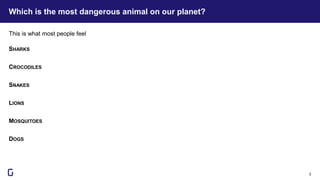
Which is the most dangerous animal on our planet?
2
SHARKS
LIONS
CROCODILES
DOGS
SNAKES
MOSQUITOES
This is what most people feel
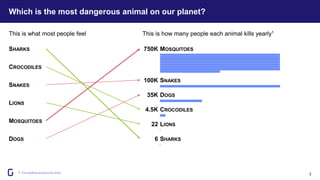
Which is the most dangerous animal on our planet?
3
1. The deadliest animal in the world
SHARKS
LIONS
CROCODILES
DOGS
SNAKES
MOSQUITOES
MOSQUITOES
750K
SNAKES
100K
DOGS
35K
CROCODILES
4.5K
LIONS
22
SHARKS
6
This is what most people feel This is how many people each animal kills yearly1
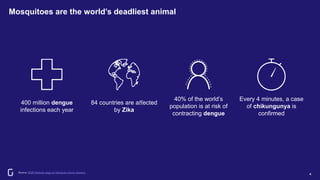
Mosquitoes are the world’s deadliest animal
4
Source: WMP Website page on Mosquito-borne diseases
400 million dengue
infections each year
84 countries are affected
by Zika
40% of the world’s
population is at risk of
contracting dengue
Every 4 minutes, a case
of chikungunya is
confirmed
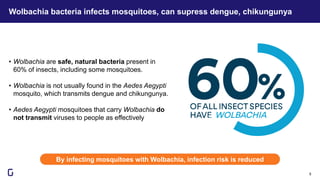
Wolbachia bacteria infects mosquitoes, can supress dengue, chikungunya
By infecting mosquitoes with Wolbachia, infection risk is reduced
5
• Wolbachia are safe, natural bacteria present in
60% of insects, including some mosquitoes.
• Wolbachia is not usually found in the Aedes Aegypti
mosquito, which transmits dengue and chikungunya.
• Aedes Aegypti mosquitoes that carry Wolbachia do
not transmit viruses to people as effectively
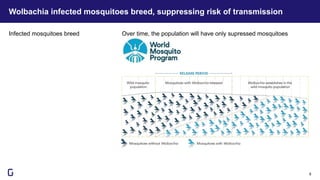
Wolbachia infected mosquitoes breed, suppressing risk of transmission
6
Infected mosquitoes breed Over time, the population will have only supressed mosquitoes
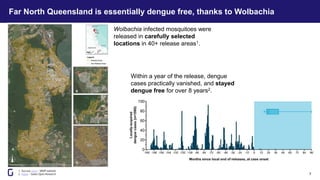
Far North Queensland is essentially dengue free, thanks to Wolbachia
7
1. Success story - WMP website
2. Paper - Gates Open Research
Wolbachia infected mosquitoes were
released in carefully selected
locations in 40+ release areas1.
Within a year of the release, dengue
cases practically vanished, and stayed
dengue free for over 8 years2.
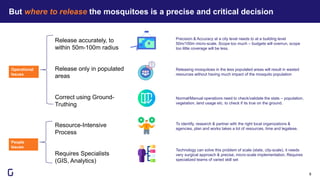
But where to release the mosquitoes is a precise and critical decision
8
Resource-Intensive
Process
Requires Specialists
(GIS, Analytics)
To identify, research & partner with the right local organizations &
agencies, plan and works takes a lot of resources, time and legalese.
Technology can solve this problem of scale (state, city-scale), it needs
very surgical approach & precise, micro-scale implementation. Requires
specialized teams of varied skill set
People
Issues
Release only in populated
areas
Release accurately, to
within 50m-100m radius
Correct using Ground-
Truthing
Precision & Accuracy at a city level needs to at a building level
50m/100m micro-scale. Scope too much – budgets will overrun, scope
too little coverage will be less.
Releasing mosquitoes in the less populated areas will result in wasted
resources without having much impact of the mosquito population
Normal/Manual operations need to check/validate the stats – population,
vegetation, land usage etc. to check if its true on the ground.
Operational
Issues
This is where we came in
9
Anand S
Co-founder, Gramener
Clients
Insights as Data Stories
twitter.com/sanand0
github.com/sanand0
We worked with the World Mosquito Program
How can we quickly and accurately identify the
exact release locations in any city?
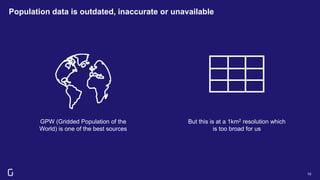
Population data is outdated, inaccurate or unavailable
10
GPW (Gridded Population of the
World) is one of the best sources
But this is at a 1km2 resolution which
is too broad for us
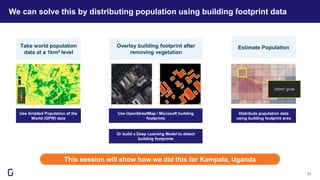
We can solve this by distributing population using building footprint data
This session will show how we did this for Kampala, Uganda
11
Take world population
data at a 1km2 level
Use Gridded Population of the
World (GPW) data
Overlay building footprint after
removing vegetation
Use OpenStreetMap / Microsoft building
footprints
Estimate Population
100m2 grids
Distribute population data
using building footprint area
Or build a Deep Learning Model to detect
building footprints
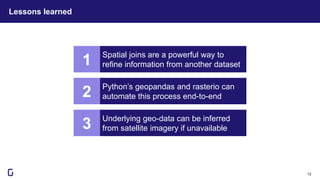
Lessons learned
12
Spatial joins are a powerful way to
refine information from another dataset
Python’s geopandas and rasterio can
automate this process end-to-end
1
2
Underlying geo-data can be inferred
from satellite imagery if unavailable
3
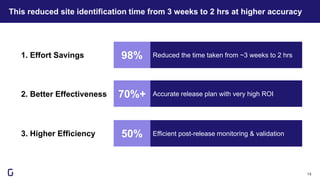
This reduced site identification time from 3 weeks to 2 hrs at higher accuracy
13
Reduced the time taken from ~3 weeks to 2 hrs
98%
Accurate release plan with very high ROI
70%+
Efficient post-release monitoring & validation
50%
1. Effort Savings
2. Better Effectiveness
3. Higher Efficiency
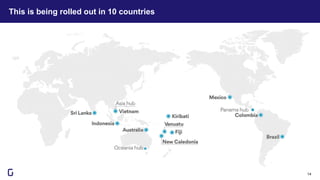
This is being rolled out in 10 countries
14
Saving Lives with
Geospatial AI
Q&A
twitter.com/sanand0

Saving Lives with Geospatial AI - Pycon Indonesia 2020

  • 1.
    Saving Lives with GeospatialAI PyCon Indonesia, 14 Nov 2020 twitter.com/sanand0
  • 2.
    Which is themost dangerous animal on our planet? 2 SHARKS LIONS CROCODILES DOGS SNAKES MOSQUITOES This is what most people feel
  • 3.
    Which is themost dangerous animal on our planet? 3 1. The deadliest animal in the world SHARKS LIONS CROCODILES DOGS SNAKES MOSQUITOES MOSQUITOES 750K SNAKES 100K DOGS 35K CROCODILES 4.5K LIONS 22 SHARKS 6 This is what most people feel This is how many people each animal kills yearly1
  • 4.
    Mosquitoes are theworld’s deadliest animal 4 Source: WMP Website page on Mosquito-borne diseases 400 million dengue infections each year 84 countries are affected by Zika 40% of the world’s population is at risk of contracting dengue Every 4 minutes, a case of chikungunya is confirmed
  • 5.
    Wolbachia bacteria infectsmosquitoes, can supress dengue, chikungunya By infecting mosquitoes with Wolbachia, infection risk is reduced 5 • Wolbachia are safe, natural bacteria present in 60% of insects, including some mosquitoes. • Wolbachia is not usually found in the Aedes Aegypti mosquito, which transmits dengue and chikungunya. • Aedes Aegypti mosquitoes that carry Wolbachia do not transmit viruses to people as effectively
  • 6.
    Wolbachia infected mosquitoesbreed, suppressing risk of transmission 6 Infected mosquitoes breed Over time, the population will have only supressed mosquitoes
  • 7.
    Far North Queenslandis essentially dengue free, thanks to Wolbachia 7 1. Success story - WMP website 2. Paper - Gates Open Research Wolbachia infected mosquitoes were released in carefully selected locations in 40+ release areas1. Within a year of the release, dengue cases practically vanished, and stayed dengue free for over 8 years2.
  • 8.
    But where torelease the mosquitoes is a precise and critical decision 8 Resource-Intensive Process Requires Specialists (GIS, Analytics) To identify, research & partner with the right local organizations & agencies, plan and works takes a lot of resources, time and legalese. Technology can solve this problem of scale (state, city-scale), it needs very surgical approach & precise, micro-scale implementation. Requires specialized teams of varied skill set People Issues Release only in populated areas Release accurately, to within 50m-100m radius Correct using Ground- Truthing Precision & Accuracy at a city level needs to at a building level 50m/100m micro-scale. Scope too much – budgets will overrun, scope too little coverage will be less. Releasing mosquitoes in the less populated areas will result in wasted resources without having much impact of the mosquito population Normal/Manual operations need to check/validate the stats – population, vegetation, land usage etc. to check if its true on the ground. Operational Issues
  • 9.
    This is wherewe came in 9 Anand S Co-founder, Gramener Clients Insights as Data Stories twitter.com/sanand0 github.com/sanand0 We worked with the World Mosquito Program How can we quickly and accurately identify the exact release locations in any city?
  • 10.
    Population data isoutdated, inaccurate or unavailable 10 GPW (Gridded Population of the World) is one of the best sources But this is at a 1km2 resolution which is too broad for us
  • 11.
    We can solvethis by distributing population using building footprint data This session will show how we did this for Kampala, Uganda 11 Take world population data at a 1km2 level Use Gridded Population of the World (GPW) data Overlay building footprint after removing vegetation Use OpenStreetMap / Microsoft building footprints Estimate Population 100m2 grids Distribute population data using building footprint area Or build a Deep Learning Model to detect building footprints
  • 12.
    Lessons learned 12 Spatial joinsare a powerful way to refine information from another dataset Python’s geopandas and rasterio can automate this process end-to-end 1 2 Underlying geo-data can be inferred from satellite imagery if unavailable 3
  • 13.
    This reduced siteidentification time from 3 weeks to 2 hrs at higher accuracy 13 Reduced the time taken from ~3 weeks to 2 hrs 98% Accurate release plan with very high ROI 70%+ Efficient post-release monitoring & validation 50% 1. Effort Savings 2. Better Effectiveness 3. Higher Efficiency
  • 14.
    This is beingrolled out in 10 countries 14
  • 15.
    Saving Lives with GeospatialAI Q&A twitter.com/sanand0