Table of Contents
2
1. Blockchain and DLT 101
2. DLT Landscape
3. Use Cases and Business
Models
4. Architecture and Governance
2017 Global Blockchain Benchmarking Study
5. Challenges and Interoperability
6. Public Sector
7. Appendices
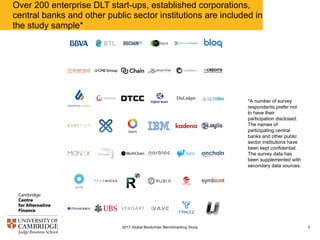
Over 200 enterprise DLT start-ups, established corporations,
central banks and other public sector institutions are included in
the study sample*
32017 Global Blockchain Benchmarking Study
*A number of survey
respondents prefer not
to have their
participation disclosed.
The names of
participating central
banks and other public
sector institutions have
been kept confidential.
The survey data has
been supplemented with
secondary data sources.
Study Authors
4
Dr Garrick Hileman
Research Fellow, Head of Cryptocurrency
and Blockchain Research
g.hileman@jbs.cam.ac.uk
Michel Rauchs
Research Assistant
m.rauchs@jbs.cam.ac.uk
2017 Global Blockchain Benchmarking Study
Blockchain and DLT 101
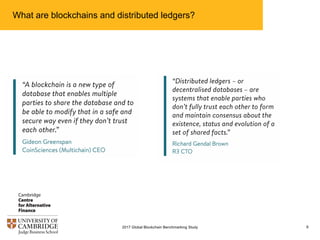
What are blockchains and distributed ledgers?
62017 Global Blockchain Benchmarking Study
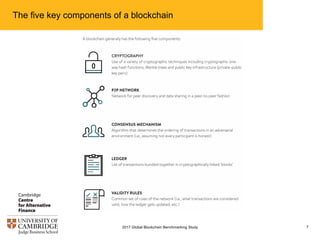
The five key components of a blockchain
72017 Global Blockchain Benchmarking Study
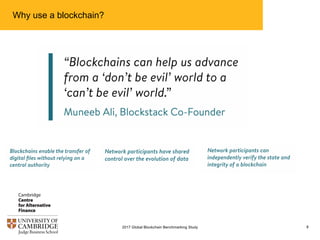
Why use a blockchain?
82017 Global Blockchain Benchmarking Study
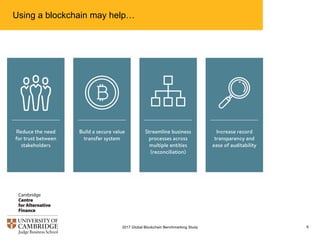
Using a blockchain may help…
92017 Global Blockchain Benchmarking Study
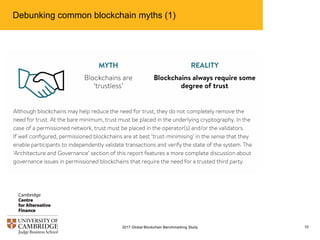
Debunking common blockchain myths (1)
102017 Global Blockchain Benchmarking Study
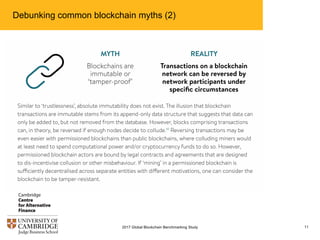
Debunking common blockchain myths (2)
112017 Global Blockchain Benchmarking Study
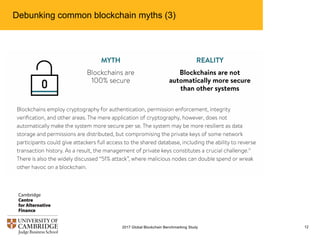
Debunking common blockchain myths (3)
122017 Global Blockchain Benchmarking Study
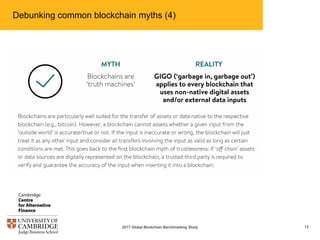
Debunking common blockchain myths (4)
132017 Global Blockchain Benchmarking Study
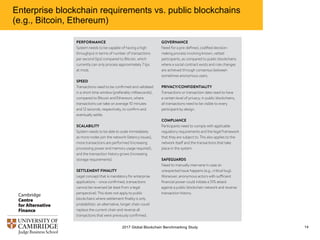
Enterprise blockchain requirements vs. public blockchains
(e.g., Bitcoin, Ethereum)
142017 Global Blockchain Benchmarking Study
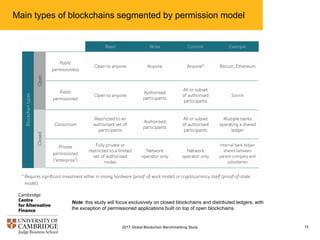
Main types of blockchains segmented by permission model
152017 Global Blockchain Benchmarking Study
Note: this study will focus exclusively on closed blockchains and distributed ledgers, with
the exception of permissioned applications built on top of open blockchains.
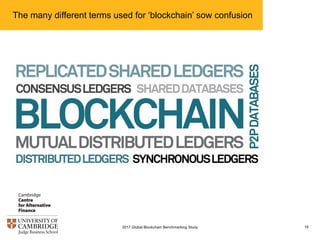
The many different terms used for ‘blockchain’ sow confusion
162017 Global Blockchain Benchmarking Study
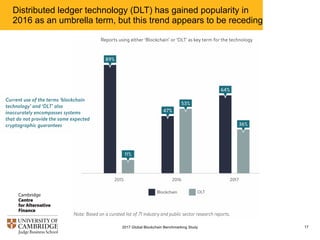
Distributed ledger technology (DLT) has gained popularity in
2016 as an umbrella term, but this trend appears to be receding
172017 Global Blockchain Benchmarking Study
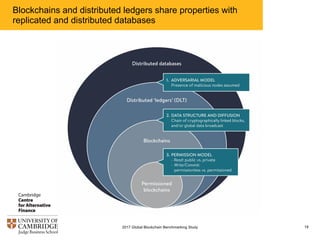
Blockchains and distributed ledgers share properties with
replicated and distributed databases
182017 Global Blockchain Benchmarking Study
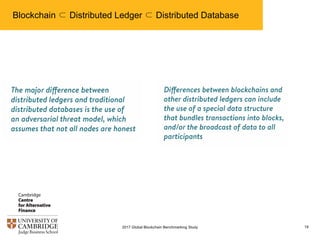
Blockchain ⊂ Distributed Ledger ⊂ Distributed Database
192017 Global Blockchain Benchmarking Study
DLT Landscape
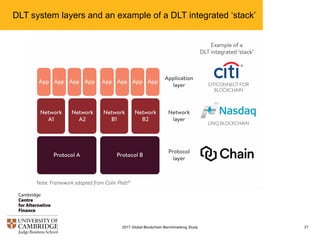
DLT system layers and an example of a DLT integrated ‘stack’
212017 Global Blockchain Benchmarking Study
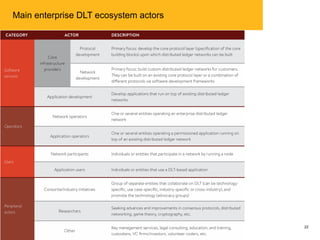
Main enterprise DLT ecosystem actors
222017 Global Blockchain Benchmarking Study
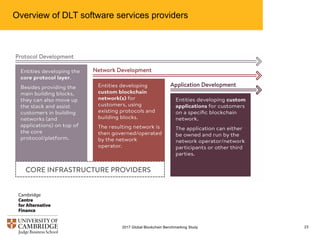
Overview of DLT software services providers
232017 Global Blockchain Benchmarking Study
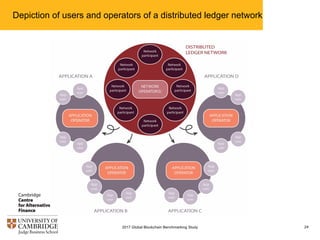
Depiction of users and operators of a distributed ledger network
242017 Global Blockchain Benchmarking Study
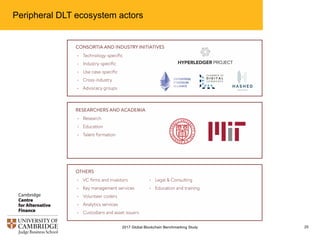
Peripheral DLT ecosystem actors
252017 Global Blockchain Benchmarking Study
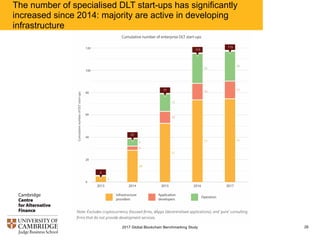
The number of specialised DLT start-ups has significantly
increased since 2014: majority are active in developing
infrastructure
262017 Global Blockchain Benchmarking Study
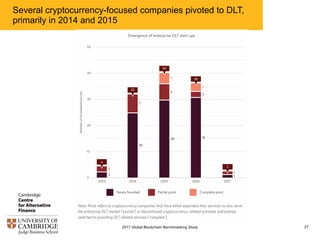
Several cryptocurrency-focused companies pivoted to DLT,
primarily in 2014 and 2015
272017 Global Blockchain Benchmarking Study
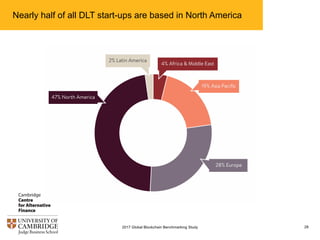
Nearly half of all DLT start-ups are based in North America
282017 Global Blockchain Benchmarking Study
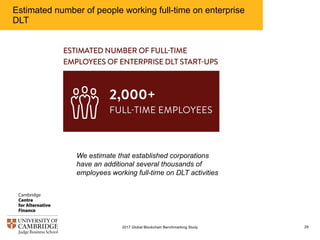
Estimated number of people working full-time on enterprise
DLT
292017 Global Blockchain Benchmarking Study
We estimate that established corporations
have an additional several thousands of
employees working full-time on DLT activities
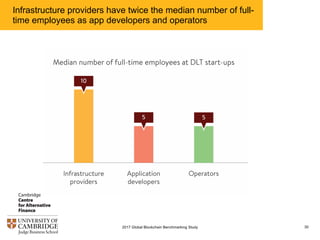
Infrastructure providers have twice the median number of full-
time employees as app developers and operators
302017 Global Blockchain Benchmarking Study
Use Cases and Business Models
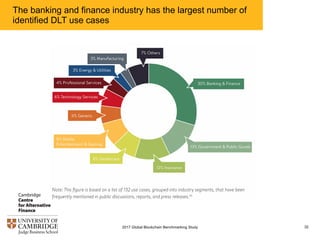
The banking and finance industry has the largest number of
identified DLT use cases
322017 Global Blockchain Benchmarking Study
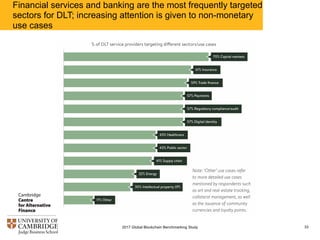
Financial services and banking are the most frequently targeted
sectors for DLT; increasing attention is given to non-monetary
use cases
332017 Global Blockchain Benchmarking Study
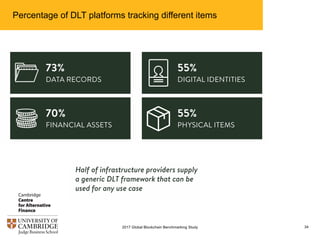
Percentage of DLT platforms tracking different items
342017 Global Blockchain Benchmarking Study
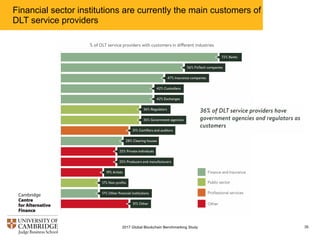
Financial sector institutions are currently the main customers of
DLT service providers
352017 Global Blockchain Benchmarking Study
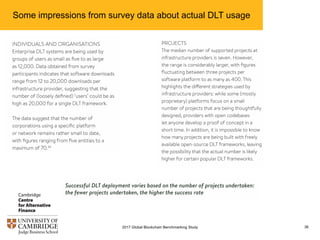
Some impressions from survey data about actual DLT usage
362017 Global Blockchain Benchmarking Study
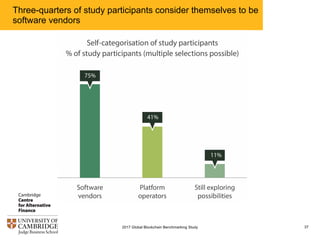
Three-quarters of study participants consider themselves to be
software vendors
372017 Global Blockchain Benchmarking Study
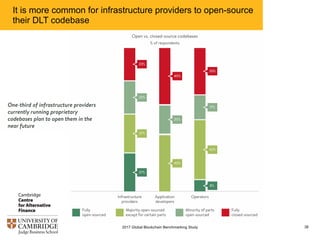
It is more common for infrastructure providers to open-source
their DLT codebase
382017 Global Blockchain Benchmarking Study
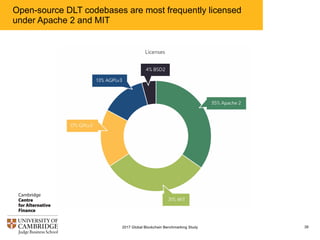
Open-source DLT codebases are most frequently licensed
under Apache 2 and MIT
392017 Global Blockchain Benchmarking Study
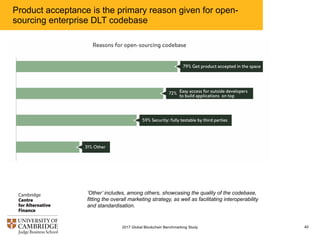
Product acceptance is the primary reason given for open-
sourcing enterprise DLT codebase
402017 Global Blockchain Benchmarking Study
’Other’ includes, among others, showcasing the quality of the codebase,
fitting the overall marketing strategy, as well as facilitating interoperability
and standardisation.
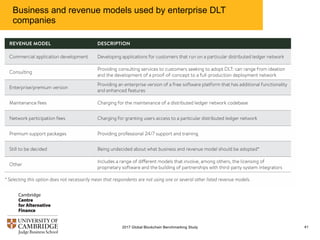
Business and revenue models used by enterprise DLT
companies
412017 Global Blockchain Benchmarking Study
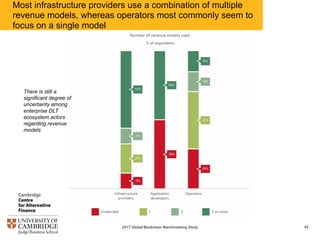
Most infrastructure providers use a combination of multiple
revenue models, whereas operators most commonly seem to
focus on a single model
422017 Global Blockchain Benchmarking Study
There is still a
significant degree of
uncertainty among
enterprise DLT
ecosystem actors
regarding revenue
models
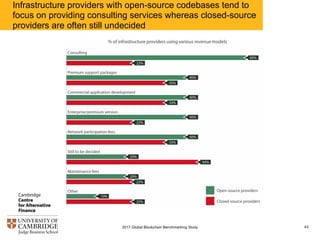
Infrastructure providers with open-source codebases tend to
focus on providing consulting services whereas closed-source
providers are often still undecided
432017 Global Blockchain Benchmarking Study
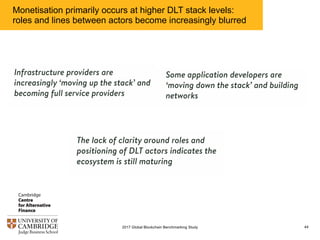
Monetisation primarily occurs at higher DLT stack levels:
roles and lines between actors become increasingly blurred
442017 Global Blockchain Benchmarking Study
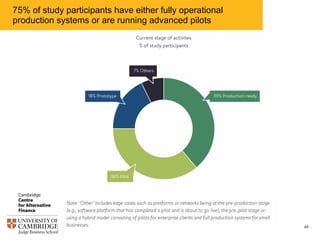
75% of study participants have either fully operational
production systems or are running advanced pilots
452017 Global Blockchain Benchmarking Study
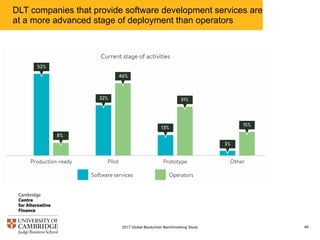
DLT companies that provide software development services are
at a more advanced stage of deployment than operators
462017 Global Blockchain Benchmarking Study
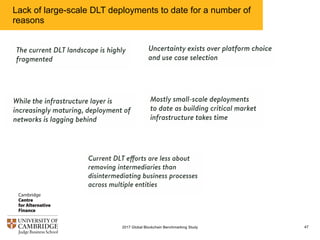
Lack of large-scale DLT deployments to date for a number of
reasons
472017 Global Blockchain Benchmarking Study
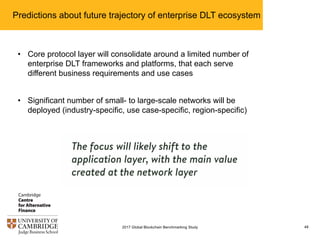
Predictions about future trajectory of enterprise DLT ecosystem
482017 Global Blockchain Benchmarking Study
• Core protocol layer will consolidate around a limited number of
enterprise DLT frameworks and platforms, that each serve
different business requirements and use cases
• Significant number of small- to large-scale networks will be
deployed (industry-specific, use case-specific, region-specific)
Architecture and Governance
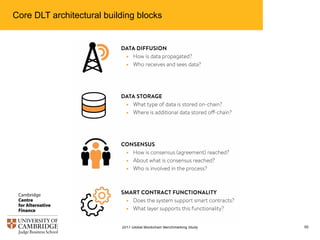
Core DLT architectural building blocks
502017 Global Blockchain Benchmarking Study
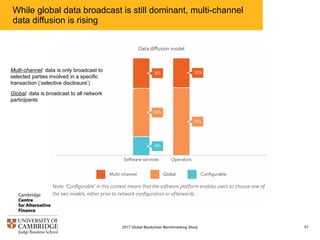
While global data broadcast is still dominant, multi-channel
data diffusion is rising
512017 Global Blockchain Benchmarking Study
Multi-channel: data is only broadcast to
selected parties involved in a specific
transaction (‘selective disclosure’)
Global: data is broadcast to all network
participants
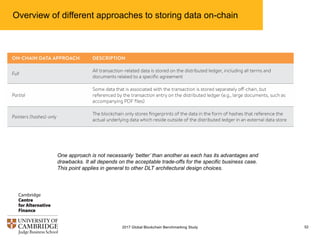
Overview of different approaches to storing data on-chain
522017 Global Blockchain Benchmarking Study
One approach is not necessarily ’better’ than another as each has its advantages and
drawbacks. It all depends on the acceptable trade-offs for the specific business case.
This point applies in general to other DLT architectural design choices.
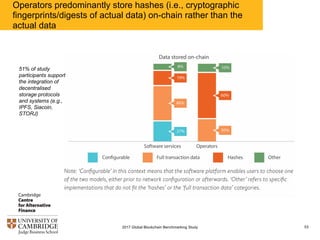
Operators predominantly store hashes (i.e., cryptographic
fingerprints/digests of actual data) on-chain rather than the
actual data
532017 Global Blockchain Benchmarking Study
51% of study
participants support
the integration of
decentralised
storage protocols
and systems (e.g.,
IPFS, Siacoin,
STORJ)
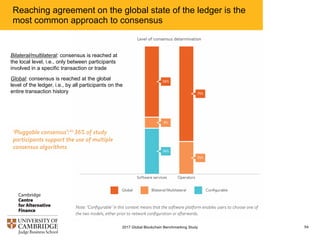
Reaching agreement on the global state of the ledger is the
most common approach to consensus
542017 Global Blockchain Benchmarking Study
Bilateral/multilateral: consensus is reached at
the local level, i.e., only between participants
involved in a specific transaction or trade
Global: consensus is reached at the global
level of the ledger, i.e., by all participants on the
entire transaction history
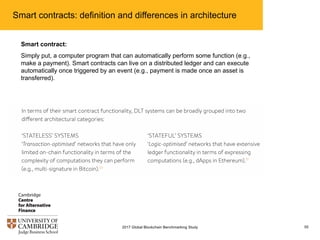
Smart contracts: definition and differences in architecture
552017 Global Blockchain Benchmarking Study
Smart contract:
Simply put, a computer program that can automatically perform some function (e.g.,
make a payment). Smart contracts can live on a distributed ledger and can execute
automatically once triggered by an event (e.g., payment is made once an asset is
transferred).
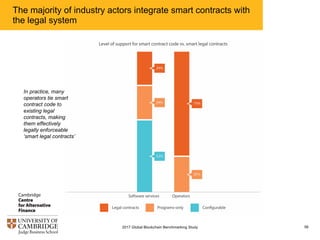
The majority of industry actors integrate smart contracts with
the legal system
562017 Global Blockchain Benchmarking Study
In practice, many
operators tie smart
contract code to
existing legal
contracts, making
them effectively
legally enforceable
‘smart legal contracts’
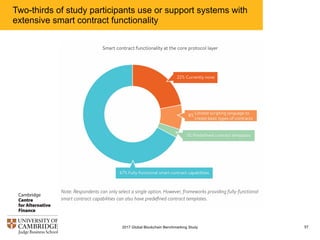
Two-thirds of study participants use or support systems with
extensive smart contract functionality
572017 Global Blockchain Benchmarking Study
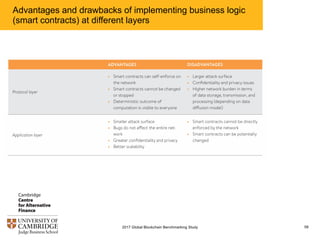
Advantages and drawbacks of implementing business logic
(smart contracts) at different layers
582017 Global Blockchain Benchmarking Study
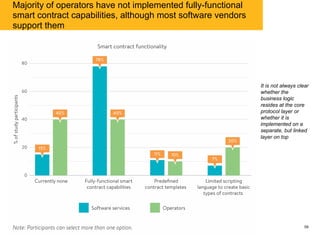
Majority of operators have not implemented fully-functional
smart contract capabilities, although most software vendors
support them
592017 Global Blockchain Benchmarking Study
It is not always clear
whether the
business logic
resides at the core
protocol layer or
whether it is
implemented on a
separate, but linked
layer on top
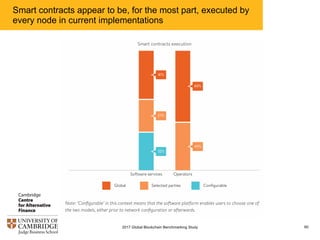
Smart contracts appear to be, for the most part, executed by
every node in current implementations
602017 Global Blockchain Benchmarking Study
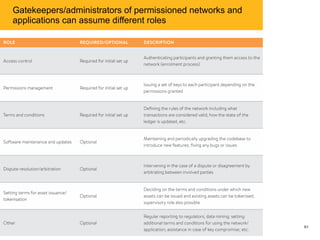
Gatekeepers/administrators of permissioned networks and
applications can assume different roles
612017 Global Blockchain Benchmarking Study
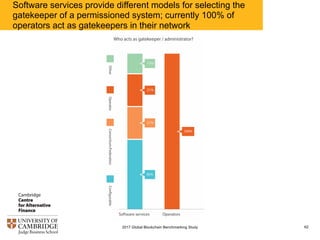
Software services provide different models for selecting the
gatekeeper of a permissioned system; currently 100% of
operators act as gatekeepers in their network
622017 Global Blockchain Benchmarking Study
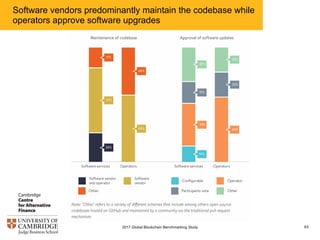
Software vendors predominantly maintain the codebase while
operators approve software upgrades
632017 Global Blockchain Benchmarking Study
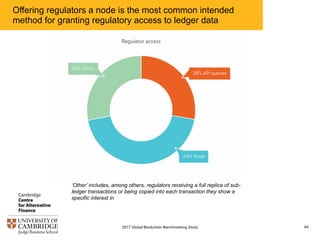
Offering regulators a node is the most common intended
method for granting regulatory access to ledger data
642017 Global Blockchain Benchmarking Study
‘Other’ includes, among others, regulators receiving a full replica of sub-
ledger transactions or being copied into each transaction they show a
specific interest in
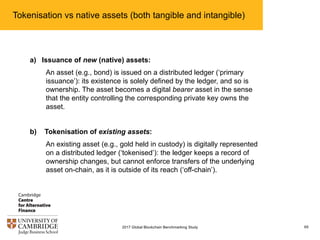
Tokenisation vs native assets (both tangible and intangible)
652017 Global Blockchain Benchmarking Study
a) Issuance of new (native) assets:
An asset (e.g., bond) is issued on a distributed ledger (‘primary
issuance’): its existence is solely defined by the ledger, and so is
ownership. The asset becomes a digital bearer asset in the sense
that the entity controlling the corresponding private key owns the
asset.
b) Tokenisation of existing assets:
An existing asset (e.g., gold held in custody) is digitally represented
on a distributed ledger (‘tokenised’): the ledger keeps a record of
ownership changes, but cannot enforce transfers of the underlying
asset on-chain, as it is outside of its reach (‘off-chain’).
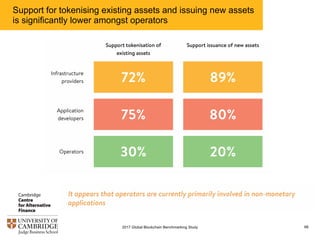
Support for tokenising existing assets and issuing new assets
is significantly lower amongst operators
662017 Global Blockchain Benchmarking Study
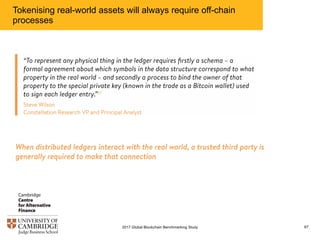
Tokenising real-world assets will always require off-chain
processes
672017 Global Blockchain Benchmarking Study
Challenges and Interoperability
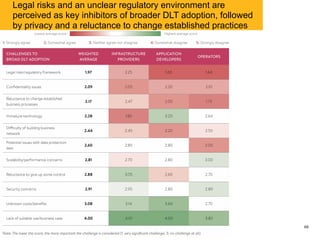
Legal risks and an unclear regulatory environment are
perceived as key inhibitors of broader DLT adoption, followed
by privacy and a reluctance to change established practices
692017 Global Blockchain Benchmarking Study
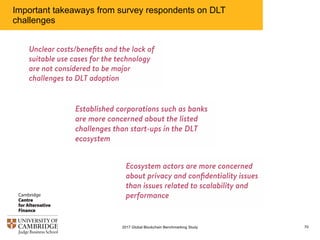
Important takeaways from survey respondents on DLT
challenges
702017 Global Blockchain Benchmarking Study
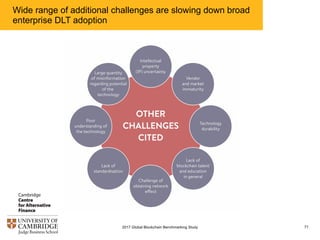
Wide range of additional challenges are slowing down broad
enterprise DLT adoption
712017 Global Blockchain Benchmarking Study
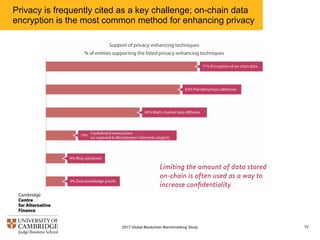
Privacy is frequently cited as a key challenge; on-chain data
encryption is the most common method for enhancing privacy
722017 Global Blockchain Benchmarking Study
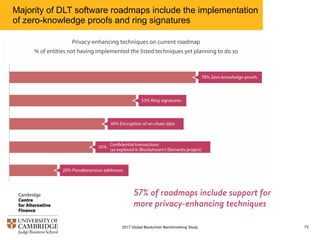
Majority of DLT software roadmaps include the implementation
of zero-knowledge proofs and ring signatures
732017 Global Blockchain Benchmarking Study
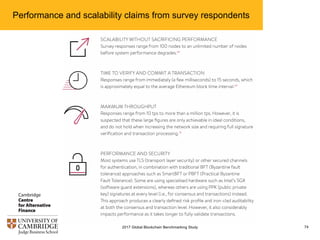
Performance and scalability claims from survey respondents
742017 Global Blockchain Benchmarking Study
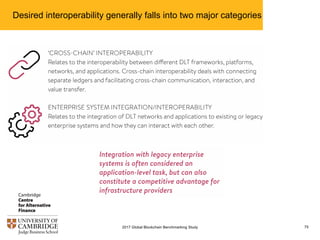
Desired interoperability generally falls into two major categories
752017 Global Blockchain Benchmarking Study
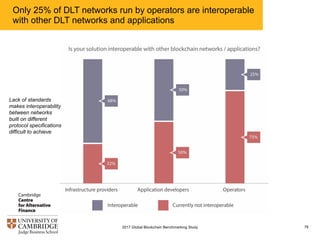
Only 25% of DLT networks run by operators are interoperable
with other DLT networks and applications
762017 Global Blockchain Benchmarking Study
Lack of standards
makes interoperability
between networks
built on different
protocol specifications
difficult to achieve
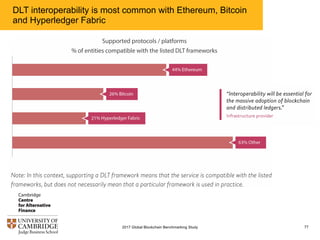
DLT interoperability is most common with Ethereum, Bitcoin
and Hyperledger Fabric
772017 Global Blockchain Benchmarking Study
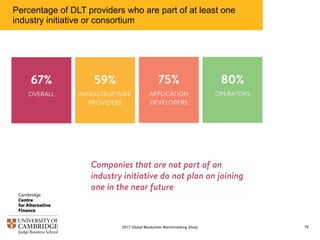
Percentage of DLT providers who are part of at least one
industry initiative or consortium
782017 Global Blockchain Benchmarking Study
Public Sector
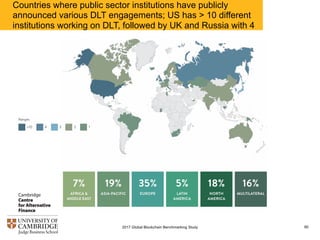
Countries where public sector institutions have publicly
announced various DLT engagements; US has > 10 different
institutions working on DLT, followed by UK and Russia with 4
802017 Global Blockchain Benchmarking Study
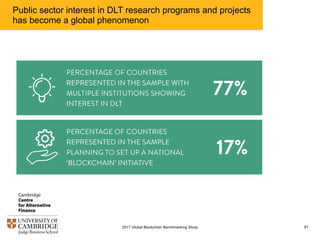
Public sector interest in DLT research programs and projects
has become a global phenomenon
812017 Global Blockchain Benchmarking Study
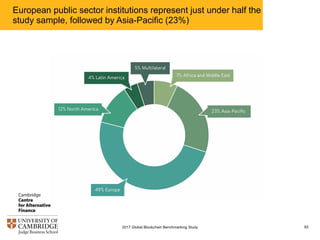
European public sector institutions represent just under half the
study sample, followed by Asia-Pacific (23%)
822017 Global Blockchain Benchmarking Study
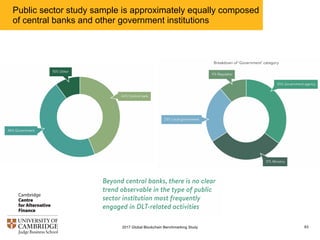
Public sector study sample is approximately equally composed
of central banks and other government institutions
832017 Global Blockchain Benchmarking Study
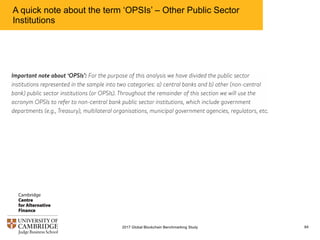
A quick note about the term ‘OPSIs’ – Other Public Sector
Institutions
842017 Global Blockchain Benchmarking Study
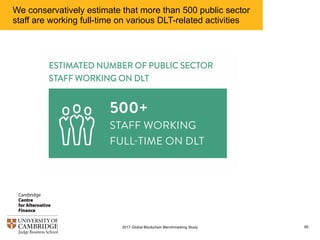
We conservatively estimate that more than 500 public sector
staff are working full-time on various DLT-related activities
852017 Global Blockchain Benchmarking Study
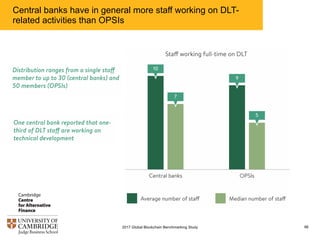
Central banks have in general more staff working on DLT-
related activities than OPSIs
862017 Global Blockchain Benchmarking Study
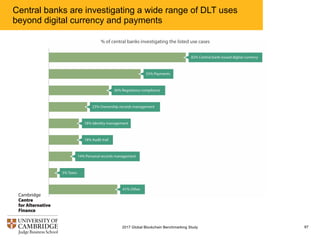
Central banks are investigating a wide range of DLT uses
beyond digital currency and payments
872017 Global Blockchain Benchmarking Study
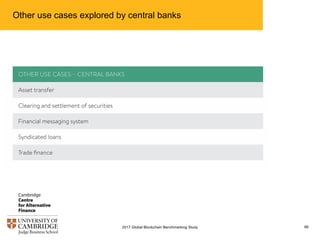
Other use cases explored by central banks
882017 Global Blockchain Benchmarking Study
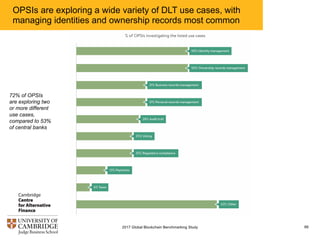
OPSIs are exploring a wide variety of DLT use cases, with
managing identities and ownership records most common
892017 Global Blockchain Benchmarking Study
72% of OPSIs
are exploring two
or more different
use cases,
compared to 53%
of central banks
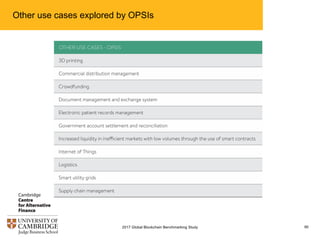
Other use cases explored by OPSIs
902017 Global Blockchain Benchmarking Study
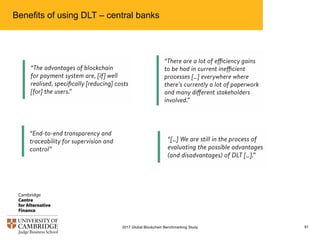
Benefits of using DLT – central banks
912017 Global Blockchain Benchmarking Study
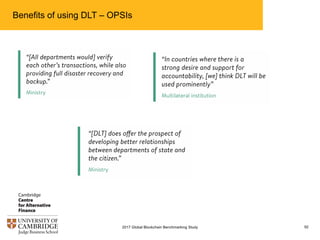
Benefits of using DLT – OPSIs
922017 Global Blockchain Benchmarking Study
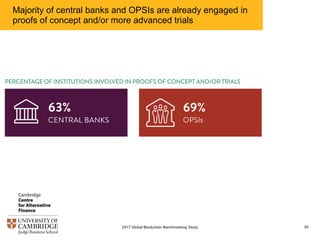
Majority of central banks and OPSIs are already engaged in
proofs of concept and/or more advanced trials
932017 Global Blockchain Benchmarking Study
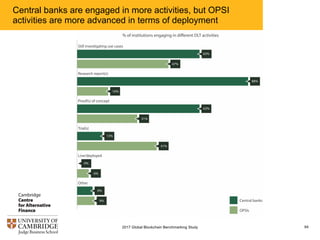
Central banks are engaged in more activities, but OPSI
activities are more advanced in terms of deployment
942017 Global Blockchain Benchmarking Study
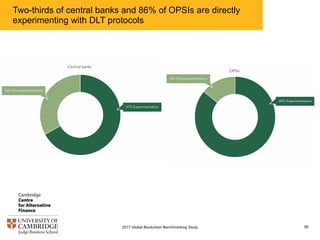
Two-thirds of central banks and 86% of OPSIs are directly
experimenting with DLT protocols
952017 Global Blockchain Benchmarking Study
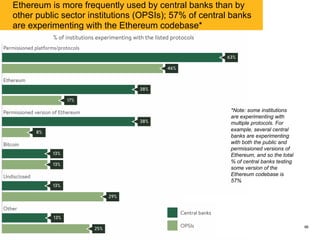
Ethereum is more frequently used by central banks than by
other public sector institutions (OPSIs); 57% of central banks
are experimenting with the Ethereum codebase*
962017 Global Blockchain Benchmarking Study
*Note: some institutions
are experimenting with
multiple protocols. For
example, several central
banks are experimenting
with both the public and
permissioned versions of
Ethereum, and so the total
% of central banks testing
some version of the
Ethereum codebase is
57%
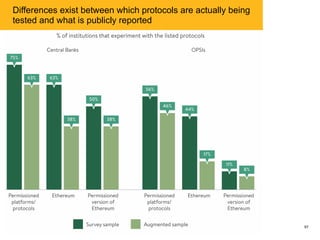
Differences exist between which protocols are actually being
tested and what is publicly reported
972017 Global Blockchain Benchmarking Study
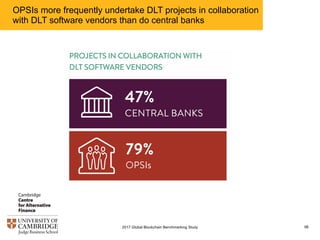
OPSIs more frequently undertake DLT projects in collaboration
with DLT software vendors than do central banks
982017 Global Blockchain Benchmarking Study
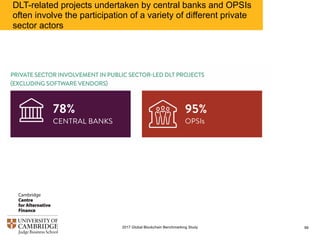
DLT-related projects undertaken by central banks and OPSIs
often involve the participation of a variety of different private
sector actors
992017 Global Blockchain Benchmarking Study
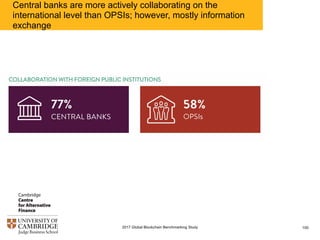
Central banks are more actively collaborating on the
international level than OPSIs; however, mostly information
exchange
1002017 Global Blockchain Benchmarking Study
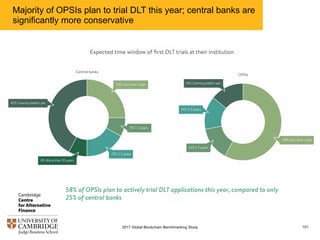
Majority of OPSIs plan to trial DLT this year; central banks are
significantly more conservative
1012017 Global Blockchain Benchmarking Study
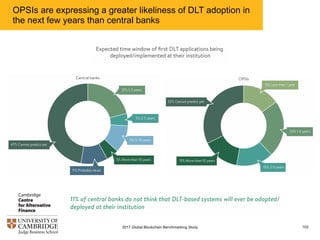
OPSIs are expressing a greater likeliness of DLT adoption in
the next few years than central banks
1022017 Global Blockchain Benchmarking Study
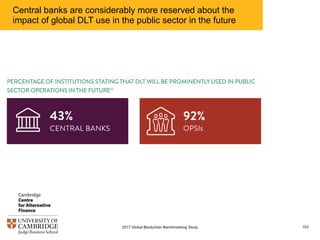
Central banks are considerably more reserved about the
impact of global DLT use in the public sector in the future
1032017 Global Blockchain Benchmarking Study
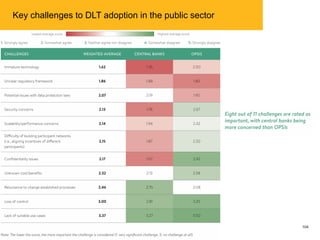
Key challenges to DLT adoption in the public sector
1042017 Global Blockchain Benchmarking Study
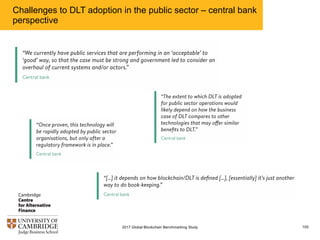
Challenges to DLT adoption in the public sector – central bank
perspective
1052017 Global Blockchain Benchmarking Study
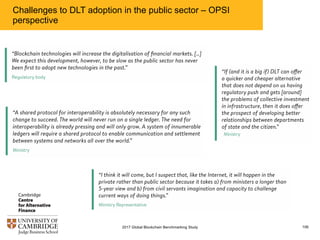
Challenges to DLT adoption in the public sector – OPSI
perspective
1062017 Global Blockchain Benchmarking Study
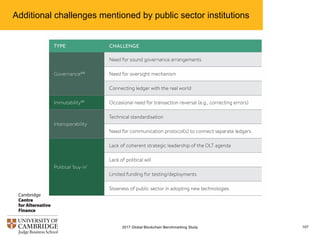
Additional challenges mentioned by public sector institutions
1072017 Global Blockchain Benchmarking Study
Appendices
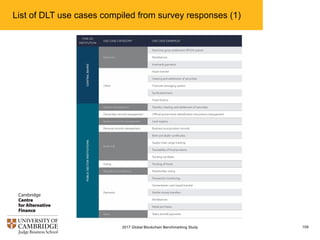
List of DLT use cases compiled from survey responses (1)
1092017 Global Blockchain Benchmarking Study
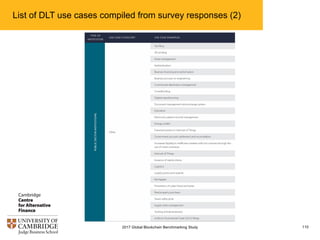
List of DLT use cases compiled from survey responses (2)
1102017 Global Blockchain Benchmarking Study
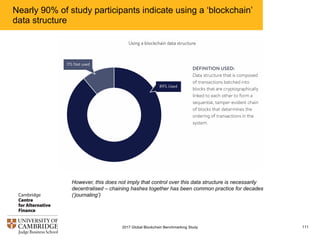
Nearly 90% of study participants indicate using a ‘blockchain’
data structure
1112017 Global Blockchain Benchmarking Study
However, this does not imply that control over this data structure is necessarily
decentralised – chaining hashes together has been common practice for decades
(‘journaling’)
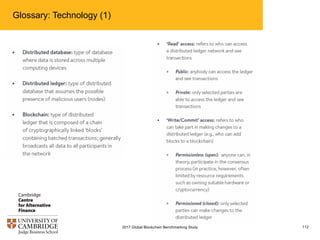
Glossary: Technology (1)
1122017 Global Blockchain Benchmarking Study
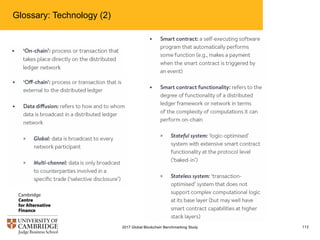
Glossary: Technology (2)
1132017 Global Blockchain Benchmarking Study
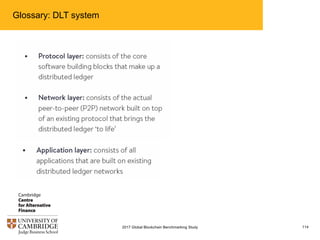
Glossary: DLT system
1142017 Global Blockchain Benchmarking Study
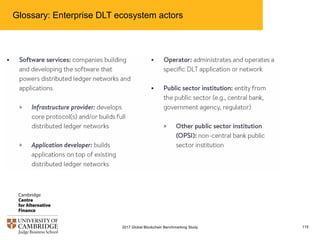
Glossary: Enterprise DLT ecosystem actors
1152017 Global Blockchain Benchmarking Study
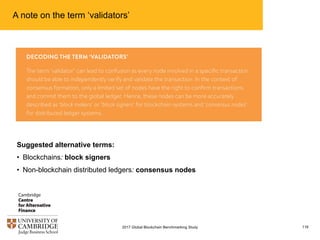
A note on the term ‘validators’
1162017 Global Blockchain Benchmarking Study
Suggested alternative terms:
• Blockchains: block signers
• Non-blockchain distributed ledgers: consensus nodes

2017 Global Blockchain Benchmarking Study

  • 2.
    Table of Contents 2 1.Blockchain and DLT 101 2. DLT Landscape 3. Use Cases and Business Models 4. Architecture and Governance 2017 Global Blockchain Benchmarking Study 5. Challenges and Interoperability 6. Public Sector 7. Appendices
  • 3.
    Over 200 enterpriseDLT start-ups, established corporations, central banks and other public sector institutions are included in the study sample* 32017 Global Blockchain Benchmarking Study *A number of survey respondents prefer not to have their participation disclosed. The names of participating central banks and other public sector institutions have been kept confidential. The survey data has been supplemented with secondary data sources.
  • 4.
    Study Authors 4 Dr GarrickHileman Research Fellow, Head of Cryptocurrency and Blockchain Research g.hileman@jbs.cam.ac.uk Michel Rauchs Research Assistant m.rauchs@jbs.cam.ac.uk 2017 Global Blockchain Benchmarking Study
  • 5.
  • 6.
    What are blockchainsand distributed ledgers? 62017 Global Blockchain Benchmarking Study
  • 7.
    The five keycomponents of a blockchain 72017 Global Blockchain Benchmarking Study
  • 8.
    Why use ablockchain? 82017 Global Blockchain Benchmarking Study
  • 9.
    Using a blockchainmay help… 92017 Global Blockchain Benchmarking Study
  • 10.
    Debunking common blockchainmyths (1) 102017 Global Blockchain Benchmarking Study
  • 11.
    Debunking common blockchainmyths (2) 112017 Global Blockchain Benchmarking Study
  • 12.
    Debunking common blockchainmyths (3) 122017 Global Blockchain Benchmarking Study
  • 13.
    Debunking common blockchainmyths (4) 132017 Global Blockchain Benchmarking Study
  • 14.
    Enterprise blockchain requirementsvs. public blockchains (e.g., Bitcoin, Ethereum) 142017 Global Blockchain Benchmarking Study
  • 15.
    Main types ofblockchains segmented by permission model 152017 Global Blockchain Benchmarking Study Note: this study will focus exclusively on closed blockchains and distributed ledgers, with the exception of permissioned applications built on top of open blockchains.
  • 16.
    The many differentterms used for ‘blockchain’ sow confusion 162017 Global Blockchain Benchmarking Study
  • 17.
    Distributed ledger technology(DLT) has gained popularity in 2016 as an umbrella term, but this trend appears to be receding 172017 Global Blockchain Benchmarking Study
  • 18.
    Blockchains and distributedledgers share properties with replicated and distributed databases 182017 Global Blockchain Benchmarking Study
  • 19.
    Blockchain ⊂ DistributedLedger ⊂ Distributed Database 192017 Global Blockchain Benchmarking Study
  • 20.
  • 21.
    DLT system layersand an example of a DLT integrated ‘stack’ 212017 Global Blockchain Benchmarking Study
  • 22.
    Main enterprise DLTecosystem actors 222017 Global Blockchain Benchmarking Study
  • 23.
    Overview of DLTsoftware services providers 232017 Global Blockchain Benchmarking Study
  • 24.
    Depiction of usersand operators of a distributed ledger network 242017 Global Blockchain Benchmarking Study
  • 25.
    Peripheral DLT ecosystemactors 252017 Global Blockchain Benchmarking Study
  • 26.
    The number ofspecialised DLT start-ups has significantly increased since 2014: majority are active in developing infrastructure 262017 Global Blockchain Benchmarking Study
  • 27.
    Several cryptocurrency-focused companiespivoted to DLT, primarily in 2014 and 2015 272017 Global Blockchain Benchmarking Study
  • 28.
    Nearly half ofall DLT start-ups are based in North America 282017 Global Blockchain Benchmarking Study
  • 29.
    Estimated number ofpeople working full-time on enterprise DLT 292017 Global Blockchain Benchmarking Study We estimate that established corporations have an additional several thousands of employees working full-time on DLT activities
  • 30.
    Infrastructure providers havetwice the median number of full- time employees as app developers and operators 302017 Global Blockchain Benchmarking Study
  • 31.
    Use Cases andBusiness Models
  • 32.
    The banking andfinance industry has the largest number of identified DLT use cases 322017 Global Blockchain Benchmarking Study
  • 33.
    Financial services andbanking are the most frequently targeted sectors for DLT; increasing attention is given to non-monetary use cases 332017 Global Blockchain Benchmarking Study
  • 34.
    Percentage of DLTplatforms tracking different items 342017 Global Blockchain Benchmarking Study
  • 35.
    Financial sector institutionsare currently the main customers of DLT service providers 352017 Global Blockchain Benchmarking Study
  • 36.
    Some impressions fromsurvey data about actual DLT usage 362017 Global Blockchain Benchmarking Study
  • 37.
    Three-quarters of studyparticipants consider themselves to be software vendors 372017 Global Blockchain Benchmarking Study
  • 38.
    It is morecommon for infrastructure providers to open-source their DLT codebase 382017 Global Blockchain Benchmarking Study
  • 39.
    Open-source DLT codebasesare most frequently licensed under Apache 2 and MIT 392017 Global Blockchain Benchmarking Study
  • 40.
    Product acceptance isthe primary reason given for open- sourcing enterprise DLT codebase 402017 Global Blockchain Benchmarking Study ’Other’ includes, among others, showcasing the quality of the codebase, fitting the overall marketing strategy, as well as facilitating interoperability and standardisation.
  • 41.
    Business and revenuemodels used by enterprise DLT companies 412017 Global Blockchain Benchmarking Study
  • 42.
    Most infrastructure providersuse a combination of multiple revenue models, whereas operators most commonly seem to focus on a single model 422017 Global Blockchain Benchmarking Study There is still a significant degree of uncertainty among enterprise DLT ecosystem actors regarding revenue models
  • 43.
    Infrastructure providers withopen-source codebases tend to focus on providing consulting services whereas closed-source providers are often still undecided 432017 Global Blockchain Benchmarking Study
  • 44.
    Monetisation primarily occursat higher DLT stack levels: roles and lines between actors become increasingly blurred 442017 Global Blockchain Benchmarking Study
  • 45.
    75% of studyparticipants have either fully operational production systems or are running advanced pilots 452017 Global Blockchain Benchmarking Study
  • 46.
    DLT companies thatprovide software development services are at a more advanced stage of deployment than operators 462017 Global Blockchain Benchmarking Study
  • 47.
    Lack of large-scaleDLT deployments to date for a number of reasons 472017 Global Blockchain Benchmarking Study
  • 48.
    Predictions about futuretrajectory of enterprise DLT ecosystem 482017 Global Blockchain Benchmarking Study • Core protocol layer will consolidate around a limited number of enterprise DLT frameworks and platforms, that each serve different business requirements and use cases • Significant number of small- to large-scale networks will be deployed (industry-specific, use case-specific, region-specific)
  • 49.
  • 50.
    Core DLT architecturalbuilding blocks 502017 Global Blockchain Benchmarking Study
  • 51.
    While global databroadcast is still dominant, multi-channel data diffusion is rising 512017 Global Blockchain Benchmarking Study Multi-channel: data is only broadcast to selected parties involved in a specific transaction (‘selective disclosure’) Global: data is broadcast to all network participants
  • 52.
    Overview of differentapproaches to storing data on-chain 522017 Global Blockchain Benchmarking Study One approach is not necessarily ’better’ than another as each has its advantages and drawbacks. It all depends on the acceptable trade-offs for the specific business case. This point applies in general to other DLT architectural design choices.
  • 53.
    Operators predominantly storehashes (i.e., cryptographic fingerprints/digests of actual data) on-chain rather than the actual data 532017 Global Blockchain Benchmarking Study 51% of study participants support the integration of decentralised storage protocols and systems (e.g., IPFS, Siacoin, STORJ)
  • 54.
    Reaching agreement onthe global state of the ledger is the most common approach to consensus 542017 Global Blockchain Benchmarking Study Bilateral/multilateral: consensus is reached at the local level, i.e., only between participants involved in a specific transaction or trade Global: consensus is reached at the global level of the ledger, i.e., by all participants on the entire transaction history
  • 55.
    Smart contracts: definitionand differences in architecture 552017 Global Blockchain Benchmarking Study Smart contract: Simply put, a computer program that can automatically perform some function (e.g., make a payment). Smart contracts can live on a distributed ledger and can execute automatically once triggered by an event (e.g., payment is made once an asset is transferred).
  • 56.
    The majority ofindustry actors integrate smart contracts with the legal system 562017 Global Blockchain Benchmarking Study In practice, many operators tie smart contract code to existing legal contracts, making them effectively legally enforceable ‘smart legal contracts’
  • 57.
    Two-thirds of studyparticipants use or support systems with extensive smart contract functionality 572017 Global Blockchain Benchmarking Study
  • 58.
    Advantages and drawbacksof implementing business logic (smart contracts) at different layers 582017 Global Blockchain Benchmarking Study
  • 59.
    Majority of operatorshave not implemented fully-functional smart contract capabilities, although most software vendors support them 592017 Global Blockchain Benchmarking Study It is not always clear whether the business logic resides at the core protocol layer or whether it is implemented on a separate, but linked layer on top
  • 60.
    Smart contracts appearto be, for the most part, executed by every node in current implementations 602017 Global Blockchain Benchmarking Study
  • 61.
    Gatekeepers/administrators of permissionednetworks and applications can assume different roles 612017 Global Blockchain Benchmarking Study
  • 62.
    Software services providedifferent models for selecting the gatekeeper of a permissioned system; currently 100% of operators act as gatekeepers in their network 622017 Global Blockchain Benchmarking Study
  • 63.
    Software vendors predominantlymaintain the codebase while operators approve software upgrades 632017 Global Blockchain Benchmarking Study
  • 64.
    Offering regulators anode is the most common intended method for granting regulatory access to ledger data 642017 Global Blockchain Benchmarking Study ‘Other’ includes, among others, regulators receiving a full replica of sub- ledger transactions or being copied into each transaction they show a specific interest in
  • 65.
    Tokenisation vs nativeassets (both tangible and intangible) 652017 Global Blockchain Benchmarking Study a) Issuance of new (native) assets: An asset (e.g., bond) is issued on a distributed ledger (‘primary issuance’): its existence is solely defined by the ledger, and so is ownership. The asset becomes a digital bearer asset in the sense that the entity controlling the corresponding private key owns the asset. b) Tokenisation of existing assets: An existing asset (e.g., gold held in custody) is digitally represented on a distributed ledger (‘tokenised’): the ledger keeps a record of ownership changes, but cannot enforce transfers of the underlying asset on-chain, as it is outside of its reach (‘off-chain’).
  • 66.
    Support for tokenisingexisting assets and issuing new assets is significantly lower amongst operators 662017 Global Blockchain Benchmarking Study
  • 67.
    Tokenising real-world assetswill always require off-chain processes 672017 Global Blockchain Benchmarking Study
  • 68.
  • 69.
    Legal risks andan unclear regulatory environment are perceived as key inhibitors of broader DLT adoption, followed by privacy and a reluctance to change established practices 692017 Global Blockchain Benchmarking Study
  • 70.
    Important takeaways fromsurvey respondents on DLT challenges 702017 Global Blockchain Benchmarking Study
  • 71.
    Wide range ofadditional challenges are slowing down broad enterprise DLT adoption 712017 Global Blockchain Benchmarking Study
  • 72.
    Privacy is frequentlycited as a key challenge; on-chain data encryption is the most common method for enhancing privacy 722017 Global Blockchain Benchmarking Study
  • 73.
    Majority of DLTsoftware roadmaps include the implementation of zero-knowledge proofs and ring signatures 732017 Global Blockchain Benchmarking Study
  • 74.
    Performance and scalabilityclaims from survey respondents 742017 Global Blockchain Benchmarking Study
  • 75.
    Desired interoperability generallyfalls into two major categories 752017 Global Blockchain Benchmarking Study
  • 76.
    Only 25% ofDLT networks run by operators are interoperable with other DLT networks and applications 762017 Global Blockchain Benchmarking Study Lack of standards makes interoperability between networks built on different protocol specifications difficult to achieve
  • 77.
    DLT interoperability ismost common with Ethereum, Bitcoin and Hyperledger Fabric 772017 Global Blockchain Benchmarking Study
  • 78.
    Percentage of DLTproviders who are part of at least one industry initiative or consortium 782017 Global Blockchain Benchmarking Study
  • 79.
  • 80.
    Countries where publicsector institutions have publicly announced various DLT engagements; US has > 10 different institutions working on DLT, followed by UK and Russia with 4 802017 Global Blockchain Benchmarking Study
  • 81.
    Public sector interestin DLT research programs and projects has become a global phenomenon 812017 Global Blockchain Benchmarking Study
  • 82.
    European public sectorinstitutions represent just under half the study sample, followed by Asia-Pacific (23%) 822017 Global Blockchain Benchmarking Study
  • 83.
    Public sector studysample is approximately equally composed of central banks and other government institutions 832017 Global Blockchain Benchmarking Study
  • 84.
    A quick noteabout the term ‘OPSIs’ – Other Public Sector Institutions 842017 Global Blockchain Benchmarking Study
  • 85.
    We conservatively estimatethat more than 500 public sector staff are working full-time on various DLT-related activities 852017 Global Blockchain Benchmarking Study
  • 86.
    Central banks havein general more staff working on DLT- related activities than OPSIs 862017 Global Blockchain Benchmarking Study
  • 87.
    Central banks areinvestigating a wide range of DLT uses beyond digital currency and payments 872017 Global Blockchain Benchmarking Study
  • 88.
    Other use casesexplored by central banks 882017 Global Blockchain Benchmarking Study
  • 89.
    OPSIs are exploringa wide variety of DLT use cases, with managing identities and ownership records most common 892017 Global Blockchain Benchmarking Study 72% of OPSIs are exploring two or more different use cases, compared to 53% of central banks
  • 90.
    Other use casesexplored by OPSIs 902017 Global Blockchain Benchmarking Study
  • 91.
    Benefits of usingDLT – central banks 912017 Global Blockchain Benchmarking Study
  • 92.
    Benefits of usingDLT – OPSIs 922017 Global Blockchain Benchmarking Study
  • 93.
    Majority of centralbanks and OPSIs are already engaged in proofs of concept and/or more advanced trials 932017 Global Blockchain Benchmarking Study
  • 94.
    Central banks areengaged in more activities, but OPSI activities are more advanced in terms of deployment 942017 Global Blockchain Benchmarking Study
  • 95.
    Two-thirds of centralbanks and 86% of OPSIs are directly experimenting with DLT protocols 952017 Global Blockchain Benchmarking Study
  • 96.
    Ethereum is morefrequently used by central banks than by other public sector institutions (OPSIs); 57% of central banks are experimenting with the Ethereum codebase* 962017 Global Blockchain Benchmarking Study *Note: some institutions are experimenting with multiple protocols. For example, several central banks are experimenting with both the public and permissioned versions of Ethereum, and so the total % of central banks testing some version of the Ethereum codebase is 57%
  • 97.
    Differences exist betweenwhich protocols are actually being tested and what is publicly reported 972017 Global Blockchain Benchmarking Study
  • 98.
    OPSIs more frequentlyundertake DLT projects in collaboration with DLT software vendors than do central banks 982017 Global Blockchain Benchmarking Study
  • 99.
    DLT-related projects undertakenby central banks and OPSIs often involve the participation of a variety of different private sector actors 992017 Global Blockchain Benchmarking Study
  • 100.
    Central banks aremore actively collaborating on the international level than OPSIs; however, mostly information exchange 1002017 Global Blockchain Benchmarking Study
  • 101.
    Majority of OPSIsplan to trial DLT this year; central banks are significantly more conservative 1012017 Global Blockchain Benchmarking Study
  • 102.
    OPSIs are expressinga greater likeliness of DLT adoption in the next few years than central banks 1022017 Global Blockchain Benchmarking Study
  • 103.
    Central banks areconsiderably more reserved about the impact of global DLT use in the public sector in the future 1032017 Global Blockchain Benchmarking Study
  • 104.
    Key challenges toDLT adoption in the public sector 1042017 Global Blockchain Benchmarking Study
  • 105.
    Challenges to DLTadoption in the public sector – central bank perspective 1052017 Global Blockchain Benchmarking Study
  • 106.
    Challenges to DLTadoption in the public sector – OPSI perspective 1062017 Global Blockchain Benchmarking Study
  • 107.
    Additional challenges mentionedby public sector institutions 1072017 Global Blockchain Benchmarking Study
  • 108.
  • 109.
    List of DLTuse cases compiled from survey responses (1) 1092017 Global Blockchain Benchmarking Study
  • 110.
    List of DLTuse cases compiled from survey responses (2) 1102017 Global Blockchain Benchmarking Study
  • 111.
    Nearly 90% ofstudy participants indicate using a ‘blockchain’ data structure 1112017 Global Blockchain Benchmarking Study However, this does not imply that control over this data structure is necessarily decentralised – chaining hashes together has been common practice for decades (‘journaling’)
  • 112.
    Glossary: Technology (1) 1122017Global Blockchain Benchmarking Study
  • 113.
    Glossary: Technology (2) 1132017Global Blockchain Benchmarking Study
  • 114.
    Glossary: DLT system 1142017Global Blockchain Benchmarking Study
  • 115.
    Glossary: Enterprise DLTecosystem actors 1152017 Global Blockchain Benchmarking Study
  • 116.
    A note onthe term ‘validators’ 1162017 Global Blockchain Benchmarking Study Suggested alternative terms: • Blockchains: block signers • Non-blockchain distributed ledgers: consensus nodes