Non-formal education methods used in
workshops during EVS in Wola
Spis treści:
5 Non-formal education methods – Emanuele Tosto:
6 Eco-course
7 Italian course
8 Cooking workshop
9 Non-formal education methods – Natela Pavliashvili
10 A famous method – Energizer
10 Workshop – A palm Print
11 Learning words
11 Set up words
12 A Role play
12 Let’s play with dices
13 Few words about Natela and Emanuele
Non-formal education methods
– Emanuele Tosto
Eco-course
During my EVS in Poland, I learned about the different environ-
mental problems that afflict this country, the first input was given
to me by the president of my coordinating organisation, FRSP,
who, during a day of leisure, informed us about the tragic situ-
ation that afflicts the country in regards of air pollution. After this
input I was informed about the issues by consulting both Italian
and foreign sites, and I proposed to my association to carry out
environmental education courses in schools. Before these cour-
ses will start, I had my Arrival-Training in Warsaw, and I used this
opportunity to ask people directly what they tho-
ught of this issue, trying to find out more; our
trainers have assigned us a group work in
which we had to ask questions to citi-
zens about subjects of our choice
and I chose this theme and,
accompanied by two Ger-
man girls, we asked at the
citizens what they thought
of this problem, collecting a
lot of information and signi-
ficant opinions that I used in
my courses.
The course „Why is important live more eco” was aimed at classes
of children aged 13 to 16 in a provincial school, and was divided into
2 hours for class for a total of 3 classes and 6 hours of work. For
my course I prepared a power point divided into steps, between
one step and another I stopped the power point and asked to the
students a question for start a debate based not so much on their
knowledge, but on their uses and habits (for example, in regard to
recycling, I asked if everyone did recycling at home and how they
divide up the waste, or for example where they threw cooking oil,
in order to correct the wrong behaviors that we all commit every
day and in order not to seem like „I know everything” but simply
a person for who this thematic is important and wants to talk to
people to try to change the wrong uses) in which I explained the
different forms of pollution present, with particular attention
to air pollution, other important topics dealt with were related to
Europe’s influence on the issue and what measure it took on the
issue EU, with particular attention on their part, and the possible
alternatives to plastic. Once I had finished the course, I assigned
a small homework that consisted of writing all the rubbish thrown
personally by each student in a notebook. I also allowed myself
to talk about some environmental problematic series that afflict
my country to make it clear that this is a problem that concerns
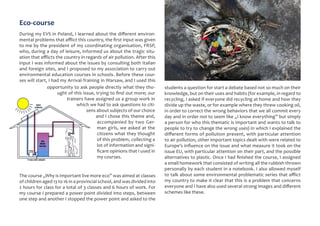
everyone and I have also used several strong images and different
schemes like these.
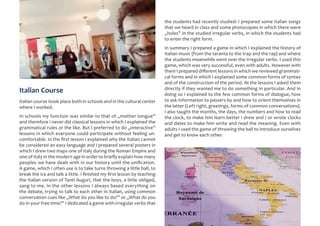
Italian Course
Italian course itook place both in schools and in the cultural center
where I worked.
In schools my function was similar to that of „mother tongue”
and therefore I never did classical lessons in which I explained the
grammatical rules or the like. But I preferred to do „interactive”
lessons in which everyone could participate without feeling un-
comfortable. In the first lesson I explained why the Italian cannot
be considered an easy language and I prepared several posters in
which I drew two maps one of Italy during the Roman Empire and
one of Italy in the modern age in order to briefly explain how many
peoples we have dealt with in our history until the unification.
A game, which I often use is to take turns throwing a little ball, to
break the ice and talk a little. I finished my first lesson by teaching
the Italian version of Tanti Auguri, that the boys, a little obliged,
sang to me. In the other lessons I always based everything on
the debate, trying to talk to each other in Italian, using common
conversation cues like „What do you like to do?” or „What do you
do in your free time?” I dedicated a game with irregular verbs that
the students had recently studied: I prepared some Italian songs
that we heard in class and some photocopies in which there were
„holes” in the studied irregular verbs, in which the students had
to enter the right form.
In summary I prepared a game in which I explained the history of
Italian music (from the taranta to the trap and the rap) and where
the students meanwhile went over the irregular verbs. I used this
game, which was very successful, even with adults. However with
them I prepared different lessons in which we reviewed grammati-
cal forms and in which I explained some common forms of syntax
and of the construction of the period. At the lessons I asked them
directly if they wanted me to do something in particular. And in
doing so I explained to the few common forms of dialogue, how
to ask information to passers-by and how to orient themselves in
the latter (Left right, greetings, forms of common conversations).
I also taught the months, the days, the numbers and how to read
the clock, to make him learn better I drew and / or wrote clocks
and dates to make him write and read the meaning. Even with
adults I used the game of throwing the ball to introduce ourselves
and get to know each other.
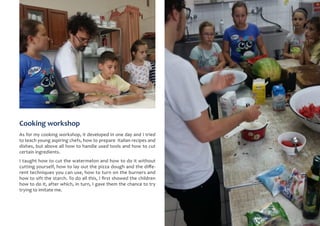
Cooking workshop
As for my cooking workshop, it developed in one day and I tried
to teach young aspiring chefs, how to prepare Italian recipes and
dishes, but above all how to handle used tools and how to cut
certain ingredients.
I taught how to cut the watermelon and how to do it without
cutting yourself, how to lay out the pizza dough and the diffe-
rent techniques you can use, how to turn on the burners and
how to sift the starch. To do all this, I first showed the children
how to do it, after which, in turn, I gave them the chance to try
trying to imitate me.
Non-formal education methods
– Natela Pavliashvili
A famous method – Energizer
Method: Energizer
Duration: 5-7 minutes
Group size: 7 – 10 participants
For the first lesson I decided to meet each other, so I used the fol-
lowing energizer, We made a circle and we started moving parts
of our body turn by turn and at the same time saying our names.
Also we used to make different movements. It was successful.
We met each other, kids were pleased.
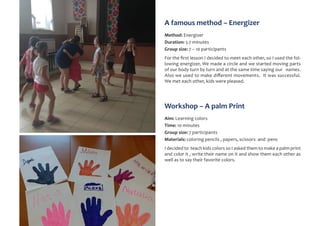
Workshop – A palm Print
Aim: Learning colors
Time: 10 minutes
Group size: 7 participants
Materials: coloring pencils , papers, scissors and pens
I decided to teach kids colors so I asked them to make a palm print
and color it , write their name on it and show them each other as
well as to say their favorite colors.
Learning words
Aim: learning words
Time: 15 minutes
Group size: 10 participants
Materials: crosswords and pen
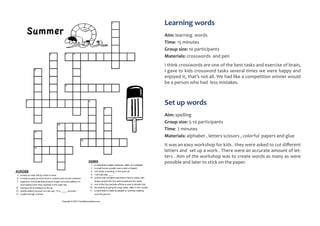
I think crosswords are one of the best tasks and exercise of brain,
I gave to kids crossword tasks several times we were happy and
enjoyed it, that’s not all. We had like a competition winner would
be a person who had less mistakes.
Set up words
Aim: spelling
Group size: 5-10 participants
Time: 7 minutes
Materials: alphabet , letters scissors , colorful papers and glue
It was an easy workshop for kids . they were asked to cut different
letters and set up a work . There were an accurate amount of let-
ters . Aim of the workshop was to create words as many as were
possible and later to stick on the paper.
A Role play
Aim: Develop several skills at the same time
Group size: participants are divided in several groups
Materials: dialogues
Time: 10 minutes
One of interesting activity is a role play. It was made According
dialogue which kids, this is one of the useful activity in order to im-
prove pronounce, grammar and reading skills. Dialogue for exam-
ple in the airport, at hotel, in a shop at university in family etc.
Let’s play with dices
Aim: improve pronounce skills
Group size: 10 participants
Time: 10 minutes
Materials: dices
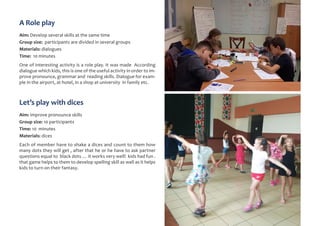
Each of member have to shake a dices and count to them how
many dots they will get , after that he or he have to ask partner
questions equal to black dots … it works very well! kids had fun .
that game helps to them to develop spelling skill as well as it helps
kids to turn on their fantasy.
Few words about
Natela and Emanuele
Emanuele Tosto
Mobility dates: 10 marca 2019 – 08 listopada 2019
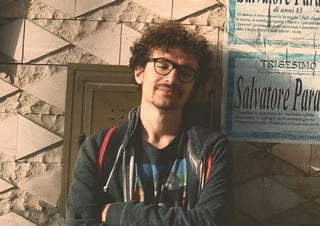
My name is Emanuele Tosto, but everyone calls me Lele, and I’m Sicilian. I am 20 years old and
I have a degree in political sciences and international relationships. I can say that I am a fan
of comics, I really like football, and I have had the opportunity to play football and futsal for
a long time. I love nature, especially animals, and I deal with environmental protection and
education.
I develped my knowledge and gained new skills, especially connected with culture, events
organisation and copperation with youngsters and elderly people.
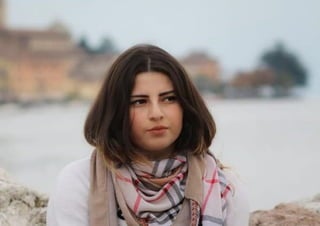
Natela Pavliashvili
Mobility dates: 06 lipca 2018 – 06 marca 2019
I am Natia. I am from Georgia and I am 20 years old. I finished my 2nd year at Gori State Te-
aching. I like reading, visiting historical places, taking photos and attending interesting tra-
inings and meetings. I am creative, flexible, energetic and friendly person.
I like also innovations and challenges, that’s why I have decided to volunteer in Wola, Poland.
Thanks to the project I developed my working skills, shared my own experiences and ideas to
others. Beside, volunteering abroad gave me a great chance to get to know more about Po-
lish culture, people and in general its lifestyle and let them know more about mine, Georgian.
Project financed by the European Commission under the ERASMUS+ Programme
Project title: Youth, entrepreneurship and culture for rural development
Project number: 2018-1-PL01-KA125-050050
Participating organisations:
Fundacja Rozwoju Społeczeństwa Przedsiębiorczego
Gminny Ośrodek Kultury w Miedźnej z/s w Woli
Bridge of Friendship Kartlosi
Associazione Culturale Strauss
Illustrations:
cover – pixabay.com/ArtsyBee; str. 3 left – cleangreenenergyzone.com/solar-energy/solar-thermal-systems;
str. 3 right – www.nakpack.it/blog/ambiente/il-sesto-continente-il-pacific-trash-vortex;
str. 8 – www.treevalleyacademy.com/summer-crossword-puzzles-for-kids; str. 4-5, 7, 9, 12, 14 – own materials
All the workshops were conducted in non-formal methods,
participation in them was free of charge.
Publication financed by the European Commission through the Erasmus+ programme
Publikacja została zrealizowana przy wsparciu finansowym Komisji Europejskiej. Publikacja odzwierciedla jedynie stanowisko jej autorów This publication has been produced
with the financial support of the European Commission. This publication reflects the views only of the author, and the European Commission and the Erasmus+ National
Agency cannot be held responsible for any use which may be made of the information contained therein.
PUBLICATION FREE OF CHARGE

NFE methodes_eng_publication

  • 1.
    Non-formal education methodsused in workshops during EVS in Wola
  • 3.
    Spis treści: 5 Non-formaleducation methods – Emanuele Tosto: 6 Eco-course 7 Italian course 8 Cooking workshop 9 Non-formal education methods – Natela Pavliashvili 10 A famous method – Energizer 10 Workshop – A palm Print 11 Learning words 11 Set up words 12 A Role play 12 Let’s play with dices 13 Few words about Natela and Emanuele
  • 4.
  • 5.
    Eco-course During my EVSin Poland, I learned about the different environ- mental problems that afflict this country, the first input was given to me by the president of my coordinating organisation, FRSP, who, during a day of leisure, informed us about the tragic situ- ation that afflicts the country in regards of air pollution. After this input I was informed about the issues by consulting both Italian and foreign sites, and I proposed to my association to carry out environmental education courses in schools. Before these cour- ses will start, I had my Arrival-Training in Warsaw, and I used this opportunity to ask people directly what they tho- ught of this issue, trying to find out more; our trainers have assigned us a group work in which we had to ask questions to citi- zens about subjects of our choice and I chose this theme and, accompanied by two Ger- man girls, we asked at the citizens what they thought of this problem, collecting a lot of information and signi- ficant opinions that I used in my courses. The course „Why is important live more eco” was aimed at classes of children aged 13 to 16 in a provincial school, and was divided into 2 hours for class for a total of 3 classes and 6 hours of work. For my course I prepared a power point divided into steps, between one step and another I stopped the power point and asked to the students a question for start a debate based not so much on their knowledge, but on their uses and habits (for example, in regard to recycling, I asked if everyone did recycling at home and how they divide up the waste, or for example where they threw cooking oil, in order to correct the wrong behaviors that we all commit every day and in order not to seem like „I know everything” but simply a person for who this thematic is important and wants to talk to people to try to change the wrong uses) in which I explained the different forms of pollution present, with particular attention to air pollution, other important topics dealt with were related to Europe’s influence on the issue and what measure it took on the issue EU, with particular attention on their part, and the possible alternatives to plastic. Once I had finished the course, I assigned a small homework that consisted of writing all the rubbish thrown personally by each student in a notebook. I also allowed myself to talk about some environmental problematic series that afflict my country to make it clear that this is a problem that concerns everyone and I have also used several strong images and different schemes like these.
  • 6.
    Italian Course Italian courseitook place both in schools and in the cultural center where I worked. In schools my function was similar to that of „mother tongue” and therefore I never did classical lessons in which I explained the grammatical rules or the like. But I preferred to do „interactive” lessons in which everyone could participate without feeling un- comfortable. In the first lesson I explained why the Italian cannot be considered an easy language and I prepared several posters in which I drew two maps one of Italy during the Roman Empire and one of Italy in the modern age in order to briefly explain how many peoples we have dealt with in our history until the unification. A game, which I often use is to take turns throwing a little ball, to break the ice and talk a little. I finished my first lesson by teaching the Italian version of Tanti Auguri, that the boys, a little obliged, sang to me. In the other lessons I always based everything on the debate, trying to talk to each other in Italian, using common conversation cues like „What do you like to do?” or „What do you do in your free time?” I dedicated a game with irregular verbs that the students had recently studied: I prepared some Italian songs that we heard in class and some photocopies in which there were „holes” in the studied irregular verbs, in which the students had to enter the right form. In summary I prepared a game in which I explained the history of Italian music (from the taranta to the trap and the rap) and where the students meanwhile went over the irregular verbs. I used this game, which was very successful, even with adults. However with them I prepared different lessons in which we reviewed grammati- cal forms and in which I explained some common forms of syntax and of the construction of the period. At the lessons I asked them directly if they wanted me to do something in particular. And in doing so I explained to the few common forms of dialogue, how to ask information to passers-by and how to orient themselves in the latter (Left right, greetings, forms of common conversations). I also taught the months, the days, the numbers and how to read the clock, to make him learn better I drew and / or wrote clocks and dates to make him write and read the meaning. Even with adults I used the game of throwing the ball to introduce ourselves and get to know each other.
  • 7.
    Cooking workshop As formy cooking workshop, it developed in one day and I tried to teach young aspiring chefs, how to prepare Italian recipes and dishes, but above all how to handle used tools and how to cut certain ingredients. I taught how to cut the watermelon and how to do it without cutting yourself, how to lay out the pizza dough and the diffe- rent techniques you can use, how to turn on the burners and how to sift the starch. To do all this, I first showed the children how to do it, after which, in turn, I gave them the chance to try trying to imitate me.
  • 8.
  • 9.
    A famous method– Energizer Method: Energizer Duration: 5-7 minutes Group size: 7 – 10 participants For the first lesson I decided to meet each other, so I used the fol- lowing energizer, We made a circle and we started moving parts of our body turn by turn and at the same time saying our names. Also we used to make different movements. It was successful. We met each other, kids were pleased. Workshop – A palm Print Aim: Learning colors Time: 10 minutes Group size: 7 participants Materials: coloring pencils , papers, scissors and pens I decided to teach kids colors so I asked them to make a palm print and color it , write their name on it and show them each other as well as to say their favorite colors.
  • 10.
    Learning words Aim: learningwords Time: 15 minutes Group size: 10 participants Materials: crosswords and pen I think crosswords are one of the best tasks and exercise of brain, I gave to kids crossword tasks several times we were happy and enjoyed it, that’s not all. We had like a competition winner would be a person who had less mistakes. Set up words Aim: spelling Group size: 5-10 participants Time: 7 minutes Materials: alphabet , letters scissors , colorful papers and glue It was an easy workshop for kids . they were asked to cut different letters and set up a work . There were an accurate amount of let- ters . Aim of the workshop was to create words as many as were possible and later to stick on the paper.
  • 11.
    A Role play Aim:Develop several skills at the same time Group size: participants are divided in several groups Materials: dialogues Time: 10 minutes One of interesting activity is a role play. It was made According dialogue which kids, this is one of the useful activity in order to im- prove pronounce, grammar and reading skills. Dialogue for exam- ple in the airport, at hotel, in a shop at university in family etc. Let’s play with dices Aim: improve pronounce skills Group size: 10 participants Time: 10 minutes Materials: dices Each of member have to shake a dices and count to them how many dots they will get , after that he or he have to ask partner questions equal to black dots … it works very well! kids had fun . that game helps to them to develop spelling skill as well as it helps kids to turn on their fantasy.
  • 13.
  • 15.
    Emanuele Tosto Mobility dates:10 marca 2019 – 08 listopada 2019 My name is Emanuele Tosto, but everyone calls me Lele, and I’m Sicilian. I am 20 years old and I have a degree in political sciences and international relationships. I can say that I am a fan of comics, I really like football, and I have had the opportunity to play football and futsal for a long time. I love nature, especially animals, and I deal with environmental protection and education. I develped my knowledge and gained new skills, especially connected with culture, events organisation and copperation with youngsters and elderly people.
  • 17.
    Natela Pavliashvili Mobility dates:06 lipca 2018 – 06 marca 2019 I am Natia. I am from Georgia and I am 20 years old. I finished my 2nd year at Gori State Te- aching. I like reading, visiting historical places, taking photos and attending interesting tra- inings and meetings. I am creative, flexible, energetic and friendly person. I like also innovations and challenges, that’s why I have decided to volunteer in Wola, Poland. Thanks to the project I developed my working skills, shared my own experiences and ideas to others. Beside, volunteering abroad gave me a great chance to get to know more about Po- lish culture, people and in general its lifestyle and let them know more about mine, Georgian.
  • 18.
    Project financed bythe European Commission under the ERASMUS+ Programme Project title: Youth, entrepreneurship and culture for rural development Project number: 2018-1-PL01-KA125-050050 Participating organisations: Fundacja Rozwoju Społeczeństwa Przedsiębiorczego Gminny Ośrodek Kultury w Miedźnej z/s w Woli Bridge of Friendship Kartlosi Associazione Culturale Strauss Illustrations: cover – pixabay.com/ArtsyBee; str. 3 left – cleangreenenergyzone.com/solar-energy/solar-thermal-systems; str. 3 right – www.nakpack.it/blog/ambiente/il-sesto-continente-il-pacific-trash-vortex; str. 8 – www.treevalleyacademy.com/summer-crossword-puzzles-for-kids; str. 4-5, 7, 9, 12, 14 – own materials All the workshops were conducted in non-formal methods, participation in them was free of charge.
  • 20.
    Publication financed bythe European Commission through the Erasmus+ programme Publikacja została zrealizowana przy wsparciu finansowym Komisji Europejskiej. Publikacja odzwierciedla jedynie stanowisko jej autorów This publication has been produced with the financial support of the European Commission. This publication reflects the views only of the author, and the European Commission and the Erasmus+ National Agency cannot be held responsible for any use which may be made of the information contained therein. PUBLICATION FREE OF CHARGE