
Red Swarm: 
Smart Mobility in Cities with EAs 
Daniel H. Stolfi and Enrique Alba 
Amsterdam, The Netherlands 
July 06-10, 2013
RReedd Red SSwwaarrmm:: Swarm: SSmmaarrtt MMoobbiilliittyy iinn CCiittiieess wwiitthh EEAAss 
Daniel H. Stolfi 
dhstolfi@lcc.uma.es 
http://www.danielstolfi.com 
Enrique Alba 
eat@lcc.uma.es 
http://www.lcc.uma.es/~eat 
University of Malaga 
July 2013 
July 2013 
Daniel H. Stolfi and Enrique Alba Red Swarm: Smart Mobility in Cities with EAs
TTaabbllee ooff CCoonntteennttss 
Daniel H. Stolfi and Enrique Alba Red Swarm: Smart Mobility in Cities with EAs 3 
3 
Introduction 
Proposal 
Experiments 
Conclusions 
1 
2 
4
Introduction 
Proposal 
Experiments 
Conclusions 
Daniel H. Stolfi and Enrique Alba Red Swarm: Smart Mobility in Cities with EAs 4 
IInnttrroodduuccttiioonn 
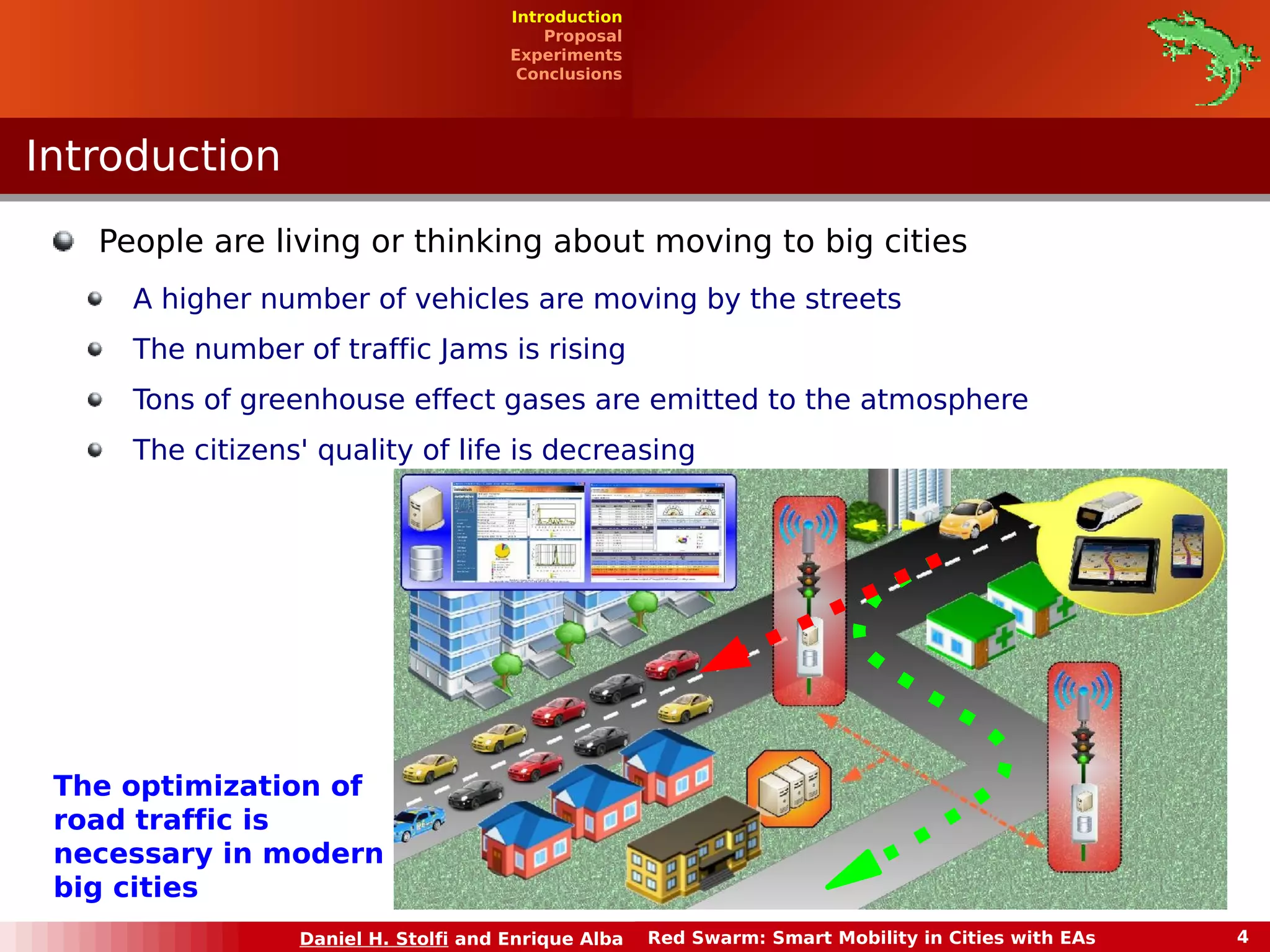
People are living or thinking about moving to big cities 
A higher number of vehicles are moving by the streets 
The number of traffic Jams is rising 
Tons of greenhouse effect gases are emitted to the atmosphere 
The citizens' quality of life is decreasing 
The optimization of 
road traffic is 
necessary in modern 
big cities
Introduction 
Proposal 
Experiments 
Conclusions 
Daniel H. Stolfi and Enrique Alba Red Swarm: Smart Mobility in Cities with EAs 5 
RReedd SSwwaarrmm 
Red Swarm 
Architecture 
Rerouting 
Scenario 
Evolutionary Algorithm 
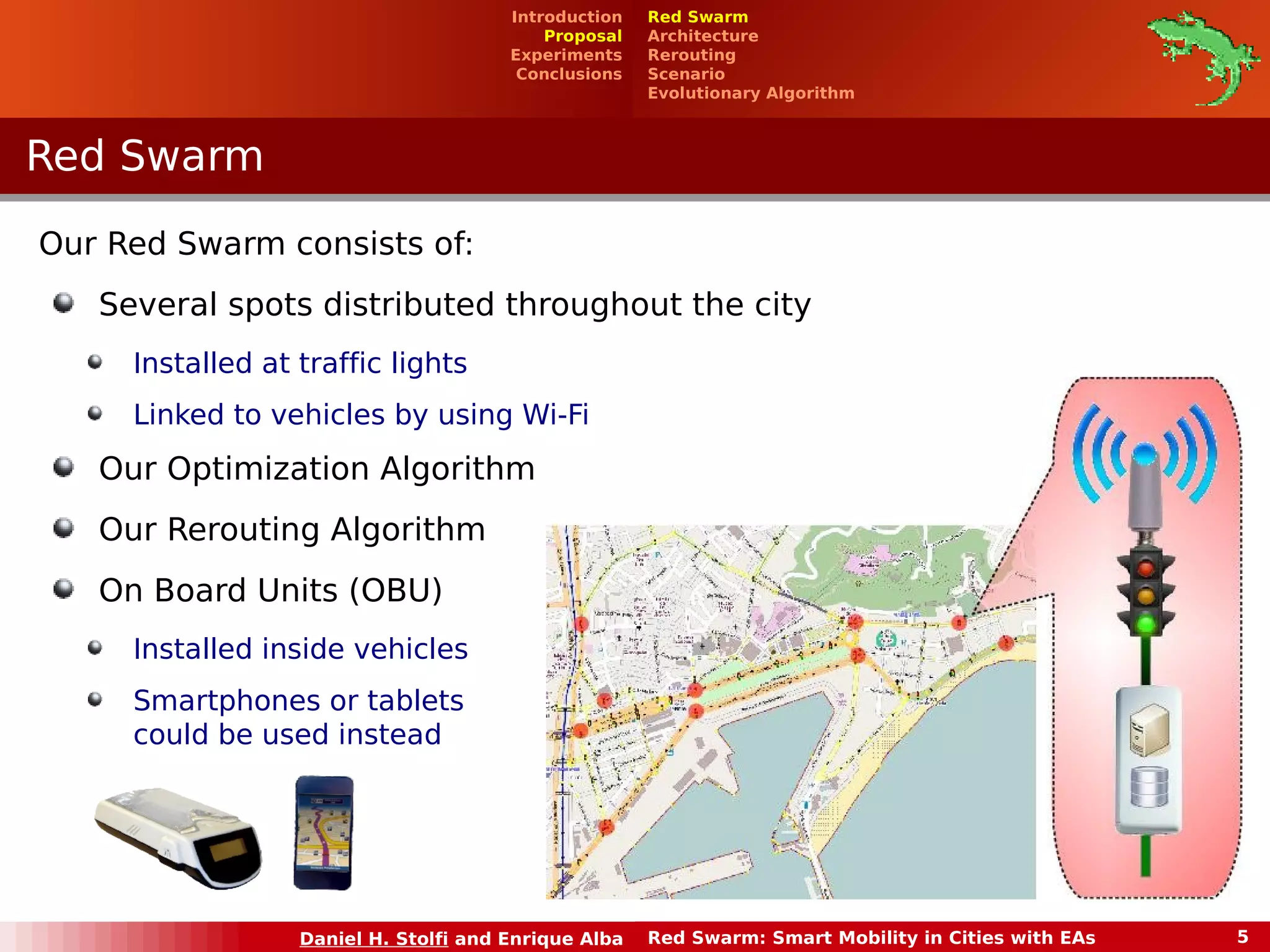
Our Red Swarm consists of: 
Several spots distributed throughout the city 
Installed at traffic lights 
Linked to vehicles by using Wi-Fi 
Our Optimization Algorithm 
Our Rerouting Algorithm 
On Board Units (OBU) 
Installed inside vehicles 
Smartphones or tablets 
could be used instead
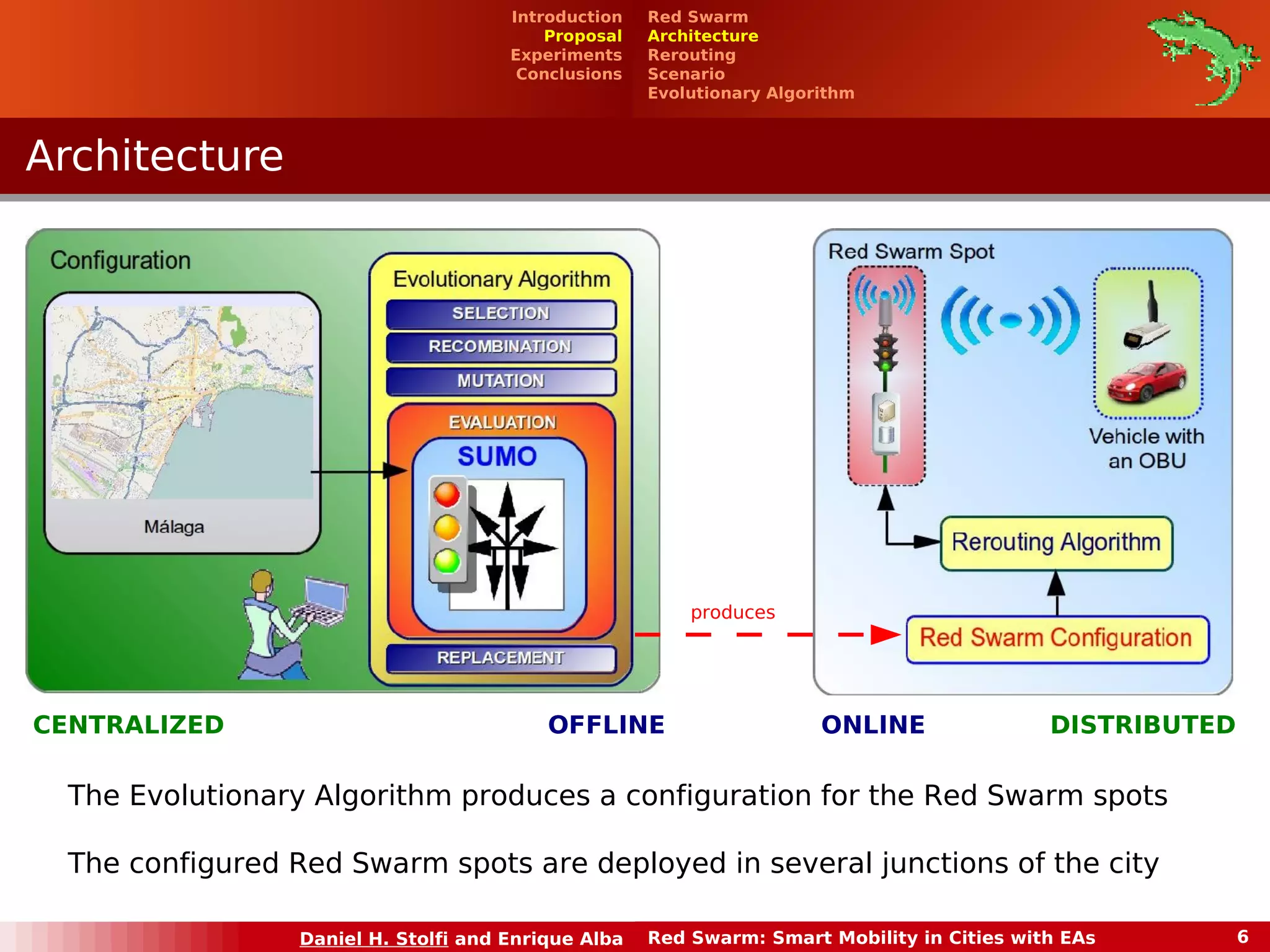
produces 
CENTRALIZED OFFLINE ONLINE DISTRIBUTED 
Daniel H. Stolfi and Enrique Alba Red Swarm: Smart Mobility in Cities with EAs 6 
AArrcchhiitteeccttuurree 
Red Swarm 
Architecture 
Rerouting 
Scenario 
Evolutionary Algorithm 
Introduction 
Proposal 
Experiments 
Conclusions 
The Evolutionary Algorithm produces a configuration for the Red Swarm spots 
The configured Red Swarm spots are deployed in several junctions of the city
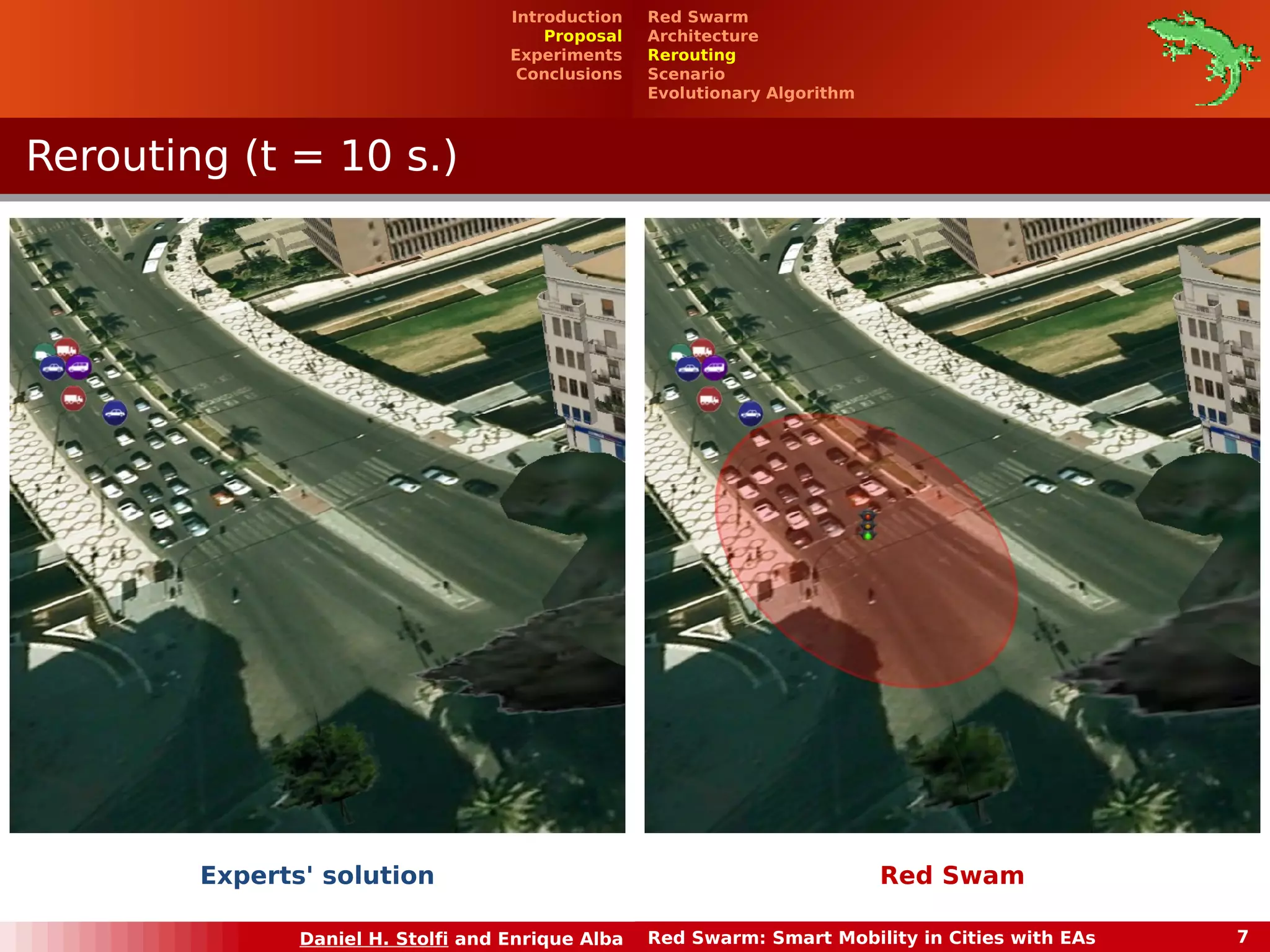
RReerroouuttiinngg ((tt == 1100 ss..)) 
Introduction 
Proposal 
Experiments 
Conclusions 
Red Swarm 
Architecture 
Rerouting 
Scenario 
Evolutionary Algorithm 
Experts' solution Red Swam 
Daniel H. Stolfi and Enrique Alba Red Swarm: Smart Mobility in Cities with EAs 7
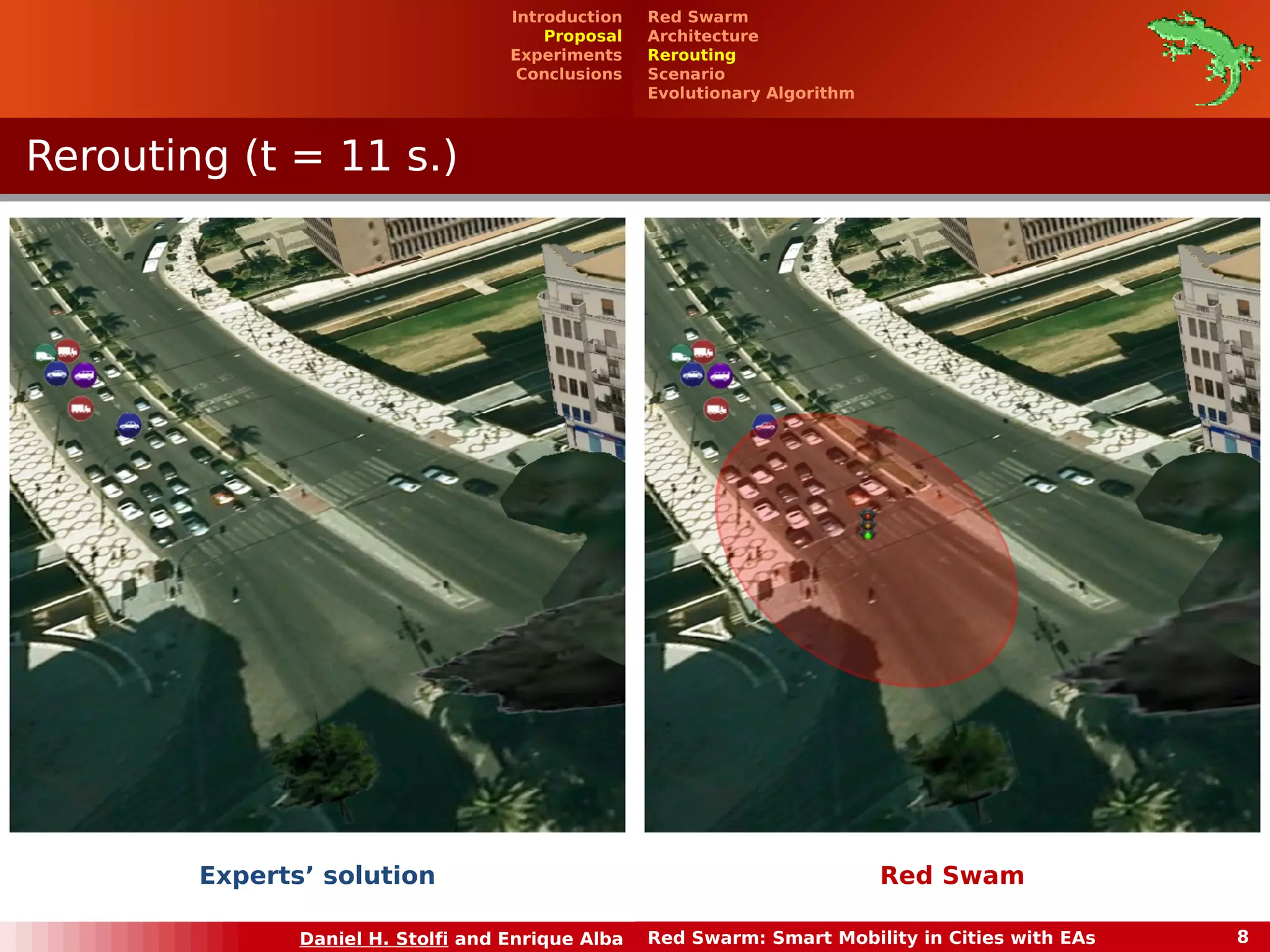
RReerroouuttiinngg ((tt == 1111 ss..)) 
Red Swarm 
Architecture 
Rerouting 
Scenario 
Evolutionary Algorithm 
Introduction 
Proposal 
Experiments 
Conclusions 
Experts’ solution Red Swam 
Daniel H. Stolfi and Enrique Alba Red Swarm: Smart Mobility in Cities with EAs 8
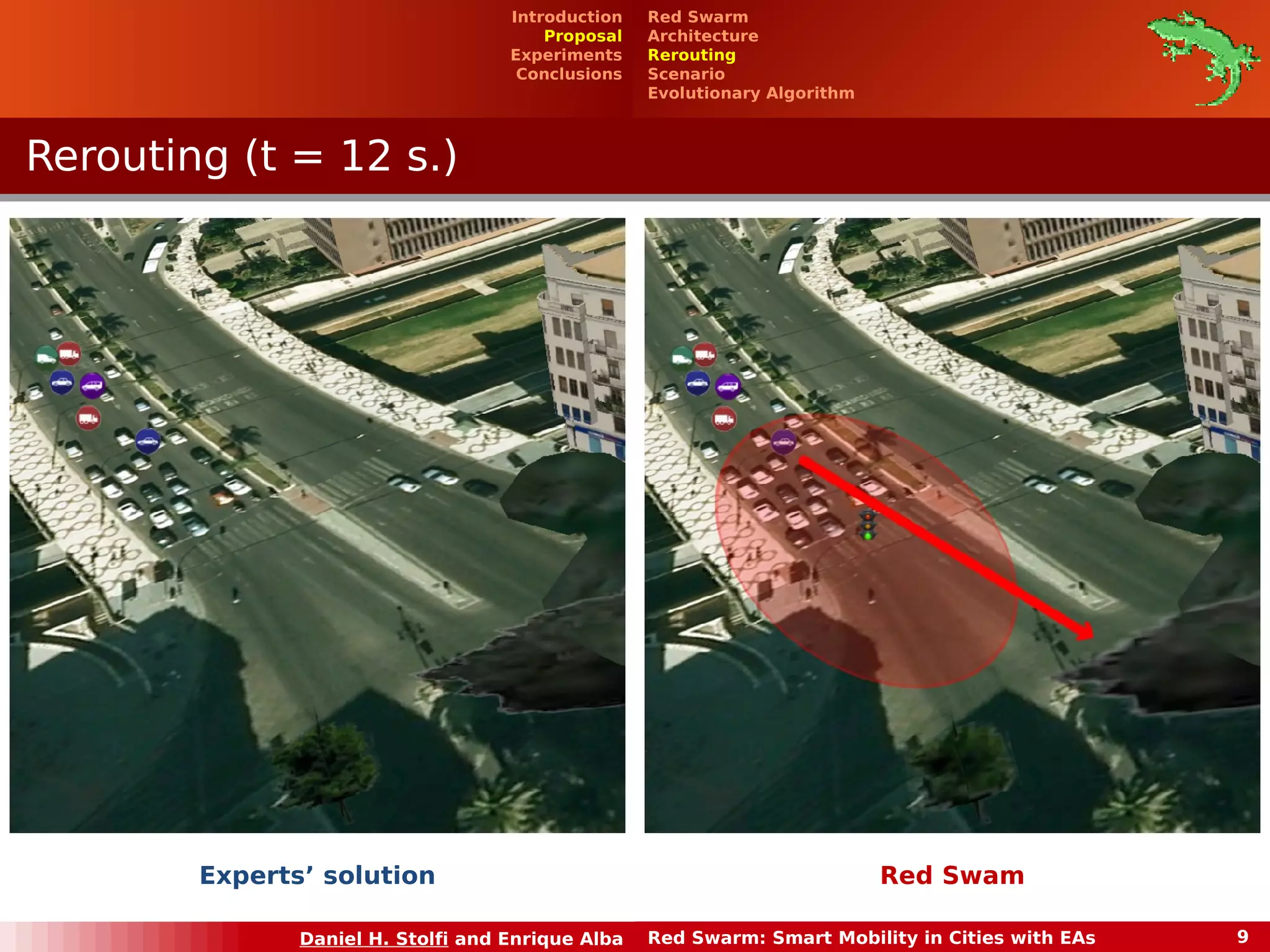
RReerroouuttiinngg ((tt == 1122 ss..)) 
Red Swarm 
Architecture 
Rerouting 
Scenario 
Evolutionary Algorithm 
Introduction 
Proposal 
Experiments 
Conclusions 
Experts’ solution Red Swam 
Daniel H. Stolfi and Enrique Alba Red Swarm: Smart Mobility in Cities with EAs 9
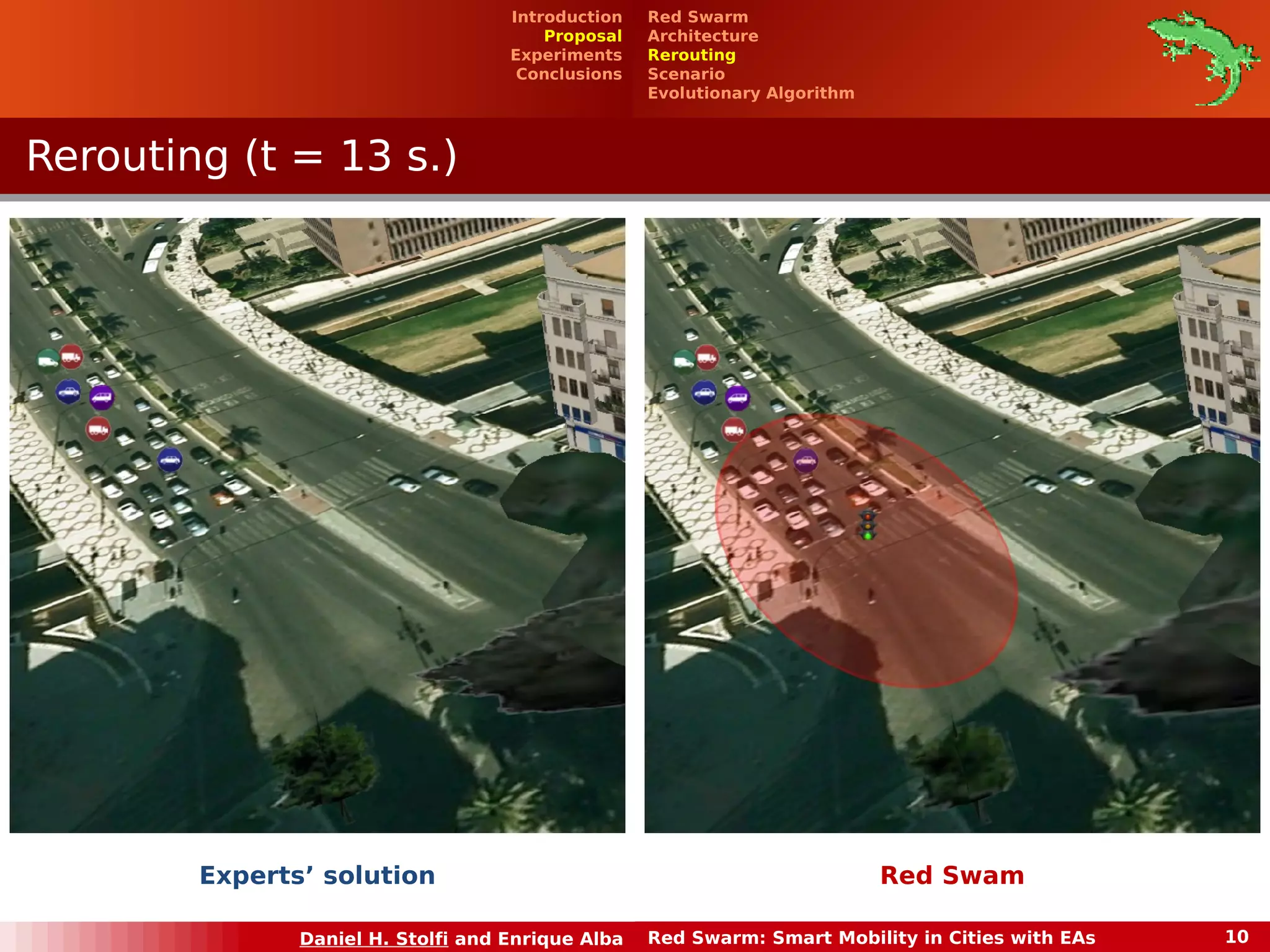
RReerroouuttiinngg ((tt == 1133 ss..)) 
Red Swarm 
Architecture 
Rerouting 
Scenario 
Evolutionary Algorithm 
Introduction 
Proposal 
Experiments 
Conclusions 
Experts’ solution Red Swam 
Daniel H. Stolfi and Enrique Alba Red Swarm: Smart Mobility in Cities with EAs 10
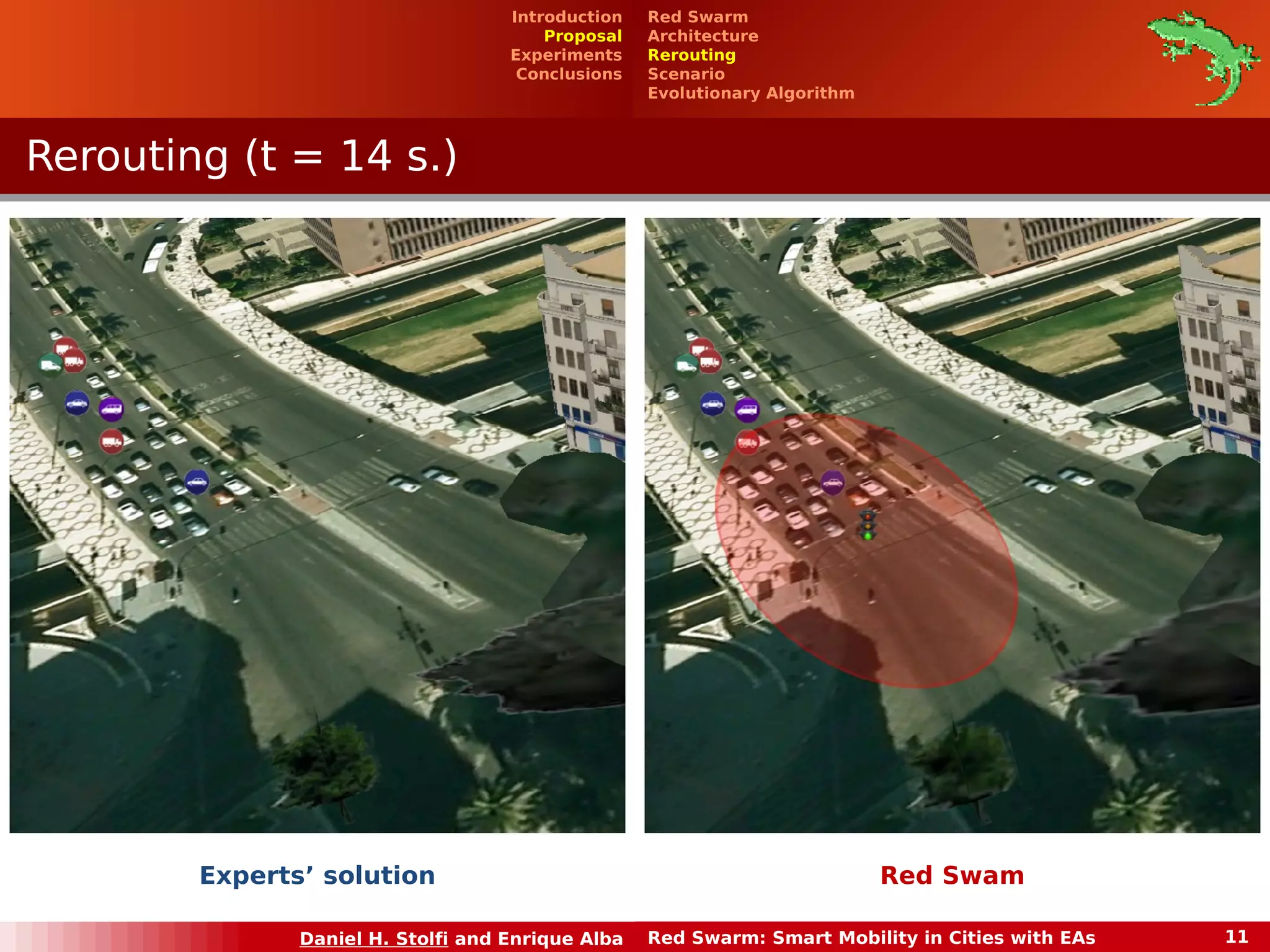
RReerroouuttiinngg ((tt == 1144 ss..)) 
Red Swarm 
Architecture 
Rerouting 
Scenario 
Evolutionary Algorithm 
Introduction 
Proposal 
Experiments 
Conclusions 
Experts’ solution Red Swam 
Daniel H. Stolfi and Enrique Alba Red Swarm: Smart Mobility in Cities with EAs 11
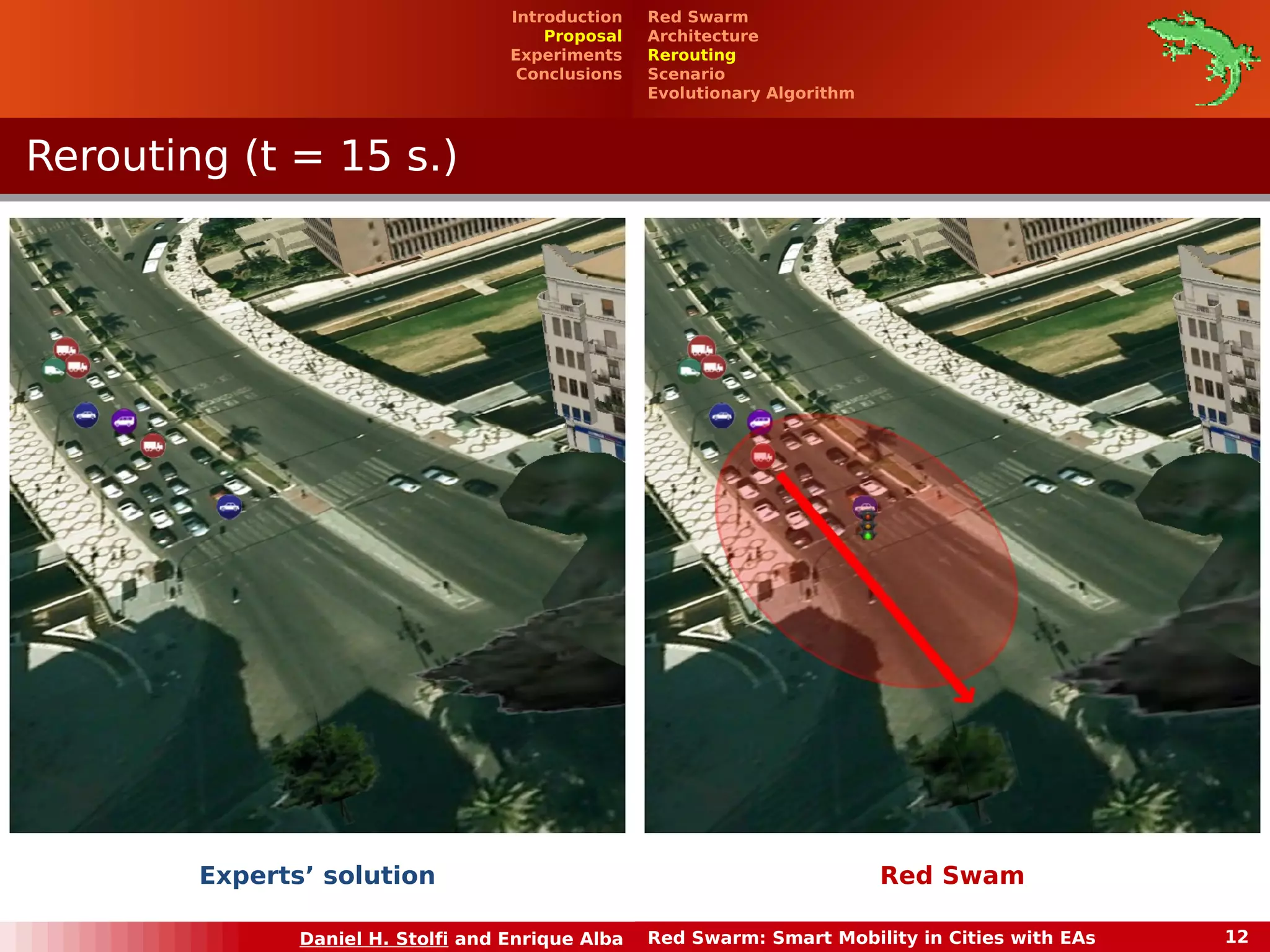
RReerroouuttiinngg ((tt == 1155 ss..)) 
Red Swarm 
Architecture 
Rerouting 
Scenario 
Evolutionary Algorithm 
Introduction 
Proposal 
Experiments 
Conclusions 
Experts’ solution Red Swam 
Daniel H. Stolfi and Enrique Alba Red Swarm: Smart Mobility in Cities with EAs 12
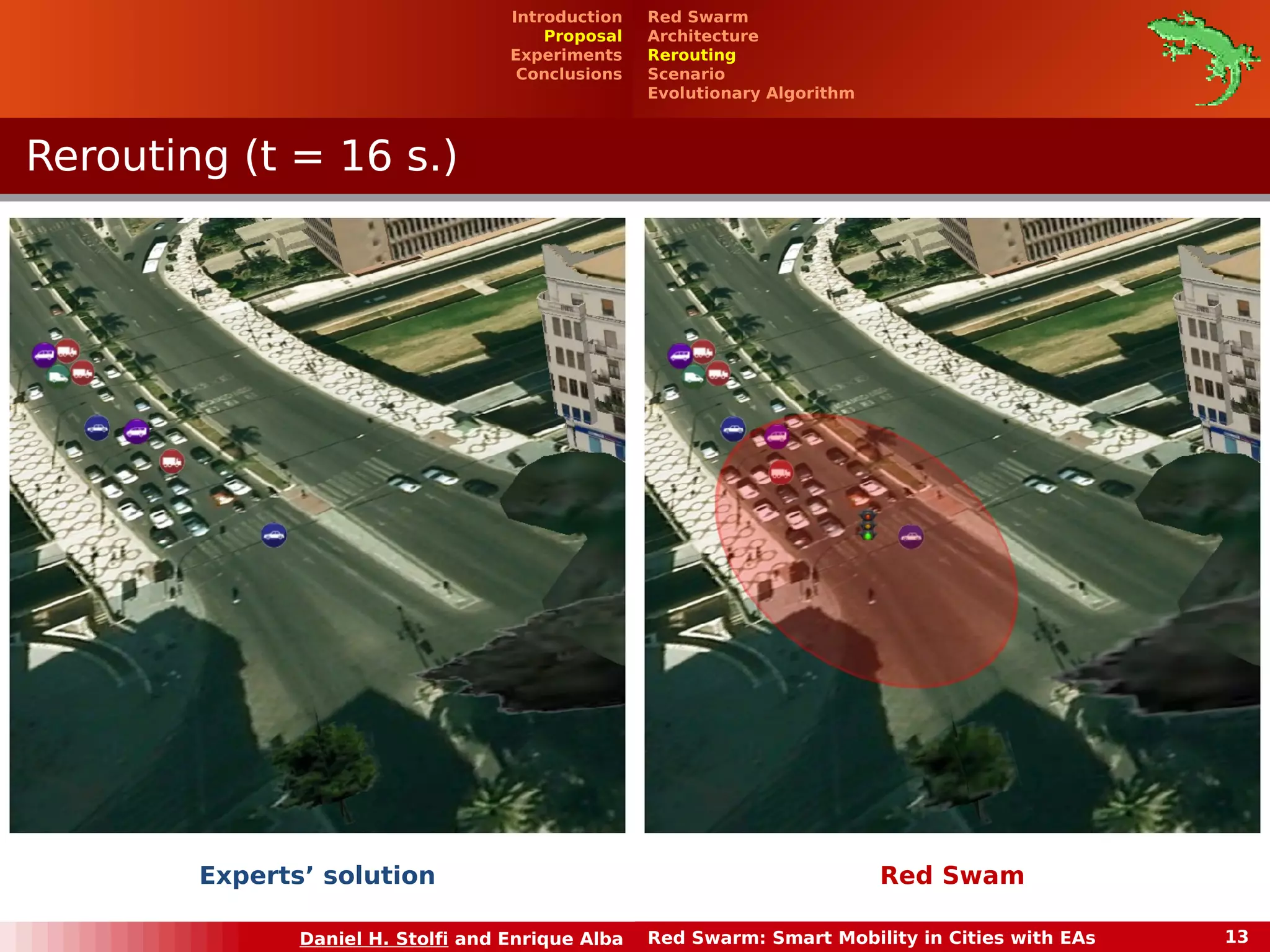
RReerroouuttiinngg ((tt == 1166 ss..)) 
Red Swarm 
Architecture 
Rerouting 
Scenario 
Evolutionary Algorithm 
Introduction 
Proposal 
Experiments 
Conclusions 
Experts’ solution Red Swam 
Daniel H. Stolfi and Enrique Alba Red Swarm: Smart Mobility in Cities with EAs 13
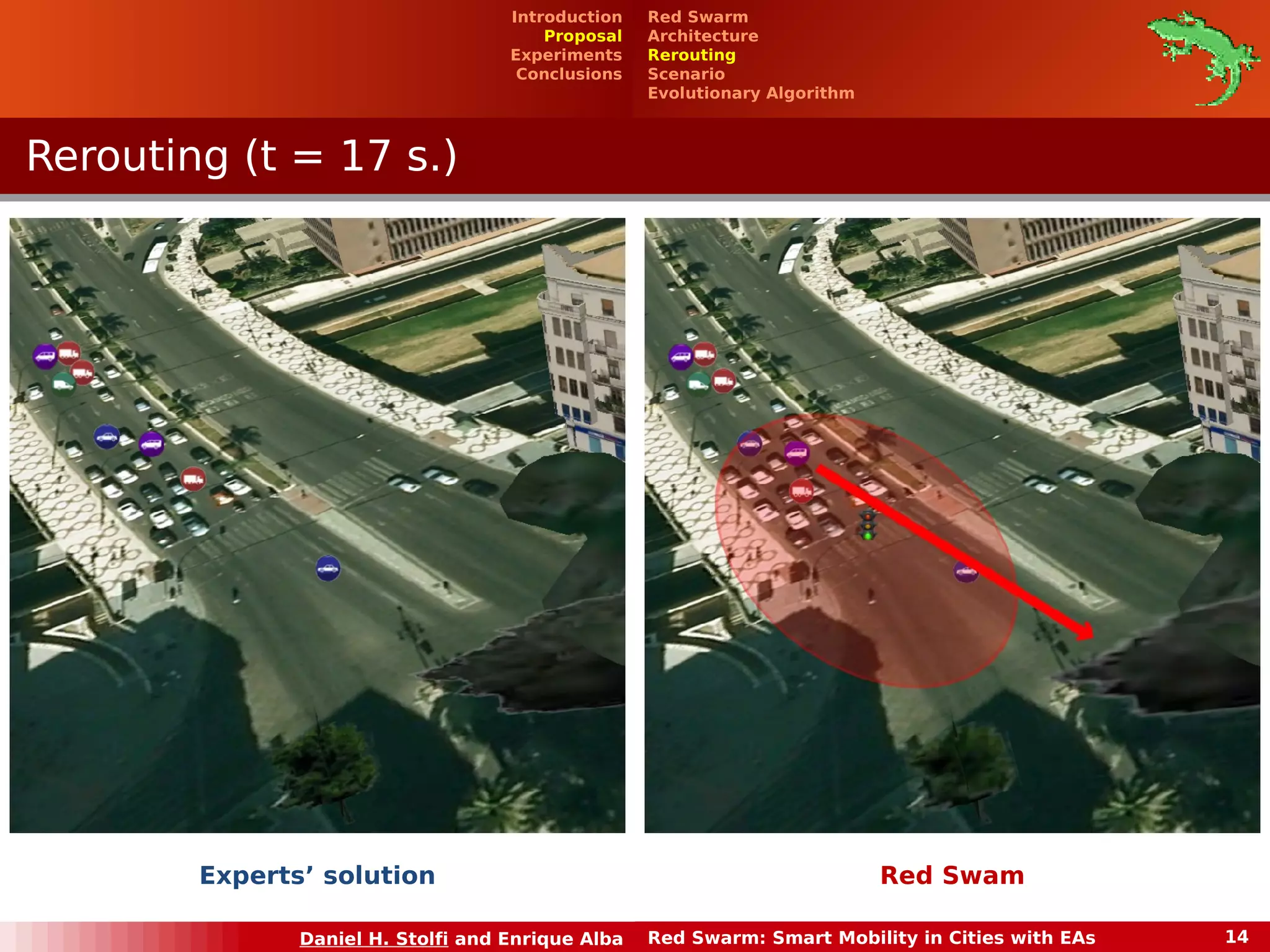
RReerroouuttiinngg ((tt == 1177 ss..)) 
Red Swarm 
Architecture 
Rerouting 
Scenario 
Evolutionary Algorithm 
Introduction 
Proposal 
Experiments 
Conclusions 
Experts’ solution Red Swam 
Daniel H. Stolfi and Enrique Alba Red Swarm: Smart Mobility in Cities with EAs 14
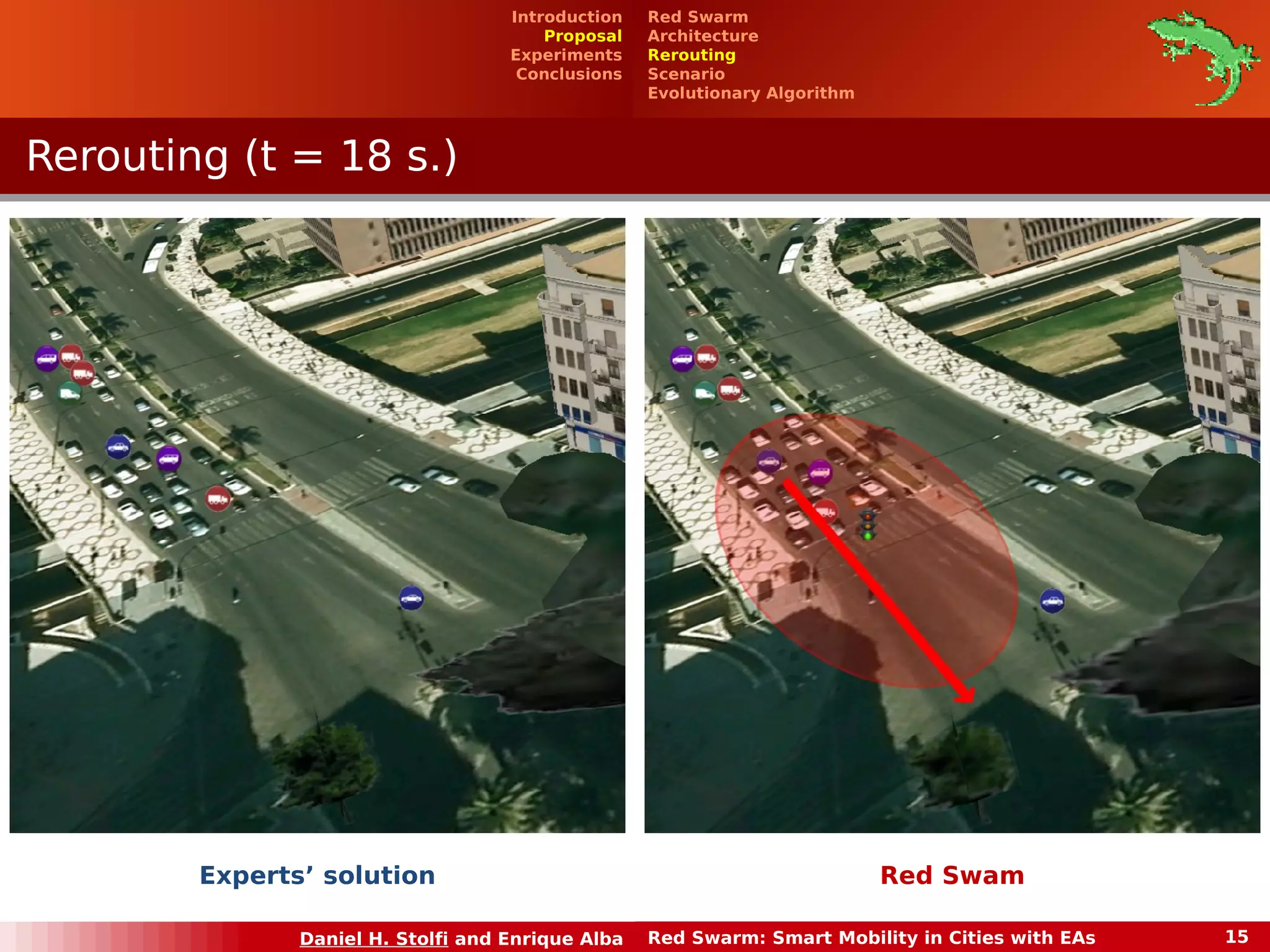
RReerroouuttiinngg ((tt == 1188 ss..)) 
Red Swarm 
Architecture 
Rerouting 
Scenario 
Evolutionary Algorithm 
Introduction 
Proposal 
Experiments 
Conclusions 
Experts’ solution Red Swam 
Daniel H. Stolfi and Enrique Alba Red Swarm: Smart Mobility in Cities with EAs 15
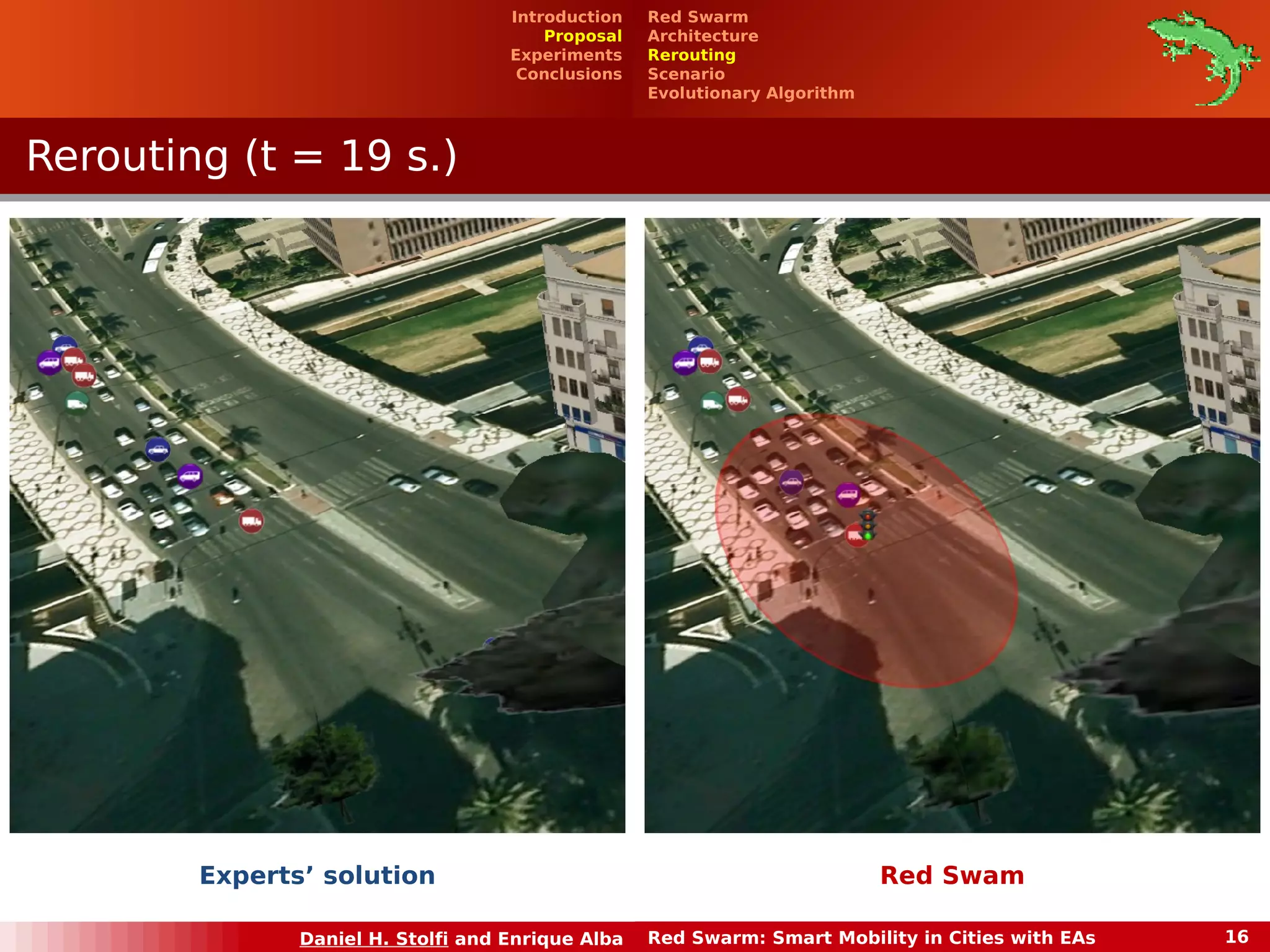
RReerroouuttiinngg ((tt == 1199 ss..)) 
Red Swarm 
Architecture 
Rerouting 
Scenario 
Evolutionary Algorithm 
Introduction 
Proposal 
Experiments 
Conclusions 
Experts’ solution Red Swam 
Daniel H. Stolfi and Enrique Alba Red Swarm: Smart Mobility in Cities with EAs 16
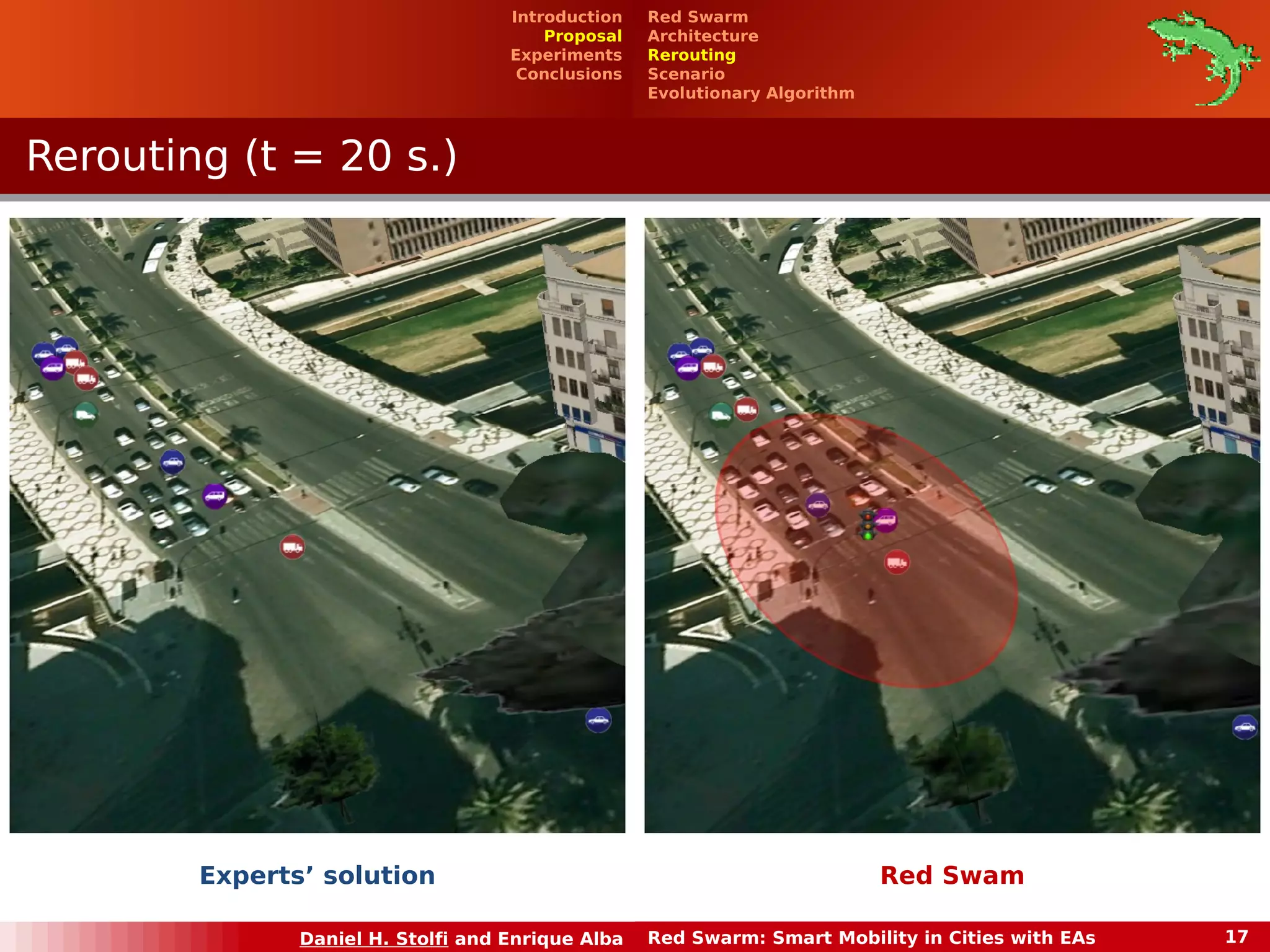
RReerroouuttiinngg ((tt == 2200 ss..)) 
Red Swarm 
Architecture 
Rerouting 
Scenario 
Evolutionary Algorithm 
Introduction 
Proposal 
Experiments 
Conclusions 
Experts’ solution Red Swam 
Daniel H. Stolfi and Enrique Alba Red Swarm: Smart Mobility in Cities with EAs 17
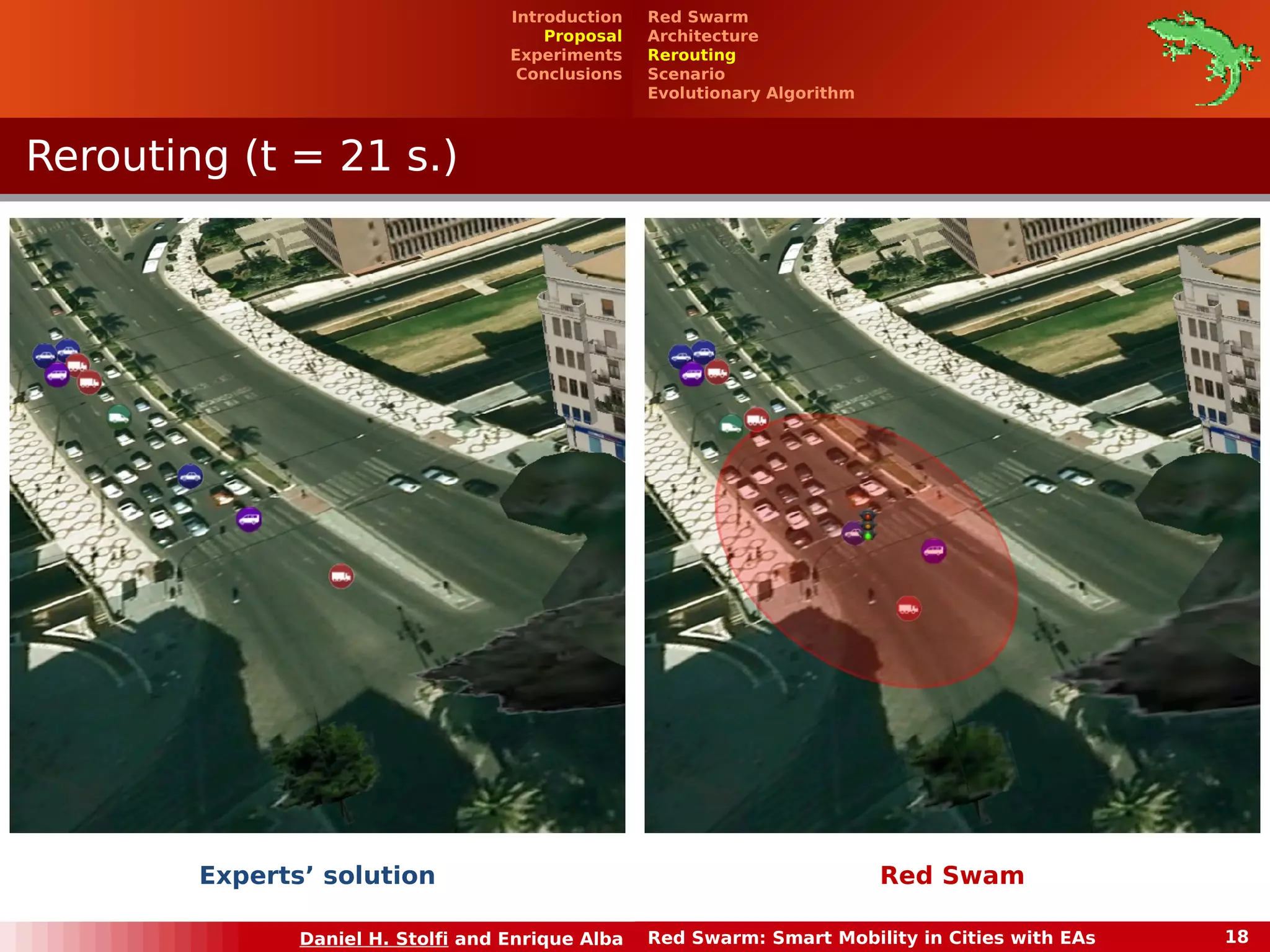
RReerroouuttiinngg ((tt == 2211 ss..)) 
Red Swarm 
Architecture 
Rerouting 
Scenario 
Evolutionary Algorithm 
Introduction 
Proposal 
Experiments 
Conclusions 
Experts’ solution Red Swam 
Daniel H. Stolfi and Enrique Alba Red Swarm: Smart Mobility in Cities with EAs 18
RReerroouuttiinngg ((tt == 2222 ss..)) 
Red Swarm 
Architecture 
Rerouting 
Scenario 
Evolutionary Algorithm 
Introduction 
Proposal 
Experiments 
Conclusions 
Experts’ solution Red Swam 
Daniel H. Stolfi and Enrique Alba Red Swarm: Smart Mobility in Cities with EAs 19
Red Swarm 
Architecture 
Rerouting 
Scenario 
Evolutionary Algorithm 
Introduction 
Proposal 
Experiments 
Conclusions 
Daniel H. Stolfi and Enrique Alba Red Swarm: Smart Mobility in Cities with EAs 20
Red Swarm 
Architecture 
Rerouting 
Scenario 
Evolutionary Algorithm 
Introduction 
Proposal 
Experiments 
Conclusions 
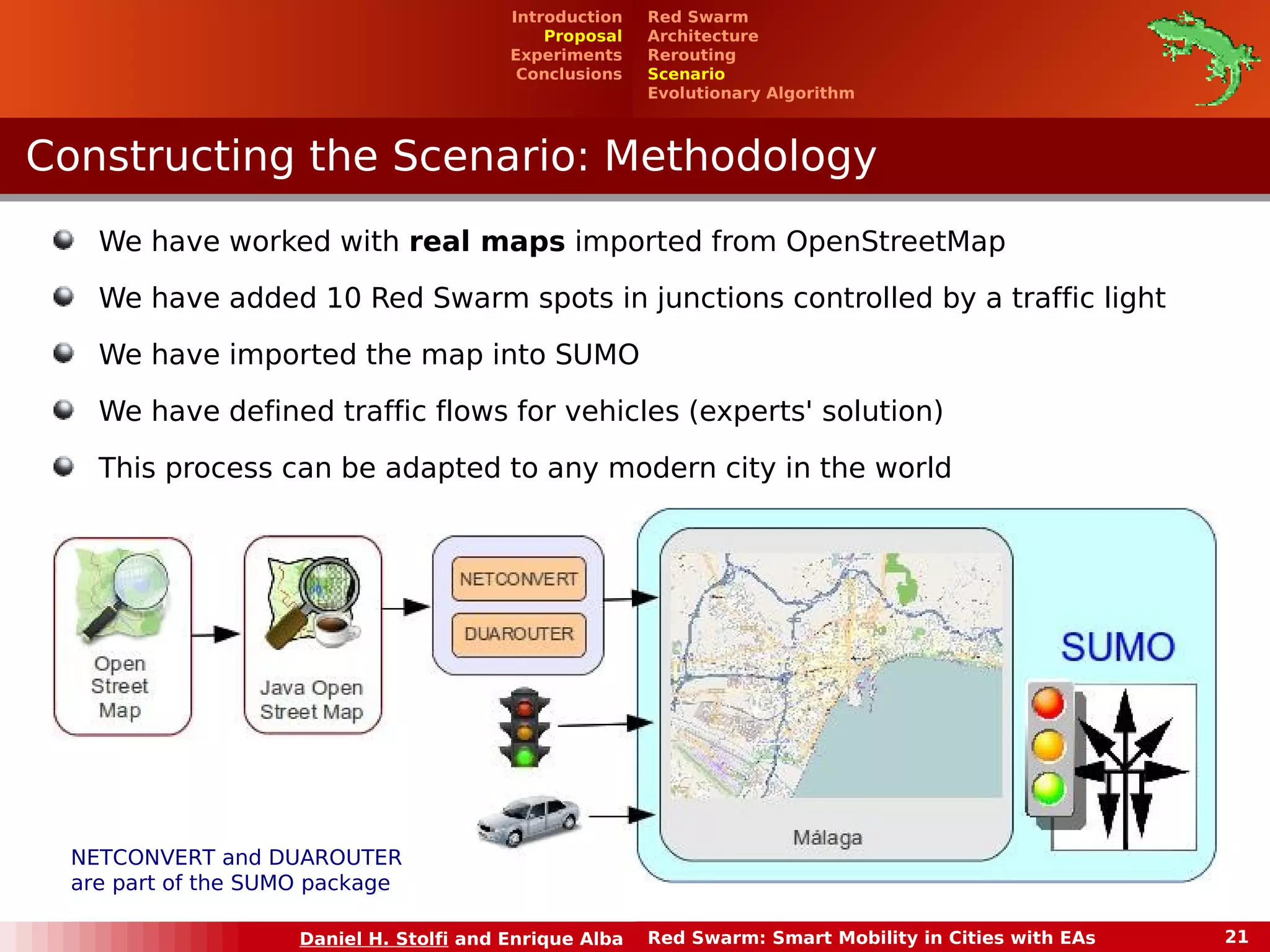
Constructing tthhee SScceennaarriioo:: MMeetthhooddoollooggyy 
We have worked with real maps imported from OpenStreetMap 
We have added 10 Red Swarm spots in junctions controlled by a traffic light 
We have imported the map into SUMO 
We have defined traffic flows for vehicles (experts' solution) 
This process can be adapted to any modern city in the world 
NETCONVERT and DUAROUTER 
are part of the SUMO package 
Daniel H. Stolfi and Enrique Alba Red Swarm: Smart Mobility in Cities with EAs 21
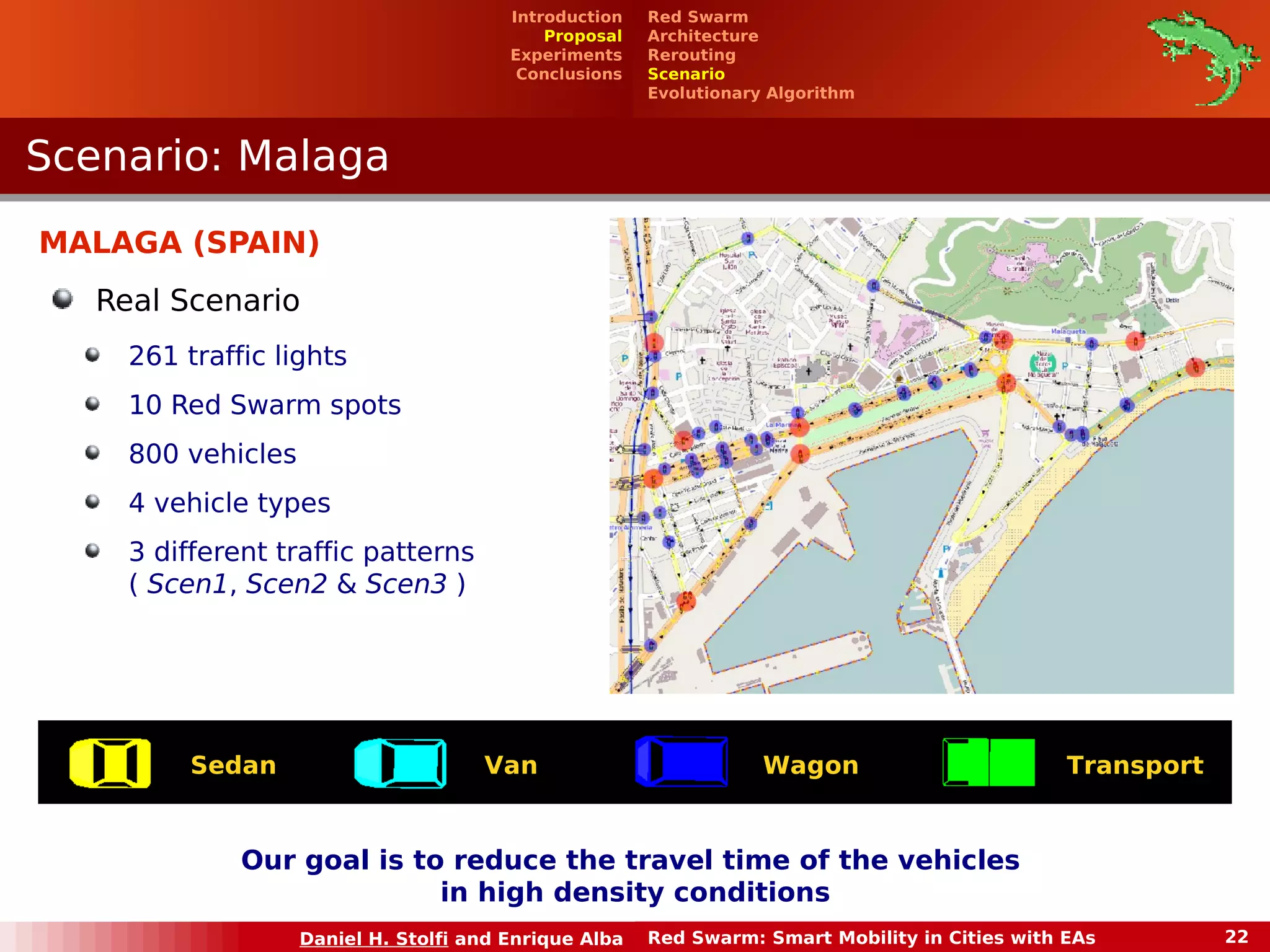
SScceennaarriioo:: MMaallaaggaa 
MALAGA (SPAIN) 
Real Scenario 
261 traffic lights 
10 Red Swarm spots 
800 vehicles 
4 vehicle types 
3 different traffic patterns 
( Scen1, Scen2 & Scen3 ) 
Red Swarm 
Architecture 
Rerouting 
Scenario 
Evolutionary Algorithm 
Introduction 
Proposal 
Experiments 
Conclusions 
Sedan Van Wagon Transport 
Our goal is to reduce the travel time of the vehicles 
in high density conditions 
Daniel H. Stolfi and Enrique Alba Red Swarm: Smart Mobility in Cities with EAs 22
Experiments 
Conclusions 
EEvvoolluuttiioonnaarryy AAllggoorriitthhmm 
Red Swarm 
Architecture 
Rerouting 
Scenario 
Evolutionary Algorithm 
Introduction 
Proposal 
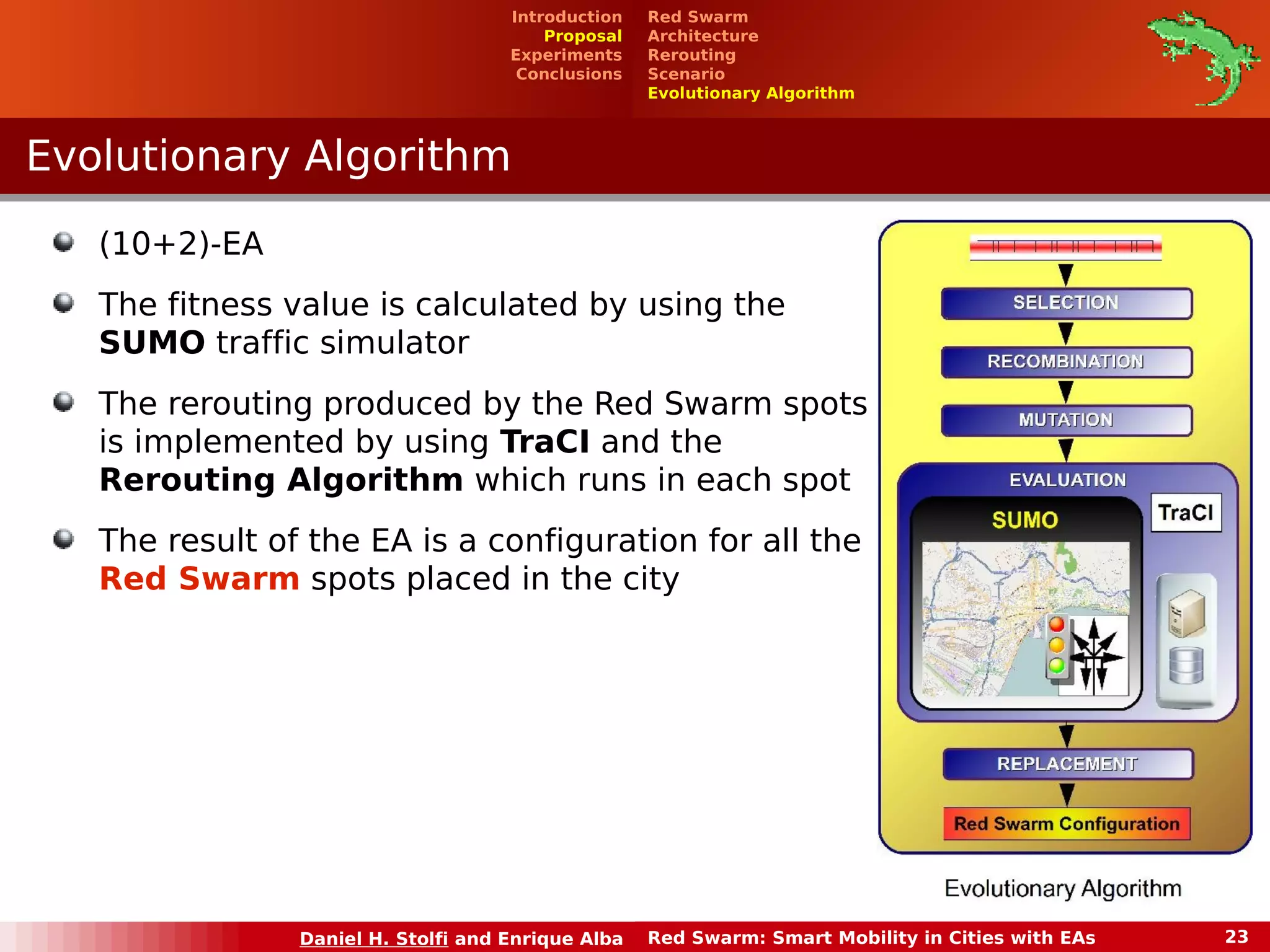
(10+2)-EA 
The fitness value is calculated by using the 
SUMO traffic simulator 
The rerouting produced by the Red Swarm spots 
is implemented by using TraCI and the 
Rerouting Algorithm which runs in each spot 
The result of the EA is a configuration for all the 
Red Swarm spots placed in the city 
Daniel H. Stolfi and Enrique Alba Red Swarm: Smart Mobility in Cities with EAs 23
Red Swarm 
Architecture 
Rerouting 
Scenario 
Evolutionary Algorithm 
Introduction 
Proposal 
Experiments 
Conclusions 
Evolutionary Algorithm: RReepprreesseennttaattiioonn ((SSeennssoorrss)) 
Daniel H. Stolfi and Enrique Alba Red Swarm: Smart Mobility in Cities with EAs 24 
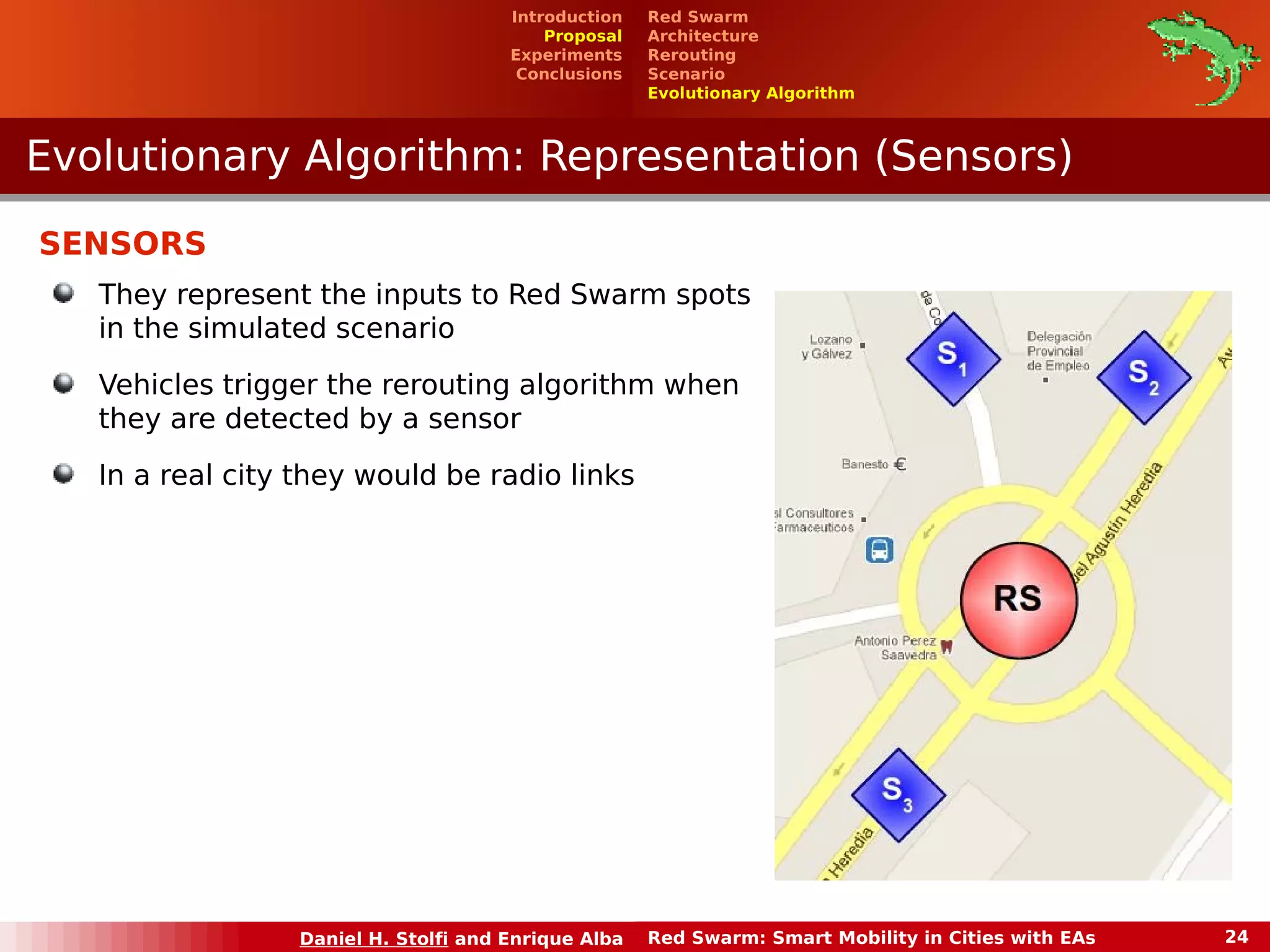
SENSORS 
They represent the inputs to Red Swarm spots 
in the simulated scenario 
Vehicles trigger the rerouting algorithm when 
they are detected by a sensor 
In a real city they would be radio links
Red Swarm 
Architecture 
Rerouting 
Scenario 
Evolutionary Algorithm 
Introduction 
Proposal 
Experiments 
Conclusions 
Evolutionary Algorithm: RReepprreesseennttaattiioonn ((EExxaammppllee)) 
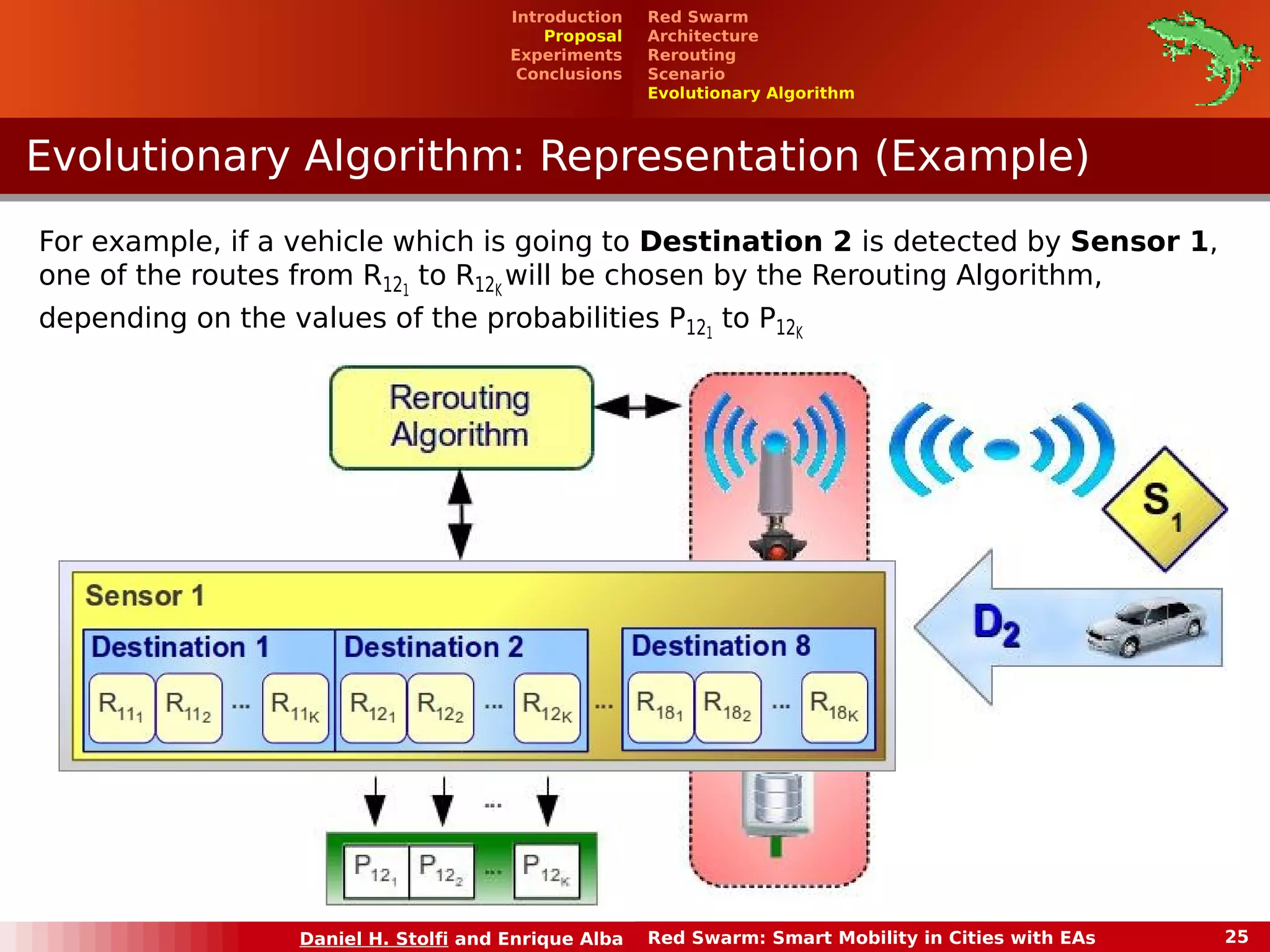
For example, if a vehicle which is going to Destination 2 is detected by Sensor 1, 
one of the routes from R121 to R12K will be chosen by the Rerouting Algorithm, 
depending on the values of the probabilities P121 to P12K 
Daniel H. Stolfi and Enrique Alba Red Swarm: Smart Mobility in Cities with EAs 25
Red Swarm 
Architecture 
Rerouting 
Scenario 
Evolutionary Algorithm 
Introduction 
Proposal 
Experiments 
Conclusions 
Evolutionary Algorithm: RReepprreesseennttaattiioonn 
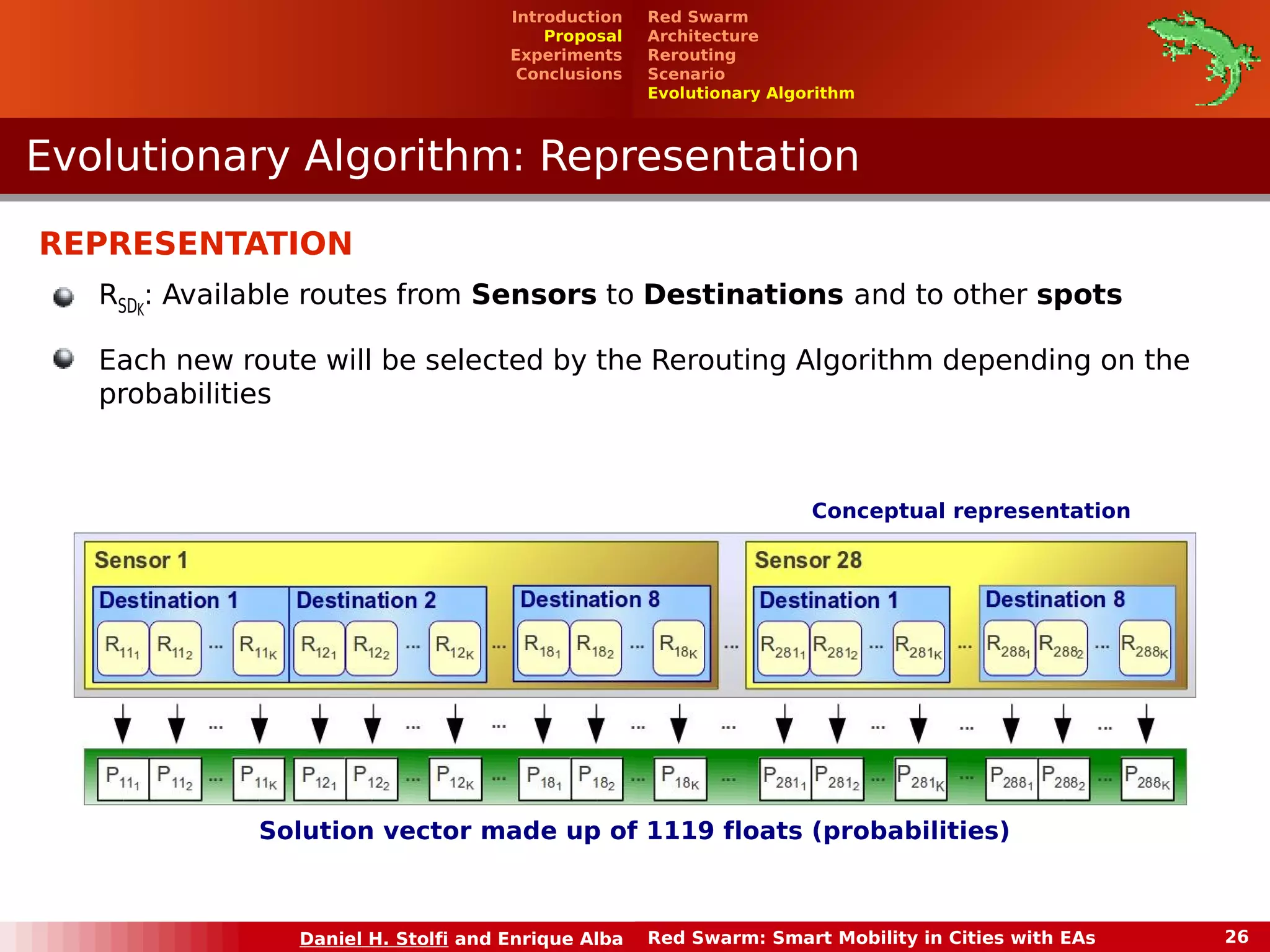
REPRESENTATION 
RSDK: Available routes from Sensors to Destinations and to other spots 
Each new route will be selected by the Rerouting Algorithm depending on the 
probabilities 
Conceptual representation 
Solution vector made up of 1119 floats (probabilities) 
Daniel H. Stolfi and Enrique Alba Red Swarm: Smart Mobility in Cities with EAs 26
Red Swarm 
Architecture 
Rerouting 
Scenario 
Evolutionary Algorithm 
Introduction 
Proposal 
Experiments 
Conclusions 
Evolutionary Algorithm: FFiittnneessss FFuunnccttiioonn 
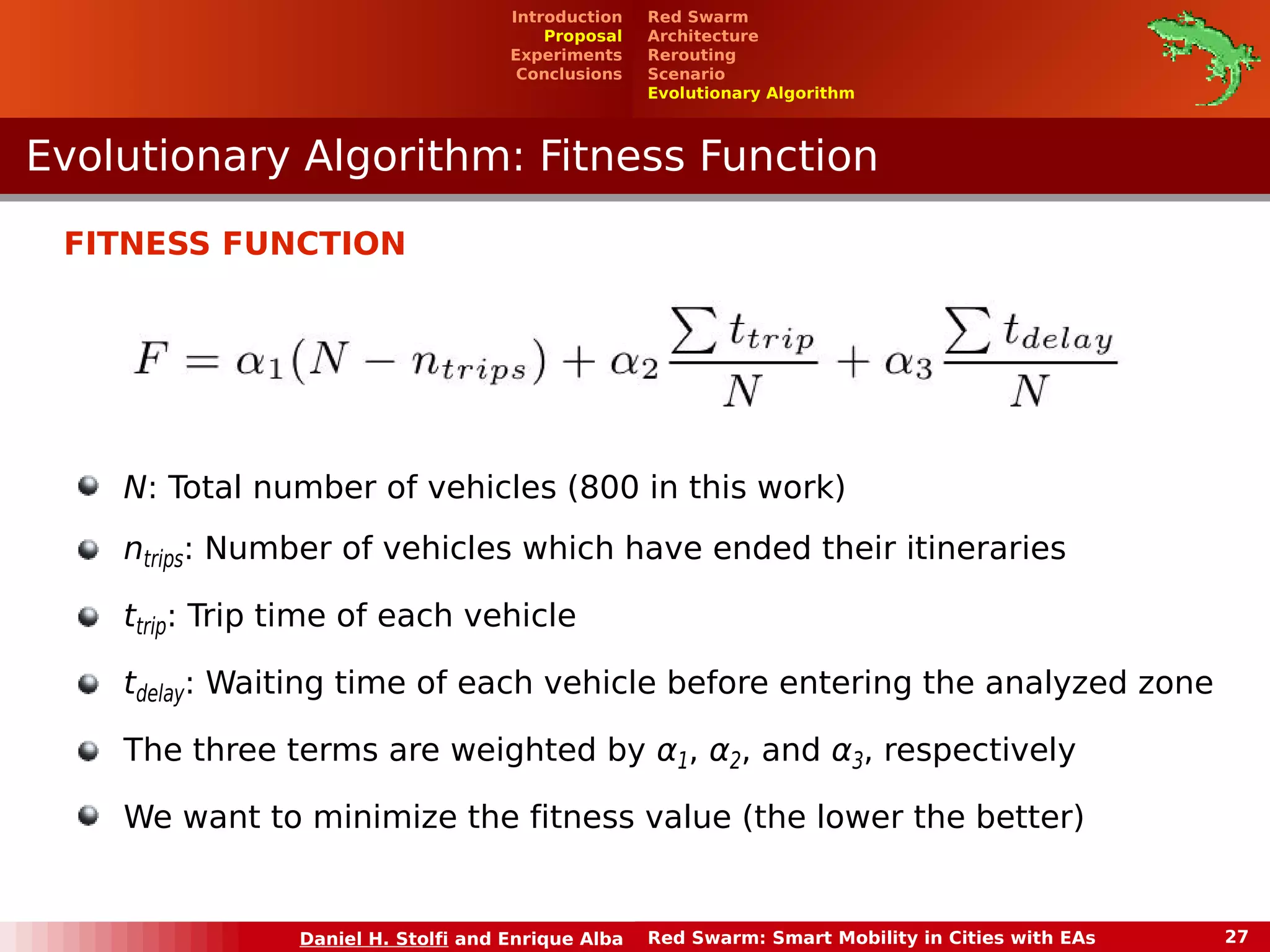
FITNESS FUNCTION 
N: Total number of vehicles (800 in this work) 
ntrips: Number of vehicles which have ended their itineraries 
ttrip: Trip time of each vehicle 
tdelay: Waiting time of each vehicle before entering the analyzed zone 
The three terms are weighted by α1, α2, and α3, respectively 
We want to minimize the fitness value (the lower the better) 
Daniel H. Stolfi and Enrique Alba Red Swarm: Smart Mobility in Cities with EAs 27
Red Swarm 
Architecture 
Rerouting 
Scenario 
Evolutionary Algorithm 
Introduction 
Proposal 
Experiments 
Conclusions 
Evolutionary Algorithm: RReeccoommbbiinnaattiioonn OOppeerraattoorr 
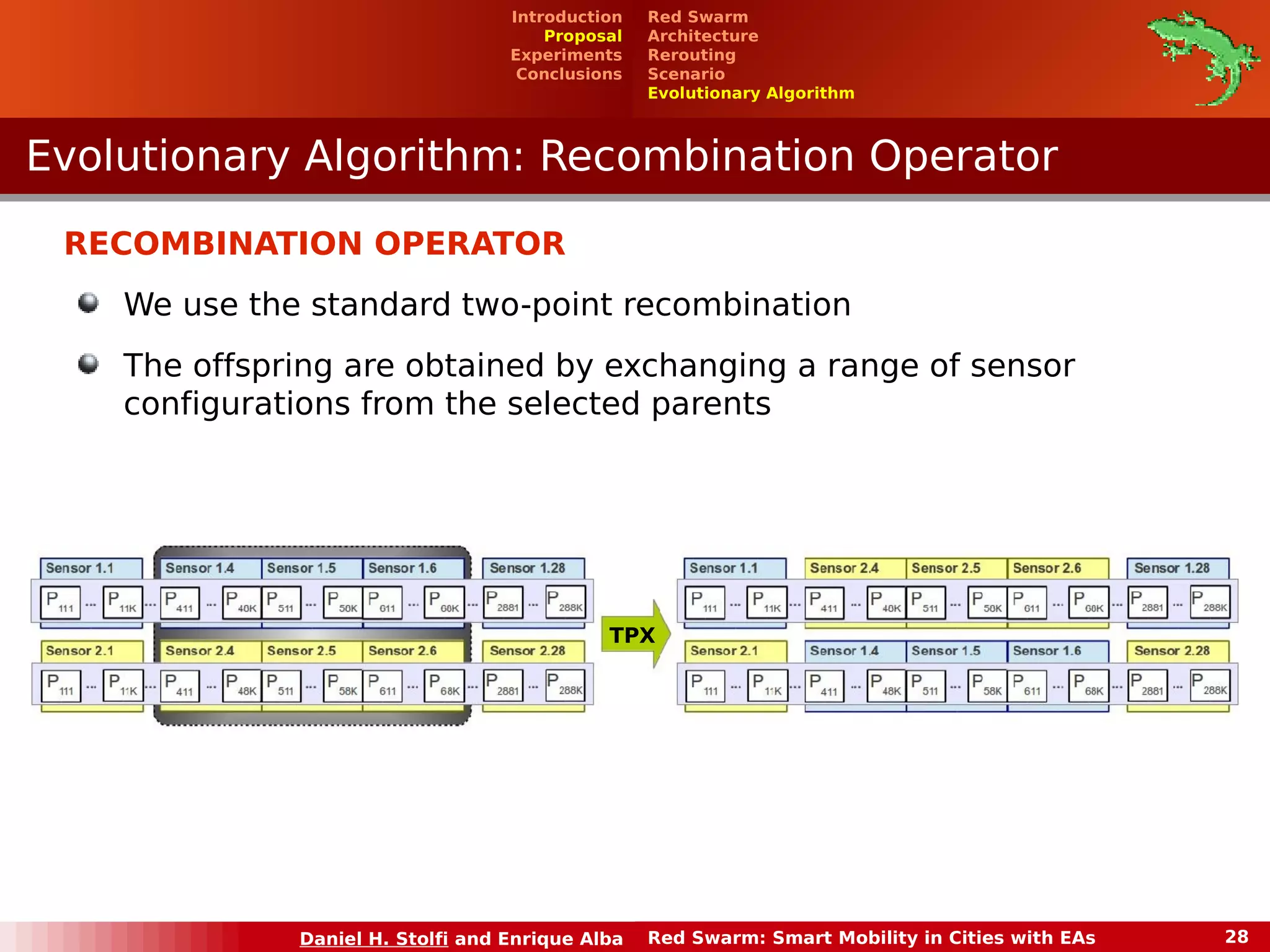
RECOMBINATION OPERATOR 
We use the standard two-point recombination 
The offspring are obtained by exchanging a range of sensor 
configurations from the selected parents 
TPX 
Daniel H. Stolfi and Enrique Alba Red Swarm: Smart Mobility in Cities with EAs 28
Red Swarm 
Architecture 
Rerouting 
Scenario 
Evolutionary Algorithm 
Introduction 
Proposal 
Experiments 
Conclusions 
Evolutionary Algorithm: MMuuttaattiioonn OOppeerraattoorrss 
MUTATION OPERATOR 
Changes the probabilities of the routes in the sensor configurations 
1) All Destinations – One Sensor 
It changes all probabilities in a Sensor block (i.e. all the probabilities in Sensor 4) 
2) One Destination – One Sensor 
It changes probabilities in a Destination block in a Sensor block 
(i.e. only the probabilities of Destination 8 in Sensor 4) 
Exploration 
Exploitation 
Daniel H. Stolfi and Enrique Alba Red Swarm: Smart Mobility in Cities with EAs 29
Daniel H. Stolfi and Enrique Alba Red Swarm: Smart Mobility in Cities with EAs 30 
RReessuullttss 
Introduction Results 
Proposal 
Experiments 
Conclusions 
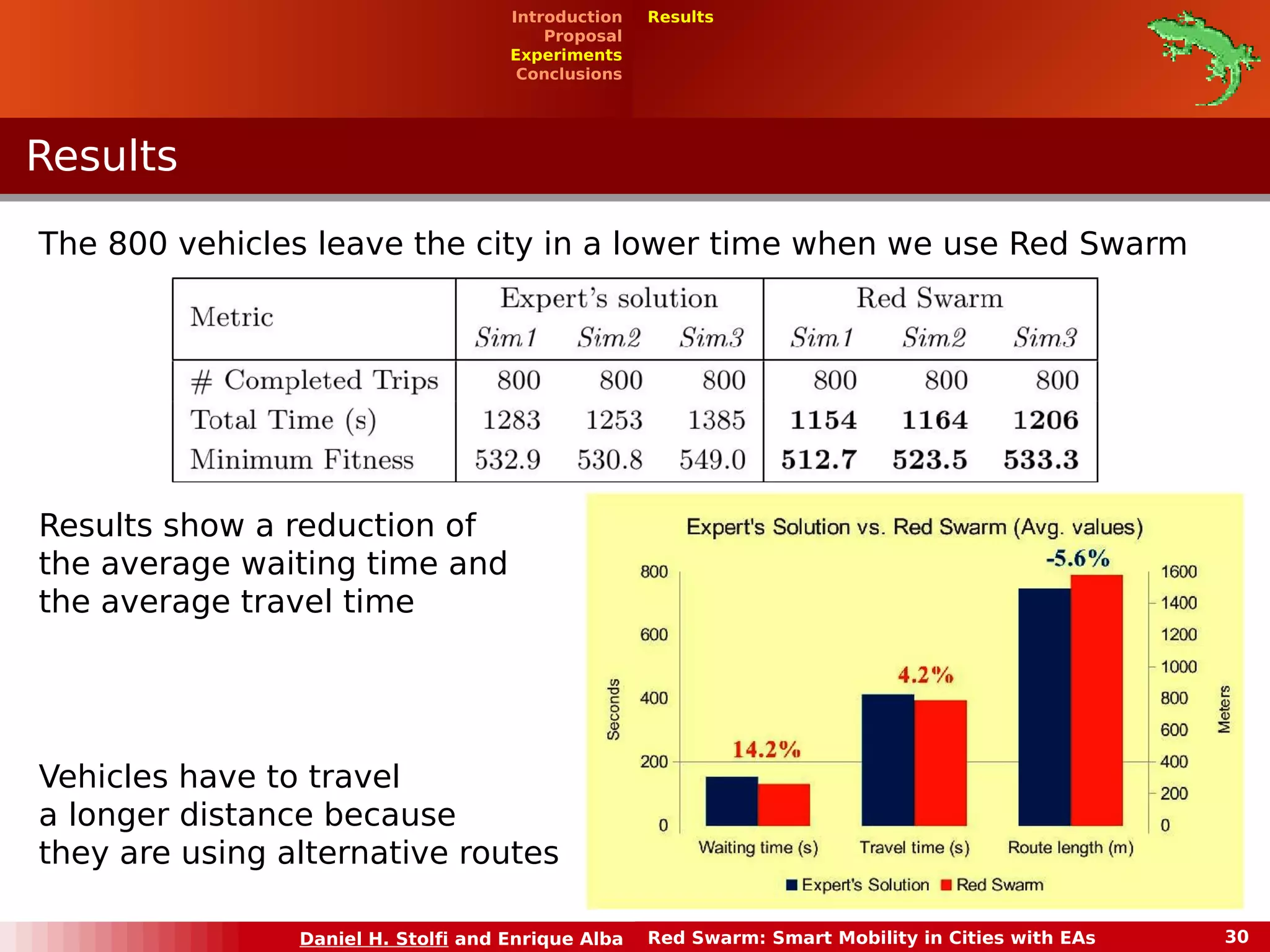
The 800 vehicles leave the city in a lower time when we use Red Swarm 
Results show a reduction of 
the average waiting time and 
the average travel time 
Vehicles have to travel 
a longer distance because 
they are using alternative routes
Introduction Results 
Proposal 
Experiments 
Conclusions 
Daniel H. Stolfi and Enrique Alba Red Swarm: Smart Mobility in Cities with EAs 31
Introduction Results 
Proposal 
Experiments 
Conclusions 
Results: Simulation Time vvss.. NNuummbbeerr ooff VVeehhiicclleess 
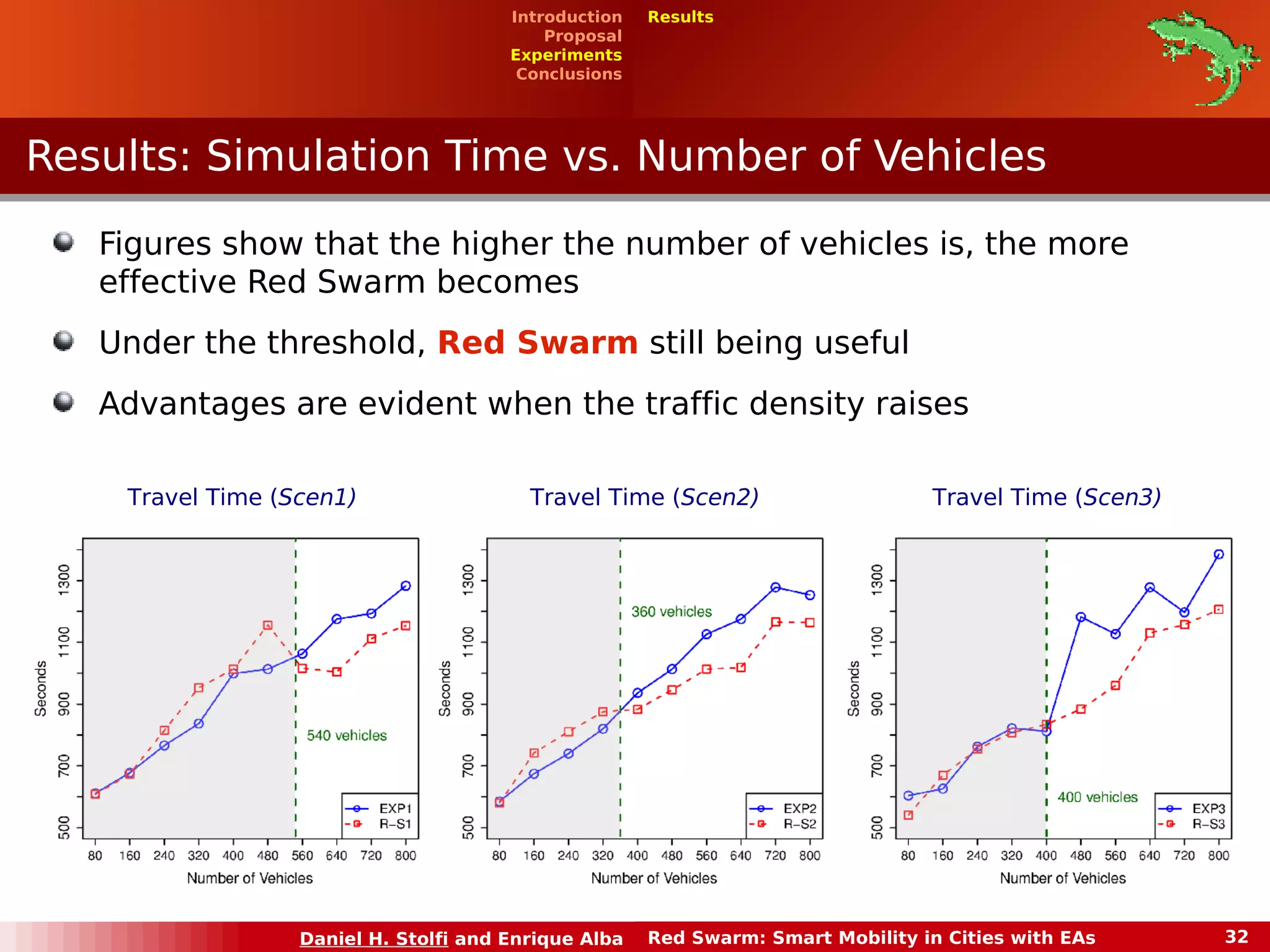
Figures show that the higher the number of vehicles is, the more 
effective Red Swarm becomes 
Under the threshold, Red Swarm still being useful 
Advantages are evident when the traffic density raises 
Travel Time (Scen1) Travel Time (Scen2) Travel Time (Scen3) 
Daniel H. Stolfi and Enrique Alba Red Swarm: Smart Mobility in Cities with EAs 32
Introduction Results 
Proposal 
Experiments 
Conclusions 
GGeenneerraalliizzaattiioonn ooff RReessuullttss 
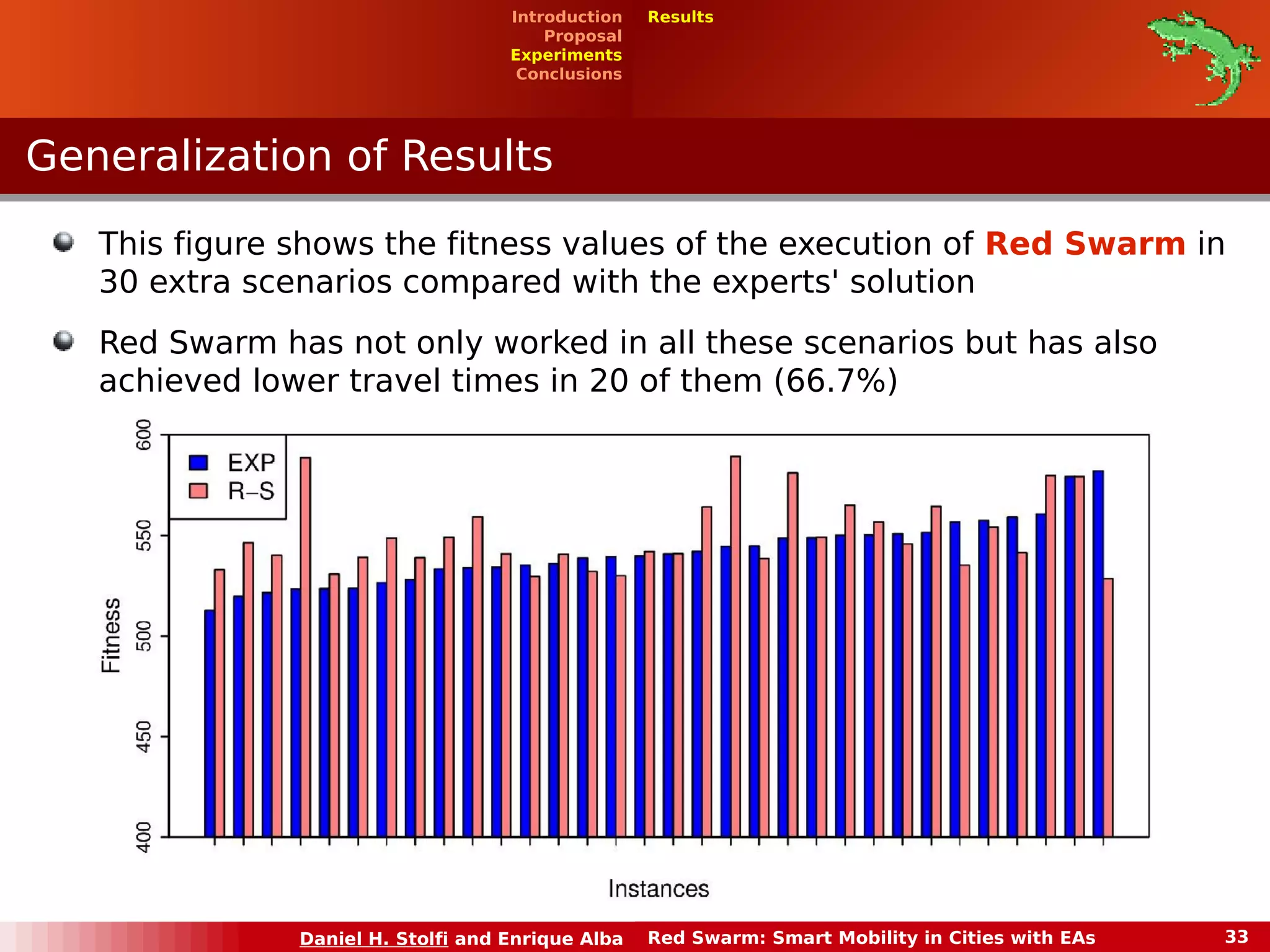
This figure shows the fitness values of the execution of Red Swarm in 
30 extra scenarios compared with the experts' solution 
Red Swarm has not only worked in all these scenarios but has also 
achieved lower travel times in 20 of them (66.7%) 
Daniel H. Stolfi and Enrique Alba Red Swarm: Smart Mobility in Cities with EAs 33
Daniel H. Stolfi and Enrique Alba Red Swarm: Smart Mobility in Cities with EAs 34 
CCoonncclluussiioonnss 
Introduction 
Proposal 
Experiments 
Conclusions 
This is an innovative approach to the prevention of traffic jams 
The results confirm road traffic can be improved by using Red Swarm 
We have reduced the travel times and waiting times of the vehicles 
Currently, we are working on: 
The expansion of the analyzed region 
Collecting information from vehicles (on-line and historical data of the city) 
The reduction of greenhouse gas emissions
http://neo.lcc.uma.es 
http://en.danielstolfi.com/redswarm/ 
Daniel H. Stolfi and Enrique Alba Red Swarm: Smart Mobility in Cities with EAs 35
http://neo.lcc.uma.es 
http://en.danielstolfi.com/redswarm/ 
dhstolfi@lcc.uma.es 
Questions? 
Daniel H. Stolfi and Enrique Alba Red Swarm: Smart Mobility in Cities with EAs 36

Red Swarm: Smart Mobility in Cities with EAs (GECCO'13)

  • 1.
    Red Swarm: SmartMobility in Cities with EAs Daniel H. Stolfi and Enrique Alba Amsterdam, The Netherlands July 06-10, 2013
  • 2.
    RReedd Red SSwwaarrmm::Swarm: SSmmaarrtt MMoobbiilliittyy iinn CCiittiieess wwiitthh EEAAss Daniel H. Stolfi dhstolfi@lcc.uma.es http://www.danielstolfi.com Enrique Alba eat@lcc.uma.es http://www.lcc.uma.es/~eat University of Malaga University of Malaga July 2013 July 2013 Daniel H. Stolfi and Enrique Alba Red Swarm: Smart Mobility in Cities with EAs
  • 3.
    TTaabbllee ooff CCoonntteennttss Daniel H. Stolfi and Enrique Alba Red Swarm: Smart Mobility in Cities with EAs 3 3 Introduction Proposal Experiments Conclusions 1 2 4
  • 4.
    Introduction Proposal Experiments Conclusions Daniel H. Stolfi and Enrique Alba Red Swarm: Smart Mobility in Cities with EAs 4 IInnttrroodduuccttiioonn People are living or thinking about moving to big cities A higher number of vehicles are moving by the streets The number of traffic Jams is rising Tons of greenhouse effect gases are emitted to the atmosphere The citizens' quality of life is decreasing The optimization of road traffic is necessary in modern big cities
  • 5.
    Introduction Proposal Experiments Conclusions Daniel H. Stolfi and Enrique Alba Red Swarm: Smart Mobility in Cities with EAs 5 RReedd SSwwaarrmm Red Swarm Architecture Rerouting Scenario Evolutionary Algorithm Our Red Swarm consists of: Several spots distributed throughout the city Installed at traffic lights Linked to vehicles by using Wi-Fi Our Optimization Algorithm Our Rerouting Algorithm On Board Units (OBU) Installed inside vehicles Smartphones or tablets could be used instead
  • 6.
    produces CENTRALIZED OFFLINEONLINE DISTRIBUTED Daniel H. Stolfi and Enrique Alba Red Swarm: Smart Mobility in Cities with EAs 6 AArrcchhiitteeccttuurree Red Swarm Architecture Rerouting Scenario Evolutionary Algorithm Introduction Proposal Experiments Conclusions The Evolutionary Algorithm produces a configuration for the Red Swarm spots The configured Red Swarm spots are deployed in several junctions of the city
  • 7.
    RReerroouuttiinngg ((tt ==1100 ss..)) Introduction Proposal Experiments Conclusions Red Swarm Architecture Rerouting Scenario Evolutionary Algorithm Experts' solution Red Swam Daniel H. Stolfi and Enrique Alba Red Swarm: Smart Mobility in Cities with EAs 7
  • 8.
    RReerroouuttiinngg ((tt ==1111 ss..)) Red Swarm Architecture Rerouting Scenario Evolutionary Algorithm Introduction Proposal Experiments Conclusions Experts’ solution Red Swam Daniel H. Stolfi and Enrique Alba Red Swarm: Smart Mobility in Cities with EAs 8
  • 9.
    RReerroouuttiinngg ((tt ==1122 ss..)) Red Swarm Architecture Rerouting Scenario Evolutionary Algorithm Introduction Proposal Experiments Conclusions Experts’ solution Red Swam Daniel H. Stolfi and Enrique Alba Red Swarm: Smart Mobility in Cities with EAs 9
  • 10.
    RReerroouuttiinngg ((tt ==1133 ss..)) Red Swarm Architecture Rerouting Scenario Evolutionary Algorithm Introduction Proposal Experiments Conclusions Experts’ solution Red Swam Daniel H. Stolfi and Enrique Alba Red Swarm: Smart Mobility in Cities with EAs 10
  • 11.
    RReerroouuttiinngg ((tt ==1144 ss..)) Red Swarm Architecture Rerouting Scenario Evolutionary Algorithm Introduction Proposal Experiments Conclusions Experts’ solution Red Swam Daniel H. Stolfi and Enrique Alba Red Swarm: Smart Mobility in Cities with EAs 11
  • 12.
    RReerroouuttiinngg ((tt ==1155 ss..)) Red Swarm Architecture Rerouting Scenario Evolutionary Algorithm Introduction Proposal Experiments Conclusions Experts’ solution Red Swam Daniel H. Stolfi and Enrique Alba Red Swarm: Smart Mobility in Cities with EAs 12
  • 13.
    RReerroouuttiinngg ((tt ==1166 ss..)) Red Swarm Architecture Rerouting Scenario Evolutionary Algorithm Introduction Proposal Experiments Conclusions Experts’ solution Red Swam Daniel H. Stolfi and Enrique Alba Red Swarm: Smart Mobility in Cities with EAs 13
  • 14.
    RReerroouuttiinngg ((tt ==1177 ss..)) Red Swarm Architecture Rerouting Scenario Evolutionary Algorithm Introduction Proposal Experiments Conclusions Experts’ solution Red Swam Daniel H. Stolfi and Enrique Alba Red Swarm: Smart Mobility in Cities with EAs 14
  • 15.
    RReerroouuttiinngg ((tt ==1188 ss..)) Red Swarm Architecture Rerouting Scenario Evolutionary Algorithm Introduction Proposal Experiments Conclusions Experts’ solution Red Swam Daniel H. Stolfi and Enrique Alba Red Swarm: Smart Mobility in Cities with EAs 15
  • 16.
    RReerroouuttiinngg ((tt ==1199 ss..)) Red Swarm Architecture Rerouting Scenario Evolutionary Algorithm Introduction Proposal Experiments Conclusions Experts’ solution Red Swam Daniel H. Stolfi and Enrique Alba Red Swarm: Smart Mobility in Cities with EAs 16
  • 17.
    RReerroouuttiinngg ((tt ==2200 ss..)) Red Swarm Architecture Rerouting Scenario Evolutionary Algorithm Introduction Proposal Experiments Conclusions Experts’ solution Red Swam Daniel H. Stolfi and Enrique Alba Red Swarm: Smart Mobility in Cities with EAs 17
  • 18.
    RReerroouuttiinngg ((tt ==2211 ss..)) Red Swarm Architecture Rerouting Scenario Evolutionary Algorithm Introduction Proposal Experiments Conclusions Experts’ solution Red Swam Daniel H. Stolfi and Enrique Alba Red Swarm: Smart Mobility in Cities with EAs 18
  • 19.
    RReerroouuttiinngg ((tt ==2222 ss..)) Red Swarm Architecture Rerouting Scenario Evolutionary Algorithm Introduction Proposal Experiments Conclusions Experts’ solution Red Swam Daniel H. Stolfi and Enrique Alba Red Swarm: Smart Mobility in Cities with EAs 19
  • 20.
    Red Swarm Architecture Rerouting Scenario Evolutionary Algorithm Introduction Proposal Experiments Conclusions Daniel H. Stolfi and Enrique Alba Red Swarm: Smart Mobility in Cities with EAs 20
  • 21.
    Red Swarm Architecture Rerouting Scenario Evolutionary Algorithm Introduction Proposal Experiments Conclusions Constructing tthhee SScceennaarriioo:: MMeetthhooddoollooggyy We have worked with real maps imported from OpenStreetMap We have added 10 Red Swarm spots in junctions controlled by a traffic light We have imported the map into SUMO We have defined traffic flows for vehicles (experts' solution) This process can be adapted to any modern city in the world NETCONVERT and DUAROUTER are part of the SUMO package Daniel H. Stolfi and Enrique Alba Red Swarm: Smart Mobility in Cities with EAs 21
  • 22.
    SScceennaarriioo:: MMaallaaggaa MALAGA(SPAIN) Real Scenario 261 traffic lights 10 Red Swarm spots 800 vehicles 4 vehicle types 3 different traffic patterns ( Scen1, Scen2 & Scen3 ) Red Swarm Architecture Rerouting Scenario Evolutionary Algorithm Introduction Proposal Experiments Conclusions Sedan Van Wagon Transport Our goal is to reduce the travel time of the vehicles in high density conditions Daniel H. Stolfi and Enrique Alba Red Swarm: Smart Mobility in Cities with EAs 22
  • 23.
    Experiments Conclusions EEvvoolluuttiioonnaarryyAAllggoorriitthhmm Red Swarm Architecture Rerouting Scenario Evolutionary Algorithm Introduction Proposal (10+2)-EA The fitness value is calculated by using the SUMO traffic simulator The rerouting produced by the Red Swarm spots is implemented by using TraCI and the Rerouting Algorithm which runs in each spot The result of the EA is a configuration for all the Red Swarm spots placed in the city Daniel H. Stolfi and Enrique Alba Red Swarm: Smart Mobility in Cities with EAs 23
  • 24.
    Red Swarm Architecture Rerouting Scenario Evolutionary Algorithm Introduction Proposal Experiments Conclusions Evolutionary Algorithm: RReepprreesseennttaattiioonn ((SSeennssoorrss)) Daniel H. Stolfi and Enrique Alba Red Swarm: Smart Mobility in Cities with EAs 24 SENSORS They represent the inputs to Red Swarm spots in the simulated scenario Vehicles trigger the rerouting algorithm when they are detected by a sensor In a real city they would be radio links
  • 25.
    Red Swarm Architecture Rerouting Scenario Evolutionary Algorithm Introduction Proposal Experiments Conclusions Evolutionary Algorithm: RReepprreesseennttaattiioonn ((EExxaammppllee)) For example, if a vehicle which is going to Destination 2 is detected by Sensor 1, one of the routes from R121 to R12K will be chosen by the Rerouting Algorithm, depending on the values of the probabilities P121 to P12K Daniel H. Stolfi and Enrique Alba Red Swarm: Smart Mobility in Cities with EAs 25
  • 26.
    Red Swarm Architecture Rerouting Scenario Evolutionary Algorithm Introduction Proposal Experiments Conclusions Evolutionary Algorithm: RReepprreesseennttaattiioonn REPRESENTATION RSDK: Available routes from Sensors to Destinations and to other spots Each new route will be selected by the Rerouting Algorithm depending on the probabilities Conceptual representation Solution vector made up of 1119 floats (probabilities) Daniel H. Stolfi and Enrique Alba Red Swarm: Smart Mobility in Cities with EAs 26
  • 27.
    Red Swarm Architecture Rerouting Scenario Evolutionary Algorithm Introduction Proposal Experiments Conclusions Evolutionary Algorithm: FFiittnneessss FFuunnccttiioonn FITNESS FUNCTION N: Total number of vehicles (800 in this work) ntrips: Number of vehicles which have ended their itineraries ttrip: Trip time of each vehicle tdelay: Waiting time of each vehicle before entering the analyzed zone The three terms are weighted by α1, α2, and α3, respectively We want to minimize the fitness value (the lower the better) Daniel H. Stolfi and Enrique Alba Red Swarm: Smart Mobility in Cities with EAs 27
  • 28.
    Red Swarm Architecture Rerouting Scenario Evolutionary Algorithm Introduction Proposal Experiments Conclusions Evolutionary Algorithm: RReeccoommbbiinnaattiioonn OOppeerraattoorr RECOMBINATION OPERATOR We use the standard two-point recombination The offspring are obtained by exchanging a range of sensor configurations from the selected parents TPX Daniel H. Stolfi and Enrique Alba Red Swarm: Smart Mobility in Cities with EAs 28
  • 29.
    Red Swarm Architecture Rerouting Scenario Evolutionary Algorithm Introduction Proposal Experiments Conclusions Evolutionary Algorithm: MMuuttaattiioonn OOppeerraattoorrss MUTATION OPERATOR Changes the probabilities of the routes in the sensor configurations 1) All Destinations – One Sensor It changes all probabilities in a Sensor block (i.e. all the probabilities in Sensor 4) 2) One Destination – One Sensor It changes probabilities in a Destination block in a Sensor block (i.e. only the probabilities of Destination 8 in Sensor 4) Exploration Exploitation Daniel H. Stolfi and Enrique Alba Red Swarm: Smart Mobility in Cities with EAs 29
  • 30.
    Daniel H. Stolfiand Enrique Alba Red Swarm: Smart Mobility in Cities with EAs 30 RReessuullttss Introduction Results Proposal Experiments Conclusions The 800 vehicles leave the city in a lower time when we use Red Swarm Results show a reduction of the average waiting time and the average travel time Vehicles have to travel a longer distance because they are using alternative routes
  • 31.
    Introduction Results Proposal Experiments Conclusions Daniel H. Stolfi and Enrique Alba Red Swarm: Smart Mobility in Cities with EAs 31
  • 32.
    Introduction Results Proposal Experiments Conclusions Results: Simulation Time vvss.. NNuummbbeerr ooff VVeehhiicclleess Figures show that the higher the number of vehicles is, the more effective Red Swarm becomes Under the threshold, Red Swarm still being useful Advantages are evident when the traffic density raises Travel Time (Scen1) Travel Time (Scen2) Travel Time (Scen3) Daniel H. Stolfi and Enrique Alba Red Swarm: Smart Mobility in Cities with EAs 32
  • 33.
    Introduction Results Proposal Experiments Conclusions GGeenneerraalliizzaattiioonn ooff RReessuullttss This figure shows the fitness values of the execution of Red Swarm in 30 extra scenarios compared with the experts' solution Red Swarm has not only worked in all these scenarios but has also achieved lower travel times in 20 of them (66.7%) Daniel H. Stolfi and Enrique Alba Red Swarm: Smart Mobility in Cities with EAs 33
  • 34.
    Daniel H. Stolfiand Enrique Alba Red Swarm: Smart Mobility in Cities with EAs 34 CCoonncclluussiioonnss Introduction Proposal Experiments Conclusions This is an innovative approach to the prevention of traffic jams The results confirm road traffic can be improved by using Red Swarm We have reduced the travel times and waiting times of the vehicles Currently, we are working on: The expansion of the analyzed region Collecting information from vehicles (on-line and historical data of the city) The reduction of greenhouse gas emissions
  • 35.
    http://neo.lcc.uma.es http://en.danielstolfi.com/redswarm/ DanielH. Stolfi and Enrique Alba Red Swarm: Smart Mobility in Cities with EAs 35
  • 36.
    http://neo.lcc.uma.es http://en.danielstolfi.com/redswarm/ dhstolfi@lcc.uma.es Questions? Daniel H. Stolfi and Enrique Alba Red Swarm: Smart Mobility in Cities with EAs 36