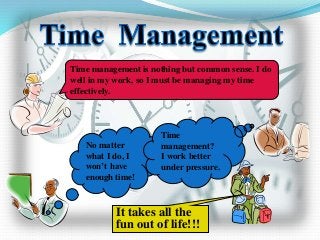
Time management is nothing but common sense. I do
well in my work, so I must be managing my time
effectively.
It takes all the
fun out of life!!!
No matter
what I do, I
won’t have
enough time!
Time
management?
I work better
under pressure.
Outline
1. Meaning and Definition
2. Importance
3. Steps
4. Advantages
5. Disadvantages
6. Learn to say “NO”
7. Charts and graphs
8. Obstacles
9. Tips
10. Case study
11. Conclusion
12. Recommendations.
What is time management?
Meaning:- Time management is the act or
process of planning and exercising conscious
control over the amount of time spent on
specific activities, especially to increase
effectiveness, efficiency or productivity.
Definition of time management.
Do not dwell in past, do not dream of future, concentrate the mind on the
present moment. - Buddha
Defer no time, delays have dangerous ends. – William Shakespeare
Never leave till tomorrow which you can do today. –Benjamin Franklin
A man who dares to waste one hour of life has not discovered the value of
life. – Charles Darwin
Time stays long enough for those who use it. – Leonardo Da Vinci
Importance of time management.
 You are more efficient.
 You feel calmer and more in control.
 You are more fulfilled.
 You have more energy.
 You develop more qualities.
 You achieve what you want to and need to faster.
 You enjoy your life more.
Steps of time management.
1. Set a goal.
2. Set a schedule of work.
3. Set a direction towards goal.
Setting a goal
Specific
Measurable
Achievable
Realistic
Time-Based
Realize that goals change , but know which goals to stick with!
Setting a schedule of work.
 Prioritize.
 Organize.
 Planning.
All work and no play will drive you nuts!
Setting a direction towards goals.
 Revisit your schedule.
 Revise your schedule.
 Complete the work in scheduled time.
 Change the scheduled as per the outcomes of the work.
 Continue the schedule in daily terms.
Time and Tides wait for none!
Advantages of time management.
 Reduction in stress level.
 Provides focus on the task.
 Decrease procrastination.
 Gain self confidence.
 A way to the goal.
 Challenge your productivity.
 Have an instinct for achievement.
 Time to relax and do recreational activities.
 Financial soundness.
Disadvantages of time management
 Non-clear objectives.
 Mismanagement.
 Can’t say no.
 Obstacles.
 Load of different work at same time.
 Insufficient work flow.
Learn to say “NO”.
 You can’t do everything.
 Don’t undertake things you can’t
complete.
 Remain consistent to the goals.
 Tune out interruptions.
Don’t let distractions sap your time!
I have a study group
tonight. Are you free
on Thursday?
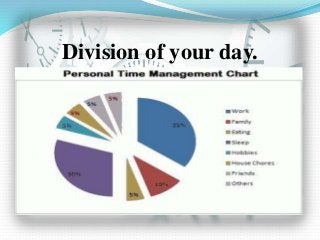
Division of your day.
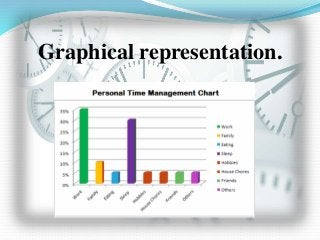
Graphical representation.
Obstacles in time management
 Unclear objectives.
 Disorganization.
 Inability to say “NO”.
 Periods of inactivity.
 Stress and fatigue.
 Mentally or physically ill.
Tips for managing time.
 Get a day timer.
 Write things down.
 What’s our next task .
 Stress more over quality of work.
 Enjoy your achievements.
 Speed up your work but , efficiently.
Case study
 Amit had just completed his first term as a Fresher. He had submitted all but one of his
assignments, but all had been late. In addition he had received low marks for the submitted work,
with comments on his poor expression, lack of structure and incorrect referencing. He had been
sent to the learning development service to inquire about assessment for dyslexia.
 Initial discussion suggested that Amit was unlikely to have a specific learning difficulty: he was
able to self-correct his writing and reported no problems with slowness in reading or
communicating his ideas. He admitted that he had completed the submitted assignments at the
last minute and had not had enough time to proof read or check proper referencing procedure. In
addition, he felt that spending time on planning his work would have held him up even further, so
had just started writing, referring to texts as he went along.
 Amit complained that all of his deadlines had come at the same time, and that he had not been
given guidance on how many or which texts to read from the extensive reading list provided.
Closer questioning showed that Amit had come directly from a small school where he had had a
lot of input from teaching staff with his organization and other study practices. It was suggested
that he set his own deadlines, spreading them out and starting in good time to make sure his
assignments were completed. He was shown how to plan his workload, and to set himself a flexible
study timetable for each week. Two more sessions were booked in which Amit was given advice on
selective reading, effective proof reading, correct referencing and how to prepare for and write
assignments.
 Amit returned later in the year for help with planning his revision, and was able to report that he
had submitted all of his assignments for the previous term on time, and had improved his marks.
Conclusion of managing time.
 Celebrate the achievement of your goals to maintain a
healthy balance in life between work and play.
 Reward yourself when you complete a task .
 If you work in a team setting , or delegated some task
to others, rewards the efforts of all involved.
 Celebration is a vital part of all project management.
 No matter how tight your schedule looks, this is time
well spent.
Slide created by-
1.Neel Gala
2.Dewang Jhunjhunwala
Recommended reading.
 The One Minute Manager,
Kenneth Blanchard and
Spencer Johnson, Berkeley
Books, 1981, ISBN 0-425-
09847-8
 The Seven Habits of Highly
Effective People, Stephen
Covey, Simon & Schuster,
1989, ISBN 0-671-70863-5.

Time  management

Time management

  • 2.
    Time management isnothing but common sense. I do well in my work, so I must be managing my time effectively. It takes all the fun out of life!!! No matter what I do, I won’t have enough time! Time management? I work better under pressure.
  • 3.
    Outline 1. Meaning andDefinition 2. Importance 3. Steps 4. Advantages 5. Disadvantages 6. Learn to say “NO” 7. Charts and graphs 8. Obstacles 9. Tips 10. Case study 11. Conclusion 12. Recommendations.
  • 4.
    What is timemanagement? Meaning:- Time management is the act or process of planning and exercising conscious control over the amount of time spent on specific activities, especially to increase effectiveness, efficiency or productivity.
  • 5.
    Definition of timemanagement. Do not dwell in past, do not dream of future, concentrate the mind on the present moment. - Buddha Defer no time, delays have dangerous ends. – William Shakespeare Never leave till tomorrow which you can do today. –Benjamin Franklin A man who dares to waste one hour of life has not discovered the value of life. – Charles Darwin Time stays long enough for those who use it. – Leonardo Da Vinci
  • 6.
    Importance of timemanagement.  You are more efficient.  You feel calmer and more in control.  You are more fulfilled.  You have more energy.  You develop more qualities.  You achieve what you want to and need to faster.  You enjoy your life more.
  • 7.
    Steps of timemanagement. 1. Set a goal. 2. Set a schedule of work. 3. Set a direction towards goal.
  • 8.
  • 9.
    Setting a scheduleof work.  Prioritize.  Organize.  Planning. All work and no play will drive you nuts!
  • 10.
    Setting a directiontowards goals.  Revisit your schedule.  Revise your schedule.  Complete the work in scheduled time.  Change the scheduled as per the outcomes of the work.  Continue the schedule in daily terms. Time and Tides wait for none!
  • 11.
    Advantages of timemanagement.  Reduction in stress level.  Provides focus on the task.  Decrease procrastination.  Gain self confidence.  A way to the goal.  Challenge your productivity.  Have an instinct for achievement.  Time to relax and do recreational activities.  Financial soundness.
  • 12.
    Disadvantages of timemanagement  Non-clear objectives.  Mismanagement.  Can’t say no.  Obstacles.  Load of different work at same time.  Insufficient work flow.
  • 13.
    Learn to say“NO”.  You can’t do everything.  Don’t undertake things you can’t complete.  Remain consistent to the goals.  Tune out interruptions. Don’t let distractions sap your time! I have a study group tonight. Are you free on Thursday?
  • 14.
  • 15.
  • 16.
    Obstacles in timemanagement  Unclear objectives.  Disorganization.  Inability to say “NO”.  Periods of inactivity.  Stress and fatigue.  Mentally or physically ill.
  • 17.
    Tips for managingtime.  Get a day timer.  Write things down.  What’s our next task .  Stress more over quality of work.  Enjoy your achievements.  Speed up your work but , efficiently.
  • 18.
    Case study  Amithad just completed his first term as a Fresher. He had submitted all but one of his assignments, but all had been late. In addition he had received low marks for the submitted work, with comments on his poor expression, lack of structure and incorrect referencing. He had been sent to the learning development service to inquire about assessment for dyslexia.  Initial discussion suggested that Amit was unlikely to have a specific learning difficulty: he was able to self-correct his writing and reported no problems with slowness in reading or communicating his ideas. He admitted that he had completed the submitted assignments at the last minute and had not had enough time to proof read or check proper referencing procedure. In addition, he felt that spending time on planning his work would have held him up even further, so had just started writing, referring to texts as he went along.  Amit complained that all of his deadlines had come at the same time, and that he had not been given guidance on how many or which texts to read from the extensive reading list provided. Closer questioning showed that Amit had come directly from a small school where he had had a lot of input from teaching staff with his organization and other study practices. It was suggested that he set his own deadlines, spreading them out and starting in good time to make sure his assignments were completed. He was shown how to plan his workload, and to set himself a flexible study timetable for each week. Two more sessions were booked in which Amit was given advice on selective reading, effective proof reading, correct referencing and how to prepare for and write assignments.  Amit returned later in the year for help with planning his revision, and was able to report that he had submitted all of his assignments for the previous term on time, and had improved his marks.
  • 19.
    Conclusion of managingtime.  Celebrate the achievement of your goals to maintain a healthy balance in life between work and play.  Reward yourself when you complete a task .  If you work in a team setting , or delegated some task to others, rewards the efforts of all involved.  Celebration is a vital part of all project management.  No matter how tight your schedule looks, this is time well spent.
  • 20.
    Slide created by- 1.NeelGala 2.Dewang Jhunjhunwala
  • 21.
    Recommended reading.  TheOne Minute Manager, Kenneth Blanchard and Spencer Johnson, Berkeley Books, 1981, ISBN 0-425- 09847-8  The Seven Habits of Highly Effective People, Stephen Covey, Simon & Schuster, 1989, ISBN 0-671-70863-5.