1/20/2018 4:41 PM, p. 1democracygps.org
Bernie Sanders would likely
be president with ranked
choice voting
Chris Krenn, Ph.D.
1/15/18
Copyright © 2017 by Christopher Krenn
democracygps.org
democracygps <at> gmail.com
1/20/2018 4:41 PM, p. 2democracygps.org
Voters are frustrated, but have not
yet given up or irreversibly polarized
>85% polled think the two-party
presidential election system is
not working
[AP-NORC, 2016]
Voting rates have not
changed much in 100 years
[fairvote.com, 2016; electproject.org, 2014]
Polarization is
increasing, but
there is still a
large population
of moderates
[Pew, 2014]
Political Ideology, 1970-
2015
1/20/2018 4:41 PM, p. 3democracygps.org
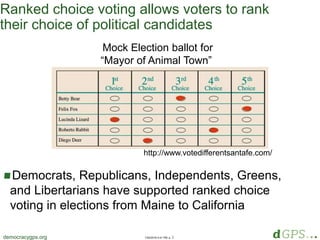
Ranked choice voting allows voters to rank
their choice of political candidates
Democrats, Republicans, Independents, Greens,
and Libertarians have supported ranked choice
voting in elections from Maine to California
http://www.votedifferentsantafe.com/
Mock Election ballot for
“Mayor of Animal Town”
1/20/2018 4:41 PM, p. 4democracygps.org
We are looking forward, not backward…
This study is not trying to question the
actual outcome of the 2016 Presidential
election. It is trying to answer the following
questions:
"What would have happened in 2016 if
ranked voting was used?", and
"Should the United States use ranked
voting in the future?"
1/20/2018 4:41 PM, p. 5democracygps.org
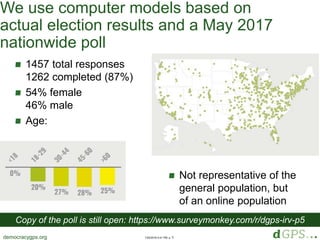
We use computer models based on
actual election results and a May 2017
nationwide poll
1457 total responses
1262 completed (87%)
54% female
46% male
Age:
Not representative of the
general population, but
of an online population
Copy of the poll is still open: https://www.surveymonkey.com/r/dgps-irv-p5
1/20/2018 4:41 PM, p. 6democracygps.org
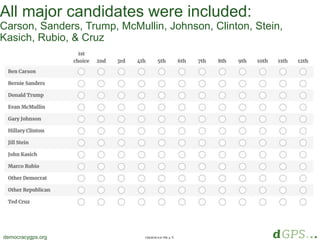
All major candidates were included:
Carson, Sanders, Trump, McMullin, Johnson, Clinton, Stein,
Kasich, Rubio, & Cruz
1/20/2018 4:41 PM, p. 7democracygps.org
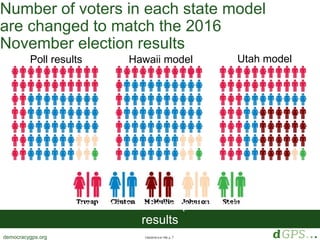
Poll results Hawaii model Utah model
Number of voters in each state model
are changed to match the 2016
November election results
This method uses a national poll to estimate state
results
1/20/2018 4:41 PM, p. 8democracygps.org
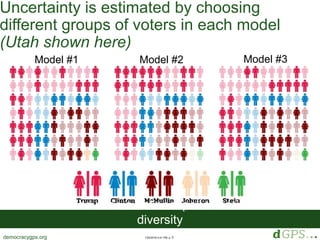
Uncertainty is estimated by choosing
different groups of voters in each model
(Utah shown here)
Model #1 Model #2 Model #3
This method uses a national poll to estimate state
diversity
1/20/2018 4:41 PM, p. 9democracygps.org
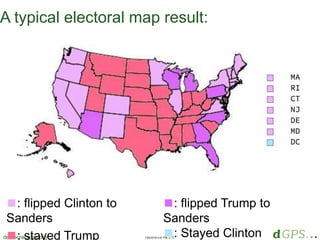
A typical electoral map result:
◼: flipped Clinton to
Sanders
◼: stayed Trump
◼: flipped Trump to
Sanders
◼: Stayed Clinton
1/20/2018 4:41 PM, p.
10democracygps.org
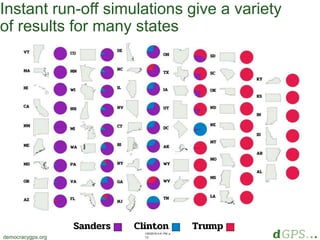
Instant run-off simulations give a variety
of results for many states
1/20/2018 4:41 PM, p.
11democracygps.org
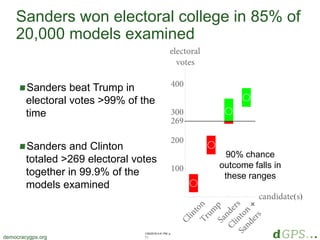
Sanders beat Trump in
electoral votes >99% of the
time
Sanders and Clinton
totaled >269 electoral votes
together in 99.9% of the
models examined
Sanders won electoral college in 85% of
20,000 models examined
90% chance
outcome falls in
these ranges
1/20/2018 4:41 PM, p.
12democracygps.org
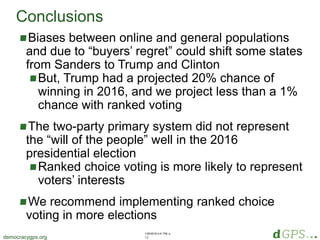
Biases between online and general populations
and due to “buyers’ regret” could shift some states
from Sanders to Trump and Clinton
But, Trump had a projected 20% chance of
winning in 2016, and we project less than a 1%
chance with ranked voting
The two-party primary system did not represent
the “will of the people” well in the 2016
presidential election
Ranked choice voting is more likely to represent
voters’ interests
We recommend implementing ranked choice
voting in more elections
Conclusions
1/20/2018 4:41 PM, p.
13democracygps.org
Analysis of alternate ranked voting methods (e.g.
“Schultze” and “MDDA”)
More detailed description of uncertainty analysis
and “convergence” of numerical simulations
More detailed analysis of poll results
Public release of polling and simulation data
Still to come…
1/20/2018 4:41 PM, p.
14democracygps.org
Acknowledgements and References
2016 electoral results taken from:
https://en.wikipedia.org/wiki/United
_States_presidential_election,_201
6
http://www.foxnews.com/politics/el
ections/2016/exit-polls
Visualizations and charts inspired
by fivethirtyeight.com
Survey done using
surveymonkey.com
Male/female symbols from aiga.org
High contrast colors from S.
Trubetskoy:
https://sashat.me/2017/01/11/list-
of-20-simple-distinct-colors/
APNORC:
http://www.apnorc.org/PDFs/Voting
/APNORC_Elections_Topline.pdf
ElectProject:
http://www.electproject.org/2014g
FairVote:
http://www.fairvote.org/research-
and-analysis/voter-turnout/
Pew: http://www.people-
press.org/2014/06/12/political-
polarization-in-the-american-public/
1/20/2018 4:41 PM, p.
15democracygps.org
Chris Krenn is a computational physicist and
metallurgist working near San Francisco since
2001 and has been exploring electronic
democracy systems since 2013. He has a B.S.
from Yale and a Ph.D. from U.C. Berkeley.
About the author

2016 Sanders victory with instant runoff elections

  • 1.
    1/20/2018 4:41 PM,p. 1democracygps.org Bernie Sanders would likely be president with ranked choice voting Chris Krenn, Ph.D. 1/15/18 Copyright © 2017 by Christopher Krenn democracygps.org democracygps <at> gmail.com
  • 2.
    1/20/2018 4:41 PM,p. 2democracygps.org Voters are frustrated, but have not yet given up or irreversibly polarized >85% polled think the two-party presidential election system is not working [AP-NORC, 2016] Voting rates have not changed much in 100 years [fairvote.com, 2016; electproject.org, 2014] Polarization is increasing, but there is still a large population of moderates [Pew, 2014] Political Ideology, 1970- 2015
  • 3.
    1/20/2018 4:41 PM,p. 3democracygps.org Ranked choice voting allows voters to rank their choice of political candidates Democrats, Republicans, Independents, Greens, and Libertarians have supported ranked choice voting in elections from Maine to California http://www.votedifferentsantafe.com/ Mock Election ballot for “Mayor of Animal Town”
  • 4.
    1/20/2018 4:41 PM,p. 4democracygps.org We are looking forward, not backward… This study is not trying to question the actual outcome of the 2016 Presidential election. It is trying to answer the following questions: "What would have happened in 2016 if ranked voting was used?", and "Should the United States use ranked voting in the future?"
  • 5.
    1/20/2018 4:41 PM,p. 5democracygps.org We use computer models based on actual election results and a May 2017 nationwide poll 1457 total responses 1262 completed (87%) 54% female 46% male Age: Not representative of the general population, but of an online population Copy of the poll is still open: https://www.surveymonkey.com/r/dgps-irv-p5
  • 6.
    1/20/2018 4:41 PM,p. 6democracygps.org All major candidates were included: Carson, Sanders, Trump, McMullin, Johnson, Clinton, Stein, Kasich, Rubio, & Cruz
  • 7.
    1/20/2018 4:41 PM,p. 7democracygps.org Poll results Hawaii model Utah model Number of voters in each state model are changed to match the 2016 November election results This method uses a national poll to estimate state results
  • 8.
    1/20/2018 4:41 PM,p. 8democracygps.org Uncertainty is estimated by choosing different groups of voters in each model (Utah shown here) Model #1 Model #2 Model #3 This method uses a national poll to estimate state diversity
  • 9.
    1/20/2018 4:41 PM,p. 9democracygps.org A typical electoral map result: ◼: flipped Clinton to Sanders ◼: stayed Trump ◼: flipped Trump to Sanders ◼: Stayed Clinton
  • 10.
    1/20/2018 4:41 PM,p. 10democracygps.org Instant run-off simulations give a variety of results for many states
  • 11.
    1/20/2018 4:41 PM,p. 11democracygps.org Sanders beat Trump in electoral votes >99% of the time Sanders and Clinton totaled >269 electoral votes together in 99.9% of the models examined Sanders won electoral college in 85% of 20,000 models examined 90% chance outcome falls in these ranges
  • 12.
    1/20/2018 4:41 PM,p. 12democracygps.org Biases between online and general populations and due to “buyers’ regret” could shift some states from Sanders to Trump and Clinton But, Trump had a projected 20% chance of winning in 2016, and we project less than a 1% chance with ranked voting The two-party primary system did not represent the “will of the people” well in the 2016 presidential election Ranked choice voting is more likely to represent voters’ interests We recommend implementing ranked choice voting in more elections Conclusions
  • 13.
    1/20/2018 4:41 PM,p. 13democracygps.org Analysis of alternate ranked voting methods (e.g. “Schultze” and “MDDA”) More detailed description of uncertainty analysis and “convergence” of numerical simulations More detailed analysis of poll results Public release of polling and simulation data Still to come…
  • 14.
    1/20/2018 4:41 PM,p. 14democracygps.org Acknowledgements and References 2016 electoral results taken from: https://en.wikipedia.org/wiki/United _States_presidential_election,_201 6 http://www.foxnews.com/politics/el ections/2016/exit-polls Visualizations and charts inspired by fivethirtyeight.com Survey done using surveymonkey.com Male/female symbols from aiga.org High contrast colors from S. Trubetskoy: https://sashat.me/2017/01/11/list- of-20-simple-distinct-colors/ APNORC: http://www.apnorc.org/PDFs/Voting /APNORC_Elections_Topline.pdf ElectProject: http://www.electproject.org/2014g FairVote: http://www.fairvote.org/research- and-analysis/voter-turnout/ Pew: http://www.people- press.org/2014/06/12/political- polarization-in-the-american-public/
  • 15.
    1/20/2018 4:41 PM,p. 15democracygps.org Chris Krenn is a computational physicist and metallurgist working near San Francisco since 2001 and has been exploring electronic democracy systems since 2013. He has a B.S. from Yale and a Ph.D. from U.C. Berkeley. About the author