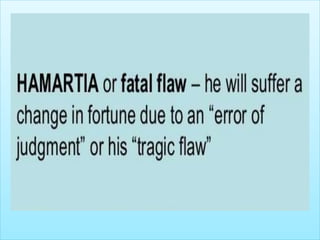
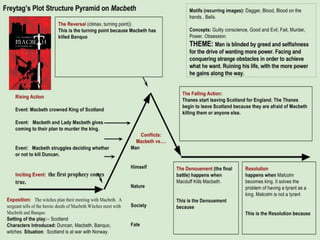
In classical tragedy the protagonist faces his downfall because of
his tragic flaw which means the inherent traits of his character
DEFINITION OF TRAGIC FLAW
In Shakespeare's Macbeth, Macbeth and his wife Lady Macbeth
are both examples of tragic heroes who possess a tragic flaw.
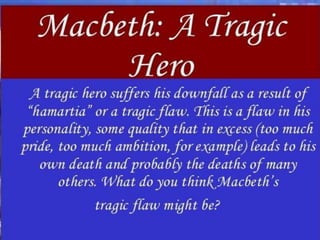
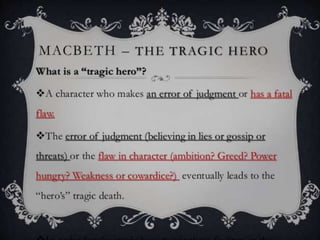
According to Webster's dictionary, a tragic flaw is defined as "a
flaw in character that brings about the downfall of the hero of a
tragedy." Macbeth held within his character the flaw of ambition,
as well as moral weakness and selective perception, which
eventually contributed to his untimely death. In Lady Macbeth's
case, the main shortcoming is her destruction and final suicide
was greed, along with an ignorance and repression of the
emotions that contradicted this desire. Both characters began in
high positions and, throughout the play, accumulated losses
caused by their own weaknesses in personality.
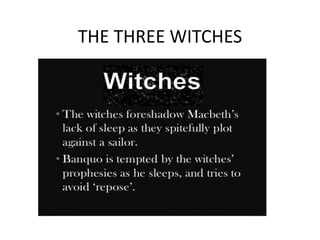
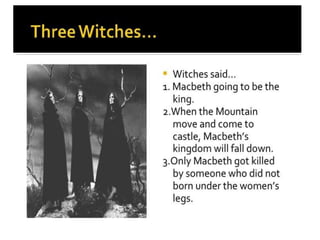
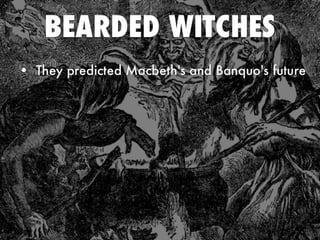
THE THREE WITCHES
UNDERSTANDING THE PLOT
ACT 1
ACT 1
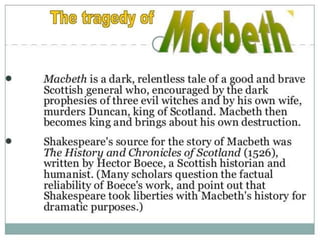
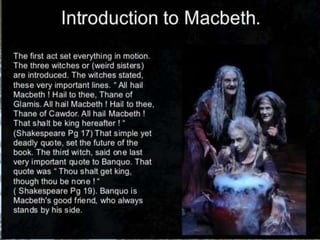
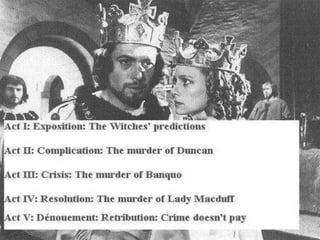
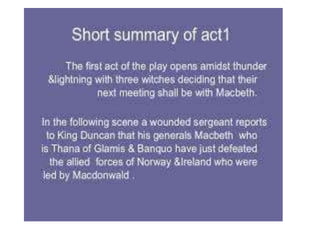
The play takes place in Scotland. Duncan, the king of Scotland, is
at war with the king of Norway. As the play opens, he learns of
Macbeth's bravery in a victorious battle against Macdonald—a
Scot who sided with the Norwegians. At the same time, news
arrives concerning the arrest of the treacherous Thane of Cawdor.
Duncan decides to give the title of Thane of Cawdor to Macbeth.
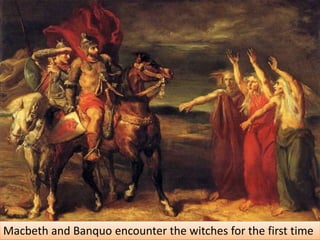
As Macbeth and Banquo return home from battle, they meet
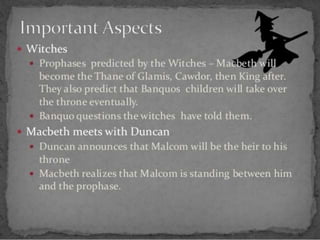
three witches. The witches predict that Macbeth will be thane of
Cawdor and king of Scotland, and that Banquo will be the father
of kings. After the witches disappear, Macbeth and Banquo meet
two noblemen Ross and Angus, who announce Macbeth's new
title as thane of Cawdor. Upon hearing this, Macbeth begins to
contemplate the murder of Duncan in order to realize the witches
' second prophecy.
Macbeth and Banquo encounter the witches for the first time
ACT 1
Macbeth and Banquo meet with Duncan, who announces that he is going to pay
Macbeth a visit at his castle. Macbeth rides ahead to prepare his household.
Meanwhile, Lady Macbeth receives a letter from Macbeth informing her of the
witches' prophesy and its subsequent realization. A servant appears to inform
her of Duncan's approach. Energized by the news, Lady Macbeth invokes
supernatural powers to strip her of feminine softness and thus prepare her for
the murder of Duncan. When Macbeth arrives, Lady Macbeth tells him that she
will plot Duncan's murder. When Duncan arrives at the castle, Lady Macbeth
greets him alone. When Macbeth fails to appear, Lady Macbeth finds him is in
his room, contemplating the weighty and evil decision to kill Duncan. Lady
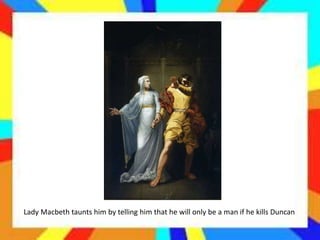
Macbeth taunts him by telling him that he will only be a man if he kills Duncan.
She then tells him her plan for the murder, which Macbeth accepts: they will kill
him while his drunken bodyguards sleep, then plant incriminating evidence on
the bodyguards.
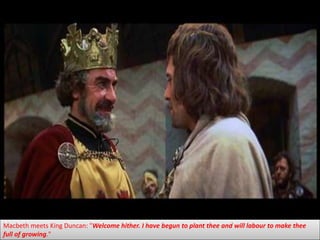
Macbeth meets King Duncan: "Welcome hither. I have begun to plant thee and will labour to make thee
full of growing."
Lady Macbeth taunts him by telling him that he will only be a man if he kills Duncan
UNDERSTANDING THE PLOT
ACT-2
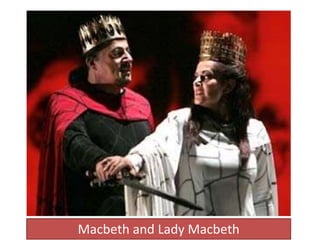
Macbeth and Lady Macbeth
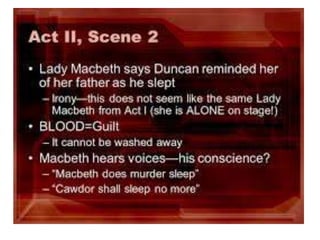
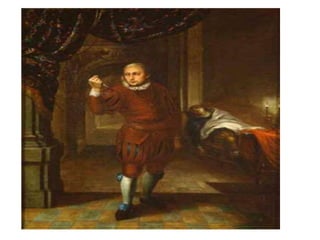
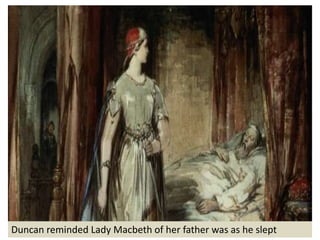
Duncan reminded Lady Macbeth of her father was as he slept
ACT 2
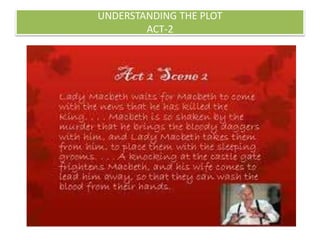
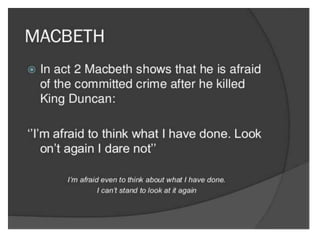
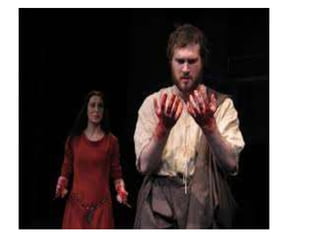
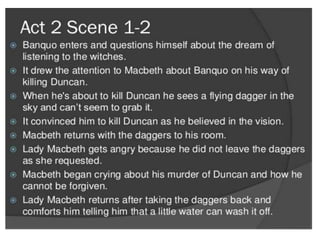
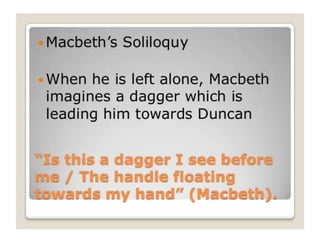
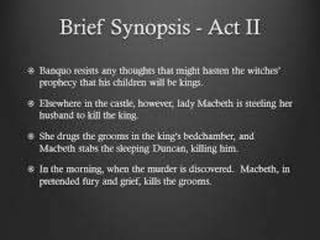
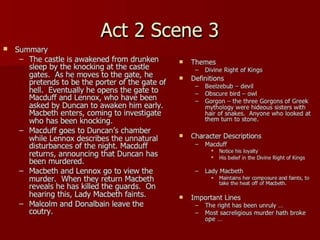
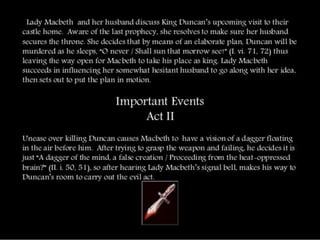
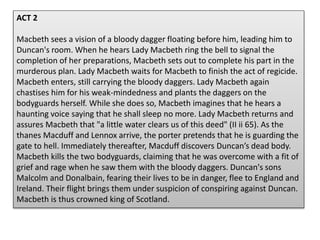
Macbeth sees a vision of a bloody dagger floating before him, leading him to
Duncan's room. When he hears Lady Macbeth ring the bell to signal the
completion of her preparations, Macbeth sets out to complete his part in the
murderous plan. Lady Macbeth waits for Macbeth to finish the act of regicide.
Macbeth enters, still carrying the bloody daggers. Lady Macbeth again
chastises him for his weak-mindedness and plants the daggers on the
bodyguards herself. While she does so, Macbeth imagines that he hears a
haunting voice saying that he shall sleep no more. Lady Macbeth returns and
assures Macbeth that "a little water clears us of this deed" (II ii 65). As the
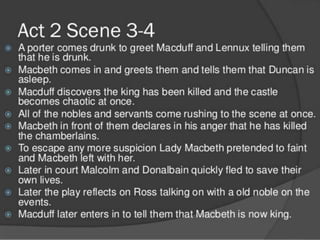
thanes Macduff and Lennox arrive, the porter pretends that he is guarding the
gate to hell. Immediately thereafter, Macduff discovers Duncan’s dead body.
Macbeth kills the two bodyguards, claiming that he was overcome with a fit of
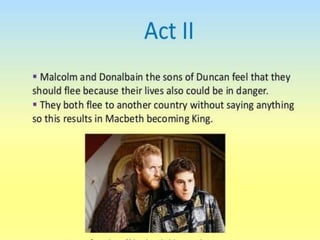
grief and rage when he saw them with the bloody daggers. Duncan's sons
Malcolm and Donalbain, fearing their lives to be in danger, flee to England and
Ireland. Their flight brings them under suspicion of conspiring against Duncan.
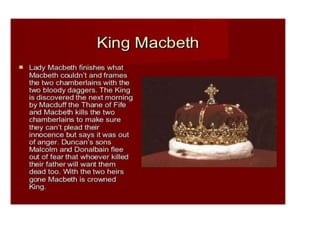
Macbeth is thus crowned king of Scotland.
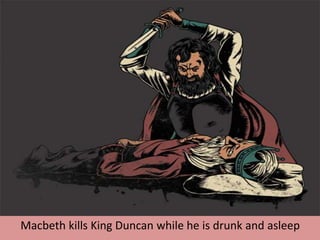
Macbeth kills King Duncan while he is drunk and asleep
The next morning, the murder is blamed on the guards. Macbeth
kills them before they can protest, explaining that he killed them
out of rage. The King’s sons, however, are still fearful for their lives
and run away. Macbeth is crowned king. Macbeth knows that
Banquo is suspicious of him. When Macbeth learns that Banquo
and his son are out of riding, he sends men out to kill them. They
are only half successful in their job, and Banquo is empty because
he’s dead/ In the empty seat, the ghost of Banquo appears,
frightening Macbeth badly.
UNDERSTANDING THE PLOT
ACT 3
ACT 3
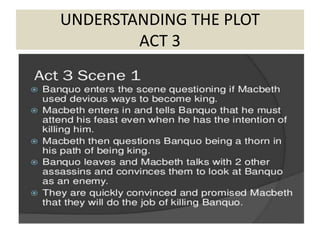
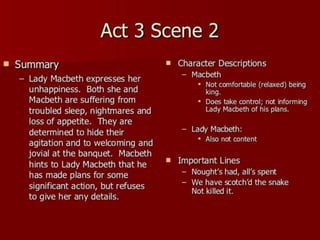
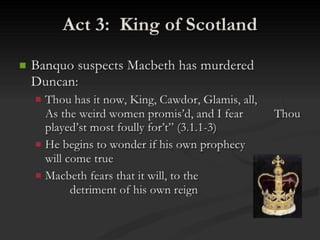
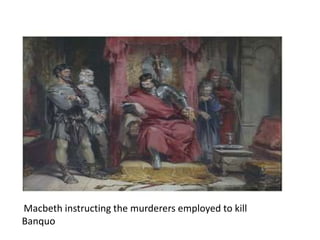
In an attempt to thwart the witches' prophesy that Banquo will
father kings, Macbeth hires two murderers to kill Banquo and his
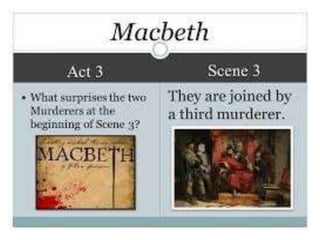
son Fleance. Lady Macbeth is left uninformed of these plans. A
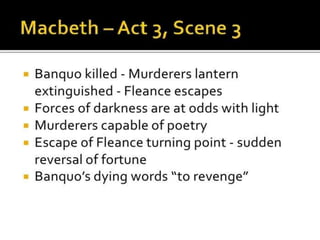
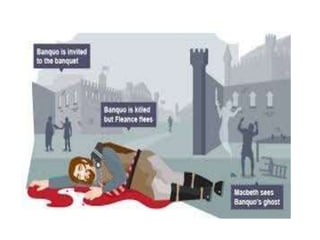
third murderer joins the other two on the heath and the three
men kill Banquo. Fleance, however, manages to escape. Banquo’s
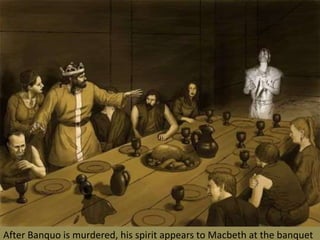
ghost appears to Macbeth as he sits down to a celebratory
banquet, sending him into a frenzy of terror. Lady Macbeth
attempts to cover up for his odd behavior but the banquet comes
to a premature end as the thanes begin to question Macbeth's
sanity. Macbeth decides that he must revisit the witches to look
into the future once more. Meanwhile, Macbeth's thanes begin
to turn against him. Macduff meets Malcolm in England to
prepare an army to march on Scotland.
After Banquo is murdered, his spirit appears to Macbeth at the banquet
Macbeth instructing the murderers employed to kill
Banquo
THE APPARITIONS
ACT 4
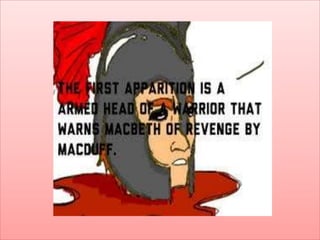
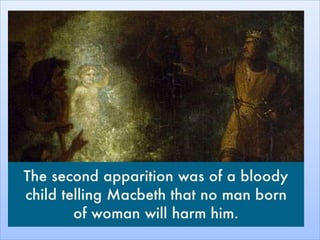
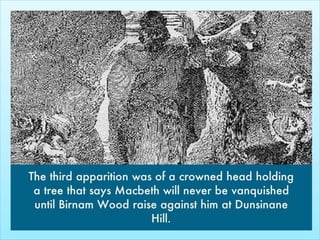
The witches show Macbeth three apparitions. The first warns
him against Macduff, the second tells him to fear no man
born of woman, and the third prophesizes that he will fall
only when Birnam Wood comes to Dunsinane castle.
Macbeth takes this as a prophecy that he is infallible. When
he asks the witches if their prophesy about Banquo will come
true, they show him a procession of eight kings, all of whom
look like Banquo. Meanwhile in England, Malcolm tests
Macduff's loyalty by pretending to confess to multiple sins
and malicious ambitions. When Macduff proves his loyalty to
Scotland, the two strategize for their offensive against
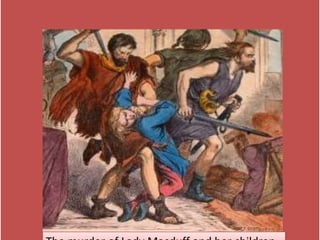
Macbeth. Back in Scotland, Macbeth has Macduff’s wife and
children murdered.
UNDERSTANDING THE PLOT
ACT 5
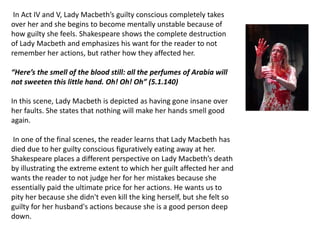
In Act IV and V, Lady Macbeth’s guilty conscious completely takes
over her and she begins to become mentally unstable because of
how guilty she feels. Shakespeare shows the complete destruction
of Lady Macbeth and emphasizes his want for the reader to not
remember her actions, but rather how they affected her.
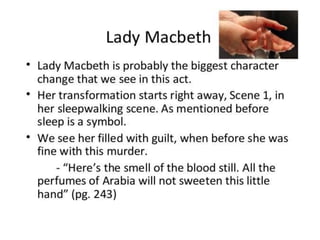
“Here’s the smell of the blood still: all the perfumes of Arabia will
not sweeten this little hand. Oh! Oh! Oh” (5.1.140)
In this scene, Lady Macbeth is depicted as having gone insane over
her faults. She states that nothing will make her hands smell good
again.
In one of the final scenes, the reader learns that Lady Macbeth has
died due to her guilty conscious figuratively eating away at her.
Shakespeare places a different perspective on Lady Macbeth’s death
by illustrating the extreme extent to which her guilt affected her and
wants the reader to not judge her for her mistakes because she
essentially paid the ultimate price for her actions. He wants us to
pity her because she didn't even kill the king herself, but she felt so
guilty for her husband's actions because she is a good person deep
down.
ACT 5
Lady Macbeth suffers from bouts of sleepwalking. To a doctor who observes her
symptoms, she unwittingly reveals her guilt as she pronounces that she cannot wash her
hands clean of bloodstains. Macbeth is too preoccupied with battle preparations to pay
much heed to her dreams and expresses anger when the doctor says he cannot cure her.
Just as the English army led by Malcolm, Macduff, Siward approaches, Lady Macbeth’s
cry of death is heard in the castle. When Macbeth hears of her death, he comments that
she should have died at a future date and muses on the meaninglessness of life.
Taking the witches’ second prophecy in good faith, Macbeth still believes that he is
impregnable to the approaching army. But Malcolm has instructed each man in the
English army to cut a tree branch from Birnam Wood and hold it up to disguise the
army’s total numbers. As a result, Macbeth's servant reports that he has seen a
seemingly impossible sight: Birnam Wood seems to be moving toward the castle.
Macbeth is shaken but still engages the oncoming army.
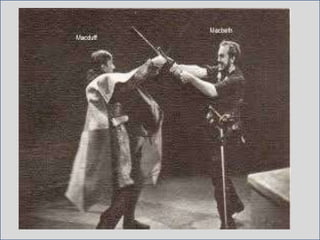
In battle, Macbeth kills Young Siward, the English general's brave son. Macduff then
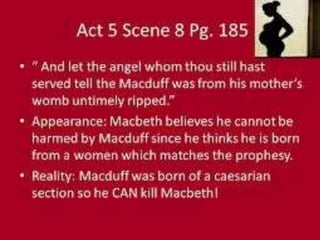
challenges Macbeth. As they fight, Macduff reveals that he was not "of woman born" but
was "untimely ripped" from his mother's womb (V x 13-16). Macbeth is stunned but
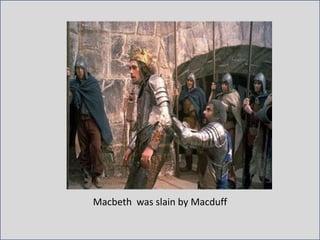
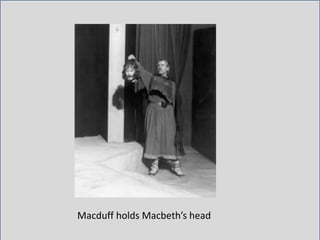
refuses to yield to Macduff. Macduff kills him and decapitates him. At the end of the
play, Malcolm is proclaimed the new king of Scotland.
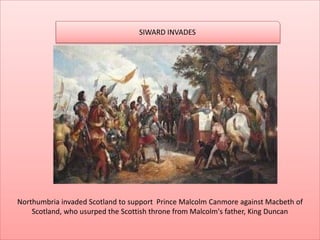
Northumbria invaded Scotland to support Prince Malcolm Canmore against Macbeth of
Scotland, who usurped the Scottish throne from Malcolm's father, King Duncan
SIWARD INVADES
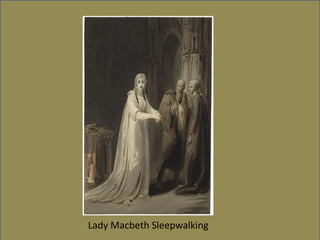
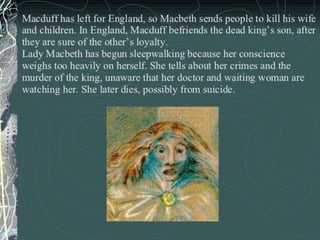
Lady Macbeth Sleepwalking
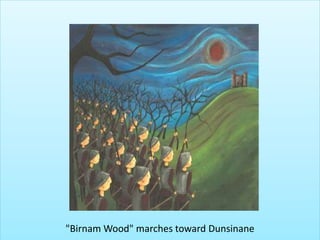
"Birnam Wood" marches toward Dunsinane
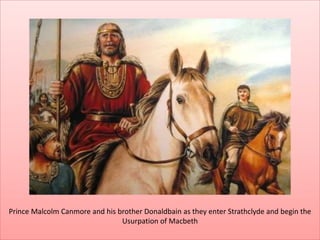
Prince Malcolm Canmore and his brother Donaldbain as they enter Strathclyde and begin the
Usurpation of Macbeth
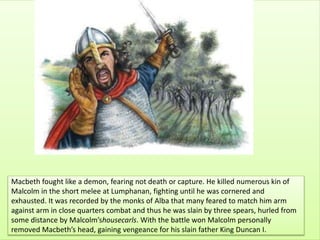
Macbeth fought like a demon, fearing not death or capture. He killed numerous kin of
Malcolm in the short melee at Lumphanan, fighting until he was cornered and
exhausted. It was recorded by the monks of Alba that many feared to match him arm
against arm in close quarters combat and thus he was slain by three spears, hurled from
some distance by Malcolm’shousecarls. With the battle won Malcolm personally
removed Macbeth’s head, gaining vengeance for his slain father King Duncan I.
On 15th August 1057, Macbeth, the King of Scots, then known as the King of Alba, was killed at
the Battle of [the Peelring of] Lumphanan in what is today Aberdeenshire, Scotland. Macbeth
was killed in battle by the combined Scottish-Scandinavian army of Prince Malcolm Canmore,
the son of the dethroned and murdered King Duncan I.
The Peelring
Macbeth was slain by Macduff
Macduff holds Macbeth’s head
CRIME DOESN’T PAY
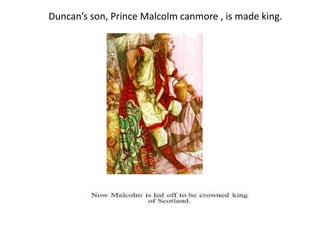
Duncan’s son, Prince Malcolm canmore , is made king.
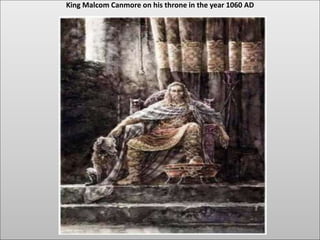
King Malcom Canmore on his throne in the year 1060 AD
MACBETH’S TRAGIC FLAWS
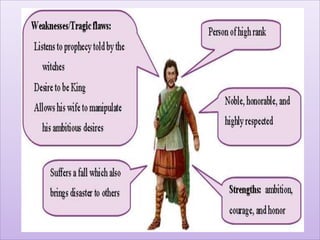
Macbeth is a tragic hero. He was a person of high
distinction who is eventually brought to ruin by a flaws
in his character. Macbeth has several tragic flaws that
lead to his destruction. His first tragic flaw is his evil
ambition, which leads him to a series of bloody and
ever increasing malicious acts. Macbeth's belief in the
three witches and their prophecies is yet another
tragic flaw. This makes Macbeth wonder about the
next prophecy, and he ends up acting on his free will to
make it come true.
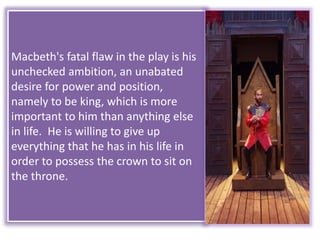
Macbeth's fatal flaw in the play is his
unchecked ambition, an unabated
desire for power and position,
namely to be king, which is more
important to him than anything else
in life. He is willing to give up
everything that he has in his life in
order to possess the crown to sit on
the throne.
Macbeth is the tragic hero of the play Macbeth because he fits the following
criteria:
• he is of noble birth
• he is morally good at the start
• he has a tragic flaw
• his actions affect the entire kingdom
• he understands the consequences of his actions; and his actions lead to
his death.
Macbeth's father was Thane of Glamis, and Macbeth succeeded his father,
making him of noble birth. (Act 1, Scene 3, line 48)
At the beginning of the play, Macbeth is loyal to his country and king and
also fights bravely for them. Duncan praises him and his peers look up to
him. (Act 1, Scene 2, lines 1-69)
Macbeth's tragic flaw is too much ambition. Once Lady Macbeth convinces
him to kill the king, Macbeth becomes power hungry and does whatever he
has to to stay atop as king, including killing his best friend (Act 3, Scene 3,
lines 1-22), and his enemy's family (Act 4, Scene 2, lines 1-83).
Contd….
Macbeth's actions affect the whole kingdom greatly. First, he kills
Duncan, Scotland's king (Act 2, Scene 2, lines 1-74). This leaves
Scotland with no king until Macbeth is crowned, which is a rather
large change. He then kills Banquo, fearing that he and Fleance, his
son, would be his down fall (Act 3, Scene 3, lines 1-22).
Near the end of the play, Macbeth recognizes that his actions now
have consequences. Since he killed Duncan, he enraged many and
now faces his doom. He realizes that this all stemmed from one
murder he committed.
Macduff kills Macbeth as revenge for killing Macduff's family, and
also for Malcolm, the rightful king, as Macbeth murdered his father.
Once again, because of one murder, chaos ensued. (Act 5, Scene
8, lines 30-105)
For all the above cited reasons, Macbeth is considered to be
indeed the tragic hero.
FATAL FLAW IN MACBETH
Macbeth, an individual who started
out at the beginning as an honest and
loyal soldier, becomes a murderous
human being because of his flaws in
character, thus making this play one of
the greatest tragedies in the world of
literature.
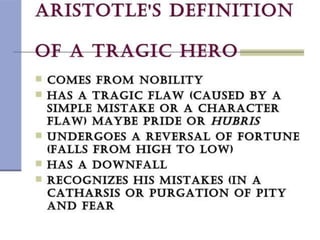
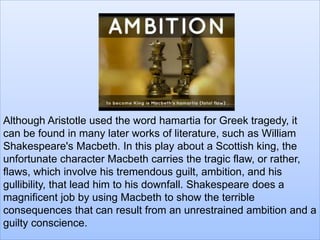
Although Aristotle used the word hamartia for Greek tragedy, it
can be found in many later works of literature, such as William
Shakespeare's Macbeth. In this play about a Scottish king, the
unfortunate character Macbeth carries the tragic flaw, or rather,
flaws, which involve his tremendous guilt, ambition, and his
gullibility, that lead him to his downfall. Shakespeare does a
magnificent job by using Macbeth to show the terrible
consequences that can result from an unrestrained ambition and a
guilty conscience.
The witches convince Macbeth that he will not be killed by a person who was
not woman-born, which causes Macbeth to think he is invincible: "Laugh to
scorn the pow'r of man, for none of woman born shall harm Macbeth. (IV. i. 79-
81)" This act of easily believing what the witches prophesied eventually leads
Macbeth to his death when Macduff, who was "ripped from his mother's womb,"
stabs Macbeth in the battlefield at the end of the play.
Unlike many other heroes in classic literature, whose flaws involve arrogance
and pride, Macbeth's ambitious nature is was not exactly harmful or considered
a bad thing in any way until his uncontrolled ambition and inability to remain
emotionally tough after committing the crimes was met with his gullibility.
This fatal combination turned Macbeth into almost a madman, motivated solely
by lust for fame and power. It is exactly his great ambition and extreme gullibility
that ultimately leads him to his demise.
REFERENCES
1.Wikipedia
2.www.google.com
3.www.sllideplayer.com: Macbeth summary by Buddy
James
4.www.exampleessays.com
5.www.bbc.co.uk
6.Macbethian era Scotland and the Battle of Lumphanan 1057:
www.warfarehistorianblogspot.in
7. Prelude, The End Of King Malcolm III's reign, 1093 AD
8.www.enotes.com
9. Tragic flaws of Macbeth:www.markedbyteachers.com
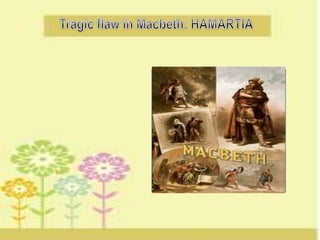
Tragic flaw in macbeth: HAMARTIA

Tragic flaw in macbeth: HAMARTIA

  • 3.
    In classical tragedythe protagonist faces his downfall because of his tragic flaw which means the inherent traits of his character DEFINITION OF TRAGIC FLAW
  • 7.
    In Shakespeare's Macbeth,Macbeth and his wife Lady Macbeth are both examples of tragic heroes who possess a tragic flaw. According to Webster's dictionary, a tragic flaw is defined as "a flaw in character that brings about the downfall of the hero of a tragedy." Macbeth held within his character the flaw of ambition, as well as moral weakness and selective perception, which eventually contributed to his untimely death. In Lady Macbeth's case, the main shortcoming is her destruction and final suicide was greed, along with an ignorance and repression of the emotions that contradicted this desire. Both characters began in high positions and, throughout the play, accumulated losses caused by their own weaknesses in personality.
  • 15.
  • 21.
  • 22.
    ACT 1 The playtakes place in Scotland. Duncan, the king of Scotland, is at war with the king of Norway. As the play opens, he learns of Macbeth's bravery in a victorious battle against Macdonald—a Scot who sided with the Norwegians. At the same time, news arrives concerning the arrest of the treacherous Thane of Cawdor. Duncan decides to give the title of Thane of Cawdor to Macbeth. As Macbeth and Banquo return home from battle, they meet three witches. The witches predict that Macbeth will be thane of Cawdor and king of Scotland, and that Banquo will be the father of kings. After the witches disappear, Macbeth and Banquo meet two noblemen Ross and Angus, who announce Macbeth's new title as thane of Cawdor. Upon hearing this, Macbeth begins to contemplate the murder of Duncan in order to realize the witches ' second prophecy.
  • 23.
    Macbeth and Banquoencounter the witches for the first time
  • 24.
    ACT 1 Macbeth andBanquo meet with Duncan, who announces that he is going to pay Macbeth a visit at his castle. Macbeth rides ahead to prepare his household. Meanwhile, Lady Macbeth receives a letter from Macbeth informing her of the witches' prophesy and its subsequent realization. A servant appears to inform her of Duncan's approach. Energized by the news, Lady Macbeth invokes supernatural powers to strip her of feminine softness and thus prepare her for the murder of Duncan. When Macbeth arrives, Lady Macbeth tells him that she will plot Duncan's murder. When Duncan arrives at the castle, Lady Macbeth greets him alone. When Macbeth fails to appear, Lady Macbeth finds him is in his room, contemplating the weighty and evil decision to kill Duncan. Lady Macbeth taunts him by telling him that he will only be a man if he kills Duncan. She then tells him her plan for the murder, which Macbeth accepts: they will kill him while his drunken bodyguards sleep, then plant incriminating evidence on the bodyguards.
  • 25.
    Macbeth meets KingDuncan: "Welcome hither. I have begun to plant thee and will labour to make thee full of growing."
  • 26.
    Lady Macbeth tauntshim by telling him that he will only be a man if he kills Duncan
  • 29.
  • 33.
  • 35.
    Duncan reminded LadyMacbeth of her father was as he slept
  • 38.
    ACT 2 Macbeth seesa vision of a bloody dagger floating before him, leading him to Duncan's room. When he hears Lady Macbeth ring the bell to signal the completion of her preparations, Macbeth sets out to complete his part in the murderous plan. Lady Macbeth waits for Macbeth to finish the act of regicide. Macbeth enters, still carrying the bloody daggers. Lady Macbeth again chastises him for his weak-mindedness and plants the daggers on the bodyguards herself. While she does so, Macbeth imagines that he hears a haunting voice saying that he shall sleep no more. Lady Macbeth returns and assures Macbeth that "a little water clears us of this deed" (II ii 65). As the thanes Macduff and Lennox arrive, the porter pretends that he is guarding the gate to hell. Immediately thereafter, Macduff discovers Duncan’s dead body. Macbeth kills the two bodyguards, claiming that he was overcome with a fit of grief and rage when he saw them with the bloody daggers. Duncan's sons Malcolm and Donalbain, fearing their lives to be in danger, flee to England and Ireland. Their flight brings them under suspicion of conspiring against Duncan. Macbeth is thus crowned king of Scotland.
  • 42.
    Macbeth kills KingDuncan while he is drunk and asleep
  • 43.
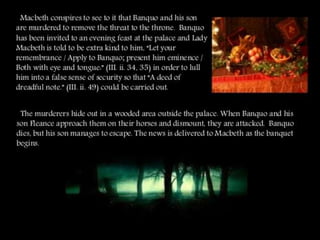
    The next morning,the murder is blamed on the guards. Macbeth kills them before they can protest, explaining that he killed them out of rage. The King’s sons, however, are still fearful for their lives and run away. Macbeth is crowned king. Macbeth knows that Banquo is suspicious of him. When Macbeth learns that Banquo and his son are out of riding, he sends men out to kill them. They are only half successful in their job, and Banquo is empty because he’s dead/ In the empty seat, the ghost of Banquo appears, frightening Macbeth badly.
  • 50.
  • 53.
    ACT 3 In anattempt to thwart the witches' prophesy that Banquo will father kings, Macbeth hires two murderers to kill Banquo and his son Fleance. Lady Macbeth is left uninformed of these plans. A third murderer joins the other two on the heath and the three men kill Banquo. Fleance, however, manages to escape. Banquo’s ghost appears to Macbeth as he sits down to a celebratory banquet, sending him into a frenzy of terror. Lady Macbeth attempts to cover up for his odd behavior but the banquet comes to a premature end as the thanes begin to question Macbeth's sanity. Macbeth decides that he must revisit the witches to look into the future once more. Meanwhile, Macbeth's thanes begin to turn against him. Macduff meets Malcolm in England to prepare an army to march on Scotland.
  • 54.
    After Banquo ismurdered, his spirit appears to Macbeth at the banquet
  • 58.
    Macbeth instructing themurderers employed to kill Banquo
  • 72.
  • 77.
    ACT 4 The witchesshow Macbeth three apparitions. The first warns him against Macduff, the second tells him to fear no man born of woman, and the third prophesizes that he will fall only when Birnam Wood comes to Dunsinane castle. Macbeth takes this as a prophecy that he is infallible. When he asks the witches if their prophesy about Banquo will come true, they show him a procession of eight kings, all of whom look like Banquo. Meanwhile in England, Malcolm tests Macduff's loyalty by pretending to confess to multiple sins and malicious ambitions. When Macduff proves his loyalty to Scotland, the two strategize for their offensive against Macbeth. Back in Scotland, Macbeth has Macduff’s wife and children murdered.
  • 81.
  • 84.
    In Act IVand V, Lady Macbeth’s guilty conscious completely takes over her and she begins to become mentally unstable because of how guilty she feels. Shakespeare shows the complete destruction of Lady Macbeth and emphasizes his want for the reader to not remember her actions, but rather how they affected her. “Here’s the smell of the blood still: all the perfumes of Arabia will not sweeten this little hand. Oh! Oh! Oh” (5.1.140) In this scene, Lady Macbeth is depicted as having gone insane over her faults. She states that nothing will make her hands smell good again. In one of the final scenes, the reader learns that Lady Macbeth has died due to her guilty conscious figuratively eating away at her. Shakespeare places a different perspective on Lady Macbeth’s death by illustrating the extreme extent to which her guilt affected her and wants the reader to not judge her for her mistakes because she essentially paid the ultimate price for her actions. He wants us to pity her because she didn't even kill the king herself, but she felt so guilty for her husband's actions because she is a good person deep down.
  • 86.
    ACT 5 Lady Macbethsuffers from bouts of sleepwalking. To a doctor who observes her symptoms, she unwittingly reveals her guilt as she pronounces that she cannot wash her hands clean of bloodstains. Macbeth is too preoccupied with battle preparations to pay much heed to her dreams and expresses anger when the doctor says he cannot cure her. Just as the English army led by Malcolm, Macduff, Siward approaches, Lady Macbeth’s cry of death is heard in the castle. When Macbeth hears of her death, he comments that she should have died at a future date and muses on the meaninglessness of life. Taking the witches’ second prophecy in good faith, Macbeth still believes that he is impregnable to the approaching army. But Malcolm has instructed each man in the English army to cut a tree branch from Birnam Wood and hold it up to disguise the army’s total numbers. As a result, Macbeth's servant reports that he has seen a seemingly impossible sight: Birnam Wood seems to be moving toward the castle. Macbeth is shaken but still engages the oncoming army. In battle, Macbeth kills Young Siward, the English general's brave son. Macduff then challenges Macbeth. As they fight, Macduff reveals that he was not "of woman born" but was "untimely ripped" from his mother's womb (V x 13-16). Macbeth is stunned but refuses to yield to Macduff. Macduff kills him and decapitates him. At the end of the play, Malcolm is proclaimed the new king of Scotland.
  • 87.
    Northumbria invaded Scotlandto support Prince Malcolm Canmore against Macbeth of Scotland, who usurped the Scottish throne from Malcolm's father, King Duncan SIWARD INVADES
  • 88.
  • 90.
    "Birnam Wood" marchestoward Dunsinane
  • 92.
    Prince Malcolm Canmoreand his brother Donaldbain as they enter Strathclyde and begin the Usurpation of Macbeth
  • 94.
    Macbeth fought likea demon, fearing not death or capture. He killed numerous kin of Malcolm in the short melee at Lumphanan, fighting until he was cornered and exhausted. It was recorded by the monks of Alba that many feared to match him arm against arm in close quarters combat and thus he was slain by three spears, hurled from some distance by Malcolm’shousecarls. With the battle won Malcolm personally removed Macbeth’s head, gaining vengeance for his slain father King Duncan I.
  • 95.
    On 15th August1057, Macbeth, the King of Scots, then known as the King of Alba, was killed at the Battle of [the Peelring of] Lumphanan in what is today Aberdeenshire, Scotland. Macbeth was killed in battle by the combined Scottish-Scandinavian army of Prince Malcolm Canmore, the son of the dethroned and murdered King Duncan I. The Peelring
  • 96.
  • 97.
  • 98.
  • 99.
    Duncan’s son, PrinceMalcolm canmore , is made king.
  • 100.
    King Malcom Canmoreon his throne in the year 1060 AD
  • 102.
    MACBETH’S TRAGIC FLAWS Macbethis a tragic hero. He was a person of high distinction who is eventually brought to ruin by a flaws in his character. Macbeth has several tragic flaws that lead to his destruction. His first tragic flaw is his evil ambition, which leads him to a series of bloody and ever increasing malicious acts. Macbeth's belief in the three witches and their prophecies is yet another tragic flaw. This makes Macbeth wonder about the next prophecy, and he ends up acting on his free will to make it come true.
  • 103.
    Macbeth's fatal flawin the play is his unchecked ambition, an unabated desire for power and position, namely to be king, which is more important to him than anything else in life. He is willing to give up everything that he has in his life in order to possess the crown to sit on the throne.
  • 104.
    Macbeth is thetragic hero of the play Macbeth because he fits the following criteria: • he is of noble birth • he is morally good at the start • he has a tragic flaw • his actions affect the entire kingdom • he understands the consequences of his actions; and his actions lead to his death. Macbeth's father was Thane of Glamis, and Macbeth succeeded his father, making him of noble birth. (Act 1, Scene 3, line 48) At the beginning of the play, Macbeth is loyal to his country and king and also fights bravely for them. Duncan praises him and his peers look up to him. (Act 1, Scene 2, lines 1-69) Macbeth's tragic flaw is too much ambition. Once Lady Macbeth convinces him to kill the king, Macbeth becomes power hungry and does whatever he has to to stay atop as king, including killing his best friend (Act 3, Scene 3, lines 1-22), and his enemy's family (Act 4, Scene 2, lines 1-83). Contd….
  • 105.
    Macbeth's actions affectthe whole kingdom greatly. First, he kills Duncan, Scotland's king (Act 2, Scene 2, lines 1-74). This leaves Scotland with no king until Macbeth is crowned, which is a rather large change. He then kills Banquo, fearing that he and Fleance, his son, would be his down fall (Act 3, Scene 3, lines 1-22). Near the end of the play, Macbeth recognizes that his actions now have consequences. Since he killed Duncan, he enraged many and now faces his doom. He realizes that this all stemmed from one murder he committed. Macduff kills Macbeth as revenge for killing Macduff's family, and also for Malcolm, the rightful king, as Macbeth murdered his father. Once again, because of one murder, chaos ensued. (Act 5, Scene 8, lines 30-105) For all the above cited reasons, Macbeth is considered to be indeed the tragic hero.
  • 106.
    FATAL FLAW INMACBETH Macbeth, an individual who started out at the beginning as an honest and loyal soldier, becomes a murderous human being because of his flaws in character, thus making this play one of the greatest tragedies in the world of literature.
  • 107.
    Although Aristotle usedthe word hamartia for Greek tragedy, it can be found in many later works of literature, such as William Shakespeare's Macbeth. In this play about a Scottish king, the unfortunate character Macbeth carries the tragic flaw, or rather, flaws, which involve his tremendous guilt, ambition, and his gullibility, that lead him to his downfall. Shakespeare does a magnificent job by using Macbeth to show the terrible consequences that can result from an unrestrained ambition and a guilty conscience.
  • 108.
    The witches convinceMacbeth that he will not be killed by a person who was not woman-born, which causes Macbeth to think he is invincible: "Laugh to scorn the pow'r of man, for none of woman born shall harm Macbeth. (IV. i. 79- 81)" This act of easily believing what the witches prophesied eventually leads Macbeth to his death when Macduff, who was "ripped from his mother's womb," stabs Macbeth in the battlefield at the end of the play. Unlike many other heroes in classic literature, whose flaws involve arrogance and pride, Macbeth's ambitious nature is was not exactly harmful or considered a bad thing in any way until his uncontrolled ambition and inability to remain emotionally tough after committing the crimes was met with his gullibility. This fatal combination turned Macbeth into almost a madman, motivated solely by lust for fame and power. It is exactly his great ambition and extreme gullibility that ultimately leads him to his demise.
  • 109.
    REFERENCES 1.Wikipedia 2.www.google.com 3.www.sllideplayer.com: Macbeth summaryby Buddy James 4.www.exampleessays.com 5.www.bbc.co.uk 6.Macbethian era Scotland and the Battle of Lumphanan 1057: www.warfarehistorianblogspot.in 7. Prelude, The End Of King Malcolm III's reign, 1093 AD 8.www.enotes.com 9. Tragic flaws of Macbeth:www.markedbyteachers.com