Introducing Swift 
- and the Sunset of Our 
Culture 
@dankogai 
1
Introducing Swift 
- and the Sunset of Our 
Culture? 
2
Introducing Swift 
3
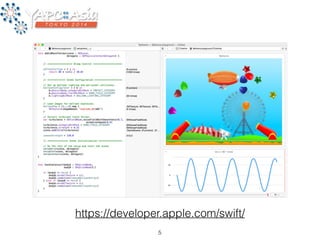
https://developer.apple.com/swift/ 
5
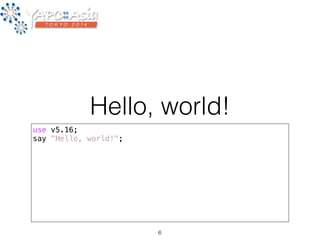
Hello, world! 
use v5.16; 
say "Hello, world!"; 
6
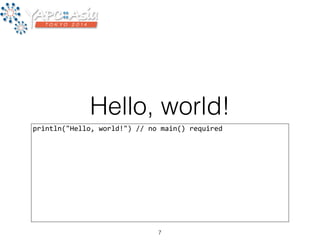
Hello, world! 
println("Hello, 
world!") 
// 
no 
main() 
required 
7
FizzBuzz 
#!/usr/bin/env perl -l 
print+(Fizz)[$_%3].(Buzz)[$_%5]||$_ for 1..100 
! 
# http://developer.cybozu.co.jp/takesako/2007/05/ 
fizzbuzz.html 
8
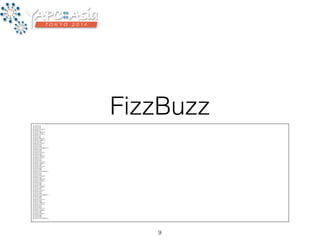
FizzBuzz 
println(1) 
println(2) 
println("Fizz") 
println(4) 
println("Buzz") 
println("Fizz") 
println(7) 
println(8) 
println("Fizz") 
println("Buzz") 
println(11) 
println("Fizz") 
println(13) 
println(14) 
println("FizzBuzz") 
println(16) 
println(17) 
println("Fizz") 
println(19) 
println("Buzz") 
println("Fizz") 
println(22) 
println(23) 
println("Fizz") 
println("Buzz") 
println(26) 
println("Fizz") 
println(28) 
println(29) 
println("FizzBuzz") 
println(31) 
println(32) 
println("Fizz") 
println(34) 
println("Buzz") 
println("Fizz") 
println(37) 
println(38) 
println("Fizz") 
println("Buzz") 
println(41) 
println("Fizz") 
println(43) 
println(44) 
println("FizzBuzz") 
println(46) 
println(47) 
println("Fizz") 
println(49) 
println("Buzz") 
println("Fizz") 
println(52) 
println(53) 
println("Fizz") 
println("Buzz") 
println(56) 
println("Fizz") 
println(58) 
println(59) 
println("FizzBuzz") 
9
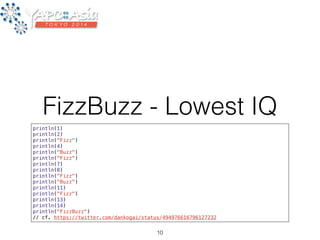
FizzBuzz - Lowest IQ 
println(1) 
println(2) 
println("Fizz") 
println(4) 
println("Buzz") 
println("Fizz") 
println(7) 
println(8) 
println("Fizz") 
println("Buzz") 
println(11) 
println("Fizz") 
println(13) 
println(14) 
println("FizzBuzz") 
// cf. https://twitter.com/dankogai/status/494976616796127232 
10
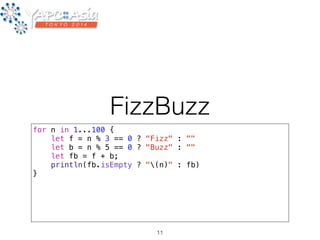
FizzBuzz 
for n in 1...100 { 
let f = n % 3 == 0 ? "Fizz" : "" 
let b = n % 5 == 0 ? "Buzz" : "" 
let fb = f + b; 
println(fb.isEmpty ? "(n)" : fb) 
} 
11
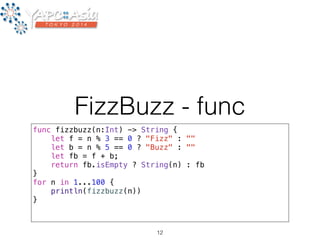
FizzBuzz - func 
func fizzbuzz(n:Int) -> String { 
let f = n % 3 == 0 ? "Fizz" : "" 
let b = n % 5 == 0 ? "Buzz" : "" 
let fb = f + b; 
return fb.isEmpty ? String(n) : fb 
} 
for n in 1...100 { 
println(fizzbuzz(n)) 
} 
12
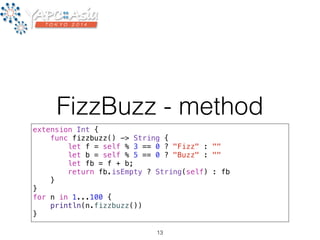
FizzBuzz - method 
extension Int { 
func fizzbuzz() -> String { 
let f = self % 3 == 0 ? "Fizz" : "" 
let b = self % 5 == 0 ? "Buzz" : "" 
let fb = f + b; 
return fb.isEmpty ? String(self) : fb 
} 
} 
for n in 1...100 { 
println(n.fizzbuzz()) 
} 
13
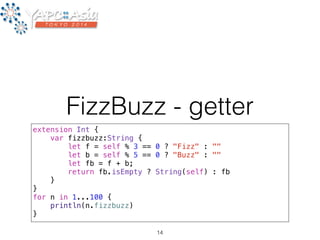
FizzBuzz - getter 
extension Int { 
var fizzbuzz:String { 
let f = self % 3 == 0 ? "Fizz" : "" 
let b = self % 5 == 0 ? "Buzz" : "" 
let fb = f + b; 
return fb.isEmpty ? String(self) : fb 
} 
} 
for n in 1...100 { 
println(n.fizzbuzz) 
} 
14
FizzBuzz - subscript 
class FizzBuzz { 
subscript (n:Int)->String { 
let f = n % 3 == 0 ? "Fizz" : "" 
let b = n % 5 == 0 ? "Buzz" : "" 
let fb = f + b; 
return fb.isEmpty ? String(n) : fb 
} 
} 
let fizzbuzz = FizzBuzz() 
for n in 1...100 { 
println(fizzbuzz[n]) 
} 
15
FizzBuzz - generator 
extension FizzBuzz : SequenceType { 
func generate() -> GeneratorOf<String> { 
var n = 0 
return GeneratorOf<String> { 
if n == 100 { return nil } 
return self[++n] 
} 
} 
} 
let fizzbuzz = FizzBuzz() 
for s in fizzbuzz { 
println(s) 
} 
16
FizzBuzz - optional 
let fizzbuzz = [ 
3:"Fizz",5:"Buzz",6:"Fizz",9:"Fizz", 
10:"Buzz",12:"Fizz",0:"FizzBuzz" 
] 
for n in 1...100 { 
println(fizzbuzz[n % 15] ?? "(n)") 
} 
17
FizzBuzz - functionally 
let fizzbuzz = [ 
3:"Fizz",5:"Buzz",6:"Fizz",9:"Fizz", 
10:"Buzz",12:"Fizz",0:"FizzBuzz" 
] 
Array(1...100) 
.map { fizzbuzz[$0 % 15] ?? "($0)" } 
.map { println($0) } 
18
FizzBuzz - operator 
infix operator => { associativity left precedence 95 } 
func => <A,R> (lhs:A, rhs:A->R)->R { 
return rhs(lhs) 
} 
let fizzbuzz = [ 
3:"Fizz",5:"Buzz",6:"Fizz",9:"Fizz", 
10:"Buzz",12:"Fizz",0:"FizzBuzz" 
] 
Array(1...100).map { 
fizzbuzz[n % 15] ?? "(n)" => println 
} 
19
Demo
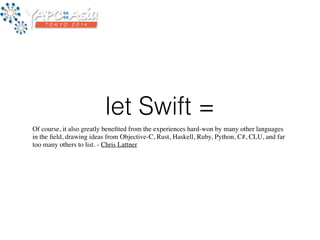
let Swift = 
Of course, it also greatly benefited from the experiences hard-won by many other languages 
in the field, drawing ideas from Objective-C, Rust, Haskell, Ruby, Python, C#, CLU, and far 
too many others to list. - Chris Lattner
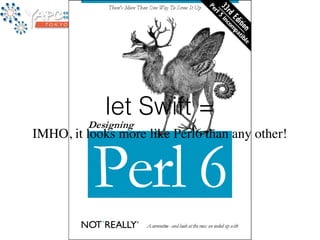
let Swift = 
IMHO, it looks more like Perl6 than any other!
let Swift = 
what.perl6.was.supposed 
.to.be!
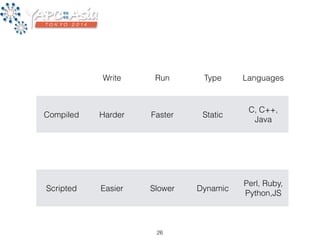
Script Languages vs 
"Compiler" Languages 
24
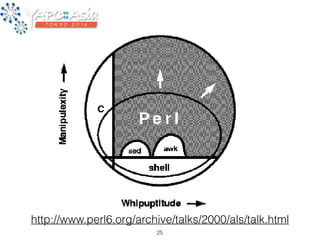
http://www.perl6.org/archive/talks/2000/als/talk.html 
25
Write Run Type Languages 
Compiled Harder Faster Static 
C, C++, 
Java 
Scripted Easier Slower Dynamic 
Perl, Ruby, 
Python,JS 
26
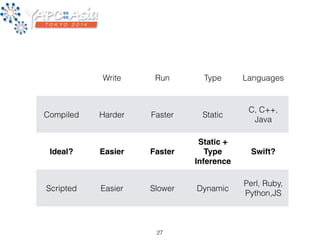
Write Run Type Languages 
Compiled Harder Faster Static 
C, C++, 
Java 
Ideal? Easier Faster 
Static + ! 
Type 
Inference 
Swift? 
Scripted Easier Slower Dynamic 
Perl, Ruby, 
Python,JS 
27
The Sunset of Our 
Culture? 
28
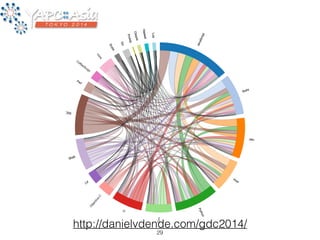
http://danielvdende.com/gdc2014/ 
29
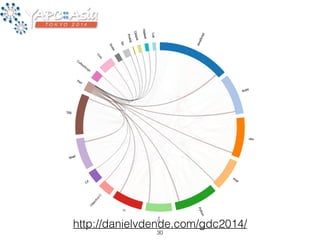
http://danielvdende.com/gdc2014/ 
30
Bottom-up languages 
are "discovered" 
• Perl for those C is too hard 
• Perl for those awk is too limited 
• PHP for those who considers perl too hard 
• Python for those who considers perl too easy 
• Ruby for those who cosiders -> too much 
31
Top-down languages 
are "delivered" 
• Java by Sun -> Oracle 
• JS by Netscape -> MS -> Google and Apple 
• Dart and Go by Google 
• Swift by Apple 
32
How Apple Delivers 
Their Products 
• Release a few good products 
• Microsoft: C#, F#, Silverlight, TypeScript… 
• Google: Dart and go 
• Facebook: Hack? What the Heck? 
• Apple: Swift 
• Among a few good products, languages are the fewest 
• Only two since 1984 - HyperTalk, AppleScript (I 
know Dylan but only its name) 
33
How Apple Delivers 
Their Products 
• "Innovation is not about creating something 
extraordinary today: it is about making 
something ordinary tomorrow" — @chibicode 
• "We’d be lucky if we sold 10 million iPhones" — 
steve Jobs 
• More iPhones are sold in a month these days 
34
How Apple Delivers 
Their Products 
• "Swift is an innovative new programming 
language for Cocoa and Cocoa Touch." 
• Then why "lldb -repl" invokes Swift? 
• I coundn’t find anything special to Cocoa and 
Cocoa Touch in Swift. 
35
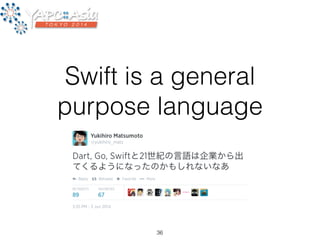
Swift is a general 
purpose language 
36
Swift is a general 
purpose language 
• Emits native code. 
• UnsafePointer<()> 
• @asmname 
• Inherits libc and Foundation 
• rejects legacy syntax of (Objective-)?C 
• Will it achieve C++ and Java did not — replace 
C? Time will tell… 
37
Will Swift go OSS? 
• No promise. Just guesses. 
• clang is OSS 
• lldb -repl 
• Swift itself is not platform-specific 
• Once OSS, you can never close it 
• Android 3.X has set a very bad example 
38
Top-down 
> 
Bottom-up? 
• Perl6 = Still Crazy After All These Years 
• Perl5: two years just to add subroutine signature 
• Swift: two weeks to change T[] to [T] 
39
A language for getting 
the jobs done 
• But who gives you the job? 
• And if your job giver offer you a lanugage, who 
can resist? 
40
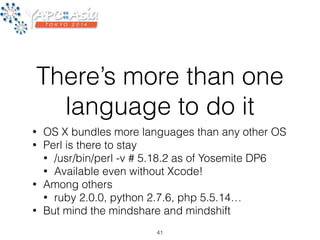
There’s more than one 
language to do it 
• OS X bundles more languages than any other OS 
• Perl is there to stay 
• /usr/bin/perl -v # 5.18.2 as of Yosemite DP6 
• Available even without Xcode! 
• Among others 
• ruby 2.0.0, python 2.7.6, php 5.5.14… 
• But mind the mindshare and mindshift 
41
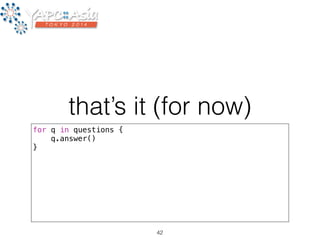
that’s it (for now) 
for q in questions { 
q.answer() 
} 
42

Introducing Swift - and the Sunset of Our Culture?

  • 1.
    Introducing Swift -and the Sunset of Our Culture @dankogai 1
  • 2.
    Introducing Swift -and the Sunset of Our Culture? 2
  • 3.
  • 5.
  • 6.
    Hello, world! usev5.16; say "Hello, world!"; 6
  • 7.
    Hello, world! println("Hello, world!") // no main() required 7
  • 8.
    FizzBuzz #!/usr/bin/env perl-l print+(Fizz)[$_%3].(Buzz)[$_%5]||$_ for 1..100 ! # http://developer.cybozu.co.jp/takesako/2007/05/ fizzbuzz.html 8
  • 9.
    FizzBuzz println(1) println(2) println("Fizz") println(4) println("Buzz") println("Fizz") println(7) println(8) println("Fizz") println("Buzz") println(11) println("Fizz") println(13) println(14) println("FizzBuzz") println(16) println(17) println("Fizz") println(19) println("Buzz") println("Fizz") println(22) println(23) println("Fizz") println("Buzz") println(26) println("Fizz") println(28) println(29) println("FizzBuzz") println(31) println(32) println("Fizz") println(34) println("Buzz") println("Fizz") println(37) println(38) println("Fizz") println("Buzz") println(41) println("Fizz") println(43) println(44) println("FizzBuzz") println(46) println(47) println("Fizz") println(49) println("Buzz") println("Fizz") println(52) println(53) println("Fizz") println("Buzz") println(56) println("Fizz") println(58) println(59) println("FizzBuzz") 9
  • 10.
    FizzBuzz - LowestIQ println(1) println(2) println("Fizz") println(4) println("Buzz") println("Fizz") println(7) println(8) println("Fizz") println("Buzz") println(11) println("Fizz") println(13) println(14) println("FizzBuzz") // cf. https://twitter.com/dankogai/status/494976616796127232 10
  • 11.
    FizzBuzz for nin 1...100 { let f = n % 3 == 0 ? "Fizz" : "" let b = n % 5 == 0 ? "Buzz" : "" let fb = f + b; println(fb.isEmpty ? "(n)" : fb) } 11
  • 12.
    FizzBuzz - func func fizzbuzz(n:Int) -> String { let f = n % 3 == 0 ? "Fizz" : "" let b = n % 5 == 0 ? "Buzz" : "" let fb = f + b; return fb.isEmpty ? String(n) : fb } for n in 1...100 { println(fizzbuzz(n)) } 12
  • 13.
    FizzBuzz - method extension Int { func fizzbuzz() -> String { let f = self % 3 == 0 ? "Fizz" : "" let b = self % 5 == 0 ? "Buzz" : "" let fb = f + b; return fb.isEmpty ? String(self) : fb } } for n in 1...100 { println(n.fizzbuzz()) } 13
  • 14.
    FizzBuzz - getter extension Int { var fizzbuzz:String { let f = self % 3 == 0 ? "Fizz" : "" let b = self % 5 == 0 ? "Buzz" : "" let fb = f + b; return fb.isEmpty ? String(self) : fb } } for n in 1...100 { println(n.fizzbuzz) } 14
  • 15.
    FizzBuzz - subscript class FizzBuzz { subscript (n:Int)->String { let f = n % 3 == 0 ? "Fizz" : "" let b = n % 5 == 0 ? "Buzz" : "" let fb = f + b; return fb.isEmpty ? String(n) : fb } } let fizzbuzz = FizzBuzz() for n in 1...100 { println(fizzbuzz[n]) } 15
  • 16.
    FizzBuzz - generator extension FizzBuzz : SequenceType { func generate() -> GeneratorOf<String> { var n = 0 return GeneratorOf<String> { if n == 100 { return nil } return self[++n] } } } let fizzbuzz = FizzBuzz() for s in fizzbuzz { println(s) } 16
  • 17.
    FizzBuzz - optional let fizzbuzz = [ 3:"Fizz",5:"Buzz",6:"Fizz",9:"Fizz", 10:"Buzz",12:"Fizz",0:"FizzBuzz" ] for n in 1...100 { println(fizzbuzz[n % 15] ?? "(n)") } 17
  • 18.
    FizzBuzz - functionally let fizzbuzz = [ 3:"Fizz",5:"Buzz",6:"Fizz",9:"Fizz", 10:"Buzz",12:"Fizz",0:"FizzBuzz" ] Array(1...100) .map { fizzbuzz[$0 % 15] ?? "($0)" } .map { println($0) } 18
  • 19.
    FizzBuzz - operator infix operator => { associativity left precedence 95 } func => <A,R> (lhs:A, rhs:A->R)->R { return rhs(lhs) } let fizzbuzz = [ 3:"Fizz",5:"Buzz",6:"Fizz",9:"Fizz", 10:"Buzz",12:"Fizz",0:"FizzBuzz" ] Array(1...100).map { fizzbuzz[n % 15] ?? "(n)" => println } 19
  • 20.
  • 21.
    let Swift = Of course, it also greatly benefited from the experiences hard-won by many other languages in the field, drawing ideas from Objective-C, Rust, Haskell, Ruby, Python, C#, CLU, and far too many others to list. - Chris Lattner
  • 22.
    let Swift = IMHO, it looks more like Perl6 than any other!
  • 23.
    let Swift = what.perl6.was.supposed .to.be!
  • 24.
    Script Languages vs "Compiler" Languages 24
  • 25.
  • 26.
    Write Run TypeLanguages Compiled Harder Faster Static C, C++, Java Scripted Easier Slower Dynamic Perl, Ruby, Python,JS 26
  • 27.
    Write Run TypeLanguages Compiled Harder Faster Static C, C++, Java Ideal? Easier Faster Static + ! Type Inference Swift? Scripted Easier Slower Dynamic Perl, Ruby, Python,JS 27
  • 28.
    The Sunset ofOur Culture? 28
  • 29.
  • 30.
  • 31.
    Bottom-up languages are"discovered" • Perl for those C is too hard • Perl for those awk is too limited • PHP for those who considers perl too hard • Python for those who considers perl too easy • Ruby for those who cosiders -> too much 31
  • 32.
    Top-down languages are"delivered" • Java by Sun -> Oracle • JS by Netscape -> MS -> Google and Apple • Dart and Go by Google • Swift by Apple 32
  • 33.
    How Apple Delivers Their Products • Release a few good products • Microsoft: C#, F#, Silverlight, TypeScript… • Google: Dart and go • Facebook: Hack? What the Heck? • Apple: Swift • Among a few good products, languages are the fewest • Only two since 1984 - HyperTalk, AppleScript (I know Dylan but only its name) 33
  • 34.
    How Apple Delivers Their Products • "Innovation is not about creating something extraordinary today: it is about making something ordinary tomorrow" — @chibicode • "We’d be lucky if we sold 10 million iPhones" — steve Jobs • More iPhones are sold in a month these days 34
  • 35.
    How Apple Delivers Their Products • "Swift is an innovative new programming language for Cocoa and Cocoa Touch." • Then why "lldb -repl" invokes Swift? • I coundn’t find anything special to Cocoa and Cocoa Touch in Swift. 35
  • 36.
    Swift is ageneral purpose language 36
  • 37.
    Swift is ageneral purpose language • Emits native code. • UnsafePointer<()> • @asmname • Inherits libc and Foundation • rejects legacy syntax of (Objective-)?C • Will it achieve C++ and Java did not — replace C? Time will tell… 37
  • 38.
    Will Swift goOSS? • No promise. Just guesses. • clang is OSS • lldb -repl • Swift itself is not platform-specific • Once OSS, you can never close it • Android 3.X has set a very bad example 38
  • 39.
    Top-down > Bottom-up? • Perl6 = Still Crazy After All These Years • Perl5: two years just to add subroutine signature • Swift: two weeks to change T[] to [T] 39
  • 40.
    A language forgetting the jobs done • But who gives you the job? • And if your job giver offer you a lanugage, who can resist? 40
  • 41.
    There’s more thanone language to do it • OS X bundles more languages than any other OS • Perl is there to stay • /usr/bin/perl -v # 5.18.2 as of Yosemite DP6 • Available even without Xcode! • Among others • ruby 2.0.0, python 2.7.6, php 5.5.14… • But mind the mindshare and mindshift 41
  • 42.
    that’s it (fornow) for q in questions { q.answer() } 42