THE LONGEST
TIME PROPHECY
Cristopher V. Luaya, MAR
Northern Luzon Adventist College
NLAC SDA Church
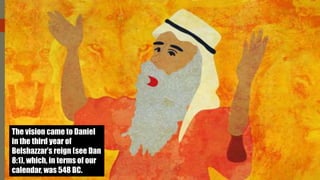
The vision came to Daniel
in the third year of
Belshazzar’s reign (see Dan
8:1), which, in terms of our
calendar, was 548 BC.
Daniel 8 previews the three
great beasts, the activities
of the end-time papacy, and
the 2,300-year prophecy.
TWO-HORNED RAM: MEDO-PERSIA
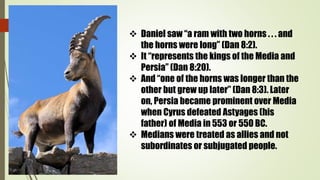
 Daniel saw “a ram with two horns . . . and
the horns were long” (Dan 8:2).
 It “represents the kings of the Media and
Persia” (Dan 8:20).
 And “one of the horns was longer than the
other but grew up later” (Dan 8:3). Later
on, Persia became prominent over Media
when Cyrus defeated Astyages (his
father) of Media in 553 or 550 BC.
 Medians were treated as allies and not
subordinates or subjugated people.
 The prophet saw “the ram [Medo-
Persia] toward the west and the
north and the south” (Dan 8:4).
 “No animal could stand against
him, and none could rescue from
his power” (Dan 8:4a)—for he
“became great” (Dan 8:4b).
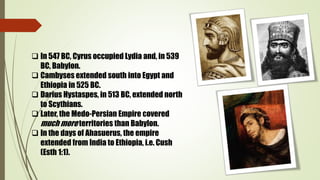
 In 547 BC, Cyrus occupied Lydia and, in 539
BC, Babylon.
 Cambyses extended south into Egypt and
Ethiopia in 525 BC.
 Darius Hystaspes, in 513 BC, extended north
to Scythians.
 Later, the Medo-Persian Empire covered
much more territories than Babylon.
 In the days of Ahasuerus, the empire
extended from India to Ethiopia, i.e. Cush
(Esth 1:1).
GOAT: GREECE
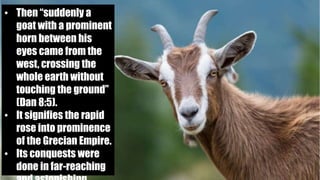
• Then “suddenly a
goat with a prominent
horn between his
eyes came from the
west, crossing the
whole earth without
touching the ground”
(Dan 8:5).
• It signifies the rapid
rose into prominence
of the Grecian Empire.
• Its conquests were
done in far-reaching
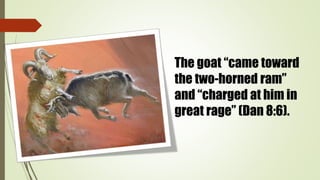
The goat “came toward
the two-horned ram”
and “charged at him in
great rage” (Dan 8:6).
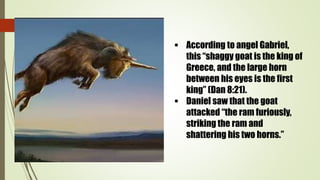
 According to angel Gabriel,
this “shaggy goat is the king of
Greece, and the large horn
between his eyes is the first
king” (Dan 8:21).
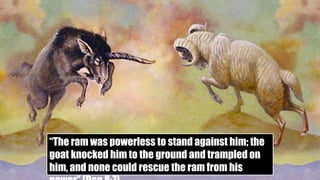
 Daniel saw that the goat
attacked “the ram furiously,
striking the ram and
shattering his two horns.”
“The ram was powerless to stand against him; the
goat knocked him to the ground and trampled on
him, and none could rescue the ram from his
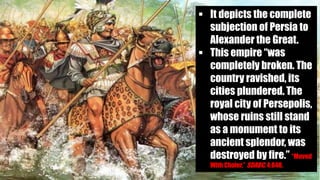
 It depicts the complete
subjection of Persia to
Alexander the Great.
 This empire “was
completely broken. The
country ravished, its
cities plundered. The
royal city of Persepolis,
whose ruins still stand
as a monument to its
ancient splendor, was
destroyed by fire.” “Moved
With Choler,” SDABC, 4:840.
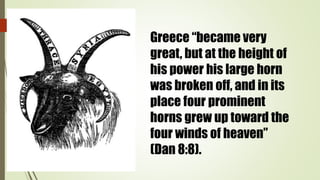
Greece “became very
great, but at the height of
his power his large horn
was broken off, and in its
place four prominent
horns grew up toward the
four winds of heaven”
(Dan 8:8).
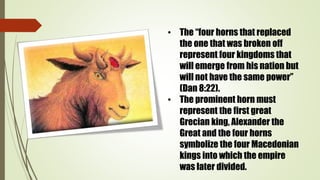
• The “four horns that replaced
the one that was broken off
represent four kingdoms that
will emerge from his nation but
will not have the same power”
(Dan 8:22).
• The prominent horn must
represent the first great
Grecian king, Alexander the
Great and the four horns
symbolize the four Macedonian
kings into which the empire
was later divided.
HORN: ROME
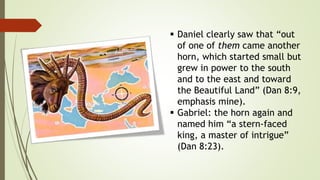
 Daniel clearly saw that “out
of one of them came another
horn, which started small but
grew in power to the south
and to the east and toward
the Beautiful Land” (Dan 8:9,
emphasis mine).
 Gabriel: the horn again and
named him “a stern-faced
king, a master of intrigue”
(Dan 8:23).
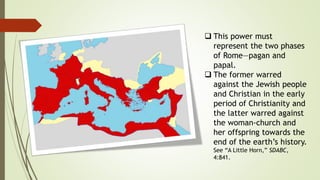
 This power must
represent the two phases
of Rome—pagan and
papal.
 The former warred
against the Jewish people
and Christian in the early
period of Christianity and
the latter warred against
the woman-church and
her offspring towards the
end of the earth’s history.
See “A Little Horn,” SDABC,
4:841.
“Therefore the he goat waxed very great: and
when he was strong, the great horn was broken;
and for it came up four notable ones toward the
four winds of heaven. And out of one of them
came forth a little horn, which waxed exceeding
great, toward the south, and toward the east,
and toward the pleasant land” (Dan 8:8-9, KJV).
“Therefore the he goat waxed very great: and
when he was strong, the great horn was broken;
and for it came up four notable ones toward the
four winds of heaven. And out of one [‘achath,
feminine] of them came forth a little horn,
which waxed exceeding great, toward the south,
and toward the east, and toward the pleasant
land” (Dan 8:8-9, KJV).
 First, “the four
winds of heaven”
(Dan 8:8) has its
nearest possible
antecedent is “out
of the one of them”
(Dan 8:9). This
indicates that the
little horn comes
out from the four
winds of heaven—
the metaphor of the
cardinal directions
of the compass (see
Jer 49:36; Zech
2:6).
 Second, the vision
report of Daniel 8
places the horn on the
same level as the
previous two animals.
Obviously, vv. 3-4
describe the ram,
verses 5-8 the goat,
and verses 9-11 the
little horn.
“Each part shows the same pattern of
introduction and movement, resulting in
absolute power and self-magnification,
followed by a downfall. In each of the initial
statements, the main actor (ram, goat, or
little horn) is introduced to a geographic term
or location and its first activity is described as
a movement in a geographic direction. Such a
pattern required that “one of them” refers to
one of the four winds of heaven.”—Martin
Pröbstle, “Does the Little Horn Come Out of One of the Goat’s
Four Horns or From the Four Winds,” Interpreting Scriptures:
Bible Questions and Answers, Biblical Research Institute
Studies, vol. 2, ed. Gerhard Pfandl (Silver Spring, MD: Biblical
Research Institute, 2010), 243.
 Third, the parallel order of the
protagonists in Daniel 7 and 8 do not
allow for a chronological connection
between the four horns of the male
goat (Dan 8:8) and the horn (Dan 8:9).
The bear (with two sides, three ribs in
its mouth) devours much flesh (Dan
7:5), and the ram (with two horns,
butting in three direction, and no other
beast could defy him, Dan 8:3-4)
represents the same kingdom—i.e.
Medo-Persia.
The leopard (with four wings, four head, Dan 7:6)
and the male goat (flies without touching the
ground, had four horns) represent the same
kingdom—Greece. An equivalent animal to the
fourth beast in Daniel 7 does not appear in chapter
8 because of the fact that the little horn (Dan 7)
originates from the fourth beast (Rome) and the
fourth beast does not refer to the same power as
the male goat in chapter 8. The little horn in
Daniel 8 does not come from one of the horns of
the male goat (Greece). Thus, the origin of the
horn is one of the four winds of heaven.
See Pröbstle, “Little Horn,” 243.
 And fourth, the Hebrew yatsa’(come
forth) in Daniel 8:9 “is frequently
used to describe the activity of
movement in reference to location,
often in a military sense, which
parallel the verbs used for the
activities of the ram and the male
goat. Yatsa’ is not used to describe
the growing of a horn, an activity
usually designed by ˓alah, ‘come up’
(cf. 8:3, 8).” Ibid.
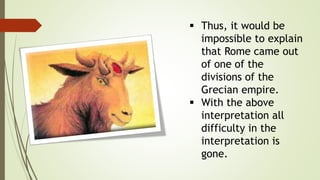
 Thus, it would be
impossible to explain
that Rome came out
of one of the
divisions of the
Grecian empire.
 With the above
interpretation all
difficulty in the
interpretation is
gone.
“The grammatical
construction of verses
8 and 9, the structural
arrangement in the
vision of Daniel 8, and
the parallelism
between chapters 7
and 8 in the book of
Daniel preclude the
interpretation that the
little horn in Daniel 8
comes out of one of
the four horns of the
male goat. Rather, the
little horn comes from
one of the directions of
the compass, i.e. from
the west [Rome].”
Pröbstle, “Little Horn,” 244.
THE RISE OF THE LITTLE HORN
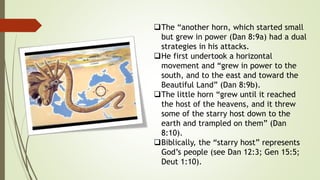
The “another horn, which started small
but grew in power (Dan 8:9a) had a dual
strategies in his attacks.
He first undertook a horizontal
movement and “grew in power to the
south, and to the east and toward the
Beautiful Land” (Dan 8:9b).
The little horn “grew until it reached
the host of the heavens, and it threw
some of the starry host down to the
earth and trampled on them” (Dan
8:10).
Biblically, the “starry host” represents
God’s people (see Dan 12:3; Gen 15:5;
Deut 1:10).
“These three
directions correspond
to the three major
areas that fell under
the domination of
pagan Rome.” Souza, 105.
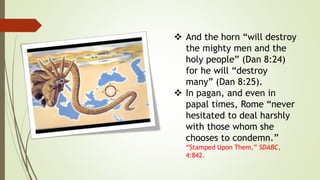
 And the horn “will destroy
the mighty men and the
holy people” (Dan 8:24)
for he will “destroy
many” (Dan 8:25).
 In pagan, and even in
papal times, Rome “never
hesitated to deal harshly
with those whom she
chooses to condemn.”
“Stamped Upon Them,” SDABC,
4:842.
THE LITTLE HORN IN DANIEL 7 & 8
(1)Both horns started little in the
beginning (Dan 7:8; 8:9);
(2)Both horns become great later
on (Dan 7:20; 8:9);
(3)Both are persecuting powers
(Dan 7:21, 25; 8:10, 24);
(4)Both horns are self-exalting
and pompous (Dan 7:8, 20, 25;
8:17, 19);
(5) Both target God’s people (Dan
7:25; 8:24);
(6) Both reigned the same time
period (Dan 7:25; 8:13, 14);
(7) Both extend until the time of
the end (Dan 7:25, 26; Dan 8:17,
19);
(8) and both face supernatural
destructions (Dan 7:11, 26; 8:25).
THE LITTLE HORN IN DANIEL 7 & 8
“Because the little
horn of Daniel 7
represents the
papacy, the vertical
expansion of the
little horn in Daniel
8 must represent
the same power.
Thus, as in Daniel 2
and 7, the final
main power is
Rome, both pagan
and papal.” Souza,
105.
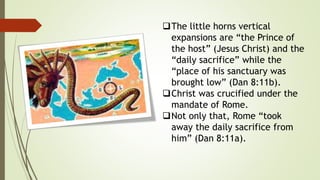
The little horns vertical
expansions are “the Prince of
the host” (Jesus Christ) and the
“daily sacrifice” while the
“place of his sanctuary was
brought low” (Dan 8:11b).
Christ was crucified under the
mandate of Rome.
Not only that, Rome “took
away the daily sacrifice from
him” (Dan 8:11a).
“The substitution of the papacy
of compulsory unity in a visible
church in place of the voluntary
unity of all believers in Christ,
the invisible head of the
church, of a priestly hierarchy
in place of direct access of
Christ by all believers, of a
system of salvation by work
ordained by the church in place
of salvation by faith in Christ,
and, most particularly, of the
confessional and the sacrifice
of the mass in place of the
mediatorial work of Christ as
our great high priest in the
courts of heaven; and that
this system quite completely
diverted men’s attention from
Christ and thus deprived them
of the benefits of His
ministry.”
“By Him” SDABC, 4:843.
THE 2300-YEAR PROPHECY
 Verse 12 clearly states that
these acts are Rome’s
rebellion.
 At the same time, the
saints and the daily
sacrifice (“the continual
priestly ministry of Christ in
the heavenly sanctuary”]
(“By Him” SDABC, 4:843) were
given over to it” and the
“papacy loaded the truth
with tradition and obscured
it by superstition.” “Host,”
SDABC, 4:843.
“How long will it take for the vision to be
fulfilled—the vision concerning the daily
sacrifice, the rebellion that causes
desolation, and the surrender of the
sanctuary and of the host that will be
trampled underfoot?” (Dan 8:13).
 The holy one could no longer bear the activity of the
papal horn.
 “It will take 2,300 evenings and mornings; then the
sanctuary will be reconsecrated” (Dan 8:14) or “shall
be cleansed” (KJV).
 Literally: “How long the vision, the continual, the
desolating transgression to give both sanctuary and
host to trampling.” “How Long,” SDABC, 4:843.
• The expression “2,300 evenings and mornings” is
similar to the biblical expression “and there was
evening, and there was morning—the first day” (Gen
1:5). Thus, it simply means 2,300 days.
• A day is equivalent to a year (Ezek 4:6).
• Therefore, 2,300 days is equals to 2,300 years.
• The starting date of this figure is the issue of the
book of Daniel chapter 9.
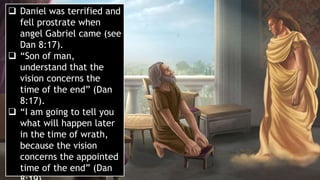
 Daniel was terrified and
fell prostrate when
angel Gabriel came (see
Dan 8:17).
 “Son of man,
understand that the
vision concerns the
time of the end” (Dan
8:17).
 “I am going to tell you
what will happen later
in the time of wrath,
because the vision
concerns the appointed
time of the end” (Dan
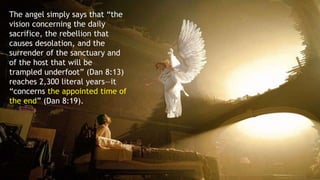
The angel simply says that “the
vision concerning the daily
sacrifice, the rebellion that
causes desolation, and the
surrender of the sanctuary and
of the host that will be
trampled underfoot” (Dan 8:13)
reaches 2,300 literal years—it
“concerns the appointed time of
the end” (Dan 8:19).
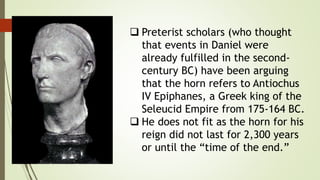
 Preterist scholars (who thought
that events in Daniel were
already fulfilled in the second-
century BC) have been arguing
that the horn refers to Antiochus
IV Epiphanes, a Greek king of the
Seleucid Empire from 175-164 BC.
 He does not fit as the horn for his
reign did not last for 2,300 years
or until the “time of the end.”
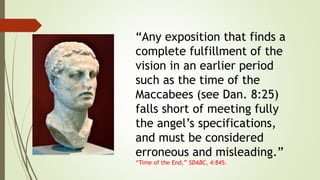
“Any exposition that finds a
complete fulfillment of the
vision in an earlier period
such as the time of the
Maccabees (see Dan. 8:25)
falls short of meeting fully
the angel’s specifications,
and must be considered
erroneous and misleading.”
“Time of the End,” SDABC, 4:845.
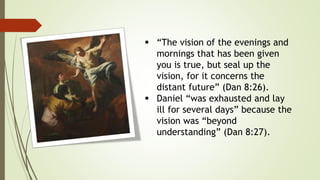
 “The vision of the evenings and
mornings that has been given
you is true, but seal up the
vision, for it concerns the
distant future” (Dan 8:26).
 Daniel “was exhausted and lay
ill for several days” because the
vision was “beyond
understanding” (Dan 8:27).
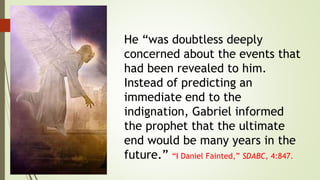
He “was doubtless deeply
concerned about the events that
had been revealed to him.
Instead of predicting an
immediate end to the
indignation, Gabriel informed
the prophet that the ultimate
end would be many years in the
future.” “I Daniel Fainted,” SDABC, 4:847.
OBJECT LESSON
 Daniel 8 presents the cleansing of the
heavenly sanctuary, i.e. the removal of
sins in the universe.
 It depicts God’s justice, mercy, and
love.
 The good news is that God hates sins but
loves sinners.
1. How is it with you about the fact that the papacy distorted God’s truth and
established a distorted way of worship?
2. Reflect on this statement of E. G. White: “While the investigative
judgment is going forward in heaven, while the sins of penitent believers
are being removed from the sanctuary, there is to be a special work of
purification, of putting away of sin, among God’s people on earth.” GC,
425.
3. What is the relevance of Jesus’ work completed at the cross and Jesus’
ministry in the heavenly sanctuary?
4. Why God still need to undertake an investigative judgment in the
heavenly sanctuary? What does this judicial procedure reveal about God’s
character?
FOR PERSONAL APPLICATIONS

The Longest Time Prophecy

  • 1.
    THE LONGEST TIME PROPHECY CristopherV. Luaya, MAR Northern Luzon Adventist College NLAC SDA Church
  • 2.
    The vision cameto Daniel in the third year of Belshazzar’s reign (see Dan 8:1), which, in terms of our calendar, was 548 BC.
  • 3.
    Daniel 8 previewsthe three great beasts, the activities of the end-time papacy, and the 2,300-year prophecy.
  • 4.
  • 5.
     Daniel saw“a ram with two horns . . . and the horns were long” (Dan 8:2).  It “represents the kings of the Media and Persia” (Dan 8:20).  And “one of the horns was longer than the other but grew up later” (Dan 8:3). Later on, Persia became prominent over Media when Cyrus defeated Astyages (his father) of Media in 553 or 550 BC.  Medians were treated as allies and not subordinates or subjugated people.
  • 6.
     The prophetsaw “the ram [Medo- Persia] toward the west and the north and the south” (Dan 8:4).  “No animal could stand against him, and none could rescue from his power” (Dan 8:4a)—for he “became great” (Dan 8:4b).
  • 7.
     In 547BC, Cyrus occupied Lydia and, in 539 BC, Babylon.  Cambyses extended south into Egypt and Ethiopia in 525 BC.  Darius Hystaspes, in 513 BC, extended north to Scythians.  Later, the Medo-Persian Empire covered much more territories than Babylon.  In the days of Ahasuerus, the empire extended from India to Ethiopia, i.e. Cush (Esth 1:1).
  • 8.
  • 9.
    • Then “suddenlya goat with a prominent horn between his eyes came from the west, crossing the whole earth without touching the ground” (Dan 8:5). • It signifies the rapid rose into prominence of the Grecian Empire. • Its conquests were done in far-reaching
  • 10.
    The goat “cametoward the two-horned ram” and “charged at him in great rage” (Dan 8:6).
  • 11.
     According toangel Gabriel, this “shaggy goat is the king of Greece, and the large horn between his eyes is the first king” (Dan 8:21).  Daniel saw that the goat attacked “the ram furiously, striking the ram and shattering his two horns.”
  • 12.
    “The ram waspowerless to stand against him; the goat knocked him to the ground and trampled on him, and none could rescue the ram from his
  • 13.
     It depictsthe complete subjection of Persia to Alexander the Great.  This empire “was completely broken. The country ravished, its cities plundered. The royal city of Persepolis, whose ruins still stand as a monument to its ancient splendor, was destroyed by fire.” “Moved With Choler,” SDABC, 4:840.
  • 14.
    Greece “became very great,but at the height of his power his large horn was broken off, and in its place four prominent horns grew up toward the four winds of heaven” (Dan 8:8).
  • 15.
    • The “fourhorns that replaced the one that was broken off represent four kingdoms that will emerge from his nation but will not have the same power” (Dan 8:22). • The prominent horn must represent the first great Grecian king, Alexander the Great and the four horns symbolize the four Macedonian kings into which the empire was later divided.
  • 16.
  • 17.
     Daniel clearlysaw that “out of one of them came another horn, which started small but grew in power to the south and to the east and toward the Beautiful Land” (Dan 8:9, emphasis mine).  Gabriel: the horn again and named him “a stern-faced king, a master of intrigue” (Dan 8:23).
  • 18.
     This powermust represent the two phases of Rome—pagan and papal.  The former warred against the Jewish people and Christian in the early period of Christianity and the latter warred against the woman-church and her offspring towards the end of the earth’s history. See “A Little Horn,” SDABC, 4:841.
  • 19.
    “Therefore the hegoat waxed very great: and when he was strong, the great horn was broken; and for it came up four notable ones toward the four winds of heaven. And out of one of them came forth a little horn, which waxed exceeding great, toward the south, and toward the east, and toward the pleasant land” (Dan 8:8-9, KJV).
  • 20.
    “Therefore the hegoat waxed very great: and when he was strong, the great horn was broken; and for it came up four notable ones toward the four winds of heaven. And out of one [‘achath, feminine] of them came forth a little horn, which waxed exceeding great, toward the south, and toward the east, and toward the pleasant land” (Dan 8:8-9, KJV).
  • 21.
     First, “thefour winds of heaven” (Dan 8:8) has its nearest possible antecedent is “out of the one of them” (Dan 8:9). This indicates that the little horn comes out from the four winds of heaven— the metaphor of the cardinal directions of the compass (see Jer 49:36; Zech 2:6).
  • 22.
     Second, thevision report of Daniel 8 places the horn on the same level as the previous two animals. Obviously, vv. 3-4 describe the ram, verses 5-8 the goat, and verses 9-11 the little horn.
  • 23.
    “Each part showsthe same pattern of introduction and movement, resulting in absolute power and self-magnification, followed by a downfall. In each of the initial statements, the main actor (ram, goat, or little horn) is introduced to a geographic term or location and its first activity is described as a movement in a geographic direction. Such a pattern required that “one of them” refers to one of the four winds of heaven.”—Martin Pröbstle, “Does the Little Horn Come Out of One of the Goat’s Four Horns or From the Four Winds,” Interpreting Scriptures: Bible Questions and Answers, Biblical Research Institute Studies, vol. 2, ed. Gerhard Pfandl (Silver Spring, MD: Biblical Research Institute, 2010), 243.
  • 24.
     Third, theparallel order of the protagonists in Daniel 7 and 8 do not allow for a chronological connection between the four horns of the male goat (Dan 8:8) and the horn (Dan 8:9). The bear (with two sides, three ribs in its mouth) devours much flesh (Dan 7:5), and the ram (with two horns, butting in three direction, and no other beast could defy him, Dan 8:3-4) represents the same kingdom—i.e. Medo-Persia.
  • 25.
    The leopard (withfour wings, four head, Dan 7:6) and the male goat (flies without touching the ground, had four horns) represent the same kingdom—Greece. An equivalent animal to the fourth beast in Daniel 7 does not appear in chapter 8 because of the fact that the little horn (Dan 7) originates from the fourth beast (Rome) and the fourth beast does not refer to the same power as the male goat in chapter 8. The little horn in Daniel 8 does not come from one of the horns of the male goat (Greece). Thus, the origin of the horn is one of the four winds of heaven. See Pröbstle, “Little Horn,” 243.
  • 26.
     And fourth,the Hebrew yatsa’(come forth) in Daniel 8:9 “is frequently used to describe the activity of movement in reference to location, often in a military sense, which parallel the verbs used for the activities of the ram and the male goat. Yatsa’ is not used to describe the growing of a horn, an activity usually designed by ˓alah, ‘come up’ (cf. 8:3, 8).” Ibid.
  • 27.
     Thus, itwould be impossible to explain that Rome came out of one of the divisions of the Grecian empire.  With the above interpretation all difficulty in the interpretation is gone.
  • 28.
    “The grammatical construction ofverses 8 and 9, the structural arrangement in the vision of Daniel 8, and the parallelism between chapters 7 and 8 in the book of Daniel preclude the interpretation that the little horn in Daniel 8 comes out of one of the four horns of the male goat. Rather, the little horn comes from one of the directions of the compass, i.e. from the west [Rome].” Pröbstle, “Little Horn,” 244.
  • 29.
    THE RISE OFTHE LITTLE HORN
  • 30.
    The “another horn,which started small but grew in power (Dan 8:9a) had a dual strategies in his attacks. He first undertook a horizontal movement and “grew in power to the south, and to the east and toward the Beautiful Land” (Dan 8:9b). The little horn “grew until it reached the host of the heavens, and it threw some of the starry host down to the earth and trampled on them” (Dan 8:10). Biblically, the “starry host” represents God’s people (see Dan 12:3; Gen 15:5; Deut 1:10).
  • 31.
    “These three directions correspond tothe three major areas that fell under the domination of pagan Rome.” Souza, 105.
  • 32.
     And thehorn “will destroy the mighty men and the holy people” (Dan 8:24) for he will “destroy many” (Dan 8:25).  In pagan, and even in papal times, Rome “never hesitated to deal harshly with those whom she chooses to condemn.” “Stamped Upon Them,” SDABC, 4:842.
  • 33.
    THE LITTLE HORNIN DANIEL 7 & 8 (1)Both horns started little in the beginning (Dan 7:8; 8:9); (2)Both horns become great later on (Dan 7:20; 8:9); (3)Both are persecuting powers (Dan 7:21, 25; 8:10, 24); (4)Both horns are self-exalting and pompous (Dan 7:8, 20, 25; 8:17, 19);
  • 34.
    (5) Both targetGod’s people (Dan 7:25; 8:24); (6) Both reigned the same time period (Dan 7:25; 8:13, 14); (7) Both extend until the time of the end (Dan 7:25, 26; Dan 8:17, 19); (8) and both face supernatural destructions (Dan 7:11, 26; 8:25). THE LITTLE HORN IN DANIEL 7 & 8
  • 35.
    “Because the little hornof Daniel 7 represents the papacy, the vertical expansion of the little horn in Daniel 8 must represent the same power. Thus, as in Daniel 2 and 7, the final main power is Rome, both pagan and papal.” Souza, 105.
  • 36.
    The little hornsvertical expansions are “the Prince of the host” (Jesus Christ) and the “daily sacrifice” while the “place of his sanctuary was brought low” (Dan 8:11b). Christ was crucified under the mandate of Rome. Not only that, Rome “took away the daily sacrifice from him” (Dan 8:11a).
  • 37.
    “The substitution ofthe papacy of compulsory unity in a visible church in place of the voluntary unity of all believers in Christ, the invisible head of the church, of a priestly hierarchy in place of direct access of Christ by all believers, of a system of salvation by work ordained by the church in place of salvation by faith in Christ,
  • 38.
    and, most particularly,of the confessional and the sacrifice of the mass in place of the mediatorial work of Christ as our great high priest in the courts of heaven; and that this system quite completely diverted men’s attention from Christ and thus deprived them of the benefits of His ministry.” “By Him” SDABC, 4:843.
  • 39.
  • 40.
     Verse 12clearly states that these acts are Rome’s rebellion.  At the same time, the saints and the daily sacrifice (“the continual priestly ministry of Christ in the heavenly sanctuary”] (“By Him” SDABC, 4:843) were given over to it” and the “papacy loaded the truth with tradition and obscured it by superstition.” “Host,” SDABC, 4:843.
  • 41.
    “How long willit take for the vision to be fulfilled—the vision concerning the daily sacrifice, the rebellion that causes desolation, and the surrender of the sanctuary and of the host that will be trampled underfoot?” (Dan 8:13).
  • 42.
     The holyone could no longer bear the activity of the papal horn.  “It will take 2,300 evenings and mornings; then the sanctuary will be reconsecrated” (Dan 8:14) or “shall be cleansed” (KJV).  Literally: “How long the vision, the continual, the desolating transgression to give both sanctuary and host to trampling.” “How Long,” SDABC, 4:843.
  • 43.
    • The expression“2,300 evenings and mornings” is similar to the biblical expression “and there was evening, and there was morning—the first day” (Gen 1:5). Thus, it simply means 2,300 days. • A day is equivalent to a year (Ezek 4:6). • Therefore, 2,300 days is equals to 2,300 years. • The starting date of this figure is the issue of the book of Daniel chapter 9.
  • 44.
     Daniel wasterrified and fell prostrate when angel Gabriel came (see Dan 8:17).  “Son of man, understand that the vision concerns the time of the end” (Dan 8:17).  “I am going to tell you what will happen later in the time of wrath, because the vision concerns the appointed time of the end” (Dan
  • 45.
    The angel simplysays that “the vision concerning the daily sacrifice, the rebellion that causes desolation, and the surrender of the sanctuary and of the host that will be trampled underfoot” (Dan 8:13) reaches 2,300 literal years—it “concerns the appointed time of the end” (Dan 8:19).
  • 46.
     Preterist scholars(who thought that events in Daniel were already fulfilled in the second- century BC) have been arguing that the horn refers to Antiochus IV Epiphanes, a Greek king of the Seleucid Empire from 175-164 BC.  He does not fit as the horn for his reign did not last for 2,300 years or until the “time of the end.”
  • 47.
    “Any exposition thatfinds a complete fulfillment of the vision in an earlier period such as the time of the Maccabees (see Dan. 8:25) falls short of meeting fully the angel’s specifications, and must be considered erroneous and misleading.” “Time of the End,” SDABC, 4:845.
  • 48.
     “The visionof the evenings and mornings that has been given you is true, but seal up the vision, for it concerns the distant future” (Dan 8:26).  Daniel “was exhausted and lay ill for several days” because the vision was “beyond understanding” (Dan 8:27).
  • 49.
    He “was doubtlessdeeply concerned about the events that had been revealed to him. Instead of predicting an immediate end to the indignation, Gabriel informed the prophet that the ultimate end would be many years in the future.” “I Daniel Fainted,” SDABC, 4:847.
  • 50.
  • 51.
     Daniel 8presents the cleansing of the heavenly sanctuary, i.e. the removal of sins in the universe.  It depicts God’s justice, mercy, and love.  The good news is that God hates sins but loves sinners.
  • 52.
    1. How isit with you about the fact that the papacy distorted God’s truth and established a distorted way of worship? 2. Reflect on this statement of E. G. White: “While the investigative judgment is going forward in heaven, while the sins of penitent believers are being removed from the sanctuary, there is to be a special work of purification, of putting away of sin, among God’s people on earth.” GC, 425. 3. What is the relevance of Jesus’ work completed at the cross and Jesus’ ministry in the heavenly sanctuary? 4. Why God still need to undertake an investigative judgment in the heavenly sanctuary? What does this judicial procedure reveal about God’s character? FOR PERSONAL APPLICATIONS

Editor's Notes

  • #3 This chapter’s vision came to prophet Daniel in the third year of King Belshazzar’s reign (see Dan 8:1), which, in terms of our calendar, was 548 BC.
  • #4 In the book of Daniel chapter 8 previews the three great beasts, the activities of the end-time papacy, and the 2,300-year prophecy.
  • #6 In the vision, prophet Daniel saw “a ram with two horns . . . and the horns were long” (Dan 8:2). Gabriel says that it “represents the kings of the Media and Persia” (Dan 8:20). And “one of the horns was longer than the other but grew up later” (Dan 8:3). Later on, Persia became prominent over Media when Cyrus defeated Astyages (his father) of Media in 553 or 550 BC. Since then, Medians were treated as allies and not subordinates or subjugated people.
  • #7 The prophet saw “the ram [Medo-Persia] toward the west and the north and the south” (Dan 8:4). In fact, “no animal could stand against him, and none could rescue from his power” (Dan 8:4a)—for he “became great” (Dan 8:4b).
  • #8 In 547 BC, Cyrus occupied Lydia and, in 539 BC, Babylon. Moreover, Cambyses extended south into Egypt and Ethiopia in 525 BC. Darius Hystaspes, in 513 BC, extended north to Scythians. Later, the Medo-Persian Empire covered much more territories than Babylon. In the days of Ahasuerus, the empire extended from India to Ethiopia, i.e. Cush (Esth 1:1). Ahasuerus is a Hebrew name while Xerxes is a Persian name.
  • #9 In fact, the frequent title of the Persian king was “king of kings” or “king of the countries.” “Pushing Westward,” SDABC, 4:840.
  • #10 Then “suddenly a goat with a prominent horn between his eyes came from the west, crossing the whole earth without touching the ground” (Dan 8:5). It signifies the rapid rose into prominence of the Grecian Empire. Its conquests were done in far-reaching and astonishing speed.
  • #11 The goat “came toward the two-horned ram” and “charged at him in great rage” (Dan 8:6).
  • #12 According to angel Gabriel, this “shaggy goat is the king of Greece, and the large horn between his eyes is the first king” (Dan 8:21). The prophet Daniel saw that the goat attacked “the ram furiously, striking the ram and shattering his two horns.
  • #13 The ram was powerless to stand against him; the goat knocked him to the ground and trampled on him, and none could rescue the ram from his power” (Dan 8:7).
  • #14 Clearly, it depicts the complete subjection of Persia to Alexander the Great. In fact, this empire “was completely broken. The country ravished, its cities plundered. The royal city of Persepolis, whose ruins still stand as a monument to its ancient splendor, was destroyed by fire.” “Moved With Choler,” SDABC, 4:840.
  • #15 Greece “became very great, but at the height of his power his large horn was broken off, and in its place four prominent horns grew up toward the four winds of heaven” (Dan 8:8).
  • #16 According to Gabriel, the “four horns that replaced the one that was broken off represent four kingdoms that will emerge from his nation but will not have the same power” (Dan 8:22). The prominent horn must represent the first great Grecian king, Alexander the Great and the four horns symbolize the four Macedonian kings into which the empire was later divided.
  • #18 The prophet Daniel clearly saw that “out of one of them came another horn, which started small but grew in power to the south and to the east and toward the Beautiful Land” (Dan 8:9, emphasis mine). Gabriel mentions the horn again and named him “a stern-faced king, a master of intrigue” (Dan 8:23).
  • #19 This power must represent the two phases of Rome—pagan and papal. The former warred against the Jewish people and Christian in the early period of Christianity and the latter warred against the woman-church and her offspring towards the end of the earth’s history. See “A Little Horn,” SDABC, 4:841.
  • #20 In Hebrew, the phrase “out of one [feminine] of them [masculine]” presents confusion of gender. The word “them” indicates that, grammatically, its antecedent is “winds” (Dan 8:8) and not “horns.”
  • #21 The word for “one,” ’achath, is feminine, suggesting “horns” as the antecedent. ’Achath could, of course, refer back to the word for “winds,” which occurs most frequently in the feminine. But it is doubtful that the writer would assign two different genders to the same noun in such close contextual relationship. To reach grammatical agreement, either ’achath should be changed into a feminine, in which case the reference would be ambiguous, since either “winds” or “horns” may be the antecedent. A number of Hebrew manuscripts have the word for ‘them’ in the feminine. If these manuscripts the correct reading, the passage is still ambiguous. “Out of One of Them,” SDABC, 4:841.
  • #22 Pröbstle offers evidences in favor with the above claim. First, the phrase “the four winds of heaven” (Dan 8:8) has its nearest possible antecedent is “out of the one of them” (Dan 8:9). This indicates that the little horn comes out from the four winds of heaven—the metaphor of the cardinal directions of the compass (see Jer 49:36; Zech 2:6).
  • #23 Second, the vision report of the book Daniel chapter 8 places the horn on the same level as the previous two animals. Obviously, verses 3-4 describe the ram, verses 5-8 the goat, and verses 9-11 the little horn.
  • #24 “Each part,” Pröbstle says, “shows the same pattern of introduction and movement, resulting in absolute power and self-magnification, followed by a downfall. In each of the initial statements, the main actor (ram, goat, or little horn) is introduced to a geographic term or location and its first activity is described as a movement in a geographic direction. Such a pattern required that “one of them” refers to one of the four winds of heaven.” Martin Pröbstle, “Does the Little Horn Come Out of One of the Goat’s Four Horns or From the Four Winds,” Interpreting Scriptures: Bible Questions and Answers, Biblical Research Institute Studies, vol. 2, ed. Gerhard Pfandl (Silver Spring, MD: Biblical Research Institute, 2010), 243.
  • #25 Third, the parallel order of the protagonists in the book of Daniel chapters 7 and 8 does not allow for a chronological connection between the four horns of the male goat (Dan 8:8) and the horn (Dan 8:9). The bear (with two sides, three ribs in its mouth) devours much flesh (Dan 7:5), and the ram (with two horns, butting in three direction, and no other beast could defy him, Dan 8:3-4) represents the same kingdom—i.e. Medo-Persia.
  • #26 The leopard (with four wings, four head, Dan 7:6) and the male goat (flies without touching the ground, had four horns) represent the same kingdom—Greece. An equivalent animal to the fourth beast in the book of Daniel chapter 7 does not appear in chapter 8 because of the fact that the little horn (Dan 7) originates from the fourth beast (Rome) and the fourth beast does not refer to the same power as the male goat in chapter 8. The little horn in the book of Daniel chapter 8 does not come from one of the horns of the male goat (Greece). Thus, the origin of the horn is one of the four winds of heaven. See Pröbstle, “Little Horn,” 243.
  • #27 And fourth, the Hebrew yatsa’(come forth) in Daniel 8:9 “is frequently used to describe the activity of movement in reference to location, often in a military sense, which parallel the verbs used for the activities of the ram and the male goat. Yatsa’ is not used to describe the growing of a horn, an activity usually designed by ˓alah, ‘come up’ (cf. 8:3, 8).” Ibid.
  • #28 Thus, it would be impossible to explain that Rome came out of one of the divisions of the Grecian empire. With the above interpretation all difficulty in the interpretation is gone.
  • #29 I concur with Pröbstle, who says, The grammatical construction of verses 8 and 9, the structural arrangement in the vision of Daniel 8, and the parallelism between chapters 7 and 8 in the book of Daniel preclude the interpretation that the little horn in Daniel 8 comes out of one of the four horns of the male goat. Rather, the little horn comes from one of the directions of the compass, i.e. from the west [Rome]. Pröbstle, “Little Horn,” 244.
  • #31 The “another horn, which started small but grew in power (Dan 8:9a) had a dual strategies in his attacks. He first undertook a horizontal movement and “grew in power to the south, and to the east and toward the Beautiful Land” (Dan 8:9b). The little horn “grew until it reached the host of the heavens, and it threw some of the starry host down to the earth and trampled on them” (Dan 8:10). Biblically, the “starry host” represents God’s people (see Dan 12:3; Gen 15:5; Deut 1:10).
  • #32 Souza says, “These three directions correspond to the three major areas that fell under the domination of pagan Rome.” Souza, 105.
  • #33 And the horn “will destroy the mighty men and the holy people” (Dan 8:24) for he will “destroy many” (Dan 8:25). In pagan, and even in papal times, Rome “never hesitated to deal harshly with those whom she chooses to condemn.” “Stamped Upon Them,” SDABC, 4:842.
  • #34 The vertical attack of the little horn receives a detailed attention. The horn in the book of Daniel chapter 8 corresponds closely to the little horn in chapter 7, with the following comparisons: (1) Both horns started little in the beginning (Dan 7:8; 8:9); (2) Both horns become great later on (Dan 7:20; 8:9); (3) Both are persecuting powers (Dan 7:21, 25; 8:10, 24); (4) Both horns are self-exalting and pompous (Dan 7:8, 20, 25; 8:17, 19);
  • #35 (5) Both target God’s people (Dan 7:25; 8:24); (6) Both reigned the same time period (Dan 7:25; 8:13, 14); (7) Both extend until the time of the end (Dan 7:25, 26; Dan 8:17, 19); (8) and both face supernatural destructions (Dan 7:11, 26; 8:25).
  • #36 Souza says, “Because the little horn of Daniel 7 represents the papacy, the vertical expansion of the little horn in Daniel 8 must represent the same power. Thus, as in Daniel 2 and 7, the final main power is Rome, both pagan and papal.” Souza, 105.
  • #37 The little horns vertical expansions are “the Prince of the host” (Jesus Christ) and the “daily sacrifice” while the “place of his sanctuary was brought low” (Dan 8:11b). Christ was crucified under the mandate of Rome. Not only that, Rome “took away the daily sacrifice from him” (Dan 8:11a).
  • #38 It is by the substitution of the papacy of compulsory unity in a visible church in place of the voluntary unity of all believers in Christ, the invisible head of the church, of a priestly hierarchy in place of direct access of Christ by all believers, of a system of salvation by work ordained by the church in place of salvation by faith in Christ,
  • #39 and, most particularly, of the confessional and the sacrifice of the mass in place of the mediatorial work of Christ as our great high priest in the courts of heaven; and that this system quite completely diverted men’s attention from Christ and thus deprived them of the benefits of His ministry. “By Him” SDABC, 4:843.
  • #41 Verse 12 clearly states that these acts are Rome’s rebellion. At the same time, the saints and the daily sacrifice (“the continual priestly ministry of Christ in the heavenly sanctuary”] were given over to it” and the “papacy loaded the truth with tradition and obscured it by superstition.” Ibid. “Host,” SDABC, 4:843.
  • #42 However, “How long will it take for the vision to be fulfilled—the vision concerning the daily sacrifice, the rebellion that causes desolation, and the surrender of the sanctuary and of the host that will be trampled underfoot?” (Dan 8:13).
  • #43 The holy one could no longer bear the activity of the papal horn. The angel says, “It will take 2,300 evenings and mornings; then the sanctuary will be reconsecrated” (Dan 8:14) or “shall be cleansed” (KJV). It is literally reads in Hebrew, “How long the vision, the continual, the desolating transgression to give both sanctuary and host to trampling.” “How Long,” SDABC, 4:843.
  • #44 The expression “2,300 evenings and mornings” is similar to the biblical expression “and there was evening, and there was morning—the first day” (Gen 1:5). Thus, it simply means 2,300 days. In Bible prophecy, a day is equivalent to a year (Ezek 4:6). Therefore, 2,300 days is equals to 2,300 years. The starting date of this figure is the issue of the book of Daniel chapter 9.
  • #45 The prophet Daniel was terrified and fell prostrate when angel Gabriel came (see Dan 8:17). But, the latter says, “Son of man, understand that the vision concerns the time of the end” (Dan 8:17). Further he says, “I am going to tell you what will happen later in the time of wrath, because the vision concerns the appointed time of the end” (Dan 8:19).
  • #46 The angel simply says that “the vision concerning the daily sacrifice, the rebellion that causes desolation, and the surrender of the sanctuary and of the host that will be trampled underfoot” (Dan 8:13) reaches 2,300 literal years—it “concerns the appointed time of the end” (Dan 8:19).
  • #47 Preterist scholars (who thought that events in the book of Daniel were already fulfilled in the second-century BC) have been arguing that the horn refers to Antiochus IV Epiphanes, a Greek king of the Seleucid Empire from 175-164 BC. However, he does not fit as the horn for his reign did not last for 2,300 years or until the “time of the end.”
  • #48 Thus, “any exposition that finds a complete fulfillment of the vision in an earlier period such as the time of the Maccabees (see Dan. 8:25) falls short of meeting fully the angel’s specifications, and must be considered erroneous and misleading.” “Time of the End,” SDABC, 4:845.
  • #49 Gabriel says, “The vision of the evenings and mornings that has been given you is true, but seal up the vision, for it concerns the distant future” (Dan 8:26). Consequently, Daniel “was exhausted and lay ill for several days” because the vision was “beyond understanding” (Dan 8:27).
  • #50 He “was doubtless deeply concerned about the events that had been revealed to him. Instead of predicting an immediate end to the indignation, Gabriel informed the prophet that the ultimate end would be many years in the future.” “I Daniel Fainted,” SDABC, 4:847.
  • #52 The book of Daniel chapter 8 presents the cleansing of the heavenly sanctuary, i.e. the removal of sins in the universe. It depicts God’s justice, mercy, and love. The good news is that God hates sins but loves sinners.