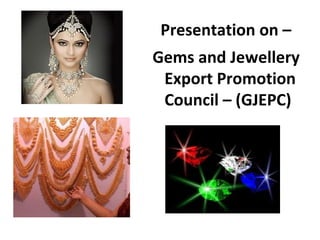
Presentation on –
Gems and Jewellery
 Export Promotion
 Council – (GJEPC)
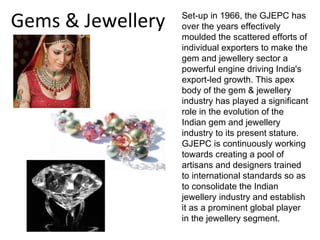
Gems & Jewellery   Set-up in 1966, the GJEPC has
                   over the years effectively
                   moulded the scattered efforts of
                   individual exporters to make the
                   gem and jewellery sector a
                   powerful engine driving India's
                   export-led growth. This apex
                   body of the gem & jewellery
                   industry has played a significant
                   role in the evolution of the
                   Indian gem and jewellery
                   industry to its present stature.
                   GJEPC is continuously working
                   towards creating a pool of
                   artisans and designers trained
                   to international standards so as
                   to consolidate the Indian
                   jewellery industry and establish
                   it as a prominent global player
                   in the jewellery segment.
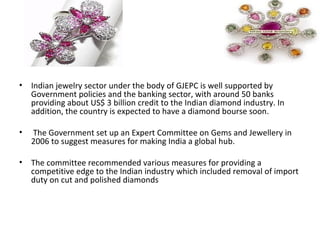
• Indian jewelry sector under the body of GJEPC is well supported by
  Government policies and the banking sector, with around 50 banks
  providing about US$ 3 billion credit to the Indian diamond industry. In
  addition, the country is expected to have a diamond bourse soon.

•   The Government set up an Expert Committee on Gems and Jewellery in
    2006 to suggest measures for making India a global hub.

• The committee recommended various measures for providing a
  competitive edge to the Indian industry which included removal of import
  duty on cut and polished diamonds
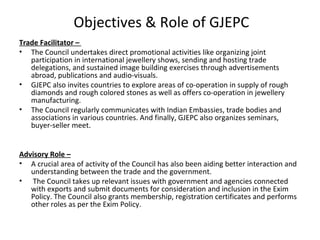
Objectives & Role of GJEPC
Trade Facilitator –
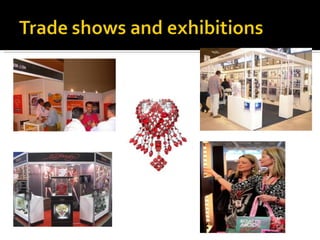
• The Council undertakes direct promotional activities like organizing joint
   participation in international jewellery shows, sending and hosting trade
   delegations, and sustained image building exercises through advertisements
   abroad, publications and audio-visuals.
• GJEPC also invites countries to explore areas of co-operation in supply of rough
   diamonds and rough colored stones as well as offers co-operation in jewellery
   manufacturing.
• The Council regularly communicates with Indian Embassies, trade bodies and
   associations in various countries. And finally, GJEPC also organizes seminars,
   buyer-seller meet.


Advisory Role –
• A crucial area of activity of the Council has also been aiding better interaction and
   understanding between the trade and the government.
• The Council takes up relevant issues with government and agencies connected
   with exports and submit documents for consideration and inclusion in the Exim
   Policy. The Council also grants membership, registration certificates and performs
   other roles as per the Exim Policy.
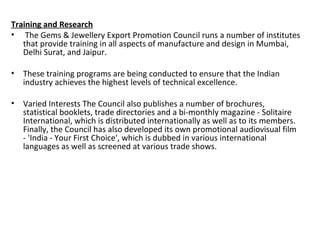
Training and Research
• The Gems & Jewellery Export Promotion Council runs a number of institutes
   that provide training in all aspects of manufacture and design in Mumbai,
   Delhi Surat, and Jaipur.

• These training programs are being conducted to ensure that the Indian
  industry achieves the highest levels of technical excellence.

• Varied Interests The Council also publishes a number of brochures,
  statistical booklets, trade directories and a bi-monthly magazine - Solitaire
  International, which is distributed internationally as well as to its members.
  Finally, the Council has also developed its own promotional audiovisual film
  - 'India - Your First Choice', which is dubbed in various international
  languages as well as screened at various trade shows.
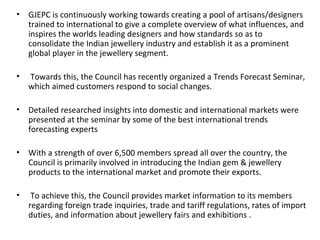
• GJEPC is continuously working towards creating a pool of artisans/designers
  trained to international to give a complete overview of what influences, and
  inspires the worlds leading designers and how standards so as to
  consolidate the Indian jewellery industry and establish it as a prominent
  global player in the jewellery segment.

•   Towards this, the Council has recently organized a Trends Forecast Seminar,
    which aimed customers respond to social changes.

• Detailed researched insights into domestic and international markets were
  presented at the seminar by some of the best international trends
  forecasting experts

• With a strength of over 6,500 members spread all over the country, the
  Council is primarily involved in introducing the Indian gem & jewellery
  products to the international market and promote their exports.

•    To achieve this, the Council provides market information to its members
    regarding foreign trade inquiries, trade and tariff regulations, rates of import
    duties, and information about jewellery fairs and exhibitions .
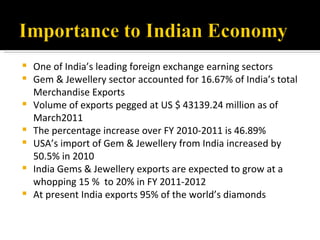
   One of India’s leading foreign exchange earning sectors
   Gem & Jewellery sector accounted for 16.67% of India’s total
    Merchandise Exports
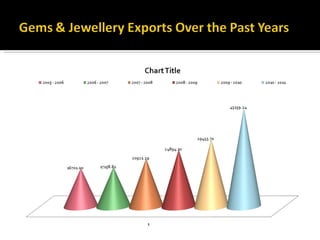
   Volume of exports pegged at US $ 43139.24 million as of
    March2011
   The percentage increase over FY 2010-2011 is 46.89%
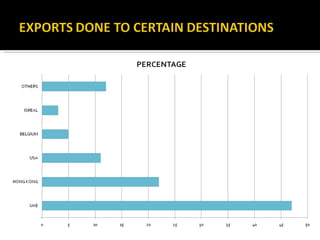
   USA’s import of Gem & Jewellery from India increased by
    50.5% in 2010
   India Gems & Jewellery exports are expected to grow at a
    whopping 15 % to 20% in FY 2011-2012
   At present India exports 95% of the world’s diamonds
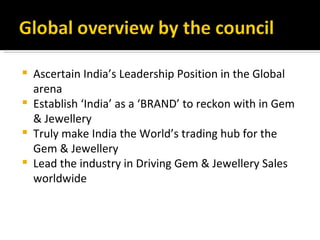
   Ascertain India’s Leadership Position in the Global
    arena
   Establish ‘India’ as a ‘BRAND’ to reckon with in Gem
    & Jewellery
   Truly make India the World’s trading hub for the
    Gem & Jewellery
   Lead the industry in Driving Gem & Jewellery Sales
    worldwide
TRAINING INSTITUTIONS:
There are several training institutions for imparting training in diamond and gem processing and
jewellery manufacturing industry. The prominent ones are listed below:

A) UNDER THE AUSPICES OF GJEPC:

Indian Diamond Institute, Surat:
Courses in diamond, Gems and Jewellery and Computers; Established in 1978; Enrolment: About
350 students.

Indian Gemmological Institute, New Delhi: Gem Testing Laboratory and Gemmology Courses;
Established in 1980.

Gem Testing Laboratory, Jaipur: Gem Testing Services, Courses in Gemmology, Technical services
to overseas buyers.

Jewellery Product Development Centre, Mumbai:Short-term courses in Jewellery and video
cassettes and other library for free use.

Jewellery Product Development Centre, New Delhi: Seminars and Workshop-cum-Training
programmes for jewellery industry and technical assistance.
B) PRIVATE SECTOR INSTITUTIONS:
S.G. Centre for Diamond Technology, Vile Parle (W), Mumbai:This institution is situated
within the campus of Shri Bhagubhai Mafatlal Polytechnic and conducts a comprehensive
diploma course in Diamond Technology.
Gemmological Institute of India, Mumbai: Founded by the Gem and Jewellery
Exporters' Association, Mumbai in 1971; Diploma course in Gemmology and
Diamond Course, both of which are resident programmes; Correspondence Course in
Gemmology, Pearl Course, Jewellery Designing Course; Jewellery Casting Course;
gemstones testing through its Gem Testing Laboratory.

C) INDIAN DIAMOND INSTITUTE (IDI), SURAT
IDI is jointly aided by Ministry of Commerce, Government of India and The Gem &
Jewellery Export Promotion Council.
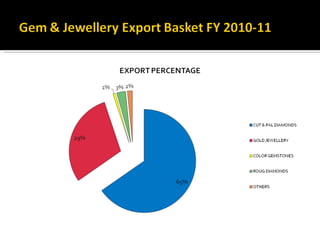
IDI is located in Gujarat, which accounts for about 80% of the cut and polished diamonds
exported from India. Surat, the ‘Diamond City’, has the largest share in diamond
processing among all the diamond processing centres.
Over 10,000 diamond units operate in Surat, which accounts for the largest share in
diamond industry employment, i.e., 750,000 out of an estimated 800,000.
 Therefore, it is natural that The Indian Diamond Institute, the premier institution for
training for this industry is located at Surat.
IDI provides training, laboratory services, research & development and consultancy
services in a wide spectrum of areas related to the Gems and Jewellery Industry.
•   The Kimberley Process came into force when the South African diamond producing
    nations met at Kimberley in South Africa in May 2000
•    The Kimberly Process was set up to discuss ways to stop the trade in ‘conflict
    diamonds’ and to ensure that diamond purchases did not fund violence.
•   As of November 2008, the KP had 49 members, representing 75 countries.
•   The Kimberley Process Certification Scheme (KPCS) was implemented in India on
    January 1, 2003 to verify the legitimacy of the import / export of rough diamonds as
    per the UN resolution and to curb the entry of conflict diamonds into the global trade
    flow.
•    The system of verification and issuance of KPC is administered from the Mumbai and
    Surat offices of GJEPC.
•    In India’s Foreign Trade Policy 2009-14, the following measures related to the
    Kimberley Process Certification Scheme (KPCS) have been adopted:
•   No import or export of rough diamonds shall be permitted unless accompanied by the
    KP certificate as specified by the GJEPC.
•   The export and import of rough diamonds to and from Venezuela has been prohibited
    by the Indian government owing to the voluntary separation of Venezuela from the
    KPCS.
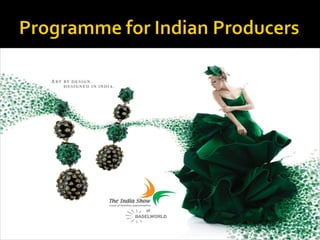
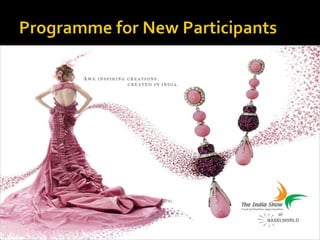
Objective - To position India as a global hub in jewellery DESIGN

How? - Appropriate Indian jewellery to benchmarks of design

What are these benchmarks? – Art and Fashion are always
 considered the ultimate design manifestations

Approach - Present the said benchmarks as inspired by jewellery
  from India…and even vice -versa
Conclusion
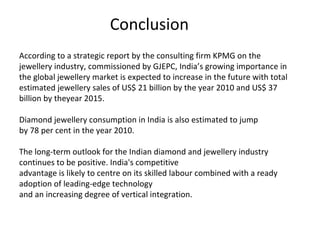
According to a strategic report by the consulting firm KPMG on the
jewellery industry, commissioned by GJEPC, India’s growing importance in
the global jewellery market is expected to increase in the future with total
estimated jewellery sales of US$ 21 billion by the year 2010 and US$ 37
billion by theyear 2015.

Diamond jewellery consumption in India is also estimated to jump
by 78 per cent in the year 2010.

The long-term outlook for the Indian diamond and jewellery industry
continues to be positive. India's competitive
advantage is likely to centre on its skilled labour combined with a ready
adoption of leading-edge technology
and an increasing degree of vertical integration.

Gems & jwellery

  • 1.
    Presentation on – Gemsand Jewellery Export Promotion Council – (GJEPC)
  • 3.
    Gems & Jewellery Set-up in 1966, the GJEPC has over the years effectively moulded the scattered efforts of individual exporters to make the gem and jewellery sector a powerful engine driving India's export-led growth. This apex body of the gem & jewellery industry has played a significant role in the evolution of the Indian gem and jewellery industry to its present stature. GJEPC is continuously working towards creating a pool of artisans and designers trained to international standards so as to consolidate the Indian jewellery industry and establish it as a prominent global player in the jewellery segment.
  • 4.
    • Indian jewelrysector under the body of GJEPC is well supported by Government policies and the banking sector, with around 50 banks providing about US$ 3 billion credit to the Indian diamond industry. In addition, the country is expected to have a diamond bourse soon. • The Government set up an Expert Committee on Gems and Jewellery in 2006 to suggest measures for making India a global hub. • The committee recommended various measures for providing a competitive edge to the Indian industry which included removal of import duty on cut and polished diamonds
  • 5.
    Objectives & Roleof GJEPC Trade Facilitator – • The Council undertakes direct promotional activities like organizing joint participation in international jewellery shows, sending and hosting trade delegations, and sustained image building exercises through advertisements abroad, publications and audio-visuals. • GJEPC also invites countries to explore areas of co-operation in supply of rough diamonds and rough colored stones as well as offers co-operation in jewellery manufacturing. • The Council regularly communicates with Indian Embassies, trade bodies and associations in various countries. And finally, GJEPC also organizes seminars, buyer-seller meet. Advisory Role – • A crucial area of activity of the Council has also been aiding better interaction and understanding between the trade and the government. • The Council takes up relevant issues with government and agencies connected with exports and submit documents for consideration and inclusion in the Exim Policy. The Council also grants membership, registration certificates and performs other roles as per the Exim Policy.
  • 6.
    Training and Research •The Gems & Jewellery Export Promotion Council runs a number of institutes that provide training in all aspects of manufacture and design in Mumbai, Delhi Surat, and Jaipur. • These training programs are being conducted to ensure that the Indian industry achieves the highest levels of technical excellence. • Varied Interests The Council also publishes a number of brochures, statistical booklets, trade directories and a bi-monthly magazine - Solitaire International, which is distributed internationally as well as to its members. Finally, the Council has also developed its own promotional audiovisual film - 'India - Your First Choice', which is dubbed in various international languages as well as screened at various trade shows.
  • 7.
    • GJEPC iscontinuously working towards creating a pool of artisans/designers trained to international to give a complete overview of what influences, and inspires the worlds leading designers and how standards so as to consolidate the Indian jewellery industry and establish it as a prominent global player in the jewellery segment. • Towards this, the Council has recently organized a Trends Forecast Seminar, which aimed customers respond to social changes. • Detailed researched insights into domestic and international markets were presented at the seminar by some of the best international trends forecasting experts • With a strength of over 6,500 members spread all over the country, the Council is primarily involved in introducing the Indian gem & jewellery products to the international market and promote their exports. • To achieve this, the Council provides market information to its members regarding foreign trade inquiries, trade and tariff regulations, rates of import duties, and information about jewellery fairs and exhibitions .
  • 8.
    One of India’s leading foreign exchange earning sectors  Gem & Jewellery sector accounted for 16.67% of India’s total Merchandise Exports  Volume of exports pegged at US $ 43139.24 million as of March2011  The percentage increase over FY 2010-2011 is 46.89%  USA’s import of Gem & Jewellery from India increased by 50.5% in 2010  India Gems & Jewellery exports are expected to grow at a whopping 15 % to 20% in FY 2011-2012  At present India exports 95% of the world’s diamonds
  • 9.
    Ascertain India’s Leadership Position in the Global arena  Establish ‘India’ as a ‘BRAND’ to reckon with in Gem & Jewellery  Truly make India the World’s trading hub for the Gem & Jewellery  Lead the industry in Driving Gem & Jewellery Sales worldwide
  • 13.
    TRAINING INSTITUTIONS: There areseveral training institutions for imparting training in diamond and gem processing and jewellery manufacturing industry. The prominent ones are listed below: A) UNDER THE AUSPICES OF GJEPC: Indian Diamond Institute, Surat: Courses in diamond, Gems and Jewellery and Computers; Established in 1978; Enrolment: About 350 students. Indian Gemmological Institute, New Delhi: Gem Testing Laboratory and Gemmology Courses; Established in 1980. Gem Testing Laboratory, Jaipur: Gem Testing Services, Courses in Gemmology, Technical services to overseas buyers. Jewellery Product Development Centre, Mumbai:Short-term courses in Jewellery and video cassettes and other library for free use. Jewellery Product Development Centre, New Delhi: Seminars and Workshop-cum-Training programmes for jewellery industry and technical assistance.
  • 14.
    B) PRIVATE SECTORINSTITUTIONS: S.G. Centre for Diamond Technology, Vile Parle (W), Mumbai:This institution is situated within the campus of Shri Bhagubhai Mafatlal Polytechnic and conducts a comprehensive diploma course in Diamond Technology. Gemmological Institute of India, Mumbai: Founded by the Gem and Jewellery Exporters' Association, Mumbai in 1971; Diploma course in Gemmology and Diamond Course, both of which are resident programmes; Correspondence Course in Gemmology, Pearl Course, Jewellery Designing Course; Jewellery Casting Course; gemstones testing through its Gem Testing Laboratory. C) INDIAN DIAMOND INSTITUTE (IDI), SURAT IDI is jointly aided by Ministry of Commerce, Government of India and The Gem & Jewellery Export Promotion Council. IDI is located in Gujarat, which accounts for about 80% of the cut and polished diamonds exported from India. Surat, the ‘Diamond City’, has the largest share in diamond processing among all the diamond processing centres. Over 10,000 diamond units operate in Surat, which accounts for the largest share in diamond industry employment, i.e., 750,000 out of an estimated 800,000. Therefore, it is natural that The Indian Diamond Institute, the premier institution for training for this industry is located at Surat. IDI provides training, laboratory services, research & development and consultancy services in a wide spectrum of areas related to the Gems and Jewellery Industry.
  • 15.
    The Kimberley Process came into force when the South African diamond producing nations met at Kimberley in South Africa in May 2000 • The Kimberly Process was set up to discuss ways to stop the trade in ‘conflict diamonds’ and to ensure that diamond purchases did not fund violence. • As of November 2008, the KP had 49 members, representing 75 countries. • The Kimberley Process Certification Scheme (KPCS) was implemented in India on January 1, 2003 to verify the legitimacy of the import / export of rough diamonds as per the UN resolution and to curb the entry of conflict diamonds into the global trade flow. • The system of verification and issuance of KPC is administered from the Mumbai and Surat offices of GJEPC. • In India’s Foreign Trade Policy 2009-14, the following measures related to the Kimberley Process Certification Scheme (KPCS) have been adopted: • No import or export of rough diamonds shall be permitted unless accompanied by the KP certificate as specified by the GJEPC. • The export and import of rough diamonds to and from Venezuela has been prohibited by the Indian government owing to the voluntary separation of Venezuela from the KPCS.
  • 16.
    Objective - Toposition India as a global hub in jewellery DESIGN How? - Appropriate Indian jewellery to benchmarks of design What are these benchmarks? – Art and Fashion are always considered the ultimate design manifestations Approach - Present the said benchmarks as inspired by jewellery from India…and even vice -versa
  • 22.
    Conclusion According to astrategic report by the consulting firm KPMG on the jewellery industry, commissioned by GJEPC, India’s growing importance in the global jewellery market is expected to increase in the future with total estimated jewellery sales of US$ 21 billion by the year 2010 and US$ 37 billion by theyear 2015. Diamond jewellery consumption in India is also estimated to jump by 78 per cent in the year 2010. The long-term outlook for the Indian diamond and jewellery industry continues to be positive. India's competitive advantage is likely to centre on its skilled labour combined with a ready adoption of leading-edge technology and an increasing degree of vertical integration.