





On February 8, 2006, President Bush signed the Deficit Reduction Act of 2005 into law. Due to the time delay
between the writing of and the printing of this publication, this legislation was listed as pending on page 70. The
new law provides $150 million for each of Federal fiscal years 2006 through 2010 to promote and support healthy
marriages and responsible fatherhood. The funds will be awarded as competitive grants to government entities,
faith-based organizations or community organizations.

Up to $50 million per year may be awarded to government entities, faith-based organizations or community
organizations to fund activities promoting responsible fatherhood. Such activities may include parent education,
counseling, education and career services to foster fathers’ economic stability, or a national media campaign to
encourage appropriate parent involvement in a child’s life. Up to $2 million per year may be awarded as
competitive grants to Indian tribes to demonstrate the effectiveness of coordinating the provision of child welfare
and TANF services to tribal families at risk of child abuse or neglect. The remaining funds are designated for
healthy marriage activities, which may include programs of premarital education, conflict resolution, marriage
enhancement for married couples and programs designed to reduce disincentives to marriage in means-tested aid
programs.
The Importance of Fathers 

in the Healthy Development of Children


         Jeffrey Rosenberg and W. Bradford Wilcox


                              2006


          U.S. Department of Health and Human Services

             Administration for Children and Families

          Administration on Children, Youth and Families

                        Children’s Bureau

                Office on Child Abuse and Neglect
Table of Contents


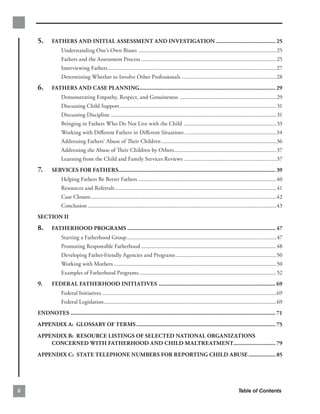
PREFACE ................................................................................................................................................ 1

ACKNOWLEDGMENTS ....................................................................................................................... 3

1.      PURPOSE AND OVERVIEW ...................................................................................................... 5

              Purpose of the Manual ..................................................................................................................6

              Overview of the Scope of Child Maltreatment and Child Protection .............................................6

              Research on the Role of Fathers .....................................................................................................7

SECTION I
2.      FATHERS AND THEIR IMPACT ON CHILDREN’S WELLBEING ..................................... 11

              The Impact of the Mother-Father Relationship on Child Outcomes ............................................. 11

              The Impact of Fathers on Cognitive Ability and Educational Achievement ..................................12

              The Impact of Fathers on Psychological Well-being and Social Behavior ......................................12

3.      FATHERS AND THEIR IMPACT ON CHILD MALTREATMENT ........................................ 15

              Child Maltreatment and Its Impact on Children ......................................................................... 15

              Perpetrators of Child Maltreatment ..............................................................................................16

              The Presence of Fathers as a Protective Factor ..............................................................................16

              The Role of Fathers in Child Maltreatment ................................................................................. 17

4.      EFFECTIVE FATHERING ......................................................................................................... 19

              Fostering a Positive Relationship with the Children’s Mother .................................................... 19

              Spending Time with Children ......................................................................................................20

              Nurturing Children ......................................................................................................................21

              Disciplining Children Appropriately.............................................................................................21

              Serving as a Guide to the Outside World ......................................................................................22

              Protecting and Providing ..............................................................................................................22

              Being a Role Model ......................................................................................................................23


The Importance of Fathers in the Healthy Development of Children                                                                                              i
5.      FATHERS AND INITIAL ASSESSMENT AND INVESTIGATION ........................................ 25

                   Understanding One’s Own Biases ................................................................................................25

                   Fathers and the Assessment Process ..............................................................................................25

                   Interviewing Fathers .....................................................................................................................27

                   Determining Whether to Involve Other Professionals ..................................................................28

     6.      FATHERS AND CASE PLANNING........................................................................................... 29

                   Demonstrating Empathy, Respect, and Genuineness ...................................................................29

                   Discussing Child Support............................................................................................................. 31

                   Discussing Discipline ................................................................................................................... 31

                   Bringing in Fathers Who Do Not Live with the Child ................................................................33

                   Working with Different Fathers in Different Situations ................................................................34

                   Addressing Fathers’ Abuse of Their Children ................................................................................36

                   Addressing the Abuse of Their Children by Others.......................................................................37

                   Learning from the Child and Family Services Reviews ................................................................37

     7.      SERVICES FOR FATHERS......................................................................................................... 39

                   Helping Fathers Be Better Fathers ................................................................................................40

                   Resources and Referrals ................................................................................................................41

                   Case Closure.................................................................................................................................42

                   Conclusion ...................................................................................................................................43

     SECTION II
     8.      FATHERHOOD PROGRAMS ................................................................................................... 47

                   Starting a Fatherhood Group........................................................................................................47

                   Promoting Responsible Fatherhood ..............................................................................................48

                   Developing Father-friendly Agencies and Programs ......................................................................50

                   Working with Mothers .................................................................................................................50

                   Examples of Fatherhood Programs................................................................................................52

     9.      FEDERAL FATHERHOOD INITIATIVES .............................................................................. 69

                   Federal Initiatives .........................................................................................................................69

                   Federal Legislation........................................................................................................................69

     ENDNOTES ......................................................................................................................................... 71

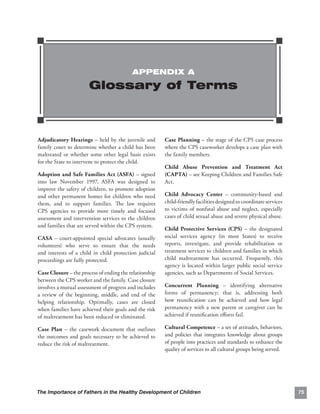
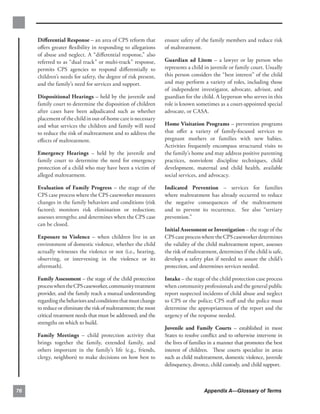
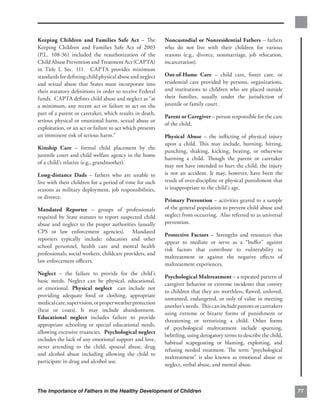
     APPENDIX A: GLOSSARY OF TERMS ............................................................................................. 75

     APPENDIX B: RESOURCE LISTINGS OF SELECTED NATIONAL ORGANIZATIONS 

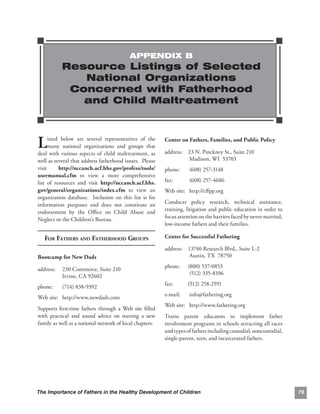
         CONCERNED WITH FATHERHOOD AND CHILD MALTREATMENT............................ 79

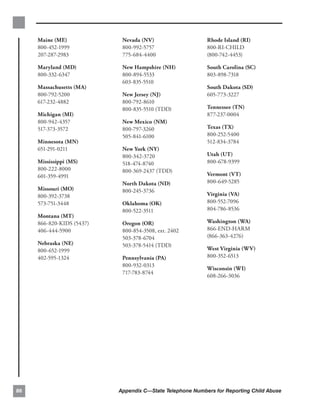
     APPENDIX C: STATE TELEPHONE NUMBERS FOR REPORTING CHILD ABUSE .................. 85


ii                                                                                                                                    Table of Contents
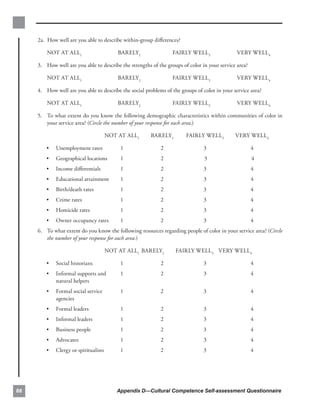
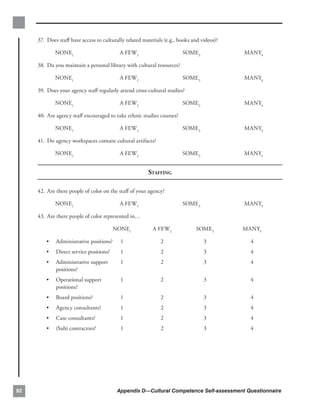
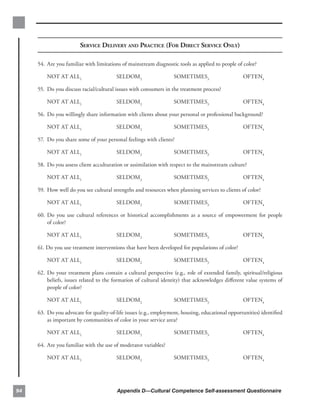
APPENDIX D: CULTURAL COMPETENCE SELFASSESSMENT QUESTIONNAIRE, SERVICE 

    PROVIDER VERSION ............................................................................................................... 87 

APPENDIX E: TIPS FOR DADS....................................................................................................... 101

APPENDIX F: HEALTHY MARRIAGES ..........................................................................................117


The Importance of Fathers in the Healthy Development of Children                                                                            iii
Preface


E    ach day, the safety and well-being of some
     children across the Nation are threatened by
child abuse and neglect. Intervening effectively in
                                                            for Children and Families (ACF), U.S. Department of
                                                            Health and Human Services (DHHS), has developed
                                                            this third edition of the User Manual Series to reflect
the lives of these children and their families is not the   the increased knowledge base and the evolving
sole responsibility of any single agency or professional    state of practice. The updated and new manuals
group, but rather is a shared community concern.            are comprehensive in scope while also succinct in
                                                            presentation and easy to follow, and they address
Since the late 1970s, the Child Abuse and Neglect           trends and concerns relevant to today’s professional.
User Manual Series has provided guidance on
child protection to hundreds of thousands of                This new manual, The Importance of Fathers in
multidisciplinary professionals and concerned               the Healthy Development of Children, is a result of
community members. The User Manual Series                   increased recognition of the vital role that fathers
provides a foundation for understanding child               play in all aspects of their children’s lives. While
maltreatment and the roles and responsibilities of          the User Manual Series addresses the issues of child
various practitioners in its prevention, identification,     abuse and neglect, this manual extends that context
investigation, assessment, and treatment. Through           by examining how to strengthen the roles of fathers
the years, the manuals have served as valuable              within their children’s lives and their own.
resources for building knowledge, promoting effective
practices, and enhancing community collaboration.           Readers of The Importance of Fathers in the Healthy
                                                            Development of Children may also be interested in A
Since the last update of the User Manual Series in the      Coordinated Response to Child Abuse and Neglect: The
early 1990s, a number of changes have occurred that         Foundation for Practice and Child Protective Services:
dramatically affect each community’s response to             A Guide for Caseworkers. The Foundation for Practice,
child maltreatment. The changing landscape reflects          which is the keystone for the series, addresses the
increased recognition of the complexity of issues           definition, scope, causes, and consequences of child
facing parents and their children, new legislation,         abuse and neglect. It also presents an overview of
practice innovations, and system reform efforts.             prevention efforts and the child protection process.
Significant advances in research have helped shape           Because child protection is a multidisciplinary effort,
new directions for interventions, while ongoing             The Foundation for Practice describes the roles and
evaluations help us to know “what works.”                   responsibilities of different professional groups and
                                                            offers guidance on how the groups can work together
The Office on Child Abuse and Neglect (OCAN)                  effectively to protect the safety, permanency, and
within the Children’s Bureau of the Administration          well-being of children. A Guide for Caseworkers


The Importance of Fathers in the Healthy Development of Children                                                     1
provides the fundamental information that child       earlier manuals as it relates specifically to fathers. It
    protective services (CPS) professionals must know     is primarily intended to help CPS caseworkers work
    to perform essential casework functions. This new     effectively with fathers and thereby support families
    manual builds on the information presented in those   as fully as possible.


                                             User Manual Series

     This manual—along with the entire Child Abuse and Neglect User Manual Series—is available from the
     National Clearinghouse on Child Abuse and Neglect Information. Contact the Clearinghouse for a full
     list of available manuals and ordering information:

                         National Clearinghouse on Child Abuse and Neglect Information
                                            Children’s Bureau/ACYF
                                          1250 Maryland Avenue, SW
                                                  Eighth Floor
                                            Washington, DC 20024
                                    Phone: (800) 394-3366 or (703) 385-7565
                                              Fax: (703) 385-3206
                                          E-mail: nccanch@caliber.com


     The manuals also are available online at http://nccanch.acf.hhs.gov/profess/tools/usermanual.cfm.


2                                                                                                       Preface
Acknowledgments


                      AUTHORS                                                  REVIEWERS

Jeff rey Rosenberg is the founder of Rosenberg              Byron Egeland, Institute of Child Development,
Communications, a full-service public relations firm.       University of Minnesota
For the National Fatherhood Initiative, Rosenberg
Communications designed and implemented a media            Joe Jones, Center for Fathers, Families, and Workforce
relations strategy to educate the public about the issue   Development
of absentee fathers, created a media kit, and planned
                                                           James May, The Fathers Network
a nationwide event on the issue of fatherhood. Mr.
Rosenberg was previously the Communications                David Popenoe, National Marriage Project
Director at the U.S. Department of Health and
Human Services.                                            Bob Scholle, Independent Consultant

W. Bradford Wilcox, Ph.D., is assistant professor of       Neil Tift, National Practitioners Network for Fathers
sociology at the University of Virginia and a member       and Families
of the James Madison Society at Princeton University.
His research focuses on religion, fatherhood,
                                                                     TECHNICAL ADVISORY PANEL
marriage, and parenting. Dr. Wilcox is the author of
Soft Patriarchs, New Men: How Christianity Shapes
Fathers and Husbands. His research has been featured       The following were members of the January 2001
in the Boston Globe, The Washington Post, USA Today,       Technical Advisory Panel for the User Manual Series
and other media outlets.                                   contract. The organizations identified reflect each
                                                           member’s affiliation at that time.

                                                           Carolyn Abdullah
                                                           FRIENDS National Resource Center
                                                           Washington, DC

                                                           Lien Bragg
                                                           American Public Human Services Association
                                                           Washington, DC


The Importance of Fathers in the Healthy Development of Children                                                    3
Sgt. Richard Cage                                  Ron Zuskin
    Montgomery County Police Department                University of Maryland at
    Wheaton, MD                                        Baltimore School of Social Work
                                                       Baltimore, MD
    Diane DePanfilis, Ph.D.
    University of Maryland at                          The following members subsequently were added to
    Baltimore School of Social Work                    the Technical Advisory Panel:
    Baltimore, MD
                                                       William R. (Reyn) Archer III, M.D.
    Pauline Grant                                      Hill and Knowlton, Inc.
    Florida Department of Children and Families        Washington, DC
    Jacksonville, FL
                                                       David Popenoe, Ph.D.
    Jodi Hill                                          National Marriage Project
    Connecticut Department of Children and Families    Princeton, NJ
    Hartford, CT
                                                       Bob Scholle
    Robert Ortega, Ph.D.                               Independent Consultant
    University of Michigan School of Social Work       Pittsburgh, PA
    Ann Arbor, MI
                                                       Brad Wilcox, Ph.D.
    Nancy Rawlings                                     University of Virginia, Department of Sociology
    Kentucky Cabinet for Families and Children         Charlottesville, VA
    Frankfort, KY

    Barry Salovitz                                            ADDITIONAL ACKNOWLEDGMENT
    Child Welfare Institute/National Resource Center
    on Child Maltreatment
                                                       This manual in the User Manual Series was developed
    Glenmont, NY
                                                       under the valuable guidance and direction of Dr.
    Sarah Webster                                      Susan Orr, Associate Commissioner, Children’s
    Texas Department of Protective and                 Bureau, the U.S. Department of Health and Human
    Regulatory Services                                Services.
    Austin, TX


4                                                                                     Acknowledgments
CHAPTER 1

              Purpose and Overview


C     hild protective services (CPS) caseworkers
      are charged with a task that is both crucial to
society and, at times, overwhelming to the individual
                                                          father. Working with fathers who are the perpetrators
                                                          of child maltreatment is different than working with
                                                          mothers or other perpetrators. In addition, fathers
caseworker: determining when this nation’s most           whose children were victimized by someone else,
vulnerable citizens—children—are in danger and            even fathers not living with their children, can prove
what actions must be taken to ensure their safety.        to be a valuable ally as the CPS caseworker pursues
Then, they must make sure that these actions take         his or her case planning objectives.
place in both a timely and sensitive manner.
                                                          Effectively involving fathers in case planning and
To carry out their responsibilities of protecting         service provision presents unique challenges for
children at risk of maltreatment, CPS caseworkers         caseworkers. This may explain in part why they
must effectively engage families that often both           often may not include fathers. This manual hopes
present and face great challenges. These can include      to provide guidance to rectify this problem. While
substance abuse, mental health problems, economic         many of the issues facing fathers as they try to be good
stress, unemployment, separation and divorce,             parents are the same as those facing mothers—stress,
inadequate housing, crime, and incarceration.             finances, limited time, to name a few—how fathers
Figuring out how best to work with and engage these       perceive and react to these is usually different and
families, always with the safety of and permanency        is often grounded in cultural views of manhood and
for the child as the goal, is not easy. Other manuals     fatherhood. Plus, the abuse of a child raises unique
in this series, particularly Child Protective Services:   feelings and reactions in a father. Whether the father
A Guide for Caseworkers, provide insight into what        is the perpetrator or not, the abuse of a child can be a
years of experience and research tell us about effective   direct affront to how a father views himself as a man
casework in the field of child welfare. This manual,       and a father. How well a caseworker understands
The Importance of Fathers in the Healthy Development      these reactions and feelings and how effectively the
of Children, complements and builds on the strategies     caseworker can address them will make a major
for CPS articulated in the other manuals.                 difference when trying to either help an abusing father
                                                          become a protecting father or engaging a father as an
This manual also speaks to both the opportunities and     ally in addressing the family dynamics that made the
challenges presented by one participant in the family     situation unsafe for the child.
sagas that CPS caseworkers deal with everyday: the


The Importance of Fathers in the Healthy Development of Children                                                     5
PURPOSE OF THE MANUAL                           OVERVIEW OF THE SCOPE OF CHILD

                                                                  MALTREATMENT AND CHILD PROTECTION

    Today, there is an increased emphasis on family-
    centered practice. Family-centered practice does not        Prior to delving into the discussion of fathers and
    mean only mother-and-child-centered practice.1 Rather,      their role in both preventing and perpetrating child
    all family members and individuals who play a role          maltreatment, it is useful to understand the scope
    in the family should be engaged, when appropriate,          of the problem. The following findings from the
    in order to support meaningful outcomes for the             National Child Abuse and Neglect Data System
    entire family. This manual is designed to help              (NCANDS) for 2003 provide a snapshot of reported
    caseworkers:                                                child victimization:
    •	 Recognize the value of fathers to children;              •	 During 2003, an estimated 906,000 children
                                                                    were victims of abuse or neglect.
    •	 Appreciate the importance of fathers to the case
        planning and service provision process;                 •	 An estimated 2.9 million referrals of abuse or
                                                                    neglect concerning approximately 5.5 million
    •	 Understand the issues unique to working with                 children were received by CPS agencies. More
        fathers;
                                                                    than two-thirds of those referrals were accepted
    •	 Effectively involve fathers in all aspects of case            for investigation or assessment.
        management, from assessment through case
                                                                •	 Nationally, 60.9 percent of child victims
        closure;
                                                                    experienced neglect (including medical neglect),
    •	 Work successfully with fathers in a wide range of            18.9 percent were physically abused, 9.9 percent
        family situations and structures.                           were sexually abused, and 4.9 percent were
                                                                    emotionally or psychologically maltreated.
    Section I of this manual discusses what is known
    about a father’s connection to his child’s well-being,      •	 Approximately two-fifths (40.8 percent) of child
    including his role in the occurrence and prevention of          victims were maltreated by their mothers acting
    maltreatment. The section also relates the literature on        alone; another 18.8 percent were maltreated by
    fatherhood to the different stages of the child protection       their fathers acting alone; and 16.9 percent were
    process. Section II provides practical guidance for             abused by both parents.2
    starting and running a fatherhood program, presents
                                                                In most jurisdictions, CPS is the agency mandated
    various examples of existing programs, and describes
                                                                to conduct an investigation into reports of child
    Federal fatherhood initiatives. CPS agencies can also
                                                                abuse or neglect and to offer services to families
    use this information to ensure that they are providing
                                                                and children where maltreatment has occurred or
    a father-friendly environment. The appendices offer
                                                                is likely to occur. Of course, any intervention into
    additional resources, including a glossary of terms,
                                                                family life on behalf of children must be guided by
    resource listings, and tips that CPS workers can share
                                                                State laws, sound professional standards for practice,
    with fathers to help them be better parents.
                                                                and strong philosophical underpinnings. The key
                                                                principles guiding State laws on child protection are
                                                                based largely on Federal statutes, primarily the Child
                                                                Abuse Prevention and Treatment Act (CAPTA) as
                                                                amended by the Keeping Children and Families
                                                                Safe Act of 2003 (P.L. 108-36) and the Adoption


6                                                                                           Purpose and Overview
and Safe Families Act (ASFA) of 1997 (P.L. 105-89).       •	 The presence of fathers in the home is tied to
While CAPTA provides definitions and guidelines                lower rates of maltreatment;
regarding child maltreatment issues, ASFA promotes
three national goals for child protection:                •	 Unrelated male figures and stepfathers in
                                                              households tend to be more abusive than
•	 Safety. All children have the right to live in an          biological, married fathers;
    environment free from abuse and neglect. The
    safety of children is the paramount concern that      •	 The quality of the relationship between the
    must guide child protection efforts.                       mother and father has an important indirect
                                                              effect on the odds of maltreatment.4
•	 Permanency. Children need a family and
    a permanent place to call home. A sense of            Not much is known, however, about the specific
    continuity and connectedness is central to a          role that fathers play in preventing, causing, or
    child’s healthy development.                          contributing to child maltreatment. In addition,
                                                          relatively little energy has been invested in training
•	 Child and family well-being. Children deserve          CPS caseworkers to work with fathers in cases of
    nurturing families and environments in which          maltreatment. A number of studies indicate that
    their physical, emotional, educational, and social    caseworkers may overlook fathers in connection with
    needs are met. Child protection practices must        their investigations and interventions regarding child
    take into account each child’s needs and should       maltreatment.5 This is not surprising since working
    promote the healthy development of family             with fathers in social services is relatively new—the
    relationships.                                        first national meeting dedicated solely to issues
                                                          concerning fathers did not occur until 1994. In
Effectively engaging fathers in the child protection       addition, American families today represent a range
process is one aspect of the CPS caseworker’s             of fatherhood models, some of which lend themselves
responsibilities that helps further progress toward       to productive involvement with the caseworker and
these goals.                                              others which may not.

                                                          While research and training directly related to fathers
     RESEARCH ON THE ROLE OF FATHERS                      and child maltreatment have been limited, there have
                                                          been significant efforts over recent years devoted to
In the last decade, the social sciences have begun        research on the role of fathers in child development
recognizing and examining the crucial role that fathers   and the creation of programs to strengthen the
play in child development and family dynamics.            capacity of fathers. This manual highlights both the
Nevertheless, relatively little attention has been paid   findings from the available research and examples of
to the role fathers play in the dynamics of child         fatherhood programs. By equipping CPS caseworkers
maltreatment. A 1997 review of research on child          with a solid introduction to the fatherhood research,
abuse and neglect concluded that this research was        the manual should foster a sense of empathy and
characterized by a “conspicuous absence of information    knowledge that will enable them to work effectively
from and about fathers in violent families.”3             with fathers. Further, the exploration of each stage of
                                                          the child protection process—from investigation to
The research that does exist on the link between          case closure—will help caseworkers work with fathers
fathers and maltreatment suggests that:                   in a way that increases the likelihood of achieving the
                                                          ultimate goal: safety and permanency for the child.
•	 Fathers are directly involved in 36.8 percent
    (acting alone in 18.8 percent and with others in
    18.0 percent of the cases) of maltreatment cases;


The Importance of Fathers in the Healthy Development of Children                                                    7
Section I
CHAPTER 2

         Fathers and Their Impact
          on Children’s Well-being


A     noted sociologist, Dr. David Popenoe, is one of the
      pioneers of the relatively young field of research
into fathers and fatherhood. “Fathers are far more than
                                                                 THE IMPACT OF THE MOTHER-FATHER

                                                                 RELATIONSHIP ON CHILD OUTCOMES

just ‘second adults’ in the home,” he says. “Involved
fathers bring positive benefits to their children that       One of the most important influences a father can
no other person is as likely to bring.”6 Fathers have a     have on his child is indirect—fathers influence their
direct impact on the well-being of their children. It       children in large part through the quality of their
is important for professionals working with fathers—        relationship with the mother of their children. A father
especially in the difficult, emotionally charged arena        who has a good relationship with the mother of their
in which child protective services (CPS) caseworkers        children is more likely to be involved and to spend
operate—to have a working understanding of the              time with their children and to have children who are
literature that addresses this impact. Such knowledge       psychologically and emotionally healthier. Similarly,
will help make the case for why the most effective CPS       a mother who feels affirmed by her children’s father
case plans will involve fathers.                            and who enjoys the benefits of a happy relationship is
This chapter lays out the connection between fathers        more likely to be a better mother. Indeed, the quality
and child outcomes, including cognitive ability,            of the relationship affects the parenting behavior of
educational achievement, psychological well-being,          both parents. They are more responsive, affectionate,
and social behavior. The chapter also underscores           and confident with their infants; more self-controlled
the impact of the father and mother’s relationship on       in dealing with defiant toddlers; and better confidants
the well-being of their children. While serving as an       for teenagers seeking advice and emotional support.7
introduction to the issues, this chapter is not intended    One of the most important benefits of a positive
as an exhaustive review of the literature. For the          relationship between mother and father, and a benefit
reader wishing to learn more, the U.S. Department of        directly related to the objectives of the CPS caseworker,
Health and Human Services (http://fatherhood.hhs.           is the behavior it models for children. Fathers who
gov/index.shtml), the National Fatherhood Initiative        treat the mothers of their children with respect and
(www.fatherhood.org), and the National Center for           deal with conflict within the relationship in an adult
Fathering (www.fathers.com) are valuable resources.         and appropriate manner are more likely to have boys
                                                            who understand how they are to treat women and who


The Importance of Fathers in the Healthy Development of Children                                                        11
are less likely to act in an aggressive fashion toward        The influence of a father’s involvement on academic
     females. Girls with involved, respectful fathers see          achievement extends into adolescence and young
     how they should expect men to treat them and are              adulthood. Numerous studies find that an active and
     less likely to become involved in violent or unhealthy        nurturing style of fathering is associated with better
     relationships. In contrast, research has shown that           verbal skills, intellectual functioning, and academic
     husbands who display anger, show contempt for, or             achievement among adolescents.11 For instance, a
     who stonewall their wives (i.e., “the silent treatment”)      2001 U.S. Department of Education study found
     are more likely to have children who are anxious,             that highly involved biological fathers had children
     withdrawn, or antisocial.8                                    who were 43 percent more likely than other children
                                                                   to earn mostly As and 33 percent less likely than
                                                                   other children to repeat a grade.12
       THE IMPACT OF FATHERS ON COGNITIVE

       ABILITY AND EDUCATIONAL ACHIEVEMENT

                                                                    THE IMPACT OF FATHERS ON PSYCHOLOGICAL

                                                                        WELL-BEING AND SOCIAL BEHAVIOR

     Children with involved, caring fathers have better
     educational outcomes. A number of studies suggest
     that fathers who are involved, nurturing, and playful         Even from birth, children who have an involved father
     with their infants have children with higher IQs, as well     are more likely to be emotionally secure, be confident
     as better linguistic and cognitive capacities.9 Toddlers      to explore their surroundings, and, as they grow older,
     with involved fathers go on to start school with              have better social connections with peers. These
     higher levels of academic readiness. They are more            children also are less likely to get in trouble at home,
     patient and can handle the stresses and frustrations          school, or in the neighborhood.13 Infants who receive
     associated with schooling more readily than children          high levels of affection from their fathers (e.g., babies
     with less involved fathers.10                                 whose fathers respond quickly to their cries and who


                                  The Link Between Marriage and Fatherhood

      Caring, involved fathers exist outside of marriage. They are more likely, however, to be found in the
      context of marriage. There are numerous reasons for this, not the least of which being the legal and social
      norms associated with marriage that connect a father to the family unit. That may also explain, in part,
      why research consistently shows that the married mother-and-father family is a better environment for
      raising children than the cohabitating (living together) mother-and-father family.14

      It is interesting to note that, contrary to stereotypes about low-income, unmarried parents, a significant
      majority—more than 8 in 10—of urban, low-income fathers and mothers are in a romantic relationship when
      their children are born.15 Most of these couples expect that they will get married. One study found that more
      than 80 percent expected they would get married or live together. However, only 11 percent of these couples
      had actually married a year later.16 Why they do not marry is an interesting question open to conjecture.
      However, as Dr. Wade Horn, Assistant Secretary for Children and Families at the U.S. Department of Health
      and Human Services has pointed out, it may be because these couples receive very little encouragement to
      marry from the health and social services professionals with whom they come in contact.17


12                                                               Fathers and Their Impact on Children’s Well-being
play together) are more securely attached; that is, they   world around them and more likely to exhibit self-
can explore their environment comfortably when a           control and pro-social behavior.20
parent is nearby and can readily accept comfort from
their parent after a brief separation. A number of         One study of school-aged children found that
studies suggest they also are more sociable and popular    children with good relationships with their fathers
with other children throughout early childhood.18          were less likely to experience depression, to exhibit
                                                           disruptive behavior, or to lie and were more likely to
The way fathers play with their children also has an       exhibit pro-social behavior.21 This same study found
important impact on a child’s emotional and social         that boys with involved fathers had fewer school
development. Fathers spend a much higher percentage        behavior problems and that girls had stronger self­
of their one-on-one interaction with infants and           esteem.22 In addition, numerous studies have found
preschoolers in stimulating, playful activity than         that children who live with their fathers are more
do mothers. From these interactions, children learn        likely to have good physical and emotional health,
how to regulate their feelings and behavior. Rough­        to achieve academically, and to avoid drugs, violence,
housing with dad, for example, can teach children          and delinquent behavior.23
how to deal with aggressive impulses and physical
contact without losing control of their emotions.19        In short, fathers have a powerful and positive impact upon
Generally speaking, fathers also tend to promote           the development and health of children. A caseworker
independence and an orientation to the outside world.      who understands the important contributions fathers
Fathers often push achievement while mothers stress        make to their children’s development and how to
nurturing, both of which are important to healthy          effectively involve fathers in the case planning process
development. As a result, children who grow up with        will find additional and valuable allies in the mission to
involved fathers are more comfortable exploring the        create a permanent and safe environment for children.


                         Dispelling the Stereotype of Low-income Fathers

 It is very important for anybody working with fathers, especially CPS caseworkers, to dispel one common
 stereotype: the image of low-income urban fathers as disengaged and uninvolved with their children. As Dr.
 Michael Lamb has stated, “Our research really bashes the stereotype of the low-income father. These fathers
 care about their kids, but may not show their love in conventional ways and sometimes a lack of a job, poor
 communication with the mom, or even their own childhood experiences can prevent them from getting
 involved.”24 Too often, professionals may assume that a low-income, urban dad who does not live with his
 children is uninvolved with, even unconcerned about, his children. This can push a father away from his
 family, the exact opposite of what a CPS caseworker wants to see happen.


The Importance of Fathers in the Healthy Development of Children                                                        13
CHAPTER 3

                       Fathers and Their
                            Impact on
                       Child Maltreatment


A    father in the home can be a strong protective factor
     for children. A father also may play a role in child
maltreatment. This chapter first looks at the definition
                                                                   child, or exposing a child to sexually explicit
                                                                   material or conduct.

and impact of child maltreatment and presents data on
                                                               •	 Child neglect is a failure to provide for a child’s
                                                                   basic needs for health care, food, clothing, adult
the perpetrators of child abuse and neglect. The chapter
                                                                   supervision, education, and nurturing.
then discusses fathers in light of their varying roles.
                                                               •	 Psychological maltreatment refers to behavior,
           CHILD MALTREATMENT AND
                                 such as ridiculing, terrorizing, corrupting, or
                                                                   denying affection to a child.
            ITS IMPACT ON CHILDREN

                                                               The abuse and neglect of children can have profoundly
The Child Abuse Prevention and Treatment Act                   negative consequences for the social, psychological, and
(CAPTA) (P.L. 93-247) defines child abuse and neglect           physical health of children. The physical abuse (e.g.,
as any “recent act or failure to act on the part of a parent   shaking a crying baby) and neglect of infants is linked
or caretaker that results in death, serious physical or        to a range of physical and emotional maladies (e.g.,
emotional harm, sexual abuse, or exploitation” of a            seizures, irritability, developmental delays, and learning
child under the age of 18 or, “an act or failure to act that   disabilities).25 The physical and psychological abuse of
presents an imminent risk of serious harm” to a child.         preschoolers and school-aged children is associated with
                                                               depression, low self-esteem, antisocial behavior, juvenile
Maltreatment is commonly classified into four                   delinquency, and adult criminal behavior.26 Sexual
categories:                                                    abuse is associated with depression, substance abuse,
                                                               eating disorders, suicidal behavior, and promiscuity.27
• Physical abuse includes punching, beating,                   Neglect is associated with “non-organic failure to thrive,”
    kicking, biting or shaking a child.                        which is characterized by below-average weight, height,
•	 Sexual abuse refers to any sexual contact with              and intellectual development; neglect is also linked to
    a child, the simulation of such conduct with a             attachment disorders, aggression, and difficulty dealing
                                                               with others.28


  For more information on the definition and consequences of child abuse and neglect, see A Coordinated
  Response to Child Abuse and Neglect: The Foundation for Practice at
  http://nccanch.acf.hhs.gov/profess/tools/usermanual.cfm.


The Importance of Fathers in the Healthy Development of Children                                                             15
the majority.33 Perpetrator patterns differ, however,
       PERPETRATORS OF CHILD MALTREATMENT                       by type of maltreatment. Mothers are not more
                                                                likely to be the perpetrator when it comes to sexual
     In 2003, an estimated 906,000 children were victims        abuse; fathers are more likely to be reported for this
     of abuse and neglect. Neglect was the most common          crime.34
     form of maltreatment, with 60.9 percent of child
     victims suffering from neglect in 2003. Neglect was                    THE PRESENCE OF FATHERS

     followed by physical abuse (18.9 percent of child
                                                                            AS A PROTECTIVE FACTOR

     victims), sexual abuse (9.9 percent of child victims),
     and psychological maltreatment (4.9 percent of child
     victims). In 2003, approximately 1,500 children died       Relatively little research has focused squarely on the
     because of abuse or neglect.29                             question of how fathers either directly contribute to
                                                                the risk of child abuse in a family or offer a protective
     The largest percentage of perpetrators (83.9 percent)      factor. Nevertheless, several studies on fathers and
     was parents, including birth parents, adoptive             parents in general offer insights into the role of fathers
     parents, and stepparents.30 How do fathers compare         in the child maltreatment equation:
     to mothers in the perpetration of child maltreatment?
     As discussed earlier, Federal data derived from CPS        •	 Generally speaking, the same characteristics
     reports in 2003 indicate that in 18.8 percent of the           that make a man a good father make him less
     substantiated cases, fathers were the sole perpetrators        likely to abuse or neglect his children. Fathers
     of maltreatment; in 16.9 percent of the cases, the             who nurture and take significant responsibility
     fathers and the mothers were perpetrators; and in 1.1          for basic childcare for their children (e.g.,
     percent of the cases, the father acted with someone            feeding, changing diapers) from an early age are
     else to abuse or neglect his child. Mothers were the           significantly less likely to sexually abuse their
     sole perpetrators in 40.8 percent of the cases and acted       children.35 These fathers typically develop such
     with someone besides the father in 6.3 percent of the          a strong connection with their children that it
     cases.31 This means that fathers were involved in 36.8         decreases the likelihood of any maltreatment.
     percent of child maltreatment cases and that mothers
     were involved in 64 percent of child maltreatment          •	 The involvement of a father in the life of a
     cases. Additionally, more than one-half of the male            family is also associated with lower levels of
     perpetrators were biological fathers, and, although            child neglect, even in families that may be
     recidivism rates were low, biological fathers were             facing other factors, such as unemployment and
     more likely to be perpetrators of maltreatment again           poverty, which could place the family at risk
     than were most other male perpetrators. This may               for maltreatment.36 Such involvement reduces
     be due in part to the lack of permanence between a             the parenting and housework load a mother
     mother and her boyfriend or that the perpetrator may           has to bear and increases the overall parental
     be excluded from the household before recidivism               investments in family life, thereby minimizing
     can occur.32                                                   the chances that either parent will neglect to care
                                                                    for or to supervise their children.
     Mothers are almost twice as likely to be directly
     involved in child maltreatment as fathers. Mothers         •	 On average, fathers who live in a married
     are more likely to abuse or neglect their children             household with their children are better able
     than fathers because they bear a larger share of               to create a family environment that is more
     parenting responsibilities in two-parent families              conducive to the safety and necessary care of their
     and because a large percentage of families today are           children. Consequently, children who live with
     headed by mothers. In some communities, they are               their biological father in a married household are


16                                                              Fathers and Their Impact on Child Maltreatment
significantly less likely to be physically abused,
    sexually abused, or neglected than children who                      THE ROLE OF FATHERS
    do not live with their married biological parents.                 IN CHILD MALTREATMENT

One cannot equate a household headed by a married
                                                           While a father in the home reduces the likelihood of
mother and father with a household headed by
                                                           a child being abused, there are still, of course, fathers
parents who are cohabitating. There is something
                                                           who are perpetrators of child abuse. Research shows
about the legal and social commitments of marriage
                                                           that there are certain characteristics of fathers that
that strengthens the positive impacts of fathering—it
                                                           make them more likely to mistreat a child. Poverty,
may simply be that being married strengthens the
                                                           underemployment, or unemployment can increase a
commitment of a father to his family. However,
                                                           father’s stress level, which may make him more likely
when working with families headed by a cohabitating
                                                           to abuse his children physically.40 Underemployment
couple, the caseworker should not dismiss the
                                                           and unemployment also undermine a father’s feelings
potential contributions to be made by the father.
                                                           of self-worth, which may make him more likely to
While research shows the benefits of marriage over
                                                           lash out at his children.41
cohabitation when it comes to raising children,
fathers who live with the mother of their children         Substance abuse also is strongly associated with higher
are still in a position to contribute greatly to their     rates of abuse and neglect among fathers and mothers.
children’s development and must be considered a            One study found that 66 percent of children raised in
potential asset by the caseworker.37 The caseworker        alcoholic homes were physically maltreated or witnessed
may also want to see if the cohabitating parents are       domestic violence and that more than 25 percent of these
interested in being referred to a marriage preparation     children were sexually abused.42 Additionally, fathers
course. For more information on such programs, see         who were abused or who witnessed domestic violence
the U.S. Department of Health and Human Services’          between their parents are more likely to abuse their
Healthy Marriage Initiative website at http://www.         own children.43 Among other things, substance abuse
acf.hhs.gov/healthymarriage/index.html.                    lowers the inhibitions that fathers might otherwise
                                                           have in connection with abusing their children by
By contrast, children who live in father-absent homes
                                                           diminishing self-control.
often face higher risks of physical abuse, sexual abuse,
and neglect than children who live with their fathers.     Fathers with a low sense of self-worth are also more
A 1997 Federal study indicated that the overall rate       likely to abuse their children.44 Those experiencing
of child maltreatment among single-parent families         psychological distress or low self-esteem may seek
was almost double that of the rate among two-parent        diversion from their problems or may abuse their
families: 27.4 children per 1,000 were maltreated in       children as a way to dominate and thus to derive a
single-parent families, compared to 15.5 per 1,000 in      perverse sense of personal power.45 Fathers also may
two-parent families.38 One national study found that       abuse their children as a way of exacting revenge on a
7 percent of children who had lived with one parent        spouse or partner by whom they feel humiliated.46
had ever been sexually abused, compared to 4 percent
of children who lived with both biological parents.39


The Importance of Fathers in the Healthy Development of Children                                                       17
CHAPTER 4

                      Effective Fathering


O      f course, fathers are not all the same, and being
       an effective father takes many different forms.
It is important for any caseworker who is going to
                                                           • Fostering a positive relationship with the 

                                                               children’s mother

be working with fathers—in other words, every              • Spending time with children
caseworker—to understand what effective fathering
                                                           • Nurturing children
is. Understanding what makes for an effective father
can help the caseworker work with a father around          • Disciplining children appropriately
setting goals and objectives and assist both the
caseworker and the father in understanding when            • Serving as a guide to the outside world
progress has been made.
                                                           • Protecting and providing
Helping men understand what an invaluable and
irreplaceable role they play in the development and
                                                           • Serving as a positive role model.
lives of their children can lead them to make a greater    Fathers may not excel in all seven of these dimensions,
commitment and investment in their family. Indeed,         but fathers who do well in most of them will serve their
Dr. Wade F. Horn, co-founder and former president of       children and families well. Some of the dimensions
the National Fatherhood Initiative, coined the phrase      are generic indicators of good parenting; others apply
“the myth of the superfluous father.”47 By this, he was     specifically to men in their role as fathers.
referring to the fact that too many fathers become
convinced that they are simply an extra set of hands
to help around the house, rather than irreplaceable to          FOSTERING A POSITIVE RELATIONSHIP

their children. Men who see themselves as simply an               WITH THE CHILDREN’S MOTHER

“extra set of hands” are not in a position to help the
family prevent future child maltreatment.
                                                           As discussed in Chapter 2, Fathers and Their Impact
The following discussion explores what makes a father      on Children’s Well-being, one of the most important
effective and offers the caseworker further insight into     ways that men can be good fathers is by treating the
the importance of fathers. Despite a diversity of views    mother of their children with affection, respect, and
on fathering, research suggests seven dimensions of        consideration. The virtues that a father displays in
effective fathering:                                        his relationship with the mother of his children set
                                                           an important example for the children. Children
                                                           who witness affectionate, respectful, and sacrificial


The Importance of Fathers in the Healthy Development of Children                                                      19
behavior on the part of their father are more likely to     prone to stonewalling. Both of these behaviors can
     treat their own, future spouses in a similar fashion.       be enormously destructive to a relationship.50 By
     Just as child maltreatment and domestic abuse can           contrast, fathers who can keep calm in the midst
     be passed on from one generation to the next, so can        of conflict, who can speak non-defensively, validate
     respect, caring, and kindness. These children are           their partner’s concerns, and attempt to respond to
     also more likely to be happy and well-adjusted. By          legitimate issues raised by their partner are much
     contrast, children who witness their father’s anger         more likely to have a strong and happy relationship
     toward or contempt for their mother are more at risk        with their wife and children.
     for depression, aggression, and poor health. The stress
     of parental conflict can have a negative effect even
     on the immune system, which can result in health                    SPENDING TIME WITH CHILDREN
     problems for children.48 See Appendix F for more on
     healthy marriages.                                          “Kids spell love T-I-M-E.”—Dr. Ken Canfield,Founder
                                                                 and President, National Center for Fathering51
     The research on fatherhood suggests two implications
     for fathers. First, fathers need to accentuate the          The time a father spends with his children is important
     positive when interacting with their wives and to           for at least three reasons. First, spending time together
     show affection for their wives on a daily basis. While       enables a father to get to know and to be known by
     for many men this comes naturally, for others it            his child. A father can best discover his child’s virtues
     does not. Many men, especially those who grew up            and vices, hopes and fears, and aspirations and ideals
     without a father, simply did not have role models           by spending lots of time with his child. Second, a
     for how men can and ought to relate to their spouse         father who spends lots of time with his child tends to
     or partner in a positive fashion. Further, the way a        be better at caring. Time spent together makes a father
     man treats and interacts with the women in his life         more sensitive to his child’s needs for love, attention,
     is frequently connected to how he views himself as a        direction, and discipline.52 And third, as the quotation
     man. The second implication is that husbands need           above illustrates, children often do see time as an
     to be able to deal with conflict with their wives in a       indicator of a parent’s love for them.
     constructive manner. Conflict, in and of itself, is not
     a bad thing in a relationship. Indeed, conflict is often     The research literature suggests a few important points
     necessary to resolve issues, grievances, or injustices in   about how fathers spend time with their children:
     a relationship. Couples who can raise issues with one
     another constructively, compromise, and forgive one
                                                                 •	 Fathers should spend considerable time with their
                                                                     children playing and having fun. As discussed
     another for the wrongs done generally have happier
                                                                     earlier, fathers’ play has a unique role in the
     marriages and happier children than those who do
                                                                     child’s development, teaching, for example, how
     not handle conflict well or who avoid addressing
                                                                     to explore the world and how to keep aggressive
     issues in their relationship.49
                                                                     impulses in check.
     Men should try to avoid two pitfalls of relationships:
     criticism and stonewalling.          Criticism entails
                                                                 •	 Fathers should maintain the active, physical, and
                                                                     playful style of fathering as their children age. In
     attacking a partner’s personality or character as
                                                                     other words, when it comes to father-child fun,
     opposed to addressing a specific concern about her
                                                                     active pursuits like tossing the football, playing
     behavior. Stonewalling means that one partner
                                                                     basketball, hiking, or going to the library are
     disengages from the relationship when conflict arises,
                                                                     more valuable than spending time in passive
     either by failing to speak, being emotionally distant,
                                                                     activities such as watching television—for their
     or by physically leaving the scene. In conflict, women
     tend to resort more to criticizing and men are more


20                                                                                                 Effective Fathering
relationship and for their child’s emotional well­     adolescents, especially when they achieve significant
    being, social development, and physical fitness.        accomplishments.

•	 Fathers should engage in productive activities          Fathers’ nurturing may be less openly expressive than
    with their children such as household chores,          mothers’. In fact, one unique way that fathers nurture
    washing dishes after dinner, or cleaning up the        their children—especially toddlers and teenagers—is
    backyard. Research consistently shows that such        by remaining calm when the child is upset or acting
    shared activities promote a sense of responsibility    out. Studies suggest that fathers who respond calmly
    and significance in children that is, in turn, linked   when their children misbehave, get upset, or otherwise
    to greater self-esteem, academic and occupational      lose control have children who are more popular, boys
    achievement, psychological well-being, and civic       who are less aggressive, and girls who are less negative
    engagement later in life.                              with their friends.54 Fathers exercise a critical role in
                                                           providing their children with a mental map of how to
•	 Fathers should spend time fostering their               respond to difficult situations. This is why they have
    children’s intellectual growth. Some studies           to learn the art of self-control as they interact with
    suggest that fathers’ involvement in educational       their children.
    activities—from reading to their children to
    meeting with their child’s teacher—is more
    important for their children’s academic success           DISCIPLINING CHILDREN APPROPRIATELY
    than their mother’s involvement.53
                                                           The role that fathers play as disciplinarians cannot be
                NURTURING CHILDREN                         underestimated. The way this role is understood and
                                                           implemented within the individual family can have
                                                           an enormous impact on how the family responds to
Nurturing by a father serves several important             efforts to prevent further child maltreatment.
purposes:
                                                           One advantage of having two parents rather than one
•	 Helps fathers build close relationships with their      is that two parents can share the load of parenting.
    children.                                              Discipline often is difficult and frustrating; hence,
                                                           fathers can make raising children easier for all in
•	 Fosters psychological well-being and self-worth
                                                           the family by taking up a substantial share of child
    in their children.
                                                           discipline. Fathers seem to be uniquely successful in
•	 Provides children with a healthy model of               disciplining boys, perhaps in part because boys are
    masculinity.                                           often more likely to respond to discipline by a man.55

•	 Helps protect girls from prematurely seeking the        How should fathers discipline their children? First of
    romantic and sexual attention of men.                  all, a father must maintain control of his emotions,
                                                           his body language, and his hands when he disciplines
With infants, fathers should be responsive to              his children. Fathers who scream at their children,
their babies’ cries, hold and hug them often, and          who pound tables, or who strike their children are
participate in their basic care (e.g., feeding, changing   destined to fail as disciplinarians, both because they
diapers). Throughout the rest of early childhood,          are modeling bad behavior and because they lose
fathers should praise their children when they             their children’s respect when they let their emotions
behave well or accomplish something, hug and kiss          take hold of them.56 Unfortunately, many fathers
their children often, and comfort them when they           resort to these tactics out of frustration when they
are sad or scared. Fathers should continue to praise       feel they cannot control their children, because they


The Importance of Fathers in the Healthy Development of Children                                                       21
cannot control their anger, or because they simply do       act independently and to make good use of their
     not know another way.                                       independence.

     Since the way a father disciplines can be so important
     to preventing further child maltreatment in a family,                 PROTECTING AND PROVIDING
     Chapter 6, Fathers and Case Planning, presents a
     more detailed discussion on how to work with fathers
                                                                 Certainly the role of father as protector and provider
     on proper discipline.
                                                                 has changed over the years. Historically, fathers were
                                                                 viewed as chief financial provider for and protector of
                    SERVING AS A GUIDE
                          their children. As the traditional roles of mother and
                  TO THE OUTSIDE WORLD
                          father, and likewise man and wife, have changed over
                                                                 the years, the distinctions have blurred, especially
                                                                 when it comes to who is the breadwinner. One
     Another important function that fathers serve in            study, however, found that men view marriage “as a
     the lives of their children is as guides to the world       partnership of equals, albeit one in which the man is
     outside the home. When children are in preschool,           the partner ultimately responsible for the provision
     fathers can best prepare their children for the outside     of income and the family’s protection.”58 The ability
     world by engaging in vigorous, physical play and            to provide and protect is still, today, very much tied
     encouraging small steps in the direction of autonomy.       up with the average man’s sense of self and sense of
     For instance, fathers can push preschoolers to learn to     manhood. Research consistently shows that fathers
     dress themselves, to shake hands with house guests,         who are employed full-time express more happiness
     and, more generally, to deal with the frustrations of       with family life and have better relationships
     daily life. As children begin school, fathers can tell      with their children, compared to fathers who are
     their children of their own experiences in school and       underemployed or unemployed.59
     encourage them to study hard, teach them about
     money management, or teach them a sport that will           For many men, feelings of inadequacy in the role of
     help their children learn about teamwork.                   protector and provider can translate into frustration
                                                                 and anger, which may not be managed appropriately.
     Fathers of adolescents should incorporate discussions       Men who are under- or unemployed may feel powerless
     of their core beliefs and life experiences into ordinary    within the family. Child maltreatment can at times
     conversations with their teens and have meals with          be a way of “getting even” with a partner whom the
     their children on a regular basis. Fathers should           man sees as more powerful within the relationship.
     also include their children in some of their work or        Furthermore, fathers who feel inadequate in their
     community activities so as to give their teenaged           role as provider and protector may feel inadequate to
     children a taste of their lives outside the home.57 They    step in and to help to prevent further maltreatment.
     also should talk to their children about peer pressure      This is why it is particularly important to explore this
     and the dangers of alcohol, drugs, early sexual activity,   role in the case planning process.
     and violence. And fathers should take the lead in
     giving their adolescents a little more freedom as they      Fathers also are still expected to provide protection
     grow older, so long as this freedom is coupled with         in addition to providing for their family financially.
     the occasional word of encouragement and advice,            From child-proofing a home when the child is
     along with consequences for abuses of that freedom.         very young to making sure their children are not
     In sum, fathers need to be preparing their children         threatened by other children or adults, fathers play an
     for the challenges and opportunities of adulthood           important role in making sure their children are safe.
     by gradually giving them more opportunities to              This is particularly important in communities that
                                                                 experience high rates of violence and crime. In fact,


22                                                                                                Effective Fathering
research clearly suggests that fathers in disadvantaged   that the role model provided by the father is of the
communities play a critical role in monitoring and        utmost importance.
controlling their own children, and even others’
children, and that such communities suffer when there      Being a role model is not a simple or easy task. In the
are few fathers able to play this protective role.60      way that fathers treat other people, spend their time
                                                          and money, and handle the joys and stresses of life,
Fathers also can protect their children by monitoring     they provide a template of living for their children
their social environment. Research indicates that         that often proves critical in guiding the behavior
children benefit when their parents know their friends     of their children, for better or worse. As discussed
and the parents of their friends.61 Fathers can use       earlier, a father’s treatment of the opposite sex, his
this “intergenerational closure,” as social scientists    ability to control his own emotions, and his approach
call it, to keep track of their children’s whereabouts    to work all play a formative role in shaping his sons’
and activities and to collaborate with other parents in   and daughters’ approach to romantic relationships
making sure that their children are behaving in ways      and marriage, interpersonal relationships, and school
they approve. Fathers also should pay close attention     and work.62
to the type of peers with whom their children
are spending time. If they determine that their           There are three points that can guide a father as he
children’s peers are engaged in unethical, dangerous,     explores what kind of role model he is and wants to be:
or unlawful activities, they need to minimize their
                                                          •	 Fathers should promote the mission of their
children’s contact with these other children.
                                                              families. It may sound odd to talk about a mission
                                                              statement for a family but all healthy families
              BEING A ROLE MODEL                              have them, whether they are articulated or not.
                                                              For instance, families that believe their children
                                                              should be brought up with a sound spiritual
While the direct relationship a father has with his           foundation have, as part of their mission, raising
child is of paramount value, fathers also exercise a          children of faith. And families that believe that
strong influence on their children through the type            children must learn the benefits of hard work
of life they live in and outside the home. In the             raise children who recognize and can embrace
wake of child maltreatment, it is very important              the virtues of working hard and applying one’s
that the father examine what sort of role model he            self to a goal.
is presenting to his children. Of course, if he is the
perpetrator of the maltreatment, the answer is that       •	 Fathers should abide by the spirit and (where
he is providing a very poor role model. Yet it is not         appropriate) the letter of the rules that govern
solely the question of the maltreatment—how else is           family life. For example, a father who asks his
the father communicating to the child what kind of            teenager to obey his curfew should also make an
life he leads?                                                effort to be home at a decent hour.

If the father is not the perpetrator, it is still very    •	 Fathers should acknowledge their mistakes to
important for him to look at what kind of role model          their children. When appropriate, they should
he is portraying. The victim of the maltreatment and          be willing to seek forgiveness from their children.
all other children in the home will be confused and           A father who loses his temper while disciplining
fearful about his own place in the family following           a child should apologize to the child. Many
one or more instances of maltreatment. Children               men view apologizing to their child as a sign of
will look to the adults in the household for emotional        weakness that will cause the child to lose respect
sustenance, including how to respond and behave               for the father. The opposite is true. Apologizing
moving forward. It is at such times of familial stress        shows a man is capable of acknowledging and


The Importance of Fathers in the Healthy Development of Children                                                    23
facing up to a mistake, fixing the mistake to          The above discussion of the seven dimensions of
         the extent possible, and committing to moving         effective fathering offers some insight for CPS
         forward—hardly a sign of weakness, much more          caseworkers into how to strengthen a father’s role in
         so a sign of strength.63                              the lives of his children. The next three chapters are
                                                               designed to help caseworkers put this information
     A father’s influence as a role model for his children is   into the context of the child protection process
     affected by the amount of time they spend together.        from investigation to case planning through service
     Whether they live in the same home on a full-time         provision and case closure.
     basis or not, fathers should make a concerted effort to
     model behaviors and attitudes that they want to see
     their children display when they grow up.


24                                                                                             Effective Fathering
CHAPTER 5

                           Fathers and
                       Initial Assessment
                        and Investigation


F   athers have, traditionally, not been as involved in
    child welfare case planning as mothers. Worker
bias regarding father involvement appears to be the
                                                                UNDERSTANDING ONE’S OWN BIASES

most widely researched barrier to fathers’ participation   Everyone’s views regarding fatherhood are likely to be
in child welfare case planning. One study found that       colored by their own experience with their fathers, and,
caseworkers did not pay attention to birth fathers to      with caseworkers, perhaps by their clinical experience.
the degree that they did to birth mothers.64 At the        Simply put, it is impossible to be without biases and
same time, the fathers did not respond to outreach         preconceptions about fathers. For any professional
efforts as well as mothers, which testifies to the           working with men, especially caseworkers in the
need to approach fathers with an understanding of          very difficult and emotionally charged realm of child
their unique needs and feelings. At least in this one      protective services, it is important to recognize and
study, caseworkers were found to require that fathers      understand one’s own biases and preconceptions.
demonstrate their connection to the child whereas
the mothers’ connection was taken for granted. 65 Of       To work successfully with fathers, caseworkers must
course, characteristics of fathers who do not live with    know what their own biases and preconceptions are
their children also can contribute to the difficulties       about fatherhood and fathers. Once caseworkers
in successfully engaging fathers—incarceration,            understand these, they can more readily do a self-
homelessness, substance abuse, to name a few.              check throughout the case to ensure that these biases
                                                           are not affecting their view of the families with whom
Certainly the safety of the child and family is the        they work.
most important goal of child protection. Not all
fathers should be included in the child protective
services (CPS) case plan. When a father has been the           FATHERS AND THE ASSESSMENT PROCESS
perpetrator of abuse, and the conclusion is reached that
working with the father can promote neither safety
                                                           Fathers, whether or not they are the perpetrator of the
nor permanence for the child, then the caseworker’s
                                                           child maltreatment, must play an important part in
focus must remain with other members of the family.
                                                           the initial assessment or investigation process. This
This conclusion, however, must be reached only after
                                                           includes fathers who do not live with their children.
the family assessment is complete—it cannot be
assumed. How to involve fathers effectively in the
initial assessment process is the focus of this chapter.


The Importance of Fathers in the Healthy Development of Children                                                      25
Initial CPS Assessment or Investigation

      As described in Child Protective Services: A Guide for Caseworkers, the purpose of the initial assessment or
      investigation is:

        …to gather and analyze information in response to CPS reports, to interpret the agency’s role to the
        children and families, and to determine which families will benefit from further agency intervention.
        After interviewing all parties and gathering all relevant information, CPS caseworkers must determine
        whether maltreatment has occurred and can be substantiated. In most States, CPS staff are mandated
        by law to determine whether the report is substantiated or founded (meaning that credible evidence
        indicates that abuse or neglect has occurred) or whether the report is unsubstantiated or unfounded
        (meaning that there is a lack of credible evidence to substantiate child maltreatment—but does not
        mean it did not necessarily occur). Depending on State law, CPS agencies usually have up to 30, 60,
        or 90 days after receiving the report to complete the initial assessment or investigation. A major part
        of the initial assessment or investigation includes determining whether there is a risk or likelihood of
        maltreatment occurring in the future and whether the child is safe (not at risk of imminent, serious
        harm). In addition, CPS caseworkers must decide whether ongoing services to reduce risk and assure
        safety should be provided by the CPS agency or other community partners.66


     If the father of the child does not live in the home,      strengths, and resources, and agency and community
     the caseworker should find out where the father is.         services.67 Assessing risk involves gathering
     Whether in the home or not, the caseworker should          information in four key domains: the maltreatment
     also:                                                      itself, the child, caregivers, and family functioning.

     •	 Understand what type of relationship the father         Fathers clearly need to be interviewed as part of the
         has with his child and the family.                     assessment or investigation. This is recommended
                                                                whether the father is living with the child or not. The
     •	 Learn about how the father of the child fits into        reasons why it is important to interview fathers who
         the current family dynamics.                           live outside the home include the following:
     •	 Understand what role the father plays either in         •	 The father is significant to the child, whether
         contributing to the circumstances that led to              the father is actively involved in the child’s life
         maltreatment or in helping to protect the child            or not.
         from further maltreatment.
                                                                •	 The nonresidential father has an important
     An assessment or investigation cannot be considered            impact on the dynamics of the family.
     complete until these issues are addressed and
     understood to the fullest extent possible.                 •	 If placement outside of the home should be
                                                                    necessary, the biological father may prove to be
     The first decision point in the assessment process is           a suitable placement.
     substantiating that maltreatment actually occurred.
     The second decision point is assessing risk. Risk          •	 The nonresidential father may play a role in
     assessment involves evaluating the child and family’s          ameliorating the circumstances that led to the
     situation to identify and weigh the risk factors, family       abuse.


26                                                              Fathers and Initial Assessment and Investigation
•	 What is the relationship between the father and
             INTERVIEWING FATHERS                            the mother of the child(ren), and how does he
                                                             interact with her?
During the initial assessment or investigation,
                                                         •	 Are there other men involved with the family,
caseworkers must gather and analyze a great deal of
                                                             how does the father view these men, and what is
information from the child victim, family members,
                                                             the type and quality of their relationship?
and other sources who may be knowledgeable about
the alleged maltreatment or the risk to and safety of    •	 For fathers who live outside the child’s home,
the children. Child Protective Services: A Guide for         topics to explore include:
Caseworkers provides a detailed exhibit of the types
of information that caseworkers should gather from       •	 What is the current living arrangement of the
each source (see http://nccanch.acf.hhs.gov/pubs/            father vis-à-vis the home in which his child
usermanuals/cps/exhibit6_2.cfm).                             lives?

While conducting interviews with fathers, the            •	 Is there another man living in the home with
caseworker should be aware of some unique                    the child? How does the child’s father view this
issues relevant to fathers that may prove useful in          man and his relationship with his child and the
understanding the father’s role in the family. For           mother of his child?
fathers who live in the home, caseworkers should
address the following topics:                            •	 How often does the father see his child? If and
                                                             when he does see the child, what is the nature of
•	 What role does the father view himself playing            the interaction?
    in the family?
                                                         The CPS caseworker must keep in mind that
•	 How does the father view the maltreatment that        traditional roles of fathers—provider, protector, and
    occurred? Does he see it as a failure on his part?   teacher—still have great meaning for men today.
    Does he experience the fact that his child was       Whether or not the father is the perpetrator, a man
    maltreated as an affront to how he views himself      very often views the maltreatment of his child as a
    as a man and a father?                               failure on his part—a failure to protect his child,
                                                         for example. It is equally important to recognize
•	 Is there anything he personally believes he could     that the entire self-perception of “manliness”
    have done differently to prevent the maltreatment?    and “fatherhood” are deeply intertwined. In
                                                         every culture, “being a man” is loaded with deep
•	 What role models as a father has he himself had?      meaning and these meanings vary across cultures.
    How does the father believe these role models
                                                         Caseworkers who try to understand the dynamics
    would or should have handled the situation that
                                                         of the family need to recognize what “manliness”
    led to the maltreatment?
                                                         and “fatherhood” mean to the men in that family.
•	 If the father was the perpetrator, it will be         Appendix D, Cultural Competence Self-assessment
    important to explore his views of discipline         Questionnaire, can also help an agency and its
    and how he came to learn what is appropriate         caseworkers address their cultural competency
    discipline. It will also be important to explore     training needs as they relate to the father and
    the role of aggression and anger in the father’s     families they serve.
    life to help determine the risk the father may
    present in the future. Is he, for example, open to
    learning new ways of discipline?


The Importance of Fathers in the Healthy Development of Children                                                 27
a professional may bring an understanding of child
               DETERMINING WHETHER TO                           maltreatment, combined with experience working
             INVOLVE OTHER PROFESSIONALS                        with fathers, to the CPS assessment process. Also
                                                                keep in mind that for many fathers, the outside
     If, as the assessment progresses, significant questions     professional may be a religious leader at the religious
     still exist about the risks and strengths in the family,   institution the father attends.
     the caseworker may find it valuable to utilize outside      CPS workers, however, may or may not be able
     referrals. Given the importance that the father can        to locate such programs easily, depending on the
     play in the assessment process, the caseworker may         resources in the community, but generally finding
     need to turn to an outside professional if unable to       a fatherhood program in a local community should
     gather sufficient information about the father and his       not be too difficult. Today, there are numerous
     role in the dynamics that caused the maltreatment.         such programs, examples of which are presented in
     For example, for some men and in some cultures,            Section II of the manual. In addition to colleagues
     it is extremely difficult to speak to a woman about          and to local social service experts, two good resources
     issues relating to family and to fatherhood. In such a     mentioned previously are the National Center for
     case, the caseworker may find it valuable to have the       Fathering (1-800-593-DADS; www.fathers.com)
     father meet with a professional who is experienced         and the National Fatherhood Initiative (301-948­
     working with fathers. Such a professional may be           0599; www.fatherhood.org).
     found within the same social services agency or            The local child support enforcement offices also may
     at another organization within the community.              prove to be a good resource. Obviously, they have a
     The challenge here is that, while today, in nearly         great deal of experience working with fathers. Many
     every community there is a program dedicated to            low-income fathers may still perceive child support
     supporting and helping fathers, many of the staff may       as an enforcement agency rather than a helping tool.
     not be sensitive to and knowledgeable about issues         Over the past several years, child support offices have
     related to child maltreatment. Prior to involving          strived to become a supportive service to fathers by
     staff from such an organization in the assessment           helping them with challenges ranging from defeating
     process, it is important to inquire whether they have      substance abuse, successfully returning to family
     had experience with fathers who have been involved,        life after incarceration, and developing job skills.
     either as a perpetrator or a non-offending adult in the     However, since misperceptions about local child
     family, in a child maltreatment case. If they have         support offices remain common among low-income
     not, then ask if there is a psychologist, psychiatrist,    fathers, the caseworker needs to be sensitive to these
     or clinical social worker with whom the organization       misperceptions.
     works who is good at working with fathers. Such


28                                                              Fathers and Initial Assessment and Investigation
CHAPTER 6

      Fathers and Case Planning


H       istorically, child protective services (CPS)
        casework and policies, as well as academic
research, typically overlooked the role that fathers
                                                                      DEMONSTRATING EMPATHY, 

                                                                      RESPECT, AND GENUINENESS

played in the dynamics of child abuse and neglect,
other than as the alleged offenders.68 Barriers to          Researchers have defined three core conditions that
involving fathers in case planning included custody        are essential to the helping relationship:
issues, unemployment, child support payment and
collection, domestic violence, and incarceration.69        • Empathy
Heavy caseloads also made it harder to track down
a nonresidential father; it is often seen as easier to     • Respect
manage the ongoing interactions over the course
of the case by working with just one parent, usually
                                                           • Genuineness
the mother, and the children. Fathers often had to         “A caseworker’s ability to communicate these three
demonstrate their connection to the child, whereas the     core conditions will strongly influence whether
mothers’ connection was taken for granted.70 While it      they will build a relationship with the children and
may take extra effort to involve a nonresidential father,   family that is characterized by cooperation or a
it is usually in the child’s best interest to do so.       relationship that is hostile and distrustful.”71 Each of
                                                           these conditions is discussed below in the context of
This chapter focuses on working directly with fathers
                                                           working with fathers.
in the case planning process. The chapter first
highlights the importance of demonstrating empathy,        Empathy is the ability to perceive and communicate
respect, and genuineness in interactions with a father.    with sensitivity the feelings and experiences of another
It continues with a discussion of two specific issues       person.72 Developing empathy is not easy. It can be
of particular concern in working with fathers: child       especially difficult with men and fathers. Whether
support and discipline. The chapter then looks at the      or not the father is the perpetrator, the entire intake,
challenges of bringing in fathers who do not live with     assessment, and case planning process is experienced
the child. Recognizing that not all relationships are      by the father, to some degree, as a threat. The very
the same, the chapter also explores issues relevant to     fact that his family is involved with CPS is testimony,
fathers in different situations.                            at least in his mind, that he has failed in his role
                                                           as protector. Some fathers will be able to accept
                                                           and verbalize these feelings; others will defensively
                                                           shunt them aside. Regardless, the caseworker must


The Importance of Fathers in the Healthy Development of Children                                                      29
Case Planning

      Child Protective Services: A Guide for Caseworkers describes case planning in this way:

      The case plan that a child protective services (CPS) caseworker develops with a family is their road map to
      successful intervention. The outcomes identify the destination, the goals provide the direction, and the tasks
      outline the specific steps necessary to reach the final destination. The purposes of case planning are to:

      • Identify strategies with the family that address the effects of maltreatment and change the behaviors or
           conditions contributing to its risk;

      • Provide a clear and specific guide for the caseworker and the family for changing the behaviors and
           conditions that influence risk;

      • Establish a benchmark to measure client progress for achieving outcomes;
      • Develop an essential framework for case decision-making.
      • The primary decisions during this stage are guided by the following questions:
      • What are the outcomes that, when achieved, will indicate that risk is reduced and that the effects of
           maltreatment have been successfully addressed?

      • What goals and tasks must be accomplished to achieve these outcomes?
      • What are the priorities among the outcomes, goals, and tasks?
      • What interventions or services will best facilitate successful outcomes? Are the appropriate services
           available?

      • How and when will progress be evaluated?73

     understand the feelings the father is experiencing to     him feel disrespected. It is important that the father
     effectively engage him in the process.                     not be given reason to accurately conclude he is being
                                                               disrespected by the caseworker. Transient feelings can
     Respect has special meaning to men and fathers.           be dealt with and overcome. A genuine belief that the
     An entire popular language has developed around           caseworker disrespects the father, however, can poison
     respect and disrespect in the male-dominated worlds       the relationship, making it much harder to reach the
     of sports and hip-hop, for example. Communicating         ultimate goal of safety and permanency for the child.
     respect throughout the case planning process is an
     important way to get and to keep the father engaged.      Genuineness refers to “caseworkers being themselves.
     This is not to suggest that despite the caseworker’s      This means simply that caseworkers are consistent in
     best efforts, the father will never feel disrespected      what they say and do, non-defensive, and authentic.”74
     during the case planning process. Likely, things will     Genuineness is important in working with fathers, as
     be said and feelings will be exposed that may make        it is with all members of the family.


30                                                                                    Fathers and Case Planning
DISCUSSING CHILD SUPPORT                                       DISCUSSING DISCIPLINE

As discussed earlier, child support can mean “walking       The topic of discipline may be the most important
a tightrope” in the CPS context. When working with          discussion a caseworker will have with a father,
a father who does not live with his child, child support    whether or not the father is the perpetrator of the
may be an issue of contention between the mother            maltreatment. Every father needs to understand
and father, an issue that could indeed stand in the         how to discipline a child properly, not only because
way of a mother and father working together in any          it can help ensure that a child is not maltreated but
meaningful fashion. For example, among families             also because it is one of the most important tools for
where the father is not living in the home, the rate of     teaching children. Discipline is not simply about
current child support collection rose from 54 percent       punishment or correction of misbehavior. More
in 2000 to 59 percent in 2004. The percentage of            broadly, discipline is also about teaching a child to
arrears cases, however, has remained around 60              exercise self-control and to obey legitimate authority.
percent.75 Not surprisingly, children in homes where
they receive no financial support from their fathers         Fathers can learn strategies for controlling their
are much more likely to be poor.                            anger, such as recognizing their own physical and
                                                            emotional cues that suggest they are too angry to
Underemployment and unemployment can be                     deal with a situation at that moment and learning to
experienced by the father as a direct insult to his self-   walk away from a situation until they have reached a
perception as a man and father. The same can be true        calmer emotional state. Sometimes a father’s anger
when a man is unable to pay child support. Many men         may be grounded in very personal issues, such as his
who owe child support are hesitant about approaching        own experiences with his father when he was a boy.
any government office, particularly CPS. It would             In such cases the caseworker may find it valuable to
be a mistake for the caseworker to be perceived by a        connect the father with a psychologist or clinical
father as an agent for child support enforcement. At        social worker.
the same time, the caseworker would be remiss by not
addressing questions of child support when dealing          A father’s anger may grow out of the dynamics in
with a nonresidential father and trying to bring this       the family or from his relationship with the child’s
father into the equation to ensure the child is living      mother, issues that may reveal themselves to the
in a safe environment.                                      caseworker in individual interviews and family
                                                            meetings. In such cases, the caseworker may wish to
It may be advisable to speak with the local child           bring a family therapist into the process.
support enforcement agency about the services
available in the community prior to broaching the           There are a variety of ways to help fathers better
subject with the family. Over the past several years,       manage their anger. Some can be addressed directly
the child support movement has come to not only             by the caseworker, while others may require additional
recognize but also actively support the notion that         professional intervention. One role the caseworker
fathers provide much more to the child than financial        can assume is that of teacher, educating the father
support. It is now understood that a nonresidential         on how to discipline appropriately. Again, this may
father, even if he is only able to provide minimal          need to begin by changing the father’s view of what
child support, is much more likely to help support          is appropriate discipline. The caseworker should find
the child financially over the years if he is involved in    out how he currently disciplines his children and how
his child’s life than if he is not emotionally connected    he was disciplined as a child.
to his child.


The Importance of Fathers in the Healthy Development of Children                                                      31
For starters, fathers (and mothers) must set clear and     The keys to good discipline are:

     consistent limits. Rules serve two purposes. First, they
     help maintain household order, generally creating a        •	 Set clear rules and enforce them.
     home environment that allows each member to feel
                                                                •	 Be consistent.
     comfortable, respected, and safe. A chaotic family
     situation not only hinders healthy child development,      •	 Never give in to a tantrum. This will only teach
     it also makes for a stressful place to live. Second,           children that tantrums work, and will encourage
     rules help set the boundaries for children’s behavior          more and louder tantrums in the future.
     so that they remain safe. Children do not have the
     judgment of adults—rules take the place of more            •	 Keep anger out of discipline. This also helps
     mature judgment by clearly telling children this is            the parent refrain from either inappropriate or
     what they can do and this is what they cannot do.              excessive discipline.

     Good discipline also requires that fathers respond         •	 Do not confuse bad behavior with a bad child.
     with consistent and reasonable consequences to the             Parents need to verbalize to children that it’s the
     misbehavior or carelessness of their children. Fathers         bad behavior they don’t like, not the child.
     should not punish rude behavior by a 6-year-old on
     one occasion with a time-out and ignore or laugh it off
                                                                • Use      time-outs     and        other   appropriate
                                                                    consequences.
     on another. They also should tailor the punishment
     to fit the crime. When a 3-year-old carelessly spills       • Praise good behavior.
     milk it should not be dealt with the same way as
     when that child slaps his 1-year-old sister. Fathers       •	 Combine rules and limit setting with explanations.
     must recognize they have a number of negative                  Telling children why rules are what they are, and
     consequences at their disposal: a verbal warning, a            why they are being punished helps them learn
     time-out, or taking away a privilege. Fathers can use          what is and is not acceptable behavior.76
     natural consequences. For example, if a child throws
     a stuffed animal at a sibling, the stuffed animal            During the case planning process, caseworkers should
     gets taken away. Or, another example, if horseplay         work with fathers to set appropriate goals relevant to
     by the child results in spilling a drink all over the      identified discipline issues. In addition, caseworkers
     kitchen floor, the child is not allowed to play or to do    should help identify the specific tasks and services
     anything else until he cleans up the mess.                 needed to achieve these goals.


                                             Discipline Self-assessment

      Caseworkers can help a father learn a simple evaluation method, so that the father can look back at his own
      disciplinary measures and determine if they were appropriate. Here are four simple questions a father can
      ask himself as he reviews his own response:

      • Did I teach or did I express anger?
      • Was my response consistent with our family rules?
      • Did the consequence suit the misbehavior?
      • Was there any possibility my response could have hurt my child?


32                                                                                     Fathers and Case Planning
Depending on the living situation of the nonresidential
          BRINGING IN FATHERS                             father, the caseworker will often determine that it is
     WHO DO NOT LIVE WITH THE CHILD                       advisable to include him in family meetings. He is
                                                          potentially an additional resource as the family plans
                                                          how to ensure the child’s safety. Of course, he has
This manual has discussed the importance of
                                                          a stake in the child’s safety and future. Involving
involving nonresidential fathers. They can be a
                                                          the nonresidential father and his family in family
source of support to the mother of their child, both
                                                          meetings may require skilled social work on the part
financially and emotionally; are an irreplaceable
                                                          of the caseworkers, requiring that they understand:
figure in the lives of their children; and can be a
supportive presence as the family deals with the          •	 The dynamics of the relationship between the
problems that contributed to the maltreatment. If             father and the mother;
it is determined that the family is not a safe place
for the child, the nonresidential father is a placement   •	 How other adult members of the family and adults
option that should be considered.                             living in the household view the nonresidential
                                                              father;
Of course, there may be times when involving the
nonresidential father in the case planning process is     •	 The dynamics of the relationship, if any, between the
impossible or ill-advised. Examples include when              nonresidential father and these other adult family
the father is involved in illegal activities, such as         members and adults living in the household;
substance abuse or criminal behavior. More often
than not, however, the nonresidential father can play     •	 How the nonresidential father and his child
a useful role. Bringing him into the process, though,         interact;
may require some skilled negotiating on the part of
                                                          •	 How involved the father has been in his child’s
the caseworker.
                                                              life.


                                     Optimizing Family Strengths

 Since the early 1990s, CPS agencies have primarily been using two models—the Family Unity Model and
 the Family Group Conferencing Model (also known as the Family Group Decision-making Model)—to
 optimize family strengths in the planning process. These models bring the family, extended family, and
 others in the family’s social support network together to make decisions regarding how to ensure safety
 and well-being. The demonstrated benefits of these models include:

 • An increased willingness of family members to accept the services suggested in the plan because they
    were integrally involved in the planning process;

 • Maintained family continuity and connection through kinship rather than foster care placements;
 • Enhanced relationships between professionals and families resulting in increased job satisfaction of
    professionals.

 Family meetings can be powerful events since families often experience caring and concern from family
 members, relatives, and professionals. Meetings based on the families’ strengths can help them develop a
 sense of hope and vision for the future. The meetings themselves may also improve family functioning by
 modeling openness in communication and appropriate problem-solving skills.77


The Importance of Fathers in the Healthy Development of Children                                                     33
There is no straightforward rule or guide for when to       Other research has shown that teenagers being raised
     bring the nonresidential father into family meetings.       by cohabitating parents have more emotional and
     Each situation will differ. In some cases, involving         behavioral problems than peers who are living with
     the nonresidential father will seem natural and             married parents.79 Why there is such a difference
     obvious to family members. In other cases, it will be       in outcomes for couples and children alike in a
     less clear. As with any step that can prove difficult to      cohabitating arrangement can only be answered by
     navigate, the caseworker is advised to consult with a       theory and speculation. It may have to do with the
     supervisor to determine how and when to proceed.            view the couple has toward marriage, commitment,
                                                                 and their own relationship. It is theorized that
                                                                 perhaps cohabitating parents, especially men, view
           WORKING WITH DIFFERENT FATHERS
                       the union as more tenuous and perhaps temporary,
              IN DIFFERENT SITUATIONS
                           which suggests that the caseworker determine how
                                                                 the cohabitating mother and father view their own
     Caseworkers need to adapt their approaches to fit            relationship, its strength, and its longevity.80
     fathers in varying circumstances. There is no single
                                                                 Incarcerated fathers. More and more programs
     model for fatherhood and no single model for being
                                                                 are working with men in prison not only to prepare
     an involved father. While it is clear that a married
                                                                 them for returning to a productive role in society,
     father is more likely to be involved in his child’s life,
                                                                 but just as importantly to prepare them for being a
     fathers in other situations can be and are good fathers
                                                                 good father upon their return. Many men who are in
     as well. The following discussion highlights different
                                                                 prison have never had an opportunity or know how
     father situations and explores relevant caseworker
                                                                 to be good fathers. These programs work with men
     issues for each while working with families in the
                                                                 around issues related to fatherhood not only out of a
     child welfare system.
                                                                 commitment to connecting men with their children,
     Married fathers. This is the model most often               but also because ensuring that men who leave prison
     associated with positive outcomes for children. Child       are prepared to take an active role in their family may
     maltreatment may be a sign of a problem in the              be one of the best ways to motivate men to avoid the
     marriage. At the very least, it signals significant stress   behaviors that got them into prison in the first place.
     upon the marital unit. When working with a family           A caseworker working with a family who has a father
     headed by a married mother and father, the caseworker       currently in prison may find it valuable to determine
     must come to understand the status of the marriage. Is      where the father is incarcerated and if one of these
     it strong and healthy? Is it troubled and, if so, why and   programs is currently operating at this facility.
     how? The condition of the marriage directly impacts         Several programs that work with incarcerated fathers
     the children. Furthermore, the child maltreatment           are included in Section II.
     may have occurred as a result of marital problems that
                                                                 Multiple fathers. A situation that can be extremely
     caused misdirected anger, stress, and exhaustion.
                                                                 challenging occurs when there are multiple fathers
     Cohabitating parents. A man and a woman living              involved in the family. In some families, children
     together who have one or more children together             are living in the same household, yet have different
     present many of the same issues as a married couple.        fathers. There may be different arrangements: the
     However, the research shows that cohabitation—even          mother is living with children by herself, while the
     and especially when children are involved—is not the        fathers of the children may or may not be involved;
     same as marriage. For example, one study reveals            the mother may be living with the father of one or
     that when couples marry after cohabiting, they are          more of her children, while the father(s) of her other
     nearly 50 percent more likely to divorce eventually         children may or may not be involved; and the mother
     as compared to couples that did not live together.78        may be living with a man who is not the father of


34                                                                                      Fathers and Case Planning
any of her children, and the father(s) of her children     same emotional and normative commitment to the
may or may not be involved. Obviously, any one             child’s welfare, and the same institutionalized role
of these scenarios presents the potential for tension      as a father figure as do biological fathers in intact
and confusion over roles. Concerns over who is             families, boyfriends pose a higher risk to children if
responsible for the safety of the children, who plays      they spend time alone with them.
the role of the psychological father—the man who
acts, in the eyes of the child, as “dad”—and how           These factors help to explain why mothers’ boyfriends
other adults are portraying the father to his children     are much more likely to be involved in physical or
will come into play. Financial issues are often a source   sexual abuse of children than a biological father.81 In
of tension. Issues of trust between and among the          one study of physical abuse, boyfriends accounted
adults are almost sure to arise. As one would expect,      for 64 percent of non-parental abuse, even though
it is common for one father to be angry at another         boyfriends performed only 2 percent of non-parental
over who is responsible for a child being maltreated.      care.82 Another study found that the odds of child
                                                           maltreatment were 2.5 times higher in households
When working with a family with multiple fathers           with a boyfriend living in the home, compared to
involved, it is important for the caseworker to            households with a biological father.83 The authors
understand the role each man plays in the family           of this study concluded that CPS caseworkers
dynamic. It is also important to learn how each            should “focus more of their attention on the high-
father views the maltreatment, what led up to it, and      risk relationship between a surrogate father and the
who, in his mind, is responsible for the maltreatment      children.”84
occurring. All men living in the household should
be part of the process, including family meetings.         Stepfathers. While research varies, some studies
Whether and when to involve other fathers of children      show that stepfathers are more likely to abuse their
in the household needs to be determined on a case-         children physically and sexually.85 A 1997 study of
by-case basis and, like any challenging issue facing a     more than 600 families in upstate New York found
caseworker, the input of a supervisor can be a valuable    that children living with stepfathers were more than
tool. The goal of the entire process, of course, is to     three times more likely to be sexually abused than
achieve safety and permanency for the child. One           children living in intact families.86 Another study
or all of the fathers who are connected to the family      found that the presence of a stepfather doubles the risk
can prove to be a valuable ally in accomplishing this      of sexual abuse for girls—either from the stepfather
goal—determining which of the fathers and how              or another male figure.87 Analyzing reports of fatal
he or they will be helpful, and how the caseworker         child abuse in the United States, one study found
can support them in being helpful, is the task the         that stepfathers were approximately 60 times more
caseworker faces.                                          likely than biological fathers to kill their preschool
                                                           children.88 While these studies find that stepfathers
Boyfriends. While he is not the father, a boyfriend        often invest less in caring for their stepchildren,
may fill the role of father to the child. He may            others cite many examples of caring behaviors by and
contribute financially to rearing the child. He may         close relationships with stepparents, suggesting that
be the father of other children in the house, but not      paternal investment is not restricted only to biological
of the child who was maltreated. If the father of the      offspring.89
child who was maltreated is involved in any way, the
father assuredly will have strong feelings about the       This is not to suggest that the caseworker should
boyfriend. Much has been written about boyfriends          assume the boyfriend or stepfather is a dangerous
in the house and their role in child maltreatment.         member of the family. There are, of course, countless
Because these men typically do not have the same           stepfathers who step into the role of dad with both
history of care and nurturing with the child, the          competence and caring. And many live-in boyfriends


The Importance of Fathers in the Healthy Development of Children                                                      35
provide both love and structure for the children in           •	 Apologize to their children, either in-person
     the household. It does mean that the caseworker                   or in writing, both to acknowledge their own
     needs to recognize that there are unique issues at play           culpability and to help their children recover
     when working with a live-in boyfriend or stepfather.              from the abuse. Research suggests that children
     It also may mean that, if the perpetrator is the live-            can benefit when they do not have to hide the
     in boyfriend or stepfather, there are additional                  fact of their abuse—especially sexual abuse—
     challenges and issues to consider when assessing the              from people they care about.
     safety of the child.
                                                                   •	 Identify the psychological and situational
                                                                       stressors and stimuli—e.g., loneliness, drug or
                ADDRESSING FATHERS’ ABUSE
                             alcohol use, being alone with their child in the
                   OF THEIR CHILDREN
                                  evening—that led to physical or sexual abuse
                                                                       and avoid them at all costs.90
     There is little literature on the rehabilitation of fathers   Individual or group treatment is generally
     who have maltreated their children, as well as the            incorporated into interventions to help confront
     role that fathers can play in helping children who            patterns of abusive behavior and the psychological
     have been abused. The following sections should be            issues underlying that behavior. Either through
     viewed as preliminary efforts to understand and to             counseling or parenting classes, these fathers need
     help fathers who have abused their children or fathers        to be taught appropriate disciplinary principles
     who are helping their children recover from abuse             and techniques. Physical abuse is often linked to
     and neglect.                                                  unrealistic expectations on the part of a parent.
                                                                   By learning about the developmental stages of
     Fathers who have abused or neglected their children
                                                                   children, they can develop appropriate rules and
     need to:
                                                                   expectations.
     •	 Address any factors that may have led up to their          Reconciliation between a father and his child—
         perpetration of maltreatment.
                                                                   especially in cases of sexual abuse or multiple
     •	 Be honest about the fact that they have a problem          incidents of physical abuse—will necessarily
         and need to take active steps to prevent future           be difficult. Indeed, involved family members,
         acts of maltreatment. Therapists and scholars             CPS caseworkers, and judicial officials will often
         agree that the crucial first step that abusive             legitimately decide that a father can no longer live
         parents must take is to acknowledge what they             with his children as a consequence of his physical or
         have done.                                                sexual abuse. Nevertheless, research on restorative
                                                                   justice suggests that some contact, even if it is brief,
     •	 Acknowledge that their abuse was wrong and                 between the father and his child may be helpful to
         harmful. They should reflect specifically on                all concerned parties if the father takes responsibility
         the harm they have done to their child, which             for his actions, expresses.91 Thus, professionals and
         is a crucial step in helping them to desist from          family members seeking to address a father’s abuse
         further abuse.                                            of his child may wish to consider some effort at
                                                                   reconciliation, provided that both the father and the
                                                                   child (along with the mother or guardian) consent to
                                                                   such an effort.


36                                                                                         Fathers and Case Planning
children who feel betrayed by their mothers suggest
            ADDRESSING THE ABUSE OF                            that a father and his child should openly express
           THEIR CHILDREN BY OTHERS                            their concerns or feelings about what transpired,
                                                               preferably in the presence of a counselor or a member
Children who have been maltreated are more likely              of the clergy. The father should acknowledge, where
than children who have not to suffer from a range of            legitimate, any responsibility for the abuse and any
psychological problems, to have difficulty relating to           of his child’s disappointment, anger, or frustration.
others, and to suffer from physical or developmental            However, the overall goal of any encounter over a
impairments.92 Research on children who have been              father’s perceived failure to protect his child must
abused or neglected indicates that their behavior is quite     be reconciliation between the father and the child,
variable (e.g., one moment they are warm, the next             especially since such reconciliation can help the child
aloof), that they often can be irrationally angry with their   recover from his or her abuse or neglect.95
caretakers, and that they can be unusually manipulative
in their treatment of caretakers. Fathers who are dealing              LEARNING FROM THE CHILD AND

with a child who has been maltreated need to be                          FAMILY SERVICES REVIEWS

prepared to be unusually flexible, patient, consistent, and
nurturing. This necessitates preparing themselves ahead
of time for such difficulties and communicating in both          The 1994 amendments to the Social Security Act
word and deed to their children that their affection and        mandated the development of regulations to review
commitment to them is unconditional. The knowledge             States’ child and family services. In response, the
that most maltreated children will respond quite well          Children’s Bureau developed and implemented
to a consistent, affectionate, and disciplined approach         the Child and Family Services Reviews (CFSRs), a
to parenting over the long haul should also help fathers       results-oriented, comprehensive monitoring system
prepare to handle erratic or difficult behavior for a year       designed to assist States in improving outcomes for
or two.93                                                      the children and families they serve. The CFSR
                                                               process assesses States in two areas:
Fathers will also have to tailor their parenting style to
the specific type of maltreatment that their children           •	 Outcomes for children and families in the areas
have experienced. Children who have been physically                of safety, permanency, and child and family well­
abused will need consistent, calm, and nonphysical                 being. There are seven outcomes; each is measured
discipline from their fathers. Children who have                   using a number of indicators. Six national standards
been sexually abused will need fathers to respect their            have been developed related to these outcomes that
privacy—especially in connection with bathing,                     set benchmarks for States to achieve.
changing, and toileting—and to display modesty
around them. Children who have been neglected
                                                               •	 Systemic factors that directly impact the States’
                                                                   abilities to deliver services that can achieve the
will need their fathers to pay particular attention to
                                                                   designated outcomes.
cultivating a routine that provides them with a sense
of security, direction, and regular adult attention.94         There are three phases of the CFSR that each State
                                                               must undergo. The first is a comprehensive self-
Finally, fathers often will have to address feelings of
                                                               assessment using the CFSR tool to assess the safety,
betrayal on the part of a son or daughter who has been
                                                               permanency, and well-being outcomes for children
maltreated, especially if the mother is the perpetrator.
                                                               in the child welfare systems. Following this phase,
Children often think of fathers as protectors and,
                                                               the Administration for Children and Families,
consequently, can feel let down by their fathers
                                                               U.S. Department of Health and Human Services,
if abused or neglected. Therapeutic research on


The Importance of Fathers in the Healthy Development of Children                                                          37
conducts on-site reviews in each State and produces       with respect to child well-being was a lack of father
     a Final Report identifying the State’s performance        involvement in case planning. Findings also show that
     on each outcome and factor under review. The last         child welfare systems are often not making adequate
     phase involves each State developing a Program            efforts to establish contact with fathers, even when
     Improvement Plan (PIP) to address outcomes and            fathers are involved with the family. Additionally,
     factors with which the State was not in conformance.      agencies were less likely to assess the needs of fathers,
     The CFSR findings are important to CPS caseworkers         to search for paternal relatives as possible placements
     for two key reasons: they are a tool to improve service   or for other involvement, or to provide fathers with
     delivery to families and children and, if these changes   services than they were with mothers.97 Also, if the
     are not incorporated, the State and agencies face         mother was not contacted, then the father was also not
     funding penalties.96                                      likely to be contacted. In general, child welfare agencies
                                                               recognize this lack of involvement and are working to
     The CFSR findings regarding fathers showed several         address the issue primarily through initiating changes
     areas for needed improvement. A common challenge          in policies, protocols, and practice guidelines.


38                                                                                     Fathers and Case Planning
CHAPTER 7

                 Services for Fathers


A    s with the entire family, the services that
     the caseworker identifies for the father must
correspond to the level of risk the child is currently
                                                                           (NAPCWA) has developed a conceptual framework
                                                                           that is very helpful in thinking about levels of risk
                                                                           and the corresponding strategy for service provision.
facing as determined by the caseworker. The National                       See below Exhibit 7-1, Child Protection Service
Association of Public Child Welfare Administrators                         Pyramid.

                                                  Exhibit 7-1

                                       Child Protection Service Pyramid98


                                                                Services to
                                                                Families at
                                                               High Risk for
                                                             Child Maltreatment
                                                     Target: serious injury, severe neglect,
                                                    sexual abuse
                                                    Primary Agencies: CPS, law enforcement
                                                    Primary Concern: child safety
                                                    Service Strategy: intensive family preservation
                                                    services, adoption, child removal, court-ordered
                                                    services, foster care, criminal prosecution

                                                      Services to Families at
                                                Moderate Risk for Child Maltreatment
                                Target: neglect, excessive or inappropriate discipline,inadequate medical care
                                Primary Agencies: CPS, community partners
                                Primary Concern: family functioning related to child safety
                                Service Strategy: appropriate formal services coordinated
                                through family support, safety plans, and community support agencies

                                        Services to Families at Low Risk for Child Maltreatment
                    Target: high family stress, emotional and economic stress, pre-incidence families
                    Primary Agencies: community partners
                    Primary Concern: child and family well-being
                    Service Strategy: early intervention, family support center, formal and informal services, parent education,
                    housing assistance, community or neighborhood advocacy


The Importance of Fathers in the Healthy Development of Children                                                                   39
The services discussed here primarily relate to the       Second, fathers need to take a careful look at
     bottom two sections of this pyramid. Though it            how they discipline their children. As discussed
     should be noted again that, if child removal is the       earlier, the caseworker can help a father determine
     selected course of action and there is a nonresidential   how his own discipline techniques and how he
     father, he or his family should be considered as          reacts to misbehavior of his children compare to a
     placement options where appropriate.                      model of good discipline. The caseworker can help a
                                                               father understand that discipline is one of, if not the,
     Whether provided directly by the caseworker, other        most difficult tasks of parenting and that no father
     professionals at the child protective services (CPS)      is the perfect disciplinarian. With the assistance of
     agency, or an outside service provider, all of the        the caseworker, the father can identify where he is
     service choices should be selected because they relate    lacking and how he can improve. If necessary, both
     to the ultimate goal of safety and permanency. A          the father and caseworker may find it valuable to refer
     father can contribute to this goal by understanding       the father to an outside professional, either a therapist
     how he can help improve the family dynamics and           or a local community fatherhood program.
     his relationship with his child. The following sections
     discuss ways that CPS caseworkers can help fathers        Third, the caseworker must be on the lookout
     be better fathers and also connect men to needed          for a father who finds himself chronically angry,
     services.                                                 depressed, insecure, powerless, or stressed. Such
                                                               a father may be at an increased risk of maltreating
                                                               his children.99 When a caseworker is working with a
         HELPING FATHERS BE BETTER FATHERS                     father who expresses feelings of low self-worth, anger,
                                                               or depression, she should help the father seek out
     There are five steps that fathers, especially those        individual or group counseling that teaches men how
     who feel tempted to lash out at their children, can       to manage their emotions and address any underlying
     take to minimize their propensity to maltreat. The        psychological or spiritual issues.100 Working with a
     caseworker can explain these five steps to a father        therapist, individually, or in a group may help the
     and, if deemed appropriate, refer him to an outside       father acquire the sense of self-worth and self-control
     professional who can delve further into these issues.     needed to refrain from engaging in the abuse of his
                                                               children.101 When exploring such issues with a father,
     First, fathers need to take an active role in             it may be valuable to explore the father’s spirituality
     nurturing their children. Many fathers mistakenly         and religiosity as well. For some fathers, the best
     see this as mother’s work. It is a valuable way men       referral may be to a member of the clergy.
     teach their children that they are loved and respected,
     and it helps ensure that children, especially boys, do    Fourth, fathers need to tend to their marital (or
     not feel the necessity to act out to get their father’s   romantic) relationship. As discussed earlier, fathers
     attention. Helping a toddler brush her teeth, reading a   who treat their wives with consideration, affection,
     son a nightly story (even a father with limited reading   and respect are much less likely to abuse or neglect
     ability can still enjoy books with his child—together,    their children, and their wives are less likely to
     they can look at the pictures and make up a story),       abuse or neglect their children. Caseworkers need to
     and bottle-feeding a hungry infant all help foster a      understand the quality of the relationship between a
     healthy, strong tie between father and child.             married mother and father or between the cohabitating


      Appendix E, Tips for Dads, provides a series of concrete tips that CPS caseworkers can provide to fathers,
      whatever their circumstances.


40                                                                                             Services for Fathers
couple. If issues exist, and anger or resentment          Finally, fathers should teach their children to
festers between the two, the caseworker needs to help     develop respect for their own bodies. Fathers
connect them to services in the community that can        should teach children to seek out privacy as they dress,
help strengthen the marriage. Until recently, marital     bathe, and use the toilet. Fathers and mothers should
counseling and other related support services were        show affection to each other in front of their children,
primarily a middle- and upper-class phenomenon—it         though they should take reasonable measures to ensure
is more accepted in these communities, and services       that their sexual relationship is private.
were more readily available. This still is true, but it
is changing. More and more organizations, often
but not always led by religious leaders, are offering                 RESOURCES AND REFERRALS
services to strengthen marriages in low-income
communities. The U.S. Department of Health and            The previous discussion cited numerous possible
Human Services also has created a website to provide      referral sources: marital counseling, family therapists,
information on healthy marriage at http://www.acf.        clergy, and domestic violence offender programs, to
hhs.gov/healthymarriage.                                  name a few. Another source is parent education and
                                                          parent support programs. Numerous organizations
If it becomes clear that the father is abusing the
                                                          operate these types of groups that are designed to
mother or is at risk of doing so, then the caseworker
                                                          allow parents to learn effective parenting techniques
will need to reach out to a local domestic violence
                                                          and to provide mutual support to each other. Two
offender program. Several emerging programs have
                                                          national organizations that run such programs are
been designed specifically for training adult assailants
                                                          Parents Anonymous (www.parentsanonymous.
how to parent without resorting to violence. These
                                                          org) and Prevent Child Abuse America (www.
programs include information and activities on:
                                                          preventchildabuse.org). Parent education and parent
•	 A father’s role in the family;                         support groups can be valuable tools for fathers.

•	 Defining violence in parenting;                         Before referring a father to a local group it is
                                                          important to ensure that it is not only open to, but
•	 Using discipline versus inappropriate punishment;      clearly welcoming of fathers. The caseworker should
                                                          find out if the group has fathers currently involved. If
•	 Nonviolent means for changing children’s               not, find out how the group would welcome fathers.
    behaviors;                                            Where, for example, does the group meet, and is
                                                          the setting clearly welcoming to fathers? Even the
•	 Information on child development;
                                                          physical setting can be welcoming or unwelcoming to
•	 The effects of child exposure to domestic violence;     fathers. If the meeting place has posters of mothers,
                                                          but no fathers, or pictures and posters that are clearly
•	 How to use logical and natural consequences;           feminine in nature, but nothing that resonates with
                                                          men, or the waiting area has women’s magazines, but
•	 Communication         skills, assertiveness,    and
                                                          nothing of interest to men, then fathers will not feel
    expressing feelings appropriately.102
                                                          welcome. If a father does not feel welcome or that
Where domestic violence is present, the local domestic    the place is “for” him, then he will not be back. And
violence offender program can be a valuable partner        referring a father to a group that immediately makes
for the child protective services caseworker.             him feel uncomfortable will not only be a waste of his


 For more information, visit the National Healthy Marriage Resource Center at
 http://www.healthymarriageinfo.org.


The Importance of Fathers in the Healthy Development of Children                                                     41
Service Follow-up

      Child Protective Services: A Guide for Caseworkers describes the relationship between the caseworker and
      other professionals, including necessary follow-up, in this way:

      Intervention and service provision are typically a collaborative effort between CPS and other agencies
      or individual providers. Consequently, the evaluation of family progress must also be a collaborative
      venture. Referrals to service providers should clearly specify the number, frequency, and methods of
      reports expected. The caseworker must also clearly communicate expectations for reporting concerns,
      observable changes, and family progress. It is the caseworker’s responsibility to ensure the submission of
      these reports and to request meetings with service providers, if indicated.103


      For more on what caseworkers should look for in referring fathers to father-friendly resources or on
      how to make the CPS agency itself more father-friendly, see Exhibit 8-2, The ABCs of a Father-friendly
      Environment.

     time, but leave him questioning the judgment of the
     caseworker. If the caseworker concludes that none                             CASE CLOSURE
     of the local groups are a good fit for fathers, the CPS
     agency may wish to start their own group for fathers      There are four types of case closure:
     or to work with an outside professional to start one.
                                                               •	 Termination, if all of the outcomes have
     It is extremely important that the caseworker                 been achieved or if the family feels unready or
     maintains contact with any professional or                    unwilling to work toward those outcomes, and
     organization to which the father is referred. At the          there is sufficient reason to believe that the child
     time of referral, the caseworker needs to brief the           is safe;
     service provider fully on the case, the reason for the
     referral, and the goals and objectives for the father.    •	 Referral, if the family is able or willing to
     The caseworker must keep in regular contact with              continue working with other service providers
     the professional to ensure that needed services are, in       toward objectives yet to be accomplished;
     fact, being provided and that progress is being made.
     The caseworker is the manager of the case. Services       •	 Transfer, if the caseworker’s role in the case is
     provided by other professionals are supportive of the         ending, but the family will work with another
     ultimate goal: safety and permanency for the child.           caseworker in the agency;
     The caseworker needs to know how all the services
                                                               •	 Discontinuation by the family, if the family
     being provided to the family come together to help
                                                                   is receiving services voluntarily and unilaterally
     achieve that goal. In addition, when the court is
                                                                   decides to end services.104
     involved, it is appropriate to obtain information
     from the parent’s attorney, the child’s attorney, and     In each of these types of closure, the caseworker meets
     the court-appointed special advocate (CASA) or the        with the family, if at all possible, to discuss next steps,
     Guardian ad Litem (GAL).                                  progress made toward identified outcomes, and any


42                                                                                               Services for Fathers
questions and concerns the family may have. Of           program in the correctional institution dedicated to
course, the fathers who have been involved in the        preparing men to return to their families.
process are involved in case closure.
                                                         Regardless of the situation, fathers who have been
If the caseworker has been successful in engaging        involved in the process will have strong feelings
the father in the CPS process, it will be important to   about the closure of the case, ranging from relief to
review the following with the father at this stage:      satisfaction to fear to anger to powerlessness. The
                                                         feelings the father may experience may be intense,
•	 His current view of the family and the factors        but they may not be expressed. The caseworker
    that led to the maltreatment;                        should keep an eye out for verbal and non-verbal cues
                                                         as to the father’s reaction to case closure, seeking to
•	 Steps he has taken to strengthen his role as a
                                                         help the father recognize the progress that has been
    father;
                                                         made, the work still to be done, and how the father
•	 Ways he can continually evaluate his role in the      can take control and continue to make progress.
    family and self-correct as necessary;

•	 Resources available to him in the community;                             CONCLUSION

•	 Referrals made or being made;
                                                         Fathers have a crucial role to play in the CPS process,
•	 Questions the father may have.                        whether the father is the perpetrator, a non-offending
                                                         adult in the household, or a nonresidential father.
Every father will leave the process with a different      Traditionally, fathers have not been adequately
objective, and every type of father will lend            brought into this process, unfortunately ensuring
himself to different types of short- and long-term        that the caseworker is missing both an important
goals. Married fathers may need to work on their         dynamic in the child’s life and a possible resource
relationship with their wives. Cohabitating fathers      in creating safety and permanency for the child.
may commit to exploring marriage. A nonresidential       A caseworker who has a good working knowledge
father will need to determine how to negotiate the       of why fathers are important to their children’s
proper role in his child’s life and the family now       development, what makes for good fathering, and
headed by the mother of his child. He has both to        how to work with fathers, is equipped to make
understand and to be respectful of the boundaries        important progress with the family. While the
of the family unit formed by his children, the           caseworker’s primary concern is, of course, the child
mother of his children, and any other adults in the      victim of maltreatment, a caseworker can become an
household. Stepfathers may find a parenting group         important support for the father, even an advocate
specifically tailored to them as they wrestle with the    for the father as he accesses outside services. For
challenge of filling the role of father. Case closure     many men, this will be a new experience and an
for incarcerated fathers could include a referral to a   invaluable one.


The Importance of Fathers in the Healthy Development of Children                                                   43
Section II
CHAPTER 8

               Fatherhood Programs


N      ationally and locally, there are numerous
       fatherhood programs that strive to meet the
various needs of the many different fathers and
                                                                 STARTING A FATHERHOOD GROUP

families. These programs fill the gaps left by social      While there are many different types of fatherhood
service agencies, which have limited funding, suffer       groups serving many different kinds of fathers,
from case overloads, and are unable to offer activities    several core themes emerged from talking with the
beyond the scope of their responsibilities. There         leaders. The following are lessons learned in starting a
is no one fatherhood program model—some are               program or involving fathers in an existing program:
informal support groups started locally and that
meet sporadically, some address the special issues        •	 Involve fathers whenever a program or agency
that affect fathers parenting special needs or adopted         involves the mother (except in cases of safety
children, others are structured to work with fathers          issues). The exclusion of fathers, even when they
holistically to address stressors or behaviors that           wanted to be involved, was repeatedly mentioned
can affect their abilities to support their children           throughout discussions with various program
emotionally and financially (such as unemployment,             directors. One father working with a CPS worker
noncustodial, or long-distance dads), and still others        doing an investigation said the worker addressed
work with incarcerated fathers or those involved in           questions only to the mother and virtually
family violence. Some are small, local activities while       ignored the father.
others collaborate with larger social service agencies.
                                                          •	 Have men lead the fatherhood programs.
The goal of Section II is to provide examples and             Over and over again, men expressed that a father-
contact information for communities, faith-based              led, fathers-only group gives them the safety and
organizations, agencies, or groups of individuals to          ability to open up about their doubts, fears, and
utilize should they wish to start their own groups.           other emotions that would not be possible in a
Child welfare agencies can also discover ways to make         co-ed group.
their agencies more father-friendly. Additionally,
to help guide referrals for fathers, these resources      •	 Include the mothers in complementary
provide a means for caseworkers to determine how              group activities. While the groups expressed
father-friendly other service providers are.                  the previous point, the importance of a good
                                                              relationship with the child’s mother was also


The Importance of Fathers in the Healthy Development of Children                                                     47
emphasized. Interaction and involvement with           •	 Involve. Reach out to men who are fathers, whether
         the mother always were encouraged in other                 married or not, to foster their emotional connection
         group activities.                                          to and financial support of their children.

     •	 Make the programs culturally relevant. As               •	 Support. Actively support fathers in the variety
         one program head described it, “mainstream”                of their roles and in their connection with their
         programs do not work for every cultural group,             children, regardless of their legal and financial
         and, in order to be effective, it is important to           status (married, unmarried, employed, and
         recognize the differences that various cultures,            unemployed).105
         ethnic, religious, and socioeconomic groups face.
         Appendix D, Cultural Competence Self-assessment        Several agencies are working with community-based
         Questionnaire, provides program staff with a tool       groups to address the issues confronting noncustodial
         to assess the cultural competency of both the          fathers. They recognize that many noncustodial fathers
         program and staff.                                      are responsible parents who want to be actively involved
                                                                in the lives of their children. However, substantial
     •	 Let the fathers help determine the type of              barriers may exist that prevent or inhibit a father’s
         activities. While this does not work with all          involvement with his children. The National Center
         groups or group settings, many groups let their        on Fathers and Families identified the following seven
         various branches determine what the needs of the       core findings about fathers based on the experiences of
         fathers in their area are. Under the same group        the frontline people who work with them:
         umbrella, some branches only sponsor fathers’
         nights out while others have a year-long curriculum    •	 Fathers care—even if caring is not always shown
         teaching fathering and parenting skills, but they          in conventional ways.
         let the fathers decide what they needed.
                                                                •	 The presence of fathers matters—in terms of
     Exhibit 8-1 illustrates what various other groups have         economic well-being, social support, and child
     found helpful in starting a fatherhood program or group.       development.

                                                                •	 Joblessness is a major impediment to family
        PROMOTING RESPONSIBLE FATHERHOOD                            formation and father involvement.

                                                                •	 Existing     approaches to public benefits,
     One recent study researched and analyzed 300                   child support enforcement, and paternity
     community-based initiatives, and it offers the                  establishment operate to create obstacles and
     following strategic objectives as a framework for              disincentives to father involvement.           The
     programs promoting responsible fatherhood:                     disincentives are sufficiently compelling to have
                                                                    prompted the emergence of a phenomenon
     •	 Prevent. Prevent men from having children                   dubbed “underground fathers”—men who are
         before they are ready for the financial and                 involved in the lives of their children, but refuse
         emotional responsibilities of fatherhood.                  to participate as fathers in formal systems.
     •	 Prepare. Prepare men for the legal, financial,           •	 A growing number of young, unwed fathers and
         and emotional responsibilities of fatherhood.              mothers need additional support to develop the
                                                                    vital skills to share responsibility for parenting.
     •	 Establish. Promote paternity establishment at
         childbirth so that every father and child has, at a    •	 The transition from biological father to
         minimum, a legal connection.                               committed parent has significant developmental
                                                                    implications for young fathers.


48                                                                                           Fatherhood Programs
•	 The behaviors of young parents, both fathers           These findings offer a context for understanding the
   and mothers, are significantly influenced by             challenges faced by many young and adult men who
   intergenerational beliefs and practices within         want to become responsible fathers as well as the
   families of origin.107                                 programs designed to help them achieve that goal.108


                                     Exhibit 8-1
    Lessons Learned: Core Ideas for Building Successful Father-friendly Programs105
 • Have strong male leadership; use men to market, recruit for, and facilitate the program;
 • Build programs around the stated needs of the men in the program;
 • Provide the leadership and men with the essentials of group and 1:1 leadership skills, including
    building group norms, handling differences, listening, and confidentiality;

 • Respect the “culture” of the men involved: geographic area, age, socio-economics, ethnicity, and race;
 • Provide resources, education, and information (the “tangibles”);
 • Laugh, have fun through social times and activities (both for men only and with their families), but
    with absolutely no alcohol involved;

 • If possible, have developmentally appropriate father-child activities;
 • Never let costs or money get in the way of father involvement (this includes transportation, child care);
 • Be flexible in scheduling; find places and times where men can attend (i.e., individual education
    programs);

 • Have family activities (family is everyone who is important in a child’s life, such as grandparents and
    neighbors);

 • Let men learn from other men (i.e., one-on-one and in groups);
 • Have meetings in places that are friendly, easygoing, nonclinical, and relaxed;
 • Know that numbers alone have little to do with program success.
 • Always spend time “celebrating” successes (“bragging rights”); the men need unlimited opportunities
    to “brag” about their kids and the value they have in their children’s lives;

 • Provide food or snacks. “Feed them and they will come.” (Yes, food does make a difference!)
 • For further suggestions, read Circles of Care and Understanding by James May or visit the Fathers
    Network Web page at http://www.fathersnetwork.org.


The Importance of Fathers in the Healthy Development of Children                                                 49
mothers be given consideration in the development
              DEVELOPING FATHER-FRIENDLY                          of service delivery models. Additionally, fatherhood
               AGENCIES AND PROGRAMS                              programs should not merely replicate the single
                                                                  gender focus of many of the current social service
     Establishing fatherhood initiatives in the communities       programs serving mothers and children. Programs
     is not enough. It also is important for agencies and         that serve only fathers and their children could
     programs to assess if they provide a father-friendly         possibly distort the family perspective as much as
     environment. Important components include:                   programs that serve only mothers and their children.
                                                                  Research finds that the quality of the mother-father
     • The attitudes of staff;                                     relationship is one factor that strongly affects a
                                                                  father’s willingness and ability to be involved with
     • The inclusiveness of language and environment;             his children. Studies indicate that many parents have
                                                                  a positive relationship at the time of the baby’s birth,
     • The types of activities available for fathers;             both mothers and fathers want to be actively involved
     • The scheduling of activities for nonwork hours;            in their child’s life, and disagreements among parents
                                                                  may become more intractable over time. This has led
     • Media and communications;                                  to an interest in working with the whole family from
                                                                  the earliest intervention date possible.110
     • The presence of male staff and volunteers.109
                                                                  The issue of family violence is another important
     (See Exhibit 8-2, The ABCs of a Father-friendly              reason for working with mothers as part of responsible
     Environment, for other ways to assess whether an             fatherhood efforts. Additionally, experts in the field of
     agency or program is father-friendly.)                       domestic violence have identified the lack of services
                                                                  for domestic violence perpetrators as one of the
                 WORKING WITH MOTHERS                             areas that need improvement in order to strengthen
                                                                  violence prevention efforts. Responsible fatherhood
                                                                  program providers also are struggling with the issue
     Many fatherhood program development experts agree 
          and some are developing curriculum and programs to
     that it is crucial that mothers’ perspectives be involved
   address this important issue.111
     in the planning of programs for fathers and that 


50                                                                                             Fatherhood Programs
Exhibit 8-2
                               The ABCs of a Father-friendly Environment
 If your organization aims to promote the importance of father and male involvement, this easy checklist
 will help to ensure that you have the building blocks of success.

 Assets of fathers are emphasized, not their deficits.
 Budget indicates that fathers are a priority.
 Curricula and educational materials respect the range of fathers being served.
 Diverse staff reflects the population using your services.
 Environment clearly states that dads and men in families are welcome here.
 Father-child bond is emphasized and encouraged.
 Gender-neutral forms, policies, and procedures are employed.
 Hands-on learning experiences are components of many activities.
 Importance of fathers is promoted but not at the expense of mothers.
 Journals, magazines, and reading materials reflect the interests of dads, too.
 Knowledgeable men are recruited to address sensitive concerns of fathers.
 Language is respectful and affirming of all parents and children.
 Marketing plan invites many faces of fathers and promotes their full involvement.
 Needs of fathers influence the program’s growth and development.
 Outreach staff recruit in locations that all types of fathers frequent.
 Paternal and maternal parenting styles are recognized and respected.
 Quality evaluation tools and procedures that respect fathers are in place.
 Recognize and reduce barriers that limit father involvement.
 Staff receives periodic best practices training to better serve fathers.
 Targeted services are offered specifically for fathers.
 Understand wide range of fathers’ physical and mental health concerns.
 Values are emphasized that promote gender reconciliation.
 Women’s and men’s rooms each have a diaper changing station.
 eXcellent advisory council and active speakers bureau are in place.
 Young fathers are offered services.
 Zealous attitude prevails that we are all in this together.
 Adapted from: Tift, N. (n.d.). The ABCs of a father-friendly environment for maternal and child health agencies. Washington, DC:
 National Practitioners Network for Fathers and Families.


The Importance of Fathers in the Healthy Development of Children                                                                    51
Exhibit 8-3
                                          Identifying Potential Partners112
      Whether starting a Federal, State, local, or community program, it may be helpful to collaborate with
      other groups and organizations. The following types of organizations could be potential partners:

      • Faith-based organizations and other groups that are in the community and have a general purpose to serve
         or assist community residents often will make good partners, especially when there are common values;

      • Employment and training agencies, such as Workforce Investment Act and Welfare-to-Work
         agencies at the local level;

      • Public social service agencies at the local level, such as the TANF (public welfare) agency, the local
         Office of Child Support Enforcement, or the Employment Service;

      • Private agencies such as the Boys and Girls Clubs and the YMCA;
      • Service groups, such as the Junior League or the Kiwanis, which sometimes adopt special projects for
         funding and other support;

      • Educational institutions, such as local community colleges or universities, which may sponsor special
         programs, local elementary and high schools, or early childhood education programs;

      • State agencies, such as the TANF agency at the State level, the State Human Services agency, and
         Workforce Investment Act and Education agencies at the State level.

      Each group and community should identify the needs of the fathers and families it wishes to serve. Then
      it is important to discover if such a program already exists or if there is a need to start a new program or
      group. If the necessary services are already in place, then it may be much easier to collaborate with or
      coordinate with the existing program. While collaboration is not always easy, it can be less burdensome
      and faster than trying to create, finance, and operate a separate organization.


                                                                  They illustrate some of the varied approaches and
         EXAMPLES OF FATHERHOOD PROGRAMS                          activities for working with fathers, and along with
                                                                  the Tips for Dads in Appendix E, address some of the
     As the manual has shown throughout, there are                issues affecting the bond between fathers and their
     numerous needs and reasons to strengthen the roles           children—deterrence of unprepared fatherhood, the
     of fathers. A wide range of programs exists to meet          joys and difficulties of fathering, preventing child
     many of the needs of fathers and their children. The         abuse and neglect, parenting children with special
     following were selected as examples of programs              needs, adoption, and noncustodial fathering. The
     that span the fatherhood initiative spectrum.                programs are presented in alphabetical order and


      While listed in a U.S. Department of Health and Human Services publication, a program or organization’s
      inclusion does not in any way connote an endorsement of the programs nor were site visits conducted to gather
      program or evaluation information for this report. Additionally, many programs across all cultural, tribal, ethnic,
      religious, and socioeconomic lines were contacted; only those that provided substantive information were included.


52                                                                                               Fatherhood Programs
provide descriptions as well as contact information.         For more information, contact:
In addition, Appendix B, Resource Listings, includes
national organizations that offer resources, products,        Boot Camp for New Dads
technical assistance, or other information that may          (Available in English or Spanish)
be beneficial.                                                Susan Worsham, Program Coordinator
                                                             230 Commerce, Suite 210
                                                             Irvine, CA 92602
    BOOT CAMP FOR NEW DADS (BCND)                            Phone: 714-838-9392
                Helping New Fathers                          Fax:       714-838-9675
                                                             E-mail: Susan@newdads.com
                                                             Web site: http://www.newdads.com

Formed in 1990 to help new fathers “hit the ground
crawling,” a few fathers, with their babies in their arms,
held an orientation workshop for men about to become           THE CHILDREN’S TRUST FUND OF ALABAMA
fathers. When the “rookies” expressed apprehension             Meeting the Needs of Noncustodial Fathers
about caring for babies, they were handed a baby to hold
for the first time. Several months later, the “rookies”
returned as veterans with their own babies to orient the     The Children’s Trust Fund (CTF) of Alabama, the
next group of men, who in turn returned as veterans.         Community-Based Child Abuse Prevention Program
                                                             lead agency for the State, works in partnership with
BCND has improved over the years, but the basic              the Alabama Department of Human Resources, to
premise—veteran dads showing “rookies” the ropes,            fund thirty-six programs designed to meet the needs
with babies adding a serious dose of reality—has             of non-custodial fathers. Programs are designed to
remained. It was started by a father who felt men would      delay the onset of fatherhood with adolescent males
enjoy their babies more if they started off with a basic      before they are prepared for the emotional and
understanding of the challenges they would face, a few       financial responsibilities of parenting.
essential skills, and a sense of confidence. The veterans
exemplify its effectiveness. BCND is rapidly developing       The CTF also worked with a State team to develop
into a national support network for men confronting the      a set of booklets designed to address co-parenting
realities of fatherhood. This innovative, community-         issues for newly established paternity and child
based program delivers support and education at the          support cases. Other fatherhood programs include
time when men are most receptive and in a manner that        pregnancy prevention, character development and
is very effective in preparing men to be dads.                life skills classes with adolescent males, parenting
                                                             classes with noncustodial males (including one prison-
With programs operating in over 200 communities              based program); home visitation with non-custodial
across the country and a strong network of veterans,         males; mediation with non- or never-married parents
coaches, and supporters, BCND is positioned to               regarding visitation and custody issues; and community
help lead the development of a vibrant new culture           education sessions on the rights and responsibilities of
of fatherhood throughout America. Its developing             fatherhood. Faith-based organizations have played a
strength as an organization, coupled with the                significant role in Alabama’s Fatherhood Initiative.
opportunities facing it, enable a hopeful vision for the
future of fathers, children, and families.                   The strong collaboration with the Department of
                                                             Human Resources has helped to increase project
                                                             grantee awareness and access to accurate information
                                                             and assistance with child support issues and work
                                                             readiness/employment projects. Additionally, more
                                                             focus is being placed on evaluation of current models of


The Importance of Fathers in the Healthy Development of Children                                                        53
program delivery and program replication. CTF will        need to be nurturing fathers is one of the cornerstones
     provide feedback and support to the State Fatherhood      of child abuse prevention.
     Initiative with information on national trends in
     programming and “best practices” for the State.           The National Center is dedicated to preventing this
                                                               form of abuse by providing any potential father with a
     For more information, contact:                            comprehensive understanding of how shaking causes
                                                               serious injury and preparing them for the stressors that
     Children’s Trust Fund of Alabama                          may trigger this kind of abuse. Beyond telling fathers
     Stan Landers, Program Director                            “don’t shake,” the National Center works toward
     PO Box 4251, Montgomery, AL 36103                         primary prevention by helping potential fathers
     Phone: (334) 242-5710                                     form reasonable expectations about caring for young
     E-mail: stan.landers@ctf.alabama.gov                      children and teaching them about the importance of
     Web site: http://ctf.state.al.us/Fatherhood.htm           being involved in the lives of their children.

                                                               The Dads 101 Program is a childbirth education-
          THE DADS 101 PROGRAM AND MALE
                       training program for new and expectant fathers.
               INVOLVEMENT CAMPAIGN
                           Presented by a male instructor, participants in this
       Working to Prevent Shaken Baby Syndrome                 program discuss their concerns about becoming
                                                               fathers, learn basic caregiving skills, and learn about
     Shaken baby syndrome (SBS) is the leading cause of        shaking as a form of abuse and what their role is in
     death in abusive head trauma cases, and an estimated      preventing it. The program is designed to be a three-
     1,600 children are injured or killed by shaking           session course, each session is about 2 hours long.
     every year in the United States. Actual numbers
     may be much higher because shaking injuries               Session 1·Gender Stereotypes and Pregnancy
     may be misdiagnosed or symptoms overlooked.               During this first session, the instructor sets the tone
     Approximately 25 percent of all SBS victims die as        for the course by encouraging discussion among
     a result of their injuries, and survivors may suffer       participants. Dads learn about how fatherhood
     permanent disability such as severe brain damage,         has changed over time. They discuss the social
     cerebral palsy, mental retardation, behavioral            and cultural expectations of fathers and how those
     disorders, and impaired motor and cognitive skills.       expectations have changed over generations. Dads
     Many survivors require constant medical or personal       also learn about current research on fathering, the
     attention, which places tremendous emotional and          benefits of father involvement, and the consequences
     financial strain on families.                              of absent fathers.
     The majority of perpetrators in shaken baby cases
     are male, usually the victim’s biological father or the   Session 2·Fatherhood: The Undiscovered
                                                               Country & Labor and Delivery
     mother’s boyfriend. With this in mind, the National
     Center on Shaken Baby Syndrome has developed an           This session discusses the expectations of becoming a
     awareness campaign targeted at the male population        father. Participants explore their excitement, anxiety, and
     comprising programs, products, and materials              concerns about this new role and how it will change their
     specifically designed for agencies or groups that work     lifestyle and relationships. They also talk about what
     directly with fathers, provide services for women         their own fathers were like, and discuss any parenting
     and children, or want to show their commitment to         methods they want to recreate or avoid. This session also
     strengthening families. Teaching men the skills they      covers what happens during labor and delivery.


54                                                                                            Fatherhood Programs
Session 3·Coping with Crying and
Shaken Baby Syndrome                                          DADS MAKE A DIFFERENCE PROGRAM
                                                              A School-based Program Led by Teens
The final session is information intensive. While
the first two sessions are structured around group
participation and discussion, the final session teaches   The Dads Make a Difference (DMAD) mission is to
participants valuable information about shaken baby      promote the positive involvement of fathers and to
syndrome and early infant crying, and the pairing        educate youth about responsible parenting, including
of these topics is intentional. Inconsolable crying      teaching the practice of abstinence as the only 100
is the number one trigger offered by perpetrators         percent way to prevent either pregnancy or sexually
who confess to shaking. Since this information is        transmitted diseases. In 1993, four organizations
invaluable to both parents, the dads’ partners are       came together to assist teens with understanding
invited to attend this session. The latest research on   the importance of acknowledging paternity and to
early infant crying is presented, and some common        make well-thought out decisions about becoming
myths about crying are discussed. They also learn        parents. These organizations included the University
that it is OK to get frustrated with crying and that     of Minnesota Extension Service–Ramsey County, the
it is OK to set their crying baby down in a safe place   Children’s Defense Fund of Minnesota, the Family Tree
and take a moment to calm themselves down. Parents       Clinic in St. Paul, and the Ramsey County Attorney’s
learn detailed information on shaken baby syndrome,      Office–Child Support and Collections Office.
including victim and perpetrator statistics and how
                                                         These organizations sought information from teens
shaking is different from other forms of abuse. They
                                                         during the initial needs assessment process. Focus
also watch a documentary about a case of shaken
                                                         groups of ninth and tenth graders revealed that some
baby syndrome and the impact it has on a family.
                                                         teens do not make the connection between sexual
The Dads 101 Program is being used in hospitals,         activity and potential parenting; that teens lack basic
prisons, detention centers, religious organizations,     knowledge about the importance of paternity; and
high schools, community groups, and on military          that teens want more opportunities to talk about
installations. It features testing and evaluation        paternity, fathering, and sexual responsibility. In
materials and comes with an instructor’s manual,         reviewing other prevention curricula and programs
participant guidebooks, a shaken baby syndrome           about too-early parenting both a focus on males as
documentary, and a CD-ROM with additional                nurturing, important parents, and an emphasis on
support materials. Onsite training for Dads 101          the importance of planning to become prepared,
instructors also is available.                           capable parents were missing.

For more information, contact:                           With this information, DMAD was developed in
                                                         1994 as a four-lesson, activity-based, middle school
National Center on Shaken Baby Syndrome                  curriculum. The curriculum includes an 18-minute
Adam Salazar, Program Specialist                         video featuring local teens sharing their experiences,
2955 Harrison Blvd., Suite 102                           thoughts, and feelings about sexual responsibility;
Ogden, UT 84403                                          how hard it is to be a teen parent; wanting and
Phone: (801) 627-3399, ext. 110 or                       needing a father; financially supporting a child; and
          (888) 273-0071                                 hopes and dreams for the future. The four lessons
Fax:      (801) 627-3321                                 help youth:
E-mail: asalazar@dontshake.com
Web site: http://www.dontshake.com


The Importance of Fathers in the Healthy Development of Children                                                   55
•	 Examine risky behavior and learn about risk and            From October 1994 through May 2003, DMAD
         protective factors;                                       trained 2,080 teen teachers in Minnesota from 153
                                                                   schools and community agencies. These teens in
     •	 Explore legal issues of fatherhood, including              turn taught the curriculum to approximately 38,000
         child support and the benefits of paternity;               middle school-aged youth in urban, suburban, and
                                                                   rural settings. In addition, about 1,000 youth in
     •	 Discover how involved fathers make a difference
                                                                   juvenile correctional settings participated in the
         in the well-being of children;
                                                                   DMAD program since May 2000. A total of 205
     •	 Learn the importance of making responsible                 teens from other States also have been trained, with
         decisions about when to have a child.                     some of them traveling to Minnesota to participate in
                                                                   training events.
     DMAD uses high school teens teaching as a male/
     female pair to present the four-lesson curriculum and         An evaluation completed in 2002 showed the DMAD
     video to middle school-aged youth. The curriculum             program’s effectiveness with both middle school and
     gives boys and girls a timely wake-up call by building        high school youth. Middle school youth showed
     their awareness of the vital role fathers play in families,   statistically significant gains in every area related to
     of the tremendous challenges of parenting, and of the         youth risk behavior, and all gains had been retained
     importance of considering the implications of choices         or were increased 6 weeks later. The evaluation also
     that may result in their becoming parents themselves.         shows considerable impact on teen teachers, who
                                                                   gained significantly in all areas measured after the
     DMAD trains high school teens who are diverse in              training and continued to gain in knowledge and
     many ways—race, ethnicity, gender, age, academic              desirable attitudes in the follow-up surveys 1 and 2
     status, socioeconomic status, family type, geographic         years later.
     location (urban, suburban, rural), parenting status,
     and sexual orientation. Two important criteria for            For more information, contact:
     participation are that the teens have some general
                                                                   Dads Make a Difference
     comfort leading a group and that the teens are
                                                                   Jan Hayne, Program Coordinator
     interested in impacting their community in a positive
                                                                   Concordia University, School of Human Services
     way. These teens, in groups representing schools
                                                                   275 Syndicate Street North
     and community agencies, attend a 2-day overnight
                                                                   St. Paul, MN 55104-5494
     training along with their adult advisor.
                                                                   Phone: (651) 603-6312
     At the training, the high school teens participate            Fax:       (651) 603-6144
     in team-building exercises and discuss fatherhood,            E-mail: hayne@csp.edu
     parenting, and sexual responsibility. Learning                Web site: http://www.dadsmakeadifference.org

     from adult and teen trainers, the teens go through
     activities from the DMAD curriculum. Finally, they
                                                                     FAMILY AND COMMUNITY VIOLENCE AND

     practice teaching the activities. The adult advisor
     then makes connections with teachers or other adults
                                                                   PREVENTION PROJECT AND 50/50 PARENTING

     working with middle school-aged youth to arrange                Working to Prevent Family Violence and to 

     opportunities for the teens to teach. The curriculum                Improve Couples’ Relationships

     presentations are designed to fit into the health,
     family life, or social studies courses that are offered in     The Center for Fathers, Families, and Workforce
     most schools, and it also provides continuing support         Development (CFWD), developed to meet the needs
     for schools and community agencies to carry out and           of fathers, their families, and low-income individuals
     sustain teaching of the middle school curriculum.             in the Baltimore, Maryland area, empowers low­


56                                                                                              Fatherhood Programs
income families by enhancing the ability of men            outcomes when they are raised in families headed by
to fulfill their roles as fathers and helping men and       two biological, married parents who have a healthy,
women to contribute to their families as wage earners.     stable relationship. Thus, this program has two
Two beliefs are central to the CFWD approach:              goals. First, it will help couples that want to marry
that men want to be emotionally and financially             to gain the knowledge, attitudes, and skills they need
responsible for their children and that poverty can        to develop and sustain a healthy marriage. Second,
hinder parental involvement and support.                   it also will help low-income mothers and fathers for
                                                           whom marriage is not an option to form healthy co­
CFWD collaborated with the House of Ruth (HR)              parenting relationships. The curriculum includes
to facilitate a cross-exchange of information (e.g.,       sessions for a variety of audiences. The program is
staff cross-training in respective areas, resources, and    guided by the following principles:
services in the prevention and intervention of family
violence). Program participants engage in activities       •	 Participation is voluntary at all times. The curriculum
that promote prevention and are offered batterer                will acknowledge that marriage is not appropriate
intervention services by the House of Ruth. CFWD               for, legally accessible to, or desired by everyone.
and HR have increased the capacity of services to the
participants by offering:                                   •	 The program will be offered in a style that is open
                                                               and respectful to participants from a wide variety
•	 Prevention (education and awareness) and                    of backgrounds, cultures, and religions.
    intervention programs consisting of intensive case
    management (e.g., home visits; individualized          •	 The curriculum will promote a model of “healthy”
    counseling sessions; support that focuses on               and “safe” marriages based on respect between
    domestic violence issues; domestic violence-               equals.
    focused workshops; counseling based upon
                                                           •	 Efforts to promote marriages or 50-50 parenting
    curriculum modules—the CFWD/HR training
                                                               relationships should never supersede nor
    manual, the Healthy Start Fatherhood Journal,
                                                               compromise the safety of the children or the
    and the National Center for Program Leadership
                                                               mother.
    Fatherhood Development curriculum—that
    address conflict resolution, anger management,          •	 Race, culture, and socioeconomic status have a
    and communication skills).                                 profound impact on the gender roles and identities
                                                               of individuals coming for services. Efforts should
•	 Voluntary referrals to the House of Ruth’s batterer         be taken to address gender-role stereotypes that
    intervention services (22-week curriculum).
                                                               lessen the ability of mothers and fathers in fragile
CFWD also organized a team parenting program                   families to form healthy marriages or to work
called 50/50 Parenting, which recognizes that never-           cooperatively in the best interest of their children
married parents, whether or not they are still a couple,       (e.g., the belief in male privilege and a man’s
may need support in working together for the health            right to dominate his female partner; the belief
and well-being of their children. Their support                that mothers are innately superior to fathers in
team might include the children’s grandparents, the            the parenting arena).
parents’ new spouses or partners, and influential
                                                           •	 Anger is a normal feeling, and conflict is a natural
“others” in the family’s life. The overarching goal
                                                               and normal occurrence in relationships. Violence,
of the 50/50 Parenting program is to promote the
                                                               however, is not the natural result of conflict
well-being of low-income children by encouraging
                                                               between intimate partners. Violence is a choice
healthy relationships between their biological parents.
                                                               and is an unacceptable way to resolve conflicts in
Research indicates that children have the best
                                                               relationships or to discipline children.


The Importance of Fathers in the Healthy Development of Children                                                        57
•	 The curriculum addresses unemployment,                 program coordinator to develop further and to expand
         incarceration, substance abuse, depression, or        the FACT program. BCC’s continued commitment to
         physical illness which can make it difficult to         operating the first parenting program for incarcerated
         have a healthy relationship.                          fathers in Kentucky prisons is also a key factor leading
                                                               to the success the program has experienced.
     For more information, contact:
                                                               Inmate fathers, stepfathers, and grandfathers, on
     Center for Fathers, Families,                             a voluntary basis, are offered a series of 13 parent
     and Workforce Development                                 education classes that meet for 2 hours once a week.
     3002 Druid Park Drive                                     Three class cycles of the program are offered during
     Baltimore, MD 21215-7800                                  the year. After completing the series, fathers are
     Phone: (410) 367-5691                                     considered graduates and may continue to participate
     Fax:      (410) 367-4246                                  in the FACT program as long as they remain at
                                                               BCC. Graduates have the opportunity to attend any
      FATHERS AND CHILDREN TOGETHER (FACT)                     additional classes, participate in special visits, serve
                                                               on the FACT Program Inmate Advisory Council,
            Working with Incarcerated Fathers                  and participate in special projects.

     Prevent Child Abuse Kentucky (PCAK) is a State            Classes are conducted in an interactive, non-
     Chapter of Prevent Child Abuse America. Its               judgmental manner, using a variety of teaching
     mission is to prevent the abuse and neglect of            methods including experiential learning activities.
     Kentucky’s children. To achieve this goal, PCAK has       The lesson plans derive from an original and flexible
     established programs that are designed to promote         curriculum based upon validated parent education
     public awareness and to educate parents, children,        material supplemented with information specific to
     public officials, and other professionals who work          incarcerated fathers. Staff members from PCAK and
     directly with families about issues pertaining to child   BCC, along with periodic guest speakers, conduct
     abuse and neglect. One such program, Fathers and          the presentation of the classes.
     Children Together (FACT), works with incarcerated
                                                               A new curriculum piece, entitled “Daddy’s Thoughts,”
     fathers. The goal of the FACT program is to reduce
                                                               was developed and piloted during 2002. This new
     the potential for child abuse and neglect and to
                                                               addition to the curriculum was developed to replace
     promote father involvement in the lives of their
                                                               the “ice breakers” that had previously been utilized
     children by creating positive father-child experiences
                                                               to start the beginning of the weekly sessions. The
     and opportunities for these fathers to learn parenting
                                                               “Daddy’s Thoughts” component consists of 12
     skills during incarceration. Below is a description of
                                                               questions that are relevant to the topic of the day
     activities at one of the prisons.
                                                               and are used as a platform for focusing the group
     Blackburn Correctional Complex (BCC) is a 557­            on the current topic being discussed, in addition to
     bed, minimum-security State prison for adult male         encouraging open discussion of the issue at hand.
     felony offenders. The FACT program began at BCC            Participants receive a copy of the “Daddy’s Thoughts”
     in 1992, and has experienced a continual growth in        for the next week’s topic at the conclusion of each
     the number of participants served by the program          session and are expected to come to the next class
     and the development of related services that may be       prepared to discuss the content of the question being
     accessed by fathers choosing to participate. PCAK has     posed to them.
     co-sponsored FACT by providing parent education
                                                               Special 2-hour, child-oriented visits are scheduled
     consultants, classroom instructors, social workers
                                                               approximately every 6 weeks for fathers attending
     for children’s visits, and collaboration with the BCC


58                                                                                          Fatherhood Programs
classes and graduates of the program. The visits          For more program information, contact:

provide an opportunity for fathers to practice
parenting skills learned in FACT classes. They are        Prevent Child Abuse Kentucky
conducted in the BCC gymnasium on Saturdays               Trey Berlin, Family-based Prevention Specialist
after regular visiting hours in order to allow fathers    489 East Main Street, 3rd Floor
additional visit time to play and talk with their         Lexington, KY 40507
children and to be supervised by social workers rather    Phone: (859) 225-8879 or (800) CHILDREN
than correctional officers. Fathers also may choose to      Fax:       (859)225-8969
participate in the Storybook Project at any time. This    E-mail: tberlin@pcaky.org
project allows fathers the opportunity to make a tape     Web site: http://www.pcaky.org
recording while reading a storybook to their child.
                                                          For evaluation information, contact:
The book and the tape are then mailed to the child
free of charge.                                           Mary Secret, Ph.D.
                                                          Associate Professor
Since 1992, more than 480 classes in different
                                                          University of Kentucky, College of Social Work
correctional facilities and 90 “special visits” have
                                                          Phone: (859) 257-3978
been offered to participants serving over 1,300
                                                          E-mail: mcsecr@pop.uky.edu
fathers, mothers, and their children. A preliminary
evaluation of data collected from 2000–2003               David Christiansen
indicates graduates of the FACT program exceed            University of Kentucky, College of Social Work
averages of the national population of incarcerated       Phone: (859) 257-3983
fathers regarding the amount of contact with their        E-mail: dcchri2@uky.edu
children via mail, telephone, and visits. Additionally,
program graduates have reported:
                                                                       THE FATHERS NETWORK
•	 Feeling less isolated as fathers;                              Working with Fathers of Children
•	 Increased knowledge and use of parenting skills;                     with Special Needs

•	 Increased recognition of the importance of their       The Fathers Network promotes collaboration between
    role as fathers;                                      family members and health professionals in health
                                                          care systems at the Federal, State, and local levels in
•	 An increased understanding as to how life
                                                          order to develop and enhance the male caregivers’
    experiences affect their parenting skills.
                                                          roles and responsibilities in parenting children with
Through a grant funded by the Children’s Bureau,          special needs. In Washington State, the program
the University of Kentucky’s Research Foundation          broadened the scope of outreach to fathers, especially
is doing an evaluation of the program’s resources,        those from minority backgrounds, so they could
services, and outcomes. Baseline data will be collected   actively participate in health care decisions at the
at the beginning of the program, and post-test data       Federal, State, and community levels by partnering
will be collected at completion of parent educational     with Tribal services, pediatric AIDS programs, Head
classes and at six-month intervals. Additionally, a       Start, and the Washington State Migrant Council.
record keeping system will be developed to track the      Additionally, the program created and expanded
status of fathers who have been released from prison.     existing networks of support for men by developing
                                                          statewide forums and replicating The Father’s Network
                                                          model in two States. It also provided information,
                                                          materials, expertise, and support for fathers and the


The Importance of Fathers in the Healthy Development of Children                                                    59
professionals who serve them through the program’s       •	 Presenting at regional and statewide parent and
     Web site.113                                                 professional conferences;

     The Washington State Fathers Network (WSFN)              •	 Assisting organizations in reviewing their current
     has served over 1,000 families in the past 20 years.         services and making their offerings increasingly
     Founded on the belief that men are crucial in the            “father-friendly;”
     lives of children, WSFN is a powerful voice for
     increasing the involvement of men in all aspects of      •	 Networking through Connections, a tri-yearly
     family life, and provides support and resources for          newsletter;
     all men involved in the life of a child with special
                                                              •	 Sponsoring programs that bring men and
     health care needs or developmental disabilities. It
                                                                  families together from existing fathers’ programs
     recently received a 3-year grant from the Washington
                                                                  (i.e., social events, weekend campout);
     Council for the Protection of Children from Abuse
     and Neglect to serve men from inner city, rural, and     •	 Sponsoring statewide and regional conferences
     culturally diverse settings in the following ways:           to provide places for men to meet and exchange
                                                                  ideas with other men facing similar challenges;
     •	 Clarifying the needs of fathers raising children
         with special needs and responding to those needs     •	 Making appropriate written materials available
         whenever possible;                                       in English and Spanish.114
     •	 Developing father support and mentoring               For more information and other materials, contact:
         programs;
                                                              Washington State Fathers Network
     •	 Building upon a 2,000+ member statewide               James May, Program Director
         database of fathers and providers interested in      16120 N.E. Eighth Street
         promoting and participating in activities for        Bellevue, WA 98008
         men;                                                 Phone: (425) 747-4004, ext. #4286 &
                                                                        (206) 284-2859
     •	 Developing and maintaining a statewide steering       Fax:      (425) 747-1069 & (206) 284-9664
         committee and regional coordinators committed
                                                              E-mail: jmay@fathersnetwork.org
         to making the network a vital organization;
                                                              Web site: http://www.fathersnetwork.org
     •	 Sponsoring evening and weekend programs
         specifically designed for men involved in the lives                     FIRST THINGS FIRST
         of children with special needs; fathers serve as
         facilitators, organizers, speakers, and panelists;             Strengthening Families through 

                                                                         Public Education Campaigns

     •	 Providing scholarships for men to attend
         conferences, workshops, and activities that speak    First Things First is a non-profit, grassroots organization
         to their unique concerns;                            based in Hamilton County, Tennessee, which is
                                                              dedicated to strengthening families through education,
     •	 Developing and maintaining an award winning
                                                              collaboration and mobilization.           This program
         Web site (http://www.fathersnetwork.org)
                                                              encourages fathers to build bonds with their children
         with extensive family resources, links, a photo
                                                              and encourages mothers to include fathers in raising
         album, current news, materials in Spanish, and
                                                              newborns. The goals of this program are threefold:
         articles for families and providers;


60                                                                                           Fatherhood Programs
•	 Reduce the number of divorces filed in Hamilton       acknowledge and reward the acts of outstanding
    County;                                             fathers during Father’s Day weekend of 2003.
                                                        Representatives of the campaign scoured zoos, parks,
•	 Reduce the number of out-of-wedlock pregnancies      libraries, and other public places where families were
    in Hamilton County;                                 gathered in search of fathers who were interacting
                                                        positively with their children. Winners were touted
•	 Increase the involvement of fathers in raising
                                                        as “Golden Dads,” as inspired by the Rendezvous
    children in Hamilton County.
                                                        Entertainment CD, “Golden Slumbers: A Father’s
In order to accomplish its goals, First Things First    Lullaby,” a 2003 “Parents’ Choice” award-winning
collaborated with a variety of community agencies       collection of classic and unexpected lullabies made
and organizations such as churches, synagogues, civic   especially for fathers and their children and featuring
organizations, businesses, and the local government     the Grammy-nominated performances of Dave Koz
to conduct public education campaigns promoting         and Jeff Koz.
issues like character education, teen pregnancy
                                                        Fathers “caught” being Golden Dads in Atlanta,
prevention, marriage education, divorce mediation,
                                                        Philadelphia, Los Angeles, Dallas, and Washington,
and fathering classes.
                                                        DC, received a copy of the “Golden Slumbers” CD,
Thanks in part to First Things First, the divorce       NFI’s “10 Ways to Be a Better Dad” brochure, and a
rates and out-of-wedlock teen pregnancy rates           limited-edition “Golden Dad” button. One hundred
have declined in Hamilton County over a period          “Golden Dads” were awarded in each of the targeted
of six years. Additionally, many churches are now       cities for a total of 500 “Golden Dads” across the
requiring premarital counseling sessions prior to       country. The campaign partners hope to promote
conducting weddings.                                    the importance of responsible fatherhood by publicly
                                                        recognizing the unique and irreplaceable contributions
For more information, contact:                          good fathers can make to their children.

First Things First                                      NFI President Roland C. Warren said, “A lot of
701 Cherokee Blvd.                                      people have been asking us what exactly a Golden
Suite 230                                               Dad is. Simply put, it’s a dad who exemplifies the
Chattanooga, TN 37405                                   three characteristics of what NFI feels a good father
Phone: (423) 267-5383                                   is: involved, responsible, and committed. This
Fax:      (423) 267-8876                                can be demonstrated in a number of ways, such as
E-mail: ftf@firstthings.org                              comforting a crying child, changing diapers, playing
Web site: http://www.firstthings.org/                    with his kids, pushing a stroller, or teaching his kid
                                                        to ride a bike.”
                 GOLDEN DADS                            For more information, contact:
           A National Campaign to 

                                                        National Fatherhood Initiative™
        Promote Responsible Fatherhood

                                                        101 Lake Forest Boulevard, Suite 360
                                                        Gaithersburg, MD 20877
While this national campaign was started by the         Phone: (301) 948-0599
National Fatherhood Initiative (NFI), communities       Fax:      (301) 948-4325
and groups can work with the NFI to start their own     Web site: http://www.fatherhood.org/golden_dads.htm
local campaign. The NFI, Warner Bros. Records,
Rendezvous Entertainment, HUM Recordings,
and Kid Scoop conducted a national campaign to


The Importance of Fathers in the Healthy Development of Children                                                  61
and many opportunities to involve fathers right from
       GREAT BEGINNINGS START BEFORE BIRTH                     the start, to reduce stress for the mother, and to
     Working with Fathers-to-be and Their Partners             engage in prenatal bonding and stimulation activities
                                                               with the unborn child.
     The best time to begin prevention efforts is during
                                                               The curriculum works to engage fathers from the
     the prenatal period. The latest technology has created
                                                               beginning, addresses concerns both partners may
     a landslide of evidence that clearly demonstrates
                                                               have about father involvement or lack thereof,
     that the intellectual and physical development of
                                                               provides videos on engaging fathers, and disseminates
     the unborn child can be greatly enhanced through
                                                               handouts such as tips for fathers on how to support
     prenatal stimulation and interaction with both the
                                                               their pregnant partners. (For more ideas, see
     mother and father. Beginning home visiting services
                                                               Appendix E, Tips for Dads.)
     at this time has enormous advantages. It provides
     an opportunity for the home visitor to establish a        For more information on the program, contact:
     trusting relationship with the parents before the baby
     arrives. The home visitor can provide information,        Prevent Child Abuse America
     resources, and support that will improve the parent’s     200 S. Michigan Ave., Suite 1700
     knowledge of child care and self care to ensure           Chicago, IL 60604
     healthier outcomes for the mother, father, and baby.      Phone: (312) 663-3520
                                                               Web site: http://www.preventchildabuse.org
     Research shows that the father’s support is essential
     to the mother and, therefore, to their child’s well­
     being. Stress can contribute to potentially serious                      LEADING BY EXAMPLE
     health problems for both mother and baby, and                  A Faith-based Fatherhood Initiative and 

     fathers certainly experience stress as well. A healthy,                 Mentoring Program

     supportive relationship with the baby’s father can
     contribute to reducing the mother’s stress and offers      Leading by Example, a faith-based fatherhood initiative
     the opportunity for fathers to bond with their unborn     sponsored by the National Fatherhood Initiative, is
     child. Studies also show that:                            designed to have a thought provoking, life-changing
     •	 Fathers who bond with their children before            effect on Christian men. Its mission is to improve the
         or shortly after birth are much more likely to        quality of life for the next generation by ensuring that
         continue contact with and support their children      more young men grow up with a better understanding
         even if they are not in a relationship with the       of what it is to be a man. It highlights the four Cs—
         mother.                                               character, commitment, consistency, and caring in a
                                                               nurturing way—which are essential ingredients to the
     •	 Infants whose fathers are involved demonstrate         shaping of boys into men.
         a lower degree of stressfulness or anxiety and are
         better able to deal with frustrations.                Two programs comprise Leading by Example—a
                                                               curriculum and a mentoring initiative. The curriculum
     Great Beginnings Start Before Birth is a training         encompasses practical fatherhood principles based on
     program and curriculum based on the Healthy               the Bible, which are presented in such a way as to engage
     Families model that works with prenatal families.         its participants in a roundtable discussion in an intimate
     It has been field-tested and a fatherhood component        small group setting. This 10-week ministry is designed
     was added. The prenatal module is targeted to home        to assist faith-anchored men in understanding the
     visitors and other service providers who provide          importance of being a man of character who is above
     services to prenatal families. It provides instruction    reproach. Many of today’s men have grown up with


62                                                                                            Fatherhood Programs
their parents telling them to do as they say not as they    For more information, contact:
do. However, in today’s society, we find more young
people doing as we do and not as we say. The Scriptures     Urban Family Council
emphasize that as a leader of one or as a leader of many,   Chris Pender
it is essential that men lead by example.                   PO Box 11415
                                                            Philadelphia, PA 19111
The groups are made up of 8 to 12 participants who          Phone: (215) 663-9494
meet once a week for 2 hours over a 10-week period.         Fax:      (215) 663-9444.
Topics discussed include:                                   E-mail: cpender@urbanfamily.org

•	 Being a man of good character
                                                                   PREVENTION AND RELATIONSHIP

•	 Possessing a strong commitment to family                       ENHANCEMENT PROGRAM (PREP)

•	 Improving communication skills                            Enhancing and Supporting Healthy Marriages

•	 The importance of cultivating a caring spirit            PREP is a comprehensive education program focused
•	 Managing anger                                           on divorce prevention and marriage enhancement.
                                                            This program includes a curriculum structured around
•	 The importance of good communication within              skill- and principle-building, which is designed to
    my family structure                                     help couples work through relationship difficulties
                                                            and build stronger bonds with one another. There are
•	 Healthy relationships                                    two versions of the PREP curriculum, a secular and
                                                            a Christian version. The curricula consist of twelve
•	 The bondage of generational curses
                                                            hours of mini-lectures and discussions on topics
•	 My legacy to my children                                 related to marriage enhancement such as:

•	 Developing a support system.                             •	 Communication

Leading by Example’s mentoring initiative is a              •	 Conflict management
character-based, educational, self-help support
                                                            •	 Forgiveness
program designed to meet the unique, specific needs
of today’s young men. Participants meet weekly to           •	 Expectations
share, encourage, support, and assist one another as
they struggle with the concepts of manhood. Many            Evaluations of PREP have shown that, in the long
young men struggle with the concept of what is a man        run, couples who have gone through the PREP
and what is a man’s role in his home and community.         curriculum report improvements in their marriage
How do young men who have never had a healthy               quality, as well as reduced divorce rates within the
role model tap into the potential that lies within          first three to five years after marriage. Furthermore,
them? How does a young man lead a family when he            compared with couples who did not go through the
becomes an adult when he has never had a model of a         program, PREP couples reported greater marriage
healthy marriage or relationship?                           satisfaction, a greater ability to communicate more
                                                            effectively with one another, and fewer conflicts.


The Importance of Fathers in the Healthy Development of Children                                                   63
For more information, contact:                              skills, these fathers find increased satisfaction in their
                                                                 roles as parents.
     PREP, Inc.
     P.O. Box 4793                                               The program includes such core services as:
     Greenwood Village, CO 80155-4793
     Phone: (800) 366-0166                                       •	 Men in Relationships Groups
     E-mail: info@prepinc.com
                                                                 •	 Individual family counseling
     Web site: http://www.prepinc.com/index.asp
                                                                 •	 Activity groups for children
                   PROJECT FATHERHOOD                            •	 Advocacy for fathers in the court system
                  Helping At-risk Fathers 

              Learn How to Parent Effectively
                    •	 Links to other CII programs addressing family
                                                                     needs for food, housing, shelter, and medical
                                                                     assistance.
     Children’s Institute International (CII) developed
     Project Fatherhood in response to a growing local, State,   The core component of the Fatherhood Program is
     and national focus on the urgent need to re-engage          the Men in Relationships Group (MIRG). This is an
     many fathers—particularly in urban settings—in the          open-ended group led by trained and licensed mental
     care and upbringing of their children. Advocacy for         health professionals. While the men attend the
     biological fathers’ involvement in the lives of their       group, there are parallel activities for their children.
     children and all the children of the community is the       All men are asked to bring their children every time
     major overarching goal of the program. CII’s main           they come to group. For men who are unemployed or
     goal is to increase the involvement of fathers in child     underemployed, there is a Job Club—which teaches
     rearing and to enhance the parenting skills of fathers      a behavioral approach to job seeking. Once fathers
     so they can help their children grow into healthy,          have made sufficient progress, they can be paired with
     responsible adults. However, most child welfare             a professional to begin another MIRG group. Men
     agencies are ill-equipped to work effectively with           do not “graduate” from the program; they can stay
     fathers and often avoid including them in treatment         in forever. CII also has biannual five-day trainings
     programs. With the help of trained counselors and           in the MIRG model, leading to a certificate and the
     other fathers, Project Fatherhood helps men begin the       ability to lead MIRG groups.
     process of growth and training, which is necessary to
     be effective parents and to support each others’ efforts      For more information, contact:
     to become good fathers to their children.
                                                                 Children’s Institute International
     Project Fatherhood provides a new approach to services      711 South New Hampshire Avenue
     typically available to families and offers an impressive     Los Angeles, CA 90005
     array of specially designed programs that teach men         Phone: (213) 385-5100
     how to parent. The target population includes fathers       Fax:      (213) 251-3673
     who are facing poverty, homelessness, a familial history    Web site: http://www.childrensinstitute.org
     of single parenthood, violence, physical abuse, substance
                                                                 Hershel K. Swinger
     abuse, recent or long-term lack of employment, or limited
                                                                 Director, Project Fatherhood
     experience in interacting with their children. Assessment
                                                                 E-mail: hswinger@childrensinstitute.org
     and case management by trained CII professionals, as
     well as a peer mentor program, provide the necessary        Kenneth Cole
     tools to build healthy relationships between fathers and    Program Manager, Project Fatherhood
     their children. By sharing experiences and learning new     E-mail: kcole@childrensinstitute.org


64                                                                                             Fatherhood Programs
Project MECCA aims to be a national model to
       PROJECT MECCA AND ANOTHER
                         encourage African American males to adopt based on
        CHOICE FOR BLACK CHILDREN
                        the belief that fathers play a critical role in the home
        Supporting Children and Families 
                and community. Project MECCA staff work tirelessly
           During and After Adoption
                     to assist the fathers during and after placement and to
                                                          reaffirm the men that they are valued and are needed
                                                          to help strengthen and prepare the next generation.
Another Choice for Black Children, Inc., is the first
adoption agency in North Carolina specializing in         Reaching potential fathers through traditional
recruiting families to adopt African American and         and nontraditional methods are key tenets, such as
other special needs children in the foster care system.   frequenting barber and beauty shops, communities
Since it opened in 1995, this agency has recruited        of faith, and other nonprofit organizations and
families to adopt more than 500 children, the majority    disseminating brochures, flyers, pamphlets, and
being school-aged and members of siblings groups.         other information to inform the public of the need
Boasting of a less than 1 percent disruption rate,        for adoptive or foster families.
Another Choice prides itself on providing responsive
and respectful services that are tailored to meet the     Adoption is a lifelong process. Committed to the
needs of the agency’s adoptive families.                  belief that services must be respected and responsive,
                                                          the staff of Another Choice (of which Project MECCA
Building on the mission that “children grow better in     is a part) strive to become part of the “extended
families,” this agency has created a family atmosphere    family” to each adoptive family. Families and staff
that is conducive to this line of work. Another           can provide assistance, support, and understanding
Choice has had positive experiences with African          to families within the network. Tailoring services
American men in their program. Many of the fathers        based on the needs of the particular family has proved
participate on the speakers bureau, while others          successful in keeping families intact. The majority
provide direct assistance to families. In the past, the   of these services were initially funded through a
dads met on a monthly basis, and now they meet at         Federal grant, however, Another Choice has been
their discretion—generally, for special occasions or      able to continue these services through other funding
to organize an event.                                     streams without charging any fees to families.
In October 2002, Another Choice was awarded a             Among the pre- and post-placement services available
Federal grant to recruit 60 African American men to       to families are:
become adoptive or foster parents. Project MECCA
(Men Embracing Children Collectively Through              •	 Kids Night Out, which brings together children
Adoption) works in partnership with Mecklenburg               ages 5 years and above with their brothers and
County Youth and Family Services to identify children         sisters for respite.
in need of adoptive families. It specifically focuses
on older children and those who are members of a          •	 Teen Konnection, which serves to connect teenagers
sibling group. This grant has gained such widespread          whose lives have been touched by adoption with
attention in the African American community that              other teens in foster care to help them understand
more than 150 men (the majority are married) have             adoption and normalize the process.
contacted the agency and completed the initial
                                                          •	 Sisters to Sisters and For Daddies Only, which
application to become adoptive or foster parents.
                                                              are groups that meet at their discretion to provide
Some of the men have stated an interest in becoming
                                                              support, encouragement, and information.
mentors for children in the system.
                                                              Respite and tutoring services are also available.


The Importance of Fathers in the Healthy Development of Children                                                     65
•	 Chat‘N’Chill, which provides in-home services         Boot Camp (http://www.newdads.com). The men­
         to families when the family is facing challenges.    helping-men approach is successful in assisting new
                                                              dads, and sessions include attention to supporting
     •	 Friends of Black Children Conference, an              new moms, baby care techniques, calming a crying
         annual weekend that is a mixture of a family         baby, Shaken Baby Syndrome and its prevention,
         reunion, revival, and large support group get-       postpartum depression, baby safety, and addressing
         together. A special breakout, “For Men Only,”        the unique concerns of the “rookies,” who also have
         allows the men an opportunity to share with one      the opportunity to hold, feed, and change the babies
         another about their challenges, how to show and      in the class.
         deal with their emotions, and how to get other
         men to become involved.                              For more information, contact:

     For more information, contact:                           Doug Gertner, Ph.D.
                                                              7949 East 28th Place
     Another Choice                                           Denver, CO 80238
     2340 Beatties Ford Road                                  Phone: (303) 886-4114 or (303) 377-8081
     Charlotte, NC 28216                                      E-mail: doug@emuconsulting.com
     Phone: (704) 394-1124
     Fax:      (704) 394-3843                                 Shalom Baby
     Web site: http://www.anotherchoice.org                   Robert E. Loup Jewish Community Center
                                                              350 South Dahlia Street
                                                              Denver, CO 80246
                 SHALOM BABY—
                                Phone: (303) 316-6377
           BOOTCAMP FOR NEW JEWISH DADS
                      Web site: http://www.jccdenver.org/childrenyouth
               Working with Fathers Prior to                            shalombaby.htm
               and Immediately after Birth
                                                              Boot Camp for New Dads
                                                              4605 Barranca Pkwy, Ste. 205
     Boot Camp for New Jewish Dads is a program of
                                                              Irvine, CA 92604
     the Shalom Baby Initiative, which is funded by the
                                                              Phone: (949) 786-3146
     Rose Foundation of Denver and run by the Robert
                                                              Web site: http://www.newdads.com
     E. Loup Jewish Community Center. The goal is to
     provide programs and services addressing the needs
     of children ages 3 and under, to support new Jewish                    STAY-AT-HOME DADS
     families, and to encourage Jewish affiliation.                        How to Start a Playgroup or 

     A cornerstone of Shalom Baby is Jewish Baby                         Local Dad-to-Dad Chapter

     University (JBU), a 6-week, prenatal class that
     combines Lamaze childbirth techniques taught by          Where do I start?
     a certified instructor with Jewish family traditions
     taught by a local rabbi. Fathers are invited to a Boot   You may feel that you are the only at-home dad in
     Camp session at the Jewish Community Center              your town or city, but it is estimated that there are
     where “veterans” of past sessions bring their new        two million at-home dads in the United States. In an
     babies, usually ages 2-6 months, to show “rookie”        average town of 20,000, there is a minimum of 10-20
     dads what they have learned about caring for new         dads who stay home with their children. Now it is
     babies. This program is affiliated with the National       time to find these dads.


66                                                                                        Fatherhood Programs
So how do I find at-home dads in my local area?           • Join the At-Home Dad Network. All paid
                                                              subscribers can have their name and contact
•	 Make out an ad. Draw up an ad, something
                                                              information listed in a hardcopy version of the
   like: “At-home dad playgroup in formation for
                                                              quarterly newsletter, which is sent to 1,000 at-
   fathers who are primary caregivers for their
                                                              home dads across the country.
   children. This weekly playgroup will provide fun
   and support for you and your children. Please
                                                          I found a few dads, where should we meet?
   call John Doe at 555-1212 for more information.”
                                                          The best place is a neutral meeting place, such as an
   John W. placed this ad in his local suburban paper     indoor/outdoor playground. Once you get to know
   in Winnetka, Illinois. At first, he received five        each other you may want to keep it that way or to
   calls from this ad. In a letter updating his efforts,   meet at each others’ houses.
   he writes, “Now, every Friday morning, six dads
   and their kids get together for coffee, support, and    What do we do now?
   refereeing among our toddlers from 14 months
   to some terrible twos. Imagine—Bob, Tom, Pat,          Your group may be happy just meeting at the local
   Andy, Palo, John and Burt—all from adjoining           playground or you may want to plan additional
   towns! I actually discovered another at-home dad       activities. Curtis Cooper planned weekly activities
   from around the corner!” John also states, “The        such as trips to the zoo, local restaurants with indoor
   moral of this story is that daddy playgroups are       playgrounds, or even to children’s museums. You
   just waiting to happen. Consider this: There are       also could plan a day trip to a baseball game (kids
   two million at-home dads while the total prison        permitting). You may want to seek out the local places
   population is only 1.6 million. If we can better       in your area that may be of interest to your group.
   organize ourselves, then full-time parenting will
   seem a bit less like solitary confinement.”             What other activities can we do for the dads in
                                                          our group?
•	 Post the ad (above) or a simple flyer in the
   local library children’s section. A library will       One dad-to-dad activity started by Mr. Cooper was
   usually permit you to do this.                         “Dad’s Night Out.” One night each month, the dads
                                                          go out to a local restaurant or event. This gives the
•	 Call the local mothers’ groups in town. They           dads time to get to know each other while the kids
   sometimes get calls form other dads looking to         are at home.
   connect.
                                                          What can I do to keep my group organized?
•	 Seek out other dads you may meet at the
   playground. They may also be at-home dads.             The best way to keep your local events organized is
                                                          to have a monthly newsletter or calendar, which can
•	 Talk to your local paper.          They may be         be mailed out to the members in your group. You
   interested in doing a story about your new group.      can make a regular schedule of playgroup meetings,
   In addition, a statewide paper may be interested       Dad’s Nights Out, and special field trips, complete
   in doing a story about your group, which may           with dates and time. You also can add comments on
   attract more members.                                  what happened on recent events.


The Importance of Fathers in the Healthy Development of Children                                                    67
For more information, contact:

     Curtis Cooper
     E-mail: DadtoDad@aol.com

     Peter Baylies
     E-mail: Athomedad@aol.com
     Web site: http://slowlane.com/connecting/starting_
                a_playgroup.html


68                                                        Fatherhood Programs
CHAPTER 9

                    Federal Fatherhood
                        Initiatives


                                                          The Department’s activities also recognize that there
               FEDERAL INITIATIVES                        are circumstances under which increased involvement
                                                          by a father or a mother may not be in the best interest

T    he Federal Government has increasingly been          of the child and support family preservation and
     involved in developing programs and policies to      reunification efforts when they do not risk the safety
strengthen and support the roles of fathers. The U.S.     of the child.116
Department of Health and Human Services (HHS)
                                                          The Toolkit for Fatherhood, developed by HHS,
has taken the lead in developing a special initiative
                                                          provides fatherhood programs and interested
guided by the following principles:
                                                          individuals with tools and information related to
•	 All fathers can be important contributors to the       fatherhood and fathering such as the Responsible
    well-being of their children.                         Fatherhood Management Information System,
                                                          funding and program development, and related Web
•	 Parents are partners in raising their children, even   sites. HHS Regional Offices are working to coordinate
    when they do not live in the same household.          fatherhood activities throughout the States and have
                                                          sponsored a variety of forums to bring together local
•	 The roles fathers play in families are diverse and     public and private organizations and individuals to
    related to cultural and community norms.              support fathers’ involvement in their families and
•	 Men should receive the education and support           communities.
    necessary to prepare them for the responsibility
    of parenthood.                                                      FEDERAL LEGISLATION
•	 Government can encourage and promote father
    involvement through its programs and through          Several bills have been presented before Congress on

    its own workforce policies.115                        legislation to strengthen and support the roles fathers 


 The Toolkit for Fatherhood and additional lists of resources, research, funding, and programs on the
 fatherhood initiative can be found at http://fatherhood.hhs.gov/index.shtml.


The Importance of Fathers in the Healthy Development of Children                                                      69
play in the lives of their children by including the       promoting the formation and maintenance of
     following:                                                 married, two-parent families; strengthen fragile
                                                                families; and promote responsible fatherhood.
     •	 Encourage the formation and maintenance of
         healthy two-parent, married families; encourage    •	 Develop a national clearinghouse to assist States
         responsible fatherhood; and prevent and reduce         and communities to promote and support
         the incidence of out-of-wedlock pregnancies.           marriage and responsible fatherhood.

     •	 Provide for the demonstration, evaluation,          •	 Award competitive matching grants to eligible
         and dissemination of information concerning            entities to help fathers and their families avoid
         promising approaches to promoting and                  or leave welfare and to improve their economic
         supporting involved, committed, and responsible        status.117
         fatherhood, and promoting and supporting
         healthy marriages.                                 While none of these bills have yet been enacted,
                                                            interest continues and the potential for more active
     •	 Establish block grants to States and territories    support for the importance of fathers in the lives and
         to implement, at their option, media campaigns     development of their children continues to grow.


70                                                                              Federal Fatherhood Initiatives
Endnotes


1                                                                 7
    National Child Welfare Resource Center for Family-                 Lamb, M. E. (2002). Infant-father attachments and their
    Centered Practice. (2002, Summer). Father involvement              impact on child development. In C. S. Tamis-LeMonda
    in child welfare: Estrangement and reconciliation                  & N. Cabrera (Eds.), Handbook of father involvement:
    [On-line]. Available: http://www.cwresource.org/                   Multidisciplinary perspectives (pp. 93–118). Mahwah, NJ:
    Online%20publications/fatherInvolvement.pdf.                       Erlbaum; Cummings, E. M., & O’Reilly, A. W. (1997).
2                                                                      Fathers and family context: Effects of marital quality on
    U.S. Department of Health and Human Services,                      child adjustment. In M. E. Lamb (Ed.), The role of fathers
    Administration on Children, Youth and Families (ACYF).             in child development (3rd ed., pp. 49–65, 318–325). New
    (2005). Child maltreatment 2003 [On-line]. Available:              York, NY: John Wiley & Sons; Lamb, M. E. (1997).
    http://www.acf.hhs.gov/programs/cb/publications/cm03/              Fathers and child development: An introductory overview
    index.htm.                                                         and guide. In M. E. Lamb (Ed.), The role of fathers in child
3
    Sternberg, K. J. (1997). Fathers, the missing parents in           development (3rd ed., pp. 1–18, 309–313). New York, NY:
    research on family violence. In M. E. Lamb (Ed.), The              John Wiley & Sons.
    role of fathers in child development (3rd ed., pp. 284–308,   8
                                                                       Gable, S., Crnic, K., & Belsky, J. (1994). Co-parenting
    392–397). New York, NY: John Wiley & Sons.                         within the family system: Influences on children’s
4
    U.S. Department of Health and Human Services (ACYF).               development. Family Relations, 43(4), 380–386.
    (2005); Horn, W., & Sylvester, T. (2002). Father facts.       9
                                                                       Pruett, K. (2000). Father-need. New York, NY: Broadway
    Gaithersburg, MD: National Fatherhood Initiative;                  Books; Sternberg, K. J. (1997).
    Goldman, J., & Salus, M. K. (2003). A coordinated
                                                                  10
    response to child abuse and neglect: The foundation for            Pruett, K. (2000).
    practice [On-line]. Available: http://nccanch.acf.hhs.gov/    11
    pubs/usermanuals/foundation/foundation.pdf.                        Goldstine, H. S. (1982). Fathers’ absence and cognitive
                                                                       development of 12–17 year olds. Psychological Reports,
5
    Hornsby, D. (2002, Summer). Engaging fathers in                    51, 843–848; Nord, C., & West, J. (2001). Fathers’ and
    child welfare cases: A case manager’s perspective [On­             mothers’ involvement in their children’s schools by family type
    line]. Available: http://cwresource.org/hotTopics/                 and resident status [On-line]. Available: http://aspe.hhs.
    fatherInv/engagingFathers.htmhttp://www.cwresource.                gov/search/fatherhood/htdocs/pdf/nces-2001032.pdf.
    org/Online%20publications/fatherInvolvement.pdf;              12
    O’Donnell, J. M. (1999). Casework practice with fathers            Nord, C., & West, J. (2001).
    of children in kinship foster care. In J. Gleason & C. F.     13
                                                                       Yeung, W. J., Duncan, G. J., & Hill, M. S. (2000).
    Hairston (Eds.), Kinship care: Improving practice through          Putting fathers back in the picture: Parental activities
    research (pp. 167–188). Washington, DC: Child Welfare              and children’s adult outcomes. In H. E. Peters, G.
    League; O’Hagan, K. (1997). The problem of engaging                W. Peterson, S. K. Steinmetz, & R. D. Day (Eds.),
    men in child protection work. British Journal of Social            Fatherhood: Research, interventions and policies (pp. 97–
    Work, 27(1), 25–42.                                                113). New York, NY: Hayworth Press; Harris, K. M., &
6
    Popenoe, D. (1996). Life without father: Compelling new            Marmer, J. K. (1996). Poverty, paternal involvement, and
    evidence that fatherhood and marriage are indispensable for        adolescent well-being. Journal of Family Issues, 17(5), 614–
    the good of children and society (p. 163). New York, NY:           640; Pleck, J. H. (1997). Paternal involvement: Levels,
    The Free Press; Stanton, G. T. (2003). How fathers, as male        sources, and consequences. In M. E. Lamb (Ed.), The role
    parents, matter for healthy child development [On-line].           of fathers in child development (3rd ed., pp. 66–103). New
    Available: http://www.family.org/cforum/fosi/marriage/             York, NY: John Wiley & Sons.
    fatherhood/a0026230.cfm.


The Importance of Fathers in the Healthy Development of Children                                                                         71
14                                                                          Experience and brain development. Child Development,
           Palkovitz, R. (2002). Involved fathering and child
           development: Advancing our understanding of good                      58, 539–559; Shore, R. (1997). Rethinking the brain. New
           fathering. In C. S. Tamis-LeMonda & N. Cabrera                        York, NY: Families and Work Institute; Moeller, T. P.,
           (Eds.), Handbook of father involvement: Multidisciplinary             Bachman, G. A., & Moeller, J. R. (1993). The combined
           perspectives (pp. 119–140). Mahwah, NJ: Erlbaum;                      effects of physicals, sexual, and emotional abuse during
           Wilcox, W. B. (2004). Soft patriarchs, new men: How                   childhood: Long-term health consequences for women.
           Christianity shapes husbands and fathers. Chicago, IL:                Child Abuse and Neglect, 17(5), 623–640.
           University of Chicago Press; Hofferth, S., & Anderson,            27
                                                                                 Calder, M. C., & Peake, A. (2001). Capacity to parent
           K. (2003). Are all dads equal? Biology versus marriage                the abused child and siblings. In M. C. Calder, A. Peake,
           as a basis for paternal investment. Journal of Marriage               & K. Rose (Eds.), Mothers of sexually abused children: A
           and Family, 65(1), 213–232; Clarke, L., Cooksey, E. C.,               framework for assessment, understanding and support (pp.
           & Verropoulou, G. (1998). Fathers and absent fathers:                 180–220). Dorset, UK: Russell House; Putman, F. W.
           Sociodemographic similarities in Britain and the United               (2003). Ten-year research update review: Child sexual
           States. Demography, 35(2), 217–228.                                   abuse. Journal of the American Academy of Child and
     15	                                                                         Adolescent Psychiatry, 42(3), 269–278; Wuertele, S. K., &
           McLanahan, S., Garfinkel, I., Reichman, N., Teitler, J.,
           Carlson, M., & Norland Audigier, C. (2003, March). The                Miller-Perrin, C. L. (1992). Preventing child sexual abuse.
           fragile families and child well-being study. Baseline national        Lincoln, NE: University of Nebraska Press.
           report. Princeton, NJ: Center for Research on Child              28
                                                                                 Buchanan, A. (1996); Greenough, W. T., et al. (1987);
           Wellbeing.                                                            Shore, R. (1997); Moeller, T. P., et al. (1993); Goldman,
     16                                                                          J., & Salus, M. K. (2003).
           Gibson, G., Edin, K., & McLanahan, S. (2003, June).
           High hopes but even higher expectations: The retreat from        29
                                                                                 U. S. Department of Health and Human Services
           marriage among low-income couples. Princeton, NJ: Center              (ACYF). (2005).
           for Research on Child Wellbeing.
                                                                            30
     17                                                                          U.S. Department of Health and Human Services (ACYF).
           Horn, W. (2003). Closing the marriage gap [On-line].                  (2005).
           Available: http://www.crisismagazine.com/june2003/
           horn.htm.                                                        31
                                                                                 U.S. Department of Health and Human Services (ACYF).
     18                                                                          (2005).
           Pruett, K. (2000); Lamb, M. E. (2002).
                                                                            32
     19                                                                          Shusterman, G. R., Fluke, J. D., & Yuan, Y. T. (2005).
           Parke, R.D. (1996); Lamb (2002).                                      Male perpetrators of child maltreatment: Findings from
     20                                                                          NCANDS [On-line]. Available: http://aspe.hhs.gov/
           Parke, R.D. (1996).
     21
                                                                                 hsp/05/child-maltreat/report.pdf.
           Mosley, J., & Thompson, E. (1995). Fathering behavior            33
           and child outcomes: The role of race and poverty. In W.               Goldman, J., & Salus, M. K. (2003); Straus, M. A.,
           Marsiglio (Ed.), Fatherhood: Contemporary theory, research,           Gelles, R. J., & Steinmetz, S. K. (1980). Behind closed
           and social policy (pp. 148–165). Thousand Oaks, CA: Sage.             doors: Violence in the American family. Garden City, NY:
     22
                                                                                 Doubleday.
           Mosley, J., & Thompson, E. (1995).                               34
     23
                                                                                 Shusterman, G. R., et al. (2005).
           Horn, W., & Sylvester, T. (2002); U.S. Department                35
           of Health and Human Services, Substance Abuse and                     Pruett, K. (2000).
           Mental Health Services Administration (SAMHSA).                  36
                                                                                 Gaudin, J. M., & Dubowitz, H. (1997). Family
           (1996). The relationship between family structure and                 functioning in neglectful families: Recent research. In
           adolescent substance abuse. Rockville, MD: National                   J. D. Berrick, R. P. Barth, & N. Gilbert (Eds.), Child
           Clearinghouse for Alcohol and Drug Information;                       welfare research review, Vol. 2 (pp. 28–62). New York, NY:
           Harper, C., & McLanahan, S. S. (1998). Father absence                 Columbia University Press; Marshall, D. B., English, D.
           and youth incarceration. Paper presented at the Annual                J., & Stewart, A. J. (2001). The effect of fathers or father
           Meeting of the American Sociological Association, San                 figures on child behavioral problems in families referred
           Francisco, CA; Brenner, E. (1999). Fathers in prison: A               to child protective services. Child Maltreatment, 6(4),
           review of the data. Philadelphia, PA: National Center on              290–299.
           Fathers and Families.
                                                                            37
     24                                                                          Bumpass, L., & Lu, H. (2000). Trends in cohabitation
           Marsiglio, W., Day, R. D., Braver, S., Evans, J. V.,                  and implications for children’s family contexts in the U.S.
           Lamb, M. E., & Peters, E. (1998). Social fatherhood and               Population Studies, 54, 29–41.
           paternal involvement: Conceptual, data, and policymaking
           issues [On-line]. Available: http://fatherhood.hhs.gov/          38
                                                                                 Goldman, J., & Salus, M. K. (2003); Buchanan, A.
           CFSForum/c4.htm.                                                      (1996); Calder, M. C., & Peake, A. (2001). Wuertele, S.
     25                                                                          K., & Miller-Perrin, C. L. (1992).
           Conway, E. E. (1998). Nonaccidental head injury in
           infants: The shaken baby syndrome revisited. Pediatric           39
                                                                                 Finkelhor, D., Moore, D., Hamby, S. L., & Strauss, M. A.
           Annals, 27(10), 677–690: Alexander, R. C., & Smith,                   (1997). Sexually abused children in a national survey of
           W. L. (1998). Shaken baby syndrome. Infants and Young                 parents: Methodological issues. Child Abuse and Neglect,
           Children, 10(3), 1–9; Wallace, H. (1996). Family violence:            21(1), 1–9.
           Legal, medical, and social perspectives. Needham Heights,        40
           MA: Allyn & Bacon; Goldman, J., & Salus, M. K.                        Buchanan, A. (1996); Goldman, J., & Salus, M. K.
           (2003).                                                               (2003); Kruttschnitt, C., McLeod, J. D., & Dornfield, M.
     26
                                                                                 (1994). The economic environment of child abuse. Social
           Goldman, J., & Salus, M. K. (2003); Buchanan, A.                      Problems, 41(2), 299–315.
           (1996). Cycles of child maltreatment: Facts, fallacies, and      41
           interventions. Chichester, UK: John Wiley & Sons;                     Buchanan, A. (1996); Figueredo, A. J., & McCloskey, L.
           Greenough, W. T., Black, J. E., & Wallace, C. S. (1987).              A. (1993). Sex, money, and paternity: The evolutionary


72                                                                                                                               Endnotes
psychology of domestic violence. Ethology and                         positive example for your child [On-line]. Available:
      Sociobiology, 14(6), 353–379.                                         http://www.nichd.nih.gov/publications/pubs/parenting/
42                                                                          modeling.cfm; U.S. Department of Health and Human
      Buchanan, A. (1996).                                                  Services, SAMHSA. (2003). Parents: Be role models for
43
      Buchanan, A. (1996).                                                  your child [On-line]. Available: http://www.mentalhealth.
                                                                            org/publications/allpubs/SVP-0010/default.asp.
44
      Figueredo, A. J., & McCloskey, L. A. (1993).                    63
                                                                            Stenson, J. (1996).
45
      Figueredo, A. J., & McCloskey, L. A. (1993); Buchanan,          64
      A. (1996).                                                            Sonenstien, F., Malm, K., & Billing. A. (2002). Study
                                                                            of fathers’ involvement in permanency planning and child
46
      Figueredo, A. J., & McCloskey, L. A. (1993).                          welfare casework [On-line]. Available: aspe.hhs.gov/
47                                                                          hsp/CW-dads02; Greif, G. L., & Zuravin, S. J. (1989).
      Horn, W. F. (1997). You’ve come a long way, Daddy [On­                Fathers: A placement resource for abused and neglected
      line]. Available: http://www.dadsnow.org/essay/HORN1.                 children? Child Welfare, 68(5), 479–490; Franck, E. J.
      HTM.                                                                  (2001). Outreach to birthfathers of children in out-of­
48                                                                          home-care. Child Welfare, 80(3), 381–399.
      Horn, W., & Sylvester, T. (2002).
49                                                                    65
      Gottman, J. M. (1998); Stanley, S., et al. (1998).                    Sonenstien, F., et al. (2002); Greif, G. L., & Zuravin, S. J.
50
                                                                            (1989); Franck, E. J. (2001).
      Gottman, J. M. (1998); Stanley, S., et al. (1998).              66
51
                                                                            DePanfilis, D., & Salus, M.K. (2003). Child protective
      Horn, W., & Sylvester, T. (2002). (p. 95); Horn, W. F.                services: A guide for caseworkers [On-line]. Available: http://
      (1999). Father facts (3rd. ed.) [On-line]. Available: http://         nccanch.acf.hhs.gov/pubs/usermanuals/cps/index.cfm.
      www.fafny.org/FamilyHelpPDFfiles/17-FatherFacts.pdf.             67	
52
                                                                            Pecora, P. J., Whittaker, J. K., Maluccio, A. N., Barth, R.
      Almeida, D. M., Wethington, E., & McDonald, D.                        P., & Plotnick, R. D. (2000). The child welfare challenge
      A. (2001). Daily variation in paternal engagement and                 (2nd ed.). New York, NY: Aldine de Gruyter.
      negative mood: Implications for emotionally supportive          68
      and conflictual interactions. Journal of Marriage and                  Pruett, K. (2000).
      Family, 63, 417-429; Coltrane, S. (1996). Family man:           69
                                                                            National Child Welfare Resource Center for Family-
      Fatherhood, housework, and gender equity. New York,                   Centered Practice. (n.d.). Involving fathers and males in
      NY: Oxford University Press; Snarey, J. (1993). How                   child welfare [On-line]. Available: http://www.cwresource.
      fathers care for the next generation: A four-decade study.            org/services_moreServices.htm#fathers.
      Cambridge, MA: Harvard University Press.
                                                                      70
53                                                                          Sonenstein, F., et al. (2002); Franck, E. J. (2001).
      Nord, C., & West, J. (2001).
                                                                      71
54	                                                                         DePanfilis, D., & Salus, M. K. (2003).
      Parke, R. D., McDowell, D. J., Kim, M., Killian, C.,
      Dennis, J., & Flyr, M. L. (2002). Fathers’ contributions        72
                                                                            DePanfilis, D., & Salus, M .K. (2003).
      to children’s peer relationships. In C. S. Tamis-LeMonda        73
      & N. Cabrera (Eds.), Handbook of father involvement:                  DePanfilis, D., & Salus, M. K. (2003).
      Multidisciplinary perspectives (pp. 141–167). Mahwah, NJ:       74
                                                                            DePanfilis, D., & Salus, M. K. (2003).
      Erlbaum; Parke, R. D. (1996).
                                                                      75
55                                                                          U. S. Department of Health and Human Services,
      Pruett, K. (2000).                                                    Office of Child Support Enforcement. (2005). Child
56
      Parke, R. D., & Slaby, R. G. (1983). The development                  support enforcement, FY 2004, Preliminary report [On­
      of aggression. In E. M. Hetherington, Handbook of child               line]. Available: http://www.acf.dhhs.gov/programs/cse/
      psychology (pp. 647–647). New York, NY: John Wiley &                  pubs/2005/reports/preliminary_report/#results.
      Sons; Straus, M. A., Sugarman, D. B., & Giles-Sims, J.          76
                                                                            Horn, W., & Rosenberg, J. (1998). The Better Homes and
      (1997). Spanking by parents and subsequent antisocial                 Gardens new father book (pp. 73–75). Des Moines, IA:
      behavior of children. Archives of Pediatrics & Adolescents            Meredith Books.
      Medicine, 151(8), 761–767.
                                                                      77
57                                                                          DePanfilis, D., & Salus, M. K. (2003).
      Pruett, K. (2000).
                                                                      78
58                                                                          DeMaris, A., & Rao, K. B. (1992). Premarital
      Weiss, R. S. (1987). Men and their wives’ work. In F.J.               cohabitation and subsequent marital stability in the
      Crosby (Ed.), Spouse, parent, worker: On gender and                   United States: A reassessment. Journal of Marriage and the
      multiple roles (p. 110). New Haven, CT: Yale University               Family, 54, 178–190.
      Press.
                                                                      79
59                                                                          Nelson, S., Clark, R. L., & Acs, G. (2001). Beyond the two-
      Blankenhorn., D. (1995); Pruett, K. (2000).                           parent family: How teenagers fare in cohabiting couple and
60
      Anderson, K. (2003).                                                  blended families. Washington, DC: The Urban Institute.
                                                                      80
61
      Hagan, J., MacMillan, R., & Wheaton, B. (1996). New                   Wilcox, W. B., Doherty, W. J., Galston, W. A., Glenn, N.
      kid in town: Social capital and the life course effects                D., Gottman, J., Lerman, R., et al. (2005). Why marriage
      of family migration on children. American Sociological                matters: Twenty-six conclusions from the social sciences. New
      Review, 61(3), 368–385; Parke, R., et al. (2002).                     York, NY: Institute for American Values.
                                                                      81
62
      Stenson, J. (1996). Lifeline: The religious upbringing of             Finkelhor, D., et al. (1997).
      your children. Princeton, NJ: Scepter Publishers; U.S.          82
                                                                            Finkelhor, D., et al. (1997).
      Department of Health and Human Services, National
                                                                      83	
      Institutes of Child Health and Human Development.                     Radhakrishna, A., Bou-Saada, I. E., Hunter, W. M.,
      (2002). Modeling your own behavior to provide a consistent,           Catellier, D. J., & Kotch, J. B. (2001). Are father


The Importance of Fathers in the Healthy Development of Children                                                                              73
surrogates a risk factor for child maltreatment? Child         100
                                                                               Stosny, S. (1995); Gottman, J. M. (1998).
          Maltreatment, 6(4), 281–289.                                   101
     84
                                                                               Buchanan, A. (1996); Goldman, J., & Salus, M. K.
          Radhakrishna, A., et al. (2001). p. 287.                             (2003).
     85                                                                  102
          Popenoe, D. (1996). Whelan, R. (1993). Broken homes and              Edleson, J. L., Mbilinyi, L. F., & Shetty, S. (2001).
          battered children: A study of the relationship between child         Parenting in the aftermath of domestic violence. Paper
          abuse and family type. London, UK: Family Education Trust.           prepared for the Administrative Office of the Court, Center
     86
          Brown, J., Cohen, P., Johnson, J. G., & Salzinger, S.                for Family, Children, and the Courts, Judicial Council of
          (1998). A longitudinal analysis of risk factors for child            California; Sullivan, C. M., Juras, J., Bybee, D., Nguyen,
          maltreatment: Findings of a 17-year prospective study                H., & Allen, N. (2000). How children’s adjustment is
          of officially recorded and self-reported child abuse and               affected by their relationships to their mothers’ abusers.
          neglect. Child Abuse and Neglect, 22(11), 1065–1078.                 Journal of Interpersonal Violence, 15(6), 587–602.
                                                                         103
     87
          Putman, F. W. (2003).                                                DePanfilis, D., & Salus, M. K. (2003).
                                                                         104
     88
          Daly, M., & Wilson, M. I. (1994). Some differential                   DePanfilis, D., & Salus, M. K. (2003).
          attributes of lethal assaults on small children by             105
                                                                                U.S. Department of Health and Human Services.
          stepfathers versus genetic fathers. Ethology & Sociobiology,         (1997). An evaluability assessment of responsible fatherhood
          15, 207–217.                                                         programs: Final report [On-line]. Available: http://
     89
          Hofferth, S. L., Stueve, J. L., Pleck, J., Bianchi, S., &             fatherhood.hhs.gov/evaluaby/chapter1.htm#TOP; Levine,
          Sayer, L. (2002). The demography of fathers: What                    J., & Pitt, E. (1995). New expectations: Community
          fathers do. In C. S. Tamis-LeMonda & N. Cabrera                      strategies for responsible fatherhood. New York, NY: Family
          (Eds.), Handbook of father involvement: Multidisciplinary            and Work Institute.
          perspectives (pp. 63–90). Mahwah, NJ: Erlbaum; Hofferth,        106
                                                                               May, J. (2002). Lessons learned: Core ideas for building
          S., & Anderson, K. (2003); Clarke, L., Cooksey, E. C., &             successful “ father-friendly” programs. Seattle, WA:
          Verropoulou, G. (1998).                                              Washington State Fathers Network.
     90                                                                  107
          Calder, M. C., & Peake, A. (2001); Berlin F. S., & Krout,            U.S. Department of Health and Human Services. (1997);
          E. (1986). Pedophilia: Diagnostic concepts, treatment,               National Center on Fathers and Families. (1994). Fathers
          and ethical considerations. American Journal of Forensic             and families: Building a framework to support practice and
          Psychiatry, 1(1), 13–30; Hanson, R. K. (2000). Risk                  research. Philadelphia, PA: Author.
          assessment. Beaverton, OR: Association for the Treatment       108
          of Sexual Abusers.                                                   U.S. Department of Health and Human Services. (1997);
     91
                                                                               National Center on Fathers and Families. (1994).
          Braithwaite, J. (2002). Restorative justice and responsive     109
          regulation. New York, NY: Oxford University Press.                   U.S. Departments of Agriculture, Education, Health
     92
                                                                               and Human Services, Housing and Urban Development,
          Goldman, J., & Salus, M. (2003); Koralek, D. G. (1992).              Justice, and Labor. (2001). Meeting the challenge: What the
          Caregivers of young children: Preventing and responding to           federal government can do to support responsible fatherhood
          child maltreatment. Washington, DC: U.S. Department of               eff orts [On-line]. Available: http://fatherhood.hhs.gov/
          Health and Human Services, National Center on Child                  guidance01/ch2.htm#s4.
          Abuse and Neglect.                                             110
     93
                                                                               U.S. Departments of Agriculture, Education, Health
          U.S. Department of Health and Human Services,                        and Human Services, Housing and Urban Development,
          National Adoption Information Clearinghouse (NAIC).                  Justice, and Labor. (2001).
          (1990). Parenting the sexually abused child [On-line].         111
          Available: http://naic.acf.hhs.gov/pubs/f_abused/f_                  U.S. Departments of Agriculture, Education, Health
          abused.cfm.                                                          and Human Services, Housing and Urban Development,
     94
                                                                               Justice, and Labor. (2001).
          Koralek, D. G. (1992); U.S. Department of Health and           112
          Human Services, NAIC. (1990).                                        U.S. Departments of Agriculture, Education, Health
     95
                                                                               and Human Services, Housing and Urban Development,
          Calder, M. C., & Peake, A. (2001).                                   Justice, and Labor. (2001).
     96                                                                  113
          U.S. Department of Health and Human Services,                        U.S. Departments of Agriculture, Education, Health
          Administration for Children and Families (ACF). (2005).              and Human Services, Housing and Urban Development,
          General findings from the federal child and family services           Justice, and Labor. (2001).
          review [On-line]. Available: http://www.acf.hhs.gov/           114
          programs/cb/cwrp/results/statefindings/genfindings04/                  May, J. (n.d.). Washington State Fathers Network: A
          genfindings04.pdf.                                                    powerful voice for fathers and families of children with
     97
                                                                               special needs. Bellevue, WA: Washington State Fathers
          U.S. Department of Health and Human Services, ACF.                   Network.
          (2005).                                                        115
     98
                                                                               U.S. Department of Health and Human Services.
           National Association of Public Child Welfare                        (n.d.). Fatherhood initiative [On-line]. Available: http://
          Administrators. (1999). Guidelines for a model system of             fatherhood.hhs.gov/index.shtml.
          protective services for abused and neglected children and      116
          their families. Washington, DC: Author. Reprinted with               U.S. Department of Health and Human Services. (n.d.).
          permission.                                                    117
                                                                               National Fatherhood Initiative. (n.d.). Legislative updates
     99                                                                        [On-line]. Available: https://fatherhood.safeserver.com/
          Buchanan, A. (1996); Stosny, S. (1995). Treating
          attachment abuse: A compassionate approach. New York,                legislative.htm.
          NY: Springer.


74                                                                                                                             Endnotes
APPENDIX A

                       Glossary of Terms


Adjudicatory Hearings – held by the juvenile and        Case Planning – the stage of the CPS case process
family court to determine whether a child has been      where the CPS caseworker develops a case plan with
maltreated or whether some other legal basis exists     the family members.
for the State to intervene to protect the child.
                                                        Child Abuse Prevention and Treatment Act
Adoption and Safe Families Act (ASFA) – signed          (CAPTA) – see Keeping Children and Families Safe
into law November 1997, ASFA was designed to            Act.
improve the safety of children, to promote adoption
and other permanent homes for children who need         Child Advocacy Center – community-based and
them, and to support families. The law requires         child-friendly facilities designed to coordinate services
CPS agencies to provide more timely and focused         to victims of nonfatal abuse and neglect, especially
assessment and intervention services to the children    cases of child sexual abuse and severe physical abuse.
and families that are served within the CPS system.
                                                        Child Protective Services (CPS) – the designated
CASA – court-appointed special advocates (usually       social services agency (in most States) to receive
volunteers) who serve to ensure that the needs          reports, investigate, and provide rehabilitation or
and interests of a child in child protection judicial   treatment services to children and families in which
proceedings are fully protected.                        child maltreatment has occurred. Frequently, this
                                                        agency is located within larger public social service
Case Closure – the process of ending the relationship   agencies, such as Departments of Social Services.
between the CPS worker and the family. Case closure
involves a mutual assessment of progress and includes   Concurrent Planning – identifying alternative
a review of the beginning, middle, and end of the       forms of permanency; that is, addressing both
helping relationship. Optimally, cases are closed       how reunification can be achieved and how legal
when families have achieved their goals and the risk    permanency with a new parent or caregiver can be
of maltreatment has been reduced or eliminated.         achieved if reunification efforts fail.

Case Plan – the casework document that outlines         Cultural Competence – a set of attitudes, behaviors,
the outcomes and goals necessary to be achieved to      and policies that integrates knowledge about groups
reduce the risk of maltreatment.                        of people into practices and standards to enhance the
                                                        quality of services to all cultural groups being served.


The Importance of Fathers in the Healthy Development of Children                                                    75
Differential Response – an area of CPS reform that           ensure safety of the family members and reduce risk
     offers greater flexibility in responding to allegations       of maltreatment.
     of abuse and neglect. A “differential response,” also
     referred to as “dual track” or multi-track” response,       Guardian ad Litem – a lawyer or lay person who
     permits CPS agencies to respond differentially to            represents a child in juvenile or family court. Usually
     children’s needs for safety, the degree of risk present,    this person considers the “best interest” of the child
     and the family’s need for services and support.             and may perform a variety of roles, including those
                                                                 of independent investigator, advocate, advisor, and
     Dispositional Hearings – held by the juvenile and           guardian for the child. A layperson who serves in this
     family court to determine the disposition of children       role is known sometimes as a court-appointed special
     after cases have been adjudicated such as whether           advocate, or CASA.
     placement of the child in out-of-home care is necessary
     and what services the children and family will need         Home Visitation Programs – prevention programs
     to reduce the risk of maltreatment and to address the       that offer a variety of family-focused services to
     effects of maltreatment.                                     pregnant mothers or families with new babies.
                                                                 Activities frequently encompass structured visits to
     Emergency Hearings – held by the juvenile and               the family’s home and may address positive parenting
     family court to determine the need for emergency            practices, nonviolent discipline techniques, child
     protection of a child who may have been a victim of         development, maternal and child health, available
     alleged maltreatment.                                       social services, and advocacy.

     Evaluation of Family Progress – the stage of the            Indicated Prevention – services for families
     CPS case process where the CPS caseworker measures          where maltreatment has already occurred to reduce
     changes in the family behaviors and conditions (risk        the negative consequences of the maltreatment
     factors); monitors risk elimination or reduction;           and to prevent its recurrence. See also “tertiary
     assesses strengths; and determines when the CPS case        prevention.”
     can be closed.
                                                                 Initial Assessment or Investigation – the stage of the
     Exposure to Violence – when children live in an             CPS case process where the CPS caseworker determines
     environment of domestic violence, whether the child         the validity of the child maltreatment report, assesses
     actually witnesses the violence or not (i.e., hearing,      the risk of maltreatment, determines if the child is safe,
     observing, or intervening in the violence or its            develops a safety plan if needed to assure the child’s
     aftermath).                                                 protection, and determines services needed.

     Family Assessment – the stage of the child protection       Intake – the stage of the child protection case process
     process when the CPS caseworker, community treatment        when community professionals and the general public
     provider, and the family reach a mutual understanding       report suspected incidents of child abuse and neglect
     regarding the behaviors and conditions that must change     to CPS or the police; CPS staff and the police must
     to reduce or eliminate the risk of maltreatment; the most   determine the appropriateness of the report and the
     critical treatment needs that must be addressed; and the    urgency of the response needed.
     strengths on which to build.
                                                                 Juvenile and Family Courts – established in most
     Family Meetings – child protection activity that            States to resolve conflict and to otherwise intervene in
     brings together the family, extended family, and            the lives of families in a manner that promotes the best
     others important in the family’s life (e.g., friends,       interest of children. These courts specialize in areas
     clergy, neighbors) to make decisions on how best to         such as child maltreatment, domestic violence, juvenile
                                                                 delinquency, divorce, child custody, and child support.


76                                                                                  Appendix A—Glossary of Terms
Keeping Children and Families Safe Act – The               Noncustodial or Nonresidential Fathers – fathers
Keeping Children and Families Safe Act of 2003             who do not live with their children for various
(P.L. 108-36) included the reauthorization of the          reasons (e.g., divorce, nonmarriage, job relocation,
Child Abuse Prevention and Treatment Act (CAPTA)           incarceration).
in Title I, Sec. 111. CAPTA provides minimum
standards for defining child physical abuse and neglect     Out-of-Home Care – child care, foster care, or
and sexual abuse that States must incorporate into         residential care provided by persons, organizations,
their statutory definitions in order to receive Federal     and institutions to children who are placed outside
funds. CAPTA defines child abuse and neglect as “at         their families, usually under the jurisdiction of
a minimum, any recent act or failure to act on the         juvenile or family court.
part of a parent or caretaker, which results in death,
                                                           Parent or Caregiver – person responsible for the care
serious physical or emotional harm, sexual abuse or
                                                           of the child.
exploitation, or an act or failure to act which presents
an imminent risk of serious harm.”                         Physical Abuse – the inflicting of physical injury
                                                           upon a child. This may include, burning, hitting,
Kinship Care – formal child placement by the
                                                           punching, shaking, kicking, beating, or otherwise
juvenile court and child welfare agency in the home
                                                           harming a child. Though the parent or caretaker
of a child’s relative (e.g., grandmother).
                                                           may not have intended to hurt the child, the injury
Long-distance Dads – fathers who are unable to             is not an accident. It may, however, have been the
live with their children for a period of time for such     result of over-discipline or physical punishment that
reasons as military deployment, job responsibilities,      is inappropriate to the child’s age.
or divorce.
                                                           Primary Prevention – activities geared to a sample
Mandated Reporter – groups of professionals                of the general population to prevent child abuse and
required by State statutes to report suspected child       neglect from occurring. Also referred to as universal
abuse and neglect to the proper authorities (usually       prevention.
CPS or law enforcement agencies). Mandated
                                                           Protective Factors – Strengths and resources that
reporters typically include: educators and other
                                                           appear to mediate or serve as a “buffer” against
school personnel, health care and mental health
                                                           risk factors that contribute to vulnerability to
professionals, social workers, childcare providers, and
                                                           maltreatment or against the negative effects of
law enforcement officers.
                                                           maltreatment experiences.
Neglect – the failure to provide for the child’s
                                                           Psychological Maltreatment – a repeated pattern of
basic needs. Neglect can be physical, educational,
                                                           caregiver behavior or extreme incidents that convey
or emotional. Physical neglect can include not
                                                           to children that they are worthless, flawed, unloved,
providing adequate food or clothing, appropriate
                                                           unwanted, endangered, or only of value in meeting
medical care, supervision, or proper weather protection
                                                           another’s needs. This can include parents or caretakers
(heat or coats). It may include abandonment.
                                                           using extreme or bizarre forms of punishment or
Educational neglect includes failure to provide
                                                           threatening or terrorizing a child. Other forms
appropriate schooling or special educational needs,
                                                           of psychological maltreatment include spurning,
allowing excessive truancies. Psychological neglect
                                                           belittling, using derogatory terms to describe the child,
includes the lack of any emotional support and love,
                                                           habitual scapegoating or blaming, exploiting, and
never attending to the child, spousal abuse, drug
                                                           refusing needed treatment. The term “psychological
and alcohol abuse including allowing the child to
                                                           maltreatment” is also known as emotional abuse or
participate in drug and alcohol use.
                                                           neglect, verbal abuse, and mental abuse.


The Importance of Fathers in the Healthy Development of Children                                                       77
Response Time – a determination made by CPS and               committed by a person responsible for the care of a
     law enforcement after receiving a child abuse report          child (for example a baby-sitter, a parent, or a day care
     regarding the immediacy of the response needed by             provider) or related to the child. If a stranger commits
     CPS or law enforcement.                                       these acts, it would be considered sexual assault and
                                                                   handled solely be the police and criminal courts.
     Review Hearings – held by the juvenile and family
     court to review dispositions (usually every 6 months)         Shelter – a short-term, undisclosed haven for adult
     and to determine the need to maintain placement in            victims of intimate partner violence and their children
     out-of-home care or court jurisdiction of a child.            where they are provided with safety, confidentiality,
                                                                   advocacy, and access to resources related to their
     Risk – the likelihood that a child will be maltreated         victimization.
     in the future.
                                                                   Substantiated – an investigation disposition that
     Risk Assessment – an assessment and measurement               concludes that the allegation of maltreatment or risk
     of the likelihood that a child will be maltreated in          of maltreatment was supported or founded by State
     the future, frequently through the use of checklists,         law or State policy. A CPS determination that credible
     matrices, scales, or other methods of measurement.            evidence exists that child abuse or neglect has occurred.
     Risk Factors – behaviors and conditions present in            Tertiary Prevention – treatment efforts geared
     the caregiver, family, child, or environment, which           to address situations where child maltreatment has
     contribute to the increased likelihood of child               already occurred with the goals of preventing child
     maltreatment occurring in the future.                         maltreatment from occurring in the future and
                                                                   avoiding the harmful effects of child maltreatment.
     Safety Assessment – a part of the CPS case process
                                                                   Also referred to as indicated prevention.
     in which available information is analyzed to identify
     whether a child is in immediate danger of moderate            Treatment – the stage of the child protection case
     or serious harm.                                              process when specific services are provided by CPS
                                                                   and other service providers to reduce the risk of
     Secondary Prevention – activities targeted to prevent
                                                                   maltreatment, support families in meeting case goals,
     breakdowns and dysfunctions among families who
                                                                   and address the effects of maltreatment.
     have been identified as at risk for abuse and neglect.
     Also referred to as selective prevention.                     Universal Prevention – activities and services
                                                                   directed at the general public with the goal of stopping
     Selective Prevention – activities and services for
                                                                   the occurrence of maltreatment before it starts. Also
     families at high risk of maltreatment intended to
                                                                   referred to as primary prevention.
     alleviate the conditions associated with problem.
     Also referred to as secondary prevention.                     Unsubstantiated (Not Substantiated) – an
                                                                   investigation disposition that determines that there
     Service Provision – the stage of the CPS casework
                                                                   is not sufficient evidence under State law or policy
     process when CPS and other service providers
                                                                   to conclude that the child has been maltreated or is
     provide specific treatment services geared toward the
                                                                   at risk of maltreatment. A CPS determination that
     reduction of risk of maltreatment.
                                                                   credible evidence does not exist that child abuse or
     Sexual Abuse – inappropriate sexual behavior with a           neglect has occurred.
     child. It includes fondling a child’s genitals, making
     the child fondle the adult’s genitals, intercourse, incest,
     rape, sodomy, exhibitionism and sexual exploitation.
     To be considered child abuse these acts have to be


78                                                                                    Appendix A—Glossary of Terms
APPENDIX B
           Resource Listings of Selected
              National Organizations
            Concerned with Fatherhood
              and Child Maltreatment


L     isted below are several representatives of the
      many national organizations and groups that
deal with various aspects of child maltreatment, as
                                                           Center on Fathers, Families, and Public Policy

                                                           address:	 23 N. Pinckney St., Suite 210
well as several that address fatherhood issues. Please               Madison, WI 53703
visit      http://nccanch.acf.hhs.gov/profess/tools/       phone:     (608) 257-3148
usermanual.cfm to view a more comprehensive
list of resources and visit http://nccanch.acf.hhs.        fax:       (608) 257-4686
gov/general/organizations/index.cfm to view an             Web site: http://cffpp.org
organization database. Inclusion on this list is for
information purposes and does not constitute an            Conducts policy research, technical assistance,
endorsement by the Office on Child Abuse and                 training, litigation and public education in order to
Neglect or the Children’s Bureau.                          focus attention on the barriers faced by never-married,
                                                           low-income fathers and their families.

   FOR FATHERS AND FATHERHOOD GROUPS                       Center for Successful Fathering

                                                           address:	 13740 Research Blvd., Suite L-2
Bootcamp for New Dads
                                                Austin, TX 78750
                                                           phone:    (800) 537-0853
                                                                      	
address:   230 Commerce, Suite 210
                                                                      (512) 335-8106
           Irvine, CA 92602
                                                           fax:	     (512) 258-2591
phone:     (714) 838-9392
                                                           e-mail:    info@fathering.org
                                                                      	
Web site: http://www.newdads.com
                                                           Web site: 	 http://www.fathering.org
Supports first-time fathers through a Web site filled

with practical and sound advice on starting a new
         Trains parent educators to implement father
family as well as a national network of local chapters.
   involvement programs in schools attracting all races
                                                           and types of fathers including custodial, noncustodial,
                                                           single-parent, teen, and incarcerated fathers.


The Importance of Fathers in the Healthy Development of Children                                                     79
Family and Corrections Network 
                           National Center on Shaken Baby Syndrome

     address:   32 Oak Grove Rd.                                address:	 2955 Harrison Blvd., Suite 102
                Palmyra, VA 22963                                          Ogden, UT 84403
     phone:     (434) 589-3036                                  phone:     (888) 273-0071
                                                                            	
                                                                            (801) 627-3399, ext. 110
     fax:       (434) 589-6520
                                                                fax:	      (801) 627-3321
     Web site: http://www.fcnetwork.org
                                                                e-mail: 	 asalazar@dontshake.com
     Offers information, training, and technical assistance
     on children of prisoners, parenting programs for           Web site: 	http://www.dontshake.com
     prisoners, prison visiting, incarcerated fathers and       Offers information on infant crying and shaken baby
     mothers, hospitality programs, keeping in touch,           syndrome specifically written for fathers, explains
     returning to the community, and the impact of the          how dads can promote early brain development, and
     justice system on families.                                provides helpful tips for dads on how to bond with
     The Fathers Network                                        their new baby.

     address:	 2657 10th Ave., West                             National Fatherhood Initiative
               Seattle, WA 98119
                                                                address:   101 Lake Forest Blvd., Suite 360
     phone:     (206) 284-2859
                 	                                                         Gaithersburg, MD 20877
     email:     jmay@fathersnetwork.org
                	                                               phone:     (301) 948-0599

     Web site: 	 http://www.fathersnetwork.org                  fax:       (301) 948-4325

     Provides current information and resources to assist       Web site: www.fatherhood.org
     all families and care providers involved in the lives of   Works to improve the well-being of children by
     children with special needs.                               increasing the proportion of children growing up
     National Center on Fathering                               with involved, responsible, and committed fathers.

     address:	 P.O. Box 413888                                  National Latino Fatherhood and Family Institute
                Kansas City, MO 64141
                                                                address:	 5252 Beverly Blvd.
     phone:     (800) 593-DADS
                 	                                                         Los Angeles, CA 90022
     fax:	      (913) 384-4665                                  phone:     (323) 728-7770
                                                                            	
                                                                            (323) 728-9577
     e-mail: 	 dads@fathers.com
                                                                fax:	      (323) 728-8666
     Web site: 	 http://www.fathers.com
                                                                Web site: 	 http://www.bienvenidos.org/nlffi
     Serves as a catalyst in communities across the country
     to stimulate increased involvement by fathers in the       Addresses the multifaceted needs of Latino males
     lives of children by empowering local organizations        as it relates to their positive involvement with their
     and individuals.                                           families and communities through research, training,
                                                                and direct services.


80                                                                                Appendix B—Resource Listings
National Practitioners Network for Fathers and
Families, Inc.                                                       FOR THE GENERAL PUBLIC

address:	 1003 K St., NW, Suite 565
           Washington, DC 20001                          Childhelp USA

phone:    (800) 34N-PNFF
           	                                             address:	 15757 North 78th St.
           (202) 737-6680                                           Scottsdale, AZ 85260

fax:	     (202) 737-6683                                 phone:     (800) 4-A-CHILD
                                                                     	
                                                                     (800) 2-A-CHILD (TDD line)
e-mail:   info@npnff .org
           	                                                         (480) 922-8212
Web site: 	 http://www.npnff.org                          fax:	      (480) 922-7061
Supports the profession of practitioners working to      e-mail:	   help@childhelpusa.org
increase the responsible involvement of fathers in the
lives of their children by fostering communication,      Web site: 	 http://www.childhelpusa.org
promoting professionalism, and enhancing collabo­        Provides crisis counseling to adult survivors and child
ration among individuals working with fathers and        victims of child abuse, offenders, and parents and
fragile families.                                        operates a national hotline.
Slowlane.com                                             National Center for Missing and Exploited
                                                         Children
address:	 1216 East Lee St.
           Pensacola, FL 32503                           address:	 Charles B. Wang International
phone:     (850) 434-2626                                          Children’s Building
                                                                   699 Prince St.
fax:       (850) 434-7937                                          Alexandria, VA 22314-3175
Web site: http://www.slowlane.com                        phone:     (800) 843-5678
                                                                     	
                                                                     (703) 274-3900
Provides a searchable online reference catalog,
resources, and national network for stay-at-home         fax:	      (703) 274-2220
dads and their families.
                                                         Web site: 	 http://www.missingkids.com
                                                         Provides assistance to parents, children, law
                                                         enforcement, schools, and the community in
                                                         recovering missing children and raising public
                                                         awareness about ways to help prevent child abduction,
                                                         molestation, and sexual exploitation.


The Importance of Fathers in the Healthy Development of Children                                                   81
Parents Anonymous
                                    National Exchange Club Foundation for the
                                                           Prevention of Child Abuse
     address:   675 West Foothill Blvd., Suite 220
                Claremont, CA 91711                        address:   3050 Central Ave.
                                                                      Toledo, OH 43606-1700
     phone:     (909) 621-6184
                                                           phone:     (800) 924-2643
     fax:       (909) 625-6304
                                                                      (419) 535-3232
     e-mail:    Parentsanonymous@parentsanonymous.org
                                                           fax:       (419) 535-1989
     Web site: http://www.parentsanonymous.org
                                                           e-mail:    info@preventchildabuse.com
     Leads mutual support groups to help parents provide
                                                           Web site: http://www.nationalexchangeclub.com
     nurturing environments for their families.
                                                           Conducts local campaigns in the fight against child
                                                           abuse by providing education, intervention, and
                  COMMUNITY PARTNERS                       support to families affected by child maltreatment.

     The Center for Faith-Based and Community
                                                                      PREVENTION ORGANIZATIONS
     Initiatives

     e-mail:    CFBCI@hhs.gov                              National Alliance of Children’s Trust and
     Web site: http://www.hhs.gov/faith/                   Prevention Funds

     Welcomes the participation of faith-based and         address:   5712 30th Ave. NE
     community-based organizations as valued and                      Seattle, WA 98105
     essential partners with the Department of Health      phone:     206-526-1221
     and Human Services. Funding goes to faith-
     based organizations through Head Start, programs      fax:       206-526-0220
     for refugee resettlement, runaway and homeless        e-mail:    trafael@juno.com
     youth, independent living, childcare, child support
     enforcement, and child welfare.                       Web site: www.ctfalliance.org
                                                           Assists State children’s trust and prevention funds to
     Family Support America
                                                           strengthen families and protect children from harm.
     (formerly Family Resource Coalition of America)

     address:   205 West Randolph Street, Suite 2222
                Chicago, IL 60606
     phone:     (312) 338-0900
     fax:       (312) 338-1522
     e-mail:    info@familysupportamerica.org
     Web site: www.familysupportamerica.org
     Works to strengthen and empower families and
     communities so that they can foster the optimal
     development of children, youth, and adult family
     members.


82                                                                          Appendix B—Resource Listings
Prevent Child Abuse America
                               AVANCE Family Support and Education Program

address:    200 South Michigan Ave., 17th Floor            address:	 118 N. Medina
            Chicago, IL 60604-2404                                    San Antonio, TX 78207
phone:      (800) 835-2671 (orders)                        phone:     (210) 270-4630
                                                                       	
            (312) 663-3520
                                                           fax:	      (210) 270-4612
fax:        (312) 939-8962
                                                           Web site: 	 www.avance.org
e-mail:     mailbox@preventchildabuse.org
                                                           Operates a national training center to share and
Web site: http://www.preventchildabuse.org                 disseminate information, material, and curricula
                                                           to service providers and policy makers interested in
Conducts prevention activities such as public
                                                           supporting high-risk Hispanic families.
awareness campaigns, advocacy, networking,
research, and publishing. Also, provides information       Child Welfare League of America
and statistics on child abuse.
                                                           address:	 440 First St., NW, Th ird Floor
                                                                     Washington, DC 20001-2085
          CHILD WELFARE ORGANIZATIONS
                                                           phone:     (202) 638-2952

American Humane Association Children’s
                    fax:       (202) 638-4004
Division                                                   Web site: http://www.cwla.org
address:    63 Inverness Dr., East                         Provides training, consultation, and technical
            Englewood, CO 80112-5117                       assistance to child welfare professionals and agencies
                                                           while also educating the public about emerging issues
phone:      (800) 227-4645
            (303) 792-9900                                 affecting children.

fax:        (303) 792-5333                                 National Black Child Development Institute

e-mail:     children@americanhumane.org                    address:   1101 15th St., NW, Suite 900
                                                                      Washington, DC 20005
Web site: http://www.americanhumane.org
                                                           phone:     (202) 833-2220
Conducts research, analysis, and training to help public
and private agencies respond to child maltreatment.        fax:       (202) 833-8222
                                                           e-mail:    moreinfo@nbcdi.org
                                                           Web site: www.nbcdi.org
                                                           Operates programs and sponsors a national training
                                                           conference through Howard University to improve and
                                                           protect the well-being of African-American children.


The Importance of Fathers in the Healthy Development of Children                                                    83
National Indian Child Welfare Association

                                                                           FOR MORE INFORMATION
     address:   5100 SW Macadam Ave., Suite 300

                Portland, OR 97239
                                                               National Clearinghouse on Child Abuse and
     phone:     (503) 222-4044                                 Neglect Information
     fax:       (503) 222-4007
                                                               address:   1250 Maryland Avenue, SW
     e-mail:    info@nicwa.org                                            Eighth Floor
                                                                          Washington, DC 20024
     Web site: http://www.nicwa.org
                                                               phone:     (800) 394-3366
     Disseminates information and provides technical                      (703) 385-7565
     assistance on Indian child welfare issues. Supports
     community development and advocacy efforts to facilitate   fax:       (703) 385-3206
     tribal responses to the needs of families and children.   e-mail:    nccanch@caliber.com
                                                               Web site: http://nccanch.acf.hhs.gov
                                                               Collects, stores, catalogs, and disseminates information
                                                               on all aspects of child maltreatment and child welfare
                                                               to help build the capacity of professionals in the field.
                                                               A service of the Children’s Bureau.


84                                                                               Appendix B—Resource Listings
APPENDIX C

        State Telephone Numbers
        for Reporting Child Abuse


E   ach State designates specific agencies to receive and investigate reports of suspected child abuse
    and neglect. Typically, this responsibility is carried out by child protective services (CPS) within a
Department of Social Services, Department of Human Resources, or Division of Family and Children
Services. In some States, police departments also may receive reports of child abuse or neglect.

Many States have local or toll-free telephone numbers, listed below, for reporting suspected abuse. The
reporting party must be calling from the same State where the child is allegedly being abused for most
of the following numbers to be valid.

For States not listed, or when the reporting party resides in a different State from the child, please call
Childhelp, 800-4-A-Child (800-422-4453), or your local CPS agency. For additional information,
including State Web addresses, visit http://nccanch.acf.hhs.gov/pubs/reslist/rl_dsp.cfm?rs_id=5&rate_
chno=11-11172.
Alabama (AL)                           Delaware (DE)                          Indiana (IN)
334-242-9500                           800-292-9582                           800-800-5556
                                       302-577-6550
Alaska (AK)                                                                   Iowa (IA)
800-478-4444                           District of Columbia (DC)              800-362-2178
                                       877-617-7233                           515-281-3240
Arizona (AZ)                           202-671-SAFE (7233)
888-SOS-CHILD                                                                 Kansas (KS)
(888-767-2445)                         Florida (FL)                           800-922-5330
                                       800-96-ABUSE                           785-296-0044
Arkansas (AR)                          (800-962-2873)
800-482-5964                                                                  Kentucky (KY)
                                       Idaho (ID)                             800-752-6200
California (CA)                        800-926-2588                           502-595-4550
916-445-2771
                                       Illinois (IL)                          Louisiana (LA)
Connecticut (CT)                       800-252-2873                           225-342-6832
800-842-2288                           817-785-4020
800-624-5518 (TDD)


The Importance of Fathers in the Healthy Development of Children                                             85
Maine (ME)             Nevada (NV)                    Rhode Island (RI)
     800-452-1999           800-992-5757                   800-RI-CHILD
     207-287-2983           775-684-4400                   (800-742-4453)

     Maryland (MD)          New Hampshire (NH)             South Carolina (SC)
     800-332-6347           800-894-5533                   803-898-7318
                            603-835-5510
     Massachusetts (MA)                                    South Dakota (SD)
     800-792-5200           New Jersey (NJ)                605-773-3227
     617-232-4882           800-792-8610
                            800-835-5510 (TDD)             Tennessee (TN)
     Michigan (MI)                                         877-237-0004
     800-942-4357           New Mexico (NM)
     517-373-3572           800-797-3260                   Texas (TX)
                            505-841-6100                   800-252-5400
     Minnesota (MN)                                        512-834-3784
     651-291-0211           New York (NY)
                            800-342-3720                   Utah (UT)
     Mississippi (MS)       518-474-8740                   800-678-9399
     800-222-8000           800-369-2437 (TDD)
     601-359-4991                                          Vermont (VT)
                            North Dakota (ND)              800-649-5285
     Missouri (MO)          800-245-3736
     800-392-3738                                          Virginia (VA)
     573-751-3448           Oklahoma (OK)                  800-552-7096
                            800-522-3511                   804-786-8536
     Montana (MT)
     866-820-KIDS (5437)    Oregon (OR)                    Washington (WA)
     406-444-5900           800-854-3508, ext. 2402        866-END-HARM
                            503-378-6704                   (866-363-4276)
     Nebraska (NE)          503-378-5414 (TDD)
     800-652-1999                                          West Virginia (WV)
     402-595-1324           Pennsylvania (PA)              800-352-6513
                            800-932-0313
                                                           Wisconsin (WI)
                            717-783-8744
                                                           608-266-3036


86                         Appendix C—State Telephone Numbers for Reporting Child Abuse
APPENDIX D

        Cultural Competence Self-
        assessment Questionnaire,
         Service Provider Version1


T    his questionnaire is designed to assess the cultural competence training needs of mental health and
     human service professionals. The self-assessment process is used to develop agency-specific training
interventions that address cross-cultural weaknesses and build upon cross-cultural strengths of the staff,
generally, and the organization, specifically. Cultural competence is a development process; therefore, the
goal is to promote positive movement along the cultural competence continuum. Thus, the assessment
should be viewed as an indication of areas in which the agency and staff can enhance attitudes, practices,
policies, and structures concerning service delivery to culturally diverse populations.

    Instructions: Please circle or otherwise mark the response that most accurately reflects your perceptions.
    If you have trouble understanding a question, answer to the best of your ability. Feel free to expand your
    responses or note concerns on the backs of the pages. Inapplicable questions will be eliminated from the
    analysis. Please keep in mind that there is no way to perform poorly. The higher the score, the more
    culturally competent your agency and staff are.


                                              KNOWLEDGE OF COMMUNITIES

1.	 How well are you able to describe the communities of color in your service area?

      NOT AT ALL1                           BARELY2                       FAIRLY WELL3                        VERY WELL4

2.	 Please list the cultural group(s) of color who reside in your service area and how much of the overall
    population this represents:

                   Group                              Percent of Population                       Percent of Population
                                                         in Service Area                                 in State


1     The National Fathers’ Network. (1996). Cultural competence self-assessment questionnaire: Service provider version. Equal
      partners: African American fathers and systems of health care: Discussion and resource guide (pp.19–28). Bellevue, WA: Author.


The Importance of Fathers in the Healthy Development of Children                                                                       87
2a. How well are you able to describe within-group differences?


         NOT AT ALL1                      BARELY2                  FAIRLY WELL3                 VERY WELL4

     3.	 How well are you able to describe the strengths of the groups of color in your service area?

         NOT AT ALL1                      BARELY2                  FAIRLY WELL3                 VERY WELL4

     4. 	 How well are you able to describe the social problems of the groups of color in your service area?

         NOT AT ALL1                      BARELY2                  FAIRLY WELL3                 VERY WELL4

     5.	 To what extent do you know the following demographic characteristics within communities of color in
         your service area? (Circle the number of your response for each area.)

                                      NOT AT ALL1        BARELY2         FAIRLY WELL3          VERY WELL4

         •   Unemployment rates            1                 2                   3                      4
         •   Geographical locations        1                 2                   3                      4
         •   Income differentials           1                 2                   3                      4
         •   Educational attainment        1                 2                   3                      4
         •   Birth/death rates             1                 2                   3                      4
         •   Crime rates                   1                 2                   3                      4
         •   Homicide rates                1                 2                   3                      4
         •   Owner occupancy rates         1                 2                   3                      4
     6.	 To what extent do you know the following resources regarding people of color in your service area? (Circle
         the number of your response for each area.)

                                      NOT AT ALL1 BARELY2	          FAIRLY WELL3 VERY WELL4

         •	 Social historians              1                 2                   3                      4
         •	 Informal supports and          1                 2                   3                      4
            natural helpers
         •	 Formal social service          1                 2                   3                      4
            agencies
         •	 Formal leaders                 1                 2                   3                      4
         •	 Informal leaders               1                 2                   3                      4
         •	 Business people                1                 2                   3                      4
         •	 Advocates                      1                 2                   3                      4
         •	 Clergy or spiritualists        1                 2                   3                      4


88                                        Appendix D—Cultural Competence Self-assessment Questionnaire
7. Do you know the prevailing beliefs, customs, norms, and values of the groups of color in your service area?


    NOT AT ALL1                     BARELY2                   FAIRLY WELL3                 VERY WELL4

8. 	 Do you know the social service needs within communities of color that go unaddressed by the formal
     social service system?

    NOT AT ALL1                     BARELY2                   FAIRLY WELL3                 VERY WELL4

9.	 Do you know of social service needs that can be addressed by natural networks of support within the
    communities of color?

    NOT AT ALL1                     BARELY2                   FAIRLY WELL3                 VERY WELL4

10. 	Do you know of any conflicts between or within groups of color in your service area?

    NOT AT ALL1                     BARELY2                   FAIRLY WELL3                 VERY WELL4

11. 	Do you know the greeting protocol within the communities of color?

    NOT AT ALL1                     BARELY2                   FAIRLY WELL3                 VERY WELL4

12. Do you know the cultural-specific perspectives of mental health/illness as viewed by the groups of color in
    your area?

    NOT AT ALL1                     BARELY2                   FAIRLY WELL3                 VERY WELL4

13. 	Do you understand the conceptual distinction between the terms “immigrant” and “refugee”?

    NOT AT ALL1                     BARELY2                   FAIRLY WELL3                 VERY WELL4

14. 	Do you know what languages are used by the communities of color in your area?

    NOT AT ALL1                     BARELY2                   FAIRLY WELL3                 VERY WELL4

15. 	Are you able to describe the common needs of people of all colors in your community?

    NOT AT ALL1                     BARELY2                   FAIRLY WELL3                 VERY WELL4


                                          PERSONAL INVOLVEMENT

16. 	Do you attend cultural or racial group holidays or functions within the communities of color?

    NOT AT ALL1                     BARELY2                   FAIRLY WELL3                 VERY WELL4

17. 	Do you interact socially with people of color within your service area?

    NOT AT ALL1                     BARELY2                   FAIRLY WELL3                 VERY WELL4


The Importance of Fathers in the Healthy Development of Children                                                  89
18. 	 Do you attend school-based meetings that impact people of color in your service area?

         NOT AT ALL1                      BARELY2                   FAIRLY WELL3                 VERY WELL4

     19. 	Do you attend community forums or neighborhood meetings within communities of color?

         NOT AT ALL1                      BARELY2                   FAIRLY WELL3                 VERY WELL4

     20. Do you patronize businesses owned by people of color in your service area?

         NOT AT ALL1                      BARELY2                   FAIRLY WELL3                 VERY WELL4

     21. 	Do you pursue recreational or leisure activities within the communities of color?

         NOT AT ALL1                      BARELY2                   FAIRLY WELL3                 VERY WELL4

     22. Do you feel safe within communities of color?

         NOT AT ALL1                      BARELY2                   FAIRLY WELL3                 VERY WELL4

     23. 	Do you attend interagency coordination (IAC) meetings that impact service delivery in communities of color?

         NOT AT ALL1                      BARELY2                   FAIRLY WELL3                 VERY WELL4

     24. Do you attend community- or culturally based advocacy group meetings within communities of color?

         NOT AT ALL1                      BARELY2                   FAIRLY WELL3                 VERY WELL4


                                               RESOURCES AND LINKAGES

     25. Does your agency work collaboratively with programs that provide…

                                    NOT AT ALL1          BARELY2         FAIRLY WELL3           VERY WELL4

         •   Employment training?          1                    2                3                     4
         •   Educational opportunity?      1                    2                3                     4
         •   Housing?                      1                    2                3                     4
         •   Alcohol/substance treatment? 1                     2                3                     4
         •   Maternal and child health     1                    2                3                     4
             services?
         •   Public health services?       1                    2                3                     4
         •   Juvenile justice services?    1                    2                3                     4
         •   Recreation services?          1                    2                3                     4
         •   Child welfare services?       1                    2                3                     4
         •   Youth development services? 1                      2                3                     4


90                                        Appendix D—Cultural Competence Self-assessment Questionnaire
26. Does your agency have linkages with institutions of higher education (e.g., colleges, universities, or
    professional schools) that can provide accurate information concerning communities of color?

       NONE1	                        A FEW2                      SOME3                       MANY4

27. 	Does your agency have linkages with civil rights, human rights, or human relations groups that provide
     accurate information concerning populations of color?

       NONE1	                        A FEW2                      SOME3                       MANY4

28. Does your agency have linkages with the U.S. Census Bureau, local planners, Chamber of Commerce, or
    philanthropic groups who can provide you with accurate information regarding populations of color?

       NONE1	                        A FEW2                      SOME3                       MANY4

29. 	Does your agency publish or assist in the publication of information focusing on cultural groups of color?

       NONE1                         A FEW2                      SOME3                       MANY4

30. Has your agency conducted or participated in a needs assessment utilizing consumer or family members of
    colors as respondents?

       NONE1	                        A FEW2                      SOME3                       MANY4

31. 	Has your agency conducted or participated in a needs assessment utilizing consumer or family members of
     color as respondents?

       NONE1	                        A FEW2                      SOME3                       MANY4

32. Does your agency have linkages with advocates for communities of color who can provide reliable
    information regarding community opinions about diverse and important issues?

       NONE1	                        A FEW2                      SOME3                       MANY4

33. 	Does your agency conduct open house-type events to which you invite providers, consumers, and others
     concerned with service delivery to communities of color?

       NONE1	                        A FEW2                      SOME3                       MANY4

34. Does staff utilize cultural consultants who can help them work more effectively within a cultural context?

       NONE1                         A FEW2                      SOME3                       MANY4

35. 	Does your agency utilize interpreters to work with non-English speaking persons?

       NONE1                         A FEW2                      SOME3                       MANY4

36. Does your agency subscribe to publications (local or national) in order to stay abreast of the latest
    information about populations of color?

       NONE1	                        A FEW2                      SOME3                       MANY4


The Importance of Fathers in the Healthy Development of Children                                                  91
37. Does staff have access to culturally related materials (e.g., books and videos)?


             NONE1                         A FEW2                       SOME3               MANY4

     38. Do you maintain a personal library with cultural resources?

             NONE1                         A FEW2                       SOME3               MANY4

     39. Does your agency staff regularly attend cross-cultural studies?

             NONE1                         A FEW2                       SOME3               MANY4

     40. Are agency staff encouraged to take ethnic studies courses?

             NONE1                         A FEW2                       SOME3               MANY4

     41. Do agency workspaces contain cultural artifacts?

             NONE1                         A FEW2                       SOME3               MANY4


                                                        STAFFING

     42. Are there people of color on the staff of your agency?

             NONE1                         A FEW2                       SOME3               MANY4

     43. Are there people of color represented in…

                                         NONE1            A FEW2              SOME3         MANY4

         •   Administrative positions?     1                 2                   3            4
         •   Direct service positions?     1                 2                   3            4
         •   Administrative support        1                 2                   3            4
             positions?
         •   Operational support           1                 2                   3            4
             positions?
         •   Board positions?              1                 2                   3            4
         •   Agency consultants?           1                 2                   3            4
         •   Case consultants?             1                 2                   3            4
         •   (Sub) contractors?            1                 2                   3            4


92                                        Appendix D—Cultural Competence Self-assessment Questionnaire
44. Does your agency…

                                 NEVER1           SELDOM2           SOMETIMES3           REGULARLY4

    •	 Hire natural helpers or       1                  2                   3                    4

       other noncredentialed people

       of color as professionals?

    •	 Hire practicum students       1                  2                   3                    4

       or interns of color?

    •	 Out-station staff in           1                  2                   3                    4

       communities of color?

    •	 Hire bilingual staff?          1                  2                   3                    4
45. 	Does your agency prepare new staff to work with people of color?

    NOT AT ALL1                     BARELY2                  FAIRLY WELL3                 VERY WELL4

46. Does your agency provide training that helps staff work with people of	color?

    NOT AT ALL1                    SELDOM2                    SOMETIMES3                     OFTEN4

47. 	Does your agency emphasize active recruitment of people of color?

    NONE1                          A LITTLE2                      SOME3                       A LOT4

48. How well has your agency been able to retain people of color on staff?

    NOT AT ALL1                     BARELY2                  FAIRLY WELL3                 VERY WELL4

49. 	Does your agency staff routinely discuss barriers to working across cultures?

    NOT AT ALL1                    SELDOM2                    SOMETIMES3                     OFTEN4

50. Does your agency staff routinely discuss their feelings about working with consumers/coworkers of color?

    NOT AT ALL1                    SELDOM2                    SOMETIMES3                     OFTEN4

51. 	Does your agency staff routinely share practiced-based “success stories” involving people of color?

    NOT AT ALL1                    SELDOM2                    SOMETIMES3                     OFTEN4

52. Does your agency direct students of color towards careers in human service or related occupations?

    NOT AT ALL1                    SELDOM2                    SOMETIMES3                     OFTEN4

53. 	 oes your agency convene or reward activities that promote learning new languages relevant to the
    D
    communities of color that the agency serves?

    NOT AT ALL1                    SELDOM2                    SOMETIMES3                     OFTEN4


The Importance of Fathers in the Healthy Development of Children                                              93
SERVICE DELIVERY AND PRACTICE (FOR DIRECT SERVICE ONLY)

     54. Are you familiar with limitations of mainstream diagnostic tools as applied to people of color?

         NOT AT ALL1                    SELDOM2                   SOMETIMES3                      OFTEN4

     55. 	Do you discuss racial/cultural issues with consumers in the treatment process?

         NOT AT ALL1                    SELDOM2                   SOMETIMES3                      OFTEN4

     56. Do you willingly share information with clients about your personal or professional background?

         NOT AT ALL1                    SELDOM2                   SOMETIMES3                      OFTEN4

     57. 	Do you share some of your personal feelings with clients?

         NOT AT ALL1                    SELDOM2                   SOMETIMES3                      OFTEN4

     58. Do you assess client acculturation or assimilation with respect to the mainstream culture?

         NOT AT ALL1                    SELDOM2                   SOMETIMES3                      OFTEN4

     59. 	How well do you see cultural strengths and resources when planning services to clients of color?

         NOT AT ALL1                    SELDOM2                   SOMETIMES3                      OFTEN4

     60. Do you use cultural references or historical accomplishments as a source of empowerment for people
         of color?

         NOT AT ALL1                    SELDOM2                   SOMETIMES3                      OFTEN4

     61. Do you use treatment interventions that have been developed for populations of color?

         NOT AT ALL1                    SELDOM2                   SOMETIMES3                      OFTEN4

     62. Do your treatment plans contain a cultural perspective (e.g., role of extended family, spiritual/religious
         beliefs, issues related to the formation of cultural identity) that acknowledges different value systems of
         people of color?

         NOT AT ALL1                    SELDOM2                   SOMETIMES3                      OFTEN4

     63. Do you advocate for quality-of-life issues (e.g., employment, housing, educational opportunities) identified
         as important by communities of color in your service area?

         NOT AT ALL1                    SELDOM2                   SOMETIMES3                      OFTEN4

     64. Are you familiar with the use of moderator variables?

         NOT AT ALL1                    SELDOM2                   SOMETIMES3                      OFTEN4


94                                       Appendix D—Cultural Competence Self-assessment Questionnaire
65. Do you use ethnographic interviewing as a technique to gather information that is more accurate?


    NOT AT ALL1                    SELDOM2                   SOMETIMES3                       OFTEN4

66. Do you use self-disclosure in the treatment process?

    NOT AT ALL1                    SELDOM2                   SOMETIMES3                       OFTEN4

67. 	Do you encourage the involvement of extended family members or significant others in diagnosis, treatment
     planning, or evaluation of treatment?

    NOT AT ALL1                    SELDOM2                   SOMETIMES3                       OFTEN4

68. Do you see clients outside of your usual office setting?

    NOT AT ALL1                    SELDOM2                   SOMETIMES3                       OFTEN4

69. 	Do you use clergy from the spiritual community to enhance services to people of color?

    NOT AT ALL1                    SELDOM2                   SOMETIMES3                       OFTEN4

70. 	Do you dismiss clients that come late for their appointments?

    NOT AT ALL1                    SELDOM2                   SOMETIMES3                       OFTEN4

71. 	Do you use consumer satisfaction measures to evaluate service delivery?

    NOT AT ALL1                    SELDOM2                   SOMETIMES3                       OFTEN4

72. Do you ensure that clients of color have transportation, child care, and other arrangements that facilitate
    access to your services?

    NOT AT ALL1                    SELDOM2                   SOMETIMES3                       OFTEN4


The Importance of Fathers in the Healthy Development of Children                                                  95
ORGANIZATION POLICY AND PROCEDURES

     73. As a matter of formal policy, does your agency…


                                        NO         CONSIDERING CURRENTLY             POLICY IN
                                      POLICY1        POLICY2    WRITING               PLACE4
                                                                FORMAL
                                                                POLICY3

        •   Use culture-specific            1                2            3                4
            instruments for
            diagnosis?
        •   Use culture-specific            1                2            3                4
            treatment approaches?
        •   Envision community             1                2            3                4
            empowerment as a
            treatment goal?
        •   Review case practice on a      1                2            3                4
            regular basis to determine
            relevancy to clients of
            color?
        •   Provide or facilitate child    1                2            3                4
            care?
        •   Provide or facilitate          1                2            3                4
            transportation (e.g.,
            bus tickets, ride­
            sharing)?
        •   Allow access after             1                2            3                4
            regular business
            hours (e.g., through
            message-beeper,
            agreements with
            crisis providers)?
        •   Specifically consider           1                2            3                4
            inservice plans?
        •   Conduct outreach               1                2            3                4
            to community-based
            organizazations, social
            service agencies,
            natural helpers,
            or extended families?


96                                        Appendix D—Cultural Competence Self-assessment Questionnaire
NO          CONSIDERING CURRENTLY                    POLICY IN
                                 POLICY1         POLICY2    WRITING                      PLACE4
                                                            FORMAL
                                                            POLICY3

   •	 Take referrals from           1                 2                  3                     4

      nontraditional sources?

   •	 Translate agency              1                 2                  3                     4

      materials into

      languages that

      reflect the linguistic

      diversity in your

      service area? 

   •	 Solicit input from            1                 2                  3                     4

      groups of color

      with respect to

      physical plant

      location and

      interior design? 

   •	 Advocate for a better         1                 2                  3                     4

      quality of life for

      persons of color in

      addition to providing

      services?

74. 	In general, how well are policies communicated to agency staff?

    NOT AT ALL1                    BARELY2                  FAIRLY WELL3                VERY WELL4

75. 	Is information on ethnicity or culture of clients specifically recorded in your organization’s management
     information system?

    NOT AT ALL1                    BARELY2                  FAIRLY WELL3                VERY WELL4


The Importance of Fathers in the Healthy Development of Children                                                97
REACHING OUT TO COMMUNITIES

     76. How well do you ensure that communities of color are aware of your program and the services and resources
         you offer?

         NOT AT ALL1                    BARELY2                  FAIRLY WELL3                VERY WELL4

     77. Does your organization or agency reach out to…

                                       NEVER1         SELDOM2          SOMETIMES3           REGULARLY4

        •    Churches and other          1                 2                  3                     4
             places of worship,
             clergy persons,
             ministerial alliances,
             or indigenous
             religious leaders
             in communities of
             color?
        •    Medicine people,            1                 2                  3                     4
             health clinics,
             chiropractors,
             naturopaths,
             herbalists, or
             midwives that
             provide services in
             communities of
             color?
        •    Publishers, broadcast       1                 2                  3                     4
             or other media
             sources within
             communities of
             color?
        •    Formal entities that        1                 2                  3                     4
             provide services?
        •    Cultural, racial,           1                 2                  3                     4
             or tribal organizations
             where people of color
             are likely to voice
             complaints or
             issues?
        •    Business alliances          1                 2                  3                     4
             or organizations
             in communities
             of color?

98                                      Appendix D—Cultural Competence Self-assessment Questionnaire
78. Are people of color depicted on agency brochures or other print media?


    NOT AT ALL1                    SELDOM2                   SOMETIMES3                     OFTEN4

79. 	Does your agency participate in cultural, political, religious, or other events or festivals sponsored by
     communities of color?

    NOT AT ALL1                    SELDOM2                   SOMETIMES3                     OFTEN4


The Importance of Fathers in the Healthy Development of Children                                                 99
APPENDIX E

                                  Tips for Dads


            SIXTEEN THINGS FATHERS CAN DO TO SUPPORT THEIR PREGNANT PARTNERS

1.	 Go with your partner to her prenatal visits. The baby’s heart starts beating 22 days after conception, or
    the fifth week of pregnancy, and you can hear it with an ultrasound anywhere between the seventh and
    twelfth weeks. 1 During the second trimester, go with your partner if she needs an ultrasound. You can see
    the baby’s head, arms, hands, legs, and feet. You may even find out the sex of the baby. During the third
    trimester, ask how you can help during the delivery.

2.	 Watch videotapes, listen to audiotapes, check out the Internet, or read books about prenatal development,
    birthing, and becoming a parent.

3.	 Help plan for the baby. Talk with your partner about what you both want for your baby. Ask friends and
    family members if you can borrow a crib, changing table, or baby clothes. Many people are glad to let you
    use their things. Save a little money each week. It will make it easier once the baby arrives.

4. 	 Go to classes that will teach you and your partner about childbirth.

5.	 Help your partner stay healthy during pregnancy. Help her eat many different foods. Watch what you eat
    too. If you eat right, you will make it easier for her. Help your partner stay away from alcohol. Alcohol
    can cause birth defects. Encourage her to drink juice or milk.

6.	 Help your partner stay away from street drugs. If you use illegal drugs, stop now, and if your partner uses
    them, get help for her. Also, encourage her to check with the doctor before taking any over-the-counter
    drugs or prescription drugs.

7.	 Make sure your partner stays away from dangerous household products. Strong cleansers, paint products,
    and insecticides can all harm your baby. Do not let her empty the cat litter box.

1
    U.S. Department of Health and Human Services, National Institutes of Health. (2005). Pregnancy [On-line]. Available:
    http://www.nlm.nih.gov/medlineplus/pregnancy.html#overviews; Kids Health for Parents (n.d.). Pregnancy calendar
    [On-line]. Available: http://kidshealth.org/parent/pregnancy_calendar/week6.html and http://kidshealth.org/parent/
    pregnancy_calendar/week9.html; Greenfield, M., MD. (2004) Hearing the fetal heartbeat [On-line]. Available: http://www.
    drspock.com/article/0,1510,9851,00.html; EhealthMD.com. (2004). Is my pregnancy going well? [On-line]. Available: http://
    yourmedicalsource.com/library/pregnancy/PGW_normal.html.


The Importance of Fathers in the Healthy Development of Children                                                                101
8. 	 Exercise during pregnancy. Walk or swim together. Both are safe exercises and provide time together.

      9.	 Be sure your partner gets enough rest. Help with the household chores. Encourage her to use relaxation
          exercises and join in. Stress can be very harmful to both mother and baby. Talk out differences in a
          supportive way. If you find yourself becoming angry and having difficulty controlling negative feelings, seek
          out counseling. Never use physical force, intimidation, belittling comments, or other abusive behaviors.
          These are not productive for any relationship and are especially harmful during pregnancy.

      10. Understand the different changes both you and your partner are going through as you prepare for
          	
          parenthood. Pregnancy causes many changes in how a woman feels about how her body is changing. You
          can still have sex. Talk to each other about what feels good.

      11. 	Support your partner’s choice on how to feed the baby. Breast milk is best for the baby. If mom chooses
           bottle feeding, you can often take over the feeding of the baby and give mom a rest. Even if breast feeding,
           mom can pump milk into a bottle, which will allow your participation in the feeding of the baby.

      12. To attach with your baby, take time to learn about the developmental stages and how nutrition, lifestyles,
          and stress can affect prenatal growth. Listen to your child’s heartbeat, feel the kicks. From the second
          trimester on, you can play the “tapping” game. Each time the mother feels the unborn baby kick, you can
          respond by tapping her stomach in the same area. The unborn baby quickly learns this “call and response”
          game. Talk and sing to your baby. Direct positive thoughts and loving feelings to your unborn child.
          Visualize yourself holding, touching, rocking, or talking to your child. Think about the kind of father you
          want to be to your child.

      13. 	Find an infant massage class and attend with your partner. Infant massage is a wonderful way to soothe a
           baby.

      14. 	Learn how to bathe, feed, diaper, hold, and comfort a baby. All of these activities will build a father’s
           confidence and enhance bonding with the child.

      15. 	Find a “New Fathers” support group or talk to other men who have had or are going to have new babies.
           Share feelings, ideas on supporting the pregnant mom, and tips to make sure you are taking care of
           yourself.

      16.	 As soon as the baby is born, hold the baby and look into the baby’s eyes. If you talked to the baby before he or she
           was born, speak to him or her at birth, then he or she will probably recognize your voice.


      Prevent Child Abuse America. (n.d.). Things fathers can do to support their pregnant partner. Chicago, IL: Author.


102                                                                                                    Appendix E—Tips for Dads
TIPS FOR DADS: CARING FOR NEW MOMS

The first few weeks home with a new baby are often a gauntlet of doubt, sleep deprivation, and frustration, with
sporadic moments of joy when the baby goes to sleep. It gets a lot better. It is generally worse for Mom. She
is recovering from birth and a C-section, riding an emotional and physical roller coaster, trying to breast-feed
a screaming infant she may believe she is starving, and has little experienced help.

Life as she knew it has evaporated. Her traditional support structure is gone. She feels trapped and often is physically
attached. Under the best of circumstances, she may get no more than a few hours rest a day. Exhausted and overwhelmed,
as well as due to her “maternal instinct,” she is expected to also know and do all the baby needs. Talk about a setup!

The following is standard advice for fathers for the first week at home:

•	 Quickly learn to change diapers, burp, and calm your crying baby by jumping in from the start. Show
    mom she can count on you.

•	 Coordinate any help. Obtain what is needed from family, friends, or neighbors, and make sure it is
    actually helpful.

•	 Keep necessary resources available, including phone numbers of doctors, the hospital, and helpful books,
    and use them.

•	 Tell her she is doing great and will be a wonderful mom.
•	 Help her get some sleep, and try to get some yourself.
Mom also may think she inherently is supposed to know it all, but may feel overwhelmed and lost.

•	 Reassure her that you are in it together, and you will get through it together. Be positive, constructive,
    encouraging, and help build her confidence.

•	 Pitch in as much as possible. In the middle of the night when the baby is crying and both of you are dead
    tired, reach deep and find the strength to get up and handle the baby. Sleep will do her good.

•	 On occasion, when your baby is calm, remind her of the miracle that she brought into your world. Together,
    check out your baby’s fingers, toes, and nose, and talk of the future—your child’s first date, first day at
    school, and of course, the first time he sleeps through the night.

Some new moms totally thrive like they were born to be a mom. Some babies sleep through the night right off
and rarely cry. If so, enjoy, but do not count on it. Be aware that “natural” moms and calm babies need just as
much from dad, so do not be left out.

More than any other issue, veteran dads stress the importance of taking care of new moms. When you are dog
tired and perhaps taking heat for not being perfect, being magnanimous with mom can be trying. Down the
road, however, when you look back, you will want to know you were up to it, and you will want her to know
too. Often the little things count the most. “Nice job, Mom” when your baby goes to sleep after being fussy.
The impromptu backrub that feels good and leaves mom feeling loved and appreciated.
Boot Camp for New Dads. (2003). Caring for new moms [On-line]. Available: http://www.newdads.com/CaringMom.htm.


The Importance of Fathers in the Healthy Development of Children                                                           103
TROUBLESHOOTER’S GUIDE TO CRYING BABIES

      It is the middle of the night, 1 hour after his last feeding, and he has been crying for 10 minutes for no apparent
      reason. Mom is exhausted and may lose it. You have to go to work early.

      It is time to earn your spurs, Dad. Think troubleshooter’s guide. A practical, proactive approach is in order. Proven
      at Boot Camp, this guide employs the same approach used in fixing cars, computers, or other mechanical items.

      What do you do?

      •	 To deduce the cause of his crying, develop a mental list of why your baby cries. Being hungry will be at the
          top of the list, followed by tired. All lists will be as different as babies are, but think gas, wet diaper, rash,
          constipation, hot, cold, just wants to be held, or burped—and add new issues as they develop.

      •	 Keep trying solutions like you do when troubleshooting a car that will not start. Check the gas, battery,
          starter, spark plugs, and so on. As long as you are proactively testing solutions, you will minimize anxiety
          and frustration, which tend to upset babies.

      •	 When you finish your baby’s regular list, keep checking. The new nipple on his bottle may not have a hole
          or a sharp edge of the tape on his diaper may be poking him.

      •	 When you have tried everything and nothing worked, go back to the second item on the list—tired. After
          30 minutes of crying, your baby is going to be overtired, and putting her to sleep will be challenging.

      Of course, if at any point you suspect your baby may need medical attention, call a doctor. This advice comes
      from pediatricians, who say you should be on the safe side. Check your resources for indications.

      Here are some tips for calming crying babies from veteran dads:

      •	 Do not take the crying personally.
      •	 Go for a walk. Babies often love the motion of a stroller or riding in a backpack, pouch, or sling.
      •	 A taut tummy or kicking legs may indicate gas pain. Bicycle her legs, gently rub her tummy, or lay him
          across your lap with one leg under his tummy and pat his back.

      •	 Try tag team parenting with mom. Taking turns is much better than both of you up all night together.
      •	 Give mom a break and do not have her pop the baby on her breast every time he whimpers. Develop
          alternate techniques.

      •	 Invest in a baby swing.
      •	 Once you get her to sleep, use a heating pad to warm her bedding (remove before putting baby in crib) so
          the shock of cold sheets does not wake her up.

      •	 Rhythmic motion and background noise also help lull babies to sleep. Try the vacuum, car rides, music at
          a low volume, or the washer or dryer.


104                                                                                        Appendix E—Tips for Dads
There may be times when walking your crying baby for hours is the only alternative. Babies can be tough, some
much more than others. Even the worst cases of colic will pass, and, while the memories of the tough times
may never be fond, a dad will always know that he was there when he was needed. This feeling is the basis for
a very strong relationship as one’s child grows. Hang in there.
Boot Camp for New Dads. (2003). Troubleshooting for crying [On-line]. Available: http://www.newdads.com/troubleshooter.htm.


The Importance of Fathers in the Healthy Development of Children                                                              105
TEN WAYS TO BE A BETTER DAD

      1. Respect Your Children’s Mother

      One of the best things a father can do for his children is to respect their mother. If you are married, keep
      your marriage strong and vital. If you are not married, it is still important to respect and support the mother
      of your children. A father and mother who respect each other and let their children know it provide a secure
      environment for them. When children see their parents respecting each other, they are more likely to feel that
      they are also accepted and respected.

      2. Spend Time with Your Children

      How a father spends his time tells his children what is important to him. If you always seem too busy for your
      children, they will feel neglected no matter what you say. Treasuring children often means sacrificing other
      things, but it is essential to spend time with your children. Kids grow up so quickly. Missed opportunities are
      lost forever.

      3. Earn the Right to Be Heard

      All too often, the only time a father speaks to his children is when they have done something wrong. That is
      why so many children cringe when their mother says, “Your father wants to talk with you.” Begin talking with
      your kids when they are very young so that difficult subjects will be easier to handle as they get older. Take
      time and listen to their ideas and problems.

      4. Discipline with Love

      All children need guidance and discipline, not as punishment, but to set reasonable limits. Remind your
      children of the consequences of their actions and provide meaningful rewards for desirable behavior. Fathers
      who discipline in a calm and fair manner show love for their children.

      5. Be a Role Model

      Fathers are role models to their kids whether they realize it or not. A girl who spends time with a loving father
      grows up knowing she deserves to be treated with respect by boys, and what to look for in a husband. Fathers
      can teach sons what is important in life by demonstrating honesty, humility, and responsibility.

      6. Be a Teacher

      Too many fathers think teaching is something others do, but a father who teaches his children about right and
      wrong, and encourages them to do their best, will see his children make good choices. Involved fathers use
      everyday examples to help their children learn the basic lessons of life.

      7. Eat Together as a Family

      Sharing a meal together (breakfast, lunch, or dinner) can be an important part of healthy family life. In
      addition to providing some structure in a busy day, it gives kids the chance to talk about what they are doing
      and want to do. It is also a good time for fathers to listen and give advice. Most importantly, it is a time for
      families to be together each day.


106                                                                                     Appendix E—Tips for Dads
8. Read to Your Children

In a world where television often dominates the lives of children, it is important that fathers make the effort
to read to their children. Children learn best by doing and reading, as well as seeing and hearing. Begin
reading to your children when they are very young. When they are older, encourage them to read on their
own. Instilling your children with a love for reading is one of the best ways to ensure they will have a lifetime
of personal and career growth.

9. Show Affection

Children need the security that comes from knowing they are wanted, accepted, and loved by their family.
Parents, especially fathers, need to feel both comfortable and willing to hug their children. Showing affection
everyday is the best way to let your children know that you love them.

10. Realize That a Father’s Job Is Never Done

Even after children are grown and ready to leave home, they still look to their fathers for wisdom and advice.
Whether it is continued schooling, a new job, or a wedding, fathers continue to play an essential part in the
lives of their children as they grow and, perhaps, marry and build their own families.
National Fatherhood Initiative. (n.d.). 10 ways to be a better dad [On-line]. Available: http://www.fatherhood.org/tenways.htm.


The Importance of Fathers in the Healthy Development of Children                                                                  107
TIPS FOR DADS: PRACTICAL TIPS FOR KNOWING YOUR CHILD—NONTRIVIAL QUESTIONS

      It is amazing what things men commit to memory, for example, key statistics for the Atlanta Braves or Chicago
      Bulls, specifications for next year’s Corvette, or lyrics to songs from 20 years ago. However, how many dads can
      answer even simple questions about their children, who are as important as anyone or anything in their lives?

      Here are some questions fathers can ask their children. Some may be easy, some are not, but this is not just
      trivia. These questions provide a marker for how aware a father is of his child and his or her world. A healthy
      awareness will help in so many areas of fathering. It can be as simple as going out for a soda and asking about
      his child’s friends at school and what they like to do together. This should not turn this into an interrogation.
      A child can tell whether the questioner is genuinely interested or simply collecting data that may be used
      against him or her later. It is simply to get to know more about the various aspects of the child’s life. Some
      examples of appropriate questions include:

      • Who is your child’s all-time hero?
      • What is your child’s most prized possession?
      • Who is his or her best friend?
      • What causes your child to lose sleep?
      • What were your child’s greatest achievements and disappointments in the last year?
      • What is your child’s favorite meal?
      • What would your child like to do when he or she grows up?
      • If your child had $20 to spend, what would he or she buy?
      • What does your child most like to do with you?
      • What is the most important thing you need to discuss with your child in the next 6 months?
      Even for the most aware fathers, these questions may serve as a wake-up call. After asking such questions, a
      father may decide he needs to sit down with his child and find out more about what makes him or her tick. It
      could lead to a great discussion about who he or she is and hopes to become. Fathers also should listen to their
      child’s friends, teachers, coaches, and, especially, their mothers. All of these people see a different side of the
      child, and they will give dads insights they would have never noticed on their own.
      Canfield, K. (n.d.). Practical tips for knowing your child [On-line]. Available: http://www.fathers.com/articles/articles.
      asp?id=103&cat=23.


108                                                                                                       Appendix E—Tips for Dads
TWENTY LONG DISTANCE ACTIVITIES FOR DADS AT A DISTANCE

The Dads at a Distance Web site has been designed to help fathers who are business travelers, military men,
noncustodial fathers, airline pilots, travel guides, traveling salesmen, railroad workers, truckers, professional
athletes, musicians/entertainers, actors, corporate executives, and any other fathers who have to be away from
their children to maintain and strengthen the relationships they have with their children while they are away.

1.	 Go to the mall and have a photo of yourself put on a pillow case and then send it to your child. If you have
    a favorite cologne, you might want to put a little bit on the pillowcase to remind your child of you.

2.	 Purchase or make stickers of your child’s name and stick them over the names of a character in one of their
    favorite books. You also can get a picture of your child’s face and place it over the character’s face.

3.	 Make a video or audiotape of you reading bedtime stories. Send them to your child along with the book.

4. 	 Arrange for flowers or pizza to be delivered to your child before or after a special event (e.g., a play, recital,
     or sports game). Include a note telling them how proud you are of their accomplishment.

5.	 Send a package containing all the things your child will need if he or she gets sick. For example, you could
    send a can of chicken noodle soup, a special blanket or pillowcase, a video or audiotape wishing them a
    speedy recovery, crossword puzzles, or a stuffed animal.

6.	 Send home a photo documentary of what you do all day when you are away. Be sure to include things like
    what you eat and how you travel. Things that you might think are boring, your kids will be very interested
    in seeing. Have your child do the same.

7.	 Have a star officially named after your child.

8. 	 Send a postcard attack. (Send a postcard everyday for a week straight; try to send postcards from unique
     places.)

9.	 If both you and your child have access to cell phones, then go fishing with them from a distance.

10. 	Include surprises within your letters: fast food wrappers, foreign currency, pencil shavings, coasters, Band-
     Aids, your own art, flower petals, Sunday comics, sand, fortunes from cookies, newspaper clippings,
     stamps, or old shoe laces.

11. 	If both you and your child have access to the Internet, then go on a virtual field trip together. Be sure to use
     a chat program so you can communicate with each other while looking at the Web sites. A couple of places
     to start would be NASA’s Web site at http://www.nasa.gov or the PBS Web site at http://www.pbs.org.

12. Find unique things to write your letters on, for example, things your child likes—a favorite color of paper,
    stickers, or pictures of things they like; fun objects—coaster, napkins, paper tray liners at restaurants,
    air sickness bags, old handkerchiefs, or pictures of you or of favorite spots; paper cut into special shapes
    (holiday shapes like shamrocks or hearts); or puzzles (cut your finished letter into pieces; try sending one
    piece at a time).


The Importance of Fathers in the Healthy Development of Children                                                         109
13. 	Send home some money so that your child can go to the ice cream parlor. Be sure to send a special letter
           along that can only be read at the ice cream parlor. If you both have access to cell phones, then you can
           both be at a ice cream parlor talking over your ice cream.

      14. 	Write a newsletter (have a regular issue of your own family newsletter with columns about each child,
           family events, and exciting news).

      15. 	If your child does not already have access to a speakerphone, then buy one. Set the phone in the middle of
           the room, and you will be able to have dinner with them, be there as they brush their teeth, and get ready
           for bed.

      16. 	Start a letter and take it with you throughout the day. Add a sentence every now and then and be sure to
           add where you are when you write the different sentences (i.e., an elevator, taxi, or café).

      17. 	Play Internet games together like Jeopardy or Wheel of Fortune. Other games that can be found on the
           Internet include golf, card games, chess, checkers, and strategy games.

      18. 	Make a package that contains cookie cutters and the non-perishable ingredients of your child’s favorite
           cookie so you can “help” them bake while you are away.

      19. 	Choose a photo from your photo album that you can send to your child and then write a letter explaining
           the events surrounding it. Also, if both you and your child have access to the Internet, have a family
           home page.

      20. Begin a life’s lessons booklet.	Each week write down a few of the lessons you have learned in life and
          how you learned those lessons. When the booklet is full, send it to your child to use as he or she begins
          or continues the journey of life.

          Before you leave home next time, hide some treasure (notes of appreciation, videos of you reading stories,
          candy, or toys) around the house. Be sure to draw a treasure map of where you have hidden these things,
          and then mail it home. If your child has a portable phone, then you can talk to them and give hints as
          they hunt for the treasure. If you are not living with your child, you can still do this activity by mailing
          the treasures ahead of time to the person who is taking care of your child.

      More activities and resources for long distance dads and their families can be found at Dads at a Distance Web site at
      http://www.daads.com.
      The National Long Distance Relationship Building Institute. (2001). 20 long distance activities for dads at a distance [On-line].
      Available: www.daads.com/fathering.html.


110                                                                                                 Appendix E—Tips for Dads
TEN WAYS TO STAY INVOLVED WITH YOUR CHILDREN DURING DEPLOYMENT

Most of us do not want to think about deployment. After all, it means time away from those we love! The fact
is that military families do separate, and deployment can be tough when not prepared for it. Here are 10 great
tips that can help you and your family to make it through deployment.

1. Be Creative

Today’s military offers many ways to stay connected: video and cassette tapes, video conferencing, phone calls,
postcards, letters, e-mail and Web sites, just to name a few. Use the ones that work best for you, and use them
often!

2. Put a “Message in a Bottle”

Before you leave, write as many short messages to your children as possible and put them in a large jar, can, or
box. Tell your child to pull out one message a day while you are gone.

3. Draw Pictures for Your Children

Your kids will love to receive your drawings. Everyone can draw. The best part is that your kids will love your
artwork, even if you do not. So, take a pencil, some paper, and spend 5 minutes drawing a simple picture of
you and your child. Then give it to them. You will make their day.

4. Record Helpful Phone Numbers

The parent who stays home will need to know who to call in a crisis. Even when it is not a crisis, it is easier
to have a phone list handy to avoid fumbling for it while the kids are screaming. Make the list before you are
deployed. If you are already deployed, encourage the other parent that stays home to do it.

5. Get Your House in Order

Take care of financial, medical, and legal needs before you leave. Create a deployment spending plan for the
family and decide which parent will pay the monthly bills during deployment. It might make sense to have two
checking accounts, one for the parent who stays home and one for the deployed parent. Make sure your family
knows how to use its medical insurance and to get legal aid from the military. Create a Family Care Plan,
offered by the military. It describes how your family will want financial, medical, and legal affairs handled
during deployment.

6. Prepare for Changes in Your Children

The biggest complaint many military fathers have about deployment is the changes that they will miss in their
children. They might miss their first steps, first words, or first birthday. One way to accept the changes is to stay
connected as much as possible during deployment so the changes will not overwhelm you when you return.

7. Learn the Basics of Child Development

Even though your children will change while you are away, they will do so in regular and predictable ways.
Take the time to learn the basics of child development. If you know what your children will be able to do and
not do when you return, you will know what to expect. Suppose you return to a 6-month-old daughter and


The Importance of Fathers in the Healthy Development of Children                                                     111
expect that she can eat with a spoon. You might be disappointed when she grabs a handful of mashed carrots
      with her fist instead. Armed with knowledge about how children develop, you will know that it will take
      another 6 months before your princess’ table manners improve.

      8. Allow Your Children to Ask Questions and Express Fears

      The world can be a scary place. It is your job to keep your kids safe. Kids these days not only have to deal with
      the boogey man and monsters in the closet, they worry about things they see on the evening news, in the paper,
      and in real life. War, crime, and disease seem to be the main topics these days. Deployment also can scare and
      worry kids. Before and after you leave, talk with your children calmly and reassure them that everything is
      okay. Allow them to ask questions and express fears about anything. This will comfort your children.

      9. Get Help if You Need It

      If you need help during deployment, it is available. There are all kinds of help for all kinds of problems. You
      are not alone. Do you have the blues or feel depressed? Do you need a baby-sitter because you are up to your
      neck in kids? Are you in a deep crisis and need spiritual guidance? Regardless of your need, there are people
      who can help. Check your local phone book for counselors, parenting classes, spiritual leaders, recreational
      outlets, swimming pools, suicide hotlines, social organizations, gyms, libraries, and more. The military has
      many activities for families, from outdoor events to basketball leagues to private counseling. It is all at your
      fingertips. If nothing else, call a relative or an old friend. Reach out for help…for your children’s sake.

      10. Remember Your Sacrifice for Country and Family

      It is no surprise: Parents give up a lot for their children. Military parents give up more than most. They give
      up personal time, family time, and stable home lives. Who benefits from your sacrifice? Your family, your
      neighbors, and all Americans! Talk with your kids about the meaning of this sacrifice. It will make it easier for
      them to handle being away from you.

      For more on dealing with family issues during deployment, please visit the Health Parenting Initiative: Information
      for Military Personnel and Their Families Web site at http://www.mfrc-dodqol.org/healthyparenting/
      deployment.cfm.
      National Fatherhood Initiative. (2002). 10 ways to stay involved with your children during deployment [On-line]. Available: http://www.
      fatherhood.org/military-fams.htm.


112                                                                                                     Appendix E—Tips for Dads
ADVICE TO NONRESIDENTIAL FATHERS

1. Respect the mother of your children.

Regardless of their feelings for the mother of their children, fathers need to treat her with respect—for the
sake of their children. Children are happier and feel more secure when their parents get along. Fathers should
ignore negative comments, compliment the mother when they can, and keep the lines of communication open.
Fathers should try to seek common ground with mothers around common goals for their children, and they
should never criticize their children’s mother in front of their children.

2. Keep your promises.

Children who have endured divorce or the breakup of a parental relationship often feel abandoned and
distrustful of the adults in their lives. Nonresidential fathers need to be careful to nurture or restore their
children’s faith in adults and in them, in particular. Hence, they need to keep the promises they make to their
children. If this means promising their children less, fine, but fathers need to earn their children’s trust by
keeping their word.

3. Do not be a “Disneyland Dad.”

Nonresidential fathers are often tempted to play “Disneyland Dad,” that is, to spend virtually all the time they
have with their children in fun activities. “Disneyland Dads” miss opportunities to help their children grow in
virtue; they also miss chances to get to know their children in their ordinary lives. Nonresidential fathers need
to challenge their children to grow in virtue and they also need to spend time doing ordinary things with them.
They need to help their children with homework, to have them do chores around their home, and to tuck them
into bed on a school night. Generally, they will discover much more about their children amidst the ordinary
struggles of daily life than they will eating popcorn with their children in a darkened movie theater.

4. Stay in regular contact.

Nonresidential fathers should stay in regular contact with their children. If they live locally, they should be
faithful about seeing their children on a given day. If they do not live close by or are incarcerated, they should
be faithful about calling or sending a letter or email to their children on a weekly basis. Children thrive on
maintaining regular contact with their fathers. This advice holds even for teenagers, who may have to be asked
to make sacrifices in their social or sports schedules to keep up with their fathers. In the end, maintaining the
father-child bond is more important than a missed game or movie with friends.

5. Do not be soft on your kids.

Nonresidential fathers often feel like they should go easy on their children when it comes to discipline. Given
the brevity of father-child visits, many fathers do not want to alienate their children by disciplining them for
misbehavior, but this is a big mistake. Children will take advantage of their fathers’ laxity by pushing the
behavioral envelope even more. Nonresidential fathers should be firm, consistent disciplinarians with their
children, even if that means that one or two visits are spent largely on discipline. In the long-term, children
who are disciplined well are better behaved and more respectful of their fathers than children who are given a
free reign.


The Importance of Fathers in the Healthy Development of Children                                                     113
6. Take care of your children financially.

      Nonresidential fathers need to take at least partial responsibility for the financial welfare of their children.
      Children who receive regular financial support from their fathers do better educationally and are more confident
      that their father is there for them and their family. They should pay child support on time and be flexible
      enough to help their children when unforeseen expenses come up. If possible, they should tell their adolescents
      that they will help pay for college or vocational training. If employment or child support is a problem, fathers
      should contact a local fatherhood program to get help with job-skills, job placement, and addressing any
      outstanding child support they may owe.
      Note: This advice draws on educational material from The Children’s Trust Fund of Massachusetts, The National Fatherhood
      Initiative, the National Practitioners Network for Fathers and Families, and the National Center for Fathering.


114                                                                                              Appendix E—Tips for Dads
TIPS FROM A FATHER IN PRISON

The following is a list of suggestions that you can use to maintain the attachment to your children from inside
a prison.

1.	 Even if your relationship with the mother of your children is over, you need to establish and maintain
    a positive relationship with her. For the sake of your children, try to find ways to connect with her
    respectfully.

2.	 Do not expect big changes right away from your family members. Take your time.

3.	 Find out about policies regarding how you can connect with your child—visitation, letters, telephone calls,
    and audiotapes. Ask your prison chaplain, counselor, or other staff.

4. 	 Develop a plan and follow it on how often you will connect with your child.

5.	 When explaining to your children why you are not living with them, be honest but respect their ability to
    understand it according to their age.

6.	 When telling your children how important they are to you, do not be surprised if they do not respond the
    way you want them to. Children are often angry that you did something wrong that prevents you from
    being with them.

7.	 To establish and maintain your family relationships, be ready to make amends and apologize to them.

8. 	 Find ways to support your children emotionally, financially, and spiritually as much as possible.

9.	 Your family and children need to be able to rely on you if you say you will call or write regularly, so be
    consistent in your approach and contact schedule.

10. 	Be realistic about goals and expectations. Do not expect too much, too soon from them.

11. 	Remember family celebrations, special occasions, and cultural events. If you have a hobby or crafts at
     prison, make gifts or draw pictures and make them into a coloring book.

12. If at all possible, purchase small items for your children through the commissary or mail order catalogs.

13. Use your time constructively. Get your GED, or take parenting classes, anger management, adult
    	
    continuing education classes, anything that betters yourself.

14. 	Some prisons allow you to purchase and make video or audiotapes. Use these to tell stories, share memories,
     and bedtime stories. Have your children listen to it when they miss you.

15. 	Before your release date, clear up any legal problems that may be pending such as your driving record,
     credit problems, or child support.

16. 	 our children might not know how to say exactly what they are feeling and thinking, so be patient with
    Y
    them.


The Importance of Fathers in the Healthy Development of Children                                                   115
17. 	Make a realistic plan and follow through, no matter how bad things get, when re-connecting with your
           children after you are released from jail.

      18. 	While you are still in prison, research programs that might help you reach your goals once released. Seek
           out programs about parenting, housing, jobs, legal problems, or credit problems.

      19. 	Work with other prison fathers trying to connect with their children from inside prison.

      20. Get some	counseling from the appropriate staff (psychologist, chaplain, case manager, correctional
          counselor).

      21. Think about how you want to be a parent and your future as a dad and make decisions about that future.
          Look at your own relationship with your dad to see what was learned, good and bad.

      22. Go to the prison library, take the time to read what you can to try to learn about being a better dad.	Try
          to read as much as you can about father/child relationships.

      23. Check out some of the other resources in the Incarcerated Fathers Library.


      For more help for incarcerated parents and their families, please visit the Family and Corrections Network at 

      http://www.fcnetwork.org.


      Carlin, M. (2002). Tips from a father in prison [On-line]. Available: http://www.fcnetwork.org/library/p10TipsFromAFather.html.


116                                                                                                 Appendix E—Tips for Dads
APPENDIX F

                        Healthy Marriages


P   arenting can be rewarding, but it also can be a difficult and demanding responsibility. Particularly with
    all of the demands facing busy families, it perhaps is not surprising that children tend to thrive best in two
parent households, providing that it is not a high-conflict marriage. There are numerous factors that can impact
a healthy marriage, but those factors should be assessed differently for different populations. For instance, the
challenges and concerns of couples with a partner away on a military deployment or because of incarceration
are different than those of a couple living together. In addition, it is important to recognize that couples do
not either have a healthy marriage or not—healthy marriages exist in varying degrees along a continuum. The
quality of the marriage and the contentment of each person involved are likely to vary over time.1

There is a growing consensus that it is not just marriage in and of itself that matters, but healthy marriage.2
There are 10 components instrumental in building a healthy marriage, based on decades of research on marriage
and the perspectives of researchers working in the field.

1.	 Commitment of the couple—taking a long-term perspective toward the relationship, being willing to
    persevere when difficulties arise, and committing to caring for the other person.

2.	 Satisfaction—being contented and happy with various aspects of and with the marriage overall.

3.	 Communication—involving just not the sheer volume of communication in the marriage, but also the
    quality and nature of it.

4. Conflict resolution—having the ability to address and resolve conflict that can otherwise undermine the
   	
   relationship.

5.	 Lack of domestic violence—experiencing conflict is a normal part of marriage, but physical assaults and
    psychological abuse are markers of an unhealthy marriage.

6.	 Fidelity—being faithful to one’s spouse is an important component and many relationships do not survive
    this betrayal of trust.

7.	 Interaction and time together—having positive interactions and enjoying time together is as important as
    the amount of time spent together.
1
    McLanahan, S., & Sandefur, G. (1994); Amato, P. R. (2000); Coleman, M., et al. (2000); Amato, P. R., et al. (1995); Jekielek,
    S. M. (1998).
2
    Horn, W. F. (2003, September).


The Importance of Fathers in the Healthy Development of Children                                                                    117
8. 	 Intimacy and emotional support—experiencing feelings of trust, caring, and love, as well as physical
           affection, represent important dimensions of a healthy marriage.

      9.	 Commitment to children—being committed to the development and well-being of all children born to or
          adopted by either spouse is an important element for couples with children.

      10.	 Duration and legal marital status—remaining married, as long as it is not characterized by violence or high
           conflict, contributes to the stability of the children and family.3


      3
          Straus, M. A. (1992). Sociological research and social policy: The case of family violence. Sociological Forum, 7(2), 211–238;
          Straus, M. A., & Gelles, R. J. (1990). Physical violence in American families: Risk factors and adaptations to violence in 8,145
          families. New Brunswick, NJ: Transaction Publishers; Smock, P. J., & Manning, W. D. (2003). The conceptualization
          and measurement of relationship quality: Insights from a qualitative study of cohabiting young adults. Unpublished memo
          commissioned by Child Trends. Washington, DC; Amato, P. R., et al. (1995).


118                                                                                                     Appendix E—Tips for Dads
To view or obtain copies of other manuals in this series, contact the 

National Clearinghouse on Child Abuse and Neglect Information at:


                            800-FYI-3366

                       nccanch@caliber.com

     http://nccanch.acf.hhs.gov/profess/tools/usermanual.cfm

Fatherhood

  • 2.
    On February 8,2006, President Bush signed the Deficit Reduction Act of 2005 into law. Due to the time delay between the writing of and the printing of this publication, this legislation was listed as pending on page 70. The new law provides $150 million for each of Federal fiscal years 2006 through 2010 to promote and support healthy marriages and responsible fatherhood. The funds will be awarded as competitive grants to government entities, faith-based organizations or community organizations. Up to $50 million per year may be awarded to government entities, faith-based organizations or community organizations to fund activities promoting responsible fatherhood. Such activities may include parent education, counseling, education and career services to foster fathers’ economic stability, or a national media campaign to encourage appropriate parent involvement in a child’s life. Up to $2 million per year may be awarded as competitive grants to Indian tribes to demonstrate the effectiveness of coordinating the provision of child welfare and TANF services to tribal families at risk of child abuse or neglect. The remaining funds are designated for healthy marriage activities, which may include programs of premarital education, conflict resolution, marriage enhancement for married couples and programs designed to reduce disincentives to marriage in means-tested aid programs.
  • 3.
    The Importance ofFathers in the Healthy Development of Children Jeffrey Rosenberg and W. Bradford Wilcox 2006 U.S. Department of Health and Human Services Administration for Children and Families Administration on Children, Youth and Families Children’s Bureau Office on Child Abuse and Neglect
  • 5.
    Table of Contents PREFACE................................................................................................................................................ 1 ACKNOWLEDGMENTS ....................................................................................................................... 3 1. PURPOSE AND OVERVIEW ...................................................................................................... 5 Purpose of the Manual ..................................................................................................................6 Overview of the Scope of Child Maltreatment and Child Protection .............................................6 Research on the Role of Fathers .....................................................................................................7 SECTION I 2. FATHERS AND THEIR IMPACT ON CHILDREN’S WELLBEING ..................................... 11 The Impact of the Mother-Father Relationship on Child Outcomes ............................................. 11 The Impact of Fathers on Cognitive Ability and Educational Achievement ..................................12 The Impact of Fathers on Psychological Well-being and Social Behavior ......................................12 3. FATHERS AND THEIR IMPACT ON CHILD MALTREATMENT ........................................ 15 Child Maltreatment and Its Impact on Children ......................................................................... 15 Perpetrators of Child Maltreatment ..............................................................................................16 The Presence of Fathers as a Protective Factor ..............................................................................16 The Role of Fathers in Child Maltreatment ................................................................................. 17 4. EFFECTIVE FATHERING ......................................................................................................... 19 Fostering a Positive Relationship with the Children’s Mother .................................................... 19 Spending Time with Children ......................................................................................................20 Nurturing Children ......................................................................................................................21 Disciplining Children Appropriately.............................................................................................21 Serving as a Guide to the Outside World ......................................................................................22 Protecting and Providing ..............................................................................................................22 Being a Role Model ......................................................................................................................23 The Importance of Fathers in the Healthy Development of Children i
  • 6.
    5. FATHERS AND INITIAL ASSESSMENT AND INVESTIGATION ........................................ 25 Understanding One’s Own Biases ................................................................................................25 Fathers and the Assessment Process ..............................................................................................25 Interviewing Fathers .....................................................................................................................27 Determining Whether to Involve Other Professionals ..................................................................28 6. FATHERS AND CASE PLANNING........................................................................................... 29 Demonstrating Empathy, Respect, and Genuineness ...................................................................29 Discussing Child Support............................................................................................................. 31 Discussing Discipline ................................................................................................................... 31 Bringing in Fathers Who Do Not Live with the Child ................................................................33 Working with Different Fathers in Different Situations ................................................................34 Addressing Fathers’ Abuse of Their Children ................................................................................36 Addressing the Abuse of Their Children by Others.......................................................................37 Learning from the Child and Family Services Reviews ................................................................37 7. SERVICES FOR FATHERS......................................................................................................... 39 Helping Fathers Be Better Fathers ................................................................................................40 Resources and Referrals ................................................................................................................41 Case Closure.................................................................................................................................42 Conclusion ...................................................................................................................................43 SECTION II 8. FATHERHOOD PROGRAMS ................................................................................................... 47 Starting a Fatherhood Group........................................................................................................47 Promoting Responsible Fatherhood ..............................................................................................48 Developing Father-friendly Agencies and Programs ......................................................................50 Working with Mothers .................................................................................................................50 Examples of Fatherhood Programs................................................................................................52 9. FEDERAL FATHERHOOD INITIATIVES .............................................................................. 69 Federal Initiatives .........................................................................................................................69 Federal Legislation........................................................................................................................69 ENDNOTES ......................................................................................................................................... 71 APPENDIX A: GLOSSARY OF TERMS ............................................................................................. 75 APPENDIX B: RESOURCE LISTINGS OF SELECTED NATIONAL ORGANIZATIONS CONCERNED WITH FATHERHOOD AND CHILD MALTREATMENT............................ 79 APPENDIX C: STATE TELEPHONE NUMBERS FOR REPORTING CHILD ABUSE .................. 85 ii Table of Contents
  • 7.
    APPENDIX D: CULTURALCOMPETENCE SELFASSESSMENT QUESTIONNAIRE, SERVICE PROVIDER VERSION ............................................................................................................... 87 APPENDIX E: TIPS FOR DADS....................................................................................................... 101 APPENDIX F: HEALTHY MARRIAGES ..........................................................................................117 The Importance of Fathers in the Healthy Development of Children iii
  • 9.
    Preface E ach day, the safety and well-being of some children across the Nation are threatened by child abuse and neglect. Intervening effectively in for Children and Families (ACF), U.S. Department of Health and Human Services (DHHS), has developed this third edition of the User Manual Series to reflect the lives of these children and their families is not the the increased knowledge base and the evolving sole responsibility of any single agency or professional state of practice. The updated and new manuals group, but rather is a shared community concern. are comprehensive in scope while also succinct in presentation and easy to follow, and they address Since the late 1970s, the Child Abuse and Neglect trends and concerns relevant to today’s professional. User Manual Series has provided guidance on child protection to hundreds of thousands of This new manual, The Importance of Fathers in multidisciplinary professionals and concerned the Healthy Development of Children, is a result of community members. The User Manual Series increased recognition of the vital role that fathers provides a foundation for understanding child play in all aspects of their children’s lives. While maltreatment and the roles and responsibilities of the User Manual Series addresses the issues of child various practitioners in its prevention, identification, abuse and neglect, this manual extends that context investigation, assessment, and treatment. Through by examining how to strengthen the roles of fathers the years, the manuals have served as valuable within their children’s lives and their own. resources for building knowledge, promoting effective practices, and enhancing community collaboration. Readers of The Importance of Fathers in the Healthy Development of Children may also be interested in A Since the last update of the User Manual Series in the Coordinated Response to Child Abuse and Neglect: The early 1990s, a number of changes have occurred that Foundation for Practice and Child Protective Services: dramatically affect each community’s response to A Guide for Caseworkers. The Foundation for Practice, child maltreatment. The changing landscape reflects which is the keystone for the series, addresses the increased recognition of the complexity of issues definition, scope, causes, and consequences of child facing parents and their children, new legislation, abuse and neglect. It also presents an overview of practice innovations, and system reform efforts. prevention efforts and the child protection process. Significant advances in research have helped shape Because child protection is a multidisciplinary effort, new directions for interventions, while ongoing The Foundation for Practice describes the roles and evaluations help us to know “what works.” responsibilities of different professional groups and offers guidance on how the groups can work together The Office on Child Abuse and Neglect (OCAN) effectively to protect the safety, permanency, and within the Children’s Bureau of the Administration well-being of children. A Guide for Caseworkers The Importance of Fathers in the Healthy Development of Children 1
  • 10.
    provides the fundamentalinformation that child earlier manuals as it relates specifically to fathers. It protective services (CPS) professionals must know is primarily intended to help CPS caseworkers work to perform essential casework functions. This new effectively with fathers and thereby support families manual builds on the information presented in those as fully as possible. User Manual Series This manual—along with the entire Child Abuse and Neglect User Manual Series—is available from the National Clearinghouse on Child Abuse and Neglect Information. Contact the Clearinghouse for a full list of available manuals and ordering information: National Clearinghouse on Child Abuse and Neglect Information Children’s Bureau/ACYF 1250 Maryland Avenue, SW Eighth Floor Washington, DC 20024 Phone: (800) 394-3366 or (703) 385-7565 Fax: (703) 385-3206 E-mail: nccanch@caliber.com The manuals also are available online at http://nccanch.acf.hhs.gov/profess/tools/usermanual.cfm. 2 Preface
  • 11.
    Acknowledgments AUTHORS REVIEWERS Jeff rey Rosenberg is the founder of Rosenberg Byron Egeland, Institute of Child Development, Communications, a full-service public relations firm. University of Minnesota For the National Fatherhood Initiative, Rosenberg Communications designed and implemented a media Joe Jones, Center for Fathers, Families, and Workforce relations strategy to educate the public about the issue Development of absentee fathers, created a media kit, and planned James May, The Fathers Network a nationwide event on the issue of fatherhood. Mr. Rosenberg was previously the Communications David Popenoe, National Marriage Project Director at the U.S. Department of Health and Human Services. Bob Scholle, Independent Consultant W. Bradford Wilcox, Ph.D., is assistant professor of Neil Tift, National Practitioners Network for Fathers sociology at the University of Virginia and a member and Families of the James Madison Society at Princeton University. His research focuses on religion, fatherhood, TECHNICAL ADVISORY PANEL marriage, and parenting. Dr. Wilcox is the author of Soft Patriarchs, New Men: How Christianity Shapes Fathers and Husbands. His research has been featured The following were members of the January 2001 in the Boston Globe, The Washington Post, USA Today, Technical Advisory Panel for the User Manual Series and other media outlets. contract. The organizations identified reflect each member’s affiliation at that time. Carolyn Abdullah FRIENDS National Resource Center Washington, DC Lien Bragg American Public Human Services Association Washington, DC The Importance of Fathers in the Healthy Development of Children 3
  • 12.
    Sgt. Richard Cage Ron Zuskin Montgomery County Police Department University of Maryland at Wheaton, MD Baltimore School of Social Work Baltimore, MD Diane DePanfilis, Ph.D. University of Maryland at The following members subsequently were added to Baltimore School of Social Work the Technical Advisory Panel: Baltimore, MD William R. (Reyn) Archer III, M.D. Pauline Grant Hill and Knowlton, Inc. Florida Department of Children and Families Washington, DC Jacksonville, FL David Popenoe, Ph.D. Jodi Hill National Marriage Project Connecticut Department of Children and Families Princeton, NJ Hartford, CT Bob Scholle Robert Ortega, Ph.D. Independent Consultant University of Michigan School of Social Work Pittsburgh, PA Ann Arbor, MI Brad Wilcox, Ph.D. Nancy Rawlings University of Virginia, Department of Sociology Kentucky Cabinet for Families and Children Charlottesville, VA Frankfort, KY Barry Salovitz ADDITIONAL ACKNOWLEDGMENT Child Welfare Institute/National Resource Center on Child Maltreatment This manual in the User Manual Series was developed Glenmont, NY under the valuable guidance and direction of Dr. Sarah Webster Susan Orr, Associate Commissioner, Children’s Texas Department of Protective and Bureau, the U.S. Department of Health and Human Regulatory Services Services. Austin, TX 4 Acknowledgments
  • 13.
    CHAPTER 1 Purpose and Overview C hild protective services (CPS) caseworkers are charged with a task that is both crucial to society and, at times, overwhelming to the individual father. Working with fathers who are the perpetrators of child maltreatment is different than working with mothers or other perpetrators. In addition, fathers caseworker: determining when this nation’s most whose children were victimized by someone else, vulnerable citizens—children—are in danger and even fathers not living with their children, can prove what actions must be taken to ensure their safety. to be a valuable ally as the CPS caseworker pursues Then, they must make sure that these actions take his or her case planning objectives. place in both a timely and sensitive manner. Effectively involving fathers in case planning and To carry out their responsibilities of protecting service provision presents unique challenges for children at risk of maltreatment, CPS caseworkers caseworkers. This may explain in part why they must effectively engage families that often both often may not include fathers. This manual hopes present and face great challenges. These can include to provide guidance to rectify this problem. While substance abuse, mental health problems, economic many of the issues facing fathers as they try to be good stress, unemployment, separation and divorce, parents are the same as those facing mothers—stress, inadequate housing, crime, and incarceration. finances, limited time, to name a few—how fathers Figuring out how best to work with and engage these perceive and react to these is usually different and families, always with the safety of and permanency is often grounded in cultural views of manhood and for the child as the goal, is not easy. Other manuals fatherhood. Plus, the abuse of a child raises unique in this series, particularly Child Protective Services: feelings and reactions in a father. Whether the father A Guide for Caseworkers, provide insight into what is the perpetrator or not, the abuse of a child can be a years of experience and research tell us about effective direct affront to how a father views himself as a man casework in the field of child welfare. This manual, and a father. How well a caseworker understands The Importance of Fathers in the Healthy Development these reactions and feelings and how effectively the of Children, complements and builds on the strategies caseworker can address them will make a major for CPS articulated in the other manuals. difference when trying to either help an abusing father become a protecting father or engaging a father as an This manual also speaks to both the opportunities and ally in addressing the family dynamics that made the challenges presented by one participant in the family situation unsafe for the child. sagas that CPS caseworkers deal with everyday: the The Importance of Fathers in the Healthy Development of Children 5
  • 14.
    PURPOSE OF THEMANUAL OVERVIEW OF THE SCOPE OF CHILD MALTREATMENT AND CHILD PROTECTION Today, there is an increased emphasis on family- centered practice. Family-centered practice does not Prior to delving into the discussion of fathers and mean only mother-and-child-centered practice.1 Rather, their role in both preventing and perpetrating child all family members and individuals who play a role maltreatment, it is useful to understand the scope in the family should be engaged, when appropriate, of the problem. The following findings from the in order to support meaningful outcomes for the National Child Abuse and Neglect Data System entire family. This manual is designed to help (NCANDS) for 2003 provide a snapshot of reported caseworkers: child victimization: • Recognize the value of fathers to children; • During 2003, an estimated 906,000 children were victims of abuse or neglect. • Appreciate the importance of fathers to the case planning and service provision process; • An estimated 2.9 million referrals of abuse or neglect concerning approximately 5.5 million • Understand the issues unique to working with children were received by CPS agencies. More fathers; than two-thirds of those referrals were accepted • Effectively involve fathers in all aspects of case for investigation or assessment. management, from assessment through case • Nationally, 60.9 percent of child victims closure; experienced neglect (including medical neglect), • Work successfully with fathers in a wide range of 18.9 percent were physically abused, 9.9 percent family situations and structures. were sexually abused, and 4.9 percent were emotionally or psychologically maltreated. Section I of this manual discusses what is known about a father’s connection to his child’s well-being, • Approximately two-fifths (40.8 percent) of child including his role in the occurrence and prevention of victims were maltreated by their mothers acting maltreatment. The section also relates the literature on alone; another 18.8 percent were maltreated by fatherhood to the different stages of the child protection their fathers acting alone; and 16.9 percent were process. Section II provides practical guidance for abused by both parents.2 starting and running a fatherhood program, presents In most jurisdictions, CPS is the agency mandated various examples of existing programs, and describes to conduct an investigation into reports of child Federal fatherhood initiatives. CPS agencies can also abuse or neglect and to offer services to families use this information to ensure that they are providing and children where maltreatment has occurred or a father-friendly environment. The appendices offer is likely to occur. Of course, any intervention into additional resources, including a glossary of terms, family life on behalf of children must be guided by resource listings, and tips that CPS workers can share State laws, sound professional standards for practice, with fathers to help them be better parents. and strong philosophical underpinnings. The key principles guiding State laws on child protection are based largely on Federal statutes, primarily the Child Abuse Prevention and Treatment Act (CAPTA) as amended by the Keeping Children and Families Safe Act of 2003 (P.L. 108-36) and the Adoption 6 Purpose and Overview
  • 15.
    and Safe FamiliesAct (ASFA) of 1997 (P.L. 105-89). • The presence of fathers in the home is tied to While CAPTA provides definitions and guidelines lower rates of maltreatment; regarding child maltreatment issues, ASFA promotes three national goals for child protection: • Unrelated male figures and stepfathers in households tend to be more abusive than • Safety. All children have the right to live in an biological, married fathers; environment free from abuse and neglect. The safety of children is the paramount concern that • The quality of the relationship between the must guide child protection efforts. mother and father has an important indirect effect on the odds of maltreatment.4 • Permanency. Children need a family and a permanent place to call home. A sense of Not much is known, however, about the specific continuity and connectedness is central to a role that fathers play in preventing, causing, or child’s healthy development. contributing to child maltreatment. In addition, relatively little energy has been invested in training • Child and family well-being. Children deserve CPS caseworkers to work with fathers in cases of nurturing families and environments in which maltreatment. A number of studies indicate that their physical, emotional, educational, and social caseworkers may overlook fathers in connection with needs are met. Child protection practices must their investigations and interventions regarding child take into account each child’s needs and should maltreatment.5 This is not surprising since working promote the healthy development of family with fathers in social services is relatively new—the relationships. first national meeting dedicated solely to issues concerning fathers did not occur until 1994. In Effectively engaging fathers in the child protection addition, American families today represent a range process is one aspect of the CPS caseworker’s of fatherhood models, some of which lend themselves responsibilities that helps further progress toward to productive involvement with the caseworker and these goals. others which may not. While research and training directly related to fathers RESEARCH ON THE ROLE OF FATHERS and child maltreatment have been limited, there have been significant efforts over recent years devoted to In the last decade, the social sciences have begun research on the role of fathers in child development recognizing and examining the crucial role that fathers and the creation of programs to strengthen the play in child development and family dynamics. capacity of fathers. This manual highlights both the Nevertheless, relatively little attention has been paid findings from the available research and examples of to the role fathers play in the dynamics of child fatherhood programs. By equipping CPS caseworkers maltreatment. A 1997 review of research on child with a solid introduction to the fatherhood research, abuse and neglect concluded that this research was the manual should foster a sense of empathy and characterized by a “conspicuous absence of information knowledge that will enable them to work effectively from and about fathers in violent families.”3 with fathers. Further, the exploration of each stage of the child protection process—from investigation to The research that does exist on the link between case closure—will help caseworkers work with fathers fathers and maltreatment suggests that: in a way that increases the likelihood of achieving the ultimate goal: safety and permanency for the child. • Fathers are directly involved in 36.8 percent (acting alone in 18.8 percent and with others in 18.0 percent of the cases) of maltreatment cases; The Importance of Fathers in the Healthy Development of Children 7
  • 17.
  • 19.
    CHAPTER 2 Fathers and Their Impact on Children’s Well-being A noted sociologist, Dr. David Popenoe, is one of the pioneers of the relatively young field of research into fathers and fatherhood. “Fathers are far more than THE IMPACT OF THE MOTHER-FATHER RELATIONSHIP ON CHILD OUTCOMES just ‘second adults’ in the home,” he says. “Involved fathers bring positive benefits to their children that One of the most important influences a father can no other person is as likely to bring.”6 Fathers have a have on his child is indirect—fathers influence their direct impact on the well-being of their children. It children in large part through the quality of their is important for professionals working with fathers— relationship with the mother of their children. A father especially in the difficult, emotionally charged arena who has a good relationship with the mother of their in which child protective services (CPS) caseworkers children is more likely to be involved and to spend operate—to have a working understanding of the time with their children and to have children who are literature that addresses this impact. Such knowledge psychologically and emotionally healthier. Similarly, will help make the case for why the most effective CPS a mother who feels affirmed by her children’s father case plans will involve fathers. and who enjoys the benefits of a happy relationship is This chapter lays out the connection between fathers more likely to be a better mother. Indeed, the quality and child outcomes, including cognitive ability, of the relationship affects the parenting behavior of educational achievement, psychological well-being, both parents. They are more responsive, affectionate, and social behavior. The chapter also underscores and confident with their infants; more self-controlled the impact of the father and mother’s relationship on in dealing with defiant toddlers; and better confidants the well-being of their children. While serving as an for teenagers seeking advice and emotional support.7 introduction to the issues, this chapter is not intended One of the most important benefits of a positive as an exhaustive review of the literature. For the relationship between mother and father, and a benefit reader wishing to learn more, the U.S. Department of directly related to the objectives of the CPS caseworker, Health and Human Services (http://fatherhood.hhs. is the behavior it models for children. Fathers who gov/index.shtml), the National Fatherhood Initiative treat the mothers of their children with respect and (www.fatherhood.org), and the National Center for deal with conflict within the relationship in an adult Fathering (www.fathers.com) are valuable resources. and appropriate manner are more likely to have boys who understand how they are to treat women and who The Importance of Fathers in the Healthy Development of Children 11
  • 20.
    are less likelyto act in an aggressive fashion toward The influence of a father’s involvement on academic females. Girls with involved, respectful fathers see achievement extends into adolescence and young how they should expect men to treat them and are adulthood. Numerous studies find that an active and less likely to become involved in violent or unhealthy nurturing style of fathering is associated with better relationships. In contrast, research has shown that verbal skills, intellectual functioning, and academic husbands who display anger, show contempt for, or achievement among adolescents.11 For instance, a who stonewall their wives (i.e., “the silent treatment”) 2001 U.S. Department of Education study found are more likely to have children who are anxious, that highly involved biological fathers had children withdrawn, or antisocial.8 who were 43 percent more likely than other children to earn mostly As and 33 percent less likely than other children to repeat a grade.12 THE IMPACT OF FATHERS ON COGNITIVE ABILITY AND EDUCATIONAL ACHIEVEMENT THE IMPACT OF FATHERS ON PSYCHOLOGICAL WELL-BEING AND SOCIAL BEHAVIOR Children with involved, caring fathers have better educational outcomes. A number of studies suggest that fathers who are involved, nurturing, and playful Even from birth, children who have an involved father with their infants have children with higher IQs, as well are more likely to be emotionally secure, be confident as better linguistic and cognitive capacities.9 Toddlers to explore their surroundings, and, as they grow older, with involved fathers go on to start school with have better social connections with peers. These higher levels of academic readiness. They are more children also are less likely to get in trouble at home, patient and can handle the stresses and frustrations school, or in the neighborhood.13 Infants who receive associated with schooling more readily than children high levels of affection from their fathers (e.g., babies with less involved fathers.10 whose fathers respond quickly to their cries and who The Link Between Marriage and Fatherhood Caring, involved fathers exist outside of marriage. They are more likely, however, to be found in the context of marriage. There are numerous reasons for this, not the least of which being the legal and social norms associated with marriage that connect a father to the family unit. That may also explain, in part, why research consistently shows that the married mother-and-father family is a better environment for raising children than the cohabitating (living together) mother-and-father family.14 It is interesting to note that, contrary to stereotypes about low-income, unmarried parents, a significant majority—more than 8 in 10—of urban, low-income fathers and mothers are in a romantic relationship when their children are born.15 Most of these couples expect that they will get married. One study found that more than 80 percent expected they would get married or live together. However, only 11 percent of these couples had actually married a year later.16 Why they do not marry is an interesting question open to conjecture. However, as Dr. Wade Horn, Assistant Secretary for Children and Families at the U.S. Department of Health and Human Services has pointed out, it may be because these couples receive very little encouragement to marry from the health and social services professionals with whom they come in contact.17 12 Fathers and Their Impact on Children’s Well-being
  • 21.
    play together) aremore securely attached; that is, they world around them and more likely to exhibit self- can explore their environment comfortably when a control and pro-social behavior.20 parent is nearby and can readily accept comfort from their parent after a brief separation. A number of One study of school-aged children found that studies suggest they also are more sociable and popular children with good relationships with their fathers with other children throughout early childhood.18 were less likely to experience depression, to exhibit disruptive behavior, or to lie and were more likely to The way fathers play with their children also has an exhibit pro-social behavior.21 This same study found important impact on a child’s emotional and social that boys with involved fathers had fewer school development. Fathers spend a much higher percentage behavior problems and that girls had stronger self­ of their one-on-one interaction with infants and esteem.22 In addition, numerous studies have found preschoolers in stimulating, playful activity than that children who live with their fathers are more do mothers. From these interactions, children learn likely to have good physical and emotional health, how to regulate their feelings and behavior. Rough­ to achieve academically, and to avoid drugs, violence, housing with dad, for example, can teach children and delinquent behavior.23 how to deal with aggressive impulses and physical contact without losing control of their emotions.19 In short, fathers have a powerful and positive impact upon Generally speaking, fathers also tend to promote the development and health of children. A caseworker independence and an orientation to the outside world. who understands the important contributions fathers Fathers often push achievement while mothers stress make to their children’s development and how to nurturing, both of which are important to healthy effectively involve fathers in the case planning process development. As a result, children who grow up with will find additional and valuable allies in the mission to involved fathers are more comfortable exploring the create a permanent and safe environment for children. Dispelling the Stereotype of Low-income Fathers It is very important for anybody working with fathers, especially CPS caseworkers, to dispel one common stereotype: the image of low-income urban fathers as disengaged and uninvolved with their children. As Dr. Michael Lamb has stated, “Our research really bashes the stereotype of the low-income father. These fathers care about their kids, but may not show their love in conventional ways and sometimes a lack of a job, poor communication with the mom, or even their own childhood experiences can prevent them from getting involved.”24 Too often, professionals may assume that a low-income, urban dad who does not live with his children is uninvolved with, even unconcerned about, his children. This can push a father away from his family, the exact opposite of what a CPS caseworker wants to see happen. The Importance of Fathers in the Healthy Development of Children 13
  • 23.
    CHAPTER 3 Fathers and Their Impact on Child Maltreatment A father in the home can be a strong protective factor for children. A father also may play a role in child maltreatment. This chapter first looks at the definition child, or exposing a child to sexually explicit material or conduct. and impact of child maltreatment and presents data on • Child neglect is a failure to provide for a child’s basic needs for health care, food, clothing, adult the perpetrators of child abuse and neglect. The chapter supervision, education, and nurturing. then discusses fathers in light of their varying roles. • Psychological maltreatment refers to behavior, CHILD MALTREATMENT AND such as ridiculing, terrorizing, corrupting, or denying affection to a child. ITS IMPACT ON CHILDREN The abuse and neglect of children can have profoundly The Child Abuse Prevention and Treatment Act negative consequences for the social, psychological, and (CAPTA) (P.L. 93-247) defines child abuse and neglect physical health of children. The physical abuse (e.g., as any “recent act or failure to act on the part of a parent shaking a crying baby) and neglect of infants is linked or caretaker that results in death, serious physical or to a range of physical and emotional maladies (e.g., emotional harm, sexual abuse, or exploitation” of a seizures, irritability, developmental delays, and learning child under the age of 18 or, “an act or failure to act that disabilities).25 The physical and psychological abuse of presents an imminent risk of serious harm” to a child. preschoolers and school-aged children is associated with depression, low self-esteem, antisocial behavior, juvenile Maltreatment is commonly classified into four delinquency, and adult criminal behavior.26 Sexual categories: abuse is associated with depression, substance abuse, eating disorders, suicidal behavior, and promiscuity.27 • Physical abuse includes punching, beating, Neglect is associated with “non-organic failure to thrive,” kicking, biting or shaking a child. which is characterized by below-average weight, height, • Sexual abuse refers to any sexual contact with and intellectual development; neglect is also linked to a child, the simulation of such conduct with a attachment disorders, aggression, and difficulty dealing with others.28 For more information on the definition and consequences of child abuse and neglect, see A Coordinated Response to Child Abuse and Neglect: The Foundation for Practice at http://nccanch.acf.hhs.gov/profess/tools/usermanual.cfm. The Importance of Fathers in the Healthy Development of Children 15
  • 24.
    the majority.33 Perpetratorpatterns differ, however, PERPETRATORS OF CHILD MALTREATMENT by type of maltreatment. Mothers are not more likely to be the perpetrator when it comes to sexual In 2003, an estimated 906,000 children were victims abuse; fathers are more likely to be reported for this of abuse and neglect. Neglect was the most common crime.34 form of maltreatment, with 60.9 percent of child victims suffering from neglect in 2003. Neglect was THE PRESENCE OF FATHERS followed by physical abuse (18.9 percent of child AS A PROTECTIVE FACTOR victims), sexual abuse (9.9 percent of child victims), and psychological maltreatment (4.9 percent of child victims). In 2003, approximately 1,500 children died Relatively little research has focused squarely on the because of abuse or neglect.29 question of how fathers either directly contribute to the risk of child abuse in a family or offer a protective The largest percentage of perpetrators (83.9 percent) factor. Nevertheless, several studies on fathers and was parents, including birth parents, adoptive parents in general offer insights into the role of fathers parents, and stepparents.30 How do fathers compare in the child maltreatment equation: to mothers in the perpetration of child maltreatment? As discussed earlier, Federal data derived from CPS • Generally speaking, the same characteristics reports in 2003 indicate that in 18.8 percent of the that make a man a good father make him less substantiated cases, fathers were the sole perpetrators likely to abuse or neglect his children. Fathers of maltreatment; in 16.9 percent of the cases, the who nurture and take significant responsibility fathers and the mothers were perpetrators; and in 1.1 for basic childcare for their children (e.g., percent of the cases, the father acted with someone feeding, changing diapers) from an early age are else to abuse or neglect his child. Mothers were the significantly less likely to sexually abuse their sole perpetrators in 40.8 percent of the cases and acted children.35 These fathers typically develop such with someone besides the father in 6.3 percent of the a strong connection with their children that it cases.31 This means that fathers were involved in 36.8 decreases the likelihood of any maltreatment. percent of child maltreatment cases and that mothers were involved in 64 percent of child maltreatment • The involvement of a father in the life of a cases. Additionally, more than one-half of the male family is also associated with lower levels of perpetrators were biological fathers, and, although child neglect, even in families that may be recidivism rates were low, biological fathers were facing other factors, such as unemployment and more likely to be perpetrators of maltreatment again poverty, which could place the family at risk than were most other male perpetrators. This may for maltreatment.36 Such involvement reduces be due in part to the lack of permanence between a the parenting and housework load a mother mother and her boyfriend or that the perpetrator may has to bear and increases the overall parental be excluded from the household before recidivism investments in family life, thereby minimizing can occur.32 the chances that either parent will neglect to care for or to supervise their children. Mothers are almost twice as likely to be directly involved in child maltreatment as fathers. Mothers • On average, fathers who live in a married are more likely to abuse or neglect their children household with their children are better able than fathers because they bear a larger share of to create a family environment that is more parenting responsibilities in two-parent families conducive to the safety and necessary care of their and because a large percentage of families today are children. Consequently, children who live with headed by mothers. In some communities, they are their biological father in a married household are 16 Fathers and Their Impact on Child Maltreatment
  • 25.
    significantly less likelyto be physically abused, sexually abused, or neglected than children who THE ROLE OF FATHERS do not live with their married biological parents. IN CHILD MALTREATMENT One cannot equate a household headed by a married While a father in the home reduces the likelihood of mother and father with a household headed by a child being abused, there are still, of course, fathers parents who are cohabitating. There is something who are perpetrators of child abuse. Research shows about the legal and social commitments of marriage that there are certain characteristics of fathers that that strengthens the positive impacts of fathering—it make them more likely to mistreat a child. Poverty, may simply be that being married strengthens the underemployment, or unemployment can increase a commitment of a father to his family. However, father’s stress level, which may make him more likely when working with families headed by a cohabitating to abuse his children physically.40 Underemployment couple, the caseworker should not dismiss the and unemployment also undermine a father’s feelings potential contributions to be made by the father. of self-worth, which may make him more likely to While research shows the benefits of marriage over lash out at his children.41 cohabitation when it comes to raising children, fathers who live with the mother of their children Substance abuse also is strongly associated with higher are still in a position to contribute greatly to their rates of abuse and neglect among fathers and mothers. children’s development and must be considered a One study found that 66 percent of children raised in potential asset by the caseworker.37 The caseworker alcoholic homes were physically maltreated or witnessed may also want to see if the cohabitating parents are domestic violence and that more than 25 percent of these interested in being referred to a marriage preparation children were sexually abused.42 Additionally, fathers course. For more information on such programs, see who were abused or who witnessed domestic violence the U.S. Department of Health and Human Services’ between their parents are more likely to abuse their Healthy Marriage Initiative website at http://www. own children.43 Among other things, substance abuse acf.hhs.gov/healthymarriage/index.html. lowers the inhibitions that fathers might otherwise have in connection with abusing their children by By contrast, children who live in father-absent homes diminishing self-control. often face higher risks of physical abuse, sexual abuse, and neglect than children who live with their fathers. Fathers with a low sense of self-worth are also more A 1997 Federal study indicated that the overall rate likely to abuse their children.44 Those experiencing of child maltreatment among single-parent families psychological distress or low self-esteem may seek was almost double that of the rate among two-parent diversion from their problems or may abuse their families: 27.4 children per 1,000 were maltreated in children as a way to dominate and thus to derive a single-parent families, compared to 15.5 per 1,000 in perverse sense of personal power.45 Fathers also may two-parent families.38 One national study found that abuse their children as a way of exacting revenge on a 7 percent of children who had lived with one parent spouse or partner by whom they feel humiliated.46 had ever been sexually abused, compared to 4 percent of children who lived with both biological parents.39 The Importance of Fathers in the Healthy Development of Children 17
  • 27.
    CHAPTER 4 Effective Fathering O f course, fathers are not all the same, and being an effective father takes many different forms. It is important for any caseworker who is going to • Fostering a positive relationship with the children’s mother be working with fathers—in other words, every • Spending time with children caseworker—to understand what effective fathering • Nurturing children is. Understanding what makes for an effective father can help the caseworker work with a father around • Disciplining children appropriately setting goals and objectives and assist both the caseworker and the father in understanding when • Serving as a guide to the outside world progress has been made. • Protecting and providing Helping men understand what an invaluable and irreplaceable role they play in the development and • Serving as a positive role model. lives of their children can lead them to make a greater Fathers may not excel in all seven of these dimensions, commitment and investment in their family. Indeed, but fathers who do well in most of them will serve their Dr. Wade F. Horn, co-founder and former president of children and families well. Some of the dimensions the National Fatherhood Initiative, coined the phrase are generic indicators of good parenting; others apply “the myth of the superfluous father.”47 By this, he was specifically to men in their role as fathers. referring to the fact that too many fathers become convinced that they are simply an extra set of hands to help around the house, rather than irreplaceable to FOSTERING A POSITIVE RELATIONSHIP their children. Men who see themselves as simply an WITH THE CHILDREN’S MOTHER “extra set of hands” are not in a position to help the family prevent future child maltreatment. As discussed in Chapter 2, Fathers and Their Impact The following discussion explores what makes a father on Children’s Well-being, one of the most important effective and offers the caseworker further insight into ways that men can be good fathers is by treating the the importance of fathers. Despite a diversity of views mother of their children with affection, respect, and on fathering, research suggests seven dimensions of consideration. The virtues that a father displays in effective fathering: his relationship with the mother of his children set an important example for the children. Children who witness affectionate, respectful, and sacrificial The Importance of Fathers in the Healthy Development of Children 19
  • 28.
    behavior on thepart of their father are more likely to prone to stonewalling. Both of these behaviors can treat their own, future spouses in a similar fashion. be enormously destructive to a relationship.50 By Just as child maltreatment and domestic abuse can contrast, fathers who can keep calm in the midst be passed on from one generation to the next, so can of conflict, who can speak non-defensively, validate respect, caring, and kindness. These children are their partner’s concerns, and attempt to respond to also more likely to be happy and well-adjusted. By legitimate issues raised by their partner are much contrast, children who witness their father’s anger more likely to have a strong and happy relationship toward or contempt for their mother are more at risk with their wife and children. for depression, aggression, and poor health. The stress of parental conflict can have a negative effect even on the immune system, which can result in health SPENDING TIME WITH CHILDREN problems for children.48 See Appendix F for more on healthy marriages. “Kids spell love T-I-M-E.”—Dr. Ken Canfield,Founder and President, National Center for Fathering51 The research on fatherhood suggests two implications for fathers. First, fathers need to accentuate the The time a father spends with his children is important positive when interacting with their wives and to for at least three reasons. First, spending time together show affection for their wives on a daily basis. While enables a father to get to know and to be known by for many men this comes naturally, for others it his child. A father can best discover his child’s virtues does not. Many men, especially those who grew up and vices, hopes and fears, and aspirations and ideals without a father, simply did not have role models by spending lots of time with his child. Second, a for how men can and ought to relate to their spouse father who spends lots of time with his child tends to or partner in a positive fashion. Further, the way a be better at caring. Time spent together makes a father man treats and interacts with the women in his life more sensitive to his child’s needs for love, attention, is frequently connected to how he views himself as a direction, and discipline.52 And third, as the quotation man. The second implication is that husbands need above illustrates, children often do see time as an to be able to deal with conflict with their wives in a indicator of a parent’s love for them. constructive manner. Conflict, in and of itself, is not a bad thing in a relationship. Indeed, conflict is often The research literature suggests a few important points necessary to resolve issues, grievances, or injustices in about how fathers spend time with their children: a relationship. Couples who can raise issues with one another constructively, compromise, and forgive one • Fathers should spend considerable time with their children playing and having fun. As discussed another for the wrongs done generally have happier earlier, fathers’ play has a unique role in the marriages and happier children than those who do child’s development, teaching, for example, how not handle conflict well or who avoid addressing to explore the world and how to keep aggressive issues in their relationship.49 impulses in check. Men should try to avoid two pitfalls of relationships: criticism and stonewalling. Criticism entails • Fathers should maintain the active, physical, and playful style of fathering as their children age. In attacking a partner’s personality or character as other words, when it comes to father-child fun, opposed to addressing a specific concern about her active pursuits like tossing the football, playing behavior. Stonewalling means that one partner basketball, hiking, or going to the library are disengages from the relationship when conflict arises, more valuable than spending time in passive either by failing to speak, being emotionally distant, activities such as watching television—for their or by physically leaving the scene. In conflict, women tend to resort more to criticizing and men are more 20 Effective Fathering
  • 29.
    relationship and fortheir child’s emotional well­ adolescents, especially when they achieve significant being, social development, and physical fitness. accomplishments. • Fathers should engage in productive activities Fathers’ nurturing may be less openly expressive than with their children such as household chores, mothers’. In fact, one unique way that fathers nurture washing dishes after dinner, or cleaning up the their children—especially toddlers and teenagers—is backyard. Research consistently shows that such by remaining calm when the child is upset or acting shared activities promote a sense of responsibility out. Studies suggest that fathers who respond calmly and significance in children that is, in turn, linked when their children misbehave, get upset, or otherwise to greater self-esteem, academic and occupational lose control have children who are more popular, boys achievement, psychological well-being, and civic who are less aggressive, and girls who are less negative engagement later in life. with their friends.54 Fathers exercise a critical role in providing their children with a mental map of how to • Fathers should spend time fostering their respond to difficult situations. This is why they have children’s intellectual growth. Some studies to learn the art of self-control as they interact with suggest that fathers’ involvement in educational their children. activities—from reading to their children to meeting with their child’s teacher—is more important for their children’s academic success DISCIPLINING CHILDREN APPROPRIATELY than their mother’s involvement.53 The role that fathers play as disciplinarians cannot be NURTURING CHILDREN underestimated. The way this role is understood and implemented within the individual family can have an enormous impact on how the family responds to Nurturing by a father serves several important efforts to prevent further child maltreatment. purposes: One advantage of having two parents rather than one • Helps fathers build close relationships with their is that two parents can share the load of parenting. children. Discipline often is difficult and frustrating; hence, fathers can make raising children easier for all in • Fosters psychological well-being and self-worth the family by taking up a substantial share of child in their children. discipline. Fathers seem to be uniquely successful in • Provides children with a healthy model of disciplining boys, perhaps in part because boys are masculinity. often more likely to respond to discipline by a man.55 • Helps protect girls from prematurely seeking the How should fathers discipline their children? First of romantic and sexual attention of men. all, a father must maintain control of his emotions, his body language, and his hands when he disciplines With infants, fathers should be responsive to his children. Fathers who scream at their children, their babies’ cries, hold and hug them often, and who pound tables, or who strike their children are participate in their basic care (e.g., feeding, changing destined to fail as disciplinarians, both because they diapers). Throughout the rest of early childhood, are modeling bad behavior and because they lose fathers should praise their children when they their children’s respect when they let their emotions behave well or accomplish something, hug and kiss take hold of them.56 Unfortunately, many fathers their children often, and comfort them when they resort to these tactics out of frustration when they are sad or scared. Fathers should continue to praise feel they cannot control their children, because they The Importance of Fathers in the Healthy Development of Children 21
  • 30.
    cannot control theiranger, or because they simply do act independently and to make good use of their not know another way. independence. Since the way a father disciplines can be so important to preventing further child maltreatment in a family, PROTECTING AND PROVIDING Chapter 6, Fathers and Case Planning, presents a more detailed discussion on how to work with fathers Certainly the role of father as protector and provider on proper discipline. has changed over the years. Historically, fathers were viewed as chief financial provider for and protector of SERVING AS A GUIDE their children. As the traditional roles of mother and TO THE OUTSIDE WORLD father, and likewise man and wife, have changed over the years, the distinctions have blurred, especially when it comes to who is the breadwinner. One Another important function that fathers serve in study, however, found that men view marriage “as a the lives of their children is as guides to the world partnership of equals, albeit one in which the man is outside the home. When children are in preschool, the partner ultimately responsible for the provision fathers can best prepare their children for the outside of income and the family’s protection.”58 The ability world by engaging in vigorous, physical play and to provide and protect is still, today, very much tied encouraging small steps in the direction of autonomy. up with the average man’s sense of self and sense of For instance, fathers can push preschoolers to learn to manhood. Research consistently shows that fathers dress themselves, to shake hands with house guests, who are employed full-time express more happiness and, more generally, to deal with the frustrations of with family life and have better relationships daily life. As children begin school, fathers can tell with their children, compared to fathers who are their children of their own experiences in school and underemployed or unemployed.59 encourage them to study hard, teach them about money management, or teach them a sport that will For many men, feelings of inadequacy in the role of help their children learn about teamwork. protector and provider can translate into frustration and anger, which may not be managed appropriately. Fathers of adolescents should incorporate discussions Men who are under- or unemployed may feel powerless of their core beliefs and life experiences into ordinary within the family. Child maltreatment can at times conversations with their teens and have meals with be a way of “getting even” with a partner whom the their children on a regular basis. Fathers should man sees as more powerful within the relationship. also include their children in some of their work or Furthermore, fathers who feel inadequate in their community activities so as to give their teenaged role as provider and protector may feel inadequate to children a taste of their lives outside the home.57 They step in and to help to prevent further maltreatment. also should talk to their children about peer pressure This is why it is particularly important to explore this and the dangers of alcohol, drugs, early sexual activity, role in the case planning process. and violence. And fathers should take the lead in giving their adolescents a little more freedom as they Fathers also are still expected to provide protection grow older, so long as this freedom is coupled with in addition to providing for their family financially. the occasional word of encouragement and advice, From child-proofing a home when the child is along with consequences for abuses of that freedom. very young to making sure their children are not In sum, fathers need to be preparing their children threatened by other children or adults, fathers play an for the challenges and opportunities of adulthood important role in making sure their children are safe. by gradually giving them more opportunities to This is particularly important in communities that experience high rates of violence and crime. In fact, 22 Effective Fathering
  • 31.
    research clearly suggeststhat fathers in disadvantaged that the role model provided by the father is of the communities play a critical role in monitoring and utmost importance. controlling their own children, and even others’ children, and that such communities suffer when there Being a role model is not a simple or easy task. In the are few fathers able to play this protective role.60 way that fathers treat other people, spend their time and money, and handle the joys and stresses of life, Fathers also can protect their children by monitoring they provide a template of living for their children their social environment. Research indicates that that often proves critical in guiding the behavior children benefit when their parents know their friends of their children, for better or worse. As discussed and the parents of their friends.61 Fathers can use earlier, a father’s treatment of the opposite sex, his this “intergenerational closure,” as social scientists ability to control his own emotions, and his approach call it, to keep track of their children’s whereabouts to work all play a formative role in shaping his sons’ and activities and to collaborate with other parents in and daughters’ approach to romantic relationships making sure that their children are behaving in ways and marriage, interpersonal relationships, and school they approve. Fathers also should pay close attention and work.62 to the type of peers with whom their children are spending time. If they determine that their There are three points that can guide a father as he children’s peers are engaged in unethical, dangerous, explores what kind of role model he is and wants to be: or unlawful activities, they need to minimize their • Fathers should promote the mission of their children’s contact with these other children. families. It may sound odd to talk about a mission statement for a family but all healthy families BEING A ROLE MODEL have them, whether they are articulated or not. For instance, families that believe their children should be brought up with a sound spiritual While the direct relationship a father has with his foundation have, as part of their mission, raising child is of paramount value, fathers also exercise a children of faith. And families that believe that strong influence on their children through the type children must learn the benefits of hard work of life they live in and outside the home. In the raise children who recognize and can embrace wake of child maltreatment, it is very important the virtues of working hard and applying one’s that the father examine what sort of role model he self to a goal. is presenting to his children. Of course, if he is the perpetrator of the maltreatment, the answer is that • Fathers should abide by the spirit and (where he is providing a very poor role model. Yet it is not appropriate) the letter of the rules that govern solely the question of the maltreatment—how else is family life. For example, a father who asks his the father communicating to the child what kind of teenager to obey his curfew should also make an life he leads? effort to be home at a decent hour. If the father is not the perpetrator, it is still very • Fathers should acknowledge their mistakes to important for him to look at what kind of role model their children. When appropriate, they should he is portraying. The victim of the maltreatment and be willing to seek forgiveness from their children. all other children in the home will be confused and A father who loses his temper while disciplining fearful about his own place in the family following a child should apologize to the child. Many one or more instances of maltreatment. Children men view apologizing to their child as a sign of will look to the adults in the household for emotional weakness that will cause the child to lose respect sustenance, including how to respond and behave for the father. The opposite is true. Apologizing moving forward. It is at such times of familial stress shows a man is capable of acknowledging and The Importance of Fathers in the Healthy Development of Children 23
  • 32.
    facing up toa mistake, fixing the mistake to The above discussion of the seven dimensions of the extent possible, and committing to moving effective fathering offers some insight for CPS forward—hardly a sign of weakness, much more caseworkers into how to strengthen a father’s role in so a sign of strength.63 the lives of his children. The next three chapters are designed to help caseworkers put this information A father’s influence as a role model for his children is into the context of the child protection process affected by the amount of time they spend together. from investigation to case planning through service Whether they live in the same home on a full-time provision and case closure. basis or not, fathers should make a concerted effort to model behaviors and attitudes that they want to see their children display when they grow up. 24 Effective Fathering
  • 33.
    CHAPTER 5 Fathers and Initial Assessment and Investigation F athers have, traditionally, not been as involved in child welfare case planning as mothers. Worker bias regarding father involvement appears to be the UNDERSTANDING ONE’S OWN BIASES most widely researched barrier to fathers’ participation Everyone’s views regarding fatherhood are likely to be in child welfare case planning. One study found that colored by their own experience with their fathers, and, caseworkers did not pay attention to birth fathers to with caseworkers, perhaps by their clinical experience. the degree that they did to birth mothers.64 At the Simply put, it is impossible to be without biases and same time, the fathers did not respond to outreach preconceptions about fathers. For any professional efforts as well as mothers, which testifies to the working with men, especially caseworkers in the need to approach fathers with an understanding of very difficult and emotionally charged realm of child their unique needs and feelings. At least in this one protective services, it is important to recognize and study, caseworkers were found to require that fathers understand one’s own biases and preconceptions. demonstrate their connection to the child whereas the mothers’ connection was taken for granted. 65 Of To work successfully with fathers, caseworkers must course, characteristics of fathers who do not live with know what their own biases and preconceptions are their children also can contribute to the difficulties about fatherhood and fathers. Once caseworkers in successfully engaging fathers—incarceration, understand these, they can more readily do a self- homelessness, substance abuse, to name a few. check throughout the case to ensure that these biases are not affecting their view of the families with whom Certainly the safety of the child and family is the they work. most important goal of child protection. Not all fathers should be included in the child protective services (CPS) case plan. When a father has been the FATHERS AND THE ASSESSMENT PROCESS perpetrator of abuse, and the conclusion is reached that working with the father can promote neither safety Fathers, whether or not they are the perpetrator of the nor permanence for the child, then the caseworker’s child maltreatment, must play an important part in focus must remain with other members of the family. the initial assessment or investigation process. This This conclusion, however, must be reached only after includes fathers who do not live with their children. the family assessment is complete—it cannot be assumed. How to involve fathers effectively in the initial assessment process is the focus of this chapter. The Importance of Fathers in the Healthy Development of Children 25
  • 34.
    Initial CPS Assessmentor Investigation As described in Child Protective Services: A Guide for Caseworkers, the purpose of the initial assessment or investigation is: …to gather and analyze information in response to CPS reports, to interpret the agency’s role to the children and families, and to determine which families will benefit from further agency intervention. After interviewing all parties and gathering all relevant information, CPS caseworkers must determine whether maltreatment has occurred and can be substantiated. In most States, CPS staff are mandated by law to determine whether the report is substantiated or founded (meaning that credible evidence indicates that abuse or neglect has occurred) or whether the report is unsubstantiated or unfounded (meaning that there is a lack of credible evidence to substantiate child maltreatment—but does not mean it did not necessarily occur). Depending on State law, CPS agencies usually have up to 30, 60, or 90 days after receiving the report to complete the initial assessment or investigation. A major part of the initial assessment or investigation includes determining whether there is a risk or likelihood of maltreatment occurring in the future and whether the child is safe (not at risk of imminent, serious harm). In addition, CPS caseworkers must decide whether ongoing services to reduce risk and assure safety should be provided by the CPS agency or other community partners.66 If the father of the child does not live in the home, strengths, and resources, and agency and community the caseworker should find out where the father is. services.67 Assessing risk involves gathering Whether in the home or not, the caseworker should information in four key domains: the maltreatment also: itself, the child, caregivers, and family functioning. • Understand what type of relationship the father Fathers clearly need to be interviewed as part of the has with his child and the family. assessment or investigation. This is recommended whether the father is living with the child or not. The • Learn about how the father of the child fits into reasons why it is important to interview fathers who the current family dynamics. live outside the home include the following: • Understand what role the father plays either in • The father is significant to the child, whether contributing to the circumstances that led to the father is actively involved in the child’s life maltreatment or in helping to protect the child or not. from further maltreatment. • The nonresidential father has an important An assessment or investigation cannot be considered impact on the dynamics of the family. complete until these issues are addressed and understood to the fullest extent possible. • If placement outside of the home should be necessary, the biological father may prove to be The first decision point in the assessment process is a suitable placement. substantiating that maltreatment actually occurred. The second decision point is assessing risk. Risk • The nonresidential father may play a role in assessment involves evaluating the child and family’s ameliorating the circumstances that led to the situation to identify and weigh the risk factors, family abuse. 26 Fathers and Initial Assessment and Investigation
  • 35.
    • What isthe relationship between the father and INTERVIEWING FATHERS the mother of the child(ren), and how does he interact with her? During the initial assessment or investigation, • Are there other men involved with the family, caseworkers must gather and analyze a great deal of how does the father view these men, and what is information from the child victim, family members, the type and quality of their relationship? and other sources who may be knowledgeable about the alleged maltreatment or the risk to and safety of • For fathers who live outside the child’s home, the children. Child Protective Services: A Guide for topics to explore include: Caseworkers provides a detailed exhibit of the types of information that caseworkers should gather from • What is the current living arrangement of the each source (see http://nccanch.acf.hhs.gov/pubs/ father vis-à-vis the home in which his child usermanuals/cps/exhibit6_2.cfm). lives? While conducting interviews with fathers, the • Is there another man living in the home with caseworker should be aware of some unique the child? How does the child’s father view this issues relevant to fathers that may prove useful in man and his relationship with his child and the understanding the father’s role in the family. For mother of his child? fathers who live in the home, caseworkers should address the following topics: • How often does the father see his child? If and when he does see the child, what is the nature of • What role does the father view himself playing the interaction? in the family? The CPS caseworker must keep in mind that • How does the father view the maltreatment that traditional roles of fathers—provider, protector, and occurred? Does he see it as a failure on his part? teacher—still have great meaning for men today. Does he experience the fact that his child was Whether or not the father is the perpetrator, a man maltreated as an affront to how he views himself very often views the maltreatment of his child as a as a man and a father? failure on his part—a failure to protect his child, for example. It is equally important to recognize • Is there anything he personally believes he could that the entire self-perception of “manliness” have done differently to prevent the maltreatment? and “fatherhood” are deeply intertwined. In every culture, “being a man” is loaded with deep • What role models as a father has he himself had? meaning and these meanings vary across cultures. How does the father believe these role models Caseworkers who try to understand the dynamics would or should have handled the situation that of the family need to recognize what “manliness” led to the maltreatment? and “fatherhood” mean to the men in that family. • If the father was the perpetrator, it will be Appendix D, Cultural Competence Self-assessment important to explore his views of discipline Questionnaire, can also help an agency and its and how he came to learn what is appropriate caseworkers address their cultural competency discipline. It will also be important to explore training needs as they relate to the father and the role of aggression and anger in the father’s families they serve. life to help determine the risk the father may present in the future. Is he, for example, open to learning new ways of discipline? The Importance of Fathers in the Healthy Development of Children 27
  • 36.
    a professional maybring an understanding of child DETERMINING WHETHER TO maltreatment, combined with experience working INVOLVE OTHER PROFESSIONALS with fathers, to the CPS assessment process. Also keep in mind that for many fathers, the outside If, as the assessment progresses, significant questions professional may be a religious leader at the religious still exist about the risks and strengths in the family, institution the father attends. the caseworker may find it valuable to utilize outside CPS workers, however, may or may not be able referrals. Given the importance that the father can to locate such programs easily, depending on the play in the assessment process, the caseworker may resources in the community, but generally finding need to turn to an outside professional if unable to a fatherhood program in a local community should gather sufficient information about the father and his not be too difficult. Today, there are numerous role in the dynamics that caused the maltreatment. such programs, examples of which are presented in For example, for some men and in some cultures, Section II of the manual. In addition to colleagues it is extremely difficult to speak to a woman about and to local social service experts, two good resources issues relating to family and to fatherhood. In such a mentioned previously are the National Center for case, the caseworker may find it valuable to have the Fathering (1-800-593-DADS; www.fathers.com) father meet with a professional who is experienced and the National Fatherhood Initiative (301-948­ working with fathers. Such a professional may be 0599; www.fatherhood.org). found within the same social services agency or The local child support enforcement offices also may at another organization within the community. prove to be a good resource. Obviously, they have a The challenge here is that, while today, in nearly great deal of experience working with fathers. Many every community there is a program dedicated to low-income fathers may still perceive child support supporting and helping fathers, many of the staff may as an enforcement agency rather than a helping tool. not be sensitive to and knowledgeable about issues Over the past several years, child support offices have related to child maltreatment. Prior to involving strived to become a supportive service to fathers by staff from such an organization in the assessment helping them with challenges ranging from defeating process, it is important to inquire whether they have substance abuse, successfully returning to family had experience with fathers who have been involved, life after incarceration, and developing job skills. either as a perpetrator or a non-offending adult in the However, since misperceptions about local child family, in a child maltreatment case. If they have support offices remain common among low-income not, then ask if there is a psychologist, psychiatrist, fathers, the caseworker needs to be sensitive to these or clinical social worker with whom the organization misperceptions. works who is good at working with fathers. Such 28 Fathers and Initial Assessment and Investigation
  • 37.
    CHAPTER 6 Fathers and Case Planning H istorically, child protective services (CPS) casework and policies, as well as academic research, typically overlooked the role that fathers DEMONSTRATING EMPATHY, RESPECT, AND GENUINENESS played in the dynamics of child abuse and neglect, other than as the alleged offenders.68 Barriers to Researchers have defined three core conditions that involving fathers in case planning included custody are essential to the helping relationship: issues, unemployment, child support payment and collection, domestic violence, and incarceration.69 • Empathy Heavy caseloads also made it harder to track down a nonresidential father; it is often seen as easier to • Respect manage the ongoing interactions over the course of the case by working with just one parent, usually • Genuineness the mother, and the children. Fathers often had to “A caseworker’s ability to communicate these three demonstrate their connection to the child, whereas the core conditions will strongly influence whether mothers’ connection was taken for granted.70 While it they will build a relationship with the children and may take extra effort to involve a nonresidential father, family that is characterized by cooperation or a it is usually in the child’s best interest to do so. relationship that is hostile and distrustful.”71 Each of these conditions is discussed below in the context of This chapter focuses on working directly with fathers working with fathers. in the case planning process. The chapter first highlights the importance of demonstrating empathy, Empathy is the ability to perceive and communicate respect, and genuineness in interactions with a father. with sensitivity the feelings and experiences of another It continues with a discussion of two specific issues person.72 Developing empathy is not easy. It can be of particular concern in working with fathers: child especially difficult with men and fathers. Whether support and discipline. The chapter then looks at the or not the father is the perpetrator, the entire intake, challenges of bringing in fathers who do not live with assessment, and case planning process is experienced the child. Recognizing that not all relationships are by the father, to some degree, as a threat. The very the same, the chapter also explores issues relevant to fact that his family is involved with CPS is testimony, fathers in different situations. at least in his mind, that he has failed in his role as protector. Some fathers will be able to accept and verbalize these feelings; others will defensively shunt them aside. Regardless, the caseworker must The Importance of Fathers in the Healthy Development of Children 29
  • 38.
    Case Planning Child Protective Services: A Guide for Caseworkers describes case planning in this way: The case plan that a child protective services (CPS) caseworker develops with a family is their road map to successful intervention. The outcomes identify the destination, the goals provide the direction, and the tasks outline the specific steps necessary to reach the final destination. The purposes of case planning are to: • Identify strategies with the family that address the effects of maltreatment and change the behaviors or conditions contributing to its risk; • Provide a clear and specific guide for the caseworker and the family for changing the behaviors and conditions that influence risk; • Establish a benchmark to measure client progress for achieving outcomes; • Develop an essential framework for case decision-making. • The primary decisions during this stage are guided by the following questions: • What are the outcomes that, when achieved, will indicate that risk is reduced and that the effects of maltreatment have been successfully addressed? • What goals and tasks must be accomplished to achieve these outcomes? • What are the priorities among the outcomes, goals, and tasks? • What interventions or services will best facilitate successful outcomes? Are the appropriate services available? • How and when will progress be evaluated?73 understand the feelings the father is experiencing to him feel disrespected. It is important that the father effectively engage him in the process. not be given reason to accurately conclude he is being disrespected by the caseworker. Transient feelings can Respect has special meaning to men and fathers. be dealt with and overcome. A genuine belief that the An entire popular language has developed around caseworker disrespects the father, however, can poison respect and disrespect in the male-dominated worlds the relationship, making it much harder to reach the of sports and hip-hop, for example. Communicating ultimate goal of safety and permanency for the child. respect throughout the case planning process is an important way to get and to keep the father engaged. Genuineness refers to “caseworkers being themselves. This is not to suggest that despite the caseworker’s This means simply that caseworkers are consistent in best efforts, the father will never feel disrespected what they say and do, non-defensive, and authentic.”74 during the case planning process. Likely, things will Genuineness is important in working with fathers, as be said and feelings will be exposed that may make it is with all members of the family. 30 Fathers and Case Planning
  • 39.
    DISCUSSING CHILD SUPPORT DISCUSSING DISCIPLINE As discussed earlier, child support can mean “walking The topic of discipline may be the most important a tightrope” in the CPS context. When working with discussion a caseworker will have with a father, a father who does not live with his child, child support whether or not the father is the perpetrator of the may be an issue of contention between the mother maltreatment. Every father needs to understand and father, an issue that could indeed stand in the how to discipline a child properly, not only because way of a mother and father working together in any it can help ensure that a child is not maltreated but meaningful fashion. For example, among families also because it is one of the most important tools for where the father is not living in the home, the rate of teaching children. Discipline is not simply about current child support collection rose from 54 percent punishment or correction of misbehavior. More in 2000 to 59 percent in 2004. The percentage of broadly, discipline is also about teaching a child to arrears cases, however, has remained around 60 exercise self-control and to obey legitimate authority. percent.75 Not surprisingly, children in homes where they receive no financial support from their fathers Fathers can learn strategies for controlling their are much more likely to be poor. anger, such as recognizing their own physical and emotional cues that suggest they are too angry to Underemployment and unemployment can be deal with a situation at that moment and learning to experienced by the father as a direct insult to his self- walk away from a situation until they have reached a perception as a man and father. The same can be true calmer emotional state. Sometimes a father’s anger when a man is unable to pay child support. Many men may be grounded in very personal issues, such as his who owe child support are hesitant about approaching own experiences with his father when he was a boy. any government office, particularly CPS. It would In such cases the caseworker may find it valuable to be a mistake for the caseworker to be perceived by a connect the father with a psychologist or clinical father as an agent for child support enforcement. At social worker. the same time, the caseworker would be remiss by not addressing questions of child support when dealing A father’s anger may grow out of the dynamics in with a nonresidential father and trying to bring this the family or from his relationship with the child’s father into the equation to ensure the child is living mother, issues that may reveal themselves to the in a safe environment. caseworker in individual interviews and family meetings. In such cases, the caseworker may wish to It may be advisable to speak with the local child bring a family therapist into the process. support enforcement agency about the services available in the community prior to broaching the There are a variety of ways to help fathers better subject with the family. Over the past several years, manage their anger. Some can be addressed directly the child support movement has come to not only by the caseworker, while others may require additional recognize but also actively support the notion that professional intervention. One role the caseworker fathers provide much more to the child than financial can assume is that of teacher, educating the father support. It is now understood that a nonresidential on how to discipline appropriately. Again, this may father, even if he is only able to provide minimal need to begin by changing the father’s view of what child support, is much more likely to help support is appropriate discipline. The caseworker should find the child financially over the years if he is involved in out how he currently disciplines his children and how his child’s life than if he is not emotionally connected he was disciplined as a child. to his child. The Importance of Fathers in the Healthy Development of Children 31
  • 40.
    For starters, fathers(and mothers) must set clear and The keys to good discipline are: consistent limits. Rules serve two purposes. First, they help maintain household order, generally creating a • Set clear rules and enforce them. home environment that allows each member to feel • Be consistent. comfortable, respected, and safe. A chaotic family situation not only hinders healthy child development, • Never give in to a tantrum. This will only teach it also makes for a stressful place to live. Second, children that tantrums work, and will encourage rules help set the boundaries for children’s behavior more and louder tantrums in the future. so that they remain safe. Children do not have the judgment of adults—rules take the place of more • Keep anger out of discipline. This also helps mature judgment by clearly telling children this is the parent refrain from either inappropriate or what they can do and this is what they cannot do. excessive discipline. Good discipline also requires that fathers respond • Do not confuse bad behavior with a bad child. with consistent and reasonable consequences to the Parents need to verbalize to children that it’s the misbehavior or carelessness of their children. Fathers bad behavior they don’t like, not the child. should not punish rude behavior by a 6-year-old on one occasion with a time-out and ignore or laugh it off • Use time-outs and other appropriate consequences. on another. They also should tailor the punishment to fit the crime. When a 3-year-old carelessly spills • Praise good behavior. milk it should not be dealt with the same way as when that child slaps his 1-year-old sister. Fathers • Combine rules and limit setting with explanations. must recognize they have a number of negative Telling children why rules are what they are, and consequences at their disposal: a verbal warning, a why they are being punished helps them learn time-out, or taking away a privilege. Fathers can use what is and is not acceptable behavior.76 natural consequences. For example, if a child throws a stuffed animal at a sibling, the stuffed animal During the case planning process, caseworkers should gets taken away. Or, another example, if horseplay work with fathers to set appropriate goals relevant to by the child results in spilling a drink all over the identified discipline issues. In addition, caseworkers kitchen floor, the child is not allowed to play or to do should help identify the specific tasks and services anything else until he cleans up the mess. needed to achieve these goals. Discipline Self-assessment Caseworkers can help a father learn a simple evaluation method, so that the father can look back at his own disciplinary measures and determine if they were appropriate. Here are four simple questions a father can ask himself as he reviews his own response: • Did I teach or did I express anger? • Was my response consistent with our family rules? • Did the consequence suit the misbehavior? • Was there any possibility my response could have hurt my child? 32 Fathers and Case Planning
  • 41.
    Depending on theliving situation of the nonresidential BRINGING IN FATHERS father, the caseworker will often determine that it is WHO DO NOT LIVE WITH THE CHILD advisable to include him in family meetings. He is potentially an additional resource as the family plans how to ensure the child’s safety. Of course, he has This manual has discussed the importance of a stake in the child’s safety and future. Involving involving nonresidential fathers. They can be a the nonresidential father and his family in family source of support to the mother of their child, both meetings may require skilled social work on the part financially and emotionally; are an irreplaceable of the caseworkers, requiring that they understand: figure in the lives of their children; and can be a supportive presence as the family deals with the • The dynamics of the relationship between the problems that contributed to the maltreatment. If father and the mother; it is determined that the family is not a safe place for the child, the nonresidential father is a placement • How other adult members of the family and adults option that should be considered. living in the household view the nonresidential father; Of course, there may be times when involving the nonresidential father in the case planning process is • The dynamics of the relationship, if any, between the impossible or ill-advised. Examples include when nonresidential father and these other adult family the father is involved in illegal activities, such as members and adults living in the household; substance abuse or criminal behavior. More often than not, however, the nonresidential father can play • How the nonresidential father and his child a useful role. Bringing him into the process, though, interact; may require some skilled negotiating on the part of • How involved the father has been in his child’s the caseworker. life. Optimizing Family Strengths Since the early 1990s, CPS agencies have primarily been using two models—the Family Unity Model and the Family Group Conferencing Model (also known as the Family Group Decision-making Model)—to optimize family strengths in the planning process. These models bring the family, extended family, and others in the family’s social support network together to make decisions regarding how to ensure safety and well-being. The demonstrated benefits of these models include: • An increased willingness of family members to accept the services suggested in the plan because they were integrally involved in the planning process; • Maintained family continuity and connection through kinship rather than foster care placements; • Enhanced relationships between professionals and families resulting in increased job satisfaction of professionals. Family meetings can be powerful events since families often experience caring and concern from family members, relatives, and professionals. Meetings based on the families’ strengths can help them develop a sense of hope and vision for the future. The meetings themselves may also improve family functioning by modeling openness in communication and appropriate problem-solving skills.77 The Importance of Fathers in the Healthy Development of Children 33
  • 42.
    There is nostraightforward rule or guide for when to Other research has shown that teenagers being raised bring the nonresidential father into family meetings. by cohabitating parents have more emotional and Each situation will differ. In some cases, involving behavioral problems than peers who are living with the nonresidential father will seem natural and married parents.79 Why there is such a difference obvious to family members. In other cases, it will be in outcomes for couples and children alike in a less clear. As with any step that can prove difficult to cohabitating arrangement can only be answered by navigate, the caseworker is advised to consult with a theory and speculation. It may have to do with the supervisor to determine how and when to proceed. view the couple has toward marriage, commitment, and their own relationship. It is theorized that perhaps cohabitating parents, especially men, view WORKING WITH DIFFERENT FATHERS the union as more tenuous and perhaps temporary, IN DIFFERENT SITUATIONS which suggests that the caseworker determine how the cohabitating mother and father view their own Caseworkers need to adapt their approaches to fit relationship, its strength, and its longevity.80 fathers in varying circumstances. There is no single Incarcerated fathers. More and more programs model for fatherhood and no single model for being are working with men in prison not only to prepare an involved father. While it is clear that a married them for returning to a productive role in society, father is more likely to be involved in his child’s life, but just as importantly to prepare them for being a fathers in other situations can be and are good fathers good father upon their return. Many men who are in as well. The following discussion highlights different prison have never had an opportunity or know how father situations and explores relevant caseworker to be good fathers. These programs work with men issues for each while working with families in the around issues related to fatherhood not only out of a child welfare system. commitment to connecting men with their children, Married fathers. This is the model most often but also because ensuring that men who leave prison associated with positive outcomes for children. Child are prepared to take an active role in their family may maltreatment may be a sign of a problem in the be one of the best ways to motivate men to avoid the marriage. At the very least, it signals significant stress behaviors that got them into prison in the first place. upon the marital unit. When working with a family A caseworker working with a family who has a father headed by a married mother and father, the caseworker currently in prison may find it valuable to determine must come to understand the status of the marriage. Is where the father is incarcerated and if one of these it strong and healthy? Is it troubled and, if so, why and programs is currently operating at this facility. how? The condition of the marriage directly impacts Several programs that work with incarcerated fathers the children. Furthermore, the child maltreatment are included in Section II. may have occurred as a result of marital problems that Multiple fathers. A situation that can be extremely caused misdirected anger, stress, and exhaustion. challenging occurs when there are multiple fathers Cohabitating parents. A man and a woman living involved in the family. In some families, children together who have one or more children together are living in the same household, yet have different present many of the same issues as a married couple. fathers. There may be different arrangements: the However, the research shows that cohabitation—even mother is living with children by herself, while the and especially when children are involved—is not the fathers of the children may or may not be involved; same as marriage. For example, one study reveals the mother may be living with the father of one or that when couples marry after cohabiting, they are more of her children, while the father(s) of her other nearly 50 percent more likely to divorce eventually children may or may not be involved; and the mother as compared to couples that did not live together.78 may be living with a man who is not the father of 34 Fathers and Case Planning
  • 43.
    any of herchildren, and the father(s) of her children same emotional and normative commitment to the may or may not be involved. Obviously, any one child’s welfare, and the same institutionalized role of these scenarios presents the potential for tension as a father figure as do biological fathers in intact and confusion over roles. Concerns over who is families, boyfriends pose a higher risk to children if responsible for the safety of the children, who plays they spend time alone with them. the role of the psychological father—the man who acts, in the eyes of the child, as “dad”—and how These factors help to explain why mothers’ boyfriends other adults are portraying the father to his children are much more likely to be involved in physical or will come into play. Financial issues are often a source sexual abuse of children than a biological father.81 In of tension. Issues of trust between and among the one study of physical abuse, boyfriends accounted adults are almost sure to arise. As one would expect, for 64 percent of non-parental abuse, even though it is common for one father to be angry at another boyfriends performed only 2 percent of non-parental over who is responsible for a child being maltreated. care.82 Another study found that the odds of child maltreatment were 2.5 times higher in households When working with a family with multiple fathers with a boyfriend living in the home, compared to involved, it is important for the caseworker to households with a biological father.83 The authors understand the role each man plays in the family of this study concluded that CPS caseworkers dynamic. It is also important to learn how each should “focus more of their attention on the high- father views the maltreatment, what led up to it, and risk relationship between a surrogate father and the who, in his mind, is responsible for the maltreatment children.”84 occurring. All men living in the household should be part of the process, including family meetings. Stepfathers. While research varies, some studies Whether and when to involve other fathers of children show that stepfathers are more likely to abuse their in the household needs to be determined on a case- children physically and sexually.85 A 1997 study of by-case basis and, like any challenging issue facing a more than 600 families in upstate New York found caseworker, the input of a supervisor can be a valuable that children living with stepfathers were more than tool. The goal of the entire process, of course, is to three times more likely to be sexually abused than achieve safety and permanency for the child. One children living in intact families.86 Another study or all of the fathers who are connected to the family found that the presence of a stepfather doubles the risk can prove to be a valuable ally in accomplishing this of sexual abuse for girls—either from the stepfather goal—determining which of the fathers and how or another male figure.87 Analyzing reports of fatal he or they will be helpful, and how the caseworker child abuse in the United States, one study found can support them in being helpful, is the task the that stepfathers were approximately 60 times more caseworker faces. likely than biological fathers to kill their preschool children.88 While these studies find that stepfathers Boyfriends. While he is not the father, a boyfriend often invest less in caring for their stepchildren, may fill the role of father to the child. He may others cite many examples of caring behaviors by and contribute financially to rearing the child. He may close relationships with stepparents, suggesting that be the father of other children in the house, but not paternal investment is not restricted only to biological of the child who was maltreated. If the father of the offspring.89 child who was maltreated is involved in any way, the father assuredly will have strong feelings about the This is not to suggest that the caseworker should boyfriend. Much has been written about boyfriends assume the boyfriend or stepfather is a dangerous in the house and their role in child maltreatment. member of the family. There are, of course, countless Because these men typically do not have the same stepfathers who step into the role of dad with both history of care and nurturing with the child, the competence and caring. And many live-in boyfriends The Importance of Fathers in the Healthy Development of Children 35
  • 44.
    provide both loveand structure for the children in • Apologize to their children, either in-person the household. It does mean that the caseworker or in writing, both to acknowledge their own needs to recognize that there are unique issues at play culpability and to help their children recover when working with a live-in boyfriend or stepfather. from the abuse. Research suggests that children It also may mean that, if the perpetrator is the live- can benefit when they do not have to hide the in boyfriend or stepfather, there are additional fact of their abuse—especially sexual abuse— challenges and issues to consider when assessing the from people they care about. safety of the child. • Identify the psychological and situational stressors and stimuli—e.g., loneliness, drug or ADDRESSING FATHERS’ ABUSE alcohol use, being alone with their child in the OF THEIR CHILDREN evening—that led to physical or sexual abuse and avoid them at all costs.90 There is little literature on the rehabilitation of fathers Individual or group treatment is generally who have maltreated their children, as well as the incorporated into interventions to help confront role that fathers can play in helping children who patterns of abusive behavior and the psychological have been abused. The following sections should be issues underlying that behavior. Either through viewed as preliminary efforts to understand and to counseling or parenting classes, these fathers need help fathers who have abused their children or fathers to be taught appropriate disciplinary principles who are helping their children recover from abuse and techniques. Physical abuse is often linked to and neglect. unrealistic expectations on the part of a parent. By learning about the developmental stages of Fathers who have abused or neglected their children children, they can develop appropriate rules and need to: expectations. • Address any factors that may have led up to their Reconciliation between a father and his child— perpetration of maltreatment. especially in cases of sexual abuse or multiple • Be honest about the fact that they have a problem incidents of physical abuse—will necessarily and need to take active steps to prevent future be difficult. Indeed, involved family members, acts of maltreatment. Therapists and scholars CPS caseworkers, and judicial officials will often agree that the crucial first step that abusive legitimately decide that a father can no longer live parents must take is to acknowledge what they with his children as a consequence of his physical or have done. sexual abuse. Nevertheless, research on restorative justice suggests that some contact, even if it is brief, • Acknowledge that their abuse was wrong and between the father and his child may be helpful to harmful. They should reflect specifically on all concerned parties if the father takes responsibility the harm they have done to their child, which for his actions, expresses.91 Thus, professionals and is a crucial step in helping them to desist from family members seeking to address a father’s abuse further abuse. of his child may wish to consider some effort at reconciliation, provided that both the father and the child (along with the mother or guardian) consent to such an effort. 36 Fathers and Case Planning
  • 45.
    children who feelbetrayed by their mothers suggest ADDRESSING THE ABUSE OF that a father and his child should openly express THEIR CHILDREN BY OTHERS their concerns or feelings about what transpired, preferably in the presence of a counselor or a member Children who have been maltreated are more likely of the clergy. The father should acknowledge, where than children who have not to suffer from a range of legitimate, any responsibility for the abuse and any psychological problems, to have difficulty relating to of his child’s disappointment, anger, or frustration. others, and to suffer from physical or developmental However, the overall goal of any encounter over a impairments.92 Research on children who have been father’s perceived failure to protect his child must abused or neglected indicates that their behavior is quite be reconciliation between the father and the child, variable (e.g., one moment they are warm, the next especially since such reconciliation can help the child aloof), that they often can be irrationally angry with their recover from his or her abuse or neglect.95 caretakers, and that they can be unusually manipulative in their treatment of caretakers. Fathers who are dealing LEARNING FROM THE CHILD AND with a child who has been maltreated need to be FAMILY SERVICES REVIEWS prepared to be unusually flexible, patient, consistent, and nurturing. This necessitates preparing themselves ahead of time for such difficulties and communicating in both The 1994 amendments to the Social Security Act word and deed to their children that their affection and mandated the development of regulations to review commitment to them is unconditional. The knowledge States’ child and family services. In response, the that most maltreated children will respond quite well Children’s Bureau developed and implemented to a consistent, affectionate, and disciplined approach the Child and Family Services Reviews (CFSRs), a to parenting over the long haul should also help fathers results-oriented, comprehensive monitoring system prepare to handle erratic or difficult behavior for a year designed to assist States in improving outcomes for or two.93 the children and families they serve. The CFSR process assesses States in two areas: Fathers will also have to tailor their parenting style to the specific type of maltreatment that their children • Outcomes for children and families in the areas have experienced. Children who have been physically of safety, permanency, and child and family well­ abused will need consistent, calm, and nonphysical being. There are seven outcomes; each is measured discipline from their fathers. Children who have using a number of indicators. Six national standards been sexually abused will need fathers to respect their have been developed related to these outcomes that privacy—especially in connection with bathing, set benchmarks for States to achieve. changing, and toileting—and to display modesty around them. Children who have been neglected • Systemic factors that directly impact the States’ abilities to deliver services that can achieve the will need their fathers to pay particular attention to designated outcomes. cultivating a routine that provides them with a sense of security, direction, and regular adult attention.94 There are three phases of the CFSR that each State must undergo. The first is a comprehensive self- Finally, fathers often will have to address feelings of assessment using the CFSR tool to assess the safety, betrayal on the part of a son or daughter who has been permanency, and well-being outcomes for children maltreated, especially if the mother is the perpetrator. in the child welfare systems. Following this phase, Children often think of fathers as protectors and, the Administration for Children and Families, consequently, can feel let down by their fathers U.S. Department of Health and Human Services, if abused or neglected. Therapeutic research on The Importance of Fathers in the Healthy Development of Children 37
  • 46.
    conducts on-site reviewsin each State and produces with respect to child well-being was a lack of father a Final Report identifying the State’s performance involvement in case planning. Findings also show that on each outcome and factor under review. The last child welfare systems are often not making adequate phase involves each State developing a Program efforts to establish contact with fathers, even when Improvement Plan (PIP) to address outcomes and fathers are involved with the family. Additionally, factors with which the State was not in conformance. agencies were less likely to assess the needs of fathers, The CFSR findings are important to CPS caseworkers to search for paternal relatives as possible placements for two key reasons: they are a tool to improve service or for other involvement, or to provide fathers with delivery to families and children and, if these changes services than they were with mothers.97 Also, if the are not incorporated, the State and agencies face mother was not contacted, then the father was also not funding penalties.96 likely to be contacted. In general, child welfare agencies recognize this lack of involvement and are working to The CFSR findings regarding fathers showed several address the issue primarily through initiating changes areas for needed improvement. A common challenge in policies, protocols, and practice guidelines. 38 Fathers and Case Planning
  • 47.
    CHAPTER 7 Services for Fathers A s with the entire family, the services that the caseworker identifies for the father must correspond to the level of risk the child is currently (NAPCWA) has developed a conceptual framework that is very helpful in thinking about levels of risk and the corresponding strategy for service provision. facing as determined by the caseworker. The National See below Exhibit 7-1, Child Protection Service Association of Public Child Welfare Administrators Pyramid. Exhibit 7-1 Child Protection Service Pyramid98 Services to Families at High Risk for Child Maltreatment Target: serious injury, severe neglect, sexual abuse Primary Agencies: CPS, law enforcement Primary Concern: child safety Service Strategy: intensive family preservation services, adoption, child removal, court-ordered services, foster care, criminal prosecution Services to Families at Moderate Risk for Child Maltreatment Target: neglect, excessive or inappropriate discipline,inadequate medical care Primary Agencies: CPS, community partners Primary Concern: family functioning related to child safety Service Strategy: appropriate formal services coordinated through family support, safety plans, and community support agencies Services to Families at Low Risk for Child Maltreatment Target: high family stress, emotional and economic stress, pre-incidence families Primary Agencies: community partners Primary Concern: child and family well-being Service Strategy: early intervention, family support center, formal and informal services, parent education, housing assistance, community or neighborhood advocacy The Importance of Fathers in the Healthy Development of Children 39
  • 48.
    The services discussedhere primarily relate to the Second, fathers need to take a careful look at bottom two sections of this pyramid. Though it how they discipline their children. As discussed should be noted again that, if child removal is the earlier, the caseworker can help a father determine selected course of action and there is a nonresidential how his own discipline techniques and how he father, he or his family should be considered as reacts to misbehavior of his children compare to a placement options where appropriate. model of good discipline. The caseworker can help a father understand that discipline is one of, if not the, Whether provided directly by the caseworker, other most difficult tasks of parenting and that no father professionals at the child protective services (CPS) is the perfect disciplinarian. With the assistance of agency, or an outside service provider, all of the the caseworker, the father can identify where he is service choices should be selected because they relate lacking and how he can improve. If necessary, both to the ultimate goal of safety and permanency. A the father and caseworker may find it valuable to refer father can contribute to this goal by understanding the father to an outside professional, either a therapist how he can help improve the family dynamics and or a local community fatherhood program. his relationship with his child. The following sections discuss ways that CPS caseworkers can help fathers Third, the caseworker must be on the lookout be better fathers and also connect men to needed for a father who finds himself chronically angry, services. depressed, insecure, powerless, or stressed. Such a father may be at an increased risk of maltreating his children.99 When a caseworker is working with a HELPING FATHERS BE BETTER FATHERS father who expresses feelings of low self-worth, anger, or depression, she should help the father seek out There are five steps that fathers, especially those individual or group counseling that teaches men how who feel tempted to lash out at their children, can to manage their emotions and address any underlying take to minimize their propensity to maltreat. The psychological or spiritual issues.100 Working with a caseworker can explain these five steps to a father therapist, individually, or in a group may help the and, if deemed appropriate, refer him to an outside father acquire the sense of self-worth and self-control professional who can delve further into these issues. needed to refrain from engaging in the abuse of his children.101 When exploring such issues with a father, First, fathers need to take an active role in it may be valuable to explore the father’s spirituality nurturing their children. Many fathers mistakenly and religiosity as well. For some fathers, the best see this as mother’s work. It is a valuable way men referral may be to a member of the clergy. teach their children that they are loved and respected, and it helps ensure that children, especially boys, do Fourth, fathers need to tend to their marital (or not feel the necessity to act out to get their father’s romantic) relationship. As discussed earlier, fathers attention. Helping a toddler brush her teeth, reading a who treat their wives with consideration, affection, son a nightly story (even a father with limited reading and respect are much less likely to abuse or neglect ability can still enjoy books with his child—together, their children, and their wives are less likely to they can look at the pictures and make up a story), abuse or neglect their children. Caseworkers need to and bottle-feeding a hungry infant all help foster a understand the quality of the relationship between a healthy, strong tie between father and child. married mother and father or between the cohabitating Appendix E, Tips for Dads, provides a series of concrete tips that CPS caseworkers can provide to fathers, whatever their circumstances. 40 Services for Fathers
  • 49.
    couple. If issuesexist, and anger or resentment Finally, fathers should teach their children to festers between the two, the caseworker needs to help develop respect for their own bodies. Fathers connect them to services in the community that can should teach children to seek out privacy as they dress, help strengthen the marriage. Until recently, marital bathe, and use the toilet. Fathers and mothers should counseling and other related support services were show affection to each other in front of their children, primarily a middle- and upper-class phenomenon—it though they should take reasonable measures to ensure is more accepted in these communities, and services that their sexual relationship is private. were more readily available. This still is true, but it is changing. More and more organizations, often but not always led by religious leaders, are offering RESOURCES AND REFERRALS services to strengthen marriages in low-income communities. The U.S. Department of Health and The previous discussion cited numerous possible Human Services also has created a website to provide referral sources: marital counseling, family therapists, information on healthy marriage at http://www.acf. clergy, and domestic violence offender programs, to hhs.gov/healthymarriage. name a few. Another source is parent education and parent support programs. Numerous organizations If it becomes clear that the father is abusing the operate these types of groups that are designed to mother or is at risk of doing so, then the caseworker allow parents to learn effective parenting techniques will need to reach out to a local domestic violence and to provide mutual support to each other. Two offender program. Several emerging programs have national organizations that run such programs are been designed specifically for training adult assailants Parents Anonymous (www.parentsanonymous. how to parent without resorting to violence. These org) and Prevent Child Abuse America (www. programs include information and activities on: preventchildabuse.org). Parent education and parent • A father’s role in the family; support groups can be valuable tools for fathers. • Defining violence in parenting; Before referring a father to a local group it is important to ensure that it is not only open to, but • Using discipline versus inappropriate punishment; clearly welcoming of fathers. The caseworker should find out if the group has fathers currently involved. If • Nonviolent means for changing children’s not, find out how the group would welcome fathers. behaviors; Where, for example, does the group meet, and is the setting clearly welcoming to fathers? Even the • Information on child development; physical setting can be welcoming or unwelcoming to • The effects of child exposure to domestic violence; fathers. If the meeting place has posters of mothers, but no fathers, or pictures and posters that are clearly • How to use logical and natural consequences; feminine in nature, but nothing that resonates with men, or the waiting area has women’s magazines, but • Communication skills, assertiveness, and nothing of interest to men, then fathers will not feel expressing feelings appropriately.102 welcome. If a father does not feel welcome or that Where domestic violence is present, the local domestic the place is “for” him, then he will not be back. And violence offender program can be a valuable partner referring a father to a group that immediately makes for the child protective services caseworker. him feel uncomfortable will not only be a waste of his For more information, visit the National Healthy Marriage Resource Center at http://www.healthymarriageinfo.org. The Importance of Fathers in the Healthy Development of Children 41
  • 50.
    Service Follow-up Child Protective Services: A Guide for Caseworkers describes the relationship between the caseworker and other professionals, including necessary follow-up, in this way: Intervention and service provision are typically a collaborative effort between CPS and other agencies or individual providers. Consequently, the evaluation of family progress must also be a collaborative venture. Referrals to service providers should clearly specify the number, frequency, and methods of reports expected. The caseworker must also clearly communicate expectations for reporting concerns, observable changes, and family progress. It is the caseworker’s responsibility to ensure the submission of these reports and to request meetings with service providers, if indicated.103 For more on what caseworkers should look for in referring fathers to father-friendly resources or on how to make the CPS agency itself more father-friendly, see Exhibit 8-2, The ABCs of a Father-friendly Environment. time, but leave him questioning the judgment of the caseworker. If the caseworker concludes that none CASE CLOSURE of the local groups are a good fit for fathers, the CPS agency may wish to start their own group for fathers There are four types of case closure: or to work with an outside professional to start one. • Termination, if all of the outcomes have It is extremely important that the caseworker been achieved or if the family feels unready or maintains contact with any professional or unwilling to work toward those outcomes, and organization to which the father is referred. At the there is sufficient reason to believe that the child time of referral, the caseworker needs to brief the is safe; service provider fully on the case, the reason for the referral, and the goals and objectives for the father. • Referral, if the family is able or willing to The caseworker must keep in regular contact with continue working with other service providers the professional to ensure that needed services are, in toward objectives yet to be accomplished; fact, being provided and that progress is being made. The caseworker is the manager of the case. Services • Transfer, if the caseworker’s role in the case is provided by other professionals are supportive of the ending, but the family will work with another ultimate goal: safety and permanency for the child. caseworker in the agency; The caseworker needs to know how all the services • Discontinuation by the family, if the family being provided to the family come together to help is receiving services voluntarily and unilaterally achieve that goal. In addition, when the court is decides to end services.104 involved, it is appropriate to obtain information from the parent’s attorney, the child’s attorney, and In each of these types of closure, the caseworker meets the court-appointed special advocate (CASA) or the with the family, if at all possible, to discuss next steps, Guardian ad Litem (GAL). progress made toward identified outcomes, and any 42 Services for Fathers
  • 51.
    questions and concernsthe family may have. Of program in the correctional institution dedicated to course, the fathers who have been involved in the preparing men to return to their families. process are involved in case closure. Regardless of the situation, fathers who have been If the caseworker has been successful in engaging involved in the process will have strong feelings the father in the CPS process, it will be important to about the closure of the case, ranging from relief to review the following with the father at this stage: satisfaction to fear to anger to powerlessness. The feelings the father may experience may be intense, • His current view of the family and the factors but they may not be expressed. The caseworker that led to the maltreatment; should keep an eye out for verbal and non-verbal cues as to the father’s reaction to case closure, seeking to • Steps he has taken to strengthen his role as a help the father recognize the progress that has been father; made, the work still to be done, and how the father • Ways he can continually evaluate his role in the can take control and continue to make progress. family and self-correct as necessary; • Resources available to him in the community; CONCLUSION • Referrals made or being made; Fathers have a crucial role to play in the CPS process, • Questions the father may have. whether the father is the perpetrator, a non-offending adult in the household, or a nonresidential father. Every father will leave the process with a different Traditionally, fathers have not been adequately objective, and every type of father will lend brought into this process, unfortunately ensuring himself to different types of short- and long-term that the caseworker is missing both an important goals. Married fathers may need to work on their dynamic in the child’s life and a possible resource relationship with their wives. Cohabitating fathers in creating safety and permanency for the child. may commit to exploring marriage. A nonresidential A caseworker who has a good working knowledge father will need to determine how to negotiate the of why fathers are important to their children’s proper role in his child’s life and the family now development, what makes for good fathering, and headed by the mother of his child. He has both to how to work with fathers, is equipped to make understand and to be respectful of the boundaries important progress with the family. While the of the family unit formed by his children, the caseworker’s primary concern is, of course, the child mother of his children, and any other adults in the victim of maltreatment, a caseworker can become an household. Stepfathers may find a parenting group important support for the father, even an advocate specifically tailored to them as they wrestle with the for the father as he accesses outside services. For challenge of filling the role of father. Case closure many men, this will be a new experience and an for incarcerated fathers could include a referral to a invaluable one. The Importance of Fathers in the Healthy Development of Children 43
  • 53.
  • 55.
    CHAPTER 8 Fatherhood Programs N ationally and locally, there are numerous fatherhood programs that strive to meet the various needs of the many different fathers and STARTING A FATHERHOOD GROUP families. These programs fill the gaps left by social While there are many different types of fatherhood service agencies, which have limited funding, suffer groups serving many different kinds of fathers, from case overloads, and are unable to offer activities several core themes emerged from talking with the beyond the scope of their responsibilities. There leaders. The following are lessons learned in starting a is no one fatherhood program model—some are program or involving fathers in an existing program: informal support groups started locally and that meet sporadically, some address the special issues • Involve fathers whenever a program or agency that affect fathers parenting special needs or adopted involves the mother (except in cases of safety children, others are structured to work with fathers issues). The exclusion of fathers, even when they holistically to address stressors or behaviors that wanted to be involved, was repeatedly mentioned can affect their abilities to support their children throughout discussions with various program emotionally and financially (such as unemployment, directors. One father working with a CPS worker noncustodial, or long-distance dads), and still others doing an investigation said the worker addressed work with incarcerated fathers or those involved in questions only to the mother and virtually family violence. Some are small, local activities while ignored the father. others collaborate with larger social service agencies. • Have men lead the fatherhood programs. The goal of Section II is to provide examples and Over and over again, men expressed that a father- contact information for communities, faith-based led, fathers-only group gives them the safety and organizations, agencies, or groups of individuals to ability to open up about their doubts, fears, and utilize should they wish to start their own groups. other emotions that would not be possible in a Child welfare agencies can also discover ways to make co-ed group. their agencies more father-friendly. Additionally, to help guide referrals for fathers, these resources • Include the mothers in complementary provide a means for caseworkers to determine how group activities. While the groups expressed father-friendly other service providers are. the previous point, the importance of a good relationship with the child’s mother was also The Importance of Fathers in the Healthy Development of Children 47
  • 56.
    emphasized. Interaction andinvolvement with • Involve. Reach out to men who are fathers, whether the mother always were encouraged in other married or not, to foster their emotional connection group activities. to and financial support of their children. • Make the programs culturally relevant. As • Support. Actively support fathers in the variety one program head described it, “mainstream” of their roles and in their connection with their programs do not work for every cultural group, children, regardless of their legal and financial and, in order to be effective, it is important to status (married, unmarried, employed, and recognize the differences that various cultures, unemployed).105 ethnic, religious, and socioeconomic groups face. Appendix D, Cultural Competence Self-assessment Several agencies are working with community-based Questionnaire, provides program staff with a tool groups to address the issues confronting noncustodial to assess the cultural competency of both the fathers. They recognize that many noncustodial fathers program and staff. are responsible parents who want to be actively involved in the lives of their children. However, substantial • Let the fathers help determine the type of barriers may exist that prevent or inhibit a father’s activities. While this does not work with all involvement with his children. The National Center groups or group settings, many groups let their on Fathers and Families identified the following seven various branches determine what the needs of the core findings about fathers based on the experiences of fathers in their area are. Under the same group the frontline people who work with them: umbrella, some branches only sponsor fathers’ nights out while others have a year-long curriculum • Fathers care—even if caring is not always shown teaching fathering and parenting skills, but they in conventional ways. let the fathers decide what they needed. • The presence of fathers matters—in terms of Exhibit 8-1 illustrates what various other groups have economic well-being, social support, and child found helpful in starting a fatherhood program or group. development. • Joblessness is a major impediment to family PROMOTING RESPONSIBLE FATHERHOOD formation and father involvement. • Existing approaches to public benefits, One recent study researched and analyzed 300 child support enforcement, and paternity community-based initiatives, and it offers the establishment operate to create obstacles and following strategic objectives as a framework for disincentives to father involvement. The programs promoting responsible fatherhood: disincentives are sufficiently compelling to have prompted the emergence of a phenomenon • Prevent. Prevent men from having children dubbed “underground fathers”—men who are before they are ready for the financial and involved in the lives of their children, but refuse emotional responsibilities of fatherhood. to participate as fathers in formal systems. • Prepare. Prepare men for the legal, financial, • A growing number of young, unwed fathers and and emotional responsibilities of fatherhood. mothers need additional support to develop the vital skills to share responsibility for parenting. • Establish. Promote paternity establishment at childbirth so that every father and child has, at a • The transition from biological father to minimum, a legal connection. committed parent has significant developmental implications for young fathers. 48 Fatherhood Programs
  • 57.
    • The behaviorsof young parents, both fathers These findings offer a context for understanding the and mothers, are significantly influenced by challenges faced by many young and adult men who intergenerational beliefs and practices within want to become responsible fathers as well as the families of origin.107 programs designed to help them achieve that goal.108 Exhibit 8-1 Lessons Learned: Core Ideas for Building Successful Father-friendly Programs105 • Have strong male leadership; use men to market, recruit for, and facilitate the program; • Build programs around the stated needs of the men in the program; • Provide the leadership and men with the essentials of group and 1:1 leadership skills, including building group norms, handling differences, listening, and confidentiality; • Respect the “culture” of the men involved: geographic area, age, socio-economics, ethnicity, and race; • Provide resources, education, and information (the “tangibles”); • Laugh, have fun through social times and activities (both for men only and with their families), but with absolutely no alcohol involved; • If possible, have developmentally appropriate father-child activities; • Never let costs or money get in the way of father involvement (this includes transportation, child care); • Be flexible in scheduling; find places and times where men can attend (i.e., individual education programs); • Have family activities (family is everyone who is important in a child’s life, such as grandparents and neighbors); • Let men learn from other men (i.e., one-on-one and in groups); • Have meetings in places that are friendly, easygoing, nonclinical, and relaxed; • Know that numbers alone have little to do with program success. • Always spend time “celebrating” successes (“bragging rights”); the men need unlimited opportunities to “brag” about their kids and the value they have in their children’s lives; • Provide food or snacks. “Feed them and they will come.” (Yes, food does make a difference!) • For further suggestions, read Circles of Care and Understanding by James May or visit the Fathers Network Web page at http://www.fathersnetwork.org. The Importance of Fathers in the Healthy Development of Children 49
  • 58.
    mothers be givenconsideration in the development DEVELOPING FATHER-FRIENDLY of service delivery models. Additionally, fatherhood AGENCIES AND PROGRAMS programs should not merely replicate the single gender focus of many of the current social service Establishing fatherhood initiatives in the communities programs serving mothers and children. Programs is not enough. It also is important for agencies and that serve only fathers and their children could programs to assess if they provide a father-friendly possibly distort the family perspective as much as environment. Important components include: programs that serve only mothers and their children. Research finds that the quality of the mother-father • The attitudes of staff; relationship is one factor that strongly affects a father’s willingness and ability to be involved with • The inclusiveness of language and environment; his children. Studies indicate that many parents have a positive relationship at the time of the baby’s birth, • The types of activities available for fathers; both mothers and fathers want to be actively involved • The scheduling of activities for nonwork hours; in their child’s life, and disagreements among parents may become more intractable over time. This has led • Media and communications; to an interest in working with the whole family from the earliest intervention date possible.110 • The presence of male staff and volunteers.109 The issue of family violence is another important (See Exhibit 8-2, The ABCs of a Father-friendly reason for working with mothers as part of responsible Environment, for other ways to assess whether an fatherhood efforts. Additionally, experts in the field of agency or program is father-friendly.) domestic violence have identified the lack of services for domestic violence perpetrators as one of the WORKING WITH MOTHERS areas that need improvement in order to strengthen violence prevention efforts. Responsible fatherhood program providers also are struggling with the issue Many fatherhood program development experts agree and some are developing curriculum and programs to that it is crucial that mothers’ perspectives be involved address this important issue.111 in the planning of programs for fathers and that 50 Fatherhood Programs
  • 59.
    Exhibit 8-2 The ABCs of a Father-friendly Environment If your organization aims to promote the importance of father and male involvement, this easy checklist will help to ensure that you have the building blocks of success. Assets of fathers are emphasized, not their deficits. Budget indicates that fathers are a priority. Curricula and educational materials respect the range of fathers being served. Diverse staff reflects the population using your services. Environment clearly states that dads and men in families are welcome here. Father-child bond is emphasized and encouraged. Gender-neutral forms, policies, and procedures are employed. Hands-on learning experiences are components of many activities. Importance of fathers is promoted but not at the expense of mothers. Journals, magazines, and reading materials reflect the interests of dads, too. Knowledgeable men are recruited to address sensitive concerns of fathers. Language is respectful and affirming of all parents and children. Marketing plan invites many faces of fathers and promotes their full involvement. Needs of fathers influence the program’s growth and development. Outreach staff recruit in locations that all types of fathers frequent. Paternal and maternal parenting styles are recognized and respected. Quality evaluation tools and procedures that respect fathers are in place. Recognize and reduce barriers that limit father involvement. Staff receives periodic best practices training to better serve fathers. Targeted services are offered specifically for fathers. Understand wide range of fathers’ physical and mental health concerns. Values are emphasized that promote gender reconciliation. Women’s and men’s rooms each have a diaper changing station. eXcellent advisory council and active speakers bureau are in place. Young fathers are offered services. Zealous attitude prevails that we are all in this together. Adapted from: Tift, N. (n.d.). The ABCs of a father-friendly environment for maternal and child health agencies. Washington, DC: National Practitioners Network for Fathers and Families. The Importance of Fathers in the Healthy Development of Children 51
  • 60.
    Exhibit 8-3 Identifying Potential Partners112 Whether starting a Federal, State, local, or community program, it may be helpful to collaborate with other groups and organizations. The following types of organizations could be potential partners: • Faith-based organizations and other groups that are in the community and have a general purpose to serve or assist community residents often will make good partners, especially when there are common values; • Employment and training agencies, such as Workforce Investment Act and Welfare-to-Work agencies at the local level; • Public social service agencies at the local level, such as the TANF (public welfare) agency, the local Office of Child Support Enforcement, or the Employment Service; • Private agencies such as the Boys and Girls Clubs and the YMCA; • Service groups, such as the Junior League or the Kiwanis, which sometimes adopt special projects for funding and other support; • Educational institutions, such as local community colleges or universities, which may sponsor special programs, local elementary and high schools, or early childhood education programs; • State agencies, such as the TANF agency at the State level, the State Human Services agency, and Workforce Investment Act and Education agencies at the State level. Each group and community should identify the needs of the fathers and families it wishes to serve. Then it is important to discover if such a program already exists or if there is a need to start a new program or group. If the necessary services are already in place, then it may be much easier to collaborate with or coordinate with the existing program. While collaboration is not always easy, it can be less burdensome and faster than trying to create, finance, and operate a separate organization. They illustrate some of the varied approaches and EXAMPLES OF FATHERHOOD PROGRAMS activities for working with fathers, and along with the Tips for Dads in Appendix E, address some of the As the manual has shown throughout, there are issues affecting the bond between fathers and their numerous needs and reasons to strengthen the roles children—deterrence of unprepared fatherhood, the of fathers. A wide range of programs exists to meet joys and difficulties of fathering, preventing child many of the needs of fathers and their children. The abuse and neglect, parenting children with special following were selected as examples of programs needs, adoption, and noncustodial fathering. The that span the fatherhood initiative spectrum. programs are presented in alphabetical order and While listed in a U.S. Department of Health and Human Services publication, a program or organization’s inclusion does not in any way connote an endorsement of the programs nor were site visits conducted to gather program or evaluation information for this report. Additionally, many programs across all cultural, tribal, ethnic, religious, and socioeconomic lines were contacted; only those that provided substantive information were included. 52 Fatherhood Programs
  • 61.
    provide descriptions aswell as contact information. For more information, contact: In addition, Appendix B, Resource Listings, includes national organizations that offer resources, products, Boot Camp for New Dads technical assistance, or other information that may (Available in English or Spanish) be beneficial. Susan Worsham, Program Coordinator 230 Commerce, Suite 210 Irvine, CA 92602 BOOT CAMP FOR NEW DADS (BCND) Phone: 714-838-9392 Helping New Fathers Fax: 714-838-9675 E-mail: Susan@newdads.com Web site: http://www.newdads.com Formed in 1990 to help new fathers “hit the ground crawling,” a few fathers, with their babies in their arms, held an orientation workshop for men about to become THE CHILDREN’S TRUST FUND OF ALABAMA fathers. When the “rookies” expressed apprehension Meeting the Needs of Noncustodial Fathers about caring for babies, they were handed a baby to hold for the first time. Several months later, the “rookies” returned as veterans with their own babies to orient the The Children’s Trust Fund (CTF) of Alabama, the next group of men, who in turn returned as veterans. Community-Based Child Abuse Prevention Program lead agency for the State, works in partnership with BCND has improved over the years, but the basic the Alabama Department of Human Resources, to premise—veteran dads showing “rookies” the ropes, fund thirty-six programs designed to meet the needs with babies adding a serious dose of reality—has of non-custodial fathers. Programs are designed to remained. It was started by a father who felt men would delay the onset of fatherhood with adolescent males enjoy their babies more if they started off with a basic before they are prepared for the emotional and understanding of the challenges they would face, a few financial responsibilities of parenting. essential skills, and a sense of confidence. The veterans exemplify its effectiveness. BCND is rapidly developing The CTF also worked with a State team to develop into a national support network for men confronting the a set of booklets designed to address co-parenting realities of fatherhood. This innovative, community- issues for newly established paternity and child based program delivers support and education at the support cases. Other fatherhood programs include time when men are most receptive and in a manner that pregnancy prevention, character development and is very effective in preparing men to be dads. life skills classes with adolescent males, parenting classes with noncustodial males (including one prison- With programs operating in over 200 communities based program); home visitation with non-custodial across the country and a strong network of veterans, males; mediation with non- or never-married parents coaches, and supporters, BCND is positioned to regarding visitation and custody issues; and community help lead the development of a vibrant new culture education sessions on the rights and responsibilities of of fatherhood throughout America. Its developing fatherhood. Faith-based organizations have played a strength as an organization, coupled with the significant role in Alabama’s Fatherhood Initiative. opportunities facing it, enable a hopeful vision for the future of fathers, children, and families. The strong collaboration with the Department of Human Resources has helped to increase project grantee awareness and access to accurate information and assistance with child support issues and work readiness/employment projects. Additionally, more focus is being placed on evaluation of current models of The Importance of Fathers in the Healthy Development of Children 53
  • 62.
    program delivery andprogram replication. CTF will need to be nurturing fathers is one of the cornerstones provide feedback and support to the State Fatherhood of child abuse prevention. Initiative with information on national trends in programming and “best practices” for the State. The National Center is dedicated to preventing this form of abuse by providing any potential father with a For more information, contact: comprehensive understanding of how shaking causes serious injury and preparing them for the stressors that Children’s Trust Fund of Alabama may trigger this kind of abuse. Beyond telling fathers Stan Landers, Program Director “don’t shake,” the National Center works toward PO Box 4251, Montgomery, AL 36103 primary prevention by helping potential fathers Phone: (334) 242-5710 form reasonable expectations about caring for young E-mail: stan.landers@ctf.alabama.gov children and teaching them about the importance of Web site: http://ctf.state.al.us/Fatherhood.htm being involved in the lives of their children. The Dads 101 Program is a childbirth education- THE DADS 101 PROGRAM AND MALE training program for new and expectant fathers. INVOLVEMENT CAMPAIGN Presented by a male instructor, participants in this Working to Prevent Shaken Baby Syndrome program discuss their concerns about becoming fathers, learn basic caregiving skills, and learn about Shaken baby syndrome (SBS) is the leading cause of shaking as a form of abuse and what their role is in death in abusive head trauma cases, and an estimated preventing it. The program is designed to be a three- 1,600 children are injured or killed by shaking session course, each session is about 2 hours long. every year in the United States. Actual numbers may be much higher because shaking injuries Session 1·Gender Stereotypes and Pregnancy may be misdiagnosed or symptoms overlooked. During this first session, the instructor sets the tone Approximately 25 percent of all SBS victims die as for the course by encouraging discussion among a result of their injuries, and survivors may suffer participants. Dads learn about how fatherhood permanent disability such as severe brain damage, has changed over time. They discuss the social cerebral palsy, mental retardation, behavioral and cultural expectations of fathers and how those disorders, and impaired motor and cognitive skills. expectations have changed over generations. Dads Many survivors require constant medical or personal also learn about current research on fathering, the attention, which places tremendous emotional and benefits of father involvement, and the consequences financial strain on families. of absent fathers. The majority of perpetrators in shaken baby cases are male, usually the victim’s biological father or the Session 2·Fatherhood: The Undiscovered Country & Labor and Delivery mother’s boyfriend. With this in mind, the National Center on Shaken Baby Syndrome has developed an This session discusses the expectations of becoming a awareness campaign targeted at the male population father. Participants explore their excitement, anxiety, and comprising programs, products, and materials concerns about this new role and how it will change their specifically designed for agencies or groups that work lifestyle and relationships. They also talk about what directly with fathers, provide services for women their own fathers were like, and discuss any parenting and children, or want to show their commitment to methods they want to recreate or avoid. This session also strengthening families. Teaching men the skills they covers what happens during labor and delivery. 54 Fatherhood Programs
  • 63.
    Session 3·Coping withCrying and Shaken Baby Syndrome DADS MAKE A DIFFERENCE PROGRAM A School-based Program Led by Teens The final session is information intensive. While the first two sessions are structured around group participation and discussion, the final session teaches The Dads Make a Difference (DMAD) mission is to participants valuable information about shaken baby promote the positive involvement of fathers and to syndrome and early infant crying, and the pairing educate youth about responsible parenting, including of these topics is intentional. Inconsolable crying teaching the practice of abstinence as the only 100 is the number one trigger offered by perpetrators percent way to prevent either pregnancy or sexually who confess to shaking. Since this information is transmitted diseases. In 1993, four organizations invaluable to both parents, the dads’ partners are came together to assist teens with understanding invited to attend this session. The latest research on the importance of acknowledging paternity and to early infant crying is presented, and some common make well-thought out decisions about becoming myths about crying are discussed. They also learn parents. These organizations included the University that it is OK to get frustrated with crying and that of Minnesota Extension Service–Ramsey County, the it is OK to set their crying baby down in a safe place Children’s Defense Fund of Minnesota, the Family Tree and take a moment to calm themselves down. Parents Clinic in St. Paul, and the Ramsey County Attorney’s learn detailed information on shaken baby syndrome, Office–Child Support and Collections Office. including victim and perpetrator statistics and how These organizations sought information from teens shaking is different from other forms of abuse. They during the initial needs assessment process. Focus also watch a documentary about a case of shaken groups of ninth and tenth graders revealed that some baby syndrome and the impact it has on a family. teens do not make the connection between sexual The Dads 101 Program is being used in hospitals, activity and potential parenting; that teens lack basic prisons, detention centers, religious organizations, knowledge about the importance of paternity; and high schools, community groups, and on military that teens want more opportunities to talk about installations. It features testing and evaluation paternity, fathering, and sexual responsibility. In materials and comes with an instructor’s manual, reviewing other prevention curricula and programs participant guidebooks, a shaken baby syndrome about too-early parenting both a focus on males as documentary, and a CD-ROM with additional nurturing, important parents, and an emphasis on support materials. Onsite training for Dads 101 the importance of planning to become prepared, instructors also is available. capable parents were missing. For more information, contact: With this information, DMAD was developed in 1994 as a four-lesson, activity-based, middle school National Center on Shaken Baby Syndrome curriculum. The curriculum includes an 18-minute Adam Salazar, Program Specialist video featuring local teens sharing their experiences, 2955 Harrison Blvd., Suite 102 thoughts, and feelings about sexual responsibility; Ogden, UT 84403 how hard it is to be a teen parent; wanting and Phone: (801) 627-3399, ext. 110 or needing a father; financially supporting a child; and (888) 273-0071 hopes and dreams for the future. The four lessons Fax: (801) 627-3321 help youth: E-mail: asalazar@dontshake.com Web site: http://www.dontshake.com The Importance of Fathers in the Healthy Development of Children 55
  • 64.
    • Examine riskybehavior and learn about risk and From October 1994 through May 2003, DMAD protective factors; trained 2,080 teen teachers in Minnesota from 153 schools and community agencies. These teens in • Explore legal issues of fatherhood, including turn taught the curriculum to approximately 38,000 child support and the benefits of paternity; middle school-aged youth in urban, suburban, and rural settings. In addition, about 1,000 youth in • Discover how involved fathers make a difference juvenile correctional settings participated in the in the well-being of children; DMAD program since May 2000. A total of 205 • Learn the importance of making responsible teens from other States also have been trained, with decisions about when to have a child. some of them traveling to Minnesota to participate in training events. DMAD uses high school teens teaching as a male/ female pair to present the four-lesson curriculum and An evaluation completed in 2002 showed the DMAD video to middle school-aged youth. The curriculum program’s effectiveness with both middle school and gives boys and girls a timely wake-up call by building high school youth. Middle school youth showed their awareness of the vital role fathers play in families, statistically significant gains in every area related to of the tremendous challenges of parenting, and of the youth risk behavior, and all gains had been retained importance of considering the implications of choices or were increased 6 weeks later. The evaluation also that may result in their becoming parents themselves. shows considerable impact on teen teachers, who gained significantly in all areas measured after the DMAD trains high school teens who are diverse in training and continued to gain in knowledge and many ways—race, ethnicity, gender, age, academic desirable attitudes in the follow-up surveys 1 and 2 status, socioeconomic status, family type, geographic years later. location (urban, suburban, rural), parenting status, and sexual orientation. Two important criteria for For more information, contact: participation are that the teens have some general Dads Make a Difference comfort leading a group and that the teens are Jan Hayne, Program Coordinator interested in impacting their community in a positive Concordia University, School of Human Services way. These teens, in groups representing schools 275 Syndicate Street North and community agencies, attend a 2-day overnight St. Paul, MN 55104-5494 training along with their adult advisor. Phone: (651) 603-6312 At the training, the high school teens participate Fax: (651) 603-6144 in team-building exercises and discuss fatherhood, E-mail: hayne@csp.edu parenting, and sexual responsibility. Learning Web site: http://www.dadsmakeadifference.org from adult and teen trainers, the teens go through activities from the DMAD curriculum. Finally, they FAMILY AND COMMUNITY VIOLENCE AND practice teaching the activities. The adult advisor then makes connections with teachers or other adults PREVENTION PROJECT AND 50/50 PARENTING working with middle school-aged youth to arrange Working to Prevent Family Violence and to opportunities for the teens to teach. The curriculum Improve Couples’ Relationships presentations are designed to fit into the health, family life, or social studies courses that are offered in The Center for Fathers, Families, and Workforce most schools, and it also provides continuing support Development (CFWD), developed to meet the needs for schools and community agencies to carry out and of fathers, their families, and low-income individuals sustain teaching of the middle school curriculum. in the Baltimore, Maryland area, empowers low­ 56 Fatherhood Programs
  • 65.
    income families byenhancing the ability of men outcomes when they are raised in families headed by to fulfill their roles as fathers and helping men and two biological, married parents who have a healthy, women to contribute to their families as wage earners. stable relationship. Thus, this program has two Two beliefs are central to the CFWD approach: goals. First, it will help couples that want to marry that men want to be emotionally and financially to gain the knowledge, attitudes, and skills they need responsible for their children and that poverty can to develop and sustain a healthy marriage. Second, hinder parental involvement and support. it also will help low-income mothers and fathers for whom marriage is not an option to form healthy co­ CFWD collaborated with the House of Ruth (HR) parenting relationships. The curriculum includes to facilitate a cross-exchange of information (e.g., sessions for a variety of audiences. The program is staff cross-training in respective areas, resources, and guided by the following principles: services in the prevention and intervention of family violence). Program participants engage in activities • Participation is voluntary at all times. The curriculum that promote prevention and are offered batterer will acknowledge that marriage is not appropriate intervention services by the House of Ruth. CFWD for, legally accessible to, or desired by everyone. and HR have increased the capacity of services to the participants by offering: • The program will be offered in a style that is open and respectful to participants from a wide variety • Prevention (education and awareness) and of backgrounds, cultures, and religions. intervention programs consisting of intensive case management (e.g., home visits; individualized • The curriculum will promote a model of “healthy” counseling sessions; support that focuses on and “safe” marriages based on respect between domestic violence issues; domestic violence- equals. focused workshops; counseling based upon • Efforts to promote marriages or 50-50 parenting curriculum modules—the CFWD/HR training relationships should never supersede nor manual, the Healthy Start Fatherhood Journal, compromise the safety of the children or the and the National Center for Program Leadership mother. Fatherhood Development curriculum—that address conflict resolution, anger management, • Race, culture, and socioeconomic status have a and communication skills). profound impact on the gender roles and identities of individuals coming for services. Efforts should • Voluntary referrals to the House of Ruth’s batterer be taken to address gender-role stereotypes that intervention services (22-week curriculum). lessen the ability of mothers and fathers in fragile CFWD also organized a team parenting program families to form healthy marriages or to work called 50/50 Parenting, which recognizes that never- cooperatively in the best interest of their children married parents, whether or not they are still a couple, (e.g., the belief in male privilege and a man’s may need support in working together for the health right to dominate his female partner; the belief and well-being of their children. Their support that mothers are innately superior to fathers in team might include the children’s grandparents, the the parenting arena). parents’ new spouses or partners, and influential • Anger is a normal feeling, and conflict is a natural “others” in the family’s life. The overarching goal and normal occurrence in relationships. Violence, of the 50/50 Parenting program is to promote the however, is not the natural result of conflict well-being of low-income children by encouraging between intimate partners. Violence is a choice healthy relationships between their biological parents. and is an unacceptable way to resolve conflicts in Research indicates that children have the best relationships or to discipline children. The Importance of Fathers in the Healthy Development of Children 57
  • 66.
    • The curriculumaddresses unemployment, program coordinator to develop further and to expand incarceration, substance abuse, depression, or the FACT program. BCC’s continued commitment to physical illness which can make it difficult to operating the first parenting program for incarcerated have a healthy relationship. fathers in Kentucky prisons is also a key factor leading to the success the program has experienced. For more information, contact: Inmate fathers, stepfathers, and grandfathers, on Center for Fathers, Families, a voluntary basis, are offered a series of 13 parent and Workforce Development education classes that meet for 2 hours once a week. 3002 Druid Park Drive Three class cycles of the program are offered during Baltimore, MD 21215-7800 the year. After completing the series, fathers are Phone: (410) 367-5691 considered graduates and may continue to participate Fax: (410) 367-4246 in the FACT program as long as they remain at BCC. Graduates have the opportunity to attend any FATHERS AND CHILDREN TOGETHER (FACT) additional classes, participate in special visits, serve on the FACT Program Inmate Advisory Council, Working with Incarcerated Fathers and participate in special projects. Prevent Child Abuse Kentucky (PCAK) is a State Classes are conducted in an interactive, non- Chapter of Prevent Child Abuse America. Its judgmental manner, using a variety of teaching mission is to prevent the abuse and neglect of methods including experiential learning activities. Kentucky’s children. To achieve this goal, PCAK has The lesson plans derive from an original and flexible established programs that are designed to promote curriculum based upon validated parent education public awareness and to educate parents, children, material supplemented with information specific to public officials, and other professionals who work incarcerated fathers. Staff members from PCAK and directly with families about issues pertaining to child BCC, along with periodic guest speakers, conduct abuse and neglect. One such program, Fathers and the presentation of the classes. Children Together (FACT), works with incarcerated A new curriculum piece, entitled “Daddy’s Thoughts,” fathers. The goal of the FACT program is to reduce was developed and piloted during 2002. This new the potential for child abuse and neglect and to addition to the curriculum was developed to replace promote father involvement in the lives of their the “ice breakers” that had previously been utilized children by creating positive father-child experiences to start the beginning of the weekly sessions. The and opportunities for these fathers to learn parenting “Daddy’s Thoughts” component consists of 12 skills during incarceration. Below is a description of questions that are relevant to the topic of the day activities at one of the prisons. and are used as a platform for focusing the group Blackburn Correctional Complex (BCC) is a 557­ on the current topic being discussed, in addition to bed, minimum-security State prison for adult male encouraging open discussion of the issue at hand. felony offenders. The FACT program began at BCC Participants receive a copy of the “Daddy’s Thoughts” in 1992, and has experienced a continual growth in for the next week’s topic at the conclusion of each the number of participants served by the program session and are expected to come to the next class and the development of related services that may be prepared to discuss the content of the question being accessed by fathers choosing to participate. PCAK has posed to them. co-sponsored FACT by providing parent education Special 2-hour, child-oriented visits are scheduled consultants, classroom instructors, social workers approximately every 6 weeks for fathers attending for children’s visits, and collaboration with the BCC 58 Fatherhood Programs
  • 67.
    classes and graduatesof the program. The visits For more program information, contact: provide an opportunity for fathers to practice parenting skills learned in FACT classes. They are Prevent Child Abuse Kentucky conducted in the BCC gymnasium on Saturdays Trey Berlin, Family-based Prevention Specialist after regular visiting hours in order to allow fathers 489 East Main Street, 3rd Floor additional visit time to play and talk with their Lexington, KY 40507 children and to be supervised by social workers rather Phone: (859) 225-8879 or (800) CHILDREN than correctional officers. Fathers also may choose to Fax: (859)225-8969 participate in the Storybook Project at any time. This E-mail: tberlin@pcaky.org project allows fathers the opportunity to make a tape Web site: http://www.pcaky.org recording while reading a storybook to their child. For evaluation information, contact: The book and the tape are then mailed to the child free of charge. Mary Secret, Ph.D. Associate Professor Since 1992, more than 480 classes in different University of Kentucky, College of Social Work correctional facilities and 90 “special visits” have Phone: (859) 257-3978 been offered to participants serving over 1,300 E-mail: mcsecr@pop.uky.edu fathers, mothers, and their children. A preliminary evaluation of data collected from 2000–2003 David Christiansen indicates graduates of the FACT program exceed University of Kentucky, College of Social Work averages of the national population of incarcerated Phone: (859) 257-3983 fathers regarding the amount of contact with their E-mail: dcchri2@uky.edu children via mail, telephone, and visits. Additionally, program graduates have reported: THE FATHERS NETWORK • Feeling less isolated as fathers; Working with Fathers of Children • Increased knowledge and use of parenting skills; with Special Needs • Increased recognition of the importance of their The Fathers Network promotes collaboration between role as fathers; family members and health professionals in health care systems at the Federal, State, and local levels in • An increased understanding as to how life order to develop and enhance the male caregivers’ experiences affect their parenting skills. roles and responsibilities in parenting children with Through a grant funded by the Children’s Bureau, special needs. In Washington State, the program the University of Kentucky’s Research Foundation broadened the scope of outreach to fathers, especially is doing an evaluation of the program’s resources, those from minority backgrounds, so they could services, and outcomes. Baseline data will be collected actively participate in health care decisions at the at the beginning of the program, and post-test data Federal, State, and community levels by partnering will be collected at completion of parent educational with Tribal services, pediatric AIDS programs, Head classes and at six-month intervals. Additionally, a Start, and the Washington State Migrant Council. record keeping system will be developed to track the Additionally, the program created and expanded status of fathers who have been released from prison. existing networks of support for men by developing statewide forums and replicating The Father’s Network model in two States. It also provided information, materials, expertise, and support for fathers and the The Importance of Fathers in the Healthy Development of Children 59
  • 68.
    professionals who servethem through the program’s • Presenting at regional and statewide parent and Web site.113 professional conferences; The Washington State Fathers Network (WSFN) • Assisting organizations in reviewing their current has served over 1,000 families in the past 20 years. services and making their offerings increasingly Founded on the belief that men are crucial in the “father-friendly;” lives of children, WSFN is a powerful voice for increasing the involvement of men in all aspects of • Networking through Connections, a tri-yearly family life, and provides support and resources for newsletter; all men involved in the life of a child with special • Sponsoring programs that bring men and health care needs or developmental disabilities. It families together from existing fathers’ programs recently received a 3-year grant from the Washington (i.e., social events, weekend campout); Council for the Protection of Children from Abuse and Neglect to serve men from inner city, rural, and • Sponsoring statewide and regional conferences culturally diverse settings in the following ways: to provide places for men to meet and exchange ideas with other men facing similar challenges; • Clarifying the needs of fathers raising children with special needs and responding to those needs • Making appropriate written materials available whenever possible; in English and Spanish.114 • Developing father support and mentoring For more information and other materials, contact: programs; Washington State Fathers Network • Building upon a 2,000+ member statewide James May, Program Director database of fathers and providers interested in 16120 N.E. Eighth Street promoting and participating in activities for Bellevue, WA 98008 men; Phone: (425) 747-4004, ext. #4286 & (206) 284-2859 • Developing and maintaining a statewide steering Fax: (425) 747-1069 & (206) 284-9664 committee and regional coordinators committed E-mail: jmay@fathersnetwork.org to making the network a vital organization; Web site: http://www.fathersnetwork.org • Sponsoring evening and weekend programs specifically designed for men involved in the lives FIRST THINGS FIRST of children with special needs; fathers serve as facilitators, organizers, speakers, and panelists; Strengthening Families through Public Education Campaigns • Providing scholarships for men to attend conferences, workshops, and activities that speak First Things First is a non-profit, grassroots organization to their unique concerns; based in Hamilton County, Tennessee, which is dedicated to strengthening families through education, • Developing and maintaining an award winning collaboration and mobilization. This program Web site (http://www.fathersnetwork.org) encourages fathers to build bonds with their children with extensive family resources, links, a photo and encourages mothers to include fathers in raising album, current news, materials in Spanish, and newborns. The goals of this program are threefold: articles for families and providers; 60 Fatherhood Programs
  • 69.
    • Reduce thenumber of divorces filed in Hamilton acknowledge and reward the acts of outstanding County; fathers during Father’s Day weekend of 2003. Representatives of the campaign scoured zoos, parks, • Reduce the number of out-of-wedlock pregnancies libraries, and other public places where families were in Hamilton County; gathered in search of fathers who were interacting positively with their children. Winners were touted • Increase the involvement of fathers in raising as “Golden Dads,” as inspired by the Rendezvous children in Hamilton County. Entertainment CD, “Golden Slumbers: A Father’s In order to accomplish its goals, First Things First Lullaby,” a 2003 “Parents’ Choice” award-winning collaborated with a variety of community agencies collection of classic and unexpected lullabies made and organizations such as churches, synagogues, civic especially for fathers and their children and featuring organizations, businesses, and the local government the Grammy-nominated performances of Dave Koz to conduct public education campaigns promoting and Jeff Koz. issues like character education, teen pregnancy Fathers “caught” being Golden Dads in Atlanta, prevention, marriage education, divorce mediation, Philadelphia, Los Angeles, Dallas, and Washington, and fathering classes. DC, received a copy of the “Golden Slumbers” CD, Thanks in part to First Things First, the divorce NFI’s “10 Ways to Be a Better Dad” brochure, and a rates and out-of-wedlock teen pregnancy rates limited-edition “Golden Dad” button. One hundred have declined in Hamilton County over a period “Golden Dads” were awarded in each of the targeted of six years. Additionally, many churches are now cities for a total of 500 “Golden Dads” across the requiring premarital counseling sessions prior to country. The campaign partners hope to promote conducting weddings. the importance of responsible fatherhood by publicly recognizing the unique and irreplaceable contributions For more information, contact: good fathers can make to their children. First Things First NFI President Roland C. Warren said, “A lot of 701 Cherokee Blvd. people have been asking us what exactly a Golden Suite 230 Dad is. Simply put, it’s a dad who exemplifies the Chattanooga, TN 37405 three characteristics of what NFI feels a good father Phone: (423) 267-5383 is: involved, responsible, and committed. This Fax: (423) 267-8876 can be demonstrated in a number of ways, such as E-mail: ftf@firstthings.org comforting a crying child, changing diapers, playing Web site: http://www.firstthings.org/ with his kids, pushing a stroller, or teaching his kid to ride a bike.” GOLDEN DADS For more information, contact: A National Campaign to National Fatherhood Initiative™ Promote Responsible Fatherhood 101 Lake Forest Boulevard, Suite 360 Gaithersburg, MD 20877 While this national campaign was started by the Phone: (301) 948-0599 National Fatherhood Initiative (NFI), communities Fax: (301) 948-4325 and groups can work with the NFI to start their own Web site: http://www.fatherhood.org/golden_dads.htm local campaign. The NFI, Warner Bros. Records, Rendezvous Entertainment, HUM Recordings, and Kid Scoop conducted a national campaign to The Importance of Fathers in the Healthy Development of Children 61
  • 70.
    and many opportunitiesto involve fathers right from GREAT BEGINNINGS START BEFORE BIRTH the start, to reduce stress for the mother, and to Working with Fathers-to-be and Their Partners engage in prenatal bonding and stimulation activities with the unborn child. The best time to begin prevention efforts is during The curriculum works to engage fathers from the the prenatal period. The latest technology has created beginning, addresses concerns both partners may a landslide of evidence that clearly demonstrates have about father involvement or lack thereof, that the intellectual and physical development of provides videos on engaging fathers, and disseminates the unborn child can be greatly enhanced through handouts such as tips for fathers on how to support prenatal stimulation and interaction with both the their pregnant partners. (For more ideas, see mother and father. Beginning home visiting services Appendix E, Tips for Dads.) at this time has enormous advantages. It provides an opportunity for the home visitor to establish a For more information on the program, contact: trusting relationship with the parents before the baby arrives. The home visitor can provide information, Prevent Child Abuse America resources, and support that will improve the parent’s 200 S. Michigan Ave., Suite 1700 knowledge of child care and self care to ensure Chicago, IL 60604 healthier outcomes for the mother, father, and baby. Phone: (312) 663-3520 Web site: http://www.preventchildabuse.org Research shows that the father’s support is essential to the mother and, therefore, to their child’s well­ being. Stress can contribute to potentially serious LEADING BY EXAMPLE health problems for both mother and baby, and A Faith-based Fatherhood Initiative and fathers certainly experience stress as well. A healthy, Mentoring Program supportive relationship with the baby’s father can contribute to reducing the mother’s stress and offers Leading by Example, a faith-based fatherhood initiative the opportunity for fathers to bond with their unborn sponsored by the National Fatherhood Initiative, is child. Studies also show that: designed to have a thought provoking, life-changing • Fathers who bond with their children before effect on Christian men. Its mission is to improve the or shortly after birth are much more likely to quality of life for the next generation by ensuring that continue contact with and support their children more young men grow up with a better understanding even if they are not in a relationship with the of what it is to be a man. It highlights the four Cs— mother. character, commitment, consistency, and caring in a nurturing way—which are essential ingredients to the • Infants whose fathers are involved demonstrate shaping of boys into men. a lower degree of stressfulness or anxiety and are better able to deal with frustrations. Two programs comprise Leading by Example—a curriculum and a mentoring initiative. The curriculum Great Beginnings Start Before Birth is a training encompasses practical fatherhood principles based on program and curriculum based on the Healthy the Bible, which are presented in such a way as to engage Families model that works with prenatal families. its participants in a roundtable discussion in an intimate It has been field-tested and a fatherhood component small group setting. This 10-week ministry is designed was added. The prenatal module is targeted to home to assist faith-anchored men in understanding the visitors and other service providers who provide importance of being a man of character who is above services to prenatal families. It provides instruction reproach. Many of today’s men have grown up with 62 Fatherhood Programs
  • 71.
    their parents tellingthem to do as they say not as they For more information, contact: do. However, in today’s society, we find more young people doing as we do and not as we say. The Scriptures Urban Family Council emphasize that as a leader of one or as a leader of many, Chris Pender it is essential that men lead by example. PO Box 11415 Philadelphia, PA 19111 The groups are made up of 8 to 12 participants who Phone: (215) 663-9494 meet once a week for 2 hours over a 10-week period. Fax: (215) 663-9444. Topics discussed include: E-mail: cpender@urbanfamily.org • Being a man of good character PREVENTION AND RELATIONSHIP • Possessing a strong commitment to family ENHANCEMENT PROGRAM (PREP) • Improving communication skills Enhancing and Supporting Healthy Marriages • The importance of cultivating a caring spirit PREP is a comprehensive education program focused • Managing anger on divorce prevention and marriage enhancement. This program includes a curriculum structured around • The importance of good communication within skill- and principle-building, which is designed to my family structure help couples work through relationship difficulties and build stronger bonds with one another. There are • Healthy relationships two versions of the PREP curriculum, a secular and a Christian version. The curricula consist of twelve • The bondage of generational curses hours of mini-lectures and discussions on topics • My legacy to my children related to marriage enhancement such as: • Developing a support system. • Communication Leading by Example’s mentoring initiative is a • Conflict management character-based, educational, self-help support • Forgiveness program designed to meet the unique, specific needs of today’s young men. Participants meet weekly to • Expectations share, encourage, support, and assist one another as they struggle with the concepts of manhood. Many Evaluations of PREP have shown that, in the long young men struggle with the concept of what is a man run, couples who have gone through the PREP and what is a man’s role in his home and community. curriculum report improvements in their marriage How do young men who have never had a healthy quality, as well as reduced divorce rates within the role model tap into the potential that lies within first three to five years after marriage. Furthermore, them? How does a young man lead a family when he compared with couples who did not go through the becomes an adult when he has never had a model of a program, PREP couples reported greater marriage healthy marriage or relationship? satisfaction, a greater ability to communicate more effectively with one another, and fewer conflicts. The Importance of Fathers in the Healthy Development of Children 63
  • 72.
    For more information,contact: skills, these fathers find increased satisfaction in their roles as parents. PREP, Inc. P.O. Box 4793 The program includes such core services as: Greenwood Village, CO 80155-4793 Phone: (800) 366-0166 • Men in Relationships Groups E-mail: info@prepinc.com • Individual family counseling Web site: http://www.prepinc.com/index.asp • Activity groups for children PROJECT FATHERHOOD • Advocacy for fathers in the court system Helping At-risk Fathers Learn How to Parent Effectively • Links to other CII programs addressing family needs for food, housing, shelter, and medical assistance. Children’s Institute International (CII) developed Project Fatherhood in response to a growing local, State, The core component of the Fatherhood Program is and national focus on the urgent need to re-engage the Men in Relationships Group (MIRG). This is an many fathers—particularly in urban settings—in the open-ended group led by trained and licensed mental care and upbringing of their children. Advocacy for health professionals. While the men attend the biological fathers’ involvement in the lives of their group, there are parallel activities for their children. children and all the children of the community is the All men are asked to bring their children every time major overarching goal of the program. CII’s main they come to group. For men who are unemployed or goal is to increase the involvement of fathers in child underemployed, there is a Job Club—which teaches rearing and to enhance the parenting skills of fathers a behavioral approach to job seeking. Once fathers so they can help their children grow into healthy, have made sufficient progress, they can be paired with responsible adults. However, most child welfare a professional to begin another MIRG group. Men agencies are ill-equipped to work effectively with do not “graduate” from the program; they can stay fathers and often avoid including them in treatment in forever. CII also has biannual five-day trainings programs. With the help of trained counselors and in the MIRG model, leading to a certificate and the other fathers, Project Fatherhood helps men begin the ability to lead MIRG groups. process of growth and training, which is necessary to be effective parents and to support each others’ efforts For more information, contact: to become good fathers to their children. Children’s Institute International Project Fatherhood provides a new approach to services 711 South New Hampshire Avenue typically available to families and offers an impressive Los Angeles, CA 90005 array of specially designed programs that teach men Phone: (213) 385-5100 how to parent. The target population includes fathers Fax: (213) 251-3673 who are facing poverty, homelessness, a familial history Web site: http://www.childrensinstitute.org of single parenthood, violence, physical abuse, substance Hershel K. Swinger abuse, recent or long-term lack of employment, or limited Director, Project Fatherhood experience in interacting with their children. Assessment E-mail: hswinger@childrensinstitute.org and case management by trained CII professionals, as well as a peer mentor program, provide the necessary Kenneth Cole tools to build healthy relationships between fathers and Program Manager, Project Fatherhood their children. By sharing experiences and learning new E-mail: kcole@childrensinstitute.org 64 Fatherhood Programs
  • 73.
    Project MECCA aimsto be a national model to PROJECT MECCA AND ANOTHER encourage African American males to adopt based on CHOICE FOR BLACK CHILDREN the belief that fathers play a critical role in the home Supporting Children and Families and community. Project MECCA staff work tirelessly During and After Adoption to assist the fathers during and after placement and to reaffirm the men that they are valued and are needed to help strengthen and prepare the next generation. Another Choice for Black Children, Inc., is the first adoption agency in North Carolina specializing in Reaching potential fathers through traditional recruiting families to adopt African American and and nontraditional methods are key tenets, such as other special needs children in the foster care system. frequenting barber and beauty shops, communities Since it opened in 1995, this agency has recruited of faith, and other nonprofit organizations and families to adopt more than 500 children, the majority disseminating brochures, flyers, pamphlets, and being school-aged and members of siblings groups. other information to inform the public of the need Boasting of a less than 1 percent disruption rate, for adoptive or foster families. Another Choice prides itself on providing responsive and respectful services that are tailored to meet the Adoption is a lifelong process. Committed to the needs of the agency’s adoptive families. belief that services must be respected and responsive, the staff of Another Choice (of which Project MECCA Building on the mission that “children grow better in is a part) strive to become part of the “extended families,” this agency has created a family atmosphere family” to each adoptive family. Families and staff that is conducive to this line of work. Another can provide assistance, support, and understanding Choice has had positive experiences with African to families within the network. Tailoring services American men in their program. Many of the fathers based on the needs of the particular family has proved participate on the speakers bureau, while others successful in keeping families intact. The majority provide direct assistance to families. In the past, the of these services were initially funded through a dads met on a monthly basis, and now they meet at Federal grant, however, Another Choice has been their discretion—generally, for special occasions or able to continue these services through other funding to organize an event. streams without charging any fees to families. In October 2002, Another Choice was awarded a Among the pre- and post-placement services available Federal grant to recruit 60 African American men to to families are: become adoptive or foster parents. Project MECCA (Men Embracing Children Collectively Through • Kids Night Out, which brings together children Adoption) works in partnership with Mecklenburg ages 5 years and above with their brothers and County Youth and Family Services to identify children sisters for respite. in need of adoptive families. It specifically focuses on older children and those who are members of a • Teen Konnection, which serves to connect teenagers sibling group. This grant has gained such widespread whose lives have been touched by adoption with attention in the African American community that other teens in foster care to help them understand more than 150 men (the majority are married) have adoption and normalize the process. contacted the agency and completed the initial • Sisters to Sisters and For Daddies Only, which application to become adoptive or foster parents. are groups that meet at their discretion to provide Some of the men have stated an interest in becoming support, encouragement, and information. mentors for children in the system. Respite and tutoring services are also available. The Importance of Fathers in the Healthy Development of Children 65
  • 74.
    • Chat‘N’Chill, whichprovides in-home services Boot Camp (http://www.newdads.com). The men­ to families when the family is facing challenges. helping-men approach is successful in assisting new dads, and sessions include attention to supporting • Friends of Black Children Conference, an new moms, baby care techniques, calming a crying annual weekend that is a mixture of a family baby, Shaken Baby Syndrome and its prevention, reunion, revival, and large support group get- postpartum depression, baby safety, and addressing together. A special breakout, “For Men Only,” the unique concerns of the “rookies,” who also have allows the men an opportunity to share with one the opportunity to hold, feed, and change the babies another about their challenges, how to show and in the class. deal with their emotions, and how to get other men to become involved. For more information, contact: For more information, contact: Doug Gertner, Ph.D. 7949 East 28th Place Another Choice Denver, CO 80238 2340 Beatties Ford Road Phone: (303) 886-4114 or (303) 377-8081 Charlotte, NC 28216 E-mail: doug@emuconsulting.com Phone: (704) 394-1124 Fax: (704) 394-3843 Shalom Baby Web site: http://www.anotherchoice.org Robert E. Loup Jewish Community Center 350 South Dahlia Street Denver, CO 80246 SHALOM BABY— Phone: (303) 316-6377 BOOTCAMP FOR NEW JEWISH DADS Web site: http://www.jccdenver.org/childrenyouth Working with Fathers Prior to shalombaby.htm and Immediately after Birth Boot Camp for New Dads 4605 Barranca Pkwy, Ste. 205 Boot Camp for New Jewish Dads is a program of Irvine, CA 92604 the Shalom Baby Initiative, which is funded by the Phone: (949) 786-3146 Rose Foundation of Denver and run by the Robert Web site: http://www.newdads.com E. Loup Jewish Community Center. The goal is to provide programs and services addressing the needs of children ages 3 and under, to support new Jewish STAY-AT-HOME DADS families, and to encourage Jewish affiliation. How to Start a Playgroup or A cornerstone of Shalom Baby is Jewish Baby Local Dad-to-Dad Chapter University (JBU), a 6-week, prenatal class that combines Lamaze childbirth techniques taught by Where do I start? a certified instructor with Jewish family traditions taught by a local rabbi. Fathers are invited to a Boot You may feel that you are the only at-home dad in Camp session at the Jewish Community Center your town or city, but it is estimated that there are where “veterans” of past sessions bring their new two million at-home dads in the United States. In an babies, usually ages 2-6 months, to show “rookie” average town of 20,000, there is a minimum of 10-20 dads what they have learned about caring for new dads who stay home with their children. Now it is babies. This program is affiliated with the National time to find these dads. 66 Fatherhood Programs
  • 75.
    So how doI find at-home dads in my local area? • Join the At-Home Dad Network. All paid subscribers can have their name and contact • Make out an ad. Draw up an ad, something information listed in a hardcopy version of the like: “At-home dad playgroup in formation for quarterly newsletter, which is sent to 1,000 at- fathers who are primary caregivers for their home dads across the country. children. This weekly playgroup will provide fun and support for you and your children. Please I found a few dads, where should we meet? call John Doe at 555-1212 for more information.” The best place is a neutral meeting place, such as an John W. placed this ad in his local suburban paper indoor/outdoor playground. Once you get to know in Winnetka, Illinois. At first, he received five each other you may want to keep it that way or to calls from this ad. In a letter updating his efforts, meet at each others’ houses. he writes, “Now, every Friday morning, six dads and their kids get together for coffee, support, and What do we do now? refereeing among our toddlers from 14 months to some terrible twos. Imagine—Bob, Tom, Pat, Your group may be happy just meeting at the local Andy, Palo, John and Burt—all from adjoining playground or you may want to plan additional towns! I actually discovered another at-home dad activities. Curtis Cooper planned weekly activities from around the corner!” John also states, “The such as trips to the zoo, local restaurants with indoor moral of this story is that daddy playgroups are playgrounds, or even to children’s museums. You just waiting to happen. Consider this: There are also could plan a day trip to a baseball game (kids two million at-home dads while the total prison permitting). You may want to seek out the local places population is only 1.6 million. If we can better in your area that may be of interest to your group. organize ourselves, then full-time parenting will seem a bit less like solitary confinement.” What other activities can we do for the dads in our group? • Post the ad (above) or a simple flyer in the local library children’s section. A library will One dad-to-dad activity started by Mr. Cooper was usually permit you to do this. “Dad’s Night Out.” One night each month, the dads go out to a local restaurant or event. This gives the • Call the local mothers’ groups in town. They dads time to get to know each other while the kids sometimes get calls form other dads looking to are at home. connect. What can I do to keep my group organized? • Seek out other dads you may meet at the playground. They may also be at-home dads. The best way to keep your local events organized is to have a monthly newsletter or calendar, which can • Talk to your local paper. They may be be mailed out to the members in your group. You interested in doing a story about your new group. can make a regular schedule of playgroup meetings, In addition, a statewide paper may be interested Dad’s Nights Out, and special field trips, complete in doing a story about your group, which may with dates and time. You also can add comments on attract more members. what happened on recent events. The Importance of Fathers in the Healthy Development of Children 67
  • 76.
    For more information,contact: Curtis Cooper E-mail: DadtoDad@aol.com Peter Baylies E-mail: Athomedad@aol.com Web site: http://slowlane.com/connecting/starting_ a_playgroup.html 68 Fatherhood Programs
  • 77.
    CHAPTER 9 Federal Fatherhood Initiatives The Department’s activities also recognize that there FEDERAL INITIATIVES are circumstances under which increased involvement by a father or a mother may not be in the best interest T he Federal Government has increasingly been of the child and support family preservation and involved in developing programs and policies to reunification efforts when they do not risk the safety strengthen and support the roles of fathers. The U.S. of the child.116 Department of Health and Human Services (HHS) The Toolkit for Fatherhood, developed by HHS, has taken the lead in developing a special initiative provides fatherhood programs and interested guided by the following principles: individuals with tools and information related to • All fathers can be important contributors to the fatherhood and fathering such as the Responsible well-being of their children. Fatherhood Management Information System, funding and program development, and related Web • Parents are partners in raising their children, even sites. HHS Regional Offices are working to coordinate when they do not live in the same household. fatherhood activities throughout the States and have sponsored a variety of forums to bring together local • The roles fathers play in families are diverse and public and private organizations and individuals to related to cultural and community norms. support fathers’ involvement in their families and • Men should receive the education and support communities. necessary to prepare them for the responsibility of parenthood. FEDERAL LEGISLATION • Government can encourage and promote father involvement through its programs and through Several bills have been presented before Congress on its own workforce policies.115 legislation to strengthen and support the roles fathers The Toolkit for Fatherhood and additional lists of resources, research, funding, and programs on the fatherhood initiative can be found at http://fatherhood.hhs.gov/index.shtml. The Importance of Fathers in the Healthy Development of Children 69
  • 78.
    play in thelives of their children by including the promoting the formation and maintenance of following: married, two-parent families; strengthen fragile families; and promote responsible fatherhood. • Encourage the formation and maintenance of healthy two-parent, married families; encourage • Develop a national clearinghouse to assist States responsible fatherhood; and prevent and reduce and communities to promote and support the incidence of out-of-wedlock pregnancies. marriage and responsible fatherhood. • Provide for the demonstration, evaluation, • Award competitive matching grants to eligible and dissemination of information concerning entities to help fathers and their families avoid promising approaches to promoting and or leave welfare and to improve their economic supporting involved, committed, and responsible status.117 fatherhood, and promoting and supporting healthy marriages. While none of these bills have yet been enacted, interest continues and the potential for more active • Establish block grants to States and territories support for the importance of fathers in the lives and to implement, at their option, media campaigns development of their children continues to grow. 70 Federal Fatherhood Initiatives
  • 79.
    Endnotes 1 7 National Child Welfare Resource Center for Family- Lamb, M. E. (2002). Infant-father attachments and their Centered Practice. (2002, Summer). Father involvement impact on child development. In C. S. Tamis-LeMonda in child welfare: Estrangement and reconciliation & N. Cabrera (Eds.), Handbook of father involvement: [On-line]. Available: http://www.cwresource.org/ Multidisciplinary perspectives (pp. 93–118). Mahwah, NJ: Online%20publications/fatherInvolvement.pdf. Erlbaum; Cummings, E. M., & O’Reilly, A. W. (1997). 2 Fathers and family context: Effects of marital quality on U.S. Department of Health and Human Services, child adjustment. In M. E. Lamb (Ed.), The role of fathers Administration on Children, Youth and Families (ACYF). in child development (3rd ed., pp. 49–65, 318–325). New (2005). Child maltreatment 2003 [On-line]. Available: York, NY: John Wiley & Sons; Lamb, M. E. (1997). http://www.acf.hhs.gov/programs/cb/publications/cm03/ Fathers and child development: An introductory overview index.htm. and guide. In M. E. Lamb (Ed.), The role of fathers in child 3 Sternberg, K. J. (1997). Fathers, the missing parents in development (3rd ed., pp. 1–18, 309–313). New York, NY: research on family violence. In M. E. Lamb (Ed.), The John Wiley & Sons. role of fathers in child development (3rd ed., pp. 284–308, 8 Gable, S., Crnic, K., & Belsky, J. (1994). Co-parenting 392–397). New York, NY: John Wiley & Sons. within the family system: Influences on children’s 4 U.S. Department of Health and Human Services (ACYF). development. Family Relations, 43(4), 380–386. (2005); Horn, W., & Sylvester, T. (2002). Father facts. 9 Pruett, K. (2000). Father-need. New York, NY: Broadway Gaithersburg, MD: National Fatherhood Initiative; Books; Sternberg, K. J. (1997). Goldman, J., & Salus, M. K. (2003). A coordinated 10 response to child abuse and neglect: The foundation for Pruett, K. (2000). practice [On-line]. Available: http://nccanch.acf.hhs.gov/ 11 pubs/usermanuals/foundation/foundation.pdf. Goldstine, H. S. (1982). Fathers’ absence and cognitive development of 12–17 year olds. Psychological Reports, 5 Hornsby, D. (2002, Summer). Engaging fathers in 51, 843–848; Nord, C., & West, J. (2001). Fathers’ and child welfare cases: A case manager’s perspective [On­ mothers’ involvement in their children’s schools by family type line]. Available: http://cwresource.org/hotTopics/ and resident status [On-line]. Available: http://aspe.hhs. fatherInv/engagingFathers.htmhttp://www.cwresource. gov/search/fatherhood/htdocs/pdf/nces-2001032.pdf. org/Online%20publications/fatherInvolvement.pdf; 12 O’Donnell, J. M. (1999). Casework practice with fathers Nord, C., & West, J. (2001). of children in kinship foster care. In J. Gleason & C. F. 13 Yeung, W. J., Duncan, G. J., & Hill, M. S. (2000). Hairston (Eds.), Kinship care: Improving practice through Putting fathers back in the picture: Parental activities research (pp. 167–188). Washington, DC: Child Welfare and children’s adult outcomes. In H. E. Peters, G. League; O’Hagan, K. (1997). The problem of engaging W. Peterson, S. K. Steinmetz, & R. D. Day (Eds.), men in child protection work. British Journal of Social Fatherhood: Research, interventions and policies (pp. 97– Work, 27(1), 25–42. 113). New York, NY: Hayworth Press; Harris, K. M., & 6 Popenoe, D. (1996). Life without father: Compelling new Marmer, J. K. (1996). Poverty, paternal involvement, and evidence that fatherhood and marriage are indispensable for adolescent well-being. Journal of Family Issues, 17(5), 614– the good of children and society (p. 163). New York, NY: 640; Pleck, J. H. (1997). Paternal involvement: Levels, The Free Press; Stanton, G. T. (2003). How fathers, as male sources, and consequences. In M. E. Lamb (Ed.), The role parents, matter for healthy child development [On-line]. of fathers in child development (3rd ed., pp. 66–103). New Available: http://www.family.org/cforum/fosi/marriage/ York, NY: John Wiley & Sons. fatherhood/a0026230.cfm. The Importance of Fathers in the Healthy Development of Children 71
  • 80.
    14 Experience and brain development. Child Development, Palkovitz, R. (2002). Involved fathering and child development: Advancing our understanding of good 58, 539–559; Shore, R. (1997). Rethinking the brain. New fathering. In C. S. Tamis-LeMonda & N. Cabrera York, NY: Families and Work Institute; Moeller, T. P., (Eds.), Handbook of father involvement: Multidisciplinary Bachman, G. A., & Moeller, J. R. (1993). The combined perspectives (pp. 119–140). Mahwah, NJ: Erlbaum; effects of physicals, sexual, and emotional abuse during Wilcox, W. B. (2004). Soft patriarchs, new men: How childhood: Long-term health consequences for women. Christianity shapes husbands and fathers. Chicago, IL: Child Abuse and Neglect, 17(5), 623–640. University of Chicago Press; Hofferth, S., & Anderson, 27 Calder, M. C., & Peake, A. (2001). Capacity to parent K. (2003). Are all dads equal? Biology versus marriage the abused child and siblings. In M. C. Calder, A. Peake, as a basis for paternal investment. Journal of Marriage & K. Rose (Eds.), Mothers of sexually abused children: A and Family, 65(1), 213–232; Clarke, L., Cooksey, E. C., framework for assessment, understanding and support (pp. & Verropoulou, G. (1998). Fathers and absent fathers: 180–220). Dorset, UK: Russell House; Putman, F. W. Sociodemographic similarities in Britain and the United (2003). Ten-year research update review: Child sexual States. Demography, 35(2), 217–228. abuse. Journal of the American Academy of Child and 15 Adolescent Psychiatry, 42(3), 269–278; Wuertele, S. K., & McLanahan, S., Garfinkel, I., Reichman, N., Teitler, J., Carlson, M., & Norland Audigier, C. (2003, March). The Miller-Perrin, C. L. (1992). Preventing child sexual abuse. fragile families and child well-being study. Baseline national Lincoln, NE: University of Nebraska Press. report. Princeton, NJ: Center for Research on Child 28 Buchanan, A. (1996); Greenough, W. T., et al. (1987); Wellbeing. Shore, R. (1997); Moeller, T. P., et al. (1993); Goldman, 16 J., & Salus, M. K. (2003). Gibson, G., Edin, K., & McLanahan, S. (2003, June). High hopes but even higher expectations: The retreat from 29 U. S. Department of Health and Human Services marriage among low-income couples. Princeton, NJ: Center (ACYF). (2005). for Research on Child Wellbeing. 30 17 U.S. Department of Health and Human Services (ACYF). Horn, W. (2003). Closing the marriage gap [On-line]. (2005). Available: http://www.crisismagazine.com/june2003/ horn.htm. 31 U.S. Department of Health and Human Services (ACYF). 18 (2005). Pruett, K. (2000); Lamb, M. E. (2002). 32 19 Shusterman, G. R., Fluke, J. D., & Yuan, Y. T. (2005). Parke, R.D. (1996); Lamb (2002). Male perpetrators of child maltreatment: Findings from 20 NCANDS [On-line]. Available: http://aspe.hhs.gov/ Parke, R.D. (1996). 21 hsp/05/child-maltreat/report.pdf. Mosley, J., & Thompson, E. (1995). Fathering behavior 33 and child outcomes: The role of race and poverty. In W. Goldman, J., & Salus, M. K. (2003); Straus, M. A., Marsiglio (Ed.), Fatherhood: Contemporary theory, research, Gelles, R. J., & Steinmetz, S. K. (1980). Behind closed and social policy (pp. 148–165). Thousand Oaks, CA: Sage. doors: Violence in the American family. Garden City, NY: 22 Doubleday. Mosley, J., & Thompson, E. (1995). 34 23 Shusterman, G. R., et al. (2005). Horn, W., & Sylvester, T. (2002); U.S. Department 35 of Health and Human Services, Substance Abuse and Pruett, K. (2000). Mental Health Services Administration (SAMHSA). 36 Gaudin, J. M., & Dubowitz, H. (1997). Family (1996). The relationship between family structure and functioning in neglectful families: Recent research. In adolescent substance abuse. Rockville, MD: National J. D. Berrick, R. P. Barth, & N. Gilbert (Eds.), Child Clearinghouse for Alcohol and Drug Information; welfare research review, Vol. 2 (pp. 28–62). New York, NY: Harper, C., & McLanahan, S. S. (1998). Father absence Columbia University Press; Marshall, D. B., English, D. and youth incarceration. Paper presented at the Annual J., & Stewart, A. J. (2001). The effect of fathers or father Meeting of the American Sociological Association, San figures on child behavioral problems in families referred Francisco, CA; Brenner, E. (1999). Fathers in prison: A to child protective services. Child Maltreatment, 6(4), review of the data. Philadelphia, PA: National Center on 290–299. Fathers and Families. 37 24 Bumpass, L., & Lu, H. (2000). Trends in cohabitation Marsiglio, W., Day, R. D., Braver, S., Evans, J. V., and implications for children’s family contexts in the U.S. Lamb, M. E., & Peters, E. (1998). Social fatherhood and Population Studies, 54, 29–41. paternal involvement: Conceptual, data, and policymaking issues [On-line]. Available: http://fatherhood.hhs.gov/ 38 Goldman, J., & Salus, M. K. (2003); Buchanan, A. CFSForum/c4.htm. (1996); Calder, M. C., & Peake, A. (2001). Wuertele, S. 25 K., & Miller-Perrin, C. L. (1992). Conway, E. E. (1998). Nonaccidental head injury in infants: The shaken baby syndrome revisited. Pediatric 39 Finkelhor, D., Moore, D., Hamby, S. L., & Strauss, M. A. Annals, 27(10), 677–690: Alexander, R. C., & Smith, (1997). Sexually abused children in a national survey of W. L. (1998). Shaken baby syndrome. Infants and Young parents: Methodological issues. Child Abuse and Neglect, Children, 10(3), 1–9; Wallace, H. (1996). Family violence: 21(1), 1–9. Legal, medical, and social perspectives. Needham Heights, 40 MA: Allyn & Bacon; Goldman, J., & Salus, M. K. Buchanan, A. (1996); Goldman, J., & Salus, M. K. (2003). (2003); Kruttschnitt, C., McLeod, J. D., & Dornfield, M. 26 (1994). The economic environment of child abuse. Social Goldman, J., & Salus, M. K. (2003); Buchanan, A. Problems, 41(2), 299–315. (1996). Cycles of child maltreatment: Facts, fallacies, and 41 interventions. Chichester, UK: John Wiley & Sons; Buchanan, A. (1996); Figueredo, A. J., & McCloskey, L. Greenough, W. T., Black, J. E., & Wallace, C. S. (1987). A. (1993). Sex, money, and paternity: The evolutionary 72 Endnotes
  • 81.
    psychology of domesticviolence. Ethology and positive example for your child [On-line]. Available: Sociobiology, 14(6), 353–379. http://www.nichd.nih.gov/publications/pubs/parenting/ 42 modeling.cfm; U.S. Department of Health and Human Buchanan, A. (1996). Services, SAMHSA. (2003). Parents: Be role models for 43 Buchanan, A. (1996). your child [On-line]. Available: http://www.mentalhealth. org/publications/allpubs/SVP-0010/default.asp. 44 Figueredo, A. J., & McCloskey, L. A. (1993). 63 Stenson, J. (1996). 45 Figueredo, A. J., & McCloskey, L. A. (1993); Buchanan, 64 A. (1996). Sonenstien, F., Malm, K., & Billing. A. (2002). Study of fathers’ involvement in permanency planning and child 46 Figueredo, A. J., & McCloskey, L. A. (1993). welfare casework [On-line]. Available: aspe.hhs.gov/ 47 hsp/CW-dads02; Greif, G. L., & Zuravin, S. J. (1989). Horn, W. F. (1997). You’ve come a long way, Daddy [On­ Fathers: A placement resource for abused and neglected line]. Available: http://www.dadsnow.org/essay/HORN1. children? Child Welfare, 68(5), 479–490; Franck, E. J. HTM. (2001). Outreach to birthfathers of children in out-of­ 48 home-care. Child Welfare, 80(3), 381–399. Horn, W., & Sylvester, T. (2002). 49 65 Gottman, J. M. (1998); Stanley, S., et al. (1998). Sonenstien, F., et al. (2002); Greif, G. L., & Zuravin, S. J. 50 (1989); Franck, E. J. (2001). Gottman, J. M. (1998); Stanley, S., et al. (1998). 66 51 DePanfilis, D., & Salus, M.K. (2003). Child protective Horn, W., & Sylvester, T. (2002). (p. 95); Horn, W. F. services: A guide for caseworkers [On-line]. Available: http:// (1999). Father facts (3rd. ed.) [On-line]. Available: http:// nccanch.acf.hhs.gov/pubs/usermanuals/cps/index.cfm. www.fafny.org/FamilyHelpPDFfiles/17-FatherFacts.pdf. 67 52 Pecora, P. J., Whittaker, J. K., Maluccio, A. N., Barth, R. Almeida, D. M., Wethington, E., & McDonald, D. P., & Plotnick, R. D. (2000). The child welfare challenge A. (2001). Daily variation in paternal engagement and (2nd ed.). New York, NY: Aldine de Gruyter. negative mood: Implications for emotionally supportive 68 and conflictual interactions. Journal of Marriage and Pruett, K. (2000). Family, 63, 417-429; Coltrane, S. (1996). Family man: 69 National Child Welfare Resource Center for Family- Fatherhood, housework, and gender equity. New York, Centered Practice. (n.d.). Involving fathers and males in NY: Oxford University Press; Snarey, J. (1993). How child welfare [On-line]. Available: http://www.cwresource. fathers care for the next generation: A four-decade study. org/services_moreServices.htm#fathers. Cambridge, MA: Harvard University Press. 70 53 Sonenstein, F., et al. (2002); Franck, E. J. (2001). Nord, C., & West, J. (2001). 71 54 DePanfilis, D., & Salus, M. K. (2003). Parke, R. D., McDowell, D. J., Kim, M., Killian, C., Dennis, J., & Flyr, M. L. (2002). Fathers’ contributions 72 DePanfilis, D., & Salus, M .K. (2003). to children’s peer relationships. In C. S. Tamis-LeMonda 73 & N. Cabrera (Eds.), Handbook of father involvement: DePanfilis, D., & Salus, M. K. (2003). Multidisciplinary perspectives (pp. 141–167). Mahwah, NJ: 74 DePanfilis, D., & Salus, M. K. (2003). Erlbaum; Parke, R. D. (1996). 75 55 U. S. Department of Health and Human Services, Pruett, K. (2000). Office of Child Support Enforcement. (2005). Child 56 Parke, R. D., & Slaby, R. G. (1983). The development support enforcement, FY 2004, Preliminary report [On­ of aggression. In E. M. Hetherington, Handbook of child line]. Available: http://www.acf.dhhs.gov/programs/cse/ psychology (pp. 647–647). New York, NY: John Wiley & pubs/2005/reports/preliminary_report/#results. Sons; Straus, M. A., Sugarman, D. B., & Giles-Sims, J. 76 Horn, W., & Rosenberg, J. (1998). The Better Homes and (1997). Spanking by parents and subsequent antisocial Gardens new father book (pp. 73–75). Des Moines, IA: behavior of children. Archives of Pediatrics & Adolescents Meredith Books. Medicine, 151(8), 761–767. 77 57 DePanfilis, D., & Salus, M. K. (2003). Pruett, K. (2000). 78 58 DeMaris, A., & Rao, K. B. (1992). Premarital Weiss, R. S. (1987). Men and their wives’ work. In F.J. cohabitation and subsequent marital stability in the Crosby (Ed.), Spouse, parent, worker: On gender and United States: A reassessment. Journal of Marriage and the multiple roles (p. 110). New Haven, CT: Yale University Family, 54, 178–190. Press. 79 59 Nelson, S., Clark, R. L., & Acs, G. (2001). Beyond the two- Blankenhorn., D. (1995); Pruett, K. (2000). parent family: How teenagers fare in cohabiting couple and 60 Anderson, K. (2003). blended families. Washington, DC: The Urban Institute. 80 61 Hagan, J., MacMillan, R., & Wheaton, B. (1996). New Wilcox, W. B., Doherty, W. J., Galston, W. A., Glenn, N. kid in town: Social capital and the life course effects D., Gottman, J., Lerman, R., et al. (2005). Why marriage of family migration on children. American Sociological matters: Twenty-six conclusions from the social sciences. New Review, 61(3), 368–385; Parke, R., et al. (2002). York, NY: Institute for American Values. 81 62 Stenson, J. (1996). Lifeline: The religious upbringing of Finkelhor, D., et al. (1997). your children. Princeton, NJ: Scepter Publishers; U.S. 82 Finkelhor, D., et al. (1997). Department of Health and Human Services, National 83 Institutes of Child Health and Human Development. Radhakrishna, A., Bou-Saada, I. E., Hunter, W. M., (2002). Modeling your own behavior to provide a consistent, Catellier, D. J., & Kotch, J. B. (2001). Are father The Importance of Fathers in the Healthy Development of Children 73
  • 82.
    surrogates a riskfactor for child maltreatment? Child 100 Stosny, S. (1995); Gottman, J. M. (1998). Maltreatment, 6(4), 281–289. 101 84 Buchanan, A. (1996); Goldman, J., & Salus, M. K. Radhakrishna, A., et al. (2001). p. 287. (2003). 85 102 Popenoe, D. (1996). Whelan, R. (1993). Broken homes and Edleson, J. L., Mbilinyi, L. F., & Shetty, S. (2001). battered children: A study of the relationship between child Parenting in the aftermath of domestic violence. Paper abuse and family type. London, UK: Family Education Trust. prepared for the Administrative Office of the Court, Center 86 Brown, J., Cohen, P., Johnson, J. G., & Salzinger, S. for Family, Children, and the Courts, Judicial Council of (1998). A longitudinal analysis of risk factors for child California; Sullivan, C. M., Juras, J., Bybee, D., Nguyen, maltreatment: Findings of a 17-year prospective study H., & Allen, N. (2000). How children’s adjustment is of officially recorded and self-reported child abuse and affected by their relationships to their mothers’ abusers. neglect. Child Abuse and Neglect, 22(11), 1065–1078. Journal of Interpersonal Violence, 15(6), 587–602. 103 87 Putman, F. W. (2003). DePanfilis, D., & Salus, M. K. (2003). 104 88 Daly, M., & Wilson, M. I. (1994). Some differential DePanfilis, D., & Salus, M. K. (2003). attributes of lethal assaults on small children by 105 U.S. Department of Health and Human Services. stepfathers versus genetic fathers. Ethology & Sociobiology, (1997). An evaluability assessment of responsible fatherhood 15, 207–217. programs: Final report [On-line]. Available: http:// 89 Hofferth, S. L., Stueve, J. L., Pleck, J., Bianchi, S., & fatherhood.hhs.gov/evaluaby/chapter1.htm#TOP; Levine, Sayer, L. (2002). The demography of fathers: What J., & Pitt, E. (1995). New expectations: Community fathers do. In C. S. Tamis-LeMonda & N. Cabrera strategies for responsible fatherhood. New York, NY: Family (Eds.), Handbook of father involvement: Multidisciplinary and Work Institute. perspectives (pp. 63–90). Mahwah, NJ: Erlbaum; Hofferth, 106 May, J. (2002). Lessons learned: Core ideas for building S., & Anderson, K. (2003); Clarke, L., Cooksey, E. C., & successful “ father-friendly” programs. Seattle, WA: Verropoulou, G. (1998). Washington State Fathers Network. 90 107 Calder, M. C., & Peake, A. (2001); Berlin F. S., & Krout, U.S. Department of Health and Human Services. (1997); E. (1986). Pedophilia: Diagnostic concepts, treatment, National Center on Fathers and Families. (1994). Fathers and ethical considerations. American Journal of Forensic and families: Building a framework to support practice and Psychiatry, 1(1), 13–30; Hanson, R. K. (2000). Risk research. Philadelphia, PA: Author. assessment. Beaverton, OR: Association for the Treatment 108 of Sexual Abusers. U.S. Department of Health and Human Services. (1997); 91 National Center on Fathers and Families. (1994). Braithwaite, J. (2002). Restorative justice and responsive 109 regulation. New York, NY: Oxford University Press. U.S. Departments of Agriculture, Education, Health 92 and Human Services, Housing and Urban Development, Goldman, J., & Salus, M. (2003); Koralek, D. G. (1992). Justice, and Labor. (2001). Meeting the challenge: What the Caregivers of young children: Preventing and responding to federal government can do to support responsible fatherhood child maltreatment. Washington, DC: U.S. Department of eff orts [On-line]. Available: http://fatherhood.hhs.gov/ Health and Human Services, National Center on Child guidance01/ch2.htm#s4. Abuse and Neglect. 110 93 U.S. Departments of Agriculture, Education, Health U.S. Department of Health and Human Services, and Human Services, Housing and Urban Development, National Adoption Information Clearinghouse (NAIC). Justice, and Labor. (2001). (1990). Parenting the sexually abused child [On-line]. 111 Available: http://naic.acf.hhs.gov/pubs/f_abused/f_ U.S. Departments of Agriculture, Education, Health abused.cfm. and Human Services, Housing and Urban Development, 94 Justice, and Labor. (2001). Koralek, D. G. (1992); U.S. Department of Health and 112 Human Services, NAIC. (1990). U.S. Departments of Agriculture, Education, Health 95 and Human Services, Housing and Urban Development, Calder, M. C., & Peake, A. (2001). Justice, and Labor. (2001). 96 113 U.S. Department of Health and Human Services, U.S. Departments of Agriculture, Education, Health Administration for Children and Families (ACF). (2005). and Human Services, Housing and Urban Development, General findings from the federal child and family services Justice, and Labor. (2001). review [On-line]. Available: http://www.acf.hhs.gov/ 114 programs/cb/cwrp/results/statefindings/genfindings04/ May, J. (n.d.). Washington State Fathers Network: A genfindings04.pdf. powerful voice for fathers and families of children with 97 special needs. Bellevue, WA: Washington State Fathers U.S. Department of Health and Human Services, ACF. Network. (2005). 115 98 U.S. Department of Health and Human Services. National Association of Public Child Welfare (n.d.). Fatherhood initiative [On-line]. Available: http:// Administrators. (1999). Guidelines for a model system of fatherhood.hhs.gov/index.shtml. protective services for abused and neglected children and 116 their families. Washington, DC: Author. Reprinted with U.S. Department of Health and Human Services. (n.d.). permission. 117 National Fatherhood Initiative. (n.d.). Legislative updates 99 [On-line]. Available: https://fatherhood.safeserver.com/ Buchanan, A. (1996); Stosny, S. (1995). Treating attachment abuse: A compassionate approach. New York, legislative.htm. NY: Springer. 74 Endnotes
  • 83.
    APPENDIX A Glossary of Terms Adjudicatory Hearings – held by the juvenile and Case Planning – the stage of the CPS case process family court to determine whether a child has been where the CPS caseworker develops a case plan with maltreated or whether some other legal basis exists the family members. for the State to intervene to protect the child. Child Abuse Prevention and Treatment Act Adoption and Safe Families Act (ASFA) – signed (CAPTA) – see Keeping Children and Families Safe into law November 1997, ASFA was designed to Act. improve the safety of children, to promote adoption and other permanent homes for children who need Child Advocacy Center – community-based and them, and to support families. The law requires child-friendly facilities designed to coordinate services CPS agencies to provide more timely and focused to victims of nonfatal abuse and neglect, especially assessment and intervention services to the children cases of child sexual abuse and severe physical abuse. and families that are served within the CPS system. Child Protective Services (CPS) – the designated CASA – court-appointed special advocates (usually social services agency (in most States) to receive volunteers) who serve to ensure that the needs reports, investigate, and provide rehabilitation or and interests of a child in child protection judicial treatment services to children and families in which proceedings are fully protected. child maltreatment has occurred. Frequently, this agency is located within larger public social service Case Closure – the process of ending the relationship agencies, such as Departments of Social Services. between the CPS worker and the family. Case closure involves a mutual assessment of progress and includes Concurrent Planning – identifying alternative a review of the beginning, middle, and end of the forms of permanency; that is, addressing both helping relationship. Optimally, cases are closed how reunification can be achieved and how legal when families have achieved their goals and the risk permanency with a new parent or caregiver can be of maltreatment has been reduced or eliminated. achieved if reunification efforts fail. Case Plan – the casework document that outlines Cultural Competence – a set of attitudes, behaviors, the outcomes and goals necessary to be achieved to and policies that integrates knowledge about groups reduce the risk of maltreatment. of people into practices and standards to enhance the quality of services to all cultural groups being served. The Importance of Fathers in the Healthy Development of Children 75
  • 84.
    Differential Response –an area of CPS reform that ensure safety of the family members and reduce risk offers greater flexibility in responding to allegations of maltreatment. of abuse and neglect. A “differential response,” also referred to as “dual track” or multi-track” response, Guardian ad Litem – a lawyer or lay person who permits CPS agencies to respond differentially to represents a child in juvenile or family court. Usually children’s needs for safety, the degree of risk present, this person considers the “best interest” of the child and the family’s need for services and support. and may perform a variety of roles, including those of independent investigator, advocate, advisor, and Dispositional Hearings – held by the juvenile and guardian for the child. A layperson who serves in this family court to determine the disposition of children role is known sometimes as a court-appointed special after cases have been adjudicated such as whether advocate, or CASA. placement of the child in out-of-home care is necessary and what services the children and family will need Home Visitation Programs – prevention programs to reduce the risk of maltreatment and to address the that offer a variety of family-focused services to effects of maltreatment. pregnant mothers or families with new babies. Activities frequently encompass structured visits to Emergency Hearings – held by the juvenile and the family’s home and may address positive parenting family court to determine the need for emergency practices, nonviolent discipline techniques, child protection of a child who may have been a victim of development, maternal and child health, available alleged maltreatment. social services, and advocacy. Evaluation of Family Progress – the stage of the Indicated Prevention – services for families CPS case process where the CPS caseworker measures where maltreatment has already occurred to reduce changes in the family behaviors and conditions (risk the negative consequences of the maltreatment factors); monitors risk elimination or reduction; and to prevent its recurrence. See also “tertiary assesses strengths; and determines when the CPS case prevention.” can be closed. Initial Assessment or Investigation – the stage of the Exposure to Violence – when children live in an CPS case process where the CPS caseworker determines environment of domestic violence, whether the child the validity of the child maltreatment report, assesses actually witnesses the violence or not (i.e., hearing, the risk of maltreatment, determines if the child is safe, observing, or intervening in the violence or its develops a safety plan if needed to assure the child’s aftermath). protection, and determines services needed. Family Assessment – the stage of the child protection Intake – the stage of the child protection case process process when the CPS caseworker, community treatment when community professionals and the general public provider, and the family reach a mutual understanding report suspected incidents of child abuse and neglect regarding the behaviors and conditions that must change to CPS or the police; CPS staff and the police must to reduce or eliminate the risk of maltreatment; the most determine the appropriateness of the report and the critical treatment needs that must be addressed; and the urgency of the response needed. strengths on which to build. Juvenile and Family Courts – established in most Family Meetings – child protection activity that States to resolve conflict and to otherwise intervene in brings together the family, extended family, and the lives of families in a manner that promotes the best others important in the family’s life (e.g., friends, interest of children. These courts specialize in areas clergy, neighbors) to make decisions on how best to such as child maltreatment, domestic violence, juvenile delinquency, divorce, child custody, and child support. 76 Appendix A—Glossary of Terms
  • 85.
    Keeping Children andFamilies Safe Act – The Noncustodial or Nonresidential Fathers – fathers Keeping Children and Families Safe Act of 2003 who do not live with their children for various (P.L. 108-36) included the reauthorization of the reasons (e.g., divorce, nonmarriage, job relocation, Child Abuse Prevention and Treatment Act (CAPTA) incarceration). in Title I, Sec. 111. CAPTA provides minimum standards for defining child physical abuse and neglect Out-of-Home Care – child care, foster care, or and sexual abuse that States must incorporate into residential care provided by persons, organizations, their statutory definitions in order to receive Federal and institutions to children who are placed outside funds. CAPTA defines child abuse and neglect as “at their families, usually under the jurisdiction of a minimum, any recent act or failure to act on the juvenile or family court. part of a parent or caretaker, which results in death, Parent or Caregiver – person responsible for the care serious physical or emotional harm, sexual abuse or of the child. exploitation, or an act or failure to act which presents an imminent risk of serious harm.” Physical Abuse – the inflicting of physical injury upon a child. This may include, burning, hitting, Kinship Care – formal child placement by the punching, shaking, kicking, beating, or otherwise juvenile court and child welfare agency in the home harming a child. Though the parent or caretaker of a child’s relative (e.g., grandmother). may not have intended to hurt the child, the injury Long-distance Dads – fathers who are unable to is not an accident. It may, however, have been the live with their children for a period of time for such result of over-discipline or physical punishment that reasons as military deployment, job responsibilities, is inappropriate to the child’s age. or divorce. Primary Prevention – activities geared to a sample Mandated Reporter – groups of professionals of the general population to prevent child abuse and required by State statutes to report suspected child neglect from occurring. Also referred to as universal abuse and neglect to the proper authorities (usually prevention. CPS or law enforcement agencies). Mandated Protective Factors – Strengths and resources that reporters typically include: educators and other appear to mediate or serve as a “buffer” against school personnel, health care and mental health risk factors that contribute to vulnerability to professionals, social workers, childcare providers, and maltreatment or against the negative effects of law enforcement officers. maltreatment experiences. Neglect – the failure to provide for the child’s Psychological Maltreatment – a repeated pattern of basic needs. Neglect can be physical, educational, caregiver behavior or extreme incidents that convey or emotional. Physical neglect can include not to children that they are worthless, flawed, unloved, providing adequate food or clothing, appropriate unwanted, endangered, or only of value in meeting medical care, supervision, or proper weather protection another’s needs. This can include parents or caretakers (heat or coats). It may include abandonment. using extreme or bizarre forms of punishment or Educational neglect includes failure to provide threatening or terrorizing a child. Other forms appropriate schooling or special educational needs, of psychological maltreatment include spurning, allowing excessive truancies. Psychological neglect belittling, using derogatory terms to describe the child, includes the lack of any emotional support and love, habitual scapegoating or blaming, exploiting, and never attending to the child, spousal abuse, drug refusing needed treatment. The term “psychological and alcohol abuse including allowing the child to maltreatment” is also known as emotional abuse or participate in drug and alcohol use. neglect, verbal abuse, and mental abuse. The Importance of Fathers in the Healthy Development of Children 77
  • 86.
    Response Time –a determination made by CPS and committed by a person responsible for the care of a law enforcement after receiving a child abuse report child (for example a baby-sitter, a parent, or a day care regarding the immediacy of the response needed by provider) or related to the child. If a stranger commits CPS or law enforcement. these acts, it would be considered sexual assault and handled solely be the police and criminal courts. Review Hearings – held by the juvenile and family court to review dispositions (usually every 6 months) Shelter – a short-term, undisclosed haven for adult and to determine the need to maintain placement in victims of intimate partner violence and their children out-of-home care or court jurisdiction of a child. where they are provided with safety, confidentiality, advocacy, and access to resources related to their Risk – the likelihood that a child will be maltreated victimization. in the future. Substantiated – an investigation disposition that Risk Assessment – an assessment and measurement concludes that the allegation of maltreatment or risk of the likelihood that a child will be maltreated in of maltreatment was supported or founded by State the future, frequently through the use of checklists, law or State policy. A CPS determination that credible matrices, scales, or other methods of measurement. evidence exists that child abuse or neglect has occurred. Risk Factors – behaviors and conditions present in Tertiary Prevention – treatment efforts geared the caregiver, family, child, or environment, which to address situations where child maltreatment has contribute to the increased likelihood of child already occurred with the goals of preventing child maltreatment occurring in the future. maltreatment from occurring in the future and avoiding the harmful effects of child maltreatment. Safety Assessment – a part of the CPS case process Also referred to as indicated prevention. in which available information is analyzed to identify whether a child is in immediate danger of moderate Treatment – the stage of the child protection case or serious harm. process when specific services are provided by CPS and other service providers to reduce the risk of Secondary Prevention – activities targeted to prevent maltreatment, support families in meeting case goals, breakdowns and dysfunctions among families who and address the effects of maltreatment. have been identified as at risk for abuse and neglect. Also referred to as selective prevention. Universal Prevention – activities and services directed at the general public with the goal of stopping Selective Prevention – activities and services for the occurrence of maltreatment before it starts. Also families at high risk of maltreatment intended to referred to as primary prevention. alleviate the conditions associated with problem. Also referred to as secondary prevention. Unsubstantiated (Not Substantiated) – an investigation disposition that determines that there Service Provision – the stage of the CPS casework is not sufficient evidence under State law or policy process when CPS and other service providers to conclude that the child has been maltreated or is provide specific treatment services geared toward the at risk of maltreatment. A CPS determination that reduction of risk of maltreatment. credible evidence does not exist that child abuse or Sexual Abuse – inappropriate sexual behavior with a neglect has occurred. child. It includes fondling a child’s genitals, making the child fondle the adult’s genitals, intercourse, incest, rape, sodomy, exhibitionism and sexual exploitation. To be considered child abuse these acts have to be 78 Appendix A—Glossary of Terms
  • 87.
    APPENDIX B Resource Listings of Selected National Organizations Concerned with Fatherhood and Child Maltreatment L isted below are several representatives of the many national organizations and groups that deal with various aspects of child maltreatment, as Center on Fathers, Families, and Public Policy address: 23 N. Pinckney St., Suite 210 well as several that address fatherhood issues. Please Madison, WI 53703 visit http://nccanch.acf.hhs.gov/profess/tools/ phone: (608) 257-3148 usermanual.cfm to view a more comprehensive list of resources and visit http://nccanch.acf.hhs. fax: (608) 257-4686 gov/general/organizations/index.cfm to view an Web site: http://cffpp.org organization database. Inclusion on this list is for information purposes and does not constitute an Conducts policy research, technical assistance, endorsement by the Office on Child Abuse and training, litigation and public education in order to Neglect or the Children’s Bureau. focus attention on the barriers faced by never-married, low-income fathers and their families. FOR FATHERS AND FATHERHOOD GROUPS Center for Successful Fathering address: 13740 Research Blvd., Suite L-2 Bootcamp for New Dads Austin, TX 78750 phone: (800) 537-0853 address: 230 Commerce, Suite 210 (512) 335-8106 Irvine, CA 92602 fax: (512) 258-2591 phone: (714) 838-9392 e-mail: info@fathering.org Web site: http://www.newdads.com Web site: http://www.fathering.org Supports first-time fathers through a Web site filled with practical and sound advice on starting a new Trains parent educators to implement father family as well as a national network of local chapters. involvement programs in schools attracting all races and types of fathers including custodial, noncustodial, single-parent, teen, and incarcerated fathers. The Importance of Fathers in the Healthy Development of Children 79
  • 88.
    Family and CorrectionsNetwork National Center on Shaken Baby Syndrome address: 32 Oak Grove Rd. address: 2955 Harrison Blvd., Suite 102 Palmyra, VA 22963 Ogden, UT 84403 phone: (434) 589-3036 phone: (888) 273-0071 (801) 627-3399, ext. 110 fax: (434) 589-6520 fax: (801) 627-3321 Web site: http://www.fcnetwork.org e-mail: asalazar@dontshake.com Offers information, training, and technical assistance on children of prisoners, parenting programs for Web site: http://www.dontshake.com prisoners, prison visiting, incarcerated fathers and Offers information on infant crying and shaken baby mothers, hospitality programs, keeping in touch, syndrome specifically written for fathers, explains returning to the community, and the impact of the how dads can promote early brain development, and justice system on families. provides helpful tips for dads on how to bond with The Fathers Network their new baby. address: 2657 10th Ave., West National Fatherhood Initiative Seattle, WA 98119 address: 101 Lake Forest Blvd., Suite 360 phone: (206) 284-2859 Gaithersburg, MD 20877 email: jmay@fathersnetwork.org phone: (301) 948-0599 Web site: http://www.fathersnetwork.org fax: (301) 948-4325 Provides current information and resources to assist Web site: www.fatherhood.org all families and care providers involved in the lives of Works to improve the well-being of children by children with special needs. increasing the proportion of children growing up National Center on Fathering with involved, responsible, and committed fathers. address: P.O. Box 413888 National Latino Fatherhood and Family Institute Kansas City, MO 64141 address: 5252 Beverly Blvd. phone: (800) 593-DADS Los Angeles, CA 90022 fax: (913) 384-4665 phone: (323) 728-7770 (323) 728-9577 e-mail: dads@fathers.com fax: (323) 728-8666 Web site: http://www.fathers.com Web site: http://www.bienvenidos.org/nlffi Serves as a catalyst in communities across the country to stimulate increased involvement by fathers in the Addresses the multifaceted needs of Latino males lives of children by empowering local organizations as it relates to their positive involvement with their and individuals. families and communities through research, training, and direct services. 80 Appendix B—Resource Listings
  • 89.
    National Practitioners Networkfor Fathers and Families, Inc. FOR THE GENERAL PUBLIC address: 1003 K St., NW, Suite 565 Washington, DC 20001 Childhelp USA phone: (800) 34N-PNFF address: 15757 North 78th St. (202) 737-6680 Scottsdale, AZ 85260 fax: (202) 737-6683 phone: (800) 4-A-CHILD (800) 2-A-CHILD (TDD line) e-mail: info@npnff .org (480) 922-8212 Web site: http://www.npnff.org fax: (480) 922-7061 Supports the profession of practitioners working to e-mail: help@childhelpusa.org increase the responsible involvement of fathers in the lives of their children by fostering communication, Web site: http://www.childhelpusa.org promoting professionalism, and enhancing collabo­ Provides crisis counseling to adult survivors and child ration among individuals working with fathers and victims of child abuse, offenders, and parents and fragile families. operates a national hotline. Slowlane.com National Center for Missing and Exploited Children address: 1216 East Lee St. Pensacola, FL 32503 address: Charles B. Wang International phone: (850) 434-2626 Children’s Building 699 Prince St. fax: (850) 434-7937 Alexandria, VA 22314-3175 Web site: http://www.slowlane.com phone: (800) 843-5678 (703) 274-3900 Provides a searchable online reference catalog, resources, and national network for stay-at-home fax: (703) 274-2220 dads and their families. Web site: http://www.missingkids.com Provides assistance to parents, children, law enforcement, schools, and the community in recovering missing children and raising public awareness about ways to help prevent child abduction, molestation, and sexual exploitation. The Importance of Fathers in the Healthy Development of Children 81
  • 90.
    Parents Anonymous National Exchange Club Foundation for the Prevention of Child Abuse address: 675 West Foothill Blvd., Suite 220 Claremont, CA 91711 address: 3050 Central Ave. Toledo, OH 43606-1700 phone: (909) 621-6184 phone: (800) 924-2643 fax: (909) 625-6304 (419) 535-3232 e-mail: Parentsanonymous@parentsanonymous.org fax: (419) 535-1989 Web site: http://www.parentsanonymous.org e-mail: info@preventchildabuse.com Leads mutual support groups to help parents provide Web site: http://www.nationalexchangeclub.com nurturing environments for their families. Conducts local campaigns in the fight against child abuse by providing education, intervention, and COMMUNITY PARTNERS support to families affected by child maltreatment. The Center for Faith-Based and Community PREVENTION ORGANIZATIONS Initiatives e-mail: CFBCI@hhs.gov National Alliance of Children’s Trust and Web site: http://www.hhs.gov/faith/ Prevention Funds Welcomes the participation of faith-based and address: 5712 30th Ave. NE community-based organizations as valued and Seattle, WA 98105 essential partners with the Department of Health phone: 206-526-1221 and Human Services. Funding goes to faith- based organizations through Head Start, programs fax: 206-526-0220 for refugee resettlement, runaway and homeless e-mail: trafael@juno.com youth, independent living, childcare, child support enforcement, and child welfare. Web site: www.ctfalliance.org Assists State children’s trust and prevention funds to Family Support America strengthen families and protect children from harm. (formerly Family Resource Coalition of America) address: 205 West Randolph Street, Suite 2222 Chicago, IL 60606 phone: (312) 338-0900 fax: (312) 338-1522 e-mail: info@familysupportamerica.org Web site: www.familysupportamerica.org Works to strengthen and empower families and communities so that they can foster the optimal development of children, youth, and adult family members. 82 Appendix B—Resource Listings
  • 91.
    Prevent Child AbuseAmerica AVANCE Family Support and Education Program address: 200 South Michigan Ave., 17th Floor address: 118 N. Medina Chicago, IL 60604-2404 San Antonio, TX 78207 phone: (800) 835-2671 (orders) phone: (210) 270-4630 (312) 663-3520 fax: (210) 270-4612 fax: (312) 939-8962 Web site: www.avance.org e-mail: mailbox@preventchildabuse.org Operates a national training center to share and Web site: http://www.preventchildabuse.org disseminate information, material, and curricula to service providers and policy makers interested in Conducts prevention activities such as public supporting high-risk Hispanic families. awareness campaigns, advocacy, networking, research, and publishing. Also, provides information Child Welfare League of America and statistics on child abuse. address: 440 First St., NW, Th ird Floor Washington, DC 20001-2085 CHILD WELFARE ORGANIZATIONS phone: (202) 638-2952 American Humane Association Children’s fax: (202) 638-4004 Division Web site: http://www.cwla.org address: 63 Inverness Dr., East Provides training, consultation, and technical Englewood, CO 80112-5117 assistance to child welfare professionals and agencies while also educating the public about emerging issues phone: (800) 227-4645 (303) 792-9900 affecting children. fax: (303) 792-5333 National Black Child Development Institute e-mail: children@americanhumane.org address: 1101 15th St., NW, Suite 900 Washington, DC 20005 Web site: http://www.americanhumane.org phone: (202) 833-2220 Conducts research, analysis, and training to help public and private agencies respond to child maltreatment. fax: (202) 833-8222 e-mail: moreinfo@nbcdi.org Web site: www.nbcdi.org Operates programs and sponsors a national training conference through Howard University to improve and protect the well-being of African-American children. The Importance of Fathers in the Healthy Development of Children 83
  • 92.
    National Indian ChildWelfare Association FOR MORE INFORMATION address: 5100 SW Macadam Ave., Suite 300 Portland, OR 97239 National Clearinghouse on Child Abuse and phone: (503) 222-4044 Neglect Information fax: (503) 222-4007 address: 1250 Maryland Avenue, SW e-mail: info@nicwa.org Eighth Floor Washington, DC 20024 Web site: http://www.nicwa.org phone: (800) 394-3366 Disseminates information and provides technical (703) 385-7565 assistance on Indian child welfare issues. Supports community development and advocacy efforts to facilitate fax: (703) 385-3206 tribal responses to the needs of families and children. e-mail: nccanch@caliber.com Web site: http://nccanch.acf.hhs.gov Collects, stores, catalogs, and disseminates information on all aspects of child maltreatment and child welfare to help build the capacity of professionals in the field. A service of the Children’s Bureau. 84 Appendix B—Resource Listings
  • 93.
    APPENDIX C State Telephone Numbers for Reporting Child Abuse E ach State designates specific agencies to receive and investigate reports of suspected child abuse and neglect. Typically, this responsibility is carried out by child protective services (CPS) within a Department of Social Services, Department of Human Resources, or Division of Family and Children Services. In some States, police departments also may receive reports of child abuse or neglect. Many States have local or toll-free telephone numbers, listed below, for reporting suspected abuse. The reporting party must be calling from the same State where the child is allegedly being abused for most of the following numbers to be valid. For States not listed, or when the reporting party resides in a different State from the child, please call Childhelp, 800-4-A-Child (800-422-4453), or your local CPS agency. For additional information, including State Web addresses, visit http://nccanch.acf.hhs.gov/pubs/reslist/rl_dsp.cfm?rs_id=5&rate_ chno=11-11172. Alabama (AL) Delaware (DE) Indiana (IN) 334-242-9500 800-292-9582 800-800-5556 302-577-6550 Alaska (AK) Iowa (IA) 800-478-4444 District of Columbia (DC) 800-362-2178 877-617-7233 515-281-3240 Arizona (AZ) 202-671-SAFE (7233) 888-SOS-CHILD Kansas (KS) (888-767-2445) Florida (FL) 800-922-5330 800-96-ABUSE 785-296-0044 Arkansas (AR) (800-962-2873) 800-482-5964 Kentucky (KY) Idaho (ID) 800-752-6200 California (CA) 800-926-2588 502-595-4550 916-445-2771 Illinois (IL) Louisiana (LA) Connecticut (CT) 800-252-2873 225-342-6832 800-842-2288 817-785-4020 800-624-5518 (TDD) The Importance of Fathers in the Healthy Development of Children 85
  • 94.
    Maine (ME) Nevada (NV) Rhode Island (RI) 800-452-1999 800-992-5757 800-RI-CHILD 207-287-2983 775-684-4400 (800-742-4453) Maryland (MD) New Hampshire (NH) South Carolina (SC) 800-332-6347 800-894-5533 803-898-7318 603-835-5510 Massachusetts (MA) South Dakota (SD) 800-792-5200 New Jersey (NJ) 605-773-3227 617-232-4882 800-792-8610 800-835-5510 (TDD) Tennessee (TN) Michigan (MI) 877-237-0004 800-942-4357 New Mexico (NM) 517-373-3572 800-797-3260 Texas (TX) 505-841-6100 800-252-5400 Minnesota (MN) 512-834-3784 651-291-0211 New York (NY) 800-342-3720 Utah (UT) Mississippi (MS) 518-474-8740 800-678-9399 800-222-8000 800-369-2437 (TDD) 601-359-4991 Vermont (VT) North Dakota (ND) 800-649-5285 Missouri (MO) 800-245-3736 800-392-3738 Virginia (VA) 573-751-3448 Oklahoma (OK) 800-552-7096 800-522-3511 804-786-8536 Montana (MT) 866-820-KIDS (5437) Oregon (OR) Washington (WA) 406-444-5900 800-854-3508, ext. 2402 866-END-HARM 503-378-6704 (866-363-4276) Nebraska (NE) 503-378-5414 (TDD) 800-652-1999 West Virginia (WV) 402-595-1324 Pennsylvania (PA) 800-352-6513 800-932-0313 Wisconsin (WI) 717-783-8744 608-266-3036 86 Appendix C—State Telephone Numbers for Reporting Child Abuse
  • 95.
    APPENDIX D Cultural Competence Self- assessment Questionnaire, Service Provider Version1 T his questionnaire is designed to assess the cultural competence training needs of mental health and human service professionals. The self-assessment process is used to develop agency-specific training interventions that address cross-cultural weaknesses and build upon cross-cultural strengths of the staff, generally, and the organization, specifically. Cultural competence is a development process; therefore, the goal is to promote positive movement along the cultural competence continuum. Thus, the assessment should be viewed as an indication of areas in which the agency and staff can enhance attitudes, practices, policies, and structures concerning service delivery to culturally diverse populations. Instructions: Please circle or otherwise mark the response that most accurately reflects your perceptions. If you have trouble understanding a question, answer to the best of your ability. Feel free to expand your responses or note concerns on the backs of the pages. Inapplicable questions will be eliminated from the analysis. Please keep in mind that there is no way to perform poorly. The higher the score, the more culturally competent your agency and staff are. KNOWLEDGE OF COMMUNITIES 1. How well are you able to describe the communities of color in your service area? NOT AT ALL1 BARELY2 FAIRLY WELL3 VERY WELL4 2. Please list the cultural group(s) of color who reside in your service area and how much of the overall population this represents: Group Percent of Population Percent of Population in Service Area in State 1 The National Fathers’ Network. (1996). Cultural competence self-assessment questionnaire: Service provider version. Equal partners: African American fathers and systems of health care: Discussion and resource guide (pp.19–28). Bellevue, WA: Author. The Importance of Fathers in the Healthy Development of Children 87
  • 96.
    2a. How wellare you able to describe within-group differences? NOT AT ALL1 BARELY2 FAIRLY WELL3 VERY WELL4 3. How well are you able to describe the strengths of the groups of color in your service area? NOT AT ALL1 BARELY2 FAIRLY WELL3 VERY WELL4 4. How well are you able to describe the social problems of the groups of color in your service area? NOT AT ALL1 BARELY2 FAIRLY WELL3 VERY WELL4 5. To what extent do you know the following demographic characteristics within communities of color in your service area? (Circle the number of your response for each area.) NOT AT ALL1 BARELY2 FAIRLY WELL3 VERY WELL4 • Unemployment rates 1 2 3 4 • Geographical locations 1 2 3 4 • Income differentials 1 2 3 4 • Educational attainment 1 2 3 4 • Birth/death rates 1 2 3 4 • Crime rates 1 2 3 4 • Homicide rates 1 2 3 4 • Owner occupancy rates 1 2 3 4 6. To what extent do you know the following resources regarding people of color in your service area? (Circle the number of your response for each area.) NOT AT ALL1 BARELY2 FAIRLY WELL3 VERY WELL4 • Social historians 1 2 3 4 • Informal supports and 1 2 3 4 natural helpers • Formal social service 1 2 3 4 agencies • Formal leaders 1 2 3 4 • Informal leaders 1 2 3 4 • Business people 1 2 3 4 • Advocates 1 2 3 4 • Clergy or spiritualists 1 2 3 4 88 Appendix D—Cultural Competence Self-assessment Questionnaire
  • 97.
    7. Do youknow the prevailing beliefs, customs, norms, and values of the groups of color in your service area? NOT AT ALL1 BARELY2 FAIRLY WELL3 VERY WELL4 8. Do you know the social service needs within communities of color that go unaddressed by the formal social service system? NOT AT ALL1 BARELY2 FAIRLY WELL3 VERY WELL4 9. Do you know of social service needs that can be addressed by natural networks of support within the communities of color? NOT AT ALL1 BARELY2 FAIRLY WELL3 VERY WELL4 10. Do you know of any conflicts between or within groups of color in your service area? NOT AT ALL1 BARELY2 FAIRLY WELL3 VERY WELL4 11. Do you know the greeting protocol within the communities of color? NOT AT ALL1 BARELY2 FAIRLY WELL3 VERY WELL4 12. Do you know the cultural-specific perspectives of mental health/illness as viewed by the groups of color in your area? NOT AT ALL1 BARELY2 FAIRLY WELL3 VERY WELL4 13. Do you understand the conceptual distinction between the terms “immigrant” and “refugee”? NOT AT ALL1 BARELY2 FAIRLY WELL3 VERY WELL4 14. Do you know what languages are used by the communities of color in your area? NOT AT ALL1 BARELY2 FAIRLY WELL3 VERY WELL4 15. Are you able to describe the common needs of people of all colors in your community? NOT AT ALL1 BARELY2 FAIRLY WELL3 VERY WELL4 PERSONAL INVOLVEMENT 16. Do you attend cultural or racial group holidays or functions within the communities of color? NOT AT ALL1 BARELY2 FAIRLY WELL3 VERY WELL4 17. Do you interact socially with people of color within your service area? NOT AT ALL1 BARELY2 FAIRLY WELL3 VERY WELL4 The Importance of Fathers in the Healthy Development of Children 89
  • 98.
    18. Doyou attend school-based meetings that impact people of color in your service area? NOT AT ALL1 BARELY2 FAIRLY WELL3 VERY WELL4 19. Do you attend community forums or neighborhood meetings within communities of color? NOT AT ALL1 BARELY2 FAIRLY WELL3 VERY WELL4 20. Do you patronize businesses owned by people of color in your service area? NOT AT ALL1 BARELY2 FAIRLY WELL3 VERY WELL4 21. Do you pursue recreational or leisure activities within the communities of color? NOT AT ALL1 BARELY2 FAIRLY WELL3 VERY WELL4 22. Do you feel safe within communities of color? NOT AT ALL1 BARELY2 FAIRLY WELL3 VERY WELL4 23. Do you attend interagency coordination (IAC) meetings that impact service delivery in communities of color? NOT AT ALL1 BARELY2 FAIRLY WELL3 VERY WELL4 24. Do you attend community- or culturally based advocacy group meetings within communities of color? NOT AT ALL1 BARELY2 FAIRLY WELL3 VERY WELL4 RESOURCES AND LINKAGES 25. Does your agency work collaboratively with programs that provide… NOT AT ALL1 BARELY2 FAIRLY WELL3 VERY WELL4 • Employment training? 1 2 3 4 • Educational opportunity? 1 2 3 4 • Housing? 1 2 3 4 • Alcohol/substance treatment? 1 2 3 4 • Maternal and child health 1 2 3 4 services? • Public health services? 1 2 3 4 • Juvenile justice services? 1 2 3 4 • Recreation services? 1 2 3 4 • Child welfare services? 1 2 3 4 • Youth development services? 1 2 3 4 90 Appendix D—Cultural Competence Self-assessment Questionnaire
  • 99.
    26. Does youragency have linkages with institutions of higher education (e.g., colleges, universities, or professional schools) that can provide accurate information concerning communities of color? NONE1 A FEW2 SOME3 MANY4 27. Does your agency have linkages with civil rights, human rights, or human relations groups that provide accurate information concerning populations of color? NONE1 A FEW2 SOME3 MANY4 28. Does your agency have linkages with the U.S. Census Bureau, local planners, Chamber of Commerce, or philanthropic groups who can provide you with accurate information regarding populations of color? NONE1 A FEW2 SOME3 MANY4 29. Does your agency publish or assist in the publication of information focusing on cultural groups of color? NONE1 A FEW2 SOME3 MANY4 30. Has your agency conducted or participated in a needs assessment utilizing consumer or family members of colors as respondents? NONE1 A FEW2 SOME3 MANY4 31. Has your agency conducted or participated in a needs assessment utilizing consumer or family members of color as respondents? NONE1 A FEW2 SOME3 MANY4 32. Does your agency have linkages with advocates for communities of color who can provide reliable information regarding community opinions about diverse and important issues? NONE1 A FEW2 SOME3 MANY4 33. Does your agency conduct open house-type events to which you invite providers, consumers, and others concerned with service delivery to communities of color? NONE1 A FEW2 SOME3 MANY4 34. Does staff utilize cultural consultants who can help them work more effectively within a cultural context? NONE1 A FEW2 SOME3 MANY4 35. Does your agency utilize interpreters to work with non-English speaking persons? NONE1 A FEW2 SOME3 MANY4 36. Does your agency subscribe to publications (local or national) in order to stay abreast of the latest information about populations of color? NONE1 A FEW2 SOME3 MANY4 The Importance of Fathers in the Healthy Development of Children 91
  • 100.
    37. Does staffhave access to culturally related materials (e.g., books and videos)? NONE1 A FEW2 SOME3 MANY4 38. Do you maintain a personal library with cultural resources? NONE1 A FEW2 SOME3 MANY4 39. Does your agency staff regularly attend cross-cultural studies? NONE1 A FEW2 SOME3 MANY4 40. Are agency staff encouraged to take ethnic studies courses? NONE1 A FEW2 SOME3 MANY4 41. Do agency workspaces contain cultural artifacts? NONE1 A FEW2 SOME3 MANY4 STAFFING 42. Are there people of color on the staff of your agency? NONE1 A FEW2 SOME3 MANY4 43. Are there people of color represented in… NONE1 A FEW2 SOME3 MANY4 • Administrative positions? 1 2 3 4 • Direct service positions? 1 2 3 4 • Administrative support 1 2 3 4 positions? • Operational support 1 2 3 4 positions? • Board positions? 1 2 3 4 • Agency consultants? 1 2 3 4 • Case consultants? 1 2 3 4 • (Sub) contractors? 1 2 3 4 92 Appendix D—Cultural Competence Self-assessment Questionnaire
  • 101.
    44. Does youragency… NEVER1 SELDOM2 SOMETIMES3 REGULARLY4 • Hire natural helpers or 1 2 3 4 other noncredentialed people of color as professionals? • Hire practicum students 1 2 3 4 or interns of color? • Out-station staff in 1 2 3 4 communities of color? • Hire bilingual staff? 1 2 3 4 45. Does your agency prepare new staff to work with people of color? NOT AT ALL1 BARELY2 FAIRLY WELL3 VERY WELL4 46. Does your agency provide training that helps staff work with people of color? NOT AT ALL1 SELDOM2 SOMETIMES3 OFTEN4 47. Does your agency emphasize active recruitment of people of color? NONE1 A LITTLE2 SOME3 A LOT4 48. How well has your agency been able to retain people of color on staff? NOT AT ALL1 BARELY2 FAIRLY WELL3 VERY WELL4 49. Does your agency staff routinely discuss barriers to working across cultures? NOT AT ALL1 SELDOM2 SOMETIMES3 OFTEN4 50. Does your agency staff routinely discuss their feelings about working with consumers/coworkers of color? NOT AT ALL1 SELDOM2 SOMETIMES3 OFTEN4 51. Does your agency staff routinely share practiced-based “success stories” involving people of color? NOT AT ALL1 SELDOM2 SOMETIMES3 OFTEN4 52. Does your agency direct students of color towards careers in human service or related occupations? NOT AT ALL1 SELDOM2 SOMETIMES3 OFTEN4 53. oes your agency convene or reward activities that promote learning new languages relevant to the D communities of color that the agency serves? NOT AT ALL1 SELDOM2 SOMETIMES3 OFTEN4 The Importance of Fathers in the Healthy Development of Children 93
  • 102.
    SERVICE DELIVERY ANDPRACTICE (FOR DIRECT SERVICE ONLY) 54. Are you familiar with limitations of mainstream diagnostic tools as applied to people of color? NOT AT ALL1 SELDOM2 SOMETIMES3 OFTEN4 55. Do you discuss racial/cultural issues with consumers in the treatment process? NOT AT ALL1 SELDOM2 SOMETIMES3 OFTEN4 56. Do you willingly share information with clients about your personal or professional background? NOT AT ALL1 SELDOM2 SOMETIMES3 OFTEN4 57. Do you share some of your personal feelings with clients? NOT AT ALL1 SELDOM2 SOMETIMES3 OFTEN4 58. Do you assess client acculturation or assimilation with respect to the mainstream culture? NOT AT ALL1 SELDOM2 SOMETIMES3 OFTEN4 59. How well do you see cultural strengths and resources when planning services to clients of color? NOT AT ALL1 SELDOM2 SOMETIMES3 OFTEN4 60. Do you use cultural references or historical accomplishments as a source of empowerment for people of color? NOT AT ALL1 SELDOM2 SOMETIMES3 OFTEN4 61. Do you use treatment interventions that have been developed for populations of color? NOT AT ALL1 SELDOM2 SOMETIMES3 OFTEN4 62. Do your treatment plans contain a cultural perspective (e.g., role of extended family, spiritual/religious beliefs, issues related to the formation of cultural identity) that acknowledges different value systems of people of color? NOT AT ALL1 SELDOM2 SOMETIMES3 OFTEN4 63. Do you advocate for quality-of-life issues (e.g., employment, housing, educational opportunities) identified as important by communities of color in your service area? NOT AT ALL1 SELDOM2 SOMETIMES3 OFTEN4 64. Are you familiar with the use of moderator variables? NOT AT ALL1 SELDOM2 SOMETIMES3 OFTEN4 94 Appendix D—Cultural Competence Self-assessment Questionnaire
  • 103.
    65. Do youuse ethnographic interviewing as a technique to gather information that is more accurate? NOT AT ALL1 SELDOM2 SOMETIMES3 OFTEN4 66. Do you use self-disclosure in the treatment process? NOT AT ALL1 SELDOM2 SOMETIMES3 OFTEN4 67. Do you encourage the involvement of extended family members or significant others in diagnosis, treatment planning, or evaluation of treatment? NOT AT ALL1 SELDOM2 SOMETIMES3 OFTEN4 68. Do you see clients outside of your usual office setting? NOT AT ALL1 SELDOM2 SOMETIMES3 OFTEN4 69. Do you use clergy from the spiritual community to enhance services to people of color? NOT AT ALL1 SELDOM2 SOMETIMES3 OFTEN4 70. Do you dismiss clients that come late for their appointments? NOT AT ALL1 SELDOM2 SOMETIMES3 OFTEN4 71. Do you use consumer satisfaction measures to evaluate service delivery? NOT AT ALL1 SELDOM2 SOMETIMES3 OFTEN4 72. Do you ensure that clients of color have transportation, child care, and other arrangements that facilitate access to your services? NOT AT ALL1 SELDOM2 SOMETIMES3 OFTEN4 The Importance of Fathers in the Healthy Development of Children 95
  • 104.
    ORGANIZATION POLICY ANDPROCEDURES 73. As a matter of formal policy, does your agency… NO CONSIDERING CURRENTLY POLICY IN POLICY1 POLICY2 WRITING PLACE4 FORMAL POLICY3 • Use culture-specific 1 2 3 4 instruments for diagnosis? • Use culture-specific 1 2 3 4 treatment approaches? • Envision community 1 2 3 4 empowerment as a treatment goal? • Review case practice on a 1 2 3 4 regular basis to determine relevancy to clients of color? • Provide or facilitate child 1 2 3 4 care? • Provide or facilitate 1 2 3 4 transportation (e.g., bus tickets, ride­ sharing)? • Allow access after 1 2 3 4 regular business hours (e.g., through message-beeper, agreements with crisis providers)? • Specifically consider 1 2 3 4 inservice plans? • Conduct outreach 1 2 3 4 to community-based organizazations, social service agencies, natural helpers, or extended families? 96 Appendix D—Cultural Competence Self-assessment Questionnaire
  • 105.
    NO CONSIDERING CURRENTLY POLICY IN POLICY1 POLICY2 WRITING PLACE4 FORMAL POLICY3 • Take referrals from 1 2 3 4 nontraditional sources? • Translate agency 1 2 3 4 materials into languages that reflect the linguistic diversity in your service area? • Solicit input from 1 2 3 4 groups of color with respect to physical plant location and interior design? • Advocate for a better 1 2 3 4 quality of life for persons of color in addition to providing services? 74. In general, how well are policies communicated to agency staff? NOT AT ALL1 BARELY2 FAIRLY WELL3 VERY WELL4 75. Is information on ethnicity or culture of clients specifically recorded in your organization’s management information system? NOT AT ALL1 BARELY2 FAIRLY WELL3 VERY WELL4 The Importance of Fathers in the Healthy Development of Children 97
  • 106.
    REACHING OUT TOCOMMUNITIES 76. How well do you ensure that communities of color are aware of your program and the services and resources you offer? NOT AT ALL1 BARELY2 FAIRLY WELL3 VERY WELL4 77. Does your organization or agency reach out to… NEVER1 SELDOM2 SOMETIMES3 REGULARLY4 • Churches and other 1 2 3 4 places of worship, clergy persons, ministerial alliances, or indigenous religious leaders in communities of color? • Medicine people, 1 2 3 4 health clinics, chiropractors, naturopaths, herbalists, or midwives that provide services in communities of color? • Publishers, broadcast 1 2 3 4 or other media sources within communities of color? • Formal entities that 1 2 3 4 provide services? • Cultural, racial, 1 2 3 4 or tribal organizations where people of color are likely to voice complaints or issues? • Business alliances 1 2 3 4 or organizations in communities of color? 98 Appendix D—Cultural Competence Self-assessment Questionnaire
  • 107.
    78. Are peopleof color depicted on agency brochures or other print media? NOT AT ALL1 SELDOM2 SOMETIMES3 OFTEN4 79. Does your agency participate in cultural, political, religious, or other events or festivals sponsored by communities of color? NOT AT ALL1 SELDOM2 SOMETIMES3 OFTEN4 The Importance of Fathers in the Healthy Development of Children 99
  • 109.
    APPENDIX E Tips for Dads SIXTEEN THINGS FATHERS CAN DO TO SUPPORT THEIR PREGNANT PARTNERS 1. Go with your partner to her prenatal visits. The baby’s heart starts beating 22 days after conception, or the fifth week of pregnancy, and you can hear it with an ultrasound anywhere between the seventh and twelfth weeks. 1 During the second trimester, go with your partner if she needs an ultrasound. You can see the baby’s head, arms, hands, legs, and feet. You may even find out the sex of the baby. During the third trimester, ask how you can help during the delivery. 2. Watch videotapes, listen to audiotapes, check out the Internet, or read books about prenatal development, birthing, and becoming a parent. 3. Help plan for the baby. Talk with your partner about what you both want for your baby. Ask friends and family members if you can borrow a crib, changing table, or baby clothes. Many people are glad to let you use their things. Save a little money each week. It will make it easier once the baby arrives. 4. Go to classes that will teach you and your partner about childbirth. 5. Help your partner stay healthy during pregnancy. Help her eat many different foods. Watch what you eat too. If you eat right, you will make it easier for her. Help your partner stay away from alcohol. Alcohol can cause birth defects. Encourage her to drink juice or milk. 6. Help your partner stay away from street drugs. If you use illegal drugs, stop now, and if your partner uses them, get help for her. Also, encourage her to check with the doctor before taking any over-the-counter drugs or prescription drugs. 7. Make sure your partner stays away from dangerous household products. Strong cleansers, paint products, and insecticides can all harm your baby. Do not let her empty the cat litter box. 1 U.S. Department of Health and Human Services, National Institutes of Health. (2005). Pregnancy [On-line]. Available: http://www.nlm.nih.gov/medlineplus/pregnancy.html#overviews; Kids Health for Parents (n.d.). Pregnancy calendar [On-line]. Available: http://kidshealth.org/parent/pregnancy_calendar/week6.html and http://kidshealth.org/parent/ pregnancy_calendar/week9.html; Greenfield, M., MD. (2004) Hearing the fetal heartbeat [On-line]. Available: http://www. drspock.com/article/0,1510,9851,00.html; EhealthMD.com. (2004). Is my pregnancy going well? [On-line]. Available: http:// yourmedicalsource.com/library/pregnancy/PGW_normal.html. The Importance of Fathers in the Healthy Development of Children 101
  • 110.
    8. Exerciseduring pregnancy. Walk or swim together. Both are safe exercises and provide time together. 9. Be sure your partner gets enough rest. Help with the household chores. Encourage her to use relaxation exercises and join in. Stress can be very harmful to both mother and baby. Talk out differences in a supportive way. If you find yourself becoming angry and having difficulty controlling negative feelings, seek out counseling. Never use physical force, intimidation, belittling comments, or other abusive behaviors. These are not productive for any relationship and are especially harmful during pregnancy. 10. Understand the different changes both you and your partner are going through as you prepare for parenthood. Pregnancy causes many changes in how a woman feels about how her body is changing. You can still have sex. Talk to each other about what feels good. 11. Support your partner’s choice on how to feed the baby. Breast milk is best for the baby. If mom chooses bottle feeding, you can often take over the feeding of the baby and give mom a rest. Even if breast feeding, mom can pump milk into a bottle, which will allow your participation in the feeding of the baby. 12. To attach with your baby, take time to learn about the developmental stages and how nutrition, lifestyles, and stress can affect prenatal growth. Listen to your child’s heartbeat, feel the kicks. From the second trimester on, you can play the “tapping” game. Each time the mother feels the unborn baby kick, you can respond by tapping her stomach in the same area. The unborn baby quickly learns this “call and response” game. Talk and sing to your baby. Direct positive thoughts and loving feelings to your unborn child. Visualize yourself holding, touching, rocking, or talking to your child. Think about the kind of father you want to be to your child. 13. Find an infant massage class and attend with your partner. Infant massage is a wonderful way to soothe a baby. 14. Learn how to bathe, feed, diaper, hold, and comfort a baby. All of these activities will build a father’s confidence and enhance bonding with the child. 15. Find a “New Fathers” support group or talk to other men who have had or are going to have new babies. Share feelings, ideas on supporting the pregnant mom, and tips to make sure you are taking care of yourself. 16. As soon as the baby is born, hold the baby and look into the baby’s eyes. If you talked to the baby before he or she was born, speak to him or her at birth, then he or she will probably recognize your voice. Prevent Child Abuse America. (n.d.). Things fathers can do to support their pregnant partner. Chicago, IL: Author. 102 Appendix E—Tips for Dads
  • 111.
    TIPS FOR DADS:CARING FOR NEW MOMS The first few weeks home with a new baby are often a gauntlet of doubt, sleep deprivation, and frustration, with sporadic moments of joy when the baby goes to sleep. It gets a lot better. It is generally worse for Mom. She is recovering from birth and a C-section, riding an emotional and physical roller coaster, trying to breast-feed a screaming infant she may believe she is starving, and has little experienced help. Life as she knew it has evaporated. Her traditional support structure is gone. She feels trapped and often is physically attached. Under the best of circumstances, she may get no more than a few hours rest a day. Exhausted and overwhelmed, as well as due to her “maternal instinct,” she is expected to also know and do all the baby needs. Talk about a setup! The following is standard advice for fathers for the first week at home: • Quickly learn to change diapers, burp, and calm your crying baby by jumping in from the start. Show mom she can count on you. • Coordinate any help. Obtain what is needed from family, friends, or neighbors, and make sure it is actually helpful. • Keep necessary resources available, including phone numbers of doctors, the hospital, and helpful books, and use them. • Tell her she is doing great and will be a wonderful mom. • Help her get some sleep, and try to get some yourself. Mom also may think she inherently is supposed to know it all, but may feel overwhelmed and lost. • Reassure her that you are in it together, and you will get through it together. Be positive, constructive, encouraging, and help build her confidence. • Pitch in as much as possible. In the middle of the night when the baby is crying and both of you are dead tired, reach deep and find the strength to get up and handle the baby. Sleep will do her good. • On occasion, when your baby is calm, remind her of the miracle that she brought into your world. Together, check out your baby’s fingers, toes, and nose, and talk of the future—your child’s first date, first day at school, and of course, the first time he sleeps through the night. Some new moms totally thrive like they were born to be a mom. Some babies sleep through the night right off and rarely cry. If so, enjoy, but do not count on it. Be aware that “natural” moms and calm babies need just as much from dad, so do not be left out. More than any other issue, veteran dads stress the importance of taking care of new moms. When you are dog tired and perhaps taking heat for not being perfect, being magnanimous with mom can be trying. Down the road, however, when you look back, you will want to know you were up to it, and you will want her to know too. Often the little things count the most. “Nice job, Mom” when your baby goes to sleep after being fussy. The impromptu backrub that feels good and leaves mom feeling loved and appreciated. Boot Camp for New Dads. (2003). Caring for new moms [On-line]. Available: http://www.newdads.com/CaringMom.htm. The Importance of Fathers in the Healthy Development of Children 103
  • 112.
    TROUBLESHOOTER’S GUIDE TOCRYING BABIES It is the middle of the night, 1 hour after his last feeding, and he has been crying for 10 minutes for no apparent reason. Mom is exhausted and may lose it. You have to go to work early. It is time to earn your spurs, Dad. Think troubleshooter’s guide. A practical, proactive approach is in order. Proven at Boot Camp, this guide employs the same approach used in fixing cars, computers, or other mechanical items. What do you do? • To deduce the cause of his crying, develop a mental list of why your baby cries. Being hungry will be at the top of the list, followed by tired. All lists will be as different as babies are, but think gas, wet diaper, rash, constipation, hot, cold, just wants to be held, or burped—and add new issues as they develop. • Keep trying solutions like you do when troubleshooting a car that will not start. Check the gas, battery, starter, spark plugs, and so on. As long as you are proactively testing solutions, you will minimize anxiety and frustration, which tend to upset babies. • When you finish your baby’s regular list, keep checking. The new nipple on his bottle may not have a hole or a sharp edge of the tape on his diaper may be poking him. • When you have tried everything and nothing worked, go back to the second item on the list—tired. After 30 minutes of crying, your baby is going to be overtired, and putting her to sleep will be challenging. Of course, if at any point you suspect your baby may need medical attention, call a doctor. This advice comes from pediatricians, who say you should be on the safe side. Check your resources for indications. Here are some tips for calming crying babies from veteran dads: • Do not take the crying personally. • Go for a walk. Babies often love the motion of a stroller or riding in a backpack, pouch, or sling. • A taut tummy or kicking legs may indicate gas pain. Bicycle her legs, gently rub her tummy, or lay him across your lap with one leg under his tummy and pat his back. • Try tag team parenting with mom. Taking turns is much better than both of you up all night together. • Give mom a break and do not have her pop the baby on her breast every time he whimpers. Develop alternate techniques. • Invest in a baby swing. • Once you get her to sleep, use a heating pad to warm her bedding (remove before putting baby in crib) so the shock of cold sheets does not wake her up. • Rhythmic motion and background noise also help lull babies to sleep. Try the vacuum, car rides, music at a low volume, or the washer or dryer. 104 Appendix E—Tips for Dads
  • 113.
    There may betimes when walking your crying baby for hours is the only alternative. Babies can be tough, some much more than others. Even the worst cases of colic will pass, and, while the memories of the tough times may never be fond, a dad will always know that he was there when he was needed. This feeling is the basis for a very strong relationship as one’s child grows. Hang in there. Boot Camp for New Dads. (2003). Troubleshooting for crying [On-line]. Available: http://www.newdads.com/troubleshooter.htm. The Importance of Fathers in the Healthy Development of Children 105
  • 114.
    TEN WAYS TOBE A BETTER DAD 1. Respect Your Children’s Mother One of the best things a father can do for his children is to respect their mother. If you are married, keep your marriage strong and vital. If you are not married, it is still important to respect and support the mother of your children. A father and mother who respect each other and let their children know it provide a secure environment for them. When children see their parents respecting each other, they are more likely to feel that they are also accepted and respected. 2. Spend Time with Your Children How a father spends his time tells his children what is important to him. If you always seem too busy for your children, they will feel neglected no matter what you say. Treasuring children often means sacrificing other things, but it is essential to spend time with your children. Kids grow up so quickly. Missed opportunities are lost forever. 3. Earn the Right to Be Heard All too often, the only time a father speaks to his children is when they have done something wrong. That is why so many children cringe when their mother says, “Your father wants to talk with you.” Begin talking with your kids when they are very young so that difficult subjects will be easier to handle as they get older. Take time and listen to their ideas and problems. 4. Discipline with Love All children need guidance and discipline, not as punishment, but to set reasonable limits. Remind your children of the consequences of their actions and provide meaningful rewards for desirable behavior. Fathers who discipline in a calm and fair manner show love for their children. 5. Be a Role Model Fathers are role models to their kids whether they realize it or not. A girl who spends time with a loving father grows up knowing she deserves to be treated with respect by boys, and what to look for in a husband. Fathers can teach sons what is important in life by demonstrating honesty, humility, and responsibility. 6. Be a Teacher Too many fathers think teaching is something others do, but a father who teaches his children about right and wrong, and encourages them to do their best, will see his children make good choices. Involved fathers use everyday examples to help their children learn the basic lessons of life. 7. Eat Together as a Family Sharing a meal together (breakfast, lunch, or dinner) can be an important part of healthy family life. In addition to providing some structure in a busy day, it gives kids the chance to talk about what they are doing and want to do. It is also a good time for fathers to listen and give advice. Most importantly, it is a time for families to be together each day. 106 Appendix E—Tips for Dads
  • 115.
    8. Read toYour Children In a world where television often dominates the lives of children, it is important that fathers make the effort to read to their children. Children learn best by doing and reading, as well as seeing and hearing. Begin reading to your children when they are very young. When they are older, encourage them to read on their own. Instilling your children with a love for reading is one of the best ways to ensure they will have a lifetime of personal and career growth. 9. Show Affection Children need the security that comes from knowing they are wanted, accepted, and loved by their family. Parents, especially fathers, need to feel both comfortable and willing to hug their children. Showing affection everyday is the best way to let your children know that you love them. 10. Realize That a Father’s Job Is Never Done Even after children are grown and ready to leave home, they still look to their fathers for wisdom and advice. Whether it is continued schooling, a new job, or a wedding, fathers continue to play an essential part in the lives of their children as they grow and, perhaps, marry and build their own families. National Fatherhood Initiative. (n.d.). 10 ways to be a better dad [On-line]. Available: http://www.fatherhood.org/tenways.htm. The Importance of Fathers in the Healthy Development of Children 107
  • 116.
    TIPS FOR DADS:PRACTICAL TIPS FOR KNOWING YOUR CHILD—NONTRIVIAL QUESTIONS It is amazing what things men commit to memory, for example, key statistics for the Atlanta Braves or Chicago Bulls, specifications for next year’s Corvette, or lyrics to songs from 20 years ago. However, how many dads can answer even simple questions about their children, who are as important as anyone or anything in their lives? Here are some questions fathers can ask their children. Some may be easy, some are not, but this is not just trivia. These questions provide a marker for how aware a father is of his child and his or her world. A healthy awareness will help in so many areas of fathering. It can be as simple as going out for a soda and asking about his child’s friends at school and what they like to do together. This should not turn this into an interrogation. A child can tell whether the questioner is genuinely interested or simply collecting data that may be used against him or her later. It is simply to get to know more about the various aspects of the child’s life. Some examples of appropriate questions include: • Who is your child’s all-time hero? • What is your child’s most prized possession? • Who is his or her best friend? • What causes your child to lose sleep? • What were your child’s greatest achievements and disappointments in the last year? • What is your child’s favorite meal? • What would your child like to do when he or she grows up? • If your child had $20 to spend, what would he or she buy? • What does your child most like to do with you? • What is the most important thing you need to discuss with your child in the next 6 months? Even for the most aware fathers, these questions may serve as a wake-up call. After asking such questions, a father may decide he needs to sit down with his child and find out more about what makes him or her tick. It could lead to a great discussion about who he or she is and hopes to become. Fathers also should listen to their child’s friends, teachers, coaches, and, especially, their mothers. All of these people see a different side of the child, and they will give dads insights they would have never noticed on their own. Canfield, K. (n.d.). Practical tips for knowing your child [On-line]. Available: http://www.fathers.com/articles/articles. asp?id=103&cat=23. 108 Appendix E—Tips for Dads
  • 117.
    TWENTY LONG DISTANCEACTIVITIES FOR DADS AT A DISTANCE The Dads at a Distance Web site has been designed to help fathers who are business travelers, military men, noncustodial fathers, airline pilots, travel guides, traveling salesmen, railroad workers, truckers, professional athletes, musicians/entertainers, actors, corporate executives, and any other fathers who have to be away from their children to maintain and strengthen the relationships they have with their children while they are away. 1. Go to the mall and have a photo of yourself put on a pillow case and then send it to your child. If you have a favorite cologne, you might want to put a little bit on the pillowcase to remind your child of you. 2. Purchase or make stickers of your child’s name and stick them over the names of a character in one of their favorite books. You also can get a picture of your child’s face and place it over the character’s face. 3. Make a video or audiotape of you reading bedtime stories. Send them to your child along with the book. 4. Arrange for flowers or pizza to be delivered to your child before or after a special event (e.g., a play, recital, or sports game). Include a note telling them how proud you are of their accomplishment. 5. Send a package containing all the things your child will need if he or she gets sick. For example, you could send a can of chicken noodle soup, a special blanket or pillowcase, a video or audiotape wishing them a speedy recovery, crossword puzzles, or a stuffed animal. 6. Send home a photo documentary of what you do all day when you are away. Be sure to include things like what you eat and how you travel. Things that you might think are boring, your kids will be very interested in seeing. Have your child do the same. 7. Have a star officially named after your child. 8. Send a postcard attack. (Send a postcard everyday for a week straight; try to send postcards from unique places.) 9. If both you and your child have access to cell phones, then go fishing with them from a distance. 10. Include surprises within your letters: fast food wrappers, foreign currency, pencil shavings, coasters, Band- Aids, your own art, flower petals, Sunday comics, sand, fortunes from cookies, newspaper clippings, stamps, or old shoe laces. 11. If both you and your child have access to the Internet, then go on a virtual field trip together. Be sure to use a chat program so you can communicate with each other while looking at the Web sites. A couple of places to start would be NASA’s Web site at http://www.nasa.gov or the PBS Web site at http://www.pbs.org. 12. Find unique things to write your letters on, for example, things your child likes—a favorite color of paper, stickers, or pictures of things they like; fun objects—coaster, napkins, paper tray liners at restaurants, air sickness bags, old handkerchiefs, or pictures of you or of favorite spots; paper cut into special shapes (holiday shapes like shamrocks or hearts); or puzzles (cut your finished letter into pieces; try sending one piece at a time). The Importance of Fathers in the Healthy Development of Children 109
  • 118.
    13. Send homesome money so that your child can go to the ice cream parlor. Be sure to send a special letter along that can only be read at the ice cream parlor. If you both have access to cell phones, then you can both be at a ice cream parlor talking over your ice cream. 14. Write a newsletter (have a regular issue of your own family newsletter with columns about each child, family events, and exciting news). 15. If your child does not already have access to a speakerphone, then buy one. Set the phone in the middle of the room, and you will be able to have dinner with them, be there as they brush their teeth, and get ready for bed. 16. Start a letter and take it with you throughout the day. Add a sentence every now and then and be sure to add where you are when you write the different sentences (i.e., an elevator, taxi, or café). 17. Play Internet games together like Jeopardy or Wheel of Fortune. Other games that can be found on the Internet include golf, card games, chess, checkers, and strategy games. 18. Make a package that contains cookie cutters and the non-perishable ingredients of your child’s favorite cookie so you can “help” them bake while you are away. 19. Choose a photo from your photo album that you can send to your child and then write a letter explaining the events surrounding it. Also, if both you and your child have access to the Internet, have a family home page. 20. Begin a life’s lessons booklet. Each week write down a few of the lessons you have learned in life and how you learned those lessons. When the booklet is full, send it to your child to use as he or she begins or continues the journey of life. Before you leave home next time, hide some treasure (notes of appreciation, videos of you reading stories, candy, or toys) around the house. Be sure to draw a treasure map of where you have hidden these things, and then mail it home. If your child has a portable phone, then you can talk to them and give hints as they hunt for the treasure. If you are not living with your child, you can still do this activity by mailing the treasures ahead of time to the person who is taking care of your child. More activities and resources for long distance dads and their families can be found at Dads at a Distance Web site at http://www.daads.com. The National Long Distance Relationship Building Institute. (2001). 20 long distance activities for dads at a distance [On-line]. Available: www.daads.com/fathering.html. 110 Appendix E—Tips for Dads
  • 119.
    TEN WAYS TOSTAY INVOLVED WITH YOUR CHILDREN DURING DEPLOYMENT Most of us do not want to think about deployment. After all, it means time away from those we love! The fact is that military families do separate, and deployment can be tough when not prepared for it. Here are 10 great tips that can help you and your family to make it through deployment. 1. Be Creative Today’s military offers many ways to stay connected: video and cassette tapes, video conferencing, phone calls, postcards, letters, e-mail and Web sites, just to name a few. Use the ones that work best for you, and use them often! 2. Put a “Message in a Bottle” Before you leave, write as many short messages to your children as possible and put them in a large jar, can, or box. Tell your child to pull out one message a day while you are gone. 3. Draw Pictures for Your Children Your kids will love to receive your drawings. Everyone can draw. The best part is that your kids will love your artwork, even if you do not. So, take a pencil, some paper, and spend 5 minutes drawing a simple picture of you and your child. Then give it to them. You will make their day. 4. Record Helpful Phone Numbers The parent who stays home will need to know who to call in a crisis. Even when it is not a crisis, it is easier to have a phone list handy to avoid fumbling for it while the kids are screaming. Make the list before you are deployed. If you are already deployed, encourage the other parent that stays home to do it. 5. Get Your House in Order Take care of financial, medical, and legal needs before you leave. Create a deployment spending plan for the family and decide which parent will pay the monthly bills during deployment. It might make sense to have two checking accounts, one for the parent who stays home and one for the deployed parent. Make sure your family knows how to use its medical insurance and to get legal aid from the military. Create a Family Care Plan, offered by the military. It describes how your family will want financial, medical, and legal affairs handled during deployment. 6. Prepare for Changes in Your Children The biggest complaint many military fathers have about deployment is the changes that they will miss in their children. They might miss their first steps, first words, or first birthday. One way to accept the changes is to stay connected as much as possible during deployment so the changes will not overwhelm you when you return. 7. Learn the Basics of Child Development Even though your children will change while you are away, they will do so in regular and predictable ways. Take the time to learn the basics of child development. If you know what your children will be able to do and not do when you return, you will know what to expect. Suppose you return to a 6-month-old daughter and The Importance of Fathers in the Healthy Development of Children 111
  • 120.
    expect that shecan eat with a spoon. You might be disappointed when she grabs a handful of mashed carrots with her fist instead. Armed with knowledge about how children develop, you will know that it will take another 6 months before your princess’ table manners improve. 8. Allow Your Children to Ask Questions and Express Fears The world can be a scary place. It is your job to keep your kids safe. Kids these days not only have to deal with the boogey man and monsters in the closet, they worry about things they see on the evening news, in the paper, and in real life. War, crime, and disease seem to be the main topics these days. Deployment also can scare and worry kids. Before and after you leave, talk with your children calmly and reassure them that everything is okay. Allow them to ask questions and express fears about anything. This will comfort your children. 9. Get Help if You Need It If you need help during deployment, it is available. There are all kinds of help for all kinds of problems. You are not alone. Do you have the blues or feel depressed? Do you need a baby-sitter because you are up to your neck in kids? Are you in a deep crisis and need spiritual guidance? Regardless of your need, there are people who can help. Check your local phone book for counselors, parenting classes, spiritual leaders, recreational outlets, swimming pools, suicide hotlines, social organizations, gyms, libraries, and more. The military has many activities for families, from outdoor events to basketball leagues to private counseling. It is all at your fingertips. If nothing else, call a relative or an old friend. Reach out for help…for your children’s sake. 10. Remember Your Sacrifice for Country and Family It is no surprise: Parents give up a lot for their children. Military parents give up more than most. They give up personal time, family time, and stable home lives. Who benefits from your sacrifice? Your family, your neighbors, and all Americans! Talk with your kids about the meaning of this sacrifice. It will make it easier for them to handle being away from you. For more on dealing with family issues during deployment, please visit the Health Parenting Initiative: Information for Military Personnel and Their Families Web site at http://www.mfrc-dodqol.org/healthyparenting/ deployment.cfm. National Fatherhood Initiative. (2002). 10 ways to stay involved with your children during deployment [On-line]. Available: http://www. fatherhood.org/military-fams.htm. 112 Appendix E—Tips for Dads
  • 121.
    ADVICE TO NONRESIDENTIALFATHERS 1. Respect the mother of your children. Regardless of their feelings for the mother of their children, fathers need to treat her with respect—for the sake of their children. Children are happier and feel more secure when their parents get along. Fathers should ignore negative comments, compliment the mother when they can, and keep the lines of communication open. Fathers should try to seek common ground with mothers around common goals for their children, and they should never criticize their children’s mother in front of their children. 2. Keep your promises. Children who have endured divorce or the breakup of a parental relationship often feel abandoned and distrustful of the adults in their lives. Nonresidential fathers need to be careful to nurture or restore their children’s faith in adults and in them, in particular. Hence, they need to keep the promises they make to their children. If this means promising their children less, fine, but fathers need to earn their children’s trust by keeping their word. 3. Do not be a “Disneyland Dad.” Nonresidential fathers are often tempted to play “Disneyland Dad,” that is, to spend virtually all the time they have with their children in fun activities. “Disneyland Dads” miss opportunities to help their children grow in virtue; they also miss chances to get to know their children in their ordinary lives. Nonresidential fathers need to challenge their children to grow in virtue and they also need to spend time doing ordinary things with them. They need to help their children with homework, to have them do chores around their home, and to tuck them into bed on a school night. Generally, they will discover much more about their children amidst the ordinary struggles of daily life than they will eating popcorn with their children in a darkened movie theater. 4. Stay in regular contact. Nonresidential fathers should stay in regular contact with their children. If they live locally, they should be faithful about seeing their children on a given day. If they do not live close by or are incarcerated, they should be faithful about calling or sending a letter or email to their children on a weekly basis. Children thrive on maintaining regular contact with their fathers. This advice holds even for teenagers, who may have to be asked to make sacrifices in their social or sports schedules to keep up with their fathers. In the end, maintaining the father-child bond is more important than a missed game or movie with friends. 5. Do not be soft on your kids. Nonresidential fathers often feel like they should go easy on their children when it comes to discipline. Given the brevity of father-child visits, many fathers do not want to alienate their children by disciplining them for misbehavior, but this is a big mistake. Children will take advantage of their fathers’ laxity by pushing the behavioral envelope even more. Nonresidential fathers should be firm, consistent disciplinarians with their children, even if that means that one or two visits are spent largely on discipline. In the long-term, children who are disciplined well are better behaved and more respectful of their fathers than children who are given a free reign. The Importance of Fathers in the Healthy Development of Children 113
  • 122.
    6. Take careof your children financially. Nonresidential fathers need to take at least partial responsibility for the financial welfare of their children. Children who receive regular financial support from their fathers do better educationally and are more confident that their father is there for them and their family. They should pay child support on time and be flexible enough to help their children when unforeseen expenses come up. If possible, they should tell their adolescents that they will help pay for college or vocational training. If employment or child support is a problem, fathers should contact a local fatherhood program to get help with job-skills, job placement, and addressing any outstanding child support they may owe. Note: This advice draws on educational material from The Children’s Trust Fund of Massachusetts, The National Fatherhood Initiative, the National Practitioners Network for Fathers and Families, and the National Center for Fathering. 114 Appendix E—Tips for Dads
  • 123.
    TIPS FROM AFATHER IN PRISON The following is a list of suggestions that you can use to maintain the attachment to your children from inside a prison. 1. Even if your relationship with the mother of your children is over, you need to establish and maintain a positive relationship with her. For the sake of your children, try to find ways to connect with her respectfully. 2. Do not expect big changes right away from your family members. Take your time. 3. Find out about policies regarding how you can connect with your child—visitation, letters, telephone calls, and audiotapes. Ask your prison chaplain, counselor, or other staff. 4. Develop a plan and follow it on how often you will connect with your child. 5. When explaining to your children why you are not living with them, be honest but respect their ability to understand it according to their age. 6. When telling your children how important they are to you, do not be surprised if they do not respond the way you want them to. Children are often angry that you did something wrong that prevents you from being with them. 7. To establish and maintain your family relationships, be ready to make amends and apologize to them. 8. Find ways to support your children emotionally, financially, and spiritually as much as possible. 9. Your family and children need to be able to rely on you if you say you will call or write regularly, so be consistent in your approach and contact schedule. 10. Be realistic about goals and expectations. Do not expect too much, too soon from them. 11. Remember family celebrations, special occasions, and cultural events. If you have a hobby or crafts at prison, make gifts or draw pictures and make them into a coloring book. 12. If at all possible, purchase small items for your children through the commissary or mail order catalogs. 13. Use your time constructively. Get your GED, or take parenting classes, anger management, adult continuing education classes, anything that betters yourself. 14. Some prisons allow you to purchase and make video or audiotapes. Use these to tell stories, share memories, and bedtime stories. Have your children listen to it when they miss you. 15. Before your release date, clear up any legal problems that may be pending such as your driving record, credit problems, or child support. 16. our children might not know how to say exactly what they are feeling and thinking, so be patient with Y them. The Importance of Fathers in the Healthy Development of Children 115
  • 124.
    17. Make arealistic plan and follow through, no matter how bad things get, when re-connecting with your children after you are released from jail. 18. While you are still in prison, research programs that might help you reach your goals once released. Seek out programs about parenting, housing, jobs, legal problems, or credit problems. 19. Work with other prison fathers trying to connect with their children from inside prison. 20. Get some counseling from the appropriate staff (psychologist, chaplain, case manager, correctional counselor). 21. Think about how you want to be a parent and your future as a dad and make decisions about that future. Look at your own relationship with your dad to see what was learned, good and bad. 22. Go to the prison library, take the time to read what you can to try to learn about being a better dad. Try to read as much as you can about father/child relationships. 23. Check out some of the other resources in the Incarcerated Fathers Library. For more help for incarcerated parents and their families, please visit the Family and Corrections Network at http://www.fcnetwork.org. Carlin, M. (2002). Tips from a father in prison [On-line]. Available: http://www.fcnetwork.org/library/p10TipsFromAFather.html. 116 Appendix E—Tips for Dads
  • 125.
    APPENDIX F Healthy Marriages P arenting can be rewarding, but it also can be a difficult and demanding responsibility. Particularly with all of the demands facing busy families, it perhaps is not surprising that children tend to thrive best in two parent households, providing that it is not a high-conflict marriage. There are numerous factors that can impact a healthy marriage, but those factors should be assessed differently for different populations. For instance, the challenges and concerns of couples with a partner away on a military deployment or because of incarceration are different than those of a couple living together. In addition, it is important to recognize that couples do not either have a healthy marriage or not—healthy marriages exist in varying degrees along a continuum. The quality of the marriage and the contentment of each person involved are likely to vary over time.1 There is a growing consensus that it is not just marriage in and of itself that matters, but healthy marriage.2 There are 10 components instrumental in building a healthy marriage, based on decades of research on marriage and the perspectives of researchers working in the field. 1. Commitment of the couple—taking a long-term perspective toward the relationship, being willing to persevere when difficulties arise, and committing to caring for the other person. 2. Satisfaction—being contented and happy with various aspects of and with the marriage overall. 3. Communication—involving just not the sheer volume of communication in the marriage, but also the quality and nature of it. 4. Conflict resolution—having the ability to address and resolve conflict that can otherwise undermine the relationship. 5. Lack of domestic violence—experiencing conflict is a normal part of marriage, but physical assaults and psychological abuse are markers of an unhealthy marriage. 6. Fidelity—being faithful to one’s spouse is an important component and many relationships do not survive this betrayal of trust. 7. Interaction and time together—having positive interactions and enjoying time together is as important as the amount of time spent together. 1 McLanahan, S., & Sandefur, G. (1994); Amato, P. R. (2000); Coleman, M., et al. (2000); Amato, P. R., et al. (1995); Jekielek, S. M. (1998). 2 Horn, W. F. (2003, September). The Importance of Fathers in the Healthy Development of Children 117
  • 126.
    8. Intimacyand emotional support—experiencing feelings of trust, caring, and love, as well as physical affection, represent important dimensions of a healthy marriage. 9. Commitment to children—being committed to the development and well-being of all children born to or adopted by either spouse is an important element for couples with children. 10. Duration and legal marital status—remaining married, as long as it is not characterized by violence or high conflict, contributes to the stability of the children and family.3 3 Straus, M. A. (1992). Sociological research and social policy: The case of family violence. Sociological Forum, 7(2), 211–238; Straus, M. A., & Gelles, R. J. (1990). Physical violence in American families: Risk factors and adaptations to violence in 8,145 families. New Brunswick, NJ: Transaction Publishers; Smock, P. J., & Manning, W. D. (2003). The conceptualization and measurement of relationship quality: Insights from a qualitative study of cohabiting young adults. Unpublished memo commissioned by Child Trends. Washington, DC; Amato, P. R., et al. (1995). 118 Appendix E—Tips for Dads
  • 127.
    To view orobtain copies of other manuals in this series, contact the National Clearinghouse on Child Abuse and Neglect Information at: 800-FYI-3366 nccanch@caliber.com http://nccanch.acf.hhs.gov/profess/tools/usermanual.cfm