How to design a kitchen: here's the technical guide with everything you need to know about how to design a kitchen correctly together with rules, standards, layouts, examples and 3D project files ready for download
How to designa kitchen
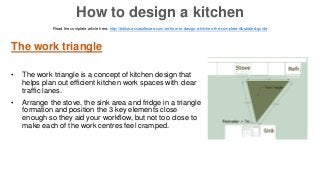
The work triangle
• The work triangle is a concept of kitchen design that
helps plan out efficient kitchen work spaces with clear
traffic lanes.
• Arrange the stove, the sink area and fridge in a triangle
formation and position the 3 key elements close
enough so they aid your workflow, but not too close to
make each of the work centres feel cramped.
Read the complete article here: http://biblus.accasoftware.com/en/how-to-design-a-kitchen-the-complete-illustrated-guide
3.
Layouts
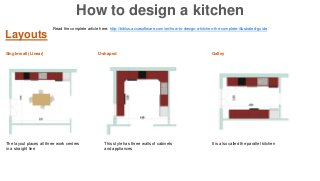
The layout placesall three work centers
in a straight line
Single-wall (Linear) U-shaped Galley
It is also called the parallel kitchenThis style has three walls of cabinets
and appliances
Read the complete article here: http://biblus.accasoftware.com/en/how-to-design-a-kitchen-the-complete-illustrated-guide
How to design a kitchen
4.
Layouts
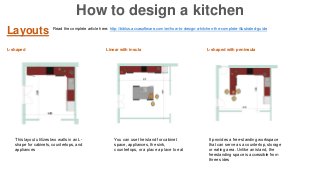
L-shaped Linear withinsula L-shaped with peninsula
This layout utilizes two walls in an L-
shape for cabinets, countertops, and
appliances
You can use the island for cabinet
space, appliances, the sink,
countertops, or a place a place to eat
It provides a free-standing workspace
that can serve as a countertop, storage
or eating area. Unlike an island, the
freestanding space is accessible from
three sides
Read the complete article here: http://biblus.accasoftware.com/en/how-to-design-a-kitchen-the-complete-illustrated-guide
How to design a kitchen
5.
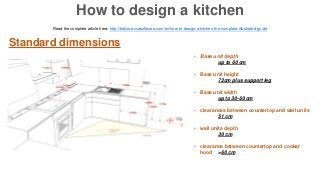
Standard dimensions
• Baseunit depth
up to 60 cm
• Base unit height
72cm plus support leg
• Base unit width
up to 30-60 cm
• clearances between countertop and wall units
51 cm
• wall units depth
30 cm
• clearance between countertop and cooker
hood >60 cm
Read the complete article here: http://biblus.accasoftware.com/en/how-to-design-a-kitchen-the-complete-illustrated-guide
How to design a kitchen
6.
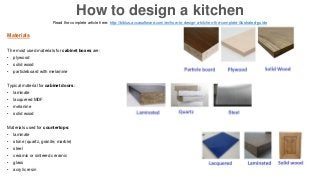
Materials
The most usedmaterials for cabinet boxes are:
• plywood
• solid wood
• particleboard with melamine
Typical material for cabinet doors:
• laminate
• lacquered MDF
• melanine
• solid wood
Materials used for countertops:
• laminate
• stone (quartz, granite, marble)
• steel
• ceramic or sintered ceramic
• glass
• acrylic resin
Read the complete article here: http://biblus.accasoftware.com/en/how-to-design-a-kitchen-the-complete-illustrated-guide
How to design a kitchen
7.
Kitchen building regulations
•In the U.K., work to refit a kitchen or bathroom with new units and
fittings does not generally require building regulations approval,
although drainage or electrical works that form part of the refit may
require approval under the building regulations.
• European reference standard:
- IEC TC 64 (for protection against electrical shock from appliances)
Read the complete article here: http://biblus.accasoftware.com/en/how-to-design-a-kitchen-the-complete-illustrated-guide
How to design a kitchen