Ben Lai 
www.industries.my
GST is charged on: 
 Taxable Supply of Goods and Service 
 Made by Taxable Person 
 In the course or furtherance of business 
 In MALAYSIA 
 Imported Goods/Services
Type of supply Output Tax Input Tax Example 
Standard-Rated 6% Claimable Scaffolding, Roofing, Truss, 
Racking, Painting, 
Installation etc. 
Zero-Rated 0% Claimable Basic Food, Lives Stock, 
300units of electricity, 
Exported Goods & Services 
Exempted No GST Not 
Claimable 
Public Transport, Tol, 
Education, Healthcare, 
Financial, Residential 
Properties, Land for general 
use.
Strategy Formulation 
Create awareness 
Compliance with Law 
 
 Improve Efficiency 
TOP 
Management 
-------------- 
Middle 
Management 
-------------- 
Technical / 
Operational
GST committee was formed with representative 
from the respective department to undertake 
the impact study on the area of : 
 Information System 
 Finance / Account 
 Sales & Marketing 
 Purchasing & Logistic 
 Human Resource
Before 1 April 2014 
 At least 1 month for SYSTEM test run 
 Create awareness among all 
After 1 April 2014 
 Monthly Submission on time 
 Not Changes Allowed after submit 
 Internal Control
 ERP system implementation 
◦ Mapping of New Chart of Account 
◦ Exchange rate in conformity with RMC requirements 
◦ Documentation Setup in conformity with RMC 
requirements 
◦ GST Return form 03 
◦ GST audit file 
 Accounting System Advisory Subsidiaries 
◦ AutoCount 
◦ SQL accounting 
◦ SAGE 300 ERP
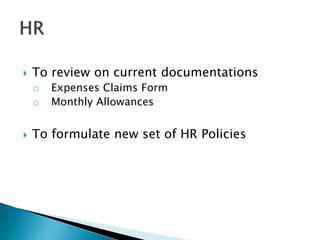
 To review on current documentations 
o Expenses Claims Form 
o Monthly Allowances 
 To formulate new set of HR Policies
 Review of all material contracts 
 Obtained appropriate registration 
 Cancel old sales / service tax license 
 Prepare for switch over date (trial run) 
 Apply for appropriate special scheme (ATS) 
 Identify Cash flow impact and optimization 
 Minimization of compliance cost 
 Maximize claim of input tax 
 Financial Application Impact (eg. BA, Term 
Loan)
 Pricing Strategy 
 Standard rated supplies (Products & Scrap) 
 Deemed supplies (Services & Labor) 
 Timing of supply (21 days rule) 
 Debts Management (6 months old debts) 
 Transfer pricing issues (Inter-Company Sales)
 Vendor validation & Selection 
o To request for vendor registration 
o To study all material cost impact 
o To study on indirect cost impact (eg. TPT cost) 
o To minimize input tax (bonded warehouse)
 Attend training run by professional body 
 Training of key staff (In house) 
 Engage external consultant to run the project 
across subsidiaries.
 To identify connected person and consider 
transfer pricing issue 
 To optimise business models impact by GST 
implementation 
 To optimise Corporate Structure for GST 
efficiency
Malaysia GST Implementation plan for Company

Malaysia GST Implementation plan for Company

  • 1.
  • 2.
    GST is chargedon:  Taxable Supply of Goods and Service  Made by Taxable Person  In the course or furtherance of business  In MALAYSIA  Imported Goods/Services
  • 3.
    Type of supplyOutput Tax Input Tax Example Standard-Rated 6% Claimable Scaffolding, Roofing, Truss, Racking, Painting, Installation etc. Zero-Rated 0% Claimable Basic Food, Lives Stock, 300units of electricity, Exported Goods & Services Exempted No GST Not Claimable Public Transport, Tol, Education, Healthcare, Financial, Residential Properties, Land for general use.
  • 5.
    Strategy Formulation Createawareness Compliance with Law   Improve Efficiency TOP Management -------------- Middle Management -------------- Technical / Operational
  • 6.
    GST committee wasformed with representative from the respective department to undertake the impact study on the area of :  Information System  Finance / Account  Sales & Marketing  Purchasing & Logistic  Human Resource
  • 8.
    Before 1 April2014  At least 1 month for SYSTEM test run  Create awareness among all After 1 April 2014  Monthly Submission on time  Not Changes Allowed after submit  Internal Control
  • 10.
     ERP systemimplementation ◦ Mapping of New Chart of Account ◦ Exchange rate in conformity with RMC requirements ◦ Documentation Setup in conformity with RMC requirements ◦ GST Return form 03 ◦ GST audit file  Accounting System Advisory Subsidiaries ◦ AutoCount ◦ SQL accounting ◦ SAGE 300 ERP
  • 11.
     To reviewon current documentations o Expenses Claims Form o Monthly Allowances  To formulate new set of HR Policies
  • 12.
     Review ofall material contracts  Obtained appropriate registration  Cancel old sales / service tax license  Prepare for switch over date (trial run)  Apply for appropriate special scheme (ATS)  Identify Cash flow impact and optimization  Minimization of compliance cost  Maximize claim of input tax  Financial Application Impact (eg. BA, Term Loan)
  • 13.
     Pricing Strategy  Standard rated supplies (Products & Scrap)  Deemed supplies (Services & Labor)  Timing of supply (21 days rule)  Debts Management (6 months old debts)  Transfer pricing issues (Inter-Company Sales)
  • 14.
     Vendor validation& Selection o To request for vendor registration o To study all material cost impact o To study on indirect cost impact (eg. TPT cost) o To minimize input tax (bonded warehouse)
  • 15.
     Attend trainingrun by professional body  Training of key staff (In house)  Engage external consultant to run the project across subsidiaries.
  • 16.
     To identifyconnected person and consider transfer pricing issue  To optimise business models impact by GST implementation  To optimise Corporate Structure for GST efficiency