The Power Of AI
Making Eye Screening Easy
INTRODUCTION
AI has brought commendable changes in various
industries, and the medical field is no exception.
The remarkable advantages it offers healthcare
facilities and beyond are invaluable. Now, in the
realm of detecting eye diseases, let’s see what
unfolds.
AI in Eye
Making
The impact of AI on eye disease detection is
revolutionary. As healthcare practitioners
leverage the capabilities of AI during eye
screening, they are able to see efficient and
accurate results. Apart from an early detection
of eye disease it has improved eye screening
procedures.
Vision loss and other serious vision problems
can be avoided with early detection and
treatment. For instance, diabetic retinopathy
damages the blood vessels in the retina and
affects approximately 30% of diabetic people;
if it is not treated immediately, it can result in
blindness.
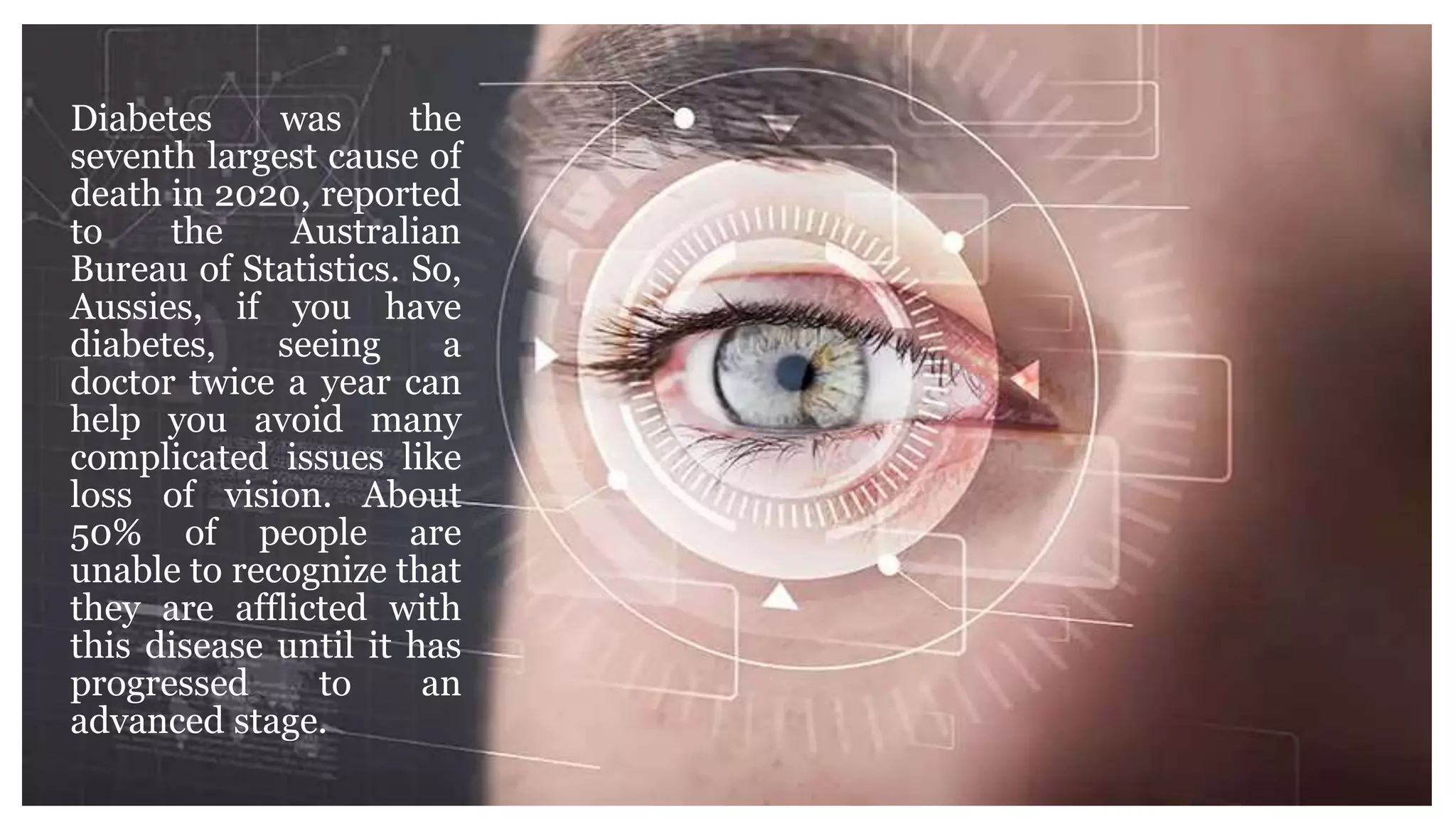
Diabetes was the
seventh largest cause of
death in 2020, reported
to the Australian
Bureau of Statistics. So,
Aussies, if you have
diabetes, seeing a
doctor twice a year can
help you avoid many
complicated issues like
loss of vision. About
50% of people are
unable to recognize that
they are afflicted with
this disease until it has
progressed to an
advanced stage.
There was room for error and subjectivity with
traditional eye screening methods because
they relied solely on human interpretation.
However, artificial intelligence in eye
care uses complex algorithms to scan
enormous volumes of data from diagnostic
tests and retinal imaging so AI can recognize
even the smallest anomalies. Artificial
intelligence can quickly identify diseases
including glaucoma, retinopathy, and age-
related eye disorders, and thus improve a
patient’s quality of life.
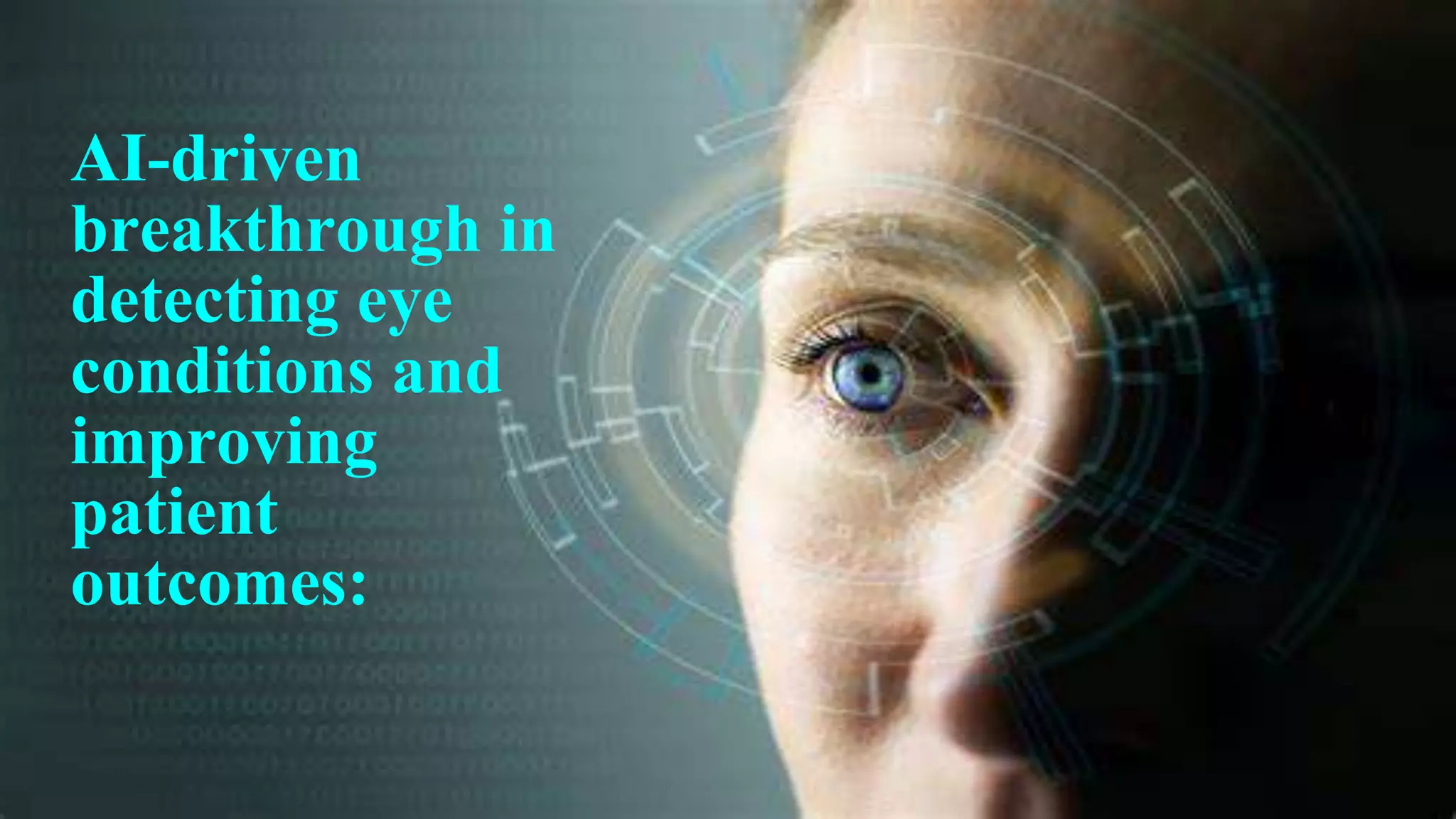
AI-driven
breakthrough in
detecting eye
conditions and
improving
patient
outcomes:
Professor Mingguang He, Principal Investigator in Ophthalmic Epidemiology
at CERA, says that he created an innovative method to enhance the detection
of eye disease. The AI system identified the alterations brought on by age-
related macular degeneration, glaucoma, diabetes, and cataracts after being
trained on 70,000 retinal scans.
Additionally, the tool was evaluated in numerous real-life scenarios, and it
was found to be more accurate than humans. It was incorporated into
general practice, endocrinology, and many other natural settings where it
provided quick referrals for additional assessment and therapy. Patients
benefited as a result of numerous healthcare settings.
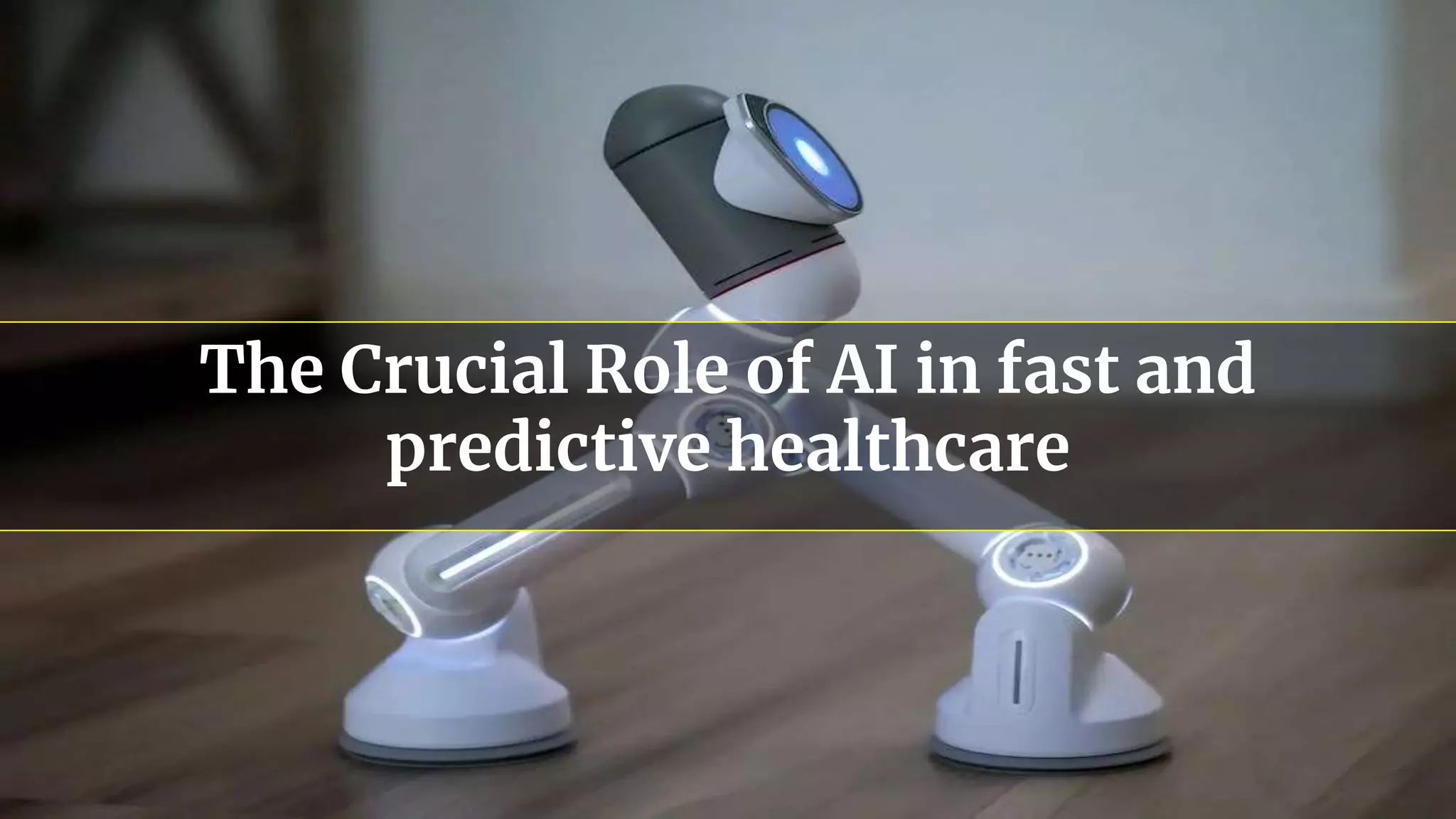
The Crucial Role of AI in fast and
predictive healthcare
The healthcare sector is transitioning to proactive and predictive care, which
has made AI for eye disease diagnosis priceless. Predictive analytics enabled
by AI and other artificial intelligence clinical techniques allow early
identification and management of eye illnesses.
By analyzing large datasets, artificial intelligence (AI) provides preliminary
warning signs for specific eye conditions. This also highlights warnings for
illnesses like sepsis and convulsions. Making decisions regarding the
necessary care, treatments, and trends that may influence treatment options
is assisted by machine learning algorithms.
Ways in which AI
will revolutionize
the healthcare
industry and
people:
From integrating the best diagnostics techniques to streamlining
administrative procedures, AI is fundamentally changing the healthcare
sector. It helps in detecting diseases earlier so patients can take necessary
precautions or adopt the right treatments for improving their health. We will
examine a few ways to see how AI is fundamentally altering the healthcare
industry and people’s lives:
1. A Tailored Approach to Healing Using Precision Medicine
AI systems can predict illness risks, recommend customized treatments, and
anticipate likely negative effects by analyzing big datasets. Medical
treatments will soon be as unique as the people they treat thanks to this
paradigm-shifting invention.
2. Diagnoses Reimagined using AI as a Medical Detective
For a treatment to be effective, a diagnosis must be established swiftly and
precisely. When examining medical images such as X-rays, MRIs, and CT
scans, even the most skilled experts may overlook minute patterns and hints
that AI algorithms can find.
3. AI as the Virtual Doctor in Remote Healthcare
Thanks to chatbots and virtual assistants powered by AI, geographical
boundaries are being removed, medical advice is being offered, and patients
are being watched remotely. These “virtual doctors” provide medical advice
and see to it that patients with ongoing diseases continue to be treated.
4. AI in Pharma: Drug Discovery at Warp Speed
The field of pharmaceutical research is being revolutionized by AI-driven
drug discovery, on the other hand. Massive amounts of data are combed
through by machine learning algorithms, which hastens the identification of
potential treatment possibilities and speeds up the discovery of intriguing
chemicals.
5. Improving Surgical Precision
Instead of replacing doctors’ skills, the AI Surgeon’s Assistant enhances them.
Artificial intelligence (AI)-assisted robotic surgical systems offer outstanding
precision, stability, and agility during difficult surgeries.
6. Predictive Healthcare: Prediction of Results
Instead of replacing doctors’ skills, the AI Surgeon’s Assistant enhances them.
Artificial intelligence (AI)-assisted robotic surgical systems offer outstanding
precision, stability, and agility during difficult surgeries.
7. Preventive Care and Predictive Analytics
Due to AI’s predictive powers, medical professionals can identify patients who are
more prone to develop chronic illnesses including diabetes, cardiovascular
disease, and asthma.
Ethical Difficulties and Prospects
Despite the immense potential of AI
in healthcare, there are certain
ethical concerns. Data privacy,
transparency, and algorithmic
biases must all be upheld if trust is
to be earned and AI’s full potential
is to be realized. By carefully and
Unwaveringly adhering to ethical
norms, we may create the
groundwork for a future in which AI-
driven healthcare will benefit
Everyone.
Conclusion: The Journey Ahead
A path that offers hope, promise, and the potential to change millions of lives
globally is the integration of AI with healthcare. As time goes on, embracing
innovation while keeping committed to ethical issues will be the key to realizing
AI’s full potential in healthcare.
AI-driven screening will enable early diagnosis of eye diseases, which will not
only facilitate swift action but also enhance treatment outcomes, assist in being
ready for any warning indications, and enable many patients to preserve their
vision. As technology advances, artificial intelligence will open up more
opportunities in the field of eye care.
Although it cannot replace human intervention, it will undoubtedly work
alongside humans to create a more radiant and healthier future for all.

The Power Of AI Making Eye Screening Easy

  • 1.
    The Power OfAI Making Eye Screening Easy
  • 2.
    INTRODUCTION AI has broughtcommendable changes in various industries, and the medical field is no exception. The remarkable advantages it offers healthcare facilities and beyond are invaluable. Now, in the realm of detecting eye diseases, let’s see what unfolds.
  • 3.
    AI in Eye Making Theimpact of AI on eye disease detection is revolutionary. As healthcare practitioners leverage the capabilities of AI during eye screening, they are able to see efficient and accurate results. Apart from an early detection of eye disease it has improved eye screening procedures. Vision loss and other serious vision problems can be avoided with early detection and treatment. For instance, diabetic retinopathy damages the blood vessels in the retina and affects approximately 30% of diabetic people; if it is not treated immediately, it can result in blindness.
  • 4.
    Diabetes was the seventhlargest cause of death in 2020, reported to the Australian Bureau of Statistics. So, Aussies, if you have diabetes, seeing a doctor twice a year can help you avoid many complicated issues like loss of vision. About 50% of people are unable to recognize that they are afflicted with this disease until it has progressed to an advanced stage.
  • 5.
    There was roomfor error and subjectivity with traditional eye screening methods because they relied solely on human interpretation. However, artificial intelligence in eye care uses complex algorithms to scan enormous volumes of data from diagnostic tests and retinal imaging so AI can recognize even the smallest anomalies. Artificial intelligence can quickly identify diseases including glaucoma, retinopathy, and age- related eye disorders, and thus improve a patient’s quality of life.
  • 6.
  • 7.
    Professor Mingguang He,Principal Investigator in Ophthalmic Epidemiology at CERA, says that he created an innovative method to enhance the detection of eye disease. The AI system identified the alterations brought on by age- related macular degeneration, glaucoma, diabetes, and cataracts after being trained on 70,000 retinal scans. Additionally, the tool was evaluated in numerous real-life scenarios, and it was found to be more accurate than humans. It was incorporated into general practice, endocrinology, and many other natural settings where it provided quick referrals for additional assessment and therapy. Patients benefited as a result of numerous healthcare settings.
  • 8.
    The Crucial Roleof AI in fast and predictive healthcare
  • 9.
    The healthcare sectoris transitioning to proactive and predictive care, which has made AI for eye disease diagnosis priceless. Predictive analytics enabled by AI and other artificial intelligence clinical techniques allow early identification and management of eye illnesses. By analyzing large datasets, artificial intelligence (AI) provides preliminary warning signs for specific eye conditions. This also highlights warnings for illnesses like sepsis and convulsions. Making decisions regarding the necessary care, treatments, and trends that may influence treatment options is assisted by machine learning algorithms.
  • 10.
    Ways in whichAI will revolutionize the healthcare industry and people:
  • 11.
    From integrating thebest diagnostics techniques to streamlining administrative procedures, AI is fundamentally changing the healthcare sector. It helps in detecting diseases earlier so patients can take necessary precautions or adopt the right treatments for improving their health. We will examine a few ways to see how AI is fundamentally altering the healthcare industry and people’s lives:
  • 12.
    1. A TailoredApproach to Healing Using Precision Medicine AI systems can predict illness risks, recommend customized treatments, and anticipate likely negative effects by analyzing big datasets. Medical treatments will soon be as unique as the people they treat thanks to this paradigm-shifting invention. 2. Diagnoses Reimagined using AI as a Medical Detective For a treatment to be effective, a diagnosis must be established swiftly and precisely. When examining medical images such as X-rays, MRIs, and CT scans, even the most skilled experts may overlook minute patterns and hints that AI algorithms can find.
  • 13.
    3. AI asthe Virtual Doctor in Remote Healthcare Thanks to chatbots and virtual assistants powered by AI, geographical boundaries are being removed, medical advice is being offered, and patients are being watched remotely. These “virtual doctors” provide medical advice and see to it that patients with ongoing diseases continue to be treated. 4. AI in Pharma: Drug Discovery at Warp Speed The field of pharmaceutical research is being revolutionized by AI-driven drug discovery, on the other hand. Massive amounts of data are combed through by machine learning algorithms, which hastens the identification of potential treatment possibilities and speeds up the discovery of intriguing chemicals.
  • 14.
    5. Improving SurgicalPrecision Instead of replacing doctors’ skills, the AI Surgeon’s Assistant enhances them. Artificial intelligence (AI)-assisted robotic surgical systems offer outstanding precision, stability, and agility during difficult surgeries. 6. Predictive Healthcare: Prediction of Results Instead of replacing doctors’ skills, the AI Surgeon’s Assistant enhances them. Artificial intelligence (AI)-assisted robotic surgical systems offer outstanding precision, stability, and agility during difficult surgeries. 7. Preventive Care and Predictive Analytics Due to AI’s predictive powers, medical professionals can identify patients who are more prone to develop chronic illnesses including diabetes, cardiovascular disease, and asthma.
  • 15.
    Ethical Difficulties andProspects Despite the immense potential of AI in healthcare, there are certain ethical concerns. Data privacy, transparency, and algorithmic biases must all be upheld if trust is to be earned and AI’s full potential is to be realized. By carefully and Unwaveringly adhering to ethical norms, we may create the groundwork for a future in which AI- driven healthcare will benefit Everyone.
  • 16.
    Conclusion: The JourneyAhead A path that offers hope, promise, and the potential to change millions of lives globally is the integration of AI with healthcare. As time goes on, embracing innovation while keeping committed to ethical issues will be the key to realizing AI’s full potential in healthcare. AI-driven screening will enable early diagnosis of eye diseases, which will not only facilitate swift action but also enhance treatment outcomes, assist in being ready for any warning indications, and enable many patients to preserve their vision. As technology advances, artificial intelligence will open up more opportunities in the field of eye care. Although it cannot replace human intervention, it will undoubtedly work alongside humans to create a more radiant and healthier future for all.