FRACTAL©www.fractal-consulting.com
Using Systems Approaches To Manage
Change in Complex and Turbulent
Environments
Patrick Hoverstadt - Fractal &
Cranfield
FRACTAL©www.fractal-consulting.com
Fractal: Strategy, Organisation, Change
FRACTAL©www.fractal-consulting.com
Today
• Why is it important?
• How did we get here?
• Conventional PM approaches
• Underlying theory
• Systems approaches
• Concepts
• Tools
• Example(s)
FRACTAL©www.fractal-consulting.com
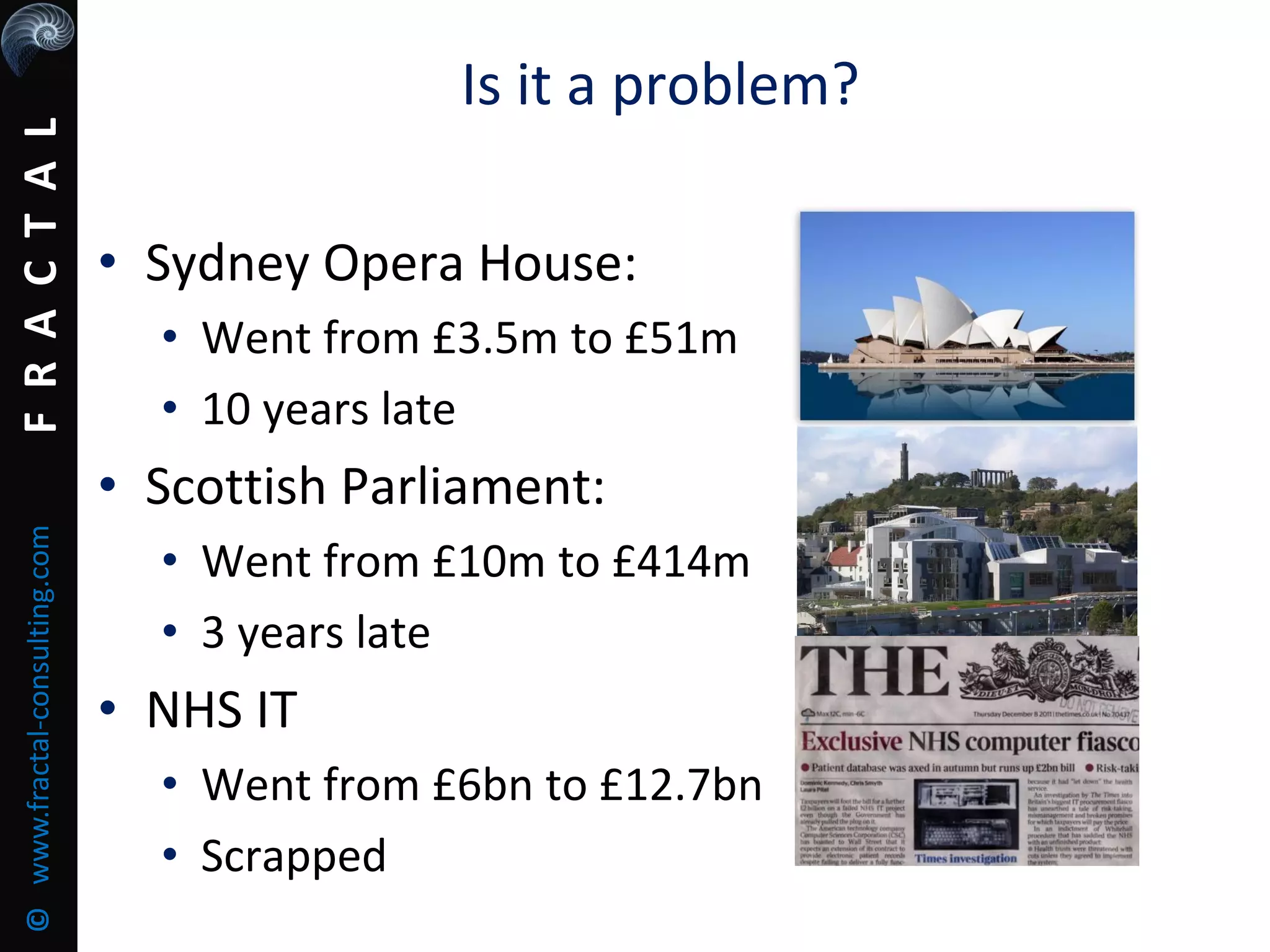
Is it a problem?
• Sydney Opera House:
• Went from £3.5m to £51m
• 10 years late
• Scottish Parliament:
• Went from £10m to £414m
• 3 years late
• NHS IT
• Went from £6bn to £12.7bn
• Scrapped
FRACTAL©www.fractal-consulting.com
Underlying issues
Three Main Variables:
1. What we need: Requirement
2. How long its going to take: Time
3. How much its going to take: Cost
FRACTAL©www.fractal-consulting.com
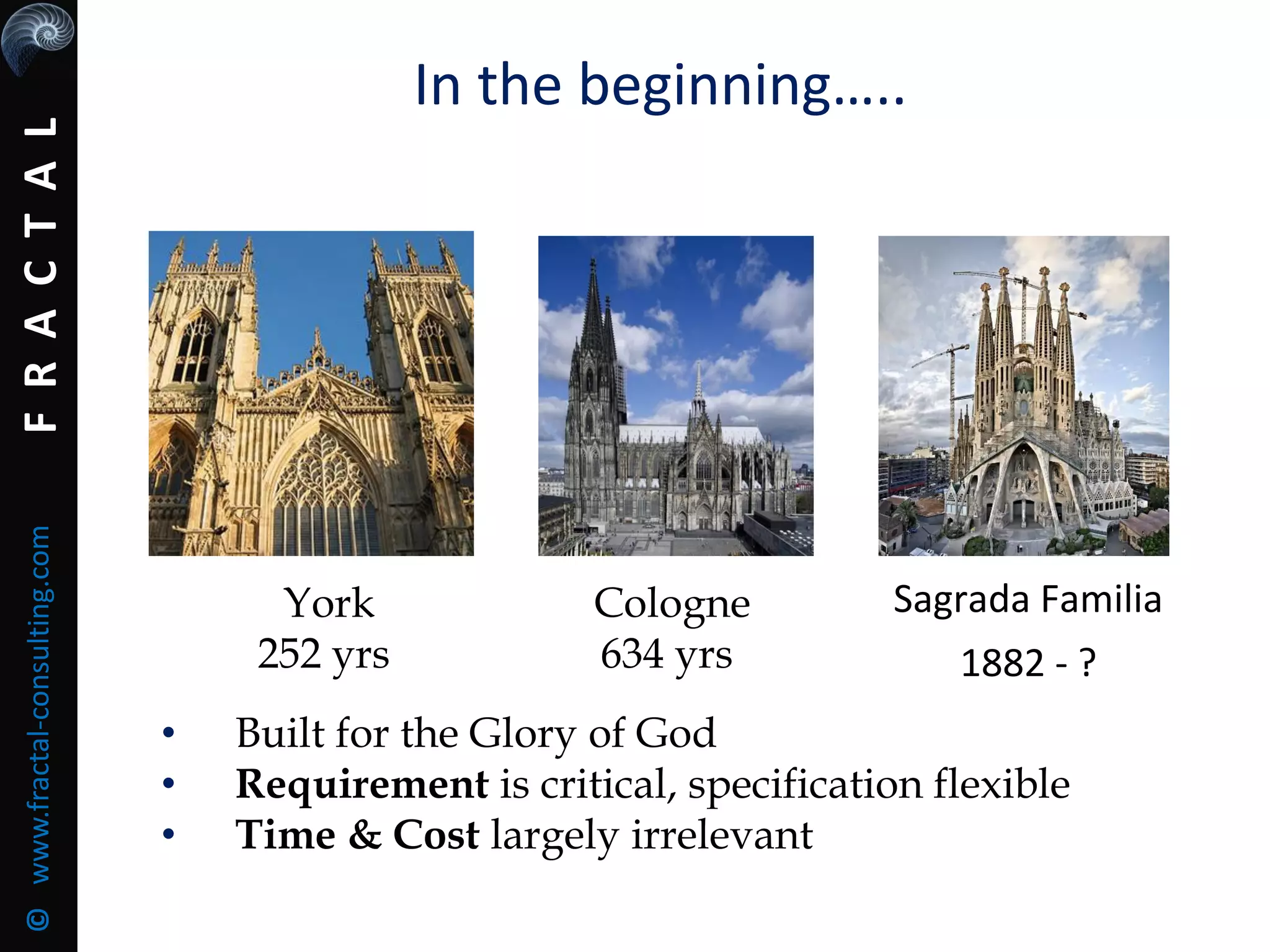
In the beginning…..
Sagrada Familia
1882 - ?
York
252 yrs
Cologne
634 yrs
• Built for the Glory of God
• Requirement is critical, specification flexible
• Time & Cost largely irrelevant
FRACTAL©www.fractal-consulting.com
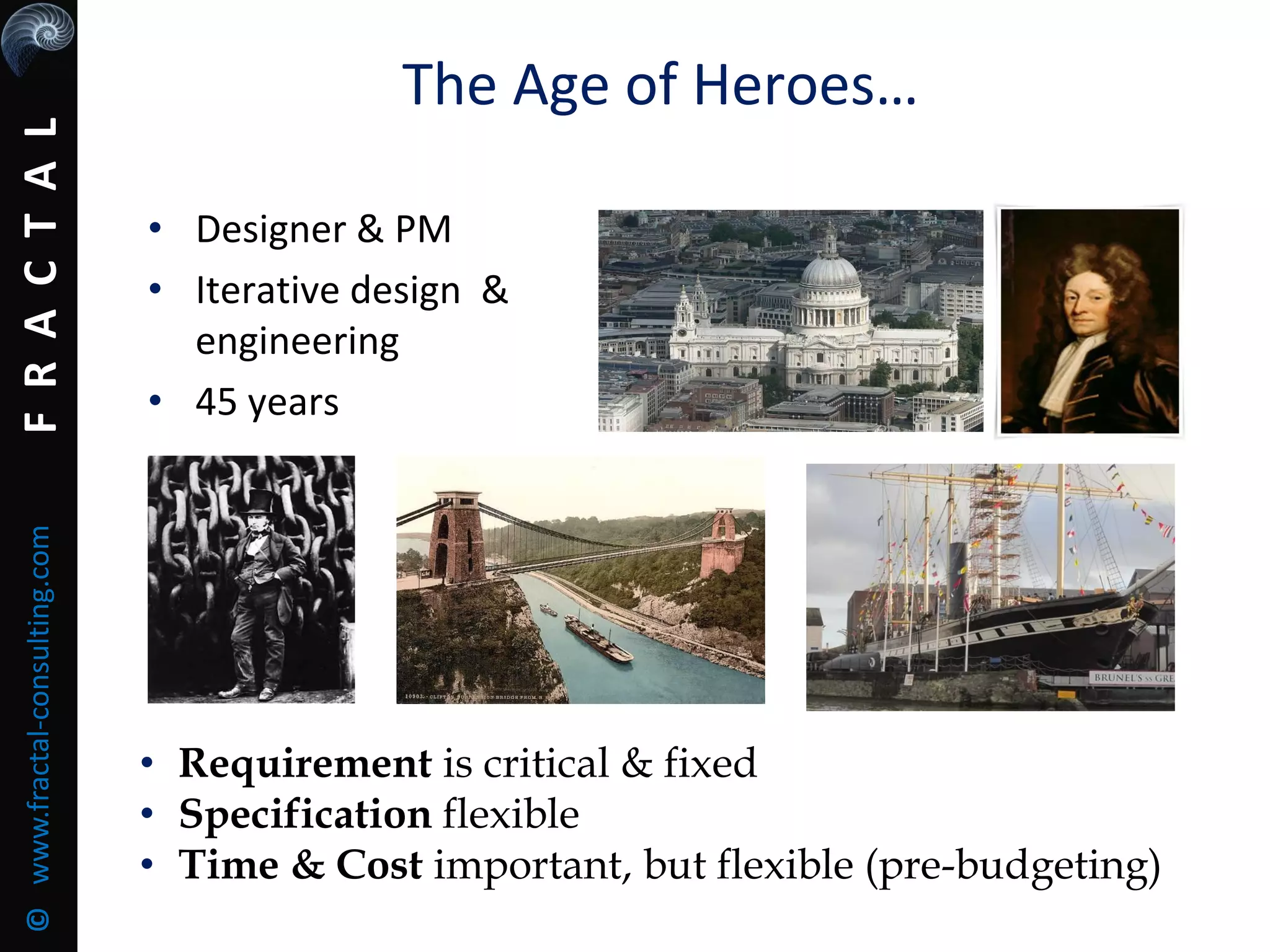
The Age of Heroes…
• Designer & PM
• Iterative design &
engineering
• 45 years
• Requirement is critical & fixed
• Specification flexible
• Time & Cost important, but flexible (pre-budgeting)
FRACTAL©www.fractal-consulting.com
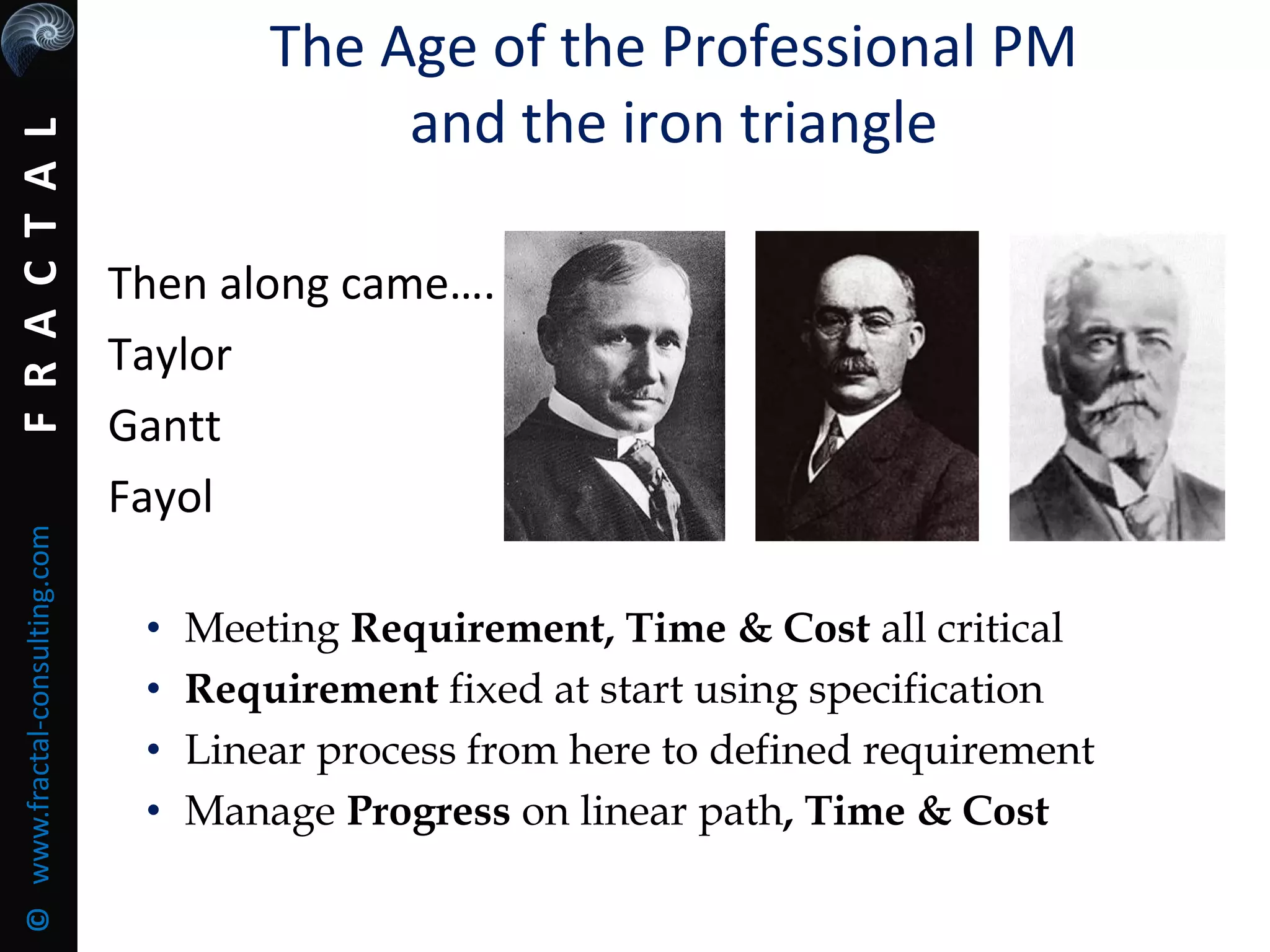
The Age of the Professional PM
and the iron triangle
Then along came….
Taylor
Gantt
Fayol
• Meeting Requirement, Time & Cost all critical
• Requirement fixed at start using specification
• Linear process from here to defined requirement
• Manage Progress on linear path, Time & Cost
FRACTAL©www.fractal-consulting.com
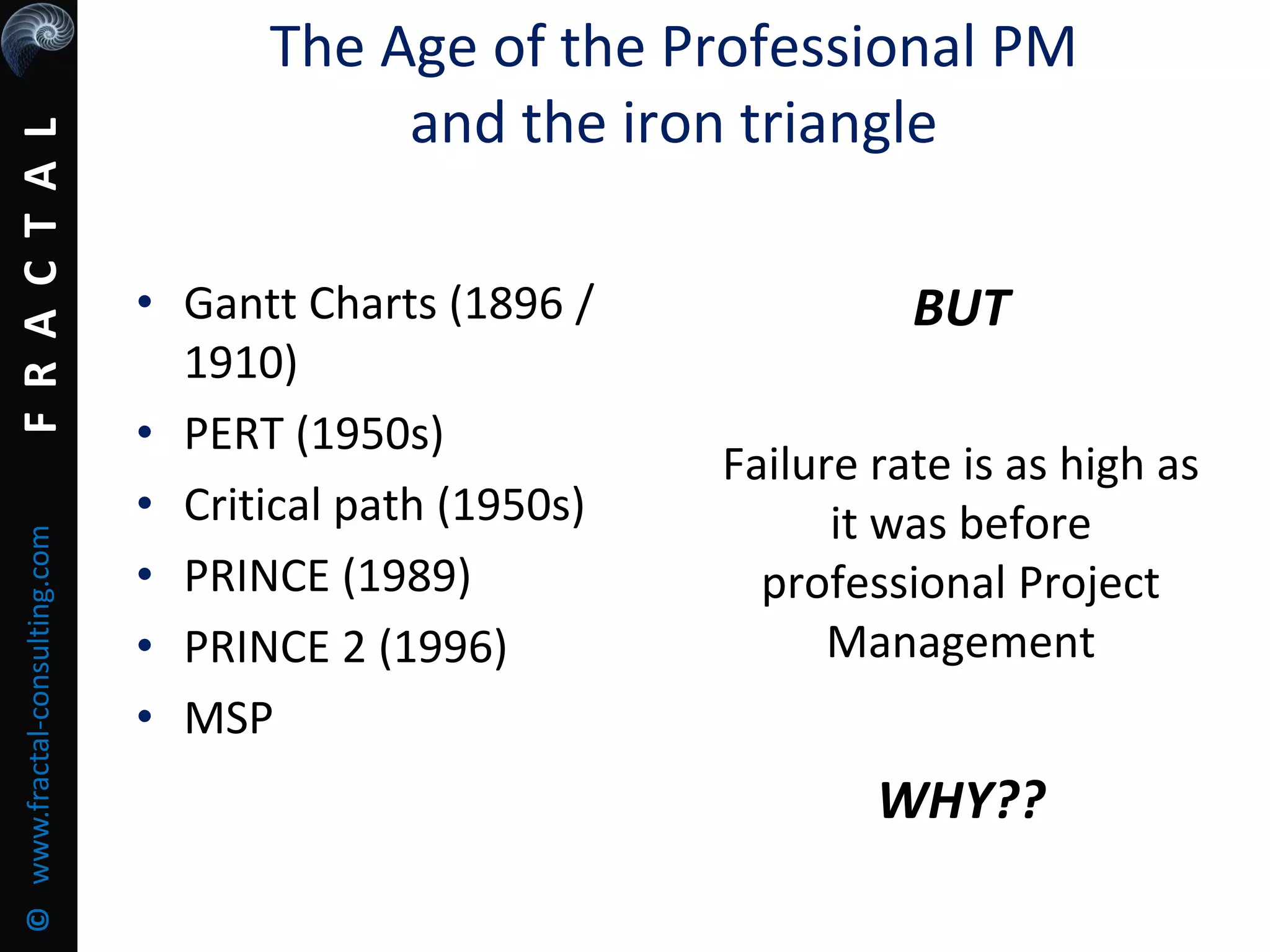
• Gantt Charts (1896 /
1910)
• PERT (1950s)
• Critical path (1950s)
• PRINCE (1989)
• PRINCE 2 (1996)
• MSP
BUT
Failure rate is as high as
it was before
professional Project
Management
WHY??
The Age of the Professional PM
and the iron triangle
FRACTAL©www.fractal-consulting.com The underlying nature of the problem….
Complexity & Uncertainty
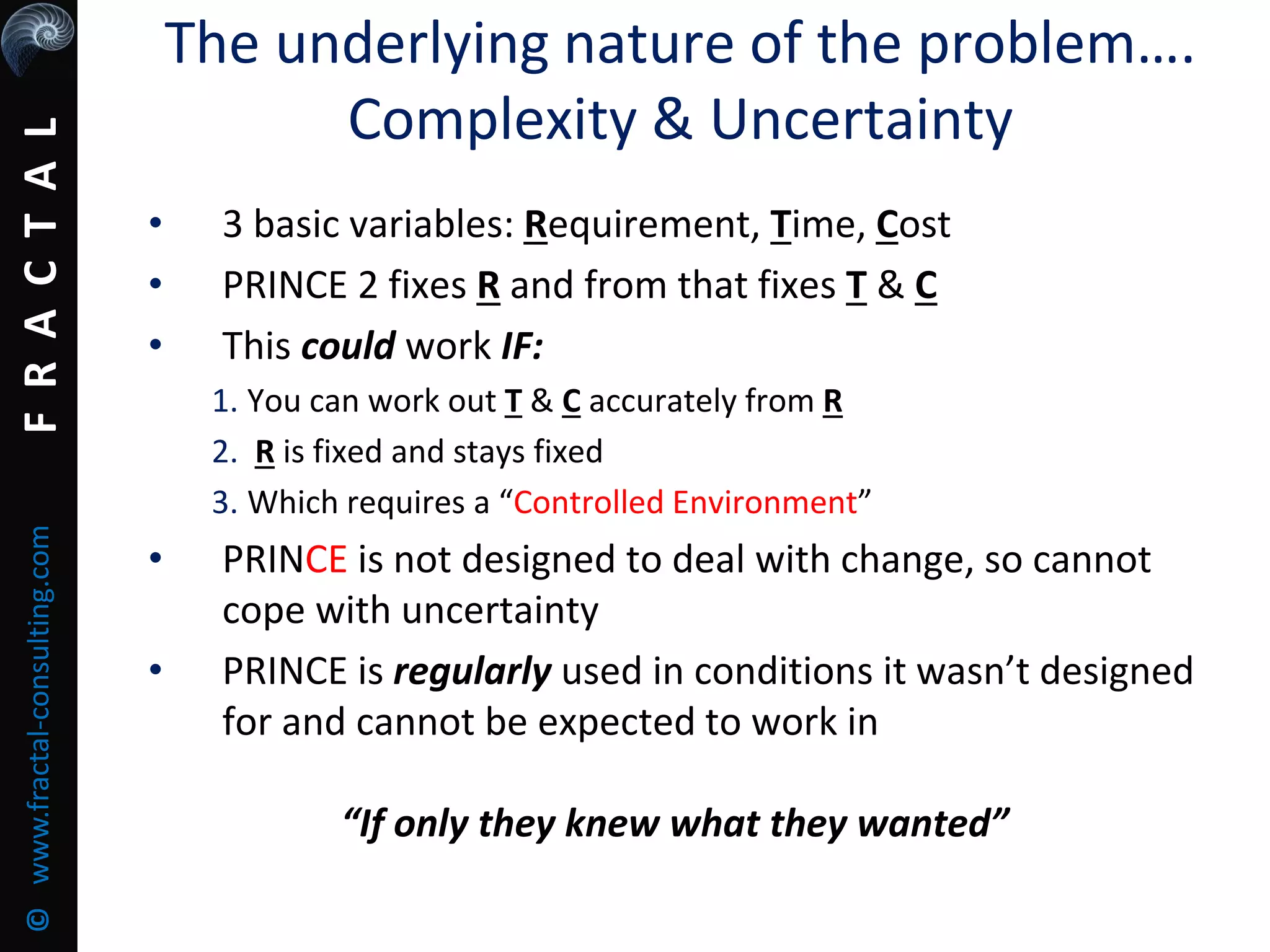
• 3 basic variables: Requirement, Time, Cost
• PRINCE 2 fixes R and from that fixes T & C
• This could work IF:
1. You can work out T & C accurately from R
2. R is fixed and stays fixed
3. Which requires a “Controlled Environment”
• PRINCE is not designed to deal with change, so cannot
cope with uncertainty
• PRINCE is regularly used in conditions it wasn’t designed
for and cannot be expected to work in
“If only they knew what they wanted”
FRACTAL©www.fractal-consulting.com
Counter movements….
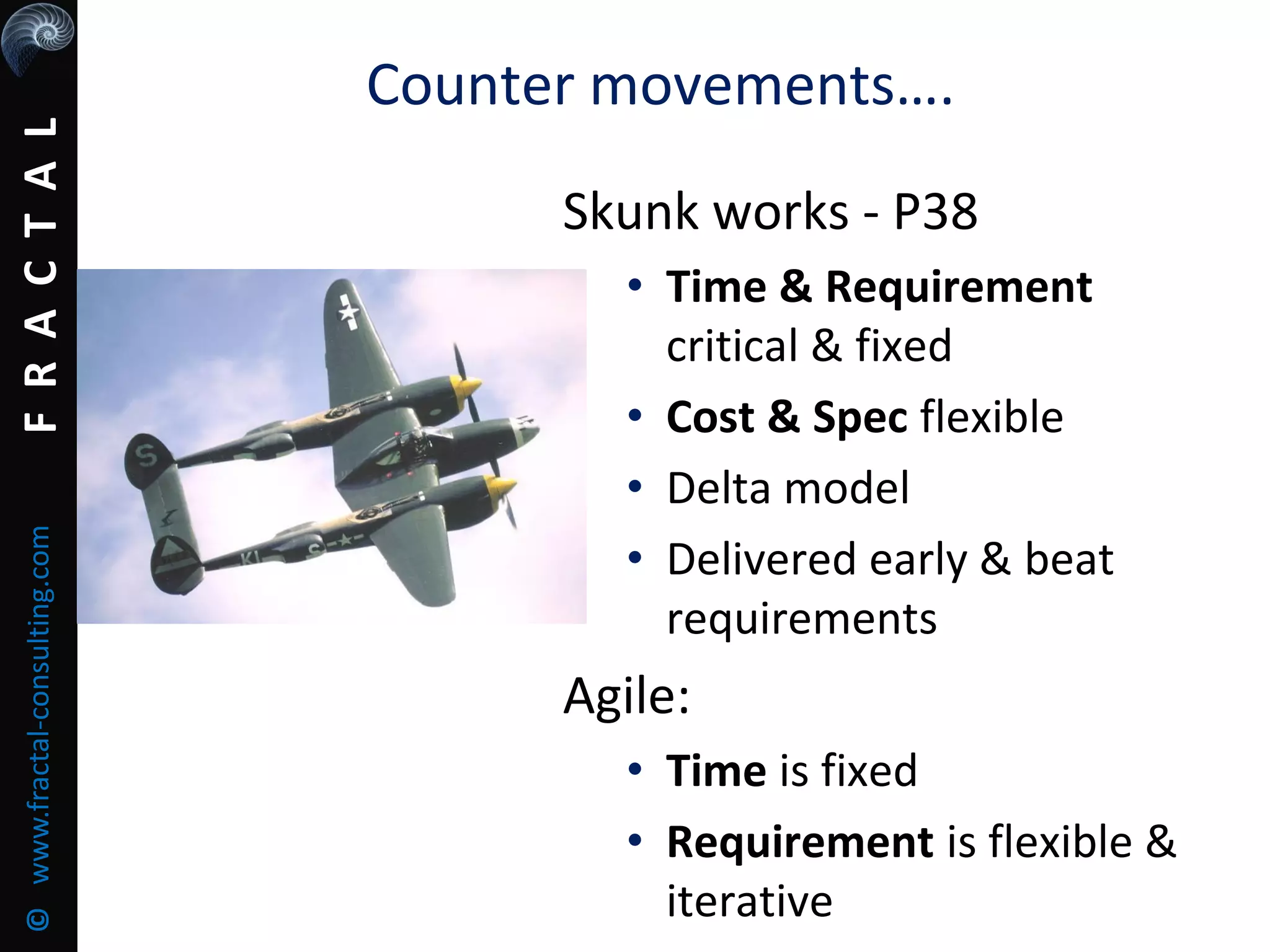
Skunk works - P38
• Time & Requirement
critical & fixed
• Cost & Spec flexible
• Delta model
• Delivered early & beat
requirements
Agile:
• Time is fixed
• Requirement is flexible &
iterative
FRACTAL©www.fractal-consulting.com
The underlying nature of the problem….
Complexity & Uncertainty
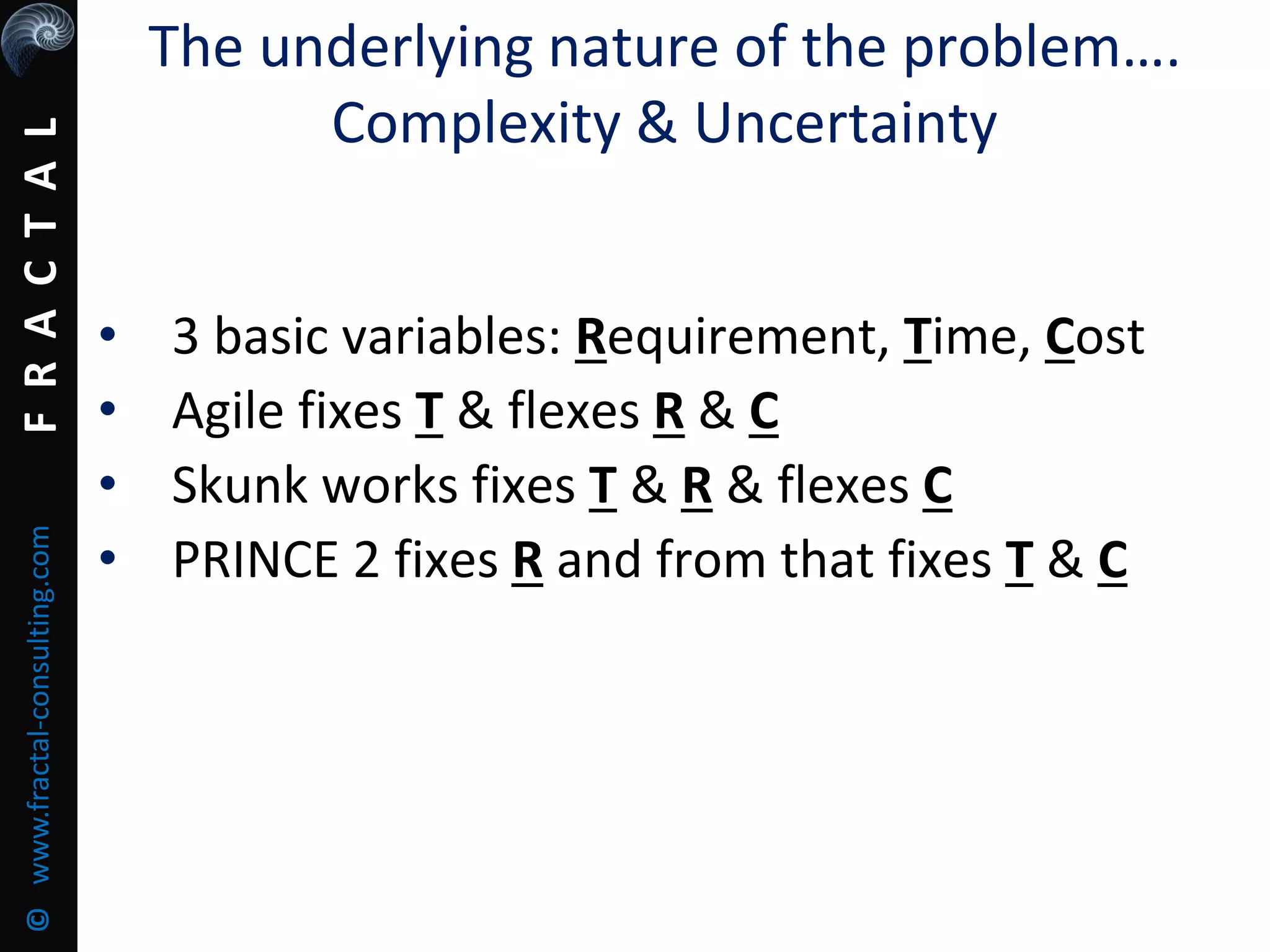
• 3 basic variables: Requirement, Time, Cost
• Agile fixes T & flexes R & C
• Skunk works fixes T & R & flexes C
• PRINCE 2 fixes R and from that fixes T & C
FRACTAL©www.fractal-consulting.com
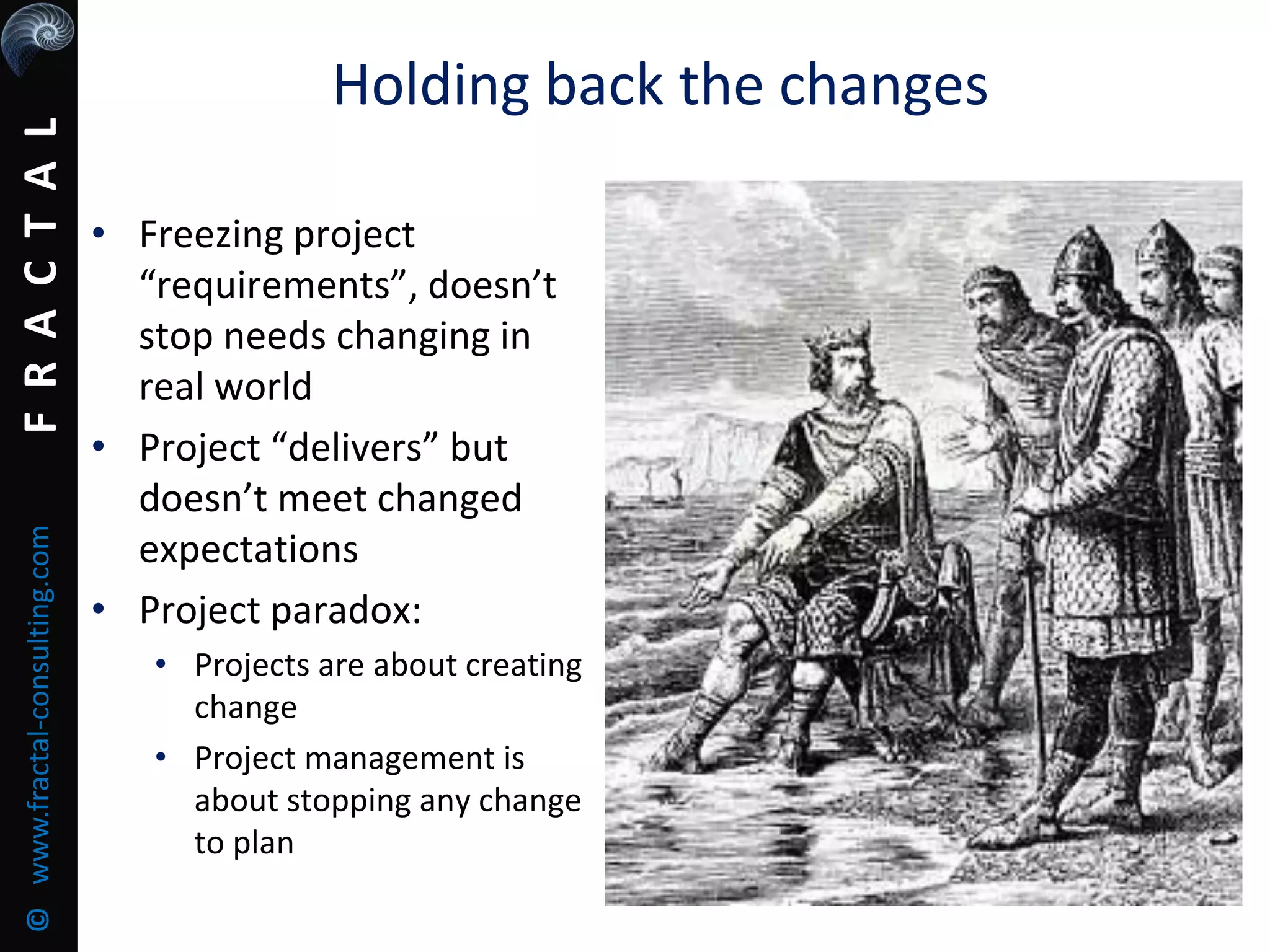
Holding back the changes
• Freezing project
“requirements”, doesn’t
stop needs changing in
real world
• Project “delivers” but
doesn’t meet changed
expectations
• Project paradox:
• Projects are about creating
change
• Project management is
about stopping any change
to plan
FRACTAL©www.fractal-consulting.com
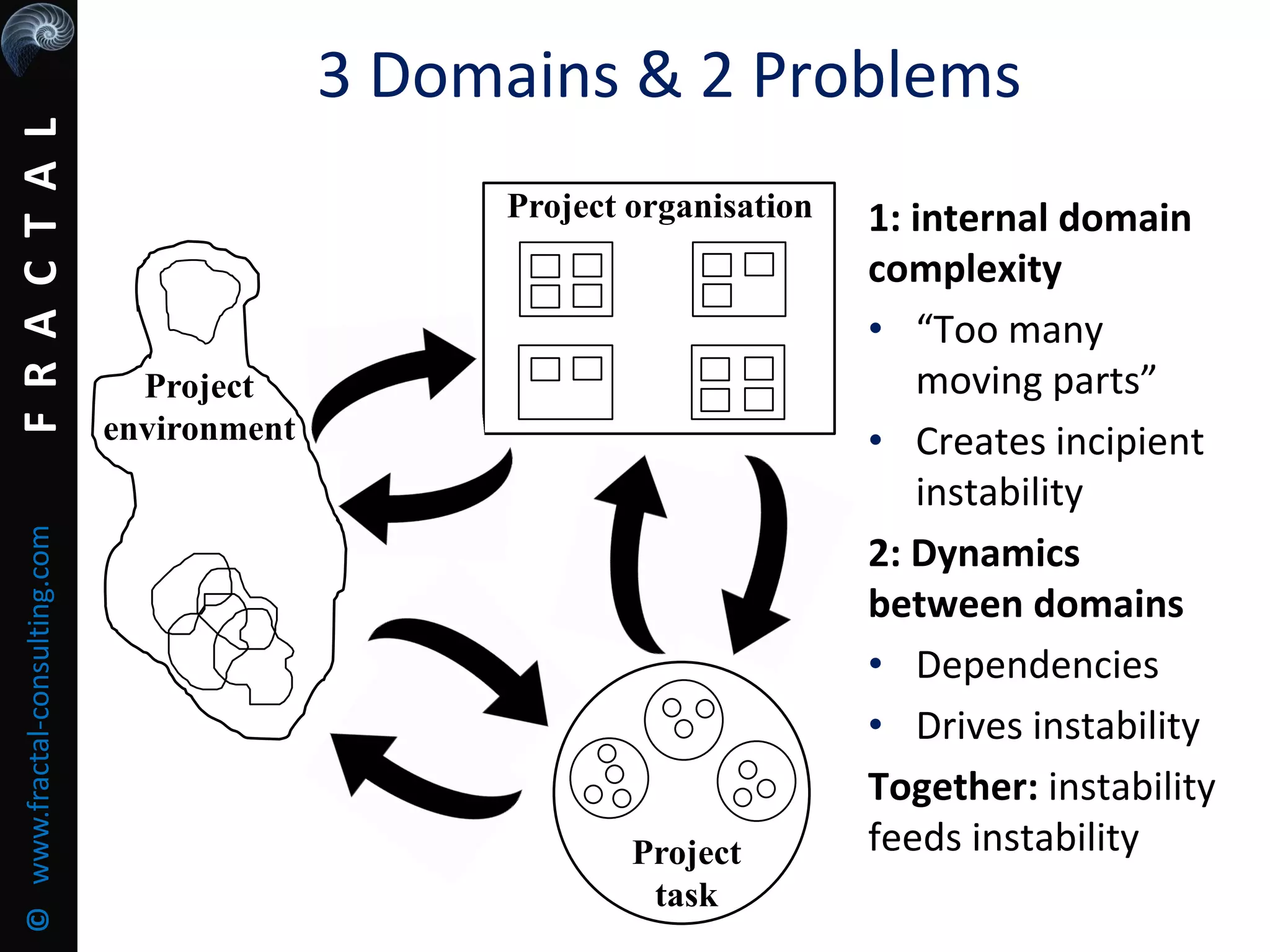
3 Domains & 2 Problems
1: internal domain
complexity
• “Too many
moving parts”
• Creates incipient
instability
2: Dynamics
between domains
• Dependencies
• Drives instability
Together: instability
feeds instability
Project organisation
Project
task
Project
environment
FRACTAL©www.fractal-consulting.com
• Systems approaches were developed specifically to
deal with Complexity & Uncertainty
• Offer different approaches to:
• Building stable systems in all 3 domains
• Understanding & managing dynamics within & between
domains
• The toolkit - all established and proven on very large
complex systems:
1. Complexity equations - domain complexity
2. Viable System Model – organisational & task complexity
3. System Dynamics – dynamic within & between domains
4. Patterns of Strategy – dynamics in & between domains
5. Soft Systems – stakeholders (in environment)
So what’s the alternative?
FRACTAL©www.fractal-consulting.com
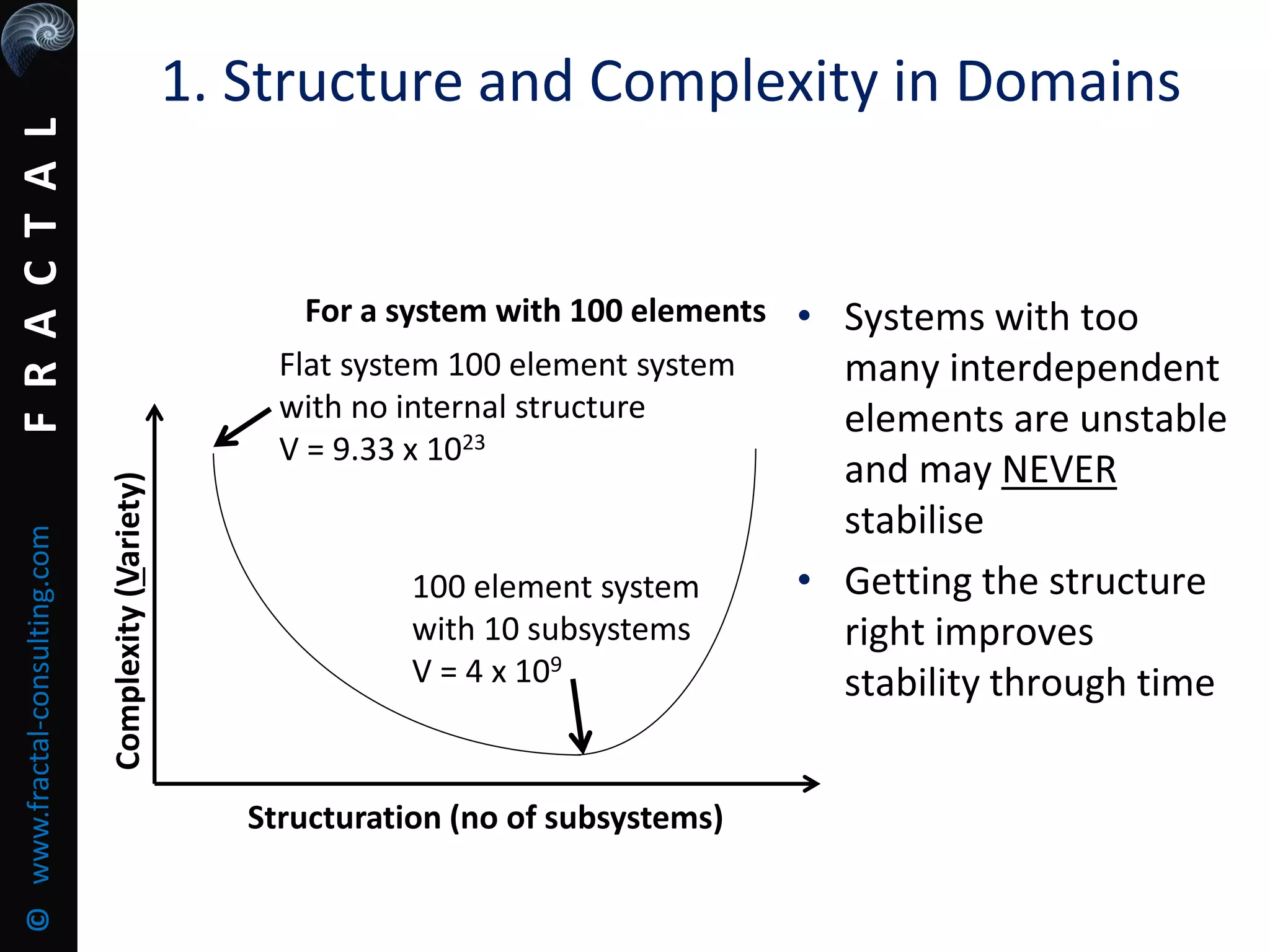
1. Structure and Complexity in Domains
• Systems with too
many interdependent
elements are unstable
and may NEVER
stabilise
• Getting the structure
right improves
stability through time
Complexity(Variety)
Structuration (no of subsystems)
For a system with 100 elements
Flat system 100 element system
with no internal structure
V = 9.33 x 10²³
100 element system
with 10 subsystems
V = 4 x 10⁹
FRACTAL©www.fractal-consulting.com
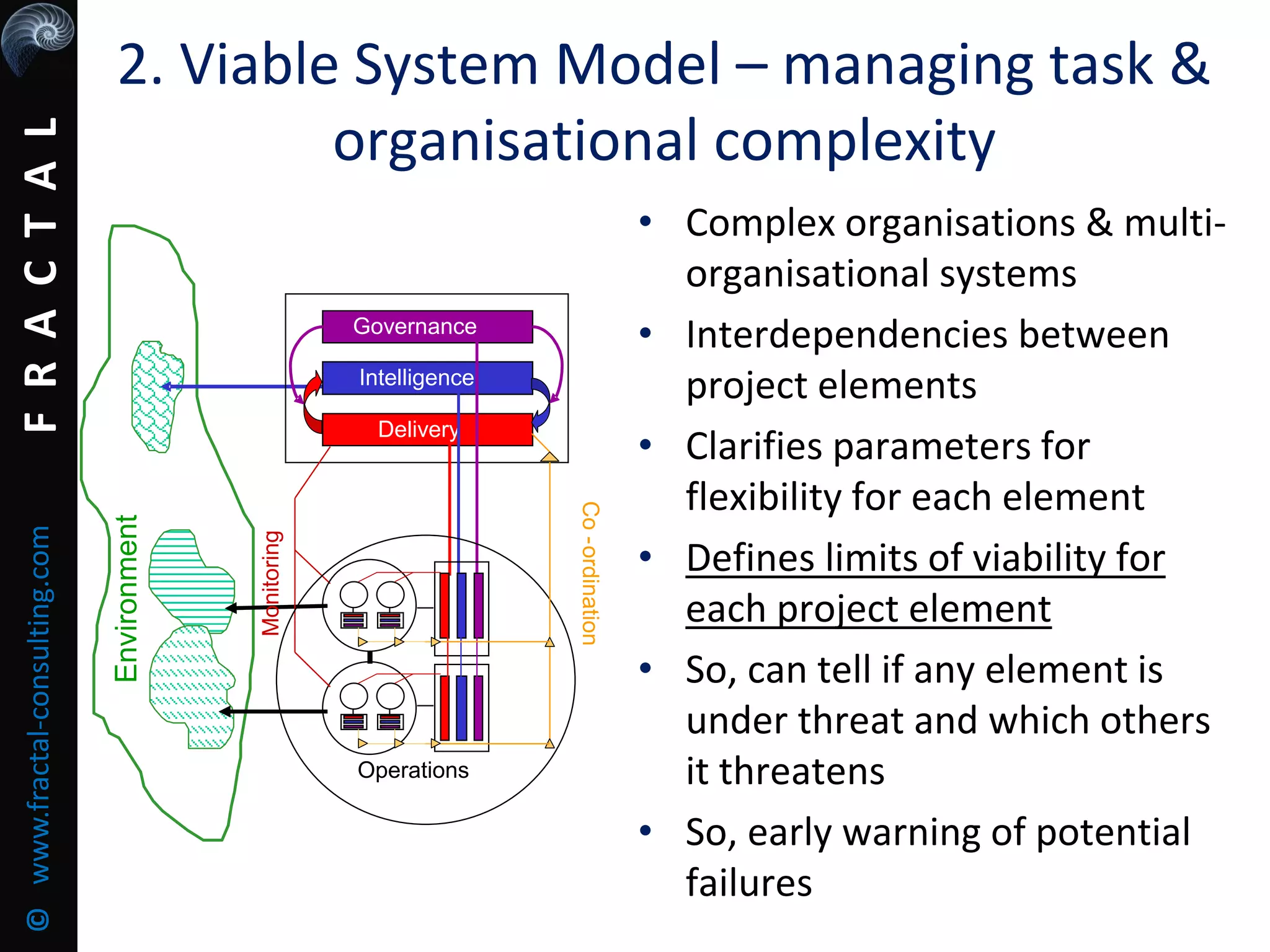
2. Viable System Model – managing task &
organisational complexity
• Complex organisations & multi-
organisational systems
• Interdependencies between
project elements
• Clarifies parameters for
flexibility for each element
• Defines limits of viability for
each project element
• So, can tell if any element is
under threat and which others
it threatens
• So, early warning of potential
failures
Environment
Delivery
Intelligence
Governance
Operations
Co-ordination
Monitoring
FRACTAL©www.fractal-consulting.com
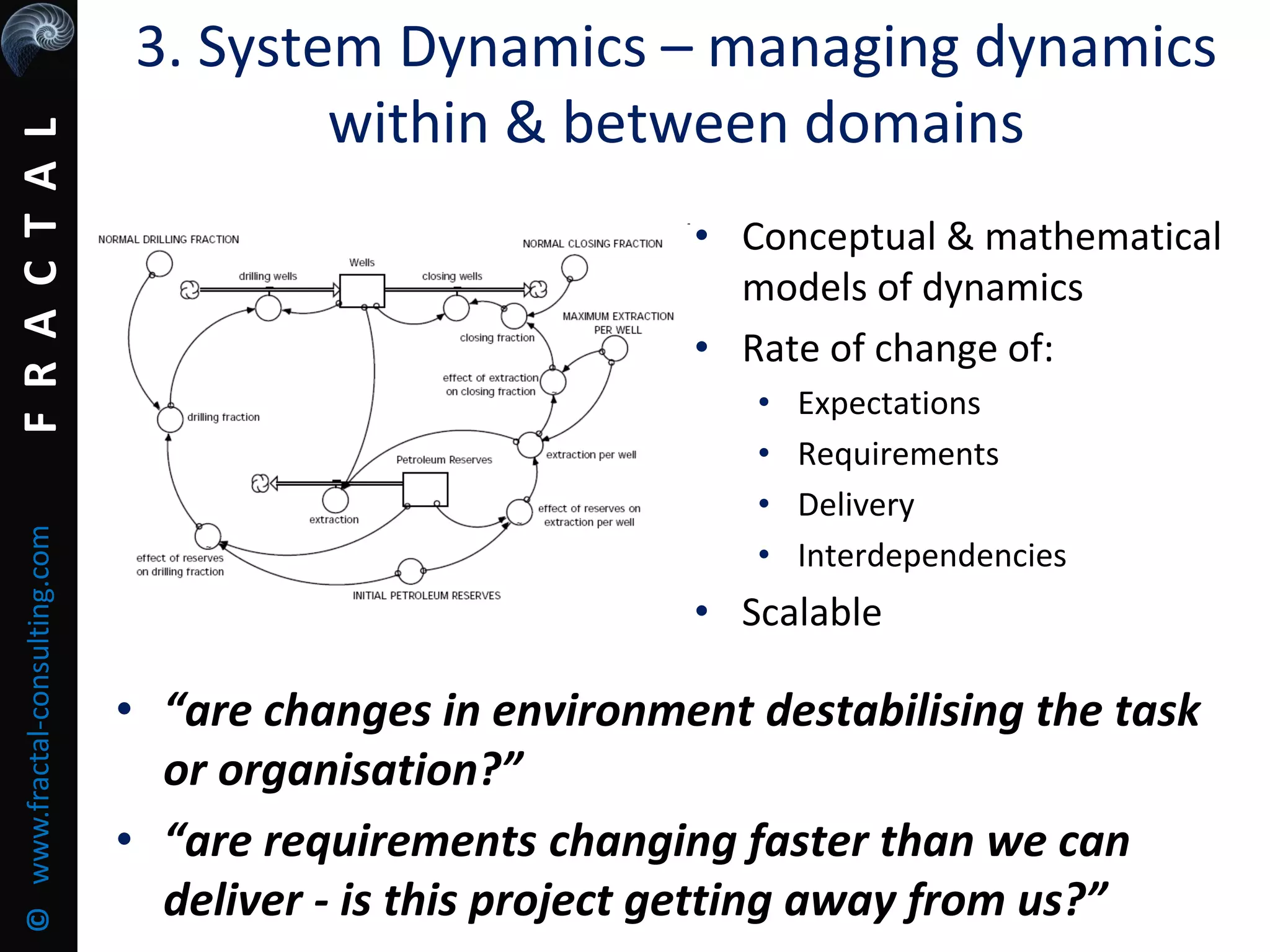
3. System Dynamics – managing dynamics
within & between domains
• Conceptual & mathematical
models of dynamics
• Rate of change of:
• Expectations
• Requirements
• Delivery
• Interdependencies
• Scalable
• “are changes in environment destabilising the task
or organisation?”
• “are requirements changing faster than we can
deliver - is this project getting away from us?”
FRACTAL©www.fractal-consulting.com
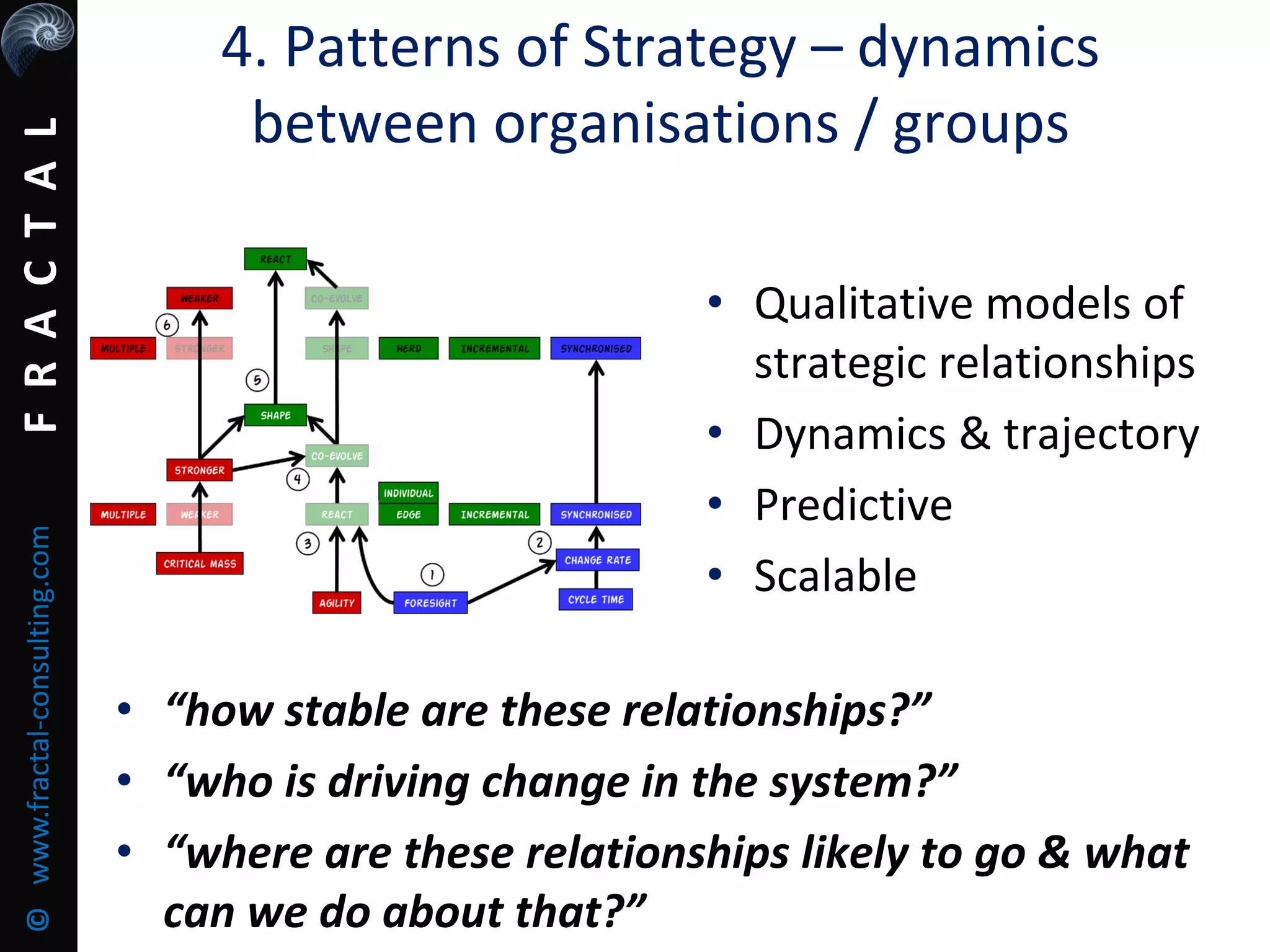
4. Patterns of Strategy – dynamics
between organisations / groups
• Qualitative models of
strategic relationships
• Dynamics & trajectory
• Predictive
• Scalable
• “how stable are these relationships?”
• “who is driving change in the system?”
• “where are these relationships likely to go & what
can we do about that?”
FRACTAL©www.fractal-consulting.com
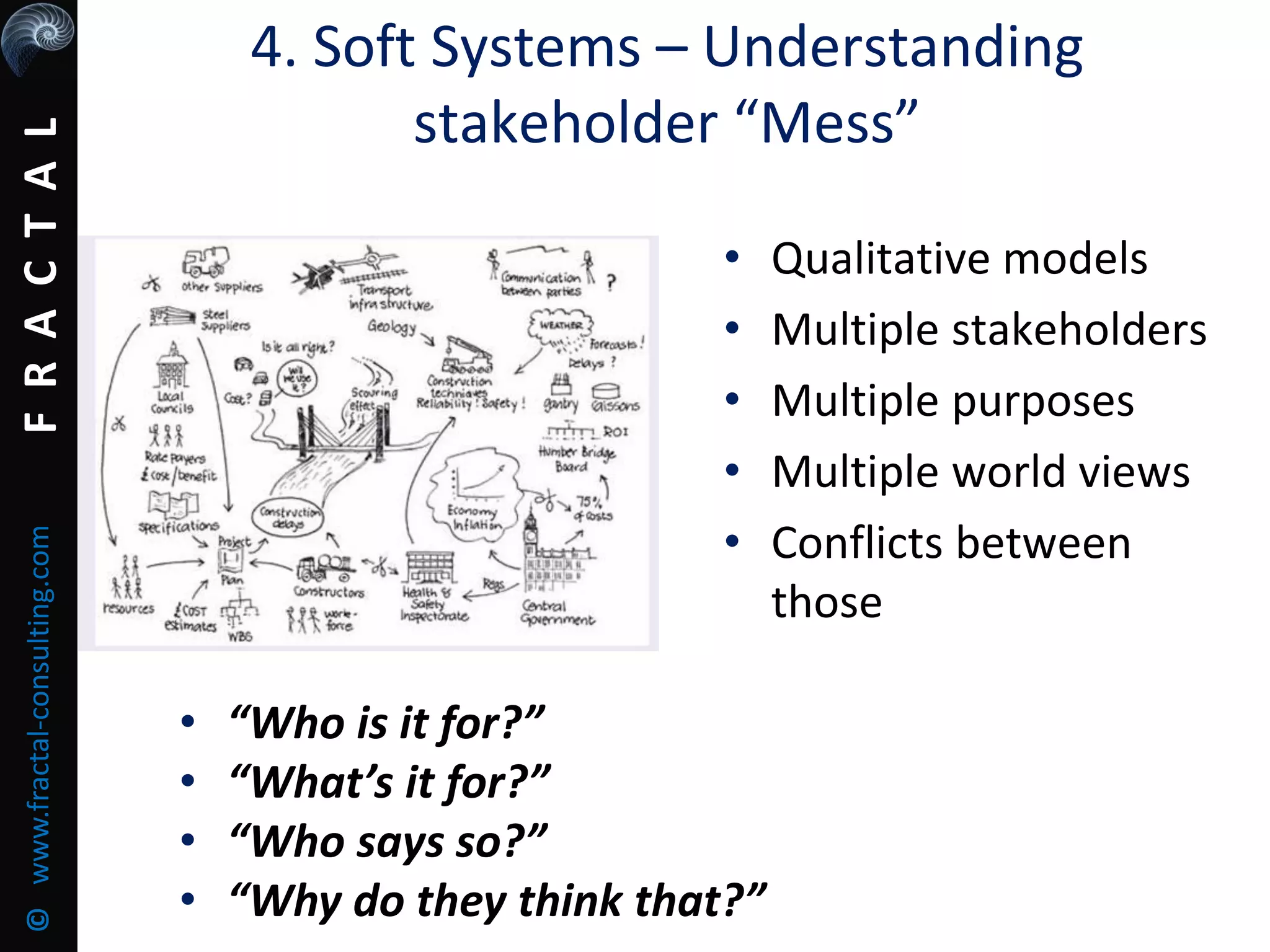
4. Soft Systems – Understanding
stakeholder “Mess”
• Qualitative models
• Multiple stakeholders
• Multiple purposes
• Multiple world views
• Conflicts between
those
• “Who is it for?”
• “What’s it for?”
• “Who says so?”
• “Why do they think that?”
FRACTAL©www.fractal-consulting.com
21
Fundamental Shift
• From trying to freeze requirement changes
at the start
• To recognising change is inevitable and
managing it
• Building ability to flex throughout the
project structure & lifetime
• Knowing the limits and implications of
flexibility of each element
• Knowing early if the project becomes non-
viable
FRACTAL©www.fractal-consulting.com
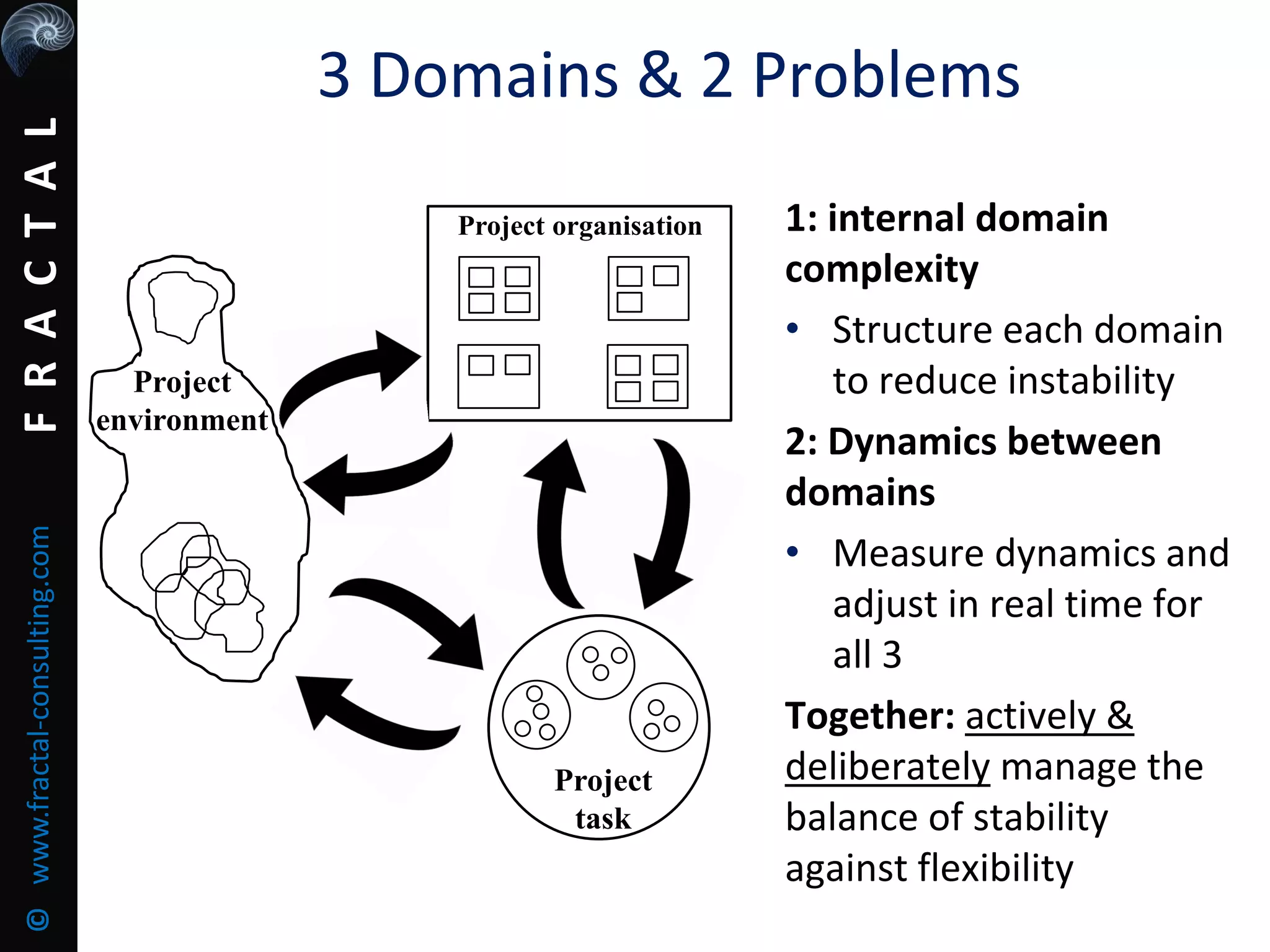
3 Domains & 2 Problems
1: internal domain
complexity
• Structure each domain
to reduce instability
2: Dynamics between
domains
• Measure dynamics and
adjust in real time for
all 3
Together: actively &
deliberately manage the
balance of stability
against flexibility
Project
environment
Project organisation
Project
task
FRACTAL©www.fractal-consulting.com
Revs & bens in Salford Council
• Failing authority
• Benefits Administration assessed in 2002/3 CPA programme
as 0 = lowest possible score
• BPR project to re-engineer benefits service
• Challenge was organisational change
SO….
• Service redesign ≠ organisational change
• Don’t change the old – create a new organisation
• Innovation model
• Skunk works & VSM
FRACTAL©www.fractal-consulting.com
Managing complexity & dynamics in
the 3 domains
1. Reduce task complexity:
• One service element at a time,
• Actively managed interdependencies
2. Reduce organisational complexity:
• Simplified and controlled management structure
• Accountability
3. Manage boundary with environment:
• Recognised, patrolled and defended boundary
• Broad, agreed mandate
• Brand/Set of Symbols
• Joining Ritual
FRACTAL©www.fractal-consulting.com
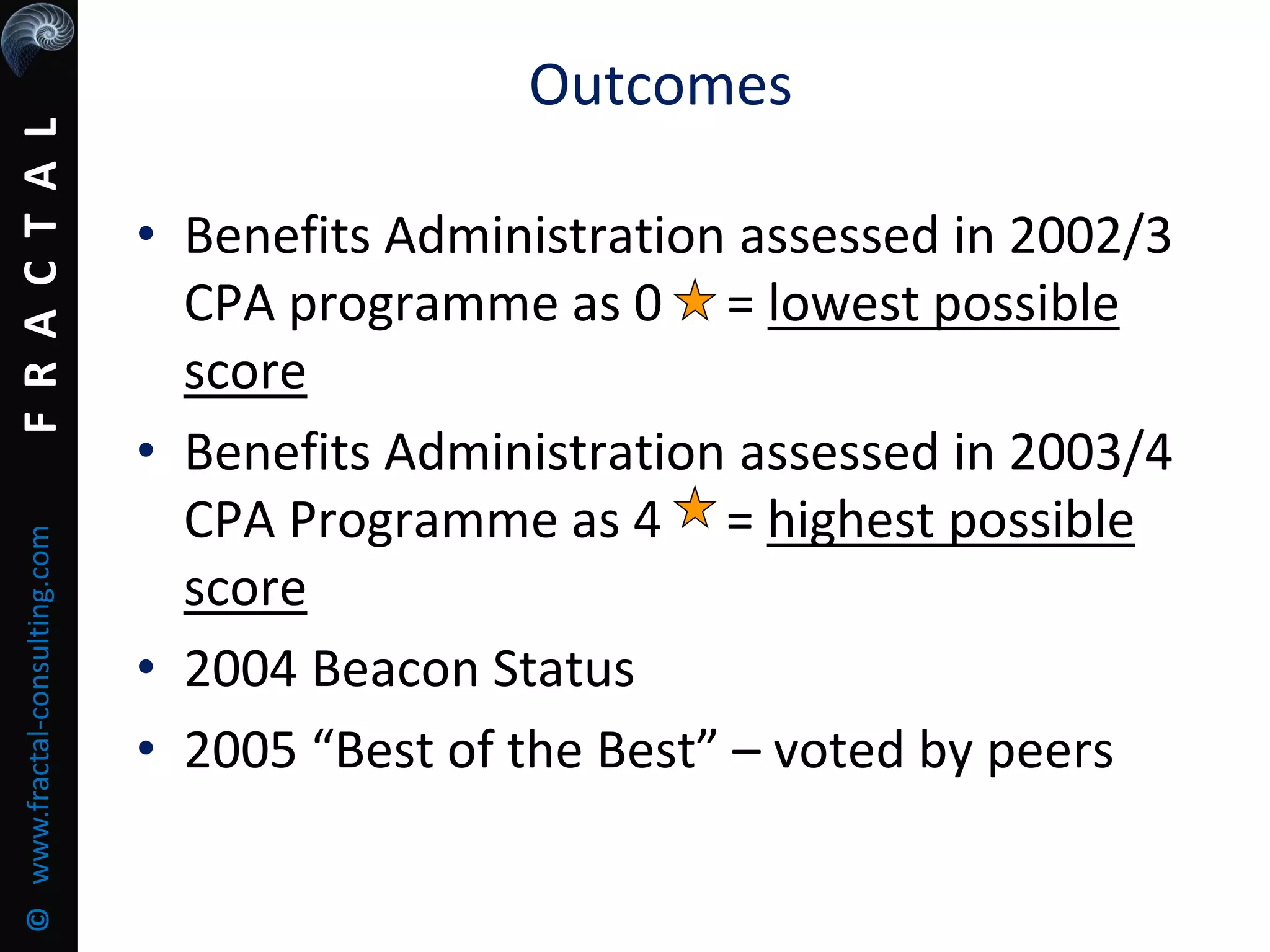
Outcomes
• Benefits Administration assessed in 2002/3
CPA programme as 0 = lowest possible
score
• Benefits Administration assessed in 2003/4
CPA Programme as 4 = highest possible
score
• 2004 Beacon Status
• 2005 “Best of the Best” – voted by peers
FRACTAL©www.fractal-consulting.com
Thoughts?
Comments?
Questions?

Using systems approaches to manage change in complex and turbulent environments - Patrick Hoverstadt

  • 1.
    FRACTAL©www.fractal-consulting.com Using Systems ApproachesTo Manage Change in Complex and Turbulent Environments Patrick Hoverstadt - Fractal & Cranfield
  • 2.
  • 3.
    FRACTAL©www.fractal-consulting.com Today • Why isit important? • How did we get here? • Conventional PM approaches • Underlying theory • Systems approaches • Concepts • Tools • Example(s)
  • 4.
    FRACTAL©www.fractal-consulting.com Is it aproblem? • Sydney Opera House: • Went from £3.5m to £51m • 10 years late • Scottish Parliament: • Went from £10m to £414m • 3 years late • NHS IT • Went from £6bn to £12.7bn • Scrapped
  • 5.
    FRACTAL©www.fractal-consulting.com Underlying issues Three MainVariables: 1. What we need: Requirement 2. How long its going to take: Time 3. How much its going to take: Cost
  • 6.
    FRACTAL©www.fractal-consulting.com In the beginning….. SagradaFamilia 1882 - ? York 252 yrs Cologne 634 yrs • Built for the Glory of God • Requirement is critical, specification flexible • Time & Cost largely irrelevant
  • 7.
    FRACTAL©www.fractal-consulting.com The Age ofHeroes… • Designer & PM • Iterative design & engineering • 45 years • Requirement is critical & fixed • Specification flexible • Time & Cost important, but flexible (pre-budgeting)
  • 8.
    FRACTAL©www.fractal-consulting.com The Age ofthe Professional PM and the iron triangle Then along came…. Taylor Gantt Fayol • Meeting Requirement, Time & Cost all critical • Requirement fixed at start using specification • Linear process from here to defined requirement • Manage Progress on linear path, Time & Cost
  • 9.
    FRACTAL©www.fractal-consulting.com • Gantt Charts(1896 / 1910) • PERT (1950s) • Critical path (1950s) • PRINCE (1989) • PRINCE 2 (1996) • MSP BUT Failure rate is as high as it was before professional Project Management WHY?? The Age of the Professional PM and the iron triangle
  • 10.
    FRACTAL©www.fractal-consulting.com The underlyingnature of the problem…. Complexity & Uncertainty • 3 basic variables: Requirement, Time, Cost • PRINCE 2 fixes R and from that fixes T & C • This could work IF: 1. You can work out T & C accurately from R 2. R is fixed and stays fixed 3. Which requires a “Controlled Environment” • PRINCE is not designed to deal with change, so cannot cope with uncertainty • PRINCE is regularly used in conditions it wasn’t designed for and cannot be expected to work in “If only they knew what they wanted”
  • 11.
    FRACTAL©www.fractal-consulting.com Counter movements…. Skunk works- P38 • Time & Requirement critical & fixed • Cost & Spec flexible • Delta model • Delivered early & beat requirements Agile: • Time is fixed • Requirement is flexible & iterative
  • 12.
    FRACTAL©www.fractal-consulting.com The underlying natureof the problem…. Complexity & Uncertainty • 3 basic variables: Requirement, Time, Cost • Agile fixes T & flexes R & C • Skunk works fixes T & R & flexes C • PRINCE 2 fixes R and from that fixes T & C
  • 13.
    FRACTAL©www.fractal-consulting.com Holding back thechanges • Freezing project “requirements”, doesn’t stop needs changing in real world • Project “delivers” but doesn’t meet changed expectations • Project paradox: • Projects are about creating change • Project management is about stopping any change to plan
  • 14.
    FRACTAL©www.fractal-consulting.com 3 Domains &2 Problems 1: internal domain complexity • “Too many moving parts” • Creates incipient instability 2: Dynamics between domains • Dependencies • Drives instability Together: instability feeds instability Project organisation Project task Project environment
  • 15.
    FRACTAL©www.fractal-consulting.com • Systems approacheswere developed specifically to deal with Complexity & Uncertainty • Offer different approaches to: • Building stable systems in all 3 domains • Understanding & managing dynamics within & between domains • The toolkit - all established and proven on very large complex systems: 1. Complexity equations - domain complexity 2. Viable System Model – organisational & task complexity 3. System Dynamics – dynamic within & between domains 4. Patterns of Strategy – dynamics in & between domains 5. Soft Systems – stakeholders (in environment) So what’s the alternative?
  • 16.
    FRACTAL©www.fractal-consulting.com 1. Structure andComplexity in Domains • Systems with too many interdependent elements are unstable and may NEVER stabilise • Getting the structure right improves stability through time Complexity(Variety) Structuration (no of subsystems) For a system with 100 elements Flat system 100 element system with no internal structure V = 9.33 x 10²³ 100 element system with 10 subsystems V = 4 x 10⁹
  • 17.
    FRACTAL©www.fractal-consulting.com 2. Viable SystemModel – managing task & organisational complexity • Complex organisations & multi- organisational systems • Interdependencies between project elements • Clarifies parameters for flexibility for each element • Defines limits of viability for each project element • So, can tell if any element is under threat and which others it threatens • So, early warning of potential failures Environment Delivery Intelligence Governance Operations Co-ordination Monitoring
  • 18.
    FRACTAL©www.fractal-consulting.com 3. System Dynamics– managing dynamics within & between domains • Conceptual & mathematical models of dynamics • Rate of change of: • Expectations • Requirements • Delivery • Interdependencies • Scalable • “are changes in environment destabilising the task or organisation?” • “are requirements changing faster than we can deliver - is this project getting away from us?”
  • 19.
    FRACTAL©www.fractal-consulting.com 4. Patterns ofStrategy – dynamics between organisations / groups • Qualitative models of strategic relationships • Dynamics & trajectory • Predictive • Scalable • “how stable are these relationships?” • “who is driving change in the system?” • “where are these relationships likely to go & what can we do about that?”
  • 20.
    FRACTAL©www.fractal-consulting.com 4. Soft Systems– Understanding stakeholder “Mess” • Qualitative models • Multiple stakeholders • Multiple purposes • Multiple world views • Conflicts between those • “Who is it for?” • “What’s it for?” • “Who says so?” • “Why do they think that?”
  • 21.
    FRACTAL©www.fractal-consulting.com 21 Fundamental Shift • Fromtrying to freeze requirement changes at the start • To recognising change is inevitable and managing it • Building ability to flex throughout the project structure & lifetime • Knowing the limits and implications of flexibility of each element • Knowing early if the project becomes non- viable
  • 22.
    FRACTAL©www.fractal-consulting.com 3 Domains &2 Problems 1: internal domain complexity • Structure each domain to reduce instability 2: Dynamics between domains • Measure dynamics and adjust in real time for all 3 Together: actively & deliberately manage the balance of stability against flexibility Project environment Project organisation Project task
  • 23.
    FRACTAL©www.fractal-consulting.com Revs & bensin Salford Council • Failing authority • Benefits Administration assessed in 2002/3 CPA programme as 0 = lowest possible score • BPR project to re-engineer benefits service • Challenge was organisational change SO…. • Service redesign ≠ organisational change • Don’t change the old – create a new organisation • Innovation model • Skunk works & VSM
  • 24.
    FRACTAL©www.fractal-consulting.com Managing complexity &dynamics in the 3 domains 1. Reduce task complexity: • One service element at a time, • Actively managed interdependencies 2. Reduce organisational complexity: • Simplified and controlled management structure • Accountability 3. Manage boundary with environment: • Recognised, patrolled and defended boundary • Broad, agreed mandate • Brand/Set of Symbols • Joining Ritual
  • 25.
    FRACTAL©www.fractal-consulting.com Outcomes • Benefits Administrationassessed in 2002/3 CPA programme as 0 = lowest possible score • Benefits Administration assessed in 2003/4 CPA Programme as 4 = highest possible score • 2004 Beacon Status • 2005 “Best of the Best” – voted by peers
  • 26.