Hands-on Science at Pasadena
Public Library
Inspired by Young Readers
League selection, Circus
Mirandus by Cassie Beasley
November 18, 2016
WHY IS THE SKY
BLUE?
WHY IS THE sun red at
sunset?
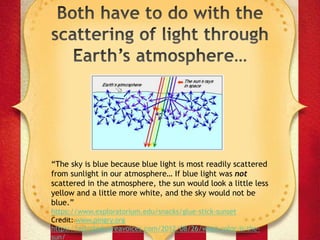
“The sky is blue because blue light is most readily scattered
from sunlight in our atmosphere… If blue light was not
scattered in the atmosphere, the sun would look a little less
yellow and a little more white, and the sky would not be
blue.”
https://www.exploratorium.edu/snacks/glue-stick-sunset
Credit: www.pingry.org
https://astrobob.areavoices.com/2012/08/26/what-color-is-the-
sun/
“At sunset the sun is low—near the horizon—and light
travels through a greater thickness of atmosphere before
reaching your eyes than it does when the sun is higher in
the sky… [T]he sunset appears red when the atmospheric
path through which the sunlight travels gets longer. ”
https://www.exploratorium.edu/snacks/glue-stick-sunset
Illustration: Bob King https://astrobob.areavoices.com/2012/08/26/what-color-is-the-sun/
WHAT COLOR IS our
sun?
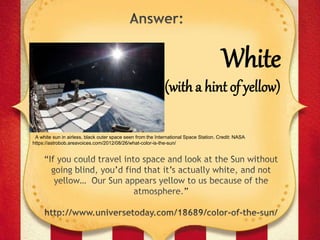
White
(with a hint of yellow)
A white sun in airless, black outer space seen from the International Space Station. Credit: NASA
https://astrobob.areavoices.com/2012/08/26/what-color-is-the-sun/
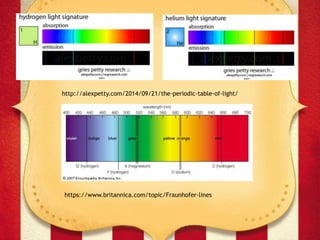
WHAT is our sun made
of?
http://alexpetty.com/2014/09/21/the-periodic-table-of-light/
https://www.britannica.com/topic/Fraunhofer-lines
Turn off lights
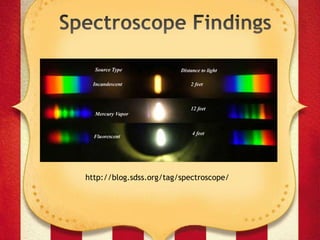
http://blog.sdss.org/tag/spectroscope/
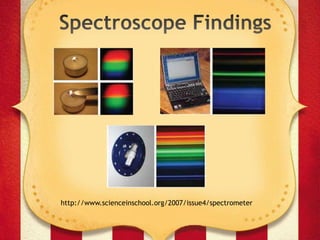
http://www.scienceinschool.org/2007/issue4/spectrometer
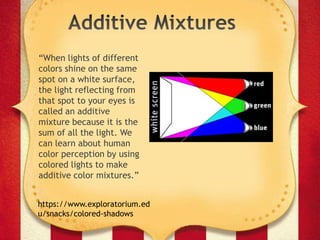
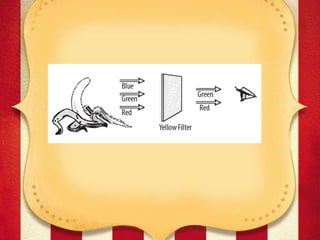
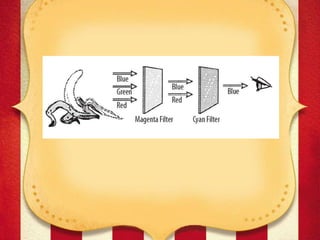
“When lights of different
colors shine on the same
spot on a white surface,
the light reflecting from
that spot to your eyes is
called an additive
mixture because it is the
sum of all the light. We
can learn about human
color perception by using
colored lights to make
additive color mixtures.”
https://www.exploratorium.ed
u/snacks/colored-shadows
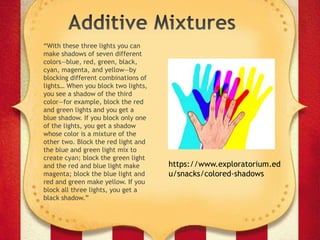
“With these three lights you can
make shadows of seven different
colors—blue, red, green, black,
cyan, magenta, and yellow—by
blocking different combinations of
lights… When you block two lights,
you see a shadow of the third
color—for example, block the red
and green lights and you get a
blue shadow. If you block only one
of the lights, you get a shadow
whose color is a mixture of the
other two. Block the red light and
the blue and green light mix to
create cyan; block the green light
and the red and blue light make
magenta; block the blue light and
red and green make yellow. If you
block all three lights, you get a
black shadow.”
https://www.exploratorium.ed
u/snacks/colored-shadows
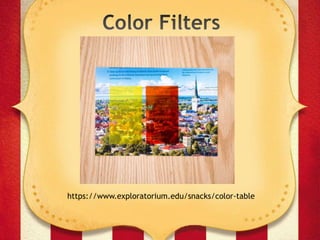
https://www.exploratorium.edu/snacks/color-table
write a secret message!
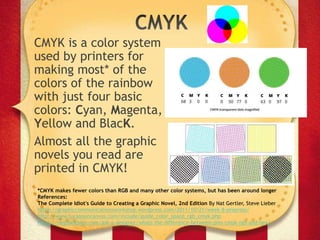
CMYK is a color system
used by printers for
making most* of the
colors of the rainbow
with just four basic
colors: Cyan, Magenta,
Yellow and BlacK.
Almost all the graphic
novels you read are
printed in CMYK!
*CMYK makes fewer colors than RGB and many other color systems, but has been around longer
References:
The Complete Idiot's Guide to Creating a Graphic Novel, 2nd Edition By Nat Gertler, Steve Lieber
https://graphiccommunicationsworkshop.wordpress.com/2011/10/21/week-8-prepress/
http://www.tucsononcanvas.com/include/guide_color_space_rgb_cmyk.php
https://negliadesign.com/ask-a-designer/whats-the-difference-between-pms-cmyk-rgb-and-hex/
Make your own cymk
rainbow!
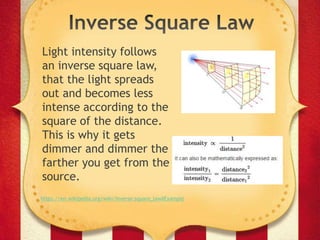
Light intensity follows
an inverse square law,
that the light spreads
out and becomes less
intense according to the
square of the distance.
This is why it gets
dimmer and dimmer the
farther you get from the
source.
https://en.wikipedia.org/wiki/Inverse-square_law#Example
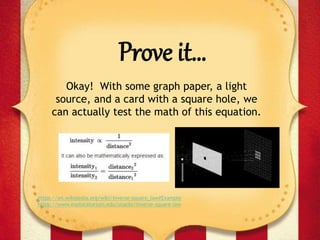
Prove it…
Okay! With some graph paper, a light
source, and a card with a square hole, we
can actually test the math of this equation.
https://en.wikipedia.org/wiki/Inverse-square_law#Example
https://www.exploratorium.edu/snacks/inverse-square-law
Be a Light Bender
Be a Light Bender

Be a Light Bender

  • 1.
    Hands-on Science atPasadena Public Library Inspired by Young Readers League selection, Circus Mirandus by Cassie Beasley November 18, 2016
  • 2.
    WHY IS THESKY BLUE?
  • 3.
    WHY IS THEsun red at sunset?
  • 4.
    “The sky isblue because blue light is most readily scattered from sunlight in our atmosphere… If blue light was not scattered in the atmosphere, the sun would look a little less yellow and a little more white, and the sky would not be blue.” https://www.exploratorium.edu/snacks/glue-stick-sunset Credit: www.pingry.org https://astrobob.areavoices.com/2012/08/26/what-color-is-the- sun/
  • 5.
    “At sunset thesun is low—near the horizon—and light travels through a greater thickness of atmosphere before reaching your eyes than it does when the sun is higher in the sky… [T]he sunset appears red when the atmospheric path through which the sunlight travels gets longer. ” https://www.exploratorium.edu/snacks/glue-stick-sunset Illustration: Bob King https://astrobob.areavoices.com/2012/08/26/what-color-is-the-sun/
  • 6.
    WHAT COLOR ISour sun?
  • 7.
    White (with a hintof yellow) A white sun in airless, black outer space seen from the International Space Station. Credit: NASA https://astrobob.areavoices.com/2012/08/26/what-color-is-the-sun/
  • 8.
    WHAT is oursun made of?
  • 9.
  • 10.
  • 11.
  • 12.
  • 13.
    “When lights ofdifferent colors shine on the same spot on a white surface, the light reflecting from that spot to your eyes is called an additive mixture because it is the sum of all the light. We can learn about human color perception by using colored lights to make additive color mixtures.” https://www.exploratorium.ed u/snacks/colored-shadows
  • 14.
    “With these threelights you can make shadows of seven different colors—blue, red, green, black, cyan, magenta, and yellow—by blocking different combinations of lights… When you block two lights, you see a shadow of the third color—for example, block the red and green lights and you get a blue shadow. If you block only one of the lights, you get a shadow whose color is a mixture of the other two. Block the red light and the blue and green light mix to create cyan; block the green light and the red and blue light make magenta; block the blue light and red and green make yellow. If you block all three lights, you get a black shadow.” https://www.exploratorium.ed u/snacks/colored-shadows
  • 15.
  • 19.
  • 20.
    CMYK is acolor system used by printers for making most* of the colors of the rainbow with just four basic colors: Cyan, Magenta, Yellow and BlacK. Almost all the graphic novels you read are printed in CMYK! *CMYK makes fewer colors than RGB and many other color systems, but has been around longer References: The Complete Idiot's Guide to Creating a Graphic Novel, 2nd Edition By Nat Gertler, Steve Lieber https://graphiccommunicationsworkshop.wordpress.com/2011/10/21/week-8-prepress/ http://www.tucsononcanvas.com/include/guide_color_space_rgb_cmyk.php https://negliadesign.com/ask-a-designer/whats-the-difference-between-pms-cmyk-rgb-and-hex/
  • 24.
    Make your owncymk rainbow!
  • 25.
    Light intensity follows aninverse square law, that the light spreads out and becomes less intense according to the square of the distance. This is why it gets dimmer and dimmer the farther you get from the source. https://en.wikipedia.org/wiki/Inverse-square_law#Example
  • 26.
    Prove it… Okay! Withsome graph paper, a light source, and a card with a square hole, we can actually test the math of this equation. https://en.wikipedia.org/wiki/Inverse-square_law#Example https://www.exploratorium.edu/snacks/inverse-square-law