INTRODUCTION IBM MQ – MONITORING BASICS IBM MQ – QUEUE MONITORING IMPROVEMENTS END REMARKS
Monitoring Payment Queues
Łukasz Lipski
IT Infrastructure Specialist, Nordea IT Polska
INTRODUCTION IBM MQ – MONITORING BASICS IBM MQ – QUEUE MONITORING IMPROVEMENTS END REMARKS
NORDEA IT POLAND
HQ in Gdynia, Poland, with 300 employees
supporting the banking systems in Latvia, Lithuania
and Estonia
providing IT services for our Nordic colleagues
in Nordea Bank AB
INTRODUCTION IBM MQ – MONITORING BASICS IBM MQ – QUEUE MONITORING IMPROVEMENTS END REMARKS
ZABBIX @ NORDEA
currently 2.4.5
350 monitored hosts, 40k items,
20k triggers and nvps below 1k
Oracle as the database backend (11.2)
primary monitoring system among others
(Oracle EM, SCOM, Dynatrace, ...)
key systems: core banking, card traffic, e-banking
INTRODUCTION IBM MQ – MONITORING BASICS IBM MQ – QUEUE MONITORING IMPROVEMENTS END REMARKS
MONITORING PAYMENT QUEUES
short talk
focusing on one product, partially applicable to others
“the most you can do with the least effort”
INTRODUCTION IBM MQ – MONITORING BASICS IBM MQ – QUEUE MONITORING IMPROVEMENTS END REMARKS
IBM MQ – INTRODUCTION
IBM’s messaging solution since 1992
the name: MQM, MQSeries, Websphere MQ,
IBM MQ since 2014
the product: largely the same for the last 20 (sic!) years
quite popular, quite reliable, a bit strange
INTRODUCTION IBM MQ – MONITORING BASICS IBM MQ – QUEUE MONITORING IMPROVEMENTS END REMARKS
BASIC STUFF
MQ filesystem space
(usually /var/mqm)
global error reports
(.FDC files under /var/mqm/errors)
Queue Manager status
and local QM error reports
status of the listener process (runmqlsr)
channel status
INTRODUCTION IBM MQ – MONITORING BASICS IBM MQ – QUEUE MONITORING IMPROVEMENTS END REMARKS
BASIC STUFF – CONT.
Queue Manager status
dspmq
echo "ping qmgr" | runmqsc QMNAME
Listener status
ps -ef | grep runmqlsr
echo "display lsstatus()" | runmqsc QMNAME
Channel status
echo "display chstatus()" | runmqsc QMNAME
INTRODUCTION IBM MQ – MONITORING BASICS IBM MQ – QUEUE MONITORING IMPROVEMENTS END REMARKS
QUEUE MONITORING – BASIC METRICS
Number of messages on queue: current depth
echo "display ql(QUEUE.NAME) curdepth" | runmqsc QMNAME
Queue capacity: max depth
echo "display ql(QUEUE.NAME) maxdepth" | runmqsc QMNAME
Combined, they give us another key health check – queue % fill.
INTRODUCTION IBM MQ – MONITORING BASICS IBM MQ – QUEUE MONITORING IMPROVEMENTS END REMARKS
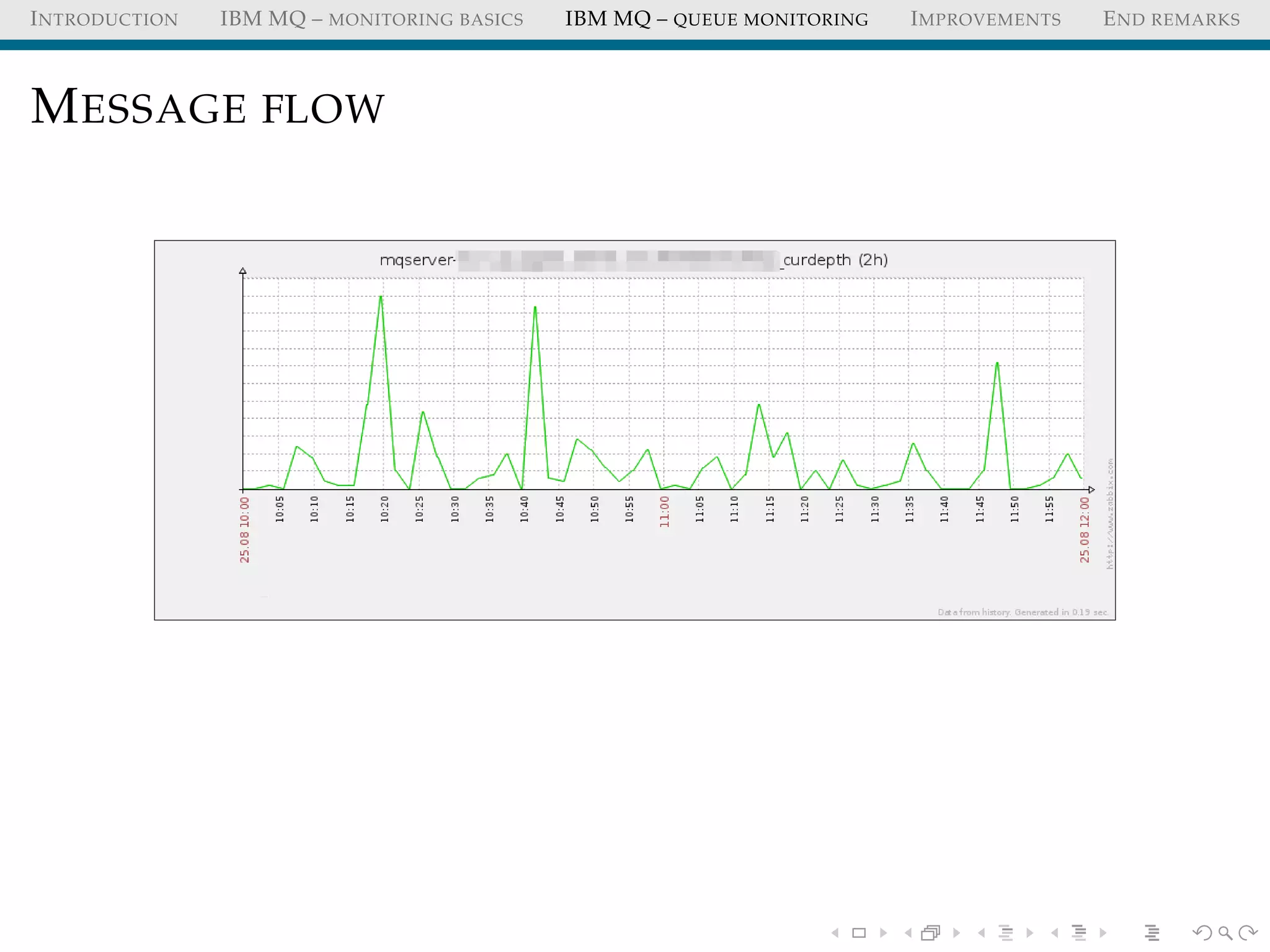
MESSAGE FLOW
INTRODUCTION IBM MQ – MONITORING BASICS IBM MQ – QUEUE MONITORING IMPROVEMENTS END REMARKS
MESSAGE FLOW
First attempt at a trigger expression:
{queue_curdepth_itemkey.min(#20)} > 0
INTRODUCTION IBM MQ – MONITORING BASICS IBM MQ – QUEUE MONITORING IMPROVEMENTS END REMARKS
MESSAGE FLOW
First attempt at a trigger expression:
{queue_curdepth_itemkey.min(#20)} > 0
This is probably going to be insufficient.
INTRODUCTION IBM MQ – MONITORING BASICS IBM MQ – QUEUE MONITORING IMPROVEMENTS END REMARKS
MESSAGE FLOW, CONTINUED
INTRODUCTION IBM MQ – MONITORING BASICS IBM MQ – QUEUE MONITORING IMPROVEMENTS END REMARKS
MESSAGE FLOW, CONTINUED
To look for the drops over a period of time, we need
to add a coupled calculated item, with the following formula:
last(queue_depth, #1) - last(queue_depth, #2)
INTRODUCTION IBM MQ – MONITORING BASICS IBM MQ – QUEUE MONITORING IMPROVEMENTS END REMARKS
MESSAGE FLOW – FINAL
Now, we can examine if the queue is being unloaded,
with this revised trigger expression:
{queue_depth.min(#20)} > 0 and {queue_depth_change.min(#20)} >= 0
INTRODUCTION IBM MQ – MONITORING BASICS IBM MQ – QUEUE MONITORING IMPROVEMENTS END REMARKS
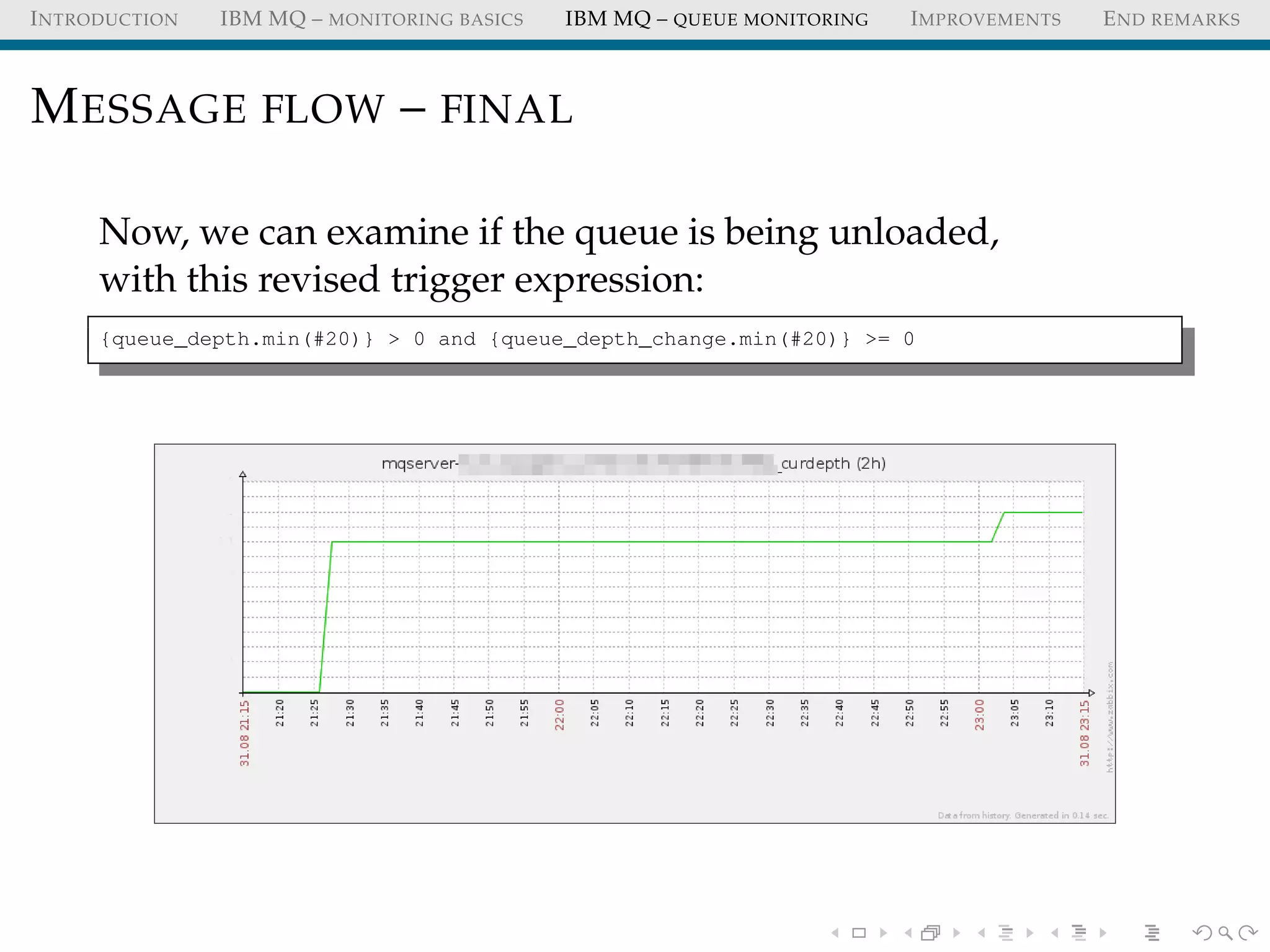
MESSAGE FLOW – FINAL
Now, we can examine if the queue is being unloaded,
with this revised trigger expression:
{queue_depth.min(#20)} > 0 and {queue_depth_change.min(#20)} >= 0
INTRODUCTION IBM MQ – MONITORING BASICS IBM MQ – QUEUE MONITORING IMPROVEMENTS END REMARKS
LOADABLE MODULES
Support for loadable modules introduced in 2.2 (2013)
Very easy to wrap around existing C code
Very easy to get started (src/modules/dummy)
Noticeable performance gains
INTRODUCTION IBM MQ – MONITORING BASICS IBM MQ – QUEUE MONITORING IMPROVEMENTS END REMARKS
...EXISTING C CODE
Look at the IBM provided samples, in this case, amqsailq.c.
/* bag for inquiry */
mqCreateBag(MQCBO_ADMIN_BAG, &adminBag, &cc, &r);
/* bag for the response */
mqCreateBag(MQCBO_ADMIN_BAG, &responseBag, &cc, &r);
/* create the inquiry by putting request items in the bag */
mqAddString(adminBag, MQCA_Q_NAME, MQBL_NULL_TERMINATED, queue, &cc, &r);
mqAddInteger(adminBag, MQIA_Q_TYPE, MQQT_LOCAL, &cc, &r);
mqAddInquiry(adminBag, MQIA_CURRENT_Q_DEPTH, &cc, &r);
/* execute the inquiry */
mqExecute(
/* needed params omitted here */
);
if (reason == MQRC_CMD_SERVER_NOT_AVAILABLE) {
MQDISC(&hConn, &cc, &r);
exit(98);
}
/* when mqExecute was successful */
if ( compCode == MQCC_OK ) {
mqInquireBag(responseBag, MQHA_BAG_HANDLE, 0, &qAttrsBag, &cc, &r);
mqInquireInteger(qAttrsBag, MQIA_CURRENT_Q_DEPTH, MQIND_NONE, &qDepth, &cc, &r);
printf("%dn", qDepth);
}
INTRODUCTION IBM MQ – MONITORING BASICS IBM MQ – QUEUE MONITORING IMPROVEMENTS END REMARKS
VERY EASY TO WRAP AROUND...
Look at the samples: zabbix−2.2.10/src/modules/dummy−orig/.
In our case, you need to add around 40 lines of code.
static ZBX_METRIC keys[] = {
{"mq.q.curdepth", CF_HAVEPARAMS, mq_q_curdepth, "ECHO"},
{NULL}
};
int mq_q_curdepth(AGENT_REQUEST *request, AGENT_RESULT *result) {
char *param;
if (request->nparam != 1) {
SET_MSG_RESULT(result, strdup("You must give the queue name as parameter"));
return SYSINFO_RET_FAIL;
}
param = get_rparam(request, 0);
// code that sets gathered_value goes here
SET_UI64_RESULT(result, gathered_value);
return SYSINFO_RET_OK;
}
INTRODUCTION IBM MQ – MONITORING BASICS IBM MQ – QUEUE MONITORING IMPROVEMENTS END REMARKS
PERFORMANCE GAINS
A simple shell script that gathers queue depth:
echo "DIS QL($1) CURDEPTH" | runmqsc | grep "[C]URDEPTH(" | grep -o ’[0-9]+’
The same thing can be (quite easily) done in C.
INTRODUCTION IBM MQ – MONITORING BASICS IBM MQ – QUEUE MONITORING IMPROVEMENTS END REMARKS
PERFORMANCE GAINS
A simple shell script that gathers queue depth:
echo "DIS QL($1) CURDEPTH" | runmqsc | grep "[C]URDEPTH(" | grep -o ’[0-9]+’
The same thing can be (quite easily) done in C.
No surprises. Wrapping it in a module is even more effective.
INTRODUCTION IBM MQ – MONITORING BASICS IBM MQ – QUEUE MONITORING IMPROVEMENTS END REMARKS
SHARE
All the code that I’ve discussed here is uploaded
to Zabbix Share – hope some of it proves useful.
https://share.zabbix.com/cat-app/queue-managers/ibm-mq-agent-module
Keep in mind that it’s written as a proof of concept,
for the purposes of this talk.
You should at least add additional error checking
after each MQI call (see the MQCONN call for an example).
INTRODUCTION IBM MQ – MONITORING BASICS IBM MQ – QUEUE MONITORING IMPROVEMENTS END REMARKS
Any questions?
INTRODUCTION IBM MQ – MONITORING BASICS IBM MQ – QUEUE MONITORING IMPROVEMENTS END REMARKS
Thank you!

Lukasz Lipski - Monitoring Payment Queues

  • 1.
    INTRODUCTION IBM MQ– MONITORING BASICS IBM MQ – QUEUE MONITORING IMPROVEMENTS END REMARKS Monitoring Payment Queues Łukasz Lipski IT Infrastructure Specialist, Nordea IT Polska
  • 2.
    INTRODUCTION IBM MQ– MONITORING BASICS IBM MQ – QUEUE MONITORING IMPROVEMENTS END REMARKS NORDEA IT POLAND HQ in Gdynia, Poland, with 300 employees supporting the banking systems in Latvia, Lithuania and Estonia providing IT services for our Nordic colleagues in Nordea Bank AB
  • 3.
    INTRODUCTION IBM MQ– MONITORING BASICS IBM MQ – QUEUE MONITORING IMPROVEMENTS END REMARKS ZABBIX @ NORDEA currently 2.4.5 350 monitored hosts, 40k items, 20k triggers and nvps below 1k Oracle as the database backend (11.2) primary monitoring system among others (Oracle EM, SCOM, Dynatrace, ...) key systems: core banking, card traffic, e-banking
  • 4.
    INTRODUCTION IBM MQ– MONITORING BASICS IBM MQ – QUEUE MONITORING IMPROVEMENTS END REMARKS MONITORING PAYMENT QUEUES short talk focusing on one product, partially applicable to others “the most you can do with the least effort”
  • 5.
    INTRODUCTION IBM MQ– MONITORING BASICS IBM MQ – QUEUE MONITORING IMPROVEMENTS END REMARKS IBM MQ – INTRODUCTION IBM’s messaging solution since 1992 the name: MQM, MQSeries, Websphere MQ, IBM MQ since 2014 the product: largely the same for the last 20 (sic!) years quite popular, quite reliable, a bit strange
  • 6.
    INTRODUCTION IBM MQ– MONITORING BASICS IBM MQ – QUEUE MONITORING IMPROVEMENTS END REMARKS BASIC STUFF MQ filesystem space (usually /var/mqm) global error reports (.FDC files under /var/mqm/errors) Queue Manager status and local QM error reports status of the listener process (runmqlsr) channel status
  • 7.
    INTRODUCTION IBM MQ– MONITORING BASICS IBM MQ – QUEUE MONITORING IMPROVEMENTS END REMARKS BASIC STUFF – CONT. Queue Manager status dspmq echo "ping qmgr" | runmqsc QMNAME Listener status ps -ef | grep runmqlsr echo "display lsstatus()" | runmqsc QMNAME Channel status echo "display chstatus()" | runmqsc QMNAME
  • 8.
    INTRODUCTION IBM MQ– MONITORING BASICS IBM MQ – QUEUE MONITORING IMPROVEMENTS END REMARKS QUEUE MONITORING – BASIC METRICS Number of messages on queue: current depth echo "display ql(QUEUE.NAME) curdepth" | runmqsc QMNAME Queue capacity: max depth echo "display ql(QUEUE.NAME) maxdepth" | runmqsc QMNAME Combined, they give us another key health check – queue % fill.
  • 9.
    INTRODUCTION IBM MQ– MONITORING BASICS IBM MQ – QUEUE MONITORING IMPROVEMENTS END REMARKS MESSAGE FLOW
  • 10.
    INTRODUCTION IBM MQ– MONITORING BASICS IBM MQ – QUEUE MONITORING IMPROVEMENTS END REMARKS MESSAGE FLOW First attempt at a trigger expression: {queue_curdepth_itemkey.min(#20)} > 0
  • 11.
    INTRODUCTION IBM MQ– MONITORING BASICS IBM MQ – QUEUE MONITORING IMPROVEMENTS END REMARKS MESSAGE FLOW First attempt at a trigger expression: {queue_curdepth_itemkey.min(#20)} > 0 This is probably going to be insufficient.
  • 12.
    INTRODUCTION IBM MQ– MONITORING BASICS IBM MQ – QUEUE MONITORING IMPROVEMENTS END REMARKS MESSAGE FLOW, CONTINUED
  • 13.
    INTRODUCTION IBM MQ– MONITORING BASICS IBM MQ – QUEUE MONITORING IMPROVEMENTS END REMARKS MESSAGE FLOW, CONTINUED To look for the drops over a period of time, we need to add a coupled calculated item, with the following formula: last(queue_depth, #1) - last(queue_depth, #2)
  • 14.
    INTRODUCTION IBM MQ– MONITORING BASICS IBM MQ – QUEUE MONITORING IMPROVEMENTS END REMARKS MESSAGE FLOW – FINAL Now, we can examine if the queue is being unloaded, with this revised trigger expression: {queue_depth.min(#20)} > 0 and {queue_depth_change.min(#20)} >= 0
  • 15.
    INTRODUCTION IBM MQ– MONITORING BASICS IBM MQ – QUEUE MONITORING IMPROVEMENTS END REMARKS MESSAGE FLOW – FINAL Now, we can examine if the queue is being unloaded, with this revised trigger expression: {queue_depth.min(#20)} > 0 and {queue_depth_change.min(#20)} >= 0
  • 16.
    INTRODUCTION IBM MQ– MONITORING BASICS IBM MQ – QUEUE MONITORING IMPROVEMENTS END REMARKS LOADABLE MODULES Support for loadable modules introduced in 2.2 (2013) Very easy to wrap around existing C code Very easy to get started (src/modules/dummy) Noticeable performance gains
  • 17.
    INTRODUCTION IBM MQ– MONITORING BASICS IBM MQ – QUEUE MONITORING IMPROVEMENTS END REMARKS ...EXISTING C CODE Look at the IBM provided samples, in this case, amqsailq.c. /* bag for inquiry */ mqCreateBag(MQCBO_ADMIN_BAG, &adminBag, &cc, &r); /* bag for the response */ mqCreateBag(MQCBO_ADMIN_BAG, &responseBag, &cc, &r); /* create the inquiry by putting request items in the bag */ mqAddString(adminBag, MQCA_Q_NAME, MQBL_NULL_TERMINATED, queue, &cc, &r); mqAddInteger(adminBag, MQIA_Q_TYPE, MQQT_LOCAL, &cc, &r); mqAddInquiry(adminBag, MQIA_CURRENT_Q_DEPTH, &cc, &r); /* execute the inquiry */ mqExecute( /* needed params omitted here */ ); if (reason == MQRC_CMD_SERVER_NOT_AVAILABLE) { MQDISC(&hConn, &cc, &r); exit(98); } /* when mqExecute was successful */ if ( compCode == MQCC_OK ) { mqInquireBag(responseBag, MQHA_BAG_HANDLE, 0, &qAttrsBag, &cc, &r); mqInquireInteger(qAttrsBag, MQIA_CURRENT_Q_DEPTH, MQIND_NONE, &qDepth, &cc, &r); printf("%dn", qDepth); }
  • 18.
    INTRODUCTION IBM MQ– MONITORING BASICS IBM MQ – QUEUE MONITORING IMPROVEMENTS END REMARKS VERY EASY TO WRAP AROUND... Look at the samples: zabbix−2.2.10/src/modules/dummy−orig/. In our case, you need to add around 40 lines of code. static ZBX_METRIC keys[] = { {"mq.q.curdepth", CF_HAVEPARAMS, mq_q_curdepth, "ECHO"}, {NULL} }; int mq_q_curdepth(AGENT_REQUEST *request, AGENT_RESULT *result) { char *param; if (request->nparam != 1) { SET_MSG_RESULT(result, strdup("You must give the queue name as parameter")); return SYSINFO_RET_FAIL; } param = get_rparam(request, 0); // code that sets gathered_value goes here SET_UI64_RESULT(result, gathered_value); return SYSINFO_RET_OK; }
  • 19.
    INTRODUCTION IBM MQ– MONITORING BASICS IBM MQ – QUEUE MONITORING IMPROVEMENTS END REMARKS PERFORMANCE GAINS A simple shell script that gathers queue depth: echo "DIS QL($1) CURDEPTH" | runmqsc | grep "[C]URDEPTH(" | grep -o ’[0-9]+’ The same thing can be (quite easily) done in C.
  • 20.
    INTRODUCTION IBM MQ– MONITORING BASICS IBM MQ – QUEUE MONITORING IMPROVEMENTS END REMARKS PERFORMANCE GAINS A simple shell script that gathers queue depth: echo "DIS QL($1) CURDEPTH" | runmqsc | grep "[C]URDEPTH(" | grep -o ’[0-9]+’ The same thing can be (quite easily) done in C. No surprises. Wrapping it in a module is even more effective.
  • 21.
    INTRODUCTION IBM MQ– MONITORING BASICS IBM MQ – QUEUE MONITORING IMPROVEMENTS END REMARKS SHARE All the code that I’ve discussed here is uploaded to Zabbix Share – hope some of it proves useful. https://share.zabbix.com/cat-app/queue-managers/ibm-mq-agent-module Keep in mind that it’s written as a proof of concept, for the purposes of this talk. You should at least add additional error checking after each MQI call (see the MQCONN call for an example).
  • 22.
    INTRODUCTION IBM MQ– MONITORING BASICS IBM MQ – QUEUE MONITORING IMPROVEMENTS END REMARKS Any questions?
  • 23.
    INTRODUCTION IBM MQ– MONITORING BASICS IBM MQ – QUEUE MONITORING IMPROVEMENTS END REMARKS Thank you!